EP0697279B1 - Aluminum alloy sheet having excellent press formability and spot weldability - Google Patents
Aluminum alloy sheet having excellent press formability and spot weldability Download PDFInfo
- Publication number
- EP0697279B1 EP0697279B1 EP95112959A EP95112959A EP0697279B1 EP 0697279 B1 EP0697279 B1 EP 0697279B1 EP 95112959 A EP95112959 A EP 95112959A EP 95112959 A EP95112959 A EP 95112959A EP 0697279 B1 EP0697279 B1 EP 0697279B1
- Authority
- EP
- European Patent Office
- Prior art keywords
- aluminum alloy
- alloy sheet
- organic
- film
- resin
- Prior art date
- Legal status (The legal status is an assumption and is not a legal conclusion. Google has not performed a legal analysis and makes no representation as to the accuracy of the status listed.)
- Expired - Lifetime
Links
- 229910000838 Al alloy Inorganic materials 0.000 title claims description 92
- 229920005989 resin Polymers 0.000 claims description 68
- 239000011347 resin Substances 0.000 claims description 68
- ZCDOYSPFYFSLEW-UHFFFAOYSA-N chromate(2-) Chemical compound [O-][Cr]([O-])(=O)=O ZCDOYSPFYFSLEW-UHFFFAOYSA-N 0.000 claims description 52
- 239000000314 lubricant Substances 0.000 claims description 50
- VYZAMTAEIAYCRO-UHFFFAOYSA-N Chromium Chemical compound [Cr] VYZAMTAEIAYCRO-UHFFFAOYSA-N 0.000 claims description 11
- 229910052804 chromium Inorganic materials 0.000 claims description 9
- 239000011651 chromium Substances 0.000 claims description 9
- 238000002844 melting Methods 0.000 claims description 9
- 230000008018 melting Effects 0.000 claims description 9
- 229920001903 high density polyethylene Polymers 0.000 claims description 4
- 239000004700 high-density polyethylene Substances 0.000 claims description 4
- 238000011282 treatment Methods 0.000 description 50
- 238000000576 coating method Methods 0.000 description 44
- 239000011248 coating agent Substances 0.000 description 34
- 238000000034 method Methods 0.000 description 21
- 239000001993 wax Substances 0.000 description 20
- 230000001050 lubricating effect Effects 0.000 description 19
- 238000003466 welding Methods 0.000 description 17
- 238000005530 etching Methods 0.000 description 13
- 229910000831 Steel Inorganic materials 0.000 description 12
- -1 polyethylene Polymers 0.000 description 12
- 239000010959 steel Substances 0.000 description 12
- 238000012360 testing method Methods 0.000 description 10
- HEMHJVSKTPXQMS-UHFFFAOYSA-M Sodium hydroxide Chemical compound [OH-].[Na+] HEMHJVSKTPXQMS-UHFFFAOYSA-M 0.000 description 9
- 229910045601 alloy Inorganic materials 0.000 description 9
- 239000000956 alloy Substances 0.000 description 9
- 239000010410 layer Substances 0.000 description 9
- 239000000126 substance Substances 0.000 description 9
- KRHYYFGTRYWZRS-UHFFFAOYSA-N Fluorane Chemical compound F KRHYYFGTRYWZRS-UHFFFAOYSA-N 0.000 description 8
- NBIIXXVUZAFLBC-UHFFFAOYSA-N Phosphoric acid Chemical compound OP(O)(O)=O NBIIXXVUZAFLBC-UHFFFAOYSA-N 0.000 description 8
- 239000004698 Polyethylene Substances 0.000 description 8
- 239000000463 material Substances 0.000 description 8
- 229920000573 polyethylene Polymers 0.000 description 8
- 230000003746 surface roughness Effects 0.000 description 8
- 229910052782 aluminium Inorganic materials 0.000 description 7
- XAGFODPZIPBFFR-UHFFFAOYSA-N aluminium Chemical compound [Al] XAGFODPZIPBFFR-UHFFFAOYSA-N 0.000 description 7
- 238000006757 chemical reactions by type Methods 0.000 description 7
- 230000007797 corrosion Effects 0.000 description 7
- 238000005260 corrosion Methods 0.000 description 7
- 239000000203 mixture Substances 0.000 description 7
- 239000003921 oil Substances 0.000 description 7
- 238000005238 degreasing Methods 0.000 description 6
- 238000004070 electrodeposition Methods 0.000 description 6
- 238000011156 evaluation Methods 0.000 description 6
- 230000002829 reductive effect Effects 0.000 description 6
- CPLXHLVBOLITMK-UHFFFAOYSA-N Magnesium oxide Chemical compound [Mg]=O CPLXHLVBOLITMK-UHFFFAOYSA-N 0.000 description 5
- VYPSYNLAJGMNEJ-UHFFFAOYSA-N Silicium dioxide Chemical compound O=[Si]=O VYPSYNLAJGMNEJ-UHFFFAOYSA-N 0.000 description 5
- 239000002253 acid Substances 0.000 description 5
- 239000007864 aqueous solution Substances 0.000 description 5
- 238000004519 manufacturing process Methods 0.000 description 5
- 239000002245 particle Substances 0.000 description 5
- LRXTYHSAJDENHV-UHFFFAOYSA-H zinc phosphate Chemical compound [Zn+2].[Zn+2].[Zn+2].[O-]P([O-])([O-])=O.[O-]P([O-])([O-])=O LRXTYHSAJDENHV-UHFFFAOYSA-H 0.000 description 5
- 229910000165 zinc phosphate Inorganic materials 0.000 description 5
- 239000004925 Acrylic resin Substances 0.000 description 4
- 229920000178 Acrylic resin Polymers 0.000 description 4
- GRYLNZFGIOXLOG-UHFFFAOYSA-N Nitric acid Chemical compound O[N+]([O-])=O GRYLNZFGIOXLOG-UHFFFAOYSA-N 0.000 description 4
- QAOWNCQODCNURD-UHFFFAOYSA-N Sulfuric acid Chemical compound OS(O)(=O)=O QAOWNCQODCNURD-UHFFFAOYSA-N 0.000 description 4
- 229920006362 Teflon® Polymers 0.000 description 4
- 239000000654 additive Substances 0.000 description 4
- 229910000147 aluminium phosphate Inorganic materials 0.000 description 4
- 239000003822 epoxy resin Substances 0.000 description 4
- 229910017604 nitric acid Inorganic materials 0.000 description 4
- 238000005554 pickling Methods 0.000 description 4
- 239000000049 pigment Substances 0.000 description 4
- 229920000647 polyepoxide Polymers 0.000 description 4
- 229920002803 thermoplastic polyurethane Polymers 0.000 description 4
- OKTJSMMVPCPJKN-UHFFFAOYSA-N Carbon Chemical compound [C] OKTJSMMVPCPJKN-UHFFFAOYSA-N 0.000 description 3
- YCKRFDGAMUMZLT-UHFFFAOYSA-N Fluorine atom Chemical compound [F] YCKRFDGAMUMZLT-UHFFFAOYSA-N 0.000 description 3
- KWYUFKZDYYNOTN-UHFFFAOYSA-M Potassium hydroxide Chemical compound [OH-].[K+] KWYUFKZDYYNOTN-UHFFFAOYSA-M 0.000 description 3
- 239000004809 Teflon Substances 0.000 description 3
- 238000002441 X-ray diffraction Methods 0.000 description 3
- 230000002411 adverse Effects 0.000 description 3
- PNEYBMLMFCGWSK-UHFFFAOYSA-N aluminium oxide Inorganic materials [O-2].[O-2].[O-2].[Al+3].[Al+3] PNEYBMLMFCGWSK-UHFFFAOYSA-N 0.000 description 3
- 229910052799 carbon Inorganic materials 0.000 description 3
- 239000003795 chemical substances by application Substances 0.000 description 3
- KRVSOGSZCMJSLX-UHFFFAOYSA-L chromic acid Substances O[Cr](O)(=O)=O KRVSOGSZCMJSLX-UHFFFAOYSA-L 0.000 description 3
- 239000011737 fluorine Substances 0.000 description 3
- 229910052731 fluorine Inorganic materials 0.000 description 3
- 238000007654 immersion Methods 0.000 description 3
- 230000006872 improvement Effects 0.000 description 3
- VAKIVKMUBMZANL-UHFFFAOYSA-N iron phosphide Chemical compound P.[Fe].[Fe].[Fe] VAKIVKMUBMZANL-UHFFFAOYSA-N 0.000 description 3
- 239000007788 liquid Substances 0.000 description 3
- 239000004645 polyester resin Substances 0.000 description 3
- 229920001225 polyester resin Polymers 0.000 description 3
- 230000008569 process Effects 0.000 description 3
- 235000011121 sodium hydroxide Nutrition 0.000 description 3
- 239000000243 solution Substances 0.000 description 3
- XLYOFNOQVPJJNP-UHFFFAOYSA-N water Substances O XLYOFNOQVPJJNP-UHFFFAOYSA-N 0.000 description 3
- XEEYBQQBJWHFJM-UHFFFAOYSA-N Iron Chemical compound [Fe] XEEYBQQBJWHFJM-UHFFFAOYSA-N 0.000 description 2
- 239000004743 Polypropylene Substances 0.000 description 2
- 239000012670 alkaline solution Substances 0.000 description 2
- 239000004411 aluminium Substances 0.000 description 2
- 150000001768 cations Chemical class 0.000 description 2
- 230000008859 change Effects 0.000 description 2
- 230000000052 comparative effect Effects 0.000 description 2
- 230000006866 deterioration Effects 0.000 description 2
- WMYWOWFOOVUPFY-UHFFFAOYSA-L dihydroxy(dioxo)chromium;phosphoric acid Chemical compound OP(O)(O)=O.O[Cr](O)(=O)=O WMYWOWFOOVUPFY-UHFFFAOYSA-L 0.000 description 2
- 238000004090 dissolution Methods 0.000 description 2
- 230000000694 effects Effects 0.000 description 2
- AWJWCTOOIBYHON-UHFFFAOYSA-N furo[3,4-b]pyrazine-5,7-dione Chemical compound C1=CN=C2C(=O)OC(=O)C2=N1 AWJWCTOOIBYHON-UHFFFAOYSA-N 0.000 description 2
- JEIPFZHSYJVQDO-UHFFFAOYSA-N iron(III) oxide Inorganic materials O=[Fe]O[Fe]=O JEIPFZHSYJVQDO-UHFFFAOYSA-N 0.000 description 2
- 230000000670 limiting effect Effects 0.000 description 2
- 239000000395 magnesium oxide Substances 0.000 description 2
- 239000005011 phenolic resin Substances 0.000 description 2
- 229920002037 poly(vinyl butyral) polymer Polymers 0.000 description 2
- 229920001155 polypropylene Polymers 0.000 description 2
- 238000003825 pressing Methods 0.000 description 2
- 150000003839 salts Chemical class 0.000 description 2
- 239000000377 silicon dioxide Substances 0.000 description 2
- 239000002904 solvent Substances 0.000 description 2
- 239000000758 substrate Substances 0.000 description 2
- XOLBLPGZBRYERU-UHFFFAOYSA-N tin dioxide Chemical compound O=[Sn]=O XOLBLPGZBRYERU-UHFFFAOYSA-N 0.000 description 2
- 229910001887 tin oxide Inorganic materials 0.000 description 2
- KUBDPQJOLOUJRM-UHFFFAOYSA-N 2-(chloromethyl)oxirane;4-[2-(4-hydroxyphenyl)propan-2-yl]phenol Chemical compound ClCC1CO1.C=1C=C(O)C=CC=1C(C)(C)C1=CC=C(O)C=C1 KUBDPQJOLOUJRM-UHFFFAOYSA-N 0.000 description 1
- 229910018134 Al-Mg Inorganic materials 0.000 description 1
- 229910018467 Al—Mg Inorganic materials 0.000 description 1
- 239000004215 Carbon black (E152) Substances 0.000 description 1
- BVKZGUZCCUSVTD-UHFFFAOYSA-L Carbonate Chemical compound [O-]C([O-])=O BVKZGUZCCUSVTD-UHFFFAOYSA-L 0.000 description 1
- 229910001018 Cast iron Inorganic materials 0.000 description 1
- 239000004593 Epoxy Substances 0.000 description 1
- 239000004606 Fillers/Extenders Substances 0.000 description 1
- FYYHWMGAXLPEAU-UHFFFAOYSA-N Magnesium Chemical compound [Mg] FYYHWMGAXLPEAU-UHFFFAOYSA-N 0.000 description 1
- 239000004640 Melamine resin Substances 0.000 description 1
- 229920000877 Melamine resin Polymers 0.000 description 1
- BPQQTUXANYXVAA-UHFFFAOYSA-N Orthosilicate Chemical compound [O-][Si]([O-])([O-])[O-] BPQQTUXANYXVAA-UHFFFAOYSA-N 0.000 description 1
- 229910019142 PO4 Inorganic materials 0.000 description 1
- 239000002033 PVDF binder Substances 0.000 description 1
- 229920006361 Polyflon Polymers 0.000 description 1
- 229920000297 Rayon Polymers 0.000 description 1
- GWEVSGVZZGPLCZ-UHFFFAOYSA-N Titan oxide Chemical compound O=[Ti]=O GWEVSGVZZGPLCZ-UHFFFAOYSA-N 0.000 description 1
- HCHKCACWOHOZIP-UHFFFAOYSA-N Zinc Chemical compound [Zn] HCHKCACWOHOZIP-UHFFFAOYSA-N 0.000 description 1
- 229920000180 alkyd Polymers 0.000 description 1
- 239000012164 animal wax Substances 0.000 description 1
- 238000000137 annealing Methods 0.000 description 1
- QVGXLLKOCUKJST-UHFFFAOYSA-N atomic oxygen Chemical compound [O] QVGXLLKOCUKJST-UHFFFAOYSA-N 0.000 description 1
- 239000010953 base metal Substances 0.000 description 1
- 230000009286 beneficial effect Effects 0.000 description 1
- 230000008901 benefit Effects 0.000 description 1
- 230000015572 biosynthetic process Effects 0.000 description 1
- QHIWVLPBUQWDMQ-UHFFFAOYSA-N butyl prop-2-enoate;methyl 2-methylprop-2-enoate;prop-2-enoic acid Chemical compound OC(=O)C=C.COC(=O)C(C)=C.CCCCOC(=O)C=C QHIWVLPBUQWDMQ-UHFFFAOYSA-N 0.000 description 1
- CJZGTCYPCWQAJB-UHFFFAOYSA-L calcium stearate Chemical compound [Ca+2].CCCCCCCCCCCCCCCCCC([O-])=O.CCCCCCCCCCCCCCCCCC([O-])=O CJZGTCYPCWQAJB-UHFFFAOYSA-L 0.000 description 1
- 235000013539 calcium stearate Nutrition 0.000 description 1
- 239000008116 calcium stearate Substances 0.000 description 1
- 239000006229 carbon black Substances 0.000 description 1
- 238000006243 chemical reaction Methods 0.000 description 1
- 229910052593 corundum Inorganic materials 0.000 description 1
- 230000007423 decrease Effects 0.000 description 1
- 230000000593 degrading effect Effects 0.000 description 1
- KHEMNHQQEMAABL-UHFFFAOYSA-J dihydroxy(dioxo)chromium Chemical compound O[Cr](O)(=O)=O.O[Cr](O)(=O)=O KHEMNHQQEMAABL-UHFFFAOYSA-J 0.000 description 1
- 238000003618 dip coating Methods 0.000 description 1
- 239000006185 dispersion Substances 0.000 description 1
- 230000007613 environmental effect Effects 0.000 description 1
- 239000007888 film coating Substances 0.000 description 1
- 238000009501 film coating Methods 0.000 description 1
- LNEPOXFFQSENCJ-UHFFFAOYSA-N haloperidol Chemical compound C1CC(O)(C=2C=CC(Cl)=CC=2)CCN1CCCC(=O)C1=CC=C(F)C=C1 LNEPOXFFQSENCJ-UHFFFAOYSA-N 0.000 description 1
- 229930195733 hydrocarbon Natural products 0.000 description 1
- 150000002430 hydrocarbons Chemical class 0.000 description 1
- 230000002401 inhibitory effect Effects 0.000 description 1
- 239000011229 interlayer Substances 0.000 description 1
- 229910052742 iron Inorganic materials 0.000 description 1
- 239000011777 magnesium Substances 0.000 description 1
- 229910052749 magnesium Inorganic materials 0.000 description 1
- 238000012423 maintenance Methods 0.000 description 1
- 238000005259 measurement Methods 0.000 description 1
- 230000007246 mechanism Effects 0.000 description 1
- 239000000155 melt Substances 0.000 description 1
- 229910052751 metal Inorganic materials 0.000 description 1
- 239000002184 metal Substances 0.000 description 1
- YLGXILFCIXHCMC-JHGZEJCSSA-N methyl cellulose Chemical compound COC1C(OC)C(OC)C(COC)O[C@H]1O[C@H]1C(OC)C(OC)C(OC)OC1COC YLGXILFCIXHCMC-JHGZEJCSSA-N 0.000 description 1
- 239000004200 microcrystalline wax Substances 0.000 description 1
- 235000019808 microcrystalline wax Nutrition 0.000 description 1
- 229940114937 microcrystalline wax Drugs 0.000 description 1
- 239000012184 mineral wax Substances 0.000 description 1
- 239000011259 mixed solution Substances 0.000 description 1
- 238000002156 mixing Methods 0.000 description 1
- 230000004048 modification Effects 0.000 description 1
- 238000012986 modification Methods 0.000 description 1
- 239000012170 montan wax Substances 0.000 description 1
- 230000003647 oxidation Effects 0.000 description 1
- 238000007254 oxidation reaction Methods 0.000 description 1
- 239000001301 oxygen Substances 0.000 description 1
- 229910052760 oxygen Inorganic materials 0.000 description 1
- 238000010422 painting Methods 0.000 description 1
- 239000012188 paraffin wax Substances 0.000 description 1
- 239000012169 petroleum derived wax Substances 0.000 description 1
- 235000019381 petroleum wax Nutrition 0.000 description 1
- NBIIXXVUZAFLBC-UHFFFAOYSA-K phosphate Chemical compound [O-]P([O-])([O-])=O NBIIXXVUZAFLBC-UHFFFAOYSA-K 0.000 description 1
- 239000010452 phosphate Substances 0.000 description 1
- 239000012165 plant wax Substances 0.000 description 1
- 229920000642 polymer Polymers 0.000 description 1
- 229920002620 polyvinyl fluoride Polymers 0.000 description 1
- 229920002981 polyvinylidene fluoride Polymers 0.000 description 1
- 235000011118 potassium hydroxide Nutrition 0.000 description 1
- 239000000843 powder Substances 0.000 description 1
- 230000003449 preventive effect Effects 0.000 description 1
- 230000009467 reduction Effects 0.000 description 1
- 238000005096 rolling process Methods 0.000 description 1
- 229910052710 silicon Inorganic materials 0.000 description 1
- 239000010703 silicon Substances 0.000 description 1
- 239000007787 solid Substances 0.000 description 1
- 238000005507 spraying Methods 0.000 description 1
- 239000003381 stabilizer Substances 0.000 description 1
- 230000008961 swelling Effects 0.000 description 1
- 229920003002 synthetic resin Polymers 0.000 description 1
- 239000000057 synthetic resin Substances 0.000 description 1
- OGIDPMRJRNCKJF-UHFFFAOYSA-N titanium oxide Inorganic materials [Ti]=O OGIDPMRJRNCKJF-UHFFFAOYSA-N 0.000 description 1
- 150000003657 tungsten Chemical class 0.000 description 1
- 150000003673 urethanes Chemical class 0.000 description 1
- 229910001845 yogo sapphire Inorganic materials 0.000 description 1
- 150000003751 zinc Chemical class 0.000 description 1
- 229910052725 zinc Inorganic materials 0.000 description 1
- 239000011701 zinc Substances 0.000 description 1
Classifications
-
- B—PERFORMING OPERATIONS; TRANSPORTING
- B05—SPRAYING OR ATOMISING IN GENERAL; APPLYING FLUENT MATERIALS TO SURFACES, IN GENERAL
- B05D—PROCESSES FOR APPLYING FLUENT MATERIALS TO SURFACES, IN GENERAL
- B05D7/00—Processes, other than flocking, specially adapted for applying liquids or other fluent materials to particular surfaces or for applying particular liquids or other fluent materials
- B05D7/50—Multilayers
- B05D7/51—One specific pretreatment, e.g. phosphatation, chromatation, in combination with one specific coating
-
- B—PERFORMING OPERATIONS; TRANSPORTING
- B05—SPRAYING OR ATOMISING IN GENERAL; APPLYING FLUENT MATERIALS TO SURFACES, IN GENERAL
- B05D—PROCESSES FOR APPLYING FLUENT MATERIALS TO SURFACES, IN GENERAL
- B05D7/00—Processes, other than flocking, specially adapted for applying liquids or other fluent materials to particular surfaces or for applying particular liquids or other fluent materials
- B05D7/14—Processes, other than flocking, specially adapted for applying liquids or other fluent materials to particular surfaces or for applying particular liquids or other fluent materials to metal, e.g. car bodies
-
- B—PERFORMING OPERATIONS; TRANSPORTING
- B05—SPRAYING OR ATOMISING IN GENERAL; APPLYING FLUENT MATERIALS TO SURFACES, IN GENERAL
- B05D—PROCESSES FOR APPLYING FLUENT MATERIALS TO SURFACES, IN GENERAL
- B05D7/00—Processes, other than flocking, specially adapted for applying liquids or other fluent materials to particular surfaces or for applying particular liquids or other fluent materials
- B05D7/50—Multilayers
- B05D7/52—Two layers
- B05D7/54—No clear coat specified
- B05D7/548—No curing step for the last layer
- B05D7/5483—No curing step for any layer
-
- C—CHEMISTRY; METALLURGY
- C09—DYES; PAINTS; POLISHES; NATURAL RESINS; ADHESIVES; COMPOSITIONS NOT OTHERWISE PROVIDED FOR; APPLICATIONS OF MATERIALS NOT OTHERWISE PROVIDED FOR
- C09D—COATING COMPOSITIONS, e.g. PAINTS, VARNISHES OR LACQUERS; FILLING PASTES; CHEMICAL PAINT OR INK REMOVERS; INKS; CORRECTING FLUIDS; WOODSTAINS; PASTES OR SOLIDS FOR COLOURING OR PRINTING; USE OF MATERIALS THEREFOR
- C09D201/00—Coating compositions based on unspecified macromolecular compounds
-
- C—CHEMISTRY; METALLURGY
- C23—COATING METALLIC MATERIAL; COATING MATERIAL WITH METALLIC MATERIAL; CHEMICAL SURFACE TREATMENT; DIFFUSION TREATMENT OF METALLIC MATERIAL; COATING BY VACUUM EVAPORATION, BY SPUTTERING, BY ION IMPLANTATION OR BY CHEMICAL VAPOUR DEPOSITION, IN GENERAL; INHIBITING CORROSION OF METALLIC MATERIAL OR INCRUSTATION IN GENERAL
- C23C—COATING METALLIC MATERIAL; COATING MATERIAL WITH METALLIC MATERIAL; SURFACE TREATMENT OF METALLIC MATERIAL BY DIFFUSION INTO THE SURFACE, BY CHEMICAL CONVERSION OR SUBSTITUTION; COATING BY VACUUM EVAPORATION, BY SPUTTERING, BY ION IMPLANTATION OR BY CHEMICAL VAPOUR DEPOSITION, IN GENERAL
- C23C28/00—Coating for obtaining at least two superposed coatings either by methods not provided for in a single one of groups C23C2/00 - C23C26/00 or by combinations of methods provided for in subclasses C23C and C25C or C25D
- C23C28/02—Coating for obtaining at least two superposed coatings either by methods not provided for in a single one of groups C23C2/00 - C23C26/00 or by combinations of methods provided for in subclasses C23C and C25C or C25D only coatings only including layers of metallic material
- C23C28/023—Coating for obtaining at least two superposed coatings either by methods not provided for in a single one of groups C23C2/00 - C23C26/00 or by combinations of methods provided for in subclasses C23C and C25C or C25D only coatings only including layers of metallic material only coatings of metal elements only
-
- C—CHEMISTRY; METALLURGY
- C23—COATING METALLIC MATERIAL; COATING MATERIAL WITH METALLIC MATERIAL; CHEMICAL SURFACE TREATMENT; DIFFUSION TREATMENT OF METALLIC MATERIAL; COATING BY VACUUM EVAPORATION, BY SPUTTERING, BY ION IMPLANTATION OR BY CHEMICAL VAPOUR DEPOSITION, IN GENERAL; INHIBITING CORROSION OF METALLIC MATERIAL OR INCRUSTATION IN GENERAL
- C23C—COATING METALLIC MATERIAL; COATING MATERIAL WITH METALLIC MATERIAL; SURFACE TREATMENT OF METALLIC MATERIAL BY DIFFUSION INTO THE SURFACE, BY CHEMICAL CONVERSION OR SUBSTITUTION; COATING BY VACUUM EVAPORATION, BY SPUTTERING, BY ION IMPLANTATION OR BY CHEMICAL VAPOUR DEPOSITION, IN GENERAL
- C23C28/00—Coating for obtaining at least two superposed coatings either by methods not provided for in a single one of groups C23C2/00 - C23C26/00 or by combinations of methods provided for in subclasses C23C and C25C or C25D
- C23C28/30—Coatings combining at least one metallic layer and at least one inorganic non-metallic layer
- C23C28/32—Coatings combining at least one metallic layer and at least one inorganic non-metallic layer including at least one pure metallic layer
- C23C28/321—Coatings combining at least one metallic layer and at least one inorganic non-metallic layer including at least one pure metallic layer with at least one metal alloy layer
-
- C—CHEMISTRY; METALLURGY
- C23—COATING METALLIC MATERIAL; COATING MATERIAL WITH METALLIC MATERIAL; CHEMICAL SURFACE TREATMENT; DIFFUSION TREATMENT OF METALLIC MATERIAL; COATING BY VACUUM EVAPORATION, BY SPUTTERING, BY ION IMPLANTATION OR BY CHEMICAL VAPOUR DEPOSITION, IN GENERAL; INHIBITING CORROSION OF METALLIC MATERIAL OR INCRUSTATION IN GENERAL
- C23C—COATING METALLIC MATERIAL; COATING MATERIAL WITH METALLIC MATERIAL; SURFACE TREATMENT OF METALLIC MATERIAL BY DIFFUSION INTO THE SURFACE, BY CHEMICAL CONVERSION OR SUBSTITUTION; COATING BY VACUUM EVAPORATION, BY SPUTTERING, BY ION IMPLANTATION OR BY CHEMICAL VAPOUR DEPOSITION, IN GENERAL
- C23C28/00—Coating for obtaining at least two superposed coatings either by methods not provided for in a single one of groups C23C2/00 - C23C26/00 or by combinations of methods provided for in subclasses C23C and C25C or C25D
- C23C28/30—Coatings combining at least one metallic layer and at least one inorganic non-metallic layer
- C23C28/34—Coatings combining at least one metallic layer and at least one inorganic non-metallic layer including at least one inorganic non-metallic material layer, e.g. metal carbide, nitride, boride, silicide layer and their mixtures, enamels, phosphates and sulphates
- C23C28/345—Coatings combining at least one metallic layer and at least one inorganic non-metallic layer including at least one inorganic non-metallic material layer, e.g. metal carbide, nitride, boride, silicide layer and their mixtures, enamels, phosphates and sulphates with at least one oxide layer
-
- B—PERFORMING OPERATIONS; TRANSPORTING
- B05—SPRAYING OR ATOMISING IN GENERAL; APPLYING FLUENT MATERIALS TO SURFACES, IN GENERAL
- B05D—PROCESSES FOR APPLYING FLUENT MATERIALS TO SURFACES, IN GENERAL
- B05D2202/00—Metallic substrate
- B05D2202/20—Metallic substrate based on light metals
- B05D2202/25—Metallic substrate based on light metals based on Al
-
- Y—GENERAL TAGGING OF NEW TECHNOLOGICAL DEVELOPMENTS; GENERAL TAGGING OF CROSS-SECTIONAL TECHNOLOGIES SPANNING OVER SEVERAL SECTIONS OF THE IPC; TECHNICAL SUBJECTS COVERED BY FORMER USPC CROSS-REFERENCE ART COLLECTIONS [XRACs] AND DIGESTS
- Y10—TECHNICAL SUBJECTS COVERED BY FORMER USPC
- Y10T—TECHNICAL SUBJECTS COVERED BY FORMER US CLASSIFICATION
- Y10T428/00—Stock material or miscellaneous articles
- Y10T428/31504—Composite [nonstructural laminate]
- Y10T428/31678—Of metal
-
- Y—GENERAL TAGGING OF NEW TECHNOLOGICAL DEVELOPMENTS; GENERAL TAGGING OF CROSS-SECTIONAL TECHNOLOGIES SPANNING OVER SEVERAL SECTIONS OF THE IPC; TECHNICAL SUBJECTS COVERED BY FORMER USPC CROSS-REFERENCE ART COLLECTIONS [XRACs] AND DIGESTS
- Y10—TECHNICAL SUBJECTS COVERED BY FORMER USPC
- Y10T—TECHNICAL SUBJECTS COVERED BY FORMER US CLASSIFICATION
- Y10T428/00—Stock material or miscellaneous articles
- Y10T428/31504—Composite [nonstructural laminate]
- Y10T428/31678—Of metal
- Y10T428/31692—Next to addition polymer from unsaturated monomers
Definitions
- the present invention relates to an organic resin-treated aluminum alloy sheet, suitable for automobile body applications, which combines excellent spot weldability and press formability.
- the poor formability of conventional aluminum alloy sheet results from poor ductility of the base aluminum alloy sheet, the strong affinity of aluminum alloy sheet for cast iron or other materials commonly used in pressing dies (due to the low melting point and softness of aluminum), and higher friction coefficient caused by adherence to the die.
- the use of aluminum alloy sheet shortens spot-welding electrode life as compared to steel sheet, thereby reducing production efficiency of the automobile body. That is, spot welding of aluminum alloy sheet sharply decreases the number of acceptably strong welding spots that one electrode can produce without undergoing maintenance and/or being replaced. Thus, production efficiency is markedly reduced.
- Japanese Unexamined Patent Publication Nos. 61-130452 and 3-287739 disclose a method of manufacturing an aluminum alloy sheet in which elongation property of aluminum alloy sheet is improved by restricting the upper quantity limit of iron and silicon, and increasing the amount of magnesium added so as to improve formability.
- Japanese Unexamined Patent Publication No. 4-123879 discloses a technique of controlling the thickness of an oxide film formed on the surface of the aluminum alloy sheet to produce a suitable electrical resistance so as to increase the electrode life.
- Japanese Unexamined Patent Publication Nos. 6-184587 and 6-305074 disclose a technique for improving formability by a water-soluble organic lubricating resin treatment: that is, by providing film-removing type solid lubricants such that a coating film is melted and removed by a zinc phosphate conversion treatment performed during degreasing process which is done after a press working.
- film-removing type solid lubricants such that a coating film is melted and removed by a zinc phosphate conversion treatment performed during degreasing process which is done after a press working.
- resin is incompletely removed.
- resistance to filfarm corrosion and corrosion greater than that of bare aluminum alloy sheet does not result because the zinc phosphate treatment is inferior.
- Japanese Unexamined Patent Publication Nos. 4-268038 and 6-55137 disclose techniques in which an organic lubricating resin film, typically applied to zinc series plated steel sheet, is applied to aluminum alloy sheet. That is, techniques are disclosed in which a non-film-removing type resin typically used for lubricating steel sheet and composed of a base resin and organic lubricants (such as a wax and a fluorine resin), is applied to a chromated aluminum alloy sheet and then dried.
- a non-film-removing type resin typically used for lubricating steel sheet and composed of a base resin and organic lubricants such as a wax and a fluorine resin
- Japanese Unexamined Patent Publication No. 3-18936 discloses an improved technique in which an extremely thin resin layer is applied to the surface of the aluminum alloy original sheet. However, an organic lubricant is not present in the resin, which prevents realization of effective press formability.
- Japanese Unexamined Patent Publications Nos. 5-309331 and 5-311454 disclose a technique in which electrically conductive assistants (such as iron phosphide) which are also utilized for the lubricating steel sheet (for example, disclosed in Japanese Patent Publication No. 62-73938) are incorporated in the lubricating resin.
- electrically conductive assistants such as iron phosphide
- this technique does not provide significant weldability improvement, and some inorganic electrically conductive substances actually adversely affect formability and interfere with coating properties of the lubricating resin (causing roping, etc.).
- EP-A-557928 discloses a surface-treated aluminium material having improved spot resistance weldability, workability and corrosion resistance comprising
- An organic lubricating resin film (hereinafter referred to as the organic film) formed on a lubricated steel sheet generally contains about 1 % of an organic lubricant.
- Such organic film formed on an aluminum alloy sheet exhibits a very high electrical resistance.
- the organic film generally has a volume resistance of about 10 15 ⁇ cm. Even if the thickness of the organic film is reduced to about 1 ⁇ m, interlayer resistance is still about 10 10 ⁇ cm or more. This high electrical resistance causes the resin layer to become overheated, thereby sharply degrading spot weldability.
- an aluminum alloy sheet having excellent press formability and spot weldability which comprises an aluminum alloy sheet; 1.0 to 50.0 mg/m 2 of chromate film based on metallic chromium formed as a layer on the surface of an aluminum alloy sheet; and a further layer of organic resin film containing 60-95 wt% of organic lubricant and having a dry thickness of about 0.02 to 0.90 ⁇ m.
- the thickness of the oxide film formed on the surface of the aluminum alloy sheet is less than 100 ⁇ .
- the organic lubricant be a high-density polyethylene having a mean molecular weight of 900 to 15,000 and a density of 0.93 or more.
- composition of the aluminum alloy sheet used in the present invention is not particularly limited. It is possible to utilize all kinds of the known aluminum alloy sheets. In particular, aluminum alloy sheets defined in the JIS 5000 series or the JIS 6000 series which are now used for automobiles, or under consideration for use therein, may be suitably utilized. Also, various kinds of aluminum alloy sheets defined in JIS H4000 may be suitably utilized.
- the aluminum alloy sheet to be used in the present invention may preferably have a surface roughness of 0.8 ⁇ m or less in terms of Ra (arithmetical mean deviation of profile defined in JIS B0601).
- the press formability of the aluminum alloy sheet may be improved by improving its surface frictional coefficient. It is very effective to form an organic film containing an organic lubricant on the surface of the aluminum alloy sheet. In the present invention, reducing the surface roughness of the aluminum alloy sheet allows the application of a thinner layer of organic film, thereby improving overall press formability.
- the Ra value of the aluminum alloy sheet according to the present invention is preferably controlled to 0.8 ⁇ m or less, more preferably 0.5 ⁇ m or less, thereby allowing for a thinner application of the organic film so that spot weldability and press formability are further improved.
- the oxide film formed on the sheet surface e.g. by performing an etching treatment. Enough oxide film should be removed to reduce the thickness of the oxide film to 100 ⁇ or less.
- the thickness of the oxide film formed on the surface of the aluminum alloy sheet By limiting the thickness of the oxide film formed on the surface of the aluminum alloy sheet to 100 ⁇ or less, preferably 50 ⁇ or less, spot weldability can be further improved.
- any one of an alkaline etching treatment where an alumina (Al 2 O 3 ) layer is removed in an alkaline solution, a pickling treatment where mainly a magnesia (MgO) layer is removed in an acid solution, and a pickling treatment after the alkaline etching treatment may be employed.
- alkaline etching and pickling treatments utilizing commercially available treating liquids can be used.
- caustic soda, caustic potash or the like may be used as treating liquid in the alkaline etching treatment
- sulfuric acid, phosphoric acid, nitric acid, hydrofluoric acid and a mixed solution of nitric acid and hydrofluoric acid may be used in the pickling treatment.
- the oxide film formed on the surface thereof is mainly composed of acid soluble MgO.
- MgO may be dissolved and removed during the chromate treatment process by utilizing a strong acid chromate liquid (as described later) so that the thickness of the oxide film may be reduced to 100 ⁇ or less.
- Other oxide film removing treatments may be omitted in such a case.
- the thickness of the oxide film may be less than 100 ⁇ prior to any oxide film removal treatment. In this case, it is also possible to omit the oxide film removal treatments.
- an aluminum alloy sheet is subjected to chromate treatment so as to form a chromate film.
- a conventional chromate treatment may be utilized.
- any of a reactive-type chromate treatment, a coat-type chromate treatment and an electrolytic chromate treatment may be used. From the viewpoint of ease of treatment, the reaction-type chromate treatment or the coat-type chromate treatment may be preferable.
- reaction-type chromate treatment when applied to a steel sheet, the steel sheet is immersed in a strong acid solution containing chromic acid, phosphoric acid, nitric acid and hydrofluoric acid, then rinsed and dried.
- a strong acid solution containing chromic acid, phosphoric acid, nitric acid and hydrofluoric acid
- hydrofluoric acid in the reaction-type chromate treatment applied to an aluminum alloy sheet, it is necessary to include about 1 to 20 % by weight of hydrofluoric acid in the strong acid solution so as to increase the activity of the aluminum alloy sheet.
- the chromate films formed by the reaction-type chromate treatment include chromic acid chromate film, and phosphoric acid chromate film. There is no significant difference in properties, such as corrosion resistance and subsequent adhesion of the organic resin film, between these chromate films.
- the chromate film according to the coat-type chromate treatment may be formed as follows. An aqueous solution containing a partially reduced chromic acid as a major component and one or more components among phosphoric acid, an acrylic resin and silica particles is directly applied to the original sheet by roll coating, spraying or a dip coating. Thereafter, the coating weight of the film is adjusted by an air-knife and roll squeeze method, and then the film is baked and dried at 100 to 200°C without rinsing.
- the chromate film according to the coat-type chromate treatment can result in uneven film coating (i.e., an increased recessed portion).
- the content of alkali-soluble chromium in the chromate film is increased. This is advantageous for corrosion resistance, but too much alkali-soluble chromium may cause dissolution of chrome during painting of the automobile. Therefore, it is preferable that the content of chromium undissolved in the alkaline solution be at least about 70 % by weight based on the total coating weight of the chromium, which is achieved by degreasing.
- the coat-type chromate treatment it is possible to incorporate electrical conductive assistants such as pulverized metal (zinc, aluminum, etc.), iron phosphide, tin oxide and carbon black in the chromate film so as to increase conductivity of the chromate layer, thereby improving weldability.
- electrical conductive assistants such as pulverized metal (zinc, aluminum, etc.), iron phosphide, tin oxide and carbon black
- the addition of silica, alumina, molybdic salt and tungsten salt to the chromate film may improve corrosion resistance and adhesion of the lubricant resin coating, and thus may be added as needed.
- the coating weight of the chromate film is 1.0 to 50.0 mg/m 2 , preferably 5 to 25 mg/m 2 in terms of metallic chromium.
- an organic coating containing 60-95 % by weight of the organic lubricant and having a dry thickness of 0.02 to 0.90 ⁇ m is formed on the chromate film.
- the organic film is essentially composed of a base resin and an organic lubricant.
- the base resin can utilize various known solvent series or water series resins as used for lubricating steel sheet.
- base resins include at least one resin selected from epoxy resin, alkyd resin, acrylic resin, urethane resin, phenol resin, melamine resin, polyvinyl butyral resin, polyester resin and modified resin such as urethane-modified epoxy resin and acrylic-modified urethane resin, for example.
- epoxy resins, urethane resins, acrylic resins and polyester resins, or mixtures thereof may be preferably employed.
- the organic lubricant added to the base resin may be an organic substance which is generally referred to as "wax" and having a melting or softening temperature under 200°C while having a low melt viscosity.
- Natural wax such as plant wax, animal wax or mineral wax, petroleum wax, synthetic wax of synthetic hydrocarbon series and oxidized and/or modified waxes thereof may be used.
- wax examples include natural wax, such as montan wax, paraffin wax, micro-crystalline wax, and synthetic wax such as Fischer-Tropsch wax, polyethylene wax and polypropylene wax.
- synthetic resin examples include the Teflons (fluorine resin such as poly-4-ethylene fluoride resin, polyvinyl fluoride resin or polyvinylidene fluoride resin) wax.
- Teflon waxes are very effective for improving formability, they do not melt during welding and adversely affect weldability. Therefore, it is undesirable to use a Teflon wax alone.
- Polyethylene wax is preferably used because it is inexpensive yet highly effective for improving press formability.
- a chemically stable high-density polyethylene wax which causes little melting and swelling of press wash oil, and which has a molecular weight of 900 to 15,000 and a density of 0.93 g/cm 3 or more is more preferable.
- organic lubricant Various kinds of commercially available lubricants may be utilized as the organic lubricant.
- the melting point (or the softening point) of the organic lubricant is in the range of 60 to 150°C. If the melting point is less than 60°C, the benefit of improved formability is reduced because fluidity of the organic lubricant is increased excessively under the extreme pressure conditions created during press forming. On the other hand, if the melting point exceeds 150°C, spot welding resistance undesirably increases.
- the die temperature may change during continuous pressing, whereby wax performance may change.
- it is effective to use two or more waxes each having a different melting point (or the softening point).
- the content of the organic lubricant in the organic film is a critical factor in improving spot weldability. It is essential that 60-95 % by weight of the organic lubricant is contained in the organic film.
- the organic lubricant particularly the organic lubricant having a low melting point typified by polyethylene, melts and volatilizes during the early stage of the spot welding, thus easily forming welding points. Therefore, the organic lubricant does not contribute to welding resistance. This fact can be confirmed from our discovery that welding resistance correlates with the thickness of the base resin, and not the content of the organic lubricant in the organic film.
- the content of organic lubricant in the organic film is less than 60 % by weight, spot weldability is not sufficiently improved. If the content of organic lubricant exceeds 95 % by weight, the applied organic film can be removed during press working, with adverse effect on adhesion of the electrodeposition coating. Therefore, according to the present invention, the content of organic lubricant is limited to 60-95% by weight. A content of 65 to 90 % by weight is preferable.
- the organic lubricant is an essential component of the organic film (the base resin).
- One or more additives among extender pigments such as carbonate and silicate, rust preventing pigments such as silica, chromic acid salt, phosphate and lead salt, rust preventive agents such as amine compounds and phenolic carboxylic acid, electrically conductive pigments such as carbon, iron phosphide and tin oxide, color pigments such as titanium oxide and carbon, and dispersion stabilizing agents may be added to the organic coating, as needed.
- the organic lubricant content should be controlled at 60-95 % by weight based on the entire organic film (the total of the organic lubricant, the base resin and the additives).
- the thickness of the organic film containing these organic lubricants should be 0.02 to 0.90 ⁇ m, preferably 0.10 to 0.50 ⁇ m in terms of dry thickness. If the dry thickness of the organic film is less than 0.02 ⁇ m, press formability is not improved sufficiently. If the thickness exceeds 0.90 ⁇ m, spot weldability is deteriorated. Therefore, the dry thickness is set to a range of 0.02 to 0.90 ⁇ m.
- the formability of the organic resin-treated aluminum alloy sheet according to the present invention has been described with the condition that press wash oil is applied thereon. However, the formability is effective even in the case where press wash oil is not applied. In addition, the oil having high lubricating properties to which a high-viscosity agent or an extreme pressure agent (such as calcium stearate) is added is applied to the aluminum alloy sheet, formability of the aluminum alloy sheet can be further improved.
- a high-viscosity agent or an extreme pressure agent such as calcium stearate
- the base resin and the organic lubricant may be dissolved (or dispersed) in a suitable solvent, and additives may be incorporated therein as needed to prepare an organic lubricating resin coating.
- the coating may be applied to the aluminum alloy sheet by a known method, such as roll coating or curtain flow coating, and then baked.
- the condition of baking the coating after application is not particularly restricted. However, it is desirable to set a maximum attainable temperature of the sheet within the range of 80 to 180°C because the aluminum alloy sheet of the invention has excellent coating adhesion, and therefore can be manufactured and treated with high thermal efficiency in a short period of time.
- the aluminum alloy sheet according to the present invention has organic film on both surfaces thereof. However, it is possible that only one surface of the sheet may be covered with the resin film as described above, while leaving the other surface as an untreated aluminum alloy sheet, or as merely an etching surface or having a chromate film formed thereon.
- These sheets were etched after annealed so as to adjust thicknesses of the oxide films formed on the sheet surfaces. Thereafter, these sheets were subjected to a reaction-type chromate treatment to form chromate films thereon.
- Organic lubricating resin coatings containing various kinds of base resins and organic lubricants shown below were applied to the above chromate films by a roll coating method, and then baked such that the maximum temperature attained by the sheets was 150°C. Organic (lubricating) films were thusly prepared on the aluminum alloy sheet.
- the resulting aluminum alloy sheets were tested for press formability, spot weldability and adhesion after coating.
- Ra three dimensions
- S L x L
- f(x, y) is a function representing a surface roughness curve.
- the aluminum alloy sheets were etched under the following condition so as to remove and control the oxide films formed on the surfaces thereof.
- the thickness of the oxide films after etching were measured by oxygen strength in a fluorescent X-ray analysis.
- the etching treatment was performed by degreasing the aluminum alloy sheets, and then immersing them in a 25°C aqueous solution containing 10 % sulfuric acid.
- the etched aluminum alloy sheets were immediately subjected to a chromate treatment under the following conditions.
- the coating weight of the chromate films after the treatment was measured by chrome strength in a fluorescent X-ray analysis, and represented in terms of metallic chromium.
- the chromate treatment was performed through a reaction-type chromate treatment using Alchrome 713 (manufactured by Nihon Parkerizing Co., Ltd).
- the electrode life of the aluminum alloy sheets after the treatment were evaluated using a single-phase AC welder under the following electrode and welding conditions.
- each of the Examples according to the present invention exhibit excellent spot weldability, which is due to the high content of organic lubricant in the organic resin film.
- the comparative examples exhibit poor adhesion after coating because of the exceedingly high content of organic lubricant.
- Sheet No. 4 exhibited somewhat poor formability because its surface roughness (Ra) exceeded 0.8 ⁇ m. However, the sheet is still suitable for all applications except those for which high formability properties are required.
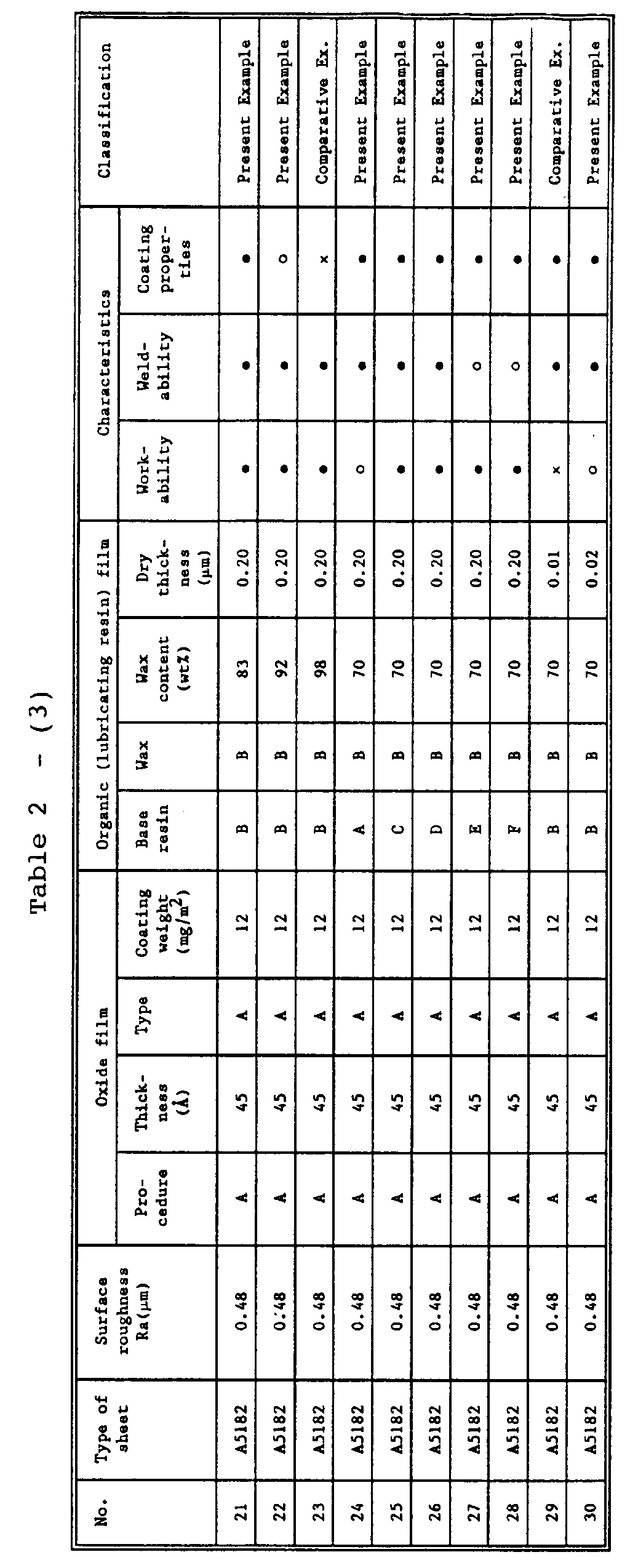
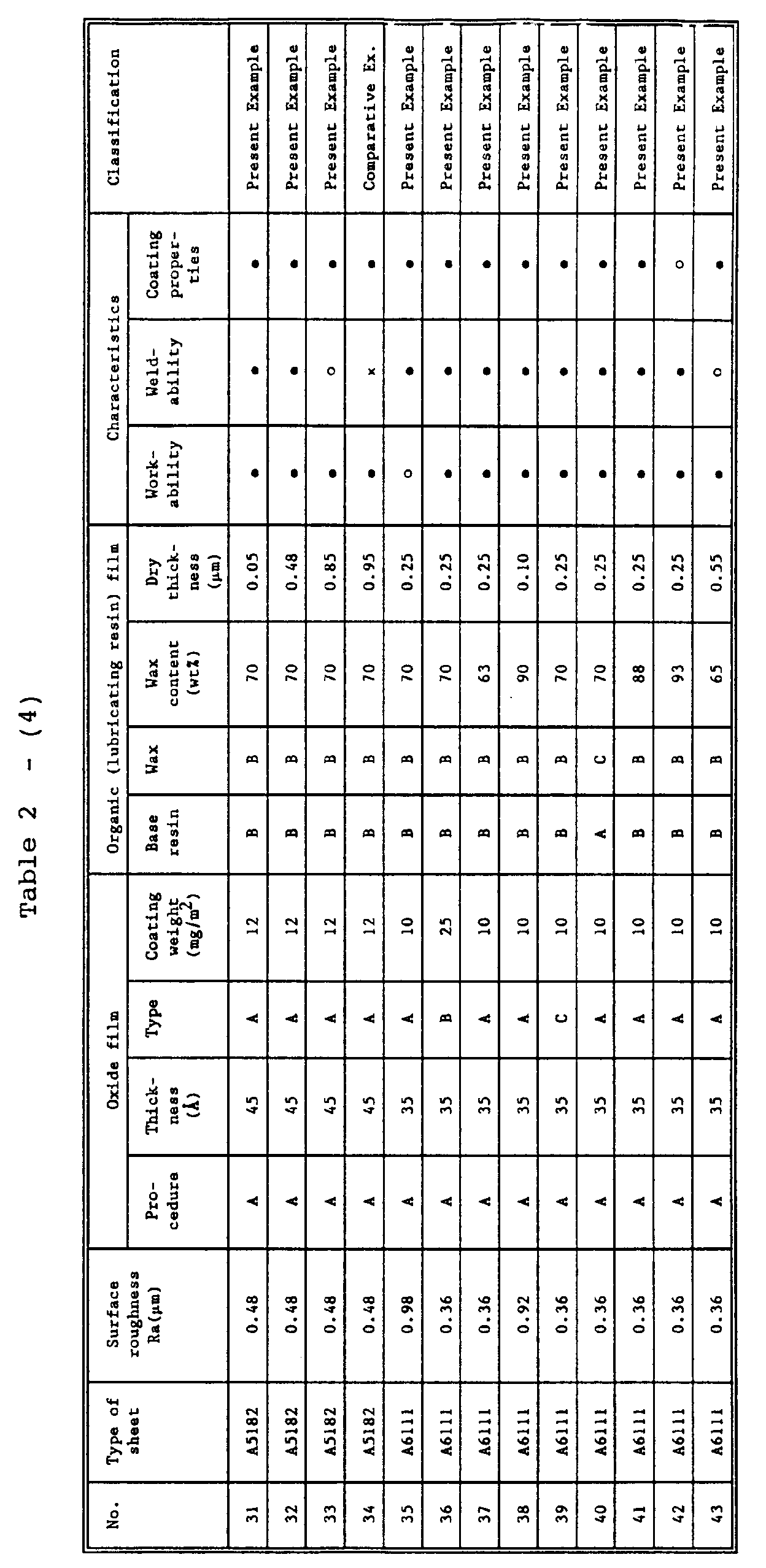
- Example 2 Using JIS A5182-0 materials and JIS A6111-T4 materials, various types of organic resin-coated aluminum alloy sheets were prepared and evaluated as in Example 1, but under the conditions shown in Table 2. Each of the conditions and evaluation results are shown in Table 2. The conditions which differ from those of Example 1 are as follows.
- Example 2 some etchings were conducted under the following conditions instead of the etching (procedure A) described in Example 1.
- Example 2 some chromate treatments were conducted under the following conditions instead of the chromate treatment (condition A) described in Example 1.
- Example 2 the following organic films were sometimes used instead of the organic film (the base resin A, the organic lubricant A) described in Example 1.
- Base resin A the organic film described in Example 1.
- Press wash oil (R303P, manufactured by Sugimura Chemical Corporation) was applied to the surfaces of the samples, then the samples were punched with a 95 mm diameter punch followed by a high speed cupping test (speed: 500 mm/s) with a punch diameter of 50 mm (radius R of fillet: 8 mm) while varying blanking holding force (BHF).
- Formability of A6111 alloy sheet was evaluated as follows.
- Press wash oil was applied to various types of aluminum alloys sheets, and the sheets were subjected to a zinc phosphate treatment using PB-L3020 (aluminum specification; manufactured by Nihon Parkerizing Co., Ltd.). Then, a 20 ⁇ m thick cation electrodeposition of organic resin (U-600; manufactured by Nippon Paint Co., Ltd.), a 35 ⁇ m thick intercoating (KPX 50; manufactured by Kansai Paint Co., Ltd.) and a 35 ⁇ m thick top coating (B531; manufactured by Kansai Paint Co., Ltd.) were sequentially applied to the treated sheets. Thereafter, the thus-treated aluminum alloy sheets were immersed in 40°C pure water for 10 days. Subsequently, a 2 mm cross-cut adhesion test (100 mesh) was performed to evaluate the electrodeposition adhesion by the number of residual coatings.
- PB-L3020 aluminum specification; manufactured by Nihon Parkerizing Co., Ltd.
- each of the Examples according to the present invention combine excellent press formability and spot weldability, while any one of press formability, spot weldability and adhesion after coating is poor in the comparative examples.
- Some of the present Examples have normal-level formability, weldability, or coating properties because the surface roughness, thickness of the oxide film, coating weight of chromate, type of the base resin, type of organic lubricant and the content thereof, and thickness of the organic resin film are not within the optimum ranges.
- those aluminum alloy sheets are suitable for all applications except those requiring high formability, weldability and coating properties, respectively.
- the aluminum alloy sheet according to the present invention is excellent in both press formability and spot weldability, and thus particularly suitable for automobile body applications.
Landscapes
- Chemical & Material Sciences (AREA)
- Engineering & Computer Science (AREA)
- Materials Engineering (AREA)
- Organic Chemistry (AREA)
- Inorganic Chemistry (AREA)
- Chemical Kinetics & Catalysis (AREA)
- Mechanical Engineering (AREA)
- Metallurgy (AREA)
- Life Sciences & Earth Sciences (AREA)
- Wood Science & Technology (AREA)
- Laminated Bodies (AREA)
- Application Of Or Painting With Fluid Materials (AREA)
Description

- Good (o ○): neither cracks nor galling were formed in the side faces of cylindrical sample pieces
- Normal (○): cracks were not formed, but galling was formed
- Poor (X): cracks were formed
| •Shape: dome (DR) type | •Tip diameter: 6.0 mm |
| •Tip curvature: 40 mmR | •Material: copper-chrome |
| •Pressure applied: 2943 N (300 kgf) | |
| •Squeeze time: 30/50 s | |
| •Weld time: 3/50 s | •Holding time: 1/50 s |
| •Welding current: 25 kA |

| •Shape: dome (DR) type | •Tip curvature: 80 mmR |
| •Material: copper-chrome |
| •Pressure applied: 3924 N (400 kgf) | |
| •Squeeze time: 30/50 s | |
| •Weld time: 3/50 s | •Holding time: 1/50 s |
| •Welding current: 29 kA |


Claims (4)
- An aluminum alloy sheet having excellent press formability and spot weldability, comprising:an aluminum alloy sheet having a surface;1.0 to 50.0 mg/m2 of chromate film in terms of metallic chromium formed as a chromate layer on said aluminum alloy sheet; andan organic lubricant resin film containing organic lubricant having a melting point of 60°C to 150°C, the resin film having a dry thickness of 0.02 to 0.90 µm formed on said chromate film,
characterized in that said organic lubricant resin film contains 60-95% by weight of organic lubricant, based on the weight of organic lubricant resin film. - An aluminum alloy sheet according to claim 1, wherein an oxide film is formed on said sheet, said oxide film having a thickness which is less than 100 Å.
- An aluminum alloy sheet according to claim 1, wherein said organic lubricant is a high-density polyethylene having a mean molecular weight of 900 to 15,000 and a density of 0.93 g/cm3 or more.
- An aluminum alloy sheet according to claim 2, wherein said organic lubricant is a high-density polyethylene having a mean molecular weight of 900 to 15,000 and a density of 0.93 g/cm3 or more.
Applications Claiming Priority (3)
| Application Number | Priority Date | Filing Date | Title |
|---|---|---|---|
| JP19517094 | 1994-08-19 | ||
| JP195170/94 | 1994-08-19 | ||
| JP19517094 | 1994-08-19 |
Publications (3)
| Publication Number | Publication Date |
|---|---|
| EP0697279A2 EP0697279A2 (en) | 1996-02-21 |
| EP0697279A3 EP0697279A3 (en) | 1996-03-06 |
| EP0697279B1 true EP0697279B1 (en) | 2000-11-08 |
Family
ID=16336610
Family Applications (1)
| Application Number | Title | Priority Date | Filing Date |
|---|---|---|---|
| EP95112959A Expired - Lifetime EP0697279B1 (en) | 1994-08-19 | 1995-08-17 | Aluminum alloy sheet having excellent press formability and spot weldability |
Country Status (5)
| Country | Link |
|---|---|
| US (1) | US5674627A (en) |
| EP (1) | EP0697279B1 (en) |
| KR (1) | KR960007822A (en) |
| CA (1) | CA2156477A1 (en) |
| DE (1) | DE69519346T2 (en) |
Families Citing this family (7)
| Publication number | Priority date | Publication date | Assignee | Title |
|---|---|---|---|---|
| AU718855B2 (en) * | 1996-07-31 | 2000-04-20 | Nippon Steel Corporation | Rustproof steel sheet for automobile fuel tank with excellent resistance weldability corrosion resistance and press moldability |
| US5783622A (en) * | 1997-05-05 | 1998-07-21 | Armco Inc. | Precoated chromium alloyed steel with enhanced paint adhesion for exhaust applications |
| JP2002275656A (en) | 2000-12-21 | 2002-09-25 | Furukawa Electric Co Ltd:The | Metal plate material for electrical and electronic equipment, and electrical and electronic equipment using it |
| CN1460561B (en) * | 2002-02-28 | 2012-01-04 | 关西涂料株式会社 | Paint-applying method for car body |
| JP3944505B2 (en) * | 2004-10-26 | 2007-07-11 | 三菱電機株式会社 | Rotating electric machine and manufacturing method thereof |
| JP6457193B2 (en) * | 2014-03-31 | 2019-01-23 | 株式会社神戸製鋼所 | Aluminum alloy material and bonded body with excellent adhesion durability, or automobile parts |
| JP6591849B2 (en) * | 2015-10-01 | 2019-10-16 | 株式会社神戸製鋼所 | Vehicle body front structure and method for manufacturing vehicle body front structure |
Family Cites Families (20)
| Publication number | Priority date | Publication date | Assignee | Title |
|---|---|---|---|---|
| US3955016A (en) * | 1974-08-12 | 1976-05-04 | E. I. Du Pont De Nemours And Company | Foil coating process |
| US4719038A (en) * | 1983-12-27 | 1988-01-12 | Nippon Paint Co., Ltd. | Corrosion resistant, coated metal laminate, its preparation and coating materials |
| JPS61130452A (en) | 1984-11-29 | 1986-06-18 | Kobe Steel Ltd | High strength aluminum alloy having high formability |
| JPS6273938A (en) | 1985-09-27 | 1987-04-04 | 日本ペイント株式会社 | Corrosion-resistant coated laminate |
| GB8724242D0 (en) * | 1987-10-15 | 1987-11-18 | Metal Box Plc | Laminated metal sheet |
| IT1235002B (en) * | 1988-05-18 | 1992-06-16 | Sviluppo Materiali Spa | ORGANIC COATING FOR METALS |
| EP0344717B1 (en) * | 1988-05-31 | 1994-01-05 | Kawasaki Steel Corporation | Lubricating resin coated steel strips having improved formability and corrosion resistance |
| JPH0318936A (en) | 1989-06-16 | 1991-01-28 | Hitachi Ltd | Input/output executing device for recursive virtual computer |
| US5272011A (en) * | 1989-10-11 | 1993-12-21 | Toyo Kohan Co., Ltd. | Copolyester resin film laminated metal sheet |
| JPH066768B2 (en) | 1990-04-03 | 1994-01-26 | 株式会社神戸製鋼所 | High formability aluminum alloy |
| JPH04123879A (en) | 1990-09-14 | 1992-04-23 | Kobe Steel Ltd | Resistance spot welding method |
| JP2788131B2 (en) * | 1991-01-29 | 1998-08-20 | 日本パーカライジング株式会社 | Method for forming composite film on aluminum or aluminum alloy surface |
| JPH04268038A (en) | 1991-02-22 | 1992-09-24 | Nkk Corp | Surface-treated aluminum alloy plate with excellent press formability |
| WO1993011880A1 (en) * | 1991-12-12 | 1993-06-24 | Nkk Corporation | Zinc-plated steel plate having high press formability and high corrosion resistance |
| JP2787124B2 (en) | 1991-12-16 | 1998-08-13 | 日本鋼管株式会社 | Composite coated aluminum plate or aluminum alloy plate excellent in press formability, scratch resistance, yarn rust resistance and sharpness |
| US5395687A (en) * | 1992-02-24 | 1995-03-07 | Kawasaki Steel Corporation | Surface-treated aluminum material having improved spot resistance weldability, workability, and corrosion resistance |
| JPH05311454A (en) | 1992-04-03 | 1993-11-22 | Nkk Corp | Composite coated aluminum plate or aluminum alloy plate excellent in press moldability, scratch resistance, filiform erosion resistance and image clarity |
| JP3251082B2 (en) | 1992-12-17 | 2002-01-28 | 日本パーカライジング株式会社 | A method for forming a lubricating film on an aluminum plate or an aluminum alloy plate. |
| JPH06305074A (en) | 1993-04-23 | 1994-11-01 | Kobe Steel Ltd | Surface treated al or al alloy material for car panel |
| JPH0790599A (en) * | 1993-08-10 | 1995-04-04 | Kawasaki Steel Corp | Surface-treated aluminum material with excellent workability, spot resistance weldability and corrosion resistance |
-
1995
- 1995-08-16 US US08/515,997 patent/US5674627A/en not_active Expired - Fee Related
- 1995-08-17 DE DE69519346T patent/DE69519346T2/en not_active Expired - Fee Related
- 1995-08-17 EP EP95112959A patent/EP0697279B1/en not_active Expired - Lifetime
- 1995-08-18 CA CA002156477A patent/CA2156477A1/en not_active Abandoned
- 1995-08-18 KR KR1019950025608A patent/KR960007822A/en not_active Ceased
Also Published As
| Publication number | Publication date |
|---|---|
| US5674627A (en) | 1997-10-07 |
| KR960007822A (en) | 1996-03-22 |
| DE69519346T2 (en) | 2001-04-12 |
| CA2156477A1 (en) | 1996-02-20 |
| EP0697279A2 (en) | 1996-02-21 |
| DE69519346D1 (en) | 2000-12-14 |
| EP0697279A3 (en) | 1996-03-06 |
Similar Documents
| Publication | Publication Date | Title |
|---|---|---|
| KR100530285B1 (en) | Hexavalent chromium-free surface-treating agent for sn- or al-based coated steel sheet, and surface treated steel sheet | |
| JPH03191093A (en) | Galvanized steel sheet excellent in press formability and chemical conversion treating property | |
| AU718855B2 (en) | Rustproof steel sheet for automobile fuel tank with excellent resistance weldability corrosion resistance and press moldability | |
| US5395687A (en) | Surface-treated aluminum material having improved spot resistance weldability, workability, and corrosion resistance | |
| US5674627A (en) | Aluminum alloy sheet having excellent press formability and spot weldability | |
| US5514483A (en) | Organic composite coated steel plates having improved corrosion resistance in as-worked state | |
| JP2002012983A (en) | Phosphate composite coated steel sheet with excellent corrosion resistance, lubricity and paint adhesion | |
| JP3305702B2 (en) | Aluminum plated steel sheet for fuel tank | |
| JP3078473B2 (en) | Aluminum alloy sheet excellent in press workability and spot weldability and method for producing the same | |
| JP3129635B2 (en) | Aluminum alloy plate with excellent press workability and spot weldability | |
| JPH10113724A (en) | Aluminum alloy plate with excellent press workability and spot weldability | |
| JP3261378B1 (en) | Aluminum plated steel sheet for fuel tank | |
| JP4727840B2 (en) | Coated steel sheet excellent in workability and corrosion resistance, and method for producing the same | |
| JP3200223B2 (en) | Surface treated aluminum material with excellent spot resistance weldability, workability and corrosion resistance | |
| JP2608494B2 (en) | Aluminum surface treated plate with excellent spot weldability and electrodeposition coating properties | |
| JPH05311454A (en) | Composite coated aluminum plate or aluminum alloy plate excellent in press moldability, scratch resistance, filiform erosion resistance and image clarity | |
| JP2025153981A (en) | Surface-treated steel sheet and automotive components using the same | |
| JP4435945B2 (en) | Aluminum-based plated steel sheet with excellent galling resistance and white rust resistance | |
| AU744314B2 (en) | Rustproof steel sheet for automobile fuel tank with excellent resistance weldability, corrosion resistance and press moldability | |
| JP3172083B2 (en) | Low-gloss black steel sheet with excellent workability and post-processing corrosion resistance | |
| JPH0790599A (en) | Surface-treated aluminum material with excellent workability, spot resistance weldability and corrosion resistance | |
| JP2000038683A (en) | Aluminum alloy treated plate and its manufacturing method | |
| CN118639296A (en) | A pre-painting process for co-linear steel plate workpiece and aluminum alloy workpiece | |
| JPH0665783A (en) | Surface-treated al sheet for automobile panel | |
| JP2000080481A (en) | Resin chromated metal sheet excellent in lubricity and poor chromium insolubility and method for producing the same |
Legal Events
| Date | Code | Title | Description |
|---|---|---|---|
| PUAI | Public reference made under article 153(3) epc to a published international application that has entered the european phase |
Free format text: ORIGINAL CODE: 0009012 |
|
| PUAL | Search report despatched |
Free format text: ORIGINAL CODE: 0009013 |
|
| AK | Designated contracting states |
Kind code of ref document: A2 Designated state(s): DE FR GB |
|
| AK | Designated contracting states |
Kind code of ref document: A3 Designated state(s): DE FR GB IT SE |
|
| 17P | Request for examination filed |
Effective date: 19960404 |
|
| 17Q | First examination report despatched |
Effective date: 19980513 |
|
| GRAG | Despatch of communication of intention to grant |
Free format text: ORIGINAL CODE: EPIDOS AGRA |
|
| GRAG | Despatch of communication of intention to grant |
Free format text: ORIGINAL CODE: EPIDOS AGRA |
|
| GRAG | Despatch of communication of intention to grant |
Free format text: ORIGINAL CODE: EPIDOS AGRA |
|
| GRAH | Despatch of communication of intention to grant a patent |
Free format text: ORIGINAL CODE: EPIDOS IGRA |
|
| RBV | Designated contracting states (corrected) |
Designated state(s): DE FR GB |
|
| GRAH | Despatch of communication of intention to grant a patent |
Free format text: ORIGINAL CODE: EPIDOS IGRA |
|
| GRAA | (expected) grant |
Free format text: ORIGINAL CODE: 0009210 |
|
| AK | Designated contracting states |
Kind code of ref document: B1 Designated state(s): DE FR GB |
|
| REF | Corresponds to: |
Ref document number: 69519346 Country of ref document: DE Date of ref document: 20001214 |
|
| ET | Fr: translation filed | ||
| PGFP | Annual fee paid to national office [announced via postgrant information from national office to epo] |
Ref country code: FR Payment date: 20010618 Year of fee payment: 7 |
|
| PGFP | Annual fee paid to national office [announced via postgrant information from national office to epo] |
Ref country code: GB Payment date: 20010716 Year of fee payment: 7 |
|
| PLBE | No opposition filed within time limit |
Free format text: ORIGINAL CODE: 0009261 |
|
| STAA | Information on the status of an ep patent application or granted ep patent |
Free format text: STATUS: NO OPPOSITION FILED WITHIN TIME LIMIT |
|
| 26N | No opposition filed | ||
| PGFP | Annual fee paid to national office [announced via postgrant information from national office to epo] |
Ref country code: DE Payment date: 20011031 Year of fee payment: 7 |
|
| REG | Reference to a national code |
Ref country code: GB Ref legal event code: IF02 |
|
| PG25 | Lapsed in a contracting state [announced via postgrant information from national office to epo] |
Ref country code: GB Free format text: LAPSE BECAUSE OF NON-PAYMENT OF DUE FEES Effective date: 20020817 |
|
| PG25 | Lapsed in a contracting state [announced via postgrant information from national office to epo] |
Ref country code: DE Free format text: LAPSE BECAUSE OF NON-PAYMENT OF DUE FEES Effective date: 20030301 |
|
| GBPC | Gb: european patent ceased through non-payment of renewal fee |
Effective date: 20020817 |
|
| PG25 | Lapsed in a contracting state [announced via postgrant information from national office to epo] |
Ref country code: FR Free format text: LAPSE BECAUSE OF NON-PAYMENT OF DUE FEES Effective date: 20030430 |
|
| REG | Reference to a national code |
Ref country code: FR Ref legal event code: ST |