EP0695993A2 - System und Verfahren zur Kommunikation zwischen Prozessen - Google Patents
System und Verfahren zur Kommunikation zwischen Prozessen Download PDFInfo
- Publication number
- EP0695993A2 EP0695993A2 EP95304857A EP95304857A EP0695993A2 EP 0695993 A2 EP0695993 A2 EP 0695993A2 EP 95304857 A EP95304857 A EP 95304857A EP 95304857 A EP95304857 A EP 95304857A EP 0695993 A2 EP0695993 A2 EP 0695993A2
- Authority
- EP
- European Patent Office
- Prior art keywords
- message
- task
- data
- memory
- memory means
- Prior art date
- Legal status (The legal status is an assumption and is not a legal conclusion. Google has not performed a legal analysis and makes no representation as to the accuracy of the status listed.)
- Withdrawn
Links
Images











Classifications
-
- G—PHYSICS
- G06—COMPUTING OR CALCULATING; COUNTING
- G06F—ELECTRIC DIGITAL DATA PROCESSING
- G06F9/00—Arrangements for program control, e.g. control units
- G06F9/06—Arrangements for program control, e.g. control units using stored programs, i.e. using an internal store of processing equipment to receive or retain programs
- G06F9/46—Multiprogramming arrangements
- G06F9/54—Interprogram communication
- G06F9/546—Message passing systems or structures, e.g. queues
-
- G—PHYSICS
- G06—COMPUTING OR CALCULATING; COUNTING
- G06F—ELECTRIC DIGITAL DATA PROCESSING
- G06F9/00—Arrangements for program control, e.g. control units
- G06F9/06—Arrangements for program control, e.g. control units using stored programs, i.e. using an internal store of processing equipment to receive or retain programs
- G06F9/46—Multiprogramming arrangements
- G06F9/54—Interprogram communication
- G06F9/547—Remote procedure calls [RPC]; Web services
Definitions
- the invention disclosed herein is also related to the copending United States Patent Application by James M. Magee, et al. which is entitled "TEMPORARY DATA METHOD AND APPARATUS FOR A MICROKERNEL DATA PROCESSING SYSTEM", Serial Number 263,633, filed June 21, 1994, IBM Docket Number BC9-94-076, assigned to the International Business Machines Corporation, and incorporated herein by reference.
- the invention disclosed herein is also related to the copending United States Patent Application by Ching-Yun Chao, et al., which is entitled "MASTER SERVER PROGRAM LOADING METHOD AND APPARATUS FOR A MICROKERNEL DATA PROCESSING SYSTEM", Serial Number 308,189, filed September 19, 1994, IBM Docket Number BC9-94-074, assigned to the International Business Machines Corporation, and incorporated herein by reference.
- a system for an application program to request interprocess communication with another task in a microkernel architecture comprising: a memory means in a data processing system, for storing data and programmed instructions; an application program means in said memory means, for providing application program instructions to be executed; a processor means coupled to said memory means, for executing said programmed instructions; a microkernel means in said memory means, for coordinating operations between a plurality of tasks in said memory means; an interprocess communications means in said microkernel means, for coordinating message passing between tasks in said memory means; a first task in said memory means having a control buffer for storing message control information and a data buffer for storing message data information, and having a first thread executing instruction in said processor means, for forming a first message to send to a destination port; a second task in said memory means having a set of attributes defining said destination port, and having a second thread executing instructions in said processor means, and a transmission control means in said interprocess
- a system for a personality-neutral services program to request interprocess communication with another task in a microkernel architecture comprising: a memory means in a data processing system, for storing data and programmed instructions; a personality-neutral services program means in said memory means, for providing personality-neutral services program instruction to be executed; a processor means coupled to said memory means, for executing said programmed instructions; an interprocess communications means in said microkernel means, for coordinating message passing between tasks in said memory means; a first task in said memory means having a control buffer for storing message control information and a data buffer for storing message data information, and having a first thread executing instructions in said processor means, for forming a first message to send to a destination port; a second task in said memory means having a set of attributes defining said destination port, and having a second thread executing instructions in said processor means; and a transmission control means in said interprocess communications means, for interpreting said message control information at said control buffer without
- a system 'as claimed in any of claims 23 to 25' comprising: a second processor means coupled to said memory means, for executing said programmed instructions; a third thread in said memory means associated with said second task, for providing said programmed instructions for execution in said second processor means.
- a system for interprocess communications in a microkernel architecture data processing system comprising: a memory in the data processing system, for storing information; a program for a first task in said memory, that includes a message passing procedure call to send a message making data available to a second task; a first task, a send data buffer, and a transmission control buffer in the memory; a header template for the first task, that includes a pointer to the transmission control buffer; a processor means associated with a thread of the first task, for executing the instructions from the program; said processor means executing a first instruction in the thread, to load a data value into the send data buffer and to load a control value into the transmission control buffer; said processor means executing the procedure call in the thread, to make the header template available to an interprocess communications subsystem; and said interprocess communications subsystem establishing the transmission of the data value from the send data buffer to the second task, using the control value in the transmission control buffer pointed to by the header template.
- microkernel architecture has a faster and more efficient interprocess communication capability. Still furthermore, the microkernel architecture for a data processing system, that has greater flexibility in the exchange of messages between tasks within a shared memory environment and between distributed data processors that do not share a common memory.
- the user provides a procedure call instruction in the sending task's program code, directed to the microkernel.
- the procedure call is accompanied by the name of the destination task's port, the name of the message, the type of message (two way, synchronous RPC; one way, asynchronous IPC; asynchronous send/receive, etc.), and other information.
- the call may be accompanied by a destination port, or as an option the port may be supplied by an optional header field. In this way, the system can support the very simplest of local procedure calls as well as those based on object subclassing.
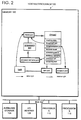
- Figure 2 shows the client visible structure associated with a thread.
- Figure 8 shows a functional block diagram of two host multiprocessor systems running in a distributed processing arrangement, with the IPC subsystem and the transmission control module on each host processor managing interprocess communications between tasks with the exchange of messages between the two hosts over a communications link.
- Figure 19 illustrates a typical call of a by-proxy user level library.
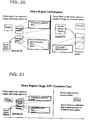
- Figure 31 illustrates share region usage in the RPC common case.
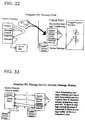
- Figure 33 illustrates a primitive IPC message receive attempt, message waiting.
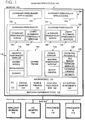
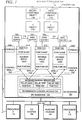
- the microkernel 120 contains a small, message-passing nucleus of system software running in the most privileged state of the host multiprocessor 100, that controls the basic operation of the machine.
- the microkernel system 115 includes the microkernel 120 and a set of servers and device drivers that provide personality neutral services 140.
- the personality neutral servers and device drivers are not dependent on any personality such as UNIX or OS/2. They depend on the microkernel 120 and upon each other.
- the personality servers 150 use the message passing services of the microkernel 120 to communicate with the personality neutral services 140.
- UNIX, OS/2 or any other personality server can send a message to a personality neutral disc driver and ask it to read a block of data from the disc.
- the disc driver reads the block and returns it in a message.
- the message system is optimized so that large amounts of data are transferred rapidly by manipulating pointers; the data itself is not copied.
- the Microkernel System 115 is a new foundation for operating systems. It provides a comprehensive environment for operating system development with the following features: Support for multiple personalities Extensible memory management Interprocess communication Multi-threading Multi-processing
- the Microkernel System 115 is based on the following concepts: User mode tasks performing many traditional operating system functions (for example, file system and network access); A basic set of user-level run time services for creating operating systems; A simple, extensible communication kernel; An object basis with communication channels as object references; and A client/server programming model, using synchronous and asynchronous inter-process communication.
- the microkernel 120 supports multiple points of control separately from the operating system environment's process.
- the microkernel provides the following two concepts: Task Thread (Refer to Section 2, Architectural Model, for a detailed description of the task and thread concepts).
- the Microkernel System 115 has, as its primary responsibility, the provision of points of control that execute instructions within a framework. These points of control are called threads. Threads execute in a virtual environment.
- the virtual environment provided by the kernel contains a virtual processor that executes all of the user space accessible hardware instructions, augmented by user-space PNS and emulated instructions (system traps) provided by the kernel.
- the virtual processor accesses a set of virtualized registers and some virtual memory that otherwise responds as does the machine's physical memory. All other hardware resources are accessible only through special combinations of memory accesses and emulated instructions. Note that all resources provided by the kernel are virtualized. This section describes the top level elements of the virtual environment as seen by threads.
- the abstract representation of a memory object provided by the memory manager to clients of the memory object.
- the representative names the associated abstract memory object and limits the potential access modes permitted to the client.
- a physical processor capable of executing threads.
- a task can be viewed as a container that holds a set of threads. It contains default values to be applied to its containing threads. Most importantly, it contains those elements that its containing threads need to execute, namely, a port name space and a virtual address space.
- the state associated with a task is as follows: The set of contained threads; The associated virtual address space; The associated port name space, naming a set of port rights, and a related set of port notification requests; A security token to be sent with messages from the task; A small set of task specific ports, identifying the task's kernel port, default ports to use for exception handling for contained threads, and bootstrap ports to name other services; A suspend count, non-zero if no contained threads are to execute instructions; Default scheduling parameters for threads; and Various statistics, including statistical PC samples.
- the kernel provides notification messages upon the death of a port upon request.
- a port is a unidirectional communication channel between a client who requests service and a server who provides the service. If a reply is to be provided to such a service request, a second port must be used.
- the service to be provided is determined by the manager that receives the message sent over the port. It follows that the receiver for ports associated with kernel provided entities is the kernel.
- the receiver for ports associated with task provided entities is the task providing that entity. For ports that name task provided entities, it is possible to change the receiver of messages for that port to a different task.
- a single task might have multiple ports that refer to resources it supports.
- the kernel should be viewed as using main memory as a directly accessible cache for the contents of the various memory objects.
- the kernel is involved in an asynchronous dialogue with the various memory managers to maintain this cache, filling and flushing this cache as the kernel desires, by sending messages to the abstract memory object ports.
- the operations upon abstract memory objects include the following: Initialization Page reads Page writes Synchronization with force and flush operations Requests for permission to access pages Page copies Termination
- the abstract memory object port is used by the kernel to request access to the backing storage for a memory object. Because of the protected nature of this dialogue, memory managers do not typically give access to the abstract memory object port to clients. Instead, clients are given access to memory object representatives.
- a memory object representative is the client's representation of a memory object. There is only one operation permitted against such a port and that is to map the associated memory object into a task's address space. Making such a request initiates a protocol between the mapping kernel and the memory manager to initialize the underlying abstract memory object. It is through this special protocol that the kernel is informed of the abstract memory object represented by the representative, as well as the set of access modes permitted by the representative.
- the portion of the kernel's main memory cache that contains the resident pages associated with a given abstract memory object is referred to as the memory cache object.
- the memory manager for a memory object holds send rights to the kernel's memory cache object.
- the memory manager is involved in an asynchronous dialogue with the kernel to provide the abstraction of its abstract memory object by sending messages to the associated memory cache object.
- the operations upon memory cache objects include the following: Set operational attributes Return attributes Supply pages to the kernel Indicate that pages requested by the kernel are not available Indicate that pages requested by the kernel should be filled by the kernel's default rules Force delayed copies of the object to be completed Indicate that pages sent to the memory manager have been disposed Restrict access to memory pages Provide performance hints Terminate
- the user provides a procedure call instruction named mk_msg in the sending task's 210 program code, directed to the microkernel 120.
- the procedure call mk_msg is accompanied by the name (PORT NAME'') of the destination task's 210'' port 507, the name of the message (ALPHA), the type of message (two way, synchronous RPC) and other information.
- the procedure call mk_msg includes parameter values supplied by the user to specify options for the message, such as giving permission to the microkernel 120 to choose a transmission strategy or alternately requiring that a physical copy of the data be provided to the destination task 210''.
- the procedure call mk_msg is executed, it will cause a message to be formed on behalf of the sending task 210 and be transmitted to the destination task 210'', transmitting the desired information.
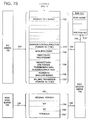
- Transmission control information also includes message control structure (MCS) 722 specifying features of the data format, such as the number and length of direct data values and the presence of address pointers to data objects 734, and a pointer 735 to the send data buffer 752.
- MCS message control structure
- Transmission control information also includes the parameters 737 from the procedure call mk_msg.
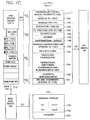
- the compiler forms a header template 740 for the task 210, shown in Figure 7E.
- the header template 740 is invoked at runtime whenever the procedure call mk_msg is executed by the thread 248 of the task 210 and its execution is signalled over path 723 to the task library 210H.
- the header template 740 can be stored in a task library 210H associated with the sending task 210.
- the task header library 210H can have stored therein several header templates for message headers that are to be used by the task 210.
- the header templates are assembled at the compile time for the program in the task 210.
- the sending task 210 has a transmission control buffer comprising, for example, four component buffers 713A, 713B, 713C, and 713D. These are used by the sending task 210 and its thread 248 to store working copies of the transmission control information 702 as it is formulated by the user's program at different times in preparation for the execution of the procedure call mk_msg. There can be several, non-contiguous component buffers 713A, 713B, 713C, and 713D that in the aggregate, serve as the transmission control buffer. For example buffer 713A can store working copies of the transmission control overall header information 717 such as the message ID, the message type and the destination task.
- a byte count value for the data in the buffer 713D can be included in the header 740 or at the top of the buffer 713D, itself. While the program in the sending task 210 is preparing the transmission control information 702 in the transmission control buffers 713A, 713B, 713C, and 713D, the sending task 210 is also preparing the data 720 over path 727 in the send data buffer 752.
- the header template 740 includes the identity 742 of the sending task 210 making the mk_msg call to the microkernel 120.
- the header template 740 overall header portion 717 includes an address pointer 717' to the sending task's 210 transmission control buffer 713A.
- the header template 740 is provided to the IPC subsystem 122. This can be accomplished by maintaining in the message passing library 220 a pointer to the header template 740, to enable the IPC subsystem 122 to read the contents of the header template 740 in response to the mk_msg procedure call.
- Step 770 then executes the procedure call mk_msg in the thread 248 with the processor 110, to make the header template 740 available to the transmission control module 700 of the interprocess communications subsystem 122, as shown in Figure 7A.
- the Message Passing Library 220 Makes Initial Transmission Checks
- the IPC Subsystem 122 implements Any Timeout Request
- the Message Passing Library 220 Parses the MCS to Move By-reference Data and Port Rights to the Destination
- the IPC subsystem 122 avoids unnecessary copying operations by passing pointers referring to buffers of transmission control information 713A, 713B, 713C, and 713D that the first task 210 wishes to provide to the IPC subsystem 122, to enable the IPC subsystem 122 to set up the message to be passed to the second task 210''.
- the IPC subsystem 122 has the option of passing the pointers referring to the buffers of control information 713A, 713B, 713C, and 713D, to the receiving task 210''.
- the message passing library 220 maintains a record of the tasks, threads, and objects and the tasks' various virtual address spaces.
- the invention enables every message to interact with the IPC subsystem 122 to bring order and predictability to interprocess communications in the multitasking system 100, and yet it maximizes the performance of the system.
- the establishment of the message transfer by the IPC subsystem 122 uses the message passing library 220 to locate the various objects and identify their attributes in the address spaces of the memory 102, the capability engine 300 to determine if the sending task 210 has sufficient port rights to send this message to the destination task's port 507, and the call scheduler 232 to queue the message to the destination task's port 507.
- the transmission control information 702 from the sending task 210 to the IPC subsystem 122 as shown in Figure 7A, contains more information than is necessary for the destination task 210'' and its thread to perform their programmed operations on the data portion 720.
- the example second task 210'' adds X1 and X2, respectively to constants Y from the data object 710 to provide results 736, 736', and 736" that are in ASCII form.
- This example can be the conversion of lower case alpha characters in EBCDIC form to upper case alpha characters in ASCII form.
- the ASCII form result data are to be output in an IPC message-type 720' to the third task 210', after the second task 210'' sends its RPC reply to the first task 210, acknowledging its completion of the ASCII conversion.
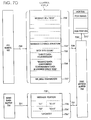
- Figure 7D shows the substitute transmission control information 708, as it appears after it has been processed by the interprocess communications subsystem 112.
- the data path 731 from the send buffer 756 of task 210'' makes the data 720' available to the receive buffer 758 of task 210'.
- the path 739' from the receive buffer 758 to the task 210' makes both the substituted transmission control information 708 and the data 720' available to the task 210'.
- the destination task 210' will perform operations on the ASCII message data 736, 736', and 736'', using the Z-object 712 and the ASCII object 716.
- the microkernel also includes the capability engine module 300 that manages capabilities or rights to map regions of the memory 102.
- the capability engine 300 is included in the IPC subsystem 122, along with several other modules, including the call scheduler 232, the message passing library 220, the temporary data module 400, the control registration module 500, the anonymous reply module 600, the transmission control separation module 700, the shared memory support module 800, and the fast path module 900. All of these modules provide services contributing to the interprocess communications operations of the IPC 122.
- the capability transfer scheme may be powerful but in traditional message passing it is un-necessarily expensive.
- the IPC 122 library (henceforth referred to as IPC 122) will continue to support the capability as the underlying logical data type but through a new data type avoid when possible the explicit creation and translation of capabilities.
- the new type which is secondary in that it is strictly internal to IPC 122, will be referred to as the by-reference data type.
- the by-reference data type is also a secondary data type in the sense that its function can be described as combinations of capability subsystem and capability transfer calls. As an example, let us say task A wishes to send 2 pages of data to task B.
- the asynchronous model behaves similarly to the synchronous one. Since it is not necessary to create an explicit message, the performance of the combination of examples 2 and 3 of the asynchronous case will be significantly better than that represented by the combination of asynchronous examples 1 and 4.
- the only difference between the asynchronous and synchronous example 2 cases is the lack of a pending reply in the async case. Without the need to wait on a reply, the sender is free to return.
- Example 4 of Fig. 17 calls the port specific send queue and recovers the appropriate message based on queue function specific criteria.
- the message is made up of direct data which can be transferred to receiver without transformation. It may also contain ports and capabilities. The ports and capabilities must be translated via calls to the capability engine 300. Small by-reference fields may be masqueraded by the message passing library 220 to avoid the overhead of capability creation at the time of explicit message creation. The receiver may still choose to receive the field as a capability, but if it is receive as a by-reference buffer, the capability engine 300 will not have to be called.
- the proxy may pass the address of the parameter block as the address of the message head as shown in Fig. 19.
- an extra type was added to the by-reference sub-types outlined earlier, the pointer to a by-reference parameter. This is very popular as a means of returning an altered pointer to a data structure in languages such as "C" which view the direct altering of an argument by a called function within the scope of its caller to be a violation of scope rules.
- Primary descriptors have a one to one, mapped and onto relationship with the parameters of the message, the first corresponding to the first parameter, the second to the second and so on. Further, the primary descriptors are required to be contiguous. In this way it is possible to find the descriptor corresponding to the 3rd parameter by simple offset from the beginning of the descriptor section of the message control structure. Primary descriptors may not be large enough to carry all the state information necessary for a particular parameter. If this is the case, a field of the primary descriptor points to an offset within the message control structure which corresponds to the start of a secondary descriptor. Secondary descriptors come in different sizes, appear after the primary descriptors and in no particular order.
- the receiver would have to look at the message control structure to find the parameter boundaries.
- the sender is not required to supply a message control structure to the message passing library 220 and the message passing library 220 does not supply one to the receiver.
- the simple option should be turned off.
- the transmission control information subsection of the message structure consists of the header and an optional group of transmission variables.
- the information contained in this subsection is characterized by two things. First, it is information that is presented directly by the caller of the message passing library 220. Second, whatever its origin or final use, the fields and most often the data are parsed and interpreted by the caller of the message passing library 220 and the library itself.
- the motivation for the separation of message control information from the rest of the message is the same as that for the separation of message data and static control information.
- the collection of fields found in the transmission portion of the message is created and manipulated at the same time and by the same routine regardless of the message passing model. (IPC message type, RPC by-proxy) This guarantees that there will not be unnecessary copying.
- the strictly enforced point of interaction for the transmission section is the message passing library 220.
- a sender can only influence the format of a message delivered to a receiver through the message control structure.
- the format of the message buffer is completely determined by the message control structure and the overwrite buffer (The overwrite buffer allows the receiver to exercise local override on final disposition of capabilities and by-reference regions. Please see section 3.2.4.3 for details).
- the format of the header returned from a call to the message passing library 220 is determined by the options chosen in the transmission control section at the time of the call.
- the server believes the first parameter is a by-reference and that further, the associated buffer is to be removed after the client send. Now if the data in the client send just happens to look like a valid address, the client will unintentionally unmap a portion of its address space.
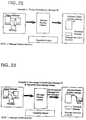
- Fig. 22 shows 2 examples of message control structure usage with out accepted convention, client supplied message control information.
- the distillation of message buffer information is such that the average parameter is fully described in 8 bytes.
- layout of the message buffer for a 4 parameter interface might be checked by a byte to byte comparison of 32 bytes!
- the fact that other portions of the interface, like those associated with transmission control protocol are described elsewhere means that there will not be an unnecessary restriction on transmission options in a byte compare protocol check.
- the RPC system should be noted here because the message control structure describes buffers and buffer disposition for both the request and reply. It is very reasonable that a server would want to support clients that chose different local buffer disposition options. As an example let us consider 2 clients which both want to interact with a common server. They both want to send a by-reference field to the server. One wants the buffer removed after the send, the other wishes to retain it. It would be awkward if the server were to reject one of these two clients just because neither of them was trusted. The bits of the parameter disposition have been set so that this case can be handled. There is a field of bits associated with client buffer disposition.
- the check of send/receive compatibility is not only optional, it is user level.
- the user level libmk library support will include the binary byte by byte check and the client option mask override for RPC message control structures as callable macros, the server is free to fashion any sort of partial check it sees fit. For example, allowing clients which send a buffer as temporary as well as those which send it as permanent with the dealloc flag set. (See sections 2.1 and 2.4 for a description of the data types.)
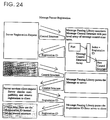
- a server wishing to participate in registration makes a registration call for the message control structures associated with the server's set of interfaces.
- the registration call parameters are the message control structure, the associated port, and a placeholder for the returned registration id.
- the message control structure becomes registered with the port for the duration of the life of that port. In this way senders who acquire that registration id will be guaranteed that it is valid for the life of the port.
- a client wishing to send messages via the registration service contacts the server with a simple call, sending the message control structure; possibly containing a message id, and asking for the associated registration number.
- the server is free to run what checks it likes, but in practice absolute compatibility is required.
- the server Should the server detect for instance a difference in client local buffer disposition and pass back the registration id anyway, the client would be damaged upon the use of that registration id.
- the server may fail a registration request which does not match exactly or register an additional message control structure for that particular message id.
- the server would then be responsible for checking both registration numbers for that particular message id, the server template registration number and the client registered on.
- the server should also keep a copy of the client message control structure on hand to check against future registration requests. If a client is refused a registration number, it is still free to attempt non-registered transfer.
- any number of descriptors may be concatenated in this way and there is an option to make the number strict or "upto".
- the strict case exactly the stated number of regions must be found to fill the gather descriptor area or an error is returned.
- the "upto” case if the number of regions specified in the descriptor is larger than the available number of regions in the incoming message, the message proceeds anyway. Descriptors in the overwrite region which account for regions than are found in the message are ignored. Likewise, if the overwrite descriptors account for fewer permanent by-reference and capability parameters than occur in the message. The parameters beyond those enumerated by the overwrite structure behave as if the overwrite option had not been exercised.
- the capability engine 300 is defined to create a simple and general message passing service. It has done so by formalizing all transfers as either direct data or capabilities. In a port based message passing system such as MACH, such ports can be used to pass access to any transformation.
- the message passing library 220 carries with it the function of the capability engine 300 but it has sought to raise the performance level by taking the mapping transformations which must be done explicitly in the capability engine 300 paradigm and creating a language to express there transfer without creating formal capabilities. If the two endpoints of a transfer both use the message passing library 220 then a mapped area of a sender's space can be described in a message and the place to write it in or map it in can be described for the receiver.
- a server utilizing the overwrite option may accept a wider range of incoming client messages and may have to adjust its message control structure check because the clients send different remote buffer disposition information. Restriction 2 also accounts for some additional options in registration. The need to accept and register possibly more than one message control structure format grows out of the asymmetric nature of the client/server relationship. The server registers the client's message control structure. If there are two clients which send exactly the same format message but wish to receive the reply data differently, the server must register two message control structures to support them both.
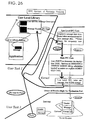
- Fig. 26 is a diagram of the RPC transfer.
- the message control structure is kept in the message passing library 220 while the server is active in anticipation of the reply. If the message was complex but was accompanied by a large amount of direct data, the server can avoid sending this data back on the reply by sending an override message control structure with zero size direct data fields.
- the message passing library 220 will use the override message control structure to find the by-reference, capability, and other port fields in the message buffer sent from the server and will fill in client buffers, or update the client's double indirect pointers as appropriate.
- the client message buffer is, of course, not written back to the client.
- Client/Server juxtaposition is characterized by the synchronization of the client send and server receive.
- the server arrives at the receive port before there are any messages to receive, it blocks. If the client arrives before the receiver it blocks until the receiver arrives. This in effect guarantees simultaneous access to both the client and server space for the purpose of message transferral.
- client/server juxtaposition can be achieved in some circumstances in asynchronous communications it cannot always be guaranteed as it is in the case of RPC. If an asynchronous send is attempted on a port upon which there is not a waiting receiver, the message passing library 220 must produce a message and allow the sender to continue.
- the general server loop does get involved in discrete message processing in one place.
- the message control structures are made available to it through a table indexed by message id.
- the byte by byte check code is generic. It is just the data involved which is function specific. Further, alterations to server side options are necessarily server wide in scope. It is the general server function that is the most appropriate place for the necessary adjustments to the server side format check. It is also true that the server side stubs tend to be automatically generated. This makes them a less convenient target for receive side buffer disposition customization.
- the remote caller After using basic co_resident utilities to download specified code into a target task, the remote caller would send a server_create message to the server/server port and receive a handle back on the reply.
- the caller may have supplied a set of proxies on the call or may fill in the proxies through subsequent calls.
- the caller has an additional call which is not one of the calls exported by the server package. An extra call is needed to create a thread and then direct that thread to associate itself with the target server instance.
- the passive model it is possible to simply provide the thread body resources to the receiver, but in the active model, the server acquires threads via a call by the target thread. There is an advantage to having the routine built in this way.
- the target server task is free to adjust post processing or customize thread state or resource for its specific needs.
- the simple case provides the message passing library 220 with an opportunity to employ the same technique used to optimize by-reference data transfer in effect, by-passing the explicit port wait that occurs in asynchronous and explicit receives.
- the message passing library 220 can in this case, avoid the expense of contacting the capability engine 300 both to do the wait and to map a send or send_once right into the server's space. There are cases, however, where for throughput or transmission control reasons more flexibility is needed.
- the server thread's data structure is checked for an outstanding reply. This will be present in case 1 and case 3 above. If this is an example of case 3, a second field in the port structure points to the client reply port. If the client is blocked on a port, it is removed. If it is not blocked, the server is made to wait on the port as a sender. When the client is available, the reply is delivered, the client thread returns and the server resources or thread are free to take on another message.
- Thread_abort_notify when experienced by a thread blocked on the request queue, results in the request being removed from the queue and the client receiving a thread_abort_notify_send message.
- the server was never aware of the request, and the client is free to retry the RPC or not based on its handling of the notify signal directed at it.
- Thread_abort_safely in that the synchronous code path is activated. The code is free to go off and do anything, delaying its return to wait for the reply indefinitely. It is not possible to protect the system from this behaviour as it is with the separate signal handling code path of Thread_abort_safely.
- Message control structure allows the client to send the share buffer either statically, where its size is described in the message control structure or dynamically, where another parameter on the call serves to give the size.
- Overwrite options give the receiver the ability to direct the overwrite region to a specified region of mapped memory or allow it to be placed in formerly unmapped memory.
- One way message support in an RPC system is apt to strike one as an oxymoron.
- the server thread usually performs a reply with a subsequent receive for the next message. This is fine for the steady state condition, but how do you start it? The answer is that you start the server with a one way receive.
- the thread resource is put to sleep awaiting the arrival of the first message.
- the RPC implementation of the message passing library 220 was meant to support RPC without the need of compiled front ends.
- the interface presented by the message passing library 220 allows proxy routines to support RPC without expensive run-time interpretation. This is not to say that the message passing library 220 will not support front ends, compiled or otherwise, but RPC can be supported with simple message control structure creation routines.
- the MIG tool has been ported to the message passing library 220 for backward compatibility. It has been extended to support the increased functionality. Porting of the MIG front end has proven that the new RPC is a superset of existing functionality as exposed by the MIG interface. Other front ends may be ported to provide compatibility with existing application code bases.
- the message passing library 220 will accept double indirection pointers but under some circumstances (i.e., some machines might be extremely slow at de-referencing pointers across a protection domain boundary), it might be better to de-reference the pointer in user space possibly even twice, making it direct data. This would require the message option prescribing the writing back of direct data to the client. Dynamic data fields could be turned into static data fields. This would require the message control structure be written with each pass since it is here that static buffer lengths are kept, but it would remove the need for a separate count parameter. Finally, all direct parameters could be coalesced into a single direct data field, reducing the parsing time necessary in the message passing library 220.
- the set of IPC message types is a large and nearly complete subset of RPC.
- IPC message types support capabilities, direct data, and most of the by-reference data types.
- the only by-reference data type not supported by IPC message types is Server_Allocate which exists in RPC because of the semantic link between request and reply and the coalesced Message Control Structure. (Coalesced with respect to request and reply message formats and buffer disposition.)
- the message control structure for IPC message types has the same format as that for RPC but it only pertains to the send portion of the transfer, even in two way messages.
- the parameter descriptors contain only send information. There are no IN/OUT or IN descriptors and the fields associated with reply buffer disposition are ignored.
- Fig. 32 is an outline of a simple IPC message pass.
- the header, message control structure, and message are shown as a contiguous unit because it is expected that in a large number of IPC message types cases, the application itself will be message aware and create the message, there will be no proxy. It will thus often be convenient to place these fields contiguously.
- the transmission region may be used for outgoing optional transmission information because even in non-proxy uses, IPC servers may wish to make receipt of such transmission information because even in non-proxy uses, IPC message type servers may wish to make receipt of such transmission information optional.
- the message passing library 220 creates a message. This may involve some or all of the following:
- the receiver may attempt a receive before or after the arrival of a message. If it is before, the receiver will block, waiting for the message. If it is after, the message is dequeued, the data associated with anonymous capabilities is mapped, capabilities and port rights are moved into the receiver's space, an the message buffer, message control structure if requested, and server temporary data are moved into the receive buffer, as shown in Fig. 33.
- the message passing library 220 sets up the transmission protocol extension as per the receiver's request.
- the receiver is free to send as overwrite buffer to influence the placement of by-reference data and to translate capabilities into by-reference fields and visa versa.
- Asynchronous on-way is the most primitive form of IPC message type, as message is sent by one entity, placed on a queue and received by a second.
- the other three subclasses of IPC message type can be represented as combinations of asynchronous calls, they are supported directly by the message passing library 220 for performance and broader resource control considerations only.
- Synchronous two way could be mimicked by both parties doing paired send/receives with a permitted queue length of zero.
- One part of course could have to start out the affair with an unpaired receive.
- Asynchronous two-way could be imitated through the same send/receive pairing at application level. However, message queuing would be allowed in the event the sender did not find a waiting receiver.
- One-way synchronous could be decomposed into a paired send/receive in which the receive contains no data, or a send where the associated message queue length is zero.
- server_temporary usage will be impacted by application level convention between senders and receivers, knowing that a receiver is making a certain amount of space available for instance, or limiting the message formats which will be encountered to an enumerated set.
- IPC message type will be used quite often for generic message passing where the receiver knows little about the incoming message and must request the sender's message control structure.
- Message demultiplexing and single use receivers are supported and offer convenience and performance advantage. They should be used when the situation permits.
- two-way messages have an advantage over one-way messages emulating two-way behaviour because it is possible to do a single send/rcv call instead of a separate send and receive.
- a series of subclasses spring up when message passing library 220 must become aware of the intended relation between these two one-way primitives.
- the cases in the two-way message example are:
- two-way IPC message type support is a performance optimization. For cases where two-way is unacceptable, one-way messages may still be used, ensuring functional completeness. Further, on-way and two-way messages are completely compatible. In any of the cases, above, party 1 or party 2 could substitute one-way messages without the other party being able to detect the change.
- party 1 or party 2 could substitute one-way messages without the other party being able to detect the change.
- the reader may have noticed that some the classes above are supported by both synchronous and asynchronous two-way and wonder why they have been enumerated. The existence of the enumerated sub-classes above makes possible performance optimizations beyond the simple call combination already mentioned.
- IPC message types also support the two-way message pass where the reply port field of the header can be used as a way to indicate the port to do the receive on, without causing a right to be passed to the remote party. The caller achieves this by supplying a port int he reply field of the header but leaving the local (reply) port disposition field blank. This will yield better performance than the explicitly right pass on every message transaction. It can be used for cases where the remote party already knows the port to send back on and does a copy send on the right.
- IPC message types support the standard case of a reply port which serves as the receive port for the initial 2-way message invoker and as the source of a send or send once right as specified by the local or reply port disposition information field in the header.
- Synchronized two-way IPC message type differs from RPC in that the two parties of the transaction are symmetric peers. This offers an advantage to IPC message type when the application wants to send direct data back from party 2 to party 1. Whereas the RPC transaction requires that message buffer data returned from the server be passed back as indirect data, the IPC message type transaction is free to pass back altered direct data. Moreover, IPC types will only send back the data and parameters which match the unlinked send (correlates to the reply). Extra parameters for fields of the reply need not be included in the request, and fields used for the request do not show up in the reply. The performance advantage, though small comes for free in the two-way synchronous IPC message type model.
- the overwrite structure contains server specific requests to alter the placement and class of incoming by-reference variables as capabilities or visa versa. It may request that multiple by-reference variables be written into contiguous memory or at specific disparate locations. Please see section 3.2.4.3 for more details.
- the overwrite buffer's function is limited to receive side override of an incoming message's default buffer disposition characteristics. Because of this, its function and usage in IPC message type is identical to that of RPC.
- the IPC message type two-way application might be more inclined to move transmission options into the message buffer because of the lower interest in the use of proxies and the greater likelihood that endpoints will be message aware, it is unable to move request for information options into the message buffer because the message control structure has no influence over the receive.
- the client or sender must send the server (receiver) a copy of the message control structure and request the associated registration handle.
- the server is free to: 1) deny the request; 2) comply with it after matching the entry against an existing template; 3) match the incoming request against an existing template and find its semantics close enough to pass back the registration for the existing template; or finally 4) make a local copy of the incoming message control structure, register it as a new template with the message passing system and pass the new registration number back to the caller.
- the message is registered on the port and the registration is immutable, it can neither be changed nor cancelled, for the life of the port.
- the message passing subsystem will thus hold a copy of the template and will be able to refer to it on a message send.
- IPC message type both parties in a two-way send are capable of registering their send with their counterpart. The opportunity is fully symmetric, but it is not necessary to register on both ends. If only one of the parties supports registration, the two-way send will send registration handles from one end and traditional message control structures from the other. In case both parties int he transaction support registration, the two ports associated respectively with party 1 and party 2 will each contain their independent lists of registered message control structures.
- Thread B must start out with an initial receive. In other circumstances, if Thread A is sending asynchronous two-way, Thread B might just start out with a send/receive. This is not recommended in the above case not just because it would result i an unnecessary explicit message creation but more importantly, asynchronous two-way may lead to the return of improper send status. If a send is attempted without having first experienced a receive the thread specific status will not reflect a waiting remote party. Anonymous receive depends on the ordered pairing of the send and the subsequent receive, therefore anonymous receive and asynchronous two-way are incompatible.
- Both tasks have messages coming into their address spaces from third party sources. Both tasks have messages going out of their space to third party destinations.
- the message formats are varied, there is no fixed relation between the messages presented at one end of the pipe connecting A with B and those presented at the other. This example represents one of the prime uses IPC message type can be put to where there is not an RPC equivalent.
- the send side option's most important use is RPC where it allows the client to match a true procedure call model by avoiding exposure of the paired send/receive, i.e. the client should not have to create an explicit reply port when the model of remote procedure call is to invoke a non-local procedure and return with the result.
- Ports as direct data are not treated differently in IPC message type, since as with all direct data they are limited to send/only status. Even if RPC is later expanded to allow direct data to be sent in both directions, ports sent on the reply will not require a new data type or additional status in the message control structure. If a port is to be sent in either direction (request or reply) a parameter slot is made for it. If one is not to be sent in both directions, the PORT_NULL value is placed in the message buffer in the place corresponding to the port parameter for the direction in which a port is not passed.
- Ports as by-reference data, or port arrays, may be contained in buffers corresponding to an of the by-reference types. By-reference types will be limited to the OUT parameters. There will be no IN/OUT and IN parameters. Further, the Server_Allocate class does not exist. The reason for the Server_Allocate class is that a parameter with a buffer description exists into which the server is to place data for the client, and the writer of the interface does not want the message passing library 220 to provide the server with the buffer on the request. This is done for performance and to increase the subset of procedure call supported in RPC. In any case it is a direct outgrowth of the knowledge of the reply at the time of the request.
- Server_Deallocate survives as a data type only in the form of a Sender_Deallocate. It is no longer supplied on a request and acted on in a reply. Its action now is limited to the direct action on the buffer associated with a send. Sender_Deallocate exists in the IPC message type and on the client side of the RPC.
- Non-persistent message data can be characterized as data passed by-reference which nonetheless will not persist beyond the processing of the data associated with the message, or at least will not be required past the need to do another receive for a following message.
- this sub-class of by-reference support is referred to as Server_Temporary.
- the data in this subclass might be used in a reply to the client, but it is defined to be useless beyond the reply, allowing the space associated with it to be reused.
- IPC message type non-persistent message data shares the same mechanism as RPC Server_Temporary and its circumstances and ultimate treatment are similar. Like Server_Temporary, IPC message type non-persistent memory is placed in the receive buffer after the header, message control structure (if requested), and message body. Beyond the restriction that Server_Temporary or non-persistent memory data must follow the three structures enumerated above, they may appear in any order in the remaining space. The main different between Server_Temporary and non persistent data types is when the data becomes stale. In the case of Server_Temporary, the data may be used on the reply. In the non-persistent case, the data loses its importance as soon as the associated send has been processed.
- Shared memory as supported by RPC is a performance optimization of a by-reference parameter pass on a procedure call.
- the parameter looks like a normal parameter on the transfer in all respects except that the message passing library 220 is aware that the physical memory associated with the parameter may actually be shared between the client and the server. In this way shared memory remains transparent to the application at least at the interface protocol level. Obviously steps must still be taken to set up the shared region. This may be done in a separate service, however, allowing the endpoint server and client code to remain free of share specific protocol considerations. If the application code restricts itself to the use of this buffer or portions of it in communicating information back and forth it will satisfy the needs of the share memory support.
- RPC is capable of acting on shared regions which are set up through share capabilities but this is not recommended for RPC because a send share capability may be cloned by the owner and multiple share regions set up in different tasks. IN line with the emulation of shared memory, even in the RPC case, the list of tasks which map a shared region is traversed and, if some of the members do not share physical memory they are updated. Only one entity, however, the target server of the call, will be sent a message.
- the port associated with the destination of the message would be sufficient to target the actions of the message passing library 220's shared memory support.
- the destination would be checked to see if it was local, if it was and the destination space contained a mapping of the shared region, the by-reference pointer would be updated to reflect the correlative address in the receiver's space. If the destination does not share a common memory resource, the data associated with the transfer including the "shared data region" would be collected into a message and transferred via something like the proxy port notion of NORMA. From a model perspective it is important to note here that the non-local treatment is really just the ignoring of the share option bit. Proxy port NORMA need know nothing about shared memory, it simply delivers the message, including the data from the "shared" region. The message passing library 220 code at the remote end will place the data in the "shared" region.
- a port on which the distant party owns the receive right (or a proxy port) is associated with the share memory region mapping entry.
- the owner of this port must be ready to receive a message on the port regarding transfer of data in the shared region.
- the port is supplied at the time of the share capability mapping or in the case of the by-reference setup method, it is the port on which the receiver received the message that mapped the receive region.
- Fig. 37 is a picture of a share memory region membership list.
- the destination port is translated and checked against the task ID field of the entries in the membership list.
- the membership list is found via a hash function on the address associated with a by-reference share parameter. If a match is not found, the message is returned to the send with an error. If a match is found, the offset and size variables are checked and if the region described in the message falls within the share region, the by-reference pointer is adjusted to point to the appropriate region in the remote space and the transfer continues. If the task ID turns out to be a proxy port of the NORMA variety, the special NORMA code will create a message and send the data, including the shared data to the remote party.
- Capabilities are implemented as ports, as such they are subject to the same transfer mechanisms as other ports. In the case of direct ports, there is no difference between the treatment of RPC and IPC message type. In the case of by-reference versions, i.e. port_arrays, capabilities like ports are subject to the treatment of by-reference subclasses. Please see section 4.2.5.1.
- IPC message type the mapping options for capabilities on the receive side are identical to those available in RPC.
- the receiver communicates its wishes through the overwrite buffer.
- the client makes its directives known through the message control structure.
- the options associated with reply side handling in the coalesced message control structure are identical to those available in the overwrite buffer.
- IPC message type Calls made to queue a message on a port must go through the capability engine.
- the capability engine associates queuing procedures with ports via an exported call. This allows the customization of queuing mechanism.
- Both IPC message type and RPC make use of the plugable queue. In the IPC message type case, however, the complexity of queue mechanism is usually greater.
- IPC message type's must be capable of queuing both blocked threads of execution and messages.
- the queue may at any one time contain examples of both messages and blocked threads.
- the condition will be produced by a mixture of synchronous and asynchronous IPC message type. For example, if one sender sent an asynchronous one-way message and a second party sent a synchronous one-way message to a port upon which a receiver was not waiting.
- the choice of running the remote process using the scheduling information of a remote thread or the scheduling priority of the message or local thread is made outside of the plugable queue.
- the queue's jobs is kept simple, deliver the highest priority waiting message first, as determined by a customizable scheduling policy. There is a wrinkle, however.
- the queue code itself will run at the priority of the request on the queuing side. If there are higher priority tasks running in the target of the send or elsewhere, the act of queuing may have to wait. Thus, active servers running at high priority may block a medium priority task in favour of carrying out the processing of a request for a lower priority entity. This is an issue of personality level system design, however, and does not impact directly the queue procedure.
- IPC message type servers are more likely to be active in nature (running with their own scheduling policy) but passive servers receiving asynchronous messages are not unreasonable.
- the scheduling characteristics in a non-migratory model would be akin to a fork of a new execution entity and an exec in the case of a thread_shuttle clone. Or just an exec in the case of a migratory thread_shuttle handoff.
- synchronous two-way IPC message type behaves exactly as RPC when it comes to thread migration and the active vs. passive model.
- Asynchronous two-way will behave differently.
- the remote party has a message available on the port the local party is to do its receive on, it is conceivable that both the remote party and the local party would be running simultaneously.
- the message passing system cloned a shuttle to run the receive on the remote party's side and the local party continued with its shuttle to pick up and process the message on its receive port.
- new shuttles spring into existence based largely on the stochastic elements surrounding message creation and processing within the two parties and their scheduling priorities, and then wink out when a send is done and there is nothing to receive.
- One-way synchronous and one-way asynchronous send behave identically when it comes to resource and scheduling issues of migration.
- the delay and synchronization event experienced in one-way synchronous IPC message type only affects message creation. It is still the aim of the call to let message processing and the callers subsequent processing continue simultaneously.
- One-way IPC message type in a non-migratory model where scheduling information nonetheless is passed by the message looks very much like a thread fork. For the duration of the remote message processing, a remote thread and the local caller will be running at the scheduling priority of the caller. As with the asynchronous two-way IPC message type case above in systems sensitive to real-time, one-way IPC message type calls will have to be monitored and subject to a quota.
- the one-way IPC message type in migratory model will require explicit thread body management.
- the act of migration can be hidden in the all of the two-way models because the act of a send is taken by convention to offer the shuttle of the sender.
- the act of a receive frees the shuttles of its patron and the caller receives the shuttle of the sender when the message arrives.
- paired send receives may be used to keep track of non-explicit thread bodies. Only thread bodies are blocked on a receive port, but this is transparent to a caller since it will receive the sender's shuttle when a message arrives and it had a thread body when the caller did the receive. It is only the unpaired send which produces a problem.
- the message passing library 220 gives the sender's thread body to the receiver, the message passing library 220 does not have a port to place the send thread body on.
- thread bodies could be dealt with explicitly.
- a method could be set up in which some portion of control information associated with the body structures would be accessible to the message passing library 220.
- the message passing library 220 would signal the release of the thread body structures through an alternation in this state.
- Linked lists of thread bodies could be traversed at the application's leisure and freed thread bodies re-cycled.
- lone sends may be treated as non-migratory, resulting in the cloning of the thread shuttle and the return from send for the on-way IPC message type.
- Migratory and non-migratory receives can appear much the same to the application.
- the thread body and shuttle are welded together from the kernel perspective.
- the thread which does a receive waits intact for the message.
- the thread will do a receive as before, but the kernel level thread resource will be freed.
- the kernel level resource associated with the send or resource from a resource pool is again associated with the receive thread and it returns from its receive. If an abort should occur, a resource from the pool will be supplied.
- the old thread handoff code of CMU presents the kernel stack as an example of a kernel level resource which can transparently be shared amongst senders and receivers. The underlying requirement is, however, that the resources remain anonymous and interchangeable.
- the scheduling attribute is an example of this. If the passive model is chosen, scheduling information is passed from the sender to the receiver. The receiver will thus process the incoming message with the scheduling attributes associated with that message. This works well for the message, but the receiver thread loses its scheduling identity. If a thread wishes to do work no associated with a message it has just received and processed, it must do so using the message related scheduling properties or explicitly alter the scheduling information.
- a scheduling template may be associated with the receive port, allowing aborted receives to operate at a predetermined scheduling priority, but this will not reflect the possibly different scheduling properties of multiple threads which might be using the port for receives.
- IPC message type requires the creation of an explicit message in order to satisfy the asynchronous property and allow for the subsequent opportunity to simultaneously process both the post message code in the sender and the message processing code in the receiver.
- the creation of these messages is not only expensive in processing terms, it also leads to utilization of memory and kernel address space resources which are hard to bound.
- Memory for the message header, message control structure (if registration is not being used), and message buffer (containing the direct message data and by-reference pointers) must be acquired.
- This memory is often wired for convenience and performance. Even in systems where it is not wired, the memory is taken from the address space of the kernel proper. Large numbers of queued messages containing large amounts of direct data may cause the kernel to run out of virtual address space. By-reference regions are not quite as bad, but still represent a drain on kernel level resource.
- the message passing library 220 When a region in the sender's address space is to be send as a by-reference buffer, the message passing library 220 must call the capability engine to create a capability. The capability structure and any support structures such as shadow objects must be kept in the kernel address space.
- quota monitor For example, controlling the number of messages queued and explicit thread quotas on the amount of direct data, the size and number of by-reference parameters, and the number of ports, as well as the total number of active ports in the system. This seems daunting until one compares it against the mammoth task of deadlock avoidance or recovery for entities in an asynchronous model which find themselves blocked because of kernel resource insufficiency or draconian quota.
- RPC has a tremendous advantage over IPC message type. Because an explicit message is never created, a message transfer may in theory, not consume even temporarily more than a few bytes of kernel memory.
- the message, message control structure, and header may be viewed in the caller's space, and built in the receiver's space. IN practice it is more convenient to copy at least the header into the kernel space, but even if the entire message, message control structure are all copies in.
- the kernel level resource usage cannot go above the number of threads int he system multiplied with the maximum message control structure and message sizes. If the data is chosen to pageable, the amount of kernel virtual storage will remain manageable even in the worst case for a considerably large number of threads.
- the message passing library 220 is still aware of demultiplexing servers to the extent that a message ID field is supplied in the header.
- the support of an ID in the header makes possible an optimized form of interpretive receiver where there is an enumerated set of message formats expected. Please see section 4.1.7 for a full description of message ID.
- message ID's in IPC message type refer only to the send. This means that the delivery of a message ID in a two-way IPC message type is symmetrical, each party describes its own send transfer and the two sends of a two-way message are not semantically linked. The meaning of the ID is determined by prior agreement between the sender and receiver.
Landscapes
- Engineering & Computer Science (AREA)
- Software Systems (AREA)
- Theoretical Computer Science (AREA)
- Physics & Mathematics (AREA)
- General Engineering & Computer Science (AREA)
- General Physics & Mathematics (AREA)
- Multi Processors (AREA)
Applications Claiming Priority (2)
| Application Number | Priority Date | Filing Date | Title |
|---|---|---|---|
| US28121794A | 1994-07-27 | 1994-07-27 | |
| US281217 | 1994-07-27 |
Publications (1)
| Publication Number | Publication Date |
|---|---|
| EP0695993A2 true EP0695993A2 (de) | 1996-02-07 |
Family
ID=23076423
Family Applications (1)
| Application Number | Title | Priority Date | Filing Date |
|---|---|---|---|
| EP95304857A Withdrawn EP0695993A2 (de) | 1994-07-27 | 1995-07-12 | System und Verfahren zur Kommunikation zwischen Prozessen |
Country Status (3)
| Country | Link |
|---|---|
| EP (1) | EP0695993A2 (de) |
| JP (1) | JPH0855035A (de) |
| CA (1) | CA2149445A1 (de) |
Cited By (20)
| Publication number | Priority date | Publication date | Assignee | Title |
|---|---|---|---|---|
| EP0853277A3 (de) * | 1997-01-08 | 2000-05-03 | Crossroads Software, Inc. | Modular zusammenarbeitende Anwendungen |
| EP1176507A2 (de) | 2000-07-24 | 2002-01-30 | Sony Corporation | Informationsverarbeitungsverfahren, inter-task Kommunikationsverfahren und computerausführbares Programm dafür |
| US6507875B1 (en) | 1997-01-08 | 2003-01-14 | International Business Machines Corporation | Modular application collaboration including filtering at the source and proxy execution of compensating transactions to conserve server resources |
| EP1437655A3 (de) * | 2002-09-24 | 2007-03-14 | Siemens Aktiengesellschaft | Rechner- und/oder Software-Architektur unter Verwendung von Micro-Kernel- und Multi-Tier-Konzept mit Komponententechnik |
| WO2009007171A1 (en) * | 2007-07-06 | 2009-01-15 | Xmos Ltd | Processor communication tokens |
| EP1438678A4 (de) * | 2001-10-05 | 2009-07-29 | Bea Systems Inc | System zum anwendungsserver-nach richtenaustausch mit mehreren dispatch-pools |
| US7788675B2 (en) | 2001-10-05 | 2010-08-31 | Bea Systems Inc. | System for integrating java servlets with asynchronous message |
| US8019901B2 (en) * | 2000-09-29 | 2011-09-13 | Alacritech, Inc. | Intelligent network storage interface system |
| US9201712B2 (en) | 2013-12-27 | 2015-12-01 | Kaspersky Lab Ao | System and method for selecting a synchronous or asynchronous interprocess communication mechanism |
| WO2019005864A1 (en) * | 2017-06-28 | 2019-01-03 | Apple Inc. | Asynchronous kernel |
| CN110928700A (zh) * | 2018-09-20 | 2020-03-27 | 北京君正集成电路股份有限公司 | 多进程通讯方法和装置 |
| CN111427417A (zh) * | 2020-03-19 | 2020-07-17 | 珠海豹趣科技有限公司 | 一种时间获取方法、装置及电子设备 |
| CN111506442A (zh) * | 2020-04-16 | 2020-08-07 | 艾普阳科技(深圳)有限公司 | 一种本地过程调用方法、装置、设备及介质 |
| CN112463545A (zh) * | 2020-12-22 | 2021-03-09 | 上海金卓科技有限公司 | 一种操作系统的检测方法及装置 |
| CN113934549A (zh) * | 2020-07-13 | 2022-01-14 | 北京国双科技有限公司 | 数据调用方法、装置以及电子设备 |
| CN114328114A (zh) * | 2021-12-29 | 2022-04-12 | 北京和利时系统工程有限公司 | 程序异常信息的记录方法、装置、设备及可读存储介质 |
| CN114328125A (zh) * | 2021-12-29 | 2022-04-12 | 北京和利时系统工程有限公司 | 程序异常信息的记录方法、装置、设备及可读存储介质 |
| CN116244099A (zh) * | 2023-05-11 | 2023-06-09 | 深圳比特微电子科技有限公司 | 嵌入式系统内进程通讯方法、装置、电子设备和存储介质 |
| TWI854261B (zh) * | 2022-05-09 | 2024-09-01 | 瑞昱半導體股份有限公司 | 兼具已定義與非定義匯流排通訊機制的電子裝置及其通訊方法 |
| CN119918069A (zh) * | 2024-11-26 | 2025-05-02 | 中电数据产业集团有限公司 | 一种端点管理方法及装置 |
Families Citing this family (1)
| Publication number | Priority date | Publication date | Assignee | Title |
|---|---|---|---|---|
| JP3573386B2 (ja) * | 1996-04-02 | 2004-10-06 | 株式会社野村総合研究所 | 負荷制御を行う大規模クライアントサーバーシステム |
-
1995
- 1995-05-16 CA CA 2149445 patent/CA2149445A1/en not_active Abandoned
- 1995-07-12 EP EP95304857A patent/EP0695993A2/de not_active Withdrawn
- 1995-07-18 JP JP18180795A patent/JPH0855035A/ja active Pending
Non-Patent Citations (3)
| Title |
|---|
| "Proceedings of the Summer 1986 USENIX Conference, Atlanta, Georgia", article M. ACCETTA ET AL.: "MACH: A New Kernel Foundation for UNIX Development" |
| "Proceedings of the Summer 1990 USENIX Conference, Anaheim, California", article D. GOLUB ET AL.: "UNIX as an Application Program" |
| J. BOYKIN ET AL.: "Programming Under MACH", 1993, ADDISON WESSELY PUBLISHING COMPANY, INCORPORATED |
Cited By (31)
| Publication number | Priority date | Publication date | Assignee | Title |
|---|---|---|---|---|
| US6507875B1 (en) | 1997-01-08 | 2003-01-14 | International Business Machines Corporation | Modular application collaboration including filtering at the source and proxy execution of compensating transactions to conserve server resources |
| EP0853277A3 (de) * | 1997-01-08 | 2000-05-03 | Crossroads Software, Inc. | Modular zusammenarbeitende Anwendungen |
| US7398526B2 (en) | 2000-07-24 | 2008-07-08 | Sony Corporation | Information processing method, inter-task communication method, and computer-executable program for the same |
| EP1176507A3 (de) * | 2000-07-24 | 2005-08-17 | Sony Corporation | Informationsverarbeitungsverfahren, inter-task Kommunikationsverfahren und computerausführbares Programm dafür |
| US7334231B2 (en) | 2000-07-24 | 2008-02-19 | Sony Corporation | Information processing method, inter-task communication method, and computer-executable program for the same |
| EP1176507A2 (de) | 2000-07-24 | 2002-01-30 | Sony Corporation | Informationsverarbeitungsverfahren, inter-task Kommunikationsverfahren und computerausführbares Programm dafür |
| US8019901B2 (en) * | 2000-09-29 | 2011-09-13 | Alacritech, Inc. | Intelligent network storage interface system |
| EP1438678A4 (de) * | 2001-10-05 | 2009-07-29 | Bea Systems Inc | System zum anwendungsserver-nach richtenaustausch mit mehreren dispatch-pools |
| US7788675B2 (en) | 2001-10-05 | 2010-08-31 | Bea Systems Inc. | System for integrating java servlets with asynchronous message |
| EP1437655A3 (de) * | 2002-09-24 | 2007-03-14 | Siemens Aktiengesellschaft | Rechner- und/oder Software-Architektur unter Verwendung von Micro-Kernel- und Multi-Tier-Konzept mit Komponententechnik |
| WO2009007171A1 (en) * | 2007-07-06 | 2009-01-15 | Xmos Ltd | Processor communication tokens |
| US8224884B2 (en) | 2007-07-06 | 2012-07-17 | XMOS Ltd. | Processor communication tokens |
| US9201712B2 (en) | 2013-12-27 | 2015-12-01 | Kaspersky Lab Ao | System and method for selecting a synchronous or asynchronous interprocess communication mechanism |
| US11392409B2 (en) | 2017-06-28 | 2022-07-19 | Apple Inc. | Asynchronous kernel |
| WO2019005864A1 (en) * | 2017-06-28 | 2019-01-03 | Apple Inc. | Asynchronous kernel |
| CN110928700A (zh) * | 2018-09-20 | 2020-03-27 | 北京君正集成电路股份有限公司 | 多进程通讯方法和装置 |
| CN110928700B (zh) * | 2018-09-20 | 2023-04-07 | 北京君正集成电路股份有限公司 | 多进程通讯方法和装置 |
| CN111427417A (zh) * | 2020-03-19 | 2020-07-17 | 珠海豹趣科技有限公司 | 一种时间获取方法、装置及电子设备 |
| CN111427417B (zh) * | 2020-03-19 | 2023-08-22 | 珠海豹趣科技有限公司 | 一种时间获取方法、装置及电子设备 |
| CN111506442A (zh) * | 2020-04-16 | 2020-08-07 | 艾普阳科技(深圳)有限公司 | 一种本地过程调用方法、装置、设备及介质 |
| CN111506442B (zh) * | 2020-04-16 | 2023-05-09 | 艾普阳科技(深圳)有限公司 | 一种本地过程调用方法、装置、设备及介质 |
| CN113934549A (zh) * | 2020-07-13 | 2022-01-14 | 北京国双科技有限公司 | 数据调用方法、装置以及电子设备 |
| CN112463545A (zh) * | 2020-12-22 | 2021-03-09 | 上海金卓科技有限公司 | 一种操作系统的检测方法及装置 |
| CN114328125A (zh) * | 2021-12-29 | 2022-04-12 | 北京和利时系统工程有限公司 | 程序异常信息的记录方法、装置、设备及可读存储介质 |
| CN114328114A (zh) * | 2021-12-29 | 2022-04-12 | 北京和利时系统工程有限公司 | 程序异常信息的记录方法、装置、设备及可读存储介质 |
| CN114328114B (zh) * | 2021-12-29 | 2025-01-14 | 北京和利时系统工程有限公司 | 程序异常信息的记录方法、装置、设备及可读存储介质 |
| TWI854261B (zh) * | 2022-05-09 | 2024-09-01 | 瑞昱半導體股份有限公司 | 兼具已定義與非定義匯流排通訊機制的電子裝置及其通訊方法 |
| US12105660B2 (en) | 2022-05-09 | 2024-10-01 | Realtek Semiconductor Corporation | Electronic apparatus and communication method thereof having both defined and undefined bus communication mechanism |
| CN116244099A (zh) * | 2023-05-11 | 2023-06-09 | 深圳比特微电子科技有限公司 | 嵌入式系统内进程通讯方法、装置、电子设备和存储介质 |
| CN116244099B (zh) * | 2023-05-11 | 2023-09-08 | 深圳比特微电子科技有限公司 | 嵌入式系统内进程通讯方法、装置、电子设备和存储介质 |
| CN119918069A (zh) * | 2024-11-26 | 2025-05-02 | 中电数据产业集团有限公司 | 一种端点管理方法及装置 |
Also Published As
| Publication number | Publication date |
|---|---|
| CA2149445A1 (en) | 1996-01-28 |
| JPH0855035A (ja) | 1996-02-27 |
Similar Documents
| Publication | Publication Date | Title |
|---|---|---|
| EP0695993A2 (de) | System und Verfahren zur Kommunikation zwischen Prozessen | |
| EP0704796B1 (de) | Verfahren und Gerät mit Fähigkeitsvorrichtung für ein Mikrokern-Datenverarbeitungssystem | |
| JP3095777B2 (ja) | オブジェクト指向オペレーティング・システム | |
| US5771383A (en) | Shared memory support method and apparatus for a microkernel data processing system | |
| US5729710A (en) | Method and apparatus for management of mapped and unmapped regions of memory in a microkernel data processing system | |
| JP4690437B2 (ja) | ネットワークアプリケーションにおける通信方法、通信装置及びそのためのプログラム | |
| EP0700538B1 (de) | Objektorientiertes host-system | |
| US5473777A (en) | Wrapper for enabling an object otented application to maintain virtual memory using procedural function calls | |
| US5404529A (en) | Object-oriented interprocess communication system interface for a procedural operating system | |
| Roscoe | The structure of a multi-service operating system | |
| WO1995003576A1 (en) | Object-oriented multi-tasking system | |
| EP0689139A2 (de) | Verfahren und Gerät mit anonymen Antwortport für ein Mikrokernendatenverarbeitungssystem | |
| EP0689137A2 (de) | Verfahren und Gerät zum Aufzeichnen einer Nachrichtkontrollestruktur für ein Mikrokernendatenverarbeitungssystem | |
| EP0689138A2 (de) | Verfahren und Gerät mit temporären Daten für ein Mikrokernendatenverarbeitungssystem | |
| EP0846288B1 (de) | Portierbares objektorientiertes betriebssystem | |
| Appavoo et al. | Utilizing Linux kernel components in K42 | |
| Marsh | Multimodel parallel programming | |
| Qin | A Study of Location-Transparent Load Sharing in Distributed Systems |
Legal Events
| Date | Code | Title | Description |
|---|---|---|---|
| PUAI | Public reference made under article 153(3) epc to a published international application that has entered the european phase |
Free format text: ORIGINAL CODE: 0009012 |
|
| AK | Designated contracting states |
Kind code of ref document: A2 Designated state(s): AT BE CH DE ES FR GB IT LI NL SE |
|
| STAA | Information on the status of an ep patent application or granted ep patent |
Free format text: STATUS: THE APPLICATION HAS BEEN WITHDRAWN |
|
| 18W | Application withdrawn |
Withdrawal date: 19960322 |