EP0693314B1 - Chromatography using silicon dioxide based adsorbents. - Google Patents
Chromatography using silicon dioxide based adsorbents. Download PDFInfo
- Publication number
- EP0693314B1 EP0693314B1 EP94810428A EP94810428A EP0693314B1 EP 0693314 B1 EP0693314 B1 EP 0693314B1 EP 94810428 A EP94810428 A EP 94810428A EP 94810428 A EP94810428 A EP 94810428A EP 0693314 B1 EP0693314 B1 EP 0693314B1
- Authority
- EP
- European Patent Office
- Prior art keywords
- silicon dioxide
- dmb
- chromatography
- kovasil
- porous
- Prior art date
- Legal status (The legal status is an assumption and is not a legal conclusion. Google has not performed a legal analysis and makes no representation as to the accuracy of the status listed.)
- Expired - Lifetime
Links
- VYPSYNLAJGMNEJ-UHFFFAOYSA-N Silicium dioxide Chemical compound O=[Si]=O VYPSYNLAJGMNEJ-UHFFFAOYSA-N 0.000 title claims description 37
- 239000000377 silicon dioxide Substances 0.000 title claims description 18
- 235000012239 silicon dioxide Nutrition 0.000 title claims description 12
- 238000004587 chromatography analysis Methods 0.000 title claims description 4
- 239000003463 adsorbent Substances 0.000 title description 7
- -1 3,3-dimethylbutyldimethylsilyl Chemical group 0.000 claims description 10
- 238000000034 method Methods 0.000 claims description 9
- 239000004005 microsphere Substances 0.000 claims description 9
- 239000002245 particle Substances 0.000 claims description 3
- 102000004169 proteins and genes Human genes 0.000 claims description 3
- 108090000623 proteins and genes Proteins 0.000 claims description 3
- 238000012856 packing Methods 0.000 claims 1
- 102000004196 processed proteins & peptides Human genes 0.000 claims 1
- 108090000765 processed proteins & peptides Proteins 0.000 claims 1
- DTQVDTLACAAQTR-UHFFFAOYSA-N Trifluoroacetic acid Chemical compound OC(=O)C(F)(F)F DTQVDTLACAAQTR-UHFFFAOYSA-N 0.000 description 24
- WEVYAHXRMPXWCK-UHFFFAOYSA-N Acetonitrile Chemical compound CC#N WEVYAHXRMPXWCK-UHFFFAOYSA-N 0.000 description 15
- 239000003795 chemical substances by application Substances 0.000 description 15
- 239000003480 eluent Substances 0.000 description 10
- 239000000203 mixture Substances 0.000 description 10
- 239000000047 product Substances 0.000 description 9
- 238000000926 separation method Methods 0.000 description 9
- 239000003708 ampul Substances 0.000 description 8
- YXFVVABEGXRONW-UHFFFAOYSA-N Toluene Chemical compound CC1=CC=CC=C1 YXFVVABEGXRONW-UHFFFAOYSA-N 0.000 description 7
- 238000002360 preparation method Methods 0.000 description 7
- 102000008192 Lactoglobulins Human genes 0.000 description 6
- 108010060630 Lactoglobulins Proteins 0.000 description 6
- 239000011248 coating agent Substances 0.000 description 6
- 238000000576 coating method Methods 0.000 description 6
- 238000010828 elution Methods 0.000 description 6
- 239000000843 powder Substances 0.000 description 6
- 239000002344 surface layer Substances 0.000 description 6
- XDTMQSROBMDMFD-UHFFFAOYSA-N Cyclohexane Chemical compound C1CCCCC1 XDTMQSROBMDMFD-UHFFFAOYSA-N 0.000 description 5
- 230000005526 G1 to G0 transition Effects 0.000 description 5
- OCKPCBLVNKHBMX-UHFFFAOYSA-N butylbenzene Chemical compound CCCCC1=CC=CC=C1 OCKPCBLVNKHBMX-UHFFFAOYSA-N 0.000 description 5
- 230000003301 hydrolyzing effect Effects 0.000 description 5
- 239000010410 layer Substances 0.000 description 5
- 238000002156 mixing Methods 0.000 description 5
- 239000002904 solvent Substances 0.000 description 5
- XLYOFNOQVPJJNP-UHFFFAOYSA-N water Substances O XLYOFNOQVPJJNP-UHFFFAOYSA-N 0.000 description 5
- BLRPTPMANUNPDV-UHFFFAOYSA-N Silane Chemical compound [SiH4] BLRPTPMANUNPDV-UHFFFAOYSA-N 0.000 description 4
- 230000014759 maintenance of location Effects 0.000 description 4
- OMBFQOXQDGUVON-UHFFFAOYSA-N n-[3,3-dimethylbutyl(dimethyl)silyl]-n-methylmethanamine Chemical compound CN(C)[Si](C)(C)CCC(C)(C)C OMBFQOXQDGUVON-UHFFFAOYSA-N 0.000 description 4
- 239000011148 porous material Substances 0.000 description 4
- 229910000077 silane Inorganic materials 0.000 description 4
- 125000001424 substituent group Chemical group 0.000 description 4
- PWATWSYOIIXYMA-UHFFFAOYSA-N Pentylbenzene Chemical compound CCCCCC1=CC=CC=C1 PWATWSYOIIXYMA-UHFFFAOYSA-N 0.000 description 3
- 125000000217 alkyl group Chemical group 0.000 description 3
- 238000004458 analytical method Methods 0.000 description 3
- 230000000694 effects Effects 0.000 description 3
- VLKZOEOYAKHREP-UHFFFAOYSA-N n-Hexane Chemical compound CCCCCC VLKZOEOYAKHREP-UHFFFAOYSA-N 0.000 description 3
- AHJCYBLQMDWLOC-UHFFFAOYSA-N n-methyl-n-silylmethanamine Chemical class CN(C)[SiH3] AHJCYBLQMDWLOC-UHFFFAOYSA-N 0.000 description 3
- 239000000243 solution Substances 0.000 description 3
- 239000007858 starting material Substances 0.000 description 3
- 239000000725 suspension Substances 0.000 description 3
- OFBQJSOFQDEBGM-UHFFFAOYSA-N Pentane Chemical compound CCCCC OFBQJSOFQDEBGM-UHFFFAOYSA-N 0.000 description 2
- 102000006382 Ribonucleases Human genes 0.000 description 2
- 108010083644 Ribonucleases Proteins 0.000 description 2
- XUIMIQQOPSSXEZ-UHFFFAOYSA-N Silicon Chemical group [Si] XUIMIQQOPSSXEZ-UHFFFAOYSA-N 0.000 description 2
- NOESYZHRGYRDHS-UHFFFAOYSA-N insulin Chemical compound N1C(=O)C(NC(=O)C(CCC(N)=O)NC(=O)C(CCC(O)=O)NC(=O)C(C(C)C)NC(=O)C(NC(=O)CN)C(C)CC)CSSCC(C(NC(CO)C(=O)NC(CC(C)C)C(=O)NC(CC=2C=CC(O)=CC=2)C(=O)NC(CCC(N)=O)C(=O)NC(CC(C)C)C(=O)NC(CCC(O)=O)C(=O)NC(CC(N)=O)C(=O)NC(CC=2C=CC(O)=CC=2)C(=O)NC(CSSCC(NC(=O)C(C(C)C)NC(=O)C(CC(C)C)NC(=O)C(CC=2C=CC(O)=CC=2)NC(=O)C(CC(C)C)NC(=O)C(C)NC(=O)C(CCC(O)=O)NC(=O)C(C(C)C)NC(=O)C(CC(C)C)NC(=O)C(CC=2NC=NC=2)NC(=O)C(CO)NC(=O)CNC2=O)C(=O)NCC(=O)NC(CCC(O)=O)C(=O)NC(CCCNC(N)=N)C(=O)NCC(=O)NC(CC=3C=CC=CC=3)C(=O)NC(CC=3C=CC=CC=3)C(=O)NC(CC=3C=CC(O)=CC=3)C(=O)NC(C(C)O)C(=O)N3C(CCC3)C(=O)NC(CCCCN)C(=O)NC(C)C(O)=O)C(=O)NC(CC(N)=O)C(O)=O)=O)NC(=O)C(C(C)CC)NC(=O)C(CO)NC(=O)C(C(C)O)NC(=O)C1CSSCC2NC(=O)C(CC(C)C)NC(=O)C(NC(=O)C(CCC(N)=O)NC(=O)C(CC(N)=O)NC(=O)C(NC(=O)C(N)CC=1C=CC=CC=1)C(C)C)CC1=CN=CN1 NOESYZHRGYRDHS-UHFFFAOYSA-N 0.000 description 2
- QWTDNUCVQCZILF-UHFFFAOYSA-N isopentane Chemical compound CCC(C)C QWTDNUCVQCZILF-UHFFFAOYSA-N 0.000 description 2
- 239000000463 material Substances 0.000 description 2
- 239000011159 matrix material Substances 0.000 description 2
- 229910021426 porous silicon Inorganic materials 0.000 description 2
- 238000010992 reflux Methods 0.000 description 2
- 229910052710 silicon Inorganic materials 0.000 description 2
- 239000002356 single layer Substances 0.000 description 2
- 238000001179 sorption measurement Methods 0.000 description 2
- 238000002604 ultrasonography Methods 0.000 description 2
- 235000007575 Calluna vulgaris Nutrition 0.000 description 1
- 108090000317 Chymotrypsin Proteins 0.000 description 1
- 108010026206 Conalbumin Proteins 0.000 description 1
- 102000004877 Insulin Human genes 0.000 description 1
- 108090001061 Insulin Proteins 0.000 description 1
- 102000036675 Myoglobin Human genes 0.000 description 1
- 108010062374 Myoglobin Proteins 0.000 description 1
- CTQNGGLPUBDAKN-UHFFFAOYSA-N O-Xylene Chemical compound CC1=CC=CC=C1C CTQNGGLPUBDAKN-UHFFFAOYSA-N 0.000 description 1
- 108010071390 Serum Albumin Proteins 0.000 description 1
- 102000007562 Serum Albumin Human genes 0.000 description 1
- 108090000631 Trypsin Proteins 0.000 description 1
- 102000004142 Trypsin Human genes 0.000 description 1
- 239000003929 acidic solution Substances 0.000 description 1
- 235000019647 acidic taste Nutrition 0.000 description 1
- 230000009471 action Effects 0.000 description 1
- 239000012300 argon atmosphere Substances 0.000 description 1
- 125000003118 aryl group Chemical group 0.000 description 1
- 230000008901 benefit Effects 0.000 description 1
- 238000009835 boiling Methods 0.000 description 1
- 239000000872 buffer Substances 0.000 description 1
- 238000005119 centrifugation Methods 0.000 description 1
- 230000008859 change Effects 0.000 description 1
- 150000001805 chlorine compounds Chemical class 0.000 description 1
- 238000013375 chromatographic separation Methods 0.000 description 1
- 229960002376 chymotrypsin Drugs 0.000 description 1
- 238000001816 cooling Methods 0.000 description 1
- AFABGHUZZDYHJO-UHFFFAOYSA-N dimethyl butane Natural products CCCC(C)C AFABGHUZZDYHJO-UHFFFAOYSA-N 0.000 description 1
- 239000012153 distilled water Substances 0.000 description 1
- 238000001035 drying Methods 0.000 description 1
- 238000000921 elemental analysis Methods 0.000 description 1
- 238000001704 evaporation Methods 0.000 description 1
- 230000008020 evaporation Effects 0.000 description 1
- 239000012467 final product Substances 0.000 description 1
- 125000000524 functional group Chemical group 0.000 description 1
- 239000011521 glass Substances 0.000 description 1
- 238000010438 heat treatment Methods 0.000 description 1
- 238000004128 high performance liquid chromatography Methods 0.000 description 1
- 230000002209 hydrophobic effect Effects 0.000 description 1
- 229940125396 insulin Drugs 0.000 description 1
- 230000003993 interaction Effects 0.000 description 1
- 230000002427 irreversible effect Effects 0.000 description 1
- 238000002955 isolation Methods 0.000 description 1
- 230000007246 mechanism Effects 0.000 description 1
- 238000002844 melting Methods 0.000 description 1
- 230000008018 melting Effects 0.000 description 1
- 125000000250 methylamino group Chemical group [H]N(*)C([H])([H])[H] 0.000 description 1
- 230000004048 modification Effects 0.000 description 1
- 238000012986 modification Methods 0.000 description 1
- ATPIGQZMOQTAFY-UHFFFAOYSA-N n-[dimethyl(tetradecyl)silyl]-n-methylmethanamine Chemical compound CCCCCCCCCCCCCC[Si](C)(C)N(C)C ATPIGQZMOQTAFY-UHFFFAOYSA-N 0.000 description 1
- 239000012038 nucleophile Substances 0.000 description 1
- FVSKHRXBFJPNKK-UHFFFAOYSA-N propionitrile Chemical compound CCC#N FVSKHRXBFJPNKK-UHFFFAOYSA-N 0.000 description 1
- 238000000746 purification Methods 0.000 description 1
- 238000007873 sieving Methods 0.000 description 1
- 150000004756 silanes Chemical class 0.000 description 1
- 239000000741 silica gel Substances 0.000 description 1
- 229910002027 silica gel Inorganic materials 0.000 description 1
- 239000010703 silicon Substances 0.000 description 1
- 238000006884 silylation reaction Methods 0.000 description 1
- 125000004079 stearyl group Chemical group [H]C([*])([H])C([H])([H])C([H])([H])C([H])([H])C([H])([H])C([H])([H])C([H])([H])C([H])([H])C([H])([H])C([H])([H])C([H])([H])C([H])([H])C([H])([H])C([H])([H])C([H])([H])C([H])([H])C([H])([H])C([H])([H])[H] 0.000 description 1
- 125000000547 substituted alkyl group Chemical group 0.000 description 1
- 238000004381 surface treatment Methods 0.000 description 1
- 239000012588 trypsin Substances 0.000 description 1
- 239000008096 xylene Substances 0.000 description 1
Images



Classifications
-
- B—PERFORMING OPERATIONS; TRANSPORTING
- B01—PHYSICAL OR CHEMICAL PROCESSES OR APPARATUS IN GENERAL
- B01J—CHEMICAL OR PHYSICAL PROCESSES, e.g. CATALYSIS OR COLLOID CHEMISTRY; THEIR RELEVANT APPARATUS
- B01J20/00—Solid sorbent compositions or filter aid compositions; Sorbents for chromatography; Processes for preparing, regenerating or reactivating thereof
- B01J20/30—Processes for preparing, regenerating, or reactivating
- B01J20/32—Impregnating or coating ; Solid sorbent compositions obtained from processes involving impregnating or coating
- B01J20/3231—Impregnating or coating ; Solid sorbent compositions obtained from processes involving impregnating or coating characterised by the coating or impregnating layer
- B01J20/3242—Layers with a functional group, e.g. an affinity material, a ligand, a reactant or a complexing group
- B01J20/3244—Non-macromolecular compounds
- B01J20/3246—Non-macromolecular compounds having a well defined chemical structure
- B01J20/3257—Non-macromolecular compounds having a well defined chemical structure the functional group or the linking, spacer or anchoring group as a whole comprising at least one of the heteroatoms nitrogen, oxygen or sulfur together with at least one silicon atom, these atoms not being part of the carrier as such
-
- B—PERFORMING OPERATIONS; TRANSPORTING
- B01—PHYSICAL OR CHEMICAL PROCESSES OR APPARATUS IN GENERAL
- B01J—CHEMICAL OR PHYSICAL PROCESSES, e.g. CATALYSIS OR COLLOID CHEMISTRY; THEIR RELEVANT APPARATUS
- B01J20/00—Solid sorbent compositions or filter aid compositions; Sorbents for chromatography; Processes for preparing, regenerating or reactivating thereof
- B01J20/02—Solid sorbent compositions or filter aid compositions; Sorbents for chromatography; Processes for preparing, regenerating or reactivating thereof comprising inorganic material
- B01J20/10—Solid sorbent compositions or filter aid compositions; Sorbents for chromatography; Processes for preparing, regenerating or reactivating thereof comprising inorganic material comprising silica or silicate
- B01J20/103—Solid sorbent compositions or filter aid compositions; Sorbents for chromatography; Processes for preparing, regenerating or reactivating thereof comprising inorganic material comprising silica or silicate comprising silica
-
- B—PERFORMING OPERATIONS; TRANSPORTING
- B01—PHYSICAL OR CHEMICAL PROCESSES OR APPARATUS IN GENERAL
- B01J—CHEMICAL OR PHYSICAL PROCESSES, e.g. CATALYSIS OR COLLOID CHEMISTRY; THEIR RELEVANT APPARATUS
- B01J20/00—Solid sorbent compositions or filter aid compositions; Sorbents for chromatography; Processes for preparing, regenerating or reactivating thereof
- B01J20/28—Solid sorbent compositions or filter aid compositions; Sorbents for chromatography; Processes for preparing, regenerating or reactivating thereof characterised by their form or physical properties
- B01J20/28002—Solid sorbent compositions or filter aid compositions; Sorbents for chromatography; Processes for preparing, regenerating or reactivating thereof characterised by their form or physical properties characterised by their physical properties
- B01J20/28004—Sorbent size or size distribution, e.g. particle size
-
- B—PERFORMING OPERATIONS; TRANSPORTING
- B01—PHYSICAL OR CHEMICAL PROCESSES OR APPARATUS IN GENERAL
- B01J—CHEMICAL OR PHYSICAL PROCESSES, e.g. CATALYSIS OR COLLOID CHEMISTRY; THEIR RELEVANT APPARATUS
- B01J20/00—Solid sorbent compositions or filter aid compositions; Sorbents for chromatography; Processes for preparing, regenerating or reactivating thereof
- B01J20/28—Solid sorbent compositions or filter aid compositions; Sorbents for chromatography; Processes for preparing, regenerating or reactivating thereof characterised by their form or physical properties
- B01J20/28054—Solid sorbent compositions or filter aid compositions; Sorbents for chromatography; Processes for preparing, regenerating or reactivating thereof characterised by their form or physical properties characterised by their surface properties or porosity
- B01J20/28057—Surface area, e.g. B.E.T specific surface area
-
- B—PERFORMING OPERATIONS; TRANSPORTING
- B01—PHYSICAL OR CHEMICAL PROCESSES OR APPARATUS IN GENERAL
- B01J—CHEMICAL OR PHYSICAL PROCESSES, e.g. CATALYSIS OR COLLOID CHEMISTRY; THEIR RELEVANT APPARATUS
- B01J20/00—Solid sorbent compositions or filter aid compositions; Sorbents for chromatography; Processes for preparing, regenerating or reactivating thereof
- B01J20/28—Solid sorbent compositions or filter aid compositions; Sorbents for chromatography; Processes for preparing, regenerating or reactivating thereof characterised by their form or physical properties
- B01J20/28054—Solid sorbent compositions or filter aid compositions; Sorbents for chromatography; Processes for preparing, regenerating or reactivating thereof characterised by their form or physical properties characterised by their surface properties or porosity
- B01J20/28078—Pore diameter
-
- B—PERFORMING OPERATIONS; TRANSPORTING
- B01—PHYSICAL OR CHEMICAL PROCESSES OR APPARATUS IN GENERAL
- B01J—CHEMICAL OR PHYSICAL PROCESSES, e.g. CATALYSIS OR COLLOID CHEMISTRY; THEIR RELEVANT APPARATUS
- B01J20/00—Solid sorbent compositions or filter aid compositions; Sorbents for chromatography; Processes for preparing, regenerating or reactivating thereof
- B01J20/281—Sorbents specially adapted for preparative, analytical or investigative chromatography
-
- B—PERFORMING OPERATIONS; TRANSPORTING
- B01—PHYSICAL OR CHEMICAL PROCESSES OR APPARATUS IN GENERAL
- B01J—CHEMICAL OR PHYSICAL PROCESSES, e.g. CATALYSIS OR COLLOID CHEMISTRY; THEIR RELEVANT APPARATUS
- B01J20/00—Solid sorbent compositions or filter aid compositions; Sorbents for chromatography; Processes for preparing, regenerating or reactivating thereof
- B01J20/281—Sorbents specially adapted for preparative, analytical or investigative chromatography
- B01J20/286—Phases chemically bonded to a substrate, e.g. to silica or to polymers
- B01J20/287—Non-polar phases; Reversed phases
-
- B—PERFORMING OPERATIONS; TRANSPORTING
- B01—PHYSICAL OR CHEMICAL PROCESSES OR APPARATUS IN GENERAL
- B01J—CHEMICAL OR PHYSICAL PROCESSES, e.g. CATALYSIS OR COLLOID CHEMISTRY; THEIR RELEVANT APPARATUS
- B01J20/00—Solid sorbent compositions or filter aid compositions; Sorbents for chromatography; Processes for preparing, regenerating or reactivating thereof
- B01J20/30—Processes for preparing, regenerating, or reactivating
- B01J20/3092—Packing of a container, e.g. packing a cartridge or column
-
- B—PERFORMING OPERATIONS; TRANSPORTING
- B01—PHYSICAL OR CHEMICAL PROCESSES OR APPARATUS IN GENERAL
- B01J—CHEMICAL OR PHYSICAL PROCESSES, e.g. CATALYSIS OR COLLOID CHEMISTRY; THEIR RELEVANT APPARATUS
- B01J20/00—Solid sorbent compositions or filter aid compositions; Sorbents for chromatography; Processes for preparing, regenerating or reactivating thereof
- B01J20/30—Processes for preparing, regenerating, or reactivating
- B01J20/32—Impregnating or coating ; Solid sorbent compositions obtained from processes involving impregnating or coating
- B01J20/3202—Impregnating or coating ; Solid sorbent compositions obtained from processes involving impregnating or coating characterised by the carrier, support or substrate used for impregnation or coating
- B01J20/3204—Inorganic carriers, supports or substrates
-
- B—PERFORMING OPERATIONS; TRANSPORTING
- B01—PHYSICAL OR CHEMICAL PROCESSES OR APPARATUS IN GENERAL
- B01J—CHEMICAL OR PHYSICAL PROCESSES, e.g. CATALYSIS OR COLLOID CHEMISTRY; THEIR RELEVANT APPARATUS
- B01J20/00—Solid sorbent compositions or filter aid compositions; Sorbents for chromatography; Processes for preparing, regenerating or reactivating thereof
- B01J20/30—Processes for preparing, regenerating, or reactivating
- B01J20/32—Impregnating or coating ; Solid sorbent compositions obtained from processes involving impregnating or coating
- B01J20/3231—Impregnating or coating ; Solid sorbent compositions obtained from processes involving impregnating or coating characterised by the coating or impregnating layer
- B01J20/3242—Layers with a functional group, e.g. an affinity material, a ligand, a reactant or a complexing group
- B01J20/3244—Non-macromolecular compounds
- B01J20/3246—Non-macromolecular compounds having a well defined chemical structure
-
- B—PERFORMING OPERATIONS; TRANSPORTING
- B01—PHYSICAL OR CHEMICAL PROCESSES OR APPARATUS IN GENERAL
- B01J—CHEMICAL OR PHYSICAL PROCESSES, e.g. CATALYSIS OR COLLOID CHEMISTRY; THEIR RELEVANT APPARATUS
- B01J2220/00—Aspects relating to sorbent materials
- B01J2220/50—Aspects relating to the use of sorbent or filter aid materials
- B01J2220/52—Sorbents specially adapted for preparative chromatography
-
- B—PERFORMING OPERATIONS; TRANSPORTING
- B01—PHYSICAL OR CHEMICAL PROCESSES OR APPARATUS IN GENERAL
- B01J—CHEMICAL OR PHYSICAL PROCESSES, e.g. CATALYSIS OR COLLOID CHEMISTRY; THEIR RELEVANT APPARATUS
- B01J2220/00—Aspects relating to sorbent materials
- B01J2220/50—Aspects relating to the use of sorbent or filter aid materials
- B01J2220/54—Sorbents specially adapted for analytical or investigative chromatography
-
- B—PERFORMING OPERATIONS; TRANSPORTING
- B01—PHYSICAL OR CHEMICAL PROCESSES OR APPARATUS IN GENERAL
- B01J—CHEMICAL OR PHYSICAL PROCESSES, e.g. CATALYSIS OR COLLOID CHEMISTRY; THEIR RELEVANT APPARATUS
- B01J2220/00—Aspects relating to sorbent materials
- B01J2220/50—Aspects relating to the use of sorbent or filter aid materials
- B01J2220/58—Use in a single column
Definitions
- Most stationary phases applied for the chromatographic analysis and preparative separation of high molecular weight biomolecules are surface modified silicon dioxide preparations 1 .
- precipitated silica with a high specific surface area is applied with large pore diameter in order to avoid molecular sieving effects and irreversible adsorption in the pores.
- retention mechanism is based on hydrophobic interaction between biomolecules and the adsorbent, chromatography is often made in a chemically aggressive medium at high acidities or in buffers.
- the hydrolytic stability of the organic graft is an important parameter for the lifetime of the column and the reproducibility of the analysis.
- the surface modification must result grafts which completely shield the nature of the underlaying silica matrix in order to avoid adsorption on the bare silica.
- Kovasil MS-DMB Preparation of Kovasil MS-DMB.
- the starting material was Kovasil MS from Chemie Uetikon (Uetikon, Switzerland) composed of compact, non-porous silicon dioxide microspheres, rehydrated in water for 20 h. Specifications:
Landscapes
- Chemical & Material Sciences (AREA)
- Analytical Chemistry (AREA)
- Organic Chemistry (AREA)
- Chemical Kinetics & Catalysis (AREA)
- Inorganic Chemistry (AREA)
- Solid-Sorbent Or Filter-Aiding Compositions (AREA)
- Silicon Compounds (AREA)
- Treatment Of Liquids With Adsorbents In General (AREA)
Description
- Most stationary phases applied for the chromatographic analysis and preparative separation of high molecular weight biomolecules are surface modified silicon dioxide preparations1. For preparative purposes precipitated silica with a high specific surface area is applied with large pore diameter in order to avoid molecular sieving effects and irreversible adsorption in the pores. If retention mechanism is based on hydrophobic interaction between biomolecules and the adsorbent, chromatography is often made in a chemically aggressive medium at high acidities or in buffers. Hence, the hydrolytic stability of the organic graft is an important parameter for the lifetime of the column and the reproducibility of the analysis. Finally, the surface modification must result grafts which completely shield the nature of the underlaying silica matrix in order to avoid adsorption on the bare silica.
- It has been shown that by using triorganyl(dimethylamino)silanes as silylating agents fully hydrated silicon dioxide preparations can be covered with the densest possible monolayers even with triorganylsiloxy groups having bulky substituents. Such layers completely shield the silicon dioxide matrix and are stable and give reproducible results for at least during two years in a water/acetonitrile mixture at room temperature.
- Monodispersed, calcined, compact, non-porous silicon dioxide microspheres could also be surface treated with monofunctional (dimethylamino)silanes as silylating agents2. As an example of a surface coating with exposed alkyl chains microspheres were prepared with a monolayer of tetradecyldimethylsiloxy (C14) graft to give a surface coverage of Γsox = 3.9 µmol m-2. For chromatographic separations we prefer the C14 coating to the popular octadecyldimethylsiloxy (C18) grafts. In fact, C18 grafts show in a scanning calorimeter an endothermic enthalpic effect around 25 °C probably due to the "melting" of the quasi-cristalline octadecyl heather. Consequently, the C18-coating is not in a well defined state around room temperature at which such phases are mostly used for analysis contrary to the C14-covered adsorbents where the corresponding phase change is around 0 °C. Besides of this "soft" type non-polar graft with long alkyl chains a "hard" type surface was prepared with (3,3-dimethylbutyl)dimethyl(dimethylamino)silane as silylating agent. The resulting DMB-graft had a surface coverage of Γsox = 3.8 µmol m-2. These surfaces have a very good hydrolytic stability (see Example 4). The good resistance of the coating under aggressive conditions (80 °C, acidic solution) was explained by the fact that the bulky 3,3-dimethybutyl substituent hinders the access of nucleophiles to the silicon atom of the DMB-substituent. The hydrolytic stability of this "hard" non-polar coating seems to be even better than isopropylsiloxy grafts. In fact, the stability of layers prepared with (dimethylamino)silane silylating agents is due to two reasons. The first reason is the adequate choice of the substituent on the silicon (bulky substituents) but also as a second reason the high (highest possible) density of the organic coating largely contributes to the hydrolytic stability of the chemically bonded monolayer.
- The preparation and use of dense surface layers on porous silica is well known. Also the preparation of non-porous, monosized silicon dioxide microspheres is well known. Surprisingly, dense surface layers on non-porous, monosized silica spheres yield a material which is suitable for the separation of biomolecules much faster than by any other known method. Most likely, this is due to the low surface area of the non-porous material.
- It is an object of this invention to provide a method as set out in the claim.
- The method of this invention uses adsorbents with dense surface layers obtained by treating the silicon dioxide surface with 3,3-dimethylbutyldimethyl(dimethylamino)silane as silylating agent to yield a hard, non-polar surface.
- The method of this invention also uses adsorbents with dense surface layers obtained by treating the silicon dioxide surface with tetradecyldimethyl(dimethylamino)silane as silylating agent to yield a soft, non-polar surface.
- The method of this invention also uses adsorbents prepared from powders composed of non-porous, monosized silicon dioxide microspheres for the high speed analysis of high molecular weight biomolecules.
- The starting material for the preparation of non-polar adsorbents is either a meso-porous silica or a powder composed of nearly monosized non-porous spherical silicon dioxide. The surface of precipitated silicas are fully hydrated, the surface of calcined, compact microspheres must be rehydrated prior surface treatment. The rehydration can be made by treating calcined material with distilled water at 90 °C. The silylating agent is a monofunctional R-dimethyl(X)silane where the functional group X is dimethylamino, ethylamino or methylamino group and R is an alkyl, substituted alkyl or an aryl group. These agents are preferred to the popular X = methoxy-, ethoxy- or chloro-derivatives and have the advantage to give densest surface layers in one step. Methylamino, ethylamino or dimethylamino silanes were applied in a quantity of 15-30 µmol m-2. As the final product has surface concentration of Γsox = 3-6 µmol m-2 the applied silylating agent corresponds to an excess of at least 200 %. The silicon dioxide is wetted by a solution of the silane in a low boiling apolar solvent such as pentane, hexane or cyclohexane then the solvent is evaporated and the product is heated at 140-250 °C with the silane during a period of 10-70 h.
- Monosized microspheres must be first redispersed in a non-protic polar type solvent, such as acetonitrile, propionitrile, under the action of ultrasound. After redispersion the silylating agent is added, the suspension heated to reflux. After isolation and drying at 120 °C/10-3 Torr the powder is treated again with the same silylating agent as described before in order to complete the surface layer. Another possibility is to wet the slightly agglomerated redispersable powder by a non-polar type solvent such as cyclohexane, toluene or xylene, add the silylating agent and treat the stirred solution by ultrasound where the product is partly silylated and forms a monosized suspension. After heating to reflux for 10-30 h the product is isolated in a centrifuge. Elemental analysis shows that a nearly compact layer of alkyldimethylsiloxy layer is formed. The product may be treated as described before with the same silylating agent at elevated temperatures in order to complete silylation.
- Using the final products columns were packed by known procedures.
- Preparation of Nu-DMB. The starting material was Nucleosil from Macherey-Nagel (Düren, Germany) having the following specifications:
- Nucleosil 300-5
- Average pore diameter: 300 Å
- Particle size: 5 µm
- Batch N°: 9304
- Specific surface area (BET): 118 m2 g-1
-
- A quantity of 5.0 g of this product was suspended in an ampoule in a solution of 1.38 g of (3,3-dimethylbutyl)dimethyl(dimethylamino)silane in isopentane (5 ml) and the solvent was evaporated. After evaporation the ampoule was cooled, evacuated at 10-3 Torr, sealed and the dosed ampoule was placed in an oven. After 50 h at 140 °C the ampoule was opened, the white powder was washed by suspending it in cyclohexane and dried. Surface concentration of the (3,3-dimethylbutyl)dimethylsiloxy groups was Γsox = 3.8 µmol m-2. In the following this stationary phase will be designated by Nu-DMB.
- Preparation of Kovasil MS-DMB. The starting material was Kovasil MS from Chemie Uetikon (Uetikon, Switzerland) composed of compact, non-porous silicon dioxide microspheres, rehydrated in water for 20 h. Specifications:
- Particle diameter: 1.49 µm
- Relative standard deviation of diameter: 1.2 %
- Specific surface area (BET): 2.4 m2 g-1
-
- A quantity of 10.0 g of the product was redispersed in 200 ml acetonitrile applying ultrasonic irradiation during 15 min. (3,3-dimethylbutyl)dimethyl(dimethylamino)silane (67.5 mg) was added to the suspension which was refluxed under an argon atmosphere during 12 h. The partly silylated product was isolated by centrifugation and washed with cyclohexane and finally dried. The dried product was transferred into a glass ampoule, the same silylating agent (60 mg) was added then the ampoule was cooled, evacuated and sealed. The closed ampoule was kept at 150 °C during 50 h. After cooling the ampoule was opened and the white powder was washed with cyclohexane and dried. Surface concentration of the (3,3-dimethylbutyl)dimethylsiloxy groups was Γsox = 4.0 µmol m-2. In the following this stationary phase will be designated by Kovasil MS-DMB. (The stationary phase silylated with the same method but with use of tetradecyldimethyl(dimethyilamino)silane as silylating agent will be designated by Kovasil MS-C14).
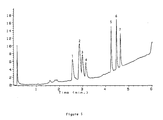
- Test of a column packed with Kovasil MS-C14. Separation of a test mixture composed of toluene (1), butylbenzene (2) and pentylbenzene (3). Experimental: column: 33 x 4.6 mm; elution mode: isocratic; mobile phase: acetonitrile/water (AN/W = 50/50 by volume); flow rate: 0.9 ml min-1; pressure: 20 MPa; temperature: ambient; detector:
UV 254 nm (see Fig. 1).
Theoretical plate numbers, Nx: Ntoluene: 4100; Nbutylbenzene: 6150; Npentylbenzene: 7980. The increase of number of theoretical plates as a function of retention time was explained by extracolumn contributions of the chromatographic system to peak-broadening (with longer retention this contribution has a smaller effect). - Hydrolytic stability of the stationary phases, Kovasil MS-C14 and Kovasil MS-DMB. Experimental: columns: 33 x 4.6 mm; mobile phase is a mixture of acetonitrile/water (AN/W = 50/50 by volume) containing 0.12 % trifluoroacetic acid (TFA); temperature: 80 °C; flow rate: 1.5 ml min-1; pressure: 16 MPa. The columns were connected periodically to the chromatographic system (every 20 h) and the mixture of Example 3 was injected. Retention times as a function of time are shown in Fig. 2. During the whole test period (400 h) the number of theoretical plates remained constant.
- Separation of a protein mixture of analytical importance on Kovasil MS-DMB Components: 1 ribonuclease, 2 cytochrom C (horse), 3 cytochrom C (bovin), 4 lysosyme, 5 conalbumin, 6 myoglobin, 7 β-lactoglobulin B, 8 β-lactoglobulin A, 9 chymotrypsinogene. Experimental: column: 33 x 4.6 mm; elution mode: multilinear gradient by mixing A and B where eluent A is a mixture of AN/W = 20/80 and eluent B is AN/W = 90/10 both containing 0.12 % trifluoroacetic acid (TFA); elution program: 0 → 0.5 min 3.6 → 27 % B, 0.5 → 1 min 27 → 29 % B, 1 → 1.2 min 29 → 37 % B, 1.2 → 2 min 37 → 39 % B, keep and return; flow rate: 3.0 ml min-1; pressure at start: 35.1 MPa; temperature: 80 °C; detector: UV 215 nm (see Fig. 3).
- Separation of β-lactoglobulins on Kovasil MS-DMB. Components: 1 β-lactoglobulin B, 2 β-lactoglobulin A. Experimental: column: 33 x 4.6 mm; elution mode: linear gradient by mixing A and B where eluent A is a mixture of AN/W = 20/80 and eluent B is AN/W = 90/10 both containing 0.12 % trifluoroacetic acid (TFA); elution program: 0 → 0.8
min 28 → 100 % B, keep and return; flow rate: 3.6 ml min-1; pressure at start: 35 MPa; temperature: 90 °C; detector: UV 215 nm (see Fig. 4). - Separation of octapeptides on Kovasil MS-DMB. The seven octapeptides analysed have the following structure: Tyr-Ile-Pro-X-Ala-Glu-Lys-Ile with X: 1 X = Lys, 2 X = Asn, 3 X = Ala, 4 X = Glu, 5 X = Ile 6 X = Phe 7 X = Leu. Experimental: column: 33 x 4.6 mm; elution mode: multilinear gradient by mixing A and B where eluent A is a mixture of AN/W = 3/97 and eluent B is AN / W = 90 / 10 both containing 0.05 % trifluoroacetic acid (TFA); elution program: 0 → 3
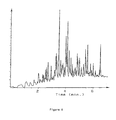
min 1 → 9.7 % B, 3 → 7 min 9.7 → 50 % B, keep and return; flow rate: 1.5 ml min-1; pressure at start: 22 MPa; temperature: 40 °C; detector: UV 215 nm (see Fig. 5). - Separation of trypsin digest of serum albumin on Kovasil MS-DMB. Experimental: column: 66 x 4.6 mm; elution mode: multilinear gradient by mixing A and B where eluent A is a mixture of AN/W = 2/98 and eluent B is AN/W = 90/10 both containing 0.1 % trifluoroacetic acid (TFA); elution program: 0 → 1.8
min 5 → 12 % B, 1.8 → 3.8min 12 → 32 % B, 3.8 → 6 min 32 → 50 % B, keep and return; flow rate: 1.4 ml min-1; pressure at start: 37 MPa; temperature: 37 °C; detector: UV 215 nm (see Fig. 6). - Separation of proteins on Nu-DMB. Components: 1 ribonuclease, 2 insulin (bovin), 3 cytochrom C (horse), 4 lysosyme, 5 chymotrypsin, 6 β-lactoglobulin B, 7 β-lactoglobulin A. Experimental: column: 125 x 4.6 mm; elution mode: linear gradient by mixing A and B where eluent A is a mixture of AN/W = 20/80 and eluent B is AN/W = 90/10 both containing 0.12 % trifluoroacetic acid (TFA); elution program: 0 → 20
min 0 → 80 % B, keep and return; flow rate: 1.0 ml min-1; pressure at start: 14 MPa; detector: UV 215 nm (see Fig. 7). This example shows that surfaces covered with a dense layer may be also used for high capacity silica gel, consequently, for preparative separations and purifications. -
- 1. Melander, W.R. and Horváth, Cs.; in Horváth, Cs. (ed.), High Performance Liquid Chromatography - Advances and Perspectives, Vol. 2, Academic Press, New York 1980
- 2. Jelinek, L., Erbacher, C., sz. Kováts, E.,
European Patent 0 574 642 A1 (1992) -
Claims (1)
- A method for the rapid chromatographic analysis of proteins or peptides, the method comprising: preparing an adsorbant, the adsorbant comprising redispersable, non-porous, monosized silicon dioxide microspheres covered with a dense layer of triorganylsilyl groups, selected from the group consisting of 3,3-dimethylbutyldimethylsilyl or tetradecyldimethylsilyl, the microspheres having a particle diameter of 1,49µm, packing a chromatographic column with the adsorbant, using the packed chromatographic column for chromatographically separating the said biomolecules, and analysing these eluted biomolecules with a detector.
Priority Applications (4)
| Application Number | Priority Date | Filing Date | Title |
|---|---|---|---|
| EP94810428A EP0693314B1 (en) | 1994-07-20 | 1994-07-20 | Chromatography using silicon dioxide based adsorbents. |
| DE69428437T DE69428437T2 (en) | 1994-07-20 | 1994-07-20 | Chromatography using silica-based adsorbents. |
| JP7183665A JPH0862199A (en) | 1994-07-20 | 1995-07-20 | Silicon dioxide-based microspheres for rapid separation of biomolecules by chromatography |
| US08/852,746 US5762803A (en) | 1994-07-20 | 1997-05-06 | Silicon dioxide based microspheres for rapid chromatographic separation of biomolecules |
Applications Claiming Priority (1)
| Application Number | Priority Date | Filing Date | Title |
|---|---|---|---|
| EP94810428A EP0693314B1 (en) | 1994-07-20 | 1994-07-20 | Chromatography using silicon dioxide based adsorbents. |
Publications (2)
| Publication Number | Publication Date |
|---|---|
| EP0693314A1 EP0693314A1 (en) | 1996-01-24 |
| EP0693314B1 true EP0693314B1 (en) | 2001-09-26 |
Family
ID=8218288
Family Applications (1)
| Application Number | Title | Priority Date | Filing Date |
|---|---|---|---|
| EP94810428A Expired - Lifetime EP0693314B1 (en) | 1994-07-20 | 1994-07-20 | Chromatography using silicon dioxide based adsorbents. |
Country Status (4)
| Country | Link |
|---|---|
| US (1) | US5762803A (en) |
| EP (1) | EP0693314B1 (en) |
| JP (1) | JPH0862199A (en) |
| DE (1) | DE69428437T2 (en) |
Families Citing this family (2)
| Publication number | Priority date | Publication date | Assignee | Title |
|---|---|---|---|---|
| IN2015DN02055A (en) | 2012-09-17 | 2015-08-14 | Grace W R & Co | |
| CN104971670B (en) * | 2014-04-01 | 2017-08-25 | 上海师范大学 | Magnetic hollow silicon dioxide microballoon and its preparation technology |
Family Cites Families (11)
| Publication number | Priority date | Publication date | Assignee | Title |
|---|---|---|---|---|
| US3722181A (en) * | 1970-05-22 | 1973-03-27 | Du Pont | Chromatographic packing with chemically bonded organic stationary phases |
| US3795313A (en) * | 1970-05-22 | 1974-03-05 | Du Pont | Chromatographic packing with chemically bonded organic stationary phases |
| DE2225973C2 (en) * | 1972-05-27 | 1974-07-04 | Merck Patent Gmbh, 6100 Darmstadt | Process for coating non-porous material with a porous silicon dioxide layer |
| US5212143A (en) * | 1978-08-28 | 1993-05-18 | Torobin Leonard B | Hollow porous microspheres made from dispersed particle compositions |
| US4743545A (en) * | 1984-08-09 | 1988-05-10 | Torobin Leonard B | Hollow porous microspheres containing biocatalyst |
| DE2930516A1 (en) * | 1979-07-27 | 1981-02-12 | Merck Patent Gmbh | RELEASE MATERIAL FOR CHROMATOGRAPHY WITH ORGANICALLY MODIFIED SURFACE, METHOD FOR THE PRODUCTION OF SUCH RELEASE MATERIALS AND THEIR USE |
| US4874518A (en) * | 1985-11-01 | 1989-10-17 | E. I. Du Pont De Nemours And Company | Porous silica microspheres having a silanol enriched surface |
| US5108595A (en) * | 1985-11-01 | 1992-04-28 | E. I. Du Pont De Nemours And Company | Porous silica microspheres having silanol-enriched and silanized surfaces |
| US5032266A (en) * | 1985-11-01 | 1991-07-16 | E. I. Du Pont De Nemours And Company | Porous silica microspheres having silanol-enriched and silanized surfaces |
| GB8822180D0 (en) * | 1988-09-21 | 1988-10-26 | Glaverbel | Separation of product of biological process from fluid medium |
| ATE172695T1 (en) * | 1992-06-19 | 1998-11-15 | Uetikon Chemie Ag | METHOD FOR PRODUCING POWDERS AND SUSPENSIONS OF AMORPHIC SILICON DIOXIDE MICROBLADES |
-
1994
- 1994-07-20 DE DE69428437T patent/DE69428437T2/en not_active Expired - Fee Related
- 1994-07-20 EP EP94810428A patent/EP0693314B1/en not_active Expired - Lifetime
-
1995
- 1995-07-20 JP JP7183665A patent/JPH0862199A/en active Pending
-
1997
- 1997-05-06 US US08/852,746 patent/US5762803A/en not_active Expired - Fee Related
Also Published As
| Publication number | Publication date |
|---|---|
| DE69428437D1 (en) | 2001-10-31 |
| DE69428437T2 (en) | 2002-06-20 |
| US5762803A (en) | 1998-06-09 |
| JPH0862199A (en) | 1996-03-08 |
| EP0693314A1 (en) | 1996-01-24 |
Similar Documents
| Publication | Publication Date | Title |
|---|---|---|
| Stellwagen | [25] Gel filtration | |
| JP4086305B2 (en) | Phosphorylcholine group-containing compound and surface modifier comprising the compound | |
| Leatherbarrow et al. | Studies on the mechanism of binding of serum albumins to immobilized cibacron blue F3G A | |
| Buszewski et al. | Chemically bonded phases for the reversed-phase high-performance liquid chromatographic separation of basic substances | |
| EP2700445B1 (en) | Method of preparing a chromatography packing | |
| Engelhardt et al. | Polymer encapsulated staionary phases: Advantages, properties and selectivities | |
| Yu et al. | Reversed-phase liquid chromatography with microspherical octadecyl-zirconia bonded stationary phases | |
| Schomburg | Polymer coating of surfaces in column liquid chromatography and capillary electrophoresis | |
| Sun et al. | Study of the irreversible adsorption of proteins on polybutadiene-coated zirconia | |
| JPS615100A (en) | Sulfone-activated thioether adsorbent for separating proteinor like | |
| Van Oss et al. | Interaction between proteins and inorganic oxides—Adsorption of albumin and its desorption with a complexing agent | |
| JPS6345558A (en) | Reverse phase charging▲Ten▼Materials | |
| Filho et al. | 2-Mercaptoimidazole covalently bonded to a silica gel surface for the selective separation of mercury (II) from an aqueous solution | |
| Lakhiari et al. | Temperature-responsive size-exclusion chromatography using poly (N-isopropylacrylamide) grafted silica | |
| SE8700949D0 (en) | ADSORBENT FOR AFFINITY CHROMATOGRAPHY | |
| Štulík et al. | Stationary phases for peptide analysis by high performance liquid chromatography: a review | |
| Hearn | Peptide analysis by rapid, orthogonal technologies with high separation selectivities and sensitivities | |
| Giaquinto et al. | Surface area of reversed-phase HPLC columns | |
| EP0693314A1 (en) | Silicon dioxide based adsorbents for chromatography | |
| Zou et al. | Capillary electrochromatography with physically and dynamically absorbed stationary phases | |
| US20080015341A1 (en) | New hydrophobic polymer comprising fluorine moieties | |
| de Collongue-Poyet et al. | Study of conformational effects of recombinant interferon γ adsorbed on a non-porous reversed-phase silica support | |
| JPH06186202A (en) | Inactivation of inner surface of capillary | |
| Kopaciewicz et al. | Synthesis of an adsorb reversed-phase packing material for the separation of proteins and peptides | |
| JPH04269656A (en) | Filler for liquid chromatograph |
Legal Events
| Date | Code | Title | Description |
|---|---|---|---|
| PUAI | Public reference made under article 153(3) epc to a published international application that has entered the european phase |
Free format text: ORIGINAL CODE: 0009012 |
|
| AK | Designated contracting states |
Kind code of ref document: A1 Designated state(s): CH DE FR GB LI SE |
|
| AX | Request for extension of the european patent |
Free format text: SI |
|
| RAX | Requested extension states of the european patent have changed |
Free format text: SI |
|
| K1C3 | Correction of patent application (complete document) published |
Effective date: 19960124 |
|
| 17P | Request for examination filed |
Effective date: 19960410 |
|
| 17Q | First examination report despatched |
Effective date: 19970707 |
|
| GRAG | Despatch of communication of intention to grant |
Free format text: ORIGINAL CODE: EPIDOS AGRA |
|
| GRAG | Despatch of communication of intention to grant |
Free format text: ORIGINAL CODE: EPIDOS AGRA |
|
| GRAH | Despatch of communication of intention to grant a patent |
Free format text: ORIGINAL CODE: EPIDOS IGRA |
|
| GRAH | Despatch of communication of intention to grant a patent |
Free format text: ORIGINAL CODE: EPIDOS IGRA |
|
| GRAA | (expected) grant |
Free format text: ORIGINAL CODE: 0009210 |
|
| AK | Designated contracting states |
Kind code of ref document: B1 Designated state(s): CH DE FR GB LI SE |
|
| REG | Reference to a national code |
Ref country code: CH Ref legal event code: EP |
|
| REF | Corresponds to: |
Ref document number: 69428437 Country of ref document: DE Date of ref document: 20011031 |
|
| REG | Reference to a national code |
Ref country code: GB Ref legal event code: IF02 |
|
| ET | Fr: translation filed | ||
| PG25 | Lapsed in a contracting state [announced via postgrant information from national office to epo] |
Ref country code: GB Free format text: LAPSE BECAUSE OF NON-PAYMENT OF DUE FEES Effective date: 20020720 |
|
| PG25 | Lapsed in a contracting state [announced via postgrant information from national office to epo] |
Ref country code: SE Free format text: LAPSE BECAUSE OF NON-PAYMENT OF DUE FEES Effective date: 20020721 |
|
| PG25 | Lapsed in a contracting state [announced via postgrant information from national office to epo] |
Ref country code: LI Free format text: LAPSE BECAUSE OF NON-PAYMENT OF DUE FEES Effective date: 20020731 Ref country code: CH Free format text: LAPSE BECAUSE OF NON-PAYMENT OF DUE FEES Effective date: 20020731 |
|
| PLBE | No opposition filed within time limit |
Free format text: ORIGINAL CODE: 0009261 |
|
| STAA | Information on the status of an ep patent application or granted ep patent |
Free format text: STATUS: NO OPPOSITION FILED WITHIN TIME LIMIT |
|
| 26N | No opposition filed | ||
| PG25 | Lapsed in a contracting state [announced via postgrant information from national office to epo] |
Ref country code: DE Free format text: LAPSE BECAUSE OF NON-PAYMENT OF DUE FEES Effective date: 20030201 |
|
| EUG | Se: european patent has lapsed | ||
| GBPC | Gb: european patent ceased through non-payment of renewal fee |
Effective date: 20020720 |
|
| REG | Reference to a national code |
Ref country code: CH Ref legal event code: PL |
|
| PG25 | Lapsed in a contracting state [announced via postgrant information from national office to epo] |
Ref country code: FR Free format text: LAPSE BECAUSE OF NON-PAYMENT OF DUE FEES Effective date: 20030331 |
|
| REG | Reference to a national code |
Ref country code: FR Ref legal event code: ST |