EP0692740B1 - Procédé et dispositif de fabrication d'un composant optique - Google Patents
Procédé et dispositif de fabrication d'un composant optique Download PDFInfo
- Publication number
- EP0692740B1 EP0692740B1 EP19950401654 EP95401654A EP0692740B1 EP 0692740 B1 EP0692740 B1 EP 0692740B1 EP 19950401654 EP19950401654 EP 19950401654 EP 95401654 A EP95401654 A EP 95401654A EP 0692740 B1 EP0692740 B1 EP 0692740B1
- Authority
- EP
- European Patent Office
- Prior art keywords
- substance
- process according
- substrate
- photopolymerisable
- lighting
- Prior art date
- Legal status (The legal status is an assumption and is not a legal conclusion. Google has not performed a legal analysis and makes no representation as to the accuracy of the status listed.)
- Expired - Lifetime
Links
- 238000000034 method Methods 0.000 title claims description 29
- 230000003287 optical effect Effects 0.000 title claims description 22
- 238000004519 manufacturing process Methods 0.000 title claims description 15
- 239000000126 substance Substances 0.000 claims description 50
- 239000000758 substrate Substances 0.000 claims description 23
- 239000000203 mixture Substances 0.000 claims description 22
- 150000001768 cations Chemical class 0.000 claims description 13
- 239000007788 liquid Substances 0.000 claims description 12
- 239000000463 material Substances 0.000 claims description 9
- -1 Bengali pink Chemical compound 0.000 claims description 7
- 230000000694 effects Effects 0.000 claims description 6
- 230000001235 sensitizing effect Effects 0.000 claims description 5
- KWOLFJPFCHCOCG-UHFFFAOYSA-N Acetophenone Chemical compound CC(=O)C1=CC=CC=C1 KWOLFJPFCHCOCG-UHFFFAOYSA-N 0.000 claims description 4
- SEACYXSIPDVVMV-UHFFFAOYSA-L eosin Y Chemical compound [Na+].[Na+].[O-]C(=O)C1=CC=CC=C1C1=C2C=C(Br)C(=O)C(Br)=C2OC2=C(Br)C([O-])=C(Br)C=C21 SEACYXSIPDVVMV-UHFFFAOYSA-L 0.000 claims description 4
- 239000007787 solid Substances 0.000 claims description 4
- 238000003860 storage Methods 0.000 claims description 4
- UEEJHVSXFDXPFK-UHFFFAOYSA-N N-dimethylaminoethanol Chemical compound CN(C)CCO UEEJHVSXFDXPFK-UHFFFAOYSA-N 0.000 claims description 3
- RWCCWEUUXYIKHB-UHFFFAOYSA-N benzophenone Chemical compound C=1C=CC=CC=1C(=O)C1=CC=CC=C1 RWCCWEUUXYIKHB-UHFFFAOYSA-N 0.000 claims description 3
- 229960002887 deanol Drugs 0.000 claims description 3
- ISAOCJYIOMOJEB-UHFFFAOYSA-N desyl alcohol Natural products C=1C=CC=CC=1C(O)C(=O)C1=CC=CC=C1 ISAOCJYIOMOJEB-UHFFFAOYSA-N 0.000 claims description 3
- 239000012972 dimethylethanolamine Substances 0.000 claims description 3
- 238000009826 distribution Methods 0.000 claims description 3
- 239000004973 liquid crystal related substance Substances 0.000 claims description 3
- 229920000728 polyester Polymers 0.000 claims description 3
- 229920005862 polyol Polymers 0.000 claims description 3
- 230000037452 priming Effects 0.000 claims description 3
- ANRHNWWPFJCPAZ-UHFFFAOYSA-M thionine Chemical compound [Cl-].C1=CC(N)=CC2=[S+]C3=CC(N)=CC=C3N=C21 ANRHNWWPFJCPAZ-UHFFFAOYSA-M 0.000 claims description 3
- OTKCEEWUXHVZQI-UHFFFAOYSA-N 1,2-diphenylethanone Chemical class C=1C=CC=CC=1C(=O)CC1=CC=CC=C1 OTKCEEWUXHVZQI-UHFFFAOYSA-N 0.000 claims description 2
- RBTBFTRPCNLSDE-UHFFFAOYSA-N 3,7-bis(dimethylamino)phenothiazin-5-ium Chemical compound C1=CC(N(C)C)=CC2=[S+]C3=CC(N(C)C)=CC=C3N=C21 RBTBFTRPCNLSDE-UHFFFAOYSA-N 0.000 claims description 2
- 244000028419 Styrax benzoin Species 0.000 claims description 2
- 235000000126 Styrax benzoin Nutrition 0.000 claims description 2
- 235000008411 Sumatra benzointree Nutrition 0.000 claims description 2
- 229960002130 benzoin Drugs 0.000 claims description 2
- 239000012965 benzophenone Substances 0.000 claims description 2
- ZBCBWPMODOFKDW-UHFFFAOYSA-N diethanolamine Chemical compound OCCNCCO ZBCBWPMODOFKDW-UHFFFAOYSA-N 0.000 claims description 2
- IINNWAYUJNWZRM-UHFFFAOYSA-L erythrosin B Chemical compound [Na+].[Na+].[O-]C(=O)C1=CC=CC=C1C1=C2C=C(I)C(=O)C(I)=C2OC2=C(I)C([O-])=C(I)C=C21 IINNWAYUJNWZRM-UHFFFAOYSA-L 0.000 claims description 2
- 229940011411 erythrosine Drugs 0.000 claims description 2
- 235000012732 erythrosine Nutrition 0.000 claims description 2
- 239000004174 erythrosine Substances 0.000 claims description 2
- 238000001914 filtration Methods 0.000 claims description 2
- 235000019382 gum benzoic Nutrition 0.000 claims description 2
- 125000005395 methacrylic acid group Chemical group 0.000 claims description 2
- 229960000907 methylthioninium chloride Drugs 0.000 claims description 2
- SOUHUMACVWVDME-UHFFFAOYSA-N safranin O Chemical compound [Cl-].C12=CC(N)=CC=C2N=C2C=CC(N)=CC2=[N+]1C1=CC=CC=C1 SOUHUMACVWVDME-UHFFFAOYSA-N 0.000 claims description 2
- 238000011144 upstream manufacturing Methods 0.000 claims description 2
- 239000003795 chemical substances by application Substances 0.000 claims 2
- 238000004040 coloring Methods 0.000 claims 1
- 238000005286 illumination Methods 0.000 description 20
- 229920000642 polymer Polymers 0.000 description 12
- 238000005406 washing Methods 0.000 description 11
- 239000011521 glass Substances 0.000 description 9
- CRVGTESFCCXCTH-UHFFFAOYSA-N methyl diethanolamine Chemical compound OCCN(C)CCO CRVGTESFCCXCTH-UHFFFAOYSA-N 0.000 description 5
- 230000035515 penetration Effects 0.000 description 5
- HVVWZTWDBSEWIH-UHFFFAOYSA-N [2-(hydroxymethyl)-3-prop-2-enoyloxy-2-(prop-2-enoyloxymethyl)propyl] prop-2-enoate Chemical compound C=CC(=O)OCC(CO)(COC(=O)C=C)COC(=O)C=C HVVWZTWDBSEWIH-UHFFFAOYSA-N 0.000 description 4
- 238000009472 formulation Methods 0.000 description 4
- 238000006116 polymerization reaction Methods 0.000 description 4
- XKRFYHLGVUSROY-UHFFFAOYSA-N Argon Chemical compound [Ar] XKRFYHLGVUSROY-UHFFFAOYSA-N 0.000 description 2
- LFQSCWFLJHTTHZ-UHFFFAOYSA-N Ethanol Chemical compound CCO LFQSCWFLJHTTHZ-UHFFFAOYSA-N 0.000 description 2
- 206010070834 Sensitisation Diseases 0.000 description 2
- VYPSYNLAJGMNEJ-UHFFFAOYSA-N Silicium dioxide Chemical compound O=[Si]=O VYPSYNLAJGMNEJ-UHFFFAOYSA-N 0.000 description 2
- FAPWRFPIFSIZLT-UHFFFAOYSA-M Sodium chloride Chemical compound [Na+].[Cl-] FAPWRFPIFSIZLT-UHFFFAOYSA-M 0.000 description 2
- 230000015572 biosynthetic process Effects 0.000 description 2
- 239000003086 colorant Substances 0.000 description 2
- 150000001875 compounds Chemical class 0.000 description 2
- 230000008021 deposition Effects 0.000 description 2
- YQGOJNYOYNNSMM-UHFFFAOYSA-N eosin Chemical compound [Na+].OC(=O)C1=CC=CC=C1C1=C2C=C(Br)C(=O)C(Br)=C2OC2=C(Br)C(O)=C(Br)C=C21 YQGOJNYOYNNSMM-UHFFFAOYSA-N 0.000 description 2
- 230000006870 function Effects 0.000 description 2
- 239000003999 initiator Substances 0.000 description 2
- 229910052751 metal Inorganic materials 0.000 description 2
- 239000002184 metal Substances 0.000 description 2
- 230000000379 polymerizing effect Effects 0.000 description 2
- 150000003077 polyols Chemical class 0.000 description 2
- 230000005855 radiation Effects 0.000 description 2
- STRXNPAVPKGJQR-UHFFFAOYSA-N rose bengal A Natural products O1C(=O)C(C(=CC=C2Cl)Cl)=C2C21C1=CC(I)=C(O)C(I)=C1OC1=C(I)C(O)=C(I)C=C21 STRXNPAVPKGJQR-UHFFFAOYSA-N 0.000 description 2
- 230000008313 sensitization Effects 0.000 description 2
- JHNLZOVBAQWGQU-UHFFFAOYSA-N 380814_sial Chemical compound CS(O)(=O)=O.O=P(=O)OP(=O)=O JHNLZOVBAQWGQU-UHFFFAOYSA-N 0.000 description 1
- IICCLYANAQEHCI-UHFFFAOYSA-N 4,5,6,7-tetrachloro-3',6'-dihydroxy-2',4',5',7'-tetraiodospiro[2-benzofuran-3,9'-xanthene]-1-one Chemical compound O1C(=O)C(C(=C(Cl)C(Cl)=C2Cl)Cl)=C2C21C1=CC(I)=C(O)C(I)=C1OC1=C(I)C(O)=C(I)C=C21 IICCLYANAQEHCI-UHFFFAOYSA-N 0.000 description 1
- RZVAJINKPMORJF-UHFFFAOYSA-N Acetaminophen Chemical compound CC(=O)NC1=CC=C(O)C=C1 RZVAJINKPMORJF-UHFFFAOYSA-N 0.000 description 1
- 241000393496 Electra Species 0.000 description 1
- 241001080024 Telles Species 0.000 description 1
- DAKWPKUUDNSNPN-UHFFFAOYSA-N Trimethylolpropane triacrylate Chemical compound C=CC(=O)OCC(CC)(COC(=O)C=C)COC(=O)C=C DAKWPKUUDNSNPN-UHFFFAOYSA-N 0.000 description 1
- LUTSRLYCMSCGCS-BWOMAWGNSA-N [(3s,8r,9s,10r,13s)-10,13-dimethyl-17-oxo-1,2,3,4,7,8,9,11,12,16-decahydrocyclopenta[a]phenanthren-3-yl] acetate Chemical compound C([C@@H]12)C[C@]3(C)C(=O)CC=C3[C@@H]1CC=C1[C@]2(C)CC[C@H](OC(=O)C)C1 LUTSRLYCMSCGCS-BWOMAWGNSA-N 0.000 description 1
- 238000010521 absorption reaction Methods 0.000 description 1
- NIXOWILDQLNWCW-UHFFFAOYSA-N acrylic acid group Chemical group C(C=C)(=O)O NIXOWILDQLNWCW-UHFFFAOYSA-N 0.000 description 1
- 229910052786 argon Inorganic materials 0.000 description 1
- OYLGJCQECKOTOL-UHFFFAOYSA-L barium fluoride Chemical compound [F-].[F-].[Ba+2] OYLGJCQECKOTOL-UHFFFAOYSA-L 0.000 description 1
- 229910001632 barium fluoride Inorganic materials 0.000 description 1
- 239000011248 coating agent Substances 0.000 description 1
- 238000000576 coating method Methods 0.000 description 1
- 229910002026 crystalline silica Inorganic materials 0.000 description 1
- 239000005350 fused silica glass Substances 0.000 description 1
- 238000001879 gelation Methods 0.000 description 1
- PCHJSUWPFVWCPO-UHFFFAOYSA-N gold Chemical compound [Au] PCHJSUWPFVWCPO-UHFFFAOYSA-N 0.000 description 1
- 239000010931 gold Substances 0.000 description 1
- 229910052737 gold Inorganic materials 0.000 description 1
- 238000001393 microlithography Methods 0.000 description 1
- 239000000178 monomer Substances 0.000 description 1
- GVKCHTBDSMQENH-UHFFFAOYSA-L phloxine B Chemical compound [Na+].[Na+].[O-]C(=O)C1=C(Cl)C(Cl)=C(Cl)C(Cl)=C1C1=C2C=C(Br)C(=O)C(Br)=C2OC2=C(Br)C([O-])=C(Br)C=C21 GVKCHTBDSMQENH-UHFFFAOYSA-L 0.000 description 1
- 230000001681 protective effect Effects 0.000 description 1
- 239000005297 pyrex Substances 0.000 description 1
- 239000012966 redox initiator Substances 0.000 description 1
- 239000011347 resin Substances 0.000 description 1
- 229920005989 resin Polymers 0.000 description 1
- 229930187593 rose bengal Natural products 0.000 description 1
- 229940081623 rose bengal Drugs 0.000 description 1
- AZJPTIGZZTZIDR-UHFFFAOYSA-L rose bengal Chemical compound [K+].[K+].[O-]C(=O)C1=C(Cl)C(Cl)=C(Cl)C(Cl)=C1C1=C2C=C(I)C(=O)C(I)=C2OC2=C(I)C([O-])=C(I)C=C21 AZJPTIGZZTZIDR-UHFFFAOYSA-L 0.000 description 1
- 230000035945 sensitivity Effects 0.000 description 1
- 238000007493 shaping process Methods 0.000 description 1
- 235000012239 silicon dioxide Nutrition 0.000 description 1
- 239000011780 sodium chloride Substances 0.000 description 1
- 239000002904 solvent Substances 0.000 description 1
- 229940096522 trimethylolpropane triacrylate Drugs 0.000 description 1
- 238000007738 vacuum evaporation Methods 0.000 description 1
Images

Classifications
-
- G—PHYSICS
- G03—PHOTOGRAPHY; CINEMATOGRAPHY; ANALOGOUS TECHNIQUES USING WAVES OTHER THAN OPTICAL WAVES; ELECTROGRAPHY; HOLOGRAPHY
- G03F—PHOTOMECHANICAL PRODUCTION OF TEXTURED OR PATTERNED SURFACES, e.g. FOR PRINTING, FOR PROCESSING OF SEMICONDUCTOR DEVICES; MATERIALS THEREFOR; ORIGINALS THEREFOR; APPARATUS SPECIALLY ADAPTED THEREFOR
- G03F7/00—Photomechanical, e.g. photolithographic, production of textured or patterned surfaces, e.g. printing surfaces; Materials therefor, e.g. comprising photoresists; Apparatus specially adapted therefor
- G03F7/0005—Production of optical devices or components in so far as characterised by the lithographic processes or materials used therefor
- G03F7/001—Phase modulating patterns, e.g. refractive index patterns
Definitions
- the present invention relates to the manufacture of a optical component which can be used in a optical device due to its ability to modify the properties of a light beam, or constitute a storage medium for information.
- the object of the invention is to exceed these limits by proposing a manufacturing process and device of an optical component based on a technique of completely different from light curing used so far.
- the photosensitive medium receives the light beam from awareness through an interface lit according to a incidence ensuring total reflection and therefore, the formation of an evanescent zone.
- US-A-3,864,130 relates to a process for the production of integrated optical circuits.
- a radiation sensitive material is exposed to electromagnetic surface waves, preferably by total reflection.
- the radiation-sensitive material is placed on a support in a cell completely filled with a liquid medium with very high refractive index. We send a monochromatic plane wave to through this liquid medium.
- the present invention relates to a method of manufacturing a optical component allowing good control of the thickness of deposited polymer, as well as a device for manufacturing a component optics particularly suitable for this process.
- the invention relates to a method of manufacture of an optical component according to claim 1.
- the method of manufacturing an optical component of the invention consists in manufacturing a thin layer of polymer, of micron or submicron thickness, on the surface of a transparent substrate of high index n 1 .
- the transparent substrate has a polished face on which the thin layer of polymer will form. It can be made of many glassy materials with a high index, for example ordinary glass, pyrex (registered trademark), fused silica, monocrystalline sodium chloride, monocrystalline barium fluoride ... Its index n 1 is preferably greater than 1.35.
- the formation of the thin layer of polymer is obtained by bringing a polished face of the substrate into contact with a photopolymerizable substance in solid, liquid or gaseous form, of index n 2 .
- a light beam illuminates the polished face of the substrate through it, at an angle of index i , such as n 1 / n 2 sin i > 1, that is to say in total reflection, thus producing a evanescence zone in the vicinity of the interface between the transparent substrate and the photopolymerizable substance.
- the angle of incidence i is chosen so that the relationship reflecting the total reflection is ensured both after and before polymerization, the index n 2 generally changing between these two states.
- the light-curing substance is composed of a initiator sensitive to light, capable of providing free radicals or cations and a resin photopolymerizable under the effect of these free radicals or cations.
- OD ⁇ c 1
- OD the optical density of the photopolymerizable material before polymerization
- c the concentration of the initiator
- ⁇ its molar absorption coefficient the optical path traveled by the light.
- a transparent layer of index n 3 less than n 2 makes it possible to fulfill the conditions of the frustrated reflection and thus to introduce an additional means of controlling the thickness of the deposited polymer, the latter depending on the nature of the material of the layer of index n 3 and on its thickness.
- the incident light beam can be spatially modulated by a mask
- the image of this mask can be formed in the evanescence area and it can possibly be constituted by a valve with liquid crystals.
- the layer photosensitive After sensitization of the substance photopolymerizable by a light beam, the layer photosensitive is washed so that the unreacted or non-reacting substances sufficiently transformed, be eliminated by a suitable solvent.
- a metal stand 1 is intended to cooperate with a glass slide constituting the transparent substrate 2. Together they form an open parallelepiped, of so as to delimit an interior cavity 3, itself parallelepiped.
- the angle of incidence of the laser beam 6 with the surface 4 is determined so that the conditions of total reflection be satisfied.
- this angle of incidence i is determined as a function of the indices n 1 of the substrate 2 and n 2 of the photopolymerizable substance to obtain the desired penetration depth of the beam 6 in the photopolymerizable mixture.
- a mask 7 provides the spatial modulation of the beam.
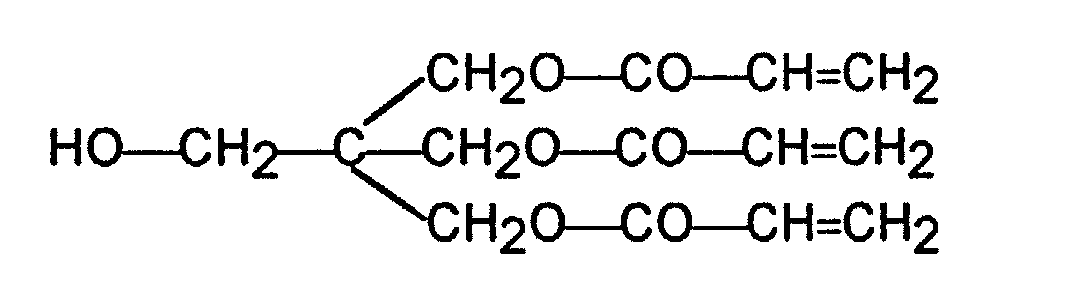
- the photopolymerizable liquid mixture placed in the view is formed from pentaerythritoltriacrylate (10 g), methyldiethanolamine (900 mg) and eosin Y (340 mg).
- a laser beam 6, of wavelength ⁇ 514 mm, produced by an ionized argon source, penetrates laterally into the blade 2, as shown in Figure 1, forming, with the normal to the plane of incidence, a angle i of 70.3 °.
- This beam shaped by a suitable optical device not shown, has a diameter of 4 mm and its light power is 6.2 mW / cm 2 .
- This beam produces the phenomenon of evanescence in region 5.
- the tank is dismantled and the glass slide 1 is rinsed with ethanol. After this operation, there remains a film of polypentaerythritoltriacrylate, the thickness of which, measured by conventional interferometric techniques, is estimated at 0.3 ⁇ m.
- the reactive formulation is identical to that of Example 1.
- the light power of the laser beam is 5 mW / cm 2 .
- the irradiation time and the angle of incidence are unchanged.
- the measured thickness of the polymerized layer is 0.14 ⁇ m.
- the reactive formulation, the light power and the angle of incidence are identical to those of the example 1.
- the illumination time is increased to 30 seconds.
- the thickness measured from the polymerized layer is 0.19 ⁇ m.
- the reactive formulation, the light power and the irradiation times are identical to those of Example 1.
- the angle of incidence is then 68.7 °.
- the light output, the illumination time and the angle of incidence are identical to those of the example 1.
- the amount of methyldiethanolamine is increased to 0.66 g.
- the measured thickness of the polymerized layer is 0.27 ⁇ m.
- the light output, the illumination time and the angle of incidence are identical to those of the example 1.
- the amount of eosin is brought to 0.13 g.
- the thickness measured from the polymerized layer is 0.1 ⁇ m.
- the light output and the angle of incidence are identical to those of Example 5.
- the time illumination is increased to 90 s.
- eosin is replaced by phloxine at the same proportion.
- the measured thickness of the polymerized layer is 0.05 ⁇ m approximately.
- the light output, the illumination time and the angle of incidence are identical to those of the example 1.
- methyldiethanolamine is replaced by dimethylethanolamine.
- the measured thickness of the layer is 0.16 ⁇ m.
- the light output and the angle of incidence are identical to those of Example 1. Time irradiation is increased to 90 s.
- the pentaerythritoltriacrylate is replaced by the trimethylolpropanetriacrylate.
- the measured thickness of the layer polymerized is approximately 0.04 ⁇ m.
- the light power, the illumination time, the angle of incidence, as well as the mixture polymerizable, are identical to those of Example 1.
- a mask of amplitude 7, similar to those used in microlithography, is interposed on the path of the laser beam 6. This mask defines an alternation of opaque and transparent areas with periodicity 5 lines / mm.
- the light power, the illumination time, the angle of incidence, as well as the mixture polymerizable, are identical to those of Example 1.
- a spatial modulation of the amplitude of the evanescent wave is obtained by creating, using a suitable optical device, the image of an amplitude mask in the area evanescence.
- the mask itself is placed on the path of the laser beam between the source and the blade 2.
- the light power, the illumination time, the angle of incidence, as well as the mixture polymerizable, are identical to those of Example 1.
- the laser is set in such a way that it emits at 488 nm instead of 514 nm, as described in examples 1 to 11.
- a polymer layer of homogeneous thickness equal to 0.04 ⁇ m.
- the light power, the illumination time, the angle of incidence, as well as the mixture polymerizable, are identical to those of Example 1.
- the glass slide 2 undergoes, prior to polymerization, a treatment corresponding to the deposition of a thin layer of 0.2 ⁇ m crystalline silica on the interface at neighborhood of which the phenomenon occurs evanescence.
- the thickness of the polymer layer obtained is reduced to 0.1 ⁇ m, then that in the absence of this intermediate micro-layer (example 1), it was 0.3 ⁇ m.
- the light power, the illumination time, the angle of incidence, as well as the mixture polymerizable, are identical to those of Example 1.
- the glass slide 2 is treated as described in Example 13.
- the polymer layer obtained is coated by vacuum evaporation of a 50 nm gold layer.
- the optical element obtained is a mirror whose reflection characteristics are defined only by the reflective power of the protective metal.
- a mask containing a density wedge is placed in the path of the laser beam.
- the reactive formulation is the same as in Example 6, the angle is 69.2 ° and the power is 2.4 mW / cm 2 after the mask.
- a microprism 5 mm long with a variation in thickness from 0 to 0.12 ⁇ m and 2 mm wide is obtained.
- Pentaerythritoltriacrylate PETA
- Methyldiethanolamine MDEA
- Eosine Eosine:
- This thickness can also be controlled by the choice of the composition of the polymerizable mixture.
- sensitizing dye the nature of the electron donor and the nature of the monomer can each be chosen from many compounds without affecting the principle of the invention.
Landscapes
- Physics & Mathematics (AREA)
- General Physics & Mathematics (AREA)
- Physical Or Chemical Processes And Apparatus (AREA)
- Polymerisation Methods In General (AREA)
- Optical Integrated Circuits (AREA)
Description
- la substance photopolymérisable déposée sur le substrat forme, après polymérisation, une couche d'épaisseur comprise entre 0,01 et 5 micromètres ;
- cette substance photopolymérisable contient des molécules susceptibles de polymériser sous l'effet d'un amorçage par des radicaux libres ou des cations et une substance capable sous l'effet de l'éclairement de générer transitoirement ces radicaux libres ou cations ;
- lors de l'éclairement de la substance photopolymérisable, le faisceau lumineux possède une répartition d'amplitude obtenue par une technique interférométrique ;
- lors de l'éclairement de la substance photopolymérisable, le faisceau lumineux est modulé spatialement, en amont de celle-ci par tout moyen approprié tel que, par exemple, un masque ;
- lors de l'éclairement de la substance photopolymérisable, l'image du masque est formée dans la zone d'évanescence ;
- le masque est une valve à cristaux liquides ;
- le substrat est en matériau vitreux d'indice n1 > 1,35 ;
- les molécules susceptibles de polymériser ; appartiennent, par exemple, à l'ensemble formé par les mono ou polyesters acryliques ou méthacryliques de polyols ;
- la substance capable de générer transitoirement des radicaux libres ou des cations est un mélange de deux types de molécules utilisées en conjonction telle que, par exemple et de façon non limitative, la benzophénone et ses dérivés, la diéthanolamine, l'acétophénone et ses dérivés, la diméthyléthanolamine, ou tout autre système connu de l'homme de l'art comme système amorceur photorédox ou oxydo réductif ;
- la substance capable de générer transitoirement des radicaux libres ou des cations comporte un colorant sensibilisateur ;
- le colorant sensibilisateur appartient, par exemple et de façon non limitative, à l'ensemble formé par l'éosine, l'érythrosine, le rose Bengale, le phénosafranine, le bleu de méthylène, la thionine, l'hexaméthylindo ricarbocyanine ;
- la substance capable de générer transitoirement des radicaux libres ou des cations appartient à l'ensemble formé par les éthers de benzoïne, les dérivés de phénylacétophénone et les acylphosphines oxydes et leurs dérivés ;
- le composant optique assure le stockage d'information codée optiquement.
- la Figure 1 est une représentation schématique du dispositif de l'invention ;
- la Figure 2 est une vue en perspective de la cuve mise en oeuvre dans le dispositif de l'invention.


Claims (15)
- Procédé de fabrication d'un composant optique dans lequel :caractérisé en ce que le substrat réalisé est transparent, en ce que le faisceau lumineux éclaire la substance photopolymérisable au travers du substrat et en ce que le substrat est recouvert, sur sa face recevant la substance photopolymérisable, d'une couche solide transparente d'indice n3 < n2,on réalise un substrat,on dépose sur le substrat une substance photopolymérisable d'indice n2,on éclaire la substance photopolymérisable au travers d'un milieu traversé d'indice élevé n1 à l'aide d'un faisceau lumineux, sous un angle d'incidence i, tel que n1/n2 sin i > 1 avant et après la polymérisation, produisant une zone d'évanescence au voisinage de l'interface entre les deux milieux,on traite la substance photopolymérisable de façon à révéler l'empreinte du faisceau lumineux,
- Procédé de fabrication d'un composant optique selon la revendication 1, caractérisé en ce que la substance photopolymérisable déposée sur le substrat forme, après polymérisation, une couche d'épaisseur comprise entre 0,01 et 5 micromètres.
- Procédé selon l'une des revendications 1 et 2, caractérisé en ce que la substance photopolymérisable contient des molécules susceptibles de polymériser sous l'effet d'un amorçage par des radicaux libres ou des cations et une substance capable sous l'effet de l'éclairement de générer transitoirement les radicaux libres ou les cations.
- Procédé selon l'une quelconque des revendications 1 à 3, caractérisé en ce que lors de l'éclairement de la substance photopolymérisable, le faisceau lumineux possède une répartition d'amplitude obtenue par une technique interférométrique.
- Procédé selon l'une quelconque des revendications 1 à 3, caractérisé en ce que lors de l'éclairement de la substance photopolymérisable, le faisceau lumineux est modulé spatialement, en amont de celle-ci par un masque.
- Procédé selon la revendication 5, caractérisé en ce que lors de l'éclairement de la substance photopolymérisable, l'image du masque est formée dans la zone d'évanescence.
- Procédé selon l'une quelconque des revendications 5 ou 6, caractérisé en ce que le masque est une valve à cristaux liquides.
- Procédé selon l'une quelconque des revendications 1 à 7, caractérisé en ce que le substrat est en matériau vitreux d'indice n1 > 1,35.
- Procédé selon l'une quelconque des revendications 3 à 8, caractérisé en ce que les molécules susceptibles de polymériser appartiennent à l'ensemble formé par les mono ou polyesters acryliques ou méthacryliques de polyols.
- Procédé selon l'une quelconque des revendications 3 à 9, caractérisé en ce que la substance capable de générer transitoirement des radicaux libres ou des cations est un mélange de deux types de molécules utilisées en conjonction appartenant à l'ensemble formé de la benzophénone et ses dérivés, la diéthanolamine, l'acétophénone et ses dérivés, la diméthyléthanolamine.
- Procédé selon l'une quelconque des revendications 3 à 10, caractérisé en ce que la substance capable de générer transitoirement des radicaux libres ou des cations comporte un colorant sensibilisateur.
- Procédé selon la revendication 11, caractérisé en ce que le colorant sensibilisateur appartient à l'ensemble formé par l'éosine, l'érythrosine, le rose Bengale, le phénosafranine, le bleu de méthylène, la thionine, l'hexaméthylindotricarbocyanine.
- Procédé selon l'une quelconque des revendications 3 à 9, caractérisé en ce que la substance capable de générer transitoirement des radicaux libres ou des cations appartient à l'ensemble formé par les éthers de benzoïne, les dérivés de phénylacétophénone et les acylphosphines oxydes et leurs dérivés.
- Procédé selon l'une quelconque des revendications 1 à 13, caractérisé en ce que le composant optique assure le stockage d'information.
- Dispositif de fabrication d'un composant optique selon une des revendications 1 à 14 comprenant :caractérisé en ce qu'il comporte un statif destiné à être fermé par un substrat transparent, de façon à former une cuve pouvant recevoir une substance photopolymérisable solide, liquide ou gazeuse, les moyens d'éclairage permettant d'éclairer l'interface entre le substrat et la substance photopolymérisable en réflexion totale, de façon à former une zone d'évanescence au voisinage de cette interface.des moyens d'éclairage par un faisceau lumineux,des moyens de filtrage spatial du faisceau,
Applications Claiming Priority (2)
| Application Number | Priority Date | Filing Date | Title |
|---|---|---|---|
| FR9408558 | 1994-07-11 | ||
| FR9408558A FR2722308B1 (fr) | 1994-07-11 | 1994-07-11 | Procede et dispositif de fabrication d'un composant optique |
Publications (2)
| Publication Number | Publication Date |
|---|---|
| EP0692740A1 EP0692740A1 (fr) | 1996-01-17 |
| EP0692740B1 true EP0692740B1 (fr) | 2000-03-15 |
Family
ID=9465233
Family Applications (1)
| Application Number | Title | Priority Date | Filing Date |
|---|---|---|---|
| EP19950401654 Expired - Lifetime EP0692740B1 (fr) | 1994-07-11 | 1995-07-07 | Procédé et dispositif de fabrication d'un composant optique |
Country Status (3)
| Country | Link |
|---|---|
| EP (1) | EP0692740B1 (fr) |
| DE (1) | DE69515566T2 (fr) |
| FR (1) | FR2722308B1 (fr) |
Families Citing this family (1)
| Publication number | Priority date | Publication date | Assignee | Title |
|---|---|---|---|---|
| US6010747A (en) * | 1996-12-02 | 2000-01-04 | Alliedsignal Inc. | Process for making optical structures for diffusing light |
Family Cites Families (5)
| Publication number | Priority date | Publication date | Assignee | Title |
|---|---|---|---|---|
| BE755251A (fr) | 1969-08-25 | 1971-02-25 | Du Pont | Enregistrement holographique dans des couches photopoly- merisables |
| US3864130A (en) * | 1971-03-02 | 1975-02-04 | Bayer Ag | Integrated optical circuits |
| US4917977A (en) | 1988-12-23 | 1990-04-17 | E. I. Du Pont De Nemours And Company | Visible sensitizers for photopolymerizable compositions |
| US5137801A (en) * | 1989-06-05 | 1992-08-11 | Nippon Sheet Glass Co., Ltd. | Process for producing light control plate having light-scattering pervious region |
| FR2678748B1 (fr) * | 1991-07-05 | 1997-05-16 | Centre Nat Etd Spatiales | Compositions photopolymerisables, sensibles dans le rouge, utiles pour l'enregistrement d'hologrammes de phase. |
-
1994
- 1994-07-11 FR FR9408558A patent/FR2722308B1/fr not_active Expired - Fee Related
-
1995
- 1995-07-07 EP EP19950401654 patent/EP0692740B1/fr not_active Expired - Lifetime
- 1995-07-07 DE DE1995615566 patent/DE69515566T2/de not_active Expired - Fee Related
Also Published As
| Publication number | Publication date |
|---|---|
| DE69515566D1 (de) | 2000-04-20 |
| FR2722308B1 (fr) | 1996-09-27 |
| DE69515566T2 (de) | 2000-09-14 |
| FR2722308A1 (fr) | 1996-01-12 |
| EP0692740A1 (fr) | 1996-01-17 |
Similar Documents
| Publication | Publication Date | Title |
|---|---|---|
| US6274288B1 (en) | Self-trapping and self-focusing of optical beams in photopolymers | |
| Nguyen et al. | High-efficiency fused-silica transmission gratings | |
| EP3924757B1 (fr) | Métasurfaces optiques, procédés et systèmes de fabrication associés | |
| US3707371A (en) | Photosensitive element comprising a polymer matrix including styrene,auramine o,and a proxide and the use thereof in volume recording | |
| EP0728572B1 (fr) | Procédé d'obtention d'un article transparent à gradient d'indice de réfraction | |
| Blaya et al. | Optimization of an acrylamide-based dry film used for holographic recording | |
| Zanutta et al. | Photopolymeric films with highly tunable refractive index modulation for high precision diffractive optics | |
| Gleeson et al. | Comparison of a new self developing photopolymer with AA/PVA based photopolymer utilizing the NPDD model | |
| Driemeier et al. | High-resolution photorefractive polymer for optical recording of waveguide gratings | |
| FR2494866A1 (fr) | Dispositif d'interferometrie pour la visualisation en temps reel des deformations de structures vibrantes | |
| EP0692740A1 (fr) | Procédé et dispositif de fabrication d'un composant optique | |
| JP3651808B2 (ja) | カラーリップマンホログラムの製造方法 | |
| WO1996042036A9 (fr) | Autopiegeage et autofocalisation de faisceaux optiques dans des photopolymeres | |
| Palchetti et al. | Photobleaching of polydiacetylene waveguides: a characterization of the process and patterning of optical elements | |
| FR2927708A1 (fr) | Procede de photolithographie ultraviolette a immersion | |
| Oh et al. | Holographic recording on photopolymers containing pyrene for enhanced fluorescence intensity | |
| Sainov et al. | High spatial frequency evanescent wave holographic recording in photopolymers | |
| Diamond et al. | Two-photon holography in 3-D photopolymer host-guest matrix | |
| Pantelić et al. | Improving the holographic sensitivity of dichromated gelatin in the blue–green part of the spectrum by sensitization with xanthene dyes | |
| FR2843205A1 (fr) | Solution sol-gels photoreticulables dans le spectre du visible, et leurs utilisations | |
| Tikhomirov et al. | Design of low-haze holographic notch filters | |
| TWI901763B (zh) | 全像光學元件以及其製造方法 | |
| Ma et al. | Reflection HOEs recorded on photopolymerisable glass layers: a step towards holographic mirrors for AR technologies | |
| Boiko et al. | CO2 laser diffractive optics fabrication on photopolymer and performance evaluation | |
| Stevens et al. | Interference techniques for generating diffracting optical components |
Legal Events
| Date | Code | Title | Description |
|---|---|---|---|
| PUAI | Public reference made under article 153(3) epc to a published international application that has entered the european phase |
Free format text: ORIGINAL CODE: 0009012 |
|
| AK | Designated contracting states |
Kind code of ref document: A1 Designated state(s): DE GB |
|
| 17P | Request for examination filed |
Effective date: 19960717 |
|
| 17Q | First examination report despatched |
Effective date: 19980312 |
|
| GRAG | Despatch of communication of intention to grant |
Free format text: ORIGINAL CODE: EPIDOS AGRA |
|
| GRAG | Despatch of communication of intention to grant |
Free format text: ORIGINAL CODE: EPIDOS AGRA |
|
| GRAH | Despatch of communication of intention to grant a patent |
Free format text: ORIGINAL CODE: EPIDOS IGRA |
|
| GRAH | Despatch of communication of intention to grant a patent |
Free format text: ORIGINAL CODE: EPIDOS IGRA |
|
| GRAA | (expected) grant |
Free format text: ORIGINAL CODE: 0009210 |
|
| AK | Designated contracting states |
Kind code of ref document: B1 Designated state(s): DE GB |
|
| PG25 | Lapsed in a contracting state [announced via postgrant information from national office to epo] |
Ref country code: GB Free format text: LAPSE BECAUSE OF FAILURE TO SUBMIT A TRANSLATION OF THE DESCRIPTION OR TO PAY THE FEE WITHIN THE PRESCRIBED TIME-LIMIT Effective date: 20000315 |
|
| REF | Corresponds to: |
Ref document number: 69515566 Country of ref document: DE Date of ref document: 20000420 |
|
| GBV | Gb: ep patent (uk) treated as always having been void in accordance with gb section 77(7)/1977 [no translation filed] |
Effective date: 20000315 |
|
| PLBE | No opposition filed within time limit |
Free format text: ORIGINAL CODE: 0009261 |
|
| STAA | Information on the status of an ep patent application or granted ep patent |
Free format text: STATUS: NO OPPOSITION FILED WITHIN TIME LIMIT |
|
| 26N | No opposition filed | ||
| PGFP | Annual fee paid to national office [announced via postgrant information from national office to epo] |
Ref country code: DE Payment date: 20030904 Year of fee payment: 9 |
|
| PG25 | Lapsed in a contracting state [announced via postgrant information from national office to epo] |
Ref country code: DE Free format text: LAPSE BECAUSE OF NON-PAYMENT OF DUE FEES Effective date: 20050201 |