EP0691570B1 - Photographic element - Google Patents
Photographic element Download PDFInfo
- Publication number
- EP0691570B1 EP0691570B1 EP95107167A EP95107167A EP0691570B1 EP 0691570 B1 EP0691570 B1 EP 0691570B1 EP 95107167 A EP95107167 A EP 95107167A EP 95107167 A EP95107167 A EP 95107167A EP 0691570 B1 EP0691570 B1 EP 0691570B1
- Authority
- EP
- European Patent Office
- Prior art keywords
- layer
- abrasive
- particles
- photographic element
- transparent
- Prior art date
- Legal status (The legal status is an assumption and is not a legal conclusion. Google has not performed a legal analysis and makes no representation as to the accuracy of the status listed.)
- Expired - Lifetime
Links
- 230000005291 magnetic effect Effects 0.000 claims description 62
- 239000002245 particle Substances 0.000 claims description 57
- 239000011230 binding agent Substances 0.000 claims description 46
- 239000006249 magnetic particle Substances 0.000 claims description 36
- VYPSYNLAJGMNEJ-UHFFFAOYSA-N Silicium dioxide Chemical compound O=[Si]=O VYPSYNLAJGMNEJ-UHFFFAOYSA-N 0.000 claims description 11
- 230000005294 ferromagnetic effect Effects 0.000 claims description 11
- 239000000203 mixture Substances 0.000 claims description 8
- 239000012763 reinforcing filler Substances 0.000 claims description 8
- 239000000377 silicon dioxide Substances 0.000 claims description 5
- 235000012239 silicon dioxide Nutrition 0.000 claims description 5
- 229910000323 aluminium silicate Inorganic materials 0.000 claims description 3
- HNPSIPDUKPIQMN-UHFFFAOYSA-N dioxosilane;oxo(oxoalumanyloxy)alumane Chemical compound O=[Si]=O.O=[Al]O[Al]=O HNPSIPDUKPIQMN-UHFFFAOYSA-N 0.000 claims description 3
- 239000000945 filler Substances 0.000 claims description 3
- TWNQGVIAIRXVLR-UHFFFAOYSA-N oxo(oxoalumanyloxy)alumane Chemical compound O=[Al]O[Al]=O TWNQGVIAIRXVLR-UHFFFAOYSA-N 0.000 claims description 2
- 239000010410 layer Substances 0.000 description 132
- 239000002904 solvent Substances 0.000 description 51
- YMWUJEATGCHHMB-UHFFFAOYSA-N Dichloromethane Chemical compound ClCCl YMWUJEATGCHHMB-UHFFFAOYSA-N 0.000 description 39
- -1 silver halide Chemical class 0.000 description 36
- 239000006185 dispersion Substances 0.000 description 29
- CSCPPACGZOOCGX-UHFFFAOYSA-N Acetone Chemical compound CC(C)=O CSCPPACGZOOCGX-UHFFFAOYSA-N 0.000 description 27
- 238000000576 coating method Methods 0.000 description 26
- 239000011248 coating agent Substances 0.000 description 24
- 229920001747 Cellulose diacetate Polymers 0.000 description 22
- DOIRQSBPFJWKBE-UHFFFAOYSA-N dibutyl phthalate Chemical compound CCCCOC(=O)C1=CC=CC=C1C(=O)OCCCC DOIRQSBPFJWKBE-UHFFFAOYSA-N 0.000 description 18
- 229920002284 Cellulose triacetate Polymers 0.000 description 16
- NNLVGZFZQQXQNW-ADJNRHBOSA-N [(2r,3r,4s,5r,6s)-4,5-diacetyloxy-3-[(2s,3r,4s,5r,6r)-3,4,5-triacetyloxy-6-(acetyloxymethyl)oxan-2-yl]oxy-6-[(2r,3r,4s,5r,6s)-4,5,6-triacetyloxy-2-(acetyloxymethyl)oxan-3-yl]oxyoxan-2-yl]methyl acetate Chemical compound O([C@@H]1O[C@@H]([C@H]([C@H](OC(C)=O)[C@H]1OC(C)=O)O[C@H]1[C@@H]([C@@H](OC(C)=O)[C@H](OC(C)=O)[C@@H](COC(C)=O)O1)OC(C)=O)COC(=O)C)[C@@H]1[C@@H](COC(C)=O)O[C@@H](OC(C)=O)[C@H](OC(C)=O)[C@H]1OC(C)=O NNLVGZFZQQXQNW-ADJNRHBOSA-N 0.000 description 16
- 239000000839 emulsion Substances 0.000 description 16
- 108010010803 Gelatin Proteins 0.000 description 14
- 229920000159 gelatin Polymers 0.000 description 14
- 239000008273 gelatin Substances 0.000 description 14
- 235000019322 gelatine Nutrition 0.000 description 14
- 235000011852 gelatine desserts Nutrition 0.000 description 14
- ZUNKMNLKJXRCDM-UHFFFAOYSA-N silver bromoiodide Chemical compound [Ag].IBr ZUNKMNLKJXRCDM-UHFFFAOYSA-N 0.000 description 13
- WRQNANDWMGAFTP-UHFFFAOYSA-N Methylacetoacetic acid Chemical compound COC(=O)CC(C)=O WRQNANDWMGAFTP-UHFFFAOYSA-N 0.000 description 12
- 239000003431 cross linking reagent Substances 0.000 description 12
- XMBWDFGMSWQBCA-UHFFFAOYSA-N hydrogen iodide Chemical compound I XMBWDFGMSWQBCA-UHFFFAOYSA-N 0.000 description 12
- 239000004094 surface-active agent Substances 0.000 description 12
- 239000003381 stabilizer Substances 0.000 description 11
- 150000001875 compounds Chemical class 0.000 description 10
- 239000002270 dispersing agent Substances 0.000 description 10
- 229910052709 silver Inorganic materials 0.000 description 10
- 239000004332 silver Substances 0.000 description 10
- 239000003054 catalyst Substances 0.000 description 9
- 239000004615 ingredient Substances 0.000 description 9
- 125000004432 carbon atom Chemical group C* 0.000 description 8
- 229920001577 copolymer Polymers 0.000 description 8
- 230000003287 optical effect Effects 0.000 description 8
- 239000000463 material Substances 0.000 description 7
- 229920002678 cellulose Polymers 0.000 description 6
- 230000000052 comparative effect Effects 0.000 description 6
- 230000000873 masking effect Effects 0.000 description 6
- 229920000139 polyethylene terephthalate Polymers 0.000 description 6
- 239000005020 polyethylene terephthalate Substances 0.000 description 6
- 150000001298 alcohols Chemical class 0.000 description 5
- 235000014113 dietary fatty acids Nutrition 0.000 description 5
- 150000002148 esters Chemical class 0.000 description 5
- 239000000194 fatty acid Substances 0.000 description 5
- 229930195729 fatty acid Natural products 0.000 description 5
- UQSXHKLRYXJYBZ-UHFFFAOYSA-N iron oxide Inorganic materials [Fe]=O UQSXHKLRYXJYBZ-UHFFFAOYSA-N 0.000 description 5
- 239000000314 lubricant Substances 0.000 description 5
- XOLBLPGZBRYERU-UHFFFAOYSA-N tin dioxide Chemical compound O=[Sn]=O XOLBLPGZBRYERU-UHFFFAOYSA-N 0.000 description 5
- 229910001887 tin oxide Inorganic materials 0.000 description 5
- KSBAEPSJVUENNK-UHFFFAOYSA-L tin(ii) 2-ethylhexanoate Chemical compound [Sn+2].CCCCC(CC)C([O-])=O.CCCCC(CC)C([O-])=O KSBAEPSJVUENNK-UHFFFAOYSA-L 0.000 description 5
- YCKRFDGAMUMZLT-UHFFFAOYSA-N Fluorine atom Chemical compound [F] YCKRFDGAMUMZLT-UHFFFAOYSA-N 0.000 description 4
- BQCADISMDOOEFD-UHFFFAOYSA-N Silver Chemical compound [Ag] BQCADISMDOOEFD-UHFFFAOYSA-N 0.000 description 4
- WYURNTSHIVDZCO-UHFFFAOYSA-N Tetrahydrofuran Chemical compound C1CCOC1 WYURNTSHIVDZCO-UHFFFAOYSA-N 0.000 description 4
- GWEVSGVZZGPLCZ-UHFFFAOYSA-N Titan oxide Chemical compound O=[Ti]=O GWEVSGVZZGPLCZ-UHFFFAOYSA-N 0.000 description 4
- 239000001913 cellulose Substances 0.000 description 4
- AYTAKQFHWFYBMA-UHFFFAOYSA-N chromium dioxide Chemical compound O=[Cr]=O AYTAKQFHWFYBMA-UHFFFAOYSA-N 0.000 description 4
- 239000008199 coating composition Substances 0.000 description 4
- 239000012141 concentrate Substances 0.000 description 4
- GNTDGMZSJNCJKK-UHFFFAOYSA-N divanadium pentaoxide Chemical compound O=[V](=O)O[V](=O)=O GNTDGMZSJNCJKK-UHFFFAOYSA-N 0.000 description 4
- 239000000975 dye Substances 0.000 description 4
- SZVJSHCCFOBDDC-UHFFFAOYSA-N ferrosoferric oxide Chemical compound O=[Fe]O[Fe]O[Fe]=O SZVJSHCCFOBDDC-UHFFFAOYSA-N 0.000 description 4
- 229910052731 fluorine Inorganic materials 0.000 description 4
- 239000011737 fluorine Substances 0.000 description 4
- 229910052751 metal Inorganic materials 0.000 description 4
- 238000003801 milling Methods 0.000 description 4
- 229920000642 polymer Polymers 0.000 description 4
- 229920001296 polysiloxane Polymers 0.000 description 4
- 239000000843 powder Substances 0.000 description 4
- 238000011160 research Methods 0.000 description 4
- 239000007787 solid Substances 0.000 description 4
- 239000000243 solution Substances 0.000 description 4
- 238000012360 testing method Methods 0.000 description 4
- ZWEHNKRNPOVVGH-UHFFFAOYSA-N 2-Butanone Chemical compound CCC(C)=O ZWEHNKRNPOVVGH-UHFFFAOYSA-N 0.000 description 3
- XEKOWRVHYACXOJ-UHFFFAOYSA-N Ethyl acetate Chemical compound CCOC(C)=O XEKOWRVHYACXOJ-UHFFFAOYSA-N 0.000 description 3
- LYCAIKOWRPUZTN-UHFFFAOYSA-N Ethylene glycol Chemical compound OCCO LYCAIKOWRPUZTN-UHFFFAOYSA-N 0.000 description 3
- OKKJLVBELUTLKV-UHFFFAOYSA-N Methanol Chemical compound OC OKKJLVBELUTLKV-UHFFFAOYSA-N 0.000 description 3
- 239000004698 Polyethylene Substances 0.000 description 3
- DNIAPMSPPWPWGF-UHFFFAOYSA-N Propylene glycol Chemical compound CC(O)CO DNIAPMSPPWPWGF-UHFFFAOYSA-N 0.000 description 3
- YXFVVABEGXRONW-UHFFFAOYSA-N Toluene Chemical compound CC1=CC=CC=C1 YXFVVABEGXRONW-UHFFFAOYSA-N 0.000 description 3
- 229910052783 alkali metal Inorganic materials 0.000 description 3
- 239000004203 carnauba wax Substances 0.000 description 3
- 235000013869 carnauba wax Nutrition 0.000 description 3
- 230000000694 effects Effects 0.000 description 3
- 150000004665 fatty acids Chemical class 0.000 description 3
- 235000013980 iron oxide Nutrition 0.000 description 3
- 239000002184 metal Substances 0.000 description 3
- 229910044991 metal oxide Inorganic materials 0.000 description 3
- 150000004706 metal oxides Chemical class 0.000 description 3
- 238000000034 method Methods 0.000 description 3
- 238000002156 mixing Methods 0.000 description 3
- 229920000728 polyester Polymers 0.000 description 3
- 239000005056 polyisocyanate Substances 0.000 description 3
- 229920001228 polyisocyanate Polymers 0.000 description 3
- 230000001681 protective effect Effects 0.000 description 3
- 229920002554 vinyl polymer Polymers 0.000 description 3
- 239000001043 yellow dye Substances 0.000 description 3
- QEGNUYASOUJEHD-UHFFFAOYSA-N 1,1-dimethylcyclohexane Chemical compound CC1(C)CCCCC1 QEGNUYASOUJEHD-UHFFFAOYSA-N 0.000 description 2
- HZAXFHJVJLSVMW-UHFFFAOYSA-N 2-Aminoethan-1-ol Chemical compound NCCO HZAXFHJVJLSVMW-UHFFFAOYSA-N 0.000 description 2
- PNEYBMLMFCGWSK-UHFFFAOYSA-N Alumina Chemical compound [O-2].[O-2].[O-2].[Al+3].[Al+3] PNEYBMLMFCGWSK-UHFFFAOYSA-N 0.000 description 2
- QGZKDVFQNNGYKY-UHFFFAOYSA-N Ammonia Chemical compound N QGZKDVFQNNGYKY-UHFFFAOYSA-N 0.000 description 2
- 0 C*c(cc1C*)cc(C)c1N(*(C1*c2c(*)cccc2)=O)N=C1Nc1cc(*)ccc1C1CC1 Chemical compound C*c(cc1C*)cc(C)c1N(*(C1*c2c(*)cccc2)=O)N=C1Nc1cc(*)ccc1C1CC1 0.000 description 2
- OKTJSMMVPCPJKN-UHFFFAOYSA-N Carbon Chemical compound [C] OKTJSMMVPCPJKN-UHFFFAOYSA-N 0.000 description 2
- 229920008347 Cellulose acetate propionate Polymers 0.000 description 2
- HEDRZPFGACZZDS-UHFFFAOYSA-N Chloroform Chemical compound ClC(Cl)Cl HEDRZPFGACZZDS-UHFFFAOYSA-N 0.000 description 2
- NIQCNGHVCWTJSM-UHFFFAOYSA-N Dimethyl phthalate Chemical compound COC(=O)C1=CC=CC=C1C(=O)OC NIQCNGHVCWTJSM-UHFFFAOYSA-N 0.000 description 2
- LFQSCWFLJHTTHZ-UHFFFAOYSA-N Ethanol Chemical compound CCO LFQSCWFLJHTTHZ-UHFFFAOYSA-N 0.000 description 2
- PEDCQBHIVMGVHV-UHFFFAOYSA-N Glycerine Chemical compound OCC(O)CO PEDCQBHIVMGVHV-UHFFFAOYSA-N 0.000 description 2
- 229920000877 Melamine resin Polymers 0.000 description 2
- ZQPPMHVWECSIRJ-UHFFFAOYSA-N Oleic acid Natural products CCCCCCCCC=CCCCCCCCC(O)=O ZQPPMHVWECSIRJ-UHFFFAOYSA-N 0.000 description 2
- ZJCCRDAZUWHFQH-UHFFFAOYSA-N Trimethylolpropane Chemical compound CCC(CO)(CO)CO ZJCCRDAZUWHFQH-UHFFFAOYSA-N 0.000 description 2
- 229920001807 Urea-formaldehyde Polymers 0.000 description 2
- NIXOWILDQLNWCW-UHFFFAOYSA-N acrylic acid group Chemical group C(C=C)(=O)O NIXOWILDQLNWCW-UHFFFAOYSA-N 0.000 description 2
- 125000000217 alkyl group Chemical group 0.000 description 2
- 150000008051 alkyl sulfates Chemical class 0.000 description 2
- 229910052782 aluminium Inorganic materials 0.000 description 2
- XAGFODPZIPBFFR-UHFFFAOYSA-N aluminium Chemical compound [Al] XAGFODPZIPBFFR-UHFFFAOYSA-N 0.000 description 2
- 229910052787 antimony Inorganic materials 0.000 description 2
- WATWJIUSRGPENY-UHFFFAOYSA-N antimony atom Chemical compound [Sb] WATWJIUSRGPENY-UHFFFAOYSA-N 0.000 description 2
- 150000008280 chlorinated hydrocarbons Chemical class 0.000 description 2
- JHIVVAPYMSGYDF-UHFFFAOYSA-N cyclohexanone Chemical compound O=C1CCCCC1 JHIVVAPYMSGYDF-UHFFFAOYSA-N 0.000 description 2
- 230000002939 deleterious effect Effects 0.000 description 2
- 229910003460 diamond Inorganic materials 0.000 description 2
- 239000010432 diamond Substances 0.000 description 2
- QDOXWKRWXJOMAK-UHFFFAOYSA-N dichromium trioxide Chemical compound O=[Cr]O[Cr]=O QDOXWKRWXJOMAK-UHFFFAOYSA-N 0.000 description 2
- FLKPEMZONWLCSK-UHFFFAOYSA-N diethyl phthalate Chemical compound CCOC(=O)C1=CC=CC=C1C(=O)OCC FLKPEMZONWLCSK-UHFFFAOYSA-N 0.000 description 2
- 125000005442 diisocyanate group Chemical group 0.000 description 2
- MQHNKCZKNAJROC-UHFFFAOYSA-N dipropyl phthalate Chemical compound CCCOC(=O)C1=CC=CC=C1C(=O)OCCC MQHNKCZKNAJROC-UHFFFAOYSA-N 0.000 description 2
- 238000009826 distribution Methods 0.000 description 2
- UKMSUNONTOPOIO-UHFFFAOYSA-N docosanoic acid Chemical compound CCCCCCCCCCCCCCCCCCCCCC(O)=O UKMSUNONTOPOIO-UHFFFAOYSA-N 0.000 description 2
- POULHZVOKOAJMA-UHFFFAOYSA-N dodecanoic acid Chemical compound CCCCCCCCCCCC(O)=O POULHZVOKOAJMA-UHFFFAOYSA-N 0.000 description 2
- ZQPPMHVWECSIRJ-MDZDMXLPSA-N elaidic acid Chemical compound CCCCCCCC\C=C\CCCCCCCC(O)=O ZQPPMHVWECSIRJ-MDZDMXLPSA-N 0.000 description 2
- 235000019580 granularity Nutrition 0.000 description 2
- IPCSVZSSVZVIGE-UHFFFAOYSA-N hexadecanoic acid Chemical compound CCCCCCCCCCCCCCCC(O)=O IPCSVZSSVZVIGE-UHFFFAOYSA-N 0.000 description 2
- NAQMVNRVTILPCV-UHFFFAOYSA-N hexane-1,6-diamine Chemical compound NCCCCCCN NAQMVNRVTILPCV-UHFFFAOYSA-N 0.000 description 2
- 125000004435 hydrogen atom Chemical group [H]* 0.000 description 2
- 239000011229 interlayer Substances 0.000 description 2
- 239000012948 isocyanate Substances 0.000 description 2
- 150000002513 isocyanates Chemical class 0.000 description 2
- QXJSBBXBKPUZAA-UHFFFAOYSA-N isooleic acid Natural products CCCCCCCC=CCCCCCCCCC(O)=O QXJSBBXBKPUZAA-UHFFFAOYSA-N 0.000 description 2
- 150000002576 ketones Chemical class 0.000 description 2
- 238000011068 loading method Methods 0.000 description 2
- 150000001247 metal acetylides Chemical class 0.000 description 2
- 125000005395 methacrylic acid group Chemical group 0.000 description 2
- 239000011236 particulate material Substances 0.000 description 2
- XNGIFLGASWRNHJ-UHFFFAOYSA-N phthalic acid Chemical compound OC(=O)C1=CC=CC=C1C(O)=O XNGIFLGASWRNHJ-UHFFFAOYSA-N 0.000 description 2
- 239000000049 pigment Substances 0.000 description 2
- 229920003207 poly(ethylene-2,6-naphthalate) Polymers 0.000 description 2
- 229920000573 polyethylene Polymers 0.000 description 2
- 239000011112 polyethylene naphthalate Substances 0.000 description 2
- 238000002360 preparation method Methods 0.000 description 2
- 238000012545 processing Methods 0.000 description 2
- HBMJWWWQQXIZIP-UHFFFAOYSA-N silicon carbide Chemical compound [Si+]#[C-] HBMJWWWQQXIZIP-UHFFFAOYSA-N 0.000 description 2
- 229910010271 silicon carbide Inorganic materials 0.000 description 2
- ADZWSOLPGZMUMY-UHFFFAOYSA-M silver bromide Chemical compound [Ag]Br ADZWSOLPGZMUMY-UHFFFAOYSA-M 0.000 description 2
- 229910052708 sodium Inorganic materials 0.000 description 2
- 239000006104 solid solution Substances 0.000 description 2
- 239000000126 substance Substances 0.000 description 2
- VZGDMQKNWNREIO-UHFFFAOYSA-N tetrachloromethane Chemical compound ClC(Cl)(Cl)Cl VZGDMQKNWNREIO-UHFFFAOYSA-N 0.000 description 2
- YLQBMQCUIZJEEH-UHFFFAOYSA-N tetrahydrofuran Natural products C=1C=COC=1 YLQBMQCUIZJEEH-UHFFFAOYSA-N 0.000 description 2
- 239000004408 titanium dioxide Substances 0.000 description 2
- DVKJHBMWWAPEIU-UHFFFAOYSA-N toluene 2,4-diisocyanate Chemical compound CC1=CC=C(N=C=O)C=C1N=C=O DVKJHBMWWAPEIU-UHFFFAOYSA-N 0.000 description 2
- MTPVUVINMAGMJL-UHFFFAOYSA-N trimethyl(1,1,2,2,2-pentafluoroethyl)silane Chemical compound C[Si](C)(C)C(F)(F)C(F)(F)F MTPVUVINMAGMJL-UHFFFAOYSA-N 0.000 description 2
- 239000000080 wetting agent Substances 0.000 description 2
- 229910052725 zinc Inorganic materials 0.000 description 2
- 229910003145 α-Fe2O3 Inorganic materials 0.000 description 2
- 229910006297 γ-Fe2O3 Inorganic materials 0.000 description 2
- PUPZLCDOIYMWBV-UHFFFAOYSA-N (+/-)-1,3-Butanediol Chemical compound CC(O)CCO PUPZLCDOIYMWBV-UHFFFAOYSA-N 0.000 description 1
- ALSTYHKOOCGGFT-KTKRTIGZSA-N (9Z)-octadecen-1-ol Chemical compound CCCCCCCC\C=C/CCCCCCCCO ALSTYHKOOCGGFT-KTKRTIGZSA-N 0.000 description 1
- WRIDQFICGBMAFQ-UHFFFAOYSA-N (E)-8-Octadecenoic acid Natural products CCCCCCCCCC=CCCCCCCC(O)=O WRIDQFICGBMAFQ-UHFFFAOYSA-N 0.000 description 1
- VJFPVACZAZLCCM-UAIGNFCESA-N (z)-but-2-enedioic acid;chloroethene;ethenyl acetate Chemical compound ClC=C.CC(=O)OC=C.OC(=O)\C=C/C(O)=O VJFPVACZAZLCCM-UAIGNFCESA-N 0.000 description 1
- QMMJWQMCMRUYTG-UHFFFAOYSA-N 1,2,4,5-tetrachloro-3-(trifluoromethyl)benzene Chemical compound FC(F)(F)C1=C(Cl)C(Cl)=CC(Cl)=C1Cl QMMJWQMCMRUYTG-UHFFFAOYSA-N 0.000 description 1
- OVBFMUAFNIIQAL-UHFFFAOYSA-N 1,4-diisocyanatobutane Chemical compound O=C=NCCCCN=C=O OVBFMUAFNIIQAL-UHFFFAOYSA-N 0.000 description 1
- NHUXFMNHQIITCP-UHFFFAOYSA-N 2-butoxyethyl octadecanoate Chemical compound CCCCCCCCCCCCCCCCCC(=O)OCCOCCCC NHUXFMNHQIITCP-UHFFFAOYSA-N 0.000 description 1
- KFVIYKFKUYBKTP-UHFFFAOYSA-N 2-n-(methoxymethyl)-1,3,5-triazine-2,4,6-triamine Chemical compound COCNC1=NC(N)=NC(N)=N1 KFVIYKFKUYBKTP-UHFFFAOYSA-N 0.000 description 1
- LQJBNNIYVWPHFW-UHFFFAOYSA-N 20:1omega9c fatty acid Natural products CCCCCCCCCCC=CCCCCCCCC(O)=O LQJBNNIYVWPHFW-UHFFFAOYSA-N 0.000 description 1
- UPMLOUAZCHDJJD-UHFFFAOYSA-N 4,4'-Diphenylmethane Diisocyanate Chemical compound C1=CC(N=C=O)=CC=C1CC1=CC=C(N=C=O)C=C1 UPMLOUAZCHDJJD-UHFFFAOYSA-N 0.000 description 1
- SJIDAAGFCNIAJP-UHFFFAOYSA-N 6-methylheptyl octadecanoate Chemical compound CCCCCCCCCCCCCCCCCC(=O)OCCCCCC(C)C SJIDAAGFCNIAJP-UHFFFAOYSA-N 0.000 description 1
- QSBYPNXLFMSGKH-UHFFFAOYSA-N 9-Heptadecensaeure Natural products CCCCCCCC=CCCCCCCCC(O)=O QSBYPNXLFMSGKH-UHFFFAOYSA-N 0.000 description 1
- 229920002126 Acrylic acid copolymer Polymers 0.000 description 1
- 235000021357 Behenic acid Nutrition 0.000 description 1
- 241000212384 Bifora Species 0.000 description 1
- DKPFZGUDAPQIHT-UHFFFAOYSA-N Butyl acetate Natural products CCCCOC(C)=O DKPFZGUDAPQIHT-UHFFFAOYSA-N 0.000 description 1
- DQEFEBPAPFSJLV-UHFFFAOYSA-N Cellulose propionate Chemical compound CCC(=O)OCC1OC(OC(=O)CC)C(OC(=O)CC)C(OC(=O)CC)C1OC1C(OC(=O)CC)C(OC(=O)CC)C(OC(=O)CC)C(COC(=O)CC)O1 DQEFEBPAPFSJLV-UHFFFAOYSA-N 0.000 description 1
- FBPFZTCFMRRESA-FSIIMWSLSA-N D-Glucitol Natural products OC[C@H](O)[C@H](O)[C@@H](O)[C@H](O)CO FBPFZTCFMRRESA-FSIIMWSLSA-N 0.000 description 1
- FBPFZTCFMRRESA-JGWLITMVSA-N D-glucitol Chemical compound OC[C@H](O)[C@@H](O)[C@H](O)[C@H](O)CO FBPFZTCFMRRESA-JGWLITMVSA-N 0.000 description 1
- MQIUGAXCHLFZKX-UHFFFAOYSA-N Di-n-octyl phthalate Natural products CCCCCCCCOC(=O)C1=CC=CC=C1C(=O)OCCCCCCCC MQIUGAXCHLFZKX-UHFFFAOYSA-N 0.000 description 1
- PIICEJLVQHRZGT-UHFFFAOYSA-N Ethylenediamine Chemical compound NCCN PIICEJLVQHRZGT-UHFFFAOYSA-N 0.000 description 1
- 239000005057 Hexamethylene diisocyanate Substances 0.000 description 1
- UFHFLCQGNIYNRP-UHFFFAOYSA-N Hydrogen Chemical compound [H][H] UFHFLCQGNIYNRP-UHFFFAOYSA-N 0.000 description 1
- 239000005058 Isophorone diisocyanate Substances 0.000 description 1
- 239000005639 Lauric acid Substances 0.000 description 1
- OYHQOLUKZRVURQ-HZJYTTRNSA-N Linoleic acid Chemical compound CCCCC\C=C/C\C=C/CCCCCCCC(O)=O OYHQOLUKZRVURQ-HZJYTTRNSA-N 0.000 description 1
- XOMPUFACNHSNPC-UHFFFAOYSA-N N=C=O.N=C=O.CC1=CC=CC=C1C Chemical compound N=C=O.N=C=O.CC1=CC=CC=C1C XOMPUFACNHSNPC-UHFFFAOYSA-N 0.000 description 1
- 229920000459 Nitrile rubber Polymers 0.000 description 1
- 239000005642 Oleic acid Substances 0.000 description 1
- 229910019142 PO4 Inorganic materials 0.000 description 1
- 235000021314 Palmitic acid Nutrition 0.000 description 1
- 239000004952 Polyamide Substances 0.000 description 1
- 239000004695 Polyether sulfone Substances 0.000 description 1
- 239000004743 Polypropylene Substances 0.000 description 1
- 239000004793 Polystyrene Substances 0.000 description 1
- 229910052581 Si3N4 Inorganic materials 0.000 description 1
- 229910021607 Silver chloride Inorganic materials 0.000 description 1
- 235000021355 Stearic acid Nutrition 0.000 description 1
- NRTOMJZYCJJWKI-UHFFFAOYSA-N Titanium nitride Chemical compound [Ti]#N NRTOMJZYCJJWKI-UHFFFAOYSA-N 0.000 description 1
- GSEJCLTVZPLZKY-UHFFFAOYSA-N Triethanolamine Chemical compound OCCN(CCO)CCO GSEJCLTVZPLZKY-UHFFFAOYSA-N 0.000 description 1
- XSQUKJJJFZCRTK-UHFFFAOYSA-N Urea Chemical compound NC(N)=O XSQUKJJJFZCRTK-UHFFFAOYSA-N 0.000 description 1
- 229920002433 Vinyl chloride-vinyl acetate copolymer Polymers 0.000 description 1
- OCKWAZCWKSMKNC-UHFFFAOYSA-N [3-octadecanoyloxy-2,2-bis(octadecanoyloxymethyl)propyl] octadecanoate Chemical compound CCCCCCCCCCCCCCCCCC(=O)OCC(COC(=O)CCCCCCCCCCCCCCCCC)(COC(=O)CCCCCCCCCCCCCCCCC)COC(=O)CCCCCCCCCCCCCCCCC OCKWAZCWKSMKNC-UHFFFAOYSA-N 0.000 description 1
- SJOOOZPMQAWAOP-UHFFFAOYSA-N [Ag].BrCl Chemical compound [Ag].BrCl SJOOOZPMQAWAOP-UHFFFAOYSA-N 0.000 description 1
- KXBFLNPZHXDQLV-UHFFFAOYSA-N [cyclohexyl(diisocyanato)methyl]cyclohexane Chemical compound C1CCCCC1C(N=C=O)(N=C=O)C1CCCCC1 KXBFLNPZHXDQLV-UHFFFAOYSA-N 0.000 description 1
- 238000005299 abrasion Methods 0.000 description 1
- 239000003082 abrasive agent Substances 0.000 description 1
- 239000006096 absorbing agent Substances 0.000 description 1
- DHKHKXVYLBGOIT-UHFFFAOYSA-N acetaldehyde Diethyl Acetal Natural products CCOC(C)OCC DHKHKXVYLBGOIT-UHFFFAOYSA-N 0.000 description 1
- 150000001241 acetals Chemical class 0.000 description 1
- 239000002253 acid Substances 0.000 description 1
- 150000007513 acids Chemical class 0.000 description 1
- 239000000654 additive Substances 0.000 description 1
- 230000002411 adverse Effects 0.000 description 1
- 238000005054 agglomeration Methods 0.000 description 1
- 230000002776 aggregation Effects 0.000 description 1
- 150000001346 alkyl aryl ethers Chemical class 0.000 description 1
- 125000005907 alkyl ester group Chemical group 0.000 description 1
- 125000002947 alkylene group Chemical group 0.000 description 1
- DTOSIQBPPRVQHS-PDBXOOCHSA-N alpha-linolenic acid Chemical compound CC\C=C/C\C=C/C\C=C/CCCCCCCC(O)=O DTOSIQBPPRVQHS-PDBXOOCHSA-N 0.000 description 1
- 235000020661 alpha-linolenic acid Nutrition 0.000 description 1
- 150000001412 amines Chemical group 0.000 description 1
- 229910021529 ammonia Inorganic materials 0.000 description 1
- 239000002216 antistatic agent Substances 0.000 description 1
- 239000007864 aqueous solution Substances 0.000 description 1
- 239000003849 aromatic solvent Substances 0.000 description 1
- 150000001541 aziridines Chemical class 0.000 description 1
- 229940116226 behenic acid Drugs 0.000 description 1
- BJQHLKABXJIVAM-UHFFFAOYSA-N bis(2-ethylhexyl) phthalate Chemical compound CCCCC(CC)COC(=O)C1=CC=CC=C1C(=O)OCC(CC)CCCC BJQHLKABXJIVAM-UHFFFAOYSA-N 0.000 description 1
- OHJMTUPIZMNBFR-UHFFFAOYSA-N biuret Chemical class NC(=O)NC(N)=O OHJMTUPIZMNBFR-UHFFFAOYSA-N 0.000 description 1
- FHTACFVZIAVFCY-UHFFFAOYSA-N buta-1,3-diene;2-methylprop-2-enoic acid;prop-2-enenitrile Chemical compound C=CC=C.C=CC#N.CC(=C)C(O)=O FHTACFVZIAVFCY-UHFFFAOYSA-N 0.000 description 1
- NTXGQCSETZTARF-UHFFFAOYSA-N buta-1,3-diene;prop-2-enenitrile Chemical compound C=CC=C.C=CC#N NTXGQCSETZTARF-UHFFFAOYSA-N 0.000 description 1
- LTMGJWZFKVPEBX-UHFFFAOYSA-N buta-1,3-diene;prop-2-enenitrile;prop-2-enoic acid Chemical compound C=CC=C.C=CC#N.OC(=O)C=C LTMGJWZFKVPEBX-UHFFFAOYSA-N 0.000 description 1
- DHAZIUXMHRHVMP-UHFFFAOYSA-N butyl tetradecanoate Chemical compound CCCCCCCCCCCCCC(=O)OCCCC DHAZIUXMHRHVMP-UHFFFAOYSA-N 0.000 description 1
- 239000004202 carbamide Substances 0.000 description 1
- 229920002301 cellulose acetate Polymers 0.000 description 1
- 229920006217 cellulose acetate butyrate Polymers 0.000 description 1
- 229920001727 cellulose butyrate Polymers 0.000 description 1
- 229920006218 cellulose propionate Polymers 0.000 description 1
- 239000007795 chemical reaction product Substances 0.000 description 1
- IAQWMWUKBQPOIY-UHFFFAOYSA-N chromium(4+);oxygen(2-) Chemical class [O-2].[O-2].[Cr+4] IAQWMWUKBQPOIY-UHFFFAOYSA-N 0.000 description 1
- 238000004140 cleaning Methods 0.000 description 1
- 229910017052 cobalt Inorganic materials 0.000 description 1
- 239000010941 cobalt Substances 0.000 description 1
- GUTLYIVDDKVIGB-UHFFFAOYSA-N cobalt atom Chemical compound [Co] GUTLYIVDDKVIGB-UHFFFAOYSA-N 0.000 description 1
- 239000002131 composite material Substances 0.000 description 1
- 239000000470 constituent Substances 0.000 description 1
- 229910052802 copper Inorganic materials 0.000 description 1
- 238000004132 cross linking Methods 0.000 description 1
- 239000013078 crystal Substances 0.000 description 1
- 238000011161 development Methods 0.000 description 1
- 150000005690 diesters Chemical class 0.000 description 1
- ZBCBWPMODOFKDW-UHFFFAOYSA-N diethanolamine Chemical compound OCCNCCO ZBCBWPMODOFKDW-UHFFFAOYSA-N 0.000 description 1
- FBSAITBEAPNWJG-UHFFFAOYSA-N dimethyl phthalate Natural products CC(=O)OC1=CC=CC=C1OC(C)=O FBSAITBEAPNWJG-UHFFFAOYSA-N 0.000 description 1
- 229960001826 dimethylphthalate Drugs 0.000 description 1
- SZXQTJUDPRGNJN-UHFFFAOYSA-N dipropylene glycol Chemical compound OCCCOCCCO SZXQTJUDPRGNJN-UHFFFAOYSA-N 0.000 description 1
- LQZZUXJYWNFBMV-UHFFFAOYSA-N dodecan-1-ol Chemical compound CCCCCCCCCCCCO LQZZUXJYWNFBMV-UHFFFAOYSA-N 0.000 description 1
- 238000001035 drying Methods 0.000 description 1
- 239000003822 epoxy resin Substances 0.000 description 1
- 150000002170 ethers Chemical class 0.000 description 1
- 238000011156 evaluation Methods 0.000 description 1
- 239000003302 ferromagnetic material Substances 0.000 description 1
- 235000011187 glycerol Nutrition 0.000 description 1
- 125000005843 halogen group Chemical group 0.000 description 1
- LNEPOXFFQSENCJ-UHFFFAOYSA-N haloperidol Chemical compound C1CC(O)(C=2C=CC(Cl)=CC=2)CCN1CCCC(=O)C1=CC=C(F)C=C1 LNEPOXFFQSENCJ-UHFFFAOYSA-N 0.000 description 1
- RRAMGCGOFNQTLD-UHFFFAOYSA-N hexamethylene diisocyanate Chemical compound O=C=NCCCCCCN=C=O RRAMGCGOFNQTLD-UHFFFAOYSA-N 0.000 description 1
- TZMQHOJDDMFGQX-UHFFFAOYSA-N hexane-1,1,1-triol Chemical compound CCCCCC(O)(O)O TZMQHOJDDMFGQX-UHFFFAOYSA-N 0.000 description 1
- FUZZWVXGSFPDMH-UHFFFAOYSA-M hexanoate Chemical compound CCCCCC([O-])=O FUZZWVXGSFPDMH-UHFFFAOYSA-M 0.000 description 1
- 239000001257 hydrogen Substances 0.000 description 1
- 229910052739 hydrogen Inorganic materials 0.000 description 1
- 229910052738 indium Inorganic materials 0.000 description 1
- APFVFJFRJDLVQX-UHFFFAOYSA-N indium atom Chemical compound [In] APFVFJFRJDLVQX-UHFFFAOYSA-N 0.000 description 1
- 230000002452 interceptive effect Effects 0.000 description 1
- XEEYBQQBJWHFJM-UHFFFAOYSA-N iron Substances [Fe] XEEYBQQBJWHFJM-UHFFFAOYSA-N 0.000 description 1
- 229910052742 iron Inorganic materials 0.000 description 1
- VBMVTYDPPZVILR-UHFFFAOYSA-N iron(2+);oxygen(2-) Chemical class [O-2].[Fe+2] VBMVTYDPPZVILR-UHFFFAOYSA-N 0.000 description 1
- NIMLQBUJDJZYEJ-UHFFFAOYSA-N isophorone diisocyanate Chemical compound CC1(C)CC(N=C=O)CC(C)(CN=C=O)C1 NIMLQBUJDJZYEJ-UHFFFAOYSA-N 0.000 description 1
- 229910052745 lead Inorganic materials 0.000 description 1
- 229960004232 linoleic acid Drugs 0.000 description 1
- 229960004488 linolenic acid Drugs 0.000 description 1
- KQQKGWQCNNTQJW-UHFFFAOYSA-N linolenic acid Natural products CC=CCCC=CCC=CCCCCCCCC(O)=O KQQKGWQCNNTQJW-UHFFFAOYSA-N 0.000 description 1
- 229910052744 lithium Inorganic materials 0.000 description 1
- 230000001050 lubricating effect Effects 0.000 description 1
- 238000004519 manufacturing process Methods 0.000 description 1
- 150000007974 melamines Chemical class 0.000 description 1
- 150000002739 metals Chemical class 0.000 description 1
- 229920003145 methacrylic acid copolymer Polymers 0.000 description 1
- AYLRODJJLADBOB-QMMMGPOBSA-N methyl (2s)-2,6-diisocyanatohexanoate Chemical compound COC(=O)[C@@H](N=C=O)CCCCN=C=O AYLRODJJLADBOB-QMMMGPOBSA-N 0.000 description 1
- 238000005065 mining Methods 0.000 description 1
- 238000012986 modification Methods 0.000 description 1
- 230000004048 modification Effects 0.000 description 1
- AJDUTMFFZHIJEM-UHFFFAOYSA-N n-(9,10-dioxoanthracen-1-yl)-4-[4-[[4-[4-[(9,10-dioxoanthracen-1-yl)carbamoyl]phenyl]phenyl]diazenyl]phenyl]benzamide Chemical compound O=C1C2=CC=CC=C2C(=O)C2=C1C=CC=C2NC(=O)C(C=C1)=CC=C1C(C=C1)=CC=C1N=NC(C=C1)=CC=C1C(C=C1)=CC=C1C(=O)NC1=CC=CC2=C1C(=O)C1=CC=CC=C1C2=O AJDUTMFFZHIJEM-UHFFFAOYSA-N 0.000 description 1
- WQEPLUUGTLDZJY-UHFFFAOYSA-N n-Pentadecanoic acid Natural products CCCCCCCCCCCCCCC(O)=O WQEPLUUGTLDZJY-UHFFFAOYSA-N 0.000 description 1
- 230000007935 neutral effect Effects 0.000 description 1
- 229910052759 nickel Inorganic materials 0.000 description 1
- 150000004767 nitrides Chemical class 0.000 description 1
- QIQXTHQIDYTFRH-UHFFFAOYSA-N octadecanoic acid Chemical compound CCCCCCCCCCCCCCCCCC(O)=O QIQXTHQIDYTFRH-UHFFFAOYSA-N 0.000 description 1
- OQCDKBAXFALNLD-UHFFFAOYSA-N octadecanoic acid Natural products CCCCCCCC(C)CCCCCCCCC(O)=O OQCDKBAXFALNLD-UHFFFAOYSA-N 0.000 description 1
- IIGMITQLXAGZTL-UHFFFAOYSA-N octyl octadecanoate Chemical compound CCCCCCCCCCCCCCCCCC(=O)OCCCCCCCC IIGMITQLXAGZTL-UHFFFAOYSA-N 0.000 description 1
- QWPNJOHZHSJFIY-UHFFFAOYSA-N octyl tetradecanoate Chemical compound CCCCCCCCCCCCCC(=O)OCCCCCCCC QWPNJOHZHSJFIY-UHFFFAOYSA-N 0.000 description 1
- 239000003921 oil Substances 0.000 description 1
- 229960002969 oleic acid Drugs 0.000 description 1
- 229940055577 oleyl alcohol Drugs 0.000 description 1
- XMLQWXUVTXCDDL-UHFFFAOYSA-N oleyl alcohol Natural products CCCCCCC=CCCCCCCCCCCO XMLQWXUVTXCDDL-UHFFFAOYSA-N 0.000 description 1
- 239000003960 organic solvent Substances 0.000 description 1
- WXZMFSXDPGVJKK-UHFFFAOYSA-N pentaerythritol Chemical compound OCC(CO)(CO)CO WXZMFSXDPGVJKK-UHFFFAOYSA-N 0.000 description 1
- 229940086560 pentaerythrityl tetrastearate Drugs 0.000 description 1
- MOQRZWSWPNIGMP-UHFFFAOYSA-N pentyl octadecanoate Chemical compound CCCCCCCCCCCCCCCCCC(=O)OCCCCC MOQRZWSWPNIGMP-UHFFFAOYSA-N 0.000 description 1
- 229920001568 phenolic resin Polymers 0.000 description 1
- 239000005011 phenolic resin Substances 0.000 description 1
- 229920006287 phenoxy resin Polymers 0.000 description 1
- 239000013034 phenoxy resin Substances 0.000 description 1
- 235000021317 phosphate Nutrition 0.000 description 1
- 150000003014 phosphoric acid esters Chemical class 0.000 description 1
- 150000003021 phthalic acid derivatives Chemical class 0.000 description 1
- 229920002492 poly(sulfone) Polymers 0.000 description 1
- 229920002037 poly(vinyl butyral) polymer Polymers 0.000 description 1
- 229920002647 polyamide Polymers 0.000 description 1
- 229920000768 polyamine Polymers 0.000 description 1
- 229920001230 polyarylate Polymers 0.000 description 1
- 229920001707 polybutylene terephthalate Polymers 0.000 description 1
- 229920000515 polycarbonate Polymers 0.000 description 1
- 239000004417 polycarbonate Substances 0.000 description 1
- 229920000647 polyepoxide Polymers 0.000 description 1
- 229920001225 polyester resin Polymers 0.000 description 1
- 239000004645 polyester resin Substances 0.000 description 1
- 229920000570 polyether Polymers 0.000 description 1
- 229920006393 polyether sulfone Polymers 0.000 description 1
- 229920001601 polyetherimide Polymers 0.000 description 1
- 239000004848 polyfunctional curative Substances 0.000 description 1
- 229920000151 polyglycol Polymers 0.000 description 1
- 239000010695 polyglycol Substances 0.000 description 1
- 239000011116 polymethylpentene Substances 0.000 description 1
- 229920000306 polymethylpentene Polymers 0.000 description 1
- 229920005862 polyol Polymers 0.000 description 1
- 229920000098 polyolefin Polymers 0.000 description 1
- 150000003077 polyols Chemical class 0.000 description 1
- 229920013636 polyphenyl ether polymer Polymers 0.000 description 1
- 229920001155 polypropylene Polymers 0.000 description 1
- 229920002223 polystyrene Polymers 0.000 description 1
- 229920005749 polyurethane resin Polymers 0.000 description 1
- 229920002620 polyvinyl fluoride Polymers 0.000 description 1
- 229910052700 potassium Inorganic materials 0.000 description 1
- 230000001737 promoting effect Effects 0.000 description 1
- 239000011241 protective layer Substances 0.000 description 1
- 150000003254 radicals Chemical class 0.000 description 1
- 230000033458 reproduction Effects 0.000 description 1
- 229920005989 resin Polymers 0.000 description 1
- 239000011347 resin Substances 0.000 description 1
- 230000002441 reversible effect Effects 0.000 description 1
- 150000003839 salts Chemical class 0.000 description 1
- 239000004576 sand Substances 0.000 description 1
- 229910052594 sapphire Inorganic materials 0.000 description 1
- 239000010980 sapphire Substances 0.000 description 1
- 230000003678 scratch resistant effect Effects 0.000 description 1
- 238000006748 scratching Methods 0.000 description 1
- 230000002393 scratching effect Effects 0.000 description 1
- HQVNEWCFYHHQES-UHFFFAOYSA-N silicon nitride Chemical compound N12[Si]34N5[Si]62N3[Si]51N64 HQVNEWCFYHHQES-UHFFFAOYSA-N 0.000 description 1
- 229920002545 silicone oil Polymers 0.000 description 1
- HKZLPVFGJNLROG-UHFFFAOYSA-M silver monochloride Chemical compound [Cl-].[Ag+] HKZLPVFGJNLROG-UHFFFAOYSA-M 0.000 description 1
- 239000002356 single layer Substances 0.000 description 1
- 235000011078 sorbitan tristearate Nutrition 0.000 description 1
- 239000000600 sorbitol Substances 0.000 description 1
- 230000003068 static effect Effects 0.000 description 1
- 239000008117 stearic acid Substances 0.000 description 1
- 238000003756 stirring Methods 0.000 description 1
- 229920003048 styrene butadiene rubber Polymers 0.000 description 1
- KKEYFWRCBNTPAC-UHFFFAOYSA-L terephthalate(2-) Chemical compound [O-]C(=O)C1=CC=C(C([O-])=O)C=C1 KKEYFWRCBNTPAC-UHFFFAOYSA-L 0.000 description 1
- TUNFSRHWOTWDNC-HKGQFRNVSA-N tetradecanoic acid Chemical compound CCCCCCCCCCCCC[14C](O)=O TUNFSRHWOTWDNC-HKGQFRNVSA-N 0.000 description 1
- 229920002803 thermoplastic polyurethane Polymers 0.000 description 1
- 229920001187 thermosetting polymer Polymers 0.000 description 1
- 229910052718 tin Inorganic materials 0.000 description 1
- 150000005691 triesters Chemical class 0.000 description 1
- AVWRKZWQTYIKIY-UHFFFAOYSA-N urea-1-carboxylic acid Chemical class NC(=O)NC(O)=O AVWRKZWQTYIKIY-UHFFFAOYSA-N 0.000 description 1
- 125000000391 vinyl group Chemical group [H]C([*])=C([H])[H] 0.000 description 1
- XLYOFNOQVPJJNP-UHFFFAOYSA-N water Substances O XLYOFNOQVPJJNP-UHFFFAOYSA-N 0.000 description 1
- 239000001993 wax Substances 0.000 description 1
- 238000009736 wetting Methods 0.000 description 1
Classifications
-
- G—PHYSICS
- G11—INFORMATION STORAGE
- G11B—INFORMATION STORAGE BASED ON RELATIVE MOVEMENT BETWEEN RECORD CARRIER AND TRANSDUCER
- G11B5/00—Recording by magnetisation or demagnetisation of a record carrier; Reproducing by magnetic means; Record carriers therefor
- G11B5/62—Record carriers characterised by the selection of the material
- G11B5/633—Record carriers characterised by the selection of the material of cinematographic films or slides with integral magnetic track
-
- G—PHYSICS
- G03—PHOTOGRAPHY; CINEMATOGRAPHY; ANALOGOUS TECHNIQUES USING WAVES OTHER THAN OPTICAL WAVES; ELECTROGRAPHY; HOLOGRAPHY
- G03C—PHOTOSENSITIVE MATERIALS FOR PHOTOGRAPHIC PURPOSES; PHOTOGRAPHIC PROCESSES, e.g. CINE, X-RAY, COLOUR, STEREO-PHOTOGRAPHIC PROCESSES; AUXILIARY PROCESSES IN PHOTOGRAPHY
- G03C1/00—Photosensitive materials
- G03C1/76—Photosensitive materials characterised by the base or auxiliary layers
- G03C1/7614—Cover layers; Backing layers; Base or auxiliary layers characterised by means for lubricating, for rendering anti-abrasive or for preventing adhesion
-
- G—PHYSICS
- G03—PHOTOGRAPHY; CINEMATOGRAPHY; ANALOGOUS TECHNIQUES USING WAVES OTHER THAN OPTICAL WAVES; ELECTROGRAPHY; HOLOGRAPHY
- G03C—PHOTOSENSITIVE MATERIALS FOR PHOTOGRAPHIC PURPOSES; PHOTOGRAPHIC PROCESSES, e.g. CINE, X-RAY, COLOUR, STEREO-PHOTOGRAPHIC PROCESSES; AUXILIARY PROCESSES IN PHOTOGRAPHY
- G03C7/00—Multicolour photographic processes or agents therefor; Regeneration of such processing agents; Photosensitive materials for multicolour processes
- G03C7/30—Colour processes using colour-coupling substances; Materials therefor; Preparing or processing such materials
- G03C7/3029—Materials characterised by a specific arrangement of layers, e.g. unit layers, or layers having a specific function
-
- G—PHYSICS
- G11—INFORMATION STORAGE
- G11B—INFORMATION STORAGE BASED ON RELATIVE MOVEMENT BETWEEN RECORD CARRIER AND TRANSDUCER
- G11B5/00—Recording by magnetisation or demagnetisation of a record carrier; Reproducing by magnetic means; Record carriers therefor
- G11B5/62—Record carriers characterised by the selection of the material
- G11B5/68—Record carriers characterised by the selection of the material comprising one or more layers of magnetisable material homogeneously mixed with a bonding agent
- G11B5/70—Record carriers characterised by the selection of the material comprising one or more layers of magnetisable material homogeneously mixed with a bonding agent on a base layer
- G11B5/708—Record carriers characterised by the selection of the material comprising one or more layers of magnetisable material homogeneously mixed with a bonding agent on a base layer characterised by addition of non-magnetic particles to the layer
- G11B5/7085—Record carriers characterised by the selection of the material comprising one or more layers of magnetisable material homogeneously mixed with a bonding agent on a base layer characterised by addition of non-magnetic particles to the layer non-magnetic abrasive particles
-
- G—PHYSICS
- G11—INFORMATION STORAGE
- G11B—INFORMATION STORAGE BASED ON RELATIVE MOVEMENT BETWEEN RECORD CARRIER AND TRANSDUCER
- G11B5/00—Recording by magnetisation or demagnetisation of a record carrier; Reproducing by magnetic means; Record carriers therefor
- G11B5/62—Record carriers characterised by the selection of the material
- G11B5/72—Protective coatings, e.g. anti-static or antifriction
Definitions
- This invention relates to photographic elements and more particularly to photographic elements having a light-sensitive silver halide layer and a transparent magnetic recording layer.
- a difficulty arises in that magnetic recording layers generally employed in the magnetic recording industry are opaque, not only because of the nature of the magnetic particles, but also because of the requirements that the recording layer contains other additives which further create problems with regard to the optical characteristics of the layer. Also, the requirements of recording and reading of the magnetic signal from a transparent magnetic layer present on a photographic element are more stringent than that found in conventional magnetic recording because of the loading of the magnetic particles in the transparent magnetic layer and the nature of the photographic element.
- the presence of the magnetic recording layer cannot interfere with the primary function of the photographic element which is to achieve realistic reproductions of the original image.
- the magnetic recording layer must be capable of accurately recording the information applied thereto and reading out the information on demand. This is particularly difficult because the loading and distribution of the magnetic particles in the transparent layer must be such as to not interfere with the quality of the photographic elements.
- the photographic element and particularly the transparent magnetic recording layer provided thereon must be capable of repeated use in both the recording and reading mode and, therefore, must be durable, abrasion resistant and scratch resistant so as not to adversely affect the quality of the photographic element. For example, during the residence of the film in a camera, entries may be made to the magnetic recording layer for every exposure, and an indeterminate number of read operations are conducted depending on the particular application to which the film is used. This also is true in the processing of the film and in subsequent use of the processed film for additional copies, enlargements and the like.
- Photofinishing equipment generally used in the photographic industry often contains film tracks or film guides through which the film must pass. These tracks or guides are usually fabricated from aluminum which are subject to wear by particles contained in the film. Particles generated by wear of the aluminum components can have a deleterious effect on images obtained during printing. Such wear may occur both from the surface of the film or from the edge of the film.
- the invention provides an improved photographic element including a support, having provided thereon a light-sensitive layer, a transparent magnetic recording layer and a transparent abrasive layer coated over the transparent magnetic recording layer, the transparent magnetic recording layer comprising a transparent polymeric binder and ferro-magnetic particles having a surface area greater than 30 m 2 /gm and a coverage of from 1x10 -11 mg/ ⁇ m 3 to 3x10 -10 mg/ ⁇ m 3 , the transparent abrasive layer comprising a transparent polymeric binder and abrasive particles, the abrasive particles having a median diameter of from 0.2 to 0.4 ⁇ m, a specific surface area greater than 5 m 2 /gm, a Mohs hardness of at least 6 and being present in an amount of at least 5x10 -12 mg/ ⁇ m 3 .
- the transparent abrasive layer has a thickness of from 0.2 ⁇ m to 0.8 ⁇ m.
- the transparent abrasive layer may also contain ferro-magnetic particles such that the total coverage of magnetic particles in both layers together is in the range stated above.
- at least one of the layers may contain reinforcing filler particles.
- at least one of the layers may be crosslinked.
- the magnetic layer be transparent in the photographic sense, it is highly unexpected to find that the addition of a further layer containing particulate material in the form of the abrasive particles could be achieved without interfering with the optical and photographic properties of the element while at the same time achieving substantial increase in head cleaning, running durability, and scratch resistance of the element.
- the quite unexpected result of improved scratch resistance of a two layer structure was obtained without deleterious effect on mechanical parts that engage the element.
- the magnetic particles In the preparation of a photographic element having a transparent magnetic recording layer, the magnetic particles have a surface area greater than 30 m 2 /g and preferably greater than 40 m 2 /g.
- the coverage of the magnetic particles in the magnetic recording layer varies within the ranges given above depending upon the thickness of the magnetic recording layer.
- the magnetic recording layer should be such that normal wear will not result in signal loss after multiple reading and writing operations. However, the layer must not be so thick as to interfere with the photographic properties of the film.
- the abrasive particles are present in an amount of from 1 percent to 75 percent by weight based on the weight of the binder present, preferably in an amount of from 2 to 40 percent, most preferably, in an amount of 4 to 10 percent based on the weight of the binder.
- the abrasive particles are present in sufficient quantities in order to provide durability and to prevent clogging of the magnetic heads.
- the abrasive particles are present in an amount of from about 5x10 -12 mg/ ⁇ m 3 to 4.3x10 -10 mg/ ⁇ m 3 .
- the upper limit of the quantity of abrasive particles is controlled by the effect such particles have on various apparatus with which the photographic film comes in contact, such as magnetic heads, film cartridges, cameras, photofinishing devices and the like, as well as the optical characteristics of the photographic element.
- magnetic particles When magnetic particles are also present in the abrasive layer, they are present in an amount of from 2 to 12 percent by weight based upon the weight of the binder and most preferably in an amount of 5 to 10 percent. When magnetic particles are present in both the magnetic recording layer and the abrasive layer, the total magnetic particles are present in an amount of from 1x10 -11 to 3x10 -10 mg/ ⁇ m 3 .
- the transparent magnetic recording layer is prepared by initially forming a high solids content magnetic concentrate by mixing the magnetic particles in a suitable grind solvent together with suitable surfactants and milling in a device such as, for example, a ball mill, a roll mill, a high speed impeller mill, media mill, an attritor or a sand mill. Milling proceeds for a sufficient time to ensure that substantially no agglomerates of the magnetic particles remain.
- the high solids magnetic concentrate is next diluted with suitable solvents and polymeric stabilizers to maintain the particles in an unagglomerated state (subsequently referred to as the intermediate letdown). Mixing for an additional period of time is continued in order to polish the ingredients.
- the binder polymer is dissolved in a suitable solvent.
- the intermediate letdown in accordance with the procedure set forth above and stirring is continued.
- This dispersion is coated onto a suitable support in its present form or additional and optional ingredients such as, crosslinking agents, catalysts, coating aids, and lubricants, may be added before the coating operation.
- the transparent abrasive layer is coated to a dry thickness of from 0.2 ⁇ m to 0.8 ⁇ m.
- the coating composition is applied to a suitable support which may contain additional layers for promoting adhesion, by any suitable coating device including slot die hoppers, slide hoppers, gravure coaters, and reverse roll coaters.
- the transparent abrasive layer is prepared by initially forming a high solids content abrasive concentrate by mixing the abrasive particles in a suitable solvent together with suitable dispersants and milling a device as indicated above with respect to the magnetic particles. Milling proceeds for a sufficient time so there are no agglomerates of the abrasive particles and the high solids abrasive concentrate is diluted with suitable solvents and added to a binder solution. The abrasive coating solution is then coated, utilizing any of the above-mentioned coating devices, onto the already formed magnetic layer.
- the magnetic layer and the abrasive layer are simultaneously cast using a slide hopper.
- the diluted abrasive coating composition is added to a portion of the intermediate letdown and coated in accordance with either of the embodiments set forth.
- the abrasive layer can also be overcoated with conventional layers including antistats, protective overcoats, and lubricants.
- this layer may include materials that act as antistats and/or lubricants, or which allow the abrasive layer to act as a protective overcoat for the magnetic layer.
- Any suitable support may be employed in the practice of this invention, such as, cellulose derivatives including cellulose diacetate, cellulose triacetate, cellulose propionate, cellulose butyrate, cellulose acetate propionate and the like; polyamides; polycarbonates; polyesters, particularly polyethylene terephthalate, poly-1,4-cyclohexanedimethylene terephthalate, polyethylene 1,2-diphenoxyethane-4,4'-dicarboxylate, polybutylene terephthalate and polyethylene naphthalate; polystyrene, polypropylene, polyethylene, polymethyl-pentene, polysulfone, polyethersulfone, polyarylates, and polyether imides.
- Particularly preferred supports are polyethylene terephthalate, polyethylene naphthalate and the cellulose esters particularly cellulose triacetate.
- Thickness of those supports used in the present invention is from 50 ⁇ m to 180 ⁇ m, preferably, 75 to 125 microns.
- various dyes may be formulated into the support or the magnetic layer to give neutral density.
- suitable transparent tie or undercoat layers may be desired.
- primers are used in order to promote adhesion. Any suitable primers in accordance with those described in the following U.S. patents may be employed: 2,627,088; 3,501,301; 4,689,359; 4,363,872; and 4,098,952.
- the ferromagnetic pigments comprise ferromagnetic iron oxides, such as ⁇ -Fe 2 O 3 , Fe 3 O 4 or ⁇ -Fe 2 O 3 or Fe 3 O 4 with Co, Zn or other metals in solid solution or surface treated, or ferromagnetic chromium dioxides, such as CrO 2 or CrO 2 with metallic elements, for example Li, Na, Sn, Pb, Fe, Co, Ni and Zn, or halogen atoms in solid solution.
- Ferromagnetic metal pigments with an oxide coating on their surface to improve their chemical stability or to improve dispersibility, as is commonly used in conventional magnetic recording, may also be used in accordance with the invention.
- magnetic oxides with a thicker layer of lower refractive index oxide or other material having a lower optical scattering cross-section as taught in U.S. Patents 5,217,804 and 5,252,444 may also be used.
- Cobalt surface treated iron oxide is the preferred ferromagnetic material for use in accordance with this invention.
- abrasive particles include nonmagnetic inorganic powders with a Mohs scale hardness of not less than 6.
- metal oxides such as alpha-alumina, chromium oxide (Cr 2 O 3 ), alpha-Fe 2 O 3 , silicon dioxide, alumino-silicate and titanium dioxide; carbides such as silicon carbide and titanium carbide; nitrides such as, silicon nitride, titanium nitride and diamond in fine powder.
- Alpha alumina and silicon dioxide are the preferred abrasives in accordance with this invention.
- the binders used in the magnetic recording layer and the abrasive layer can be the same or different and include, for example, vinyl chloride-vinyl acetate copolymers, vinyl chloride-vinyl acetate-vinyl alcohol copolymers, vinyl chloride-vinyl acetate-maleic acid polymers, vinyl chloride-vinylidene chloride copolymers, vinyl chloride-acrylonitrile copolymers, acrylic ester-acrylonitrile copolymers, acrylic ester-vinylidene chloride copolymers, methacrylic ester-vinylidene chloride copolymers, methacrylic ester-styrene copolymers, thermoplastic polyurethane resins, phenoxy resins, polyvinyl fluoride, vinylidene, chloride-acrylonitrile copolymers, butadiene-acrylonitrile copolymers, acrylonitrile-butadiene-acrylic acid copolymers, acrylonitrile
- the cellulose derivatives are the preferred binders for use in accordance with this invention.
- Cellulose derivatives include cellulose esters such as, for example, cellulose acetate, cellulose diacetate, cellulose triacetate, cellulose acetate butyrate, cellulose acetate propionate, and the like.
- the most preferred binder for each layer is cellulose diacetate.
- the binder should contain active hydrogen atoms as determined by the Zerewitinoff test, such active hydrogen atoms including -OH, -NH 2 -NHR, where R is an organic radical as described in U.S. Patent 3,479,310.
- Dispersing agents can be present in the dispersion to facilitate dispersion of the particles and/or wetting of the particles with the dispersing medium. This helps to further minimize agglomeration of the particles.
- Useful dispersing agents include fatty acid amines, and commercially available wetting agents such as Witco Emcol CC59 which is a quaternary amine available from Witco Chemical Corp.
- Rhodafac PE 510, Rhodafac RE 610, Phodafac RE 960, and Rhodafac LO 529 which are phosphoric acid esters available from Rhone-Poulenc
- Solsperse 24000 which is a polyester-polyamine sold by Zeneca Inc.
- Other constituents of the coating composition, such as, grind solvents, coating aids, and solvents for the binder are included.
- Suitable grind solvents include, for example, organic acid esters such as phthalic acid esters.
- Preferred esters are dialkylesters of phthalic acid, the alkyl portion of which can contain from 1 to about 12, preferably 4 to 8, carbon atoms.
- Exemplary useful esters include dimethyl phthalate, diethyl phthalate, dioctyl phthalate, dipropyl phthalate, and dibutyl phthalate as disclosed in U.S. Patent 4,990,276 issued to Bishop et al. and assigned to the same assignee as this application.
- Suitable coating aids include nonionic fluorinated alkyl esters such as, FC-430, FC-431 sold by Minnesota Mining and Manufacturing Co., polysiloxanes such as, Dow Corning DC 1248, DC 200, DC 510, DC 190 sold by Dow Corning and BYK 310, BYK 320, and BYK 322 sold by BYK Chemie and SF 1079, SF 1023, SF 1054 and SF 1080 sold by General Electric.
- nonionic fluorinated alkyl esters such as, FC-430, FC-431 sold by Minnesota Mining and Manufacturing Co.
- polysiloxanes such as, Dow Corning DC 1248, DC 200, DC 510, DC 190 sold by Dow Corning and BYK 310, BYK 320, and BYK 322 sold by BYK Chemie and SF 1079, SF 1023, SF 1054 and SF 1080 sold by General Electric.
- Organic solvents are normally used for the preparation of the dispersion.
- suitable solvents are ketones, such as acetone, methyl ethyl ketone and cyclohexanone; alcohols, including methanol, ethanol and the like; esters, such as ethyl acetate and butyl acetate; cellosolves; ethers, such as tetrahydrofuran; aromatic solvents, such as toluene; and chlorinated hydrocarbons, such as carbon tetrachloride, chloroform, dichloromethane; tetrahydrofuran and the ketoesters of U.S.
- the binder in the magnetic layer and/or the abrasive layer may be crosslinked employing any suitable crosslinking agent such as, for example, organic isocyanates; aziridines, as taught in U.S. Patent 4,225,665; and melamines such as methoxymethylmelamine as set forth in U.S. Patent 5,198,499 to Anderson et al. issued March 30, 1993 and assigned to the same assignee as this application.
- any suitable crosslinking agent such as, for example, organic isocyanates; aziridines, as taught in U.S. Patent 4,225,665; and melamines such as methoxymethylmelamine as set forth in U.S. Patent 5,198,499 to Anderson et al. issued March 30, 1993 and assigned to the same assignee as this application.
- Any suitable organic polyisocyanate can be used as the crosslinking agent such as, tetramethylene diisocyanate, hexamethylene diisocyanate, diisocyanato dimethylcyclohexane, dicyclohexylmethane diisocyanate, isophorone diisocyanate, dimethylbenzene diisocyanate, methylcyclohexylene diisocyanate, lysine diisocyanate, tolylene diisocyanate, diphenylmethane diisocyanate, polymers of the foregoing, polyisocyanates prepared by reacting an excess of an organic diisocyanate with an active hydrogen containing compounds such as polyols, polyethers and polyesters including ethylene glycol, propylene glycol, dipropylene glycol, butylene glycol, trimethylol propane, hexanetriol, glycerine, sorbitol, pentaerythritol, caster oil, ethylene
- reinforcing filler particles may be included in the magnetic recording layer and/or the abrasive layer.
- the reinforcing filler particles have a median diameter of from 0.04 to 0.15 ⁇ m, preferably 0.04 to 0.1 ⁇ m and most preferably 0.04 to 0.08 ⁇ m.
- the filler particles have a Mohs hardness greater than 6 and are present in an amount of from 20 to 300 percent by weight and preferably from 50 to 120 percent and most preferably from 65 to 85 percent based on the weight of the binder. It was quite unexpected that such high quantities of additional particulate material could be present in the magnetic recording layer and/or the abrasive layer without affecting the transparency thereof in a photographic sense and at the same time increase the durability of the layer when running under high pressure against various surfaces.
- the reinforcing filler particles include nonmagnetic inorganic powders with a Mohs scale hardness of at least 6.
- metal oxides such as ⁇ -aluminum oxide, chromium oxide (Cr 2 O 3 ), iron oxide (alpha-Fe 2 O 3 ), tin oxide, doped tin oxide, such as antimony or indium doped tin oxide, silicon dioxide, alumino-silicate and titanium dioxide; carbides such as silicon carbide and titanium carbide; and diamond in fine powder.
- Gamma aluminum oxide and silicon dioxide are preferred.
- the filler particles have the particle size and are used in the amounts expressed above.
- photographic elements in accordance with this invention comprise at least one photosensitive layer.
- Such photosensitive layers can be image-forming layers containing photographic silver halides such as silver chloride, silver bromide, silver bromoiodide, silver chlorobromide. Both negative and reversal silver halide elements are contemplated.
- the emulsion layers as taught in U.S. Patent 5,236,817, especially Examples 16 and 21, are particularly suitable. Any of the known silver halide emulsion layers, such as those described in Research Disclosure, Vol. 176, December 1978 Item 17643 and Research Disclosure Vol. 225, January 1983 Item 22534 are useful in preparing photographic elements in accordance with this invention.
- the photographic element is prepared by coating the support film on the side opposite the magnetic recording layer with one or more layers comprising a dispersion of silver halide crystals in an aqueous solution of gelatin and optionally one or more subbing layers, such as, for example gelatin.
- the coating process can be carried out on a continuously operating machine wherein a single layer or a plurality of layers are applied to the support.
- layers can be coated simultaneously on the composite support film as described in U.S. Pat. No. 2,761,791 and U.S. Pat. No. 3,508,947. Additional useful coating and drying procedures are described in Research Disclosure, Vol. 176, December 1978, Item 17643.
- Suitable photosensitive image forming layers are those which provide color or black and white images.
- an element is useful for both photographic and magnetic recording depends on both the size distribution and concentration of the magnetic particles and on the relationship between the granularities of the magnetic and photographic coatings.
- the mean size of the magnetic particles that can be tolerated relates directly to the grain of the photographic emulsion. That is, larger size magnetic particles are tolerable in grainy films.
- a magnetic particle concentration between about 10 and 1000 mg/m 2 when uniformly distributed across the desired area of the photographic element will be sufficiently photographically transparent provided that the maximum particle size is less than 1 micron. Particle concentrations less than 10 mg/m 2 tend to be insufficient for magnetic recording purposes and particle concentrations greater than 1000 mg/m 2 tend to be too dense for photographic purposes. Particularly useful particle concentrations are in the range of 20-70 mg/m 2 . Concentrations of about 30 mg/m 2 have been found to be particularly useful in reversal films and concentrations of about 60 mg/m 2 are particularly useful in negative films.
- the photographic elements according to this invention can contain one or more conducting layers such as antistatic layers and/or anti-halation layers such as such as described in Research Disclosure, Vol. 176, December 1978, Item 17643 to prevent undesirable static discharges during manufacture, exposure and processing of the photographic element.
- Antistatic layers conventionally used in color films have been found to be satisfactory for use herewith. Any of the antistatic agents set forth in U.S. Patent 5,147,768 may be employed.
- Preferred antistats include metal oxides, for example, tin oxide, antimony doped tin oxide, vanadium pentoxide and silver doped vanadium pentoxide.
- the photographic elements according to this invention can be provided with a protective or lubricating layer, such as a wax layer, in or over the transparent magnetic recording layer.
- Suitable lubricants include silicone oil, silicones having polar groups, fatty acid-modified silicones, fluorine-containing silicones, fluorine-containing alcohols, fluorine-containing esters, polyolefins, polyglycols alkyl phosphates and alkali metal salts thereof, alkyl sulfates and alkali metal salts thereof, polyphenyl ethers, fluorine-containing alkyl sulfates and alkali metal salts thereof, monobasic fatty acids having 10 to 24 carbon atoms (which may contain unsaturated bonds or may be branched) and metal salts thereof (such as Li, Na, K and Cu), monovalent, divalent, trivalent, tetravalent, pentavalent and hexavalent alcohols having 12 to 22 carbon atoms (which may contain unsaturated bonds or may
- these compounds include lauric acid, myristic acid, palmitic acid, stearic acid, behenic acid, butyl stearate, oleic acid, linolic acid, linolenic acid, elaidic acid, octyl stearate, amyl stearate, isooctyl stearate, butyl myristate, octyl myristate, butoxyethyl stearate, anhydrosorbitan monostearate, anhydrosorbitan distearate, anhydrosorbitan tristearate, pentaerythrityl tetrastearate, oleyl alcohol and lauryl alcohol. Carnauba wax is preferred.
- a cellulose diacetate/cellulose triacetate binder with magnetic particles is cast to a dry thickness of about 0.8 microns onto subbed polyethylene terephthalate support and overcoated with a cellulose diacetate binder with abrasive particles cast to a dry thickness of about 0.45 microns from a dispersion compositions as shown in Table 1.
- the dispersions are prepared by adding the respective particle dispersions with respective stabilizing agents and solvents to a cellulose diacetate solution in methylene chloride/acetone/methyl acetoacetate using a high shear mixer. A coating aid is then added with low shear. Subsequently, the cast layers are overcoated with 27 mg/m 2 (2.5 mg/sq.
- a two layer structure is coated as described in Example 1 except that reinforcing filler particles are added to the cellulose diacetate/cellulose triacetate binder with magnetic particles and a higher concentration of magnetic particles is used. Also, the overcoat of cellulose diacetate binder with abrasive particles does not contain magnetic particles.
- the layers are cast from dispersion compositions as shown in Table 2 and subsequently overcoated with 27mg/m 2 (2.5 mg/sq.ft.) of carnauba wax.
- a two layer structure is coated as described in Example 1 except that magnetic particles and crosslinking agent and catalyst are omitted from the transparent abrasive layer and a higher concentration of magnetic particles are present in the transparent magnetic recording layer.
- the layers are cast from dispersion compositions as shown in Table 3.
- a two layer structure is coated as described in Example 3 except that crosslinking agent and catalyst are present in the transparent abrasive layer dispersion as shown in Table 4.
- Dispersion Ingredient Function Percent Transparent Magnetic Recording Layer Cellulose Diacetate Binder 1.72 Cellulose Triacetate Binder/Dispersion Stabilizer 0.125 Toda CSF-4085V2 Magnet Particle 0.125 Dibutyl Phthalate Grind Solvent 0.245 Rhodafac PE510 Surfactant 0.0063 FC-431 Coating Aid 0.015 Methylene Chloride Solvent 68.435 Acetone Solvent 24.441 Methyl Acetoacetate Solvent 4.888 Transparent Abrasive Layer Cellulose Diacetate Binder 1.85 Mobay Mondur CB75 Crosslinking Agent 0.278 Tin Octoate Catalyst 0.014 Zeneca Solsperse 24000 Dispersant 0.004 Sumitomo AKP-50 (0.25 ⁇ m median diameter) Abrasive Particle 0.083 FC-431 Coating Aid 0.015 M
- a cellulose diacetate/cellulose triacetate binder with magnetic particles, abrasive particles, crosslinking agent and catalyst is cast to a thickness of about 1.2 microns onto subbed polyethylene terephthalate from a dispersion composition as shown in Table 5.
- Dispersion Ingredient Function Percent Transparent Magnetic Recording Layer Cellulose Diacetate Binder 2.4 Cellulose Triacetate Binder/Dispersion Stabilizer 0.125 Toda CSF-4085V2 Magnet Particle 0.125 Dibutyl Phthalate Grind Solvent 0.247 Rhodafac PE510 Surfactant 0.006 Mobay Mondur CB75 Crosslinking Agent 0.24 Tin Octoate Catalyst 0.12 Sumitomo AKP-50 (0.25 ⁇ m median diameter) Abrasive Particle 0.123 FC-431 Coating Aid 0.015 Methylene Chloride Solvent 67.621 Acetone Solvent 24.151 Methyl Acetoacetate Solvent 4.83
- a cellulose diacetate/cellulose triacetate binder with magnetic particles and abrasive particles is cast to a thickness of about 1.2 microns onto subbed polyethylene terephthalate from a dispersion composition as shown in Table 6.
- Dispersion Ingredient Function Percent Transparent Magnetic Recording Layer Cellulose Diacetate Binder 1.5 Cellulose Triacetate Binder/Dispersion Stabilizer 0.1295 Toda CSF-4085V2 Magnetic Particle 0.1295 Dibutyl Phthalate
- Grind Solvent 0.267 Rhodafac RE610 Surfactant 0.003 Rhodafac PE510 Surfactant 0.006 Mobay Mondur CB75 Crosslinking Agent 0.375 Tin Octoate Catalyst 0.014 Degussa Oxide C (0.08 ⁇ m median diameter) Reinforcing Filler Particle 1.35 Zeneca Solsperse 24000 Dispersant 0.27 Sumitomo AKP-50 (0.27 ⁇ m median diameter) Abrasive Particle 0.1363 FC
- a cellulose diacetate/cellulose triacetate binder with magnetic particles and abrasive particles is cast to a thickness of about 1.2 microns onto subbed polyethylene terephthalate from a dispersion composition as shown in Table 7.
- Dispersion Ingredient Function Percent Transparent Magnetic Recording Layer Cellulose Diacetate Binder 2.55 Cellulose Triacetate Binder/Dispersion Stabilizer 0.116 Toda CSF-4085V2 Magnetic Particle 0.116 Dibutyl Phthalate
- Grind Solvent 0.142 Rhodafac PE510 Surfactant 0.005 Norton E-600 (0.35 ⁇ m median diameter) Abrasive Particle 0.115 Zeneca Solsperse 24000 Dispersant 0.0233 FC-431 Coating Aid 0.015 Methylene Chloride Solvent 67.843 Acetone Solvent 24.229 Methyl Acetoacetate Solvent 4.846
- the resistance to scratches of lubricated cast layers is evaluated by a single arm scratch test. This test consists of determining the load in grams required to produce a visible scratch on a piece of film using a 0.076 mm (3 mil) diameter sapphire sylus. The load to scratch is determined by the first visible scratch when projected with a slide projector and viewed at 1.22 m and 4.57 m (4 and 15 feet). This is a lubricant sensitive test which requires transparent samples.
- Haze is measured using an XL-211 Hazegard System which measures the transmitted light on a percentage basis for any light deviating by more than 2.5° from the incident beam.
- First Visible Load to Scrach (grams) Sample 1.22 m Projection 4.57 m Projection Haze Example 1 110 140 6.8 Example 2 110 140 5.9 Example 3 100 140 7.4 Example 4 110 130 6.2 Comparative Example C-1 100 120 8.4 Comparative Example C-2 90 120 9.5 Comparative Example C-3 100 130 11.6
- a color photographic recording material for color negative development is prepared by applying the following layers in the given sequence to the opposite side of each of the supports of Examples 1-4 respectively.
- the quantities of silver halide are given in grams (g) of silver per m 2 .
- the quantities of other materials are given in g per m 2 .
- This film is hardened at coating with 2% by weight to total gelatin of hardener H-1.
- Surfactants, coating aids, scavengers, soluble absorber dyes and stabilizers are added to the various layers of this sample as is commonly practiced in the art.
- the quantity of the abrasive particles do not interfere significantly with the optical qualities of the photographic element.
Landscapes
- Physics & Mathematics (AREA)
- General Physics & Mathematics (AREA)
- Chemical & Material Sciences (AREA)
- Engineering & Computer Science (AREA)
- Materials Engineering (AREA)
- Paints Or Removers (AREA)
- Magnetic Record Carriers (AREA)
Description
- This invention relates to photographic elements and more particularly to photographic elements having a light-sensitive silver halide layer and a transparent magnetic recording layer.
- It is known from various U.S. patents, including: 3,782,947; 4,279,945; 4,990,276; 5,217,804; 5,147,768; 5,229,259, and others; to include in a light-sensitive silver halide photographic element a transparent magnetic recording layer. Such elements are advantageous because they can be employed to record images by the customary photographic process while at the same time information can be recorded into and read from the magnetic recording layer by the techniques similar to that employed in the magnetic recording art.
- A difficulty, however, arises in that magnetic recording layers generally employed in the magnetic recording industry are opaque, not only because of the nature of the magnetic particles, but also because of the requirements that the recording layer contains other additives which further create problems with regard to the optical characteristics of the layer. Also, the requirements of recording and reading of the magnetic signal from a transparent magnetic layer present on a photographic element are more stringent than that found in conventional magnetic recording because of the loading of the magnetic particles in the transparent magnetic layer and the nature of the photographic element.
- Thus, the presence of the magnetic recording layer cannot interfere with the primary function of the photographic element which is to achieve realistic reproductions of the original image. In addition, the magnetic recording layer must be capable of accurately recording the information applied thereto and reading out the information on demand. This is particularly difficult because the loading and distribution of the magnetic particles in the transparent layer must be such as to not interfere with the quality of the photographic elements.
- The photographic element and particularly the transparent magnetic recording layer provided thereon must be capable of repeated use in both the recording and reading mode and, therefore, must be durable, abrasion resistant and scratch resistant so as not to adversely affect the quality of the photographic element. For example, during the residence of the film in a camera, entries may be made to the magnetic recording layer for every exposure, and an indeterminate number of read operations are conducted depending on the particular application to which the film is used. This also is true in the processing of the film and in subsequent use of the processed film for additional copies, enlargements and the like.
- Finally, after exposure of the photographic element, the film must pass through photofinishing equipment to allow developing and printing of the exposed film. Photofinishing equipment generally used in the photographic industry often contains film tracks or film guides through which the film must pass. These tracks or guides are usually fabricated from aluminum which are subject to wear by particles contained in the film. Particles generated by wear of the aluminum components can have a deleterious effect on images obtained during printing. Such wear may occur both from the surface of the film or from the edge of the film.
- It would be highly desirable to provide photographic elements having a transparent magnetic recording layer(s) that demonstrates improved magnetic performance, improved photographic performance, improved running durability and scratch resistance while minimizing the extent to which the element abrades contact surfaces and therefore the impact on the optical properties of the photographic element. This goal is extremely difficult to achieve because of the nature and concentration of the magnetic particles required to provide sufficient signal to write and read magnetically stored data, the effect of any noticeable color, haze, or grain associated with the magnetic layer on the photographic layers and the effect of the magnetic layer on the optical density and granularity of the photographic layers. Thus, all of these various characteristics must be considered both independently and cumulatively in order to arrive at a commercially viable photographic element containing a transparent magnetic recording layer that will withstand repeated and numerous passages through the recording and reading zones of a suitable apparatus. Also, because of the curl of the element, primarily due to the photographic layers and core set, the film must be held tightly against the magnetic heads by pressures much higher than those in conventional magnetic recording in order to maintain film plane flatness in the recording and reading zone.
- The invention provides an improved photographic element including a support, having provided thereon a light-sensitive layer, a transparent magnetic recording layer and a transparent abrasive layer coated over the transparent magnetic recording layer, the transparent magnetic recording layer comprising a transparent polymeric binder and ferro-magnetic particles having a surface area greater than 30 m2/gm and a coverage of from 1x10-11 mg/µm3 to 3x10⁻¹⁰ mg/µm3, the transparent abrasive layer comprising a transparent polymeric binder and abrasive particles, the abrasive particles having a median diameter of from 0.2 to 0.4 µm, a specific surface area greater than 5 m2/gm, a Mohs hardness of at least 6 and being present in an amount of at least 5x10-12 mg/µm3. The transparent abrasive layer has a thickness of from 0.2 µm to 0.8 µm. Optionally, the transparent abrasive layer may also contain ferro-magnetic particles such that the total coverage of magnetic particles in both layers together is in the range stated above. Optionally, at least one of the layers may contain reinforcing filler particles. Also, optionally, at least one of the layers may be crosslinked.
- Because of the requirement that the magnetic layer be transparent in the photographic sense, it is highly unexpected to find that the addition of a further layer containing particulate material in the form of the abrasive particles could be achieved without interfering with the optical and photographic properties of the element while at the same time achieving substantial increase in head cleaning, running durability, and scratch resistance of the element. In addition, the quite unexpected result of improved scratch resistance of a two layer structure was obtained without deleterious effect on mechanical parts that engage the element.
- In the preparation of a photographic element having a transparent magnetic recording layer, the magnetic particles have a surface area greater than 30 m2/g and preferably greater than 40 m2/g. The coverage of the magnetic particles in the magnetic recording layer varies within the ranges given above depending upon the thickness of the magnetic recording layer. For optimum performance, the magnetic recording layer should be such that normal wear will not result in signal loss after multiple reading and writing operations. However, the layer must not be so thick as to interfere with the photographic properties of the film.
- In accordance with this invention, the abrasive particles are present in an amount of from 1 percent to 75 percent by weight based on the weight of the binder present, preferably in an amount of from 2 to 40 percent, most preferably, in an amount of 4 to 10 percent based on the weight of the binder. The abrasive particles are present in sufficient quantities in order to provide durability and to prevent clogging of the magnetic heads. The abrasive particles are present in an amount of from about 5x10-12 mg/µm3 to 4.3x10⁻¹⁰ mg/µm3. The upper limit of the quantity of abrasive particles is controlled by the effect such particles have on various apparatus with which the photographic film comes in contact, such as magnetic heads, film cartridges, cameras, photofinishing devices and the like, as well as the optical characteristics of the photographic element.
- When magnetic particles are also present in the abrasive layer, they are present in an amount of from 2 to 12 percent by weight based upon the weight of the binder and most preferably in an amount of 5 to 10 percent. When magnetic particles are present in both the magnetic recording layer and the abrasive layer, the total magnetic particles are present in an amount of from 1x10-11 to 3x10⁻¹⁰ mg/µm3.
- In accordance with this invention, the transparent magnetic recording layer is prepared by initially forming a high solids content magnetic concentrate by mixing the magnetic particles in a suitable grind solvent together with suitable surfactants and milling in a device such as, for example, a ball mill, a roll mill, a high speed impeller mill, media mill, an attritor or a sand mill. Milling proceeds for a sufficient time to ensure that substantially no agglomerates of the magnetic particles remain. The high solids magnetic concentrate is next diluted with suitable solvents and polymeric stabilizers to maintain the particles in an unagglomerated state (subsequently referred to as the intermediate letdown). Mixing for an additional period of time is continued in order to polish the ingredients. In a separate container, the binder polymer is dissolved in a suitable solvent. To this solution is added the intermediate letdown in accordance with the procedure set forth above and stirring is continued. This dispersion is coated onto a suitable support in its present form or additional and optional ingredients such as, crosslinking agents, catalysts, coating aids, and lubricants, may be added before the coating operation. The transparent abrasive layer is coated to a dry thickness of from 0.2 µm to 0.8 µm.
- The coating composition is applied to a suitable support which may contain additional layers for promoting adhesion, by any suitable coating device including slot die hoppers, slide hoppers, gravure coaters, and reverse roll coaters.
- The transparent abrasive layer is prepared by initially forming a high solids content abrasive concentrate by mixing the abrasive particles in a suitable solvent together with suitable dispersants and milling a device as indicated above with respect to the magnetic particles. Milling proceeds for a sufficient time so there are no agglomerates of the abrasive particles and the high solids abrasive concentrate is diluted with suitable solvents and added to a binder solution. The abrasive coating solution is then coated, utilizing any of the above-mentioned coating devices, onto the already formed magnetic layer.
- In an alternate embodiment, the magnetic layer and the abrasive layer are simultaneously cast using a slide hopper.
- When a portion of the magnetic particles are incorporated into the abrasive layer in accordance with the above, the diluted abrasive coating composition is added to a portion of the intermediate letdown and coated in accordance with either of the embodiments set forth.
- The abrasive layer can also be overcoated with conventional layers including antistats, protective overcoats, and lubricants. In addition, this layer may include materials that act as antistats and/or lubricants, or which allow the abrasive layer to act as a protective overcoat for the magnetic layer.
- Any suitable support may be employed in the practice of this invention, such as, cellulose derivatives including cellulose diacetate, cellulose triacetate, cellulose propionate, cellulose butyrate, cellulose acetate propionate and the like; polyamides; polycarbonates; polyesters, particularly polyethylene terephthalate, poly-1,4-cyclohexanedimethylene terephthalate, polyethylene 1,2-diphenoxyethane-4,4'-dicarboxylate, polybutylene terephthalate and polyethylene naphthalate; polystyrene, polypropylene, polyethylene, polymethyl-pentene, polysulfone, polyethersulfone, polyarylates, and polyether imides. Particularly preferred supports are polyethylene terephthalate, polyethylene naphthalate and the cellulose esters particularly cellulose triacetate.
- Thickness of those supports used in the present invention is from 50 µm to 180 µm, preferably, 75 to 125 microns. In addition, various dyes may be formulated into the support or the magnetic layer to give neutral density.
- Depending upon the nature of the support, suitable transparent tie or undercoat layers may be desired. Particularly with regard to polyester supports, primers are used in order to promote adhesion. Any suitable primers in accordance with those described in the following U.S. patents may be employed: 2,627,088; 3,501,301; 4,689,359; 4,363,872; and 4,098,952.
- The ferromagnetic pigments comprise ferromagnetic iron oxides, such as γ-Fe2O3, Fe3O4 or γ-Fe2O3 or Fe3O4 with Co, Zn or other metals in solid solution or surface treated, or ferromagnetic chromium dioxides, such as CrO2 or CrO2 with metallic elements, for example Li, Na, Sn, Pb, Fe, Co, Ni and Zn, or halogen atoms in solid solution. Ferromagnetic metal pigments with an oxide coating on their surface to improve their chemical stability or to improve dispersibility, as is commonly used in conventional magnetic recording, may also be used in accordance with the invention. In addition, magnetic oxides with a thicker layer of lower refractive index oxide or other material having a lower optical scattering cross-section as taught in U.S. Patents 5,217,804 and 5,252,444 may also be used. Cobalt surface treated iron oxide is the preferred ferromagnetic material for use in accordance with this invention.
- Examples of the abrasive particles include nonmagnetic inorganic powders with a Mohs scale hardness of not less than 6. Specific examples are metal oxides such as alpha-alumina, chromium oxide (Cr2O3), alpha-Fe2O3, silicon dioxide, alumino-silicate and titanium dioxide; carbides such as silicon carbide and titanium carbide; nitrides such as, silicon nitride, titanium nitride and diamond in fine powder. Alpha alumina and silicon dioxide are the preferred abrasives in accordance with this invention.
- The binders used in the magnetic recording layer and the abrasive layer can be the same or different and include, for example, vinyl chloride-vinyl acetate copolymers, vinyl chloride-vinyl acetate-vinyl alcohol copolymers, vinyl chloride-vinyl acetate-maleic acid polymers, vinyl chloride-vinylidene chloride copolymers, vinyl chloride-acrylonitrile copolymers, acrylic ester-acrylonitrile copolymers, acrylic ester-vinylidene chloride copolymers, methacrylic ester-vinylidene chloride copolymers, methacrylic ester-styrene copolymers, thermoplastic polyurethane resins, phenoxy resins, polyvinyl fluoride, vinylidene, chloride-acrylonitrile copolymers, butadiene-acrylonitrile copolymers, acrylonitrile-butadiene-acrylic acid copolymers, acrylonitrile-butadiene-methacrylic acid copolymers, polyvinyl butyral, polyvinyl acetal, cellulose derivatives, styrene-butadiene copolymers, polyester resins, phenolic resins, epoxy resins, thermosetting polyurethane resins, urea resins, melamine resins, alkyl resins, and urea-formaldehyde resins. Of the above, the cellulose derivatives are the preferred binders for use in accordance with this invention. Cellulose derivatives include cellulose esters such as, for example, cellulose acetate, cellulose diacetate, cellulose triacetate, cellulose acetate butyrate, cellulose acetate propionate, and the like. The most preferred binder for each layer is cellulose diacetate. For crosslinking of the binder with isocyanates, the binder should contain active hydrogen atoms as determined by the Zerewitinoff test, such active hydrogen atoms including -OH, -NH2 -NHR, where R is an organic radical as described in U.S. Patent 3,479,310.
- Dispersing agents, sometimes referred to as a wetting agent or a surface active agent, can be present in the dispersion to facilitate dispersion of the particles and/or wetting of the particles with the dispersing medium. This helps to further minimize agglomeration of the particles. Useful dispersing agents include fatty acid amines, and commercially available wetting agents such as Witco Emcol CC59 which is a quaternary amine available from Witco Chemical Corp. Rhodafac PE 510, Rhodafac RE 610, Phodafac RE 960, and Rhodafac LO 529 which are phosphoric acid esters available from Rhone-Poulenc, and Solsperse 24000 which is a polyester-polyamine sold by Zeneca Inc. Other constituents of the coating composition, such as, grind solvents, coating aids, and solvents for the binder are included. Suitable grind solvents include, for example, organic acid esters such as phthalic acid esters. Preferred esters are dialkylesters of phthalic acid, the alkyl portion of which can contain from 1 to about 12, preferably 4 to 8, carbon atoms. Exemplary useful esters include dimethyl phthalate, diethyl phthalate, dioctyl phthalate, dipropyl phthalate, and dibutyl phthalate as disclosed in U.S. Patent 4,990,276 issued to Bishop et al. and assigned to the same assignee as this application.
- Suitable coating aids include nonionic fluorinated alkyl esters such as, FC-430, FC-431 sold by Minnesota Mining and Manufacturing Co., polysiloxanes such as, Dow Corning DC 1248, DC 200, DC 510, DC 190 sold by Dow Corning and BYK 310, BYK 320, and BYK 322 sold by BYK Chemie and SF 1079, SF 1023, SF 1054 and SF 1080 sold by General Electric.
- Organic solvents are normally used for the preparation of the dispersion. Examples of suitable solvents are ketones, such as acetone, methyl ethyl ketone and cyclohexanone; alcohols, including methanol, ethanol and the like; esters, such as ethyl acetate and butyl acetate; cellosolves; ethers, such as tetrahydrofuran; aromatic solvents, such as toluene; and chlorinated hydrocarbons, such as carbon tetrachloride, chloroform, dichloromethane; tetrahydrofuran and the ketoesters of U.S. Application Serial Number 08/173,833 filed December 22, 1993, entitled Coating Compositions For A Transparent Magnetic Recording Layer, by R. M. Wexler and assigned to the same assignee as the immediate application. Mixtures of chlorinated hydrocarbon, ketones and ketoesters are preferred.
- Optionally, the binder in the magnetic layer and/or the abrasive layer may be crosslinked employing any suitable crosslinking agent such as, for example, organic isocyanates; aziridines, as taught in U.S. Patent 4,225,665; and melamines such as methoxymethylmelamine as set forth in U.S. Patent 5,198,499 to Anderson et al. issued March 30, 1993 and assigned to the same assignee as this application.
- Any suitable organic polyisocyanate can be used as the crosslinking agent such as, tetramethylene diisocyanate, hexamethylene diisocyanate, diisocyanato dimethylcyclohexane, dicyclohexylmethane diisocyanate, isophorone diisocyanate, dimethylbenzene diisocyanate, methylcyclohexylene diisocyanate, lysine diisocyanate, tolylene diisocyanate, diphenylmethane diisocyanate, polymers of the foregoing, polyisocyanates prepared by reacting an excess of an organic diisocyanate with an active hydrogen containing compounds such as polyols, polyethers and polyesters including ethylene glycol, propylene glycol, dipropylene glycol, butylene glycol, trimethylol propane, hexanetriol, glycerine, sorbitol, pentaerythritol, caster oil, ethylenediamine, hexamethylenediamine, ethanolamine, diethanolamine, triethanolamine, water, ammonia, and urea, including biuret compounds, and allophanate compounds. The preferred polyisocyanates employed as a crosslinking agent is the reaction product of trimethylol propane and 2,4-tolylene diisocyanate sold by Mobay under the trade designation Mondur CB 75.
- In another embodiment of the invention, reinforcing filler particles may be included in the magnetic recording layer and/or the abrasive layer. The reinforcing filler particles have a median diameter of from 0.04 to 0.15 µm, preferably 0.04 to 0.1 µm and most preferably 0.04 to 0.08 µm. The filler particles have a Mohs hardness greater than 6 and are present in an amount of from 20 to 300 percent by weight and preferably from 50 to 120 percent and most preferably from 65 to 85 percent based on the weight of the binder. It was quite unexpected that such high quantities of additional particulate material could be present in the magnetic recording layer and/or the abrasive layer without affecting the transparency thereof in a photographic sense and at the same time increase the durability of the layer when running under high pressure against various surfaces.
- Examples of the reinforcing filler particles include nonmagnetic inorganic powders with a Mohs scale hardness of at least 6. Specific examples are metal oxides such as γ-aluminum oxide, chromium oxide (Cr2O3), iron oxide (alpha-Fe2O3), tin oxide, doped tin oxide, such as antimony or indium doped tin oxide, silicon dioxide, alumino-silicate and titanium dioxide; carbides such as silicon carbide and titanium carbide; and diamond in fine powder. Gamma aluminum oxide and silicon dioxide are preferred. The important feature is that the filler particles have the particle size and are used in the amounts expressed above.
- As noted, photographic elements in accordance with this invention comprise at least one photosensitive layer. Such photosensitive layers can be image-forming layers containing photographic silver halides such as silver chloride, silver bromide, silver bromoiodide, silver chlorobromide. Both negative and reversal silver halide elements are contemplated. For reversal films, the emulsion layers as taught in U.S. Patent 5,236,817, especially Examples 16 and 21, are particularly suitable. Any of the known silver halide emulsion layers, such as those described in Research Disclosure, Vol. 176, December 1978 Item 17643 and Research Disclosure Vol. 225, January 1983 Item 22534 are useful in preparing photographic elements in accordance with this invention. Generally, the photographic element is prepared by coating the support film on the side opposite the magnetic recording layer with one or more layers comprising a dispersion of silver halide crystals in an aqueous solution of gelatin and optionally one or more subbing layers, such as, for example gelatin. The coating process can be carried out on a continuously operating machine wherein a single layer or a plurality of layers are applied to the support. For multicolor elements, layers can be coated simultaneously on the composite support film as described in U.S. Pat. No. 2,761,791 and U.S. Pat. No. 3,508,947. Additional useful coating and drying procedures are described in Research Disclosure, Vol. 176, December 1978, Item 17643. Suitable photosensitive image forming layers are those which provide color or black and white images.
- As is taught in U.S. Pat. No. 3,782,947 noted above, whether an element is useful for both photographic and magnetic recording depends on both the size distribution and concentration of the magnetic particles and on the relationship between the granularities of the magnetic and photographic coatings. Generally, the mean size of the magnetic particles that can be tolerated relates directly to the grain of the photographic emulsion. That is, larger size magnetic particles are tolerable in grainy films. A magnetic particle concentration between about 10 and 1000 mg/m2 when uniformly distributed across the desired area of the photographic element will be sufficiently photographically transparent provided that the maximum particle size is less than 1 micron. Particle concentrations less than 10 mg/m2 tend to be insufficient for magnetic recording purposes and particle concentrations greater than 1000 mg/m2 tend to be too dense for photographic purposes. Particularly useful particle concentrations are in the range of 20-70 mg/m2. Concentrations of about 30 mg/m2 have been found to be particularly useful in reversal films and concentrations of about 60 mg/m2 are particularly useful in negative films.
- The photographic elements according to this invention can contain one or more conducting layers such as antistatic layers and/or anti-halation layers such as such as described in Research Disclosure, Vol. 176, December 1978, Item 17643 to prevent undesirable static discharges during manufacture, exposure and processing of the photographic element. Antistatic layers conventionally used in color films have been found to be satisfactory for use herewith. Any of the antistatic agents set forth in U.S. Patent 5,147,768 may be employed. Preferred antistats include metal oxides, for example, tin oxide, antimony doped tin oxide, vanadium pentoxide and silver doped vanadium pentoxide.
- The photographic elements according to this invention can be provided with a protective or lubricating layer, such as a wax layer, in or over the transparent magnetic recording layer. Suitable lubricants include silicone oil, silicones having polar groups, fatty acid-modified silicones, fluorine-containing silicones, fluorine-containing alcohols, fluorine-containing esters, polyolefins, polyglycols alkyl phosphates and alkali metal salts thereof, alkyl sulfates and alkali metal salts thereof, polyphenyl ethers, fluorine-containing alkyl sulfates and alkali metal salts thereof, monobasic fatty acids having 10 to 24 carbon atoms (which may contain unsaturated bonds or may be branched) and metal salts thereof (such as Li, Na, K and Cu), monovalent, divalent, trivalent, tetravalent, pentavalent and hexavalent alcohols having 12 to 22 carbon atoms (which may contain unsaturated bonds or may be branched), alkoxy alcohols having 12 to 22 carbon atoms, mono-, di- and tri-esters of monobasic fatty acids having 10 to 24 carbon atoms (which may contain unsaturated bonds or may be branched) and one of monovalent, divalent, trivalent, tetravalent, pentavalent and hexavalent alcohols having 2 to 12 carbon atoms (which may contain unsaturated bonds or may be branched), fatty acid esters of monoalkyl ethers of alkylene oxide polymers, fatty acid amides having 8 to 22 carbon atoms and aliphatic amines having 8 to 22 carbon atoms.
- Specific examples of these compounds (i.e., alcohols, acids or esters) include lauric acid, myristic acid, palmitic acid, stearic acid, behenic acid, butyl stearate, oleic acid, linolic acid, linolenic acid, elaidic acid, octyl stearate, amyl stearate, isooctyl stearate, butyl myristate, octyl myristate, butoxyethyl stearate, anhydrosorbitan monostearate, anhydrosorbitan distearate, anhydrosorbitan tristearate, pentaerythrityl tetrastearate, oleyl alcohol and lauryl alcohol. Carnauba wax is preferred.
- The invention will be further illustrated by the following examples in which parts and percentages are given by weight unless otherwise specified.
- A cellulose diacetate/cellulose triacetate binder with magnetic particles is cast to a dry thickness of about 0.8 microns onto subbed polyethylene terephthalate support and overcoated with a cellulose diacetate binder with abrasive particles cast to a dry thickness of about 0.45 microns from a dispersion compositions as shown in Table 1. The dispersions are prepared by adding the respective particle dispersions with respective stabilizing agents and solvents to a cellulose diacetate solution in methylene chloride/acetone/methyl acetoacetate using a high shear mixer. A coating aid is then added with low shear. Subsequently, the cast layers are overcoated with 27 mg/m2 (2.5 mg/sq. ft.) of carnauba wax.
Dispersion Ingredient Function Percent Transparent Magnetic Recording Layer Cellulose Diacetate Binder 1.87 Cellulose Triacetate Binder/Dispersion Stabilizer 0.083 Toda CSF-4085V2 (Toda Kogyo) Magnetic Particle 0.083 Rhodafac PE510 (Rhone-Poulenc) Surfactant 0.004 Dibutyl Phthalate Grind Solvent 0.1633 FC-431 (3M Co.) Coating Aid 0.015 Methylene Chloride Solvent 68.447 Acetone Solvent 24.446 Methyl Acetoacetate Solvent 4.889 Transparent Abrasive Layer Cellulose Diacetate Binder 1.60 Cellulose Triacetate Binder/Dispersion Stabilizer 0.0765 Toda CSF-4085V2 Magnetic Particle 0.0765 Rhodafac PE510 Surfactant 0.004 Dibutyl Phthalate Grind Solvent 0.153 Sumitomo AKP-50 (0.25 µm median diameter) Abrasive Particle 0.08 Mobay Mondur CB75 Crosslinking Agent 0.24 Tin Octoate Catalyst 0.012 Zeneca Solsperse 24000 Dispersant 0.0043 FC-431 Coating Aid 0.015 Methylene Chloride Solvent 68.417 Acetone Solvent 24.435 Methyl Acetoacetate Solvent 4.887 - A two layer structure is coated as described in Example 1 except that reinforcing filler particles are added to the cellulose diacetate/cellulose triacetate binder with magnetic particles and a higher concentration of magnetic particles is used. Also, the overcoat of cellulose diacetate binder with abrasive particles does not contain magnetic particles. The layers are cast from dispersion compositions as shown in Table 2 and subsequently overcoated with 27mg/m2 (2.5 mg/sq.ft.) of carnauba wax.
Dispersion Ingredient Function Percent Transparent Magnetic Recording Layer Cellulose Diacetate Binder 1.02 Cellulose Triacetate Binder/Dispersion Stabilizer 0.125 Toda CSF-4085V2 Magnetic Particle 0.125 Dibutyl Phthalate Grind Solvent 0.25 Rhodafac PE510 Surfactant 0.006 Degussa Oxide C (0.04 µm median diameter) Reinforcing Filler Particle 1.031 Zeneca Solsperse 24000 Dispersant 0.2063 FC-431 Coating Aid 0.015 Methylene Chloride Solvent 68.055 Acetone Solvent 24.306 Methyl Acetoacetate Solvent 4.861 Transparent Abrasive Layer Cellulose Diacetate Binder 2.07 Mobay Mondur CB75 Crosslinking Agent 0.3105 Tin Octoate Catalyst 0.0155 Zeneca Solsperse 24000 Dispersant 0.004 Sumitomo AKP-50 (0.20 µm media diameter) Abrasive Particle 0.0873 FC-431 Coating Aid 0.015 Methylene Chloride Solvent 68.249 Acetone Solvent 24.374 Methyl Acetoacetate Solvent 4.875 - A two layer structure is coated as described in Example 1 except that magnetic particles and crosslinking agent and catalyst are omitted from the transparent abrasive layer and a higher concentration of magnetic particles are present in the transparent magnetic recording layer. The layers are cast from dispersion compositions as shown in Table 3.
Dispersion Ingredient Function Percent Transparent Magnetic Recording Layer Cellulose Diacetate Binder 1.72 Cellulose Triacetate Binder/Dispersion Stabilizer 0.125 Toda CSF-4085V2 Magnetic Particle 0.125 Rhodafac PE510 Surfactant 0.006 Dibutyl Phthalate Grind Solvent 0.253 FC-431 Coating Aid 0.015 Methylene Chloride Solvent 68.431 Acetone Solvent 24.44 Methyl Acetoacetate Solvent 4.888 Transparent Abrasive Layer Cellulose Diacetate Binder 2.07 Sumitomo AKP-50 (0.20 µm media diameter) Abrasive Particle 0.074 Zeneca Solsperse 24000 Dispersant 0.0043 FC-431 Coating Aid 0.015 Methylene Chloride Solvent 68.486 Acetone Solvent 24.459 Methyl Acetoacetate Solvent 4.892 - A two layer structure is coated as described in Example 3 except that crosslinking agent and catalyst are present in the transparent abrasive layer dispersion as shown in Table 4.
Dispersion Ingredient Function Percent Transparent Magnetic Recording Layer Cellulose Diacetate Binder 1.72 Cellulose Triacetate Binder/Dispersion Stabilizer 0.125 Toda CSF-4085V2 Magnet Particle 0.125 Dibutyl Phthalate Grind Solvent 0.245 Rhodafac PE510 Surfactant 0.0063 FC-431 Coating Aid 0.015 Methylene Chloride Solvent 68.435 Acetone Solvent 24.441 Methyl Acetoacetate Solvent 4.888 Transparent Abrasive Layer Cellulose Diacetate Binder 1.85 Mobay Mondur CB75 Crosslinking Agent 0.278 Tin Octoate Catalyst 0.014 Zeneca Solsperse 24000 Dispersant 0.004 Sumitomo AKP-50 (0.25 µm median diameter) Abrasive Particle 0.083 FC-431 Coating Aid 0.015 Methylene Chloride Solvent 68.431 Acetone Solvent 24.44 Methyl Acetoacetate Solvent 4.888 - A cellulose diacetate/cellulose triacetate binder with magnetic particles, abrasive particles, crosslinking agent and catalyst is cast to a thickness of about 1.2 microns onto subbed polyethylene terephthalate from a dispersion composition as shown in Table 5.
Dispersion Ingredient Function Percent Transparent Magnetic Recording Layer Cellulose Diacetate Binder 2.4 Cellulose Triacetate Binder/Dispersion Stabilizer 0.125 Toda CSF-4085V2 Magnet Particle 0.125 Dibutyl Phthalate Grind Solvent 0.247 Rhodafac PE510 Surfactant 0.006 Mobay Mondur CB75 Crosslinking Agent 0.24 Tin Octoate Catalyst 0.12 Sumitomo AKP-50 (0.25 µm median diameter) Abrasive Particle 0.123 FC-431 Coating Aid 0.015 Methylene Chloride Solvent 67.621 Acetone Solvent 24.151 Methyl Acetoacetate Solvent 4.83 - A cellulose diacetate/cellulose triacetate binder with magnetic particles and abrasive particles is cast to a thickness of about 1.2 microns onto subbed polyethylene terephthalate from a dispersion composition as shown in Table 6.
Dispersion Ingredient Function Percent Transparent Magnetic Recording Layer Cellulose Diacetate Binder 1.5 Cellulose Triacetate Binder/Dispersion Stabilizer 0.1295 Toda CSF-4085V2 Magnetic Particle 0.1295 Dibutyl Phthalate Grind Solvent 0.267 Rhodafac RE610 Surfactant 0.003 Rhodafac PE510 Surfactant 0.006 Mobay Mondur CB75 Crosslinking Agent 0.375 Tin Octoate Catalyst 0.014 Degussa Oxide C (0.08 µm median diameter) Reinforcing Filler Particle 1.35 Zeneca Solsperse 24000 Dispersant 0.27 Sumitomo AKP-50 (0.27 µm median diameter) Abrasive Particle 0.1363 FC-431 Coating Aid 0.015 Methylene Chloride Solvent 67.064 Acetone Solvent 23.951 Methyl Acetoacetate Solvent 4.79 - A cellulose diacetate/cellulose triacetate binder with magnetic particles and abrasive particles is cast to a thickness of about 1.2 microns onto subbed polyethylene terephthalate from a dispersion composition as shown in Table 7.
Dispersion Ingredient Function Percent Transparent Magnetic Recording Layer Cellulose Diacetate Binder 2.55 Cellulose Triacetate Binder/Dispersion Stabilizer 0.116 Toda CSF-4085V2 Magnetic Particle 0.116 Dibutyl Phthalate Grind Solvent 0.142 Rhodafac PE510 Surfactant 0.005 Norton E-600 (0.35 µm median diameter) Abrasive Particle 0.115 Zeneca Solsperse 24000 Dispersant 0.0233 FC-431 Coating Aid 0.015 Methylene Chloride Solvent 67.843 Acetone Solvent 24.229 Methyl Acetoacetate Solvent 4.846 - The resistance to scratches of lubricated cast layers is evaluated by a single arm scratch test. This test consists of determining the load in grams required to produce a visible scratch on a piece of film using a 0.076 mm (3 mil) diameter sapphire sylus. The load to scratch is determined by the first visible scratch when projected with a slide projector and viewed at 1.22 m and 4.57 m (4 and 15 feet). This is a lubricant sensitive test which requires transparent samples.
- Haze is measured using an XL-211 Hazegard System which measures the transmitted light on a percentage basis for any light deviating by more than 2.5° from the incident beam.
First Visible Load to Scrach (grams) Sample 1.22 m Projection 4.57 m Projection Haze Example 1 110 140 6.8 Example 2 110 140 5.9 Example 3 100 140 7.4 Example 4 110 130 6.2 Comparative Example C-1 100 120 8.4 Comparative Example C-2 90 120 9.5 Comparative Example C-3 100 130 11.6 - As is apparent from the results in Table 8, the requirements of this invention offer excellent resistance to scratching and improved optical properties.
- A color photographic recording material for color negative development is prepared by applying the following layers in the given sequence to the opposite side of each of the supports of Examples 1-4 respectively. The quantities of silver halide are given in grams (g) of silver per m2. The quantities of other materials are given in g per m2.
- Layer 1 {Antihalation Layer} black colloidal silver sol containing 0.236 g of silver, with 2.44 g gelatin.
- Layer 2 {First (least) Red-Sensitive Layer} Red sensitized silver iodobromide emulsion [1.3 mol % iodide, average grain diameter 0.55 microns, average thickness 0.08 microns] at 0.49 g, red sensitized silver iodobromide emulsion [4 mol % iodide, average grain diameter 1.0 microns, average thickness 0.09 microns] at 0.48 g, cyan dye-forming image coupler C-1 at 0.56 g, cyan dye-forming masking coupler CM-1 at 0.033 g, BAR compound B-1 at 0.039 g, with gelatin at 1.83 g.
- Layer 3 {Second (more) Red-Sensitive Layer} Red sensitive silver iodobromide emulsion [4 mol % iodide, average grain diameter 1.3 microns, average grain thickness 0.12 microns] at 0.72 g, cyan dye-forming image coupler C-1 at 0.23 g, cyan dye-forming masking coupler CM-1 at 0.022 g, DIR compound D-1 at 0.011 g, with gelatin at 1.66 g.
- Layer 4 {Third (most) Red-Sensitive Layer} Red sensitized silver iodobromide emulsion [4 mol % iodide, average grain diameter 2.6 microns, average grain thickness 0.13 microns] at 1.11 g, cyan dye-forming image coupler C-1 at 0.13 g, cyan dye-forming masking coupler CM-1 at 0.033 g, DIR compound D-1 at 0.024 g, DIR compound D-2 at 0.050 g, with gelatin at 1.36 g.
- Layer 5 {Interlayer} Yellow dye material YD-1 at
0.11 g and 1.33 g of gelatin
- Layer 6 {First (least) Green-Sensitive Layer} Green sensitized silver iodobromide emulsion [1.3 mol % iodide, average grain diameter 0.55 microns, average grain thickness 0.08 microns] at 0.62 g, green sensitized silver iodobromide emulsion [4 mol % iodide, average grain diameter 1.0 microns, average grain thickness 0.09 microns] at 0.32 g, magenta dye-forming image coupler M-1 at 0.24 g, magenta dye-forming masking coupler MM-1 at 0.067 g with gelatin at 1.78 g.
- Layer 7 {Second (more) Green-Sensitive Layer} Green sensitized silver iodobromide emulsion [4 mol % iodide, average grain diameter 1.25 microns, average grain thickness 0.12 microns] at 1.00 g, magenta dye-forming image coupler M-1 at 0.091 g, magenta dye-forming masking coupler MM-1 at 0.067 g, DIR compound D-1 at 0.024 g with gelatin at 1.48 g.
- Layer 8 {Third (most) Green-Sensitive Layer) Green sensitized silver iodobromide emulsion [4 mol % iodide, average grain diameter 2.16 microns, average grain thickness 0.12 microns] at 1.00 g, magenta dye-forming image coupler M-1 at 0.0.72 g, magenta dye-forming masking coupler MM-1 at 0.056 g, DIR compound D-3 at 0.01 g, DIR compound D-4 at 0.011 g, with gelatin at 1.33 g.
- Layer 9 {Interlayer} Yellow dye material YD-2 at 0.11 g with 1.33 g gelatin.
- Layer 10 {First (less) Blue-Sensitive Layer} Blue sensitized silver iodobromide emulsion [1.3 mol % iodide, average grain diameter 0.55, average grain thickness 0.08 microns] at 0.24 g, blue sensitized silver iodobromide emulsion [6 mol % iodide, average grain diameter 1.0 microns, average grain thickness 0.26 microns] at 0.61 g, yellow dye-forming image coupler Y-1 at 0.29 g, yellow dye forming image coupler Y-2 at 0.72 g, cyan dye-forming image coupler C-1 at 0.017 g, DIR compound D-5 at 0.067 g, BAR compound B-1 at 0.003 g with gelatin at 2.6 g.
- Layer 11 {Second (more) Blue-Sensitive Layer} Blue sensitized silver iodobromide emulsion [4 mol % iodide, average grain diameter 3.0 microns, average grain thickness 0.14 microns] at 0.23 g, blue sensitized silver iodobromide emulsion [9 mol % iodide, average grain diameter 1.0 microns] at 0.59 g, yellow dye-forming image coupler Y-1 at 0.090 g, yellow dye-forming image coupler Y-2 at 0.23 g, cyan dye-forming, image coupler C-1 0.022 g, DIR compound D-5 at 0.05 g, BAR compound B-1 at 0.006 g with gelatin at 1.97 g.
- Layer 12 {Protective Layer} 0.111 g of dye UV-1, 0.111 g of dye UV-2, unsensitized silver bromide Lippman emulsion at 0.222 g, 2.03 g.
-
- This film is hardened at coating with 2% by weight to total gelatin of hardener H-1. Surfactants, coating aids, scavengers, soluble absorber dyes and stabilizers are added to the various layers of this sample as is commonly practiced in the art.
- The formulas for the component materials are as follows:


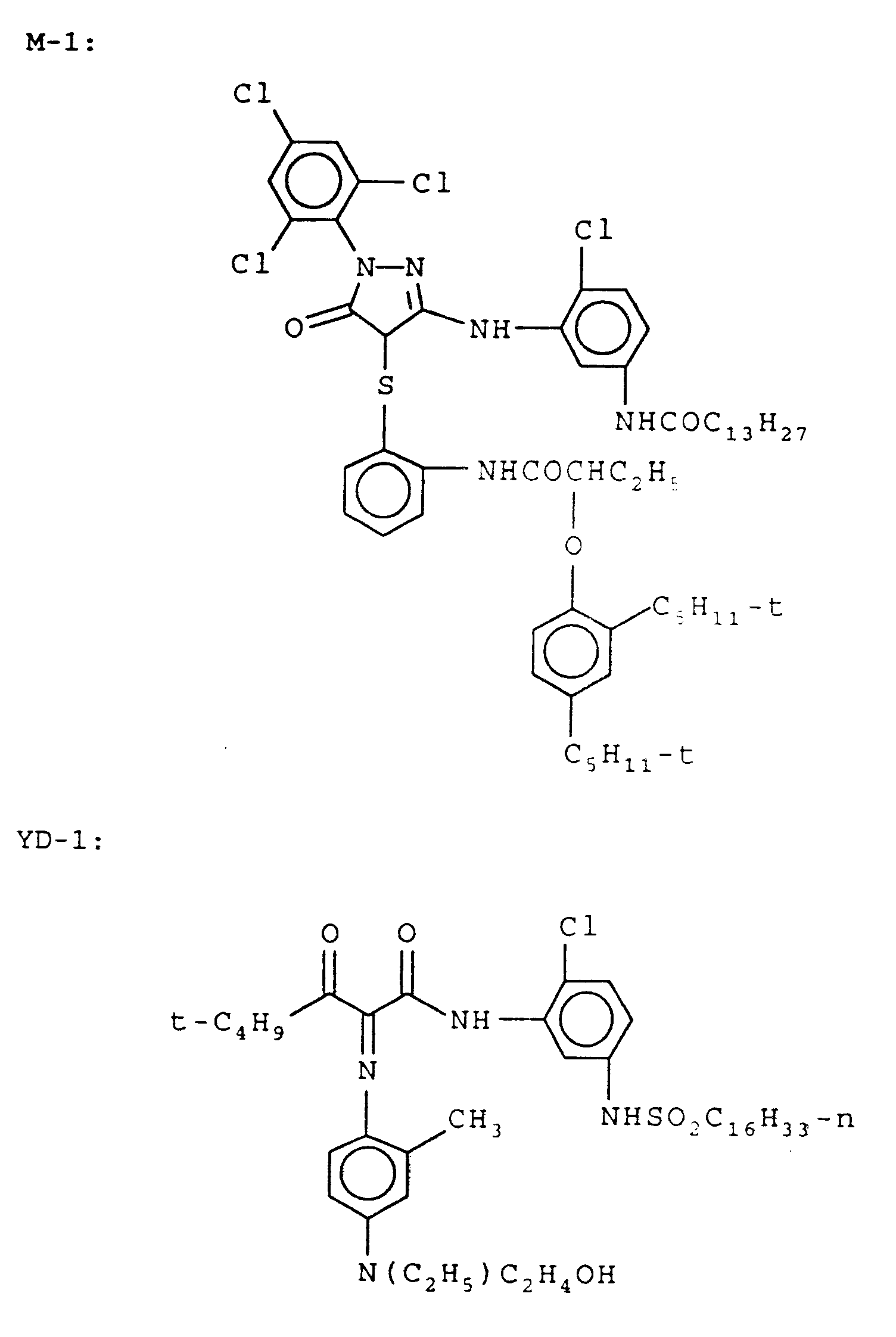
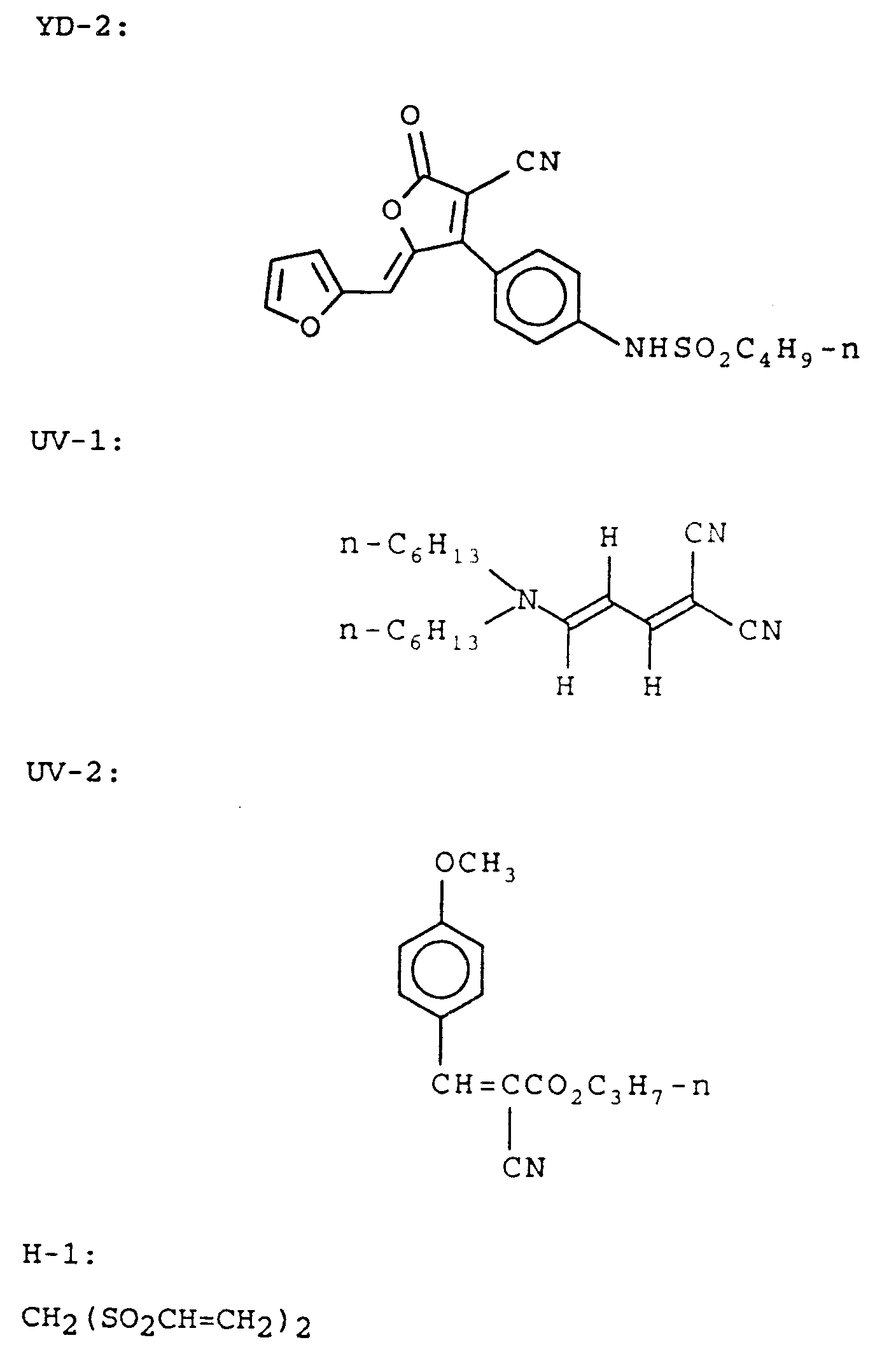
- The quantity of the abrasive particles, even at the highest levels, do not interfere significantly with the optical qualities of the photographic element.
- The invention has been described in detail with particular reference to preferred embodiments thereof, but it will be understood that variations and modifications can be effected within the scope of the claims.
Claims (10)
- A photographic element comprising a support having provided thereon a light-sensitive layer, a transparent magnetic recording layer, and a transparent abrasive layer coated over the transparent magentic recording layer, the transparent magnetic recording layer comprising a transparent polymeric binder and ferro-magnetic particles having a surface area greater than 30 m2/g and a coverage of from 1x10-11 mg/µm3 to 3x10⁻¹⁰ mg/µm3, the abrasive layer comprising a transparent polymeric binder and abrasive particles having a median diameter of from 0.2 to 0.4 µm, a specific surface area greater than 5 m2/gm, a Mohs hardness of at least 6 and being present in an amount of at least 5x10-12 mg/µm3.
- The photographic element of Claim 1 wherein the abrasive particles are present in an amount of from 5x10-12 to 4.3x10⁻¹⁰ mg/µm3.
- The photographic element of Claim 1 wherein the abrasive particles are present in the abrasive layer in an amount of from 1 to 75 percent by weight based on the weight of the polymeric binder.
- The photographic element of Claim 1 wherein the abrasive particles are alpha aluminum oxide, silicon dioxide, alumino-silicate, or mixtures thereof.
- The photographic element of Claim 1 wherein the thickness of the abrasive layer is from 0.2 µm to 0.8 µm.
- The photographic element of Claim 1 wherein ferromagnetic particles are also present in the abrasive layer and the total coverage of ferromagnetic particles in both layers is from 1x10-11 mg/µm3 to 1x10⁻¹⁰ mg/µm3.
- The photographic element of Claim 6 wherein the ferromagnetic particles in the abrasive layer are present in an amount of from 2 to 12 percent by weight based on the weight of the polymeric binder present in the abrasive layer.
- The photographic element of Claim 7 wherein the ferromagnetic particles are present in an amount of from 5 to 10 percent.
- The photographic element of Claim 1 wherein reinforcing filler particles are present in the magnetic recording layer or the abrasive layer.
- The photographic element of Claim 9 wherein the filler particles have a median diameter of less than 0.15 µm, a Mohs hardness of at least 6 and are present in an amount of from 20 to 300 percent by weight based on the weight of the polymeric binder in the layer.
Applications Claiming Priority (2)
| Application Number | Priority Date | Filing Date | Title |
|---|---|---|---|
| US08/252,500 US5434037A (en) | 1994-06-01 | 1994-06-01 | Photographic element having a transparent magnetic recording layer |
| US252500 | 1994-06-01 |
Publications (2)
| Publication Number | Publication Date |
|---|---|
| EP0691570A1 EP0691570A1 (en) | 1996-01-10 |
| EP0691570B1 true EP0691570B1 (en) | 2000-08-09 |
Family
ID=22956273
Family Applications (1)
| Application Number | Title | Priority Date | Filing Date |
|---|---|---|---|
| EP95107167A Expired - Lifetime EP0691570B1 (en) | 1994-06-01 | 1995-05-11 | Photographic element |
Country Status (4)
| Country | Link |
|---|---|
| US (1) | US5434037A (en) |
| EP (1) | EP0691570B1 (en) |
| JP (1) | JPH0850340A (en) |
| DE (1) | DE69518285T2 (en) |
Families Citing this family (13)
| Publication number | Priority date | Publication date | Assignee | Title |
|---|---|---|---|---|
| US5747234A (en) * | 1995-11-13 | 1998-05-05 | Eastman Kodak Company | Photographic element |
| US5776668A (en) * | 1996-09-30 | 1998-07-07 | Eastman Kodak Company | Abrasive lubricating overcoat layers |
| US5817451A (en) * | 1997-01-28 | 1998-10-06 | Eastman Kodak Company | Fluorinated particles as lubricants for transparent magnetic recording media |
| US5807661A (en) * | 1997-01-28 | 1998-09-15 | Eastman Kodak Company | Transparent lubricious overcoat containing fluoropolymer microparticles for transparent magnetic recording layer for photographic element |
| US5821027A (en) * | 1997-05-19 | 1998-10-13 | Eastman Kodak Company | Simultaneous coatings of polymeric lubricant layer and transparent magnetic recording layer for photographic element |
| US5798136A (en) * | 1997-05-19 | 1998-08-25 | Eastman Kodak Company | Simultaneous coatings of wax dispersion containing lubricant layer and transparent magnetic recording layer for photographic element |
| US5756272A (en) * | 1997-05-19 | 1998-05-26 | Eastman Kodak Company | Simultaneous coatings of stearamide lubricant layer and transparent magnetic recording layer for photographic element |
| US6296996B1 (en) | 1997-06-03 | 2001-10-02 | Fuji Photo Film Co., Ltd. | Transparent magnetic recording medium |
| JPH10334458A (en) * | 1997-06-03 | 1998-12-18 | Fuji Photo Film Co Ltd | Transparent magnetic recording medium |
| JP2000090429A (en) | 1998-09-09 | 2000-03-31 | Fuji Photo Film Co Ltd | Transparent magnetic recording medium |
| US6599991B1 (en) | 1999-12-30 | 2003-07-29 | Eastman Kodak Company | In-situ blending of polyesters with poly(ether imide) |
| US6485896B2 (en) | 2000-12-06 | 2002-11-26 | Eastman Kodak Company | Emulsion composition to control film core-set |
| US7235296B2 (en) * | 2002-03-05 | 2007-06-26 | 3M Innovative Properties Co. | Formulations for coated diamond abrasive slurries |
Family Cites Families (27)
| Publication number | Priority date | Publication date | Assignee | Title |
|---|---|---|---|---|
| US2627088A (en) | 1950-03-22 | 1953-02-03 | Du Pont | Preparation of oriented coated films |
| CA557259A (en) | 1955-02-23 | 1958-05-13 | Canadian Kodak Co. Limited | Multiple layer hopper for multiply coating a web |
| US3501301A (en) | 1962-04-24 | 1970-03-17 | Eastman Kodak Co | Coating compositions for polyester sheeting and polyester sheeting coated therewith |
| DE1495745C3 (en) | 1963-09-19 | 1978-06-01 | Bayer Ag, 5090 Leverkusen | Process for the production of aqueous, emulsifier-free polyurethane latices |
| US3508947A (en) | 1968-06-03 | 1970-04-28 | Eastman Kodak Co | Method for simultaneously applying a plurality of coated layers by forming a stable multilayer free-falling vertical curtain |
| US3782947A (en) * | 1972-01-28 | 1974-01-01 | Eastman Kodak Co | Photographic product with photographically transparent magnetic recording medium |
| GB1497101A (en) | 1975-08-04 | 1978-01-05 | Ici Ltd | Coated film assemblies |
| FR2382325A1 (en) * | 1977-03-02 | 1978-09-29 | Kodak Pathe | PRODUCT INCLUDING A TRANSPARENT MAGNETIC RECORDING LAYER |
| US4225665A (en) | 1978-12-20 | 1980-09-30 | E. I. Du Pont De Nemours And Company | Photographic element in which the antistatic layer is interlinked in the base |
| JPS56143430A (en) * | 1980-04-11 | 1981-11-09 | Fuji Photo Film Co Ltd | Photographic sensitive material with improved antistatic property |
| JPS5785866A (en) * | 1980-11-18 | 1982-05-28 | Mitsubishi Metal Corp | Antistatic transparent paint |
| JPS6049894B2 (en) * | 1980-12-23 | 1985-11-05 | 富士写真フイルム株式会社 | photographic material |
| JPS57118242A (en) * | 1981-01-14 | 1982-07-23 | Fuji Photo Film Co Ltd | Photographic sensitive material |
| US4363872A (en) | 1981-02-24 | 1982-12-14 | Imperial Chemical Industries Limited | Coated film bases, photographic films derived from the bases and processes for their production |
| JPH0762895B2 (en) * | 1985-05-13 | 1995-07-05 | 富士写真フイルム株式会社 | Magnetic recording medium |
| JPH0766526B2 (en) * | 1985-06-17 | 1995-07-19 | 富士写真フイルム株式会社 | Magnetic recording medium |
| US4689359A (en) | 1985-08-22 | 1987-08-25 | Eastman Kodak Company | Composition formed from gelatin and polymer of vinyl monomer having a primary amine addition salt group |
| US4999276A (en) * | 1988-06-29 | 1991-03-12 | Fuji Photo Film Co., Ltd. | Silver halide photographic materials |
| US4990276A (en) * | 1990-02-01 | 1991-02-05 | Eastman Kodak Company | Magnetic dispersion |
| US5096975A (en) | 1990-05-23 | 1992-03-17 | Eastman Kodak Company | Cross-linked polymers from vinyl benzene sulfonate salts and ethylenic hydroxy monomers |
| JP2699014B2 (en) * | 1990-07-10 | 1998-01-19 | 富士写真フイルム株式会社 | Silver halide color photographic material having a magnetic recording element |
| JP2684232B2 (en) * | 1990-08-13 | 1997-12-03 | 富士写真フイルム株式会社 | Silver halide photographic material |
| US5217804A (en) * | 1990-11-06 | 1993-06-08 | Eastman Kodak Company | Magnetic particles |
| US5252441A (en) * | 1990-11-06 | 1993-10-12 | Eastman Kodak Company | Transparent magnetic recording layers and photographic elements containing the same |
| JP3041724B2 (en) | 1991-01-25 | 2000-05-15 | コニカ株式会社 | Silver halide color photographic materials with excellent hue reproducibility |
| US5236817A (en) | 1991-05-14 | 1993-08-17 | Eastman Kodak Company | Tabular grain emulsion containing reversal photographic elements exhibiting improved sharpness in underlying layers |
| US5395743A (en) * | 1993-12-22 | 1995-03-07 | Eastman Kodak Company | Photographic element having a transparent magnetic layer and a process of preparing the same |
-
1994
- 1994-06-01 US US08/252,500 patent/US5434037A/en not_active Expired - Lifetime
-
1995
- 1995-05-11 DE DE69518285T patent/DE69518285T2/en not_active Expired - Fee Related
- 1995-05-11 EP EP95107167A patent/EP0691570B1/en not_active Expired - Lifetime
- 1995-05-31 JP JP7133942A patent/JPH0850340A/en active Pending
Also Published As
| Publication number | Publication date |
|---|---|
| DE69518285D1 (en) | 2000-09-14 |
| JPH0850340A (en) | 1996-02-20 |
| DE69518285T2 (en) | 2000-12-21 |
| EP0691570A1 (en) | 1996-01-10 |
| US5434037A (en) | 1995-07-18 |
Similar Documents
| Publication | Publication Date | Title |
|---|---|---|
| US5432050A (en) | Photographic element having a transparent magnetic recording layer | |
| EP0660178B1 (en) | Photographic element having a transparent magnetic layer and a process of preparing the same | |
| US5427900A (en) | Photographic element having a transparent magnetic recording layer | |
| EP0731452B1 (en) | Photographic element having a transparent magnetic recording layer | |
| US5382494A (en) | Silver halide photographic light-sensitive material having excellent transporting ability | |
| US5434037A (en) | Photographic element having a transparent magnetic recording layer | |
| EP0685762B1 (en) | Photographic element | |
| US5397826A (en) | Coating compositions for a transparent magnetic recording layer | |
| US5747234A (en) | Photographic element | |
| US6001550A (en) | Photographic element having a annealable transparent magnetic recording layer | |
| US5491051A (en) | Photographic element | |
| US5753426A (en) | Photographic elements containing a transparent magnetic recording layer | |
| EP0855619B1 (en) | Transparent lubricious overcoat containing fluoropolymer microparticles for transparent magnetic recording layer for photographic element | |
| US5776668A (en) | Abrasive lubricating overcoat layers | |
| US6905761B2 (en) | Transparent film-forming compositions for magnetic recording | |
| US5891612A (en) | Photographic elements comprising highly loaded particulate material containing layer | |
| US6317191B1 (en) | Process for viewing a positive motion picture film scene image with integral audio soundtrack | |
| US6422702B1 (en) | Method for monitoring film remaining in a motion picture film magazine | |
| JPH1160958A (en) | Wax dispersion and silver halide photosensitive material using same | |
| JP2000260016A (en) | Magnetic recording medium, photographic sensitive material and their production | |
| JPH1069025A (en) | Photographic coating liquid composition and support using the same and silver halide photographic sensitive material | |
| JPH1069024A (en) | Photographic coating liquid composition and silver halide photographic sensitive material using the same |
Legal Events
| Date | Code | Title | Description |
|---|---|---|---|
| PUAI | Public reference made under article 153(3) epc to a published international application that has entered the european phase |
Free format text: ORIGINAL CODE: 0009012 |
|
| AK | Designated contracting states |
Kind code of ref document: A1 Designated state(s): DE FR GB |
|
| 17P | Request for examination filed |
Effective date: 19960612 |
|
| GRAG | Despatch of communication of intention to grant |
Free format text: ORIGINAL CODE: EPIDOS AGRA |
|
| 17Q | First examination report despatched |
Effective date: 19990616 |
|
| GRAG | Despatch of communication of intention to grant |
Free format text: ORIGINAL CODE: EPIDOS AGRA |
|
| GRAH | Despatch of communication of intention to grant a patent |
Free format text: ORIGINAL CODE: EPIDOS IGRA |
|
| GRAH | Despatch of communication of intention to grant a patent |
Free format text: ORIGINAL CODE: EPIDOS IGRA |
|
| GRAA | (expected) grant |
Free format text: ORIGINAL CODE: 0009210 |
|
| AK | Designated contracting states |
Kind code of ref document: B1 Designated state(s): DE FR GB |
|
| REF | Corresponds to: |
Ref document number: 69518285 Country of ref document: DE Date of ref document: 20000914 |
|
| ET | Fr: translation filed | ||
| PLBE | No opposition filed within time limit |
Free format text: ORIGINAL CODE: 0009261 |
|
| STAA | Information on the status of an ep patent application or granted ep patent |
Free format text: STATUS: NO OPPOSITION FILED WITHIN TIME LIMIT |
|
| 26N | No opposition filed | ||
| REG | Reference to a national code |
Ref country code: GB Ref legal event code: IF02 |
|
| PGFP | Annual fee paid to national office [announced via postgrant information from national office to epo] |
Ref country code: GB Payment date: 20020404 Year of fee payment: 8 |
|
| PGFP | Annual fee paid to national office [announced via postgrant information from national office to epo] |
Ref country code: FR Payment date: 20020503 Year of fee payment: 8 |
|
| PGFP | Annual fee paid to national office [announced via postgrant information from national office to epo] |
Ref country code: DE Payment date: 20020531 Year of fee payment: 8 |
|
| PG25 | Lapsed in a contracting state [announced via postgrant information from national office to epo] |
Ref country code: GB Free format text: LAPSE BECAUSE OF NON-PAYMENT OF DUE FEES Effective date: 20030511 |
|
| PG25 | Lapsed in a contracting state [announced via postgrant information from national office to epo] |
Ref country code: DE Free format text: LAPSE BECAUSE OF NON-PAYMENT OF DUE FEES Effective date: 20031202 |
|
| GBPC | Gb: european patent ceased through non-payment of renewal fee |
Effective date: 20030511 |
|
| PG25 | Lapsed in a contracting state [announced via postgrant information from national office to epo] |
Ref country code: FR Free format text: LAPSE BECAUSE OF NON-PAYMENT OF DUE FEES Effective date: 20040130 |
|
| REG | Reference to a national code |
Ref country code: FR Ref legal event code: ST |