EP0690703B1 - Formed resilient orthopaedic support - Google Patents
Formed resilient orthopaedic support Download PDFInfo
- Publication number
- EP0690703B1 EP0690703B1 EP94901565A EP94901565A EP0690703B1 EP 0690703 B1 EP0690703 B1 EP 0690703B1 EP 94901565 A EP94901565 A EP 94901565A EP 94901565 A EP94901565 A EP 94901565A EP 0690703 B1 EP0690703 B1 EP 0690703B1
- Authority
- EP
- European Patent Office
- Prior art keywords
- support
- compression molded
- orthopaedic
- foam
- thickness
- Prior art date
- Legal status (The legal status is an assumption and is not a legal conclusion. Google has not performed a legal analysis and makes no representation as to the accuracy of the status listed.)
- Expired - Lifetime
Links
Images


Classifications
-
- B—PERFORMING OPERATIONS; TRANSPORTING
- B29—WORKING OF PLASTICS; WORKING OF SUBSTANCES IN A PLASTIC STATE IN GENERAL
- B29C—SHAPING OR JOINING OF PLASTICS; SHAPING OF MATERIAL IN A PLASTIC STATE, NOT OTHERWISE PROVIDED FOR; AFTER-TREATMENT OF THE SHAPED PRODUCTS, e.g. REPAIRING
- B29C44/00—Shaping by internal pressure generated in the material, e.g. swelling or foaming ; Producing porous or cellular expanded plastics articles
- B29C44/02—Shaping by internal pressure generated in the material, e.g. swelling or foaming ; Producing porous or cellular expanded plastics articles for articles of definite length, i.e. discrete articles
- B29C44/04—Shaping by internal pressure generated in the material, e.g. swelling or foaming ; Producing porous or cellular expanded plastics articles for articles of definite length, i.e. discrete articles consisting of at least two parts of chemically or physically different materials, e.g. having different densities
- B29C44/0446—Shaping by internal pressure generated in the material, e.g. swelling or foaming ; Producing porous or cellular expanded plastics articles for articles of definite length, i.e. discrete articles consisting of at least two parts of chemically or physically different materials, e.g. having different densities by increasing the density locally by compressing part of the foam while still in the mould
-
- A—HUMAN NECESSITIES
- A61—MEDICAL OR VETERINARY SCIENCE; HYGIENE
- A61F—FILTERS IMPLANTABLE INTO BLOOD VESSELS; PROSTHESES; DEVICES PROVIDING PATENCY TO, OR PREVENTING COLLAPSING OF, TUBULAR STRUCTURES OF THE BODY, e.g. STENTS; ORTHOPAEDIC, NURSING OR CONTRACEPTIVE DEVICES; FOMENTATION; TREATMENT OR PROTECTION OF EYES OR EARS; BANDAGES, DRESSINGS OR ABSORBENT PADS; FIRST-AID KITS
- A61F5/00—Orthopaedic methods or devices for non-surgical treatment of bones or joints; Nursing devices ; Anti-rape devices
- A61F5/01—Orthopaedic devices, e.g. long-term immobilising or pressure directing devices for treating broken or deformed bones such as splints, casts or braces
- A61F5/0102—Orthopaedic devices, e.g. long-term immobilising or pressure directing devices for treating broken or deformed bones such as splints, casts or braces specially adapted for correcting deformities of the limbs or for supporting them; Ortheses, e.g. with articulations
-
- A—HUMAN NECESSITIES
- A61—MEDICAL OR VETERINARY SCIENCE; HYGIENE
- A61F—FILTERS IMPLANTABLE INTO BLOOD VESSELS; PROSTHESES; DEVICES PROVIDING PATENCY TO, OR PREVENTING COLLAPSING OF, TUBULAR STRUCTURES OF THE BODY, e.g. STENTS; ORTHOPAEDIC, NURSING OR CONTRACEPTIVE DEVICES; FOMENTATION; TREATMENT OR PROTECTION OF EYES OR EARS; BANDAGES, DRESSINGS OR ABSORBENT PADS; FIRST-AID KITS
- A61F5/00—Orthopaedic methods or devices for non-surgical treatment of bones or joints; Nursing devices ; Anti-rape devices
- A61F5/01—Orthopaedic devices, e.g. long-term immobilising or pressure directing devices for treating broken or deformed bones such as splints, casts or braces
- A61F5/0102—Orthopaedic devices, e.g. long-term immobilising or pressure directing devices for treating broken or deformed bones such as splints, casts or braces specially adapted for correcting deformities of the limbs or for supporting them; Ortheses, e.g. with articulations
- A61F5/0104—Orthopaedic devices, e.g. long-term immobilising or pressure directing devices for treating broken or deformed bones such as splints, casts or braces specially adapted for correcting deformities of the limbs or for supporting them; Ortheses, e.g. with articulations without articulation
- A61F5/0106—Orthopaedic devices, e.g. long-term immobilising or pressure directing devices for treating broken or deformed bones such as splints, casts or braces specially adapted for correcting deformities of the limbs or for supporting them; Ortheses, e.g. with articulations without articulation for the knees
-
- A—HUMAN NECESSITIES
- A61—MEDICAL OR VETERINARY SCIENCE; HYGIENE
- A61F—FILTERS IMPLANTABLE INTO BLOOD VESSELS; PROSTHESES; DEVICES PROVIDING PATENCY TO, OR PREVENTING COLLAPSING OF, TUBULAR STRUCTURES OF THE BODY, e.g. STENTS; ORTHOPAEDIC, NURSING OR CONTRACEPTIVE DEVICES; FOMENTATION; TREATMENT OR PROTECTION OF EYES OR EARS; BANDAGES, DRESSINGS OR ABSORBENT PADS; FIRST-AID KITS
- A61F5/00—Orthopaedic methods or devices for non-surgical treatment of bones or joints; Nursing devices ; Anti-rape devices
- A61F5/01—Orthopaedic devices, e.g. long-term immobilising or pressure directing devices for treating broken or deformed bones such as splints, casts or braces
- A61F5/0102—Orthopaedic devices, e.g. long-term immobilising or pressure directing devices for treating broken or deformed bones such as splints, casts or braces specially adapted for correcting deformities of the limbs or for supporting them; Ortheses, e.g. with articulations
- A61F5/0104—Orthopaedic devices, e.g. long-term immobilising or pressure directing devices for treating broken or deformed bones such as splints, casts or braces specially adapted for correcting deformities of the limbs or for supporting them; Ortheses, e.g. with articulations without articulation
- A61F5/0111—Orthopaedic devices, e.g. long-term immobilising or pressure directing devices for treating broken or deformed bones such as splints, casts or braces specially adapted for correcting deformities of the limbs or for supporting them; Ortheses, e.g. with articulations without articulation for the feet or ankles
-
- A—HUMAN NECESSITIES
- A61—MEDICAL OR VETERINARY SCIENCE; HYGIENE
- A61F—FILTERS IMPLANTABLE INTO BLOOD VESSELS; PROSTHESES; DEVICES PROVIDING PATENCY TO, OR PREVENTING COLLAPSING OF, TUBULAR STRUCTURES OF THE BODY, e.g. STENTS; ORTHOPAEDIC, NURSING OR CONTRACEPTIVE DEVICES; FOMENTATION; TREATMENT OR PROTECTION OF EYES OR EARS; BANDAGES, DRESSINGS OR ABSORBENT PADS; FIRST-AID KITS
- A61F5/00—Orthopaedic methods or devices for non-surgical treatment of bones or joints; Nursing devices ; Anti-rape devices
- A61F5/01—Orthopaedic devices, e.g. long-term immobilising or pressure directing devices for treating broken or deformed bones such as splints, casts or braces
- A61F5/0102—Orthopaedic devices, e.g. long-term immobilising or pressure directing devices for treating broken or deformed bones such as splints, casts or braces specially adapted for correcting deformities of the limbs or for supporting them; Ortheses, e.g. with articulations
- A61F5/012—Orthopaedic devices, e.g. long-term immobilising or pressure directing devices for treating broken or deformed bones such as splints, casts or braces specially adapted for correcting deformities of the limbs or for supporting them; Ortheses, e.g. with articulations inflatable
-
- A—HUMAN NECESSITIES
- A61—MEDICAL OR VETERINARY SCIENCE; HYGIENE
- A61F—FILTERS IMPLANTABLE INTO BLOOD VESSELS; PROSTHESES; DEVICES PROVIDING PATENCY TO, OR PREVENTING COLLAPSING OF, TUBULAR STRUCTURES OF THE BODY, e.g. STENTS; ORTHOPAEDIC, NURSING OR CONTRACEPTIVE DEVICES; FOMENTATION; TREATMENT OR PROTECTION OF EYES OR EARS; BANDAGES, DRESSINGS OR ABSORBENT PADS; FIRST-AID KITS
- A61F5/00—Orthopaedic methods or devices for non-surgical treatment of bones or joints; Nursing devices ; Anti-rape devices
- A61F5/01—Orthopaedic devices, e.g. long-term immobilising or pressure directing devices for treating broken or deformed bones such as splints, casts or braces
- A61F5/0102—Orthopaedic devices, e.g. long-term immobilising or pressure directing devices for treating broken or deformed bones such as splints, casts or braces specially adapted for correcting deformities of the limbs or for supporting them; Ortheses, e.g. with articulations
- A61F5/0123—Orthopaedic devices, e.g. long-term immobilising or pressure directing devices for treating broken or deformed bones such as splints, casts or braces specially adapted for correcting deformities of the limbs or for supporting them; Ortheses, e.g. with articulations for the knees
-
- A—HUMAN NECESSITIES
- A61—MEDICAL OR VETERINARY SCIENCE; HYGIENE
- A61F—FILTERS IMPLANTABLE INTO BLOOD VESSELS; PROSTHESES; DEVICES PROVIDING PATENCY TO, OR PREVENTING COLLAPSING OF, TUBULAR STRUCTURES OF THE BODY, e.g. STENTS; ORTHOPAEDIC, NURSING OR CONTRACEPTIVE DEVICES; FOMENTATION; TREATMENT OR PROTECTION OF EYES OR EARS; BANDAGES, DRESSINGS OR ABSORBENT PADS; FIRST-AID KITS
- A61F5/00—Orthopaedic methods or devices for non-surgical treatment of bones or joints; Nursing devices ; Anti-rape devices
- A61F5/01—Orthopaedic devices, e.g. long-term immobilising or pressure directing devices for treating broken or deformed bones such as splints, casts or braces
- A61F5/02—Orthopaedic corsets
- A61F5/028—Braces for providing support to the lower back, e.g. lumbo sacral supports
-
- B—PERFORMING OPERATIONS; TRANSPORTING
- B29—WORKING OF PLASTICS; WORKING OF SUBSTANCES IN A PLASTIC STATE IN GENERAL
- B29C—SHAPING OR JOINING OF PLASTICS; SHAPING OF MATERIAL IN A PLASTIC STATE, NOT OTHERWISE PROVIDED FOR; AFTER-TREATMENT OF THE SHAPED PRODUCTS, e.g. REPAIRING
- B29C59/00—Surface shaping of articles, e.g. embossing; Apparatus therefor
- B29C59/02—Surface shaping of articles, e.g. embossing; Apparatus therefor by mechanical means, e.g. pressing
- B29C59/026—Surface shaping of articles, e.g. embossing; Apparatus therefor by mechanical means, e.g. pressing of layered or coated substantially flat surfaces
-
- A—HUMAN NECESSITIES
- A61—MEDICAL OR VETERINARY SCIENCE; HYGIENE
- A61F—FILTERS IMPLANTABLE INTO BLOOD VESSELS; PROSTHESES; DEVICES PROVIDING PATENCY TO, OR PREVENTING COLLAPSING OF, TUBULAR STRUCTURES OF THE BODY, e.g. STENTS; ORTHOPAEDIC, NURSING OR CONTRACEPTIVE DEVICES; FOMENTATION; TREATMENT OR PROTECTION OF EYES OR EARS; BANDAGES, DRESSINGS OR ABSORBENT PADS; FIRST-AID KITS
- A61F5/00—Orthopaedic methods or devices for non-surgical treatment of bones or joints; Nursing devices ; Anti-rape devices
- A61F5/01—Orthopaedic devices, e.g. long-term immobilising or pressure directing devices for treating broken or deformed bones such as splints, casts or braces
- A61F5/0102—Orthopaedic devices, e.g. long-term immobilising or pressure directing devices for treating broken or deformed bones such as splints, casts or braces specially adapted for correcting deformities of the limbs or for supporting them; Ortheses, e.g. with articulations
- A61F2005/0132—Additional features of the articulation
- A61F2005/0172—Additional features of the articulation with cushions
- A61F2005/0176—Additional features of the articulation with cushions supporting the patella
-
- B—PERFORMING OPERATIONS; TRANSPORTING
- B29—WORKING OF PLASTICS; WORKING OF SUBSTANCES IN A PLASTIC STATE IN GENERAL
- B29K—INDEXING SCHEME ASSOCIATED WITH SUBCLASSES B29B, B29C OR B29D, RELATING TO MOULDING MATERIALS OR TO MATERIALS FOR MOULDS, REINFORCEMENTS, FILLERS OR PREFORMED PARTS, e.g. INSERTS
- B29K2105/00—Condition, form or state of moulded material or of the material to be shaped
- B29K2105/04—Condition, form or state of moulded material or of the material to be shaped cellular or porous
-
- B—PERFORMING OPERATIONS; TRANSPORTING
- B29—WORKING OF PLASTICS; WORKING OF SUBSTANCES IN A PLASTIC STATE IN GENERAL
- B29L—INDEXING SCHEME ASSOCIATED WITH SUBCLASS B29C, RELATING TO PARTICULAR ARTICLES
- B29L2031/00—Other particular articles
- B29L2031/753—Medical equipment; Accessories therefor
Definitions
- the present invention generally relates to orthopaedic supports for the human anatomy and, more particularly, to an orthopaedic support that is compression molded to improve the fit and performance of the support.
- Orthopaedic supports are typically used to stabilize and protect certain injured parts of the human anatomy. Such supports have often been used on knees, elbows, ankles, wrists, thighs and backs. These supports are intended to reduce strain on the injured body part, thereby allowing the injury to heal. Some supports have included struts and other hardware to help relieve some of the load from the injured part, and to restrict motion.
- One such orthopaedic support specifically a knee brace which is described in US-A-3,587,572, is a molded elongate cylindrical sleeve whose thickness does not change and which has both transversely and longitudinally extending ribs formed thereon to impart rigidity.
- Two sets of ribs extend longitudinally to overlie and support the lateral and medial portions of the knee joint and a third set of ribs extending transversely of the first two sets is adapted to overlie the patella of the joint.
- Another known orthopaedic support is constructed as follows. First, the manufacturer cuts a base layer from a sheet of material, such as foam rubber. The manufacturer then sews a variety of pads onto the base layer, which may include buttresses, condylar pads, and popliteal pads. The manufacturer then sews on straps, which are used to secure the support to a limb. The manufacturer may also attach hardware to the support, or may sandwich such hardware between the base layer of material and a pad.
- a first problem relates to the manufacturing process as with the latter type of support already mentioned herein.
- the manufacturer To construct such a support, the manufacturer must cut the pads from a piece of material, position those pads onto the base layer, and sew the pads into place. The process of cutting, sewing, and positioning is labor-intensive and can become expensive. If a pad is improperly positioned and sewn, the entire support may need to be discarded as defective. Furthermore, material is wasted when the cutting process produces scrap pieces that must be thrown away.
- a second set of problems is common to both the aforesaid types of support arises.
- the typical support stretches in order to roughly conform to the shape of joints and limbs.
- mere stretching cannot allow the support to closely conform to the nuances in the shape of the limb or joint, particularly in the cases of knees, elbows and ankles.
- areas of the limb or joint are left under-supported or even entirely unsupported.
- the typical support has a base that is of uniform thickness and density, thereby producing uniform circumferential compression.
- Such compression cannot be increased or decreased to provide more or less support in selected areas of the injured limb or joint, in the absence of supplemental material straps. Consequently, such a support tends to shift position on the limb because there are no regions of high pressure to anchor it.
- a support having uniform thickness and density may allow the limb to move with equal ease in a variety of directions. Such ease of movement may increase the likelihood that a particular injury such as a patella injury will be aggravated.
- a third set of problems arises with respect to the performance of the typical support.
- One problem is that the support material tends to bunch up whenever the limb is flexed. This bunching tends to interfere with the motion of the limb, is uncomfortable to the user, and may rub or chafe the skin and even bruise the skin.
- Another problem is that the edges of the typical support are die-cut, thereby exposing the user's skin to potentially allergenic support materials, such as neoprene. The edges tend to be rather rough, causing skin irritation during exercise.
- An additional set of problems stems from hardware that may be attached to the typical support.
- Such hardware may include gel packs, inflatable bladders, pumps, straps, and struts. This hardware tends to protrude from the base of the support and can get caught on other objects. Since the hardware is typically sewn onto the base, the stitches can be ripped from the base and the hardware torn free.
- a special problem arises with hinged strut mechanisms, which can be twisted out of place so that the hinged strut does not properly guide and support the flexing motion of the joint.
- One object is to provide an orthopaedic support having varied thickness and material density. This support may be manufactured without having to cut and sew extra padding pieces.
- the varied thickness allows the manufacturer to increase or decrease the pressure provided to selected areas of the limb, including pressure that will prevent the support from shifting position.
- the varied density should allow the manufacturer to limit the range of limb motion in certain directions.
- Another important object of the present invention is to provide an orthopaedic support molded to generally conform to the contour of the part of the human anatomy that it supports.
- the edges may be shaped so that the skin is not exposed to allergenic or rough-edged material.
- the support should also not bunch up when a limb is flexed.
- An additional object of the present invention is to provide an orthopaedic support having grooves to accommodate hardware. These grooves allow the hardware to remain close to the base of the support, maintain the proper position of the hardware, and act as hardware locators for ease of support assembly. Moreover, the grooves particularly act as locators for removable materials, and as gel pads, straps, etc., ensuring proper placement when re-attached.
- an orthopaedic support comprising a support body for supporting a portion of the anatomy, said support body comprising stretchable and resilient foam material in sheet form; said foam sheet having a surface and a predetermined thickness in major areas of said sheet; characterised in that said foam material is compression molded in at least one area to decrease the thickness and increase the density of the material in the compression molded area to facilitate the function of the support, said compression molded area extending inwardly from said surface and the thickness of said sheet at the bottom of said compression molded area being less than said predetermined thickness.
- the foam material is preferably an open cell foam in particular foam rubber.
- the support includes a thin outer layer of material extending over the outer surface of the foam, a thin inner layer of material, and an open cell foam in between said inner and outer layers of material.
- the specific areas in which there has been compression molding have a thickness and density that is different from other areas of the support and serve to better fit the support to the body.
- Such supports can be manufactured for use on various parts of the human anatomy.
- Embodiments of the invention may include a number of features.
- the support may include compression molded grooves or cavities to accommodate straps, struts, gel-filled pads, inflatable bladders, pumps, and other accessories.
- the support may be compression molded into a shape that conforms to the general contour of the part of the human anatomy that it supports.
- the support may also include a number of compression molded grooves that reduce bunching when the support is bent. Edges of the support may have molded radii for minimizing skin irritation during activity.
- the knee brace is manufactured from a sheet of foam rubber.
- the knee brace includes a front side to accommodate the patella and a rear popliteal side. Compression molded grooves extend across the popliteal side to reduce material bunching when the user bends her or his knee.
- the knee brace may also have a variety of compression molded pads and buttresses, as well as hardware and compression molded grooves and cavities to support that hardware.
- the compression molded support is manufactured without having to cut and sew extra padding pieces.
- the variable thickness and density provide pressure to selected areas of a limb and improve the range of motion in certain directions.
- the shape of the support conforms to the contour of the part of the human anatomy that it supports, and the molded edges protect the user's skin from allergic reactions and abrasion.
- the compression molded grooves serve to prevent bunching of the material when the limb is flexed.
- other compression molded grooves accommodate hardware, act to maintain the hardware in proper position, and serve as hardware locators during assembly of the support.
- a principal characteristic of the present support invention is regions of varying thickness and density. These regions are created by a process known as compression molding, wherein a combination of heat and pressure is applied to a sheet of material. The manufacturer varies the amount of heat and pressure that is applied in different areas of the material in order to reduce thickness in certain areas. The areas that are not compressed, or which are only slightly compressed, can constitute regions of extra padding.
- the material is typically a closed-cell rubber, such as neoprene, although the material might also be a resilient open-cell material such as urethane foam.
- compression molding requires both special equipment and special skill. Therefore, a designer of a compression molded product will typically submit specifications to a commercial compression molding company, which will then manufacture the product.
- One such compression molding company is Rubatex Corporation of Bedford, Virginia.
- Fig. 10 is a comparison of the stretch characteristics of compressed and uncompressed foam rubber. This figure was derived from tension tests of uncompressed, and compressed samples of neoprene that were supplied to the inventors by the Rubatex Corporation. Each of the samples had a testing length of 3 inches (7,62 cm) and a width of 1 inch (2.54cm). The uncompressed samples were 3/16 inch (0.43cm) thick, and the compressed samples were 1/8 inch (0.16cm) thick. In Fig.10, load expressed in pounds weight (each pound is equal to 2.2 kilograms) is plotted against thickness expressed in inches (one inch is equal to 2.54cm). Fig. 10 illustrates, the compressed and uncompressed materials behave similarly at low loads.
- Fig. 1 shows an orthopaedic knee brace 18.
- the brace has been compression molded to have a number of features.
- Strip pads 22 protect the flesh and muscle above the knee when the user either falls down or bumps into another object. Similar pads may be placed below the knee to protect the shin.
- Patellar buttress 24 supports and protects the patella.
- Main body 28 may be compression molded to have a generally uniform thickness and density, and therefore uniform stretch characteristics as may be desired for overall support.
- the knee brace also includes compression molded transverse grooves 32 located in the rear popliteal area 30. These compression molded grooves 32 are shown in both Figs. 1 and 2. Grooves 32 allow the rear popliteal area 30 to fold accordion style when the knee is bent. This feature overcomes the long standing problem of material bunching, which prevents the knee from flexing freely with traditional knee braces. Rear popliteal area 30 may have a generally relaxed thickness in order to help the knee bend. The sheet material is sewn together along sew line 31 as shown in Fig. 2.
- Raised rims 20 act to anchor the knee brace onto the knee area.
- compressed foam rubber stretches more easily than foam rubber that is not compressed or that is compressed relatively less. Consequently, rims 20 stretch relatively less than base 28, thereby causing rims 20 to behave like elastic bands around the portions of the leg that are above and below the knee.
- the knee brace of Fig. 1 is self-anchoring without the use of straps.
- Fig. 4 is a cross sectional view of the brace taken at Section 4-4 of Fig. 3.
- Fig. 4 particularly shows such features as pads 22, patellar buttress 24, and transverse grooves 32.
- patellar aperture 26 is also shown. Note that the compression molding technique allows sudden discontinuities in height and density between raised and non-raised portions, thereby allowing the designer to create corresponding discontinuities in the pressure that the brace exerts on the limb.
- Fig. 4 also illustrates molded edge 36, which rounds the interior of the edge away from the skin to reduce both allergy problems and irritation during exercise.
- Fig. 8 which is a close-up view of Section 8 of Fig. 4, shows a more detailed view of molded edge 36.
- Fig. 8 reveals that the knee brace 18 is formed from a material having three layers.
- the two outer layers 52 are typically a thin nylon or brushed nylon material.
- the middle layer 54 is typically a closed cell rubber such as neoprene. Molded edge 36 prevents the user's skin from coming into contact with middle layer 54, which is often allergenic. Furthermore, the skin does not come into contact with a rough edge, as it would if the edge was die cut.
- Fig. 3 illustrates the overall appearance of the leg and knee brace 34.
- Several types of channels, grooves, and indentations can be compression molded into the brace. These channels and indentations serve to hold brace hardware into place, to prevent the hardware from protruding from the brace, and to serve as hardware locators during the manufacturing process.
- the strap grooves 38 are an example of this type of compression molded groove, as shown in Fig. 5.
- the strap grooves guide or maintain straps 44 and 46 in place so that there may be no need to sew the straps onto the brace itself. Note that the level of the straps is about even with base 28 of the brace, and the straps do not protrude. Thus, it is unlikely that the straps will catch on external objects when the brace is worn.
- Fig. 6 illustrates a knee brace having a compression molded channel for strut and hinge hardware, which serve to reduce the load that bears directly on the knee.
- the compression molded channel holds strut 48 and strut hinge 50 in place, and prevents strut 48 and strut hinge 50 from significantly protruding from the brace.
- Fig. 7, which is a cross sectional view taken along Section 7-7 of Fig. 6, shows strut 48 neatly resting inside strut channel 66.
- Strut 48 is covered by one of two outer layers 52, which are typically a nylon or brushed nylon material.
- a second layer 68 of the same material lies underneath outer layer 52 and underneath strut 48.
- the base of the brace is an inner layer of material 54, which is typically foam rubber.
- Outer layer 52 lies flat over strut 48, such that the strut itself is not visible from the exterior of the brace.
- These strut channels 66 allow strut 48 to rest underneath straps 62 and 64, thereby allowing the user to secure the brace to her or his knee without interference from the strut mechanism.
- Fig. 9 illustrates an air bladder, an associated air pump, and a tube to connect the air pump to the air bladder, all of which rest neatly inside compression molded indentations.
- the bladder 58 serves to support and protect the knee beyond what patellar buttress 24 can provide.
- Tube 60 connects pump 56 to bladder 58. The user may pump more or less air into the bladder to adjust the pressure that the bladder exerts upon the knee. Such air packs weigh very little, yet can add considerable support to the knee.
- Similar channels and indentations can be compression molded into the brace for a variety of other types of hardware.
- indentations can be provided for gel packs, which are used either to protect against impact and/or for thermal therapy.
- a gel pack for protecting against impact may be permanently located underneath the surface of the knee brace, similar to the manner in which strut 48 is permanently buried underneath the surface of the knee brace in Fig. 7.
- Gel packs that are to be used for thermal therapy must be removable, and may rest inside a pouch partially defined by a compression molded indentation. In the case of heat therapy, the user first heats a gel pack, then inserts the gel pack into a gel pack pouch. Once the gel pack has cooled somewhat, the user replaces it with a freshly heated gel pack.
- the foam rubber sheet has an uncompressed thickness of 3/16" (0.48 cm). Pads 22, rims 20 and patellar buttress 24 are not compressed and have the same 3/16" (0.48 cm) thickness. Base 28 is compression molded to a thickness of 1/8". Transverse grooves 32 have a thickness of 1/16" (0.16 cm). Of course, numerous variations are possible. One such variation is to reduce the thickness of the entire popliteal area 30, thereby allowing the user to bend her or his knee more easily.
- knee brace 18 is presented as just one of a multitude of possible embodiments of the invention.
- the invention encompasses a wide range of compression molded supports and braces for all other parts of the body.
- the invention includes similar supports for elbows, thighs, wrists, ankles, backs, feet, and shins.
- the material need not be nylon-covered neoprene, but could be another closed cell rubber, or an open cell foam such as urethane.
- the pads could be positioned in various places, such as below the knee to protect the tibial spine, tibial crest and tibial tubercle during a fall.
- the thickness of the base can be patterned to make the brace stretch more easily in certain directions than in other directions, and the stretch characteristics may be custom designed for particular injuries.
- the straps could be replaced with bands of a strong elastic material, which could be covered with nylon to make them invisible from the exterior.
- the patellar buttresses could have a different shape or could be substantially larger than that shown in the drawings.
- Air pump 56 can be located in a variety of places. Similarly, the air pump can be an external unit that temporarily connects to the bladder to fill the bladder with air. Additionally, compression molded transverse grooves 32 may not exist in some embodiments where ease of bending is not desired. Instead, some knee braces may have a rigid member along rear popliteal side 30 to prevent any bending of the knee whatsoever. Similar modifications may be made to the multitude of other embodiments of the present invention. Accordingly, the present invention is not limited to the specific embodiments shown in the drawings and described in the detailed description.
Landscapes
- Health & Medical Sciences (AREA)
- Engineering & Computer Science (AREA)
- Vascular Medicine (AREA)
- Orthopedic Medicine & Surgery (AREA)
- Biomedical Technology (AREA)
- Heart & Thoracic Surgery (AREA)
- Nursing (AREA)
- Life Sciences & Earth Sciences (AREA)
- Animal Behavior & Ethology (AREA)
- General Health & Medical Sciences (AREA)
- Public Health (AREA)
- Veterinary Medicine (AREA)
- Mechanical Engineering (AREA)
- Orthopedics, Nursing, And Contraception (AREA)
Abstract
Description
- The present invention generally relates to orthopaedic supports for the human anatomy and, more particularly, to an orthopaedic support that is compression molded to improve the fit and performance of the support.
- Orthopaedic supports are typically used to stabilize and protect certain injured parts of the human anatomy. Such supports have often been used on knees, elbows, ankles, wrists, thighs and backs. These supports are intended to reduce strain on the injured body part, thereby allowing the injury to heal. Some supports have included struts and other hardware to help relieve some of the load from the injured part, and to restrict motion.
- One such orthopaedic support, specifically a knee brace which is described in US-A-3,587,572, is a molded elongate cylindrical sleeve whose thickness does not change and which has both transversely and longitudinally extending ribs formed thereon to impart rigidity. Two sets of ribs extend longitudinally to overlie and support the lateral and medial portions of the knee joint and a third set of ribs extending transversely of the first two sets is adapted to overlie the patella of the joint.
- Another known orthopaedic support is constructed as follows. First, the manufacturer cuts a base layer from a sheet of material, such as foam rubber. The manufacturer then sews a variety of pads onto the base layer, which may include buttresses, condylar pads, and popliteal pads. The manufacturer then sews on straps, which are used to secure the support to a limb. The manufacturer may also attach hardware to the support, or may sandwich such hardware between the base layer of material and a pad.
- A number of problems arise with these common types of support. In some cases, a first problem relates to the manufacturing process as with the latter type of support already mentioned herein. To construct such a support, the manufacturer must cut the pads from a piece of material, position those pads onto the base layer, and sew the pads into place. The process of cutting, sewing, and positioning is labor-intensive and can become expensive. If a pad is improperly positioned and sewn, the entire support may need to be discarded as defective. Furthermore, material is wasted when the cutting process produces scrap pieces that must be thrown away.
- A second set of problems is common to both the aforesaid types of support arises. First, the typical support stretches in order to roughly conform to the shape of joints and limbs. However, mere stretching cannot allow the support to closely conform to the nuances in the shape of the limb or joint, particularly in the cases of knees, elbows and ankles. As a result, areas of the limb or joint are left under-supported or even entirely unsupported.
- Another problem arises because the typical support has a base that is of uniform thickness and density, thereby producing uniform circumferential compression. Such compression cannot be increased or decreased to provide more or less support in selected areas of the injured limb or joint, in the absence of supplemental material straps. Consequently, such a support tends to shift position on the limb because there are no regions of high pressure to anchor it. Furthermore, a support having uniform thickness and density may allow the limb to move with equal ease in a variety of directions. Such ease of movement may increase the likelihood that a particular injury such as a patella injury will be aggravated.
- A third set of problems arises with respect to the performance of the typical support. One problem is that the support material tends to bunch up whenever the limb is flexed. This bunching tends to interfere with the motion of the limb, is uncomfortable to the user, and may rub or chafe the skin and even bruise the skin. Another problem is that the edges of the typical support are die-cut, thereby exposing the user's skin to potentially allergenic support materials, such as neoprene. The edges tend to be rather rough, causing skin irritation during exercise.
- An additional set of problems stems from hardware that may be attached to the typical support. Such hardware may include gel packs, inflatable bladders, pumps, straps, and struts. This hardware tends to protrude from the base of the support and can get caught on other objects. Since the hardware is typically sewn onto the base, the stitches can be ripped from the base and the hardware torn free. A special problem arises with hinged strut mechanisms, which can be twisted out of place so that the hinged strut does not properly guide and support the flexing motion of the joint.
- There are a number of objects of the present invention. One object is to provide an orthopaedic support having varied thickness and material density. This support may be manufactured without having to cut and sew extra padding pieces. The varied thickness allows the manufacturer to increase or decrease the pressure provided to selected areas of the limb, including pressure that will prevent the support from shifting position. The varied density should allow the manufacturer to limit the range of limb motion in certain directions.
- Another important object of the present invention is to provide an orthopaedic support molded to generally conform to the contour of the part of the human anatomy that it supports. The edges may be shaped so that the skin is not exposed to allergenic or rough-edged material. The support should also not bunch up when a limb is flexed.
- An additional object of the present invention is to provide an orthopaedic support having grooves to accommodate hardware. These grooves allow the hardware to remain close to the base of the support, maintain the proper position of the hardware, and act as hardware locators for ease of support assembly. Moreover, the grooves particularly act as locators for removable materials, and as gel pads, straps, etc., ensuring proper placement when re-attached.
- According to the present invention, there is provided an orthopaedic support comprising a support body for supporting a portion of the anatomy, said support body comprising stretchable and resilient foam material in sheet form; said foam sheet having a surface and a predetermined thickness in major areas of said sheet; characterised in that said foam material is compression molded in at least one area to decrease the thickness and increase the density of the material in the compression molded area to facilitate the function of the support, said compression molded area extending inwardly from said surface and the thickness of said sheet at the bottom of said compression molded area being less than said predetermined thickness.
- The foam material is preferably an open cell foam in particular foam rubber. Moreover, preferably the support includes a thin outer layer of material extending over the outer surface of the foam, a thin inner layer of material, and an open cell foam in between said inner and outer layers of material. The specific areas in which there has been compression molding have a thickness and density that is different from other areas of the support and serve to better fit the support to the body. Such supports can be manufactured for use on various parts of the human anatomy.
- Embodiments of the invention may include a number of features. The support may include compression molded grooves or cavities to accommodate straps, struts, gel-filled pads, inflatable bladders, pumps, and other accessories. The support may be compression molded into a shape that conforms to the general contour of the part of the human anatomy that it supports. The support may also include a number of compression molded grooves that reduce bunching when the support is bent. Edges of the support may have molded radii for minimizing skin irritation during activity.
- One specific embodiment of the invention is a knee brace, which is manufactured from a sheet of foam rubber. The knee brace includes a front side to accommodate the patella and a rear popliteal side. Compression molded grooves extend across the popliteal side to reduce material bunching when the user bends her or his knee. The knee brace may also have a variety of compression molded pads and buttresses, as well as hardware and compression molded grooves and cavities to support that hardware.
- As is apparent from the foregoing description, the present orthopaedic support readily satisfies the objects of the invention. The compression molded support is manufactured without having to cut and sew extra padding pieces. The variable thickness and density provide pressure to selected areas of a limb and improve the range of motion in certain directions. The shape of the support conforms to the contour of the part of the human anatomy that it supports, and the molded edges protect the user's skin from allergic reactions and abrasion. The compression molded grooves serve to prevent bunching of the material when the limb is flexed. Furthermore, other compression molded grooves accommodate hardware, act to maintain the hardware in proper position, and serve as hardware locators during assembly of the support.
- Other objects, features, and advantages of the invention will become apparent from a consideration of the following detailed description and the accompanying drawings.
-
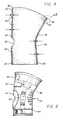
- Fig. 1 is a side view of one embodiment of a formed foam rubber orthopaedic knee brace;
- Fig. 2 is a rear perspective view of the formed foam rubber knee brace of Fig. 1.
- Fig. 3 is a front view of the formed foam rubber knee brace of Fig. 1;
- Fig. 4 is a sectional view of the formed foam rubber knee brace taken along the line 4-4 of Fig. 3;
- Fig. 5 is a side view of an embodiment of a formed foam rubber orthopaedic knee brace having grooves for straps;
- Fig. 6 is a side view of an embodiment of a formed foam rubber orthopaedic knee brace having grooves for struts and for straps;
- Fig. 7 is a cross-sectional view taken along line 7-7 of Fig. 6 showing the strut and the strut groove;
- Fig. 8 is a close-up view of portion 8 of Fig. 4 showing a first outer layer of material, an inner layer of foam rubber, and a second outer layer of material;
- Fig. 9 is a front view of an embodiment of a formed foam rubber orthopaedic knee brace having grooves for a bladder, a pump, and a tube connecting the pump to the bladder.
-
- Before considering a particular preferred embodiment, it is useful to discuss the invention in general. A principal characteristic of the present support invention is regions of varying thickness and density. These regions are created by a process known as compression molding, wherein a combination of heat and pressure is applied to a sheet of material. The manufacturer varies the amount of heat and pressure that is applied in different areas of the material in order to reduce thickness in certain areas. The areas that are not compressed, or which are only slightly compressed, can constitute regions of extra padding. The material is typically a closed-cell rubber, such as neoprene, although the material might also be a resilient open-cell material such as urethane foam.
- The art of compression molding requires both special equipment and special skill. Therefore, a designer of a compression molded product will typically submit specifications to a commercial compression molding company, which will then manufacture the product. One such compression molding company is Rubatex Corporation of Bedford, Virginia.
- Fig. 10 is a comparison of the stretch characteristics of compressed and uncompressed foam rubber. This figure was derived from tension tests of uncompressed, and compressed samples of neoprene that were supplied to the inventors by the Rubatex Corporation. Each of the samples had a testing length of 3 inches (7,62 cm) and a width of 1 inch (2.54cm). The uncompressed samples were 3/16 inch (0.43cm) thick, and the compressed samples were 1/8 inch (0.16cm) thick. In Fig.10, load expressed in pounds weight (each pound is equal to 2.2 kilograms) is plotted against thickness expressed in inches (one inch is equal to 2.54cm). Fig. 10 illustrates, the compressed and uncompressed materials behave similarly at low loads. However, as the load increases, the compressed material tends to stretch more than the uncompressed material. By applying this principle to foam rubber orthopaedic support design, a designer may control the stretch characteristics of a support by varying the degree to which different regions of the support are compressed. Furthermore, because the support pressure of a foam rubber support is related to its stretch characteristics, the designer may simultaneously control the pressure that the brace exerts at different areas of an injured part of the human anatomy.
- Now turning to one specific embodiment of the invention, Fig. 1 shows an
orthopaedic knee brace 18. The brace has been compression molded to have a number of features.Strip pads 22 protect the flesh and muscle above the knee when the user either falls down or bumps into another object. Similar pads may be placed below the knee to protect the shin. Patellar buttress 24 supports and protects the patella.Main body 28 may be compression molded to have a generally uniform thickness and density, and therefore uniform stretch characteristics as may be desired for overall support. - The knee brace also includes compression molded
transverse grooves 32 located in the rearpopliteal area 30. These compression moldedgrooves 32 are shown in both Figs. 1 and 2.Grooves 32 allow the rearpopliteal area 30 to fold accordion style when the knee is bent. This feature overcomes the long standing problem of material bunching, which prevents the knee from flexing freely with traditional knee braces. Rearpopliteal area 30 may have a generally relaxed thickness in order to help the knee bend. The sheet material is sewn together along sewline 31 as shown in Fig. 2. - Raised rims 20 act to anchor the knee brace onto the knee area. As discussed previously, and as shown in Fig. 10, compressed foam rubber stretches more easily than foam rubber that is not compressed or that is compressed relatively less. Consequently, rims 20 stretch relatively less than
base 28, thereby causingrims 20 to behave like elastic bands around the portions of the leg that are above and below the knee. Thus, the knee brace of Fig. 1 is self-anchoring without the use of straps. - The compression molded features of
knee brace 18 are more particularly seen in Fig. 4, which is a cross sectional view of the brace taken at Section 4-4 of Fig. 3. Fig. 4 particularly shows such features aspads 22, patellar buttress 24, andtransverse grooves 32. Also shown ispatellar aperture 26, which allows the user to flex her or his knee with relative freedom. Note that the compression molding technique allows sudden discontinuities in height and density between raised and non-raised portions, thereby allowing the designer to create corresponding discontinuities in the pressure that the brace exerts on the limb. - Fig. 4 also illustrates molded
edge 36, which rounds the interior of the edge away from the skin to reduce both allergy problems and irritation during exercise. Fig. 8, which is a close-up view of Section 8 of Fig. 4, shows a more detailed view of moldededge 36. Fig. 8 reveals that theknee brace 18 is formed from a material having three layers. The twoouter layers 52 are typically a thin nylon or brushed nylon material. Themiddle layer 54 is typically a closed cell rubber such as neoprene. Moldededge 36 prevents the user's skin from coming into contact withmiddle layer 54, which is often allergenic. Furthermore, the skin does not come into contact with a rough edge, as it would if the edge was die cut. - Fig. 3 illustrates the overall appearance of the leg and
knee brace 34. Several types of channels, grooves, and indentations can be compression molded into the brace. These channels and indentations serve to hold brace hardware into place, to prevent the hardware from protruding from the brace, and to serve as hardware locators during the manufacturing process. Thestrap grooves 38 are an example of this type of compression molded groove, as shown in Fig. 5. The strap grooves guide or maintainstraps base 28 of the brace, and the straps do not protrude. Thus, it is unlikely that the straps will catch on external objects when the brace is worn. - Fig. 6 illustrates a knee brace having a compression molded channel for strut and hinge hardware, which serve to reduce the load that bears directly on the knee. The compression molded channel holds
strut 48 and strut hinge 50 in place, and preventsstrut 48 and strut hinge 50 from significantly protruding from the brace. Fig. 7, which is a cross sectional view taken along Section 7-7 of Fig. 6, shows strut 48 neatly resting insidestrut channel 66.Strut 48 is covered by one of twoouter layers 52, which are typically a nylon or brushed nylon material. Asecond layer 68 of the same material lies underneathouter layer 52 and underneathstrut 48. The base of the brace is an inner layer ofmaterial 54, which is typically foam rubber.Outer layer 52 lies flat overstrut 48, such that the strut itself is not visible from the exterior of the brace. Thesestrut channels 66 allowstrut 48 to rest underneath straps 62 and 64, thereby allowing the user to secure the brace to her or his knee without interference from the strut mechanism. - Fig. 9 illustrates an air bladder, an associated air pump, and a tube to connect the air pump to the air bladder, all of which rest neatly inside compression molded indentations. The
bladder 58 serves to support and protect the knee beyond what patellar buttress 24 can provide.Tube 60 connectspump 56 tobladder 58. The user may pump more or less air into the bladder to adjust the pressure that the bladder exerts upon the knee. Such air packs weigh very little, yet can add considerable support to the knee. - Similar channels and indentations can be compression molded into the brace for a variety of other types of hardware. For instance, indentations can be provided for gel packs, which are used either to protect against impact and/or for thermal therapy. A gel pack for protecting against impact may be permanently located underneath the surface of the knee brace, similar to the manner in which strut 48 is permanently buried underneath the surface of the knee brace in Fig. 7. Gel packs that are to be used for thermal therapy must be removable, and may rest inside a pouch partially defined by a compression molded indentation. In the case of heat therapy, the user first heats a gel pack, then inserts the gel pack into a gel pack pouch. Once the gel pack has cooled somewhat, the user replaces it with a freshly heated gel pack.
- The following dimensions are provided by way of example and not of limitation. Referring to Fig. 1, the foam rubber sheet has an uncompressed thickness of 3/16" (0.48 cm).
Pads 22, rims 20 and patellar buttress 24 are not compressed and have the same 3/16" (0.48 cm) thickness.Base 28 is compression molded to a thickness of 1/8".Transverse grooves 32 have a thickness of 1/16" (0.16 cm). Of course, numerous variations are possible. One such variation is to reduce the thickness of the entirepopliteal area 30, thereby allowing the user to bend her or his knee more easily. - It should be noted that
knee brace 18 is presented as just one of a multitude of possible embodiments of the invention. The invention encompasses a wide range of compression molded supports and braces for all other parts of the body. Thus, in addition to knee braces, the invention includes similar supports for elbows, thighs, wrists, ankles, backs, feet, and shins. - In conclusion, it is to be understood that the foregoing detailed description and the accompanying drawings relate to preferred embodiments of the invention. Various changes and modifications may be made without departing from the herein defined invention. Thus, by way of example and not of limitation, the material need not be nylon-covered neoprene, but could be another closed cell rubber, or an open cell foam such as urethane. The pads could be positioned in various places, such as below the knee to protect the tibial spine, tibial crest and tibial tubercle during a fall. The thickness of the base can be patterned to make the brace stretch more easily in certain directions than in other directions, and the stretch characteristics may be custom designed for particular injuries. The straps could be replaced with bands of a strong elastic material, which could be covered with nylon to make them invisible from the exterior. The patellar buttresses could have a different shape or could be substantially larger than that shown in the drawings.
Air pump 56 can be located in a variety of places. Similarly, the air pump can be an external unit that temporarily connects to the bladder to fill the bladder with air. Additionally, compression moldedtransverse grooves 32 may not exist in some embodiments where ease of bending is not desired. Instead, some knee braces may have a rigid member along rearpopliteal side 30 to prevent any bending of the knee whatsoever. Similar modifications may be made to the multitude of other embodiments of the present invention. Accordingly, the present invention is not limited to the specific embodiments shown in the drawings and described in the detailed description.
Claims (12)
- An orthopaedic support (18) comprising a support body (28) for supporting a portion of the anatomy, said support body comprising stretchable and resilient foam material in sheet form; said foam sheet having a surface and a predetermined thickness in major areas of said sheet; characterised in that said foam material is compression molded in at least one area (28) to decrease the thickness and increase the density of the material in the compression molded area to facilitate the function of the support, said compression molded area extending inwardly from said surface and the thickness of said sheet at the bottom of said compression molded area being less than said predetermined thickness.
- An orthopaedic support as defined in Claim 1, wherein said foam material is an open cell foam.
- An orthopaedic support as defined in Claim 2, wherein the support includes a thin outer layer (52) of material extending over the outer surface of the foam, a thin inner layer (52) of material, and closed cell foam (54) in between said inner and outer layers of material.
- An orthopaedic support as defined in any preceding claim, wherein said portion of the anatomy includes a joint and said support includes areas subject to greater flexing in a first area in the immediate vicinity of said joint and to lesser flexing at other areas away from the immediate vicinity of said joint, said foam material being compressed in said first area to be generally thinner and to give greater flexibility and resiliency, and being substantially thicker in said other areas.
- An orthopaedic support as defined in any preceding claim wherein the support is a knee brace and further comprises an integral, raised patellar buttress portion (24) on the front side for providing support and protection for the patella.
- An orthopaedic support as defined in Claim 1, 2, 3 or 4, wherein the support is a knee brace (18) having a front side for accommodating the patella and a rear popliteal side (30) having a plurality of compression molded, substantially transverse, linearly extending grooves (32) of reduced thickness for reducing bunching of the knee brace when the leg is bent at the knee.
- An orthopaedic support as defined in any preceding claim, wherein said foam sheet material has compression molded grooves (32) extending inwardly from said surface, the thickness of said foam sheet at the bottom of said grooves being substantially less than said predetermined thickness.
- An orthopaedic support as defined in any preceding claim, wherein the support further comprises straps (44) for securing the support.
- An orthopaedic support as defined in any preceding claim, wherein the support further comprises struts (48) for an additional limb support and compression molded grooves (66) to receive said struts.
- An orthopaedic support as defined in any preceding claim wherein the support further comprises gel-filled pads and one or more compression moulded cavities to accommodate said gel-filled pads.
- An orthopaedic support as defined in any preceding claim wherein the support further comprises an inflatable bladder (58), and one or more cavities to accommodate said inflatable bladder.
- An orthopaedic support as defined in any preceding claim wherein the support further comprises compression molded edges (36) for minimizing skin irritation during activity.
Applications Claiming Priority (3)
| Application Number | Priority Date | Filing Date | Title |
|---|---|---|---|
| US08/018,004 US5334135A (en) | 1993-02-16 | 1993-02-16 | Formed resilient orthopaedic support |
| US18004 | 1993-02-16 | ||
| PCT/US1993/011167 WO1994018915A1 (en) | 1993-02-16 | 1993-11-17 | Formed resilient orthopaedic support |
Publications (3)
| Publication Number | Publication Date |
|---|---|
| EP0690703A1 EP0690703A1 (en) | 1996-01-10 |
| EP0690703A4 EP0690703A4 (en) | 1997-04-09 |
| EP0690703B1 true EP0690703B1 (en) | 2001-08-01 |
Family
ID=21785749
Family Applications (1)
| Application Number | Title | Priority Date | Filing Date |
|---|---|---|---|
| EP94901565A Expired - Lifetime EP0690703B1 (en) | 1993-02-16 | 1993-11-17 | Formed resilient orthopaedic support |
Country Status (6)
| Country | Link |
|---|---|
| US (1) | US5334135A (en) |
| EP (1) | EP0690703B1 (en) |
| AU (1) | AU5611294A (en) |
| DE (1) | DE69330528T2 (en) |
| ES (1) | ES2159298T3 (en) |
| WO (1) | WO1994018915A1 (en) |
Families Citing this family (170)
| Publication number | Priority date | Publication date | Assignee | Title |
|---|---|---|---|---|
| GB9300847D0 (en) * | 1993-01-18 | 1993-03-10 | Gardner Arthur M N | Medical appliance |
| US5695452A (en) * | 1993-02-16 | 1997-12-09 | Grim; Tracy E. | Formed resilient orthopaedic device |
| US5588956A (en) * | 1993-06-09 | 1996-12-31 | Billotti; Joseph D. | Method for supporting body joints and brace therefor |
| US5378224A (en) * | 1993-06-09 | 1995-01-03 | Billotti; Joseph D. | Method for supporting body joints and brace therefor |
| US5792084A (en) * | 1993-08-10 | 1998-08-11 | Smith & Nephew, Inc. | Knee brace having an inflatable pad circumscribing the patella |
| DE4412765C2 (en) * | 1994-04-13 | 2001-09-20 | Zimmermann Sanitaets Und Ortho | Joint orthosis, in particular knee orthosis with fluid-stiffenable pockets |
| EP0809478B1 (en) * | 1995-02-15 | 2002-05-29 | dj Orthopedics, LLC | Knee brace having an inflatable pad circumscribing the patella |
| US5643185A (en) * | 1995-10-31 | 1997-07-01 | Watson; Randy C. | Knee and elbow joint brace |
| US5626557A (en) * | 1996-01-11 | 1997-05-06 | D'mannco, Inc | Knee brace having an inflatable bladder and exterior support element |
| US5873848A (en) * | 1996-06-14 | 1999-02-23 | Depuy, Inc. | Orthopedic brace |
| NL1003826C2 (en) * | 1996-08-16 | 1998-02-20 | Orteam B V | Ankle-foot orthosis. |
| USD389582S (en) | 1996-10-10 | 1998-01-20 | Futuro, Inc. | Support brace for knee or elbow |
| US6110134A (en) * | 1997-03-24 | 2000-08-29 | Smith & Nephew, Inc. | Gel padded thermoplastic splint |
| US6588019B1 (en) * | 1998-02-03 | 2003-07-08 | Keith F. Whittle, Jr. | Impact structure for the absorption of impact forces to the body |
| US5865777A (en) * | 1998-05-01 | 1999-02-02 | Detty; Gerald D. | Geriatric knee brace |
| DE19835324A1 (en) * | 1998-08-05 | 2000-02-10 | Bayer Ag | Cyclopentabenzofuran derivatives and their use |
| US6402712B1 (en) | 1999-08-16 | 2002-06-11 | Cho-Pat, Inc. | Dual action knee strap |
| US6223350B1 (en) * | 1999-11-15 | 2001-05-01 | Knee-On Australia Pty Ltd. | Molded knee pad construction |
| USD454231S1 (en) | 1999-11-15 | 2002-03-05 | Knee-On Australia Pty Ltd. | Molded knee pad |
| FR2807644B1 (en) | 2000-04-17 | 2003-02-21 | Francaise Coop Pharma | PERFECTED ORTHOPEDIC KNEE |
| AUPQ713000A0 (en) | 2000-04-26 | 2000-05-18 | Kneeon Australia Pty Limited | Kneepad |
| FR2816174B1 (en) * | 2000-11-09 | 2003-09-05 | Salomon Sa | PROTECTION OF A JOINT |
| US6582382B2 (en) * | 2001-02-16 | 2003-06-24 | Beiersdorf, Inc. | Orthopedic supports |
| US6755800B2 (en) * | 2001-08-08 | 2004-06-29 | Beiersdorf, Inc. | Tennis elbow support comprising tendon pad |
| JP3877602B2 (en) * | 2002-01-30 | 2007-02-07 | 株式会社レイアンドカンパニー | Sheet having laminated structure and appliance having the same structure |
| US7311866B1 (en) * | 2002-06-25 | 2007-12-25 | Ebi, L.P. | Method for creating a mold for a knee brace and a knee brace |
| US8425579B1 (en) * | 2002-10-08 | 2013-04-23 | Vitalwear, Inc. | Therapeutic knee brace for a contrast therapy system |
| USD489493S1 (en) | 2002-12-19 | 2004-05-04 | Bauer Nike Hockey Inc. | Strap of an elbow pad |
| US20060064046A1 (en) * | 2003-01-13 | 2006-03-23 | Brown Medical Industries | Cold pack finger splint |
| US20040138598A1 (en) * | 2003-01-13 | 2004-07-15 | Brown Medical Industries | Cold pack finger splint |
| US7083586B2 (en) | 2003-02-03 | 2006-08-01 | Dj Orthopedics, Llc | Patellofemoral brace |
| US7967765B2 (en) * | 2004-01-06 | 2011-06-28 | Djo, Llc | Orthopedic brace suspension system |
| US7871387B2 (en) | 2004-02-23 | 2011-01-18 | Tyco Healthcare Group Lp | Compression sleeve convertible in length |
| US7615023B2 (en) * | 2004-07-22 | 2009-11-10 | Nordt Development Co., Llc | Donning support with framework fastened to garment |
| US7704219B2 (en) | 2004-07-22 | 2010-04-27 | Nordt Development Company, Llc | Wrist support |
| US7615021B2 (en) * | 2004-07-22 | 2009-11-10 | Nordt Development Co., Llc | Clothing having expandable framework |
| US7618389B2 (en) | 2004-07-22 | 2009-11-17 | Nordt Development Co., Llc | Potentiating support with expandable framework |
| US7618386B2 (en) * | 2004-07-22 | 2009-11-17 | Nordt Development Co., Llc | Two-component compression collar clamp for arm or leg |
| US7621881B2 (en) * | 2004-07-22 | 2009-11-24 | Nordt Development Co., Llc | Donning potentiating support with expandable framework spanning hinge joint |
| US8162867B2 (en) | 2004-07-22 | 2012-04-24 | Nordt Development Co., Llc | Body support for spanning a hinge joint of the body comprising an elastically stretchable framework |
| USD520141S1 (en) | 2004-07-22 | 2006-05-02 | Nordt Development Co., Inc. | Support brace |
| US7615019B2 (en) * | 2004-07-22 | 2009-11-10 | Nordt Development Co., Llc | Potentiating support with side struts spanning hinge joint |
| US7615020B2 (en) * | 2004-07-22 | 2009-11-10 | Nordt Development Co., Llc | Support with removable pressure/alignment ring |
| US7615022B2 (en) * | 2004-07-22 | 2009-11-10 | Nordt Development Co., Llc | Potentiating support with alignment opening for joint protuberance |
| USD519638S1 (en) | 2004-07-22 | 2006-04-25 | Nordt Development Co., Inc. | Support brace member |
| USD521644S1 (en) | 2004-07-22 | 2006-05-23 | Nordt Development Co., Inc. | Support brace |
| US7637884B2 (en) * | 2004-07-22 | 2009-12-29 | Nordt Development Co., Llc | Shirt, pants and jumpsuit having expandable framework |
| US7615027B2 (en) * | 2004-07-22 | 2009-11-10 | Nordt Development Co., Llc | Support with framework fastened to garment |
| USD519637S1 (en) | 2004-07-22 | 2006-04-25 | Nordt Development Co., Inc. | Support brace |
| US7708708B2 (en) * | 2004-07-22 | 2010-05-04 | Nordt Development Co., Ltd. | Donning potentiating support with expandable framework fastened to garment |
| DE102004040793B4 (en) * | 2004-08-23 | 2014-06-05 | Bauerfeind Ag | Elastic knee joint bandage |
| US7376978B2 (en) | 2004-08-25 | 2008-05-27 | Travel Caddy, Inc. | Knee pad construction |
| US7845017B2 (en) * | 2004-08-25 | 2010-12-07 | Travel Caddy, Inc. | Knee pad constructions |
| US7181770B2 (en) * | 2004-08-25 | 2007-02-27 | Travel Caddy, Inc. | Knee pad construction |
| US7841019B2 (en) * | 2004-08-25 | 2010-11-30 | Travel Caddy, Inc. | Knee pad constructions |
| US9220622B2 (en) | 2004-12-22 | 2015-12-29 | Ossur Hf | Orthopedic device |
| US8585623B2 (en) * | 2004-12-22 | 2013-11-19 | Ossur Hf | Orthopedic device |
| US8216170B2 (en) * | 2004-12-22 | 2012-07-10 | Ossur Hf | Orthopedic device |
| US8425441B2 (en) * | 2004-12-22 | 2013-04-23 | Ossur Hf | Spacer element for use in an orthopedic or prosthetic device |
| US7713225B2 (en) | 2004-12-22 | 2010-05-11 | Ossur Hf | Knee brace and method for securing the same |
| US7597675B2 (en) * | 2004-12-22 | 2009-10-06 | össur hf | Knee brace and method for securing the same |
| US7794418B2 (en) | 2004-12-22 | 2010-09-14 | Ossur Hf | Knee brace and method for securing the same |
| US7896827B2 (en) | 2004-12-22 | 2011-03-01 | Ossur Hf | Knee brace and method for securing the same |
| US8231560B2 (en) | 2004-12-22 | 2012-07-31 | Ossur Hf | Orthotic device and method for securing the same |
| US20060211967A1 (en) * | 2005-03-18 | 2006-09-21 | Ronan Reynolds | Knee orthosis |
| US20060277647A1 (en) * | 2005-06-13 | 2006-12-14 | David Dobkin | Performance apparel |
| US20060277644A1 (en) * | 2005-06-13 | 2006-12-14 | David Dobkin | Knee support system |
| US20070021699A1 (en) * | 2005-07-20 | 2007-01-25 | Wellgate Products, Llc | Orthopedic support devices with one or more lower modulus transition cuffs |
| US20070021706A1 (en) * | 2005-07-20 | 2007-01-25 | Wellgate Products, Llc | Orthopedic devices with compressive elastomer formed directly onto a base material |
| GB0515294D0 (en) | 2005-07-26 | 2005-08-31 | Novamedix Distrib Ltd | Limited durability closure means for an inflatable medical garment |
| USD574084S1 (en) * | 2005-09-02 | 2008-07-29 | Bauerfeind Ag | Bandage for a knee joint |
| US7867183B2 (en) | 2005-09-30 | 2011-01-11 | Dj Orthopedics, Llc | Knee brace having a rigid frame and patellofemoral support |
| US8029451B2 (en) | 2005-12-12 | 2011-10-04 | Tyco Healthcare Group Lp | Compression sleeve having air conduits |
| US7931606B2 (en) | 2005-12-12 | 2011-04-26 | Tyco Healthcare Group Lp | Compression apparatus |
| US20070282233A1 (en) * | 2005-12-12 | 2007-12-06 | Tyco Healthcare Group Lp | Compression apparatus |
| USD548350S1 (en) | 2006-04-04 | 2007-08-07 | 3M Innovative Properties Company | Pad ornamentation for appendage wrap |
| US20080033335A1 (en) * | 2006-08-03 | 2008-02-07 | Roman Kendyl A | Methods and means for lifting jumper |
| US20080032824A1 (en) * | 2006-08-03 | 2008-02-07 | Roman Kendyl A | Methods and means for lifting jumper |
| US7468048B2 (en) | 2006-10-06 | 2008-12-23 | National Jewish Health | Joint aspirate facilitating device |
| US20080194997A1 (en) * | 2007-02-08 | 2008-08-14 | Rehabilitation Institute Of Chicago | System and method for diagnosing and treating patellar maltracking and malalignment |
| US8048013B2 (en) * | 2007-02-12 | 2011-11-01 | Ossur Hf | Orthopedic brace and component for use therewith |
| US8016778B2 (en) | 2007-04-09 | 2011-09-13 | Tyco Healthcare Group Lp | Compression device with improved moisture evaporation |
| USD608006S1 (en) | 2007-04-09 | 2010-01-12 | Tyco Healthcare Group Lp | Compression device |
| US8021388B2 (en) | 2007-04-09 | 2011-09-20 | Tyco Healthcare Group Lp | Compression device with improved moisture evaporation |
| US8506508B2 (en) | 2007-04-09 | 2013-08-13 | Covidien Lp | Compression device having weld seam moisture transfer |
| US8109892B2 (en) | 2007-04-09 | 2012-02-07 | Tyco Healthcare Group Lp | Methods of making compression device with improved evaporation |
| US8029450B2 (en) | 2007-04-09 | 2011-10-04 | Tyco Healthcare Group Lp | Breathable compression device |
| US8034007B2 (en) | 2007-04-09 | 2011-10-11 | Tyco Healthcare Group Lp | Compression device with structural support features |
| US8016779B2 (en) | 2007-04-09 | 2011-09-13 | Tyco Healthcare Group Lp | Compression device having cooling capability |
| US8128584B2 (en) | 2007-04-09 | 2012-03-06 | Tyco Healthcare Group Lp | Compression device with S-shaped bladder |
| US8162861B2 (en) | 2007-04-09 | 2012-04-24 | Tyco Healthcare Group Lp | Compression device with strategic weld construction |
| US8070699B2 (en) | 2007-04-09 | 2011-12-06 | Tyco Healthcare Group Lp | Method of making compression sleeve with structural support features |
| US20080306420A1 (en) * | 2007-06-08 | 2008-12-11 | Tyco Healthcare Group Lp | Compression device with independently moveable inflatable member |
| US10842653B2 (en) | 2007-09-19 | 2020-11-24 | Ability Dynamics, Llc | Vacuum system for a prosthetic foot |
| DE102007057578A1 (en) * | 2007-11-28 | 2009-06-10 | Otto Bock Healthcare Ip Gmbh & Co. Kg | Sprunggelenkorthesensystem |
| US8114117B2 (en) | 2008-09-30 | 2012-02-14 | Tyco Healthcare Group Lp | Compression device with wear area |
| US20090271907A1 (en) * | 2008-05-05 | 2009-11-05 | Roman Kendyl A | Leg handle comprising hollow cylindrical section |
| US8636678B2 (en) | 2008-07-01 | 2014-01-28 | Covidien Lp | Inflatable member for compression foot cuff |
| US8235923B2 (en) | 2008-09-30 | 2012-08-07 | Tyco Healthcare Group Lp | Compression device with removable portion |
| US20100115681A1 (en) * | 2008-10-06 | 2010-05-13 | Gsm (Operations) Pty Ltd | Wetsuit |
| CN102333502B (en) | 2009-02-26 | 2014-06-25 | 欧苏尔公司 | Orthopedic devices used to treat the back |
| US8597222B2 (en) | 2009-06-12 | 2013-12-03 | Under Armour, Inc. | Garment with adjustable compression |
| US8657769B2 (en) | 2009-11-04 | 2014-02-25 | Ossur Hf | Thoracic lumbar sacral orthosis |
| US20110146032A1 (en) * | 2009-12-10 | 2011-06-23 | Ossur Hf | Strapping system |
| US20120253432A1 (en) * | 2009-12-16 | 2012-10-04 | Koninklijke Philips Electronics N.V. | Light treatment system |
| US8652079B2 (en) | 2010-04-02 | 2014-02-18 | Covidien Lp | Compression garment having an extension |
| US10751221B2 (en) | 2010-09-14 | 2020-08-25 | Kpr U.S., Llc | Compression sleeve with improved position retention |
| US8096964B1 (en) | 2010-09-29 | 2012-01-17 | Tyco Healthcare Group Lp | Compression garment having grip |
| EP2654631B1 (en) | 2010-12-22 | 2018-05-09 | Ossur HF | Orthopedic device |
| USD686330S1 (en) | 2011-01-26 | 2013-07-16 | Bauerfeind Ag | Orthotic insert |
| US10863791B2 (en) | 2011-04-07 | 2020-12-15 | Ovation Medical | Removable leg walker |
| JP2012245117A (en) * | 2011-05-26 | 2012-12-13 | Advancing:Kk | Knee joint supporter |
| WO2012177700A2 (en) | 2011-06-20 | 2012-12-27 | Ossur Hf | Orthopedic device, use of orthopedic device and method for producing the same |
| USD683859S1 (en) * | 2011-07-25 | 2013-06-04 | Ossur Hf | Knee brace |
| USD683465S1 (en) | 2011-07-25 | 2013-05-28 | Ossur Hf | Patella buttress |
| US9125787B2 (en) | 2011-09-30 | 2015-09-08 | Covidien Lp | Compression garment having a foam layer |
| US9370440B2 (en) | 2012-01-13 | 2016-06-21 | Ossur Hf | Spinal orthosis |
| US9572705B2 (en) | 2012-01-13 | 2017-02-21 | Ossur Hf | Spinal orthosis |
| US9205021B2 (en) | 2012-06-18 | 2015-12-08 | Covidien Lp | Compression system with vent cooling feature |
| US9248042B2 (en) | 2012-09-12 | 2016-02-02 | Yessenia Lopez | Dorsal foot splint |
| EP2897559B1 (en) | 2012-09-19 | 2019-03-06 | Ossur HF | Panel attachment and circumference adjustment systems for an orthopedic device |
| US11076647B2 (en) | 2012-11-06 | 2021-08-03 | 3DCalz, LLC | Pads with three dimensional image element |
| US9884240B2 (en) | 2012-11-06 | 2018-02-06 | 3DCalz, LLC | Three dimensional knee and elbow pads |
| US20140123361A1 (en) * | 2012-11-06 | 2014-05-08 | 3DCalz, LLC | Three dimensional sports pads and related methods for ornamenting a sports uniform |
| US9474334B2 (en) | 2012-11-13 | 2016-10-25 | Ossur Hf | Fastener member for affixation to a structure in an orthopedic device and method for securing the same |
| CN105228564B (en) | 2013-01-07 | 2017-11-14 | 奥索有限责任公司 | Orthopedic device and fixation method thereof |
| US9554935B2 (en) | 2013-01-24 | 2017-01-31 | Ossur Hf | Orthopedic device for treating complications of the hip |
| CN105377198B (en) | 2013-01-24 | 2017-12-08 | 奥索有限责任公司 | For treating the orthopedic appliance of hip complication |
| US9795500B2 (en) | 2013-01-24 | 2017-10-24 | Ossur Hf | Orthopedic device for treating complications of the hip |
| US10357391B2 (en) | 2013-01-24 | 2019-07-23 | Ossur Hf | Orthopedic device for treating complications of the hip |
| WO2014120393A1 (en) | 2013-01-31 | 2014-08-07 | Ossur Hf | Progressive force strap assembly for use with an orthopedic device |
| EP2950759B1 (en) | 2013-01-31 | 2020-05-13 | Ossur Hf | Orthopedic device having detachable components for treatment stages |
| US9402779B2 (en) | 2013-03-11 | 2016-08-02 | Covidien Lp | Compression garment with perspiration relief |
| WO2014144517A1 (en) | 2013-03-15 | 2014-09-18 | Ovation Medical | Orthopedic walking boot with heel cushion |
| US10449078B2 (en) | 2013-03-15 | 2019-10-22 | Ovation Medical | Modular system for an orthopedic walking boot |
| US10085871B2 (en) | 2013-03-15 | 2018-10-02 | Ovation Systems | Overmolding for an orthopedic walking boot |
| WO2014168910A1 (en) | 2013-04-08 | 2014-10-16 | Ossur Hf | Strap attachment system for orthopedic device |
| EP2983626B1 (en) | 2013-04-08 | 2021-10-27 | Ossur hf | Functional knit orthopedic device |
| FR3005570B1 (en) * | 2013-05-16 | 2016-07-29 | Millet Innovation | PROPRIOCEPTIVE ORTHESIS MAINTAINING AN ARTICULATION |
| USD733894S1 (en) * | 2013-10-07 | 2015-07-07 | Weber Orthopedic Inc. | Popliteal open/closed knee brace |
| US9510965B2 (en) | 2014-07-01 | 2016-12-06 | Ortho Systems | Adjustable walking apparatus |
| US10052221B2 (en) | 2015-01-06 | 2018-08-21 | Ossur Iceland Ehf | Orthopedic device for treating osteoarthritis of the knee |
| WO2016138215A1 (en) | 2015-02-27 | 2016-09-01 | Ossur Iceland Ehf | Spinal orthosis, kit and method for using the same |
| US10561520B2 (en) | 2015-02-27 | 2020-02-18 | Ossur Iceland Ehf | Spinal orthosis, kit and method for using the same |
| DE102016103960B3 (en) | 2016-03-04 | 2017-07-13 | medi prosthetics GmbH | Knitted piece in the form of a leg or arm stocking |
| CA3031748C (en) * | 2016-06-03 | 2023-10-03 | Shock Doctor, Inc. | Knee brace devices, systems and methods |
| US11850175B2 (en) | 2016-06-06 | 2023-12-26 | Ossur Iceland Ehf | Orthopedic device, strap system and method for securing the same |
| WO2017214091A1 (en) | 2016-06-06 | 2017-12-14 | Ossur Iceland Ehf | Orthopedic device, strap system and method for securing the same |
| US10966851B2 (en) | 2016-08-09 | 2021-04-06 | Ossur Iceland Ehf | Orthopedic device |
| US10758393B2 (en) | 2016-08-09 | 2020-09-01 | Ossur Iceland Ehf | Orthopedic device |
| DK3225390T3 (en) * | 2017-02-09 | 2019-03-18 | Eastwest Int Taiwan Enterprises | PROCEDURE FOR PREPARING A HORSE PROTECTION COVER |
| US10517271B2 (en) * | 2017-02-09 | 2019-12-31 | Eastwest International (Taiwan) Enterprises | Method of manufacturing an equine protective covering |
| US11246734B2 (en) | 2017-09-07 | 2022-02-15 | Ossur Iceland Ehf | Thoracic lumbar sacral orthosis attachment |
| EP3687743B1 (en) | 2017-09-28 | 2023-10-25 | Ossur Iceland EHF | Body interface |
| CN111278390B (en) | 2017-10-06 | 2022-12-20 | 奥索冰岛有限公司 | Orthotics for knee unloading |
| USD870298S1 (en) | 2017-11-17 | 2019-12-17 | Ossur Iceland Ehf | Strap for an orthopedic device |
| USD863566S1 (en) | 2017-11-17 | 2019-10-15 | Ossur Iceland Ehf | Orthopedic device |
| USD872285S1 (en) | 2017-11-17 | 2020-01-07 | Ossur Iceland Ehf | Lumbar support |
| USD863567S1 (en) | 2017-11-27 | 2019-10-15 | Ossur Iceland Ehf | Orthopedic device |
| WO2019104263A1 (en) * | 2017-11-27 | 2019-05-31 | Ossur Iceland Ehf | Orthopedic device |
| USD891623S1 (en) | 2017-12-05 | 2020-07-28 | Ossur Iceland Ehf | Hinge |
| USD846130S1 (en) | 2018-01-31 | 2019-04-16 | Ortho Systems | Knee brace |
| USD882803S1 (en) | 2018-10-08 | 2020-04-28 | Ossur Iceland Ehf | Orthopedic shell |
| USD908458S1 (en) | 2018-10-08 | 2021-01-26 | Ossur Iceland Ehf | Hinge cover |
| USD888258S1 (en) | 2018-10-08 | 2020-06-23 | Ossur Iceland Ehf | Connector assembly |
| US11497642B2 (en) | 2019-01-30 | 2022-11-15 | Ossur Iceland Ehf | Orthopedic device for patellofemoral issues |
| US12178729B2 (en) | 2019-03-26 | 2024-12-31 | Ossur Iceland Ehf | Hinge assembly for an orthopedic device |
| USD905859S1 (en) * | 2020-07-24 | 2020-12-22 | Inzer Advance Designs, Inc. | Sleeve |
| US11872150B2 (en) | 2020-12-28 | 2024-01-16 | Ossur Iceland Ehf | Sleeve and method for use with orthopedic device |
| US20230233145A1 (en) | 2022-01-26 | 2023-07-27 | Orthosoft Ulc | Wirelessly powered sensors for orthopedic implants |
Family Cites Families (11)
| Publication number | Priority date | Publication date | Assignee | Title |
|---|---|---|---|---|
| US3587572A (en) * | 1968-07-17 | 1971-06-28 | Michael Evans | Knee brace |
| US3786804A (en) * | 1972-08-07 | 1974-01-22 | Surgical Appliance Ind | Hinged knee brace having torque pads for producing inward support pressure |
| US4232663A (en) * | 1978-12-12 | 1980-11-11 | Newton John E | Cervical support collar |
| US4632106A (en) * | 1986-01-28 | 1986-12-30 | Jung Corporation | Stretchable tubular brace for knee or elbow and method of construction |
| US5027801A (en) * | 1987-05-29 | 1991-07-02 | Royce Medical Company | Orthopaedic gel pad assembly |
| US5088478A (en) * | 1988-05-10 | 1992-02-18 | Royce Medical Company | Gel and air cushion ankle brace |
| US4953543A (en) * | 1988-08-09 | 1990-09-04 | Royce Medical Company | Cruciate ligament leg brace |
| US5062414A (en) * | 1989-02-08 | 1991-11-05 | Royce Medical Company | Simplified orthopaedic back support |
| US4993409A (en) * | 1989-02-08 | 1991-02-19 | Royce Medical Company | Back support |
| US5026339A (en) * | 1990-02-22 | 1991-06-25 | Royce Medical Company | Sheet plastic check valve technique |
| JP2894778B2 (en) * | 1990-03-05 | 1999-05-24 | アルケア株式会社 | Supporter |
-
1993
- 1993-02-16 US US08/018,004 patent/US5334135A/en not_active Expired - Lifetime
- 1993-11-17 ES ES94901565T patent/ES2159298T3/en not_active Expired - Lifetime
- 1993-11-17 DE DE69330528T patent/DE69330528T2/en not_active Expired - Lifetime
- 1993-11-17 EP EP94901565A patent/EP0690703B1/en not_active Expired - Lifetime
- 1993-11-17 AU AU56112/94A patent/AU5611294A/en not_active Abandoned
- 1993-11-17 WO PCT/US1993/011167 patent/WO1994018915A1/en not_active Ceased
Also Published As
| Publication number | Publication date |
|---|---|
| EP0690703A4 (en) | 1997-04-09 |
| WO1994018915A1 (en) | 1994-09-01 |
| US5334135A (en) | 1994-08-02 |
| DE69330528D1 (en) | 2001-09-06 |
| DE69330528T2 (en) | 2002-07-18 |
| EP0690703A1 (en) | 1996-01-10 |
| ES2159298T3 (en) | 2001-10-01 |
| AU5611294A (en) | 1994-09-14 |
Similar Documents
| Publication | Publication Date | Title |
|---|---|---|
| US5334135A (en) | Formed resilient orthopaedic support | |
| EP0824337B1 (en) | Formed resilient orthopaedic device | |
| US5823981A (en) | Resilient orthopaedic support with independently stretchable layers | |
| US7749182B2 (en) | Stay hinge for orthopedic supports and method of using same | |
| US5139476A (en) | Orthotic knee wrap | |
| CA2121342C (en) | Adjustable knee support | |
| US6394971B1 (en) | Ankle brace and support and method | |
| CN101711141B (en) | Orthopedic device | |
| US6080121A (en) | Laminated orthopedic brace | |
| US5716335A (en) | Ankle brace with adjustable heel strap | |
| US6110135A (en) | Elbow brace with movable support | |
| US5389065A (en) | Ankle brace with ATF compression | |
| US8083704B2 (en) | Systems and methods for off-weighting a limb | |
| US10842659B2 (en) | Knee brace device, systems, and methods | |
| EP0970670A1 (en) | Ankle brace with multiple straps | |
| US11179260B2 (en) | Knee brace devices, systems and methods | |
| CA2276501C (en) | Elbow brace with movable support | |
| EP0970668A1 (en) | Laminated orthopedic brace |
Legal Events
| Date | Code | Title | Description |
|---|---|---|---|
| PUAI | Public reference made under article 153(3) epc to a published international application that has entered the european phase |
Free format text: ORIGINAL CODE: 0009012 |
|
| 17P | Request for examination filed |
Effective date: 19950912 |
|
| AK | Designated contracting states |
Kind code of ref document: A1 Designated state(s): DE ES FR GB IT |
|
| A4 | Supplementary search report drawn up and despatched |
Effective date: 19970224 |
|
| AK | Designated contracting states |
Kind code of ref document: A4 Designated state(s): DE ES FR GB IT |
|
| 17Q | First examination report despatched |
Effective date: 19990615 |
|
| GRAG | Despatch of communication of intention to grant |
Free format text: ORIGINAL CODE: EPIDOS AGRA |
|
| GRAG | Despatch of communication of intention to grant |
Free format text: ORIGINAL CODE: EPIDOS AGRA |
|
| GRAH | Despatch of communication of intention to grant a patent |
Free format text: ORIGINAL CODE: EPIDOS IGRA |
|
| GRAH | Despatch of communication of intention to grant a patent |
Free format text: ORIGINAL CODE: EPIDOS IGRA |
|
| GRAA | (expected) grant |
Free format text: ORIGINAL CODE: 0009210 |
|
| AK | Designated contracting states |
Kind code of ref document: B1 Designated state(s): DE ES FR GB IT |
|
| REF | Corresponds to: |
Ref document number: 69330528 Country of ref document: DE Date of ref document: 20010906 |
|
| REG | Reference to a national code |
Ref country code: ES Ref legal event code: FG2A Ref document number: 2159298 Country of ref document: ES Kind code of ref document: T3 |
|
| ET | Fr: translation filed | ||
| REG | Reference to a national code |
Ref country code: GB Ref legal event code: IF02 |
|
| PLBE | No opposition filed within time limit |
Free format text: ORIGINAL CODE: 0009261 |
|
| 26N | No opposition filed | ||
| PGFP | Annual fee paid to national office [announced via postgrant information from national office to epo] |
Ref country code: ES Payment date: 20091124 Year of fee payment: 17 |
|
| PGFP | Annual fee paid to national office [announced via postgrant information from national office to epo] |
Ref country code: IT Payment date: 20091119 Year of fee payment: 17 |
|
| PG25 | Lapsed in a contracting state [announced via postgrant information from national office to epo] |
Ref country code: IT Free format text: LAPSE BECAUSE OF NON-PAYMENT OF DUE FEES Effective date: 20101117 |
|
| REG | Reference to a national code |
Ref country code: ES Ref legal event code: FD2A Effective date: 20120110 |
|
| PG25 | Lapsed in a contracting state [announced via postgrant information from national office to epo] |
Ref country code: ES Free format text: LAPSE BECAUSE OF NON-PAYMENT OF DUE FEES Effective date: 20101118 |
|
| PGFP | Annual fee paid to national office [announced via postgrant information from national office to epo] |
Ref country code: DE Payment date: 20121130 Year of fee payment: 20 Ref country code: FR Payment date: 20121113 Year of fee payment: 20 |
|
| PGFP | Annual fee paid to national office [announced via postgrant information from national office to epo] |
Ref country code: GB Payment date: 20121025 Year of fee payment: 20 |
|
| REG | Reference to a national code |
Ref country code: DE Ref legal event code: R071 Ref document number: 69330528 Country of ref document: DE |
|
| REG | Reference to a national code |
Ref country code: GB Ref legal event code: PE20 Expiry date: 20131116 |
|
| PG25 | Lapsed in a contracting state [announced via postgrant information from national office to epo] |
Ref country code: DE Free format text: LAPSE BECAUSE OF EXPIRATION OF PROTECTION Effective date: 20131119 Ref country code: GB Free format text: LAPSE BECAUSE OF EXPIRATION OF PROTECTION Effective date: 20131116 |