EP0689774A2 - Process for sterilizing and homogenizing fluids using high frequency vibrations - Google Patents
Process for sterilizing and homogenizing fluids using high frequency vibrations Download PDFInfo
- Publication number
- EP0689774A2 EP0689774A2 EP95201726A EP95201726A EP0689774A2 EP 0689774 A2 EP0689774 A2 EP 0689774A2 EP 95201726 A EP95201726 A EP 95201726A EP 95201726 A EP95201726 A EP 95201726A EP 0689774 A2 EP0689774 A2 EP 0689774A2
- Authority
- EP
- European Patent Office
- Prior art keywords
- fluid
- sonotrode
- liquid
- pipe length
- vibrations
- Prior art date
- Legal status (The legal status is an assumption and is not a legal conclusion. Google has not performed a legal analysis and makes no representation as to the accuracy of the status listed.)
- Withdrawn
Links
Images




Classifications
-
- A—HUMAN NECESSITIES
- A23—FOODS OR FOODSTUFFS; TREATMENT THEREOF, NOT COVERED BY OTHER CLASSES
- A23B—PRESERVATION OF FOODS, FOODSTUFFS OR NON-ALCOHOLIC BEVERAGES; CHEMICAL RIPENING OF FRUIT OR VEGETABLES
- A23B11/00—Preservation of milk or dairy products
- A23B11/10—Preservation of milk or milk preparations
- A23B11/16—Preservation of milk or milk preparations by irradiation, e.g. by microwaves
- A23B11/162—Preservation of milk or milk preparations by irradiation, e.g. by microwaves by sonic or ultrasonic waves
-
- A—HUMAN NECESSITIES
- A01—AGRICULTURE; FORESTRY; ANIMAL HUSBANDRY; HUNTING; TRAPPING; FISHING
- A01J—MANUFACTURE OF DAIRY PRODUCTS
- A01J11/00—Apparatus for treating milk
-
- A—HUMAN NECESSITIES
- A23—FOODS OR FOODSTUFFS; TREATMENT THEREOF, NOT COVERED BY OTHER CLASSES
- A23B—PRESERVATION OF FOODS, FOODSTUFFS OR NON-ALCOHOLIC BEVERAGES; CHEMICAL RIPENING OF FRUIT OR VEGETABLES
- A23B2/00—Preservation of foods or foodstuffs, in general
- A23B2/10—Preservation of foods or foodstuffs, in general by treatment with pressure variation, shock, acceleration or shear stress
-
- A—HUMAN NECESSITIES
- A23—FOODS OR FOODSTUFFS; TREATMENT THEREOF, NOT COVERED BY OTHER CLASSES
- A23B—PRESERVATION OF FOODS, FOODSTUFFS OR NON-ALCOHOLIC BEVERAGES; CHEMICAL RIPENING OF FRUIT OR VEGETABLES
- A23B2/00—Preservation of foods or foodstuffs, in general
- A23B2/50—Preservation of foods or foodstuffs, in general by irradiation without heating
- A23B2/57—Preservation of foods or foodstuffs, in general by irradiation without heating by treatment with ultrasonic waves
Definitions
- This invention relates to the area of processes for the sterilization and/or homogenization of liquid substances and fluid substances of low or medium viscosity.
- the sterilization of milk can only be done by heating it at certain temperatures for predetermined periods of time, either in the pasteurization process, at lower temperatures, or in the ultrapurification process, at higher temperatures.
- the thermal sterilization treatment must always be repeated after the milk is put into its containers for consumption.
- the intent of the inventor was to solve the aforementioned types of problems, problems which, although having different specific aspects, also arise in sterilization and/or homogenization treatments of other types of fluids, for example water, beverages such as soft drinks, fruit juices, or even, for other purposes, dirty water with a high bacterial content, for example waste water from hospitals, purifiers, etc.
- other types of fluids for example water, beverages such as soft drinks, fruit juices, or even, for other purposes, dirty water with a high bacterial content, for example waste water from hospitals, purifiers, etc.
- the inventor proposes a process which makes it possible to attain, for all these different cases, the desired result of sterilization and/or homogenization without having to resort to the use of high temperatures or high pressures or the inevitably necessary expensive equipment for producing said effects.
- the object of this patent application is also a device that is suitable for carrying out the process according to the invention.
- the inventor has ascertained in experiments that, by subjecting a liquid with a certain bacterial content to high-frequency vibrations (for example, at a frequency of roughly 20 kHz) for a predetermined period of time, the resulting bacterial content is essentially eliminated at the end of the treatment.
- This effect is due in part to the mechanical action of rupturing the cell membrane, caused by cavitation phenomena induced by vibrations, phenomena which include point superheating on the order of 5000°C and overpressures of up to 500 ⁇ 10 ⁇ 2 kPa (500 bar) in microspheric cavitation bubbles, and in part to dispersion of bacteria into disagglutinated entities with a low population, something which for many species of bacteria prevents their reproduction.
- the graph in Fig. 5 shows the curve of vibration amplitude a as a function of the percentage of power W% used in the described device.
- the process according to the invention attains the result proposed by the inventor, namely, to achieve optimum homogenization and sterilization results in, for example, milk, without having to subject it to thermal stress and without having to resort to costly equipment.
- the pressure at which the liquid was maintained in order to suppress the erosion phenomena induced by cavitation in parts of the device for carrying out the process which will be described below was only 4 ⁇ 10 ⁇ 2 kPa (4 bar), and the temperature of the milk, throughout the course of the process, did not exceed 49°C. It can easily be concluded, and subsequent analyses have confirmed, that the milk thereby processed does not differ significantly in its organic and nutritional value from freshly expressed milk.
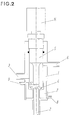
- Pump 11 takes in the liquid (in this particular case, milk) from tank 10 and sends it through inlet pipe 2 into pipe length 1 in the form of a chamber, in which sonotrode 5 is coaxially arranged (see Fig. 2) and directly connected to a generator-converter 14 without insertion of a booster (which should be added in some cases for high powers).
- the milk leaves inlet pipe 2 (see Fig. 2) through conveyor nozzle 4 so as to be directed to terminal part 5' of sonotrode 5 and so that, when subsequently traversing output pipe 3 of chamber 1, it passes in back of the external vibrating walls of said sonotrode 5.
- Regulating the range of pump 11 with a suitable regulator 12 to obtain the desired speed at which the fluid will traverse the chamber ensures that the duration of treatment with high-frequency vibrations is sufficient to guarantee the desired results.
- Overflow discharge (6) ensures moreover that any excess liquid which may be sent by pump 11 will be returned to tank 10.
- the treated liquid travels from output pipe 3 into a collection container (not shown).
- the inventor in the course of experimentation, ascertained that the phenomenon of cavitation, which is useful for obtaining the desired effects on the fluid to be treated, has an adverse effect on the durability of the sonotrode, or rather, on its vibrating terminal part.
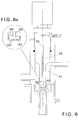
- Fig. 6 in the sonotrode there are hollowed-out channels 68i branching out from one main channel 66 arranged axially, through which an inert gas, for example nitrogen, is caused to flow at a predetermined pressure.
- an inert gas for example nitrogen
- This gas on leaving the outlet mouths of the channels which open out into the terminal part of the sonotrode, or preferably, as shown, into the external walls of a suitable cell 67 which is rigidly attached to said terminal part 65', creates an interface zone between the sonotrode and the fluid to be treated in which a high turbulence is generated (also dependent on the outgoing overpressure of the gas).
- This area develops an effective dampening effect and thus a reduction in the cavitational erosion which damages the sonotrode.
- the gas obviously can then be recovered and re-used after proper treatment.
- Another solution takes advantage of the particular behavior of high-frequency acoustic waves of relatively low wavelength, which naturally, due to their physical characteristics, behave in a manner similar to that of light rays, largely obeying known laws of geometric optics.
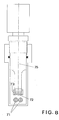
- the inventor built a device in which the pipe length in which the fluid to be treated is subjected to ultrasonic vibration consists of a bundle of parallel tubes 71 (two in Figs. 7 and 8) through which this fluid moves and in which a system of lenses 72 which are mounted facing the terminal part of the sonotrode concentrate the ultrasonic waves emitted by the sonotrode by focussing them.
- the aforementioned lenses are moreover attached to a base 73 which is able to transfer the waves by varying the focal distance with respect to the sonotrode according to requirements.
- These tubes 71 which form the aforementioned bundle should preferably be made of a material which has a low coefficient of absorption of the elastic waves which are generated therein as the result of exposure to ultrasound.
- the materials most suitable for construction of the sonotrodes associated with the device according to the invention are those already known to those skilled in the art, and preferably metals with a high resistance to cavitation erosion.
- the inventor suitably modified the crystalline structure of the terminal part of the sonotrode using ion implantation of an element different from that which composes the sonotrode, chosen for example from among nitrogen, carbon, titanium, nickel, molybdenum, cobalt and fluorine
- the inventor Downstream of the pipe length in which the fluid is subjected to ultrasonic vibrations, independently of the mode of treatment selected, but in particular when the sonotrode is in contact with the fluid to be treated, the inventor installed a filtering element (not shown) whose sterile filter catches any foreign particles and/or impurities.
Landscapes
- Life Sciences & Earth Sciences (AREA)
- Engineering & Computer Science (AREA)
- Wood Science & Technology (AREA)
- Zoology (AREA)
- Chemical & Material Sciences (AREA)
- Food Science & Technology (AREA)
- Polymers & Plastics (AREA)
- Animal Husbandry (AREA)
- Environmental Sciences (AREA)
- Food Preservation Except Freezing, Refrigeration, And Drying (AREA)
- Dairy Products (AREA)
- Apparatus For Disinfection Or Sterilisation (AREA)
Abstract

Description
- This invention relates to the area of processes for the sterilization and/or
homogenization of liquid substances and fluid substances of low or medium viscosity. - At the present time, these processes are largely based on thermal and mechanical effects produced by treatments to which the liquids or fluids are subjected. One notable example which covers all the most salient characteristic problems and aspects of these treatments is the process of sterilization and homogenization of milk for human consumption.
- For homogenization, it is necessary to reduce the maximum volume of the fat particles contained therein. This is currently done by thermal action, combined with a predominant mechanical action which is performed by ejecting milk which has been subjected to very high pressures, on the order of 170 · 10² kPa, into suitable porous or perforated units. Due to the considerable turbulence and mixing of the milk fat particles during their passage through said units, the particles break down into subparticles with maximum dimensions which are defined as acceptable by the standards of individual countries. All this requires a major expenditure of energy and the building of fairly expensive plants.
- The sterilization of milk, on the other hand, can only be done by heating it at certain temperatures for predetermined periods of time, either in the pasteurization process, at lower temperatures, or in the ultrapurification process, at higher temperatures.
- In some cases, moreover, the thermal sterilization treatment must always be repeated after the milk is put into its containers for consumption.
- Considering that the temperatures, in the case of the two treatments mentioned above, vary approximately between 100 and 150°C, it is a natural conclusion that these treatments significantly reduce the nutritional value of various components of the milk.
- It should be pointed out that experiments have in fact confirmed that in the aforementioned temperature range, there is a substantial decrease in the contents of vitamins B1, B6, B12 and C, as well as amino acids and unsaturated fatty acids, including linoleic acid, which of course are critical for proper human metabolism.
- The intent of the inventor was to solve the aforementioned types of problems, problems which, although having different specific aspects, also arise in sterilization and/or homogenization treatments of other types of fluids, for example water, beverages such as soft drinks, fruit juices, or even, for other purposes, dirty water with a high bacterial content, for example waste water from hospitals, purifiers, etc.
- The inventor, however, proposes a process which makes it possible to attain, for all these different cases, the desired result of sterilization and/or homogenization without having to resort to the use of high temperatures or high pressures or the inevitably necessary expensive equipment for producing said effects.
- He has in fact solved the problem of sterilization and homogenization by subjecting the liquids or fluids to be treated to high-frequency vibrations, with predetermined times and modalities.
- To do this, the inventor has developed the process which is the object of this patent application and which is outlined in the descriptive part of the attached claims.
- Moreover, the object of this patent application is also a device that is suitable for carrying out the process according to the invention.
- The process and some preferred embodiments of a device that is suitable for carrying out the process follow which will be described in greater detail below, with reference to the attached drawings, where:
- Fig. 1 shows a front view of the preferred embodiment of a device suitable for carrying out the process according to the invention;
- Fig. 2 shows a close-up view of the longitudinal cross-section of one part of the device as per Fig. 1 containing a sonotrode;
- Fig. 3 shows the plot of the logarithmic curve of milk sterilization values that can be obtained as a function of vibration amplitude a of the sonotrode.
- Fig. 4 shows the plot of the 0% degree of homogenization which can be obtained for milk as a function of aforementioned vibration amplitude a of the sonotrode.
- Fig. 5 shows the curve of vibration amplitude a as a function of the percentage of power W% in the sonotrode used in the test;
- Fig. 6 shows a view of a particular sonotrode which is protected from cavitation by the forced discharge of inert gas connected to its terminal part;
- Fig. 6a shows a close-up view of the terminal part of the sonotrode in Fig. 6;
- Fig. 7 shows a cross-sectional view of an embodiment in which the ultrasonic waves are concentrated and focused on the fluid to be treated;
- Fig. 8 shows a cross-sectional view of the embodiment in Fig. 7 in a plane that is perpendicular to the plane of the cross-section in Fig. 7.
- The inventor has ascertained in experiments that, by subjecting a liquid with a certain bacterial content to high-frequency vibrations (for example, at a frequency of roughly 20 kHz) for a predetermined period of time, the resulting bacterial content is essentially eliminated at the end of the treatment. This effect is due in part to the mechanical action of rupturing the cell membrane, caused by cavitation phenomena induced by vibrations, phenomena which include point superheating on the order of 5000°C and overpressures of up to 500 · 10⁻² kPa (500 bar) in microspheric cavitation bubbles, and in part to dispersion of bacteria into disagglutinated entities with a low population, something which for many species of bacteria prevents their reproduction.
- In similar experiments aimed at homogenizing liquids containing low-viscosity particles in an emulsion, the inventor has determined that high-frequency vibrations cause a rapid and effective subdivision of these particles into parts with reduced dimensions whose sizes are more than sufficient to ensure that the emulsion can be defined as "homogenized" as per the current state of the art.
- For this he has developed the process which is the object of this invention, which can be, as already pointed out, used in a number of situations of considerable importance to society, and with lower expenditure of energy than has been needed to date for various treatments which accomplish this purpose.
- One experimental example selected for its particular importance is that of milk for natural nutrition: with a treatment based on high-frequency vibrations, it has been found that, when the power used is increased and consequently the amplitude of the vibrations produced by a generator-converter is increased, progressively better results are obtained both in the homogenization index (0% in Fig. 4) and in the degree of sterilization (logb in Fig. 3). Logb indicates the value of the logarithm of the total number of germs remaining in one milliliter of milk.
- The graph in Fig. 5 shows the curve of vibration amplitude a as a function of the percentage of power W% used in the described device.
- As is obvious from the graphs, even at 70% power residual bacterial content levels are reached which are lower than those established by, for example Swiss standards for pasteurized milk and, extrapolating the sterilization curve to maximum power (100%), a bacterial content of virtually "0" is obtained. This extrapolation is not included in the graph since at the time this patent application was written it had not yet been possible to carry out tests at 100% power due to cavitation problems of the material (titanium) of which the vibrating terminal part of the sonotrode used as a vibration generating unit was made. These problems were subsequently solved.
- Similar favorable results were obtained for homogenization: as can be deduced from the graph in Fig. 4, at 70% power a homogenization index equal to 94% is reached.
- As can be observed from Figs. 3 and 4, the amplitudes of vibrations used in the experiments (for small ranges, equal to 6:20/h) are between 143.64 and 189 m. The energy involved for these ranges was verified to be only 300 Whr.
- It can therefore be asserted that the process according to the invention attains the result proposed by the inventor, namely, to achieve optimum homogenization and sterilization results in, for example, milk, without having to subject it to thermal stress and without having to resort to costly equipment.
- The pressure at which the liquid was maintained in order to suppress the erosion phenomena induced by cavitation in parts of the device for carrying out the process which will be described below was only 4 · 10⁻² kPa (4 bar), and the temperature of the milk, throughout the course of the process, did not exceed 49°C. It can easily be concluded, and subsequent analyses have confirmed, that the milk thereby processed does not differ significantly in its organic and nutritional value from freshly expressed milk.
- One example of a device configured to carry out the process is shown in Fig. 1:
Pump 11 takes in the liquid (in this particular case, milk) fromtank 10 and sends it throughinlet pipe 2 intopipe length 1 in the form of a chamber, in whichsonotrode 5 is coaxially arranged (see Fig. 2) and directly connected to a generator-converter 14 without insertion of a booster (which should be added in some cases for high powers). The milk leaves inlet pipe 2 (see Fig. 2) throughconveyor nozzle 4 so as to be directed to terminal part 5' ofsonotrode 5 and so that, when subsequently traversingoutput pipe 3 ofchamber 1, it passes in back of the external vibrating walls of saidsonotrode 5. Regulating the range of pump 11 with asuitable regulator 12 to obtain the desired speed at which the fluid will traverse the chamber ensures that the duration of treatment with high-frequency vibrations is sufficient to guarantee the desired results. - Overflow discharge (6) ensures moreover that any excess liquid which may be sent by pump 11 will be returned to
tank 10. The treated liquid, on the other hand, travels fromoutput pipe 3 into a collection container (not shown). - To keep the temperature of the treated fluid, which tends to rise in proximity to terminal part 5' of
sonotrode 5, within predetermined limits (in the case of milk, 45-49°C), there is around at least one part ofchamber 1annular cooling jacket 7 for circulating fluid, which reaches the jacket and leaves through twopipes - In other cases where neither a high degree of sterilization nor a particularly high homogenization index is desired (for example, in a treatment which is aimed only at decreasing bacterial content in hospital waste) and where, for reasons of corrosion, direct contact between the sonotrode and the fluid to be treated is not advisable, there can be inserted between them, for example, an annular hollow member containing a fluid which surrounds the outside of the pipe length involved in the treatment; said fluid is subjected to vibration by the sonotrode, retransmits the vibrations in turn to said pipe length and then, finally, to the liquid contained therein (this case not shown).
- The inventor, in the course of experimentation, ascertained that the phenomenon of cavitation, which is useful for obtaining the desired effects on the fluid to be treated, has an adverse effect on the durability of the sonotrode, or rather, on its vibrating terminal part.
- Based on his experience, as well as theoretical studies by other researchers, he has provided some innovative technical solutions which make it possible to prolong the durability of the sonotrode and minimize the introduction of foreign particles produced by the effect of cavitational erosion on the sonotrode into the liquid to be treated.
- One of these solutions is shown in Fig. 6: in the sonotrode there are hollowed-out channels 68i branching out from one
main channel 66 arranged axially, through which an inert gas, for example nitrogen, is caused to flow at a predetermined pressure. This gas, on leaving the outlet mouths of the channels which open out into the terminal part of the sonotrode, or preferably, as shown, into the external walls of asuitable cell 67 which is rigidly attached to said terminal part 65', creates an interface zone between the sonotrode and the fluid to be treated in which a high turbulence is generated (also dependent on the outgoing overpressure of the gas). This area develops an effective dampening effect and thus a reduction in the cavitational erosion which damages the sonotrode. The gas obviously can then be recovered and re-used after proper treatment. - Another solution takes advantage of the particular behavior of high-frequency acoustic waves of relatively low wavelength, which naturally, due to their physical characteristics, behave in a manner similar to that of light rays, largely obeying known laws of geometric optics.
- Using this fact as a foundation, the inventor built a device in which the pipe length in which the fluid to be treated is subjected to ultrasonic vibration consists of a bundle of parallel tubes 71 (two in Figs. 7 and 8) through which this fluid moves and in which a system of
lenses 72 which are mounted facing the terminal part of the sonotrode concentrate the ultrasonic waves emitted by the sonotrode by focussing them. - The aforementioned lenses are moreover attached to a
base 73 which is able to transfer the waves by varying the focal distance with respect to the sonotrode according to requirements. - These
tubes 71 which form the aforementioned bundle should preferably be made of a material which has a low coefficient of absorption of the elastic waves which are generated therein as the result of exposure to ultrasound. - This prevents the sonotrode from coming into contact with the fluid to be treated, and consequently some emissions of extraneous particles into this fluid are avoided.
- The materials most suitable for construction of the sonotrodes associated with the device according to the invention are those already known to those skilled in the art, and preferably metals with a high resistance to cavitation erosion.
- In order to further increase this resistance, the inventor suitably modified the crystalline structure of the terminal part of the sonotrode using ion implantation of an element different from that which composes the sonotrode, chosen for example from among nitrogen, carbon, titanium, nickel, molybdenum, cobalt and fluorine
- Downstream of the pipe length in which the fluid is subjected to ultrasonic vibrations, independently of the mode of treatment selected, but in particular when the sonotrode is in contact with the fluid to be treated, the inventor installed a filtering element (not shown) whose sterile filter catches any foreign particles and/or impurities.
- Any variations which could be made by one skilled in the art either to the process which is the object of this invention or to the embodiments thereof, and not restricted to the device as it is described, and which do not depart from the scope of these attached claims, will be considered as being covered by the protection conferred by this patent application.
Claims (12)
- Process for the sterilization and homogenization of a liquid or a fluid of low or medium viscosity, characterized in that the sterilization and homogenization are obtained by subjecting said liquid or fluid to high-frequency vibrations for a predetermined period of time.
- Device for the sterilization and homogenization of a liquid or a fluid of low or medium viscosity according to the process in claim 1, comprising pumping means (11) suitable for taking in liquid or fluid from tank (10) and sending it through pipe length (1) in which, while traversing said pipe length, said fluid is subjected to vibrations produced by high-frequency vibration generating unit (5) installed inside of or in proximity to said pipe length (1), with the liquid or fluid then continuing on towards a collection container.
- Device according to claim 2, wherein this pipe length forms chamber (1) equipped with inlet pipe (2) and outlet pipe (3) for the liquid or fluid circulating therein, inside of which sonotrode (5) is arranged coaxially, connected to a high-frequency vibration converter-generator (14).
- Device according to claim 3, wherein inlet pipe (2) for the fluid or liquid has a longitudinal axis arranged on the extension of the longitudinal axis of the sonotrode, and discharges facing the terminal part (5'), independent of the latter, while said outlet pipe (3) discharges from said chamber (1) into an area close to the central part of said sonotrode (5).
- Device according to claim 4, wherein around at least one part of said chamber (1) there is annular cooling jacket (7) for circulating fluid.
- Device according to one of claims 4 or 5, wherein said chamber (1) also has overflow discharge (6) which returns excess liquid or fluid to said tank (10).
- Device according to claim 2, wherein said pipe length (1) is surrounded on the outside by an annular member which contains a fluid that is made to vibrate by a ultrasonic frequency generating unit, with the fluid transmitting the vibrations through the annular member to said pipe length.
- Device according to claim 2, wherein said vibration generator unit is sonotrode (65) whose terminal part is traversed by one or more channels (68i) flowing out into said pipe length (61) through which inert gas is caused to flow at a predetermined pressure.
- Device according to claim 2, wherein said pipe length consists of a bundle of parallel tubes (71) traversed by the fluid to be treated, and the vibration generator unit is a sonotrode (75), facing the terminal part of which are mounted one or more lenses (72) which are able to concentrate ultrasonic waves from sonotrode (75), focusing them on tubes (71) composing this bundle.
- Device according to claim 9, wherein said lenses (72) are attached to base (73) which is able to transfer the waves by varying the focal distance of the lenses with respect to sonotrode (75).
- Device according to any of claims 3 through 10, wherein the sonotrode is made of metal and its terminal part is treated, using ion implantation, with a chemical element different from the metal which composes the sonotrode.
- Device according to any of claims 2 through 11, also containing a filtering element located downstream of the pipe length in which the liquid is subjected to ultrasonic vibrations.
Applications Claiming Priority (2)
| Application Number | Priority Date | Filing Date | Title |
|---|---|---|---|
| CH02078/94A CH688813A5 (en) | 1994-06-30 | 1994-06-30 | Apparatus for the sterilization and homogenization of fluid substances using ultrasonic vibrations. |
| CH2078/94 | 1994-06-30 |
Publications (2)
| Publication Number | Publication Date |
|---|---|
| EP0689774A2 true EP0689774A2 (en) | 1996-01-03 |
| EP0689774A3 EP0689774A3 (en) | 1996-05-15 |
Family
ID=4225391
Family Applications (1)
| Application Number | Title | Priority Date | Filing Date |
|---|---|---|---|
| EP95201726A Withdrawn EP0689774A3 (en) | 1994-06-30 | 1995-06-26 | Process for sterilization and homogenization of fluids using vibrations at high frequencies |
Country Status (3)
| Country | Link |
|---|---|
| US (1) | US5531157A (en) |
| EP (1) | EP0689774A3 (en) |
| CH (1) | CH688813A5 (en) |
Cited By (4)
| Publication number | Priority date | Publication date | Assignee | Title |
|---|---|---|---|---|
| US5837303A (en) * | 1997-04-07 | 1998-11-17 | Mark Hayden | Method for killing microorganisms in liquids |
| WO2000001620A1 (en) * | 1998-07-06 | 2000-01-13 | Gerber Ulrich | Method and apparatus for treating liquid with ultrasonic vibrations |
| ES2291051A1 (en) * | 2001-12-14 | 2008-02-16 | Universidad Zaragoza | IMPROVEMENT OF YOGURT TEXTURE THROUGH MANOTERMOSONICATION (MTS) PRIOR TO MILK. |
| EP4725624A1 (en) | 2024-10-14 | 2026-04-15 | Amazemet Spolka Z Ograniczona Odpowiedzialnoscia | Method of atomization of powdered feedstock and device for atomization of powdered feedstock |
Families Citing this family (25)
| Publication number | Priority date | Publication date | Assignee | Title |
|---|---|---|---|---|
| US6380264B1 (en) * | 1994-06-23 | 2002-04-30 | Kimberly-Clark Corporation | Apparatus and method for emulsifying a pressurized multi-component liquid |
| US6019499A (en) * | 1995-04-18 | 2000-02-01 | Advanced Molecular Technologies, Llc | Method of conditioning hydrocarbon liquids and an apparatus for carrying out the method |
| EP0833114A4 (en) | 1995-04-18 | 1998-05-20 | Advanced Molecular Technologie | Method of heating a liquid and a device therefor |
| ZA969680B (en) | 1995-12-21 | 1997-06-12 | Kimberly Clark Co | Ultrasonic liquid fuel injection on apparatus and method |
| US5783245A (en) * | 1997-04-17 | 1998-07-21 | Apv Crepaco, Inc. | Method and apparatus for processing dairy product |
| JP3091752B1 (en) * | 1999-09-09 | 2000-09-25 | 明治乳業株式会社 | Method for dissolving dissolved oxygen such as milk with nitrogen gas for sterilization and nitrogen gas replacement device |
| US6537600B1 (en) | 1999-09-14 | 2003-03-25 | Charles R. Meldrum | Multiple-stage energy-efficient produce processing system |
| US6514349B1 (en) | 1999-09-14 | 2003-02-04 | Charles R. Meldrum | Produce washing system utilizing multiple energy sources |
| BR0014577A (en) | 1999-09-30 | 2003-02-25 | Saitec Srl | Method and system for cooling and effecting change in the state of a liquid mixture |
| US6663027B2 (en) * | 2000-12-11 | 2003-12-16 | Kimberly-Clark Worldwide, Inc. | Unitized injector modified for ultrasonically stimulated operation |
| US6543700B2 (en) | 2000-12-11 | 2003-04-08 | Kimberly-Clark Worldwide, Inc. | Ultrasonic unitized fuel injector with ceramic valve body |
| US6916418B2 (en) * | 2002-03-13 | 2005-07-12 | Harris Acoustic Products Corporation | Assembly and method for purifying water at a point of use and apparatus and method for testing same |
| US20050008739A1 (en) * | 2002-03-13 | 2005-01-13 | Harris Acoustic Products Corp. | Method and assembly for pasteurizing and homogenizing low viscosity liquids |
| AU2002952457A0 (en) * | 2002-11-01 | 2002-11-21 | Mars, Incorporated | Method of Treatment of Vegetable Matter with Ultrasonic Energy |
| US20050276883A1 (en) * | 2004-06-14 | 2005-12-15 | Jeffrey George M | System and method for dispensing a dairy product |
| US7799146B2 (en) * | 2005-02-08 | 2010-09-21 | Cavitus Pty Ltd | Apparatus and method of ultrasonic cleaning and disinfection |
| AU2005200778B2 (en) * | 2005-02-08 | 2014-04-17 | Cavitus Pty Ltd | An apparatus and method of ultrasonic cleaning and disinfection |
| KR100940778B1 (en) | 2007-10-31 | 2010-02-10 | 주식회사 비락 | Method for removing dissolved oxygen, oil and odor components of crude oil by vacuum degassing apparatus with ultrasonic generator |
| US20100008178A1 (en) * | 2008-07-14 | 2010-01-14 | Dale Fahrion | Acoustic Beverage Mixer |
| NZ591223A (en) * | 2008-07-29 | 2013-01-25 | Cavitus Pty Ltd | Viscosity reduction via highly propogating ultrasonic energy |
| WO2010129985A1 (en) | 2009-05-14 | 2010-11-18 | Cavitus Pty Ltd | Density modification |
| US20110097455A1 (en) * | 2009-10-22 | 2011-04-28 | Whitewave Services, Inc. | System and method to mix, homogenize, and emulsify a fluid using sonication |
| GB201317864D0 (en) * | 2013-10-09 | 2013-11-20 | Univ Birmingham | Inhibition of microbial and cellular growth in substances |
| ITUA20164431A1 (en) * | 2016-06-16 | 2017-12-16 | Next Cooking Generation S R L | Procedure for improving the structure of foods before cooking and relative equipment |
| CN109393289A (en) * | 2018-11-26 | 2019-03-01 | 江南大学 | A kind of juice method for disinfection |
Family Cites Families (21)
| Publication number | Priority date | Publication date | Assignee | Title |
|---|---|---|---|---|
| FR1531698A (en) * | 1967-05-26 | 1968-07-05 | Ultrasonic producing device | |
| US3896716A (en) * | 1971-02-19 | 1975-07-29 | Gervais Danone Co | Apparatus for expanding food products |
| US3743523A (en) * | 1971-08-04 | 1973-07-03 | A Bodine | Method for the sonic treating of food material |
| US3997145A (en) * | 1972-06-05 | 1976-12-14 | New Process Industries, Inc. | Oscillating mixer and method |
| US3771434A (en) * | 1972-07-03 | 1973-11-13 | Dosi Ind Inc | Milk sterilizing apparatus |
| US4160002A (en) * | 1976-06-09 | 1979-07-03 | Janovtchik Viacheslav J | Steam injectors |
| NL7607527A (en) * | 1976-07-07 | 1978-01-10 | Remia Bv | METHOD FOR HOMOGENIZING MASSES AND DEVICE TO BE USED FOR THIS. |
| AT362220B (en) * | 1979-05-28 | 1981-04-27 | Langenecker Versuchsanst | METHOD FOR THE HOMOGENIZATION AND DISinfection of MILK AND OTHER LIQUID FOODSTUFFS OR ENJOYMENTS BY MEANS OF ULTRASOUND AND DEVICE FOR CARRYING OUT THIS PROCESS |
| IT1148877B (en) * | 1980-06-30 | 1986-12-03 | Francesco Mario Vota | APPARATUS SUITABLE FOR THE GENERATION AND AUTOMATIC REGULATION OF ULTRASONIC WAVES, USED IN FLUID TREATMENT PROCESSES |
| IT1141984B (en) * | 1981-02-26 | 1986-10-08 | Ernesto Marelli | ULTRASONIC EQUIPMENT FOR PARTICULARLY TREATMENT OF LIQUIDS |
| NL8300061A (en) * | 1983-01-07 | 1984-08-01 | Stork Amsterdam | APPARATUS FOR HEAT TREATING A LIQUID PRODUCT, AND A METHOD FOR OPERATING AND CLEANING SUCH AN APPARATUS. |
| CH664613A5 (en) * | 1985-05-09 | 1988-03-15 | Nestle Sa | COMPENSATOR DEVICE FOR PRESSURE AND FLOW RATE FLUCTUATIONS OF A LIQUID IN A CIRCULATION NETWORK. |
| US4838154A (en) * | 1985-05-31 | 1989-06-13 | Maxwell Laboratories, Inc. | Apparatus for extending the shelf life of fluid food products |
| US5235905A (en) * | 1985-05-31 | 1993-08-17 | Foodco Corporation | High pulsed voltage systems for extending the shelf life of pumpable food products |
| US5105724A (en) * | 1990-01-23 | 1992-04-21 | North Carolina State University | Apparatus for pasteurizing liquid whole egg products |
| US5026564A (en) * | 1990-07-02 | 1991-06-25 | Hayden Steven M | Apparatus and method for treatment of various liquid or slurry by ultrasonification in conjuction with heat and pressure |
| DE4041365A1 (en) * | 1990-12-20 | 1992-07-02 | Bandelin Electronic Gmbh & Co | SONOTRODE WITH CAVITATION PROTECTIVE LAYER |
| DE9017338U1 (en) * | 1990-12-20 | 1991-03-07 | Bandelin electronic GmbH & Co KG, 12207 Berlin | Flow vessel for a disintegrator |
| AU3256893A (en) * | 1991-12-20 | 1993-07-28 | Murax Ag | Method and device for the production of cream for adjusting the fat content of skimmed-milk/cream mixtures, for producing skimmed-milk/cream mixtures and for producing cheese |
| WO1993013674A1 (en) * | 1992-01-14 | 1993-07-22 | Franz Roiner | Process and device for exterminating microorganisms |
| US5395592A (en) * | 1993-10-04 | 1995-03-07 | Bolleman; Brent | Acoustic liquid processing device |
-
1994
- 1994-06-30 CH CH02078/94A patent/CH688813A5/en not_active IP Right Cessation
- 1994-07-20 US US08/277,635 patent/US5531157A/en not_active Expired - Fee Related
-
1995
- 1995-06-26 EP EP95201726A patent/EP0689774A3/en not_active Withdrawn
Non-Patent Citations (1)
| Title |
|---|
| None |
Cited By (6)
| Publication number | Priority date | Publication date | Assignee | Title |
|---|---|---|---|---|
| US5837303A (en) * | 1997-04-07 | 1998-11-17 | Mark Hayden | Method for killing microorganisms in liquids |
| WO2000001620A1 (en) * | 1998-07-06 | 2000-01-13 | Gerber Ulrich | Method and apparatus for treating liquid with ultrasonic vibrations |
| US6214222B1 (en) | 1998-07-06 | 2001-04-10 | Ulrich Gerber | Method and apparatus for treating liquid |
| ES2291051A1 (en) * | 2001-12-14 | 2008-02-16 | Universidad Zaragoza | IMPROVEMENT OF YOGURT TEXTURE THROUGH MANOTERMOSONICATION (MTS) PRIOR TO MILK. |
| ES2291051B1 (en) * | 2001-12-14 | 2009-01-16 | Universidad Zaragoza | IMPROVEMENT OF YOGURT TEXTURE THROUGH MANOTERMOSONICATION (MTS) PRIOR TO MILK. |
| EP4725624A1 (en) | 2024-10-14 | 2026-04-15 | Amazemet Spolka Z Ograniczona Odpowiedzialnoscia | Method of atomization of powdered feedstock and device for atomization of powdered feedstock |
Also Published As
| Publication number | Publication date |
|---|---|
| US5531157A (en) | 1996-07-02 |
| CH688813A5 (en) | 1998-04-15 |
| EP0689774A3 (en) | 1996-05-15 |
Similar Documents
| Publication | Publication Date | Title |
|---|---|---|
| US5531157A (en) | Sterilization and homogenization of fluid substances by high frequecy vibration | |
| Nunes et al. | Microbiological inactivation by ultrasound in liquid products | |
| US20150359247A1 (en) | Wine processing and liquid processing apparatus and methods | |
| US7083764B2 (en) | Method and apparatus for treating liquids | |
| US20020134734A1 (en) | Method for pretreating water for desalination | |
| US20220193623A1 (en) | Bubble generation nozzle | |
| Khadhraoui et al. | Ultrasound technology for food processing, preservation, and extraction | |
| US20190374912A1 (en) | Method and system for manufacturing beverage or other liquid containing bubbles | |
| US4086057A (en) | Ultrasonic disinfection system | |
| US20110278153A1 (en) | Viscosity reduction | |
| CA2778412A1 (en) | Water purification apparatus comprising an uv source | |
| EP2334424B1 (en) | Method of viscosity reduction | |
| EP1464342A1 (en) | Process and apparatus for sterilising liquids using ultraviolet radiation and short-time heating | |
| AU2002232852A1 (en) | Method and apparatus for ultrasonic treatment of fluids | |
| US20040057866A1 (en) | System and method for sterilization of a liquid | |
| CN101674736B (en) | Method and device for sterilising a liquid | |
| NZ295351A (en) | Plant for continuously sterilising milk and cream with the fluid flowing from vacuum chamber to sterilising device via heat exchanger | |
| Soltani Firouz et al. | Ultrasound assisted processing of milk: Advances and challenges | |
| US20050008739A1 (en) | Method and assembly for pasteurizing and homogenizing low viscosity liquids | |
| JPH11216173A (en) | Continuous liquid sterilization apparatus and continuous liquid sterilization method | |
| JP2019055384A (en) | Microbubble sterilization system and method for sterilizing seafood, beverages and foods | |
| RU2188797C1 (en) | Device for treatment of liquid media | |
| CN213939606U (en) | Multipurpose ultrasonic steam quick and efficient disinfection and sterilization equipment | |
| RU2193856C2 (en) | Liquid and fluid products treating method and apparatus | |
| EP3697227B1 (en) | Process equipment and method for sterilizing milk |
Legal Events
| Date | Code | Title | Description |
|---|---|---|---|
| PUAI | Public reference made under article 153(3) epc to a published international application that has entered the european phase |
Free format text: ORIGINAL CODE: 0009012 |
|
| AK | Designated contracting states |
Kind code of ref document: A2 Designated state(s): BE DE ES FR GB IT SE |
|
| PUAL | Search report despatched |
Free format text: ORIGINAL CODE: 0009013 |
|
| RHK1 | Main classification (correction) |
Ipc: A23L 3/30 |
|
| AK | Designated contracting states |
Kind code of ref document: A3 Designated state(s): BE DE ES FR GB IT SE |
|
| 17P | Request for examination filed |
Effective date: 19960827 |
|
| 17Q | First examination report despatched |
Effective date: 19970804 |
|
| GRAG | Despatch of communication of intention to grant |
Free format text: ORIGINAL CODE: EPIDOS AGRA |
|
| GRAG | Despatch of communication of intention to grant |
Free format text: ORIGINAL CODE: EPIDOS AGRA |
|
| GRAH | Despatch of communication of intention to grant a patent |
Free format text: ORIGINAL CODE: EPIDOS IGRA |
|
| STAA | Information on the status of an ep patent application or granted ep patent |
Free format text: STATUS: THE APPLICATION IS DEEMED TO BE WITHDRAWN |
|
| 18D | Application deemed to be withdrawn |
Effective date: 19981215 |