EP0688122B1 - Method and apparatus for determining network delays - Google Patents
Method and apparatus for determining network delays Download PDFInfo
- Publication number
- EP0688122B1 EP0688122B1 EP94304256A EP94304256A EP0688122B1 EP 0688122 B1 EP0688122 B1 EP 0688122B1 EP 94304256 A EP94304256 A EP 94304256A EP 94304256 A EP94304256 A EP 94304256A EP 0688122 B1 EP0688122 B1 EP 0688122B1
- Authority
- EP
- European Patent Office
- Prior art keywords
- messages
- network
- load
- offset
- derived
- Prior art date
- Legal status (The legal status is an assumption and is not a legal conclusion. Google has not performed a legal analysis and makes no representation as to the accuracy of the status listed.)
- Expired - Lifetime
Links
- 238000000034 method Methods 0.000 title claims description 31
- 230000001934 delay Effects 0.000 title claims description 13
- 238000011068 loading method Methods 0.000 claims description 39
- 238000005259 measurement Methods 0.000 claims description 18
- 239000000523 sample Substances 0.000 claims description 17
- 238000012544 monitoring process Methods 0.000 claims description 15
- 230000002123 temporal effect Effects 0.000 claims description 8
- 230000036962 time dependent Effects 0.000 claims description 4
- 230000011664 signaling Effects 0.000 claims description 3
- 238000001914 filtration Methods 0.000 claims 1
- 238000013459 approach Methods 0.000 description 8
- 238000010586 diagram Methods 0.000 description 5
- 230000000694 effects Effects 0.000 description 4
- 238000005070 sampling Methods 0.000 description 3
- 230000005540 biological transmission Effects 0.000 description 2
- 238000012545 processing Methods 0.000 description 2
- 238000012935 Averaging Methods 0.000 description 1
- 238000004891 communication Methods 0.000 description 1
- 230000003247 decreasing effect Effects 0.000 description 1
- 238000009795 derivation Methods 0.000 description 1
- 238000000691 measurement method Methods 0.000 description 1
Images


Classifications
-
- H—ELECTRICITY
- H04—ELECTRIC COMMUNICATION TECHNIQUE
- H04L—TRANSMISSION OF DIGITAL INFORMATION, e.g. TELEGRAPHIC COMMUNICATION
- H04L47/00—Traffic control in data switching networks
- H04L47/10—Flow control; Congestion control
- H04L47/28—Flow control; Congestion control in relation to timing considerations
-
- H—ELECTRICITY
- H04—ELECTRIC COMMUNICATION TECHNIQUE
- H04L—TRANSMISSION OF DIGITAL INFORMATION, e.g. TELEGRAPHIC COMMUNICATION
- H04L43/00—Arrangements for monitoring or testing data switching networks
- H04L43/08—Monitoring or testing based on specific metrics, e.g. QoS, energy consumption or environmental parameters
- H04L43/0852—Delays
-
- H—ELECTRICITY
- H04—ELECTRIC COMMUNICATION TECHNIQUE
- H04L—TRANSMISSION OF DIGITAL INFORMATION, e.g. TELEGRAPHIC COMMUNICATION
- H04L47/00—Traffic control in data switching networks
- H04L47/10—Flow control; Congestion control
-
- H—ELECTRICITY
- H04—ELECTRIC COMMUNICATION TECHNIQUE
- H04L—TRANSMISSION OF DIGITAL INFORMATION, e.g. TELEGRAPHIC COMMUNICATION
- H04L47/00—Traffic control in data switching networks
- H04L47/10—Flow control; Congestion control
- H04L47/11—Identifying congestion
-
- H—ELECTRICITY
- H04—ELECTRIC COMMUNICATION TECHNIQUE
- H04L—TRANSMISSION OF DIGITAL INFORMATION, e.g. TELEGRAPHIC COMMUNICATION
- H04L43/00—Arrangements for monitoring or testing data switching networks
- H04L43/02—Capturing of monitoring data
- H04L43/022—Capturing of monitoring data by sampling
-
- H—ELECTRICITY
- H04—ELECTRIC COMMUNICATION TECHNIQUE
- H04L—TRANSMISSION OF DIGITAL INFORMATION, e.g. TELEGRAPHIC COMMUNICATION
- H04L43/00—Arrangements for monitoring or testing data switching networks
- H04L43/12—Network monitoring probes
Definitions
- the present invention relates to a method and apparatus for determining delays in a network carrying messages between entities connected to the network; the invention is applicable, without limitation, to telecommunication signalling networks such as CCITT (now known as ITUTS) SS7 networks, as well as to networks using protocols such as TCP/IP.
- CCITT now known as ITUTS
- SS7 networks
- protocols such as TCP/IP.
- the continuous monitoring of the health of a network is essential for providing a high quality service to network users.
- a load measure can be made by counting the various types of messages present on the network in a given time interval.
- time intervals between network events can be measured.
- EP-A-0 415 843 describes a technique for comparing round-trip delays measured for different load levels (using a timer algorithm executed in a sending node to track the times of sending of a packet and of receipt of an acknowledgement), to determine whether load levels can be increased or should be decreased to maintain a high throughput in combination with a low round-trip delay.
- An object of the present invention is to provide a method and apparatus for determining network delays that can, where appropriate, be used to effect continuous monitoring of network delays and does not require the direct correlation of the individual parts of the same transaction.
- a method of determining delays in a network carrying messages between entities connected to the network these messages including first messages and second messages of respective predetermined categories, the first and second messages each producing a respective time-dependent loading of the network and the second messages being caused by the first messages whereby the loadings vary in a similar manner with time but with the loading produced by the second messages being subject to a temporal offset relative to that produced by the first messages; the method comprising the steps of:
- the first messages may be independently generated by an entity connected to the network or may be deliberately injected into the network as part of the delay-determining method; in the former case, step (a) will involve monitoring the network to detect both said first and second messages, whereas in the latter case, step (a) involves counting the number of first messages injected into the network and monitoring the network to detect the number of second messages produced in response to the injected first messages.
- step (a) involves deriving a said load measure for the first messages at a start time, and thereafter deriving a series of load measures for said second messages; step (b) then involves determining an end time when the loading produced by the second messages as determined from the load measures derived in respect thereof, corresponds to the loading produced by the first messages at said start time as indicated by the load measure taken for the first messages at the start time.
- the offset is thereafter determined by calculating the time interval between the start and end times.
- the messages include message type information and addressing information and the categories of the first and second messages are characterised by this message type and addressing information.
- the load measures derived in step (a) for the first and second messages will be repeatedly derived and the offset will be determined in step (b) at regular intervals from the most recent load measures.
- each said load measure can be effected by counting the number of messages of the category concerned occurring on the network in a fixed update interval with load measures for messages of the same category being carried out over non-overlapping intervals.
- a sliding window approach can be used; in this case, each load measure is derived by counting the number of messages of the category concerned occurring on the network in a fixed measurement window with successive load measures for messages of the same category being determined at fixed update intervals less than said measurement window.
- the load measures derived in step (a) are derived at the predetermined location and then communicated to a remote management station where step (b) is performed.
- apparatus for determining delays in a network carrying messages between entities connected to the network, these messages including first messages and second messages of respective predetermined categories, the first and second messages each producing a respective time-dependent loading of the network and the second messages being caused by the first messages whereby the loadings vary in a similar manner with time but with the loading produced by the second messages being subject to a temporal offset relative to that produced by the first messages;
- the load measuring means are incorporated into a network monitoring probe intended to be disposed at the predetermined location, the load measuring means being operative to determine load measures for the first and second messages at regular intervals and the monitor probe including reporting means for reporting the load measures to a remote management station comprising the offset determining means.
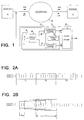
- Figure 1 shows two stations A and B which can communicate with each other over a network 10 by sending and receiving messages. These messages will generally contain source and destination addressing information as well as message type information.
- station A is shown as sending request messages "REQ” to station B which responds by returning an acknowledgement message “ACK”; the "ACK” message is caused by the receipt of the "REQ” message by station B.
- the network 10 is used to carry many of these REQ-ACK transactions.
- Delay-determining apparatus 11 is attached to the network at Station A. This apparatus comprises a load-measuring probe portion 12 and an offset determination portion 13.
- the probe portion 12 comprises a network interface 14, a message filter 15, first and second message counters 16 and 17, and an interval timer 18.
- the network interface receives all messages appearing on the part of the network to which the apparatus is attached.
- the filter 15 serves to identify the messages of interest, namely messages of type "REQ" passing from station A to B (category X messages) and messages of types "ACK" passing from station B to A (category Y messages).
- Counter 16 counts category X messages and counter 17 counts category Y messages. These counts are repeatedly carried out over predetermined time intervals set by the interval timer 18.
- the count values held in counters 16 and 17 are output as load measures L X and L Y respectively for the loading of the network by the category X and Y messages.
- FIG 3 shows an example plot of the load measures L X and L Y over a period of time (such as one hour).
- the L X loading curve represents the fluctuation with time of REQ messages sent by station A
- the L Y loading curve represents the ACK messages sent back by station B.
- the form of curve L Y is similar to that for L X but lags the latter by a phase delay (or offset) dt that corresponds to the average interval between transmission of the REQ messages from station A to the receipt by that station of the response messages ACK from station B; in other words, the offset dt is a measure of the network delay, in round trip terms, between stations A and B (and including, of course, any processing delay in station B).
- the interval D between successive load measures is small compared with the offset dt, then the latter can be determined with a good degree of accuracy by measuring how long it takes the category Y loading curve to catch up to a load value previously noted for the category X loading curve (this assumes that the category X loading is not constant). If, however, the interval D between successive load measures approaches or is greater than the offset dt, then this approach is potentially highly inaccurate.
- Figure 4 shows linearised loading curves L X , L Y for messages of categories X and Y respectively.
- dt D (L X2 -L Y2 )/(L X2 -L X1 )
- the determination of the offset value is carried out by the offset-determination portion 13 of the Figure 1 apparatus 11.
- the probe portion 12 can be arranged either to count all first and second messages or to sample the network messages randomly and only count first and second messages when found by such sampling; this latter approach will generally only be advantageous where there are high message loadings as may occur in LANs.
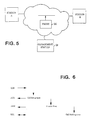
- the probe portion 12 and the offset-determination portion 13 of the apparatus are shown co-located, in many cases the probe portion 12 will be implemented as a discrete monitoring probe such as illustrated at 20 in Figure 5.
- the offset-determination portion will normally be located at a management station 21 connected to the network, the probe 20 then communicating the load measures as they are generated to the station 21 via the network 10.
- the probe 20 may be located anywhere in the network for measuring delays as seen at that location. Of course, it is important to ensure that the message categories being monitored are appropriate for the delay it is wished to determine.
- probes 20 may be distributed throughout the network, all reporting back to the same management station.
- the probe 20 Rather than relying on passive monitoring of messages placed on the network by other entities, it is possible to arrange for the probe 20 to inject messages that require a target destination to effect a response. In this case, care must be taken when interpreting the resultant delay measurement to take account of the possibility that the messages produced by the probe may have affected the network response by causing processing overload, bandwidth limitations or similar effects.
- the above-described delay measurement method will next be illustrated using an SS7 network and telephony as an example; the method can, of course, be applied equally well to other services supported by SS7 networks and to other message-based networks such as ATM networks and TCP/IP networks, subject to the limits on accuracy explained above.
- a normal successful telephone call setup over SS7 typically consists of the sequence of messages shown in Figure 6, that is:
- the call setup time (an important network characteristic) is the time interval between the transmission of the IAM and reception of the ACM. Typically, this is in the order of 100-300ms. As the network becomes busy, the delay increases. Consider the case of a call rate change of the order of 20 per second. For counts taken every minute and an average network delay of 2s between the IAM being sent and ACM returning there will be an additional gap of 40 between the minute totals. This behaviour is illustrated in exaggerated form in the graph shown in Figure 7.
- the time between call set up and answer time is in the order of seconds to a minute. Steady call rate changes of the order of 1 per second will reveal an average network answer response time of 10 seconds with a gap of 10 between the minute totals of IAM and ANS messages.
- the call holding time can vary from seconds to minutes averaging around 3 minutes for telephony. Steady call rate changes of the order of 1 per second will produce a difference of 180 between the number of IAM's and REL's. For long average holding times (hours), the delay could be determined directly as explained above.
Landscapes
- Engineering & Computer Science (AREA)
- Computer Networks & Wireless Communication (AREA)
- Signal Processing (AREA)
- Environmental & Geological Engineering (AREA)
- Data Exchanges In Wide-Area Networks (AREA)
- Monitoring And Testing Of Exchanges (AREA)
Priority Applications (4)
| Application Number | Priority Date | Filing Date | Title |
|---|---|---|---|
| EP94304256A EP0688122B1 (en) | 1994-06-13 | 1994-06-13 | Method and apparatus for determining network delays |
| DE69430841T DE69430841T2 (de) | 1994-06-13 | 1994-06-13 | Verfahren und Vorrichtung zum Bestimmen der Netzwerkverzögerungen |
| US08/435,551 US5612949A (en) | 1994-06-13 | 1995-05-05 | Method and apparatus for determining network delays |
| JP17036495A JP3623017B2 (ja) | 1994-06-13 | 1995-06-13 | ネットワーク遅延判定方法および装置 |
Applications Claiming Priority (1)
| Application Number | Priority Date | Filing Date | Title |
|---|---|---|---|
| EP94304256A EP0688122B1 (en) | 1994-06-13 | 1994-06-13 | Method and apparatus for determining network delays |
Publications (2)
| Publication Number | Publication Date |
|---|---|
| EP0688122A1 EP0688122A1 (en) | 1995-12-20 |
| EP0688122B1 true EP0688122B1 (en) | 2002-06-19 |
Family
ID=8217740
Family Applications (1)
| Application Number | Title | Priority Date | Filing Date |
|---|---|---|---|
| EP94304256A Expired - Lifetime EP0688122B1 (en) | 1994-06-13 | 1994-06-13 | Method and apparatus for determining network delays |
Country Status (4)
| Country | Link |
|---|---|
| US (1) | US5612949A (enExample) |
| EP (1) | EP0688122B1 (enExample) |
| JP (1) | JP3623017B2 (enExample) |
| DE (1) | DE69430841T2 (enExample) |
Families Citing this family (38)
| Publication number | Priority date | Publication date | Assignee | Title |
|---|---|---|---|---|
| US5815667A (en) * | 1995-11-28 | 1998-09-29 | Ncr Corporation | Circuits and methods for intelligent acknowledgement based flow control in a processing system network |
| JPH09271002A (ja) * | 1996-03-29 | 1997-10-14 | Mitsubishi Electric Corp | ビデオデータ配信方式 |
| US5918002A (en) * | 1997-03-14 | 1999-06-29 | Microsoft Corporation | Selective retransmission for efficient and reliable streaming of multimedia packets in a computer network |
| US6128653A (en) * | 1997-03-17 | 2000-10-03 | Microsoft Corporation | Method and apparatus for communication media commands and media data using the HTTP protocol |
| US7050456B1 (en) | 1998-12-04 | 2006-05-23 | Tekelec | Methods and systems for communicating signaling system 7 (SS7) user part messages among SS7 signaling points (SPs) and internet protocol (IP) nodes using signal transfer points (STPs) |
| US6944184B1 (en) | 1998-12-04 | 2005-09-13 | Tekelec | Methods and systems for providing database node access control functionality in a communications network routing node |
| US6393387B1 (en) | 1998-03-06 | 2002-05-21 | Perot Systems Corporation | System and method for model mining complex information technology systems |
| US6311175B1 (en) | 1998-03-06 | 2001-10-30 | Perot Systems Corp. | System and method for generating performance models of complex information technology systems |
| US6205120B1 (en) * | 1998-03-13 | 2001-03-20 | Packeteer, Inc. | Method for transparently determining and setting an optimal minimum required TCP window size |
| US6396819B1 (en) | 1998-03-21 | 2002-05-28 | Richard D. Fleeter | Low-cost satellite communication system |
| US7002988B1 (en) | 1998-12-04 | 2006-02-21 | Tekelec | Methods and systems for communicating SS7 messages over packet-based network using transport adapter layer interface |
| US7783299B2 (en) | 1999-01-08 | 2010-08-24 | Trueposition, Inc. | Advanced triggers for location-based service applications in a wireless location system |
| US6782264B2 (en) | 1999-01-08 | 2004-08-24 | Trueposition, Inc. | Monitoring of call information in a wireless location system |
| US6445681B1 (en) * | 1999-09-15 | 2002-09-03 | Vocaltec Communications Ltd. | Method for measuring delay parameters in a network |
| US7227884B2 (en) | 2000-02-28 | 2007-06-05 | Aeroastro, Inc. | Spread-spectrum receiver with progressive fourier transform |
| US7249192B1 (en) * | 2000-03-09 | 2007-07-24 | Hewlett-Packard Development Company, L.P. | Protocol for insuring exactly once semantics of transactions across an unordered, unreliable network |
| US7075981B1 (en) * | 2000-05-19 | 2006-07-11 | Telchemy, Incorporated | Dynamic quality of service monitor |
| IL136324A (en) * | 2000-05-24 | 2005-12-18 | Verint Systems Ltd | Method of surveilling internet communication |
| US7318091B2 (en) | 2000-06-01 | 2008-01-08 | Tekelec | Methods and systems for providing converged network management functionality in a gateway routing node to communicate operating status information associated with a signaling system 7 (SS7) node to a data network node |
| NO20003682L (no) * | 2000-07-18 | 2002-01-21 | Ericsson Telefon Ab L M | Måling av holdetid i kommunikasjonsnett |
| WO2002045275A2 (en) * | 2000-11-28 | 2002-06-06 | Flash Networks Ltd. | System and method for a transmission rate controller |
| US7480713B2 (en) * | 2000-12-15 | 2009-01-20 | International Business Machines Corporation | Method and system for network management with redundant monitoring and categorization of endpoints |
| KR100441487B1 (ko) * | 2000-12-19 | 2004-07-23 | 엘지전자 주식회사 | 넘버 세븐 신호망에서의 신호 모니터링 방법 |
| KR20020054557A (ko) * | 2000-12-28 | 2002-07-08 | 윤종용 | 넘버.7 신호 시스템의 프로세서 상태 모니터링 방법 |
| US6961309B2 (en) * | 2001-04-25 | 2005-11-01 | International Business Machines Corporation | Adaptive TCP delayed acknowledgment |
| US7177271B2 (en) * | 2001-09-21 | 2007-02-13 | Microsoft Corporation | Method and system for managing admission to a network |
| US20030158942A1 (en) * | 2002-02-15 | 2003-08-21 | Exanet, Inc. | Real-time reconfiguration of computer networks based on system measurements |
| DE60213623T2 (de) * | 2002-12-09 | 2007-10-18 | Tektronix International Sales Gmbh | Umlaufzeitabschätzungsverfahren und Einrichtung mittels Rückquittierung in einem Paketübertragungssystem |
| US7366774B2 (en) * | 2003-01-31 | 2008-04-29 | Rockwell Automation Technologies, Inc. | Network delay monitor for safety control networks |
| US6810235B2 (en) * | 2003-03-04 | 2004-10-26 | Qualcomm, Incorporated | Method and apparatus for detecting communication network delays |
| CN100342747C (zh) * | 2004-06-28 | 2007-10-10 | 普天信息技术研究院 | 一种信令服务器负载测试的方法 |
| US7532647B2 (en) * | 2004-07-14 | 2009-05-12 | Tekelec | Methods and systems for auto-correlating message transfer part (MTP) priority and internet protocol (IP) type of service in converged networks |
| WO2006052174A1 (en) * | 2004-11-12 | 2006-05-18 | Telefonaktiebolaget Lm Ericsson (Publ) | Congestion handling in a packet switched network domain |
| WO2007136415A2 (en) * | 2005-12-30 | 2007-11-29 | Comtech Mobile Datacom Corporation | Mobile satellite communications |
| US8548107B1 (en) | 2009-01-26 | 2013-10-01 | Comtech Mobile Datacom Corporation | Advanced multi-user detector |
| US9106364B1 (en) | 2009-01-26 | 2015-08-11 | Comtech Mobile Datacom Corporation | Signal processing of a high capacity waveform |
| US8213957B2 (en) | 2009-04-22 | 2012-07-03 | Trueposition, Inc. | Network autonomous wireless location system |
| US8675711B1 (en) | 2009-09-25 | 2014-03-18 | Comtech Mobile Datacom Corporation | System and methods for dynamic spread spectrum usage |
Family Cites Families (4)
| Publication number | Priority date | Publication date | Assignee | Title |
|---|---|---|---|---|
| US5193151A (en) * | 1989-08-30 | 1993-03-09 | Digital Equipment Corporation | Delay-based congestion avoidance in computer networks |
| US5095444A (en) * | 1989-12-21 | 1992-03-10 | Legent Corporation | System and method for measuring inter-nodal transmission delays in a communications network |
| EP0477448B1 (en) * | 1990-09-28 | 1995-07-12 | Hewlett-Packard Company | Network monitoring device and system |
| US5450394A (en) * | 1994-03-10 | 1995-09-12 | Northern Telecom Limited | Delay monitoring of telecommunication networks |
-
1994
- 1994-06-13 EP EP94304256A patent/EP0688122B1/en not_active Expired - Lifetime
- 1994-06-13 DE DE69430841T patent/DE69430841T2/de not_active Expired - Fee Related
-
1995
- 1995-05-05 US US08/435,551 patent/US5612949A/en not_active Expired - Lifetime
- 1995-06-13 JP JP17036495A patent/JP3623017B2/ja not_active Expired - Fee Related
Also Published As
| Publication number | Publication date |
|---|---|
| JP3623017B2 (ja) | 2005-02-23 |
| EP0688122A1 (en) | 1995-12-20 |
| DE69430841D1 (de) | 2002-07-25 |
| JPH089035A (ja) | 1996-01-12 |
| US5612949A (en) | 1997-03-18 |
| DE69430841T2 (de) | 2002-10-02 |
Similar Documents
| Publication | Publication Date | Title |
|---|---|---|
| US5612949A (en) | Method and apparatus for determining network delays | |
| EP0915635B1 (en) | Delay monitoring of telecommunication networks | |
| US8160835B2 (en) | Method for measuring unidirectional transmission characteristics such as packet propagation time, fluctuations in propagation time and results derivable therefrom, in a telecommunications network | |
| US6545979B1 (en) | Round trip delay measurement | |
| EP1215559B1 (en) | Method and system for time synchronization | |
| US7123589B1 (en) | Method for determining the delay and jitter in communication between objects in a connected network | |
| EP1418705B1 (en) | Network monitoring system using packet sequence numbers | |
| EP2374245B1 (en) | Controlling packet transmission using bandwidth estimation | |
| EP1327323B1 (en) | Method and device for monitoring quality of service in packet based networks | |
| EP2359510B1 (en) | Method and device for packet network synchronization | |
| US20070053303A1 (en) | Transmission Quality Monitoring For Multimedia Streams | |
| US20120269204A1 (en) | Method for generating a robust timing correction in timing transfer systems | |
| US8345570B2 (en) | Network impairment metrics for timing over packet | |
| US8243599B2 (en) | Method and apparatus for high resolution passive network latency measurement | |
| US6937622B2 (en) | Determining phase jitter and packet inter-arrival jitter between network end points | |
| US9559911B1 (en) | Forecasting link utilization between points of presence in an IP network | |
| EP2223450B1 (en) | Oscillator calibration | |
| US20090172455A1 (en) | Using Travel-Time as Means for Improving the Accuracy of Simple Network Time Protocol | |
| WO1992022967A1 (en) | Method and apparatus for testing a packet-based network | |
| JP2002217970A (ja) | 電気通信ネットワークにおけるトラフィックのモニタ | |
| WO2001091375A2 (en) | Method and system for measuring one-way delay variation | |
| JP3614835B2 (ja) | パケット通信品質測定方法およびシステム | |
| EP1687935B1 (en) | Methods and system for measuring the round trip time in packet switching telecommunication networks | |
| EP1209850B1 (en) | System and method for network element synchronization | |
| KR101315593B1 (ko) | 클라이언트 클럭 주파수를 서버 클럭 주파수와 동기화시키는 방법 |
Legal Events
| Date | Code | Title | Description |
|---|---|---|---|
| PUAI | Public reference made under article 153(3) epc to a published international application that has entered the european phase |
Free format text: ORIGINAL CODE: 0009012 |
|
| AK | Designated contracting states |
Kind code of ref document: A1 Designated state(s): DE FR GB |
|
| 17P | Request for examination filed |
Effective date: 19960215 |
|
| 17Q | First examination report despatched |
Effective date: 19991112 |
|
| RAP1 | Party data changed (applicant data changed or rights of an application transferred) |
Owner name: HEWLETT-PACKARD COMPANY, A DELAWARE CORPORATION |
|
| RAP1 | Party data changed (applicant data changed or rights of an application transferred) |
Owner name: AGILENT TECHNOLOGIES, INC. |
|
| RAP1 | Party data changed (applicant data changed or rights of an application transferred) |
Owner name: AGILENT TECHNOLOGIES INC. |
|
| RAP1 | Party data changed (applicant data changed or rights of an application transferred) |
Owner name: AGILENT TECHNOLOGIES INC. A DELAWARE CORPORATION |
|
| GRAG | Despatch of communication of intention to grant |
Free format text: ORIGINAL CODE: EPIDOS AGRA |
|
| RAP1 | Party data changed (applicant data changed or rights of an application transferred) |
Owner name: AGILENT TECHNOLOGIES, INC. (A DELAWARE CORPORATION |
|
| GRAG | Despatch of communication of intention to grant |
Free format text: ORIGINAL CODE: EPIDOS AGRA |
|
| GRAH | Despatch of communication of intention to grant a patent |
Free format text: ORIGINAL CODE: EPIDOS IGRA |
|
| GRAH | Despatch of communication of intention to grant a patent |
Free format text: ORIGINAL CODE: EPIDOS IGRA |
|
| GRAA | (expected) grant |
Free format text: ORIGINAL CODE: 0009210 |
|
| AK | Designated contracting states |
Kind code of ref document: B1 Designated state(s): DE FR GB |
|
| PG25 | Lapsed in a contracting state [announced via postgrant information from national office to epo] |
Ref country code: FR Free format text: LAPSE BECAUSE OF FAILURE TO SUBMIT A TRANSLATION OF THE DESCRIPTION OR TO PAY THE FEE WITHIN THE PRESCRIBED TIME-LIMIT Effective date: 20020619 |
|
| REG | Reference to a national code |
Ref country code: GB Ref legal event code: FG4D |
|
| REF | Corresponds to: |
Ref document number: 69430841 Country of ref document: DE Date of ref document: 20020725 |
|
| EN | Fr: translation not filed | ||
| PLBE | No opposition filed within time limit |
Free format text: ORIGINAL CODE: 0009261 |
|
| STAA | Information on the status of an ep patent application or granted ep patent |
Free format text: STATUS: NO OPPOSITION FILED WITHIN TIME LIMIT |
|
| 26N | No opposition filed |
Effective date: 20030320 |
|
| PGFP | Annual fee paid to national office [announced via postgrant information from national office to epo] |
Ref country code: DE Payment date: 20060731 Year of fee payment: 13 |
|
| PGFP | Annual fee paid to national office [announced via postgrant information from national office to epo] |
Ref country code: GB Payment date: 20070628 Year of fee payment: 14 |
|
| PG25 | Lapsed in a contracting state [announced via postgrant information from national office to epo] |
Ref country code: DE Free format text: LAPSE BECAUSE OF NON-PAYMENT OF DUE FEES Effective date: 20080101 |
|
| GBPC | Gb: european patent ceased through non-payment of renewal fee |
Effective date: 20080613 |
|
| PG25 | Lapsed in a contracting state [announced via postgrant information from national office to epo] |
Ref country code: GB Free format text: LAPSE BECAUSE OF NON-PAYMENT OF DUE FEES Effective date: 20080613 |