EP0687721A2 - Detergent composition - Google Patents
Detergent composition Download PDFInfo
- Publication number
- EP0687721A2 EP0687721A2 EP95109359A EP95109359A EP0687721A2 EP 0687721 A2 EP0687721 A2 EP 0687721A2 EP 95109359 A EP95109359 A EP 95109359A EP 95109359 A EP95109359 A EP 95109359A EP 0687721 A2 EP0687721 A2 EP 0687721A2
- Authority
- EP
- European Patent Office
- Prior art keywords
- type
- salt
- detergent composition
- acid
- fatty acid
- Prior art date
- Legal status (The legal status is an assumption and is not a legal conclusion. Google has not performed a legal analysis and makes no representation as to the accuracy of the status listed.)
- Withdrawn
Links
Classifications
-
- C—CHEMISTRY; METALLURGY
- C11—ANIMAL OR VEGETABLE OILS, FATS, FATTY SUBSTANCES OR WAXES; FATTY ACIDS THEREFROM; DETERGENTS; CANDLES
- C11D—DETERGENT COMPOSITIONS; USE OF SINGLE SUBSTANCES AS DETERGENTS; SOAP OR SOAP-MAKING; RESIN SOAPS; RECOVERY OF GLYCEROL
- C11D1/00—Detergent compositions based essentially on surface-active compounds; Use of these compounds as a detergent
- C11D1/02—Anionic compounds
- C11D1/12—Sulfonic acids or sulfuric acid esters; Salts thereof
- C11D1/18—Sulfonic acids or sulfuric acid esters; Salts thereof derived from amino alcohols
- C11D1/20—Fatty acid condensates
-
- A—HUMAN NECESSITIES
- A61—MEDICAL OR VETERINARY SCIENCE; HYGIENE
- A61K—PREPARATIONS FOR MEDICAL, DENTAL OR TOILETRY PURPOSES
- A61K8/00—Cosmetics or similar toiletry preparations
- A61K8/18—Cosmetics or similar toiletry preparations characterised by the composition
- A61K8/30—Cosmetics or similar toiletry preparations characterised by the composition containing organic compounds
- A61K8/33—Cosmetics or similar toiletry preparations characterised by the composition containing organic compounds containing oxygen
- A61K8/36—Carboxylic acids; Salts or anhydrides thereof
- A61K8/361—Carboxylic acids having more than seven carbon atoms in an unbroken chain; Salts or anhydrides thereof
-
- A—HUMAN NECESSITIES
- A61—MEDICAL OR VETERINARY SCIENCE; HYGIENE
- A61K—PREPARATIONS FOR MEDICAL, DENTAL OR TOILETRY PURPOSES
- A61K8/00—Cosmetics or similar toiletry preparations
- A61K8/18—Cosmetics or similar toiletry preparations characterised by the composition
- A61K8/30—Cosmetics or similar toiletry preparations characterised by the composition containing organic compounds
- A61K8/40—Cosmetics or similar toiletry preparations characterised by the composition containing organic compounds containing nitrogen
- A61K8/44—Aminocarboxylic acids or derivatives thereof, e.g. aminocarboxylic acids containing sulfur; Salts; Esters or N-acylated derivatives thereof
-
- A—HUMAN NECESSITIES
- A61—MEDICAL OR VETERINARY SCIENCE; HYGIENE
- A61Q—SPECIFIC USE OF COSMETICS OR SIMILAR TOILETRY PREPARATIONS
- A61Q19/00—Preparations for care of the skin
- A61Q19/10—Washing or bathing preparations
-
- A—HUMAN NECESSITIES
- A61—MEDICAL OR VETERINARY SCIENCE; HYGIENE
- A61Q—SPECIFIC USE OF COSMETICS OR SIMILAR TOILETRY PREPARATIONS
- A61Q5/00—Preparations for care of the hair
- A61Q5/02—Preparations for cleaning the hair
-
- C—CHEMISTRY; METALLURGY
- C11—ANIMAL OR VEGETABLE OILS, FATS, FATTY SUBSTANCES OR WAXES; FATTY ACIDS THEREFROM; DETERGENTS; CANDLES
- C11D—DETERGENT COMPOSITIONS; USE OF SINGLE SUBSTANCES AS DETERGENTS; SOAP OR SOAP-MAKING; RESIN SOAPS; RECOVERY OF GLYCEROL
- C11D1/00—Detergent compositions based essentially on surface-active compounds; Use of these compounds as a detergent
- C11D1/02—Anionic compounds
- C11D1/04—Carboxylic acids or salts thereof
- C11D1/10—Amino carboxylic acids; Imino carboxylic acids; Fatty acid condensates thereof
-
- C—CHEMISTRY; METALLURGY
- C11—ANIMAL OR VEGETABLE OILS, FATS, FATTY SUBSTANCES OR WAXES; FATTY ACIDS THEREFROM; DETERGENTS; CANDLES
- C11D—DETERGENT COMPOSITIONS; USE OF SINGLE SUBSTANCES AS DETERGENTS; SOAP OR SOAP-MAKING; RESIN SOAPS; RECOVERY OF GLYCEROL
- C11D10/00—Compositions of detergents, not provided for by one single preceding group
- C11D10/04—Compositions of detergents, not provided for by one single preceding group based on mixtures of surface-active non-soap compounds and soap
- C11D10/042—Compositions of detergents, not provided for by one single preceding group based on mixtures of surface-active non-soap compounds and soap based on anionic surface-active compounds and soap
-
- A—HUMAN NECESSITIES
- A61—MEDICAL OR VETERINARY SCIENCE; HYGIENE
- A61K—PREPARATIONS FOR MEDICAL, DENTAL OR TOILETRY PURPOSES
- A61K2800/00—Properties of cosmetic compositions or active ingredients thereof or formulation aids used therein and process related aspects
- A61K2800/40—Chemical, physico-chemical or functional or structural properties of particular ingredients
- A61K2800/59—Mixtures
- A61K2800/596—Mixtures of surface active compounds
Definitions
- the present invention relates to a detergent composition in which an N-acylthreonine salt and a higher fatty acid salt are jointly used and also to a detergent composition in which another surface-active agent is further used jointly.
- the detergent composition of the present invention exhibits little irritation and is safe, and it is a detergent composition with an improved foam maintenance, foam quality and feel upon use.
- the conventional detergent compositions mainly comprising anionic surface-active agents such as shampoo, face soap, kitchen detergent, etc., higher fatty acid salts, polyoxyethylene alkyl ether sulfates, alkyl benzenesulfonates and the like have been used.
- the detergents mainly comprising such anionic surface-active agents exhibit excellent detergency, the feel upon actual use such as a creaking feel during rinsing and a stretching feel after use are not so satisfactory and, in addition, there is a disadvantage in that it exhibits much irritation to the skin and causes damage to the hair.
- N-acylamino acid salts are known and, among them, N-acylglutamates (cf. "Functional Cosmetic Products” published by CMC, page 275, 1990), N-acyl sarcosine salts, N-acyl-N-methyl- ⁇ -alanine salts, N-acylmethyltaurine salts, etc. have been widely used for detergents.
- N-acylamino acid salts have been studied already and several N-acylamino acids have been actually synthesized from natural amino acids and synthesizable amino acids and investigated. Especially, there have been many reports on the results of the investigations on N-acyl derivatives of natural amino acids.
- An object of the present invention is to offer a detergent composition with excellent detergency and with improved foam maintenance, foam quality and feel upon use by employing N-acylthreonine salt and also to utilize the N-acylthreonine salts which have not been fully utilized up to now.
- the present inventors have found that, when an N-acylthreonine salt is jointly used with a higher fatty acid salt or when another surface-active agent is used in addition to these, the above-mentioned object can be achieved.
- the present invention relates to a detergent composition which is characterized in that it contains (A) an N-acylthreonine salt in which the acyl group is a fatty acid residue having 8-22 carbon atoms and (B) a higher fatty acid salt having 8-22 carbon atoms.
- the acyl group of the N-acylthreonine salt which is a component (A) compound of the detergent composition of the present invention is an acyl residue of saturated or unsaturated fatty acid having 8-22 carbon atoms.
- acyl residues of fatty acids of a single composition such as lauric acid, myristic acid, palmitic acid, stearic acid and oleic acid and also are acyl residues of the mixed fatty acids obtained from nature such as coconut oil fatty acids, tallow fatty acids, hydrogenated tallow fatty acids, castor oil fatty acids, olive oil fatty acids and palm oil fatty acids as well as those of the fatty acids (including branched ones) obtained through synthesis.
- N-acylthreonine salts are the salts of N-lauroylthreonine, N-myristoylthreonine, N-palmitoylthreonine, N-stearoylthreonine, N-oleoylthreonine, N-cocoylthreonine and an acylthreonine derived from N-hydrogenated tallow fatty acids.
- Those N-acylthreonine salts may be any of optically active and racemic substances.
- Examples of the basic component of the N-acylthreonine salts of the present invention are alkali metals such as sodium and potassium; alkali earth metals such as magnesium and calcium; organic amines such as monoethanolamine, diethanolamine, triethanolamine, 2-amino-2-methyl-1-propanol and 2-amino-2-methyl-1,3-propanediol; basic amino acids such as lysine, ornithine and arginine; and ammonia. Two or more of those basic components may be used jointly.
- the higher fatty acid salt of the component (B) of the detergent composition of the present invention is a salt with a linear or branched and saturated or unsaturated fatty acid having 8-22 carbon atoms.
- Preferred examples are the salts with lauric acid, myristic acid, palmitic acid, stearic acid, coconut oil fatty acid, hydrogenated tallow fatty acid, behenic acid and oleic acid.
- Examples of the basic component for such a salt are alkali metals such as sodium and potassium; alkali earth metals such as magnesium and calcium; organic amines such as monoethanolamine, diethanolamine, triethanolamine, 2-amino-2-methyl-1-propanol and 2-amino-2-methyl-1,3-propanediol; basic amino acids such as lysine, ornithine and arginine; and ammonia.
- Those basic components may be used either solely or jointly by combining two or more of them.
- the combining ratio of the components (A) to (B) in the detergent composition of the present invention may be suitably selected within a range from 0.5/99.5 to 99.5/0.5 by weight depending upon the property of the final product.
- the foam amount is sufficient but the foam maintenance is poor and the foam quality is rough and, in addition, there is a problem in the finish after washing resulting in some sliminess.
- the compounding ratio of the component (A) is less than 0.5, the foam maintenance is satisfactory but there are problems in terms of the feel upon use, that a scratchy feel results upon rinsing and, moreover, that there is another problem of irritation to the hair and skin.
- the total compounding amount of (A) and (B) in the detergent composition of the present invention may vary depending upon the form of the detergent composition but, preferably, it is from 5 to 95% by weight.
- the present invention further offers a detergent composition in which foaming ability and foam maintenance are excellent, the foams are fine and creamy, the scratchy feel upon rinsing is reduced and the finish after washing is fresh whereby the feel is improved.
- Examples of such a surface-active agent are anionic surface-active agents of the carboxylate type (excluding the components (A) and (B)), sulfonate type and sulfate type; cationic surface-active agents of the aliphatic amine quaternary ammonium salt type, the aromatic quaternary ammonium salt type and the mono(long- chain acyl) basic amino acid lower alkyl ester salt type; nonionic surface-active agents of the alkylglycoside type and the aliphatic alkanolamide type; and amphoteric surface-active agents of the betaine type and the imidazoline type.
- anionic surface-active agents will be described.
- Examples of the surface-active agent of the carboxylate type are of the N-acylaminocarboxylate type and the ether carboxylate type.
- the acyl group is an acyl residue of saturated or unsaturated fatty acid having 8-22 carbon atoms.
- acyl residues of fatty acids of a single composition such as lauric acid, myristic acid, palmitic acid, stearic acid and oleic acid and also are acyl residues of the mixed fatty acids obtained from nature such as coconut oil fatty acids, tallow fatty acids, hydrogenated tallow fatty acids, castor oil fatty acids, olive oil fatty acids and palm oil fatty acids as well as of the fatty acids (including branched ones) obtained through synthesis.
- aminocarboxylic acid binding therewith examples include acidic amino acids such as glutamic acid, aspartic acid, cysteic acid and homocysteic acid; neutral amino acids such as glycine, alanine, valine, leucine, isoleucine, phenylalanine, tryptophane, sarcosine, beta-alanine, gamma-aminobutyric acid, epsilon-aminocaproic acid, serine, homoserine, tyrosine, proline, hydroxyproline, cystine, cysteine and methionine; and basic amino acids such as lysine, ornithine and arginine. With respect to those acylaminocarboxylic acids, any optical isomer or racemic compound may be used.
- Examples of the surface-active agent of the ether carboxylate type are polyoxyethylene alkyl ether acetates and polyglyceryl alkyl ether acetates and more specific examples are polyoxyethylene lauryl ether acetate and polyoxyethylene tridecyl ether acetate.
- Examples of the surface-active agents of the sulfonate type are anionic surface-active agents of the sulfosuccinate type and anionic surface-active agents being organic sulfonates of monobasic acids such as those of the alkylsulfonate type, the ester sulfonate type and the N-acylsulfonate type.
- anionic surface-active agent of the sulfosuccinate type examples include sulfosuccinates of higher alcohols represented by the following general formula (1) or (2) or ethoxylates thereof or sulfosuccinates derived from higher fatty acid amides or salts thereof.
- R1 is R2-O- or R3-CONH- (in which R2 is a linear or branched alkyl or alkenyl having 8-22 carbon atoms and R3 is a linear or branched alkyl or alkenyl having 7-21 carbon toms); M1 and M2 each is a hydrogen atom or a cation selected from alkali metals, alkaline earth metals, ammonium and organic ammonium independently; and a is an integer of 0-20.
- undecylenoylamide ethylsulfosuccinate polyoxyethylene lauroylethanolamide sulfosuccinate salt, lauryl sulfosuccinate salt, polyoxyethylene lauryl sulfosuccinate salt and oleic acid amide sulfosuccinate.
- anionic surface-active agent of the type of an organic sulfonate of a monobasic acid examples include C8 ⁇ 22 linear or branched alkyl or alkenyl sufonates, alkyl benzenesulfonates having a linear or branched alkyl group of 10-16 carbon atoms and N-acylsulfonates or O-acylsulfonates in which the acyl group is a linear or branched and saturated or unsaturated fatty acid residue having 8-22 carbon atoms.
- alkanesulfonates ⁇ -olefinsulfonates
- alkyl benzenesulfonates alkyl benzenesulfonates
- acyl methyltaurine salts isethionic acid fatty acid ester salts and ⁇ -sulfonated fatty acid ester salts.
- anionic surface-active agent of the sulfate type examples include surface-active agents such as alkyl sulfate salts and ether sulfate salts.
- the above-mentioned anionic surface-active agent of the alkyl sulfate salt type is a salt of an ester of a C8 ⁇ 22 linear or branched and saturated or unsaturated higher alcohol with sulfuric acid and examples of it are lauryl sulfate salts, myristyl sulfate salts and oleyl sulfate salts.
- the above-mentioned anionic surface-active agent of an ether sulfate type is an alkylene oxide adduct of the above-mentioned alkyl sulfate salt and its examples are polyoxyethylene lauryl ether sulfates, polyoxyethylene myristyl ether sulfates and polyoxyethylene oleyl ether sulfates.
- alkali metals such as sodium and potassium
- alkaline earth metals such as magnesium and calcium
- organic amines such as monoethanolamine, diethanolamine, triethanolamine, 2-amino-2-methyl-1-propanol and 2-amino-2-methyl-1,3-propanediol
- basic amino acids such as lysine, ornithine and arginine
- ammonia Those basic components may be used either solely or jointly by combining two or more of them.
- the compounding ratio of the above-mentioned various anionic surface-active agents may be selected depending upon the property of the final product, but usually the agents are compounded at a ratio within a range of from 1/15 to 15/1 to the total amount (by weight) of components (A) and (B).
- cationic surface-active agent which is used as the third component of the detergent composition of the present invention.
- the aliphatic amine quaternary ammonium salt is, for example, a linear mono or dialkyl quaternary ammonium salt represented by the following general formula (3).
- R4-R7 are long-chain alkyl having 8-24 carbon atoms while others are alkyl or hydroxyalkyl having 1-3 carbon atoms; and
- X is a halogen atom or an alkyl sulfate group having 1 or 2 carbon atoms.
- ammonium salt examples include mono(long- chain alkyl) quaternary ammonium salts such as lauryl trimethylammonium chloride, myristyl trimethylammonium chloride, palmityl trimethylammonium chloride, stearyl trimethylammonium chloride, oleyl trimethylammonium chloride, cetyl trimethylammonium chloride, cetyl trimethylammonium methylsulfate, eicosyl trimetylammonium chloride and behenyl trimethylammonium chloride; and di(long-chain alkyl) quaternary ammonium salts such as dipalmityl dimethylammonium chloride, distearyl dimethylammonium chloride, di(hydrogenated tallow alkyl) dimethylammonium bromide and di(hydrogenated tallow alkyl) dimethylammonium methylsulfate. They may be used either solely or jointly by combining two or more of them.
- the aromatic quaternary ammonium salt is, for example, a benzalconium salt represented by the following general formula (4).
- R8 is an alkyl having 8-24 carbon atoms
- Y is a halogen atom or an alkyl sulfate group having 1 or 2 carbon atoms.
- benzalconium salt are lauryl dimethylbenzylammonium chloride and stearyl dimethylbenzylammonium chloride. They may be used either solely or jointly by combining two or more of them.
- the acyl group is an acyl residue of a fatty acid having 8-22 carbon atoms and examples of it are lauroyl, cocoyl, myristoyl, palmitoyl, stearoyl and oleyl.
- Examples of the basic amino acid binding therewith are natural amino acids such as lysine, ornithine and arginine and any optically active or racemic substances may be used.
- Examples of the salt for the mono(long-chain acyl) basic amino acid lower alkyl ester salt are inorganic salts such as hydrochloride and sulfate; and organic salts such as acetate, tartrate, citrate, p-toluenesulfonate, fatty acid salts, acidic amino acid salts and pyroglutamate.
- Suitable lower alkyl ester components are methyl ester, ethyl ester, propyl ester, butyl ester, pentyl ester, hexyl ester, heptyl ester and octyl ester.
- the compounding amount of the above-mentioned various cationic surface-active agents may suitably be selected depending upon the property of the final product but, usually, the amount in the detergent composition is from 0.01 to 5.0% by weight.
- nonionic surface-active agent used as the third component for the detergent composition of the present invention.
- R9(OR10) b G c An example of the alkyl glycoside used is that which is represented by the following general formula (5).
- R9(OR10) b G c (5) In the above formula, R9 is linear or branched alkyl or alkenyl having 8-18 carbon atoms; R10 is an alkylene group having 2-4 carbon atoms; G is a residue derived from a reducing sugar having 5-6 carbon atoms; the average value of b is 0-5; and the average value of c is 1-10.
- the binding mode of the sugar may be a 1-2, 1-3, 1-4 or 1-6 bond or, moreover, ⁇ - or ⁇ -pyranoside or furanoside bond or any mixture being in the mixed mode thereof.
- value of b it is preferably 0-2 in terms of water solubility and crystallinity while the preferred value of c is about 1-3 in terms of foam-increasing effect.
- R9 is a linear or branched alkyl, alkenyl or alkylphenyl having 8-18 carbon atoms but, the preferred carbon atom numbers from a standpoint of solubility, foaming ability and detergency are 10-14.
- R10 is an alkylene group having 2-4 carbon atoms but the preferred value from the standpoint of water solubility is 2 -3.
- the structure of G is decided by the material which is a monosaccharide or di- or higher saccharide and examples of the material for G in the case of monosaccharide are glucose, galactose, xylose, mannose, lyxose, arabinose and a mixture thereof while those in the case of a di- or higher saccharide are maltose, xylobiose, isomaltose, cellobiose, gentiobiose, lactose, sucrose, negerose, turanose, raffinose, gentianose, melezitose and a mixture thereof.
- preferred materials are glucose and fructose for monosaccharide and are maltose and sucrose for di- or higher saccharide due to their availability and low cost.
- alkylglycosides may be used either solely or jointly by combining two or more of them.
- R11 is an alkyl group having 8-20 carbon atoms; and R12 and R13 are same or different and each of them is a hydrogen atom, a hydroxylalkyl group having 1-3 carbon atoms or a -(C2H4O) d H group (where d is an integer of 2-4).
- the preferred carbon numbers of the alkyl for R11 are 12-18 and a preferred combinations for R12 and R13 are that both of them are hydroxyalkyl (particularly hydroxyethyl) and that one of them is a hydoxyalkyl (particularly hydroxyethyl) while another is a hydrogen atom.
- aliphatic alkanolamide examples include coconut oil fatty acid monoethanolamide, coconut oil fatty acid diethanolamide, lauric acid monoethanolamide and lauric acid dlethanolamide. They may be used either solely or jointly by combining two or more of them.
- the compounding ratio of the above nonionic surface-active agent may be suitably selected depending upon the property of the final product, but usually the ratio of the alkylglycoside represented by the general formula (5) and that of the aliphatic alkanolamide represented by the general formula (6) to the total amount of components (A) and (B) are within ranges of 1/15- 15/1 and 1/100-1/2, respectively.
- amphoteric surface-active agent used as the third component of the detergent composition of the present invention.
- amphoteric surface-active agent of the betaine type examples include surface-active agent of the carbobetaine type, that of an amidobetaine type, that of a sulfobetaine type, that of a hydroxysulfobetaine type, that of an amidosulfobetaine type and that of a phosphobetaine type.
- the surface-active agent of the betaine type as such has, for example, alkyl, alkenyl or acyl having 8-24 carbon atoms. More specific examples are coconut oil alkyldimethylaminoacetic acid betaine, coconut oil fatty acid amide propyldimethylaminoacetic acid betaine, stearyl dihydroxyethylaminoacetic acid betaine, lauryl hydroxysulfobetaine, lauryl sulfobetaine and lauryl phosphobetaine. Those amphoteric surface-active agents of the betaine type may be used either solely, or jointly by combining two or more of them.
- amphoteric surface-active agent of the imidazoline type are those having C8 ⁇ 22 alkyl groups such as 2-alkyl-N-carboxymethyl-N-hydroxyethylimidazolinium betaine, 2-alkyl-N-carboxyethyl-N-hydroxyethylimidazolinium betain and 2-alkyl-N-sodium carboxymethyl-N-carboxymethyloxyethylimidazolinium betaine. They may also be used either solely, or jointly by combining two or more of them.
- the mixing ratio of the above-mentioned various amphoteric surface-active agents may be selected depending upon the property of the final product and, usually, they are compounded within a range of from 1/15 to 15/1 to the total weight of the components (A) and (B).
- the total compounding amount of the components (A) and (B) and the third component in the detergent composition of the present invention may vary depending upon the form of the detergent composition but, preferably, it is from 5 to 95% by weight of the detergent composition.
- the form of the detergent in the detergent composition of the present invention there is no particular limitation in terms of the form of the detergent in the detergent composition of the present invention and any of the forms of liquid, paste, gel, solid, powder, etc. may be adopted.
- the pH of such a detergent is 5-9 or, preferably, 6-8.
- the foam property is not deteriorated, unlike the composition using other N-acyl neutral amino acid salt such as N-acylalanine salt or N-acylglycine salt, even if the pH is 7 or less and, therefore, a product with little irritation to the skin can be prepared.
- detergent compositions may be added to the detergent composition of the present invention so far as they do not inhibit the effect of the present invention.
- other common components for the detergent compositions are polyhydric alcohols such as diglycerol, octanediol, maltitol, diethylene glycol, polyethylene glycol, ethylene glycol, propylene glycol, dipropylene glycol, polypropylene glycol, isopropylene glycol, pentaerythritol, glucose, trehalose, fructose, 1,3-butylene glycol, glycerol and sorbitol; moisturizing agents such as sodium DL-pyrrolidonecarboxylate and sodium lactate; emulsifiers such as glycerol monostearate, sorbitan monopalmitate, sorbitan monostearate, sorbitan monooleate, sorbitan monosesquioleate, sorbitan monolaurate, polyglycerol, octan
- N-Lauroyl-L-threonine was synthesized by a method described in Examined Japanese Patent Publication Sho-51/038681.
- the by-produced impurities were removed by means of a recrystallization and the resulting high-purity N-lauroyl-L-threonine was neutralized with potassium hydroxide or triethanolamine to give potassium salt of N-lauroyl-L-threonine or triethanolamine salt of N-lauroyl-L-threonine, respectively. They were used in the following examples.
- potassium laurate potassium laurate
- TEA laurate triethanolamine laurate
- Each aqueous solution (50 g) was stirred with a mixer for domestic use (350 ml; manufactured by Iwatani Sangyo KK) and the volumes (ml) of the foams after allowing them to stand for one minute and ten minutes were measured whereby the foam amount and the foam maintenance (rate of maintaining the foams) were evaluated.
- the foams were placed on a slide glass immediately after foaming, covered with a covering glass and evaluated through observation under a microscope.
- Table 1 shows the evaluation standards for each of the evaluating items.
- the feel upon washing (feel or touch of the foams, scratching feel and freshness) as a detergent for hair and body was evaluated in organoleptic evaluation by ten female and ten male panellers and the total evaluation was conducted as well.
- the organoleptic evaluation was carried out as follows.
- the surface-active agents were taken in the proportions as given in Table 3, made into aqueous solutions of 15% or 30% using distilled water and each of the aqueous solutions was subjected to the tests for washing hands and for washing hair.
- the evaluation standards for each of the evaluating items are given in the following Table 2. In the meanwhile, it was found that, with respect to the total evaluation, three points or less were insufficient for actual use while four points or more were satisfactory for actual use.
- N-Lauroylthreonine salt and higher fatty acid salt were used together with other surface-active agents as the third components, i.e. anionic, cationic, nonionic and amphoteric surface-active agents in the amounts as shown in Tables 4to 10 and evaluations were made in the same manner as in the above-mentioned examples. The results of the evaluations are given in Tables 4 to 10 as well.
Landscapes
- Life Sciences & Earth Sciences (AREA)
- Health & Medical Sciences (AREA)
- Chemical & Material Sciences (AREA)
- Public Health (AREA)
- Veterinary Medicine (AREA)
- Animal Behavior & Ethology (AREA)
- General Health & Medical Sciences (AREA)
- Oil, Petroleum & Natural Gas (AREA)
- Engineering & Computer Science (AREA)
- Chemical Kinetics & Catalysis (AREA)
- Wood Science & Technology (AREA)
- Organic Chemistry (AREA)
- Epidemiology (AREA)
- Birds (AREA)
- Emergency Medicine (AREA)
- Dermatology (AREA)
- Cosmetics (AREA)
- Detergent Compositions (AREA)
Abstract
Description
- The present invention relates to a detergent composition in which an N-acylthreonine salt and a higher fatty acid salt are jointly used and also to a detergent composition in which another surface-active agent is further used jointly. The detergent composition of the present invention exhibits little irritation and is safe, and it is a detergent composition with an improved foam maintenance, foam quality and feel upon use. In the conventional detergent compositions mainly comprising anionic surface-active agents such as shampoo, face soap, kitchen detergent, etc., higher fatty acid salts, polyoxyethylene alkyl ether sulfates, alkyl benzenesulfonates and the like have been used. However, although the detergents mainly comprising such anionic surface-active agents exhibit excellent detergency, the feel upon actual use such as a creaking feel during rinsing and a stretching feel after use are not so satisfactory and, in addition, there is a disadvantage in that it exhibits much irritation to the skin and causes damage to the hair.
- With respect to the surface-active agent exhibiting little irritation to the skin and hair and having an excellent detergency, N-acylamino acid salts are known and, among them, N-acylglutamates (cf. "Functional Cosmetic Products" published by CMC, page 275, 1990), N-acyl sarcosine salts, N-acyl-N-methyl-β-alanine salts, N-acylmethyltaurine salts, etc. have been widely used for detergents. Other N-acylamino acid salts have been studied already and several N-acylamino acids have been actually synthesized from natural amino acids and synthesizable amino acids and investigated. Especially, there have been many reports on the results of the investigations on N-acyl derivatives of natural amino acids.
- It has been recently reported that the scum which is formed by N-acylglycine salts, N-acyl-β-alanine salts, etc. with calcium in tap water has been found to exhibit a good feel (cf. Japanese Laid-Open Patent Publication Hei-04/221607). However, with respect to the foaming properties of the N-acylamino acid salts in this report, they are not sufficient in terms of foam maintenance, creaminess, foaming ability and exhibit sliminess.
- There have been rare cases in which N-(long-chain acyl) threonine (which is a kind of oxyamino acids) is used in detergent compositions. Examined Japanese Patent Publication Sho-39/029444 provides a detergent composition which does not chap the skin wherein 1-50% by weight of the above-mentioned substance is added to and compounded with a synthetic detergent of a mineral oil type or an alcohol type. However, no composition which has a satisfying feel upon use such as foam quality and finish after washing has been obtained. In the Japanese Laid-Open Patent Publication Sho-55/090594, there is a disclosure on a detergent composition containing N-acylated mixed amino acid salts and there is a description that the N-acyloxy amino acid salts exhibit a protective action to the skin and hair. However, although the resulting detergent composition is excellent in terms of the foaming and the creaking feel during rinsing, it has insufficient foam quality and finish after washing. Further, when the acylthreonine salt is used solely, there are similar problems as above and, moreover, there is another problem in that it cannot maintain a good foam.
- An object of the present invention is to offer a detergent composition with excellent detergency and with improved foam maintenance, foam quality and feel upon use by employing N-acylthreonine salt and also to utilize the N-acylthreonine salts which have not been fully utilized up to now.
- The present inventors have found that, when an N-acylthreonine salt is jointly used with a higher fatty acid salt or when another surface-active agent is used in addition to these, the above-mentioned object can be achieved.
- Thus, the present invention relates to a detergent composition which is characterized in that it contains (A) an N-acylthreonine salt in which the acyl group is a fatty acid residue having 8-22 carbon atoms and (B) a higher fatty acid salt having 8-22 carbon atoms.
- The acyl group of the N-acylthreonine salt which is a component (A) compound of the detergent composition of the present invention is an acyl residue of saturated or unsaturated fatty acid having 8-22 carbon atoms. Examples of it are acyl residues of fatty acids of a single composition such as lauric acid, myristic acid, palmitic acid, stearic acid and oleic acid and also are acyl residues of the mixed fatty acids obtained from nature such as coconut oil fatty acids, tallow fatty acids, hydrogenated tallow fatty acids, castor oil fatty acids, olive oil fatty acids and palm oil fatty acids as well as those of the fatty acids (including branched ones) obtained through synthesis. Preferred examples of the N-acylthreonine salts are the salts of N-lauroylthreonine, N-myristoylthreonine, N-palmitoylthreonine, N-stearoylthreonine, N-oleoylthreonine, N-cocoylthreonine and an acylthreonine derived from N-hydrogenated tallow fatty acids. Those N-acylthreonine salts may be any of optically active and racemic substances.
- Examples of the basic component of the N-acylthreonine salts of the present invention are alkali metals such as sodium and potassium; alkali earth metals such as magnesium and calcium; organic amines such as monoethanolamine, diethanolamine, triethanolamine, 2-amino-2-methyl-1-propanol and 2-amino-2-methyl-1,3-propanediol; basic amino acids such as lysine, ornithine and arginine; and ammonia. Two or more of those basic components may be used jointly.
- The higher fatty acid salt of the component (B) of the detergent composition of the present invention is a salt with a linear or branched and saturated or unsaturated fatty acid having 8-22 carbon atoms. Preferred examples are the salts with lauric acid, myristic acid, palmitic acid, stearic acid, coconut oil fatty acid, hydrogenated tallow fatty acid, behenic acid and oleic acid. Examples of the basic component for such a salt are alkali metals such as sodium and potassium; alkali earth metals such as magnesium and calcium; organic amines such as monoethanolamine, diethanolamine, triethanolamine, 2-amino-2-methyl-1-propanol and 2-amino-2-methyl-1,3-propanediol; basic amino acids such as lysine, ornithine and arginine; and ammonia. Those basic components may be used either solely or jointly by combining two or more of them.
- The combining ratio of the components (A) to (B) in the detergent composition of the present invention may be suitably selected within a range from 0.5/99.5 to 99.5/0.5 by weight depending upon the property of the final product. When the amount of the component (B) is less than 0.5, the foam amount is sufficient but the foam maintenance is poor and the foam quality is rough and, in addition, there is a problem in the finish after washing resulting in some sliminess. On the other hand, when the compounding ratio of the component (A) is less than 0.5, the foam maintenance is satisfactory but there are problems in terms of the feel upon use, that a scratchy feel results upon rinsing and, moreover, that there is another problem of irritation to the hair and skin.
- The total compounding amount of (A) and (B) in the detergent composition of the present invention may vary depending upon the form of the detergent composition but, preferably, it is from 5 to 95% by weight.
- As a result of compounding with a suitable amount of another surface-active agent as the third component in addition to the components (A) and (B), the present invention further offers a detergent composition in which foaming ability and foam maintenance are excellent, the foams are fine and creamy, the scratchy feel upon rinsing is reduced and the finish after washing is fresh whereby the feel is improved.
- Examples of such a surface-active agent are anionic surface-active agents of the carboxylate type (excluding the components (A) and (B)), sulfonate type and sulfate type; cationic surface-active agents of the aliphatic amine quaternary ammonium salt type, the aromatic quaternary ammonium salt type and the mono(long- chain acyl) basic amino acid lower alkyl ester salt type; nonionic surface-active agents of the alkylglycoside type and the aliphatic alkanolamide type; and amphoteric surface-active agents of the betaine type and the imidazoline type.
- Hereinafter, various surface-active agents which are used as the third component for the detergent composition of the present invention will be described in detail.
- First, anionic surface-active agents will be described.
- Examples of the surface-active agent of the carboxylate type are of the N-acylaminocarboxylate type and the ether carboxylate type.
- In the anionic surface-active agent of the N-acylamino carboxylate type, the acyl group is an acyl residue of saturated or unsaturated fatty acid having 8-22 carbon atoms. Examples of it are acyl residues of fatty acids of a single composition such as lauric acid, myristic acid, palmitic acid, stearic acid and oleic acid and also are acyl residues of the mixed fatty acids obtained from nature such as coconut oil fatty acids, tallow fatty acids, hydrogenated tallow fatty acids, castor oil fatty acids, olive oil fatty acids and palm oil fatty acids as well as of the fatty acids (including branched ones) obtained through synthesis. Examples of the aminocarboxylic acid binding therewith are acidic amino acids such as glutamic acid, aspartic acid, cysteic acid and homocysteic acid; neutral amino acids such as glycine, alanine, valine, leucine, isoleucine, phenylalanine, tryptophane, sarcosine, beta-alanine, gamma-aminobutyric acid, epsilon-aminocaproic acid, serine, homoserine, tyrosine, proline, hydroxyproline, cystine, cysteine and methionine; and basic amino acids such as lysine, ornithine and arginine. With respect to those acylaminocarboxylic acids, any optical isomer or racemic compound may be used.
- Examples of the surface-active agent of the ether carboxylate type are polyoxyethylene alkyl ether acetates and polyglyceryl alkyl ether acetates and more specific examples are polyoxyethylene lauryl ether acetate and polyoxyethylene tridecyl ether acetate.
- Examples of the surface-active agents of the sulfonate type are anionic surface-active agents of the sulfosuccinate type and anionic surface-active agents being organic sulfonates of monobasic acids such as those of the alkylsulfonate type, the ester sulfonate type and the N-acylsulfonate type.
- Examples of the above-mentioned anionic surface-active agent of the sulfosuccinate type are sulfosuccinates of higher alcohols represented by the following general formula (1) or (2) or ethoxylates thereof or sulfosuccinates derived from higher fatty acid amides or salts thereof.

In the above formulae, R¹ is R²-O- or R³-CONH- (in which R² is a linear or branched alkyl or alkenyl having 8-22 carbon atoms and R³ is a linear or branched alkyl or alkenyl having 7-21 carbon toms); M¹ and M² each is a hydrogen atom or a cation selected from alkali metals, alkaline earth metals, ammonium and organic ammonium independently; and a is an integer of 0-20. - Specific examples are undecylenoylamide ethylsulfosuccinate, polyoxyethylene lauroylethanolamide sulfosuccinate salt, lauryl sulfosuccinate salt, polyoxyethylene lauryl sulfosuccinate salt and oleic acid amide sulfosuccinate.
- Examples of the above-mentioned anionic surface-active agent of the type of an organic sulfonate of a monobasic acid are C₈₋₂₂ linear or branched alkyl or alkenyl sufonates, alkyl benzenesulfonates having a linear or branched alkyl group of 10-16 carbon atoms and N-acylsulfonates or O-acylsulfonates in which the acyl group is a linear or branched and saturated or unsaturated fatty acid residue having 8-22 carbon atoms.
- Specific examples are alkanesulfonates, α-olefinsulfonates, alkyl benzenesulfonates, acyl methyltaurine salts, isethionic acid fatty acid ester salts and α-sulfonated fatty acid ester salts.
- Examples of the anionic surface-active agent of the sulfate type are surface-active agents such as alkyl sulfate salts and ether sulfate salts.
- The above-mentioned anionic surface-active agent of the alkyl sulfate salt type is a salt of an ester of a C₈₋₂₂ linear or branched and saturated or unsaturated higher alcohol with sulfuric acid and examples of it are lauryl sulfate salts, myristyl sulfate salts and oleyl sulfate salts.
- The above-mentioned anionic surface-active agent of an ether sulfate type is an alkylene oxide adduct of the above-mentioned alkyl sulfate salt and its examples are polyoxyethylene lauryl ether sulfates, polyoxyethylene myristyl ether sulfates and polyoxyethylene oleyl ether sulfates.
- Examples of the basic component of these various anionic surface-active agents are alkali metals such as sodium and potassium; alkaline earth metals such as magnesium and calcium; organic amines such as monoethanolamine, diethanolamine, triethanolamine, 2-amino-2-methyl-1-propanol and 2-amino-2-methyl-1,3-propanediol; basic amino acids such as lysine, ornithine and arginine; and ammonia. Those basic components may be used either solely or jointly by combining two or more of them.
- The compounding ratio of the above-mentioned various anionic surface-active agents may be selected depending upon the property of the final product, but usually the agents are compounded at a ratio within a range of from 1/15 to 15/1 to the total amount (by weight) of components (A) and (B).
- Below, described is the cationic surface-active agent which is used as the third component of the detergent composition of the present invention.
- The aliphatic amine quaternary ammonium salt is, for example, a linear mono or dialkyl quaternary ammonium salt represented by the following general formula (3).
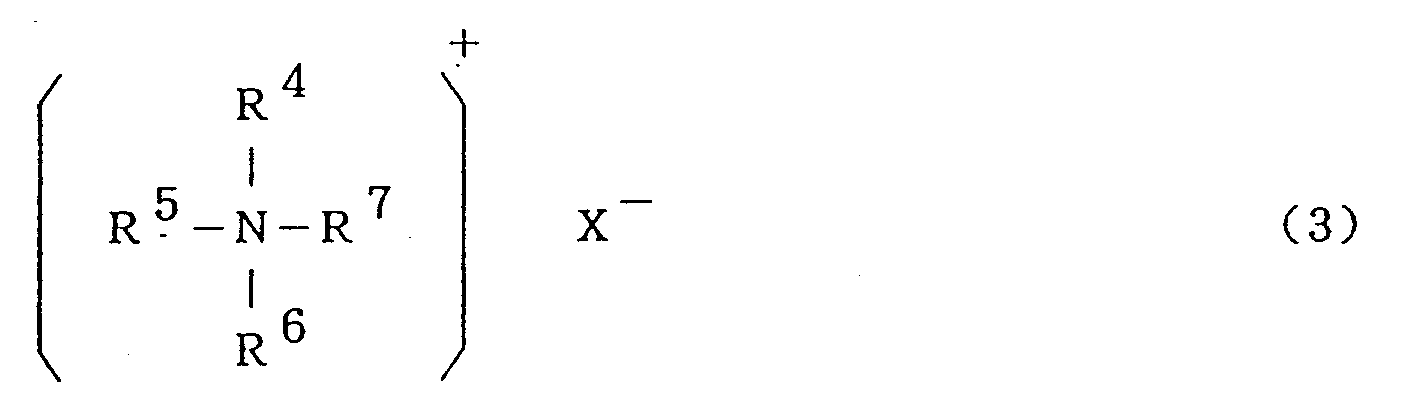
In the above formula, one or two of R⁴-R⁷ are long-chain alkyl having 8-24 carbon atoms while others are alkyl or hydroxyalkyl having 1-3 carbon atoms; and X is a halogen atom or an alkyl sulfate group having 1 or 2 carbon atoms. - Preferred examples of such an ammonium salt are mono(long- chain alkyl) quaternary ammonium salts such as lauryl trimethylammonium chloride, myristyl trimethylammonium chloride, palmityl trimethylammonium chloride, stearyl trimethylammonium chloride, oleyl trimethylammonium chloride, cetyl trimethylammonium chloride, cetyl trimethylammonium methylsulfate, eicosyl trimetylammonium chloride and behenyl trimethylammonium chloride; and di(long-chain alkyl) quaternary ammonium salts such as dipalmityl dimethylammonium chloride, distearyl dimethylammonium chloride, di(hydrogenated tallow alkyl) dimethylammonium bromide and di(hydrogenated tallow alkyl) dimethylammonium methylsulfate. They may be used either solely or jointly by combining two or more of them.
- The aromatic quaternary ammonium salt is, for example, a benzalconium salt represented by the following general formula (4).

In the above formula, R⁸ is an alkyl having 8-24 carbon atoms; and Y is a halogen atom or an alkyl sulfate group having 1 or 2 carbon atoms. - Preferred examples of the benzalconium salt are lauryl dimethylbenzylammonium chloride and stearyl dimethylbenzylammonium chloride. They may be used either solely or jointly by combining two or more of them.
- In the cationic surface-active agent of the mono(long-chain acyl) basic amino acid lower alkyl ester salt type, the acyl group is an acyl residue of a fatty acid having 8-22 carbon atoms and examples of it are lauroyl, cocoyl, myristoyl, palmitoyl, stearoyl and oleyl. Examples of the basic amino acid binding therewith are natural amino acids such as lysine, ornithine and arginine and any optically active or racemic substances may be used. Examples of the salt for the mono(long-chain acyl) basic amino acid lower alkyl ester salt are inorganic salts such as hydrochloride and sulfate; and organic salts such as acetate, tartrate, citrate, p-toluenesulfonate, fatty acid salts, acidic amino acid salts and pyroglutamate. Suitable lower alkyl ester components are methyl ester, ethyl ester, propyl ester, butyl ester, pentyl ester, hexyl ester, heptyl ester and octyl ester.
- They may be used either solely or jointly by combining two or more of them.
- The compounding amount of the above-mentioned various cationic surface-active agents may suitably be selected depending upon the property of the final product but, usually, the amount in the detergent composition is from 0.01 to 5.0% by weight.
- In the following, an illustration will be made for the nonionic surface-active agent used as the third component for the detergent composition of the present invention.
- An example of the alkyl glycoside used is that which is represented by the following general formula (5).
R⁹(OR¹⁰)bGc (5)
In the above formula, R⁹ is linear or branched alkyl or alkenyl having 8-18 carbon atoms; R¹⁰ is an alkylene group having 2-4 carbon atoms; G is a residue derived from a reducing sugar having 5-6 carbon atoms; the average value of b is 0-5; and the average value of c is 1-10. - When the average value of c is 1 or more in the above general formula (5) or, in other words, when a sugar chain of di- or higher saccharide is used as a hydrophilic group, the binding mode of the sugar may be a 1-2, 1-3, 1-4 or 1-6 bond or, moreover, α- or β-pyranoside or furanoside bond or any mixture being in the mixed mode thereof. With respect to value of b, it is preferably 0-2 in terms of water solubility and crystallinity while the preferred value of c is about 1-3 in terms of foam-increasing effect.
- R⁹ is a linear or branched alkyl, alkenyl or alkylphenyl having 8-18 carbon atoms but, the preferred carbon atom numbers from a standpoint of solubility, foaming ability and detergency are 10-14. R¹⁰ is an alkylene group having 2-4 carbon atoms but the preferred value from the standpoint of water solubility is 2 -3. The structure of G is decided by the material which is a monosaccharide or di- or higher saccharide and examples of the material for G in the case of monosaccharide are glucose, galactose, xylose, mannose, lyxose, arabinose and a mixture thereof while those in the case of a di- or higher saccharide are maltose, xylobiose, isomaltose, cellobiose, gentiobiose, lactose, sucrose, negerose, turanose, raffinose, gentianose, melezitose and a mixture thereof. Among those, preferred materials are glucose and fructose for monosaccharide and are maltose and sucrose for di- or higher saccharide due to their availability and low cost.
- Those alkylglycosides may be used either solely or jointly by combining two or more of them.
- An example of the aliphatic alkanolamide is that which is represented by he following general formula (6).

In the above formula, R¹¹ is an alkyl group having 8-20 carbon atoms; and R¹² and R¹³ are same or different and each of them is a hydrogen atom, a hydroxylalkyl group having 1-3 carbon atoms or a -(C₂H₄O)dH group (where d is an integer of 2-4). - In the above formula, the preferred carbon numbers of the alkyl for R¹¹ are 12-18 and a preferred combinations for R¹² and R¹³ are that both of them are hydroxyalkyl (particularly hydroxyethyl) and that one of them is a hydoxyalkyl (particularly hydroxyethyl) while another is a hydrogen atom.
- Specific examples of the aliphatic alkanolamide are coconut oil fatty acid monoethanolamide, coconut oil fatty acid diethanolamide, lauric acid monoethanolamide and lauric acid dlethanolamide. They may be used either solely or jointly by combining two or more of them.
- The compounding ratio of the above nonionic surface-active agent may be suitably selected depending upon the property of the final product, but usually the ratio of the alkylglycoside represented by the general formula (5) and that of the aliphatic alkanolamide represented by the general formula (6) to the total amount of components (A) and (B) are within ranges of 1/15- 15/1 and 1/100-1/2, respectively.
- An illustration will now be made of the amphoteric surface-active agent used as the third component of the detergent composition of the present invention.
- Examples of the amphoteric surface-active agent of the betaine type are surface-active agent of the carbobetaine type, that of an amidobetaine type, that of a sulfobetaine type, that of a hydroxysulfobetaine type, that of an amidosulfobetaine type and that of a phosphobetaine type.
- In other words, the surface-active agent of the betaine type as such has, for example, alkyl, alkenyl or acyl having 8-24 carbon atoms. More specific examples are coconut oil alkyldimethylaminoacetic acid betaine, coconut oil fatty acid amide propyldimethylaminoacetic acid betaine, stearyl dihydroxyethylaminoacetic acid betaine, lauryl hydroxysulfobetaine, lauryl sulfobetaine and lauryl phosphobetaine. Those amphoteric surface-active agents of the betaine type may be used either solely, or jointly by combining two or more of them.
- Examples of the amphoteric surface-active agent of the imidazoline type are those having C₈₋₂₂ alkyl groups such as 2-alkyl-N-carboxymethyl-N-hydroxyethylimidazolinium betaine, 2-alkyl-N-carboxyethyl-N-hydroxyethylimidazolinium betain and 2-alkyl-N-sodium carboxymethyl-N-carboxymethyloxyethylimidazolinium betaine. They may also be used either solely, or jointly by combining two or more of them.
- The mixing ratio of the above-mentioned various amphoteric surface-active agents may be selected depending upon the property of the final product and, usually, they are compounded within a range of from 1/15 to 15/1 to the total weight of the components (A) and (B).
- The total compounding amount of the components (A) and (B) and the third component in the detergent composition of the present invention may vary depending upon the form of the detergent composition but, preferably, it is from 5 to 95% by weight of the detergent composition.
- There is no particular limitation in terms of the form of the detergent in the detergent composition of the present invention and any of the forms of liquid, paste, gel, solid, powder, etc. may be adopted. The pH of such a detergent is 5-9 or, preferably, 6-8. In the case of the detergent composition of the present invention in which N-acrylthreonine salt is used, the foam property is not deteriorated, unlike the composition using other N-acyl neutral amino acid salt such as N-acylalanine salt or N-acylglycine salt, even if the pH is 7 or less and, therefore, a product with little irritation to the skin can be prepared.
- Other components which are common for use in detergent compositions may be added to the detergent composition of the present invention so far as they do not inhibit the effect of the present invention. Examples of such other common components for the detergent compositions are polyhydric alcohols such as diglycerol, octanediol, maltitol, diethylene glycol, polyethylene glycol, ethylene glycol, propylene glycol, dipropylene glycol, polypropylene glycol, isopropylene glycol, pentaerythritol, glucose, trehalose, fructose, 1,3-butylene glycol, glycerol and sorbitol; moisturizing agents such as sodium DL-pyrrolidonecarboxylate and sodium lactate; emulsifiers such as glycerol monostearate, sorbitan monopalmitate, sorbitan monostearate, sorbitan monooleate, sorbitan monosesquioleate, sorbitan monolaurate, polyglycerol monostearate, polyoxyethylene cetyl ether, polyoxyethylene stearyl ether, polyoxyethylene sorbitan monolaurate, diglycerol monostearate, polyethylene glycol monostearate, polyethylene glycol monooleate, polyethylene glycol monolaurate, polyethylene glycol distearate, polyethylene glycol dioleate, polyethylene glycol dilaurate, polyoxyethylene oleyl ether, polyoxyethylene lauryl ether, polyoxyethylene nonylphenyl ether, polyoxyethylene octylphenyl ether, polyoxyethylene sorbitol bees wax, polyoxyethylene sorbitan monostearate, polyoxyethylene sorbitan monooleate, polyoxyethylene sorbitan monolaurate and ethylene glycol monostearate; triglycerides such as avocado oil, almond oil, olive oil, cacao butter, beef tallow, sesame oil, wheat germ oil, safflower oil, shea butter, turtle oil, tsubaki oil, persic oil, castor oil, grape oil, macademia nut oil, mink oil, egg yolk oil, wood wax, coconut oil, rose hip oil, soybean oil, cotton seed oil and hydrogenated oil; wax such as orange raffy oil, carnauba wax, candelilla wax, whale wax, jojoba oil, montan wax, bees wax and lanolin; hydrocarbons such as liquid paraffin, paraffin, vaseline, ceresin, microcrystalline wax, solid paraffin, squalane and olefin oligomers; higher alcohols such as lauryl alcohol, cetyl alcohol, cetostearyl alcohol, stearyl alcohol, oleyl alcohol, behenyl alcohol, lanolin alristate, glycerol tris(caprylcaprate), propylene glycol dioleate, glycerol triisostearate, glycerol triisooctanoate, cetyl lactate, myristyl lactate, diisostearyl malate, cholesteryl stearate, cholesteryl isostearate, cholesteryl 12-hydroxystearate, glyceryl pyroglutamate oleate, di(cholesteryl, behenyl or octyldodeyl alcohol) N-lauroyl-L-glutamate and triglycerol 2-ethylhexanoate; polymers such as methylcellulose, hydroxyethylcellulose, hydroxypropylcellulose, ethylcellulose, nitrocellulose, sodium carboxymethylcellulose, carboxyvinyl polymer, polyvinyl methyl ether, polyvinyl alcohol, crystalline cellulose, arabic gum, tragacanth gum, guar gum, locust bean gum, karaya gum, irish moss, queens seed, gelatin, shellac, rosin, casein, sodium alginate, ester gum, polyvinylpyrrolidone, sodium polyacrylate, polyamide resin, silicone oil, chitin, partially deacetylated chitin, hydrolyzed collagen, polyaspartic acid, sodium polyglutamate and xanthan gum; antiseptics/antifungals such as cresol derivatives and paraben derivatives; pharmaceuticals and effective materials such as antiinflammatory agents, crude drugs, vitamins, hair growth promoters, whitening agents, UV absorbers and hormones; cosmetic materials such as pH-adjusting agents, feel-improving agents, perfatty agents, inorganic salts, amino acids, pearling agents, viscosity-adjusting agents, perfumes, dyes, softeners and mitigating agents; chelating agents such as ethylenediaminetetraacetic acid, citric acid, maleic acid, succinic acid, ascorbic acid, cephalin, gluconic acid, saccharinic acid, hexametaphosphoric acid, 1-hydroxyethane-1,1-diphosphonic acid, dihydoxyethylglycine and salts thereof; and animal and plant extracts such as placenta extract, licorice extract, hamamelis solution, sponge cucumber solution, elastin, aloe extract and chamomilla extract.
- The present invention will be further illustrated in more detail by way of the following examples.
-
- N-Lauroyl-L-threonine was synthesized by a method described in Examined Japanese Patent Publication Sho-51/038681. The by-produced impurities were removed by means of a recrystallization and the resulting high-purity N-lauroyl-L-threonine was neutralized with potassium hydroxide or triethanolamine to give potassium salt of N-lauroyl-L-threonine or triethanolamine salt of N-lauroyl-L-threonine, respectively. They were used in the following examples.
- Potassium salt of N-lauroyl-L-threonine (hereinafter, may be abbreviated as "lauroylthreonine K") and triethanolamine salt of N-lauroyl-L-threonine (hereinafter, may be abbreviated as "lauroylthreonine TEA") prepared in the Manufacturing Example 1 and potassium laurate (hereinafter, may be abbreviated as "K laurate") and triethanolamine laurate (hereinafter, may be abbreviated as "TEA laurate") were taken in various proportions (by weight) as shown in Table 3 which will be shown later and aqueous solutions in which the total concentration of the surface-active agents was 0.5% by weight were prepared using distilled water.
- Each aqueous solution (50 g) was stirred with a mixer for domestic use (350 ml; manufactured by Iwatani Sangyo KK) and the volumes (ml) of the foams after allowing them to stand for one minute and ten minutes were measured whereby the foam amount and the foam maintenance (rate of maintaining the foams) were evaluated. With respect to the creaminess, the foams were placed on a slide glass immediately after foaming, covered with a covering glass and evaluated through observation under a microscope. The following Table 1 shows the evaluation standards for each of the evaluating items.

- Then the feel upon washing (feel or touch of the foams, scratching feel and freshness) as a detergent for hair and body was evaluated in organoleptic evaluation by ten female and ten male panellers and the total evaluation was conducted as well. The organoleptic evaluation was carried out as follows. Thus, the surface-active agents were taken in the proportions as given in Table 3, made into aqueous solutions of 15% or 30% using distilled water and each of the aqueous solutions was subjected to the tests for washing hands and for washing hair. The evaluation standards for each of the evaluating items are given in the following Table 2. In the meanwhile, it was found that, with respect to the total evaluation, three points or less were insufficient for actual use while four points or more were satisfactory for actual use.
[Table 2] (1) Touch of bubbles: ⓞ; very good, ○; good, △; usual, X; bad (2) Jarring feeling (hands): ⓞ; very smooth, ○; smooth, △; usual, X; extremely jarring (3) Jarring feeling (hair): same manner for hands (4) Refreshed feeling: ⓞ; very refreshed, ○; refreshed, △; usual, X; slimy (5) Total evaluation: ⓞ; 2 points, ○; 1 point, △; 0 point, X; -1 point Evaluated by the total point. The criteria are as follows:
5; ≧10 points, 4; 6∼10 points, 3; 2∼6 points,
2; -2∼2 points, 1; -2 points > - The results of the evaluations are given in the following Table 3.

- It is clear from Table 3 that, although the sole use of N- acylthreonine salt is insufficient in terms of the foam maintenance and the creaminess of foams, addition of higher fatty acid salt to the N-acylthreonine salt results in an improved foam maintenance and creaminess of foams. Moreover, the touch of the foams, scratchiness and freshness is improved through the synergistic action of both components.
- N-Lauroylthreonine salt and higher fatty acid salt were used together with other surface-active agents as the third components, i.e. anionic, cationic, nonionic and amphoteric surface-active agents in the amounts as shown in Tables 4to 10 and evaluations were made in the same manner as in the above-mentioned examples. The results of the evaluations are given in Tables 4 to 10 as well.
- It is understood from the results of Tables 4-10 that the three-componential system wherein an N-lauroylthreonine salt, a higher fatty acid salt and another surface-active agent are compounded exhibits improved foam properties and feel upon use as compared with the two-componential system. In evaluations, the detergent compositions of the present invention gained four points or higher (of a total of five points) in all cases and thus are considered excellent for actual use.


- The components as shown in the following Tables 11-28 were mixed in the compounding ratio (by weight) given there and various detergent compositions were prepared by a conventional method. Those detergent compositions exhibited excellent foam volumes, foam maintenance and foam creaminess and had excellent feel on use as well.
Table 11 (Soap bar) Composition Content (%) Sodium N-lauroylthreonate 70 Soap base 20 Cetyl alcohol 5 Water 5 Table 12 (Shampoo) Composition Content (%) Triethanolamine N-cocoylthreonate 8 Triethanolamine laurate 1 Sodium lauryl sulfonate 3 Coconut oil fatty acid diethanolamide 3 Coconut oil fatty acid amidepropylbetaine 3 Polyethyleneglycol distearate 1.5 Glycerol 5 Antiseptic 0.1 Perfume 0.1 Water balance Table 13 (Cleansing cream) Composition Content (%) Sodium N-lauroylthreonate 20 Sodium laurate 5 Monosodium lauryl phosphate 5 lauric acid diethanolamide 2 Propylene glycol 5 Polyethylene sorbitane monolaurate 5 Antiseptic 0.2 Perfume 0.2 Water balance Table 14 (Cleansing form) Composition Content (%) Potassium N-myristoylthreonate 20 Potassium myristorate 4 Glycerol 10 PEG 400 15 Dipropylent glycol 10 Lauroyl methyl taurine 5 POE·POP block polymer 5 POE(15)oleyl alcohol 3 Lanolin derivative 2 Antiseptic 0.1 Perfume 0.1 Water balance Table 15 (Shampoo) Composition Content (%) Triethanolamine N-cocoylthreonate 10 Triethanolamine laurate 2 Distearyl dimethyl ammonium chloride 0.2 PCA ethyl N-cocoylarginate 0.2 Sodium lauryl sulfonate 6 Coconut oil fatty acid diethanolamide 1 Glycerol 5 Antiseptic 0.1 Perfume 0.1 Water balance Table 16 (Shampoo) Composition Content (%) Triethanolamine N-cocoylthreonate 10 Coconaut oil fatty acid triethanolamine salt 2 Lauric acid diethanolamide 4 Triethanolamine lauryl sulfonate 8 1,3-Butylene glycol 3 Cationized cellulose 0.4 Hydrolyzed collagen 0.5 Antiseptic 0.1 Perfume 0.1 Water balance Table 17 (Shampoo) Composition Content (%) Potassium N-cocoylthreonate 15 Coconut oil fatty acid potassium salt 3 Sodium pyrrolidoncarboxylate (50% solution) 2 Dioctyldodecyl N-lauroylglutamate 0.5 Dimethyl diallyl ammonium chloride acrylamide copolymer (8% solution) 4 Hydroxypropyl cellulose 1 Antiseptic 0.1 Perfume 0.1 Water balance Table 18 (Shampoo) Composition Content (%) Triethanolamine N-lauroylthreonate 15 Triethanolamine laurate 3 Coconut oil fatty acid diethanolamide 3 N-(N'-Lanokin fatty acid amide propyl)-N-ethyl-N,N-dimethyl ammonium ethylsulfate (67% solution) 1 POE(60)myristylene(1)tallow alkyl ether 2.5 POE(40)hydrogenated castor oil monopyrroglutamate 5 Butylene glycol 3 MARINE DEW PC-100* 10 Ethylene glycol distearate 1.2 Antiseptic 0.1 Perfume 0.1 Water balance *; Partially deacetylated chitin -
Table 19 (Shampoo) Composition Content (%) Triethanolamine N-cocoylthreonate 12 Coconut oil fatty acid triethanolamine salt 2 Coconut oil fatty acid diethanolamide 3 Cationized cellulose 0.2 POE(60)myristylene(1)tallow alkyl ether 3 ELDEW CL-301* 1 Butylene glycol 2 Antiseptic 0.1 Perfume 0.1 Water balance *; Di(cholesteryl, behenyl, octyldodecyl) N-lauroyl-L-glutamate -
Table 20 (Shampoo) Composition Content (%) Triethanolamine N-lauroylthreonate 6 Sodium N-lauroylmethyltaurate 3 Triethanolamine laurate 10 Triethanolamine myristyrate 10 Lauryl imidazolinium betaine 5 Lauryl diethanolamide 5 Propylene glycol 7 Lauryl dimethyl amine oxide 2 Antiseptic 0.1 Perfume 0.1 Water balance Table 21 (Shampoo) Composition Content (%) Potassium N-cocoylthreonate 8 Potassium laurate 1 Coconut oil alkyl dimethyl aminobetaine 10 Coconut oil fatty acid diethanolamide 5 Sodium chloride 2 Mannitol 20 Methylparaben 0.2 Sodium benzoate 0.2 Sodium citrate 0.5 Water balance Table 22 (Cleansing liquid) Composition Content (%) Sodium N-cocoylthreonate 3 Triethanolamine laurate 10 Sodium polyoxyethylene lauryl acetate 5 Lauryl hydroxy sulfobetaine 2 Hydroxyproline 0.1 Ethylene glycol distearate 2 D-glucose 30 Hydroxypropylcellulose 2 Aloe extract 1 Lithospermum root extract 2 Antiseptic 0.1 Perfume 0.1 Water balance Table 23 (Shampoo) Composition Content (%) Potassium N-lauroylthreonate 5 Potassium laurate 1 Sodium N-lauroyl-methyl-β-alanate 5 Sodium lauryl sulfate 2 Lauroyl diethanolamide 3 Carboxyvinyl polymer 2 Hydrolyzed collagen 1 Sodium pyrroridoncarboxylate (50% solution) 5 Citric acid 1 Squalene 0.5 2-Phenoxyethanol 0.1 Methylparaben 0.2 Perfume 0.2 Water balance Table 24 (Shampoo) Composition Content (%) Potassium N-myristoylthreonate 10 Potassimu myristyrate 5 Coconut oil alkyl dimethylaminobetaine 5 Coconut oil fatty acid potassium salt 5 Glycol 3 Hydroxymethylcellulose 2 EDTA 0.1 Methylparaben 0.2 Perfume 0.1 Water balance Table 25 (Acidic shampoo) Composition Content (%) Potassium N-cocoylthreonate 15 Coconut oil fatty acid potassium salt 2 Potassium myristyrate 2 Glycerol 3 Lauroyl diethanolamide 5 Sorbitol 4 Citric acid 2 Methylparaben 0.1 Perfume 0.1 Water balance Table 26 (Cleansing foam) Composition Content (%) Sodium N-lauroylthreonate 25 Sodium laurate 5 Glycerol 20 PEG 400 10 1,3-Butylene glycol 10 Methylparaben 0.2 Perfume 0.3 Water balance Table 27 (Shampoo) Composition Content (%) Triethanolamine N-lauroylthreonate 25 Triethanolamine laurate 6 Dipotassium glycyrrhizinate 0.2 Allantoin 0.4 Dibutyl hydroxytoluene 0.2 Ethanol 3 Perfume 0.5 Water balance Table 28 (Cleansing) Composition Content (%) Triethanolamine N-lauroylthreonate 25 Triethanolamine laurate 6 Polyoxypropylene(11)polyoxyethylene(4) butylether (HLB 7.2) 5 Dibutyl hydroxytoluene 0.2 Ethanol 3 Perfume 0.3 Water balance
Claims (5)
- A detergent composition comprising (A) an N-acylthreonine salt in which the acyl group is a fatty acid residue having 8-22 carbon atoms and (B) a higher fatty acid salt having 8-22 carbon atoms.
- A detergent composition according to claim 1 in which, in addition to components (A) and (B), said composition further contains at least one component selected from anionic surface-active agents of the carboxylate type (excluding components (A) and (B)), the sulfonate type and and the sulfate type.
- A detergent composition according to claim 1 in which, in addition to components (A) and (B), said composition further contains at least one component selected from cationic surface-active agents of the aliphatic amine quaternary ammonium salt type, the aromatic quaternary ammonium salt type and the mono(long- chain acyl) basic amino acid lower alkyl ester type.
- A detergent composition according to claim 1 in which, in addition to components (A) and (B), said composition further contains at least one component selected from nonionic surface-active agents of the alkyl glycoside type and the aliphatic alkanolamide type.
- A detergent composition according to claim 1 in which, in addition to components (A) and (B), said composition further contains at least one component selected from amphoteric surface-active agents of the betaine type and the imidazoline type.
Applications Claiming Priority (2)
| Application Number | Priority Date | Filing Date | Title |
|---|---|---|---|
| JP132849/94 | 1994-06-15 | ||
| JP13284994 | 1994-06-15 |
Publications (2)
| Publication Number | Publication Date |
|---|---|
| EP0687721A2 true EP0687721A2 (en) | 1995-12-20 |
| EP0687721A3 EP0687721A3 (en) | 1996-09-25 |
Family
ID=15090962
Family Applications (1)
| Application Number | Title | Priority Date | Filing Date |
|---|---|---|---|
| EP95109359A Withdrawn EP0687721A3 (en) | 1994-06-15 | 1995-06-16 | Detergent composition |
Country Status (4)
| Country | Link |
|---|---|
| US (1) | US5616552A (en) |
| EP (1) | EP0687721A3 (en) |
| KR (1) | KR960001096A (en) |
| TW (1) | TW319797B (en) |
Cited By (7)
| Publication number | Priority date | Publication date | Assignee | Title |
|---|---|---|---|---|
| WO1998053795A1 (en) * | 1997-05-27 | 1998-12-03 | Sederma S.A. | Cosmetic and dermopharmaceutical compositions containing threonine or serine derivatives |
| WO2002056840A3 (en) * | 2001-01-18 | 2003-02-27 | Cognis Deutschland Gmbh | Cosmetic and/or pharmaceutical agent containing acylated amino acid |
| DE10252395A1 (en) * | 2002-11-12 | 2004-05-27 | Beiersdorf Ag | Cosmetic cleaning composition containing alkali soaps, useful for cleaning skin, hair and nails, includes hydroxyalkylcellulose as thickener to improve temperature stability |
| WO2009112432A2 (en) | 2008-03-12 | 2009-09-17 | Unilever Plc | Make-up removal composition which provides good foam |
| EP3519057A1 (en) * | 2016-09-30 | 2019-08-07 | Innospec Limited | A method of treating a material comprising an amine salt of a carboxylic acid having 4 to 10 carbon atoms |
| EP3519055A1 (en) * | 2016-09-30 | 2019-08-07 | Innospec Limited | Reducing colour loss from a dyed material by using an amine salt of a carboxylic acid |
| WO2020259934A1 (en) * | 2019-06-24 | 2020-12-30 | Beiersdorf Ag | Cleansing product with high viscosity |
Families Citing this family (19)
| Publication number | Priority date | Publication date | Assignee | Title |
|---|---|---|---|---|
| JPH0967591A (en) * | 1995-09-04 | 1997-03-11 | Kao Corp | Detergent composition |
| TW328914B (en) * | 1996-02-06 | 1998-04-01 | Ajinomoto Kk | Surfactant, and toiletry or detergent composition containing the same |
| US20050203187A1 (en) * | 1998-06-01 | 2005-09-15 | Verbiscar Anthony J. | Formulations useful for the treatment of varicella zoster virus infections and methods for the use thereof |
| JP2002537307A (en) * | 1999-02-19 | 2002-11-05 | ベー・エル・アー・ハー・エム・エス・ディアグノスティカ・ゲーエムベーハー | Use of blocking anti-TSH receptor antibodies in the treatment of hyperthyroidism and monoclonal antibodies for such uses |
| GB2362350A (en) * | 2000-05-11 | 2001-11-21 | Reckitt Benekiser N V | Process and press for the production of tablets |
| GB0202017D0 (en) * | 2002-01-29 | 2002-03-13 | Unilever Plc | Detergent compositions |
| ES2279939T3 (en) * | 2002-01-29 | 2007-09-01 | Unilever N.V. | DETERGENT COMPOSITIONS. |
| GB0228354D0 (en) * | 2002-12-05 | 2003-01-08 | Unilever Plc | Detergent compositions |
| JP4644493B2 (en) * | 2003-01-07 | 2011-03-02 | 株式会社ピーアンドピーエフ | Surfactant composition and detergent composition and emulsified composition using the same |
| WO2004099121A1 (en) * | 2003-05-07 | 2004-11-18 | Ajinomoto Co., Inc. | Solid n-acylalanine or salts thereof |
| JPWO2004098558A1 (en) * | 2003-05-07 | 2006-07-13 | 味の素株式会社 | Cleaning composition |
| DE112004000731B4 (en) * | 2003-05-07 | 2016-05-12 | Ajinomoto Co., Inc. | cleaning composition |
| EP1746141B1 (en) * | 2004-02-13 | 2018-06-20 | Ajinomoto Co., Inc. | Thickened cleansing compositions |
| JP2007261946A (en) * | 2004-06-18 | 2007-10-11 | Ajinomoto Co Inc | Inflammation inhibitor comprising zinc salt of acylamino acid |
| JP4696507B2 (en) * | 2004-09-13 | 2011-06-08 | 味の素株式会社 | Cleaning composition |
| KR100656617B1 (en) * | 2005-11-15 | 2006-12-11 | 현대자동차주식회사 | Accelerator pedal |
| CN1966090B (en) * | 2005-11-18 | 2012-09-05 | 花王株式会社 | Deodorant compositions |
| JP5591436B2 (en) * | 2006-07-07 | 2014-09-17 | 味の素株式会社 | Low temperature stable cream detergent composition |
| WO2008103136A1 (en) * | 2007-02-23 | 2008-08-28 | Rutherford Chemicals Llc | Shea butter alkanolamides |
Family Cites Families (7)
| Publication number | Priority date | Publication date | Assignee | Title |
|---|---|---|---|---|
| GB1241480A (en) * | 1968-11-23 | 1971-08-04 | Sir Soc Italiana Resine Spa | Method of preparing supported oxidation catalysts for producing ethylene oxide |
| US4273684A (en) * | 1979-05-03 | 1981-06-16 | Ajinomoto Co., Inc. | Transparent detergent bar |
| JPH0676593B2 (en) * | 1989-09-29 | 1994-09-28 | 株式会社資生堂 | Transparent solid detergent |
| JPH05156298A (en) * | 1991-12-04 | 1993-06-22 | Kao Corp | Solid detergent composition |
| JP3018122B2 (en) * | 1991-12-04 | 2000-03-13 | 花王株式会社 | Detergent composition |
| ES2139737T3 (en) * | 1993-03-30 | 2000-02-16 | Ajinomoto Kk | DETERGENT COMPOSITION. |
| JP3296018B2 (en) * | 1993-05-26 | 2002-06-24 | 味の素株式会社 | Detergent composition |
-
1995
- 1995-06-07 TW TW084105764A patent/TW319797B/zh active
- 1995-06-14 KR KR1019950015635A patent/KR960001096A/en not_active Withdrawn
- 1995-06-15 US US08/490,716 patent/US5616552A/en not_active Expired - Fee Related
- 1995-06-16 EP EP95109359A patent/EP0687721A3/en not_active Withdrawn
Cited By (11)
| Publication number | Priority date | Publication date | Assignee | Title |
|---|---|---|---|---|
| WO1998053795A1 (en) * | 1997-05-27 | 1998-12-03 | Sederma S.A. | Cosmetic and dermopharmaceutical compositions containing threonine or serine derivatives |
| FR2763842A1 (en) * | 1997-05-27 | 1998-12-04 | Sederma Sa | COSMETIC OR DERMOPHARMACEUTICAL COMPOSITIONS CONTAINING THREONINE OR SERINE DERIVATIVES |
| WO2002056840A3 (en) * | 2001-01-18 | 2003-02-27 | Cognis Deutschland Gmbh | Cosmetic and/or pharmaceutical agent containing acylated amino acid |
| DE10252395A1 (en) * | 2002-11-12 | 2004-05-27 | Beiersdorf Ag | Cosmetic cleaning composition containing alkali soaps, useful for cleaning skin, hair and nails, includes hydroxyalkylcellulose as thickener to improve temperature stability |
| WO2009112432A2 (en) | 2008-03-12 | 2009-09-17 | Unilever Plc | Make-up removal composition which provides good foam |
| WO2009112432A3 (en) * | 2008-03-12 | 2009-12-17 | Unilever Plc | Make-up removal composition which provides good foam |
| EP3519057A1 (en) * | 2016-09-30 | 2019-08-07 | Innospec Limited | A method of treating a material comprising an amine salt of a carboxylic acid having 4 to 10 carbon atoms |
| EP3519055A1 (en) * | 2016-09-30 | 2019-08-07 | Innospec Limited | Reducing colour loss from a dyed material by using an amine salt of a carboxylic acid |
| US11253453B2 (en) | 2016-09-30 | 2022-02-22 | Innospec Limited | Reducing colour loss from a dyed material by using an amine salt of a carboxylic acid |
| EP3519055B1 (en) * | 2016-09-30 | 2025-12-24 | Innospec Limited | Reducing colour loss from a dyed material by using an amine salt of a carboxylic acid |
| WO2020259934A1 (en) * | 2019-06-24 | 2020-12-30 | Beiersdorf Ag | Cleansing product with high viscosity |
Also Published As
| Publication number | Publication date |
|---|---|
| EP0687721A3 (en) | 1996-09-25 |
| KR960001096A (en) | 1996-01-25 |
| US5616552A (en) | 1997-04-01 |
| TW319797B (en) | 1997-11-11 |
Similar Documents
| Publication | Publication Date | Title |
|---|---|---|
| US5616552A (en) | Detergent composition comprising N-acylthreonine salt | |
| US6004915A (en) | Cleansing compositions | |
| EP0648833B1 (en) | Detergent composition | |
| EP1586625B1 (en) | Novel surfactants and use thereof | |
| US5985809A (en) | Aqueous personal cleansing compositions comprising specific nonocclusive liquid polyol fatty acid polyester | |
| US8425889B2 (en) | Cleansing composition | |
| US5922659A (en) | Cleanser composition | |
| JP2001503439A (en) | Aqueous pearlescent concentrate | |
| EP0733698B1 (en) | Detergent composition | |
| EP0885288A1 (en) | Body soap composition | |
| JPH10121091A (en) | Detergent composition | |
| EP0826766B2 (en) | Wash composition | |
| JP2000514410A (en) | Aqueous pearlescent concentrate | |
| EP0723004B1 (en) | Detergent composition | |
| JPH083585A (en) | Detergent composition | |
| JPH06293620A (en) | Shampoo composition | |
| JP2005146014A (en) | Alkylglycol polyhydric alcohol ether-containing surfactant composition improved in low-temperature stability, and detergent composition comprising the same | |
| JP3644074B2 (en) | Cleaning composition | |
| JP3436836B2 (en) | Detergent composition | |
| JPH08311498A (en) | Detergent composition | |
| JPH09165598A (en) | Detergent composition | |
| JP2020169127A (en) | Body cleanser composition | |
| JP3441222B2 (en) | Detergent composition | |
| JP2747659B2 (en) | Detergent composition | |
| JPH09165597A (en) | Detergent composition |
Legal Events
| Date | Code | Title | Description |
|---|---|---|---|
| PUAI | Public reference made under article 153(3) epc to a published international application that has entered the european phase |
Free format text: ORIGINAL CODE: 0009012 |
|
| AK | Designated contracting states |
Kind code of ref document: A2 Designated state(s): DE FR GB IT |
|
| PUAL | Search report despatched |
Free format text: ORIGINAL CODE: 0009013 |
|
| AK | Designated contracting states |
Kind code of ref document: A3 Designated state(s): DE FR GB IT |
|
| 17P | Request for examination filed |
Effective date: 19970313 |
|
| 17Q | First examination report despatched |
Effective date: 19990614 |
|
| STAA | Information on the status of an ep patent application or granted ep patent |
Free format text: STATUS: THE APPLICATION IS DEEMED TO BE WITHDRAWN |
|
| 18D | Application deemed to be withdrawn |
Effective date: 19991026 |