EP0687072A2 - Gerät und Verfahren für schnellere lineare Blockdekodierung für digitale zellulare Kommunikationsempfänger und andere Systemen - Google Patents
Gerät und Verfahren für schnellere lineare Blockdekodierung für digitale zellulare Kommunikationsempfänger und andere Systemen Download PDFInfo
- Publication number
- EP0687072A2 EP0687072A2 EP95850103A EP95850103A EP0687072A2 EP 0687072 A2 EP0687072 A2 EP 0687072A2 EP 95850103 A EP95850103 A EP 95850103A EP 95850103 A EP95850103 A EP 95850103A EP 0687072 A2 EP0687072 A2 EP 0687072A2
- Authority
- EP
- European Patent Office
- Prior art keywords
- code word
- demodulated
- code
- decoding
- receiver
- Prior art date
- Legal status (The legal status is an assumption and is not a legal conclusion. Google has not performed a legal analysis and makes no representation as to the accuracy of the status listed.)
- Withdrawn
Links
Images


Classifications
-
- H—ELECTRICITY
- H03—ELECTRONIC CIRCUITRY
- H03M—CODING; DECODING; CODE CONVERSION IN GENERAL
- H03M13/00—Coding, decoding or code conversion, for error detection or error correction; Coding theory basic assumptions; Coding bounds; Error probability evaluation methods; Channel models; Simulation or testing of codes
- H03M13/03—Error detection or forward error correction by redundancy in data representation, i.e. code words containing more digits than the source words
- H03M13/05—Error detection or forward error correction by redundancy in data representation, i.e. code words containing more digits than the source words using block codes, i.e. a predetermined number of check bits joined to a predetermined number of information bits
- H03M13/13—Linear codes
- H03M13/15—Cyclic codes, i.e. cyclic shifts of codewords produce other codewords, e.g. codes defined by a generator polynomial, Bose-Chaudhuri-Hocquenghem [BCH] codes
- H03M13/151—Cyclic codes, i.e. cyclic shifts of codewords produce other codewords, e.g. codes defined by a generator polynomial, Bose-Chaudhuri-Hocquenghem [BCH] codes using error location or error correction polynomials
-
- H—ELECTRICITY
- H03—ELECTRONIC CIRCUITRY
- H03M—CODING; DECODING; CODE CONVERSION IN GENERAL
- H03M13/00—Coding, decoding or code conversion, for error detection or error correction; Coding theory basic assumptions; Coding bounds; Error probability evaluation methods; Channel models; Simulation or testing of codes
Definitions
- the present invention relates to digital cellular communication systems and more particularly to binary linear cyclic block decoders employed in receivers in digital cellular base stations and mobile digital cellular units.
- encoding/decoding procedures are applied to transmitted voice and other data to reduce data errors.
- encoding Prior to transmission from a mobile phone or from a base station, encoding is usually performed with either a block coding scheme or a trellis coding scheme.
- Trellis encoding is most commonly implemented by means of a convolutional scheme, and is best adapted for correcting random data errors.
- the digital cellular system procedure for encoding messages at the sending end of the system may be a two step or a single step procedure.
- a message is first encoded using a cyclic redundancy code in an outer code loop and then encoded using a trellis or block code in an inner code loop.
- the message is decoded using the inner loop code to eliminate as many errors as possible through forward error correction (FEC).
- FEC forward error correction
- the single step procedure only the trellis or block code is employed.
- a linear block code is a collection of vector spaces over a finite field.
- a syndrome calculation is performed using a polynomial.
- These codes are of the type where GF(2 k ), with k > 1.
- the most common binary linear block coding scheme is the Reed-Solomon (R-S) scheme which is best adapted for correcting burst data errors such as those that often occur in cellular communication channels as a result of Rayleigh fading.
- R-S Reed-Solomon
- the BCH code is another common binary linear block coding scheme.
- linear block or R-S decoding procedures normally include, as already indicated, a syndrome calculation as a first decoding step and an error detection and correction as a second and last step.
- Such block decoding procedures are applicable to linear block decoders in digital cellular communication systems as well as other products in which such decoders may be employed.
- the decoding procedure be performed as rapidly as possible.
- product applications such as digital cellular data transmission systems, where especially fast demodulation and decoding are required, it is desirable from cost and performance standpoints that demodulation and decoding be performed with commonly used digital signal processors as opposed to resorting to special, high speed block or R-S decoder chips.
- a receiver comprises a system for receiving and demodulating a signal representing a code word encoded in a binary linear block code and a decoder for decoding the binary linear block code in the demodulated signal.
- a system operates the receiving and demodulating system and the decoder to demodulate the code word partially and produce a demodulated portion of the code word, to provide partial decoding of the demodulated portion of the code word as at least one additional portion of the code word is demodulated, and to decode the code word fully when the entire code word is demodulated.
- An output system then outputs the decoded signals.
- the conventional method of binary linear block code or R-S code processing in a receiver is first to demodulate a complete received codeword before any syndrome calculation is performed.
- the total time required to decode the complete R-S block occurs after the time the demodulation of the R-S block is completed.
- the present invention provides faster binary linear block decoding by introducing parallelism between the demodulation and the decoding subprocesses. Since syndrome calculation is a significant part of the total decoder computation and has to be completed before proceeding with other steps in the block decoder, the invention performs a partial syndrome calculation on a partially received codeword. The partial syndrome calculation is done in parallel with the demodulation process, thereby reducing the decode time required once the block demodulation is completed. As a result, the total time for demodulation and decoding is reduced to enable use of digital signal processors in data communication and other systems where fast demodulation and decoding processing is required or desirable.
- the complete codeword has to be received and demodulated before the complete syndrome calculation is performed fordecoding.
- processing resources may be kept idle.
- the present invention maximizes the use of processing resources while meeting stringent decoding time requirements.
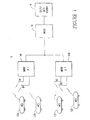
- FIGURE 1 a digital cellular communication system 10 is shown in FIGURE 1 in which a preferred form of the present invention is embodied.
- the system 10 is operative in a defined geographic region such as all or part of a metropolitan area. Further, in this case, the system 10 is in the form of a CDPD system which may be part of a Digital Cellular System.
- CDPD specifications require that R-S decoding be completed prior to a second microslot after a block is received. After providing for various hardware and processing delays, the decoder thus has approximately 5 microseconds to generate a decoded output.
- the present invention achieves faster decoding output thereby enabling decoding for CDPD and other systems with a DSP as opposed to a high speed R-S decoder chip.
- the cellular system 10 includes mobile end systems (MES), as represented by four illustrated MES 12A through 12D. Communication links may be established between the MES 12A-12D and a mobile data base station (MDBS) for the communication cell within which the MES may be located. In this illustrative case, two MDBS 14Aand 14B are shown.
- MES mobile end systems
- MDBS mobile data base station
- Respective pairs of diversity antennae A1, B1 and A2, B2 are provided at the MDBS 14Aand 14B, respectively, to provide for receiving diversity signals from a transmitting MES.
- the single step block encoding scheme is employed in structuring the received signals prior to transmission.
- R-S encoding is the preferred block encoding scheme.
- a mobile data intermediate system (MDIS) 16 provides system management functions through regulation of the operation of the MDBS 14A and 18B and by establishing communication links through a data router 18 employing transmission control protocol/internet protocol (TCP/IP).
- TCP/IP transmission control protocol/internet protocol
- circuitry for the MDBS 14A or 14B includes an RF receiver having a low noise amplifier 20 that receives signals from diversity antennae A and B.
- a down-conversion module 22 provides signal downconversion from RF to the baseband and then provides analog-to digital conversion through a signal sampling procedure.
- the output digital signal from the downconversion module 22 is applied to a demodulator 24, preferably in the form of a digital signal processor (DSP), where the originally modulated signal is demodulated. GMSK coherent demodulation is employed in the present case.
- the demodulator output is coupled to a decoder 26 which is also preferably in the form of a DSP.
- the demodulator 24 is structured in accordance with the present invention to operate with the decoder 26 in providing demodulation and faster binary linear block decoding. In other applications of the invention similar cooperation can be employed between demodulator and decoding subprocesses in a single DSP if the DSP has sufficient computing capacity.
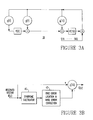
- the R-S encoding/decoding employed in the present embodiment is represented in FIGURES 3A and 3B to provide a better understanding of the invention.
- the GF(2 6 ) is defined with 8,1 as its primitive element under an irreducible polynomial 1 + X + X 6 .
- the generator polynomial is defined as:
- the encoding is performed by generating the parity symbols or the remainder r(x).
- the DSP 24 performs the block demodulation while the DSP 26 is used as the decoder.
- the R-S symbols are transferred to the decoder DSP 26 which begins a partial syndrome calculation for that received block.
- the decoder DSP 26 which performs the second partial syndrome calculation before combining the results of the partial calculation.
- Figure 3A shows a shift register 39 employed to implement the R-S encoder.
- decoding is performed in two basic steps, i.e., syndrome calculations, as indicated by block 40, and error detection and correction as indicated by block 42.
- the portion of the decoding procedure employed in the block 42 may be a conventional procedure available in prior art publications.
- a received word r may contain an error pattern e. Then r may be written
- the syndrome If the received word r is multiplied by a parity check matrix H, the resultant vector s (called the syndrome) is
- Figure 3B shows the decoding procedure employed. Besides the syndrome calculation which is the heart of the invention, the remainder of the decoding procedure is standard and can be found in many textbooks and papers.
- decoding is performed for a (64,47) RS decoder with erasures:
- the output of the Key Equations is the Errata Locator Polynomial and the Errata Evaluator Polynomial. 4.
- the inverse roots of the Errata Locator Polynomial gives the location of the errors and the erasures.
- the Errata Magnitude is evaluated and then subtracted from the received vector to give the transmitted code word.
- the cooperative operation of the demodulator 24 and the decoder 26 is illustrated by the flow diagrams shown in FIGURES 4 and 5.
- the invention divides the R-S syndrome calculation into a partial syndrome calculation on a partially received codeword and a subsequent partial syndrome calculation on the rest of the received codeword. This procedure shortens the time required to decode an R-S or other block in a CDPD or other system.
- Block 54 demodulates one R-S symbol in a R-S block, and test block 56 determines whether demodulation has been partially completed to a threshold level, in this case a 2/3 block level. If not, demodulation of the R-S block continues.
- a threshold level in this case a 2/3 block level. If not, demodulation of the R-S block continues.
- block 58 transfers the partial demodulation data from the demodulator DSP 24 to the decoder DSP 26.
- block 72 waits for a transfer of the partial demodulation data for the R-S block, and, once such data is received, block 74 performs a partial syndrome calculation in accordance with equations subsequently set forth herein.
- GF Galois Field
- block 76 causes the decoder DSP 26 to wait for the rest of the demodulation data for the R-S block.
- block 60 (FIGURE 4) demodulates the rest of the R-S block, and test block 62 determines when the demodulation is completed.
- block 64 transfers the rest of the demodulation data for the R-S block from the demodulator DSP 24 to the decoder DSP 26.
- the block 78 (FIGURE 5) detects the transfer of the rest of the demodulation data and then performs the rest of the syndrome calculation for the R-S block.
- Output block 80 finds error locations in the decoded R-S block, corrects the errors, and returns program execution to the starting block 52 in the demodulator DSP 24 to process the next R-S symbol in the manner just described. If the numberof errors in a decoded block exceeds the correctability of the block code, the block is discarded.
- an (N,k) codeword is R-S decoded as follows: be the received message.
- the length of f and m in the preferred embodiment of the invention is chosen as 42 and 21 respectively for a (63,47) R-S code.
- the 2t syndromes are then calculated as follows.
- the received codeword may be divided into p partial codewords where p ⁇ N with a method similar to that described above used to calculate each partial syndrome and, finally, the whole syndrome.
- Each code word contains message data and parity, and is represented in polynomial form as previously indicated.
- FIGURE 6 illustrates the performance provided by the invention in the described embodiment. As shown, the total time for demodulation and decoding is greater for the prior art than it is for a receiver in which the invention is applied.
- the parallel syndrome calculation procedure indicated by block 82 provides the basis upon which faster decoding is achieved by the invention.
Landscapes
- Physics & Mathematics (AREA)
- Mathematical Physics (AREA)
- Probability & Statistics with Applications (AREA)
- Engineering & Computer Science (AREA)
- Theoretical Computer Science (AREA)
- Algebra (AREA)
- General Physics & Mathematics (AREA)
- Pure & Applied Mathematics (AREA)
- Error Detection And Correction (AREA)
Applications Claiming Priority (2)
| Application Number | Priority Date | Filing Date | Title |
|---|---|---|---|
| US257967 | 1981-04-27 | ||
| US08/257,967 US5677919A (en) | 1994-06-10 | 1994-06-10 | Faster linear block decoding apparatus and method for receivers in digital cellular communication and other systems |
Publications (2)
| Publication Number | Publication Date |
|---|---|
| EP0687072A2 true EP0687072A2 (de) | 1995-12-13 |
| EP0687072A3 EP0687072A3 (de) | 1996-10-02 |
Family
ID=22978542
Family Applications (1)
| Application Number | Title | Priority Date | Filing Date |
|---|---|---|---|
| EP95850103A Withdrawn EP0687072A3 (de) | 1994-06-10 | 1995-06-09 | Gerät und Verfahren für schnellere lineare Blockdekodierung für digitale zellulare Kommunikationsempfänger und andere Systemen |
Country Status (3)
| Country | Link |
|---|---|
| US (1) | US5677919A (de) |
| EP (1) | EP0687072A3 (de) |
| CA (1) | CA2151408A1 (de) |
Cited By (1)
| Publication number | Priority date | Publication date | Assignee | Title |
|---|---|---|---|---|
| US6732325B1 (en) * | 2000-11-08 | 2004-05-04 | Digeo, Inc. | Error-correction with limited working storage |
Families Citing this family (4)
| Publication number | Priority date | Publication date | Assignee | Title |
|---|---|---|---|---|
| US7458007B2 (en) * | 2000-02-18 | 2008-11-25 | Texas Instruments Incorporated | Error correction structures and methods |
| US8498349B2 (en) * | 2009-03-11 | 2013-07-30 | Texas Instruments Incorporated | Demodulation and decoding for frequency modulation (FM) receivers with radio data system (RDS) or radio broadcast data system (RBDS) |
| US8805371B2 (en) * | 2009-03-17 | 2014-08-12 | Airvana Lp | Identifying hand-over targets in lightly coordinated networks |
| RU2738789C1 (ru) * | 2019-12-31 | 2020-12-16 | Федеральное государственное казенное военное образовательное учреждение высшего образования "Краснодарское высшее военное орденов Жукова и Октябрьской Революции Краснознаменное училище имени генерала армии С.М.Штеменко" Министерства обороны Российской Федерации | Способ и устройство защиты данных, передаваемых с использованием блочных разделимых кодов, от имитирующих действий злоумышленника |
Family Cites Families (9)
| Publication number | Priority date | Publication date | Assignee | Title |
|---|---|---|---|---|
| KR930003997B1 (ko) * | 1983-12-20 | 1993-05-19 | 소니 가부시끼가이샤 | 에러 정정부호의 복호방법 및 복호장치 |
| US4555784A (en) * | 1984-03-05 | 1985-11-26 | Ampex Corporation | Parity and syndrome generation for error detection and correction in digital communication systems |
| US5003539A (en) * | 1986-04-11 | 1991-03-26 | Ampex Corporation | Apparatus and method for encoding and decoding attribute data into error checking symbols of main data |
| US4928280A (en) * | 1988-04-29 | 1990-05-22 | International Business Machines Corporation | Fast processor for multi-bit error correction codes |
| US5077741A (en) * | 1989-12-05 | 1991-12-31 | Motorola, Inc. | Data throughput enhancement |
| US5331645A (en) * | 1990-01-17 | 1994-07-19 | Integrated Device Technology, Inc. | Expandable digital error detection and correction device |
| US5249218A (en) * | 1992-04-06 | 1993-09-28 | Spectrum Information Technologies, Inc. | Programmable universal interface system |
| US5329535A (en) * | 1992-04-30 | 1994-07-12 | International Business Machines Corporation | Variable block lengths on-the-fly error correcting decoder |
| JP2821324B2 (ja) * | 1992-11-04 | 1998-11-05 | 三菱電機株式会社 | 誤り訂正回路 |
-
1994
- 1994-06-10 US US08/257,967 patent/US5677919A/en not_active Expired - Lifetime
-
1995
- 1995-06-09 EP EP95850103A patent/EP0687072A3/de not_active Withdrawn
- 1995-06-09 CA CA002151408A patent/CA2151408A1/en not_active Abandoned
Non-Patent Citations (1)
| Title |
|---|
| None |
Cited By (1)
| Publication number | Priority date | Publication date | Assignee | Title |
|---|---|---|---|---|
| US6732325B1 (en) * | 2000-11-08 | 2004-05-04 | Digeo, Inc. | Error-correction with limited working storage |
Also Published As
| Publication number | Publication date |
|---|---|
| EP0687072A3 (de) | 1996-10-02 |
| CA2151408A1 (en) | 1995-12-11 |
| US5677919A (en) | 1997-10-14 |
Similar Documents
| Publication | Publication Date | Title |
|---|---|---|
| JP3996205B2 (ja) | 連接符号データの送受信方法および送受信装置 | |
| US5606569A (en) | Error correcting decoder and decoding method for receivers in digital cellular communication systems | |
| EP1542386B1 (de) | Fehlerschutz für Über-Funk-Datenübertragung | |
| CN100438346C (zh) | 用于线性分组码的擦除和单错纠正的方法和设备 | |
| EP0998072B1 (de) | Dekodierung eines Fehlerkorrekturcodes für ARQ-Protokoll | |
| US7941736B2 (en) | Apparatus and method for receiving signal in communication system | |
| US6728323B1 (en) | Baseband processors, mobile terminals, base stations and methods and systems for decoding a punctured coded received signal using estimates of punctured bits | |
| US20090158117A1 (en) | Method and system for providing long and short block length low density parity check (ldpc) codes | |
| KR101576816B1 (ko) | 적어도 하나의 릴레이를 이용하여 적어도 2개의 송신기와 적어도 하나의 수신기 사이에서 디지털 신호를 전송하는 방법 및 대응하는 프로그램 제품과 릴레이 장치 | |
| US5677919A (en) | Faster linear block decoding apparatus and method for receivers in digital cellular communication and other systems | |
| US20070204198A1 (en) | Apparatus and method for transmitting/receiving signal in communication system | |
| US7856592B2 (en) | Apparatus and method for transmitting/receiving signal in a communication system | |
| US6954892B2 (en) | Method for calculating syndrome polynomial in decoding error correction codes | |
| US20070226586A1 (en) | Apparatus and method for receiving signal in a communication system | |
| Gaffour et al. | FPGA Implementation of CCCDS Standards Based on Satellite Telecommand System | |
| JP2004015259A (ja) | 受信装置、および通信システム | |
| JP2002368627A (ja) | 誤り訂正制御装置 | |
| KR100284969B1 (ko) | 양방향 무선호출 시스템의 역방향 무선링크채널부호화방법 | |
| Rudolph et al. | Forward error correction techniques for mobile satellite communications | |
| KR20000024730A (ko) | 확장된 리드-솔로몬 부호의 오증 연산방법및 복호방법 | |
| MXPA99006562A (en) | Method and apparatus for transmitting and receiving concatenated code data | |
| HK1027693B (en) | Method and apparatus for providing error protection for over-the-air file transfer | |
| HK1077683A (en) | Error protection for over-the-air file transfer |
Legal Events
| Date | Code | Title | Description |
|---|---|---|---|
| PUAI | Public reference made under article 153(3) epc to a published international application that has entered the european phase |
Free format text: ORIGINAL CODE: 0009012 |
|
| AK | Designated contracting states |
Kind code of ref document: A2 Designated state(s): AT BE CH DE DK ES FR GB GR IT LI NL SE |
|
| PUAL | Search report despatched |
Free format text: ORIGINAL CODE: 0009013 |
|
| AK | Designated contracting states |
Kind code of ref document: A3 Designated state(s): AT BE CH DE DK ES FR GB GR IT LI NL SE |
|
| 17P | Request for examination filed |
Effective date: 19970402 |
|
| RAP1 | Party data changed (applicant data changed or rights of an application transferred) |
Owner name: HE HOLDINGS, INC. |
|
| RAP1 | Party data changed (applicant data changed or rights of an application transferred) |
Owner name: HUGHES ELECTRONICS CORPORATION |
|
| 17Q | First examination report despatched |
Effective date: 20000331 |
|
| STAA | Information on the status of an ep patent application or granted ep patent |
Free format text: STATUS: THE APPLICATION IS DEEMED TO BE WITHDRAWN |
|
| 18D | Application deemed to be withdrawn |
Effective date: 20001011 |