EP0686705A1 - Grossblech aus Aluminium-Legierung und Verfahren zur Herstellung - Google Patents
Grossblech aus Aluminium-Legierung und Verfahren zur Herstellung Download PDFInfo
- Publication number
- EP0686705A1 EP0686705A1 EP95201483A EP95201483A EP0686705A1 EP 0686705 A1 EP0686705 A1 EP 0686705A1 EP 95201483 A EP95201483 A EP 95201483A EP 95201483 A EP95201483 A EP 95201483A EP 0686705 A1 EP0686705 A1 EP 0686705A1
- Authority
- EP
- European Patent Office
- Prior art keywords
- plate
- accordance
- ingot
- thickness
- micropores
- Prior art date
- Legal status (The legal status is an assumption and is not a legal conclusion. Google has not performed a legal analysis and makes no representation as to the accuracy of the status listed.)
- Ceased
Links
- 229910000838 Al alloy Inorganic materials 0.000 title claims abstract description 25
- 238000000034 method Methods 0.000 title claims description 46
- 238000004519 manufacturing process Methods 0.000 title claims description 20
- 238000005098 hot rolling Methods 0.000 claims abstract description 27
- 239000000155 melt Substances 0.000 claims abstract description 26
- 238000000399 optical microscopy Methods 0.000 claims abstract description 12
- 239000001768 carboxy methyl cellulose Substances 0.000 claims abstract description 10
- 238000010998 test method Methods 0.000 claims abstract description 8
- XKRFYHLGVUSROY-UHFFFAOYSA-N Argon Chemical compound [Ar] XKRFYHLGVUSROY-UHFFFAOYSA-N 0.000 claims description 16
- 229910045601 alloy Inorganic materials 0.000 claims description 8
- 239000000956 alloy Substances 0.000 claims description 8
- 229910052786 argon Inorganic materials 0.000 claims description 8
- 238000005096 rolling process Methods 0.000 claims description 8
- 238000005266 casting Methods 0.000 claims description 7
- 238000005242 forging Methods 0.000 claims description 7
- 239000007789 gas Substances 0.000 claims description 7
- 239000000470 constituent Substances 0.000 claims 1
- 238000007872 degassing Methods 0.000 abstract description 19
- 238000012360 testing method Methods 0.000 description 14
- 239000011148 porous material Substances 0.000 description 5
- 239000012535 impurity Substances 0.000 description 3
- 238000011160 research Methods 0.000 description 3
- UFHFLCQGNIYNRP-UHFFFAOYSA-N Hydrogen Chemical compound [H][H] UFHFLCQGNIYNRP-UHFFFAOYSA-N 0.000 description 2
- 239000000274 aluminium melt Substances 0.000 description 2
- 238000009826 distribution Methods 0.000 description 2
- 230000000694 effects Effects 0.000 description 2
- 239000001257 hydrogen Substances 0.000 description 2
- 229910052739 hydrogen Inorganic materials 0.000 description 2
- 230000000977 initiatory effect Effects 0.000 description 2
- 239000000463 material Substances 0.000 description 2
- 239000000203 mixture Substances 0.000 description 2
- 238000005498 polishing Methods 0.000 description 2
- 238000012546 transfer Methods 0.000 description 2
- ZAMOUSCENKQFHK-UHFFFAOYSA-N Chlorine atom Chemical compound [Cl] ZAMOUSCENKQFHK-UHFFFAOYSA-N 0.000 description 1
- XAGFODPZIPBFFR-UHFFFAOYSA-N aluminium Chemical compound [Al] XAGFODPZIPBFFR-UHFFFAOYSA-N 0.000 description 1
- 229910052782 aluminium Inorganic materials 0.000 description 1
- 239000004411 aluminium Substances 0.000 description 1
- 238000004458 analytical method Methods 0.000 description 1
- 230000015556 catabolic process Effects 0.000 description 1
- 239000000460 chlorine Substances 0.000 description 1
- 229910052801 chlorine Inorganic materials 0.000 description 1
- 229910052804 chromium Inorganic materials 0.000 description 1
- 230000000052 comparative effect Effects 0.000 description 1
- 230000006835 compression Effects 0.000 description 1
- 238000007906 compression Methods 0.000 description 1
- 238000010924 continuous production Methods 0.000 description 1
- 239000013078 crystal Substances 0.000 description 1
- 230000001186 cumulative effect Effects 0.000 description 1
- 230000001627 detrimental effect Effects 0.000 description 1
- 238000011161 development Methods 0.000 description 1
- 238000009792 diffusion process Methods 0.000 description 1
- 238000011156 evaluation Methods 0.000 description 1
- 229910052735 hafnium Inorganic materials 0.000 description 1
- 229910052742 iron Inorganic materials 0.000 description 1
- 238000005259 measurement Methods 0.000 description 1
- 229910052758 niobium Inorganic materials 0.000 description 1
- 239000002245 particle Substances 0.000 description 1
- 230000035515 penetration Effects 0.000 description 1
- 238000005554 pickling Methods 0.000 description 1
- 230000008092 positive effect Effects 0.000 description 1
- 238000012545 processing Methods 0.000 description 1
- 238000007670 refining Methods 0.000 description 1
- 238000007493 shaping process Methods 0.000 description 1
- 239000007787 solid Substances 0.000 description 1
- 238000007711 solidification Methods 0.000 description 1
- 230000008023 solidification Effects 0.000 description 1
- 230000003746 surface roughness Effects 0.000 description 1
- 229910052720 vanadium Inorganic materials 0.000 description 1
- 229910052725 zinc Inorganic materials 0.000 description 1
- 229910052726 zirconium Inorganic materials 0.000 description 1
Images
Classifications
-
- C—CHEMISTRY; METALLURGY
- C22—METALLURGY; FERROUS OR NON-FERROUS ALLOYS; TREATMENT OF ALLOYS OR NON-FERROUS METALS
- C22F—CHANGING THE PHYSICAL STRUCTURE OF NON-FERROUS METALS AND NON-FERROUS ALLOYS
- C22F1/00—Changing the physical structure of non-ferrous metals or alloys by heat treatment or by hot or cold working
- C22F1/04—Changing the physical structure of non-ferrous metals or alloys by heat treatment or by hot or cold working of aluminium or alloys based thereon
-
- C—CHEMISTRY; METALLURGY
- C22—METALLURGY; FERROUS OR NON-FERROUS ALLOYS; TREATMENT OF ALLOYS OR NON-FERROUS METALS
- C22F—CHANGING THE PHYSICAL STRUCTURE OF NON-FERROUS METALS AND NON-FERROUS ALLOYS
- C22F1/00—Changing the physical structure of non-ferrous metals or alloys by heat treatment or by hot or cold working
- C22F1/04—Changing the physical structure of non-ferrous metals or alloys by heat treatment or by hot or cold working of aluminium or alloys based thereon
- C22F1/053—Changing the physical structure of non-ferrous metals or alloys by heat treatment or by hot or cold working of aluminium or alloys based thereon of alloys with zinc as the next major constituent
Definitions
- the invention relates to an aluminium alloy plate having a thickness of at least 2 inches (5 cm) and an average logarithmic fatigue life of more than 100,000 cycles determined in accordance with ASTM test method E 466.
- Such plates find particular application in the manufacture of structural members of aircraft, but are not limited to this use.
- the invention also relates to methods of manufacture of such plates.
- the log-average fatigue life is given by where N is the number of specimens tested and Nf(i) is the fatigue life of the i th specimen.
- US-A-5277719 describes manufacture of aluminium alloy plate by forming a melt, degassing the melt, casting the melt into an ingot, and shaping the ingot into the plate by a combination of forging and hot rolling.
- the method is said to achieve plates having a thickness of 5.7 inches with an improved fatigue life.
- the improvement is attributed to the forging technique in relation to porosity. It is mentioned that degassing is desirable to reduce hydrogen content. It is also stated that porosity should be reduced to not more than 0.05% for 3 to 6 inch plate and as high as 0.1% for plate 6 to 10 inches thick, because pores may act as sites for fatigue crack initiation.
- FR-A-2529578 describes a process for improving both fatigue resistance and toughness by forging steps combined with a step of hot compression in a transverse direction. The concern seems to be to improve the crystal microstructure.
- a long life is of great importance for a thicker plate because it permits weight to be saved in those applications in which plate fatigue characteristics are decisive.
- An object of the invention is to provide a thick aluminium alloy plate with improved fatigue properties.
- Another object of the invention is to create a method for the manufacture of a thick aluminium alloy plate with improved fatigue properties.
- the micropores resulting from shrinkage are decisive for the lifetime. These micropores occur mainly in the midplane (T/2) position of the finished plate. With the present level of lifetimes, non-metallic inclusions are not thought decisive. Furthermore, the density of the micropores and not just their size was found to be related to lifetime. In research the applicant has found not only that the plate in accordance with the invention has far fewer micropores larger than 80 ⁇ m, but also that the total number of micropores was far smaller than in a plate in accordance with the state of the art.
- the density of micropores with a size larger than 65 ⁇ m in all locations in the midplane (T/2) position of the finished plate is less than 0.025 micropores per cm2.
- the plate in accordance with the invention is further preferably characterized by the density of clusters of micropores in the plate. Not only is the density of the larger micropores decisive for the fatigue strength, but also the density of local concentrations of micropores may have significant effect.
- a cluster is defined as a whole group of individual micropores in which the distance between any two neighbouring micropores is no greater than the maximum dimension of the largest micropore in the group.
- the density of clusters of micropores is less than 0.025 clusters per cm2. More preferably the density of clusters of micropores with a size larger than 100 ⁇ m in all locations in the midplane (T/2) position of the finished plate is less than 0.025 clusters per cm2.
- the plate desirably has a very low total volume porosity.
- the volume porosity of the plate is less than 0.005%, more preferably less than 0.001% and may be as low as 0.0002%.
- thick plate can be provided with an exceptionally long life, by which significant savings in weight can be achieved.
- Plates in accordance with the invention can be provided having an average logarithmic fatigue life of at least 250,000 cycles, or even at least 350,000 cycles.
- aluminium alloys to which the invention may be applied have the following composition apart from aluminium and unavoidable impurities:- Cu 0.3 to 3 wt. % Mg 1 to 3 wt. % Zn 5 to 9 wt. % Si max. 0.4 wt. % Fe max. 0.6 wt. % optionally Mn max. 0.5 wt. % Cr max. 0.3 wt. % Zr, V, Hf, Nb max. 0.3 wt. % each. Sc max. 0.5 wt. %
- the aluminium alloy of the plate preferably belongs to the group of the AA 7xxx alloys, also known as the AA 7000 series alloys.
- Preferred specific alloys are AA 7050 T 7451 and AA 7150 T 7451.
- the invention also provides methods of manufacturing aluminium alloy plates having a long fatigue life, particularly plates as defined above.
- a method of manufacture of an aluminium alloy plate comprising the steps of:
- the density of the micropores with a size larger than 80 ⁇ m is less than 0.1 micropores per cm2, and more preferably less than 0.07 micropores per cm2.
- Such a low density means that less than 1 in a hundred micropores is larger than 80 ⁇ m.
- the volume porosity of the ingot before hot rolling is preferably not more than 0.01%, more preferably not more than 0.005%.
- the melt is degassed with a argon or a gas containing argon.
- degassing an aluminium melt is of itself known from EP-A-500 052 for the removal of solid particles and gases from the aluminium melt, to refine it.
- the positive effect of this on the life of a finished thick plate is not described.
- Degassing is also described and explained in US-A-3839019. Degassing is essentially a refining process to remove unwanted gases such as hydrogen and other impurities, by passing through the melt bubbles of a gas which is inert in the melt.
- a hot rolling pass of large reduction is performed.
- the invention also provides a method of manufacture of an aluminium alloy plate with a thickness of at least 10 cm (4 inches), comprising the steps of:
- the thickness of the aluminium alloy plate is more than 5.7 inches.
- Hot rolling of the ingot into thick plate takes place in a number of passes.
- the roll stand does not permit a high reduction ratio to be applied.
- the high reduction ratio ⁇ is preferably applied during one of the last five passes of the hot rolling.
- the number of passes is preferably greater than five and may be ten or more.
- the ingot is formed into the plate without any forging step.
- the invention further extends to use of a plate of the invention described above or a plate made by a method of the invention described above, in the manufacture of an aircraft structural member.
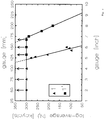
- Fig.1 is a graph plotting log-average fatigue life (in kcycles) against thickness of the plate, for aluminium alloy plates produced conventionally and plates in accordance with the present invention.
- melts were prepared of the aluminium alloy AA 7050.
- the melts were degassed in a continuous process in a SNIF Box T120 apparatus (Union Carbide) having two chambers and two rotors, by flow of argon gas. Rotor speed was 480 rpm.
- the mass flow of the melt during degassing was 0.25 ton melt/min.
- Gas flow rate was 4.5 m3/h in degassing technique I referred to below and 6.5 m3/h in degassing technique II.
- a high argon flow rate such as is used in degassing technique II, is generally considered to be detrimental to the purity of the melt.
- the degassed melt was then cast into ingots with a thickness of 440 mm (rectangular section) and the ingots where thereafter homogenised.
- the porosity of the ingots was determined by Optical Microscopy. Samples measuring approximately 50 x 80 mm and approximately 1 ⁇ 2 inch thick were taken perpendicular to the longitudinal direction of the ingots. The samples were prepared by grinding and polishing. The material smoothed off the surface of the samples during grinding and polishing was removed by pickling with negligible increase in micropore size. The samples were examined by ultraviolet penetration. The ultraviolet reflections were noted and the samples examined under a light microscope in order to assess whether a reflection was attributable to a micropore or to an artefact (false image). Then the pore size distribution was determined with a light microscope and an image analyzing system.
- the samples were taken from the midplane (T/2) position of the ingots (T is the thickness of the ingot), since maximum porosity occurs during solidification at the centre of the ingot.
- the Optical Microscopy revealed no micropores with a length exceeding 80 ⁇ m in samples of the ingots made by degassing technique II. Volume porosity was less than 0.005%.
- micropores were revealed of up to 120 ⁇ m and a micropore density larger than 80 ⁇ m of approximately 0.15 micropores per cm2. Values for density of micropores in an ingot referred to in this specification and claims are related to a sample size of 50 x 80 mm.
- the ingots were then hot rolled in a number of passes into plates with a thickness of 6 inches, using work rolls of radius 460 mm. Plates in accordance with the invention were rolled in ten passes, and in the seventh and eighth passes some of the ingots were given a high reduction ratio (seventh pass entry thickness 275 mm and exit thickness 225 mm, eighth pass entry thickness 225 mm and exit thickness 175 mm). Other ingots, rolled in accordance with the state of the art, were rolled in more passes and were given no such high reduction ratio in any pass, the reduction in any one pass being about 10 mm and a maximum of 20 mm. Such relatively low reduction ratio passes are normally given in the state of the art to avoid high rolling forces, which could result in damage to the rolling stand and loss of production. The plates were then solution heat treated, quenched, stretched by 2% and heat treated to condition T 7451.
- the porosity of some of the plates was determined by Optical Microscopy as described above from samples measuring approximately 40 x 80 mm taken from the midplane (T/2) position (T is the thickness of the plate) with the measuring plane parallel to the length and the thickness directions i.e. perpendicular to the direction of width. This meant that the size of 80 mm extended in the direction of rolling and the size of 40 mm in the thickness direction and symmetrically to the midplane. These samples were taken from the mid width position.
- Values for density of micropores and clusters in plates referred to in this specification and claims are related to a sample size of 40 x 80 mm.
- Tables 1 and 2 Cumulative density of clusters above the indicated size Cluster size [ ⁇ m] Density [number of clusters per cm2] A-1 A-2 C > 70 0 0 0.60 > 100 0 0 0.27 > 125 0 0 0.20 > 150 0 0 0.13 > 175 0 0 0.067 > 200 0 0 0.067 > 250 0 0 0.067
- the pore size is the maximum dimension of a pore.
- the density is the number of micropores or the number of clusters above the indicated size divided by the total examined surface of the sample.
- a cluster is defined as a group of individual micropores in which the distance between any two neighbouring micropores is no greater than the maximum dimension of the largest micropore in the group.
- the cluster size is the maximum dimension of the cluster.
- A-1 and A-2 are samples taken from plates of different melts, those plates being manufactured in accordance with the invention and with both degassing technique II and the high reduction ratio applied.
- the fatigue characteristics of the plates were determined in accordance with ASTM E 466 in air at room temperature on test pieces with a measurement length of 2 inch and a diameter of 1 ⁇ 2 inch taken from the midplane (T/2) position of the plates.
- the results are summarized in Table 3.
- Fig.1 shows fatigue lives of a number of other plates of a range of thicknesses, produced in accordance with the invention, and subjected to the same test (ASTM E 466).
- the plates whose lives are given by the filled triangles were made by a production technique I employing hot rolling without the high reduction ratio passes and to degassing technique I.
- the plates whose lives are given by the filled squares were made by the same hot rolling and degassing techniques as plates A-1 and A-2 above (Production technique II).
- the tests were terminated at 300,000 cycles, if failure had not occurred, so that for the points in Fig.1 which lie on the horizontal line at 300,000, the vertical arrows indicate that the actual log-average fatigue life is substantially higher.
- the slope line representing plates of production technique II represents a substantial improvement for thick plates up to about 9 inches.
Landscapes
- Chemical & Material Sciences (AREA)
- Physics & Mathematics (AREA)
- Thermal Sciences (AREA)
- Crystallography & Structural Chemistry (AREA)
- Engineering & Computer Science (AREA)
- Materials Engineering (AREA)
- Mechanical Engineering (AREA)
- Metallurgy (AREA)
- Organic Chemistry (AREA)
- Manufacture And Refinement Of Metals (AREA)
Applications Claiming Priority (6)
| Application Number | Priority Date | Filing Date | Title |
|---|---|---|---|
| NL9400939A NL9400939A (nl) | 1994-06-09 | 1994-06-09 | Dikke plaat van een aluminium legering met verbeterde vermoeiingseigenschappen en werkwijze voor het vervaardigen daarvan. |
| NL9400939 | 1994-06-09 | ||
| EP95200134 | 1995-01-19 | ||
| EP95200134 | 1995-01-19 | ||
| EP95201243 | 1995-05-12 | ||
| EP95201243 | 1995-05-15 |
Publications (1)
| Publication Number | Publication Date |
|---|---|
| EP0686705A1 true EP0686705A1 (de) | 1995-12-13 |
Family
ID=27236675
Family Applications (1)
| Application Number | Title | Priority Date | Filing Date |
|---|---|---|---|
| EP95201483A Ceased EP0686705A1 (de) | 1994-06-09 | 1995-06-06 | Grossblech aus Aluminium-Legierung und Verfahren zur Herstellung |
Country Status (2)
| Country | Link |
|---|---|
| US (1) | US5772800A (de) |
| EP (1) | EP0686705A1 (de) |
Cited By (1)
| Publication number | Priority date | Publication date | Assignee | Title |
|---|---|---|---|---|
| EP3807434B1 (de) | 2018-06-12 | 2022-09-14 | Novelis Koblenz GmbH | Verfahren zur herstellung eines plattenprodukts aus aluminiumlegierung der serie 7xxx mit verbesserter ermüdungsbruchfestigkeit |
Families Citing this family (3)
| Publication number | Priority date | Publication date | Assignee | Title |
|---|---|---|---|---|
| CN101479397B (zh) * | 2006-06-30 | 2013-03-13 | 肯联铝业轧制品-雷文斯伍德有限公司 | 高强度、可热处理的Al-Zn-Mg铝合金 |
| FR2971793B1 (fr) | 2011-02-18 | 2017-12-22 | Alcan Rhenalu | Demi-produit en alliage d'aluminium a microporosite amelioree et procede de fabrication |
| CN111974814B (zh) * | 2020-07-16 | 2022-09-20 | 南京钢铁股份有限公司 | 一种头尾炉连铸坯轧制后定向取样评估方法 |
Citations (4)
| Publication number | Priority date | Publication date | Assignee | Title |
|---|---|---|---|---|
| FR2529578A1 (fr) | 1982-07-02 | 1984-01-06 | Cegedur | Procede pour ameliorer a la fois la resistance a la fatigue et la tenacite des alliages d'al a haute resistance |
| EP0500052A2 (de) * | 1991-02-19 | 1992-08-26 | Foseco International Limited | Vorrichtung zum Einleiten von Gas für die Reinigung von Aluminiumschmelzen |
| US5277719A (en) | 1991-04-18 | 1994-01-11 | Aluminum Company Of America | Aluminum alloy thick plate product and method |
| EP0666333A1 (de) * | 1994-01-25 | 1995-08-09 | Pechiney Rhenalu | Ermudungsbeständiges Grobblech aus Aluminium-Legierung und Verfahren zur Herstellung |
-
1995
- 1995-06-06 US US08/466,114 patent/US5772800A/en not_active Expired - Lifetime
- 1995-06-06 EP EP95201483A patent/EP0686705A1/de not_active Ceased
Patent Citations (5)
| Publication number | Priority date | Publication date | Assignee | Title |
|---|---|---|---|---|
| FR2529578A1 (fr) | 1982-07-02 | 1984-01-06 | Cegedur | Procede pour ameliorer a la fois la resistance a la fatigue et la tenacite des alliages d'al a haute resistance |
| US4511409A (en) | 1982-07-02 | 1985-04-16 | Cegedur Societe De Transformation De L'aluminium Pechiney | Process for improving both fatigue strength and toughness of high-strength Al alloys |
| EP0500052A2 (de) * | 1991-02-19 | 1992-08-26 | Foseco International Limited | Vorrichtung zum Einleiten von Gas für die Reinigung von Aluminiumschmelzen |
| US5277719A (en) | 1991-04-18 | 1994-01-11 | Aluminum Company Of America | Aluminum alloy thick plate product and method |
| EP0666333A1 (de) * | 1994-01-25 | 1995-08-09 | Pechiney Rhenalu | Ermudungsbeständiges Grobblech aus Aluminium-Legierung und Verfahren zur Herstellung |
Non-Patent Citations (9)
| Title |
|---|
| "ADVANCES IF FRACTURE RESEARCH" PROC 7TH INT CONF HOUSTON TEXAS 20-24 MARC PERGAMON, OXFORD GB ,1989 VOL 2, bladzijden 999 -1007 * |
| "Advances in Fracture Research, Proceedings of the 7th International Conference on Fracture, Houston March 1989", 1989, PERGAMON, article MAGNUSEN ET AL.: "The influence of material quality on airframe structural durability", pages: 999 - 1007 |
| CHIEN ET AL.: "Cast microstructure and fatigue behaviour of a high strength aluminium alloy (KO-1)", METALLURGICAL TRANSACTIONS, vol. 4, 1973, pages 1069 - 1076 |
| JOURNAL OF TESTING AND EVALUATION, vol. 18, no. 1, 1990, pages 439 - 445 |
| K-H. CHIEN ET AL: "CAST MICROSTRUCTURE AND FATIGUE BEHAVIOR OF A HIGH STRENGTH ALUMINUM ALLOY (KO-1)", METALLURGICAL TRANSACTIONS, vol. 4, NEW YORK US, pages 1069 - 1076 * |
| M.ABBAS ET AL: "MICROPOROSITY OF AIR CAST AND VACUUM CAST ALLOYS", TRANSACTIONS OF THE AMERICAN FOUNDRYMAN'S SOCIETY, vol. 94, USA, pages 47 - 56 * |
| P.E.MAGNUSEN ET AL: "DURABILITY ASSESSMENT BASED ON INITIAL MATERIAL QUALITY", JOURNAL OF TESTING AND EVALUATION, vol. 18, no. 1, PHILADELPHIA USA, pages 439 - 445, XP000540022 * |
| TRANSACTIONS OF THE AMERICAN FOUNDRYMAN'S SOCIETY, vol. 94, 1986, pages 47 - 56 |
| WALTER A. BACKOFEN: "DEFORMATION PROCESSING", 1972, ADDISON WESLEY PUBLISHING COMPANY |
Cited By (2)
| Publication number | Priority date | Publication date | Assignee | Title |
|---|---|---|---|---|
| EP3807434B1 (de) | 2018-06-12 | 2022-09-14 | Novelis Koblenz GmbH | Verfahren zur herstellung eines plattenprodukts aus aluminiumlegierung der serie 7xxx mit verbesserter ermüdungsbruchfestigkeit |
| EP3807434B2 (de) † | 2018-06-12 | 2025-09-17 | Novelis Koblenz GmbH | Verfahren zur herstellung eines plattenprodukts aus aluminiumlegierung der serie 7xxx mit verbesserter ermüdungsbruchfestigkeit |
Also Published As
| Publication number | Publication date |
|---|---|
| US5772800A (en) | 1998-06-30 |
Similar Documents
| Publication | Publication Date | Title |
|---|---|---|
| Zhang et al. | Effect of solidification cooling rate on the fatigue life of A356. 2‐T6 cast aluminium alloy | |
| Ikeda et al. | Fabrication of lotus-type porous stainless steel by continuous zone melting technique and mechanical property | |
| Han et al. | Deformation behavior of bimodal nanostructured 5083 Al alloys | |
| EP2034035B2 (de) | Verfahren zur herstellung einer aluminiumlegierungsplatte | |
| EP3124633A1 (de) | Geschmiedetes aluminiumlegierungsmaterial und verfahren zur herstellung davon | |
| EP1382698B2 (de) | Knetprodukt aus Al-Cu-Mg-Legierung für das Strukturbauteil eines Flugzeugs | |
| EP2719784A1 (de) | Aluminiumlegierung mit hervorragenden hochtemperatureigenschaften | |
| Li et al. | Microstructure related analysis of tensile and fatigue properties for sand casting aluminum alloy cylinder head | |
| Eylon | Fatigue crack initiation in hot isostatically pressed Ti-6Al-4V castings | |
| EP1362130B1 (de) | Herstellung von hochfesten folien aus aluminiumlegierungen mit guter wälzbarkeit | |
| EP0686705A1 (de) | Grossblech aus Aluminium-Legierung und Verfahren zur Herstellung | |
| Eylon et al. | Fatigue crack initiation in Ti-6wt% Al-4 wt% V castings | |
| JP4712159B2 (ja) | 強度と耐食性に優れたアルミニウム合金板およびその製造方法 | |
| EP0488670B1 (de) | Hochfester Aluminium-Legierungsguss mit hoher Zähigkeit und Verfahren zu seiner Herstellung | |
| EP0731185B1 (de) | Aluminium-Kupfer-Magnesiumbleche mit niedrigen Restspannungen | |
| Beevers et al. | Some observations on the influence of oxygen content on the fatigue behaviour of α-titanium | |
| KR100508468B1 (ko) | 굽힘 가공성이 우수한 인청동조 | |
| Carvalho et al. | Extrusion and mechanical properties of mixed powder and spray co-deposited Al 2014/SiC metal matrix composites | |
| Hasegawa et al. | Effects of intermediate annealing on the r-value of Al-Mg alloy sheets | |
| Paray et al. | Effect of strontium on microstructure and properties of aluminium based extrusion alloy 6061 | |
| CN117877613A (zh) | 一种紧固件用7055高强度铝合金原材料稳定性控制方法 | |
| Taylor et al. | Grinding induced machining damage in beryllium | |
| Mackay et al. | Chemistry optimisation to improve casting durability of engine blocks | |
| Jiang et al. | Influence of surface conditions on the fatigue behavior of A357 aluminum alloy | |
| EP0666333B1 (de) | Ermudungsbeständiges Grobblech aus Aluminium-Legierung und Verfahren zur Herstellung |
Legal Events
| Date | Code | Title | Description |
|---|---|---|---|
| PUAI | Public reference made under article 153(3) epc to a published international application that has entered the european phase |
Free format text: ORIGINAL CODE: 0009012 |
|
| AK | Designated contracting states |
Kind code of ref document: A1 Designated state(s): DE FR GB |
|
| 17P | Request for examination filed |
Effective date: 19960613 |
|
| 17Q | First examination report despatched |
Effective date: 19971105 |
|
| APAB | Appeal dossier modified |
Free format text: ORIGINAL CODE: EPIDOS NOAPE |
|
| APAB | Appeal dossier modified |
Free format text: ORIGINAL CODE: EPIDOS NOAPE |
|
| APAD | Appeal reference recorded |
Free format text: ORIGINAL CODE: EPIDOS REFNE |
|
| RAP1 | Party data changed (applicant data changed or rights of an application transferred) |
Owner name: CORUS ALUMINIUM WALZPRODUKTE GMBH |
|
| STAA | Information on the status of an ep patent application or granted ep patent |
Free format text: STATUS: THE APPLICATION HAS BEEN REFUSED |
|
| 18R | Application refused |
Effective date: 20021009 |
|
| APAF | Appeal reference modified |
Free format text: ORIGINAL CODE: EPIDOSCREFNE |