EP0686579B1 - Apparatus suitable for separately receiving, compacting and storing solid urban waste - Google Patents
Apparatus suitable for separately receiving, compacting and storing solid urban waste Download PDFInfo
- Publication number
- EP0686579B1 EP0686579B1 EP19950830242 EP95830242A EP0686579B1 EP 0686579 B1 EP0686579 B1 EP 0686579B1 EP 19950830242 EP19950830242 EP 19950830242 EP 95830242 A EP95830242 A EP 95830242A EP 0686579 B1 EP0686579 B1 EP 0686579B1
- Authority
- EP
- European Patent Office
- Prior art keywords
- waste
- treatment
- containers
- hatch
- control panel
- Prior art date
- Legal status (The legal status is an assumption and is not a legal conclusion. Google has not performed a legal analysis and makes no representation as to the accuracy of the status listed.)
- Expired - Lifetime
Links
- 239000002699 waste material Substances 0.000 title claims description 51
- 239000007787 solid Substances 0.000 title claims description 6
- 239000000463 material Substances 0.000 claims description 6
- 239000013502 plastic waste Substances 0.000 claims description 6
- 238000003780 insertion Methods 0.000 claims description 4
- 230000037431 insertion Effects 0.000 claims description 4
- 238000000034 method Methods 0.000 claims description 3
- 238000007906 compression Methods 0.000 claims description 2
- 238000001035 drying Methods 0.000 claims description 2
- 239000011368 organic material Substances 0.000 claims description 2
- 230000003213 activating effect Effects 0.000 claims 1
- 230000000903 blocking effect Effects 0.000 claims 1
- 229910052751 metal Inorganic materials 0.000 claims 1
- 239000002184 metal Substances 0.000 claims 1
- 150000002739 metals Chemical class 0.000 claims 1
- 239000002910 solid waste Substances 0.000 claims 1
- 239000000047 product Substances 0.000 description 5
- XEEYBQQBJWHFJM-UHFFFAOYSA-N Iron Chemical compound [Fe] XEEYBQQBJWHFJM-UHFFFAOYSA-N 0.000 description 2
- 229910052782 aluminium Inorganic materials 0.000 description 2
- XAGFODPZIPBFFR-UHFFFAOYSA-N aluminium Chemical compound [Al] XAGFODPZIPBFFR-UHFFFAOYSA-N 0.000 description 2
- 238000013461 design Methods 0.000 description 2
- 238000010586 diagram Methods 0.000 description 2
- 239000011521 glass Substances 0.000 description 2
- 230000005298 paramagnetic effect Effects 0.000 description 2
- 230000015572 biosynthetic process Effects 0.000 description 1
- 238000012790 confirmation Methods 0.000 description 1
- 239000010791 domestic waste Substances 0.000 description 1
- 230000008030 elimination Effects 0.000 description 1
- 238000003379 elimination reaction Methods 0.000 description 1
- 230000002708 enhancing effect Effects 0.000 description 1
- 239000002440 industrial waste Substances 0.000 description 1
- 229910052742 iron Inorganic materials 0.000 description 1
- 238000012423 maintenance Methods 0.000 description 1
- 239000010814 metallic waste Substances 0.000 description 1
- 238000012544 monitoring process Methods 0.000 description 1
- 235000019645 odor Nutrition 0.000 description 1
- 238000012545 processing Methods 0.000 description 1
- 238000010298 pulverizing process Methods 0.000 description 1
- 239000013589 supplement Substances 0.000 description 1
- 238000005406 washing Methods 0.000 description 1
Images




Classifications
-
- B—PERFORMING OPERATIONS; TRANSPORTING
- B30—PRESSES
- B30B—PRESSES IN GENERAL
- B30B9/00—Presses specially adapted for particular purposes
- B30B9/32—Presses specially adapted for particular purposes for consolidating scrap metal or for compacting used cars
- B30B9/321—Presses specially adapted for particular purposes for consolidating scrap metal or for compacting used cars for consolidating empty containers, e.g. cans
-
- B—PERFORMING OPERATIONS; TRANSPORTING
- B30—PRESSES
- B30B—PRESSES IN GENERAL
- B30B9/00—Presses specially adapted for particular purposes
- B30B9/30—Presses specially adapted for particular purposes for baling; Compression boxes therefor
- B30B9/306—Mechanically-driven presses
- B30B9/3064—Mechanically-driven presses by screw means
-
- B—PERFORMING OPERATIONS; TRANSPORTING
- B30—PRESSES
- B30B—PRESSES IN GENERAL
- B30B9/00—Presses specially adapted for particular purposes
- B30B9/32—Presses specially adapted for particular purposes for consolidating scrap metal or for compacting used cars
- B30B9/321—Presses specially adapted for particular purposes for consolidating scrap metal or for compacting used cars for consolidating empty containers, e.g. cans
- B30B9/325—Presses specially adapted for particular purposes for consolidating scrap metal or for compacting used cars for consolidating empty containers, e.g. cans between rotary pressing members, e.g. rollers, discs
-
- B—PERFORMING OPERATIONS; TRANSPORTING
- B65—CONVEYING; PACKING; STORING; HANDLING THIN OR FILAMENTARY MATERIAL
- B65F—GATHERING OR REMOVAL OF DOMESTIC OR LIKE REFUSE
- B65F1/00—Refuse receptacles; Accessories therefor
- B65F1/0033—Refuse receptacles; Accessories therefor specially adapted for segregated refuse collecting, e.g. receptacles with several compartments; Combination of receptacles
-
- B—PERFORMING OPERATIONS; TRANSPORTING
- B65—CONVEYING; PACKING; STORING; HANDLING THIN OR FILAMENTARY MATERIAL
- B65F—GATHERING OR REMOVAL OF DOMESTIC OR LIKE REFUSE
- B65F1/00—Refuse receptacles; Accessories therefor
- B65F1/0033—Refuse receptacles; Accessories therefor specially adapted for segregated refuse collecting, e.g. receptacles with several compartments; Combination of receptacles
- B65F1/004—Refuse receptacles; Accessories therefor specially adapted for segregated refuse collecting, e.g. receptacles with several compartments; Combination of receptacles the receptacles being divided in compartments by partitions
-
- B—PERFORMING OPERATIONS; TRANSPORTING
- B65—CONVEYING; PACKING; STORING; HANDLING THIN OR FILAMENTARY MATERIAL
- B65F—GATHERING OR REMOVAL OF DOMESTIC OR LIKE REFUSE
- B65F1/00—Refuse receptacles; Accessories therefor
- B65F1/10—Refuse receptacles; Accessories therefor with refuse filling means, e.g. air-locks
-
- B—PERFORMING OPERATIONS; TRANSPORTING
- B65—CONVEYING; PACKING; STORING; HANDLING THIN OR FILAMENTARY MATERIAL
- B65F—GATHERING OR REMOVAL OF DOMESTIC OR LIKE REFUSE
- B65F1/00—Refuse receptacles; Accessories therefor
- B65F1/0033—Refuse receptacles; Accessories therefor specially adapted for segregated refuse collecting, e.g. receptacles with several compartments; Combination of receptacles
- B65F2001/008—Means for automatically selecting the receptacle in which refuse should be placed
-
- B—PERFORMING OPERATIONS; TRANSPORTING
- B65—CONVEYING; PACKING; STORING; HANDLING THIN OR FILAMENTARY MATERIAL
- B65F—GATHERING OR REMOVAL OF DOMESTIC OR LIKE REFUSE
- B65F2210/00—Equipment of refuse receptacles
- B65F2210/112—Coding means to aid in recycling
- B65F2210/1121—Apertures
-
- B—PERFORMING OPERATIONS; TRANSPORTING
- B65—CONVEYING; PACKING; STORING; HANDLING THIN OR FILAMENTARY MATERIAL
- B65F—GATHERING OR REMOVAL OF DOMESTIC OR LIKE REFUSE
- B65F2210/00—Equipment of refuse receptacles
- B65F2210/112—Coding means to aid in recycling
- B65F2210/1125—Colors
-
- B—PERFORMING OPERATIONS; TRANSPORTING
- B65—CONVEYING; PACKING; STORING; HANDLING THIN OR FILAMENTARY MATERIAL
- B65F—GATHERING OR REMOVAL OF DOMESTIC OR LIKE REFUSE
- B65F2210/00—Equipment of refuse receptacles
- B65F2210/112—Coding means to aid in recycling
- B65F2210/1128—Text
-
- Y—GENERAL TAGGING OF NEW TECHNOLOGICAL DEVELOPMENTS; GENERAL TAGGING OF CROSS-SECTIONAL TECHNOLOGIES SPANNING OVER SEVERAL SECTIONS OF THE IPC; TECHNICAL SUBJECTS COVERED BY FORMER USPC CROSS-REFERENCE ART COLLECTIONS [XRACs] AND DIGESTS
- Y02—TECHNOLOGIES OR APPLICATIONS FOR MITIGATION OR ADAPTATION AGAINST CLIMATE CHANGE
- Y02W—CLIMATE CHANGE MITIGATION TECHNOLOGIES RELATED TO WASTEWATER TREATMENT OR WASTE MANAGEMENT
- Y02W30/00—Technologies for solid waste management
- Y02W30/10—Waste collection, transportation, transfer or storage, e.g. segregated refuse collecting, electric or hybrid propulsion
Definitions
- This invention relates to an apparatus for separately receiving, compacting and storing different categories of solid urban waste.
- German utility model DE 92 16 358 U describes a device, according to the preamble of claim 1, for processing and filling waste containers, wherein domestic and industrial waste may be introduced and stored or partially treated; the above mentioned patent provides for various containers wherein the waste is introduced, according to separately collected ractions, and may then be compressed or crushed by means of a handle.
- This apparatus altough it undoubtely represents a step forward, relies totally on the discretion of the user, with regard to the selection and checking of the waste separately introduced into the containers, with no automatic checking and treatment devices, which would make the use of such an apparatus much easier.
- the object of the present invention is to remedy this shortcoming by means of an apparatus as defined by claim 1.
- Such apparatus is provided with automatic devices for treating the waste, after it has been divided into separately collected fractions, by means of a specific control panel, and capable of automatically checking the correspondence between the type of waste selected on the control panel and the waste actually introduced into the apparatus, after the selection operation and before the treatment process begins.
- the external appearance of the apparatus dealt with in the present invention may resemble that of a normal home appliance which can be placed inside a normal kitchen; the interior of the apparatus is subdivided into two zones: one for the insertion and compacting of the products to be disposed of, the other for the separate storage of the different types of waste.
- a control panel is located on a portion of the apparatus which is easy to reach and well in sight; before proceeding with the introduction of the waste, the buttons on this panel are used to select the category of refuse to be disposed of, for example: glass, aluminum, plastic, etc..
- the selection of the category of refuse on the external control panel activates, inside the machine, the rotation and positioning of the appropriate device for the pulverization and compacting of that category of waste, lining it up with the insertion hatch, and, depending on the type of object being disposed of, the simultaneous rotation and positioning of the collection basket meant to hold only that type of waste product.
- the in-put on the control panel of the type of waste being disposed of also may lead to the automatic opening of the hatch to the loading zone.
- the machine By analyzing one or more properties such as the electrical conductivity of the object being disposed of, or its paramagnetic and/or thermal characteristics, or its hardness, the machine confirms that the object inserted actually falls under the category selected.
- the apparatus then initiates the treatment contemplated for that type of material, after which the treated material itself is deposited in the basket set aside for its category, located in the lower portion of the machine.
- An electronic display may signal when the baskets are full.
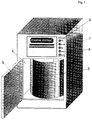
- one of the preferred versions of the apparatus 1 suitable for separately receiving, compacting and storing different categories of solid urban waste in a domestic setting has the dimensions and the external appearance of a washing machine, with a hatch 2 on the upper portion which closes off the opening used for the introduction of the waste; just below this hatch 2, is a door 3 which closes off the compartment 4 where the containers 5 are housed.
- a control panel 6 selection is made of the category of waste to be thrown away.
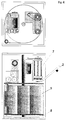
- the interior of the apparatus is divided into two sections which are clearly visible in figures 4, 5 and 6: the upper section 7 houses the devices for the treatment of the waste, while the lower section 8 holds the containers 5 for the treated waste.
- the treatment device which rotates to the position of the insertion hatch 2 is the compactor 9, which consists of a number of rollers 10, three to give an example, arranged in close proximity one to the other and set in rotation by a motor, preferably electric; these rollers crush the plastic waste in question, for instance a bottle, between them, all the while pushing it in a forward direction.
- the rollers 10 can also be designed with teeth or protuberances which facilitate the crushing of the plastic containers by enhancing the evacuation of any air trapped inside of them; the plastic container, having been reduced in volume, then falls into the underlying basket 12, which collects only plastic; as an alternative, or as a supplement, to the treatment described above for plastic waste, air heated to an extremely high temperature can be used in order to reduce the volume of the object; a procedure similar to the one described for plastic is employed in the treatment of glass, which is ground up and then collected in the basket meant for that category.
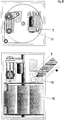
- the preliminary treatment involves pressing by the device 13 presented in figure 5, which is shown at the termination of the pressing operation; the press, driven by a motor 14, preferably electric, which is connected to the press itself by a set of belts, operates by moving the plate 16 along the worm screw 15 until the waste to be disposed of has been totally compressed; at the end of the compression process, the press assumes an inclined position, as shown in figure 5, in such a way that the compressed waste can fall into the proper container below.
- the operation of the apparatus is extremely simple for the user, who, before introducing any waste into the apparatus, simply pushes one of the buttons on the control panel 6, specifying the type of waste to be thrown away, at which point both the treatment device and the storage basket for that category of waste are rotated into place and the hatch 2 for the introduction of the waste - which otherwise remains closed air-tight so that no odors can leak out of the machine, thanks in part to a special exhaust assembly as well - is opened.
- the apparatus confirms, by analyzing the electrical conductivity and the paramagnetic and thermal characteristics of the waste products, as well as their hardness, whether the correct category has been selected on the control panel (this feature proves particular useful in the treatment of products with similar characteristics, such as iron and aluminum, which could possibly be confused); following confirmation of the product category, the hatch 2 goes back to the closed position, and the apparatus automatically, and in a fully autonomous fashion, treats the waste and throws it into the basket corresponding to its category. When one or more of the baskets are full, a signal light alerts the user.
Landscapes
- Engineering & Computer Science (AREA)
- Mechanical Engineering (AREA)
- Processing Of Solid Wastes (AREA)
- Refuse Collection And Transfer (AREA)
Description
- It is common knowledge that elevated standards of living and growing levels of consumption, combined with the subsequent growth in the volume of refuse, represent a critically important problem in modern society.
- Large cities, and by now small cities and towns as well, must deal with the problem od solid urban waste under emergency conditions in which the capacity of disposal sites is rapidly exhausted, incinerators are closed down on account of being undesired or inadequate, and it becomes increasingly difficult to find locations where new refuse-disposal facilities are accepted. In addition, there are the difficulties involved in calculating the expense of treating waste, which, at present, is transported from one part of the country to be other at increasingly higher costs.
- It is obvious, therefore, that the problem must be faced and resolved by reducing the quantity of waste to be sent to the disposal sites.
- This invention relates to an apparatus for separately receiving, compacting and storing different categories of solid urban waste.
- German utility model DE 92 16 358 U describes a device, according to the preamble of
claim 1, for processing and filling waste containers, wherein domestic and industrial waste may be introduced and stored or partially treated; the above mentioned patent provides for various containers wherein the waste is introduced, according to separately collected ractions, and may then be compressed or crushed by means of a handle. This apparatus however, altough it undoubtely represents a step forward, relies totally on the discretion of the user, with regard to the selection and checking of the waste separately introduced into the containers, with no automatic checking and treatment devices, which would make the use of such an apparatus much easier. The object of the present invention is to remedy this shortcoming by means of an apparatus as defined byclaim 1. Such apparatus is provided with automatic devices for treating the waste, after it has been divided into separately collected fractions, by means of a specific control panel, and capable of automatically checking the correspondence between the type of waste selected on the control panel and the waste actually introduced into the apparatus, after the selection operation and before the treatment process begins. - The external appearance of the apparatus dealt with in the present invention may resemble that of a normal home appliance which can be placed inside a normal kitchen; the interior of the apparatus is subdivided into two zones: one for the insertion and compacting of the products to be disposed of, the other for the separate storage of the different types of waste.
- A control panel is located on a portion of the apparatus which is easy to reach and well in sight; before proceeding with the introduction of the waste, the buttons on this panel are used to select the category of refuse to be disposed of, for example: glass, aluminum, plastic, etc..
- The selection of the category of refuse on the external control panel activates, inside the machine, the rotation and positioning of the appropriate device for the pulverization and compacting of that category of waste, lining it up with the insertion hatch, and, depending on the type of object being disposed of, the simultaneous rotation and positioning of the collection basket meant to hold only that type of waste product. The in-put on the control panel of the type of waste being disposed of also may lead to the automatic opening of the hatch to the loading zone.
- By analyzing one or more properties such as the electrical conductivity of the object being disposed of, or its paramagnetic and/or thermal characteristics, or its hardness, the machine confirms that the object inserted actually falls under the category selected.
- The apparatus then initiates the treatment contemplated for that type of material, after which the treated material itself is deposited in the basket set aside for its category, located in the lower portion of the machine.
- An electronic display, or a similar monitoring and alert device, may signal when the baskets are full.
- A more in-depth understanding of the features briefly described in the preceding paragraphs can be gained through the detailed description which follows, provided with reference to the enclosed diagrams:
- Figure 1 provides a frontal view of a preferred design of the apparatus dealt with in the present invention, showing the door of the space where the collection baskets are housed in its open position.
- Figure 2 provides a frontal view of the apparatus, showing one of the collection baskets in a partially extracted position.
- Figure 3 shows the apparatus with all of the collection baskets extracted.
- Figure 4 provides a top and side view of the devices for the treatment of the waste.
- Figure 5 provides a top and side view of the devices for treating the waste, showing the compactor in the inclined position designed for expulsion of the treated object.
- Figure 6 provides a top and side view of the device for treating plastic waste, shown at the beginning of its cycle.
- Figure 7 provides a top and side view of the device for treating plastic waste, shown in operation.
-
- With regard to the aforementioned diagrams, one of the preferred versions of the
apparatus 1 suitable for separately receiving, compacting and storing different categories of solid urban waste in a domestic setting, as stipulated in the present invention, has the dimensions and the external appearance of a washing machine, with ahatch 2 on the upper portion which closes off the opening used for the introduction of the waste; just below thishatch 2, is adoor 3 which closes off thecompartment 4 where thecontainers 5 are housed. Using acontrol panel 6, selection is made of the category of waste to be thrown away. - The interior of the apparatus is divided into two sections which are clearly visible in figures 4, 5 and 6: the
upper section 7 houses the devices for the treatment of the waste, while thelower section 8 holds thecontainers 5 for the treated waste. - There are different treatment devices for the different categories of refuse. In the device for the treatment of organic materials, a drying phase is followed by a stage in which the material is pulverized using the appropriate machinery and then allowed to drop into the appropriate container below. When the user has selected the category of plastic waste, then the treatment device which rotates to the position of the
insertion hatch 2 is thecompactor 9, which consists of a number ofrollers 10, three to give an example, arranged in close proximity one to the other and set in rotation by a motor, preferably electric; these rollers crush the plastic waste in question, for instance a bottle, between them, all the while pushing it in a forward direction. Therollers 10 can also be designed with teeth or protuberances which facilitate the crushing of the plastic containers by enhancing the evacuation of any air trapped inside of them; the plastic container, having been reduced in volume, then falls into theunderlying basket 12, which collects only plastic; as an alternative, or as a supplement, to the treatment described above for plastic waste, air heated to an extremely high temperature can be used in order to reduce the volume of the object; a procedure similar to the one described for plastic is employed in the treatment of glass, which is ground up and then collected in the basket meant for that category. In the case of metal waste, the preliminary treatment involves pressing by thedevice 13 presented in figure 5, which is shown at the termination of the pressing operation; the press, driven by amotor 14, preferably electric, which is connected to the press itself by a set of belts, operates by moving theplate 16 along theworm screw 15 until the waste to be disposed of has been totally compressed; at the end of the compression process, the press assumes an inclined position, as shown in figure 5, in such a way that the compressed waste can fall into the proper container below. - The operation of the apparatus is extremely simple for the user, who, before introducing any waste into the apparatus, simply pushes one of the buttons on the
control panel 6, specifying the type of waste to be thrown away, at which point both the treatment device and the storage basket for that category of waste are rotated into place and thehatch 2 for the introduction of the waste - which otherwise remains closed air-tight so that no odors can leak out of the machine, thanks in part to a special exhaust assembly as well - is opened. - Following the opening of the
hatch 2, the apparatus confirms, by analyzing the electrical conductivity and the paramagnetic and thermal characteristics of the waste products, as well as their hardness, whether the correct category has been selected on the control panel (this feature proves particular useful in the treatment of products with similar characteristics, such as iron and aluminum, which could possibly be confused); following confirmation of the product category, thehatch 2 goes back to the closed position, and the apparatus automatically, and in a fully autonomous fashion, treats the waste and throws it into the basket corresponding to its category. When one or more of the baskets are full, a signal light alerts the user. - Based on what has been described and illustrated in the preceding paragraphs, it is clear that the machine dealt with in the present invention fully succeeds in meeting its proposed objective, meaning the elimination at the source of the problem of the formation of multi-material solid urban waste, making it possible to store all types of refuse in distinct categories and in compacted form by means of a apparatus which is both easy to use and safe, and whose maintenance and operating costs are extremely limited.
- It is readily evident that the specific apparatus which has been described and illustrated represents a preferred design which can be subjected to whatever variations within the scope of the invention as defined by
claim 1 should become necessary for its actual operation, or for specific uses, as in the case of apparatuses created for establishments open to the public, for offices, etc..
Claims (4)
- An apparatus for separately receiving, compacting and storing different categories of solid urban waste at home, comprising:an upper section (7) having a hatch (2) through which the waste is introduced and a plurality of waste-treament devices (9,13) where the waste is compacted;a lower section (8) housing a plurality of containers (5) for separate fractions of solid waste;means for positioning each container (5) underneath a corresponding waste-treatment device; anda control panel (6) having separate buttons for each kind of waste to be collected for activating the positioning means of the containers (5) so that the appropriate container is positioned underneath the corresponding waste-treatment device;
characterized in that:said waste-treatment devices (9,13) are installed on a rotating platform having positioning means for moving and aligning each waste-treatment device with the hatch (2); in thatthe control panel buttons also activate said positioning means of the waste-treatment devices (9,13) so that the appropriate waste-treatment device is lined up with the insertion hatch; and in thatthe apparatus further comprises: a) means for analyzing one or more properties of the waste to be disposed of; b) means for checking that the type of waste selected on the control panel (6) corresponds with the results of the analysis; and d) means for blocking the waste-treatment process in the event that the selected type of waste does not correspond with the analysis results. - An apparatus designed according to the preceding claim, including a waste-treatment device for organic materials; the first phase in the operation of this device involves the drying of the waste material, following which the material is ground up with the proper equipment and left to fall into the appropriate basket below;
- An apparatus designed according to the preceding claims, distinguished by the fact that it includes a device for the treatment of plastic waste and similar materials, consisting of a compactor 9 whose components include a number of rollers, three for example, arranged in close proximity to one another and set in rotation by a motor, preferably electrical, in such a way as to crush, while pushing in a forward direction, the product to be treated; the rollers 10 can be equipped with teeth or protuberances which facilitate the crushing of the plastic containers inserted between them, allowing whatever air has been trapped inside the containers to be expelled; at the end of the treatment, the waste product falls into the proper storage basket.
- An apparatus designed according to the preceding claims, characterized by the fact that it includes a device for the treatment of metals, with this device consisting of a press driven by a motor 14, preferably electric, which is connected to the press by appropriate belts; the motor moves the plate 16 along the worm screw 15 until the waste to be disposed of has been fully compressed; at the end of the compression process, the entire press shifts to an inclined position so that the compressed waste can fall into the proper container below.
Applications Claiming Priority (2)
| Application Number | Priority Date | Filing Date | Title |
|---|---|---|---|
| IT000364 IT1272266B (en) | 1994-06-10 | 1994-06-10 | EQUIPMENT SUITABLE FOR WELCOMING COMPACT AND STORAGE SOLID URBAN WASTE SEPARATELY IN THE DOMESTIC AREA. |
| ITRM940364 | 1994-06-10 |
Publications (3)
| Publication Number | Publication Date |
|---|---|
| EP0686579A2 EP0686579A2 (en) | 1995-12-13 |
| EP0686579A3 EP0686579A3 (en) | 1996-02-28 |
| EP0686579B1 true EP0686579B1 (en) | 1999-04-07 |
Family
ID=11402587
Family Applications (1)
| Application Number | Title | Priority Date | Filing Date |
|---|---|---|---|
| EP19950830242 Expired - Lifetime EP0686579B1 (en) | 1994-06-10 | 1995-06-09 | Apparatus suitable for separately receiving, compacting and storing solid urban waste |
Country Status (4)
| Country | Link |
|---|---|
| EP (1) | EP0686579B1 (en) |
| DE (1) | DE69508844T2 (en) |
| ES (1) | ES2133704T3 (en) |
| IT (1) | IT1272266B (en) |
Cited By (1)
| Publication number | Priority date | Publication date | Assignee | Title |
|---|---|---|---|---|
| EP3950293A1 (en) | 2020-08-03 | 2022-02-09 | Daniel Hölle | Device for drawing and compacting solid and elastic materials |
Families Citing this family (20)
| Publication number | Priority date | Publication date | Assignee | Title |
|---|---|---|---|---|
| FR2749284B1 (en) * | 1996-06-04 | 1998-09-11 | Charmetant Jean Michel | INTEGRATED HOUSEHOLD APPLIANCE UNDER WORKTOP FOR SELECTIVE WASTE STORAGE WITH VOLUME REDUCER |
| DE19634038A1 (en) * | 1996-08-23 | 1998-02-26 | Peter Dipl Ing Aka | Recycling system for domestic rubbish |
| AU7446698A (en) * | 1997-06-10 | 1998-12-30 | Demil S.R.L. | Apparatus for collecting and compacting recyclable waste |
| WO1999064327A1 (en) * | 1998-06-10 | 1999-12-16 | Ingenieria, Diseño Y Analisis, S.L. | Waste processing apparatus |
| ES2291055B1 (en) * | 2003-12-17 | 2009-03-16 | Joaquin Jose Corral Moreno | SYSTEM FOR THE RECOVERY OF WASTE. |
| ITPS20090013A1 (en) * | 2009-05-22 | 2010-11-23 | Bruna Cimarossa | "ANANKE" ELECTRIC BOTTLE RACK |
| PT104932A (en) * | 2010-01-05 | 2011-07-05 | Carlos Manuel Cardoso De Figueiredo Ministro | PROCESS AND MACHINE FOR UNIVERSAL SEPARATION, TREATMENT AND CONTAINMENT OF URBAN, RECYCLABLE AND INDIFFERENTIAL SOLID WASTE, DOMESTIC OR INDUSTRIAL |
| WO2012044143A1 (en) * | 2010-09-27 | 2012-04-05 | Morfin Lopez Alfredo | Container for temporarily storing objects and for facilitating the removal thereof |
| ITFI20110047A1 (en) * | 2011-03-30 | 2012-10-01 | Mp Costruzioni & Restauri S R L | WASTE TREATMENT DEVICE |
| ITCS20110031A1 (en) * | 2011-10-18 | 2012-01-17 | Gianfranco Cioni | IDENTIFICATION, REDUCTION AND DISPOSAL SYSTEM FOR URBAN SOLID WASTE |
| SI23945A (en) * | 2011-12-15 | 2013-06-28 | Janko Cerar | Process and equipment for controlled urban waste collection and separation |
| EP2764988B1 (en) * | 2013-02-08 | 2015-09-16 | Bruna Cimarossa | A device for compaction and selective disposal of liquid containers, and small-sized plastic, cardboard or metal packaging |
| ITFI20130218A1 (en) * | 2013-09-18 | 2015-03-19 | Da Silva Fernando Gomes | A UNIT OF COLLECTION OF DIFFERENTIATED WASTE OF DOMESTIC TYPE |
| ES2530761B1 (en) * | 2014-09-26 | 2016-07-22 | Diseño Y Construcción De Maquinaria Automatizada, S.L. | Equipment for separation and treatment of household waste |
| WO2016113662A1 (en) * | 2015-01-12 | 2016-07-21 | Graf S.P.A. | Household appliance for the treatment of household waste |
| BR102015009605B1 (en) * | 2015-04-28 | 2022-06-07 | Nacere Antonio Abib | Household waste processing and conditioning machine |
| IT201700048860A1 (en) * | 2017-05-05 | 2018-11-05 | Alessandro Guccini | Device for treatment and separate collection of waste |
| IT201900001039A1 (en) * | 2019-01-24 | 2020-07-24 | Repod S R L | EQUIPMENT FOR THE SEPARATE WASTE COLLECTION |
| AT523084B1 (en) * | 2019-11-07 | 2021-06-15 | Headplanet Produktforschung & Entw E U | Device for shredding waste |
| CN113230067B (en) * | 2021-04-29 | 2022-11-18 | 宿州市久协医药信息咨询有限公司 | Dispensing cart for pediatrics department |
Family Cites Families (8)
| Publication number | Priority date | Publication date | Assignee | Title |
|---|---|---|---|---|
| AU7325291A (en) * | 1990-02-20 | 1991-09-18 | Pryde Foundation | Domestic waste processor |
| US5257577A (en) * | 1991-04-01 | 1993-11-02 | Clark Melvin D | Apparatus for assist in recycling of refuse |
| FR2691384A1 (en) * | 1992-05-19 | 1993-11-26 | Tallet Gerard | Individual and collective sorting equipment for household rubbish - uses compartmented motorised kitchen carousel to receive categorised rubbish, later dispatched to communal carousel for collection. |
| SE9202726D0 (en) * | 1992-09-22 | 1992-09-22 | Kaj Mickos | PROCESS TECHNOLOGY FOR ORGANIC WASTE PRODUCTS MM |
| EP0600808A1 (en) * | 1992-11-30 | 1994-06-08 | Sarl ROUGEMONT-BARBIER | Device for sorting, crushing and conditioning waste |
| DE9216358U1 (en) * | 1992-12-02 | 1993-02-11 | Augustin, Kathrin, O-8020 Dresden | Processing and filling facility |
| DE4241123A1 (en) * | 1992-12-07 | 1994-06-09 | Stahl Und Apparatebau Gmbh Gen | Mechanised handling system for domestic waste handling - has communal system with carousel of waste bins with card identification access and weighing system |
| DE4321784A1 (en) * | 1993-06-30 | 1995-01-12 | Martin Dengler | Waste collection device with at least one insertion opening for disposing of domestic waste such as boxes, tins, plastic material, glassware, bottles, compost waste or the like |
-
1994
- 1994-06-10 IT IT000364 patent/IT1272266B/en active IP Right Grant
-
1995
- 1995-06-09 EP EP19950830242 patent/EP0686579B1/en not_active Expired - Lifetime
- 1995-06-09 ES ES95830242T patent/ES2133704T3/en not_active Expired - Lifetime
- 1995-06-09 DE DE69508844T patent/DE69508844T2/en not_active Expired - Fee Related
Cited By (1)
| Publication number | Priority date | Publication date | Assignee | Title |
|---|---|---|---|---|
| EP3950293A1 (en) | 2020-08-03 | 2022-02-09 | Daniel Hölle | Device for drawing and compacting solid and elastic materials |
Also Published As
| Publication number | Publication date |
|---|---|
| DE69508844D1 (en) | 1999-05-12 |
| ITRM940364A0 (en) | 1994-06-10 |
| IT1272266B (en) | 1997-06-16 |
| EP0686579A3 (en) | 1996-02-28 |
| EP0686579A2 (en) | 1995-12-13 |
| ITRM940364A1 (en) | 1995-12-10 |
| DE69508844T2 (en) | 1999-12-30 |
| ES2133704T3 (en) | 1999-09-16 |
Similar Documents
| Publication | Publication Date | Title |
|---|---|---|
| EP0686579B1 (en) | Apparatus suitable for separately receiving, compacting and storing solid urban waste | |
| US7625195B2 (en) | Device and process for processing organic waste | |
| US5259304A (en) | Carousel compactor for multi-component refuse | |
| US4706560A (en) | Refuse treatment apparatus | |
| US3353478A (en) | Waste collecting and compacting unit | |
| JP5536307B2 (en) | Apparatus, system and method for compressing, sorting and storing recyclable materials | |
| EP0469122B1 (en) | Domestic waste processor | |
| WO1993000995A1 (en) | Segregated waste disposal system | |
| US4996918A (en) | Solid waste compactor with multiple receptacles | |
| CN107138501A (en) | A kind of food and drink waste plastic refuse disposal installation | |
| US5123341A (en) | Solid waste compactor with multiple receptacles | |
| KR101222877B1 (en) | Food waste treatment equipment | |
| US5119722A (en) | Solid waste compactor with multiple receptacles | |
| US3807296A (en) | Apparatus for removing waste material | |
| WO2003051620A1 (en) | Compacting machine for the separate collection of rubbish | |
| CN102770357B (en) | Garbage disposer | |
| CN212607178U (en) | A garbage sorting device for kitchen, cans and other garbage with high water content | |
| KR101584274B1 (en) | Oven locking device for quantity and weight loss of food garbage container | |
| KR100349248B1 (en) | Compacting & Banding Machine for Recycle or Waste Matter | |
| CN213736899U (en) | Compression device for garbage classification box | |
| KR200208465Y1 (en) | Compacting & Banding Machine for Recycle or Waste Matter | |
| KR200194554Y1 (en) | Refinement of food garbage | |
| DE29917059U1 (en) | Conveying and shredding system for kitchen waste | |
| Vega | Household Separating Compactor | |
| KR100694304B1 (en) | Food waste crusher that is completely dried and ground by heat-generating electromagnetic waves. |
Legal Events
| Date | Code | Title | Description |
|---|---|---|---|
| PUAI | Public reference made under article 153(3) epc to a published international application that has entered the european phase |
Free format text: ORIGINAL CODE: 0009012 |
|
| AK | Designated contracting states |
Kind code of ref document: A2 Designated state(s): DE ES FR GB |
|
| PUAL | Search report despatched |
Free format text: ORIGINAL CODE: 0009013 |
|
| AK | Designated contracting states |
Kind code of ref document: A3 Designated state(s): DE ES FR GB |
|
| 17P | Request for examination filed |
Effective date: 19960829 |
|
| 17Q | First examination report despatched |
Effective date: 19970731 |
|
| GRAG | Despatch of communication of intention to grant |
Free format text: ORIGINAL CODE: EPIDOS AGRA |
|
| GRAG | Despatch of communication of intention to grant |
Free format text: ORIGINAL CODE: EPIDOS AGRA |
|
| GRAH | Despatch of communication of intention to grant a patent |
Free format text: ORIGINAL CODE: EPIDOS IGRA |
|
| GRAH | Despatch of communication of intention to grant a patent |
Free format text: ORIGINAL CODE: EPIDOS IGRA |
|
| GRAA | (expected) grant |
Free format text: ORIGINAL CODE: 0009210 |
|
| AK | Designated contracting states |
Kind code of ref document: B1 Designated state(s): DE ES FR GB |
|
| REF | Corresponds to: |
Ref document number: 69508844 Country of ref document: DE Date of ref document: 19990512 |
|
| ET | Fr: translation filed | ||
| REG | Reference to a national code |
Ref country code: ES Ref legal event code: FG2A Ref document number: 2133704 Country of ref document: ES Kind code of ref document: T3 |
|
| PLBE | No opposition filed within time limit |
Free format text: ORIGINAL CODE: 0009261 |
|
| STAA | Information on the status of an ep patent application or granted ep patent |
Free format text: STATUS: NO OPPOSITION FILED WITHIN TIME LIMIT |
|
| 26N | No opposition filed | ||
| REG | Reference to a national code |
Ref country code: GB Ref legal event code: IF02 |
|
| PGFP | Annual fee paid to national office [announced via postgrant information from national office to epo] |
Ref country code: ES Payment date: 20050726 Year of fee payment: 11 |
|
| PGFP | Annual fee paid to national office [announced via postgrant information from national office to epo] |
Ref country code: FR Payment date: 20060629 Year of fee payment: 12 |
|
| PGFP | Annual fee paid to national office [announced via postgrant information from national office to epo] |
Ref country code: DE Payment date: 20060630 Year of fee payment: 12 |
|
| PGFP | Annual fee paid to national office [announced via postgrant information from national office to epo] |
Ref country code: GB Payment date: 20060727 Year of fee payment: 12 |
|
| GBPC | Gb: european patent ceased through non-payment of renewal fee |
Effective date: 20070609 |
|
| REG | Reference to a national code |
Ref country code: FR Ref legal event code: ST Effective date: 20080229 |
|
| PG25 | Lapsed in a contracting state [announced via postgrant information from national office to epo] |
Ref country code: DE Free format text: LAPSE BECAUSE OF NON-PAYMENT OF DUE FEES Effective date: 20080101 |
|
| PG25 | Lapsed in a contracting state [announced via postgrant information from national office to epo] |
Ref country code: GB Free format text: LAPSE BECAUSE OF NON-PAYMENT OF DUE FEES Effective date: 20070609 |
|
| REG | Reference to a national code |
Ref country code: ES Ref legal event code: FD2A Effective date: 20070611 |
|
| PG25 | Lapsed in a contracting state [announced via postgrant information from national office to epo] |
Ref country code: FR Free format text: LAPSE BECAUSE OF NON-PAYMENT OF DUE FEES Effective date: 20070702 |
|
| PG25 | Lapsed in a contracting state [announced via postgrant information from national office to epo] |
Ref country code: ES Free format text: LAPSE BECAUSE OF NON-PAYMENT OF DUE FEES Effective date: 20070611 |