EP0680531B1 - Method for the recovery of energy and chemicals from cellulose spent liquors - Google Patents
Method for the recovery of energy and chemicals from cellulose spent liquors Download PDFInfo
- Publication number
- EP0680531B1 EP0680531B1 EP94905888A EP94905888A EP0680531B1 EP 0680531 B1 EP0680531 B1 EP 0680531B1 EP 94905888 A EP94905888 A EP 94905888A EP 94905888 A EP94905888 A EP 94905888A EP 0680531 B1 EP0680531 B1 EP 0680531B1
- Authority
- EP
- European Patent Office
- Prior art keywords
- reactor
- potassium
- cooking liquor
- withdrawn
- compounds
- Prior art date
- Legal status (The legal status is an assumption and is not a legal conclusion. Google has not performed a legal analysis and makes no representation as to the accuracy of the status listed.)
- Expired - Lifetime
Links
- 238000000034 method Methods 0.000 title claims abstract description 43
- 238000011084 recovery Methods 0.000 title claims abstract description 34
- 239000000126 substance Substances 0.000 title claims abstract description 25
- 239000001913 cellulose Substances 0.000 title claims abstract description 11
- 229920002678 cellulose Polymers 0.000 title claims abstract description 11
- ZLMJMSJWJFRBEC-UHFFFAOYSA-N Potassium Chemical compound [K] ZLMJMSJWJFRBEC-UHFFFAOYSA-N 0.000 claims abstract description 50
- 229910052700 potassium Inorganic materials 0.000 claims abstract description 50
- 239000011591 potassium Substances 0.000 claims abstract description 50
- 239000007789 gas Substances 0.000 claims abstract description 31
- 238000010411 cooking Methods 0.000 claims abstract description 29
- 239000011734 sodium Substances 0.000 claims abstract description 26
- DGAQECJNVWCQMB-PUAWFVPOSA-M Ilexoside XXIX Chemical compound C[C@@H]1CC[C@@]2(CC[C@@]3(C(=CC[C@H]4[C@]3(CC[C@@H]5[C@@]4(CC[C@@H](C5(C)C)OS(=O)(=O)[O-])C)C)[C@@H]2[C@]1(C)O)C)C(=O)O[C@H]6[C@@H]([C@H]([C@@H]([C@H](O6)CO)O)O)O.[Na+] DGAQECJNVWCQMB-PUAWFVPOSA-M 0.000 claims abstract description 19
- 229910052708 sodium Inorganic materials 0.000 claims abstract description 19
- 239000007788 liquid Substances 0.000 claims abstract description 15
- 230000003647 oxidation Effects 0.000 claims abstract description 15
- 238000007254 oxidation reaction Methods 0.000 claims abstract description 15
- 238000004519 manufacturing process Methods 0.000 claims abstract description 13
- 239000000463 material Substances 0.000 claims abstract description 8
- 150000001339 alkali metal compounds Chemical class 0.000 claims abstract description 7
- QVGXLLKOCUKJST-UHFFFAOYSA-N atomic oxygen Chemical compound [O] QVGXLLKOCUKJST-UHFFFAOYSA-N 0.000 claims abstract description 7
- 229910052760 oxygen Inorganic materials 0.000 claims abstract description 7
- 239000001301 oxygen Substances 0.000 claims abstract description 7
- 230000015572 biosynthetic process Effects 0.000 claims abstract description 6
- 239000007787 solid Substances 0.000 claims abstract description 5
- 239000003513 alkali Substances 0.000 claims abstract description 4
- 150000003388 sodium compounds Chemical class 0.000 claims abstract description 3
- 239000011343 solid material Substances 0.000 claims abstract description 3
- VEXZGXHMUGYJMC-UHFFFAOYSA-M Chloride anion Chemical compound [Cl-] VEXZGXHMUGYJMC-UHFFFAOYSA-M 0.000 claims description 9
- NINIDFKCEFEMDL-UHFFFAOYSA-N Sulfur Chemical class [S] NINIDFKCEFEMDL-UHFFFAOYSA-N 0.000 claims description 9
- 238000001704 evaporation Methods 0.000 claims description 6
- 230000008020 evaporation Effects 0.000 claims description 6
- GRVFOGOEDUUMBP-UHFFFAOYSA-N sodium sulfide (anhydrous) Chemical compound [Na+].[Na+].[S-2] GRVFOGOEDUUMBP-UHFFFAOYSA-N 0.000 claims description 6
- 239000005864 Sulphur Substances 0.000 claims description 4
- 229910044991 metal oxide Inorganic materials 0.000 claims description 3
- 150000004706 metal oxides Chemical class 0.000 claims description 3
- DPLVEEXVKBWGHE-UHFFFAOYSA-N potassium sulfide Chemical compound [S-2].[K+].[K+] DPLVEEXVKBWGHE-UHFFFAOYSA-N 0.000 claims description 3
- 229910052979 sodium sulfide Inorganic materials 0.000 claims description 3
- RTAQQCXQSZGOHL-UHFFFAOYSA-N Titanium Chemical compound [Ti] RTAQQCXQSZGOHL-UHFFFAOYSA-N 0.000 claims description 2
- 229910052783 alkali metal Inorganic materials 0.000 claims description 2
- 238000002425 crystallisation Methods 0.000 claims description 2
- 230000008025 crystallization Effects 0.000 claims description 2
- 239000012535 impurity Substances 0.000 claims description 2
- 238000002386 leaching Methods 0.000 claims description 2
- LSNNMFCWUKXFEE-UHFFFAOYSA-L sulfite Chemical compound [O-]S([O-])=O LSNNMFCWUKXFEE-UHFFFAOYSA-L 0.000 claims description 2
- 229910052719 titanium Inorganic materials 0.000 claims description 2
- 239000010936 titanium Substances 0.000 claims description 2
- 150000008044 alkali metal hydroxides Chemical class 0.000 claims 2
- 239000000110 cooling liquid Substances 0.000 claims 2
- OYPRJOBELJOOCE-UHFFFAOYSA-N Calcium Chemical compound [Ca] OYPRJOBELJOOCE-UHFFFAOYSA-N 0.000 claims 1
- RWSOTUBLDIXVET-UHFFFAOYSA-N Dihydrogen sulfide Chemical compound S RWSOTUBLDIXVET-UHFFFAOYSA-N 0.000 claims 1
- FYYHWMGAXLPEAU-UHFFFAOYSA-N Magnesium Chemical compound [Mg] FYYHWMGAXLPEAU-UHFFFAOYSA-N 0.000 claims 1
- 229910001854 alkali hydroxide Inorganic materials 0.000 claims 1
- 229910000288 alkali metal carbonate Inorganic materials 0.000 claims 1
- 150000008041 alkali metal carbonates Chemical class 0.000 claims 1
- -1 alkali metal hydrogen sulphides Chemical class 0.000 claims 1
- 239000011575 calcium Substances 0.000 claims 1
- 229910052791 calcium Inorganic materials 0.000 claims 1
- 239000000567 combustion gas Substances 0.000 claims 1
- 150000001875 compounds Chemical class 0.000 claims 1
- 239000011777 magnesium Substances 0.000 claims 1
- 229910052749 magnesium Inorganic materials 0.000 claims 1
- WPBNNNQJVZRUHP-UHFFFAOYSA-L manganese(2+);methyl n-[[2-(methoxycarbonylcarbamothioylamino)phenyl]carbamothioyl]carbamate;n-[2-(sulfidocarbothioylamino)ethyl]carbamodithioate Chemical compound [Mn+2].[S-]C(=S)NCCNC([S-])=S.COC(=O)NC(=S)NC1=CC=CC=C1NC(=S)NC(=O)OC WPBNNNQJVZRUHP-UHFFFAOYSA-L 0.000 claims 1
- 150000003467 sulfuric acid derivatives Chemical class 0.000 claims 1
- 238000004061 bleaching Methods 0.000 description 14
- BWHMMNNQKKPAPP-UHFFFAOYSA-L potassium carbonate Chemical compound [K+].[K+].[O-]C([O-])=O BWHMMNNQKKPAPP-UHFFFAOYSA-L 0.000 description 13
- 238000002309 gasification Methods 0.000 description 12
- 238000002485 combustion reaction Methods 0.000 description 8
- WCUXLLCKKVVCTQ-UHFFFAOYSA-M Potassium chloride Chemical compound [Cl-].[K+] WCUXLLCKKVVCTQ-UHFFFAOYSA-M 0.000 description 7
- 241001062472 Stokellia anisodon Species 0.000 description 7
- 229910000027 potassium carbonate Inorganic materials 0.000 description 7
- 239000002994 raw material Substances 0.000 description 7
- 239000002023 wood Substances 0.000 description 7
- OKTJSMMVPCPJKN-UHFFFAOYSA-N Carbon Chemical compound [C] OKTJSMMVPCPJKN-UHFFFAOYSA-N 0.000 description 6
- CURLTUGMZLYLDI-UHFFFAOYSA-N Carbon dioxide Chemical compound O=C=O CURLTUGMZLYLDI-UHFFFAOYSA-N 0.000 description 6
- KWYUFKZDYYNOTN-UHFFFAOYSA-M Potassium hydroxide Chemical compound [OH-].[K+] KWYUFKZDYYNOTN-UHFFFAOYSA-M 0.000 description 6
- 229910052799 carbon Inorganic materials 0.000 description 6
- 239000002655 kraft paper Substances 0.000 description 6
- 150000003112 potassium compounds Chemical class 0.000 description 6
- 230000003197 catalytic effect Effects 0.000 description 5
- XLYOFNOQVPJJNP-UHFFFAOYSA-N water Substances O XLYOFNOQVPJJNP-UHFFFAOYSA-N 0.000 description 5
- CDBYLPFSWZWCQE-UHFFFAOYSA-L Sodium Carbonate Chemical compound [Na+].[Na+].[O-]C([O-])=O CDBYLPFSWZWCQE-UHFFFAOYSA-L 0.000 description 4
- 238000006243 chemical reaction Methods 0.000 description 4
- 230000007797 corrosion Effects 0.000 description 4
- 238000005260 corrosion Methods 0.000 description 4
- 239000001103 potassium chloride Substances 0.000 description 4
- 235000011164 potassium chloride Nutrition 0.000 description 4
- BVKZGUZCCUSVTD-UHFFFAOYSA-L Carbonate Chemical compound [O-]C([O-])=O BVKZGUZCCUSVTD-UHFFFAOYSA-L 0.000 description 3
- ZAMOUSCENKQFHK-UHFFFAOYSA-N Chlorine atom Chemical compound [Cl] ZAMOUSCENKQFHK-UHFFFAOYSA-N 0.000 description 3
- 239000001569 carbon dioxide Substances 0.000 description 3
- 229910002092 carbon dioxide Inorganic materials 0.000 description 3
- 239000000460 chlorine Substances 0.000 description 3
- 229910052801 chlorine Inorganic materials 0.000 description 3
- 150000001805 chlorine compounds Chemical class 0.000 description 3
- 230000004927 fusion Effects 0.000 description 3
- 229920001131 Pulp (paper) Polymers 0.000 description 2
- 239000000443 aerosol Substances 0.000 description 2
- 230000000740 bleeding effect Effects 0.000 description 2
- 239000003054 catalyst Substances 0.000 description 2
- OSVXSBDYLRYLIG-UHFFFAOYSA-N dioxidochlorine(.) Chemical compound O=Cl=O OSVXSBDYLRYLIG-UHFFFAOYSA-N 0.000 description 2
- 239000000428 dust Substances 0.000 description 2
- 230000000694 effects Effects 0.000 description 2
- 238000005516 engineering process Methods 0.000 description 2
- 230000007613 environmental effect Effects 0.000 description 2
- 239000000446 fuel Substances 0.000 description 2
- 210000003734 kidney Anatomy 0.000 description 2
- 239000000203 mixture Substances 0.000 description 2
- 230000001590 oxidative effect Effects 0.000 description 2
- 159000000001 potassium salts Chemical class 0.000 description 2
- 229910000029 sodium carbonate Inorganic materials 0.000 description 2
- 239000000725 suspension Substances 0.000 description 2
- 238000005406 washing Methods 0.000 description 2
- UGFAIRIUMAVXCW-UHFFFAOYSA-N Carbon monoxide Chemical compound [O+]#[C-] UGFAIRIUMAVXCW-UHFFFAOYSA-N 0.000 description 1
- 239000004155 Chlorine dioxide Substances 0.000 description 1
- MYMOFIZGZYHOMD-UHFFFAOYSA-N Dioxygen Chemical compound O=O MYMOFIZGZYHOMD-UHFFFAOYSA-N 0.000 description 1
- CBENFWSGALASAD-UHFFFAOYSA-N Ozone Chemical compound [O-][O+]=O CBENFWSGALASAD-UHFFFAOYSA-N 0.000 description 1
- UCKMPCXJQFINFW-UHFFFAOYSA-N Sulphide Chemical compound [S-2] UCKMPCXJQFINFW-UHFFFAOYSA-N 0.000 description 1
- 239000000654 additive Substances 0.000 description 1
- 150000001340 alkali metals Chemical class 0.000 description 1
- PYKYMHQGRFAEBM-UHFFFAOYSA-N anthraquinone Natural products CCC(=O)c1c(O)c2C(=O)C3C(C=CC=C3O)C(=O)c2cc1CC(=O)OC PYKYMHQGRFAEBM-UHFFFAOYSA-N 0.000 description 1
- 150000004056 anthraquinones Chemical class 0.000 description 1
- 239000002585 base Substances 0.000 description 1
- 229910002091 carbon monoxide Inorganic materials 0.000 description 1
- 235000019398 chlorine dioxide Nutrition 0.000 description 1
- 239000000470 constituent Substances 0.000 description 1
- 238000001816 cooling Methods 0.000 description 1
- 230000003247 decreasing effect Effects 0.000 description 1
- 238000003795 desorption Methods 0.000 description 1
- 238000004090 dissolution Methods 0.000 description 1
- 230000008030 elimination Effects 0.000 description 1
- 238000003379 elimination reaction Methods 0.000 description 1
- 239000003344 environmental pollutant Substances 0.000 description 1
- 239000000374 eutectic mixture Substances 0.000 description 1
- 238000000605 extraction Methods 0.000 description 1
- 230000002349 favourable effect Effects 0.000 description 1
- 239000010419 fine particle Substances 0.000 description 1
- 239000012530 fluid Substances 0.000 description 1
- 238000010438 heat treatment Methods 0.000 description 1
- 229910001385 heavy metal Inorganic materials 0.000 description 1
- XLYOFNOQVPJJNP-UHFFFAOYSA-M hydroxide Chemical compound [OH-] XLYOFNOQVPJJNP-UHFFFAOYSA-M 0.000 description 1
- 238000009434 installation Methods 0.000 description 1
- 238000011068 loading method Methods 0.000 description 1
- 150000002697 manganese compounds Chemical class 0.000 description 1
- 239000012528 membrane Substances 0.000 description 1
- YJCZGTAEFYFJRJ-UHFFFAOYSA-N n,n,3,5-tetramethyl-1h-pyrazole-4-sulfonamide Chemical compound CN(C)S(=O)(=O)C=1C(C)=NNC=1C YJCZGTAEFYFJRJ-UHFFFAOYSA-N 0.000 description 1
- 150000004045 organic chlorine compounds Chemical class 0.000 description 1
- 150000002894 organic compounds Chemical class 0.000 description 1
- 230000003204 osmotic effect Effects 0.000 description 1
- 239000002245 particle Substances 0.000 description 1
- 150000002978 peroxides Chemical class 0.000 description 1
- 231100000614 poison Toxicity 0.000 description 1
- 231100000719 pollutant Toxicity 0.000 description 1
- 229910052939 potassium sulfate Inorganic materials 0.000 description 1
- 238000010926 purge Methods 0.000 description 1
- 238000000746 purification Methods 0.000 description 1
- 150000003839 salts Chemical class 0.000 description 1
- 159000000000 sodium salts Chemical class 0.000 description 1
- 238000001179 sorption measurement Methods 0.000 description 1
- 229910052717 sulfur Inorganic materials 0.000 description 1
- 239000011593 sulfur Substances 0.000 description 1
- 239000003440 toxic substance Substances 0.000 description 1
Classifications
-
- D—TEXTILES; PAPER
- D21—PAPER-MAKING; PRODUCTION OF CELLULOSE
- D21C—PRODUCTION OF CELLULOSE BY REMOVING NON-CELLULOSE SUBSTANCES FROM CELLULOSE-CONTAINING MATERIALS; REGENERATION OF PULPING LIQUORS; APPARATUS THEREFOR
- D21C11/00—Regeneration of pulp liquors or effluent waste waters
- D21C11/12—Combustion of pulp liquors
- D21C11/125—Decomposition of the pulp liquors in reducing atmosphere or in the absence of oxidants, i.e. gasification or pyrolysis
-
- D—TEXTILES; PAPER
- D21—PAPER-MAKING; PRODUCTION OF CELLULOSE
- D21C—PRODUCTION OF CELLULOSE BY REMOVING NON-CELLULOSE SUBSTANCES FROM CELLULOSE-CONTAINING MATERIALS; REGENERATION OF PULPING LIQUORS; APPARATUS THEREFOR
- D21C11/00—Regeneration of pulp liquors or effluent waste waters
- D21C11/04—Regeneration of pulp liquors or effluent waste waters of alkali lye
-
- D—TEXTILES; PAPER
- D21—PAPER-MAKING; PRODUCTION OF CELLULOSE
- D21C—PRODUCTION OF CELLULOSE BY REMOVING NON-CELLULOSE SUBSTANCES FROM CELLULOSE-CONTAINING MATERIALS; REGENERATION OF PULPING LIQUORS; APPARATUS THEREFOR
- D21C11/00—Regeneration of pulp liquors or effluent waste waters
- D21C11/06—Treatment of pulp gases; Recovery of the heat content of the gases; Treatment of gases arising from various sources in pulp and paper mills; Regeneration of gaseous SO2, e.g. arising from liquors containing sulfur compounds
- D21C11/063—Treatment of gas streams comprising solid matter, e.g. the ashes resulting from the combustion of black liquor
-
- Y—GENERAL TAGGING OF NEW TECHNOLOGICAL DEVELOPMENTS; GENERAL TAGGING OF CROSS-SECTIONAL TECHNOLOGIES SPANNING OVER SEVERAL SECTIONS OF THE IPC; TECHNICAL SUBJECTS COVERED BY FORMER USPC CROSS-REFERENCE ART COLLECTIONS [XRACs] AND DIGESTS
- Y02—TECHNOLOGIES OR APPLICATIONS FOR MITIGATION OR ADAPTATION AGAINST CLIMATE CHANGE
- Y02P—CLIMATE CHANGE MITIGATION TECHNOLOGIES IN THE PRODUCTION OR PROCESSING OF GOODS
- Y02P70/00—Climate change mitigation technologies in the production process for final industrial or consumer products
- Y02P70/10—Greenhouse gas [GHG] capture, material saving, heat recovery or other energy efficient measures, e.g. motor control, characterised by manufacturing processes, e.g. for rolling metal or metal working
Definitions
- the present invention relates to a method for recovery of energy and chemicals from cellulose spent liquors having a high content of potassium in producing pulp cooked under alkaline conditions, wherein the cellulose spent liquor is subjected to partial oxidation at 400°-900°C in a reactor, with evolution of a combustible gas and the potassium compounds formed under these conditions being separated and withdrawn from the combustible gas and dissolved in a liquid in order to prepare cooking liquor.
- the closed effluent-free pulp mill has for a long time beckoned as being the final goal to satisfy all environmental demands.
- the aim should therefore be to seek to limit the effluents to as great an extent as possible and convert them into a manageable form in order eventually to be able to return the residues to their source as a constituent part of the natural cycle.
- TCF bleaching based on final bleaching with peroxides in combination with ozone, will completely eliminate the effluents of organic chlorine compounds, thereby eliminating of one of the most serious environmental problems.
- Another option for achieving a high degree of mill closure, while retaining the need for evaporation, is based on the principle of returning all liquid countercurrent through the bleaching plant and in this way transferring both chemicals and released organic substance to the recovery.
- this method leads to other types of problem, including the build-up and enrichment of heavy metals in the bleaching plant to levels which become critical for the process.
- kidneys could, for example, consist of efficient filters or osmotic membranes.
- a prerequisite for efficiently separating the impurities is that it is mainly present in suspended form.
- a common feature of all the abovementioned processes is the fact that potassium, which is supplied in considerable quantity together with the wood used as raw material, is enriched in the recovery system as the degree of closure increases. Potassium compounds are readily soluble in the alkaline liquids which are used in the process, and normally potassium follow sodium and sulphur, and are bled out from the modern mill principally through washing losses. Consequently, efforts to decrease the washing losses will cause the potassium content to increase in circulating liquors.
- the present invention relates to a method for producing pulp which is cooked in an alkaline manner using an integrated recovery system based on partial combustion of black liquors, in which method liquors having a high content of potassium do not interfere with the process.
- US-A- 3,020,195 describes a system for producing potassium carbonate in association with conventional pulp production using potassium-based cooking chemicals.
- the system is based on wholly or partially using a conventional recovery boiler for producing cooking chemicals and potassium carbonate. It is indicated, inter alia, that a significant advantage of the system is the fact that the recovery boiler can be operated at a lower temperature owing to the lower fusion point of the potassium salts.
- US-A- 4,735,683 likewise describes a method for producing potassium salts in association with the production of sulphite pulp using potassium-based cooking chemicals.
- chemicals and energy are recovered using traditional technology in the form of a smelter furnace or fluid bed boiler working wholly or partially under oxidizing conditions, with consequent problems in the form of corrosion and the accretion of potassium compounds which fuse at low temperature.
- CA-A- 1,109,611 describes a potassium-based kraft pulp process in which chlorides are eliminated by evaporation and crystallizing from green liquor or white liquor.
- the recovery of energy and chemicals is said to be effected by combustion, with the formation of a smelt containing potassium carbonate.
- the patent specification does not describe the conditions under which the combustion takes place, nor is there any information on the production of a combustible gas in conjunction with the recovery, something which is an important feature of the present invention and enables efficient energy recovery, for example in an associated gas turbine plant.
- US-A-4 738 835 discloses a method of recovering alkaline chemicals from a material containing sodium or potassium compounds.
- the material is gasified by an external heat source at a temperature of over 1000°C after which the gas is rapidly cooled by arranging it to contact with cooled solid particles separated from the gas.
- US-A-4 808 264 describes a method for recovery of energy and chemicals by partial oxidation of black liquor comprising sulfur and sodium in a gasification reactor at a temperature of 800°C-900°C.
- An energy rich gas is produced, in which the inorganic chemicals of the black liquor are contained in the form of molten droplets.
- the gas is cooled through direct contact with water in which the molten droplets are dissolved, forming green liquor.
- the clean gas is used for preparing cooking liquor.
- the present invention thus relates to a cooking and chemical recovery system for preparing chemical pulp, which system is in the main potassium-based.
- the concentration of potassium in the recovery cycle varies from mill to mill, mainly depending on the potassium content of the wood used as raw material and on the extent of mill closure.
- the wood which is used as raw material contains on average 0.5-0.8 kg of potassium/ADTP, and even with limited closure of the mill the content of potassium in the liquors builds up to levels which are critical for operation of the recovery boiler.
- the content of sodium in the wood used as raw material is usually significantly lower, or on average 0.05-0.1 kg of sodium/ADTP.
- the cooking liquid can mainly consist of potassium hydroxide and/or potassium carbonate, where appropriate in the presence of one or more delignification catalysts, such as, for example, anthraquinone.
- Potassium has a higher vapour pressure than sodium and, for this reason, the fine particles and aerosols which develop during gasification and combustion of black liquors have a higher K/Na ratio than that pertaining in smelt and black liquor.
- One method of bleeding out potassium from present-day recovery systems is based on this fact and is carried out in practice by purging electrostatic filter ash which is also enriched with regard to chloride.
- the properties of the salt smelt also alter per se. Inter alia, the fusion point falls and the tendency of the dust carried over into the recovery boiler to form accretions increases.
- a high content of potassium in the black liquor can eventually limit the steam temperature in the recovery boiler to 450°C or lower, due to minimized corrosion of the superheater tubes.
- energy and chemicals are thus recovered from cellulose spent liquors having a high content of potassium by means of partial oxidation in a reactor while an oxygen-containing gas is being supplied.
- the temperature in the reactor is adjusted to between 400°C and 900°C, more preferably between 600°C and 850°C.
- the combustible gas which is formed in association with the partial oxidation is separated from its content of solid and/or liquid alkali metal compounds and finally oxidized at a high temperature in a combustion chamber connected to a steam/heating boiler or gas turbine.
- the alkali metal compounds separated from the process gas are dissolved in a liquid, which liquid is used for preparing new cooking liquor.
- the high content of potassium in the black liquor affects the ratio between the potassium sulphide and sodium sulphide formed in the reactor in a manner which is significant for the process in the present invention.
- the surprisingly high affinity between sulphur and potassium under the pertaining gasification conditions results in the molar ratio between potassium sulphide and sodium sulphide, calculated as K 2 S/K 2 S + Na 2 S, in the smelt or the separated alkali exceeding 0.4 when the potassium/sodium ratio in the black liquor, calculated as K/K + Na, barely exceeds 0.25. This in turn affects the fusion point. Eutectic mixtures in the system K 2 S, K 2 CO 3 , KCl, Na 2 S and Na 2 CO 3 fuse at temperatures which are even lower than 500°C.
- the mechanism of the catalytic effect exerted by potassium in association with combustion/gasification is the subject of extensive studies of both theoretical and experimental nature.
- the view which currently prevails is that the potassium catalyst oscillates between two oxidation states during the reaction, thereby facilitating transport of the oxygen molecule from the gas phase to the reactive carbon surface.
- the catalytic effect of potassium, in combination with the smelt properties of potassium compounds, makes it possible to operate a suspension bed gasifier at a lower temperature, while retaining the degree of carbon conversion, than is possible with corresponding operation using a sodium-based system.
- the potassium carbonate is highly soluble in water, resulting in that the carbonate remains in solution even when present in high concentrations in green liquor/white liquor; this is in contrast to sodium carbonate, which tends to be precipitated from the solution at higher concentrations.
- An alkaline cooking and recovery system having mainly potassium as its base can thus, in this or another expedient manner, be supplemented with a system for eliminating chloride, if this should be found to be necessary.
- the recovery system proposed in the present invention for cellulose spent liquors having a high potassium content can advantageously be integrated with the process described in SE-B-465039, in which sulphur compounds are supplied to the reactor in order to prevent carbonate formation.
- the principle is based on sulphur having a greater affinity for alkali metal than does carbon dioxide under the conditions pertaining in the reaction zone.
- Other possible additives having similar properties, and used with a view to limiting the formation of carbonate in the reactor are certain metal oxides, principally titanium and manganese compounds.
Landscapes
- Paper (AREA)
- Polysaccharides And Polysaccharide Derivatives (AREA)
- Organic Low-Molecular-Weight Compounds And Preparation Thereof (AREA)
Abstract
Description
- The present invention relates to a method for recovery of energy and chemicals from cellulose spent liquors having a high content of potassium in producing pulp cooked under alkaline conditions, wherein the cellulose spent liquor is subjected to partial oxidation at 400°-900°C in a reactor, with evolution of a combustible gas and the potassium compounds formed under these conditions being separated and withdrawn from the combustible gas and dissolved in a liquid in order to prepare cooking liquor.
- The closed effluent-free pulp mill has for a long time beckoned as being the final goal to satisfy all environmental demands. Naturally, such an installation is a physical impossibility and the aim should therefore be to seek to limit the effluents to as great an extent as possible and convert them into a manageable form in order eventually to be able to return the residues to their source as a constituent part of the natural cycle.
- In recent years, the introduction of modified cooking and oxygen bleaching, in combination with the use of chlorine dioxide for final bleaching, has, in a very striking manner, decreased the pulp mills effluents of chlorinated pollutants to the recipient.
- The novel technique of bleaching entirely without the addition of chlorine chemicals, so-called TCF bleaching, based on final bleaching with peroxides in combination with ozone, will completely eliminate the effluents of organic chlorine compounds, thereby eliminating of one of the most serious environmental problems.
- Another area of importance, which has attracted increasing interest in recent years, not least because of the significant costs which are associated with the chemical and biological purification of water, is that of also closing the mill with regard to COD and BOD effluents.
- The trend towards increasing closure of the mill in conjunction with the production of pulp will in the future entail increasing potassium and chloride concentrations in the liquor system of the mill, something which in turn can lead to operational problems when conventional recovery technology is used, principally due to the smelt and corrosion properties of the potassium compounds.
- During the seventies, an extensive programme was carried out in order to evaluate the completely closed kraft pulp mill at Great Lakes Forest Products Co in Canada. The effluent from both the chlorine and extraction stages in the bleaching plant was returned to the chemical recovery, after which the white liquor was concentrated by evaporation. Chlorides were bled off in conjunction with the evaporation.
- Such a process has many advantages per se, due to the fact that effluents of BOD, COD, suspended solid material and toxic substances, such as chlorinated organic compounds, holistically summarized as AOX, can also be minimized or completely eliminated.
- However, recycle countercurrent of the effluents to the recovery in this manner makes it necessary to resolve several issues which are crucial to the whole production process.
- In the first place, non process elements will be enriched in the system, which substances must be bled out in one way or another, and, in the second, the loading on the recovery system will increase. Another issue which has to be dealt with relates to the water balance in the mill.
- The experimental runs at Great Lakes, involving the recycle of chloride-containing bleaching plant effluents, gave rise to significant operational problems, chiefly due to the increasing content of chloride in the liquors, and the corrosion, which was related to this, in the white liquor evaporator and boiler system.
- The chloride problem in conjunction with the return of bleaching plant effluents obviously disappears with TCF bleaching, a bleaching method which is to be preferred from other points of view as well.
- Another option for achieving a high degree of mill closure, while retaining the need for evaporation, is based on the principle of returning all liquid countercurrent through the bleaching plant and in this way transferring both chemicals and released organic substance to the recovery. However, this method leads to other types of problem, including the build-up and enrichment of heavy metals in the bleaching plant to levels which become critical for the process.
- One idea which is being discussed for dealing with unwanted enrichment in association with the countercurrent return of bleaching plant wash effluents is to purify process flows internally at carefully selected positions by introducing so-called kidneys and thereby separating material which is critical for the process. Such kidneys could, for example, consist of efficient filters or osmotic membranes. In this context, a prerequisite for efficiently separating the impurities is that it is mainly present in suspended form.
- A common feature of all the abovementioned processes is the fact that potassium, which is supplied in considerable quantity together with the wood used as raw material, is enriched in the recovery system as the degree of closure increases. Potassium compounds are readily soluble in the alkaline liquids which are used in the process, and normally potassium follow sodium and sulphur, and are bled out from the modern mill principally through washing losses. Consequently, efforts to decrease the washing losses will cause the potassium content to increase in circulating liquors.
- In today's modern "half-closed" mill, the molar ratio of potassium/sodium in the liquors, calculated as K/K + Na, is already approaching 0.20, which can cause a certain degree of interference with the process, principally in the recovery boiler.
- The present invention relates to a method for producing pulp which is cooked in an alkaline manner using an integrated recovery system based on partial combustion of black liquors, in which method liquors having a high content of potassium do not interfere with the process.
- It is previously well known to utilize potassium-based chemicals for producing chemical pulp.
- For example, US-A- 3,020,195 describes a system for producing potassium carbonate in association with conventional pulp production using potassium-based cooking chemicals.
- The system is based on wholly or partially using a conventional recovery boiler for producing cooking chemicals and potassium carbonate. It is indicated, inter alia, that a significant advantage of the system is the fact that the recovery boiler can be operated at a lower temperature owing to the lower fusion point of the potassium salts.
- This contrasts completely with the recovery system in the present invention, in which system a combustible gas is generated under reducing conditions in a special reactor, which combustible gas is cleaned of its content of alkali and burnt under oxidizing conditions in a combustion chamber or boiler which is separate from the reactor. It is thereby possible to operate the oxidation process in the present invention at a high temperature, which has considerable advantages from the point of view of energy production.
- US-A- 4,735,683 likewise describes a method for producing potassium salts in association with the production of sulphite pulp using potassium-based cooking chemicals. In this system as well, chemicals and energy are recovered using traditional technology in the form of a smelter furnace or fluid bed boiler working wholly or partially under oxidizing conditions, with consequent problems in the form of corrosion and the accretion of potassium compounds which fuse at low temperature.
- CA-A- 1,109,611 describes a potassium-based kraft pulp process in which chlorides are eliminated by evaporation and crystallizing from green liquor or white liquor. The recovery of energy and chemicals is said to be effected by combustion, with the formation of a smelt containing potassium carbonate. The patent specification does not describe the conditions under which the combustion takes place, nor is there any information on the production of a combustible gas in conjunction with the recovery, something which is an important feature of the present invention and enables efficient energy recovery, for example in an associated gas turbine plant.
- US-A-4 738 835 discloses a method of recovering alkaline chemicals from a material containing sodium or potassium compounds. The material is gasified by an external heat source at a temperature of over 1000°C after which the gas is rapidly cooled by arranging it to contact with cooled solid particles separated from the gas.
- US-A-4 808 264 describes a method for recovery of energy and chemicals by partial oxidation of black liquor comprising sulfur and sodium in a gasification reactor at a temperature of 800°C-900°C. An energy rich gas is produced, in which the inorganic chemicals of the black liquor are contained in the form of molten droplets. The gas is cooled through direct contact with water in which the molten droplets are dissolved, forming green liquor. The clean gas is used for preparing cooking liquor.
- The present invention thus relates to a cooking and chemical recovery system for preparing chemical pulp, which system is in the main potassium-based.
- In present-day kraft mills, the concentration of potassium in the recovery cycle varies from mill to mill, mainly depending on the potassium content of the wood used as raw material and on the extent of mill closure.
- The wood which is used as raw material contains on average 0.5-0.8 kg of potassium/ADTP, and even with limited closure of the mill the content of potassium in the liquors builds up to levels which are critical for operation of the recovery boiler. The content of sodium in the wood used as raw material is usually significantly lower, or on average 0.05-0.1 kg of sodium/ADTP.
- It has been found that an increasing potassium/sodium ratio in the cooking liquors does not have any negative effect on the delignification process. If anything, the strength properties of the resulting pulp are improved under otherwise comparable conditions. Since the wood used as raw material itself contains significantly more potassium than sodium, it is natural to allow the potassium content to increase in the cooking and circulating liquors, provided the recovery problem can be solved, which is the aim of the present invention.
- Several types of potassium-based cooking-chemical systems can conceivably be used when putting the present invention into practice, which systems include the conventional hydroxide/sulphide system, which is nowadays the system which completely dominates the kraft pulp industry. In another alternative, the cooking liquid can mainly consist of potassium hydroxide and/or potassium carbonate, where appropriate in the presence of one or more delignification catalysts, such as, for example, anthraquinone.
- When recovering energy from black liquors having a high content of potassium, the distinguishing properties of potassium and sodium must be taken into account.
- Potassium has a higher vapour pressure than sodium and, for this reason, the fine particles and aerosols which develop during gasification and combustion of black liquors have a higher K/Na ratio than that pertaining in smelt and black liquor.
- One method of bleeding out potassium from present-day recovery systems is based on this fact and is carried out in practice by purging electrostatic filter ash which is also enriched with regard to chloride.
- As the potassium content of the black liquor increases, the properties of the salt smelt also alter per se. Inter alia, the fusion point falls and the tendency of the dust carried over into the recovery boiler to form accretions increases. A high content of potassium in the black liquor can eventually limit the steam temperature in the recovery boiler to 450°C or lower, due to minimized corrosion of the superheater tubes.
- For these reasons, it would be desirable to use a recovery system which is less sensitive than is the conventional recovery boiler to this type of accretion-inclined dust and to chemical compositions which fuse at low temperatures.
- Gasification of black liquor in suspension bed gasifiers has recently been developed and is being introduced commercially for conventional kraft spent liquors. This system is based on the fact that the inorganic fraction is entrained with the process gas in the form of an aerosol or smelt, which fraction is drawn off and separated from the gas phase by rapid cooling and dissolution in a liquid. Gasification systems which are particularly suitable for use when applying the present invention are described, inter alia, in US-A- 4,692,209 and SE-B-464921.
- In the present invention, energy and chemicals are thus recovered from cellulose spent liquors having a high content of potassium by means of partial oxidation in a reactor while an oxygen-containing gas is being supplied. The temperature in the reactor is adjusted to between 400°C and 900°C, more preferably between 600°C and 850°C.
- The combustible gas which is formed in association with the partial oxidation is separated from its content of solid and/or liquid alkali metal compounds and finally oxidized at a high temperature in a combustion chamber connected to a steam/heating boiler or gas turbine.
- The alkali metal compounds separated from the process gas are dissolved in a liquid, which liquid is used for preparing new cooking liquor.
- The high content of potassium in the black liquor affects the ratio between the potassium sulphide and sodium sulphide formed in the reactor in a manner which is significant for the process in the present invention.
- The surprisingly high affinity between sulphur and potassium under the pertaining gasification conditions results in the molar ratio between potassium sulphide and sodium sulphide, calculated as K2S/K2S + Na2S, in the smelt or the separated alkali exceeding 0.4 when the potassium/sodium ratio in the black liquor, calculated as K/K + Na, barely exceeds 0.25. This in turn affects the fusion point. Eutectic mixtures in the system K2S, K2CO3, KCl, Na2S and Na2CO3 fuse at temperatures which are even lower than 500°C.
- It has also been known for a long time that potassium has a considerable catalytic effect in the gasification and combustion of carbon-containing fuels. In gasification processes, water and carbon dioxide react endothermally with carbon, resulting in the formation of high-quality gaseous fuels such as H2 and CH4, whereas oxygen which has been supplied reacts exothermally with carbon to give carbon monoxide and carbon dioxide.
- The mechanism of the catalytic effect exerted by potassium in association with combustion/gasification is the subject of extensive studies of both theoretical and experimental nature. The view which currently prevails is that the potassium catalyst oscillates between two oxidation states during the reaction, thereby facilitating transport of the oxygen molecule from the gas phase to the reactive carbon surface.
- Sodium compounds also have a catalytic effect, but this effect is not of the same order as that of potassium.
- A good comprehensive description of the catalytic effect of potassium is provided in the following reference.
- (Adsorption, desorption and reaction of oxygen containing molecules on clean and potassium covered carbon surfaces. P. Sjövall, Department of Physics PhD Thesis 1992, Chalmers, Gothenburg).
- The catalytic effect of potassium, in combination with the smelt properties of potassium compounds, makes it possible to operate a suspension bed gasifier at a lower temperature, while retaining the degree of carbon conversion, than is possible with corresponding operation using a sodium-based system. This means either that the capacity in an existing gasification system can be increased or, alternatively, that the operating temperature can be lowered by almost 150°C, resulting in the production of a process gas of higher quality. These factors become of particular importance for the economy of the process in conjunction with pressurized gasification and recovery of energy in a gas turbine.
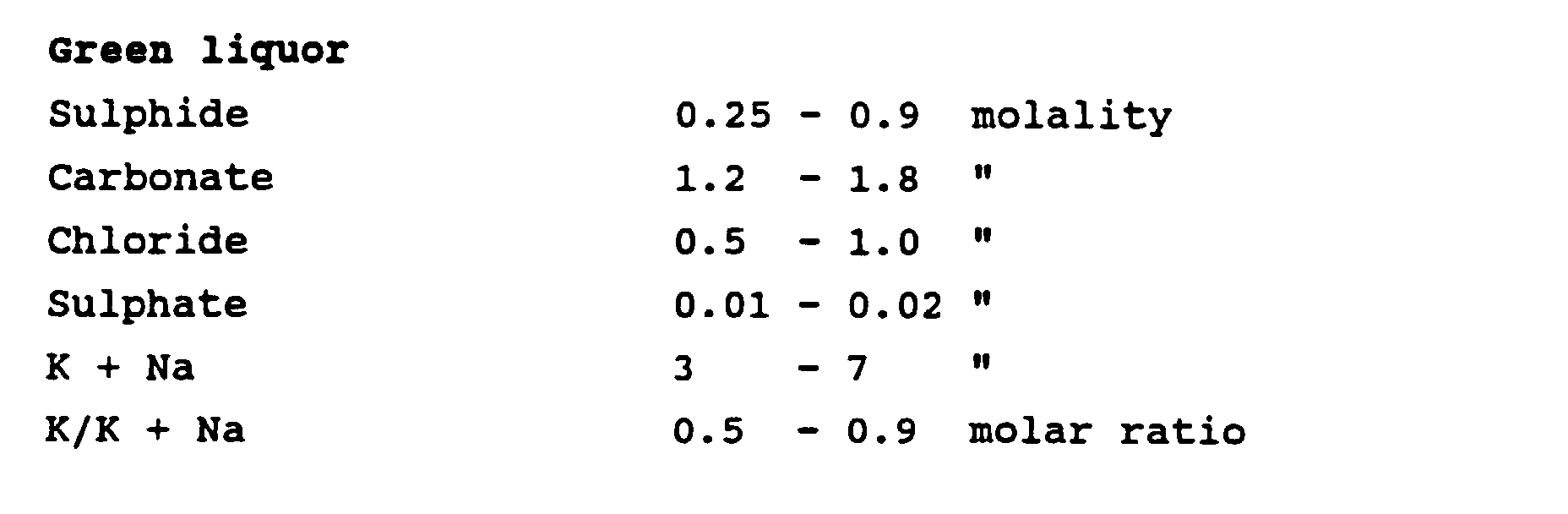
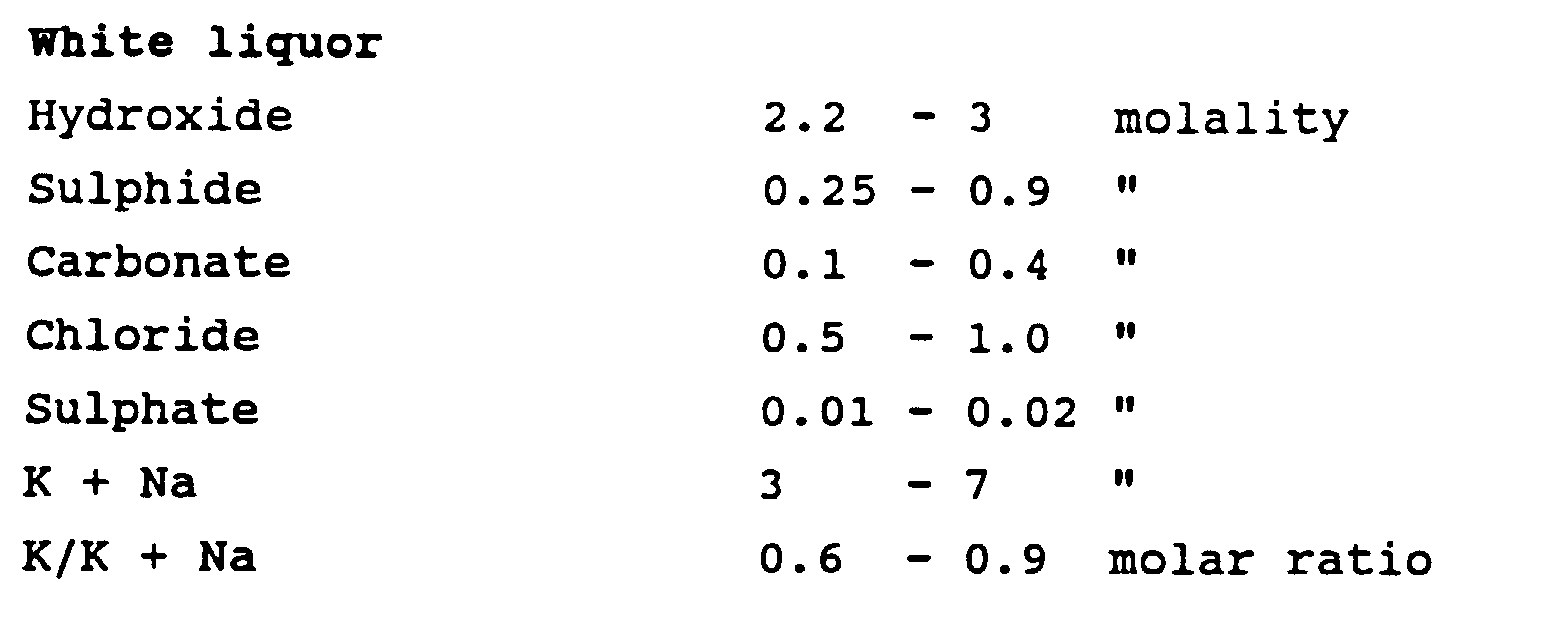
- Assuming that the wood used as raw material is the principal source of supply of sodium, and taking into account the solubility of sodium salts in solutions having a high content of potassium, a green liquor or white liquor, respectively, is obtained having the following essential compositions when the present invention is applied using a recovery system, as described in SE-B-464921, in an otherwise conventional kraft pulp mill having a high degree of closure:
- In the example below, the key data are shown for gasification of a potassium-based black liquor having a potassium/sodium molar ratio, calculated as K/K + Na, of 0.8. A system which is completely sodium-based is reproduced for comparison. The gasification is assumed to reach equilibrium in both cases.
-


- It has also been found that the solubility data for the system KOH - K2CO3 - K2SO4 - KCl - H2O differ in a significant way from those of corresponding sodium systems.
- The potassium carbonate is highly soluble in water, resulting in that the carbonate remains in solution even when present in high concentrations in green liquor/white liquor; this is in contrast to sodium carbonate, which tends to be precipitated from the solution at higher concentrations.
- This fact leads to more favourable conditions for eliminating chlorides from the liquors in the form of potassium chloride. Such an elimination can be effected, for example, by bleeding off a relatively small quantity of green liquor/white liquor which is then evaporated and separated from its content of chloride by leaching or by crystallization. Under these conditions , the evaporation of the green liquor/white liquor is carried out to an extent such that the quantity of potassium chloride which is bled off corresponds to the quantity of chloride which is supplied to the system in the wood used as raw material and in the make-up and, in the present case, in the chlorine chemicals which are reccled from the bleaching plant.
- An alkaline cooking and recovery system having mainly potassium as its base can thus, in this or another expedient manner, be supplemented with a system for eliminating chloride, if this should be found to be necessary.
- The recovery system proposed in the present invention for cellulose spent liquors having a high potassium content can advantageously be integrated with the process described in SE-B-465039, in which sulphur compounds are supplied to the reactor in order to prevent carbonate formation. The principle is based on sulphur having a greater affinity for alkali metal than does carbon dioxide under the conditions pertaining in the reaction zone. Other possible additives having similar properties, and used with a view to limiting the formation of carbonate in the reactor, are certain metal oxides, principally titanium and manganese compounds.
Claims (12)
- Method for recovery of energy and chemicals from cellulose spent liquors in producing pulp cooked under alkaline conditions, in which method cellulose-containing material is brought into contact, in a digester, with an alkaline cooking liquor containing dissolved potassium and sodium compounds, used spent cooking liquor being separated from the cellulose-containing material and withdrawn for the recovery of energy and chemicals by treatment in a recovery system which is integrated with said digester and in which the withdrawn spent cooking liquor is concentrated with respect to its content of solid material, characterized in that the spent cooking liquor is withdrawn from the digester with a molar ratio between potassium and sodium, calculated as K/K + Na, exceeding 0.25, and the concentrated spent cooking liquor is subjected to partial oxidation in a reactor, resulting in the formation of a combustible gas which is withdrawn from the reactor, whereby oxygen-containing gas is supplied to the reactor in order to support said partial oxidation and the operating temperature in the reactor is adjusted to a temperature between 400-900°C and whereby solid and/or liquid alkali metal compounds are entrained with the combustible gas, which is obtained in association with the partial oxidation, in a molar ratio between potassium sulphide and sodium sulphide, calculated as K2S/K2S + Na2S, which exceeds 0.4, and then the combustible gas is separated from the major part of its content of alkali and is used for the production of useful energy, in that the combustion gas, with its content of entrained solid and/or liquid alkali metal compounds, is brought into direct contact with a cooling liquid, in which cooling liquid the alkali metal compounds are soluble and said liquid is used either wholly or in part for preparing cooking liquor for said pulp production.
- Method according to claim 1, characterized in that the molar ratio, calculated as K/K + Na, between potassium and sodium in said withdrawn cooking liquor exceeds 0.4, and is preferably greater than 0.6.
- Method according to claim 1 or 2, characterized in that the quantity of oxygen-containing gas supplied to the reactor corresponds to between 20 and 80% of the stoichiometric requirement for complete oxidation of the cooking liquor.
- Method according to any one of the preceding claims, characterized in that the operating temperature in the reactor is adjusted to between 600 and 850°C.
- Method according to any one of the preceding claims, characterized in that chloride-containing impurities are separated from potassium-containing liquids which occur in the system by evaporation and/or leaching/crystallization.
- Method according to any one of the preceding claims, characterized in that an alkaline cooking liquor entering the digester mainly consists of dissolved alkali hydroxides and alkali metal hydrogen sulphides.
- Method according to any one of claims 1 to 5, characterized in that an alkaline cooking liquor entering the digester mainly consists of dissolved alkali metal hydroxides and/or alkali metal carbonates.
- Method according to any one of the preceding claims, characterized in that the used potassium-containing spent cooking liquor is subjected to partial oxidation in a reactor in the presence of one or more sulphur compounds, which compounds are supplied to the reactor after having been withdrawn from sulphur-containing material or gas flows occurring in the cellulose mill.
- Method according to claim 8, characterized in that sulphur compounds which are supplied to the reactor mainly consist of a gas containing hydrogen sulphide.
- Method according to claim 8, characterized in that sulphur compounds which are supplied to the reactor mainly consist of a sulphite or sulphate salt.
- Method according to any one of the preceding claims, characterized in that the used potassium-containing spent cooking liquor is subjected to partial oxidation in a reactor in the presence of one or more metal oxides.
- Method according to claim 11, characterized in that the metal oxide mainly consists of oxides of titanium, manganese, magnesium or calcium.
Applications Claiming Priority (3)
| Application Number | Priority Date | Filing Date | Title |
|---|---|---|---|
| SE9300199A SE9300199L (en) | 1993-01-25 | 1993-01-25 | Method for recycling cellulosic liquids |
| SE9300199 | 1993-01-25 | ||
| PCT/SE1994/000028 WO1994017240A1 (en) | 1993-01-25 | 1994-01-18 | Method for the recovery of cellulose spent liquors |
Publications (2)
| Publication Number | Publication Date |
|---|---|
| EP0680531A1 EP0680531A1 (en) | 1995-11-08 |
| EP0680531B1 true EP0680531B1 (en) | 1997-09-10 |
Family
ID=20388636
Family Applications (1)
| Application Number | Title | Priority Date | Filing Date |
|---|---|---|---|
| EP94905888A Expired - Lifetime EP0680531B1 (en) | 1993-01-25 | 1994-01-18 | Method for the recovery of energy and chemicals from cellulose spent liquors |
Country Status (10)
| Country | Link |
|---|---|
| US (1) | US5746886A (en) |
| EP (1) | EP0680531B1 (en) |
| AT (1) | ATE158035T1 (en) |
| AU (1) | AU5981494A (en) |
| CA (1) | CA2153983A1 (en) |
| DE (1) | DE69405537T2 (en) |
| ES (1) | ES2107186T3 (en) |
| FI (1) | FI111389B (en) |
| SE (1) | SE9300199L (en) |
| WO (1) | WO1994017240A1 (en) |
Families Citing this family (7)
| Publication number | Priority date | Publication date | Assignee | Title |
|---|---|---|---|---|
| SE9300199L (en) * | 1993-01-25 | 1994-07-26 | Kvaerner Pulping Tech | Method for recycling cellulosic liquids |
| US5715763A (en) * | 1995-09-11 | 1998-02-10 | The Mead Corporation | Combustion system for a black liquor recovery boiler |
| FR2761088B1 (en) * | 1997-03-20 | 1999-05-28 | Balcke Duerr Swenson Sa | PROCESS FOR THE RECOVERY OF SODIUM SULFATE FROM SOLID PARTICLES ARISING FROM THE INCINERATION OF BLACK LIQUORS OF STATIONERY AND CORRESPONDING INSTALLATION |
| SE514813E (en) * | 1997-10-15 | 2005-05-24 | Aga Ab | Method for gasification of black liquor in soda pans |
| FI112959B (en) * | 1999-11-03 | 2004-02-13 | Metso Paper Inc | Procedure for arranging the water circulation in a paper mill |
| US20050076568A1 (en) * | 2003-10-09 | 2005-04-14 | Stigsson Lars Lennart | Partial oxidation of cellulose spent pulping liquor |
| US8690977B2 (en) | 2009-06-25 | 2014-04-08 | Sustainable Waste Power Systems, Inc. | Garbage in power out (GIPO) thermal conversion process |
Family Cites Families (9)
| Publication number | Priority date | Publication date | Assignee | Title |
|---|---|---|---|---|
| US3020195A (en) * | 1960-02-29 | 1962-02-06 | Glatfelter Co P H | Production of potassium compounds |
| CA1109611A (en) * | 1978-05-12 | 1981-09-29 | Erco Envirotech Ltd. | Potassium-based pulp mill process |
| SE448007B (en) * | 1983-04-21 | 1987-01-12 | Skf Steel Eng Ab | PROCEDURE AND DEVICE FOR RECOVERY OF CHEMICALS |
| FI71541C (en) * | 1985-05-22 | 1987-01-19 | Ahlstroem Oy | METHOD ATT ALKALIKEMIKALIER UR EN ROEKGAS SOM INNEHAOLLER ALKALIMETALLAONGOR. |
| CA1255058A (en) * | 1985-05-28 | 1989-06-06 | Gary B. Derdall | Process for preparation of potassium salts from pulping of lignocellulosic materials |
| SE448173B (en) * | 1985-06-03 | 1987-01-26 | Croon Inventor Ab | PROCEDURE FOR THE RECOVERY OF CELLULOSA DISPOSAL CHEMICALS BY PYROLYSIS |
| SE464921B (en) * | 1987-06-25 | 1991-07-01 | Skf Plasma Tech | SAVED TO RECOVER CHEMICALS FROM MASS DEVICES |
| SE465039B (en) * | 1989-11-23 | 1991-07-15 | Chemrec Ab | MADE TO MAKE SUBSTANCES WITH HIGH SULFIDITY BEFORE SULFAT PREPARATION |
| SE9300199L (en) * | 1993-01-25 | 1994-07-26 | Kvaerner Pulping Tech | Method for recycling cellulosic liquids |
-
1993
- 1993-01-25 SE SE9300199A patent/SE9300199L/en not_active Application Discontinuation
-
1994
- 1994-01-18 DE DE69405537T patent/DE69405537T2/en not_active Expired - Fee Related
- 1994-01-18 AT AT94905888T patent/ATE158035T1/en not_active IP Right Cessation
- 1994-01-18 WO PCT/SE1994/000028 patent/WO1994017240A1/en not_active Ceased
- 1994-01-18 AU AU59814/94A patent/AU5981494A/en not_active Abandoned
- 1994-01-18 EP EP94905888A patent/EP0680531B1/en not_active Expired - Lifetime
- 1994-01-18 ES ES94905888T patent/ES2107186T3/en not_active Expired - Lifetime
- 1994-01-18 CA CA002153983A patent/CA2153983A1/en not_active Abandoned
- 1994-01-18 US US08/491,893 patent/US5746886A/en not_active Expired - Lifetime
-
1995
- 1995-07-24 FI FI953539A patent/FI111389B/en not_active IP Right Cessation
Also Published As
| Publication number | Publication date |
|---|---|
| CA2153983A1 (en) | 1994-08-04 |
| ES2107186T3 (en) | 1997-11-16 |
| DE69405537T2 (en) | 1998-02-12 |
| SE9300199L (en) | 1994-07-26 |
| US5746886A (en) | 1998-05-05 |
| FI111389B (en) | 2003-07-15 |
| AU5981494A (en) | 1994-08-15 |
| FI953539A0 (en) | 1995-07-24 |
| EP0680531A1 (en) | 1995-11-08 |
| WO1994017240A1 (en) | 1994-08-04 |
| FI953539L (en) | 1995-07-24 |
| SE9300199D0 (en) | 1993-01-25 |
| ATE158035T1 (en) | 1997-09-15 |
| DE69405537D1 (en) | 1997-10-16 |
Similar Documents
| Publication | Publication Date | Title |
|---|---|---|
| US5082526A (en) | Process of producing kraft pulping liquor by the oxidation of white liquor in the presence of lime mud | |
| US4098639A (en) | Process for reducing the requirement of fresh chemicals without increasing emissions in the pulping of cellulosic material | |
| JP2796477B2 (en) | White liquor selective oxidation method, oxidized white liquor production method and control method of oxidation reaction system operation in pulp mill | |
| AU677827B2 (en) | A method of separating sulphur compounds | |
| EP0672208B1 (en) | Method of bleaching pulp without using chlorine-containing chemicals | |
| US3909344A (en) | Removal of sodium chloride from pulp mill operations | |
| CA2116017C (en) | Production of sodium hydroxide | |
| US5746886A (en) | Method for the recovery of energy and chemicals from cellulose spent liquor containing potassium using a gasifier | |
| US3331732A (en) | Method of removing hydrogen sulfide from an aqueous solution of alkali sulfide | |
| CA1122360A (en) | Method at the digestion of cellulose-containing material | |
| FI62363C (en) | FOERFARANDE FOER AOTERVINNING AV SODIUM CHLORIDE FRAON CELLULOSAFABRIKENS PROCESSER | |
| RU2117629C1 (en) | Method of preparing hydrogen peroxide for bleaching of cellulose | |
| US3950217A (en) | Removal of sodium chloride from pulping operations | |
| US3554859A (en) | Process for recovery of sulphur from furnaced black liquor | |
| EP1566480B1 (en) | Process for producing kraft pulp | |
| US3986923A (en) | Removal of dissolved salts from sulphide liquors | |
| US3020195A (en) | Production of potassium compounds | |
| US4253911A (en) | Process for maintaining a low sodium chloride content in recycled sodium chemicals of sodium-based pulp manufacturing processes | |
| US5597445A (en) | Method for recovering sodium from a spent cooking liquor | |
| US5814189A (en) | Method for gasifying cellulose spent liquor to produce superheated steam and green liquor of low carbonate concentration | |
| CA1059271A (en) | Removal of sodium chloride from pulp mill systems | |
| WO1995021291A1 (en) | Process for separating off chloride from sulphide-containing alkaline liquor | |
| US5628872A (en) | Method for bleaching pulp with hydrogen peroxide recovered from cellulosic spent liquor | |
| US20040194900A1 (en) | Method for recovery of pulping chemicals in an alkaline sulphite pulping process and for production of steam |
Legal Events
| Date | Code | Title | Description |
|---|---|---|---|
| PUAI | Public reference made under article 153(3) epc to a published international application that has entered the european phase |
Free format text: ORIGINAL CODE: 0009012 |
|
| 17P | Request for examination filed |
Effective date: 19950710 |
|
| AK | Designated contracting states |
Kind code of ref document: A1 Designated state(s): AT DE ES FR PT SE |
|
| 17Q | First examination report despatched |
Effective date: 19951215 |
|
| RAP1 | Party data changed (applicant data changed or rights of an application transferred) |
Owner name: KVAERNER PULPING AB |
|
| GRAG | Despatch of communication of intention to grant |
Free format text: ORIGINAL CODE: EPIDOS AGRA |
|
| GRAH | Despatch of communication of intention to grant a patent |
Free format text: ORIGINAL CODE: EPIDOS IGRA |
|
| GRAH | Despatch of communication of intention to grant a patent |
Free format text: ORIGINAL CODE: EPIDOS IGRA |
|
| GRAA | (expected) grant |
Free format text: ORIGINAL CODE: 0009210 |
|
| AK | Designated contracting states |
Kind code of ref document: B1 Designated state(s): AT DE ES FR PT SE |
|
| REF | Corresponds to: |
Ref document number: 158035 Country of ref document: AT Date of ref document: 19970915 Kind code of ref document: T |
|
| REF | Corresponds to: |
Ref document number: 69405537 Country of ref document: DE Date of ref document: 19971016 |
|
| ET | Fr: translation filed | ||
| REG | Reference to a national code |
Ref country code: ES Ref legal event code: FG2A Ref document number: 2107186 Country of ref document: ES Kind code of ref document: T3 |
|
| REG | Reference to a national code |
Ref country code: PT Ref legal event code: SC4A Free format text: AVAILABILITY OF NATIONAL TRANSLATION Effective date: 19970929 |
|
| PLBE | No opposition filed within time limit |
Free format text: ORIGINAL CODE: 0009261 |
|
| STAA | Information on the status of an ep patent application or granted ep patent |
Free format text: STATUS: NO OPPOSITION FILED WITHIN TIME LIMIT |
|
| 26N | No opposition filed | ||
| PGFP | Annual fee paid to national office [announced via postgrant information from national office to epo] |
Ref country code: PT Payment date: 20001220 Year of fee payment: 8 |
|
| PGFP | Annual fee paid to national office [announced via postgrant information from national office to epo] |
Ref country code: AT Payment date: 20001221 Year of fee payment: 8 |
|
| PGFP | Annual fee paid to national office [announced via postgrant information from national office to epo] |
Ref country code: FR Payment date: 20010103 Year of fee payment: 8 |
|
| PGFP | Annual fee paid to national office [announced via postgrant information from national office to epo] |
Ref country code: ES Payment date: 20010122 Year of fee payment: 8 |
|
| REG | Reference to a national code |
Ref country code: ES Ref legal event code: PC2A |
|
| REG | Reference to a national code |
Ref country code: PT Ref legal event code: PC4A Free format text: KVAERNER CHEMREC AB SE Effective date: 20010814 |
|
| PG25 | Lapsed in a contracting state [announced via postgrant information from national office to epo] |
Ref country code: AT Free format text: LAPSE BECAUSE OF NON-PAYMENT OF DUE FEES Effective date: 20020118 |
|
| PG25 | Lapsed in a contracting state [announced via postgrant information from national office to epo] |
Ref country code: ES Free format text: LAPSE BECAUSE OF NON-PAYMENT OF DUE FEES Effective date: 20020119 |
|
| PGFP | Annual fee paid to national office [announced via postgrant information from national office to epo] |
Ref country code: DE Payment date: 20020128 Year of fee payment: 9 |
|
| REG | Reference to a national code |
Ref country code: FR Ref legal event code: TP |
|
| PG25 | Lapsed in a contracting state [announced via postgrant information from national office to epo] |
Ref country code: PT Free format text: LAPSE BECAUSE OF NON-PAYMENT OF DUE FEES Effective date: 20020731 |
|
| PG25 | Lapsed in a contracting state [announced via postgrant information from national office to epo] |
Ref country code: FR Free format text: LAPSE BECAUSE OF NON-PAYMENT OF DUE FEES Effective date: 20020930 |
|
| REG | Reference to a national code |
Ref country code: FR Ref legal event code: ST Ref country code: PT Ref legal event code: MM4A Free format text: LAPSE DUE TO NON-PAYMENT OF FEES Effective date: 20020731 |
|
| PG25 | Lapsed in a contracting state [announced via postgrant information from national office to epo] |
Ref country code: DE Free format text: LAPSE BECAUSE OF NON-PAYMENT OF DUE FEES Effective date: 20030801 |
|
| PGFP | Annual fee paid to national office [announced via postgrant information from national office to epo] |
Ref country code: SE Payment date: 20130122 Year of fee payment: 20 |
|
| REG | Reference to a national code |
Ref country code: SE Ref legal event code: EUG |