EP0679171B1 - Insulated wire - Google Patents
Insulated wire Download PDFInfo
- Publication number
- EP0679171B1 EP0679171B1 EP94907242A EP94907242A EP0679171B1 EP 0679171 B1 EP0679171 B1 EP 0679171B1 EP 94907242 A EP94907242 A EP 94907242A EP 94907242 A EP94907242 A EP 94907242A EP 0679171 B1 EP0679171 B1 EP 0679171B1
- Authority
- EP
- European Patent Office
- Prior art keywords
- composition
- weight
- insulated wire
- polyester
- polymeric component
- Prior art date
- Legal status (The legal status is an assumption and is not a legal conclusion. Google has not performed a legal analysis and makes no representation as to the accuracy of the status listed.)
- Expired - Lifetime
Links
- 239000000203 mixture Substances 0.000 claims abstract description 38
- 229920000728 polyester Polymers 0.000 claims abstract description 26
- 125000003118 aryl group Chemical group 0.000 claims abstract description 12
- 229920002725 thermoplastic elastomer Polymers 0.000 claims abstract description 10
- 229920003232 aliphatic polyester Polymers 0.000 claims abstract description 9
- 238000000576 coating method Methods 0.000 claims description 20
- 239000011248 coating agent Substances 0.000 claims description 14
- 229920000642 polymer Polymers 0.000 claims description 13
- -1 polybutylene terephthalate Polymers 0.000 claims description 12
- 239000004615 ingredient Substances 0.000 claims description 11
- 229920001707 polybutylene terephthalate Polymers 0.000 claims description 9
- 229920001610 polycaprolactone Polymers 0.000 claims description 9
- 239000004632 polycaprolactone Substances 0.000 claims description 8
- 239000003365 glass fiber Substances 0.000 claims description 5
- 229910052736 halogen Inorganic materials 0.000 claims description 4
- 150000002367 halogens Chemical class 0.000 claims description 4
- 239000003063 flame retardant Substances 0.000 claims description 3
- VTHJTEIRLNZDEV-UHFFFAOYSA-L magnesium dihydroxide Chemical compound [OH-].[OH-].[Mg+2] VTHJTEIRLNZDEV-UHFFFAOYSA-L 0.000 claims description 3
- 229910001862 magnesium hydroxide Inorganic materials 0.000 claims description 3
- 239000000347 magnesium hydroxide Substances 0.000 claims description 3
- OAICVXFJPJFONN-UHFFFAOYSA-N Phosphorus Chemical compound [P] OAICVXFJPJFONN-UHFFFAOYSA-N 0.000 claims description 2
- 229910052698 phosphorus Inorganic materials 0.000 claims description 2
- 239000011574 phosphorus Substances 0.000 claims description 2
- 239000007787 solid Substances 0.000 claims description 2
- RNFJDJUURJAICM-UHFFFAOYSA-N 2,2,4,4,6,6-hexaphenoxy-1,3,5-triaza-2$l^{5},4$l^{5},6$l^{5}-triphosphacyclohexa-1,3,5-triene Chemical compound N=1P(OC=2C=CC=CC=2)(OC=2C=CC=CC=2)=NP(OC=2C=CC=CC=2)(OC=2C=CC=CC=2)=NP=1(OC=1C=CC=CC=1)OC1=CC=CC=C1 RNFJDJUURJAICM-UHFFFAOYSA-N 0.000 claims 1
- 239000000155 melt Substances 0.000 claims 1
- 238000009413 insulation Methods 0.000 abstract description 4
- 230000003679 aging effect Effects 0.000 abstract description 2
- 239000000779 smoke Substances 0.000 description 8
- 239000000654 additive Substances 0.000 description 6
- OJMIONKXNSYLSR-UHFFFAOYSA-N phosphorous acid Chemical compound OP(O)O OJMIONKXNSYLSR-UHFFFAOYSA-N 0.000 description 4
- 125000001931 aliphatic group Chemical group 0.000 description 3
- 229920000139 polyethylene terephthalate Polymers 0.000 description 3
- 239000005020 polyethylene terephthalate Substances 0.000 description 3
- 229920000874 polytetramethylene terephthalate Polymers 0.000 description 3
- 230000001629 suppression Effects 0.000 description 3
- BGYHLZZASRKEJE-UHFFFAOYSA-N [3-[3-(3,5-ditert-butyl-4-hydroxyphenyl)propanoyloxy]-2,2-bis[3-(3,5-ditert-butyl-4-hydroxyphenyl)propanoyloxymethyl]propyl] 3-(3,5-ditert-butyl-4-hydroxyphenyl)propanoate Chemical compound CC(C)(C)C1=C(O)C(C(C)(C)C)=CC(CCC(=O)OCC(COC(=O)CCC=2C=C(C(O)=C(C=2)C(C)(C)C)C(C)(C)C)(COC(=O)CCC=2C=C(C(O)=C(C=2)C(C)(C)C)C(C)(C)C)COC(=O)CCC=2C=C(C(O)=C(C=2)C(C)(C)C)C(C)(C)C)=C1 BGYHLZZASRKEJE-UHFFFAOYSA-N 0.000 description 2
- 230000032683 aging Effects 0.000 description 2
- 229920001400 block copolymer Polymers 0.000 description 2
- 150000001718 carbodiimides Chemical class 0.000 description 2
- 238000009472 formulation Methods 0.000 description 2
- 230000014759 maintenance of location Effects 0.000 description 2
- 229910044991 metal oxide Inorganic materials 0.000 description 2
- 150000004706 metal oxides Chemical class 0.000 description 2
- 238000000465 moulding Methods 0.000 description 2
- 239000002667 nucleating agent Substances 0.000 description 2
- 239000002530 phenolic antioxidant Substances 0.000 description 2
- 239000012763 reinforcing filler Substances 0.000 description 2
- 239000003381 stabilizer Substances 0.000 description 2
- 229920013683 Celanese Polymers 0.000 description 1
- RYGMFSIKBFXOCR-UHFFFAOYSA-N Copper Chemical compound [Cu] RYGMFSIKBFXOCR-UHFFFAOYSA-N 0.000 description 1
- JOYRKODLDBILNP-UHFFFAOYSA-N Ethyl urethane Chemical compound CCOC(N)=O JOYRKODLDBILNP-UHFFFAOYSA-N 0.000 description 1
- 229910019142 PO4 Inorganic materials 0.000 description 1
- 229920001283 Polyalkylene terephthalate Polymers 0.000 description 1
- ATJFFYVFTNAWJD-UHFFFAOYSA-N Tin Chemical compound [Sn] ATJFFYVFTNAWJD-UHFFFAOYSA-N 0.000 description 1
- QVGXLLKOCUKJST-UHFFFAOYSA-N atomic oxygen Chemical compound [O] QVGXLLKOCUKJST-UHFFFAOYSA-N 0.000 description 1
- 150000001558 benzoic acid derivatives Chemical class 0.000 description 1
- 230000015556 catabolic process Effects 0.000 description 1
- 239000004020 conductor Substances 0.000 description 1
- 229910052802 copper Inorganic materials 0.000 description 1
- 239000010949 copper Substances 0.000 description 1
- 238000002425 crystallisation Methods 0.000 description 1
- 230000008025 crystallization Effects 0.000 description 1
- 230000006735 deficit Effects 0.000 description 1
- 238000006731 degradation reaction Methods 0.000 description 1
- 229920001971 elastomer Polymers 0.000 description 1
- 239000000806 elastomer Substances 0.000 description 1
- 238000005187 foaming Methods 0.000 description 1
- 239000011256 inorganic filler Substances 0.000 description 1
- 229910003475 inorganic filler Inorganic materials 0.000 description 1
- 239000002184 metal Substances 0.000 description 1
- 229910052751 metal Inorganic materials 0.000 description 1
- 150000002739 metals Chemical class 0.000 description 1
- 150000003891 oxalate salts Chemical class 0.000 description 1
- 229910052760 oxygen Inorganic materials 0.000 description 1
- 239000001301 oxygen Substances 0.000 description 1
- 230000000737 periodic effect Effects 0.000 description 1
- 235000021317 phosphate Nutrition 0.000 description 1
- 150000003013 phosphoric acid derivatives Chemical class 0.000 description 1
- 230000000704 physical effect Effects 0.000 description 1
- 239000000049 pigment Substances 0.000 description 1
- 229920002961 polybutylene succinate Polymers 0.000 description 1
- 239000004631 polybutylene succinate Substances 0.000 description 1
- 229920000098 polyolefin Polymers 0.000 description 1
- 239000004810 polytetrafluoroethylene Substances 0.000 description 1
- 229920001343 polytetrafluoroethylene Polymers 0.000 description 1
- 150000003873 salicylate salts Chemical class 0.000 description 1
- 150000004760 silicates Chemical class 0.000 description 1
- RYYKJJJTJZKILX-UHFFFAOYSA-M sodium octadecanoate Chemical class [Na+].CCCCCCCCCCCCCCCCCC([O-])=O RYYKJJJTJZKILX-UHFFFAOYSA-M 0.000 description 1
- 150000003467 sulfuric acid derivatives Chemical class 0.000 description 1
- 150000003892 tartrate salts Chemical class 0.000 description 1
- 238000009864 tensile test Methods 0.000 description 1
- JLYXXMFPNIAWKQ-UHFFFAOYSA-N γ Benzene hexachloride Chemical compound ClC1C(Cl)C(Cl)C(Cl)C(Cl)C1Cl JLYXXMFPNIAWKQ-UHFFFAOYSA-N 0.000 description 1
Classifications
-
- H—ELECTRICITY
- H01—ELECTRIC ELEMENTS
- H01B—CABLES; CONDUCTORS; INSULATORS; SELECTION OF MATERIALS FOR THEIR CONDUCTIVE, INSULATING OR DIELECTRIC PROPERTIES
- H01B3/00—Insulators or insulating bodies characterised by the insulating materials; Selection of materials for their insulating or dielectric properties
- H01B3/18—Insulators or insulating bodies characterised by the insulating materials; Selection of materials for their insulating or dielectric properties mainly consisting of organic substances
- H01B3/30—Insulators or insulating bodies characterised by the insulating materials; Selection of materials for their insulating or dielectric properties mainly consisting of organic substances plastics; resins; waxes
- H01B3/42—Insulators or insulating bodies characterised by the insulating materials; Selection of materials for their insulating or dielectric properties mainly consisting of organic substances plastics; resins; waxes polyesters; polyethers; polyacetals
- H01B3/421—Polyesters
- H01B3/422—Linear saturated polyesters derived from dicarboxylic acids and dihydroxy compounds
-
- C—CHEMISTRY; METALLURGY
- C08—ORGANIC MACROMOLECULAR COMPOUNDS; THEIR PREPARATION OR CHEMICAL WORKING-UP; COMPOSITIONS BASED THEREON
- C08K—Use of inorganic or non-macromolecular organic substances as compounding ingredients
- C08K3/00—Use of inorganic substances as compounding ingredients
- C08K3/18—Oxygen-containing compounds, e.g. metal carbonyls
- C08K3/20—Oxides; Hydroxides
- C08K3/22—Oxides; Hydroxides of metals
-
- C—CHEMISTRY; METALLURGY
- C08—ORGANIC MACROMOLECULAR COMPOUNDS; THEIR PREPARATION OR CHEMICAL WORKING-UP; COMPOSITIONS BASED THEREON
- C08L—COMPOSITIONS OF MACROMOLECULAR COMPOUNDS
- C08L67/00—Compositions of polyesters obtained by reactions forming a carboxylic ester link in the main chain; Compositions of derivatives of such polymers
- C08L67/02—Polyesters derived from dicarboxylic acids and dihydroxy compounds
-
- H—ELECTRICITY
- H01—ELECTRIC ELEMENTS
- H01B—CABLES; CONDUCTORS; INSULATORS; SELECTION OF MATERIALS FOR THEIR CONDUCTIVE, INSULATING OR DIELECTRIC PROPERTIES
- H01B3/00—Insulators or insulating bodies characterised by the insulating materials; Selection of materials for their insulating or dielectric properties
- H01B3/18—Insulators or insulating bodies characterised by the insulating materials; Selection of materials for their insulating or dielectric properties mainly consisting of organic substances
- H01B3/30—Insulators or insulating bodies characterised by the insulating materials; Selection of materials for their insulating or dielectric properties mainly consisting of organic substances plastics; resins; waxes
- H01B3/42—Insulators or insulating bodies characterised by the insulating materials; Selection of materials for their insulating or dielectric properties mainly consisting of organic substances plastics; resins; waxes polyesters; polyethers; polyacetals
Definitions
- This invention relates to polyester compositions suitable for use as insulation on wires.
- polyester compositions are known, some of which can be melt-shaped, e.g. melt-extruded around a conductor to provide an insulating coating.
- the physical and electrical properties of such polyester compositions, including flammability and smoke generation when burnt, are very important. Reference may be made for example to United States Patent Nos. 2,167,278, 3,671,487, 3,835,089, 4,048,128, 4,332,855, and 5,081,176, PCT Publication No. 91/19760 and European Patent Publication No. 0 057 415.
- EP-A-0057415 discloses molding compositions containing polyethylene terephthalate (PET) and/or polybutylene terephthalate (PBT or PTMT), 100 parts, and polycaprolactone (PCL), 0.1 to 30 parts. It is stated that the PCL promotes the crystallization of the polyester, and thus results in a molded product having improved dimensional stability and mechanical strength. It is also stated that the composition may also contain "a small amount" of a third polymer, and a broad range of such polymers is briefly disclosed, including "polyester elastomers". No further explanation or example of the use of a third polymer is provided.
- the molding composition preferably contains glass fibers or another inorganic filler.
- nucleating agent may also contain a nucleating agent; a broad range of nucleating agents is briefly described, including oxides, sulfates, phosphates, silicates, oxalates, stearates, benzoates, salicylates and tartrates of metals of Group II of the Periodic Table.
- compositions which can be melt extruded to form insulation around wires and which contain PTMT, 100 parts, and a polyester block copolymer, e.g. "Hytrel", 10-100 parts. It is stated that polyester block copolymer reduces the susceptibility of the PTMT to embrittlement.
- the composition can also contain a third polymer, preferably in amount less than 20%; but no examples of such third polymers are given.
- WO-A-9119760 discloses compositions which can be melt extruded to form insulation around the wires and which contain PBT or another poly(alkylene terephthalate), at least 30%; polycaprolactone (PCL) or another polyactone, at least 3%; a carbodiimide, 0.05-10%; and an aliphatic phosphite, 0.05-10%. It is stated that the carbodiimide and the phosphite improve the thermal stability of the composition.
- the composition can also contain various additives, including flame retardants and pigments.
- compositions which contain PBT or another polyalkylene terephthalate, at least 20%, and SnO, at least 1%.
- the compositions preferably contain glass fibres or another reinforcing filler. It is stated that the presence of the SnO reduces the smoke released when the composition is burned.
- the composition preferably also contains PTFE (0-20%).
- the present invention provides an insulated wire which comprises
- the insulating coating can be the sole insulating coating. Alternatively, if there are several coatings, it may be the innermost coating, or the outermost coating, or an intermediate coating.
- the aromatic polyester is preferably poly(1, 4-butylene terephthalate); other aromatic polyesters which can be used include polyethylene terephthalate and those disclosed in the documents referred to above.
- the aliphatic polyester is preferably polycaprolactone.
- the thermoplastic elastomer is preferably a polyester thermoplastic elastomer, e.g. one of the polymers sold under the trade names Arnitel and Hytrel.
- the thermoplastic elastomer can for example contain aromatic polyester blocks (e.g. polybutylene terephthalate blocks) and aliphatic polyester blocks (e.g. polybutylene succinate) linked to each other, for example through urethane linkages.
- Arnitel is an example of such a thermoplastic elastomer.
- the polymers (A), (B) and (C) preferably constitute 80-100%, particularly 90-100%, by weight of the polymeric component.
- Other polymers which can be present in the polymeric component include polyolefins and the polymers disclosed in the documents referred to above, in particular U.S. Patent No. 4,332,855.
- Preferably all the polymers in the composition are compatible with the aromatic polyester and have a solubility parameter which differs by at most 1.5 from the solubility parameter of the aromatic polyester.
- all the polymers in the composition are free from halogen.
- the novel insulating coatings show remarkably good heat aging properties, in particular in their retention of elongation and tensile strength when aged at elevated temperatures, e.g. for 168 hours at 150°C. Preferably, they retain at least 50% of their elongation and at least 80% of their tensile strength (at room temperature) after aging for 168 hours at 150° and preferably after aging for 168 hours at 180°C.
- the improved retention of physical properties apparently results from the presence of both ingredient (B) and ingredient (C), and makes it possible to include relatively large quantities of additives which improve flame retardance and/or smoke suppression, without unacceptable loss of elongation and tensile strength. This is especially important in wires to be used in automobiles, trains, trams and other transit vehicles, and in other uses where wires are subject to high ambient temperatures.
- the amount of SnO is selected to provide the desired level of improved flame retardance and/or smoke reduction without unacceptable impairment of other physical and/or electrical properties.
- the amount is generally 3 to 60%, e.g. 10 to 50%, preferably 15 to 45%, by weight of the composition.
- the metal oxide can be the sole ingredient which provides flame retardance and/or smoke suppression to the composition, or other such ingredients can be present. Examples of other ingredients are other metal oxides and known additives, for example those disclosed in the documents referred to above. However, the compositions are preferably free from halogen-containing ingredients. The presence of SnO makes it possible to reduce the amount of such known additives.
- the total weight percent of SnO and other additives is less than (preferably at least 3% less than, particularly at least 10% less than) the weight percent of those additives which, in a composition which is identical except that it does not contain SnO, produces the same level of flame retardance and/or smoke suppression in one of the known tests for such properties, e.g. Limiting Oxygen Index (ASTM D 2863-74), Flammability (SAE J1128 MIL-W-81044, or ASTM D 3032-84) or Smoke Generation (ASTM E 662).
- ingredients which can be present include phosphorus-containing flame retardants and/or Mg(OH) 2 , the amount of Mg(OH) 2 being reduced to a level which avoids the problems which otherwise arise when using these together, in particular degradation and foaming of the polyester.
- the novel insulating coatings are free from glass fibers and are preferably free from all reinforcing fillers.
- the coating can be of any appropriate thickness, e.g. 0.025 inch (0.0635 cm), preferably 0.008 to 0.018 inch (0.02 to 0.046 cm). Coatings as thin as 0.005 inch (0.0125 cm) may be useful, particularly in conjunction with other coatings.
- the insulating layer contains SnO; it is thus gray in color. It may be desirable to provide an outermost layer constructed of a different polymer for purposes of appearance.
- Polybutylene terephthalate (PBT) used in Examples 1-10 was Celanex 1600A available from Hoechst-Celanese. Tone P700, Tone P767 and Tone P787 are polycaprolactones of different molecular weights available from Union Carbide. Arnitel used was thermoplastic elastomer with polyester blocks available from AKZO.
- the formulation for the stabilizer used in Examples 1-4 and 6-10 was 1.75% polycarbodiimide (PCD), 1.75% of a hindered phenolic antioxidant (Irganox 1010) and 0.88% of an aliphatic phosphite (Western 619).
- the formulation for the stabilizer used in Example 5 was 2.2% polycarbodiimide (PCD), 2.2% of a hindered phenolic antioxidant (Irganox 1010) and 1.2% of an aliphatic phosphite (Western 619).
- the elongation and tensile tests were carried out on 3 inch (7.5 cm) samples removed from the wire.
- the VW-1 tests were carried out in accordance with the UL VW-1 test, and the results are expressed in the form x/y, where y is the number of samples tested and x is the number of samples which passed the test.
Landscapes
- Chemical & Material Sciences (AREA)
- Polymers & Plastics (AREA)
- Health & Medical Sciences (AREA)
- Spectroscopy & Molecular Physics (AREA)
- Chemical Kinetics & Catalysis (AREA)
- Medicinal Chemistry (AREA)
- Physics & Mathematics (AREA)
- Organic Chemistry (AREA)
- Compositions Of Macromolecular Compounds (AREA)
- Organic Insulating Materials (AREA)
- Insulated Conductors (AREA)
- Communication Cables (AREA)
- Paints Or Removers (AREA)
Abstract
Description
- This invention relates to polyester compositions suitable for use as insulation on wires.
- Many polyester compositions are known, some of which can be melt-shaped, e.g. melt-extruded around a conductor to provide an insulating coating. The physical and electrical properties of such polyester compositions, including flammability and smoke generation when burnt, are very important. Reference may be made for example to United States Patent Nos. 2,167,278, 3,671,487, 3,835,089, 4,048,128, 4,332,855, and 5,081,176, PCT Publication No. 91/19760 and European Patent Publication No. 0 057 415.
- EP-A-0057415 discloses molding compositions containing polyethylene terephthalate (PET) and/or polybutylene terephthalate (PBT or PTMT), 100 parts, and polycaprolactone (PCL), 0.1 to 30 parts. It is stated that the PCL promotes the crystallization of the polyester, and thus results in a molded product having improved dimensional stability and mechanical strength. It is also stated that the composition may also contain "a small amount" of a third polymer, and a broad range of such polymers is briefly disclosed, including "polyester elastomers". No further explanation or example of the use of a third polymer is provided. The molding composition preferably contains glass fibers or another inorganic filler. It may also contain a nucleating agent; a broad range of nucleating agents is briefly described, including oxides, sulfates, phosphates, silicates, oxalates, stearates, benzoates, salicylates and tartrates of metals of Group II of the Periodic Table.
- DE-A-2915155 and equivalent US-A-4332855 disclose compositions which can be melt extruded to form insulation around wires and which contain PTMT, 100 parts, and a polyester block copolymer, e.g. "Hytrel", 10-100 parts. It is stated that polyester block copolymer reduces the susceptibility of the PTMT to embrittlement. The composition can also contain a third polymer, preferably in amount less than 20%; but no examples of such third polymers are given.
- WO-A-9119760 discloses compositions which can be melt extruded to form insulation around the wires and which contain PBT or another poly(alkylene terephthalate), at least 30%; polycaprolactone (PCL) or another polyactone, at least 3%; a carbodiimide, 0.05-10%; and an aliphatic phosphite, 0.05-10%. It is stated that the carbodiimide and the phosphite improve the thermal stability of the composition. The composition can also contain various additives, including flame retardants and pigments.
- US-A-5081176 discloses compositions which contain PBT or another polyalkylene terephthalate, at least 20%, and SnO, at least 1%. The compositions preferably contain glass fibres or another reinforcing filler. It is stated that the presence of the SnO reduces the smoke released when the composition is burned. The composition preferably also contains PTFE (0-20%).
- The present invention provides an insulated wire which comprises
- (1) a solid or stranded wire, and
- (2) an insulating coating on the wire, said coating being composed of a melt-extruded polymeric composition which is free from glass fibres and which comprises a polymeric component comprising a major amount of an aromatic polyester and a minor amount of an aliphatic polyester; characterized in that the polymeric component comprises
- (A) at least 60 % of at least one aromatic polyester,
- (B) 3 to 20% of at least one aliphatic polyester, and
- (C) 3 to 20% of at least one thermoplastic elastomer containing polyester blocks,
-
- The insulating coating can be the sole insulating coating. Alternatively, if there are several coatings, it may be the innermost coating, or the outermost coating, or an intermediate coating.
- The aromatic polyester is preferably poly(1, 4-butylene terephthalate); other aromatic polyesters which can be used include polyethylene terephthalate and those disclosed in the documents referred to above. The aliphatic polyester is preferably polycaprolactone. The thermoplastic elastomer is preferably a polyester thermoplastic elastomer, e.g. one of the polymers sold under the trade names Arnitel and Hytrel. The thermoplastic elastomer can for example contain aromatic polyester blocks (e.g. polybutylene terephthalate blocks) and aliphatic polyester blocks (e.g. polybutylene succinate) linked to each other, for example through urethane linkages. Arnitel is an example of such a thermoplastic elastomer. The polymers (A), (B) and (C) preferably constitute 80-100%, particularly 90-100%, by weight of the polymeric component. Other polymers which can be present in the polymeric component include polyolefins and the polymers disclosed in the documents referred to above, in particular U.S. Patent No. 4,332,855. Preferably all the polymers in the composition are compatible with the aromatic polyester and have a solubility parameter which differs by at most 1.5 from the solubility parameter of the aromatic polyester. Preferably all the polymers in the composition are free from halogen.
- The novel insulating coatings show remarkably good heat aging properties, in particular in their retention of elongation and tensile strength when aged at elevated temperatures, e.g. for 168 hours at 150°C. Preferably, they retain at least 50% of their elongation and at least 80% of their tensile strength (at room temperature) after aging for 168 hours at 150° and preferably after aging for 168 hours at 180°C. The improved retention of physical properties apparently results from the presence of both ingredient (B) and ingredient (C), and makes it possible to include relatively large quantities of additives which improve flame retardance and/or smoke suppression, without unacceptable loss of elongation and tensile strength. This is especially important in wires to be used in automobiles, trains, trams and other transit vehicles, and in other uses where wires are subject to high ambient temperatures.
- We have discovered that the novel insulating coatings show a surprising improvement in flame retardance and/or smoke reduction when they contain SnO. The amount of SnO is selected to provide the desired level of improved flame retardance and/or smoke reduction without unacceptable impairment of other physical and/or electrical properties. The amount is generally 3 to 60%, e.g. 10 to 50%, preferably 15 to 45%, by weight of the composition. The metal oxide can be the sole ingredient which provides flame retardance and/or smoke suppression to the composition, or other such ingredients can be present. Examples of other ingredients are other metal oxides and known additives, for example those disclosed in the documents referred to above. However, the compositions are preferably free from halogen-containing ingredients. The presence of SnO makes it possible to reduce the amount of such known additives. Preferably, the total weight percent of SnO and other additives is less than (preferably at least 3% less than, particularly at least 10% less than) the weight percent of those additives which, in a composition which is identical except that it does not contain SnO, produces the same level of flame retardance and/or smoke suppression in one of the known tests for such properties, e.g. Limiting Oxygen Index (ASTM D 2863-74), Flammability (SAE J1128 MIL-W-81044, or ASTM D 3032-84) or Smoke Generation (ASTM E 662). Other ingredients which can be present include phosphorus-containing flame retardants and/or Mg(OH)2, the amount of Mg(OH)2 being reduced to a level which avoids the problems which otherwise arise when using these together, in particular degradation and foaming of the polyester.
- The novel insulating coatings are free from glass fibers and are preferably free from all reinforcing fillers. The coating can be of any appropriate thickness, e.g. 0.025 inch (0.0635 cm), preferably 0.008 to 0.018 inch (0.02 to 0.046 cm). Coatings as thin as 0.005 inch (0.0125 cm) may be useful, particularly in conjunction with other coatings.
- The insulating layer contains SnO; it is thus gray in color. It may be desirable to provide an outermost layer constructed of a different polymer for purposes of appearance.
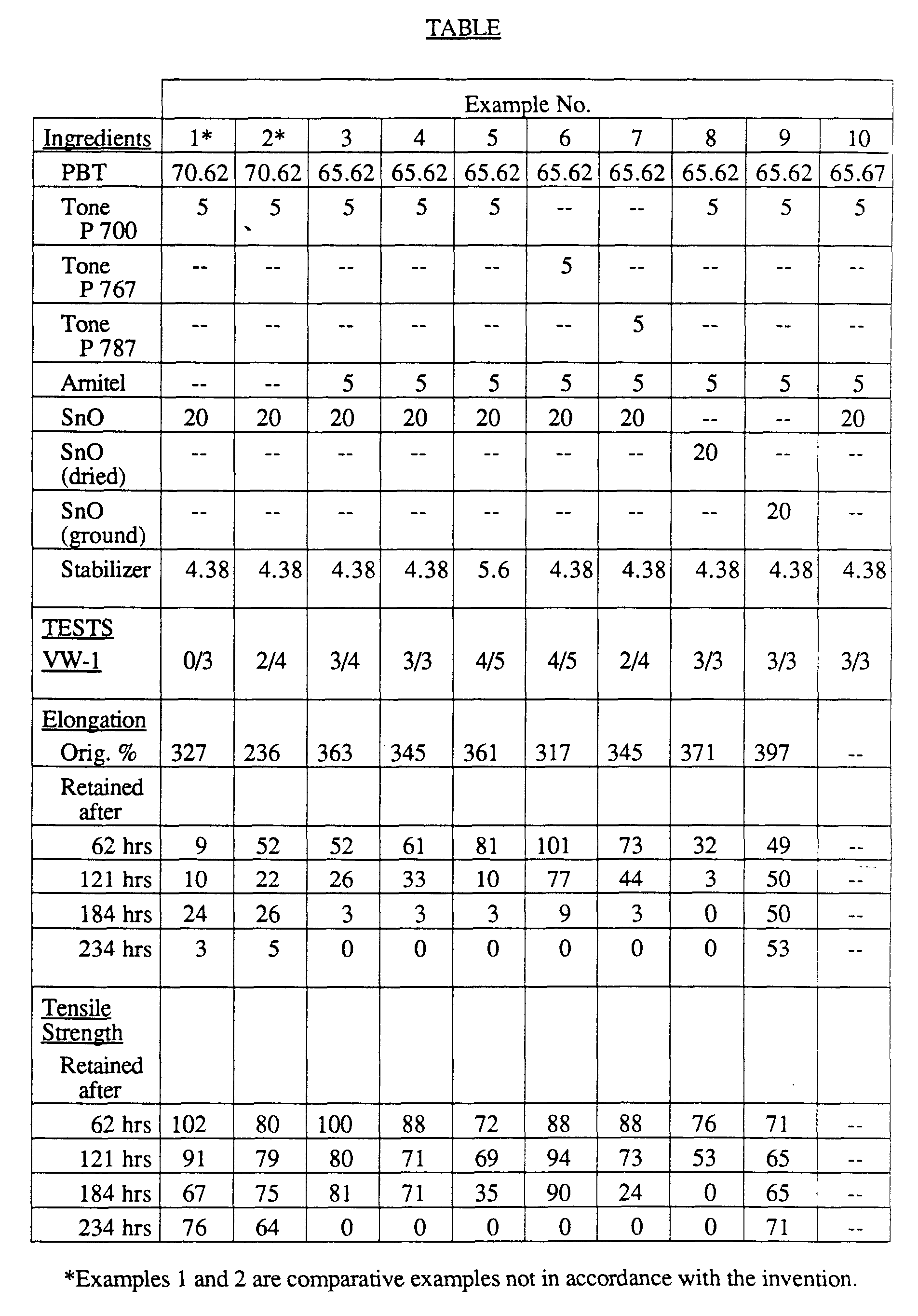
- The ingredients and amounts thereof set out in the Table were mixed together in a Brabender, and then melt-extruded over a 20 AWG 19/32 tin-coated copper stranded wire as a coating 0.010 inch (0.025 cm) thick. The products were tested and the results are set out in the Table.
- Polybutylene terephthalate (PBT) used in Examples 1-10 was Celanex 1600A available from Hoechst-Celanese. Tone P700, Tone P767 and Tone P787 are polycaprolactones of different molecular weights available from Union Carbide. Arnitel used was thermoplastic elastomer with polyester blocks available from AKZO. The formulation for the stabilizer used in Examples 1-4 and 6-10 was 1.75% polycarbodiimide (PCD), 1.75% of a hindered phenolic antioxidant (Irganox 1010) and 0.88% of an aliphatic phosphite (Western 619). The formulation for the stabilizer used in Example 5 was 2.2% polycarbodiimide (PCD), 2.2% of a hindered phenolic antioxidant (Irganox 1010) and 1.2% of an aliphatic phosphite (Western 619).
- The elongation and tensile tests were carried out on 3 inch (7.5 cm) samples removed from the wire. The VW-1 tests were carried out in accordance with the UL VW-1 test, and the results are expressed in the form x/y, where y is the number of samples tested and x is the number of samples which passed the test.
Claims (9)
- An insulated wire which comprisescharacterized in that the polymeric component comprises(1) a solid or stranded wire, and(2) an insulating coating on the wire, said coating being composed of a melt -extruded polymeric composition which is free from glass fibres and which comprises a polymeric component comprising a major amount of an aromatic polyester and a minor amount of an aliphatic polyester;(A) at least 60 % of at least one aromatic polyester,(B) 3 to 20% of at least one aliphatic polyester, and(C) 3 to 20% of at least one thermoplastic elastomer containing polyester blocks, the percentages being by weight based on the weight of the polymeric component, and the composition contains 3 to 60% by weight based on the weight of the composition, of SnO.
- An insulated wire according to claim 1 wherein the polymeric component comprises(A) 75 to 85% of the aromatic polyester,(B) 6 to 10% of the aliphatic polyester, and(C) 6 to 10% of the thermoplastic elastomer.
- An insulated wire according to claim 2 wherein the aromatic polyester is polybutylene terephthalate and the aliphatic polyester is polycaprolactone.
- An insulated wire according to any one of the preceding claims wherein the polymers (A), (B) and (C) constitute 80 to 100% by weight of the polymeric component.
- An insulated wire according to any one of the preceding claims wherein the composition contains 10 to 50% by weight, based on the weight of the composition, of SnO.
- An insulated wire according to any one of the preceding claims wherein the composition contains (a) SnO and (b) Mg(OH)2 and/or a phosphorus-containing flame retardant.
- An insulated wire according to any one of the preceding claims wherein the composition is free from halogen-containing ingredients.
- An insulated wire according to any one of the preceding claims wherein the composition is free from halogen-containing ingredients and contains(i) a polymeric component which comprisesthe ingredients (A), (B) and (C) constituting 80 to 100% of the polymeric component, the percentages being by weight based on the weight of the polymeric component; and(A) 70 to 90% of polybutylene terephthalate,(B) 5 to 15% of polycaprolactone, and(C) 5 to 15% of a thermoplastic elastomer containing polyester blocks.(ii) 10 to 50%, preferably 15 to 45%, by weight, based on the weight of the composition, of SnO.
- An insulated wire according to any one of the preceding claims which also comprises a second insulating coating, outside the coating composed of said composition.
Applications Claiming Priority (3)
| Application Number | Priority Date | Filing Date | Title |
|---|---|---|---|
| US474993A | 1993-01-14 | 1993-01-14 | |
| PCT/US1994/000624 WO1994016014A1 (en) | 1993-01-14 | 1994-01-13 | Polyester compositions for wire insulation |
| US4749 | 1998-01-08 |
Publications (2)
| Publication Number | Publication Date |
|---|---|
| EP0679171A1 EP0679171A1 (en) | 1995-11-02 |
| EP0679171B1 true EP0679171B1 (en) | 2002-07-10 |
Family
ID=21712335
Family Applications (1)
| Application Number | Title | Priority Date | Filing Date |
|---|---|---|---|
| EP94907242A Expired - Lifetime EP0679171B1 (en) | 1993-01-14 | 1994-01-13 | Insulated wire |
Country Status (7)
| Country | Link |
|---|---|
| EP (1) | EP0679171B1 (en) |
| JP (1) | JPH08506129A (en) |
| CN (1) | CN1066765C (en) |
| AT (1) | ATE220415T1 (en) |
| AU (1) | AU690537B2 (en) |
| DE (1) | DE69430947T2 (en) |
| WO (1) | WO1994016014A1 (en) |
Families Citing this family (5)
| Publication number | Priority date | Publication date | Assignee | Title |
|---|---|---|---|---|
| CA2219122A1 (en) * | 1995-04-26 | 1996-10-31 | Phu D. Nguyen | Polyester compositions |
| US6087591A (en) * | 1995-04-26 | 2000-07-11 | Nguyen; Phu D. | Insulated electrical conductors |
| JP5205979B2 (en) * | 2007-01-23 | 2013-06-05 | 日立電線株式会社 | Insulated wire |
| JP5200563B2 (en) * | 2008-02-01 | 2013-06-05 | 日立電線株式会社 | Insulated wire |
| CN108231255A (en) * | 2017-12-27 | 2018-06-29 | 深圳市凯中和东新材料有限公司 | A kind of halogen-free environmental F grades straight weldering three layer insulation wires |
Citations (2)
| Publication number | Priority date | Publication date | Assignee | Title |
|---|---|---|---|---|
| EP0057415A2 (en) * | 1981-01-30 | 1982-08-11 | Teijin Limited | Polyester resin composition |
| WO1991019760A1 (en) * | 1990-06-13 | 1991-12-26 | Raychem Corporation | Stabilized polymeric compositions |
Family Cites Families (6)
| Publication number | Priority date | Publication date | Assignee | Title |
|---|---|---|---|---|
| US3835089A (en) * | 1972-06-23 | 1974-09-10 | Gen Electric | Polylactone-modified linear polyesters and molding compositions containing the same |
| US3985926A (en) * | 1975-08-27 | 1976-10-12 | Allied Chemical Corporation | Flame-retardant carpet |
| US4332855A (en) * | 1978-04-14 | 1982-06-01 | Raychem Corporation | Polymeric compositions |
| EP0186050B1 (en) * | 1984-12-19 | 1990-01-31 | General Electric Company | Copolyester-carbonate composition |
| US5081176A (en) * | 1990-09-24 | 1992-01-14 | General Electric Company | Polyalkylene Terephthalate compositions having improved burning characteristics |
| BR9106186A (en) * | 1990-10-15 | 1993-03-16 | Gen Electric | HIGH DENSE THERMOPLASTIC MOLDING COMPOSITES WITH RESISTANCE TO IMPACT IMPACT |
-
1994
- 1994-01-13 DE DE69430947T patent/DE69430947T2/en not_active Expired - Fee Related
- 1994-01-13 AU AU60900/94A patent/AU690537B2/en not_active Ceased
- 1994-01-13 CN CN94190946A patent/CN1066765C/en not_active Expired - Fee Related
- 1994-01-13 AT AT94907242T patent/ATE220415T1/en not_active IP Right Cessation
- 1994-01-13 EP EP94907242A patent/EP0679171B1/en not_active Expired - Lifetime
- 1994-01-13 JP JP6516359A patent/JPH08506129A/en active Pending
- 1994-01-13 WO PCT/US1994/000624 patent/WO1994016014A1/en not_active Ceased
Patent Citations (2)
| Publication number | Priority date | Publication date | Assignee | Title |
|---|---|---|---|---|
| EP0057415A2 (en) * | 1981-01-30 | 1982-08-11 | Teijin Limited | Polyester resin composition |
| WO1991019760A1 (en) * | 1990-06-13 | 1991-12-26 | Raychem Corporation | Stabilized polymeric compositions |
Also Published As
| Publication number | Publication date |
|---|---|
| JPH08506129A (en) | 1996-07-02 |
| CN1116431A (en) | 1996-02-07 |
| AU6090094A (en) | 1994-08-15 |
| DE69430947D1 (en) | 2002-08-14 |
| AU690537B2 (en) | 1998-04-30 |
| EP0679171A1 (en) | 1995-11-02 |
| DE69430947T2 (en) | 2003-03-13 |
| ATE220415T1 (en) | 2002-07-15 |
| CN1066765C (en) | 2001-06-06 |
| WO1994016014A1 (en) | 1994-07-21 |
Similar Documents
| Publication | Publication Date | Title |
|---|---|---|
| JPH08510283A (en) | Polymer composition and electrical wire insulation | |
| KR101351717B1 (en) | Flame-retardant resin composition, and electric wire and insulating tube using same | |
| EP0989147B1 (en) | Thermoplastic polyester resin, and insulated wire, electrically insulated cable and heat-shrinkable tube each made with the resin | |
| JPH107913A (en) | Flame-retardant and halogen-free composition | |
| JPH11513722A (en) | Flame retardant polyketone polymer blend | |
| JPH0554723A (en) | Flame retardant electric insulating composition and flame retardant wire & cable | |
| JPS6241244A (en) | Fire retarant thermoplastic composition containing no halogen | |
| US5908887A (en) | Polyester compositions | |
| KR100459488B1 (en) | Polymer composition with low smoke and heat resistance for insulating material and Locomotive wire using it | |
| US5684117A (en) | Flame retardant polyketone polymer blend | |
| AU690537B2 (en) | Polyester compositions for wire insulation | |
| JPS62500894A (en) | electrical wires and cables | |
| EP3652756A1 (en) | Low-smoke flame reduced cable | |
| EP0822559B1 (en) | Self-extinguishing cable releasing low quantities of toxic and corrosive smokes and gases | |
| JP3571725B2 (en) | Liquid crystal polymer composition | |
| JP5282843B2 (en) | Electric wire and cable using polybutylene naphthalate resin composition | |
| JP3025275B2 (en) | Wires and cables | |
| WO1996035216A1 (en) | Thermoplastic elastomeric compositions and insulated electrical conductors | |
| CA2219122A1 (en) | Polyester compositions | |
| JPH11306873A (en) | Fire resistant wires and cables | |
| JP2537620B2 (en) | Heat-aging resin composition | |
| JPH079945A (en) | Electric part for automobile | |
| JPH0565374A (en) | Heat-resistant composition | |
| JPS61228052A (en) | Resin composition | |
| KR20050106254A (en) | Halogen free polymeric composition with thermoplastic elastomer and the cable using thereof |
Legal Events
| Date | Code | Title | Description |
|---|---|---|---|
| PUAI | Public reference made under article 153(3) epc to a published international application that has entered the european phase |
Free format text: ORIGINAL CODE: 0009012 |
|
| 17P | Request for examination filed |
Effective date: 19950713 |
|
| AK | Designated contracting states |
Kind code of ref document: A1 Designated state(s): AT BE DE FR GB IT |
|
| 17Q | First examination report despatched |
Effective date: 19970425 |
|
| RTI1 | Title (correction) |
Free format text: INSULATED WIRE |
|
| GRAG | Despatch of communication of intention to grant |
Free format text: ORIGINAL CODE: EPIDOS AGRA |
|
| RAP1 | Party data changed (applicant data changed or rights of an application transferred) |
Owner name: TYCO ELECTRONICS CORPORATION |
|
| GRAG | Despatch of communication of intention to grant |
Free format text: ORIGINAL CODE: EPIDOS AGRA |
|
| GRAH | Despatch of communication of intention to grant a patent |
Free format text: ORIGINAL CODE: EPIDOS IGRA |
|
| GRAH | Despatch of communication of intention to grant a patent |
Free format text: ORIGINAL CODE: EPIDOS IGRA |
|
| GRAA | (expected) grant |
Free format text: ORIGINAL CODE: 0009210 |
|
| RIC1 | Information provided on ipc code assigned before grant |
Free format text: 7C 08L 67/02 A, 7C 08K 3/22 B, 7H 01B 3/42 B, 7H 01B 7/34 B |
|
| AK | Designated contracting states |
Kind code of ref document: B1 Designated state(s): AT BE DE FR GB IT |
|
| PG25 | Lapsed in a contracting state [announced via postgrant information from national office to epo] |
Ref country code: BE Free format text: LAPSE BECAUSE OF FAILURE TO SUBMIT A TRANSLATION OF THE DESCRIPTION OR TO PAY THE FEE WITHIN THE PRESCRIBED TIME-LIMIT Effective date: 20020710 Ref country code: AT Free format text: LAPSE BECAUSE OF FAILURE TO SUBMIT A TRANSLATION OF THE DESCRIPTION OR TO PAY THE FEE WITHIN THE PRESCRIBED TIME-LIMIT Effective date: 20020710 |
|
| REF | Corresponds to: |
Ref document number: 220415 Country of ref document: AT Date of ref document: 20020715 Kind code of ref document: T |
|
| REG | Reference to a national code |
Ref country code: GB Ref legal event code: FG4D |
|
| RIC1 | Information provided on ipc code assigned before grant |
Free format text: 7C 08L 67/02 A, 7C 08K 3/22 B, 7H 01B 3/42 B, 7H 01B 7/29 B |
|
| REF | Corresponds to: |
Ref document number: 69430947 Country of ref document: DE Date of ref document: 20020814 |
|
| ET | Fr: translation filed | ||
| PLBE | No opposition filed within time limit |
Free format text: ORIGINAL CODE: 0009261 |
|
| STAA | Information on the status of an ep patent application or granted ep patent |
Free format text: STATUS: NO OPPOSITION FILED WITHIN TIME LIMIT |
|
| 26N | No opposition filed |
Effective date: 20030411 |
|
| PGFP | Annual fee paid to national office [announced via postgrant information from national office to epo] |
Ref country code: DE Payment date: 20090302 Year of fee payment: 16 |
|
| PGFP | Annual fee paid to national office [announced via postgrant information from national office to epo] |
Ref country code: GB Payment date: 20090129 Year of fee payment: 16 |
|
| PGFP | Annual fee paid to national office [announced via postgrant information from national office to epo] |
Ref country code: IT Payment date: 20090129 Year of fee payment: 16 |
|
| PGFP | Annual fee paid to national office [announced via postgrant information from national office to epo] |
Ref country code: FR Payment date: 20090119 Year of fee payment: 16 |
|
| GBPC | Gb: european patent ceased through non-payment of renewal fee |
Effective date: 20100113 |
|
| REG | Reference to a national code |
Ref country code: FR Ref legal event code: ST Effective date: 20100930 |
|
| PG25 | Lapsed in a contracting state [announced via postgrant information from national office to epo] |
Ref country code: FR Free format text: LAPSE BECAUSE OF NON-PAYMENT OF DUE FEES Effective date: 20100201 |
|
| PG25 | Lapsed in a contracting state [announced via postgrant information from national office to epo] |
Ref country code: DE Free format text: LAPSE BECAUSE OF NON-PAYMENT OF DUE FEES Effective date: 20100803 |
|
| PG25 | Lapsed in a contracting state [announced via postgrant information from national office to epo] |
Ref country code: GB Free format text: LAPSE BECAUSE OF NON-PAYMENT OF DUE FEES Effective date: 20100113 |
|
| PG25 | Lapsed in a contracting state [announced via postgrant information from national office to epo] |
Ref country code: IT Free format text: LAPSE BECAUSE OF NON-PAYMENT OF DUE FEES Effective date: 20100113 |