EP0678810A1 - Determining Dynamic properties of programs - Google Patents
Determining Dynamic properties of programs Download PDFInfo
- Publication number
- EP0678810A1 EP0678810A1 EP95302242A EP95302242A EP0678810A1 EP 0678810 A1 EP0678810 A1 EP 0678810A1 EP 95302242 A EP95302242 A EP 95302242A EP 95302242 A EP95302242 A EP 95302242A EP 0678810 A1 EP0678810 A1 EP 0678810A1
- Authority
- EP
- European Patent Office
- Prior art keywords
- program
- information
- execution environment
- debugger
- set forth
- Prior art date
- Legal status (The legal status is an assumption and is not a legal conclusion. Google has not performed a legal analysis and makes no representation as to the accuracy of the status listed.)
- Ceased
Links
Images

Classifications
-
- G—PHYSICS
- G06—COMPUTING OR CALCULATING; COUNTING
- G06F—ELECTRIC DIGITAL DATA PROCESSING
- G06F11/00—Error detection; Error correction; Monitoring
- G06F11/36—Prevention of errors by analysis, debugging or testing of software
- G06F11/3604—Analysis of software for verifying properties of programs
- G06F11/3612—Analysis of software for verifying properties of programs by runtime analysis
-
- G—PHYSICS
- G06—COMPUTING OR CALCULATING; COUNTING
- G06F—ELECTRIC DIGITAL DATA PROCESSING
- G06F11/00—Error detection; Error correction; Monitoring
- G06F11/36—Prevention of errors by analysis, debugging or testing of software
- G06F11/362—Debugging of software
- G06F11/3624—Debugging of software by performing operations on the source code, e.g. via a compiler
Definitions
- This invention relates to software testing and verification in general and more particularly to determining dynamic properties of programs.
- dynamic properties that can be determined only by running the program.
- the dynamic properties involve information that is not visible during the normal operation of the program. Examples of such dynamic properties with respect to a program P and a set of inputs I for the program are:
- Instrumentation can be done during the process of building the program, that is the process of compiling the source code to produce object code and linking the object code to produce executable code and can be done on the executable code itself.
- One way of instrumenting a program during program build is to simply add code for the instrumentation to the source code and then compile the source code to produce the object code.
- the object code contains code corresponding to the instrumentation code which was added to the source code.
- Another way of doing it is to compile the source code using a special compiler which adds the necessary instrumentation to the object code.
- the first technique, adding instrumentation code to the source code is very general; the kinds of instrumentation which can be added are limited only by the ingenuity of the programmer.
- the disadvantage, of course, is that adding the instrumentation has meant changing the source code; thus, the source code being investigated is no longer the original source code.
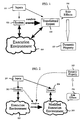
- FIG. 1 provides a conceptual overview of systems of the type just described.
- a system 102 of one or more programs runs with inputs 101 in an execution environment 104.
- an internal property such as "does this system execute all functions on inputs 101'' cannot be determined.
- we build a transformed version of the system 105 which has been instrumented to generate side effects when something happens during an execution of system 102 which is relevant to the desired property.
- system 102 For instance, if one wants to find out if system 102 executes all of its functions when executed with inputs 101, one can instrument system 102 by inserting a print statement at the beginning of the source code for each function called by system 102. The instrumentation transforms system 102 into system 105. Now this transformed system 105 is run on inputs 101. Each time transformed system 105 executes a function, it executes the print statement which was inserted at the beginning of the function. The execution of the print statement is a side effect 106, and by looking at the output from the print statements, the programmer can determine which of the print statements were executed and can use that information to determine which functions were executed.
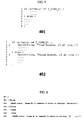
- FIG. 4 An example of how source code may be modified to determine test coverage for a given set of test inputs is shown in FIG. 4.
- the goal is to determine if the test has caused every if-statement to exercise both its true branch and its false branch.
- the original source code 401 with an if-statement (true and false branches on lines 2 and 5 respectively) is modified by inserting print statements (402) at lines 1.i and 4.i; when this modified code is executed, messages about branch executions are output to a log file and test coverage can be determined by looking at the messages in the log file.
- the techniques of the invention solve the problems of the prior art by programming a programmable execution environment to provide the desired information about the dynamic properties.
- the unmodified code for the program under investigation is then executed in the programmed execution environment, and the execution environment responds to the execution of the program under investigation by outputting information about the dynamic properties of interest.
- the program for the execution environment is produced by statically analyzing the source code for the program under investigation.
- One way of doing the static analysis is to provide a specification of the analysis to a tool which generates code analyzers. The tool then produces the code analyzer, which is in turn applied to the source code for the program under investigation to produce the program for the execution environment.
- Source code analyzers may be produced equally easily for many dynamic properties, and execution environments are available which have been ported to many different machines.
- the techniques of the invention thus not only avoid modification of the source code being tested, but may also be used to produce apparatus for testing an infinite variety of dynamic properties.
- the techniques may be used with any programmable execution environment and are as portable as the execution environments themselves.
- System 202 is made up of one or more programs which are executed in a programmable execution environment 203.
- One example of such an execution environment is a programmable debugger.
- system 202 is identical with system 204, which is shown separately in FIG. 2 just for convenience, and instead transform execution environment 203 into another execution environment 205. How the transformation is done depends both on the system being analyzed (202 ⁇ 204) and the dynamic property 207.
- Transformed execution environment 205 interrupts the execution of the programs of system 204 ( ⁇ 202) at points that are determined by the property and the system itself, and generates side effects 206. These side effects, like the side effects 106 generated in FIG. 1, can be used to investigate property 207.
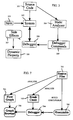
- FIG. 3 shows an example embodiment of how a dynamic property may be investigated by modifying an execution environment as described in the previous section.
- execution environment 203 is a debugger 306.
- Debuggers are tools used by programmers for finding bugs in programs. When a program is being debugged, it is executed in the debugger. The debugger permits the programmer to precisely control the execution of the program.
- a fundamental capability of debuggers is setting breakpoints .
- a breakpoint is a location in the program at which control passes from the program to the debugger when the program is executed in the debugger.
- debuggers are programmable, that is, the programmer can provide the debugger with a list of instructions which specify not only the locations of the breakpoints, but also actions which the debugger is to take when it encounters the break point. Actions may include halting execution until the person using the debugger restarts it or printing out the contents of machine registers and/or memory locations.
- Debuggers of the type used in the present invention work with the executable binaries for a program.
- the programmer using the debugger specifies a location for a break point relative to the source code for the program.
- the debugger finds the corresponding location in the executable binary code and replaces the instruction at that point in the executable binary with an illegal instruction.
- the debugger retains the replaced instruction and the action which the debugger is to take at the breakpoint.
- the hardware When the program is executed and the point at which the break point was set is reached, the hardware responds to the illegal instruction with an illegal instruction event.
- the debugger responds to the illegal instruction event by executing the action which the programmer specified for the break point. When that has been done, the debugger replaces the illegal instruction with the retained actual instruction, executes that instruction, and passes control back to the program, which continues executing until it reaches the next breakpoint.
- such a debugger 306 is used to determine a specific property 308 of system 302 when run with inputs 303.
- a static analyzer 304 is created for the specific property.
- Static analyzer 304 is applied to source code 301 for the system and generates a sequence of commands 305 for the debugger 306.
- the system 302 can be loaded into the debugger 306; the debugger then configures itself by executing commands 305 generated by static analyzer 304 and finally executes system 302 using inputs 303.
- debugger 306 interrupts the execution of system 302 at specified points and creates side effects 307 (for example, writing information about the state of the program at the time of the interruption of execution into a log file). The side effects can then be analyzed for information about dynamic property 307.
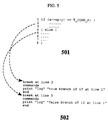
- FIG. 5 A specific example of this approach in use is shown in FIG. 5.
- the application is software testing; it is desired to determine whether a set of tests is complete, that is, whether the tests have executed both the true and false branches of every if-statement.
- static analyzer 304 is made using GENOA, a tool for generating source code analyzers.
- GENOA is described in Devanbu P., GENOA- A language and front-end independent source code analyzer generator, Proceedings, Twelfth International Conference on Software Engineering , May 1992.
- Static analyzer 304 produced by GENOA works on a parse tree representation of source code 501 for the program.
- a parse tree is a set of labelled nodes with labelled edges connecting them.
- the nodes represent different parts of the parse tree.
- the labels on the nodes represent the type of syntactic structure represented by the node.
- the entire source file containing the program being analyzed is represented by the node labelled File .
- Somewhere below this node in the tree is the node labelled If corresponding to the If-statement 601. This portion of the parse tree appears at reference number 602 in FIG. 6.
- Each of these edges connect the If node (line 1 in 601) to Block nodes representing the blocks beginning at lines 2 and 5 in 601.
- Static analyzer 304 produced by GENOA traverses the parse tree looking for nodes representing If-statements. When the analyzer finds a nodes for an If-statement, it determines from the parse tree what the starting locations in the source code are for the true- and false- branches, and generates debugger commands 502 (FIG. 5) specifying those locations and actions to be taken when they are reached. When the commands are provided to debugger 306 and the system 302 built from the source 501 is executed by the debugger as configured by the commands, the debugger performs the action specified for the breakpoint at each breakpoint reached by the execution. If the actions specified for all of the breakpoints have taken place, the set of tests is complete with regard to the branches of the if statements. It should be noted here that the debugger instructions need not be produced from source 501, but can be produced as well from any available source of information about the program being tested.
- the technique requires no modification of the source code.
- the modifications of the executable binary produced by the debugger are temporary and do not involve the addition of instructions to the executable binary.
- the debugger is one which is available on many platforms, one gains the convenience of binary instrumentation without sacrificing portability.
- An example of such a debugger is gdb, described in Stallman, R., and Pesch, R., Debugging with GDB, available by Internet file transfer from prep .mit . edu).
- FIG. 7 Coupling the Dynamic Property Analyzer to a Graphical Display: FIG. 7
- the side effects 307 produced by debugger 306 may of course be provided to any kind of device which produces output which is useful for analyzing the dynamic property.
- the side effects 307 are used to animate a flow graph 705.
- Flow graph 705 is produced in this example using another static analyzer made with GENOA.
- Flow graph 705 is provided to graphical browser 706 for visual display.
- the commands set break points at beginnings of blocks etc; each time a break point is activated, the debugger responds as specified by the commands.
- the commands specify that an inter-process message 708 specifying a modification in the visual display of the flow graph be sent from the process in which debugger 704 is executing to the process in which graphical browser 706 is executing.
- graphical browser 706 modifies the visual display. This technique can be used for visual display of test coverage information or simply as an aid to program comprehension and debugging.
- FIG. 8 A portion of a specification used with GENOA to produce a static analyzer 304 are shown in FIG. 8.
- the static analyzer which GENOA produces from the specification performs a search of the entire program for blocks and switch statements.
- the search is specified by the square brackets at line 801 and the end of line 807. What is being searched for is specified at line 802 (for the blocks) and line 804 (for the switch statements).
- Line 803 specifies that break points are to be set at the beginning of the block and that debugger commands are to be generated for each break point which instruct the debugger to delete the breakpoint and continue.
- breakpoints are set at each case of the switch (line 807) and the same debugger commands are to be generated.
- each breakpoint is deleted when activated, the breakpoints remaining after a test run indicate the parts of the code that have not been executed.
- the programmable debugger employed in the preferred embodiment indicates to the user which break points have not been executed, and thus indicates which parts of the code have not been executed.
- the execution environment is a debugger; however, the principles of the invention may be employed with any programmable execution environment.
- the preferred embodiment employs a static analysis of the source code to produce the instructions for the programmable execution environment, any kind of analysis which produced such instructions could be used instead.
- GENOA GENOA
Landscapes
- Engineering & Computer Science (AREA)
- Theoretical Computer Science (AREA)
- Computer Hardware Design (AREA)
- Quality & Reliability (AREA)
- Physics & Mathematics (AREA)
- General Engineering & Computer Science (AREA)
- General Physics & Mathematics (AREA)
- Software Systems (AREA)
- Debugging And Monitoring (AREA)
- Stored Programmes (AREA)
Applications Claiming Priority (2)
| Application Number | Priority Date | Filing Date | Title |
|---|---|---|---|
| US22904394A | 1994-04-18 | 1994-04-18 | |
| US229043 | 1994-04-18 |
Publications (1)
| Publication Number | Publication Date |
|---|---|
| EP0678810A1 true EP0678810A1 (en) | 1995-10-25 |
Family
ID=22859617
Family Applications (1)
| Application Number | Title | Priority Date | Filing Date |
|---|---|---|---|
| EP95302242A Ceased EP0678810A1 (en) | 1994-04-18 | 1995-04-04 | Determining Dynamic properties of programs |
Country Status (4)
| Country | Link |
|---|---|
| US (1) | US5832271A (enExample) |
| EP (1) | EP0678810A1 (enExample) |
| JP (1) | JPH07295859A (enExample) |
| CA (1) | CA2143145C (enExample) |
Cited By (3)
| Publication number | Priority date | Publication date | Assignee | Title |
|---|---|---|---|---|
| EP0753814A3 (enExample) * | 1995-07-13 | 1997-01-29 | At & T Corp | |
| WO2009065168A1 (en) * | 2007-11-20 | 2009-05-28 | National Ict Australia Limited | Multi language software code analysis |
| EP2261802A1 (en) * | 2009-06-10 | 2010-12-15 | ITI Scotland Limited | Automated debugging system and method |
Families Citing this family (26)
| Publication number | Priority date | Publication date | Assignee | Title |
|---|---|---|---|---|
| US6098092A (en) * | 1996-11-08 | 2000-08-01 | Silicon Graphics, Inc. | Server to dynamically generate graphics for the world wide web |
| US5953534A (en) * | 1997-12-23 | 1999-09-14 | University Of Washington | Environment manipulation for executing modified executable and dynamically-loaded library files |
| US6216237B1 (en) * | 1998-06-19 | 2001-04-10 | Lucent Technologies Inc. | Distributed indirect software instrumentation |
| US6279149B1 (en) * | 1998-09-24 | 2001-08-21 | International Business Machines Corporation | Aggregate structure identification and its application to program analysis |
| US6959431B1 (en) * | 1999-05-13 | 2005-10-25 | Compuware Corporation | System and method to measure and report on effectiveness of software program testing |
| US6427232B1 (en) | 1999-06-10 | 2002-07-30 | International Business Machines Corporation | Functional debugger for debugging software programs |
| US6775827B1 (en) * | 1999-09-20 | 2004-08-10 | Harkins Audit Software, Inc. | Real-time program audit software |
| US7240336B1 (en) | 2000-07-25 | 2007-07-03 | Sci Systems, Inc. | Interpretive simulation of software download process |
| US7191436B1 (en) | 2001-03-08 | 2007-03-13 | Microsoft Corporation | Computer system utility facilitating dynamically providing program modifications for identified programs |
| US7055146B1 (en) | 2001-03-08 | 2006-05-30 | Microsoft Corporation | Method and system for dynamically inserting modifications for identified programs |
| US20050081104A1 (en) * | 2003-09-25 | 2005-04-14 | Borislav Nikolik | Test diversity software testing method and apparatus |
| US7657869B2 (en) * | 2004-02-05 | 2010-02-02 | Microsoft Corporation | Integration of external tools into an existing design environment |
| JP4776235B2 (ja) * | 2005-01-07 | 2011-09-21 | ソニー株式会社 | 情報処理装置および方法、並びにプログラム |
| US7549144B2 (en) * | 2005-02-22 | 2009-06-16 | Microsoft Corporation | Custom API modeling for source code static analysis simulator |
| US7779399B2 (en) * | 2005-05-16 | 2010-08-17 | Armorize Technologies, Inc. | System and method for securing web application code and verifying correctness of software |
| US8212805B1 (en) | 2007-01-05 | 2012-07-03 | Kenneth Banschick | System and method for parametric display of modular aesthetic designs |
| JP2008257390A (ja) * | 2007-04-03 | 2008-10-23 | Toshiba Information Systems (Japan) Corp | プログラム検査装置及びプログラム検査用プログラム |
| KR101275698B1 (ko) * | 2008-11-28 | 2013-06-17 | 상하이 신하오 (브레이브칩스) 마이크로 일렉트로닉스 코. 엘티디. | 데이터 처리 방법 및 장치 |
| US10157049B2 (en) * | 2011-10-26 | 2018-12-18 | International Business Machines Corporation | Static analysis with input reduction |
| US8918881B2 (en) | 2012-02-24 | 2014-12-23 | Appthority, Inc. | Off-device anti-malware protection for mobile devices |
| US8713684B2 (en) | 2012-02-24 | 2014-04-29 | Appthority, Inc. | Quantifying the risks of applications for mobile devices |
| US8819772B2 (en) | 2012-06-25 | 2014-08-26 | Appthority, Inc. | In-line filtering of insecure or unwanted mobile device software components or communications |
| US9552285B2 (en) | 2013-05-02 | 2017-01-24 | Microsoft Technology Licensing, Llc | Micro-execution for software testing |
| JP6088445B2 (ja) * | 2014-01-07 | 2017-03-01 | 日本電信電話株式会社 | ソフトウェア規模演算装置およびプログラム |
| US10379825B2 (en) | 2017-05-22 | 2019-08-13 | Ab Initio Technology Llc | Automated dependency analyzer for heterogeneously programmed data processing system |
| US12443723B2 (en) * | 2023-05-22 | 2025-10-14 | Sap Se | Collaborative software application static vulnerability detection |
Family Cites Families (5)
| Publication number | Priority date | Publication date | Assignee | Title |
|---|---|---|---|---|
| US4080650A (en) * | 1976-07-28 | 1978-03-21 | Bell Telephone Laboratories, Incorporated | Facilitating return from an on-line debugging program to a target program breakpoint |
| US4914568A (en) * | 1986-10-24 | 1990-04-03 | National Instruments, Inc. | Graphical system for modelling a process and associated method |
| US4819234A (en) * | 1987-05-01 | 1989-04-04 | Prime Computer, Inc. | Operating system debugger |
| US5038348A (en) * | 1988-07-01 | 1991-08-06 | Sharp Kabushiki Kaisha | Apparatus for debugging a data flow program |
| US5313616A (en) * | 1990-09-18 | 1994-05-17 | 88Open Consortium, Ltd. | Method for analyzing calls of application program by inserting monitoring routines into the executable version and redirecting calls to the monitoring routines |
-
1995
- 1995-02-22 CA CA002143145A patent/CA2143145C/en not_active Expired - Fee Related
- 1995-04-04 EP EP95302242A patent/EP0678810A1/en not_active Ceased
- 1995-04-18 JP JP7092036A patent/JPH07295859A/ja active Pending
-
1996
- 1996-07-08 US US08/677,000 patent/US5832271A/en not_active Expired - Lifetime
Non-Patent Citations (5)
| Title |
|---|
| AMBRAS J P ET AL: "MICROSCOPE: AN INTEGRATED PROGRAM ANALYSIS TOOLSET", HEWLETT-PACKARD JOURNAL, no. 4, 1 August 1988 (1988-08-01), PALO ALTO US, pages 71 - 82, XP000106161 * |
| D. J. JABLONOWSKI ET AL.: "VASE: the visualization and application steering environment", PROCEEDINGS SUPERCOMPUTING 93, 15 - 19 NOVEMBER 1993, PORTLAND US, IEEE, LOS ALAMITOS US, pages 560 - 569, XP000437395 * |
| HEYMANN J: "A 100 % PORTABLE INLINE-BEBUGGER", ACM SIGPLAN NOTICES, vol. 28, no. 9, 1 September 1993 (1993-09-01), NEW YORK US, pages 39 - 46, XP000398037 * |
| PREMKUMAR T. DEVANBU: "Genoa - A Customizable, Language- and Front-End independent Code Analyzer", 12TH INTERNATIONAL CONFERENCE ON SOFTWARE ENGINEERING, 11 May 1992 (1992-05-11), IEEE, MAY 11-15, 1992, pages 307 - 317, XP000604440 * |
| T. WILLIAMS: "BRANCH ANALYSIS TOOL QUANTIFIES TESTING", COMPUTER DESIGN, vol. 29, no. 3, 1 February 1990 (1990-02-01), TULSA US, pages 40, XP000096036 * |
Cited By (7)
| Publication number | Priority date | Publication date | Assignee | Title |
|---|---|---|---|---|
| US5909577A (en) * | 1994-04-18 | 1999-06-01 | Lucent Technologies Inc. | Determining dynamic properties of programs |
| EP0753814A3 (enExample) * | 1995-07-13 | 1997-01-29 | At & T Corp | |
| WO2009065168A1 (en) * | 2007-11-20 | 2009-05-28 | National Ict Australia Limited | Multi language software code analysis |
| US8869120B2 (en) | 2007-11-20 | 2014-10-21 | National Ict Australia Limited | Multi language software code analysis |
| EP2261802A1 (en) * | 2009-06-10 | 2010-12-15 | ITI Scotland Limited | Automated debugging system and method |
| WO2010142966A1 (en) * | 2009-06-10 | 2010-12-16 | Iti Scotland Limited | Automated debugging system and method |
| US8732673B2 (en) | 2009-06-10 | 2014-05-20 | Iti Scotland Limited | Automated debugging system and method |
Also Published As
| Publication number | Publication date |
|---|---|
| JPH07295859A (ja) | 1995-11-10 |
| CA2143145A1 (en) | 1995-10-19 |
| CA2143145C (en) | 1999-12-28 |
| US5832271A (en) | 1998-11-03 |
Similar Documents
| Publication | Publication Date | Title |
|---|---|---|
| US5832271A (en) | Determining dynamic properties of programs | |
| US5909577A (en) | Determining dynamic properties of programs | |
| US6003143A (en) | Tool and method for diagnosing and correcting errors in a computer program | |
| EP1130518B1 (en) | Software analysis system having an apparatus for selectively collecting analysis data from a target system executing software instrumented with tag statements and method for use thereof | |
| US6430741B1 (en) | System and method for data coverage analysis of a computer program | |
| JP2795244B2 (ja) | プログラムデバッグシステム | |
| Korel et al. | Application of Dynamic Slicing in Program Debugging. | |
| EP0406602B1 (en) | Method and apparatus for debugging parallel programs by serialization | |
| US6493834B1 (en) | Apparatus and method for dynamically defining exception handlers in a debugger | |
| EP0539120B1 (en) | Source code analyzer | |
| US20030033592A1 (en) | Software debugger and software development support system | |
| US20090199163A1 (en) | Debugger assistance for locating values at runtime | |
| US20030093736A1 (en) | System and method enabling hierarchical execution of a test executive subsequence | |
| JP2000122886A (ja) | 半導体試験装置のプログラム作成方式 | |
| Staiger | Reverse engineering of graphical user interfaces using static analyses | |
| US20030018957A1 (en) | Debugger monitor with anticipatory highlights | |
| EP0801348A1 (en) | Method of monitoring the operation of a computer | |
| KR20010070401A (ko) | 반도체 시험 장치의 프로그램 실행 시스템 | |
| Griffin et al. | A debugger for parallel processes | |
| KR20030088523A (ko) | 소프트웨어 분석 방법 및 장치 | |
| Lee et al. | A review of popular reverse engineering tools from a novice perspective | |
| JP2001043110A (ja) | プログラムのデバッグ方法 | |
| Zhao et al. | Semantics of RxJS | |
| Cunha et al. | A distributed debugging tool for a parallel software engineering environment | |
| Studio | Getting Started Guide |
Legal Events
| Date | Code | Title | Description |
|---|---|---|---|
| PUAI | Public reference made under article 153(3) epc to a published international application that has entered the european phase |
Free format text: ORIGINAL CODE: 0009012 |
|
| AK | Designated contracting states |
Kind code of ref document: A1 Designated state(s): DE FR GB |
|
| 17P | Request for examination filed |
Effective date: 19960412 |
|
| 17Q | First examination report despatched |
Effective date: 19970715 |
|
| APAB | Appeal dossier modified |
Free format text: ORIGINAL CODE: EPIDOS NOAPE |
|
| APAB | Appeal dossier modified |
Free format text: ORIGINAL CODE: EPIDOS NOAPE |
|
| APAD | Appeal reference recorded |
Free format text: ORIGINAL CODE: EPIDOS REFNE |
|
| APBT | Appeal procedure closed |
Free format text: ORIGINAL CODE: EPIDOSNNOA9E |
|
| STAA | Information on the status of an ep patent application or granted ep patent |
Free format text: STATUS: THE APPLICATION HAS BEEN REFUSED |
|
| 18R | Application refused |
Effective date: 20040910 |
|
| APAF | Appeal reference modified |
Free format text: ORIGINAL CODE: EPIDOSCREFNE |