EP0675924B1 - Cyclic-substituted unsymmetrical cyanine dyes - Google Patents
Cyclic-substituted unsymmetrical cyanine dyes Download PDFInfo
- Publication number
- EP0675924B1 EP0675924B1 EP94914173A EP94914173A EP0675924B1 EP 0675924 B1 EP0675924 B1 EP 0675924B1 EP 94914173 A EP94914173 A EP 94914173A EP 94914173 A EP94914173 A EP 94914173A EP 0675924 B1 EP0675924 B1 EP 0675924B1
- Authority
- EP
- European Patent Office
- Prior art keywords
- dye
- omega
- alkyl
- substituted
- carbons
- Prior art date
- Legal status (The legal status is an assumption and is not a legal conclusion. Google has not performed a legal analysis and makes no representation as to the accuracy of the status listed.)
- Expired - Lifetime
Links
- 239000000975 dye Substances 0.000 title claims description 256
- ANRHNWWPFJCPAZ-UHFFFAOYSA-M thionine Chemical compound [Cl-].C1=CC(N)=CC2=[S+]C3=CC(N)=CC=C3N=C21 ANRHNWWPFJCPAZ-UHFFFAOYSA-M 0.000 title 1
- 238000000034 method Methods 0.000 claims abstract description 36
- 125000000217 alkyl group Chemical group 0.000 claims abstract description 34
- -1 heteroalicyclic Chemical group 0.000 claims abstract description 30
- 230000004044 response Effects 0.000 claims abstract description 30
- SIKJAQJRHWYJAI-UHFFFAOYSA-N Indole Chemical compound C1=CC=C2NC=CC2=C1 SIKJAQJRHWYJAI-UHFFFAOYSA-N 0.000 claims abstract description 23
- 125000003118 aryl group Chemical group 0.000 claims abstract description 22
- 229910052736 halogen Inorganic materials 0.000 claims abstract description 22
- 125000001424 substituent group Chemical group 0.000 claims abstract description 21
- 150000002367 halogens Chemical class 0.000 claims abstract description 20
- 239000007850 fluorescent dye Substances 0.000 claims abstract description 14
- 229910052757 nitrogen Inorganic materials 0.000 claims abstract description 13
- 125000005842 heteroatom Chemical group 0.000 claims abstract description 11
- 229910052760 oxygen Inorganic materials 0.000 claims abstract description 11
- 125000005010 perfluoroalkyl group Chemical group 0.000 claims abstract description 10
- 229920006395 saturated elastomer Polymers 0.000 claims abstract description 10
- 125000001072 heteroaryl group Chemical group 0.000 claims abstract description 8
- 125000002723 alicyclic group Chemical group 0.000 claims abstract description 7
- 125000004169 (C1-C6) alkyl group Chemical group 0.000 claims abstract 18
- 210000004027 cell Anatomy 0.000 claims description 94
- 108020004707 nucleic acids Proteins 0.000 claims description 87
- 102000039446 nucleic acids Human genes 0.000 claims description 87
- 150000007523 nucleic acids Chemical class 0.000 claims description 87
- 150000001875 compounds Chemical class 0.000 claims description 44
- 241000894006 Bacteria Species 0.000 claims description 37
- 125000001997 phenyl group Chemical group [H]C1=C([H])C([H])=C(*)C([H])=C1[H] 0.000 claims description 31
- JUJWROOIHBZHMG-UHFFFAOYSA-O pyridinium Chemical class C1=CC=[NH+]C=C1 JUJWROOIHBZHMG-UHFFFAOYSA-O 0.000 claims description 22
- SMWDFEZZVXVKRB-UHFFFAOYSA-O hydron;quinoline Chemical class [NH+]1=CC=CC2=CC=CC=C21 SMWDFEZZVXVKRB-UHFFFAOYSA-O 0.000 claims description 20
- 238000010186 staining Methods 0.000 claims description 20
- QGKMIGUHVLGJBR-UHFFFAOYSA-M (4z)-1-(3-methylbutyl)-4-[[1-(3-methylbutyl)quinolin-1-ium-4-yl]methylidene]quinoline;iodide Chemical compound [I-].C12=CC=CC=C2N(CCC(C)C)C=CC1=CC1=CC=[N+](CCC(C)C)C2=CC=CC=C12 QGKMIGUHVLGJBR-UHFFFAOYSA-M 0.000 claims description 19
- 125000000623 heterocyclic group Chemical group 0.000 claims description 17
- 125000004122 cyclic group Chemical group 0.000 claims description 15
- RTZKZFJDLAIYFH-UHFFFAOYSA-N Diethyl ether Chemical compound CCOCC RTZKZFJDLAIYFH-UHFFFAOYSA-N 0.000 claims description 14
- 238000005286 illumination Methods 0.000 claims description 11
- 125000002496 methyl group Chemical group [H]C([H])([H])* 0.000 claims description 11
- IJGRMHOSHXDMSA-UHFFFAOYSA-N Atomic nitrogen Chemical compound N#N IJGRMHOSHXDMSA-UHFFFAOYSA-N 0.000 claims description 10
- 210000000170 cell membrane Anatomy 0.000 claims description 10
- 150000003568 thioethers Chemical class 0.000 claims description 10
- 230000003834 intracellular effect Effects 0.000 claims description 9
- XSXHWVKGUXMUQE-UHFFFAOYSA-N osmium dioxide Inorganic materials O=[Os]=O XSXHWVKGUXMUQE-UHFFFAOYSA-N 0.000 claims description 9
- 102000004169 proteins and genes Human genes 0.000 claims description 9
- 108090000623 proteins and genes Proteins 0.000 claims description 9
- 239000007787 solid Substances 0.000 claims description 9
- 229910052717 sulfur Inorganic materials 0.000 claims description 9
- LFQSCWFLJHTTHZ-UHFFFAOYSA-N Ethanol Chemical compound CCO LFQSCWFLJHTTHZ-UHFFFAOYSA-N 0.000 claims description 8
- JUJWROOIHBZHMG-UHFFFAOYSA-N Pyridine Chemical group C1=CC=NC=C1 JUJWROOIHBZHMG-UHFFFAOYSA-N 0.000 claims description 8
- 239000000980 acid dye Substances 0.000 claims description 8
- 125000004435 hydrogen atom Chemical group [H]* 0.000 claims description 8
- 239000012528 membrane Substances 0.000 claims description 8
- 108090000790 Enzymes Proteins 0.000 claims description 7
- 102000004190 Enzymes Human genes 0.000 claims description 7
- 125000000113 cyclohexyl group Chemical group [H]C1([H])C([H])([H])C([H])([H])C([H])(*)C([H])([H])C1([H])[H] 0.000 claims description 7
- 125000002924 primary amino group Chemical group [H]N([H])* 0.000 claims description 7
- SMWDFEZZVXVKRB-UHFFFAOYSA-N Quinoline Chemical group N1=CC=CC2=CC=CC=C21 SMWDFEZZVXVKRB-UHFFFAOYSA-N 0.000 claims description 6
- 150000001412 amines Chemical class 0.000 claims description 6
- 239000000539 dimer Substances 0.000 claims description 6
- 125000001434 methanylylidene group Chemical group [H]C#[*] 0.000 claims description 6
- 239000000178 monomer Substances 0.000 claims description 5
- 239000002245 particle Substances 0.000 claims description 5
- 125000001544 thienyl group Chemical group 0.000 claims description 5
- BCMCBBGGLRIHSE-UHFFFAOYSA-N 1,3-benzoxazole Chemical class C1=CC=C2OC=NC2=C1 BCMCBBGGLRIHSE-UHFFFAOYSA-N 0.000 claims description 4
- QGZKDVFQNNGYKY-UHFFFAOYSA-N Ammonia Chemical compound N QGZKDVFQNNGYKY-UHFFFAOYSA-N 0.000 claims description 4
- QTANTQQOYSUMLC-UHFFFAOYSA-O Ethidium cation Chemical group C12=CC(N)=CC=C2C2=CC=C(N)C=C2[N+](CC)=C1C1=CC=CC=C1 QTANTQQOYSUMLC-UHFFFAOYSA-O 0.000 claims description 4
- 125000003545 alkoxy group Chemical group 0.000 claims description 4
- 125000003282 alkyl amino group Chemical group 0.000 claims description 4
- IOJUPLGTWVMSFF-UHFFFAOYSA-N benzothiazole Chemical class C1=CC=C2SC=NC2=C1 IOJUPLGTWVMSFF-UHFFFAOYSA-N 0.000 claims description 4
- 125000004181 carboxyalkyl group Chemical group 0.000 claims description 4
- 125000004663 dialkyl amino group Chemical group 0.000 claims description 4
- 229910052739 hydrogen Inorganic materials 0.000 claims description 4
- 125000001624 naphthyl group Chemical group 0.000 claims description 4
- 125000006413 ring segment Chemical group 0.000 claims description 4
- 239000000758 substrate Substances 0.000 claims description 4
- AIGNCQCMONAWOL-UHFFFAOYSA-N 1,3-benzoselenazole Chemical class C1=CC=C2[se]C=NC2=C1 AIGNCQCMONAWOL-UHFFFAOYSA-N 0.000 claims description 3
- HYZJCKYKOHLVJF-UHFFFAOYSA-N 1H-benzimidazole Chemical class C1=CC=C2NC=NC2=C1 HYZJCKYKOHLVJF-UHFFFAOYSA-N 0.000 claims description 3
- 241000192125 Firmicutes Species 0.000 claims description 3
- 125000001164 benzothiazolyl group Chemical group S1C(=NC2=C1C=CC=C2)* 0.000 claims description 3
- 125000004541 benzoxazolyl group Chemical group O1C(=NC2=C1C=CC=C2)* 0.000 claims description 3
- 125000004432 carbon atom Chemical group C* 0.000 claims description 3
- 125000000596 cyclohexenyl group Chemical group C1(=CCCCC1)* 0.000 claims description 3
- 125000002541 furyl group Chemical group 0.000 claims description 3
- 239000001257 hydrogen Substances 0.000 claims description 3
- 125000002971 oxazolyl group Chemical group 0.000 claims description 3
- 238000000926 separation method Methods 0.000 claims description 3
- 125000002023 trifluoromethyl group Chemical group FC(F)(F)* 0.000 claims description 3
- PRDFBSVERLRRMY-UHFFFAOYSA-N 2'-(4-ethoxyphenyl)-5-(4-methylpiperazin-1-yl)-2,5'-bibenzimidazole Chemical compound C1=CC(OCC)=CC=C1C1=NC2=CC=C(C=3NC4=CC(=CC=C4N=3)N3CCN(C)CC3)C=C2N1 PRDFBSVERLRRMY-UHFFFAOYSA-N 0.000 claims description 2
- FPNZBYLXNYPRLR-UHFFFAOYSA-N 2-(4-carbamimidoylphenyl)-1h-indole-6-carboximidamide;hydron;dichloride Chemical compound Cl.Cl.C1=CC(C(=N)N)=CC=C1C1=CC2=CC=C(C(N)=N)C=C2N1 FPNZBYLXNYPRLR-UHFFFAOYSA-N 0.000 claims description 2
- 108090001090 Lectins Proteins 0.000 claims description 2
- 102000004856 Lectins Human genes 0.000 claims description 2
- 230000009471 action Effects 0.000 claims description 2
- 150000004703 alkoxides Chemical class 0.000 claims description 2
- 229910021529 ammonia Inorganic materials 0.000 claims description 2
- 210000000805 cytoplasm Anatomy 0.000 claims description 2
- 238000001962 electrophoresis Methods 0.000 claims description 2
- 239000002523 lectin Substances 0.000 claims description 2
- 125000002757 morpholinyl group Chemical group 0.000 claims description 2
- 210000003463 organelle Anatomy 0.000 claims description 2
- INAAIJLSXJJHOZ-UHFFFAOYSA-N pibenzimol Chemical compound C1CN(C)CCN1C1=CC=C(N=C(N2)C=3C=C4NC(=NC4=CC=3)C=3C=CC(O)=CC=3)C2=C1 INAAIJLSXJJHOZ-UHFFFAOYSA-N 0.000 claims description 2
- 150000003573 thiols Chemical class 0.000 claims description 2
- 230000003612 virological effect Effects 0.000 claims description 2
- 125000003277 amino group Chemical group 0.000 claims 9
- 229910052794 bromium Inorganic materials 0.000 claims 3
- 229910052801 chlorine Inorganic materials 0.000 claims 3
- 229910052731 fluorine Inorganic materials 0.000 claims 3
- RMVRSNDYEFQCLF-UHFFFAOYSA-N thiophenol Chemical compound SC1=CC=CC=C1 RMVRSNDYEFQCLF-UHFFFAOYSA-N 0.000 claims 3
- 102000004316 Oxidoreductases Human genes 0.000 claims 2
- 108090000854 Oxidoreductases Proteins 0.000 claims 2
- 210000003850 cellular structure Anatomy 0.000 claims 2
- 229910052740 iodine Inorganic materials 0.000 claims 2
- 125000004433 nitrogen atom Chemical group N* 0.000 claims 2
- 125000004076 pyridyl group Chemical group 0.000 claims 2
- 108090001008 Avidin Proteins 0.000 claims 1
- UFHFLCQGNIYNRP-UHFFFAOYSA-N Hydrogen Chemical compound [H][H] UFHFLCQGNIYNRP-UHFFFAOYSA-N 0.000 claims 1
- ISWSIDIOOBJBQZ-UHFFFAOYSA-N Phenol Chemical compound OC1=CC=CC=C1 ISWSIDIOOBJBQZ-UHFFFAOYSA-N 0.000 claims 1
- 108010090804 Streptavidin Proteins 0.000 claims 1
- 101710120037 Toxin CcdB Proteins 0.000 claims 1
- HSMPSHPWCOOUJH-UHFFFAOYSA-N anilinyl Chemical group [NH]C1=CC=CC=C1 HSMPSHPWCOOUJH-UHFFFAOYSA-N 0.000 claims 1
- 150000001720 carbohydrates Chemical class 0.000 claims 1
- 210000002472 endoplasmic reticulum Anatomy 0.000 claims 1
- 150000004676 glycans Chemical class 0.000 claims 1
- 210000002288 golgi apparatus Anatomy 0.000 claims 1
- 230000003301 hydrolyzing effect Effects 0.000 claims 1
- 125000001449 isopropyl group Chemical group [H]C([H])([H])C([H])(*)C([H])([H])[H] 0.000 claims 1
- 210000003712 lysosome Anatomy 0.000 claims 1
- 230000001868 lysosomic effect Effects 0.000 claims 1
- 238000004519 manufacturing process Methods 0.000 claims 1
- 210000003470 mitochondria Anatomy 0.000 claims 1
- UPSFMJHZUCSEHU-JYGUBCOQSA-N n-[(2s,3r,4r,5s,6r)-2-[(2r,3s,4r,5r,6s)-5-acetamido-4-hydroxy-2-(hydroxymethyl)-6-(4-methyl-2-oxochromen-7-yl)oxyoxan-3-yl]oxy-4,5-dihydroxy-6-(hydroxymethyl)oxan-3-yl]acetamide Chemical compound CC(=O)N[C@@H]1[C@@H](O)[C@H](O)[C@@H](CO)O[C@H]1O[C@H]1[C@H](O)[C@@H](NC(C)=O)[C@H](OC=2C=C3OC(=O)C=C(C)C3=CC=2)O[C@@H]1CO UPSFMJHZUCSEHU-JYGUBCOQSA-N 0.000 claims 1
- 125000004108 n-butyl group Chemical group [H]C([H])([H])C([H])([H])C([H])([H])C([H])([H])* 0.000 claims 1
- 125000004430 oxygen atom Chemical group O* 0.000 claims 1
- 229920001282 polysaccharide Polymers 0.000 claims 1
- 239000005017 polysaccharide Substances 0.000 claims 1
- 108090000765 processed proteins & peptides Proteins 0.000 claims 1
- ZDWVWKDAWBGPDN-UHFFFAOYSA-O propidium Chemical compound C12=CC(N)=CC=C2C2=CC=C(N)C=C2[N+](CCC[N+](C)(CC)CC)=C1C1=CC=CC=C1 ZDWVWKDAWBGPDN-UHFFFAOYSA-O 0.000 claims 1
- 125000004434 sulfur atom Chemical group 0.000 claims 1
- 125000002827 triflate group Chemical group FC(S(=O)(=O)O*)(F)F 0.000 claims 1
- 125000004417 unsaturated alkyl group Chemical group 0.000 claims 1
- 210000003934 vacuole Anatomy 0.000 claims 1
- 230000035899 viability Effects 0.000 abstract description 12
- 125000003342 alkenyl group Chemical group 0.000 abstract description 5
- 125000000304 alkynyl group Chemical group 0.000 abstract description 5
- 238000010521 absorption reaction Methods 0.000 abstract description 4
- 239000007864 aqueous solution Substances 0.000 abstract description 3
- OKKJLVBELUTLKV-UHFFFAOYSA-N Methanol Chemical compound OC OKKJLVBELUTLKV-UHFFFAOYSA-N 0.000 description 39
- 239000000523 sample Substances 0.000 description 31
- 239000000725 suspension Substances 0.000 description 26
- YMWUJEATGCHHMB-UHFFFAOYSA-N Dichloromethane Chemical compound ClCCl YMWUJEATGCHHMB-UHFFFAOYSA-N 0.000 description 24
- XLYOFNOQVPJJNP-UHFFFAOYSA-N water Substances O XLYOFNOQVPJJNP-UHFFFAOYSA-N 0.000 description 24
- 101100041820 Saccharomyces cerevisiae (strain ATCC 204508 / S288c) SCEI gene Proteins 0.000 description 22
- 239000000243 solution Substances 0.000 description 22
- ZMXDDKWLCZADIW-UHFFFAOYSA-N N,N-Dimethylformamide Chemical compound CN(C)C=O ZMXDDKWLCZADIW-UHFFFAOYSA-N 0.000 description 21
- ZMANZCXQSJIPKH-UHFFFAOYSA-N Triethylamine Chemical compound CCN(CC)CC ZMANZCXQSJIPKH-UHFFFAOYSA-N 0.000 description 21
- XEKOWRVHYACXOJ-UHFFFAOYSA-N Ethyl acetate Chemical compound CCOC(C)=O XEKOWRVHYACXOJ-UHFFFAOYSA-N 0.000 description 19
- 230000005284 excitation Effects 0.000 description 16
- 239000000203 mixture Substances 0.000 description 16
- 238000002360 preparation method Methods 0.000 description 16
- 239000012192 staining solution Substances 0.000 description 14
- 210000004369 blood Anatomy 0.000 description 13
- 239000008280 blood Substances 0.000 description 13
- 238000011068 loading method Methods 0.000 description 13
- 239000002243 precursor Substances 0.000 description 13
- 239000000047 product Substances 0.000 description 13
- QTBSBXVTEAMEQO-UHFFFAOYSA-N Acetic acid Chemical compound CC(O)=O QTBSBXVTEAMEQO-UHFFFAOYSA-N 0.000 description 12
- HEDRZPFGACZZDS-UHFFFAOYSA-N Chloroform Chemical compound ClC(Cl)Cl HEDRZPFGACZZDS-UHFFFAOYSA-N 0.000 description 12
- IAZDPXIOMUYVGZ-UHFFFAOYSA-N Dimethylsulphoxide Chemical compound CS(C)=O IAZDPXIOMUYVGZ-UHFFFAOYSA-N 0.000 description 12
- 238000006243 chemical reaction Methods 0.000 description 12
- 238000001514 detection method Methods 0.000 description 12
- 108020004414 DNA Proteins 0.000 description 11
- 230000001580 bacterial effect Effects 0.000 description 11
- XHXFXVLFKHQFAL-UHFFFAOYSA-N phosphoryl trichloride Chemical compound ClP(Cl)(Cl)=O XHXFXVLFKHQFAL-UHFFFAOYSA-N 0.000 description 11
- 241000588724 Escherichia coli Species 0.000 description 10
- LISFMEBWQUVKPJ-UHFFFAOYSA-N quinolin-2-ol Chemical compound C1=CC=C2NC(=O)C=CC2=C1 LISFMEBWQUVKPJ-UHFFFAOYSA-N 0.000 description 10
- 238000010790 dilution Methods 0.000 description 9
- 239000012895 dilution Substances 0.000 description 9
- XKRFYHLGVUSROY-UHFFFAOYSA-N Argon Chemical compound [Ar] XKRFYHLGVUSROY-UHFFFAOYSA-N 0.000 description 8
- FAPWRFPIFSIZLT-UHFFFAOYSA-M Sodium chloride Chemical compound [Na+].[Cl-] FAPWRFPIFSIZLT-UHFFFAOYSA-M 0.000 description 8
- 239000000543 intermediate Substances 0.000 description 8
- ACOJCCLIDPZYJC-UHFFFAOYSA-M thiazole orange Chemical compound CC1=CC=C(S([O-])(=O)=O)C=C1.C1=CC=C2C(C=C3N(C4=CC=CC=C4S3)C)=CC=[N+](C)C2=C1 ACOJCCLIDPZYJC-UHFFFAOYSA-M 0.000 description 8
- VYPSYNLAJGMNEJ-UHFFFAOYSA-N Silicium dioxide Chemical compound O=[Si]=O VYPSYNLAJGMNEJ-UHFFFAOYSA-N 0.000 description 7
- 239000003153 chemical reaction reagent Substances 0.000 description 7
- 239000000741 silica gel Substances 0.000 description 7
- 229910002027 silica gel Inorganic materials 0.000 description 7
- 108091032973 (ribonucleotides)n+m Proteins 0.000 description 6
- 238000004458 analytical method Methods 0.000 description 6
- 230000015572 biosynthetic process Effects 0.000 description 6
- 239000012043 crude product Substances 0.000 description 6
- GNBHRKFJIUUOQI-UHFFFAOYSA-N fluorescein Chemical compound O1C(=O)C2=CC=CC=C2C21C1=CC=C(O)C=C1OC1=CC(O)=CC=C21 GNBHRKFJIUUOQI-UHFFFAOYSA-N 0.000 description 6
- BWHMMNNQKKPAPP-UHFFFAOYSA-L potassium carbonate Chemical compound [K+].[K+].[O-]C([O-])=O BWHMMNNQKKPAPP-UHFFFAOYSA-L 0.000 description 6
- 210000001995 reticulocyte Anatomy 0.000 description 6
- 239000008223 sterile water Substances 0.000 description 6
- 229910019213 POCl3 Inorganic materials 0.000 description 5
- 230000001413 cellular effect Effects 0.000 description 5
- HPNMFZURTQLUMO-UHFFFAOYSA-N diethylamine Chemical compound CCNCC HPNMFZURTQLUMO-UHFFFAOYSA-N 0.000 description 5
- 238000000295 emission spectrum Methods 0.000 description 5
- 239000000499 gel Substances 0.000 description 5
- XMBWDFGMSWQBCA-UHFFFAOYSA-N hydrogen iodide Chemical compound I XMBWDFGMSWQBCA-UHFFFAOYSA-N 0.000 description 5
- 239000011780 sodium chloride Substances 0.000 description 5
- 230000003595 spectral effect Effects 0.000 description 5
- 239000011550 stock solution Substances 0.000 description 5
- 238000003786 synthesis reaction Methods 0.000 description 5
- 210000001519 tissue Anatomy 0.000 description 5
- LWOQYWAFZDPJAC-UHFFFAOYSA-M 2-chloro-4-methyl-1-phenylquinolin-1-ium;chloride Chemical compound [Cl-].C12=CC=CC=C2C(C)=CC(Cl)=[N+]1C1=CC=CC=C1 LWOQYWAFZDPJAC-UHFFFAOYSA-M 0.000 description 4
- LPZWUECCZRSOAQ-UHFFFAOYSA-N 4-methyl-1-phenylpyridin-2-one Chemical compound O=C1C=C(C)C=CN1C1=CC=CC=C1 LPZWUECCZRSOAQ-UHFFFAOYSA-N 0.000 description 4
- ILKUVYJZEPVFHW-UHFFFAOYSA-N 4-methyl-1-phenylquinolin-2-one Chemical compound C12=CC=CC=C2C(C)=CC(=O)N1C1=CC=CC=C1 ILKUVYJZEPVFHW-UHFFFAOYSA-N 0.000 description 4
- SGABZOJLSUJGFH-UHFFFAOYSA-M 4-methylbenzenesulfonate;3-methyl-2-methylsulfanyl-1,3-benzothiazol-3-ium Chemical compound CC1=CC=C(S([O-])(=O)=O)C=C1.C1=CC=C2[N+](C)=C(SC)SC2=C1 SGABZOJLSUJGFH-UHFFFAOYSA-M 0.000 description 4
- CPELXLSAUQHCOX-UHFFFAOYSA-M Bromide Chemical compound [Br-] CPELXLSAUQHCOX-UHFFFAOYSA-M 0.000 description 4
- 239000012981 Hank's balanced salt solution Substances 0.000 description 4
- MZRVEZGGRBJDDB-UHFFFAOYSA-N N-Butyllithium Chemical compound [Li]CCCC MZRVEZGGRBJDDB-UHFFFAOYSA-N 0.000 description 4
- AFBPFSWMIHJQDM-UHFFFAOYSA-N N-methylaniline Chemical compound CNC1=CC=CC=C1 AFBPFSWMIHJQDM-UHFFFAOYSA-N 0.000 description 4
- QAOWNCQODCNURD-UHFFFAOYSA-N Sulfuric acid Chemical compound OS(O)(=O)=O QAOWNCQODCNURD-UHFFFAOYSA-N 0.000 description 4
- 229910052786 argon Inorganic materials 0.000 description 4
- 239000000872 buffer Substances 0.000 description 4
- CSJLBAMHHLJAAS-UHFFFAOYSA-N diethylaminosulfur trifluoride Chemical compound CCN(CC)S(F)(F)F CSJLBAMHHLJAAS-UHFFFAOYSA-N 0.000 description 4
- WASQWSOJHCZDFK-UHFFFAOYSA-N diketene Chemical compound C=C1CC(=O)O1 WASQWSOJHCZDFK-UHFFFAOYSA-N 0.000 description 4
- 238000000695 excitation spectrum Methods 0.000 description 4
- 125000005843 halogen group Chemical group 0.000 description 4
- 239000011159 matrix material Substances 0.000 description 4
- 239000003068 molecular probe Substances 0.000 description 4
- XJMOSONTPMZWPB-UHFFFAOYSA-M propidium iodide Chemical compound [I-].[I-].C12=CC(N)=CC=C2C2=CC=C(N)C=C2[N+](CCC[N+](C)(CC)CC)=C1C1=CC=CC=C1 XJMOSONTPMZWPB-UHFFFAOYSA-M 0.000 description 4
- 238000011160 research Methods 0.000 description 4
- 239000000126 substance Substances 0.000 description 4
- CEONKCOBRZOYJS-UHFFFAOYSA-N 1,4-dimethylquinolin-2-one Chemical compound C1=CC=C2C(C)=CC(=O)N(C)C2=C1 CEONKCOBRZOYJS-UHFFFAOYSA-N 0.000 description 3
- MRPSVYYRHVAZFL-UHFFFAOYSA-M 4-methylbenzenesulfonate;3-methyl-2-methylsulfanyl-1,3-benzoxazol-3-ium Chemical compound CC1=CC=C(S([O-])(=O)=O)C=C1.C1=CC=C2[N+](C)=C(SC)OC2=C1 MRPSVYYRHVAZFL-UHFFFAOYSA-M 0.000 description 3
- CSCPPACGZOOCGX-UHFFFAOYSA-N Acetone Chemical compound CC(C)=O CSCPPACGZOOCGX-UHFFFAOYSA-N 0.000 description 3
- WEVYAHXRMPXWCK-UHFFFAOYSA-N Acetonitrile Chemical compound CC#N WEVYAHXRMPXWCK-UHFFFAOYSA-N 0.000 description 3
- 241000283707 Capra Species 0.000 description 3
- KFZMGEQAYNKOFK-UHFFFAOYSA-N Isopropanol Chemical compound CC(C)O KFZMGEQAYNKOFK-UHFFFAOYSA-N 0.000 description 3
- 240000004808 Saccharomyces cerevisiae Species 0.000 description 3
- 241000700605 Viruses Species 0.000 description 3
- 238000002835 absorbance Methods 0.000 description 3
- 230000008901 benefit Effects 0.000 description 3
- 230000027455 binding Effects 0.000 description 3
- BQRGNLJZBFXNCZ-UHFFFAOYSA-N calcein am Chemical compound O1C(=O)C2=CC=CC=C2C21C1=CC(CN(CC(=O)OCOC(C)=O)CC(=O)OCOC(C)=O)=C(OC(C)=O)C=C1OC1=C2C=C(CN(CC(=O)OCOC(C)=O)CC(=O)OCOC(=O)C)C(OC(C)=O)=C1 BQRGNLJZBFXNCZ-UHFFFAOYSA-N 0.000 description 3
- 229910052799 carbon Inorganic materials 0.000 description 3
- 239000006285 cell suspension Substances 0.000 description 3
- 238000005119 centrifugation Methods 0.000 description 3
- 125000001309 chloro group Chemical group Cl* 0.000 description 3
- 230000000694 effects Effects 0.000 description 3
- 230000007613 environmental effect Effects 0.000 description 3
- 238000000855 fermentation Methods 0.000 description 3
- 230000004151 fermentation Effects 0.000 description 3
- 238000001914 filtration Methods 0.000 description 3
- 238000000684 flow cytometry Methods 0.000 description 3
- 239000012634 fragment Substances 0.000 description 3
- XMBWDFGMSWQBCA-UHFFFAOYSA-M iodide Chemical compound [I-] XMBWDFGMSWQBCA-UHFFFAOYSA-M 0.000 description 3
- INQOMBQAUSQDDS-UHFFFAOYSA-N iodomethane Chemical compound IC INQOMBQAUSQDDS-UHFFFAOYSA-N 0.000 description 3
- 125000000956 methoxy group Chemical group [H]C([H])([H])O* 0.000 description 3
- 230000004048 modification Effects 0.000 description 3
- 238000012986 modification Methods 0.000 description 3
- 235000015097 nutrients Nutrition 0.000 description 3
- 230000003287 optical effect Effects 0.000 description 3
- 230000035699 permeability Effects 0.000 description 3
- 229910000027 potassium carbonate Inorganic materials 0.000 description 3
- 238000006862 quantum yield reaction Methods 0.000 description 3
- 239000011541 reaction mixture Substances 0.000 description 3
- 238000010992 reflux Methods 0.000 description 3
- 230000035945 sensitivity Effects 0.000 description 3
- FVAUCKIRQBBSSJ-UHFFFAOYSA-M sodium iodide Chemical compound [Na+].[I-] FVAUCKIRQBBSSJ-UHFFFAOYSA-M 0.000 description 3
- 239000002904 solvent Substances 0.000 description 3
- WJKHJLXJJJATHN-UHFFFAOYSA-N triflic anhydride Chemical compound FC(F)(F)S(=O)(=O)OS(=O)(=O)C(F)(F)F WJKHJLXJJJATHN-UHFFFAOYSA-N 0.000 description 3
- BUZJJYJTLPMBLC-UHFFFAOYSA-N 1,4-dimethyl-8-phenylquinolin-2-one Chemical group C1=CC=C2C(C)=CC(=O)N(C)C2=C1C1=CC=CC=C1 BUZJJYJTLPMBLC-UHFFFAOYSA-N 0.000 description 2
- VHYFNPMBLIVWCW-UHFFFAOYSA-N 4-Dimethylaminopyridine Chemical compound CN(C)C1=CC=NC=C1 VHYFNPMBLIVWCW-UHFFFAOYSA-N 0.000 description 2
- DGHXMTHBYXQBDL-UHFFFAOYSA-N 4-methylbenzenesulfonate;n-[(e)-2-(3-methyl-1,3-benzothiazol-3-ium-2-yl)ethenyl]aniline Chemical compound CC1=CC=C(S([O-])(=O)=O)C=C1.S1C2=CC=CC=C2[N+](C)=C1C=CNC1=CC=CC=C1 DGHXMTHBYXQBDL-UHFFFAOYSA-N 0.000 description 2
- MUDSDYNRBDKLGK-UHFFFAOYSA-N 4-methylquinoline Chemical compound C1=CC=C2C(C)=CC=NC2=C1 MUDSDYNRBDKLGK-UHFFFAOYSA-N 0.000 description 2
- PAYRUJLWNCNPSJ-UHFFFAOYSA-N Aniline Chemical compound NC1=CC=CC=C1 PAYRUJLWNCNPSJ-UHFFFAOYSA-N 0.000 description 2
- VEXZGXHMUGYJMC-UHFFFAOYSA-M Chloride anion Chemical compound [Cl-] VEXZGXHMUGYJMC-UHFFFAOYSA-M 0.000 description 2
- 241000588914 Enterobacter Species 0.000 description 2
- KRHYYFGTRYWZRS-UHFFFAOYSA-M Fluoride anion Chemical compound [F-] KRHYYFGTRYWZRS-UHFFFAOYSA-M 0.000 description 2
- 239000007995 HEPES buffer Substances 0.000 description 2
- TWRXJAOTZQYOKJ-UHFFFAOYSA-L Magnesium chloride Chemical compound [Mg+2].[Cl-].[Cl-] TWRXJAOTZQYOKJ-UHFFFAOYSA-L 0.000 description 2
- CSNNHWWHGAXBCP-UHFFFAOYSA-L Magnesium sulfate Chemical compound [Mg+2].[O-][S+2]([O-])([O-])[O-] CSNNHWWHGAXBCP-UHFFFAOYSA-L 0.000 description 2
- YNAVUWVOSKDBBP-UHFFFAOYSA-N Morpholine Chemical compound C1COCCN1 YNAVUWVOSKDBBP-UHFFFAOYSA-N 0.000 description 2
- 241000187481 Mycobacterium phlei Species 0.000 description 2
- JGFZNNIVVJXRND-UHFFFAOYSA-N N,N-Diisopropylethylamine (DIPEA) Chemical compound CCN(C(C)C)C(C)C JGFZNNIVVJXRND-UHFFFAOYSA-N 0.000 description 2
- 108091034117 Oligonucleotide Proteins 0.000 description 2
- 229910019142 PO4 Inorganic materials 0.000 description 2
- 108010046516 Wheat Germ Agglutinins Proteins 0.000 description 2
- JLCPHMBAVCMARE-UHFFFAOYSA-N [3-[[3-[[3-[[3-[[3-[[3-[[3-[[3-[[3-[[3-[[3-[[5-(2-amino-6-oxo-1H-purin-9-yl)-3-[[3-[[3-[[3-[[3-[[3-[[5-(2-amino-6-oxo-1H-purin-9-yl)-3-[[5-(2-amino-6-oxo-1H-purin-9-yl)-3-hydroxyoxolan-2-yl]methoxy-hydroxyphosphoryl]oxyoxolan-2-yl]methoxy-hydroxyphosphoryl]oxy-5-(5-methyl-2,4-dioxopyrimidin-1-yl)oxolan-2-yl]methoxy-hydroxyphosphoryl]oxy-5-(6-aminopurin-9-yl)oxolan-2-yl]methoxy-hydroxyphosphoryl]oxy-5-(6-aminopurin-9-yl)oxolan-2-yl]methoxy-hydroxyphosphoryl]oxy-5-(6-aminopurin-9-yl)oxolan-2-yl]methoxy-hydroxyphosphoryl]oxy-5-(6-aminopurin-9-yl)oxolan-2-yl]methoxy-hydroxyphosphoryl]oxyoxolan-2-yl]methoxy-hydroxyphosphoryl]oxy-5-(5-methyl-2,4-dioxopyrimidin-1-yl)oxolan-2-yl]methoxy-hydroxyphosphoryl]oxy-5-(4-amino-2-oxopyrimidin-1-yl)oxolan-2-yl]methoxy-hydroxyphosphoryl]oxy-5-(5-methyl-2,4-dioxopyrimidin-1-yl)oxolan-2-yl]methoxy-hydroxyphosphoryl]oxy-5-(5-methyl-2,4-dioxopyrimidin-1-yl)oxolan-2-yl]methoxy-hydroxyphosphoryl]oxy-5-(6-aminopurin-9-yl)oxolan-2-yl]methoxy-hydroxyphosphoryl]oxy-5-(6-aminopurin-9-yl)oxolan-2-yl]methoxy-hydroxyphosphoryl]oxy-5-(4-amino-2-oxopyrimidin-1-yl)oxolan-2-yl]methoxy-hydroxyphosphoryl]oxy-5-(4-amino-2-oxopyrimidin-1-yl)oxolan-2-yl]methoxy-hydroxyphosphoryl]oxy-5-(4-amino-2-oxopyrimidin-1-yl)oxolan-2-yl]methoxy-hydroxyphosphoryl]oxy-5-(6-aminopurin-9-yl)oxolan-2-yl]methoxy-hydroxyphosphoryl]oxy-5-(4-amino-2-oxopyrimidin-1-yl)oxolan-2-yl]methyl [5-(6-aminopurin-9-yl)-2-(hydroxymethyl)oxolan-3-yl] hydrogen phosphate Polymers Cc1cn(C2CC(OP(O)(=O)OCC3OC(CC3OP(O)(=O)OCC3OC(CC3O)n3cnc4c3nc(N)[nH]c4=O)n3cnc4c3nc(N)[nH]c4=O)C(COP(O)(=O)OC3CC(OC3COP(O)(=O)OC3CC(OC3COP(O)(=O)OC3CC(OC3COP(O)(=O)OC3CC(OC3COP(O)(=O)OC3CC(OC3COP(O)(=O)OC3CC(OC3COP(O)(=O)OC3CC(OC3COP(O)(=O)OC3CC(OC3COP(O)(=O)OC3CC(OC3COP(O)(=O)OC3CC(OC3COP(O)(=O)OC3CC(OC3COP(O)(=O)OC3CC(OC3COP(O)(=O)OC3CC(OC3COP(O)(=O)OC3CC(OC3COP(O)(=O)OC3CC(OC3COP(O)(=O)OC3CC(OC3COP(O)(=O)OC3CC(OC3CO)n3cnc4c(N)ncnc34)n3ccc(N)nc3=O)n3cnc4c(N)ncnc34)n3ccc(N)nc3=O)n3ccc(N)nc3=O)n3ccc(N)nc3=O)n3cnc4c(N)ncnc34)n3cnc4c(N)ncnc34)n3cc(C)c(=O)[nH]c3=O)n3cc(C)c(=O)[nH]c3=O)n3ccc(N)nc3=O)n3cc(C)c(=O)[nH]c3=O)n3cnc4c3nc(N)[nH]c4=O)n3cnc4c(N)ncnc34)n3cnc4c(N)ncnc34)n3cnc4c(N)ncnc34)n3cnc4c(N)ncnc34)O2)c(=O)[nH]c1=O JLCPHMBAVCMARE-UHFFFAOYSA-N 0.000 description 2
- 238000000862 absorption spectrum Methods 0.000 description 2
- 239000002253 acid Substances 0.000 description 2
- 239000003570 air Substances 0.000 description 2
- 239000002168 alkylating agent Substances 0.000 description 2
- 229940100198 alkylating agent Drugs 0.000 description 2
- 230000029936 alkylation Effects 0.000 description 2
- 238000005804 alkylation reaction Methods 0.000 description 2
- 239000003125 aqueous solvent Substances 0.000 description 2
- 239000013060 biological fluid Substances 0.000 description 2
- 210000000601 blood cell Anatomy 0.000 description 2
- 125000001246 bromo group Chemical group Br* 0.000 description 2
- 244000309466 calf Species 0.000 description 2
- 230000024245 cell differentiation Effects 0.000 description 2
- 238000004587 chromatography analysis Methods 0.000 description 2
- 238000004440 column chromatography Methods 0.000 description 2
- 230000021615 conjugation Effects 0.000 description 2
- 238000011109 contamination Methods 0.000 description 2
- 230000007423 decrease Effects 0.000 description 2
- 230000001419 dependent effect Effects 0.000 description 2
- 238000001317 epifluorescence microscopy Methods 0.000 description 2
- 210000003743 erythrocyte Anatomy 0.000 description 2
- GTSMOYLSFUBTMV-UHFFFAOYSA-N ethidium homodimer Chemical compound [H+].[H+].[Cl-].[Cl-].[Cl-].[Cl-].C12=CC(N)=CC=C2C2=CC=C(N)C=C2C(C)=[N+]1CCCNCCNCCC[N+](C1=CC(N)=CC=C1C1=CC=C(N)C=C11)=C1C1=CC=CC=C1 GTSMOYLSFUBTMV-UHFFFAOYSA-N 0.000 description 2
- 210000003527 eukaryotic cell Anatomy 0.000 description 2
- 238000002474 experimental method Methods 0.000 description 2
- 239000012530 fluid Substances 0.000 description 2
- 235000013305 food Nutrition 0.000 description 2
- 230000002068 genetic effect Effects 0.000 description 2
- 150000002391 heterocyclic compounds Chemical class 0.000 description 2
- 238000010348 incorporation Methods 0.000 description 2
- 238000011534 incubation Methods 0.000 description 2
- 208000015181 infectious disease Diseases 0.000 description 2
- 125000002346 iodo group Chemical group I* 0.000 description 2
- 239000007788 liquid Substances 0.000 description 2
- 229910052744 lithium Inorganic materials 0.000 description 2
- ZCSHNCUQKCANBX-UHFFFAOYSA-N lithium diisopropylamide Chemical compound [Li+].CC(C)[N-]C(C)C ZCSHNCUQKCANBX-UHFFFAOYSA-N 0.000 description 2
- 239000000463 material Substances 0.000 description 2
- 239000002609 medium Substances 0.000 description 2
- LVWZTYCIRDMTEY-UHFFFAOYSA-N metamizole Chemical compound O=C1C(N(CS(O)(=O)=O)C)=C(C)N(C)N1C1=CC=CC=C1 LVWZTYCIRDMTEY-UHFFFAOYSA-N 0.000 description 2
- 125000002816 methylsulfanyl group Chemical group [H]C([H])([H])S[*] 0.000 description 2
- 244000005700 microbiome Species 0.000 description 2
- 238000002156 mixing Methods 0.000 description 2
- 125000004573 morpholin-4-yl group Chemical group N1(CCOCC1)* 0.000 description 2
- 229940055036 mycobacterium phlei Drugs 0.000 description 2
- VLKZOEOYAKHREP-UHFFFAOYSA-N n-Hexane Chemical class CCCCCC VLKZOEOYAKHREP-UHFFFAOYSA-N 0.000 description 2
- 238000005457 optimization Methods 0.000 description 2
- 239000008188 pellet Substances 0.000 description 2
- VLTRZXGMWDSKGL-UHFFFAOYSA-M perchlorate Inorganic materials [O-]Cl(=O)(=O)=O VLTRZXGMWDSKGL-UHFFFAOYSA-M 0.000 description 2
- VLTRZXGMWDSKGL-UHFFFAOYSA-N perchloric acid Chemical compound OCl(=O)(=O)=O VLTRZXGMWDSKGL-UHFFFAOYSA-N 0.000 description 2
- NBIIXXVUZAFLBC-UHFFFAOYSA-K phosphate Chemical compound [O-]P([O-])([O-])=O NBIIXXVUZAFLBC-UHFFFAOYSA-K 0.000 description 2
- 239000010452 phosphate Substances 0.000 description 2
- IPNPIHIZVLFAFP-UHFFFAOYSA-N phosphorus tribromide Chemical compound BrP(Br)Br IPNPIHIZVLFAFP-UHFFFAOYSA-N 0.000 description 2
- 229920000642 polymer Polymers 0.000 description 2
- 238000000746 purification Methods 0.000 description 2
- WHMDPDGBKYUEMW-UHFFFAOYSA-N pyridine-2-thiol Chemical compound SC1=CC=CC=N1 WHMDPDGBKYUEMW-UHFFFAOYSA-N 0.000 description 2
- 238000004445 quantitative analysis Methods 0.000 description 2
- PMZDQRJGMBOQBF-UHFFFAOYSA-N quinolin-4-ol Chemical compound C1=CC=C2C(O)=CC=NC2=C1 PMZDQRJGMBOQBF-UHFFFAOYSA-N 0.000 description 2
- 230000009257 reactivity Effects 0.000 description 2
- 238000007363 ring formation reaction Methods 0.000 description 2
- 239000012488 sample solution Substances 0.000 description 2
- 238000010561 standard procedure Methods 0.000 description 2
- 239000007858 starting material Substances 0.000 description 2
- 238000006467 substitution reaction Methods 0.000 description 2
- 238000010189 synthetic method Methods 0.000 description 2
- 238000012360 testing method Methods 0.000 description 2
- 238000005406 washing Methods 0.000 description 2
- 0 *IC1=C(C=C([C@]2C=CC=CC2N2C3CC=CCC3)C=C2Cl)Sc2ccccc2CC1 Chemical compound *IC1=C(C=C([C@]2C=CC=CC2N2C3CC=CCC3)C=C2Cl)Sc2ccccc2CC1 0.000 description 1
- XHTYQFMRBQUCPX-UHFFFAOYSA-N 1,1,3,3-tetramethoxypropane Chemical compound COC(OC)CC(OC)OC XHTYQFMRBQUCPX-UHFFFAOYSA-N 0.000 description 1
- VBKUCGKXGUHMAD-UHFFFAOYSA-N 1,1,3-trimethoxyprop-1-ene Chemical compound COCC=C(OC)OC VBKUCGKXGUHMAD-UHFFFAOYSA-N 0.000 description 1
- WSLDOOZREJYCGB-UHFFFAOYSA-N 1,2-Dichloroethane Chemical compound ClCCCl WSLDOOZREJYCGB-UHFFFAOYSA-N 0.000 description 1
- PVOAHINGSUIXLS-UHFFFAOYSA-N 1-Methylpiperazine Chemical compound CN1CCNCC1 PVOAHINGSUIXLS-UHFFFAOYSA-N 0.000 description 1
- JRJCXXGOGXWERL-UHFFFAOYSA-N 1-cyclohexyl-4-methylquinolin-2-one Chemical compound C12=CC=CC=C2C(C)=CC(=O)N1C1CCCCC1 JRJCXXGOGXWERL-UHFFFAOYSA-N 0.000 description 1
- DHEAFFQHPYCHOO-UHFFFAOYSA-N 1-methoxyquinolin-1-ium Chemical class C1=CC=C2[N+](OC)=CC=CC2=C1 DHEAFFQHPYCHOO-UHFFFAOYSA-N 0.000 description 1
- HQWNTNFZAGSJAX-UHFFFAOYSA-N 1-phenylpyridin-2-one Chemical compound O=C1C=CC=CN1C1=CC=CC=C1 HQWNTNFZAGSJAX-UHFFFAOYSA-N 0.000 description 1
- SIKJAQJRHWYJAI-UHFFFAOYSA-O 1H-indol-1-ium Chemical compound C1=CC=C2[NH2+]C=CC2=C1 SIKJAQJRHWYJAI-UHFFFAOYSA-O 0.000 description 1
- GYHJFWZSCIYJKD-UHFFFAOYSA-M 2,3-dimethyl-1,3-benzothiazol-3-ium;4-methylbenzenesulfonate Chemical compound C1=CC=C2[N+](C)=C(C)SC2=C1.CC1=CC=C(S([O-])(=O)=O)C=C1 GYHJFWZSCIYJKD-UHFFFAOYSA-M 0.000 description 1
- DENMGZODXQRYAR-UHFFFAOYSA-N 2-(dimethylamino)ethanethiol Chemical compound CN(C)CCS DENMGZODXQRYAR-UHFFFAOYSA-N 0.000 description 1
- BWGDOFPZQICFPF-UHFFFAOYSA-M 2-bromo-4-methyl-1-phenylquinolin-1-ium;bromide Chemical compound [Br-].C12=CC=CC=C2C(C)=CC(Br)=[N+]1C1=CC=CC=C1 BWGDOFPZQICFPF-UHFFFAOYSA-M 0.000 description 1
- SXCRPAKWELXIKZ-UHFFFAOYSA-M 2-chloro-1-cyclohexylquinolin-1-ium;chloride Chemical compound [Cl-].ClC1=CC=C2C=CC=CC2=[N+]1C1CCCCC1 SXCRPAKWELXIKZ-UHFFFAOYSA-M 0.000 description 1
- RYSJGFWZSWNNDG-UHFFFAOYSA-M 2-chloro-1-phenylquinolin-1-ium;chloride Chemical compound [Cl-].ClC1=CC=C2C=CC=CC2=[N+]1C1=CC=CC=C1 RYSJGFWZSWNNDG-UHFFFAOYSA-M 0.000 description 1
- GVOKWGZSIAOKAQ-UHFFFAOYSA-M 2-fluoro-4-methyl-1-phenylquinolin-1-ium;fluoride Chemical compound [F-].C12=CC=CC=C2C(C)=CC(F)=[N+]1C1=CC=CC=C1 GVOKWGZSIAOKAQ-UHFFFAOYSA-M 0.000 description 1
- TWBPWBPGNQWFSJ-UHFFFAOYSA-N 2-phenylaniline Chemical compound NC1=CC=CC=C1C1=CC=CC=C1 TWBPWBPGNQWFSJ-UHFFFAOYSA-N 0.000 description 1
- YLMOTKLYENPQLK-UHFFFAOYSA-N 3-(n-methylanilino)prop-2-enal Chemical compound O=CC=CN(C)C1=CC=CC=C1 YLMOTKLYENPQLK-UHFFFAOYSA-N 0.000 description 1
- ORWQBKPSGDRPPA-UHFFFAOYSA-N 3-[2-[ethyl(methyl)amino]ethyl]-1h-indol-4-ol Chemical compound C1=CC(O)=C2C(CCN(C)CC)=CNC2=C1 ORWQBKPSGDRPPA-UHFFFAOYSA-N 0.000 description 1
- NDACNGSDAFKTGE-UHFFFAOYSA-N 3-hydroxydiphenylamine Chemical compound OC1=CC=CC(NC=2C=CC=CC=2)=C1 NDACNGSDAFKTGE-UHFFFAOYSA-N 0.000 description 1
- MKASXAGBWHIGCF-UHFFFAOYSA-N 3-methoxy-n-phenylaniline Chemical compound COC1=CC=CC(NC=2C=CC=CC=2)=C1 MKASXAGBWHIGCF-UHFFFAOYSA-N 0.000 description 1
- MPOYBFYHRQBZPM-UHFFFAOYSA-N 3h-pyridin-4-one Chemical class O=C1CC=NC=C1 MPOYBFYHRQBZPM-UHFFFAOYSA-N 0.000 description 1
- HETSDWRDICBRSQ-UHFFFAOYSA-N 3h-quinolin-4-one Chemical class C1=CC=C2C(=O)CC=NC2=C1 HETSDWRDICBRSQ-UHFFFAOYSA-N 0.000 description 1
- GCNTZFIIOFTKIY-UHFFFAOYSA-N 4-hydroxypyridine Chemical compound OC1=CC=NC=C1 GCNTZFIIOFTKIY-UHFFFAOYSA-N 0.000 description 1
- YBDRFJXGJQULGH-UHFFFAOYSA-N 4-methyl-1h-pyridin-2-one Chemical compound CC1=CC=NC(O)=C1 YBDRFJXGJQULGH-UHFFFAOYSA-N 0.000 description 1
- APLVPBUBDFWWAD-UHFFFAOYSA-N 4-methylquinolin-2(1H)-one Chemical compound C1=CC=C2C(C)=CC(=O)NC2=C1 APLVPBUBDFWWAD-UHFFFAOYSA-N 0.000 description 1
- VVPPLTQBYPNYQU-UHFFFAOYSA-N 7-methoxy-3-methyl-1-phenylquinolin-2-one Chemical compound C12=CC(OC)=CC=C2C=C(C)C(=O)N1C1=CC=CC=C1 VVPPLTQBYPNYQU-UHFFFAOYSA-N 0.000 description 1
- XLYJJQZOFZGDGY-UHFFFAOYSA-N 7-methoxy-4-methyl-1-phenylquinolin-2-one Chemical compound C12=CC(OC)=CC=C2C(C)=CC(=O)N1C1=CC=CC=C1 XLYJJQZOFZGDGY-UHFFFAOYSA-N 0.000 description 1
- ZKHQWZAMYRWXGA-KQYNXXCUSA-J ATP(4-) Chemical compound C1=NC=2C(N)=NC=NC=2N1[C@@H]1O[C@H](COP([O-])(=O)OP([O-])(=O)OP([O-])([O-])=O)[C@@H](O)[C@H]1O ZKHQWZAMYRWXGA-KQYNXXCUSA-J 0.000 description 1
- ZKHQWZAMYRWXGA-UHFFFAOYSA-N Adenosine triphosphate Natural products C1=NC=2C(N)=NC=NC=2N1C1OC(COP(O)(=O)OP(O)(=O)OP(O)(O)=O)C(O)C1O ZKHQWZAMYRWXGA-UHFFFAOYSA-N 0.000 description 1
- 229920001817 Agar Polymers 0.000 description 1
- 241000759835 Aucuba Species 0.000 description 1
- 241000193830 Bacillus <bacterium> Species 0.000 description 1
- 241000193755 Bacillus cereus Species 0.000 description 1
- 244000063299 Bacillus subtilis Species 0.000 description 1
- NQRYJNQNLNOLGT-UHFFFAOYSA-N C1CCNCC1 Chemical compound C1CCNCC1 NQRYJNQNLNOLGT-UHFFFAOYSA-N 0.000 description 1
- XKZBHWMFVNLCMN-UHFFFAOYSA-M C[N+]1=C[S+](C)C2=CC=CC=C12.[I-] Chemical compound C[N+]1=C[S+](C)C2=CC=CC=C12.[I-] XKZBHWMFVNLCMN-UHFFFAOYSA-M 0.000 description 1
- UXVMQQNJUSDDNG-UHFFFAOYSA-L Calcium chloride Chemical compound [Cl-].[Cl-].[Ca+2] UXVMQQNJUSDDNG-UHFFFAOYSA-L 0.000 description 1
- 241000589876 Campylobacter Species 0.000 description 1
- OKTJSMMVPCPJKN-UHFFFAOYSA-N Carbon Chemical compound [C] OKTJSMMVPCPJKN-UHFFFAOYSA-N 0.000 description 1
- 102000014914 Carrier Proteins Human genes 0.000 description 1
- 108010078791 Carrier Proteins Proteins 0.000 description 1
- JOXIMZWYDAKGHI-UHFFFAOYSA-N Cc(cc1)ccc1S(O)(=O)=O Chemical compound Cc(cc1)ccc1S(O)(=O)=O JOXIMZWYDAKGHI-UHFFFAOYSA-N 0.000 description 1
- 108010001857 Cell Surface Receptors Proteins 0.000 description 1
- 241000193403 Clostridium Species 0.000 description 1
- 241000193470 Clostridium sporogenes Species 0.000 description 1
- RYGMFSIKBFXOCR-UHFFFAOYSA-N Copper Chemical compound [Cu] RYGMFSIKBFXOCR-UHFFFAOYSA-N 0.000 description 1
- 241000186245 Corynebacterium xerosis Species 0.000 description 1
- XDTMQSROBMDMFD-UHFFFAOYSA-N Cyclohexane Chemical compound C1CCCCC1 XDTMQSROBMDMFD-UHFFFAOYSA-N 0.000 description 1
- 102000053602 DNA Human genes 0.000 description 1
- 239000006144 Dulbecco’s modified Eagle's medium Substances 0.000 description 1
- KCXVZYZYPLLWCC-UHFFFAOYSA-N EDTA Chemical compound OC(=O)CN(CC(O)=O)CCN(CC(O)=O)CC(O)=O KCXVZYZYPLLWCC-UHFFFAOYSA-N 0.000 description 1
- 241000589566 Elizabethkingia meningoseptica Species 0.000 description 1
- 241000196324 Embryophyta Species 0.000 description 1
- 241000588722 Escherichia Species 0.000 description 1
- 108090000371 Esterases Proteins 0.000 description 1
- 241000206602 Eukaryota Species 0.000 description 1
- 229920001917 Ficoll Polymers 0.000 description 1
- 241000382842 Flavobacterium psychrophilum Species 0.000 description 1
- 241000233866 Fungi Species 0.000 description 1
- 241000606790 Haemophilus Species 0.000 description 1
- 241000588748 Klebsiella Species 0.000 description 1
- 201000008225 Klebsiella pneumonia Diseases 0.000 description 1
- 241000588747 Klebsiella pneumoniae Species 0.000 description 1
- 241000186660 Lactobacillus Species 0.000 description 1
- 240000001046 Lactobacillus acidophilus Species 0.000 description 1
- 235000013956 Lactobacillus acidophilus Nutrition 0.000 description 1
- YDQJXVYGARVLRT-UHFFFAOYSA-N Lepidine Natural products C=1C=CC(CC=2NC=CN=2)=CC=1OC=1C(OC)=CC=CC=1CC1=NC=CN1 YDQJXVYGARVLRT-UHFFFAOYSA-N 0.000 description 1
- WHXSMMKQMYFTQS-UHFFFAOYSA-N Lithium Chemical compound [Li] WHXSMMKQMYFTQS-UHFFFAOYSA-N 0.000 description 1
- WSMYVTOQOOLQHP-UHFFFAOYSA-N Malondialdehyde Chemical compound O=CCC=O WSMYVTOQOOLQHP-UHFFFAOYSA-N 0.000 description 1
- 102000018697 Membrane Proteins Human genes 0.000 description 1
- 108010052285 Membrane Proteins Proteins 0.000 description 1
- 241000192041 Micrococcus Species 0.000 description 1
- 241000191938 Micrococcus luteus Species 0.000 description 1
- 241000186359 Mycobacterium Species 0.000 description 1
- 241000204031 Mycoplasma Species 0.000 description 1
- 229910002651 NO3 Inorganic materials 0.000 description 1
- QOVYHDHLFPKQQG-NDEPHWFRSA-N N[C@@H](CCC(=O)N1CCC(CC1)NC1=C2C=CC=CC2=NC(NCC2=CN(CCCNCCCNC3CCCCC3)N=N2)=N1)C(O)=O Chemical compound N[C@@H](CCC(=O)N1CCC(CC1)NC1=C2C=CC=CC2=NC(NCC2=CN(CCCNCCCNC3CCCCC3)N=N2)=N1)C(O)=O QOVYHDHLFPKQQG-NDEPHWFRSA-N 0.000 description 1
- 241000588653 Neisseria Species 0.000 description 1
- 241001136170 Neisseria subflava Species 0.000 description 1
- NHNBFGGVMKEFGY-UHFFFAOYSA-N Nitrate Chemical compound [O-][N+]([O-])=O NHNBFGGVMKEFGY-UHFFFAOYSA-N 0.000 description 1
- 102000007999 Nuclear Proteins Human genes 0.000 description 1
- 108010089610 Nuclear Proteins Proteins 0.000 description 1
- CWEKGCILYDRKNV-KPOOZVEVSA-L Orange B Chemical compound [Na+].[Na+].CCOC(=O)c1[nH]n(-c2ccc(cc2)S([O-])(=O)=O)c(=O)c1\N=N\c1ccc(c2ccccc12)S([O-])(=O)=O CWEKGCILYDRKNV-KPOOZVEVSA-L 0.000 description 1
- 229910020667 PBr3 Inorganic materials 0.000 description 1
- 206010035717 Pneumonia klebsiella Diseases 0.000 description 1
- 241000186429 Propionibacterium Species 0.000 description 1
- 241000588769 Proteus <enterobacteria> Species 0.000 description 1
- 241000589516 Pseudomonas Species 0.000 description 1
- 241000589517 Pseudomonas aeruginosa Species 0.000 description 1
- 241000589194 Rhizobium leguminosarum Species 0.000 description 1
- 241000607142 Salmonella Species 0.000 description 1
- 241001135250 Salmonella enterica subsp. enterica serovar Oranienburg Species 0.000 description 1
- 241000607768 Shigella Species 0.000 description 1
- 241000607760 Shigella sonnei Species 0.000 description 1
- 241000191940 Staphylococcus Species 0.000 description 1
- 241000191967 Staphylococcus aureus Species 0.000 description 1
- 241000194017 Streptococcus Species 0.000 description 1
- 241000193996 Streptococcus pyogenes Species 0.000 description 1
- QAOWNCQODCNURD-UHFFFAOYSA-L Sulfate Chemical compound [O-]S([O-])(=O)=O QAOWNCQODCNURD-UHFFFAOYSA-L 0.000 description 1
- MZZINWWGSYUHGU-UHFFFAOYSA-J ToTo-1 Chemical compound [I-].[I-].[I-].[I-].C12=CC=CC=C2C(C=C2N(C3=CC=CC=C3S2)C)=CC=[N+]1CCC[N+](C)(C)CCC[N+](C)(C)CCC[N+](C1=CC=CC=C11)=CC=C1C=C1N(C)C2=CC=CC=C2S1 MZZINWWGSYUHGU-UHFFFAOYSA-J 0.000 description 1
- 239000007983 Tris buffer Substances 0.000 description 1
- 238000006887 Ullmann reaction Methods 0.000 description 1
- 241000607598 Vibrio Species 0.000 description 1
- 241000607272 Vibrio parahaemolyticus Species 0.000 description 1
- 108020000999 Viral RNA Proteins 0.000 description 1
- 241000607734 Yersinia <bacteria> Species 0.000 description 1
- 238000011481 absorbance measurement Methods 0.000 description 1
- GCPWJFKTWGFEHH-UHFFFAOYSA-N acetoacetamide Chemical compound CC(=O)CC(N)=O GCPWJFKTWGFEHH-UHFFFAOYSA-N 0.000 description 1
- 239000008272 agar Substances 0.000 description 1
- 150000001298 alcohols Chemical class 0.000 description 1
- 150000007933 aliphatic carboxylic acids Chemical class 0.000 description 1
- 125000004414 alkyl thio group Chemical group 0.000 description 1
- 230000004075 alteration Effects 0.000 description 1
- 150000001408 amides Chemical class 0.000 description 1
- 210000004102 animal cell Anatomy 0.000 description 1
- 150000001450 anions Chemical class 0.000 description 1
- 230000006907 apoptotic process Effects 0.000 description 1
- 238000009360 aquaculture Methods 0.000 description 1
- 244000144974 aquaculture Species 0.000 description 1
- 159000000032 aromatic acids Chemical class 0.000 description 1
- 125000005228 aryl sulfonate group Chemical group 0.000 description 1
- YCOXTKKNXUZSKD-UHFFFAOYSA-N as-o-xylenol Natural products CC1=CC=C(O)C=C1C YCOXTKKNXUZSKD-UHFFFAOYSA-N 0.000 description 1
- 238000003556 assay Methods 0.000 description 1
- 238000001574 biopsy Methods 0.000 description 1
- 125000000319 biphenyl-4-yl group Chemical group [H]C1=C([H])C([H])=C([H])C([H])=C1C1=C([H])C([H])=C([*])C([H])=C1[H] 0.000 description 1
- SIPUZPBQZHNSDW-UHFFFAOYSA-N bis(2-methylpropyl)aluminum Chemical compound CC(C)C[Al]CC(C)C SIPUZPBQZHNSDW-UHFFFAOYSA-N 0.000 description 1
- 230000000903 blocking effect Effects 0.000 description 1
- 239000001045 blue dye Substances 0.000 description 1
- 239000007853 buffer solution Substances 0.000 description 1
- 239000007975 buffered saline Substances 0.000 description 1
- DEGAKNSWVGKMLS-UHFFFAOYSA-N calcein Chemical compound O1C(=O)C2=CC=CC=C2C21C1=CC(CN(CC(O)=O)CC(O)=O)=C(O)C=C1OC1=C2C=C(CN(CC(O)=O)CC(=O)O)C(O)=C1 DEGAKNSWVGKMLS-UHFFFAOYSA-N 0.000 description 1
- 239000001110 calcium chloride Substances 0.000 description 1
- 229910001628 calcium chloride Inorganic materials 0.000 description 1
- 238000011088 calibration curve Methods 0.000 description 1
- 150000001721 carbon Chemical group 0.000 description 1
- 230000003197 catalytic effect Effects 0.000 description 1
- 125000002091 cationic group Chemical group 0.000 description 1
- 230000004956 cell adhesive effect Effects 0.000 description 1
- 238000004113 cell culture Methods 0.000 description 1
- 210000003855 cell nucleus Anatomy 0.000 description 1
- 230000003833 cell viability Effects 0.000 description 1
- 210000001175 cerebrospinal fluid Anatomy 0.000 description 1
- 239000013043 chemical agent Substances 0.000 description 1
- 239000003795 chemical substances by application Substances 0.000 description 1
- 210000000349 chromosome Anatomy 0.000 description 1
- 230000001332 colony forming effect Effects 0.000 description 1
- 230000009137 competitive binding Effects 0.000 description 1
- 230000001268 conjugating effect Effects 0.000 description 1
- 238000001816 cooling Methods 0.000 description 1
- 239000006059 cover glass Substances 0.000 description 1
- 239000013058 crude material Substances 0.000 description 1
- 238000012258 culturing Methods 0.000 description 1
- 230000000093 cytochemical effect Effects 0.000 description 1
- 230000001086 cytosolic effect Effects 0.000 description 1
- 239000003599 detergent Substances 0.000 description 1
- 125000005266 diarylamine group Chemical group 0.000 description 1
- 238000005906 dihydroxylation reaction Methods 0.000 description 1
- 201000010099 disease Diseases 0.000 description 1
- 208000037265 diseases, disorders, signs and symptoms Diseases 0.000 description 1
- 238000004520 electroporation Methods 0.000 description 1
- 210000002257 embryonic structure Anatomy 0.000 description 1
- 210000002615 epidermis Anatomy 0.000 description 1
- 150000002170 ethers Chemical class 0.000 description 1
- ZMMJGEGLRURXTF-UHFFFAOYSA-N ethidium bromide Chemical compound [Br-].C12=CC(N)=CC=C2C2=CC=C(N)C=C2[N+](CC)=C1C1=CC=CC=C1 ZMMJGEGLRURXTF-UHFFFAOYSA-N 0.000 description 1
- 229960005542 ethidium bromide Drugs 0.000 description 1
- HHFAWKCIHAUFRX-UHFFFAOYSA-N ethoxide Chemical compound CC[O-] HHFAWKCIHAUFRX-UHFFFAOYSA-N 0.000 description 1
- 125000001495 ethyl group Chemical group [H]C([H])([H])C([H])([H])* 0.000 description 1
- 239000000284 extract Substances 0.000 description 1
- 238000013213 extrapolation Methods 0.000 description 1
- 210000002950 fibroblast Anatomy 0.000 description 1
- 238000001917 fluorescence detection Methods 0.000 description 1
- 238000000799 fluorescence microscopy Methods 0.000 description 1
- 238000001506 fluorescence spectroscopy Methods 0.000 description 1
- 238000002189 fluorescence spectrum Methods 0.000 description 1
- 238000005558 fluorometry Methods 0.000 description 1
- WBJINCZRORDGAQ-UHFFFAOYSA-N formic acid ethyl ester Natural products CCOC=O WBJINCZRORDGAQ-UHFFFAOYSA-N 0.000 description 1
- 238000009472 formulation Methods 0.000 description 1
- 239000011521 glass Substances 0.000 description 1
- 239000001963 growth medium Substances 0.000 description 1
- 125000001188 haloalkyl group Chemical group 0.000 description 1
- 125000001475 halogen functional group Chemical group 0.000 description 1
- 238000010438 heat treatment Methods 0.000 description 1
- 208000007475 hemolytic anemia Diseases 0.000 description 1
- 230000007866 hepatic necrosis Effects 0.000 description 1
- 206010019692 hepatic necrosis Diseases 0.000 description 1
- 125000004051 hexyl group Chemical group [H]C([H])([H])C([H])([H])C([H])([H])C([H])([H])C([H])([H])C([H])([H])* 0.000 description 1
- 230000001744 histochemical effect Effects 0.000 description 1
- 230000006872 improvement Effects 0.000 description 1
- 230000002458 infectious effect Effects 0.000 description 1
- 238000002329 infrared spectrum Methods 0.000 description 1
- 238000007689 inspection Methods 0.000 description 1
- SNHMUERNLJLMHN-UHFFFAOYSA-N iodobenzene Chemical compound IC1=CC=CC=C1 SNHMUERNLJLMHN-UHFFFAOYSA-N 0.000 description 1
- FUCOMWZKWIEKRK-UHFFFAOYSA-N iodocyclohexane Chemical compound IC1CCCCC1 FUCOMWZKWIEKRK-UHFFFAOYSA-N 0.000 description 1
- 239000003456 ion exchange resin Substances 0.000 description 1
- 229920003303 ion-exchange polymer Polymers 0.000 description 1
- 150000002500 ions Chemical class 0.000 description 1
- 238000002372 labelling Methods 0.000 description 1
- 229940039696 lactobacillus Drugs 0.000 description 1
- 229940039695 lactobacillus acidophilus Drugs 0.000 description 1
- 239000010410 layer Substances 0.000 description 1
- 231100000053 low toxicity Toxicity 0.000 description 1
- 210000004880 lymph fluid Anatomy 0.000 description 1
- 210000004698 lymphocyte Anatomy 0.000 description 1
- 229910001629 magnesium chloride Inorganic materials 0.000 description 1
- 229910052943 magnesium sulfate Inorganic materials 0.000 description 1
- 235000019341 magnesium sulphate Nutrition 0.000 description 1
- GFTXWCQFWLOXAT-UHFFFAOYSA-M magnesium;cyclohexane;bromide Chemical compound [Mg+2].[Br-].C1CC[CH-]CC1 GFTXWCQFWLOXAT-UHFFFAOYSA-M 0.000 description 1
- 210000004962 mammalian cell Anatomy 0.000 description 1
- 238000005259 measurement Methods 0.000 description 1
- 230000001404 mediated effect Effects 0.000 description 1
- 230000002503 metabolic effect Effects 0.000 description 1
- 230000004060 metabolic process Effects 0.000 description 1
- 229910052987 metal hydride Inorganic materials 0.000 description 1
- 150000004681 metal hydrides Chemical class 0.000 description 1
- 230000011987 methylation Effects 0.000 description 1
- 238000007069 methylation reaction Methods 0.000 description 1
- 238000000520 microinjection Methods 0.000 description 1
- 230000002438 mitochondrial effect Effects 0.000 description 1
- 230000011278 mitosis Effects 0.000 description 1
- 210000000947 motile cell Anatomy 0.000 description 1
- 230000004899 motility Effects 0.000 description 1
- LVCAUABGOWBVQM-UHFFFAOYSA-N n',n'-dimethyl-n-propylpropane-1,3-diamine Chemical compound CCCNCCCN(C)C LVCAUABGOWBVQM-UHFFFAOYSA-N 0.000 description 1
- DKLYDESVXZKCFI-UHFFFAOYSA-N n,n-diphenylacetamide Chemical compound C=1C=CC=CC=1N(C(=O)C)C1=CC=CC=C1 DKLYDESVXZKCFI-UHFFFAOYSA-N 0.000 description 1
- ZFYNTCNECVPHDZ-UHFFFAOYSA-N n-(3-phenyliminoprop-1-enyl)aniline Chemical compound C=1C=CC=CC=1NC=CC=NC1=CC=CC=C1 ZFYNTCNECVPHDZ-UHFFFAOYSA-N 0.000 description 1
- TXTHKGMZDDTZFD-UHFFFAOYSA-N n-cyclohexylaniline Chemical compound C1CCCCC1NC1=CC=CC=C1 TXTHKGMZDDTZFD-UHFFFAOYSA-N 0.000 description 1
- 125000001280 n-hexyl group Chemical group C(CCCCC)* 0.000 description 1
- CARILLOXVAEKID-UHFFFAOYSA-N n-methyl-2-phenylaniline Chemical compound CNC1=CC=CC=C1C1=CC=CC=C1 CARILLOXVAEKID-UHFFFAOYSA-N 0.000 description 1
- JIKUXBYRTXDNIY-UHFFFAOYSA-N n-methyl-n-phenylformamide Chemical compound O=CN(C)C1=CC=CC=C1 JIKUXBYRTXDNIY-UHFFFAOYSA-N 0.000 description 1
- 238000012758 nuclear staining Methods 0.000 description 1
- 239000012038 nucleophile Substances 0.000 description 1
- 210000004940 nucleus Anatomy 0.000 description 1
- 229960002378 oftasceine Drugs 0.000 description 1
- 235000013987 orange B Nutrition 0.000 description 1
- 239000012044 organic layer Substances 0.000 description 1
- 239000003960 organic solvent Substances 0.000 description 1
- 125000001181 organosilyl group Chemical group [SiH3]* 0.000 description 1
- 244000045947 parasite Species 0.000 description 1
- 210000005105 peripheral blood lymphocyte Anatomy 0.000 description 1
- 239000012466 permeate Substances 0.000 description 1
- 150000002989 phenols Chemical class 0.000 description 1
- PBKBURVPAHHUIK-UHFFFAOYSA-N phenyl(3-phenyliminoprop-1-enyl)azanium;chloride Chemical compound Cl.C=1C=CC=CC=1NC=CC=NC1=CC=CC=C1 PBKBURVPAHHUIK-UHFFFAOYSA-N 0.000 description 1
- 230000004962 physiological condition Effects 0.000 description 1
- 125000003386 piperidinyl group Chemical group 0.000 description 1
- 239000002244 precipitate Substances 0.000 description 1
- 238000001556 precipitation Methods 0.000 description 1
- 230000008569 process Effects 0.000 description 1
- 210000001236 prokaryotic cell Anatomy 0.000 description 1
- UBQKCCHYAOITMY-UHFFFAOYSA-N pyridin-2-ol Chemical compound OC1=CC=CC=N1 UBQKCCHYAOITMY-UHFFFAOYSA-N 0.000 description 1
- UMJSCPRVCHMLSP-UHFFFAOYSA-N pyridine Natural products COC1=CC=CN=C1 UMJSCPRVCHMLSP-UHFFFAOYSA-N 0.000 description 1
- 238000005956 quaternization reaction Methods 0.000 description 1
- 230000008707 rearrangement Effects 0.000 description 1
- 102000005962 receptors Human genes 0.000 description 1
- 230000001105 regulatory effect Effects 0.000 description 1
- 230000000717 retained effect Effects 0.000 description 1
- 108020004418 ribosomal RNA Proteins 0.000 description 1
- 210000003296 saliva Anatomy 0.000 description 1
- 150000003839 salts Chemical group 0.000 description 1
- 238000005070 sampling Methods 0.000 description 1
- 230000028327 secretion Effects 0.000 description 1
- 229910052711 selenium Inorganic materials 0.000 description 1
- 238000013207 serial dilution Methods 0.000 description 1
- 229940115939 shigella sonnei Drugs 0.000 description 1
- 230000035939 shock Effects 0.000 description 1
- 235000009518 sodium iodide Nutrition 0.000 description 1
- 239000002689 soil Substances 0.000 description 1
- 150000003871 sulfonates Chemical class 0.000 description 1
- MPLHNVLQVRSVEE-UHFFFAOYSA-N texas red Chemical compound [O-]S(=O)(=O)C1=CC(S(Cl)(=O)=O)=CC=C1C(C1=CC=2CCCN3CCCC(C=23)=C1O1)=C2C1=C(CCC1)C3=[N+]1CCCC3=C2 MPLHNVLQVRSVEE-UHFFFAOYSA-N 0.000 description 1
- 210000001541 thymus gland Anatomy 0.000 description 1
- JOXIMZWYDAKGHI-UHFFFAOYSA-M toluene-4-sulfonate Chemical compound CC1=CC=C(S([O-])(=O)=O)C=C1 JOXIMZWYDAKGHI-UHFFFAOYSA-M 0.000 description 1
- 238000001890 transfection Methods 0.000 description 1
- GKASDNZWUGIAMG-UHFFFAOYSA-N triethyl orthoformate Chemical compound CCOC(OCC)OCC GKASDNZWUGIAMG-UHFFFAOYSA-N 0.000 description 1
- FTVLMFQEYACZNP-UHFFFAOYSA-N trimethylsilyl trifluoromethanesulfonate Chemical compound C[Si](C)(C)OS(=O)(=O)C(F)(F)F FTVLMFQEYACZNP-UHFFFAOYSA-N 0.000 description 1
- LENZDBCJOHFCAS-UHFFFAOYSA-N tris Chemical compound OCC(N)(CO)CO LENZDBCJOHFCAS-UHFFFAOYSA-N 0.000 description 1
- 210000002700 urine Anatomy 0.000 description 1
- 230000002792 vascular Effects 0.000 description 1
- 230000000007 visual effect Effects 0.000 description 1
Images
Classifications
-
- C—CHEMISTRY; METALLURGY
- C07—ORGANIC CHEMISTRY
- C07D—HETEROCYCLIC COMPOUNDS
- C07D211/00—Heterocyclic compounds containing hydrogenated pyridine rings, not condensed with other rings
- C07D211/04—Heterocyclic compounds containing hydrogenated pyridine rings, not condensed with other rings with only hydrogen or carbon atoms directly attached to the ring nitrogen atom
- C07D211/68—Heterocyclic compounds containing hydrogenated pyridine rings, not condensed with other rings with only hydrogen or carbon atoms directly attached to the ring nitrogen atom having one double bond between ring members or between a ring member and a non-ring member
- C07D211/72—Heterocyclic compounds containing hydrogenated pyridine rings, not condensed with other rings with only hydrogen or carbon atoms directly attached to the ring nitrogen atom having one double bond between ring members or between a ring member and a non-ring member with hetero atoms or with carbon atoms having three bonds to hetero atoms, with at the most one bond to halogen, directly attached to ring carbon atoms
- C07D211/74—Oxygen atoms
- C07D211/76—Oxygen atoms attached in position 2 or 6
-
- C—CHEMISTRY; METALLURGY
- C07—ORGANIC CHEMISTRY
- C07D—HETEROCYCLIC COMPOUNDS
- C07D215/00—Heterocyclic compounds containing quinoline or hydrogenated quinoline ring systems
- C07D215/02—Heterocyclic compounds containing quinoline or hydrogenated quinoline ring systems having no bond between the ring nitrogen atom and a non-ring member or having only hydrogen atoms or carbon atoms directly attached to the ring nitrogen atom
- C07D215/16—Heterocyclic compounds containing quinoline or hydrogenated quinoline ring systems having no bond between the ring nitrogen atom and a non-ring member or having only hydrogen atoms or carbon atoms directly attached to the ring nitrogen atom with hetero atoms or with carbon atoms having three bonds to hetero atoms with at the most one bond to halogen, e.g. ester or nitrile radicals, directly attached to ring carbon atoms
- C07D215/18—Halogen atoms or nitro radicals
-
- C—CHEMISTRY; METALLURGY
- C07—ORGANIC CHEMISTRY
- C07D—HETEROCYCLIC COMPOUNDS
- C07D215/00—Heterocyclic compounds containing quinoline or hydrogenated quinoline ring systems
- C07D215/02—Heterocyclic compounds containing quinoline or hydrogenated quinoline ring systems having no bond between the ring nitrogen atom and a non-ring member or having only hydrogen atoms or carbon atoms directly attached to the ring nitrogen atom
- C07D215/16—Heterocyclic compounds containing quinoline or hydrogenated quinoline ring systems having no bond between the ring nitrogen atom and a non-ring member or having only hydrogen atoms or carbon atoms directly attached to the ring nitrogen atom with hetero atoms or with carbon atoms having three bonds to hetero atoms with at the most one bond to halogen, e.g. ester or nitrile radicals, directly attached to ring carbon atoms
- C07D215/20—Oxygen atoms
- C07D215/22—Oxygen atoms attached in position 2 or 4
- C07D215/227—Oxygen atoms attached in position 2 or 4 only one oxygen atom which is attached in position 2
-
- C—CHEMISTRY; METALLURGY
- C07—ORGANIC CHEMISTRY
- C07D—HETEROCYCLIC COMPOUNDS
- C07D417/00—Heterocyclic compounds containing two or more hetero rings, at least one ring having nitrogen and sulfur atoms as the only ring hetero atoms, not provided for by group C07D415/00
- C07D417/02—Heterocyclic compounds containing two or more hetero rings, at least one ring having nitrogen and sulfur atoms as the only ring hetero atoms, not provided for by group C07D415/00 containing two hetero rings
- C07D417/06—Heterocyclic compounds containing two or more hetero rings, at least one ring having nitrogen and sulfur atoms as the only ring hetero atoms, not provided for by group C07D415/00 containing two hetero rings linked by a carbon chain containing only aliphatic carbon atoms
-
- C—CHEMISTRY; METALLURGY
- C07—ORGANIC CHEMISTRY
- C07D—HETEROCYCLIC COMPOUNDS
- C07D417/00—Heterocyclic compounds containing two or more hetero rings, at least one ring having nitrogen and sulfur atoms as the only ring hetero atoms, not provided for by group C07D415/00
- C07D417/14—Heterocyclic compounds containing two or more hetero rings, at least one ring having nitrogen and sulfur atoms as the only ring hetero atoms, not provided for by group C07D415/00 containing three or more hetero rings
-
- C—CHEMISTRY; METALLURGY
- C09—DYES; PAINTS; POLISHES; NATURAL RESINS; ADHESIVES; COMPOSITIONS NOT OTHERWISE PROVIDED FOR; APPLICATIONS OF MATERIALS NOT OTHERWISE PROVIDED FOR
- C09B—ORGANIC DYES OR CLOSELY-RELATED COMPOUNDS FOR PRODUCING DYES, e.g. PIGMENTS; MORDANTS; LAKES
- C09B23/00—Methine or polymethine dyes, e.g. cyanine dyes
- C09B23/02—Methine or polymethine dyes, e.g. cyanine dyes the polymethine chain containing an odd number of >CH- or >C[alkyl]- groups
- C09B23/04—Methine or polymethine dyes, e.g. cyanine dyes the polymethine chain containing an odd number of >CH- or >C[alkyl]- groups one >CH- group, e.g. cyanines, isocyanines, pseudocyanines
-
- Y—GENERAL TAGGING OF NEW TECHNOLOGICAL DEVELOPMENTS; GENERAL TAGGING OF CROSS-SECTIONAL TECHNOLOGIES SPANNING OVER SEVERAL SECTIONS OF THE IPC; TECHNICAL SUBJECTS COVERED BY FORMER USPC CROSS-REFERENCE ART COLLECTIONS [XRACs] AND DIGESTS
- Y10—TECHNICAL SUBJECTS COVERED BY FORMER USPC
- Y10S—TECHNICAL SUBJECTS COVERED BY FORMER USPC CROSS-REFERENCE ART COLLECTIONS [XRACs] AND DIGESTS
- Y10S436/00—Chemistry: analytical and immunological testing
- Y10S436/80—Fluorescent dyes, e.g. rhodamine
-
- Y—GENERAL TAGGING OF NEW TECHNOLOGICAL DEVELOPMENTS; GENERAL TAGGING OF CROSS-SECTIONAL TECHNOLOGIES SPANNING OVER SEVERAL SECTIONS OF THE IPC; TECHNICAL SUBJECTS COVERED BY FORMER USPC CROSS-REFERENCE ART COLLECTIONS [XRACs] AND DIGESTS
- Y10—TECHNICAL SUBJECTS COVERED BY FORMER USPC
- Y10T—TECHNICAL SUBJECTS COVERED BY FORMER US CLASSIFICATION
- Y10T436/00—Chemistry: analytical and immunological testing
- Y10T436/14—Heterocyclic carbon compound [i.e., O, S, N, Se, Te, as only ring hetero atom]
- Y10T436/142222—Hetero-O [e.g., ascorbic acid, etc.]
- Y10T436/143333—Saccharide [e.g., DNA, etc.]
Definitions
- the invention relates to fluorescent dyes for nucleic acids.
- the invention relates to dyes derived from unsymmetrical cyanine dyes having a saturated or unsaturated cyclic substituent that stain nucleic acids in a variety of media.
- nucleic acids both isolated and within cells as a routine component of standard experimental methods.
- Such applications require a fast, sensitive, and selective methodology that can detect nucleic acids, even when bounded (or surrounded) by cellular membranes, such as living cells.
- analysis of cells from mixed populations of cells or microorganisms for both viability and/or Gram sign is a routine component of standard experimental methods.
- Thiazole Orange and similar thioflavin dyes are permeant to many mammalian cells, yet are impermeant to some eukaryotic cells.
- WO-A-93,06482 discloses dimers of unsymmetrical fluorescent dyes useful for nucleic acid staining.
- the inventors have discovered that attachment of various cyclic structures to a parent unsymmetrical cyanine produces a family of superior nucleic acid dyes. Surprisingly, although bulkier, the new dyes more quickly penetrate the cell membranes of a wider variety of cell types, including both gram-positive and gram-negative bacteria, yeasts, and eukaryotic cells as well as prokaryotic cells. The subject dyes also more rapidly stain electrophoretic gels used for the separation of nucleic acids. Direct comparison of the rate of uptake in bacteria with known dyes such as Thiazole Orange and its homologs, shows enhanced uptake of the new compounds (Table 1). Even in applications where cell permeability is not a factor, the quantum yield of most of these dyes is unexpectedly, and significantly, better than that of Thiazole Orange (Table 2).
- a family of dyes having absorption and emission spectral properties that cover most of the visible and near-infrared spectrum can be prepared.
- the improved fluorescent properties of the dyes of the present invention present significant advantages for the detection of cellular or non-cellular nucleic acids in all areas of nucleic acid research. These dyes are particularly useful in combination with other dyes, for example to differentiate cells and/or determine viability.
- Loading Time To peak (sec) To Equilibrium (sec) DYE S. aureus T 0.5 E . coli T 0.5 S . aureus T 0.95 E .
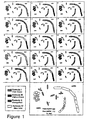
- FIG. 1 Each numbered panel (1-15) corresponds directly to the combination of stains shown in Table 5.
- the cyclic-substituted unsymmetrical cyanine dyes of the invention are virtually non-fluorescent when diluted in aqueous solution. When bound to nucleic acid polymers such as DNA and RNA, however, the resultant dye-nucleic acid complex becomes extremely fluorescent upon illumination.
- the dyes of the present invention are highly permeant and label nucleic acids in a wide variety of solid or liquid samples, particularly in cells and gels. These dyes are optionally used in combination with other detection reagents to differentiate varioius properties of cells such as viability, Gram sign, or antibody staining.
- the dyes of the invention comprise three parts: 1) a first heterocyclic ring system that is a substituted benzazolium ring system, 2) a linking methine bridge and 3) a second heterocyclic ring system that is a pyridinium or quinolinium ring system, one or more positions of which is substituted by a saturated or unsaturated, substituted or unsubstituted, cyclic substituent.
- the two ring systems are optionally further substituted independently by lower alkyl, ether, thioether, substituted or unsubstituted amine, sulfonate ester, halo, or cyclic substitutents.
- the ring nitrogen of the second heterocyclic ring system contains a cyclic subsitutent, adjacent to which is a second non-hydrogen substituent.
- the non-hydrogen substituent is preferably another cyclic substitutent, or a halo, an ether, a thioether, a substituted or unsubstituted amine, or a sulfonate ester substituent.
- dyes of the present invention are described by the formula: where the substituted benzazolium ring system on the left is linked by a methine bride to the righthand pyridinium or quinolinium ring system, one or more substituents of which must be an OMEGA.
- An OMEGA is a saturated or unsaturated, substituted or unsubstituted, cyclic substituent that has a total of 2-16 ring carbon atoms in 1-2 alicyclic. aromatic, or heteroalicyclic or heteroaromatic rings containing 1-4 heteroatoms (wherein the hetero atoms are O, N or S) that is directly bonded to the pyridinium or quinolinium ring system by a single bond.
- Examples of OMEGA are substituted or unsubstituted cyclohexyls cyclohexenyls, morpholinos, and piperidinyls.
- OMEGA examples include substituted or unsubstituted naphthyls, phenyls, thienyls, benzothiazolyls, furanyls, oxazolyls, benzoxazolyls, and pyridinyls
- Substituents on OMEGA are independently hydrogen, halogen, alkyl, perfluoroalkyl, amino, alkylamino, dialkylamino, alkoxy or carboxyalkyl, each alkyl having 1-6 carbons.
- OMEGA is substituted or unsubstituted naphthyl, phenyl, thienyl, morpholino, and cyclohexyl, more preferably substituted or unsubstituted phenyl.
- R 1 on the benzazolium ring system is usually H
- incorporation of one or more non-hydrogen substituents R 1 can be used to fine tune the absorption and emission spectrum of the resulting dye.
- R 1 is a methoxy (compound 770) its absorption spectrum shifts ⁇ 12 nm and its emission spectrum shifts ⁇ 18 nm (Table 5) relative to the comparable compound where R 1 is H (compound 63).
- the compound contains no more than one R 1 that is not H.
- the substituent R 2 is an alkyl group having 1-6 carbons, preferably methyl or ethyl, more preferably methyl.
- the counterion Z - is a biologically compatible ion that is stable and synthetically accessible.
- Z - include, among others, chloride, bromide, iodide, sulfate, alkanesulfonate, arylsulfonate, phosphate, perchlorate, tetrafluoroborate, tetraarylboride, nitrate and anions of aromatic or aliphatic carboxylic acids.
- Preferred Z - counterions are chloride, iodide, perchlorate and various sulfonates.
- X is one of O, S, Se or NR 15 , where R 15 is H or an alkyl group having 1-6 carbons.
- R 15 is H or an alkyl group having 1-6 carbons.
- X is CR 16 R 17 , where R 16 and R 17 , which may be the same or different, are independently H or alkyl groups having 1-6 carbons, or the carbons of R 16 and R 17 taken in combination complete a five or six membered saturated ring.
- R 16 and R 17 are methyls.
- the number of methine groups between the heteroaromatic rings influences the spectral properties of the dye (Table 3).
- R 5 is an alkyl, alkenyl, polyalkenyl, alkynyl or polyalkynyl group having 1-6 carbons; or R 5 is an OMEGA. Most commonly R 5 is an OMEGA.
- embodiments of this invention are quinolinium derivatives according to the formula where ring substituents R 11 , R 12 , R 13 , and R 14 may be the same or different, and are independently H; or an alkyl, alkenyl, polyalkenyl, alkynyl or polyalkynyl group having 1-6 carbons; or a halogen; or -OH, -OR 8 , -SR 8 , -(NR 8 R 9 ), where R 8 and R 9 are as defined previously; or -OSO 2 R 19 where R 19 is alkyl having 1-6 carbons, or perfluoroalkyl having 1-6 carbons, or aryl; or an OMEGA.
- one or more of the substituents of the pyridinium or quinolinium ring system is an OMEGA.
- one or two substituents are OMEGAs.
- the two or more OMEGAs may be the same or different.
- OMEGA is preferably R 5 , or R 6 or both.
- OMEGA is preferably R 4 or R 5 , or both.
- OMEGA is preferably R 5 , R 11 or both.
- R 5 is an OMEGA.
- One embodiment of the invention contains exactly two non-hydrogen substituents on the second heterocyclic ring, one of which is an OMEGA.
- R 5 is an OMEGA and the substituent adjacent to R 5 (R 6 for pyridiniums, R 4 for 4-quinoliniums, and R 11 for 2-quinoliniums) is a non-hydrogen substituent.
- the substituent adjacent to R 5 is halogen or -OSO 2 R 19 , more preferably halogen.
- the substituent adjacent to R 5 is an OMEGA.
- one non-hydrogen substituent is -OR 8 , -SR 8 , or -NR 8 R 9 , preferably -NR 8 R 9 .
- a benzazolium salt a pyridinium (or quinolinium) salt (both of which have the appropriate chemical substituents)
- X may be O (benzoxazolium), S (benzothiazolium), Se (benzoselenazolium), N or an alkyl-substituted N (benzimidazolium) or a carbon atom substituted by two alkyl groups R 16 R 17 (indolium) (where R 16 and R 17 are independently alkyl groups having 1-6 carbons, or R 16 and R 17 taken in combination complete a five or six membered saturated ring).
- R 1 is usually incorporated in the parent benzazole molecule prior to quaternization with an alkylating agent.
- R 2 is usually obtained by alkylation of the parent heterocycle with R 2 -Z, where R 2 is an alkyl group having 1-6 carbons and Z is an electronegative group that frequently becomes the counterion on the resultant dye.
- Z - is a biologically compatible counterion that additionally is stable and synthetically accessible. The counterion may be exchanged for another counterion by methods known in the art, such as the use of ion exchange resins or by precipitation.
- A is a substituent whose nature is determined by the synthetic method utilized to couple the benzazolium precursor with the pyridinium or quinolinium precursor.
- A is usually alkylthio, commonly methylthio, or A is chloro, bromo or iodo.
- the second heterocyclic precursor is a pyridinium or quinolinium sail These can sometimes be generated from the corresponding pyridine or quinoline by alkylation at nitrogen using a suitable alkylating agent R 5 -Z.
- 2- and 4-pyridones and 2- and 4-quinolones are much more versatile chemical intermediates, with the added advantage of being easily prepared (for examples see HETEROCYCLIC COMPOUNDS. VOL 4, R. C. Elderfield ed., John Wiley and Sons Inc., (1952) pp 1-331 or Wawzonek et al., J. HETEROCYCLIC CHEM., 25, 381 (1988)).
- the required pyridinium salt precursor has the structure and the quinolinium salt precursor has the structure At all times, the ring is a cationic 6-membered pyridinium- or quinolinium-based heterocycle.
- B is methyl, or B is chloro, bromo or iodo.
- the 2-pyridone or 4-pyridone or 2-quinolone or 4-quinolone can be treated with a powerful nucleophile such as a Grignard or an alkyl lithium reagent (Example 11) or with a metal hydride (Example 12), to generate the pyridinium or quinolinium salt after acid-catalyzed dehydroxylation.
- a powerful nucleophile such as a Grignard or an alkyl lithium reagent (Example 11) or with a metal hydride (Example 12), to generate the pyridinium or quinolinium salt after acid-catalyzed dehydroxylation.
- the pyridone or quinolone can also be converted to a pyridinium or quinolinium salt by using an agent such as phosphorous oxychloride, phosphorous tribromide, diethylaminosulfur trifluoride (Example 5) or trifluoromethanesulfonic anhydride.
- an agent such as phosphorous oxychloride, phosphorous tribromide, diethylaminosulfur trifluoride (Example 5) or trifluoromethanesulfonic anhydride.
- the resulting activated intermediate can be condensed with the appropriate benzazolium salt to form the dye directly (Example 6) or the activated intermediate can be treated with alcohols, phenols, or alkoxides to yield ether derivatives (Example 10), thiols or thiolphenols to yield thioether derivatives (Example 8) or ammonia or amines to yield substituted or unsubstituted amino derivatives (Example 7).
- Synthesis of monomethine dyes commonly uses a combination of reagents where the methine carbon atom results from either A on the 2-position of the benzazolium salt or B on the 2- or 4-position of the pyridinium or quinolinium salt being methyl and the other of A or B being a reactive "leaving group" that is typically methylthio or chloro (Brooker et al., supra ).
- the additional methine carbon of is provided by a reagent such as N-methylformanilide or ethyl orthoformate (HOUBEN-WEYL, supra ) or the additional trimethine fragment is provided by a malonaldehyde equivalent such as 1,1,3,3-tetramethoxypropane: 1,1,3-trimethoxypropene, 3-(N-methylanilino)propenal or 1-anilino-3-phenylimino-1-propene (Sprague, supra ).
- the reactivity of the 2-halogenated pyridinium or quinolinium intermediate offers a variety of synthetic methods for attachment of various substituents at the 2-position.
- the reactivity of the 2-halo derivatives is preserved even after conjugation with the benzazolium precursor, enabling conversion of the resulting dye in which R 4 is halogen into the appropriate ether, amine and thioether analogs. as described above for the pyridinium and quinolinium precursors (Examples 7, 8 and 10).
- the use of the invention comprises combining a dye of the present invention with a sample that contains or is thought to contain a nucleic acid, incubating the sample for a time sufficient to obtain a detectable fluorescent response, and observing the fluorescent response.
- the sample is optionally combined with one or more additional dyes (preferably fluorescent dyes) having a response detectably different from that of the subject dyes.
- the subject dye is present as a staining solution, which is prepared by addition of the dye to an aqueous solution that is biologically compatible with the sample.
- the staining solution is made by dissolving the dye directly in an aqueous solvent such as water, a buffer solution, such as buffered saline (preferably non-phosphate), or an organic water-miscible solvent such as dimethylsulfoxide (DMSO), dimethylformamide (DMF), or a lower alcohol such as methanol or ethanol, or acetonitrile.
- an aqueous solvent such as water, a buffer solution, such as buffered saline (preferably non-phosphate), or an organic water-miscible solvent such as dimethylsulfoxide (DMSO), dimethylformamide (DMF), or a lower alcohol such as methanol or ethanol, or acetonitrile.
- the dye is preliminarily dissolved in an organic solvent (preferably 100% DMSO) at a concentration of greater than about 100-times that used in the staining solution, then diluted one or more times with an aqueous solvent such as water or buffer, such that the dye is present in an effective amount.
- An effective amount of dye is the amount sufficient to give a detectable fluorescent response when in the presence of nucleic acids.
- staining solutions for cellular samples have a dye concentration greater than about 0.1 nM, and less than about 100 ⁇ M, more typically greater than about 1 nM.
- Staining solutions for electrophoretic gels typically have a dye concentration of greater than about 1 ⁇ M and less than about 10 ⁇ M, more typically about 4-5 ⁇ M.
- Staining solution for detection of free nucleic acids in solution typically have a concentration 10 nM-1 ⁇ M.
- concentration 10 nM-1 ⁇ M The specific concentration of the staining solution is determined by the physical nature of the sample, and the nature of the analysis being performed, and can be optimized according to standard procedures such as described for cell samples in Example 16.
- the dye is combined with a sample that contains a nucleic acid.
- the nucleic acid in the sample may be RNA or DNA, or a mixture thereof. Any DNA is optionally single-, double-, triple-, or quadruple-stranded DNA.
- the nucleic acid may be natural (biological in origin) or synthetic (prepared artificially).
- the nucleic acid may be present as nucleic acid fragments, oligonucleotides, or nucleic acid polymers, and may contain unnatural bases.
- the nucleic acid may be present in a condensed phase, such as a chromosome.
- the presence of the nucleic acid in the sample may be due to a successful or unsuccessful experimental methodology, undesirable contamination, or a disease state.
- Nucleic acid may be present in all, or only part, of a sample, and the presence of nucleic acids may be used to distinguish between individual samples, or to differentiate a portion or region within a single sample.
- the nucleic acid may be enclosed in a biological structure, for example contained within a viral particle, an organelle, or within a cell.
- Cell types include, but are not limited to, eukaryotes, such as nucleated plant and animal cells, and prokaryotes, such as bacteria (including both Gram-negative and Gram-positive bacteria such as Bacillus cereus , Bacillus subtilus , Clostridium sporogenes , Corynebacterium xerosis , Micrococcus luteus , Mycobacterium phlei , Propionibacterium freunderreichii , Staphylococcus aureus, Streptococcus pyogenes , Lactobacillus acidophilus , Cytophaga psychrophila , Enterobacter acrogenes , Escherichia coli , Flavobacterium meningosepticum , Klebsiella pneumonia , Neisseria subflava , Pseudom
- the nucleic acids enclosed in biological structures may be obtained from a wide variety of sources, including unfiltered or separated biological fluids (such as urine, cerebrospinal fluid, blood, lymph fluids, tissue homogenate, mucous, saliva, stool, or physiological secretions or other similar fluids); environmental samples such as soil, water and air, a fermentation medium such as from a biological reactor or food fermentation process such as brewing; or surface washes of materials, (e.g. food) or small amounts of solids such as retentates, scrapes, and smears; or liquid growth medium in which cells have been introduced for culturing.
- unfiltered or separated biological fluids such as urine, cerebrospinal fluid, blood, lymph fluids, tissue homogenate, mucous, saliva, stool, or physiological secretions or other similar fluids
- environmental samples such as soil, water and air, a fermentation medium such as from a biological reactor or food fermentation process such as brewing; or surface washes of materials, (e.g. food) or small amounts of solid
- the cells are optionally discrete or individual cells, including microorganisms, or multiple cells associated with other cells in two or three dimensional layers, including multicellular organisms, embryos, tissues, biopsies, filaments, biofilms, etc.
- the nucleic acid may be endogenous or introduced as foreign material, such as by infection or by transfection.
- the cells may be viable or dead cells or a mixture thereof.
- the nearly universal permeability of the instant dyes, their accelerated rate of uptake and the low toxicity of the dyes to living systems enable the examination of nucleic acids in living samples with little or no perturbation caused by the dye itself.
- the dyes can also be used for staining nucleic acids in a cell or cells fixed and treated with routine histochemical or cytochemical procedures.
- the nucleic acid in any of the forms described previously, is not enclosed within a biological structure, but is present as a sample solution.
- the sample solution can vary from one of purified oligonucleotides or nucleic acids to crude mixtures such as cell extracts, biological fluids and environmental samples from the sources listed above.
- the high sensitivity of the dyes of the present invention allow the detection of previously unmeasureable amounts of nucleic acids without requiring destaining.
- One embodiment of the invention when used in conjunction with an ultraviolet transilluminator, allows detection of as little as 20 picograms of double-stranded DNA per band.
- the sample may be combined with the staining solution by any means that facilitates contact between the dye and the nucleic acid.
- the contact can occur through simple mixing, as in the case where the sample is a solution.
- the dye may be added to the nucleic acid solution directly or may contact the solution on an inert matrix such as a blot or gel, a testing strip, or any other solid or semi-solid surface, for example where only a simple and visible demonstration of the presence of nucleic acids is desired.
- Any inert matrix used to separate the sample can be used to detect the presence of nucleic acids by observing the fluorescent response on the inert matrix.
- any other technique that is suitable for transporting the dye across cell membranes with minimal disruption of the viability of the cell and integrity of cell membranes is also a valid method of combining the sample with the subject dye.
- suitable processes include action of chemical agents such as detergents, enzymes or adenosine triphosphate; receptor- or transport protein-mediated uptake; pore-forming proteins; microinjection; electroporation; hypoosmotic shock; or minimal physical disruption such as scrape loading or bombardment with solid particles coated with or in the presence of the dyes.
- the sample is incubated in the presence of the dye for a time sufficient to form the fluorescent nucleic acid-dye complex.
- Detectable fluorescence in a solution of nucleic acids is essentially instantaneous. Detectable fluorescence within cell membranes requires the permeation of the dye into the cell.
- the dye is added at a temperature optimal for normal activity of the cells within the operating parameters of the dyes (between about 5 °C and about 50 °C); typically this is room temperature (23 °C). At temperatures between 5-45 °C, visibly detectable fluorescence is obtained within about 15-20 minutes of combination with the sample, commonly within about 5 minutes. Preferred embodiments give detectable fluorescence inside cells in less than about 2 minutes.
- Lymphocytes loaded with 5 ⁇ M dye solutions give a fluorescent response in less than 5 seconds, too fast to measure by conventional fluorometry. This property is useful for observing nuclear structure and rearrangement, for example such as occurs during mitosis or apoptosis. While permeation and fluorescence is rapid for all embodiments, optimal permeation of the dye or formation of the nucleic acid complex is dependent upon the physical and chemical nature of the individual sample and the sample medium, and can be determined according to standard procedures such as described in Example 17.
- the subject dyes bind non-covalently with nucleic acids to yield enhanced fluorescence, the level of enhancement being generally about 100-1000 fold, typically greater than about 300-fold (Table 2). These dyes generally exhibit improved quantum yields upon binding to nucleic acids, relative to Thiazole Orange, which translate directly into improved sensitivity in nucleic acid detection. While not every dye shows an improved quantum yield, other attributes of the subject dyes represent significant improvement, including enhanced permeation, enhanced rate of permeation, and/or the selectivity of excitation and emission bands to suit specific instrumentation.
- the excitation or emission properties of the fluorescent complex are utilized.
- the sample is excited by a light source capable of producing light at or near the wavelength of maximum absorption of the fluorescent complex, such as an ultraviolet or visible tamp, an arc lamp, a laser, or even sunlight.
- the fluorescent complex is excited at a wavelength equal to or greater than about 300 nm, more preferably equal to or greater than about 340 nm.
- the equipment commonly available for excitation of samples near 254 nm, between 300 and 310 nm, and near 365 nm can be used to excite any of the dyes of the present invention.
- Excitation by a source more appropriate to the maximum absorption band of the nucleic acid-dye complex such as the 488 nm band of the argon laser, results in even higher sensitivity. Some examples permit excitation beyond 600 nm.
- the fluorescence of the complex is detected qualitatively or quantitatively by detection of the resultant light emission at a wavelength of greater than about 400 nm, preferably greater than about 480 nm, more preferably at greater than about 500 nm.
- the emission is detected by means that include visible inspection, photographic film, or the use of current instrumentation such as fluorometers, quantum counters, plate readers, epifluorescence microscopes, and flow cytometers, or by means for amplifying the signal such as a photomultiplier.
- the nucleic acid concentration in a sample can also be quantified, as the fluorescence of the nucleic acid-dye complex is linearly dependent on concentration (Examples 22-23).
- the wavelengths of the excitation and emission bands of the dyes vary with dye composition to encompass a wide range of illumination and detection bands (e.g. Table 3). This allows the selection of individual dyes for use with a specific excitation source or detection filter.
- dyes can be selected that match their excitation band with the commonly used argon laser, or emission bands that match preexisting filters such as a typical fluorescein long-pass set or multi-band set with fluorescein excitation and emission bands.
- the dye can be selected to give a detection response that is different from that of other dyes desired to be used in combination with the subject dyes.
- the additional dye or dyes are fluorescent, for which the response to illumination that is detectably different from that of the subject cyclic-substituted unsymmetrical cyanine dyes. Any fluorescence detection system can be used to detect the difference in spectral characteristics between dyes.
- the dyes have the same or overlapping excitation spectra, but possess visibly different emission spectra, generally having emission maxima separated by >10 nm, preferably >20 nm, more preferably >50 nm.
- the additional dyes are optionally used to differentiate cells or cell-free samples containing nucleic acids according to size, shape, metabolic state, physiological condition, genotype, or other biological parameters or combinations thereof.
- the additional dye or dyes are metabolized intracellularly to give a fluorescent product inside certain cells but not inside other cells, so that the fluorescent response of the cyclic-substituted unsymmetrical cyanine dye predominates only where such metabolic process is not taking place.
- the additional dye or dyes are specific for some external component of the -cell such as cell surface proteins or receptors.
- the additional dye or dyes actively or passively cross the cell membrane and are used to indicate the integrity or functioning of the cell membrane.
- the additional dyes are added to the sample being analyzed to be present in an effective amount, with the optimal concentration of dye determined according to the cell density as above.
- concentration of each dye is between about 0.01 ⁇ M and about 100 ⁇ M. more typically between 0.1 ⁇ M and 10 ⁇ M.
- Each dye is optionally prepared in a separate solution or combined in one solution.
- the dyes are present in the staining solution within about a five-fold molar range. but the molar ratio one to the other in the sample can vary from about 1:1 to about 1:100, and may vary depending on whether the dyes are added to the sample simultaneously or sequentially.
- the differential fluorescent response can be used as a basis for sorting the cells or nucleic acids for further analysis or experimentation. For example, all cells that "survive" a certain procedure are sorted, or all cells of a certain type in a sample are sorted. The cells can be sorted manually or using an automated technique such as flow cytometry according to the procedures known in the art such as in US-A-4,665,024 to Mansour, et al. (1987).
- the subject dyes are used in combination with a second fluorescent dye (Dye II) to distinguish viable cells from dead cells, where Dye II is selective either for viable or for dead cells.
- Dye II is selective either for viable or for dead cells.
- the invention includes methods of staining nucleic acids in a sample wherein the nucleic acids are enclosed in a biological structure and the method further comprises combining the sample with one or more additional dyes, singly or in combination; where at least one additional dye is a fluorescent nucleic acid stain that is permeant or impermeant to cells; another additional dye is selectively permeant to Gram positive or Gram negative bacteria; and where each of the additional dyes has a fluorescent response to illumination that is detectably different from that of the other dyes.
- the nucleic acid stain is impermeant to cells with intact membranes.
- the nucleic acid stain is impermeant to cells with intact membranes and is a phenanthridium monomer or dimer derivative that is an ethidium, ethidium dimer, propidium; or is a benzazolium monomer or dimer derivative such as TOTOTM, YOYOTM, POPOTM, BOBOTM, TOPROTM, YO-PROTM, BO-PROTM, PO-PROTM.
- the nucleic acid stain is permeant to cells or is selectively permeant to Gram-positive bacteria and is a C 4 -C 8 alkyl-substituted phenanthridium, or 2'-(4-hydroxyphenyl)-5-(4-methyl-1-piperazinyl)-2,5'-bi-1H-benzimidazole, 2'-(4-ethoxyphenyl)-5-(4-methyl-1-piperazinyl)-2,5'-bi-1H-benzimidazole or 4', 6-diamidino-2-phenylindole dihydrochloride.
- Dye II gives a detectable fluorescent response only in viable cells, such as fluorescent enzyme substrates and reagents described in Haugland, HANDBOOK OF FLUORESCENT PROBES AND RESEARCH CHEMICALS (1992-94) to selectively stain viable cells, including haloalkyl esterase substrates and calcein AM.
- Dye II gives a detectable fluorescent response only in dead cells, such as an impermeant dye that only becomes fluorescent upon passing through the cell membrane to bind to some intracellular component, such as an intracellular protein or nucleic acid.
- Suitable dyes include impermeant phenanthridium or benzazolium derivatives, including monomers or dimers thereof, such as ethidium homodimer, ethidium bromide, propidium iodide, TOTOTM, BOBOTM, POPOTM, YOYOTM, TO-PROTM, BO-PROTM, PO-PROTM and YO-PROTM (Molecular Probes) that give an enhanced fluorescence when complexed to intracellular nucleic acids.
- Loading times for impermeant Dye II dyes, such as phenanthridium or benzazolium dyes is generally the same as previously discussed above.
- Cell permeant Dye II dyes selective for viable cells generally require longer loading times, particularly if such dyes require intracellular activity to generate fluorescence.
- both dyes are present because the subject dyes stain all cells, including those for which Dye II is selective.
- the intracellular fluorescent response of Dye II is optionally the same as the fluorescent response of Dye II alone (e.g. where Dye II effectively competes for nucleic acid binding relative to the subject dye) or is a response indicative of the presence of both dyes (as is the case where the competitive binding is less effective or where Dye II is not a nucleic acid stain).
- the fluorescent response of the subject dye alone is indicative of cells for which Dye II is not selective, either viable or non-viable cells as the case may be.
- the cells for which Dye II is selective are optionally sorted or counted, as above.
- the sample is combined with multiple fluorescent dyes to determine identification, and optionally viability.
- the additional fluorescent dye(s) binds selectively to cell surface components or is selectively permeant to certain cell types, and can be used in combination with Dye II to also indicate viability.
- the surface label that only stains externally is distinguishable from the dyes that stain intracellularly.
- a surface dye is used in combination with one or more intracellular stains such as nucleic acid stains, a "bullseye" pattern of staining is seen -- i.e. a brightly stained interior within an exterior ringstain.
- the surface label also has an emission spectrum that is detectably different from that of the other dyes used.
- each dye or dye-nucleic acid complex overlaps the excitation spectrum of the other dye(s). More preferably, each dye complexed with nucleic acids has an excitation maximum between about 480 nm and 510 nm. Most preferably, each dye or dye-complex also excites in the UV between about 300 nm and 365 nm.
- the appearance of the stained bacteria indicates the Gram reaction of the bacteria in the sample, and optionally whether or not the G + or G - bacteria present in the sample are viable.
- Gram positive (G + ) bacteria are those that give a positive Gram stain, including but not limited to Bacillus, Lactobacillus, Micrococcus, Streptococcus, Clostridium, Staphylococcus , and Mycobacterium, among others.
- Gram negative (G - ) bacteria are those that are negative for the Gram stain, including but not limited to Escherichia, Enterobacter, Salmonella , Pseudomonas, Shigella , Klebsiella , Haemophilus , Neisseria , Proteus , Vibrio, Campylobacter , and Yersinia , among others.
- a cyclic-substituted unsymmetrical cyanine dye that (in combination with intracellular nucleic acids) gives a green or yellow-green fluorescence is used in combination with one or more of the following dyes: a) a C 4 -C 8 alkyl substituted phenanthridium nucleic acid stain (preferably hexidium or C 6 -substituted phenanthridium, Watkins, J.CHEM. SOC.
- Table 5 summarizes the spectral response, where the cyclic-substituted unsymmetrical cyanine dye (I) has an emission maximum between 500 nm and 535 nm (e.g. dye 624); the phenanthridium dye (II) has an emission maximum between 580 nm and 650 nm (e.g. hexidium); the membrane impermeant benzazolium (III) nucleic acid complex has an emission maximum between 530 nm and 590 nm (e.g. TOTOTM, YOYOTM, TO-PROTM or YO-PROTM); and the labeled protein (IV) has an emission maximum between 410 nm and 480 nm (e.g.
- AMCATM-or Cascade Blue-labeled wheat germ agglutinin Careful matching of other fluorescent stains with equivalent selective permeability, excitation/emission spectra, and preferential binding affinity for nucleic acids allows substitution of the preferred combination of nucleic acid stains to discriminate between many different organisms, whether live or dead.
- the synthetic precursor (1) is prepared either by an Ullmann coupling according to a literature procedure (Wawzonek, et al., supra .) or via the reaction of the corresponding diarylamine with diketene followed by acid cyclization (Elderfield, supra ).
- a literature procedure Wangzonek, et al., supra .
- diketene followed by acid cyclization
- 10.0 g (62.9 mmoles) of 2-hydroxy-4-methylquinoline is heated at reflux with 24.0 g (377 mmoles) of copper powder, 8.68 g (62.9 mmoles) of potassium carbonate and 19.2 g (94 mmoles) of iodobenzene for 48 hours.
- the reaction is cooled to room temperature, partitioned between water and ethyl acetate, filtered, and the organic layer is dried over magnesium sulfate.
- the crude product is purified on a silica gel column, eluting with 1:1 ethyl acetate/hexanes to yield 8.1 g of the desired product
- Synthetic precursor 2 is prepared as in Example 1 with a 40% yield, except that the starting material is 1,2-dihydro-4-methyl-2-pyridone.
- Synthetic precursor 3 is prepared by first conjugating N-methylaniline with diketene, followed by an acid cyclization of the amide intermediate. Thus 10.0 g (0.12 moles) of diketene is added dropwise to 10.7 g (0.1 moles) of N-methylaniline and the reaction is heated at 100 °C for an additional 30 minutes. To the resulting mixture is added 30 mL of acetic acid and 30 mL of sulfuric acid. and the mixture is heated at 50 °C overnight. The reaction is worked up with water and ethyl acetate and purified on a silica gel column to yield 9.5 g of the desired product.
- N-(3-hydroxyphenyl)-N-phenylamine is O-methylated with potassium carbonate and methyl iodide in acetone in 39% yield.
- the resulting N-(3-methoxyphenyl)-N-phenylamine is then reacted with diketene to generate the corresponding acetoacetamide which, without purification, is cyclized in acetic acid/sulfuric acid as in Example 3 to generate the desired quinolone in 41% yield.
- the following compound is prepared: To 2.8 g (11.9 mmoles) of 1 in 20 mL of methylene chloride is added 1.85 g of POCl 3 and a catalytic amount of dimethylformamide (Marson, TETRAHEDRON., 48 , 3659 (1992)). The resulting mixture is heated to reflux for 24 hours. Alter cooling, the product is purified using column chromatography. The corresponding bromide is prepared using PBr 3 rather than POCl 3 . The corresponding fluoride is prepared using diethylaminosulfur trifluoride, rather than POCl 3 .
- the corresponding bromide (Dye 774) is prepared analogously using 2-bromo-4-methyl-1-phenylquinolinium bromide in place of 4.
- the corresponding fluoride (Dye 834) is prepared analogously using 2-fluoro-4-methyl-1-phenylquinolinium fluoride in place of 4.
- the methoxyquinolinium analog (Dye 5103) is prepared in the same way, except using 1,2-dihydro-7-methoxy-3-methyl-1-phenyl-2-quinolone.
- the pyridinium analog (Dye 678) is prepared in the same way, except using the pyridinium analog of 4.
- the trimethine dye analog (Dye 823) is prepared similarly, except using 2-(2-anilinovinyl)-3-methylbenzothiazolium tosylate in place of 5.
- An additional synthetic route to Dye 591 utilizes 4-[2,3-dihydro-3-methyl-(benzo-1,3-thiazol-2-yl)-methylidene]-1,2-dihydro-1-phenyl-2-quinolone (6), which in turn is prepared from 1 and 5.
- lithium enolate of 1 prepared from treating the quinolone with 2.7 equivalent of lithium diisopropyl amide
- silyl enolate of 1 from (1) and trimethylsilyl trifluoromethanesulfonate and diisopropylethylamine
- the desired intermediate (6) is isolated by column chromatography.
- the quinolone (6) is then treated with POCl 3 to generate Dye 591.
- Dye 619 is prepared by heating Dye 591 (26 mg) at 55 °C with 0.5 mL of diethylamine in 1.5 mL of DMF overnight. The desired product is isolated by a simple filtration.
- Dye 752 is prepared similarly, except using morpholine in place of diethylamine in DMF at 50 °C.
- Dye 856 is prepared similarly, except using N-methylpiperazine in place of diethylamine.
- Dye 130 is prepared similarly, except using aniline in place of diethylamine.
- 1-Cyclohexyl-1,2-dihydro-4-methyl-2-quinolone is prepared using N-cyclohexylaniline as starting material.
- the quinolone (0.482 g, 2 mmol) is transformed to the 2-chloro-1-cyclohexylquinolinium chloride with a procedure similar to Example 5, and is then reacted with 5 (0.74 g. 2 mmol) and triethylamine (0.28 mL, 2 mmol) to yield the product.
- the intermediate compound (4) (4.3 mmoles) and methanol (10 mL) are heated to reflux for 2 hours. The methanol is removed under reduced pressure, and 10 mL of methylene chloride is added, followed by 1.56 g (4.3 mmoles) of 5 and 1.5 mL of triethylamine. The resulting mixture is stirred at room temperature for 3 days.
- the crude material is purified on a silica gel column by eluting with 5:5:1 ethyl acetate: chloroform: methanol. Thc corresponding ethoxide (Dye 715) is prepared analogously, using ethanol rather than methanol.
- the following compound is prepared: To 0.235 g (1 mmole) of 1 in 10 mL of THF at -78 °C under nitrogen, 1.2 equivalents of n-butyl lithium is introduced. The reaction is stirred at -78 °C for 15 minutes, and then the temperature is raised to 0°C for another 30 minutes, then the reaction is quenched with acetic acid and the solvent is evaporated. The residue is dissolved in 5 mL of methylene chloride and 0.367 (1 mmole) of 5 is added followed by 0.28 mL (2 mmoles) of triethylamine. The reaction mixture is stirred for 20 minutes at room temperature and the crude product is isolated as the iodide salt after a salt exchange.
- Dye 624 is prepared similarly, except that 3-methyl-2-methylthiobenzoxazolium tosylate (7) (Rye, et al., supra ) is used instead of 5 in the synthesis.
- Dye 6104 is prepared similarly, except that cyclohexyl magnesium bromide is used instead of butyl lithium.
- the corresponding trimethine dye (Dye 621) is prepared similarly, except that 2-(2-anilinovinyl)-3-methylbenzothiazolium tosylate is used in place of 5.
- the corresponding pentamethine dye (Dye 100) is prepared similarly, except that 2-(4-anilino)-1,3-butadienyl)-benzothiazolium iodide is used in place of 5.
- 2-(4-Anilino)-1,3-butadienyl)-benzothiazolium iodide is prepared using methods known in the art (U.S. Patent No.
- the reaction mixture is stirred at room temperature for 3 hours and the crude product is loaded on a silica gel column and eluted with 3:3:1 ethyl acetate/chloroform/methanol.
- the fractions containing the product are pooled and evaporated, redissolved in 5 mL of DMF and added to 5 g of sodium iodide in 75 mL of water.
- the precipitate is filtered and recrystallized from methanol. If 1,2-dihydro-1,4-dimethyl-8-phenyl-2-quinolone is used in place of the pyridone, the reaction produces Dye 72.
- the following compound is prepared: A mixture of 1.43 g (10 mmoles) of lepidine and 2.1 g (10 mmoles) of cyclohexyl iodide is heated at 130°C for 2 hours. Ethyl acetate (20 mL) is added and 1.36 g of solid is obtained after filtration. The solid is stirred in 50 nL of methylene chloride with 1.41 g of 5 and 1.12 mL of triethylamine for several hours. The crude product is converted to the iodide salt and recrystallized from methanol to yield the pure product.
- N-phenyl-2-chloroquinolinium chloride is prepared according to Marson (TETRAHEDRON, 48 , 3659 (1992)).
- TETRAHEDRON 48 , 3659 (1992)
- 1.06 g (5 mmoles) of N,N-diphenylacetamide is heated with 1.69 g (11 mmoles) of POCl 3 and 0.44 g (6 mmoles) of DMF at 120 °C for 2 hours.
- the reaction mixture is cooled to room temperature and 15 mL of methylene chloride is added to dissolve the residue.
- Trifluoromethanesulfonic acid anhydride (66 ⁇ L) is added to 0.1 g of 6 in 5 mL of 1,2-dichloroethane, and the solution is heated at 80 °C for 3 hours. The reaction is worked up with water and chloroform, and the resulting product is purified by chromatography on silica gel.
- Cell density is determined by counting or by the following extrapolation.
- a cell culture is washed by centrifugation and resuspended in water to its original volume.
- 150 ⁇ L volumes of suspension are loaded per well.
- a single well of sterile water is the well background standard.
- absorbance is determined for the initial volumes of suspension.
- the suspension is diluted seven times by serial ten-fold dilutions in water, 150 ⁇ L of suspension per well, and the absorbance measured for each dilution. Following the absorbance measurements, each dilution loaded into wells is further diluted 1:10 and plated in duplicate on nutrient growth agar.
- the colonies are counted and expressed as colony forming units per milliliter (cfu/mL).
- the suspension is diluted to a density of about 1x10 9 cfu/mL.
- the cell suspension adjusted to a known density, is diluted seven times by serial ten-fold dilutions in water; 150 ⁇ L of suspension per well. Three-fold serial dilutions of dye are used (30-0.04 ⁇ M); 50 ⁇ L of dye at 4x final concentration.
- a matrix is set up whereby the cell concentration decreases across the plate and the dye concentration decreases down the plate, final volume per well is 200 ⁇ L.
- the top row and first column are reserved for the control, sterile water.
- the plate is incubated at 37 °C for 30 minutes, then read in a CytoFluorTM 2350 fluorescence microplate reader at a fixed excitation of 485 +/-10 nm and each of three emission wavelengths, 530 +/-12, 620 +/-20, or 645 +/-20 nm.
- the results determine the best dye range (30-1 ⁇ M) and the best cell concentrations (concentrated through first three ten-fold dilutions) for optimal dye loading. These results lead to the next staining optimization assay.
- Using the four dye dilutions and the four cell dilutions many cultures and dyes can be assayed quickly. The data collected allow the determination of optimal dye and cell concentration required for maximal fluorescence intensity per cell.
- Minimum times for dye loading are obtained as follows: Cells are grown in nutrient broth to log phase. washed by centrifugation, and resuspended in water to a density previously shown to allow dye loading to maximal fluorescence/cell. Fluorescence cuvettes containing the cell suspension are placed in a fluorescence spectrophotometer equipped with a temperature regulated cuvette holder and magnetic stirrer. The suspensions are brought to the appropriate temperature prior to dye addition. Millimolar dye stock solutions in DMSO are added at the appropriate concentrations to produce maximum attainable fluorescence/cell at the peak emission wavelength of each dye. Fluorescence intensity of the suspensions is measured at or near the peak excitation and emission wavelengths for the dye (see e.g. Table 3).
- a frozen suspension of goat sperm is thawed and held at 32 °C. Enough of a 10 mM dye stock solution (dye 628, 624, 835 or 591) is added to the sperm suspension to obtain a final concentration of 0.5 ⁇ M dye. The sperm are labeled by incubation in the dye solution for 10 min. Sperm cells stain with all of the dyes, and the order of brightness is 628 > 624 >> 835 > 591. Motility is retained at 0.5 ⁇ M, but is lost in some sperm at s ⁇ M dye.
- a leaf of Aucuba spp. is cross-sectioned with a razor blade and immersed in 0.5 mL of a 10 ⁇ M solution of dye 624 in E-pure water in a 35 mm glass dish.
- the tissue is stained for 30 min at room temperature in the dark.
- the tissue preparation is mounted in the presence of dye between coverglass and slide.
- the leaf epidermal layer is demarcated by a large amount of yellow autofluorescence, however both the vascular bundle and cell nuclei stain bright green in the dye 624-loaded cells.
- a 10 mM stock solution of dye 613 is added to a suspension of Infectious Hepatic Necrosis Virus in 135 mM NaCl, 5 mM KCI, 1 mM MgCl 2 , 1.8 mM CaCl 2 , 20 mM Na-HEPES, at pH 7.4 (HBSS+) to give a 40 ⁇ M dye solution.
- the viruses After incubation for 10 minutes at 15 °C, the viruses are observed in an epifluorescence microscope using a 100x objective lens. The virus particles ( ⁇ 30 x 160 nm) are below the resolution limit of the microscope using visible light. Incorporation of dye 613 into the viral RNA results in a sufficient concentration of the dye in the particle to render it visible as a bright point of green light when observed using a standard fluorescein long-pass filter set.
- 3T3 mouse fibroblast cells are grown on coverslips in calf serum-supplemented Dulbecco's Modified Eagle medium. Coverslips of cells are washed using HBSS+, then incubated for 30 min at room temperature in solutions of dye 835 with final concentrations of either 2 ⁇ M or 0.2 ⁇ M prepared in HBSS+. Cells are then washed in HBSS+ and viewed by epifluorescence microscopy using a long-pass fluorescein filter set. After 30 minutes all of the cells are stained green in both the nucleus and cytoplasm, although to different intensities, when viewed through the long-pass fluorescein filter.
- Cells loaded with 0.2 ⁇ M dye show distinct mitochondrial staining whereas cytoplasmic fluorescence appears to be less punctate in cells incubated with 2 ⁇ M dye. Nuclear staining is fairly uniform and is not concentrated in the nucleolar regions. Cell viability, as determined using an ethidium homodimer counterstain, is maintained throughout.
- dye 61 is prepared as 10 mM stock solution in DMSO, then diluted to 2 ⁇ M in TNE buffer (2 M NaCl, 10 mM Tris. 1 mM EDTA, adjusted to pH 7.4).
- Calf thymus DNA or yeast ribosomal RNA solutions between 1-40 ⁇ g/mL are prepared in TNE buffer and mixed 1:1 with diluted dye. Fluorescence of 100 ⁇ L samples is measured in a CytoFluor fluorescence microplate reader. A linear increase in fluorescence is obtained with increasing DNA or RNA concentration.
- the density of a suspension of E.coli is indicated by adding enough cells to cuvettes containing 30 ⁇ M dye 624 to effect final densities of 10 5 -10 8 bacteria/mL and incubating for 5 minutes.
- the suspensions are excited at 480 nm and the fluorescence emission spectra of the suspensions are measured in a fluorometer.
- the green fluorescence of the bacterial suspensions increases with decade changes in bacterial cell density.
- Peripheral blood lymphocytes are isolated from whole goat blood using the standard ficoll density gradient protocol. The cells are incubated in saline buffer with coverslips coated with a cell adhesive. After attachment to the coverslip, the cells are incubated with either
- Both samples are then centrifuged as above and washed.
- the pellets are then resuspended in separate tubes using 10 mL of sterile water in each tube.
- the optical density of each suspension is then determined at 670 nm.
- the optical density of the suspensions is then adjusted to 1 x 10 8 bacteria/mL (0.03 OD 670 ) for E. coli or 1 x 10 7 bacteria/mL (0.149 OD 670 ) for Staph . aureus.
- the 1 x 10 8 bacteria/mL (0.03 OD 670 ) suspensions are then diluted 1:100 in sterile water to give a final bacterial density of 1 x 10 6 bacteria/mL for both bacterial samples. Eleven different proportions of E.
- coli are prepared to yield live:dead ratios between 0 and 100% in 10% increments.
- the volume of each bacterial sample is 2 mL.
- a staining solution is prepared that is 1.67 mM in dye 624 and 10 mM in propidium iodide.
- Each of the 11 samples is stained with 6 ⁇ L of the staining solution and mixed thoroughly. The samples are incubated in the dark for 15 minutes.
- the bacterial samples are analyzed using a flow cytometer (Coulter Electronics, Hialeah, Florida) equipped with an argon laser (488 nm excitation), two photomultipliers (PMT), and a 76 ⁇ m flow tip.
- the emission light path contains a 515 nm blocking filter, 590 nm dichroic filter before the Green PMT, and a 610 nm absorbance filter before the Red PMT.
- the fluorescence acquisition is gated on the log integrated green fluorescence (LIGFL) and discriminated at the 15% level on LIGFL since both live and dead bacteria have a measurable green signal.
- the populations of bacteria are discriminated by the ratio of LIRFL to LIGFL and the numbers of bacteria found within these regions are used to determine the percentage of viable organisms in the population.
- Example 26 Viability Analysis Using a Microplate Reader:
- Suspensions of live and dead E. coli or Staph . aureus are prepared as in Example 25, except that the Staph . aureus suspension is adjusted to an optical density of 5 x 10 6 bacteria/mL (0.074 OD 670 ), and incremental mixtures of live and dead bacteria are likewise prepared.
- Sterile filtered water serves as a reagent blank.
- a staining solution is prepared that is 1.67 mM in dye 624 and 10 mM in propidium iodide. To 6.6 mL of sterile water is added 40 ⁇ L of the staining solution, and the new solution is mixed thoroughly.
- each test well of a 96-well flat-bottom microplate is pipetted 100 ⁇ L of the mixed live/dead bacterial suspensions. Using a new pipet tip for each row, 100 ⁇ L of the diluted staining solution is pipetted into each appropriate well in the row. The plate is then incubated in the dark for 15 minutes. The appropriate gain setting and filters are set on the specific fluorescence microplate reader.
- the excitation filter is set to 485 ⁇ 20 nm (blue) and the emission filter is set to 530 ⁇ 25 nm (1).
- the fluorescence emission intensity of the entire plate is measured, and the data saved.
- the emission filter is set to 620 ⁇ 40 nm (2), retaining the blue excitation.
- the fluorescence emission intensity of the entire plate is measured, and the data saved.
- the fluorescence data are analyzed by subtracting the fluorescence of the reagent solution in water from the fluorescence of the stained cell suspensions with each filter combination and dividing the corrected fluorescence emission 1 by the fluorescence emission 2.
- the corrected ratio versus percent live bacteria suspension is plotted and used as a calibration curve for determining live/dead ratios in bacterial samples.
- Blood is collected aseptically in a K 3 EDTA-containing tube and maintained at room temperature. 5 ⁇ L of whole blood is added to 1 mL of a 30-90 nM solution of dye 628 or 591 in 135 mM NaCl, 5 mM KCl, and 20 mM Na-HEPES, at pH 7.4 (HBSS-). The suspension is incubated at room temperature for between 10 min and 3 hr. The cells are analyzed in a flow cytometer by gating around the erythrocyte population. Fluorescence is excited at 488 nm and emission is measured between 520 and 550 nm.
- Reticulocyte staining of patient blood samples is compared with staining of reticulocyte standards (Retic Chex, Streck).
- Dyes 591 and 628 are effective stains for reliculocytes, both by the measurement of commercial reticulocyte standards and with populations of reticulocytes in normal blood and in blood from patients with hemolytic anemia.
- Example 28 Cell Differentiation Using Multiple Dyes
- the Gram reaction and viability of the mixed bacterial suspension of Staph . aureus (5 x 10 5 /mL) and E . coli (1 x 10 6 /mL) in water is determined by automated fluorescence microscopy by loading the bacteria with 1 ⁇ M of TOTO-1 dye (Molecular Probes) in combination with 5 ⁇ M of dye 624 and 1 ⁇ M of hexidium bromide dye (C 6 alkyl substituted phenanthridium, Watkins, J.CHEM. SOC. 3059 (1952)). All dyes are prepared by dilution of 1 mM DMSO stock solutions in water. All dead bacteria appear very brightly fluorescent yellow-green, while live S . aureus bacteria appear orange-red and live E.
- TOTO-1 dye Molecular Probes
- All dyes are prepared by dilution of 1 mM DMSO stock solutions in water. All dead bacteria appear very brightly fluorescent yellow-green, while live S . aureus bacteria appear orange-red and live E.
- coli appear green. ( Figure 1& Table 5). Cell fragments that have no associated nucleic acids are not stained. Cells that are stained with a 2-fold lower concentration of the same dyes are analyzed using a flow cytometer equipped with a 488 nm Argon laser. The cells are sorted or counted based on red/green ratio and spectral intensity. Three populations are discerned.
- Whole goat blood smears are prepared with 30 ⁇ L blood diluted 50:50 with HBSS-. Blood with or without 5 ⁇ L of Mycobacterium phlei (in 1% TX-100) per 100 ⁇ L of blood is used for the smears. Smears are air dried and heat fixed at 50 °C for 2 hours. 15 ⁇ L of 5 ⁇ M dye 628 in water are added to the smears. A coverslip is placed over the dye droplet and sealed. Bacteria are visible after ⁇ 30 sec. Numerous extremely bright bacteria can be seen in blood to which Mycobacteria have been added. Low background fluorescence is observed in blood without Mycobacteria , aside from a few tiny bright dots, which are much smaller than bacteria and not nearly as bright when observed by epifluorescence microscopy using a 40x or 100x objective lens.
Landscapes
- Organic Chemistry (AREA)
- Chemical & Material Sciences (AREA)
- Investigating Or Analysing Biological Materials (AREA)
- Plural Heterocyclic Compounds (AREA)
- Investigating Or Analysing Materials By The Use Of Chemical Reactions (AREA)
- Investigating, Analyzing Materials By Fluorescence Or Luminescence (AREA)
- Thermal Transfer Or Thermal Recording In General (AREA)
- Indole Compounds (AREA)
- Pyridine Compounds (AREA)
- Quinoline Compounds (AREA)
- Measuring Or Testing Involving Enzymes Or Micro-Organisms (AREA)
- Non-Silver Salt Photosensitive Materials And Non-Silver Salt Photography (AREA)
- Heat Sensitive Colour Forming Recording (AREA)
Abstract
Description
- The invention relates to fluorescent dyes for nucleic acids. In particular, the invention relates to dyes derived from unsymmetrical cyanine dyes having a saturated or unsaturated cyclic substituent that stain nucleic acids in a variety of media.
- In many fields of life sciences research, including biological, biomedical, genetic, fermentation, aquaculture, agricultural, forensic and environmental research, there is a need to identify nucleic acids both isolated and within cells as a routine component of standard experimental methods. Such applications require a fast, sensitive, and selective methodology that can detect nucleic acids, even when bounded (or surrounded) by cellular membranes, such as living cells. Additionally, analysis of cells from mixed populations of cells or microorganisms for both viability and/or Gram sign is a routine component of standard experimental methods.
- Although certain unsymmetrical cyanine dyes were first described before the genetic role of nucleic acids was established (Brooker, et al., J. AM. CHEM. SOC. 64, 199 (1942)), a variety of unsymmetrical cyanine dyes have now been found to be very effective in the fluorescent staining of DNA and RNA. The compound sold as Thiazole Orange has particular advantages in the quantitative analysis of immature blood cells or reticulocytes US-A-4,883,867 to Lee, et al. (1989)) or in preferentially staining the nucleic acids of bloodborne parasites with little staining of nucleated blood cells US-A-4,937,198 to Lee, et al. (1990). Thiazole Orange and similar thioflavin dyes are permeant to many mammalian cells, yet are impermeant to some eukaryotic cells. WO-A-93,06482 discloses dimers of unsymmetrical fluorescent dyes useful for nucleic acid staining.
- The inventors have discovered that attachment of various cyclic structures to a parent unsymmetrical cyanine produces a family of superior nucleic acid dyes. Surprisingly, although bulkier, the new dyes more quickly penetrate the cell membranes of a wider variety of cell types, including both gram-positive and gram-negative bacteria, yeasts, and eukaryotic cells as well as prokaryotic cells. The subject dyes also more rapidly stain electrophoretic gels used for the separation of nucleic acids. Direct comparison of the rate of uptake in bacteria with known dyes such as Thiazole Orange and its homologs, shows enhanced uptake of the new compounds (Table 1). Even in applications where cell permeability is not a factor, the quantum yield of most of these dyes is unexpectedly, and significantly, better than that of Thiazole Orange (Table 2).
- Furthermore, by simple synthetic modification, a family of dyes having absorption and emission spectral properties that cover most of the visible and near-infrared spectrum can be prepared. The improved fluorescent properties of the dyes of the present invention present significant advantages for the detection of cellular or non-cellular nucleic acids in all areas of nucleic acid research. These dyes are particularly useful in combination with other dyes, for example to differentiate cells and/or determine viability.
Loading Time To peak (sec) To Equilibrium (sec) DYE S. aureus
T0.5E. coli
T0.5S. aureus
T0.95E. coli
T0.9561 3.4 18.2 66.9 270.9 63 7.9 ND 172.2 ND 613 9.1 11.3 149.0 163.1 619 7.3 15.5 34.3 243.3 624 7.6 24.3 27.6 89.4 628 19.6 36.8 47.2 89.9 591 6.3 25.3 116.3 73.3 634 14.5 12.5 86.3 154.2 73 10.0 23.3 145.1 58.6 720 6.8 21.6 216.4 221.6 Thiazole Orange 57.2 39.2 242.0 125.9 Loading time is expressed as: time required to reach half of the maximal fluorescence (T05) and to reach 95% of the fluorescence measured at equilibrium (T095). Properties of Representative Dyes DYE Ex/Em (nm) Properties on DNA RNA DNA RNA Kp QY P.B. F.E. F.E. 61 500/527 510/530 1.0E07 0.46 1.10 353 502 63 514/531 515/537 3.9E06 0.24 1.08 582 696 613 506/523 508/529 5.3E06 0.33 1.14 225 1614 619 488/317 492/529 9.7E06 0.62 0.89 301 518 624 480/501 485/505 5.0E06 0.58 1.17 661 1435 628 488/506 490/510 7.0E06 0.40 1.13 771 166 591 509/532 517/536 4.8E06 0.09 1.11 169 653 634 510/530 511/533 2.0E06 0.18 1.10 176 122 73 508/525 510/531 4.4E06 0.31 1.12 700 371 720 487/507 490/523 1.2E07 0.52 1.09 1330 107 Thiazole Orange 510/530 509/535 4.8E06 0.18 1.01 143 811 - Figure 1: Each numbered panel (1-15) corresponds directly to the combination of stains shown in Table 5.
- The cyclic-substituted unsymmetrical cyanine dyes of the invention are virtually non-fluorescent when diluted in aqueous solution. When bound to nucleic acid polymers such as DNA and RNA, however, the resultant dye-nucleic acid complex becomes extremely fluorescent upon illumination. The dyes of the present invention are highly permeant and label nucleic acids in a wide variety of solid or liquid samples, particularly in cells and gels. These dyes are optionally used in combination with other detection reagents to differentiate varioius properties of cells such as viability, Gram sign, or antibody staining.
- The dyes of the invention comprise three parts: 1) a first heterocyclic ring system that is a substituted benzazolium ring system, 2) a linking methine bridge and 3) a second heterocyclic ring system that is a pyridinium or quinolinium ring system, one or more positions of which is substituted by a saturated or unsaturated, substituted or unsubstituted, cyclic substituent. The two ring systems are optionally further substituted independently by lower alkyl, ether, thioether, substituted or unsubstituted amine, sulfonate ester, halo, or cyclic substitutents. Preferably the ring nitrogen of the second heterocyclic ring system contains a cyclic subsitutent, adjacent to which is a second non-hydrogen substituent. The non-hydrogen substituent is preferably another cyclic substitutent, or a halo, an ether, a thioether, a substituted or unsubstituted amine, or a sulfonate ester substituent.
- Specific examples of the dyes of the present invention are described by the formula:where the substituted benzazolium ring system on the left is linked by a methine bride to the righthand pyridinium or quinolinium ring system, one or more substituents of which must be an OMEGA.

- An OMEGA is a saturated or unsaturated, substituted or unsubstituted, cyclic substituent that has a total of 2-16 ring carbon atoms in 1-2 alicyclic. aromatic, or heteroalicyclic or heteroaromatic rings containing 1-4 heteroatoms (wherein the hetero atoms are O, N or S) that is directly bonded to the pyridinium or quinolinium ring system by a single bond. Examples of OMEGA are substituted or unsubstituted cyclohexyls cyclohexenyls, morpholinos, and piperidinyls. Examples of OMEGA that are aromatic include substituted or unsubstituted naphthyls, phenyls, thienyls, benzothiazolyls, furanyls, oxazolyls, benzoxazolyls, and pyridinyls Substituents on OMEGA are independently hydrogen, halogen, alkyl, perfluoroalkyl, amino, alkylamino, dialkylamino, alkoxy or carboxyalkyl, each alkyl having 1-6 carbons. Preferred embodiments of OMEGA are substituted or unsubstituted naphthyl, phenyl, thienyl, morpholino, and cyclohexyl, more preferably substituted or unsubstituted phenyl.
- Although R1 on the benzazolium ring system is usually H, incorporation of one or more non-hydrogen substituents R1 can be used to fine tune the absorption and emission spectrum of the resulting dye. For instance when R1 is a methoxy (compound 770) its absorption spectrum shifts ∼ 12 nm and its emission spectrum shifts ∼ 18 nm (Table 5) relative to the comparable compound where R1 is H (compound 63). The benzazole may contain more than one substituent R1, which may be the same or different (t = 1-4). Each R1 is optionally an alkyl group having from 1-6 carbons; or a trifluoromethyl; or a halogen; or -OR8, -SR8 or -(NR8R9) where R8 and R9, which can be the same or different, are independently H or alkyl groups having 1-6 carbons; or 1-2 alicyclic, aromatic, or heteroalicyclic or heteroaromatic rings having a total of 3-16 ring atoms (wherein the hetero atoms are O, N or S); or R8 and R9 taken in combination are -(CH2)2-L-(CH2)2- where L = -O-, -NR10, -CH2- or a single bond where R10 is H or an alkyl group having 1-6 carbons. Typically, the compound contains no more than one R1 that is not H.
- The substituent R2 is an alkyl group having 1-6 carbons, preferably methyl or ethyl, more preferably methyl.
- The counterion Z- is a biologically compatible ion that is stable and synthetically accessible. Examples of Z- include, among others, chloride, bromide, iodide, sulfate, alkanesulfonate, arylsulfonate, phosphate, perchlorate, tetrafluoroborate, tetraarylboride, nitrate and anions of aromatic or aliphatic carboxylic acids. Preferred Z- counterions are chloride, iodide, perchlorate and various sulfonates.
- X is one of O, S, Se or NR15, where R15 is H or an alkyl group having 1-6 carbons. Alternatively, X is CR16R17, where R16 and R17, which may be the same or different, are independently H or alkyl groups having 1-6 carbons, or the carbons of R16 and R17 taken in combination complete a five or six membered saturated ring. Generally, R16 and R17 are methyls.
- The two heterocyclic ring systems are linked by 1, 3 or 5 methine (-CH=) groups in such a way as to permit extensive electronic delocalization. When n = 0 the dyes are unsymmetrical monomethine dyes; when n = 1 the dyes are trimethine dyes; when n = 2, the dyes are pentamethine dyes. As with similar compounds (Griffiths, COLOUR AND CONSTITUTION OF ORGANIC MOLECULES, pp. 241 (1976)), the number of methine groups between the heteroaromatic rings influences the spectral properties of the dye (Table 3).
- The N-bound substituent R5 is an alkyl, alkenyl, polyalkenyl, alkynyl or polyalkynyl group having 1-6 carbons; or R5 is an OMEGA. Most commonly R5 is an OMEGA.
- The second ring system contains a ring fragment Y that is -CR3=CR4-, with subscripts p and m equal to 0 or 1, such that p + m = 1. For all embodiments, the ring contains a 6 membered pyridinium-based heterocycle according to one of these formulationsor
 In preferred embodiments of the invention, m = 1 and p = 0 (4-pyridinium).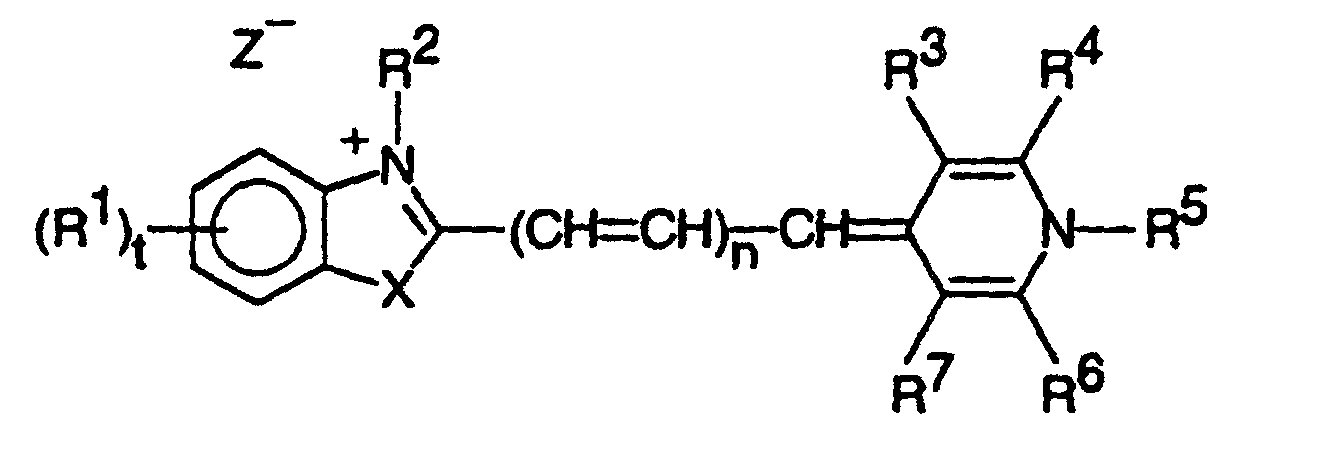
- The substituents on the second heterocyclic ring system, R3, R4, R6 and R7, may be the same or different and are independently H; or an alkyl, alkenyl, polyalkenyl, alkynyl or polyalkynyl group having 1-6 carbons; or a halogen; or -OH, -OR8, -SR8, -(NR8R9), as defined previously; or -OSO2R19 where R19 is alkyl having 1-6 carbons, or perfluoroalkyl having 1-6 carbons, or aryl; or an OMEGA (defined above); or R6 and R7 taken in combination are -(CH2)v- where v = 3 or 4, forming a fused 5 or 6 membered ring, or R6 and R7, taken in combination form a fused 6 membered aromatic ring.
- Where R6 and R7 taken in combination form a fused 6 membered aromatic ring, embodiments of this invention are quinolinium derivatives according to the formulawhere ring substituents R11, R12, R13, and R14 may be the same or different, and are independently H; or an alkyl, alkenyl, polyalkenyl, alkynyl or polyalkynyl group having 1-6 carbons; or a halogen; or -OH, -OR8, -SR8, -(NR8R9), where R8 and R9 are as defined previously; or -OSO2R19 where R19 is alkyl having 1-6 carbons, or perfluoroalkyl having 1-6 carbons, or aryl; or an OMEGA. A preferred embodiment of the invention is a quinolinium wherein m = 1 and p = 0 (4-quinolinium).

- For all embodiments of the invention, one or more of the substituents of the pyridinium or quinolinium ring system is an OMEGA. Preferably, one or two substituents are OMEGAs. When more than one OMEGA is bound to a compound of the present invention, the two or more OMEGAs may be the same or different. For embodiments of the invention that contain pyridinium ring systems, OMEGA is preferably R5, or R6 or both. For embodiments of the invention that contain a 4-quinolinium ring system, OMEGA is preferably R4 or R5, or both. For embodiments of the invention that contain a 2-quinolinium ring system, OMEGA is preferably R5, R11 or both. For all embodiments of the invention, preferably R5 is an OMEGA.
- One embodiment of the invention contains exactly two non-hydrogen substituents on the second heterocyclic ring, one of which is an OMEGA. In one preferred embodiment, R5 is an OMEGA and the substituent adjacent to R5 (R6 for pyridiniums, R4 for 4-quinoliniums, and R11 for 2-quinoliniums) is a non-hydrogen substituent. In one aspect, the substituent adjacent to R5 is halogen or -OSO2R19, more preferably halogen. In another aspect, the substituent adjacent to R5 is an OMEGA. In another preferred embodiment, one non-hydrogen substituent is -OR8, -SR8, or -NR8R9, preferably -NR8R9.
DYE EXmax / EM max QY (DNA) QY (RNA) Kp Thiazole Orange 510/530 0.18 0.15 4.8 E6 61 500/527 0.46 0.34 1.0 E7 63 514/531 0.24 3.9 E6 64 450/523 71 508/526 0.31 72 515/535 0.026 1.2 E6 73 508/525 0.31 4.4 E6 200 739/759 542 510/527 578 470/504 4.1 E5 582 516/533 591 509/532 0.09 0.13 4.8 E6 613 506/523 0.33 5.3 E6 616 471/510 3.8 E5 619 488/517 0.62 0.22 9.7 E6 621 635/656 624 480/501 0.58 0.57 5.0 E6 628 488/506 0.40 7.0 E6 630 517/544 0.19 633 489/508 0.12 7.4 E5 634 510/530 0.18 2.0 E6 637 601/622 0.28 639 513/548 0.20 8.0 E6 640 471/516 641 503/526 0.35 2.0 E7 672 586/611 720 487/507 0.52 1.2 E7 742 570/611 752 494/518 0.51 758 504/524 0.44 8.5 E6 760 483/510 0.68 764 486/508 0.58 0.46 1.1 E7 765 506/524 0.50 1.1 E7 770 526/549 1.7 E6 774 517/533 7.9 E6 776 0.65 780 (Cl) 513/536 0.09 3.4 E6 780 (S) 0.31 830 517/533 834 486/507 835 495/518 853 516/555 854 483/520 856 502/523 0.43 5103 511/530 0.18 5.4 E6 6104 505/523 0.52 1.3 E7 DYE# X heterocycle R1 R2 R4 R5 R11 R12 n 125 S 2-pyridinium H Me H phenyl - - 0 578 S 4-pyridinium H Me Cl phenyl - - 0 616 S 4-pyridinium H Me Cl o-MeO-phenyl - - 0 640 S 4-pyridinium H Me H phenyl - - 0 742 S 4-pyridinium H Me n-butyl phenyl - - 1 64 S 2-quinolinium H Me H phenyl H H 0 61 S 4-quinolinium H Me n-butyl phenyl H H 0 63 S 4-quinolinium H Me H phenyl H H 0 71 S 4-quinolinium H Me n-butyl thienyl H H 0 72 S 4-quinolinium H Me H Me phenyl H 0 73 S 4-quinolinium H Me H cyclohexyl H H 0 130 S 4-quinolinium H Me -NH-phenyl phenyl H H 0 100 S 4-quinolinium H Me n-butyl phenyl H H 2 200 S 4-quinolinium H Et Cl phenyl H H 0 542 S 4-quinolinium H Me H cyclohexenyl H H 0 582 S 4-quinolinium H Me Cl p-MeO-phenyl H H 0 591 S 4-quinolinium H Me Cl phenyl H H 0 613 S 4-quinolinium H Me Me phenyl H H 0 619 S 4-quinolinium H Me -NEt2 phenyl H H 0 621 S 4-quinolinium H Me n-butyl phenyl H H 1 624 O 4-quinolinium H Me n-butyl phenyl H H 0 628 S 4-quinolinium H Me -OMe phenyl H H 0 630 S 4-quinolinium H Me phenyl phenyl H H 0 633 O 4-quinolinium H Me Cl phenyl H H 0 634 S 4-quinolinium H Me H n-hexyl H H 0 637 O 4-quinolinium H Me n-butyl phenyl H H 1 639 S 4-quinolinium H Me phenyl Me H H 0 641 S 4-quinolinium H Me -SMe phenyl H H 0 672 O 4-quinolinium H Me -OMe phenyl H H 1 720 S 4-quinolinium H Me -OEt phenyl H H 0 752 S 4-quinolinium H Me morpholinyl Me H H 0 758 S 4-quinolinium Cl Me n-butyl phenyl H H 0 760 S 4-quinolinium H Me -NEt2 phenyl H -OMe 0 764 S 4-quinolinium H Me -O-iPr phenyl H H 0 765 S 4-quinolinium H Me cyclohexyl phenyl H H 0 770 S 4-quinolinium -OMe Me H phenyl H H 0 774 S 4-quinolinium H Me Br phenyl H H 0 776 S 4-quinolinium H Me -N-nPr2 phenyl H H 0 780 (Cl) S 4-quinolinium H Me Cl cyclohexyl H H 0 780 (S) S 4-quinolinium H Me -SMe cyclohexyl H H 0 823 S 4-quinolinium H Me Cl phenyl H H 1 830 S 4-quinolinium H Me Cl thienyl H H 0 834 S 4-quinolinium H Me F phenyl H H 0 835 S 4-quinolinium H Me -O-phenyl phenyl H H 0 853 S 4-quinolinium H Me -S-2-pyridyl phenyl H H 0 854 S 4-quinolinium H Me -OSO2CF3 phenyl H H 0 856 S 4-quinolinium H Me N-Me-piperazyl phenyl H H 0 5103 S 4-quinolinium H Me Cl phenyl H -OMe 0 6104 S 4-quinolinium H Me cyclohexyl Me H H 0 - In general, synthesis of these dyes requires three precursors: a benzazolium salt, a pyridinium (or quinolinium) salt (both of which have the appropriate chemical substituents), and (where n = 1 or 2) a source for the methine spacer. Although the combination that enables these compounds to be useful stains for nucleic acids has not been described previously, the chemisty that is required to prepare and combine these precursors so as to yield any of the subject derivatives is generally well-understood by one skilled in the art.
- A wide variety of derivatives of this type have been described (Brooker, et al., J. AM. CHEM. SOC., 64, 199 (1942)) and Hamer, "The Cyanine Dyes and Related Compounds", THE CHEMISTRY OF HETEROCYCLIC COMPOUNDS, Vol. 18, A. Weissberger, Ed., Interscience, New York (1964). These precursors have the common structure:
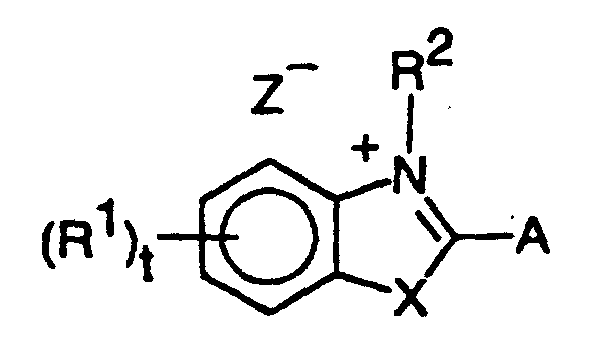
- X may be O (benzoxazolium), S (benzothiazolium), Se (benzoselenazolium), N or an alkyl-substituted N (benzimidazolium) or a carbon atom substituted by two alkyl groups R16R17 (indolium) (where R16 and R17 are independently alkyl groups having 1-6 carbons, or R16 and R17 taken in combination complete a five or six membered saturated ring).
- R1 is usually incorporated in the parent benzazole molecule prior to quaternization with an alkylating agent. R2 is usually obtained by alkylation of the parent heterocycle with R2-Z, where R2 is an alkyl group having 1-6 carbons and Z is an electronegative group that frequently becomes the counterion on the resultant dye. Z- is a biologically compatible counterion that additionally is stable and synthetically accessible. The counterion may be exchanged for another counterion by methods known in the art, such as the use of ion exchange resins or by precipitation. Preferred R2-Z are compounds that yield R2 = methyl, such as methyl iodide.
- A is a substituent whose nature is determined by the synthetic method utilized to couple the benzazolium precursor with the pyridinium or quinolinium precursor. When n = 0, A is usually alkylthio, commonly methylthio, or A is chloro, bromo or iodo. When n = 1 or 2, A is methyl.
- The second heterocyclic precursor is a pyridinium or quinolinium sail These can sometimes be generated from the corresponding pyridine or quinoline by alkylation at nitrogen using a suitable alkylating agent R5-Z. However, 2- and 4-pyridones and 2- and 4-quinolones are much more versatile chemical intermediates, with the added advantage of being easily prepared (for examples see HETEROCYCLIC COMPOUNDS. VOL 4, R. C. Elderfield ed., John Wiley and Sons Inc., (1952) pp 1-331 or Wawzonek et al., J. HETEROCYCLIC CHEM., 25, 381 (1988)).
- Typically the required pyridinium salt precursor has the structureand the quinolinium salt precursor has the structure
 At all times, the ring is a cationic 6-membered pyridinium- or quinolinium-based heterocycle.
- When n = 0, B is methyl, or B is chloro, bromo or iodo. When n = 1 or 2, B is methyl. When n = 1 or n = 2 part of B can be incorporated in the final compound.
- When R5 is an OMEGA or alkyl, the 2-pyridone or 4-pyridone or 2-quinolone or 4-quinolone can be treated with a powerful nucleophile such as a Grignard or an alkyl lithium reagent (Example 11) or with a metal hydride (Example 12), to generate the pyridinium or quinolinium salt after acid-catalyzed dehydroxylation.
- The pyridone or quinolone can also be converted to a pyridinium or quinolinium salt by using an agent such as phosphorous oxychloride, phosphorous tribromide, diethylaminosulfur trifluoride (Example 5) or trifluoromethanesulfonic anhydride. The resulting activated intermediate can be condensed with the appropriate benzazolium salt to form the dye directly (Example 6) or the activated intermediate can be treated with alcohols, phenols, or alkoxides to yield ether derivatives (Example 10), thiols or thiolphenols to yield thioether derivatives (Example 8) or ammonia or amines to yield substituted or unsubstituted amino derivatives (Example 7).
- The methine bridge consists of 1, 3 or 5 methine (-CH=) groups that bridge the benzazolium rings and the pyridinium or quinolinium ring(s) in such a way as to permit extensive electronic conjugation.
- Synthesis of monomethine dyes (n = 0) commonly uses a combination of reagents where the methine carbon atom results from either A on the 2-position of the benzazolium salt or B on the 2- or 4-position of the pyridinium or quinolinium salt being methyl and the other of A or B being a reactive "leaving group" that is typically methylthio or chloro (Brooker et al., supra).
- To synthesize trimethine dyes (n = 1) or pentamethine dyes (n = 2) both A and B are methyl. In these cases the additional methine carbon of is provided by a reagent such as N-methylformanilide or ethyl orthoformate (HOUBEN-WEYL, supra) or the additional trimethine fragment is provided by a malonaldehyde equivalent such as 1,1,3,3-tetramethoxypropane: 1,1,3-trimethoxypropene, 3-(N-methylanilino)propenal or 1-anilino-3-phenylimino-1-propene (Sprague, supra).
- As described earlier, the reactivity of the 2-halogenated pyridinium or quinolinium intermediate offers a variety of synthetic methods for attachment of various substituents at the 2-position. However, the reactivity of the 2-halo derivatives is preserved even after conjugation with the benzazolium precursor, enabling conversion of the resulting dye in which R4 is halogen into the appropriate ether, amine and thioether analogs. as described above for the pyridinium and quinolinium precursors (Examples 7, 8 and 10).
- The use of the invention comprises combining a dye of the present invention with a sample that contains or is thought to contain a nucleic acid, incubating the sample for a time sufficient to obtain a detectable fluorescent response, and observing the fluorescent response. The sample is optionally combined with one or more additional dyes (preferably fluorescent dyes) having a response detectably different from that of the subject dyes.
- Typically, the subject dye is present as a staining solution, which is prepared by addition of the dye to an aqueous solution that is biologically compatible with the sample. The staining solution is made by dissolving the dye directly in an aqueous solvent such as water, a buffer solution, such as buffered saline (preferably non-phosphate), or an organic water-miscible solvent such as dimethylsulfoxide (DMSO), dimethylformamide (DMF), or a lower alcohol such as methanol or ethanol, or acetonitrile. Typically the dye is preliminarily dissolved in an organic solvent (preferably 100% DMSO) at a concentration of greater than about 100-times that used in the staining solution, then diluted one or more times with an aqueous solvent such as water or buffer, such that the dye is present in an effective amount. An effective amount of dye is the amount sufficient to give a detectable fluorescent response when in the presence of nucleic acids. Typically staining solutions for cellular samples have a dye concentration greater than about 0.1 nM, and less than about 100 µM, more typically greater than about 1 nM. Staining solutions for electrophoretic gels typically have a dye concentration of greater than about 1 µM and less than about 10 µM, more typically about 4-5 µM. Staining solution for detection of free nucleic acids in solution typically have a
concentration 10 nM-1 µM. The specific concentration of the staining solution is determined by the physical nature of the sample, and the nature of the analysis being performed, and can be optimized according to standard procedures such as described for cell samples in Example 16. - The dye is combined with a sample that contains a nucleic acid. The nucleic acid in the sample may be RNA or DNA, or a mixture thereof. Any DNA is optionally single-, double-, triple-, or quadruple-stranded DNA. The nucleic acid may be natural (biological in origin) or synthetic (prepared artificially). The nucleic acid may be present as nucleic acid fragments, oligonucleotides, or nucleic acid polymers, and may contain unnatural bases. The nucleic acid may be present in a condensed phase, such as a chromosome. The presence of the nucleic acid in the sample may be due to a successful or unsuccessful experimental methodology, undesirable contamination, or a disease state. Nucleic acid may be present in all, or only part, of a sample, and the presence of nucleic acids may be used to distinguish between individual samples, or to differentiate a portion or region within a single sample.
- The nucleic acid may be enclosed in a biological structure, for example contained within a viral particle, an organelle, or within a cell. Cell types include, but are not limited to, eukaryotes, such as nucleated plant and animal cells, and prokaryotes, such as bacteria (including both Gram-negative and Gram-positive bacteria such as Bacillus cereus, Bacillus subtilus, Clostridium sporogenes, Corynebacterium xerosis, Micrococcus luteus, Mycobacterium phlei, Propionibacterium freunderreichii, Staphylococcus aureus, Streptococcus pyogenes, Lactobacillus acidophilus, Cytophaga psychrophila, Enterobacter acrogenes, Escherichia coli, Flavobacterium meningosepticum, Klebsiella pneumonia, Neisseria subflava, Pseudomonas aeruginosa, Rhizobium trifolii, Salmonella oranienburg, Shigella sonnei, Vibrio parahaemolyticus or combinations thereof), as well as yeast and other fungi, mycobacteria and mycoplasma. The nucleic acids enclosed in biological structures may be obtained from a wide variety of sources, including unfiltered or separated biological fluids (such as urine, cerebrospinal fluid, blood, lymph fluids, tissue homogenate, mucous, saliva, stool, or physiological secretions or other similar fluids); environmental samples such as soil, water and air, a fermentation medium such as from a biological reactor or food fermentation process such as brewing; or surface washes of materials, (e.g. food) or small amounts of solids such as retentates, scrapes, and smears; or liquid growth medium in which cells have been introduced for culturing. The cells are optionally discrete or individual cells, including microorganisms, or multiple cells associated with other cells in two or three dimensional layers, including multicellular organisms, embryos, tissues, biopsies, filaments, biofilms, etc. The nucleic acid may be endogenous or introduced as foreign material, such as by infection or by transfection. The cells may be viable or dead cells or a mixture thereof. The nearly universal permeability of the instant dyes, their accelerated rate of uptake and the low toxicity of the dyes to living systems enable the examination of nucleic acids in living samples with little or no perturbation caused by the dye itself. The dyes can also be used for staining nucleic acids in a cell or cells fixed and treated with routine histochemical or cytochemical procedures.
- Alternatively, the nucleic acid, in any of the forms described previously, is not enclosed within a biological structure, but is present as a sample solution. The sample solution can vary from one of purified oligonucleotides or nucleic acids to crude mixtures such as cell extracts, biological fluids and environmental samples from the sources listed above. In some cases it is desirable to separate the nucleic acids from a mixture of biomolecules or fluids in the solution prior to combination with the dye. Numerous techniques exist for separation and purification of nucleic acids from generally crude mixtures with other proteins or other biological molecules. These include such means as electrophoretic techniques and chromatographic techniques using a variety of supports. When used for poststaining electrophoresis gels, the high sensitivity of the dyes of the present invention allow the detection of previously unmeasureable amounts of nucleic acids without requiring destaining. One embodiment of the invention, when used in conjunction with an ultraviolet transilluminator, allows detection of as little as 20 picograms of double-stranded DNA per band.
- The sample may be combined with the staining solution by any means that facilitates contact between the dye and the nucleic acid. The contact can occur through simple mixing, as in the case where the sample is a solution. The dye may be added to the nucleic acid solution directly or may contact the solution on an inert matrix such as a blot or gel, a testing strip, or any other solid or semi-solid surface, for example where only a simple and visible demonstration of the presence of nucleic acids is desired. Any inert matrix used to separate the sample can be used to detect the presence of nucleic acids by observing the fluorescent response on the inert matrix. While the subject dyes have shown an ability to permeate cellular membranes rapidly and completely upon addition of the dye solution, any other technique that is suitable for transporting the dye across cell membranes with minimal disruption of the viability of the cell and integrity of cell membranes is also a valid method of combining the sample with the subject dye. Examples of suitable processes include action of chemical agents such as detergents, enzymes or adenosine triphosphate; receptor- or transport protein-mediated uptake; pore-forming proteins; microinjection; electroporation; hypoosmotic shock; or minimal physical disruption such as scrape loading or bombardment with solid particles coated with or in the presence of the dyes.
- The sample is incubated in the presence of the dye for a time sufficient to form the fluorescent nucleic acid-dye complex. Detectable fluorescence in a solution of nucleic acids is essentially instantaneous. Detectable fluorescence within cell membranes requires the permeation of the dye into the cell. Preferably, the dye is added at a temperature optimal for normal activity of the cells within the operating parameters of the dyes (between about 5 °C and about 50 °C); typically this is room temperature (23 °C). At temperatures between 5-45 °C, visibly detectable fluorescence is obtained within about 15-20 minutes of combination with the sample, commonly within about 5 minutes. Preferred embodiments give detectable fluorescence inside cells in less than about 2 minutes. Lymphocytes loaded with 5 µM dye solutions give a fluorescent response in less than 5 seconds, too fast to measure by conventional fluorometry. This property is useful for observing nuclear structure and rearrangement, for example such as occurs during mitosis or apoptosis. While permeation and fluorescence is rapid for all embodiments, optimal permeation of the dye or formation of the nucleic acid complex is dependent upon the physical and chemical nature of the individual sample and the sample medium, and can be determined according to standard procedures such as described in Example 17.
- The subject dyes bind non-covalently with nucleic acids to yield enhanced fluorescence, the level of enhancement being generally about 100-1000 fold, typically greater than about 300-fold (Table 2). These dyes generally exhibit improved quantum yields upon binding to nucleic acids, relative to Thiazole Orange, which translate directly into improved sensitivity in nucleic acid detection. While not every dye shows an improved quantum yield, other attributes of the subject dyes represent significant improvement, including enhanced permeation, enhanced rate of permeation, and/or the selectivity of excitation and emission bands to suit specific instrumentation.
- To facilitate the detection of the nucleic acid-dye complex, the excitation or emission properties of the fluorescent complex are utilized. For example, the sample is excited by a light source capable of producing light at or near the wavelength of maximum absorption of the fluorescent complex, such as an ultraviolet or visible tamp, an arc lamp, a laser, or even sunlight. Preferably the fluorescent complex is excited at a wavelength equal to or greater than about 300 nm, more preferably equal to or greater than about 340 nm. The equipment commonly available for excitation of samples near 254 nm, between 300 and 310 nm, and near 365 nm can be used to excite any of the dyes of the present invention. Excitation by a source more appropriate to the maximum absorption band of the nucleic acid-dye complex, such as the 488 nm band of the argon laser, results in even higher sensitivity. Some examples permit excitation beyond 600 nm.
- The fluorescence of the complex is detected qualitatively or quantitatively by detection of the resultant light emission at a wavelength of greater than about 400 nm, preferably greater than about 480 nm, more preferably at greater than about 500 nm. The emission is detected by means that include visible inspection, photographic film, or the use of current instrumentation such as fluorometers, quantum counters, plate readers, epifluorescence microscopes, and flow cytometers, or by means for amplifying the signal such as a photomultiplier. The nucleic acid concentration in a sample can also be quantified, as the fluorescence of the nucleic acid-dye complex is linearly dependent on concentration (Examples 22-23).
- The wavelengths of the excitation and emission bands of the dyes vary with dye composition to encompass a wide range of illumination and detection bands (e.g. Table 3). This allows the selection of individual dyes for use with a specific excitation source or detection filter. In particular, dyes can be selected that match their excitation band with the commonly used argon laser, or emission bands that match preexisting filters such as a typical fluorescein long-pass set or multi-band set with fluorescein excitation and emission bands.
- In addition, the dye can be selected to give a detection response that is different from that of other dyes desired to be used in combination with the subject dyes. Preferably the additional dye or dyes are fluorescent, for which the response to illumination that is detectably different from that of the subject cyclic-substituted unsymmetrical cyanine dyes. Any fluorescence detection system can be used to detect the difference in spectral characteristics between dyes. Preferably the dyes have the same or overlapping excitation spectra, but possess visibly different emission spectra, generally having emission maxima separated by >10 nm, preferably >20 nm, more preferably >50 nm.
- The additional dyes are optionally used to differentiate cells or cell-free samples containing nucleic acids according to size, shape, metabolic state, physiological condition, genotype, or other biological parameters or combinations thereof. In one aspect of the invention, the additional dye or dyes are metabolized intracellularly to give a fluorescent product inside certain cells but not inside other cells, so that the fluorescent response of the cyclic-substituted unsymmetrical cyanine dye predominates only where such metabolic process is not taking place. Alternatively, the additional dye or dyes are specific for some external component of the -cell such as cell surface proteins or receptors. In yet another aspect of the invention, the additional dye or dyes actively or passively cross the cell membrane and are used to indicate the integrity or functioning of the cell membrane.
- The additional dyes are added to the sample being analyzed to be present in an effective amount, with the optimal concentration of dye determined according to the cell density as above. Typically the concentration of each dye is between about 0.01 µM and about 100 µM. more typically between 0.1 µM and 10 µM. Each dye is optionally prepared in a separate solution or combined in one solution. Generally the dyes are present in the staining solution within about a five-fold molar range. but the molar ratio one to the other in the sample can vary from about 1:1 to about 1:100, and may vary depending on whether the dyes are added to the sample simultaneously or sequentially. After illumination of the dyed cells at a suitable wavelength, as above, the cells are analyzed according to their fluorescent response to the illumination. In addition, the differential fluorescent response can be used as a basis for sorting the cells or nucleic acids for further analysis or experimentation. For example, all cells that "survive" a certain procedure are sorted, or all cells of a certain type in a sample are sorted. The cells can be sorted manually or using an automated technique such as flow cytometry according to the procedures known in the art such as in US-A-4,665,024 to Mansour, et al. (1987).
- In one embodiment of the invention, the subject dyes are used in combination with a second fluorescent dye (Dye II) to distinguish viable cells from dead cells, where Dye II is selective either for viable or for dead cells. Accordingly, the invention includes methods of staining nucleic acids in a sample wherein the nucleic acids are enclosed in a biological structure and the method further comprises combining the sample with one or more additional dyes, singly or in combination; where at least one additional dye is a fluorescent nucleic acid stain that is permeant or impermeant to cells; another additional dye is selectively permeant to Gram positive or Gram negative bacteria; and where each of the additional dyes has a fluorescent response to illumination that is detectably different from that of the other dyes. In one class of such methods, the nucleic acid stain is impermeant to cells with intact membranes. In another class of such methods, the nucleic acid stain is impermeant to cells with intact membranes and is a phenanthridium monomer or dimer derivative that is an ethidium, ethidium dimer, propidium; or is a benzazolium monomer or dimer derivative such as TOTO™, YOYO™, POPO™, BOBO™, TOPRO™, YO-PRO™, BO-PRO™, PO-PRO™. In a further class of such methods, the nucleic acid stain is permeant to cells or is selectively permeant to Gram-positive bacteria and is a C4-C8 alkyl-substituted phenanthridium, or 2'-(4-hydroxyphenyl)-5-(4-methyl-1-piperazinyl)-2,5'-bi-1H-benzimidazole, 2'-(4-ethoxyphenyl)-5-(4-methyl-1-piperazinyl)-2,5'-bi-1H-benzimidazole or 4', 6-diamidino-2-phenylindole dihydrochloride.
- Considering now in more detail methods in which a Dye II is used, in one aspect of the invention, Dye II gives a detectable fluorescent response only in viable cells, such as fluorescent enzyme substrates and reagents described in Haugland, HANDBOOK OF FLUORESCENT PROBES AND RESEARCH CHEMICALS (1992-94) to selectively stain viable cells, including haloalkyl esterase substrates and calcein AM. Alternatively, Dye II gives a detectable fluorescent response only in dead cells, such as an impermeant dye that only becomes fluorescent upon passing through the cell membrane to bind to some intracellular component, such as an intracellular protein or nucleic acid. While there is not an exact equivalence between an intact cell membrane and the term "viability" (technically defined as the ability of a cell to maintain its existence), it is common to refer to cells where the cell membrane has been irreversibly disrupted as "dead" cells or "non-viable" cells. Suitable dyes include impermeant phenanthridium or benzazolium derivatives, including monomers or dimers thereof, such as ethidium homodimer, ethidium bromide, propidium iodide, TOTO™, BOBO™, POPO™, YOYO™, TO-PRO™, BO-PRO™, PO-PRO™ and YO-PRO™ (Molecular Probes) that give an enhanced fluorescence when complexed to intracellular nucleic acids. Loading times for impermeant Dye II dyes, such as phenanthridium or benzazolium dyes, is generally the same as previously discussed above. Cell permeant Dye II dyes selective for viable cells generally require longer loading times, particularly if such dyes require intracellular activity to generate fluorescence.
- In cells for which Dye II is selective, both dyes are present because the subject dyes stain all cells, including those for which Dye II is selective. In the cells for which Dye II is selective (and both dyes are present) the intracellular fluorescent response of Dye II is optionally the same as the fluorescent response of Dye II alone (e.g. where Dye II effectively competes for nucleic acid binding relative to the subject dye) or is a response indicative of the presence of both dyes (as is the case where the competitive binding is less effective or where Dye II is not a nucleic acid stain). The fluorescent response of the subject dye alone is indicative of cells for which Dye II is not selective, either viable or non-viable cells as the case may be. The cells for which Dye II is selective are optionally sorted or counted, as above.
- In another embodiment of the invention, the sample is combined with multiple fluorescent dyes to determine identification, and optionally viability. The additional fluorescent dye(s) binds selectively to cell surface components or is selectively permeant to certain cell types, and can be used in combination with Dye II to also indicate viability. The surface label that only stains externally is distinguishable from the dyes that stain intracellularly. When a surface dye is used in combination with one or more intracellular stains such as nucleic acid stains, a "bullseye" pattern of staining is seen -- i.e. a brightly stained interior within an exterior ringstain. Preferably, the surface label also has an emission spectrum that is detectably different from that of the other dyes used. Preferably the excitation spectrum of each dye or dye-nucleic acid complex overlaps the excitation spectrum of the other dye(s). More preferably, each dye complexed with nucleic acids has an excitation maximum between about 480 nm and 510 nm. Most preferably, each dye or dye-complex also excites in the UV between about 300 nm and 365 nm.
- In one aspect of the invention, the appearance of the stained bacteria indicates the Gram reaction of the bacteria in the sample, and optionally whether or not the G+ or G- bacteria present in the sample are viable. Gram positive (G+) bacteria are those that give a positive Gram stain, including but not limited to Bacillus, Lactobacillus, Micrococcus, Streptococcus, Clostridium, Staphylococcus, and Mycobacterium, among others. Gram negative (G-) bacteria are those that are negative for the Gram stain, including but not limited to Escherichia, Enterobacter, Salmonella, Pseudomonas, Shigella, Klebsiella, Haemophilus, Neisseria, Proteus, Vibrio, Campylobacter, and Yersinia, among others.
- Preferably a cyclic-substituted unsymmetrical cyanine dye that (in combination with intracellular nucleic acids) gives a green or yellow-green fluorescence is used in combination with one or more of the following dyes: a) a C4-C8 alkyl substituted phenanthridium nucleic acid stain (preferably hexidium or C6-substituted phenanthridium, Watkins, J.CHEM. SOC. 3059 (1952)) that selectively stains live G+ bacteria and all dead bacteria with an orange red fluorescent signal that partially or completely replaces the signal of the cyclic-substituted unsymmetrical cyanine dye; and/or b) a protein that is covalently bound to a fluorophore with a fluorescent response different from that of the phenanthridium dye in a) and from that of the cyclic-substituted unsymmetrical cyanine dye, preferably a lectin such as wheat germ agglutinin labeled with AMCA™ or Cascade Blue dye (Molecular Probes) that is selective for the cell surface of G+ bacteria, live or dead; and optionally c) a membrane impermeant benzazolium nucleic acid stain according to Dye II above, that has a fluorescent response different from that of the other dyes used, preferably dyes sold under the names TOTO™, YOYO™, BOBO™, POPO™, TO-PRO™, YO-PRO™, BO-PRO™, PO-PRO™ (Molecular Probes).
- Table 5 summarizes the spectral response, where the cyclic-substituted unsymmetrical cyanine dye (I) has an emission maximum between 500 nm and 535 nm (e.g. dye 624); the phenanthridium dye (II) has an emission maximum between 580 nm and 650 nm (e.g. hexidium); the membrane impermeant benzazolium (III) nucleic acid complex has an emission maximum between 530 nm and 590 nm (e.g. TOTO™, YOYO™, TO-PRO™ or YO-PRO™); and the labeled protein (IV) has an emission maximum between 410 nm and 480 nm (e.g. AMCA™-or Cascade Blue-labeled wheat germ agglutinin). Careful matching of other fluorescent stains with equivalent selective permeability, excitation/emission spectra, and preferential binding affinity for nucleic acids allows substitution of the preferred combination of nucleic acid stains to discriminate between many different organisms, whether live or dead.
Panel # in Figure 1 Dyes† Live Gram (+) Bacteria Live Gram (-) Bacteria Dead Gram (+) Bacteria Dead Gram (-) Bacteria 1 I G G G G 2 II O ― O O 3 III ― ― Y Y 4 IV B ― B ― 5 I, II O G O O 6 I, III G G Y Y 7 I, IV G with B G G with B G 8 II, III O ― Y Y 9 II, IV O with B ― O with B O 10 III, IV B ― Y with B Y 11 I, II, III O G Y Y 12 I, II, IV O with B G O with B O 13 I, III, IV G with B G Y with B Y 14 II, III, IV O with B ― Y with B Y 15 I, II, III, IV O with B G Y with B Y Color Key: G = True-green Y = Yellow-green O = Orange B = Blue Halo ―=Unstained - The examples below are given so as to illustrate the practice of this invention. They are not intended to limit or define the entire scope of this invention. In the structural formulae below, the substituent phenyl is represented by the symbol Ø, as is generally used and understood in the art.
- The following compound is prepared:The synthetic precursor (1) is prepared either by an Ullmann coupling according to a literature procedure (Wawzonek, et al., supra.) or via the reaction of the corresponding diarylamine with diketene followed by acid cyclization (Elderfield, supra). Thus 10.0 g (62.9 mmoles) of 2-hydroxy-4-methylquinoline is heated at reflux with 24.0 g (377 mmoles) of copper powder, 8.68 g (62.9 mmoles) of potassium carbonate and 19.2 g (94 mmoles) of iodobenzene for 48 hours. The reaction is cooled to room temperature, partitioned between water and ethyl acetate, filtered, and the organic layer is dried over magnesium sulfate. The crude product is purified on a silica gel column, eluting with 1:1 ethyl acetate/hexanes to yield 8.1 g of the desired product

- The following compound is prepared:Synthetic precursor 2 is prepared as in Example 1 with a 40% yield, except that the starting material is 1,2-dihydro-4-methyl-2-pyridone.
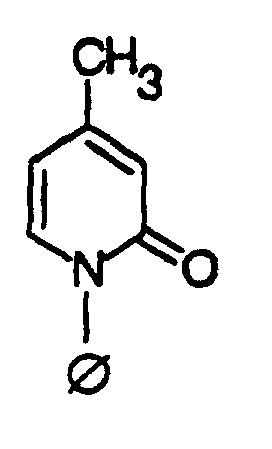
- The following compound is prepared:Synthetic precursor 3 is prepared by first conjugating N-methylaniline with diketene, followed by an acid cyclization of the amide intermediate. Thus 10.0 g (0.12 moles) of diketene is added dropwise to 10.7 g (0.1 moles) of N-methylaniline and the reaction is heated at 100 °C for an additional 30 minutes. To the resulting mixture is added 30 mL of acetic acid and 30 mL of sulfuric acid. and the mixture is heated at 50 °C overnight. The reaction is worked up with water and ethyl acetate and purified on a silica gel column to yield 9.5 g of the desired product.
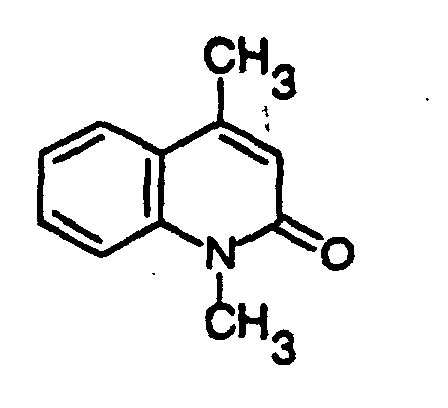
If the synthesis is performed using N-methyl-2-phenylaniline (generated by methylation of 2-phenylaniline using K2CO3 and CH3I) the resulting product is 1,2-dihydro-1,4-dimethyl-8-phenyl-2-quinolone. - The following compound is prepared:N-(3-hydroxyphenyl)-N-phenylamine is O-methylated with potassium carbonate and methyl iodide in acetone in 39% yield. The resulting N-(3-methoxyphenyl)-N-phenylamine is then reacted with diketene to generate the corresponding acetoacetamide which, without purification, is cyclized in acetic acid/sulfuric acid as in Example 3 to generate the desired quinolone in 41% yield.

- The following compound is prepared:To 2.8 g (11.9 mmoles) of 1 in 20 mL of methylene chloride is added 1.85 g of POCl3 and a catalytic amount of dimethylformamide (Marson, TETRAHEDRON., 48, 3659 (1992)). The resulting mixture is heated to reflux for 24 hours. Alter cooling, the product is purified using column chromatography.
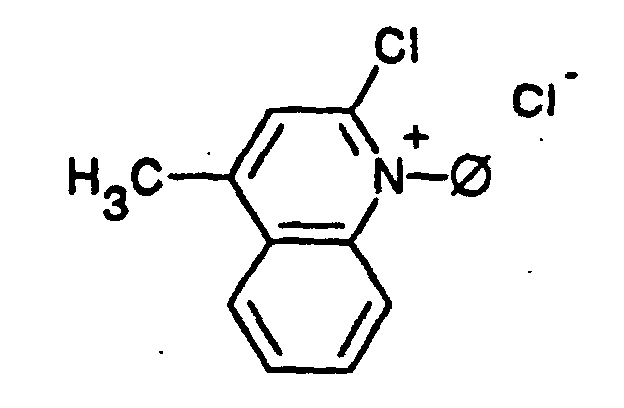
The corresponding bromide is prepared using PBr3 rather than POCl3.
The corresponding fluoride is prepared using diethylaminosulfur trifluoride, rather than POCl3. - The following compound is prepared:A room temperature solution of 4 (11.9 mmoles) is prepared, and 3.5 g (9.6 mmoles) of N-methyl-2-methylthiobenzothiazolium tosylate (5) (Rye, et al., NUCLEIC ACIDS RES., 20, 2803 (1992)) is added followed by 1.3 mL (9.4 mmoles) of triethylamine. The mixture is stirred for an additional 6 hours. The crude product is purified on silica gel using ethyl acetate:chloroform:methanol, 3:3:1 as eluant. The product is then recrystallized from methanol/chloroform/ethyl acetate.

The corresponding bromide (Dye 774) is prepared analogously using 2-bromo-4-methyl-1-phenylquinolinium bromide in place of 4.
The corresponding fluoride (Dye 834) is prepared analogously using 2-fluoro-4-methyl-1-phenylquinolinium fluoride in place of 4.
The methoxyquinolinium analog (Dye 5103) is prepared in the same way, except using 1,2-dihydro-7-methoxy-3-methyl-1-phenyl-2-quinolone.
The pyridinium analog (Dye 678) is prepared in the same way, except using the pyridinium analog of 4.
The trimethine dye analog (Dye 823) is prepared similarly, except using 2-(2-anilinovinyl)-3-methylbenzothiazolium tosylate in place of 5.
An additional synthetic route to Dye 591 utilizes 4-[2,3-dihydro-3-methyl-(benzo-1,3-thiazol-2-yl)-methylidene]-1,2-dihydro-1-phenyl-2-quinolone (6), which in turn is prepared from 1 and 5. Thus the lithium enolate of 1 (prepared from treating the quinolone with 2.7 equivalent of lithium diisopropyl amide) or the silyl enolate of 1 (from (1) and trimethylsilyl trifluoromethanesulfonate and diisopropylethylamine) is stirred with 5. The desired intermediate (6) is isolated by column chromatography. The quinolone (6) is then treated with POCl3 to generate Dye 591. - The following compound is prepared:Dye 619 is prepared by heating Dye 591 (26 mg) at 55 °C with 0.5 mL of diethylamine in 1.5 mL of DMF overnight. The desired product is isolated by a simple filtration.

Dye 752 is prepared similarly, except using morpholine in place of diethylamine in DMF at 50 °C.
Dye 856 is prepared similarly, except using N-methylpiperazine in place of diethylamine.
Dye 130 is prepared similarly, except using aniline in place of diethylamine.
2-(N-3-dimethylaminopropyl)-N-propylamino-4-[2,3-dihydro-3-methyl-(benzo-1,3-thiazol-2-yl)-methylidene]-1-phenylquinolinium ioide (Dye 1037) is prepared similarly, except using N-(3-dimethylaminopropyl)-N-propylamine in place of diethylamine. - The following compound is prepared:2-Mercaptopyridine (6.3 mg) is added to 25 mg of Dye 591 in 2 mL of methylene chloride, followed by 13 µL of triethylamine, and the resulting mixture is stirred at room temperature for 1.5 hours. The volume of solvent is reduced to about 0.5 mL under reduced pressure and the product is isolated by filtration.
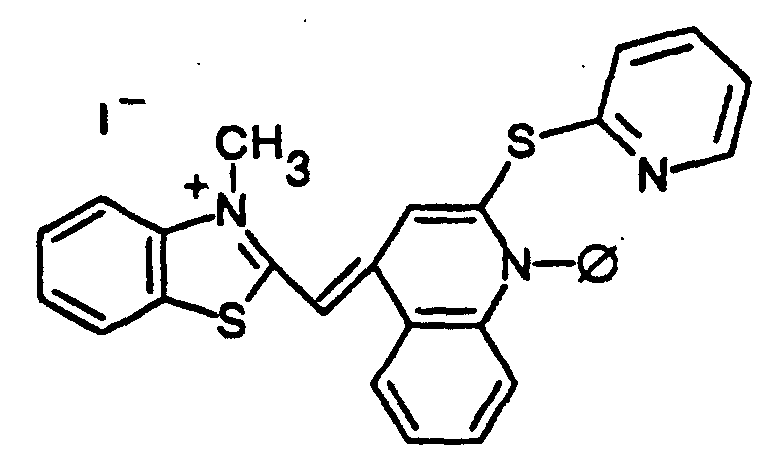
2-(2-Dimethylaminoethylthio)-4-[2,3-dihydro-3-methyl-(benzo-1,3-thiazol-2-yl)-methylidene]-1-phenylquinolinium iodide (Dye 1004) is prepared analogously, using Dye 633 in place of Dye 591, and 2-dimethylaminoethanethiol in place of 2-mercaptopyridine. - The following compound is prepared:1-Cyclohexyl-1,2-dihydro-4-methyl-2-quinolone is prepared using N-cyclohexylaniline as starting material. The quinolone (0.482 g, 2 mmol) is transformed to the 2-chloro-1-cyclohexylquinolinium chloride with a procedure similar to Example 5, and is then reacted with 5 (0.74 g. 2 mmol) and triethylamine (0.28 mL, 2 mmol) to yield the product.
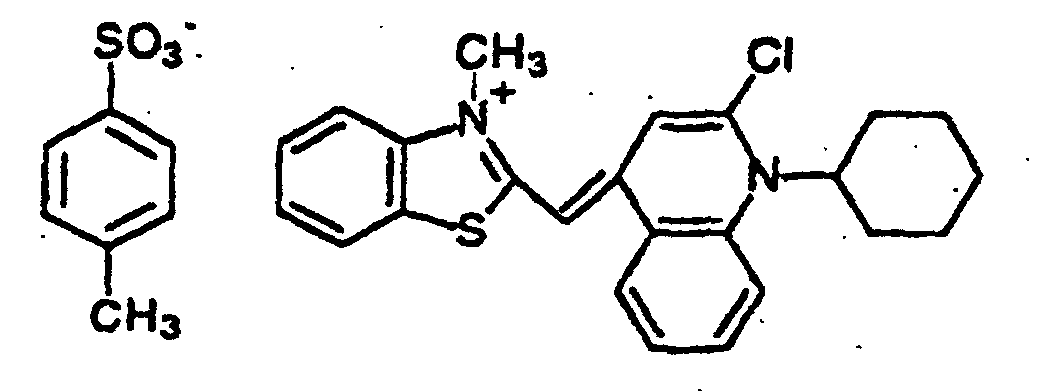
- The following compound is prepared:The intermediate compound (4) (4.3 mmoles) and methanol (10 mL) are heated to reflux for 2 hours. The methanol is removed under reduced pressure, and 10 mL of methylene chloride is added, followed by 1.56 g (4.3 mmoles) of 5 and 1.5 mL of triethylamine. The resulting mixture is stirred at room temperature for 3 days. The crude material is purified on a silica gel column by eluting with 5:5:1 ethyl acetate: chloroform: methanol.

Thc corresponding ethoxide (Dye 715) is prepared analogously, using ethanol rather than methanol. - The following compound is prepared:To 0.235 g (1 mmole) of 1 in 10 mL of THF at -78 °C under nitrogen, 1.2 equivalents of n-butyl lithium is introduced. The reaction is stirred at -78 °C for 15 minutes, and then the temperature is raised to 0°C for another 30 minutes, then the reaction is quenched with acetic acid and the solvent is evaporated. The residue is dissolved in 5 mL of methylene chloride and 0.367 (1 mmole) of 5 is added followed by 0.28 mL (2 mmoles) of triethylamine. The reaction mixture is stirred for 20 minutes at room temperature and the crude product is isolated as the iodide salt after a salt exchange. The crude iodide is recrystallized from methanol.
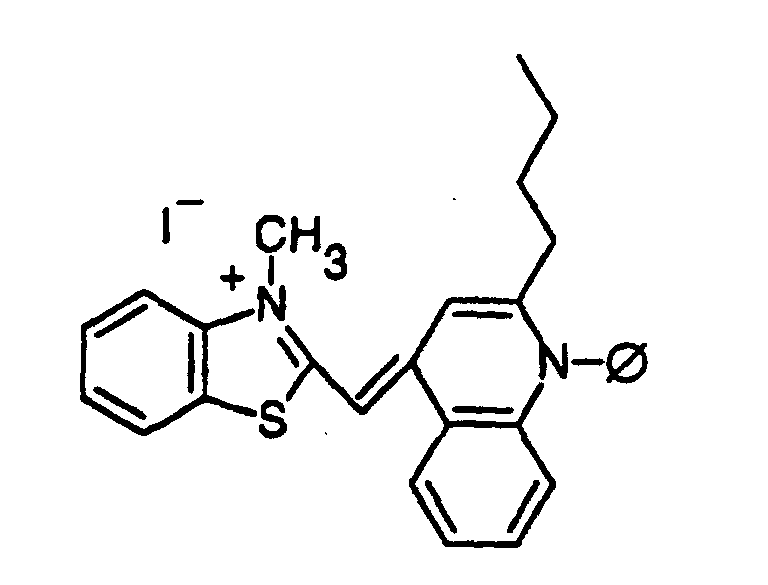
Dye 624 is prepared similarly, except that 3-methyl-2-methylthiobenzoxazolium tosylate (7) (Rye, et al., supra) is used instead of 5 in the synthesis.
Dye 6104 is prepared similarly, except that cyclohexyl magnesium bromide is used instead of butyl lithium.
The corresponding trimethine dye (Dye 621) is prepared similarly, except that 2-(2-anilinovinyl)-3-methylbenzothiazolium tosylate is used in place of 5.
The corresponding pentamethine dye (Dye 100) is prepared similarly, except that 2-(4-anilino)-1,3-butadienyl)-benzothiazolium iodide is used in place of 5. 2-(4-Anilino)-1,3-butadienyl)-benzothiazolium iodide is prepared using methods known in the art (U.S. Patent No. 2,269,234 to Sprague (1942); and HOUBEN-WEYL METHODON DER ORGANISCHEN CHEMIE, Band V/1d, 231-299 (1972)) from 1,3-dimethylbenzothiazolium iodide and 1-anilino-3-phenylimino-1-propene hydrochloride. - The following compound is prepared:To 0.37 g (2 mmoles) of 1,2-dihydro-1-phenyl-2-pyridone in 10 mL of methylene chloride at 0 °C is added 2.2 mL of 1.0 M DIBAL (in cyclohexane) and the resulting mixture is stirred at a low temperature for 2 hours. Acetic acid (0.3 mL) is added, and the volatile components are evaporated. The residue is dried, then is redissolved in 15 mL of methylene chloride. 0.74 g (2 mmoles) of 5 is added followed by 0.28 mL (2 mmoles) of triethylamine. The reaction mixture is stirred at room temperature for 3 hours and the crude product is loaded on a silica gel column and eluted with 3:3:1 ethyl acetate/chloroform/methanol. The fractions containing the product are pooled and evaporated, redissolved in 5 mL of DMF and added to 5 g of sodium iodide in 75 mL of water. The precipitate is filtered and recrystallized from methanol.
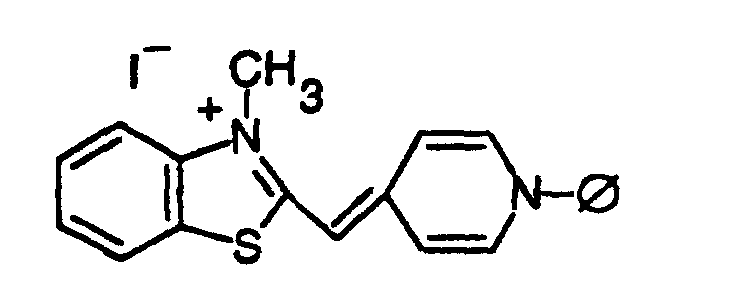
If 1,2-dihydro-1,4-dimethyl-8-phenyl-2-quinolone is used in place of the pyridone, the reaction produces Dye 72. - The following compound is prepared:A mixture of 1.43 g (10 mmoles) of lepidine and 2.1 g (10 mmoles) of cyclohexyl iodide is heated at 130°C for 2 hours. Ethyl acetate (20 mL) is added and 1.36 g of solid is obtained after filtration. The solid is stirred in 50 nL of methylene chloride with 1.41 g of 5 and 1.12 mL of triethylamine for several hours. The crude product is converted to the iodide salt and recrystallized from methanol to yield the pure product.

- The following compound is prepared:The intermediate N-phenyl-2-chloroquinolinium chloride is prepared according to Marson (TETRAHEDRON, 48, 3659 (1992)). Thus 1.06 g (5 mmoles) of N,N-diphenylacetamide is heated with 1.69 g (11 mmoles) of POCl3 and 0.44 g (6 mmoles) of DMF at 120 °C for 2 hours. The reaction mixture is cooled to room temperature and 15 mL of methylene chloride is added to dissolve the residue. To the solution is added 1.68 g (5 mmoles) of 2,3-dimethylbenzothiazolium tosylate and 1.46 g (12 mmoles) of 4-dimethylaminopyridine, and the reaction is stirred overnight (Elderfield, supra). The crude product is first purified on a silica gel column eluting with 2:2:1 ethyl acetate/chloroform/methanol and then metathesized to the iodide salt and recrystallized from methanol to obtain the pure product.
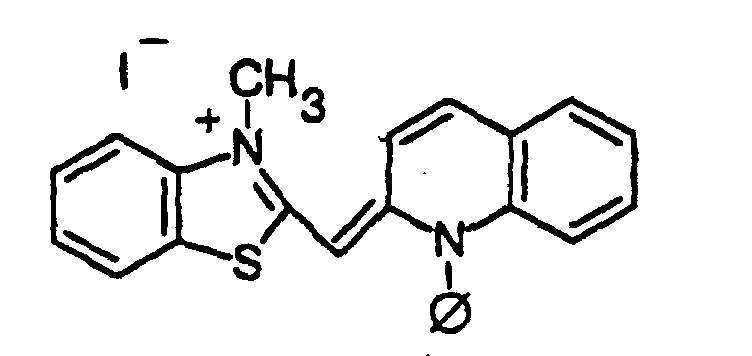
- The following compound is prepared:Trifluoromethanesulfonic acid anhydride (66 µL) is added to 0.1 g of 6 in 5 mL of 1,2-dichloroethane, and the solution is heated at 80 °C for 3 hours. The reaction is worked up with water and chloroform, and the resulting product is purified by chromatography on silica gel.
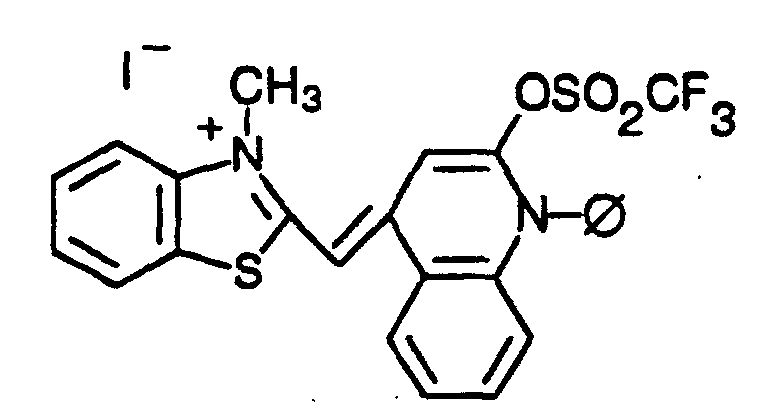
- Cell density is determined by counting or by the following extrapolation. A cell culture is washed by centrifugation and resuspended in water to its original volume. Using flat-bottom 96-well microtiter plates, 150 µL volumes of suspension are loaded per well. A single well of sterile water is the well background standard. Using a Dynatech MR600 microplate reader equipped with a 410 nm filter, absorbance is determined for the initial volumes of suspension. The suspension is diluted seven times by serial ten-fold dilutions in water, 150 µL of suspension per well, and the absorbance measured for each dilution. Following the absorbance measurements, each dilution loaded into wells is further diluted 1:10 and plated in duplicate on nutrient growth agar. The colonies are counted and expressed as colony forming units per milliliter (cfu/mL). Using the turbidity of the dilution in the microtiter plate, the suspension is diluted to a density of about 1x10⁹ cfu/mL.
The cell suspension, adjusted to a known density, is diluted seven times by serial ten-fold dilutions in water; 150 µL of suspension per well. Three-fold serial dilutions of dye are used (30-0.04 µM); 50 µL of dye at 4x final concentration. Using 96-well flat-bottom plates, a matrix is set up whereby the cell concentration decreases across the plate and the dye concentration decreases down the plate, final volume per well is 200 µL. The top row and first column are reserved for the control, sterile water. The plate is incubated at 37 °C for 30 minutes, then read in a CytoFluor™ 2350 fluorescence microplate reader at a fixed excitation of 485 +/-10 nm and each of three emission wavelengths, 530 +/-12, 620 +/-20, or 645 +/-20 nm. The results determine the best dye range (30-1 µM) and the best cell concentrations (concentrated through first three ten-fold dilutions) for optimal dye loading. These results lead to the next staining optimization assay. Using the four dye dilutions and the four cell dilutions, many cultures and dyes can be assayed quickly. The data collected allow the determination of optimal dye and cell concentration required for maximal fluorescence intensity per cell. - Minimum times for dye loading are obtained as follows: Cells are grown in nutrient broth to log phase. washed by centrifugation, and resuspended in water to a density previously shown to allow dye loading to maximal fluorescence/cell. Fluorescence cuvettes containing the cell suspension are placed in a fluorescence spectrophotometer equipped with a temperature regulated cuvette holder and magnetic stirrer. The suspensions are brought to the appropriate temperature prior to dye addition. Millimolar dye stock solutions in DMSO are added at the appropriate concentrations to produce maximum attainable fluorescence/cell at the peak emission wavelength of each dye. Fluorescence intensity of the suspensions is measured at or near the peak excitation and emission wavelengths for the dye (see e.g. Table 3). Sampling of fluorescence is carried out until the fluorescence signal stabilizes. Comparison of loading times at 5 °C, 23 ° C, and 37 °C shows a marked enhancement of rate of loading as the temperature increases, after equilibrating the suspensions at the appropriate temperatures and adding the dye as described above.
- A frozen suspension of goat sperm is thawed and held at 32 °C. Enough of a 10 mM dye stock solution (dye 628, 624, 835 or 591) is added to the sperm suspension to obtain a final concentration of 0.5 µM dye. The sperm are labeled by incubation in the dye solution for 10 min. Sperm cells stain with all of the dyes, and the order of brightness is 628 > 624 >> 835 > 591. Motility is retained at 0.5 µM, but is lost in some sperm at s µM dye.
- A leaf of Aucuba spp. is cross-sectioned with a razor blade and immersed in 0.5 mL of a 10 µM solution of dye 624 in E-pure water in a 35 mm glass dish. The tissue is stained for 30 min at room temperature in the dark. The tissue preparation is mounted in the presence of dye between coverglass and slide. The leaf epidermal layer is demarcated by a large amount of yellow autofluorescence, however both the vascular bundle and cell nuclei stain bright green in the dye 624-loaded cells.
- A 10 mM stock solution of dye 613 is added to a suspension of Infectious Hepatic Necrosis Virus in 135 mM NaCl, 5 mM KCI, 1 mM MgCl2, 1.8 mM CaCl2, 20 mM Na-HEPES, at pH 7.4 (HBSS+) to give a 40 µM dye solution. After incubation for 10 minutes at 15 °C, the viruses are observed in an epifluorescence microscope using a 100x objective lens. The virus particles (~30 x 160 nm) are below the resolution limit of the microscope using visible light. Incorporation of dye 613 into the viral RNA results in a sufficient concentration of the dye in the particle to render it visible as a bright point of green light when observed using a standard fluorescein long-pass filter set.
- 3T3 mouse fibroblast cells are grown on coverslips in calf serum-supplemented Dulbecco's Modified Eagle medium. Coverslips of cells are washed using HBSS+, then incubated for 30 min at room temperature in solutions of dye 835 with final concentrations of either 2 µM or 0.2 µM prepared in HBSS+. Cells are then washed in HBSS+ and viewed by epifluorescence microscopy using a long-pass fluorescein filter set. After 30 minutes all of the cells are stained green in both the nucleus and cytoplasm, although to different intensities, when viewed through the long-pass fluorescein filter. Cells loaded with 0.2 µM dye show distinct mitochondrial staining whereas cytoplasmic fluorescence appears to be less punctate in cells incubated with 2 µM dye. Nuclear staining is fairly uniform and is not concentrated in the nucleolar regions. Cell viability, as determined using an ethidium homodimer counterstain, is maintained throughout.
- To quantify the amount of DNA or RNA in solution, dye 61 is prepared as 10 mM stock solution in DMSO, then diluted to 2 µM in TNE buffer (2 M NaCl, 10 mM Tris. 1 mM EDTA, adjusted to pH 7.4). Calf thymus DNA or yeast ribosomal RNA solutions between 1-40 µg/mL are prepared in TNE buffer and mixed 1:1 with diluted dye. Fluorescence of 100 µL samples is measured in a CytoFluor fluorescence microplate reader. A linear increase in fluorescence is obtained with increasing DNA or RNA concentration.
- The density of a suspension of E.coli is indicated by adding enough cells to cuvettes containing 30 µM dye 624 to effect final densities of 105 -108 bacteria/mL and incubating for 5 minutes. The suspensions are excited at 480 nm and the fluorescence emission spectra of the suspensions are measured in a fluorometer. The green fluorescence of the bacterial suspensions increases with decade changes in bacterial cell density.
- Peripheral blood lymphocytes are isolated from whole goat blood using the standard ficoll density gradient protocol. The cells are incubated in saline buffer with coverslips coated with a cell adhesive. After attachment to the coverslip, the cells are incubated with either
- a) 1 µM dye 637 for 30 minutes followed by washing, and subsequently incubating with 1 µM calcein AM for 30 minutes, or
- b) as above but labeling first with calcein AM. and subsequently staining with dye 637. After washing with saline, the stained cells are viewed through a long-pass fluorescein filter to view calcein fluorescence and a long-pass Texas Red® filter to view the emission of dye 637. The majority of cells are visible using both the red and green filters. Cells that are dead, however, are stained only with dye 637 and do not exhibit green fluorescence, regardless of order of staining.
-
- Cultures of either E. coli or Staph. aureus are grown to late log phase in 30 mL of nutrient broth. A 25 mL suspension of the culture is concentrated by centrifugation at 10,000 rpm for 10-15 minutes. The supernate is discarded and the pellet is resuspended by triturating in 2 mL sterile, filtered water. Two 30-40 mL centrifuge tubes are prepared containing, respectively, 20 mL sterile water (for the live bacteria standard) and 20 mL 70% isopropyl alcohol (for the dead bacteria standard). To each of the centrifuge tubes is added 1 mL of the resuspended bacterial sample. Both tubes are then incubated at room temperature for 1 hour, mixing every 15 minutes. Both samples are then centrifuged as above and washed. The pellets are then resuspended in separate tubes using 10 mL of sterile water in each tube. The optical density of each suspension is then determined at 670 nm. The optical density of the suspensions is then adjusted to 1 x 10⁸ bacteria/mL (0.03 OD670) for E. coli or 1 x 10⁷ bacteria/mL (0.149 OD670) for Staph. aureus. The 1 x 10⁸ bacteria/mL (0.03 OD670) suspensions are then diluted 1:100 in sterile water to give a final bacterial density of 1 x 10⁶ bacteria/mL for both bacterial samples. Eleven different proportions of E. coli are prepared to yield live:dead ratios between 0 and 100% in 10% increments. The volume of each bacterial sample is 2 mL.
A staining solution is prepared that is 1.67 mM indye 624 and 10 mM in propidium iodide. Each of the 11 samples is stained with 6 µL of the staining solution and mixed thoroughly. The samples are incubated in the dark for 15 minutes.
The bacterial samples are analyzed using a flow cytometer (Coulter Electronics, Hialeah, Florida) equipped with an argon laser (488 nm excitation), two photomultipliers (PMT), and a 76 µm flow tip. The emission light path contains a 515 nm blocking filter, 590 nm dichroic filter before the Green PMT, and a 610 nm absorbance filter before the Red PMT. The fluorescence acquisition is gated on the log integrated green fluorescence (LIGFL) and discriminated at the 15% level on LIGFL since both live and dead bacteria have a measurable green signal. The populations of bacteria are discriminated by the ratio of LIRFL to LIGFL and the numbers of bacteria found within these regions are used to determine the percentage of viable organisms in the population. - Suspensions of live and dead E. coli or Staph. aureus are prepared as in Example 25, except that the Staph. aureus suspension is adjusted to an optical density of 5 x 10⁶ bacteria/mL (0.074 OD670), and incremental mixtures of live and dead bacteria are likewise prepared. Sterile filtered water serves as a reagent blank.
A staining solution is prepared that is 1.67 mM indye 624 and 10 mM in propidium iodide. To 6.6 mL of sterile water is added 40 µL of the staining solution, and the new solution is mixed thoroughly.
Into each test well of a 96-well flat-bottom microplate is pipetted 100 µL of the mixed live/dead bacterial suspensions. Using a new pipet tip for each row, 100 µL of the diluted staining solution is pipetted into each appropriate well in the row. The plate is then incubated in the dark for 15 minutes. The appropriate gain setting and filters are set on the specific fluorescence microplate reader. The excitation filter is set to 485 ± 20 nm (blue) and the emission filter is set to 530 ± 25 nm (1). The fluorescence emission intensity of the entire plate is measured, and the data saved. The emission filter is set to 620 ± 40 nm (2), retaining the blue excitation. The fluorescence emission intensity of the entire plate is measured, and the data saved. The fluorescence data are analyzed by subtracting the fluorescence of the reagent solution in water from the fluorescence of the stained cell suspensions with each filter combination and dividing the corrected fluorescence emission 1 by the fluorescence emission 2. The corrected ratio versus percent live bacteria suspension is plotted and used as a calibration curve for determining live/dead ratios in bacterial samples. - Blood is collected aseptically in a K3EDTA-containing tube and maintained at room temperature. 5 µL of whole blood is added to 1 mL of a 30-90 nM solution of dye 628 or 591 in 135 mM NaCl, 5 mM KCl, and 20 mM Na-HEPES, at pH 7.4 (HBSS-). The suspension is incubated at room temperature for between 10 min and 3 hr. The cells are analyzed in a flow cytometer by gating around the erythrocyte population. Fluorescence is excited at 488 nm and emission is measured between 520 and 550 nm. Cells with fluorescence above the autofluorescence of the erythrocyte population without dye are counted as reticulocytes. Reticulocyte staining of patient blood samples is compared with staining of reticulocyte standards (Retic Chex, Streck). Dyes 591 and 628 are effective stains for reliculocytes, both by the measurement of commercial reticulocyte standards and with populations of reticulocytes in normal blood and in blood from patients with hemolytic anemia.
- The Gram reaction and viability of the mixed bacterial suspension of Staph. aureus (5 x 10⁵/mL) and E. coli (1 x 10⁶/mL) in water is determined by automated fluorescence microscopy by loading the bacteria with 1 µM of TOTO-1 dye (Molecular Probes) in combination with 5 µM of dye 624 and 1 µM of hexidium bromide dye (C6 alkyl substituted phenanthridium, Watkins, J.CHEM. SOC. 3059 (1952)). All dyes are prepared by dilution of 1 mM DMSO stock solutions in water. All dead bacteria appear very brightly fluorescent yellow-green, while live S. aureus bacteria appear orange-red and live E. coli appear green. (Figure 1& Table 5). Cell fragments that have no associated nucleic acids are not stained. Cells that are stained with a 2-fold lower concentration of the same dyes are analyzed using a flow cytometer equipped with a 488 nm Argon laser. The cells are sorted or counted based on red/green ratio and spectral intensity. Three populations are discerned.
- Whole goat blood smears are prepared with 30 µL blood diluted 50:50 with HBSS-. Blood with or without 5 µL of Mycobacterium phlei (in 1% TX-100) per 100 µL of blood is used for the smears. Smears are air dried and heat fixed at 50 °C for 2 hours. 15 µL of 5 µM dye 628 in water are added to the smears. A coverslip is placed over the dye droplet and sealed. Bacteria are visible after < 30 sec. Numerous extremely bright bacteria can be seen in blood to which Mycobacteria have been added. Low background fluorescence is observed in blood without Mycobacteria, aside from a few tiny bright dots, which are much smaller than bacteria and not nearly as bright when observed by epifluorescence microscopy using a 40x or 100x objective lens.
- It is to be understood that, while the foregoing invention has been described in detail by way of illustration and example, numerous modifications, substitutions, and alterations are possible without departing from the scope of the invention as described in the following claims.
Claims (30)
- A compound of the formulawherein

each R1 is independently H; C1-C6 alkyl; trifluoromethyl; a halogen; or -OR8, -SR8 or -(NR8R9) where R8 and R9, which can be the same or different, are independently H, C1-C6 alkyl or 1-2 alicyclic, heteroalicyclic, aromatic or heteroaromatic rings, having a total of 3-16 ring atoms, wherein the hetero atoms are O, N or S, or R8 and R9 taken in combination are -(CH2)2-L-(CH2)2- where L = a single bond, -O-, CH2-, or -NR10-, where R10 is H or C1-C6 alkyl;whereint = 1-4;R2 is C1-C6 alkyl;X is O or S;n = 0, 1 or 2;Z is a biologically compatible counterion;Q has the formula Q1 or Q2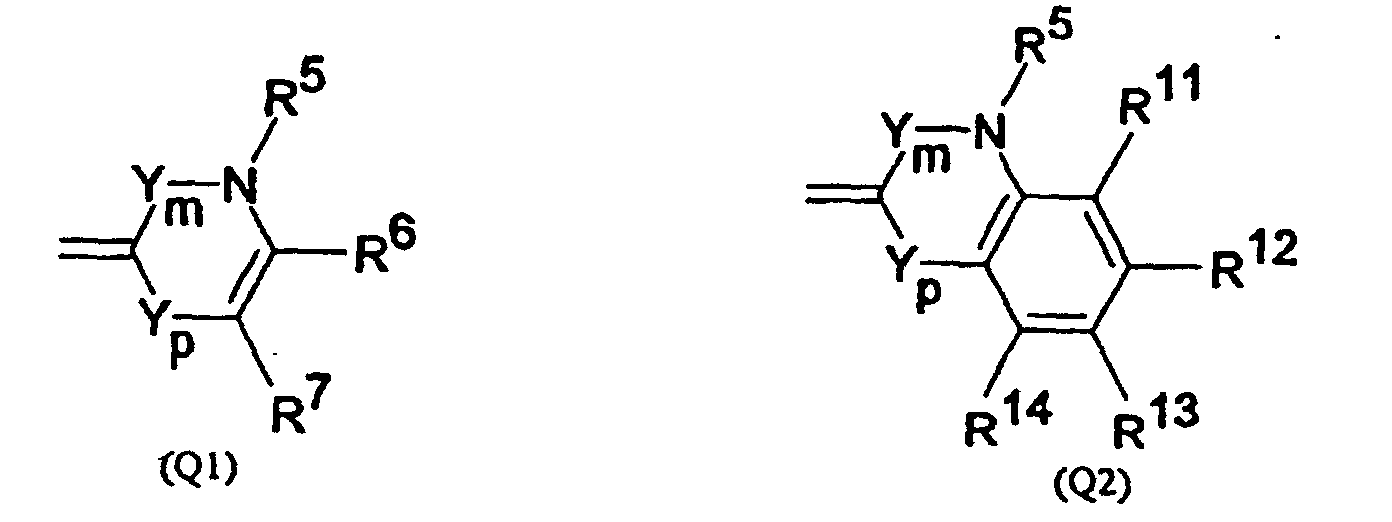 Y is -CR3=CR4-;p and m = 0 or 1, such that p + m = 1;R5 is C1-C6 alkyl or an OMEGA;R3, R4, R6 and R7, which may be the same or different, are independently H, C1-C6 alkyl, a halogen, or -OSO2R19 where R19 is alkyl having 1-6 carbons, or perfluoroalkyl having 1-6 carbons, or aryl; or an OMEGA; or -OH, -OR8, - SR8, -(NR8R9);or R6 and R7, taken in combination are -(CH2)v- where v = 3 or 4, or R6 and R7 form a fused aromatic ring according to formula Q2;R11, R12, R13, and R14, which may be the same or different, are independently H; or an akyl group having 1-6 carbons; or a halogen; or an OMEGA; or -OH, -OR8, -SR8, or -(NR8R9);OMEGA is cyclohexyl, cyclohexenyl, morpholino, piperidinyl, naphthyl, phenyl, thienyl, benzothiazolyl, furanyl, oxazolyl, benzoxazolyl or pyridinyl, any of the afore said OMEGA groups being unsubstituted or optionally substituted one or more times, independently, by halogen, alkyl, perfluoroalkyl, amino, alkylamino, dialkylamino, alkoxy or carboxyalkyl, having 1-6 carbons, and that is attached as R3, R4, R5, R6, R7, R11, R12, R13 or R14 by a single bond, and, where more than one of R3, R4, R5, R6, R7, R11, R12, R13 or R14 is an OMEGA, each OMEGA is the same or different;provided that at least one of R3, R4, R5, R6, R7, R11, R12, R13 and R14 is an OMEGA and that when Q has the formula Q1, n = 0.
 - A compound according to claim 1 wherein m = 1 and R5 is an OMEGA.
- A compound according to claim 1 or claim 2 wherein R4 is H; or R4 is an alkyl group having 1-6 carbons; or a halogen; or R4 is -OH, -OR8, -SR8, -(NR8R9); or R4 is-OSO2R19; or R4 is an OMEGA.
- A compound according to claim 3, wherein n = 0 or 1, and OMEGA is phenyl or substituted phenyl.
- A compound according to claim 3 or claim 4, wherein(i) R4 is halogen or -OSO2R19; or(ii) R4 is -SR8 or -(NR8R9).
- A cyclic-substituted unsymmetical cyanine dye, comprising a first heterocyclic ring system that is a substituted benzothiazolium, benzoxazolium, benzoselenazolium, benzimidazolium, or dialkylindolinium; that is linked by a monomethine, trimethine, or pentamethine bridging moiety attached at the 2-position of said first ring system to the 2- or 4- position of a second heterocyclic ring system that is a substituted quinolinium, or that is linked by a monomethine bridging moiety attached to the 2-position of said first system to the 2- or 4-position of a second heterocyclic ring system that is a substituted pyridinium; wherein one or more substituents of said second ring system is an OMEGA, where OMEGA is a cyclohexyl, cyclohexenyl, morpholino, piperidinyl, naphthyl, phenyl, thienyl, benzothiazolyl, furanyl, oxazolyl, benzoxazolyl or pyridinyl, any of the afore said OMEGA groups being unsubstituted or optionally substituted one or more times, independently, by halogen, alkyl, perfluoroalkyl, amino, alkylamino, dialkylamino, alkoxy or carboxyalkyl, having 1-6 carbons, and, where there is more than one OMEGA, each OMEGA is the same or different.
- A cyanine dye as claimed in claim 6, wherein(i) said first heterocyclic ring system is substituted benzothiazolium or benzoxazolium, which first ring system is substituted at its aromatic nitrogen by a C1-C6 alkyl; and/or(ii) said second ring system is further independently substituted by hydrogen, saturated or unsaturated C1-C6 alkyl, halogen, an ether, a thioether, a substituted or unsubstituted amino, an OMEGA; or a sulfonate ester.
- A cyanine dye as claimed in claim 6 or 7, wherein said second ring system is a 4-quinolinium that is substituted at or adjacent to the ring nitrogen by an OMEGA.
- A cyanine dye as claimed in any of claims 6 to 8, wherein OMEGA is a substituted or unsubstituted phenyl.
- A cyanine dye as claimed in claim 8, wherein a substituent adjacent to OMEGA is hydrogen; a saturated or unsaturated alkyl; a halogen; an ether; a thioether; a substituted or unsubstituted amino, or a sulfonate ester.
- A cyanine dye as claimed in claim 10, wherein said substituent adjacent to OMEGA is(i) a halogen or a sulfonate ester; or(ii) a thioether or substituted or unsubstituted amino.
- A fluorescent complex comprising a nucleic acid and one or more molecules of a dye compound, which dye compound is eitherA) of the formula:wherein

each R1 is independently H; or C1-C6 alkyl; trifluoromethyl; a halogen; or -OR8, -SR8 or -(NR8R9) where R8 and R9, which can be the same or different, are independently H, C1-C6 alkyl or 1-2 alicyclic, heteroalicyclic, aromatic or heteroaromatic rings, having a total of 3-16 ring atoms, wherein the hetero atoms are O, N or S, or R8 and R9 taken in combination are -(CH2)2-L-(CH2)2- where L = a single bond, -O-, CH2-, or -NR10-, where R10 is H or C1-C6 alkyl;whereint = 1-4;R2 is C1-C6 alkyl;X is O or S;n = 0, 1 or 2;Z- is a biologically compatible counterion;Q has the formula Q1 or Q2 provided that at least one of R3, R4, R5, R6, R7, R11, R12, R13 and R14 is an OMEGA; or isY is -CR3=CR4-;p and m = 0 or 1, such that p + m = 1;R5 is an alkyl group having 1-6 carbons; or R5 is an OMEGA;R3, R4, R6 and R7, which may be the same or different, are independently H; or an alkyl group having 1-6 carbons; or a halogen; or -OSO2R19 where R19 is alkyl having 1-6 carbons, or perfluoroalkyl having 1-6 carbons, or aryl; or an OMEGA; or -OH, -OR8, -SR8, -(NR8R9);or R6 and R7, taken in combination are -(CH2)v- where v = 3 or 4, or R6 and R7 form a fused aromatic ring according to formula Q2;R11, R12, R13, and R14, which may be the same or different, are independently H; or an alkyl group having 1-6 carbons; or a halogen; or an OMEGA; or -OH, -OR8, -SR8, or -(NR8R9);OMEGA is a saturated or unsaturated, substituted or unsubstituted, cyclic substituent that has a total of 2-16 ring carbon atoms in 1-2 alicyclic, heteroalicyclic, aromatic, or heteroaromatic rings, containing 1-4 heteroatoms (wherein the hetero atoms are O, N or S), that is unsubstituted or optionally substituted one or more times, independently, by halogen, alkyl, perfluoroalkyl, amino, alkylamino, dialkylamino, alkoxy or carboxyalkyl, having 1-6 carbons, and that is attached as R3, R4, R5, R6, R7, R11, R12, R13 or R14 by a single bond, and where more than one of R3, R4, R5, R6, R7, R11, R12, R13 and R14 is an OMEGA, each OMEGA is the same or different;B) a cyclic-substituted unsymmetrical cyanine dye, comprising a first heterocyclic ring system that is a substitued benzothiazolium, benzoxazolium, benzoselenazolium, benzimidazolium, or dialkylindolinium; that is linked by a monomethine, trimethine, or pentamethine bridging moiety attached at the 2-position of said first ring system to the 2- or 4-position of a second heterocyclic ring system that is a substituted pyridinium or quinolinium, wherein one or more substituents of said second ring system is an OMEGA, where OMEGA is a saturated or unsaturated, substituted or unsubstituted, cyclic substituent that has a total of 2-16 ring carbon atoms in 1-2 alicyclic, heteroalicyclic, aromatic, or heteroaromatic rings, containing 1-4 heteroatoms (wherein the heteroatoms are O, N or S).
 - A complex as claimed in claim 12, wherein the dye compound is as defined in any one of claims 1 to 5 or 6 to 11.
- A method of staining nucleic acids in a sample, comprisinga) combining a sample that contains or is thought to contain nucleic acids with a cyclic substituted unsymmetrical dye compound as defined in claim 12 or claim 13 or in any of claims 1 to 11;b) incubating the sample for a time sufficient for the dye compound to combine with the nucleic acids in the sample to form a nucleic acid-dye complex that gives a detectable fluorescent signal;c) observing the detectable fluorescent signal of the nucleic acid-dye complex.
- A method according to claim 14, wherein(i) the nucleic acids are enclosed in a biological structure; or(ii) the nucleic acids are enclosed in a biological structure and the method further comprises combining the sample with one or more additional dyes, singly or in combination; where at least one additional dye is a fluorescent nucleic acid stain that is permeant or impermeant to cells; another additional dye is selectively permeant to Gram positive or Gram negative bacteria; and where each of the additional dyes has a fluorescent response to illumination that is detectably different from that of the other dyes.
- A method according to claim 15(ii) wherein(i) the nucleic acid stain is impermeant to cells with intact membranes; or(ii) the nucleic acid stain is impermeant to cells with intact membranes and is a phenanthridium monomer or dimer derivative that is an ethidium, ethidium dimer or propidium; or is a benzazolium monomer or dimer derivative.
- A method according to claim 15(ii) wherein the nucleic acid stain is permeant to cells or is selectively permeant to Gram positive bacteria and is a C4-C8 alkyl-substituted phenanthridium, or 2'-(4-hydroxyphenyl)-5-(4-methyl-1-piperazinyl)-2,5'-bi-1H-benzimidazole, 2'-(4-ethoxyphenyl)-5-(4-methyl-1-piperazinyl)-2,5'-bi-1H-benzimidazole or 4', 6-diamidino-2-phenylindole dihydrochloride.
- A method according to claim 14, wherein the nucleic acids are in solution.
- A method according to claim 14 or 18 further comprising electrophoretic separation of the nucleic acids or nucleic acid-dye complex and optionally further comprising combining the dye compound with the gel before or after electrophoresis.
- A method according to claim 14, of staining nucleic acids in a sample, wherein the nucleic acids are immobilized on a solid or semi-solid support.
- A method according to any one of claims 14, 15(i), 15(ii), 16(i), 16(ii) or 17 further comprising(i) combining the sample with one or more additional dyes, singly or in combination; where at least one additional dye is a fluorescent dye of a molecular weight of less than 2000 that selectively stains a cellular structure that is not a nucleic acid or is not an enzyme substrate; and where each of the additional dyes has a fluorescent response to illumination that is detectably different from that of the other dyes, wherein the cellular structure optionally is a cell membrane, a protein, a vacuole, a mitochondrion, a Golgi apparatus, an endoplasmic reticulum, a cytoplasm, a lysosome, or a saccharide or polysaccharide;(ii) combining the sample with one or more additional dyes, singly or in combination; where at least one additional dye is a fluorescent peptide or protein, where the protein is an antibody, a lectin an avidin, streptavidin, protein A or protein G; and where each of the additional dyes has a fluorescent response to illumination that is detectably different from that of the other dyes; or(iii) combining the sample with one or more additional dyes, singly or in combination; where at least one additional dye is a fluorogenic substrate for an intracellular enzyme; where said substrate has a fluorescent response to illumination that is detectably different from that of the other dyes after action of the enzyme, wherein the intracellular enzyme optionally is a hydrolytic enzyme, an oxidase or a reductase.
- A method according to any one of claims 15(ii), 16(i), 16(ii) or 17 wherein the fluorescent response of the dyes to illumination is detected using a flow cytometer, a fluorometer or fluorescence plate reader, or a fluorescence microscope.
- A compound of the formula:wherein R5 is an OMEGA as defined in claim 6 or claim 9;
 B is methyl;R3, R11, R12, R13, and R14 are independently H or alkyl having 1-6 carbons; andR4 is F, Cl, Br, I, or -OSO2R19 where R19 is alkyl having 1-6 carbons, or aryl.
 - A compound of the formulaor of the formula
 wherein R5 is an OMEGA as defined in claim 6 or claim 9;
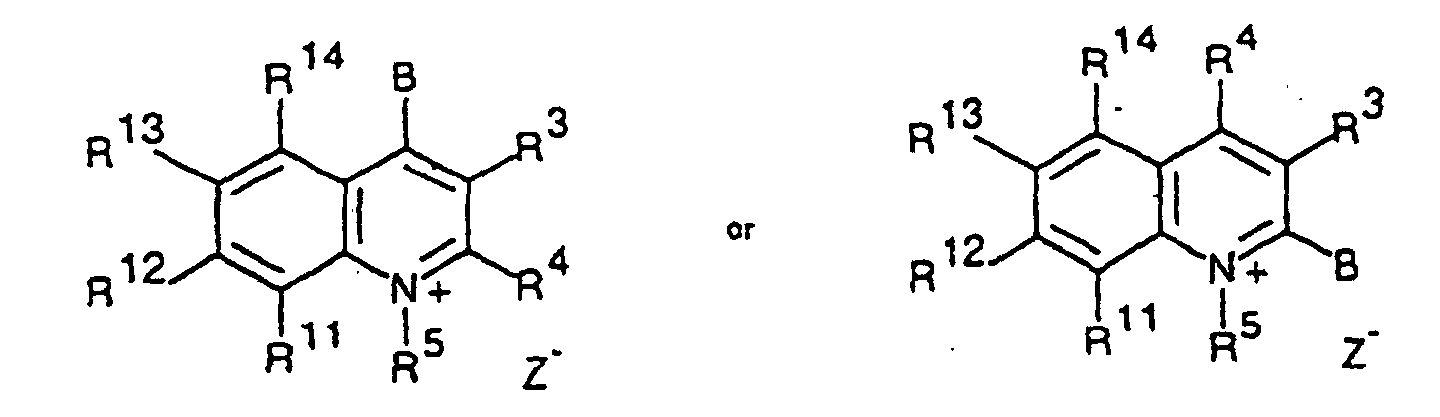 B is methyl;R6 and R7 are H;R3, R11, R12, R13 and R14 are independently H or alkyl having 1-6 carbons; andR4 is F, Cl, Br, I or -OSO2R19 where R19 is alkyl having 1-6 carbons, or perfluoroalkyl having 1-6 carbons, or aryl.
 - A compound of claim 23 or claim 24 when substituted with a group forming at the 2-position an ether linkage, a thioether linkage or an amino group (whether substituted or unsubstituted).
- A method of making a fluorescent dye, comprising conjoining a pyridinium or quinolinium compound as defined in claim 23 or claim 24 with a benzazolium compound of the formulawherein R1, t, X and Z are as defined in claim 1, and A is a substituent suitable for the conjoining of the compounds, to form a compound comprising a benzazolium ring system linked through its 2-position by 1, 3 or 5 bridging methine groups to the 4-position of a pyridinium or quinolinium ring system, and, when the pyridinium or quinolinium compound is as defined in claim 22 or claim 23, the method optionally further comprising condensing the pyridinium or quinolinium ring system at its 2-position with an alcohol, a phenol, an alkoxide, a thiol, a thiophenol, a thioether, ammonia or an amine.

- A method of claim 26 wherein the resultant fluorescent dye has at the 2-position of the pyridinium or quinolinium ring system a substituent group forming an ether linkage, a thioether linkage or an amino group (whether substituted or unsubstituted).
- A method of claim 27, wherein the group substituted at the 2-position of the pyridinium or quinolinium ring system comprises, in addition to any amino group directly bonded to the 2-position (the 2-position amino group), a substituted amino group, where the substituted amino group is in a heteroalicyclic ring which has from 3 to 16 ring atoms and which is bonded to the O, N or S atoms bonded to the 2-position of the ring system, and optionally wherein there is a 2-position amino group and the substituted amino group is group NR10 in a moiety of the formula -(CH2)2-NR10-(CH2)2- ring formingly bonded directly to the N atom of the 2-position amino group, R10 being H or 1C-6C alkyl.
- The use to penetrate biological structures in detecting for nucleic acid of a compound as defined in claim 12 or claim 13 or in any of claims 1-11, wherein the biological structure optionally is:(i) a viral particle,(ii) an organelle, or(iii) a cell.
- The use of claim 29, wherein the pyridinium ring (group Q of claims 1 to 5) is of the formulawherein

OMEGA is as defined in claim 1 or is a phenyl group and R4 is(i) as defined in claim 1, or(ii) selected from H, F, Cl, Br, n-butyl, -NH-phenyl, NEt2, N-nPr2, N-methylpiperazyl, morpholinyl, anilinyl, 2-(N-3-dimethylaminopropyl)-N-propylamino, Me, OMe, OEt, OPh, Ph, SMe, O-iPr, cyclohexyl, S-2-pyridyl, 2-(2-dimethylaminoethylthio) and OSO2CF3.
Applications Claiming Priority (8)
| Application Number | Priority Date | Filing Date | Title |
|---|---|---|---|
| US146328 | 1988-01-21 | ||
| US47683 | 1993-04-13 | ||
| US08/090,890 US5436134A (en) | 1993-04-13 | 1993-07-12 | Cyclic-substituted unsymmetrical cyanine dyes |
| US90890 | 1993-07-12 | ||
| US08/146,328 US5545535A (en) | 1993-04-13 | 1993-11-01 | Fluorescent assay for bacterial gram reaction |
| US08/148,847 US5534416A (en) | 1993-04-13 | 1993-11-08 | Fluorescent viability assay using cyclic-substituted unsymmetrical cyanine dyes |
| US148847 | 1993-11-08 | ||
| PCT/US1994/004127 WO1994024213A1 (en) | 1993-04-13 | 1994-04-13 | Cyclic-substituted unsymmetrical cyanine dyes |
Publications (2)
| Publication Number | Publication Date |
|---|---|
| EP0675924A1 EP0675924A1 (en) | 1995-10-11 |
| EP0675924B1 true EP0675924B1 (en) | 2001-12-12 |
Family
ID=27376684
Family Applications (1)
| Application Number | Title | Priority Date | Filing Date |
|---|---|---|---|
| EP94914173A Expired - Lifetime EP0675924B1 (en) | 1993-04-13 | 1994-04-13 | Cyclic-substituted unsymmetrical cyanine dyes |
Country Status (9)
| Country | Link |
|---|---|
| US (1) | US5534416A (en) |
| EP (1) | EP0675924B1 (en) |
| JP (4) | JPH07196930A (en) |
| AT (1) | ATE210703T1 (en) |
| AU (1) | AU676317B2 (en) |
| CA (1) | CA2133765C (en) |
| DE (1) | DE69429422T2 (en) |
| ES (1) | ES2166777T3 (en) |
| WO (1) | WO1994024213A1 (en) |
Cited By (2)
| Publication number | Priority date | Publication date | Assignee | Title |
|---|---|---|---|---|
| US7598390B2 (en) | 2005-05-11 | 2009-10-06 | Life Technologies Corporation | Fluorescent chemical compounds having high selectivity for double stranded DNA, and methods for their use |
| CN107850601A (en) * | 2015-07-16 | 2018-03-27 | Sfc株式会社 | Dye composition |
Families Citing this family (111)
| Publication number | Priority date | Publication date | Assignee | Title |
|---|---|---|---|---|
| US5571388A (en) * | 1984-03-29 | 1996-11-05 | Li-Cor, Inc. | Sequencing near infrared and infrared fluorescense labeled DNA for detecting using laser diodes and suitable labels thereof |
| US5723218A (en) * | 1990-04-16 | 1998-03-03 | Molecular Probes, Inc. | Dipyrrometheneboron difluoride labeled flourescent microparticles |
| US5658751A (en) * | 1993-04-13 | 1997-08-19 | Molecular Probes, Inc. | Substituted unsymmetrical cyanine dyes with selected permeability |
| US5459268A (en) * | 1993-10-25 | 1995-10-17 | Molecular Probes, Inc. | Xanthylium dyes that are well retained in mitochondria |
| US5656449A (en) * | 1995-03-06 | 1997-08-12 | Molecular Probes, Inc. | Neutral unsymmetrical cyanine dyes |
| US5691204A (en) * | 1995-04-21 | 1997-11-25 | Abbott Laboratories | Compositions and methods for the rapid analysis of reticulocytes |
| US6008373A (en) * | 1995-06-07 | 1999-12-28 | Carnegie Mellon University | Fluorescent labeling complexes with large stokes shift formed by coupling together cyanine and other fluorochromes capable of resonance energy transfer |
| JP3425830B2 (en) * | 1995-10-06 | 2003-07-14 | シスメックス株式会社 | New compounds and their uses |
| US5734058A (en) * | 1995-11-09 | 1998-03-31 | Biometric Imaging, Inc. | Fluorescent DNA-Intercalating cyanine dyes including a positively charged benzothiazole substituent |
| US5994067A (en) * | 1995-11-14 | 1999-11-30 | The United States Of America As Represented By The Secretary Of The Army | Method and kit for rapid detection of toxins and bacteria |
| TW379284B (en) * | 1996-04-12 | 2000-01-11 | Toa Medical Electronics | Agent for detecting reticulocyte |
| SE506700C2 (en) * | 1996-05-31 | 1998-02-02 | Mikael Kubista | Probe and Methods for Analysis of Nucleic Acid |
| US6312930B1 (en) | 1996-09-16 | 2001-11-06 | E. I. Du Pont De Nemours And Company | Method for detecting bacteria using PCR |
| US5804448A (en) * | 1996-10-29 | 1998-09-08 | Toa Medical Electronics Co., Ltd. | Method of staining cellular material and analyzing the same |
| US6495692B1 (en) * | 1996-12-10 | 2002-12-17 | Abbott Laboratories | Helium-neon excitable reticulocyte dyes derivable from halolepidines |
| JP3783808B2 (en) * | 1997-05-19 | 2006-06-07 | シスメックス株式会社 | Leukocyte classification and counting reagent |
| JP3077628B2 (en) * | 1997-05-27 | 2000-08-14 | 日本電気株式会社 | Cytotoxicity test method |
| US6080868A (en) * | 1998-01-23 | 2000-06-27 | The Perkin-Elmer Corporation | Nitro-substituted non-fluorescent asymmetric cyanine dye compounds |
| JP3350442B2 (en) * | 1998-04-09 | 2002-11-25 | 科学技術振興事業団 | Microscope system |
| GB9812596D0 (en) * | 1998-06-11 | 1998-08-12 | Amersham Pharm Biotech Uk Ltd | Energy transfer assay method |
| US6529835B1 (en) | 1998-06-25 | 2003-03-04 | Caliper Technologies Corp. | High throughput methods, systems and apparatus for performing cell based screening assays |
| ATE349700T1 (en) | 1998-10-27 | 2007-01-15 | Molecular Probes Inc | TRANSITION METAL COMPLEX CONTAINING LUMINESCENT PROTEIN COLORS |
| DE19911421A1 (en) * | 1999-03-11 | 2000-10-05 | Dyomics Gmbh | Laser compatible NIR marker dyes |
| US6664047B1 (en) | 1999-04-30 | 2003-12-16 | Molecular Probes, Inc. | Aza-benzazolium containing cyanine dyes |
| US6309835B1 (en) | 1999-05-27 | 2001-10-30 | Koninkiijke Philips Electronics N.V. | Methods for quantitating the efficacy of oral care products |
| US6329205B1 (en) | 1999-08-31 | 2001-12-11 | Molecular Probes, Inc. | Detection method using luminescent europium-based protein stains |
| ATE399878T1 (en) * | 1999-10-25 | 2008-07-15 | Genprime Inc | METHOD AND DEVICE FOR QUANTIFYING PROKARYOTIC AND EUKARYOTIC CELLS |
| US6787302B2 (en) * | 1999-10-25 | 2004-09-07 | Genprime, Inc. | Method and apparatus for prokaryotic and eukaryotic cell quantitation |
| US6673568B1 (en) * | 1999-10-25 | 2004-01-06 | Genprime, Inc. | Method and apparatus for prokaryotic and eukaryotic cell quantitation |
| DE60038127T2 (en) * | 2000-01-06 | 2009-03-05 | Caliper Life Sciences, Inc., Mountain View | METHODS AND SYSTEMS FOR MONITORING INTRA-CELLULAR BINDER ACTIONS |
| GB0002261D0 (en) * | 2000-02-02 | 2000-03-22 | Amersham Pharm Biotech Uk Ltd | Fluorescent detection method & reagent |
| DE10046215B4 (en) | 2000-09-19 | 2004-04-15 | Institut für Chemo- und Biosensorik Münster e.V. i.Ins. | Fluorochromes and their use |
| AU9650201A (en) | 2000-10-02 | 2002-04-15 | Molecular Probes Inc | Reagents for labeling biomolecules having aldehyde or ketone moieties |
| EP2085781B2 (en) * | 2000-10-06 | 2020-03-11 | Life Technologies Corporation | Transfectable micelles containing semiconductor nanocrystals |
| US20050059031A1 (en) * | 2000-10-06 | 2005-03-17 | Quantum Dot Corporation | Method for enhancing transport of semiconductor nanocrystals across biological membranes |
| AU2002241602A1 (en) * | 2000-11-16 | 2002-06-11 | Burstein Technologies, Inc. | Methods and apparatus for detecting and quantifying lymphocytes with optical biodiscs |
| US20030143637A1 (en) * | 2001-08-31 | 2003-07-31 | Selvan Gowri Pyapali | Capture layer assemblies for cellular assays including related optical analysis discs and methods |
| CN1659439A (en) * | 2001-09-07 | 2005-08-24 | 伯斯坦技术公司 | Identification and quantification of white blood cell types based on nuclear morphology using an optical biodisc system |
| CA2468041A1 (en) * | 2001-11-20 | 2003-05-30 | Burstein Technologies, Inc. | Optical bio-discs and microfluidic devices for analysis of cells |
| US20040072262A1 (en) * | 2002-10-11 | 2004-04-15 | Montero-Julian Felix A. | Methods and systems for detecting MHC class I binding peptides |
| US6955872B2 (en) * | 2003-03-20 | 2005-10-18 | Coulter International Corp. | Dye compositions which provide enhanced differential fluorescence and light scatter characteristics |
| WO2004087882A2 (en) * | 2003-03-26 | 2004-10-14 | Washington University | Neuregulin protein regulation of synaptic proteins |
| EP1635782A1 (en) * | 2003-05-24 | 2006-03-22 | JUVENA (International) AG | Tissue culture media used as a component of cosmetics |
| CA2445420A1 (en) | 2003-07-29 | 2005-01-29 | Invitrogen Corporation | Kinase and phosphatase assays |
| US7619059B2 (en) | 2003-07-29 | 2009-11-17 | Life Technologies Corporation | Bimolecular optical probes |
| US7727752B2 (en) | 2003-07-29 | 2010-06-01 | Life Technologies Corporation | Kinase and phosphatase assays |
| US20050074796A1 (en) * | 2003-07-31 | 2005-04-07 | Stephen Yue | Unsymmetrical cyanine dimer compounds and their application |
| US7271265B2 (en) | 2003-08-11 | 2007-09-18 | Invitrogen Corporation | Cyanine compounds and their application as quenching compounds |
| EP1988177A1 (en) * | 2003-09-30 | 2008-11-05 | Molecular Probes Inc. | Detection of immobilised nucleic acid |
| JP2007511760A (en) * | 2003-11-03 | 2007-05-10 | ベックマン コールター インコーポレーティッド | Solution-based method for detecting MHC binding peptides |
| US7776529B2 (en) | 2003-12-05 | 2010-08-17 | Life Technologies Corporation | Methine-substituted cyanine dye compounds |
| US7446202B2 (en) | 2003-12-05 | 2008-11-04 | Molecular Probes, Inc. | Cyanine dye compounds |
| EP1720945B1 (en) | 2003-12-05 | 2016-03-16 | Life Technologies Corporation | Methine-substituted cyanine dye compounds |
| US7282349B2 (en) | 2003-12-16 | 2007-10-16 | Kimberly-Clark Worldwide, Inc. | Solvatochromatic bacterial detection |
| US7300770B2 (en) * | 2004-12-16 | 2007-11-27 | Kimberly-Clark Worldwide, Inc. | Detection of microbe contamination on elastomeric articles |
| US7399608B2 (en) * | 2003-12-16 | 2008-07-15 | Kimberly-Clark Worldwide, Inc. | Microbial detection and quantification |
| ATE451615T1 (en) * | 2004-03-12 | 2009-12-15 | Winterlab Ltd | METHOD FOR ASSESSING THE FRESHNESS OF A FISH PRODUCT |
| EP1766393A4 (en) * | 2004-05-07 | 2008-06-18 | Beckman Coulter Inc | MAIN HISTOCOMPATIBILITY COMPLEX BRIDGE FORMATION SYSTEM FOR DETECTING LYMPHOCYTE MEDIATED LYSE OF CELLS HAVING ANTIGENS |
| EP1781313A4 (en) * | 2004-06-17 | 2009-08-26 | Beckman Coulter Inc | Mycobacterium tuberculosis epitopes and methods of use thereof |
| US20060188445A1 (en) * | 2005-02-22 | 2006-08-24 | Fred Hutchinson Cancer Research Center | Assay for compounds that protect against sensory hair cell death and compounds identified by same |
| US7601498B2 (en) | 2005-03-17 | 2009-10-13 | Biotium, Inc. | Methods of using dyes in association with nucleic acid staining or detection and associated technology |
| US7776567B2 (en) * | 2005-03-17 | 2010-08-17 | Biotium, Inc. | Dimeric and trimeric nucleic acid dyes, and associated systems and methods |
| US20060275798A1 (en) * | 2005-04-04 | 2006-12-07 | Steichen John C | Detection of organisms using a media sachet and primer directed nucleic acid amplification |
| JP4911423B2 (en) * | 2005-06-10 | 2012-04-04 | 富士電機株式会社 | Microorganism measurement method |
| WO2007100392A2 (en) | 2005-11-30 | 2007-09-07 | Biotium, Inc. | Enzyme substrate comprising a functional dye and associated technology and methods |
| US7727513B2 (en) * | 2005-12-15 | 2010-06-01 | Kimberly-Clark Worldwide, Inc. | Method for screening for bacterial conjunctivitis |
| JP2009524832A (en) | 2006-01-24 | 2009-07-02 | ライフ テクノロジーズ コーポレーション | Device and method for quantifying analytes |
| US8562802B1 (en) | 2006-02-13 | 2013-10-22 | Life Technologies Corporation | Transilluminator base and scanner for imaging fluorescent gels, charging devices and portable electrophoresis systems |
| FR2904833A1 (en) * | 2006-08-11 | 2008-02-15 | Bioquanta Sarl | Determining the quantity of nucleic acid, particularly DNA or RNA in a sample comprises adding a fluorophore to the sample, measuring fluorescence intensities in response to luminous stimulations and removing the nucleic acids |
| US20080057534A1 (en) * | 2006-08-31 | 2008-03-06 | Kimberly-Clark Worldwide, Inc. | Microbe-sensitive indicators and use of the same |
| US20100041045A1 (en) * | 2007-11-15 | 2010-02-18 | Sigma-Aldrich Co. | Nucleic acid fluorescent stains |
| US20090131279A1 (en) * | 2007-11-15 | 2009-05-21 | Sigma Aldrich Company | Nucleic acid fluorescent stains |
| US20090142275A1 (en) * | 2007-11-29 | 2009-06-04 | Kimberly-Clark Worldwide, Inc. | Wound Suture Capable of Identifying the Presence of Bacteria |
| US7927561B2 (en) | 2008-01-10 | 2011-04-19 | Becton, Dickinson And Company | Rapid particle detection assay |
| JP2009242379A (en) * | 2008-03-11 | 2009-10-22 | Osaka Prefecture Univ | Conjugated compound, and photoelectric transducer, photoelectrochemical cell and photoelectric transducer electrolyte each using the conjugated compound |
| US8148101B2 (en) * | 2008-07-22 | 2012-04-03 | Abbott Laboratories | Method for classifying and counting bacteria in body fluids |
| AU2009277638A1 (en) * | 2008-07-30 | 2010-02-04 | Sysmex Corporation | Reagent for detecting abnormal cell in cervix of uterus, and method for detecting abnormal cell in cervix of uterus by using same |
| US20110201047A1 (en) * | 2008-10-14 | 2011-08-18 | Cornell University | novel sorting technology that allows for highly efficient selection of sperm without chromatin damage |
| US7943320B2 (en) * | 2008-12-30 | 2011-05-17 | Canon U.S. Life Sciences, Inc. | Unsymmetrical cyanine dyes for high resolution nucleic acid melting analysis |
| JP5746135B2 (en) * | 2009-03-16 | 2015-07-08 | プロメガ コーポレイションPromega Corporation | Nucleic acid binding dyes and uses thereof |
| US20110135756A1 (en) * | 2009-12-08 | 2011-06-09 | University Of Washington | Compositions and methods for protecting sensory hair cells |
| US8877437B1 (en) | 2009-12-23 | 2014-11-04 | Biotium, Inc. | Methods of using dyes in association with nucleic acid staining or detection |
| US8974651B2 (en) | 2010-04-17 | 2015-03-10 | C.C. Imex | Illuminator for visualization of fluorophores |
| RU2527519C2 (en) * | 2010-06-24 | 2014-09-10 | Общество С Ограниченной Ответственностью "Митотех" | Mild cationic mitochondrial uncouplers |
| US20130052650A1 (en) | 2011-08-29 | 2013-02-28 | Thermo Fisher Scientific Inc. | Dye blends |
| US9933341B2 (en) | 2012-04-05 | 2018-04-03 | Becton, Dickinson And Company | Sample preparation for flow cytometry |
| US8993259B2 (en) | 2012-05-02 | 2015-03-31 | Charles River Laboratories, Inc. | Method of viability staining with membrane permeable fluorescent dye and membrane impermeable fluorescence quencher |
| CN104685346B (en) | 2012-05-02 | 2018-05-29 | 查尔斯河实验室公司 | Cell capture system and its use |
| EP2780707B1 (en) | 2012-05-02 | 2016-02-24 | Charles River Laboratories, Inc. | Method of detecting viable cells in a cell sample |
| AU2013295679A1 (en) | 2012-07-25 | 2015-01-29 | Theranos, Inc. | Image analysis and measurement of biological samples |
| US9513224B2 (en) | 2013-02-18 | 2016-12-06 | Theranos, Inc. | Image analysis and measurement of biological samples |
| KR101933620B1 (en) * | 2012-09-18 | 2018-12-28 | 삼성전자주식회사 | Compositions and kits for detecting a vesicle, and methods for analyzing the vesicle using the same |
| KR101933622B1 (en) * | 2012-10-09 | 2018-12-28 | 삼성전자주식회사 | Compositions for monitoring a vesicle, kits and methods for monitoring the vesicle using the same |
| CN103267840B (en) * | 2013-05-28 | 2015-07-22 | 宁夏医科大学 | Magnetic layered double hydroxide-DNA (MLDH-DNA) supramolecular assembly type magnetic targeting probe |
| US9835587B2 (en) | 2014-04-01 | 2017-12-05 | C.C. Imex | Electrophoresis running tank assembly |
| US10112194B2 (en) | 2014-04-14 | 2018-10-30 | Q-Linea Ab | Detection of microscopic objects |
| EP3247797B1 (en) | 2015-01-12 | 2020-04-29 | Life Technologies Corporation | Methods, systems and compositions thereof for nucleic acid library quality control and quantification |
| ES2938640T3 (en) * | 2015-01-12 | 2023-04-13 | Tacount Exact Ltd | Spectral Intensity Ratio (SIR) Analysis for Rapid Enumeration of Live Microbes |
| US10768105B1 (en) | 2016-07-29 | 2020-09-08 | Labrador Diagnostics Llc | Image analysis and measurement of biological samples |
| US10995358B2 (en) | 2017-07-13 | 2021-05-04 | Pocared Diagnostics Ltd. | Rapid antibiotic susceptibility test using membrane fluorescence staining and spectral intensity ratio improved by flow cytometry dead to live population ratio |
| US20200224249A1 (en) | 2017-10-06 | 2020-07-16 | Life Technologies Corporation | RNA Quality Assay |
| GB201716883D0 (en) | 2017-10-13 | 2017-11-29 | Q-Linea Ab | Method for determining the concentration of intact microorganisms in a sample |
| MD3762368T2 (en) | 2018-03-08 | 2022-07-31 | Incyte Corp | Aminopyrazine diol compounds as pi3k-y inhibitors |
| CN108440987A (en) * | 2018-04-17 | 2018-08-24 | 安迪福诺生物科技(武汉)有限公司 | Asymmetric cyanine dye and its application |
| US11046658B2 (en) | 2018-07-02 | 2021-06-29 | Incyte Corporation | Aminopyrazine derivatives as PI3K-γ inhibitors |
| FR3094016B1 (en) * | 2019-03-22 | 2024-04-12 | Microbs Sas | Functionalized glass beads, their use to capture microorganisms and the corresponding devices. |
| DE102020000677B4 (en) | 2020-02-01 | 2023-01-12 | Hochschule Anhalt | Universal flow meter and method of controlling a universal flow meter |
| CN111560026B (en) * | 2020-05-11 | 2021-08-27 | 苏州大学 | High-optical-stability cell membrane fluorescent marker and preparation method and application thereof |
| WO2022099658A1 (en) * | 2020-11-13 | 2022-05-19 | 大连理工大学 | Cyanine compound, dye containing cyanine compound, and application of cyanine compound |
| WO2025104604A1 (en) | 2023-11-14 | 2025-05-22 | Janssen Pharmaceuticals, Inc. | Anti-respiratory syncytial virus antibodies and uses thereof |
| CN118085600B (en) * | 2024-02-01 | 2025-10-21 | 大连理工大学 | A type of trimethine pyridine cyanine dye, preparation method and application thereof |
Family Cites Families (18)
| Publication number | Priority date | Publication date | Assignee | Title |
|---|---|---|---|---|
| BE502441A (en) * | 1950-04-08 | |||
| GB1320168A (en) * | 1969-06-12 | 1973-06-13 | Eastman Kodak Co | Methine dyes for photographic antihalation and filter layers |
| US3639127A (en) * | 1970-07-23 | 1972-02-01 | Eastman Kodak Co | Silver halide emulsions containing a dye derived from 4,6-diaryl substituted picolinium salts as desensitizer |
| US4190328A (en) * | 1978-12-01 | 1980-02-26 | Levine Robert A | Process for detection of blood-borne parasites |
| US4544546A (en) * | 1980-04-21 | 1985-10-01 | Abbott Laboratories | Fluorescent nucleic acid stains |
| CA1155041A (en) * | 1980-04-21 | 1983-10-11 | Michael E. Jolley | Fluorescent nucleic acid stains |
| US4665024A (en) * | 1984-10-01 | 1987-05-12 | Becton, Dickinson And Company | Fluorescent gram stain |
| US4883867A (en) * | 1985-11-01 | 1989-11-28 | Becton, Dickinson And Company | Detection of reticulocytes, RNA or DNA |
| JPS62242933A (en) * | 1986-04-15 | 1987-10-23 | Fuji Photo Film Co Ltd | Silver halide photographic sensitive material |
| US5057413A (en) * | 1988-06-13 | 1991-10-15 | Becton, Dickinson And Company | Method for discriminating between intact and damaged cells in a sample |
| DE3912046B4 (en) * | 1988-09-02 | 2004-03-25 | Carnegie Mellon University | Method of labeling a component of an aqueous liquid and luminescent photostable reaction product |
| US5122602A (en) * | 1989-02-13 | 1992-06-16 | Miles Inc. | Chromogenic merocyanine enzyme substrates |
| US4937198A (en) * | 1989-07-28 | 1990-06-26 | Becton, Dickinson And Company | Novel fluorescent dye |
| GB9008818D0 (en) * | 1990-04-19 | 1990-06-13 | Ici Plc | Amine derivatives |
| US5208148A (en) * | 1990-12-07 | 1993-05-04 | Molecular Probes, Inc. | Lipophilic fluorescent glycosidase substrates |
| US5242805A (en) * | 1991-08-23 | 1993-09-07 | Molecular Probes, Inc. | Long wavelength lipophilic fluorogenic glycosidase substrates |
| EP0603266B1 (en) * | 1991-08-23 | 1999-05-12 | Molecular Probes, Inc. | Use of haloalkyl derivatives of reporter molecules to analyze metabolic activity in cells |
| CA2119126C (en) * | 1991-09-16 | 1996-09-03 | Molecular Probes, Inc. | Dimers of unsymmetrical cyanine dyes |
-
1993
- 1993-11-08 US US08/148,847 patent/US5534416A/en not_active Expired - Lifetime
-
1994
- 1994-04-13 AU AU66345/94A patent/AU676317B2/en not_active Expired
- 1994-04-13 ES ES94914173T patent/ES2166777T3/en not_active Expired - Lifetime
- 1994-04-13 CA CA002133765A patent/CA2133765C/en not_active Expired - Lifetime
- 1994-04-13 WO PCT/US1994/004127 patent/WO1994024213A1/en not_active Ceased
- 1994-04-13 DE DE69429422T patent/DE69429422T2/en not_active Expired - Lifetime
- 1994-04-13 AT AT94914173T patent/ATE210703T1/en active
- 1994-04-13 EP EP94914173A patent/EP0675924B1/en not_active Expired - Lifetime
- 1994-07-12 JP JP6159824A patent/JPH07196930A/en not_active Withdrawn
-
2005
- 2005-06-07 JP JP2005167584A patent/JP4684016B2/en not_active Expired - Lifetime
- 2005-06-07 JP JP2005167583A patent/JP4216267B2/en not_active Expired - Lifetime
- 2005-10-20 JP JP2005306416A patent/JP2006111884A/en not_active Withdrawn
Cited By (5)
| Publication number | Priority date | Publication date | Assignee | Title |
|---|---|---|---|---|
| US7598390B2 (en) | 2005-05-11 | 2009-10-06 | Life Technologies Corporation | Fluorescent chemical compounds having high selectivity for double stranded DNA, and methods for their use |
| US8865904B2 (en) | 2005-05-11 | 2014-10-21 | Life Technologies Corporation | Fluorescent chemical compounds having high selectivity for double stranded DNA, and methods for their use |
| US9115397B2 (en) | 2005-05-11 | 2015-08-25 | Life Technologies Corporation | Fluorescent chemical compounds having high selectivity for double stranded DNA, and methods for their use |
| US9366676B2 (en) | 2005-05-11 | 2016-06-14 | Life Technologies Corporation | Fluorescent chemical compounds having high selectivity for double stranded DNA, and methods for their use |
| CN107850601A (en) * | 2015-07-16 | 2018-03-27 | Sfc株式会社 | Dye composition |
Also Published As
| Publication number | Publication date |
|---|---|
| JPH07196930A (en) | 1995-08-01 |
| JP2005344121A (en) | 2005-12-15 |
| WO1994024213A1 (en) | 1994-10-27 |
| JP4684016B2 (en) | 2011-05-18 |
| ATE210703T1 (en) | 2001-12-15 |
| AU6634594A (en) | 1994-11-08 |
| US5534416A (en) | 1996-07-09 |
| ES2166777T3 (en) | 2002-05-01 |
| CA2133765A1 (en) | 1994-10-27 |
| JP2006111884A (en) | 2006-04-27 |
| DE69429422T2 (en) | 2002-05-16 |
| AU676317B2 (en) | 1997-03-06 |
| CA2133765C (en) | 1999-11-09 |
| EP0675924A1 (en) | 1995-10-11 |
| JP4216267B2 (en) | 2009-01-28 |
| JP2005272479A (en) | 2005-10-06 |
| DE69429422D1 (en) | 2002-01-24 |
Similar Documents
| Publication | Publication Date | Title |
|---|---|---|
| CA2133765C (en) | Cyclic-substituted unsymmetrical cyanine dyes | |
| US5436134A (en) | Cyclic-substituted unsymmetrical cyanine dyes | |
| US5545535A (en) | Fluorescent assay for bacterial gram reaction | |
| US5656449A (en) | Neutral unsymmetrical cyanine dyes | |
| EP0740689B1 (en) | Substituted unsymmetrical cyanine dyes with selected permeability | |
| US9458499B2 (en) | Nucleic acid binding dyes and uses therefor | |
| US8883415B2 (en) | Aza-benzazolium containing cyanine dyes | |
| US5410030A (en) | Dimers of unsymmetrical cyanine dyes containing pyridinium moieties | |
| US5445946A (en) | Intravacuolar stains for yeast and other fungi | |
| EP1885718B1 (en) | Fluorescent chemical compounds having high selectivity for double stranded dna, and methods for their use | |
| US20200263231A1 (en) | Fluorogenic dyes for high sensitivity DNA detection | |
| JP2010196067A (en) | Cyclic-substituted asymmetrical cyanine dye | |
| CN118085600B (en) | A type of trimethine pyridine cyanine dye, preparation method and application thereof |
Legal Events
| Date | Code | Title | Description |
|---|---|---|---|
| PUAI | Public reference made under article 153(3) epc to a published international application that has entered the european phase |
Free format text: ORIGINAL CODE: 0009012 |
|
| 17P | Request for examination filed |
Effective date: 19950425 |
|
| AK | Designated contracting states |
Kind code of ref document: A1 Designated state(s): AT BE CH DE ES FR GB IT LI NL |
|
| 17Q | First examination report despatched |
Effective date: 19990706 |
|
| GRAG | Despatch of communication of intention to grant |
Free format text: ORIGINAL CODE: EPIDOS AGRA |
|
| GRAG | Despatch of communication of intention to grant |
Free format text: ORIGINAL CODE: EPIDOS AGRA |
|
| GRAG | Despatch of communication of intention to grant |
Free format text: ORIGINAL CODE: EPIDOS AGRA |
|
| GRAH | Despatch of communication of intention to grant a patent |
Free format text: ORIGINAL CODE: EPIDOS IGRA |
|
| GRAG | Despatch of communication of intention to grant |
Free format text: ORIGINAL CODE: EPIDOS AGRA |
|
| GRAH | Despatch of communication of intention to grant a patent |
Free format text: ORIGINAL CODE: EPIDOS IGRA |
|
| GRAH | Despatch of communication of intention to grant a patent |
Free format text: ORIGINAL CODE: EPIDOS IGRA |
|
| GRAA | (expected) grant |
Free format text: ORIGINAL CODE: 0009210 |
|
| AK | Designated contracting states |
Kind code of ref document: B1 Designated state(s): AT BE CH DE ES FR GB IT LI NL |
|
| REF | Corresponds to: |
Ref document number: 210703 Country of ref document: AT Date of ref document: 20011215 Kind code of ref document: T |
|
| REG | Reference to a national code |
Ref country code: CH Ref legal event code: EP |
|
| REG | Reference to a national code |
Ref country code: CH Ref legal event code: NV Representative=s name: BRAUN & PARTNER PATENT-, MARKEN-, RECHTSANWAELTE |
|
| REG | Reference to a national code |
Ref country code: GB Ref legal event code: IF02 |
|
| REF | Corresponds to: |
Ref document number: 69429422 Country of ref document: DE Date of ref document: 20020124 |
|
| ET | Fr: translation filed | ||
| REG | Reference to a national code |
Ref country code: ES Ref legal event code: FG2A Ref document number: 2166777 Country of ref document: ES Kind code of ref document: T3 |
|
| PLBE | No opposition filed within time limit |
Free format text: ORIGINAL CODE: 0009261 |
|
| STAA | Information on the status of an ep patent application or granted ep patent |
Free format text: STATUS: NO OPPOSITION FILED WITHIN TIME LIMIT |
|
| 26N | No opposition filed | ||
| PG25 | Lapsed in a contracting state [announced via postgrant information from national office to epo] |
Ref country code: IT Free format text: LAPSE BECAUSE OF NON-PAYMENT OF DUE FEES Effective date: 20050413 |
|
| PGRI | Patent reinstated in contracting state [announced from national office to epo] |
Ref country code: IT Effective date: 20080301 |
|
| REG | Reference to a national code |
Ref country code: GB Ref legal event code: 732E Free format text: REGISTERED BETWEEN 20090903 AND 20090909 |
|
| PGFP | Annual fee paid to national office [announced via postgrant information from national office to epo] |
Ref country code: ES Payment date: 20120426 Year of fee payment: 19 |
|
| PGFP | Annual fee paid to national office [announced via postgrant information from national office to epo] |
Ref country code: AT Payment date: 20120321 Year of fee payment: 19 |
|
| PGFP | Annual fee paid to national office [announced via postgrant information from national office to epo] |
Ref country code: GB Payment date: 20130429 Year of fee payment: 20 Ref country code: CH Payment date: 20130429 Year of fee payment: 20 Ref country code: BE Payment date: 20130429 Year of fee payment: 20 Ref country code: DE Payment date: 20130429 Year of fee payment: 20 |
|
| PGFP | Annual fee paid to national office [announced via postgrant information from national office to epo] |
Ref country code: NL Payment date: 20130426 Year of fee payment: 20 Ref country code: IT Payment date: 20130422 Year of fee payment: 20 Ref country code: FR Payment date: 20130506 Year of fee payment: 20 |
|
| REG | Reference to a national code |
Ref country code: DE Ref legal event code: R071 Ref document number: 69429422 Country of ref document: DE |
|
| REG | Reference to a national code |
Ref country code: DE Ref legal event code: R071 Ref document number: 69429422 Country of ref document: DE Ref country code: CH Ref legal event code: PL |
|
| REG | Reference to a national code |
Ref country code: NL Ref legal event code: V4 Effective date: 20140413 |
|
| BE20 | Be: patent expired |
Owner name: *MOLECULAR PROBES INC. Effective date: 20140413 |
|
| REG | Reference to a national code |
Ref country code: GB Ref legal event code: PE20 Expiry date: 20140412 |
|
| REG | Reference to a national code |
Ref country code: AT Ref legal event code: MK07 Ref document number: 210703 Country of ref document: AT Kind code of ref document: T Effective date: 20140413 |
|
| PG25 | Lapsed in a contracting state [announced via postgrant information from national office to epo] |
Ref country code: GB Free format text: LAPSE BECAUSE OF EXPIRATION OF PROTECTION Effective date: 20140412 |
|
| PG25 | Lapsed in a contracting state [announced via postgrant information from national office to epo] |
Ref country code: DE Free format text: LAPSE BECAUSE OF EXPIRATION OF PROTECTION Effective date: 20140415 |
|
| REG | Reference to a national code |
Ref country code: ES Ref legal event code: FD2A Effective date: 20140926 |
|
| PG25 | Lapsed in a contracting state [announced via postgrant information from national office to epo] |
Ref country code: ES Free format text: LAPSE BECAUSE OF EXPIRATION OF PROTECTION Effective date: 20140414 |