EP0674635B1 - Derives de quinuclidine comme inhibiteurs de la squalene synthetase - Google Patents
Derives de quinuclidine comme inhibiteurs de la squalene synthetase Download PDFInfo
- Publication number
- EP0674635B1 EP0674635B1 EP94902924A EP94902924A EP0674635B1 EP 0674635 B1 EP0674635 B1 EP 0674635B1 EP 94902924 A EP94902924 A EP 94902924A EP 94902924 A EP94902924 A EP 94902924A EP 0674635 B1 EP0674635 B1 EP 0674635B1
- Authority
- EP
- European Patent Office
- Prior art keywords
- formula
- compound
- alkyl
- moiety
- hydroxy
- Prior art date
- Legal status (The legal status is an assumption and is not a legal conclusion. Google has not performed a legal analysis and makes no representation as to the accuracy of the status listed.)
- Expired - Lifetime
Links
Classifications
-
- C—CHEMISTRY; METALLURGY
- C07—ORGANIC CHEMISTRY
- C07D—HETEROCYCLIC COMPOUNDS
- C07D453/00—Heterocyclic compounds containing quinuclidine or iso-quinuclidine ring systems, e.g. quinine alkaloids
- C07D453/02—Heterocyclic compounds containing quinuclidine or iso-quinuclidine ring systems, e.g. quinine alkaloids containing not further condensed quinuclidine ring systems
-
- A—HUMAN NECESSITIES
- A61—MEDICAL OR VETERINARY SCIENCE; HYGIENE
- A61P—SPECIFIC THERAPEUTIC ACTIVITY OF CHEMICAL COMPOUNDS OR MEDICINAL PREPARATIONS
- A61P9/00—Drugs for disorders of the cardiovascular system
- A61P9/10—Drugs for disorders of the cardiovascular system for treating ischaemic or atherosclerotic diseases, e.g. antianginal drugs, coronary vasodilators, drugs for myocardial infarction, retinopathy, cerebrovascula insufficiency, renal arteriosclerosis
Definitions
- This invention concerns heterocyclic derivatives which are useful in inhibiting squalene synthase, processes for their preparation and pharmaceutical compositions containing them.
- the present invention is also concerned with methods of using such heterocyclic derivatives in treating diseases and medical conditions where inhibition of squalene synthase is desirable, for example in treating diseases or medical conditions such as hypercholesterolemia and atherosclerosis.
- HMG CoA reductase which is essential for the production of cholesterol
- agents which inhibit the enzyme HMG CoA reductase have been reported to reduce levels of serum cholesterol.
- HMG CoA reductase inhibitor known as lovastatin which is disclosed in US Patent No 4,231,938.
- Other agents which are reported to lower serum cholesterol include those which act by complexing with bile acids in the intestinal system and which are hence termed "bile acid sequestrants". It is believed that many of such agents act by sequestering bile acids within the intestinal tract.
- Squalene synthase (also referred to in the art as squalene synthetase) is a microsomal enzyme which catalyses the first committed step of cholesterol biosynthesis.
- FPP farnesyl pyrophosphate
- NADPH nicotinamide adenine dinucleotide phosphate
- the inhibition of this committed step to cholesterol should leave unhindered biosynthetic pathways to ubiquinone, dolichol and isopentenyl t-RNA. Elevated cholesterol levels are known to be one of the main risk factors for ischaemic cardiovacsular disease. Thus, an agent which inhibits squalene synthase should be useful in treating diseases and medical conditions in which a reduction in the levels of cholesterol is desirable, for example hypercholesterolemia and atherosclerosis.
- squalene synthase inhibitors have concentrated on the preparation of analogues of the substrate farnesyl pyrophosphate (FPP), and hence on compounds which contain phosphorus groups.
- FPP farnesyl pyrophosphate
- the preparation of phosphorous-containing squalene synthase inhibitors is reported in published European Patent Application No. 409,181; and the preparation of isoprenoid (phosphinylmethyl)phosphonates as inhibitors of squalene synthase is reported by Biller et al , J. Med. Chem., 1988, 31 , 1869.
- Various quinuclidine derivatives have been reported in, for example, EP 307,142 and EP 316,718 to be muscarinic agonists. Recently certain quinuclidine derivatives have been reported (WO 92/15579 and US 5,135,935) to inhibit squalene synthase.
- the present invention is based on the discovery that certain heterocyclic derivatives are inhibitors of squalene synthase, and are hence useful in treating diseases and medical conditions in which inhibition of squalene synthase is desirable.
- the compounds of the invention may exist in, and be isolated in, optically active or racemic form.
- the invention includes any optically active or racemic form of a compound of formula I which possesses the beneficial pharmacological effect of inhibiting squalene synthase.
- the synthesis of optically active forms may be carried out by standard techniques of organic chemistry well known in the art, for example by, resolution of a racemic form, by synthesis from optically active starting materials or by asymmetric synthesis.
- the present invention includes any tautomeric form of a compound of formula I which possesses the beneficial pharmacological effect of inhibiting squalene synthase.
- alkyl include both the straight chain and branched chain groups such as butyl and tert-butyl.
- butyl when a specific term such as “butyl” is used, it is specific for the straight chain or "normal” butyl group, branched chain isomers such as “t-butyl” being referred to specifically when intended.
- Ar 2 may be attached to Ar 1 through any available ring atom.
- Suitable values for Ar 1 when Ar 1 is a phenylene moiety, include 1,2-phenylene, 1,3-phenylene and 1,4-phenylene.
- a particular value for an optional substituent which may be present on Ar 1 or Ar 2 is, for example,
- a particular value for Ar 1 when Ar 1 is a phenylene moiety is, for example, 1,3-phenylene or 1,4-phenylene.
- Ar 2 when Ar 2 is a heterocyclic moiety include, for example, furyl, pyrrolyl, thienyl, imidazolyl, oxazolyl, isooxazolyl, thiazolyl, isothiazolyl, oxadiazolyl, 1,2,3-triazolyl, 1,2,4-triazolyl, benzfuranyl, quinolyl, isoquinolyl, benzimidazolyl, indolyl, benzthiazolyl, benzdioxanyl (such as 1,4-benzdioxanyl), benzdioxolyl (such as 1,3-benzdioxolyl) and 2,3-dihydrobenzfuranyl.
- furyl pyrrolyl
- thienyl imidazolyl
- oxazolyl isooxazolyl
- thiazolyl isothiazolyl
- oxadiazolyl 1,2,3-triazo
- Ar 2 when it represents a heterocyclic moiety include, for example, pyrrolyl, quinolyl, oxadiazolyl, oxazolyl, thienyl, thiazolyl, furyl, pyridyl, benzthiazolyl, benzoxazolyl, benzimidazolyl and benzdioxolyl.
- Values of particular interest for Ar 2 when Ar 2 is a heterocyclic moiety include, for example, pyrrolyl, quinolyl, oxadiazolyl, oxazolyl, thienyl, thiazolyl, furyl, pyridyl, benzthiazolyl, benzoxazolyl, benzimidazolyl and benzdioxolyl, especially pyrrolyl, quinolyl, oxadiazolyl, oxazolyl, thiazolyl, benzthiazolyl and benzdioxolyl (more especialy oxadiazolyl or quinoyl).
- Ar 1 is optionally unsubstituted or substituted by one, two or three substituents independently selected from those mentioned above; and that Ar 2 is optionally unsubstituted or substituted by one, two or three substituents from those mentioned above.
- Ar 1 and Ar 2 may optionally bear one or more substituents selected from halogeno, hydroxy, nitro, (1-6C)alkyl, (2-6C)alkenyl, (1-6C)alkoxy, (1-6C)alkanoylamino, halogeno-(1-6C)alkyl, (1-6C)alkanoyl and oxime derivatives thereof and O-(1-6C)alkyl ethers of said oximes.
- substituents selected from halogeno, hydroxy, nitro, (1-6C)alkyl, (2-6C)alkenyl, (1-6C)alkoxy, (1-6C)alkanoylamino, halogeno-(1-6C)alkyl, (1-6C)alkanoyl and oxime derivatives thereof and O-(1-6C)alkyl ethers of said oximes.
- R 1 is hydroxy and R 2 is hydrogen.
- Ar 1 is phenylene
- Ar 1 is 1,4-phenylene
- Ar2 is a heterocyclic moiety selected from an aromatic 5-membered or 6-membered heterocyclic ring containing (in addition to carbon atoms) one, two or three heteroatoms selected from nitrogen, oxygen and sulphur which is optionally fused to a benzene ring.
- Ar 2 is a heterocyclic moiety it is an oxadiazole or quinolyl moiety.
- R 1 /R 2 Specific values for R 1 /R 2 include when R 1 is hydroxy and R 2 is hydrogen.
- -Ar 1 -Ar 2 include, for example, a 4-(2,5-dimethylpyrrol-1-yl)phenyl, 4-(1-pyrrolyl)phenyl, 4-(2-quinolyl)phenyl, 4-(2-benzthiazolyl)phenyl, 4-(3-methyl-1,2,4-oxadiazol-5-yl)phenyl, 4-(2-benzoxazolyl)phenyl, 4-(2-methyloxazol-5-yl)phenyl, 4-(1-meythl-benzimidazol-2-yl)phenyl, 4-(2-thienyl)phenyl, 4-(2-thiazolyl)phenyl, 4-(3,4-methylenedioxyphenyl)phenyl, 4-(5-methyl-1 ,2,4-oxadiazol-3-yl)phenyl, 4-(3-quinolyl)phenyl, 4-(3-thienyl)phenyl or a 4-(3-furyl)phenyl,
- Ar 2 further values of interest for Ar 2 include, for example, 2-thienyl, 1-imidazolyl, 1-pyrrolyl, 2-imidazolyl, 1,2,3-triazol-1-yl, 1,2,3-triazol-3-yl, 3-quinolyl, 2-quinolyl, 1-isoquinolyl, 2-thiazolyl, 3-isoquinolyl, 1-benzimidazolyl, 2-benzthiazolyl, 5-oxadiazoyl, 2-indolyl and 3-indolyl, which may optionally bear one or two substituents independently selected from fluoro, chloro, bromo, iodo, hydroxy, nitro, methyl, ethyl, propyl, isopropyl, butyl, isobutyl, sec-butyl, allyl, methoxy, ethoxy, propoxy, isopropoxy, butoxy, acetamido, propionamido, iso-propionamido, fluoromethyl
- Ar 1 includes, for example, an unsubstituted 1,4-phenylene moiety and a 1,4-phenylene moiety having one or two substituents independently selected from fluoro, chloro, bromo, iodo, hydroxy, nitro, methyl, ethyl, propyl, isopropyl, butyl, isobutyl, sec-butyl, allyl, methoxy, ethoxy, propoxy, isopropoxy, butoxy, acetamido, propionamido, iso-propionamido, fluoromethyl, difluoromethyl, trifluoromethyl, formyl, acetyl, propionyl, butyryl and oxime derivatives of the last four groups and O-methyl, ethyl, propyl, isopropyl and butyl ethers of said oximes.
- substituents independently selected from fluoro, chloro, bromo, iodo, hydroxy,
- Ar 1 is an unsubstituted 1,4-phenylene moiety
- Ar 2 is an optionally substituted heterocyclic moiety (as hereinbefore defined).
- Ar 1 is unsubstituted and Ar 2 optionally substituted by one or two substituents independently selected from fluoro, chloro, bromo, iodo, hydroxy, nitro, methyl, ethyl, propyl, isopropyl, butyl, isobutyl, sec-butyl, allyl, methoxy, ethoxy, propoxy, isopropoxy, butoxy, acetamido, propionamido, iso-propionamido, fluoromethyl, difluoromethyl, trifluoromethyl, formyl, acetyl, propionyl, butyryl and oxime derivatives of the last four groups and O-methyl, ethyl, propyl, isopropyl and butyl ethers of said oximes.
- substituents independently selected from fluoro, chloro, bromo, iodo, hydroxy, nitro, methyl, ethyl, propyl, is
- R 1 and R 2 are both hydrogen; and Ar 1 and Ar 2 have any of the meanings defined above.
- R 1 is hydroxy; R 2 is hydrogen; and Ar 1 an Ar 2 have any of the meanings defined above.
- R 1 and R 2 are joined together so that CR 1- CR 2 is a double bond; and Ar 1 and Ar 2 have any of the meanings defined above.
- a compound of formula I or a pharmaceutically acceptable salt thereof wherein R 1 is hydroxy, R 2 is hydrogen, Ar 1 is a phenylene moiety, Ar 2 is a heterocyclic moiety selected from an aromatic 5-membered or 6-membered heterocyclic ring containing one, two or three heteroatoms selected from nitrogen, oxygen and sulphur; an aromatic 5-membered or 6-membered heterocyclic ring containing one, two or three heteroatoms selected from nitrogen, oxygen and sulphur which is fused to a benzene ring; and a bicyclic heterocycle which consists of a non-aromatic 5-membered or 6-membered heterocyclic ring containing (in addition to carbon atoms) one, two or three heteroatoms selected from nitrogen, oxygen and sulphur fused to a benzene ring; and wherein one or both of Ar 1 and Ar 2 may optionally bear one or more substituents independently selected from hal
- a compound of formula I or a pharmaceutically-acceptable salt thereof wherein R 1 is hydroxy, R 2 is hydrogen, Ar 1 is a 1,4-phenylene moiety, Ar 2 is a 5- or 6- membered heteroaryl moiety containing one, two or three heteroatoms selected from nitrogen, oxygen and sulphur, which moiety may optionally be fused to a benzene ring; and wherein one or both of Ar 1 and Ar 2 may optionally bear one or more substituents independently selected from halogeno, hydroxy, amino, nitro cyano, carboxy, carbamoyl, (1-6C)alkyl, (2-6C)alkenyl, (2-6C)alkynyl, (1-6C)alkoxy, (1-6C)alkylamino, di-[(1-6C)alkyl]amino, N-(1-6C)alkylcarbamoyl, di-N,N-[(1-6C)alkyl]carbam
- a compound of formula I or a pharmaceutically acceptable salt thereof, wherein; R 1 is hydroxy; R 2 is hydrogen; Ar 1 is 1,4-phenylene and Ar 2 is pyrrolyl, benzthiazolyl, oxadiazolyl or quinolyl, and Ar 1 and Ar 2 are optionally substituted as defined above.
- a suitable pharmaceutically-acceptable salt of the present invention comprises an acid-addition salt derived from an inorganic or organic acid which provides a pharmaceutically-acceptable anion.
- salts of the present invention include acid-addition salts with hydrochloric, hydrobromic, nitric, sulphuric, phosphoric, trifluoroacetic, citric, tartaric, succinic, maleic, fumaric or acetic acid.
- suitable pharmaceutically-acceptable salts include [where the compound of formula I is sufficiently acidic, for example where the compound of formula I bears an acidic substituent such as carboxy] those formed with a base which affords a pharmaceutically acceptable cation.
- Suitable bases include an alkali metal salt (such as a sodium or potassium salt), an alkaline earth metal salt (such as a calcium or magnesium salt), an ammonium salt or a salt with an organic base which affords a physiologically-acceptable cation such as a salt with methylamine, dimethylamine, triethylamine, piperidine or morpholine.
- an alkali metal salt such as a sodium or potassium salt
- an alkaline earth metal salt such as a calcium or magnesium salt
- an ammonium salt or a salt with an organic base which affords a physiologically-acceptable cation such as a salt with methylamine, dimethylamine, triethylamine, piperidine or morpholine.
- the compounds of the present invention may be obtained by standard procedures of organic chemistry already known to be applicable to the preparation of structurally analogous compounds. Such procedures for the preparation of the compounds of formula I, or pharmaceutically acceptable salts thereof, are provided as a further feature of the present invention and are illustrated by the following preferred processes in which the various generic radicals, for example, R 1 , R 2 , Ar 1 and Ar 2 have any of the meanings defined hereinbefore, and in which Ar 1 and Ar 2 may be unsubstituted or substituted as hereinbefore defined.
- Suitable values for M include, for example, magnesium and lithium.
- M is magnesium it is conveniently present in the form of a derivative such as the group -MgX where X is a halogeno atom, such as iodo or bromo, so that the compound of formula Ar 2 -Ar 1 -M is a "Grignard Reagent".
- the reaction is generally carried out in an inert solvent, such as dry diethyl ether or dry tetrahydrofuran, and at a temperature from about ambient temperature to the reflux temperature of the reaction mixture.
- the compounds of formula Ar 2 -Ar 1 -M may be prepared by reacting a compound of formula Ar 2 -Ar 1 -hal in which "hal" is a halogeno atom such as iodo or bromo with the appropriate metal.
- hal is a halogeno atom such as iodo or bromo
- M is the group -MgX
- the compound of formula Ar 2 -Ar 1 -hal may be reacted with magnesium turnings as is well known in the art.
- the desired Grignard Reagent may also be prepared by a transmetallation reaction, for example by reaction of a compound of formula Ar 2 -Ar 1 -hal with a Grignard Reagent such as MeMgBr.
- the compound of formula Ar 2 -Ar 1 -M may be prepared by reaction of a compound of formula Ar 2 -Ar 1 -hal with lithium in an inert solvent such as dry ether or tetrahydrofuran at a temperature below 0°C, such as at about -70°C.
- an inert solvent such as dry ether or tetrahydrofuran
- the compound of formula Ar 2 -Ar 1 -hal may be treated with an alkyl lithium compound such as sec-butyl lithium.
- the compounds of formula Ar 2 -Ar 1 -hal may be prepared from compounds of formula H 2 N-Ar 1 -hal in which "hal" is a halogen atom such as iodo or bromo.
- hal is a halogen atom such as iodo or bromo.
- the compound of formula H2N-Ar 1 -hal is treated with sodium nitrite and concentrated hydrochloric acid with cooling as described in Example 1 part(a) to generate a diazonium salt which is then treated with the compound, Ar 2 , in the presence of a base such as sodium hydroxide to give the compound of formula Ar 2 -Ar 1 -hal.
- Positional isomers may be separated using conventional techniques such as column chromatography.
- the compounds of formula Ar 2 -Ar 1 -hal may be prepared by reaction of the appropriate compound of formula Ar 2- X in which X is a leaving group such as halogen (for example, bromo) or trifluoromethanesulphonyloxy, with the appropriate compound of formula hal-Ar 1 -B(L 1 )L 2 in which "hal" is halogen such as bromo and L 1 and L2 are suitable ligands such as hydroxy.
- the reaction will be carried out in the presence of a catalyst such as tetrakis(triphenylphosphine)-palladium(-0). Suitable reaction conditions are those mentioned in (b) below.
- compounds of formula Ar 2 -Ar 1 -hal may be prepared by reaction of a compound of formula Ar 2- B(L 1 )L 2 with a compound of formula X-Ar 1 -hal.
- Suitable values for X include, for example, halogen such as bromo or iodo, and a trifluoromethanesulphonyloxy group.
- Suitable values for the ligands L 1 and L 2 present on the boron atom include groups independently selected from hydroxy, (1-4C)alkoxy (such as methoxy or ethoxy) and (1-6C)alkyl (such as methyl, ethyl, propyl or butyl).
- the groups L 1 and L 2 may, together with the boron atom to which they are attached, form a boroxin ring.
- the groups L 1 and L 2 may be joined together to define an-oxyalkyleneoxy- group so that L 1 and L 2 together with the boron atom define a cyclic borate ester group.
- a particularly suitable leaving group is the group -B(OH) 2 .
- Suitable catalysts include, for example, a catalyst selected from a palladium (0), palladium (II), nickel (0) and nickel (II) catalyst.
- Particular catalysts include, for example, tetrakis-(triphenylphosphine)nickel(0), bis(triphenylphosphine)nickel(II) chloride, nickel(II)chloride, palladium(II)chloride, bis(triphenylphosphine)palladium(II)chloride, bis(triphenylphosphine)phenylpalladium iodide and tetrakis(triphenylphosphine)palladium(0).
- a radical initiator for example, azo(bisisobutyronitrile) may also be present.
- the process is generally performed in the presence of a suitable solvent or diluent, for example, a hydrocarbon, such as toluene or xylene, or an ether such as dioxan or tetrahydrofuran, and at a temperature in the range, for example, 20-150°C.
- a suitable solvent or diluent for example, a hydrocarbon, such as toluene or xylene, or an ether such as dioxan or tetrahydrofuran, and at a temperature in the range, for example, 20-150°C.
- Compounds of formula II may be prepared by reaction of a compound of formula RO-BL 1 (L 2 ), such as a compound of formula B(OR) 3 , wherein R is (1-6C)alkyl with a Grignard Reagent or aryllithium compound derived from a compound of formula IIIa in which X is halogen such as bromo in an analogous manner to the preparation of compounds of formula Ar 2 -B(L 1 )L 2 mentioned below.
- a compound of formula RO-BL 1 (L 2 ) such as a compound of formula B(OR) 3 , wherein R is (1-6C)alkyl
- a Grignard Reagent or aryllithium compound derived from a compound of formula IIIa in which X is halogen such as bromo in an analogous manner to the preparation of compounds of formula Ar 2 -B(L 1 )L 2 mentioned below.
- compounds of formula II in which R 1 is hydroxy and R 2 is hydrogen may be prepared by reaction of quinuclidin-3-one with a Grignard Reagent or aryllithium compound derived, using standard procedures such as those mentioned in (a) above, from a compound of formula hal-Ar 1 -B(L 1 )L 2 in which "hal" represents halogen such as bromo or iodo and L 1 and L 2 are as defined above, and in which they are preferably joined together so that L 1 and L 2 together to form an oxyalkyleneoxy group in which the alkylene moiety may bear one or more alkyl groups.
- the compounds of formula hal-Ar 1 -B(L 1 )L 2 in which R 1 is hydroxy and R 2 is hydrogen may be converted into those in which R 1 and R 2 are both hydrogen or R 1 and R 2 are joined together so that CR 1 -CR 2 is a double bond using standard procedures such as those mentioned under (d), (e), (f) or (g) below.
- Suitable values for X, L 1 and L 2 , suitable catalysts and suitable reaction conditions are those mentioned under (b) above.
- the compounds of formula hal-Ar 1 -B(L 1 )L 2 may be prepared by reaction of a boron compound of formula RO-BL 1 (L 2 ) in which L 1 and L 2 are alkyl or alkoxy groups as defined above.
- a compound of formula B(OR) 3 wherein R is a (1-6C)alkyl group may be reacted with a Grignard Reagent or aryllithium compound derived, using standard procedures such as those mentioned in (a) above, from a compound of formula Ar 2 -hal wherein "hal" represents a halogeno atom such as bromo or iodo.
- the reaction is generally carried out in a solvent such as tetrahydrofuran or diethyl ether, or a mixture thereof, and at a temperature of -78°C to 25°C.
- a solvent such as tetrahydrofuran or diethyl ether, or a mixture thereof.
- the compounds of formula V wherein the ligands attached to boron are alkoxy may be converted to those in which the ligands are hydroxy by hydrolysis using standard techniques.
- the boroxin compounds may be prepared from the latter by dehydration using standard procedures.
- the compounds of formula III in which R 1 is hydroxy and R 2 is hydrogen may be prepared by reaction of quinuclidin-3-one with a aryllithium compound derived, using procedures such as those analogous to those mentioned under (a) above, from a compounds of formula hal-Ar 1 -X in which "hal" represents a halogen atom such as bromo or iodo and X is as defined above.
- the compounds of formula III in which R 1 is hydroxy and R 2 is hydrogen may be converted into compounds of formula III in which R 1 and R 2 are both hydrogen using standard procedures such as those mentioned in (d) or (g) below, and into compounds in which R 1 and R 2 are joined so that CR 1 -CR 2 is a double bond using standard procedures such as those mentioned in (e) or (f) below.
- the reduction may be carried out, for example, by catalytic hydrogenation, or by reaction with a suitable reducing agent.
- Suitable reaction conditions include, for example, catalytic hydrogenation using a catalyst which comprises a noble metal.
- catalysts include palladium, platinum, nickel and supported catalysts such as Pd/C.
- the reduction is conveniently carried out in a solvent of, for example, an alcohol such as ethanol, and at (or near) ambient temperature and optionally under pressure.
- reaction conditions include, for example, reduction with a borane such as diborane.
- the reaction is generally carried out in an inert solvent of, for example, tetrahydrofuran or methyl t -butyl ether at, for example, a temperature of 0 to 60°C. It may be preferable to cool the reaction below ambient temperature (eg. to about 0°C) during the reduction.
- the borane generated may be hydrolysed by treatment with an organic acid such as acetic acid.
- the dehydration may be carried out using an acid such as sulphuric acid (for example, concentrated sulphuric acid), or p-toluene sulphonic acid.
- the reaction may conveniently be carried out with heating.
- the reaction may be carried out using p-toluene sulphonic acid in a hydrocarbon solvent of, for example, toluene or xylene at ambient temperature to reflux, and preferably at reflux.
- the dehydration may also be carried out using trifluoroacetic acid in an inert solvent such as dichloromethane and at a temperature from ambient temperature to the reflux temperature of the reaction mixture.
- Suitable values for X include, for example, halogeno such as chloro, bromo or iodo, or a sulphonyloxy group such as methanesulphonyloxy or toluenesulphonyloxy.
- Suitable bases include alkali metal hydroxides (such as potassium or sodium hydroxide), and alkali metal alkoxides (such as potassium t-butoxide or sodium ethoxide).
- the reaction may conveniently be carried out in the presence of a solvent, preferably a polar organic solvent.
- Suitable solvents include, for example, an alcohol (such as ethanol), or an aprotic solvent such as dimethylformamide or N-methyl pyrrolidone.
- the reaction may be carried out at ambient temperature or at an elevated temperature such as at temperature between ambient and the reflux temperature of the reaction mixture.
- the compounds of formula IV may be prepared, for example, from compounds of formula I in which R 1 is hydroxy and R 2 is hydrogen using methods well known in the art.
- compounds of formula IV in which X is halogen may be prepared by reaction of formula I in which R 1 is hydroxy with the appropriate phosphorus halide (for example PC13, PBr 3 or PI 3 ) or, where X is chloro, by reaction with thionyl chloride.
- Compounds of formula IV in which X is methanesulphonyloxy or toluenesulphonyloxy may be prepared by reaction of the compound of formula I in which R 1 is hydroxy with mesyl chloride or tosyl chloride respectively.
- the reaction may be carried out by catalytic hydrogenation. Suitable reaction conditions include those mentioned under (d) above.
- the reaction may also be carried out using, for example, trifluoroacetic acid and Et 3 SiH, conveniently at a temperature between ambient temperature and the reflux temperature of the reaction mixture (eg. at about 50°C).
- Suitable protecting groups for hydroxy include, for example, silyl groups such as trimethylsilyl or t-butyldimethylsilyl, tetrahydropyranyl and esterifying groups such as a methyl or ethyl ester; and for amino groups include benzyloxycarbonyl and t-butoxycarbonyl.
- Carboxy groups may be protected in a reduced form such as in the form of the corresponding protected alcohol, which may be subsequently oxidised to give the carboxy group.
- the protecting groups may be removed at any convenient stage in the synthesis using conventional techniques well known in the chemical art.
- the preferred process for preparing a particular compound of formula I will depend upon the nature of the various radicals.
- the preferred choice of reagent will depend upon the nature of the various radicals present. For example, when it is required to reduce a particular compound the reducing agent will generally be selected to be one which does not interfere with other groupings present.
- aromatic substitution reactions include the introduction of a nitro group using concentrated nitric acid, the introduction of an acyl group using, for example, an acylhalide and Lewis acid (such as aluminium trichloride) under Friedel Crafts conditions; the introduction of an alkyl group using an alkyl halide and Lewis acid (such as aluminium trichloride) under Friedel Crafts conditions; and the introduction of a halogeno group.
- modifications include the reduction of a nitro group to an amino group by for example, catalytic hydrogenation with a nickel catalyst or treatment with iron in the presence of hydrochloric acid with heating; oxidation of alkylthio to alkylsulphinyl or alkylsulphonyl.
- a pharmaceutically-acceptable salt of a compound of the formula I may be obtained, for example, by reaction of said compound with the appropriate acid (which affords a physiologically acceptable anion), or with the appropriate base (which affords a physiologically acceptable cation), or by any other conventional salt formation procedure.
- the compounds of the formula I are inhibitors of the enzyme squalene synthase.
- the compounds of the present invention are capable of inhibiting cholesterol biosynthesis by inhibition of de novo squalene production.
- the beneficial pharmacological properties of the compounds of the present invention may be demonstrated using one or more of the following techniques.
- test compound is incubated at a concentration of 25 micromolar in 200 ⁇ l of a buffered solution containing potassium phosphate (50mM), MgCl 2 (4.95mM), KF (9.9mM), NADPH (0.9mM) and rat liver microsomal protein (20 ⁇ g).
- Rat liver microsomes are prepared by the method described in published European Patent Application No. 324,421 and stored in liquid nitrogen prior to assay. Assay vials are kept at 37°C throughout the incubation.
- the reaction is started with the addition of the substrate (1-( 3 H]-farnesyl pyrophosphate), final concentration 20 ⁇ M, and stopped after 15 minutes reaction time with the addition of 50 ⁇ l of 4% KOH.
- the reaction products are separated from unreacted substrate after application to a C-18 octadecyl 1ccBond column (Analytichem Int product No. 617101).
- An aqueous fraction is eluted with 250 ⁇ l of 0.1M KOH.
- Squalene is then eluted with 1.0 ml 10% ethylacetate in hexane and radioactivity determined. The difference in radioactivity in the presence and absence of the test compound is used to determine the level of inhibition.
- test compound inhibits at greater than about 70% at 25 micromolar, it is generally re-tested at 25 and 2.5 micromolar.
- concentration which results in a 50% inhibition of squalene production can be determined by testing the compound at several, for example five, concentrations predicted from the two concentration results. The IC 50 can then be determined from a plot of percentage inhibition against concentration of test compound.
- compounds of formula I show significant inhibition in the above test at a concentration in the range of about 0.001 to 25 ⁇ M.
- Test compounds may be administered by oral gavage, dissolved or suspended in 0.5% polysorbate, or by ip or iv dosing. Control animals receive vehicle alone. After 1 hour the rats are injected ip with 25 ⁇ Ci [2- 14 C]-acetate (NEN DUPONT.
- rats are terminally anaesthetised with halothane and a blood sample obtained from the abdominal vena cava.
- 1ml of plasma is lyophilised and then saponified in 2ml ethanolic KOH (1 part 33% KOH, 9 parts ethanol) at 75°C for 2 hours.
- ethanolic KOH 1 part 33% KOH, 9 parts ethanol
- non-saponifiable lipids are extracted with two 5ml volumes of hexane.
- the hexane extracts are evaporated to dryness and the residues dissolved in ethanol to determine cholesterol specific radioactivity.
- ED 50 values can be determined in the standard way.
- compounds of formula I show activity in the range of about 0.1 to 100 mg/kg.
- the compound of formula I described in Example 3 gave a 74% reduction in the rate of cholesterol biosynthesis and an ED 50 of about 14 mg/kg; the compound described in Example 12 gave an ED 50 of about 3.8mg/kg and the compoud described in Example 6 gave an ED 50 of about 4.5mg/kg.
- the compounds of the present invention are squalene synthase inhibitors and hence possess the property of inhibiting cholesterol biosynthesis.
- the compounds of the present invention will be useful in treating diseases or medical conditions in which an inhibition of squalene synthase is desirable, for example those in which a lowering of the level of cholesterol is blood plasma is desirable.
- the compounds of the present invention will be useful in treating hypercholesterolemia and/or ischaemic diseases associated with atheromatous vascular degeneration such as atherosclerosis.
- the compounds of the present invention will also be useful in treating fungal infections.
- a method of inhibiting squalene synthase in a warm-blooded animals (such as man) requiring such treatment comprises administering to said animal an effective amount of a compound of formula I, or a pharmaceutically-acceptable salt thereof, wherein:
- the present invention provides a method of inhibiting cholesterol biosynthesis, and more particularly to a method of treating hypercholesterolemia and atheromatous vascular degeneration (such as atherosclerosis).
- the present invention also provides the use of a compound of formula I (as herein defined), or a pharmaceutically-acceptable salt thereof, for the manufacture of a medicament for treating diseases or medical conditions in which a lowering of the level of cholesterol in blood plasma is desirable (such as hypercholesterolemia and atherosclerosis).
- a compound of formula I (or a pharmaceutically acceptable salt thereof) will be administered orally, intravenously, or by some other medically acceptable route so that a dose in the general range of, for example, 0.01 to 50 mg per kg body weight is received.
- a dose in the general range of, for example, 0.01 to 50 mg per kg body weight is received.
- the precise dose administered will necessarily vary according to the nature and severity of the disease, the age and sex of the patient being treated and the route of administration.
- the compounds of formula I (or a pharmaceutically-acceptable salt thereof) will usually be administered in the form of a pharmaceutical composition, that is together with a pharmaceutically acceptable diluent or carrier, and such a composition is provided as a further feature of the present invention.
- a pharmaceutical composition of the present invention may be in a variety of dosage forms.
- it may be in the form of tablets, capsules, solutions or suspensions for oral administration, in the form of a suppository for rectal administration; in the form of a sterile solution or suspension for parenteral administration such as by intravenous or intramuscular injection.
- a composition may be obtained by conventional procedures using pharmaceutically acceptable diluents and carriers well known in the art.
- Tablets and capsules for oral administration may conveniently be formed with a coating, such as an enteric coating (for example, one based on cellulose acetate phthalate), to minimise dissolution of the active ingredient of formula I (or a pharmaceutically-acceptable salt thereof) in the stomach or to mask unpleasant taste.
- a coating such as an enteric coating (for example, one based on cellulose acetate phthalate), to minimise dissolution of the active ingredient of formula I (or a pharmaceutically-acceptable salt thereof) in the stomach or to mask unpleasant taste.
- the compounds of the present invention may, if desired, be administered together with (or sequentially to) one or more other pharmacological agents known to be useful in the treatment of cardiovascular disease, for example, together with agents such as HMG-CoA reductase inhibitors, bile acid sequestrants, other hypocholesterolaemic agents such as fibrates, for example gemfibrozil, and drugs for the treatment of coronary heart disease.
- agents such as HMG-CoA reductase inhibitors, bile acid sequestrants, other hypocholesterolaemic agents such as fibrates, for example gemfibrozil, and drugs for the treatment of coronary heart disease.
- the compounds of the present invention may, if desired, be administered together with (or sequentially to) an angiotensin converting enzyme (ACE) inhibitor, such as captopril, lisinopril, zofenopril or enalapril.
- ACE angiotensin converting enzyme
- the present invention also provides a method of treating fungal infections which comprises administration to an a warm blooded animal, such as man, in need of such treatment an effective amount of a compound of formula I, or a pharmaceutically acceptable salt thereof.
- the compounds When used as anti-fungal agents the compounds may be formulated in a variety of ways, the nature of such formulation depending on whether the use is for controlling pathogens infecting mammals such as man, or in agriculture such as in soil or plants, or some other object.
- the compounds of the present invention may, in addition to the formulations mentioned above, be adapted for topical administration and such a composition is provided as a further feature of the present invention.
- Such compositions may be in a variety of forms, for example creams or lotions.
- the starting 5-(4-iodophenyl)-3-methyl-1,2,4-oxadiazole was prepared by the following method:
- the 2-(4-bromophenyl)benzoxazole used as starting material was prepared as follows.
- the 2-(4-bromophenyl)-5-methyl oxazole used as starting material was prepared as follows.
- N'-methyl-2-(4-bromophenyl)benzimidazole used as starting material was prepared as follows.
- the crude hydrochloride salt was suspended in water (25ml) and basified with 2M aqueous sodium hydroxide solution. This aqueous solution was extracted with ethyl acetate. The ethyl actetate phase was separated, washed with brine (2 x 25ml), dried (MgSO 4 ) and evaporated. The residue was purified by medium pressure chromatography on silica gel using a 1:1 (v/v) mixture of hexane/ethyl acetate as eluent to give N'-methyl-2-(4-bromophenyl)benzimidazole (1.45g) as a solid, m.p.
- the aqueous acid extract was basified to pH12 with 8M aqueous sodium hydroxide solution and then extracted with ethyl acetate.
- the ethyl acetate phase was washed with saturated brine, dried (MgSO 4 ) and evaporated.
- the residue was recrystallised from ethyl acetate to give 3-(4-(thien-2-yl)phenyl]quinuclidin-3-ol (301mg) as a grey solid, m.p. 165-8°C; microanalysis, found: C, 69.7; H, 6.70; N, 4.70%, C 17 H 19 NOS.
- 0.5H 2 0 requires: C, 69.6; H, 6.80, N, 4.70%; NMR([CD 3 ] 2 SO): 1.20-1.50(3H,m), 1.92(1H,m), 2.05-2.23(1H,m), 2.60-2.97(5H,m), 3.32(1H,d), 5.22(1H,s), 7.08-7.15(1H,m) and 7.42-7.65(6H,m); m/z 286(M+H).
- the boronic acid used as starting material was prepared as follows.
- reaction mixture was stirred for 1 hour at -100°C, allowed to warm to ambient temperature and then stirred at ambient temperature for a further 2 hours.
- An aqueous solution of ammonium chloride (0.55g) in water (5ml) was added and the mixture stirred for 0.5 hours.
- the tetrahydrofuran was then removed by evaporation.
- Toluene (20ml) and saturated sodium carbonate solution (10ml) were added to the residue.
- a solution of 2-bromothiazole (870mg) in absolute alcohol (10ml) was added to the mixture at 25°C whilst under an atmosphere of argon.
- Tetrakis triphenylphosphine palladium [O] 100mg was added and the mixture heated at reflux for 4 hours.
- the 4-(4-bromophenyl-1,2-methylene dioxybenzene used as starting material was prepared as follows.
- reaction mixture was stirred at -100°C for a further 30 minutes.
- a solution of quinculidin-3-one (1.45g) in freshly distilled tetrahydrofuran (6ml) was added and the reaction mixture was stirred at -100°C for 15 minutes.
- the reaction mixture was allowed to warm to ambient temperature and was then stirred at ambient temperature for 2 hours.
- a solution of ammonium chloride (1.15g) in water (10ml) was then added to the mixture.
- the mixture was stirred for 5 minutes and the solvent was then evaporated to give a green oil.
- Toluene (30ml) saturated aqueous sodium carbonate solution (15ml) and a solution of 3-bromoquinoline (2.44g) in absolute alcohol (15ml) were added to the residue.
- the reaction vessel was purged with argon and tetrakistriphenylphosphinepalladium [O] (200mg) was then added to the mixture. The mixture was then heated at reflux with stirring for 4 hours. The mixture was cooled to ambient temperature and the solvent evaporated. Ice followed by 2M aqueous hydrochloric acid were added to the residue and the mixture was extracted with ethyl acetate (3 x 50ml)
- the aqueous phase was treated with ice, basified with aqueous sodium hydroxide solution (density 1.35g/cm 3 ) and extracted with ethyl acetate (4 x 70ml). The ethyl acetate extracts were combined, dried (MgSO 4 ) and evaported. The residue was triturated with hot ethyl acetate and the mixture cooled to give 3-[4-quinol-3-ylphenyl]quinculidin-3-ol as a solid (46% yield), m.p.
- the 3-(4-bromophenyl)quinuclidin-3-ol was prepared as follows.
- Illustrative pharmaceutical dosage forms suitable for presenting the compounds of the invention for therapeutic or prophylactic use include the following tablet and capsule formulations, which may be obtained by conventional procedures well known in the art of pharmacy and are suitable for therapeutic or prophylactic use in humans:- (a) Tablet I mg/tablet Compound Z * 1.0 Lactose Ph. Eur. 93.25 Croscarmellose sodium 4.0 Maize starch paste (5% w/v aqueous paste) 0.75 Magnesium stearate 1.0 (b) Tablet II mg/tablet Compound Z * 50 Lactose Ph.
- the tablet compositions (a) - (c) may be enteric coated by conventional means, for example, with cellulose acetate phthalate
Landscapes
- Chemical & Material Sciences (AREA)
- Organic Chemistry (AREA)
- Health & Medical Sciences (AREA)
- Engineering & Computer Science (AREA)
- Bioinformatics & Cheminformatics (AREA)
- Urology & Nephrology (AREA)
- Vascular Medicine (AREA)
- Cardiology (AREA)
- Heart & Thoracic Surgery (AREA)
- Chemical Kinetics & Catalysis (AREA)
- General Chemical & Material Sciences (AREA)
- Medicinal Chemistry (AREA)
- Nuclear Medicine, Radiotherapy & Molecular Imaging (AREA)
- Pharmacology & Pharmacy (AREA)
- Life Sciences & Earth Sciences (AREA)
- Animal Behavior & Ethology (AREA)
- General Health & Medical Sciences (AREA)
- Public Health (AREA)
- Veterinary Medicine (AREA)
- Pharmaceuticals Containing Other Organic And Inorganic Compounds (AREA)
- Nitrogen Condensed Heterocyclic Rings (AREA)
Abstract
Claims (12)
- Composé de formule (I):ou sel pharmaceutiquement acceptable de celui-ci, dans laquelle
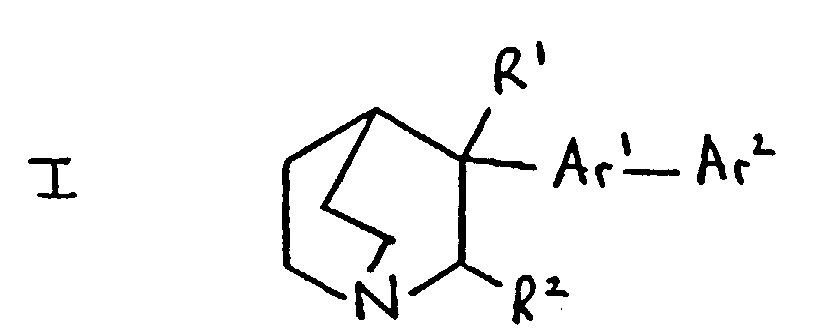 et dans laquelle l'un des groupes Ar1 ou Ar2 ou les deux, peuvent éventuellement porter un ou plusieurs substituants choisis indépendamment parmi les groupes halogéno, hydroxy, amino, nitro, cyano, carboxy, carbamoyle, alkyle(1-6C), alkényle(2-6C), alkynyle(2-6C), alcoxy(1-6C), alkyl(1-6C)amine, di-[alkyl(1-6C)]amine N-alkyl(1-6C)carbamoyle, di-N,N-[alkyl(1-6C)]carbamoyle, alcoxy(1-6C)carbonyle, alkyl(1-6C)thio, alkyl(1-6C)sulfinyle, alkyl(1-6C)sulfonyle, halogénoalkyle (1-6C), alca-noyl(1-6C)amino, uréido, N'-alkyl(l-6C)alkyluréido, alcanoyle (1-6C) et les dérivés oxime de ceux-ci et les éthers O-alkyle (1-6C) desdits dérivés oxime ; à la condition que Ar2 ne soit pas une entité hétéroaryle à 6 atomes contenant un ou deux atomes d'azote.R1 représente un hydrogène ou un groupe hydroxy ;R2 représente un hydrogène ; ouR1 et R2 sont unis l'un à l'autre de sorte que CR1-CR2 est une double liaison ;Ar1 représente une entité phénylène et Ar2 représente une entité hétérocyclique choisie parmi un hétérocycle aromatique à 5 atomes ou à 6 atomes contenant un, deux ou trois hétéroatomes choisis parmi l'azote, l'oxygène et le soufre ; un hétérocycle aromatique à 5 atomes ou à 6 atomes contenant un, deux ou trois hétéroatomes choisis parmi l'azote, l'oxygène et le soufre et qui est fusionné à un cycle benzénique ; et un hétérocycle bicyclique qui consiste en un hétérocycle non aromatique à 5 atomes ou à 6 atomes contenant (en plus des atomes de carbone), un, deux ou trois hétéroatomes choisis parmi l'azote, l'oxygène et le soufre, fusionné à un cycle benzénique ;
 - Composé selon la revendication 1, dans lequel l'un des groupes Ar1 ou Ar2 ou les deux, peuvent éventuellement être non substitués ou peuvent porter un ou plusieurs substituants choisis indépendamment parmi les groupes halogéno, hydroxy, amino, nitro, alkyle (1-6C), alkényle (2-6C), alcoxy (1-6C), alcanoyle (1-6C) et les dérivés oxime de ceux-ci et les éthers O-alkyle (1-6C) desdits dérivés oxime, halogénoalkyle (1-6C) et alcanoyl(1-6C)amino.
- Composé selon la revendication 1 ou la revendication 2 dans lequel Ar1 est une entité 1,4-phénylène et Ar2 est une entité hétérocyclique choisie parmi les entités pyrrolyle, quinolyle, oxadiazolyle, oxazolyle, thiényle, thiazolyle, furyle, pyridyle, benzthiazolyle, benzoxa-zolyle, benzimidazolyle et benzdioxolyle.
- Composé selon la revendication 3, dans lequel Ar2 est une entité hétérocyclique choisie parmi les entités pyrrolyle, quinolyle, oxadiazolyle, oxazolyle, thiazolyle, benzthiazolyle et benzdioxolyle.
- Composé selon l'une quelconque des revendications précédentes, dans lequel R1 est un hydroxy et R2 est un hydrogène.
- Composé de formule (I) ou sel pharmaceutiquement acceptable de celui-ci, dans laquelle :R1 représente un hydroxy ; R2 représente un hydrogène ; Ar1 représente une entité phénylène et Ar2 représente une entité hétérocyclique choisie parmi un hétérocycle aromatique à 5 atomes ou à 6 atomes contenant un, deux ou trois hétéroatomes choisis parmi l'azote, l'oxygène et le soufre ; un hétérocycle aromatique à 5 atomes ou à 6 atomes contenant un, deux ou trois hétéroatomes choisis parmi l'azote, l'oxygène et le soufre et qui est fusionné à un cycle benzénique ; et un hétérocycle bicyclique qui consiste en un hétérocycle non aromatique à 5 atomes ou à 6 atomes contenant (en plus des atomes de carbone), un, deux ou trois hétéroatomes choisis parmi l'azote, l'oxygène et le soufre, fusionné à un cycle benzénique ;
et dans laquelle l'un des groupes Ar1 ou Ar2 ou les deux, peuvent éventuellement porter un ou plusieurs substituants choisis indépendamment parmi les groupes halogéno, hydroxy, amino, nitro, cyano, carboxy, carbamoyle, alkyle(1-6C), alkényle(2-6C), alkynyle(2-6C), alcoxy(1-6C), alkyl( 1-6C)amino, di-[alkyl( -6C)]amino N-alkyl( -6C)carbamoyle, di-N,N-[alkyl(1-6C)]carbamoyle, alcoxy(1-6C)carbonyle, alkyl(1-6C)thio, alkyl(1-6C)sulfinyle, alkyl(1-6C)sulfonyle, halogénoalkyle (1-6C), alca-noyl(1-6C)amino, uréido, N'-alkyl(1-6C)alkyluréido, alcanoyle (1-6C) et les dérivés oxime de ceux-ci et les éthers O-alkyle (1-6C) desdits dérivés oxime ; à la condition que Ar2 ne soit pas une entité hétéroaryle à 6 atomes contenant un ou deux atomes d'azote. - Composé selon la revendication 7, dans lequel Ar1 est une entité 1,4-phénylène et Ar2 est choisi parmi les entités oxadiazole et quinolyle.
- Composé selon la revendication 1, qui est choisi parmi le 3-[4-(3-méthyl-1,2,4-oxadiazol-5-yl)phényl]quinuclidin-3-ol et les sels pharmaceutiquement acceptables de celui-ci.
- Procédé pour la préparation d'un composé de formule (I) ou d'un sel pharmaceutiquement acceptable de celui-ci selon la revendication 1, lequel procédé est choisi entre :et après cela, lorsqu'un sel pharmaceutiquement acceptable d'un composé de formule (I) est nécessaire, la réaction d'un composé de formule (I) avec un acide qui apporte un anion physiologiquement acceptable ou avec une base qui apporte un cation physiologiquement acceptable.(a) pour les composés de formule (I) dans laquelle R1 est un hydroxy et R2 est un hydrogène, la réaction d'un composé de formule Ar2-Ar1-M dans laquelle M est un atome de métal ou un dérivé de celui-ci, avec la quinuclidin-3-one ;(b) la réaction d'un composé de formule (II)dans laquelle L1 et L2 sont des ligands appropriés, avec un composé de formule Ar2-X dans laquelle X représente un groupe partant, en présence d'un catalyseur ;
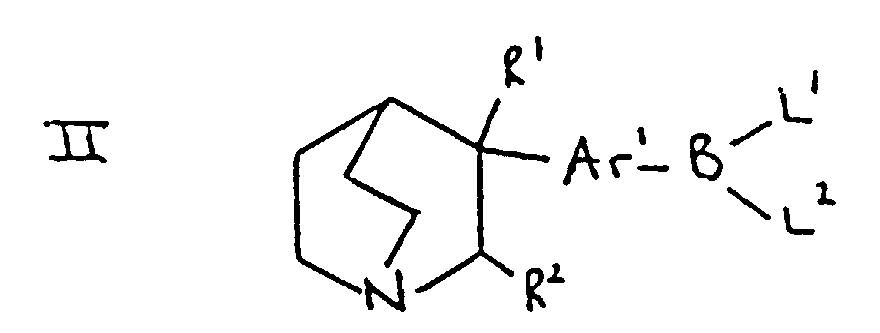 (c) la réaction d'in composé de formule (III) :dans laquelle X est groupe partant approprié, avec un composé de formule hal-Ar1-B(L1)L2 dans laquelle L1 et L2 sont des ligands appropriés, en présence d'un catalyseur ;
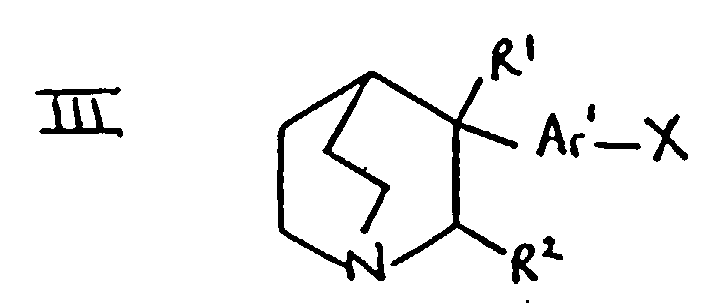 (d) pour les composés de formule (I) dans laquelle R1 et R2 représentent tous deux l'hydrogène, la réduction d'un composé de formule (I) dans laquelle R1 et R2 sont unis l'un à l'autre de sorte que -CR1 -CR2 est une double liaison ;(e) pour les composés de formule (I) dans laquelle R1 et R2 sont unis l'un à l'autre de sorte que -CR1 -CR2 représente une double liaison, la déshydratation d'un composé de formule (I) dans laquelle R1 est un hydroxy ;(f) pour les composés de formule (I) dans laquelle R1 et R2 sont unis l'un à l'autre de sorte que -CR1-CR2 représente une double liaison, le traitement d'un composé de formule (IV) :dans laquelle X est un groupe partant, avec une base ; et
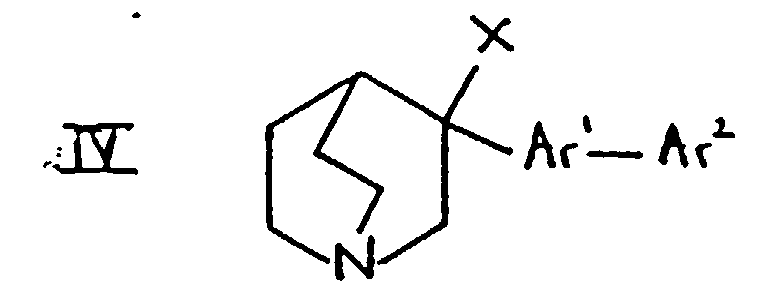 (g) pour les composés de formule (I) dans laquelle R1 et R2 représentent tous deux l'hydrogène, la déshydroxylation d'un composé de formule (I) dans laquelle R1 est un hydroxy ;
 - Composition pharmaceutique comprenant un composé de formule (I) ou un sel pharmaceutiquement acceptable de celui-ci selon l'une quelconque des revendications 1 à 9, en association avec un diluant ou véhicule pharmaceutiquement acceptable.
- Utilisation d'un composé de formule (I) ou d'un sel pharmaceutiquement acceptable de celui-ci selon l'une quelconque des revendications 1 à 9, pour la fabrication d'un médicament destiné à inhiber la biosynthèse du cholestérol.
- Utilisation selon la revendication 12, pour la fabrication d'un médicament destiné au traitement de l'hypercholestérolémie et/ou de l'artériosclérose.
Applications Claiming Priority (5)
| Application Number | Priority Date | Filing Date | Title |
|---|---|---|---|
| GB9226574 | 1992-12-21 | ||
| GB929226574A GB9226574D0 (en) | 1992-12-21 | 1992-12-21 | Heterocyclic derivatives |
| GB9226576 | 1992-12-21 | ||
| GB929226576A GB9226576D0 (en) | 1992-12-21 | 1992-12-21 | Therapeutic heterocyclic derivatives |
| PCT/GB1993/002614 WO1994014803A1 (fr) | 1992-12-21 | 1993-12-21 | Derives de quinuclidine comme inhibiteurs de la squalene synthetase |
Publications (2)
| Publication Number | Publication Date |
|---|---|
| EP0674635A1 EP0674635A1 (fr) | 1995-10-04 |
| EP0674635B1 true EP0674635B1 (fr) | 2001-03-28 |
Family
ID=26302196
Family Applications (1)
| Application Number | Title | Priority Date | Filing Date |
|---|---|---|---|
| EP94902924A Expired - Lifetime EP0674635B1 (fr) | 1992-12-21 | 1993-12-21 | Derives de quinuclidine comme inhibiteurs de la squalene synthetase |
Country Status (5)
| Country | Link |
|---|---|
| EP (1) | EP0674635B1 (fr) |
| JP (1) | JPH08504801A (fr) |
| AU (1) | AU5708694A (fr) |
| DE (1) | DE69330069D1 (fr) |
| WO (1) | WO1994014803A1 (fr) |
Families Citing this family (4)
| Publication number | Priority date | Publication date | Assignee | Title |
|---|---|---|---|---|
| US5385912A (en) * | 1991-03-08 | 1995-01-31 | Rhone-Poulenc Rorer Pharmaceuticals Inc. | Multicyclic tertiary amine polyaromatic squalene synthase inhibitors |
| WO1997025043A1 (fr) * | 1996-01-04 | 1997-07-17 | Novo Nordisk A/S | Procede de traitement de l'hypercholesterolemie et des troubles apparentes |
| US6858592B2 (en) | 2001-06-29 | 2005-02-22 | Genzyme Corporation | Aryl boronic acids for treating obesity |
| US7041280B2 (en) | 2001-06-29 | 2006-05-09 | Genzyme Corporation | Aryl boronate functionalized polymers for treating obesity |
Family Cites Families (5)
| Publication number | Priority date | Publication date | Assignee | Title |
|---|---|---|---|---|
| NZ225999A (en) * | 1987-09-10 | 1992-04-28 | Merck Sharp & Dohme | Azacyclic- or azabicyclic-substituted thiadiazole derivatives and pharmaceutical compositions |
| WO1992015579A1 (fr) * | 1991-03-08 | 1992-09-17 | Rhone-Poulenc Rorer International (Holdings) Inc. | Composes polyaromatiques et multicycliques a base d'amines tertiaires, ayant une fonction inhibitrice de la squalenesynthetase |
| US5135935A (en) * | 1991-05-17 | 1992-08-04 | Merck & Co., Inc. | Squalene synthetase inhibitors |
| GB9122988D0 (en) * | 1991-10-30 | 1991-12-18 | Ici Plc | Heterocyclic compounds |
| GB9211796D0 (en) * | 1992-06-04 | 1992-07-15 | Ici Plc | Heterocyclic derivatives |
-
1993
- 1993-12-21 EP EP94902924A patent/EP0674635B1/fr not_active Expired - Lifetime
- 1993-12-21 AU AU57086/94A patent/AU5708694A/en not_active Abandoned
- 1993-12-21 WO PCT/GB1993/002614 patent/WO1994014803A1/fr not_active Ceased
- 1993-12-21 JP JP6514940A patent/JPH08504801A/ja active Pending
- 1993-12-21 DE DE69330069T patent/DE69330069D1/de not_active Expired - Lifetime
Also Published As
| Publication number | Publication date |
|---|---|
| DE69330069D1 (en) | 2001-05-03 |
| JPH08504801A (ja) | 1996-05-28 |
| AU5708694A (en) | 1994-07-19 |
| EP0674635A1 (fr) | 1995-10-04 |
| WO1994014803A1 (fr) | 1994-07-07 |
Similar Documents
| Publication | Publication Date | Title |
|---|---|---|
| EP0656897B1 (fr) | Derives de la quinuclidine utilises comme inhibiteurs de la squalene synthetase | |
| EP0674637B1 (fr) | Derives de la quinuclidine comme inhibiteurs de la squalene synthetase | |
| US5612352A (en) | Heterocyclic compounds | |
| US5654315A (en) | Quinuclidine compounds useful in treating diseases | |
| EP0654032B1 (fr) | Derives de la quinuclidine utilises comme inhibiteurs de la squalene synthetase | |
| EP0598093B1 (fr) | Derives de quinuclidine utiles comme inhibiteurs de squalene synthetase | |
| EP0674635A1 (fr) | Derives de quinuclidine comme inhibiteurs de la squalene synthetase | |
| US5792777A (en) | Biphenyl quinuclidines | |
| EP0596057B1 (fr) | Derives de quinuclidine utiles comme inhibiteurs de squalene synthase | |
| CA2093777A1 (fr) | Amines therapeutiques | |
| EP0674636B1 (fr) | Derives de la quinuclidine utilises comme inhibiteurs de la squalene synthetase | |
| WO1995035295A1 (fr) | Derives de quinuclidine en tant qu'inhibiteurs de squalene synthase |
Legal Events
| Date | Code | Title | Description |
|---|---|---|---|
| PUAI | Public reference made under article 153(3) epc to a published international application that has entered the european phase |
Free format text: ORIGINAL CODE: 0009012 |
|
| 17P | Request for examination filed |
Effective date: 19950515 |
|
| AK | Designated contracting states |
Kind code of ref document: A1 Designated state(s): CH DE ES FR GB IT LI |
|
| 17Q | First examination report despatched |
Effective date: 19961113 |
|
| GRAG | Despatch of communication of intention to grant |
Free format text: ORIGINAL CODE: EPIDOS AGRA |
|
| GRAG | Despatch of communication of intention to grant |
Free format text: ORIGINAL CODE: EPIDOS AGRA |
|
| GRAG | Despatch of communication of intention to grant |
Free format text: ORIGINAL CODE: EPIDOS AGRA |
|
| GRAH | Despatch of communication of intention to grant a patent |
Free format text: ORIGINAL CODE: EPIDOS IGRA |
|
| GRAH | Despatch of communication of intention to grant a patent |
Free format text: ORIGINAL CODE: EPIDOS IGRA |
|
| GRAA | (expected) grant |
Free format text: ORIGINAL CODE: 0009210 |
|
| AK | Designated contracting states |
Kind code of ref document: B1 Designated state(s): CH DE ES FR GB IT LI |
|
| PG25 | Lapsed in a contracting state [announced via postgrant information from national office to epo] |
Ref country code: LI Free format text: LAPSE BECAUSE OF FAILURE TO SUBMIT A TRANSLATION OF THE DESCRIPTION OR TO PAY THE FEE WITHIN THE PRESCRIBED TIME-LIMIT Effective date: 20010328 Ref country code: IT Free format text: LAPSE BECAUSE OF FAILURE TO SUBMIT A TRANSLATION OF THE DESCRIPTION OR TO PAY THE FEE WITHIN THE PRE;WARNING: LAPSES OF ITALIAN PATENTS WITH EFFECTIVE DATE BEFORE 2007 MAY HAVE OCCURRED AT ANY TIME BEFORE 2007. THE CORRECT EFFECTIVE DATE MAY BE DIFFERENT FROM THE ONE RECORDED.SCRIBED TIME-LIMIT Effective date: 20010328 Ref country code: FR Free format text: LAPSE BECAUSE OF FAILURE TO SUBMIT A TRANSLATION OF THE DESCRIPTION OR TO PAY THE FEE WITHIN THE PRESCRIBED TIME-LIMIT Effective date: 20010328 Ref country code: CH Free format text: LAPSE BECAUSE OF FAILURE TO SUBMIT A TRANSLATION OF THE DESCRIPTION OR TO PAY THE FEE WITHIN THE PRESCRIBED TIME-LIMIT Effective date: 20010328 |
|
| RAP1 | Party data changed (applicant data changed or rights of an application transferred) |
Owner name: SYNGENTA LIMITED |
|
| REG | Reference to a national code |
Ref country code: CH Ref legal event code: EP |
|
| REF | Corresponds to: |
Ref document number: 69330069 Country of ref document: DE Date of ref document: 20010503 |
|
| PG25 | Lapsed in a contracting state [announced via postgrant information from national office to epo] |
Ref country code: DE Free format text: LAPSE BECAUSE OF FAILURE TO SUBMIT A TRANSLATION OF THE DESCRIPTION OR TO PAY THE FEE WITHIN THE PRESCRIBED TIME-LIMIT Effective date: 20010629 |
|
| EN | Fr: translation not filed | ||
| PG25 | Lapsed in a contracting state [announced via postgrant information from national office to epo] |
Ref country code: ES Free format text: LAPSE BECAUSE OF FAILURE TO SUBMIT A TRANSLATION OF THE DESCRIPTION OR TO PAY THE FEE WITHIN THE PRESCRIBED TIME-LIMIT Effective date: 20010927 |
|
| REG | Reference to a national code |
Ref country code: CH Ref legal event code: PL |
|
| PG25 | Lapsed in a contracting state [announced via postgrant information from national office to epo] |
Ref country code: GB Free format text: LAPSE BECAUSE OF NON-PAYMENT OF DUE FEES Effective date: 20011221 |
|
| REG | Reference to a national code |
Ref country code: GB Ref legal event code: IF02 |
|
| PLBE | No opposition filed within time limit |
Free format text: ORIGINAL CODE: 0009261 |
|
| STAA | Information on the status of an ep patent application or granted ep patent |
Free format text: STATUS: NO OPPOSITION FILED WITHIN TIME LIMIT |
|
| 26N | No opposition filed | ||
| GBPC | Gb: european patent ceased through non-payment of renewal fee |
Effective date: 20011221 |