EP0672717A1 - Flame-retardant polymer composition and shaped article thereof - Google Patents
Flame-retardant polymer composition and shaped article thereof Download PDFInfo
- Publication number
- EP0672717A1 EP0672717A1 EP95301685A EP95301685A EP0672717A1 EP 0672717 A1 EP0672717 A1 EP 0672717A1 EP 95301685 A EP95301685 A EP 95301685A EP 95301685 A EP95301685 A EP 95301685A EP 0672717 A1 EP0672717 A1 EP 0672717A1
- Authority
- EP
- European Patent Office
- Prior art keywords
- flame
- polymer composition
- composition according
- parts
- retardant polymer
- Prior art date
- Legal status (The legal status is an assumption and is not a legal conclusion. Google has not performed a legal analysis and makes no representation as to the accuracy of the status listed.)
- Withdrawn
Links
- 239000000203 mixture Substances 0.000 title claims abstract description 90
- 229920000642 polymer Polymers 0.000 title claims abstract description 78
- RNFJDJUURJAICM-UHFFFAOYSA-N 2,2,4,4,6,6-hexaphenoxy-1,3,5-triaza-2$l^{5},4$l^{5},6$l^{5}-triphosphacyclohexa-1,3,5-triene Chemical compound N=1P(OC=2C=CC=CC=2)(OC=2C=CC=CC=2)=NP(OC=2C=CC=CC=2)(OC=2C=CC=CC=2)=NP=1(OC=1C=CC=CC=1)OC1=CC=CC=C1 RNFJDJUURJAICM-UHFFFAOYSA-N 0.000 title claims abstract description 51
- 239000003063 flame retardant Substances 0.000 title claims abstract description 51
- 229920001169 thermoplastic Polymers 0.000 claims abstract description 56
- ZFSLODLOARCGLH-UHFFFAOYSA-N isocyanuric acid Chemical compound OC1=NC(O)=NC(O)=N1 ZFSLODLOARCGLH-UHFFFAOYSA-N 0.000 claims abstract description 53
- 150000003839 salts Chemical class 0.000 claims abstract description 25
- 125000000217 alkyl group Chemical group 0.000 claims abstract description 18
- 125000001997 phenyl group Chemical group [H]C1=C([H])C([H])=C(*)C([H])=C1[H] 0.000 claims abstract description 16
- 150000003918 triazines Chemical class 0.000 claims abstract description 15
- 125000003118 aryl group Chemical group 0.000 claims description 57
- 229920000728 polyester Polymers 0.000 claims description 37
- 125000004435 hydrogen atom Chemical group [H]* 0.000 claims description 18
- 239000004416 thermosoftening plastic Substances 0.000 claims description 14
- 125000003710 aryl alkyl group Chemical group 0.000 claims description 12
- 125000004432 carbon atom Chemical group C* 0.000 claims description 12
- 125000000753 cycloalkyl group Chemical group 0.000 claims description 12
- 239000004721 Polyphenylene oxide Substances 0.000 claims description 11
- 239000002245 particle Substances 0.000 claims description 11
- 229920006380 polyphenylene oxide Polymers 0.000 claims description 11
- 239000004734 Polyphenylene sulfide Substances 0.000 claims description 10
- 229920000069 polyphenylene sulfide Polymers 0.000 claims description 10
- 239000000126 substance Substances 0.000 claims description 10
- 229910052736 halogen Inorganic materials 0.000 claims description 9
- 150000002367 halogens Chemical class 0.000 claims description 9
- 229920006287 phenoxy resin Polymers 0.000 claims description 8
- 239000013034 phenoxy resin Substances 0.000 claims description 8
- 238000006116 polymerization reaction Methods 0.000 claims description 8
- 239000004811 fluoropolymer Substances 0.000 claims description 6
- ISWSIDIOOBJBQZ-UHFFFAOYSA-N Phenol Chemical compound OC1=CC=CC=C1 ISWSIDIOOBJBQZ-UHFFFAOYSA-N 0.000 claims description 5
- JDSHMPZPIAZGSV-UHFFFAOYSA-N melamine Chemical compound NC1=NC(N)=NC(N)=N1 JDSHMPZPIAZGSV-UHFFFAOYSA-N 0.000 claims description 5
- 239000003381 stabilizer Substances 0.000 claims description 5
- 125000003944 tolyl group Chemical group 0.000 claims description 5
- 125000005023 xylyl group Chemical group 0.000 claims description 5
- 239000002253 acid Substances 0.000 claims description 4
- 239000000945 filler Substances 0.000 claims description 4
- 125000001424 substituent group Chemical group 0.000 claims description 4
- 229920000877 Melamine resin Polymers 0.000 claims description 3
- 239000011236 particulate material Substances 0.000 claims 1
- 238000006460 hydrolysis reaction Methods 0.000 abstract description 25
- 230000007062 hydrolysis Effects 0.000 abstract description 24
- -1 polyethylene terephthalate Polymers 0.000 description 46
- 229920000388 Polyphosphate Polymers 0.000 description 30
- 239000001205 polyphosphate Substances 0.000 description 30
- 235000011176 polyphosphates Nutrition 0.000 description 30
- OAICVXFJPJFONN-UHFFFAOYSA-N Phosphorus Chemical compound [P] OAICVXFJPJFONN-UHFFFAOYSA-N 0.000 description 24
- 238000000034 method Methods 0.000 description 22
- 230000000052 comparative effect Effects 0.000 description 19
- 229920002842 oligophosphate Polymers 0.000 description 18
- 229910052698 phosphorus Inorganic materials 0.000 description 18
- 239000011574 phosphorus Substances 0.000 description 18
- UNXRWKVEANCORM-UHFFFAOYSA-N triphosphoric acid Polymers OP(O)(=O)OP(O)(=O)OP(O)(O)=O UNXRWKVEANCORM-UHFFFAOYSA-N 0.000 description 18
- 229910019142 PO4 Inorganic materials 0.000 description 15
- 150000007973 cyanuric acids Chemical class 0.000 description 15
- 239000010452 phosphate Substances 0.000 description 15
- 229920001577 copolymer Polymers 0.000 description 12
- 239000008188 pellet Substances 0.000 description 12
- NBIIXXVUZAFLBC-UHFFFAOYSA-K phosphate Chemical compound [O-]P([O-])([O-])=O NBIIXXVUZAFLBC-UHFFFAOYSA-K 0.000 description 12
- 229920001707 polybutylene terephthalate Polymers 0.000 description 11
- 238000002425 crystallisation Methods 0.000 description 10
- 230000008025 crystallization Effects 0.000 description 10
- 230000000694 effects Effects 0.000 description 10
- 238000010348 incorporation Methods 0.000 description 10
- 239000003365 glass fiber Substances 0.000 description 9
- BFKJFAAPBSQJPD-UHFFFAOYSA-N tetrafluoroethene Chemical group FC(F)=C(F)F BFKJFAAPBSQJPD-UHFFFAOYSA-N 0.000 description 7
- 239000004793 Polystyrene Substances 0.000 description 6
- 150000001875 compounds Chemical class 0.000 description 6
- 239000000463 material Substances 0.000 description 6
- 125000002496 methyl group Chemical group [H]C([H])([H])* 0.000 description 6
- 229920002223 polystyrene Polymers 0.000 description 6
- WPMYUUITDBHVQZ-UHFFFAOYSA-M 3-(3,5-ditert-butyl-4-hydroxyphenyl)propanoate Chemical compound CC(C)(C)C1=CC(CCC([O-])=O)=CC(C(C)(C)C)=C1O WPMYUUITDBHVQZ-UHFFFAOYSA-M 0.000 description 5
- 239000004952 Polyamide Substances 0.000 description 5
- 229920002313 fluoropolymer Polymers 0.000 description 5
- 238000005227 gel permeation chromatography Methods 0.000 description 5
- 238000001746 injection moulding Methods 0.000 description 5
- 239000000178 monomer Substances 0.000 description 5
- 229920002647 polyamide Polymers 0.000 description 5
- 229920000515 polycarbonate Polymers 0.000 description 5
- 239000004417 polycarbonate Substances 0.000 description 5
- KKEYFWRCBNTPAC-UHFFFAOYSA-L terephthalate(2-) Chemical compound [O-]C(=O)C1=CC=C(C([O-])=O)C=C1 KKEYFWRCBNTPAC-UHFFFAOYSA-L 0.000 description 5
- 239000004753 textile Substances 0.000 description 5
- VGGSQFUCUMXWEO-UHFFFAOYSA-N Ethene Chemical compound C=C VGGSQFUCUMXWEO-UHFFFAOYSA-N 0.000 description 4
- 239000005977 Ethylene Substances 0.000 description 4
- 239000003963 antioxidant agent Substances 0.000 description 4
- 125000001797 benzyl group Chemical group [H]C1=C([H])C([H])=C(C([H])=C1[H])C([H])([H])* 0.000 description 4
- IISBACLAFKSPIT-UHFFFAOYSA-N bisphenol A Chemical compound C=1C=C(O)C=CC=1C(C)(C)C1=CC=C(O)C=C1 IISBACLAFKSPIT-UHFFFAOYSA-N 0.000 description 4
- 125000001495 ethyl group Chemical group [H]C([H])([H])C([H])([H])* 0.000 description 4
- 229920001038 ethylene copolymer Polymers 0.000 description 4
- 238000002156 mixing Methods 0.000 description 4
- 229920001343 polytetrafluoroethylene Polymers 0.000 description 4
- 239000004810 polytetrafluoroethylene Substances 0.000 description 4
- 239000002002 slurry Substances 0.000 description 4
- 239000000243 solution Substances 0.000 description 4
- 229920000049 Carbon (fiber) Polymers 0.000 description 3
- 239000000654 additive Substances 0.000 description 3
- 230000003078 antioxidant effect Effects 0.000 description 3
- 239000004917 carbon fiber Substances 0.000 description 3
- 229920001971 elastomer Polymers 0.000 description 3
- 239000000806 elastomer Substances 0.000 description 3
- 125000001449 isopropyl group Chemical group [H]C([H])([H])C([H])(*)C([H])([H])[H] 0.000 description 3
- VNWKTOKETHGBQD-UHFFFAOYSA-N methane Chemical compound C VNWKTOKETHGBQD-UHFFFAOYSA-N 0.000 description 3
- 125000004108 n-butyl group Chemical group [H]C([H])([H])C([H])([H])C([H])([H])C([H])([H])* 0.000 description 3
- 125000004123 n-propyl group Chemical group [H]C([H])([H])C([H])([H])C([H])([H])* 0.000 description 3
- 229920003207 poly(ethylene-2,6-naphthalate) Polymers 0.000 description 3
- 239000011112 polyethylene naphthalate Substances 0.000 description 3
- 229920000139 polyethylene terephthalate Polymers 0.000 description 3
- 239000005020 polyethylene terephthalate Substances 0.000 description 3
- 238000009877 rendering Methods 0.000 description 3
- 229920005989 resin Polymers 0.000 description 3
- 239000011347 resin Substances 0.000 description 3
- 238000009864 tensile test Methods 0.000 description 3
- ISPYQTSUDJAMAB-UHFFFAOYSA-N 2-chlorophenol Chemical compound OC1=CC=CC=C1Cl ISPYQTSUDJAMAB-UHFFFAOYSA-N 0.000 description 2
- FJDLQLIRZFKEKJ-UHFFFAOYSA-N 3-(3,5-ditert-butyl-4-hydroxyphenyl)propanamide Chemical compound CC(C)(C)C1=CC(CCC(N)=O)=CC(C(C)(C)C)=C1O FJDLQLIRZFKEKJ-UHFFFAOYSA-N 0.000 description 2
- GZVHEAJQGPRDLQ-UHFFFAOYSA-N 6-phenyl-1,3,5-triazine-2,4-diamine Chemical compound NC1=NC(N)=NC(C=2C=CC=CC=2)=N1 GZVHEAJQGPRDLQ-UHFFFAOYSA-N 0.000 description 2
- VTYYLEPIZMXCLO-UHFFFAOYSA-L Calcium carbonate Chemical compound [Ca+2].[O-]C([O-])=O VTYYLEPIZMXCLO-UHFFFAOYSA-L 0.000 description 2
- 229920001634 Copolyester Polymers 0.000 description 2
- OAKJQQAXSVQMHS-UHFFFAOYSA-N Hydrazine Chemical compound NN OAKJQQAXSVQMHS-UHFFFAOYSA-N 0.000 description 2
- 239000002033 PVDF binder Substances 0.000 description 2
- QAOWNCQODCNURD-UHFFFAOYSA-N Sulfuric acid Chemical compound OS(O)(=O)=O QAOWNCQODCNURD-UHFFFAOYSA-N 0.000 description 2
- NJYZCEFQAIUHSD-UHFFFAOYSA-N acetoguanamine Chemical compound CC1=NC(N)=NC(N)=N1 NJYZCEFQAIUHSD-UHFFFAOYSA-N 0.000 description 2
- 125000003368 amide group Chemical group 0.000 description 2
- QVGXLLKOCUKJST-UHFFFAOYSA-N atomic oxygen Chemical compound [O] QVGXLLKOCUKJST-UHFFFAOYSA-N 0.000 description 2
- TZCXTZWJZNENPQ-UHFFFAOYSA-L barium sulfate Chemical compound [Ba+2].[O-]S([O-])(=O)=O TZCXTZWJZNENPQ-UHFFFAOYSA-L 0.000 description 2
- 239000006227 byproduct Substances 0.000 description 2
- 238000006243 chemical reaction Methods 0.000 description 2
- 238000007334 copolymerization reaction Methods 0.000 description 2
- 125000002592 cumenyl group Chemical group C1(=C(C=CC=C1)*)C(C)C 0.000 description 2
- 125000000582 cycloheptyl group Chemical group [H]C1([H])C([H])([H])C([H])([H])C([H])([H])C([H])(*)C([H])([H])C1([H])[H] 0.000 description 2
- 125000000113 cyclohexyl group Chemical group [H]C1([H])C([H])([H])C([H])([H])C([H])(*)C([H])([H])C1([H])[H] 0.000 description 2
- 125000001511 cyclopentyl group Chemical group [H]C1([H])C([H])([H])C([H])([H])C([H])(*)C1([H])[H] 0.000 description 2
- 230000001747 exhibiting effect Effects 0.000 description 2
- 239000011521 glass Substances 0.000 description 2
- 125000004029 hydroxymethyl group Chemical group [H]OC([H])([H])* 0.000 description 2
- 238000002347 injection Methods 0.000 description 2
- 239000007924 injection Substances 0.000 description 2
- QQVIHTHCMHWDBS-UHFFFAOYSA-L isophthalate(2-) Chemical compound [O-]C(=O)C1=CC=CC(C([O-])=O)=C1 QQVIHTHCMHWDBS-UHFFFAOYSA-L 0.000 description 2
- KWGKDLIKAYFUFQ-UHFFFAOYSA-M lithium chloride Chemical compound [Li+].[Cl-] KWGKDLIKAYFUFQ-UHFFFAOYSA-M 0.000 description 2
- 238000002844 melting Methods 0.000 description 2
- 230000008018 melting Effects 0.000 description 2
- 125000004184 methoxymethyl group Chemical group [H]C([H])([H])OC([H])([H])* 0.000 description 2
- 125000001624 naphthyl group Chemical group 0.000 description 2
- 229910052757 nitrogen Inorganic materials 0.000 description 2
- 229910052760 oxygen Inorganic materials 0.000 description 2
- 239000001301 oxygen Substances 0.000 description 2
- 125000001037 p-tolyl group Chemical group [H]C1=C([H])C(=C([H])C([H])=C1*)C([H])([H])[H] 0.000 description 2
- ACVYVLVWPXVTIT-UHFFFAOYSA-N phosphinic acid Chemical group O[PH2]=O ACVYVLVWPXVTIT-UHFFFAOYSA-N 0.000 description 2
- ABLZXFCXXLZCGV-UHFFFAOYSA-N phosphonic acid group Chemical group P(O)(O)=O ABLZXFCXXLZCGV-UHFFFAOYSA-N 0.000 description 2
- 229920000098 polyolefin Polymers 0.000 description 2
- 229920002981 polyvinylidene fluoride Polymers 0.000 description 2
- 239000000843 powder Substances 0.000 description 2
- 125000002914 sec-butyl group Chemical group [H]C([H])([H])C([H])([H])C([H])(*)C([H])([H])[H] 0.000 description 2
- 238000007493 shaping process Methods 0.000 description 2
- 125000000999 tert-butyl group Chemical group [H]C([H])([H])C(*)(C([H])([H])[H])C([H])([H])[H] 0.000 description 2
- BQCIDUSAKPWEOX-UHFFFAOYSA-N 1,1-Difluoroethene Chemical compound FC(F)=C BQCIDUSAKPWEOX-UHFFFAOYSA-N 0.000 description 1
- BPXVHIRIPLPOPT-UHFFFAOYSA-N 1,3,5-tris(2-hydroxyethyl)-1,3,5-triazinane-2,4,6-trione Chemical compound OCCN1C(=O)N(CCO)C(=O)N(CCO)C1=O BPXVHIRIPLPOPT-UHFFFAOYSA-N 0.000 description 1
- YBYIRNPNPLQARY-UHFFFAOYSA-N 1H-indene Natural products C1=CC=C2CC=CC2=C1 YBYIRNPNPLQARY-UHFFFAOYSA-N 0.000 description 1
- QSRJVOOOWGXUDY-UHFFFAOYSA-N 2-[2-[2-[3-(3-tert-butyl-4-hydroxy-5-methylphenyl)propanoyloxy]ethoxy]ethoxy]ethyl 3-(3-tert-butyl-4-hydroxy-5-methylphenyl)propanoate Chemical compound CC(C)(C)C1=C(O)C(C)=CC(CCC(=O)OCCOCCOCCOC(=O)CCC=2C=C(C(O)=C(C)C=2)C(C)(C)C)=C1 QSRJVOOOWGXUDY-UHFFFAOYSA-N 0.000 description 1
- YVPKLYRHNTWXCT-UHFFFAOYSA-N 4-[1,1-bis(5-tert-butyl-4-hydroxy-2-methylphenyl)propyl]-2-tert-butyl-5-methylphenol Chemical compound C=1C(C(C)(C)C)=C(O)C=C(C)C=1C(C=1C(=CC(O)=C(C=1)C(C)(C)C)C)(CC)C1=CC(C(C)(C)C)=C(O)C=C1C YVPKLYRHNTWXCT-UHFFFAOYSA-N 0.000 description 1
- VSAWBBYYMBQKIK-UHFFFAOYSA-N 4-[[3,5-bis[(3,5-ditert-butyl-4-hydroxyphenyl)methyl]-2,4,6-trimethylphenyl]methyl]-2,6-ditert-butylphenol Chemical compound CC1=C(CC=2C=C(C(O)=C(C=2)C(C)(C)C)C(C)(C)C)C(C)=C(CC=2C=C(C(O)=C(C=2)C(C)(C)C)C(C)(C)C)C(C)=C1CC1=CC(C(C)(C)C)=C(O)C(C(C)(C)C)=C1 VSAWBBYYMBQKIK-UHFFFAOYSA-N 0.000 description 1
- UQRONKZLYKUEMO-UHFFFAOYSA-N 4-methyl-1-(2,4,6-trimethylphenyl)pent-4-en-2-one Chemical group CC(=C)CC(=O)Cc1c(C)cc(C)cc1C UQRONKZLYKUEMO-UHFFFAOYSA-N 0.000 description 1
- ZVVFVKJZNVSANF-UHFFFAOYSA-N 6-[3-(3,5-ditert-butyl-4-hydroxyphenyl)propanoyloxy]hexyl 3-(3,5-ditert-butyl-4-hydroxyphenyl)propanoate Chemical compound CC(C)(C)C1=C(O)C(C(C)(C)C)=CC(CCC(=O)OCCCCCCOC(=O)CCC=2C=C(C(O)=C(C=2)C(C)(C)C)C(C)(C)C)=C1 ZVVFVKJZNVSANF-UHFFFAOYSA-N 0.000 description 1
- BRLQWZUYTZBJKN-UHFFFAOYSA-N Epichlorohydrin Chemical compound ClCC1CO1 BRLQWZUYTZBJKN-UHFFFAOYSA-N 0.000 description 1
- SECXISVLQFMRJM-UHFFFAOYSA-N N-Methylpyrrolidone Chemical compound CN1CCCC1=O SECXISVLQFMRJM-UHFFFAOYSA-N 0.000 description 1
- 229920002292 Nylon 6 Polymers 0.000 description 1
- 229920010448 Poly(2,6-dimethyl-1,4-phenylene oxide) PPO Polymers 0.000 description 1
- 229920001283 Polyalkylene terephthalate Polymers 0.000 description 1
- 239000004698 Polyethylene Substances 0.000 description 1
- 239000004743 Polypropylene Substances 0.000 description 1
- NINIDFKCEFEMDL-UHFFFAOYSA-N Sulfur Chemical compound [S] NINIDFKCEFEMDL-UHFFFAOYSA-N 0.000 description 1
- GWEVSGVZZGPLCZ-UHFFFAOYSA-N Titan oxide Chemical compound O=[Ti]=O GWEVSGVZZGPLCZ-UHFFFAOYSA-N 0.000 description 1
- XTXRWKRVRITETP-UHFFFAOYSA-N Vinyl acetate Chemical compound CC(=O)OC=C XTXRWKRVRITETP-UHFFFAOYSA-N 0.000 description 1
- LTHDXRBQYLHLTE-UHFFFAOYSA-N [(4,6-diamino-1,3,5-triazin-2-yl)-(hydroxymethyl)amino]methanol Chemical compound NC1=NC(N)=NC(N(CO)CO)=N1 LTHDXRBQYLHLTE-UHFFFAOYSA-N 0.000 description 1
- MBHRHUJRKGNOKX-UHFFFAOYSA-N [(4,6-diamino-1,3,5-triazin-2-yl)amino]methanol Chemical compound NC1=NC(N)=NC(NCO)=N1 MBHRHUJRKGNOKX-UHFFFAOYSA-N 0.000 description 1
- USDJGQLNFPZEON-UHFFFAOYSA-N [[4,6-bis(hydroxymethylamino)-1,3,5-triazin-2-yl]amino]methanol Chemical compound OCNC1=NC(NCO)=NC(NCO)=N1 USDJGQLNFPZEON-UHFFFAOYSA-N 0.000 description 1
- 239000006096 absorbing agent Substances 0.000 description 1
- 239000000956 alloy Substances 0.000 description 1
- 229910045601 alloy Inorganic materials 0.000 description 1
- 125000005428 anthryl group Chemical group [H]C1=C([H])C([H])=C2C([H])=C3C(*)=C([H])C([H])=C([H])C3=C([H])C2=C1[H] 0.000 description 1
- 229910052787 antimony Inorganic materials 0.000 description 1
- WATWJIUSRGPENY-UHFFFAOYSA-N antimony atom Chemical compound [Sb] WATWJIUSRGPENY-UHFFFAOYSA-N 0.000 description 1
- 229920006231 aramid fiber Polymers 0.000 description 1
- 239000010425 asbestos Substances 0.000 description 1
- 239000011324 bead Substances 0.000 description 1
- 230000015572 biosynthetic process Effects 0.000 description 1
- 230000000740 bleeding effect Effects 0.000 description 1
- 229910000019 calcium carbonate Inorganic materials 0.000 description 1
- 239000003795 chemical substances by application Substances 0.000 description 1
- 238000004587 chromatography analysis Methods 0.000 description 1
- 239000004927 clay Substances 0.000 description 1
- 229910052570 clay Inorganic materials 0.000 description 1
- 239000003086 colorant Substances 0.000 description 1
- 238000013329 compounding Methods 0.000 description 1
- 238000000748 compression moulding Methods 0.000 description 1
- 238000001514 detection method Methods 0.000 description 1
- 125000004177 diethyl group Chemical group [H]C([H])([H])C([H])([H])* 0.000 description 1
- NJLLQSBAHIKGKF-UHFFFAOYSA-N dipotassium dioxido(oxo)titanium Chemical compound [K+].[K+].[O-][Ti]([O-])=O NJLLQSBAHIKGKF-UHFFFAOYSA-N 0.000 description 1
- 238000002845 discoloration Methods 0.000 description 1
- 239000002270 dispersing agent Substances 0.000 description 1
- 239000000975 dye Substances 0.000 description 1
- 150000002148 esters Chemical class 0.000 description 1
- HQQADJVZYDDRJT-UHFFFAOYSA-N ethene;prop-1-ene Chemical group C=C.CC=C HQQADJVZYDDRJT-UHFFFAOYSA-N 0.000 description 1
- RTZKZFJDLAIYFH-UHFFFAOYSA-N ether Substances CCOCC RTZKZFJDLAIYFH-UHFFFAOYSA-N 0.000 description 1
- VXNZUUAINFGPBY-UHFFFAOYSA-N ethyl ethylene Natural products CCC=C VXNZUUAINFGPBY-UHFFFAOYSA-N 0.000 description 1
- 238000011156 evaluation Methods 0.000 description 1
- 238000001125 extrusion Methods 0.000 description 1
- 239000000835 fiber Substances 0.000 description 1
- 239000007789 gas Substances 0.000 description 1
- 239000012760 heat stabilizer Substances 0.000 description 1
- HCDGVLDPFQMKDK-UHFFFAOYSA-N hexafluoropropylene Chemical group FC(F)=C(F)C(F)(F)F HCDGVLDPFQMKDK-UHFFFAOYSA-N 0.000 description 1
- 125000003454 indenyl group Chemical group C1(C=CC2=CC=CC=C12)* 0.000 description 1
- 239000012770 industrial material Substances 0.000 description 1
- 239000011256 inorganic filler Substances 0.000 description 1
- 229910003475 inorganic filler Inorganic materials 0.000 description 1
- 239000000314 lubricant Substances 0.000 description 1
- ZQKXQUJXLSSJCH-UHFFFAOYSA-N melamine cyanurate Chemical compound NC1=NC(N)=NC(N)=N1.O=C1NC(=O)NC(=O)N1 ZQKXQUJXLSSJCH-UHFFFAOYSA-N 0.000 description 1
- 239000000155 melt Substances 0.000 description 1
- 229910052751 metal Inorganic materials 0.000 description 1
- 239000002184 metal Substances 0.000 description 1
- 239000010445 mica Substances 0.000 description 1
- 229910052618 mica group Inorganic materials 0.000 description 1
- 150000004712 monophosphates Chemical class 0.000 description 1
- 238000000465 moulding Methods 0.000 description 1
- 125000000740 n-pentyl group Chemical group [H]C([H])([H])C([H])([H])C([H])([H])C([H])([H])C([H])([H])* 0.000 description 1
- 125000001971 neopentyl group Chemical group [H]C([*])([H])C(C([H])([H])[H])(C([H])([H])[H])C([H])([H])[H] 0.000 description 1
- SSDSCDGVMJFTEQ-UHFFFAOYSA-N octadecyl 3-(3,5-ditert-butyl-4-hydroxyphenyl)propanoate Chemical compound CCCCCCCCCCCCCCCCCCOC(=O)CCC1=CC(C(C)(C)C)=C(O)C(C(C)(C)C)=C1 SSDSCDGVMJFTEQ-UHFFFAOYSA-N 0.000 description 1
- 150000002894 organic compounds Chemical class 0.000 description 1
- TWNQGVIAIRXVLR-UHFFFAOYSA-N oxo(oxoalumanyloxy)alumane Chemical compound O=[Al]O[Al]=O TWNQGVIAIRXVLR-UHFFFAOYSA-N 0.000 description 1
- 125000003538 pentan-3-yl group Chemical group [H]C([H])([H])C([H])([H])C([H])(*)C([H])([H])C([H])([H])[H] 0.000 description 1
- 150000003018 phosphorus compounds Chemical class 0.000 description 1
- 230000000704 physical effect Effects 0.000 description 1
- 239000000049 pigment Substances 0.000 description 1
- 238000006068 polycondensation reaction Methods 0.000 description 1
- 229920000573 polyethylene Polymers 0.000 description 1
- 229920002959 polymer blend Polymers 0.000 description 1
- 229920001155 polypropylene Polymers 0.000 description 1
- 239000000047 product Substances 0.000 description 1
- QQONPFPTGQHPMA-UHFFFAOYSA-N propylene Natural products CC=C QQONPFPTGQHPMA-UHFFFAOYSA-N 0.000 description 1
- 239000011342 resin composition Substances 0.000 description 1
- 229910052895 riebeckite Inorganic materials 0.000 description 1
- 239000000779 smoke Substances 0.000 description 1
- 239000002904 solvent Substances 0.000 description 1
- 229910052717 sulfur Inorganic materials 0.000 description 1
- 239000011593 sulfur Substances 0.000 description 1
- 239000000454 talc Substances 0.000 description 1
- 229910052623 talc Inorganic materials 0.000 description 1
- 229920006344 thermoplastic copolyester Polymers 0.000 description 1
- OGIDPMRJRNCKJF-UHFFFAOYSA-N titanium oxide Inorganic materials [Ti]=O OGIDPMRJRNCKJF-UHFFFAOYSA-N 0.000 description 1
- 229960000834 vinyl ether Drugs 0.000 description 1
- XLYOFNOQVPJJNP-UHFFFAOYSA-N water Substances O XLYOFNOQVPJJNP-UHFFFAOYSA-N 0.000 description 1
- 239000003643 water by type Substances 0.000 description 1
- 239000010456 wollastonite Substances 0.000 description 1
- 229910052882 wollastonite Inorganic materials 0.000 description 1
Classifications
-
- C—CHEMISTRY; METALLURGY
- C08—ORGANIC MACROMOLECULAR COMPOUNDS; THEIR PREPARATION OR CHEMICAL WORKING-UP; COMPOSITIONS BASED THEREON
- C08K—Use of inorganic or non-macromolecular organic substances as compounding ingredients
- C08K5/00—Use of organic ingredients
- C08K5/49—Phosphorus-containing compounds
- C08K5/51—Phosphorus bound to oxygen
- C08K5/52—Phosphorus bound to oxygen only
- C08K5/521—Esters of phosphoric acids, e.g. of H3PO4
- C08K5/523—Esters of phosphoric acids, e.g. of H3PO4 with hydroxyaryl compounds
-
- C—CHEMISTRY; METALLURGY
- C08—ORGANIC MACROMOLECULAR COMPOUNDS; THEIR PREPARATION OR CHEMICAL WORKING-UP; COMPOSITIONS BASED THEREON
- C08G—MACROMOLECULAR COMPOUNDS OBTAINED OTHERWISE THAN BY REACTIONS ONLY INVOLVING UNSATURATED CARBON-TO-CARBON BONDS
- C08G79/00—Macromolecular compounds obtained by reactions forming a linkage containing atoms other than silicon, sulfur, nitrogen, oxygen, and carbon with or without the latter elements in the main chain of the macromolecule
- C08G79/02—Macromolecular compounds obtained by reactions forming a linkage containing atoms other than silicon, sulfur, nitrogen, oxygen, and carbon with or without the latter elements in the main chain of the macromolecule a linkage containing phosphorus
- C08G79/04—Phosphorus linked to oxygen or to oxygen and carbon
-
- C—CHEMISTRY; METALLURGY
- C09—DYES; PAINTS; POLISHES; NATURAL RESINS; ADHESIVES; COMPOSITIONS NOT OTHERWISE PROVIDED FOR; APPLICATIONS OF MATERIALS NOT OTHERWISE PROVIDED FOR
- C09K—MATERIALS FOR MISCELLANEOUS APPLICATIONS, NOT PROVIDED FOR ELSEWHERE
- C09K21/00—Fireproofing materials
- C09K21/06—Organic materials
- C09K21/12—Organic materials containing phosphorus
-
- C—CHEMISTRY; METALLURGY
- C08—ORGANIC MACROMOLECULAR COMPOUNDS; THEIR PREPARATION OR CHEMICAL WORKING-UP; COMPOSITIONS BASED THEREON
- C08L—COMPOSITIONS OF MACROMOLECULAR COMPOUNDS
- C08L2201/00—Properties
- C08L2201/02—Flame or fire retardant/resistant
-
- C—CHEMISTRY; METALLURGY
- C08—ORGANIC MACROMOLECULAR COMPOUNDS; THEIR PREPARATION OR CHEMICAL WORKING-UP; COMPOSITIONS BASED THEREON
- C08L—COMPOSITIONS OF MACROMOLECULAR COMPOUNDS
- C08L2666/00—Composition of polymers characterized by a further compound in the blend, being organic macromolecular compounds, natural resins, waxes or and bituminous materials, non-macromolecular organic substances, inorganic substances or characterized by their function in the composition
- C08L2666/66—Substances characterised by their function in the composition
- C08L2666/84—Flame-proofing or flame-retarding additives
Definitions
- This invention relates to a flame-retardant polymer composition containing a non-halogen flame retarder, and a shaped article thereof.
- the shaped articles of the flame-retardant polymer composition of the present invention have good mechanical properties and a good hydrolysis resistance, and are useful for electrical parts and electronic parts, such as a connector, a relay, a switch, a case part, a transducer part and a coil bobbin, automobile parts, and mechanical parts.
- Thermoplastic polymers including polyesters such as polyethylene terephthalate, polybutylene terephthalate, polyethylene naphthalate and polycyclohexanedimethylene terephthalate, polycarbonates, polyamides and polyphenylene oxides have good properties, and thus, injection molded articles thereof are widely used as, for example, mechanical parts, electrical parts and automobile parts. Since these thermoplastic polymers are essentially combustible, where they are used as industrial materials, safety against flames, i.e., flame-retardancy, as well as good and balanced general chemical and physical properties, are often required.
- thermoplastic polymer To impart a flame retardancy to a thermoplastic polymer, a method of compounding a halogen-containing organic compound as a flame retarder and a antimony-containing compound with the thermoplastic polymer is generally employed.
- this method has a problem in that, when burnt, it produces a large quantity of smoke.
- JP-A-55-5916 and JP-A-49-74240 refer to injection molding of the flame-retardant polyester compositions.
- most of the prior art for rendering a thermoplastic polyester flame-retardant by using conventional phosphorus compounds is concerned with flame retardation not of a film, a sheet or other shaped articles, but of textile materials.
- thermoplastic polyester flame-retardant Furthermore, a method for rendering a thermoplastic polyester flame-retardant has been proposed wherein an aromatic phosphate or an aromatic phosphate oligomer is incorporated in a polyester (JP-A-48-90348, JP-A-48-91147 and JP-A-52-102255). This method also is intended to render a textile materials flame-retardant.
- flame-retardant polymer compositions used for injection molded articles, films and sheets have good mechanical properties, and further good heat resistance and resistance to hydrolysis so that these articles can withstand high-temperature and high-humidity conditions with a high reliability. From this viewpoint, it is seen that with the previously proposed methods for imparting a flame retardancy to thermoplastic polymers the following problems arise.
- the present invention seeks to provide a flame retardant thermoplastic polymer composition having incorporated therein a nonhalogen flame retarder, which exhibits an enhanced flame retardancy and a good shapability, and films, sheets and other shaped articles made from which have good mechanical properties and resistance to hydrolysis.
- the present invention also seeks to provide a shaped article exhibiting good mechanical properties, melt-flowability, surface appearance and resistance to hydrolysis, as well as good flame retardancy, which is made from the above-mentioned flame retardant thermoplastic polymer composition.
- the present invention seeks to provide a flame retardant thermoplastic polymer composition and a shaped article made therefrom, which are useful for mechanical parts, electrical and electronic parts and automobile parts.
- thermoplastic polymer which retarder is a hydroquinone-type aromatic oligophosphate or polyphosphate having a specific degree of polymerization, and which has excellent and balanced performances.
- a flame-retardant polymer composition comprising a thermoplastic polymer and a flame retarder having a chemical structure represented by the following formula (1): wherein R1, R2, R3 and R4 independently represent a hydrogen atom or an alkyl group having 1 to 5 carbon atoms, Ar1, Ar2, Ar3 and Ar4 independently represent a phenyl group or a phenyl group having an organic residue substituent containing no halogen, n is a number average degree of polymerization and in the range of 0.5 to 3,000, and each of k and m is from 0 to 2 and the sum of k and m is in the range of 0 to 2.
- each of k and m may, independently of one another be 0 or an integer of 1 or 2 and the sum of k and m may also be 0 or an integer of 1 or 2.
- a flame-retardant polymer composition comprising a thermoplastic polymer, the above-mentioned flame retarder having a chemical structure represented by the formula (1), and a salt of a triazine derivative represented by the formula (3): with at least one acid selected from cyanuric acid and isocyanuric acid; wherein R5, R6, R7 and R8 independently represent a hydrogen atom, an aryl, alkyl, aralkyl or cycloalkyl group, or -CONH2; and R represents the same group as -NR5R6 or -NR7R8, or independently represents a hydrogen atom, an aryl, alkyl, aralkyl or cycloalkyl group, or -NH2 or -CONH2.
- a shaped article made of a flame-retardant polymer composition comprising a thermoplastic polymer and the above-mentioned flame retarder having a chemical structure represented by the formula (1).
- thermoplastic polymer to which flame retardancy is imparted by the incorporation of the above-mentioned flame retarder in the present invention is a polymeric material exhibiting, when heated, a fluidity and thus capable of being shaped and processed in a heated state.
- thermoplastic polymer there can be mentioned polyesters, polycarbonates, polyamides, polyphenylene oxides, modified polyphenylene oxides, phenoxy resins, polyphenylene sulfides, polyolefins such as polyethylene and polypropylene, polyolefin copolymers such as an ethylene/propylene copolymer, an ethylene/1-butene copolymer, an ethylene/propylene/non-conjugated diene copolymer, an ethylene/ethyl acrylate copolymer, an ethylene/glycidyl methacrylate copolymer, an ethylene/vinyl acetate/glycidyl methacrylate copolymer and an ethylene/propylene-g-maleic anhydride copolymer, and elastomers such as a polyesterether elastomer and a polyesterpolyester elastomer.
- thermoplastic polymers may be used either alone or in combination.
- thermoplastic polyesters and mixtures of a thermoplastic polyester and at least one thermoplastic polymers selected from phenoxy resins, polyphenylene oxides, modified polyphenylene oxides and polyphenylene sulfides are preferable.
- thermoplastic polyesters there can be mentioned polyethylene terephthalate, polypropylene terephthalate, polybutylene terephthalate, polyethylene naphthalate, polybutylene naphthalate, polycyclohexanedimethylene terephthalate and polyethylene-1,2-bis(phenoxy)ethane-4,4'-dicarboxylate; and thermoplastic copolyesters such as polyethylene isophthalate/terephthalate, polybutylene terephthalate/isophthalate, polybutylene terephthalate/decanedicarboxylate and polycyclohexanedimethylene terephthalate/isophthalate.
- thermoplastic polyesters polybutylene terephthalate, polybutylene naphthalate, polycyclohexanedimethylene terephthalate, polyethylene naphthalate and polyethylene terephthalate are preferable because they provide good and balanced mechanical properties and shapabily.
- the proportion of the thermoplastic polyester to the other thermoplastic polymer or polymers is preferably in the range of 100/200 to 100/5 by weight.
- a hydroquinone-type aromatic oligophosphate or polyphosphate having a chemical structure represented by the formula (1) is used as a flame retarder.
- each of k and m may be 0, 1 or 2, preferably 0 or 1, and more preferably 1, and the sum of k plus m is 0, 1 or 2.
- This hydroquinone-type aromatic oligophosphate or polyphosphate has a number average degree (n) of polymerization of 0.5 to 3,000, preferably 0.5 to 500. In view of flame retardancy, n is most preferably in the range of 1 to 2.5 or the range of 6 to 100.
- R1, R2, R3 and R4 independently represent a hydrogen atom or an alkyl group having 1 to 5 carbon atoms.
- the alkyl group there can be mentioned methyl, ethyl, n-propyl, isopropyl, n-butyl, sec.-butyl, tert.-butyl, n-pentyl, 2-pentyl, 3-pentyl and neopentyl groups.
- a hydrogen atom and methyl and ethyl groups are preferable.
- a hydrogen atom is most preferable.
- Ar1, Ar2, Ar3 and Ar4 independently represent a phenyl group or a phenyl group having an organic residue substituent containing no halogen.
- Ar1, Ar2, Ar3 and Ar4 there can be mentioned phenyl, tolyl, xylyl, mesityl, cumenyl, naphthyl, indenyl and anthryl groups. Of these, phenyl, tolyl, xylyl, cumenyl and naphthyl groups are preferable. Phenyl, tolyl and xylyl groups are more preferable.
- the hydroquinone-type aromatic oligophosphate or polyphosphate of the formula (1) is generally produced by processes represented by the following reaction formula (4) or (5).
- aromatic oligophosphate or polyphosphate of the formula (1) is made according to the reaction formula (4) or (5), it is possible that low-molecular-weight monophosphates such as a triaryl phosphate are produced as by-products. However, the formation of such by-products offers no problem provided that the resulting phosphate mixture has an average degree of polymerization of at least 0.5.
- aromatic oligophosphate and the aromatic polyphosphate there can be mentioned those which are listed in Tables 1-1 and 1-2. However, the aromatic oligophosphate and the aromatic polyphosphate used in the present invention are not restricted to these compounds. Table 1-1 No.
- aromatic oligophosphates and aromatic polyphosphates those in which Ar1, Ar2, Ar3 and Ar4 independently represent a phenyl, tolyl or xylyl group and each of k and m is an integer of 1 is preferable, and, those which are represented by the following formula (2) are more preferable in view of the flame retardancy, mechanical properties and economic factor.
- the amount of the aromatic oligophosphate or the aromatic polyphosphate in the flame retardant polymer composition of the present invention is in the range of 0.5 to 100 parts by weight, preferably 1 to 80 parts by weight and more preferably 5 to 50 parts by weight, per 100 parts by weight of a thermoplastic polymer.
- the flame retardancy of the polymer composition depends upon the amount of phosphorus contained therein. Therefore, where an aromatic oligophosphate or polyphosphate having a high phosphorus content is incorporated, the intended high retardancy can be obtained with a small amount of the aromatic oligophosphate or polyphosphate. In contrast, where an aromatic oligophosphate or polyphosphate having a low phosphorus content is incorporated, a large amount of the aromatic oligophosphate or polyphosphate must be incorporated for obtaining the intended high flame retardancy.
- the content of phosphorus in the polymer composition which is required for obtaining the high flame retardancy, is usually in the range of 0.1 to 10% by weight, preferably 0.2 to 8% by weight and more preferably 0.5 to 5% by weight, based on the weight of the composition.
- R5, R6, R7 and R8 independently represent a hydrogen atom, an aryl, alkyl, aralkyl or cycloalkyl group, or -CONH2; and R represents the same group as -NR5R6 or -NR7R8, or independently represents a hydrogen atom, an aryl, alkyl, aralkyl or cycloalkyl group, or -NH2 or -CONH2.
- the ratio of the triazine derivative to cyanuric acid or isocyanuric acid is usually 1/1 by mole, and occasionally 1/2 by mole. It is to be noted that, among triazine derivatives represented by the formula (3), those which are incapable of reacting with cyanuric acid or isocyanuric acid cannot be used.
- R5, R6, R7 and R8 independently represent a hydrogen atom, an aryl, alkyl, aralkyl or cycloalkyl group, or -CONH2.
- aryl, alkyl, aralkyl or cycloalkyl group an aryl group having 6 to 15 carbon atoms, an alkyl group having 1 to 10 carbon atoms, an aralkyl group having 7 to 16 carbon atoms and a cycloalkyl group having 4 to 15 carbon atoms, respectively, are preferable.
- R represents the same group as -NR5R6 or -NR7R8, or independently represents a hydrogen atom, an aryl, alkyl, aralkyl or cycloalkyl group, or -NH2 or -CONH2.
- aryl, alkyl, aralkyl or cycloalkyl group an aryl group having 6 to 15 carbon atoms, an alkyl group having 1 to 10 carbon atoms, an aralkyl group having 7 to 16 carbon atoms and a cycloalkyl group having 4 to 15 carbon atoms, respectively, are preferable.
- a hydrogen atom, and phenyl, methyl, hydroxymethyl, methoxymethyl, benzyl and amide groups are preferable.
- R there can be mentioned a hydrogen atom, and amino, amide, methylamino, dimethylamino, ethylamino, diethylamino, mono(hydroxymethyl)amino, di(hydroxymethyl)amino, mono(methoxymethyl)amino, di(methoxymethyl)amino, phenylamino, diphenylamino, phenyl, p-tolyl, ⁇ -naphthyl, ⁇ -naphthyl, methyl, ethyl, n-propyl, isopropyl, n-butyl, sec-butyl, tert-butyl, benzyl, cyclopentyl, cyclohexyl, cycloheptyl, 2-methyl-1-pentyl and 4-methyl-1-cyclohexyl groups.
- a hydrogen atom, and amino, amide, methyl, mono(hydroxymethyl)amino, di(hydroxymethyl)amino, mono(methoxymethyl)amino, di(methoxymethyl)amino, phenyl and benzyl groups are preferable.
- triazine derivative of the formula (3) there can be mentioned melamine, benzoguanamine, acetoguanamine, 2-amide-4,6-diamino-1,3,5-triazine, mono(hydroxymethyl)melamine, di(hydroxymethyl)melamine and tri(hydroxymethyl)melamine.
- melamine, benzoguanamine and acetoguanamine are more preferable.
- the salt of a triazine derivative of the formula (3) with cyanuric acid and/or isocyanuric acid may be a powder obtained by a process wherein a mixture of a triazine derivative of the formula (3) with cyanuric acid and/or isocyanuric acid is dispersed in water to prepare an aqueous slurry, the components of the slurry is thoroughly mixed together to obtain a uniform slurry of finely divided particles, the slurry is filtered and then dried.
- this salt is not a mere mixture of the triazine derivative with cyanuric acid and/or isocyanuric acid.
- the salt used in the present invention is not necessarily a complete salt and may contain unreacted triazine derivative, cyanuric acid and/or isocyanuric acid.
- the form of the salt used is not particularly limited, but the salt is preferably in a finely divided particulate form because shaped articles made from the polymer composition have good mechanical strengths and surface appearance. Further, in view of the flame retardancy and mechanical properties, the smaller the average particle diameter of the salt in the polymer composition, the better the salt. More specifically the salt preferably has an average particle diameter not larger than 100 ⁇ m. Where the salt used has a poor dispersibility, a dispersing agent such as tris( ⁇ -hydroxyethyl)isocyanurate may be used.
- the amount of the above-mentioned salt incorporated in the polymer composition of the present invention may be in the range of 0.5 to 100 parts by weight, preferably 2 to 80 parts by weight, and more preferably 3 to 70 parts by weight, per 100 parts by weight of a thermoplastic polymer.
- a fluoropolymer may be further incorporated in the flame-retardant polymer composition of the present invention.
- a fluoropolymer By the incorporation of a fluoropolymer, undesirable dripping of molten polymer as usually observed when burnt can be minimized.
- the fluoropolymer there can be mentioned polytetrafluoroethylene, polyhexafluoropropylene, a tetrafluoroethylene/hexafluoropropylene copolymer, a tetrafluoroethylene/perfluoroalkyl-vinyl-ether copolymer, a tetrafluoroethylene/ethylene copolymer, a hexafluoropropylene/propylene copolymer, polyvinylidene fluoride and a vinylidene fluoride/ethylene copolymer.
- polytetrafluoroethylene a tetrafluoroethylene/perfluoroalkylvinyl-ether copolymer, a tetrafluoroethylene/hexafluoropropylene copolymer, a tetrafluoroethylene/ethylene copolymer and polyvinylidene fluoride are especially preferable.
- Polytetrafluoroethylene and a tetrafluoroethylene/ethylene copolymer are most preferable.
- the amount of the fluoropolymer optionally added is usually in the range of 0.01 to 10 parts by weight, preferably 0.1 to 5 parts by weight and more preferably 0.2 to 3 parts by weight, per 100 parts by weight of the thermoplastic polymer, in view of the mechanical properties and shapability.
- the dripping-suppressing effect by the incorporation of the fluoropolymer is prominent foracombinationofa thermoplastic polyester with at least one resin selected from a phenoxy resin, a polyphenylene oxide, a modified polyphenylene oxide and a polyphenylene sulfide.
- the aromatic oligophosphate and aromatic polyphosphate flame retarder used in the present invention promotes hydrolysis of a thermoplastic polymer having a structure prepared by dehydrating polycondensation, such as an ester linkage, only to a very slight extent. This is in contrast to the conventional phosphorus-containing flame retarder.
- a hindered phenol stabilizer is incorporated in the flame-retardant polymer composition, the good resistance to hydrolysis can be maintained even when the polymer composition is exposed to a high-temperature for a long time.
- hindered phenol stabilizer there can be mentioned triethyleneglycol-bis[3-(3-tert-butyl-5-methyl-4-hydroxyphenyl)propionate], 1,6-hexanediol-bis[3-(3,5-di-tert-butyl-4-hydroxyphenyl)propionate], pentaerythrityl-tetrakis[3-(3,5-di-tert-butyl-4-hydroxyphenyl)propionate], 2,2-thio-diethylenebis-[3-(3,5-di-tert-butyl-4-hydroxyphenyl)propionate, octadecyl-3-(3,5-di-tert-butyl-4-hydroxyphenyl)propionate, diethyl 3,5-di-tert-butyl-4-hydroxybenzylphophonate, 1,3,5-trimethyl-2,4,6-tris(3,5-di-tert-butyl-4-hydroxybenzyl
- the amount of the optional hindered phenol stabilizer incorporated in the flame-retardant polymer composition is usually 0.01 to 3 parts by weight, preferably 0.01 to 1 part by weight, and more preferably 0.03 to 0.5 part by weight, per 100 parts by weight of the thermoplastic polymer.
- additives can be incorporated in the flame-retardant polymer composition, in an amount such that the intended object of the present invention is achieved.
- additives include, for example, phosphorus- or sulfur-containing antioxidants, heat-stabilizers, ultraviolet absorbers, lubricants, releasing agents, and colorants including pigments and dyes.
- fibrous and/or particulate fillers are added into the flame-retardant polymer composition of the present invention to drastically enhance the strength, rigidity and heat resistance.
- Such fillers include, for example, glass fiber, carbon fiber, metal fiber, aramid fiber, asbestos, potassium titanate whisker, wollastonite, glass flakes, glass beads, talc, mica, clay, calcium carbonate, barium sulfate, titanium oxide and aluminum oxide. Chopped strands of glass fiber are especially preferable.
- the amount of these fillers is preferably in the range of 5 to 140 parts by weight, more preferably 5 to 100 parts by weight, per 100 parts by weight of the thermoplastic polymer.
- the flame-retardant polymer composition of the present invention may be produced by a conventional process.
- a process wherein a thermoplastic polymer, an aromatic oligophosphate and/or aromatic polyphosphate and other additives are mixed in a molten state by an extruder, and a process wherein these components are uniformly mixed mechanically in a particulate form, and the mixture is then further mixed together and simultaneously shaped into a shaped article by a molding machine or other shaping machines.
- the flame-retardant polymer composition of the present invention can be shaped into various shaped articles such as a molded article, a sheet and a film by a conventional shaping means such as injection molding, extrusion molding and compression molding. Of these, injection molding is advantageously used for the polymer composition of the present invention.
- the shaped articles are useful as mechanical parts, electrical and electronic parts and automobile parts.
- Mn number average molecular weight
- the mixture was melt-extruded through a twin-screw extruder having a diameter of 30 mm at a polymer temperature of 260°C to form pellets.
- the pellets were dried and then injection-molded at a mold temperature of 80°C to prepare a specimen for tensile tests according to ASTM D-638.
- the pellets were press-molded into stripe specimens for LOI determination and flame retardancy determination according to UL-94.
- thermoplastic polymer Various phosphorus-containing compounds, salts of cyanuric acid or isocyanuric acid, an antioxidant (pentaerythrityl-tetrakis[3-(3,5-di-tert-butyl-4-hydroxyphenyl)propionate], "IR-1010" supplied by Ciba-Geigy AG), and carbon fiber were mixed, in amounts shown in Table 6, together with 100 parts by weight of the following thermoplastic polymer:
- the mixture was melt-extruded through a twin-screw extruder having a diameter of 30 mm to form pellets.
- the pellets were dried and then injection-molded to prepare a specimen for tensile tests according to ASTM D-638.
- the pellets were press-molded into stripe specimens for LOI determination and flame retardancy determination according to UL-94.
- the polymer compositions prepared by using a cyanuric acid salt having a large average particle diameter exhibit mechanical properties which are deteriorated to some extent as compared with those of the polymer compositions prepared from a cyanuric acid salt having a small average particle diameter.
- the flame retardancy of the former polymer compositions is on the same level as that of the latter polymer compositions.
- the mixture was melt-extruded through a twin-screw extruder having a diameter of 30 mm to form pellets.
- the pellets were dried and then injection-molded to prepare a specimen for tensile tests according to ASTM D-638.
- the pellets were press-molded into stripe specimens for LOI determination and flame retardancy determination according to UL-94.
- a good flame retardancy is imparted to a polyblend composed of a polyester and one or more polymers selected from a phenoxy resin, poly(2,6-dimethyl-1,4-phenylene)oxide (PPO) and polyphenylene sulfide (PPS) by incorporation of the specific hydroquinone-type aromatic polyphosphate and the specific cyanuric acid salt, and further, as seen from the data in Examples 52, 54, 56, 58, 60, 62, 64, 66 and 68, this flame-retardation effect is obtained whether the polymer composition is or is not reinforced with glass fiber.
- PPO poly(2,6-dimethyl-1,4-phenylene)oxide
- PPS polyphenylene sulfide
- polyblends composed of a polyester and one or more polymers selected from a phenoxy resin, PPO and PPS are superior to a polyester alone in the flame retardancy and mechanical properties of their compositions having incorporated therein the specific aromatic polyphosphate and the specific cyanuric acid salt.
- the flame-retardant polymer compositions of Examples 69 - 86 exhibited an excellent flame retardancy of V-0 level.
- these polymer compositions were subjected to a burning test, dripping of a molten polymer was not observed.
- the mechanical properties and color tone of shaped articles, and the resistance to hydrolysis of these polymer compositions were approximately the same as those of Examples 51 - 68.
Landscapes
- Chemical & Material Sciences (AREA)
- Organic Chemistry (AREA)
- Health & Medical Sciences (AREA)
- Chemical Kinetics & Catalysis (AREA)
- Medicinal Chemistry (AREA)
- Polymers & Plastics (AREA)
- Engineering & Computer Science (AREA)
- Materials Engineering (AREA)
- Compositions Of Macromolecular Compounds (AREA)
- Manufacture Of Macromolecular Shaped Articles (AREA)
Abstract
A flame-retardant thermoplastic polymer composition has incorporated therein a flame retarder of the formula:

wherein R¹, R², R³ and R⁴ are H or lower alkyl, Ar¹, Ar², Ar³ and Ar⁴ are unsubstituted or substituted phenyl, n is a number of 0.5 to 3,000, and each of k and m is an integer of 0 to 2 and k plus m is an integer of 0 to 2. The polymer composition preferably further comprises a salt of a specific triazine derivative with cyanuric acid or isocyanuric acid. A shaped article made of the polymer composition has good flame retardancy, mechanical properties and resistance to hydrolysis.
wherein R¹, R², R³ and R⁴ are H or lower alkyl, Ar¹, Ar², Ar³ and Ar⁴ are unsubstituted or substituted phenyl, n is a number of 0.5 to 3,000, and each of k and m is an integer of 0 to 2 and k plus m is an integer of 0 to 2. The polymer composition preferably further comprises a salt of a specific triazine derivative with cyanuric acid or isocyanuric acid. A shaped article made of the polymer composition has good flame retardancy, mechanical properties and resistance to hydrolysis.
Description
- This invention relates to a flame-retardant polymer composition containing a non-halogen flame retarder, and a shaped article thereof.
- The shaped articles of the flame-retardant polymer composition of the present invention have good mechanical properties and a good hydrolysis resistance, and are useful for electrical parts and electronic parts, such as a connector, a relay, a switch, a case part, a transducer part and a coil bobbin, automobile parts, and mechanical parts.
- Thermoplastic polymers including polyesters such as polyethylene terephthalate, polybutylene terephthalate, polyethylene naphthalate and polycyclohexanedimethylene terephthalate, polycarbonates, polyamides and polyphenylene oxides have good properties, and thus, injection molded articles thereof are widely used as, for example, mechanical parts, electrical parts and automobile parts. Since these thermoplastic polymers are essentially combustible, where they are used as industrial materials, safety against flames, i.e., flame-retardancy, as well as good and balanced general chemical and physical properties, are often required.
- To impart a flame retardancy to a thermoplastic polymer, a method of compounding a halogen-containing organic compound as a flame retarder and a antimony-containing compound with the thermoplastic polymer is generally employed. However, this method has a problem in that, when burnt, it produces a large quantity of smoke.
- Therefore, to obviate the problem encountered by the use of a halogen-containing retarder, in recent years there has been an increasing demand for a non-halogen flame retarder.
- Attempts to copolymerize or blend a phosphorus-containing compound for imparting a flame retardancy to a thermoplastic polymer without the use of a halogen-containing flame retarder have heretofore been made, especially for textile materials. For example, as attempts for rendering thermoplastic polyesters flame-retardant, there have been proposed a method of introducing phosphonic acid units or phosphinic acid units in a polyester by copolymerization (JP-A-51-54691 and JP-A-50-56488); a method of copolymerizing a monomer having a cyclic phosphinite skeleton as a pendant with polyester-forming monomers (JP-A-52-98089, JP-A-55-5916 and JP-A-60-240755); a method of blending a polyphosphonate with a thermoplastic polyester (US-A-3719727); and a method of blending red phosphorus with a thermoplastic polyester (JP-A-49-74240). Of these documents, JP-A-55-5916 and JP-A-49-74240 refer to injection molding of the flame-retardant polyester compositions. However, most of the prior art for rendering a thermoplastic polyester flame-retardant by using conventional phosphorus compounds is concerned with flame retardation not of a film, a sheet or other shaped articles, but of textile materials.
- Furthermore, a method for rendering a thermoplastic polyester flame-retardant has been proposed wherein an aromatic phosphate or an aromatic phosphate oligomer is incorporated in a polyester (JP-A-48-90348, JP-A-48-91147 and JP-A-52-102255). This method also is intended to render a textile materials flame-retardant.
- Moreover, methods have been proposed in which a resorcin-type aromatic phosphate oligomer is incorporated in a shaped article of a polybutylene terephthalate (PBT) alloy (EP-A-0491986) and in which a resorcin-type aromatic bisphosphate, melamine cyanurate and an inorganic filler are incorporated in a polyalkylene terephthalate (JP-A-5-70671).
- It is desired that flame-retardant polymer compositions used for injection molded articles, films and sheets have good mechanical properties, and further good heat resistance and resistance to hydrolysis so that these articles can withstand high-temperature and high-humidity conditions with a high reliability. From this viewpoint, it is seen that with the previously proposed methods for imparting a flame retardancy to thermoplastic polymers the following problems arise.
- (1) In the method of introducing phosphonic acid units or phosphinic acid units in a polyester by copolymerization, the P(=O)-O bonds introduced in the backbone structure are subject to hydrolysis, and thus, the resulting copolyester has a poor resistance to hydrolysis.
- (2) In the method of copolymerizing a phosphorus-containing monomer, especially with polyester-forming monomers, a salient amount of the phosphorus-containing monomer must be copolymerized for obtaining copolyesters having a desired high level of flame retardancy required for electrical parts or electronic parts. This leads to drastic reduction in the melting point of polymer and the rate of crystallization thereof, and the resulting polymer is extremely restricted for use in injection molding.
- (3) The method of blending red phosphorus in a thermoplastic polymer results in reduction of the mechanical properties and in discoloration, and the flame retardant effect is only to a slight extent.
- (4) In the method of incorporating a resorcin-type aromatic phosphate or a resorcin-type aromatic phosphate oligomer in a polymer, the phosphate or oligomer is subject to hydrolysis and the hydrolyzed product catalytically activates the hydrolysis reaction of the polymer, and thus, the durability of the polymer is reduced. Further, in shaped articles made of a polymer composition having incorporated therein the resorcin-type aromatic phosphate or the resorcin-type aromatic phosphate oligomer, bleeding of these flame retarders occurs.
- To sum up, with the methods previously proposed for flame retardation of textile materials difficulties are encountered when these methods are employed for flame retardation of sheets, films and molded articles. Even in the method of incorporating a resorcin-type aromatic phosphate oligomer or a resorcin-type aromatic phosphate in shaped articles other than textile materials, the above-mentioned problems arise.
- In view of the above, the present invention seeks to provide a flame retardant thermoplastic polymer composition having incorporated therein a nonhalogen flame retarder, which exhibits an enhanced flame retardancy and a good shapability, and films, sheets and other shaped articles made from which have good mechanical properties and resistance to hydrolysis.
- The present invention also seeks to provide a shaped article exhibiting good mechanical properties, melt-flowability, surface appearance and resistance to hydrolysis, as well as good flame retardancy, which is made from the above-mentioned flame retardant thermoplastic polymer composition.
- Still further, the present invention seeks to provide a flame retardant thermoplastic polymer composition and a shaped article made therefrom, which are useful for mechanical parts, electrical and electronic parts and automobile parts.
- It now has been found surprisingly that solutions to the above-mentioned problems can be achieved by incorporating a specific flame retarder in a thermoplastic polymer, which retarder is a hydroquinone-type aromatic oligophosphate or polyphosphate having a specific degree of polymerization, and which has excellent and balanced performances.
- Thus, according to one aspect of the present invention, there is provided a flame-retardant polymer composition comprising a thermoplastic polymer and a flame retarder having a chemical structure represented by the following formula (1):

wherein R¹, R², R³ and R⁴ independently represent a hydrogen atom or an alkyl group having 1 to 5 carbon atoms, Ar¹, Ar², Ar³ and Ar⁴ independently represent a phenyl group or a phenyl group having an organic residue substituent containing no halogen, n is a number average degree of polymerization and in the range of 0.5 to 3,000, and each of k and m is from 0 to 2 and the sum of k and m is in the range of 0 to 2. Thus, each of k and m may, independently of one another be 0 or an integer of 1 or 2 and the sum of k and m may also be 0 or an integer of 1 or 2. - According to another aspect of the present invention, there is provided a flame-retardant polymer composition comprising a thermoplastic polymer, the above-mentioned flame retarder having a chemical structure represented by the formula (1), and a salt of a triazine derivative represented by the formula (3):

with at least one acid selected from cyanuric acid and isocyanuric acid; wherein R⁵, R⁶, R⁷ and R⁸ independently represent a hydrogen atom, an aryl, alkyl, aralkyl or cycloalkyl group, or -CONH₂; and R represents the same group as -NR⁵R⁶ or -NR⁷R⁸, or independently represents a hydrogen atom, an aryl, alkyl, aralkyl or cycloalkyl group, or -NH₂ or -CONH₂. - According to still another aspect of the present invention, there is provided a shaped article made of a flame-retardant polymer composition comprising a thermoplastic polymer and the above-mentioned flame retarder having a chemical structure represented by the formula (1).
- The thermoplastic polymer to which flame retardancy is imparted by the incorporation of the above-mentioned flame retarder in the present invention is a polymeric material exhibiting, when heated, a fluidity and thus capable of being shaped and processed in a heated state. As specific examples of the thermoplastic polymer, there can be mentioned polyesters, polycarbonates, polyamides, polyphenylene oxides, modified polyphenylene oxides, phenoxy resins, polyphenylene sulfides, polyolefins such as polyethylene and polypropylene, polyolefin copolymers such as an ethylene/propylene copolymer, an ethylene/1-butene copolymer, an ethylene/propylene/non-conjugated diene copolymer, an ethylene/ethyl acrylate copolymer, an ethylene/glycidyl methacrylate copolymer, an ethylene/vinyl acetate/glycidyl methacrylate copolymer and an ethylene/propylene-g-maleic anhydride copolymer, and elastomers such as a polyesterether elastomer and a polyesterpolyester elastomer. These thermoplastic polymers may be used either alone or in combination. Of these thermoplastic polymers, thermoplastic polyesters and mixtures of a thermoplastic polyester and at least one thermoplastic polymers selected from phenoxy resins, polyphenylene oxides, modified polyphenylene oxides and polyphenylene sulfides are preferable.
- As specific examples of the thermoplastic polyesters, there can be mentioned polyethylene terephthalate, polypropylene terephthalate, polybutylene terephthalate, polyethylene naphthalate, polybutylene naphthalate, polycyclohexanedimethylene terephthalate and polyethylene-1,2-bis(phenoxy)ethane-4,4'-dicarboxylate; and thermoplastic copolyesters such as polyethylene isophthalate/terephthalate, polybutylene terephthalate/isophthalate, polybutylene terephthalate/decanedicarboxylate and polycyclohexanedimethylene terephthalate/isophthalate. Of these thermoplastic polyesters, polybutylene terephthalate, polybutylene naphthalate, polycyclohexanedimethylene terephthalate, polyethylene naphthalate and polyethylene terephthalate are preferable because they provide good and balanced mechanical properties and shapabily. In the mixtures of a thermoplastic polyester and at least one thermoplastic polymer selected from phenoxy resins, polyphenylene oxides, modified polyphenylene oxides and polyphenylene sulfides, the proportion of the thermoplastic polyester to the other thermoplastic polymer or polymers is preferably in the range of 100/200 to 100/5 by weight.
- In the present invention, a hydroquinone-type aromatic oligophosphate or polyphosphate having a chemical structure represented by the formula (1) is used as a flame retarder. In the formula (1), each of k and m may be 0, 1 or 2, preferably 0 or 1, and more preferably 1, and the sum of k plus m is 0, 1 or 2. This hydroquinone-type aromatic oligophosphate or polyphosphate has a number average degree (n) of polymerization of 0.5 to 3,000, preferably 0.5 to 500. In view of flame retardancy, n is most preferably in the range of 1 to 2.5 or the range of 6 to 100.
- In the formula (1), R¹, R², R³ and R⁴ independently represent a hydrogen atom or an alkyl group having 1 to 5 carbon atoms. As examples of the alkyl group, there can be mentioned methyl, ethyl, n-propyl, isopropyl, n-butyl, sec.-butyl, tert.-butyl, n-pentyl, 2-pentyl, 3-pentyl and neopentyl groups. A hydrogen atom and methyl and ethyl groups are preferable. A hydrogen atom is most preferable. Ar¹, Ar², Ar³ and Ar⁴ independently represent a phenyl group or a phenyl group having an organic residue substituent containing no halogen. As specific examples of Ar¹, Ar², Ar³ and Ar⁴, there can be mentioned phenyl, tolyl, xylyl, mesityl, cumenyl, naphthyl, indenyl and anthryl groups. Of these, phenyl, tolyl, xylyl, cumenyl and naphthyl groups are preferable. Phenyl, tolyl and xylyl groups are more preferable.
- The hydroquinone-type aromatic oligophosphate or polyphosphate of the formula (1) is generally produced by processes represented by the following reaction formula (4) or (5).


- Where the aromatic oligophosphate or polyphosphate of the formula (1) is made according to the reaction formula (4) or (5), it is possible that low-molecular-weight monophosphates such as a triaryl phosphate are produced as by-products. However, the formation of such by-products offers no problem provided that the resulting phosphate mixture has an average degree of polymerization of at least 0.5.
- As specific examples of the aromatic oligophosphate and the aromatic polyphosphate, there can be mentioned those which are listed in Tables 1-1 and 1-2. However, the aromatic oligophosphate and the aromatic polyphosphate used in the present invention are not restricted to these compounds.
Table 1-1 No. R¹ R² R³ R⁴ Ar¹ Ar² Ar³ Ar⁴ k m 3-k-m 1 H H H H Ph Ph Ph Ph 1 1 1 2 Me H H H Ph Ph Ph Ph 1 1 1 3 Me Me H H Ph Ph Ph Ph 1 1 1 4 Me Me Me H Ph Ph Ph Ph 1 1 1 5 Me Me Me Me Ph Ph Ph Ph 1 1 1 6 Et H H H Ph Ph Ph Ph 1 1 1 7 Pr H H H Ph Ph Ph Ph 1 1 1 8 Bu H H H Ph Ph Ph Ph 1 1 1 9 Pe H H H Ph Ph Ph Ph 1 1 1 10 H H H H To To To To 1 1 1 11 Me H H H To To To To 1 1 1 12 Me H H Me To To To To 1 1 1 13 Me Me Me H To To To To 1 1 1 14 Me Me Me Me To To To To 1 1 1 15 Et H H H To To To To 1 1 1 16 Pr H H H To To To To 1 1 1 17 Bu H H H To To To To 1 1 1 18 Pe H H H To To To To 1 1 1 19 H H H H Xy Xy Xy Xy 1 1 1 20 Me H H H Xy Xy Xy Xy 1 1 1 
- Of the above-mentioned aromatic oligophosphates and aromatic polyphosphates, those in which Ar¹, Ar², Ar³ and Ar⁴ independently represent a phenyl, tolyl or xylyl group and each of k and m is an integer of 1 is preferable, and, those which are represented by the following formula (2) are more preferable in view of the flame retardancy, mechanical properties and economic factor.

- The amount of the aromatic oligophosphate or the aromatic polyphosphate in the flame retardant polymer composition of the present invention is in the range of 0.5 to 100 parts by weight, preferably 1 to 80 parts by weight and more preferably 5 to 50 parts by weight, per 100 parts by weight of a thermoplastic polymer.
- The flame retardancy of the polymer composition depends upon the amount of phosphorus contained therein. Therefore, where an aromatic oligophosphate or polyphosphate having a high phosphorus content is incorporated, the intended high retardancy can be obtained with a small amount of the aromatic oligophosphate or polyphosphate. In contrast, where an aromatic oligophosphate or polyphosphate having a low phosphorus content is incorporated, a large amount of the aromatic oligophosphate or polyphosphate must be incorporated for obtaining the intended high flame retardancy. The content of phosphorus in the polymer composition, which is required for obtaining the high flame retardancy, is usually in the range of 0.1 to 10% by weight, preferably 0.2 to 8% by weight and more preferably 0.5 to 5% by weight, based on the weight of the composition.
- By further incorporating a salt of a triazine derivative represented by the following formula (3) with cyanuric acid and/or isocyanuric acid, in the polymer composition having incorporated therein the above-mentioned aromatic oligophosphate or polyphosphate, the flame retardancy of the polymer composition can be more enhanced.

wherein R⁵, R⁶, R⁷ and R⁸ independently represent a hydrogen atom, an aryl, alkyl, aralkyl or cycloalkyl group, or -CONH₂; and R represents the same group as -NR⁵R⁶ or -NR⁷R⁸, or independently represents a hydrogen atom, an aryl, alkyl, aralkyl or cycloalkyl group, or -NH₂ or -CONH₂. - In the salt of a triazine derivative of the formula (3) with cyanuric acid or isocyanuric acid, the ratio of the triazine derivative to cyanuric acid or isocyanuric acid is usually 1/1 by mole, and occasionally 1/2 by mole. It is to be noted that, among triazine derivatives represented by the formula (3), those which are incapable of reacting with cyanuric acid or isocyanuric acid cannot be used.
- In the formula (3), R⁵, R⁶, R⁷ and R⁸ independently represent a hydrogen atom, an aryl, alkyl, aralkyl or cycloalkyl group, or -CONH₂. As the aryl, alkyl, aralkyl or cycloalkyl group, an aryl group having 6 to 15 carbon atoms, an alkyl group having 1 to 10 carbon atoms, an aralkyl group having 7 to 16 carbon atoms and a cycloalkyl group having 4 to 15 carbon atoms, respectively, are preferable. R represents the same group as -NR⁵R⁶ or -NR⁷R⁸, or independently represents a hydrogen atom, an aryl, alkyl, aralkyl or cycloalkyl group, or -NH₂ or -CONH₂. As the aryl, alkyl, aralkyl or cycloalkyl group, an aryl group having 6 to 15 carbon atoms, an alkyl group having 1 to 10 carbon atoms, an aralkyl group having 7 to 16 carbon atoms and a cycloalkyl group having 4 to 15 carbon atoms, respectively, are preferable.
- As specific examples of R⁵, R⁶, R⁷ and R⁸, there can be mentioned a hydrogen atom, and phenyl, p-tolyl, α-naphthyl, β-naphthyl, methyl, ethyl, n-propyl, isopropyl, n-butyl, sec-butyl, tert-butyl, hydroxymethyl, methoxymethyl, benzyl, cyclopentyl, cyclohexyl, cycloheptyl, 2-methyl-1-pentyl, 4-methyl-1-cyclohexyl and amide groups. Of these, a hydrogen atom, and phenyl, methyl, hydroxymethyl, methoxymethyl, benzyl and amide groups are preferable.
- As specific examples of R, there can be mentioned a hydrogen atom, and amino, amide, methylamino, dimethylamino, ethylamino, diethylamino, mono(hydroxymethyl)amino, di(hydroxymethyl)amino, mono(methoxymethyl)amino, di(methoxymethyl)amino, phenylamino, diphenylamino, phenyl, p-tolyl, α-naphthyl, β-naphthyl, methyl, ethyl, n-propyl, isopropyl, n-butyl, sec-butyl, tert-butyl, benzyl, cyclopentyl, cyclohexyl, cycloheptyl, 2-methyl-1-pentyl and 4-methyl-1-cyclohexyl groups. Of these, a hydrogen atom, and amino, amide, methyl, mono(hydroxymethyl)amino, di(hydroxymethyl)amino, mono(methoxymethyl)amino, di(methoxymethyl)amino, phenyl and benzyl groups are preferable.
- As preferable examples of the triazine derivative of the formula (3), there can be mentioned melamine, benzoguanamine, acetoguanamine, 2-amide-4,6-diamino-1,3,5-triazine, mono(hydroxymethyl)melamine, di(hydroxymethyl)melamine and tri(hydroxymethyl)melamine. Of these, melamine, benzoguanamine and acetoguanamine are more preferable.
- The salt of a triazine derivative of the formula (3) with cyanuric acid and/or isocyanuric acid may be a powder obtained by a process wherein a mixture of a triazine derivative of the formula (3) with cyanuric acid and/or isocyanuric acid is dispersed in water to prepare an aqueous slurry, the components of the slurry is thoroughly mixed together to obtain a uniform slurry of finely divided particles, the slurry is filtered and then dried. Thus, this salt is not a mere mixture of the triazine derivative with cyanuric acid and/or isocyanuric acid. The salt used in the present invention is not necessarily a complete salt and may contain unreacted triazine derivative, cyanuric acid and/or isocyanuric acid.
- The form of the salt used is not particularly limited, but the salt is preferably in a finely divided particulate form because shaped articles made from the polymer composition have good mechanical strengths and surface appearance. Further, in view of the flame retardancy and mechanical properties, the smaller the average particle diameter of the salt in the polymer composition, the better the salt. More specifically the salt preferably has an average particle diameter not larger than 100 µm. Where the salt used has a poor dispersibility, a dispersing agent such as tris(β-hydroxyethyl)isocyanurate may be used.
- In view of the flame retardancy, mechanical properties and surface appearance of shaped articles, the amount of the above-mentioned salt incorporated in the polymer composition of the present invention may be in the range of 0.5 to 100 parts by weight, preferably 2 to 80 parts by weight, and more preferably 3 to 70 parts by weight, per 100 parts by weight of a thermoplastic polymer.
- A fluoropolymer may be further incorporated in the flame-retardant polymer composition of the present invention. By the incorporation of a fluoropolymer, undesirable dripping of molten polymer as usually observed when burnt can be minimized. As preferable examples of the fluoropolymer, there can be mentioned polytetrafluoroethylene, polyhexafluoropropylene, a tetrafluoroethylene/hexafluoropropylene copolymer, a tetrafluoroethylene/perfluoroalkyl-vinyl-ether copolymer, a tetrafluoroethylene/ethylene copolymer, a hexafluoropropylene/propylene copolymer, polyvinylidene fluoride and a vinylidene fluoride/ethylene copolymer. Of these, polytetrafluoroethylene, a tetrafluoroethylene/perfluoroalkylvinyl-ether copolymer, a tetrafluoroethylene/hexafluoropropylene copolymer, a tetrafluoroethylene/ethylene copolymer and polyvinylidene fluoride are especially preferable. Polytetrafluoroethylene and a tetrafluoroethylene/ethylene copolymer are most preferable.
- The amount of the fluoropolymer optionally added is usually in the range of 0.01 to 10 parts by weight, preferably 0.1 to 5 parts by weight and more preferably 0.2 to 3 parts by weight, per 100 parts by weight of the thermoplastic polymer, in view of the mechanical properties and shapability.
- The dripping-suppressing effect by the incorporation of the fluoropolymer is prominent foracombinationofa thermoplastic polyester with at least one resin selected from a phenoxy resin, a polyphenylene oxide, a modified polyphenylene oxide and a polyphenylene sulfide.
- The aromatic oligophosphate and aromatic polyphosphate flame retarder used in the present invention promotes hydrolysis of a thermoplastic polymer having a structure prepared by dehydrating polycondensation, such as an ester linkage, only to a very slight extent. This is in contrast to the conventional phosphorus-containing flame retarder. However, where a hindered phenol stabilizer is incorporated in the flame-retardant polymer composition, the good resistance to hydrolysis can be maintained even when the polymer composition is exposed to a high-temperature for a long time.
- As specific examples of the hindered phenol stabilizer, there can be mentioned triethyleneglycol-bis[3-(3-tert-butyl-5-methyl-4-hydroxyphenyl)propionate], 1,6-hexanediol-bis[3-(3,5-di-tert-butyl-4-hydroxyphenyl)propionate], pentaerythrityl-tetrakis[3-(3,5-di-tert-butyl-4-hydroxyphenyl)propionate], 2,2-thio-diethylenebis-[3-(3,5-di-tert-butyl-4-hydroxyphenyl)propionate, octadecyl-3-(3,5-di-tert-butyl-4-hydroxyphenyl)propionate, diethyl 3,5-di-tert-butyl-4-hydroxybenzylphophonate, 1,3,5-trimethyl-2,4,6-tris(3,5-di-tert-butyl-4-hydroxybenzyl)benzene, bis- or tris-(3-tert-butyl-6-methyl-4-hydroxyphenyl)propane, N,N'-hexamethylenebis(3,5-di-tert-butyl-4-hydroxy-hydrocinnamamide and N,N'-trimethylenebis(3,5-di-tert-butyl-4-hydroxyhydrocinnamamide.
- The amount of the optional hindered phenol stabilizer incorporated in the flame-retardant polymer composition is usually 0.01 to 3 parts by weight, preferably 0.01 to 1 part by weight, and more preferably 0.03 to 0.5 part by weight, per 100 parts by weight of the thermoplastic polymer.
- One or more other additives can be incorporated in the flame-retardant polymer composition, in an amount such that the intended object of the present invention is achieved. Such additives include, for example, phosphorus- or sulfur-containing antioxidants, heat-stabilizers, ultraviolet absorbers, lubricants, releasing agents, and colorants including pigments and dyes.
- If desired, fibrous and/or particulate fillers are added into the flame-retardant polymer composition of the present invention to drastically enhance the strength, rigidity and heat resistance. Such fillers include, for example, glass fiber, carbon fiber, metal fiber, aramid fiber, asbestos, potassium titanate whisker, wollastonite, glass flakes, glass beads, talc, mica, clay, calcium carbonate, barium sulfate, titanium oxide and aluminum oxide. Chopped strands of glass fiber are especially preferable. The amount of these fillers is preferably in the range of 5 to 140 parts by weight, more preferably 5 to 100 parts by weight, per 100 parts by weight of the thermoplastic polymer.
- The flame-retardant polymer composition of the present invention may be produced by a conventional process. For example, there can be mentioned a process wherein a thermoplastic polymer, an aromatic oligophosphate and/or aromatic polyphosphate and other additives are mixed in a molten state by an extruder, and a process wherein these components are uniformly mixed mechanically in a particulate form, and the mixture is then further mixed together and simultaneously shaped into a shaped article by a molding machine or other shaping machines.
- The flame-retardant polymer composition of the present invention can be shaped into various shaped articles such as a molded article, a sheet and a film by a conventional shaping means such as injection molding, extrusion molding and compression molding. Of these, injection molding is advantageously used for the polymer composition of the present invention. The shaped articles are useful as mechanical parts, electrical and electronic parts and automobile parts.
- Embodiments of the invention will now be specifically described by the following examples wherein all "parts" are by weight. Properties of flame-retardant polymer compositions and shaped articles thereof were determined as follows.
- (1) Mechanical properties
A dumbbell specimen was prepared by injection molding. Tensile strength at yield point (kgf/cm²) and elongation at break (%) were determined on the specimen according to ASTM D-638. - (2) Limiting oxygen index (LOI)
A strip specimen having a size of 150 mm x 6 mm x 1 mm was prepared from a pellet, and limiting oxygen index (LOI) was determined thereon according to ASTM D-2863. The larger the value of LOI, the higher the flame retardancy. - (3) Flame retardancy
A strip specimen having a size of 127 mm x 12.7 mm x 0.8 mm was prepared from a pellet, and flame retardancy was evaluated on the specimen according to the standard stipulated in UL-94. The flame retardancy was expressed by the following ratings: V-0 (excellent), V-1 (good), V-2 (medium) and HB (poor). - (4) Resistance to hydrolysis
A dumbbell specimen was placed in a thermo-hygrostat maintained at a temperature of 80°C and a relative humidity of 95% for a predetermined time. The molecular weight of the polymer specimen was measured by gel permeation chromatography before and after the placement in the thermohygrostat, and expressed in terms of polystyrene. The change (%) of the molecular weight is a measure for the resistance to hydrolysis. - (5) Crystallization characteristics
Crystallization characteristics were evaluated by the melting temperature (Tm) and crystallization temperature (Tc; temperature as measured upon crystallization from a molten state) of a polyester pellet specimen as measured by a differential scanning calorimeter. Both temperature rise and temperature drop were conducted at a rate of 20°C/min. When the temperature reached the highest temperature, i.e., 260°C, the specimen was maintained at this temperature for 10 minutes, then the temperature was dropped.
Chemical structure, number average molecular weight (Mn) and number average degree of polymerization (Mw) of the aromatic phosphate compounds (A) to (L) used in the examples and comparative examples are as follows. - The above-recited number average molecular weight (Mn) was determined by using gas permeation chromatography under the following conditions.
Apparatus: Waters, Column: TSK-G2500H/TSK-G4000H, Solvent: N-methyl-pyrrolidone (0.02N lithium chloride), Flow rate: 0.5 ml/min, Detection: UV (260 nm) - Observation of salts of a cyanuric acid used in Examples 3 to 29 and 51 to 86 and Comparative Examples 1 to 25 by an electron microscope revealed that these salts had an average particle diameter (average value of 100 particles) of smaller than 100 µm. Salts of a cyanuric acid used in Examples 28 to 46 had an average particle diameter of larger than 100 µm.
- Various phosphorus-containing compounds, salts of cyanuric acid or isocyanuric acid, an antioxidant (pentaerythrityl-tetrakis[3-(3,5-di-tert-butyl-4-hydroxyphenyl)propionate], "IR-1010" supplied by Ciba-Geigy AG), and glass fiber were mixed, in amounts shown in Tables 2 and 3, together with 100 parts by weight of polybutylene terephthalate (abbreviated to "PBT") having an intrinsic viscosity of 0.85 (as measured at 25°C in an o-chlorophenol solution). The mixture was melt-extruded through a twin-screw extruder having a diameter of 30 mm at a polymer temperature of 260°C to form pellets. The pellets were dried and then injection-molded at a mold temperature of 80°C to prepare a specimen for tensile tests according to ASTM D-638. The pellets were press-molded into stripe specimens for LOI determination and flame retardancy determination according to UL-94.
- With regard to the amounts of the aromatic phosphate compounds and phosphorus-containing flame retarders, the amounts of phosphorus contained therein (expressed in % by weight based on the weight of the polymer composition) also recited within parentheses in Tables 2 and 3.


- The results of determination of LOI, flame retardancy, crystallization characteristics, mechanical properties, color tone and resistance to hydrolysis are shown in Tables 4 and 5.


- As seen from comparison of LOI values and flame retardation by Ul-94 of Examples 1 and 2 with those of Comparative Examples 1 - 3, a good flame retardancy is imparted to polyester by incorporation of the specific hydroquinone-type aromatic polyphosphate, and this flame-retardation effect is obtained whether the polyester composition is or is not reinforced with glass fiber.
- As seen from comparison of LOI values and flame retardation by UL-94 of Examples 3 - 6, 8, 10, 12, 14, 16, 18, 20 and 22 with those of the comparative examples, a more enhanced flame retardancy is imparted to polyester by incorporation of a combination of the specific hydroquinone-type aromatic polyphosphate with the specific cyanuric acid salt; and, as seen from comparison of LOI values and flame retardation by UL-94 of Examples 7, 9, 11, 13, 15, 17, 19, 21 and 23 with those of the comparative examples, the enhanced flame-retardation effect also is obtained where the polyester composition is reinforced with glass fiber.
- Where the specific hydroquinonee-type aromatic polyphosphate and the specific cyanuric acid salt are incorporated in polyester (Examples 3 - 23), the mechanical properties, crystallization characteristics, color tone and resistance to hydrolysis of polyester are reduced only to a minor extent. In contrast, where red phosphorus or a resorcin-type aromatic polyphosphate is incorporated in polyester (Comparative Examples 7 - 16), the mechanical properties, crystallization characteristics, color tone and resistance to hydrolysis of polyester are reduced to a great extent.
- Where only the specific cyanuric acid salt is incorporated in polyester (Comparative Examples 3 - 5), a good flame retardancy cannot be obtained.
- Where the specific aromatic polyphosphate is incorporated in polyester, the resistance to hydrolysis of polyester is reduced although to a minor extent (comparison of Examples 3 and 5 with Comparative Example 1), but, where a hindered phenol stabilizer is incorporated in combination with the aromatic polyphosphate, the resistance to hydrolysis of polyester is not reduced but rather enhanced (Examples 4 and 6 ).
- Various phosphorus-containing compounds, salts of cyanuric acid or isocyanuric acid, an antioxidant (pentaerythrityl-tetrakis[3-(3,5-di-tert-butyl-4-hydroxyphenyl)propionate], "IR-1010" supplied by Ciba-Geigy AG), and carbon fiber were mixed, in amounts shown in Table 6, together with 100 parts by weight of the following thermoplastic polymer:
- (a) bisphenol A type polycarbonate having a weight average molecular weight of 51,000 as measured by gel permeation chromatography and expressed in terms of polystyrene,
- (b) a mixture of poly(2,6-dimethyl-1,4-phenylene)oxide having a weight average molecular weight of 120,000 as measured by gel permeation chromatography and expressed in terms of polystyrene and polystyrene having a weight average molecular weight of 430,000 (mixing ratio of 60/40 by weight; the mixture is hereinafter abbreviated to "modified PPO"), or
- (c) nylon 6 having a relative viscosity of 2.70 as measured at 25°C in a solution of 1% by weight of polymer in conc. sulfuric acid.
- The mixture was melt-extruded through a twin-screw extruder having a diameter of 30 mm to form pellets. The pellets were dried and then injection-molded to prepare a specimen for tensile tests according to ASTM D-638. The pellets were press-molded into stripe specimens for LOI determination and flame retardancy determination according to UL-94.
- With regard to the amounts of the aromatic phosphate compounds and phosphorus-containing flame retarders, the amounts of phosphorus contained therein (expressed in % by weight based on the weight of the polymer composition) also recited within parentheses in Table 6.
- The results of determination of LOI, flame retardancy, crystallization characteristics, mechanical properties, color tone and resistance to hydrolysis are shown in Table 7.


- As seen from comparison of LOI values and flame retardation by Ul-94 of Examples 24 and 25 with those of Comparative Examples 17, a good flame retardancy is imparted to polycarbonate by incorporation of the specific hydroquinone-type aromatic polyphosphate and the specific cyanuric acid salt, and this flame-retardation effect is obtained whether the polycarbonate composition is or is not reinforced with glass fiber. Where only the specific cyanuric acid salt is incorporated in polyester (Comparative Example 18), a good flame retardancy cannot be obtained. Where red phosphorus is incorporated instead of the aromatic phosphate compound (Comparative Example 19), a good flame retardancy cannot be obtained and the resistance to hydrolysis is reduced.
- As seen from comparison of LOI values and flame retardation by Ul-94 of Examples 26 and 27 with those of Comparative Examples 20, a good flame retardancy is imparted to modified PPO resin by incorporation of the specific hydroquinone-type aromatic polyphosphate and the specific cyanuric acid salt, and this flame-retardation effect is obtained whether the modified PPO resin composition is or is not reinforced with glass fiber. Where only the specific cyanuric acid salt is incorporated in modified PPO resin (Comparative Example 21), a good flame retardancy cannot be obtained. Where red phosphorus is incorporated instead of the aromatic phosphate compound (Comparative Example 22), a good flame retardancy cannot be obtained.
- As seen from comparison of LOI values and flame retardation by Ul-94 of Examples 28 and 29 with those of Comparative Examples 23, a good flame retardancy is imparted to polyamide by incorporation of the specific hydroquinone-type aromatic polyphosphate and the specific cyanuric acid salt, and this flame-retardation effect is obtained whether the polyamide composition is or is not reinforced with glass fiber. Where only the specific cyanuric acid salt is incorporated in polyamide (Comparative Example 24), a good flame retardancy cannot be obtained. Where red phosphorus is incorporated instead of the aromatic phosphate compound (Comparative Example 25), a good flame retardancy cannot be obtained.
- The same flame-retardant polymer compositions as those described in Examples 3 to 23 were prepared and their characteristics were evaluated except that cyanuric acid salts having an average particle diameter of larger than 100 µm were used instead of the cyanuric acid salt having an average particle diameter of smaller than 100 µm with all other conditions remaining the same. The results are shown in Table 8.


- As seen from the data in Table 8, the polymer compositions prepared by using a cyanuric acid salt having a large average particle diameter exhibit mechanical properties which are deteriorated to some extent as compared with those of the polymer compositions prepared from a cyanuric acid salt having a small average particle diameter. However, the flame retardancy of the former polymer compositions is on the same level as that of the latter polymer compositions.
- Various phosphorus-containing compounds, salts of cyanuric acid or isocyanuric acid, an antioxidant (pentaerythrityl-tetrakis[3-(3,5-di-tert-butyl-4-hydroxyphenyl)propionate], "IR-1010" supplied by Ciba-Geigy AG), and carbon fiber were mixed, in amounts shown in Table 9, together with 100 parts by weight of a polymer mixture composed of (a) the following polybutylene terephthalate and one or two polymers selected from the following polymers (b), (c) and (d).
- (a) Polybutylene terephthalate having an intrinsic viscosity of 0.85 as measured on a solution in o-chlorophenol at 25°C.
- (b) Phenoxy resin (polycondensate of bisphenol A with epichlorohydrin; abbreviated to "PHE") having a weight average molecular weight of 59,000 as measured by gel permeation chromatography and expressed in terms of polystyrene.
- (c) Poly(2,6-dimethyl-1,4-phenylene)oxide (abbreviated to "PPO") having a weight average molecular weight of 120,000 as measured by gel permeation chromatography and expressed in terms of polystyrene.
- (d) Polyphenylene sulfide of linear type (abbreviated to "PPS") having a melt viscosity of 800 poise as measured at a temperature of 320°C and a shear rate of 1,000/sec.
- The mixture was melt-extruded through a twin-screw extruder having a diameter of 30 mm to form pellets. The pellets were dried and then injection-molded to prepare a specimen for tensile tests according to ASTM D-638. The pellets were press-molded into stripe specimens for LOI determination and flame retardancy determination according to UL-94.
- With regard to the amounts of the aromatic phosphate compounds and phosphorus-containing flame retarders, the amounts of phosphorus contained therein (expressed in % by weight based on the weight of the polymer composition) also recited within parentheses in Table 9.
- The results of determination of LOI, flame retardancy, crystallization characteristics, mechanical properties, color tone and resistance to hydrolysis are shown in Table 10.


- As seen from the LOI values and flame retardation by Ul-94 of Examples 51, 53, 55, 57, 59, 61, 63, 65 and 67, a good flame retardancy is imparted to a polyblend composed of a polyester and one or more polymers selected from a phenoxy resin, poly(2,6-dimethyl-1,4-phenylene)oxide (PPO) and polyphenylene sulfide (PPS) by incorporation of the specific hydroquinone-type aromatic polyphosphate and the specific cyanuric acid salt, and further, as seen from the data in Examples 52, 54, 56, 58, 60, 62, 64, 66 and 68, this flame-retardation effect is obtained whether the polymer composition is or is not reinforced with glass fiber.
- As seen from comparison of LOI values and flame retardation by Ul-94 of Examples 4 and 6 - 23 with those of Examples 51 - 68, polyblends composed of a polyester and one or more polymers selected from a phenoxy resin, PPO and PPS are superior to a polyester alone in the flame retardancy and mechanical properties of their compositions having incorporated therein the specific aromatic polyphosphate and the specific cyanuric acid salt.
- The same flame-retardant polymer compositions as those described in Examples 51 to 68 were prepared and their characteristics were evaluated except that 0.3 part by weight of a polytetrafluoroethylene powder (Polyfron MPA FA-100 supplied by Daikin Ind. Ltd.) was further incorporated in each flame-retardant polymer composition with all other conditions remaining the same. The evaluation results are shown in Table 11.

- As seen from Table 11, the flame-retardant polymer compositions of Examples 69 - 86 exhibited an excellent flame retardancy of V-0 level. When these polymer compositions were subjected to a burning test, dripping of a molten polymer was not observed. The mechanical properties and color tone of shaped articles, and the resistance to hydrolysis of these polymer compositions were approximately the same as those of Examples 51 - 68.
- From the above-mentioned factual data, the following will be seen.
- (1) Flame-retardant polymer compositions embodying the present invention having incorporated therein the hydroquinone-type aromatic oligophosphate or polyphosphate exhibit a good flame-retardant effect as compared with the compositions containing the conventional phosphorus-containing flame reterder. Where the specific salt of cyanuric acid or isocyanuric acid is incorporated in combination with the hydroquinone-type aromatic oligo-phosphate or polyphosphate, the flame-retardant effect is more enhanced. The flame-retardant polymer composition of the present invention exhibits a good resistance to hydrolysis and the good characteristics of the thermoplastic polymer are not deteriorated by the incorporation of the hydroquinone-type aromatic oligophosphate or polyphosphate.
- (2) Polymer compositions embodying the present invention have good mechanical properties, melt-flowability, resistance to hydrolysis and surface appearance, as well as good flame retardancy. Therefore, the polymer compositions are useful for mechanical parts, electrical and electronic parts, and automobile parts.
- (3) Various shaped articles including injection-molded articles and film, sheet and other extrusion-shaped articles, which exhibit good flame-retardancy, resistance to hydrolysis and other properties, can be made from polymer compositions embodying the present invention.


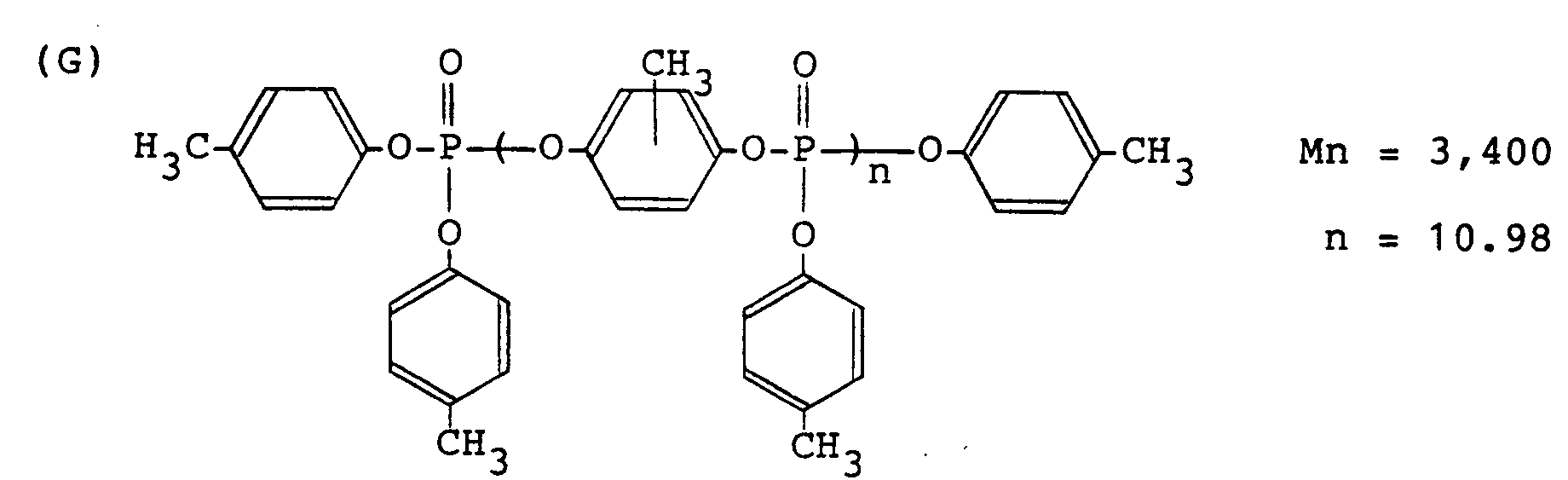


Claims (19)
- A flame-retardant polymer composition comprising a thermoplastic polymer and a flame retarder having a chemical structure represented by the following formula (1):

- A flame-retardant polymer composition according to claim 1, wherein each of k and m in the formula (1) is 1.
- A flame-retardant polymer composition according to claim 1 or claim 2, wherein Ar¹, Ar², Ar³ and Ar⁴ in the formula (1) independently represent a phenyl, tolyl or xylyl group.
- A flame-retardant polymer composition according to claim 1, wherein the flame retarder has a chemical structure represented by the following formula (2):

- A flame-retardant polymer composition according to any one of claims 1 to 4, wherein n in the formula (1) is a number in the range of 1 to 2.5.
- A flame-retardant polymer composition according to any one of claims 1 to 4, wherein n in the formula (1) is a number in the range of 6 to 100.
- A flame-retardant polymer composition according to any preceding claim, wherein the amount of the flame retarder having a chemical structure of the formula (1) is 0.5 to 100 parts by weight per 100 parts by weight of the thermoplastic polymer.
- A flame-retardant polymer composition according to any preceding claim, wherein the thermoplastic polymer is a thermoplastic polyester.
- A flame-retardant polymer composition according to any one of claims 1 to 7, wherein the thermoplastic polymer is a mixture comprising a thermoplastic polyester and at least one thermoplastic polymer selected from a phenoxy resin, a polyphenylene oxide, a modified polyphenylene oxide and polyphenylene sulfide.
- A flame-retardant polvmer composition according to any preceding claim, which further comprises a salt of a triazine derivative represented by the following formula (3):

- A flame-retardant polymer composition according to claim 10, wherein the amount of the salt of a triazine derivative of the formula (3) with at least one acid of cyanuric acid and isocyanuric acid is 0.5 to 100 parts by weight per 100 parts by weight of the thermoplastic polymer.
- A flame-retardant polymer composition according to claim 10 or claim 11, wherein the salt of a triazine derivative of the formula (3) with at least one acid of cyanuric acid and isocyanuric acid in the polymer composition is a finely divided particulate material having an average particle diameter of not larger than 100 µm.
- A flame-retardant polymer composition according to any one of claims 10 to 12, wherein the triazine derivative of the formula (3) is melamine.
- A flame-retardant polymer composition according to any preceding claim, which further comprises a fluoro-polymer in an amount of 0.01 to 10 parts by weight per 100 parts by weight of the thermoplastic polymer.
- A flame-retardant polymer composition according to any preceding claim, which further comprises a hindered phenol stabilizer in an amount of 0.01 to 3 parts by weight per 100 parts by weight of the thermoplastic polymer.
- A flame-retardant polymer composition according to any preceding claim, which further comprises a filler in an amount of 5 to 140 parts by weight per 100 parts by weight of the thermoplastic polymer.
- A shaped article made of a flame-retardant polymer composition comprising a thermoplastic polymer and a flame retarder having a chemical structure represented by the following formula (1):

- A shaped article according to claim 17, which is an injection-molded article.
- A shaped article according to claim 17, which is a film or sheet.
Applications Claiming Priority (4)
| Application Number | Priority Date | Filing Date | Title |
|---|---|---|---|
| JP4288194 | 1994-03-14 | ||
| JP42881/94 | 1994-03-14 | ||
| JP204044/94 | 1994-08-29 | ||
| JP20404494 | 1994-08-29 |
Publications (1)
| Publication Number | Publication Date |
|---|---|
| EP0672717A1 true EP0672717A1 (en) | 1995-09-20 |
Family
ID=26382628
Family Applications (1)
| Application Number | Title | Priority Date | Filing Date |
|---|---|---|---|
| EP95301685A Withdrawn EP0672717A1 (en) | 1994-03-14 | 1995-03-14 | Flame-retardant polymer composition and shaped article thereof |
Country Status (3)
| Country | Link |
|---|---|
| EP (1) | EP0672717A1 (en) |
| KR (1) | KR950032580A (en) |
| CN (1) | CN1110976A (en) |
Cited By (14)
| Publication number | Priority date | Publication date | Assignee | Title |
|---|---|---|---|---|
| EP0955338A3 (en) * | 1998-05-07 | 1999-12-22 | Basf Aktiengesellschaft | Flame protected polyester moulding matters |
| US6031035A (en) * | 1998-02-13 | 2000-02-29 | Great Lakes Chemical Corporation | Process for making and using bisaryl diphosphates |
| US6388120B1 (en) | 1998-02-13 | 2002-05-14 | Pabu Services, Inc. | Continuous process for the manufacture of phosphoric acid esters |
| US6642288B1 (en) | 1997-07-10 | 2003-11-04 | Dsm N.V. | Halogen-free flame-retardant thermoplastic polyester or polyamide composition |
| US7019056B2 (en) | 2001-01-09 | 2006-03-28 | Bayer Aktiengesellschaft | Flame retardants which contain phosphorus, and flame-retardant thermoplastic molding compositions |
| WO2008027536A1 (en) * | 2006-08-31 | 2008-03-06 | Supresta Llc | Oligomeric bis-phosphate flame retardants and compositions containing the same |
| US7829614B2 (en) | 2008-12-30 | 2010-11-09 | Sabic Innovative Plastics Ip B.V. | Reinforced polyester compositions, methods of manufacture, and articles thereof |
| US8034870B2 (en) | 2003-12-17 | 2011-10-11 | Sabic Innovative Plastics Ip B.V. | Flame-retardant polyester composition |
| US8138244B2 (en) | 2008-12-30 | 2012-03-20 | Sabic Innovative Plastics Ip B.V. | Reinforced polyester compositions, method of manufacture, and articles thereof |
| US8188172B2 (en) | 2003-12-17 | 2012-05-29 | Sabic Innovative Plastics Ip B.V. | Polyester compositions, method of manufacture, and uses thereof |
| US8686072B2 (en) | 2010-06-29 | 2014-04-01 | Sabic Innovative Plastics Ip B.V. | Flame resistant polyester compositions, method of manufacture, and articles therof |
| US8716378B2 (en) | 2010-06-29 | 2014-05-06 | Sabic Innovative Plastics Ip B.V. | Flame resistant polyester compositions, method of manufacture, and articles thereof |
| WO2018047166A1 (en) * | 2016-09-08 | 2018-03-15 | Bromine Compounds Ltd. | Flame-retarded transparent polycarbonate compositions |
| WO2025074362A1 (en) | 2023-10-01 | 2025-04-10 | Bromine Compounds Ltd. | Flame-retarded reinforced polycarbonate compositions |
Families Citing this family (2)
| Publication number | Priority date | Publication date | Assignee | Title |
|---|---|---|---|---|
| CN102558225B (en) * | 2011-12-12 | 2015-03-11 | 湖北犇星化工有限责任公司 | Aryl phosphatide high-efficiency flame retardant and synthesis method thereof |
| CN103073727A (en) * | 2012-11-29 | 2013-05-01 | 浙江大学宁波理工学院 | Polyphosphoester expanding flame retardant and preparation method thereof |
Citations (5)
| Publication number | Priority date | Publication date | Assignee | Title |
|---|---|---|---|---|
| GB1405983A (en) * | 1972-03-03 | 1975-09-10 | Mitsubishi Rayon Co | Fireproof polyester composition |
| DE2701493A1 (en) * | 1976-01-16 | 1977-07-21 | Ici Ltd | PHENOLPHOSPHATE |
| EP0386916A1 (en) * | 1989-02-27 | 1990-09-12 | Polyplastics Co. Ltd. | Flame-retardant polyester resin composition |
| US5122556A (en) * | 1990-04-23 | 1992-06-16 | General Electric Company | Tetra (lower alkaryl) p-phenylene diphosphate-polycarbonate blends |
| US5278212A (en) * | 1991-10-14 | 1994-01-11 | Asahi Kasei Kogyo Kabushiki Kaisha | Flow modifier for thermoplastic resin and thermoplastic resin composition containing the same |
-
1995
- 1995-03-10 KR KR1019950004937A patent/KR950032580A/en not_active Withdrawn
- 1995-03-14 EP EP95301685A patent/EP0672717A1/en not_active Withdrawn
- 1995-03-14 CN CN95103096A patent/CN1110976A/en active Pending
Patent Citations (5)
| Publication number | Priority date | Publication date | Assignee | Title |
|---|---|---|---|---|
| GB1405983A (en) * | 1972-03-03 | 1975-09-10 | Mitsubishi Rayon Co | Fireproof polyester composition |
| DE2701493A1 (en) * | 1976-01-16 | 1977-07-21 | Ici Ltd | PHENOLPHOSPHATE |
| EP0386916A1 (en) * | 1989-02-27 | 1990-09-12 | Polyplastics Co. Ltd. | Flame-retardant polyester resin composition |
| US5122556A (en) * | 1990-04-23 | 1992-06-16 | General Electric Company | Tetra (lower alkaryl) p-phenylene diphosphate-polycarbonate blends |
| US5278212A (en) * | 1991-10-14 | 1994-01-11 | Asahi Kasei Kogyo Kabushiki Kaisha | Flow modifier for thermoplastic resin and thermoplastic resin composition containing the same |
Cited By (18)
| Publication number | Priority date | Publication date | Assignee | Title |
|---|---|---|---|---|
| US6642288B1 (en) | 1997-07-10 | 2003-11-04 | Dsm N.V. | Halogen-free flame-retardant thermoplastic polyester or polyamide composition |
| US6031035A (en) * | 1998-02-13 | 2000-02-29 | Great Lakes Chemical Corporation | Process for making and using bisaryl diphosphates |
| US6388120B1 (en) | 1998-02-13 | 2002-05-14 | Pabu Services, Inc. | Continuous process for the manufacture of phosphoric acid esters |
| EP0955338A3 (en) * | 1998-05-07 | 1999-12-22 | Basf Aktiengesellschaft | Flame protected polyester moulding matters |
| US7019056B2 (en) | 2001-01-09 | 2006-03-28 | Bayer Aktiengesellschaft | Flame retardants which contain phosphorus, and flame-retardant thermoplastic molding compositions |
| US8034870B2 (en) | 2003-12-17 | 2011-10-11 | Sabic Innovative Plastics Ip B.V. | Flame-retardant polyester composition |
| US8188172B2 (en) | 2003-12-17 | 2012-05-29 | Sabic Innovative Plastics Ip B.V. | Polyester compositions, method of manufacture, and uses thereof |
| US8119711B2 (en) | 2006-08-31 | 2012-02-21 | Icl-Ip America Inc. | Oligomeric bisphosphate flame retardants and compositions containing the same |
| WO2008027536A1 (en) * | 2006-08-31 | 2008-03-06 | Supresta Llc | Oligomeric bis-phosphate flame retardants and compositions containing the same |
| TWI400246B (en) * | 2006-08-31 | 2013-07-01 | Supresta Llc | Oligomeric bis-phosphate flame retardants and compositions containing the same |
| US7829614B2 (en) | 2008-12-30 | 2010-11-09 | Sabic Innovative Plastics Ip B.V. | Reinforced polyester compositions, methods of manufacture, and articles thereof |
| US8138244B2 (en) | 2008-12-30 | 2012-03-20 | Sabic Innovative Plastics Ip B.V. | Reinforced polyester compositions, method of manufacture, and articles thereof |
| US8686072B2 (en) | 2010-06-29 | 2014-04-01 | Sabic Innovative Plastics Ip B.V. | Flame resistant polyester compositions, method of manufacture, and articles therof |
| US8716378B2 (en) | 2010-06-29 | 2014-05-06 | Sabic Innovative Plastics Ip B.V. | Flame resistant polyester compositions, method of manufacture, and articles thereof |
| WO2018047166A1 (en) * | 2016-09-08 | 2018-03-15 | Bromine Compounds Ltd. | Flame-retarded transparent polycarbonate compositions |
| US20190185755A1 (en) * | 2016-09-08 | 2019-06-20 | Bromine Compounds Ltd. | Flame-retarded transparent polycarbonate compositions |
| US10934489B2 (en) | 2016-09-08 | 2021-03-02 | Bromine Compounds Ltd. | Flame-retarded transparent polycarbonate compositions |
| WO2025074362A1 (en) | 2023-10-01 | 2025-04-10 | Bromine Compounds Ltd. | Flame-retarded reinforced polycarbonate compositions |
Also Published As
| Publication number | Publication date |
|---|---|
| CN1110976A (en) | 1995-11-01 |
| KR950032580A (en) | 1995-12-22 |
Similar Documents
| Publication | Publication Date | Title |
|---|---|---|
| JP5214099B2 (en) | Flame retardant polybutylene terephthalate resin composition | |
| EP1425340B1 (en) | Flame-retardant polyester composition, method for the preparation thereof, and articles derived therefrom | |
| CN110691819B (en) | Thermoplastic polyester resin composition and molded article thereof | |
| KR20160088292A (en) | Thermoplastic polyester resin composition and molded article | |
| JP2010037375A (en) | Flame-retardant thermoplastic polyester resin composition and molded article | |
| JP2021014478A (en) | Thermoplastic polyester resin composition and molded article | |
| KR101632571B1 (en) | Halogen-free flame retardant polyester resin composition with good mechanical properties and molded article thereof | |
| KR101748243B1 (en) | Halogen-free flame-retardant polyester resin composition having high fluidity and surface gloss and molded article thereof | |
| JP3633163B2 (en) | Flame retardant resin composition | |
| EP0889094B1 (en) | Flame-retardant resin composition | |
| KR100493201B1 (en) | A flame retardant resin composition | |
| CN115715309B (en) | Polyphosphonate resin composition and molded article made therefrom | |
| JPH1025338A (en) | Phosphorus-containing polyester polymer and resin composition | |
| JP3484804B2 (en) | Flame retardant resin composition | |
| JP3484803B2 (en) | Flame retardant resin composition | |
| JP3484802B2 (en) | Flame retardant polymer composition and molded article | |
| JPS638453A (en) | Thermoplastic polyester resin composition | |
| JP3307056B2 (en) | Flame retardant resin composition | |
| JP3435875B2 (en) | Flame retardant resin composition | |
| JPH09296120A (en) | Flame retardant resin composition | |
| JPS5817150A (en) | Flame-retardant polyester composition | |
| JP2597668B2 (en) | Flame retardant polyester composition | |
| JPH0696665B2 (en) | Flame-retardant polyester resin composition | |
| JP3155178B2 (en) | Flame retardant polyethylene terephthalate resin composition | |
| JP3944980B2 (en) | Flame retardant resin composition and molded article |
Legal Events
| Date | Code | Title | Description |
|---|---|---|---|
| PUAI | Public reference made under article 153(3) epc to a published international application that has entered the european phase |
Free format text: ORIGINAL CODE: 0009012 |
|
| AK | Designated contracting states |
Kind code of ref document: A1 Designated state(s): DE FR GB IT |
|
| RIN1 | Information on inventor provided before grant (corrected) |
Inventor name: NISHIMURA, TORU Inventor name: MATSUOKA, HIDEO Inventor name: OKITA, SHIGERU |
|
| 17P | Request for examination filed |
Effective date: 19960226 |
|
| 17Q | First examination report despatched |
Effective date: 19981028 |
|
| STAA | Information on the status of an ep patent application or granted ep patent |
Free format text: STATUS: THE APPLICATION IS DEEMED TO BE WITHDRAWN |
|
| 18D | Application deemed to be withdrawn |
Effective date: 19990309 |