EP0670676B1 - Modified forms of natamycin, methods for preparing them and antifungal compositions containing them - Google Patents
Modified forms of natamycin, methods for preparing them and antifungal compositions containing them Download PDFInfo
- Publication number
- EP0670676B1 EP0670676B1 EP94928841A EP94928841A EP0670676B1 EP 0670676 B1 EP0670676 B1 EP 0670676B1 EP 94928841 A EP94928841 A EP 94928841A EP 94928841 A EP94928841 A EP 94928841A EP 0670676 B1 EP0670676 B1 EP 0670676B1
- Authority
- EP
- European Patent Office
- Prior art keywords
- natamycin
- methanol
- antifungal
- hours
- composition
- Prior art date
- Legal status (The legal status is an assumption and is not a legal conclusion. Google has not performed a legal analysis and makes no representation as to the accuracy of the status listed.)
- Expired - Lifetime
Links
Images

Classifications
-
- C—CHEMISTRY; METALLURGY
- C12—BIOCHEMISTRY; BEER; SPIRITS; WINE; VINEGAR; MICROBIOLOGY; ENZYMOLOGY; MUTATION OR GENETIC ENGINEERING
- C12Q—MEASURING OR TESTING PROCESSES INVOLVING ENZYMES, NUCLEIC ACIDS OR MICROORGANISMS; COMPOSITIONS OR TEST PAPERS THEREFOR; PROCESSES OF PREPARING SUCH COMPOSITIONS; CONDITION-RESPONSIVE CONTROL IN MICROBIOLOGICAL OR ENZYMOLOGICAL PROCESSES
- C12Q1/00—Measuring or testing processes involving enzymes, nucleic acids or microorganisms; Compositions therefor; Processes of preparing such compositions
- C12Q1/02—Measuring or testing processes involving enzymes, nucleic acids or microorganisms; Compositions therefor; Processes of preparing such compositions involving viable microorganisms
- C12Q1/18—Testing for antimicrobial activity of a material
-
- A—HUMAN NECESSITIES
- A01—AGRICULTURE; FORESTRY; ANIMAL HUSBANDRY; HUNTING; TRAPPING; FISHING
- A01N—PRESERVATION OF BODIES OF HUMANS OR ANIMALS OR PLANTS OR PARTS THEREOF; BIOCIDES, e.g. AS DISINFECTANTS, AS PESTICIDES OR AS HERBICIDES; PEST REPELLANTS OR ATTRACTANTS; PLANT GROWTH REGULATORS
- A01N25/00—Biocides, pest repellants or attractants, or plant growth regulators, characterised by their forms, or by their non-active ingredients or by their methods of application, e.g. seed treatment or sequential application; Substances for reducing the noxious effect of the active ingredients to organisms other than pests
- A01N25/02—Biocides, pest repellants or attractants, or plant growth regulators, characterised by their forms, or by their non-active ingredients or by their methods of application, e.g. seed treatment or sequential application; Substances for reducing the noxious effect of the active ingredients to organisms other than pests containing liquids as carriers, diluents or solvents
-
- A—HUMAN NECESSITIES
- A01—AGRICULTURE; FORESTRY; ANIMAL HUSBANDRY; HUNTING; TRAPPING; FISHING
- A01N—PRESERVATION OF BODIES OF HUMANS OR ANIMALS OR PLANTS OR PARTS THEREOF; BIOCIDES, e.g. AS DISINFECTANTS, AS PESTICIDES OR AS HERBICIDES; PEST REPELLANTS OR ATTRACTANTS; PLANT GROWTH REGULATORS
- A01N43/00—Biocides, pest repellants or attractants, or plant growth regulators containing heterocyclic compounds
- A01N43/90—Biocides, pest repellants or attractants, or plant growth regulators containing heterocyclic compounds having two or more relevant hetero rings, condensed among themselves or with a common carbocyclic ring system
-
- A—HUMAN NECESSITIES
- A01—AGRICULTURE; FORESTRY; ANIMAL HUSBANDRY; HUNTING; TRAPPING; FISHING
- A01N—PRESERVATION OF BODIES OF HUMANS OR ANIMALS OR PLANTS OR PARTS THEREOF; BIOCIDES, e.g. AS DISINFECTANTS, AS PESTICIDES OR AS HERBICIDES; PEST REPELLANTS OR ATTRACTANTS; PLANT GROWTH REGULATORS
- A01N63/00—Biocides, pest repellants or attractants, or plant growth regulators containing microorganisms, viruses, microbial fungi, animals or substances produced by, or obtained from, microorganisms, viruses, microbial fungi or animals, e.g. enzymes or fermentates
- A01N63/30—Microbial fungi; Substances produced thereby or obtained therefrom
- A01N63/32—Yeast
-
- A—HUMAN NECESSITIES
- A23—FOODS OR FOODSTUFFS; TREATMENT THEREOF, NOT COVERED BY OTHER CLASSES
- A23B—PRESERVATION OF FOODS, FOODSTUFFS OR NON-ALCOHOLIC BEVERAGES; CHEMICAL RIPENING OF FRUIT OR VEGETABLES
- A23B11/00—Preservation of milk or dairy products
- A23B11/60—Preservation of cheese or cheese preparations
- A23B11/65—Preservation of cheese or cheese preparations by addition of preservatives
- A23B11/67—Preservation of cheese or cheese preparations by addition of preservatives of antibiotics
-
- A—HUMAN NECESSITIES
- A23—FOODS OR FOODSTUFFS; TREATMENT THEREOF, NOT COVERED BY OTHER CLASSES
- A23B—PRESERVATION OF FOODS, FOODSTUFFS OR NON-ALCOHOLIC BEVERAGES; CHEMICAL RIPENING OF FRUIT OR VEGETABLES
- A23B2/00—Preservation of foods or foodstuffs, in general
- A23B2/70—Preservation of foods or foodstuffs, in general by treatment with chemicals
- A23B2/725—Preservation of foods or foodstuffs, in general by treatment with chemicals in the form of liquids or solids
- A23B2/729—Organic compounds; Microorganisms; Enzymes
- A23B2/7295—Antibiotics
-
- A—HUMAN NECESSITIES
- A23—FOODS OR FOODSTUFFS; TREATMENT THEREOF, NOT COVERED BY OTHER CLASSES
- A23C—DAIRY PRODUCTS, e.g. MILK, BUTTER OR CHEESE; MILK OR CHEESE SUBSTITUTES; PREPARATION THEREOF
- A23C19/00—Cheese; Cheese preparations; Making thereof
- A23C19/14—Treating cheese after having reached its definite form, e.g. ripening or smoking
- A23C19/16—Covering the cheese surface, e.g. with wax coating compositions
-
- A—HUMAN NECESSITIES
- A23—FOODS OR FOODSTUFFS; TREATMENT THEREOF, NOT COVERED BY OTHER CLASSES
- A23C—DAIRY PRODUCTS, e.g. MILK, BUTTER OR CHEESE; MILK OR CHEESE SUBSTITUTES; PREPARATION THEREOF
- A23C19/00—Cheese; Cheese preparations; Making thereof
- A23C19/14—Treating cheese after having reached its definite form, e.g. ripening or smoking
- A23C19/16—Covering the cheese surface, e.g. with wax coating compositions
- A23C19/163—Covering the cheese surface, e.g. with wax coating compositions with a non-edible liquid or semi-liquid coating, e.g. wax, polymer dispersions
-
- A—HUMAN NECESSITIES
- A61—MEDICAL OR VETERINARY SCIENCE; HYGIENE
- A61K—PREPARATIONS FOR MEDICAL, DENTAL OR TOILETRY PURPOSES
- A61K31/00—Medicinal preparations containing organic active ingredients
- A61K31/70—Carbohydrates; Sugars; Derivatives thereof
-
- C—CHEMISTRY; METALLURGY
- C07—ORGANIC CHEMISTRY
- C07H—SUGARS; DERIVATIVES THEREOF; NUCLEOSIDES; NUCLEOTIDES; NUCLEIC ACIDS
- C07H17/00—Compounds containing heterocyclic radicals directly attached to hetero atoms of saccharide radicals
- C07H17/04—Heterocyclic radicals containing only oxygen as ring hetero atoms
- C07H17/08—Hetero rings containing eight or more ring members, e.g. erythromycins
-
- G—PHYSICS
- G01—MEASURING; TESTING
- G01N—INVESTIGATING OR ANALYSING MATERIALS BY DETERMINING THEIR CHEMICAL OR PHYSICAL PROPERTIES
- G01N33/00—Investigating or analysing materials by specific methods not covered by groups G01N1/00 - G01N31/00
- G01N33/48—Biological material, e.g. blood, urine; Haemocytometers
- G01N33/50—Chemical analysis of biological material, e.g. blood, urine; Testing involving biospecific ligand binding methods; Immunological testing
- G01N33/53—Immunoassay; Biospecific binding assay; Materials therefor
- G01N33/569—Immunoassay; Biospecific binding assay; Materials therefor for microorganisms, e.g. protozoa, bacteria, viruses
- G01N33/56961—Plant cells or fungi
Definitions
- natamycin has been used to prevent the growth of mould on cheese and sausages. (Ref. 1-12)
- Cheeses are treated by immersion in a suspension of natamycin in water or by coating with a natamycin-containing aqueous emulsion of a polymer, commonly an aqueous emulsion of polyvinyl acetate. Sausages are mainly treated by immersion or by spray coating with a suspension of natamycin in water.
- aqueous suspensions of natamycin for immersion treatments contain 0.1 to 0.2% w/v of natamycin, while polymer emulsions for coating purposes containing natamycin have a natamycin content of 0.01 to 0.05% w/v.
- the present invention relates to a process for improving the activity of natamycin towards mould, and the resulting modified forms of natamycin.
- Compositions comprising these forms are useful for combatting yeasts and fungi which are nornally relatively resistant to the action of natamycin.
- US patent 3,378,441 describes a process to improve the isolation and recovery of pimaricin (synonym of natamycin).
- the final steps in this process are dissolving the pimaricin after extraction of the wet filtercake with a lower alkanol, followed by spraydrying (Example 2). Since substantial amounts of water are still present in the alkanoid solution, we have found that this results in the formation of the unmodified form of ⁇ -natamycin.
- GB patent 844,289 describes the preparation of purified natamycin comprising the steps of precipitating the product from a dimethylformamide solution by the addition of water, followed by drying in vacuo. Since this way of drying does leave water in the precipitate, again, the ⁇ -form of natamycin will be formed.
- compositions for the antifungal treatment of citrus fruit and other agricultural products are obtained by combining natamycin or another polyene antibiotic with an alcohol, e.g. methyl-, ethyl- and propylalcohol or an organic acid, e.g. acetic and propionic acid.
- an alcohol e.g. methyl-, ethyl- and propylalcohol
- an organic acid e.g. acetic and propionic acid.
- the solubility of the polyene antibiotic is sufficient to penetrate the peel of the treated product and to inhibit mould growth for a prolonged period.
- Ref. 16 describes the influence of polymorphism in pharmaceutical applications.
- the factor to be considered in the preparation of physically stable and effective dosage forms are specified, together with methods to study polymorphism.
- Polymorphism is herein described as "the ability of any element or compound to crystallyze as more than one distinct crystal species" (page 911, 3rd paragraph, lines 1-3).
- An important consequence thereof is that polymorphs have different properties, e.g. solubility, melting point, density etc. These difference have to be taken into consideration when drugs which may exist in different polymorphs are comprised in pharmaceutical preparations.
- Ref. 15 addresses the effect of polymorphism of polyene antibiotics, e.g. mepartricin and nystatin, on the respective toxicity in mice. Ref. 15 shows that polymorphs of the same drug, as a result of different solubility and availability, display different toxicities.
- polyene antibiotics e.g. mepartricin and nystatin
- a modified form of natamycin can also be obtained by subjecting the compound with the "empty" crystal lattice to a humid condition. When ⁇ -natamycin is subjected to 76% RH a new trihydrated crystal modification is obtained.
- This new compound which is named ⁇ -natamycin, has an enhanced activity towards species which are normally relatively resistant to the action of the original ⁇ -natamycin, which is also a trihydrated form of natamycin (see Ref. 14, p. 520).
- the invention relates to a method of preparing an anti-fungal composition containing natamycin characterised in that said natamycin is incorporated into the composition in a modified form which shows an enhanced release profile in comparison to the unmodified ⁇ -natamycin.
- the natamycin is brought in the modified form by applying the method specified above.
- natamycin form is disclosed. This compound is selected from the group consisting of
- Preparations containing activated fungicide are useful for preventing_the growth of fungi which are normally relatively resistant to the action of polyene fungicides.
- fungi which have relatively low susceptibility towards natamycin are verticillium cinnabarinum, Botrytis cinerea and Trichophyton species.
- Aspergillus Fusarium and Penicillin species, species exhibiting relatively high tolerance to natamycin may also be found.
- An example of such a species is Penicillium echinulatum var. discolor.
- the present invention provides anti-fungal compositions comprising a modified form of natamycin, the latter obtained by applying one of the above mentioned methods.
- the invention provides a method of treating a food or agricultural product to inhibit yeast or fungal growth which comprises applying a composition of the invention.
- a solution of natamycin may be incorporated into all kinds of preparations which are suitable for treating foodstuffs such as cheese and sausages and/or for treating agricultural products such as fruit, vegetables and seed.
- suitable preparations for treating foodstuffs such as cheese and sausages are, for instance, coating emulsions which can be applied by brushing or by using a spray device and liquid preparations which can be used for immersion treatments.
- the pH of a preparation according to the invention for food or agricultural product treatment is from 1 to 10, more preferably from 2 to 8 and most preferably from 3.5 to 7.5.
- the invention concerns foods and agricultural products when so treated.
- modified form of natamycin may also be incorporated into pharmaceutical preparations, for instance for topical application.
- suitable pharmaceutical preparations are lotions, creams and ointments.
- Figure 1 (application of several natamycin preparations on cheese) shows the inhibiting effect against Penicillium echinulatum var. discolor of coating emulsions containing ⁇ -natamycin (composition J) or ⁇ -natamycin (composition K) as compared to a reference coating emulsion containing ⁇ -natamycin (composition D) and to a blank coating emulsion (composition E).
- the invention provides novel types of natamycin anti-fungal preparations and compositions to prevent spoilage of foodstuffs and/or agricultural products by mould and for use as a pharmaceutical.
- the compositions are characterised by enhanced anti-fungal activity of natamycin towards species which normally exhibit relatively high tolerance towards such compounds.
- examples of fungi which are relatively resistant towards natamycin are Verticillium cinnabarinum, Botrytis cinerea and Trichophyton species.
- Aspergillus Fusarium and Penicillium species, species exhibiting relatively high tolerance to natamycin may also be found.
- An example of such a species is Penicillium echinulatum var. discolor.
- the enhanced activity of a composition of the present invention is presumably due to improved availability of natamycin, as a result of improved dissolution.
- fungicide which is in solution will be available to exert anti-fungal activity.
- the dissolution of the fungicide the diffusion of the dissolved fungicide to the site of infection and the elimination of the dissolved fungicide.
- Natamycin may be deactivated by decomposition through the action of light or by hydrolysis (Ref.2).
- Natamycin has a MIC (minimal inhibitory concentration) of less than 10 ppm for most foodborn fungi, while its solubility in water is from 30 to 50 ppm (Ref. 13).
- MIC minimum inhibitory concentration
- the efficacy of natamycin in conventional anti-fungal preparations towards such fungi will thus not be limited significantly by solubilisation or diffusion factors, because the solubility is far higher than the MIC value. Elimination of dissolved natamycin will be compensated sufficiently by dissolution of undissolved natamycin and by diffusion of dissolved natamycin to the site of infection.
- natamycin When natamycin is applied in a solvent such as glycerol to the surface of for instance cheese which is inoculated with Penicillium echinulatum var. discolor , it does not adequately suppress the growth of the fungus. Also, the use of a micronised sample gives little improvement in result as compared to the use of a non-micronised sample.
- compositions according to the invention have a characteristic fungicide release profile when measured according to the method described in Example 1.
- a suspension of natamycin in water or in a polyvinyl acetate emulsion normally has an initial natamycin release rate of about 1 to 2 ⁇ g/day.
- compositions according to the invention exhibit a fungicide release rate of at least about 3 ⁇ g/day over at least the first day. A fungicide release rate as high as about 20 ⁇ g/day or even higher may be observed.
- Polymorphic forms of some polyene antifungal compounds are known. Ref. 15 for instance mentioned that the discrepancies of the acute toxicity values between various batches of polyene antifungal compounds, in particular of mepartricin and nystatin, could be attributed to polymorphic forms. At the other hand no differences of the microbiological activity between the different polymorphic forms of mepartricin or of nystatin were observed.
- natamycin methanol solvate contains about 2 moles of methanol and about 0.5 mole of water per mole of natamycin.
- natamycin methanol solvate looses its methanol completely when subjected to diminished pressure over phosphorous pentoxide.
- X-ray analysis revealed that the result is a new crystal modification of natamycin, which will be further referred to as ⁇ -natamycin.
- ⁇ -Natamycin can be stored in a closed bottle without decomposition for more than 3 months, although the colour of the white substance tends to turn to yellow. Under refrigeration and/or inert conditions however, the substance can be kept for more than three months without discoloration. This is surprising because natamycin trihydrate which is extremely dried by subjecting to vacuo over phosphorus pentoxide when stored in a closed bottle looses 15% of its activity within 48 hours (Ref. 14, page 542). Surprisingly ⁇ -natamycin also has an improved dissolution and moreover also an enhanced activity towards species with a low susceptibility to natamycin.
- the invention also comprises ⁇ -natamycin which is obtained by removing (part of) the solvated methanol molecules from the crystal lattice of the natamycin methanol solvate e.g. by subjection to diminished pressure over a water binding agent like phosphorous pentoxide or by the application of diminished pressure in combination with a small flow of an inert gas like nitrogen.
- ⁇ -Natamycin when stored at 76% RH is converted to a crystal modification which contain 3 moles of water per mole of natamycin.
- the new crystal form is different from the original ⁇ -modification.
- ⁇ -natamycin is a white stable substance which colour changes slowly to yellow when stored at ambient conditions. However when stored under inert gas conditions, e.g. under nitrogen, the colour remains white. Furthermore as indicated by the improved dissolution ⁇ -natamycin also has an enhanced activity towards species with a low susceptibility in comparison to the ⁇ -modification.
- ⁇ -natamycin can be converted into a variety of solvates when subjected to the influence of vapours of several solvents.
- a feature of the invention are substances which are obtained by subjecting the "empty" crystal modification of ⁇ -natamycin with vapours of solvents.
- Suitable solvents to prepare the polymorphic forms are those belonging to the groups of lower (polyhydric) alcohols, aliphatic ketones, halogenated aliphatic hydrocarbons, aliphatic cyano hydrocarbons, aliphatic ethers and aliphatic esters or mixtures thereof.
- suitable solvents are ethanol, methoxy ethanol, chloroform, methylene chloride, acetonitrile, dioxane, acetone and ethyl acetate.
- a small amount of moisture in the solvent system of up to 1% may also be present.
- compositions according to the invention which may be used for the treatment of foodstuffs such as cheese or sausages may be, for example, liquids for treatment by immersion and/or by spraying, or coating emulsions like that of the polyvinyl acetate type or of the oil in water (o/w) or water in oil (w/o) type.
- compositions of the invention for the treatment of agricultural products such as flower bulbs, (kernel) grain and vegetables may be, for example, aqueous systems which may be used by methods known per se, e.g. dipping or spraying.
- compositions for topical application in which a solution of a modified form of natamycin may be incorporated are lotions, creams and ointments.
- the amount of natamycin, in a liquid composition for immersion treatment may be from 0.01% to 2% w/v. Preferably, the amount is from 0.01% to 1% w/v.
- the immersion liquid may be of any kind.
- a surfactant may be of advantage, in particular for treating objects with a hydrophobic surface.
- the amount of natamycin may be from 0.0.05% to 2% w/v, preferably from 0.01% to 1% w/v and more preferably from 0.01% to 0.5% w/v.
- the coating emulsion may be of the o/w or w/o type. Particularly preferred are emulsions prepared from coating emulsions commonly employed in the food industry. For example, for the treatment of hard cheeses an aqueous polymer emulsion of the polyvinyl acetate type may be used.
- the pH of a composition according to the invention for food or agricultural product treatment is from 1 to 10, more preferably from 2 to 8 and most preferably from 3.5 to 7.5.
- the pH of such a composition may be adjusted by any method known in the art, e.g. by adding an acidic or a basic compound or by using a buffering system.
- Useful acids for this purpose are for example citric acid, lactic acid, hydrochloric acid, phosphoric acid, sulphuric acid and tartaric acid.
- Useful basic compounds which may be alternatively employed are for example, sodium hydroxide, potassium hydroxide, ammonia and calcium hydroxide.
- Useful buffering systems which may be employed in compositions of the invention are for instance those of the phosphate and citrate types.
- DSC and TG/DTA measurements were carried out using the SSC 5200 system of Seiko provided with the DSC 120 and the TG/DTA 220 furnaces. Standard procedures were used to obtain the desired data.
- a sealed (UFO-shaped) pan (A1) was chosen with a hole in the cover was used as a sample container. The hole in the cover was reproducibly made by using a standard needle.
- DSC temperature programme -35 to 270 °C heating rate 5 °C/min sampling 0.5 sec atmosphere nitrogen (80 ml/min) reference 1.154 mg of alumina in sealed pan (Al) with a hole in the cover sample size 1.20 ⁇ 0.15 mg sample container 15 ⁇ l sealed sample container (A1) with a hole in the cover TG/DTA temperature programme 22 to 230 °C heating rate 2.5 °C/min sampling 0.5 sec atmosphere nitrogen (100 ml/min) reference empty, open Pt pan sample size ⁇ 5 mg sample container open Pt pan
- the X-ray pattern of the different natamycin crystals were determined with a Guinier camera with a monochromator, type Johansson, utilizing CuK ⁇ radiation.
- This example describes a microbiological method for determining the availability of natamycin from an anti-fungal composition.
- Filter paper discs (S&S Antibiotics Test Discs no. 321260) with a diameter of 0.6 cm were loaded with the preparation to be tested such that each disc was loaded with 40 ⁇ g of natamycin, e.g. 50 ⁇ l of a sample containing 800 ppm of natamycin was applied to a disc. The discs were then put on agar which was seeded with Saccharomyces cerevisiae ATCC 9763. The petri dishes containing the agar were then stored for 24 hours at 6°C to permit the natamycin to release into the agar. Under these conditions, Saccharomyces does not grow. As a reference, discs were freshly loaded with a range of known amounts of natamycin dissolved in aqueous methanol.
- sample discs were transferred to new petri dishes containing agar seeded with Saccharomyces cerevisiae. New discs freshly loaded with a range of known quantities of dissolved natamycin were prepared for use as a reference. The new dishes with the sample discs and the new references were stored at 6°C for 24 hours and the old dishes containing the released natamycin incubated at 30°C for 24 hours.
- the size of the inhibition zone is a measure of the natamycin released from the sample disc.
- the amount of released natamycin can be calculated by methods known per se. By repeating the procedure, the released natamycin can be measured on a daily basis. Other release time periods may alternatively be chosen.
- natamycin Under stirring 11 g of industrial grade natamycin was suspended in a mixture of 640 ml of water and 160 ml of n-propanol. The pH was adjusted to 9.9 by adding concentrated ammonia. The obtained solution was then treated with 11 g of carbon black and filtered over a Seitz filter. By adjusting the pH of the filtrate to 6.5 by means of a 50% solution of acetic acid the natamycin was brought to crystallisation.
- the crystals were collected by filtration and washed with water.
- the crystalline mass was resuspended in 400 ml of water, filtered off and successively washed with 50 ml of water and 50 ml of acetone. After drying overnight at 40°C in a ventilation box 7.78 g of natamycin was obtained.
- the material was equilibrated at 76% relative humidity to yield 7.83 g of ⁇ -natamycin.
- the specific DSC data are: endotherms at T top 45.2, 65.9 and 104.7 °C (water) and an endotherm immediately followed by an exotherm at T top 205.6 and 221.2 °C respectively (decomposition).
- the presence of methanol was proved by NMR analysis.
- the DSC thermogram showed two endotherms at T top 53.4 and 71.5 °C (methanol), an endotherm at T top at 123.5 °C (water) and an endotherm immediately followed by an exotherm at T top 181.2 and 186.1 °C respectively (decomposition).
- the preparation of the methanol solvate can also be performed at room temperature without previous heating and at a higher concentration, e.g. 100g of natamycin in 1 1 of methanol. In this case no clear solution will be obtained prior to the formation of the methanol solvate. Usually the conversion of the ⁇ -natamycin to the methanol solvate is completed within 15 minutes.
- Samples of 100 mg of natamycin methanol solvate were stored at respectively 20 °C, 4 °C and -35 °C in an air or in a nitrogen atmosphere.
- the decomposition rate of natamycin methanol solvate was decreased considerably by storing under nitrogen and/or at low temperature.
- natamycin methanol solvate into ⁇ -natamycin can also be established by heating the material at 52 °C in vacuo for 19 hours without using P 2 O 5 or by subjecting the methanol solvate at room temperature for 72 hours to diminished pressure and a small continuous flow of nitrogen gas.
- Samples of 180 mg samples of ⁇ -natamycin were stored at respectively 20 °C, 4 °C and -35 °C in an air or in a nitrogen atmosphere. ⁇ -Natamycin proved to be much more stable than the corresponding methanol solvate. As indicated by DSC ⁇ -natamycin stored for 3 months at room temperature in an air atmosphere showed no trace of decomposition. Only a slight discoloration was observed.
- the DSC thermogram showed three endotherms at T top 42.8, 60.3 and 124.8 °C (water) and an endotherm immediately followed by an exotherm at T top 182.5 and 186.8 °C respectively (decomposition).
- natamycin methanol solvate was suspended in 100 ml of demineralized water. The suspension was stirred for 25 hours. The crystals were filtered off and washed with respectively 25 ml of water and 50 ml of acetone and then dried overnight in a ventilation box at 35 °C. 0.81 g of material was obtained of which the DSC thermogram was identical to ⁇ -natamycin. Typical data were: three endotherms at T top 44.6, 68.4 and 97.9 °C (water) and a small endotherm immediately followed by an exotherm at T top 216.2 and 230.0 °C respectively (decomposition).
- a 200 mg sample of ⁇ -natamycin was stirred during 24 hours at 32 °C with 2 ml of a solvent.
- the crystalline material was then filtered off, washed with the applied solvent and dried on the filter under a stream of nitrogen gas until dry. Eventually the crystals were washed on the filter with a small portion of acetone or diethyl ether.
- the solvates of natamycin with the following solvents were obtained: methanol, ethanol, 1-propanol, 1-butanol, 2-methoxyethanol, methyl formate, acetonitrile, dimethyl sulphoxide, and formamide.
- the conversion of ⁇ -natamycin to the solvates was confirmed by DSC analysis.
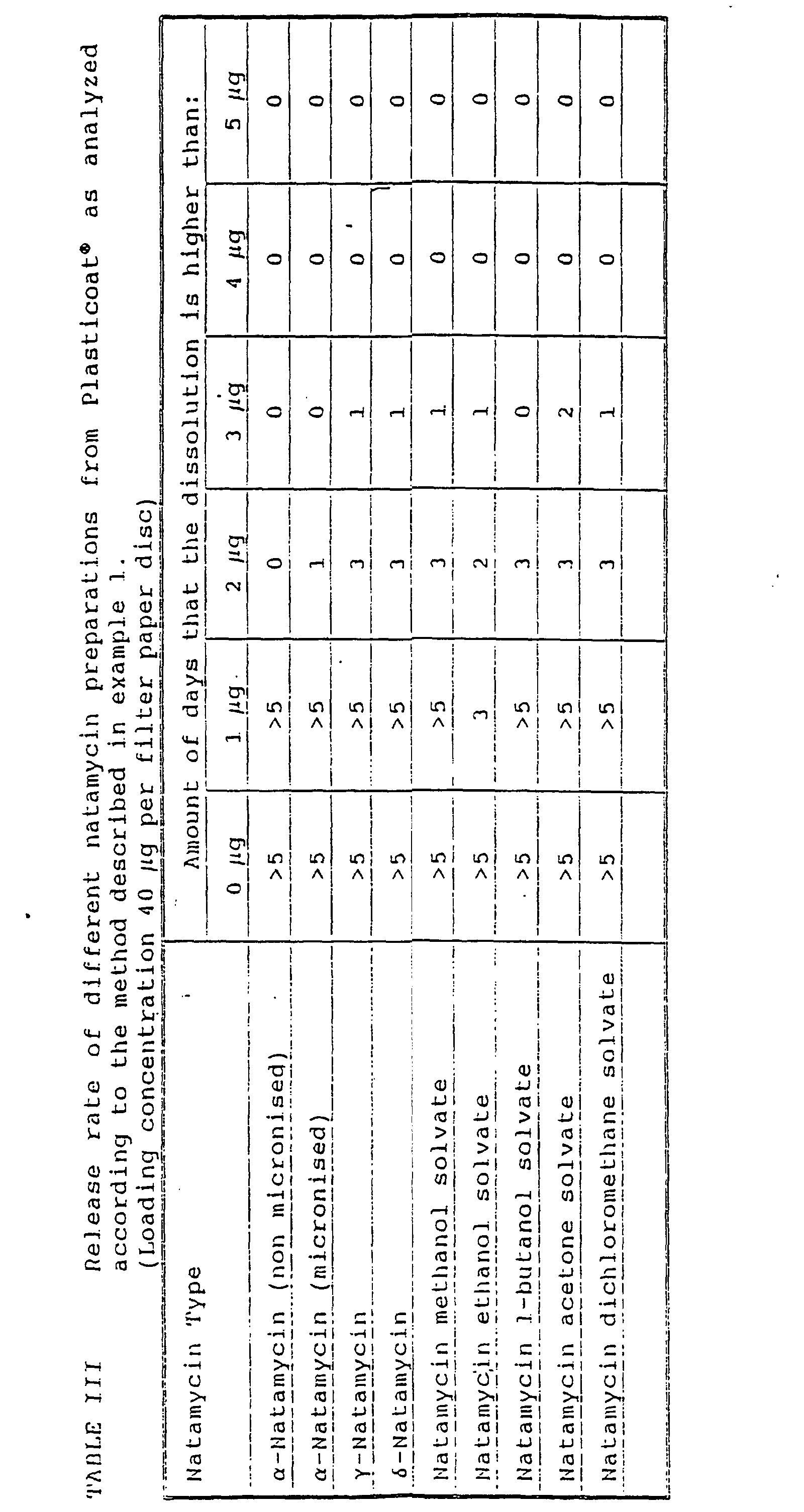
- micronised natamycin The release rate of micronised natamycin is comparable to that of non micronised natamycin, while the modified natamycin types have a higher release rate during a longer time.
- micronised natamycin from Plasticoat® is comparable to that of non micronised natamycin, while the modified natamycin types have a higher release rate during a longer time.
- This example illustrates the effect towards Penicillium echinulatum var. discolor on cheese of natamycin compositions prepared according to the invention.
- the coating compositions were applied to the surface of pieces of Gouda cheese according to the following procedure:
- a freshly brined wheel of Gouda cheese was first cut horizontally into two parts. Each part was then cut into pieces of 5 by 5 by 5 cm. Only pieces with a flat rind surface were taken for the experiment.
- the pieces of cheese were dipped into a bath of melted paraffin at 80°C in such a manner that the rind surface remained free of paraffin, while the other five surfaces were covered by a thin film of solidified paraffin.
- the rind surface was then inoculated with about 6 x 10 3 CFU/cm 2 of a mixture of spores of three strains of Penicillium echinulatum var. discolor (CBS numbers 611.92, 612.92 and 613.92).
- the inoculation was performed by applying 0.15 ml of a spore suspension containing about 10 6 CFU/ml to the surface of the piece of cheese.
- the inoculum was evenly spread over the surface by means of a sterile swab, which was saturated with the spore suspension.
- the pieces of cheese were treated with a blank Plasticoat® emulsion and Plasticoat® emulsions containing respectively 500 ppm of ⁇ -natamycin (composition D), 500 ppm of ⁇ -natamycin (composition J) and 500 ppm of ⁇ -natamycin (composition K).
- the natamycin preparations were suspended in water (1% w/v) prior to the addition to the Plasticoat®.
- 5 pieces of cheese were taken.
- 0.8 ml of the Plasticoat composition was applied and evenly spread over the surface of the cheese by means of a sterile rectangular piece of plastic of about 2 by 5 cm. After standing for 2 hours at ambient conditions, the pieces of cheese were incubated at 15°C and a relative humidity of 95%.
- the mould inhibiting effect was assessed as follows.
Landscapes
- Life Sciences & Earth Sciences (AREA)
- Health & Medical Sciences (AREA)
- Engineering & Computer Science (AREA)
- Chemical & Material Sciences (AREA)
- General Health & Medical Sciences (AREA)
- Zoology (AREA)
- Wood Science & Technology (AREA)
- Microbiology (AREA)
- Food Science & Technology (AREA)
- Organic Chemistry (AREA)
- Molecular Biology (AREA)
- Polymers & Plastics (AREA)
- Immunology (AREA)
- Biotechnology (AREA)
- Mycology (AREA)
- Agronomy & Crop Science (AREA)
- Environmental Sciences (AREA)
- Dentistry (AREA)
- Biochemistry (AREA)
- Plant Pathology (AREA)
- Pest Control & Pesticides (AREA)
- Biomedical Technology (AREA)
- Hematology (AREA)
- Physics & Mathematics (AREA)
- Urology & Nephrology (AREA)
- Genetics & Genomics (AREA)
- Analytical Chemistry (AREA)
- Proteomics, Peptides & Aminoacids (AREA)
- Medicinal Chemistry (AREA)
- Virology (AREA)
- Toxicology (AREA)
- Cell Biology (AREA)
- Bioinformatics & Cheminformatics (AREA)
- General Engineering & Computer Science (AREA)
- Botany (AREA)
- Animal Behavior & Ethology (AREA)
- Epidemiology (AREA)
- Tropical Medicine & Parasitology (AREA)
- Veterinary Medicine (AREA)
- Pharmacology & Pharmacy (AREA)
Abstract
Description
- δ-natamycin;
- γ-natamycin;
- The solvates of natamycin which are obtainable by contacting δ-natamycin with: ethanol, 1-propanol, 1-butanol, 2-methoxyethanol, methyl formate, ethyl formate, acetone, dichloromethane, acetonitrile, dimethylformamide, and formamide.
Further natamycin methanol solvate is an unstable substance (ref. 14, page 542) and therefore not very appropriate for practical use. By Differential Scanning Calorimetric (DSC) measurements, Thermogravimetric and Differential Thermal Analysis (TG/DTA) and Nuclear Magnetic Resonance (NMR) analysis it could be shown that natamycin methanol solvate contains about 2 moles of methanol and about 0.5 mole of water per mole of natamycin.
Surprisingly δ-natamycin also has an improved dissolution and moreover also an enhanced activity towards species with a low susceptibility to natamycin.
Furthermore as indicated by the improved dissolution γ-natamycin also has an enhanced activity towards species with a low susceptibility in comparison to the α-modification.
Standard procedures were used to obtain the desired data. A sealed (UFO-shaped) pan (A1) was chosen with a hole in the cover was used as a sample container. The hole in the cover was reproducibly made by using a standard needle.
| DSC | |
| temperature programme | -35 to 270 ° |
| heating rate | |
| 5 °C/min | |
| sampling | 0.5 sec |
| atmosphere | nitrogen (80 ml/min) |
| reference | 1.154 mg of alumina in sealed pan (Al) with a hole in the cover |
| sample size | 1.20 ± 0.15 |
| sample container | |
| 15 µl sealed sample container (A1) with a hole in the cover | |
| TG/DTA | |
| temperature programme | 22 to 230 °C |
| heating rate | 2.5 °C/min |
| sampling | 0.5 sec |
| atmosphere | nitrogen (100 ml/min) |
| reference | empty, open Pt pan |
| sample size | ± 5 mg |
| sample container | open Pt pan |
The crystalline material was then dried in vacuo for 1 hour at room temperature to yield 21.9 g of natamycin methanol solvate.
The preparation of the methanol solvate can also be performed at room temperature without previous heating and at a higher concentration, e.g. 100g of natamycin in 1 1 of methanol. In this case no clear solution will be obtained prior to the formation of the methanol solvate. Usually the conversion of the α-natamycin to the methanol solvate is completed within 15 minutes.
δ-Natamycin proved to be much more stable than the corresponding methanol solvate. As indicated by DSC δ-natamycin stored for 3 months at room temperature in an air atmosphere showed no trace of decomposition. Only a slight discoloration was observed.
The results are summarized in Table III.


"Use of natamycin for a protection of semihard cheeses against moulding"
Brief communications of the XXIII International Dairy Congress, Montreal, October 8-12, 1990, Vol. I.
"Prevention of mould growth on cheese by means of natamycin"
voedingsmiddelentechnologie, 18 (2), 26-29, (1985)
"Use of pimaricin as a fungicide on cheese rind: technology and the effects on the cheese surface flora"
Latte, 6 (5), 335-343, (1981)
"Control of surface growth on Blue cheese using pimaricin"
Cultured Diary Products Journal, 15 (2), 21-23, (1980)
"Use of pimaricin for preventing mould growth on Italian cured meat products"
Industria Conserve, 54 (4), 305-307, (1979)
"Preservation of dairy products with chemicals"
Deutsche Molkerei Zeitung 91 (50), 2351-2356, (1970)
"Effect of sorbate and pimaricin on surface mould and ripening of Italian dry salami"
Lebensmittel Wissenschaft und Technologie 19 (1), 59-65, (1986)
"Influence of the fungicides sorbate and natamycin in cheese coatings on the quality of the cheese"
Netherlands Milk and Dairy Journal, 39 (3), 165-172, (1985)
"Prevention of surface mould growth on Italian dry sausage by natamycin and potassium sorbate"
Applied and Environmental Microbiology, 41 (2), 422-429, (1981)
"Mould growth on cheese as influenced by pimaricin (natamycin) or sorbate treatments"
South African Journal of Dairy Technology, 10 (3), 143-146, (1978)
"Mould control on cheese. Experience with potassium sorbate (added to brine) and pimaricin for surface treatment of hard cheese"
Svenska Mejeritidningen 69 (3), 14-15, (1977)
"Preservative effect of selected antifungal agents on butter and cheese"
Asian Journal of Dairy Research 7 (1), 34-38, (1988)
"Pimaricin, anew food fungistat"
Micrbial Inhibitors in Food, Edition N. Molin, 167-184, (1964)
"Natamycin"
Analytical Profiles of
"Relationship between Acute Toxicity in MIce and Polymorphic Forms of Polyene Antibiotics"
Journal of Pharmaceutical Sciences 65 (6), 905-907, (1976)
"Pharmaceutical Applications of Polymorphism"
Journal of Pharmaceutical Sciences 58 (8), 911-929, (1969)
Claims (12)
- A method for preparing a modified form of natamycin, comprising the steps of:a) contacting said natamycin with methanol, so as to convert said antifungal compound into a solvated form;b) removing said methanol from said natamycin to form δ-natamycin.
- A method according to claim 1, wherein said δ-natamycin of step (b) is contacted with a solvent other than methanol or vapours thereof or with a humid environment.
- The method according to claim 2, wherein the humid environment is 76% RH, and yielding in γ-natamycin.
- The method according to claim 2, wherein said solvent or vapour thereof is: ethanol, 1-propanol, 1-butanol, 2-methoxyethanol, methyl formate, ethyl formate, acetone, dichloromethane, acetonitrile, dimethylformamide, dimethyl sulphoxide or formamide.
- An antifungal composition suitable for treating a foodstuff and/or agricultural product, comprising a modified form of natamycin obtainable by a method according to any one of claims 1-4 and a coating emulsion or liquid preparation.
- An antifungal composition according to claim 5, wherein the coating emulsion comprises an aqueous polymer emulsion, preferably an aqueous emulsion of polyvinyl acetate.
- A pharmaceutical composition suitable for topical application, comprising a modified form of natamycin obtainable by a method according to any one of claims 1 to 4 and a pharmaceutical excipient.
- An antifungal composition according to any one of claim 5-7 which exhibits a release rate of at least 3 µg/24 hours over the first 24 hours when contacted on a carrier with an agar surface of 0.6 cm diameter at 6°C and a carrier loading of 40 µg of antifungal compound.
- An antifungal composition according to claim 8 which exhibits a release rate of 4 to 20 µg/24 hours over the first 24 hours when contacted on a carrier with an agar surface of 0.6 cm diameter and a carrier loading of 40 µg of antifungal compound.
- A foodstuff or agricultural product having applied thereto a composition as claimed in any one of claims 5-6.
- A natamycin compound selected from the group consisting ofδ-natamycin;γ-natamycin; andthe solvates of natamycin which are obtainable by contacting δ-natamycin with: ethanol, 1-propanol, 1-butanol, 2-methoxyethanol, methyl formate, ethyl formate, acetone, dichloromethane, acetonitrile, dimethylformamide, and formamide.
- A method of treating a foodstuff or agricultural product to inhibit yeast or fungal growth which comprises applying to said foodstuff or agricultural product a composition as claimed in any one of claims 5-6.
Priority Applications (2)
| Application Number | Priority Date | Filing Date | Title |
|---|---|---|---|
| EP94928841A EP0670676B1 (en) | 1993-09-29 | 1994-09-28 | Modified forms of natamycin, methods for preparing them and antifungal compositions containing them |
| EP05077690A EP1642500A3 (en) | 1993-09-29 | 1994-09-28 | Antifungal compositions comprising an antifungal compound of the polyene type |
Applications Claiming Priority (4)
| Application Number | Priority Date | Filing Date | Title |
|---|---|---|---|
| EP93202791 | 1993-09-29 | ||
| EP93202791 | 1993-09-29 | ||
| EP94928841A EP0670676B1 (en) | 1993-09-29 | 1994-09-28 | Modified forms of natamycin, methods for preparing them and antifungal compositions containing them |
| PCT/EP1994/003245 WO1995008918A1 (en) | 1993-09-29 | 1994-09-28 | A novel antifungal composition |
Related Child Applications (1)
| Application Number | Title | Priority Date | Filing Date |
|---|---|---|---|
| EP05077690A Division EP1642500A3 (en) | 1993-09-29 | 1994-09-28 | Antifungal compositions comprising an antifungal compound of the polyene type |
Publications (2)
| Publication Number | Publication Date |
|---|---|
| EP0670676A1 EP0670676A1 (en) | 1995-09-13 |
| EP0670676B1 true EP0670676B1 (en) | 2005-12-07 |
Family
ID=8214121
Family Applications (2)
| Application Number | Title | Priority Date | Filing Date |
|---|---|---|---|
| EP94928841A Expired - Lifetime EP0670676B1 (en) | 1993-09-29 | 1994-09-28 | Modified forms of natamycin, methods for preparing them and antifungal compositions containing them |
| EP05077690A Withdrawn EP1642500A3 (en) | 1993-09-29 | 1994-09-28 | Antifungal compositions comprising an antifungal compound of the polyene type |
Family Applications After (1)
| Application Number | Title | Priority Date | Filing Date |
|---|---|---|---|
| EP05077690A Withdrawn EP1642500A3 (en) | 1993-09-29 | 1994-09-28 | Antifungal compositions comprising an antifungal compound of the polyene type |
Country Status (11)
| Country | Link |
|---|---|
| US (2) | US5821233A (en) |
| EP (2) | EP0670676B1 (en) |
| JP (1) | JPH08503966A (en) |
| AT (1) | ATE311748T1 (en) |
| AU (1) | AU678609B2 (en) |
| BR (1) | BR9405613A (en) |
| CA (1) | CA2150453A1 (en) |
| DE (1) | DE69434623T2 (en) |
| NZ (1) | NZ274164A (en) |
| WO (1) | WO1995008918A1 (en) |
| ZA (1) | ZA947613B (en) |
Cited By (1)
| Publication number | Priority date | Publication date | Assignee | Title |
|---|---|---|---|---|
| WO2009033508A2 (en) | 2007-09-13 | 2009-03-19 | Laboratorios Miret, S.A. | Combinations of polyene fungicide with cationic surfactants |
Families Citing this family (38)
| Publication number | Priority date | Publication date | Assignee | Title |
|---|---|---|---|---|
| EP0670676B1 (en) * | 1993-09-29 | 2005-12-07 | DSM IP Assets B.V. | Modified forms of natamycin, methods for preparing them and antifungal compositions containing them |
| ATE196822T1 (en) * | 1995-05-12 | 2000-10-15 | Dsm Nv | FUNGICIDAL COMPOSITIONS |
| US5725387A (en) * | 1996-03-01 | 1998-03-10 | Molex Incorporated | System for terminating the shield of a high speed cable |
| US6045815A (en) * | 1997-08-15 | 2000-04-04 | Board Of Regents, The University Of Texas System | Parenteral pimaricin as treatment of systemic infections |
| US6844004B2 (en) | 1997-08-15 | 2005-01-18 | Board Of Regents, The University Of Texas System | Topical formulations of natamycin/pimaricin |
| EP0986965A1 (en) * | 1998-09-18 | 2000-03-22 | Janssen Pharmaceutica N.V. | Antifungal food coatings |
| US6146675A (en) * | 1998-10-30 | 2000-11-14 | Lipton, Division Of Conopco, Inc. | Foodstuff preservation |
| US6589580B1 (en) | 1999-05-03 | 2003-07-08 | Kraft Foods Holdings, Inc. | Method and apparatus for application of surface treatment to food products |
| US6655081B1 (en) | 1999-07-01 | 2003-12-02 | Dsm N.V. | Mushrooms |
| US6291436B1 (en) | 1999-07-16 | 2001-09-18 | International Fiber Corporation | Direct action anti-mycotic |
| ATE261245T1 (en) * | 1999-12-21 | 2004-03-15 | Dsm Ip Assets Bv | METHOD FOR MAINTAINING THE EFFECTIVENESS OF A FUNGICIDE IN AQUEOUS SOLUTION |
| DE10117216A1 (en) * | 2001-04-06 | 2002-10-17 | Asa Spezialenzyme Gmbh | Production of pimaricin and pimaricin derivatives and their use in crop protection |
| CN1671291A (en) * | 2002-08-06 | 2005-09-21 | 帝斯曼知识产权资产管理有限公司 | Method for the covering of food with polyene antifungal compositions |
| US7140439B2 (en) * | 2002-12-10 | 2006-11-28 | Halliburton Energy Services, Inc. | Zeolite-containing remedial compositions |
| US7544640B2 (en) | 2002-12-10 | 2009-06-09 | Halliburton Energy Services, Inc. | Zeolite-containing treating fluid |
| EP1641343A1 (en) * | 2003-06-02 | 2006-04-05 | DSM IP Assets B.V. | Stable aqueous solution of natamycin fungicide |
| JP4926707B2 (en) | 2003-08-22 | 2012-05-09 | ダニスコ エイ/エス | Encapsulated antibacterial material |
| GB2388581A (en) * | 2003-08-22 | 2003-11-19 | Danisco | Coated aqueous beads |
| US7448450B2 (en) | 2003-12-04 | 2008-11-11 | Halliburton Energy Services, Inc. | Drilling and cementing with fluids containing zeolite |
| WO2005120260A1 (en) | 2004-06-10 | 2005-12-22 | Dsm Ip Assets B.V. | Automated treatment of shredded cheese with a polyene antifungal compound |
| AU2005286540B2 (en) * | 2004-09-23 | 2010-09-02 | Dsm Ip Assets B.V. | Antimicrobial composition |
| AU2011253806B2 (en) * | 2004-10-28 | 2014-02-06 | Dsm Ip Assets B.V. | Stable needle-shaped crystals of natamycin |
| AU2011253811B2 (en) * | 2004-10-28 | 2014-02-20 | Dsm Ip Assets B.V. | Stable needle-shaped crystals of natamycin |
| DK1846566T3 (en) * | 2004-10-28 | 2013-07-01 | Dsm Ip Assets Bv | STABLE Needle-Shaped Crystals of NATAMYCIN |
| US7767657B2 (en) * | 2005-02-16 | 2010-08-03 | Anacor Pharmaceuticals, Inc. | Boron-containing small molecules |
| DK2260706T3 (en) * | 2005-10-04 | 2016-08-22 | Dsm Ip Assets Bv | Enhanced antifungal composition |
| FI20055588A7 (en) * | 2005-11-02 | 2007-05-03 | Danisco | Liquid natamycin composition, method for its preparation, use thereof and protected products |
| DE602007009569D1 (en) * | 2006-12-08 | 2010-11-11 | Dsm Ip Assets Bv | Postharvest treatment of fruits with antifungal composition |
| US20080206414A1 (en) * | 2007-02-26 | 2008-08-28 | Conopco, Inc., D/B/A Unilever | Preservative method |
| EA201101215A1 (en) | 2009-02-17 | 2012-02-28 | ДСМ АйПи АССЕТС Б.В. | Method of maturation of cheese in film |
| ES2798766T3 (en) | 2010-05-05 | 2020-12-14 | Stockton Israel Ltd | Combinations of antifungal compounds and tea tree oil |
| NL2005567C2 (en) | 2010-10-25 | 2012-05-01 | Csk Food Enrichment Bv | Use of a sugar fatty acid ester as a fungicide in the surface treatment of cheese. |
| EP2838362A1 (en) | 2012-03-05 | 2015-02-25 | Ceradis B.V. | Polyelectrolyte complexes comprising natamycine and/or phosphite for biocide enhancement |
| WO2013171196A1 (en) | 2012-05-15 | 2013-11-21 | Dsm Ip Assets B.V. | Antifungal compositions |
| US20160213051A1 (en) | 2013-09-04 | 2016-07-28 | Ceradis B.V. | Processed edible product comprising a polyelectrolyte complex and an antimicrobial compound |
| GB201409451D0 (en) * | 2014-05-28 | 2014-07-09 | Ipabc Ltd | Antimicrobial preparations, methods for preparing the same and uses thereof to combat microorganisms |
| EP3445171A1 (en) * | 2016-04-18 | 2019-02-27 | Arec Crop Protection B.V. | Natamycin compositions and uses thereof |
| KR102058408B1 (en) * | 2018-02-27 | 2020-02-07 | 농업회사법인한여울바이오밸리주식회사 | Harmful fungus inhibitor and method for removing harmful fungus using the same |
Citations (2)
| Publication number | Priority date | Publication date | Assignee | Title |
|---|---|---|---|---|
| GB844289A (en) * | 1956-03-13 | 1960-08-10 | Konink Nl Gist & Spiritusfabri | Pimaricin and process of producing same |
| US3378441A (en) * | 1963-10-17 | 1968-04-16 | S B Penick & Company | Tetraene antibiotic purification |
Family Cites Families (10)
| Publication number | Priority date | Publication date | Assignee | Title |
|---|---|---|---|---|
| CH256497A (en) * | 1943-09-17 | 1948-08-31 | Grindstedvaerket As | Preparations for inhibiting the formation of mold on the cheese rind during the production of cheese and for keeping the rind supple and smooth, as well as processes for the production of this agent. |
| US3892850A (en) * | 1956-03-13 | 1975-07-01 | Gist Brocades Nv | Pimaricin and process of producing same |
| US3343968A (en) * | 1965-03-19 | 1967-09-26 | American Cyanamid Co | Control of mold growth in eggs |
| US4148891A (en) * | 1974-07-03 | 1979-04-10 | Gist-Brocades N.V. | Antifungal preparations |
| US4600706A (en) * | 1983-11-17 | 1986-07-15 | Carter A F | Anti-fungal feed compositions containing natamycin |
| US4812312A (en) * | 1987-03-03 | 1989-03-14 | Board Of Regents Of The University Of Texas System | Liposome-incorporated nystatin |
| WO1990011780A1 (en) * | 1989-03-31 | 1990-10-18 | The Regents Of The University Of California | Preparation of liposome and lipid complex compositions |
| GB8919172D0 (en) * | 1989-08-23 | 1989-10-04 | Univ Nottingham | Useful composition |
| EP0556392A4 (en) * | 1990-11-06 | 1994-03-17 | Nippon Shinyaku Co Ltd | Process for producing fat emulsion. |
| EP0670676B1 (en) * | 1993-09-29 | 2005-12-07 | DSM IP Assets B.V. | Modified forms of natamycin, methods for preparing them and antifungal compositions containing them |
-
1994
- 1994-09-28 EP EP94928841A patent/EP0670676B1/en not_active Expired - Lifetime
- 1994-09-28 NZ NZ274164A patent/NZ274164A/en unknown
- 1994-09-28 CA CA002150453A patent/CA2150453A1/en not_active Abandoned
- 1994-09-28 JP JP7510116A patent/JPH08503966A/en active Pending
- 1994-09-28 AU AU78108/94A patent/AU678609B2/en not_active Expired - Fee Related
- 1994-09-28 BR BR9405613A patent/BR9405613A/en not_active Application Discontinuation
- 1994-09-28 EP EP05077690A patent/EP1642500A3/en not_active Withdrawn
- 1994-09-28 DE DE69434623T patent/DE69434623T2/en not_active Expired - Fee Related
- 1994-09-28 US US08/446,782 patent/US5821233A/en not_active Expired - Fee Related
- 1994-09-28 WO PCT/EP1994/003245 patent/WO1995008918A1/en not_active Ceased
- 1994-09-28 AT AT94928841T patent/ATE311748T1/en not_active IP Right Cessation
- 1994-09-29 ZA ZA947613A patent/ZA947613B/en unknown
-
1998
- 1998-04-30 US US09/069,534 patent/US6369036B1/en not_active Expired - Fee Related
Patent Citations (2)
| Publication number | Priority date | Publication date | Assignee | Title |
|---|---|---|---|---|
| GB844289A (en) * | 1956-03-13 | 1960-08-10 | Konink Nl Gist & Spiritusfabri | Pimaricin and process of producing same |
| US3378441A (en) * | 1963-10-17 | 1968-04-16 | S B Penick & Company | Tetraene antibiotic purification |
Non-Patent Citations (1)
| Title |
|---|
| GHILEMETTI G. ET AL: "Relationship between Acute Toxicity in Mice and Polymorphic Forms of Polyene Antibitotics", JOURNAL OF PHARMACEUTICAL SCIENCES, vol. 65, no. 6, WASHINGTON DC, US, pages 905 - 907 * |
Cited By (1)
| Publication number | Priority date | Publication date | Assignee | Title |
|---|---|---|---|---|
| WO2009033508A2 (en) | 2007-09-13 | 2009-03-19 | Laboratorios Miret, S.A. | Combinations of polyene fungicide with cationic surfactants |
Also Published As
| Publication number | Publication date |
|---|---|
| US5821233A (en) | 1998-10-13 |
| WO1995008918A1 (en) | 1995-04-06 |
| EP1642500A2 (en) | 2006-04-05 |
| BR9405613A (en) | 1999-05-25 |
| CA2150453A1 (en) | 1995-04-06 |
| AU678609B2 (en) | 1997-06-05 |
| EP1642500A3 (en) | 2010-03-03 |
| AU7810894A (en) | 1995-04-18 |
| DE69434623T2 (en) | 2006-07-27 |
| JPH08503966A (en) | 1996-04-30 |
| EP0670676A1 (en) | 1995-09-13 |
| DE69434623D1 (en) | 2006-04-20 |
| ATE311748T1 (en) | 2005-12-15 |
| NZ274164A (en) | 1996-07-26 |
| ZA947613B (en) | 1995-05-16 |
| US6369036B1 (en) | 2002-04-09 |
Similar Documents
| Publication | Publication Date | Title |
|---|---|---|
| AU678609B2 (en) | A novel antifungal composition | |
| Weng et al. | Anhydrides as antimycotic agents added to polyethylene films for food packaging | |
| Weng et al. | Inhibition of surface molds on cheese by polyethylene film containing the antimycotic imazalil | |
| US5597598A (en) | Fungicide composition to prevent the growth of mould on foodstuff and agricultural products | |
| DE69000636T2 (en) | Decontamination process for non-liquid foods, especially cheese, and composition for this purpose. | |
| EP0865738B1 (en) | Soluble natamycin-protein complex | |
| US4148891A (en) | Antifungal preparations | |
| EP0608944B1 (en) | A fungicide composition to prevent the growth of mould on foodstuffs and agricultural products | |
| Stark et al. | Natamycin | |
| US8574645B2 (en) | Antimicrobial composition | |
| WO2000016644A1 (en) | Food coatings | |
| EP0748588B1 (en) | Fungicide compositions | |
| EP0091503A1 (en) | Process of combatting fungal infections | |
| JP3138418B2 (en) | Plant freshness preserving agent and plant freshness preserving method | |
| IE42080B1 (en) | Ntifungal preparations | |
| EP0222903A1 (en) | Method of inhibiting mycotoxin formation in human and animal foodstuffs | |
| US3087859A (en) | Muconomycin | |
| NO144697B (en) | CREATIVE SHIPS. | |
| JPH07285820A (en) | Antifungal composition | |
| JPH05292927A (en) | Food preservative | |
| JPH02303470A (en) | Freshness-retaining agent and mildewcide | |
| JPH07135942A (en) | Antifungal composition |
Legal Events
| Date | Code | Title | Description |
|---|---|---|---|
| PUAI | Public reference made under article 153(3) epc to a published international application that has entered the european phase |
Free format text: ORIGINAL CODE: 0009012 |
|
| AK | Designated contracting states |
Kind code of ref document: A1 Designated state(s): AT BE CH DE DK ES FR GB GR IE IT LI LU MC NL PT SE |
|
| 17P | Request for examination filed |
Effective date: 19951006 |
|
| 17Q | First examination report despatched |
Effective date: 19970401 |
|
| RAP1 | Party data changed (applicant data changed or rights of an application transferred) |
Owner name: DSM N.V. |
|
| RAP1 | Party data changed (applicant data changed or rights of an application transferred) |
Owner name: DSM IP ASSETS B.V. |
|
| GRAP | Despatch of communication of intention to grant a patent |
Free format text: ORIGINAL CODE: EPIDOSNIGR1 |
|
| RTI1 | Title (correction) |
Free format text: MODIFIED FORMS OF NATAMYCIN, METHODS FOR PREPARING THEM AND ANTIFUNGAL COMPOSITIONS CONTAINING THEM |
|
| GRAS | Grant fee paid |
Free format text: ORIGINAL CODE: EPIDOSNIGR3 |
|
| GRAC | Information related to communication of intention to grant a patent modified |
Free format text: ORIGINAL CODE: EPIDOSCIGR1 |
|
| GRAA | (expected) grant |
Free format text: ORIGINAL CODE: 0009210 |
|
| AK | Designated contracting states |
Kind code of ref document: B1 Designated state(s): AT BE CH DE DK ES FR GB GR IE IT LI LU MC NL PT SE |
|
| PG25 | Lapsed in a contracting state [announced via postgrant information from national office to epo] |
Ref country code: LI Free format text: LAPSE BECAUSE OF FAILURE TO SUBMIT A TRANSLATION OF THE DESCRIPTION OR TO PAY THE FEE WITHIN THE PRESCRIBED TIME-LIMIT Effective date: 20051207 Ref country code: CH Free format text: LAPSE BECAUSE OF FAILURE TO SUBMIT A TRANSLATION OF THE DESCRIPTION OR TO PAY THE FEE WITHIN THE PRESCRIBED TIME-LIMIT Effective date: 20051207 Ref country code: BE Free format text: LAPSE BECAUSE OF FAILURE TO SUBMIT A TRANSLATION OF THE DESCRIPTION OR TO PAY THE FEE WITHIN THE PRESCRIBED TIME-LIMIT Effective date: 20051207 Ref country code: AT Free format text: LAPSE BECAUSE OF FAILURE TO SUBMIT A TRANSLATION OF THE DESCRIPTION OR TO PAY THE FEE WITHIN THE PRESCRIBED TIME-LIMIT Effective date: 20051207 |
|
| REG | Reference to a national code |
Ref country code: GB Ref legal event code: FG4D |
|
| RIN1 | Information on inventor provided before grant (corrected) |
Inventor name: BARENDSE, NICOLAAS, CORNELIS, MARIA, EMANUEL Inventor name: VAN ZOEST, WILLEM, JOHAN Inventor name: TAN, HONG, SHENG Inventor name: STARK, JACOBUS Inventor name: VAN RIJN, FERDINAND, THEODORUS, JOSEPH |
|
| REG | Reference to a national code |
Ref country code: CH Ref legal event code: EP |
|
| REG | Reference to a national code |
Ref country code: IE Ref legal event code: FG4D |
|
| PG25 | Lapsed in a contracting state [announced via postgrant information from national office to epo] |
Ref country code: SE Free format text: LAPSE BECAUSE OF FAILURE TO SUBMIT A TRANSLATION OF THE DESCRIPTION OR TO PAY THE FEE WITHIN THE PRESCRIBED TIME-LIMIT Effective date: 20060307 Ref country code: GR Free format text: LAPSE BECAUSE OF FAILURE TO SUBMIT A TRANSLATION OF THE DESCRIPTION OR TO PAY THE FEE WITHIN THE PRESCRIBED TIME-LIMIT Effective date: 20060307 Ref country code: DK Free format text: LAPSE BECAUSE OF FAILURE TO SUBMIT A TRANSLATION OF THE DESCRIPTION OR TO PAY THE FEE WITHIN THE PRESCRIBED TIME-LIMIT Effective date: 20060307 |
|
| PG25 | Lapsed in a contracting state [announced via postgrant information from national office to epo] |
Ref country code: ES Free format text: LAPSE BECAUSE OF FAILURE TO SUBMIT A TRANSLATION OF THE DESCRIPTION OR TO PAY THE FEE WITHIN THE PRESCRIBED TIME-LIMIT Effective date: 20060318 |
|
| REF | Corresponds to: |
Ref document number: 69434623 Country of ref document: DE Date of ref document: 20060420 Kind code of ref document: P |
|
| PG25 | Lapsed in a contracting state [announced via postgrant information from national office to epo] |
Ref country code: PT Free format text: LAPSE BECAUSE OF FAILURE TO SUBMIT A TRANSLATION OF THE DESCRIPTION OR TO PAY THE FEE WITHIN THE PRESCRIBED TIME-LIMIT Effective date: 20060508 |
|
| REG | Reference to a national code |
Ref country code: CH Ref legal event code: PL |
|
| ET | Fr: translation filed | ||
| PGFP | Annual fee paid to national office [announced via postgrant information from national office to epo] |
Ref country code: NL Payment date: 20060924 Year of fee payment: 13 |
|
| PGFP | Annual fee paid to national office [announced via postgrant information from national office to epo] |
Ref country code: GB Payment date: 20060925 Year of fee payment: 13 |
|
| PG25 | Lapsed in a contracting state [announced via postgrant information from national office to epo] |
Ref country code: IE Free format text: LAPSE BECAUSE OF NON-PAYMENT OF DUE FEES Effective date: 20060928 |
|
| PG25 | Lapsed in a contracting state [announced via postgrant information from national office to epo] |
Ref country code: MC Free format text: LAPSE BECAUSE OF NON-PAYMENT OF DUE FEES Effective date: 20060930 |
|
| PLBE | No opposition filed within time limit |
Free format text: ORIGINAL CODE: 0009261 |
|
| STAA | Information on the status of an ep patent application or granted ep patent |
Free format text: STATUS: NO OPPOSITION FILED WITHIN TIME LIMIT |
|
| PGFP | Annual fee paid to national office [announced via postgrant information from national office to epo] |
Ref country code: DE Payment date: 20061031 Year of fee payment: 13 |
|
| 26N | No opposition filed |
Effective date: 20060908 |
|
| REG | Reference to a national code |
Ref country code: IE Ref legal event code: MM4A |
|
| PGFP | Annual fee paid to national office [announced via postgrant information from national office to epo] |
Ref country code: IT Payment date: 20070927 Year of fee payment: 14 |
|
| PGFP | Annual fee paid to national office [announced via postgrant information from national office to epo] |
Ref country code: FR Payment date: 20070917 Year of fee payment: 14 |
|
| GBPC | Gb: european patent ceased through non-payment of renewal fee |
Effective date: 20070928 |
|
| PG25 | Lapsed in a contracting state [announced via postgrant information from national office to epo] |
Ref country code: NL Free format text: LAPSE BECAUSE OF NON-PAYMENT OF DUE FEES Effective date: 20080401 |
|
| NLV4 | Nl: lapsed or anulled due to non-payment of the annual fee |
Effective date: 20080401 |
|
| PG25 | Lapsed in a contracting state [announced via postgrant information from national office to epo] |
Ref country code: LU Free format text: LAPSE BECAUSE OF NON-PAYMENT OF DUE FEES Effective date: 20060928 Ref country code: DE Free format text: LAPSE BECAUSE OF NON-PAYMENT OF DUE FEES Effective date: 20080401 |
|
| PG25 | Lapsed in a contracting state [announced via postgrant information from national office to epo] |
Ref country code: GB Free format text: LAPSE BECAUSE OF NON-PAYMENT OF DUE FEES Effective date: 20070928 |
|
| REG | Reference to a national code |
Ref country code: FR Ref legal event code: ST Effective date: 20090529 |
|
| PG25 | Lapsed in a contracting state [announced via postgrant information from national office to epo] |
Ref country code: IT Free format text: LAPSE BECAUSE OF NON-PAYMENT OF DUE FEES Effective date: 20080928 |
|
| PG25 | Lapsed in a contracting state [announced via postgrant information from national office to epo] |
Ref country code: FR Free format text: LAPSE BECAUSE OF NON-PAYMENT OF DUE FEES Effective date: 20080930 |