EP0668894B1 - Aqueous resistant metal pigment-containing paste and method for making - Google Patents
Aqueous resistant metal pigment-containing paste and method for making Download PDFInfo
- Publication number
- EP0668894B1 EP0668894B1 EP94927166A EP94927166A EP0668894B1 EP 0668894 B1 EP0668894 B1 EP 0668894B1 EP 94927166 A EP94927166 A EP 94927166A EP 94927166 A EP94927166 A EP 94927166A EP 0668894 B1 EP0668894 B1 EP 0668894B1
- Authority
- EP
- European Patent Office
- Prior art keywords
- phosphosilicate
- metal pigment
- containing paste
- particles
- heteropolyanion
- Prior art date
- Legal status (The legal status is an assumption and is not a legal conclusion. Google has not performed a legal analysis and makes no representation as to the accuracy of the status listed.)
- Expired - Lifetime
Links
Classifications
-
- C—CHEMISTRY; METALLURGY
- C09—DYES; PAINTS; POLISHES; NATURAL RESINS; ADHESIVES; COMPOSITIONS NOT OTHERWISE PROVIDED FOR; APPLICATIONS OF MATERIALS NOT OTHERWISE PROVIDED FOR
- C09C—TREATMENT OF INORGANIC MATERIALS, OTHER THAN FIBROUS FILLERS, TO ENHANCE THEIR PIGMENTING OR FILLING PROPERTIES ; PREPARATION OF CARBON BLACK ; PREPARATION OF INORGANIC MATERIALS WHICH ARE NO SINGLE CHEMICAL COMPOUNDS AND WHICH ARE MAINLY USED AS PIGMENTS OR FILLERS
- C09C1/00—Treatment of specific inorganic materials other than fibrous fillers; Preparation of carbon black
- C09C1/62—Metallic pigments or fillers
-
- C—CHEMISTRY; METALLURGY
- C09—DYES; PAINTS; POLISHES; NATURAL RESINS; ADHESIVES; COMPOSITIONS NOT OTHERWISE PROVIDED FOR; APPLICATIONS OF MATERIALS NOT OTHERWISE PROVIDED FOR
- C09D—COATING COMPOSITIONS, e.g. PAINTS, VARNISHES OR LACQUERS; FILLING PASTES; CHEMICAL PAINT OR INK REMOVERS; INKS; CORRECTING FLUIDS; WOODSTAINS; PASTES OR SOLIDS FOR COLOURING OR PRINTING; USE OF MATERIALS THEREFOR
- C09D17/00—Pigment pastes, e.g. for mixing in paints
- C09D17/004—Pigment pastes, e.g. for mixing in paints containing an inorganic pigment
- C09D17/006—Metal
-
- C—CHEMISTRY; METALLURGY
- C09—DYES; PAINTS; POLISHES; NATURAL RESINS; ADHESIVES; COMPOSITIONS NOT OTHERWISE PROVIDED FOR; APPLICATIONS OF MATERIALS NOT OTHERWISE PROVIDED FOR
- C09D—COATING COMPOSITIONS, e.g. PAINTS, VARNISHES OR LACQUERS; FILLING PASTES; CHEMICAL PAINT OR INK REMOVERS; INKS; CORRECTING FLUIDS; WOODSTAINS; PASTES OR SOLIDS FOR COLOURING OR PRINTING; USE OF MATERIALS THEREFOR
- C09D5/00—Coating compositions, e.g. paints, varnishes or lacquers, characterised by their physical nature or the effects produced; Filling pastes
- C09D5/38—Paints containing free metal not provided for above in groups C09D5/00 - C09D5/36
-
- C—CHEMISTRY; METALLURGY
- C01—INORGANIC CHEMISTRY
- C01P—INDEXING SCHEME RELATING TO STRUCTURAL AND PHYSICAL ASPECTS OF SOLID INORGANIC COMPOUNDS
- C01P2004/00—Particle morphology
- C01P2004/20—Particle morphology extending in two dimensions, e.g. plate-like
-
- C—CHEMISTRY; METALLURGY
- C01—INORGANIC CHEMISTRY
- C01P—INDEXING SCHEME RELATING TO STRUCTURAL AND PHYSICAL ASPECTS OF SOLID INORGANIC COMPOUNDS
- C01P2006/00—Physical properties of inorganic compounds
- C01P2006/80—Compositional purity
Definitions
- the present invention is related to paste compositions containing metal pigment particles suitable for forming coating compositions, particularly aqueous coating systems.
- Increasingly stringent environmental regulations have required that coating systems dramatically reduce volatile organic solvent levels.
- One way to comply with such regulations is to use water in place of the volatile organic solvents previously used.
- One technique that provides inhibiting properties is the passivation of the metal pigment particles with an ionic organic phosphate as disclosed by Williams et al., U.S. Patent No. 4,565,716, the disclosure of which is incorporated herein by reference.
- Another technique involves the use of compounds containing hexavalent chromium or pentavalent vanadium compounds as disclosed in Kondis U.S. Patent No. 4,693,754, the disclosure of which is incorporated herein by reference.
- Other techniques include the use of organic phosphites as disclosed in Kondis et al. U.S. Patent No. 4,808,231, the disclosure of which is incorporated herein by reference, or the use of nitroparaffin solvents.
- Still another technique includes the use of either (a) an ionic organic phosphate compound, for example as taught in Williams et al., U.S. Patent No. 4,565,716, or (b) a pentavalent vanadium compound, for example as taught in Kondis, U.S. Patent No. 4,693,754, or (c) an organic phosphite compound, for example as taught in Kondis et al. U.S. Patent No. 4,808,231, in combination with a nitro-containing solvent such as a nitroparaffin as disclosed in Keemer et al., U.S. Patent No. 5,215,579, the disclosure of which is incorporated herein by reference.
- the treated metal pigment particles can be used to form a metal pigment paste.
- the treatment produces a metal pigment paste which has improved gassing stability over conventionally treated products.
- the present invention is directed to metal particles which have been treated with (1) at least one heteropoly anion, (2) at least one phosphosilicate pigment or (3) a combination of at least one heteropoly anion and at least one phosphosilicate pigment.
- the metal particles, (e.g. aluminum flakes), which have been treated in this manner are stabilized to a degree suitable for use in aqueous coating systems.
- a principle object of the invention is to provide a metal flake which can be used in aqueous systems and which is resistant to hydrogen evolution.
- Another object of the invention is to provide a metal flake which maintains acceptable aesthetic values and intercoat and intracoat adhesion in the paint film.
- the present invention is based on the discovery that certain types of heteropoly anion compounds, certain types of phosphosilicate compounds, or a combination thereof, effectively stabilize metal pigments from reacting with water, rendering the metal pigment suitable for use in water-based coatings without significant evolution of hydrogen without loss of adhesion, or degradation of optical properties.
- the present invention is especially useful for aluminum and bronze pigments.
- Heteropoly anions are polymeric oxoanions which are formed by the acidification of solutions containing the requisite simple anions or by introduction of the hetero element ion after first acidifying the molybdate or tungstate anions. Heteropoly anions are described in Table 22C-2, at page 857 of Advanced Inorganic Chemistry by Cotton and Wilkenson (1) , the entire disclosure of which is incorporated herein by reference. The largest and best known group of heteropoly anions is composed of those with the hetero atom(s) enshrouded by a cage of MO 6 octahedra.
- heteropoly anion groups are the heteropoly molybdates and the heteropoly tungstates.
- Preferred heteropoly anion compounds are silicomolybdic acid (SiMoA), phosphotungstic acid (PWA) and silicotungstic acid (SiWA).
- An especially preferred compound is phosphomolybdic acid (PMoA).
- concentration of the heteropoly anion compound should be from 0.1% to 30%, preferably from 1% to 10%, based on the metal particle weight.
- Phosphosilicate pigments contain phosphorous, silicon and oxygen.
- Examples of phosphosilicate pigment compounds are calcium phosphosilicate, calcium strontium phosphosilicate and aluminum zirconium zinc phosphosilicate.
- An especially preferred compound is calcium strontium zinc phosphosilicate marketed by Halox Pigments of Hammond, Indiana, under the tradename of Halox SZP391.
- the amount of the phosphosilicate compound should be from 0.1% to 30%, preferably 10%, based on the metal particle weight.
- Solvents for use with the heteropoly anions may include glycol ethers, glycol ether acetates, alcohols, water and nitroparaffins, or any other solvent compatible with coating systems, in which the heteropoly anion is soluble.
- the nitroparaffins for use with heteropoly anions the lower members of the nitroparaffin series, i.e., nitromethane, nitroethane and 1-nitropropane, are preferred on the basis of toxicological properties and availability.
- the solvent for use with heteropoly anions should be present at 5% to 100%, but preferably 20% or more, most preferably 35% or more, of the total weight of solvent in the final metal pigment paste.
- the solvent for use with heteropoly anions is generally about 28% to 50% by weight of the paste.
- the heteropoly anion solvent may also include surface active agents such as surfactants or anti-foaming agents.
- Solvents for use with the phosphosilicate pigments may include mineral spirits, high-flash naphtha, glycol ethers, glycol ether acetates, nitroparaffins, alcohols, acetates, or any other solvent compatible with coating systems.
- the solvent may optionally include surface active agents such as surfactants, anti-foaming agents and dispersants.
- the nitroparaffins for use with phosphosilicate pigments the lower members of the nitroparaffin series, (i.e., nitromethane, nitroethane and 1-nitropropane), are preferred on the basis of toxicological properties and availability.
- the solvent for use with the phosphosilicate pigments should be present in an amount of from 5% to 100%, but preferably 20% or more, most preferably 35% or more, based on the total weight of solvent in the final metal pigment paste.
- Solvents for use with the combination of heteropoly anions and phosphosilicate pigments may include glycol ethers, glycol ether acetates, alcohols, water and nitroparaffins, or any other solvent compatible with coating systems, in which the heteropoly anion is soluble.
- the nitroparaffins the lower members of the nitroparaffin series, i.e., nitromethane, nitroethane and 1-nitropropane, are preferred on the basis of toxicological properties and availability.
- the solvent for use with heteropoly anions and phosphosilicate pigments should be present at 5% to 100%, but preferably 20% or more, most preferably 35% or more, of the total weight of solvent in the final metal pigment paste.
- the solvent may also include surface active agents such as surfactants or anti-foaming agents.
- a preferred method to incorporate the heteropoly anion compound is a variation of the slurry method taught in Kondis U.S. Patent No. 4,693,754.
- a metal pigment particle filter cake or paste typically containing 50% to 95%, preferably 60% to 85%, of metal pigment in a solvent, is added to a mixture composed of 15% to 94.5%, preferably 65% to 89%, of a solvent in which the heteropoly anion is soluble.
- the desired amount of the heteropoly anion compound typically 0.1 to 30%, preferably 1.0-10%, based on the weight of the metal particles, is added to form a reaction mixture.
- Surfactants, dispersants, anti-foaming agents, etc. may also be added to the reaction mixture.
- the reaction mixture is agitated at a temperature of from 20°C to 100°C, preferably ambient to 80°C, for a period of time ranging from 0.5 to 30 hours, preferably 2 to 8 hours. Solvent is then removed to obtain the desired final metal pigment particle content, typically 40% to 90%.
- a preferred method to incorporate the phosphosilicate pigment also is to incorporate the phosphosilicate pigment compound by a variation of the slurry method taught in Kondis U.S. Patent No. 4,693,754.
- a metal pigment particle filter cake or paste typically containing 50% to 95%, preferably 60% to 85%, of metal pigment in a solvent, is added to a mixture composed of 15% to 94.5%, preferably 65% to 89%, of a solvent in which the phosphosilicate pigment is dispersable.
- the desired amount of the phosphosilicate pigment compound typically 0.1 to 30%, preferably 10%, based on the weight of the metal particles, is added to form a reaction mixture.
- the phosphosilicate pigment may first be dispersed in a solvent.
- Surfactants, dispersants, anti-foaming agents, etc. may also be added to the reaction mixture.
- the reaction mixture is agitated at a temperature of 20°C to 100°C, preferably ambient to 80°C, for a period of time ranging from 5 minutes to 24 hours, preferably 1/2 to 2 hours.
- Solvent is then removed to obtain the desired final metal pigment particle content, typically 40% to 90%.
- a preferred method to incorporate both the heteropoly anion compound and the phosphosilicate pigment is the variation of the slurry method taught in Kondis U.S. Patent No. 4,693,754.
- a metal pigment particle filter cake or paste typically containing 50% to 95%, preferably 60% to 85%, of metal pigment in a solvent, is added to a mixture composed of 15% to 94.5%, preferably 65% to 89%, of a solvent in which the heteropoly anion is soluble.
- the desired amount of the heteropoly anion compound is added to form a reaction mixture.
- Surfactants, dispersants, anti-foaming agents, etc. may also be added to the reaction mixture.
- the reaction mixture is agitated at a temperature of from 20°C to 100°C, preferably ambient to 80°C, for a period of time ranging from 0.5 to 30 hours, preferably 2 to 8 hours. Solvent is then removed to obtain the desired final metal pigment particle content, typically 40% to 90%.
- another technique is to introduce the heteropoly anion compound, phosphosilicate compound or the combination thereof into a ball mill, along with atomized powder or foil, lubricants and solvents etc. used to produce aluminum pigments.
- the metal pigment surfaces are stabilized as they are being generated in the ball mill.
- the preferred treatment processes provide excellent stability, regardless of the lubricant used in milling.
- the pigment paste obtained can be used in a variety of known coating systems, as a direct replacement for currently used pastes. Examples include maintenance, general industrial, roof coating, and automotive coating systems.
- the paste may be used, for example, with acrylic polymer emulsions, water reducible alkyd resin systems, water reducible alkyd/melamine cross-linked systems, waterborne epoxy coatings, polyester emulsions and water reducible polyester melamine coatings.
- the heteropolyanion, phosphosilicate or the combination thereof can be added to an aqueous carrier itself either before or after the metal particles have been added to the coating composition. If the heteropolyanion compound, phosphosilicate compound or combination is added after the metal particles are added, the delay should not be long, since a long delay would permit the aqueous carrier to attack the metal particles. In the case where the addition is made to the coating composition, the amounts of heteropolyanion, phosphosilicate or combination thereof can be the same as discussed above for producing treated metal particles in paste form. Simple mixing techniques can be employed.
- the treatment with heteropolyanion, phosphosilicate or both can be combined with other treatment methods, including the use of nitroparaffins, ionic organic phosphates, organic phosphites, and vanadium compounds.
- the other treatment methods can be carried out before, during or after the treatment with heteropoly anion, phosphosilicate or both.
- each of the finished pastes obtained from the above examples is incorporated into a typical aqueous general industrial coating formulation prepared according to the following procedure. Enough of each paste to yield 20.5g of aluminum is weighed out. The paste, 41.2g glycol ether EB, 5.1g Texanol (supplier--Eastman), 1.03g Patcote 519 (supplier--Patcote), 0.62g Dow Corning 14 (supplier--Dow), 73.5g deionized water, and 313.7g Joncryl 537 Resin, an acrylic emulsion (supplier--Johnson Wax) are blended together to form a uniform coating.
- Example 1 The finished aluminum paste of Example 1 was incorporated into an aqueous automotive basecoat formulation.
- the formulation obtained was sprayed onto electrocoated steel panels, and then clear coated with a solvent-borne automotive formulation.
- This panel was placed in an enclosed chamber maintained at 100°F (38°C) and 100% relative humidity, in accordance with ASTM D2247-87. After 10 days of exposure, the panel was removed from the chamber and dried. No blistering or visual degradation was noted. The panel was then tested for adhesion, in accordance with ASTM D3359-87, Test Method B. No loss of adhesion occurred.
- Each of the finished aluminum pastes obtained from the above examples is incorporated into a general industrial aqueous coating formulation.
- the formulations are placed in a constant temperature bath at 52°C, and the gas evolved is collected in an inverted water-filled buret for 168 hours.
- the data are summarized in Table 2.
- EXPERIMENTAL CONDITIONS ALUMINUM PASTE FEED AMOUNT PMoA TIME (Hrs.) TEMPERATURE SLURRY CONC.
- Example 4 SPARKLE SILVER® 5245-AR 1.6% 2 80°C 13.6% Al 50.2
- Example 5 SPARKLE SILVERS 5245-AR 4.0% 5 80°C 5.0% Al 32.0
- Example 6 SPARKLE SILVER® 5245-AR 10.0% 0.5 80°C 9.3% Al 48.4
- Example 7 SPARKLE SILVER® 5245-AR 10.0% 2 55°C 5.0% Al 39.4
- Example 8 SPARKLE SILVER® 5245-AR 10.0% 5 30°C 13.6% Al 36.1 Comparative Example 2 None - -- 15% Al 193.3 The data clearly shows that the use of a heteropoly anion reduces the amount of undesirable gassing compared to an untreated sample.
- each of the finished pastes obtained from the above examples is incorporated into a typical aqueous general industrial coating formulation prepared according to the following procedure. Enough of each paste to yield 20.5g of aluminum is weighed out. The paste, 41.2g glycol ether EB, 5.1g Texanol (supplier--Eastman), 1.03g Patcote 519 (supplier--Patcote), 0.62g Dow Corning 14 (supplier--Dow), 73.5g deionized water, and 313.7g Joncryl 537 Resin, an acrylic emulsion (supplier--Johnson Wax) are blended together to form a uniform coating.
- Example 9 SPARKLE SILVER® 5245-AR 14.95 Comparative Example 3 193.30
- the data clearly show that the use of calcium strontium zinc phosphosilicate as an inhibitory pigment reduces undesirable gassing by more than an order of magnitude compared to untreated samples.
- the finished aluminum pastes obtained from the above examples are incorporated into general industrial aqueous coating formulations.
- the formulations are placed in a constant temperature bath at 52°C, and the gas evolved is collected in an inverted water-filled buret for 168 hours.
- the data is summarized in Table 4.
- EXPERIMENTAL CONDITIONS ALUMINUM PASTE FEED AMOUNT PMoA TIME (Hrs.) TEMPERATURE SLURRY CONC.
- Example 10 SPARKLE SILVER® 5245-AR 1.6% 5 55°C 10.4% Al 182.15
- Example 11 SPARKLE SILVER® 5245-AR 4.0% 5 80°C 5.5% Al 128.15
- Example 9 SPARKLE SILVERS 5245-AR 10.0% 5 30°C 15.2% Al 14.95
- Example 12 - TUFFLAKE" 5843 10.0% 1 Ambient 15.9% Al 9.40
- Example 13 - TUFFLAKETM 5843 15.0% 1 Ambient 15.9% Al 4.80
- the data clearly shows that different amounts of calcium strontium zinc phosphosilicate affect the amount of undesirable gassing. It can also be seen that the processing variables of time and temperature affect the level of undesirable gassing.
- Each of the finished aluminum pastes of Examples 9 and 12 was incorporated into an aqueous automotive basecoat formulation.
- the formulations obtained were sprayed onto electrocoated steel panels, and then clear coated with a solvent-borne automotive formulation. These panels were placed in an enclosed chamber maintained at 100°F (38°C) and 100% relative humidity, in accordance with ASTM D2247-87. After 10 days of exposure, the panels were removed from the chamber and dried. No blistering or visual degradation was noted. The panels were then tested for adhesion, in accordance with ASTM D3359-87, Test Method B. No loss of adhesion occurred.
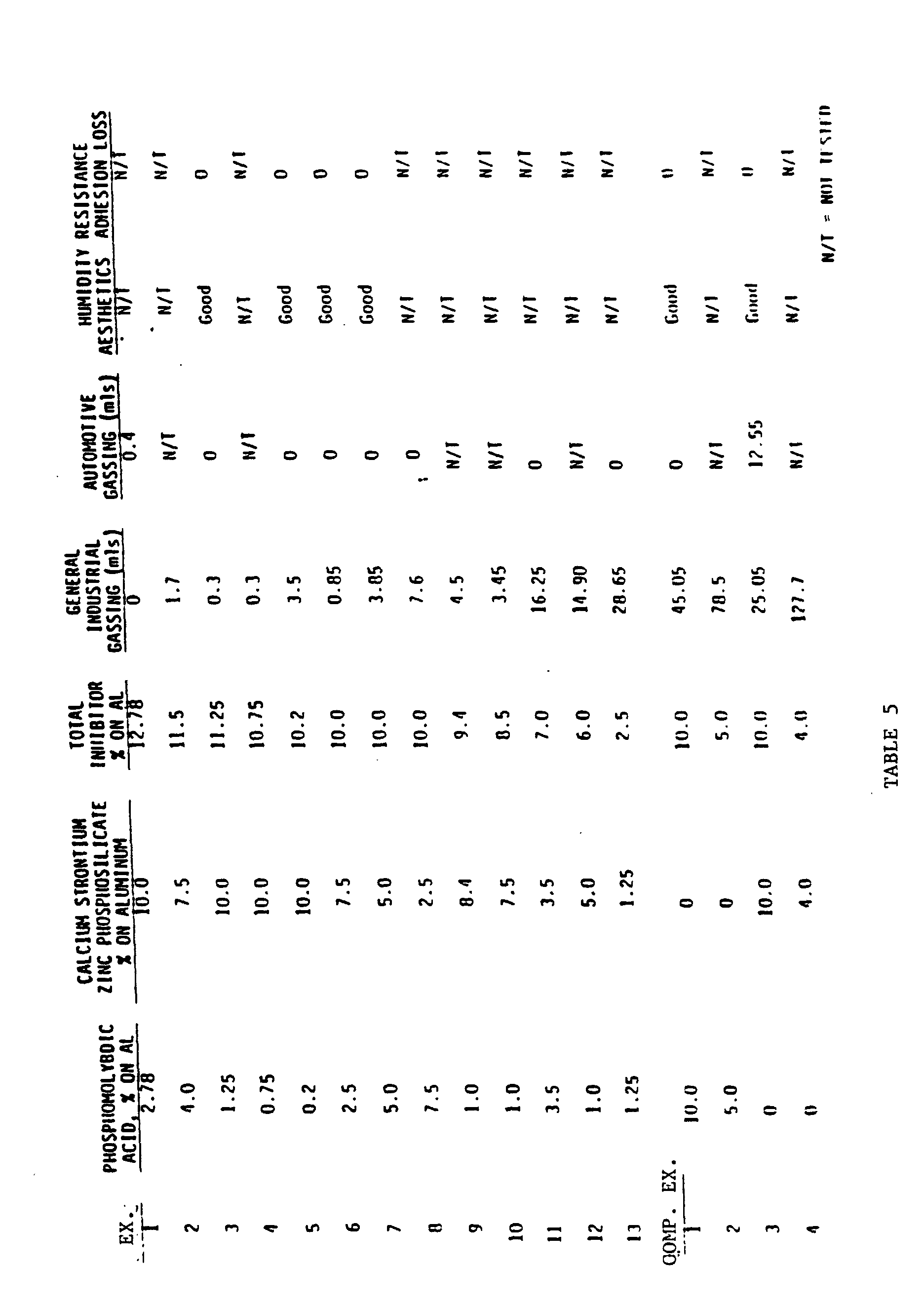
- Example 15 The procedure of Example 15 is repeated, varying the amounts of phosphomolybdic acid and calcium strontium zinc phosphosilicate. For the comparative examples, only one of the reagents is used. The formulations are detailed in Table 5.
- each of the finished pastes obtained from the above examples is incorporated into a typical aqueous general industrial coating formulation prepared according to the following procedure. Enough of each paste to yield 20.5g of aluminum is weighed out. The paste, 41.2g glycol ether EB, 5.1g Texanol (supplier--Eastman), 1.03g Patcote 519 (supplier--Patcote), 0.62g Dow Corning 14 (supplier--Dow), 73.5g deionized water, and 313.7g Joncryl 537 Resin, an acrylic emulsion (supplier--Johnson Wax) are blended together to form a uniform coating.
- aqueous automotive base coat formulations were sprayed onto electrocoated steel panels, and then clear coated with a solvent-borne automotive formulation. These panels were placed in an enclosed chamber maintained at 100°F (38°C) and 100% relative humidity, in accordance with ASTM D2247-87. After 10 days of exposure, the panels were removed from the chamber, dried, and inspected for blistering or visual degradation. The panels were then tested for adhesion, in accordance with ASTM D3359-87, Test Method B. The data are summarized in Table 5.
- Untreated SS-5745 was incorporated into a typical aqueous geneal industrial formulation prepared according to the following procedure. Enough paste to yield 20.5 g. of aluminum is weighed out. The paste, 41.2 g.
- Glycol Ether EB 5.1 g. Texanol (Supplier: Eastman Chemical), 73.5 g. deionized water, and 313.7 g. Joncryl 537 resin, an acrylic emulsion (Supplier: Johnson Wax) were blended together to form a uniform coating.
- the paints were then treated insitu with calcium strontium zinc phosphosilicate at levels of 0%, 5%, 10%, and 15% on metal weight in the formulation.
- the paints were then subjected to the gassing test (as described previously) and the results are shown in Table 6. Paint Calcium Strontium Zinc Phosphosilicate % on Aluminum Insitu Treatment Gassing (mls) SS-5745/Joncryl 537 Paint 0 143.00 5 43.3 10 17.25 15 17.35
- the insitu addition improves the gassing stability over untreated paints.
Landscapes
- Chemical & Material Sciences (AREA)
- Organic Chemistry (AREA)
- Life Sciences & Earth Sciences (AREA)
- Engineering & Computer Science (AREA)
- Materials Engineering (AREA)
- Wood Science & Technology (AREA)
- Inorganic Chemistry (AREA)
- Pigments, Carbon Blacks, Or Wood Stains (AREA)
- Paints Or Removers (AREA)
- Application Of Or Painting With Fluid Materials (AREA)
- Curing Cements, Concrete, And Artificial Stone (AREA)
- Inks, Pencil-Leads, Or Crayons (AREA)
Abstract
Description
- The present invention is related to paste compositions containing metal pigment particles suitable for forming coating compositions, particularly aqueous coating systems. Increasingly stringent environmental regulations have required that coating systems dramatically reduce volatile organic solvent levels. One way to comply with such regulations is to use water in place of the volatile organic solvents previously used.
- Within this application several publications are referenced by arabic numerals within parentheses. Full citations for these references may be found at the end of the specification immediately preceding the claims. The disclosures of these publications in their entireties are hereby expressly incorporated by reference into this application.
- In the area of coating systems utilizing metal pigment particles, aqueous systems present rather formidable difficulties. This is particularly true with respect to aluminum and zinc pigments. Thus, the metal pigment can readily react with water to generate hydrogen gas. The amount of gas generated can produce a safety hazard, creating high pressures within the composition containers. Also, the water reaction substantially diminishes the aesthetic value of metal pigments. The reaction of aluminum pigments with water can be depicted as follows:
- Due to the increasing demand for aqueous systems, a number of techniques have been proposed for inhibiting the attack on the pigment particles by water. Unfortunately, most of these techniques have not provided sufficient protection.
- One technique that provides inhibiting properties is the passivation of the metal pigment particles with an ionic organic phosphate as disclosed by Williams et al., U.S. Patent No. 4,565,716, the disclosure of which is incorporated herein by reference. Another technique involves the use of compounds containing hexavalent chromium or pentavalent vanadium compounds as disclosed in Kondis U.S. Patent No. 4,693,754, the disclosure of which is incorporated herein by reference. Other techniques include the use of organic phosphites as disclosed in Kondis et al. U.S. Patent No. 4,808,231, the disclosure of which is incorporated herein by reference, or the use of nitroparaffin solvents. Still another technique includes the use of either (a) an ionic organic phosphate compound, for example as taught in Williams et al., U.S. Patent No. 4,565,716, or (b) a pentavalent vanadium compound, for example as taught in Kondis, U.S. Patent No. 4,693,754, or (c) an organic phosphite compound, for example as taught in Kondis et al. U.S. Patent No. 4,808,231, in combination with a nitro-containing solvent such as a nitroparaffin as disclosed in Keemer et al., U.S. Patent No. 5,215,579, the disclosure of which is incorporated herein by reference.
- The treated metal pigment particles can be used to form a metal pigment paste. The treatment produces a metal pigment paste which has improved gassing stability over conventionally treated products.
- The present invention is directed to metal particles which have been treated with (1) at least one heteropoly anion, (2) at least one phosphosilicate pigment or (3) a combination of at least one heteropoly anion and at least one phosphosilicate pigment. The metal particles, (e.g. aluminum flakes), which have been treated in this manner are stabilized to a degree suitable for use in aqueous coating systems.
- A principle object of the invention is to provide a metal flake which can be used in aqueous systems and which is resistant to hydrogen evolution.
- Another object of the invention is to provide a metal flake which maintains acceptable aesthetic values and intercoat and intracoat adhesion in the paint film.
- Other objects, advantages and features of the present invention will be more readily appreciated and understood when considered in conjunction with the following detailed description.
- All the disclosed embodiments can be made using conventional compounds and procedures without undue experimentation.
- As indicated above, the present invention is based on the discovery that certain types of heteropoly anion compounds, certain types of phosphosilicate compounds, or a combination thereof, effectively stabilize metal pigments from reacting with water, rendering the metal pigment suitable for use in water-based coatings without significant evolution of hydrogen without loss of adhesion, or degradation of optical properties. The present invention is especially useful for aluminum and bronze pigments.
- Heteropoly anions are polymeric oxoanions which are formed by the acidification of solutions containing the requisite simple anions or by introduction of the hetero element ion after first acidifying the molybdate or tungstate anions. Heteropoly anions are described in Table 22C-2, at page 857 of Advanced Inorganic Chemistry by Cotton and Wilkenson(1), the entire disclosure of which is incorporated herein by reference. The largest and best known group of heteropoly anions is composed of those with the hetero atom(s) enshrouded by a cage of MO6 octahedra. One of the most common structures of heteropoly anions is the Keggin structure which is represented by [X+nM12O40](8-n)- where M represents molybdenum or tungsten and X represents silicon, germanium, phosphorus, arsenic, titanium, zirconium, etc.. Preferred heteropoly anion groups are the heteropoly molybdates and the heteropoly tungstates. Preferred heteropoly anion compounds are silicomolybdic acid (SiMoA), phosphotungstic acid (PWA) and silicotungstic acid (SiWA). An especially preferred compound is phosphomolybdic acid (PMoA). The concentration of the heteropoly anion compound should be from 0.1% to 30%, preferably from 1% to 10%, based on the metal particle weight.
- Phosphosilicate pigments contain phosphorous, silicon and oxygen. Examples of phosphosilicate pigment compounds are calcium phosphosilicate, calcium strontium phosphosilicate and aluminum zirconium zinc phosphosilicate. An especially preferred compound is calcium strontium zinc phosphosilicate marketed by Halox Pigments of Hammond, Indiana, under the tradename of Halox SZP391. The amount of the phosphosilicate compound should be from 0.1% to 30%, preferably 10%, based on the metal particle weight.
- Solvents for use with the heteropoly anions may include glycol ethers, glycol ether acetates, alcohols, water and nitroparaffins, or any other solvent compatible with coating systems, in which the heteropoly anion is soluble. Among the nitroparaffins for use with heteropoly anions, the lower members of the nitroparaffin series, i.e., nitromethane, nitroethane and 1-nitropropane, are preferred on the basis of toxicological properties and availability. The solvent for use with heteropoly anions should be present at 5% to 100%, but preferably 20% or more, most preferably 35% or more, of the total weight of solvent in the final metal pigment paste. The solvent for use with heteropoly anions is generally about 28% to 50% by weight of the paste. The heteropoly anion solvent may also include surface active agents such as surfactants or anti-foaming agents.
- Solvents for use with the phosphosilicate pigments may include mineral spirits, high-flash naphtha, glycol ethers, glycol ether acetates, nitroparaffins, alcohols, acetates, or any other solvent compatible with coating systems. The solvent may optionally include surface active agents such as surfactants, anti-foaming agents and dispersants. Among the nitroparaffins for use with phosphosilicate pigments, the lower members of the nitroparaffin series, (i.e., nitromethane, nitroethane and 1-nitropropane), are preferred on the basis of toxicological properties and availability. The solvent for use with the phosphosilicate pigments should be present in an amount of from 5% to 100%, but preferably 20% or more, most preferably 35% or more, based on the total weight of solvent in the final metal pigment paste.
- Solvents for use with the combination of heteropoly anions and phosphosilicate pigments may include glycol ethers, glycol ether acetates, alcohols, water and nitroparaffins, or any other solvent compatible with coating systems, in which the heteropoly anion is soluble. Among the nitroparaffins, the lower members of the nitroparaffin series, i.e., nitromethane, nitroethane and 1-nitropropane, are preferred on the basis of toxicological properties and availability. The solvent for use with heteropoly anions and phosphosilicate pigments should be present at 5% to 100%, but preferably 20% or more, most preferably 35% or more, of the total weight of solvent in the final metal pigment paste. The solvent may also include surface active agents such as surfactants or anti-foaming agents.
- A preferred method to incorporate the heteropoly anion compound is a variation of the slurry method taught in Kondis U.S. Patent No. 4,693,754. A metal pigment particle filter cake or paste, typically containing 50% to 95%, preferably 60% to 85%, of metal pigment in a solvent, is added to a mixture composed of 15% to 94.5%, preferably 65% to 89%, of a solvent in which the heteropoly anion is soluble. The desired amount of the heteropoly anion compound, typically 0.1 to 30%, preferably 1.0-10%, based on the weight of the metal particles, is added to form a reaction mixture. Surfactants, dispersants, anti-foaming agents, etc., may also be added to the reaction mixture. The reaction mixture is agitated at a temperature of from 20°C to 100°C, preferably ambient to 80°C, for a period of time ranging from 0.5 to 30 hours, preferably 2 to 8 hours. Solvent is then removed to obtain the desired final metal pigment particle content, typically 40% to 90%.
- A preferred method to incorporate the phosphosilicate pigment also is to incorporate the phosphosilicate pigment compound by a variation of the slurry method taught in Kondis U.S. Patent No. 4,693,754. A metal pigment particle filter cake or paste, typically containing 50% to 95%, preferably 60% to 85%, of metal pigment in a solvent, is added to a mixture composed of 15% to 94.5%, preferably 65% to 89%, of a solvent in which the phosphosilicate pigment is dispersable. The desired amount of the phosphosilicate pigment compound, typically 0.1 to 30%, preferably 10%, based on the weight of the metal particles, is added to form a reaction mixture. The phosphosilicate pigment may first be dispersed in a solvent. Surfactants, dispersants, anti-foaming agents, etc., may also be added to the reaction mixture. The reaction mixture is agitated at a temperature of 20°C to 100°C, preferably ambient to 80°C, for a period of time ranging from 5 minutes to 24 hours, preferably 1/2 to 2 hours. Solvent is then removed to obtain the desired final metal pigment particle content, typically 40% to 90%.
- Likewise, a preferred method to incorporate both the heteropoly anion compound and the phosphosilicate pigment is the variation of the slurry method taught in Kondis U.S. Patent No. 4,693,754. A metal pigment particle filter cake or paste, typically containing 50% to 95%, preferably 60% to 85%, of metal pigment in a solvent, is added to a mixture composed of 15% to 94.5%, preferably 65% to 89%, of a solvent in which the heteropoly anion is soluble. The desired amount of the heteropoly anion compound, typically 0.1 to 30%, preferably 0.2-10%, based on the weight of the metal particles and the desired amount of the phosphosilicate pigment, typically 0.1% to 30%, preferably 1% to 10%, based on the weight of the metal particles, is added to form a reaction mixture. Surfactants, dispersants, anti-foaming agents, etc., may also be added to the reaction mixture. The reaction mixture is agitated at a temperature of from 20°C to 100°C, preferably ambient to 80°C, for a period of time ranging from 0.5 to 30 hours, preferably 2 to 8 hours. Solvent is then removed to obtain the desired final metal pigment particle content, typically 40% to 90%.
- In addition to the treatment methods described above, another technique is to introduce the heteropoly anion compound, phosphosilicate compound or the combination thereof into a ball mill, along with atomized powder or foil, lubricants and solvents etc. used to produce aluminum pigments. Thus, the metal pigment surfaces are stabilized as they are being generated in the ball mill.
- The preferred treatment processes provide excellent stability, regardless of the lubricant used in milling.
- The pigment paste obtained can be used in a variety of known coating systems, as a direct replacement for currently used pastes. Examples include maintenance, general industrial, roof coating, and automotive coating systems. Thus, the paste may be used, for example, with acrylic polymer emulsions, water reducible alkyd resin systems, water reducible alkyd/melamine cross-linked systems, waterborne epoxy coatings, polyester emulsions and water reducible polyester melamine coatings.
- It is also possible to treat the metal particles after they have been combined with an aqueous coating vehicle. Thus, the heteropolyanion, phosphosilicate or the combination thereof can be added to an aqueous carrier itself either before or after the metal particles have been added to the coating composition. If the heteropolyanion compound, phosphosilicate compound or combination is added after the metal particles are added, the delay should not be long, since a long delay would permit the aqueous carrier to attack the metal particles. In the case where the addition is made to the coating composition, the amounts of heteropolyanion, phosphosilicate or combination thereof can be the same as discussed above for producing treated metal particles in paste form. Simple mixing techniques can be employed.
- The treatment with heteropolyanion, phosphosilicate or both can be combined with other treatment methods, including the use of nitroparaffins, ionic organic phosphates, organic phosphites, and vanadium compounds. The other treatment methods can be carried out before, during or after the treatment with heteropoly anion, phosphosilicate or both.
- Specific embodiments of the invention will now be further described by the following, non-limiting examples.
- 124.3 grams of a non-leafing aluminum paste feed TUFFLAKER 5843 (non-volatile 70.8%) is slurried with 514 grams of glycol ether PM to yield a slurry concentration of 13.8% aluminum. To this slurry 10% by weight phosphomolybdic acid is added, based on the weight of aluminum in the paste feed. The material is agitated for 5 hours, at 80°C. The slurry is then filter pressed to obtain a finished paste of 64% non-volatile content and then tested for aqueous stability as described below.
- 124.3 grams of a non-leafing aluminum paste feed TUFFLAKER 5843 is slurried with 514 grams of glycol ether PM to yield a slurry concentration of 13.8% aluminum. To this slurry 10% by weight silicomolybdic acid is added, based on the weight of aluminum paste in the feed. The material is agitated for 5 hours, at 80°C. The slurry is then filter pressed to obtain a finished paste of 69.2% non-volatile content and then tested for aqueous stability as described below.
- 124.3 grams of a non-leafing aluminum paste feed TUFFLAKER 5843 is slurried with 514 grams of glycol ether PM to yield a slurry concentration of 13.8% aluminum. To this slurry 10% by weight phosphotungstic acid is added, based on the weight of aluminum in the paste feed. The material is agitated for 5 hours, at 80°C. The slurry is then filter pressed to obtain a finished paste of 65.2% non-volatile content and then tested for aqueous stability as described below.
- 130 grams of a non-leafing aluminum paste feed TUFFLAKER 5843 is slurried with 443 grams of glycol ether PM to yield a slurry concentration of 16.1% aluminum. In order to provide a comparative example, no heteropoly anion is added to this slurry. The slurry is then filter pressed to obtain a finished paste of 70% non-volatile content and then tested for aqueous stability as described below.
- Each of the finished pastes obtained from the above examples is incorporated into a typical aqueous general industrial coating formulation prepared according to the following procedure. Enough of each paste to yield 20.5g of aluminum is weighed out. The paste, 41.2g glycol ether EB, 5.1g Texanol (supplier--Eastman), 1.03g Patcote 519 (supplier--Patcote), 0.62g Dow Corning 14 (supplier--Dow), 73.5g deionized water, and 313.7g Joncryl 537 Resin, an acrylic emulsion (supplier--Johnson Wax) are blended together to form a uniform coating.
- The formulations are placed in a constant temperature bath at 52°C and the gas evolved is collected in an inverted water-filled buret for 168 hours. The data are summarized in Table 1.
ALUMINUM PASTE FEED REAGENT AMOUNT PROCESS GASSING (mls.) Example 1 - TUFFLAKE™ 5843 Phosphomolybdic Acid 10% 5 hrs. 80°C 37 Example 2 - TUFFLAKE™ 5843 silicomolybdic Acid 10% 5 hrs. 80°C 70 Example 3 - TUFFLAKE™ 5843 Phosphotungstic Acid 10% 5 hrs. 80°C 146 Comparative Example 1 None -0- --- 181 - The finished aluminum paste of Example 1 was incorporated into an aqueous automotive basecoat formulation. The formulation obtained was sprayed onto electrocoated steel panels, and then clear coated with a solvent-borne automotive formulation. This panel was placed in an enclosed chamber maintained at 100°F (38°C) and 100% relative humidity, in accordance with ASTM D2247-87. After 10 days of exposure, the panel was removed from the chamber and dried. No blistering or visual degradation was noted. The panel was then tested for adhesion, in accordance with ASTM D3359-87, Test Method B. No loss of adhesion occurred.
- 112.2 grams of a non-leafing aluminum paste feed SPARKLE SILVERR 5245-AR (non-volatile of 78.1%) is slurried with 531.4 grams of glycol ether PM to yield a slurry concentration of 13.6% aluminum. To this slurry 1.6% by weight phosphomolybdic acid is added, based on the weight of aluminum in the paste feed. The material is agitated for two hours, at 80°C. The slurry is then filter pressed to obtain a finished paste of 66% non-volatile content and then tested for aqueous stability as described below.
- 41.3 grams of a non-leafing aluminum paste feed SPARKLE SILVERR 5245-AR is slurried with 602.4 grams of glycol ether PM to yield a slurry concentration of 5.0% aluminum. To this slurry 4.0% by weight phosphomolybdic acid is added, based on the weight of aluminum in the paste feed. The material is agitated for five hours, at 80°C. The slurry is then filter pressed to obtain a finished paste of 68.1% non-volatile content and then tested for aqueous stability as described below.
- 76.8 grams of a non-leafing aluminum paste feed SPARKLE SILVERR 5245-AR is slurried with 562.2 grams of glycol ether PM to yield a slurry concentration of 9.4% aluminum. To this slurry 10.0% by weight phosphomolybdic acid is added, based on the weight of aluminum in the paste feed. The material is agitated for 0.5 hours, at 80°C. The slurry is then filter pressed to obtain a finished paste of 68.8% non-volatile content and then tested for aqueous stability as described below.
- 41.3 grams of a non-leafing aluminum paste feed SPARKLE SILVERR 5245-AR is slurried with 600.5 grams of glycol ether PM to yield a slurry concentration of 5.0% aluminum. To this slurry 10.0% by weight phosphomolybdic acid is added, based on the weight of aluminum in the paste feed. The material is agitated for 2 hours, at 55°C. The slurry is then filter pressed to obtain a finished paste of 68.2% non-volatile content and then tested for aqueous stability as described below.
- 112.2 grams of a non-leafing aluminum paste feed SPARKLE SILVERR 5245-AR is slurried with 524 grams of glycol ether PM to yield a slurry concentration of 13.8% aluminum. To this slurry 10.0% by weight phosphomolybdic acid is added, based on the weight of aluminum in the paste feed. The material is agitated for 5 hours, at 30°C. The slurry is then filter pressed to obtain a finished paste of 65.2% non-volatile content and then tested for aqueous stability as described below.
- 112.7 grams of a non-leafing aluminum paste feed SPARKLE SILVERR 5245-AR is slurried with 474 grams of glycol ether PM to yield a slurry concentration of 15% aluminum. In order to provide a comparative example, no heteropoly anion is added to this slurry. The slurry is then filter pressed to obtain a finished paste of 70% non-volatile content and then tested for aqueous stability as described below.
- Each of the finished aluminum pastes obtained from the above examples is incorporated into a general industrial aqueous coating formulation. The formulations are placed in a constant temperature bath at 52°C, and the gas evolved is collected in an inverted water-filled buret for 168 hours. The data are summarized in Table 2.
EXPERIMENTAL CONDITIONS ALUMINUM PASTE FEED AMOUNT PMoA TIME (Hrs.) TEMPERATURE SLURRY CONC. GASSING (mls.) Example 4 - SPARKLE SILVER® 5245-AR 1.6% 2 80°C 13.6% Al 50.2 Example 5 - SPARKLE SILVERS 5245-AR 4.0% 5 80°C 5.0% Al 32.0 Example 6 - SPARKLE SILVER® 5245-AR 10.0% 0.5 80°C 9.3% Al 48.4 Example 7 - SPARKLE SILVERS 5245-AR 10.0% 2 55°C 5.0% Al 39.4 Example 8 - SPARKLE SILVER® 5245-AR 10.0% 5 30°C 13.6% Al 36.1 Comparative Example 2 None - -- 15% Al 193.3 - 112 grams of a non-leafing aluminum paste feed SPARKLE SILVERR 5245-AR (Non-Volatile 78.2%), is slurried with 464.0 grams of mineral spirits to yield a slurry concentration of 15.2% aluminum. To this slurry 10% by weight calcium strontium zinc phosphosilicate is added, based on the weight of aluminum in the paste feed. The material is agitated for five hours, at 30°C. The slurry is then filter pressed to obtain a finished paste of 72.6% non-volatile content and then tested for aqueous stability as described below.
- 137 grams of a non-leafing aluminum paste feed SPARKLE SILVERR 5245-AR is slurried with 447 grams of mineral spirits to yield a slurry concentration of 15% aluminum. In order to provide a comparative example, no calcium strontium zinc phosphosilicate is added to this slurry. The slurry is then filter pressed to obtain a finished paste of 64% non-volatile content and then tested for aqueous stability as described below.
- Each of the finished pastes obtained from the above examples is incorporated into a typical aqueous general industrial coating formulation prepared according to the following procedure. Enough of each paste to yield 20.5g of aluminum is weighed out. The paste, 41.2g glycol ether EB, 5.1g Texanol (supplier--Eastman), 1.03g Patcote 519 (supplier--Patcote), 0.62g Dow Corning 14 (supplier--Dow), 73.5g deionized water, and 313.7g Joncryl 537 Resin, an acrylic emulsion (supplier--Johnson Wax) are blended together to form a uniform coating.
- The coating formulations are placed in a constant temperature bath at 52°C and the gas evolved is collected in an inverted water-filled buret for 168 hours. The data are summarized in Table 3.
ALUMINUM PASTE FEED GASSING (mls.) Example 9 - SPARKLE SILVER® 5245-AR 14.95 Comparative Example 3 193.30 - 76.8 grams of a non-leafing aluminum paste feed SPARKLE SILVERR 5245-AR is slurried with 502.2 grams of mineral spirits to yield a slurry concentration of 10.4% aluminum. To this slurry 1.6% by weight calcium strontium zinc phosphosilicate is added, based on the weight of aluminum paste in the feed. The material is agitated for 5 hours, at 55°C. The slurry is then filter pressed to obtain a finished paste of 76% non-volatile content and then tested for aqueous stability as described below.
- 41.6 grams of a non-leafing aluminum paste feed SPARKLE SILVERR 5245-AR is slurried with 540.5 grams of mineral spirits to yield a slurry concentration of 5.5% aluminum. To this slurry 4.0% by weight calcium strontium zinc phosphosilicate is added, based on the weight of aluminum paste in the feed. The material is agitated for 5 hours, at 80°C. The slurry is then filter pressed to obtain a finished paste of 76% non-volatile content and then tested for aqueous stability as described below.
- 124.3 grams of a non-leafing aluminum paste feed TUFFLAKER 5843 (Non-Volatile 70.8%) is slurried with 429 grams of mineral spirits to yield a slurry concentration of 15.9% aluminum. To this slurry 10% by weight calcium strontium zinc phosphosilicate is added, based on the weight of aluminum in the paste feed. The material is agitated for one hour, at ambient temperature. The slurry is then filter pressed to obtain a finished paste of 73.2% non-volatile content and then tested for aqueous stability as described below.
- 124.3 grams of a non-leafing aluminum paste feed TUFFLAKER 5843 is slurried with 429 grams of mineral spirits to yield a slurry concentration of 15.9% aluminum. To this slurry 15% by weight calcium strontium zinc phosphosilicate is added, based on the weight of aluminum in the paste feed. The material is agitated for one hour, at ambient temperature. The slurry is then filter pressed to obtain a finished paste of 70.7% non-volatile content and then tested for aqueous stability as described below.
- 124.3 grams of a non-leafing aluminum paste feed TUFFLAKER 5843 is slurried with 429 grams of mineral spirits to yield a slurry concentration of 15.9%. To this slurry 20% by weight calcium strontium zinc phosphosilicate is added, based on the weight of aluminum in the paste feed. The material is agitated for one hour, at ambient temperature. The slurry is then filter pressed to obtain a finished paste of 69.2% non-volatile content and then tested for aqueous stability as described below.
- The finished aluminum pastes obtained from the above examples are incorporated into general industrial aqueous coating formulations. The formulations are placed in a constant temperature bath at 52°C, and the gas evolved is collected in an inverted water-filled buret for 168 hours. The data is summarized in Table 4.
EXPERIMENTAL CONDITIONS ALUMINUM PASTE FEED AMOUNT PMoA TIME (Hrs.) TEMPERATURE SLURRY CONC. GASSING (mls.) Example 10 - SPARKLE SILVER® 5245-AR 1.6% 5 55°C 10.4% Al 182.15 Example 11 - SPARKLE SILVER® 5245-AR 4.0% 5 80°C 5.5% Al 128.15 Example 9 - SPARKLE SILVERS 5245-AR 10.0% 5 30°C 15.2% Al 14.95 Example 12 - TUFFLAKE" 5843 10.0% 1 Ambient 15.9% Al 9.40 Example 13 - TUFFLAKE™ 5843 15.0% 1 Ambient 15.9% Al 4.80 Example 14 - TUFFLAKE™ 5843 20.0% 1 Ambient 15.9% Al 6.70 - Each of the finished aluminum pastes of Examples 9 and 12 was incorporated into an aqueous automotive basecoat formulation. The formulations obtained were sprayed onto electrocoated steel panels, and then clear coated with a solvent-borne automotive formulation. These panels were placed in an enclosed chamber maintained at 100°F (38°C) and 100% relative humidity, in accordance with ASTM D2247-87. After 10 days of exposure, the panels were removed from the chamber and dried. No blistering or visual degradation was noted. The panels were then tested for adhesion, in accordance with ASTM D3359-87, Test Method B. No loss of adhesion occurred.
- 139.1 grams of a non-leafing aluminum paste feed SPARKLE SILVERR 5745 ALUMINUM PASTE (non-volatile 64.7%) is slurried in 513.7 grams of glycol ether PM. To this slurry 2.78% by weight phosphomolybdic acid and 10% by weight calcium strontium zinc phosphosilicate is added, based on the weight of aluminum in the paste feed. The material is agitated for five (5) hours, at 80°C. The slurry is then filter pressed to obtain a finished paste product and then tested for aqueous stability as described below.
- The procedure of Example 15 is repeated, varying the amounts of phosphomolybdic acid and calcium strontium zinc phosphosilicate. For the comparative examples, only one of the reagents is used. The formulations are detailed in Table 5.
- Each of the finished pastes obtained from the above examples is incorporated into a typical aqueous general industrial coating formulation prepared according to the following procedure. Enough of each paste to yield 20.5g of aluminum is weighed out. The paste, 41.2g glycol ether EB, 5.1g Texanol (supplier--Eastman), 1.03g Patcote 519 (supplier--Patcote), 0.62g Dow Corning 14 (supplier--Dow), 73.5g deionized water, and 313.7g Joncryl 537 Resin, an acrylic emulsion (supplier--Johnson Wax) are blended together to form a uniform coating.
- The formulations are placed in a constant temperature bath at 52AC and the gas evolved is collected in an inverted water-filled buret for 168 hours. The data are summarized in Table 5.
- Some of the finished pastes obtained from the above examples are also incorporated into a proprietary aqueous automotive base coat formulation. The formulations are placed in a constant temperature bath at 52AC and the gas evolved is collected in an inverted water-filled buret for 168 hours. The data are summarized in Table 5.
- Several of these aqueous automotive base coat formulations were sprayed onto electrocoated steel panels, and then clear coated with a solvent-borne automotive formulation. These panels were placed in an enclosed chamber maintained at 100°F (38°C) and 100% relative humidity, in accordance with ASTM D2247-87. After 10 days of exposure, the panels were removed from the chamber, dried, and inspected for blistering or visual degradation. The panels were then tested for adhesion, in accordance with ASTM D3359-87, Test Method B. The data are summarized in Table 5.Example 28: Untreated SS-5745 was incorporated into a typical aqueous geneal industrial formulation prepared according to the following procedure. Enough paste to yield 20.5 g. of aluminum is weighed out. The paste, 41.2 g. of Glycol Ether EB, 5.1 g. Texanol (Supplier: Eastman Chemical), 73.5 g. deionized water, and 313.7 g. Joncryl 537 resin, an acrylic emulsion (Supplier: Johnson Wax) were blended together to form a uniform coating.
- The paints were then treated insitu with calcium strontium zinc phosphosilicate at levels of 0%, 5%, 10%, and 15% on metal weight in the formulation. The paints were then subjected to the gassing test (as described previously) and the results are shown in Table 6.
Paint Calcium Strontium Zinc Phosphosilicate % on Aluminum Insitu Treatment Gassing (mls) SS-5745/Joncryl
537 Paint0 143.00 5 43.3 10 17.25 15 17.35 - As can be seen from the table, the insitu addition improves the gassing stability over untreated paints.
- In the general industrial formulation, all the combinations, of heteropoly anion and phosphosilicate compound yield lower gassing than the heteropoly anion compound, alone, or the phosphosilicate compound alone, at the 4% level; and all but one are lower than the phosphosilicate compound, alone, at the 10% level. In the automotive formulation, all the combinations of heteropoly anion and phosphosilicate compound, yield lower gassing than the phosphosilicate compound, alone, and are equivalent to the heteropoly anion compound, alone. All provide good aesthetics and no adhesion loss in the humidity test.
- While there is shown and described herein certain specific examples embodying this invention for the purpose of clarity of understanding, the same is to be considered as illustrative in character, it being understood that only preferred embodiments have been shown and described. It will be manifest to those skilled in the art that certain changes, various modifications and rearrangements of the parts may be made without departing from the spirit and scope of the underlying inventive concept and that the same is not limited to the particular forms herein shown and described except insofar as indicated in the scope of the appended claims.
- The entirety of everything cited above or below is expressly incorporated herein by reference.
- 1. Cotton, F. Albert, and Wilkinson, Geoffrey, Advanced Inorganic Chemistry, 4th Ed., published by Wiley-Interscience.
Claims (22)
- A metal pigment-containing paste suitable for formation of an aqueous coating composition, comprising :metal pigment particles selected from the group of aluminium particles and bronze particles ;a solvent; anda treating agent, for reducing the susceptibility of the metal particles to attack by water, selected from at least one heteropolyanion, at least one phosphosilicate compound, and a combination of at least one heteropolyanion and at least one phosphosilicate compound.
- The metal pigment-containing paste of claim 1, wherein the metal pigment particles comprise aluminium.
- The metal pigment-containing paste of any one of claims 1-2, wherein the metal pigment particles are present in an amount of from approximately 40% to approximately 90% by weight of the paste.
- The metal pigment-containing paste of any one of claims 1-3, wherein the heteropolyanion (s) is present, in a total amount of approximately 0.1% to approximately 30% by weight of the metal particles.
- The metal pigment-containing paste of claim 4, wherein the heteropolyanion (s) is present in a total amount of from approximately 1.0% to approximately 10% by weight of the metal particles.
- The metal pigment-containing paste of any one of claims 1-4, wherein at least one heteropolyanion is present and the solvent includes at least one of glycol ethers, glycol ether acetates, alcohols, water, nitroparaffins and their mixtures.
- The metal pigment-containing paste of any one of claims 1-6, wherein at least one heteropolyanion is present and is selected from silicomolybdic acid, phosphotungstic acid, silicotungstic acid, phosphomolybdic acid and their mixtures.
- The metal pigment-containing paste of claim 7, wherein the heteropolyanion comprises phosphomolybdic acid.
- The metal pigment-containing paste of any one of claims 1-8, wherein the solvent comprises a surfactant.
- The metal pigment-containing paste of any one of claims 1-3, wherein the phosphosilicate compound (s) is present, in a total amount of from approximately 0.1% to approximately 30% by weight of the metal particles.
- The metal pigment-containing paste of claim 10, wherein the amount of the phosphosilicate compound(s) is approximately 10% by weight of the metal pigment particles.
- The metal pigment-containing paste of any one of claims 1-3 and 10, wherein at least one phosphosilicate compound is present and the solvent includes at least one of mineral spirits, high flash naptha, glycol ethers, glycol ether acetates, nitroparaffins, alcohols acetates and their mixtures.
- The metal pigment-containing paste of any one of claims 1-3 and 10-12, wherein at least one phosphosilicate compound is present and is selected from calcium phosphosilicate, calcium strontium phosphosilicate, aluminium zirconium zinc phosphosilicate, calcium strontium zinc phosphosilicate and their mixtures.
- The metal pigment-containing paste of claim 13, wherein the phosphosilicate compound comprises calcium strontium zinc phosphosilicate.
- The metal pigment-containing paste of any one of claims 1-3, wherein a combination of heteropolyanion and phosphosilicate compounds is present.
- The metal pigment-containing paste of claim 15, wherein the amount of the heteropolyanion(s) is from approximately 0.2% to approximately 10% by weight of the metal pigment particles.
- The metal pigment-containing paste of any one of claims 15 and 16, wherein the amount of the phosphosilicate compound(s) is from approximately 1% to approximately 10% by weight of the metal pigment particles.
- The metal pigment-containing paste of any one of claims 15-17, wherein the at least one heteropolyanion is selected from silicomolybdic acid, phosphotungstic acid, silicotungstic acid, phosphomolybdic acid and their mixtures and the at least one phosphosilicate compound is selected from calcium phosphosilicate, calcium strontium phosphosilicate, aluminium zirconium phosphosilicate, zinc phosphosilicate, calcium strontium zinc phosphosilicate and their mixtures.
- An aqueous coating composition, comprising :a metal pigment-containing paste as claimed in any one of claims 1-18; andan aqueous carrier for a coating composition.
- An automobile painted with an aqueous coating composition according to claim 19.
- A method of making a metal pigment-containing paste according to any one of claims 1-18, comprising contacting metal particles with a treating agent for reducing the susceptibility of the metal particles to attack by water, said treating agent being selected from at least one heteropolyanion, at least one phosphosilicate compound, and a combination of at least one heteropolyanion and at least one phosphosilicate compound.
- A method for rendering metal pigment particles selected from the group of aluminium particles and bronze particles less susceptible to attack by water in an aqueous coating composition, comprising treating said metal pigment particles with a treating agent for reducing the susceptibility of the metal particles to attack by water, said treating agent being selected from at least one heteropolyanion, at least one phosphosilicate compound, and a combination of at least one heteropolyanion and at least one phosphosilicate compound.
Applications Claiming Priority (7)
| Application Number | Priority Date | Filing Date | Title |
|---|---|---|---|
| US08/104,548 US5296032A (en) | 1993-08-11 | 1993-08-11 | Aqueous resistant metal pigment-containing paste and method for making |
| US08/104,550 US5348579A (en) | 1993-08-11 | 1993-08-11 | Water resistant metal pigment-containing paste and method for making |
| US136286 | 1993-10-15 | ||
| US08/136,286 US5356469A (en) | 1993-10-15 | 1993-10-15 | Aqueous resistant metal pigment-containing paste and method for making |
| US104550 | 1993-10-15 | ||
| PCT/US1994/009160 WO1995004783A1 (en) | 1993-08-11 | 1994-08-11 | Aqueous resistant metal pigment-containing paste and method for making |
| US104548 | 1998-06-25 |
Publications (3)
| Publication Number | Publication Date |
|---|---|
| EP0668894A1 EP0668894A1 (en) | 1995-08-30 |
| EP0668894A4 EP0668894A4 (en) | 1998-04-29 |
| EP0668894B1 true EP0668894B1 (en) | 2001-10-24 |
Family
ID=27379755
Family Applications (1)
| Application Number | Title | Priority Date | Filing Date |
|---|---|---|---|
| EP94927166A Expired - Lifetime EP0668894B1 (en) | 1993-08-11 | 1994-08-11 | Aqueous resistant metal pigment-containing paste and method for making |
Country Status (11)
| Country | Link |
|---|---|
| US (1) | US5637143A (en) |
| EP (1) | EP0668894B1 (en) |
| JP (1) | JP2759198B2 (en) |
| KR (2) | KR100404814B1 (en) |
| AT (1) | ATE207516T1 (en) |
| AU (1) | AU683931B2 (en) |
| CA (1) | CA2145291C (en) |
| DE (1) | DE69428774T2 (en) |
| DK (1) | DK0668894T3 (en) |
| ES (1) | ES2166784T3 (en) |
| WO (1) | WO1995004783A1 (en) |
Families Citing this family (22)
| Publication number | Priority date | Publication date | Assignee | Title |
|---|---|---|---|---|
| US6500276B1 (en) | 1998-12-15 | 2002-12-31 | Lynntech Coatings, Ltd. | Polymetalate and heteropolymetalate conversion coatings for metal substrates |
| US6471788B1 (en) | 1999-12-15 | 2002-10-29 | Lynntech Coatings, Ltd. | Ferrate conversion coatings for metal substrates |
| DE10001437A1 (en) * | 2000-01-15 | 2001-07-19 | Eckart Standard Bronzepulver | Flowable and pumpable metal pigment semi-finished product for the production of paints and varnishes |
| US6395106B1 (en) | 2000-02-07 | 2002-05-28 | Lynntech, Inc. | Conversion coatings prepared or treated with calcium hydroxide solutions |
| US6432224B1 (en) | 2000-02-08 | 2002-08-13 | Lynntech, Inc. | Isomolybdate conversion coatings |
| JP4633239B2 (en) * | 2000-09-12 | 2011-02-16 | 昭和アルミパウダー株式会社 | Silica-coated aluminum pigment and method for producing the same |
| US6863718B2 (en) * | 2001-10-31 | 2005-03-08 | Silberline Manufacturing Co., Inc. | Phosphonic acid derivative treatment of metallic flakes |
| GB2400371B (en) * | 2003-04-04 | 2007-08-01 | Silberline Ltd | Metal pigment composition |
| DE60336269D1 (en) * | 2003-04-28 | 2011-04-14 | Toyo Aluminium Kk | ALUMINUM PIGMENT, METHOD FOR ITS PRODUCTION AND RESIN COMPOSITION |
| JP5046368B2 (en) * | 2006-11-14 | 2012-10-10 | 旭化成ケミカルズ株式会社 | Metal pigment composition |
| CN101541891B (en) * | 2006-11-14 | 2012-07-18 | 旭化成化学株式会社 | Metal pigment composition |
| JP2011208038A (en) * | 2010-03-30 | 2011-10-20 | Asahi Kasei Chemicals Corp | Metal pigment composition |
| JP5554608B2 (en) * | 2010-03-30 | 2014-07-23 | 旭化成ケミカルズ株式会社 | Metal pigment composition |
| WO2011136215A1 (en) * | 2010-04-27 | 2011-11-03 | 旭化成ケミカルズ株式会社 | Metallic-pigment composition |
| JP5661327B2 (en) * | 2010-04-27 | 2015-01-28 | 旭化成ケミカルズ株式会社 | Metal pigment composition |
| WO2011137440A1 (en) | 2010-04-30 | 2011-11-03 | Battelle Memorial Institute | Composition for easy to clean surfaces |
| CN102933662B (en) * | 2010-06-08 | 2015-03-18 | 旭化成化学株式会社 | Metallic pigment composition |
| JP5649998B2 (en) * | 2011-02-07 | 2015-01-07 | 東洋アルミニウム株式会社 | Metal pigment composition and method for producing the same |
| JP6229833B2 (en) | 2013-10-03 | 2017-11-15 | セイコーエプソン株式会社 | Aqueous pigment dispersion and aqueous ink composition containing the same |
| JP2015108110A (en) | 2013-10-23 | 2015-06-11 | セイコーエプソン株式会社 | Pigment dispersion and solvent-based ink composition containing the same |
| JP6315172B2 (en) | 2014-01-06 | 2018-04-25 | セイコーエプソン株式会社 | Base metal pigment aqueous dispersion and aqueous ink composition |
| JP6315174B2 (en) | 2014-01-27 | 2018-04-25 | セイコーエプソン株式会社 | Base metal pigment, base metal pigment aqueous dispersion and aqueous ink composition |
Family Cites Families (12)
| Publication number | Priority date | Publication date | Assignee | Title |
|---|---|---|---|---|
| US3423229A (en) * | 1965-05-17 | 1969-01-21 | Teleflex Inc | Coating with zinc and aluminum powder in potassium silicate |
| US4370382A (en) * | 1980-06-19 | 1983-01-25 | Union Carbide Corporation | Modified zinc-rich coatings |
| JPS5815571A (en) * | 1981-07-22 | 1983-01-28 | Dainippon Toryo Co Ltd | Paint composition for power transmission towers |
| US4693754A (en) * | 1982-09-20 | 1987-09-15 | Tom Kondis | Aluminum particles resistant to reaction with water |
| US4584013A (en) * | 1983-05-18 | 1986-04-22 | Ciba-Geigy Corporation | Cyclohexanedionecarboxylic acid derivatives with herbicidal and plant growth regulating properties |
| US4808231A (en) * | 1984-09-21 | 1989-02-28 | Silberline Manufacturing Co., Inc. | Inhibitive treatment for aluminum pigments |
| JPH0680152B2 (en) * | 1986-04-04 | 1994-10-12 | 東洋アルミニウム株式会社 | Aluminum flake pigment composition for water-based paint |
| US5215579A (en) * | 1991-12-26 | 1993-06-01 | Silberline Manufacturing Co., Inc. | Water resistant metal pigment particles |
| JP2894901B2 (en) * | 1992-09-17 | 1999-05-24 | 中国塗料株式会社 | Primary rust preventive paint composition |
| US5348579A (en) * | 1993-08-11 | 1994-09-20 | Silberline Manufacturing Co., Inc. | Water resistant metal pigment-containing paste and method for making |
| US5356469A (en) * | 1993-10-15 | 1994-10-18 | Silberline Manufacturing Co., Inc. | Aqueous resistant metal pigment-containing paste and method for making |
| US5296032A (en) * | 1993-08-11 | 1994-03-22 | Silberline Manufacturing Co., Inc. | Aqueous resistant metal pigment-containing paste and method for making |
-
1994
- 1994-08-11 DK DK94927166T patent/DK0668894T3/en active
- 1994-08-11 KR KR10-2001-7016804A patent/KR100404814B1/en not_active Expired - Fee Related
- 1994-08-11 AT AT94927166T patent/ATE207516T1/en active
- 1994-08-11 KR KR1019950701360A patent/KR100358272B1/en not_active Expired - Fee Related
- 1994-08-11 ES ES94927166T patent/ES2166784T3/en not_active Expired - Lifetime
- 1994-08-11 DE DE69428774T patent/DE69428774T2/en not_active Expired - Lifetime
- 1994-08-11 EP EP94927166A patent/EP0668894B1/en not_active Expired - Lifetime
- 1994-08-11 US US08/513,900 patent/US5637143A/en not_active Expired - Lifetime
- 1994-08-11 WO PCT/US1994/009160 patent/WO1995004783A1/en not_active Ceased
- 1994-08-11 JP JP7506614A patent/JP2759198B2/en not_active Expired - Fee Related
- 1994-08-11 AU AU76878/94A patent/AU683931B2/en not_active Ceased
- 1994-08-11 CA CA002145291A patent/CA2145291C/en not_active Expired - Fee Related
Also Published As
| Publication number | Publication date |
|---|---|
| KR100404814B1 (en) | 2003-11-07 |
| US5637143A (en) | 1997-06-10 |
| WO1995004783A1 (en) | 1995-02-16 |
| KR950703613A (en) | 1995-09-20 |
| AU7687894A (en) | 1995-02-28 |
| KR100358272B1 (en) | 2003-04-21 |
| EP0668894A4 (en) | 1998-04-29 |
| DE69428774T2 (en) | 2002-07-11 |
| CA2145291A1 (en) | 1995-02-16 |
| DK0668894T3 (en) | 2002-02-18 |
| CA2145291C (en) | 1998-08-18 |
| DE69428774D1 (en) | 2001-11-29 |
| HK1011377A1 (en) | 1999-07-09 |
| AU683931B2 (en) | 1997-11-27 |
| EP0668894A1 (en) | 1995-08-30 |
| JP2759198B2 (en) | 1998-05-28 |
| ATE207516T1 (en) | 2001-11-15 |
| ES2166784T3 (en) | 2002-05-01 |
| JPH08502317A (en) | 1996-03-12 |
Similar Documents
| Publication | Publication Date | Title |
|---|---|---|
| US5637143A (en) | Aqueous resistant metal pigment-containing paste and method for making | |
| KR100262290B1 (en) | Aluminium pigments | |
| KR100903284B1 (en) | Phosphonic acid derivative treatment of metallic flakes | |
| US5215579A (en) | Water resistant metal pigment particles | |
| US5356469A (en) | Aqueous resistant metal pigment-containing paste and method for making | |
| US5348579A (en) | Water resistant metal pigment-containing paste and method for making | |
| US5296032A (en) | Aqueous resistant metal pigment-containing paste and method for making | |
| HK1004279B (en) | Water resistant metal pigment particles | |
| US5993523A (en) | Inhibited metal pigment pastes containing molybdate pigments and suitable for aqueous coating compositions | |
| HK1011377B (en) | Aqueous resistant metal pigment-containing paste and method for making | |
| US5470385A (en) | Water resistant metal pigment particles | |
| MXPA94006096A (en) | Paste containing water resistant metal pigment and method for making | |
| HK1023785B (en) | Inhibited metal pigment pastes containing molybdate pigments and suitable for aqueous coating compositions | |
| MXPA99005233A (en) | Pasting of inhibited metal pigments containing molybdate pigments and suitable for aqueous coating compositions |
Legal Events
| Date | Code | Title | Description |
|---|---|---|---|
| PUAI | Public reference made under article 153(3) epc to a published international application that has entered the european phase |
Free format text: ORIGINAL CODE: 0009012 |
|
| AK | Designated contracting states |
Kind code of ref document: A1 Designated state(s): AT BE CH DE DK ES FR GB GR IE IT LI LU MC NL PT SE |
|
| 17P | Request for examination filed |
Effective date: 19950719 |
|
| A4 | Supplementary search report drawn up and despatched |
Effective date: 19980312 |
|
| AK | Designated contracting states |
Kind code of ref document: A4 Designated state(s): AT BE CH DE DK ES FR GB GR IE IT LI LU MC NL PT SE |
|
| 17Q | First examination report despatched |
Effective date: 19990217 |
|
| GRAG | Despatch of communication of intention to grant |
Free format text: ORIGINAL CODE: EPIDOS AGRA |
|
| GRAG | Despatch of communication of intention to grant |
Free format text: ORIGINAL CODE: EPIDOS AGRA |
|
| GRAH | Despatch of communication of intention to grant a patent |
Free format text: ORIGINAL CODE: EPIDOS IGRA |
|
| GRAH | Despatch of communication of intention to grant a patent |
Free format text: ORIGINAL CODE: EPIDOS IGRA |
|
| GRAA | (expected) grant |
Free format text: ORIGINAL CODE: 0009210 |
|
| AK | Designated contracting states |
Kind code of ref document: B1 Designated state(s): AT BE CH DE DK ES FR GB GR IE IT LI LU MC NL PT SE |
|
| PG25 | Lapsed in a contracting state [announced via postgrant information from national office to epo] |
Ref country code: NL Free format text: LAPSE BECAUSE OF FAILURE TO SUBMIT A TRANSLATION OF THE DESCRIPTION OR TO PAY THE FEE WITHIN THE PRESCRIBED TIME-LIMIT Effective date: 20011024 Ref country code: IT Free format text: LAPSE BECAUSE OF FAILURE TO SUBMIT A TRANSLATION OF THE DESCRIPTION OR TO PAY THE FEE WITHIN THE PRESCRIBED TIME-LIMIT;WARNING: LAPSES OF ITALIAN PATENTS WITH EFFECTIVE DATE BEFORE 2007 MAY HAVE OCCURRED AT ANY TIME BEFORE 2007. THE CORRECT EFFECTIVE DATE MAY BE DIFFERENT FROM THE ONE RECORDED. Effective date: 20011024 |
|
| REF | Corresponds to: |
Ref document number: 207516 Country of ref document: AT Date of ref document: 20011115 Kind code of ref document: T |
|
| REG | Reference to a national code |
Ref country code: CH Ref legal event code: EP |
|
| REG | Reference to a national code |
Ref country code: IE Ref legal event code: FG4D |
|
| REF | Corresponds to: |
Ref document number: 69428774 Country of ref document: DE Date of ref document: 20011129 |
|
| REG | Reference to a national code |
Ref country code: CH Ref legal event code: NV Representative=s name: MOINAS & SAVOYE SA |
|
| REG | Reference to a national code |
Ref country code: GB Ref legal event code: IF02 |
|
| PG25 | Lapsed in a contracting state [announced via postgrant information from national office to epo] |
Ref country code: SE Free format text: LAPSE BECAUSE OF FAILURE TO SUBMIT A TRANSLATION OF THE DESCRIPTION OR TO PAY THE FEE WITHIN THE PRESCRIBED TIME-LIMIT Effective date: 20020124 Ref country code: PT Free format text: LAPSE BECAUSE OF FAILURE TO SUBMIT A TRANSLATION OF THE DESCRIPTION OR TO PAY THE FEE WITHIN THE PRESCRIBED TIME-LIMIT Effective date: 20020124 |
|
| REG | Reference to a national code |
Ref country code: DK Ref legal event code: T3 |
|
| ET | Fr: translation filed | ||
| NLV1 | Nl: lapsed or annulled due to failure to fulfill the requirements of art. 29p and 29m of the patents act | ||
| REG | Reference to a national code |
Ref country code: ES Ref legal event code: FG2A Ref document number: 2166784 Country of ref document: ES Kind code of ref document: T3 |
|
| REG | Reference to a national code |
Ref country code: GR Ref legal event code: EP Ref document number: 20020400209 Country of ref document: GR |
|
| PG25 | Lapsed in a contracting state [announced via postgrant information from national office to epo] |
Ref country code: LU Free format text: LAPSE BECAUSE OF NON-PAYMENT OF DUE FEES Effective date: 20020811 |
|
| PG25 | Lapsed in a contracting state [announced via postgrant information from national office to epo] |
Ref country code: IE Free format text: LAPSE BECAUSE OF NON-PAYMENT OF DUE FEES Effective date: 20020812 |
|
| PLBE | No opposition filed within time limit |
Free format text: ORIGINAL CODE: 0009261 |
|
| STAA | Information on the status of an ep patent application or granted ep patent |
Free format text: STATUS: NO OPPOSITION FILED WITHIN TIME LIMIT |
|
| 26N | No opposition filed | ||
| PG25 | Lapsed in a contracting state [announced via postgrant information from national office to epo] |
Ref country code: MC Free format text: LAPSE BECAUSE OF NON-PAYMENT OF DUE FEES Effective date: 20030301 |
|
| REG | Reference to a national code |
Ref country code: IE Ref legal event code: MM4A |
|
| PGFP | Annual fee paid to national office [announced via postgrant information from national office to epo] |
Ref country code: CH Payment date: 20110727 Year of fee payment: 18 Ref country code: DK Payment date: 20110721 Year of fee payment: 18 |
|
| PGFP | Annual fee paid to national office [announced via postgrant information from national office to epo] |
Ref country code: AT Payment date: 20110721 Year of fee payment: 18 Ref country code: GR Payment date: 20110726 Year of fee payment: 18 Ref country code: FR Payment date: 20110811 Year of fee payment: 18 Ref country code: ES Payment date: 20110727 Year of fee payment: 18 |
|
| PGFP | Annual fee paid to national office [announced via postgrant information from national office to epo] |
Ref country code: BE Payment date: 20110916 Year of fee payment: 18 |
|
| BERE | Be: lapsed |
Owner name: *SILBERLINE MFG CO. INC. Effective date: 20120831 |
|
| REG | Reference to a national code |
Ref country code: CH Ref legal event code: PL |
|
| REG | Reference to a national code |
Ref country code: DK Ref legal event code: EBP |
|
| REG | Reference to a national code |
Ref country code: AT Ref legal event code: MM01 Ref document number: 207516 Country of ref document: AT Kind code of ref document: T Effective date: 20120811 |
|
| PG25 | Lapsed in a contracting state [announced via postgrant information from national office to epo] |
Ref country code: CH Free format text: LAPSE BECAUSE OF NON-PAYMENT OF DUE FEES Effective date: 20120831 Ref country code: LI Free format text: LAPSE BECAUSE OF NON-PAYMENT OF DUE FEES Effective date: 20120831 |
|
| REG | Reference to a national code |
Ref country code: GR Ref legal event code: ML Ref document number: 20020400209 Country of ref document: GR Effective date: 20130304 |
|
| REG | Reference to a national code |
Ref country code: FR Ref legal event code: ST Effective date: 20130430 |
|
| PG25 | Lapsed in a contracting state [announced via postgrant information from national office to epo] |
Ref country code: GR Free format text: LAPSE BECAUSE OF NON-PAYMENT OF DUE FEES Effective date: 20130304 Ref country code: BE Free format text: LAPSE BECAUSE OF NON-PAYMENT OF DUE FEES Effective date: 20120831 |
|
| PG25 | Lapsed in a contracting state [announced via postgrant information from national office to epo] |
Ref country code: AT Free format text: LAPSE BECAUSE OF NON-PAYMENT OF DUE FEES Effective date: 20120811 |
|
| PG25 | Lapsed in a contracting state [announced via postgrant information from national office to epo] |
Ref country code: DK Free format text: LAPSE BECAUSE OF NON-PAYMENT OF DUE FEES Effective date: 20120831 |
|
| PG25 | Lapsed in a contracting state [announced via postgrant information from national office to epo] |
Ref country code: FR Free format text: LAPSE BECAUSE OF NON-PAYMENT OF DUE FEES Effective date: 20120831 |
|
| REG | Reference to a national code |
Ref country code: ES Ref legal event code: FD2A Effective date: 20131021 |
|
| PG25 | Lapsed in a contracting state [announced via postgrant information from national office to epo] |
Ref country code: ES Free format text: LAPSE BECAUSE OF NON-PAYMENT OF DUE FEES Effective date: 20120812 |
|
| PGFP | Annual fee paid to national office [announced via postgrant information from national office to epo] |
Ref country code: DE Payment date: 20130902 Year of fee payment: 20 |
|
| PGFP | Annual fee paid to national office [announced via postgrant information from national office to epo] |
Ref country code: GB Payment date: 20130827 Year of fee payment: 20 |
|
| REG | Reference to a national code |
Ref country code: DE Ref legal event code: R071 Ref document number: 69428774 Country of ref document: DE |
|
| REG | Reference to a national code |
Ref country code: DE Ref legal event code: R071 Ref document number: 69428774 Country of ref document: DE |
|
| REG | Reference to a national code |
Ref country code: GB Ref legal event code: PE20 Expiry date: 20140810 |
|
| PG25 | Lapsed in a contracting state [announced via postgrant information from national office to epo] |
Ref country code: DE Free format text: LAPSE BECAUSE OF EXPIRATION OF PROTECTION Effective date: 20140812 |
|
| PG25 | Lapsed in a contracting state [announced via postgrant information from national office to epo] |
Ref country code: GB Free format text: LAPSE BECAUSE OF EXPIRATION OF PROTECTION Effective date: 20140810 |