EP0668272B1 - A process for the production of tetrazolyl compounds - Google Patents
A process for the production of tetrazolyl compounds Download PDFInfo
- Publication number
- EP0668272B1 EP0668272B1 EP95101055A EP95101055A EP0668272B1 EP 0668272 B1 EP0668272 B1 EP 0668272B1 EP 95101055 A EP95101055 A EP 95101055A EP 95101055 A EP95101055 A EP 95101055A EP 0668272 B1 EP0668272 B1 EP 0668272B1
- Authority
- EP
- European Patent Office
- Prior art keywords
- alkyl
- process according
- alkoxy
- methyl
- tetrazolyl compound
- Prior art date
- Legal status (The legal status is an assumption and is not a legal conclusion. Google has not performed a legal analysis and makes no representation as to the accuracy of the status listed.)
- Expired - Lifetime
Links
- PUPAPFTXLYVYPX-UHFFFAOYSA-N CC1C=CC(C)C1 Chemical compound CC1C=CC(C)C1 PUPAPFTXLYVYPX-UHFFFAOYSA-N 0.000 description 1
Classifications
-
- C—CHEMISTRY; METALLURGY
- C07—ORGANIC CHEMISTRY
- C07D—HETEROCYCLIC COMPOUNDS
- C07D403/00—Heterocyclic compounds containing two or more hetero rings, having nitrogen atoms as the only ring hetero atoms, not provided for by group C07D401/00
- C07D403/02—Heterocyclic compounds containing two or more hetero rings, having nitrogen atoms as the only ring hetero atoms, not provided for by group C07D401/00 containing two hetero rings
- C07D403/10—Heterocyclic compounds containing two or more hetero rings, having nitrogen atoms as the only ring hetero atoms, not provided for by group C07D401/00 containing two hetero rings linked by a carbon chain containing aromatic rings
-
- Y—GENERAL TAGGING OF NEW TECHNOLOGICAL DEVELOPMENTS; GENERAL TAGGING OF CROSS-SECTIONAL TECHNOLOGIES SPANNING OVER SEVERAL SECTIONS OF THE IPC; TECHNICAL SUBJECTS COVERED BY FORMER USPC CROSS-REFERENCE ART COLLECTIONS [XRACs] AND DIGESTS
- Y02—TECHNOLOGIES OR APPLICATIONS FOR MITIGATION OR ADAPTATION AGAINST CLIMATE CHANGE
- Y02P—CLIMATE CHANGE MITIGATION TECHNOLOGIES IN THE PRODUCTION OR PROCESSING OF GOODS
- Y02P20/00—Technologies relating to chemical industry
- Y02P20/50—Improvements relating to the production of bulk chemicals
- Y02P20/55—Design of synthesis routes, e.g. reducing the use of auxiliary or protecting groups
Definitions
- This invention relates to a technology for producing tetrazolyl compounds.
- EP-A-0 539 713 discloses the production of substituted imidazolyl propenic acid derivatives wherein N-protected tetrazolyl compounds are deprotected in the presence of methanol and conc. hydrochloric acid.
- EP-A-0 470 794 also discloses the deprotection of an N-protected tetrazolyl compound in the presence of methanol and conc. hydrochloric acid.
- EP-A-0 550 313 discloses the deprotection of an N-protected tetrazolyl compound in the presence of methanol and acetic acid.
- EP-A-0 459 136 the deprotection of an N-protected tetrazolyl compound in the presence of methanol and 1N-HCl is described.
- the tetrazolyl compound obtained by such hydrolysis reaction can be conveniently separated from the impurity originating from the protective group by extraction with a basic aqueous solution.
- this bond is also liable to be cleaved and, therefore, this technology cannot be utilized.
- Accordingly in the case of a tetrazolyl compound containing a carboxylic ester bond it has to be separated and purified by column chromatography.
- purification by column chromatography involves a complicated procedure and is commercially disadvantageous in terms of production efficiency, manpower, time and yield. Therefore, establishment of a commercially profitable process has been awaited.
- This invention provides a commercially advantageous technology for the production of tetrazolyl compounds.
- This invention therefore, relates to a process for producing a tetrazolyl compound which comprises reacting an N-protected tetrazolyl compound represented by the formula
- the compounds produced in accordance with the process of the invention are useful as therapeutics for not only hypertension but also circulatory diseases such as heart failure, strokes, cerebral apoplexy, nephropathy and nephritis. They may be used in the same manner as the products produced in U.S. Patent 5,196,444, EP 459136, and so on, which are incorporated herein by reference.
- the object of this invention is to deprotect an N-protected tetrazolyl compound to provide the corresponding tetrazolyl compound.
- this invention comprises subjecting an N-protected tetrazolyl compound to solvolysis by dissolving an N-protected tetrazolyl compound in an inert solvent and either adding an alcohol and introducing a mineral acid under substantially anhydrous conditions or adding an alcohol containing a mineral acid under substantially anhydrous conditions, to provide the corresponding tetrazolyl compound and an ether obtained by reacting the protective group of the N-protected tetrazolyl compound with the alcohol.
- reaction product mixture is subjected, where necessary, to extraction, washing, concentration, etc., and an aliphatic hydrocarbon solvent is then added, whereupon the desired tetrazolyl compound is crystallized with high efficiency and in good yield, because the ether in the reaction mixture is extremely highly lipophilic compared to the tetrazolyl compound and is dissolved in the aliphatic hydrocarbon solvent.
- the object tetrazolyl compound can be obtained in good yield even though the starting N-protected tetrazolyl compound contains a moiety liable to be cleaved by acid hydrolysis, such as an esterified carboxyl group and an alkoxy group.
- N-protected tetrazolyl compound is represented by a compound of the following general formula
- the hydrocarbon residue R 1 is preferably alkyl, alkenyl or cycloalkyl.
- the alkyl group for R 1 is a lower alkyl group of 1 to about 8 carbon atoms, which may be straight-chain or branched, thus typically including methyl, ethyl, propyl, isopropyl, butyl, isobutyl, sec-butyl, t-butyl, pentyl, i-pentyl, hexyl, heptyl and octyl.
- the alkenyl group for R 1 is a lower alkenyl group of 2 to about 8 carbon atoms, which may be straight-chain or branched, thus typically including vinyl, propenyl, 2-butenyl, 3-butenyl, isobutenyl and 2-octenyl.
- the alkinyl group for R 1 is a lower alkinyl group of 2 to about 8 carbon atoms, which may be straight-chain or branched, thus typically including ethinyl, 2-propinyl, 2-butinyl, 2-pentinyl and 2-octinyl.
- the cycloalkyl group for R 1 is a lower cycloalkyl group of 3 to about 6 carbon atoms, thus typically including cyclopropyl, cyclobutyl, cyclopentyl and cyclohexyl.
- the phenyl-lower(C 1-4 )alkyl group for R 1 includes groups such as benzyl, phenethyl and so on.
- aralkyl and aryl groups may respectively be substituted, in any substitutable position or positions of the benzene ring, by halogen (e.g. F, Cl, Br, etc.), nitro, amino, N-lower(C 1-4 )alkylamino, N,N-di-lower(C 1-4 )alkylamino, lower(C 1-4 )alkoxy (e.g. methoxy, ethoxy, etc.), lower(C 1-4 )alkylthio (e.g. methylthio, ethylthio, etc.) and/or lower(C 1-4 )alkyl (e.g. methyl, ethyl, etc.).
- halogen e.g. F, Cl, Br, etc.
- alkyl, alkenyl and cycloalkyl groups which may be substituted (e.g. lower(C 1-5 )alkyl, lower(C 2-5 )alkenyl and lower (C 3-6 )cycloalkyl groups which may be substituted by hydroxy, amino, halogen or lower(C 1-4 )alkoxy).
- R 1 may be bonding through a hetero atom ⁇ e.g. nitrogen [N(R 9 ) (R 9 means hydrogen or lower(C 1-4 )alkyl)]; oxygen or sulfur [-S(O)m- (m is a whole number of 0-2)] ⁇ .
- a hetero atom e.g. nitrogen [N(R 9 ) (R 9 means hydrogen or lower(C 1-4 )alkyl)]; oxygen or sulfur [-S(O)m- (m is a whole number of 0-2)] ⁇ .
- Particularly preferred is a substituted or unsubstituted alkyl or alkenyl group bonding through a hetero atom (e.g.
- the substituent group or groups other than the group R 2 on ring A may be halogen (e.g. F, Cl, Br, etc.), lower(C 1-4 )alkyl, lower(C 1-4 )alkoxy, nitro, groups of the formula -CO-D' [wherein D' represents a hydroxyl group or a lower(C 1-4 )alkoxy group, the alkyl moiety of which may be substituted by hydroxy, lower(C 1-4 )alkoxy, lower(C 2-6 ) alkanoyloxy (e.g. acetoxy, pivaloyloxy, etc.) or lower(C 1-6 ) alkoxycarbonyloxy (e.g.
- the compound of general formula (I) can be produced in accordance with the disclosure in JP Kokai H4-364171/1992, EP459136, EP425921, for instance.
- the alcohol which can be employed in this invention includes methanol, ethanol, 1-propanol, 2-propanol, 1-butanol, 2-methyl-1-propanol, 2-butanol, 2-methyl-2-propanol, 1-pentanol, 2-pentanol, 3-pentanol, 2-methyl-1-butanol, 3-methyl-2-butanol, etc. and is preferably a lower(C 1-4 )alcohol such as methanol, ethanol, 1-propanol, 2-propanol, 1-butanol, 2-methyl-1-propanol, 2-butanol, 2-methyl-2-propanol, etc.
- the mineral acid which can be employed in this invention can be any acid that is under substantially anhydrous conditions.
- substantially anhydrous conditions means conditions in which water does not substantially take part in the reaction.
- hydrogen halide concentrated sulfuric acid
- Particularly preferred is hydrogen halide.
- the concentration of water is at most 1 mol, preferably at most 0.5 mol, per mole of the N-protected tetrazolyl compound.
- the hydrogen halide which can be employed in this invention includes hydrogen fluoride, hydrogen chloride, hydrogen bromide, hydrogen iodide, etc. and is preferably hydrogen chloride.
- the concentration of the concentrated sulfuric acid is at least 95%, preferably 98%.
- This invention is, for example, carried into practice by dissolving said N-protected tetrazolyl compound in an inert solvent and either adding an alcohol and introducing a mineral acid under substantially anhydrous conditions or adding an alcohol containing a mineral acid under substantially anhydrous conditions.
- the amount of the alcohol to be added is not so critical but is at least one mole, generally 2-100 moles, preferably 5-50 moles, per mole of the N-protected tetrazolyl compound.
- the inert solvent for the N-protected tetrazolyl compound can be any solvent that does not take part in the reaction and is capable of dissolving the N-protected tetrazolyl compound.
- methylene chloride, ethyl acetate, toluene, dioxane, tetrahydrofuran, xylene, chloroform and carbon tetrachloride can be mentioned.
- Particularly preferred are methylene chloride, ethyl acetate and toluene.
- These solvents can be used singly or in a suitable combination of 2 or more species.
- the alcohol for use in said introduction or dissolution of hydrogen chloride can be utilized as the reaction solvent as well.
- the amount of the solvent to be used is not so critical but is generally 2-10 or preferably 3-5 volumes relative to the N-protected tetrazolyl compound.
- the amount of mineral acid is not so critical, either, but is generally 1-5 equivalents or preferably 1-2 equivalents relative to the N-protected tetrazolyl compound.
- the reaction temperature is not critical but is generally -5-30°C and preferably not higher than 10°C.
- the reaction time which is not particularly restricted, is generally 1-6 hours and preferably 1-3 hours.
- reaction product mixture is subjected, where necessary, to extraction, washing, concentration, etc., and an aliphatic hydrocarbon solvent is then added, whereupon the desired tetrazolyl compound is crystallized.
- the aliphatic hydrocarbon solvent that can be used includes pentane, hexane, heptane and others but is preferably hexane or heptane.
- This aliphatic hydrocarbon solvent can be used in admixture with an inert solvent.
- the inert solvent that can be used includes lower(C 1-4 ) alcohols (e.g. methanol, ethanol, propanol, butanol, etc.), acetone, methylene chloride, ethyl acetate, toluene, acetonitrile and so on. Particularly preferred is acetone.
- the objective tetrazolyl compound can be obtained as crystals of high quality in good yield.
- the decomposition reaction is remarkably inhibited even though the starting N-protected tetrazolyl compound has a partial structure liable to undergo hydrolysis under acidic conditions, thus insuring a high reaction yield of the objective tetrazolyl compound.
- tetrazolyl compound can be produced with high efficiency and in good yield by deprotecting the N-protected tetrazolyl compound in accordance with this invention, a commercially useful production technology is provided for tetrazolyl compounds.
- the mixture was further stirred at 5°C for 3.5 hours, at the end of which time 19 mL of ethyl acetate and 19 mL of water were added.
- the mixture was adjusted to pH 6.3 with a saturated aqueous solution of sodium hydrogen carbonate and, then, 10 mL of ethyl acetate and 10 mL of 20% NaCl-H 2 O were added.
- the aqueous layer was separated and extracted with 20 mL of ethyl acetate.
- the ethyl acetate layers were combined and redistributed into 20% NaCl and 38 mL of ethyl acetate.
- the organic layer was separated and concentrated and the residue was diluted with ethanol and reconcentrated.
Landscapes
- Chemical & Material Sciences (AREA)
- Organic Chemistry (AREA)
- Plural Heterocyclic Compounds (AREA)
- Pharmaceuticals Containing Other Organic And Inorganic Compounds (AREA)
- Organic Low-Molecular-Weight Compounds And Preparation Thereof (AREA)
Abstract
Description
- This invention relates to a technology for producing tetrazolyl compounds.
- As the technology for removing the protective group from an N-protected tetrazolyl compound to give the unprotected tetrazolyl compound, hydrolysis in hydrochloric acid-methanol (Japanese published unexamined patent application No. H4-364171/1992(JP Kokai H4-364171/1992), J. Med. Chem. 36, 2343, 1993) and hydrolysis in acetic acid-ethanol (WO93/04059) are known.
- EP-A-0 539 713 discloses the production of substituted imidazolyl propenic acid derivatives wherein N-protected tetrazolyl compounds are deprotected in the presence of methanol and conc. hydrochloric acid.
- EP-A-0 470 794 also discloses the deprotection of an N-protected tetrazolyl compound in the presence of methanol and conc. hydrochloric acid.
- DE 42 12 748 A1 describes the deprotection of an N-protected tetrazolyl compound in the presence of ethanol and formic acid.
- According to EP-A-0 291 969 2-[1-(β-cyanoethyl)-1-H-tetrazolyl-5-yl]-4'-methylbiphenyl may be deprotected in the presence of 1,0 N NaOH and THF.
- EP-A-0 550 313 discloses the deprotection of an N-protected tetrazolyl compound in the presence of methanol and acetic acid.
- In EP-A-0 459 136 the deprotection of an N-protected tetrazolyl compound in the presence of methanol and 1N-HCl is described.
- The tetrazolyl compound obtained by such hydrolysis reaction can be conveniently separated from the impurity originating from the protective group by extraction with a basic aqueous solution. However, where the tetrazolyl compound contains a carboxylic ester bond, this bond is also liable to be cleaved and, therefore, this technology cannot be utilized. Accordingly in the case of a tetrazolyl compound containing a carboxylic ester bond, it has to be separated and purified by column chromatography. However, purification by column chromatography involves a complicated procedure and is commercially disadvantageous in terms of production efficiency, manpower, time and yield. Therefore, establishment of a commercially profitable process has been awaited.
- This invention provides a commercially advantageous technology for the production of tetrazolyl compounds.
- In view of the above state of the art, the present inventors explored in earnest for an industrially useful technology for deprotecting N-protected tetrazolyl compounds and discovered that the object tetrazolyl compound of high purity can be easily obtained by reacting the starting N-protected tetrazolyl compound with a mineral acid under substantially anhydrous conditions in the presence of an alcohol. This invention has been developed on the basis of the above finding.
- This invention, therefore, relates to a process for producing a tetrazolyl compound which comprises reacting an N-protected tetrazolyl compound represented by the formula

- wherein ring A is
a benzene ring which may be substituted, in addition to the group
R2, by a substituent selected from
- (1) a halogen,
- (2) a lower (C1-4) alkyl,
- (3) a lower (C1-4) alkoxy,
- (4) a nitro,
- (5) a group of the formula: -CO-D' wherein D' is a hydroxy or a lower (C1-4) alkoxy, the alkyl moiety of which may be substituted by hydroxy, lower (C1-4) alkoxy, lower (C2-6) alkanoyloxy or lower (C1-6) alkoxycarbonyloxy, and
- (6) an amino which may be substituted by lower (C1-4) alkyl;
- R1 is a hydrogen atom or
a hydrocarbon residue which may bind through a hetero atom,
said hydrocarbon residue being selected from lower (C1-8) alkyl,
lower (C2-8) alkenyl, lower (C2-8) alkinyl, lower (C3-6)
cycloalkyl, phenyl-lower (C1-4) alkyl and phenyl;
said alkyl, alkenyl, alkinyl and cycloalkyl being optionally substituted by a substituent selected from hydroxy, amino, N-lower (C1-4) alkylamino, N,N-di-lower (C1-4) alkylamino, halogen, lower (C1-4) alkoxy and lower (C1-4) alkylthio; and
said phenyl-lower (C1-4) alkyl and phenyl being optionally substituted, in any substitutable position or positions of the benzene ring, by a substituent selected from halogen, nitro, amino, N-lower (C1-4) alkylamino, N,N-di-lower (C1-4) alkylamino, lower (C1-4) alkoxy, lower (C1-4) alkylthio and lower (C1-4) alkyl; - R2 is
- an esterified carboxyl group selected from
- -COOMe, -COOEt, -COOtBu, -COOPr,
- pivaloyloxymethoxycarbonyl,
- 1-(cyclohexyloxycarbonyloxy)ethoxycarbonyl,
- 5-methyl-2-oxo-1,3-dioxolen-4-ylmethoxycarbonyl,
- acetoxymethyloxycarbonyl,
- propionyloxymethoxycarbonyl,
- n-butyryloxymethoxycarbonyl,
- isobutyryloxymethoxycarbonyl,
- 1-(ethoxycarbonyloxy)ethoxycarbonyl,
- 1-(acetyloxy)ethoxycarbonyl,
- 1-(isobutyryloxy)ethoxycarbonyl,
- cyclohexylcarbonyloxymethoxycarbonyl,
- benzoyloxymethoxycarbonyl,
- cinnamyloxycarbonyl and
- cyclopentylcarbonyloxymethoxycarbonyl;
- Q' is triphenylmethyl; n is 1 or 2, with a mineral acid in the presence of alcohol wherein the concentration of water is at most 1 mole per mole of the N-protected tetrazolyl compound.
-
- The compounds produced in accordance with the process of the invention are useful as therapeutics for not only hypertension but also circulatory diseases such as heart failure, strokes, cerebral apoplexy, nephropathy and nephritis. They may be used in the same manner as the products produced in U.S. Patent 5,196,444, EP 459136, and so on, which are incorporated herein by reference.
- The object of this invention is to deprotect an N-protected tetrazolyl compound to provide the corresponding tetrazolyl compound. For example, this invention comprises subjecting an N-protected tetrazolyl compound to solvolysis by dissolving an N-protected tetrazolyl compound in an inert solvent and either adding an alcohol and introducing a mineral acid under substantially anhydrous conditions or adding an alcohol containing a mineral acid under substantially anhydrous conditions, to provide the corresponding tetrazolyl compound and an ether obtained by reacting the protective group of the N-protected tetrazolyl compound with the alcohol. The reaction product mixture is subjected, where necessary, to extraction, washing, concentration, etc., and an aliphatic hydrocarbon solvent is then added, whereupon the desired tetrazolyl compound is crystallized with high efficiency and in good yield, because the ether in the reaction mixture is extremely highly lipophilic compared to the tetrazolyl compound and is dissolved in the aliphatic hydrocarbon solvent.
- In accordance with this invention, the object tetrazolyl compound can be obtained in good yield even though the starting N-protected tetrazolyl compound contains a moiety liable to be cleaved by acid hydrolysis, such as an esterified carboxyl group and an alkoxy group.
- The N-protected tetrazolyl compound is represented by a compound of the following general formula

- wherein ring A is
a benzene ring which may be substituted, in addition to the group
R2, by a substituent selected from
- (1) a halogen,
- (2) a lower (C1-4) alkyl,
- (3) a lower (C1-4) alkoxy,
- (4) a nitro,
- (5) a group of the formula: -CO-D' wherein D' is a hydroxy or a lower (C1-4) alkoxy, the alkyl moiety of which may be substituted by hydroxy, lower (C1-4) alkoxy, lower (C2-6) alkanoyloxy or lower (C1-6) alkoxycarbonyloxy, and
- (6) an amino which may be substituted by lower (C1-4) alkyl;
- R1 is a hydrogen atom or
a hydrocarbon residue which may bind through a hetero atom,
said hydrocarbon residue being selected from lower (C1-8) alkyl,
lower (C2-8) alkenyl, lower (C2-8) alkinyl, lower (C3-6)
cycloalkyl, phenyl-lower (C1-4) alkyl and phenyl;
said alkyl, alkenyl, alkinyl and cycloalkyl being optionally substituted by a substituent selected from hydroxy, amino, N-lower (C1-4) alkylamino, N,N-di-lower (C1-4) alkylamino, halogen lower (C1-4) alkoxy and lower (C1-4) alkylthio; and
said phenyl-lower (C1-4) alkyl and phenyl being optionally substituted, in any substitutable position or positions of the benzene ring, by a substituent selected from halogen, nitro, amino, N-lower (C1-4) alkylamino, N,N-di-lower (C1-4) alkylamino, lower (C1-4) alkoxy, lower (C1-4) alkylthio and lower (C1-4) alkyl; - R2 is
- an esterified carboxyl group selected from
- -COOMe, -COOEt, -COOtBu, -COOPr,
- pivaloyloxymethoxycarbonyl,
- 1-(cyclohexyloxycarbonyloxy)ethoxycarbonyl,
- 5-methyl-2-oxo-1,3-dioxolen-4-ylmethoxycarboynl,
- acetoxymethyloxycarbonyl,
- propionyloxymethoxycarbonyl,
- n-butyryloxymethoxycarbonyl,
- isobutyryloxymethoxycarbonyl,
- 1-(ethoxycarbonyloxy)ethoxycarbonyl,
- 1-(acetyloxy)ethoxycarbonyl,
- 1-(isobutyryloxy)ethoxycarbonyl,
- cyclohexylcarbonyloxymethoxycarbonyl,
- benzoyloxymethoxycarbonyl,
- cinnamyloxycarbonyl and
- cyclopentylcarbonyloxymethoxycarbonyl;
- Q' is triphenylmethyl; n is 1 or 2.
-
- The hydrocarbon residue R1 is preferably alkyl, alkenyl or cycloalkyl.
- The alkyl group for R1 is a lower alkyl group of 1 to about 8 carbon atoms, which may be straight-chain or branched, thus typically including methyl, ethyl, propyl, isopropyl, butyl, isobutyl, sec-butyl, t-butyl, pentyl, i-pentyl, hexyl, heptyl and octyl.
- The alkenyl group for R1 is a lower alkenyl group of 2 to about 8 carbon atoms, which may be straight-chain or branched, thus typically including vinyl, propenyl, 2-butenyl, 3-butenyl, isobutenyl and 2-octenyl.
- The alkinyl group for R1 is a lower alkinyl group of 2 to about 8 carbon atoms, which may be straight-chain or branched, thus typically including ethinyl, 2-propinyl, 2-butinyl, 2-pentinyl and 2-octinyl.
- The cycloalkyl group for R1 is a lower cycloalkyl group of 3 to about 6 carbon atoms, thus typically including cyclopropyl, cyclobutyl, cyclopentyl and cyclohexyl.
- The phenyl-lower(C1-4)alkyl group for R1 includes groups such as benzyl, phenethyl and so on.
- The above-mentioned aralkyl and aryl groups may respectively be substituted, in any substitutable position or positions of the benzene ring, by halogen (e.g. F, Cl, Br, etc.), nitro, amino, N-lower(C1-4)alkylamino, N,N-di-lower(C1-4)alkylamino, lower(C1-4)alkoxy (e.g. methoxy, ethoxy, etc.), lower(C1-4)alkylthio (e.g. methylthio, ethylthio, etc.) and/or lower(C1-4)alkyl (e.g. methyl, ethyl, etc.).
- Among the above-mentioned groups for R1, preferred are alkyl, alkenyl and cycloalkyl groups which may be substituted (e.g. lower(C1-5)alkyl, lower(C2-5)alkenyl and lower (C3-6)cycloalkyl groups which may be substituted by hydroxy, amino, halogen or lower(C1-4)alkoxy).
- R1 may be bonding through a hetero atom {e.g. nitrogen [N(R9) (R9 means hydrogen or lower(C1-4)alkyl)]; oxygen or sulfur [-S(O)m- (m is a whole number of 0-2)]}. Particularly preferred is a substituted or unsubstituted alkyl or alkenyl group bonding through a hetero atom (e.g. methylamino, ethylamino, propylamino, propenylamino, isopropylamino, allylamino, butylamino, isobutylamino, dimethylamino, methylethylamino, methoxy, ethoxy, propoxy, isopropoxy, propenyloxy, allyloxy, butoxy, isobutoxy, sec-butoxy, tert-butoxy, 2-butenyloxy, 3-butenyloxy, isobutenyloxy, pentoxy, isopentoxy, hexyloxy, methylthio, ethylthio, propylthio, isopropylthio, allylthio, butylthio, isobutylthio, sec-butylthio, tert-butylthio, 2-butenylthio, 3-butenylthio, isobutenylthio, pentylthio, isopentylthio, hexylthio, etc.)
- The substituent group or groups other than the group R2 on ring A may be halogen (e.g. F, Cl, Br, etc.), lower(C1-4)alkyl, lower(C1-4)alkoxy, nitro, groups of the formula -CO-D' [wherein D' represents a hydroxyl group or a lower(C1-4)alkoxy group, the alkyl moiety of which may be substituted by hydroxy, lower(C1-4)alkoxy, lower(C2-6) alkanoyloxy (e.g. acetoxy, pivaloyloxy, etc.) or lower(C1-6) alkoxycarbonyloxy (e.g. methoxycarbonyloxy, ethoxycarbonyloxy, cyclohexyloxycarbonyloxy, etc.)] and amino which may be substituted by (C1-4)alkyl (preferably, lower(C1-4)alkyl), halogen, etc). As for ring A, a benzene ring not substituted except by the group R2 is still more preferred.
- The compound of general formula (I) can be produced in accordance with the disclosure in JP Kokai H4-364171/1992, EP459136, EP425921, for instance.
- The alcohol which can be employed in this invention includes methanol, ethanol, 1-propanol, 2-propanol, 1-butanol, 2-methyl-1-propanol, 2-butanol, 2-methyl-2-propanol, 1-pentanol, 2-pentanol, 3-pentanol, 2-methyl-1-butanol, 3-methyl-2-butanol, etc. and is preferably a lower(C1-4)alcohol such as methanol, ethanol, 1-propanol, 2-propanol, 1-butanol, 2-methyl-1-propanol, 2-butanol, 2-methyl-2-propanol, etc.
- The mineral acid which can be employed in this invention can be any acid that is under substantially anhydrous conditions. The term "substantially anhydrous conditions" means conditions in which water does not substantially take part in the reaction. For example, hydrogen halide, concentrated sulfuric acid, can be mentioned. Particularly preferred is hydrogen halide.
- The concentration of water is at most 1 mol, preferably at most 0.5 mol, per mole of the N-protected tetrazolyl compound.
- The hydrogen halide which can be employed in this invention includes hydrogen fluoride, hydrogen chloride, hydrogen bromide, hydrogen iodide, etc. and is preferably hydrogen chloride.
- The concentration of the concentrated sulfuric acid is at least 95%, preferably 98%.
- This invention is, for example, carried into practice by dissolving said N-protected tetrazolyl compound in an inert solvent and either adding an alcohol and introducing a mineral acid under substantially anhydrous conditions or adding an alcohol containing a mineral acid under substantially anhydrous conditions.
- The amount of the alcohol to be added is not so critical but is at least one mole, generally 2-100 moles, preferably 5-50 moles, per mole of the N-protected tetrazolyl compound.
- The inert solvent for the N-protected tetrazolyl compound can be any solvent that does not take part in the reaction and is capable of dissolving the N-protected tetrazolyl compound. For example, methylene chloride, ethyl acetate, toluene, dioxane, tetrahydrofuran, xylene, chloroform and carbon tetrachloride can be mentioned. Particularly preferred are methylene chloride, ethyl acetate and toluene. These solvents can be used singly or in a suitable combination of 2 or more species. As to this solvent, the alcohol for use in said introduction or dissolution of hydrogen chloride can be utilized as the reaction solvent as well.
- The amount of the solvent to be used is not so critical but is generally 2-10 or preferably 3-5 volumes relative to the N-protected tetrazolyl compound.
- The amount of mineral acid is not so critical, either, but is generally 1-5 equivalents or preferably 1-2 equivalents relative to the N-protected tetrazolyl compound.
- The reaction temperature is not critical but is generally -5-30°C and preferably not higher than 10°C. The reaction time, which is not particularly restricted, is generally 1-6 hours and preferably 1-3 hours.
- The reaction product mixture is subjected, where necessary, to extraction, washing, concentration, etc., and an aliphatic hydrocarbon solvent is then added, whereupon the desired tetrazolyl compound is crystallized.
- The aliphatic hydrocarbon solvent that can be used includes pentane, hexane, heptane and others but is preferably hexane or heptane. This aliphatic hydrocarbon solvent can be used in admixture with an inert solvent. The inert solvent that can be used includes lower(C1-4) alcohols (e.g. methanol, ethanol, propanol, butanol, etc.), acetone, methylene chloride, ethyl acetate, toluene, acetonitrile and so on. Particularly preferred is acetone.
- In accordance with this invention, the objective tetrazolyl compound can be obtained as crystals of high quality in good yield.
- The compounds produced in accordance with the process of the invention are specifically disclosed as follows:
- (±)-1-(cyclohexyloxycarbonyloxy)ethyl 2-ethoxy-1-[[2'-(1H-tetrazol-5-yl)biphenyl-4-yl]methyl]-1H-benzimidazole-7-carboxylate,
- Ethyl 2-ethoxy-1-[[2'-(1H-tetrazol-5-yl)biphenyl-4-yl]methyl]benzimidazole-7-carboxylate,
- Methyl 2-ethoxy-1-[[2'-(1H-tetrazol-5-yl)biphenyl-4-yl]methyl]benzimidazole-7-carboxylate,
- Methyl 2-methoxy-1-[[2'-(1H-tetrazol-5-yl)biphenyl-4-yl]methyl]benzimidazole-7-carboxylate,
- Pivaloyloxymethyl 2-butyl-1-[[2'-(1H-tetrazol-5-yl)biphenyl-4-yl]methyl]-1H-benzimidazole-7-carboxylate,
- Pivaloyloxymethyl 2-ethoxy-1-[[2'-(1H-tetrazol-5-yl)biphenyl-4-yl]methyl]benzimidazole-7-carboxylate,
- Ethyl 2-propoxy-1-[[2'-(1H-tetrazol-5-yl)biphenyl-4-yl]methyl]benzimidazole-7-carboxylate,
- (5-Methyl-2-oxo-1,3-dioxolen-4-yl)methyl 2-ethoxy-1-[[2'-(1H-tetrazol-5-yl)biphenyl-4-yl]methyl]benzimidazole-7-carboxylate,
- Acetoxymethyl 2-ethoxy-1-[[2'-(1H-tetrazol-5-yl)biphenyl-4-yl]methyl]benzimidazole-7-carboxylate,
- Propionyloxymethyl 2-ethoxy-1-[[2'-(1H-tetrazol-5-yl)biphenyl-4-yl]methyl]benzimidazole-7-carboxylate,
- Butyryloxymethyl 2-ethoxy-1-[[2'-(1H-tetrazol-5-yl)biphenyl-4-yl]methyl]benzimidazole-7-carboxylate,
- Isobutyryloxymethyl 2-ethoxy-1-[[2'-(1H-tetrazol-5-yl)biphenyl-4-yl]methyl]benzimidazole-7-carboxylate,
- 1-(Ethoxycarbonyloxy)ethyl 2-ethoxy-1-[[2'-(1H-tetrazol-5-yl)biphenyl-4-yl]methyl]benzimidazole-7-carboxylate,
- 1-Acetoxyethyl 2-ethoxy-1-[[2'-(1H-tetrazol-5-yl)biphenyl-4-yl]methyl]benzimidazole-7-carboxylate,
- 1-(Isopropoxycarbonyloxy)ethyl 2-ethoxy-1-[[2'-(1H-tetrazol-5-yl)biphenyl-4-yl]methyl]benzimidazole-7-carboxylate,
- Cyclohexylcarbonyloxymethyl 2-ethoxy-1-[[2'-(1H-tetrazol-5-yl)biphenyl-4-yl]methyl]benzimidazole-7-carboxylate,
- Benzoyloxymethyl 2-ethoxy-1-[[2'-(1H-tetrazol-5-yl)biphenyl-4-yl]methyl]benzimidazole-7-carboxylate,
- (E)-Cinnamoyloxymethyl 2-ethoxy-1-[[2'-(1H-tetrazol-5-yl)biphenyl-4-yl]methyl]benzimidazole-7-carboxylate,
- Cyclopentylcarbonyloxymethyl 2-ethoxy-1-[[2'-(1H-tetrazol-5-yl)biphenyl-4-yl]methyl]benzimidazole-7-carboxylate,
- Pivaloyloxymethyl 2-ethylamino-1-[[2'-(1H-tetrazol-5-yl)biphenyl-4-yl]methyl]benzimidazole-7-carboxylate,
- 1-(Cyclohexyloxycarbonyloxy)ethyl 2-ethylamino-1-[[2'-(1H-tetrazol-5-yl)biphenyl-4-yl]methyl]benzimidazole-7-carboxylate,
- Methyl 2-allyloxy-1-[[2'-(1H-tetrazol-5-yl)biphenyl-4-yl]methyl]benzimidazole-7-carboxylate, and
- Methyl 2-butoxy-1-[[2'-(1H-tetrazol-5-yl)biphenyl-4-yl]methyl]benzimidazole-7-carboxylate.
-
- In accordance with this invention, as contrasted to the processes involving the presence of water in the reaction system, the decomposition reaction is remarkably inhibited even though the starting N-protected tetrazolyl compound has a partial structure liable to undergo hydrolysis under acidic conditions, thus insuring a high reaction yield of the objective tetrazolyl compound.
- Since a tetrazolyl compound can be produced with high efficiency and in good yield by deprotecting the N-protected tetrazolyl compound in accordance with this invention, a commercially useful production technology is provided for tetrazolyl compounds.
- The following examples are intended to describe this invention in further detail and should by no means be construed as defining the scope of the invention.
- In 29 mL of methylene chloride was dissolved 10.00 g of (±)-1-(cyclohexyloxycarbonyloxy)ethyl 2-ethoxy-1-[2'-(N-triphenylmethyl-1H-tetrazol-5-yl)biphenyl-4-yl]methylbenzimidazole-7-carboxylate followed by addition of 23 mL of methanol and cooling to 5°C. Then, 6 mL of methanol containing 0.53 g of hydrogen chloride as dissolved was added dropwise at 5°C over a period of 15 minutes. The mixture was further stirred at 5°C for 3.5 hours, at the end of which time 19 mL of ethyl acetate and 19 mL of water were added. The mixture was adjusted to pH 6.3 with a saturated aqueous solution of sodium hydrogen carbonate and, then, 10 mL of ethyl acetate and 10 mL of 20% NaCl-H2O were added. The aqueous layer was separated and extracted with 20 mL of ethyl acetate. The ethyl acetate layers were combined and redistributed into 20% NaCl and 38 mL of ethyl acetate. The organic layer was separated and concentrated and the residue was diluted with ethanol and reconcentrated. To the residue was added 20 mL of acetone and the mixture was stirred at room temperature for 3 hours for sufficient crystallization. Thereafter, 90 mL of hexane was added and the mixture was further stirred at room temperature for 1 hour and, then, under ice-cooling for 2 hours. The resulting crystals were collected by filtration and washed with 25 mL of acetone-hexane (1:9). The crystals were dried under reduced pressure to provide 6.90 g of (±)-1-(cyclohexyloxycarbonyloxy)ethyl 2-ethoxy-1-[2'-(1H-tetrazol-5-yl) biphenyl-4-yl]methylbenzimidazole-7-carboxylate (yield 92%).
- 1H-NMR (200 MHz, CDCl3) δ:
- 1.2-1.53 (12H, m), 1.69 (2H, m), 1.89 (2H, m), 4.55-4.69 (3H, m), 5.51 (1H, d), 5.61 (1H, d), 6.75-7.01 (11H, m), 7.13-7.46 (13H, m), 7.57 (1H, dd), 7.75 (1H, dd), 7.84-7.89 (1H, m)
- IR (KBr) cm-1:
- 2942, 1754, 1717, 1615, 1476
- In a mixture of 17 mL of methylene chloride and 13 mL of methanol was dissolved 5.79 g of pivaloyloxymethyl 2-ethoxy-1-[2'-(N-triphenylmethyl-1H-tetrazol-5-yl)biphenyl-4-yl]methylbenzimidazole-7- carboxylate and the solution was cooled to 5°C. To this solution was added 3.7 mL of methanol containing 0.344 g of hydrogen chloride dropwise and the mixture was stirred at 5-6°C for 2 hours. Then, 11 mL of ethyl acetate and 11 mL of water were added and the mixture was adjusted to pH 6.2 with a saturated aqueous solution of sodium hydrogen carbonate. Then, 6 mL of ethyl acetate and 20% NaCl-H2O were added. The aqueous layer was taken and extracted with 12 mL of ethyl acetate. The organic layers were combined and redistributed into 22 mL of ethyl acetate and 20% NaCl solution. The organic layer was separated and concentrated and the residue was stirred in 15 mL of toluene at room temperature for 30 minutes. Then, 100 mL of hexane was added and the mixture was stirred under ice-cooling for 1 hour. The resulting crystals were collected by filtration, washed with 20 mL of toluene-hexane (1:9), and dried to provide 3.65 g of pivaloyloxymethyl 2-ethoxy-1-[2'-(1H-tetrazol-5-yl)-biphenyl-4-yl]methylbenzimidazole-7-carboxylate (yield 91%).
- 1H-NMR (200 MHz, CDCl3) δ:
- 1.13 (9H, s), 1.44 (3H, t), 4.37 (2H, q), 5.61 (2H, s), 5.68 (2H, s), 6.80 (2H, d), 6.93 (2H, d), 6.99-7.11 (2H, m), 7.33-7.37 (1H, m), 7.49-7.54 (1H, m), 7.59-7.62 (2H, m), 8.03-8.07 (1H, m)
- IR (KBr) cm-1:
- 2986, 1755, 1734, 1614, 1554, 1479, 1429 m.p. 145-146°C
- Using 10.0 g of (±)-1-(cyclohexyloxycarbonyloxy)ethyl 2-ethoxy-1-[2'-(N-triphenylmethyl-1H-tetrazol-5-yl)biphenyl-4-yl]methylbenzimidazole-7-carboxylate, the reaction and after-treatment of Example 1 was repeated except that ethanol was used in lieu of methanol. The procedure provided 6.83 g of (±)-1-(cyclohexyloxycarbonyloxy)ethyl 2-ethoxy-1-[2'-(1H-tetrazol-5-yl)biphenyl-4-yl]methylbenzimidazole-7- carboxylate (yield 91%).
- In physicochemical properties, this compound was in agreement with the compound obtained in Example 1.
- In 15 mL of methylene chloride was dissolved 5.44 g of (±)-1-(cyclohexyloxycarbonyloxy)ethyl 2-ethoxy-1-[2'-(N-triphenylmethyl-1H-tetrazol-5-yl)biphenyl-4-yl]methylbenzimidazole-7-carboxylate followed by addition of 54 mL of methanol and 8.2 mL of 1N-HCl, and the mixture was stirred at 25°C for 2 hours. Then, 19 mL of water and 19 mL of ethyl acetate were added and the mixture was adjusted to pH 3.2 with a saturated aqueous solution of sodium hydrogen carbonate. The mixture was extracted using 19 mL of water and 54 mL of ethyl acetate and the aqueous layer was separated and extracted with 30 mL of ethyl acetate. The organic layers were combined, washed with 40 mL of water and concentrated under reduced pressure to give an oil. This oil was purified by silica gel chromatography (300 mL, methylene chloride-methanol = 10:1) to provide 2.92 g of (±)-1-(cyclohexyloxycarbonyloxy)ethyl 2-ethoxy-1-[2'-(1H-tetrazol-5-yl)biphenyl-4-yl]methylbenzimidazole-7-carboxylate (yield 75%).
- The physicochemical properties of this compound were in good agreement with those of the compound obtained in Example 1.
- To 2.0 g of pivaloyloxymethyl 2-ethoxy-1-[2'-(N-triphenylmethyl-1H-tetrazol-5-yl)biphenyl-4-yl]methylbenzimidazole-7-carboxylate were added 30 mL of methanol and 6 mL of 1N-hydrochloric acid and the mixture was stirred at room temperature for 30 minutes. The reaction mixture was then concentrated under reduced pressure and extracted using ethyl acetate and water. The organic layer was separated and concentrated under reduced pressure to give an oil. This oil was purified by silica gel chromatography (100 mL, methylene chloride-methanol = 10:1) to provide 1.13 g of pivaloyloxymethyl 2-ethoxy-1-[2'-(1H-tetrazol-5-yl)biphenyl-4-yl]methylbenzimidazole-7-carboxylate (yield 80%).
- The physicochemical properties of this compound were in good agreement with the compound obtained in Example 2.
- In a mixture of 1.5 mL of methylene chloride and 1.5 mL of methanol was dissolved 0.50 g of (±)-1-(cyclohexyloxycarbonyloxy)ethyl 2-ethoxy-1-[2'-(N-triphenylmethyl-1H-tetrazol-5-yl)biphenyl-4-yl]methylbenzimidazole-7-carboxylate and the solution was cooled to 3°C. To this solution was added 0.040 mL of concentrated sulfuric acid (98%) and the mixture was stirred at 3°C for 3.5 hours. Then, the reaction mixture was analyzed by HPLC. The peak area ratio of precursor material, product and by-product was shown in Table 1 (Run 1).
- The results of experiment carried out with the same procedure as described above using hydrogen chloride instead of concentrated sulfuric acid were also shown in Table 1 (Run 2).
- The results of experiment carried out with the same procedure as described in Example 4 using concentrated hydrochloric acid instead of concentrated sulfuric acid were also shown in Table 1 (Run 3).
Run No. Acid Reaction temperature Reaction time Product By-product Raw or precursor material 1 98% H2SO4 1.3eq 3°C 3.5hr. 93.6% 3.5% 2.9% 2 HCl (gas) 1.1eq 3°C 2.5hr. 97.9% 1.0% 1.0% 3 35% HCl aq. 1.3eq 3°C 5.0hr. 88.6% 10.0% 1.4%
Claims (9)
- A process for producing a tetrazolyl compound which comprises reacting an N-protected tetrazolyl compound represented by the formula
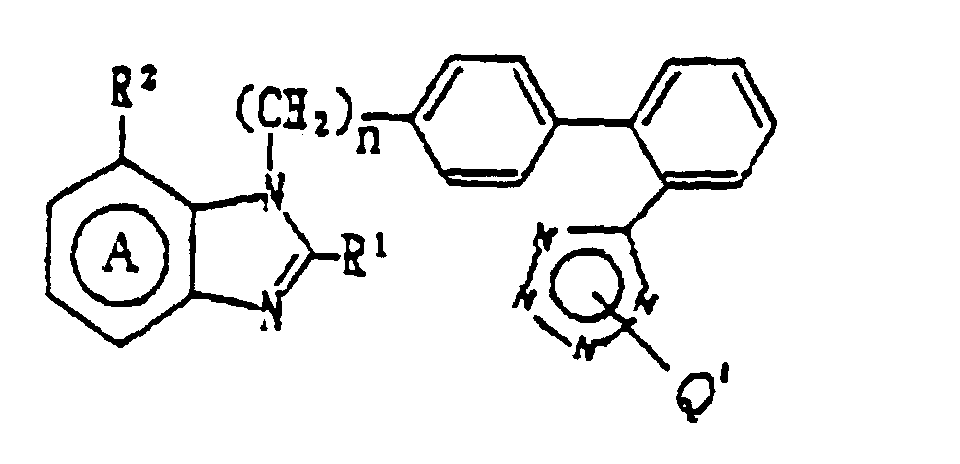 wherein ring A is a benzene ring which may be substituted, in addition to the group R2, by a substituent selected from(1) a halogen,(2) a lower (C1-4) alkyl,(3) a lower (C1-4) alkoxy,(4) a nitro,(5) a group of the formula: -CO-D' wherein D' is a hydroxy or a lower (C1-4) alkoxy, the alkyl moiety of which may be substituted by hydroxy, lower (C1-4) alkoxy, lower (C2-6) alkanoyloxy or lower (C1-6) alkoxycarbonyloxy, and(6) an amino which may be substituted by lower (C1-4) alkyl;R1 is a hydrogen atom or a hydrocarbon residue which may bind through a hetero atom, said hydrocarbon residue being selected from lower (C1-8) alkyl, lower (C2-8) alkenyl, lower (C2-8) alkinyl, lower (C3-6) cycloalkyl, phenyl-lower (C1-4) alkyl and phenyl;
said alkyl, alkenyl, alkinyl and cycloalkyl being optionally substituted by a substituent selected from hydroxy, amino, N-lower (C1-4) alkylamino, N,N-di-lower (C1-4) alkylamino, halogen, lower (C1-4) alkoxy and lower (C1-4) alkylthio; and
said phenyl-lower (C1-4) alkyl and phenyl being optionally substituted, in any substitutable position or positions of the benzene ring, by a substituent selected from halogen, nitro, amino, N-lower (C1-4) alkylamino, N,N-di-lower (C1-4) alkylamino, lower (C1-4) alkoxy, lower (C1-4) alkylthio and lower (C1-4) alkyl;R2 isan esterified carboxyl group selected from-COOMe, -COOEt, -COOtBu, -COOPr,pivaloyloxymethoxycarbonyl,1-(cyclohexyloxycarbonyloxy)ethoxycarbonyl,5-methyl-2-oxo-1,3-dioxolen-4-ylmethoxycarbonyl,acetoxymethyloxycarbonyl,propionyloxymethoxycarbonyl,n-butyryloxymethoxycarbonyl,isobutyryloxymethoxycarbonyl,1-(ethoxycarbonyloxy)ethoxycarbonyl,1-(acetyloxy)ethoxycarbonyl,1-(isobutyryloxy)ethoxycarbonyl,cyclohexylcarbonyloxymethoxycarbonyl,benzoyloxymethoxycarbonyl,cinnamyloxycarbonyl andcyclopentylcarbonyloxymethoxycarbonyl;Q' is triphenylmethyl; n is 1 or 2, with a mineral acid in the presence of alcohol wherein the concentration of water is at most 1 mole per mole of the N-protected tetrazolyl compound. - The process according to claim 1, wherein the mineral acid is hydrogen halide.
- The process according to claim 2, wherein the hydrogen halide is hydrogen chloride.
- The process according to claim 1, wherein the mineral acid is concentrated sulfuric acid.
- The process according to claim 4, wherein the concentration of the concentrated sulfuric acid is at least 95%.
- The process according to claim 1, wherein said alcohol is a lower (C1-4) alcohol.
- The process according to claim 1, wherein the tetrazolyl compound in the reaction mixture is crystallized using an aliphatic hydrocarbon solvent selected from pentane, hexane and heptane.
- The process according to claim 7, wherein said aliphatic hydrocarbon solvent is hexane.
- The process according to claim 1, wherein the tetrazolyl compound is (±)-1-(cyclohexyloxycarbonyloxy) ethyl-2-ethoxy-1-[[2'-(1H-tetrazol-5-yl)biphenyl-4-yl] methyl]-1H-benzimidazole-7-carboxylate.
Applications Claiming Priority (3)
| Application Number | Priority Date | Filing Date | Title |
|---|---|---|---|
| JP8233/94 | 1994-01-28 | ||
| JP823394 | 1994-01-28 | ||
| JP823394 | 1994-01-28 |
Publications (3)
| Publication Number | Publication Date |
|---|---|
| EP0668272A2 EP0668272A2 (en) | 1995-08-23 |
| EP0668272A3 EP0668272A3 (en) | 1995-08-30 |
| EP0668272B1 true EP0668272B1 (en) | 2000-07-12 |
Family
ID=11687442
Family Applications (1)
| Application Number | Title | Priority Date | Filing Date |
|---|---|---|---|
| EP95101055A Expired - Lifetime EP0668272B1 (en) | 1994-01-28 | 1995-01-26 | A process for the production of tetrazolyl compounds |
Country Status (9)
| Country | Link |
|---|---|
| US (2) | US5578733A (en) |
| EP (1) | EP0668272B1 (en) |
| AT (1) | ATE194603T1 (en) |
| CA (1) | CA2141175C (en) |
| DE (1) | DE69517832T2 (en) |
| DK (1) | DK0668272T3 (en) |
| ES (1) | ES2147798T3 (en) |
| GR (1) | GR3034464T3 (en) |
| PT (1) | PT668272E (en) |
Families Citing this family (32)
| Publication number | Priority date | Publication date | Assignee | Title |
|---|---|---|---|---|
| EP1346722B1 (en) | 2000-12-01 | 2008-12-10 | Takeda Pharmaceutical Company Limited | Method for producing preparation containing bioactive substance |
| EP1444988A4 (en) | 2001-11-13 | 2007-04-25 | Takeda Pharmaceutical | ANTICANCING AGENTS |
| EP1482896A4 (en) * | 2002-03-01 | 2005-11-23 | Merck & Co Inc | AMINOALKYLPHOSPHONATES AND ASSOCIATED COMPOUNDS AS EDG RECEPTOR AGONISTS |
| EP1511739B1 (en) * | 2003-03-17 | 2008-04-30 | Teva Pharmaceutical Industries Ltd. | Polymorphs of valsartan |
| US7504516B2 (en) | 2003-03-27 | 2009-03-17 | Hetero Drugs Limited | Crystalline forms of candesartan cilexetil |
| EP1556363A2 (en) | 2003-04-21 | 2005-07-27 | Teva Pharmaceutical Industries Limited | Process for the preparation of valsartan and intermediates thereof |
| CZ297016B6 (en) * | 2003-08-27 | 2006-08-16 | Zentiva, A.S. | Method for removing triphenylmethane protecting group from 1-trityl-5-(4'-substituted aminomethyl-1,1' -biphenyl-2-yl)-1H-tetrazoles and process for preparing losartan, irbesartan and valsartan potassium salt by making use thereof |
| US7098342B2 (en) * | 2003-10-16 | 2006-08-29 | Teva Pharmaceutical Industries Ltd. | Preparation of candesartan cilexetil |
| WO2005051928A1 (en) * | 2003-11-28 | 2005-06-09 | Ranbaxy Laboratories Limited | Process for production of tetrazolyl compounds |
| WO2005077941A2 (en) * | 2004-02-11 | 2005-08-25 | Teva Pharmaceutical Industries Ltd. | Candesartan cilexetil polymorphs |
| CN1953973A (en) * | 2004-05-05 | 2007-04-25 | 特瓦制药工业有限公司 | Preparation of candesartan cilexetil in high purity |
| WO2005123720A1 (en) * | 2004-06-18 | 2005-12-29 | Ranbaxy Laboratories Limited | Fine particles of the angiotensin ii antagonist candesartan cilexetil and process for production thereof |
| EP1655298A1 (en) * | 2004-11-03 | 2006-05-10 | LEK Pharmaceuticals d.d. | Novel polymorph forms of candesartan cilexetil |
| EP1812423A1 (en) * | 2004-11-11 | 2007-08-01 | LEK Pharmaceuticals D.D. | Process for the synthesis of tetrazoles |
| JP2007527925A (en) * | 2005-01-14 | 2007-10-04 | テバ ファーマシューティカル インダストリーズ リミティド | Preparation of crude candesartan cilexetil |
| JP2008505935A (en) * | 2005-05-10 | 2008-02-28 | テバ ファーマシューティカル インダストリーズ リミティド | Ultra finely ground stable candesartan cilexetil and process for its preparation |
| WO2007074399A2 (en) | 2005-06-06 | 2007-07-05 | Medichem, S.A. | Process for the preparation of tetrazolyl compounds |
| EP1910343B1 (en) * | 2005-07-29 | 2014-10-29 | Krka | Process for the preparation of olmesartan medoxomil |
| EP1816131A1 (en) * | 2006-02-06 | 2007-08-08 | KRKA, tovarna zdravil, d.d., Novo mesto | Process for the preparation of olmesartan medoxomil |
| SI22127A (en) | 2005-10-07 | 2007-04-30 | Krka, Tovarna Zdravil, D.D., Novo Mesto | Procedure of preparation of candesartan cilexetil |
| CZ299265B6 (en) * | 2005-10-20 | 2008-05-28 | Zentiva, A. S. | Process for preparing 1-(cyclohexyloxy carbonyloxy)ethyl-2-ethoxy-1-[[2'-(1H-tetrazol-5-yl)biphenyl-4-yl]-methyl]benzimidazole-7-carboxylate (candesartan cilexetil) |
| ITTO20060560A1 (en) * | 2006-07-27 | 2008-01-28 | S I M S S R L | INTERMEDIATE COMPOUNDS FOR THE PREPARATION OF ANTIGONISTS OF ANGIOTENSINA II |
| EP2066649A1 (en) * | 2006-07-28 | 2009-06-10 | KRKA, tovarna zdravil, d.d., Novo mesto | Process for the preparation of amorphous and crystalline forms of candesartan cilexetil using column chromatography |
| US20100210852A1 (en) * | 2007-07-11 | 2010-08-19 | Alembic Limited | Process for the preparation of candesartan cilexetil |
| KR20120046115A (en) | 2009-05-20 | 2012-05-09 | 랜박시 래보러터리스 리미티드 | Process for the preparation of olmesartan medoxomil |
| WO2011080684A1 (en) | 2009-12-31 | 2011-07-07 | Ranbaxy Laboratories Limited | Process for the preparation of candesartan cilexetil |
| WO2011092666A1 (en) | 2010-01-29 | 2011-08-04 | Ranbaxy Laboratories Limited | An improved process for the preparation of candesartan cilexetil, polymorphic forms of n-trityl candesartan and their uses thereof |
| KR101251741B1 (en) | 2010-12-16 | 2013-04-05 | 동화약품주식회사 | An improved process for preparing candesartan cilexetil |
| CN103396408A (en) * | 2013-08-13 | 2013-11-20 | 河南华商药业有限公司 | Preparation method of impurity B in candesartan cilexetil |
| CN109776503A (en) * | 2019-01-30 | 2019-05-21 | 浙江省食品药品检验研究院 | A kind of candesartan cilexetil crystal and preparation method thereof |
| CN109627234A (en) * | 2019-01-30 | 2019-04-16 | 浙江省食品药品检验研究院 | A kind of candesartan cilexetil crystal and preparation method thereof |
| CN109851612A (en) * | 2019-01-30 | 2019-06-07 | 浙江省食品药品检验研究院 | A kind of candesartan cilexetil crystal and preparation method thereof |
Family Cites Families (8)
| Publication number | Priority date | Publication date | Assignee | Title |
|---|---|---|---|---|
| US4820843A (en) * | 1987-05-22 | 1989-04-11 | E. I. Du Pont De Nemours And Company | Tetrazole intermediates to antihypertensive compounds |
| US5196444A (en) * | 1990-04-27 | 1993-03-23 | Takeda Chemical Industries, Ltd. | 1-(cyclohexyloxycarbonyloxy)ethyl 2-ethoxy-1-[[2'-(1H-tetrazol-5-yl)biphenyl-4-yl]methyl]benzimidazole-7-carboxylate and compositions and methods of pharmaceutical use thereof |
| GB9017480D0 (en) * | 1990-08-09 | 1990-09-26 | Ici Plc | Chemical process |
| TW209213B (en) * | 1991-08-21 | 1993-07-11 | Yamanouchi Pharma Co Ltd | |
| EP0531874A1 (en) * | 1991-09-10 | 1993-03-17 | Tanabe Seiyaku Co., Ltd. | Imidazopyridine derivatives and process for preparation thereof |
| DE4132632A1 (en) * | 1991-10-01 | 1993-04-08 | Bayer Ag | SUBSTITUTED IMIDAZOLYL-PROPENSAEUREDERIVATE |
| EP0550313A1 (en) * | 1991-12-30 | 1993-07-07 | Synthelabo | 2-(Tetranol-5-yl)-(1,1'-biphenyl)derivatives, their preparation and use as intermediates |
| DE4212748A1 (en) * | 1992-04-16 | 1993-10-21 | Thomae Gmbh Dr K | New 1-bi:phenyl:methyl- benzimidazole derivs. - used as angiotensin antagonists, e.g. for treating cardiovascular, pulmonary and CNS disorders e.g. Alzheimer's disease, ischaemia etc. |
-
1995
- 1995-01-26 DE DE69517832T patent/DE69517832T2/en not_active Expired - Lifetime
- 1995-01-26 ES ES95101055T patent/ES2147798T3/en not_active Expired - Lifetime
- 1995-01-26 CA CA002141175A patent/CA2141175C/en not_active Expired - Lifetime
- 1995-01-26 DK DK95101055T patent/DK0668272T3/en active
- 1995-01-26 AT AT95101055T patent/ATE194603T1/en active
- 1995-01-26 PT PT95101055T patent/PT668272E/en unknown
- 1995-01-26 EP EP95101055A patent/EP0668272B1/en not_active Expired - Lifetime
- 1995-01-27 US US08/378,825 patent/US5578733A/en not_active Expired - Lifetime
-
1996
- 1996-08-16 US US08/697,010 patent/US5763619A/en not_active Expired - Lifetime
-
2000
- 2000-09-21 GR GR20000402153T patent/GR3034464T3/en unknown
Also Published As
| Publication number | Publication date |
|---|---|
| DK0668272T3 (en) | 2000-09-18 |
| DE69517832D1 (en) | 2000-08-17 |
| CA2141175C (en) | 2006-12-12 |
| ATE194603T1 (en) | 2000-07-15 |
| ES2147798T3 (en) | 2000-10-01 |
| GR3034464T3 (en) | 2000-12-29 |
| CA2141175A1 (en) | 1995-07-29 |
| US5578733A (en) | 1996-11-26 |
| EP0668272A3 (en) | 1995-08-30 |
| DE69517832T2 (en) | 2000-11-09 |
| PT668272E (en) | 2000-10-31 |
| EP0668272A2 (en) | 1995-08-23 |
| US5763619A (en) | 1998-06-09 |
Similar Documents
| Publication | Publication Date | Title |
|---|---|---|
| US5578733A (en) | Process for the production of tetrazolyl compounds | |
| KR101707246B1 (en) | Solid forms of (2s,3r,4r,5s,6r)-2-(4-chloro-3-(4-ethoxybenzyl)phenyl)-6-(methylthio)tetrahydro-2h-pyran-3,4,5-triol and methods of their use | |
| US20060069141A1 (en) | Preparation of olmesartan medoxomil | |
| KR20140008371A (en) | A method of manufacturing 2-ethoxy-1-((2'-hydroxyamino)iminomethyl)biphenyl-4-yl)methyl)-1h-benzo[d]imidazole-7-carboxylic acid and its esters | |
| JPH01224379A (en) | Method for producing β-lactam derivatives | |
| WO2005051943A1 (en) | Processes for the preparation of highly pure irbesartan | |
| BE897516A (en) | NOVEL DEOXYURIDINE DERIVATIVES, THEIR PREPARATION AND THEIR USE AS MEDICAMENTS | |
| US6936720B2 (en) | Method for preparing benzisoxazole methane sulfonyl chloride and its amidation to form zonisamide | |
| US8981109B2 (en) | Process for the preparation of valsartan | |
| US7880015B2 (en) | Process for the preparation of angiotensin II antagonist | |
| JP2730501B2 (en) | Method for producing tetrazolyl compound | |
| TW202120470A (en) | Process for the preparation of a nitric oxide donating prostaglandin analogue | |
| EP1106611B1 (en) | Crystalline or crystallized acid addition salt of losartan and purification method of losartan | |
| WO2005051928A1 (en) | Process for production of tetrazolyl compounds | |
| JP7336432B2 (en) | Synthesis of aza-sugars and their intermediates | |
| CN115677774B (en) | Phosphonate derivatives and preparation methods and uses thereof | |
| EP1899328B1 (en) | A process for the preparation of losartan derivatives by chlorination and reduction of the respective 1h-imidazole-5-carbaldehydes | |
| US20050143400A1 (en) | Process for preparing famciclovir | |
| KR0183541B1 (en) | Beta-methylcarbapenem carboxy ester derivatives and process for preparing thereof | |
| KR101257272B1 (en) | Method of preparing a biphenyltetrazole compound for hypertension treatment using deprotecting reaction | |
| JP2000095780A (en) | Method for producing carbamate crystals | |
| Parvez | Development of an Improved Manufacturing Process for (2S)-3-methyl-2-[pentanoyl-[[4-[2-(2H-tetrazol-5-yl) phenyl] phenyl] methyl] amino] butanoic acid with Enhanced Yield and Reagent Recovery | |
| Parvez | Development of an Improved Manufacturing Process for Valsartan with Enhanced Yield and Reagent Recovery | |
| JPH09323991A (en) | New carboxymethylidenecycloheptoimidazole derivative, its production and agent containing the derivative | |
| EP4667456A1 (en) | Manufacturing method for 4-methoxypyrrole derivatives |
Legal Events
| Date | Code | Title | Description |
|---|---|---|---|
| PUAI | Public reference made under article 153(3) epc to a published international application that has entered the european phase |
Free format text: ORIGINAL CODE: 0009012 |
|
| PUAL | Search report despatched |
Free format text: ORIGINAL CODE: 0009013 |
|
| AK | Designated contracting states |
Kind code of ref document: A2 Designated state(s): AT BE CH DE DK ES FR GB GR IE IT LI LU NL PT SE |
|
| AK | Designated contracting states |
Kind code of ref document: A3 Designated state(s): AT BE CH DE DK ES FR GB GR IE IT LI LU NL PT SE |
|
| 17P | Request for examination filed |
Effective date: 19951222 |
|
| 17Q | First examination report despatched |
Effective date: 19980702 |
|
| GRAG | Despatch of communication of intention to grant |
Free format text: ORIGINAL CODE: EPIDOS AGRA |
|
| GRAG | Despatch of communication of intention to grant |
Free format text: ORIGINAL CODE: EPIDOS AGRA |
|
| GRAH | Despatch of communication of intention to grant a patent |
Free format text: ORIGINAL CODE: EPIDOS IGRA |
|
| GRAH | Despatch of communication of intention to grant a patent |
Free format text: ORIGINAL CODE: EPIDOS IGRA |
|
| GRAA | (expected) grant |
Free format text: ORIGINAL CODE: 0009210 |
|
| AK | Designated contracting states |
Kind code of ref document: B1 Designated state(s): AT BE CH DE DK ES FR GB GR IE IT LI LU NL PT SE |
|
| REF | Corresponds to: |
Ref document number: 194603 Country of ref document: AT Date of ref document: 20000715 Kind code of ref document: T |
|
| ITF | It: translation for a ep patent filed | ||
| REG | Reference to a national code |
Ref country code: CH Ref legal event code: NV Representative=s name: A. BRAUN, BRAUN, HERITIER, ESCHMANN AG PATENTANWAE Ref country code: CH Ref legal event code: EP |
|
| REG | Reference to a national code |
Ref country code: IE Ref legal event code: FG4D |
|
| REF | Corresponds to: |
Ref document number: 69517832 Country of ref document: DE Date of ref document: 20000817 |
|
| ET | Fr: translation filed | ||
| REG | Reference to a national code |
Ref country code: DK Ref legal event code: T3 |
|
| REG | Reference to a national code |
Ref country code: ES Ref legal event code: FG2A Ref document number: 2147798 Country of ref document: ES Kind code of ref document: T3 |
|
| REG | Reference to a national code |
Ref country code: PT Ref legal event code: SC4A Free format text: AVAILABILITY OF NATIONAL TRANSLATION Effective date: 20000717 |
|
| PLBE | No opposition filed within time limit |
Free format text: ORIGINAL CODE: 0009261 |
|
| STAA | Information on the status of an ep patent application or granted ep patent |
Free format text: STATUS: NO OPPOSITION FILED WITHIN TIME LIMIT |
|
| 26N | No opposition filed | ||
| REG | Reference to a national code |
Ref country code: GB Ref legal event code: IF02 |
|
| REG | Reference to a national code |
Ref country code: ES Ref legal event code: FD2A Effective date: 20021016 |
|
| REG | Reference to a national code |
Ref country code: CH Ref legal event code: PFA Owner name: TAKEDA PHARMACEUTICAL COMPANY LIMITED Free format text: TAKEDA CHEMICAL INDUSTRIES, LTD.#1-1, DOSHOMACHI 4-CHOME#CHUO-KU, OSAKA 541 (JP) -TRANSFER TO- TAKEDA PHARMACEUTICAL COMPANY LIMITED#1-1, DOSHOMACHI 4-CHOME CHUO-KU#OSAKA (JP) |
|
| NLT1 | Nl: modifications of names registered in virtue of documents presented to the patent office pursuant to art. 16 a, paragraph 1 |
Owner name: TAKEDA PHARMACEUTICAL COMPANY LIMITED |
|
| REG | Reference to a national code |
Ref country code: FR Ref legal event code: CD |
|
| REG | Reference to a national code |
Ref country code: CH Ref legal event code: PFA Owner name: TAKEDA PHARMACEUTICAL COMPANY LIMITED Free format text: TAKEDA PHARMACEUTICAL COMPANY LIMITED#1-1, DOSHOMACHI 4-CHOME CHUO-KU#OSAKA (JP) -TRANSFER TO- TAKEDA PHARMACEUTICAL COMPANY LIMITED#1-1, DOSHOMACHI 4-CHOME CHUO-KU#OSAKA (JP) |
|
| REG | Reference to a national code |
Ref country code: ES Ref legal event code: GD2A Effective date: 20100518 |
|
| REG | Reference to a national code |
Ref country code: ES Ref legal event code: GD2A Effective date: 20100806 |
|
| REG | Reference to a national code |
Ref country code: ES Ref legal event code: GD2A Effective date: 20100831 |
|
| REG | Reference to a national code |
Ref country code: ES Ref legal event code: GD2A Effective date: 20110518 |
|
| PGFP | Annual fee paid to national office [announced via postgrant information from national office to epo] |
Ref country code: LU Payment date: 20140102 Year of fee payment: 20 Ref country code: ES Payment date: 20131211 Year of fee payment: 20 Ref country code: NL Payment date: 20131210 Year of fee payment: 20 Ref country code: GR Payment date: 20131216 Year of fee payment: 20 |
|
| PGFP | Annual fee paid to national office [announced via postgrant information from national office to epo] |
Ref country code: SE Payment date: 20140113 Year of fee payment: 20 Ref country code: DK Payment date: 20140110 Year of fee payment: 20 Ref country code: IE Payment date: 20140110 Year of fee payment: 20 Ref country code: DE Payment date: 20140122 Year of fee payment: 20 Ref country code: BE Payment date: 20140114 Year of fee payment: 20 Ref country code: CH Payment date: 20140114 Year of fee payment: 20 |
|
| PGFP | Annual fee paid to national office [announced via postgrant information from national office to epo] |
Ref country code: FR Payment date: 20140108 Year of fee payment: 20 Ref country code: IT Payment date: 20140113 Year of fee payment: 20 Ref country code: AT Payment date: 20131224 Year of fee payment: 20 |
|
| PGFP | Annual fee paid to national office [announced via postgrant information from national office to epo] |
Ref country code: PT Payment date: 20140127 Year of fee payment: 20 Ref country code: GB Payment date: 20140122 Year of fee payment: 20 |
|
| REG | Reference to a national code |
Ref country code: CH Ref legal event code: PCAR Free format text: NEW ADDRESS: HOLBEINSTRASSE 36-38, 4051 BASEL (CH) |
|
| REG | Reference to a national code |
Ref country code: DE Ref legal event code: R071 Ref document number: 69517832 Country of ref document: DE |
|
| REG | Reference to a national code |
Ref country code: DK Ref legal event code: EUP Effective date: 20150126 |
|
| REG | Reference to a national code |
Ref country code: PT Ref legal event code: MM4A Free format text: MAXIMUM VALIDITY LIMIT REACHED Effective date: 20150126 |
|
| REG | Reference to a national code |
Ref country code: NL Ref legal event code: V4 Effective date: 20150126 |
|
| REG | Reference to a national code |
Ref country code: CH Ref legal event code: PL |
|
| REG | Reference to a national code |
Ref country code: GB Ref legal event code: PE20 Expiry date: 20150125 |
|
| REG | Reference to a national code |
Ref country code: IE Ref legal event code: MK9A |
|
| REG | Reference to a national code |
Ref country code: SE Ref legal event code: EUG |
|
| REG | Reference to a national code |
Ref country code: AT Ref legal event code: MK07 Ref document number: 194603 Country of ref document: AT Kind code of ref document: T Effective date: 20150126 |
|
| REG | Reference to a national code |
Ref country code: GR Ref legal event code: MA Ref document number: 20000402153 Country of ref document: GR Effective date: 20150127 Ref country code: ES Ref legal event code: FD2A Effective date: 20150406 |
|
| PG25 | Lapsed in a contracting state [announced via postgrant information from national office to epo] |
Ref country code: PT Free format text: LAPSE BECAUSE OF EXPIRATION OF PROTECTION Effective date: 20150203 Ref country code: ES Free format text: LAPSE BECAUSE OF EXPIRATION OF PROTECTION Effective date: 20150127 Ref country code: IE Free format text: LAPSE BECAUSE OF EXPIRATION OF PROTECTION Effective date: 20150126 |
|
| PG25 | Lapsed in a contracting state [announced via postgrant information from national office to epo] |
Ref country code: GB Free format text: LAPSE BECAUSE OF EXPIRATION OF PROTECTION Effective date: 20150125 |