EP0667770B1 - Inhibition of tnf production - Google Patents
Inhibition of tnf production Download PDFInfo
- Publication number
- EP0667770B1 EP0667770B1 EP93924754A EP93924754A EP0667770B1 EP 0667770 B1 EP0667770 B1 EP 0667770B1 EP 93924754 A EP93924754 A EP 93924754A EP 93924754 A EP93924754 A EP 93924754A EP 0667770 B1 EP0667770 B1 EP 0667770B1
- Authority
- EP
- European Patent Office
- Prior art keywords
- alkyl
- methyl
- phenyl
- amino
- group
- Prior art date
- Legal status (The legal status is an assumption and is not a legal conclusion. Google has not performed a legal analysis and makes no representation as to the accuracy of the status listed.)
- Expired - Lifetime
Links
Classifications
-
- A—HUMAN NECESSITIES
- A61—MEDICAL OR VETERINARY SCIENCE; HYGIENE
- A61K—PREPARATIONS FOR MEDICAL, DENTAL OR TOILETRY PURPOSES
- A61K31/00—Medicinal preparations containing organic active ingredients
- A61K31/33—Heterocyclic compounds
- A61K31/395—Heterocyclic compounds having nitrogen as a ring hetero atom, e.g. guanethidine or rifamycins
- A61K31/435—Heterocyclic compounds having nitrogen as a ring hetero atom, e.g. guanethidine or rifamycins having six-membered rings with one nitrogen as the only ring hetero atom
- A61K31/44—Non condensed pyridines; Hydrogenated derivatives thereof
- A61K31/4427—Non condensed pyridines; Hydrogenated derivatives thereof containing further heterocyclic ring systems
- A61K31/4436—Non condensed pyridines; Hydrogenated derivatives thereof containing further heterocyclic ring systems containing a heterocyclic ring having sulfur as a ring hetero atom
-
- A—HUMAN NECESSITIES
- A61—MEDICAL OR VETERINARY SCIENCE; HYGIENE
- A61K—PREPARATIONS FOR MEDICAL, DENTAL OR TOILETRY PURPOSES
- A61K31/00—Medicinal preparations containing organic active ingredients
-
- A—HUMAN NECESSITIES
- A61—MEDICAL OR VETERINARY SCIENCE; HYGIENE
- A61K—PREPARATIONS FOR MEDICAL, DENTAL OR TOILETRY PURPOSES
- A61K31/00—Medicinal preparations containing organic active ingredients
- A61K31/16—Amides, e.g. hydroxamic acids
-
- A—HUMAN NECESSITIES
- A61—MEDICAL OR VETERINARY SCIENCE; HYGIENE
- A61K—PREPARATIONS FOR MEDICAL, DENTAL OR TOILETRY PURPOSES
- A61K31/00—Medicinal preparations containing organic active ingredients
- A61K31/33—Heterocyclic compounds
- A61K31/38—Heterocyclic compounds having sulfur as a ring hetero atom
- A61K31/381—Heterocyclic compounds having sulfur as a ring hetero atom having five-membered rings
-
- A—HUMAN NECESSITIES
- A61—MEDICAL OR VETERINARY SCIENCE; HYGIENE
- A61K—PREPARATIONS FOR MEDICAL, DENTAL OR TOILETRY PURPOSES
- A61K31/00—Medicinal preparations containing organic active ingredients
- A61K31/33—Heterocyclic compounds
- A61K31/395—Heterocyclic compounds having nitrogen as a ring hetero atom, e.g. guanethidine or rifamycins
- A61K31/40—Heterocyclic compounds having nitrogen as a ring hetero atom, e.g. guanethidine or rifamycins having five-membered rings with one nitrogen as the only ring hetero atom, e.g. sulpiride, succinimide, tolmetin, buflomedil
- A61K31/4015—Heterocyclic compounds having nitrogen as a ring hetero atom, e.g. guanethidine or rifamycins having five-membered rings with one nitrogen as the only ring hetero atom, e.g. sulpiride, succinimide, tolmetin, buflomedil having oxo groups directly attached to the heterocyclic ring, e.g. piracetam, ethosuximide
-
- A—HUMAN NECESSITIES
- A61—MEDICAL OR VETERINARY SCIENCE; HYGIENE
- A61K—PREPARATIONS FOR MEDICAL, DENTAL OR TOILETRY PURPOSES
- A61K31/00—Medicinal preparations containing organic active ingredients
- A61K31/33—Heterocyclic compounds
- A61K31/395—Heterocyclic compounds having nitrogen as a ring hetero atom, e.g. guanethidine or rifamycins
- A61K31/40—Heterocyclic compounds having nitrogen as a ring hetero atom, e.g. guanethidine or rifamycins having five-membered rings with one nitrogen as the only ring hetero atom, e.g. sulpiride, succinimide, tolmetin, buflomedil
- A61K31/403—Heterocyclic compounds having nitrogen as a ring hetero atom, e.g. guanethidine or rifamycins having five-membered rings with one nitrogen as the only ring hetero atom, e.g. sulpiride, succinimide, tolmetin, buflomedil condensed with carbocyclic rings, e.g. carbazole
-
- A—HUMAN NECESSITIES
- A61—MEDICAL OR VETERINARY SCIENCE; HYGIENE
- A61K—PREPARATIONS FOR MEDICAL, DENTAL OR TOILETRY PURPOSES
- A61K31/00—Medicinal preparations containing organic active ingredients
- A61K31/33—Heterocyclic compounds
- A61K31/395—Heterocyclic compounds having nitrogen as a ring hetero atom, e.g. guanethidine or rifamycins
- A61K31/435—Heterocyclic compounds having nitrogen as a ring hetero atom, e.g. guanethidine or rifamycins having six-membered rings with one nitrogen as the only ring hetero atom
- A61K31/44—Non condensed pyridines; Hydrogenated derivatives thereof
- A61K31/4406—Non condensed pyridines; Hydrogenated derivatives thereof only substituted in position 3, e.g. zimeldine
-
- A—HUMAN NECESSITIES
- A61—MEDICAL OR VETERINARY SCIENCE; HYGIENE
- A61P—SPECIFIC THERAPEUTIC ACTIVITY OF CHEMICAL COMPOUNDS OR MEDICINAL PREPARATIONS
- A61P1/00—Drugs for disorders of the alimentary tract or the digestive system
- A61P1/02—Stomatological preparations, e.g. drugs for caries, aphtae, periodontitis
-
- A—HUMAN NECESSITIES
- A61—MEDICAL OR VETERINARY SCIENCE; HYGIENE
- A61P—SPECIFIC THERAPEUTIC ACTIVITY OF CHEMICAL COMPOUNDS OR MEDICINAL PREPARATIONS
- A61P17/00—Drugs for dermatological disorders
-
- A—HUMAN NECESSITIES
- A61—MEDICAL OR VETERINARY SCIENCE; HYGIENE
- A61P—SPECIFIC THERAPEUTIC ACTIVITY OF CHEMICAL COMPOUNDS OR MEDICINAL PREPARATIONS
- A61P29/00—Non-central analgesic, antipyretic or antiinflammatory agents, e.g. antirheumatic agents; Non-steroidal antiinflammatory drugs [NSAID]
-
- A—HUMAN NECESSITIES
- A61—MEDICAL OR VETERINARY SCIENCE; HYGIENE
- A61P—SPECIFIC THERAPEUTIC ACTIVITY OF CHEMICAL COMPOUNDS OR MEDICINAL PREPARATIONS
- A61P33/00—Antiparasitic agents
-
- A—HUMAN NECESSITIES
- A61—MEDICAL OR VETERINARY SCIENCE; HYGIENE
- A61P—SPECIFIC THERAPEUTIC ACTIVITY OF CHEMICAL COMPOUNDS OR MEDICINAL PREPARATIONS
- A61P35/00—Antineoplastic agents
-
- A—HUMAN NECESSITIES
- A61—MEDICAL OR VETERINARY SCIENCE; HYGIENE
- A61P—SPECIFIC THERAPEUTIC ACTIVITY OF CHEMICAL COMPOUNDS OR MEDICINAL PREPARATIONS
- A61P37/00—Drugs for immunological or allergic disorders
-
- A—HUMAN NECESSITIES
- A61—MEDICAL OR VETERINARY SCIENCE; HYGIENE
- A61P—SPECIFIC THERAPEUTIC ACTIVITY OF CHEMICAL COMPOUNDS OR MEDICINAL PREPARATIONS
- A61P43/00—Drugs for specific purposes, not provided for in groups A61P1/00-A61P41/00
-
- A—HUMAN NECESSITIES
- A61—MEDICAL OR VETERINARY SCIENCE; HYGIENE
- A61P—SPECIFIC THERAPEUTIC ACTIVITY OF CHEMICAL COMPOUNDS OR MEDICINAL PREPARATIONS
- A61P7/00—Drugs for disorders of the blood or the extracellular fluid
-
- A—HUMAN NECESSITIES
- A61—MEDICAL OR VETERINARY SCIENCE; HYGIENE
- A61P—SPECIFIC THERAPEUTIC ACTIVITY OF CHEMICAL COMPOUNDS OR MEDICINAL PREPARATIONS
- A61P9/00—Drugs for disorders of the cardiovascular system
-
- Y—GENERAL TAGGING OF NEW TECHNOLOGICAL DEVELOPMENTS; GENERAL TAGGING OF CROSS-SECTIONAL TECHNOLOGIES SPANNING OVER SEVERAL SECTIONS OF THE IPC; TECHNICAL SUBJECTS COVERED BY FORMER USPC CROSS-REFERENCE ART COLLECTIONS [XRACs] AND DIGESTS
- Y02—TECHNOLOGIES OR APPLICATIONS FOR MITIGATION OR ADAPTATION AGAINST CLIMATE CHANGE
- Y02A—TECHNOLOGIES FOR ADAPTATION TO CLIMATE CHANGE
- Y02A50/00—TECHNOLOGIES FOR ADAPTATION TO CLIMATE CHANGE in human health protection, e.g. against extreme weather
- Y02A50/30—Against vector-borne diseases, e.g. mosquito-borne, fly-borne, tick-borne or waterborne diseases whose impact is exacerbated by climate change
Definitions
- This invention relates to a new pharmaceutical and veterinary use of certain hydroxamic acid derivatives, previously known in the art as inhibitors of matrix metalloproteinases such as collagenase.
- the known compounds have been found to be capable of inhibiting the production of tumour necrosis factor (TNF) by cells, and thus to be useful in the management of diseases or conditions mediated by overproduction of, or over-responsiveness to, TNF.
- TNF tumour necrosis factor
- TNF is a cytokine which is produced initially as a cell-associated 28kD precursor. It is released as an active, 17kD form (Jue, D-M et al, (1990) Biochemistry 29:8371-8377), which can mediate a large number of deleterious effects in vivo .
- TNF When administered to animals or humans it causes inflammation, fever, cardiovascular effects, haemorrhage, coagulation and acute phase responses, similar to those seen during acute infections and shock states. Chronic administration can also cause cachexia and anorexia. Accumulation of excessive TNF can be lethal.
- TNF is also an autocrine growth factor for some myelomas and lymphomas and can act to inhibit normal haematopoiesis in patients with these tumours.
- TNF Preventing the production or action of TNF is, therefore, predicted to be a potent therapeutic strategy for many inflammatory, infectious, immunological or malignant diseases.
- tumour necrosis factor or TNF therefore means tumour necrosis factor ⁇ and peptides having a high degree of sequence homology with, and substantially similar physiological effects to, TNF ⁇ , for example TNF ⁇ .
- MMPs matrix metalloproteinases
- hydroxamic acid-based MMP inhibitors are those forming part of the state of the art by virtue of any of the following patent publications:
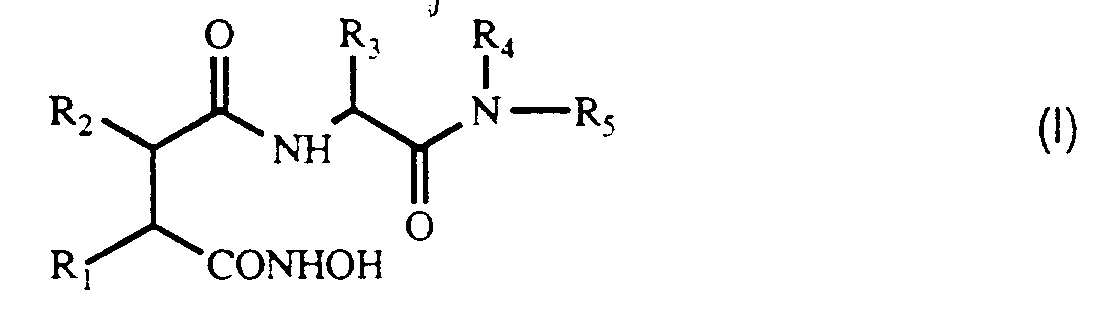
- the MMP inhibiting hydroxamic acid derivatives disclosed therein can be regarded as having the following basic structure (I): wherein the five substituents R 1 - R 5 may vary according to the detailed disclosure of each publication. However, neither the compounds per se nor the method of their preparation form part of this invention. Rather, the invention arises from the finding by the present inventors that representative members of the compound classes disclosed in each of those publications have the property of inhibiting release of TNF from cells, and the realisation that such activity is widespread amongst the disclosed compounds.
- Salts of such known MMP inhibitors include physiologically acceptable acid addition salts for example hydrochlorides, hydrobromides, sulphates, methane sulphonates, p-toluenesulphonates, phosphates, acetates, citrates, succinates, lactates, tartrates, fumarates and maleates. Salts may also be formed with bases, for example sodium, potassium, magnesium, and calcium salts.
- the present invention provides the use of a compound of formula (I) below in the preparation of an agent for use in the treatment of diseases mediated by TNF by inhibiting release of TNF from cells: wherein the five substituents R 1 - R 5 may vary as follows:
- TNF TNF-induced fibroblast growth factor
- TNF TNF-induced fibroblast growth factor
- fibroblasts mediated by TNF include, but are not limited to, inflammation, fever, cardiovascular effects, haemmorhage, coagulation and acute phase response, cachexia and anorexia, acute infections, shock states, graft versus host reactions and autoimmune disease.
- the target for the present invention is inhibition of the release of and the effects of TNF in septic shock, haemodynamic shock or sepsis syndrome, in post ischaemic reperfusion injury, in malaria, mycobacterial infection and meningitis, in psoriasis, in cancer, in cachexia, in fibrotic disease, in congestive heart failure, in graft rejection, in rheumatoid arthritis, in radiation damage and toxicity following administration of immunosuppressive monoclonal antibodies such as OKT3 or CAMPATH-1, in hyperoxic alveolar injury, in autoimmune disease for example AIDS and multiple sclerosis, and in any disease state where TNF is a mediator of host injury.
- TNF inhibitory activity for use in the present invention are those listed in the Examples below, particularly those listed in Example 2, Group A.
- compositions may be in the form of tablets, capsules, powders, granules, lozenges, liquid or gel preparations, such as oral, topical, or sterile parenteral solutions or suspensions, as appropriate.
- Tablets and capsules for oral administration may be in unit dose presentation form, and may contain conventional excipients such as binding agents, for example syrup, acacia, gelatin, sorbitol, tragacanth, or polyvinyl-pyrrolidone; fillers for example lactose, sugar, maize-starch, calcium phosphate, sorbitol or glycine; tabletting lubricant, for example magnesium stearate, talc, polyethylene glycol or silica; disintegrants for example potato starch, or acceptable wetting agents such as sodium lauryl sulphate.
- the tablets may be coated according to methods well known in normal pharmaceutical practice.
- Oral liquid preparations may be in the form of, for example, aqueous or oily suspensions, solutions, emulsions, syrups or elixirs, or may be presented as a dry product for reconstitution with water or other suitable vehicle before use.
- Such liquid preparations may contain conventional additives such as suspending agents, for example sorbitol, syrup, methyl cellulose, glucose syrup, gelatin hydrogenated edible fats; emulsifying agents, for example lecithin, sorbitan monooleate, or acacia; non-aqueous vehicles (which may include edible oils), for example almond oil, fractionated coconut oil, oily esters such as glycerine, propylene glycol, or ethyl alcohol; preservatives, for example methyl or propyl p-hydroxybenzoate or sorbic acid, and if desired conventional flavouring or colouring agents.
- suspending agents for example sorbitol, syrup, methyl cellulose, glucose syrup, gelatin hydrogenated edible fats
- emulsifying agents for example lecithin, sorbitan monooleate, or acacia
- non-aqueous vehicles which may include edible oils
- almond oil fractionated coconut oil
- oily esters such as glycerine, propylene
- the dosage unit for oral administration may contain from about 1 to 250mg, for example from about 25 to 250mg of a compound of general formula I.
- a suitable daily dose for a mammal may vary widely depending on the condition of the patient. However, a dose of a compound of general formula I of about 0.1 to 300mg/kg body weight, particularly from about 1 to 100mg/kg body weight may be appropriate.
- the drug may be made up into a cream, lotion or ointment.
- Cream or ointment formulations which may be used for the drug are conventional formulations well known in the art, for example as described in standard textbooks of pharmaceutics such as the British Pharmacopoeia.
- the drug may be made up into a solution or suspension in a suitable sterile aqueous or non aqueous vehicle.
- Additives for instance buffers such as sodium metabisulphite or disodium edeate; preservatives including bactericidal and fungicidal agents such as phenyl mercuric acetate or nitrate, benzalkonium chloride or chlorhexidine, and thickening agents such as hypromellose may also be included.
- each dose may typically be in the range from 10 to 100mg of the drug.
- the active ingredient may also be administered parenterally in a sterile medium.
- the drug can either be suspended or dissolved in the vehicle.
- adjuvants such as a local anaesthetic, preservative and buffering agents can be dissolved in the vehicle.
- matrix metalloproteinase inhibitors containing a hydroxamic acid group known from specific patent publications as described above, it is thought highly probable that those other structural classes of compounds which are known in the art as matrix metalloproteinase inhibitors will, by analogous mechanisms, also have the property of inhibiting the production of TNF, and will therefore also be of use for the treatment of TNF-mediated diseases.
- Example 1 Metalloproteinase inhibitors can prevent the release of TNF from PMA-stimulated human monocytic cell line U937.
- the ability of representative compounds, which are inhibitors of metalloproteinases, to inhibit the release of TNF was investigated.
- the assay is based on the ability of phorbol myristate acetate (PMA) to stimulate the release of TNF ⁇ from a human monocytic cell line, U937.
- PMA phorbol myristate acetate
- U937 cells cultured in RPMI 1640 medium + 5% foetal calf serum were centifuged at 1000 x g for 5 minutes and then resuspended in medium at 2 x 10 6 /ml. 1 ml of cell suspension was aliquoted into individual wells of 24-well plates. Test compounds were dissolved in dimethyl sulphoxide (DMSO) at a stock concentration of 100mM, then diluted to 50x the final required concentration with RPMI 1640 medium. 20 ⁇ l of the diluted compounds were added to U937 cells in duplicate wells. TNF ⁇ release was stimulated by addition of PMA to the cells at a final concentration of 50nM. Appropriate control cultures were set up in duplicate.
- DMSO dimethyl sulphoxide
- the plates were incubated for 18 hours at 37°C, 5% CO 2 , then centrifuged at 1000 x g for 5 minutes.
- a specific ELISA for TNF ⁇ obtained from British Bio-technology Products Limited, Abingdon, England was used to measure TNF ⁇ levels in the culture supernatants according to the protocol supplied.
- test compound which inhibits the release of TNF ⁇ by 50% relative to the control culture was assessed as greater than 90 ⁇ M, in the range 10 ⁇ M -90 ⁇ M, or less than 10 ⁇ M.
- Group A Compounds with IC 50 s less than 10 micromolar.
- Group B Compounds with IC 50 s between 10 and 90 micromolar.
- Group C Compounds with IC 50 s greater than 90 micromolar.
- Example 2 Metalloproteinase inhibitors can prevent the release of TNF from LPS-stimulated whole blood cultures.
- Test compounds were added directly to each well. Control cultures containing RPMI-1640 alone, LPS at 100ng/ml and LPS plus diluent were included in each experiment. Test compounds at dilutions from 100 ⁇ M final concentration were added to culture wells containing 100ng/ml LPS. After 24hrs incubation at 37°C, supernatants were removed, centrifuged at 1200rpm for 10 mins and assayed for TNF ⁇ . A specific ELISA for TNF ⁇ (British Bio-technology Products) was used to measure TNF levels.
- test compounds specifically inhibit the release of TNF from LPS-stimulated blood cells into the supernatant at concentrations below 100 ⁇ M.
- Test compounds were assessed for their ability to inhibit release of endotoxin induced TNF production in vivo .
- Rats were administered LPS at a dose of 500 ⁇ g.kg -1 which resulted in a marked increase in TNF ⁇ levels in comparison to saline controls.
- the peak of TNF release was at the 1 hour timepoint.
- TNF levels were expressed in units/ml where 1 unit is the equivalent of 1pg of mouse TNF ⁇ .
- Rat serum TNF levels were measured using a mouse TNF ⁇ reference standard.
- the commercial ELISA kits were from Genzyme.
- Test compounds were administered intraperitoneally to anaesthetised rats at a dose of 10mg.kg -1 , 1 hour prior to LPS administration.
Landscapes
- Health & Medical Sciences (AREA)
- Veterinary Medicine (AREA)
- Chemical & Material Sciences (AREA)
- Medicinal Chemistry (AREA)
- Pharmacology & Pharmacy (AREA)
- Life Sciences & Earth Sciences (AREA)
- Animal Behavior & Ethology (AREA)
- General Health & Medical Sciences (AREA)
- Public Health (AREA)
- Epidemiology (AREA)
- Chemical Kinetics & Catalysis (AREA)
- General Chemical & Material Sciences (AREA)
- Nuclear Medicine, Radiotherapy & Molecular Imaging (AREA)
- Organic Chemistry (AREA)
- Engineering & Computer Science (AREA)
- Bioinformatics & Cheminformatics (AREA)
- Rheumatology (AREA)
- Pain & Pain Management (AREA)
- Dermatology (AREA)
- Tropical Medicine & Parasitology (AREA)
- Immunology (AREA)
- Diabetes (AREA)
- Hematology (AREA)
- Cardiology (AREA)
- Heart & Thoracic Surgery (AREA)
- Pharmaceuticals Containing Other Organic And Inorganic Compounds (AREA)
- Preparation Of Compounds By Using Micro-Organisms (AREA)
- Medicines Containing Plant Substances (AREA)
- Acyclic And Carbocyclic Compounds In Medicinal Compositions (AREA)
- Organic Low-Molecular-Weight Compounds And Preparation Thereof (AREA)
- Heterocyclic Compounds Containing Sulfur Atoms (AREA)
- Quinoline Compounds (AREA)
- Pyridine Compounds (AREA)
- Plural Heterocyclic Compounds (AREA)
- Pyrrole Compounds (AREA)
- Compounds Of Unknown Constitution (AREA)
Abstract
Description
- This invention relates to a new pharmaceutical and veterinary use of certain hydroxamic acid derivatives, previously known in the art as inhibitors of matrix metalloproteinases such as collagenase. In accordance with the invention the known compounds have been found to be capable of inhibiting the production of tumour necrosis factor (TNF) by cells, and thus to be useful in the management of diseases or conditions mediated by overproduction of, or over-responsiveness to, TNF.
- TNF is a cytokine which is produced initially as a cell-associated 28kD precursor. It is released as an active, 17kD form (Jue, D-M et al, (1990) Biochemistry 29:8371-8377), which can mediate a large number of deleterious effects in vivo. When administered to animals or humans it causes inflammation, fever, cardiovascular effects, haemorrhage, coagulation and acute phase responses, similar to those seen during acute infections and shock states. Chronic administration can also cause cachexia and anorexia. Accumulation of excessive TNF can be lethal.
- There is considerable evidence from animal model studies that blocking the effects of TNF with specific antibodies can be beneficial in acute infections, shock states, graft versus host reactions and autoimmune disease. TNF is also an autocrine growth factor for some myelomas and lymphomas and can act to inhibit normal haematopoiesis in patients with these tumours.
- Preventing the production or action of TNF is, therefore, predicted to be a potent therapeutic strategy for many inflammatory, infectious, immunological or malignant diseases.
- It has been shown that the effects of TNF are mediated by two peptides, TNF α and TNF β. Although these peptides have only 30% homology with each other, they activate the same receptors and are encoded by immediately adjacent genes. As used herein, the term tumour necrosis factor or TNF therefore means tumour necrosis factor α and peptides having a high degree of sequence homology with, and substantially similar physiological effects to, TNF α, for example TNF β.
- It is known that metalloproteinases such as collagenase, stromelysin and gelatinase (known as "matrix metalloproteinases", and herein referred to as MMPs) are involved in connective tissue breakdown. The known hydroxamic acid-based MMP inhibitors are those forming part of the state of the art by virtue of any of the following patent publications:
- US 4599361
- ("Searle")
- EP-A-0236872
- ("Roche 1")
- EP-A-0274453
- ("Bellon")
- WO 90/05716
- (British Bio-technology) ("BBL1")
- WO 90/05719
- (British Bio-technology) ("BBL2")
- WO 91/02716
- (British Bio-technology) ("BBL3")
- EP-A-0489577
- ("Celltech 1")
- EP-A-0489579
- ("Celltech 2")
- EP-A-0497192
- ("Roche 2")
- WO 92/13831
- (British Bio-technology) ("BBL4")
- WO 92/22523
- (Research Corporation Technologies) ("RCT")
- WO 93/09090
- ("Yamanouchi")
- WO 93/09097
- ("Sankyo")
- The MMP inhibiting hydroxamic acid derivatives disclosed therein can be regarded as having the following basic structure (I):

- Without prejudice to the true disclosures of the patent publications listed above, the following general composite structural definition of the disclosed compounds is offered as a guide. It has been compiled from the structural disclosures of the publications:
- The aforesaid composite structural definition is of compounds of formula (I) or (Ib)

- R1
- (Searle) hydrogen, C1-C6 alkyl, phenyl, phenyl(C1-C6 alkyl);
(Roche 1) hydrogen, NH2, OH, SH, C1-C6 alkyl, C1-C6 alkoxy, C1-C6 alkylamino, C1-C6 alkylthio or aryl(C1-C6 alkyl) group or amino-C1-C6 alkyl, hydroxy-C1-C6 alkyl, mercapto-C1-C6 alkyl or carboxy-C1-C6 alkyl where the amino-, hydroxy-, mercapto or carboxyl group can be protected, the amino group acylated or the carboxyl group amidated;
(Bellon) hydrogen;
(BBL1) hydrogen, C1-C6 alkyl, C2-C6 alkenyl, phenyl, phenyl(C1-C6 alkyl), or a group BSOnCH2- wherein n is 0, 1 or 2 and B is hydrogen or a (C1-C6) alkyl, phenyl, substituted phenyl, phenyl(C1-C6)alkyl, or heterocyclyl group; (BBL2) a group BSOnA- wherein n is 0, 1 or 2 and B is hydrogen or an alkyl, phenyl, substituted phenyl, phenylalkyl, heterocyclyl, alkylcarbonyl, phenacyl or substituted phenacyl group, and A represents a hydrocarbon chain optionally substituted with one or more alkyl, phenyl, or substituted phenyl groups;
(BBL3) hydrogen or a (C1-C6) alkyl, (C2-C6) alkenyl, phenyl, phenyl(C1-C6)alkyl, (C1-C6)alkylthiomethyl, phenylthiomethyl, substituted phenylthiomethyl, phenyl(C1-C6)alkylthiomethyl or heterocyclylthiomethyl group;
(Celltech 1) optionally substituted alkyl, alkenyl, aryl, aralkyl, heteroaralkyl, or heteroarylthioalkyl;
(Celltech 2) optionally substituted alkyl, alkenyl, aryl, aralkyl, heteroaralkyl, or heteroarylthioalkyl;
(Roche 2) hydrogen, amino, protected amino, acylamino, or lower alkyl optionally substituted by aryl, hydroxy, protected hydroxy, amino, protected amino, acylamino, maleimido, succinimido, naphthalimido, 2,3-dihydro-1,3-dioxo-1H-benz[d,e]isoquinol-2-yl, carboxy, protected carboxy, carbamoyl, mono(lower alkyl)carbamoyl, di(lower alkyl)carbamoyl, di(lower alkyl)amino, carboxy-lower alkanoylamino, pyrrolidino or morpholino;
(BBL4) hydrogen (C1-C6) alkyl, phenyl, substituted phenyl, phenyl(C1-66)alkyl, or heterocyclyl; or R1 represents ASOnR7 wherein A represents a (C1-C6) hydrocarbon chain, optionally substituted with one or more (C1-C6)alkyl, phenyl or or substituted phenyl groups and n=0, 1 or 2; R7 is (C1-C6)alkyl, phenyl, substituted phenyl, phenyl (C1-C6) alkyl, heterocyclyl, (C1-C6)alkyl, (C1-C6)acyl, thienyl or phenacyl;
("RCT") hydrogen, lower alkyl, aryl, or aryl lower alkyl;
(Yamanouchi) lower alkyl which may be substituted by a substituent selected from mercapto, loweralkylthio, arylthio and lower acylthio;
(Sankyo) hydrogen; - R2
- (Searle) hydrogen, phenyl, phenyl(C1-C6 alkyl), cycloalkyl, cycloalkyl(C1-C6 alkyl);
(Roche 1) C2-C5 alkyl;
(Bellon) isobutyl;
(BBL1) hydrogen atom or an (C1-C6)alkyl, (C2-C6)alkenyl, phenyl(C1-C6)alkyl, cycloalkyl (C1-C6)alkyl or cycloalkenyl(C1-C6)alkyl group;
(BBL2) a hydrogen atom or an alkyl, alkenyl, phenylalkyl, cycloalkylalkyl or cycloalkenylalkyl group;
(BBL3) a hydrogen atom or an (C1-C6)alkyl, (C2-C6)alkenyl, phenyl(C1-C6)alkyl, cycloalkyl (C1-C6)alkyl or cycloalkenyl(C1-C6)alkyl group;
(Celltech 1) optionally substituted alkyl, alkenyl, cycloalkyl, aryl, aralkyl, aralkoxy, or aralkylthio group, or an amino, substituted amino, carboxyl, or esterified carboxyl group;
(Celltech 2) optionally substituted phenylethyl, phenylpropyl or phenylbutyl group;
(Roche 2) isobutyl;
(BBL4) hydrogen or an (C1-C6)alkyl, (C2-C6)alkenyl, phenyl(C1-C6)alkyl, or cycloalkyl(C1-C6)alkyl group;
("RCT") hydrogen, lower alkyl, aryl, or aryl lower alkyl;
(Yamanouchi) a group -Y-X-Z wherein Y is a single bond or lower alkylene, X is O or S, and Z is lower alkyl;
(Sankyo) hydrogen, alkyl or aralkyl; - R3
- (Searle) C1-C6 alkyl, benzyl, benzyloxybenzyl, (C1-C6 alkoxy)benzyl, benzyloxy(C1-C6 alkyl);
(Roche 1) the characterising group of a natural α amino acid, which may be protected if functional groups are present, eg acylation of amino groups and amidation of carboxylgroups, with the provision that R3 is not H or methyl;
(Bellon) isopropyl, 4-aminobutyl, n-butyl, 2-methylmercaptoethyl;
(BBL1) an amino acid residue with R or S stereochemistry or a (C1-C6)alkyl, benzyl, (C1-C6)alkoxy benzyl or benzyloxy (C1-C6)alkyl group;
(BBL2) an amino acid residue with R or S stereochemistry or a (C1-C6)alkyl, benzyl, (C1-C6 alkoxy) benzyl or benzyloxy (C1-C6 alkyl) group;
(BBL3) an amino acid residue with R or S stereochemistry or a (C1-C6)alkyl, benzyl, (C1-C6)alkoxy benzyl, benzyloxy (C1-C6)alkyl or benzyloxybenzyl group;
(Celltech 1) a group [Alk]nR6 where Alk is an alkyl or alkenyl group optionally interrupted by one or more -O-, or -S- atoms or N(R7)-groups [where R7 is a hydrogen atom or a C1-C6 alkyl group], n is zero or an integer 1, and R6 is an optionally substituted cycloalkyl or cycloalkenyl group;
(Celltech 2) optionally substituted alkyl or alkenyl group optionally interrupted by one or more -O-, or -S- atoms or -N(R7)-groups [where R7 is a hydrogen atom or a C1-C6 alkyl group];
(Roche 2) tert-butyl;
(BBL4) a benzyl group with one or two substituents in the phenyl ring selected from hydrogen, halogen, cyano amino, amino (C1-C6)alkyl, amino di (C1-C6)alkyl, amino (C1-C6)alkylacyl, aminophenacyl, amino(substituted)phenacyl, amino acid or derivative thereof, hydroxy, oxy (C1-C6)alkyl, oxyacyl, formyl, carboxylic acid, carboxamide, carboxy (C1-C6)alkylamide, carboxyphenylamide, carboxy (C1-C6)alkyl, hydroxy (C1-C6)alkyl, (C1-C6)alkyloxy (C1-C6)alkyl or acyloxy (C1-C6)alkyl, (C1-C6)alkylcarboxylic acid, or (C1-C6)alkylcarboxy (C1-C6)alkyl, amino(C1-C6)alkylacyl carboxylic acid or amino(C1-C6)alkylcarboxylate; or a benzyl group with one substituent in the phenyl ring selected from groups of formula -OCH2CN, OCH2COR8 and -OCH2CH2OR9, where R8 is hydroxyl, (C1-C6)oxyalkyl, (C1-C6)oxyalkylphenyl, amino, (C1-C6)aminoalkyl, (C1-C6)aminodialkyl, (C1-C6)aminoalkylphenyl, an amino acid or derivative thereof; and R9 is (C1-C6)alkyl, (C1-C6)alkylphenyl, phenyl, substituted phenyl (C1-C6)alkylacyl or phenacyl;
("RCT") aryl lower alkyl, or heterocyclic lower alkyl, either being unsubstituted or mono- or di-substituted with fluoro, bromo, chloro, halo, nitro, carboxy, lower carbalkoxy, cyano, lower alkanoyl, trifluoromethyl lowere alkyl, hydroxy, lower alkoxy, formyl, amino, lower alkyl amino, di-lower alkyl amino, mercapto, lower alkylthio, or mercapto lower alkyl;
(Yamanouchi) 4-(lower alkyl)phenylmethyl;
(Sankyo) a group -CH2-CH2-CH2-NH- where the right hand bond is formed with the N atom adjacent the C atom carrying R3, thereby replacing the H atom shown on that C atom in formula (I); - R4
- (Searle) C1-C6 alkyl;
(Roche 1) a group -CHBD wherein B is H or methyl and D is H or C1-C6 alkyl, C1-C6 alkoxy-C1-C6 alkyl, di(C1-C6 alkoxy)methyl, carboxy, C1-C6 alkylcarbonyl, C1-C6 alkoxycarbonyl, arylmethoxycarbonyl, C1-C6 alkylaminocarbonyl or arylaminocarbonyl, or B and D together form a trimethylene group; or R3 and B together form a group (CH2)n where n is an integer from 4-11;
(Bellon) hydrogen, phenyl(C1-C2 alkyl), or trifluoromethylphenyl(C1-C2 alkyl);
(BBL1) a group -(CH2)nA wherein n is an integer from 1 to 6 and A represents the group -NH2, a substituted acyclic amine or a heterocyclic base;
(BBL2) a hydrogen atom or a (C1-C6) alkyl group;
(BBL3) a group (CH2)nA wherein n is an integer from 1 to 6 and A represents a hydroxy, (C1-C6)alkoxy, (C2-C7)acyloxy, (C1-C6)alkylthio, phenylthio, (C2-C7)acylamino or N-pyrrolidone group;
(Celltech 1) a hydrogen atom, an optionally substituted straight or branched alkyl group, optionally interrupted by one or more -O- or -S-atoms or -N(R7)-groups [where R7 is a hydrogen atom or a C1-C6 alkyl group], or aminocarbonyloxy groups; or R4 and R5 together with the nitrogen atom to which they are attached may form an optionally substituted C3-C6 cyclic amino group optionally possessing one or more other heteroatoms selected from -O- or -S- or -N(R7)-groups [where R7 is a hydrogen atom or a C1-C6 alkyl group];
(Celltech 2) a hydrogen atom, an optionally substituted straight or branched alkyl group, optionally interrupted by one or more -O- or -S-atoms or -N(R7)-groups [where R7 is a hydrogen atom or a C1-C6 alkyl group], or aminocarbonyloxy groups; or R4 and R5 together with the nitrogen atom to which they are attached may form an optionally substituted C3-C6 cyclic amino group optionally possessing one or more other heteroatoms selected from -O- or -S- or -N(R7)-groups [where R7 is a hydrogen atom or a C1-C6 alkyl group];
(Roche 2) hydrogen or lower alkyl optionally substituted by aryl, amino, protected amino, di(lower alkyl)amino, guanidino, carboxyl, protected carboxyl, carbamoyl, mono(lower alkyl)carbamoyl, di(lower alkyl)carbamoyl, di(lower alkyl)phosphinyl, dihydroxyphosphinyl, pyrrolidino, piperidino or morpholino;
(BBL4) hydrogen or a (C1-C6)alkyl, or phenyl(C1-C6)alkyl group;
("RCT") a group -XD wherein X is a bond, lower alkylene, or a group -(CAB)m-C(O)-N(Z)-, or -(CAB)m-CH2O-, or -(CAB)m-C(O)O- wherein A is hydrogen, methyl or ethyl, and B and Z are independently hydrogen or lower alkyl, and m is 1, 2 or 3 with the proviso that when X is a chemical bond then the group R3 (see above for RCT definition of R3) is not unsubstituted benzyl or benzyl monosubstituted with hydroxy or lower alkoxy, and the further proviso that when X is a group -(CAB)m-C(O)-N(Z)-wherein m is 1 and A, B and Z are as defined above, then the group R3 (see above for RCT definition of R3) is not indole or imidazole or unsubstituted benzyl or benzyl substituted with hydroxy or lower alkoxy;
(Yamanouchi) lower alkyl;
(Sankyo) hydrogen, alkyl, alkoxy, or (when R5 is hydrogen) -CH(R6)COR7 where R6 is hydrogen or alkyl and R7 is alkyl, or -CH(R6)COOR8 where R6 is hydrogen or alkyl and R8 is alkyl, or -CH(R6)CONR9R10 where R9 and R10 are each alkyl, or R4 taken together with R5 and the nitrogen atom to which they are attached form a heterocyclic group; - R5
- (Searle) hydrogen;
(Roche 1) H or methyl;
(Bellon) hydrogen;
(BBL1) a hydrogen atom or a methyl group;
(BBL2) a hydrogen atom or a methyl group;
(BBL3) a hydrogen atom or a methyl group;
(Celltech 1) a hydrogen atom, an optionally substituted straight or branched alkyl group, optionally interrupted by one or more -O- or -S-atoms or -N(R7)-groups [where R7 is a hydrogen atom or a C1-C6 alkyl group], or aminocarbonyloxy groups;
(Celltech 2) a hydrogen atom, an optionally substituted straight or branched alkyl group, optionally interrupted by one or more -O- or -S-atoms or -N(R7)-groups [where R7 is a hydrogen atom or a C1-C6 alkyl group], or aminocarbonyloxy groups;
(Roche 2) hydrogen;
(BBL4) hydrogen or methyl ;
("RCT") hydrogen or lower alkyl;
(Yamanouchi) hydrogen;
(Sankyo) hydrogen or alkyl. - In addition, the publication (Roche 1) discloses "reverse hydroxamic acid" MMP inhibitors of formula (Ib)

- Salts of such known MMP inhibitors include physiologically acceptable acid addition salts for example hydrochlorides, hydrobromides, sulphates, methane sulphonates, p-toluenesulphonates, phosphates, acetates, citrates, succinates, lactates, tartrates, fumarates and maleates. Salts may also be formed with bases, for example sodium, potassium, magnesium, and calcium salts.
- There are several chiral centres in such known MMP inhibitors because of the presence of asymmetric carbon atoms. The presence of several asymmetric carbon atoms gives rise to a number of diastereomers with R or S stereochemistry at each chiral centre. General formula (I), and (unless specified otherwise) all other formulae in this specification are to be understood to include all such stereoisomers and mixtures (for example racemic mixtures) thereof.
- The preferred stereochemistry is in general as follows:
- C atom adjacent the -CONHOH moiety - S,
- C atom adjacent the R2 group - R,
- C atom adjacent the R3 group - S,
- The present invention provides the use of a compound of formula (I) below in the preparation of an agent for use in the treatment of diseases mediated by TNF by inhibiting release of TNF from cells:
- R1
- hydrogen;
C1-C6 alkyl;
C2-C6 alkenyl;
phenyl;
substituted phenyl;
phenyl(C1-C6 alkyl);
heterocyclyl;
a group BSOnA- wherein- n is 0, 1 or 2 and
- B is hydrogen or a (C1-C6) alkyl, phenyl, substituted phenyl, heterocyclyl, C1-C6 acyl, phenacyl or substituted phenacyl group, and
- A represents C1-C6 alkyl;
protected amino;
acylamino;
OH;
SH;
C1-C6 alkoxy;
C1-C6 alkylamino;
C1-C6 alkylthio;
aryl(C1-C6 alkyl);
amino(C1-C6 alkyl), hydroxy(C1-C6 alkyl), mercapto(C1-C6 alkyl) or carboxy(C1-C6 alkyl) wherein the amino-, hydroxy-, mercapto- or carboxyl-group is optionally protected or the carboxyl- group amidated;
lower alkyl substituted by maleimido, succinimido, naphthalimido, 2,3-dihydro-1,3-dioxo-1H-benz[d,e]isoquinol-2-yl, carbamoyl, mono(lower alkyl)carbamoyl, di(lower alkyl)carbamoyl, di(lower alkyl)amino, carboxy-lower alkanoylamino, pyrrolidino or morpholino; - R2
- (C1-C6)alkyl;
(C2-C6)alkenyl;
phenyl(C1-C6)alkyl;
cycloalkyl(C1-C6)alkyl;
cycloalkenyl(C1-C6)alkyl;
substituted amino;
carboxyl;
esterified carboxyl; or
a group -Y-X-Z wherein- Y is a single bond or (C1-C6)alkylene,
- X is O or S, and
- Z is (C1-C6)alkyl;
- R3
- C1-C6 alkyl;
benzyl;
benzyloxybenzyl;
C1-C6 alkoxy)benzyl;
benzyloxy(C1-C6 alkyl);
the characterising group of a natural α amino acid, which may be protected if functional groups are present, eg by acylation of amino groups and amidation of carboxyl groups;
a group - [Alk]nR6 where- Alk is a C1-C6 alkyl or C2-C6 alkenyl group optionally interrupted by one or more -O-, or -S- atoms or -N(R7)-groups [where R7 is a hydrogen atom or a C1-C6 alkyl group],
- n is 0 or 1, and
- R6 is an optionally substituted cycloalkyl or cycloalkenyl group;
halogen,
cyano,
amino,
amino(C1-C6)alkyl,
amino di(C1-C6)alkyl,
amino (C1-C6)alkylacyl,
aminophenacyl,
amino(substituted phenacyl),
amino acid or derivative thereof,
hydroxy,
oxy(C1-C6)alkyl,
oxyacyl,
formyl,
carboxylic acid,
carboxamide,
carboxy(C1-C6)alkylamide,
carboxyphenylamide,
carboxy(C1-C6)alkyl,
hydroxy(C1-C6)alkyl,
(C1-C6)alkyloxy(C1-C6)alkyl,
acyloxy(C1-C6)alkyl,
(C1-C6)alkylcarboxylic acid,
(C1-C6)alkylcarboxy(C1-C6)alkyl,
amino(C1-C6)alkylacyl carboxylic acid,
amino(C1-C6)alkylcarboxylate;
or a benzyl group with one substituent in the phenyl ring selected from groups of formula - OCH2CN, -OCH2COR8 and -OCH2CH2OR9, where - R8
- is hydroxyl,
(C1-C6)oxyalkyl,
(C1-C6)oxyalkylphenyl,
amino,
(C1-C6)aminoalkyl,
(C1-C6)aminodialkyl,
(C1-C6)aminoalkylphenyl, or
an amino acid or derivative thereof; and - R9
- is (C1-C6)alkyl,
(C1-C6)alkylphenyl,
phenyl,
substituted phenyl,
(C1-C6)alkylacyl,
phenacyl,
heterocyclic lower alkyl, either being unsubstituted or mono- or di-substituted with
halo,
nitro,
carboxy,
C1-C6 alkoxy,
cyano,
C1-C6 alkanoyl,
trifluoromethyl,
C1-C6 alkyl,
hydroxy,
formyl,
amino,
C1-C6 alkyl amino,
di-C1-C6 alkyl amino,
mercapto, C1-C6 alkylthio, or
mercapto (C1-C6 alkyl;
or (C1-C6alkyl)phenylmethyl; - R4
- hydrogen;
C1-C6 alkyl;
a group -CHBD wherein
B is H and D is H or
C1-C6 alkyl,
C1-C6 alkoxy-C1-C6 alkyl,
di(C1-C6 alkoxy)methyl,
carboxy,
C1-C6 alkylcarbonyl,
C1-C6 alkoxycarbonyl,
arylmethoxycarbonyl,
C1-C6 alkylaminocarbonyl or
arylaminocarbonyl;
or R3 and B together form a group (CH2)n where n is an integer from 4-11;
phenyl(C1-C2 alkyl);
trifluoromethylphenyl(C1-C2alkyl);
a group -(CH2)nA wherein n is an integer from 1 to 6 and A represents
-NH2,
a substituted acyclic amine,
a heterocyclic base,
hydroxy,
(C1-C6)alkoxy,
(C2-C7)acyloxy,
(C1-C6)alkylthio,
phenylthio,
(C2-C7)acylamino or
an N-pyrrolidone group;
an optionally substituted straight or branched alkyl group, optionally interrupted by one or more -O- or S atoms or -N(R7)- groups [where R7 is a hydrogen atom or a C1-C6 alkyl group], or aminocarbonyloxy groups; C1-C6 alkyl optionally substituted by
aryl,
amino,
protected amino,
di(lower alkyl)amino,
guanidino,
carboxyl,
protected carboxyl,
carbamoyl,
mono(lower alkyl)carbamoyl,
di(lower alkyl)carbamoyl,
di(lower alkyl)phosphinyl,
dihydroxyphosphinyl,
pyrrolidino,
piperidino or
morpholino; - R5
- hydrogen.
- Diseases mediated by TNF include, but are not limited to, inflammation, fever, cardiovascular effects, haemmorhage, coagulation and acute phase response, cachexia and anorexia, acute infections, shock states, graft versus host reactions and autoimmune disease.
- Specifically the target for the present invention is inhibition of the release of and the effects of TNF in septic shock, haemodynamic shock or sepsis syndrome, in post ischaemic reperfusion injury, in malaria, mycobacterial infection and meningitis, in psoriasis, in cancer, in cachexia, in fibrotic disease, in congestive heart failure, in graft rejection, in rheumatoid arthritis, in radiation damage and toxicity following administration of immunosuppressive monoclonal antibodies such as OKT3 or CAMPATH-1, in hyperoxic alveolar injury, in autoimmune disease for example AIDS and multiple sclerosis, and in any disease state where TNF is a mediator of host injury.
- Specific compounds having TNF inhibitory activity, for use in the present invention are those listed in the Examples below, particularly those listed in Example 2, Group A.
- The compounds with which the invention is concerned may be prepared for administration by any route consistent with their physicochemical and pharmacokinetic properties. The compositions thus may be in the form of tablets, capsules, powders, granules, lozenges, liquid or gel preparations, such as oral, topical, or sterile parenteral solutions or suspensions, as appropriate. Tablets and capsules for oral administration may be in unit dose presentation form, and may contain conventional excipients such as binding agents, for example syrup, acacia, gelatin, sorbitol, tragacanth, or polyvinyl-pyrrolidone; fillers for example lactose, sugar, maize-starch, calcium phosphate, sorbitol or glycine; tabletting lubricant, for example magnesium stearate, talc, polyethylene glycol or silica; disintegrants for example potato starch, or acceptable wetting agents such as sodium lauryl sulphate. The tablets may be coated according to methods well known in normal pharmaceutical practice. Oral liquid preparations may be in the form of, for example, aqueous or oily suspensions, solutions, emulsions, syrups or elixirs, or may be presented as a dry product for reconstitution with water or other suitable vehicle before use. Such liquid preparations may contain conventional additives such as suspending agents, for example sorbitol, syrup, methyl cellulose, glucose syrup, gelatin hydrogenated edible fats; emulsifying agents, for example lecithin, sorbitan monooleate, or acacia; non-aqueous vehicles (which may include edible oils), for example almond oil, fractionated coconut oil, oily esters such as glycerine, propylene glycol, or ethyl alcohol; preservatives, for example methyl or propyl p-hydroxybenzoate or sorbic acid, and if desired conventional flavouring or colouring agents.
- The dosage unit for oral administration may contain from about 1 to 250mg, for example from about 25 to 250mg of a compound of general formula I. A suitable daily dose for a mammal may vary widely depending on the condition of the patient. However, a dose of a compound of general formula I of about 0.1 to 300mg/kg body weight, particularly from about 1 to 100mg/kg body weight may be appropriate.
- For topical application to the skin, the drug may be made up into a cream, lotion or ointment. Cream or ointment formulations which may be used for the drug are conventional formulations well known in the art, for example as described in standard textbooks of pharmaceutics such as the British Pharmacopoeia.
- For topical application to the eye, the drug may be made up into a solution or suspension in a suitable sterile aqueous or non aqueous vehicle. Additives, for instance buffers such as sodium metabisulphite or disodium edeate; preservatives including bactericidal and fungicidal agents such as phenyl mercuric acetate or nitrate, benzalkonium chloride or chlorhexidine, and thickening agents such as hypromellose may also be included.
- The dosage for topical administration will of course depend on the size of the area being treated. For the eyes, each dose may typically be in the range from 10 to 100mg of the drug.
- The active ingredient may also be administered parenterally in a sterile medium. Depending on the vehicle and concentration used, the drug can either be suspended or dissolved in the vehicle. Advantageously, adjuvants such as a local anaesthetic, preservative and buffering agents can be dissolved in the vehicle.
- Although this invention is concerned with the use of certain matrix metalloproteinase inhibitors containing a hydroxamic acid group, known from specific patent publications as described above, it is thought highly probable that those other structural classes of compounds which are known in the art as matrix metalloproteinase inhibitors will, by analogous mechanisms, also have the property of inhibiting the production of TNF, and will therefore also be of use for the treatment of TNF-mediated diseases.
- The following examples illustrate the invention. As stated, the known MMP inhibitors made part of the state of the art by virtue of the patent publications listed above have in general the property of inhibiting TNF production, although of course the potency of the compounds in vitro and in vivo will vary. Compounds which on first testing appear less active, may nonetheless show higher potencies when optimally formulated or when administered at higher dose levels, or when the dosage schedule is optimised.
- The ability of representative compounds, which are inhibitors of metalloproteinases, to inhibit the release of TNF was investigated. The assay is based on the ability of phorbol myristate acetate (PMA) to stimulate the release of TNFα from a human monocytic cell line, U937.
- U937 cells cultured in RPMI 1640 medium + 5% foetal calf serum were centifuged at 1000 x g for 5 minutes and then resuspended in medium at 2 x 10⁶/ml. 1 ml of cell suspension was aliquoted into individual wells of 24-well plates. Test compounds were dissolved in dimethyl sulphoxide (DMSO) at a stock concentration of 100mM, then diluted to 50x the final required concentration with RPMI 1640 medium. 20µl of the diluted compounds were added to U937 cells in duplicate wells. TNFα release was stimulated by addition of PMA to the cells at a final concentration of 50nM. Appropriate control cultures were set up in duplicate. The plates were incubated for 18 hours at 37°C, 5% CO2, then centrifuged at 1000 x g for 5 minutes. A specific ELISA for TNFα obtained from British Bio-technology Products Limited, Abingdon, England was used to measure TNFα levels in the culture supernatants according to the protocol supplied.
- The average concentration of test compound which inhibits the release of TNFα by 50% relative to the control culture was assessed as greater than 90µM, in the range 10µM -90µM, or less than 10µM.
-
- 1 3R-(2-(4-methoxyphenyl)-1S-methylcarbamoyl-ethylcarbamoyl)-2S,5-dimethyl-hexanohydroxamic acid.
- 2 2S-(phenylsulfanylmethyl)-3R-(2-phenyl-1S-methylcarbamoyl-ethylcarbamoyl)-5-methyl-hexanohydroxamic acid.
- 3 2S-(thien-2-ylsulfanylmethyl)-3R-(2-phenyl-1S-methylcarbamoyl-ethylcarbamoyl)-5-methyl-hexanohydroxamic acid.
- 4 2S-(benzoylsulfanylmethyl)-3R-(2-phenyl-1S-methylcarbamoyl-ethylcarbamoyl)-5-methyl-hexanohydroxamic acid.
- 5 3R-{2-phenyl-1S-(3-[2-oxo-pyrolidin-1-yl]propylcarbamoyl)-ethylcarbamoyl}-2S,5-dimethyl-hexanohydroxamic acid.
- 6 3R-(2-phenyl-1S-(2-[pyrid-2-yl]ethyl)carbamoyl-ethylcarbamoyl)-2S,5-dimethyl-hexanohydroxamic acid hydrochloride.
- 7 2S-(2,2-dimethylpropionylsulfanylmethyl)-3R-(2-phenyl-1S-methylcarbamoyl-ethylcarbamoyl)-5-methyl-hexanohydroxamic acid.
- 8 3R-(2-phenyl-1S-pyrid-3-ylmethylcarbamoyl-ethylcarbamoyl)-2S,5-dimethyl-hexanohydroxamic acid
- 9 2S-(phenylsulfonylmethyl)-3R-(2-phenyl-1S-methylcarbamoyl-ethylcarbamoyl)-5-methyl-hexanohydroxamic acid.
- 10 3R-(2-(4-methoxyphenyl)-1S-(2-hydroxyethylcarbamoyl)-ethylcarbamoyl)-2S,5-dimethyl-hexanohydroxamic acid.
- 11 2S-(4-methoxyphenylsulfanylmethyl)-3R-(2-phenyl-1S-methylcarbamoyl-ethylcarbamoyl)-5-methyl-hexanohydroxamic acid.
- 12 sodium 2S-methyl-3R-(2-phenyl-1S-(pyrid-3-ylmethylcarbamoyl)-ethylcarbamoyl)-5-methyl-hexanohydroxamate.
- 13 2S-(3-bromophenylsulfanylmethyl)-3R-(2-phenyl-1S-methylcarbamoyl-ethylcarbamoyl)-5-methyl-hexanohydroxamic acid.
- 14 sodium 2S-methyl-3R-(2-phenyl-1S-(pyrid-4-ylmethylcarbamoyl)-ethylcarbamoyl)-5-methyl-hexanohydroxamate.
- 15 2S-(4-hydroxyphenylsulfanylmethyl)-3R-(2-phenyl-1S-methylcarbamoyl-ethylcarbamoyl)-5-methyl-hexanohydroxamic acid.
- 16 2S-(3-chlorophenylsulfanylmethyl)-3R-(2-phenyl-1S-methylcarbamoyl-ethylcarbamoyl)-5-methyl-hexanohydroxamic acid.
- 17 2S-(phenylsulfanylmethyl)-3R-(2-phenyl-1S-(pyrid-3-ylmethylcarbamoyl)-ethylcarbamoyl)-5-methyl-hexanohydroxamic acid.
- 18 2S-(3-methylphenylsulfanylmethyl)-3R-(2-phenyl-1S-methylcarbamoyl-ethylcarbamoyl)-5-methyl-hexanohydroxamic acid.
- 19 2S-(4-acetamidophenylsulfanylmethyl)-3R-(2-phenyl-1S-methylcarbamoyl-ethylcarbamoyl)-5-methyl-hexanohydroxamic acid.
- 20 2S-(thien-2-ylsulfanylmethyl)-3R-(2-(4-methoxyphenyl)-1S-methylcarbamoyl-ethylcarbamoyl)-5-methyl-hexanohydroxamic acid.
- 21 2S-(4-[3-ethoxycarbonyl-propionylamino]phenylsulfanylmethyl)-3R-(2-phenyl-1S-methylcarbamoyl-ethylcarbamoyl)-5-methyl-hexanohydroxamic acid.
- 22 2S-(methoxycarbonylmethylsulfanylmethyl)-3R-(2-phenyl-1S-methylcarbamoyl-ethylcarbamoyl)-5-methyl-hexanohydroxamic acid.
- 23 3R-(2-(4-acetamidophenyl)-1S-methylcarbamoyl-ethylcarbamoyl)-5-methyl-hexanohydroxamic acid.
- 24 3R-(2-(4-dimethylcarbamoylmethoxyphenyl)-1S-methylcarbamoyl-ethylcarbamoyl)-5-methyl-hexanohydroxamic acid.
- 25 2S-(thien-2-ylsulfanylmethyl)-3R-(3-methoxycarbonyl-1S-methylcarbamoyl-propylcarbamoyl)-5-methyl-hexanohydroxamic acid.
- 26 dilithio-2S-methyl-3R-(2-(4-carboxymethylcarbamoylmethoxyphenyl)-1S-methylcarbamoyl-ethylcarbamoyl)-5-methyl-hexanohydroxamate.
- 27 dilithio-2S-(thien-2-ylsulphanylmethyl)-3R-(2-(4-carboxymethylcarbamoylmethoxyphenyl)-1S-methylcarbamoyl-ethylcarbamoyl)-5-methyl-hexanohydroxamate.
- 28 2S-(thien-2-ylsulphanylmethyl)-3R-(2-(4-methoxycarbonylmethoxyphenyl)-1S-methylcarbamoyl-ethylcarbamoyl)-5-methyl-hexanohydroxamic acid.
- 29 2S-(thien-2-ylsulphanylmethyl)-3R-(2-(4-carboxymethoxyphenyl)-1S-methylcarbamoyl-ethylcarbamoyl)-5-methyl-hexanohydroxamic acid.
- 30 2S-(thien-2-ylsulphanylmethyl)-3R-(5-(1,1-dimethyl-ethoxycarbamoyl)-1S-methylcarbamoyl-pentylcarbamoyl)-5-methyl-hexanohydroxamic acid.
- 31 2S-(thien-2-ylsulphanylmethyl)-3R-(2-phenyl-1S-(pyrid-3-ylmethylcarbamoyl)-ethylcarbamoyl)-5-methyl-hexanohydroxamic acid.
- 32 2S-(4-hydroxyphenylsulphanylmethyl)-3R-(5-(1,1-dimethyl-ethoxycarbamoyl)-1S-methylcarbamoyl-pentylcarbamoyl)-5-methyl-hexanohydroxamic acid.
- 33 3R-(5-(1,1-dimethyl-ethoxycarbamoyl)-1S-methylcarbamoyl-pentylcarbamoyl)-2S,5-dimethyl-hexanohydroxamic acid.
- 34 2S-(4-hydroxyphenylsulphanylmethyl)-3R-(2-phenyl-1S-(pyrid-3-ylmethylcarbamoyl)-ethylcarbamoyl)-5-methyl-hexanohydroxamic acid.
- 35 2S-(4-aminophenylsulphanylmethyl)-3R-(2-phenyl-1S-(pyrid-3-ylmethylcarbamoyl)-ethylcarbamoyl)-5-methyl-hexanohydroxamic acid.
- 36 2S-(methoxycarbonylmethylsulphanylmethyl)-3R-(2-phenyl-1S-(pyrid-3-ylmethylcarbamoyl)-ethylcarbamoyl)-5-methyl-hexanohydroxamic acid.
- 37 Dilithio-2S-(thien-2-ylsulphanylmethyl)-3R-(2-(4-[3-carboxypropionyl]amino-phenyl)-1S-methylcarbamoyl-ethylcarbamoyl)-5-methyl-hexanohydroxamate.
- 38 Dilithio-2S-(4-aminophenylsulphanylmethyl)-3R-(2-[4-{3-carboxypropionyl}amino-phenyl]-1S-methylcarbamoyl-ethylcarbamoyl)-5-methyl-hexanohydroxamate.
- 39 Dilithio-2S-(4-hydroxyphenylsulphanylmethyl)-3R-(2-[4{3-carboxypropionyl}amino-phenyl]-1S-methylcarbamoyl-ethylcarbamoyl)-5-methyl- hexanohydroxamate.
- 40 2S-hydroxy-3R-(2-phenyl-1S-methylcarbamoyl-ethylcarbamoyl)-5-methyl-hexanohydroxamic acid.
- 41 2R-(3-bromophenylmethyl)-3R-(2-phenyl-1S-methylcarbamoyl-ethylcarbamoyl)-5-methyl-hexanohydroxamic acid.
- 42 2R-(3-bromophenylmethyl)-3R-(3-methoxycarbonyl-1S-methylcarbamoyl-propylcarbamoyl)-5-methyl-hexanohydroxamic acid.
- 43 2S-(4-hydroxyphenylsulphanylmethyl)-3R-(5-[1,1-dimethyl-ethoxycarbonyl],[4-hydroxyphenylsulfanylmethyl]-amino-1S-methylcarbamoyl-pentylcarbamoyl)-5-methyl-hexanohydroxamic acid.
- 44 2S-(thien-2-ylsulfanylmethyl)-3R-(2-naph-2-yl-1S-methylcarbamoyl-ethylcarbamoyl)-5-methyl-hexanohydroxamic acid.
- 45 2S-(3,4-dimethoxyphenylsulfanylmethyl)-3R-(2-phenyl-1S-methylcarbamoyl-ethylcarbamoyl)-5-methyl-hexanohydroxamic acid.
- 46 2S-(4-[thien-2-yl]acetamidophenylsulfanylmethyl)-3R-(2-phenyl-1S-methylcarbamoyl-ethylcarbamoyl)-5-methyl-hexanohydroxamic acid.
- 47 2S-hydroxy-3R-(2-oxo-aza-tridecan-3-ylcarbamoyl)-5-methyl-hexanohydroxamic acid.
- 48 2S-(thien-2-ylsulfanylmethyl)-3R-(2-phenyl-1S-[2,2-dimethylpropionyloxymethyl]-methyl-carbamoyl-ethylcarbamoyl)-5-methyl-hexanohydroxamic acid.
- 49 2S-(4-hydroxyphenylsulfanylmethyl)-3R-(2R-hydroxy-1S-methylcarbamoyl-propylcarbamoyl)-5-methyl-hexanohydroxamic acid.
- 50 2S-(4-hydroxyphenylsulfanylmethyl)-3R-(5-acetamido-1S-methylcarbamoyl-pentylcarbamoyl)-5-methyl-hexanohydroxamic acid.
- 51 2S-(ethylsulfanylmethyl)-3R-(2-cyclohexyl-1S-methylcarbamoyl-ethylcarbamoyl)-5-methyl-hexanohydroxamic acid.
- 52 2S-(4-hydroxyphenylsulfanylmethyl)-3R-(2[1,1-dimethylethoxycarbonyl]-1S-methylcarbamoyl-ethylcarbamoyl)-5-methyl-hexanohydroxamic acid.
- 53 2S-(4-hydroxyphenylsulfanylmethyl)-3R-(3-methoxycarbonyl-1S-methylcarbamoyl-propylcarbamoyl)-5-methylhexanohydroxamic acid.
- 54 2S-(4-hydroxyphenylsulfanylmethyl)-3R-(3[1,1-dimethylethoxycarbonyl]-1S-methylcarbamoyl-propylcarbamoyl)-5-methyl-hexanohydroxamic acid.
- 55 2S-(ethylsulfanylmethyl)-3R-(3-methoxycarbony-1S-methylcarbamoyl-propylcarbamoyl)-5-methyl-hexanohydroxamic acid.
- 56 2S-(4-aminophenylsulfanylmethyl)-3R-(3-methoxycarbonyl-S-methylcarbamoyl-propylcarbamoyl)-5-methyl-hexanohydroxamic acid.
- 57 2S-(4-methoxyphenylsulfanylmethyl)-3R-(3-methoxycarbonyl-1S-methylcarbamoyl-propylcarbamoyl)-5-methyl-hexanohydroxamic acid.
- 58 2S-(benzylsulfanylmethyl)-3R-(3-methoxycarbonyl-1S-methylcarbamoyl-propylcarbamoyl)-5-methyl-hexanohydroxamic acid.
- 59 2S-(benzyloxy)-3R-(2-phenyl-1S-methylcarbamoyl-ethylcarbamoyl)-5-methyl-hexanohydroxamic acid.
- 60 2S-(4-hydroxyphenylsulfanylmethyl)-3R-(3-carboxyl-1S-methylcarbamoyl-propylcarbamoyl)-5-methyl-hexanohydroxamic acid.
- 61 2S-(1,1-dimethylethylsulfanylmethyl)-3R-(3-methoxycarbonyl-1S-methylcarbamoyl-propylcarbamoyl)-5-methyl-hexanohydroxamic acid.
- 62 2S-(prop-2-enyloxy)-3R-(2-phenyl-1S-methylcarbamoyl-ethylcarbamoyl)-5-methyl-hexanohydroxamic acid.
- 63 2S-hydroxy-3R-(3-methoxycarbonyl-1S-methylcarbamoyl-propylcarbamoyl)-5-methyl-hexanohydroxamic acid.
- 64 2S-(prop-2-enyloxy)-3R-(2-cyclohexyl-1S-methylcarbamoyl-ethylcarbamoyl)-5-methyl-hexanohydroxamic acid.
- 65 2S-(4-hydroxyphenylsulfanylmethyl)-3R-(3-methylcarbamoyl-1S-methylcarbamoyl-propylcarbamoyl)-5-methyl-hexanohydroxamic acid.
- 66 2S-(4-hydroxyphenylsulfanylmethyl)-3R-(2-phenyl-1S-methylcarbamoyl-ethylcarbamoyl)-4-methyl-pentanohydroxamic acid.
- 67 3R-(2-phenyl-1S-[1-hydroxy-2,2-dimethylprop-3-yl]carbamoyl-ethylcarbamoyl)-5-methyl-hexanohydroxamic acid.
- 68 2-(1S-formylhydroxyamino-butyl)-4-methyl-pentanoic acid-[1-(1S-methylcarbamoyl)-2-{4-methoxypnenyl}-ethyl]-amide
-
- 69 3S-(2(4-methoxyphenyl)-1S-methylcarbamoyl-ethylcarbamoyl)-2S,5-dimethyl-hexanohydroxamic acid.
- 70 3R-(2(4-methoxyphenyl)-1S-methylcarbamoyl-ethylcarbamoyl)-5-methyl-hexanohydroxamic acid.
- 71 3R-(2-phenyl-1S-carboxy-ethylcarbamoyl)-5-methyl-hexanohydroxamic acid.
- 72 3R-(2-phenyl-1S-[3-imidazo-1-yl-propylcarbamoyl]-ethylcarbamoyl)-5-methyl-hexanohydroxamic acid.
- 73 3R-(2-phenyl-1S-[2-(1-methylpyrrol-2-yl)ethylcarbamoyl]-ethylcarbamoyl)-5-methyl-hexanohydroxamic acid.
- 74 3R-(2-phenyl-1S-[2-oxo-pyrolid-1-yl]propylcarbamoyl-ethylcarbamoyl)-5-methyl-hexanohydroxamic acid.
- 75 2S-(2,4-dimethylphenylsulfanylmethyl)-3R-(2-phenyl-1S-methylcarbamoyl-ethylcarbamoyl)-5-methyl-hexanohydroxamic acid.
- 76 3R-(2-phenyl-1S-methylcarbamoyl-ethylcarbamoyl)-5-methyl-hexanohydroxamic acid.
- 77 3R-(2-[4-cyanophenyl]-1S-methylcarbamoyl-ethylcarbamoyl)-5-methyl-hexanohydroxamic acid.
- 78 3R-(2-[4-methoxycarbonylmethylcarbamoylmethoxyphenyl]-1S-methylcarbamoyl-ethylcarbamoyl)-5-methyl-hexanohydroxamic acid.
- 79 3R-(2-[4-carboxymethylcarbamoylmethoxyphenyl]-1S-methylcarbamoyl-ethylcarbamoyl)-5-methyl-hexanohydroxamic acid.
- 80 3R-(2-[4-carbamoylmethoxyphenyl]-1S-methylcarbamoylethylcarbamoyl)-5-methyl-hexanohydroxamic acid.
- 81 3R-(2-[4-aminophenyl]-1S-methylcarbamoyl-ethylcarbamoyl)-5-methyl-hexanohydroxamic acid.
- 82 3R-(2-phenyl-1S-[2-phenyl-1R-methyl-ethylcarbamoyl]-ethylcarbamoyl)-5-methyl-hexanohydroxamic acid.
- 83 dilithio-3R-(2-[4-{3-carboxypropionyl}aminophenyl]-1S-methylcarbamoyl-ethylcarbamoyl)-2S,5-dimethyl-hexanohydroxamate.
- 84 2R-(4-hydroxyphenylsulfanylmethyl)-3R-(3-methoxycarbonyl-1S-methylcarbamoyl-propylcarbamoyl)-5-methyl-hexanohydroxamic acid.
- 85 3R-(2-phenyl-1S-[2-amino-ethylcarbamoyl]-ethylcarbamoyl)-5-methyl-hexanohydroxamic acid.
- 86 3R-(2-phenyl-1S-[3-{morpholin-4-yl}-propylcarbamoyl]-ethylcarbamoyl)-4-cyclopentyl-butanohydroxamic acid.
- 87 3R-(2-phenyl-1S-methylcarbamoyl-ethylcarbamoyl)-5-phenyl-pentanohydroxamic acid.
- 88 3R-(2,2-dimethyl-1S-methylcarbamoyl-propylcarbamoyl)-5-methyl-hexanohydroxamic acid.
- 89 2S-thiomethyl-3R-(3-methoxycarbonyl-1S-methylcarbamoyl-propylcarbamoyl)-5-methyl-hexanohydroxamic acid.
- 90 3R-(6-carbamoyl-1S-methylcarbamoyl-hexylcarbamoyl)-5-methyl-hexanohydroxamic acid.
- 91 3R-(4-carbamoyl-1S-methylcarbamoyl-butylcarbamoyl)-5-methyl-hexanohydroxamic acid.
- 92 2S-(4-phthalimido-butyl)-3S-(3-methyl-1S-ethoxycarbonylmethylcarbamoyl-butylcarbamoyl)-5-methyl-hexanohydroxamic acid.
- 93 2S-(4-phthalimido-butyl)-3R-(3-methyl-1S-ethoxycarbonylmethylcarbamoyl-butylcarbamoyl)-5-methyl-hexanohydroxamic acid.
- 94 3R-(2-phenyl-1S-phenylcarbamoyl-ethylcarbamoyl)-5-methyl-hexanohydroxamic acid.
- 95 2-formylhydroxyaminomethyl-4-methyl-pentanoic acid-[1-(1S-methylcarbamoyl)-2-{4-methoxyphenyl}-ethyl]-amide
- 96 2-(1S-formylhydroxyamino-ethyl)-4-methyl-pentanoic acid-[1-(1S-methylcarbamoyl)-2-{4-carboxymethoxyphenyl}-ethyl]-amide
- 97 2-(1S-formylhydroxyamino-ethyl)-4-methyl-pentanoic acid-[1-(1S-methylcarbamoyl)-2-{4-aminophenyl}-ethyl]-amide
- 98 3R-(2-phenyl-1S-[pyrid-3-ylmethylcarbamoyl]-ethylcarbamoyl)-5-methyl-hexanohydroxamic acid.
- 99 2S-(thien-2-ylsulfonylmethyl)-3R-(2-phenyl-1S-methylcarbamoyl-ethylcarbamoyl)-5-methyl-hexanohydroxamic acid.
-
- 100 3R-(2-(4-methoxyphenyl)-1S-dimethylcarbamoyl-ethylcarbamoyl)-5-methyl-hexanohydroxamic acid.
- 101 3R-(2-oxo-1,2,3,4-tetrahydro-quinoli-3-ylcarbamoyl)-5-methyl-hexanohydroxamic acid.
- 102 3R-(5-amino-1S-methylcarbamoyl-pentylcarbamoyl)-5-methyl-hexanohydroxamic acid.
- 103 3R-(3-carboxy-1S-[1S-phenyl-ethyl]carbamoyl-propylcarbamoyl)-5-methyl-hexanohydroxamic acid.
- 104 3R-(2-phenyl-1S-[2-carboxyethylcarbamoyl]-ethylcarbamoyl)-5-methyl-hexanohydroxamic acid.
- 105 3R-(2-phenyl-1S-[2-phenyl-1S-methoxycarbonyl-ethylcarbamoyl]-ethylcarbamoyl)-5-methyl-hexanohydroxamic acid.
- 106 3R-(2-pyrazol-1-yl-1S-methylcarbamoyl-ethylcarbamoyl)-5-methyl-hexanohydroxamic acid.
- 107 3R-(2-phenyl-1R-carboxy-ethylcarbamoyl)-5-methyl-hexanohydroxamic acid.
- 108 3R-(3-methyl-1S-[1R-ethoxycarbonyl-ethylcarbamoyl]-butylcarbamoyl)-5-methyl-hexanohydroxamic acid.
- 109 2S-propyl-3R-(2-phenyl-1S-methylcarbamoyl-ethylcarbamoyl)-5-methyl-hexanohydroxamic acid.
- 110 3R-(2-phenyl-1S(1,1-dimethylethylcarbamoyl]-ethylcarbamoyl)-5-methyl-hexanohydroxamic acid.
- 111 3R-(2-methyl-1S-methylcarbamoyl-propylcarbamoyl)-5-methyl-hexanohydroxamic acid.
- 112 3R-(2-phenyl-1S-[1,1-dimethyl-propylcarbamoyl]-ethylcarbamoyl)-5-methyl-hexanohydroxamic acid.
- 113 3R-(2-phenyl-1S-dimethylcarbamoyl-ethylcarbamoyl)-4-methyl-pentanohydroxamic acid.
- 114 3R-(2-phenyl-1S-[pyrid-3-ylmethylcarbamoyl]-ethylcarbamoyl)-5-methyl-hexanohydroxamic acid.
- The ability of representative compounds, which are inhibitors of metalloproteinases, to inhibit the release of TNF was investigated. A modified whole blood culture system was used (Wilson BMG, Severn A, Rapson NT, Chana J & Hopkins P. (1991) J. Immune. Meths. 139:233-240). The compounds tested were nos 1, 69, 24, 78, 2, and 34.
- Blood was removed from healthy volunteers by venepuncture into heparinised containers, diluted to 1:4 with RPMI 1640 medium and aliquoted into 1.5ml culture wells. Test compounds were added directly to each well. Control cultures containing RPMI-1640 alone, LPS at 100ng/ml and LPS plus diluent were included in each experiment. Test compounds at dilutions from 100µM final concentration were added to culture wells containing 100ng/ml LPS. After 24hrs incubation at 37°C, supernatants were removed, centrifuged at 1200rpm for 10 mins and assayed for TNFα. A specific ELISA for TNFα (British Bio-technology Products) was used to measure TNF levels. The specificity of inhibition was confirmed by measuring the release of IL-1b and IL-6 from the same cultures using specific ELISAs (British Bio-technology Products Limited, Abingdon, England). The production of these latter cytokines was not inhibited by the metalloproteinase inhibitors.
- The test compounds specifically inhibit the release of TNF from LPS-stimulated blood cells into the supernatant at concentrations below 100µM.
- Test compounds were assessed for their ability to inhibit release of endotoxin induced TNF production in vivo.
- Male CD rats (Charles River, UK) weighing between 300g - 400g were anaesthetised with an intra-peritoneal injection of a mixture of 62.5mg.kg-1 thiopental and 22.5mg.kg-1 sodium pentobarbitone (Thiopental, Sigma Chemical Co., UK; Sodium pentobarbitone (Sagatal), May and Baker., UK). The trachea was exposed and cannulated to allow spontaneous respiration through a patent airway. The left jugular vein was exposed and cannulated for the administration of LPS. The right femoral artery was exposed and cannulated for withdrawal of blood samples.
- Blood samples (1 ml) were removed 5 minutes prior to bolus administration of either LPS (E. coli serotype 0111:b4, Difco Laboratories, USA) or saline (NaCL 0.9% w/v) and at intervals of 1 hour and 2 hours after LPS. Removed blood was replaced with equal amounts of saline.
- Rats were administered LPS at a dose of 500µg.kg-1 which resulted in a marked increase in TNF α levels in comparison to saline controls. The peak of TNF release was at the 1 hour timepoint. TNF levels were expressed in units/ml where 1 unit is the equivalent of 1pg of mouse TNF α.
- Rat serum TNF levels were measured using a mouse TNF α reference standard. The commercial ELISA kits were from Genzyme.
- Test compounds were administered intraperitoneally to anaesthetised rats at a dose of 10mg.kg-1, 1 hour prior to LPS administration.
- The results are expressed as the % inhibition of maximal TNF elevation relative to control:
Compound Tested % Inhibition of Maximal TNF Elevation 87 4 99 55 23 35 93 43 1 0 74 28 70 37 98 28 88 66 - In a variation of the above methodology, the infusion of compound 29, 1 mg/kg/hr, 15 minutes prior to the administration of LPS, 500µg.kg-1, for 2 hours resulted in a 60% inhibition of maximal TNF elevation relative to control.
Claims (5)
- The use of a compound of formula (I) below in the preparation of an agent for use in the treatment of diseases mediated by TNF by inhibiting release of TNF from cells:
 X -CONHOH;R1 hydrogen;
C1-C6 alkyl;
C2-C6 alkenyl;
phenyl;
substituted phenyl;
phenyl(C1-C6 alkyl);
heterocyclyl;
a group BSOnA- whereinn is 0, 1 or 2 andB is hydrogen or a (C1-C6) alkyl, phenyl, substituted phenyl, heterocyclyl, C1-C6 acyl, phenacyl or substituted phenacyl group, andA represents C1-C6 alkyl;amino;
protected amino;
acylamino;
OH;
SH;
C1-C6 alkoxy;
C1-C6 alkylamino;
C1-C6 alkylthio;
aryl(C1-C6 alkyl);
amino(C1-C6 alkyl), hydroxy(C1-C6 alkyl), mercapto(C1-C6 alkyl) or carboxy(C1-C6 alkyl) wherein the amino-, hydroxy-, mercapto- or carboxyl-group is optionally protected or the carboxyl- group amidated;
lower alkyl substituted by maleimido, succinimido, naphthalimido, 2,3-dihydro-1,3-dioxo-1H-benz[d,e]isoquinol-2-yl, carbamoyl, mono(lower alkyl)carbamoyl, di(lower alkyl)carbamoyl, di(lower alkyl)amino, carboxy-lower alkanoylamino, pyrrolidino or morpholino;R2 (C1-C6)alkyl;
(C2-C6)alkenyl;
phenyl(C1-C6)alkyl;
cycloalkyl(C1-C6)alkyl;
cycloalkenyl(C1-C6)alkyl;
substituted amino;
carboxyl;
esterified carboxyl; or
a group -Y-X-Z whereinY is a single bond or (C1-C6)alkylene,X is O or S, andZ is (C1-C6)alkyl;R3 C1-C6 alkyl;
benzyl;
benzyloxybenzyl;
(C1-C6 alkoxy)benzyl;
benzyloxy(C1-C6 alkyl);
the characterising group of a natural α amino acid, which may be protected if functional groups are present, eg by acylation of amino groups and amidation of carboxyl groups;
a group - [Alk]nR6 whereAlk is a C1-C6 alkyl or C2-C6 alkenyl group optionally interrupted by one or more -O-, or -S- atoms or -N(R7)-groups [where R7 is a hydrogen atom or a C1-C6 alkyl group],n is 0 or 1, andR6 is an optionally substituted cycloalkyl or cycloalkenyl group;a benzyl group with one or two substituents in the phenyl ring selected from
hydrogen,
halogen,
cyano,
amino,
amino(C1-C6)alkyl,
amino di(C1-C6)alkyl,
amino (C1-C6)alkylacyl,
aminophenacyl,
amino(substituted phenacyl),
amino acid or derivative thereof,
hydroxy,
oxy(C1-C6)alkyl,
oxyacyl,
formyl,
carboxylic acid,
carboxamide,
carboxy(C1-C6)alkylamide,
carboxyphenylamide,
carboxy(C1-C6)alkyl,
hydroxy (C1-C6)alkyl,
(C1-C6)alkyloxy(C1-C6)alkyl,
acyloxy(C1-C6)alkyl,
(C1-C6)alkylcarboxylic acid,
(C1-C6)alkylcarboxy(C1-C6)alkyl,
amino(C1-C6)alkylacyl carboxylic acid,
amino (C1-C6)alkylcarboxylate;
or a benzyl group with one substituent in the phenyl ring selected from groups of formula - OCH2CN, -OCH2COR8 and -OCH2CH2OR9, whereR8 is hydroxyl,
(C1-C6)oxyalkyl,
(C1-C6)oxyalkylphenyl,
amino,
(C1-C6)aminoalkyl,
(C1-C6)aminodialkyl,
(C1-C6)aminoalkylphenyl, or
an amino acid or derivative thereof; andR9 is (C1-C6)alkyl,
(C1-C6)alkylphenyl,
phenyl,
substituted phenyl,
(C1-C6)alkylacyl,
phenacyl,
heterocyclic lower alkyl, either being unsubstituted or mono- or di-substituted with
halo,
nitro,
carboxy,
C1-C6 alkoxy,
cyano,
C1-C6 alkanoyl,
trifluoromethyl,
C1-C6 alkyl,
hydroxy,
formyl,
amino,
C1-C6 alkyl amino,
di-C1-C6 alkyl amino,
mercapto, C1-C6 alkylthio, or
mercapto (C1-C6 alkyl);
or (C1-C6alkyl)phenylmethyl;R4 hydrogen;
C1-C6 alkyl;
a group -CHBD wherein
B is H and D is H or
C1-C6 alkyl,
C1-C6 alkoxy-C1-C6 alkyl,
di(C1-C6 alkoxy)methyl,
carboxy,
C1-C6 alkylcarbonyl,
C1-C6 alkoxycarbonyl,
arylmethoxycarbonyl,
C1-C6 alkylaminocarbonyl or
arylaminocarbonyl;
or R3 and B together form a group (CH2)n where n is an integer from 4-11;
phenyl(C1-C2 alkyl);
trifluoromethylphenyl(C1-C2alkyl);
a group -(CH2)nA wherein n is an integer from 1 to 6 and A represents -NH2,
a substituted acyclic amine,
a heterocyclic base,
hydroxy,
(C1-C6)alkoxy,
(C2-C7)acyloxy,
(C1-C6)alkylthio,
phenylthio,
(C2-C7)acylamino or
an N-pyrrolidone group;
an optionally substituted straight or branched alkyl group, optionally interrupted by one or more -O-or -S- atoms or -N(R7)- groups [where R7 is a hydrogen atom or a C1-C6 alkyl group], or aminocarbonyloxy groups; C1-C6 alkyl optionally substituted by
aryl,
amino,
protected amino,
di(lower alkyl)amino,
guanidino,
carboxyl,
protected carboxyl,
carbamoyl,
mono(lower alkyl)carbamoyl,
di(lower alkyl)carbamoyl,
di(lower alkyl)phosphinyl,
dihydroxyphosphinyl,
pyrrolidino,
piperidino or
morpholino;R5 hydrogen. - The use as claimed in claim 1 of a compound selected from the group consisting of:2S-(4-methoxyphenylsulfanylmethyl)-3R-(2-phenyl-1S-methylcarbamoyl-ethylcarbamoyl)-5-methyl-hexanohydroxamic acid.2S-(3-chlorophenyisulfanylmethyl)-3R-(2-phenyl-1S-methylcarbamoyl-ethylcarbamoyl)-5-methyl-hexanohydroxamic acid.2S-(phenylsulfanylmethyl)-3R-(2-phenyl-1S-(pyrid-3-ylmethylcarbamoyl)-ethylcarbamoyl)-5-methyl-hexanohydroxamic acid.2S-(3-methylphenylsulfanylmethyl)-3R-(2-phenyl-1S-methylcarbamoyl-ethylcarbamoyl)-5-methyl-hexanohydroxamic acid.2S-(thien-2-ylsulphanylmethyl)-3R-(2-(4-carboxymethoxyphenyl)-1S-methylcarbamoyl-ethylcarbamoyl)-5-methyl-hexanohydroxamic acid.2S-(thien-2-ylsulphanylmethyl)-3R-(2-phenyl-1S-(pyrid-3-ylmethylcarbamoyl)-ethylcarbamoyl)-5-methyl-hexanohydroxamic acid.2S-(4-hydroxyphenylsulphanylmethyl)-3R-(2-phenyl-1S-(pyrid-3-ylmethylcarbamoyl)-ethylcarbamoyl)-5-methyl-hexanohydroxamic acid.2S-(thien-2-ylsulfanylmethyl)-3R-(2-naph-2-yl-1S-methylcarbamoyl-ethylcarbamoyl)-5-methyl-hexanohydroxamic acid.2S-(4-hydroxyphenylsulfanylmethyl)-3R-(2R-hydroxy-1S-methylcarbamoyl-propylcarbamoyl)-5-methyl-hexanohydroxamic acid.2S-(4-hydroxyphenylsulfanylmethyl)-3R-(5-acetamido-1S-methylcarbamoyl-pentylcarbamoyl)-5-methyl-hexanohydroxamic acid.2S-(4-hydroxyphenylsulfanylmethyl)-3R-(3-[1,1-dimethylethoxycarbonyl]-1S-methylcarbamoyl-propylcarbamoyl)-5-methyl-hexanohydroxamic acid.
- The use as claimed in claim 1 of a compound selected from the group consisting of:2S-(thien-2-ylsulfonylmethyl)-3R-(2-phenyl-1S-methylcarbamoyl-ethylcarbamoyl)-5-methyl-hexanohydroxamic acid.3S-(2-[4-acetamido-phenyl]-1S-methylcarbamoyl-ethylcarbamoyl)-5-methyl-hexanohydroxamic acid.2S-(4-phthalimido-butyl)-3R-(3-methyl-1S-ethoxycarbonylmethylcarbamoyl-butylcarbamoyl)-5-methyl-hexanohydroxamic acid.3R-(2-[4-methoxy-phenyl]-1S-methylcarbamoyl-ethylcarbamoyl)-2S,5-dimethyl-hexanohydroxamic acid.3R-(2-phenyl-1S-[2-oxo-pyrolid-1-yl]propylcarbamoyl-ethylcarbamoyl)-5-methyl-hexanohydroxamic acid.3R-(2-[4-methoxy-phenyl]-1S-methylcarbamoyl-ethylcarbamoyl)-5-methyl-hexanohydroxamic acid.3R-(2-phenyl-1S-[pyrid-3-ylmethylcarbamoyl]-ethylcarbamoyl)-5-methyl-hexanohydroxamic acid.3R-(2,2-dimethyl-1S-methylcarbamoyl-propylcarbamoyl)-5-methyl-hexanohydroxamic acid.2S-(thien-2-ylsulphanylmethyl)-3R-(2-(4-carboxymethoxyphenyl)-1S-methylcarbamoyl-ethylcarbamoyl)-5-methyl-hexanohydroxamic acid.
- The use as claimed in any one of claims 1 to 3, in which the disease mediated by TNF is inflammation, fever, cardiovascular disorder, haemmorhage, coagulation, acute phase response, cachexia, anorexia, acute infection, shock state, graft versus host reaction or autoimmune disease.
- The use as claimed in any one of claims 1 to 3, in which the disease is inhibition of the release of and the effects of TNF in septic shock, haemodynamic shock or sepsis syndrome, in post ischaemic reperfusion injury, in malaria, mycobacterial infection and meningitis, in psoriasis, in cancer, in cachexia, in fibrotic disease, in congestive heart failure, in graft rejection, in rheumatoid arthritis, in radiation damage, or in toxicity following administration of immunosuppressive monoclonal antibodies such as OKT3 or CAMPATH-1, in hyperoxic alveolar injury, in autoimmune disease for example AIDS and multiple sclerosis, and in any disease state where TNF is a mediator of host injury.
Applications Claiming Priority (3)
| Application Number | Priority Date | Filing Date | Title |
|---|---|---|---|
| GB9223904 | 1992-11-13 | ||
| GB929223904A GB9223904D0 (en) | 1992-11-13 | 1992-11-13 | Inhibition of cytokine production |
| PCT/GB1993/002331 WO1994010990A1 (en) | 1992-11-13 | 1993-11-12 | Inhibition of tnf production |
Publications (2)
| Publication Number | Publication Date |
|---|---|
| EP0667770A1 EP0667770A1 (en) | 1995-08-23 |
| EP0667770B1 true EP0667770B1 (en) | 1997-03-19 |
Family
ID=10725090
Family Applications (1)
| Application Number | Title | Priority Date | Filing Date |
|---|---|---|---|
| EP93924754A Expired - Lifetime EP0667770B1 (en) | 1992-11-13 | 1993-11-12 | Inhibition of tnf production |
Country Status (9)
| Country | Link |
|---|---|
| US (1) | US5691382A (en) |
| EP (1) | EP0667770B1 (en) |
| JP (1) | JPH08505605A (en) |
| AT (1) | ATE150300T1 (en) |
| AU (1) | AU5430194A (en) |
| DE (1) | DE69309094T2 (en) |
| ES (1) | ES2101358T3 (en) |
| GB (1) | GB9223904D0 (en) |
| WO (1) | WO1994010990A1 (en) |
Cited By (1)
| Publication number | Priority date | Publication date | Assignee | Title |
|---|---|---|---|---|
| US6838466B2 (en) | 2001-12-20 | 2005-01-04 | Schering Corporation | Compounds for the treatment of inflammatory disorders |
Families Citing this family (91)
| Publication number | Priority date | Publication date | Assignee | Title |
|---|---|---|---|---|
| US5646167A (en) * | 1993-01-06 | 1997-07-08 | Ciba-Geigy Corporation | Arylsulfonamido-substituted hydroxamix acids |
| US5552419A (en) * | 1993-01-06 | 1996-09-03 | Ciba-Geigy Corporation | Arylsulfonamido-substituted hydroxamic acids |
| US5594006A (en) * | 1993-03-18 | 1997-01-14 | Otsuka Pharmaceutical Co., Ltd. | Carbostyril derivatives as matrix metalloproteinases inhibitors |
| GB9320660D0 (en) * | 1993-10-07 | 1993-11-24 | British Bio Technology | Inhibition of cytokine production |
| GB9601042D0 (en) * | 1996-01-17 | 1996-03-20 | Smithkline Beecham Plc | Medical use |
| GB9414157D0 (en) * | 1994-07-13 | 1994-08-31 | Smithkline Beecham Plc | Medical use |
| GB9423914D0 (en) * | 1994-11-26 | 1995-01-11 | British Biotech Pharm | Polyether derivatives as metalloproteinase inhibitors |
| US5639746A (en) * | 1994-12-29 | 1997-06-17 | The Procter & Gamble Company | Hydroxamic acid-containing inhibitors of matrix metalloproteases |
| GB9502858D0 (en) * | 1995-02-14 | 1995-04-05 | British Biotech Pharm | Novel use of matrix metalloproteinase inhibitors |
| US5672598A (en) * | 1995-03-21 | 1997-09-30 | The Procter & Gamble Company | Lactam-containing hydroxamic acids |
| GB9507799D0 (en) * | 1995-04-18 | 1995-05-31 | British Biotech Pharm | Metalloproteinase inhibitors |
| US5691381A (en) * | 1995-04-18 | 1997-11-25 | The Dupont Merck Pharmaceutical Company | Hydroxamic and carbocyclic acids as metalloprotease inhibitors |
| US5703092A (en) * | 1995-04-18 | 1997-12-30 | The Dupont Merck Pharmaceutical Company | Hydroxamic acid compounds as metalloprotease and TNF inhibitors |
| US6406901B1 (en) | 1995-06-08 | 2002-06-18 | Immunex Corporation | TNF-a converting enzyme |
| US5917090A (en) * | 1995-06-30 | 1999-06-29 | British Biotech Pharmaceuticals Ltd. | Matrix metalloproteinase inhibitors |
| GB9513331D0 (en) * | 1995-06-30 | 1995-09-06 | British Biotech Pharm | Matrix metalloproteinase inhibitors |
| AU2986295A (en) * | 1995-07-19 | 1997-02-18 | British Biotech Pharmaceuticals Limited | N-(amino acid) substituted succinic acid amide derivatives as metalloproteinase inhibitors |
| GB9514867D0 (en) * | 1995-07-20 | 1995-09-20 | British Biotech Pharm | Metalloproteinase inhibitors |
| US6548084B2 (en) | 1995-07-20 | 2003-04-15 | Smithkline Beecham Plc | Controlled release compositions |
| GB2318353B (en) * | 1995-07-20 | 1999-10-06 | British Biotech Pharm | Metalloproteinase inhibitors |
| US5665777A (en) * | 1995-11-14 | 1997-09-09 | Abbott Laboratories | Biphenyl hydroxamate inhibitors of matrix metalloproteinases |
| NZ322553A (en) | 1995-11-23 | 1998-12-23 | British Biotech Pharm | Metalloproteinase inhibitors |
| US20140212413A1 (en) * | 1995-12-11 | 2014-07-31 | New York University | Methods of Treating TNF-alpha-Mediated Diseases Using Chimeric TNF-alpha Antibodies |
| WO1997024117A1 (en) * | 1996-01-02 | 1997-07-10 | Rhone-Poulenc Rorer Pharmaceuticals Inc. | Substituted (aryl, heteroaryl, arylmethyl or heteroarylmethyl) hydroxamic acid compounds |
| US7608262B2 (en) | 1996-02-16 | 2009-10-27 | The Kennedy Institute Of Rheumatology | Methods of preventing or treating thrombosis with tumor necrosis factor antagonists |
| WO1997042168A1 (en) * | 1996-05-06 | 1997-11-13 | Zeneca Limited | Thio derivatives of hydroxamic acids |
| TR199900429T2 (en) * | 1996-08-28 | 1999-05-21 | The Procter & Gamble Company | Spirosiklik metalloproteaz inhibit�rleri. |
| CN1228771A (en) * | 1996-08-28 | 1999-09-15 | 普罗克特和甘保尔公司 | 1,3-biheterocyclic metalloproteinase inhibitors |
| ATE226573T1 (en) * | 1996-08-28 | 2002-11-15 | Procter & Gamble | HETEROCYCLIC METALLOPROTEASE INHIBITORS |
| HUP9903916A3 (en) * | 1996-08-28 | 2001-06-28 | Procter And Gamble Co Cincinna | Phosphinic acid amides and pharmaceutical compositions containing the same |
| HUP0000505A3 (en) * | 1996-08-28 | 2001-12-28 | Procter & Gamble | Saturated 7-9 membered heterocyclic n-hydroxycarboxamide derivatives and pharmaceutical compositions containing them |
| ID21897A (en) * | 1996-09-27 | 1999-08-05 | Upjohn Co | ACID B-SULFONYL HYDROXYCAMM AS A MATERIAL HANDLING MATRIX METALOPROTEINASE |
| US6500983B2 (en) | 1996-10-02 | 2002-12-31 | Novartis Ag | Hydroxamic acid derivatives |
| ES2178759T3 (en) * | 1996-10-02 | 2003-01-01 | Novartis Ag | HYDROXAMIC ACID DERIVATIVES. |
| US5952320A (en) * | 1997-01-07 | 1999-09-14 | Abbott Laboratories | Macrocyclic inhibitors of matrix metalloproteinases and TNFα secretion |
| US5985911A (en) * | 1997-01-07 | 1999-11-16 | Abbott Laboratories | C-terminal ketone inhibitors of matrix metalloproteinases and TNFα secretion |
| PT960096E (en) * | 1997-01-22 | 2005-08-31 | Aventis Pharma Inc | SUBSTITUTED BETA-THIOCARBOXYLIC ACIDS |
| KR20000075681A (en) * | 1997-02-26 | 2000-12-26 | 그레이엄 브레레톤, 레슬리 에드워즈 | Reverse Hydroxamate Derivatives as Metalloprotease Inhibitors |
| JP2001518090A (en) | 1997-03-28 | 2001-10-09 | ゼネカ リミテッド | Hydroxamic acids substituted by heterocycles useful for inhibiting tumor necrosis factor |
| GB9708133D0 (en) * | 1997-04-22 | 1997-06-11 | British Biotech Pharm | Novel use of matrix metalloproteinase inhibitors |
| AUPO721997A0 (en) * | 1997-06-06 | 1997-07-03 | Queensland Institute Of Medical Research, The | Anticancer compounds |
| CN1265647A (en) | 1997-07-31 | 2000-09-06 | 普罗克特和甘保尔公司 | Acyclic Metalloproteinase Inhibitors |
| PL194240B1 (en) * | 1998-02-07 | 2007-05-31 | British Biotech Pharm | Antibacterial agents |
| GB9802549D0 (en) * | 1998-02-07 | 1998-04-01 | British Biotech Pharm | Antibacterial agents |
| GB9804777D0 (en) * | 1998-03-07 | 1998-04-29 | British Biotech Pharm | Anti-inflammatory agents |
| US6329418B1 (en) | 1998-04-14 | 2001-12-11 | The Procter & Gamble Company | Substituted pyrrolidine hydroxamate metalloprotease inhibitors |
| GB9810464D0 (en) * | 1998-05-16 | 1998-07-15 | British Biotech Pharm | Hydroxamic acid derivatives |
| EP1081132B1 (en) * | 1998-05-22 | 2004-03-10 | Mitsubishi Pharma Corporation | Hydroxamic acid derivatives and medicinal utilization thereof |
| GB9813451D0 (en) | 1998-06-22 | 1998-08-19 | Smithkline Beecham Plc | Novel compounds |
| WO2000003703A1 (en) * | 1998-07-17 | 2000-01-27 | Fuji Yakuhin Kogyo Kabushiki Kaisha | Novel remedies for allergic diseases |
| US6172064B1 (en) | 1998-08-26 | 2001-01-09 | Glaxo Wellcome Inc. | Formamides as therapeutic agents |
| US6329400B1 (en) | 1998-08-26 | 2001-12-11 | Glaxo Wellcome Inc. | Formamide compounds as therapeutic agents |
| GB9818605D0 (en) | 1998-08-26 | 1998-10-21 | Glaxo Group Ltd | Formamide compounds as therepeutic agents |
| EP1121118A4 (en) * | 1998-08-26 | 2002-09-11 | Glaxo Group Ltd | Formamides as therapeutic agents |
| US6288261B1 (en) | 1998-12-18 | 2001-09-11 | Abbott Laboratories | Inhibitors of matrix metalloproteinases |
| GB9901444D0 (en) * | 1999-01-23 | 1999-03-10 | British Biotech Pharm | Anti-inflammatory agents |
| KR20010102486A (en) | 1999-03-03 | 2001-11-15 | 데이비드 엠 모이어 | Alkenyl- and alkynyl-containing metalloprotease inhibitors |
| US6716878B1 (en) * | 1999-04-09 | 2004-04-06 | Vernalis (Oxford) Limited | Antimicrobial agents |
| US20040220103A1 (en) | 1999-04-19 | 2004-11-04 | Immunex Corporation | Soluble tumor necrosis factor receptor treatment of medical disorders |
| JP2001031637A (en) * | 1999-05-17 | 2001-02-06 | Fuji Chemical Industries Ltd | New hydroxamic acid derivative |
| MXPA01011762A (en) * | 1999-05-17 | 2002-04-24 | Daiichi Fine Chem Co Ltd | Novel hydroxamic acid derivatives. |
| US6297337B1 (en) | 1999-05-19 | 2001-10-02 | Pmd Holdings Corp. | Bioadhesive polymer compositions |
| ES2242411T3 (en) | 1999-08-10 | 2005-11-01 | Vernalis (Oxford) Ltd | ANTIBACTERIAL AGENTS. |
| US6696456B1 (en) * | 1999-10-14 | 2004-02-24 | The Procter & Gamble Company | Beta disubstituted metalloprotease inhibitors |
| GB9929527D0 (en) * | 1999-12-14 | 2000-02-09 | Smithkline Beecham Plc | Novel compounds |
| US6797820B2 (en) * | 1999-12-17 | 2004-09-28 | Vicuron Pharmaceuticals Inc. | Succinate compounds, compositions and methods of use and preparation |
| US7141607B1 (en) | 2000-03-10 | 2006-11-28 | Insite Vision Incorporated | Methods and compositions for treating and inhibiting retinal neovascularization |
| CA2401728A1 (en) * | 2000-03-21 | 2001-09-27 | The Procter & Gamble Company | Difluorobutyric acid metalloprotease inhibitors |
| WO2001070682A2 (en) * | 2000-03-21 | 2001-09-27 | The Procter & Gamble Company | Carbocyclic side chain containing metalloprotease inhibitors |
| RU2245876C2 (en) * | 2000-03-21 | 2005-02-10 | Дзе Проктер Энд Гэмбл Компани | Derivatives of sulfonamides and pharmaceutical composition based on thereof |
| EP1282435A2 (en) * | 2000-05-12 | 2003-02-12 | Immunex Corporation | Interleukin-1 inhibitors in the treatment of diseases |
| AU2001271068A1 (en) * | 2000-07-18 | 2002-01-30 | Chugai Seiyaku Kabushiki Kaisha | Matrix metalloprotease inhibitors |
| WO2002006214A1 (en) * | 2000-07-19 | 2002-01-24 | Mitsubishi Pharma Corporation | Sulfonic acid derivatives of hydroxamic acids and their use as medicinal products |
| CA2423868C (en) | 2000-09-29 | 2011-06-07 | Prolifix Limited | Carbamic acid compounds comprising an amide linkage as hdac inhibitors |
| GB0023983D0 (en) * | 2000-09-29 | 2000-11-15 | Prolifix Ltd | Therapeutic compounds |
| GB0100761D0 (en) | 2001-01-11 | 2001-02-21 | Biocompatibles Ltd | Drug delivery from stents |
| UY27192A1 (en) * | 2001-03-01 | 2002-09-30 | Smithkline Beecham Corp | PEPTIDE DEFORMILASE INHIBITORS |
| US20040072805A1 (en) * | 2001-04-06 | 2004-04-15 | Warren Marshelle S. | Use of tumor necrosis factor inhibitors to treat cardiovascular disease |
| US6861504B2 (en) * | 2001-05-03 | 2005-03-01 | Cbr, Inc. | Compounds and methods for the modulation of CD154 |
| US20040072750A1 (en) * | 2001-05-03 | 2004-04-15 | David Phillips | Compounds and methods for the modulation of CD154 |
| EP1392648A1 (en) * | 2001-05-11 | 2004-03-03 | Guilford Pharmaceuticals Inc. | Hydroxamic acids and acyl hydroxamines as naaladase inhibitors |
| UY27813A1 (en) * | 2002-05-31 | 2003-12-31 | Smithkline Beecham Corp | PEPTIDE-DISFORMILASE INHIBITORS |
| WO2004060346A2 (en) | 2002-12-30 | 2004-07-22 | Angiotech International Ag | Drug delivery from rapid gelling polymer composition |
| KR100527361B1 (en) * | 2003-04-01 | 2005-11-09 | 주식회사 프로메디텍 | A deformylase inhibitor, a process for the preparation thereof, and a composition comprising the same |
| US7892563B2 (en) * | 2003-05-20 | 2011-02-22 | Wyeth Holdings Corporation | Methods for treatment of severe acute respiratory syndrome (SARS) |
| CA2560889A1 (en) * | 2004-03-23 | 2005-10-13 | Sanjay D. Khare | Monoclonal antibodies specific for human ox40l (cd 134l) |
| JP4769456B2 (en) * | 2004-12-27 | 2011-09-07 | 昭和シェル石油株式会社 | Urea-based lubricating grease composition, rolling bearing and electric power steering device |
| WO2007016364A2 (en) * | 2005-07-29 | 2007-02-08 | Smithkline Beecham Corporation | Peptide deformylase inhibitors |
| UA108596C2 (en) * | 2007-11-09 | 2015-05-25 | Peptide deformylase inhibitors | |
| WO2009113320A1 (en) * | 2008-03-13 | 2009-09-17 | 株式会社ヤクルト本社 | Mmp inhibitor |
| WO2009158432A2 (en) | 2008-06-27 | 2009-12-30 | Amgen Inc. | Ang-2 inhibition to treat multiple sclerosis |
Family Cites Families (13)
| Publication number | Priority date | Publication date | Assignee | Title |
|---|---|---|---|---|
| US4599361A (en) * | 1985-09-10 | 1986-07-08 | G. D. Searle & Co. | Hydroxamic acid based collagenase inhibitors |
| DK77487A (en) * | 1986-03-11 | 1987-09-12 | Hoffmann La Roche | hydroxylamine |
| FR2609289B1 (en) * | 1987-01-06 | 1991-03-29 | Bellon Labor Sa Roger | NOVEL COMPOUNDS HAVING ACTIVITY OF COLLAGENASE INHIBITORS, PROCESS FOR PREPARING SAME AND PHARMACEUTICAL COMPOSITIONS CONTAINING SAME |
| GB8827305D0 (en) * | 1988-11-23 | 1988-12-29 | British Bio Technology | Compounds |
| GB8827308D0 (en) * | 1988-11-23 | 1988-12-29 | British Bio Technology | Compounds |
| GB8919251D0 (en) * | 1989-08-24 | 1989-10-04 | British Bio Technology | Compounds |
| GB9024738D0 (en) * | 1990-11-14 | 1991-01-02 | Erba Carlo Spa | A new method of treatment of tumor necroisis factor(tnf)-related diseases |
| JPH05503719A (en) * | 1990-12-03 | 1993-06-17 | セルテック リミテッド | Peptidyl derivative |
| CA2058797A1 (en) * | 1991-02-01 | 1992-08-02 | Michael John Broadhurst | Amino acid derivatives |
| GB9102635D0 (en) * | 1991-02-07 | 1991-03-27 | British Bio Technology | Compounds |
| WO1992022523A2 (en) * | 1991-06-14 | 1992-12-23 | Research Corporation Technologies, Inc. | Peptide derivatives of collagenase inhibitor |
| JPH05125029A (en) * | 1991-11-06 | 1993-05-21 | Yamanouchi Pharmaceut Co Ltd | New amide compound or its salt |
| RU2091373C1 (en) * | 1991-11-08 | 1997-09-27 | Санкио Компани Лимитед | Piperasine carboxylic acid derivatives, methods of preparation thereof, and pharmaceutical composition |
-
1992
- 1992-11-13 GB GB929223904A patent/GB9223904D0/en active Pending
-
1993
- 1993-11-12 EP EP93924754A patent/EP0667770B1/en not_active Expired - Lifetime
- 1993-11-12 ES ES93924754T patent/ES2101358T3/en not_active Expired - Lifetime
- 1993-11-12 US US08/436,190 patent/US5691382A/en not_active Expired - Fee Related
- 1993-11-12 AT AT93924754T patent/ATE150300T1/en not_active IP Right Cessation
- 1993-11-12 JP JP6511862A patent/JPH08505605A/en active Pending
- 1993-11-12 AU AU54301/94A patent/AU5430194A/en not_active Abandoned
- 1993-11-12 WO PCT/GB1993/002331 patent/WO1994010990A1/en not_active Ceased
- 1993-11-12 DE DE69309094T patent/DE69309094T2/en not_active Expired - Fee Related
Cited By (3)
| Publication number | Priority date | Publication date | Assignee | Title |
|---|---|---|---|---|
| US6838466B2 (en) | 2001-12-20 | 2005-01-04 | Schering Corporation | Compounds for the treatment of inflammatory disorders |
| US7034057B2 (en) | 2001-12-20 | 2006-04-25 | Schering Corporation | Compounds for the treatment of inflammatory disorders |
| US7598242B2 (en) | 2001-12-20 | 2009-10-06 | Schering Corporation | Compounds for the treatment of inflammatory disorders |
Also Published As
| Publication number | Publication date |
|---|---|
| US5691382A (en) | 1997-11-25 |
| DE69309094D1 (en) | 1997-04-24 |
| DE69309094T2 (en) | 1997-07-31 |
| EP0667770A1 (en) | 1995-08-23 |
| GB9223904D0 (en) | 1993-01-06 |
| JPH08505605A (en) | 1996-06-18 |
| WO1994010990A1 (en) | 1994-05-26 |
| ES2101358T3 (en) | 1997-07-01 |
| ATE150300T1 (en) | 1997-04-15 |
| AU5430194A (en) | 1994-06-08 |
Similar Documents
| Publication | Publication Date | Title |
|---|---|---|
| US5691382A (en) | Inhibition of TNF production with matrix metaloproteinase inhibitors | |
| JP3348725B2 (en) | Hydroxamic acid-based collagenases and cytokine inhibitors | |
| JP2768554B2 (en) | Hydroxamic acid derivatives as metalloproteinase inhibitors | |
| AU2021250993A1 (en) | Aryl receptor modulators and methods of making and using the same | |
| US6399618B1 (en) | Compositions and methods for modulating sexual activity | |
| MXPA02009665A (en) | Inhibition of cyclooxygenase 2 activity. | |
| AU2005249503B2 (en) | ICE inhibitors for the treatment of autoinflammatory diseases | |
| WO2019055509A1 (en) | Cxcr-2 inhibitors for treating disorders | |
| KR20000070233A (en) | Bis-Sulfonamides Hydroxamic Acids as MMP Inhibitors | |
| RU2158261C2 (en) | Derivatives of phenylcyclohexylcarboxylic acid amide, mixture of their or separate isomers and their salts, pharmaceutical composition with antiarteriosclerotic and antirestenosis activity | |
| US20030119792A1 (en) | Method of inhibiting the production and/or effects of intestinal pro-inflammatory cytokines, prostaglandins and others | |
| WO2003045381A1 (en) | Aminoalkylimidazole derivatives and their use in medicine | |
| WO2004073704A1 (en) | New combination | |
| JP7787823B2 (en) | Compositions and methods for treating inflammatory bowel disease using CCR9 inhibitors and anti-IL-23 blocking antibodies | |
| EA022060B1 (en) | Compound for treating infectious diseases, corresponding method, and pharmaceutical composition comprising said compound | |
| JP2001509790A (en) | Metalloproteinase inhibitors | |
| EP1547585A1 (en) | Therapeutic agent for rheumatism containing benzamide derivative as active ingredient | |
| CZ20023509A3 (en) | Inhibition methods of angiogenesis and tumor growth in vitro and corresponding medicament | |
| US6534499B2 (en) | N-substituted-N′-substituted urea derivatives and the use thereof as TNF-α production inhibitory agents | |
| US20040106666A1 (en) | Hydroxamic acid or n-formyl hydroxylamine derivatives as inhibitors of bakterial polypeptide deformylase for treating microbial infections | |
| JP2017535606A (en) | Pantothenamide analogue | |
| JP2004508312A (en) | Substituted hydrazine derivatives | |
| JP2008031066A (en) | Degreasing reaction inhibitor | |
| JP2004137267A (en) | Rheumatic drug containing benzamide derivative as active ingredient | |
| HK1107011A (en) | Ice inhibitors for the treatment of autoinflammatory diseases |
Legal Events
| Date | Code | Title | Description |
|---|---|---|---|
| PUAI | Public reference made under article 153(3) epc to a published international application that has entered the european phase |
Free format text: ORIGINAL CODE: 0009012 |
|
| 17P | Request for examination filed |
Effective date: 19950418 |
|
| AK | Designated contracting states |
Kind code of ref document: A1 Designated state(s): AT BE CH DE DK ES FR GB GR IE IT LI LU NL PT SE |
|
| 17Q | First examination report despatched |
Effective date: 19950904 |
|
| GRAG | Despatch of communication of intention to grant |
Free format text: ORIGINAL CODE: EPIDOS AGRA |
|
| GRAH | Despatch of communication of intention to grant a patent |
Free format text: ORIGINAL CODE: EPIDOS IGRA |
|
| GRAH | Despatch of communication of intention to grant a patent |
Free format text: ORIGINAL CODE: EPIDOS IGRA |
|
| GRAA | (expected) grant |
Free format text: ORIGINAL CODE: 0009210 |
|
| AK | Designated contracting states |
Kind code of ref document: B1 Designated state(s): AT BE CH DE DK ES FR GB GR IE IT LI LU NL PT SE |
|
| PG25 | Lapsed in a contracting state [announced via postgrant information from national office to epo] |
Ref country code: NL Free format text: LAPSE BECAUSE OF FAILURE TO SUBMIT A TRANSLATION OF THE DESCRIPTION OR TO PAY THE FEE WITHIN THE PRESCRIBED TIME-LIMIT Effective date: 19970319 Ref country code: LI Effective date: 19970319 Ref country code: GR Free format text: LAPSE BECAUSE OF FAILURE TO SUBMIT A TRANSLATION OF THE DESCRIPTION OR TO PAY THE FEE WITHIN THE PRESCRIBED TIME-LIMIT Effective date: 19970319 Ref country code: DK Effective date: 19970319 Ref country code: CH Effective date: 19970319 Ref country code: BE Effective date: 19970319 Ref country code: AT Effective date: 19970319 |
|
| REF | Corresponds to: |
Ref document number: 150300 Country of ref document: AT Date of ref document: 19970415 Kind code of ref document: T |
|
| REG | Reference to a national code |
Ref country code: CH Ref legal event code: EP |
|
| REF | Corresponds to: |
Ref document number: 69309094 Country of ref document: DE Date of ref document: 19970424 |
|
| ITF | It: translation for a ep patent filed | ||
| REG | Reference to a national code |
Ref country code: IE Ref legal event code: FG4D Free format text: 72628 |
|
| PG25 | Lapsed in a contracting state [announced via postgrant information from national office to epo] |
Ref country code: SE Effective date: 19970619 Ref country code: PT Effective date: 19970619 |
|
| REG | Reference to a national code |
Ref country code: ES Ref legal event code: FG2A Ref document number: 2101358 Country of ref document: ES Kind code of ref document: T3 |
|
| ET | Fr: translation filed | ||
| NLV1 | Nl: lapsed or annulled due to failure to fulfill the requirements of art. 29p and 29m of the patents act | ||
| REG | Reference to a national code |
Ref country code: CH Ref legal event code: PL |
|
| PG25 | Lapsed in a contracting state [announced via postgrant information from national office to epo] |
Ref country code: LU Free format text: LAPSE BECAUSE OF NON-PAYMENT OF DUE FEES Effective date: 19971112 |
|
| PLBE | No opposition filed within time limit |
Free format text: ORIGINAL CODE: 0009261 |
|
| STAA | Information on the status of an ep patent application or granted ep patent |
Free format text: STATUS: NO OPPOSITION FILED WITHIN TIME LIMIT |
|
| 26N | No opposition filed | ||
| REG | Reference to a national code |
Ref country code: GB Ref legal event code: IF02 |
|
| PGFP | Annual fee paid to national office [announced via postgrant information from national office to epo] |
Ref country code: IE Payment date: 20021010 Year of fee payment: 10 Ref country code: GB Payment date: 20021010 Year of fee payment: 10 |
|
| PGFP | Annual fee paid to national office [announced via postgrant information from national office to epo] |
Ref country code: FR Payment date: 20021017 Year of fee payment: 10 |
|
| PGFP | Annual fee paid to national office [announced via postgrant information from national office to epo] |
Ref country code: ES Payment date: 20021106 Year of fee payment: 10 |
|
| PGFP | Annual fee paid to national office [announced via postgrant information from national office to epo] |
Ref country code: DE Payment date: 20021125 Year of fee payment: 10 |
|
| PG25 | Lapsed in a contracting state [announced via postgrant information from national office to epo] |
Ref country code: IE Free format text: LAPSE BECAUSE OF NON-PAYMENT OF DUE FEES Effective date: 20031112 Ref country code: GB Free format text: LAPSE BECAUSE OF NON-PAYMENT OF DUE FEES Effective date: 20031112 |
|
| PG25 | Lapsed in a contracting state [announced via postgrant information from national office to epo] |
Ref country code: ES Free format text: LAPSE BECAUSE OF NON-PAYMENT OF DUE FEES Effective date: 20031113 |
|
| PG25 | Lapsed in a contracting state [announced via postgrant information from national office to epo] |
Ref country code: DE Free format text: LAPSE BECAUSE OF NON-PAYMENT OF DUE FEES Effective date: 20040602 |
|
| GBPC | Gb: european patent ceased through non-payment of renewal fee |
Effective date: 20031112 |
|
| PG25 | Lapsed in a contracting state [announced via postgrant information from national office to epo] |
Ref country code: FR Free format text: LAPSE BECAUSE OF NON-PAYMENT OF DUE FEES Effective date: 20040730 |
|
| REG | Reference to a national code |
Ref country code: IE Ref legal event code: MM4A |
|
| REG | Reference to a national code |
Ref country code: FR Ref legal event code: ST |
|
| REG | Reference to a national code |
Ref country code: ES Ref legal event code: FD2A Effective date: 20031113 |
|
| PG25 | Lapsed in a contracting state [announced via postgrant information from national office to epo] |
Ref country code: IT Free format text: LAPSE BECAUSE OF NON-PAYMENT OF DUE FEES;WARNING: LAPSES OF ITALIAN PATENTS WITH EFFECTIVE DATE BEFORE 2007 MAY HAVE OCCURRED AT ANY TIME BEFORE 2007. THE CORRECT EFFECTIVE DATE MAY BE DIFFERENT FROM THE ONE RECORDED. Effective date: 20051112 |