EP0665896B1 - Stable reagent for ferric ion complex indicator systems - Google Patents
Stable reagent for ferric ion complex indicator systems Download PDFInfo
- Publication number
- EP0665896B1 EP0665896B1 EP93922415A EP93922415A EP0665896B1 EP 0665896 B1 EP0665896 B1 EP 0665896B1 EP 93922415 A EP93922415 A EP 93922415A EP 93922415 A EP93922415 A EP 93922415A EP 0665896 B1 EP0665896 B1 EP 0665896B1
- Authority
- EP
- European Patent Office
- Prior art keywords
- reagent
- acid
- compound
- ferric ion
- analyte
- Prior art date
- Legal status (The legal status is an assumption and is not a legal conclusion. Google has not performed a legal analysis and makes no representation as to the accuracy of the status listed.)
- Expired - Lifetime
Links
Classifications
-
- C—CHEMISTRY; METALLURGY
- C12—BIOCHEMISTRY; BEER; SPIRITS; WINE; VINEGAR; MICROBIOLOGY; ENZYMOLOGY; MUTATION OR GENETIC ENGINEERING
- C12Q—MEASURING OR TESTING PROCESSES INVOLVING ENZYMES, NUCLEIC ACIDS OR MICROORGANISMS; COMPOSITIONS OR TEST PAPERS THEREFOR; PROCESSES OF PREPARING SUCH COMPOSITIONS; CONDITION-RESPONSIVE CONTROL IN MICROBIOLOGICAL OR ENZYMOLOGICAL PROCESSES
- C12Q1/00—Measuring or testing processes involving enzymes, nucleic acids or microorganisms; Compositions therefor; Processes of preparing such compositions
-
- C—CHEMISTRY; METALLURGY
- C12—BIOCHEMISTRY; BEER; SPIRITS; WINE; VINEGAR; MICROBIOLOGY; ENZYMOLOGY; MUTATION OR GENETIC ENGINEERING
- C12Q—MEASURING OR TESTING PROCESSES INVOLVING ENZYMES, NUCLEIC ACIDS OR MICROORGANISMS; COMPOSITIONS OR TEST PAPERS THEREFOR; PROCESSES OF PREPARING SUCH COMPOSITIONS; CONDITION-RESPONSIVE CONTROL IN MICROBIOLOGICAL OR ENZYMOLOGICAL PROCESSES
- C12Q1/00—Measuring or testing processes involving enzymes, nucleic acids or microorganisms; Compositions therefor; Processes of preparing such compositions
- C12Q1/26—Measuring or testing processes involving enzymes, nucleic acids or microorganisms; Compositions therefor; Processes of preparing such compositions involving oxidoreductase
Definitions
- the invention relates to a stable reagent useful for forming a ferric ion chelation complex, as an indicator, in the detection or measurement of an analyte from a fluid sample.
- the invention also relates to a method of making a stable reagent, incorporating the reagent into an analytical element, and a method of determining the presence of an analyte in a liquid sample.
- Exemplary of such assays is the analysis of glucose from a blood sample by utilizing a reagent that forms Prussian Blue (or Turnbull's Blue) as a colored indicator.
- the reagent may include the enzyme glucose oxidase (GOD), and potassium ferricyanide and ferric sulfate for the formation of Prussian Blue.
- GOD glucose oxidase
- the reaction that generates Prussian Blue may be depicted as follows (Scheme I):
- reagents that are used to form the Prussian Blue indicator and other reagents that are used to form indicators that involve ferric ion complexes, are stability.
- Such reagents when in liquid form, are unstable to light and heat, and, when in lyophilized form or included in a film, are additionally unstable to humidity.
- the instability is manifested by premature formation of Prussian Blue ("the blank reaction") in the reagent prior to addition of a blood sample containing glucose.
- U.S. patent 5,036,000 describes a colorimetric assay system comprising NAD (P)H (or a source for NAD (P) H to generate NAD (P) H in situ), a chromogen (like a tetrazolium salt) which upon catalytic reduction generates a dye (like a formazan) and a reactant for the dye which is capable of-and does - oxidise the dye as it is formed to form again a chromogen, thus preventing the formation of color by a chemical reaction and consumption of the reactant.
- ferricyanide and other complexed ferric salts like the triethylamine chloride salt of Fe(III), the Fe (In) citrate complex, the Fe (III) EDTA complex and the Fe (III) sorbitol complex. None is said however about the probem of insufficient light, heat and huminidity stability of ferric ion complexes and about the solution of this problem.
- the invention is a stable reagent used in assay systems that form a colored ferric ion complex, such as Prussian Blue.
- a colored ferric ion complex such as Prussian Blue.
- Such reagents are useful for the detection or measurement of an analyte from a fluid sample.
- these reagents are unstable to heat and light.
- these reagents are further unstable to humidity. This instability is often manifested in the form of a blank reaction.
- Prussian Blue is prematurely formed in the reagent.
- the present invention is a stable reagent, capable of forming a ferric ion colored complex in the presence of an analyte from a fluid sample, and useful for the detection or measurement of the analyte from the fluid sample.
- the reagent includes
- the first compound may be a ferricyanide, such as potassium ferricyanide
- the second compound may be a ferrocyanide
- the source of ferric ions may be ferric sulfate
- the ferric ion chelator may be 3-sulfobenzoic acid, 3-hydroxybutyric acid, 4-hydroxybutyric acid, 5-aminovaleric acid, butyric acid, or propionic acid, or salts thereof.
- the ferric ion chelator may also be 2-sulfobenzoic acid, or tartaric acid, or a salt thereof.
- ferric ion chelator of the type specified herein, stabilizes a liquid reagent against heat and light and stabilizes a dry reagent (lyophilized or in a film) against heat, light and humidity.
- a molar ratio of about 3:1 ferric ion chelator: ferric ion in the reagent is sufficient to stabilize the reagent.
- the reagent will be increasingly stabilized with molar ratios of ferric ion chelator to ferric ion above about 3:1.
- the increased stabilization will be beneficial until the ratio of ferric ion chelator to ferric ion becomes high enough to deleteriously affect the reaction kinetics of the assay, that is, the colored complex (e.g., Prussian Blue) forms too slowly in the assay, and, as a result, assay time becomes too long and precision and accuracy of measurement are adversely affected.
- the colored complex e.g., Prussian Blue
- a catalyst is preferably included in the reagent.
- the catalyst should be of sufficient type and in sufficient amount to catalyze the reaction involving the analyte and the first compound.
- the catalyst may be the enzyme glucose oxidase.
- a buffer is also preferably included, and when 2-sulfobenzoic acid is used a buffer should be included, in the reagent.
- the buffer should be of sufficient type and in sufficient amount to provide a desired pH for the reagent and the reaction involving the analyte and the first compound. Further, the buffer should not deleteriously bind to ferric ion. For example, phosphate buffer precipitates ferric ion and should not be used in the reagent.
- biological buffers such as "Good" buffers (available from, e.g., Sigma Chemical Company) are often used buffers. Pyruvic acid, 2-amino butyric acid, gluconic acid, and 2-hydroxyisobutyric acid are useful buffers. The particular buffer used will depend upon the particular assay system being employed. For a reagent that is capable of forming the Prussian Blue indicator in a diagnostic assay, 4-amino butyric acid is a useful buffer.
- the buffer may even be a weak chelator of ferric ion as long as the buffer does not substantially inhibit formation of the colored complex (the indicator) after the addition of the analyte to the reagent. If the buffer does weakly chelate ferric ion, then a lesser amount of ferric ion chelator (that is, less than a 3:1 molar ratio of ferric ion chelator to ferric ion) may be needed to stabilize the reagent.
- the reagent may be formulated in liquid (aqueous) form, in lyophilized form, or incorporated into a film or a diagnostic kit.
- a film former for example, an aqueous vinyl propionate/vinyl acetate copolymer dispersion sold under the mark PROPIOFAN® 70 D (obtained from BASF) or a polyvinylacetate ethylene copolymer, such as film formers sold under the mark ELVACE (available from Reichhold Chemicals) or AIRFLEX 300 (available from Air Products), is needed.
- a film former for example, an aqueous vinyl propionate/vinyl acetate copolymer dispersion sold under the mark PROPIOFAN® 70 D (obtained from BASF) or a polyvinylacetate ethylene copolymer, such as film formers sold under the mark ELVACE (available from Reichhold Chemicals) or AIRFLEX 300 (available from Air Products), is needed.
- ELVACE available from Reichhold Chemicals
- a viscosity controlling agent such as hydroxy-methyl cellulose
- a surfactant such as polyoxyethylene-sorbitan monolaurate
- an anti-foaming agent such as acetone
- a film opener such as diatomaceous earth or the film openers disclosed in Vogel et al. , U.S. Patent No. 4,312,834, issued January 26, 1982, the disclosure of which is hereby incorporated by reference, may be helpful additives in formulating a film.
- Addition of a pigment, such as titanium dioxide may be helpful in reflectance films; and addition of an oxidizing agent, such as potassium dichromate, may further increase the stability of a film that includes the reagent of the present invention by providing an oxidizing environment.
- the present invention is generally applicable to any reagent that includes a source of ferric ions and that forms, as an indicator, a colored ferric ion chelation complex in the detection or measurement of an analyte from a fluid sample.
- Including a ferric ion chelator that substantially inhibits formation of the colored ferric ion chelation complex prior to addition of the analyte to the reagent and that does not substantially inhibit formation of the colored ferric ion chelation complex after addition of the analyte to the reagent will protect the reagent from the destabilizing effects of heat and light, if the reagent is in liquid form, and additionally from humidity, if the reagent is in dry form (lyophilized or incorporated in a film).
- a reagent that is stable to heat and light if the reagent is in liquid form, and additionally stable to humidity, if the reagent is incorporated into a film on a test strip, may be prepared by adding to the reagent an amount of ferric ion chelator sufficient to make the molar ratio of ferric ion chelator to ferric ion about 3:1.
- the ultimate aqueous ionic mixture is slowly added to the filtrate of the polymer mixture. Once addition is complete, the filtrate of the enzyme mixture is added to form the penultimate coating mass, which is filtered to form the ultimate coating mass.
- the ultimate coating mass may be coated onto a clear, polyester foil, as described in U.S. Patent No. 4,929,545, Example 3 (col. 6), and dried to form a film coated test strip.
- This test strip may be used in detecting or measuring glucose in a fluid sample as described in Example 3 (col. 6) of U.S. Patent No. 4,929,545.
Landscapes
- Chemical & Material Sciences (AREA)
- Organic Chemistry (AREA)
- Life Sciences & Earth Sciences (AREA)
- Zoology (AREA)
- Wood Science & Technology (AREA)
- Proteomics, Peptides & Aminoacids (AREA)
- Health & Medical Sciences (AREA)
- Engineering & Computer Science (AREA)
- Microbiology (AREA)
- Biochemistry (AREA)
- Physics & Mathematics (AREA)
- Molecular Biology (AREA)
- Biotechnology (AREA)
- Biophysics (AREA)
- Analytical Chemistry (AREA)
- Immunology (AREA)
- Bioinformatics & Cheminformatics (AREA)
- General Engineering & Computer Science (AREA)
- General Health & Medical Sciences (AREA)
- Genetics & Genomics (AREA)
- Investigating Or Analyzing Non-Biological Materials By The Use Of Chemical Means (AREA)
- Investigating Or Analysing Biological Materials (AREA)
- Measuring Or Testing Involving Enzymes Or Micro-Organisms (AREA)
Abstract
Description
- The invention relates to a stable reagent useful for forming a ferric ion chelation complex, as an indicator, in the detection or measurement of an analyte from a fluid sample. The invention also relates to a method of making a stable reagent, incorporating the reagent into an analytical element, and a method of determining the presence of an analyte in a liquid sample.
- Many clinical chemistry assays are performed using reagents that form colored indicators. In such assays, the intensity of the color of the indicator is correlated to the concentration of analyte in the fluid sample being measured.
- Exemplary of such assays is the analysis of glucose from a blood sample by utilizing a reagent that forms Prussian Blue (or Turnbull's Blue) as a colored indicator. The reagent may include the enzyme glucose oxidase (GOD), and potassium ferricyanide and ferric sulfate for the formation of Prussian Blue. The reaction that generates Prussian Blue may be depicted as follows (Scheme I):
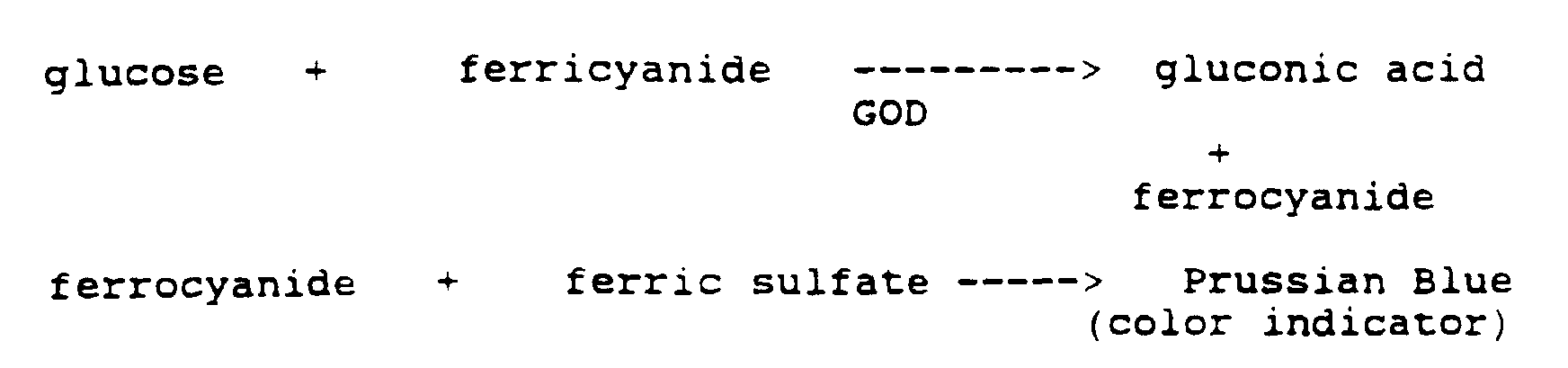
- Accordingly, the more Prussian Blue that is formed by this reaction, then the more glucose is present in the blood sample being analyzed.
- However, a particular problem with reagents that are used to form the Prussian Blue indicator, and other reagents that are used to form indicators that involve ferric ion complexes, is stability. Such reagents, when in liquid form, are unstable to light and heat, and, when in lyophilized form or included in a film, are additionally unstable to humidity. In the case of a reagent useful for forming the Prussian Blue indicator in a glucose assay, the instability is manifested by premature formation of Prussian Blue ("the blank reaction") in the reagent prior to addition of a blood sample containing glucose.
- U.S. patent 5,036,000 describes a colorimetric assay system comprising NAD (P)H (or a source for NAD (P) H to generate NAD (P) H in situ), a chromogen (like a tetrazolium salt) which upon catalytic reduction generates a dye (like a formazan) and a reactant for the dye which is capable of-and does - oxidise the dye as it is formed to form again a chromogen, thus preventing the formation of color by a chemical reaction and consumption of the reactant. As possible reactants there are mentioned ferricyanide and other complexed ferric salts, like the triethylamine chloride salt of Fe(III), the Fe (In) citrate complex, the Fe (III) EDTA complex and the Fe (III) sorbitol complex. Nothing is said however about the probem of insufficient light, heat and huminidity stability of ferric ion complexes and about the solution of this problem.
- The invention is a stable reagent used in assay systems that form a colored ferric ion complex, such as Prussian Blue. Such reagents are useful for the detection or measurement of an analyte from a fluid sample. However, in liquid form these reagents are unstable to heat and light. In lyophilized form or in a film, these reagents are further unstable to humidity. This instability is often manifested in the form of a blank reaction. For example, in a reagent used for forming the colored complex Prussian Blue, Prussian Blue is prematurely formed in the reagent.
- Surprisingly, it has been found that the inclusion of certain ferric ion chelating agents, such as 3-sulfobenzoic acid, will inhibit formation of the blank reaction in the reagent.
- The present invention is a stable reagent, capable of forming a ferric ion colored complex in the presence of an analyte from a fluid sample, and useful for the detection or measurement of the analyte from the fluid sample. At a minimum, the reagent includes
- a first compound that will react in a reaction involving the analyte to form a second compound that complexes with ferric ion to form a colored complex;
- a source of ferric ions;
- and a ferric ion chelator of sufficient type and in sufficient amount to substantially inhibit formation of the colored complex prior to addition of the analyte to the reagent and to substantially not inhibit formation of the colored complex after addition of the analyte to the reagent. Ferric ion chelators, such as citric acid, aspartic acid, ethylenediamine tetraacetic acid (EDTA), and succinic acid, which have too high an affinity for ferric ion are not of the type of ferric ion chelators included in this invention.
-
- When the colored complex is Prussian Blue, the first compound may be a ferricyanide, such as potassium ferricyanide, the second compound may be a ferrocyanide, the source of ferric ions may be ferric sulfate, and the ferric ion chelator may be 3-sulfobenzoic acid, 3-hydroxybutyric acid, 4-hydroxybutyric acid, 5-aminovaleric acid, butyric acid, or propionic acid, or salts thereof. (see Scheme I in Background of the Invention section.) The ferric ion chelator may also be 2-sulfobenzoic acid, or tartaric acid, or a salt thereof.
- Importantly, inclusion of the ferric ion chelator, of the type specified herein, stabilizes a liquid reagent against heat and light and stabilizes a dry reagent (lyophilized or in a film) against heat, light and humidity. A molar ratio of about 3:1 ferric ion chelator: ferric ion in the reagent is sufficient to stabilize the reagent. The reagent will be increasingly stabilized with molar ratios of ferric ion chelator to ferric ion above about 3:1. The increased stabilization will be beneficial until the ratio of ferric ion chelator to ferric ion becomes high enough to deleteriously affect the reaction kinetics of the assay, that is, the colored complex (e.g., Prussian Blue) forms too slowly in the assay, and, as a result, assay time becomes too long and precision and accuracy of measurement are adversely affected.
- A catalyst is preferably included in the reagent. The catalyst should be of sufficient type and in sufficient amount to catalyze the reaction involving the analyte and the first compound. When the analyte is glucose, the catalyst may be the enzyme glucose oxidase.
- A buffer is also preferably included, and when 2-sulfobenzoic acid is used a buffer should be included, in the reagent. The buffer should be of sufficient type and in sufficient amount to provide a desired pH for the reagent and the reaction involving the analyte and the first compound. Further, the buffer should not deleteriously bind to ferric ion. For example, phosphate buffer precipitates ferric ion and should not be used in the reagent. In diagnostic assays, biological buffers, such as "Good" buffers (available from, e.g., Sigma Chemical Company) are often used buffers. Pyruvic acid, 2-amino butyric acid, gluconic acid, and 2-hydroxyisobutyric acid are useful buffers. The particular buffer used will depend upon the particular assay system being employed. For a reagent that is capable of forming the Prussian Blue indicator in a diagnostic assay, 4-amino butyric acid is a useful buffer.
- The buffer may even be a weak chelator of ferric ion as long as the buffer does not substantially inhibit formation of the colored complex (the indicator) after the addition of the analyte to the reagent. If the buffer does weakly chelate ferric ion, then a lesser amount of ferric ion chelator (that is, less than a 3:1 molar ratio of ferric ion chelator to ferric ion) may be needed to stabilize the reagent.
- The reagent may be formulated in liquid (aqueous) form, in lyophilized form, or incorporated into a film or a diagnostic kit. When incorporated into a film, a film former, for example, an aqueous vinyl propionate/vinyl acetate copolymer dispersion sold under the mark PROPIOFAN® 70 D (obtained from BASF) or a polyvinylacetate ethylene copolymer, such as film formers sold under the mark ELVACE (available from Reichhold Chemicals) or AIRFLEX 300 (available from Air Products), is needed. Other additives may be helpful in producing a film that incorporates the reagent of the present invention. For example, a viscosity controlling agent, such as hydroxy-methyl cellulose, a surfactant, such as polyoxyethylene-sorbitan monolaurate, an anti-foaming agent, such as acetone, and a film opener, such as diatomaceous earth or the film openers disclosed in Vogel et al., U.S. Patent No. 4,312,834, issued January 26, 1982, the disclosure of which is hereby incorporated by reference, may be helpful additives in formulating a film. Addition of a pigment, such as titanium dioxide, may be helpful in reflectance films; and addition of an oxidizing agent, such as potassium dichromate, may further increase the stability of a film that includes the reagent of the present invention by providing an oxidizing environment.
- The present invention is generally applicable to any reagent that includes a source of ferric ions and that forms, as an indicator, a colored ferric ion chelation complex in the detection or measurement of an analyte from a fluid sample. Including a ferric ion chelator that substantially inhibits formation of the colored ferric ion chelation complex prior to addition of the analyte to the reagent and that does not substantially inhibit formation of the colored ferric ion chelation complex after addition of the analyte to the reagent will protect the reagent from the destabilizing effects of heat and light, if the reagent is in liquid form, and additionally from humidity, if the reagent is in dry form (lyophilized or incorporated in a film).
- The present invention is specifically applicable to the compositions, methods, and analytical elements described in Freitag, U.S. Patent No. 4,929,545, issued May 29, 1990, the disclosure of which is hereby incorporated by reference. In any of the examples found in the U.S. Patent No. 4,929,545, a reagent that is stable to heat and light, if the reagent is in liquid form, and additionally stable to humidity, if the reagent is incorporated into a film on a test strip, may be prepared by adding to the reagent an amount of ferric ion chelator sufficient to make the molar ratio of ferric ion chelator to ferric ion about 3:1. Increasing this molar ratio will further stabilize the reagent until the ratio becomes high enough to deleteriously affect the reaction kinetics of an analyte assay that utilizes the reagent. The molar ratio of ferric ion chelator to ferric ion may become so high that assay time is too long and assay accuracy and precision become poor.
- Another example of a reagent, or coating mass as it is referred to in Example 3 of U.S. Patent No. 4,929,545, is as follows:
- Thoroughly mix 1376 grams(g) water, 58g sodium hydroxide (pellets), 52g 4-amino butyric acid, 331g 3-sulfobenzoic acid, 52 g ferric sulfate, and 234g potassium ferricyanide, thereby forming a penultimate aqueous ionic mixture. The penultimate aqueous ionic mixture is filtered to remove large particles and impurities. 0.17g potassium dichromate, 288g diatomaceous earth (available from Eagle-Picher Minerals, Inc. under the mark CELABRITE), and a sonicated suspension of 414g titanium dioxide in 907g water are mixed into the resulting filtrate, thereby forming the ultimate aqueous ionic mixture.
- Thoroughly mix 1067g water, 1739g PROPIOFAN® 70 D film former that has been demonomerized, 485g of 4% aqueous hydroxymethyl cellulose (sold under the mark NATROSOL), 75g acetone, and 4.7g polyoxyethylenesorbitan monolaurate surfactant (sold under the mark TWEEN 20), thereby forming a polymer mixture. This mixture is filtered to remove large particles and impurities.
- Thoroughly mix 368g water and 64g glucose oxidase (G02A grade having 185 kilounits glucose oxidase/g, available from Biozyme Laboratories International, Ltd.), thereby forming an enzyme mixture. This enzyme mixture is filtered.
- With mixing, the ultimate aqueous ionic mixture is slowly added to the filtrate of the polymer mixture. Once addition is complete, the filtrate of the enzyme mixture is added to form the penultimate coating mass, which is filtered to form the ultimate coating mass.
- The ultimate coating mass may be coated onto a clear, polyester foil, as described in U.S. Patent No. 4,929,545, Example 3 (col. 6), and dried to form a film coated test strip. This test strip may be used in detecting or measuring glucose in a fluid sample as described in Example 3 (col. 6) of U.S. Patent No. 4,929,545.
- The present invention has been disclosed in the above teachings and drawings with sufficient clarity and conciseness to enable one skilled in the art to make and use the invention, to know the best mode for carrying out the invention, and to distinguish it from other inventions and from what is old. Many variations and obvious adaptations of the invention will readily come to mind, and these are intended to be contained within the scope of the invention as claimed below.
Claims (16)
- A reagent useful for the detection or measurement of an analyte from a fluid sample, comprising:a) a first compound that will react in a reaction involving the analyte to form a second compound that complexes with ferric ion to form a colored complex;b) a source of ferric ions; andc) 3-sulfobenzoic acid, 2-sulfobenzoic acid, tartaric acid, 3-hydroxybutyric acid, 4-hydroxybutyric acid, 5-aminovaleric acid, butyric acid, or propionic acid, or a salt thereof as ferric ion chelator in sufficient amount to substantially inhibit formation of the colored complex prior to addition of the analyte to the reagent and to substantially not inhibit formation of the colored complex after addition of the analyte to the reagent.
- The reagent of claim 1, further comprising:(d) a catalyst of sufficient type and in sufficient amount to catalyze the reaction involving the analyte and first compound.
- The reagent of claim 1, wherein the molar ratio of element (c) to ferric ion is at least about 3:1.
- The reagent of claim 2, further comprising:(e) a buffer of sufficient type and in sufficient amount to provide a desired pH for the reagent and the reaction involving the analyte and first compound and which will not deleteriously bind ferric ion.
- The reagent of claim 4, wherein the catalyst is an enzyme.
- The reagent of claim 5, wherein the molar ratio of ferric ion chelator to ferric ion is at least about 3:1.
- The reagent of claim 5, wherein the reagent is an aqueous reagent.
- The reagent of claim 5, further comprising:(f) at least one film-forming agent in sufficient amount to form a film.
- The reagent of claim 7, wherein the first compound is ferricyanide, the second compound is ferrocyanide, and the colored complex is Prussian Blue.
- The reagent of claim 7, wherein the first compound is ferricyanide, the second compound is ferrocyanide, the colored complex is Prussian Blue, and element (c) is 3-sulfobenzoic acid or a salt thereof.
- The reagent of claim 8, wherein the first compound is ferricyanide, the second compound is ferrocyanide, the colored complex is Prussian Blue, and element (c) is3-sulfobenzoic acid, 2-sulfobenzoic acid, tartaric acid,3-hydroxybutyric acid, or 4-hydroxybutyric acid, or a salt thereof.
- The reagent of claim 8, wherein the first compound is ferricyanide, the second compound is ferrocyanide, the colored complex is Prussian Blue, and element (c) is3-sulfobenzoic acid or a salt thereof.
- The reagent of claim 9, wherein the molar ratio of element (c) to ferric ion is at least about 3:1.
- The reagent of claim 11, wherein the molar ratio of element (c) to ferric ion is at least about 3:1.
- A method of stabilizing a reagent that includes a source of ferric ions and a first compound that will react in a reaction involving an analyte from a fluid sample to form a second compound that complexes with ferric ion to form a colored complex, comprising:adding to the reagent 3-sulfobenzoic acid, 2-sulfobenzoic acid, tartaric acid, 3-hydroxybutyric acid, 4-hydroxybutyric acid, 5-aminovaleric acid, butyric acid, or propionic acid, or a salt thereof in sufficient amount to substantially inhibit formation of the colored complex prior to addition of the analyte to the reagent and to substantially not inhibit formation of the colored complex after addition of the analyte to the reagent.
- The method of claim 15, wherein the first compound is ferricyanide, the second compound is ferrocyanide, and the colored complex is Prussian Blue.
Applications Claiming Priority (3)
| Application Number | Priority Date | Filing Date | Title |
|---|---|---|---|
| US95244592A | 1992-09-28 | 1992-09-28 | |
| US952445 | 1992-09-28 | ||
| PCT/US1993/009206 WO1994008045A1 (en) | 1992-09-28 | 1993-09-28 | Stable reagent for ferric ion complex indicator systems |
Publications (3)
| Publication Number | Publication Date |
|---|---|
| EP0665896A1 EP0665896A1 (en) | 1995-08-09 |
| EP0665896A4 EP0665896A4 (en) | 1996-10-02 |
| EP0665896B1 true EP0665896B1 (en) | 1999-11-17 |
Family
ID=25492922
Family Applications (1)
| Application Number | Title | Priority Date | Filing Date |
|---|---|---|---|
| EP93922415A Expired - Lifetime EP0665896B1 (en) | 1992-09-28 | 1993-09-28 | Stable reagent for ferric ion complex indicator systems |
Country Status (7)
| Country | Link |
|---|---|
| US (1) | US5639631A (en) |
| EP (1) | EP0665896B1 (en) |
| JP (1) | JP3340742B2 (en) |
| CA (1) | CA2145406C (en) |
| DE (1) | DE69327060T2 (en) |
| ES (1) | ES2141172T3 (en) |
| WO (1) | WO1994008045A1 (en) |
Families Citing this family (3)
| Publication number | Priority date | Publication date | Assignee | Title |
|---|---|---|---|---|
| WO2016148218A1 (en) * | 2015-03-18 | 2016-09-22 | 栗田工業株式会社 | Dithiocarbamic acid-based heavy metal scavenger concentration measurement method and concentration measurement reagent |
| JP5962880B1 (en) * | 2015-03-18 | 2016-08-03 | 栗田工業株式会社 | Method for measuring concentration of dithiocarbamic acid heavy metal scavenger and reagent for concentration measurement |
| TWI768561B (en) | 2020-11-25 | 2022-06-21 | 五鼎生物技術股份有限公司 | Biochemical test chip |
Citations (1)
| Publication number | Priority date | Publication date | Assignee | Title |
|---|---|---|---|---|
| US5036000A (en) * | 1986-12-16 | 1991-07-30 | Enzymatics, Inc. | Threshold color control system |
Family Cites Families (10)
| Publication number | Priority date | Publication date | Assignee | Title |
|---|---|---|---|---|
| DE3311027A1 (en) * | 1983-03-25 | 1984-09-27 | Boehringer Mannheim Gmbh, 6800 Mannheim | NAD (P) INDEPENDENT GLYCERINE DEHYDROGENASE, METHOD FOR THE PRODUCTION THEREOF AND THE USE THEREOF FOR DETERMINING GLYCERINE AND TRIGLYCERIDES |
| US4587220A (en) * | 1983-03-28 | 1986-05-06 | Miles Laboratories, Inc. | Ascorbate interference-resistant composition, device and method for the determination of peroxidatively active substances |
| JPS6125498A (en) * | 1984-07-13 | 1986-02-04 | Yatoron:Kk | Reagent for quantitative determination of component in body fluid |
| US4701420A (en) * | 1985-04-01 | 1987-10-20 | Eastman Kodak Company | Analytical compositions, elements and methods utilizing reduction of ferric ion chelates to form detectable dyes |
| US4755472A (en) * | 1986-01-16 | 1988-07-05 | Miles Inc. | Stable composition for the determination of peroxidatively active substances |
| US4942127A (en) * | 1988-05-06 | 1990-07-17 | Molecular Devices Corporation | Polyredox couples in analyte determinations |
| DE3826922A1 (en) * | 1988-08-09 | 1990-02-22 | Boehringer Mannheim Gmbh | PROCESS FOR THE COLOR-RIMETRIC DETERMINATION OF AN ANALYTE BY ENZYMATIC OXIDATION |
| US4929545A (en) * | 1989-04-14 | 1990-05-29 | Boehringer Mannheim Corporation | Method and reagent for determination of an analyte via enzymatic means using a ferricyanide/ferric compound system |
| US5508171A (en) * | 1989-12-15 | 1996-04-16 | Boehringer Mannheim Corporation | Assay method with enzyme electrode system |
| JP3217066B2 (en) * | 1993-01-28 | 2001-10-09 | ロシュ ダイアグノスティックス コーポレーション | Compositions useful for anaerobic determination of analytes |
-
1993
- 1993-09-28 EP EP93922415A patent/EP0665896B1/en not_active Expired - Lifetime
- 1993-09-28 ES ES93922415T patent/ES2141172T3/en not_active Expired - Lifetime
- 1993-09-28 JP JP50924994A patent/JP3340742B2/en not_active Expired - Fee Related
- 1993-09-28 CA CA002145406A patent/CA2145406C/en not_active Expired - Fee Related
- 1993-09-28 WO PCT/US1993/009206 patent/WO1994008045A1/en not_active Ceased
- 1993-09-28 DE DE69327060T patent/DE69327060T2/en not_active Expired - Fee Related
-
1995
- 1995-06-22 US US08/493,727 patent/US5639631A/en not_active Expired - Fee Related
Patent Citations (1)
| Publication number | Priority date | Publication date | Assignee | Title |
|---|---|---|---|---|
| US5036000A (en) * | 1986-12-16 | 1991-07-30 | Enzymatics, Inc. | Threshold color control system |
Also Published As
| Publication number | Publication date |
|---|---|
| CA2145406A1 (en) | 1994-04-14 |
| EP0665896A4 (en) | 1996-10-02 |
| DE69327060T2 (en) | 2000-04-13 |
| WO1994008045A1 (en) | 1994-04-14 |
| DE69327060D1 (en) | 1999-12-23 |
| CA2145406C (en) | 2005-04-05 |
| US5639631A (en) | 1997-06-17 |
| JPH08502354A (en) | 1996-03-12 |
| ES2141172T3 (en) | 2000-03-16 |
| JP3340742B2 (en) | 2002-11-05 |
| EP0665896A1 (en) | 1995-08-09 |
Similar Documents
| Publication | Publication Date | Title |
|---|---|---|
| US4517287A (en) | Method and reagent for the enzymatic determination of enzyme substrates | |
| US6068971A (en) | Process for determination of ions in fluids by masking of interfering ions | |
| US5384247A (en) | Determination of sodium ions in fluids | |
| EP0575515B1 (en) | Stabilization of enzyme containing reagent composition for determination of an analyte | |
| EP0149853B1 (en) | Process for measuring activity of dehydrogenase | |
| CS199692B2 (en) | Method of photometric determination of hydrogen peroxides | |
| US5639631A (en) | Stable reagent for ferric ion complex indicator systems | |
| NL7906143A (en) | METHOD FOR DETERMINING GLUTAMATOXAL ACETATE TRANSAMINASE OR GLUTAMATE PYRUVATE TRANSAMINASE AND A REAGENT COMBINATION, FOR DETERMINING THE SAME. | |
| EP0193204B1 (en) | Process for determining superoxide dismutase activity | |
| US5266472A (en) | Stabilization of the enzyme urate oxidase in liquid form | |
| EP0586397B1 (en) | Improved method and reagent for determination of an analyte | |
| CA1339797C (en) | Method for detection of thiol compounds in a fluid sample | |
| US4116773A (en) | Enzymatic reagent and method for increasing the sensitivity of enzymatic substrate analyses using oxygen rate analyzers | |
| JP2694004B2 (en) | Method for measuring fructosamine in serum or plasma | |
| US5955027A (en) | Reagent composition, testing piece, and assay kit | |
| EP0227073A2 (en) | Method of determining a co-enzyme | |
| JPH05219991A (en) | Method for determination using enzyme reaction | |
| KR0134132B1 (en) | Method for measuring the titer of sugar transferase in the presence of glycosylase mixture | |
| Buttery et al. | Colorimetric measurement of D (-) lactate in plasma | |
| JP3594331B2 (en) | Chlorine ion determination method | |
| AU622859C (en) | Method and composition for the determination of potassium ions in fluids | |
| JPH06205699A (en) | Method for measuring activity of alpha-amylase and reagent for measuring activity of alpha-amylase | |
| JPH0510956A (en) | Method for measuring constituent within living organism sample | |
| JPS63276500A (en) | Method for determining inorganic phosphoric acid in biological humor and reagent therefor | |
| JPH0545240B2 (en) |
Legal Events
| Date | Code | Title | Description |
|---|---|---|---|
| PUAI | Public reference made under article 153(3) epc to a published international application that has entered the european phase |
Free format text: ORIGINAL CODE: 0009012 |
|
| 17P | Request for examination filed |
Effective date: 19950422 |
|
| AK | Designated contracting states |
Kind code of ref document: A1 Designated state(s): DE ES FR GB IT |
|
| RIN1 | Information on inventor provided before grant (corrected) |
Inventor name: CARR, WILLIAM, R. Inventor name: JERNIGAN, WALTER, W. Inventor name: DEAN, KENNETH, J. Inventor name: HAN, CHI-NENG, ARTHUR |
|
| A4 | Supplementary search report drawn up and despatched |
Effective date: 19960819 |
|
| AK | Designated contracting states |
Kind code of ref document: A4 Designated state(s): DE ES FR GB IT |
|
| RHK1 | Main classification (correction) |
Ipc: G01N 33/52 |
|
| 17Q | First examination report despatched |
Effective date: 19980923 |
|
| GRAG | Despatch of communication of intention to grant |
Free format text: ORIGINAL CODE: EPIDOS AGRA |
|
| GRAG | Despatch of communication of intention to grant |
Free format text: ORIGINAL CODE: EPIDOS AGRA |
|
| GRAH | Despatch of communication of intention to grant a patent |
Free format text: ORIGINAL CODE: EPIDOS IGRA |
|
| GRAH | Despatch of communication of intention to grant a patent |
Free format text: ORIGINAL CODE: EPIDOS IGRA |
|
| RAP1 | Party data changed (applicant data changed or rights of an application transferred) |
Owner name: ROCHE DIAGNOSTICS CORPORATION |
|
| GRAA | (expected) grant |
Free format text: ORIGINAL CODE: 0009210 |
|
| AK | Designated contracting states |
Kind code of ref document: B1 Designated state(s): DE ES FR GB IT |
|
| REF | Corresponds to: |
Ref document number: 69327060 Country of ref document: DE Date of ref document: 19991223 |
|
| ITF | It: translation for a ep patent filed | ||
| ET | Fr: translation filed | ||
| REG | Reference to a national code |
Ref country code: ES Ref legal event code: FG2A Ref document number: 2141172 Country of ref document: ES Kind code of ref document: T3 |
|
| PLBE | No opposition filed within time limit |
Free format text: ORIGINAL CODE: 0009261 |
|
| STAA | Information on the status of an ep patent application or granted ep patent |
Free format text: STATUS: NO OPPOSITION FILED WITHIN TIME LIMIT |
|
| 26N | No opposition filed | ||
| REG | Reference to a national code |
Ref country code: GB Ref legal event code: IF02 |
|
| REG | Reference to a national code |
Ref country code: GB Ref legal event code: 732E |
|
| REG | Reference to a national code |
Ref country code: FR Ref legal event code: TP |
|
| PGFP | Annual fee paid to national office [announced via postgrant information from national office to epo] |
Ref country code: ES Payment date: 20070913 Year of fee payment: 15 |
|
| PGFP | Annual fee paid to national office [announced via postgrant information from national office to epo] |
Ref country code: GB Payment date: 20070809 Year of fee payment: 15 |
|
| PGFP | Annual fee paid to national office [announced via postgrant information from national office to epo] |
Ref country code: IT Payment date: 20070913 Year of fee payment: 15 Ref country code: DE Payment date: 20070928 Year of fee payment: 15 |
|
| PGFP | Annual fee paid to national office [announced via postgrant information from national office to epo] |
Ref country code: FR Payment date: 20070904 Year of fee payment: 15 |
|
| GBPC | Gb: european patent ceased through non-payment of renewal fee |
Effective date: 20080928 |
|
| REG | Reference to a national code |
Ref country code: FR Ref legal event code: ST Effective date: 20090529 |
|
| PG25 | Lapsed in a contracting state [announced via postgrant information from national office to epo] |
Ref country code: IT Free format text: LAPSE BECAUSE OF NON-PAYMENT OF DUE FEES Effective date: 20080928 Ref country code: DE Free format text: LAPSE BECAUSE OF NON-PAYMENT OF DUE FEES Effective date: 20090401 |
|
| PG25 | Lapsed in a contracting state [announced via postgrant information from national office to epo] |
Ref country code: FR Free format text: LAPSE BECAUSE OF NON-PAYMENT OF DUE FEES Effective date: 20080930 |
|
| REG | Reference to a national code |
Ref country code: ES Ref legal event code: FD2A Effective date: 20080929 |
|
| PG25 | Lapsed in a contracting state [announced via postgrant information from national office to epo] |
Ref country code: GB Free format text: LAPSE BECAUSE OF NON-PAYMENT OF DUE FEES Effective date: 20080928 |
|
| PG25 | Lapsed in a contracting state [announced via postgrant information from national office to epo] |
Ref country code: ES Free format text: LAPSE BECAUSE OF NON-PAYMENT OF DUE FEES Effective date: 20080929 |