EP0664903B1 - Loader system - Google Patents
Loader system Download PDFInfo
- Publication number
- EP0664903B1 EP0664903B1 EP94909429A EP94909429A EP0664903B1 EP 0664903 B1 EP0664903 B1 EP 0664903B1 EP 94909429 A EP94909429 A EP 94909429A EP 94909429 A EP94909429 A EP 94909429A EP 0664903 B1 EP0664903 B1 EP 0664903B1
- Authority
- EP
- European Patent Office
- Prior art keywords
- load module
- load
- address
- recited
- function
- Prior art date
- Legal status (The legal status is an assumption and is not a legal conclusion. Google has not performed a legal analysis and makes no representation as to the accuracy of the status listed.)
- Expired - Lifetime
Links
Images





Classifications
-
- G—PHYSICS
- G06—COMPUTING OR CALCULATING; COUNTING
- G06F—ELECTRIC DIGITAL DATA PROCESSING
- G06F9/00—Arrangements for program control, e.g. control units
- G06F9/06—Arrangements for program control, e.g. control units using stored programs, i.e. using an internal store of processing equipment to receive or retain programs
- G06F9/44—Arrangements for executing specific programs
- G06F9/445—Program loading or initiating
- G06F9/44521—Dynamic linking or loading; Link editing at or after load time, e.g. Java class loading
-
- G—PHYSICS
- G06—COMPUTING OR CALCULATING; COUNTING
- G06F—ELECTRIC DIGITAL DATA PROCESSING
- G06F9/00—Arrangements for program control, e.g. control units
- G06F9/06—Arrangements for program control, e.g. control units using stored programs, i.e. using an internal store of processing equipment to receive or retain programs
- G06F9/44—Arrangements for executing specific programs
- G06F9/448—Execution paradigms, e.g. implementations of programming paradigms
- G06F9/4488—Object-oriented
Definitions
- the present invention relates generally to computer documents and more particularly to concurrent use of frameworks in an object-oriented operating system.
- a known method for loading applications in an object-oriented operating system is discussed in Byte, vol. 16, no. 2, Feb. 1991, pp. 211-221.
- the document discloses an operating environment for a notebook computer system utilizing a loader for object-oriented application programs.
- An example of an application program imbedded in an application program is discussed.
- the operating environment is a multitasking emvironment, but it does not provide any, control for concurrent applications on two or more systems.
- Other examples of object-oriented environments include Informationstechnik it, vol. 34, pp. 102-112, Feb. 1992 which discusses inheritance and other object-oriented techniques to construct new programming paradigms utilizing object-oriented tools; and Unit Textwindows, pp.
- object-oriented applications should also reflect a consistent interaction interface with the user regardless of what application is currently active, and how many concurrent users are using the application. None of the prior art references of which applicant is aware provides the innovative hardware and software system features which enable all object oriented applications to function in a consistent manner.
- Relocating loader for MS-DOS .EXE executable files vol. 17, no. 7, Microprocessors and Microsystems (Sept. 1990) discloses two methods of linking object files to product a load module which the article refers to as: Binary loaders and relocating loaders.
- Binary loaders read a load module previously linked for residency at a specific memory address into memory.
- a load module must always be loaded at the same memory address.
- Relocating loaders read load modules of a specific format into any section of memory. In the process, a relocating loader relocates particular address fields so that the program contained within the load module will properly execute at the memory location where it is loaded.
- This reference describes an implementation of a loader program that was used to read an executable load module from storage, resolve the addressing links, and start execution of the program.
- the purpose of this program was to provide a means for loading and running an EXE program on a development system without the help of MS-DOS.
- Run-Time Type identification for C++ (Revised), Usenix C++ Technical Conference Proceedings, pp. 313-339 (August 1992) discloses means for performing runtime type identification and checked type casts, and describes a possible C++ language extension to implement runtime type identification of an object.
- the reference also discusses ways in which runtime type identification could be accomplished for the different circumstances that arise in C++. However, the reference fails to even discuss load modules.
- Cross-Address space Dynamic Linking Proceedings 2nd International Workshop Object Orientation in Operating Systems, pp. 250-56 (Sept. 1992) discloses an implementation for cross-address space dynamic linking that does not require execution in kernel mode. It utilizes a method for linking separately compiled modules together in one memory address space from a linking program executing in a second memory address space. This linking is accomplished without going into a kernel execution state. These capabilities are supported by an object-oriented operating system, the spring operating system.
- the paper also describes a method for dynamically inserting code into the second memory address space while an execution thread is active in the second address space. Essentially this provides a means for runtime linking in the second address space being performed by the program in the first address space.
- the UK patent application GB-A-2 242 293 discloses a method for dynamically linking of computer software components during run time execution.
- the software components are objects of an object oriented environment which are created from derived classes of an abstract base class.
- the instantiated objects can be manipulated by using the abstract interface of the base class definition.
- a query function is provided to allow a software component to determine, during program execution time, the name and the location of library classes available for use. For this purpose, the software component requires predetermined storage addresses to locate the appropriate library classes.
- This method does not refer to load modules as used in the instant application, and thus does not deal with the problem of processing load modules having different formats.
- a preferred embodiment employs a collection of load modules with different physical formats, each of which contains functions, static data, and classes to make the load modules appear as if they were statically linked together.
- code executing in one load module can perform operations on another load modules code, such as calling a function, or obtaining a pointer to a function; accessing static data or obtaining a pointer to the static data; calling any public or protected member function of a class to obtain a pointer or access a public or protected data member of the class; or cast to any base of an object of a class.
- a preferred embodiment of the invention is preferably practiced in the context of an operating system resident on a personal computer such as the IBM ® PS/2 ® or Apple ® Macintosh ® computer.
- a representative hardware environment is depicted in Figure 1, which illustrates a typical hardware configuration of a workstation in accordance with the subject preferred embodiment having a central processing unit 10, such as a conventional microprocessor, and a number of other units interconnected via a system bus 12.
- the workstation shown in Figure 1 includes a Random Access Memory (RAM) 14, Read Only Memory (ROM) 16, an I/O adapter 18 for connecting peripheral devices such as disk units 20 to the bus, a user interface adapter 22 for connecting a keyboard 24, a mouse 26, a speaker 28, a microphone 32, and/or other user interface devices such as a touch screen device (not shown) to the bus, a communication adapter 34 for connecting the workstation to a data processing network and a display adapter 36 for connecting the bus to a display device 38.
- the workstation typically has resident thereon an operating system such as the IBM OS/2 ® operating system or the Apple System/7 ® operating system.
- a load module implements functions, static data, and classes.
- TLoadModule an abstract class, defines the protocol to load and access load modules.
- TLoadModule allows subclasses to use very different approaches to represent and implement functions, static data, and classes. For example, a ROM on a NuBus card, a boot partition on a disk, or a disk file, can all appear as load modules.
- different programming languages and development environments can use pre-existing TLoadModule subclasses, or design custom subclasses, to suit special needs.
- the TLoadModule class provides a common protocol for the loader to mix and match fundamentally different kinds of containers of data built by diverse development environments.
- TIncrementalLoadModule and TPublishedLoadModule. These subclasses embody completely different implementations of TLoadModule, and have different purposes.
- TIncrementalLoadModule optimizes for fast incremental linking during code development while allowing an application to remain in execution while the load module remains tethered to a development environment, possibly at the expense of larger size.
- TPublishedLoadModule optimizes for speed of execution and for minimal file size.
- the loader uses load modules. It acts as a go-between; it takes a collection of load modules, each of which contain functions, static data, and classes, and makes the load modules appear to be statically linked with each other.
- Code executing in one load module can perform the following operations on exports from another load module indistinguishably from similar operations on its own functions, static data, and classes:
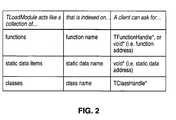
- a TLoadModule acts like three collections, consisting of functions, static data items, and classes. Clients such as the loader will index into the collections by name, as shown in Figure 2 which illustrates how a TLoadModule acts like collections of functions, static data items, and classes.
- a load module lets a client examine all of its functions and class exports through iterators.
- the "loader” refers to a handful of methods that operate on the global state of an application. These methods ensure that a given load module is loaded only once per application, regardless of the number of tasks that explicitly or implicitly load it. For instance, suppose two tasks resurrect the same flattened object simultaneously. By resurrecting an object, the preferred embodiment loads the flattened object into memory and prepares the proper linkages in accordance with the loader discussion to follow.
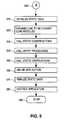
- the loader makes it appear as if a collection of load modules are statically linked with each other through the following steps. First, when a developer builds a given load module with one or more other load modules that resolve external dependencies, this becomes the direct required set of a load module.
- the load module stores the particular functions, static data items, and classes that it uses from this set.
- the loader queries the load module for the load modules in its direct required set by name; the loader computes such a set within the constraints imposed by compatibility.
- the loader needs to load module A, then the loader computes the transitive closure of the direct required set for A.
- the loader runs each load module in this closure through its initialization. For instance, the loader calls the method to resolve external linkages on all the load modules, followed by the method to call static constructors on all the load modules. A similar sequence, in the reverse order, occurs when an application shuts down.
- load modules that are shared libraries, and applications in the traditional sense are exchangeable.
- An "application” typically has a well-known entry point, such as "main” that defines the main program.
- the concept of an "entry point” has been abstracted into the TTaskProgram class.
- TLoadModuleRef is a helper class. It is the interface by which a TLoadModule tells the loader which other load modules it depends on.
- the TLibrarySearcher class provides a framework to map a library name to a specific data container that will be used to construct a load module.
- Figure 3 is a memory map of a TLoadModule of the application as it appears in the memory of the computer.
- the application can respond to queries about the address of a specific function or static data export. Clients may browse the classes, functions, and static data that is exported.
- a closed load module is created from a primary data container returned from a TLibrarySearcher.
- a data container refers to a file, ROM, memory or other storage facility for an application program.
- the loader maps the primary data container into an address space, in read-only mode.
- a primary data container contains a sized stream containing a flattened representation of a TLoadModule, at some pre-defined location (kFlattenedLoadModuleOffset) relative to the beginning of the data container.
- a load module tells the loader how much primary address space it requires, and the loader passes the request to the libserver.
- the loader returns a contiguous block, the size of the block is not smaller than the sum of GetRequiredLowerSpaceSize, GetRequiredUpperSpaceSize, and the size of the primary data container.
- a load module may request a particular relocation address (e.g., to reuse previously computed and cached data structures), the loader can assign a different address. The relocation address assignment occurs through the Relocate method.
- the loader guarantees to assign the load modules the same relocation address.
- an implementation of a load module is required to use its assigned address range consistently across different instances. (For example, if applications load the load module A, and the libserver assigns A to relocation address x, then the preferred embodiment's conventions require all instances of TLoadModule to locate any given static data item in A at the same address, x+s, across applications.) It is valid for a load module to request zero for both the upper and lower sizes. If this convention is followed, then the load module will be assigned enough address space to map the primary data container. Simple implementations of TLoadModule may choose to do this.
- Having the upper and lower areas gives the load module designer the flexibility of having address ranges that may be allocated in both the positive and negative directions, relative to the relocation address. For example, one approach is to assign the static data area to the lower area, while code is mapped as part of the primary data container. This gives the creator of the load module (e.g. a linker) the ability to place code at positive offsets from the relocation address, while assigning static data addresses at negative offsets. Each can grow independently at build-time, without concern of collision with the other.
- a load module is free to create or map segments in any way it chooses, assuming that it does so consistently, as described above. For example, an implementation may use separate segments for code, static data, linkage area, etc. Another implementation may choose to map more segments, or none at all. A specific example involves static data.
- One load module implementation may choose to map a preexisting, fully initialized segment or file.
- a second implementation may choose to map a segment for the non-zero portion of the static data area, and to create another segment to cover the zero portion of the static data area.
- a third implementation may choose to create an non-initialized segment, and call a DataInit-style program to fill in the contents.
- Some languages might require a way to load a main load module at an absolute address. If a language requires this capability, or a linker assumes this, the requisite TLoadModule subclass patches addresses at load time, since the preferred embodiment of the preferred embodiment cannot guarantee the assignment of a particular relocation address.
- Load module implementations have ample opportunity to improve performance by saving the results of computations on one load that may be reused on a subsequent load.
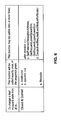
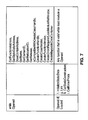
- load modules answer the following questions:
- Figure 9 is a memory map of system storage for relocated addresses of a function exported by LibA in accordance with a preferred embodiment of the subject preferred embodiment. Note how the relocation ID generalizes the concept of the relocation address. Knowing the relocation address works for items contained within the primary data container, whereas the relocation ID extends to items that may reside in the primary address range, or other address ranges, such as an application-wide static data pool.
- TLoadModule caches a copy of its linkage area as a file, where another application loading the same load module may attempt to reuse that linkage area. Because of this potential sharing, a cached linkage area represents a shared writeable state, and must be designed to be multi-application safe. Different applications may use different library searchers, which implies that a cached linkage area that is valid for one application may not be valid for another. This says that the TLoadModule subclass needs to handle situations where:
- a load module may discover that it requires more address space than it obtained as its primary address space (e.g., this may occur during the Link phase).
- a TLoadModule application must be cognizant of the relocation id guarantee.
- a load module will be queried for its relocation id during the link phase, which means after CreateDirectRequiredLoadModuleRefs, but before CallStaticConstructors.
- a load module may not provide as an export address any additional address space that it obtains after CreateDirectRequiredLoadModuleRefs, including during Link. Otherwise, the relocation id guarantee cannot be maintained.
- load modules created by different languages and by different development environments mix-and-match.
- the preferred embodiment requires that addresses corresponding to exported functions and static data items follow a specific CPU's calling convention, which may involve providing addresses that correspond to translating between the preferred embodiment of the subject preferred embodiment's calling conventions, and a different internal set of conventions.
- a load module created by a non-native C++ environment e.g. Lisp
- TLoadModule For example, suppose a subclass of TLoadModule is created from an environment other than C++, and any shared library (e.g., RunTime, LowLevelToolbox). Given a sufficiently robust development environment and the respective declarations used to build the original shared library, it is possible to reimplement the shared library in the other development environment. (Of course, some development environments may choose to restrict the ability of their classes to be subclassed by other environments; such an environment is not "sufficiently robust" according to this definition.) This thought experiment highlights the importance of each CPU architecture to define a common object layout, with respect to casting, virtual function calling, non-virtual function calling, and accessing public data members.
- any shared library e.g., RunTime, LowLevelToolbox
- a load module may defer querying another load module for the address corresponding to a function or static data item name until runtime. If there are a very large number of functions, and the likelihood of calling any one is small, a better strategy is to resolve the name to address binding at the time of the first call. This situation occurs in the context of a development environment building one or many moderate to large-sized load modules, where the bulk of time is spent in the edit-recompile-relaunch-debug loop.
- TLoadModule does not require reentrancy, because although TLoadModule objects are shared by all tasks on an application, and multiple tasks may perform loading concurrently, the loader performs operations under a "loader semaphore.”
- the loader interleaves these calls over all load modules being loaded in the current batch. That is, all load modules are given an opportunity to initialize their static data, followed by all being queried for their direct required load module names, followed by all being queried to link, and so forth.
- Equality is based on pointer equality, since it is an error for the loader to open or load two load modules on the same application, based on the same data container.
Landscapes
- Engineering & Computer Science (AREA)
- Software Systems (AREA)
- Theoretical Computer Science (AREA)
- Physics & Mathematics (AREA)
- General Engineering & Computer Science (AREA)
- General Physics & Mathematics (AREA)
- Stored Programmes (AREA)
- Devices For Executing Special Programs (AREA)
Applications Claiming Priority (3)
| Application Number | Priority Date | Filing Date | Title |
|---|---|---|---|
| US37054 | 1993-03-25 | ||
| US08/037,054 US5369766A (en) | 1993-03-25 | 1993-03-25 | Object-oriented loader system with support for different load formats |
| PCT/US1994/000017 WO1994023363A2 (en) | 1993-03-25 | 1994-01-03 | Loader system |
Publications (2)
| Publication Number | Publication Date |
|---|---|
| EP0664903A1 EP0664903A1 (en) | 1995-08-02 |
| EP0664903B1 true EP0664903B1 (en) | 1997-12-29 |
Family
ID=21892194
Family Applications (1)
| Application Number | Title | Priority Date | Filing Date |
|---|---|---|---|
| EP94909429A Expired - Lifetime EP0664903B1 (en) | 1993-03-25 | 1994-01-03 | Loader system |
Country Status (7)
| Country | Link |
|---|---|
| US (1) | US5369766A (enExample) |
| EP (1) | EP0664903B1 (enExample) |
| JP (1) | JP3550151B2 (enExample) |
| AU (1) | AU6227594A (enExample) |
| CA (1) | CA2145674A1 (enExample) |
| DE (1) | DE69407560D1 (enExample) |
| WO (1) | WO1994023363A2 (enExample) |
Families Citing this family (137)
| Publication number | Priority date | Publication date | Assignee | Title |
|---|---|---|---|---|
| DE69327138T2 (de) * | 1992-07-06 | 2000-04-27 | Microsoft Corp., Redmond | Verfahren zur Namensgebung und zur Bindung von Objekten |
| US5519862A (en) * | 1993-02-26 | 1996-05-21 | Taligent, Inc. | Concurrent processing apparatus with incremental command objects |
| US5459865A (en) * | 1993-04-05 | 1995-10-17 | Taligent Inc. | Runtime loader |
| US6684261B1 (en) * | 1993-07-19 | 2004-01-27 | Object Technology Licensing Corporation | Object-oriented operating system |
| US5379432A (en) * | 1993-07-19 | 1995-01-03 | Taligent, Inc. | Object-oriented interface for a procedural operating system |
| CN1181141A (zh) | 1995-04-07 | 1998-05-06 | 软体未来设计股份有限公司 | 数据处理系统和方法,以及计算机程序体系结构 |
| US5799181A (en) * | 1995-04-07 | 1998-08-25 | Sofmap Future Design, Inc. | Bossless architecture and digital cell technology for computer programs |
| US5790856A (en) * | 1995-05-08 | 1998-08-04 | Apple Computer, Inc. | Methods, apparatus, and data structures for data driven computer patches and static analysis of same |
| US6260075B1 (en) | 1995-06-19 | 2001-07-10 | International Business Machines Corporation | System and method for providing shared global offset table for common shared library in a computer system |
| US6449660B1 (en) | 1995-07-31 | 2002-09-10 | International Business Machines Corporation | Object-oriented I/O device interface framework mechanism |
| US5812848A (en) * | 1995-08-23 | 1998-09-22 | Symantec Corporation | Subclassing system for computer that operates with portable-executable (PE) modules |
| US5809302A (en) * | 1995-08-31 | 1998-09-15 | International Business Machines Corp. | System and method for enabling pointers to be passed from computer programs written using computer programming languages that do not support pointers |
| US6226691B1 (en) * | 1995-10-02 | 2001-05-01 | International Business Machines Corporation | System, method, and article of manufacture for adding object services to a binary class in an object oriented server |
| US6684259B1 (en) | 1995-10-11 | 2004-01-27 | Citrix Systems, Inc. | Method for providing user global object name space in a multi-user operating system |
| US5864862A (en) * | 1996-09-30 | 1999-01-26 | Telefonaktiebolaget Lm Ericsson (Publ) | System and method for creating reusable components in an object-oriented programming environment |
| US5872973A (en) * | 1995-10-26 | 1999-02-16 | Viewsoft, Inc. | Method for managing dynamic relations between objects in dynamic object-oriented languages |
| US6532487B1 (en) | 1995-12-04 | 2003-03-11 | International Business Machines Corporation | Method and system for managing semaphores in an object-oriented multi-tasking computer system |
| US6298476B1 (en) | 1995-12-04 | 2001-10-02 | International Business Machines Corporation | Object oriented software build framework mechanism |
| US5774722A (en) * | 1995-12-14 | 1998-06-30 | International Business Machines Corporation | Method for efficient external reference resolution in dynamically linked shared code libraries in single address space operating systems |
| US5797014A (en) * | 1995-12-14 | 1998-08-18 | International Business Machines Corporation | Method for reducing processor cycles used for global offset table address computation in a position independent shared library |
| US5768505A (en) * | 1995-12-19 | 1998-06-16 | International Business Machines Corporation | Object oriented mail server framework mechanism |
| US6526565B1 (en) * | 1995-12-21 | 2003-02-25 | International Business Machines Corporation | Packaging algorithm for providing object oriented applications having reduced footprints |
| US6144967A (en) * | 1996-01-25 | 2000-11-07 | International Business Machines Corporation | Object oriented processing log analysis tool framework mechanism |
| US5838972A (en) * | 1996-02-09 | 1998-11-17 | Sun Microsystems, Inc. | Method and apparatus for dynamically loading an input run-time module and an output run-time module |
| US6434739B1 (en) | 1996-04-22 | 2002-08-13 | International Business Machines Corporation | Object oriented framework mechanism for multi-target source code processing |
| US6081798A (en) * | 1996-04-24 | 2000-06-27 | International Business Machines Corp. | Object oriented case-based reasoning framework mechanism |
| US5778378A (en) | 1996-04-30 | 1998-07-07 | International Business Machines Corporation | Object oriented information retrieval framework mechanism |
| US5815718A (en) * | 1996-05-30 | 1998-09-29 | Sun Microsystems, Inc. | Method and system for loading classes in read-only memory |
| US6038590A (en) * | 1996-07-01 | 2000-03-14 | Sun Microsystems, Inc. | Object-oriented system, method and article of manufacture for a client-server state machine in an interprise computing framework system |
| US6434598B1 (en) | 1996-07-01 | 2002-08-13 | Sun Microsystems, Inc. | Object-oriented system, method and article of manufacture for a client-server graphical user interface (#9) framework in an interprise computing framework system |
| US6266709B1 (en) | 1996-07-01 | 2001-07-24 | Sun Microsystems, Inc. | Object-oriented system, method and article of manufacture for a client-server failure reporting process |
| US5999972A (en) * | 1996-07-01 | 1999-12-07 | Sun Microsystems, Inc. | System, method and article of manufacture for a distributed computer system framework |
| US6272555B1 (en) | 1996-07-01 | 2001-08-07 | Sun Microsystems, Inc. | Object-oriented system, method and article of manufacture for a client-server-centric interprise computing framework system |
| US5848246A (en) * | 1996-07-01 | 1998-12-08 | Sun Microsystems, Inc. | Object-oriented system, method and article of manufacture for a client-server session manager in an interprise computing framework system |
| US6424991B1 (en) | 1996-07-01 | 2002-07-23 | Sun Microsystems, Inc. | Object-oriented system, method and article of manufacture for a client-server communication framework |
| US5987245A (en) * | 1996-07-01 | 1999-11-16 | Sun Microsystems, Inc. | Object-oriented system, method and article of manufacture (#12) for a client-server state machine framework |
| US6304893B1 (en) | 1996-07-01 | 2001-10-16 | Sun Microsystems, Inc. | Object-oriented system, method and article of manufacture for a client-server event driven message framework in an interprise computing framework system |
| US5915252A (en) * | 1996-09-30 | 1999-06-22 | International Business Machines Corporation | Object oriented framework mechanism for data transfer between a data source and a data target |
| US6104874A (en) * | 1996-10-15 | 2000-08-15 | International Business Machines Corporation | Object oriented framework mechanism for order processing including pre-defined extensible classes for defining an order processing environment |
| US6003095A (en) * | 1996-10-31 | 1999-12-14 | International Business Machines Corporation | Apparatus and method for demand loading a dynamic link library |
| US5937189A (en) * | 1996-11-12 | 1999-08-10 | International Business Machines Corporation | Object oriented framework mechanism for determining configuration relations |
| US6401109B1 (en) | 1996-11-18 | 2002-06-04 | International Business Machines Corp. | Virtual socket for JAVA interprocess communication |
| US6460058B2 (en) * | 1996-12-06 | 2002-10-01 | Microsoft Corporation | Object-oriented framework for hyperlink navigation |
| US6401099B1 (en) | 1996-12-06 | 2002-06-04 | Microsoft Corporation | Asynchronous binding of named objects |
| US5970498A (en) * | 1996-12-06 | 1999-10-19 | International Business Machines Corporation | Object oriented framework mechanism for metering objects |
| US6769126B1 (en) | 1996-12-10 | 2004-07-27 | International Business Machines Corporation | Apparatus and method for demand load analysis |
| US5946486A (en) * | 1996-12-10 | 1999-08-31 | International Business Machines Corporation | Apparatus and method for tracing entries to or exits from a dynamic link library |
| US6052778A (en) * | 1997-01-13 | 2000-04-18 | International Business Machines Corporation | Embedded system having dynamically linked dynamic loader and method for linking dynamic loader shared libraries and application programs |
| US5961602A (en) * | 1997-02-10 | 1999-10-05 | International Business Machines Corporation | Method for optimizing off-peak caching of web data |
| US5878263A (en) * | 1997-03-05 | 1999-03-02 | International Business Machines Corporation | Internal chaining technique for fixup records |
| US5936860A (en) * | 1997-03-28 | 1999-08-10 | International Business Machines Corporation | Object oriented technology framework for warehouse control |
| US6041312A (en) * | 1997-03-28 | 2000-03-21 | International Business Machines Corporation | Object oriented technology framework for accounts receivable and accounts payable |
| US5987423A (en) * | 1997-03-28 | 1999-11-16 | International Business Machines Corporation | Object oriented technology framework for order processing |
| US6014637A (en) * | 1997-04-30 | 2000-01-11 | International Business Machines Corporation | Object oriented framework mechanism for fulfillment requirements management |
| CA2204971A1 (en) * | 1997-05-09 | 1998-11-09 | Michael Cheng | Uniform access to and interchange between objects employing a plurality of access methods |
| US6335972B1 (en) | 1997-05-23 | 2002-01-01 | International Business Machines Corporation | Framework-based cryptographic key recovery system |
| US6473893B1 (en) * | 1997-05-30 | 2002-10-29 | International Business Machines Corporation | Information objects system, method, and computer program organization |
| US5920725A (en) * | 1997-07-02 | 1999-07-06 | Adaptivity Inc. | Run-time object-synthesis and transparent client/server updating of distributed objects using a meta server of all object descriptors |
| US5893106A (en) * | 1997-07-11 | 1999-04-06 | International Business Machines Corporation | Object oriented server process framework with interdependent-object creation |
| US6513152B1 (en) | 1997-07-23 | 2003-01-28 | International Business Machines Corporation | Object oriented framework mechanism for customization of object oriented frameworks |
| US6378002B1 (en) | 1997-08-05 | 2002-04-23 | International Business Machines Corporation, | Object oriented server process framework with implicit data handling registry for remote method invocations |
| US6052670A (en) * | 1997-08-29 | 2000-04-18 | International Business Machines Corporation | Object oriented framework mechanism for an electronic catalog |
| US6016495A (en) * | 1997-09-19 | 2000-01-18 | International Business Machines Corporation | Object-oriented framework mechanism for providing persistent storage |
| US6421827B1 (en) | 1997-12-17 | 2002-07-16 | International Business Machines Corporation | System and method for detecting and reordering loading patterns |
| US5911073A (en) * | 1997-12-23 | 1999-06-08 | Hewlett-Packard Company | Method and apparatus for dynamic process monitoring through an ancillary control code system |
| US20010044901A1 (en) * | 1998-03-24 | 2001-11-22 | Symantec Corporation | Bubble-protected system for automatic decryption of file data on a per-use basis and automatic re-encryption |
| US6164841A (en) * | 1998-05-04 | 2000-12-26 | Hewlett-Packard Company | Method, apparatus, and product for dynamic software code translation system |
| US6189141B1 (en) | 1998-05-04 | 2001-02-13 | Hewlett-Packard Company | Control path evaluating trace designator with dynamically adjustable thresholds for activation of tracing for high (hot) activity and low (cold) activity of flow control |
| US6148437A (en) * | 1998-05-04 | 2000-11-14 | Hewlett-Packard Company | System and method for jump-evaluated trace designation |
| US6430569B1 (en) | 1998-08-14 | 2002-08-06 | Sun Microsystems, Inc. | Methods and apparatus for type safe, lazy, user-defined class loading |
| JP3837244B2 (ja) | 1998-10-23 | 2006-10-25 | 松下電器産業株式会社 | プログラムリンク装置及び方法 |
| US6628305B1 (en) | 1998-11-09 | 2003-09-30 | International Business Machines Corporation | Architecture and definition of an extensible, object-oriented graphical user interface framework for managing and administering heterogenous digital library datastores |
| CA2255042C (en) * | 1998-11-30 | 2004-04-13 | Leonard W. Theivendra | Class loader |
| US6618769B1 (en) * | 1999-05-27 | 2003-09-09 | Sun Microsystems, Inc. | Module-by-module verification |
| US6601114B1 (en) * | 1999-05-27 | 2003-07-29 | Sun Microsystems, Inc. | Fully lazy linking with module-by-module verification |
| US6356933B2 (en) | 1999-09-07 | 2002-03-12 | Citrix Systems, Inc. | Methods and apparatus for efficiently transmitting interactive application data between a client and a server using markup language |
| US6829761B1 (en) * | 1999-10-21 | 2004-12-07 | Oracle International Corporation | Method and apparatus for managing shared memory in a run-time environment |
| US7346848B1 (en) | 2000-06-21 | 2008-03-18 | Microsoft Corporation | Single window navigation methods and systems |
| US6874143B1 (en) | 2000-06-21 | 2005-03-29 | Microsoft Corporation | Architectures for and methods of providing network-based software extensions |
| AU2001264895A1 (en) | 2000-06-21 | 2002-01-02 | Microsoft Corporation | System and method for integrating spreadsheets and word processing tables |
| US6948135B1 (en) | 2000-06-21 | 2005-09-20 | Microsoft Corporation | Method and systems of providing information to computer users |
| US7000230B1 (en) | 2000-06-21 | 2006-02-14 | Microsoft Corporation | Network-based software extensions |
| US7117435B1 (en) | 2000-06-21 | 2006-10-03 | Microsoft Corporation | Spreadsheet fields in text |
| US6883168B1 (en) | 2000-06-21 | 2005-04-19 | Microsoft Corporation | Methods, systems, architectures and data structures for delivering software via a network |
| US7624356B1 (en) | 2000-06-21 | 2009-11-24 | Microsoft Corporation | Task-sensitive methods and systems for displaying command sets |
| US7191394B1 (en) | 2000-06-21 | 2007-03-13 | Microsoft Corporation | Authoring arbitrary XML documents using DHTML and XSLT |
| US7155667B1 (en) | 2000-06-21 | 2006-12-26 | Microsoft Corporation | User interface for integrated spreadsheets and word processing tables |
| US7346842B1 (en) | 2000-11-02 | 2008-03-18 | Citrix Systems, Inc. | Methods and apparatus for incorporating a partial page on a client |
| US20020105548A1 (en) | 2000-12-12 | 2002-08-08 | Richard Hayton | Methods and apparatus for creating a user interface using property paths |
| US7322040B1 (en) * | 2001-03-27 | 2008-01-22 | Microsoft Corporation | Authentication architecture |
| US7243346B1 (en) | 2001-05-21 | 2007-07-10 | Microsoft Corporation | Customized library management system |
| US7389515B1 (en) * | 2001-05-21 | 2008-06-17 | Microsoft Corporation | Application deflation system and method |
| US7246350B2 (en) * | 2002-01-07 | 2007-07-17 | Intel Corporation | Dynamic composition and maintenance of applications |
| US7421418B2 (en) * | 2003-02-19 | 2008-09-02 | Nahava Inc. | Method and apparatus for fundamental operations on token sequences: computing similarity, extracting term values, and searching efficiently |
| US7415672B1 (en) | 2003-03-24 | 2008-08-19 | Microsoft Corporation | System and method for designing electronic forms |
| US7275216B2 (en) | 2003-03-24 | 2007-09-25 | Microsoft Corporation | System and method for designing electronic forms and hierarchical schemas |
| US7370066B1 (en) | 2003-03-24 | 2008-05-06 | Microsoft Corporation | System and method for offline editing of data files |
| US7296017B2 (en) | 2003-03-28 | 2007-11-13 | Microsoft Corporation | Validation of XML data files |
| US7913159B2 (en) | 2003-03-28 | 2011-03-22 | Microsoft Corporation | System and method for real-time validation of structured data files |
| US7516145B2 (en) | 2003-03-31 | 2009-04-07 | Microsoft Corporation | System and method for incrementally transforming and rendering hierarchical data files |
| US7168035B1 (en) | 2003-06-11 | 2007-01-23 | Microsoft Corporation | Building a view on markup language data through a set of components |
| US7197515B2 (en) | 2003-06-30 | 2007-03-27 | Microsoft Corporation | Declarative solution definition |
| US7451392B1 (en) | 2003-06-30 | 2008-11-11 | Microsoft Corporation | Rendering an HTML electronic form by applying XSLT to XML using a solution |
| US7406660B1 (en) | 2003-08-01 | 2008-07-29 | Microsoft Corporation | Mapping between structured data and a visual surface |
| US7581177B1 (en) | 2003-08-01 | 2009-08-25 | Microsoft Corporation | Conversion of structured documents |
| US7334187B1 (en) | 2003-08-06 | 2008-02-19 | Microsoft Corporation | Electronic form aggregation |
| CA2540935A1 (en) * | 2003-10-01 | 2005-04-14 | Cash Systems, Inc. | Multi-function cashless gaming atm |
| US7171649B1 (en) * | 2004-01-12 | 2007-01-30 | Sun Microsystems, Inc. | Optimizing safe downcasting in an object-oriented programming language |
| US8819072B1 (en) | 2004-02-02 | 2014-08-26 | Microsoft Corporation | Promoting data from structured data files |
| US7430711B2 (en) | 2004-02-17 | 2008-09-30 | Microsoft Corporation | Systems and methods for editing XML documents |
| US7318063B2 (en) | 2004-02-19 | 2008-01-08 | Microsoft Corporation | Managing XML documents containing hierarchical database information |
| US7437741B2 (en) | 2004-03-08 | 2008-10-14 | International Business Machines Corporation | Method, system, and program for invoking methods between computer languages |
| US7496837B1 (en) | 2004-04-29 | 2009-02-24 | Microsoft Corporation | Structural editing with schema awareness |
| US7568101B1 (en) | 2004-05-13 | 2009-07-28 | Microsoft Corporation | Digital signatures with an embedded view |
| US7281018B1 (en) | 2004-05-26 | 2007-10-09 | Microsoft Corporation | Form template data source change |
| US7774620B1 (en) | 2004-05-27 | 2010-08-10 | Microsoft Corporation | Executing applications at appropriate trust levels |
| US7493609B2 (en) * | 2004-08-30 | 2009-02-17 | International Business Machines Corporation | Method and apparatus for automatic second-order predictive commoning |
| US7516399B2 (en) | 2004-09-30 | 2009-04-07 | Microsoft Corporation | Structured-document path-language expression methods and systems |
| US7692636B2 (en) | 2004-09-30 | 2010-04-06 | Microsoft Corporation | Systems and methods for handwriting to a screen |
| US8487879B2 (en) | 2004-10-29 | 2013-07-16 | Microsoft Corporation | Systems and methods for interacting with a computer through handwriting to a screen |
| US7712022B2 (en) | 2004-11-15 | 2010-05-04 | Microsoft Corporation | Mutually exclusive options in electronic forms |
| US7584417B2 (en) | 2004-11-15 | 2009-09-01 | Microsoft Corporation | Role-dependent action for an electronic form |
| US7721190B2 (en) | 2004-11-16 | 2010-05-18 | Microsoft Corporation | Methods and systems for server side form processing |
| US7509353B2 (en) | 2004-11-16 | 2009-03-24 | Microsoft Corporation | Methods and systems for exchanging and rendering forms |
| US7904801B2 (en) | 2004-12-15 | 2011-03-08 | Microsoft Corporation | Recursive sections in electronic forms |
| US7437376B2 (en) | 2004-12-20 | 2008-10-14 | Microsoft Corporation | Scalable object model |
| US7937651B2 (en) | 2005-01-14 | 2011-05-03 | Microsoft Corporation | Structural editing operations for network forms |
| US7725834B2 (en) | 2005-03-04 | 2010-05-25 | Microsoft Corporation | Designer-created aspect for an electronic form template |
| US8010515B2 (en) | 2005-04-15 | 2011-08-30 | Microsoft Corporation | Query to an electronic form |
| US7543228B2 (en) | 2005-06-27 | 2009-06-02 | Microsoft Corporation | Template for rendering an electronic form |
| US8200975B2 (en) | 2005-06-29 | 2012-06-12 | Microsoft Corporation | Digital signatures for network forms |
| US7613996B2 (en) | 2005-08-15 | 2009-11-03 | Microsoft Corporation | Enabling selection of an inferred schema part |
| US8001459B2 (en) | 2005-12-05 | 2011-08-16 | Microsoft Corporation | Enabling electronic documents for limited-capability computing devices |
| US7779343B2 (en) | 2006-01-30 | 2010-08-17 | Microsoft Corporation | Opening network-enabled electronic documents |
| US10410117B2 (en) | 2008-09-21 | 2019-09-10 | Brainchip, Inc. | Method and a system for creating dynamic neural function libraries |
| US9747197B2 (en) * | 2014-05-20 | 2017-08-29 | Honeywell International Inc. | Methods and apparatus to use an access triggered computer architecture |
| US10353681B2 (en) | 2014-05-20 | 2019-07-16 | Honeywell International Inc. | Systems and methods for using error correction and pipelining techniques for an access triggered computer architecture |
Family Cites Families (21)
| Publication number | Priority date | Publication date | Assignee | Title |
|---|---|---|---|---|
| JPS63626A (ja) * | 1986-06-19 | 1988-01-05 | Casio Comput Co Ltd | プログラム管理装置 |
| US4821220A (en) * | 1986-07-25 | 1989-04-11 | Tektronix, Inc. | System for animating program operation and displaying time-based relationships |
| US4885717A (en) * | 1986-09-25 | 1989-12-05 | Tektronix, Inc. | System for graphically representing operation of object-oriented programs |
| US5261080A (en) * | 1987-08-21 | 1993-11-09 | Wang Laboratories, Inc. | Matchmaker for assisting and executing the providing and conversion of data between objects in a data processing system storing data in typed objects having different data formats |
| US4891630A (en) * | 1988-04-22 | 1990-01-02 | Friedman Mark B | Computer vision system with improved object orientation technique |
| US4953080A (en) * | 1988-04-25 | 1990-08-28 | Hewlett-Packard Company | Object management facility for maintaining data in a computer system |
| EP0347162A3 (en) * | 1988-06-14 | 1990-09-12 | Tektronix, Inc. | Apparatus and methods for controlling data flow processes by generated instruction sequences |
| US5041992A (en) * | 1988-10-24 | 1991-08-20 | University Of Pittsburgh | Interactive method of developing software interfaces |
| US5133075A (en) * | 1988-12-19 | 1992-07-21 | Hewlett-Packard Company | Method of monitoring changes in attribute values of object in an object-oriented database |
| US5050090A (en) * | 1989-03-30 | 1991-09-17 | R. J. Reynolds Tobacco Company | Object placement method and apparatus |
| US5060276A (en) * | 1989-05-31 | 1991-10-22 | At&T Bell Laboratories | Technique for object orientation detection using a feed-forward neural network |
| US5125091A (en) * | 1989-06-08 | 1992-06-23 | Hazox Corporation | Object oriented control of real-time processing |
| US5257369A (en) * | 1990-10-22 | 1993-10-26 | Skeen Marion D | Apparatus and method for providing decoupling of data exchange details for providing high performance communication between software processes |
| US5247678A (en) * | 1989-10-12 | 1993-09-21 | Texas Instruments Incorporated | Load time linker for software used with a multiprocessor system |
| US5181162A (en) * | 1989-12-06 | 1993-01-19 | Eastman Kodak Company | Document management and production system |
| US5093914A (en) * | 1989-12-15 | 1992-03-03 | At&T Bell Laboratories | Method of controlling the execution of object-oriented programs |
| US5075848A (en) * | 1989-12-22 | 1991-12-24 | Intel Corporation | Object lifetime control in an object-oriented memory protection mechanism |
| GB2242293A (en) * | 1990-01-05 | 1991-09-25 | Apple Computer | Apparatus and method for dynamic linking of computer software components |
| US5151987A (en) * | 1990-10-23 | 1992-09-29 | International Business Machines Corporation | Recovery objects in an object oriented computing environment |
| US5119475A (en) * | 1991-03-13 | 1992-06-02 | Schlumberger Technology Corporation | Object-oriented framework for menu definition |
| US5303375A (en) * | 1991-04-26 | 1994-04-12 | Hewlett-Packard Company | System and method for facilitating selection of running functional process in object-oriented environments |
-
1993
- 1993-03-25 US US08/037,054 patent/US5369766A/en not_active Expired - Lifetime
-
1994
- 1994-01-03 DE DE69407560T patent/DE69407560D1/de not_active Expired - Lifetime
- 1994-01-03 AU AU62275/94A patent/AU6227594A/en not_active Abandoned
- 1994-01-03 EP EP94909429A patent/EP0664903B1/en not_active Expired - Lifetime
- 1994-01-03 WO PCT/US1994/000017 patent/WO1994023363A2/en not_active Ceased
- 1994-01-03 CA CA002145674A patent/CA2145674A1/en not_active Abandoned
- 1994-01-03 JP JP52202494A patent/JP3550151B2/ja not_active Expired - Lifetime
Also Published As
| Publication number | Publication date |
|---|---|
| AU6227594A (en) | 1994-10-24 |
| JPH08508593A (ja) | 1996-09-10 |
| DE69407560D1 (de) | 1998-02-05 |
| CA2145674A1 (en) | 1994-10-13 |
| US5369766A (en) | 1994-11-29 |
| WO1994023363A2 (en) | 1994-10-13 |
| EP0664903A1 (en) | 1995-08-02 |
| WO1994023363A3 (en) | 1995-01-12 |
| JP3550151B2 (ja) | 2004-08-04 |
Similar Documents
| Publication | Publication Date | Title |
|---|---|---|
| US5369766A (en) | Object-oriented loader system with support for different load formats | |
| US5421016A (en) | System and method for dynamically invoking object methods from an application designed for static method invocation | |
| EP0546683B1 (en) | Language neutral objects | |
| US5339438A (en) | Version independence for object oriented programs | |
| US5418964A (en) | System and method for parent class shadowing in a statically linked object hierarchy | |
| US5361350A (en) | Object oriented method management system and software for managing class method names in a computer system | |
| US5493680A (en) | Method for creating an object subclass with selective inheritance | |
| US6330709B1 (en) | Virtual machine implementation for shared persistent objects | |
| US5692195A (en) | Parent class shadowing | |
| US7143421B2 (en) | Highly componentized system architecture with a demand-loading namespace and programming model | |
| US7225438B2 (en) | Lazy compilation of template-generated classes in dynamic compilation execution environments | |
| US5732270A (en) | System and method for providing interoperability among heterogeneous object systems | |
| US7409694B2 (en) | Highly componentized system architecture with loadable virtual memory manager | |
| US8434099B2 (en) | Efficient linking and loading for late binding and platform retargeting | |
| CA2255042C (en) | Class loader | |
| US5659751A (en) | Apparatus and method for dynamic linking of computer software components | |
| US5590327A (en) | Method for making data objects having hidden pointers persistent | |
| US7565665B2 (en) | Efficient linking and loading for late binding and platform retargeting | |
| US20090133042A1 (en) | Efficient linking and loading for late binding and platform retargeting | |
| US6378003B1 (en) | Method and system for deriving metaclasses in an object oriented system | |
| WO2000073894A2 (en) | Method and apparatus for avoiding array class creation in virtual machines | |
| US7159222B1 (en) | Highly componentized system architecture with object mutation | |
| Vemulapati | An extensible dynamic linker for C++ | |
| Weiser et al. | Unix needs a true integrated environment: CASE closed |
Legal Events
| Date | Code | Title | Description |
|---|---|---|---|
| PUAI | Public reference made under article 153(3) epc to a published international application that has entered the european phase |
Free format text: ORIGINAL CODE: 0009012 |
|
| 17P | Request for examination filed |
Effective date: 19950531 |
|
| AK | Designated contracting states |
Kind code of ref document: A1 Designated state(s): DE FR GB |
|
| 17Q | First examination report despatched |
Effective date: 19950817 |
|
| GRAG | Despatch of communication of intention to grant |
Free format text: ORIGINAL CODE: EPIDOS AGRA |
|
| GRAG | Despatch of communication of intention to grant |
Free format text: ORIGINAL CODE: EPIDOS AGRA |
|
| GRAG | Despatch of communication of intention to grant |
Free format text: ORIGINAL CODE: EPIDOS AGRA |
|
| GRAH | Despatch of communication of intention to grant a patent |
Free format text: ORIGINAL CODE: EPIDOS IGRA |
|
| RBV | Designated contracting states (corrected) |
Designated state(s): DE FR GB |
|
| GRAH | Despatch of communication of intention to grant a patent |
Free format text: ORIGINAL CODE: EPIDOS IGRA |
|
| GRAA | (expected) grant |
Free format text: ORIGINAL CODE: 0009210 |
|
| AK | Designated contracting states |
Kind code of ref document: B1 Designated state(s): DE FR GB |
|
| PG25 | Lapsed in a contracting state [announced via postgrant information from national office to epo] |
Ref country code: FR Free format text: LAPSE BECAUSE OF FAILURE TO SUBMIT A TRANSLATION OF THE DESCRIPTION OR TO PAY THE FEE WITHIN THE PRESCRIBED TIME-LIMIT Effective date: 19971229 |
|
| REF | Corresponds to: |
Ref document number: 69407560 Country of ref document: DE Date of ref document: 19980205 |
|
| PG25 | Lapsed in a contracting state [announced via postgrant information from national office to epo] |
Ref country code: DE Free format text: LAPSE BECAUSE OF FAILURE TO SUBMIT A TRANSLATION OF THE DESCRIPTION OR TO PAY THE FEE WITHIN THE PRESCRIBED TIME-LIMIT Effective date: 19980331 |
|
| EN | Fr: translation not filed | ||
| PLBE | No opposition filed within time limit |
Free format text: ORIGINAL CODE: 0009261 |
|
| STAA | Information on the status of an ep patent application or granted ep patent |
Free format text: STATUS: NO OPPOSITION FILED WITHIN TIME LIMIT |
|
| 26N | No opposition filed | ||
| REG | Reference to a national code |
Ref country code: GB Ref legal event code: 732E |
|
| REG | Reference to a national code |
Ref country code: GB Ref legal event code: IF02 |
|
| REG | Reference to a national code |
Ref country code: GB Ref legal event code: 732E Free format text: REGISTERED BETWEEN 20100603 AND 20100609 |
|
| PGFP | Annual fee paid to national office [announced via postgrant information from national office to epo] |
Ref country code: GB Payment date: 20130102 Year of fee payment: 20 |
|
| REG | Reference to a national code |
Ref country code: GB Ref legal event code: PE20 Expiry date: 20140102 |
|
| PG25 | Lapsed in a contracting state [announced via postgrant information from national office to epo] |
Ref country code: GB Free format text: LAPSE BECAUSE OF EXPIRATION OF PROTECTION Effective date: 20140102 |