EP0654496A2 - Plastic container made from post consumer plastic film - Google Patents
Plastic container made from post consumer plastic film Download PDFInfo
- Publication number
- EP0654496A2 EP0654496A2 EP94118120A EP94118120A EP0654496A2 EP 0654496 A2 EP0654496 A2 EP 0654496A2 EP 94118120 A EP94118120 A EP 94118120A EP 94118120 A EP94118120 A EP 94118120A EP 0654496 A2 EP0654496 A2 EP 0654496A2
- Authority
- EP
- European Patent Office
- Prior art keywords
- post consumer
- weight
- resin
- set forth
- fusion blend
- Prior art date
- Legal status (The legal status is an assumption and is not a legal conclusion. Google has not performed a legal analysis and makes no representation as to the accuracy of the status listed.)
- Withdrawn
Links
Images


Classifications
-
- B—PERFORMING OPERATIONS; TRANSPORTING
- B32—LAYERED PRODUCTS
- B32B—LAYERED PRODUCTS, i.e. PRODUCTS BUILT-UP OF STRATA OF FLAT OR NON-FLAT, e.g. CELLULAR OR HONEYCOMB, FORM
- B32B27/00—Layered products comprising a layer of synthetic resin
- B32B27/06—Layered products comprising a layer of synthetic resin as the main or only constituent of a layer, which is next to another layer of the same or of a different material
- B32B27/08—Layered products comprising a layer of synthetic resin as the main or only constituent of a layer, which is next to another layer of the same or of a different material of synthetic resin
-
- B—PERFORMING OPERATIONS; TRANSPORTING
- B29—WORKING OF PLASTICS; WORKING OF SUBSTANCES IN A PLASTIC STATE IN GENERAL
- B29C—SHAPING OR JOINING OF PLASTICS; SHAPING OF MATERIAL IN A PLASTIC STATE, NOT OTHERWISE PROVIDED FOR; AFTER-TREATMENT OF THE SHAPED PRODUCTS, e.g. REPAIRING
- B29C49/00—Blow-moulding, i.e. blowing a preform or parison to a desired shape within a mould; Apparatus therefor
- B29C49/0005—Blow-moulding, i.e. blowing a preform or parison to a desired shape within a mould; Apparatus therefor characterised by the material
-
- B—PERFORMING OPERATIONS; TRANSPORTING
- B32—LAYERED PRODUCTS
- B32B—LAYERED PRODUCTS, i.e. PRODUCTS BUILT-UP OF STRATA OF FLAT OR NON-FLAT, e.g. CELLULAR OR HONEYCOMB, FORM
- B32B1/00—Layered products having a non-planar shape
-
- B—PERFORMING OPERATIONS; TRANSPORTING
- B32—LAYERED PRODUCTS
- B32B—LAYERED PRODUCTS, i.e. PRODUCTS BUILT-UP OF STRATA OF FLAT OR NON-FLAT, e.g. CELLULAR OR HONEYCOMB, FORM
- B32B27/00—Layered products comprising a layer of synthetic resin
- B32B27/32—Layered products comprising a layer of synthetic resin comprising polyolefins
-
- C—CHEMISTRY; METALLURGY
- C08—ORGANIC MACROMOLECULAR COMPOUNDS; THEIR PREPARATION OR CHEMICAL WORKING-UP; COMPOSITIONS BASED THEREON
- C08J—WORKING-UP; GENERAL PROCESSES OF COMPOUNDING; AFTER-TREATMENT NOT COVERED BY SUBCLASSES C08B, C08C, C08F, C08G or C08H
- C08J11/00—Recovery or working-up of waste materials
- C08J11/04—Recovery or working-up of waste materials of polymers
- C08J11/06—Recovery or working-up of waste materials of polymers without chemical reactions
-
- C—CHEMISTRY; METALLURGY
- C08—ORGANIC MACROMOLECULAR COMPOUNDS; THEIR PREPARATION OR CHEMICAL WORKING-UP; COMPOSITIONS BASED THEREON
- C08L—COMPOSITIONS OF MACROMOLECULAR COMPOUNDS
- C08L23/00—Compositions of homopolymers or copolymers of unsaturated aliphatic hydrocarbons having only one carbon-to-carbon double bond; Compositions of derivatives of such polymers
- C08L23/02—Compositions of homopolymers or copolymers of unsaturated aliphatic hydrocarbons having only one carbon-to-carbon double bond; Compositions of derivatives of such polymers not modified by chemical after-treatment
- C08L23/04—Homopolymers or copolymers of ethene
- C08L23/06—Polyethylene
-
- C—CHEMISTRY; METALLURGY
- C08—ORGANIC MACROMOLECULAR COMPOUNDS; THEIR PREPARATION OR CHEMICAL WORKING-UP; COMPOSITIONS BASED THEREON
- C08L—COMPOSITIONS OF MACROMOLECULAR COMPOUNDS
- C08L23/00—Compositions of homopolymers or copolymers of unsaturated aliphatic hydrocarbons having only one carbon-to-carbon double bond; Compositions of derivatives of such polymers
- C08L23/02—Compositions of homopolymers or copolymers of unsaturated aliphatic hydrocarbons having only one carbon-to-carbon double bond; Compositions of derivatives of such polymers not modified by chemical after-treatment
- C08L23/04—Homopolymers or copolymers of ethene
- C08L23/08—Copolymers of ethene
- C08L23/0807—Copolymers of ethene with unsaturated hydrocarbons only containing four or more carbon atoms
- C08L23/0815—Copolymers of ethene with unsaturated hydrocarbons only containing four or more carbon atoms with aliphatic 1-olefins containing one carbon-to-carbon double bond
-
- B—PERFORMING OPERATIONS; TRANSPORTING
- B29—WORKING OF PLASTICS; WORKING OF SUBSTANCES IN A PLASTIC STATE IN GENERAL
- B29K—INDEXING SCHEME ASSOCIATED WITH SUBCLASSES B29B, B29C OR B29D, RELATING TO MOULDING MATERIALS OR TO MATERIALS FOR MOULDS, REINFORCEMENTS, FILLERS OR PREFORMED PARTS, e.g. INSERTS
- B29K2023/00—Use of polyalkenes or derivatives thereof as moulding material
- B29K2023/04—Polymers of ethylene
- B29K2023/06—PE, i.e. polyethylene
- B29K2023/0608—PE, i.e. polyethylene characterised by its density
- B29K2023/0625—LLDPE, i.e. linear low density polyethylene
-
- B—PERFORMING OPERATIONS; TRANSPORTING
- B29—WORKING OF PLASTICS; WORKING OF SUBSTANCES IN A PLASTIC STATE IN GENERAL
- B29K—INDEXING SCHEME ASSOCIATED WITH SUBCLASSES B29B, B29C OR B29D, RELATING TO MOULDING MATERIALS OR TO MATERIALS FOR MOULDS, REINFORCEMENTS, FILLERS OR PREFORMED PARTS, e.g. INSERTS
- B29K2023/00—Use of polyalkenes or derivatives thereof as moulding material
- B29K2023/04—Polymers of ethylene
- B29K2023/06—PE, i.e. polyethylene
- B29K2023/0608—PE, i.e. polyethylene characterised by its density
- B29K2023/065—HDPE, i.e. high density polyethylene
-
- B—PERFORMING OPERATIONS; TRANSPORTING
- B29—WORKING OF PLASTICS; WORKING OF SUBSTANCES IN A PLASTIC STATE IN GENERAL
- B29K—INDEXING SCHEME ASSOCIATED WITH SUBCLASSES B29B, B29C OR B29D, RELATING TO MOULDING MATERIALS OR TO MATERIALS FOR MOULDS, REINFORCEMENTS, FILLERS OR PREFORMED PARTS, e.g. INSERTS
- B29K2023/00—Use of polyalkenes or derivatives thereof as moulding material
- B29K2023/04—Polymers of ethylene
- B29K2023/08—Copolymers of ethylene
- B29K2023/083—EVA, i.e. ethylene vinyl acetate copolymer
-
- B—PERFORMING OPERATIONS; TRANSPORTING
- B29—WORKING OF PLASTICS; WORKING OF SUBSTANCES IN A PLASTIC STATE IN GENERAL
- B29K—INDEXING SCHEME ASSOCIATED WITH SUBCLASSES B29B, B29C OR B29D, RELATING TO MOULDING MATERIALS OR TO MATERIALS FOR MOULDS, REINFORCEMENTS, FILLERS OR PREFORMED PARTS, e.g. INSERTS
- B29K2105/00—Condition, form or state of moulded material or of the material to be shaped
- B29K2105/26—Scrap or recycled material
-
- B—PERFORMING OPERATIONS; TRANSPORTING
- B32—LAYERED PRODUCTS
- B32B—LAYERED PRODUCTS, i.e. PRODUCTS BUILT-UP OF STRATA OF FLAT OR NON-FLAT, e.g. CELLULAR OR HONEYCOMB, FORM
- B32B2272/00—Resin or rubber layer comprising scrap, waste or recycling material
-
- B—PERFORMING OPERATIONS; TRANSPORTING
- B32—LAYERED PRODUCTS
- B32B—LAYERED PRODUCTS, i.e. PRODUCTS BUILT-UP OF STRATA OF FLAT OR NON-FLAT, e.g. CELLULAR OR HONEYCOMB, FORM
- B32B2307/00—Properties of the layers or laminate
- B32B2307/70—Other properties
- B32B2307/718—Weight, e.g. weight per square meter
-
- B—PERFORMING OPERATIONS; TRANSPORTING
- B32—LAYERED PRODUCTS
- B32B—LAYERED PRODUCTS, i.e. PRODUCTS BUILT-UP OF STRATA OF FLAT OR NON-FLAT, e.g. CELLULAR OR HONEYCOMB, FORM
- B32B2323/00—Polyalkenes
- B32B2323/04—Polyethylene
- B32B2323/043—HDPE, i.e. high density polyethylene
-
- B—PERFORMING OPERATIONS; TRANSPORTING
- B32—LAYERED PRODUCTS
- B32B—LAYERED PRODUCTS, i.e. PRODUCTS BUILT-UP OF STRATA OF FLAT OR NON-FLAT, e.g. CELLULAR OR HONEYCOMB, FORM
- B32B2439/00—Containers; Receptacles
- B32B2439/40—Closed containers
- B32B2439/60—Bottles
-
- B—PERFORMING OPERATIONS; TRANSPORTING
- B65—CONVEYING; PACKING; STORING; HANDLING THIN OR FILAMENTARY MATERIAL
- B65D—CONTAINERS FOR STORAGE OR TRANSPORT OF ARTICLES OR MATERIALS, e.g. BAGS, BARRELS, BOTTLES, BOXES, CANS, CARTONS, CRATES, DRUMS, JARS, TANKS, HOPPERS, FORWARDING CONTAINERS; ACCESSORIES, CLOSURES, OR FITTINGS THEREFOR; PACKAGING ELEMENTS; PACKAGES
- B65D2565/00—Wrappers or flexible covers; Packaging materials of special type or form
- B65D2565/38—Packaging materials of special type or form
- B65D2565/381—Details of packaging materials of special type or form
- B65D2565/384—Details of packaging materials of special type or form made of recycled material
-
- C—CHEMISTRY; METALLURGY
- C08—ORGANIC MACROMOLECULAR COMPOUNDS; THEIR PREPARATION OR CHEMICAL WORKING-UP; COMPOSITIONS BASED THEREON
- C08J—WORKING-UP; GENERAL PROCESSES OF COMPOUNDING; AFTER-TREATMENT NOT COVERED BY SUBCLASSES C08B, C08C, C08F, C08G or C08H
- C08J2323/00—Characterised by the use of homopolymers or copolymers of unsaturated aliphatic hydrocarbons having only one carbon-to-carbon double bond; Derivatives of such polymers
- C08J2323/02—Characterised by the use of homopolymers or copolymers of unsaturated aliphatic hydrocarbons having only one carbon-to-carbon double bond; Derivatives of such polymers not modified by chemical after treatment
-
- C—CHEMISTRY; METALLURGY
- C08—ORGANIC MACROMOLECULAR COMPOUNDS; THEIR PREPARATION OR CHEMICAL WORKING-UP; COMPOSITIONS BASED THEREON
- C08L—COMPOSITIONS OF MACROMOLECULAR COMPOUNDS
- C08L2205/00—Polymer mixtures characterised by other features
- C08L2205/02—Polymer mixtures characterised by other features containing two or more polymers of the same C08L -group
-
- C—CHEMISTRY; METALLURGY
- C08—ORGANIC MACROMOLECULAR COMPOUNDS; THEIR PREPARATION OR CHEMICAL WORKING-UP; COMPOSITIONS BASED THEREON
- C08L—COMPOSITIONS OF MACROMOLECULAR COMPOUNDS
- C08L2205/00—Polymer mixtures characterised by other features
- C08L2205/03—Polymer mixtures characterised by other features containing three or more polymers in a blend
-
- C—CHEMISTRY; METALLURGY
- C08—ORGANIC MACROMOLECULAR COMPOUNDS; THEIR PREPARATION OR CHEMICAL WORKING-UP; COMPOSITIONS BASED THEREON
- C08L—COMPOSITIONS OF MACROMOLECULAR COMPOUNDS
- C08L2207/00—Properties characterising the ingredient of the composition
- C08L2207/20—Recycled plastic
-
- Y—GENERAL TAGGING OF NEW TECHNOLOGICAL DEVELOPMENTS; GENERAL TAGGING OF CROSS-SECTIONAL TECHNOLOGIES SPANNING OVER SEVERAL SECTIONS OF THE IPC; TECHNICAL SUBJECTS COVERED BY FORMER USPC CROSS-REFERENCE ART COLLECTIONS [XRACs] AND DIGESTS
- Y02—TECHNOLOGIES OR APPLICATIONS FOR MITIGATION OR ADAPTATION AGAINST CLIMATE CHANGE
- Y02W—CLIMATE CHANGE MITIGATION TECHNOLOGIES RELATED TO WASTEWATER TREATMENT OR WASTE MANAGEMENT
- Y02W30/00—Technologies for solid waste management
- Y02W30/50—Reuse, recycling or recovery technologies
- Y02W30/62—Plastics recycling; Rubber recycling
-
- Y—GENERAL TAGGING OF NEW TECHNOLOGICAL DEVELOPMENTS; GENERAL TAGGING OF CROSS-SECTIONAL TECHNOLOGIES SPANNING OVER SEVERAL SECTIONS OF THE IPC; TECHNICAL SUBJECTS COVERED BY FORMER USPC CROSS-REFERENCE ART COLLECTIONS [XRACs] AND DIGESTS
- Y02—TECHNOLOGIES OR APPLICATIONS FOR MITIGATION OR ADAPTATION AGAINST CLIMATE CHANGE
- Y02W—CLIMATE CHANGE MITIGATION TECHNOLOGIES RELATED TO WASTEWATER TREATMENT OR WASTE MANAGEMENT
- Y02W30/00—Technologies for solid waste management
- Y02W30/50—Reuse, recycling or recovery technologies
- Y02W30/80—Packaging reuse or recycling, e.g. of multilayer packaging
-
- Y—GENERAL TAGGING OF NEW TECHNOLOGICAL DEVELOPMENTS; GENERAL TAGGING OF CROSS-SECTIONAL TECHNOLOGIES SPANNING OVER SEVERAL SECTIONS OF THE IPC; TECHNICAL SUBJECTS COVERED BY FORMER USPC CROSS-REFERENCE ART COLLECTIONS [XRACs] AND DIGESTS
- Y10—TECHNICAL SUBJECTS COVERED BY FORMER USPC
- Y10S—TECHNICAL SUBJECTS COVERED BY FORMER USPC CROSS-REFERENCE ART COLLECTIONS [XRACs] AND DIGESTS
- Y10S264/00—Plastic and nonmetallic article shaping or treating: processes
- Y10S264/911—Recycling consumer used articles or products
- Y10S264/918—From hollow- or container-type articles, e.g. tubes, bottles, cups
-
- Y—GENERAL TAGGING OF NEW TECHNOLOGICAL DEVELOPMENTS; GENERAL TAGGING OF CROSS-SECTIONAL TECHNOLOGIES SPANNING OVER SEVERAL SECTIONS OF THE IPC; TECHNICAL SUBJECTS COVERED BY FORMER USPC CROSS-REFERENCE ART COLLECTIONS [XRACs] AND DIGESTS
- Y10—TECHNICAL SUBJECTS COVERED BY FORMER USPC
- Y10T—TECHNICAL SUBJECTS COVERED BY FORMER US CLASSIFICATION
- Y10T428/00—Stock material or miscellaneous articles
- Y10T428/13—Hollow or container type article [e.g., tube, vase, etc.]
- Y10T428/1352—Polymer or resin containing [i.e., natural or synthetic]
-
- Y—GENERAL TAGGING OF NEW TECHNOLOGICAL DEVELOPMENTS; GENERAL TAGGING OF CROSS-SECTIONAL TECHNOLOGIES SPANNING OVER SEVERAL SECTIONS OF THE IPC; TECHNICAL SUBJECTS COVERED BY FORMER USPC CROSS-REFERENCE ART COLLECTIONS [XRACs] AND DIGESTS
- Y10—TECHNICAL SUBJECTS COVERED BY FORMER USPC
- Y10T—TECHNICAL SUBJECTS COVERED BY FORMER US CLASSIFICATION
- Y10T428/00—Stock material or miscellaneous articles
- Y10T428/13—Hollow or container type article [e.g., tube, vase, etc.]
- Y10T428/1352—Polymer or resin containing [i.e., natural or synthetic]
- Y10T428/1397—Single layer [continuous layer]
-
- Y—GENERAL TAGGING OF NEW TECHNOLOGICAL DEVELOPMENTS; GENERAL TAGGING OF CROSS-SECTIONAL TECHNOLOGIES SPANNING OVER SEVERAL SECTIONS OF THE IPC; TECHNICAL SUBJECTS COVERED BY FORMER USPC CROSS-REFERENCE ART COLLECTIONS [XRACs] AND DIGESTS
- Y10—TECHNICAL SUBJECTS COVERED BY FORMER USPC
- Y10T—TECHNICAL SUBJECTS COVERED BY FORMER US CLASSIFICATION
- Y10T428/00—Stock material or miscellaneous articles
- Y10T428/31504—Composite [nonstructural laminate]
- Y10T428/31855—Of addition polymer from unsaturated monomers
Definitions
- This invention relates to plastic containers and particularly to plastic containers made of post consumer resin.
- PCP post consumer plastic
- PCR post consumer resin
- containers are made from post consumer high density polyethylene homopolymers (HDPE) container scrap
- HDPE high density polyethylene homopolymers
- Such containers made of high density polyethylene homopolymers also have been used for packaging of certain types of liquid detergent products.
- the use of such containers to package liquid detergent products has been somewhat restricted, however, by reason of the fact that many types of liquid detergent products accelerate the tendency of the container to exhibit stress cracking. Stress cracking is evidenced by the appearance of hazy cracks in the container which are aesthetically unpleasing to the ultimate consumer. In extreme cases, stress cracking can lead to leakage of the contents from the container. Stress cracking can occur when the containers are for liquid products including liquid detergents and liquid hypochlorite bleaches.
- post consumer resin be utilized because large quantities of high density polyethylene post consumer resin are available due to the extensive use of high density polyethylene in large containers for milk and water.
- Post consumer resin from such containers contains contaminants of paper and other plastic resins, for example, from closures such that it has been generally thought that it can not be used to make satisfactory plastic containers.
- a plastic container is made from a fusion blend of a post consumer resin and ethylene polymers comprising post consumer resin of homopolymer high density polyethylene plastic and virgin high density polyethylene copolymer resin.
- the physical properties of the container including stress crack resistance are maintained as contrasted to the loss of such physical properties that have been heretofore resulted from the use of post consumer resins.
- Pellets of a homopolymer high density polyethylene resin from post consumer resin (PCR) and pellets of a virgin high density polyethylene copolymer were mixed and fusion blended. Containers were blow molded and subjected to testing for stress cracking, top load and drop impact.
- the blends of this invention contain about 15-50% by weight of post consumer resin and about 50-85% by weight of virgin high density polyethylene copolymer resin.
- plastic containers are made from a fusion blend of a post consumer resin and a small amount of linear low density polyethylene resin.
- containers are made from a blend of post consumer homopolymer high density polyethylene resin and linear low density polyethylene.
- the physical properties of the container including stress crack resistance are maintained as contrasted to the loss of such physical properties that have been heretofore resulted from the use of post consumer resins.
- Pellets or flakes of a homopolymer high density polyethylene resin from post consumer resin (PCR) and pellets of linear low density polyethylene were mixed and fusion blended.
- the containers were blow molded and subjected to testing for stress cracking, top load and drop impact.
- the blend included virgin high density copolymer resin.
- the blends contain about 10-95% by weight of post consumer resin, 0-75% by weight of virgin high density polyethylene copolymer and 2.5-25% by weight of linear low density polyethylene resin.
- fusion blends which utilize post consumer film resin either entirely or in fusion blends of post consumer film resin, post consumer milk resin, and virgin plastic material.
- a lightweight plastic container which has stress crack resistance and comprises at least one layer comprising post consumer plastic film resin; a fusion blend of post consumer plastic film resin and post consumer plastic milk resin; or a fusion blend of post consumer plastic film resin, post consumer plastic milk resin and virgin high density ethylene copolymer plastic material.
- the container may be a single layer container or a multi layer container.
- FIGS. 1-4 are bar charts illustrating the test results.
- a lightweight plastic container which has stress crack resistance and comprises at least one layer comprising post consumer plastic film resin; a fusion blend of post consumer plastic film resin and post consumer plastic milk resin; or a fusion blend of post consumer plastic film resin, post consumer plastic milk resin and virgin plastic material.
- the container may be a single layer container or a multilayer container.
- consumer film resin comprises post consumer stretch wrap film which contains 35-95% linear low density polyethylene (LLDP) and other polymers such as low density polyethylene, EVA, and small amounts of other resins.
- LLDP linear low density polyethylene
- Such post consumer plastic film resin has the properties set forth in the following TABLE I: TABLE I PROPERTY SPECIFIED VALUE Material Density 0.915 - 0.930 Grams/cc Melt Flow-Melt Index 0.5 - 2.0 DGM Crystalline Melt Temp (Peak) 120 - 130°C Moisture ⁇ 0.05% Contamination Paper ⁇ 0.01% Metal None Other (glass, stone) None
- Post consumer milk resin contains primarily the plastic from high density polyethylene homopolymer containers used for packaging milk and small amounts of colored plastic containers and possible polypropylene resin from syrup bottles, multilayer ketchup bottles and caps.
- Such post consumer resin has the properties set forth in the following TABLE II: TABLE II PROPERTY SPECIFIED VALUE Material Density .961 ⁇ .002 natural Melt Flow - Melt Index 0.75 ⁇ 0.2 DGM Polypropylene (Includes Multilayer Bottles) Not to exceed 3% Fines ⁇ 0.01% Moisture ⁇ 0.05% Contamination Paper ⁇ 0.01% Plastic-Dens. >1.0 gm/cc ⁇ 0.1% Metal fragments None Other (glass, stone) None
- the virgin high density copolymer resin contains linear high-density ethylene polymer.
- the linear high-density ethylene copolymer includes in the blends will have a density of at least about 0.94 gm/ml, a melt index of less than about 0.5 gm/10 min. and will have polymerized therein at least about 98 mol % ethylene with any comonomer polymerized therein being an alpha-monoolefin containing about 3 to 12 carbon atoms.
- Such linear high-density ethylene polymers are known and reported in the art and are commercially available from numerous commercial producers.
- Such linear high-density ethylene polymers are prepared by polymerizing ethylene, optionally in the presence of an alphamonoolefin comonomer containing 4 to 12 carbon atoms in the presence of certain metallic catalysts such as chromium catalysts, e.g. CrO3 supported on silica-alumina supports, and the Ziegler-Natta catalysts, e.g. TiCl3 employed in conjunction with certain aluminum alkyl cocatalysts.
- the requisite density and melt index desired in the polymer are obtained by proper control of polymerization conditions including temperature, pressure comonomer concentration, and the concentration of telegenating agents such as hydrogen.
- the preferred linear high-density ethylene polymers will have a density of at least about 0.94 gm/ml.
- the especially preferred polymers will have a density of at least about 0.95 gm/ml.
- post consumer film resin can be used in a single layer container alone; a fusion blend of post consumer film resin and post consumer milk resin; a fusion blend of post consumer film resin and virgin high density polyethylene copolymer; or a fusion blend of post consumer film resin, post consumer milk resin or virgin copolymer resin or homopolymer resin.
- the post consumer film resin may vary from about 10% to 100% by weight and the post consumer milk resin may vary from about 10% to 90% by weight.
- the single or monolayer container may comprise post consumer film resin of about 10% to 90% of fusion blend by weight and the virgin high density polyethylene copolymer of about 10% to 90% of fusion blend by weight.
- the outer and inner layers comprise a fusion blend of post consumer film resin and post consumer milk resin comprising about 10% to 100% by weight of post consumer film resin and about 0% to 90% by weight of post consumer milk resin.
- the intermediate layer comprises 0% to 100% of post consumer resin or alternatively the intermediate layer may comprise virgin high density ethylene copolymer resin in the amount 0% to 100% by weight with regrind.
- the outer layer may comprise the same components as the inner layer. In some instances, the outer layer may comprise 0% to 100% post consumer resin consisting of post consumer milk resin; or a fusion blend of post consumer film resin and post consumer milk resin.
- stress crack resistance of either the single layer container or multilayer container is at least equal to that of the virgin material and in some cases betters and enhances the performance of the container, as hereinafter described.
- post consumer film resin enhances the applications for light weight containers such as refill packages. It also makes 100% post consumer plastic packages feasible for some applications which would otherwise fail for ESCR performance.
- post consumer stretch wrap film potentially reduces the risk of product contamination when compared to milk post consumer milk resins. Furthermore, the sources of collection for post consumer stretch wrap can be controlled and monitored more readily than a municipal collection systems can control bottle sources.
- TABLE III includes single layer or monolayer bottle results and Stress Rupture Test Data. Stress Rupture tests frequently indicate the material performance of single layer bottles.
- the first group of data on TABLE III shows the performance of 32 oz. non handle bottles and is illustrated in FIG. 1.
- the reference containers made with 100% virgin experienced the first failures in 20 days and 50% failed in 28 days.
- 25% PCR is incorporated in the form of milk PCR
- the environmental stress crack resistance is reduced to 13 days for the first failure and 14 days for 50% of the failures.
- the blend with 25% PCR, 10% stretch wrap and 15% milk the environmental stress crack resistance is superior to the prior variables with 28 days to the first failure and 33 days to reach 50% failures.
- the bottles were tested using a modified ASTM D 2561 Procedure A, modified by using 10 bottles and Kodak Flux AR Developer-Replenisher B as the stress cracking agent.
- the second group of data in TABLE III and illustrated in FIG. 2 shows material performance for one gallon bleach containers and 50% PCR.
- the reference containers made with 100% virgin experienced the first failure on day eight and 50% failures on day 12.
- the container performance is again lessened to 7 days for the first failure and 8 for 50% failures.
- 50% PCR bottles are made using 40% milk and 10% stretch wrap, the environmental stress crack resistance is again superior to the virgin and 50% milk only containers.
- the bottles were tested using a procedure described in PBI Technical Bulletin PBI 11-1978 Rev 1-1991. The procedure was followed using Clorox Fresh Scent Bleach and 5/16" deflection with 10 bottles.
- the third group of data on TABLE III indicates stress rupture results and is illustrated in FIG. 3.
- a typical copolymer for reference is tested an F50 value of 40 hours was measured.
- the same virgin when blended with 25% milk PCR has a reduced F50 value of 15 hours.
- 25% PCR was incorporated in the amounts of 10% stretch wrap and 15% milk superior results occurred, the F50 was 99 hours.
- the test procedure is described in ASTM D 2552-69.
Landscapes
- Chemical & Material Sciences (AREA)
- Medicinal Chemistry (AREA)
- Health & Medical Sciences (AREA)
- Chemical Kinetics & Catalysis (AREA)
- Polymers & Plastics (AREA)
- Organic Chemistry (AREA)
- Mechanical Engineering (AREA)
- Engineering & Computer Science (AREA)
- Manufacturing & Machinery (AREA)
- Life Sciences & Earth Sciences (AREA)
- Sustainable Development (AREA)
- Containers Having Bodies Formed In One Piece (AREA)
- Laminated Bodies (AREA)
- Wrappers (AREA)
Abstract
Description
- This application is a continuation-in-part of application Serial No. 07/842,838 filed February 27, 1992 and application Serial No. 07/842,839 filed February 27, 1992.
- This invention relates to plastic containers and particularly to plastic containers made of post consumer resin.
- In the use of plastic materials for containers such as bottles, it has been found desirable to attempt to recycle and reuse the plastic which is commonly known as post consumer plastic (PCP) or post consumer resin (PCR). In attempts to make containers from such materials, it has been found that the properties have been adversely affected.
- Specifically, when containers are made from post consumer high density polyethylene homopolymers (HDPE) container scrap, it has been found that the containers have diminished physical properties and particularly diminished resistance to stress cracking. Such containers made of high density polyethylene homopolymers also have been used for packaging of certain types of liquid detergent products. The use of such containers to package liquid detergent products has been somewhat restricted, however, by reason of the fact that many types of liquid detergent products accelerate the tendency of the container to exhibit stress cracking. Stress cracking is evidenced by the appearance of hazy cracks in the container which are aesthetically unpleasing to the ultimate consumer. In extreme cases, stress cracking can lead to leakage of the contents from the container. Stress cracking can occur when the containers are for liquid products including liquid detergents and liquid hypochlorite bleaches.
- It has been suggested that such post consumer resin be utilized because large quantities of high density polyethylene post consumer resin are available due to the extensive use of high density polyethylene in large containers for milk and water. Post consumer resin from such containers contains contaminants of paper and other plastic resins, for example, from closures such that it has been generally thought that it can not be used to make satisfactory plastic containers.
- In copending application Serial No. 07/842,938, filed February 27, 1992, a plastic container is made from a fusion blend of a post consumer resin and ethylene polymers comprising post consumer resin of homopolymer high density polyethylene plastic and virgin high density polyethylene copolymer resin. The physical properties of the container including stress crack resistance are maintained as contrasted to the loss of such physical properties that have been heretofore resulted from the use of post consumer resins. Pellets of a homopolymer high density polyethylene resin from post consumer resin (PCR) and pellets of a virgin high density polyethylene copolymer were mixed and fusion blended. Containers were blow molded and subjected to testing for stress cracking, top load and drop impact. The blends of this invention contain about 15-50% by weight of post consumer resin and about 50-85% by weight of virgin high density polyethylene copolymer resin.
- As set forth in copending application Serial No. 07/842,838, filed February 27, 1992, plastic containers are made from a fusion blend of a post consumer resin and a small amount of linear low density polyethylene resin. In another form, containers are made from a blend of post consumer homopolymer high density polyethylene resin and linear low density polyethylene. The physical properties of the container including stress crack resistance are maintained as contrasted to the loss of such physical properties that have been heretofore resulted from the use of post consumer resins. Pellets or flakes of a homopolymer high density polyethylene resin from post consumer resin (PCR) and pellets of linear low density polyethylene were mixed and fusion blended. The containers were blow molded and subjected to testing for stress cracking, top load and drop impact. In another form the blend included virgin high density copolymer resin. The blends contain about 10-95% by weight of post consumer resin, 0-75% by weight of virgin high density polyethylene copolymer and 2.5-25% by weight of linear low density polyethylene resin.
- Among the objectives of the present invention are to provide fusion blends which utilize post consumer film resin either entirely or in fusion blends of post consumer film resin, post consumer milk resin, and virgin plastic material.
- In accordance with the invention, a lightweight plastic container is provided which has stress crack resistance and comprises at least one layer comprising post consumer plastic film resin; a fusion blend of post consumer plastic film resin and post consumer plastic milk resin; or a fusion blend of post consumer plastic film resin, post consumer plastic milk resin and virgin high density ethylene copolymer plastic material. The container may be a single layer container or a multi layer container.
- FIGS. 1-4 are bar charts illustrating the test results.
- In accordance with the invention, a lightweight plastic container is provided which has stress crack resistance and comprises at least one layer comprising post consumer plastic film resin; a fusion blend of post consumer plastic film resin and post consumer plastic milk resin; or a fusion blend of post consumer plastic film resin, post consumer plastic milk resin and virgin plastic material. The container may be a single layer container or a multilayer container.
- As used herein, consumer film resin comprises post consumer stretch wrap film which contains 35-95% linear low density polyethylene (LLDP) and other polymers such as low density polyethylene, EVA, and small amounts of other resins. Such post consumer plastic film resin has the properties set forth in the following TABLE I:
TABLE I PROPERTY SPECIFIED VALUE Material Density 0.915 - 0.930 Grams/cc Melt Flow-Melt Index 0.5 - 2.0 DGM Crystalline Melt Temp (Peak) 120 - 130°C Moisture <0.05% Contamination Paper <0.01% Metal None Other (glass, stone) None - Post consumer milk resin contains primarily the plastic from high density polyethylene homopolymer containers used for packaging milk and small amounts of colored plastic containers and possible polypropylene resin from syrup bottles, multilayer ketchup bottles and caps. Such post consumer resin has the properties set forth in the following TABLE II:
TABLE II PROPERTY SPECIFIED VALUE Material Density .961 ± .002 natural Melt Flow - Melt Index 0.75 ± 0.2 DGM Polypropylene (Includes Multilayer Bottles) Not to exceed 3% Fines <0.01% Moisture <0.05% Contamination Paper <0.01% Plastic-Dens. >1.0 gm/cc <0.1% Metal fragments None Other (glass, stone) None - As used herein, the virgin high density copolymer resin contains linear high-density ethylene polymer. The linear high-density ethylene copolymer includes in the blends will have a density of at least about 0.94 gm/ml, a melt index of less than about 0.5 gm/10 min. and will have polymerized therein at least about 98 mol % ethylene with any comonomer polymerized therein being an alpha-monoolefin containing about 3 to 12 carbon atoms. Such linear high-density ethylene polymers are known and reported in the art and are commercially available from numerous commercial producers. Such linear high-density ethylene polymers are prepared by polymerizing ethylene, optionally in the presence of an alphamonoolefin comonomer containing 4 to 12 carbon atoms in the presence of certain metallic catalysts such as chromium catalysts, e.g. CrO₃ supported on silica-alumina supports, and the Ziegler-Natta catalysts, e.g. TiCl₃ employed in conjunction with certain aluminum alkyl cocatalysts. The requisite density and melt index desired in the polymer are obtained by proper control of polymerization conditions including temperature, pressure comonomer concentration, and the concentration of telegenating agents such as hydrogen. The preferred linear high-density ethylene polymers will have a density of at least about 0.94 gm/ml. The especially preferred polymers will have a density of at least about 0.95 gm/ml.
- Stress crack resistance is conventionally conducted with test methods as established by Technical Bulletin PBI 11-1978 of the Plastic Bottle Institute, Rev.1-1991 or ASTM D2561-70 (Reapproved 1989).
- It has been found that post consumer film resin can be used in a single layer container alone; a fusion blend of post consumer film resin and post consumer milk resin; a fusion blend of post consumer film resin and virgin high density polyethylene copolymer; or a fusion blend of post consumer film resin, post consumer milk resin or virgin copolymer resin or homopolymer resin.
- In a single or monolayer plastic container comprising post consumer film resin and post consumer milk resin, the post consumer film resin may vary from about 10% to 100% by weight and the post consumer milk resin may vary from about 10% to 90% by weight.
- In another form, the single or monolayer container may comprise post consumer film resin of about 10% to 90% of fusion blend by weight and the virgin high density polyethylene copolymer of about 10% to 90% of fusion blend by weight.
- In a multilayer container, for example, a three-layer container, the outer and inner layers comprise a fusion blend of post consumer film resin and post consumer milk resin comprising about 10% to 100% by weight of post consumer film resin and about 0% to 90% by weight of post consumer milk resin. The intermediate layer comprises 0% to 100% of post consumer resin or alternatively the intermediate layer may comprise virgin high density ethylene copolymer resin in the
amount 0% to 100% by weight with regrind. The outer layer may comprise the same components as the inner layer. In some instances, the outer layer may comprise 0% to 100% post consumer resin consisting of post consumer milk resin; or a fusion blend of post consumer film resin and post consumer milk resin. - It has been found that stress crack resistance of either the single layer container or multilayer container is at least equal to that of the virgin material and in some cases betters and enhances the performance of the container, as hereinafter described.
- The use of post consumer film resin enhances the applications for light weight containers such as refill packages. It also makes 100% post consumer plastic packages feasible for some applications which would otherwise fail for ESCR performance.
- Use of post consumer stretch wrap film potentially reduces the risk of product contamination when compared to milk post consumer milk resins. Furthermore, the sources of collection for post consumer stretch wrap can be controlled and monitored more readily than a municipal collection systems can control bottle sources.
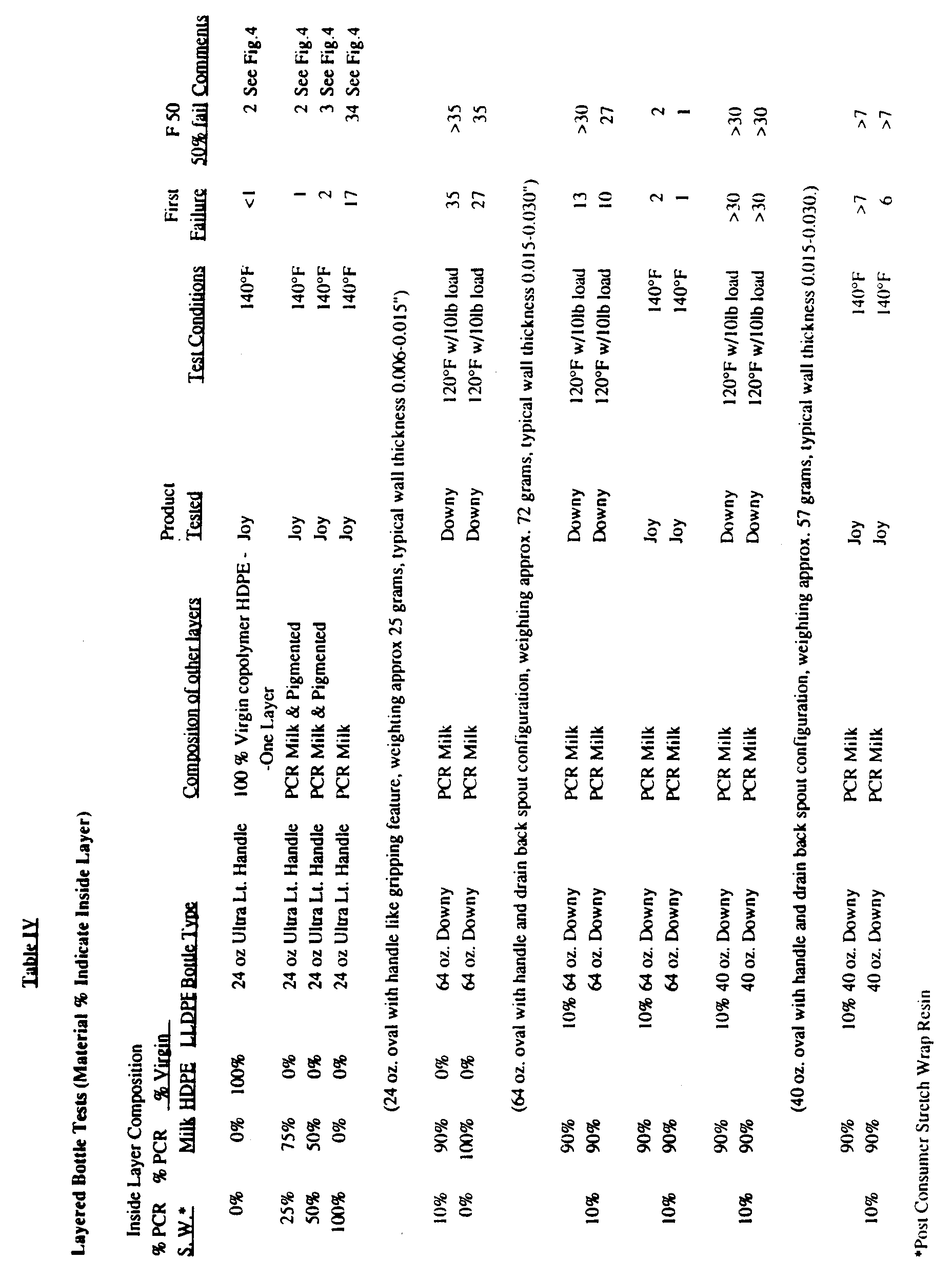
- Extensive tests have been provided as summarized in the following TABLES III and IV:

- TABLE III includes single layer or monolayer bottle results and Stress Rupture Test Data. Stress Rupture tests frequently indicate the material performance of single layer bottles.
- The first group of data on TABLE III shows the performance of 32 oz. non handle bottles and is illustrated in FIG. 1. The reference containers made with 100% virgin experienced the first failures in 20 days and 50% failed in 28 days. When 25% PCR is incorporated in the form of milk PCR, the environmental stress crack resistance is reduced to 13 days for the first failure and 14 days for 50% of the failures. The blend with 25% PCR, 10% stretch wrap and 15% milk the environmental stress crack resistance is superior to the prior variables with 28 days to the first failure and 33 days to reach 50% failures. The bottles were tested using a modified ASTM D 2561 Procedure A, modified by using 10 bottles and Kodak Flux AR Developer-Replenisher B as the stress cracking agent.
- The second group of data in TABLE III and illustrated in FIG. 2 shows material performance for one gallon bleach containers and 50% PCR. The reference containers made with 100% virgin experienced the first failure on day eight and 50% failures on
day 12. When 50% PCR in the form of milk is used, the container performance is again lessened to 7 days for the first failure and 8 for 50% failures. When 50% PCR bottles are made using 40% milk and 10% stretch wrap, the environmental stress crack resistance is again superior to the virgin and 50% milk only containers. The first failures occurred onday 14 and onday 15 the test was terminated before 50% of the containers had failed. The bottles were tested using a procedure described in PBI Technical Bulletin PBI 11-1978 Rev 1-1991. The procedure was followed using Clorox Fresh Scent Bleach and 5/16" deflection with 10 bottles. - The third group of data on TABLE III indicates stress rupture results and is illustrated in FIG. 3. When a typical copolymer for reference is tested an F₅₀ value of 40 hours was measured. The same virgin when blended with 25% milk PCR has a reduced F₅₀ value of 15 hours. When 25% PCR was incorporated in the amounts of 10% stretch wrap and 15% milk superior results occurred, the F₅₀ was 99 hours. The test procedure is described in ASTM D 2552-69.
- The TABLE IV data indicates results for several layered bottle configurations.
- The Environmental Stress Crack Resistance of a 24 oz. Ultra light containers (FIG. 4 and TABLE IV) was tested using monolayer virgin copolymer HDPE as a reference point. The first failures occurred in less than one day. One half of the samples failed in two days. When bottles were made using a blend of 25% stretch wrap resin with 75% post consumer milk material on the inside layer of a three layer bottle, the environmental stress crack resistance was the same or slightly improved over the 100% virgin bottles as the first failure occurred after one day. As the amount of stretch wrap resin is increased to 50% and then 100%, the environmental stress crack resistance improved dramatically, e.g., the first failures occurred on
day day 3 and 34, respectively. The bottles were tested using a modified ASTM D 2561 Procedure A, modified by using 10 bottles and Joy dish washing detergent as the stress cracking agent. - TABLE IV data indicates the performance of layered 64 oz. Downy bottles made of 100% post consumer milk material was similar in environmental stress crack performance when 10% stretch wrap resin was added to the inside layer. While the first failures occurred in 27 days v. 35 and 50% of the failures occurred in 35 days, both results are similar and acceptable for this product. The test method described in PBI 11-1978 Rev 1-1991 was used with a 10 pound top load and Downy Fabric Softener as the stress cracking agent.
- The remaining data shown on TABLE IV indicates that stretch wrap resin when substituted for virgin LLDPE provides similar environmental stress crack resistance.
Claims (43)
- A lightweight plastic container having stress crack resistance comprising
a hollow body comprising at least one layer including post consumer film resin. - The plastic container set forth in claim 1 wherein said container comprises a single layer of a fusion blend of said post consumer film resin and a post consumer milk resin.
- The plastic container set forth in claim 2 wherein said post consumer milk resin comprises the major portion of said fusion blend, by weight.
- The plastic container set forth in claim 3 wherein said post consumer film resin comprises about 10% to 100% of the fusion blend by weight and the post consumer milk resin comprises about 10% to 90% of the fusion blend by weight.
- The plastic container set forth in claim 1 wherein said container comprises a single layer of fusion blend of said post consumer film resin and virgin high density polyethylene copolymer.
- The plastic container set forth in claim 5 wherein said virgin high density copolymer comprises the major portion of said fusion blend, by weight.
- The plastic container set forth in claim 6 wherein said virgin high density polyethylene copolymer comprises about 10% to 90% of the fusion blend by weight and the post consumer film blend comprises about 10% to 100% of the fusion blend by weight.
- The plastic container set forth in claim 1 wherein said container comprises three layers including an outer and an inner layer comprising said post consumer film resin and an intermediate layer comprising post consumer milk resin.
- The plastic container set forth in claim 8 wherein said outer and inner layers comprise a fusion blend of said post consumer film resin and post consumer milk resin.
- The plastic container set forth in claim 9 wherein said post consumer milk resin of said outer and inner layers comprises the major portion of the fusion blend.
- The plastic container set forth in any one of claims 8-10 wherein the inner layer comprises about 10% to 100% by weight of post consumer film resin and about 0% to 90% by weight of post consumer milk resin.
- The plastic container set forth in claim 11 wherein said intermediate layer comprises 0% to 100% by weight of post consumer resin.
- The plastic container set forth in claim 11 wherein the intermediate layer comprises 0% to 100% virgin high density polyethylene copolymer.
- The plastic container set forth in claim 5 wherein said fusion blend comprises 10% post consumer film resin by weight, 15% post consumer milk resin by weight, and 75°% virgin high density polyethylene copolymer by weight.
- The plastic container set forth in claim 5 wherein said fusion blend comprises 10% post consumer film resin by weight, 40% post consumer milk resin by weight, and 50°% virgin high density polyethylene copolymer by weight.
- The plastic container set forth in claim 1 wherein the container comprises a multilayer container and said inner layer comprises 10% to 100% by weight of post consumer film resin and 0% to 90% by weight of post consumer milk resin.
- The plastic container set forth in claim 16 wherein said inner layer includes 10% virgin high density ethylene copolymer.
- A method of making a lightweight plastic container having stress crack resistance comprising
providing a fusion blend comprising post consumer resin,
forming a hollow body comprising at least one layer from said fusion blend. - The method set forth in claim 17 wherein said fusion blend comprises said post consumer film resin and a post consumer milk resin.
- The method set forth in claim 18 wherein said post consumer milk resin comprises the major portion of said fusion blend, by weight.
- The method set forth in claim 19 wherein said post consumer film resin comprises about 10% to 100% of the fusion blend by weight and the post consumer milk resin comprises about 10% to 90% of the fusion blend by weight.
- The method let forth in claim 17 wherein said container comprises a single layer of fusion blend of said post consumer film resin and virgin high density polyethylene copolymer.
- The method set forth in claim 21 wherein said virgin high density copolymer comprises the major portion of said fusion blend, by weight.
- The method set forth in claim 22 wherein said virgin high density polyethylene copolymer comprises about 10% to 90% of the fusion blend by weight and the post consumer film blend comprises about 10% to 100% of the fusion blend by weight.
- The method set forth in claim 17 wherein the step of forming said container comprises providing three layers including an outer and an inner layer comprising said post consumer film resin and an intermediate layer comprising post consumer milk resin.
- The method set forth in claim 24 wherein said outer and inner layers comprise a fusion blend of said post consumer film resin and post consumer milk resin.
- The method let forth in claim 25 wherein said post consumer milk resin of said outer and inner layers comprises the major portion of the fusion blend.
- The method set forth in any one of claims 17-26 wherein the inner layer comprises about 10% to 100% by weight of post consumer film resin and about 0% to 90% by weight of post consumer milk resin.
- The method set forth in claim 27 wherein said intermediate layer comprises 0% to 100% by weight of post consumer resin.
- The method set forth in claim 28 wherein the intermediate layer comprises 0% to 100% virgin high density polyethylene copolymer.
- The method set forth in claim 21 wherein said fusion blend comprises 10% post consumer film resin by weight, 15% post consumer milk resin by weight, and 75°% virgin high density polyethylene copolymer by weight.
- The method set forth in claim 21 wherein said fusion blend comprises 10% post consumer film resin by weight, 40% post consumer milk resin by weight, and 50°% virgin high density polyethylene copolymer by weight.
- The method set forth in claim 17 wherein the container comprises a multilayer container and said inner layer comprises 10% to 100% by weight of post consumer film resin and 0% to 90% by weight of post consumer milk resin.
- The method set forth in claim 32 wherein said inner layer includes 10% virgin high density ethylene copolymer.
- A fusion blend for forming a hollow lightweight plastic container having stress crack resistance comprising
a fusion blend including post consumer film resin. - The fusion blend set forth in claim 34 wherein said fusion blend comprises said post consumer film resin and a post consumer milk resin.
- The fusion blend set forth in claim 35 wherein said post consumer milk resin comprises the major portion of said fusion blend, by weight.
- The fusion blend set forth in claim 36 wherein said post consumer film resin comprises about 10% to 100% of the fusion blend by weight and the post consumer milk resin comprises about 10% to 90% of the fusion blend by weight.
- The fusion blend set forth in claim 34 wherein said fusion blend comprises said post consumer film resin and virgin high density polyethylene copolymer.
- The fusion blend set forth in claim 38 wherein said virgin high density copolymer comprises the major portion of said fusion blend, by weight.
- The fusion blend set forth in claim 39 wherein said virgin high density polyethylene copolymer comprises about 10% to 90% of the fusion blend by weight and the post consumer film blend comprises about 10% to 100% of the fusion blend by weight.
- The fusion blend set forth in claim 38 wherein said fusion blend comprises 10% post consumer film resin by weight, 15% post consumer milk resin by weight, and 75°% virgin high density polyethylene copolymer by weight.
- The fusion blend set forth in claim 38 wherein said fusion blend comprises 10% post consumer film resin by weight, 40% post consumer milk resin by weight, and 50°% virgin high density polyethylene copolymer by weight.
Applications Claiming Priority (2)
| Application Number | Priority Date | Filing Date | Title |
|---|---|---|---|
| US154413 | 1988-02-10 | ||
| US08/154,413 US5552198A (en) | 1992-02-27 | 1993-11-19 | Plastic container made from post consumer plastic film |
Publications (2)
| Publication Number | Publication Date |
|---|---|
| EP0654496A2 true EP0654496A2 (en) | 1995-05-24 |
| EP0654496A3 EP0654496A3 (en) | 1995-06-07 |
Family
ID=22551269
Family Applications (1)
| Application Number | Title | Priority Date | Filing Date |
|---|---|---|---|
| EP19940118120 Withdrawn EP0654496A3 (en) | 1993-11-19 | 1994-11-17 | Plastic container made from post consumer plastic film |
Country Status (6)
| Country | Link |
|---|---|
| US (2) | US5552198A (en) |
| EP (1) | EP0654496A3 (en) |
| JP (1) | JP2906326B2 (en) |
| AU (1) | AU682725B2 (en) |
| BR (1) | BR9404673A (en) |
| ZA (1) | ZA949187B (en) |
Cited By (5)
| Publication number | Priority date | Publication date | Assignee | Title |
|---|---|---|---|---|
| EP2668105B1 (en) | 2011-01-25 | 2015-05-06 | The Procter&Gamble Company | Sustainable packaging for consumer products |
| WO2016005265A1 (en) | 2014-07-10 | 2016-01-14 | Total Research & Technology Feluy | Process for producing high density polyethylene composition having high environmental stress crack resistance from post consumer plastic and articles made of said composition |
| WO2021151797A1 (en) | 2020-01-30 | 2021-08-05 | Unilever Ip Holdings B.V. | Post consumer resin packaging |
| EP4054846A1 (en) * | 2019-11-08 | 2022-09-14 | Trioworld Smålandsstenar AB | A multilayer stretch film |
| FR3121625A1 (en) * | 2021-04-09 | 2022-10-14 | L'oréal | Bottle intended to contain a product, in particular cosmetic |
Families Citing this family (17)
| Publication number | Priority date | Publication date | Assignee | Title |
|---|---|---|---|---|
| US5876644A (en) * | 1996-08-27 | 1999-03-02 | Wellman, Inc. | Food quality polyester recycling |
| US20040076782A1 (en) * | 1999-04-07 | 2004-04-22 | Safian John W. | Multilayer container |
| US6670007B1 (en) | 1999-04-07 | 2003-12-30 | Owens-Brockway Plastic Products Inc. | Multilayer container |
| US20070292646A1 (en) * | 1999-04-07 | 2007-12-20 | Graham Packaging Company L.P. | Multilayer container |
| US20030113496A1 (en) * | 2001-12-17 | 2003-06-19 | Harris Michael G. | Polyethylene melt blends for high density polyethylene applications |
| US6809129B2 (en) * | 2002-01-23 | 2004-10-26 | Delphi Technologies, Inc. | Elastomeric intumescent material |
| US6706793B2 (en) | 2002-01-23 | 2004-03-16 | Delphi Technologies, Inc. | Intumescent fire retardant composition and method of manufacture thereof |
| US6822051B2 (en) * | 2002-03-29 | 2004-11-23 | Media Plus, Inc. | High density polyethylene melt blends for improved stress crack resistance in pipe |
| US6960375B2 (en) * | 2003-05-27 | 2005-11-01 | Unilever Home & Personal Care Usa, Division Of Conopco, Inc. | Bottle containing recycled polymers |
| US20060011108A1 (en) * | 2004-07-13 | 2006-01-19 | Abu-Isa Ismat A | Fire resistant plastic pallet |
| US11845599B2 (en) * | 2019-01-14 | 2023-12-19 | Illinois Tool Works Inc. | Container carrier |
| AR118077A1 (en) * | 2019-02-27 | 2021-09-15 | Dow Global Technologies Llc | COMPOSITION FOR THE ELIMINATION OF ODORS FOR RECYCLED RESIN |
| US20240149517A1 (en) * | 2019-10-15 | 2024-05-09 | Braskem S.A. | Blow molded articles incorporating post-consumer resin and methods thereof |
| US12031018B2 (en) | 2020-01-13 | 2024-07-09 | Illinois Tool Works Inc. | Polyolefin elastomer in multi-packaging carrier |
| US12558880B2 (en) * | 2021-04-05 | 2026-02-24 | Kim Pack Co., Ltd. | Recycled and recyclable barrier laminate tube |
| US11746219B2 (en) | 2022-04-06 | 2023-09-05 | Exxonmobil Chemical Patents Inc. | Blends of recycled resins with metallocene-catalyzed polyolefins |
| EP4506407A1 (en) * | 2023-08-08 | 2025-02-12 | Basell Polyolefine GmbH | Process for producing a blended polyethylene composition comprising recycled polymer compositions |
Family Cites Families (38)
| Publication number | Priority date | Publication date | Assignee | Title |
|---|---|---|---|---|
| NL109028C (en) * | 1960-01-15 | |||
| US3280220A (en) * | 1963-04-29 | 1966-10-18 | Phillips Petroleum Co | Blend of high density polyethylene-1-butene copolymer |
| US3869056A (en) * | 1970-09-14 | 1975-03-04 | Emery I Valyi | Multilayered hollow plastic container |
| US3884855A (en) * | 1971-03-24 | 1975-05-20 | Davy Ashmore Ag | Process for the production of regenerate from polypropylene waste |
| US3878282A (en) * | 1971-08-10 | 1975-04-15 | Ilikon Corp | Process for molding multilayer articles |
| US3795633A (en) * | 1971-12-17 | 1974-03-05 | Ford Motor Co | Recovery of thermoplastic foam |
| US3940001A (en) * | 1972-10-06 | 1976-02-24 | Ethyl Corporation | Recyclable plastic containers |
| US3976612A (en) * | 1972-11-30 | 1976-08-24 | Idemitsu, Kosan Kabushiki-Kaisha (Idemitsu Kosan Co., Ltd.) | Polyethylene composition |
| US4109813A (en) * | 1973-03-21 | 1978-08-29 | Valyi Emery I | Composite plastic container |
| JPS5182374A (en) * | 1974-03-27 | 1976-07-19 | Showa Electric Wire & Cable Co | Haikihoriechirenno saiseiryohoho |
| US4115499A (en) * | 1975-04-04 | 1978-09-19 | Monsanto Research Corporation | Large void-free polyethylene castings |
| US4332748A (en) * | 1976-07-29 | 1982-06-01 | Champion International Corporation | Polyethylene recovery from broke |
| JPS56106939A (en) * | 1980-01-29 | 1981-08-25 | Nisshin Kogyo Kk | Molding and processing for reproduction of recovered crosslinked polyethylene |
| JPS5711051A (en) * | 1980-06-24 | 1982-01-20 | Kureha Chemical Ind Co Ltd | Multilayer bottle |
| FR2493854B1 (en) * | 1980-11-13 | 1985-10-11 | Naphtachimie Sa | IMPROVED POLYETHYLENE COMPOSITIONS FOR EXTRUSION IN PARTICULAR FOR EXTRUSION-BLOWING |
| JPS57210817A (en) * | 1981-06-23 | 1982-12-24 | Nippon Telegr & Teleph Corp <Ntt> | Manufacture of reclaimed sheathing material from waste cable sheath |
| JPS5829841A (en) * | 1981-08-14 | 1983-02-22 | Asahi Chem Ind Co Ltd | Improve polyethylene composition |
| DE3215891A1 (en) * | 1982-04-29 | 1983-11-03 | Basf Farben + Fasern Ag, 2000 Hamburg | SELF-CROSS-LINKING, HEAT-CURABLE BINDING AGENT |
| US4547551A (en) * | 1982-06-22 | 1985-10-15 | Phillips Petroleum Company | Ethylene polymer blends and process for forming film |
| US4550143A (en) * | 1983-06-10 | 1985-10-29 | Idemitsu Petrochemical Co., Ltd. | Composition comprising ethylene-based polymers |
| US4577768A (en) * | 1983-11-03 | 1986-03-25 | Owens-Illinois, Inc. | Ethylene polymer blend and containers prepared therefrom |
| US4567069A (en) * | 1984-06-18 | 1986-01-28 | Owens-Illinois, Inc. | Multilayer containers with improved stress crack properties |
| IL75719A (en) * | 1984-07-18 | 1988-11-30 | Du Pont Canada | Polyolefin blends containing reactive agents |
| US4719143A (en) * | 1986-11-03 | 1988-01-12 | Owens-Illinois Plastic Products Inc. | Multilayer polyethylene articles |
| US4990382A (en) * | 1987-09-11 | 1991-02-05 | Continental Plastic Containers, Inc. | Plastic container with glass-like appearance, parison for and method of making same |
| US4923750A (en) * | 1987-12-30 | 1990-05-08 | Co-Ex Plastics, Inc. | Thermoplastic stretch-wrap material |
| US5028663A (en) * | 1988-04-28 | 1991-07-02 | Chung Chan I | Solid state processing of polymer blends |
| JPH0232940A (en) * | 1988-07-20 | 1990-02-02 | Tokan Kogyo Co Ltd | Milk container |
| US5030662A (en) * | 1988-08-11 | 1991-07-09 | Polymerix, Inc. | Construction material obtained from recycled polyolefins containing other polymers |
| US5073416A (en) * | 1988-11-21 | 1991-12-17 | General Electric Company | Articles from mixed scrap plastics |
| US5128212A (en) * | 1990-05-18 | 1992-07-07 | E. I. Du Pont De Nemours And Company | Multilayer heat shrinkable polymeric film containing recycle polymer |
| WO1991019763A1 (en) * | 1990-06-18 | 1991-12-26 | Exxon Chemical Patents Inc. | New hdpe resins and products with improved properties |
| JP3032311B2 (en) * | 1991-02-06 | 2000-04-17 | 昭和電工株式会社 | Plastic container |
| JP2598858Y2 (en) * | 1991-08-16 | 1999-08-23 | 株式会社吉野工業所 | Recycled synthetic resin container |
| US5766712A (en) * | 1992-02-14 | 1998-06-16 | Plastipak Packaging, Inc. | Coextruded multilayer plastic blow molded container |
| DE69322803D1 (en) * | 1992-02-27 | 1999-02-11 | Owens Illinois Plastic Prod | Blow molded container made from blends of re-used high density polyethylene and linear low density polyethylene |
| US5432231A (en) * | 1993-07-06 | 1995-07-11 | Mobil Oil Corporation | Recycling stretch wrap film |
| US5428093A (en) * | 1993-11-05 | 1995-06-27 | Sealed Air Corporation | Polyethylene blend compositions and methods for making same |
-
1993
- 1993-11-19 US US08/154,413 patent/US5552198A/en not_active Expired - Fee Related
-
1994
- 1994-11-17 EP EP19940118120 patent/EP0654496A3/en not_active Withdrawn
- 1994-11-18 AU AU78921/94A patent/AU682725B2/en not_active Ceased
- 1994-11-18 ZA ZA949187A patent/ZA949187B/en unknown
- 1994-11-21 JP JP30946294A patent/JP2906326B2/en not_active Expired - Fee Related
- 1994-11-21 BR BR9404673A patent/BR9404673A/en not_active Application Discontinuation
-
1996
- 1996-07-24 US US08/687,123 patent/US5908677A/en not_active Expired - Fee Related
Cited By (6)
| Publication number | Priority date | Publication date | Assignee | Title |
|---|---|---|---|---|
| EP2668105B1 (en) | 2011-01-25 | 2015-05-06 | The Procter&Gamble Company | Sustainable packaging for consumer products |
| WO2016005265A1 (en) | 2014-07-10 | 2016-01-14 | Total Research & Technology Feluy | Process for producing high density polyethylene composition having high environmental stress crack resistance from post consumer plastic and articles made of said composition |
| US10053563B2 (en) | 2014-07-10 | 2018-08-21 | Total Research & Technology Feluy | Process for producing high density polyethylene composition having high environmental stress crack resistance from post consumer plastic and articles made of said composition |
| EP4054846A1 (en) * | 2019-11-08 | 2022-09-14 | Trioworld Smålandsstenar AB | A multilayer stretch film |
| WO2021151797A1 (en) | 2020-01-30 | 2021-08-05 | Unilever Ip Holdings B.V. | Post consumer resin packaging |
| FR3121625A1 (en) * | 2021-04-09 | 2022-10-14 | L'oréal | Bottle intended to contain a product, in particular cosmetic |
Also Published As
| Publication number | Publication date |
|---|---|
| AU7892194A (en) | 1995-05-25 |
| BR9404673A (en) | 1995-07-11 |
| JPH07195560A (en) | 1995-08-01 |
| AU682725B2 (en) | 1997-10-16 |
| ZA949187B (en) | 1995-07-25 |
| US5552198A (en) | 1996-09-03 |
| US5908677A (en) | 1999-06-01 |
| EP0654496A3 (en) | 1995-06-07 |
| JP2906326B2 (en) | 1999-06-21 |
Similar Documents
| Publication | Publication Date | Title |
|---|---|---|
| US5908677A (en) | Plastic container made from post consumer plastic film | |
| EP0561187B1 (en) | Blow moulded container of blends of recycled high density polyethylene and linear low density polyethylene | |
| CA2131351C (en) | Coextruded multilayer plastic container utilizing post consumer plastic | |
| US12558880B2 (en) | Recycled and recyclable barrier laminate tube | |
| US5153039A (en) | High density polyethylene article with oxygen barrier properties | |
| US5693391A (en) | Plastic container made from a fusion blend of post consumer plastic and ethylene polymers | |
| US4567069A (en) | Multilayer containers with improved stress crack properties | |
| US4577768A (en) | Ethylene polymer blend and containers prepared therefrom | |
| EP1462378B1 (en) | Screw cap composition based on multimodal polyethylene | |
| CA1305264C (en) | Plastic composite barrier structures | |
| EP2483350B1 (en) | Multi-layered article | |
| AU616447B2 (en) | Increased regrind usage in coextruded structures | |
| WO2021231244A1 (en) | Collation shrink film | |
| WO1991019763A1 (en) | New hdpe resins and products with improved properties | |
| EP0666285B1 (en) | A PET packaging material | |
| EP0737131B1 (en) | Methods for making containers having improved barrier properties | |
| EP4351863B1 (en) | Recycled polymeric container including graphene | |
| US4719143A (en) | Multilayer polyethylene articles | |
| EP4652230A1 (en) | Polyethylene compositions containing recycled material |
Legal Events
| Date | Code | Title | Description |
|---|---|---|---|
| PUAI | Public reference made under article 153(3) epc to a published international application that has entered the european phase |
Free format text: ORIGINAL CODE: 0009012 |
|
| PUAL | Search report despatched |
Free format text: ORIGINAL CODE: 0009013 |
|
| AK | Designated contracting states |
Kind code of ref document: A2 Designated state(s): AT BE CH DE DK ES FR GB GR IE IT LI LU MC NL PT SE |
|
| RHK1 | Main classification (correction) |
Ipc: C08L 23/04 |
|
| AK | Designated contracting states |
Kind code of ref document: A3 Designated state(s): AT BE CH DE DK ES FR GB GR IE IT LI LU MC NL PT SE |
|
| 17P | Request for examination filed |
Effective date: 19950817 |
|
| 17Q | First examination report despatched |
Effective date: 19961230 |
|
| STAA | Information on the status of an ep patent application or granted ep patent |
Free format text: STATUS: THE APPLICATION HAS BEEN WITHDRAWN |
|
| 18W | Application withdrawn |
Withdrawal date: 19990315 |