EP0648723A1 - Diphenylacetylene compound, process for preparing the same and liquid crystal composition and element comprising the same - Google Patents
Diphenylacetylene compound, process for preparing the same and liquid crystal composition and element comprising the same Download PDFInfo
- Publication number
- EP0648723A1 EP0648723A1 EP94116064A EP94116064A EP0648723A1 EP 0648723 A1 EP0648723 A1 EP 0648723A1 EP 94116064 A EP94116064 A EP 94116064A EP 94116064 A EP94116064 A EP 94116064A EP 0648723 A1 EP0648723 A1 EP 0648723A1
- Authority
- EP
- European Patent Office
- Prior art keywords
- group
- formula
- compound
- trans
- acetylene
- Prior art date
- Legal status (The legal status is an assumption and is not a legal conclusion. Google has not performed a legal analysis and makes no representation as to the accuracy of the status listed.)
- Granted
Links
- CBQUXWCIEJVRSI-UHFFFAOYSA-N C#CB1Oc2ccccc2O1 Chemical compound C#CB1Oc2ccccc2O1 CBQUXWCIEJVRSI-UHFFFAOYSA-N 0.000 description 1
- AAFFTDXPYADISO-UHFFFAOYSA-N C1CC#CCC1 Chemical compound C1CC#CCC1 AAFFTDXPYADISO-UHFFFAOYSA-N 0.000 description 1
- UAEPNZWRGJTJPN-UHFFFAOYSA-N CC1CCCCC1 Chemical compound CC1CCCCC1 UAEPNZWRGJTJPN-UHFFFAOYSA-N 0.000 description 1
Classifications
-
- C—CHEMISTRY; METALLURGY
- C07—ORGANIC CHEMISTRY
- C07C—ACYCLIC OR CARBOCYCLIC COMPOUNDS
- C07C15/00—Cyclic hydrocarbons containing only six-membered aromatic rings as cyclic parts
- C07C15/40—Cyclic hydrocarbons containing only six-membered aromatic rings as cyclic parts substituted by unsaturated carbon radicals
- C07C15/50—Cyclic hydrocarbons containing only six-membered aromatic rings as cyclic parts substituted by unsaturated carbon radicals polycyclic non-condensed
- C07C15/54—Cyclic hydrocarbons containing only six-membered aromatic rings as cyclic parts substituted by unsaturated carbon radicals polycyclic non-condensed containing a group with formula
-
- C—CHEMISTRY; METALLURGY
- C07—ORGANIC CHEMISTRY
- C07C—ACYCLIC OR CARBOCYCLIC COMPOUNDS
- C07C15/00—Cyclic hydrocarbons containing only six-membered aromatic rings as cyclic parts
- C07C15/40—Cyclic hydrocarbons containing only six-membered aromatic rings as cyclic parts substituted by unsaturated carbon radicals
- C07C15/42—Cyclic hydrocarbons containing only six-membered aromatic rings as cyclic parts substituted by unsaturated carbon radicals monocyclic
- C07C15/48—Cyclic hydrocarbons containing only six-membered aromatic rings as cyclic parts substituted by unsaturated carbon radicals monocyclic the hydrocarbon substituent containing a carbon-to-carbon triple bond
-
- C—CHEMISTRY; METALLURGY
- C07—ORGANIC CHEMISTRY
- C07C—ACYCLIC OR CARBOCYCLIC COMPOUNDS
- C07C255/00—Carboxylic acid nitriles
- C07C255/49—Carboxylic acid nitriles having cyano groups bound to carbon atoms of six-membered aromatic rings of a carbon skeleton
- C07C255/50—Carboxylic acid nitriles having cyano groups bound to carbon atoms of six-membered aromatic rings of a carbon skeleton to carbon atoms of non-condensed six-membered aromatic rings
-
- C—CHEMISTRY; METALLURGY
- C07—ORGANIC CHEMISTRY
- C07C—ACYCLIC OR CARBOCYCLIC COMPOUNDS
- C07C33/00—Unsaturated compounds having hydroxy or O-metal groups bound to acyclic carbon atoms
- C07C33/28—Alcohols containing only six-membered aromatic rings as cyclic part with unsaturation outside the aromatic rings
- C07C33/30—Alcohols containing only six-membered aromatic rings as cyclic part with unsaturation outside the aromatic rings monocyclic
-
- C—CHEMISTRY; METALLURGY
- C07—ORGANIC CHEMISTRY
- C07C—ACYCLIC OR CARBOCYCLIC COMPOUNDS
- C07C33/00—Unsaturated compounds having hydroxy or O-metal groups bound to acyclic carbon atoms
- C07C33/40—Halogenated unsaturated alcohols
- C07C33/46—Halogenated unsaturated alcohols containing only six-membered aromatic rings as cyclic parts
- C07C33/48—Halogenated unsaturated alcohols containing only six-membered aromatic rings as cyclic parts with unsaturation outside the aromatic rings
- C07C33/483—Monocyclic
-
- C—CHEMISTRY; METALLURGY
- C07—ORGANIC CHEMISTRY
- C07C—ACYCLIC OR CARBOCYCLIC COMPOUNDS
- C07C43/00—Ethers; Compounds having groups, groups or groups
- C07C43/02—Ethers
- C07C43/03—Ethers having all ether-oxygen atoms bound to acyclic carbon atoms
- C07C43/14—Unsaturated ethers
- C07C43/164—Unsaturated ethers containing six-membered aromatic rings
- C07C43/166—Unsaturated ethers containing six-membered aromatic rings having unsaturation outside the aromatic rings
-
- C—CHEMISTRY; METALLURGY
- C07—ORGANIC CHEMISTRY
- C07C—ACYCLIC OR CARBOCYCLIC COMPOUNDS
- C07C43/00—Ethers; Compounds having groups, groups or groups
- C07C43/02—Ethers
- C07C43/03—Ethers having all ether-oxygen atoms bound to acyclic carbon atoms
- C07C43/14—Unsaturated ethers
- C07C43/17—Unsaturated ethers containing halogen
- C07C43/174—Unsaturated ethers containing halogen containing six-membered aromatic rings
- C07C43/176—Unsaturated ethers containing halogen containing six-membered aromatic rings having unsaturation outside the aromatic rings
-
- C—CHEMISTRY; METALLURGY
- C07—ORGANIC CHEMISTRY
- C07C—ACYCLIC OR CARBOCYCLIC COMPOUNDS
- C07C43/00—Ethers; Compounds having groups, groups or groups
- C07C43/02—Ethers
- C07C43/20—Ethers having an ether-oxygen atom bound to a carbon atom of a six-membered aromatic ring
- C07C43/215—Ethers having an ether-oxygen atom bound to a carbon atom of a six-membered aromatic ring having unsaturation outside the six-membered aromatic rings
-
- C—CHEMISTRY; METALLURGY
- C07—ORGANIC CHEMISTRY
- C07C—ACYCLIC OR CARBOCYCLIC COMPOUNDS
- C07C43/00—Ethers; Compounds having groups, groups or groups
- C07C43/02—Ethers
- C07C43/20—Ethers having an ether-oxygen atom bound to a carbon atom of a six-membered aromatic ring
- C07C43/225—Ethers having an ether-oxygen atom bound to a carbon atom of a six-membered aromatic ring containing halogen
-
- C—CHEMISTRY; METALLURGY
- C07—ORGANIC CHEMISTRY
- C07D—HETEROCYCLIC COMPOUNDS
- C07D213/00—Heterocyclic compounds containing six-membered rings, not condensed with other rings, with one nitrogen atom as the only ring hetero atom and three or more double bonds between ring members or between ring members and non-ring members
- C07D213/02—Heterocyclic compounds containing six-membered rings, not condensed with other rings, with one nitrogen atom as the only ring hetero atom and three or more double bonds between ring members or between ring members and non-ring members having three double bonds between ring members or between ring members and non-ring members
- C07D213/04—Heterocyclic compounds containing six-membered rings, not condensed with other rings, with one nitrogen atom as the only ring hetero atom and three or more double bonds between ring members or between ring members and non-ring members having three double bonds between ring members or between ring members and non-ring members having no bond between the ring nitrogen atom and a non-ring member or having only hydrogen or carbon atoms directly attached to the ring nitrogen atom
- C07D213/60—Heterocyclic compounds containing six-membered rings, not condensed with other rings, with one nitrogen atom as the only ring hetero atom and three or more double bonds between ring members or between ring members and non-ring members having three double bonds between ring members or between ring members and non-ring members having no bond between the ring nitrogen atom and a non-ring member or having only hydrogen or carbon atoms directly attached to the ring nitrogen atom with hetero atoms or with carbon atoms having three bonds to hetero atoms with at the most one bond to halogen, e.g. ester or nitrile radicals, directly attached to ring carbon atoms
- C07D213/62—Oxygen or sulfur atoms
- C07D213/63—One oxygen atom
- C07D213/64—One oxygen atom attached in position 2 or 6
-
- C—CHEMISTRY; METALLURGY
- C07—ORGANIC CHEMISTRY
- C07D—HETEROCYCLIC COMPOUNDS
- C07D239/00—Heterocyclic compounds containing 1,3-diazine or hydrogenated 1,3-diazine rings
- C07D239/02—Heterocyclic compounds containing 1,3-diazine or hydrogenated 1,3-diazine rings not condensed with other rings
- C07D239/24—Heterocyclic compounds containing 1,3-diazine or hydrogenated 1,3-diazine rings not condensed with other rings having three or more double bonds between ring members or between ring members and non-ring members
- C07D239/26—Heterocyclic compounds containing 1,3-diazine or hydrogenated 1,3-diazine rings not condensed with other rings having three or more double bonds between ring members or between ring members and non-ring members with only hydrogen atoms, hydrocarbon or substituted hydrocarbon radicals, directly attached to ring carbon atoms
-
- C—CHEMISTRY; METALLURGY
- C07—ORGANIC CHEMISTRY
- C07D—HETEROCYCLIC COMPOUNDS
- C07D239/00—Heterocyclic compounds containing 1,3-diazine or hydrogenated 1,3-diazine rings
- C07D239/02—Heterocyclic compounds containing 1,3-diazine or hydrogenated 1,3-diazine rings not condensed with other rings
- C07D239/24—Heterocyclic compounds containing 1,3-diazine or hydrogenated 1,3-diazine rings not condensed with other rings having three or more double bonds between ring members or between ring members and non-ring members
- C07D239/28—Heterocyclic compounds containing 1,3-diazine or hydrogenated 1,3-diazine rings not condensed with other rings having three or more double bonds between ring members or between ring members and non-ring members with hetero atoms or with carbon atoms having three bonds to hetero atoms with at the most one bond to halogen, directly attached to ring carbon atoms
- C07D239/32—One oxygen, sulfur or nitrogen atom
- C07D239/34—One oxygen atom
-
- C—CHEMISTRY; METALLURGY
- C09—DYES; PAINTS; POLISHES; NATURAL RESINS; ADHESIVES; COMPOSITIONS NOT OTHERWISE PROVIDED FOR; APPLICATIONS OF MATERIALS NOT OTHERWISE PROVIDED FOR
- C09K—MATERIALS FOR MISCELLANEOUS APPLICATIONS, NOT PROVIDED FOR ELSEWHERE
- C09K19/00—Liquid crystal materials
- C09K19/04—Liquid crystal materials characterised by the chemical structure of the liquid crystal components, e.g. by a specific unit
- C09K19/06—Non-steroidal liquid crystal compounds
- C09K19/08—Non-steroidal liquid crystal compounds containing at least two non-condensed rings
- C09K19/10—Non-steroidal liquid crystal compounds containing at least two non-condensed rings containing at least two benzene rings
- C09K19/14—Non-steroidal liquid crystal compounds containing at least two non-condensed rings containing at least two benzene rings linked by a carbon chain
- C09K19/18—Non-steroidal liquid crystal compounds containing at least two non-condensed rings containing at least two benzene rings linked by a carbon chain the chain containing carbon-to-carbon triple bonds, e.g. tolans
-
- C—CHEMISTRY; METALLURGY
- C09—DYES; PAINTS; POLISHES; NATURAL RESINS; ADHESIVES; COMPOSITIONS NOT OTHERWISE PROVIDED FOR; APPLICATIONS OF MATERIALS NOT OTHERWISE PROVIDED FOR
- C09K—MATERIALS FOR MISCELLANEOUS APPLICATIONS, NOT PROVIDED FOR ELSEWHERE
- C09K19/00—Liquid crystal materials
- C09K19/04—Liquid crystal materials characterised by the chemical structure of the liquid crystal components, e.g. by a specific unit
- C09K19/06—Non-steroidal liquid crystal compounds
- C09K19/34—Non-steroidal liquid crystal compounds containing at least one heterocyclic ring
- C09K19/3441—Non-steroidal liquid crystal compounds containing at least one heterocyclic ring having nitrogen as hetero atom
- C09K19/3444—Non-steroidal liquid crystal compounds containing at least one heterocyclic ring having nitrogen as hetero atom the heterocyclic ring being a six-membered aromatic ring containing one nitrogen atom, e.g. pyridine
-
- C—CHEMISTRY; METALLURGY
- C09—DYES; PAINTS; POLISHES; NATURAL RESINS; ADHESIVES; COMPOSITIONS NOT OTHERWISE PROVIDED FOR; APPLICATIONS OF MATERIALS NOT OTHERWISE PROVIDED FOR
- C09K—MATERIALS FOR MISCELLANEOUS APPLICATIONS, NOT PROVIDED FOR ELSEWHERE
- C09K19/00—Liquid crystal materials
- C09K19/04—Liquid crystal materials characterised by the chemical structure of the liquid crystal components, e.g. by a specific unit
- C09K19/06—Non-steroidal liquid crystal compounds
- C09K19/34—Non-steroidal liquid crystal compounds containing at least one heterocyclic ring
- C09K19/3441—Non-steroidal liquid crystal compounds containing at least one heterocyclic ring having nitrogen as hetero atom
- C09K19/345—Non-steroidal liquid crystal compounds containing at least one heterocyclic ring having nitrogen as hetero atom the heterocyclic ring being a six-membered aromatic ring containing two nitrogen atoms
- C09K19/3458—Uncondensed pyrimidines
- C09K19/3461—Pyrimidine-tolane
-
- C—CHEMISTRY; METALLURGY
- C09—DYES; PAINTS; POLISHES; NATURAL RESINS; ADHESIVES; COMPOSITIONS NOT OTHERWISE PROVIDED FOR; APPLICATIONS OF MATERIALS NOT OTHERWISE PROVIDED FOR
- C09K—MATERIALS FOR MISCELLANEOUS APPLICATIONS, NOT PROVIDED FOR ELSEWHERE
- C09K19/00—Liquid crystal materials
- C09K19/04—Liquid crystal materials characterised by the chemical structure of the liquid crystal components, e.g. by a specific unit
- C09K19/06—Non-steroidal liquid crystal compounds
- C09K19/34—Non-steroidal liquid crystal compounds containing at least one heterocyclic ring
- C09K19/3441—Non-steroidal liquid crystal compounds containing at least one heterocyclic ring having nitrogen as hetero atom
- C09K19/345—Non-steroidal liquid crystal compounds containing at least one heterocyclic ring having nitrogen as hetero atom the heterocyclic ring being a six-membered aromatic ring containing two nitrogen atoms
- C09K19/3458—Uncondensed pyrimidines
- C09K19/3469—Pyrimidine with a specific end-group other than alkyl, alkoxy or -C*-
Definitions
- the present invention relates to a diphenylacetylene (hereinafter referred to as "tolan") compound which is useful as a component of a liquid crystal composition, a process for preparing said tolan compound and a liquid crystal composition comprising said tolan compound and a liquid crystal element comprising said liquid crystal composition.
- tolan diphenylacetylene
- An object of the present invention is provide a low viscosity tolan compound which is excellent in anisotropy of refractive index and is suitable as a liquid crystal material.
- Another object of the present invention is to provide a process for preparing said tolan compound, which process is industrially advantageous.
- a further object of the present invention is to provide a novel compound which is useful as a starting material in the preparation of the tolan compound of the present invention.
- a yet another object of the present invention is to provide a liquid crystal composition comprising said tolan compound.
- a yet further object of the present invention is to provide a liquid crystal element comprising said liquid crystal composition.
- a tolan compound of the formula [1] wherein R is a C1-C12 alkyl group, a C2-C12 alkenyl group or a C2-C16 alkoxyalkyl group; X1, X2, X3, X4, Y1, Y2, Y3 and Y4 are independently from each other a -CH- group, a -CF- group or a nitrogen atom; A is a hydrogen atom, a fluorine atom, a trifluoromethyl group, a trifluoromethoxy group, a cyano group, a 4-R1-(cycloalkyl) group, 4-R1-(cycloalkenyl) group or a R1-(O) m group in which R1 is a C1-C12 alkyl group, a C2-C12 alkenyl group or a C2-C12 alkynyl group; and m is 0 or 1.
- a process for preparing a tolan compound of the formula [1] comprising reacting an aromatic compound of the formula [2]: wherein A, X1, X2, X3 and X4 are the same as defined above, and D is a halogen atom or -OSO2R' in which R' is a lower alkyl group having 1 to 4 carbon atoms which may be substituted by a fluorine atom or a C1-C4 alkyl, C1-C4 alkoxy or halogen substituted or unsubstituted phenyl group with an ethynyl aromatic derivative of the formula [3] wherein R, Y1, Y2, Y3 and Y4 are the same as defined above in the presence of a metal catalyst and a base.
- a process for preparing a tolan compound of the formula [1] comprising reacting an ethynyl aromatic compound of the formula [11]: wherein A, X1, X2, X3 and X4 are the same as defined above with an aromatic derivative of the formula [12]: wherein D, R, Y1, Y2, Y3 and Y4 are the same as defined above in the presence of a metal catalyst and a base.
- a process for preparing an ethynyl aromatic derivative of the formula [3] comprising treating a carbinol derivative of the formula [7]: wherein R, Y1, Y2, Y3 and Y4 are the same as defined above with a base.
- a liquid crystal composition comprising the tolan compound [1] of the present invention.
- a liquid crystal element comprising the liquid crystal composition of the present invention.
- the tolan compound of the formula [1] of the present invention can be prepared by reacting an aromatic compound of the formula [2]: wherein A, D, X1, X2, X3 and X4 are the same as defined above with an ethynyl aromatic derivative of the formula [3] wherein R, Y1, Y2, Y3 and Y4 are the same as defined above in the presence of a metal catalyst and a base.
- the amount of the ethynyl aromatic derivative [3] is usually 0.9 to 3 equivalents, preferably 1 to 2 equivalents to the ethynyl aromatic derivative [3]. While it is possible to use the ethynyl aromatic derivative [3] in an excessive amount, it is preferable to use the aromatic compound [2] in an excessive amount since the ethynyl aromatic derivative [3] is generally more expensive than the aromatic compound [2].
- a palladium catalyst As the metal catalyst, a palladium catalyst, a nickel catalyst, a rhodium catalyst and a copper catalyst are exemplified.
- the palladium catalyst are palladium chloride, palladium acetate, triphenylphosphine palladium complex and palladium on carbon.
- the nickel and rhodium catalysts are the above compounds of the palladium catalyst in which palladium is replaced by nickel or rhodium.
- Specific examples of the copper catalyst are cuprous or cupric halides such as cuprous iodide, cupric iodide, cuprous bromide, cupric bromide, cuprous chloride and cupric chloride, cuprous or cupric oxide and cuprous or cupric cyanide.
- the catalysts may be used independently or as a mixture of two or more catalysts comprising the same metal or different metals.
- An example of the mixture of the catalysts comprising the different metals is a palladium catalyst-copper catalyst system, in particular, a triphenylphosphine palladium complex-cuprous or -cupric halide system.
- the palladium catalysts and the palladium catalyst-copper catalyst system are preferred.
- the amount of the metal catalyst is usually from 0.001 to 0.1 equivalents to the ethynyl aromatic derivative [3].
- a promoter such as a trivalent phosphorus compound or a trivalent arsenic compound.
- An example of the promoter is a compound of the formula [4]: wherein Y is a phosphorus atom or an arsenic atom, R2, R3 and R4 are independently an alkyl group, an aryl group, an alkoxy group, an aryloxy group or a halogen atom.
- Examples of the compound [4] are tri-n-butylphosphine, triphenylphosphine, tri-o-tolylphosphine, tri-o-tolylphosphite, phosphorus trichloride and triphenylarsine.
- the amount of the phosphorus or arsenic compound is usually from 0.5 to 50 equivalents, preferably from 2 to 30 equivalents to the metal catalyst.
- the base examples include a carbonate, carboxylic acid salt, alkoxide or hydroxide of an alkali metal, and an organic base such as a primary amine (e.g. butylamine) and a secondary or tertiary amine (e.g. diethylamine, triethylamine, diisopropylethylamine, tri-n-butylamine, tetramethylethylenediamine, dimethylaniline, morpholine, N-methylmorpholine, pyrrolidine, N-methylpyrrolidine, piperidine and N-methylpiperidine).
- a primary amine e.g. butylamine
- a secondary or tertiary amine e.g. diethylamine, triethylamine, diisopropylethylamine, tri-n-butylamine, tetramethylethylenediamine, dimethylaniline, morpholine, N-methylmorpholine, pyrrolidine, N-methylpyr
- the amount of the base is usually from 1 to 5 equivalents to the ethynyl aromatic derivative [3].
- a solvent may be used.
- the solvent are toluene, pyridine, picoline, acetonitrile, tetrahydrofuran, dimethylformamide, hexamethylphosphorylamide, N-methylpyrrolidone and methanol.
- the above organic base may be used also as a solvent.
- the amount of the solvent is not limited.
- the above reaction is carried out in an atmosphere of an inert gas such as nitrogen or argon.
- the yield of the desired compound can be increased by elevating a reaction temperature. But, at a too high temperature, a by-product may be formed. Then, the reaction temperature is preferably from 15 to 160°C, more preferably from 30 to 140°C.
- the tolan compound [1] can be isolated from the reaction mixture by a conventional method such as extraction, distillation or recrystallization. If required, the tolan compound [1] can be purified by a conventional method such as column chromatography or recrystallization.
- carbinol compound [5] can be synthesized by the following processes:
- examples of the boron derivative [9] are dialkylboranes (e.g. dicyclohexylborane, disiamylborane, diisopinocamphenylborane and 9-borabicyclo[3.3.1]nonane), dialkoxyboranes (e.g. diisopropyloxyborane and dimethoxyborane) and catecholborane.
- dialkylboranes e.g. dicyclohexylborane, disiamylborane, diisopinocamphenylborane and 9-borabicyclo[3.3.1]nonane
- dialkoxyboranes e.g. diisopropyloxyborane and dimethoxyborane
- catecholborane catecholborane
- the amount of the alkyne compound [8] is usually from 0.5 to 10 equivalents preferably from 0.5 to 2 equivalent to the boron derivative [9].
- the above reaction is carried out in the presence or absence of a solvent.
- a solvent e.g. tetrahydrofuran, diethylether, dioxane, acetonitrile, toluene, dichloromethane or dimethylformamide can be used.
- An amount of the solvent is not limited.
- the reaction temperature of the above reaction is usually from -20 to +150°C, preferably from 0 to 100°C.
- the boron compound of the formula [6] in which R5 is a hydroxyl group can be prepared by hydrolyzing the compound of the formula [6'] which is obtained by the above reaction.
- the amount of the boron compound [6] is usually from 0.9 to 10 equivalents, preferably 1 to 2 equivalents to the carbinol compound [5]. While it is possible to use an excessive amount of the carbinol compound [5], it is preferable to use the boron compound [6] in the excessive amount since the carbinol compound [5] is generally more expensive than the boron compound [6].
- a palladium catalyst As the metal catalyst, a palladium catalyst, a nickel catalyst, a rhodium catalyst and a copper catalyst are exemplified.
- the palladium catalyst are palladium chloride, palladium acetate, triphenylphosphine palladium complex and palladium on carbon.
- the nickel and rhodium catalysts are the above compounds of the palladium catalyst in which palladium is replaced by nickel or rhodium.
- Specific examples of the copper catalyst are cuprous or cupric halides such as cuprous iodide, cupric iodide, cuprous bromide, cupric bromide, cuprous chloride and cupric chloride, cuprous or cupric oxide and cuprous or cupric cyanide.
- the catalysts may be used independently or as a mixture of two or more catalysts comprising the same metal or different metals.
- An example of the mixture of the catalysts comprising the different metals is a palladium catalyst-copper catalyst system, in particular, a triphenylphosphine palladium complex-cuprous or -cupric halide system.
- the palladium catalysts and the palladium catalyst-copper catalyst system are preferred.
- the amount of the metal catalyst are usually from 0.001 to 0.1 equivalent to the carbinol compound [5].
- a promoter such as a trivalent phosphorus compound or a trivalent arsenic compound.
- An example of the promoter is the compound of the above formula [4], in particular, tri-n-butylphosphine, triphenylphosphine, tri-o-tolylphosphine, tri-o-tolylphosphite, phosphorus trichloride and triphenylarsine.
- the amount of the phosphorus or arsenic compound [4] is usually from 0.5 to 50 equivalents, preferably from 2 to 30 equivalents to the metal catalyst.
- the reaction can be accelerated by the use of a base.
- a base examples include a carbonate, carboxylic acid salt, alkoxide or hydroxide of an alkali metal, and an organic base such as a primary amine (e.g. butylamine) and a secondary or tertiary amine (e.g. diethylamine, triethylamine, diisopropylethylamine, tri-n-butylamine, tetramethylethylenediamine, dimethylaniline, morpholine, N-methylmorpholine, pyrrolidine, N-methylpyrrolidine, piperidine and N-methylpiperidine).
- a primary amine e.g. butylamine
- a secondary or tertiary amine e.g. diethylamine, triethylamine, diisopropylethylamine, tri-n-butylamine, tetramethylethylenediamine, dimethylaniline, morpholine
- alkali metal hydroxides such as sodium hydroxide and potassium hydroxide
- alkali metal carbonates or hydrogencarbonates such as potassium carbonate, sodium carbonate, potassium hydrogencarbonate and sodium hydrogencarbonate
- alkali metal alkoxides such as sodium ethoxide and sodium methoxide are preferred.
- the amount of the base is usually from 1 to 5 equivalents to the carbinol compound [5].
- a solvent may be used.
- the solvent are water, methanol, ethanol, isopropanol, tert.-butanol, acetonitrile, tetrahydrofuran, dimethylformamide, hexamethylphosphorylamide, N-methylpyrrolidone, benzene and toluene.
- the amount of the solvent is not limited.
- the reaction temperature in the above reaction is usually from -20 to +150°C, preferably from 20 to 110°C.
- the carbinol derivative [7] can be isolated from the reaction mixture by a conventional method such as extraction, distillation or recrystallization. If required, the carbinol derivative [7] can be purified by a conventional method such as column chromatography or recrystallization.
- the base there may be used an alkali metal, an alkaline earth metal, their carbonates, carboxylic acid salts, alkoxides, hydride or hydroxide, and an organic base such as 1,8-diazabicyclo[5.4.0]undec-7-ene, triethylamine, diisopropylethylamine, tri-n-butylamine, tetramethylethylenediamine, dimethylaniline, N-methylmorpholine and N-methylpiperidine.
- Preferred examples of the base are hydroxides such as sodium hydroxide and potassium hydroxide, and alkoxides such as sodium ethoxide and sodium methoxide.
- the amount of the base is usually from 0.02 to 50 equivalents to the carbinol derivative [7].
- a solvent may be used.
- the solvent are n-butanol, tert.-butanol, methyl tert.-butyl ether, hexane, chlorobenzene, dichlorobenzene, benzene, toluene, xylene, tetrahydrofuran, cyclohexane, decane, dimethylformamide, hexamethylphosphorylamide, N-methylpyrrolidone and dimethylsulfoxide.
- the amount of the solvent is not limited.
- the reaction temperature in this reaction is usually from 20 to 190°C, preferably from 40 to 150°C.
- the reaction time is not critical.
- the ethynyl aromatic derivative [3] can be isolated from the reaction mixture by a conventional method such as extraction or distillation. If required, the ethynyl aromatic derivative [3] can be purified by a conventional method such as distillation or column chromatography.
- the aromatic compound [2] may be a commercially available compound or prepared by an analogous process to the preparation of such commercially available compound.
- the aromatic compound can be prepared by the following process:
- the raw material tolan derivative [10] may be prepared by the following process:
- a palladium catalyst As the metal catalyst, a palladium catalyst, a nickel catalyst, a rhodium catalyst and a copper catalyst are exemplified.
- the palladium catalyst are palladium chloride, palladium acetate, triphenylphosphine palladium complex and palladium on carbon.
- the nickel and rhodium catalysts are the above compounds of the palladium catalyst in which palladium is replaced by nickel or rhodium.
- Specific examples of the copper catalyst are cuprous or cupric halides such as cuprous iodide, cupric iodide, cuprous bromide, cupric bromide, cuprous chloride and cupric chloride, cuprous or cupric oxide and cuprous or cupric cyanide.
- the catalysts may be used independently or as a mixture of two or more catalysts comprising the same metal or different metals.
- An example of the mixture of the catalysts comprising the different metals is a palladium catalyst-copper catalyst system, in particular, a triphenylphosphine palladium complex-cuprous or -cupric halide system.
- the palladium catalysts and the palladium catalyst-copper catalyst system are preferred.
- the amount of the metal catalyst is usually from 0.001 to 0.1 equivalent to the tolan derivative [10].
- a promoter such as a trivalent phosphorus compound or a trivalent arsenic compound.
- An example of the promoter is the compound of the above formula [4], in particular, tri-n-butylphosphine, triphenylphosphine, tri-o-tolylphosphine, tri-o-tolylphosphite, phosphorus trichloride and triphenylarsine.
- the amount of the phosphorus or arsenic compound [4] is usually from 0.5 to 50 equivalents, preferably from 2 to 30 equivalents to the metal catalyst.
- the base examples include a carbonate, carboxylic acid salt, alkoxide or hydroxide of an alkali metal, and an organic base such as a primary amine (e.g. butylamine) and a secondary or tertiary amine (e.g. diethylamine, triethylamine, diisopropylethylamine, tri-n-butylamine, tetramethylethylenediamine, dimethylaniline, morpholine, N-methylmorpholine, pyrrolidine, N-methylpyrrolidine, piperidine and N-methylpiperidine).
- a primary amine e.g. butylamine
- a secondary or tertiary amine e.g. diethylamine, triethylamine, diisopropylethylamine, tri-n-butylamine, tetramethylethylenediamine, dimethylaniline, morpholine, N-methylmorpholine, pyrrolidine, N-methylpyr
- alkali metal hydroxides such as sodium hydroxide and potassium hydroxide
- alkali metal carbonates or hydrogencarbonates such as potassium carbonate, sodium carbonate, potassium hydrogencarbonate and sodium hydrogencarbonate
- alkali metal alkoxides such as sodium ethoxide and sodium methoxide are preferred.
- the amount of the base is usually from 1 to 5 equivalents to the tolan derivative [10].
- a solvent may be used.
- the solvent are water, methanol, ethanol, isopropanol, tert.-butanol, acetonitrile, tetrahydrofuran, dimethylformamide, hexamethylphosphorylamide, N-methylpyrrolidone, benzene and toluene.
- the amount of the solvent is not limited.
- the reaction temperature in the above reaction is usually from -20 to +190°C, preferably from 20 to 150°C.
- the tolan derivative [10] can be isolated from the reaction mixture by a conventional method such as extraction, distillation or recrystallization. If required, the tolan derivative [10] can be purified by a conventional method such as column chromatography or recrystallization.
- the tolan compound [1] of the present invention can be prepared by reacting an ethynyl aromatic compound of the formula [11]: wherein A, X1, X2, X3 and X4 are the same as defined above with an aromatic derivative of the formula [12]: wherein R, D, Y1, Y2, Y3 and Y4 are the same as defined above in the presence of a metal catalyst and a base.
- the ethynyl aromatic compound [11] may be synthesized by the following process:
- aromatic derivative [12] may be synthesized by the following process:
- a palladium catalyst As the metal catalyst, a palladium catalyst, a nickel catalyst, a rhodium catalyst and a copper catalyst are exemplified.
- the palladium catalyst are palladium chloride, palladium acetate, triphenylphosphine palladium complex and palladium on carbon.
- the nickel and rhodium catalysts are the above compounds of the palladium catalyst in which palladium is replaced by nickel or rhodium.
- Specific examples of the copper catalyst are cuprous or cupric halides such as cuprous iodide, cupric iodide, cuprous bromide, cupric bromide, cuprous chloride and cupric chloride, cuprous or cupric oxide and cuprous or cupric cyanide.
- the catalysts may be used independently or as a mixture of two or more catalysts comprising the same metal or different metals.
- An example of the mixture of the catalysts comprising the different metals is a palladium catalyst-copper catalyst system, in particular, a triphenylphosphine palladium complex-cuprous or -cupric halide system.
- the palladium catalysts and the palladium catalyst-copper catalyst system are preferred.
- the amount of the metal catalyst are usually from 0.001 to 0.1 equivalents to the aromatic derivative [12].
- a promoter such as a trivalent phosphorus compound or a trivalent arsenic compound.
- An example of the promoter is the compound of the above formula [4], in particular, tri-n-butylphosphine, triphenylphosphine, tri-o-tolylphosphine, tri-o-tolylphosphite, phosphorus trichloride and triphenylarsine.
- the amount of the phosphorus or arsenic compound [4] is usually from 0.5 to 50 equivalents, preferably from 2 to 30 equivalents to the metal catalyst.
- the base examples include a carbonate, carboxylic acid salt, alkoxide or hydroxide of an alkali metal, and an organic base such as a primary amine (e.g. butylamine ) and a secondary or tertiary amine (e.g. diethylamine, triethylamine, diisopropylethylamine, tri-n-butylamine, tetramethylethylenediamine, dimethylaniline, morpholine, N-methylmorpholine, pyrrolidine, N-methylpyrrolidine, piperidine and N-methylpiperidine).
- a primary amine e.g. butylamine
- a secondary or tertiary amine e.g. diethylamine, triethylamine, diisopropylethylamine, tri-n-butylamine, tetramethylethylenediamine, dimethylaniline, morpholine, N-methylmorpholine, pyrrolidine, N-methyl
- the amount of the base is usually from 1 to 5 equivalents to the aromatic derivative [12].
- a solvent may be used.
- the solvent are toluene, pyridine, picoline, acetonitrile, tetrahydrofuran, dimethylformamide, hexamethylphosphorylamide, N-methylpyrrolidone and methanol.
- the above organic base may be used also as a solvent.
- the amount of the solvent is not limited.
- the above reaction is carried out in an atmosphere of an inert gas such as nitrogen or argon.
- an inert gas such as nitrogen or argon.
- the yield of the desired compound can be increased by elevating the reaction temperature. But, at a too high temperature, a by-product may be formed. Then, the reaction temperature is preferably from 15 to 160°C, more preferably from 30 to 140°C.
- the tolan compound [1] can be isolated from the reaction mixture by a conventional method such as extraction, distillation or recrystallization. If required, the tolan compound [1] can be purified by a conventional method such as column chromatography or recrystallization.
- A is a methyl, ethyl, propyl, butyl, pentyl, hexyl, heptyl, octyl, nonyl, decyl, undecyl, dodecyl, ethenyl, propenyl, butenyl, pentenyl, hexenyl, heptenyl, octenyl, nonenyl, decenyl, undecenyl, dodecenyl, propynyl, butynyl, pentynyl, hexynyl, heptynyl, octynyl, nonylyl, decynyl, dodecynyl, methoxy, ethoxy, propoxyl, butoxy, pentyloxy, hexyloxy, heptyloxy, octyl, nonylyl, decynyl, dodec
- R is preferably a methyl, ethyl, propyl, butyl, pentyl, hexyl, heptyl, octyl, nonyl, decyl, undecyl, dodecyl, ethenyl, propenyl, butenyl, pentenyl, hexenyl, heptenyl, octenyl, nonenyl, decenyl, undecenyl, dodecenyl, methoxymethyl, ethoxymethyl, propoxymethyl, butoxymethyl, pentyloxymethyl, hexyloxymethl, heptyloxymethyl, octyloxymethyl, nonyloxymethyl, decyloxymethyl, methoxyethyl, ethoxyethyl, propoxyethyl, butoxyethyl, pentyloxyethyl, hexyloxyethyl, h
- Preferred examples of the ring comprising the X1 to X4 or Y1 to Y4 are a 2,5-substituted pyridine ring, 2,5-substituted pyrimidine ring, 2,5-substituted pyrazine ring, 3,6-substituted pyridazine ring, 3,6-substituted triazine ring or 3,6-substituted tetrazine ring.
- the tolan compound [1] can be used as a component of a liquid crystal composition.
- the tolan compound [1] is contained in an amount of 0.1 to 99.9 % by weight, preferably 1 to 99 % by weight of the whole weight of the liquid crystal composition.
- any of conventionally used liquid crystals may be used.
- liquid crystal composition can be used in the same way as the conventional liquid crystal compositions, in particular, in a liquid crystal element such as an optical switching element.
- a structure of the liquid crystal element may be the same as that of the conventional liquid crystal element.
- the tolan compound [1] has a larger anisotropy of refractive index than the conventional liquid crystal materials.
- the addition of such tolan compound [1] to the liquid crystal composition increases the anisotropy of refractive index of the liquid crystal composition without increasing a viscosity of the composition.
- the carbon number of R or R1 is preferably at least 2.
- the tolan compound [1] of the present invention is useful as a component of such liquid crystal composition or element, since it has the large anisotropy of refractive index and the low viscosity.
- Optical anisotropy value ⁇ n
- An optical anisotropy value of a tolan compound [1] was obtained by extrapolation from an optical anisotropy value of a liquid crystal composition comprising 85 % by weight of the following matrix liquid crystal mixture and 15 % by weight of the tolan compound and that of the matrix liquid crystal mixture at 25°C using a light having a wavelength of 550 nm.
- reaction mixture was cooled to room temperature. After adding water (10 ml), the mixture was phase separated, and the organic layer was washed with water twice and dried over anhydrous magnesium sulfate. After evaporating the solvent, the residue was purified by silica gel column chromatography to obtain 4-(1-trans-pentenyl)phenylacetylene (1.6 g). Yield: 95 %.
- reaction mixture was poured in water (100 ml) and extracted with toluene (100 ml).
- the toluene layer was washed with 3 % hydrochloric acid and then water, followed by concentration under reduced pressure to obtain a pale yellow residue.
- the residue was purified by silica gel column chromatography (eluent: toluene-hexane) to obtain 1-(4-propylphenyl)-2-[4-(1-trans-pentenyl)phenyl]acetylene (4.5 g). Yield: 77 %.
- reaction mixture was poured in water (100 ml) and extracted with toluene (100 ml).
- the toluene layer was washed with 3 % hydrochloric acid and then water, followed by concentration under reduced pressure to obtain a pale yellow residue.
- the residue was purified by silica gel column chromatography (eluent: toluene-hexane) to obtain 1-(4-cyanophenyl)-2-[4-(1-trans-pentenyl)phenyl]acetylene (4.5 g). Yield: 83 %.
- reaction mixture was poured in water (100 ml) and extracted with toluene (100 ml).
- the toluene layer was washed with 3 % hydrochloric acid and then water, followed by concentration under reduced pressure to obtain a residue.
- the residue was purified by silica gel column chromatography (eluent: toluene-hexane) to obtain 1-(4-cyano-3-fluorophenyl)-2-[4-(1-trans-pentenyl)phenyl]acetylene (4.4 g). Yield: 76 %.
- Phase sequence of 1-(4-propyl-2-fluorophenyl)-2-[4-(1-trans-pentenyl)phenyl]acetylene K-35-N-70-I (K: Crystal phase, N: Nematic Phase, I: Isotropic liquid phase).
- reaction mixture was poured in water (100 ml) and extracted by toluene (100 ml).
- the toluene layer was washed with 3 % hydrochloric acid and then water and concentrated under reduced pressure.
- the residue was purified by silica gel column chromatography (eluent: toluene-hexane) to obtain 1-(4-cyano-3-fluorophenyl)-2-[4-(1-trans-pentenyl)phenyl]acetylene (4.3 g). Yield: 75 %.
- Phase sequence of 1-(4-propylcyclohexenyl)phenyl-2-[4-(1-trans-pentenyl)phenyl]acetylene K-125-Sx-152-N-247-I (K: Crystalline phase, Sx: Smectic phase without identification of molecular arrangement, N: Nematic phase, I: Isotropic liquid phase).
- Phase sequence of 1-[4-(1-pentenyl)phenyl]-2-[4-(1-trans-pentenyl)phenyl]acetylene K-131-N-165-I (K: Crystalline phase, N: Nematic phase, I: Isotropic liquid phase).
- Example 25 In the same manner as in Example 25 except that 1-(2-fluoro-4-methylphenyl)-2-(4-bromophenyl)acetylene (3.5 g, 12 mmol) was used in place of 1-[4-(1-pentenyl)phenyl]-2-(4-bromophenyl)acetylene, the reaction was carried out to obtain 1-(2-fluoro-4-methylphenyl)-2-[4-(1-trans-pentenyl)phenyl]acetylene (2.9 g). Yield: 86 %.
Landscapes
- Chemical & Material Sciences (AREA)
- Organic Chemistry (AREA)
- Crystallography & Structural Chemistry (AREA)
- Engineering & Computer Science (AREA)
- Materials Engineering (AREA)
- Organic Low-Molecular-Weight Compounds And Preparation Thereof (AREA)
- Low-Molecular Organic Synthesis Reactions Using Catalysts (AREA)
Abstract

wherein R is a C₁-C₁₂ alkyl group, a C₂-C₁₂ alkenyl group or a C₂-C₁₆ alkoxyalkyl group; X¹, X², X³, X⁴, Y¹, Y², Y³ and Y⁴ are independently from each other a -CH- group, a -CF- group or a nitrogen atom; A is a hydrogen atom, a fluorine atom, a trifluoromethyl group, a trifluoromethoxy group, a cyano group, a 4-R¹-(cycloalkyl) group, 4-R¹-(cycloalkenyl) group or a R¹-(O)m group in which R¹ is a C₁-C₁₂ alkyl group, a C₂-C₁₂ alkenyl group or a C₂-C₁₂ alkynyl group; and m is 0 or 1, which has an excellent anisotropy of refractive index and a low viscosity and is useful as a component of a liquid crystal composition.
Description
- The present invention relates to a diphenylacetylene (hereinafter referred to as "tolan") compound which is useful as a component of a liquid crystal composition, a process for preparing said tolan compound and a liquid crystal composition comprising said tolan compound and a liquid crystal element comprising said liquid crystal composition.
- In these years, it is inevitable to improve performances of a liquid crystal display element to satisfy an information oriented society. To increase response speed and achieve high quality of the liquid crystal element, a liquid crystal material which is excellent in anisotropy of refractive index among properties of the liquid crystal composition is required.
- However, hitherto, a liquid crystal material having sufficient anisotropy of refractive index has not been found.
- An object of the present invention is provide a low viscosity tolan compound which is excellent in anisotropy of refractive index and is suitable as a liquid crystal material.
- Another object of the present invention is to provide a process for preparing said tolan compound, which process is industrially advantageous.
- A further object of the present invention is to provide a novel compound which is useful as a starting material in the preparation of the tolan compound of the present invention.
- A yet another object of the present invention is to provide a liquid crystal composition comprising said tolan compound.
- A yet further object of the present invention is to provide a liquid crystal element comprising said liquid crystal composition.
- According to a first aspect of the present invention, there is provided a tolan compound of the formula [1]:

wherein R is a C₁-C₁₂ alkyl group, a C₂-C₁₂ alkenyl group or a C₂-C₁₆ alkoxyalkyl group; X¹, X², X³, X⁴, Y¹, Y², Y³ and Y⁴ are independently from each other a -CH- group, a -CF- group or a nitrogen atom; A is a hydrogen atom, a fluorine atom, a trifluoromethyl group, a trifluoromethoxy group, a cyano group, a 4-R¹-(cycloalkyl) group, 4-R¹-(cycloalkenyl) group or a R¹-(O)m group in which R¹ is a C₁-C₁₂ alkyl group, a C₂-C₁₂ alkenyl group or a C₂-C₁₂ alkynyl group; and m is 0 or 1. - According to a second aspect of the present invention, there is provided a process for preparing a tolan compound of the formula [1] comprising reacting an aromatic compound of the formula [2]:
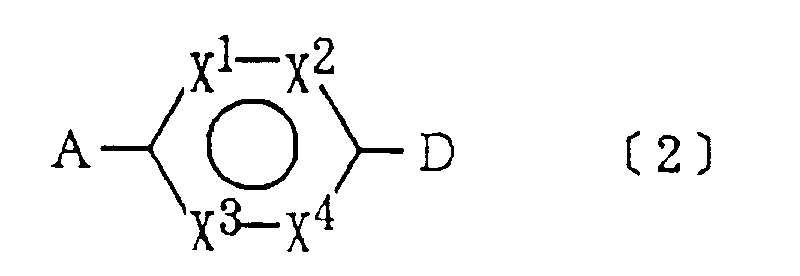
wherein A, X¹, X², X³ and X⁴ are the same as defined above, and D is a halogen atom or -OSO₂R' in which R' is a lower alkyl group having 1 to 4 carbon atoms which may be substituted by a fluorine atom or a C₁-C₄ alkyl, C₁-C₄ alkoxy or halogen substituted or unsubstituted phenyl group with an ethynyl aromatic derivative of the formula [3]
wherein R, Y¹, Y², Y³ and Y⁴ are the same as defined above in the presence of a metal catalyst and a base. - According to a third aspect of the present invention, there is provided a process for preparing a tolan compound of the formula [1] comprising reacting a tolan derivative of the formula [10]:
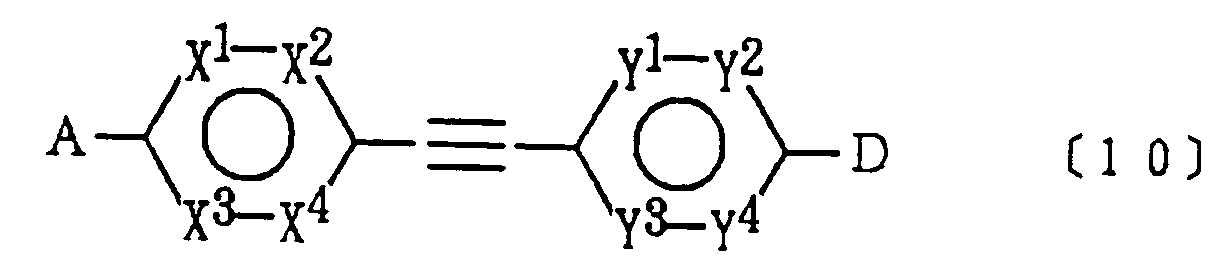
wherein A, D, X¹, X², X³, X⁴, Y¹, Y², Y³ and Y⁴ are the same as defined above with a boron compound of the formula [6]:
(R⁵)₂B-CH=CH-R (trans) [6]
wherein R is the same as defined above, and each R⁵ is a hydroxyl group, a straight, branched or cyclic alkyl group having 1 to 15 carbon atoms or a straight, branched or cyclic alkoxy group having 1 to 15 carbon atoms, or two R⁵ groups together form a straight, branched or cyclic alkylene group having 2 to 30 carbon atoms, a straight, branched or cyclic alkylenedioxy group having 2 to 30 carbon atoms or a benzodioxy group in the presence of a metal catalyst and a base. - According to a fourth aspect of the present invention, there is provided a process for preparing a tolan compound of the formula [1] comprising reacting an ethynyl aromatic compound of the formula [11]:

wherein A, X¹, X², X³ and X⁴ are the same as defined above with an aromatic derivative of the formula [12]:
wherein D, R, Y¹, Y², Y³ and Y⁴ are the same as defined above in the presence of a metal catalyst and a base. - According to a fifth aspect of the present invention, there are provided an ethynyl aromatic derivative of the formula (3):

wherein R, Y¹, Y², Y³ and Y⁴ are the same as defined above, and a carbinol derivative of the formula (7):
wherein R, Y¹, Y², Y³ and Y⁴ are the same as defined above. - According to a sixth aspect of the present invention, there is provided a process for preparing an ethynyl aromatic derivative of the formula [3] comprising treating a carbinol derivative of the formula [7]:

wherein R, Y¹, Y², Y³ and Y⁴ are the same as defined above with a base. - According to a seventh aspect of the present invention, there is provided a liquid crystal composition comprising the tolan compound [1] of the present invention.
- According to an eighth aspect of the present invention, there is provided a liquid crystal element comprising the liquid crystal composition of the present invention.
- The tolan compound of the formula [1] of the present invention can be prepared by reacting an aromatic compound of the formula [2]:

wherein A, D, X¹, X², X³ and X⁴ are the same as defined above with an ethynyl aromatic derivative of the formula [3]
wherein R, Y¹, Y², Y³ and Y⁴ are the same as defined above in the presence of a metal catalyst and a base. - In the above reaction for synthesizing the tolan compound [1] from the aromatic compound [2] and the ethynyl aromatic derivative [3], the amount of the ethynyl aromatic derivative [3] is usually 0.9 to 3 equivalents, preferably 1 to 2 equivalents to the ethynyl aromatic derivative [3]. While it is possible to use the ethynyl aromatic derivative [3] in an excessive amount, it is preferable to use the aromatic compound [2] in an excessive amount since the ethynyl aromatic derivative [3] is generally more expensive than the aromatic compound [2].
- As the metal catalyst, a palladium catalyst, a nickel catalyst, a rhodium catalyst and a copper catalyst are exemplified. Specific examples of the palladium catalyst are palladium chloride, palladium acetate, triphenylphosphine palladium complex and palladium on carbon. Examples of the nickel and rhodium catalysts are the above compounds of the palladium catalyst in which palladium is replaced by nickel or rhodium. Specific examples of the copper catalyst are cuprous or cupric halides such as cuprous iodide, cupric iodide, cuprous bromide, cupric bromide, cuprous chloride and cupric chloride, cuprous or cupric oxide and cuprous or cupric cyanide. They may be used independently or as a mixture of two or more catalysts comprising the same metal or different metals. An example of the mixture of the catalysts comprising the different metals is a palladium catalyst-copper catalyst system, in particular, a triphenylphosphine palladium complex-cuprous or -cupric halide system. Among them, the palladium catalysts and the palladium catalyst-copper catalyst system are preferred.
- The amount of the metal catalyst is usually from 0.001 to 0.1 equivalents to the ethynyl aromatic derivative [3].
- In the above reaction, it may be preferable to use a promoter such as a trivalent phosphorus compound or a trivalent arsenic compound. An example of the promoter is a compound of the formula [4]:

wherein Y is a phosphorus atom or an arsenic atom, R², R³ and R⁴ are independently an alkyl group, an aryl group, an alkoxy group, an aryloxy group or a halogen atom. - Examples of the compound [4] are tri-n-butylphosphine, triphenylphosphine, tri-o-tolylphosphine, tri-o-tolylphosphite, phosphorus trichloride and triphenylarsine.
- The amount of the phosphorus or arsenic compound is usually from 0.5 to 50 equivalents, preferably from 2 to 30 equivalents to the metal catalyst.
- Examples of the base are a carbonate, carboxylic acid salt, alkoxide or hydroxide of an alkali metal, and an organic base such as a primary amine (e.g. butylamine) and a secondary or tertiary amine (e.g. diethylamine, triethylamine, diisopropylethylamine, tri-n-butylamine, tetramethylethylenediamine, dimethylaniline, morpholine, N-methylmorpholine, pyrrolidine, N-methylpyrrolidine, piperidine and N-methylpiperidine). Among them, the secondary and tertiary amines are preferred.
- The amount of the base is usually from 1 to 5 equivalents to the ethynyl aromatic derivative [3].
- If necessary, a solvent may be used. Examples of the solvent are toluene, pyridine, picoline, acetonitrile, tetrahydrofuran, dimethylformamide, hexamethylphosphorylamide, N-methylpyrrolidone and methanol.
- The above organic base may be used also as a solvent.
- The amount of the solvent is not limited.
- Usually, the above reaction is carried out in an atmosphere of an inert gas such as nitrogen or argon.
- The yield of the desired compound can be increased by elevating a reaction temperature. But, at a too high temperature, a by-product may be formed. Then, the reaction temperature is preferably from 15 to 160°C, more preferably from 30 to 140°C.
- After completion of the reaction, the tolan compound [1] can be isolated from the reaction mixture by a conventional method such as extraction, distillation or recrystallization. If required, the tolan compound [1] can be purified by a conventional method such as column chromatography or recrystallization.
- The ethynyl aromatic derivative [3] can be prepared by reacting a carbinol compound of the formula [5]:

wherein D, Y¹, Y², Y³ and Y⁴ are the same as defined above with a boron compound of the formula [6]:
(R⁵)₂B-CH=CH-R (trans) [6]
wherein R and R⁵ are the same as defined above in the presence of a metal catalyst and a base to obtain a carbinol derivative of the formula [7]:
wherein R, Y¹, Y², Y³ and Y⁴ are the same as defined above, and treating the carbinol derivative [7] with a base. - Herein, the carbinol compound [5] can be synthesized by the following processes:
- (1) When D is a halogen atom:

- (2) When D is SO₂R':

- In the reaction between the alkyne compound [8] and the boron derivative [9], examples of the boron derivative [9] are dialkylboranes (e.g. dicyclohexylborane, disiamylborane, diisopinocamphenylborane and 9-borabicyclo[3.3.1]nonane), dialkoxyboranes (e.g. diisopropyloxyborane and dimethoxyborane) and catecholborane.
- The amount of the alkyne compound [8] is usually from 0.5 to 10 equivalents preferably from 0.5 to 2 equivalent to the boron derivative [9].
- The above reaction is carried out in the presence or absence of a solvent. When the solvent is used, e.g. tetrahydrofuran, diethylether, dioxane, acetonitrile, toluene, dichloromethane or dimethylformamide can be used. An amount of the solvent is not limited.
- The reaction temperature of the above reaction is usually from -20 to +150°C, preferably from 0 to 100°C.
- The boron compound of the formula [6] in which R⁵ is a hydroxyl group can be prepared by hydrolyzing the compound of the formula [6'] which is obtained by the above reaction.
- In the reaction for preparing the carbinol derivative [7] from the carbinol compound [5] and the boron compound [6], the amount of the boron compound [6] is usually from 0.9 to 10 equivalents, preferably 1 to 2 equivalents to the carbinol compound [5]. While it is possible to use an excessive amount of the carbinol compound [5], it is preferable to use the boron compound [6] in the excessive amount since the carbinol compound [5] is generally more expensive than the boron compound [6].
- As the metal catalyst, a palladium catalyst, a nickel catalyst, a rhodium catalyst and a copper catalyst are exemplified. Specific examples of the palladium catalyst are palladium chloride, palladium acetate, triphenylphosphine palladium complex and palladium on carbon. Examples of the nickel and rhodium catalysts are the above compounds of the palladium catalyst in which palladium is replaced by nickel or rhodium. Specific examples of the copper catalyst are cuprous or cupric halides such as cuprous iodide, cupric iodide, cuprous bromide, cupric bromide, cuprous chloride and cupric chloride, cuprous or cupric oxide and cuprous or cupric cyanide. They may be used independently or as a mixture of two or more catalysts comprising the same metal or different metals. An example of the mixture of the catalysts comprising the different metals is a palladium catalyst-copper catalyst system, in particular, a triphenylphosphine palladium complex-cuprous or -cupric halide system. Among them, the palladium catalysts and the palladium catalyst-copper catalyst system are preferred.
- The amount of the metal catalyst are usually from 0.001 to 0.1 equivalent to the carbinol compound [5].
- In the above reaction, it may be preferable to use a promoter such as a trivalent phosphorus compound or a trivalent arsenic compound. An example of the promoter is the compound of the above formula [4], in particular, tri-n-butylphosphine, triphenylphosphine, tri-o-tolylphosphine, tri-o-tolylphosphite, phosphorus trichloride and triphenylarsine.
- The amount of the phosphorus or arsenic compound [4] is usually from 0.5 to 50 equivalents, preferably from 2 to 30 equivalents to the metal catalyst.
- The reaction can be accelerated by the use of a base. Examples of the base are a carbonate, carboxylic acid salt, alkoxide or hydroxide of an alkali metal, and an organic base such as a primary amine (e.g. butylamine) and a secondary or tertiary amine (e.g. diethylamine, triethylamine, diisopropylethylamine, tri-n-butylamine, tetramethylethylenediamine, dimethylaniline, morpholine, N-methylmorpholine, pyrrolidine, N-methylpyrrolidine, piperidine and N-methylpiperidine). Among them, alkali metal hydroxides such as sodium hydroxide and potassium hydroxide, alkali metal carbonates or hydrogencarbonates such as potassium carbonate, sodium carbonate, potassium hydrogencarbonate and sodium hydrogencarbonate, and alkali metal alkoxides such as sodium ethoxide and sodium methoxide are preferred.
- The amount of the base is usually from 1 to 5 equivalents to the carbinol compound [5].
- If desired, a solvent may be used. Examples of the solvent are water, methanol, ethanol, isopropanol, tert.-butanol, acetonitrile, tetrahydrofuran, dimethylformamide, hexamethylphosphorylamide, N-methylpyrrolidone, benzene and toluene.
- The amount of the solvent is not limited.
- The reaction temperature in the above reaction is usually from -20 to +150°C, preferably from 20 to 110°C.
- After completion of the reaction, the carbinol derivative [7] can be isolated from the reaction mixture by a conventional method such as extraction, distillation or recrystallization. If required, the carbinol derivative [7] can be purified by a conventional method such as column chromatography or recrystallization.
- Next, the reaction for preparing the ethynyl aromatic derivative [3] by treating the carbinol derivative [7] with the base will be explained.
- As the base, there may be used an alkali metal, an alkaline earth metal, their carbonates, carboxylic acid salts, alkoxides, hydride or hydroxide, and an organic base such as 1,8-diazabicyclo[5.4.0]undec-7-ene, triethylamine, diisopropylethylamine, tri-n-butylamine, tetramethylethylenediamine, dimethylaniline, N-methylmorpholine and N-methylpiperidine. Preferred examples of the base are hydroxides such as sodium hydroxide and potassium hydroxide, and alkoxides such as sodium ethoxide and sodium methoxide.
- The amount of the base is usually from 0.02 to 50 equivalents to the carbinol derivative [7].
- If necessary, a solvent may be used. Examples of the solvent are n-butanol, tert.-butanol, methyl tert.-butyl ether, hexane, chlorobenzene, dichlorobenzene, benzene, toluene, xylene, tetrahydrofuran, cyclohexane, decane, dimethylformamide, hexamethylphosphorylamide, N-methylpyrrolidone and dimethylsulfoxide.
- The amount of the solvent is not limited.
- The reaction temperature in this reaction is usually from 20 to 190°C, preferably from 40 to 150°C.
- The reaction time is not critical.
- Since acetone is by-produced as the reaction proceeds, the reaction can be effectively accelerated by the removal of acetone in the course of the reaction at intervals or continuously.
- After completion of the reaction, the ethynyl aromatic derivative [3] can be isolated from the reaction mixture by a conventional method such as extraction or distillation. If required, the ethynyl aromatic derivative [3] can be purified by a conventional method such as distillation or column chromatography.
- The aromatic compound [2] may be a commercially available compound or prepared by an analogous process to the preparation of such commercially available compound. Alternatively, the aromatic compound can be prepared by the following process:
- (1) When D is -OSO₂R':

- (2) When D is a halogen atom:

- The raw material tolan derivative [10] may be prepared by the following process:
- (1) When D is a halogen atom:

- (2) When D is -OSO₂R':

- As the metal catalyst, a palladium catalyst, a nickel catalyst, a rhodium catalyst and a copper catalyst are exemplified. Specific examples of the palladium catalyst are palladium chloride, palladium acetate, triphenylphosphine palladium complex and palladium on carbon. Examples of the nickel and rhodium catalysts are the above compounds of the palladium catalyst in which palladium is replaced by nickel or rhodium. Specific examples of the copper catalyst are cuprous or cupric halides such as cuprous iodide, cupric iodide, cuprous bromide, cupric bromide, cuprous chloride and cupric chloride, cuprous or cupric oxide and cuprous or cupric cyanide. They may be used independently or as a mixture of two or more catalysts comprising the same metal or different metals. An example of the mixture of the catalysts comprising the different metals is a palladium catalyst-copper catalyst system, in particular, a triphenylphosphine palladium complex-cuprous or -cupric halide system. Among them, the palladium catalysts and the palladium catalyst-copper catalyst system are preferred.
- The amount of the metal catalyst is usually from 0.001 to 0.1 equivalent to the tolan derivative [10].
- In the above reaction, it may be preferable to use a promoter such as a trivalent phosphorus compound or a trivalent arsenic compound. An example of the promoter is the compound of the above formula [4], in particular, tri-n-butylphosphine, triphenylphosphine, tri-o-tolylphosphine, tri-o-tolylphosphite, phosphorus trichloride and triphenylarsine.
- The amount of the phosphorus or arsenic compound [4] is usually from 0.5 to 50 equivalents, preferably from 2 to 30 equivalents to the metal catalyst.
- Examples of the base are a carbonate, carboxylic acid salt, alkoxide or hydroxide of an alkali metal, and an organic base such as a primary amine (e.g. butylamine) and a secondary or tertiary amine (e.g. diethylamine, triethylamine, diisopropylethylamine, tri-n-butylamine, tetramethylethylenediamine, dimethylaniline, morpholine, N-methylmorpholine, pyrrolidine, N-methylpyrrolidine, piperidine and N-methylpiperidine). Among them, alkali metal hydroxides such as sodium hydroxide and potassium hydroxide, alkali metal carbonates or hydrogencarbonates such as potassium carbonate, sodium carbonate, potassium hydrogencarbonate and sodium hydrogencarbonate, and alkali metal alkoxides such as sodium ethoxide and sodium methoxide are preferred.
- The amount of the base is usually from 1 to 5 equivalents to the tolan derivative [10].
- If desired, a solvent may be used. Examples of the solvent are water, methanol, ethanol, isopropanol, tert.-butanol, acetonitrile, tetrahydrofuran, dimethylformamide, hexamethylphosphorylamide, N-methylpyrrolidone, benzene and toluene. The amount of the solvent is not limited.
- The reaction temperature in the above reaction is usually from -20 to +190°C, preferably from 20 to 150°C.
- After completion of the reaction, the tolan derivative [10] can be isolated from the reaction mixture by a conventional method such as extraction, distillation or recrystallization. If required, the tolan derivative [10] can be purified by a conventional method such as column chromatography or recrystallization.
- Further, the tolan compound [1] of the present invention can be prepared by reacting an ethynyl aromatic compound of the formula [11]:

wherein A, X¹, X², X³ and X⁴ are the same as defined above with an aromatic derivative of the formula [12]:
wherein R, D, Y¹, Y², Y³ and Y⁴ are the same as defined above in the presence of a metal catalyst and a base. - The ethynyl aromatic compound [11] may be synthesized by the following process:

- On the other hand, the aromatic derivative [12] may be synthesized by the following process:

- (1) When D is a halogen atom:

- (2) When D is -OSO₂R':

- As the metal catalyst, a palladium catalyst, a nickel catalyst, a rhodium catalyst and a copper catalyst are exemplified. Specific examples of the palladium catalyst are palladium chloride, palladium acetate, triphenylphosphine palladium complex and palladium on carbon. Examples of the nickel and rhodium catalysts are the above compounds of the palladium catalyst in which palladium is replaced by nickel or rhodium. Specific examples of the copper catalyst are cuprous or cupric halides such as cuprous iodide, cupric iodide, cuprous bromide, cupric bromide, cuprous chloride and cupric chloride, cuprous or cupric oxide and cuprous or cupric cyanide. They may be used independently or as a mixture of two or more catalysts comprising the same metal or different metals. An example of the mixture of the catalysts comprising the different metals is a palladium catalyst-copper catalyst system, in particular, a triphenylphosphine palladium complex-cuprous or -cupric halide system. Among them, the palladium catalysts and the palladium catalyst-copper catalyst system are preferred.
- The amount of the metal catalyst are usually from 0.001 to 0.1 equivalents to the aromatic derivative [12].
- In the above reaction, it may be preferable to use a promoter such as a trivalent phosphorus compound or a trivalent arsenic compound. An example of the promoter is the compound of the above formula [4], in particular, tri-n-butylphosphine, triphenylphosphine, tri-o-tolylphosphine, tri-o-tolylphosphite, phosphorus trichloride and triphenylarsine.
- The amount of the phosphorus or arsenic compound [4] is usually from 0.5 to 50 equivalents, preferably from 2 to 30 equivalents to the metal catalyst.
- Examples of the base are a carbonate, carboxylic acid salt, alkoxide or hydroxide of an alkali metal, and an organic base such as a primary amine (e.g. butylamine ) and a secondary or tertiary amine (e.g. diethylamine, triethylamine, diisopropylethylamine, tri-n-butylamine, tetramethylethylenediamine, dimethylaniline, morpholine, N-methylmorpholine, pyrrolidine, N-methylpyrrolidine, piperidine and N-methylpiperidine). Among them, the secondary and tertiary amines are preferred.
- The amount of the base is usually from 1 to 5 equivalents to the aromatic derivative [12].
- If desired, a solvent may be used. Examples of the solvent are toluene, pyridine, picoline, acetonitrile, tetrahydrofuran, dimethylformamide, hexamethylphosphorylamide, N-methylpyrrolidone and methanol. The above organic base may be used also as a solvent. The amount of the solvent is not limited.
- Preferably, the above reaction is carried out in an atmosphere of an inert gas such as nitrogen or argon.
- The yield of the desired compound can be increased by elevating the reaction temperature. But, at a too high temperature, a by-product may be formed. Then, the reaction temperature is preferably from 15 to 160°C, more preferably from 30 to 140°C.
- After completion of the reaction, the tolan compound [1] can be isolated from the reaction mixture by a conventional method such as extraction, distillation or recrystallization. If required, the tolan compound [1] can be purified by a conventional method such as column chromatography or recrystallization.
- In the preferred examples of the tolan compound [1] of the present invention, A is a methyl, ethyl, propyl, butyl, pentyl, hexyl, heptyl, octyl, nonyl, decyl, undecyl, dodecyl, ethenyl, propenyl, butenyl, pentenyl, hexenyl, heptenyl, octenyl, nonenyl, decenyl, undecenyl, dodecenyl, propynyl, butynyl, pentynyl, hexynyl, heptynyl, octynyl, nonylyl, decynyl, dodecynyl, methoxy, ethoxy, propoxyl, butoxy, pentyloxy, hexyloxy, heptyloxy, octyloxy, nonyloxy, decyloxy, undecyloxy, dodecyloxy, vinyloxy, propenyloxy, butenyloxy, pentenyloxy, hexenyloxy, heptenyloxy, octenyloxy, nonenyloxy, decenyloxy, propynyloxy, butynyloxy, pentynyloxy, hexynyloxy, heptynyloxy, octynyloxy, nonylyloxy, dodecynyloxy, 4-methylcyclohexyl, 4-ethylcyclohexyl, 4-propylcyclohexyl, 4-butylcyclohexyl, 4-pentylcyclohexyl, 4-hexylcyclohexyl, 4-heptylcyclohexyl, 4-octylcyclohexyl, 4-nonylcyclohexyl, 4-decylcyclohexyl or 4-propylcyclohexenyl group, a hydrogen atom, a fluorine atom, a trifluoromethyl, trifluoromethoxy or cyano group.
- R is preferably a methyl, ethyl, propyl, butyl, pentyl, hexyl, heptyl, octyl, nonyl, decyl, undecyl, dodecyl, ethenyl, propenyl, butenyl, pentenyl, hexenyl, heptenyl, octenyl, nonenyl, decenyl, undecenyl, dodecenyl, methoxymethyl, ethoxymethyl, propoxymethyl, butoxymethyl, pentyloxymethyl, hexyloxymethl, heptyloxymethyl, octyloxymethyl, nonyloxymethyl, decyloxymethyl, methoxyethyl, ethoxyethyl, propoxyethyl, butoxyethyl, pentyloxyethyl, hexyloxyethyl, heptyloxyethyl, octyloxyethyl, nonyloxyethyl, decyloxyethyl, methoxypropyl, ethoxypropoyl, propoxypropyl, butoxypropyl, pentyloxypropyl, hexyloxypropyl, heptyloxypropyl, octyloxypropyl, nonyloxypropyl, decyloxypropyl, methoxybutyl, ethoxybutyl, propoxybutyl, butoxybutyl, pentyloxybutyl, hexyloxybutyl, heptyloxybutyl, octyloxybutyl, nonyloxybutyl, decyloxybutyl, methoxypentyl, ethoxypentyl, propoxypentyl, butoxypentyl, pentyloxypentyl, hexyloxypentyl, heptyloxypentyl or octyloxypentyl group.
- Preferred examples of the ring comprising the X¹ to X⁴ or Y¹ to Y⁴ are a 2,5-substituted pyridine ring, 2,5-substituted pyrimidine ring, 2,5-substituted pyrazine ring, 3,6-substituted pyridazine ring, 3,6-substituted triazine ring or 3,6-substituted tetrazine ring.
- The tolan compound [1] can be used as a component of a liquid crystal composition. In such case, the tolan compound [1] is contained in an amount of 0.1 to 99.9 % by weight, preferably 1 to 99 % by weight of the whole weight of the liquid crystal composition.
- As other component constituting the liquid crystal composition, any of conventionally used liquid crystals may be used.
- Examples of such other component are

(R⁸: alkyl or alkoxy group, R⁹: alkyl or alkoxy group)
Such liquid crystal composition can be used in the same way as the conventional liquid crystal compositions, in particular, in a liquid crystal element such as an optical switching element. A structure of the liquid crystal element may be the same as that of the conventional liquid crystal element. - The tolan compound [1] has a larger anisotropy of refractive index than the conventional liquid crystal materials.
- Even when the tolan compound [1] itself does not have any liquid crystal phase, the addition of such tolan compound [1] to the liquid crystal composition increases the anisotropy of refractive index of the liquid crystal composition without increasing a viscosity of the composition. In view of the liquid crystal property, the carbon number of R or R¹ is preferably at least 2.
- For example, to achieve the high response speed of a STN liquid crystal element for which demand is increasing recently, it is required to decrease a cell width. The tolan compound [1] of the present invention is useful as a component of such liquid crystal composition or element, since it has the large anisotropy of refractive index and the low viscosity.
- The present invention will be illustrated by the following examples, which are only for explanation purpose and do not limit the scope of the present invention.
- Optical anisotropy value: Δn
An optical anisotropy value of a tolan compound [1] was obtained by extrapolation from an optical anisotropy value of a liquid crystal composition comprising 85 % by weight of the following matrix liquid crystal mixture and 15 % by weight of the tolan compound and that of the matrix liquid crystal mixture at 25°C using a light having a wavelength of 550 nm.
- The optical anisotropy value of the tolan compound [1] is calculated according to the following equation:

wherein a is an optical anisotropy value of the matrix liquid crystal mixture and b is an optical anisotropy value of the liquid crystal composition comprising 85 % by weight of the matrix liquid crystal mixture and 15 % by weight of the tolan compound [1]. - In a four necked flask equipped with a stirrer and a thermometer in which air had been replaced by a nitrogen atmosphere, 1-n-pentyne (13.6 g, 200 mmol) was charged, and then catecholborane (12 g, 100 mmol) was dropwise added. After mixing them at room temperature for 1 hour, they were reacted at 70°C for 2 hours. After cooling the flask to room temperature, unreacted 1-n-pentyne was evaporated under reduced pressure to obtain E-1-pentenylcatecholborane.
- In a four necked flask equipped with a stirrer and a thermometer in which air had been replaced by a nitrogen atmosphere, 3-ethoxy-1-propyne (8.4 g, 100 mmol) was charged, and then catecholborane (6 g, 50 mmol) was dropwise added. After mixing them at room temperature for 1 hour, they were reacted at 70°C for 2 hours. After cooling the flask to room temperature, unreacted 3-ethoxy-1-propyne was evaporated under reduced pressure to obtain E-1-(3-ethoxy)propenylcatecholborane.
- In the same manner as above, various boron compounds [6] are prepared.
- In a four necked flask equipped with a stirrer and a thermometer in which air had been replaced by a nitrogen atmosphere, 4-iodo-1-bromobenzene (100 g, 0.35 mol), bis(triphenylphosphine)palladium chloride (0.5 g), cuprous iodide (0.5 g), triphenylphosphine (1 g), triethylamine (80 g) and toluene (300 g) were charged. Then, to the mixture, 1,1-dimethyl-2-propyn-1-ol (32.7 g, 0.39 mol) was dropwise added at 80°C over 2 hours, followed by stirring at the same temperature for 5 hours. After cooling the reaction mixture to room temperature, hydrochloric acid was added to the mixture to make its pH neutral. Then, an organic layer was separated and washed with water. The organic layer was concentrated and purified by chromatography to obtain 4-(3-hydroxy-3,3-dimethyl-1-propynyl)-1-bromobenzene (72 g). Yield: 85 %. Melting point: 62°C.
- ¹H-NMR (CDCl₃): δ (ppm) = 1.6 (s, 6H), 1.75 (s, 1H), 7.25-7.45 (m, 4H).
- According to the procedure of Reference Example 3, various carbinol compounds [5] are prepared.
-
(1) In a four necked flask equipped with a stirrer, a reflux condenser and a thermometer in which air had been replaced by a nitrogen atmosphere, 4-(3-hydroxy-3,3-dimethyl-1-propynyl)-1-bromobenzene (3.6 g, 15 mmol), tetrakis(triphenylphosphine)palladium (0.06 g, 0.05 mmol), sodium hydroxide (0.8 g, 20 mmol) and tetrahydrofuran (60 ml) were charged. Then, to the mixture, a solution of E-1-pentenylcatecholborane prepared in Reference Example 1 (20 mmol) in tetrahydrofuran (50 ml) was dropwise added at room temperature, followed by heat refluxing for 6 hours while stirring. After cooling the reaction mixture to room temperature, 30 % aqueous hydrogen peroxide (2 ml) was added to the mixture, followed by stirring for 1 hour. The mixture was extracted with toluene and water. The organic layer was washed with water twice and dried over anhydrous magnesium sulfate. After removing the solvents, the residue was purified by silica gel column chromatography to obtain 4-(3-hydroxy-3,3-dimethyl-1-propynyl)-1-(1-trans-pentenyl)benzene (2.8 g). Yield: 83 %. Melting point: 65°C.Elementary analysis (C₁₆H₂₀O): Calculated: C, 84.16; H, 8.83 Found: C, 84.03; H, 8.73
¹H-NMR (CDCl₃): δ (ppm) = 0.95 (t. 3H), 1.5 (m, 2H), 1.60 (s, 6H), 2.1 (s, 1H), 2.2 (m, 2H), 6.2-6.4 (m, 2H), 7.2-7.4 (m, 4H).
(2) Then, a mixture of obtained 4-(3-hydroxy-3,3-dimethyl-1-propynyl)-1-(1-trans-pentenyl)benzene (2.3 g, 10 mmol), sodium hydroxide (0.8 g, 20 mmol) and toluene (25 ml) was refluxed for 2 hours while stirring, during which the solvent was evaporated.
After the completion of the reaction, the reaction mixture was cooled to room temperature. After adding water (10 ml), the mixture was phase separated, and the organic layer was washed with water twice and dried over anhydrous magnesium sulfate. After evaporation the solvent, the residue was purified by silica gel column chromatography to obtain 4-(1-trans-pentenyl)phenylacetylene (1.6 g). Yield: 96 %.
nD²⁰: 1.5729.Elementary analysis (C₁₃H₁₄): Calculated: C, 91.71; H, 8.29 Found: C, 91.52; H, 8.23
¹H-NMR (CDCl₃): δ (ppm) = 0.95 (t, 3H), 1.5 (m, 2H), 2.2 (m, 2H), 3.1 (s, 1H), 6.2-6.4 (m, 2H), 7.2-7.5 (m, 4H). -
(2) In a four necked flask equipped with a stirrer, a reflux condenser and a thermometer in which air had been replaced by a nitrogen atmosphere, 4-(3-hydroxy-3,3-dimethyl-1-propynyl)-3-fluoro-1-bromobenzene (3.9 g, 15 mmol), bis(triphenylphosphine)palladium chloride (0.07 g, 0.1 mmol), sodium hydroxide (1.2 g, 30 mmol), tetrahydrofuran (40 ml) and N-methylpyrrolidone (5 ml) were charged. Then, to the mixture, a solution of E-1-pentenylcatecholborane prepared in Reference Example 1 (20 mmol) in tetrahydrofuran (50 ml) was dropwise added at room temperature, followed by heat refluxing for 6 hours while stirring. After cooling the reaction mixture to room temperature, 30 % aqueous hydrogen peroxide (2 ml) was added to the mixture, followed by stirring for 1 hour. The mixture was extracted with toluene and water. The organic layer was washed with water twice and dried over anhydrous magnesium sulfate. After evaporating the solvent, the residue was purified by silica gel column chromatography to obtain 4-(3-hydroxy-3,3-dimethyl-1-propynyl)-1-(1-trans-pentenyl)-3-fluorobenzene (3.1 g). Yield: 84 %. Melting point: 62°C.Elementary analysis (C₁₆H₁₉FO): Calculated: C, 78.02; H, 7.77 Found: C, 78.09; H, 7.66
(2) Then, a mixture of obtained 4-(3-hydroxy-3,3-dimethyl-1-propynyl)-1-(1-trans-pentenyl)-3-fluorobenzene (2.5 g, 10 mmol), potassium hydroxide (0.9 g, 15 mmol) and toluene (25 ml) was refluxed for 1 hour while stirring, during which the solvent was evaporated.
After the completion of the reaction, the reaction mixture was cooled to room temperature. After adding water (10 ml), the mixture was phase separated, and the organic layer was washed with water twice and dried over anhydrous magnesium sulfate. After evaporating the solvent , the residue was purified by silica gel column chromatography to obtain [4-(1-trans-pentenyl)-2-fluorophenyl]acetylene (1.8 g). Yield: 96 %.
nD²⁰: 1.5619.Elementary analysis (C₁₃H₁₃F): Calculated: C, 82.95; H, 6.96 Found: C, 83.06; H, 6.79 - In the same manner as in the first step of Example 2 except that a solution of E-1-heptenylcatecholborane (20 mmol) in tetrahydrofuran (50 ml) was used in place of the solution of E-1-pentenylcatecholborane and 4-(3-hydroxy-3,3-dimethyl-1-propynyl)-2-fluoro-1-bromobenzene (3.9 g, 15 mmol) was used in place of 4-(3-hydroxy-3,3-dimethyl-1-propynyl)-3-fluoro-1-bromobenzene, the reaction was carried out to obtain 4-(3-hydroxy-3,3-dimethyl-1-propynyl)-1-(1-trans-heptenyl)-2-fluorobenzene (3.3 g). Yield: 81 %.
Elementary analysis (C₁₈H₂₃FO): Calculated: C, 78.79; H, 8.45 Found: C, 78.85; H, 8.32 - Further, in the same manner as in the second step of Example 2 except that 4-(3-hydroxy-3,3-dimethyl-1-propynyl)-1-(1-trans-heptenyl)-2-fluorobenzene was used in place of 4-(3-hydroxy-3,3-dimethyl-1-propynyl)-1-(1-trans-pentenyl)-3-fluorobenzene, the reaction was carried out to obtain [4-(1-trans-heptenyl)-3-fluorophenyl]acetylene (2.0 g). Yield: 94 %.
nD²⁰: 1.5494.Elementary analysis (C₁₅H₁₇F): Calculated: C, 83.29; H, 7.92 Found: C, 83.21; H, 7.81 - In the same manner as in the first step of Example 1 except that a solution of E-1-butenylcatecholborane (20 mmol) in tetrahydrofuran (50 ml) was used in place of the solution of E-1-pentenylcatecholborane, the reaction was carried out to obtain 4-(3-hydroxy-3,3-dimethyl-1-propynyl)-1-(1-trans-butenyl)benzene (3.3 g). Yield: 84 %.
Elementary analysis (C₁₅H₁₈O): Calculated: C, 84.07; H, 8.47 Found: C, 83.93; H, 8.61 - Further, in the same manner as in the second step of Example 1 except that 4-(3-hydroxy-3,3-dimethyl-1-propynyl)-1-(1-trans-butenyl)benzene was used, the reaction was carried out to obtain [4-(1-trans-butenyl)phenyl]acetylene (1.5 g). Yield: 96 %.
nD²⁰: 1.5784.Elementary analysis (C₁₂H₁₂): Calculated: C, 92.26; H, 7.74 Found: C, 92.11; H, 7.84 - In a four necked flask equipped with a stirrer, a reflux condenser and a thermometer in which air had been replaced by a nitrogen atmosphere, 4-(3-hydroxy-3,3-dimethyl-1-propynyl)-1-trifluoromethanesulfonyloxybenzene (3.6 g, 15 mmol), tetrakis(triphenylphosphine)palladium (0.06 g, 0.05 mmol), sodium hydroxide (1.2 g, 30 mmol) and tetrahydrofuran (60 ml) were charged. Then, to the mixture, a solution of E-1-pentenylcatecholborane prepared in Reference Example 1 (20 mmol) in tetrahydrofuran (50 ml) was dropwise added at room temperature, followed by heat refluxing for 6 hours while stirring. After cooling the reaction mixture to room temperature, 30 % aqueous hydrogen peroxide (2 ml) was added to the mixture, followed by stirring for 1 hour. The mixture was extracted with toluene and water. The organic layer was washed with water twice and dried over anhydrous magnesium sulfate. After evaporating the solvent, the residue was purified by silica gel column chromatography to obtain 4-(3-hydroxy-3,3-dimethyl-1-propynyl)-1-(1-trans-pentenyl)benzene (2.8 g). Yield: 82 %.
- Then, a mixture of obtained 4-(3-hydroxy-3,3-dimethyl-1-propynyl)-1-(1-trans-pentenyl)benzene (2.3 g, 10 mmol), potassium hydroxide (1.1 g, 20 mmol) and toluene (25 ml) was refluxed for 2 hours while stirring, during which the solvent was evaporated.
- After the completion of the reaction, the reaction mixture was cooled to room temperature. After adding water (10 ml), the mixture was phase separated, and the organic layer was washed with water twice and dried over anhydrous magnesium sulfate. After evaporating the solvent, the residue was purified by silica gel column chromatography to obtain 4-(1-trans-pentenyl)phenylacetylene (1.6 g). Yield: 95 %.
- In a four necked flask equipped with a thermometer and a stirrer, 4-propyl-1-bromobenzene (5.2 g, 0.026 mol), 4-(1-trans-pentenyl)phenylacetylene (3.4 g, 0.02 mol), bis(triphenylphosphine)palladium chloride (0.13 g), cuprous iodide (0.15 g), triphenylphosphine (0.8 g) and triethylamine (40 ml) were charged and refluxed under nitrogen atmosphere for 6 hours.
- After the completion of the reaction, the reaction mixture was poured in water (100 ml) and extracted with toluene (100 ml). The toluene layer was washed with 3 % hydrochloric acid and then water, followed by concentration under reduced pressure to obtain a pale yellow residue. Then, the residue was purified by silica gel column chromatography (eluent: toluene-hexane) to obtain 1-(4-propylphenyl)-2-[4-(1-trans-pentenyl)phenyl]acetylene (4.5 g). Yield: 77 %.
- Optical anisotropy value Δn of 1-(4-propylphenyl)-2-[4-(1-trans-pentenyl)phenyl]acetylene: 0.343.
- In a four necked flask equipped with a thermometer and a stirrer, 4-cyano-1-trifluoromethanesulfonyloxybenzene (6.4 g, 0.026 mol), 4-(1-trans-pentenyl)phenylacetylene (3.4 g, 0.02 mol), bis(triphenylphosphine)palladium chloride (0.15 g), cuprous iodide (0.15 g), triphenylphosphine (0.6 g), triethylamine (20 ml) and N-methylpiperazine (30 ml) were charged and refluxed under nitrogen atmosphere for 6 hours.
- After the completion of the reaction, the reaction mixture was poured in water (100 ml) and extracted with toluene (100 ml). The toluene layer was washed with 3 % hydrochloric acid and then water, followed by concentration under reduced pressure to obtain a pale yellow residue. Then, the residue was purified by silica gel column chromatography (eluent: toluene-hexane) to obtain 1-(4-cyanophenyl)-2-[4-(1-trans-pentenyl)phenyl]acetylene (4.5 g). Yield: 83 %.
- Optical anisotropy value Δn of 1-(4-cyanophenyl)-2-[4-(1-trans-pentenyl)phenyl]acetylene: 0.523.
- In a four necked flask equipped with a thermometer and a stirrer, 4-cyano-3-fluoro-1-bromobenzene (4.6 g, 0.022 mol), bis(triphenylphosphine)palladium chloride (0.12 g), cuprous iodide (0.15 g), triphenylphosphine (0.8 g) and triethylamine (40 ml) were charged and refluxed under nitrogen atmosphere for 6 hours.
- After the completion of the reaction, the reaction mixture was poured in water (100 ml) and extracted with toluene (100 ml). The toluene layer was washed with 3 % hydrochloric acid and then water, followed by concentration under reduced pressure to obtain a residue. Then, the residue was purified by silica gel column chromatography (eluent: toluene-hexane) to obtain 1-(4-cyano-3-fluorophenyl)-2-[4-(1-trans-pentenyl)phenyl]acetylene (4.4 g). Yield: 76 %.
- Optical anisotropy value Δn of 1-(4-cyano-3-fluorophenyl)-2-[4-(1-trans-pentenyl)phenyl]acetylene: 0.403.
- In a four necked flask equipped with a thermometer and a stirrer, 4-fluoro-1-methanesulfonyloxybenzene (6.3 g, 0.026 mol), 4-(1-trans-pentenyl)phenylacetylene (3.4 g, 0.02 mol), bis(triphenylphosphine)palladium chloride (0.15 g), cuprous iodide (0.2 g), triphenylphosphine (0.5 g), methylmorpholine (20 ml) and N-methylpyrrolidone (30 ml) were charged and refluxed under nitrogen atmosphere for 15 hours.
- After the completion of the reaction, the reaction mixture was concentrated under reduced pressure. To the residue, 3 % hydrochloric acid and ethyl acetate (60 ml) were added. The organic layer was washed with water and concentrated under reduced pressure. The residue was purified by silica gel column chromatography (eluent: ethyl acetate-hexane) to obtain 1-(4-fluorophenyl)-2-[4-(1-trans-pentenyl)phenyl]acetylene (4.3 g). Yield: 81 %.
- Optical anisotropy value Δn of 1-(4-fluorophenyl)-2-[4-(1-trans-pentenyl)phenyl]acetylene: 0.323.
-
- In the same manner as in Example 9 except that 3,4,5-trifluoro-1-bromobenzene (5.3 g, 0.025 mol) was used in place of 4-fluoro-1-methanesulfonyloxybenzene, the reaction was carried out to obtain 1-(3,4,5-trifluorophenyl)-2-[4-(1-trans-pentenyl)phenyl]acetylene (4.5 g). Yield: 75 %.
- In a four necked flask equipped with a thermometer and a stirrer, 4-(4-propylcyclohexyl)-1-bromobenzene (4.2 g, 0.015 mol), 4-(1-trans-pentenyl)phenylacetylene (1.7 g, 0.01 mol), bis(triphenylphosphine)palladium chloride (0.07 g), cuprous iodide (0.09 g), triphenylphosphine (0.15 g) and triethylamine (30 ml) were charged and reacted at 80°C for 10 hours under nitrogen atmosphere.
- After the completion of the reaction, the reaction mixture was concentrated under reduced pressure. To the residue, 3 % hydrochloric acid and ethyl acetate (60 ml) were added. The organic layer was washed with water and concentrated under reduced pressure. The residue was purified by silica gel column chromatography (eluent: ethyl acetate-hexane) to obtain 1-(4-propylcyclohexyl)phenyl-2-[4-(1-trans-pentenyl)phenyl]acetylene (2.8 g). Yield: 76 %.
- Optical anisotropy value Δn of 1-(4-propylcyclohexyl)phenyl-2-[4-(1-trans-pentenyl)phenyl]acetylene: 0.356.
- In the same manner as in Example 11 except that 2-fluoro-4-(1-trans-pentenyl)phenylacetylene (1.9 g, 0.01 mol) was used in place of 4-(1-trans-pentenyl)phenylacetylene, the reaction was carried out to obtain 1-(4-propylcyclohexyl)phenyl-2-[2-fluoro-4-(1-trans-pentenyl)phenyl]acetylene (2.9 g). Yield: 75 %.
- In a four necked flask equipped with a thermometer and a stirrer, 4-octyloxybromobenzene (3.4 g, 0.012 mol), 5-(1-trans-nonenyl)-2-ethynylpyrimidine (2.3 g, 0.01 mol), bis(triphenylphosphine)palladium chloride (0.15 g), cuprous iodide (0.15 g), triphenylphosphine (0.15 g) and triethylamine (30 ml) were charged and reacted at a temperature of 80 to 85°C for 6 hours.
- After the completion of the reaction, the reaction mixture was concentrated under reduced pressure. To the residue, toluene (60 ml) and water were added. The toluene layer was washed with water and concentrated. The residue was purified by silica gel column chromatography (eluent: toluene) to obtain 1-(4-octyloxyphenyl)-2-[5-(1-trans-nonenyl)pyrimidin-2-yl]acetylene (3.1 g). Yield: 71 %.
- In the same manner as in Example 6 except that 4-propyl-2-fluoro-1-bromobenzene (5.6 g, 0.026 mol) was used in place of 4-propyl-1-bromobenzene, the reaction was carried out to obtain 1-(4-propyl-2-fluorophenyl)-2-[4-(1-trans-pentenyl)phenyl]acetylene (4.4 g). Yield: 72 %.
- Phase sequence of 1-(4-propyl-2-fluorophenyl)-2-[4-(1-trans-pentenyl)phenyl]acetylene: K-35-N-70-I (K: Crystal phase, N: Nematic Phase, I: Isotropic liquid phase).
- In a four necked flask equipped with a thermometer and a stirrer, 4-cyano-3-fluorophenylacetylene (3.2 g, 0.022 mol), 4-(1-trans-pentenyl)-bromobenzene (4.4 g, 0.02 mol), bis(triphenylphosphine)palladium chloride (0.13 g), cuprous iodide (0.13 g), triphenylphosphine (0.7 g) and triethylamine (40 ml) were charged and refluxed for 6 hours under nitrogen atmosphere.
- After the completion of the reaction, the reaction mixture was poured in water (100 ml) and extracted by toluene (100 ml).
- The toluene layer was washed with 3 % hydrochloric acid and then water and concentrated under reduced pressure. The residue was purified by silica gel column chromatography (eluent: toluene-hexane) to obtain 1-(4-cyano-3-fluorophenyl)-2-[4-(1-trans-pentenyl)phenyl]acetylene (4.3 g). Yield: 75 %.
- In a four necked flask equipped with a thermometer and a stirrer, 3,4-difluorophenylacetylene (3.5 g, 0.025 mol), 4-(1-trans-pentenyl)-bromobenzene (4.5 g, 0.02 mol), bis(triphenylphosphine)palladium chloride (0.15 g), cuprous iodide (0.2 g), triphenylphosphine (0.25 g), methylmorpholine (20 ml) and N-methylpyrrolidone (30 ml) were charged and refluxed for 15 hours under nitrogen atmosphere.
- After the completion of the reaction, the reaction mixture was concentrated under reduced pressure. To the residue, 3 % hydrochloric acid and ethyl acetate (60 ml) were added, and the organic layer was washed with water and concentrated under reduced pressure. The residue was purified by silica gel column chromatography (eluent: ethyl acetate-hexane) to obtain 1-(3,4-difluorophenyl)-2-[4-(1-trans-pentenyl)phenyl]acetylene (4.3 g). Yield: 76 %.
- Optical anisotropy value Δn of 1-(3,4-difluorophenyl)-2-[4-(1-trans-pentenyl)phenyl]acetylene: 0.249.
- In a four necked flask equipped with a thermometer and a stirrer, 4-(4-propylcyclohexyl)phenylacetylene (3.4 g, 0.015 mol), 4-(1-trans-pentenyl)-bromobenzene (2.3 g, 0.01 mol), bis(triphenylphosphine)palladium chloride (0.06 g), cuprous iodide (0.06 g), triphenylphosphine (0.15 g) and triethylamine (30 ml) were charged and refluxed at 80°C for 10 hours under nitrogen atmosphere.
- After the completion of the reaction, the reaction mixture was concentrated under reduced pressure. To the residue, 3 % hydrochloric acid and ethyl acetate (60 ml) were added, and the organic layer was washed with water and concentrated under reduced pressure. The residue was purified by silica gel column chromatography (eluent: ethyl acetate-hexane) to obtain 1-(4-propylcyclohexyl)phenyl-2-[4-(1-trans-pentenyl)phenyl]acetylene (2.8 g). Yield: 75 %.
- In the same manner as in Example 17 except that 4-(4-propylcyclohexenyl)phenylacetylene (3.4 g, 0.015 mol) was used in place of 4-(4-propylcyclohexyl)phenylacetylene, the reaction was carried out to obtain 1-(4-propylcyclohexenyl)phenyl-2-[4-(1-trans-pentenyl)phenyl]acetylene (2.7 g). Yield: 72 %.
- Phase sequence of 1-(4-propylcyclohexenyl)phenyl-2-[4-(1-trans-pentenyl)phenyl]acetylene: K-125-Sx-152-N-247-I (K: Crystalline phase, Sx: Smectic phase without identification of molecular arrangement, N: Nematic phase, I: Isotropic liquid phase).
- In a four necked flask equipped with a thermometer and a stirrer, 4-trifluoromethylphenylacetylene (4.3 g, 0.025 mol), 4-(1-trans-pentenyl)bromobenzene (4.5 g, 0.02 mol), bis(triphenylphosphine)palladium chloride (0.15 g), cuprous iodide (0.2 g), triphenylphosphine (0.25 g), methylmorpholine (20 ml) and N-methylpyrrolidone (30 ml) were charged and refluxed for 15 hours under nitrogen atmosphere.
- After the completion of the reaction, the reaction mixture was concentrated under reduced pressure. To the residue, 3 % hydrochloric acid and ethyl acetate (60 ml) were added, and the organic layer was washed with water and concentrated under reduced pressure. The residue was purified by silica gel column chromatography (eluent: ethyl acetate-hexane) to obtain 1-(4-trifluoromethylphenyl)-2-[4-(1-trans-pentenyl)phenyl]acetylene (4.7 g). Yield: 75 %.
- In a four necked flask equipped with a thermometer and a stirrer, 4-octyloxyphenylacetylene (2.8 g, 0.012 mol), 4-(1-trans-nonenyl)-1-bromobenzene (2.8 g, 0.01 mol), bis(triphenylphosphine)palladium chloride (0.1 g), cuprous iodide (0.1 g), triphenylphosphine (0.15 g) and triethylamine (40 ml) were charged and reacted at a temperature of 80 to 85°C for 6 hours.
- After the completion of the reaction, the reaction mixture was concentrated under reduced pressure. To the residue, toluene and water were added, and the toluene layer was washed with water and concentrated under reduced pressure. The residue was purified by chromatography to obtain 1-(4-octyloxyphenyl)-2-[4-(1-trans-nonenyl)phenyl]acetylene (3.2 g). Yield: 74 %.
- In a four necked flask equipped with a stirrer, a reflux condenser and a thermometer in which air had been replaced by a nitrogen atmosphere, 1-(4-propylphenyl)-2-(4-trifluoromethanesulfonyloxyphenyl)acetylene (4.4 g, 12 mmol), tetrakis(triphenylphosphine)palladium (0.23 g, 0.2 mmol), sodium hydroxide (2.4 g, 60 mmol), tetrahydrofuran (40 ml) and N-methylpiperazine (10 ml) were charged. Then, to the mixture, a solution of E-1-pentenylcatecholborane (20 mmol) in tetrahydrofuran (50 ml) was dropwise added at room temperature, followed by heat refluxing for 6 hours while stirring. After cooling the reaction mixture to room temperature, 10 % aqueous solution of sodium hydroxide (5 ml) and 30 % aqueous hydrogen peroxide (2 ml) were added to the mixture, followed by stirring for 1 hour. The mixture was extracted with ethyl ether. The organic layer was washed with saturated aqueous solution of sodium chloride (20 ml each) twice and dried over anhydrous magnesium sulfate. After evaporating the solvent, the residue was purified by silica gel column chromatography to obtain 1-(4-propylphenyl)-2-[4-(1-trans-pentenyl)phenyl]acetylene (3.0 g). Yield: 88 %.
- In a four necked flask equipped with a stirrer, a reflux condenser and a thermometer in which air had been replaced by a nitrogen atmosphere, 1-(4-cyanophenyl)-2-(4-bromophenyl)acetylene (3.4 g, 12 mmol), tetrakis(triphenylphosphine)palladium (0.23 g, 0.2 mmol), N-methylpiperidine (5 g), potassium carbonate (5.5 g, 40 mmol) and tetrahydrofuran (60 ml) were charged. Then, to the mixture, a solution of E-1-pentenylcatecholborane (20 mmol) in tetrahydrofuran (50 ml) was dropwise added at room temperature, followed by heat refluxing for 6 hours while stirring. After cooling the reaction mixture to room temperature, 10 % aqueous solution of sodium hydroxide (5 ml) and 30 % aqueous hydrogen peroxide (2 ml) were added to the mixture, followed by stirring for 1 hour. The mixture was extracted with ethyl ether. The organic layer was washed with saturated aqueous solution of sodium chloride (20 ml each) twice and dried over anhydrous magnesium sulfate. After evaporating the solvent , the residue was purified by silica gel column chromatography to obtain 1-(4-cyanophenyl)-2-[4-(1-trans-pentenyl)phenyl]acetylene (2.7 g). Yield: 84 %.
- In the same manner as in Example 22 except that 1-(4-cyano-3-fluorophenyl)-2-(2-fluoro-4-bromopheny)acetylene (3.8 g, 12 mmol) was used in place of 1-(4-cyanophenyl)-2-(4-bromophenyl)acetylene, the reaction was carried out to obtain 1-(4-cyano-3-fluorophenyl)-2-[2-fluoro-4-(1-trans-pentenyl)phenyl]acetylene (3.1 g). Yield: 83 %.
- In a four necked flask equipped with a stirrer, a reflux condenser and a thermometer in which air had been replaced by a nitrogen atmosphere, 1-(4-fluorophenyl)-2-(4-bromophenyl)acetylene (3.3 g, 12 mmol), tetrakis(triphenylphosphine)palladium (0.23 g, 0.2 mmol), sodium hydroxide (2.4 g, 60 mmol) and tetrahydrofuran (60 ml) were charged. Then, to the mixture, a solution of E-1-pentenylcatecholborane (20 mmol) in tetrahydrofuran (50 ml) was dropwise added at room temperature, followed by heat refluxing for 6 hours while stirring. After cooling the reaction mixture to room temperature, 10 % aqueous solution of sodium hydroxide (5 ml) and 30 % aqueous hydrogen peroxide (2 ml) were added to the mixture, followed by stirring for 1 hour. The mixture was extracted with ethyl ether. The organic layer was washed with saturated aqueous solution of sodium chloride (20 ml each) twice and dried over anhydrous magnesium sulfate. After evaporating the solvent , the residue was purified by silica gel column chromatography to obtain 1-(4-fluorophenyl)-2-[4-(1-trans-pentenyl)phenyl]acetylene (2.7 g). Yield: 84 %.
- In a four necked flask equipped with a stirrer, a reflux condenser and a thermometer in which air had been replaced by a nitrogen atmosphere, 1-[4-(1-pentenyl)phenyl]-2-(4-bromophenyl)acetylene (3.9 g, 12 mmol), tetrakis(triphenylphosphine)palladium (0.23 g, 0.2 mmol), sodium hydroxide (2.4 g, 60 mmol) and tetrahydrofuran (60 ml) were charged. Then, to the mixture, a solution of E-1-pentenylcatecholborane (20 mmol) in tetrahydrofuran (50 ml) was dropwise added at room temperature, followed by heat refluxing for 6 hours while stirring. After cooling the reaction mixture to room temperature, 10 % aqueous solution of sodium hydroxide (5 ml) and 30 % aqueous hydrogen peroxide (2 ml) were added to the mixture, followed by stirring for 1 hour. The mixture was extracted with ethyl ether. The organic layer was washed with saturated aqueous solution of sodium chloride (20 ml each) twice and dried over anhydrous magnesium sulfate. After evaporating the solvent , the residue was purified by silica gel column chromatography to obtain 1-[4-(1-pentenyl)phenyl]-2-[4-(1-trans-pentenyl)phenyl]acetylene (3.2 g). Yield: 84 %.
- Phase sequence of 1-[4-(1-pentenyl)phenyl]-2-[4-(1-trans-pentenyl)phenyl]acetylene: K-131-N-165-I (K: Crystalline phase, N: Nematic phase, I: Isotropic liquid phase).
-
- In the same manner as in Example 25 except that 1-[4-(1-pentynyl)phenyl]-2-(4-bromophenyl)acetylene (3.9 g, 12 mmol) was used in place of 1-[4-(1-pentenyl)phenyl]-2-(4-bromophenyl)acetylene, the reaction was carried out to obtain 1-[4-(1-pentynyl)phenyl]-2-[4-(1-trans-pentenyl)phenyl]acetylene (3.1 g). Yield: 82 %.
- In the same manner as in Example 25 except that 1-(2-fluoro-4-methylphenyl)-2-(4-bromophenyl)acetylene (3.5 g, 12 mmol) was used in place of 1-[4-(1-pentenyl)phenyl]-2-(4-bromophenyl)acetylene, the reaction was carried out to obtain 1-(2-fluoro-4-methylphenyl)-2-[4-(1-trans-pentenyl)phenyl]acetylene (2.9 g). Yield: 86 %.
- In a four necked flask equipped with a thermometer and a stirrer, 1-(4-octyloxylphenyl)-2-(4-bromo-3-fluorophenyl)acetylene (4.8 g, 0.012 mol), tetrakis(triphenylphosphine)palladium (0.23 g, 0.2 mmol), toluene (50 ml), sodium carbonate (10.6 g, 0.1 mol) and water (90 ml) were charged. Then, to the mixture, E-1-nonenyl-dihydroxyborane (2.5 g, 0.015 mol) was added and reacted at a temperature of 80 to 85°C for 6 hours. After cooling the reaction mixture, the aqueous layer was separated off, and the organic layer was washed with water. The organic layer was concentrated under reduced pressure, and the residue was purified by silica gel column chromatography to obtain 1-(4-octyloxyphenyl)-2-[4-(1-trans-nonenyl)-3-fluorophenyl]acetylene (3.9 g). Yield: 73 %.
- In a four necked flask equipped with a stirrer, a reflux condenser and a thermometer in which air had been replaced by a nitrogen atmosphere, 1-[4-(4-propylcyclohexyl)phenyl]-2-(2-fluoro-4-bromophenyl)acetylene (4.8 g, 12 mmol), tetrakis(triphenylphosphine)palladium (0.23 g, 0.2 mmol), sodium hydroxide (2.4 g, 60 mmol) and tetrahydrofuran (60 ml) were charged. Then, to the mixture, a solution of E-1-pentenylcatecholborane (20 mmol) in tetrahydrofuran (50 ml) was dropwise added at room temperature, followed by heat refluxing for 6 hours while stirring. After cooling the reaction mixture to room temperature, 10 % aqueous solution of sodium hydroxide (5 ml) and 30 % aqueous hydrogen peroxide (2 ml) were added to the mixture, followed by stirring for 1 hour. The mixture was extracted with ethyl ether. The organic layer was washed with saturated aqueous solution of sodium chloride (20 ml each) twice and dried over anhydrous magnesium sulfate. After evaporating the solvent, the residue was purified by silica gel column chromatography to obtain 1-[4-(4-propylcyclohexyl)phenyl]-2-[2-fluoro-4-(1-trans-pentenyl)phenyl]acetylene (3.8 g). Yield: 81 %.
- In a four necked flask equipped with a stirrer, a reflux condenser and a thermometer in which air had been replaced by a nitrogen atmosphere, 1-(4-trifluoromethylphenyl)-2-(4-bromophenyl)acetylene (3.9 g, 12 mmol), tetrakis(triphenylphosphine)palladium (0.23 g, 0.2 mmol), sodium hydroxide (2.4 g, 60 mmol) and tetrahydrofuran (60 ml) were charged. Then, to the mixture, a solution of E-1-heptenylcatecholborane (20 mmol) in tetrahydrofuran (50 ml) was dropwise added at room temperature, followed by heat refluxing for 6 hours while stirring. After cooling the reaction mixture to room temperature, 10 % aqueous solution of sodium hydroxide (5 ml) and 30 % aqueous hydrogen peroxide (2 ml) were added to the mixture, followed by stirring for 1 hour. The mixture was extracted with ethyl ether. The organic layer was washed with saturated aqueous solution of sodium chloride (20 ml each) twice and dried over anhydrous magnesium sulfate. After removing the solvent, the residue was purified by silica gel column chromatography to obtain 1-(4-trifluoromethylphenyl)-2-[4-(1-trans-penteny)pheny]acetylene (3.2 g). Yield: 84 %.
- By carrying out the reactions in the analogous way to those of Examples 6-30, the following tolan compounds [1] are obtained:
1-(4-trifluoromethoxyphenyl)-2-[4-(1-trans-pentenyl)-3-fluorophenyl]acetylene,
1-[4-(1-pentynyl)-3-fluorophenyl]-2-[4-(3-ethoxy-1-trans-propenyl)phenyl]acetyene,
1-(4-decyloxy-2,3-difluorophenyl)-2-[4-(1-trans-heptenyl)-3-fluorophenyl]acetylene,
1-[4-(2-butenyloxy)-3-fluorophenyl]-2-[4-(1-trans-butenyl)phenyl]acetylene,
1-[4-(4-propylcyclohexyl)phenyl]-2-[4-(1-trans-propenyl)-3-fluorophenyl]acetylene,
1-[4-(4-propyl-1-cyclohexenyl)phenyl]-2-[4-(1-trans-pentenyl)phenyl]acetylene,
1-[4-(4-propylcyclohexyl)phenyl]-2-[4-(1-trans-pentenyl)phenyl]acetylene,
1-(4-fluorophenyl)-2-[4-(1-trans-pentenyl)-2-fluorophenyl]acetylene,
1-phenyl-2-[4-(1,5-trans,trans-octadienyl)phenyl]acetylene,
1-(4-methoxy-3-fluorophenyl)-2-[4-(1-trans-propenyl)-2,3-difluorophenyl]acetylene,
1-(4-cyano-3,5-difluorophenyl)-2-[4-(1-trans-pentenyl)phenyl]acetylene,
1-[4-(4-propylcyclohexyl)phenyl]-2-[4-(1-trans-propenyl)-2-fluorophenyl]acetylene,
1-[4-(4-propylcyclohexyl)phenyl]-2-[4-(trans-pentenyl)-2,6-difluorophenyl]acetylene,
1-(2-decyloxypyridin-5-yl)-2-[4-(1-trans-nonenyl)phenyl]acetylene,
1-(2-decyloxypyrimidin-5-yl)-2-[4-(1-trans-nonenyl)phenyl]acetylene,
1-(3,4-difluorophenyl)-2-[4-(1-trans-pentenyl)-2-fluorophenyl]acetylene,
1-(4-cyanophenyl)-2-[4-(1-trans-pentenyl)-2-fluorophenyl]acetylene,
1-(4-fluorophenyl)-2-[4-(1-trans-pentenyl)-2-fluorophenyl]acetylene,
1-(4-cyano-3-fluorophenyl)-2-[4-(1-trans-heptenyl)-2-fluorophenyl]acetylene,
1-(4-propylphenyl)-2-[4-(1-trans-pentenyl)-2-fluorophenyl]acetylene,
1-(4-cyanophenyl)-2-[4-(1-trans-heptenyl)phenyl]acetylene,
1-(4-cyanophenyl)-2-[4-(1-trans-butenyl)phenyl]acetylene,
1-(3,4-difluorophenyl)-2-[4-(1-trans-pentenyl)-2-fluorophenyl]acetylene,
1-(4-trifluoromethoxy-3-fluorophenyl)-2-[4-(1-trans-heptenyl)phenyl]acetylene,
1-(4-methylphenyl)-2-[4-(1-trans-pentenyl)-2,3-difluorophenyl]acetylene,
1-[4-(4-propylcyclohexyl)phenyl)-2-[4-(1-trans-propenyl)phenyl]acetylene,
1-(4-propylphenyl)-2-[4-[1-trans-(3-ethoxy)propenyl]-2-fluorophenyl]acetylene,
1-(4-propyl-3-fluorophenyl)-2-[4-(1-trans-pentenyl)phenyl]acetylene,
1-(4-methoxyphenyl)-2-[4-(1-trans-heptenyl)phenyl]acetylene,
1-[4-(1-pentynyl)-3-fluorophenyl]-2-[4-(1-trans-pentenyl)-3-fluorophenyl]acetylene,
1-(4-decyloxy-2,3-difluorophenyl)-2-[4-(1-trans-heptenyl)phenyl]acetylene,
1-(3,4-difluorophenyl)-2-[4-(1-trans-butenyl)phenyl]acetylene,
1-(4-trifluoromethoxyphenyl)-2-[4-(1-trans-hexenyl)-2-fluorophenyl]acetylene,
1-(4-methyl-2-fluorophenyl)-2-[4-(1-trans-heptenyl)-2,3-difluorophenyl]acetylene,
1-[4-(2-butenyloxy)phenyl]-2-[4-(1-trans-pentenyl)phenyl]acetylene,
1-[4-(4-propylcyclohexyl)phenyl-2-[4-(1-trans-butenyl)-3-fluorophenyl]acetylene,
1-(4-propylphenyl)-2-[5-(1-trans-pentenyl)pyrimidin-2-yl]acetylene,
1-(2-butylpyrimidin-5-yl)-2-[4-(1-trans-butenyl)-2-fluorophenyl]acetylene,
1-(4-cyanophenyl)-2-[5-(1-trans-butenyl)pyrimidin-2-yl]acetylene,
1-(4-cyanophenyl)-2-[5-(1-trans-pentenyl)pyrimidin-2-yl]acetylene,
1-(2-ethoxypyrimidin-5-yl)-2-[4-(1-trans-pentenyl)phenyl]acetylene,
1-(4-butylphenyl)-2-[5-(1-trans-pentenyl)pyrazin-2-yl]acetylene,
1-(4-methoxyphenyl)-2-[5-(1-trans-heptenyl)pyrazin-2-yl]acetylene,
1-(4-methoxy-2,3-difluorophenyl)-2-[2-(1-trans-pentenyl)pyridin-5-yl]acetylene,
1-(4-trifluoromethoxyphenyl)-2-[5-(1-trans-buteny)pyrimidin-2-yl]acetylene,
1-(2-ethoxypyridin-5-yl)-2-[5-(1-trans-pentenyl)pyrimidin-2-yl]acetylene,
1-(3-decylpyridazin-6-yl)-2-[4-(1-trans-pentenyl)phenyl]acetylene,
1-[4-(4-propylcyclohexyl)phenyl]-2-[5-(trans-pentenyl)pyrimidin-2-yl]acetylene,
1-[4-(4-propylcyclohexyl)phenyl)-2-[2-(trans-butenyl)pyrimidin-5-yl]acetylene,
1-[4-(4-pentylcyclohexyl)-2-fluorophenyl)-2-[2-(trans-pentenyl)pyridin-5-yl]acetylene,
1-(5-ethoxypyrimidin-2-yl)-2-[4-(1-trans-pentenyl)-2-fluorophenyl]acetylene,
1-(3,4,5-trifluorophenyl-2-[5-(trans-heptenyl)pyrimidin-2-yl]acetylene,
1-(2-ethoxypyrimidin-5-yl)-2-[5-(trans-pentenyl)pyridin-2-yl]acetylene,
1-(2-cyanopyrimidin-5-yl)-2-[4-(1-trans-pentenyl)phenyl]acetylene.
HC≡C-R [8] + (R⁶)₂BH [9] → (R5')₂B-CH=CH-R (trans) [6']
wherein R is the same as defined above, R5' is the same as R⁵ except a hydroxyl group.

wherein A, D, X¹, X², X³, X⁴, Y¹, Y², Y³ and Y⁴ are the same as defined above with the boron compound of the formula [6] in the presence of a metal catalyst and a base.
Claims (23)
- A diphenylacetylene compound of the formula [1]:

- The diphenylacetylene compound according to claim 1, wherein X¹, X², X³, X⁴, Y¹, Y², Y³ and Y⁴ are each a -CH-group or a -CF group, provided that at least one of X¹, X², X³ and X⁴ is a -CH- group, and at least one of Y¹, Y², Y³ and Y⁴ is a -CH- group.
- The diphenylacetylene compound according to claim 2, wherein A is a C₁-C₅ alkyl group, R is a C₁-C₅ alkyl group, X¹, X³, X⁴, Y³ and Y⁴ are -CH- groups, and X², Y¹ and Y² are -CH- groups or -CF-groups.
- The diphenylacetylene compound according to claim 2, wherein A is a cyano group, R is a C₁-C₅ alkyl group, X², X⁴, Y², Y³ and Y⁴ are -CH- groups, and X¹, X³ and Y¹ are -CH- groups or -CF-groups.
- The diphenylacetylene compound according to claim 2, wherein A is a 4-R¹-(cycloalkyl) group, X¹, X², X³, X⁴, Y³ and Y⁴ are -CH- groups, and Y¹ and Y² are -CH- groups or -CF-groups.
- The diphenylacetylene compound according to claim 2, wherein A is a fluorine atom or a trifluoromethoxy group, X², X⁴, Y¹, Y², Y³ and Y⁴ are -CH- groups, and X¹ and X³ are -CH- groups or -CF-groups.
- The diphenylacetylene compound according to claim 1, wherein one of X¹ to X⁴ is a nitrogen atom.
- The diphenylacetylene compound according to claim 1, wherein one of Y¹ to Y⁴ is a nitrogen atom.
- The diphenylacetylene compound according to claim 1, wherein X¹ and X³ are nitrogen atoms, or X² and X⁴ is a nitrogen atom.
- The diphenylacetylene compound according to claim 1, wherein Y¹ and Y³ are nitrogen atoms, or Y² and Y⁴ is a nitrogen atom.
- An ethynyl aromatic derivative of the formula (3):

- An carbinol derivative of the formula (7):

- A liquid crystal composition comprising a diphenylacetylene compound of the formula [1]:

- A liquid crystal element comprising the liquid crystal composition of the present invention.
- A process for preparing a diphenylacetylene compound of the formula [1]:
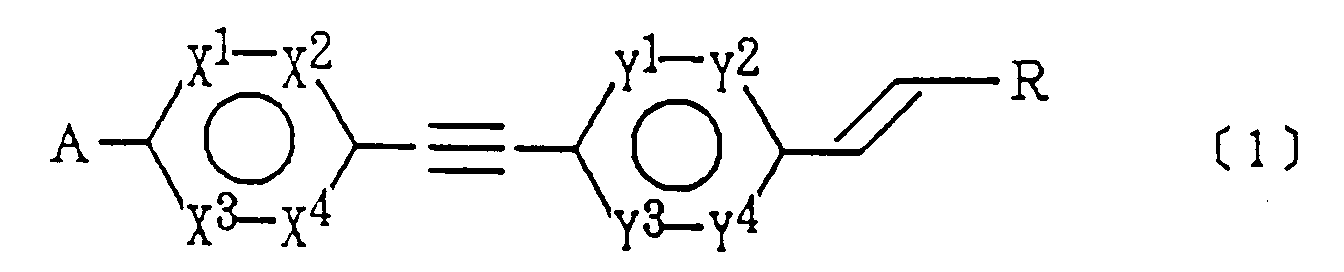
comprising reacting an aromatic compound of the formula [2]:

- The process according to claim 15, wherein said metal catalyst is at least one catalyst selected from
palladium catalysts, nickel catalysts, rhodium catalysts and copper catalysts, and said base is at least one compound selected from the group consisting of carbonates, carboxylic acid salts, alkoxides and hydroxides of alkali metals and organic bases. - The process according to claim 15, wherein said ethynyl aromatic derivative [3] is prepared by treating a carbinol derivative of the formula [7]:

- A process for preparing a diphenylacetylene compound of the formula [1]:

comprising reacting a diphenylacetylene derivative of the formula [10]:
(R⁵)₂B-CH=CH-R (trans) [6]
wherein R is the same as defined above, and each R⁵ is a hydroxyl group, a straight, branched or cyclic alkyl group or a straight, branched or cyclic alkoxy group, or two R⁵ groups together form a straight, branched or cyclic alkylene group, a straight, branched or cyclic alkylenedioxy group or a benzodioxy group in the presence of a metal catalyst and a base. - The process according to claim 18, wherein said metal catalyst is at least one catalyst selected from
palladium catalysts, nickel catalysts, rhodium catalysts and copper catalysts, and said base is at least one compound selected from the group consisting of carbonates, carboxylic acid salts, alkoxides and hydroxides of alkali metals and organic bases. - A process for preparing a diphenylacetylene compound of the formula [1]:

comprising reacting an ethynyl aromatic compound of the formula [11]:
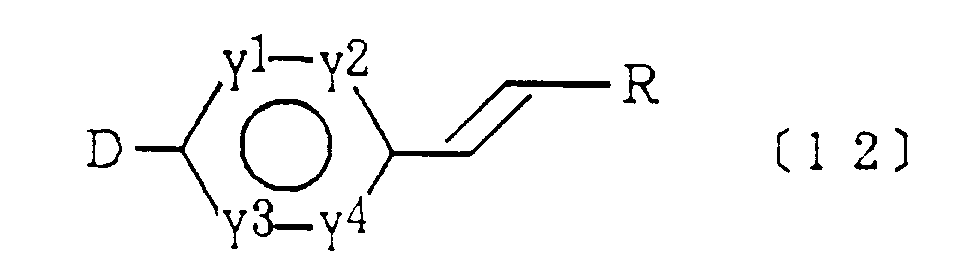
- The process according to claim 20, wherein said metal catalyst is at least one catalyst selected from
palladium catalysts, nickel catalysts, rhodium catalysts and copper catalysts, and said base is at least one compound selected from the group consisting of carbonates, carboxylic acid salts, alkoxides and hydroxides of alkali metals and organic bases. - A process for preparing an ethynyl aromatic derivative of the formula [3]:

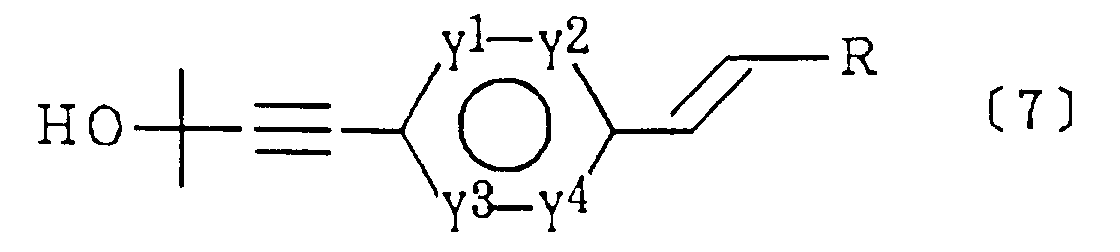
- The process according to claim 22, wherein said base is at least one compound selected from carbonates, carboxylic acid salts, alkoxides and hydroxides of alkali metals and organic bases.
Applications Claiming Priority (12)
| Application Number | Priority Date | Filing Date | Title |
|---|---|---|---|
| JP25565393 | 1993-10-13 | ||
| JP255653/93 | 1993-10-13 | ||
| JP263504/93 | 1993-10-21 | ||
| JP26350493 | 1993-10-21 | ||
| JP12023494 | 1994-06-01 | ||
| JP120234/94 | 1994-06-01 | ||
| JP14967494 | 1994-06-30 | ||
| JP149674/94 | 1994-06-30 | ||
| JP18346094 | 1994-08-04 | ||
| JP183460/94 | 1994-08-04 | ||
| JP18762694 | 1994-08-09 | ||
| JP187626/94 | 1994-08-09 |
Publications (2)
| Publication Number | Publication Date |
|---|---|
| EP0648723A1 true EP0648723A1 (en) | 1995-04-19 |
| EP0648723B1 EP0648723B1 (en) | 1998-05-20 |
Family
ID=27552573
Family Applications (1)
| Application Number | Title | Priority Date | Filing Date |
|---|---|---|---|
| EP94116064A Expired - Lifetime EP0648723B1 (en) | 1993-10-13 | 1994-10-12 | Diphenylacetylene compound, process for preparing the same and liquid crystal composition and element comprising the same |
Country Status (4)
| Country | Link |
|---|---|
| US (1) | US5658489A (en) |
| EP (1) | EP0648723B1 (en) |
| KR (1) | KR100311921B1 (en) |
| DE (1) | DE69410386T2 (en) |
Cited By (19)
| Publication number | Priority date | Publication date | Assignee | Title |
|---|---|---|---|---|
| EP0709444A1 (en) * | 1994-10-05 | 1996-05-01 | Sumitomo Chemical Company Limited | Liquid crystal mixture and liquid crystal device comprising the same |
| EP0781827A1 (en) * | 1995-12-27 | 1997-07-02 | Sumitomo Chemical Company, Limited | Liquid crystal mixture and liquid crystal device comprising the same |
| WO1997046534A1 (en) * | 1996-05-30 | 1997-12-11 | Bayer Aktiengesellschaft | Process for producing substituted aryl pyrazoles |
| WO2002020697A3 (en) * | 2000-09-05 | 2002-05-10 | Hrl Lab Llc | Polar tolane liquid crystals |
| WO2004026839A1 (en) * | 2002-09-19 | 2004-04-01 | Agro-Kanesho Co.,Ltd. | Process for producing arylethynylpyrazole compound |
| EP1479748A3 (en) * | 2003-05-21 | 2005-01-12 | MERCK PATENT GmbH | Tolane derivatives and liquid crystalline medium |
| GB2388841B (en) * | 2002-04-18 | 2006-03-15 | Merck Patent Gmbh | Polymerisable heterocyclic acetylenes |
| EP1731587A1 (en) * | 2005-06-03 | 2006-12-13 | MERCK PATENT GmbH | Tolanes, process for their preparation and use thereof |
| US7255811B2 (en) | 2003-05-21 | 2007-08-14 | Merck Patent Gmbh | Tolane derivatives and liquid crystalline medium |
| EP2746277A1 (en) | 2012-12-19 | 2014-06-25 | Basf Se | Fungicidal imidazolyl and triazolyl compounds |
| EP2746262A1 (en) | 2012-12-19 | 2014-06-25 | Basf Se | Substituted [1,2,4]triazole and imidazole compounds for combating phytopathogenic fungi |
| EP2746263A1 (en) | 2012-12-19 | 2014-06-25 | Basf Se | Alpha-substituted triazoles and imidazoles |
| EP2745691A1 (en) | 2012-12-19 | 2014-06-25 | Basf Se | Substituted imidazole compounds and their use as fungicides |
| EP2746278A1 (en) | 2012-12-19 | 2014-06-25 | Basf Se | Substituted [1,2,4]triazole and imidazole compounds |
| EP2746274A1 (en) | 2012-12-19 | 2014-06-25 | Basf Se | Substituted [1,2,4]triazole compounds |
| WO2014095548A1 (en) | 2012-12-19 | 2014-06-26 | Basf Se | Substituted [1,2,4]triazole compounds and their use as fungicides |
| WO2014095547A1 (en) | 2012-12-19 | 2014-06-26 | Basf Se | New substituted triazoles and imidazoles and their use as fungicides |
| WO2014095672A1 (en) | 2012-12-19 | 2014-06-26 | Basf Se | Substituted [1,2,4]triazole compounds and their use as fungicides |
| CN105473686A (en) * | 2013-08-23 | 2016-04-06 | 默克专利股份有限公司 | Alkinyl-tolanes, liquid-crystal mixtures containing them and components for high-frequency technology |
Families Citing this family (3)
| Publication number | Priority date | Publication date | Assignee | Title |
|---|---|---|---|---|
| CN1110470C (en) * | 1996-03-18 | 2003-06-04 | 智索股份有限公司 | Bisalkenyl derivatives, liquid crystalline compounds and liquid crystal compsns. |
| WO1998023583A1 (en) * | 1996-11-28 | 1998-06-04 | Chisso Corporation | Conjugated nitrile derivatives, liquid crystal compounds, and liquid crystal display elements |
| DE19832370B4 (en) * | 1997-08-02 | 2009-08-20 | Merck Patent Gmbh | Liquid crystal mixtures and their use in STN liquid crystal displays |
Citations (3)
| Publication number | Priority date | Publication date | Assignee | Title |
|---|---|---|---|---|
| JPS61197533A (en) * | 1985-02-26 | 1986-09-01 | Dainippon Ink & Chem Inc | Halotran derivative |
| EP0249933A1 (en) * | 1986-06-17 | 1987-12-23 | Dainippon Ink And Chemicals, Inc. | Novel optically active tolan derivatives and process for preparing same |
| JPH05286920A (en) * | 1992-04-10 | 1993-11-02 | Seimi Chem Co Ltd | Difluorocyano compound, liquid crystal composition and liquid crystal electro-optic device |
Family Cites Families (12)
| Publication number | Priority date | Publication date | Assignee | Title |
|---|---|---|---|---|
| DE3601452A1 (en) * | 1986-01-20 | 1987-07-23 | Merck Patent Gmbh | VINYLENE CONNECTIONS |
| JPS63253063A (en) * | 1987-03-20 | 1988-10-20 | メルク・パテント・ゲゼルシヤフト・ミツト・ベシユレンクテル・ハフツング | Acetylene compound |
| DE3710069A1 (en) * | 1987-03-27 | 1988-10-06 | Merck Patent Gmbh | ETHINE DERIVATIVES |
| DE3831336A1 (en) * | 1988-09-15 | 1990-03-29 | Merck Patent Gmbh | Tolans |
| US5047169A (en) * | 1988-09-16 | 1991-09-10 | Adeka Argus Chemical Co., Ltd. | Tolane compound |
| US5171473A (en) * | 1989-10-18 | 1992-12-15 | Hoffmann-La Roche Inc. | Liquid crystal compounds having a terminal 1-alkynyl residue |
| JPH03168783A (en) * | 1989-11-29 | 1991-07-22 | Seiko Epson Corp | Surplus developer removal device |
| JP2701078B2 (en) * | 1989-12-02 | 1998-01-21 | 旭電化工業株式会社 | Allyl tolan compounds |
| DE59109091D1 (en) * | 1990-12-07 | 1999-03-04 | Merck Patent Gmbh | Supertwist liquid crystal display |
| US5356562A (en) * | 1991-04-13 | 1994-10-18 | Merck Patent Gesellschaft Mit Beschrankter Haftung | Fluoro tolans and liquid crystalline media |
| US5338481A (en) * | 1992-08-10 | 1994-08-16 | Hughes Aircraft Company | Asymmetrical nonpolar diphenyl-diacetylene liquid crystals eutectic mixtures |
| DE59306101D1 (en) * | 1992-10-23 | 1997-05-15 | Merck Patent Gmbh | Fluorine-substituted phenylcyclohexylacetylenes and liquid-crystalline mixtures containing them |
-
1994
- 1994-10-11 KR KR1019940026019A patent/KR100311921B1/en not_active Expired - Fee Related
- 1994-10-12 EP EP94116064A patent/EP0648723B1/en not_active Expired - Lifetime
- 1994-10-12 DE DE69410386T patent/DE69410386T2/en not_active Expired - Fee Related
- 1994-10-13 US US08/322,332 patent/US5658489A/en not_active Expired - Fee Related
Patent Citations (3)
| Publication number | Priority date | Publication date | Assignee | Title |
|---|---|---|---|---|
| JPS61197533A (en) * | 1985-02-26 | 1986-09-01 | Dainippon Ink & Chem Inc | Halotran derivative |
| EP0249933A1 (en) * | 1986-06-17 | 1987-12-23 | Dainippon Ink And Chemicals, Inc. | Novel optically active tolan derivatives and process for preparing same |
| JPH05286920A (en) * | 1992-04-10 | 1993-11-02 | Seimi Chem Co Ltd | Difluorocyano compound, liquid crystal composition and liquid crystal electro-optic device |
Non-Patent Citations (2)
| Title |
|---|
| DATABASE WPI Week 8641, Derwent World Patents Index; AN 86-269531 * |
| DATABASE WPI Week 9348, Derwent World Patents Index; AN 93-383033 * |
Cited By (28)
| Publication number | Priority date | Publication date | Assignee | Title |
|---|---|---|---|---|
| EP0709444A1 (en) * | 1994-10-05 | 1996-05-01 | Sumitomo Chemical Company Limited | Liquid crystal mixture and liquid crystal device comprising the same |
| US5762825A (en) * | 1994-10-05 | 1998-06-09 | Sumitomo Chemical Company, Limited | Liquid crystal mixture and liquid crystal device comprising the same |
| EP0781827A1 (en) * | 1995-12-27 | 1997-07-02 | Sumitomo Chemical Company, Limited | Liquid crystal mixture and liquid crystal device comprising the same |
| US5866035A (en) * | 1995-12-27 | 1999-02-02 | Sumitomo Chemical Company, Limited | Liquid crystal mixture and liquid crystal device comprising the same |
| WO1997046534A1 (en) * | 1996-05-30 | 1997-12-11 | Bayer Aktiengesellschaft | Process for producing substituted aryl pyrazoles |
| WO2002020697A3 (en) * | 2000-09-05 | 2002-05-10 | Hrl Lab Llc | Polar tolane liquid crystals |
| US6838017B1 (en) | 2000-09-05 | 2005-01-04 | Hrl Laboratories, Llc | Polar tolane liquid crystals |
| GB2388841B (en) * | 2002-04-18 | 2006-03-15 | Merck Patent Gmbh | Polymerisable heterocyclic acetylenes |
| WO2004026839A1 (en) * | 2002-09-19 | 2004-04-01 | Agro-Kanesho Co.,Ltd. | Process for producing arylethynylpyrazole compound |
| EP1479748A3 (en) * | 2003-05-21 | 2005-01-12 | MERCK PATENT GmbH | Tolane derivatives and liquid crystalline medium |
| US7255811B2 (en) | 2003-05-21 | 2007-08-14 | Merck Patent Gmbh | Tolane derivatives and liquid crystalline medium |
| EP1731587A1 (en) * | 2005-06-03 | 2006-12-13 | MERCK PATENT GmbH | Tolanes, process for their preparation and use thereof |
| EP2746263A1 (en) | 2012-12-19 | 2014-06-25 | Basf Se | Alpha-substituted triazoles and imidazoles |
| WO2014095547A1 (en) | 2012-12-19 | 2014-06-26 | Basf Se | New substituted triazoles and imidazoles and their use as fungicides |
| EP2746277A1 (en) | 2012-12-19 | 2014-06-25 | Basf Se | Fungicidal imidazolyl and triazolyl compounds |
| EP2745691A1 (en) | 2012-12-19 | 2014-06-25 | Basf Se | Substituted imidazole compounds and their use as fungicides |
| EP2746278A1 (en) | 2012-12-19 | 2014-06-25 | Basf Se | Substituted [1,2,4]triazole and imidazole compounds |
| EP2746274A1 (en) | 2012-12-19 | 2014-06-25 | Basf Se | Substituted [1,2,4]triazole compounds |
| WO2014095548A1 (en) | 2012-12-19 | 2014-06-26 | Basf Se | Substituted [1,2,4]triazole compounds and their use as fungicides |
| EP2746262A1 (en) | 2012-12-19 | 2014-06-25 | Basf Se | Substituted [1,2,4]triazole and imidazole compounds for combating phytopathogenic fungi |
| WO2014095672A1 (en) | 2012-12-19 | 2014-06-26 | Basf Se | Substituted [1,2,4]triazole compounds and their use as fungicides |
| EP3181558A1 (en) | 2012-12-19 | 2017-06-21 | Basf Se | Substituted [1,2,4]triazole compounds and their use as fungicides |
| EP3173406A1 (en) | 2012-12-19 | 2017-05-31 | Basf Se | Substituted [1,2,4]triazole compounds and their use as fungicides |
| JP2016534108A (en) * | 2013-08-23 | 2016-11-04 | メルク パテント ゲゼルシャフト ミット ベシュレンクテル ハフツングMerck Patent Gesellschaft mit beschraenkter Haftung | Alkynyl-tolanes, liquid crystal mixtures containing them and components for high frequency technology |
| KR20160045847A (en) * | 2013-08-23 | 2016-04-27 | 메르크 파텐트 게엠베하 | Alkinyl-tolanes, liquid-crystal mixtures containing them and components for high-frequency technology |
| CN105473686A (en) * | 2013-08-23 | 2016-04-06 | 默克专利股份有限公司 | Alkinyl-tolanes, liquid-crystal mixtures containing them and components for high-frequency technology |
| US10099975B2 (en) | 2013-08-23 | 2018-10-16 | Merck Patent Gmbh | Alkynyl-tolanes, liquid-crystal mixtures containing them and components for high-frequency technology |
| CN105473686B (en) * | 2013-08-23 | 2018-11-16 | 默克专利股份有限公司 | Alkynyl tolane, comprising its liquid crystal compound and for the component of high frequency technique |
Also Published As
| Publication number | Publication date |
|---|---|
| DE69410386T2 (en) | 1999-01-07 |
| KR950011404A (en) | 1995-05-15 |
| EP0648723B1 (en) | 1998-05-20 |
| DE69410386D1 (en) | 1998-06-25 |
| KR100311921B1 (en) | 2002-10-31 |
| US5658489A (en) | 1997-08-19 |
Similar Documents
| Publication | Publication Date | Title |
|---|---|---|
| EP0648723B1 (en) | Diphenylacetylene compound, process for preparing the same and liquid crystal composition and element comprising the same | |
| JP2632401B2 (en) | Substituted phenyl trifluoromethyl ether compounds | |
| US6623810B2 (en) | Phenylacetylene compound, liquid crystal composition, and liquid crystal element produced with the same | |
| JP4036504B2 (en) | Bisalkenylbicyclohexane compound and liquid crystal medium | |
| JPH0848674A (en) | Thiadiazole derivative,its production,and its use as precursor for producing liquid crystal | |
| JP4507294B2 (en) | Method for producing biaryl derivative | |
| JPH1072386A (en) | Cyclopentyl derivative | |
| JPH0812599A (en) | Method for producing tolan compound | |
| JPS63502507A (en) | optically active compound | |
| TWI419887B (en) | Chroman compounds | |
| JP3579072B2 (en) | Tolan compound, method for producing the same and liquid crystal composition containing the same as active ingredient | |
| JPH0892137A (en) | Aromatic ester compound, production method and use thereof | |
| JP3646734B2 (en) | Process for producing tolan compounds | |
| JP3695765B2 (en) | Tolan compound, process for producing the same, and liquid crystal composition containing the compound as an active ingredient | |
| JPH08133996A (en) | Diacetylene compound, method for producing the same, liquid crystal composition containing the same as active ingredient, and liquid crystal device using the same | |
| JPH0881417A (en) | Ester derivative and method for producing the same | |
| JP3585528B2 (en) | Tolan compound, method for producing the same and liquid crystal composition containing the same as active ingredient | |
| JP4344456B2 (en) | Phenylacetylene compound having cyclopropane group or alkenyl group at skeleton end, liquid crystal composition, and liquid crystal element | |
| JP3667794B2 (en) | Tolan compound, process for producing the same, liquid crystal composition containing the same as active ingredient, and liquid crystal element using the same | |
| JPH07206715A (en) | Process for producing heterocyclic compound | |
| JPH0987210A (en) | Aromatic compound, method for producing the same, liquid crystal composition and liquid crystal device containing the same | |
| JP3782814B2 (en) | Tolan compound, process for producing the same, and liquid crystal composition containing the compound as an active ingredient | |
| JPH09301896A (en) | Cyclohexylethynylbenzene derivative, method for producing the same, liquid crystal composition and liquid crystal device containing the same | |
| JPH09301897A (en) | Cyclohexylbenzene derivative, method for producing the same, liquid crystal composition and liquid crystal device containing the same | |
| JPH08291085A (en) | Method for producing tolan compound |
Legal Events
| Date | Code | Title | Description |
|---|---|---|---|
| PUAI | Public reference made under article 153(3) epc to a published international application that has entered the european phase |
Free format text: ORIGINAL CODE: 0009012 |
|
| AK | Designated contracting states |
Kind code of ref document: A1 Designated state(s): CH DE FR GB IT LI NL |
|
| 17P | Request for examination filed |
Effective date: 19951013 |
|
| 17Q | First examination report despatched |
Effective date: 19960911 |
|
| GRAG | Despatch of communication of intention to grant |
Free format text: ORIGINAL CODE: EPIDOS AGRA |
|
| GRAG | Despatch of communication of intention to grant |
Free format text: ORIGINAL CODE: EPIDOS AGRA |
|
| GRAH | Despatch of communication of intention to grant a patent |
Free format text: ORIGINAL CODE: EPIDOS IGRA |
|
| GRAH | Despatch of communication of intention to grant a patent |
Free format text: ORIGINAL CODE: EPIDOS IGRA |
|
| GRAA | (expected) grant |
Free format text: ORIGINAL CODE: 0009210 |
|
| AK | Designated contracting states |
Kind code of ref document: B1 Designated state(s): CH DE FR GB IT LI NL |
|
| REG | Reference to a national code |
Ref country code: CH Ref legal event code: EP |
|
| ITF | It: translation for a ep patent filed | ||
| REF | Corresponds to: |
Ref document number: 69410386 Country of ref document: DE Date of ref document: 19980625 |
|
| REG | Reference to a national code |
Ref country code: CH Ref legal event code: NV Representative=s name: A. BRAUN, BRAUN, HERITIER, ESCHMANN AG PATENTANWAE |
|
| ET | Fr: translation filed | ||
| PLBE | No opposition filed within time limit |
Free format text: ORIGINAL CODE: 0009261 |
|
| STAA | Information on the status of an ep patent application or granted ep patent |
Free format text: STATUS: NO OPPOSITION FILED WITHIN TIME LIMIT |
|
| 26N | No opposition filed | ||
| REG | Reference to a national code |
Ref country code: GB Ref legal event code: IF02 |
|
| PGFP | Annual fee paid to national office [announced via postgrant information from national office to epo] |
Ref country code: NL Payment date: 20041003 Year of fee payment: 11 |
|
| PGFP | Annual fee paid to national office [announced via postgrant information from national office to epo] |
Ref country code: GB Payment date: 20041006 Year of fee payment: 11 |
|
| PGFP | Annual fee paid to national office [announced via postgrant information from national office to epo] |
Ref country code: DE Payment date: 20041007 Year of fee payment: 11 |
|
| PGFP | Annual fee paid to national office [announced via postgrant information from national office to epo] |
Ref country code: FR Payment date: 20041008 Year of fee payment: 11 |
|
| PGFP | Annual fee paid to national office [announced via postgrant information from national office to epo] |
Ref country code: CH Payment date: 20041015 Year of fee payment: 11 |
|
| REG | Reference to a national code |
Ref country code: CH Ref legal event code: PUE Owner name: MERCK PATENT GMBH Free format text: SUMITOMO CHEMICAL COMPANY LIMITED#5-33, KITAHAMA 4-CHOME, CHUO-KU#OSAKA-SHI, OSAKA 541 (JP) -TRANSFER TO- MERCK PATENT GMBH#FRANKFURTER STRASSE 250#64293 DARMSTADT (DE) |
|
| REG | Reference to a national code |
Ref country code: GB Ref legal event code: 732E |
|
| NLS | Nl: assignments of ep-patents |
Owner name: MERCK PATENT GMBH |
|
| REG | Reference to a national code |
Ref country code: FR Ref legal event code: TP |
|
| PG25 | Lapsed in a contracting state [announced via postgrant information from national office to epo] |
Ref country code: IT Free format text: LAPSE BECAUSE OF NON-PAYMENT OF DUE FEES;WARNING: LAPSES OF ITALIAN PATENTS WITH EFFECTIVE DATE BEFORE 2007 MAY HAVE OCCURRED AT ANY TIME BEFORE 2007. THE CORRECT EFFECTIVE DATE MAY BE DIFFERENT FROM THE ONE RECORDED. Effective date: 20051012 Ref country code: GB Free format text: LAPSE BECAUSE OF NON-PAYMENT OF DUE FEES Effective date: 20051012 |
|
| PG25 | Lapsed in a contracting state [announced via postgrant information from national office to epo] |
Ref country code: LI Free format text: LAPSE BECAUSE OF NON-PAYMENT OF DUE FEES Effective date: 20051031 Ref country code: CH Free format text: LAPSE BECAUSE OF NON-PAYMENT OF DUE FEES Effective date: 20051031 |
|
| PG25 | Lapsed in a contracting state [announced via postgrant information from national office to epo] |
Ref country code: NL Free format text: LAPSE BECAUSE OF NON-PAYMENT OF DUE FEES Effective date: 20060501 |
|
| PG25 | Lapsed in a contracting state [announced via postgrant information from national office to epo] |
Ref country code: DE Free format text: LAPSE BECAUSE OF NON-PAYMENT OF DUE FEES Effective date: 20060503 |
|
| REG | Reference to a national code |
Ref country code: CH Ref legal event code: PL |
|
| GBPC | Gb: european patent ceased through non-payment of renewal fee |
Effective date: 20051012 |
|
| PG25 | Lapsed in a contracting state [announced via postgrant information from national office to epo] |
Ref country code: FR Free format text: LAPSE BECAUSE OF NON-PAYMENT OF DUE FEES Effective date: 20060630 |
|
| NLV4 | Nl: lapsed or anulled due to non-payment of the annual fee |
Effective date: 20060501 |
|
| REG | Reference to a national code |
Ref country code: FR Ref legal event code: ST Effective date: 20060630 |