EP0646839B1 - A silver halide photographic light sensitive element for medical radiography - Google Patents
A silver halide photographic light sensitive element for medical radiography Download PDFInfo
- Publication number
- EP0646839B1 EP0646839B1 EP94307202A EP94307202A EP0646839B1 EP 0646839 B1 EP0646839 B1 EP 0646839B1 EP 94307202 A EP94307202 A EP 94307202A EP 94307202 A EP94307202 A EP 94307202A EP 0646839 B1 EP0646839 B1 EP 0646839B1
- Authority
- EP
- European Patent Office
- Prior art keywords
- dye
- silver halide
- layer
- radiographic element
- medical radiographic
- Prior art date
- Legal status (The legal status is an assumption and is not a legal conclusion. Google has not performed a legal analysis and makes no representation as to the accuracy of the status listed.)
- Expired - Lifetime
Links
- -1 silver halide Chemical class 0.000 title claims description 20
- 239000004332 silver Substances 0.000 title claims description 17
- 229910052709 silver Inorganic materials 0.000 title claims description 17
- 238000002601 radiography Methods 0.000 title description 3
- 239000000839 emulsion Substances 0.000 claims description 18
- XLYOFNOQVPJJNP-UHFFFAOYSA-N water Substances O XLYOFNOQVPJJNP-UHFFFAOYSA-N 0.000 claims description 16
- 239000000084 colloidal system Substances 0.000 claims description 10
- 125000000217 alkyl group Chemical group 0.000 claims description 9
- 238000000034 method Methods 0.000 claims description 9
- 125000004432 carbon atom Chemical group C* 0.000 claims description 4
- 150000003839 salts Chemical group 0.000 claims description 3
- 229910006069 SO3H Inorganic materials 0.000 claims description 2
- 230000003287 optical effect Effects 0.000 claims description 2
- 125000000020 sulfo group Chemical group O=S(=O)([*])O[H] 0.000 claims description 2
- 239000000975 dye Substances 0.000 description 49
- 239000010410 layer Substances 0.000 description 38
- 239000000243 solution Substances 0.000 description 19
- LFQSCWFLJHTTHZ-UHFFFAOYSA-N Ethanol Chemical compound CCO LFQSCWFLJHTTHZ-UHFFFAOYSA-N 0.000 description 10
- 238000000576 coating method Methods 0.000 description 10
- 239000011248 coating agent Substances 0.000 description 9
- 238000012545 processing Methods 0.000 description 9
- 239000012153 distilled water Substances 0.000 description 8
- 0 CCCC*(CCC)C(C=C([C@@](C1)C=C(C(C)=**2C(C=C3)=CCC3N=O)*2=O)OC)=C1OC Chemical compound CCCC*(CCC)C(C=C([C@@](C1)C=C(C(C)=**2C(C=C3)=CCC3N=O)*2=O)OC)=C1OC 0.000 description 7
- 108010010803 Gelatin Proteins 0.000 description 7
- AFOSIXZFDONLBT-UHFFFAOYSA-N divinyl sulfone Chemical compound C=CS(=O)(=O)C=C AFOSIXZFDONLBT-UHFFFAOYSA-N 0.000 description 7
- 229920000159 gelatin Polymers 0.000 description 7
- 239000008273 gelatin Substances 0.000 description 7
- 235000019322 gelatine Nutrition 0.000 description 7
- 235000011852 gelatine desserts Nutrition 0.000 description 7
- 239000004848 polyfunctional curative Substances 0.000 description 7
- 238000010521 absorption reaction Methods 0.000 description 6
- 230000015572 biosynthetic process Effects 0.000 description 6
- 238000003786 synthesis reaction Methods 0.000 description 6
- 239000000463 material Substances 0.000 description 5
- DZVCFNFOPIZQKX-LTHRDKTGSA-M merocyanine Chemical compound [Na+].O=C1N(CCCC)C(=O)N(CCCC)C(=O)C1=C\C=C\C=C/1N(CCCS([O-])(=O)=O)C2=CC=CC=C2O\1 DZVCFNFOPIZQKX-LTHRDKTGSA-M 0.000 description 5
- 238000001914 filtration Methods 0.000 description 4
- OAICVXFJPJFONN-UHFFFAOYSA-N Phosphorus Chemical compound [P] OAICVXFJPJFONN-UHFFFAOYSA-N 0.000 description 3
- HEMHJVSKTPXQMS-UHFFFAOYSA-M Sodium hydroxide Chemical compound [OH-].[Na+] HEMHJVSKTPXQMS-UHFFFAOYSA-M 0.000 description 3
- 150000001875 compounds Chemical class 0.000 description 3
- 238000009792 diffusion process Methods 0.000 description 3
- 125000001495 ethyl group Chemical group [H]C([H])([H])C([H])([H])* 0.000 description 3
- 125000002887 hydroxy group Chemical group [H]O* 0.000 description 3
- 238000004519 manufacturing process Methods 0.000 description 3
- 125000002496 methyl group Chemical group [H]C([H])([H])* 0.000 description 3
- 229920000120 polyethyl acrylate Polymers 0.000 description 3
- 239000000047 product Substances 0.000 description 3
- 125000001424 substituent group Chemical group 0.000 description 3
- 238000006467 substitution reaction Methods 0.000 description 3
- 239000004215 Carbon black (E152) Substances 0.000 description 2
- NBIIXXVUZAFLBC-UHFFFAOYSA-N Phosphoric acid Chemical compound OP(O)(O)=O NBIIXXVUZAFLBC-UHFFFAOYSA-N 0.000 description 2
- GLUUGHFHXGJENI-UHFFFAOYSA-N Piperazine Chemical compound C1CNCCN1 GLUUGHFHXGJENI-UHFFFAOYSA-N 0.000 description 2
- JUJWROOIHBZHMG-UHFFFAOYSA-N Pyridine Chemical compound C1=CC=NC=C1 JUJWROOIHBZHMG-UHFFFAOYSA-N 0.000 description 2
- BQCADISMDOOEFD-UHFFFAOYSA-N Silver Chemical compound [Ag] BQCADISMDOOEFD-UHFFFAOYSA-N 0.000 description 2
- 150000001299 aldehydes Chemical class 0.000 description 2
- 125000003545 alkoxy group Chemical group 0.000 description 2
- 239000007864 aqueous solution Substances 0.000 description 2
- 239000003086 colorant Substances 0.000 description 2
- 125000000113 cyclohexyl group Chemical group [H]C1([H])C([H])([H])C([H])([H])C([H])(*)C([H])([H])C1([H])[H] 0.000 description 2
- 229940119744 dextran 40 Drugs 0.000 description 2
- GXGAKHNRMVGRPK-UHFFFAOYSA-N dimagnesium;dioxido-bis[[oxido(oxo)silyl]oxy]silane Chemical compound [Mg+2].[Mg+2].[O-][Si](=O)O[Si]([O-])([O-])O[Si]([O-])=O GXGAKHNRMVGRPK-UHFFFAOYSA-N 0.000 description 2
- 229910052736 halogen Inorganic materials 0.000 description 2
- 150000002367 halogens Chemical class 0.000 description 2
- 229930195733 hydrocarbon Natural products 0.000 description 2
- 238000003384 imaging method Methods 0.000 description 2
- FZWBNHMXJMCXLU-BLAUPYHCSA-N isomaltotriose Chemical compound O[C@@H]1[C@@H](O)[C@H](O)[C@@H](CO)O[C@@H]1OC[C@@H]1[C@@H](O)[C@H](O)[C@@H](O)[C@@H](OC[C@@H](O)[C@@H](O)[C@H](O)[C@@H](O)C=O)O1 FZWBNHMXJMCXLU-BLAUPYHCSA-N 0.000 description 2
- 238000005065 mining Methods 0.000 description 2
- 239000000203 mixture Substances 0.000 description 2
- 150000002825 nitriles Chemical class 0.000 description 2
- XHXFXVLFKHQFAL-UHFFFAOYSA-N phosphoryl trichloride Chemical compound ClP(Cl)(Cl)=O XHXFXVLFKHQFAL-UHFFFAOYSA-N 0.000 description 2
- 125000001436 propyl group Chemical group [H]C([*])([H])C([H])([H])C([H])([H])[H] 0.000 description 2
- GHMLBKRAJCXXBS-UHFFFAOYSA-N resorcinol Chemical compound OC1=CC=CC(O)=C1 GHMLBKRAJCXXBS-UHFFFAOYSA-N 0.000 description 2
- ADZWSOLPGZMUMY-UHFFFAOYSA-M silver bromide Chemical compound [Ag]Br ADZWSOLPGZMUMY-UHFFFAOYSA-M 0.000 description 2
- 239000012265 solid product Substances 0.000 description 2
- 229940124530 sulfonamide Drugs 0.000 description 2
- 125000000999 tert-butyl group Chemical group [H]C([H])([H])C(*)(C([H])([H])[H])C([H])([H])[H] 0.000 description 2
- 238000012546 transfer Methods 0.000 description 2
- 239000000080 wetting agent Substances 0.000 description 2
- HDEFREPRGWFRCR-UHFFFAOYSA-N 1,4-bis(2,5-dimethoxyphenyl)piperazine Chemical compound COC1=CC=C(OC)C(N2CCN(CC2)C=2C(=CC=C(OC)C=2)OC)=C1 HDEFREPRGWFRCR-UHFFFAOYSA-N 0.000 description 1
- LLZRSOPHIGKISM-UHFFFAOYSA-N 1,4-diphenylpiperazine Chemical compound C1CN(C=2C=CC=CC=2)CCN1C1=CC=CC=C1 LLZRSOPHIGKISM-UHFFFAOYSA-N 0.000 description 1
- NAZDVUBIEPVUKE-UHFFFAOYSA-N 2,5-dimethoxyaniline Chemical compound COC1=CC=C(OC)C(N)=C1 NAZDVUBIEPVUKE-UHFFFAOYSA-N 0.000 description 1
- FGWYBPKBKYJOPJ-UHFFFAOYSA-N 3-(5-ethoxycarbonyl-3-oxo-1h-pyrazol-2-yl)benzenesulfonic acid Chemical compound N1C(C(=O)OCC)=CC(=O)N1C1=CC=CC(S(O)(=O)=O)=C1 FGWYBPKBKYJOPJ-UHFFFAOYSA-N 0.000 description 1
- FORVNTIPUKEKFX-UHFFFAOYSA-N 4-(5-ethoxycarbonyl-3-oxo-1h-pyrazol-2-yl)benzenesulfonic acid Chemical compound N1C(C(=O)OCC)=CC(=O)N1C1=CC=C(S(O)(=O)=O)C=C1 FORVNTIPUKEKFX-UHFFFAOYSA-N 0.000 description 1
- JAJJHOMIGZGEPG-UHFFFAOYSA-N 4-[4-(4-formyl-2,5-dimethoxyphenyl)piperazin-1-yl]-2,5-dimethoxybenzaldehyde Chemical compound C1=C(C=O)C(OC)=CC(N2CCN(CC2)C=2C(=CC(C=O)=C(OC)C=2)OC)=C1OC JAJJHOMIGZGEPG-UHFFFAOYSA-N 0.000 description 1
- 239000004156 Azodicarbonamide Substances 0.000 description 1
- VMHLLURERBWHNL-UHFFFAOYSA-M Sodium acetate Chemical compound [Na+].CC([O-])=O VMHLLURERBWHNL-UHFFFAOYSA-M 0.000 description 1
- 239000005708 Sodium hypochlorite Substances 0.000 description 1
- 235000010724 Wisteria floribunda Nutrition 0.000 description 1
- 230000002411 adverse Effects 0.000 description 1
- 239000004411 aluminium Substances 0.000 description 1
- XAGFODPZIPBFFR-UHFFFAOYSA-N aluminium Chemical compound [Al] XAGFODPZIPBFFR-UHFFFAOYSA-N 0.000 description 1
- 229910052782 aluminium Inorganic materials 0.000 description 1
- 229910000147 aluminium phosphate Inorganic materials 0.000 description 1
- 150000001408 amides Chemical class 0.000 description 1
- 239000012736 aqueous medium Substances 0.000 description 1
- XOZUGNYVDXMRKW-AATRIKPKSA-N azodicarbonamide Chemical compound NC(=O)\N=N\C(N)=O XOZUGNYVDXMRKW-AATRIKPKSA-N 0.000 description 1
- 235000019399 azodicarbonamide Nutrition 0.000 description 1
- 230000005540 biological transmission Effects 0.000 description 1
- 238000004061 bleaching Methods 0.000 description 1
- 239000007844 bleaching agent Substances 0.000 description 1
- 238000009835 boiling Methods 0.000 description 1
- 229910052794 bromium Inorganic materials 0.000 description 1
- 125000005521 carbonamide group Chemical group 0.000 description 1
- 125000003178 carboxy group Chemical group [H]OC(*)=O 0.000 description 1
- 150000001732 carboxylic acid derivatives Chemical class 0.000 description 1
- 239000013626 chemical specie Substances 0.000 description 1
- 229910052801 chlorine Inorganic materials 0.000 description 1
- 230000001419 dependent effect Effects 0.000 description 1
- 238000011161 development Methods 0.000 description 1
- 239000006185 dispersion Substances 0.000 description 1
- 238000004090 dissolution Methods 0.000 description 1
- 238000004043 dyeing Methods 0.000 description 1
- 230000000694 effects Effects 0.000 description 1
- 150000002148 esters Chemical class 0.000 description 1
- 229910052731 fluorine Inorganic materials 0.000 description 1
- 238000010348 incorporation Methods 0.000 description 1
- 229910052740 iodine Inorganic materials 0.000 description 1
- 150000002576 ketones Chemical class 0.000 description 1
- 238000011068 loading method Methods 0.000 description 1
- 238000002844 melting Methods 0.000 description 1
- 230000008018 melting Effects 0.000 description 1
- 125000002347 octyl group Chemical group [H]C([*])([H])C([H])([H])C([H])([H])C([H])([H])C([H])([H])C([H])([H])C([H])([H])C([H])([H])[H] 0.000 description 1
- 125000005010 perfluoroalkyl group Chemical group 0.000 description 1
- 125000001997 phenyl group Chemical group [H]C1=C([H])C([H])=C(*)C([H])=C1[H] 0.000 description 1
- 229920003229 poly(methyl methacrylate) Polymers 0.000 description 1
- 239000004926 polymethyl methacrylate Substances 0.000 description 1
- 229920001282 polysaccharide Polymers 0.000 description 1
- 239000005017 polysaccharide Substances 0.000 description 1
- 230000002035 prolonged effect Effects 0.000 description 1
- UMJSCPRVCHMLSP-UHFFFAOYSA-N pyridine Natural products COC1=CC=CN=C1 UMJSCPRVCHMLSP-UHFFFAOYSA-N 0.000 description 1
- 239000002356 single layer Substances 0.000 description 1
- 238000002791 soaking Methods 0.000 description 1
- 239000001632 sodium acetate Substances 0.000 description 1
- 235000017281 sodium acetate Nutrition 0.000 description 1
- SUKJFIGYRHOWBL-UHFFFAOYSA-N sodium hypochlorite Chemical compound [Na+].Cl[O-] SUKJFIGYRHOWBL-UHFFFAOYSA-N 0.000 description 1
- 230000003595 spectral effect Effects 0.000 description 1
- 238000001228 spectrum Methods 0.000 description 1
- 239000007858 starting material Substances 0.000 description 1
- 238000003756 stirring Methods 0.000 description 1
- FDDDEECHVMSUSB-UHFFFAOYSA-N sulfanilamide Chemical compound NC1=CC=C(S(N)(=O)=O)C=C1 FDDDEECHVMSUSB-UHFFFAOYSA-N 0.000 description 1
- 150000003456 sulfonamides Chemical class 0.000 description 1
- 125000001174 sulfone group Chemical group 0.000 description 1
- BDHFUVZGWQCTTF-UHFFFAOYSA-N sulfonic acid Chemical compound OS(=O)=O BDHFUVZGWQCTTF-UHFFFAOYSA-N 0.000 description 1
- 230000001131 transforming effect Effects 0.000 description 1
- LUVCTYHBTXSAMX-UHFFFAOYSA-N tris(2-chloroethyl) phosphite Chemical compound ClCCOP(OCCCl)OCCCl LUVCTYHBTXSAMX-UHFFFAOYSA-N 0.000 description 1
Classifications
-
- G—PHYSICS
- G03—PHOTOGRAPHY; CINEMATOGRAPHY; ANALOGOUS TECHNIQUES USING WAVES OTHER THAN OPTICAL WAVES; ELECTROGRAPHY; HOLOGRAPHY
- G03C—PHOTOSENSITIVE MATERIALS FOR PHOTOGRAPHIC PURPOSES; PHOTOGRAPHIC PROCESSES, e.g. CINE, X-RAY, COLOUR, STEREO-PHOTOGRAPHIC PROCESSES; AUXILIARY PROCESSES IN PHOTOGRAPHY
- G03C1/00—Photosensitive materials
- G03C1/76—Photosensitive materials characterised by the base or auxiliary layers
- G03C1/825—Photosensitive materials characterised by the base or auxiliary layers characterised by antireflection means or visible-light filtering means, e.g. antihalation
- G03C1/83—Organic dyestuffs therefor
-
- C—CHEMISTRY; METALLURGY
- C09—DYES; PAINTS; POLISHES; NATURAL RESINS; ADHESIVES; COMPOSITIONS NOT OTHERWISE PROVIDED FOR; APPLICATIONS OF MATERIALS NOT OTHERWISE PROVIDED FOR
- C09B—ORGANIC DYES OR CLOSELY-RELATED COMPOUNDS FOR PRODUCING DYES, e.g. PIGMENTS; MORDANTS; LAKES
- C09B23/00—Methine or polymethine dyes, e.g. cyanine dyes
- C09B23/0091—Methine or polymethine dyes, e.g. cyanine dyes having only one heterocyclic ring at one end of the methine chain, e.g. hemicyamines, hemioxonol
-
- G—PHYSICS
- G03—PHOTOGRAPHY; CINEMATOGRAPHY; ANALOGOUS TECHNIQUES USING WAVES OTHER THAN OPTICAL WAVES; ELECTROGRAPHY; HOLOGRAPHY
- G03C—PHOTOSENSITIVE MATERIALS FOR PHOTOGRAPHIC PURPOSES; PHOTOGRAPHIC PROCESSES, e.g. CINE, X-RAY, COLOUR, STEREO-PHOTOGRAPHIC PROCESSES; AUXILIARY PROCESSES IN PHOTOGRAPHY
- G03C5/00—Photographic processes or agents therefor; Regeneration of such processing agents
- G03C5/16—X-ray, infrared, or ultraviolet ray processes
-
- Y—GENERAL TAGGING OF NEW TECHNOLOGICAL DEVELOPMENTS; GENERAL TAGGING OF CROSS-SECTIONAL TECHNOLOGIES SPANNING OVER SEVERAL SECTIONS OF THE IPC; TECHNICAL SUBJECTS COVERED BY FORMER USPC CROSS-REFERENCE ART COLLECTIONS [XRACs] AND DIGESTS
- Y10—TECHNICAL SUBJECTS COVERED BY FORMER USPC
- Y10S—TECHNICAL SUBJECTS COVERED BY FORMER USPC CROSS-REFERENCE ART COLLECTIONS [XRACs] AND DIGESTS
- Y10S430/00—Radiation imagery chemistry: process, composition, or product thereof
- Y10S430/167—X-ray
-
- Y—GENERAL TAGGING OF NEW TECHNOLOGICAL DEVELOPMENTS; GENERAL TAGGING OF CROSS-SECTIONAL TECHNOLOGIES SPANNING OVER SEVERAL SECTIONS OF THE IPC; TECHNICAL SUBJECTS COVERED BY FORMER USPC CROSS-REFERENCE ART COLLECTIONS [XRACs] AND DIGESTS
- Y10—TECHNICAL SUBJECTS COVERED BY FORMER USPC
- Y10S—TECHNICAL SUBJECTS COVERED BY FORMER USPC CROSS-REFERENCE ART COLLECTIONS [XRACs] AND DIGESTS
- Y10S430/00—Radiation imagery chemistry: process, composition, or product thereof
- Y10S430/167—X-ray
- Y10S430/168—X-ray exposure process
Definitions
- This invention relates to a double-sided silver halide photographic element sensitive to green light for medical radiography.
- Medical x-ray films are often constructed with two light sensitive layers, one on either side of a transparent base.
- the film is imaged by phosphor screens placed on either side. It is undesirable for the light emitted from one screen to cross the base and expose the non-adjacent light sensitive layer. Such cross-over will lead to a blurred image, poor resolution and loss of image quality. This cross-over light gives the light sensitive layer an additional exposure and an apparent higher speed.
- the problems associated with cross-over can be eliminated by the incorporation of coloured hydrophilic colloid layers between the light sensitive layer and the base.
- the dye used to colour these layers should have the following properties:
- Item (4) is particularly important for medical x-ray materials since the dye-containing layer is adjacent to the light-sensitive layer. Diffusion of the dye into the light-sensitive layer can give rise to adverse effects.
- the coloured colloid layer must be coated at the same time as the light sensitive layer to minimise manufacturing costs. During this process, the light-sensitive photographic emulsion layer is in contact with the dye containing layer in the wet state. Diffusion of dye between these layers is very dependent on the structure of the dye.
- US 4,925,782 discloses dimeric merocyanine dyes for dyeing specific colloid layers in photographic light-sensitive elements.
- General formula (II) describes dimeric merocyanine dyes based upon N,N'-bisphenylpiperazine. None of the dyes exemplified based on this nucleus absorb green light. Of the other dyes exemplified in US 4,925,782, none have an absorption maximum in the colloid layer close to 545nm which is ideal for use in medical x-ray film.
- Exemplified dyes which absorb green light are a monomethine merocyanine (2-10) of ⁇ max 528nm and three trimethine merocyanines (1-49, 1-52 and 1-55) with, respectively ⁇ max 563nm, 575nm and 573nm.
- Item (3) is also very important for medical x-ray films as incomplete bleaching of the dye will result in an increase in Dmin.
- the dye must be completely bleached during standard x-ray processing (90 seconds dry to dry).
- Dyes 1-49, 1-52 and 1-55 of US 4,925,782 only are bleached to a residual colour of 0.01 (0.02 for double sided) following development for 3 minutes.
- the dyes described in the state of the art do not satisfy all of the above mentioned 5 properties for medical x-ray films. There is a requirement for a non-diffusing dye with maximum absorption at about 545nm that is bleached totally by photographic developer.
- a medical radiographic element comprising a base bearing on each major surface a layer of photographic silver halide emulsion sensitive to green light characterised in that between the base and at least one silver halide layer there is a hydrophilic colloid layer containing a dye having a nucleus of the general formula: in which:
- the invention provides a double sided silver halide light sensitive element for medical radiography having between at least one of the light sensitive layers and the base and preferably between each light sensitive layer and the base a hydrophilic colloid layer containing a dye which selectively colours this colloid layer and reduces the transmission of green light emitted from radiographic screens across the base.
- the dyes used in the invention have their absorption maximum in gelatin close to the emission wavelength of medical radiographic screens, are water-soluble, yet do not diffuse into adjacent light sensitive layers or affect the photographic properties of these layers and are completely bleached during normal photographic processing. Furthermore the dyes used in the invention may be coated from a multislot coater at the same time as the silver halide layer without diffusion.
- the dyes used in the invention are novel and form a further aspect of the invention.
- examples of water-solubilising groups X include sulphonic acid, carboxylic acid, sulfonamide, carbonamide, phosphoric acid, and salts thereof.
- Examples of electron attracting groups Y include aldehyde, ketone, ester, amide, sulphone, sulphonamide, nitrile, perfluoroalkyl.
- R groups include methyl, ethyl, propyl, optionally bearing one or more substituents such as hydroxyl, nitrile, halogen, alkoxy, carboxyl.
- the groups R and Y are preferably selected so as not to hinder dissolution of the dyes in aqueous media, hence those possessing low numbers of carbon atoms, e.g., up to 5 carbon atoms, and/or possessing polar substituents, such as hydroxyl or any of the groups defined by X, are preferred.
- nucleus As is well understood in this technical area, a large degree of substitution is not only tolerated, but is often advisable.
- nucleus As is well understood in this technical area, a large degree of substitution is not only tolerated, but is often advisable.
- the terms "nucleus”, “groups” and “moiety” are used to differentiate between chemical species that allow for substitution or which may be substituted and those which do not or may not be so substituted.
- alkyl group is intended to include not only pure hydrocarbon alkyl chains, such as methyl, ethyl, octyl, cyclohexyl, iso-octyl, t-butyl, but also alkyl chains bearing conventional substituents known in the art, such as hydroxyl, alkoxy, phenyl, halogen (F, Cl, Br and I), cyano, nitro, amino.
- the term “nucleus” is likewise considered to allow for substitution.
- alkyl moiety on the other hand is limited to the inclusion of only pure hydrocarbon alkyl chains, such as methyl, ethyl, propyl, cyclohexyl, iso-octyl, t-butyl.
- Preferred dyes for use in the invention are those in which;
- Dyes I and II show absorption maxima in aqueous solution at 542nm and 558nm respectively, which shift to 530nm and 548nm in gelatin coatings, and therefore provide a good match with commonly used green phosphor screens. It is most unusual for merocyanine dyes with a monomethine chain to absorb at such long wavelengths; the closest analogues in the prior art with absorption in this range have a trimethine chain. The monomethines are preferable for reasons of stability, solubility in water and ease of synthesis.
- a dye layer on each side of the base of the radiographic element It is not essential to have a dye layer on each side of the base of the radiographic element, but it is highly preferable.
- a single, dense layer will reduce cross-over in a comparable manner to two less dense layers, but the single layer would generally require prolonged processing in order to bleach the dye to an acceptable Dmin.
- the dyes are generally used in amounts providing an optical density of 0.1 to 0.5 for a layer on each side (0.2 to 1.0 overall).
- the silver halide layers in the radiographic elements of the invention may comprise any of the photographic emulsions suitable for use in X-ray film.
- Preferred emulsions are laminar grain emulsions, e.g., of the type disclosed in U.S. Patent No. 5028521.
- Phosphoryl chloride (12.2g) was added slowly to DMF (23.5mL) at 0°C. A solution of the above piperazine (14.3g) in DMF (50mL) was added and the mixture heated to 95°C for 2 hours. The solution was allowed to cool and poured onto ice (80g). The pH was adjusted to 7 with aqueous sodium acetate. The solid product was collected by filtration, washed with water and dried. The product was purified by boiling with ethanol (750mL) collecting by filtration and dried. Yield 12.2g ir 1650 cm -1 .
- Dye (I) was prepared similarly using 3-ethoxycarbonyl-1-(4'sulphophenyl)-pyrazolin-5-one.
- Dye (II) (0.75g) was dissolved in distilled water (150mL), filtered and added to a solution at 40°C containing gelatin (30g), distilled water (395g) and 10% Hostapur (7.5mL) as wetting agent at pH 5.8. Just prior to coating the weight of the whole was made up to 585g and 1% aqueous vinyl sulphone hardener (15 mL) was added.
- a tabular silver bromide emulsion (1.4 x 0.17 ⁇ m) was finalised thus: To the emulsion (0.2mol) was added gelatin (3g), and distilled water (40mL) after soaking and melting at 40°C, 20% aqueous resorcinol (3mL), 0.025M azodicarbonamide (4.5mL), 10% aqueous PEA (43mL), was added followed by 10% aqueous Dextran 40. The pH was corrected to 6.7 and the weight to 420g. The emulsion was then split into two parts and to each was added 1% aqueous vinyl sulphone hardener (30mL) just prior to coating.
- a topcoat solution was prepared: Distilled water (1484g) and gelatin (100g) were soaked and melted at 40°C. To this solution was added 1% aqueous fluorosurfactant (48mL), 10% aqueous Hostapur and 6.5% aqueous PMMA (20mL). The weight was corrected to 1760g with distilled water and pH to 6.7. Just prior to coating 1% aqueous vinyl sulphone hardener (240mL) was added.
- Film was exposed via a double-sided sensitometer through either two Wratten 98 (W98/blue) or two Wratten 99 (W99/green) filters; 0-4 continuous wedge, 0.1sec.
- X-ray exposure was via a Trimax T8 screen, 80kV, 25mA, 0.1sec aluminium 0-2 step wedge.
- Film samples were processed in an XP505 processor using a XAD2 commercial photographic developing solution (3M) 90 seconds dry to dry.
- Results obtained from Example 1 together with a comparison film identical to Example 1 but without the dye underlayers and a commercial medical x-ray film (XD/A film commercially available from 3M) are shown in Table 1.
- Dmin Sp-G Sp-B Sp-X Con-X Dmax Cross-cover Example 1 0.22 1.97 0.85 1.38 2.32 3.74 14% Comparison 0.22 2.08 0.97 1.42 2.27 3.71 26% XD/A 0.22 1.92 1.02 1.28 2.10 3.37 38%
- Sp-G, Sp-B and Sp-X are speeds to green light, blue light and x-rays respectively.
- Con-X is contrast to x-rays.
- %cross-over is the average between the values obtained at 0.45 and 1.20 densities.
- the dye underlayer reduces substantially the cross-over between two light sensitized layers without affecting photographic properties of speed, contrast, Dmax and Dmin.
- the maintaining of photographic properties indicates that the dye (II) remained in the dye underlayer even during triple slot coating.
- Modulation Transfer Function (MTF) curves were plotted for Example 1 and the comparison films.
- X-ray MTF was obtained using a lead Sayce chart resulting in a square wave "transfer function" as described in "Imaging Science” J.C. Dainty and R. Shaw. Academic Press (1974) p 243.
- the improvement in resolution of the film of this invention was clearly demonstrated from these curves.
- the film of this invention (Example 1) had a resolution of 1.0 lines/mm compared to 0.6 lines/mm without the underlayer and 0.7 lines/mm for the commercial film.
- Example 2 The same procedure was adopted as in Example 1 except that 200mL of the 0.5% solution of Dye (II) was used in the underlayer solution. The amount of hardener in the topcoat solution was also increased to 300ml of 1% aqueous vinyl sulphone.
- Table 2 The results for sensitometry and cross-over for Example 2 and a comparison sample without dye underlayer are shown in Table 2.
- Dmin Sp-G Sp-B Sp-X Con-X Dmax 0.22 1.87 0.76 1.20 2.16 3.35 16% Comparison 0.22 2.03 0.96 1.40 2.26 3.63 28% X-ray MTF was obtained for each sample as follows: The film was given a normal wedge exposure but with the addition of a lead target placed in the x-ray cassette above the top screen.
- Example 2 had a resolution of 0.65 lines/mm compared to 0.51 lines/mm without the dye underlayer.
- the silver bromide emulsion was a slightly thicker (1.2 x 0.24 ⁇ m) tabular grained emulsion than Examples 1 and 2.
- the silver coating weight was 3.9g/m 2 .
- the amount of 1% aqueous vinyl sulphone hardener used in the topcoat and emulsion solutions was reduced to 150mL and 15mL, respectively, resulting in a softer film.
- Example 3 The results for sensitometry and cross-over for Example 3, a comparison film without the dye underlayers and another commercially available film, XD/A+ are shown in Table 3.
- Dmin Sp-G Sp-B Sp-X Con-X Dmax Cross-cover Example 3 0.24 2.01 0.94 1.39 2.20 4.19 16% Comparison 0.24 2.12 0.93 1.46 2.22 4.11 26% XD/A+ 0.24 2.09 0.97 1.42 2.14 3.66 26% MTF curves obtained by the method described in Example 2 demonstrated improved resolution of the film of the invention over the other samples.
- An underlayer solution was prepared from gelatin (30g), distilled water (405g), 0.5% Dye II solution (200mL), 10% aqueous Hostapur (7.5mL) at a pH of 5.8. The weight was adjusted to 645g with distilled water and a 1% vinyl sulphone hardener solution (15mL) was added prior to coating.
- Example 4 The sensitometry and cross-over results for Example 4 together with a comparison film with no dye underlayer and another commercial film (S-HRG, Fuji) that uses an unknown dye underlayer system to achieve low cross-over are shown in Table 4.
- S-HRG, Fuji another commercial film
- Table 4 Dmin Sp-G Sp-B Sp-X Con-X
- Cross-cover Example 4 0.27 1.99 0.90 1.40 2.08 3.83 12% Comparison 0.24 2.11 0.95 1.51 2.11 3.65 26% S-HRG 0.24 2.06 0.99 1.42 2.13 3.60 17%
- the sample of this invention achieved lower cross-over than the S-HRG film resulting in improved performance as demonstrated by MTF curves obtained by the method described in Example 2.
- the high dye loading of Example 4 does result in some unbleached dye after a 90 second processing cycle.
- the residual colour from both dye layers combines to increase the Dmin by 0.03.
Landscapes
- Chemical & Material Sciences (AREA)
- Physics & Mathematics (AREA)
- General Physics & Mathematics (AREA)
- Engineering & Computer Science (AREA)
- Materials Engineering (AREA)
- Organic Chemistry (AREA)
- Silver Salt Photography Or Processing Solution Therefor (AREA)
Description
- This invention relates to a double-sided silver halide photographic element sensitive to green light for medical radiography.
- In the field of silver halide photographic light sensitive materials, it is common practice to colour photographic emulsion layers and other hydrophilic colloid layers so as to absorb light of specific wavelengths.
- Medical x-ray films are often constructed with two light sensitive layers, one on either side of a transparent base. The film is imaged by phosphor screens placed on either side. It is undesirable for the light emitted from one screen to cross the base and expose the non-adjacent light sensitive layer. Such cross-over will lead to a blurred image, poor resolution and loss of image quality. This cross-over light gives the light sensitive layer an additional exposure and an apparent higher speed. The problems associated with cross-over can be eliminated by the incorporation of coloured hydrophilic colloid layers between the light sensitive layer and the base. Ideally, the dye used to colour these layers should have the following properties:
- 1) It should have good spectral absorption in the area of the spectrum where the phosphor screens emit (e.g., 545nm with green screens).
- 2) It should be photographically inert.
- 3) It should be decolourised by the photographic processing solution and should not leave any undesirable colours on the material after processing.
- 4) It should not diffuse from the coloured layer into the other layers.
- 5) It should be stable in the photographic material for long periods of time before processing.
-
- Item (4) is particularly important for medical x-ray materials since the dye-containing layer is adjacent to the light-sensitive layer. Diffusion of the dye into the light-sensitive layer can give rise to adverse effects. The coloured colloid layer must be coated at the same time as the light sensitive layer to minimise manufacturing costs. During this process, the light-sensitive photographic emulsion layer is in contact with the dye containing layer in the wet state. Diffusion of dye between these layers is very dependent on the structure of the dye.
- A number of suitable dyes have been proposed in the art. Particulate dyes, mordants with dyes, and oil dispersed dyes have been used, but these present problems with simultaneous coating with the photographic emulsion layer.
- US 4,925,782 discloses dimeric merocyanine dyes for dyeing specific colloid layers in photographic light-sensitive elements. General formula (II) describes dimeric merocyanine dyes based upon N,N'-bisphenylpiperazine. None of the dyes exemplified based on this nucleus absorb green light. Of the other dyes exemplified in US 4,925,782, none have an absorption maximum in the colloid layer close to 545nm which is ideal for use in medical x-ray film. Exemplified dyes which absorb green light are a monomethine merocyanine (2-10) of λmax 528nm and three trimethine merocyanines (1-49, 1-52 and 1-55) with, respectively λmax 563nm, 575nm and 573nm.
- Item (3) is also very important for medical x-ray films as incomplete bleaching of the dye will result in an increase in Dmin. For medical x-ray elements, the dye must be completely bleached during standard x-ray processing (90 seconds dry to dry). Dyes 1-49, 1-52 and 1-55 of US 4,925,782 only are bleached to a residual colour of 0.01 (0.02 for double sided) following development for 3 minutes.
- The dyes described in the state of the art do not satisfy all of the above mentioned 5 properties for medical x-ray films. There is a requirement for a non-diffusing dye with maximum absorption at about 545nm that is bleached totally by photographic developer.
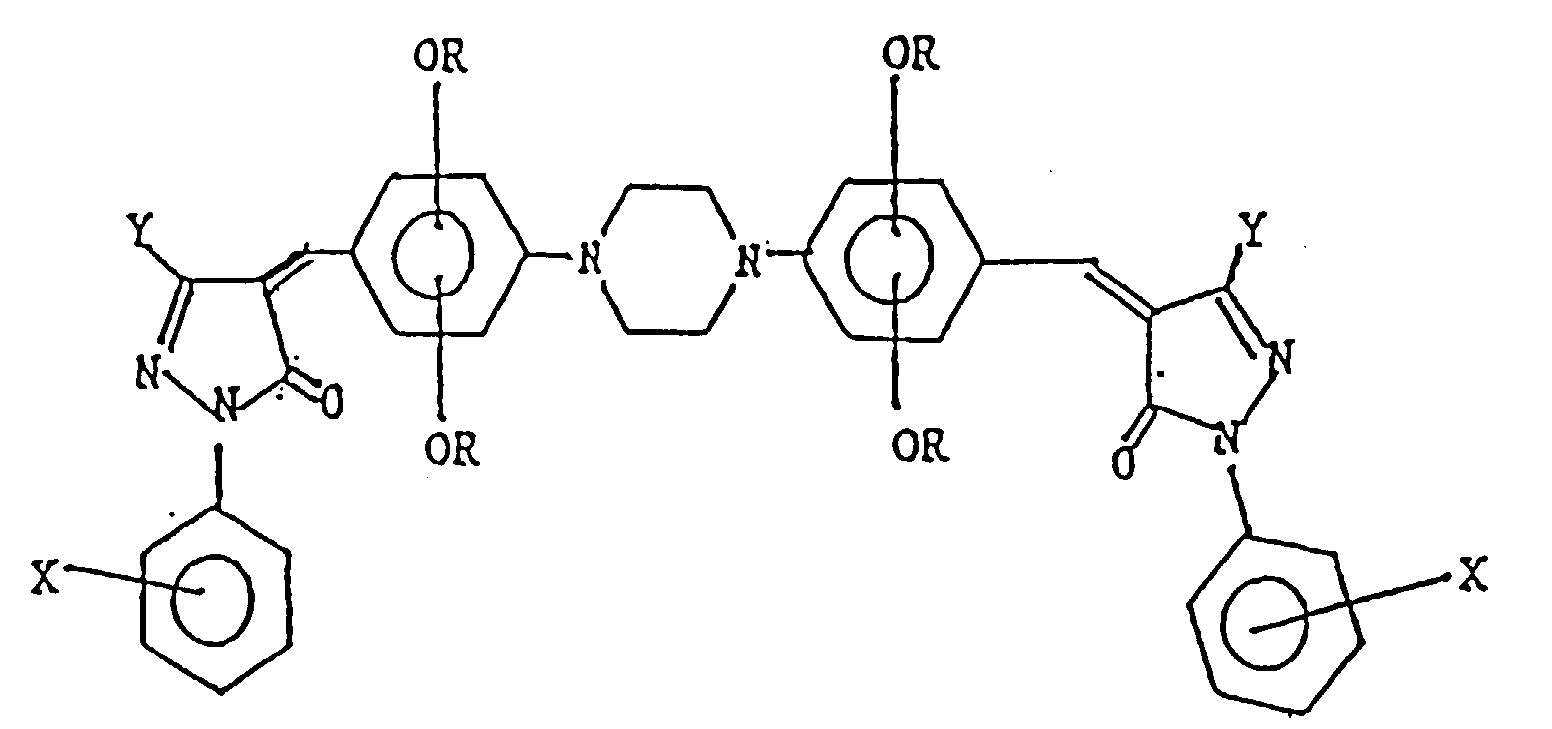
- According to the present invention there is provided a medical radiographic element comprising a base bearing on each major surface a layer of photographic silver halide emulsion sensitive to green light characterised in that between the base and at least one silver halide layer there is a hydrophilic colloid layer containing a dye having a nucleus of the general formula:in which:

- each R independently represents a substituted or unsubstituted alkyl group,
- each Y independently represents an electron attracting group, and
- each X represents a water solubilising group.
-
- The invention provides a double sided silver halide light sensitive element for medical radiography having between at least one of the light sensitive layers and the base and preferably between each light sensitive layer and the base a hydrophilic colloid layer containing a dye which selectively colours this colloid layer and reduces the transmission of green light emitted from radiographic screens across the base.
- The dyes used in the invention have their absorption maximum in gelatin close to the emission wavelength of medical radiographic screens, are water-soluble, yet do not diffuse into adjacent light sensitive layers or affect the photographic properties of these layers and are completely bleached during normal photographic processing. Furthermore the dyes used in the invention may be coated from a multislot coater at the same time as the silver halide layer without diffusion.
- The dyes used in the invention are novel and form a further aspect of the invention.
- In the above formula, examples of water-solubilising groups X include sulphonic acid, carboxylic acid, sulfonamide, carbonamide, phosphoric acid, and salts thereof.
- Examples of electron attracting groups Y include aldehyde, ketone, ester, amide, sulphone, sulphonamide, nitrile, perfluoroalkyl.
- Examples of R groups include methyl, ethyl, propyl, optionally bearing one or more substituents such as hydroxyl, nitrile, halogen, alkoxy, carboxyl.
- The groups R and Y are preferably selected so as not to hinder dissolution of the dyes in aqueous media, hence those possessing low numbers of carbon atoms, e.g., up to 5 carbon atoms, and/or possessing polar substituents, such as hydroxyl or any of the groups defined by X, are preferred.
- As is well understood in this technical area, a large degree of substitution is not only tolerated, but is often advisable. As a means of simplifying the discussion, the terms "nucleus", "groups" and "moiety" are used to differentiate between chemical species that allow for substitution or which may be substituted and those which do not or may not be so substituted. For example, the phrase "alkyl group" is intended to include not only pure hydrocarbon alkyl chains, such as methyl, ethyl, octyl, cyclohexyl, iso-octyl, t-butyl, but also alkyl chains bearing conventional substituents known in the art, such as hydroxyl, alkoxy, phenyl, halogen (F, Cl, Br and I), cyano, nitro, amino. The term "nucleus" is likewise considered to allow for substitution. The phrase "alkyl moiety" on the other hand is limited to the inclusion of only pure hydrocarbon alkyl chains, such as methyl, ethyl, propyl, cyclohexyl, iso-octyl, t-butyl.
- Conventional silver halide photographic chemistry is used in the materials of the invention.
- Preferred dyes for use in the invention are those in which;
- R represents a substituted or unsubstituted alkyl group having from 1 to 4 carbon atoms
- Y is preferably COOR, COR, CF3 or CN, in which R is as defined above
- X is preferably SO3H or a salt thereof.
-
- The following are examples of compounds represented by the general formula which are used in the present invention.
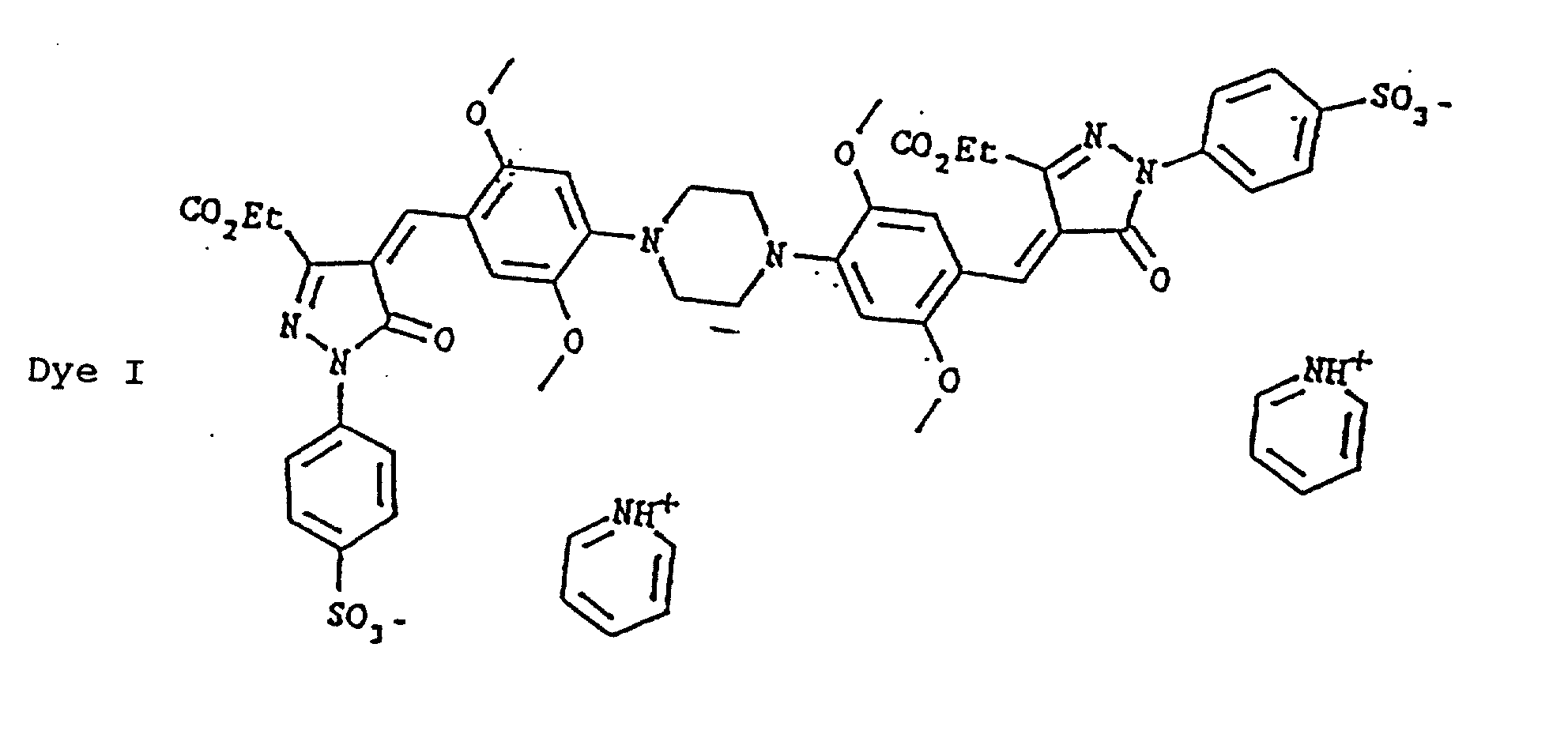

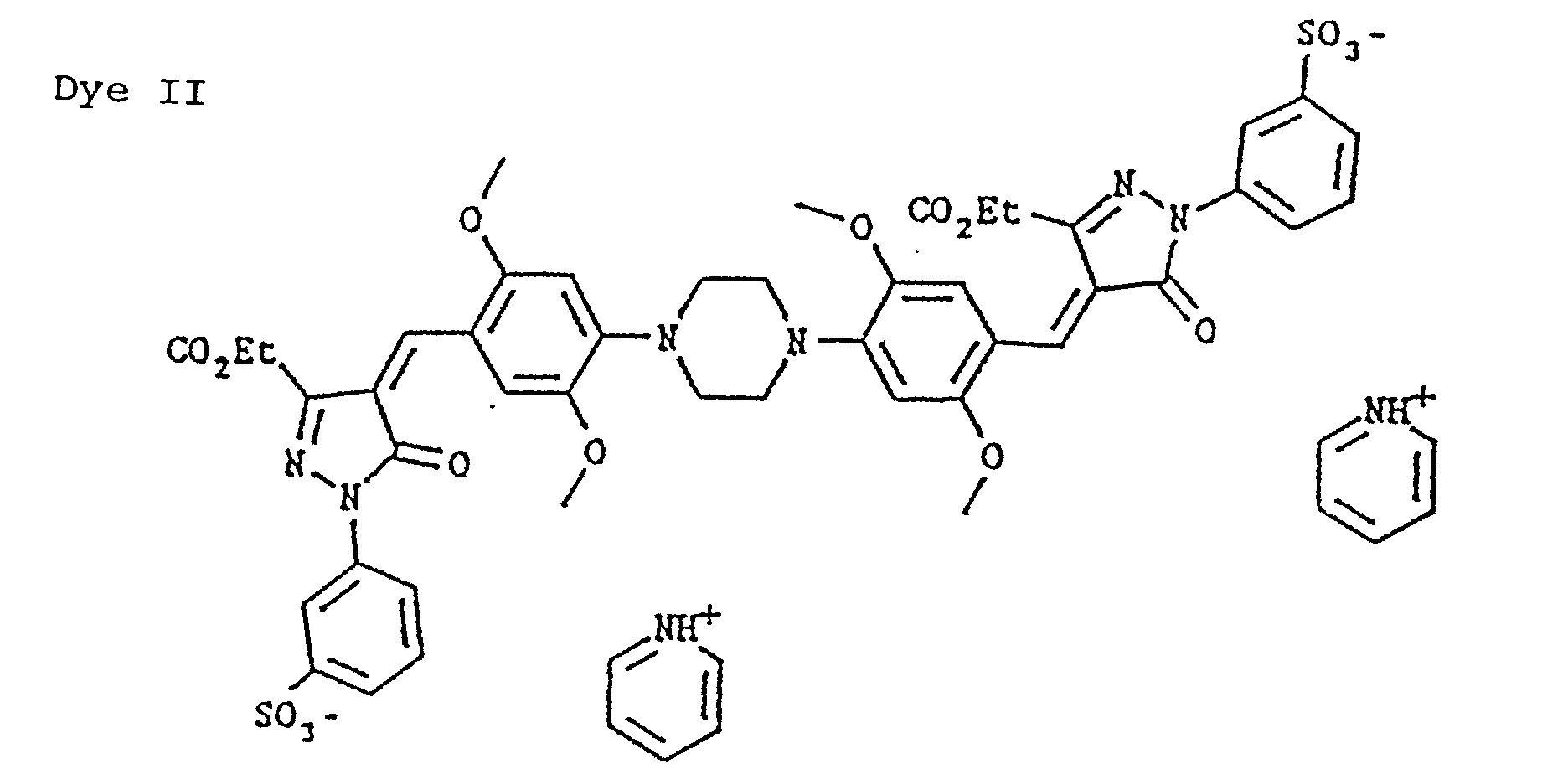
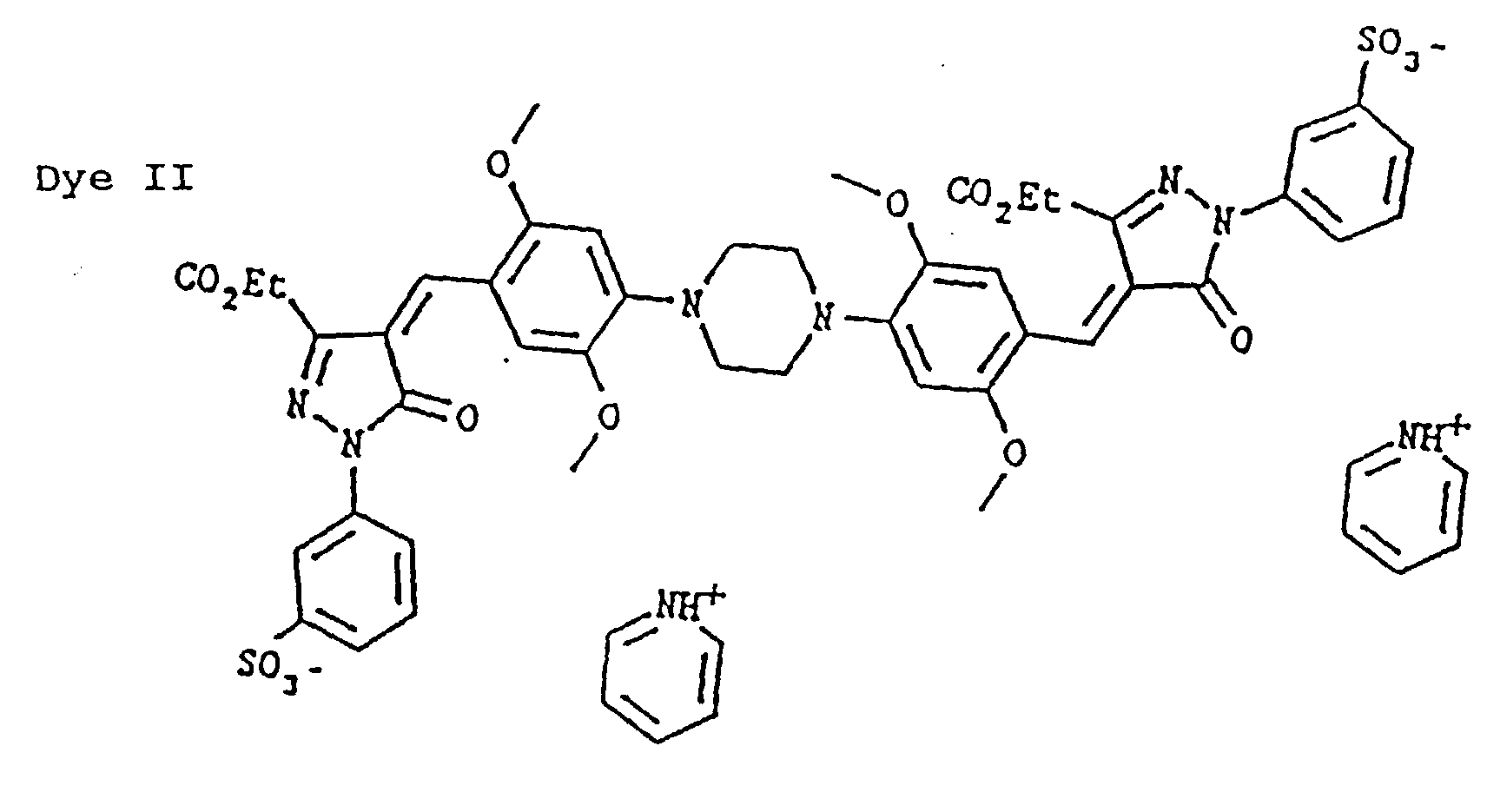
- Dyes I and II show absorption maxima in aqueous solution at 542nm and 558nm respectively, which shift to 530nm and 548nm in gelatin coatings, and therefore provide a good match with commonly used green phosphor screens. It is most unusual for merocyanine dyes with a monomethine chain to absorb at such long wavelengths; the closest analogues in the prior art with absorption in this range have a trimethine chain. The monomethines are preferable for reasons of stability, solubility in water and ease of synthesis.
- It is not essential to have a dye layer on each side of the base of the radiographic element, but it is highly preferable. A single, dense layer will reduce cross-over in a comparable manner to two less dense layers, but the single layer would generally require prolonged processing in order to bleach the dye to an acceptable Dmin. The dyes are generally used in amounts providing an optical density of 0.1 to 0.5 for a layer on each side (0.2 to 1.0 overall).
- Higher densities give lower cross-over, but at the expense of higher Dmin, unless longer or more vigorous processing conditions are employed.
- The silver halide layers in the radiographic elements of the invention may comprise any of the photographic emulsions suitable for use in X-ray film. Preferred emulsions are laminar grain emulsions, e.g., of the type disclosed in U.S. Patent No. 5028521.
- The following are examples of the synthesis of compounds which are used in this invention. The following processes can be applied to the synthesis of other compounds with suitable selection of starting materials.
- 2,5-dimethoxyaniline (30.6g) and tris(2-chloroethyl)phosphite (38.2g) were heated together at 190°C for 16 hours. The mixture was poured into aqueous sodium hydroxide (600mL, 0.8M) with stirring. The solid product was collected by filtration washed with 95% ethanol and dried. The product was recrystallised from ethanol. Yield 16.2g.
- Phosphoryl chloride (12.2g) was added slowly to DMF (23.5mL) at 0°C. A solution of the above piperazine (14.3g) in DMF (50mL) was added and the mixture heated to 95°C for 2 hours. The solution was allowed to cool and poured onto ice (80g). The pH was adjusted to 7 with aqueous sodium acetate. The solid product was collected by filtration, washed with water and dried. The product was purified by boiling with ethanol (750mL) collecting by filtration and dried. Yield 12.2g ir 1650 cm-1.
- 3-Ethoxycarbonyl-1-(3'sulphophenyl)-pyrazoline-5-one (1g) and the above aldehyde (0.78g) were refluxed together in pyridine (75mL) for 16 hours. The product was collected by filtration, washed with a little cold ethanol and dried in vacuo. Yield 1.6g λmax 558nm (Ethanol/water).
- Dye (I) was prepared similarly using 3-ethoxycarbonyl-1-(4'sulphophenyl)-pyrazolin-5-one.
- The following abbreviations and trade names are used in the Examples:-
- HOSTAPUR - wetting agent available from Hoechst (10% aqueous solution).
- DEXTRAN 40 - polysaccharide available from Fisons.
- PEA - poly(ethyl acrylate) (aqueous dispersion).
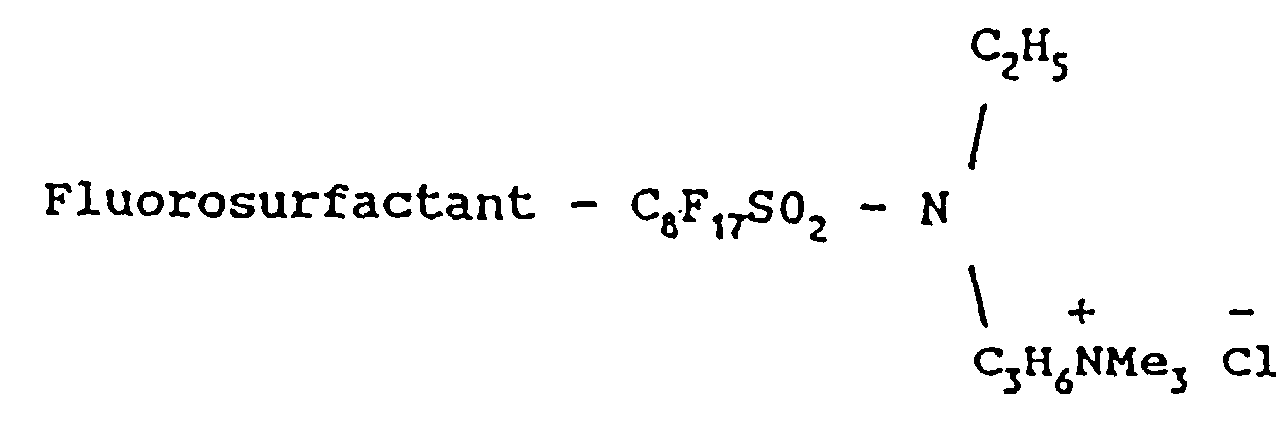
- XP505 - conventional X-ray film processor, available from Minnesota Mining and Manufacturing Company.
- XAD2 - conventional X-ray film processing chemistry, available from Minnesota Mining and Manufacturing Company.
-
- An underlayer solution was prepared: Dye (II) (0.75g) was dissolved in distilled water (150mL), filtered and added to a solution at 40°C containing gelatin (30g), distilled water (395g) and 10% Hostapur (7.5mL) as wetting agent at pH 5.8. Just prior to coating the weight of the whole was made up to 585g and 1% aqueous vinyl sulphone hardener (15 mL) was added.
- A tabular silver bromide emulsion (1.4 x 0.17 µm) was finalised thus: To the emulsion (0.2mol) was added gelatin (3g), and distilled water (40mL) after soaking and melting at 40°C, 20% aqueous resorcinol (3mL), 0.025M azodicarbonamide (4.5mL), 10% aqueous PEA (43mL), was added followed by 10% aqueous Dextran 40. The pH was corrected to 6.7 and the weight to 420g. The emulsion was then split into two parts and to each was added 1% aqueous vinyl sulphone hardener (30mL) just prior to coating.
- A topcoat solution was prepared: Distilled water (1484g) and gelatin (100g) were soaked and melted at 40°C. To this solution was added 1% aqueous fluorosurfactant (48mL), 10% aqueous Hostapur and 6.5% aqueous PMMA (20mL). The weight was corrected to 1760g with distilled water and pH to 6.7. Just prior to coating 1% aqueous vinyl sulphone hardener (240mL) was added.
- These three solutions were triple slot coated on each side of a base with pump rates of 75, 60 and 40mL/minute respectively with a web speed of 7.5 m/minute to give a dye coverage of 60-70 mg/m2 and a silver coating weight of 2.0g/m2 each side. The overall dye density was 0.3. λmax 548nm.
- Film was exposed via a double-sided sensitometer through either two Wratten 98 (W98/blue) or two Wratten 99 (W99/green) filters; 0-4 continuous wedge, 0.1sec. X-ray exposure was via a Trimax T8 screen, 80kV, 25mA, 0.1sec aluminium 0-2 step wedge.
- Film samples were processed in an XP505 processor using a XAD2 commercial photographic developing solution (3M) 90 seconds dry to dry.
- X-ray cross-over was measured: The film was given a normal x-ray screen exposure but with half the bottom screen obscured such that one half of the film received a single sided exposure and the other half received a normal double exposure. An exposure of 80 KV 25mA 0.1 sec was used. Exposed and processed samples then had the side that was lowermost on exposure removed using a sodium hypochlorite solution. The samples were then cut into two strips one of which represented the single sided exposure and the other the double sided exposure. Speed values were obtained at points 0.45 and 1.20 actual density. A speed difference was then obtained between the single and double sided exposure. % cross-over was then calculated as follows:
- Results obtained from Example 1 together with a comparison film identical to Example 1 but without the dye underlayers and a commercial medical x-ray film (XD/A film commercially available from 3M) are shown in Table 1.
Dmin Sp-G Sp-B Sp-X Con-X Dmax Cross-cover Example 1 0.22 1.97 0.85 1.38 2.32 3.74 14% Comparison 0.22 2.08 0.97 1.42 2.27 3.71 26% XD/A 0.22 1.92 1.02 1.28 2.10 3.37 38% - It has been seen that the dye underlayer reduces substantially the cross-over between two light sensitized layers without affecting photographic properties of speed, contrast, Dmax and Dmin. The maintaining of photographic properties indicates that the dye (II) remained in the dye underlayer even during triple slot coating.
- To demonstrate the improvement in image quality of medical x-ray films of this invention, Modulation Transfer Function (MTF) curves were plotted for Example 1 and the comparison films. X-ray MTF was obtained using a lead Sayce chart resulting in a square wave "transfer function" as described in "Imaging Science" J.C. Dainty and R. Shaw. Academic Press (1974) p 243.
- The improvement in resolution of the film of this invention was clearly demonstrated from these curves. For example, at an MTF value of 0.75 the film of this invention (Example 1) had a resolution of 1.0 lines/mm compared to 0.6 lines/mm without the underlayer and 0.7 lines/mm for the commercial film.
- The same procedure was adopted as in Example 1 except that 200mL of the 0.5% solution of Dye (II) was used in the underlayer solution. The amount of hardener in the topcoat solution was also increased to 300ml of 1% aqueous vinyl sulphone. The results for sensitometry and cross-over for Example 2 and a comparison sample without dye underlayer are shown in Table 2.
Dmin Sp-G Sp-B Sp-X Con-X Dmax Cross-cover Example 2 0.22 1.87 0.76 1.20 2.16 3.35 16% Comparison 0.22 2.03 0.96 1.40 2.26 3.63 28% - The MTF curves demonstrated the improvement in the quality of the film of the invention. At an MTF value of 0.75, Example 2 had a resolution of 0.65 lines/mm compared to 0.51 lines/mm without the dye underlayer.
- An underlayer solution prepared from: gelatin (46g), distilled water (775mL), 0.5% Dye II (150mL), 10% aqueous Hostapur (12mL) at a pH of 5.8 and adjusted to 985g. 1% aqueous vinyl sulphone hardener (15mL) was added just prior to coating.
- The silver bromide emulsion was a slightly thicker (1.2 x 0.24 µm) tabular grained emulsion than Examples 1 and 2. The silver coating weight was 3.9g/m2.
- The amount of 1% aqueous vinyl sulphone hardener used in the topcoat and emulsion solutions was reduced to 150mL and 15mL, respectively, resulting in a softer film.
- The results for sensitometry and cross-over for Example 3, a comparison film without the dye underlayers and another commercially available film, XD/A+ are shown in Table 3.
Dmin Sp-G Sp-B Sp-X Con-X Dmax Cross-cover Example 3 0.24 2.01 0.94 1.39 2.20 4.19 16% Comparison 0.24 2.12 0.93 1.46 2.22 4.11 26% XD/A+ 0.24 2.09 0.97 1.42 2.14 3.66 26% - An underlayer solution was prepared from gelatin (30g), distilled water (405g), 0.5% Dye II solution (200mL), 10% aqueous Hostapur (7.5mL) at a pH of 5.8. The weight was adjusted to 645g with distilled water and a 1% vinyl sulphone hardener solution (15mL) was added prior to coating.
- The emulsion and top coat solutions were as in Example 3.
- The sensitometry and cross-over results for Example 4 together with a comparison film with no dye underlayer and another commercial film (S-HRG, Fuji) that uses an unknown dye underlayer system to achieve low cross-over are shown in Table 4.
Dmin Sp-G Sp-B Sp-X Con-X Dmax Cross-cover Example 4 0.27 1.99 0.90 1.40 2.08 3.83 12% Comparison 0.24 2.11 0.95 1.51 2.11 3.65 26% S-HRG 0.24 2.06 0.99 1.42 2.13 3.60 17% - The sample of this invention achieved lower cross-over than the S-HRG film resulting in improved performance as demonstrated by MTF curves obtained by the method described in Example 2. The high dye loading of Example 4 does result in some unbleached dye after a 90 second processing cycle. The residual colour from both dye layers combines to increase the Dmin by 0.03.
Claims (13)
- A medical radiographic element comprising a base bearing on each of its two major surfaces a layer of photographic silver halide emulsion sensitive to green light, said element having between the base and at least one silver halide layer a hydrophilic colloid layer containing a dye having a nucleus of the general formula:in which:
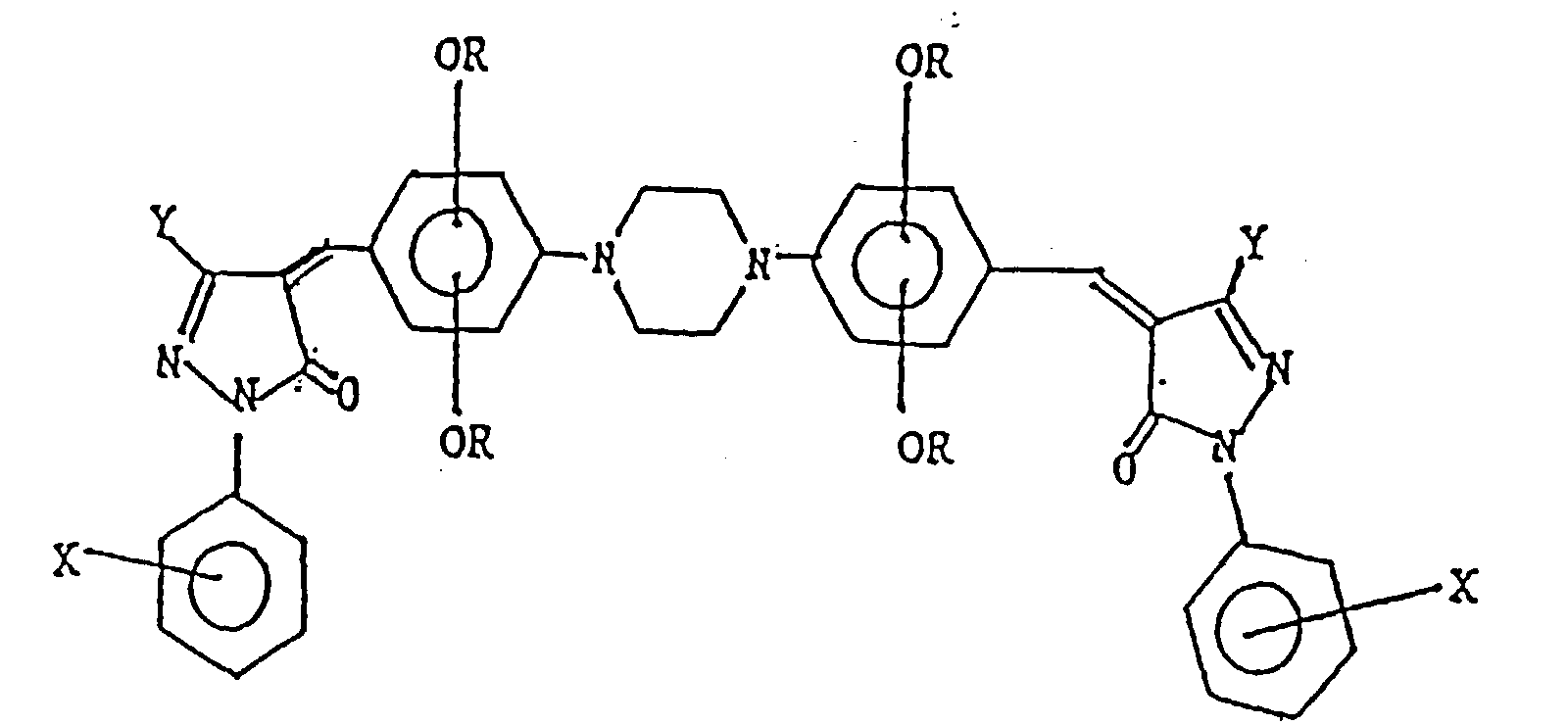 each R independently represents an alkyl group,each Y independently represents an electron attracting group andeach X represents a water solubilising group.
 - A medical radiographic element as claimed in Claim 1 in which R represents an alkyl group of from 1 to 4 carbon atoms.
- A medical radiographic element as claimed in Claim 1 or Claim 2 in which Y represents COOR, COR, CF3 or CN.
- A medical radiographic element as claimed in any preceding Claim in which X is SO3H or a salt thereof.
- A medical radiographic element as claimed in any preceding Claim in which the dye is Dye (I) or Dye (II):

- A medical radiographic element as claimed in any preceding Claim in which the dye is present in an amount to provide an optical density to green light of about 0.3 in each dye layer.
- A medical radiographic element as claimed in any preceding Claim in which the silver halide emulsion is a tabular grain emulsion.
- A method of preparing a medical radiographic element in which a layer of photographic silver halide emulsion sensitive to green light is coated on each side of a base and at least one side of said base has a hydrophilic colloid layer containing a dye having a nucleus of the general formula:in which:
 each R independently represents an alkyl group,each Y independently represents an electron attracting group andeach X represents a water solubilising group, is coated on the base between the base and at least one silver halide layer.
 - A method of preparing a medical radiographic element as claimed in Claim 8 in which the dye is as defined in any one of Claims 2 to 5.
- A method of preparing a medical radiographic element as claimed in Claim 8 or Claim 9 in which a dye layer is applied simultaneously with a silver halide layer from a multislot coater.
- A dye having the general formula:in which:
 each R independently represents an alkyl group,each Y independently represents an electron attracting group andeach X represents a water solubilising group.
 - A dye as claimed in Claim 11 in which R, Y and X are as defined in any one of Claims 2 to 4.
- A dye as claimed in Claim 11 having the structure of Dye (I) or Dye (II):

Applications Claiming Priority (2)
| Application Number | Priority Date | Filing Date | Title |
|---|---|---|---|
| GB939320284A GB9320284D0 (en) | 1993-10-01 | 1993-10-01 | A silver halide photographic light sensitive element for medical radiography |
| GB9320284 | 1993-10-01 |
Publications (2)
| Publication Number | Publication Date |
|---|---|
| EP0646839A1 EP0646839A1 (en) | 1995-04-05 |
| EP0646839B1 true EP0646839B1 (en) | 1999-04-14 |
Family
ID=10742856
Family Applications (1)
| Application Number | Title | Priority Date | Filing Date |
|---|---|---|---|
| EP94307202A Expired - Lifetime EP0646839B1 (en) | 1993-10-01 | 1994-09-30 | A silver halide photographic light sensitive element for medical radiography |
Country Status (5)
| Country | Link |
|---|---|
| US (1) | US5474881A (en) |
| EP (1) | EP0646839B1 (en) |
| JP (1) | JP3435226B2 (en) |
| DE (1) | DE69417831T2 (en) |
| GB (1) | GB9320284D0 (en) |
Families Citing this family (2)
| Publication number | Priority date | Publication date | Assignee | Title |
|---|---|---|---|---|
| EP0749038A1 (en) * | 1995-06-16 | 1996-12-18 | Minnesota Mining And Manufacturing Company | Light-sensitive photographic materials comprising tabular silver halide grains and azodicarbonamide derivatives |
| US6472137B1 (en) * | 1999-11-26 | 2002-10-29 | Agfa-Gevaert | Light-sensitive silver halide photographic film material and radiographic intensifying screen-film combination |
Family Cites Families (3)
| Publication number | Priority date | Publication date | Assignee | Title |
|---|---|---|---|---|
| WO1986004694A1 (en) * | 1985-02-06 | 1986-08-14 | Fuji Photo Film Co., Ltd. | Silver halide photographic photo-sensitive material |
| GB8907442D0 (en) * | 1989-04-03 | 1989-05-17 | Minnesota Mining & Mfg | Process for the preparation of photographic silver halide emulsions having tabular grains |
| US5210014A (en) * | 1991-03-28 | 1993-05-11 | Eastman Kodak Company | Mid-green sensitizing dyes for photographic materials |
-
1993
- 1993-10-01 GB GB939320284A patent/GB9320284D0/en active Pending
-
1994
- 1994-08-30 US US08/297,806 patent/US5474881A/en not_active Expired - Lifetime
- 1994-09-30 EP EP94307202A patent/EP0646839B1/en not_active Expired - Lifetime
- 1994-09-30 DE DE69417831T patent/DE69417831T2/en not_active Expired - Fee Related
- 1994-09-30 JP JP23767894A patent/JP3435226B2/en not_active Expired - Fee Related
Also Published As
| Publication number | Publication date |
|---|---|
| DE69417831T2 (en) | 1999-11-25 |
| JPH07168292A (en) | 1995-07-04 |
| GB9320284D0 (en) | 1993-11-17 |
| US5474881A (en) | 1995-12-12 |
| EP0646839A1 (en) | 1995-04-05 |
| DE69417831D1 (en) | 1999-05-20 |
| JP3435226B2 (en) | 2003-08-11 |
Similar Documents
| Publication | Publication Date | Title |
|---|---|---|
| EP0748465B1 (en) | Dihydroperimidine squarylium dyes as antihalation and acutance materials for photographic and photothermographic articles | |
| US5445930A (en) | Silver halide photographic material | |
| EP0710877A2 (en) | Novel silver carboxylate compounds as silver sources in photothermographic and thermographic elements | |
| GB2089056A (en) | A silver halide photographic emulsion | |
| US4873182A (en) | Light-sensitive silver halide photographic materials and process for incorporating hydrophobic photographic additives into hydrophilic colloid compositions | |
| US5474881A (en) | Silver halide photographic light sensitive element for medical radiography | |
| EP0350026B1 (en) | Infrared filter dye for photographic element | |
| EP0599383B1 (en) | Silver halide photographic elements containing furan or pyrrole substituted dye compounds | |
| JPS58143342A (en) | Silver halide photosensitive material containing dye | |
| JP2707385B2 (en) | Silver halide photographic material | |
| EP0587230B1 (en) | Photographic element containing a filter dye for rapid processing applications | |
| USH1515H (en) | Silver halide photographic material | |
| JP3545680B2 (en) | Solid fine particle dispersion of dye | |
| EP0587229A2 (en) | Filter dyes for rapid processing applications | |
| JPH07120018B2 (en) | Image receiving element for thermal transfer with improved whiteness | |
| EP0781816B1 (en) | Dyes for use in diverse applications | |
| US5811546A (en) | Dyes for use in diverse applications | |
| US6399290B1 (en) | Silver halide imaging materials | |
| EP0622423B1 (en) | Novel benzimidazolocarbocyaniene dye and silver halide photographic material containing said dye | |
| EP0656401A2 (en) | New dyes for use in diverse applications | |
| JPS63231445A (en) | Silver halide photographic sensitive material containing oxonol dye | |
| DE3437545A1 (en) | LIGHT SENSITIVE PHOTOGRAPHIC SILVER HALOGENID MATERIAL | |
| JP2603113B2 (en) | Silver halide photographic light-sensitive material containing yellow dye | |
| EP0930537B1 (en) | Light-sensitive silver halide photographic materials and process for incorporating hydrophobic photographic additives into hydrophilic colloid compositions | |
| JP3440167B2 (en) | Trimethine compound and silver halide photographic material using the same |
Legal Events
| Date | Code | Title | Description |
|---|---|---|---|
| PUAI | Public reference made under article 153(3) epc to a published international application that has entered the european phase |
Free format text: ORIGINAL CODE: 0009012 |
|
| AK | Designated contracting states |
Kind code of ref document: A1 Designated state(s): DE FR GB IT |
|
| 17P | Request for examination filed |
Effective date: 19951002 |
|
| GRAG | Despatch of communication of intention to grant |
Free format text: ORIGINAL CODE: EPIDOS AGRA |
|
| 17Q | First examination report despatched |
Effective date: 19980513 |
|
| GRAG | Despatch of communication of intention to grant |
Free format text: ORIGINAL CODE: EPIDOS AGRA |
|
| GRAH | Despatch of communication of intention to grant a patent |
Free format text: ORIGINAL CODE: EPIDOS IGRA |
|
| RAP1 | Party data changed (applicant data changed or rights of an application transferred) |
Owner name: IMATION CORP. |
|
| GRAH | Despatch of communication of intention to grant a patent |
Free format text: ORIGINAL CODE: EPIDOS IGRA |
|
| GRAA | (expected) grant |
Free format text: ORIGINAL CODE: 0009210 |
|
| AK | Designated contracting states |
Kind code of ref document: B1 Designated state(s): DE FR GB IT |
|
| REF | Corresponds to: |
Ref document number: 69417831 Country of ref document: DE Date of ref document: 19990520 |
|
| ET | Fr: translation filed | ||
| REG | Reference to a national code |
Ref country code: FR Ref legal event code: TP |
|
| PLBE | No opposition filed within time limit |
Free format text: ORIGINAL CODE: 0009261 |
|
| STAA | Information on the status of an ep patent application or granted ep patent |
Free format text: STATUS: NO OPPOSITION FILED WITHIN TIME LIMIT |
|
| 26N | No opposition filed | ||
| REG | Reference to a national code |
Ref country code: GB Ref legal event code: IF02 |
|
| REG | Reference to a national code |
Ref country code: GB Ref legal event code: 732E |
|
| PGFP | Annual fee paid to national office [announced via postgrant information from national office to epo] |
Ref country code: GB Payment date: 20030807 Year of fee payment: 10 |
|
| PGFP | Annual fee paid to national office [announced via postgrant information from national office to epo] |
Ref country code: FR Payment date: 20030902 Year of fee payment: 10 |
|
| PG25 | Lapsed in a contracting state [announced via postgrant information from national office to epo] |
Ref country code: GB Free format text: LAPSE BECAUSE OF NON-PAYMENT OF DUE FEES Effective date: 20040930 |
|
| PGFP | Annual fee paid to national office [announced via postgrant information from national office to epo] |
Ref country code: DE Payment date: 20040930 Year of fee payment: 11 |
|
| GBPC | Gb: european patent ceased through non-payment of renewal fee |
Effective date: 20040930 |
|
| PG25 | Lapsed in a contracting state [announced via postgrant information from national office to epo] |
Ref country code: FR Free format text: LAPSE BECAUSE OF NON-PAYMENT OF DUE FEES Effective date: 20050531 |
|
| REG | Reference to a national code |
Ref country code: FR Ref legal event code: ST |
|
| PG25 | Lapsed in a contracting state [announced via postgrant information from national office to epo] |
Ref country code: IT Free format text: LAPSE BECAUSE OF NON-PAYMENT OF DUE FEES Effective date: 20050930 |
|
| PG25 | Lapsed in a contracting state [announced via postgrant information from national office to epo] |
Ref country code: DE Free format text: LAPSE BECAUSE OF NON-PAYMENT OF DUE FEES Effective date: 20060401 |