EP0644181A1 - Amino acid derivative and use thereof - Google Patents
Amino acid derivative and use thereof Download PDFInfo
- Publication number
- EP0644181A1 EP0644181A1 EP93910424A EP93910424A EP0644181A1 EP 0644181 A1 EP0644181 A1 EP 0644181A1 EP 93910424 A EP93910424 A EP 93910424A EP 93910424 A EP93910424 A EP 93910424A EP 0644181 A1 EP0644181 A1 EP 0644181A1
- Authority
- EP
- European Patent Office
- Prior art keywords
- arg
- compound
- rev
- asp
- residue
- Prior art date
- Legal status (The legal status is an assumption and is not a legal conclusion. Google has not performed a legal analysis and makes no representation as to the accuracy of the status listed.)
- Granted
Links
- 150000003862 amino acid derivatives Chemical class 0.000 title claims abstract description 31
- 206010027476 Metastases Diseases 0.000 claims abstract description 30
- 230000009401 metastasis Effects 0.000 claims abstract description 30
- 206010028980 Neoplasm Diseases 0.000 claims abstract description 29
- 230000002401 inhibitory effect Effects 0.000 claims abstract description 26
- 125000003178 carboxy group Chemical group [H]OC(*)=O 0.000 claims abstract description 16
- 125000000539 amino acid group Chemical group 0.000 claims abstract description 13
- 150000003839 salts Chemical class 0.000 claims abstract description 12
- 125000004435 hydrogen atom Chemical class [H]* 0.000 claims abstract description 11
- 125000002947 alkylene group Chemical group 0.000 claims abstract description 10
- 125000000217 alkyl group Chemical group 0.000 claims abstract description 7
- 150000001875 compounds Chemical class 0.000 claims description 173
- CKLJMWTZIZZHCS-REOHCLBHSA-N L-aspartic acid Chemical group OC(=O)[C@@H](N)CC(O)=O CKLJMWTZIZZHCS-REOHCLBHSA-N 0.000 claims description 36
- 108090000765 processed proteins & peptides Chemical group 0.000 claims description 27
- 235000001014 amino acid Nutrition 0.000 claims description 18
- 150000001413 amino acids Chemical class 0.000 claims description 18
- 125000004432 carbon atom Chemical group C* 0.000 claims description 15
- 239000003795 chemical substances by application Substances 0.000 claims description 13
- 125000001424 substituent group Chemical group 0.000 claims description 12
- DHMQDGOQFOQNFH-UHFFFAOYSA-N Glycine Natural products NCC(O)=O DHMQDGOQFOQNFH-UHFFFAOYSA-N 0.000 claims description 11
- 125000003277 amino group Chemical group 0.000 claims description 10
- 235000003704 aspartic acid Nutrition 0.000 claims description 10
- OQFSQFPPLPISGP-UHFFFAOYSA-N beta-carboxyaspartic acid Chemical group OC(=O)C(N)C(C(O)=O)C(O)=O OQFSQFPPLPISGP-UHFFFAOYSA-N 0.000 claims description 10
- 125000000291 glutamic acid group Chemical group N[C@@H](CCC(O)=O)C(=O)* 0.000 claims description 8
- 125000000623 heterocyclic group Chemical group 0.000 claims description 8
- 239000004471 Glycine Substances 0.000 claims description 7
- 125000002887 hydroxy group Chemical group [H]O* 0.000 claims description 7
- 125000000637 arginyl group Chemical group N[C@@H](CCCNC(N)=N)C(=O)* 0.000 claims description 6
- 125000002795 guanidino group Chemical group C(N)(=N)N* 0.000 claims description 6
- MTCFGRXMJLQNBG-UHFFFAOYSA-N Serine Natural products OCC(N)C(O)=O MTCFGRXMJLQNBG-UHFFFAOYSA-N 0.000 claims description 5
- 125000003710 aryl alkyl group Chemical group 0.000 claims description 5
- 125000003118 aryl group Chemical group 0.000 claims description 5
- 125000003630 glycyl group Chemical group [H]N([H])C([H])([H])C(*)=O 0.000 claims description 5
- 125000001997 phenyl group Chemical group [H]C1=C([H])C([H])=C(*)C([H])=C1[H] 0.000 claims description 5
- 235000004400 serine Nutrition 0.000 claims description 5
- 239000004480 active ingredient Substances 0.000 claims description 4
- 125000004122 cyclic group Chemical group 0.000 claims description 4
- 125000002496 methyl group Chemical group [H]C([H])([H])* 0.000 claims description 4
- 125000001624 naphthyl group Chemical group 0.000 claims description 4
- 125000000843 phenylene group Chemical group C1(=C(C=CC=C1)*)* 0.000 claims description 4
- 125000003607 serino group Chemical group [H]N([H])[C@]([H])(C(=O)[*])C(O[H])([H])[H] 0.000 claims description 4
- 229910004727 OSO3H Inorganic materials 0.000 claims description 3
- 125000004433 nitrogen atom Chemical group N* 0.000 claims description 3
- 229920002845 Poly(methacrylic acid) Polymers 0.000 claims description 2
- 229920002125 Sokalan® Polymers 0.000 claims 1
- 150000004676 glycans Chemical class 0.000 claims 1
- 150000002772 monosaccharides Chemical class 0.000 claims 1
- 150000002790 naphthalenes Chemical class 0.000 claims 1
- 229920001542 oligosaccharide Polymers 0.000 claims 1
- 150000002482 oligosaccharides Chemical class 0.000 claims 1
- 239000004584 polyacrylic acid Substances 0.000 claims 1
- 229920001282 polysaccharide Polymers 0.000 claims 1
- 239000005017 polysaccharide Substances 0.000 claims 1
- 125000001273 sulfonato group Chemical group [O-]S(*)(=O)=O 0.000 claims 1
- 230000000694 effects Effects 0.000 abstract description 49
- 239000001257 hydrogen Substances 0.000 abstract description 5
- 229910052739 hydrogen Inorganic materials 0.000 abstract description 5
- 201000011510 cancer Diseases 0.000 abstract description 3
- 230000004520 agglutination Effects 0.000 abstract 1
- 239000002257 antimetastatic agent Substances 0.000 abstract 1
- 230000014508 negative regulation of coagulation Effects 0.000 abstract 1
- 230000003389 potentiating effect Effects 0.000 abstract 1
- XEKOWRVHYACXOJ-UHFFFAOYSA-N Ethyl acetate Natural products CCOC(C)=O XEKOWRVHYACXOJ-UHFFFAOYSA-N 0.000 description 239
- QTBSBXVTEAMEQO-UHFFFAOYSA-N Acetic acid Chemical compound CC(O)=O QTBSBXVTEAMEQO-UHFFFAOYSA-N 0.000 description 127
- OKKJLVBELUTLKV-UHFFFAOYSA-N Methanol Chemical compound OC OKKJLVBELUTLKV-UHFFFAOYSA-N 0.000 description 123
- KRKNYBCHXYNGOX-UHFFFAOYSA-N citric acid Chemical compound OC(=O)CC(O)(C(O)=O)CC(O)=O KRKNYBCHXYNGOX-UHFFFAOYSA-N 0.000 description 108
- 235000019439 ethyl acetate Nutrition 0.000 description 81
- WYURNTSHIVDZCO-UHFFFAOYSA-N Tetrahydrofuran Chemical compound C1CCOC1 WYURNTSHIVDZCO-UHFFFAOYSA-N 0.000 description 74
- SJRJJKPEHAURKC-UHFFFAOYSA-N N-Methylmorpholine Chemical compound CN1CCOCC1 SJRJJKPEHAURKC-UHFFFAOYSA-N 0.000 description 72
- 239000007864 aqueous solution Substances 0.000 description 71
- XLYOFNOQVPJJNP-UHFFFAOYSA-N water Chemical compound O XLYOFNOQVPJJNP-UHFFFAOYSA-N 0.000 description 71
- UIIMBOGNXHQVGW-UHFFFAOYSA-M Sodium bicarbonate Chemical compound [Na+].OC([O-])=O UIIMBOGNXHQVGW-UHFFFAOYSA-M 0.000 description 70
- ZMANZCXQSJIPKH-UHFFFAOYSA-N Triethylamine Chemical compound CCN(CC)CC ZMANZCXQSJIPKH-UHFFFAOYSA-N 0.000 description 69
- VEXZGXHMUGYJMC-UHFFFAOYSA-N Hydrochloric acid Chemical compound Cl VEXZGXHMUGYJMC-UHFFFAOYSA-N 0.000 description 66
- 239000011541 reaction mixture Substances 0.000 description 65
- RTZKZFJDLAIYFH-UHFFFAOYSA-N Diethyl ether Chemical compound CCOCC RTZKZFJDLAIYFH-UHFFFAOYSA-N 0.000 description 64
- HEDRZPFGACZZDS-UHFFFAOYSA-N Chloroform Chemical compound ClC(Cl)Cl HEDRZPFGACZZDS-UHFFFAOYSA-N 0.000 description 60
- YMWUJEATGCHHMB-UHFFFAOYSA-N Dichloromethane Chemical compound ClCCl YMWUJEATGCHHMB-UHFFFAOYSA-N 0.000 description 51
- 230000015572 biosynthetic process Effects 0.000 description 49
- 238000003786 synthesis reaction Methods 0.000 description 46
- 239000000243 solution Substances 0.000 description 44
- OFOBLEOULBTSOW-UHFFFAOYSA-N Malonic acid Chemical compound OC(=O)CC(O)=O OFOBLEOULBTSOW-UHFFFAOYSA-N 0.000 description 39
- 239000002904 solvent Substances 0.000 description 38
- 239000012044 organic layer Substances 0.000 description 37
- YLQBMQCUIZJEEH-UHFFFAOYSA-N tetrahydrofuran Natural products C=1C=COC=1 YLQBMQCUIZJEEH-UHFFFAOYSA-N 0.000 description 37
- DTQVDTLACAAQTR-UHFFFAOYSA-N trifluoroacetic acid Substances OC(=O)C(F)(F)F DTQVDTLACAAQTR-UHFFFAOYSA-N 0.000 description 37
- QTBSBXVTEAMEQO-UHFFFAOYSA-M Acetate Chemical compound CC([O-])=O QTBSBXVTEAMEQO-UHFFFAOYSA-M 0.000 description 35
- SSOLNOMRVKKSON-UHFFFAOYSA-N proguanil Chemical compound CC(C)\N=C(/N)N=C(N)NC1=CC=C(Cl)C=C1 SSOLNOMRVKKSON-UHFFFAOYSA-N 0.000 description 35
- 229920006395 saturated elastomer Polymers 0.000 description 35
- 229910000030 sodium bicarbonate Inorganic materials 0.000 description 35
- 235000017557 sodium bicarbonate Nutrition 0.000 description 35
- 238000012360 testing method Methods 0.000 description 35
- PMZURENOXWZQFD-UHFFFAOYSA-L Sodium Sulfate Chemical compound [Na+].[Na+].[O-]S([O-])(=O)=O PMZURENOXWZQFD-UHFFFAOYSA-L 0.000 description 33
- 239000000203 mixture Substances 0.000 description 33
- 238000010898 silica gel chromatography Methods 0.000 description 33
- RLSSMJSEOOYNOY-UHFFFAOYSA-N m-cresol Chemical compound CC1=CC=CC(O)=C1 RLSSMJSEOOYNOY-UHFFFAOYSA-N 0.000 description 32
- 238000001816 cooling Methods 0.000 description 30
- ODKSFYDXXFIFQN-BYPYZUCNSA-N L-arginine Chemical compound OC(=O)[C@@H](N)CCCN=C(N)N ODKSFYDXXFIFQN-BYPYZUCNSA-N 0.000 description 28
- 239000003480 eluent Substances 0.000 description 28
- VLKZOEOYAKHREP-UHFFFAOYSA-N n-Hexane Chemical compound CCCCCC VLKZOEOYAKHREP-UHFFFAOYSA-N 0.000 description 27
- NNRFRJQMBSBXGO-CIUDSAMLSA-N (3s)-3-[[2-[[(2s)-2-amino-5-(diaminomethylideneamino)pentanoyl]amino]acetyl]amino]-4-[[(1s)-1-carboxy-2-hydroxyethyl]amino]-4-oxobutanoic acid Chemical group NC(N)=NCCC[C@H](N)C(=O)NCC(=O)N[C@@H](CC(O)=O)C(=O)N[C@@H](CO)C(O)=O NNRFRJQMBSBXGO-CIUDSAMLSA-N 0.000 description 24
- ZMXDDKWLCZADIW-UHFFFAOYSA-N N,N-Dimethylformamide Chemical compound CN(C)C=O ZMXDDKWLCZADIW-UHFFFAOYSA-N 0.000 description 23
- 238000000746 purification Methods 0.000 description 21
- 238000005160 1H NMR spectroscopy Methods 0.000 description 20
- QOSSAOTZNIDXMA-UHFFFAOYSA-N Dicylcohexylcarbodiimide Chemical compound C1CCCCC1N=C=NC1CCCCC1 QOSSAOTZNIDXMA-UHFFFAOYSA-N 0.000 description 20
- 239000010410 layer Substances 0.000 description 20
- YXFVVABEGXRONW-UHFFFAOYSA-N Toluene Chemical compound CC1=CC=CC=C1 YXFVVABEGXRONW-UHFFFAOYSA-N 0.000 description 18
- 210000004027 cell Anatomy 0.000 description 18
- 229940125904 compound 1 Drugs 0.000 description 18
- MKRTXPORKIRPDG-UHFFFAOYSA-N diphenylphosphoryl azide Chemical compound C=1C=CC=CC=1P(=O)(N=[N+]=[N-])C1=CC=CC=C1 MKRTXPORKIRPDG-UHFFFAOYSA-N 0.000 description 18
- 238000004811 liquid chromatography Methods 0.000 description 18
- 238000000034 method Methods 0.000 description 18
- 229960005261 aspartic acid Drugs 0.000 description 17
- 239000008367 deionised water Substances 0.000 description 17
- 238000005194 fractionation Methods 0.000 description 17
- HNKJADCVZUBCPG-UHFFFAOYSA-N thioanisole Chemical compound CSC1=CC=CC=C1 HNKJADCVZUBCPG-UHFFFAOYSA-N 0.000 description 17
- 101000829980 Homo sapiens Ral guanine nucleotide dissociation stimulator Proteins 0.000 description 16
- JGFZNNIVVJXRND-UHFFFAOYSA-N N,N-Diisopropylethylamine (DIPEA) Chemical compound CCN(C(C)C)C(C)C JGFZNNIVVJXRND-UHFFFAOYSA-N 0.000 description 16
- 102100023320 Ral guanine nucleotide dissociation stimulator Human genes 0.000 description 16
- 229940024606 amino acid Drugs 0.000 description 16
- 229910021641 deionized water Inorganic materials 0.000 description 16
- JOXIMZWYDAKGHI-UHFFFAOYSA-N toluene-4-sulfonic acid Chemical class CC1=CC=C(S(O)(=O)=O)C=C1 JOXIMZWYDAKGHI-UHFFFAOYSA-N 0.000 description 16
- 229920001429 chelating resin Polymers 0.000 description 15
- 238000010908 decantation Methods 0.000 description 15
- 238000005342 ion exchange Methods 0.000 description 15
- KDLHZDBZIXYQEI-UHFFFAOYSA-N palladium Substances [Pd] KDLHZDBZIXYQEI-UHFFFAOYSA-N 0.000 description 15
- 238000003756 stirring Methods 0.000 description 15
- OKTJSMMVPCPJKN-UHFFFAOYSA-N Carbon Chemical compound [C] OKTJSMMVPCPJKN-UHFFFAOYSA-N 0.000 description 14
- RYHBNJHYFVUHQT-UHFFFAOYSA-N 1,4-Dioxane Chemical compound C1COCCO1 RYHBNJHYFVUHQT-UHFFFAOYSA-N 0.000 description 13
- IYMAXBFPHPZYIK-BQBZGAKWSA-N Arg-Gly-Asp Chemical group NC(N)=NCCC[C@H](N)C(=O)NCC(=O)N[C@@H](CC(O)=O)C(O)=O IYMAXBFPHPZYIK-BQBZGAKWSA-N 0.000 description 13
- 108010034892 glycyl-arginyl-glycyl-aspartyl-serine Proteins 0.000 description 13
- 125000006239 protecting group Chemical group 0.000 description 13
- RGNVSYKVCGAEHK-GUBZILKMSA-N (3s)-3-[[2-[[(2s)-2-[(2-aminoacetyl)amino]-5-(diaminomethylideneamino)pentanoyl]amino]acetyl]amino]-4-[[(1s)-1-carboxy-2-hydroxyethyl]amino]-4-oxobutanoic acid Chemical compound NC(N)=NCCC[C@H](NC(=O)CN)C(=O)NCC(=O)N[C@@H](CC(O)=O)C(=O)N[C@@H](CO)C(O)=O RGNVSYKVCGAEHK-GUBZILKMSA-N 0.000 description 12
- CSNNHWWHGAXBCP-UHFFFAOYSA-L Magnesium sulfate Chemical compound [Mg+2].[O-][S+2]([O-])([O-])[O-] CSNNHWWHGAXBCP-UHFFFAOYSA-L 0.000 description 12
- 241000699666 Mus <mouse, genus> Species 0.000 description 12
- -1 carboxylmethyl Chemical group 0.000 description 12
- 125000000250 methylamino group Chemical group [H]N(*)C([H])([H])[H] 0.000 description 12
- 102000004196 processed proteins & peptides Human genes 0.000 description 12
- 208000010110 spontaneous platelet aggregation Diseases 0.000 description 11
- 108010067306 Fibronectins Proteins 0.000 description 10
- 102000016359 Fibronectins Human genes 0.000 description 10
- 241000699670 Mus sp. Species 0.000 description 10
- 239000000706 filtrate Substances 0.000 description 10
- 229910052938 sodium sulfate Inorganic materials 0.000 description 10
- 235000011152 sodium sulphate Nutrition 0.000 description 10
- 206010050661 Platelet aggregation inhibition Diseases 0.000 description 9
- VYPSYNLAJGMNEJ-UHFFFAOYSA-N Silicium dioxide Chemical compound O=[Si]=O VYPSYNLAJGMNEJ-UHFFFAOYSA-N 0.000 description 9
- 230000010100 anticoagulation Effects 0.000 description 9
- 238000009833 condensation Methods 0.000 description 9
- 230000005494 condensation Effects 0.000 description 9
- 239000013078 crystal Substances 0.000 description 9
- 238000001914 filtration Methods 0.000 description 9
- NLKNQRATVPKPDG-UHFFFAOYSA-M potassium iodide Chemical compound [K+].[I-] NLKNQRATVPKPDG-UHFFFAOYSA-M 0.000 description 9
- 239000000725 suspension Substances 0.000 description 9
- VGALFAWDSNRXJK-VIFPVBQESA-N L-aspartic acid beta-benzyl ester Chemical compound OC(=O)[C@@H](N)CC(=O)OCC1=CC=CC=C1 VGALFAWDSNRXJK-VIFPVBQESA-N 0.000 description 8
- BQAMWLOABQRMAO-INIZCTEOSA-N dibenzyl (2s)-2-aminobutanedioate Chemical compound C([C@H](N)C(=O)OCC=1C=CC=CC=1)C(=O)OCC1=CC=CC=C1 BQAMWLOABQRMAO-INIZCTEOSA-N 0.000 description 8
- 238000007327 hydrogenolysis reaction Methods 0.000 description 8
- 230000005764 inhibitory process Effects 0.000 description 8
- JMTMSDXUXJISAY-UHFFFAOYSA-N 2H-benzotriazol-4-ol Chemical compound OC1=CC=CC2=C1N=NN2 JMTMSDXUXJISAY-UHFFFAOYSA-N 0.000 description 7
- 150000001408 amides Chemical class 0.000 description 7
- 108010089975 arginyl-glycyl-aspartyl-serine Proteins 0.000 description 7
- 150000001732 carboxylic acid derivatives Chemical class 0.000 description 7
- 229940125782 compound 2 Drugs 0.000 description 7
- NPZTUJOABDZTLV-UHFFFAOYSA-N hydroxybenzotriazole Substances O=C1C=CC=C2NNN=C12 NPZTUJOABDZTLV-UHFFFAOYSA-N 0.000 description 7
- 125000002924 primary amino group Chemical group [H]N([H])* 0.000 description 7
- GLGNXYJARSMNGJ-VKTIVEEGSA-N (1s,2s,3r,4r)-3-[[5-chloro-2-[(1-ethyl-6-methoxy-2-oxo-4,5-dihydro-3h-1-benzazepin-7-yl)amino]pyrimidin-4-yl]amino]bicyclo[2.2.1]hept-5-ene-2-carboxamide Chemical compound CCN1C(=O)CCCC2=C(OC)C(NC=3N=C(C(=CN=3)Cl)N[C@H]3[C@H]([C@@]4([H])C[C@@]3(C=C4)[H])C(N)=O)=CC=C21 GLGNXYJARSMNGJ-VKTIVEEGSA-N 0.000 description 6
- 239000004475 Arginine Substances 0.000 description 6
- ODKSFYDXXFIFQN-BYPYZUCNSA-P L-argininium(2+) Chemical compound NC(=[NH2+])NCCC[C@H]([NH3+])C(O)=O ODKSFYDXXFIFQN-BYPYZUCNSA-P 0.000 description 6
- KDXKERNSBIXSRK-YFKPBYRVSA-N L-lysine Chemical compound NCCCC[C@H](N)C(O)=O KDXKERNSBIXSRK-YFKPBYRVSA-N 0.000 description 6
- KDXKERNSBIXSRK-UHFFFAOYSA-N Lysine Natural products NCCCCC(N)C(O)=O KDXKERNSBIXSRK-UHFFFAOYSA-N 0.000 description 6
- ODKSFYDXXFIFQN-UHFFFAOYSA-N arginine Natural products OC(=O)C(N)CCCNC(N)=N ODKSFYDXXFIFQN-UHFFFAOYSA-N 0.000 description 6
- 235000009697 arginine Nutrition 0.000 description 6
- PFKFTWBEEFSNDU-UHFFFAOYSA-N carbonyldiimidazole Chemical compound C1=CN=CN1C(=O)N1C=CN=C1 PFKFTWBEEFSNDU-UHFFFAOYSA-N 0.000 description 6
- 229940125758 compound 15 Drugs 0.000 description 6
- 229940126214 compound 3 Drugs 0.000 description 6
- 229910052943 magnesium sulfate Inorganic materials 0.000 description 6
- 235000019341 magnesium sulphate Nutrition 0.000 description 6
- BWHMMNNQKKPAPP-UHFFFAOYSA-L potassium carbonate Chemical compound [K+].[K+].[O-]C([O-])=O BWHMMNNQKKPAPP-UHFFFAOYSA-L 0.000 description 6
- SZUVGFMDDVSKSI-WIFOCOSTSA-N (1s,2s,3s,5r)-1-(carboxymethyl)-3,5-bis[(4-phenoxyphenyl)methyl-propylcarbamoyl]cyclopentane-1,2-dicarboxylic acid Chemical compound O=C([C@@H]1[C@@H]([C@](CC(O)=O)([C@H](C(=O)N(CCC)CC=2C=CC(OC=3C=CC=CC=3)=CC=2)C1)C(O)=O)C(O)=O)N(CCC)CC(C=C1)=CC=C1OC1=CC=CC=C1 SZUVGFMDDVSKSI-WIFOCOSTSA-N 0.000 description 5
- GHYOCDFICYLMRF-UTIIJYGPSA-N (2S,3R)-N-[(2S)-3-(cyclopenten-1-yl)-1-[(2R)-2-methyloxiran-2-yl]-1-oxopropan-2-yl]-3-hydroxy-3-(4-methoxyphenyl)-2-[[(2S)-2-[(2-morpholin-4-ylacetyl)amino]propanoyl]amino]propanamide Chemical compound C1(=CCCC1)C[C@@H](C(=O)[C@@]1(OC1)C)NC([C@H]([C@@H](C1=CC=C(C=C1)OC)O)NC([C@H](C)NC(CN1CCOCC1)=O)=O)=O GHYOCDFICYLMRF-UTIIJYGPSA-N 0.000 description 5
- SOHLZANWVLCPHK-LBPRGKRZSA-N (2s)-2-[(2-methylpropan-2-yl)oxycarbonylamino]-4-oxo-4-phenylmethoxybutanoic acid Chemical compound CC(C)(C)OC(=O)N[C@H](C(O)=O)CC(=O)OCC1=CC=CC=C1 SOHLZANWVLCPHK-LBPRGKRZSA-N 0.000 description 5
- STBLNCCBQMHSRC-BATDWUPUSA-N (2s)-n-[(3s,4s)-5-acetyl-7-cyano-4-methyl-1-[(2-methylnaphthalen-1-yl)methyl]-2-oxo-3,4-dihydro-1,5-benzodiazepin-3-yl]-2-(methylamino)propanamide Chemical compound O=C1[C@@H](NC(=O)[C@H](C)NC)[C@H](C)N(C(C)=O)C2=CC(C#N)=CC=C2N1CC1=C(C)C=CC2=CC=CC=C12 STBLNCCBQMHSRC-BATDWUPUSA-N 0.000 description 5
- IWZSHWBGHQBIML-ZGGLMWTQSA-N (3S,8S,10R,13S,14S,17S)-17-isoquinolin-7-yl-N,N,10,13-tetramethyl-2,3,4,7,8,9,11,12,14,15,16,17-dodecahydro-1H-cyclopenta[a]phenanthren-3-amine Chemical compound CN(C)[C@H]1CC[C@]2(C)C3CC[C@@]4(C)[C@@H](CC[C@@H]4c4ccc5ccncc5c4)[C@@H]3CC=C2C1 IWZSHWBGHQBIML-ZGGLMWTQSA-N 0.000 description 5
- 238000004458 analytical method Methods 0.000 description 5
- 230000021164 cell adhesion Effects 0.000 description 5
- 230000000052 comparative effect Effects 0.000 description 5
- 229940125797 compound 12 Drugs 0.000 description 5
- 229940126543 compound 14 Drugs 0.000 description 5
- 229940125878 compound 36 Drugs 0.000 description 5
- 239000012467 final product Substances 0.000 description 5
- 210000004072 lung Anatomy 0.000 description 5
- 201000001441 melanoma Diseases 0.000 description 5
- 239000000843 powder Substances 0.000 description 5
- 108020003175 receptors Proteins 0.000 description 5
- 102000005962 receptors Human genes 0.000 description 5
- UAOUIVVJBYDFKD-XKCDOFEDSA-N (1R,9R,10S,11R,12R,15S,18S,21R)-10,11,21-trihydroxy-8,8-dimethyl-14-methylidene-4-(prop-2-enylamino)-20-oxa-5-thia-3-azahexacyclo[9.7.2.112,15.01,9.02,6.012,18]henicosa-2(6),3-dien-13-one Chemical compound C([C@@H]1[C@@H](O)[C@@]23C(C1=C)=O)C[C@H]2[C@]12C(N=C(NCC=C)S4)=C4CC(C)(C)[C@H]1[C@H](O)[C@]3(O)OC2 UAOUIVVJBYDFKD-XKCDOFEDSA-N 0.000 description 4
- MTCFGRXMJLQNBG-REOHCLBHSA-N (2S)-2-Amino-3-hydroxypropansäure Chemical compound OC[C@H](N)C(O)=O MTCFGRXMJLQNBG-REOHCLBHSA-N 0.000 description 4
- 102100025306 Integrin alpha-IIb Human genes 0.000 description 4
- 101710149643 Integrin alpha-IIb Proteins 0.000 description 4
- YNAVUWVOSKDBBP-UHFFFAOYSA-N Morpholine Chemical compound C1COCCN1 YNAVUWVOSKDBBP-UHFFFAOYSA-N 0.000 description 4
- HEDRZPFGACZZDS-MICDWDOJSA-N Trichloro(2H)methane Chemical compound [2H]C(Cl)(Cl)Cl HEDRZPFGACZZDS-MICDWDOJSA-N 0.000 description 4
- LJOOWESTVASNOG-UFJKPHDISA-N [(1s,3r,4ar,7s,8s,8as)-3-hydroxy-8-[2-[(4r)-4-hydroxy-6-oxooxan-2-yl]ethyl]-7-methyl-1,2,3,4,4a,7,8,8a-octahydronaphthalen-1-yl] (2s)-2-methylbutanoate Chemical compound C([C@H]1[C@@H](C)C=C[C@H]2C[C@@H](O)C[C@@H]([C@H]12)OC(=O)[C@@H](C)CC)CC1C[C@@H](O)CC(=O)O1 LJOOWESTVASNOG-UFJKPHDISA-N 0.000 description 4
- 230000002776 aggregation Effects 0.000 description 4
- 238000004220 aggregation Methods 0.000 description 4
- ROOXNKNUYICQNP-UHFFFAOYSA-N ammonium persulfate Chemical compound [NH4+].[NH4+].[O-]S(=O)(=O)OOS([O-])(=O)=O ROOXNKNUYICQNP-UHFFFAOYSA-N 0.000 description 4
- QMKYBPDZANOJGF-UHFFFAOYSA-N benzene-1,3,5-tricarboxylic acid Chemical compound OC(=O)C1=CC(C(O)=O)=CC(C(O)=O)=C1 QMKYBPDZANOJGF-UHFFFAOYSA-N 0.000 description 4
- UCMIRNVEIXFBKS-UHFFFAOYSA-N beta-alanine Chemical compound NCCC(O)=O UCMIRNVEIXFBKS-UHFFFAOYSA-N 0.000 description 4
- 210000004369 blood Anatomy 0.000 description 4
- 239000008280 blood Substances 0.000 description 4
- 238000006243 chemical reaction Methods 0.000 description 4
- 229940127204 compound 29 Drugs 0.000 description 4
- 238000010511 deprotection reaction Methods 0.000 description 4
- 229940079593 drug Drugs 0.000 description 4
- 239000003814 drug Substances 0.000 description 4
- 125000004185 ester group Chemical group 0.000 description 4
- 239000002244 precipitate Substances 0.000 description 4
- ABJSOROVZZKJGI-OCYUSGCXSA-N (1r,2r,4r)-2-(4-bromophenyl)-n-[(4-chlorophenyl)-(2-fluoropyridin-4-yl)methyl]-4-morpholin-4-ylcyclohexane-1-carboxamide Chemical compound C1=NC(F)=CC(C(NC(=O)[C@H]2[C@@H](C[C@@H](CC2)N2CCOCC2)C=2C=CC(Br)=CC=2)C=2C=CC(Cl)=CC=2)=C1 ABJSOROVZZKJGI-OCYUSGCXSA-N 0.000 description 3
- WWTBZEKOSBFBEM-SPWPXUSOSA-N (2s)-2-[[2-benzyl-3-[hydroxy-[(1r)-2-phenyl-1-(phenylmethoxycarbonylamino)ethyl]phosphoryl]propanoyl]amino]-3-(1h-indol-3-yl)propanoic acid Chemical compound N([C@@H](CC=1C2=CC=CC=C2NC=1)C(=O)O)C(=O)C(CP(O)(=O)[C@H](CC=1C=CC=CC=1)NC(=O)OCC=1C=CC=CC=1)CC1=CC=CC=C1 WWTBZEKOSBFBEM-SPWPXUSOSA-N 0.000 description 3
- DSWAZOVPLURWEB-DVRYWGNFSA-N (7S)-7-amino-4-[1-[[(2S)-2-amino-3-carboxypropanoyl]amino]ethylcarbamoyl]-10-(diaminomethylideneamino)-5-methyl-3,6-dioxodec-4-enoic acid Chemical compound N[C@@H](CCCNC(N)=N)C(=O)C(=C(C(=O)NC(C)NC([C@@H](N)CC(=O)O)=O)C(CC(=O)O)=O)C DSWAZOVPLURWEB-DVRYWGNFSA-N 0.000 description 3
- WZZBNLYBHUDSHF-DHLKQENFSA-N 1-[(3s,4s)-4-[8-(2-chloro-4-pyrimidin-2-yloxyphenyl)-7-fluoro-2-methylimidazo[4,5-c]quinolin-1-yl]-3-fluoropiperidin-1-yl]-2-hydroxyethanone Chemical compound CC1=NC2=CN=C3C=C(F)C(C=4C(=CC(OC=5N=CC=CN=5)=CC=4)Cl)=CC3=C2N1[C@H]1CCN(C(=O)CO)C[C@@H]1F WZZBNLYBHUDSHF-DHLKQENFSA-N 0.000 description 3
- SMZOUWXMTYCWNB-UHFFFAOYSA-N 2-(2-methoxy-5-methylphenyl)ethanamine Chemical compound COC1=CC=C(C)C=C1CCN SMZOUWXMTYCWNB-UHFFFAOYSA-N 0.000 description 3
- FALRKNHUBBKYCC-UHFFFAOYSA-N 2-(chloromethyl)pyridine-3-carbonitrile Chemical compound ClCC1=NC=CC=C1C#N FALRKNHUBBKYCC-UHFFFAOYSA-N 0.000 description 3
- NIXOWILDQLNWCW-UHFFFAOYSA-N 2-Propenoic acid Natural products OC(=O)C=C NIXOWILDQLNWCW-UHFFFAOYSA-N 0.000 description 3
- SYZRZLUNWVNNNV-UHFFFAOYSA-N 2-bromoacetyl chloride Chemical compound ClC(=O)CBr SYZRZLUNWVNNNV-UHFFFAOYSA-N 0.000 description 3
- 125000003903 2-propenyl group Chemical group [H]C([*])([H])C([H])=C([H])[H] 0.000 description 3
- CSCPPACGZOOCGX-UHFFFAOYSA-N Acetone Chemical compound CC(C)=O CSCPPACGZOOCGX-UHFFFAOYSA-N 0.000 description 3
- WEVYAHXRMPXWCK-UHFFFAOYSA-N Acetonitrile Chemical compound CC#N WEVYAHXRMPXWCK-UHFFFAOYSA-N 0.000 description 3
- 229940126639 Compound 33 Drugs 0.000 description 3
- UFHFLCQGNIYNRP-UHFFFAOYSA-N Hydrogen Chemical compound [H][H] UFHFLCQGNIYNRP-UHFFFAOYSA-N 0.000 description 3
- 206010025323 Lymphomas Diseases 0.000 description 3
- 239000004472 Lysine Substances 0.000 description 3
- OPFJDXRVMFKJJO-ZHHKINOHSA-N N-{[3-(2-benzamido-4-methyl-1,3-thiazol-5-yl)-pyrazol-5-yl]carbonyl}-G-dR-G-dD-dD-dD-NH2 Chemical compound S1C(C=2NN=C(C=2)C(=O)NCC(=O)N[C@H](CCCN=C(N)N)C(=O)NCC(=O)N[C@H](CC(O)=O)C(=O)N[C@H](CC(O)=O)C(=O)N[C@H](CC(O)=O)C(N)=O)=C(C)N=C1NC(=O)C1=CC=CC=C1 OPFJDXRVMFKJJO-ZHHKINOHSA-N 0.000 description 3
- PNUZDKCDAWUEGK-CYZMBNFOSA-N Sitafloxacin Chemical compound C([C@H]1N)N(C=2C(=C3C(C(C(C(O)=O)=CN3[C@H]3[C@H](C3)F)=O)=CC=2F)Cl)CC11CC1 PNUZDKCDAWUEGK-CYZMBNFOSA-N 0.000 description 3
- 108010031318 Vitronectin Proteins 0.000 description 3
- 102100035140 Vitronectin Human genes 0.000 description 3
- SMNRFWMNPDABKZ-WVALLCKVSA-N [[(2R,3S,4R,5S)-5-(2,6-dioxo-3H-pyridin-3-yl)-3,4-dihydroxyoxolan-2-yl]methoxy-hydroxyphosphoryl] [[[(2R,3S,4S,5R,6R)-4-fluoro-3,5-dihydroxy-6-(hydroxymethyl)oxan-2-yl]oxy-hydroxyphosphoryl]oxy-hydroxyphosphoryl] hydrogen phosphate Chemical compound OC[C@H]1O[C@H](OP(O)(=O)OP(O)(=O)OP(O)(=O)OP(O)(=O)OC[C@H]2O[C@H]([C@H](O)[C@@H]2O)C2C=CC(=O)NC2=O)[C@H](O)[C@@H](F)[C@@H]1O SMNRFWMNPDABKZ-WVALLCKVSA-N 0.000 description 3
- 239000000654 additive Substances 0.000 description 3
- 108010072041 arginyl-glycyl-aspartic acid Proteins 0.000 description 3
- 210000001772 blood platelet Anatomy 0.000 description 3
- 230000015556 catabolic process Effects 0.000 description 3
- 210000001072 colon Anatomy 0.000 description 3
- 229940125810 compound 20 Drugs 0.000 description 3
- 229940126086 compound 21 Drugs 0.000 description 3
- 229940126208 compound 22 Drugs 0.000 description 3
- 229940125898 compound 5 Drugs 0.000 description 3
- 238000006731 degradation reaction Methods 0.000 description 3
- 238000011156 evaluation Methods 0.000 description 3
- JAXFJECJQZDFJS-XHEPKHHKSA-N gtpl8555 Chemical compound OC(=O)C[C@H](N)C(=O)N[C@@H](CCC(O)=O)C(=O)N[C@@H](C(C)C)C(=O)N[C@@H](C(C)C)C(=O)N1CCC[C@@H]1C(=O)N[C@H](B1O[C@@]2(C)[C@H]3C[C@H](C3(C)C)C[C@H]2O1)CCC1=CC=C(F)C=C1 JAXFJECJQZDFJS-XHEPKHHKSA-N 0.000 description 3
- 238000004128 high performance liquid chromatography Methods 0.000 description 3
- 235000018977 lysine Nutrition 0.000 description 3
- UKVIEHSSVKSQBA-UHFFFAOYSA-N methane;palladium Chemical compound C.[Pd] UKVIEHSSVKSQBA-UHFFFAOYSA-N 0.000 description 3
- 229920000642 polymer Polymers 0.000 description 3
- 229910000027 potassium carbonate Inorganic materials 0.000 description 3
- 235000018102 proteins Nutrition 0.000 description 3
- 102000004169 proteins and genes Human genes 0.000 description 3
- 108090000623 proteins and genes Proteins 0.000 description 3
- 229940014800 succinic anhydride Drugs 0.000 description 3
- AOSZTAHDEDLTLQ-AZKQZHLXSA-N (1S,2S,4R,8S,9S,11S,12R,13S,19S)-6-[(3-chlorophenyl)methyl]-12,19-difluoro-11-hydroxy-8-(2-hydroxyacetyl)-9,13-dimethyl-6-azapentacyclo[10.8.0.02,9.04,8.013,18]icosa-14,17-dien-16-one Chemical compound C([C@@H]1C[C@H]2[C@H]3[C@]([C@]4(C=CC(=O)C=C4[C@@H](F)C3)C)(F)[C@@H](O)C[C@@]2([C@@]1(C1)C(=O)CO)C)N1CC1=CC=CC(Cl)=C1 AOSZTAHDEDLTLQ-AZKQZHLXSA-N 0.000 description 2
- 125000003088 (fluoren-9-ylmethoxy)carbonyl group Chemical group 0.000 description 2
- WORJRXHJTUTINR-UHFFFAOYSA-N 1,4-dioxane;hydron;chloride Chemical compound Cl.C1COCCO1 WORJRXHJTUTINR-UHFFFAOYSA-N 0.000 description 2
- KBPLFHHGFOOTCA-UHFFFAOYSA-N 1-Octanol Chemical compound CCCCCCCCO KBPLFHHGFOOTCA-UHFFFAOYSA-N 0.000 description 2
- KQZLRWGGWXJPOS-NLFPWZOASA-N 1-[(1R)-1-(2,4-dichlorophenyl)ethyl]-6-[(4S,5R)-4-[(2S)-2-(hydroxymethyl)pyrrolidin-1-yl]-5-methylcyclohexen-1-yl]pyrazolo[3,4-b]pyrazine-3-carbonitrile Chemical compound ClC1=C(C=CC(=C1)Cl)[C@@H](C)N1N=C(C=2C1=NC(=CN=2)C1=CC[C@@H]([C@@H](C1)C)N1[C@@H](CCC1)CO)C#N KQZLRWGGWXJPOS-NLFPWZOASA-N 0.000 description 2
- ONBQEOIKXPHGMB-VBSBHUPXSA-N 1-[2-[(2s,3r,4s,5r)-3,4-dihydroxy-5-(hydroxymethyl)oxolan-2-yl]oxy-4,6-dihydroxyphenyl]-3-(4-hydroxyphenyl)propan-1-one Chemical compound O[C@@H]1[C@H](O)[C@@H](CO)O[C@H]1OC1=CC(O)=CC(O)=C1C(=O)CCC1=CC=C(O)C=C1 ONBQEOIKXPHGMB-VBSBHUPXSA-N 0.000 description 2
- NGNBDVOYPDDBFK-UHFFFAOYSA-N 2-[2,4-di(pentan-2-yl)phenoxy]acetyl chloride Chemical compound CCCC(C)C1=CC=C(OCC(Cl)=O)C(C(C)CCC)=C1 NGNBDVOYPDDBFK-UHFFFAOYSA-N 0.000 description 2
- 238000011740 C57BL/6 mouse Methods 0.000 description 2
- BQXUPNKLZNSUMC-YUQWMIPFSA-N CCN(CCCCCOCC(=O)N[C@H](C(=O)N1C[C@H](O)C[C@H]1C(=O)N[C@@H](C)c1ccc(cc1)-c1scnc1C)C(C)(C)C)CCOc1ccc(cc1)C(=O)c1c(sc2cc(O)ccc12)-c1ccc(O)cc1 Chemical compound CCN(CCCCCOCC(=O)N[C@H](C(=O)N1C[C@H](O)C[C@H]1C(=O)N[C@@H](C)c1ccc(cc1)-c1scnc1C)C(C)(C)C)CCOc1ccc(cc1)C(=O)c1c(sc2cc(O)ccc12)-c1ccc(O)cc1 BQXUPNKLZNSUMC-YUQWMIPFSA-N 0.000 description 2
- 229920002101 Chitin Polymers 0.000 description 2
- 229920001661 Chitosan Polymers 0.000 description 2
- 229940126657 Compound 17 Drugs 0.000 description 2
- 102000010834 Extracellular Matrix Proteins Human genes 0.000 description 2
- 108010037362 Extracellular Matrix Proteins Proteins 0.000 description 2
- RRSNDVCODIMOFX-MPKOGUQCSA-N Fc1c(Cl)cccc1[C@H]1[C@@H](NC2(CCCCC2)[C@@]11C(=O)Nc2cc(Cl)ccc12)C(=O)Nc1ccc(cc1)C(=O)NCCCCCc1cccc2C(=O)N(Cc12)C1CCC(=O)NC1=O Chemical compound Fc1c(Cl)cccc1[C@H]1[C@@H](NC2(CCCCC2)[C@@]11C(=O)Nc2cc(Cl)ccc12)C(=O)Nc1ccc(cc1)C(=O)NCCCCCc1cccc2C(=O)N(Cc12)C1CCC(=O)NC1=O RRSNDVCODIMOFX-MPKOGUQCSA-N 0.000 description 2
- XPDWGBQVDMORPB-UHFFFAOYSA-N Fluoroform Chemical compound FC(F)F XPDWGBQVDMORPB-UHFFFAOYSA-N 0.000 description 2
- 108010042918 Integrin alpha5beta1 Proteins 0.000 description 2
- AYFVYJQAPQTCCC-GBXIJSLDSA-N L-threonine Chemical compound C[C@@H](O)[C@H](N)C(O)=O AYFVYJQAPQTCCC-GBXIJSLDSA-N 0.000 description 2
- AFVFQIVMOAPDHO-UHFFFAOYSA-N Methanesulfonic acid Chemical compound CS(O)(=O)=O AFVFQIVMOAPDHO-UHFFFAOYSA-N 0.000 description 2
- 108010039918 Polylysine Proteins 0.000 description 2
- CDBYLPFSWZWCQE-UHFFFAOYSA-L Sodium Carbonate Chemical compound [Na+].[Na+].[O-]C([O-])=O CDBYLPFSWZWCQE-UHFFFAOYSA-L 0.000 description 2
- DWAQJAXMDSEUJJ-UHFFFAOYSA-M Sodium bisulfite Chemical compound [Na+].OS([O-])=O DWAQJAXMDSEUJJ-UHFFFAOYSA-M 0.000 description 2
- AYFVYJQAPQTCCC-UHFFFAOYSA-N Threonine Natural products CC(O)C(N)C(O)=O AYFVYJQAPQTCCC-UHFFFAOYSA-N 0.000 description 2
- 239000004473 Threonine Substances 0.000 description 2
- 208000007536 Thrombosis Diseases 0.000 description 2
- LNUFLCYMSVYYNW-ZPJMAFJPSA-N [(2r,3r,4s,5r,6r)-2-[(2r,3r,4s,5r,6r)-6-[(2r,3r,4s,5r,6r)-6-[(2r,3r,4s,5r,6r)-6-[[(3s,5s,8r,9s,10s,13r,14s,17r)-10,13-dimethyl-17-[(2r)-6-methylheptan-2-yl]-2,3,4,5,6,7,8,9,11,12,14,15,16,17-tetradecahydro-1h-cyclopenta[a]phenanthren-3-yl]oxy]-4,5-disulfo Chemical compound O([C@@H]1[C@@H](COS(O)(=O)=O)O[C@@H]([C@@H]([C@H]1OS(O)(=O)=O)OS(O)(=O)=O)O[C@@H]1[C@@H](COS(O)(=O)=O)O[C@@H]([C@@H]([C@H]1OS(O)(=O)=O)OS(O)(=O)=O)O[C@@H]1[C@@H](COS(O)(=O)=O)O[C@H]([C@@H]([C@H]1OS(O)(=O)=O)OS(O)(=O)=O)O[C@@H]1C[C@@H]2CC[C@H]3[C@@H]4CC[C@@H]([C@]4(CC[C@@H]3[C@@]2(C)CC1)C)[C@H](C)CCCC(C)C)[C@H]1O[C@H](COS(O)(=O)=O)[C@@H](OS(O)(=O)=O)[C@H](OS(O)(=O)=O)[C@H]1OS(O)(=O)=O LNUFLCYMSVYYNW-ZPJMAFJPSA-N 0.000 description 2
- BHELZAPQIKSEDF-UHFFFAOYSA-N allyl bromide Chemical compound BrCC=C BHELZAPQIKSEDF-UHFFFAOYSA-N 0.000 description 2
- 229910001870 ammonium persulfate Inorganic materials 0.000 description 2
- 150000001483 arginine derivatives Chemical class 0.000 description 2
- XRWSZZJLZRKHHD-WVWIJVSJSA-N asunaprevir Chemical compound O=C([C@@H]1C[C@H](CN1C(=O)[C@@H](NC(=O)OC(C)(C)C)C(C)(C)C)OC1=NC=C(C2=CC=C(Cl)C=C21)OC)N[C@]1(C(=O)NS(=O)(=O)C2CC2)C[C@H]1C=C XRWSZZJLZRKHHD-WVWIJVSJSA-N 0.000 description 2
- 239000012298 atmosphere Substances 0.000 description 2
- 125000001797 benzyl group Chemical group [H]C1=C([H])C([H])=C(C([H])=C1[H])C([H])([H])* 0.000 description 2
- 229940000635 beta-alanine Drugs 0.000 description 2
- 230000037396 body weight Effects 0.000 description 2
- 239000000969 carrier Substances 0.000 description 2
- 230000003197 catalytic effect Effects 0.000 description 2
- 230000004956 cell adhesive effect Effects 0.000 description 2
- 229940126142 compound 16 Drugs 0.000 description 2
- 229940125961 compound 24 Drugs 0.000 description 2
- 229940125877 compound 31 Drugs 0.000 description 2
- 239000000470 constituent Substances 0.000 description 2
- 238000007796 conventional method Methods 0.000 description 2
- 150000002148 esters Chemical class 0.000 description 2
- 239000002038 ethyl acetate fraction Substances 0.000 description 2
- 238000001704 evaporation Methods 0.000 description 2
- 230000008020 evaporation Effects 0.000 description 2
- 210000002744 extracellular matrix Anatomy 0.000 description 2
- LFKYBJLFJOOKAE-UHFFFAOYSA-N imidazol-2-ylidenemethanone Chemical compound O=C=C1N=CC=N1 LFKYBJLFJOOKAE-UHFFFAOYSA-N 0.000 description 2
- 230000003993 interaction Effects 0.000 description 2
- 210000004185 liver Anatomy 0.000 description 2
- FPYJFEHAWHCUMM-UHFFFAOYSA-N maleic anhydride Chemical compound O=C1OC(=O)C=C1 FPYJFEHAWHCUMM-UHFFFAOYSA-N 0.000 description 2
- 230000001394 metastastic effect Effects 0.000 description 2
- NQMRYBIKMRVZLB-UHFFFAOYSA-N methylamine hydrochloride Chemical compound [Cl-].[NH3+]C NQMRYBIKMRVZLB-UHFFFAOYSA-N 0.000 description 2
- CTSLXHKWHWQRSH-UHFFFAOYSA-N oxalyl chloride Chemical compound ClC(=O)C(Cl)=O CTSLXHKWHWQRSH-UHFFFAOYSA-N 0.000 description 2
- 229910052763 palladium Inorganic materials 0.000 description 2
- 239000008363 phosphate buffer Substances 0.000 description 2
- XNGIFLGASWRNHJ-UHFFFAOYSA-N phthalic acid Chemical compound OC(=O)C1=CC=CC=C1C(O)=O XNGIFLGASWRNHJ-UHFFFAOYSA-N 0.000 description 2
- 229920001223 polyethylene glycol Polymers 0.000 description 2
- 229920000656 polylysine Polymers 0.000 description 2
- 238000010992 reflux Methods 0.000 description 2
- 235000010267 sodium hydrogen sulphite Nutrition 0.000 description 2
- 210000000952 spleen Anatomy 0.000 description 2
- DYHSDKLCOJIUFX-UHFFFAOYSA-N tert-butoxycarbonyl anhydride Chemical compound CC(C)(C)OC(=O)OC(=O)OC(C)(C)C DYHSDKLCOJIUFX-UHFFFAOYSA-N 0.000 description 2
- 235000008521 threonine Nutrition 0.000 description 2
- GETQZCLCWQTVFV-UHFFFAOYSA-N trimethylamine Chemical compound CN(C)C GETQZCLCWQTVFV-UHFFFAOYSA-N 0.000 description 2
- 210000004881 tumor cell Anatomy 0.000 description 2
- 150000003672 ureas Chemical class 0.000 description 2
- IUSARDYWEPUTPN-OZBXUNDUSA-N (2r)-n-[(2s,3r)-4-[[(4s)-6-(2,2-dimethylpropyl)spiro[3,4-dihydropyrano[2,3-b]pyridine-2,1'-cyclobutane]-4-yl]amino]-3-hydroxy-1-[3-(1,3-thiazol-2-yl)phenyl]butan-2-yl]-2-methoxypropanamide Chemical compound C([C@H](NC(=O)[C@@H](C)OC)[C@H](O)CN[C@@H]1C2=CC(CC(C)(C)C)=CN=C2OC2(CCC2)C1)C(C=1)=CC=CC=1C1=NC=CS1 IUSARDYWEPUTPN-OZBXUNDUSA-N 0.000 description 1
- WBIIPXYJAMICNU-AWEZNQCLSA-N (2s)-5-[amino-[(4-methylphenyl)sulfonylamino]methylidene]azaniumyl-2-[(2-methylpropan-2-yl)oxycarbonylamino]pentanoate Chemical compound CC1=CC=C(S(=O)(=O)NC(N)=NCCC[C@H](NC(=O)OC(C)(C)C)C(O)=O)C=C1 WBIIPXYJAMICNU-AWEZNQCLSA-N 0.000 description 1
- QFLWZFQWSBQYPS-AWRAUJHKSA-N (3S)-3-[[(2S)-2-[[(2S)-2-[5-[(3aS,6aR)-2-oxo-1,3,3a,4,6,6a-hexahydrothieno[3,4-d]imidazol-4-yl]pentanoylamino]-3-methylbutanoyl]amino]-3-(4-hydroxyphenyl)propanoyl]amino]-4-[1-bis(4-chlorophenoxy)phosphorylbutylamino]-4-oxobutanoic acid Chemical compound CCCC(NC(=O)[C@H](CC(O)=O)NC(=O)[C@H](Cc1ccc(O)cc1)NC(=O)[C@@H](NC(=O)CCCCC1SC[C@@H]2NC(=O)N[C@H]12)C(C)C)P(=O)(Oc1ccc(Cl)cc1)Oc1ccc(Cl)cc1 QFLWZFQWSBQYPS-AWRAUJHKSA-N 0.000 description 1
- QOJVNFLZCBKMQD-YUZLPWPTSA-N (3S)-3-amino-4-[1-[(1-carboxy-2-phenylmethoxyprop-1-enyl)amino]ethylamino]-4-oxobutanoic acid Chemical compound C(C1=CC=CC=C1)OC(=C(C(=O)O)NC(C)NC([C@@H](N)CC(O)=O)=O)C QOJVNFLZCBKMQD-YUZLPWPTSA-N 0.000 description 1
- UVNPEUJXKZFWSJ-LMTQTHQJSA-N (R)-N-[(4S)-8-[6-amino-5-[(3,3-difluoro-2-oxo-1H-pyrrolo[2,3-b]pyridin-4-yl)sulfanyl]pyrazin-2-yl]-2-oxa-8-azaspiro[4.5]decan-4-yl]-2-methylpropane-2-sulfinamide Chemical compound CC(C)(C)[S@@](=O)N[C@@H]1COCC11CCN(CC1)c1cnc(Sc2ccnc3NC(=O)C(F)(F)c23)c(N)n1 UVNPEUJXKZFWSJ-LMTQTHQJSA-N 0.000 description 1
- AVGQTJUPLKNPQP-UHFFFAOYSA-N 1,1,1-trichloropropane Chemical compound CCC(Cl)(Cl)Cl AVGQTJUPLKNPQP-UHFFFAOYSA-N 0.000 description 1
- NWUYHJFMYQTDRP-UHFFFAOYSA-N 1,2-bis(ethenyl)benzene;1-ethenyl-2-ethylbenzene;styrene Chemical compound C=CC1=CC=CC=C1.CCC1=CC=CC=C1C=C.C=CC1=CC=CC=C1C=C NWUYHJFMYQTDRP-UHFFFAOYSA-N 0.000 description 1
- XNWFRZJHXBZDAG-UHFFFAOYSA-N 2-METHOXYETHANOL Chemical compound COCCO XNWFRZJHXBZDAG-UHFFFAOYSA-N 0.000 description 1
- YSUIQYOGTINQIN-UZFYAQMZSA-N 2-amino-9-[(1S,6R,8R,9S,10R,15R,17R,18R)-8-(6-aminopurin-9-yl)-9,18-difluoro-3,12-dihydroxy-3,12-bis(sulfanylidene)-2,4,7,11,13,16-hexaoxa-3lambda5,12lambda5-diphosphatricyclo[13.2.1.06,10]octadecan-17-yl]-1H-purin-6-one Chemical compound NC1=NC2=C(N=CN2[C@@H]2O[C@@H]3COP(S)(=O)O[C@@H]4[C@@H](COP(S)(=O)O[C@@H]2[C@@H]3F)O[C@H]([C@H]4F)N2C=NC3=C2N=CN=C3N)C(=O)N1 YSUIQYOGTINQIN-UZFYAQMZSA-N 0.000 description 1
- TVTJUIAKQFIXCE-HUKYDQBMSA-N 2-amino-9-[(2R,3S,4S,5R)-4-fluoro-3-hydroxy-5-(hydroxymethyl)oxolan-2-yl]-7-prop-2-ynyl-1H-purine-6,8-dione Chemical compound NC=1NC(C=2N(C(N(C=2N=1)[C@@H]1O[C@@H]([C@H]([C@H]1O)F)CO)=O)CC#C)=O TVTJUIAKQFIXCE-HUKYDQBMSA-N 0.000 description 1
- BFSVOASYOCHEOV-UHFFFAOYSA-N 2-diethylaminoethanol Chemical compound CCN(CC)CCO BFSVOASYOCHEOV-UHFFFAOYSA-N 0.000 description 1
- YOETUEMZNOLGDB-UHFFFAOYSA-N 2-methylpropyl carbonochloridate Chemical compound CC(C)COC(Cl)=O YOETUEMZNOLGDB-UHFFFAOYSA-N 0.000 description 1
- QBWKPGNFQQJGFY-QLFBSQMISA-N 3-[(1r)-1-[(2r,6s)-2,6-dimethylmorpholin-4-yl]ethyl]-n-[6-methyl-3-(1h-pyrazol-4-yl)imidazo[1,2-a]pyrazin-8-yl]-1,2-thiazol-5-amine Chemical compound N1([C@H](C)C2=NSC(NC=3C4=NC=C(N4C=C(C)N=3)C3=CNN=C3)=C2)C[C@H](C)O[C@H](C)C1 QBWKPGNFQQJGFY-QLFBSQMISA-N 0.000 description 1
- WDBQJSCPCGTAFG-QHCPKHFHSA-N 4,4-difluoro-N-[(1S)-3-[4-(3-methyl-5-propan-2-yl-1,2,4-triazol-4-yl)piperidin-1-yl]-1-pyridin-3-ylpropyl]cyclohexane-1-carboxamide Chemical compound FC1(CCC(CC1)C(=O)N[C@@H](CCN1CCC(CC1)N1C(=NN=C1C)C(C)C)C=1C=NC=CC=1)F WDBQJSCPCGTAFG-QHCPKHFHSA-N 0.000 description 1
- BWGRDBSNKQABCB-UHFFFAOYSA-N 4,4-difluoro-N-[3-[3-(3-methyl-5-propan-2-yl-1,2,4-triazol-4-yl)-8-azabicyclo[3.2.1]octan-8-yl]-1-thiophen-2-ylpropyl]cyclohexane-1-carboxamide Chemical compound CC(C)C1=NN=C(C)N1C1CC2CCC(C1)N2CCC(NC(=O)C1CCC(F)(F)CC1)C1=CC=CS1 BWGRDBSNKQABCB-UHFFFAOYSA-N 0.000 description 1
- DQUHYEDEGRNAFO-UHFFFAOYSA-N 6-azaniumyl-2-[(2-methylpropan-2-yl)oxycarbonylamino]hexanoate Chemical compound CC(C)(C)OC(=O)NC(C(O)=O)CCCCN DQUHYEDEGRNAFO-UHFFFAOYSA-N 0.000 description 1
- 102000009027 Albumins Human genes 0.000 description 1
- 108010088751 Albumins Proteins 0.000 description 1
- 101100005765 Arabidopsis thaliana CDF1 gene Proteins 0.000 description 1
- 101100007579 Arabidopsis thaliana CPP1 gene Proteins 0.000 description 1
- XNCOSPRUTUOJCJ-UHFFFAOYSA-N Biguanide Chemical group NC(N)=NC(N)=N XNCOSPRUTUOJCJ-UHFFFAOYSA-N 0.000 description 1
- 102000004506 Blood Proteins Human genes 0.000 description 1
- 108010017384 Blood Proteins Proteins 0.000 description 1
- UGOBERVXDHYMKR-LWKPJOBUSA-N C(=O)(OC(C)(C)C)N(C(=O)C=C(C)OCC1=CC=CC=C1)C(C)NC([C@@H](N)CC(O)=O)=O Chemical compound C(=O)(OC(C)(C)C)N(C(=O)C=C(C)OCC1=CC=CC=C1)C(C)NC([C@@H](N)CC(O)=O)=O UGOBERVXDHYMKR-LWKPJOBUSA-N 0.000 description 1
- ODOAICIZCQKKQP-PYMCNQPYSA-N C(C1=CC=CC=C1)OC(=CC(=O)NC(C)NC([C@@H](N)CC(O)=O)=O)C Chemical compound C(C1=CC=CC=C1)OC(=CC(=O)NC(C)NC([C@@H](N)CC(O)=O)=O)C ODOAICIZCQKKQP-PYMCNQPYSA-N 0.000 description 1
- 125000001433 C-terminal amino-acid group Chemical group 0.000 description 1
- KCBAMQOKOLXLOX-BSZYMOERSA-N CC1=C(SC=N1)C2=CC=C(C=C2)[C@H](C)NC(=O)[C@@H]3C[C@H](CN3C(=O)[C@H](C(C)(C)C)NC(=O)CCCCCCCCCCNCCCONC(=O)C4=C(C(=C(C=C4)F)F)NC5=C(C=C(C=C5)I)F)O Chemical compound CC1=C(SC=N1)C2=CC=C(C=C2)[C@H](C)NC(=O)[C@@H]3C[C@H](CN3C(=O)[C@H](C(C)(C)C)NC(=O)CCCCCCCCCCNCCCONC(=O)C4=C(C(=C(C=C4)F)F)NC5=C(C=C(C=C5)I)F)O KCBAMQOKOLXLOX-BSZYMOERSA-N 0.000 description 1
- 108010035532 Collagen Proteins 0.000 description 1
- 102000008186 Collagen Human genes 0.000 description 1
- 150000008574 D-amino acids Chemical group 0.000 description 1
- ODKSFYDXXFIFQN-SCSAIBSYSA-N D-arginine Chemical compound OC(=O)[C@H](N)CCCNC(N)=N ODKSFYDXXFIFQN-SCSAIBSYSA-N 0.000 description 1
- 102000004190 Enzymes Human genes 0.000 description 1
- 108090000790 Enzymes Proteins 0.000 description 1
- PIICEJLVQHRZGT-UHFFFAOYSA-N Ethylenediamine Chemical compound NCCN PIICEJLVQHRZGT-UHFFFAOYSA-N 0.000 description 1
- 108010073385 Fibrin Proteins 0.000 description 1
- 102000009123 Fibrin Human genes 0.000 description 1
- BWGVNKXGVNDBDI-UHFFFAOYSA-N Fibrin monomer Chemical compound CNC(=O)CNC(=O)CN BWGVNKXGVNDBDI-UHFFFAOYSA-N 0.000 description 1
- 102000008946 Fibrinogen Human genes 0.000 description 1
- 108010049003 Fibrinogen Proteins 0.000 description 1
- WHUUTDBJXJRKMK-UHFFFAOYSA-N Glutamic acid Natural products OC(=O)C(N)CCC(O)=O WHUUTDBJXJRKMK-UHFFFAOYSA-N 0.000 description 1
- HTTJABKRGRZYRN-UHFFFAOYSA-N Heparin Chemical compound OC1C(NC(=O)C)C(O)OC(COS(O)(=O)=O)C1OC1C(OS(O)(=O)=O)C(O)C(OC2C(C(OS(O)(=O)=O)C(OC3C(C(O)C(O)C(O3)C(O)=O)OS(O)(=O)=O)C(CO)O2)NS(O)(=O)=O)C(C(O)=O)O1 HTTJABKRGRZYRN-UHFFFAOYSA-N 0.000 description 1
- 238000012404 In vitro experiment Methods 0.000 description 1
- 102100032817 Integrin alpha-5 Human genes 0.000 description 1
- 108010072255 Integrin alpha3beta1 Proteins 0.000 description 1
- 108010041014 Integrin alpha5 Proteins 0.000 description 1
- 150000008575 L-amino acids Chemical group 0.000 description 1
- LRQKBLKVPFOOQJ-YFKPBYRVSA-N L-norleucine Chemical compound CCCC[C@H]([NH3+])C([O-])=O LRQKBLKVPFOOQJ-YFKPBYRVSA-N 0.000 description 1
- 238000003820 Medium-pressure liquid chromatography Methods 0.000 description 1
- FXHOOIRPVKKKFG-UHFFFAOYSA-N N,N-Dimethylacetamide Chemical compound CN(C)C(C)=O FXHOOIRPVKKKFG-UHFFFAOYSA-N 0.000 description 1
- NUGPIZCTELGDOS-QHCPKHFHSA-N N-[(1S)-3-[4-(3-methyl-5-propan-2-yl-1,2,4-triazol-4-yl)piperidin-1-yl]-1-pyridin-3-ylpropyl]cyclopentanecarboxamide Chemical compound C(C)(C)C1=NN=C(N1C1CCN(CC1)CC[C@@H](C=1C=NC=CC=1)NC(=O)C1CCCC1)C NUGPIZCTELGDOS-QHCPKHFHSA-N 0.000 description 1
- LFZAGIJXANFPFN-UHFFFAOYSA-N N-[3-[4-(3-methyl-5-propan-2-yl-1,2,4-triazol-4-yl)piperidin-1-yl]-1-thiophen-2-ylpropyl]acetamide Chemical compound C(C)(C)C1=NN=C(N1C1CCN(CC1)CCC(C=1SC=CC=1)NC(C)=O)C LFZAGIJXANFPFN-UHFFFAOYSA-N 0.000 description 1
- SNWXRGXSPRSCCB-UHFFFAOYSA-N NC(NCCCC(C(NCC(O)=O)=O)NC(CC(NC(CC(O)=O)C(NC(CO)C(O)=O)=O)=O)=O)=N Chemical compound NC(NCCCC(C(NCC(O)=O)=O)NC(CC(NC(CC(O)=O)C(NC(CO)C(O)=O)=O)=O)=O)=N SNWXRGXSPRSCCB-UHFFFAOYSA-N 0.000 description 1
- BWNJJBSDPFQMFH-MQWKRIRWSA-N NC(NCCCC(C(NCC(O)=O)=O)NC(CC(N[C@@H](CC(O)=O)C(O)=O)=O)=O)=N Chemical compound NC(NCCCC(C(NCC(O)=O)=O)NC(CC(N[C@@H](CC(O)=O)C(O)=O)=O)=O)=N BWNJJBSDPFQMFH-MQWKRIRWSA-N 0.000 description 1
- 108010038807 Oligopeptides Proteins 0.000 description 1
- 102000015636 Oligopeptides Human genes 0.000 description 1
- 108091005804 Peptidases Proteins 0.000 description 1
- LGRFSURHDFAFJT-UHFFFAOYSA-N Phthalic anhydride Natural products C1=CC=C2C(=O)OC(=O)C2=C1 LGRFSURHDFAFJT-UHFFFAOYSA-N 0.000 description 1
- 239000002202 Polyethylene glycol Substances 0.000 description 1
- 239000004365 Protease Substances 0.000 description 1
- 102100037486 Reverse transcriptase/ribonuclease H Human genes 0.000 description 1
- 229920005654 Sephadex Polymers 0.000 description 1
- 239000012507 Sephadex™ Substances 0.000 description 1
- 108090000190 Thrombin Proteins 0.000 description 1
- XAKBSHICSHRJCL-UHFFFAOYSA-N [CH2]C(=O)C1=CC=CC=C1 Chemical group [CH2]C(=O)C1=CC=CC=C1 XAKBSHICSHRJCL-UHFFFAOYSA-N 0.000 description 1
- SORGEQQSQGNZFI-UHFFFAOYSA-N [azido(phenoxy)phosphoryl]oxybenzene Chemical compound C=1C=CC=CC=1OP(=O)(N=[N+]=[N-])OC1=CC=CC=C1 SORGEQQSQGNZFI-UHFFFAOYSA-N 0.000 description 1
- 150000001242 acetic acid derivatives Chemical class 0.000 description 1
- 239000002253 acid Substances 0.000 description 1
- 239000003377 acid catalyst Substances 0.000 description 1
- 239000000853 adhesive Substances 0.000 description 1
- 230000001070 adhesive effect Effects 0.000 description 1
- 150000008064 anhydrides Chemical class 0.000 description 1
- 230000002785 anti-thrombosis Effects 0.000 description 1
- 150000001509 aspartic acid derivatives Chemical class 0.000 description 1
- 125000004429 atom Chemical group 0.000 description 1
- UWCPYKQBIPYOLX-UHFFFAOYSA-N benzene-1,3,5-tricarbonyl chloride Chemical compound ClC(=O)C1=CC(C(Cl)=O)=CC(C(Cl)=O)=C1 UWCPYKQBIPYOLX-UHFFFAOYSA-N 0.000 description 1
- HFOLVDYMTHSVOB-ZDUSSCGKSA-N benzyl (3s)-4-(methylamino)-3-[(2-methylpropan-2-yl)oxycarbonylamino]-4-oxobutanoate Chemical compound CC(C)(C)OC(=O)N[C@H](C(=O)NC)CC(=O)OCC1=CC=CC=C1 HFOLVDYMTHSVOB-ZDUSSCGKSA-N 0.000 description 1
- PVEOYINWKBTPIZ-UHFFFAOYSA-N but-3-enoic acid Chemical compound OC(=O)CC=C PVEOYINWKBTPIZ-UHFFFAOYSA-N 0.000 description 1
- JHIWVOJDXOSYLW-UHFFFAOYSA-N butyl 2,2-difluorocyclopropane-1-carboxylate Chemical compound CCCCOC(=O)C1CC1(F)F JHIWVOJDXOSYLW-UHFFFAOYSA-N 0.000 description 1
- 125000003739 carbamimidoyl group Chemical group C(N)(=N)* 0.000 description 1
- 150000001735 carboxylic acids Chemical class 0.000 description 1
- 125000002057 carboxymethyl group Chemical group [H]OC(=O)C([H])([H])[*] 0.000 description 1
- 239000003054 catalyst Substances 0.000 description 1
- 230000024245 cell differentiation Effects 0.000 description 1
- 230000004663 cell proliferation Effects 0.000 description 1
- 150000001805 chlorine compounds Chemical class 0.000 description 1
- 229920001436 collagen Polymers 0.000 description 1
- 229960005188 collagen Drugs 0.000 description 1
- 238000004440 column chromatography Methods 0.000 description 1
- 229940125833 compound 23 Drugs 0.000 description 1
- 229940125846 compound 25 Drugs 0.000 description 1
- 229940125851 compound 27 Drugs 0.000 description 1
- 229940125807 compound 37 Drugs 0.000 description 1
- 210000002808 connective tissue Anatomy 0.000 description 1
- 239000012050 conventional carrier Substances 0.000 description 1
- 238000004132 cross linking Methods 0.000 description 1
- 238000002425 crystallisation Methods 0.000 description 1
- 230000008025 crystallization Effects 0.000 description 1
- MGNCLNQXLYJVJD-UHFFFAOYSA-N cyanuric chloride Chemical compound ClC1=NC(Cl)=NC(Cl)=N1 MGNCLNQXLYJVJD-UHFFFAOYSA-N 0.000 description 1
- 150000001923 cyclic compounds Chemical class 0.000 description 1
- 230000000593 degrading effect Effects 0.000 description 1
- 238000001514 detection method Methods 0.000 description 1
- OREAFAJWWJHCOT-UHFFFAOYSA-N dimethylmalonic acid Chemical compound OC(=O)C(C)(C)C(O)=O OREAFAJWWJHCOT-UHFFFAOYSA-N 0.000 description 1
- 201000010099 disease Diseases 0.000 description 1
- 208000037265 diseases, disorders, signs and symptoms Diseases 0.000 description 1
- 229940088598 enzyme Drugs 0.000 description 1
- 230000032050 esterification Effects 0.000 description 1
- 238000005886 esterification reaction Methods 0.000 description 1
- VQIWMAVZKRSQCS-UHFFFAOYSA-N ethane-1,2-diamine;2-methylprop-2-enamide Chemical compound NCCN.NCCN.CC(=C)C(N)=O VQIWMAVZKRSQCS-UHFFFAOYSA-N 0.000 description 1
- ZHHRLDASLHCWAA-UHFFFAOYSA-N ethane-1,2-diamine;2-methylprop-2-enamide;hydrochloride Chemical compound Cl.NCCN.CC(=C)C(N)=O ZHHRLDASLHCWAA-UHFFFAOYSA-N 0.000 description 1
- MVEBFGGUKPKOHD-UHFFFAOYSA-N ethane-1,2-diamine;2-methylprop-2-enoic acid;hydrochloride Chemical compound Cl.NCCN.CC(=C)C(O)=O MVEBFGGUKPKOHD-UHFFFAOYSA-N 0.000 description 1
- 125000003916 ethylene diamine group Chemical group 0.000 description 1
- 229950003499 fibrin Drugs 0.000 description 1
- 229940012952 fibrinogen Drugs 0.000 description 1
- 238000009472 formulation Methods 0.000 description 1
- 125000000524 functional group Chemical group 0.000 description 1
- 210000001035 gastrointestinal tract Anatomy 0.000 description 1
- 239000000499 gel Substances 0.000 description 1
- VANNPISTIUFMLH-UHFFFAOYSA-N glutaric anhydride Chemical compound O=C1CCCC(=O)O1 VANNPISTIUFMLH-UHFFFAOYSA-N 0.000 description 1
- 230000023597 hemostasis Effects 0.000 description 1
- 229960002897 heparin Drugs 0.000 description 1
- 229920000669 heparin Polymers 0.000 description 1
- 150000003840 hydrochlorides Chemical class 0.000 description 1
- 239000000017 hydrogel Substances 0.000 description 1
- 230000007062 hydrolysis Effects 0.000 description 1
- 238000006460 hydrolysis reaction Methods 0.000 description 1
- 238000000338 in vitro Methods 0.000 description 1
- 238000011534 incubation Methods 0.000 description 1
- 230000001939 inductive effect Effects 0.000 description 1
- 239000007924 injection Substances 0.000 description 1
- 238000002347 injection Methods 0.000 description 1
- 108010044426 integrins Proteins 0.000 description 1
- 102000006495 integrins Human genes 0.000 description 1
- 238000007918 intramuscular administration Methods 0.000 description 1
- 238000001990 intravenous administration Methods 0.000 description 1
- 239000003456 ion exchange resin Substances 0.000 description 1
- 229920003303 ion-exchange polymer Polymers 0.000 description 1
- 150000003893 lactate salts Chemical class 0.000 description 1
- 239000002502 liposome Substances 0.000 description 1
- 229920002521 macromolecule Polymers 0.000 description 1
- 239000011159 matrix material Substances 0.000 description 1
- 230000001404 mediated effect Effects 0.000 description 1
- 229940098779 methanesulfonic acid Drugs 0.000 description 1
- 239000003094 microcapsule Substances 0.000 description 1
- 239000004005 microsphere Substances 0.000 description 1
- 239000007922 nasal spray Substances 0.000 description 1
- UFOIOXZLTXNHQH-UHFFFAOYSA-N oxolane-2,3,4,5-tetracarboxylic acid Chemical compound OC(=O)C1OC(C(O)=O)C(C(O)=O)C1C(O)=O UFOIOXZLTXNHQH-UHFFFAOYSA-N 0.000 description 1
- NFHFRUOZVGFOOS-UHFFFAOYSA-N palladium;triphenylphosphane Chemical compound [Pd].C1=CC=CC=C1P(C=1C=CC=CC=1)C1=CC=CC=C1.C1=CC=CC=C1P(C=1C=CC=CC=1)C1=CC=CC=C1.C1=CC=CC=C1P(C=1C=CC=CC=1)C1=CC=CC=C1.C1=CC=CC=C1P(C=1C=CC=CC=1)C1=CC=CC=C1 NFHFRUOZVGFOOS-UHFFFAOYSA-N 0.000 description 1
- 238000007911 parenteral administration Methods 0.000 description 1
- RPGWZZNNEUHDAQ-UHFFFAOYSA-N phenylphosphine Chemical compound PC1=CC=CC=C1 RPGWZZNNEUHDAQ-UHFFFAOYSA-N 0.000 description 1
- 230000001766 physiological effect Effects 0.000 description 1
- 239000002504 physiological saline solution Substances 0.000 description 1
- 238000006116 polymerization reaction Methods 0.000 description 1
- 229920001184 polypeptide Polymers 0.000 description 1
- 238000002360 preparation method Methods 0.000 description 1
- 230000008569 process Effects 0.000 description 1
- 238000001953 recrystallisation Methods 0.000 description 1
- 230000009467 reduction Effects 0.000 description 1
- 238000011160 research Methods 0.000 description 1
- 229910000029 sodium carbonate Inorganic materials 0.000 description 1
- 239000003381 stabilizer Substances 0.000 description 1
- 239000006190 sub-lingual tablet Substances 0.000 description 1
- 238000007920 subcutaneous administration Methods 0.000 description 1
- 239000000126 substance Substances 0.000 description 1
- 239000000758 substrate Substances 0.000 description 1
- 150000003467 sulfuric acid derivatives Chemical class 0.000 description 1
- 208000024891 symptom Diseases 0.000 description 1
- HONNWTDYWUAZJF-UHFFFAOYSA-N tert-butyl 4-[2-[4-[4-(aminomethyl)-6-(trifluoromethyl)pyridin-2-yl]oxyindol-1-yl]acetyl]piperazine-1-carboxylate Chemical compound NCC1=CC(=NC(=C1)C(F)(F)F)OC1=C2C=CN(C2=CC=C1)CC(=O)N1CCN(CC1)C(=O)OC(C)(C)C HONNWTDYWUAZJF-UHFFFAOYSA-N 0.000 description 1
- 125000000999 tert-butyl group Chemical group [H]C([H])([H])C(*)(C([H])([H])[H])C([H])([H])[H] 0.000 description 1
- 238000004809 thin layer chromatography Methods 0.000 description 1
- 229960004072 thrombin Drugs 0.000 description 1
- 125000002088 tosyl group Chemical group [H]C1=C([H])C(=C([H])C([H])=C1C([H])([H])[H])S(*)(=O)=O 0.000 description 1
- 108010047303 von Willebrand Factor Proteins 0.000 description 1
Images

Classifications
-
- C—CHEMISTRY; METALLURGY
- C07—ORGANIC CHEMISTRY
- C07K—PEPTIDES
- C07K5/00—Peptides containing up to four amino acids in a fully defined sequence; Derivatives thereof
- C07K5/04—Peptides containing up to four amino acids in a fully defined sequence; Derivatives thereof containing only normal peptide links
- C07K5/06—Dipeptides
- C07K5/06086—Dipeptides with the first amino acid being basic
- C07K5/06095—Arg-amino acid
-
- A—HUMAN NECESSITIES
- A61—MEDICAL OR VETERINARY SCIENCE; HYGIENE
- A61P—SPECIFIC THERAPEUTIC ACTIVITY OF CHEMICAL COMPOUNDS OR MEDICINAL PREPARATIONS
- A61P35/00—Antineoplastic agents
-
- A—HUMAN NECESSITIES
- A61—MEDICAL OR VETERINARY SCIENCE; HYGIENE
- A61P—SPECIFIC THERAPEUTIC ACTIVITY OF CHEMICAL COMPOUNDS OR MEDICINAL PREPARATIONS
- A61P43/00—Drugs for specific purposes, not provided for in groups A61P1/00-A61P41/00
-
- C—CHEMISTRY; METALLURGY
- C07—ORGANIC CHEMISTRY
- C07C—ACYCLIC OR CARBOCYCLIC COMPOUNDS
- C07C233/00—Carboxylic acid amides
- C07C233/01—Carboxylic acid amides having carbon atoms of carboxamide groups bound to hydrogen atoms or to acyclic carbon atoms
- C07C233/45—Carboxylic acid amides having carbon atoms of carboxamide groups bound to hydrogen atoms or to acyclic carbon atoms having the nitrogen atom of at least one of the carboxamide groups bound to a carbon atom of a hydrocarbon radical substituted by carboxyl groups
- C07C233/46—Carboxylic acid amides having carbon atoms of carboxamide groups bound to hydrogen atoms or to acyclic carbon atoms having the nitrogen atom of at least one of the carboxamide groups bound to a carbon atom of a hydrocarbon radical substituted by carboxyl groups with the substituted hydrocarbon radical bound to the nitrogen atom of the carboxamide group by an acyclic carbon atom
- C07C233/47—Carboxylic acid amides having carbon atoms of carboxamide groups bound to hydrogen atoms or to acyclic carbon atoms having the nitrogen atom of at least one of the carboxamide groups bound to a carbon atom of a hydrocarbon radical substituted by carboxyl groups with the substituted hydrocarbon radical bound to the nitrogen atom of the carboxamide group by an acyclic carbon atom having the carbon atom of the carboxamide group bound to a hydrogen atom or to a carbon atom of an acyclic saturated carbon skeleton
-
- C—CHEMISTRY; METALLURGY
- C07—ORGANIC CHEMISTRY
- C07C—ACYCLIC OR CARBOCYCLIC COMPOUNDS
- C07C279/00—Derivatives of guanidine, i.e. compounds containing the group, the singly-bound nitrogen atoms not being part of nitro or nitroso groups
- C07C279/04—Derivatives of guanidine, i.e. compounds containing the group, the singly-bound nitrogen atoms not being part of nitro or nitroso groups having nitrogen atoms of guanidine groups bound to acyclic carbon atoms of a carbon skeleton
- C07C279/14—Derivatives of guanidine, i.e. compounds containing the group, the singly-bound nitrogen atoms not being part of nitro or nitroso groups having nitrogen atoms of guanidine groups bound to acyclic carbon atoms of a carbon skeleton being further substituted by carboxyl groups
-
- C—CHEMISTRY; METALLURGY
- C07—ORGANIC CHEMISTRY
- C07D—HETEROCYCLIC COMPOUNDS
- C07D251/00—Heterocyclic compounds containing 1,3,5-triazine rings
- C07D251/02—Heterocyclic compounds containing 1,3,5-triazine rings not condensed with other rings
- C07D251/12—Heterocyclic compounds containing 1,3,5-triazine rings not condensed with other rings having three double bonds between ring members or between ring members and non-ring members
- C07D251/26—Heterocyclic compounds containing 1,3,5-triazine rings not condensed with other rings having three double bonds between ring members or between ring members and non-ring members with only hetero atoms directly attached to ring carbon atoms
- C07D251/40—Nitrogen atoms
- C07D251/48—Two nitrogen atoms
- C07D251/52—Two nitrogen atoms with an oxygen or sulfur atom attached to the third ring carbon atom
-
- C—CHEMISTRY; METALLURGY
- C07—ORGANIC CHEMISTRY
- C07K—PEPTIDES
- C07K5/00—Peptides containing up to four amino acids in a fully defined sequence; Derivatives thereof
- C07K5/02—Peptides containing up to four amino acids in a fully defined sequence; Derivatives thereof containing at least one abnormal peptide link
- C07K5/0202—Peptides containing up to four amino acids in a fully defined sequence; Derivatives thereof containing at least one abnormal peptide link containing the structure -NH-X-X-C(=0)-, X being an optionally substituted carbon atom or a heteroatom, e.g. beta-amino acids
-
- C—CHEMISTRY; METALLURGY
- C07—ORGANIC CHEMISTRY
- C07K—PEPTIDES
- C07K5/00—Peptides containing up to four amino acids in a fully defined sequence; Derivatives thereof
- C07K5/02—Peptides containing up to four amino acids in a fully defined sequence; Derivatives thereof containing at least one abnormal peptide link
- C07K5/0205—Peptides containing up to four amino acids in a fully defined sequence; Derivatives thereof containing at least one abnormal peptide link containing the structure -NH-(X)3-C(=0)-, e.g. statine or derivatives thereof
-
- C—CHEMISTRY; METALLURGY
- C07—ORGANIC CHEMISTRY
- C07K—PEPTIDES
- C07K5/00—Peptides containing up to four amino acids in a fully defined sequence; Derivatives thereof
- C07K5/02—Peptides containing up to four amino acids in a fully defined sequence; Derivatives thereof containing at least one abnormal peptide link
- C07K5/0215—Peptides containing up to four amino acids in a fully defined sequence; Derivatives thereof containing at least one abnormal peptide link containing natural amino acids, forming a peptide bond via their side chain functional group, e.g. epsilon-Lys, gamma-Glu
-
- C—CHEMISTRY; METALLURGY
- C07—ORGANIC CHEMISTRY
- C07K—PEPTIDES
- C07K5/00—Peptides containing up to four amino acids in a fully defined sequence; Derivatives thereof
- C07K5/04—Peptides containing up to four amino acids in a fully defined sequence; Derivatives thereof containing only normal peptide links
- C07K5/06—Dipeptides
- C07K5/06104—Dipeptides with the first amino acid being acidic
- C07K5/06113—Asp- or Asn-amino acid
-
- A—HUMAN NECESSITIES
- A61—MEDICAL OR VETERINARY SCIENCE; HYGIENE
- A61K—PREPARATIONS FOR MEDICAL, DENTAL OR TOILETRY PURPOSES
- A61K38/00—Medicinal preparations containing peptides
Definitions
- the present invention relates to amino acid derivatives having high activity for inhibiting tumor metastasis, weak activity for inhibiting platelet aggregation and weak anticoagulation activity.
- Fibronectin and vitronectin are proteins referred as extracellular matrix molecules and involved in the cell-extracellular substrate adhesion. Recently, it was found that these interactions are mediated by a series of receptors present on cell surfaces and that Arg-Gly-Asp sequences in the cell adhesion domains of fibronectin act as recognition sites (Nature, 309, 1984, p30) and reported that one of the cell receptors is VLA-5 receptor which belongs to the integrin family. It has been also known that the Arg-Gly-Asp sequences present in other adhesive proteins such as vitronectin.
- extracellular matrix molecules are considered to adhere to the receptors of cells to be adhered and transmit their information to the adhered cells.
- they are also considered to have abilities for bonding to biological macromolecules such as heparin, collagen and fibrin and to be involved in adhesion between cells and interstitial connective tissue, cell differentiation and cell proliferation.
- the extracelllar matrix molecules are expected to be involved in adhesion and release of tumor cells observed in tumor metastasis. Therefore, there have been reported attempts to inhibit tumor metastasis by using peptides containing the recognition sequence, Arg-Gly-Asp. Yamada et al. demonstrated that the adhesion signal of fibronectin, a pentapeptide (Gly-Arg-Gly-Asp-Ser), inhibits experimental metastasis of B16-F10 melanoma cells to lungs (Science, Vol. 233 (1986) p467).
- peptides containing the Arg-Gly-Asp sequence inhibit platelet aggregation. It is considered that platelet aggregation is caused by bondings of Von Willebrand factors, plasma proteins and fibrinogen mainly to the plate let receptors present on platelets referred to as GPIIb/IIIa, which bondings form a crosslinking structure. Fibronection, vitronectin and thrombospondine are examples of the proteins which bond to GPIIb/IIIa.
- peptide drugs have a drawback that they are easily degraded by blood protease in living bodies and hence their pharmaceutical activities are lost. It is known that the Arg-Gly bond of the Arg-Gly-Asp sequence, which is the bonding site for fibronectin, is particularly easily cleaved.
- tripeptide Arg-Gly-Asp has a drawback of extremely low stability in blood stream.
- Arg-Gly-Asp derivatives containing reversed peptide bonds between two of their amino acid residues.
- WO92/13552 discloses aromatic esters and amides of Arg-Gly-Asp containing reversed amide bonds between the arginine residues and the glycine residues.
- the activity for inhibiting tumor metastasis is an activity which cannot be necessarily expected from the activity for inhibiting platelet aggregation confirmed in vitro.
- WO/00995 discloses agents for controlling cell adhesion comprising cyclic compounds containing the Arg-Gly-Asp sequences wherein the peptide bonds between the arginine residues and the glycine residues are reversed. There is disclosed that those agents for controlling cell adhesion are effective to inhibit platelet aggregation and to treat various diseases involving cell adhesion such as reobstruction by thrombosis. Therefore, when they are used as agents for inhibiting metastasis of tumor, they have a problem from the viewpoint of selectivity.
- the object of the present invention is to provide amino acid derivatives which show high activity for inhibiting tumor metastasis and weak activity for inhibiting platelet aggregation and weak anticoagulation activity and are difficult to be degraded under biochemical conditions, and agents for inhibiting tumor metastasis containing them as active ingredients.
- the inventors of the present invention had conducted researches of novel amino acid derivatives referring to the cell adhesion core of fibronectin, the Arg-Gly-Asp sequence, as a guidance.
- the inventors of the present invention had found amino acid derivatives which exhibit higher tumor metastasis inhibition activity and lower platelet aggregation inhibition activity and anticoagulation activity, which may cause side effects, as compared with the conventional Arg-Gly-Asp-Ser (RGDS).
- RGDS Arg-Gly-Asp-Ser
- the above object has been achieved by 1) amino acid derivatives represented by the following general formula (I) or pharmaceutically acceptable salts thereof and compounds composed of macromolecular carriers or organic molecules to which a plural number of the amino acid derivatives of the formula (I) are bonded by covalent bonds or pharmaceutically acceptable salts thereof, and 2) agents for inhibiting tumor metastasis comprising an amino acid derivative represented by the formula (I) or a pharmaceutically acceptable salt thereof as an active ingredient.
- L1 and L2 represent a residue which may be present or absent and, when they are present, they independently represent a natural or synthetic amino acid residue or a peptide residue.
- A2 represents a linear or branched alkylene group having 1 to 5 carbon atoms or a cyclic alkylene group having 4 to 8 carbon atoms or phenylene group, which may have one or more substituents and unsaturated groups.
- A1, A2 and A3 may be present or absent, provided that at least one of A1, A2 and A3 must be present.
- n and n represent an integer of 1 to 5 and they may be the same or different from each other.
- W represents -COOH, -CONH2, OSO3H or -OPO3H2.
- R1 and R2 independently represent hydrogen atom, linear or branched alkyl, aryl, arylalkyl group or a heterocyclic residue, which may have one or more substituents and unsaturated groups.
- R3 and R4 independently represent hydrogen atom or methyl group.
- X and Y independently represent -NH- or -O-.
- Steric configurations of asymmetric carbon atoms present in the compounds may be any of R, S and RS.
- Figure 1 is a graph which shows results of stability evaluation of Compound 1 and a comparative compound, RGDS peptide, under the biochemical degrading condition of Example 44.
- L1 and L2 represent a residue which may be present or absent and, when they are present, they independently represent an amino acid residue or a peptide residue.
- the amino acid residue may be of an amino acid not naturally occurring such as ⁇ -alanine and norleucine or amino-acid derivatives.
- L1 is an amino acid residue
- it is preferably glycine, lysine, arginine, aspartic acid or glutamic acid residue. Glycine and arginine residues are particularly preferred.
- L1 is a peptide residue, it preferably contains one or more of glycine, lysine, arginine, aspartic acid and glutamic acid residues as constituent residues.
- L2 is an amino acid residue, it is preferably serine, threonine, aspartic acid or glutamic acid residue. Serine residue is particularly preferred.
- L2 is a peptide residue, it preferably contains one or more of serine, threonine, aspartic acid and glutamic acid residues as constituent residues.
- A2 represents a linear or branched alkylene group having 1 to 5 carbon atoms, a cyclic alkylene group having 4 to 8 carbon atoms or phenylene group, which may have one or more of substituents and unsaturated groups.
- A2 is an alkylene group, it preferably contains 1 to 3 carbon atoms.
- Each of A1, A2 and A3 may be absent, but at least one of A1, A2 and A3 must be present.
- n and n represents an integer of 1 to 5.
- m and n may be the same or different.
- m is 3 or 4 and n is 1 to 3, and, particularly, m is 3 and n is 1.
- V preferably represents guanidino group or amino group, and particularly preferably represents guanidino group.
- W represents -COOH, -CONH2, -OSO3H or -OPO3H2. Particularly preferred W is carboxyl group (-COOH).
- R1 and R2 represent hydrogen atom, linear or branched alkyl, aryl, arylalkyl (aralkyl) group or a heterocyclic residue, which may have one or more substituents and unsaturated groups.
- R1 and R2 may be the same or different.
- R1 and R2 are not hydrogen atom, they preferably have 1 to 20 carbon atoms, particularly up to 8 carbon atoms.
- R3 and R4 represent hydrogen atom or methyl group.
- R3 and R4 are the same or different from each other.
- R3 and R4 are preferably hydrogen atoms.
- X and Y represents -NH- or -O-, and X and Y may be the same or different from each other. It is preferred that both or one of R1-X- and R2-Y- are hydroxyl groups. When R1-X- or R2-Y- is not a hydroxyl group, it is preferred that L1 or L2 is present and represents a glutamic acid residue.
- Steric configurations of asymmetric carbon atoms present in the compounds may be any of R, S and RS.
- Preferred salts of the compound of the present invention are hydrochlorides, acetates, sulfates, lactates and the like.
- the compounds of the present invention have lower platelet aggregation inhibition activity and anticoagulation activity as compared with the compounds disclosed in the above mentioned WO92/13552 and have tumor metastasis inhibition activity, which is not disclosed in WO92/13552.
- compounds composed of macromolecular carriers or organic molecules having a definite molecular weight to which a plural number of the amino acid derivatives of the formula (I) are bonded by covalent bonds via connecting groups are encompassed within the scope of the present invention and exhibit the activity like the amino acid derivatives of the formula (I).
- the carrier examples include phthalic acid, trimesic acid, tetrahydrofurantetracarboxylic acid, polymethacrylic acid, carboxymethyl chitin, sulfated carboxylmethyl chitin, polylysine and chitosan.
- the amino acid derivatives of the formula (I) can be bonded to carboxyl groups of the carrier by amide bonds through connecting groups such as ethylenediamine and lysine. Further, the derivatives may be bonded to amino groups of polylysine, chitosan and the like directly or through connecting groups such as ⁇ -alanine by amide bonds.
- the macromolecular carrier, the organic molecule having a definite molecular weight and the connecting group are not limited to those described above.
- the compounds of the present invention can be synthesized, for example, by following the steps described below, but not limited thereto.
- this step may be carried out by using an amino acid derivative of which side chain and carboxyl terminal group are protected.
- -X-R1 or -Y-R2 is -NH2
- this step may be carried out by using an amide derivative of a corresponding amino acid.
- L1 and L2 are peptide residues
- the above-described process may be carried out by using amino protected amino acids corresponding to the carboxyl terminal residues of the peptide residues and the resultant compound are successively extended by a conventional method using amino acids of which side chains and amino groups are protected to form L1 and L2.
- L1 and L2 are absent, this step can be skipped and the condensations of R1-X-H and R2-Y-H may be carried out in the following second step.
- the aspartic acid and the arginine derivatives, of which amino protective groups have been removed in the second step, are successively condensed with a corresponding dicarboxylic acid.
- one of the amino acid derivatives may be reacted with a monohaloalkylcarboxylic acid chloride and then the resultant compound may be condensed with the other amino acid derivative.
- Preferred monohaloalkylcarboxylic acid chlorides include monobromacetic acid chloride. Otherwise, after a carboxylic acid having an unsaturated group on its end is reacted with one of the amino acid derivatives, the other amino acid derivatives may be condensed with the resultant compound.
- Preferred carboxylic acids having an unsaturated end include acrylic acid and vinylacetic acid.
- D- means D-amino acid residues and "L-" or no indication means L-amino acid residues.
- the condensation of corresponding protected amino acids and R1-H and the condensation of corresponding protected amino acids and R2-H are carried out by a conventional method using a condensation agent such as the DCC method, the DCC-additive method and the CDI method, esterification using an acid catalyst, reaction with a halide compound in the presence of a base or the like.
- a condensation agent such as the DCC method, the DCC-additive method and the CDI method
- esterification using an acid catalyst reaction with a halide compound in the presence of a base or the like.
- the protective group of the protected amino acids Boc group, Fmoc group, Z group and the like may be used.
- Suitable protective groups can also be selected for protecting side chains taking into consideration the amino protective group and the group connected to the carboxyl terminus.
- -X-R1 or -Y-R2 is a hydroxyl group
- benzyl ester group, t-butyl ester group, phenacyl ester group, allyl ester group and the like can be mentioned as suitable carboxyl protective groups.
- -X-R1 or -Y-R2 is NH2
- amide derivatives of corresponding amino acids can be used.
- the condensation of protected arginine and R1-L1-H and the condensation of protected aspartic acid and R2-L2-H are carried out by the DCC method, the DCC-additive method and the CDI method or the like.
- Boc-Arg(NO2), Boc-Arg(Z)2, Boc-Arg(Tos) and Boc-Arg(Mts) are particularly useful.
- Boc-Asp(OBzl) is particularly useful.
- Deprotection of the protected amino acid residues may be carried out by TFA, TFA/CH2Cl2, HCl-dioxane or the like, when Boc protective groups are used.
- the condensation of the arginine derivative and the aspartic acid derivative with a corresponding dicarboxylic acid are carried out by the DCC method, the DCC-additive method, the CDI method, the DPPA method or the like.
- the dicarboxylic acid or anhydride thereof may be reacted with one of the amino acid derivatives or the protected peptides to form a half amide compound, which is then reacted with the other amino acid derivative or protected peptides.
- a dicarboxylic acid it is preferably used in an amount of 2 to 10 equivalents with an equivalent of one of the amino acid derivatives or the protected peptides.
- a corresponding dicarboxylic acid dihalide may be reacted with corresponding amino acid derivatives.
- a monochloroalkylcarboxylic acid chloride may be reacted first with one of the amino acid derivatives in dimethylacetamide in the presence of 2 equivalents of potassium carbonate and 1/10 equivalents of potassium iodide and then condensed with the other amino acid derivative.
- a carboxylic acid having an unsaturated bond on its terminus may be reacted first with one of the amino acid derivatives in the presence of a base such as triethylamine to obtain a carboxylic acid derivative and then condensed with the other amino acid derivative.
- a base such as triethylamine
- condensation methods such as those described above may be used.
- the deprotection of the fourth step greatly depends on the protective group used.
- benzyl protective groups were used, catalytic hydrogenolysis using Pd or Pt catalyst provided particularly good results.
- mesitylene-2-sulfonyl group or tosyl group is used for the guanidino protective groups of arginine, it is preferred to use methanesulfonic acid/thioanisole system or a solution of 1M-trif luoromethanesulfonic acid, thioanisole and m-cresol in trifluoroacetic acid.
- methanesulfonic acid/thioanisole system or a solution of 1M-trif luoromethanesulfonic acid, thioanisole and m-cresol in trifluoroacetic acid.
- more various means may be used as compared with the kinds of the protective groups used.
- Purification method of the obtained compounds according to the present invention may be a usual method for purifying peptides such as recrystallization, gel permeation, column chromatography, thin layer chromatography and liquid chromatography.
- the forth step is optional.
- the desalification and salt formation may be effected easily, in particular, by a method using an ion exchange resin. Purification may be carried out simultaneously with the desalification and salt formation by HPLC or medium-pressure liquid chromatography.
- the steric configurations of the asymmetric corbon atoms present in the compounds of the present invention can be selected by using protected amino acids and protected amino acid derivatives having corresponding steric configurations in the first and second steps.
- Arg re v -COCH2CO-Asp Arg re v -COCH2CO-Asp-Ser, Arg re v -COCH2CO-Asp-Asp, Gly re v -Arg re v -COCH2CO-Asp, Arg re v -Arg re v -COCH2CO-Asp, Gly re v -Arg re v -COCH2CO-Asp-Ser, Arg re v -Arg re v -COCH2CO-Asp-Ser, Arg re v -COCH2CH2CO-Asp, Arg re v -COCH2CH2CO-Asp, Arg re v -COCH2CH2CO-Asp, Arg re v -COCH2CH2CO-Asp, Arg re v -COCH2CH2CO-Asp,
- amino acid residues appended with "rev” have carboxy termini on their left sides and amino termini on their right sides.
- the carboxyl termini of terminal amino acid residues of the above compounds may be optionally alkylamidated, aralkylamidated or alkyl esterified.
- reaction mixture was added with Arg(Mts)OBzl hydrochloride (3.86 g) and a solution of diphenylphosphorylazid e (2.2 g) in tetrahydrofuran (10 ml), added dropwise with triethylamine (1.64 g) and stirred for 10 hours.
- the reaction mixture was concentrated under reduced pressure and the residue was dissolved in ethyl acetate.
- the organic layer was washed with 10 % aqueous solution of citric acid and saturated aqueous solution of sodium hydrogen carbonate and dried over anhydrous sodium sulfate.
- the aqueous layer of which pH value was adjusted to 4 with citric acid, was extracted with ethyl acetate and the organic layer was dried over anhydrous sodium sulfate.
- the ethyl acetate was evaporated under reduced pressure to give malonic acid mono ( N ⁇ -trimethylbenzenesulfonyl-L-arginine benzyl ester)amide (1.5 g, yield 60 %).
- the obtained malonic acid mono(N ⁇ -trimethylbenzenesulfony l-L-arginine benzyl ester)amide (0.52 g) was dissolved in tetrahydrofuran, added with dicyclohexylcarbodiimide (0.21 g), stirred for 15 minutes under ice cooling, added with p-toluenesulfonic acid salt of Asp(OBzl)2 (0.49 g) and N-methylmorpholine (0.12 g) in tetrahydrofuran/DMF mixture (4 ml) and stirred overnight. The reaction mixture was concentrated under reduced pressure and the residue was dissolved in ethyl acetate.
- the obtained protected compound was dissolved in a solution of 1M-trifluoromethanesulfonic acid, thioanisole and m-cresol in trifluoroacetic acid (20 ml) under ice cooling and stirred for 1 hour. Then, the reaction mixture was poured into ether and decantation was carried out.
- the obtained malonic acid mono(L-aspartic acid dibenzyl ester)amide (3.99 g) was dissolved in tetrahydrofuran (100 ml), added with diphenylphosphorylazide (2.75 g), stirred for 15 minutes under ice cooling, added with D-Arg(Tos)-OBzl hydrochloride (4.5 g) and N-methylmorpholine (1.00 g) and stirred overnight.
- the reaction mixture was concentrated under reduced pressure and the residue was dissolved in ethyl acetate.
- the organic layer was washed with 10% citric acid and saturated aqueous solution of sodium hydrogen carbonate and dried over anhydrous sodium sulfate.
- the ethyl acetate was evaporated under reduced pressure and the residue was subjected to silica gel chromatography to collect fractions of ethyl acetate, of which solvent was evaporated under reduced pressure to give a protected compound (3.89 g).
- the obtained protected compound (1.5 g) was dissolved in a solution of 1M-trifluoromethanesulfonic acid, thioanisole and m-cresol in trifluoroacetic acid (40 ml) under ice cooling and stirred for 1 hour. Then, the reaction mixture was poured into ether and decantation was carried out.
- reaction mixture was added with dicyclohexylcarbodiimie (2.06 g), Arg(Z)2OBzl hydrochloride (4.82 g) and N-methylmorpholine (2.02 g) and stirred overnight.
- the reaction mixture was concentrated under reduced pressure and the residue was dissolved in ethyl acetate.
- the organic layer was washed with 10% citric acid and saturated aqueous solution of sodium hydrogen carbonate and dried over anhydrous sodium sulfate.
- the obtained protected compound (0.35 g) was dissolved in a solution of 1M-trifluoromethanesulfonic acid, thioanisole and m-cresol in trifluoroacetic acid (15 ml) under ice cooling and stirred for 1 hour. Then, the reaction mixture was poured into ether and decantation was carried out. The residue was dissolved in deionized water and the aqueous layer was washed with ether and chloroform and subjected to ion exchange treatment using Amberlite IRA-400 (hydrochloride) and treatment with activated carbon and lyophilized to give 26 mg of Compound 3 (hydrochloride).
- the obtained protected compound (300 mg) was dissolved in a solution of 1M-trifluoromethanesulfonic acid, thioanisole and m-cresol in trifluoroacetic acid (8 ml) under ice cooling and stirred for 1 hour. Then, the reaction mixture was poured into ether and decantation was carried out. The residue was dissolved in deionized water, subjected to ion exchange treatment using Amberlite IRA-400 (hydrochloride) and treatment with activated carbon and lyophilized to give 25 mg of Compound 7 (hydrochloride).
- Boc-Asp(OBzl) (6.4g) was dissolved in tetrahydrofuran (30 ml), added with dicyclohexylcarbodiimide (4.1 g), hydroxybenzotriazole (3.0 g), methylamine hydrochloride (2.0 g) and diisopropylethylamine (3.9 g) under ice cooling and stirred for 10 hours. Insolubles were removed from the mixture by filtration and the filtrate was concentrated under reduced pressure. The residue was dissolved in ethyl acetate and the organic layer was washed with 10% aqueous solution of citric acid and saturated aqueous solution of sodium hydrogen carbonate and dried over anhydrous sodium sulfate. Then the ethyl acetate was evaporated under reduced pressure. The residue was recrystallized from ethyl acetate/hexane to give Boc-Asp(OBzl)-NHMe (3.9 g).
- Boc-Asp(OBsl)-NHMe (3.9 g) was dissolved in dioxane (20 ml), added with 4M-HCl dioxane solution (20 ml) and stirred for 1 hour at room temperature The reaction mixture was evaporated under reduced pressure and the residue was crystallized from ether to quantitatively give Asp(OBzl)-NHMe hydrochloride.
- Boc-Arg(Mts) (13.7g) was dissolved in tetrahydrofuran (100 ml), added with dicyclohexylcarbodiimide (6.2 g), hydroxybenzotriazole (4.6 g), methylamine hydrochloride (3.0 g) and diisopropylethylamine (5.8) under ice cooling and stirred for 15 hours. Insolubles were removed from the mixture by filtration and the filtrate was concentrated under reduced pressure. The residue was dissolved in ethyl acetate and the organic layer was washed with 10% aqueous solution of citric acid and saturated aqueous solution of sodium hydrogen carbonate and dried over anhydrous sodium sulfate. Then, the ethyl acetate was evaporated under reduced pressure.
- Boc-Arg(Z)2 (5.5 g) was dissolved in tetrahydrofuran (100 ml), added with dicyclohexylcarbodiimide (2.1 g), octanol (1.3 g) and diisopropylethylamine (1.3 g) under ice cooling and stirred for 24 hours. Insolubles were removed from the mixture by filtration and the filtrate was concentrated under reduced pressure. The residue was dissolved in ethyl acetate and the organic layer was washed with 10% aqueous solution of citric acid and saturated aqueous solution of sodium hydrogen carbonate and dried over anhydrous sodium sulfate. Then the ethyl acetate was evaporated under reduced pressure.
- the protected compound (0.25 g) was dissolved in a solution of 1M-trifluoromethanesulfonic acid, thioanisole and m-cresol in trifluoroacetic acid (5 ml) under ice cooling and stirred for 1 hour. Then, the reaction mixture was poured into ether and decantation was carried out. The residue was dissolved in deionized water and subjected to ion exchange treatment using Amberlite IRA-400 (hydrochloride) and treatment with activated carbon and lyophilized to give 90 mg of Compound 8 (hydrochloride).
- the reaction mixture was evaporated under reduced pressure and the residue was dissolved in ethyl acetate and washed with 10% aqueous solution of citric acid and saturated aqueous solution of sodium hydrogen carbonate.
- the organic layer was dried over anhydrous sodium sulfate and the ethyl acetate was evaporated under reduced pressure.
- the protected compound (0.65 g) was dissolved in a solution of 1M-trifluoromethanesulfonic acid, thioanisole and m-cresol in trifluoroacetic acid (24 ml) under ice cooling and stirred for 1 hour. Then, the reaction mixture was poured into ether and decantation was carried out. The residue was dissolved in deionized water and subjected to ion exchange treatment using Amberlite IRA-400 (hydrochloride) and treatment with activated carbon and lyophilized to give 90 mg of Compound 9 (hydrochloride).
- the protected compound (0.30 g) was dissolved in a solution of 1M-trifluoromethanesulfonic acid, thioanisole and m-cresol in trifluoroacetic acid (5 ml) under ice cooling and stirred for 1 hour. Then, the reaction mixture was poured into ether and decantation was carried out. The residue was dissolved in deionized water and subjected to ion exchange treatment using Amberlite IRA-400 (hydrochloride) and treatment with activated carbon and lyophilized to give 100 mg of Compound 12 (hydrochloride).
- the protected compound (0.35 g) was dissolved in a solution of 1M-trifluoromethanesulfonic acid, thioanisole and m-cresol in trifluoroacetic acid (2.6 ml) with ice cooling and stirred for 1 hour. Then, the reaction mixture was poured into ether and decantation was carried out. The residue was dissolved in deionized water and subjected to ion exchange treatment using Amberlite IRA-400 (hydrochloride) and treatment with activated carbon and lyophilized to give 52 mg of Compound 14 (hydrochloride).
- Boc-Asp(OBzl) (25.2g) was dissolved in tetrahydrofuran (400 ml), added with dicyclohexylcarbodiimide (17.7 g), hydroxybenzotriazole (11.93 g), Ser(Bzl)-OBzl hydrochloride (31.1 g) and diisopropylethylamine (10.1 g) with ice cooling and stirred for 24 hours. Insolubles were removed from the mixture by filtration and the filtrate was concentrated under reduced pressure. The residue was dissolved in ethyl acetate and the organic layer was washed with 10% aqueous solution of citric acid and saturated aqueous solution of sodium hydrogen carbonate and dried over anhydrous sodium sulfate. Then the ethyl acetate was evaporated under reduced pressure.
- Boc-Asp(OBzl)-Ser(Bzl)-OBzl (42.1 g) was dissolved in dioxane (100 ml), added with a solution of 4M-HCl/dioxane (150 ml) and stirred for 1 hour at room temperature. The reaction mixture was evaporated under reduced pressure and the residue was crystallized from ether to give Asp(OBzl)-Ser(Bzl)-OBzl hydrochloride (33.7 g).
- the protected compound (1.5 g) was dissolved in a solution of 1M-trifluoromethanesulfonic acid, thioanisole and m-cresol in trifluoroacetic acid (36 ml) with ice cooling and stirred for 1 hour. Then, the reaction mixture was poured into ether and decantation was carried out. The residue was dissolved in deionized water and the aqueous layer was washed with ether and chloroform and subjected to ion exchange treatment using Amberlite IRA-400 (hydrochloride) to give 220 mg of Compound 15 (hydrochloride).
- the title compound was synthesized in the same manner as Example 15 by using Asp(OBzl)-D-Phe-OBzl hydrochloride.
- Chloroform/methanol 97.5/2.5 was used as the eluent for the silica gel chromatography purification of the protected compound and 3% MeOH containing 0.1 % acetic acid was used as the eluent for the liquid chromatography fractionation and purification of the final product.
- the title compound was synthesized in the same manner as Example 15 by using Asp(OBzl)-D-Asp(OBzl)-NHMe hydrochloride.
- the title compound was synthesized in the same manner as Example 23 by using Asp(OBzl)-D-Glu(OBzl)-NHMe hydrochloride.
- Chloroform/methanol 95/5 was used as the eluent for the silica gel chromatography purification of the protected compound and 5% MeOH containing 0.1 % acetic acid was used as the eluent for the liquid chromatography fractionation and purification of the final product.
- the obtained protected compound (2.00 g) was dissolved in a solution of 1M-trifluoromethanesulfonic acid, thioanisole and m-cresol in trifluoroacetic acid (45 ml) with ice cooling and stirred for 1 hour. Then, the reaction mixture was poured into ether and decantation was carried out. The residue was dissolved in deionized water and the aqueous layer was washed with ether and chloroform and subjected to ion exchange treatment using Amberlite IRA-400 (hydrochloride) to give 450 mg of Compound 19 (hydrochloride).
- the title compound was synthesized in the same manner as Example 25 by using Asp(OBzl)-Ser(Bzl)-OBzl hydrochloride and Arg(Mts)-Gly-OBzl hydrochloride.
- the title compound was synthesized in the same manner as Example 25 by using Asp(OBzl)-Ser(Bzl)-OBzl hydrochloride and Arg(Mts)-Arg(Mts)-OBzl hydrochloride.
- reaction mixture was added with dicyclohexylcarbodiimide (2.06 g), Arg(Mts)OBzl hydrochloride (4.82 g) and N-methylmorpholine (2.02 g) and stirred overnight.
- the reaction mixture was concentrated under reduced pressure and the residue was dissolved in ethyl acetate and the organic layer was dried over anhydrous sodium sulfate.
- the protected compound (1.00 g) was dissolved in a solution of 1M-trifluoromethanesulfonic acid, thioanisole and m-cresol in trifluoroacetic acid (20 ml) under ice cooling and stirred for 1 hour. Then, the reaction mixture was poured into ether and decantation was carried out. The residue was dissolved in deionized water and subjected to ion exchange treatment using Amberlite IRA-400 (hydrochloride) and treatment with activated carbon and lyophilized to give 370 mg of Compound 22 (hydrochloride).
- Boc-Asp(OBzl) (12.9g) was dissolved in tetrahydrofuran (100 ml) and added with N-methylmorpholine (4.0 g) and isobutyl chloroformate (5.44 g) with cooling at -10 °C. After stirring for 15 minutes, the mixture was added with ethylenediamine monomethacrylic acid hydrochloride (4.0 g) and N-methylmorpholine (3.0 g ) and stirred. One hour later, the solvent was evaporated under reduced pressure and the residue was dissolved in chloroform. The organic layer was washed with saturated aqueous solution of sodium hydrogen carbonate and 10% aqueous solution of citric acid and dried over sodium sulfate.
- N-Boc- ⁇ -benzyloxy-L-aspartylaminoethyla minocarbonyl-2-methylethene (3.3 g) was dissolved in dioxane (50 ml) and the Boc group was removed by adding 4M-hydrochloric acid solution in dioxane (50 ml) to give ⁇ -benzyloxy-L-aspartylaminoethylaminocarbonyl-2-methylethene (2.9 g).
- the protected compound (0.84 g) was dissolved in a solution of 1M-trifluoromethanesulfonic acid, thioanisole and m-cresol in trifluoroacetic acid (25 ml) with ice cooling and stirred for 1 hour. Then, the reaction mixture was poured into ether and decantation was carried out. The residue was dissolved in deionized water, subjected to ion-exchange treatment using Amberlite IRA-400 (hydrochloride) and lyophilized to give L-arginyl-malonyl-L-aspartylaminoethylamino carbonyl-2-methylethene (0.43 mg).
- L-arginyl-malonyl-L-aspartylaminoethylaminocarbonyl-2-methylethene (0.43 mg) was dissolved in nitrogen-substituted pure water (10 ml) and added with 10% aqueous solution of ammonium persulfate (0.5 ml) and 10% aqueous solution of sodium bisulfite (0.5 ml). Then, polymerization was carried out for 3 hours. Furthermore, the mixture was added with 10% aqueous solution of ammonium persulfate (0.5 ml) and 10% aqueous solution of sodium bisulfite (0.5 ml) and allowed to react for 3 hours.
- Boc-Asp(OBzl) (0.97 g), triethylamine (0.31 g) and allyl bromide (0.36 g) were dissolved in ethyl acetate (50 ml) and stirred for 3 hours under reflux condition. Then, the mixture was further added with allyl bromide (0.72 g) and stirred under reflux condition for 3 hours and then at room temperature overnight. The reaction mixture was evaporated under reduced pressure and the residue was dissolved in ethyl acetate. The organic layer was washed with 0.1M aqueous solution of citric acid and a saturated aqueous solution of sodium hydrogen carbonate and dried over sodium sulfate.
- N-Boc- ⁇ -benzyloxy-L-aspartic acid allyl ester (0.72 g) was dissolved in dioxane (15 ml) and the Boc group was removed by adding 15 ml of 4M-hydrochloric acid solution in dioxane to give ⁇ - benzyloxy-L-aspartic acid allyl ester hydrochloride (0.40 g).
- allyl ester (0.083 g) was dissolved in tetrahydrofuran (1 ml), added with tetrakis(phenylphosphine)palladium (0.011 mg) and stirred, added with morpholine (0.086 g) and allowed to react overnight.
- the reaction mixture was evaporated under reduced pressure and the residue was dissolved in ethyl acetate.
- the organic layer was washed with 0.1M aqueous solution of citric acid and subsequently with a saturated aqueous solution of sodium hydrogen carbonate and dried over sodium sulfate.
- the protected compound (0.98 g) was dissolved in dioxane (20 ml) and the Boc group was removed by adding 25 ml of 4M-hydrochloric acid solution in dioxane to give N ⁇ -( ⁇ -benzyloxy-N ⁇ - trimethylbenzenesulfonyl-L-arginyl-malonyl- ⁇ -benzyloxy-L-aspartyl)-L-lysine benzyl ester hydrochloride (0.86 g).
- Trimesic acid chloride (0.13 mg), N ⁇ -( ⁇ -benzyloxy-N ⁇ - trimethylbenzenesulfonyl-L-arginyl-malonyl- ⁇ -benzyloxy-L-aspartyl)-L-lysine benzyl ester hydrochloride (1.49 g) and triethylamine (0.16 g) were dissolved in tetrahydrofuran and stirred overnight. The reaction mixture was evaporated under reduced pressure and the residue was dissolved in ethyl acetate. The organic layer was washed with 0.1M aqueous solution of citric acid and subsequently with a saturated aqueous solution of sodium hydrogen carbonate and dried over sodium sulfate.
- Polyethylene glycol monomethyl ether having an average molecular weight of 5000 (10 g) was dissolved in toluene (100 ml), added with sodium carbonate (5 g) and cyanuric chloride (1.1 g), stirred at 80°C for 120 hours and allowed to cool to room temperature.
- the reaction mixture was filtered and the filtrate was added with hexane to cause crystallization. Then, the crystals were recrystallized from a solvent system of toluene, acetone and hexane to give white powder (7 g).
- the reaction mixture was evaporated under reduced pressure and the residue was dissolved in pure water, dialyzed against pure water by using Spectrapore 6 (cut off: molecular weight of not more than 3500) and lyophilized to give white powder (1.6 g ).
- the obtained white powder was dissolved in acetic acid (50 ml), added with 10% palladium carbon (1.0 g) and subjected to hydrogenolysis at room temperature. Insolubles were removed by filtration through a Celite layer and the filtrate was concentrated under reduced pressure.
- Carbonylimidazole (0.81 g, 0.005mol) was dissolved in dichloromethane (50 ml) and stirred. The solution was added dropwise with a suspension of triethylamine (0.51 g, 0.005mol) and p-toluenesulfonic acid salt of aspartic acid dibenzyl ester (2.5 g, 0.005mol) in dichloromethane (30 ml) at 10°C and added with a suspension of N ⁇ -diZ-arginine benzyl ester (2.84 g, 0.005 mol) and triethylamine (0.51g, 0.005mol) in dichloromethan e.
- the obtained protected compound was suspended in methanol/acetic acid/water (40:10:5, 20 ml), added with Pd/C (0.5 g) and subjected to hydrogenolysis for 6 hours at room temperature.
- the reaction mixture was filtered through a Celite layer and the solvent was evaporated under reduced pressure.
- the obtained crystals were added with water (100 ml) and the water was evaporated under reduced pressure. Similar water addition and evaporation were repeated twice.
- the obtained crystals were washed with poured water to give Compound 32 (0.33 g).
- Oxalyl chloride (0.65 g, 0.005 mol) was dissolved in dichloromethane (50 ml) and stirred. The solution was added dropwise with a suspension of triethylamine (3.12 g, 0.031 mol) and p-toluenesulfonic acid salt of aspartic acid dibenzyl ester (2.5 g, 0.005 mol) in dichloromethane (30 ml) at 10 °C. After stirring for 1 hour, the mixture was added with N ⁇ -diZ-arginine benzyl ester (2.84 g, 0.005 mol) and triethylamine (0.51g, 0.005mol).
- the obtained protected compound was suspended in methanol/acetic acid/water (40:10:5, 20 ml), added with Pd/C (0.5 g) and subjected to hydrogenolysis for 6 hours at room temperature.
- the reaction mixture was filtered through a Celite layer and the solvent was evaporated under reduced pressure.
- the obtained crystals were added with water (100 ml) and the water was evaporated under reduced pressure. Similar water addition and evaporation were repeated twice.
- the obtained crystals were washed with poured water to give Compound 33 (0.30 g).
- p-Toluenesulfonic acid salt of aspartic acid dibenzyl ester (2.5 g, 0.005 mol), potassium carbonate (5.60 g, 0.04 mol) , potassium iodide (0.34 g, 0.002 mol) and diacetylacetamide (300 ml) were charged in a three-neck flask and stirred at 0 °C . This solution was added dropwise with bromoacetyl chloride (0.8 g, 0.005 mol) over 30 minutes and stirred for 1 hour.
- N ⁇ -diZ-arginine benzyl ester (2.84 g, 0.005mol), potassium carbonate (5.60 g, 0.04 mol), potassium iodide (0.34 g, 0.002 mol) and dimetylacetamide (300 ml) were charged in a three-neck flask and stirred at 0 °C.
- This solution was added dropwise with bromoacetyl chloride (0.8 g, 0.005 mol) over 30 minutes and stirred for 1 hour. Then, the solution was added with p-toluenesulfonic acid salt of aspartic acid dibenzyl ester (2.5 g, 0.005 mol) and stirred for 4 hours while the reaction temperature was raised to 45°C.
- the reaction mixture was added gradually with 10% aqueous solution of citric acid and with ethyl acetate to extract it.
- the organic layer was separated, washed with a saturated aqueous solution of sodium hydrogen carbonate and then with water and dried over magnesium sulfate.
- p-Toluenesulfonic acid salt of aspartic acid dibenzyl ester 300 g, 0.618 mol was dissolved in tetrahydrofuran (750 ml) and added with acrylic acid (180 g, 2.50mol) and triethylamine (313 g, 3.09mol). After stirring for 2 hours at 60 °C, the mixture was added with 18% hydrochloric acid and ethyl acetate to extract it. The organic layer was washed with water and then with a saturated aqueous solution of sodium hydrogen carbonate and left stand for 2 hours. The deposited crystals were taken by filtration. The obtained crystals were washed with poured ether to give a carboxylic acid (102 g).
- N ⁇ -diZ-arginine benzyl ester hydrochloride (4.35 g, 0.010 mol) was dissolved in tetrahydrofuran (50 ml) and added with acrylic acid (0.72 g, 0.010 mol) and triethylamine (0.11 g, 0.010 mol). After stirring for 2 hours at 60°C , the mixture was added with 18% hydrochloric acid and ethyl acetate to extract it. The organic layer was washed with water and then with a saturated aqueous solution of sodium hydrogen carbonate and left stand for 2 hours. The deposited crystals were taken by filtration. The obtained crystals were washed with poured ether to give a carboxylic acid (3.91 g).
- test compound was dissolved in 20% solution of human plasma in PBS so that the solution containing the compound at a concentration of 1 mg/ml and incubated at 37 °C . Remaining ratios of the compound at each of incubation periods were determined by high performance liquid chromatography (HPLC). The results are shown in Figure 1.
- a test compound was added to PRP (polyplatelet rich plasma, 3 x 10⁸ cells/ml) so that the plasma contained the compound at a concentration of 1 mg/ml and the plasma was added with 10 ⁇ l of ADP as an aggregation inducing substance. Five minutes later, aggregation ratio was determined by a chronologic whole blood aggregation ability measuring apparatus to calculate platelet aggregation inhibition ratio.
- test compound and B16-BL6 melanoma cells which have strong metastatic property, were mixed in PBS.
- 0.2 ml of the mixture was intravenously injected to each of C57BL/6 female mice, of which groups each consisted of 5 mice.
- the mixture injected (0.2 ml) contained 5 x 10⁴ B16-BL6 cells.
- number of melanoma cell colonies was determined and compared with that of control mice, which were administered with PBS. Test compounds, administration doses and the results are shown in Tables 2 to 11.
- the compounds of the present invention showed high activity for inhibiting metastasis of B16-BL6 melanoma cells to lung.
- preferred L1 is glycine or arginine residue and preferred L2 is serine or glutamic acid residue.
- a test compound and L5178Y-ML25 T-lymphoma cells were mixed in PBS.
- 0.2 ml of the mixture was intravenously injected to each of CDF1 mice, of which groups each consisted of 5 mice.
- the mixture injected (0.2 ml) contained 4 x 10⁴ L5178Y-ML25 T-lymphoma cells.
- weights of livers and spleens of mice were determined and compared with those of control mice, which were administered with PBS. Test compounds, administration doses and the results are shown in Table 12.
- test compound and colon 26/M3.1 cells which have strong metastatic property, were mixed in PBS.
- 0.2 ml of the mixture was intravenously injected to each of C57BL/6 female mice, of which groups each consisted of 5 mice.
- the mixture injected (0.2 ml) contained 4 x 10⁴ colon 26/M3.1 cells.
- number of colonies in lung was determined and compared with that of control mice, which were administered with PBS.
- Test compounds, administration doses and the results are shown in Table 13.
- GSGDS Gly-Arg-Gly-Asp-Ser
- Table 13 Test Compound Dose ( ⁇ g/mouse) Number of colonies (Mean ⁇ SD) PBS ---- 148 ⁇ 12 (137-170) GRGDS 1000 111 ⁇ 19 (90-134)** Compound 1 1000 31 ⁇ 26 (4-63)** * T-test; ** * P ⁇ 0.001, * * P ⁇ 0.01, * P ⁇ 0.02
- the amino acid derivatives of the present invention and pharmaceutically acceptable salts thereof can be administered to patients as an agent for inhibiting tumor metastasis, which contains at least one of the compounds and, optionally, a conventional carrier as well as pharmaceutical auxiliaries.
- Their daily dose may be in a range of from 0.2 ⁇ g/kg to 600 mg/kg (body weight of patient) and determined depending on symptoms, ages, body weights of patients and the like.
- the compounds of the present invention and salts are preferably administered by methods generally used for peptide drugs, for example, by parenteral administration methods such as intravenous administration, intramuscular administration and subcutaneous administration.
- parenteral administration methods such as intravenous administration, intramuscular administration and subcutaneous administration.
- the compounds of the present invention or salts thereof may be dissolved in PBS or physiological saline.
- lyophilized drugs may be prepares by dissolving them in about 1N acetic acid and lyophilizing the solution.
- Those formulations may contain a conventional stabilizer such as glycine and albumin.
- the drugs are prepared in the form of microcapsules composed of liposomes containing the compounds, microspheres or hydrogel, they may be administered orally and, if they may be prepared in the form of sappositories, sublingual tablets, nasal sprays or the like, they may be absorbed from mucosae other than those of digestive tract.
- the compound of the present invention are remarkably more stable and less likely to be degraded under biochemical degradation condition as compared with conventional cell adhesive peptides and, moreover, show very strong activity for inhibiting tumor matastasis. Further, they show weaker platelet aggregation inhibition activity as compared with known RGDS and GRGDS peptides, namely, they show the activity to an extent corresponding to less than about one tenth of that of RGDS peptide. Therefore, they show selectivity with respect to the activity for inhibiting tumor metastasis and particularly useful as agents for inhibiting tumor metastasis.
Landscapes
- Chemical & Material Sciences (AREA)
- Organic Chemistry (AREA)
- Health & Medical Sciences (AREA)
- Life Sciences & Earth Sciences (AREA)
- General Health & Medical Sciences (AREA)
- Medicinal Chemistry (AREA)
- Biochemistry (AREA)
- Biophysics (AREA)
- Genetics & Genomics (AREA)
- Molecular Biology (AREA)
- Proteomics, Peptides & Aminoacids (AREA)
- Animal Behavior & Ethology (AREA)
- Crystallography & Structural Chemistry (AREA)
- Veterinary Medicine (AREA)
- Chemical Kinetics & Catalysis (AREA)
- General Chemical & Material Sciences (AREA)
- Nuclear Medicine, Radiotherapy & Molecular Imaging (AREA)
- Pharmacology & Pharmacy (AREA)
- Public Health (AREA)
- Engineering & Computer Science (AREA)
- Bioinformatics & Cheminformatics (AREA)
- Peptides Or Proteins (AREA)
- Medicines That Contain Protein Lipid Enzymes And Other Medicines (AREA)
- Acyclic And Carbocyclic Compounds In Medicinal Compositions (AREA)
- Organic Low-Molecular-Weight Compounds And Preparation Thereof (AREA)
- Pharmaceuticals Containing Other Organic And Inorganic Compounds (AREA)
Abstract
Description
- The present invention relates to amino acid derivatives having high activity for inhibiting tumor metastasis, weak activity for inhibiting platelet aggregation and weak anticoagulation activity.
- Fibronectin and vitronectin are proteins referred as extracellular matrix molecules and involved in the cell-extracellular substrate adhesion. Recently, it was found that these interactions are mediated by a series of receptors present on cell surfaces and that Arg-Gly-Asp sequences in the cell adhesion domains of fibronectin act as recognition sites (Nature, 309, 1984, p30) and reported that one of the cell receptors is VLA-5 receptor which belongs to the integrin family. It has been also known that the Arg-Gly-Asp sequences present in other adhesive proteins such as vitronectin.
- Further, the extracellular matrix molecules are considered to adhere to the receptors of cells to be adhered and transmit their information to the adhered cells. In addition, they are also considered to have abilities for bonding to biological macromolecules such as heparin, collagen and fibrin and to be involved in adhesion between cells and interstitial connective tissue, cell differentiation and cell proliferation.
- Further, the extracelllar matrix molecules are expected to be involved in adhesion and release of tumor cells observed in tumor metastasis. Therefore, there have been reported attempts to inhibit tumor metastasis by using peptides containing the recognition sequence, Arg-Gly-Asp. Yamada et al. demonstrated that the adhesion signal of fibronectin, a pentapeptide (Gly-Arg-Gly-Asp-Ser), inhibits experimental metastasis of B16-F10 melanoma cells to lungs (Science, Vol. 233 (1986) p467). Further, there have been disclosed methods for more efficient inhibition of tumor metastasis by using oligopeptides containing the sequence or polypeptides containing the sequences as repeating units (Int. J. Biol. Macromol., Vol. 11 (1989), p23; Int. J. Biol. Macromol., Vol. 11 (1989), p226; Jpn. J. Cancer Res., Vol. 60 (1989), p722; and Japanese Patent Un-examined Publication (KOKAI) No. Hei 2-174789).
- It has been also known that peptides containing the Arg-Gly-Asp sequence inhibit platelet aggregation. It is considered that platelet aggregation is caused by bondings of Von Willebrand factors, plasma proteins and fibrinogen mainly to the plate let receptors present on platelets referred to as GPIIb/IIIa, which bondings form a crosslinking structure. Fibronection, vitronectin and thrombospondine are examples of the proteins which bond to GPIIb/IIIa.
- Nievelstein et al. reported that peptides containing Arg-Gly-Asp-Ser sequences inhibit thrombin-induced aggregation and adhesion of platelets to fibronectin and that there is a possibility that they shows such activities through GPIIb/IIIa complexes (Thrombosis and Hemostasis, Vol. 58 (1987), p2133).
- Further, interactions of the Arg-Gly-Asp sequence with various receptors such as VLA-5, VLA-3, VNR and GPIIb/IIIa have also been known and their various physiological activities have been reported. However, multiplicity of these activities has been considered a drawback from the viewpoint of selectivity. That is, when peptide derivatives having the Arg-Gly-Asp sequence are used for inhibiting metastasis of tumor cells, their high platelet aggregation inhibiting activity and anticoagulation activity may cause problems.
- In addition, peptide drugs have a drawback that they are easily degraded by blood protease in living bodies and hence their pharmaceutical activities are lost. It is known that the Arg-Gly bond of the Arg-Gly-Asp sequence, which is the bonding site for fibronectin, is particularly easily cleaved.
- Therefore, tripeptide Arg-Gly-Asp has a drawback of extremely low stability in blood stream.
- To solve this problem, there have been attempts to prolong lifetime of physiologically active peptides by using such peptides containing reversed peptide bonds.
- There can be mentioned the following examples of such attempts with respect to the peptides containing Arg-Gly-Asp sequences.
- The United States Patent No. 5,100,875 discloses Arg-Gly-Asp derivatives containing reversed peptide bonds between two of their amino acid residues. Further, WO92/13552 discloses aromatic esters and amides of Arg-Gly-Asp containing reversed amide bonds between the arginine residues and the glycine residues.
- Those compounds have been developed as agents for inhibiting platelet aggregation or antithrombosis agents and hence they have extremely high activity for inhibiting platelet aggregation and anticoagulation activity. However, it has not been known that those compounds have activity for inhibiting tumor metastasis and, even though they have activity for inhibiting tumor metastasis, it is obvious that their high activity for inhibiting platelet aggregation and anticoagulation activity would cause problems.
- Further, the activity for inhibiting tumor metastasis is an activity which cannot be necessarily expected from the activity for inhibiting platelet aggregation confirmed in vitro.
- WO/00995 discloses agents for controlling cell adhesion comprising cyclic compounds containing the Arg-Gly-Asp sequences wherein the peptide bonds between the arginine residues and the glycine residues are reversed. There is disclosed that those agents for controlling cell adhesion are effective to inhibit platelet aggregation and to treat various diseases involving cell adhesion such as reobstruction by thrombosis. Therefore, when they are used as agents for inhibiting metastasis of tumor, they have a problem from the viewpoint of selectivity.
- The object of the present invention is to provide amino acid derivatives which show high activity for inhibiting tumor metastasis and weak activity for inhibiting platelet aggregation and weak anticoagulation activity and are difficult to be degraded under biochemical conditions, and agents for inhibiting tumor metastasis containing them as active ingredients.
- To achieve the above object, the inventors of the present invention had conducted researches of novel amino acid derivatives referring to the cell adhesion core of fibronectin, the Arg-Gly-Asp sequence, as a guidance. As a result, the inventors of the present invention had found amino acid derivatives which exhibit higher tumor metastasis inhibition activity and lower platelet aggregation inhibition activity and anticoagulation activity, which may cause side effects, as compared with the conventional Arg-Gly-Asp-Ser (RGDS). Further, as a result of in vitro experiments, it has been revealed that the compounds of the present invention are stable in blood without being degraded by enzymes and the like, and thus the present invention have been completed.
- The above object has been achieved by 1) amino acid derivatives represented by the following general formula (I) or pharmaceutically acceptable salts thereof and compounds composed of macromolecular carriers or organic molecules to which a plural number of the amino acid derivatives of the formula (I) are bonded by covalent bonds or pharmaceutically acceptable salts thereof, and 2) agents for inhibiting tumor metastasis comprising an amino acid derivative represented by the formula (I) or a pharmaceutically acceptable salt thereof as an active ingredient.
-

In the formula, L¹ and L² represent a residue which may be present or absent and, when they are present, they independently represent a natural or synthetic amino acid residue or a peptide residue. - A¹ and A³ represent C=O, and A² represents a linear or branched alkylene group having 1 to 5 carbon atoms or a cyclic alkylene group having 4 to 8 carbon atoms or phenylene group, which may have one or more substituents and unsaturated groups. A¹, A² and A³ may be present or absent, provided that at least one of A¹, A² and A³ must be present.
- m and n represent an integer of 1 to 5 and they may be the same or different from each other.
- V represents -NHC(=NH)NH₂, -C(=NH)NH₂, -NH₂, -NHC(=NH) NHC(=NH)NH₂, or a 5- or 6-membered ring containing 1 to 5 nitrogen atoms.
- W represents -COOH, -CONH₂, OSO₃H or -OPO₃H₂.
- R¹ and R² independently represent hydrogen atom, linear or branched alkyl, aryl, arylalkyl group or a heterocyclic residue, which may have one or more substituents and unsaturated groups.
- R³ and R⁴ independently represent hydrogen atom or methyl group.
- X and Y independently represent -NH- or -O-.
- Steric configurations of asymmetric carbon atoms present in the compounds may be any of R, S and RS.
- Those compounds of the formula (I) wherein both of L¹ and L² are absent and both of A¹ and A³ are C=O, A² is -CH₂-, X is -NH-, and R² is phenyl group, naphthyl group or heterocyclic residue, which may have 1 to 3 substituents, are excluded from the compounds of the present invention.
- Figure 1 is a graph which shows results of stability evaluation of
Compound 1 and a comparative compound, RGDS peptide, under the biochemical degrading condition of Example 44. - In the formula, L¹ and L² represent a residue which may be present or absent and, when they are present, they independently represent an amino acid residue or a peptide residue. The amino acid residue may be of an amino acid not naturally occurring such as β -alanine and norleucine or amino-acid derivatives.
- When L¹ is an amino acid residue, it is preferably glycine, lysine, arginine, aspartic acid or glutamic acid residue. Glycine and arginine residues are particularly preferred. Further, when L¹ is a peptide residue, it preferably contains one or more of glycine, lysine, arginine, aspartic acid and glutamic acid residues as constituent residues.
- When L² is an amino acid residue, it is preferably serine, threonine, aspartic acid or glutamic acid residue. Serine residue is particularly preferred. When L² is a peptide residue, it preferably contains one or more of serine, threonine, aspartic acid and glutamic acid residues as constituent residues.
- A¹ and A³ represent C=O.
- A² represents a linear or branched alkylene group having 1 to 5 carbon atoms, a cyclic alkylene group having 4 to 8 carbon atoms or phenylene group, which may have one or more of substituents and unsaturated groups. When A² is an alkylene group, it preferably contains 1 to 3 carbon atoms.
- Preferred examples of A² include -CH₂-, -(CH₂)₂-, -(CH₂)₃-, -CH=CH-, -C(CH₃)₂- and -C₆H₄-. Particularly preferred are -CH₂-, -(CH₂)₂-, -CH=CH- and -C₆H₄-.
- Each of A¹, A² and A³ may be absent, but at least one of A¹, A² and A³ must be present.
- Preferred A¹-A²-A³ are -CO-CH₂-CO-, -CO-(CH₂)₂-CO-, -CO-(CH₂)₃-CO-, -CO-CH=CH-CO-, -CO-C(CH₃)₂-CO-, -CO-C₆H₄-CO-, -CO-, -CO-CO-, -CO-CH₂-, -CH₂-CO-, -CH₂-CH₂-CO- and -CO-CH₂-CH₂-, and particularly preferred A¹-A²-A³ are -CO-CH₂-CO-, -CO-(CH₂)₂-CO-, -CO-CH=CH-CO- and -CO-C₆H₄-CO-.
- m and n represents an integer of 1 to 5. m and n may be the same or different. Preferably, m is 3 or 4 and n is 1 to 3, and, particularly, m is 3 and n is 1.
- V represents guanidino group (-NHC(=NH)NH₂), amidino group (-C(=NH)NH₂), amino group (-NH₂), biguanide group (-NHC)(=NH) NHC(=NH)NH₂ or a 5- or 6-membered ring containing 1 to 5 nitrogen atoms. V preferably represents guanidino group or amino group, and particularly preferably represents guanidino group.
- W represents -COOH, -CONH₂, -OSO₃H or -OPO₃H₂. Particularly preferred W is carboxyl group (-COOH).
- R¹ and R² represent hydrogen atom, linear or branched alkyl, aryl, arylalkyl (aralkyl) group or a heterocyclic residue, which may have one or more substituents and unsaturated groups. R¹ and R² may be the same or different. When R¹ and R² are not hydrogen atom, they preferably have 1 to 20 carbon atoms, particularly up to 8 carbon atoms.
- R³ and R⁴ represent hydrogen atom or methyl group. R³ and R⁴ are the same or different from each other. R³ and R⁴ are preferably hydrogen atoms.
- X and Y represents -NH- or -O-, and X and Y may be the same or different from each other. It is preferred that both or one of R¹-X- and R²-Y- are hydroxyl groups. When R¹-X- or R²-Y- is not a hydroxyl group, it is preferred that L¹ or L² is present and represents a glutamic acid residue.
- Steric configurations of asymmetric carbon atoms present in the compounds may be any of R, S and RS.
- Preferred salts of the compound of the present invention are hydrochlorides, acetates, sulfates, lactates and the like.
- Those compounds of the formula (I) wherein both of L¹ and L² are absent, A² is -CH₂-, X is -NH-, and R² is phenyl group naphthyl group or heterocyclic residue, which may have 1 to 3 substituents, are disclosed in WO92/13552 as compounds having platelet aggregation inhibition activity and anticoagulation activity. Therefore, those compounds of the formula (I) wherein both of L¹ and L² are absent, A² is -CH₂-, X is -NH-, and R² is phenyl group, naphthyl group or heterocyclic residue, which may have 1 to 3 substituents, are excluded from the compounds of the present invention.
- The compounds of the present invention have lower platelet aggregation inhibition activity and anticoagulation activity as compared with the compounds disclosed in the above mentioned WO92/13552 and have tumor metastasis inhibition activity, which is not disclosed in WO92/13552.
- Further, compounds composed of macromolecular carriers or organic molecules having a definite molecular weight to which a plural number of the amino acid derivatives of the formula (I) are bonded by covalent bonds via connecting groups are encompassed within the scope of the present invention and exhibit the activity like the amino acid derivatives of the formula (I).
- Examples of the carrier include phthalic acid, trimesic acid, tetrahydrofurantetracarboxylic acid, polymethacrylic acid, carboxymethyl chitin, sulfated carboxylmethyl chitin, polylysine and chitosan. For example, the amino acid derivatives of the formula (I) can be bonded to carboxyl groups of the carrier by amide bonds through connecting groups such as ethylenediamine and lysine. Further, the derivatives may be bonded to amino groups of polylysine, chitosan and the like directly or through connecting groups such as β -alanine by amide bonds.
- The macromolecular carrier, the organic molecule having a definite molecular weight and the connecting group are not limited to those described above.
- The compounds of the present invention can be synthesized, for example, by following the steps described below, but not limited thereto.
- An amino acid corresponding to L¹ of which side chain and amino group are protected is condensed with a corresponding R¹-X-H, an amino acid corresponding to L² similarly protected is condensed with a corresponding R²-Y-H and the amino protective groups are removed.
- When -X-R¹ or -Y-R² is a hydroxyl group, this step may be carried out by using an amino acid derivative of which side chain and carboxyl terminal group are protected. When -X-R¹ or -Y-R² is -NH₂, this step may be carried out by using an amide derivative of a corresponding amino acid.
- When L¹ and L² are peptide residues, the above-described process may be carried out by using amino protected amino acids corresponding to the carboxyl terminal residues of the peptide residues and the resultant compound are successively extended by a conventional method using amino acids of which side chains and amino groups are protected to form L¹ and L². When L¹ and L² are absent, this step can be skipped and the condensations of R¹-X-H and R²-Y-H may be carried out in the following second step.
- Arginine of which side chain and amino group are protected and a corresponding R¹-X-L¹-H are condensed, similarly protected aspartic acid and R²-Y-L²-H are condensed and the amino protective groups are removed.
- The aspartic acid and the arginine derivatives, of which amino protective groups have been removed in the second step, are successively condensed with a corresponding dicarboxylic acid.
- In this step, when A¹ or A³ is absent, one of the amino acid derivatives may be reacted with a monohaloalkylcarboxylic acid chloride and then the resultant compound may be condensed with the other amino acid derivative. Preferred monohaloalkylcarboxylic acid chlorides include monobromacetic acid chloride. Otherwise, after a carboxylic acid having an unsaturated group on its end is reacted with one of the amino acid derivatives, the other amino acid derivatives may be condensed with the resultant compound. Preferred carboxylic acids having an unsaturated end include acrylic acid and vinylacetic acid.
- Deprotection and purification.
- Desalification and salt formation
- The above steps will be further explained in detail.
- With respect to amino acids, protective groups, functional groups and the like, abbreviations according to IUPAC-IUB Commission on Biological Nomenclature and abbreviations conventional in this field will be used in the following explanations and examples.
- With respect to amino acid residues, "D-" means D-amino acid residues and "L-" or no indication means L-amino acid residues.
- In the first step, the condensation of corresponding protected amino acids and R¹-H and the condensation of corresponding protected amino acids and R²-H are carried out by a conventional method using a condensation agent such as the DCC method, the DCC-additive method and the CDI method, esterification using an acid catalyst, reaction with a halide compound in the presence of a base or the like. As the protective group of the protected amino acids, Boc group, Fmoc group, Z group and the like may be used.
- Deprotection of the protected amino groups is carried out by TFA, TFA/CH₂ Cl₂, HCl-dioxane in case of Boc group, by a base such as morpholine in case of Fmoc group, and by hydrolysis in case of Z group. Suitable protective groups can also be selected for protecting side chains taking into consideration the amino protective group and the group connected to the carboxyl terminus.
- When -X-R¹ or -Y-R² is a hydroxyl group, benzyl ester group, t-butyl ester group, phenacyl ester group, allyl ester group and the like can be mentioned as suitable carboxyl protective groups. When -X-R¹ or -Y-R² is NH₂, amide derivatives of corresponding amino acids can be used.
- In the second step, the condensation of protected arginine and R¹-L¹-H and the condensation of protected aspartic acid and R²-L²-H are carried out by the DCC method, the DCC-additive method and the CDI method or the like.
- As the protected arginine, Boc-Arg(NO₂), Boc-Arg(Z)₂, Boc-Arg(Tos) and Boc-Arg(Mts) are particularly useful.
- As the protected aspartic acid, Boc-Asp(OBzl) is particularly useful.
- Deprotection of the protected amino acid residues may be carried out by TFA, TFA/CH₂Cl₂, HCl-dioxane or the like, when Boc protective groups are used.
- In the third step, the condensation of the arginine derivative and the aspartic acid derivative with a corresponding dicarboxylic acid are carried out by the DCC method, the DCC-additive method, the CDI method, the DPPA method or the like. The dicarboxylic acid or anhydride thereof may be reacted with one of the amino acid derivatives or the protected peptides to form a half amide compound, which is then reacted with the other amino acid derivative or protected peptides. When a dicarboxylic acid is used, it is preferably used in an amount of 2 to 10 equivalents with an equivalent of one of the amino acid derivatives or the protected peptides. Further, a corresponding dicarboxylic acid dihalide may be reacted with corresponding amino acid derivatives.
- When A¹ or A³ do not exist, a monochloroalkylcarboxylic acid chloride may be reacted first with one of the amino acid derivatives in dimethylacetamide in the presence of 2 equivalents of potassium carbonate and 1/10 equivalents of potassium iodide and then condensed with the other amino acid derivative.
- Alternatively, a carboxylic acid having an unsaturated bond on its terminus may be reacted first with one of the amino acid derivatives in the presence of a base such as triethylamine to obtain a carboxylic acid derivative and then condensed with the other amino acid derivative. For this condensation, conventional condensation methods such as those described above may be used.
- The deprotection of the fourth step greatly depends on the protective group used. When benzyl protective groups were used, catalytic hydrogenolysis using Pd or Pt catalyst provided particularly good results. When mesitylene-2-sulfonyl group or tosyl group is used for the guanidino protective groups of arginine, it is preferred to use methanesulfonic acid/thioanisole system or a solution of 1M-trif luoromethanesulfonic acid, thioanisole and m-cresol in trifluoroacetic acid. However, more various means may be used as compared with the kinds of the protective groups used.
- Purification method of the obtained compounds according to the present invention may be a usual method for purifying peptides such as recrystallization, gel permeation, column chromatography, thin layer chromatography and liquid chromatography.
- The forth step is optional. The desalification and salt formation may be effected easily, in particular, by a method using an ion exchange resin. Purification may be carried out simultaneously with the desalification and salt formation by HPLC or medium-pressure liquid chromatography.
- The steric configurations of the asymmetric corbon atoms present in the compounds of the present invention can be selected by using protected amino acids and protected amino acid derivatives having corresponding steric configurations in the first and second steps.
- Preferred examples of the compounds according to the present invention are listed below.
Argre v -COCH₂CO-Asp,
Argre v -COCH₂CO-Asp-Ser,
Argre v -COCH₂CO-Asp-Asp,
Glyre v -Argre v -COCH₂CO-Asp,
Argre v -Argre v -COCH₂CO-Asp,
Glyre v -Argre v -COCH₂CO-Asp-Ser,
Argre v -Argre v -COCH₂CO-Asp-Ser,
Argre v -COCH₂CH₂CO-Asp,
Argre v -COCH₂CH₂CO-Asp-Ser,
Glyre v -Argre v -COCH₂CH₂CO-Asp,
Argre v -Argre v -COCH₂CH₂CO-Asp,
Glyre v -Argre v -COCH₂CH₂CO-Asp-Ser,
Argre v -Argre v -COCH₂CH₂CO-Asp-Ser,
Argre v -COCH=CHCO-Asp,
Argre v -COCH=CHCO-Asp-Ser,
Glyre v -Argre v -COCH=CHCO-Asp,
Argre v -Argre v -COCH=CHCO-Asp,
Glyre v -Argre v -COCH=CHCO-Asp-Ser
Argre v -Argre v -COCH=CHCO-Asp-Ser,
Argre v -CO-Asp,
Argre v -CO-CO-Asp,
Argre v -COCH₂-Asp,
Argre v -CH₂CO-Asp,
Argre v -CH₂CH₂CO-Asp,
Argre v -COCH₂CH₂-Asp
In the formulae, "rev" indicates that the amino acid is connected inversely. That is, amino acid residues appended with "rev" have carboxy termini on their left sides and amino termini on their right sides. The carboxyl termini of terminal amino acid residues of the above compounds may be optionally alkylamidated, aralkylamidated or alkyl esterified. - Further examples of the compounds according to the present invention, which include those encompassed within the compounds of the above-described formulae and those not encompassed within them.


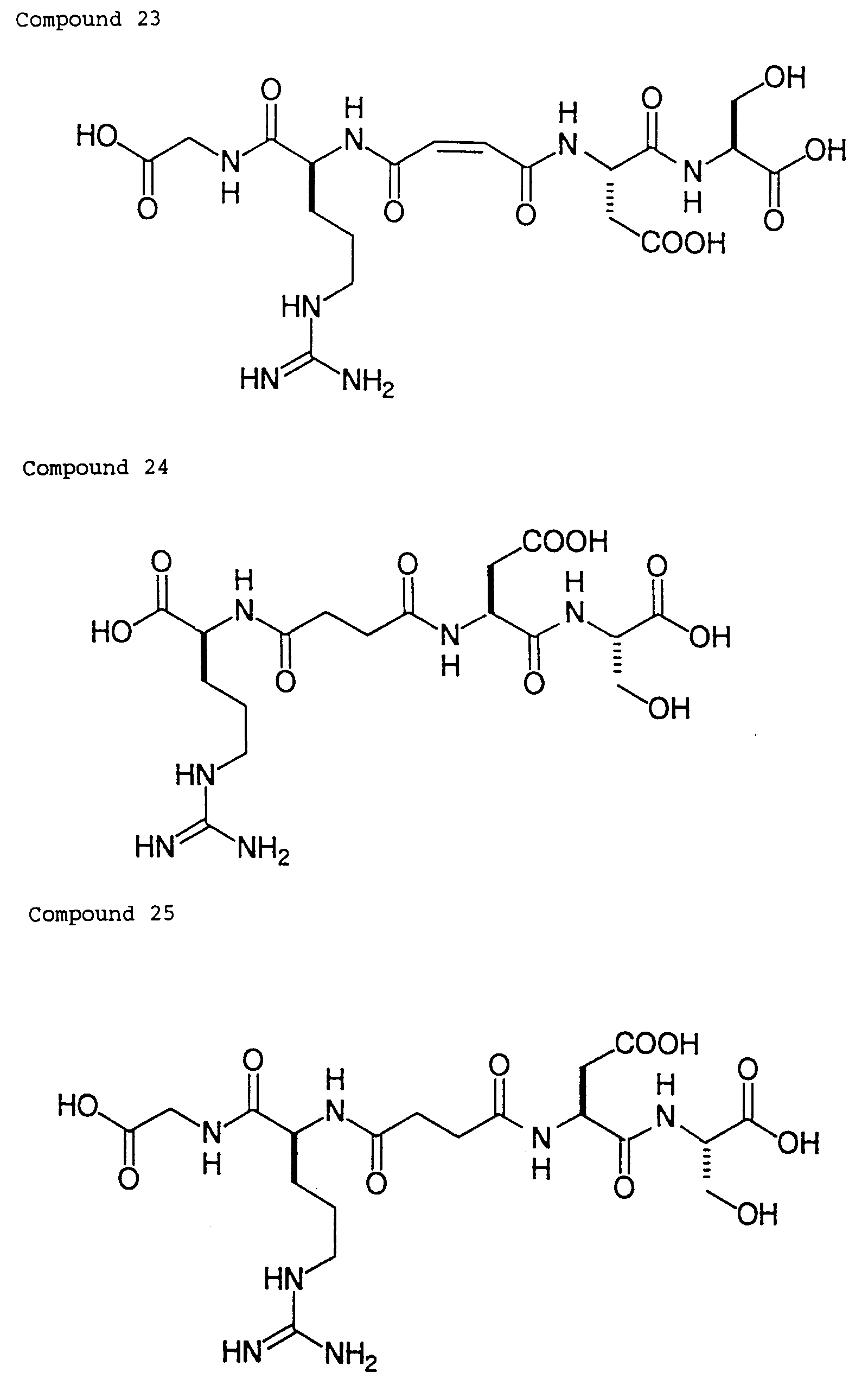


- Working examples of the preparation of the compounds of the present invention and the determination of their pharmaceutical activities will be shown below, but the present invention is not limited thereto.
- Malonic acid (1.0 g) and carbonyldiimidazole (3.2 g) were dissolved in chloroform, added with p-toluenesulfonic acid salt of Asp(OBzl)₂ (4.9 g), p-toluenesulfonic acid salt of Arg(NO₂) OBzl (4.8 g) and diisopropylethylamine (1.3 g) and stirred for 24 hours. The reaction mixture was washed with saturated aqueous solution of sodium hydrogen carbonate and 10 % aqueous solution of citric acid and the chloroform layer was dried over anhydrous sodium sulfate. The chloroform was evaporated under reduced pressure and the residue was subjected to silica gel chromatography to collect fractions of chloroform/methanol = 9/1, of which solvent was evaporated under reduced pressure to give a protected compound (600 mg).
- The obtained protected compound (600 mg) was dissolved in acetic acid (30 ml), added with 10% palladium carbon to carry out hydrogenolysis and catalytic hydrogen reduction under hydrogen atmosphere at 40 °C for 4 days. The reaction solution was filtered through a Celite layer to remove insolubles, the filtrate was concentrated under reduced pressure and the residue was recrystallized from acetic acid/ether to give 30 mg of Compound 1 (acetate)
FAB Mass (M-CH₃COO)⁺ 376 - Malonic acid (0.82 g) and p-toluenesulfonic acid salt of Asp(OBzl)₂ (3.88 g) were dissolved in tetrahydrofuran (20 ml), added with a solution of diphenylphosphorylazie (2.20 g) in tetrahydrofuran (10 ml) under ice cooling, added dropwise with triethylamine (1.64 g) and stirred for 20 minutes.
- Then, the reaction mixture was added with Arg(Mts)OBzl hydrochloride (3.86 g) and a solution of diphenylphosphorylazid e (2.2 g) in tetrahydrofuran (10 ml), added dropwise with triethylamine (1.64 g) and stirred for 10 hours. The reaction mixture was concentrated under reduced pressure and the residue was dissolved in ethyl acetate. The organic layer was washed with 10 % aqueous solution of citric acid and saturated aqueous solution of sodium hydrogen carbonate and dried over anhydrous sodium sulfate. The ethyl acetate was evaporated under reduced pressure and the residue was subjected to silica gel chromatography to collect ethyl acetate fractions, of which solvent was evaporated under reduced pressure to give a protected compound (1.58 g).
- The obtained protected compound (1.5 g) was dissolved in a solution of 1M-trifluoromethanesulfonic acid, thioanisole and m-cresol in trifluoroacetic acid (36 ml) under ice cooling, stirred for 1 hour. Then, the reaction mixture was poured into ether and decantation was carried out. The residue was dissolved in deionized water and the aqueous layer was washed with ether and chloroform and subjected to ion exchange treatment using Amberlite IRA-400 (hydrochloride) to give 360 mg of Compound 1 (hydrochloride)
- Purification and trans-salification of the obtained hydrochloride were carried out by subjecting it to liquid chromatography fractionation (ODS, eluent: 0.1% acetic acid) to give 160 mg of Compound 1 (acetate).
FAB Mass (M-CH₃COO)⁺ 376Elementary analysis (monoacetate) Calcd: H% 5.95; C% 39.72; N% 16.54 Found: H% 5.49; C% 39.59; N% 16.08
¹H-NMR (D₂O,δ ) 1.54-2.08 (m,4H), 2.10 (s,3H,AcOH), 2.86-2.98 (d,2H), 3.16-3.28 (dd,2H), 3.30-3.50 (dd,2H), 4.28-4.48 (dd,1H), 4.60-4.72 (dd,1H) - Malonic acid (1.1 g) was dissolved in tetrahydrofuran (10 ml), added with diphenylphosphorylazide (2.8 g) and stirred. Subsequently, the reaction mixture was added dropwise with a suspension of hydrochloride of Arg(Mts)OBzl (2.4 g) and N-methylmorpholine (1.0 g) in tetrahydrofuran (25 ml), stirred for 3 hours, added with N-methylmorpholine (1.5 g) and further stirred for 1 hour. The reaction mixture was concentrated under reduced pressure and the residue was dissolved in ethyl acetate, which was extracted with a saturated aqueous solution of sodium hydrogen carbonate. The aqueous layer, of which pH value was adjusted to 4 with citric acid, was extracted with ethyl acetate and the organic layer was dried over anhydrous sodium sulfate. The ethyl acetate was evaporated under reduced pressure to give malonic acid mono ( Nω-trimethylbenzenesulfonyl-L-arginine benzyl ester)amide (1.5 g, yield 60 %).
- The obtained malonic acid mono(Nω-trimethylbenzenesulfony l-L-arginine benzyl ester)amide (0.52 g) was dissolved in tetrahydrofuran, added with dicyclohexylcarbodiimide (0.21 g), stirred for 15 minutes under ice cooling, added with p-toluenesulfonic acid salt of Asp(OBzl)₂ (0.49 g) and N-methylmorpholine (0.12 g) in tetrahydrofuran/DMF mixture (4 ml) and stirred overnight. The reaction mixture was concentrated under reduced pressure and the residue was dissolved in ethyl acetate. The organic layer was washed with 10% citric acid and saturated aqueous solution of sodium hydrogen carbonate and dried over anhydrous sodium sulfate. The ethyl acetate was evaporated under reduced pressure and residue was subjected to silica gel chromatography to collect fractions of ethyl acetate, of which solvent was evaporated under reduced pressure to give a protected compound (0.68 g, yield: 78%).
- The obtained protected compound was dissolved in a solution of 1M-trifluoromethanesulfonic acid, thioanisole and m-cresol in trifluoroacetic acid (20 ml) under ice cooling and stirred for 1 hour. Then, the reaction mixture was poured into ether and decantation was carried out.
- The residue was dissolved in deionized water and the aqueous layer was washed with ether and chloroform and subjected to ion exchange treatment using Amberlite IRA-400 (hydrochloride) to give 0.22 mg of Compound 1 (hydrochloride).
FAB Mass (M-Cl)⁺ 376 - Malonic acid (11 g) was dissolved in tetrahydrofuran (100 ml), added with diphenylphosphorylazide (15.7 g) and stirred. Subsequently, the reaction mixture was added dropwise with a suspension of hydrochloride of Asp(OBzl)OBzl (20.0 g) and N-methylmorpholine (11.6 g) in tetrahydrofuran (25 ml), stirred for 6 hours, added with N-methylmorpholine (11.6 g) and further stirred for 12 hours. The reaction mixture was concentrated under reduced pressure and the residue was dissolved in ethyl acetate, which was extracted with a saturated aqueous solution of sodium hydrogen carbonate. The aqueous layer, of which pH value was adjusted to 4 with citric acid, was extracted with ethyl acetate and the organic layer was dried over anhydrous sodium sulfate. The ethyl acetate was evaporated under reduced pressure to give malonic acid mono(L-aspartic acid dibenzyl ester)amide (14.0 g).
- The obtained malonic acid mono(L-aspartic acid dibenzyl ester)amide (3.99 g) was dissolved in tetrahydrofuran (100 ml), added with diphenylphosphorylazide (2.75 g), stirred for 15 minutes under ice cooling, added with D-Arg(Tos)-OBzl hydrochloride (4.5 g) and N-methylmorpholine (1.00 g) and stirred overnight. The reaction mixture was concentrated under reduced pressure and the residue was dissolved in ethyl acetate. The organic layer was washed with 10% citric acid and saturated aqueous solution of sodium hydrogen carbonate and dried over anhydrous sodium sulfate. The ethyl acetate was evaporated under reduced pressure and the residue was subjected to silica gel chromatography to collect fractions of ethyl acetate, of which solvent was evaporated under reduced pressure to give a protected compound (3.89 g). The obtained protected compound (1.5 g) was dissolved in a solution of 1M-trifluoromethanesulfonic acid, thioanisole and m-cresol in trifluoroacetic acid (40 ml) under ice cooling and stirred for 1 hour. Then, the reaction mixture was poured into ether and decantation was carried out.
- The residue was dissolved in deionized water and the aqueous layer was washed with ether and chloroform and subjected to ion exchange treatment using Amberlite IRA-400 (hydrochloride) to give 0.85 mg of Compound 2 (hydrochloride).
- Purification and trans-salification of the obtained hydrochloride (200 mg) were carried out by subjecting it to liquid chromatography fractionation (ODS, eluent: 0.1% acetic acid) to give 120 mg of Compound 2 (acetate).
FAB Mass (M-CH₃COO)⁺ 376Elementary analysis (as monoacetate) Calcd: H% 5.95; C% 39.72; N% 16.54 Found: H% 5.48; C% 40.01; N% 17.00
¹H-NMR (D₂O,δ ) 1.54-2.08 (m,4H), 2.10 (s,3H,AcOH), 2.82-2.98 (d,2H), 3.15-3.28 (dd,2H), 3.40 (s,2H), 4.28-4.48 (dd,1H), 4.60-4.72 (dd,1H) - Maleic anhydride (0.98 g) and p-toluenesulfonic acid salt of Asp(OBzl)₂ (4.85 g) were dissolved in tetrahydrofuran (20 ml), added with N-methylmorpholine (1.01 g) and stirred for 1 hour.
- Subsequently, the reaction mixture was added with dicyclohexylcarbodiimie (2.06 g), Arg(Z)₂OBzl hydrochloride (4.82 g) and N-methylmorpholine (2.02 g) and stirred overnight. The reaction mixture was concentrated under reduced pressure and the residue was dissolved in ethyl acetate. The organic layer was washed with 10% citric acid and saturated aqueous solution of sodium hydrogen carbonate and dried over anhydrous sodium sulfate. The ethyl acetate was evaporated under reduced pressure and the residue was subjected to silica gel chromatography to collect fractions of chloroform/methanol = 95/5, of which solvent was evaporated under reduced pressure to give a protected compound (3.5 g).
- The obtained protected compound (0.35 g) was dissolved in a solution of 1M-trifluoromethanesulfonic acid, thioanisole and m-cresol in trifluoroacetic acid (15 ml) under ice cooling and stirred for 1 hour. Then, the reaction mixture was poured into ether and decantation was carried out. The residue was dissolved in deionized water and the aqueous layer was washed with ether and chloroform and subjected to ion exchange treatment using Amberlite IRA-400 (hydrochloride) and treatment with activated carbon and lyophilized to give 26 mg of Compound 3 (hydrochloride).
- Purification and trans-salification of the obtained acetate (26 mg) were carried out by subjecting it to liquid chromatography fractionation (ODS, eluent: 5% MeOH containing 0.1% acetic acid) to give 12 mg of Compound 3 (acetate).
FAB Mass (M-CH₃COO)⁺ 388
¹H-NMR (D₂O,δ ) 1.54-2.08 (m,4H), 2.10 (s,3H,AcOH), 2.82-2.92 (d,2H), 3.18-3.28 (dd,2H), 4.28-4.40 (m,1H), 4.60-4.72 (dd,1H), 6.30-6.38 (d,1H), 6.36-6.46 (d,1H) - The title compound was synthesized in the same manner as in Example 5 by using succinic anhydride. Liquid chromatography fractionation was carried out under the conditions of ODS, 5% MeOH (containing 0.1 % acetic acid).
FAB Mass (M-CH₃COO)⁺ 390
¹H-NMR (D₂O,δ ) 1.58-2.08 (m,4H), 2.10 (s,3H,AcOH), 2.62 (br s, 4H), 2.82-2.92 (d,2H), 3.18-3.28 (dd,2H), 4.28-4.40 (dd,1H), 4.60-4.72 (dd,1H) - The title compound was synthesized in the same manner as in Example 5 by using glutaric anhydride. Liquid chromatography fractionation was carried out under the conditions of ODS, 10% MeOH (containing 0.1 % acetic acid).
FAB Mass (M-CH₃COO)⁺ 404
¹H-NMR (D₂O,δ ) 1.58-2.08 (m+t,6H), 2.10 (s,3H,AcOH), 2.28-2.40 (t,4H), 2.82-2.92 (d,2H), 3.18-3.28 (dd,2H), 4.22-4.34 (m,1H), 4.60-4.78 (dd,1H) - The title compound was synthesized in the same manner as in Example 5 by using phthalic anhydride. Liquid chromatography fractionation was carried out under the conditions of ODS, 20% MeOH (containing 0.1 % acetic acid).
FAB Mass (M-CH₃COO)⁺ 438
¹H-NMR (D₂O,δ ) 1.58-2.08 (m,4H), 2.10 (s,3H,AcOH), 2.82-2.92 (d,2H), 3.20-3.28 (dd,2H), 4.22-4.34 (m,1H), 4.70-4.78 (dd,1H), 7.64 (s,4H) - Dimethylmalonic acid (264 mg) and diphenylphosphorylazide (1.10 g) were dissolved in dimethylformamide (10 ml) and stirred. Subsequently, the solution was added with p-toluenesulfonic acid salt of Asp(OBzl)₂ (970 mg), added dropwise with triethylamine (0.40 g) and stirred for 1 hour.
- Then, the solution was added with Arg(Z)₂OBzl hydrochloride (1.13 g), added dropwise with triethylamine (0.40 g) and stirred overnight. The reaction mixture was concentrated under reduced pressure and the residue was dissolved in ethyl acetate. The organic layer was washed with 10% aqueous solution of citric acid and saturated aqueous solution of sodium hydrogen carbonate and dried over anhydrous sodium sulfate. The ethyl acetate was evaporated under reduced pressure and the residue was subjected to silica gel chromatography to collect fractions of hexane/ethyl acetate = 8/2, of which solvent was evaporated under reduced pressure to give a protected compound (319 mg).
- The obtained protected compound (300 mg) was dissolved in a solution of 1M-trifluoromethanesulfonic acid, thioanisole and m-cresol in trifluoroacetic acid (8 ml) under ice cooling and stirred for 1 hour. Then, the reaction mixture was poured into ether and decantation was carried out. The residue was dissolved in deionized water, subjected to ion exchange treatment using Amberlite IRA-400 (hydrochloride) and treatment with activated carbon and lyophilized to give 25 mg of Compound 7 (hydrochloride).
- Purification and trans-salification of the obtained hydrochloride were carried out by subjecting it to liquid chromatography fractionation (ODS, eluent: 10% MeOH containing 0.1% acetic acid) to give 11 mg of Compound 7 (acetate).
FAB Mass (M-CH₃COO)⁺ 404
¹H-NMR (D₂O,δ ) 1.48-1.50 (d,6H), 1.58-2.14 (m,4H), 2.10 (s,3H, AcOH), 2.82-2.92 (d,2H), 3.18-3.28 (dd,2H), 4.22-4.40 (m,1H), 4.58-4.68 (dd,1H) - Boc-Asp(OBzl) (6.4g) was dissolved in tetrahydrofuran (30 ml), added with dicyclohexylcarbodiimide (4.1 g), hydroxybenzotriazole (3.0 g), methylamine hydrochloride (2.0 g) and diisopropylethylamine (3.9 g) under ice cooling and stirred for 10 hours. Insolubles were removed from the mixture by filtration and the filtrate was concentrated under reduced pressure. The residue was dissolved in ethyl acetate and the organic layer was washed with 10% aqueous solution of citric acid and saturated aqueous solution of sodium hydrogen carbonate and dried over anhydrous sodium sulfate. Then the ethyl acetate was evaporated under reduced pressure. The residue was recrystallized from ethyl acetate/hexane to give Boc-Asp(OBzl)-NHMe (3.9 g).
- Boc-Asp(OBsl)-NHMe (3.9 g) was dissolved in dioxane (20 ml), added with 4M-HCl dioxane solution (20 ml) and stirred for 1 hour at room temperature The reaction mixture was evaporated under reduced pressure and the residue was crystallized from ether to quantitatively give Asp(OBzl)-NHMe hydrochloride.
- In a similar manner, Asp(OBzl)-NHC₄H₉, Asp(OBzl)-NHC₈H₁₇, Asp(OBzl)-NHBzl and the like were synthesized.
- Boc-Arg(Mts) (13.7g) was dissolved in tetrahydrofuran (100 ml), added with dicyclohexylcarbodiimide (6.2 g), hydroxybenzotriazole (4.6 g), methylamine hydrochloride (3.0 g) and diisopropylethylamine (5.8) under ice cooling and stirred for 15 hours. Insolubles were removed from the mixture by filtration and the filtrate was concentrated under reduced pressure. The residue was dissolved in ethyl acetate and the organic layer was washed with 10% aqueous solution of citric acid and saturated aqueous solution of sodium hydrogen carbonate and dried over anhydrous sodium sulfate. Then, the ethyl acetate was evaporated under reduced pressure.
- The residue was dissolved in dioxane (20 ml), added with 4M-HCl dioxane solution (20 ml) and stirred for 1 hour at room temperature. The reaction mixture was evaporated under reduced pressure and the residue was crystallized from ether to give Arg(Mts)-NHMe hydrochloride (13.6 g).
- Boc-Arg(Z)₂ (5.5 g) was dissolved in tetrahydrofuran (100 ml), added with dicyclohexylcarbodiimide (2.1 g), octanol (1.3 g) and diisopropylethylamine (1.3 g) under ice cooling and stirred for 24 hours. Insolubles were removed from the mixture by filtration and the filtrate was concentrated under reduced pressure. The residue was dissolved in ethyl acetate and the organic layer was washed with 10% aqueous solution of citric acid and saturated aqueous solution of sodium hydrogen carbonate and dried over anhydrous sodium sulfate. Then the ethyl acetate was evaporated under reduced pressure.
- The residue was dissolved in dioxane (20 ml), added with 4M-HCl dioxane solution (20 ml) and stirred for 1 hour at room temperature. The reaction mixture was evaporated under reduced pressure and the residue was crystallized from ether to give Arg(Z)₂-OC₈H₁₇ hydrochloride (2.6 g).
- Malonic acid (0.38 g) and Asp(OBzl)-NHMe hydrochloride (0.95 g) were dissolved in dimethylformamide (5 ml), added with solution of diphenylphosphorylazide (0.97 g) and triethylamine (0.71 g) in tetrahydrofuran under ice cooling and stirred for 20 minutes.
- Then, the mixture was added with Arg(Z)₂OBzl hydrochloride (1.99 g) and solution of diphenylphosphorylazide (0.97 g) and triethylamine (0.71 g) in tetrahydrofuran (2 ml) and stirred overnight. The reaction mixture was concentrated under reduced pressure and the residue was dissolved in ethyl acetate and the organic layer was washed with 10% aqueous solution of citric acid and saturated aqueous solution of sodium hydrogen carbonate and dried over anhydrous sodium sulfate. The ethyl acetate was evaporated under reduced pressure and the residue was subjected to silica gel chromatography to collect fractions of chloroform/methanol = 95/5, of which solvent was evaporated under reduced pressure to give a protected compound (0.25 g).
- The protected compound (0.25 g) was dissolved in a solution of 1M-trifluoromethanesulfonic acid, thioanisole and m-cresol in trifluoroacetic acid (5 ml) under ice cooling and stirred for 1 hour. Then, the reaction mixture was poured into ether and decantation was carried out. The residue was dissolved in deionized water and subjected to ion exchange treatment using Amberlite IRA-400 (hydrochloride) and treatment with activated carbon and lyophilized to give 90 mg of Compound 8 (hydrochloride).
- Purification and trans-salification of the obtained acetate (26 mg) were carried out by subjecting it to liquid chromatography fractionation (ODS, eluent: 0.1% acetic acid) to give 11 mg of Compound 8 (acetate).
FAB Mass (M-CH₃COO)⁺ 389
¹H-NMR (D₂O,δ ) 1.58-2.14 (m,4H), 2.10 (s,3H,AcOH), 2.72 (s,3H), 2.82-2.92 (d,2H), 3.18-3.28 (dd,2H), 3.40 (s,2H), 4.22-4.40 (m,1H), 4.54-4.68 (dd, 1H) - Malonic acid (0.78 g) and diphenylphosphorylazide (4.13 g) were dissolved in tetrahydrofuran (10 ml) and added dropwise with a suspension of Asp(OBzl)-NHC₄H₉ hydrochloride (2.34 g) and N-methylmorpholine (2.27 g) over 4 hours. After stirring for 4 hours, the mixture was added with Arg(Mts)-OBzl hydrochloride (3.61 g) and N-methylmorpholine (0.75 g), stirred for 2 hours, added with diphenylphosphorylazide (2.07 g) and N-methylmorpholine (0.75 g) and stirred for twenty four hours.
- The reaction mixture was evaporated under reduced pressure and the residue was dissolved in ethyl acetate and washed with 10% aqueous solution of citric acid and saturated aqueous solution of sodium hydrogen carbonate. The organic layer was dried over anhydrous sodium sulfate and the ethyl acetate was evaporated under reduced pressure. The residue was subjected to silica gel chromatography to collect fractions of chloroform/methanol = 9/1, of which solvent was evaporated under reduced pressure to give a protected compound (0.48 g).
- The protected compound (0.65 g) was dissolved in a solution of 1M-trifluoromethanesulfonic acid, thioanisole and m-cresol in trifluoroacetic acid (24 ml) under ice cooling and stirred for 1 hour. Then, the reaction mixture was poured into ether and decantation was carried out. The residue was dissolved in deionized water and subjected to ion exchange treatment using Amberlite IRA-400 (hydrochloride) and treatment with activated carbon and lyophilized to give 90 mg of Compound 9 (hydrochloride).
FAB Mass (M-Cl)⁺ 431
¹H-NMR (D₂O,δ ) 0.88 (t,3H), 1.28 (m,2H), 1.38-2.14 (m,6H), 2.80-2.90 (2H), 3.20-3.28 (2H), 3.40-3.52 (4H), 4.22-4.40 (1H), 4.54-4.68 (1H) - The title compound was synthesized in the same manner as Example 14 by using Asp(OBzl)-NHC₈H₁₇ hydrochloride.
FAB Mass (M-Cl)⁺ 487
¹H-NMR (CDCl₃+D₂O,δ ) 0.88(t,3H), 1,28 (s,10H), 1.38-2.14 (m,6H), 2.90-3.00 (2H), 3.16-3.29 (2H), 3.40-3.52 (4H), 4.28-4.51 (1H) - The title compound was synthesized in the same manner as Example 14 by using Asp(OBzl)-NH-Bzl hydrochloride.
FAB Mass (M-Cl)⁺ 465
¹H-NMR (D₂O,δ ) 1.54-2.08 (m,4H), 2.10 (s,3H,AcOH), 2.82-2.98 (d,2H), 3.15-3.28 (dd,2H), 3.40 (s,2H), 4.28-4.48 (dd,1H), 4.60-4.72 (dd,1H), 7.36 (s,5H) - Malonic acid (0.82 g), p-toluenesulfonic acid salt of Asp(OBzl) (3.9 g) was dissolved in dimethylformamide (20 ml), added with diphenylphosphorylazide (2.2 g) and triethylamine (1.6 g) under ice cooling and stirred for 20 minutes.
- Then, the mixture was added with Arg(Mts)-NHMe hydrochloride (2.7 g) and then with diphenylphosphorylazide (2.2 g) and triethylamine (1.6 g) and stirred overnight. The reaction mixture was concentrated under reduced pressure and the residue was dissolved in ethyl acetate. The organic layer was washed with 10% aqueous solution of citric acid and saturated aqueous solution of sodium hydrogen carbonate and dried over anhydrous sodium sulfate. The ethyl acetate was evaporated under reduced pressure and the residue was subjected to silica gel chromatography to collect fractions of chloroform/methanol = 95/5, of which solvent was evaporated under reduced pressure to give a protected compound (0.82 g).
- The protected compound (0.30 g) was dissolved in a solution of 1M-trifluoromethanesulfonic acid, thioanisole and m-cresol in trifluoroacetic acid (5 ml) under ice cooling and stirred for 1 hour. Then, the reaction mixture was poured into ether and decantation was carried out. The residue was dissolved in deionized water and subjected to ion exchange treatment using Amberlite IRA-400 (hydrochloride) and treatment with activated carbon and lyophilized to give 100 mg of Compound 12 (hydrochloride).
- Purification and trans-salification of the obtained hydrochloride were carried out by subjecting it to liquid chromatography fractionation (ODS, eluent: 0.1% acetic acid) to give 45 mg of Compound 12 (acetate).
FAB Mass (M-CH₃COO)⁺ 389
¹H-NMR (D₂O,δ ) 1.58-2.14 (m,4H), 2.10 (s,3H,AcOH), 2.72 (s,3H), 2.82-2.98 (d,2H), 3.12-3.28 (dd,2H), 3.40 (s,2H), 4.22-4.40 (m,1H), 4.70-4.88 - Malonic acid (1.0 g) and dicyclohexylcarbodiimide (2.1 g) were dissolved in chloroform, added with p-toluenesulfonic acid salt of Asp(OBzl)₂ (4.9 g), trifluoroacetic acid salt of Arg(Z)₂OC₈H₁₇ (6.7 g) and diisopropylethylamine (1.3 g) and stirred twenty four hours. The reaction mixture was washed with 10% aqueous solution of citric acid and saturated aqueous solution of sodium hydrogen carbonate and the chloroform layer was dried over anhydrous sodium sulfate. The chloroform was evaporated under reduced pressure and the residue was subjected to silica gel chromatography to collect fractions of chloroform/methanol = 9/1, of which solvent was evaporated under reduced pressure to give a protected compound (420 mg).
- The obtained protected compound (400 mg) was dissolved in acetic acid (30 ml) and added with 10% palladium carbon and hydrogenolysis was carried out at 40°C for 2 days under hydrogen atmosphere. The reaction mixture was filtered through a Celite layer to remove insolubles and the filtrate was concentrated under reduced pressure. The residue was recrystallized from acetic acid/ether to give 120 mg of Compound 13 (acetate).
FAB Mass (M-Cl)⁺ 488
¹H-NMR (CDCl₃+D₂O,δ ) 0.88 (t,3H), 1.28 (s,10H), 1.38-2.14 (m,6H), 2.90-3.00 (2H), 3.16-3.29 (2H), 3.36-3.50 (4H), 4.12-4.51 (2H) - Malonic acid (0.73 g) and Asp(OBzl)-NHMe hydrochloride (1.90 g) were dissolved in dimethylformamide (20 ml), added with diphenylphosphorylazide (1.93 g) and triethylamine (1.42 g) under ice cooling and stirred for 20 minutes.
- Then, the mixture was added with Arg(Mts)-NHMe hydrochloride (2.4 g) and then with diphenylphosphorylazide (1.93 g) and triethylamine (0.71 g) and stirred overnight. The reaction mixture was concentrated under reduced pressure and the residue was dissolved in ethyl acetate. The organic layer was washed with 10% aqueous solution of citric acid and saturated aqueous solution of sodium hydrogen carbonate and dried over anhydrous sodium sulfate. The ethyl acetate was evaporated under reduced pressure and the residue was subjected to silica gel chromatography to fractions of collect ethyl acetate/methanol = 85/15. The solvent of the fractions was evaporated under reduced pressure and the residue was again subjected to silica gel chromatography to collect fractions of ethyl chloroform/methanol = 8/2. The solvent of the fractions was evaporated under reduced pressure and the residue was recrystallized from methanol/ether and acetonitrile/ether to give a protected compound (0.36 g).
- The protected compound (0.35 g) was dissolved in a solution of 1M-trifluoromethanesulfonic acid, thioanisole and m-cresol in trifluoroacetic acid (2.6 ml) with ice cooling and stirred for 1 hour. Then, the reaction mixture was poured into ether and decantation was carried out. The residue was dissolved in deionized water and subjected to ion exchange treatment using Amberlite IRA-400 (hydrochloride) and treatment with activated carbon and lyophilized to give 52 mg of Compound 14 (hydrochloride).
- The obtained hydrochloride was purified by liquid chromatography fractionation (ODS, eluent: 0.1% acetic acid) to give 28 mg of Compound 14 (acetate).
FAB Mass (M-CH₃COO)⁺ 402
¹H-NMR (D₂O,δ ) 1.50-2.04 (m,4H), 2.10 (s,3H,AcOH), 2.70-2.88 (dd+s,8H), 3.16-3.24 (dd,2H), 3.40 (s,2H), 4.22-4.40 (dd,1H), 4.60-4.68 (dd,1H) - Boc-Asp(OBzl) (25.2g) was dissolved in tetrahydrofuran (400 ml), added with dicyclohexylcarbodiimide (17.7 g), hydroxybenzotriazole (11.93 g), Ser(Bzl)-OBzl hydrochloride (31.1 g) and diisopropylethylamine (10.1 g) with ice cooling and stirred for 24 hours. Insolubles were removed from the mixture by filtration and the filtrate was concentrated under reduced pressure. The residue was dissolved in ethyl acetate and the organic layer was washed with 10% aqueous solution of citric acid and saturated aqueous solution of sodium hydrogen carbonate and dried over anhydrous sodium sulfate. Then the ethyl acetate was evaporated under reduced pressure.
- The residue was subjected to silica gel chromatography to collect fractions of hexane/ethyl acetate = 7/3 to obtain Boc-Asp(OBzl)-Ser(Bzl)-OBzl (42.1g).
- Boc-Asp(OBzl)-Ser(Bzl)-OBzl (42.1 g) was dissolved in dioxane (100 ml), added with a solution of 4M-HCl/dioxane (150 ml) and stirred for 1 hour at room temperature. The reaction mixture was evaporated under reduced pressure and the residue was crystallized from ether to give Asp(OBzl)-Ser(Bzl)-OBzl hydrochloride (33.7 g).
- Similarly, by using dicyclohexylcarbodiimide as a condensing agent, Asp(OBzl)-D-Phe-OBzl hydrochloride, Asp(OBzl)-D-Glu-NHMe hydrochloride, Asp(OBzl)-D-Asp-OBzl hydrochloride, Arg(Mts)-Arg(Mts)-OBzl hydrochloride and Arg(Mts)-Gly-OBzl hydrochloride were prepared.
- Malonic acid (4.16 g) and hydroxybenzotriazole (1.53 g) were dissolved in tetrahydrofuran (150 ml) and added with dicyclohexylcarbodiimide (2.47 g) with stirring and ice cooling. After stirring for 30 minutes, the mixture was added dropwise with a suspension of Asp(OBzl)-Ser(Bzl)-OBzl hydrochloride (5.25 g) and N-methylmorpholine (2.02 g) in tetrahydrofuran (100 ml) over 1.5 hours. After completion of the addition, the mixture was further added with dicyclohexylcarbodiimide (0.52 g) and stirred overnight. After removing insolubles, the solvent was evaporated under reduced pressure. The residue was dissolved in ethyl acetate and the organic layer was washed with 10% aqueous solution of citric acid and deionised water and dried over anhydrous sodium sulfate. The ethyl acetate was evaporated under reduced pressure, the residue was dissolved in toluene and the toluene was evaporated under reduced pressure. The residue was dissolved in tetrahydrofuran, added with dicyclohexylcarbodiimide (2.06 g), hydroxybenzotriazole (1.53 g), Arg(Mts)-OBzl hydrochloride (4.83 g) and N-methylmorpholine (2.02 g) and stirred overnight. Insolubles were removed by filtration and the filtrate was evaporated under reduced pressure. The residue was dissolved in ethyl acetate and the organic layer was washed with 10% aqueous solution of citric acid and saturated aqueous solution of sodium hydrogen carbonate and dried over anhydrous sodium sulfate. The ethyl acetate was evaporated under reduced pressure and the residue was subjected to silica gel chromatography to collect ethyl acetate fractions. The solvent of the fractions was evaporated under reduced pressure to give a protected compound (3.1 g).
- The protected compound (1.5 g) was dissolved in a solution of 1M-trifluoromethanesulfonic acid, thioanisole and m-cresol in trifluoroacetic acid (36 ml) with ice cooling and stirred for 1 hour. Then, the reaction mixture was poured into ether and decantation was carried out. The residue was dissolved in deionized water and the aqueous layer was washed with ether and chloroform and subjected to ion exchange treatment using Amberlite IRA-400 (hydrochloride) to give 220 mg of Compound 15 (hydrochloride).
- Purification and trans-salification of the obtained hydrochloride were carried out by subjecting it to liquid chromatography fractionation (ODS, eluent: 0.1% acetic acid) to give 120 mg of Compound 15 (acetate).
FAB Mass (M-CH₃COO)⁺ 463
¹H-NMR (D₂O,δ ) 1.54-2.08 (m,4H), 2.10 (s,3H,AcOH), 2.82-2.94 (dd,2H), 3.15-3.28 (dd,2H), 3.34-3.56 (dd,2H), 3.90-3.94 (dd,2H), 4.28-4.36 (dd, 1H), 4.36-4.44 (dd,1H) - The title compound was synthesized in the same manner as Example 15 by using Asp(OBzl)-D-Phe-OBzl hydrochloride.
- Chloroform/methanol = 97.5/2.5 was used as the eluent for the silica gel chromatography purification of the protected compound and 3% MeOH containing 0.1 % acetic acid was used as the eluent for the liquid chromatography fractionation and purification of the final product.
FAB Mass (M-CH₃COO)⁺ 523
¹H-NMR (D₂O,δ ) 1.54-2.08 (m,4H), 2.10 (s,3H,AcOH), 2.62-2.70 (dd,2H), 2.90-3.38 (ddd,2H), 3.15-3.28 (dd,2H), 3.38-3.48 (dd,2H), 4.28-4.36 (dd,1H), 4.56-4.68 (dd,1H) - The title compound was synthesized in the same manner as Example 15 by using Asp(OBzl)-D-Asp(OBzl)-NHMe hydrochloride.
- Chloroform/methanol = 95/5 was used as the eluent for the silica gel chromatography purification of the protected compound and 3% MeOH containing 0.1 % acetic acid was used as the eluent for the liquid chromatography fractionation and purification of the final product.
FAB Mass (M-CH₃COO)⁺ 504
¹H-NMR (D₂O,δ ) 1.58-2.04 (m,4H), 2.10 (s,3H,AcOH), 2.72 (s,3H), 2.80-2.94 (dd,4H), 3.15-3.28 (dd,2H), 3.32-3.54 (dd,2H), 4.28-4.36 (dd,2H) - The title compound was synthesized in the same manner as Example 23 by using Asp(OBzl)-D-Glu(OBzl)-NHMe hydrochloride.
- Chloroform/methanol = 95/5 was used as the eluent for the silica gel chromatography purification of the protected compound and 5% MeOH containing 0.1 % acetic acid was used as the eluent for the liquid chromatography fractionation and purification of the final product.
FAB Mass (M-CH₃COO)⁺ 518
¹H-NMR (D₂O,δ ) 1.58-2.04 (m,4H), 2.10 (s,3H,AcOH), 2.42-2.50 (dd,2H), 2.54-2.78 (dd+s,5H), 2.80-2.90 (dd,2H), 3.15-3.28 (dd,2H), 3.38-3.44 (d,2), 4.22-4.36 (m,2H), 4.60-4.68 (dd,1H) - Malonic acid (4.16 g) and hydroxybenzotriazole (1.53 g) were dissolved in tetrahydrofuran (150 ml) and added with dicyclohexylcarbodiimide (2.47 g) with stirring and ice cooling. After stirring for 30 minutes, the mixture was added dropwise with a suspension of p-toluenesulfonic acid salt of Asp(OBzl)-OBzl (4.85 g) and N-methylmorpholine (2.02 g) in tetrahydrofuran (100 ml) over 1.5 hours. After completion of the addition, the mixture was further added with dicyclohexylcarbodiimide (0.52 g) and stirred overnight. After removing insolubles, the solvent was evaporated under reduced pressure. The residue was dissolved in ethyl acetate and the organic layer was washed with 10% aqueous solution of citric acid and deionized water and dried over anhydrous sodium sulfate. The ethyl acetate was evaporated under reduced pressure. Then, the residue was dissolved in toluene and the toluene was evaporated under reduced pressure. The residue was dissolved in tetrahydrofuran, added with dicyclohexylcarbodiimide (2.06 g), hydroxybenzotriaz ole (1.53 g), Arg(Mts)-Gly-OBzl hydrochloride (5.39 g), N-methylmorpholine (2.02 g) and stirred overnight. Insolubles were removed by filtration and the filtrate was evaporated under reduced pressure. The residue was dissolved in ethyl acetate and the organic layer was washed with 10% aqueous solution of citric acid and saturated aqueous solution of sodium hydrogen carbonate and dried over anhydrous sodium sulfate. The ethyl acetate was evaporated under reduced pressure and the residue was subjected to silica gel chromatography to collect fractions of chloroform/methanol = 95/5. The solvent of the fractions was evaporated under reduced pressure to give a protected compound (2.33 g).
- The obtained protected compound (2.00 g) was dissolved in a solution of 1M-trifluoromethanesulfonic acid, thioanisole and m-cresol in trifluoroacetic acid (45 ml) with ice cooling and stirred for 1 hour. Then, the reaction mixture was poured into ether and decantation was carried out. The residue was dissolved in deionized water and the aqueous layer was washed with ether and chloroform and subjected to ion exchange treatment using Amberlite IRA-400 (hydrochloride) to give 450 mg of Compound 19 (hydrochloride).
- Purification and trans-salification of the obtained hydrochloride were carried out by subjecting it to liquid chromatography fractionation (ODS, eluent: 10% MeOH containing 0.1% acetic acid) to give 170 mg of Compound 19 (acetate).
FAB Mass (M-CH₃ COO)⁺ 433
¹H-NMR₂ (D₂O,δ ) 1.54-2.08 (m,4H), 2.10 (s,3H,AcOH), 2.86-2.98 (d,2H), 3.16-3.28 (m,2H), 3.30-3.50 (d,2H), 3.98 (s,2H), 4.28-4.48 (m,1H), 4.60-4.72 (m,1H) - The title compound was synthesized in the same manner as Example 25 by using Asp(OBzl)-Ser(Bzl)-OBzl hydrochloride and Arg(Mts)-Gly-OBzl hydrochloride.
- Chloroform/methanol = 95/5 was used as the eluent for the silica gel chromatography purification of the protected compound and 10% MeOH containing 0.1 % acetic acid was used as the eluent for the liquid chromatography fractionation and purification of the final product.
FAB Mass (M-CH₃COO)⁺ 520
¹H-NMR₂ (D₂O,δ ) 1.54-2.08 (m,4H), 2.10 (s,3H,AcOH), 2.82-2.94 (dd,2H), 3.15-3.28 (m,2H), 3.34-3.56 (m,2H), 3.90-4.02 (m,4H), 4.26-4.35 (m,1H), 4.35-4.46 (m,1H) - The title compound was synthesized in the same manner as Example 25 by using Asp(OBzl)-Ser(Bzl)-OBzl hydrochloride and Arg(Mts)-Arg(Mts)-OBzl hydrochloride.
- Chloroform/methanol = 95/5 was used as the eluent for the silica gel chromatography purification of the protected compound and 20% MeOH containing 0.1 % acetic acid was used as the eluent for the liquid chromatography fractionation and purification of the final product.
FAB Mass (M-CH₃COO)⁺ 619
¹H-NMR₂ (D₂O,δ ) 1.52-2.12 (m,8H), 2.10 (s,3H,AcOH), 2.80-3.00 (m,2H), 3.12-3.60 (m,6H), 3.90-3.94 (m,2H), 4.28-4.35 (m,2H), 4.35-4.44 (m,1H) - Maleic anhydride (0.98 g) and Asp(OBzl)-Ser(Bzl)-OBzl hydrochloride (5.26 g) were dissolved in tetrahydrofuran (20 ml), added with N-methylmorpholine (1.01 g) and stirred for 1 hour.
- Subsequently, the reaction mixture was added with dicyclohexylcarbodiimide (2.06 g), Arg(Mts)OBzl hydrochloride (4.82 g) and N-methylmorpholine (2.02 g) and stirred overnight. The reaction mixture was concentrated under reduced pressure and the residue was dissolved in ethyl acetate and the organic layer was dried over anhydrous sodium sulfate. The ethyl acetate was evaporated under reduced pressure and the residue was subjected to silica gel chromatography to collect fractions of chloroform/methanol = 95/5, of which solvent was evaporated under reduced pressure to give a protected compound (6.34 g).
- The protected compound (1.00 g) was dissolved in a solution of 1M-trifluoromethanesulfonic acid, thioanisole and m-cresol in trifluoroacetic acid (20 ml) under ice cooling and stirred for 1 hour. Then, the reaction mixture was poured into ether and decantation was carried out. The residue was dissolved in deionized water and subjected to ion exchange treatment using Amberlite IRA-400 (hydrochloride) and treatment with activated carbon and lyophilized to give 370 mg of Compound 22 (hydrochloride).
FAB Mass (M-Cl)⁺ 475
¹H-NMR (D₂O,δ ) 1.54-2.08 (m,4H), 2.10 (s,3H,AcOH), 2.82-2.94 (dd,2H), 3.15-3.28 (dd,2H), 3.90-3.94 (dd,2H), 4.28-4.36 (dd,1H), 4.36-4.44 (dd,1H), 6.30-6.38 (d,1H), 6.38-6.46 (d,1H) - The title compound was synthesized in the same manner as Example 28 by using Arg(Mts)-Gly-OBzl hydrochloride.
FAB Mass (M-Cl)⁺ 532 - The title compound was synthesized in the same manner as Example 28 by using succinic anhydride.
FAB Mass (M-Cl)⁺ 477
¹H-NMR (D₂O,δ ) 1.54-2.08 (m,4H), 2.10 (s,3H,AcOH), 2.62 (brs,4H), 2.82-2.94 (dd,2H), 3.15-3.28 (dd,2H), 3.90-3.94 (dd,2H), 4.28-4.36 (dd,1H), 4.36-4.44 (dd,1H) - The title compound was synthesized in the same manner as Example 28 by using succinic anhydride and Arg(Mts)-Gly-OBzl hydrochloride.
FAB Mass (M-Cl)⁺ 447 - The title compound was synthesized in the same manner as Example 1 by using Lys(Z)-OBzl hydrochloride.
FAB Mass (M-CH₃COO)⁺ 348 - The title compound was synthesized in the same manner as Example 1 by using p-toluenesulfonic acid salt of Glu(OBzl)₂.
FAB Mass (M-CH₃COO)⁺ 390 - Synthesis of ethylenediamine monomethacrylic acid amide Ethylenediamine (6.0 g) was dissolved in tetrahydrofuran (100 ml) and added with methacrylic acid hydroxysuccinimide ester (16.9 g). Subsequently, the mixture was added with Boc anhydride (21.8 g) and added dropwise with a solution of diisopropylethylamine (12.9 g) in dimethylformamide (100 ml). After stirring overnight, the solvent was evaporated under reduced pressure and the residue was dissolved in ethyl acetate. The organic layer was washed with 10 % aqueous solution of citric acid and dried over anhydrous sodium sulfate. The solvent was evaporated under reduced pressure and the residue was subjected to silica gel chromatography to collect fractions of dichloromethane/ethyl acetate = 1/1 and the eluent was evaporated under reduced pressure.
- Then, the residue was dissolved in dioxane (50 ml) and the Boc group was removed by adding a solution of 4M-hydrochloric acid in dioxane (50 ml) to give ethylenediamine monomethacrylic acid amide hydrochloride (4.0 g)
- Boc-Asp(OBzl) (12.9g) was dissolved in tetrahydrofuran (100 ml) and added with N-methylmorpholine (4.0 g) and isobutyl chloroformate (5.44 g) with cooling at -10 °C. After stirring for 15 minutes, the mixture was added with ethylenediamine monomethacrylic acid hydrochloride (4.0 g) and N-methylmorpholine (3.0 g ) and stirred. One hour later, the solvent was evaporated under reduced pressure and the residue was dissolved in chloroform. The organic layer was washed with saturated aqueous solution of sodium hydrogen carbonate and 10% aqueous solution of citric acid and dried over sodium sulfate. The solvent was evaporated under reduced pressure and the residue was subjected to silica gel chromatography to collect fractions of dichloromethane/ethyl acetate = 25/75 to give N-Boc- β-benzyloxy-L-aspartylaminoethylaminocarbonyl-2-methylethene (3.3 g). N-Boc-β-benzyloxy-L-aspartylaminoethyla minocarbonyl-2-methylethene (3.3 g) was dissolved in dioxane (50 ml) and the Boc group was removed by adding 4M-hydrochloric acid solution in dioxane (50 ml) to give β -benzyloxy-L-aspartylaminoethylaminocarbonyl-2-methylethene (2.9 g).
- Malonic acid (2.05 g) and diphenylphosphorylazide (5.5 g) was dissolved in tetrahydrofuran (50 ml) and stirred. The mixture was added dropwise with Arg(Mts)-OBzl hydrochloride (4.83 g) and a suspension of N-methylmorpholine (3.03 g) in tetrahydrofuran (100 ml). The reaction mixture was added with N-methylmorpholine (2.02 g) so that the mixture have a pH of 7, stirred for 6 hours, added with diphenylphosphorylazide (2.75 g) and diisopropylethylamine (1.29 g) and allowed to react overnight. The reaction mixture was concentrated under reduced pressure and the residue was dissolved in ethyl acetate. The organic layer was washed with a saturated aqueous solution of sodium hydrogen carbonate and 10% aqueous solution of citric acid and dried over sodium sulfate to give HOOC-CH₂-CO-Arg(Mts)-OBzl (4.4g).
- HOOC-CH₂-CO-Arg(Mts)-OBzl (4.4g), β -benzyloxy-L-aspartylaminoethylaminocarbonyl-2-methylketene (2.3 g) and diphenylphosphorylazide (3.6 g) were dissolved in dimethylformamide (100 ml) and added dropwise with N-methylmorpholine (2.4 g) at room temperature. After stirring overnight, the reaction mixture was concentrated under reduced pressure and the residue was dissolved in ethyl acetate. The organic layer was washed with 10% aqueous solution of citric acid and a saturated aqueous solution of sodium hydrogen carbonate and dried over sodium sulfate and the solvent was evaporated. The residue was subjected to silica gel chromatography to collect fractions of dichloromethane/methanol = 95/5 to give a protected compound (0.84 g).
- The protected compound (0.84 g) was dissolved in a solution of 1M-trifluoromethanesulfonic acid, thioanisole and m-cresol in trifluoroacetic acid (25 ml) with ice cooling and stirred for 1 hour. Then, the reaction mixture was poured into ether and decantation was carried out. The residue was dissolved in deionized water, subjected to ion-exchange treatment using Amberlite IRA-400 (hydrochloride) and lyophilized to give L-arginyl-malonyl-L-aspartylaminoethylamino carbonyl-2-methylethene (0.43 mg).
- L-arginyl-malonyl-L-aspartylaminoethylaminocarbonyl-2-methylethene (0.43 mg) was dissolved in nitrogen-substituted pure water (10 ml) and added with 10% aqueous solution of ammonium persulfate (0.5 ml) and 10% aqueous solution of sodium bisulfite (0.5 ml). Then, polymerization was carried out for 3 hours. Furthermore, the mixture was added with 10% aqueous solution of ammonium persulfate (0.5 ml) and 10% aqueous solution of sodium bisulfite (0.5 ml) and allowed to react for 3 hours. The reaction mixture was dialyzed against pure water using Spectrapore 6 (cut off: molecular weight of less than 3500) and lyophilized to give Compound 28 (250 mg).
Amino acid analysis (in 68 µg of the polymer)
Arg 27.5 nmol, Asp 22.3 nmol - Boc-Asp(OBzl) (0.97 g), triethylamine (0.31 g) and allyl bromide (0.36 g) were dissolved in ethyl acetate (50 ml) and stirred for 3 hours under reflux condition. Then, the mixture was further added with allyl bromide (0.72 g) and stirred under reflux condition for 3 hours and then at room temperature overnight. The reaction mixture was evaporated under reduced pressure and the residue was dissolved in ethyl acetate. The organic layer was washed with 0.1M aqueous solution of citric acid and a saturated aqueous solution of sodium hydrogen carbonate and dried over sodium sulfate.
- The ethyl acetate was evaporated under reduced pressure and the residue was subjected to silica gel chromatography to collect fractions of hexane/ethyl acetate = 7/3 to give is N-Boc- β -benzyloxy-L-aspartic acid allyl ester (0.72 g). N-Boc-β -benzyloxy-L-aspartic acid allyl ester (0.72 g) was dissolved in dioxane (15 ml) and the Boc group was removed by adding 15 ml of 4M-hydrochloric acid solution in dioxane to give β - benzyloxy-L-aspartic acid allyl ester hydrochloride (0.40 g).
- Malonic-acid (0.14 g), β-benzyloxy-L-aspartic acid allyl ester (0.40 g) and N-methylmorpholine (0.40 g) were dissolved in tetrahydrofuran (10 ml) and added dropwise with a solution of diphenylphosphorylazide (0.37 g) in tetrahydrofuran (10 ml) with stirring.
- After stirring for 5 hours at room temperature, the mixture was added with diphenylphosphorylazide (0.37 g), Arg(Mts)-OBzl hydrochloride (0.65 g) and N-methylmorpholine (0.14 g) and stirred overnight. The reaction mixture was evaporated under reduced pressure and the residue was dissolved in ethyl acetate and washed with 0.1M aqueous solution of citric acid and a saturated aqueous solution of sodium hydrogen carbonate. The organic layer was dried over sodium sulfate. The ethyl acetate was evaporated under reduced pressure and the residue was subjected to silica gel chromatography to collect fractions of dichloromethane/methanol = 97.5/2.5 to give α - benzyloxy-Nω -trimethylbenzenesulfonyl-L-arginyl-malonyl-β - benzyloxy-L-aspartic acid allyl ester (0.18 g).
- Subsequently, the obtained allyl ester (0.083 g) was dissolved in tetrahydrofuran (1 ml), added with tetrakis(phenylphosphine)palladium (0.011 mg) and stirred, added with morpholine (0.086 g) and allowed to react overnight. The reaction mixture was evaporated under reduced pressure and the residue was dissolved in ethyl acetate. The organic layer was washed with 0.1M aqueous solution of citric acid and subsequently with a saturated aqueous solution of sodium hydrogen carbonate and dried over sodium sulfate. The ethyl acetate was evaporated to give α -benzyloxy-Nω - trimethylbenzenesulfonyl-L-arginyl-malonyl-β -benzyloxy-L-aspartic acid (0.020 g).
- α -benzyloxy-Nω -trimethylbenzenesulfonyl-L-arginylmalonyl-β-benzyloxy-L-aspartic acid (1.38 g) was dissolved in tetrahydrofuran (50 ml), added with carbonyldiimidazole (0.32 g) and then with Nα -Boc-L-lysine benzyl ester (0.60 g) and stirred overnight. The reaction mixture was evaporated under reduced pressure and the residue was dissolved in ethyl acetate. The organic layer was washed with 0.1M aqueous solution of citric acid and subsequently with a saturated aqueous solution of sodium hydrogen carbonate and dried over sodium sulfate.
- The ethyl acetate was evaporated and the residue was subjected to silica gel chromatography to collect fractions of dichloromethane/methanol = 95/5 to give N α -Boc-Nω -(α - benzyloxy-Nω -trimethylbenzenesulfonyl-L-arginyl-malonyl-β - benzyloxy-L-aspartyl)-L-lysine benzyl ester (0.98 g). The protected compound (0.98 g) was dissolved in dioxane (20 ml) and the Boc group was removed by adding 25 ml of 4M-hydrochloric acid solution in dioxane to give Nω -(α -benzyloxy-Nω - trimethylbenzenesulfonyl-L-arginyl-malonyl-β -benzyloxy-L-aspartyl)-L-lysine benzyl ester hydrochloride (0.86 g).
- Trimesic acid chloride (0.13 mg), Nω -(α -benzyloxy-Nω - trimethylbenzenesulfonyl-L-arginyl-malonyl-β -benzyloxy-L-aspartyl)-L-lysine benzyl ester hydrochloride (1.49 g) and triethylamine (0.16 g) were dissolved in tetrahydrofuran and stirred overnight. The reaction mixture was evaporated under reduced pressure and the residue was dissolved in ethyl acetate. The organic layer was washed with 0.1M aqueous solution of citric acid and subsequently with a saturated aqueous solution of sodium hydrogen carbonate and dried over sodium sulfate. The ethyl acetate was evaporated and the residue was again dissolved in ethyl acetate and added with a suitable amount of hexane to give a precipitate (1.3 g). The obtained precipitate was dissolved in a solution of 1M-trifluoromethanesulfonic acid, thioanisole and m-cresol in trifluoroacetic acid (30 ml) under ice cooling and stirred for 1 hour. Then, the reaction mixture was poured into ether and decantation was carried out. The residue was dissolved in deionized water and the aqueous layer was washed with ether and chloroform, subjected to ion exchange treatment using Amberlite IRA-400 (hydrochloride) and lyophilized to give 0.32 g of Compound 29.
Amino acid analysis (in 13 µg of the polymer)
Arg: 20.2 nmol, Asp: 23.3 nmol, Lys: 22.9 nmol - Carbonyldiimidazole (0.16 g), Lys(Boc)-OBzl (0.70 g) and trimethylamine (0.21 g) were mixed and stirred overnight. The reaction mixture was evaporated under reduced pressure and the residue was dissolved in ethyl acetate. The organic layer was washed with 0.1M aqueous solution of citric acid and subsequently with a saturated aqueous solution of sodium hydrogen carbonate and dried over sodium sulfate. The ethyl acetate was evaporated under reduced pressure and the residue was dissolved in dichloromethane (25 ml), added with trifluoromethane (25 ml) and stirred for 30 minutes. The solvent was evaporated under reduced pressure to give a urea derivative (0.55 g).
- The obtained urea derivative (0.36 g), α -benzyloxy-O-benzyl-L-seryl-β -benzyloxy-L-aspartyl-malonyl- Nω - trimethylbenzenesulfonyl-L-arginine (0.91 g) and dicyclohexylcarbodiimide (0.16 g) were dissolved in tetrahydrofuran (50 ml). The reaction mixture was evaporated under reduced pressure and the residue was dissolved in ethyl acetate. The organic layer was washed with 0.1M aqueous solution of citric acid and subsequently with a saturated aqueous solution of sodium hydrogen carbonate and dried over sodium sulfate. The ethyl acetate was evaporated and the residue was again dissolved in ethyl acetate and added with a suitable amount of hexane to give a precipitate (0.61 g).
- The obtained precipitate was dissolved in a solution of 1M-trifluoromethanesulfonic acid, thioanisole and m-cresol in trifluoroacetic acid (30 ml) under ice cooling and stirred for 1 hour. Then, the reaction mixture was poured into ether and decantation was carried out. The residue was dissolved in deionized water, subjected to ion exchange treatment using Amberlite IRA-400 (hydrochloride) and lyophilized to give 0.20 g of Compound 30.
FAB Mass (M-CH₃COO)⁺ 1003 - Polyethylene glycol monomethyl ether having an average molecular weight of 5000 (10 g) was dissolved in toluene (100 ml), added with sodium carbonate (5 g) and cyanuric chloride (1.1 g), stirred at 80°C for 120 hours and allowed to cool to room temperature. The reaction mixture was filtered and the filtrate was added with hexane to cause crystallization. Then, the crystals were recrystallized from a solvent system of toluene, acetone and hexane to give white powder (7 g).
- The obtained white powder (2.5 g), ethylenediamine (0.58 g) and triethylamine (1.01 g) were dissolved in chloroform (50 ml) and stirred at room temperature for 24 hours. The reaction mixture was evaporated under reduced pressure and the residue was dissolved in pure water, dialyzed by using Spectrapore 6 (cut off: molecular weight of not more than 1000) and lyophilized to give white powder (2.1 g)
α -benzyloxy-O-benzyl-L-seryl-β -benzyloxy-L-aspartylmalonyl- Nω -trimethylbenzenesulfonyl-L-arginine (1.00 g) and carbonylimidazole (0.16 g) were dissolved in dimethylformamide (50 ml) and stirred, added dropwise simultaneously with a solution of the above-obtained PEG derivative (2.1 g) in chloroform (100 ml) and a solution of triethylamine (101 mg) in chloroform (50 ml) and stirred for 2 days. - The reaction mixture was evaporated under reduced pressure and the residue was dissolved in pure water, dialyzed against pure water by using Spectrapore 6 (cut off: molecular weight of not more than 3500) and lyophilized to give white powder (1.6 g ). The obtained white powder was dissolved in acetic acid (50 ml), added with 10% palladium carbon (1.0 g) and subjected to hydrogenolysis at room temperature. Insolubles were removed by filtration through a Celite layer and the filtrate was concentrated under reduced pressure.
- The residue was purified by DEAE Sephadex A-25 (eluent: Phosphate buffer) and dialyzed against pure water by using Spectrapore 6 (cut off: molecular weight of not more than 1000) and the dialysate was lyophilized to give Compound 31 (0.9 g).
Amino acid analysis (in 550 µg of the polymer)
Arg: 26.5 nmol, Asp: 30.8 nmol, Ser: 21.3 nmol - Carbonylimidazole (0.81 g, 0.005mol) was dissolved in dichloromethane (50 ml) and stirred. The solution was added dropwise with a suspension of triethylamine (0.51 g, 0.005mol) and p-toluenesulfonic acid salt of aspartic acid dibenzyl ester (2.5 g, 0.005mol) in dichloromethane (30 ml) at 10°C and added with a suspension of Nω -diZ-arginine benzyl ester (2.84 g, 0.005 mol) and triethylamine (0.51g, 0.005mol) in dichloromethan e. After stirring overnight, the reaction mixture was washed with water and separated and the organic layer was dried over magnesium sulfate. The mixture was filtered and the solvent was evaporated under reduced pressure. The residue was purified by silica gel column chromatography (eluent: ethyl acetate/hexane =1/1) to give a protected compound (1.2 g).
- The obtained protected compound was suspended in methanol/acetic acid/water (40:10:5, 20 ml), added with Pd/C (0.5 g) and subjected to hydrogenolysis for 6 hours at room temperature. The reaction mixture was filtered through a Celite layer and the solvent was evaporated under reduced pressure. The obtained crystals were added with water (100 ml) and the water was evaporated under reduced pressure. Similar water addition and evaporation were repeated twice. The obtained crystals were washed with poured water to give Compound 32 (0.33 g).
FAB-Mass (M+H)⁺ 362 - Oxalyl chloride (0.65 g, 0.005 mol) was dissolved in dichloromethane (50 ml) and stirred. The solution was added dropwise with a suspension of triethylamine (3.12 g, 0.031 mol) and p-toluenesulfonic acid salt of aspartic acid dibenzyl ester (2.5 g, 0.005 mol) in dichloromethane (30 ml) at 10 °C. After stirring for 1 hour, the mixture was added with Nω -diZ-arginine benzyl ester (2.84 g, 0.005 mol) and triethylamine (0.51g, 0.005mol). After stirring overnight, the reaction mixture was washed with water and separated. The organic layer was dried over magnesium sulfate and filtered and the solvent was evaporated under reduced pressure. The residue was purified by silica gel column chromatography (eluent: ethyl acetate) to give a protected compound (1.8 g).
- The obtained protected compound was suspended in methanol/acetic acid/water (40:10:5, 20 ml), added with Pd/C (0.5 g) and subjected to hydrogenolysis for 6 hours at room temperature. The reaction mixture was filtered through a Celite layer and the solvent was evaporated under reduced pressure. The obtained crystals were added with water (100 ml) and the water was evaporated under reduced pressure. Similar water addition and evaporation were repeated twice. The obtained crystals were washed with poured water to give Compound 33 (0.30 g).
FAB-Mass (M+H)⁺ 362 - p-Toluenesulfonic acid salt of aspartic acid dibenzyl ester (2.5 g, 0.005 mol), potassium carbonate (5.60 g, 0.04 mol) , potassium iodide (0.34 g, 0.002 mol) and diacetylacetamide (300 ml) were charged in a three-neck flask and stirred at 0 °C . This solution was added dropwise with bromoacetyl chloride (0.8 g, 0.005 mol) over 30 minutes and stirred for 1 hour. Then, the solution was added with Nω -diZ-arginine benzyl ester (2.84 g, 0.005 mol) and stirred for 4 hours while the reaction temperature was raised to 45°C. The reaction mixture was added gradually with 10% aqueous solution of citric acid aqueous solution and with ethyl acetate to extract it. The organic layer was separated, washed with a saturated aqueous solution of sodium hydrogen carbonate and then with water and dried over magnesium sulfate. The solvent was evaporated under reduced pressure and the residue was purified by silica gel column chromatography (eluent: dichloromethane/methanol = 97/3) to give a protected compound (3.5 g). The protected compound (1.0 g) was suspended in methanol/acetic acid/water (40:10:5, 30 ml) , added with Pd/C (2 g) and hydrogenated (6 hours, room temperature). The reaction mixture was filtered through a Celite layer and the solvent was evaporated under reduced pressure to give 0.27 g of Compound 34.
FAB-Mass (M+H)⁺ 348 - Nω -diZ-arginine benzyl ester (2.84 g, 0.005mol), potassium carbonate (5.60 g, 0.04 mol), potassium iodide (0.34 g, 0.002 mol) and dimetylacetamide (300 ml) were charged in a three-neck flask and stirred at 0 °C. This solution was added dropwise with bromoacetyl chloride (0.8 g, 0.005 mol) over 30 minutes and stirred for 1 hour. Then, the solution was added with p-toluenesulfonic acid salt of aspartic acid dibenzyl ester (2.5 g, 0.005 mol) and stirred for 4 hours while the reaction temperature was raised to 45°C. The reaction mixture was added gradually with 10% aqueous solution of citric acid and with ethyl acetate to extract it. The organic layer was separated, washed with a saturated aqueous solution of sodium hydrogen carbonate and then with water and dried over magnesium sulfate. The solvent was evaporated under reduced pressure and the residue was purified by silica gel column chromatography (eluent: dichloromethane/methanol = 97/3) to give a protected compound (3.8 g).
- The protected compound was suspended in methanol/acetic acid/water (40:10:5, 30 ml), added with Pd/C (2 g) and hydrogenated (6 hours, room temperature). The reaction mixture was filtered through a Celite layer and the solvent was evaporated under reduced pressure to give 0.31 g of Compound 35.
FAB-Mass (M+H)⁺ 348 - p-Toluenesulfonic acid salt of aspartic acid dibenzyl ester (300 g, 0.618 mol) was dissolved in tetrahydrofuran (750 ml) and added with acrylic acid (180 g, 2.50mol) and triethylamine (313 g, 3.09mol). After stirring for 2 hours at 60 °C, the mixture was added with 18% hydrochloric acid and ethyl acetate to extract it. The organic layer was washed with water and then with a saturated aqueous solution of sodium hydrogen carbonate and left stand for 2 hours. The deposited crystals were taken by filtration. The obtained crystals were washed with poured ether to give a carboxylic acid (102 g).
- The obtained carboxylic acid (1.92 g, 0.005 mol) and N ω -diZ-arginine benzyl ester (2.84 g, 0.005 mol) were dissolved in dichloromethane (30 ml) and added with triethylamine (0.51 g, 0.005 mol). The mixture was added with DCC (1.03 g, 0.005 mol) with ice cooling, stirred for 1 hour, turned to room temperature and stirred 3 hours. The reaction mixture was filtered and the solvent was evaporated under reduced pressure. The residue was dissolved in ethyl acetate, washed with 10% aqueous solution of citric acid and a saturated aqueous solution of sodium hydrogen carbonate and dried over magnesium sulfate. The solvent was evaporated under reduced pressure and the residue was purified by silica gel column chromatography (eluent: dichloromethane/methanol = 97/3) to give a protected compound (3.42 g). The obtained protected compound was suspended in methanol/acetic acid/water (40:10:5, 30 ml), added with Pd/C (0.5 g) and subjected to hydrogenolysis for 6 hours at room temperature. The reaction mixture was filtered through a Celite layer and the solvent was evaporated under reduced pressure to give 0.33 g of Compound 36.
FAB-Mass (M+H)⁺ 361 -
- Nω -diZ-arginine benzyl ester hydrochloride (4.35 g, 0.010 mol) was dissolved in tetrahydrofuran (50 ml) and added with acrylic acid (0.72 g, 0.010 mol) and triethylamine (0.11 g, 0.010 mol). After stirring for 2 hours at 60°C , the mixture was added with 18% hydrochloric acid and ethyl acetate to extract it. The organic layer was washed with water and then with a saturated aqueous solution of sodium hydrogen carbonate and left stand for 2 hours. The deposited crystals were taken by filtration. The obtained crystals were washed with poured ether to give a carboxylic acid (3.91 g).
- The obtained carboxylic acid (3.02 g, 0.005 mol) and p-toluenesulfonic acid salt of aspartic acid dibenzyl ester (2.43 g, 0.005 mol) were dissolved in dichloromethane (30 ml) and added with triethylamine (0.51 g, 0.005 mol). The mixture was added with DCC (1.03 g, 0.005 mol) with ice cooling, stirred for 1 hour, brought back to room temperature and stirred for 3 hour s. The reaction mixture was filtered and the solvent was evaporated under reduced pressure. The residue was dissolved in ethyl acetate, washed with 10% aqueous solution of citric acid and a saturated aqueous solution of sodium hydrogen carbonate and dried over magnesium sulfate. The solvent was evaporated under reduced pressure and the residue was purified by silica gel column chromatography (eluent: dichloromethane/methanol = 97/3) to give a protected compound (3.61 g). The obtained protected compound was suspended in methanol/acetic acid/water (40:10:5), added with Pd/C (0.5 g) and subjected to hydrogenolysis for 6 hours at room temperature. The reaction mixture was filtered through a Celite layer and the solvent was evaporated under reduced pressure to give 0.29 g of Compound 36.
FAB-Mass (M+H)⁺ 361 - A test compound was dissolved in 20% solution of human plasma in PBS so that the solution containing the compound at a concentration of 1 mg/ml and incubated at 37 °C . Remaining ratios of the compound at each of incubation periods were determined by high performance liquid chromatography (HPLC). The results are shown in Figure 1.
-
- Column:
- YMC ODS AQ (150 x 6 mm)
- Detection:
- UV (A 210)
- Eluent:
- 10 mM phosphate buffer (pH 2)/methanol [Compound 1 (95/5), RGDS (100/0)]
- Flow rate:
- 1 ml/min
- Platelet aggregation inhibition activities of
Compounds - A test compound was added to PRP (polyplatelet rich plasma, 3 x 10⁸ cells/ml) so that the plasma contained the compound at a concentration of 1 mg/ml and the plasma was added with 10 µl of ADP as an aggregation inducing substance. Five minutes later, aggregation ratio was determined by a chronologic whole blood aggregation ability measuring apparatus to calculate platelet aggregation inhibition ratio.
- A segment peptide of fibronectin, Arg-Gly-Asp-Ser (RGDS), and Gly-Arg-Gly-Asp-Ser (GRGDS), of which tumour metastasis inhibition activities have been known, were used as comparative samples.
Table 1 Test Compound Platelet aggregation inhibition rate (%) IC50 (µM) RGDS 100 180 GRGDS 100 N.T. Compound 157 2400 Compound 253 N.T. Compound 3 50 N.T. Compound 448 N.T. Compound 5 48 N.T. Compound 649 N.T. Compound 7 44 N.T. Compound 15 47 N.T. N.T.: not tested - It is clear from the above results that the compounds of the present invention have lower platelet aggregation inhibition activities as compared with the RGDS peptide.
- It is also clear from the above results that the compounds of the present invention have weaker affinities for GPIIa/IIIb as compared with the compounds disclosed in WO 92/13552.
- Tumor metastasis inhibition activities of the compounds of the present invention were examined.
- A test compound and B16-BL6 melanoma cells, which have strong metastatic property, were mixed in PBS. 0.2 ml of the mixture was intravenously injected to each of C57BL/6 female mice, of which groups each consisted of 5 mice. The mixture injected (0.2 ml) contained 5 x 10⁴ B16-BL6 cells. On the 14th day from the administration, number of melanoma cell colonies was determined and compared with that of control mice, which were administered with PBS. Test compounds, administration doses and the results are shown in Tables 2 to 11.
- A segment peptide of fibronectin, Arg-Gly-Asp-Ser (RGDS), or Gly-Arg-Gly-Asp-Ser (GRGDS), of which tumour metastasis inhibition activities have been known, were used as comparative samples.
Table 2 Test Compound Dose (µg/mouse) Number of colonies (Mean ± SD) PBS ---- 141 ± 16 (112-158) RGDS 3000 86 ± 15 (71-111)** Compound 11000 46 ± 10 (33-56)** * T-test;
** * P<0.001,* * P<0.01, * P<0.02 -
Table 3 Test Compound Dose (µg/mouse) Number of colonies (Mean ± SD) PBS ---- 81 ± 23 (53-117) RGDS 1000 89 ± 23 (55-122) Compound 21000 3 ± 2 (0-6) ** * 500 39 ± 13 (21-59) ** * Compound 3 1000 3 ± 2 (0-6)** * 500 24 ± 18 (13-60) ** * Compound 61000 37 ± 15 (22-65) ** 500 35 ± 15 (18-49) ** T-test;
** * P<0.001,* * P<0.01, * P<0.02 -
Table 4 Test Compound Dose (µg/mouse) Number of colonies (Mean ± SD) PBS ---- 96 ± 14 (74-112) RGDS 1000 83 ± 14 (63-105) Compound 1500 13 ± 6 (7-25)** * Compound 2500 23 ± 9 (12-34)** * Compound 3 500 30 ± 14 (18-50) ** Compound 4500 41 ± 23 (18-76) ** * Compound 5 500 33 ± 12 (19-47)** * Compound 6500 18 ± 3 (14-22)** * Compound 7 500 32 ± 10 (31-67) ** * Compound 8 500 55 ± 12 (35-95)** * Compound 12 500 58 ± 20 (61-131) * * Compound 14 500 94 ± 26 (52-105) T-test;
** * P<0.001,* * P<0.01, * P<0.02 -
Table 5 Test Compound Dose (µg/mouse) Number of colonies (Mean ± SD) PBS ---- 118 ± 15 (90-135) RGDS 1000 80 ± 23 (52-109) * Compound 11000 25 ± 8 (17-40) ** * Compound 8 1000 24 ± 9 (9-35)** * Compound 12 1000 19 ± 6 (10-27)** * Compound 14 1000 69 ± 7 (58-76)** * T-test;
** * P<0.001,* * P<0.01, * P<0.02 -
Table 6 Test Compound Dose (µg/mouse) Number of colonies (Mean ± SD) PBS ---- 103 ± 30 (66-163) RGDS 1000 132 ± 26 (99-158) Compound 1500 63 ± 23 (20-88) * Compound 2500 72 ± 15 (60-87) Compound 3 500 64 ± 22 (29-90) * Compound 4500 76 ± 29 (48-119) Compound 5 500 70 ± 17 (38-88) Compound 6500 85 ± 23 (61-127) Compound 7 500 89 ± 20 (62-122) Compound 15 500 39 ± 17 (15-53) ** Compound 17 500 154 ± 50 (59-197) Compound 18 500 70 ± 16 (39-86) T-test;
** * P<0.001,* * P<0.01, * P<0.02 -
Table 7 Test Compound Dose (µg/mouse) Number of colonies (Mean ± SD) PBS ---- 101 ± 28 (61-133) GRGDS 500 93 ± 45 (44-154) Compound 1500 19 ± 11 (4-36)** * Compound 2500 38 ± 16 (19-63) ** Compound 15 500 32 ± 8 (19-39) ** Compound 16 500 97 ± 29 (44-129) T-test;
** * P<0.001,* * P<0.01, * P<0.02 -
Table 8 Test Compound Dose (µg/mouse) Number of colonies (Mean ± SD) PBS ---- 168 ± 28 (121-195) GRGDS 1000 108 ± 17 (85-121)** * Compound 19 1000 32 ± 8 (20-42) ** * Compound 201000 28 ± 9 (18-43) ** * Compound 21 1000 25 ± 9 (10-33)** * Compound 22 1000 18 ± 11 (8-35)** * Compound 24 1000 55 ± 8 (45-67) ** * T-test;
** * P<0.001,* * P<0.01, * P<0.02 -
Table 9 Test Compound Dose (µg/mouse) Number of colonies (Mean ± SD) PBS ---- 168 ± 28 (121-195) GRGDS 1000 108 ± 17 (85-121) * * Compound 19 1000 32 ± 8 (20-42) ** Compound 201000 28 ± 9 (18-43) ** * Compound 21 1000 25 ± 9 (10-33) ** * T-test;
** * P<0.001,* * P<0.01, * P<0.02 -
Table 10 Test Compound Dose (µg/mouse) Number of colonies (Mean ± SD) PBS ---- 237 ± 29 (176-259) RGDS 1000 234 ± 22 (204-254) Compound 28 1000 134 ± 18 (112-164) ** * Compound 29 1000 135 ± 19 (107-160) ** * Compound 30 1000 119 ± 15 (108-145) ** * T-test;
** * P<0.001,* * P<0.01, * P<0.02 -
Table 11 Test Compound Dose (µm/mouse) Number of colonies (Mean ± SD) PBS ---- 114 ± 28 (81-169) RGDS 1000 114 ± 24 (73-126) Compound 33 500 51 ± 18 (31-84) ** * Compound 34 500 51 ± 19 (31-84) ** * Compound 35 500 52 ± 14 (37-75) ** * Compound 36 500 60 ± 14 (48-79) ** Compound 37 500 50 ± 12 (31-74) ** * T-test;
** * P<0.001,* * P<0.01, * P<0.02 - As seen from the above results, the compounds of the present invention showed high activity for inhibiting metastasis of B16-BL6 melanoma cells to lung.
- It was shown from the results of Tables 2 and 3 that the activity of the compounds are maintained irrespective of the steric configuration, R or S, of the compounds.
- It was shown from the results of Tables 3, 4 and 6 that preferred A² is -CH₂-, -CH₂=CH₂-, -CH₂ -CH₂ - and -C₆H₄-.
- It was shown from the results of Tables 4 and 5 that, when L¹ or L² is absent, it is preferred that at least one of R¹ -X-and R²-Y- is a hydroxyl group and particularly preferred that both of them are hydroxyl groups.
- It was shown from the results of Tables 6, 7, 8 and 9 that preferred L¹ is glycine or arginine residue and preferred L² is serine or glutamic acid residue.
- A test compound and L5178Y-ML25 T-lymphoma cells were mixed in PBS. 0.2 ml of the mixture was intravenously injected to each of CDF1 mice, of which groups each consisted of 5 mice. The mixture injected (0.2 ml) contained 4 x 10⁴ L5178Y-ML25 T-lymphoma cells. On the 14th day from the administration, weights of livers and spleens of mice were determined and compared with those of control mice, which were administered with PBS. Test compounds, administration doses and the results are shown in Table 12.
- A segment peptide of fibronectin, Arg-Gly-Asp-Ser (RGDS), of which tumour metastasis inhibition activities have been known, was used as a comparative sample.
Table 12 Test Compound Dose (µg/mouse) Weight of liver (Mean ± SD) Weight of spleen (Mean ± SD) PBS ---- 4.18 ± 0.30 0.23 ± 0.03 Compound 11000 1.84 ± 0.36 *** 0.14 ± 0.01 *** Compound 1500 2.98 ± 0.29 *** 0.20 ± 0.02 Compound 1100 3.09 ± 0.78 ** 0.18 ± 0.02 ** RGDS 1000 3.83 ± 0.15 0.20 ± 0.03 No lymphoma cell ---- 1.36 ± 0.02 0.12 ± 0.02 T-test;
*** P<0.001,** P<0.01 - A test compound and colon 26/M3.1 cells, which have strong metastatic property, were mixed in PBS. 0.2 ml of the mixture was intravenously injected to each of C57BL/6 female mice, of which groups each consisted of 5 mice. The mixture injected (0.2 ml) contained 4 x 10⁴ colon 26/M3.1 cells. On the 14th day from the administration, number of colonies in lung was determined and compared with that of control mice, which were administered with PBS. Test compounds, administration doses and the results are shown in Table 13.
- A segment peptide of fibronectin, Gly-Arg-Gly-Asp-Ser (GRGDS), of which tumour metastasis inhibition activities have been known, was used as a comparative sample.
Table 13 Test Compound Dose (µg/mouse) Number of colonies (Mean ± SD) PBS ---- 148 ± 12 (137-170) GRGDS 1000 111 ± 19 (90-134)** Compound 11000 31 ± 26 (4-63)** * T-test;
** * P<0.001,* * P<0.01, * P<0.02 - It is clear from the results of Examples 47 and 48 that compounds of present invention are also effective for various tumors.
- The amino acid derivatives of the present invention and pharmaceutically acceptable salts thereof can be administered to patients as an agent for inhibiting tumor metastasis, which contains at least one of the compounds and, optionally, a conventional carrier as well as pharmaceutical auxiliaries. Their daily dose may be in a range of from 0.2µg/kg to 600 mg/kg (body weight of patient) and determined depending on symptoms, ages, body weights of patients and the like.
- The compounds of the present invention and salts are preferably administered by methods generally used for peptide drugs, for example, by parenteral administration methods such as intravenous administration, intramuscular administration and subcutaneous administration. In order to prepare injections, for example, the compounds of the present invention or salts thereof may be dissolved in PBS or physiological saline. Further, lyophilized drugs may be prepares by dissolving them in about 1N acetic acid and lyophilizing the solution. Those formulations may contain a conventional stabilizer such as glycine and albumin.
- Moreover, if the drugs are prepared in the form of microcapsules composed of liposomes containing the compounds, microspheres or hydrogel, they may be administered orally and, if they may be prepared in the form of sappositories, sublingual tablets, nasal sprays or the like, they may be absorbed from mucosae other than those of digestive tract.
- The compound of the present invention are remarkably more stable and less likely to be degraded under biochemical degradation condition as compared with conventional cell adhesive peptides and, moreover, show very strong activity for inhibiting tumor matastasis. Further, they show weaker platelet aggregation inhibition activity as compared with known RGDS and GRGDS peptides, namely, they show the activity to an extent corresponding to less than about one tenth of that of RGDS peptide. Therefore, they show selectivity with respect to the activity for inhibiting tumor metastasis and particularly useful as agents for inhibiting tumor metastasis.
- To the inventors' knowledge, there have not been disclosed any compounds which show weak platelet aggregation activity or anticoagulation activity and remarkably high activity for inhibiting tumor metastasis like the amino acid derivatives of the present invention.
It is clear from the results that the amino acid derivative of the present invention is remarkably more stable under biochemical degradation condition and less likely to be degraded as compared with the cell adhesive peptide RGDS.
Claims (19)
- An amino acid derivative represented by the following general formula (I):
General formula (I)
L¹ and L² represent a residue which may be present or absent and, when they are present, they independently represent a natural or synthetic amino acid residue or a peptide residue;
A¹ and A³ represent C=O, and A² represents a linear or branched alkylene group having 1 to 5 carbon atoms or a cyclic alkylene group having 4 to 8 carbon atoms or phenylene group, which may have one or more substituents and unsaturated groups;
A¹ , A² and A³ may be present or absent, provided that at least one of A¹, A² and A³ must be present;
m and n represent an integer of 1 to 5 and they may be the same or different from each other;
V represents -NHC(=NH)NH₂, -C(=NH)NH₂, -NH₂, -NHC(=NH) NHC(=NH)NH₂, or a 5- or 6-membered ring containing 1 to 5 nitrogen atoms;
W represents -COOH, -CONH₂, -OSO₃H or -OPO₃H₂;
R¹ and R² independently represent hydrogen atom, linear or branched alkyl, aryl, arylalkyl group or a heterocyclic residue, which may have one or more substituents and unsaturated groups;
R³ and R⁴ independently represent hydrogen atom or methyl group;
X and Y independently represent -NH- or -O-; and
steric configurations of asymmetric carbon atoms present in the compounds may be any of R, S and RS;
except for those compounds of the formula (I) wherein both of L¹ and L² are absent and both of A¹ and A³ are C=O, A² is - CH₂-, X is -NH-, and R² is phenyl group, naphthyl group or heterocyclic residue, which may have 1 to 3 substituents, or a pharmaceutically acceptable salt thereof. - A compound of claim 1 wherein A² represents, when A² is present, a linear or branched alkylene group having 1 to 3 carbon atoms, a cyclic alkylene group having 4 to 8 carbon atoms or phenylene group, which may have one or more of substituents and unsaturated groups, n is an integer of 1 to 3, V represents guanidino group or amino group, W represents -COOH, and R¹ and R² represent hydrogen atom, linear or branched alkyl, aryl, arylalkyl group or a heterocyclic residue, which have 1 to 20 carbon atoms and may have one or more substituents and unsaturated groups.
- A compound of claim 2 wherein m is 3 or 4 and n is 1 or 2.
- A compound of claim 3 wherein n is 1 and V represents guanidino group.
- A compound of claim 2 wherein both or one of R¹-X- and R²-Y- represent hydroxyl group.
- A compound of claim 2 wherein -A¹-A²-A³ - is selected from the group consisting of -CO-CH₂-CO-, -CO-(CH₂)₂-CO-, -CO-(CH₂)₃-CO-, -CO-CH=CH-CO-, -CO-C(CH₃)₂-CO-, -CO-C₆H₄-CO-, -CO-, -CO-CO-, -CO-CH₂-, -CH₂-CO-, -CH₂-CH₂-CO- and -CO-CH₂-CH₂-.
- A compound of claim 6 wherein -A¹-A²-A³- represents -CO-CH₂-CO-.
- A compound of claim 7 wherein L¹ is present and represents a residue selected from the group consisting of glycine and arginine residues.
- A compound of claim 7 wherein L² is present and represents a residue selected from the group consisting of serine, aspartic acid and glutamic acid residues.
- A compound of claim 6 wherein -A¹-A²-A³- represents -CO-(CH₂)₂-CO-, -CO-CH=CH-CO- or -CO-C₆H₄-CO-.
- A compound of claim 10 wherein L¹ is present and represents a residue selected from the group consisting of glycine and arginine residues.
- A compound of claim 10 wherein L² is present and represents a residue selected from the group consisting of serine, aspartic acid and glutamic acid residues.
- A compound of claim 9 which is represented by any one of the following formulae;
Argrev -COCH₂CO-Asp,
Argrev -COCH₂CO-Asp-Ser,
Argrev -COCH₂CO-Asp-Asp,
Glyrev -Argrev -COCH₂CO-Asp,
Argrev -Argrev -COCH₂CO-Asp,
Glyrev -Argrev -COCH₂CO-Asp-Ser,
Argrev -Argrev -COCH₂CO-Asp-Ser,
Argrev -COCH₂CH₂CO-Asp,
Argrev -COCH₂CH₂CO-Asp-Ser,
Glyrev -Argrev -COCH₂CH₂CO-Asp,
Argrev -Argrev -COCH₂CH₂CO-Asp,
Glyrev -Argrev -COCH₂CH₂CO-Asp-Ser,
Argrev -Argrev -COCH₂CH₂CO-Asp-Ser,
Argrev -COCH=CHCO-Asp,
Argrev -COCH=CHCO-Asp-Ser,
Glyrev -Argrev -COCH=CHCO-Asp,
Argrev -Argrev -COCH=CHCO-Asp,
Glyrev -Argrev -COCH=CHCO-Asp-Ser
Argrev -Argrev -COCH=CHCO-Asp-Ser,
wherein "rev" indicates that the amino acid is connected inversely and a carboxyl terminus of terminal amino acid residue of the compound may be optionally alkylamidated, aralkylamidated or alkyl esterified. - A compound of claim 2 wherein -A¹-A²-A³- is selected from the group consisting of -CO-, -CO-CO-, -CO-CH₂-, -CH₂-CO-, -CH₂-CH₂-CO- and -CO-CH₂-CH₂-.
- A compound of claim 14 which is represented by any one of the following formulae;
Argrev -CO-Asp,
Argrev -CO-CO-Asp,
Argrev -COCH₂-Asp,
Argrev -CH₂CO-Asp,
Argrev -CH₂CH₂CO-Asp, and
Argrev -COCH₂CH₂-Asp,
wherein "rev" indicates that the amino acid is connected inversely. - A compound composed of a macromolecular carrier or organic molecule to which a plural number of the compounds of claim 1 are bonded by covalent bonds.
- A compound of claim 16 wherein the macromolecular carrier or organic molecule is selected from the group consisting of polysaccharides having amino groups or carboxyl groups, polyacrylic acid, polymethacrylic acid, oligosaccharides, monosaccharides, benzene derivatives and naphthalene derivatives having 1 to 6 amino groups, carboxyl groups or sulphonate groups.
- An agent for inhibiting tumor metastasis comprising a compound of claim 1 as an active ingredient.
- An agent for inhibiting tumor metastasis comprising a compound of claim 16 as an active ingredient.
Applications Claiming Priority (5)
| Application Number | Priority Date | Filing Date | Title |
|---|---|---|---|
| JP142607/92 | 1992-06-03 | ||
| JP14260792 | 1992-06-03 | ||
| JP11984893A JP3274225B2 (en) | 1992-06-03 | 1993-05-21 | Amino acid derivatives and their uses |
| JP119848/93 | 1993-05-21 | ||
| PCT/JP1993/000734 WO1993024448A1 (en) | 1992-06-03 | 1993-06-01 | Amino acid derivative and use thereof |
Publications (3)
| Publication Number | Publication Date |
|---|---|
| EP0644181A1 true EP0644181A1 (en) | 1995-03-22 |
| EP0644181A4 EP0644181A4 (en) | 1995-07-05 |
| EP0644181B1 EP0644181B1 (en) | 1996-09-04 |
Family
ID=26457514
Family Applications (1)
| Application Number | Title | Priority Date | Filing Date |
|---|---|---|---|
| EP93910424A Expired - Lifetime EP0644181B1 (en) | 1992-06-03 | 1993-06-01 | Amino acid derivative and use thereof |
Country Status (5)
| Country | Link |
|---|---|
| EP (1) | EP0644181B1 (en) |
| JP (1) | JP3274225B2 (en) |
| DE (1) | DE69304538T2 (en) |
| ES (1) | ES2094542T3 (en) |
| WO (1) | WO1993024448A1 (en) |
Cited By (5)
| Publication number | Priority date | Publication date | Assignee | Title |
|---|---|---|---|---|
| WO2002066421A1 (en) | 2001-02-21 | 2002-08-29 | Provincia Italiana Della Congregazione Dei Figli Dell'immacolata Concezione - Istituto Dermopatico Dell'immacolata | Rgd-analog non-peptidic molecules having anti-adhesive, anti-migration and anti-proliferative effects |
| CN106748890A (en) * | 2016-11-24 | 2017-05-31 | 南京工业大学 | L-citrulline succinate and preparation method and application thereof |
| CN108929314A (en) * | 2017-05-27 | 2018-12-04 | 首都医科大学 | Piperazine -2,5- diketone of 3R- indole methyl -6S- acidic amino acid modification, synthesis, activity and application |
| CN108929315A (en) * | 2017-05-27 | 2018-12-04 | 首都医科大学 | Piperazine -2,5- diketone of 3R- indole methyl -6S- methionine modification, synthesis, activity and application |
| CN111201018A (en) * | 2017-07-24 | 2020-05-26 | 安布里亚制药公司 | Compositions and methods for treating conditions associated with altered TCA cycle metabolism |
Families Citing this family (5)
| Publication number | Priority date | Publication date | Assignee | Title |
|---|---|---|---|---|
| US5763408A (en) * | 1992-06-03 | 1998-06-09 | Fuji Photo Film Co., Ltd. | Amino acid derivatives and application thereof |
| JP6005512B2 (en) * | 2012-12-28 | 2016-10-12 | 株式会社タチエス | Headrest |
| CN108948141B (en) * | 2017-05-27 | 2021-08-24 | 首都医科大学 | 3R-Indolylmethyl-6S-Pro-modified piperazine-2,5-diones, their synthesis, activities and applications |
| CN115466250B (en) * | 2021-06-11 | 2024-06-18 | 首都医科大学 | 6-Aminohexanoyltryptophan benzyl ester modified oxooxazolidines, their synthesis, activity and application |
| CN116549598A (en) * | 2022-01-29 | 2023-08-08 | 华东理工大学 | Polypeptide polymers or peptide mimics and their use in the treatment of tumors |
Family Cites Families (5)
| Publication number | Priority date | Publication date | Assignee | Title |
|---|---|---|---|---|
| GB8508508D0 (en) * | 1985-04-01 | 1985-05-09 | Creighton A M | Pharmaceutical compositions |
| DE3781263T2 (en) | 1986-12-15 | 1993-04-08 | Inst Nat Sante Rech Med | PEPTIDE DERIVATIVES AND THEIR USE IN THERAPY. |
| DE3835563A1 (en) | 1988-10-19 | 1990-04-26 | Basf Ag | RIBOFLAVIN-4 ', 5'-CYCLO-PHOSPHORIC ACID ESTERCHLORIDE, THE PRODUCTION AND USE THEREOF FOR THE PRODUCTION OF RIBOFLAVIN-5'-PHOSPHATE (5'-FMN) OR. WHICH SODIUM SALT |
| EP0492136A3 (en) * | 1990-12-20 | 1993-05-26 | American Cyanamid Company | Retroviral protease inhibitors derived from 3-chloro-2-chloromethyl-1-propene |
| EP0570507A4 (en) | 1991-02-05 | 1994-09-21 | Smithkline Beecham Corp | Anti-aggregatory peptides containing an aromatic ester or amide |
-
1993
- 1993-05-21 JP JP11984893A patent/JP3274225B2/en not_active Expired - Fee Related
- 1993-06-01 DE DE69304538T patent/DE69304538T2/en not_active Expired - Fee Related
- 1993-06-01 WO PCT/JP1993/000734 patent/WO1993024448A1/en not_active Ceased
- 1993-06-01 EP EP93910424A patent/EP0644181B1/en not_active Expired - Lifetime
- 1993-06-01 ES ES93910424T patent/ES2094542T3/en not_active Expired - Lifetime
Non-Patent Citations (2)
| Title |
|---|
| No further relevant documents disclosed * |
| See also references of WO9324448A1 * |
Cited By (10)
| Publication number | Priority date | Publication date | Assignee | Title |
|---|---|---|---|---|
| WO2002066421A1 (en) | 2001-02-21 | 2002-08-29 | Provincia Italiana Della Congregazione Dei Figli Dell'immacolata Concezione - Istituto Dermopatico Dell'immacolata | Rgd-analog non-peptidic molecules having anti-adhesive, anti-migration and anti-proliferative effects |
| US6627769B2 (en) | 2001-02-21 | 2003-09-30 | Provincia Italiana Della Congregzaione Dei Figli Dell'immacolata Concezione - Istituto Dermopatico Dell'immacolata | RGD-analog non-peptidic molecules having anti-adhesive, anti-migration and anti-proliferative effects |
| CN106748890A (en) * | 2016-11-24 | 2017-05-31 | 南京工业大学 | L-citrulline succinate and preparation method and application thereof |
| CN106748890B (en) * | 2016-11-24 | 2018-12-14 | 南京工业大学 | L-citrulline succinate and preparation method and application thereof |
| CN108929314A (en) * | 2017-05-27 | 2018-12-04 | 首都医科大学 | Piperazine -2,5- diketone of 3R- indole methyl -6S- acidic amino acid modification, synthesis, activity and application |
| CN108929315A (en) * | 2017-05-27 | 2018-12-04 | 首都医科大学 | Piperazine -2,5- diketone of 3R- indole methyl -6S- methionine modification, synthesis, activity and application |
| CN108929315B (en) * | 2017-05-27 | 2021-02-12 | 首都医科大学 | 3R-indolylmethyl-6S-methionine modified piperazine-2, 5-dione, and synthesis, activity and application thereof |
| CN108929314B (en) * | 2017-05-27 | 2021-02-12 | 首都医科大学 | 3R-indolylmethyl-6S-acidic amino acid modified piperazine-2, 5-dione, and synthesis, activity and application thereof |
| CN111201018A (en) * | 2017-07-24 | 2020-05-26 | 安布里亚制药公司 | Compositions and methods for treating conditions associated with altered TCA cycle metabolism |
| EP3658135A4 (en) * | 2017-07-24 | 2021-04-28 | Imbria Pharmaceuticals, Inc. | Compositions and methods for treating conditions associated with altered tca cycle metabolism |
Also Published As
| Publication number | Publication date |
|---|---|
| EP0644181B1 (en) | 1996-09-04 |
| WO1993024448A1 (en) | 1993-12-09 |
| DE69304538D1 (en) | 1996-10-10 |
| DE69304538T2 (en) | 1997-01-09 |
| ES2094542T3 (en) | 1997-01-16 |
| JP3274225B2 (en) | 2002-04-15 |
| JPH0649013A (en) | 1994-02-22 |
| EP0644181A4 (en) | 1995-07-05 |
Similar Documents
| Publication | Publication Date | Title |
|---|---|---|
| EP0422937B1 (en) | Fibrinogen receptor antagonists | |
| EP0619118B1 (en) | Use of peptide derivatives | |
| EP0482649B1 (en) | CM-chitin derivatives and use thereof | |
| US5229366A (en) | Peptide-containing polyethylene glycol derivatives and application thereof | |
| EP0644181B1 (en) | Amino acid derivative and use thereof | |
| EP0347931A2 (en) | Polypeptide comprising repeated cell-adhesive core sequences | |
| US4438029A (en) | Synthetic peptides | |
| US5763408A (en) | Amino acid derivatives and application thereof | |
| JPH0782225A (en) | Amino acid derivative and its use | |
| JP2611874B2 (en) | Water-soluble vinyl polymer derivatives and their uses | |
| JPH05271094A (en) | Cancer metastasis-inhibiting agent using carboxymethylated chitin derivative | |
| JP2918746B2 (en) | Peptide derivatives and their uses | |
| JPH06306096A (en) | Peptide derivative and use thereof | |
| JPH04221397A (en) | Water-soluble polypeptide derivative and its use | |
| JPH04221400A (en) | Gelatin derivative and its use | |
| JP2620728B2 (en) | Peptide-containing polyethylene glycol derivatives and their uses | |
| JP3190758B2 (en) | Peptide derivatives and their uses | |
| JPH06298797A (en) | Peptide derivative and its use | |
| JP3190765B2 (en) | Peptide derivatives and their uses | |
| JP2649871B2 (en) | Hydrophobic monomer, copolymer of said hydrophobic monomer and propenamide derivative monomer and use thereof | |
| JPH06116287A (en) | Propenamide derivative, polymer thereof and use thereof | |
| JP2617700B2 (en) | Polypeptide consisting of repeating structure of cell adhesion active core sequence | |
| JPH06128289A (en) | Peptide derivative and its use | |
| JPH05320191A (en) | Peptide derivative and its use | |
| JP2745342B2 (en) | Propenamide derivative, its polymer and its use |
Legal Events
| Date | Code | Title | Description |
|---|---|---|---|
| PUAI | Public reference made under article 153(3) epc to a published international application that has entered the european phase |
Free format text: ORIGINAL CODE: 0009012 |
|
| 17P | Request for examination filed |
Effective date: 19941201 |
|
| AK | Designated contracting states |
Kind code of ref document: A1 Designated state(s): BE CH DE ES FR GB IT LI NL |
|
| A4 | Supplementary search report drawn up and despatched | ||
| AK | Designated contracting states |
Kind code of ref document: A4 Designated state(s): BE CH DE ES FR GB IT LI NL |
|
| 17Q | First examination report despatched |
Effective date: 19951023 |
|
| GRAH | Despatch of communication of intention to grant a patent |
Free format text: ORIGINAL CODE: EPIDOS IGRA |
|
| GRAH | Despatch of communication of intention to grant a patent |
Free format text: ORIGINAL CODE: EPIDOS IGRA |
|
| GRAA | (expected) grant |
Free format text: ORIGINAL CODE: 0009210 |
|
| AK | Designated contracting states |
Kind code of ref document: B1 Designated state(s): BE CH DE ES FR GB IT LI NL |
|
| REG | Reference to a national code |
Ref country code: CH Ref legal event code: NV Representative=s name: BOVARD AG PATENTANWAELTE |
|
| REF | Corresponds to: |
Ref document number: 69304538 Country of ref document: DE Date of ref document: 19961010 |
|
| ITF | It: translation for a ep patent filed | ||
| ET | Fr: translation filed | ||
| REG | Reference to a national code |
Ref country code: ES Ref legal event code: FG2A Ref document number: 2094542 Country of ref document: ES Kind code of ref document: T3 |
|
| PLBE | No opposition filed within time limit |
Free format text: ORIGINAL CODE: 0009261 |
|
| STAA | Information on the status of an ep patent application or granted ep patent |
Free format text: STATUS: NO OPPOSITION FILED WITHIN TIME LIMIT |
|
| 26N | No opposition filed | ||
| REG | Reference to a national code |
Ref country code: GB Ref legal event code: IF02 |
|
| PGFP | Annual fee paid to national office [announced via postgrant information from national office to epo] |
Ref country code: NL Payment date: 20070430 Year of fee payment: 15 |
|
| REG | Reference to a national code |
Ref country code: GB Ref legal event code: 732E |
|
| PGFP | Annual fee paid to national office [announced via postgrant information from national office to epo] |
Ref country code: ES Payment date: 20070530 Year of fee payment: 15 |
|
| PGFP | Annual fee paid to national office [announced via postgrant information from national office to epo] |
Ref country code: CH Payment date: 20070607 Year of fee payment: 15 |
|
| PGFP | Annual fee paid to national office [announced via postgrant information from national office to epo] |
Ref country code: BE Payment date: 20070614 Year of fee payment: 15 |
|
| PGFP | Annual fee paid to national office [announced via postgrant information from national office to epo] |
Ref country code: DE Payment date: 20070730 Year of fee payment: 15 |
|
| REG | Reference to a national code |
Ref country code: FR Ref legal event code: TP Ref country code: FR Ref legal event code: CD |
|
| PGFP | Annual fee paid to national office [announced via postgrant information from national office to epo] |
Ref country code: GB Payment date: 20070530 Year of fee payment: 15 |
|
| PGFP | Annual fee paid to national office [announced via postgrant information from national office to epo] |
Ref country code: IT Payment date: 20070502 Year of fee payment: 15 |
|
| PGFP | Annual fee paid to national office [announced via postgrant information from national office to epo] |
Ref country code: FR Payment date: 20070419 Year of fee payment: 15 |
|
| BERE | Be: lapsed |
Owner name: *FUJI PHOTO FILM CO. LTD Effective date: 20080630 |
|
| REG | Reference to a national code |
Ref country code: CH Ref legal event code: PL |
|
| GBPC | Gb: european patent ceased through non-payment of renewal fee |
Effective date: 20080601 |
|
| NLV4 | Nl: lapsed or anulled due to non-payment of the annual fee |
Effective date: 20090101 |
|
| PG25 | Lapsed in a contracting state [announced via postgrant information from national office to epo] |
Ref country code: BE Free format text: LAPSE BECAUSE OF NON-PAYMENT OF DUE FEES Effective date: 20080630 |
|
| REG | Reference to a national code |
Ref country code: FR Ref legal event code: ST Effective date: 20090228 |
|
| PG25 | Lapsed in a contracting state [announced via postgrant information from national office to epo] |
Ref country code: DE Free format text: LAPSE BECAUSE OF NON-PAYMENT OF DUE FEES Effective date: 20090101 |
|
| PG25 | Lapsed in a contracting state [announced via postgrant information from national office to epo] |
Ref country code: NL Free format text: LAPSE BECAUSE OF NON-PAYMENT OF DUE FEES Effective date: 20090101 |
|
| PG25 | Lapsed in a contracting state [announced via postgrant information from national office to epo] |
Ref country code: LI Free format text: LAPSE BECAUSE OF NON-PAYMENT OF DUE FEES Effective date: 20080630 Ref country code: GB Free format text: LAPSE BECAUSE OF NON-PAYMENT OF DUE FEES Effective date: 20080601 Ref country code: CH Free format text: LAPSE BECAUSE OF NON-PAYMENT OF DUE FEES Effective date: 20080630 |
|
| REG | Reference to a national code |
Ref country code: ES Ref legal event code: FD2A Effective date: 20080602 |
|
| PG25 | Lapsed in a contracting state [announced via postgrant information from national office to epo] |
Ref country code: IT Free format text: LAPSE BECAUSE OF NON-PAYMENT OF DUE FEES Effective date: 20080601 Ref country code: FR Free format text: LAPSE BECAUSE OF NON-PAYMENT OF DUE FEES Effective date: 20080630 |
|
| PG25 | Lapsed in a contracting state [announced via postgrant information from national office to epo] |
Ref country code: ES Free format text: LAPSE BECAUSE OF NON-PAYMENT OF DUE FEES Effective date: 20080602 |