EP0643780B1 - Multiple solvent cleaning system - Google Patents
Multiple solvent cleaning system Download PDFInfo
- Publication number
- EP0643780B1 EP0643780B1 EP93900721A EP93900721A EP0643780B1 EP 0643780 B1 EP0643780 B1 EP 0643780B1 EP 93900721 A EP93900721 A EP 93900721A EP 93900721 A EP93900721 A EP 93900721A EP 0643780 B1 EP0643780 B1 EP 0643780B1
- Authority
- EP
- European Patent Office
- Prior art keywords
- cleaning
- solvent
- hydrofluorocarbon
- rinsing
- organic
- Prior art date
- Legal status (The legal status is an assumption and is not a legal conclusion. Google has not performed a legal analysis and makes no representation as to the accuracy of the status listed.)
- Expired - Lifetime
Links
- 238000004140 cleaning Methods 0.000 title claims abstract description 196
- 239000002904 solvent Substances 0.000 title claims abstract description 128
- 238000000034 method Methods 0.000 claims abstract description 49
- 229930195733 hydrocarbon Natural products 0.000 claims abstract description 46
- 239000004215 Carbon black (E152) Substances 0.000 claims abstract description 44
- 230000008569 process Effects 0.000 claims abstract description 37
- 239000002689 soil Substances 0.000 claims abstract description 13
- 238000011109 contamination Methods 0.000 claims abstract description 6
- 150000002430 hydrocarbons Chemical class 0.000 claims description 45
- 239000012530 fluid Substances 0.000 claims description 33
- 239000000203 mixture Substances 0.000 claims description 33
- 238000001035 drying Methods 0.000 claims description 30
- 150000001875 compounds Chemical class 0.000 claims description 25
- 238000009835 boiling Methods 0.000 claims description 15
- 239000003795 chemical substances by application Substances 0.000 claims description 10
- 125000004432 carbon atom Chemical group C* 0.000 claims description 7
- 229910052731 fluorine Inorganic materials 0.000 claims description 6
- 239000011737 fluorine Substances 0.000 claims description 5
- 230000000694 effects Effects 0.000 claims description 4
- 238000005191 phase separation Methods 0.000 claims description 4
- 230000009471 action Effects 0.000 claims description 3
- PXGOKWXKJXAPGV-UHFFFAOYSA-N Fluorine Chemical compound FF PXGOKWXKJXAPGV-UHFFFAOYSA-N 0.000 claims 2
- 238000007654 immersion Methods 0.000 abstract description 37
- 239000003960 organic solvent Substances 0.000 abstract description 15
- 238000005238 degreasing Methods 0.000 abstract description 9
- NBVXSUQYWXRMNV-UHFFFAOYSA-N fluoromethane Chemical compound FC NBVXSUQYWXRMNV-UHFFFAOYSA-N 0.000 abstract description 8
- 239000002351 wastewater Substances 0.000 abstract description 3
- 125000001183 hydrocarbyl group Chemical group 0.000 abstract 1
- OKTJSMMVPCPJKN-UHFFFAOYSA-N Carbon Chemical group [C] OKTJSMMVPCPJKN-UHFFFAOYSA-N 0.000 description 41
- 239000003208 petroleum Substances 0.000 description 35
- 229910052799 carbon Inorganic materials 0.000 description 33
- 239000003921 oil Substances 0.000 description 31
- 238000002474 experimental method Methods 0.000 description 29
- 239000000758 substrate Substances 0.000 description 27
- 239000007788 liquid Substances 0.000 description 21
- 150000002148 esters Chemical class 0.000 description 16
- 125000004122 cyclic group Chemical group 0.000 description 12
- JHIVVAPYMSGYDF-UHFFFAOYSA-N cyclohexanone Chemical compound O=C1CCCCC1 JHIVVAPYMSGYDF-UHFFFAOYSA-N 0.000 description 12
- 150000003505 terpenes Chemical class 0.000 description 12
- 235000007586 terpenes Nutrition 0.000 description 12
- IJGRMHOSHXDMSA-UHFFFAOYSA-N Atomic nitrogen Chemical compound N#N IJGRMHOSHXDMSA-UHFFFAOYSA-N 0.000 description 11
- 125000000217 alkyl group Chemical group 0.000 description 11
- 150000002576 ketones Chemical class 0.000 description 10
- 150000004702 methyl esters Chemical class 0.000 description 9
- 239000002480 mineral oil Substances 0.000 description 9
- 235000010446 mineral oil Nutrition 0.000 description 9
- OHMHBGPWCHTMQE-UHFFFAOYSA-N 2,2-dichloro-1,1,1-trifluoroethane Chemical compound FC(F)(F)C(Cl)Cl OHMHBGPWCHTMQE-UHFFFAOYSA-N 0.000 description 8
- 239000012071 phase Substances 0.000 description 7
- XLYOFNOQVPJJNP-UHFFFAOYSA-N water Substances O XLYOFNOQVPJJNP-UHFFFAOYSA-N 0.000 description 7
- JNCMHMUGTWEVOZ-UHFFFAOYSA-N F[CH]F Chemical compound F[CH]F JNCMHMUGTWEVOZ-UHFFFAOYSA-N 0.000 description 6
- 239000013527 degreasing agent Substances 0.000 description 6
- 238000010438 heat treatment Methods 0.000 description 6
- JRZJOMJEPLMPRA-UHFFFAOYSA-N olefin Natural products CCCCCCCC=C JRZJOMJEPLMPRA-UHFFFAOYSA-N 0.000 description 6
- 150000001336 alkenes Chemical class 0.000 description 5
- 230000008878 coupling Effects 0.000 description 5
- 238000010168 coupling process Methods 0.000 description 5
- 238000005859 coupling reaction Methods 0.000 description 5
- HPXRVTGHNJAIIH-UHFFFAOYSA-N cyclohexanol Chemical compound OC1CCCCC1 HPXRVTGHNJAIIH-UHFFFAOYSA-N 0.000 description 5
- 239000002184 metal Substances 0.000 description 5
- 229910052751 metal Inorganic materials 0.000 description 5
- 229910052757 nitrogen Inorganic materials 0.000 description 5
- 125000006340 pentafluoro ethyl group Chemical group FC(F)(F)C(F)(F)* 0.000 description 5
- 229920001223 polyethylene glycol Polymers 0.000 description 5
- 239000000243 solution Substances 0.000 description 5
- 239000004094 surface-active agent Substances 0.000 description 5
- 229910001868 water Inorganic materials 0.000 description 5
- LYCAIKOWRPUZTN-UHFFFAOYSA-N Ethylene glycol Chemical compound OCCO LYCAIKOWRPUZTN-UHFFFAOYSA-N 0.000 description 4
- CBENFWSGALASAD-UHFFFAOYSA-N Ozone Chemical compound [O-][O+]=O CBENFWSGALASAD-UHFFFAOYSA-N 0.000 description 4
- NINIDFKCEFEMDL-UHFFFAOYSA-N Sulfur Chemical compound [S] NINIDFKCEFEMDL-UHFFFAOYSA-N 0.000 description 4
- 230000008901 benefit Effects 0.000 description 4
- CRPUJAZIXJMDBK-UHFFFAOYSA-N camphene Chemical compound C1CC2C(=C)C(C)(C)C1C2 CRPUJAZIXJMDBK-UHFFFAOYSA-N 0.000 description 4
- KYKAJFCTULSVSH-UHFFFAOYSA-N chloro(fluoro)methane Chemical compound F[C]Cl KYKAJFCTULSVSH-UHFFFAOYSA-N 0.000 description 4
- NEHMKBQYUWJMIP-UHFFFAOYSA-N chloromethane Chemical compound ClC NEHMKBQYUWJMIP-UHFFFAOYSA-N 0.000 description 4
- 239000012459 cleaning agent Substances 0.000 description 4
- 150000003997 cyclic ketones Chemical class 0.000 description 4
- 238000001704 evaporation Methods 0.000 description 4
- 239000007789 gas Substances 0.000 description 4
- 125000005843 halogen group Chemical group 0.000 description 4
- 239000001257 hydrogen Substances 0.000 description 4
- 229910052739 hydrogen Inorganic materials 0.000 description 4
- 229910052760 oxygen Inorganic materials 0.000 description 4
- 239000001301 oxygen Substances 0.000 description 4
- 239000011877 solvent mixture Substances 0.000 description 4
- 229910052717 sulfur Inorganic materials 0.000 description 4
- 239000011593 sulfur Substances 0.000 description 4
- 239000012808 vapor phase Substances 0.000 description 4
- UUFQTNFCRMXOAE-UHFFFAOYSA-N 1-methylmethylene Chemical compound C[CH] UUFQTNFCRMXOAE-UHFFFAOYSA-N 0.000 description 3
- YCKRFDGAMUMZLT-UHFFFAOYSA-N Fluorine atom Chemical compound [F] YCKRFDGAMUMZLT-UHFFFAOYSA-N 0.000 description 3
- UFHFLCQGNIYNRP-UHFFFAOYSA-N Hydrogen Chemical compound [H][H] UFHFLCQGNIYNRP-UHFFFAOYSA-N 0.000 description 3
- 239000002202 Polyethylene glycol Substances 0.000 description 3
- 239000004721 Polyphenylene oxide Substances 0.000 description 3
- QVGXLLKOCUKJST-UHFFFAOYSA-N atomic oxygen Chemical compound [O] QVGXLLKOCUKJST-UHFFFAOYSA-N 0.000 description 3
- 238000001816 cooling Methods 0.000 description 3
- 125000000753 cycloalkyl group Chemical group 0.000 description 3
- QYMFNZIUDRQRSA-UHFFFAOYSA-N dimethyl butanedioate;dimethyl hexanedioate;dimethyl pentanedioate Chemical compound COC(=O)CCC(=O)OC.COC(=O)CCCC(=O)OC.COC(=O)CCCCC(=O)OC QYMFNZIUDRQRSA-UHFFFAOYSA-N 0.000 description 3
- 150000002009 diols Chemical class 0.000 description 3
- -1 e.g. Substances 0.000 description 3
- 230000008020 evaporation Effects 0.000 description 3
- 238000004880 explosion Methods 0.000 description 3
- 125000004435 hydrogen atom Chemical class [H]* 0.000 description 3
- 125000002496 methyl group Chemical group [H]C([H])([H])* 0.000 description 3
- MWUXSHHQAYIFBG-UHFFFAOYSA-N nitrogen oxide Inorganic materials O=[N] MWUXSHHQAYIFBG-UHFFFAOYSA-N 0.000 description 3
- 239000004033 plastic Substances 0.000 description 3
- 229920003023 plastic Polymers 0.000 description 3
- 229920000570 polyether Polymers 0.000 description 3
- 230000035945 sensitivity Effects 0.000 description 3
- 238000000926 separation method Methods 0.000 description 3
- 239000007921 spray Substances 0.000 description 3
- 239000000126 substance Substances 0.000 description 3
- 230000001629 suppression Effects 0.000 description 3
- VMXWYKXQWHKSHB-TYWVWOHTSA-N (1z,3z)-1,5-dimethylcycloocta-1,3-diene Chemical compound CC/1CCC\C(C)=C/C=C\1 VMXWYKXQWHKSHB-TYWVWOHTSA-N 0.000 description 2
- GETTZEONDQJALK-UHFFFAOYSA-N (trifluoromethyl)benzene Chemical compound FC(F)(F)C1=CC=CC=C1 GETTZEONDQJALK-UHFFFAOYSA-N 0.000 description 2
- FRCHKSNAZZFGCA-UHFFFAOYSA-N 1,1-dichloro-1-fluoroethane Chemical compound CC(F)(Cl)Cl FRCHKSNAZZFGCA-UHFFFAOYSA-N 0.000 description 2
- AJKNNUJQFALRIK-UHFFFAOYSA-N 1,2,3-trifluorobenzene Chemical compound FC1=CC=CC(F)=C1F AJKNNUJQFALRIK-UHFFFAOYSA-N 0.000 description 2
- LRHPLDYGYMQRHN-UHFFFAOYSA-N N-Butanol Chemical compound CCCCO LRHPLDYGYMQRHN-UHFFFAOYSA-N 0.000 description 2
- OAICVXFJPJFONN-UHFFFAOYSA-N Phosphorus Chemical compound [P] OAICVXFJPJFONN-UHFFFAOYSA-N 0.000 description 2
- PXRCIOIWVGAZEP-UHFFFAOYSA-N Primaeres Camphenhydrat Natural products C1CC2C(O)(C)C(C)(C)C1C2 PXRCIOIWVGAZEP-UHFFFAOYSA-N 0.000 description 2
- MOYAFQVGZZPNRA-UHFFFAOYSA-N Terpinolene Chemical compound CC(C)=C1CCC(C)=CC1 MOYAFQVGZZPNRA-UHFFFAOYSA-N 0.000 description 2
- 125000002015 acyclic group Chemical group 0.000 description 2
- 239000000654 additive Substances 0.000 description 2
- WNLRTRBMVRJNCN-UHFFFAOYSA-N adipic acid Chemical compound OC(=O)CCCCC(O)=O WNLRTRBMVRJNCN-UHFFFAOYSA-N 0.000 description 2
- 125000001931 aliphatic group Chemical group 0.000 description 2
- XCPQUQHBVVXMRQ-UHFFFAOYSA-N alpha-Fenchene Natural products C1CC2C(=C)CC1C2(C)C XCPQUQHBVVXMRQ-UHFFFAOYSA-N 0.000 description 2
- 125000003118 aryl group Chemical group 0.000 description 2
- 229930006739 camphene Natural products 0.000 description 2
- ZYPYEBYNXWUCEA-UHFFFAOYSA-N camphenilone Natural products C1CC2C(=O)C(C)(C)C1C2 ZYPYEBYNXWUCEA-UHFFFAOYSA-N 0.000 description 2
- 150000001721 carbon Chemical group 0.000 description 2
- 238000002485 combustion reaction Methods 0.000 description 2
- 239000000356 contaminant Substances 0.000 description 2
- FLKPEMZONWLCSK-UHFFFAOYSA-N diethyl phthalate Chemical compound CCOC(=O)C1=CC=CC=C1C(=O)OCC FLKPEMZONWLCSK-UHFFFAOYSA-N 0.000 description 2
- 238000009792 diffusion process Methods 0.000 description 2
- 230000007613 environmental effect Effects 0.000 description 2
- 125000001495 ethyl group Chemical group [H]C([H])([H])C([H])([H])* 0.000 description 2
- 125000003709 fluoroalkyl group Chemical group 0.000 description 2
- 230000004907 flux Effects 0.000 description 2
- 239000004519 grease Substances 0.000 description 2
- 239000003673 groundwater Substances 0.000 description 2
- 229910052736 halogen Inorganic materials 0.000 description 2
- 150000002367 halogens Chemical class 0.000 description 2
- 125000006341 heptafluoro n-propyl group Chemical group FC(F)(F)C(F)(F)C(F)(F)* 0.000 description 2
- 125000002887 hydroxy group Chemical group [H]O* 0.000 description 2
- WGCNASOHLSPBMP-UHFFFAOYSA-N hydroxyacetaldehyde Natural products OCC=O WGCNASOHLSPBMP-UHFFFAOYSA-N 0.000 description 2
- 239000010410 layer Substances 0.000 description 2
- XMGQYMWWDOXHJM-UHFFFAOYSA-N limonene Chemical compound CC(=C)C1CCC(C)=CC1 XMGQYMWWDOXHJM-UHFFFAOYSA-N 0.000 description 2
- 239000000463 material Substances 0.000 description 2
- 125000001997 phenyl group Chemical group [H]C1=C([H])C([H])=C(*)C([H])=C1[H] 0.000 description 2
- 229910052698 phosphorus Inorganic materials 0.000 description 2
- 239000011574 phosphorus Substances 0.000 description 2
- OSFBJERFMQCEQY-UHFFFAOYSA-N propylidene Chemical compound [CH]CC OSFBJERFMQCEQY-UHFFFAOYSA-N 0.000 description 2
- 239000008213 purified water Substances 0.000 description 2
- TXEYQDLBPFQVAA-UHFFFAOYSA-N tetrafluoromethane Chemical compound FC(F)(F)F TXEYQDLBPFQVAA-UHFFFAOYSA-N 0.000 description 2
- 239000010409 thin film Substances 0.000 description 2
- XJSRKJAHJGCPGC-UHFFFAOYSA-N 1,1,1,2,2,3,3,4,4,5,5,6,6-tridecafluorohexane Chemical compound FC(F)C(F)(F)C(F)(F)C(F)(F)C(F)(F)C(F)(F)F XJSRKJAHJGCPGC-UHFFFAOYSA-N 0.000 description 1
- FUCPNELYUCUXTJ-UHFFFAOYSA-N 1,1,1,2,2,5,5,6,6,6-decafluorohexane Chemical compound FC(F)(F)C(F)(F)CCC(F)(F)C(F)(F)F FUCPNELYUCUXTJ-UHFFFAOYSA-N 0.000 description 1
- COLOHWPRNRVWPI-UHFFFAOYSA-N 1,1,1-trifluoroethane Chemical compound [CH2]C(F)(F)F COLOHWPRNRVWPI-UHFFFAOYSA-N 0.000 description 1
- AJDIZQLSFPQPEY-UHFFFAOYSA-N 1,1,2-Trichlorotrifluoroethane Chemical compound FC(F)(Cl)C(F)(Cl)Cl AJDIZQLSFPQPEY-UHFFFAOYSA-N 0.000 description 1
- RTBFRGCFXZNCOE-UHFFFAOYSA-N 1-methylsulfonylpiperidin-4-one Chemical compound CS(=O)(=O)N1CCC(=O)CC1 RTBFRGCFXZNCOE-UHFFFAOYSA-N 0.000 description 1
- ZCYVEMRRCGMTRW-UHFFFAOYSA-N 7553-56-2 Chemical group [I] ZCYVEMRRCGMTRW-UHFFFAOYSA-N 0.000 description 1
- RSWGJHLUYNHPMX-UHFFFAOYSA-N Abietic-Saeure Natural products C12CCC(C(C)C)=CC2=CCC2C1(C)CCCC2(C)C(O)=O RSWGJHLUYNHPMX-UHFFFAOYSA-N 0.000 description 1
- CPELXLSAUQHCOX-UHFFFAOYSA-M Bromide Chemical compound [Br-] CPELXLSAUQHCOX-UHFFFAOYSA-M 0.000 description 1
- 0 CC(C)(C(C)(C)C1(*)O)C(C)(*)C(C)(*)C1=O Chemical compound CC(C)(C(C)(C)C1(*)O)C(C)(*)C(C)(*)C1=O 0.000 description 1
- ZAMOUSCENKQFHK-UHFFFAOYSA-N Chlorine atom Chemical compound [Cl] ZAMOUSCENKQFHK-UHFFFAOYSA-N 0.000 description 1
- LFQSCWFLJHTTHZ-UHFFFAOYSA-N Ethanol Chemical compound CCO LFQSCWFLJHTTHZ-UHFFFAOYSA-N 0.000 description 1
- 229920000604 Polyethylene Glycol 200 Polymers 0.000 description 1
- KHPCPRHQVVSZAH-HUOMCSJISA-N Rosin Natural products O(C/C=C/c1ccccc1)[C@H]1[C@H](O)[C@@H](O)[C@@H](O)[C@@H](CO)O1 KHPCPRHQVVSZAH-HUOMCSJISA-N 0.000 description 1
- KDYFGRWQOYBRFD-UHFFFAOYSA-N Succinic acid Natural products OC(=O)CCC(O)=O KDYFGRWQOYBRFD-UHFFFAOYSA-N 0.000 description 1
- 238000010521 absorption reaction Methods 0.000 description 1
- 239000002253 acid Substances 0.000 description 1
- 230000000996 additive effect Effects 0.000 description 1
- 239000001361 adipic acid Substances 0.000 description 1
- 235000011037 adipic acid Nutrition 0.000 description 1
- 238000013019 agitation Methods 0.000 description 1
- 150000001298 alcohols Chemical class 0.000 description 1
- 150000001335 aliphatic alkanes Chemical class 0.000 description 1
- 150000004996 alkyl benzenes Chemical class 0.000 description 1
- 125000005907 alkyl ester group Chemical group 0.000 description 1
- WUOACPNHFRMFPN-UHFFFAOYSA-N alpha-terpineol Chemical compound CC1=CCC(C(C)(C)O)CC1 WUOACPNHFRMFPN-UHFFFAOYSA-N 0.000 description 1
- 150000001412 amines Chemical class 0.000 description 1
- JFCQEDHGNNZCLN-UHFFFAOYSA-N anhydrous glutaric acid Natural products OC(=O)CCCC(O)=O JFCQEDHGNNZCLN-UHFFFAOYSA-N 0.000 description 1
- 239000007864 aqueous solution Substances 0.000 description 1
- 239000003849 aromatic solvent Substances 0.000 description 1
- 239000012298 atmosphere Substances 0.000 description 1
- 125000004429 atom Chemical group 0.000 description 1
- KDYFGRWQOYBRFD-NUQCWPJISA-N butanedioic acid Chemical compound O[14C](=O)CC[14C](O)=O KDYFGRWQOYBRFD-NUQCWPJISA-N 0.000 description 1
- 239000000919 ceramic Substances 0.000 description 1
- 238000012512 characterization method Methods 0.000 description 1
- 239000000460 chlorine Substances 0.000 description 1
- 229910052801 chlorine Inorganic materials 0.000 description 1
- 238000004891 communication Methods 0.000 description 1
- 239000002131 composite material Substances 0.000 description 1
- 230000003247 decreasing effect Effects 0.000 description 1
- SQIFACVGCPWBQZ-UHFFFAOYSA-N delta-terpineol Natural products CC(C)(O)C1CCC(=C)CC1 SQIFACVGCPWBQZ-UHFFFAOYSA-N 0.000 description 1
- 239000003599 detergent Substances 0.000 description 1
- 235000014113 dietary fatty acids Nutrition 0.000 description 1
- 125000000118 dimethyl group Chemical group [H]C([H])([H])* 0.000 description 1
- 229910001873 dinitrogen Inorganic materials 0.000 description 1
- 238000006073 displacement reaction Methods 0.000 description 1
- 230000009977 dual effect Effects 0.000 description 1
- 229920001971 elastomer Polymers 0.000 description 1
- 239000000806 elastomer Substances 0.000 description 1
- 150000002170 ethers Chemical class 0.000 description 1
- JBTWLSYIZRCDFO-UHFFFAOYSA-N ethyl methyl carbonate Chemical compound CCOC(=O)OC JBTWLSYIZRCDFO-UHFFFAOYSA-N 0.000 description 1
- 239000000194 fatty acid Substances 0.000 description 1
- 229930195729 fatty acid Natural products 0.000 description 1
- 150000004665 fatty acids Chemical class 0.000 description 1
- 239000010408 film Substances 0.000 description 1
- 125000001153 fluoro group Chemical group F* 0.000 description 1
- 239000002529 flux (metallurgy) Substances 0.000 description 1
- 125000000524 functional group Chemical group 0.000 description 1
- 239000011521 glass Substances 0.000 description 1
- 125000006342 heptafluoro i-propyl group Chemical group FC(F)(F)C(F)(*)C(F)(F)F 0.000 description 1
- 230000002452 interceptive effect Effects 0.000 description 1
- 235000001510 limonene Nutrition 0.000 description 1
- 229940087305 limonene Drugs 0.000 description 1
- 230000001050 lubricating effect Effects 0.000 description 1
- 238000004519 manufacturing process Methods 0.000 description 1
- 238000005259 measurement Methods 0.000 description 1
- 150000002739 metals Chemical class 0.000 description 1
- 238000005555 metalworking Methods 0.000 description 1
- 238000002156 mixing Methods 0.000 description 1
- 238000012986 modification Methods 0.000 description 1
- 230000004048 modification Effects 0.000 description 1
- 238000012544 monitoring process Methods 0.000 description 1
- 125000006344 nonafluoro n-butyl group Chemical group FC(F)(F)C(F)(F)C(F)(F)C(F)(F)* 0.000 description 1
- 239000002736 nonionic surfactant Substances 0.000 description 1
- 231100000252 nontoxic Toxicity 0.000 description 1
- 230000003000 nontoxic effect Effects 0.000 description 1
- 150000002894 organic compounds Chemical class 0.000 description 1
- 239000012044 organic layer Substances 0.000 description 1
- 150000002926 oxygen Chemical class 0.000 description 1
- 239000003209 petroleum derivative Substances 0.000 description 1
- 125000004437 phosphorous atom Chemical group 0.000 description 1
- 229920001470 polyketone Polymers 0.000 description 1
- 238000012545 processing Methods 0.000 description 1
- 238000005086 pumping Methods 0.000 description 1
- 230000009257 reactivity Effects 0.000 description 1
- 230000001105 regulatory effect Effects 0.000 description 1
- 230000004044 response Effects 0.000 description 1
- 229930195734 saturated hydrocarbon Natural products 0.000 description 1
- 239000012047 saturated solution Substances 0.000 description 1
- 229910001220 stainless steel Inorganic materials 0.000 description 1
- 239000010935 stainless steel Substances 0.000 description 1
- 238000006467 substitution reaction Methods 0.000 description 1
- 230000002194 synthesizing effect Effects 0.000 description 1
- 229920001059 synthetic polymer Polymers 0.000 description 1
- 229930006978 terpinene Natural products 0.000 description 1
- 150000003507 terpinene derivatives Chemical class 0.000 description 1
- 229940116411 terpineol Drugs 0.000 description 1
- 238000012360 testing method Methods 0.000 description 1
- KHPCPRHQVVSZAH-UHFFFAOYSA-N trans-cinnamyl beta-D-glucopyranoside Natural products OC1C(O)C(O)C(CO)OC1OCC=CC1=CC=CC=C1 KHPCPRHQVVSZAH-UHFFFAOYSA-N 0.000 description 1
- 238000005406 washing Methods 0.000 description 1
- 239000002699 waste material Substances 0.000 description 1
- 238000004065 wastewater treatment Methods 0.000 description 1
- 239000001993 wax Substances 0.000 description 1
Images


Classifications
-
- A—HUMAN NECESSITIES
- A61—MEDICAL OR VETERINARY SCIENCE; HYGIENE
- A61K—PREPARATIONS FOR MEDICAL, DENTAL OR TOILETRY PURPOSES
- A61K38/00—Medicinal preparations containing peptides
- A61K38/16—Peptides having more than 20 amino acids; Gastrins; Somatostatins; Melanotropins; Derivatives thereof
-
- A—HUMAN NECESSITIES
- A61—MEDICAL OR VETERINARY SCIENCE; HYGIENE
- A61K—PREPARATIONS FOR MEDICAL, DENTAL OR TOILETRY PURPOSES
- A61K31/00—Medicinal preparations containing organic active ingredients
- A61K31/04—Nitro compounds
-
- A—HUMAN NECESSITIES
- A61—MEDICAL OR VETERINARY SCIENCE; HYGIENE
- A61K—PREPARATIONS FOR MEDICAL, DENTAL OR TOILETRY PURPOSES
- A61K31/00—Medicinal preparations containing organic active ingredients
- A61K31/095—Sulfur, selenium, or tellurium compounds, e.g. thiols
-
- A—HUMAN NECESSITIES
- A61—MEDICAL OR VETERINARY SCIENCE; HYGIENE
- A61K—PREPARATIONS FOR MEDICAL, DENTAL OR TOILETRY PURPOSES
- A61K31/00—Medicinal preparations containing organic active ingredients
- A61K31/16—Amides, e.g. hydroxamic acids
-
- A—HUMAN NECESSITIES
- A61—MEDICAL OR VETERINARY SCIENCE; HYGIENE
- A61K—PREPARATIONS FOR MEDICAL, DENTAL OR TOILETRY PURPOSES
- A61K31/00—Medicinal preparations containing organic active ingredients
- A61K31/185—Acids; Anhydrides, halides or salts thereof, e.g. sulfur acids, imidic, hydrazonic or hydroximic acids
- A61K31/19—Carboxylic acids, e.g. valproic acid
- A61K31/195—Carboxylic acids, e.g. valproic acid having an amino group
-
- A—HUMAN NECESSITIES
- A61—MEDICAL OR VETERINARY SCIENCE; HYGIENE
- A61K—PREPARATIONS FOR MEDICAL, DENTAL OR TOILETRY PURPOSES
- A61K31/00—Medicinal preparations containing organic active ingredients
- A61K31/21—Esters, e.g. nitroglycerine, selenocyanates
-
- A—HUMAN NECESSITIES
- A61—MEDICAL OR VETERINARY SCIENCE; HYGIENE
- A61K—PREPARATIONS FOR MEDICAL, DENTAL OR TOILETRY PURPOSES
- A61K31/00—Medicinal preparations containing organic active ingredients
- A61K31/28—Compounds containing heavy metals
- A61K31/295—Iron group metal compounds
-
- A—HUMAN NECESSITIES
- A61—MEDICAL OR VETERINARY SCIENCE; HYGIENE
- A61K—PREPARATIONS FOR MEDICAL, DENTAL OR TOILETRY PURPOSES
- A61K31/00—Medicinal preparations containing organic active ingredients
- A61K31/33—Heterocyclic compounds
- A61K31/395—Heterocyclic compounds having nitrogen as a ring hetero atom, e.g. guanethidine or rifamycins
- A61K31/40—Heterocyclic compounds having nitrogen as a ring hetero atom, e.g. guanethidine or rifamycins having five-membered rings with one nitrogen as the only ring hetero atom, e.g. sulpiride, succinimide, tolmetin, buflomedil
-
- A—HUMAN NECESSITIES
- A61—MEDICAL OR VETERINARY SCIENCE; HYGIENE
- A61K—PREPARATIONS FOR MEDICAL, DENTAL OR TOILETRY PURPOSES
- A61K31/00—Medicinal preparations containing organic active ingredients
- A61K31/33—Heterocyclic compounds
- A61K31/395—Heterocyclic compounds having nitrogen as a ring hetero atom, e.g. guanethidine or rifamycins
- A61K31/41—Heterocyclic compounds having nitrogen as a ring hetero atom, e.g. guanethidine or rifamycins having five-membered rings with two or more ring hetero atoms, at least one of which being nitrogen, e.g. tetrazole
-
- A—HUMAN NECESSITIES
- A61—MEDICAL OR VETERINARY SCIENCE; HYGIENE
- A61K—PREPARATIONS FOR MEDICAL, DENTAL OR TOILETRY PURPOSES
- A61K31/00—Medicinal preparations containing organic active ingredients
- A61K31/33—Heterocyclic compounds
- A61K31/395—Heterocyclic compounds having nitrogen as a ring hetero atom, e.g. guanethidine or rifamycins
- A61K31/41—Heterocyclic compounds having nitrogen as a ring hetero atom, e.g. guanethidine or rifamycins having five-membered rings with two or more ring hetero atoms, at least one of which being nitrogen, e.g. tetrazole
- A61K31/42—Oxazoles
-
- A—HUMAN NECESSITIES
- A61—MEDICAL OR VETERINARY SCIENCE; HYGIENE
- A61P—SPECIFIC THERAPEUTIC ACTIVITY OF CHEMICAL COMPOUNDS OR MEDICINAL PREPARATIONS
- A61P25/00—Drugs for disorders of the nervous system
-
- A—HUMAN NECESSITIES
- A61—MEDICAL OR VETERINARY SCIENCE; HYGIENE
- A61P—SPECIFIC THERAPEUTIC ACTIVITY OF CHEMICAL COMPOUNDS OR MEDICINAL PREPARATIONS
- A61P43/00—Drugs for specific purposes, not provided for in groups A61P1/00-A61P41/00
-
- A—HUMAN NECESSITIES
- A61—MEDICAL OR VETERINARY SCIENCE; HYGIENE
- A61P—SPECIFIC THERAPEUTIC ACTIVITY OF CHEMICAL COMPOUNDS OR MEDICINAL PREPARATIONS
- A61P7/00—Drugs for disorders of the blood or the extracellular fluid
- A61P7/02—Antithrombotic agents; Anticoagulants; Platelet aggregation inhibitors
-
- A—HUMAN NECESSITIES
- A61—MEDICAL OR VETERINARY SCIENCE; HYGIENE
- A61P—SPECIFIC THERAPEUTIC ACTIVITY OF CHEMICAL COMPOUNDS OR MEDICINAL PREPARATIONS
- A61P9/00—Drugs for disorders of the cardiovascular system
-
- A—HUMAN NECESSITIES
- A61—MEDICAL OR VETERINARY SCIENCE; HYGIENE
- A61P—SPECIFIC THERAPEUTIC ACTIVITY OF CHEMICAL COMPOUNDS OR MEDICINAL PREPARATIONS
- A61P9/00—Drugs for disorders of the cardiovascular system
- A61P9/10—Drugs for disorders of the cardiovascular system for treating ischaemic or atherosclerotic diseases, e.g. antianginal drugs, coronary vasodilators, drugs for myocardial infarction, retinopathy, cerebrovascula insufficiency, renal arteriosclerosis
-
- A—HUMAN NECESSITIES
- A61—MEDICAL OR VETERINARY SCIENCE; HYGIENE
- A61P—SPECIFIC THERAPEUTIC ACTIVITY OF CHEMICAL COMPOUNDS OR MEDICINAL PREPARATIONS
- A61P9/00—Drugs for disorders of the cardiovascular system
- A61P9/12—Antihypertensives
-
- C—CHEMISTRY; METALLURGY
- C23—COATING METALLIC MATERIAL; COATING MATERIAL WITH METALLIC MATERIAL; CHEMICAL SURFACE TREATMENT; DIFFUSION TREATMENT OF METALLIC MATERIAL; COATING BY VACUUM EVAPORATION, BY SPUTTERING, BY ION IMPLANTATION OR BY CHEMICAL VAPOUR DEPOSITION, IN GENERAL; INHIBITING CORROSION OF METALLIC MATERIAL OR INCRUSTATION IN GENERAL
- C23G—CLEANING OR DE-GREASING OF METALLIC MATERIAL BY CHEMICAL METHODS OTHER THAN ELECTROLYSIS
- C23G5/00—Cleaning or de-greasing metallic material by other methods; Apparatus for cleaning or de-greasing metallic material with organic solvents
- C23G5/02—Cleaning or de-greasing metallic material by other methods; Apparatus for cleaning or de-greasing metallic material with organic solvents using organic solvents
- C23G5/024—Cleaning or de-greasing metallic material by other methods; Apparatus for cleaning or de-greasing metallic material with organic solvents using organic solvents containing hydrocarbons
-
- H—ELECTRICITY
- H05—ELECTRIC TECHNIQUES NOT OTHERWISE PROVIDED FOR
- H05K—PRINTED CIRCUITS; CASINGS OR CONSTRUCTIONAL DETAILS OF ELECTRIC APPARATUS; MANUFACTURE OF ASSEMBLAGES OF ELECTRICAL COMPONENTS
- H05K3/00—Apparatus or processes for manufacturing printed circuits
- H05K3/22—Secondary treatment of printed circuits
- H05K3/26—Cleaning or polishing of the conductive pattern
-
- H—ELECTRICITY
- H05—ELECTRIC TECHNIQUES NOT OTHERWISE PROVIDED FOR
- H05K—PRINTED CIRCUITS; CASINGS OR CONSTRUCTIONAL DETAILS OF ELECTRIC APPARATUS; MANUFACTURE OF ASSEMBLAGES OF ELECTRICAL COMPONENTS
- H05K2203/00—Indexing scheme relating to apparatus or processes for manufacturing printed circuits covered by H05K3/00
- H05K2203/07—Treatments involving liquids, e.g. plating, rinsing
- H05K2203/0756—Uses of liquids, e.g. rinsing, coating, dissolving
- H05K2203/0766—Rinsing, e.g. after cleaning or polishing a conductive pattern
-
- H—ELECTRICITY
- H05—ELECTRIC TECHNIQUES NOT OTHERWISE PROVIDED FOR
- H05K—PRINTED CIRCUITS; CASINGS OR CONSTRUCTIONAL DETAILS OF ELECTRIC APPARATUS; MANUFACTURE OF ASSEMBLAGES OF ELECTRICAL COMPONENTS
- H05K2203/00—Indexing scheme relating to apparatus or processes for manufacturing printed circuits covered by H05K3/00
- H05K2203/07—Treatments involving liquids, e.g. plating, rinsing
- H05K2203/0779—Treatments involving liquids, e.g. plating, rinsing characterised by the specific liquids involved
- H05K2203/0783—Using solvent, e.g. for cleaning; Regulating solvent content of pastes or coatings for adjusting the viscosity
-
- H—ELECTRICITY
- H05—ELECTRIC TECHNIQUES NOT OTHERWISE PROVIDED FOR
- H05K—PRINTED CIRCUITS; CASINGS OR CONSTRUCTIONAL DETAILS OF ELECTRIC APPARATUS; MANUFACTURE OF ASSEMBLAGES OF ELECTRICAL COMPONENTS
- H05K2203/00—Indexing scheme relating to apparatus or processes for manufacturing printed circuits covered by H05K3/00
- H05K2203/15—Position of the PCB during processing
- H05K2203/1518—Vertically held PCB
Definitions
- the present invention relates to a process of cleaning contaminated articles, and more particularly, to the defluxing or degreasing of parts in a non-aqueous cleaning system utilizing an organic solvent for cleaning the parts and a nonflammable hydrofluorocarbon solvent.
- Solvent vapor phase degreasing and defluxing is a process of immersing a soiled substrate (e.g., a printed circuit board or a fabricated metal, glass, ceramic, plastic, or elastomer part or composite) into a boiling, nonflammable liquid such as a chlorocarbon or chlorofluorocarbon fluid or admixture, followed by-rinsing the part in a second tank or cleaning zone by immersion or distillate spray with a clean solvent which is the same chlorocarbon or chlorofluorocarbon as used in the first cleaning zone.
- the parts are then dried by maintaining the cooled part in the condensing vapors until temperature has reached equilibrium.
- Solvent cleaning of various types of parts generally occurs in batch, hoist-assisted batch, conveyor batch, or in-line type conveyor degreaser and defluxer equipment.
- Such in-line conveyor degreaser and defluxer equipment are disclosed in co-pending U.S. patent application Serial No. 07/410,216, filed September 21, 1989, (entitled Cold Air Lock Vapor Seal"), now U.S. Patent 5,007,179, commonly assigned to the assignee of the present invention.
- Parts may also be cleaned in open top defluxing or degreasing equipment, such as that disclosed in U.S. Patent Application Serial No. 07/587,893, filed September 25, 1990, also commonly assigned.
- the entrance and/or exit ends of the equipment are generally in open communication with both the ambient environment and the solvent within the equipment.
- a common practice in the art is to use water-cooled or refrigerant-cooled coils which create a condensed vapor blanket over a hot or ambient zone region in the degreaser/defluxer tank, such as disclosed in U.S. Patent 4,261,111 to Rand.
- hydrochlorofluorocarbon (HCFC) based solvents have been developed in the last few years to provide more environmentally acceptable alternatives to CFC based vapor phase decreasing and defluxing processes. While these materials have been shown to be excellent CFC substitutes for a variety of cleaning applications,they are considered to be an interim replacement to CFCs since they still process a small, but finite, ozone depletion potential, although it is much lower than that of the CFCs they are replacing. Hence, these HCFC solvents are also proposed for global phase out in the near future. It is generally believed that organic solvents which do not contain chlorine, bromide, or iodine atoms will not contribute to stratospheric ozone depletion.
- perfluorinated hydrocarbons and hydrofluorocarbons possess many desirable solvent properties: zero ozone depletion potential; stable, non-reactive, high compatibility with plastics; good water displacement potential; generally non-toxic and inert, and ideally suited to vapor phase solvent cleaning equipment.
- perfluorocarbons have been found to be very poor solvents for many common organic and inorganic soils, e.g., fluxes.
- Hydrofluorocarbons offer improved but still limited cleaning ability over perfluorocarbon as the amount of fluorine content on the molecule diminishes, but low fluorine-content hydrofluorocarbons may start to exhibit undesirable flammability properties comparable to their hydrocarbon analogs.
- Aqueous cleaning generally involves the cleaning of a substrate or a part in an aqueous solution of detergents or surfactants, followed by multiple rinsing steps with purified water. The part is then dried by lengthy evaporation in air or by energy intensive thermal drying machines. This process is not always desirable due to the high energy cost for drying and the additional capital investment and 5 operating cost burden to provide aqueous waste water cleanup required by state and local authorities before sewering to ground water.
- Another cleaning process semi-aqueous 0 cleaning, consists of cleaning a substrate in a hydrocarbon solvent based on, for example, terpenes, esters, or petroleum distillates having a high affinity for oils, waxes, and greases being cleaned from the parts, with or without the aid of a surfactant.
- the cleaned substrate is rinsed of the high boiling hydrocarbon solvent with multiple rinsing steps using purified water.
- the hydrocarbon solvent is phase separated back to the wash sump while the aqueous effluent must be processed before sewering to ground water. Consequently, high costs associated with drying energy and with processing waste effluent are evident, similar to the before mentioned aqueous cleaning process.
- a further drawback is that the hydrocarbon solvent usually possesses a flash point and this must be carefully handled or blanketed with a nonflammable compressed gas such as nitrogen to avoid explosion. Nitrogen gas is much more fugitive than the dense vapors of a fluorocarbon contained in a condensing zone. Furthermore, in a number of applications, while the substrate to be cleaned may be compatible with the hydrocarbon solvent, some plastics or metals may be incompatible with the aqueous rinse solvent, resulting in water absorption or rusting of the substrate.
- EP-A-0350316 describes a method of cleaning and drying components by contact with a hydrogen-containing flammable, liquid organic solvent wherein the solvent surface is covered by a vapour layer rich in a highly fluorinated organic compound which transfers heat to the organic solvent, the component to be cleaned is contacted with the liquid organic solvent, removed therefrom, vapour-rinsed or dried in the highly fluorinated compound-rich vapour layer and then removed from the cleaning environment.
- Ep-A-0350316 also describes an apparatus for cleaning and drying components, comprising a highly fluorinated compound reservoir means for heating and evaporating highly fluorinated compound from said reservoir, means for conducting highly fluorinated compound vapour to a cleaning chamber to cover an organic liquid in said chamber, means for conducting components to be cleaned in and out of said chamber, and means for condensing and re-cycling highly fluorinated compound and organic solvent to their respective reservoirs.
- Ep-A-0431458 describes a cleaning composition in which the active component is an aliphatic fluorohydrocarbon of the formula: C n F m H 2n+2-m wherein 4 ⁇ n ⁇ 6 and 6 ⁇ m ⁇ 12 of the substrate.
- Another object of the invention is to provide a non-aqueous cleaning process which does not use water for rinsing, and there does not exist a necessity for aqueous waste water cleanup, and whereby said non aqueous cleaning system can be used in cases where materials are incompatible with water.
- Still a further object is to provide a non-aqueous cleaning process avoiding the need for drying by lengthy evaporation of rinsing fluid- in air or by energy intensive thermal drying methods.
- Yet a further object is to provide a non-aqueous cleaning process utilizing an organic liquid cleaning agent for cleaning the parts and a rinsing agent having at least a slight solubility for the organic cleaner for rinsing the organic cleaner from the part and which rinsing agent is capable of drying from the part using small amounts of energy.
- the present invention provides a non-aqueous cleaning process for removing residual soils or surface contamination from a part, by immersing the part in an organic cleaning fluid of sufficient solvency to remove the soils or contamination from the surface of the part, rinsing the cleaned part with a rinsing solvent to remove the cleaning fluid, and drying the part.
- the rinsing agent is based on a hydrofluorocarbon and may contain fluorocarbon solvents which contain at least one fluorine atom attached to an organic backbone comprised of two or more carbon atoms, with optionally other atoms also attached to the backbone such as oxygen, sulfur, nitrogen, phosphorus, hydrogen, or other halogen atoms.
- fluorocarbon solvents which contain at least one fluorine atom attached to an organic backbone comprised of two or more carbon atoms, with optionally other atoms also attached to the backbone such as oxygen, sulfur, nitrogen, phosphorus, hydrogen, or other halogen atoms.
- the cleaning can be done in a system where a solution of the hydrocarbon solvent and the fluorocarbon solvent is mixed together optionally with a surfactant as a solubilizing agent in a degreaser.
- the organic cleaning solvent can be selected from linear or branched alkyl or alkanol monocarboxylic or dicarboxylic esters having at least one carbon atom in the ester moiety and such solvent most preferably having a flash point greater than 93°C (200°F), or less preferably having a flash point greater than 66°C (150°F).
- the organic fluid may also be selected from linear or cyclic hydrocarbons containing at least one olefinic bond endo or exo to the ring.
- the hydrocarbon cleaning agent may comprise pinene and/or camphene, or may comprise terpinene, limonene, terpinolene, terpineol, linaleol, and other related members of the terpene family.
- the organic cleaning solvent may also consist of linear, branched or cyclic hydrocarbons containing C 10 to C 30 species.
- the organic cleaning fluid may also consist of hydrocarbon containing olefinic moieties which have been substituted with R 1 -R 12 groups, wherein R 1 -R 12 hydrogen atoms or alkyl groups containing 1-6 carbon atoms or both may comprise the substituted group, i.e.,
- the organic fluid may also be comprised of linear, branched, or cyclic mono or polyketones, such as where n is defined as 0 to 6 and R 1 -R 10 is defined as alkyl or hydrogen groups or mixtures thereof.
- organic cleaning fluids applicable to this invention may be comprised of:
- Such organic cleaning solvent may also comprise mixtures of all the above organic cleaning solvents with fluorocarbons such as linear, branched, or cyclic perfluorocarbons or hydrofluorocarbons or hydrochlorofluorocarbons optionally with substituted oxygen, sulfur, nitrogen, phosphorus or other halogen atoms attached to a carbon atoms and optionally with surfactant as a solubilizing agent.
- fluorocarbons such as linear, branched, or cyclic perfluorocarbons or hydrofluorocarbons or hydrochlorofluorocarbons optionally with substituted oxygen, sulfur, nitrogen, phosphorus or other halogen atoms attached to a carbon atoms and optionally with surfactant as a solubilizing agent.
- the rinse solvent is selected from the class of hydrofluorocarbon compounds or mixtures thereof with linear, branched, or cyclic fluorocarbon linear, branched, or cyclic fluorocarbon structures having a boiling point of at least 25°C to 120°C and such fluorocarbons may be optionally substituted with other functional groups chosen from the class consisting of other halogens and oxygen, sulfur, nitrogen, and phosphorus atoms.
- the hydrofluorocarbon compounds have a certain miscibility for organic cleaning solvents in the boiling range of at least 25°C to 120°C so that at least 2 mole % of the hydrocarbon cleaning solvent is miscible with the hydrofluorocarbon fluid without obtaining phase separation.
- the hydrofluorocarbons preferably contain between 3 to 8 carbon atoms, hydrogen and fluorine in the compound.
- the boiling point is preferably between 25°C and 120°C with at least 60% of fluorine in the compound.
- the compounds preferably have a linear or branched chain.
- Providing flammability suppression can be maintained through the use of suitable vapor blanketing hydrofluorocarbon species.
- the present invention is a novel non-aqueous cleaning process whereby the most attractive features of the semi-aqueous cleaning process and the solvent vapor degreasing solvent process are combined.
- a substrate or part to be cleaned e.g., a printed circuit board coated with a rosin-based flux, or a metallic or nonmetallic part coated with a petroleum, synthetic, or semisynthetic based oil or grease
- a substrate or part to be cleaned e.g., a printed circuit board coated with a rosin-based flux, or a metallic or nonmetallic part coated with a petroleum, synthetic, or semisynthetic based oil or grease
- a warm or ambient temperature hydrocarbon solvent tending to have a greater affinity for the soil or contaminant on the substrate than a fluorocarbon based solvent.
- the part is then rinsed by spray or immersion in a second tank or cleaning region containing a nonflammable hydrofluorocarbon solvent, preferably having a lower boiling point than the hydrocarbon solvent.
- a nonflammable hydrofluorocarbon solvent preferably having a lower boiling point than the hydrocarbon solvent.
- the hydrofluorocarbon solvent has at least slight solubility for the hydrocarbon solvent and therefore rinses the hydrocarbon solvent from the surface of the part.
- the hydrofluorocarbon solvent is then dried from the part surface by evaporation in a known manner. The benefit of this process is that drying costs are minimized, waste water treatment costs and equipment and capital investments are virtually eliminated, and safety of operation is improved. Further, through the use of hydrofluorocarbon solvents in the rinse and drying steps, the environmental benefit is greatly improved over the chlorocarbon or chlorofluorocarbon solvent systems.
- the organic cleaning agent is preferably a hydrocarbon or may be selected from linear or branched alkyl or alkanol monocarboxylic esters having at least six carbon atoms in the aliphatic moiety and at least one carbon atom in the ester moiety.
- the organic hydrocarbon fluid may also be selected from linear or cyclic hydrocarbons containing at least one olefinic bond endo or exo to the ring.
- the hydrocarbon may also be pinene and/or camphene.
- the preferred hydrofluorocarbons are selected from the following groups:
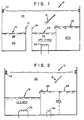
- FIG. 1 is a partial schematic illustration of one type of apparatus which can be used in the present process.
- a vessel 10 is divided into three sumps: a cleaning sump 15, a wash sump 20, and a rinsing sump 25.
- the cleaning compartment 15 is separated by one or more walls 17, 19 from the second compartment 20, which contains a hydrofluorocarbon fluid 22 heated to its boiling point by a heater 34, to provide a nonflammable condensing vapor blanket 30 or a flammability suppression blanket over all the sumps 15, 20, 25 common to vessel 10.
- Compartment 20 also provides an area where the bulk of the soil and organic cleaning agent can be washed from the substrate by either immersing into the hydrofluorocarbon fluid contained in compartment 20 or by placement in a spray stream 18 of pure hydrofluorocarbon condensate, whereby the contaminated liquid drops into the sump below.
- the cleaning compartment 15 is adapted to contain a body of the organic cleaning solvent 24 tailored for the cleaning application, which could be an organic hydrocarbon as noted above and in the examples below for heavy duty cleaning, or a mixture of an organic hydrocarbon with a milder solvent such as a hydrofluorocarbon for less rigorous cleaning applications (where compatibility with the substrate may be of more important consideration).
- the washing compartment 20 is adapted to contain a rinsing agent 22 having at least slight solubility for the cleaning solvent 24.
- "slight solubility" of the rinsing hydrofluorocarbon solvent for the hydrocarbon cleaning solvent is defined as ⁇ 2 mole % of the hydrocarbon is soluble in hydrofluorocarbon solvent.
- An appropriate rinsing agent 22 in the present invention is a hydrofluorocarbon based solvent as noted above and in the examples below
- a second rinsing compartment 25, which is at a cooler temperature than compartment 20, may be provided downstream from the first rinsing compartment, and is also adapted to contain the hydrofluorocarbon solvent rinsing agent.
- compartment 25 The purpose of compartment 25 is to provide a final immersion rinse for the substrate to remove trace residues of soil or cleaning solvent and also to cool the substrate so that the part is rinsed with pure condensing vapor in the vapor zone 30.
- the vapor zone 30 is formed above the respective compartments 15, 20, 25 and a cooling coil 32 of a type known in the art (such as disclosed in U.S. Patent 4,261,111 to Rand) defines the uppermost extent of the vapor zone 32 to condense vapor for return of condensate to compartment 25.
- hydrocarbon cleaning solvent 24 and hydrofluorocarbon rinsing fluid 22 may be chosen for their respective mutual solubilities such that some means of physical separation such as phase separation may be employed to remove built-up soils as well as to recycle clean organic solvent back to its originating sump. Therefore, with reference to Figure 1, it is to be noted that a U-tube phase separator (not shown) or weir or skimmer may be used in conjunction with compartment 20 to separate or remove condensed hydrocarbon which will float on top of the hydrofluorocarbon, and this separation device (not shown) may be arranged so that the excess hydrocarbon fluid will flow back to the cleaning tank 15 from the rinsing tank 20.
- the vessel 10 of Figure 1 is depicted as an open top type of defluxer or degreaser. However, it is to be understood that the vessel 10, in its schematic form, may also characterize an in-line type of degreaser or defluxer wherein conveyor means (not shown) may be used to successively convey the parts from the cleaning sump 15 to the rinsing sumps 20 and 25.
- the organic cleaning fluid in cleaning tank 15 may optionally be mixed with a hydrofluorocarbon type solvent.
- the cleaning fluid in this case would be warmed to a sufficient temperature to boil off the fluorocarbon, where the boiling point of the hydrofluorocarbon should be at least 10°C. lower than that of the organic hydrocarbon fluid.
- the mixture is heated with coils 33 so that the resulting vapor zone immediately overlying the hydrocarbon is essentially a hydrofluorocarbon-based nonflammable or flammability suppression vapor zone to minimize the possibility of explosion.
- the cleaning fluid mixture may or may not require a surfactant additive to ensure phase homogeneity between the organic hydrocarbon and the fluorocarbon solvents.
- the hydrofluorocarbon which was boiled off would be maintained at a constant concentration in compartment 15 by either returning the vapor condensate back to this compartment and/or pumping fluid from the rinse compartment(s) 20,25 back to this sump through control with a volume or level sensingtransducer (not shown).
- the boiling rinse sump 20 may not be necessary, or it could function purely as a second rinse sump at any intermediate temperature between compartment 15 and compartment 25.
- sump 20 may be heated with heating coils 34 and heating coils 33 may not be necessary.
- sump 15 supplies the hydrofluorocarbon vapor to form the nonflammable blanket 30 for vessel 10
- heating coil 33 would be preferred and heating coil 34 may not be necessary.
- sump 20 may not be necessary and sump 25 would provide a cool liquid rinse immersion prior to bringing the cleaned substrate into the vapor condensing zone 30 for a final pure condensate rinse.
- the rinse sump 20 may contain a saturated solution of the hydrocarbon based cleaning fluid and the hydrofluorocarbon based rinsing solvent.
- the fluids are selected so that the hydrocarbon phase separates at some low concentration (i.e., less than 10 mole %) in the hydrofluorocarbon and floats to the top of the more dense hydrofluorocarbon, providing a cascading effect back into the cleaning sump 15.
- the rinse sump(s) 25a or 25b may also in turn cascade pure rinse solvent into sump 20 to maintain its level and also to directionally provide a flow skimming action to sweep the separated organic layer towards the boil sump 15.
- the boil sump 15 contains both hydrocarbon and hydrofluorocarbon based solvents of sufficient immiscibility to form layered cleaning zones 5a and 15b.
- the advantage of this arrangement is that the heating coil 33, which provides the nonflammable vapor blanket for vessel 10, is now immersed in a hydrofluorocarbon-rich phase which lessens the possibility of accidental fire if the liquid in the sump drops below its intended level.
- the boiling hydrofluorocarbon liquid now provides an agitation action the top, less dense organic hydrocarbon phase to assist in the cleaning performance.
- the hydrofluorocarbon rinse solvent and the hydrocarbon cleaning solvent can be cascaded or pumped back to their respective sumps to ensure that sump liquid volumes are maintained.
- the hydrocarbon cleaning zone 15 may be separated from the rinsing zones 20 and 25 by being provided within separate structures 11 and 12.
- This configuration i8 intended to provide the ability to retrofit conventional solvent vapor degreasing or defluxing batch-type equipment such as represented by vessel 12 in Figure 5 with the cleaning process of this invention.
- the carry-over of organic solvent from vessel 11 to vessel 12 can be reduced by mechanical devices such as an air knife 37.
- Nitrogen or any other nonflammable compressed gas may be introduced into the vapor zone overlying the hydrocarbon sump 15 to reduce hydrocarbon flammability or the danger of explosion, as typical with many types of conventional semi-aqueous (organic cleaning/aqueous rinse) cleaning processes.
- the residual hydrocarbon 20 carried over from cleaning sump 15 may be mechanically separated out as described in Figure 1 and recycled back with a pump 45 (as schematically depicted) in view of the physical separation of the two cleaning zones which would prevent cascading as in the previous embodiments.
- the organic cleaning solvent in cleaning sump 15 is immiscible or of low miscibility with the hydrofluorocarbon-based rinsing solvent in rinsing sump 25.
- the first rinsing zone is provided with a coupling solvent (such as an alkanol like butanol, or another fluorochemical such as trifluorobenzene, or any other type of hydrocarbon) wherein the hydrofluorocarbon solvent is miscible with the coupling solvent.
- the hydrofluorocarbon solvent has a lower boiling point than either the organic cleaning solvent or the coupling solvent.
- the hydrofluorocarbon in sump 25 primarily serves the purpose of blanketing the flammable liquids in sumps 15 and 20 with a nonflammable vapor, and the level of liquid in rinse sump 20 which is comprised primarily of coupling solvent is maintained by makeup with hydrofluorocarbon liquid from sump 25.
- the substrate which has been rinsed in coupling solvent sump 20 is either subjected to a final immersion rinse in sumps(s) 25a and/or 25b or is held in the hydrofluorocarbon condensing vapor zone 42 for a final rinse, which can be suitably accomplished since the coupling-solvent is miscible with the hydrofluorocarbon solvent.
- the following examples are used to demonstrate the unexpected cleaning performance observed when a soiled coupon is first immersed in an organic cleaning solvent followed by a rinse with a hydrofluorochemical solvent.
- stainless steel coupons were coated with various commercial petroleum, semi-synthetic, and synthetic oils.
- the commercial petroleum oils are paraffinic, straight or branched chain saturated hydrocarbons. All of these oils are used in the metal working industry for cooling and lubricating purposes.
- the synthetic oils contain synthetic polymer with additives containing fatty acids and amines.
- the semisynthetic oils are mixtures of the petroleum and synthetic oils.
- the cleaning process used for tests to demonstrate this invention consisted of 30 second immersion of a coupon in the organic cleaing solvent followed by a 30 second immersion in the hydrofluorochemical solvent and a 30 second rinse above the liquid in the cooling coil zone with the condensing vapors of the fluorochemical solvent.
- the amount of soil on the coupon before and after cleaning was determined with a commercial CO 2 coulometer, which measures to microgram sensitivity the amount of organic residue, expressed in carbon units, on a surface.
- the sample of residue on the coupon is introduced into a combustion furnace via a sample boat, and is combusted in oxygen atmosphere at a temperature of 650°C.
- the resulting CO 2 and other combustion products pass through scrubbers to remove any interfering halogens, sulfur, nitrogen oxides and water.
- the gas then passes to the coulometer cell which contains an indicating solution.
- CO 2 is quantitatively absorbed, and reacts with a chemical in the solution to produce a titratable acid.
- An electric current is then automatically adjusted to neutralize the solution, the total current is integrated, and the results displayed as micrograms of carbon.
- the sensitivity of this method is +/- 0.01 micrograms carbon, which is one of the most sensitive methods to reproducibly analyze carbon components on a surface. Since all oils cleaned in this invention are primarily organic in nature, the monitoring of carbon content is an excellent way to determine with high reproducibility and sensitivity the amount of organic soil on a substrate.
- a (C 9 to C 11 ) methyl ester is used as the organic solvent.
- Spectroscopic characterization indicated a small quantity of a branched component.
- HFC 52-13 is a branched hydrofluorocarbon (C 6 F 13 H) used as the rinsing agent.
- the methyl ester is effective in removing petroleum based oil from metal coupons at room temperature, but a thin film of the methyl ester solvent remained after the cleaning process. The oil is not able to be cleaned from the surface of the coupon by HFC 52-13.
- a dibasic ester cleaning solvent mixture was prepared in the laboratory by synthesizing the dimethyl esters of adipic acid, succinic acid, and glutaric acid in the proportions of 10 wt%22 wt%68 wt%, respectively.
- Soiled coupons were immersed in a mixture of the dibasic esters with HFC-365 (CF 3 CH 2 CF 2 CH 3 ) at 56°C for 30 seconds, followed by a 30 second immersion in HFC-365 at ambient temperature and a 30 second vapor rinse with HFC-365.
- HFC-365 CF 3 CH 2 CF 2 CH 3
- This example demonstrates that a hydrofluorochemical vapor rinse step is required to completely clean a soiled surface which has been immersed in an alkanol (cyclic or a cyclic), and neither the alkanol alone nor the hydrofluorochemical solvent alone is sufficient to completely clean the surface.
- the synthetic oil and the grease Valvoline were both removed from metal coupons to better than 99.9% using the PEG-200/methyl ester cleaning solvent mixture with HFC 52-13 as the rinse solvent in the process of this invention.
Landscapes
- Health & Medical Sciences (AREA)
- Chemical & Material Sciences (AREA)
- Life Sciences & Earth Sciences (AREA)
- Medicinal Chemistry (AREA)
- Veterinary Medicine (AREA)
- Public Health (AREA)
- General Health & Medical Sciences (AREA)
- Animal Behavior & Ethology (AREA)
- Pharmacology & Pharmacy (AREA)
- Engineering & Computer Science (AREA)
- Epidemiology (AREA)
- Bioinformatics & Cheminformatics (AREA)
- General Chemical & Material Sciences (AREA)
- Organic Chemistry (AREA)
- Chemical Kinetics & Catalysis (AREA)
- Nuclear Medicine, Radiotherapy & Molecular Imaging (AREA)
- Heart & Thoracic Surgery (AREA)
- Cardiology (AREA)
- Vascular Medicine (AREA)
- Materials Engineering (AREA)
- Hematology (AREA)
- Diabetes (AREA)
- Gastroenterology & Hepatology (AREA)
- Immunology (AREA)
- Proteomics, Peptides & Aminoacids (AREA)
- Manufacturing & Machinery (AREA)
- Microelectronics & Electronic Packaging (AREA)
- Urology & Nephrology (AREA)
- Mechanical Engineering (AREA)
- Metallurgy (AREA)
- Emergency Medicine (AREA)
- Biomedical Technology (AREA)
- Neurology (AREA)
- Neurosurgery (AREA)
- Detergent Compositions (AREA)
- Cleaning By Liquid Or Steam (AREA)
- Cleaning And De-Greasing Of Metallic Materials By Chemical Methods (AREA)
Abstract
Description
- The present invention relates to a process of cleaning contaminated articles, and more particularly, to the defluxing or degreasing of parts in a non-aqueous cleaning system utilizing an organic solvent for cleaning the parts and a nonflammable hydrofluorocarbon solvent.
- Solvent vapor phase degreasing and defluxing is a process of immersing a soiled substrate (e.g., a printed circuit board or a fabricated metal, glass, ceramic, plastic, or elastomer part or composite) into a boiling, nonflammable liquid such as a chlorocarbon or chlorofluorocarbon fluid or admixture, followed by-rinsing the part in a second tank or cleaning zone by immersion or distillate spray with a clean solvent which is the same chlorocarbon or chlorofluorocarbon as used in the first cleaning zone. The parts are then dried by maintaining the cooled part in the condensing vapors until temperature has reached equilibrium.
- Solvent cleaning of various types of parts generally occurs in batch, hoist-assisted batch, conveyor batch, or in-line type conveyor degreaser and defluxer equipment. Such in-line conveyor degreaser and defluxer equipment are disclosed in co-pending U.S. patent application Serial No. 07/410,216, filed September 21, 1989, (entitled Cold Air Lock Vapor Seal"), now U.S. Patent 5,007,179, commonly assigned to the assignee of the present invention. Parts may also be cleaned in open top defluxing or degreasing equipment, such as that disclosed in U.S. Patent Application Serial No. 07/587,893, filed September 25, 1990, also commonly assigned. In both types of equipment, the entrance and/or exit ends of the equipment are generally in open communication with both the ambient environment and the solvent within the equipment. In order to minimize the loss of solvent from the equipment by either convection or diffusion, a common practice in the art is to use water-cooled or refrigerant-cooled coils which create a condensed vapor blanket over a hot or ambient zone region in the degreaser/defluxer tank, such as disclosed in U.S. Patent 4,261,111 to Rand.
- Therefore, in the foregoing solvent vapor phase degreasing process, it is generally known to use a single organic chlorocarbon or chlorofluorocarbon (CFC) fluid to perform the cleaning, rinsing, and drying steps. The use of CFC-113 and Freon type solvents have been, in the past, particularly popular. However, the vapor diffusion thereof into the environment has been implicated in recent scientific studies to be one of many possible contributing causes to the undesirable global depletion of stratospheric ozone, and the production and use of such chlorofluorocarbons is currently regulated and will be phased out in the U.S. by the end of this decade. In response to environmental concern, hydrochlorofluorocarbon (HCFC) based solvents have been developed in the last few years to provide more environmentally acceptable alternatives to CFC based vapor phase decreasing and defluxing processes. While these materials have been shown to be excellent CFC substitutes for a variety of cleaning applications,they are considered to be an interim replacement to CFCs since they still process a small, but finite, ozone depletion potential, although it is much lower than that of the CFCs they are replacing. Hence, these HCFC solvents are also proposed for global phase out in the near future. It is generally believed that organic solvents which do not contain chlorine, bromide, or iodine atoms will not contribute to stratospheric ozone depletion. However, organic chemicals which do not contain the above halogen atoms, such as hydrocarbons, alcohols, esters, ethers, ketones, etc., usually contain undesirable flammability or reactivity properties. Per fluorinated hydrocarbons and hydrofluorocarbons possess many desirable solvent properties: zero ozone depletion potential; stable, non-reactive, high compatibility with plastics; good water displacement potential; generally non-toxic and inert, and ideally suited to vapor phase solvent cleaning equipment. However, perfluorocarbons have been found to be very poor solvents for many common organic and inorganic soils, e.g., fluxes. Hydrofluorocarbons offer improved but still limited cleaning ability over perfluorocarbon as the amount of fluorine content on the molecule diminishes, but low fluorine-content hydrofluorocarbons may start to exhibit undesirable flammability properties comparable to their hydrocarbon analogs.
- Other types of cleaning processes such as aqueous cleaning exist. Aqueous cleaning generally involves the cleaning of a substrate or a part in an aqueous solution of detergents or surfactants, followed by multiple rinsing steps with purified water. The part is then dried by lengthy evaporation in air or by energy intensive thermal drying machines. This process is not always desirable due to the high energy cost for drying and the additional capital investment and 5 operating cost burden to provide aqueous waste water cleanup required by state and local authorities before sewering to ground water.
- Another cleaning process, semi-aqueous 0 cleaning, consists of cleaning a substrate in a hydrocarbon solvent based on, for example, terpenes, esters, or petroleum distillates having a high affinity for oils, waxes, and greases being cleaned from the parts, with or without the aid of a surfactant. The cleaned substrate is rinsed of the high boiling hydrocarbon solvent with multiple rinsing steps using purified water. The hydrocarbon solvent is phase separated back to the wash sump while the aqueous effluent must be processed before sewering to ground water. Consequently, high costs associated with drying energy and with processing waste effluent are evident, similar to the before mentioned aqueous cleaning process. A further drawback is that the hydrocarbon solvent usually possesses a flash point and this must be carefully handled or blanketed with a nonflammable compressed gas such as nitrogen to avoid explosion. Nitrogen gas is much more fugitive than the dense vapors of a fluorocarbon contained in a condensing zone. Furthermore, in a number of applications, while the substrate to be cleaned may be compatible with the hydrocarbon solvent, some plastics or metals may be incompatible with the aqueous rinse solvent, resulting in water absorption or rusting of the substrate.
- EP-A-0350316 describes a method of cleaning and drying components by contact with a hydrogen-containing flammable, liquid organic solvent wherein the solvent surface is covered by a vapour layer rich in a highly fluorinated organic compound which transfers heat to the organic solvent, the component to be cleaned is contacted with the liquid organic solvent, removed therefrom, vapour-rinsed or dried in the highly fluorinated compound-rich vapour layer and then removed from the cleaning environment.
- Ep-A-0350316 also describes an apparatus for cleaning and drying components, comprising a highly fluorinated compound reservoir means for heating and evaporating highly fluorinated compound from said reservoir, means for conducting highly fluorinated compound vapour to a cleaning chamber to cover an organic liquid in said chamber, means for conducting components to be cleaned in and out of said chamber, and means for condensing and re-cycling highly fluorinated compound and organic solvent to their respective reservoirs.
- Ep-A-0431458 describes a cleaning composition in which the active component is an aliphatic fluorohydrocarbon of the formula:
CnFmH2n+2-m
wherein 4 ≤ n ≤ 6 and 6 ≤ m ≤ 12 of the substrate. - It is accordingly one object of the present invention to provide a non-aqueous cleaning process for degreasing or defluxing parts in an environmentally safe manner.
- Another object of the invention is to provide a non-aqueous cleaning process which does not use water for rinsing, and there does not exist a necessity for aqueous waste water cleanup, and whereby said non aqueous cleaning system can be used in cases where materials are incompatible with water.
- Still a further object is to provide a non-aqueous cleaning process avoiding the need for drying by lengthy evaporation of rinsing fluid- in air or by energy intensive thermal drying methods.
- Yet a further object is to provide a non-aqueous cleaning process utilizing an organic liquid cleaning agent for cleaning the parts and a rinsing agent having at least a slight solubility for the organic cleaner for rinsing the organic cleaner from the part and which rinsing agent is capable of drying from the part using small amounts of energy.
- The present invention provides a non-aqueous cleaning process for removing residual soils or surface contamination from a part, by immersing the part in an organic cleaning fluid of sufficient solvency to remove the soils or contamination from the surface of the part, rinsing the cleaned part with a rinsing solvent to remove the cleaning fluid, and drying the part.
- According to the invention:
- (a) the part is immersed in the cleaning fluid in a cleaning compartment,
- (b) the cleaned part is transferred from the cleaning compartment to a rinsing compartment, containing a hydrofluorocarbon-based rinsing solvent in which the hydrocarbon cleaning solvent is at least 2 mole % miscible without obtaining phase separation and
- (c) a flammability-suppression blanket consisting essentially of a substantially pure hydrofluorocarbon vapor is provided over the cleaning and rinsing compartments.
- The rinsing agent is based on a hydrofluorocarbon and may contain fluorocarbon solvents which contain at least one fluorine atom attached to an organic backbone comprised of two or more carbon atoms, with optionally other atoms also attached to the backbone such as oxygen, sulfur, nitrogen, phosphorus, hydrogen, or other halogen atoms. The parts are then dried by holding under an inert vapor blanket of hydrofluorocarbon which lessens or mitigates the flammability of the organic cleaning fluid.
- In one embodiment the cleaning can be done in a system where a solution of the hydrocarbon solvent and the fluorocarbon solvent is mixed together optionally with a surfactant as a solubilizing agent in a degreaser.
- The organic cleaning solvent can be selected from linear or branched alkyl or alkanol monocarboxylic or dicarboxylic esters having at least one carbon atom in the ester moiety and such solvent most preferably having a flash point greater than 93°C (200°F), or less preferably having a flash point greater than 66°C (150°F). The organic fluid may also be selected from linear or cyclic hydrocarbons containing at least one olefinic bond endo or exo to the ring. The hydrocarbon cleaning agent may comprise pinene and/or camphene, or may comprise terpinene, limonene, terpinolene, terpineol, linaleol, and other related members of the terpene family.


- The organic cleaning solvent may also consist of linear, branched or cyclic hydrocarbons containing C10 to C30 species.
- The organic cleaning fluid may also consist of hydrocarbon containing olefinic moieties which have been substituted with R1-R12 groups, wherein R1-R12 hydrogen atoms or alkyl groups containing 1-6 carbon atoms or both may comprise the substituted group, i.e.,

- This organic cleaning fluid may also be comprised of acyclic or cyclic monols or diols defined by the linear structure (1)


- The organic fluid may also be comprised of linear, branched, or cyclic mono or polyketones, such as

- Other organic cleaning fluids applicable to this invention may be comprised of:
- (a) alkyl or aryl nitriles of the formula:
R - CN
where R may be an alkyl group (methyl, ethyl, etc), a phenyl group, or an alkyl substituted phenyl group - (b) an alkylbenzene of the formula:

- (c) alkyl esters such as diethylphthalate of the formula:

- (d) polyether alkanols of the formula:
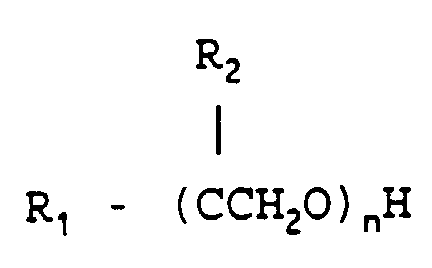
- (e) substituted aromatics of the formula:

- Such organic cleaning solvent may also comprise mixtures of all the above organic cleaning solvents with fluorocarbons such as linear, branched, or cyclic perfluorocarbons or hydrofluorocarbons or hydrochlorofluorocarbons optionally with substituted oxygen, sulfur, nitrogen, phosphorus or other halogen atoms attached to a carbon atoms and optionally with surfactant as a solubilizing agent.
- The rinse solvent is selected from the class of hydrofluorocarbon compounds or mixtures thereof with linear, branched, or cyclic fluorocarbon linear, branched, or cyclic fluorocarbon structures having a boiling point of at least 25°C to 120°C and such fluorocarbons may be optionally substituted with other functional groups chosen from the class consisting of other halogens and oxygen, sulfur, nitrogen, and phosphorus atoms.
- The hydrofluorocarbon compounds have a certain miscibility for organic cleaning solvents in the boiling range of at least 25°C to 120°C so that at least 2 mole % of the hydrocarbon cleaning solvent is miscible with the hydrofluorocarbon fluid without obtaining phase separation.
- The hydrofluorocarbons preferably contain between 3 to 8 carbon atoms, hydrogen and fluorine in the compound. The boiling point is preferably between 25°C and 120°C with at least 60% of fluorine in the compound. The compounds preferably have a linear or branched chain.
- Providing flammability suppression can be maintained through the use of suitable vapor blanketing hydrofluorocarbon species.
- Still other objects and advantages of the present invention will become readily apparent to those skilled in this art from the following detailed description, wherein only the preferred embodiments of the invention are shown and described, simply by way of illustration of the best mode contemplated of carrying out the invention. As will be realized, the invention is capable of other and different embodiments, and its several details are capable of modifications in various obvious respects, all without departing from the invention. Accordingly, the drawings and description are to be regarded as illustrative in nature, and not as restrictive.
-
- Figure 1 is a partial schematic view of degreasing or defluxing equipment that may be used in the multi-solvent non-aqueous cleaning system of the prevent invention;
- Figure 2 is a schematic view depicting an alternative embodiment of equipment that may be used in the present invention;
- Figure 3 is a schematic view depicting a further alternative embodiment of equipment for use in the present invention;
- Figure 4 is a partial schematic view of yet further alternative equipment for practicing the system of the prevent invention;
- Figure 5 it another embodiment of equipment for use in the present inventions and;
- Figure 6 is a further embodiment of equipment for use in the present invention.
- In its most basic form, the present invention is a novel non-aqueous cleaning process whereby the most attractive features of the semi-aqueous cleaning process and the solvent vapor degreasing solvent process are combined. Specifically, a substrate or part to be cleaned (e.g., a printed circuit board coated with a rosin-based flux, or a metallic or nonmetallic part coated with a petroleum, synthetic, or semisynthetic based oil or grease) is first washed in a warm or ambient temperature hydrocarbon solvent tending to have a greater affinity for the soil or contaminant on the substrate than a fluorocarbon based solvent. The part is then rinsed by spray or immersion in a second tank or cleaning region containing a nonflammable hydrofluorocarbon solvent, preferably having a lower boiling point than the hydrocarbon solvent. The hydrofluorocarbon solvent has at least slight solubility for the hydrocarbon solvent and therefore rinses the hydrocarbon solvent from the surface of the part. The hydrofluorocarbon solvent is then dried from the part surface by evaporation in a known manner. The benefit of this process is that drying costs are minimized, waste water treatment costs and equipment and capital investments are virtually eliminated, and safety of operation is improved. Further, through the use of hydrofluorocarbon solvents in the rinse and drying steps, the environmental benefit is greatly improved over the chlorocarbon or chlorofluorocarbon solvent systems.
- The organic cleaning agent is preferably a hydrocarbon or may be selected from linear or branched alkyl or alkanol monocarboxylic esters having at least six carbon atoms in the aliphatic moiety and at least one carbon atom in the ester moiety.
- The organic hydrocarbon fluid may also be selected from linear or cyclic hydrocarbons containing at least one olefinic bond endo or exo to the ring.
- The hydrocarbon may also be pinene and/or camphene.
- The preferred hydrofluorocarbons are selected from the following groups:
- (1) compounds with the empirical formula:
C3HnF8 -n
where n ≤ 4
Representative examples of this class are:
CH2FCH2FCHF2
CH2FCF2CFH2
CF2HCH2CF2H
CF2HCFHCF2H
- (2) linear or branched compounds of the empirical formula:
C4HnF10-n
where n ≤ 5
Representative examples of this class are:
CHF2(CF2)2CF2H CF3CF2CH2CH2F
CH3CF(CHF2)CHF2 CF3CH2CF2CH2F
CH3CHFCF2CF3 CF3CH2CH2CF3
CH2FCF2CF2CH2F2 CHF2CH(CF3)CF3
CHF(CF3)CF2CF3
- (3) linear or branched compounds of the empirical formula:
C5HnF12-n
where n ≤ 6
Representative examples of this class are:
CH3CHFCH2CF2CF3 CF3CH2CF2CH2CF3
CH3CHFCHFCF2CF3 CF3CH2CH2CF2CF3
CH3CHFCF2CF2CF3 CF3CF2CF2CH2CH3
CH3CF2CF2CF2CF3 CF3CH2CHFCH2CF3
CH2FCF2CF2CF2CF3 CF3CH2CF2CH2CH2F
CHF2CF2CF2CF2CF3
CH3CF(CF2H)CHFCHF2
CH3CF(CHFCHF2)CF3
CH3CH(CF2CF3)CF3
CHF2CH(CHF2)CF2CF3
CHF2CF(CHF2)CF2CF3
CHF2CF2CF(CF3)2
- (4) linear or branched compounds of the empirical formula:
C6HnF14-n
where n ≤ 7
Representative examples of this class are:
CHF2(CF2)4CF2H CF3CF2CH2CH2CF2CF3
CH2CH2CH2CF2CF2CF3 (CF3CH2)2CHCF3
CH3CH2CFHCFHCF2CF3
CH3CHFCF2CHFCHFCF3
CH3FCHFCH2CF2CHFCF3
CF2HCHFCF2CF2CHFCF2H
CH2FCF2CF2CF2CF2CF2H
CHF2CF2CF2CF2CF2CHF2
CHF2CF2CF2CF2CF2CF3
CH3CH(CHFCH2CF3)CF3
CH3CF(CF2H)CHFCHFCF3
CH3CF(CF3)CHFCHFCF3
CH3CF2CF(CF3)CF2CH3
CH3CF(CF3)CF2CF2CF3
CHF2CF2CH(CF3)CF2CF3
CHF2CF2CF(CF3)CF2CF3
- (5) linear or branched compounds of the empirical formula:
C7HnF16-n
where n ≤ 8.
Representative examples of this class are:
CH3CH2CH2CHFCF2CF2CF3
CH3CHFCH2CF2CHFCF2CF3
CH3(CF2)5CH3
CH3CH2(CF2)4CF3
CF3CH2CH2(CF2)3CF3
CH2FCF2CHF(CF2)3CF3
CF3CF2CF2CHFCHFCF2CF3
CF3CF3CF2CHFCF2CF2CF3
CH3CH2CH2CHFCF(CF3)2
CH3CH(CF3)CF2CF2CF2CH3
CH3CF(CF3)CH2)CFHCF2CF3
CH3CF(CF2CF3CHFCF2CF3
CH3CH2CH(CF3)CF2CF2CF3
CHF2CF(CF3)(CF2)3CHF2
CHF2CF(CF3)(CF2)3CF3
- (6) Linear or branched compounds of the empirical formula C8HnF18-n where n ≤ 9.
Representative examples of this class are:
CH3CH2CH2CH2CF2CF2CF2CF3
CH3(CF2)6CH3
CF3(CF2)6CF2H
CHF2CF(CF3)(CF2)4CF3
CHF2CF(CF3)(CF2)4CHF2
CH3CH2CH(CF3)CF2CF2CF2CF3
CH3CF(CF2CF3)CHFCF2CF2CF3
CH3CH2CH2CHFC(CF3) 2CF3
CH3C(CF3)2CF2CF2CF2CH3
CH3CH2CH2CF(CF3)CF(CF3)2
CH2FCF2CF2CHF(CF2)3CF3
- Figure 1 is a partial schematic illustration of one type of apparatus which can be used in the present process. Therein, a
vessel 10 is divided into three sumps: a cleaningsump 15, awash sump 20, and a rinsingsump 25. Thecleaning compartment 15 is separated by one ormore walls second compartment 20, which contains ahydrofluorocarbon fluid 22 heated to its boiling point by aheater 34, to provide a nonflammablecondensing vapor blanket 30 or a flammability suppression blanket over all thesumps vessel 10.Compartment 20 also provides an area where the bulk of the soil and organic cleaning agent can be washed from the substrate by either immersing into the hydrofluorocarbon fluid contained incompartment 20 or by placement in aspray stream 18 of pure hydrofluorocarbon condensate, whereby the contaminated liquid drops into the sump below. Thecleaning compartment 15 is adapted to contain a body of the organic cleaning solvent 24 tailored for the cleaning application, which could be an organic hydrocarbon as noted above and in the examples below for heavy duty cleaning, or a mixture of an organic hydrocarbon with a milder solvent such as a hydrofluorocarbon for less rigorous cleaning applications (where compatibility with the substrate may be of more important consideration). Thewashing compartment 20 is adapted to contain a rinsingagent 22 having at least slight solubility for thecleaning solvent 24. As used throughout this specification, "slight solubility" of the rinsing hydrofluorocarbon solvent for the hydrocarbon cleaning solvent is defined as ≥ 2 mole % of the hydrocarbon is soluble in hydrofluorocarbon solvent. Anappropriate rinsing agent 22 in the present invention is a hydrofluorocarbon based solvent as noted above and in the examples below Optionally, asecond rinsing compartment 25, which is at a cooler temperature thancompartment 20, may be provided downstream from the first rinsing compartment, and is also adapted to contain the hydrofluorocarbon solvent rinsing agent. The purpose ofcompartment 25 is to provide a final immersion rinse for the substrate to remove trace residues of soil or cleaning solvent and also to cool the substrate so that the part is rinsed with pure condensing vapor in thevapor zone 30. Thevapor zone 30 is formed above therespective compartments coil 32 of a type known in the art (such as disclosed in U.S. Patent 4,261,111 to Rand) defines the uppermost extent of thevapor zone 32 to condense vapor for return of condensate tocompartment 25. - It is to be noted that the hydrocarbon cleaning solvent 24 and
hydrofluorocarbon rinsing fluid 22 may be chosen for their respective mutual solubilities such that some means of physical separation such as phase separation may be employed to remove built-up soils as well as to recycle clean organic solvent back to its originating sump. Therefore, with reference to Figure 1, it is to be noted that a U-tube phase separator (not shown) or weir or skimmer may be used in conjunction withcompartment 20 to separate or remove condensed hydrocarbon which will float on top of the hydrofluorocarbon, and this separation device (not shown) may be arranged so that the excess hydrocarbon fluid will flow back to thecleaning tank 15 from the rinsingtank 20. - The
vessel 10 of Figure 1 is depicted as an open top type of defluxer or degreaser. However, it is to be understood that thevessel 10, in its schematic form, may also characterize an in-line type of degreaser or defluxer wherein conveyor means (not shown) may be used to successively convey the parts from the cleaningsump 15 to the rinsingsumps - In Figure 2, the organic cleaning fluid in cleaning
tank 15 may optionally be mixed with a hydrofluorocarbon type solvent. The cleaning fluid in this case would be warmed to a sufficient temperature to boil off the fluorocarbon, where the boiling point of the hydrofluorocarbon should be at least 10°C. lower than that of the organic hydrocarbon fluid. The mixture is heated withcoils 33 so that the resulting vapor zone immediately overlying the hydrocarbon is essentially a hydrofluorocarbon-based nonflammable or flammability suppression vapor zone to minimize the possibility of explosion. The cleaning fluid mixture may or may not require a surfactant additive to ensure phase homogeneity between the organic hydrocarbon and the fluorocarbon solvents. The hydrofluorocarbon which was boiled off would be maintained at a constant concentration incompartment 15 by either returning the vapor condensate back to this compartment and/or pumping fluid from the rinse compartment(s) 20,25 back to this sump through control with a volume or level sensingtransducer (not shown). In this variation of Figure 1, the boiling rinsesump 20 may not be necessary, or it could function purely as a second rinse sump at any intermediate temperature betweencompartment 15 andcompartment 25. In the three-sump option wheresump 20 supplies the hydrofluorocarbon vapor to form the nonflammable blanket forvessel 10,sump 20 may be heated withheating coils 34 and heating coils 33 may not be necessary. In the two-sump option wheresump 15 supplies the hydrofluorocarbon vapor to form thenonflammable blanket 30 forvessel 10,heating coil 33 would be preferred andheating coil 34 may not be necessary. In the two-sump option wheresump 15 supplies the hydrofluorocarbon vapor to form thenonflammable blanket 30 forvessel 10,sump 20 may not be necessary andsump 25 would provide a cool liquid rinse immersion prior to bringing the cleaned substrate into thevapor condensing zone 30 for a final pure condensate rinse. - In Figure 3, the rinse
sump 20 may contain a saturated solution of the hydrocarbon based cleaning fluid and the hydrofluorocarbon based rinsing solvent. The fluids are selected so that the hydrocarbon phase separates at some low concentration (i.e., less than 10 mole %) in the hydrofluorocarbon and floats to the top of the more dense hydrofluorocarbon, providing a cascading effect back into the cleaningsump 15. The rinse sump(s) 25a or 25b may also in turn cascade pure rinse solvent intosump 20 to maintain its level and also to directionally provide a flow skimming action to sweep the separated organic layer towards theboil sump 15. - In Figure 4, the
boil sump 15 contains both hydrocarbon and hydrofluorocarbon based solvents of sufficient immiscibility to formlayered cleaning zones 5a and 15b. The advantage of this arrangement is that theheating coil 33, which provides the nonflammable vapor blanket forvessel 10, is now immersed in a hydrofluorocarbon-rich phase which lessens the possibility of accidental fire if the liquid in the sump drops below its intended level. Furthermore, the boiling hydrofluorocarbon liquid now provides an agitation action the top, less dense organic hydrocarbon phase to assist in the cleaning performance. As in Figure 3, the hydrofluorocarbon rinse solvent and the hydrocarbon cleaning solvent can be cascaded or pumped back to their respective sumps to ensure that sump liquid volumes are maintained. - In Figure 5, the
hydrocarbon cleaning zone 15 may be separated from the rinsingzones separate structures vessel 12 in Figure 5 with the cleaning process of this invention. The carry-over of organic solvent fromvessel 11 tovessel 12 can be reduced by mechanical devices such as an air knife 37. Nitrogen or any other nonflammable compressed gas may be introduced into the vapor zone overlying thehydrocarbon sump 15 to reduce hydrocarbon flammability or the danger of explosion, as typical with many types of conventional semi-aqueous (organic cleaning/aqueous rinse) cleaning processes. In thehydrofluorocarbon boil sump 20, theresidual hydrocarbon 20 carried over from cleaningsump 15 may be mechanically separated out as described in Figure 1 and recycled back with a pump 45 (as schematically depicted) in view of the physical separation of the two cleaning zones which would prevent cascading as in the previous embodiments. - In Figure 6, it is presumed that the organic cleaning solvent in cleaning
sump 15 is immiscible or of low miscibility with the hydrofluorocarbon-based rinsing solvent in rinsingsump 25. To prevent mixing of these solvents together and thereby potentially recontaminating the cleaned substrate, the first rinsing zone is provided with a coupling solvent (such as an alkanol like butanol, or another fluorochemical such as trifluorobenzene, or any other type of hydrocarbon) wherein the hydrofluorocarbon solvent is miscible with the coupling solvent. Preferably, the hydrofluorocarbon solvent has a lower boiling point than either the organic cleaning solvent or the coupling solvent. In this Case, the hydrofluorocarbon insump 25 primarily serves the purpose of blanketing the flammable liquids insumps sump 20 which is comprised primarily of coupling solvent is maintained by makeup with hydrofluorocarbon liquid fromsump 25. The substrate which has been rinsed in couplingsolvent sump 20 is either subjected to a final immersion rinse in sumps(s) 25a and/or 25b or is held in the hydrofluorocarbon condensingvapor zone 42 for a final rinse, which can be suitably accomplished since the coupling-solvent is miscible with the hydrofluorocarbon solvent. - The following examples are used to demonstrate the unexpected cleaning performance observed when a soiled coupon is first immersed in an organic cleaning solvent followed by a rinse with a hydrofluorochemical solvent. In these studies, stainless steel coupons were coated with various commercial petroleum, semi-synthetic, and synthetic oils. The commercial petroleum oils are paraffinic, straight or branched chain saturated hydrocarbons. All of these oils are used in the metal working industry for cooling and lubricating purposes. The synthetic oils contain synthetic polymer with additives containing fatty acids and amines. The semisynthetic oils are mixtures of the petroleum and synthetic oils. The cleaning process used for tests to demonstrate this invention consisted of 30 second immersion of a coupon in the organic cleaing solvent followed by a 30 second immersion in the hydrofluorochemical solvent and a 30 second rinse above the liquid in the cooling coil zone with the condensing vapors of the fluorochemical solvent. The amount of soil on the coupon before and after cleaning was determined with a commercial CO2 coulometer, which measures to microgram sensitivity the amount of organic residue, expressed in carbon units, on a surface. The sample of residue on the coupon is introduced into a combustion furnace via a sample boat, and is combusted in oxygen atmosphere at a temperature of 650°C. The resulting CO2 and other combustion products pass through scrubbers to remove any interfering halogens, sulfur, nitrogen oxides and water. The gas then passes to the coulometer cell which contains an indicating solution. As the gas stream passes through the solution, CO2 is quantitatively absorbed, and reacts with a chemical in the solution to produce a titratable acid. An electric current is then automatically adjusted to neutralize the solution, the total current is integrated, and the results displayed as micrograms of carbon. The sensitivity of this method is +/- 0.01 micrograms carbon, which is one of the most sensitive methods to reproducibly analyze carbon components on a surface. Since all oils cleaned in this invention are primarily organic in nature, the monitoring of carbon content is an excellent way to determine with high reproducibility and sensitivity the amount of organic soil on a substrate.
- A (C9 to C11) methyl ester is used as the organic solvent. Spectroscopic characterization indicated a small quantity of a branched component. HFC 52-13 is a branched hydrofluorocarbon (C6F13H) used as the rinsing agent. The methyl ester is effective in removing petroleum based oil from metal coupons at room temperature, but a thin film of the methyl ester solvent remained after the cleaning process. The oil is not able to be cleaned from the surface of the coupon by HFC 52-13. However, the process of cleaning with the methyl ester, rinsing with HFC 52-13 followed by a rinse by the hydrofluorocarbon condensing vapors was highly effective in removing greater than 99.9% of the thin film of high boiling ester from the metal coupon without leaving a measurable trace of oil contaminant. Effectiveness of cleaning was assessed by weight measurements. In each of the examples below, blank coupons were determined to contain about 10 ug carbon on the surface.
- A dibasic ester cleaning solvent mixture was prepared in the laboratory by synthesizing the dimethyl esters of adipic acid, succinic acid, and glutaric acid in the proportions of 10 wt%22 wt%68 wt%, respectively. Soiled coupons were immersed in a mixture of the dibasic esters with HFC-365 (CF3CH2CF2CH3) at 56°C for 30 seconds, followed by a 30 second immersion in HFC-365 at ambient temperature and a 30 second vapor rinse with HFC-365. The following results were noted:
Expt. Oil on Substrate Cleaning Method Micrograms (ug) Carbon on the Surface Before Cleaning After Cleaning (a) petroleum this invention 819 11 (b) petroleum no HFC rinse 819 495 (c) petroleum no ester rinse 819 70 (d) synthetic this invention 508 10 (e) synthetic no HFC rinse 508 724 (f) synthetic no ester rinse 508 499 - Soiled coupons were immersed in a 50/50 volume % mixture of cyclohexanone, a cyclic ketone, and HFC-365, a hydrofluorocarbon, for 30 seconds at 57-59°C followed by a 30 second immersion in HFC-365 at ambient temperature and a 30 second vapor rinse with HFC-365. The following results were noted:


- In experiments (a) through (f) using an organic cleaning step followed by a hydrofluorochemical vapor rinse step resulted in completely cleaning the coupon surface (>99.9% removal of carbon). However, in experiments (b) and (e), a significant amount of carbon remained on the surface when the coupon was cleaned by a 30 second immersion in cyclohexanone only followed by a 30 second drying in air without the HFC vapor rinse. In experiments (c) and (f), a significant amount of carbon residue remained on the surface when the coupon was cleaned by a 30 second immersion in HFC-365 followed by a 30 second drying in air without using the ketone cleaning step. This example demonstrates that a hydrofluorochemical vapor rinse step is required to completely clean a soiled surface which has been immersed in either a ketone (cyclic or a cyclic) with hydrofluorochemical, and neither the ketone alone nor the hydrofluorochemical solvent alone is sufficient to completely clean the surface.
- Soiled coupons were immersed in a 50/50 volume % mixture of liquid cyclohexanol, a cyclic alkanol, and HFC-365, a hydrofluorocarbon, for 30 seconds at 57-59°C followed by a 30 second immersion in HFC-365 at ambient temperature and a 30 second vapor rinse with HFC-365. The following results were noted:
Expt. Oil on Substrate Cleaning Method Micrograms (ug) Carbon on the Surface Before Cleaning After Cleaning (a) petroleum this invention 819 4 (b) petroleum no HFC rinse 819 2397 (c) petroleum no alkanol cleaning 819 70 (d) synthetic this invention 508 139.7 (e) synthetic no HFC rinse 508 1148 (f) synthetic no alkanol cleaning 508 499 (g) mineral oil this invention 950 12.7 (h) synthetic this invention 1033 10.2 - Soiled coupons were immersed in a 50/50 volume % mixture of liquid 1, 5-dimethylcyclooctadiene, a cyclic olefin, and HFC-365, a hydrofluorocarbon, for 30 seconds at 57-59°C followed by a 30 second immersion in HFC-365 at ambient temperature and a 30 second vapor rinse with HFC-365. The following results were noted:
Expt. Oil on Substrate Cleaning Method Micrograms (ug) Carbon on the Surface Before Cleaning After Cleaning (a) petroleum this invention 819 10.1 (b) petroleum no HFC rinse 819 2953 (c) petroleum no olefin cleaning 819 70 (d) synthetic this invention 508 18.8 (e) synthetic no HFC rinse 508 2831 (f) synthetic no olefin cleaning 508 499 (g) mineral oil this invention 950 10 (h) synthetic this invention 1033 15.1 - In the experiments with petroleum oil and synthetic oil, using an organic cleaning step followed by a hydrofluorochemical vapor rinse step resulted in completely cleaning the coupon surface (>99.8% removal of carbon). However, in experiments (b) and (e), significant amount of carbon remained on the surface when the coupon was cleaned by a 30 second immersion in 1,5-dimethylcyclooctadiene only followed by a 30 second drying in air without the HFC vapor rinse. In experiments (c) and (f), significant amount of carbon residue remained on the surface when the coupon was cleaned by a 30 second immersion in HFC-365 followed by a 30 second drying in air without using the olefin solvent cleaning step. This example demonstrates that a hydrofluorochemical vapor rinse step is required to completely clean a soiled surface which has been immersed in an olefin (cyclic or acyclic), and neither the olefin alone nor the hydrofluorochemical solvent alone is sufficient to completely clean the surface.
- Soiled coupons were immersed in a 50/50 volume % mixture of liquid benzotrifluoride, a fluorinated aromatic chemical, and HFC-365, a hydrofluorocarbon, for 30 seconds at 57-59°C followed by a 30 second immersion in HFC-365 at ambient temperature and a 30 second vapor rinse with HFC-365. The following results were noted:
Expt. Oil on Substrate Cleaning Method Micrograms (ug) Carbon on the Surface Before Cleaning After Cleaning (a) petroleum this invention 819 13.3 (b) petroleum no HFC rinse 819 138 (c) petroleum no fl. org. cleaning 819 70 (d) synthetic this invention 508 16.1 (e) synthetic no HFC rinse 508 1022 (f) synthetic no fl. org. cleaning 508 499 (g) mineral oil this invention 950 13.7 (h) synthetic this invention 1033 127.9 - In the experiments with petroleum oil and synthetic oil, using an organic cleaning step followed by a hydrofluorochemical vapor rinse step resulted in completely cleaning the coupon surface (>99.8% removal of carbon). However, in experiments (b) and (e), significant amount of carbon remained on the surface when the coupon was cleaned by a 30 second immersion in benzotrifluoride only followed by a second drying in air without the HFC vapor rinse. In experiments (c) and (f), significant amount of carbon residue remained on the surface when the coupon was cleaned by a 30 second immersion in HFC-365 followed by a 30 second drying in air without using the fluoroamatic cleaning step. This example demonstrates that a hydrofluorochemical vapor rinse step is required to completely clean a soiled surface which has been immersed in a fluorinated aromatic solvent, and neither the fluoroaromatic cleaning solvent alone nor the fluorochemical solvent alone is sufficient to completely clean the surface.
- Soiled coupons were immersed in a 50 volume % mixture of polyethylene glycol (MW 200), a polyether diol, a methyl ester, and 50 volume % of HFC-365, a hydrofluorocarbon, for 30 seconds at 45-50°C followed by a 30 second immersion in HFC-365 at ambient temperature and a 30 second vapor rinse with HFC-365. The following results were noted:
Expt. Oil on Substrate Cleaning Method Micrograms (ug) Carbon on the Surface Before Cleaning After Cleaning (a) petroleum this invention 819 14 (b) petroleum no HFC rinse 819 1917 (c) petroleum no PEG/ester cleaning 819 70 (d) synthetic this invention 508 11 (e) synthetic no HFC rinse 508 1847 (f) synthetic no PEG/ester cleaning 508 499 (g) mineral oil this invention 950 12 (h) synthetic this invention 1033 13 - In the experiments with petroleum oil and synthetic oil, using an organic cleaning step followed by a hydrofluorochemical vapor rinse step resulted in completely cleaning the coupon surface (>99.8% removal of carbon). However, in experiments (b) and (e), significant amount of carbon remained on the surface when the coupon was cleaned by a 30 second immersion in polyethylene glycol/methyl ester solvent mixture only followed by a 30 second drying in air without the HFC vapor rinse. In experiments (c) and (f), significant amount of carbon residue remained on the surface when the coupon was cleaned by a 30 second immersion in HFC-365 followed by a 30 second drying in air without using the glycol/ester solvent cleaning step. This example demonstrates that a hydrofluorochemical vapor rinse step is required to completely clean a soiled surface which has been immersed in a mixture of glycol with an ester, and neither the mixed organic solvent alone nor the hydrofluorochemical solvent alone is sufficient to completely clean the surface.
- Soiled coupons were immersed in either a methyl ester, or a mixture of polyethylene glycol (MW 200), a polyether diol, and a methyl ester, for 30 seconds at 57-59°C followed by a 30 second immersion in HFC-52-13, a highly fluorinated alkane, at ambient temperature and a 30 second vapor rinse with the hydrofluorochemical solvent. The following results were noted:
- The synthetic oil and the grease Valvoline were both removed from metal coupons to better than 99.9% using the PEG-200/methyl ester cleaning solvent mixture with HFC 52-13 as the rinse solvent in the process of this invention.
- Soiled coupons were immersed in a 50/50 volume % mixture of BIOACT EC-7, a commercial blend of terpenes and non-ionic surfactants, and HFC-365, a hydrofluorocarbon, for 30 seconds at 57-59°C followed by a 30 second immersion in HFC-365 at ambient temperature and a 30 second vapor rinse with HFC-365. The following results were noted:
Expt. Oil on Substrate Cleaning Method Micrograms (ug) Carbon on the Surface Before Cleaning After Cleaning (a) petroleum this invention 819 15.3 (b) petroleum no HFC rinse 819 2221 (c) petroleum no terpene cleaning 819 36 (d) synthetic this invention 508 13.6 (e) synthetic no HFC rinse 508 2272 (f) synthetic no terpene cleaning 508 27.9 (g) mineral oil this invention 950 12 (h) mineral oil no terpene cleaning 950 94 (i) synthetic this invention 1033 13 (j) synthetic no terpene cleaning 1033 340 - In the experiments with petroleum oil and synthetic oil, using an organic cleaning step followed by a hydrofluorochemical vapor rinse step resulted in virtally complete cleaning of the coupon surface (>99.6% removal of carbon). However, in experiments (b) and(e), significant amount of carbon remained on the surface when the coupon was cleaned by a 30 second immersion in the terpene solvent mixture only followed by a 30 second drying in air without the HFC vapor rinse. In experiments (c) and (f), significant amount of carbon residue remained on the surface when the coupon was cleaned by a 30 second immersion in HFC-365 followed by a 30 second drying in air without using the terpene solvent cleaning step. This example demonstrates that a hydrofluorochemical vapor rinse step is required to completely clean a soiled surface which has been immersed in a terpene Solvent, and neither the terpene solvent alone nor the hydrofluorochemical solvent alone is sufficient to completely clean the surface.
- Soiled coupons were immersed in 50/50 volume % mixture of liquid cyclohexanone, a cyclic ketone, and HFC-365, a hydrofluorocarbon, for 30 seconds at 56-59°C followed by a 30 second immersion in a nonflammable constant-boiling blend of 5% HCFC-141b, a hydrochlorofluorocarbon, and 90% HFC-365, a hydrofluorocarbon, at ambient temperature and a 30 second vapor rinse with the condensing azeotropic vapors of HCFC141b/HFC-365. The following results were noted:
Expt. Oil on Substrate Cleaning Method Micrograms (ug) Carbon on the Surface Before Cleaning After Cleaning (a) petroleum this invention 819 18 (b) petroleum no HFC/HCFC blend rinse 819 2221 (c) petroleum no ketone cleaning 819 70 (d) synthetic this invention 508 29 (e) synthetic no HFC/HCFC blend rinse 508 2272 (f) synthetic no keton cleaning 508 499 (g) mineral oil this invention 950 15 (h) synthetic this invention 1033 25 - In the experiments with petroleum oil and synthetic oil, using an organic cleaning step followed by a fluorochemical blend of HCFC and HFC vapor rinse step resulted in virtually complete cleaning of the coupon surface (>99.8% removal of carbon). However, in experiments (b) and (e), significant amount of carbon remained on the surface when the coupon was cleaned by a 30 second immersion in the ketone cleaning solvent only followed by a 30 second drying in air without the HCFC/HFC vapor rinse. In experiments (c), (f), (h) and (j), more carbon residue remained on the surface when the coupon was cleaned by a 30 second immersion in HCFC-141b/HFC-365 azeotrope followed by a 30 second drying in air than in the dual solvent process of this invention using the terpene solvent cleaning step. This example demonstrates that even when a strong fluorochemical rinse solvent such as a blend containing HFCF-141b is used, the combined organic (ketone) cleaning step followed by a fluorochemical rinse step produces greater cleaning than if a ketone solvent alone or a fluorochemical solvent alone is used to clean the substrate.
- Soiled coupons were immersed in a 50/50 volume % mixture of liquid cyclohexanone, a cyclic ketone, and HFC-365/FC-72 (95:5 by weight) for 30 seconds at 56-59°C followed by a 30 second immersion in a non segregating blend of 5% FC-72, a perfluorocarbon, and 95% HFC-365, a hydrofluorocarbon, at ambient temperature and a 30 second vapor rinse with the condensing azeotropic vapors of FC-72/HFC-365. the following results were noted:


- In the above experiments, using an organic cleaning step followed by a fluorochemical vapor rinse step resulted in complete cleaning of the coupon surface (99.9% removal of carbon). More carbon residue remained on the surface when the coupon was cleaned by a 30 second immersion in the mixture of FC-72/HFC-365 followed by a 30 second drying in air without using the cyclohexanone solvent cleaning step. This example demonstrates that a hydrofluorochemical vapor rinse step is required to completely clean a soiled surface which has been immersed in a ketone solvent, and neither the ketone solvent alone nor the fluorochemical solvent alone is sufficient to completely clean the surface. In addition, it is well known that perfluorocarbons such as FC-72 are very poor solvents for oils.
- Soiled coupons were immersed in liquid cyclohexanol, a cyclic alcohol, which was not admixed with the HFC prior to cleaning (as in the previous examples). The coupons were immersed for 30 seconds at 56-59°C followed by a 30 second immersion in HFC-365, a hydrofluorocarbon, at ambient temperature and a 30 second vapor rinse with the condensing azeotropic vapors of HFC-365. The following results were noted:
Expt. Oil on Substrate Cleaning Method Micrograms (ug) Carbon on the Surface Before Cleaning After Cleaning (a) petroleum this invention 819 18.5 (b) synthetic this invention 508 166 (c) mineral oil this invention 950 20.9 (d) synthetic this invention 1033 22.4 - In this experiment, the cleaning ability of the organic cleaner segregated from the HFC was demonstrated. The results are within experimental error to those of Example 4, where the admixed organic/solvent system was evaluated. Interestingly, in this example the HFC/organic mixture in the cleaning sump cleaned better than if the cleaning sump contained only organic solvent (cyclohexanol).
- Soiled coupons were immersed in liquid cyclohexanone, a cyclic ketone, which was not admixed with the HFC prior to cleaning (as in the previous examples). The coupons were immersed for 30 seconds at 56-59°C followed by a 30 second immersion in HFC-365, a hydrofluorocarbon, at ambient temperature and a 30 second vapor rinse with the condensing azeotropic vapors of HFC-365. The following results were noted:
Expt. Oil on Substrate Cleaning Method Micrograms (ug) Carbon on the Surface Before Cleaning After Cleaning (a) petroleum this invention 819 11.3 (b) synthetic this invention 508 12.2 (c) mineral oil this invention 950 11.7 (d) synthetic this invention 1033 10.3 - In this experiment, the cleaning ability of the organic cleaner segregated from the HFC was demonstrated. The results are within experimental error to those of Example 12, where the admixed organic/solvent system was evaluated. It will be readily seen by one of ordinary skill in the art that the present invention fulfills all of the objects set forth above. After reading the foregoing specification, one of ordinary skill will be able to effect various changes, substitutions of equivalents and various other aspects of the invention as broadly disclosed herein. It is therefore intended that the protection granted hereon be limited only by the definition contained in the appended claims.
Claims (8)
- A non-aqueous cleaning process for removing residual soils or surface contamination from a part, by immersing the part in an organic cleaning fluid of sufficient solvency to remove the soils or contamination from the surface of the part, rinsing the cleaned part with a rinsing solvent to remove the cleaning fluid, and drying the part, characterized in that(a) the part is immersed in the cleaning fluid in a cleaning compartment (15),(b) the cleaned part is transferred from the cleaning compartment (15) to a rinsing compartment (20, 25) containing a hydrofluorocarbon-based rinsing solvent in which the hydrocarbon cleaning solvent is at least 2 mole % miscible without obtaining phase separation and(c) a flammability-suppression blanket (30) consisting essentially of a substantially pure hydrofluorocarbon vapor is provided over the cleaning and rinsing compartments.
- A process according to Claim 1 characterized in that the cleaning fluid comprises a mixture of:(a) an organic component and(b) a linear or branched hydrofluorocarbon component structure having 3 to 8 carbon atoms and at least 60 weight percent fluorine, wherein said organic or hydrocarbon component is present in an amount of at least 2 mole percent based on the total of said composition and capable of substantially removing said residual soils or surface contamination from said part;
- A process according to Claim 1 characterized in that the rinsing agent consists essentially of one or more linear or branched hydrofluorocarbon compounds having 3 to 8 carbon atoms and at least 60% by weight of fluorine, and having a boiling point of from 25 to 125°C.
- A process according to any one of Claims 1 to 3 characterized in that the cleaning compartment (15) contains an organic cleaning solvent mixed with a hydrofluorocarbon solvent, wherein the mixture is heated to a sufficient temperature to boil off at least some of the hydrofluorocarbon having a boiling point less than the hydrocarbon fluid whereby to form the flammability-suppression blanket (30).
- A process according to any one of Claims 1 to 4 characterized in that said hydrofluorocarbons are selected from:(1) compounds with the empirical formula:
C3HnF8-n
where 1 ≤ n ≤ 4(2) linear or branched compounds of the empirical formula:
C4HnF10-n
where 1 ≤ n ≤ 5(3) linear or branched compounds of the empirical formula:
C5HnF12-n
where 1 ≤ n ≤ 6(4) linear or branched compounds of the empirical formula:
C6HnF14-n
where 1 ≤ n ≤ 7(5) linear or branched compounds of the empirical formula:
C7HnF16-n
where 1 ≤ n ≤ 8(6) linear or branched compounds of the empirical formula:
C8HnF18-n
where 1 ≤ n ≤ 9 - A process according to any one of Claims 1 to 5, characterized in that said hydrofluorocarbon rinsing agent and said organic or hydrocarbon cleaning fluid are selected so that any cleaning fluid present in the rinsing compartment (20) containing the hydrofluorocarbon rinsing agent separates at a predetermined low concentration from the hydrofluorocarbon and floats to the top of the rinsing compartment (20) to provide a cascading effect of cleaning fluid back into the cleaning compartment (15).
- A process according to any one of Claims 1 to 6, characterized in that there is a second rinsing compartment (25) containing substantially entirely only a hydrofluorocarbon and providing a cascading effect of substantially pure hydrofluorocarbon rinse solvent into the first rinsing compartment (20) to maintain a predetermined level thereof and to directionally provide a flow skimming action to sweep the separated hydrocarbon cleaning fluid back toward the cleaning compartment.
- A process according to Claim 1, characterized in that it is carried out in apparatus in which the cleaning compartment (15) is housed in a structure which is separate from a structure containing the rinsing compartment (20, 25).
Applications Claiming Priority (3)
| Application Number | Priority Date | Filing Date | Title |
|---|---|---|---|
| US80119991A | 1991-12-02 | 1991-12-02 | |
| US801199 | 1991-12-02 | ||
| PCT/US1992/010291 WO1993011280A1 (en) | 1991-12-02 | 1992-11-30 | Multiple solvent cleaning system |
Publications (3)
| Publication Number | Publication Date |
|---|---|
| EP0643780A1 EP0643780A1 (en) | 1995-03-22 |
| EP0643780B1 true EP0643780B1 (en) | 1996-09-18 |
| EP0643780B2 EP0643780B2 (en) | 1999-09-01 |
Family
ID=25180450
Family Applications (1)
| Application Number | Title | Priority Date | Filing Date |
|---|---|---|---|
| EP93900721A Expired - Lifetime EP0643780B2 (en) | 1991-12-02 | 1992-11-30 | Multiple solvent cleaning system |
Country Status (16)
| Country | Link |
|---|---|
| EP (1) | EP0643780B2 (en) |
| JP (1) | JP2680930B2 (en) |
| KR (1) | KR100248175B1 (en) |
| CN (1) | CN1037201C (en) |
| AU (1) | AU664586B2 (en) |
| BR (1) | BR9206847A (en) |
| CA (1) | CA2123207A1 (en) |
| DE (1) | DE69213965T3 (en) |
| ES (1) | ES2092277T5 (en) |
| FI (1) | FI100541B (en) |
| HK (1) | HK1007172A1 (en) |
| MX (1) | MX9206771A (en) |
| NO (1) | NO942026D0 (en) |
| PL (1) | PL169599B1 (en) |
| RU (1) | RU94030729A (en) |
| WO (1) | WO1993011280A1 (en) |
Families Citing this family (24)
| Publication number | Priority date | Publication date | Assignee | Title |
|---|---|---|---|---|
| US5696307A (en) * | 1994-01-21 | 1997-12-09 | Alliedsignal Inc. | Hydrofluoroalkanes as cleaning and degreasing solvents |
| US5718293A (en) * | 1995-01-20 | 1998-02-17 | Minnesota Mining And Manufacturing Company | Fire extinguishing process and composition |
| US5925611A (en) * | 1995-01-20 | 1999-07-20 | Minnesota Mining And Manufacturing Company | Cleaning process and composition |
| US6506459B2 (en) | 1995-01-20 | 2003-01-14 | 3M Innovative Properties Company | Coating compositions containing alkoxy substituted perfluoro compounds |
| US6548471B2 (en) | 1995-01-20 | 2003-04-15 | 3M Innovative Properties Company | Alkoxy-substituted perfluorocompounds |
| EP0882124B1 (en) | 1995-12-15 | 2002-04-10 | Minnesota Mining And Manufacturing Company | Cleaning process and composition |
| US5938856A (en) * | 1997-06-13 | 1999-08-17 | International Business Machines Corporation | Process of removing flux residue from microelectronic components |
| US6552090B1 (en) | 1997-09-15 | 2003-04-22 | 3M Innovative Properties Company | Perfluoroalkyl haloalkyl ethers and compositions and applications thereof |
| US6309561B1 (en) | 1997-12-24 | 2001-10-30 | 3M Innovative Properties Company | Liquid crystal compounds having a chiral fluorinated terminal portion |
| US6127430A (en) * | 1998-12-16 | 2000-10-03 | 3M Innovative Properties Company | Microemulsions containing water and hydrofluroethers |
| US6159917A (en) * | 1998-12-16 | 2000-12-12 | 3M Innovative Properties Company | Dry cleaning compositions containing hydrofluoroether |
| FR2819201B1 (en) * | 2001-01-09 | 2003-02-21 | Atofina | PROCESS FOR CLEANING A SOLID SURFACE BY REMOVING ORGANIC AND / OR MINERAL SOILING BY MEANS OF A MICROEMULSION |
| US6423673B1 (en) | 2001-09-07 | 2002-07-23 | 3M Innovation Properties Company | Azeotrope-like compositions and their use |
| JP4407636B2 (en) * | 2003-09-09 | 2010-02-03 | 日本ゼオン株式会社 | Cleaning composition and cleaning method |
| RU2392354C1 (en) * | 2008-09-30 | 2010-06-20 | Открытое акционерное общество "Ведущий научно-исследовательский институт химической технологии" | Composition for cleaning surfaces from fat-and-oil impurities |
| US10767143B2 (en) * | 2014-03-06 | 2020-09-08 | Sage Electrochromics, Inc. | Particle removal from electrochromic films using non-aqueous fluids |
| JP5798211B1 (en) * | 2014-05-14 | 2015-10-21 | 株式会社カネコ化学 | Cleaning system and cleaning method using non-azeotropic cleaning composition |
| RU2655525C2 (en) * | 2016-10-05 | 2018-05-28 | Федеральное государственное бюджетное образовательное учреждение высшего образования "Волгоградский государственный медицинский университет" Министерства здравоохранения Российской Федерации ГБОУ ВПО ВолгГМУ МЗ РФ | Non-aqueous cleaning method for removing surface contaminants from orthopedic structures |
| CN107946178A (en) * | 2017-11-22 | 2018-04-20 | 奕铭(大连)科技发展有限公司 | A kind of cleaning method of semiconductor chip |
| KR102211622B1 (en) * | 2018-07-11 | 2021-02-03 | (주)아이솔루션 | A Wiper for Cleaning a Semiconductor Facility and a Cleaning Pack with the Same |
| CN109763133B (en) * | 2018-12-17 | 2022-01-04 | 上海利正卫星应用技术有限公司 | Degreasing agent for magnesium alloy anti-rust oil and preparation method thereof |
| CN111330906B (en) * | 2020-04-13 | 2021-06-29 | 中国原子能科学研究院 | cleaning process |
| CN114449779B (en) * | 2020-10-30 | 2024-05-31 | 北京铁路信号有限公司 | Cleaning device |
| CN115537832A (en) * | 2022-08-31 | 2022-12-30 | 深圳市鑫承诺环保产业股份有限公司 | A kind of hydrocarbon cleaning agent for cleaning the surface of metal parts and its preparation method |
Family Cites Families (5)
| Publication number | Priority date | Publication date | Assignee | Title |
|---|---|---|---|---|
| GB1440438A (en) * | 1972-09-07 | 1976-06-23 | Ici Ltd | Cleaning process |
| GB2220951B (en) * | 1988-07-08 | 1992-09-16 | Isc Chemicals Ltd | Cleaning and drying of electronic assemblies |
| AU635362B2 (en) * | 1989-12-07 | 1993-03-18 | Daikin Industries, Ltd. | Cleaning composition |
| US5104564A (en) * | 1989-12-19 | 1992-04-14 | E. I. Du Pont De Nemours And Company | High-boiling hydrochlorofluorocarbon solvent blends |
| WO1991011269A1 (en) * | 1990-01-24 | 1991-08-08 | Motorola, Inc. | A method for electrical assembly cleaning |
-
1992
- 1992-11-25 MX MX9206771A patent/MX9206771A/en not_active IP Right Cessation
- 1992-11-30 RU RU94030729/02A patent/RU94030729A/en unknown
- 1992-11-30 BR BR9206847A patent/BR9206847A/en not_active IP Right Cessation
- 1992-11-30 CA CA002123207A patent/CA2123207A1/en not_active Abandoned
- 1992-11-30 KR KR1019940701864A patent/KR100248175B1/en not_active Expired - Fee Related
- 1992-11-30 AU AU32292/93A patent/AU664586B2/en not_active Ceased
- 1992-11-30 HK HK98106340A patent/HK1007172A1/en not_active IP Right Cessation
- 1992-11-30 WO PCT/US1992/010291 patent/WO1993011280A1/en not_active Ceased
- 1992-11-30 JP JP5510280A patent/JP2680930B2/en not_active Expired - Lifetime
- 1992-11-30 DE DE69213965T patent/DE69213965T3/en not_active Expired - Fee Related
- 1992-11-30 ES ES93900721T patent/ES2092277T5/en not_active Expired - Lifetime
- 1992-11-30 PL PL92304039A patent/PL169599B1/en unknown
- 1992-11-30 EP EP93900721A patent/EP0643780B2/en not_active Expired - Lifetime
- 1992-12-02 CN CN92114105A patent/CN1037201C/en not_active Expired - Fee Related
-
1994
- 1994-06-01 NO NO942026A patent/NO942026D0/en unknown
- 1994-06-02 FI FI942594A patent/FI100541B/en active
Also Published As
| Publication number | Publication date |
|---|---|
| EP0643780B2 (en) | 1999-09-01 |
| DE69213965T2 (en) | 1997-01-30 |
| CN1075988A (en) | 1993-09-08 |
| ES2092277T5 (en) | 2000-01-01 |
| JP2680930B2 (en) | 1997-11-19 |
| RU94030729A (en) | 1996-04-10 |
| FI942594A0 (en) | 1994-06-02 |
| JPH06510821A (en) | 1994-12-01 |
| AU3229293A (en) | 1993-06-28 |
| EP0643780A1 (en) | 1995-03-22 |
| ES2092277T3 (en) | 1996-11-16 |
| CN1037201C (en) | 1998-01-28 |
| DE69213965D1 (en) | 1996-10-24 |
| PL169599B1 (en) | 1996-08-30 |
| NO942026L (en) | 1994-06-01 |
| BR9206847A (en) | 1995-11-21 |
| WO1993011280A1 (en) | 1993-06-10 |
| NO942026D0 (en) | 1994-06-01 |
| FI100541B (en) | 1997-12-31 |
| HK1007172A1 (en) | 1999-04-01 |
| MX9206771A (en) | 1993-06-01 |
| DE69213965T3 (en) | 2000-07-27 |
| CA2123207A1 (en) | 1993-06-10 |
| AU664586B2 (en) | 1995-11-23 |
| FI942594L (en) | 1994-06-02 |
| KR100248175B1 (en) | 2000-04-01 |
Similar Documents
| Publication | Publication Date | Title |
|---|---|---|
| EP0643780B2 (en) | Multiple solvent cleaning system | |
| HK1007172B (en) | Multiple solvent cleaning system | |
| US6355113B1 (en) | Multiple solvent cleaning system | |
| EP0350316B1 (en) | Cleaning and drying of electronic assemblies | |
| AU676136B2 (en) | Liquid cleaning composition for the removal of rosin solder flux | |
| US8877087B2 (en) | Nonflammable compositions comprising fluorinated compounds and use of these compositions | |
| US5091104A (en) | Azeotrope-like compositions of tertiary butyl 2,2,2-trifluoroethyl ether and perfluoromethylcyclohexane | |
| JPH05271692A (en) | Solvent cleaning method of article | |
| US7270717B2 (en) | Compositions and methods for cleaning contaminated articles | |
| AU693453B2 (en) | Multiple solvent cleaning system | |
| KR20160145620A (en) | Solvent vapor phase degreasing and defluxing compositions, methods, devices and systems | |
| US6187729B1 (en) | Cleaning composition comprising solvating agent and rinsing agent | |
| EP0444598A1 (en) | Azeotropic solvent composition | |
| JP2001509533A (en) | Azeotropic and azeotrope-like compositions of 1-bromopropane and highly fluorinated hydrocarbons | |
| JP2000510883A (en) | Decafluoropentane composition | |
| JP2001200293A (en) | Stabilized non-flammable cleaning agent, cleaning method and cleaning apparatus | |
| HK1139431A (en) | Nonflammable compositions comprising fluorinated compounds and use of these compositions |
Legal Events
| Date | Code | Title | Description |
|---|---|---|---|
| PUAI | Public reference made under article 153(3) epc to a published international application that has entered the european phase |
Free format text: ORIGINAL CODE: 0009012 |
|
| 17P | Request for examination filed |
Effective date: 19940516 |
|
| AK | Designated contracting states |
Kind code of ref document: A1 Designated state(s): BE DE DK ES FR GB IE IT NL SE |
|
| 17Q | First examination report despatched |
Effective date: 19950519 |
|
| GRAG | Despatch of communication of intention to grant |
Free format text: ORIGINAL CODE: EPIDOS AGRA |
|
| GRAH | Despatch of communication of intention to grant a patent |
Free format text: ORIGINAL CODE: EPIDOS IGRA |
|
| GRAH | Despatch of communication of intention to grant a patent |
Free format text: ORIGINAL CODE: EPIDOS IGRA |
|
| GRAA | (expected) grant |
Free format text: ORIGINAL CODE: 0009210 |
|
| AK | Designated contracting states |
Kind code of ref document: B1 Designated state(s): BE DE DK ES FR GB IE IT NL SE |
|
| PG25 | Lapsed in a contracting state [announced via postgrant information from national office to epo] |
Ref country code: NL Free format text: LAPSE BECAUSE OF FAILURE TO SUBMIT A TRANSLATION OF THE DESCRIPTION OR TO PAY THE FEE WITHIN THE PRESCRIBED TIME-LIMIT Effective date: 19960918 Ref country code: DK Effective date: 19960918 Ref country code: BE Effective date: 19960918 |
|
| ITF | It: translation for a ep patent filed | ||
| ET | Fr: translation filed | ||
| REF | Corresponds to: |
Ref document number: 69213965 Country of ref document: DE Date of ref document: 19961024 |
|
| ET | Fr: translation filed | ||
| REG | Reference to a national code |
Ref country code: IE Ref legal event code: FG4D Free format text: 69940 |
|
| REG | Reference to a national code |
Ref country code: ES Ref legal event code: FG2A Ref document number: 2092277 Country of ref document: ES Kind code of ref document: T3 |
|
| PG25 | Lapsed in a contracting state [announced via postgrant information from national office to epo] |
Ref country code: SE Effective date: 19961218 |
|
| NLV1 | Nl: lapsed or annulled due to failure to fulfill the requirements of art. 29p and 29m of the patents act | ||
| PLBQ | Unpublished change to opponent data |
Free format text: ORIGINAL CODE: EPIDOS OPPO |
|
| PLBI | Opposition filed |
Free format text: ORIGINAL CODE: 0009260 |
|
| PLBF | Reply of patent proprietor to notice(s) of opposition |
Free format text: ORIGINAL CODE: EPIDOS OBSO |
|
| 26 | Opposition filed |
Opponent name: MINNESOTA MINING AND MANUFACTURING COMPANY Effective date: 19970617 |
|
| PLBF | Reply of patent proprietor to notice(s) of opposition |
Free format text: ORIGINAL CODE: EPIDOS OBSO |
|
| PLAW | Interlocutory decision in opposition |
Free format text: ORIGINAL CODE: EPIDOS IDOP |
|
| PLAW | Interlocutory decision in opposition |
Free format text: ORIGINAL CODE: EPIDOS IDOP |
|
| REG | Reference to a national code |
Ref country code: GB Ref legal event code: 732E |
|
| REG | Reference to a national code |
Ref country code: FR Ref legal event code: TP |
|
| PUAH | Patent maintained in amended form |
Free format text: ORIGINAL CODE: 0009272 |
|
| STAA | Information on the status of an ep patent application or granted ep patent |
Free format text: STATUS: PATENT MAINTAINED AS AMENDED |
|
| RAP2 | Party data changed (patent owner data changed or rights of a patent transferred) |
Owner name: MINNESOTA MINING AND MANUFACTURING COMPANY |
|
| 27A | Patent maintained in amended form |
Effective date: 19990901 |
|
| AK | Designated contracting states |
Kind code of ref document: B2 Designated state(s): BE DE DK ES FR GB IE IT NL SE |
|
| ITF | It: translation for a ep patent filed | ||
| ET3 | Fr: translation filed ** decision concerning opposition | ||
| REG | Reference to a national code |
Ref country code: ES Ref legal event code: DC2A Kind code of ref document: T5 Effective date: 19991129 |
|
| PGFP | Annual fee paid to national office [announced via postgrant information from national office to epo] |
Ref country code: IE Payment date: 20011130 Year of fee payment: 10 |
|
| PGFP | Annual fee paid to national office [announced via postgrant information from national office to epo] |
Ref country code: ES Payment date: 20011207 Year of fee payment: 10 |
|
| REG | Reference to a national code |
Ref country code: GB Ref legal event code: IF02 |
|
| PG25 | Lapsed in a contracting state [announced via postgrant information from national office to epo] |
Ref country code: IE Free format text: LAPSE BECAUSE OF NON-PAYMENT OF DUE FEES Effective date: 20021202 Ref country code: ES Free format text: LAPSE BECAUSE OF NON-PAYMENT OF DUE FEES Effective date: 20021202 |
|
| REG | Reference to a national code |
Ref country code: IE Ref legal event code: MM4A |
|
| REG | Reference to a national code |
Ref country code: ES Ref legal event code: FD2A Effective date: 20031213 |
|
| PGFP | Annual fee paid to national office [announced via postgrant information from national office to epo] |
Ref country code: IT Payment date: 20071129 Year of fee payment: 16 |
|
| PGFP | Annual fee paid to national office [announced via postgrant information from national office to epo] |
Ref country code: GB Payment date: 20071128 Year of fee payment: 16 |
|
| PGFP | Annual fee paid to national office [announced via postgrant information from national office to epo] |
Ref country code: DE Payment date: 20071221 Year of fee payment: 16 |
|
| GBPC | Gb: european patent ceased through non-payment of renewal fee |
Effective date: 20081130 |
|
| PG25 | Lapsed in a contracting state [announced via postgrant information from national office to epo] |
Ref country code: IT Free format text: LAPSE BECAUSE OF NON-PAYMENT OF DUE FEES Effective date: 20081130 |
|
| PG25 | Lapsed in a contracting state [announced via postgrant information from national office to epo] |
Ref country code: DE Free format text: LAPSE BECAUSE OF NON-PAYMENT OF DUE FEES Effective date: 20090603 |
|
| PLAB | Opposition data, opponent's data or that of the opponent's representative modified |
Free format text: ORIGINAL CODE: 0009299OPPO |
|
| PG25 | Lapsed in a contracting state [announced via postgrant information from national office to epo] |
Ref country code: GB Free format text: LAPSE BECAUSE OF NON-PAYMENT OF DUE FEES Effective date: 20081130 |
|
| PGFP | Annual fee paid to national office [announced via postgrant information from national office to epo] |
Ref country code: FR Payment date: 20091201 Year of fee payment: 18 |
|
| REG | Reference to a national code |
Ref country code: FR Ref legal event code: ST Effective date: 20110801 |
|
| PG25 | Lapsed in a contracting state [announced via postgrant information from national office to epo] |
Ref country code: FR Free format text: LAPSE BECAUSE OF NON-PAYMENT OF DUE FEES Effective date: 20101130 |