EP0642799B1 - Improved prodrugs for enzyme mediated activation - Google Patents
Improved prodrugs for enzyme mediated activation Download PDFInfo
- Publication number
- EP0642799B1 EP0642799B1 EP94113388A EP94113388A EP0642799B1 EP 0642799 B1 EP0642799 B1 EP 0642799B1 EP 94113388 A EP94113388 A EP 94113388A EP 94113388 A EP94113388 A EP 94113388A EP 0642799 B1 EP0642799 B1 EP 0642799B1
- Authority
- EP
- European Patent Office
- Prior art keywords
- solution
- mmol
- prodrug
- compound
- added
- Prior art date
- Legal status (The legal status is an assumption and is not a legal conclusion. Google has not performed a legal analysis and makes no representation as to the accuracy of the status listed.)
- Expired - Lifetime
Links
- HLCNIJSGSQUHNR-UHFFFAOYSA-N CNOc1cccc(C(c(c2c(c3c4CCC[IH]3)OC=C)c4[O](C)=C)=O)c1C2=O Chemical compound CNOc1cccc(C(c(c2c(c3c4CCC[IH]3)OC=C)c4[O](C)=C)=O)c1C2=O HLCNIJSGSQUHNR-UHFFFAOYSA-N 0.000 description 1
Classifications
-
- A—HUMAN NECESSITIES
- A61—MEDICAL OR VETERINARY SCIENCE; HYGIENE
- A61K—PREPARATIONS FOR MEDICAL, DENTAL OR TOILETRY PURPOSES
- A61K47/00—Medicinal preparations characterised by the non-active ingredients used, e.g. carriers or inert additives; Targeting or modifying agents chemically bound to the active ingredient
- A61K47/50—Medicinal preparations characterised by the non-active ingredients used, e.g. carriers or inert additives; Targeting or modifying agents chemically bound to the active ingredient the non-active ingredient being chemically bound to the active ingredient, e.g. polymer-drug conjugates
-
- B—PERFORMING OPERATIONS; TRANSPORTING
- B82—NANOTECHNOLOGY
- B82Y—SPECIFIC USES OR APPLICATIONS OF NANOSTRUCTURES; MEASUREMENT OR ANALYSIS OF NANOSTRUCTURES; MANUFACTURE OR TREATMENT OF NANOSTRUCTURES
- B82Y5/00—Nanobiotechnology or nanomedicine, e.g. protein engineering or drug delivery
-
- A—HUMAN NECESSITIES
- A61—MEDICAL OR VETERINARY SCIENCE; HYGIENE
- A61K—PREPARATIONS FOR MEDICAL, DENTAL OR TOILETRY PURPOSES
- A61K47/00—Medicinal preparations characterised by the non-active ingredients used, e.g. carriers or inert additives; Targeting or modifying agents chemically bound to the active ingredient
- A61K47/50—Medicinal preparations characterised by the non-active ingredients used, e.g. carriers or inert additives; Targeting or modifying agents chemically bound to the active ingredient the non-active ingredient being chemically bound to the active ingredient, e.g. polymer-drug conjugates
- A61K47/51—Medicinal preparations characterised by the non-active ingredients used, e.g. carriers or inert additives; Targeting or modifying agents chemically bound to the active ingredient the non-active ingredient being chemically bound to the active ingredient, e.g. polymer-drug conjugates the non-active ingredient being a modifying agent
- A61K47/54—Medicinal preparations characterised by the non-active ingredients used, e.g. carriers or inert additives; Targeting or modifying agents chemically bound to the active ingredient the non-active ingredient being chemically bound to the active ingredient, e.g. polymer-drug conjugates the non-active ingredient being a modifying agent the modifying agent being an organic compound
- A61K47/549—Sugars, nucleosides, nucleotides or nucleic acids
-
- A—HUMAN NECESSITIES
- A61—MEDICAL OR VETERINARY SCIENCE; HYGIENE
- A61K—PREPARATIONS FOR MEDICAL, DENTAL OR TOILETRY PURPOSES
- A61K47/00—Medicinal preparations characterised by the non-active ingredients used, e.g. carriers or inert additives; Targeting or modifying agents chemically bound to the active ingredient
- A61K47/50—Medicinal preparations characterised by the non-active ingredients used, e.g. carriers or inert additives; Targeting or modifying agents chemically bound to the active ingredient the non-active ingredient being chemically bound to the active ingredient, e.g. polymer-drug conjugates
- A61K47/51—Medicinal preparations characterised by the non-active ingredients used, e.g. carriers or inert additives; Targeting or modifying agents chemically bound to the active ingredient the non-active ingredient being chemically bound to the active ingredient, e.g. polymer-drug conjugates the non-active ingredient being a modifying agent
- A61K47/68—Medicinal preparations characterised by the non-active ingredients used, e.g. carriers or inert additives; Targeting or modifying agents chemically bound to the active ingredient the non-active ingredient being chemically bound to the active ingredient, e.g. polymer-drug conjugates the non-active ingredient being a modifying agent the modifying agent being an antibody, an immunoglobulin or a fragment thereof, e.g. an Fc-fragment
- A61K47/6891—Pre-targeting systems involving an antibody for targeting specific cells
- A61K47/6899—Antibody-Directed Enzyme Prodrug Therapy [ADEPT]
-
- A—HUMAN NECESSITIES
- A61—MEDICAL OR VETERINARY SCIENCE; HYGIENE
- A61P—SPECIFIC THERAPEUTIC ACTIVITY OF CHEMICAL COMPOUNDS OR MEDICINAL PREPARATIONS
- A61P35/00—Antineoplastic agents
-
- A—HUMAN NECESSITIES
- A61—MEDICAL OR VETERINARY SCIENCE; HYGIENE
- A61P—SPECIFIC THERAPEUTIC ACTIVITY OF CHEMICAL COMPOUNDS OR MEDICINAL PREPARATIONS
- A61P43/00—Drugs for specific purposes, not provided for in groups A61P1/00-A61P41/00
Definitions
- This invention refers to enzymatically cleavable prodrugs with reduced Michaelis-Menten constant (Km).
- a prodrug may be defined as a chemical which is non-toxic and pharmacodynamically inert, but which can be transformed in vivo to a pharmacologically active drug.
- the invention refers to the field of drug-targeting, which deals with site-specific delivery of drugs in vivo.
- Site-specific delivery preferably increases the selectivity of drugs and reduces their undesirable side effects.
- One potential approach to achieve a site-specific delivery consists in applying untoxic prodrugs which can be site-specifically activated to cytotoxic drugs using prelocalized prodrug cleaving catalysts like enzymes, muteins derived from enzymes, catalytic antibodies, antibody enzyme conjugates or fusion proteins.
- This approach combines the advantage of drug delivery via prodrugs (i.e. increased stability, adjusted solubility, improved route of administration, more favourable distribution, improved pharmacokinetics, by-passing resistance; T.A. Connors, Xenobiotica 16, 975-988, 1986) with the preferential tumour specific activation mediated by a catalytic principle.
- the use of exogenous enzymes or polyclonal antibody enzyme conjugates for prodrug activation was pioneered by Graffi (Deutsche Offenlegungsschrift 22 12 014), and Philpott et al. (J. Immunol. 111, 921, 1973).
- the prodrugs of the invention have the common characteristic to be cleaved by enzymes at significantly lower molar prodrug concentration as the natural or standard substrates used for enzymatic analysis or appropriate state of the art prodrugs (WO 92/19639). They are therefore named Km-reduced prodrugs.
- the prodrugs of the invention have as another common characteristic a modified competitive enzyme activity inhibitor (S) as a crucial structural component which can be linked directly or via a spacer moiety (Z) to the pharmacologically active substance (W).
- S modified competitive enzyme activity inhibitor
- Z spacer moiety
- W pharmacologically active substance
- the spacer is self-immolative generating the pharmacologically active substance after enzymatic cleavage of the S-Z bond.
- a self-immolative spacer is defined as a moiety which is bound through two bonds to two molecules and which eliminates itself from the second molecule if the bond to the first molecule is cleaved.
- the Km-reduced prodrugs are substrates for human glycosidases and have the formula:
- Enzyme in this application may also mean a catalytic antibody.
- the compounds described herein can be prepared by prior art methods.
- Object of the invention is a compound of formula I in combination with pretargeted enzymes, catalytic antibodies, immunotoxins or immunoconjugates.
- Prodrug A (example 1) may be looked upon as derived from the competitive ⁇ -glucuronidase inhibitor saccharolactone:
- 3,6-Glucarolactone (compound 5) (45 g) was slowly added to a cooled (0-5° C) mixture of dry pyridine (225 ml) and Ac 2 O (185 ml). The internal temperature was maintained at 5° C during the addition and after all the lactone has been dissolved, the reaction mixture was allowed to be stirred for additional 2 hours. The colourless solution was then poured into 3 liters of a mixture of water and crushed ice and vigorously stirred for approximately 3 hours. The precipitate was collected and washed with water, and after drying a solid was isolated which contains 70 g of a mixture of ⁇ and ⁇ tri-O-acetyl-glucuronolactone (compound 7). This mixture was directly used for the next step.
- Titanium bromide (16.6 g, 45 mmol) as added to a stirred solution of compound 7 (70 g, 23.3 mmol) in dichloromethane (200 ml) maintained in the dark and under nitrogen atmosphere. After stirring overnight, additional TiBr 4 was added (8.3, 22 mmol). After 24 additional hours, the reaction mixture was diluted with dichloromethane (150 ml) and the organic solution poured into crushed ice water. The organic layer was separated, washed with water, dried and evaporated under reduced pressure. This gave compound 8 (65 g) pure enough for the next step.
- Prodrug A was prepared from compound 3a and doxorubicin (yield 83 %) followed by treatment with sodium methoxide in methanol and then sodium hydroxide.
- IR (CHCl 3 ) 3089w, 3067w, 3008w, 2933w, 2874w, 1759s, 1497w, 1455m, 1367m, 1248w, 1161m, 1070s, 1028s, 937w.
- Prodrug D was synthesized analogously as described in WO 92/19639.
- Km- and Vmax-determination 3'-N-[4-(beta-D-Glucuronyloxy)-3-nitro-benzyloxycarbonyl]-doxorubicin and prodrug A should be diluted in the range of 10-10000 ⁇ M in 100 mM phosphate buffer + 1 mg/ml BSA, pH 7.2. Enzymatic cleavage should be done with constant amounts of fusion protein at 37° C. Cleavage can be monitored by HPLC analysis. Km- and Vmax-values can be calculated with the software program GraFit 2.0 (Erithacus Software Ltd.).
- the HPLC apparatus consisted of an autosampler (Abimed, model 231), an automatic sample extraction system (AASP, Varian) equipped with minicartridges containing C 18 reversed phase silica gel (Analytichem), a gradient pump (Gynkotek, model 480), a fluorescence detector (Shimazdu RF 535, Excitation: 495 nm, Emission: 560 nm). Before sample injection the minicartridges were preconditioned with 2.5 ml methanol and 1.5 ml phosphate buffer, pH 6. Analytes retained on the reversed phase silica gel were then eluted by valve switching and connection of the minicartridges to the mobile phase.
- AASP automatic sample extraction system
- Prodrug A can be encapsulated according to D. Papahadjopoulos et al. (PNAS, USA 88:11460-11464, 1991) into stealth liposomes. After i.v. injection into CD1 nu/nu mice the plasma clearance of Prodrug A encapsulated into stealth liposomes should be prolonged from ⁇ 20 min for the free Prodrug A to ⁇ 40 hrs for the encapsulated Prodrug A. The significant t1/2 ⁇ prolongation leads to improved pharmacological efficacy.
Landscapes
- Health & Medical Sciences (AREA)
- Chemical & Material Sciences (AREA)
- Engineering & Computer Science (AREA)
- Life Sciences & Earth Sciences (AREA)
- Bioinformatics & Cheminformatics (AREA)
- Medicinal Chemistry (AREA)
- Pharmacology & Pharmacy (AREA)
- General Health & Medical Sciences (AREA)
- Public Health (AREA)
- Veterinary Medicine (AREA)
- Animal Behavior & Ethology (AREA)
- Epidemiology (AREA)
- Nanotechnology (AREA)
- Molecular Biology (AREA)
- General Engineering & Computer Science (AREA)
- Biochemistry (AREA)
- General Chemical & Material Sciences (AREA)
- Nuclear Medicine, Radiotherapy & Molecular Imaging (AREA)
- Organic Chemistry (AREA)
- Biophysics (AREA)
- Biotechnology (AREA)
- Immunology (AREA)
- Chemical Kinetics & Catalysis (AREA)
- Medical Informatics (AREA)
- Crystallography & Structural Chemistry (AREA)
- Pharmaceuticals Containing Other Organic And Inorganic Compounds (AREA)
- Medicines That Contain Protein Lipid Enzymes And Other Medicines (AREA)
- Saccharide Compounds (AREA)
- Acyclic And Carbocyclic Compounds In Medicinal Compositions (AREA)
- Enzymes And Modification Thereof (AREA)
- Medicinal Preparation (AREA)
- Preparation Of Compounds By Using Micro-Organisms (AREA)
Abstract
Description
- This invention refers to enzymatically cleavable prodrugs with reduced Michaelis-Menten constant (Km).
- A prodrug may be defined as a chemical which is non-toxic and pharmacodynamically inert, but which can be transformed in vivo to a pharmacologically active drug.
- The invention refers to the field of drug-targeting, which deals with site-specific delivery of drugs in vivo. Site-specific delivery preferably increases the selectivity of drugs and reduces their undesirable side effects.
- One potential approach to achieve a site-specific delivery consists in applying untoxic prodrugs which can be site-specifically activated to cytotoxic drugs using prelocalized prodrug cleaving catalysts like enzymes, muteins derived from enzymes, catalytic antibodies, antibody enzyme conjugates or fusion proteins.
- This approach combines the advantage of drug delivery via prodrugs (i.e. increased stability, adjusted solubility, improved route of administration, more favourable distribution, improved pharmacokinetics, by-passing resistance; T.A. Connors, Xenobiotica 16, 975-988, 1986) with the preferential tumour specific activation mediated by a catalytic principle. The use of exogenous enzymes or polyclonal antibody enzyme conjugates for prodrug activation was pioneered by Graffi (Deutsche Offenlegungsschrift 22 12 014), and Philpott et al. (J. Immunol. 111, 921, 1973).
- More recently the original teaching from Graffi and Philpott was exemplified and improved by the use of monoclonal antibody enzyme conjugates as prodrug activating catalysts (Bagshawe et al., Brit. J. Cancer, 58, 700, 1988; Senter et al., Bioconjugate Chem. 4, 3-9, 1993) or fusion proteins (Bosslet et al., Brit. J. Cancer, 65, 234-238, 1992; Goshorn et al., Cancer Res. 53, 2123-2127, 1993).
- Despite these improvements, the systems described so far have some major disadvantages for clinical applications:
- a) monoclonal antibody enzyme conjugates produced by chemical coupling have as a major drawback a strong immunogenicity in man due to the xenogenic origin of the antibody moiety and the enzyme (Bagshawe et al., Disease Markers 9: 233-238, 1991). As a consequence of this high immunogenicity repetitive applications in man are possible only to a very limited extent;
- b) fusion proteins consisting of non-humanised binding moieties and xenogenic enzymes produced by recombinant DNA technology will be immunogenic in man as well with disadvantages comparable to monoclonal antibody enzyme conjugates, if repetitive applications are needed;
- c) fusion proteins consisting of humanised binding moieties and human enzymes will probably not be very immunogenic in man most probably allowing repetitive treatment cycles in man. Nevertheless, the two major disadvantages of human fusion proteins are the possibly lower turnover rate (Vmax) of the human enzyme moiety as well as the possibly higher prodrug (substrate) concentration needed to obtain significant catalysis in comparison to xenogenic enzymes having a high turnover rate and a low Michaelis-Menten constant (Km).
-
- This limitation of human fusion proteins (low Vmax and high Km) given by the intrinsic nature of the human enzyme moiety can be overcome by state of the art methodology only to a very limited extent (factor 4) by random mutagenesis in the active site of the enzyme (Munir et al., PNAS USA 90:4012-4016, 1993).
- Surprisingly, it has been found that the limitation by a high Km, an intrinsic property of most human enzymes applicable for in vivo prodrug activation, can be overcome by novel prodrugs.
- The prodrugs of the invention have the common characteristic to be cleaved by enzymes at significantly lower molar prodrug concentration as the natural or standard substrates used for enzymatic analysis or appropriate state of the art prodrugs (WO 92/19639). They are therefore named Km-reduced prodrugs.
- The prodrugs of the invention have as another common characteristic a modified competitive enzyme activity inhibitor (S) as a crucial structural component which can be linked directly or via a spacer moiety (Z) to the pharmacologically active substance (W). Preferably the spacer is self-immolative generating the pharmacologically active substance after enzymatic cleavage of the S-Z bond. A self-immolative spacer is defined as a moiety which is bound through two bonds to two molecules and which eliminates itself from the second molecule if the bond to the first molecule is cleaved.
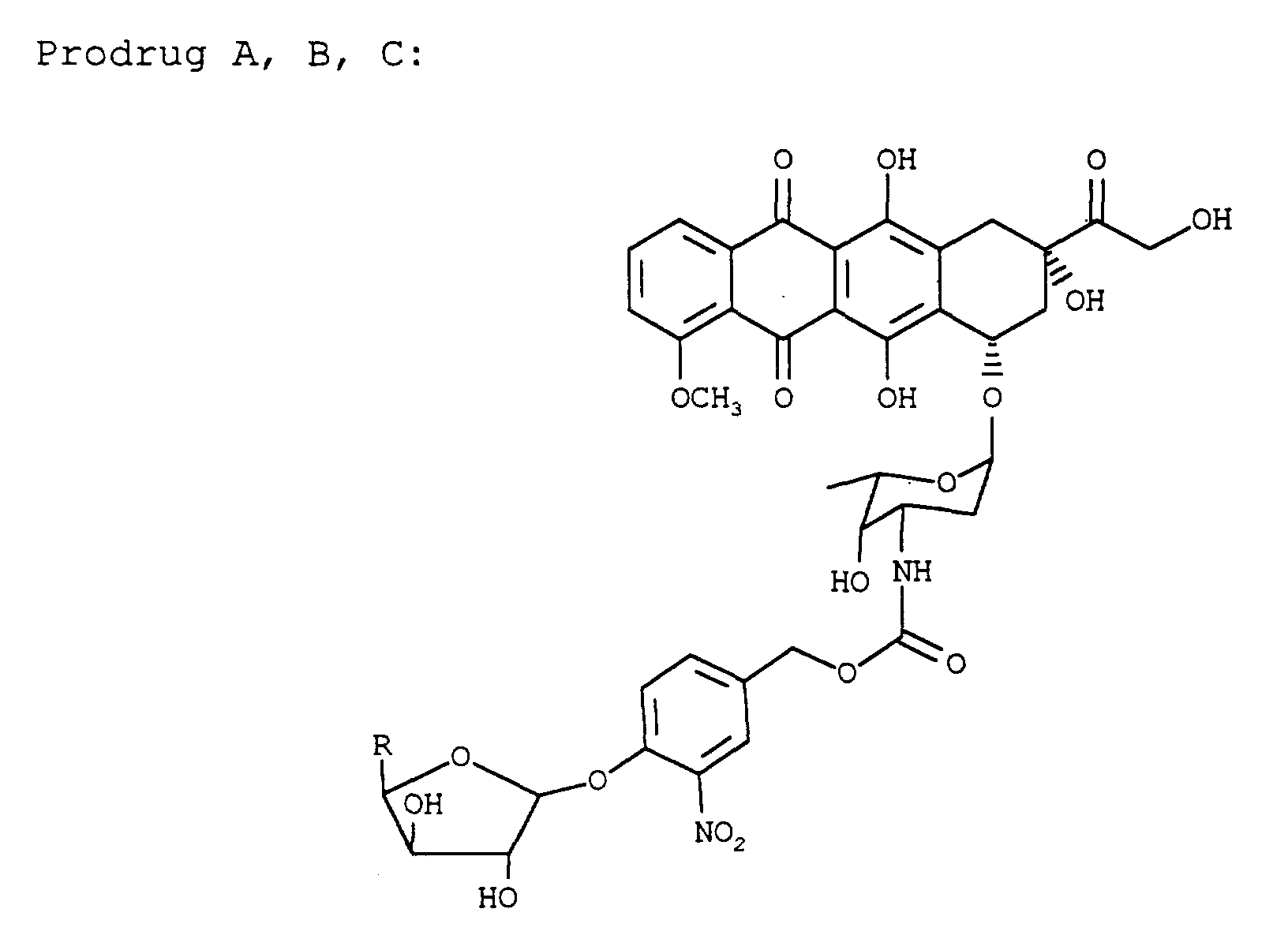
- The Km-reduced prodrugs are substrates for human glycosidases and have the formula:

- Prodrug A: R = CHOH-COOH
- Prodrug B: R = CH2-COOH
- Prodrug C: R = COOH
-
- Enzyme in this application may also mean a catalytic antibody. The compounds described herein can be prepared by prior art methods.
- Object of the invention is a compound of formula I in combination with pretargeted enzymes, catalytic antibodies, immunotoxins or immunoconjugates.
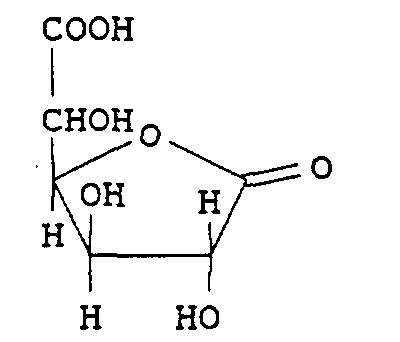
- Km-reduced prodrugs, selective for human β-glucuronidase, are described in the following sections. Prodrug A (example 1) may be looked upon as derived from the competitive β-glucuronidase inhibitor saccharolactone:
-
- Prodrug A: R = CHOH-COOH
- Prodrug B: R = CH2-COOH
- Prodrug C: R = COOH
-
-
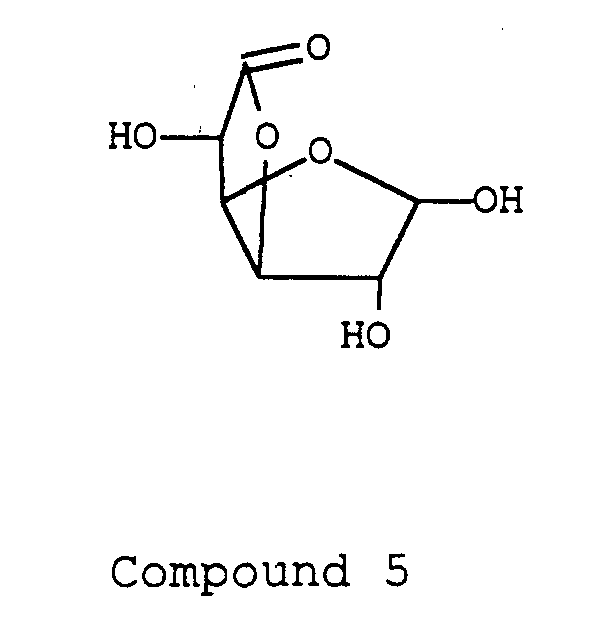
- 3,6-Glucarolactone (compound 5) (45 g) was slowly added to a cooled (0-5° C) mixture of dry pyridine (225 ml) and Ac2O (185 ml). The internal temperature was maintained at 5° C during the addition and after all the lactone has been dissolved, the reaction mixture was allowed to be stirred for additional 2 hours. The colourless solution was then poured into 3 liters of a mixture of water and crushed ice and vigorously stirred for approximately 3 hours. The precipitate was collected and washed with water, and after drying a solid was isolated which contains 70 g of a mixture of α and β tri-O-acetyl-glucuronolactone (compound 7). This mixture was directly used for the next step.
- Titanium bromide (16.6 g, 45 mmol) as added to a stirred solution of compound 7 (70 g, 23.3 mmol) in dichloromethane (200 ml) maintained in the dark and under nitrogen atmosphere. After stirring overnight, additional TiBr4 was added (8.3, 22 mmol). After 24 additional hours, the reaction mixture was diluted with dichloromethane (150 ml) and the organic solution poured into crushed ice water. The organic layer was separated, washed with water, dried and evaporated under reduced pressure. This gave compound 8 (65 g) pure enough for the next step.
- It was prepared from compound 8 (15 g, 50 mmol) and from 4-hydroxy-3-nitrobenzaldehyde according to the procedure already described in WO 92/ 19639. This afforded 12 g (61.6 %) of compound 9.
- To a solution of solid sodium hydroxide (50 mg) in methanol (125 ml), compound 9 (10 g) was added. The solution was stirred at room temperature for 4 h and evaporated under reduced pressure. This resulted in a crude mixture which was immediately dissolved in anhydrous pyridine (50 ml). After cooling to 0° C, acetic anhydride (40 ml) was added and the reaction mixture was subsequently stirred for additional 18 h. Extraction with dichloromethane followed by usual work-up resulted in 6.6 g of compound 1a (65 % overall yield).
- It was prepared by sodium borohydride reduction of compound 1a (6 g) according to the procedure already described in the WO 92/19639. This yielded 5.6 g (95 %) of compound 2a.
-
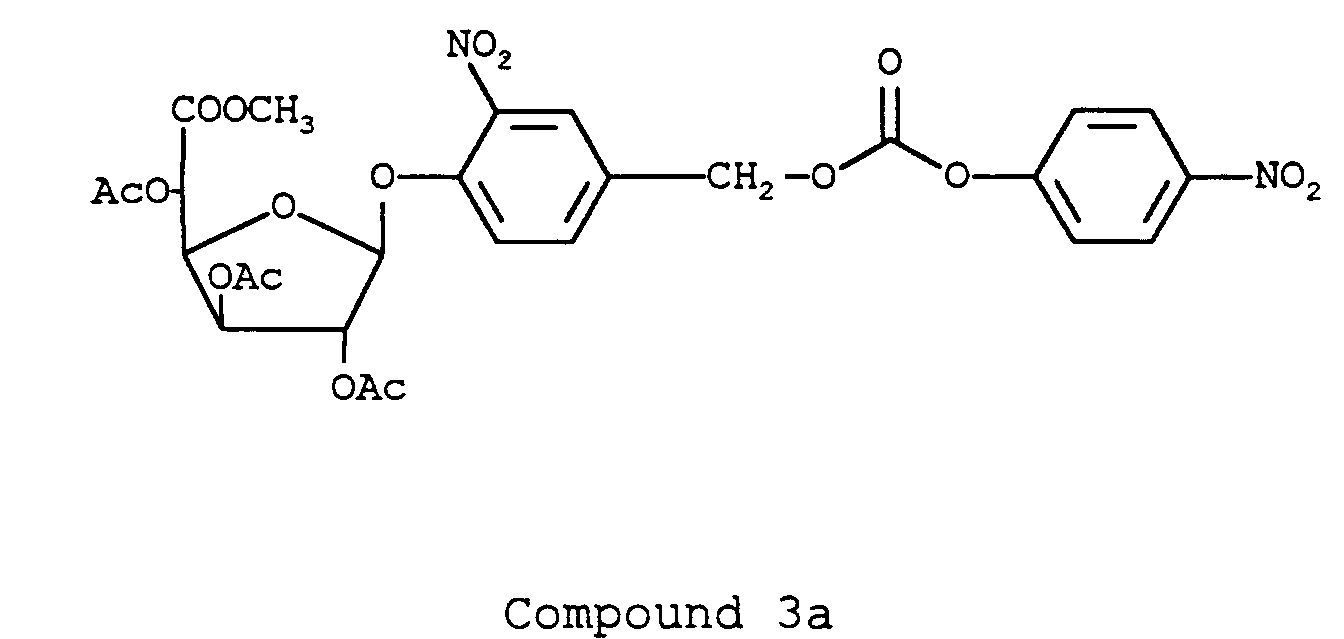
- It was prepared coupling of compound 2a (6 g) with 4-nitrophenyl chloroformiate (yield 75 %) according to the procedure already described in the WO 92/19639.
- Prodrug A was prepared from compound 3a and doxorubicin (yield 83 %) followed by treatment with sodium methoxide in methanol and then sodium hydroxide.
-
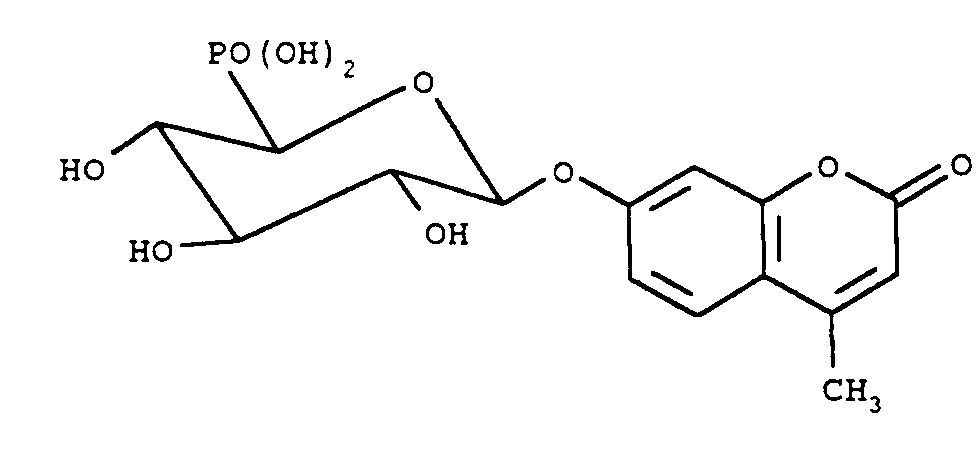
- Allyl 6-O-trityl-α-D-glucopyranoside (2). A solution of allyl α-D-glucopyranoside (1) (prepared according to R.E. Wing, J.N. BeMiller, Carbohydr. Res.. 1969, 10, 441) (12.5 g, 56.8 mmol) and triphenylmethyl chloride (20.0g, 71.7 mmol) in dry pyridine (120 ml) was stirred at r.t. for 12 h, and at 60 ° for 1 h. After the addition of triphenylmethyl chloride (12.0 g, 43.0 mmol), the solution was stirred at 60 ° until all starting material has disappeared (3-4 h). H2O (120 ml) was added to the still warm solution. Extraction with EtOAc, extraction of the combined org. layers with 1 M aq. H2SO4 and brine, evaporation of the organic layer and FC (400 g SiO2, toluene/acctone 2:1 → toluene/acetone 1:1) gave 23.3 g (90 %) of 2. Grey glassy solid.
- Allyl 2,3,4-tri-O-benzyl-6-O-trityl-α-D-glucopyranoside (3). A solution of 2 (15.9 g, 34.3 mmol) in dry THF (390 ml) was treated with a suspension of NaH (6.9 g, ca. 150 mmol) at r.t. for 10 min. BnBr (25.0 ml, 211 mmol) and Bu4NI (1.9 g, 5.1 mmol) were added. The solution was heated under reflux until TLC indicated completion of the reaction (ca. 12 h). Et2O was added, and the solution was filtered through silica. The filtrate was evaporated, and the residue was subjected to FC (600 g SiO2, Et2O/hexane 1:9 → Et2O) to give 21.4 g (85%) of 3. Rf (EtOAc/hexane 1:4) 0.36. 13C-NMR (75 MHz, C6D6): 63.46 t); 68.49 (t); 71.33 (d); 72.96 (t); 75.12 (t); 75.74 (t); 78.93 (d); 81.40 (d); 82.85 (d); 86.95 (s); 96.44 (d); 117.21 (t); 127.29-129.32 (several d); 134.73 (d); 139.11 (s); 139.32 (s); 139.89 (s); 144.78 (s, triple intensity).
- Allyl 2,3,4-tri-O-benzyl-α-D-glucopyranoside (4). A solution of BF3·OEt2 (5.0 ml, 39.8 mmol) in MeCN (90 ml) was added dropwise to a cooled (0 °) solution of 3 (13.4 g, 18.3 mmol) and Et3SiH (14.5 ml, 91.5 mmol) in dry CH2Cl2 (150 ml). After 10 min., a sat. aq. solution of NaHCO3 (100 ml) and H2O (200 ml) were added. The mixture was shaken vigorously, the aq. layer was extracted with CH2Cl2, the combined organic layers were extracted with brine, dried (MgSO4), and evaporated. FC (400 g SiO2, EtOAc/hexane 1:5 → EtOAc/hexane 1:1) affored 8.35 g (93 %) of 4. Rf (EtOAc/hexane 1:2) 0.20.
- Allyl 2,3,4-tri-O-benzyl-α-D-glucopyranuronide tert.-butyl ester (5). A solution of 4 (8.35 g, 17.0 mmol) in DMF/CH2Cl2 4:1 (45 ml) was added to a solution of CrO3 (6.8 g, 6.8 mmol) in DMF/CH2Cl2 4:1 (180 ml) and pyridine (11.0 ml, 142 mmol) which had been stirred vigorously for 30 min r.t. After addition of Ac2O (13.0 ml, 11.8 mmol) and tert.-BuOH (34.0 ml, 362 mmol) , the solution was stirred for 9 h at r.t., before MeOH (30 ml) was added. After 30 min., the mixture was concentrated to one quarter of its volume and diluted with Et2O (250 ml). Filtration through Na2SO4 and SiO2 (300 g), elution with Et2O, evaporation and FC (330 g SiO2, AcOEt/hexane 1:9) affored 6.30 g (66 %) of 5. Rf (EtOAc/hexane 1:2) 0.63. 13C-NMR (50 MHz, CDCl3): 27.94 (q, triple intensity); 68.69 (t); 71.44 (d); 73.43 (t); 75.89 (t); 79.51 (d); 79.73 (d); 81.45 (d); 82.12 (s); 96.78 (d); 118.83 (t); 127.66 - 128.50 (several d); 133.56 (d); 138.06 (s); 138.21 (s); 138.69 (s); 168.84 (s).
- Allyl 2,3,4-tri-O-benzyl-α-D-glucopyranuronide (6). A solution of 5 (6.25 g, 11.1 mmol) in HCOOH (150 ml) was stirred at r.t. for 30 min. Evaporation yielded 5.60 g (99 %) of chromatographically pure 6. Rf (EtOAc/hexane/HCOOH 1:1:trace) 0.47. 13C-NMR (75 MHz, CDCl3): 68.88 (t); 69.86 (d); 73.40 (t); 75.33 (t); 75.06 (t); 79.14 (d); 79.26 (d); 81.42 (d); 96.13 (d); 118.90 (t); 127.77 - 128.55 (several d); 133.18 (d) ; 137.47 (s); 137.84 (s); 138.46 (s); 174.18 (s).
- Allyl (5R)-5-acetoxy-2,3,4-tri-O-benzyl-α-D-xylopyranoside (7). A stirred solution of 6 (5.60 g, 11.1 mmol) in C6H6 (50 ml) and pyridine (5 ml) was treated with Pb(OAc)4 (16.80 g, ca. 32 mmol) under N2 at 60° for 25 min. Filtration through SiO2, elution with Et2O, evaporation and FC (300 g SiO2, AcOEt/hexane 1:6) affored 4.1 g (71 %) of 7. Rf (EtOAc/hexane 1:4) 0.29. IR (CHCl3) : 3089w, 3067w, 3008w, 2933w, 2874w, 1759s, 1497w, 1455m, 1367m, 1248w, 1161m, 1070s, 1028s, 937w. 13C-NMR (50 MHz, CDCl3): 21.16 (q); 68.78 (t); 73.67 (t); 75.47 (t); 76.33 (t); 79.50 (d); 80.54 (d); 81.37 (d); 90.18 (d); 95.35 (d) ; 119.09 (t); 128.05-128.84 (several d); 133.68 (d); 138.36 (s) ; 138.63 (s); 139.01 (s); 169.75 (s).
- Allyl (5S)-5-hydroxy-2,3,4-tri-O-benzyl-α-D-xylopyranoside (8). At -78°, DIBAH (2.8 ml of a 20 % solution in toluene, ca. 2.9 mmol) was added dropwise to a solution of 7 (553 mg, 0.96 mmol) in CH2Cl2 (20 ml). After 15 min., a sat. solution of NH4Cl (2 ml) was added. The mixture was warmed up to r.t., diluted with H2O and a 1 M solution of H2SO4 (10 ml). The aq. layer was extracted with CH2Cl2 (3 x), the combined org. layers were extracted with brine (2 x), dried (MgSO4) and evaporated to yield 499 mg (98 %) of crystalline 8 which was used without further purification in the next step. Rf (EtOAc/hexane 1:2) 0.32. 1H-NMR (300 MHz, CDCl3): 2.92 (broad s, OH); 3.33 (dd, J = 9.2, 7.8, H-C(4)); 3.60 (dd, J = 9.7, 3.7, H-C (2)); 3.99 (t, J = 9.5, H-C (3)); 4.07 (ddt, J = 12.9, 6.6, 1.2, OAll); 4.23 (ddt, J = 12.9, 5.2, 1.4, OAll); 4.65 (d, J = 12.0), 4.79 (d, J = 12.0, PhCH2); 4.78 (d, J = 3.7, H-C (1)); 4.81 (d, J = 11.2), 4.89 (d, J = 11.9, PhCH2); 4.85 (d, J = 10.9), 4.93 (d, J = 10.9, PhCH2) ; 5.06 (d, J = 7.8, H-C (5)); 5.24 (dq, J = 10.3, 1.5, OAll); 5.34 (dq, J = 17.2, 1.5, OAll); 5.93 (dddd, J = 17.1, 10.3, 6.6, 5.2, OA11) ; 7.28-7.42 (m, 15 arom. H).
- Allyl (5S)-5-trichloracetimidyloxy-2,3,4-tri-O-benzyl-α-D-xylopyranoside (9). MTBD (66 µl, 0.46 mmol) was added to a cooled (-30°) solution of crude 8 (200 mg, ca. 0.42 mmol) and Cl3CCN (0.63 ml, 6.3 mmol) in dry ClCH2CH2Cl (6 ml). After 10 min, the solution was filtered through SiO2, the SiO2 was eluted with Et2O, and the combined filtrates were evaporated to give crude 9 which was sufficiently pure (1H-NMR, TLC) to be used in the next step. Rf (EtOAc/hexane 1:2) 0.53.
- Allyl (5R)-5-dimethylphosphonyl-2,3,4-tri-O-benzyl-α-D-xylopyranoside (10) and allyl (5S)-5-dimethylphosphonyl-2,3,4-tri-O-benzyl-α-D-xylopyranoside (11). TMSOTf (83 µl, 0.46 mmol) was added to a cooled (-17°) solution of crude 9 (350 mg) and P(OMe)3 (240 µl, 1.26 mmol) in dry MeCN (6 ml). The solution was warmed to 0°, kept at this temperature for 3 h, and filtered through SiO2. The SiO2 was eluted with Et2O, and the combined filtrates were evaporated. The residue (396 mg) was subjected to FC (22 g SiO2, EtOAc/hexane 1:1) to give a mixture of 10 and its (5S) isomer 11 (147 mg, 62 % from 7). This mixture was further purified by HPLC (EtOAc/hexane 2:1) to give 49 mg (21 % from 7) of 10 and 52 mg (22 % from 7) of 11. Data of 10: Rf (EtOAc/hexane 1:1) 0.12. 1H-NMR (500 MHz, CDCl3) : 3.55 (dd, J = 9.6, 3.6, H-C(2)); 3.69 (d, J = 10.8, OMe); 3.80 (d, J = 10.5, OMe), 3.81 (dt, J = 10.6, 8.8, H-C(4)); 3.99 (t, J = 9.1, H-(3)); 4.00 (ddt, J = 12.8, 6.6, 1.2 OAll); 4.05 (dd, J = 10.5, 9.8, H-C(5)); 4.16 (ddt, J = 12.8, 5.2, 1.4, OAll); 4.62 (d, J = 12.1), 4.77 (d, J = 12.1, PhCH2); 4.80 (d, J = 10.6), 4.89 (d, J = 10.3 PhCH2); 4.81 (d, J = 4.7, H-C(2)); 4.83 (d, J = 11.2), 4.97 (d, J = 10.9, PhCH2); 5.24 (dq, J = 10.3, 1.1, OAll); 5.33 (dq, J = 17.2, 1.6, OAll); 5.93 (dddd, J = 17.1, 10.3, 6.7, 5.2, OAll); 7.24-7.35 (m, 15 arom. H). 13C-NMR (125 MHz, CDCl3): 52.74 (dq, J(P,C) = 6.8); 53.88 (dq, J(P,C) = 6.5); 65.86 (dd, J(C,P) = 175.1); 68.73 (t); 73.46 (t); 75.26 (t); 75.90 (t); 78.40 (dd, J(C,P) = 2.7); 79.35 (dd, J(C,P) = 1.0); 82.01 (dd, J(C,P) = 17.9; 96.40 (dd, J(C,P) = 15.0); 118.66 (t); 127.63-128.49 (several d); 133.28 (d); 138.00 (s); 138.11 (s); 138.63 (s). 31P-NMR (203 MHz, CDCl3) : 24.60.
- Prop-1-enyl (5R)-5-dimethylphosphonyl-2,3,4-tri-O-benzyl-α-D-xylopyranoside (12). A solution of activated 1,5-cyclooctadiene-bis[methyldiphenylphosphine]-iridium hexafluorophosphate (15 mg) in dry THF (5 ml) was added to a stirred solution of 10 (257 mg; 0.452 mmol) in dry THF (10 ml). After 2 h, TLC indicated completion of the reaction, and the solution was evaporated to give 57 mg of crude 12 which was used without purification in the next step. Rf (EtOAc(hexane 3:1) 0.39.
- (5R)-5-dimethylphosphonyl-2,3,4-tri-O-benzyl-α-D-xylopyranose (13). A stirred solution of crude 12 (57 mg) and yellow HgO (118 mg; 0.54 mmol) in H2O/acetone 1:10 (10 ml) was treated with a solution of HgCl2 (148 mg; 0.55 mmol) in H2O/acetone 1:10 (5 ml). After completion of the reaction, Et2O was added. The Et2O layer was washed with a semisaturated solution of KI and with brine. SiO2 (2 g) was added, the mixture was evaporated and subjected to FC (15 g SiO2, EtOAc/hexane.3:1 → EtOAc/hexane 5:1) to give 216 mg (90 % from 10) of 13. Rf (EtOAc/hexane 3:1) 0.16.
- O-[(5R)-5-dimethylphosphonyl-2,3,4-tri-O-benzyl-α-D-xylopyranoside]-trichloroacetimidate (14). At -30°, MTBD (1.1 Eq.) was added to a solution (0.05 M) of 13 and Cl3CCN (15 Eq.) in dry CH2Cl2. After completion of the reaction, the solution was filtered through SiO2, the SiO2 was eluated with Et2O, and the combined eluants were evaporated to give crude 14 which was used without purification in the next step.
- 4-Methylumbelliferyl (5R)-5-dimethylphosphonyl-2,3,4-tri-O-benzyl-β-D-xylopyranoside (15). A solution of crude 14 (1 eq.) and 4-methylumbelliferone (2 Eq.) in dry MeCN (0.05 M) at -20° was treated with BF3OEt2 (1 Eq.). After completion of the reaction, H2O was added. The aq. phase was extracted with EtOAc (3x), the combined org. phases were washed with brine, dried over MgSO4 and evaporated. The residue was subjected to FC to give 15.
- 4-Methylumbelliferyl (5R)-5-dimethylphosphonyl-β-D-xylopyranoside (16). A solution of 15 in MeOH (0.05 M) was treated with H2 in the presence of Pd/C 1:10 [K. Wallimann, Helv. Chim. Acta 1990, 73, 1359]. Filtration through Celite and evaporation gave crude 16 which was purified by FC (MeOH/EtOAc).
- 4-Methylumbelliferyl (5R)-5-phosphonyl-β-D-xylopyranoside (17). A solution of 16 in CH2Cl2 (0.05 M) was treated under N2 at 0° with Me3SiBr (30 Eq.) [C.E. McKenna, Tetrahedron Lettr. 1977, 155]. After completion of the reaction, MeOH was added, the mixture concentrated i.v., the residue taken up in H2O, and the mixture lyophilized. Purification of the residue by anion-exchange chromatography (Dowex 1 x 8 (HCOO-) : 0-0.7 M HCOOH) [K. Wallimann, Helv. Chim. Acta 1990, 73, 1359] gave 17 which was immediately transformed into its Na-salt by anion-exchange chromatography (Dowex 50 W x 4 (Na+)).
- Prodrug D was synthesized analogously as described in WO 92/19639.

- For Km- and Vmax-determination 3'-N-[4-(beta-D-Glucuronyloxy)-3-nitro-benzyloxycarbonyl]-doxorubicin and prodrug A should be diluted in the range of 10-10000 µM in 100 mM phosphate buffer + 1 mg/ml BSA, pH 7.2. Enzymatic cleavage should be done with constant amounts of fusion protein at 37° C. Cleavage can be monitored by HPLC analysis. Km- and Vmax-values can be calculated with the software program GraFit 2.0 (Erithacus Software Ltd.).
- The HPLC apparatus consisted of an autosampler (Abimed, model 231), an automatic sample extraction system (AASP, Varian) equipped with minicartridges containing C 18 reversed phase silica gel (Analytichem), a gradient pump (Gynkotek, model 480), a fluorescence detector (Shimazdu RF 535, Excitation: 495 nm, Emission: 560 nm). Before sample injection the minicartridges were preconditioned with 2.5 ml methanol and 1.5 ml phosphate buffer, pH 6. Analytes retained on the reversed phase silica gel were then eluted by valve switching and connection of the minicartridges to the mobile phase. Chromatography was performed on reversed phase material (Nucleosil C 18, 5 µm particle size, 120 mm length, 4,5 mm I.D.) and gradient elution. Elution was done by a gradient composed of 2 components (A: 20 mM phosphate, pH 3, B: acetonitrile). The gradient was run with the following time-concentration profile:
0 min 75 % A, 25 % B 20 min 25 % A, 75 % B 30 min 25 % A, 75 % B - Before starting the next run the column was allowed to equilibrate at starting conditions for 5 min.

- Prodrug A can be encapsulated according to D. Papahadjopoulos et al. (PNAS, USA 88:11460-11464, 1991) into stealth liposomes. After i.v. injection into CD1 nu/nu mice the plasma clearance of Prodrug A encapsulated into stealth liposomes should be prolonged from ≈ 20 min for the free Prodrug A to ≈ 40 hrs for the encapsulated Prodrug A. The significant t1/2β prolongation leads to improved pharmacological efficacy.
Claims (4)
- A compound having the formulawherein R is CHOH-COOH, CH2-COOH or COOH.

- A pharmaceutical composition comprising a compound according to claim 1 and a pharmaceutically acceptable carrier.
- A pharmaceutical composition according to claim 2, wherein said pharmaceutically acceptable carrier is a liposome.
- A pharmaceutical composition according to claim 2, further comprising a pretargeted enzyme, a catalytic antibody, an immunotoxin or an immunoconjugate.
Priority Applications (1)
| Application Number | Priority Date | Filing Date | Title |
|---|---|---|---|
| EP94113388A EP0642799B1 (en) | 1993-09-09 | 1994-08-26 | Improved prodrugs for enzyme mediated activation |
Applications Claiming Priority (3)
| Application Number | Priority Date | Filing Date | Title |
|---|---|---|---|
| EP93114475 | 1993-09-09 | ||
| EP93114475A EP0647450A1 (en) | 1993-09-09 | 1993-09-09 | Improved prodrugs for enzyme mediated activation |
| EP94113388A EP0642799B1 (en) | 1993-09-09 | 1994-08-26 | Improved prodrugs for enzyme mediated activation |
Publications (2)
| Publication Number | Publication Date |
|---|---|
| EP0642799A1 EP0642799A1 (en) | 1995-03-15 |
| EP0642799B1 true EP0642799B1 (en) | 2001-11-07 |
Family
ID=8213248
Family Applications (2)
| Application Number | Title | Priority Date | Filing Date |
|---|---|---|---|
| EP93114475A Withdrawn EP0647450A1 (en) | 1993-09-09 | 1993-09-09 | Improved prodrugs for enzyme mediated activation |
| EP94113388A Expired - Lifetime EP0642799B1 (en) | 1993-09-09 | 1994-08-26 | Improved prodrugs for enzyme mediated activation |
Family Applications Before (1)
| Application Number | Title | Priority Date | Filing Date |
|---|---|---|---|
| EP93114475A Withdrawn EP0647450A1 (en) | 1993-09-09 | 1993-09-09 | Improved prodrugs for enzyme mediated activation |
Country Status (13)
| Country | Link |
|---|---|
| US (1) | US5621002A (en) |
| EP (2) | EP0647450A1 (en) |
| JP (1) | JP3773120B2 (en) |
| KR (1) | KR100385830B1 (en) |
| AT (1) | ATE208213T1 (en) |
| AU (1) | AU678494B2 (en) |
| CA (1) | CA2131662C (en) |
| DE (1) | DE69428957T2 (en) |
| DK (1) | DK0642799T3 (en) |
| ES (1) | ES2167343T3 (en) |
| NO (1) | NO313126B1 (en) |
| PT (1) | PT642799E (en) |
| ZA (1) | ZA946920B (en) |
Families Citing this family (161)
| Publication number | Priority date | Publication date | Assignee | Title |
|---|---|---|---|---|
| US5525606A (en) | 1994-08-01 | 1996-06-11 | The United States Of America As Represented By The Department Of Health And Human Services | Substituted 06-benzylguanines and 6(4)-benzyloxypyrimidines |
| DE19512484A1 (en) | 1995-04-04 | 1996-10-17 | Bayer Ag | Carbohydrate modified cytostatics |
| EP0795334B1 (en) * | 1996-03-12 | 2006-02-01 | Sanofi-Aventis Deutschland GmbH | Prodrugs for the treatment tumors and inflammatory diseases |
| ATE365562T1 (en) * | 1996-05-03 | 2007-07-15 | Immunomedics Inc | TARGETED COMBINATION IMMUNOTHERAPY FOR CANCER |
| DE19631288A1 (en) * | 1996-08-02 | 1998-02-05 | Hoechst Ag | New inhibitors of β-glucuronidase |
| EP0926955A4 (en) * | 1996-09-12 | 2003-05-07 | Merck & Co Inc | CONJUGATES USEFUL IN THE TREATMENT OF PROSTATE CANCER |
| DE19720312A1 (en) * | 1997-05-15 | 1998-11-19 | Hoechst Ag | Preparation with increased in vivo tolerance |
| US6127333A (en) * | 1997-07-10 | 2000-10-03 | Merck & Co., Inc. | Conjugates useful in the treatment of prostate cancer |
| US6391305B1 (en) | 1997-09-10 | 2002-05-21 | Merck & Co., Inc. | Conjugates useful in the treatment of prostate cancer |
| ZA9810974B (en) * | 1997-12-02 | 1999-06-03 | Merck & Co Inc | Conjugates useful in the treatment of prostate cancer |
| EP1036093A1 (en) * | 1997-12-02 | 2000-09-20 | Merck & Co., Inc. | Conjugates useful in the treatment of prostate cancer |
| US20040081659A1 (en) * | 1997-12-02 | 2004-04-29 | Merck & Co., Inc. | Conjugates useful in the treatment of prostate cancer |
| DE69918950T2 (en) | 1998-02-06 | 2005-07-28 | De Montfort University | BY HYDROXYLATION ACTIVATED MEDICAMENT PREPARATIONS |
| DE69909073T2 (en) * | 1998-02-12 | 2004-05-19 | De Montfort University | ACTIVE RELEASE ACTIVATED BY HYDROXYLATION |
| GB2334256A (en) | 1998-02-12 | 1999-08-18 | Univ Montfort | Hydroxylation activated prodrugs |
| US6043367A (en) * | 1998-09-30 | 2000-03-28 | Roffler; Steve | Proactive antitumor compounds |
| US6174858B1 (en) | 1998-11-17 | 2001-01-16 | Merck & Co., Inc. | Conjugates useful in the treatment of prostate cancer |
| JP4812167B2 (en) * | 1999-02-12 | 2011-11-09 | モレキュラー インサイト ファーマスーティカルズ インコーポレイテッド | Drug transport matrix and methods for making and using the same |
| FR2791679B1 (en) * | 1999-03-31 | 2003-04-11 | Fabre Pierre Dermo Cosmetique | BIOPRECURSORS CAPABLE OF RELEASING A RETINOIC DERIVATIVE BY TAKING ADVANTAGE OF THE ENZYMATIC ACTIVITY OF THE SKIN SURFACE AND PHARMACEUTICAL AND / OR COSMETIC COMPOSITIONS |
| US6703020B1 (en) * | 1999-04-28 | 2004-03-09 | Board Of Regents, The University Of Texas System | Antibody conjugate methods for selectively inhibiting VEGF |
| DE19925810A1 (en) * | 1999-06-07 | 2000-12-14 | Paz Arzneimittelentwicklung | Use of verapamil and verapamil derivatives for the manufacture of medicinal products with glucuronidase inhibitory activity |
| US6734192B1 (en) | 1999-08-23 | 2004-05-11 | Mp-1 Inc. | Treatment of viral infections |
| GB2355007A (en) * | 1999-10-08 | 2001-04-11 | Michael Francis Holick | Tamoxifen analogue glycosides and use thereof |
| CZ20031262A3 (en) * | 2000-10-16 | 2004-03-17 | Neopharm, Inc. | Liposomal formulation of mitoxantrone |
| US7001888B2 (en) * | 2002-03-29 | 2006-02-21 | Threshold Pharmaceuticals, Inc. | Compositions and methods for treating cancer |
| CA2490626A1 (en) * | 2002-06-20 | 2003-12-31 | Nippon Suisan Kaisha, Ltd. | Prodrug, medicinal utilization thereof and process for producing the same |
| US7572442B2 (en) | 2002-07-15 | 2009-08-11 | Board Of Regents, The University Of Texas System | Selected antibody compositions for binding to aminophospholipids |
| US20040152769A1 (en) * | 2002-11-09 | 2004-08-05 | Ekwuribe Nnochiri Nkem | Modified carbamate-containing prodrugs and methods of synthesizing same |
| US7705045B2 (en) | 2002-11-14 | 2010-04-27 | Syntarga, B.V. | Prodrugs built as multiple self-elimination-release spacers |
| DE10256982A1 (en) | 2002-12-05 | 2004-06-24 | Schering Ag | New epithilone derivatives are useful for the treatment of diseases associated with proliferative diseases e.g. tumor diseases, inflammatory diseases and neurodegenerative diseases |
| WO2004050089A1 (en) * | 2002-12-05 | 2004-06-17 | Schering Ag | Epothilone analogs for site specific delivery in the treatment of proliferative diseases |
| JP2006524232A (en) | 2003-03-17 | 2006-10-26 | アルバニー モレキュラー リサーチ インコーポレーティッド | New cyclosporine |
| EP1718667B1 (en) * | 2004-02-23 | 2013-01-09 | Genentech, Inc. | Heterocyclic self-immolative linkers and conjugates |
| JP2008514701A (en) | 2004-09-29 | 2008-05-08 | エーエムアール テクノロジー インコーポレイテッド | Cyclosporine alkyne analogs and their pharmaceutical use |
| EP1804823A4 (en) | 2004-09-29 | 2010-06-09 | Amr Technology Inc | Novel cyclosporin analogues and their pharmaceutical uses |
| US7361636B2 (en) | 2004-10-06 | 2008-04-22 | Amr Technology, Inc. | Cyclosporin alkynes and their utility as pharmaceutical agents |
| NZ566395A (en) * | 2005-09-26 | 2012-03-30 | Medarex Inc | Human monoclonal antibodies to CD70 |
| EP1881000A1 (en) * | 2006-07-17 | 2008-01-23 | Institut National De La Sante Et De La Recherche Medicale (Inserm) | Conjugates of 2-fluoro-2-deoxy-glucose and their uses as anti cancer agents |
| EP2076525A2 (en) * | 2006-10-06 | 2009-07-08 | Wisconsin Alumni Research Foundation | Colchicine neoglycosides and methods for their synthesis and use |
| AU2007333098A1 (en) * | 2006-12-14 | 2008-06-19 | Medarex, Inc. | Human antibodies that bind CD70 and uses thereof |
| EP2167520A2 (en) * | 2007-06-14 | 2010-03-31 | Academisch Medisch Centrum | Novel anti-inflammatory pro-drugs |
| FR2920877B1 (en) * | 2007-09-10 | 2010-01-22 | Commissariat Energie Atomique | SACCHARIDE FLUORESCENT SUBSTRATES, PROCESS FOR PREPARING THEM AND USE THEREOF |
| MX2010005104A (en) | 2007-11-09 | 2010-08-04 | Peregrine Pharmaceuticals Inc | Anti-vegf antibody compositions and methods. |
| US20090306579A1 (en) | 2008-02-25 | 2009-12-10 | Eyegate Pharmaceuticals, Inc. | Delivery of corticosteroids through iontophoresis |
| WO2011130598A1 (en) | 2010-04-15 | 2011-10-20 | Spirogen Limited | Pyrrolobenzodiazepines and conjugates thereof |
| FR2960153B1 (en) | 2010-05-20 | 2012-08-17 | Centre Nat Rech Scient | NEW SELF-ACOUSTIC AND PRODROGATED ARMS COMPRISING SAME |
| EP2734205B1 (en) | 2011-07-21 | 2018-03-21 | Tolero Pharmaceuticals, Inc. | Heterocyclic protein kinase inhibitors |
| PT2750713E (en) | 2011-10-14 | 2016-01-20 | Genentech Inc | Pyrrolobenzodiazepines and conjugates thereof |
| PL2773671T3 (en) | 2011-11-04 | 2022-01-24 | Zymeworks Inc. | Stable heterodimeric antibody design with mutations in the fc domain |
| EP2802658A2 (en) | 2012-01-09 | 2014-11-19 | Novartis AG | Rnai agents to treat beta-catenin related diseases |
| WO2013177481A1 (en) | 2012-05-25 | 2013-11-28 | Immunogen, Inc. | Benzodiazepines and conjugates thereof |
| US9931414B2 (en) | 2012-10-12 | 2018-04-03 | Medimmune Limited | Pyrrolobenzodiazepine-antibody conjugates |
| EP2906296B1 (en) | 2012-10-12 | 2018-03-21 | ADC Therapeutics SA | Pyrrolobenzodiazepine-antibody conjugates |
| ES2738310T3 (en) | 2012-10-12 | 2020-01-21 | Medimmune Ltd | Pyrrolobenzodiazepines and conjugates thereof |
| ES2649990T3 (en) | 2012-10-12 | 2018-01-16 | Medimmune Limited | Anti-CD22-pyrrolobenzodiazepine antibody conjugates |
| WO2014057114A1 (en) | 2012-10-12 | 2014-04-17 | Adc Therapeutics Sàrl | Pyrrolobenzodiazepine-anti-psma antibody conjugates |
| NZ707486A (en) | 2012-10-12 | 2018-09-28 | Adc Therapeutics Sa | Pyrrolobenzodiazepine - anti-psma antibody conjugates |
| WO2014057120A1 (en) | 2012-10-12 | 2014-04-17 | Adc Therapeutics Sàrl | Pyrrolobenzodiazepine-antibody conjugates |
| DK2909181T3 (en) | 2012-10-16 | 2017-11-20 | Tolero Pharmaceuticals Inc | PKM2 modulators and methods for their use |
| BR112015014669B1 (en) | 2012-12-21 | 2023-09-26 | Medimmune Limited | PYRROLOBENZODIAZEPINE COMPOUNDS, CONJUGATES COMPRISING THE SAME AND USE THEREOF TO TREAT A PROLIFERATIVE DISEASE |
| HK1216176A1 (en) | 2012-12-21 | 2016-10-21 | Medlmmune Limited | Unsymmetrical pyrrolobenzodiazepines-dimers for use in the treatment of proliferative and autoimmune diseases |
| HUE039052T2 (en) | 2013-02-19 | 2018-12-28 | Novartis Ag | Benzothiophene derivatives and compositions thereof as selective estrogen receptor degraders |
| CA2905181C (en) | 2013-03-13 | 2020-06-02 | Medimmune Limited | Pyrrolobenzodiazepines and conjugates thereof for providing targeted therapy |
| CN105142674B (en) | 2013-03-13 | 2018-11-13 | 麦迪穆有限责任公司 | Pyrrolobenzodiazepines and their conjugates |
| AU2014244245C1 (en) | 2013-03-13 | 2018-04-19 | Genentech, Inc. | Pyrrolobenzodiazepines and conjugates thereof |
| JP6433974B2 (en) | 2013-03-14 | 2018-12-05 | トレロ ファーマシューティカルズ, インコーポレイテッド | JAK2 and ALK2 inhibitors and methods of use thereof |
| GB201317982D0 (en) | 2013-10-11 | 2013-11-27 | Spirogen Sarl | Pyrrolobenzodiazepines and conjugates thereof |
| EP3054985B1 (en) | 2013-10-11 | 2018-12-26 | Medimmune Limited | Pyrrolobenzodiazepine-antibody conjugates |
| EP3054983B1 (en) | 2013-10-11 | 2019-03-20 | Medimmune Limited | Pyrrolobenzodiazepine-antibody conjugates |
| EP3054986B1 (en) | 2013-10-11 | 2019-03-20 | Medimmune Limited | Pyrrolobenzodiazepine-antibody conjugates |
| WO2015092634A1 (en) | 2013-12-16 | 2015-06-25 | Novartis Ag | 1,2,3,4-tetrahydroisoquinoline compounds and compositions as selective estrogen receptor antagonists and degraders |
| EP3094629B1 (en) | 2014-01-17 | 2018-08-22 | Novartis AG | 1-(triazin-3-yl/pyridazin-3-yl)-piper(-azine)idine derivatives and compositions thereof for inhibiting the activity of shp2 |
| JO3517B1 (en) | 2014-01-17 | 2020-07-05 | Novartis Ag | N-azaspirocycloalkane substituted n-heteroaryl compounds and compositions for inhibiting the activity of shp2 |
| EP3094627B1 (en) | 2014-01-17 | 2018-08-22 | Novartis AG | 1-pyridazin-/triazin-3-yl-piper(-azine)/idine/pyrolidine derivatives and and compositions thereof for inhibiting the activity of shp2 |
| EP3125943B1 (en) | 2014-04-04 | 2026-04-22 | Merck Sharp & Dohme LLC | Phosphate based linkers for intracellular delivery of drug conjugates |
| GB201406767D0 (en) | 2014-04-15 | 2014-05-28 | Cancer Rec Tech Ltd | Humanized anti-Tn-MUC1 antibodies anf their conjugates |
| US10188746B2 (en) | 2014-09-10 | 2019-01-29 | Medimmune Limited | Pyrrolobenzodiazepines and conjugates thereof |
| GB201416112D0 (en) | 2014-09-12 | 2014-10-29 | Medimmune Ltd | Pyrrolobenzodiazepines and conjugates thereof |
| EP3223854A1 (en) | 2014-11-25 | 2017-10-04 | ADC Therapeutics SA | Pyrrolobenzodiazepine-antibody conjugates |
| CN107108637B (en) | 2014-12-23 | 2019-10-29 | 诺华股份有限公司 | Triazolopyrimidine compound and application thereof |
| CA2976766A1 (en) | 2015-03-25 | 2016-09-29 | Novartis Ag | Formylated n-heterocyclic derivatives as fgfr4 inhibitors |
| WO2016164916A1 (en) | 2015-04-10 | 2016-10-13 | Thomas Jefferson University | Methods and compositions for treating cancers and enhancing therapeutic immunity by selectively reducing immunomodulatory m2 monocytes |
| GB201506411D0 (en) | 2015-04-15 | 2015-05-27 | Bergenbio As | Humanized anti-axl antibodies |
| GB201506402D0 (en) | 2015-04-15 | 2015-05-27 | Berkel Patricius H C Van And Howard Philip W | Site-specific antibody-drug conjugates |
| GB201506389D0 (en) | 2015-04-15 | 2015-05-27 | Berkel Patricius H C Van And Howard Philip W | Site-specific antibody-drug conjugates |
| JP6878316B2 (en) | 2015-06-19 | 2021-05-26 | ノバルティス アーゲー | Compounds and compositions for inhibiting the activity of SHP2 |
| US10287266B2 (en) | 2015-06-19 | 2019-05-14 | Novartis Ag | Compounds and compositions for inhibiting the activity of SHP2 |
| ES2741746T3 (en) | 2015-06-19 | 2020-02-12 | Novartis Ag | Compounds and compositions to inhibit SHP2 activity |
| EP3359191A4 (en) | 2015-10-05 | 2019-05-29 | Merck Sharp & Dohme Corp. | ANTIBODY-PEPTIDE CONJUGATES HAVING AGONIST ACTIVITY AT GLUCAGON AND PEPTIDE-1 RECEPTORS SIMILAR TO GLUCAGON |
| EP3359194A4 (en) | 2015-10-06 | 2019-04-24 | Merck Sharp & Dohme Corp. | ANTIBODY-MEDICINAL CONJUGATE FOR ANTI-INFLAMMATORY APPLICATIONS |
| GB201601431D0 (en) | 2016-01-26 | 2016-03-09 | Medimmune Ltd | Pyrrolobenzodiazepines |
| EP3407916B1 (en) | 2016-01-29 | 2023-12-20 | Merck Sharp & Dohme LLC | Phosphonate linkers and their use to facilitate cellular retention of compounds |
| GB201602356D0 (en) | 2016-02-10 | 2016-03-23 | Medimmune Ltd | Pyrrolobenzodiazepine Conjugates |
| GB201602359D0 (en) | 2016-02-10 | 2016-03-23 | Medimmune Ltd | Pyrrolobenzodiazepine Conjugates |
| CN110267945A (en) | 2016-03-01 | 2019-09-20 | 诺华股份有限公司 | Cyano-substituted indole compounds and their use as LSD1 inhibitors |
| GB201607478D0 (en) | 2016-04-29 | 2016-06-15 | Medimmune Ltd | Pyrrolobenzodiazepine Conjugates |
| JP6969800B2 (en) | 2016-05-04 | 2021-11-24 | ジェノシアンス ファルマ | Substituted 2,4-diamino-quinoline derivatives used to treat proliferative disorders |
| AU2017283769B2 (en) | 2016-06-14 | 2019-08-15 | Novartis Ag | Compounds and compositions for inhibiting the activity of SHP2 |
| US10676479B2 (en) | 2016-06-20 | 2020-06-09 | Novartis Ag | Imidazolepyridine compounds and uses thereof |
| IL263429B (en) | 2016-06-20 | 2022-08-01 | Novartis Ag | Crystalline forms of a triazolopyrimidine compound |
| WO2017221092A1 (en) | 2016-06-20 | 2017-12-28 | Novartis Ag | Triazolopyridine compounds and uses thereof |
| WO2018005963A1 (en) * | 2016-07-01 | 2018-01-04 | Zoneone Pharma, Inc. | Synthesis of new methylumbelliferone prodrugs and their incorporation into lipid-based drug delivery formulations |
| GB201617466D0 (en) | 2016-10-14 | 2016-11-30 | Medimmune Ltd | Pyrrolobenzodiazepine conjugates |
| US11160872B2 (en) | 2017-02-08 | 2021-11-02 | Adc Therapeutics Sa | Pyrrolobenzodiazepine-antibody conjugates |
| GB201702031D0 (en) | 2017-02-08 | 2017-03-22 | Medlmmune Ltd | Pyrrolobenzodiazepine-antibody conjugates |
| WO2018146506A1 (en) * | 2017-02-10 | 2018-08-16 | Universitat Politècnica De València | Therapeutic derivatives |
| EP3612537B1 (en) | 2017-04-18 | 2022-07-13 | Medimmune Limited | Pyrrolobenzodiazepine conjugates |
| CN110536703B (en) | 2017-04-20 | 2024-07-12 | Adc治疗有限公司 | Combination therapy using anti-AXL antibody-drug conjugates |
| UA127900C2 (en) | 2017-06-14 | 2024-02-07 | Ейдісі Терапьютікс Са | Dosage regimes for the administration of an anti-cd19 adc |
| UY37774A (en) | 2017-06-19 | 2019-01-31 | Novartis Ag | SUBSTITUTED 5-CYANOINDOL COMPOUNDS AND USES OF THE SAME |
| RS62928B1 (en) | 2017-08-18 | 2022-03-31 | Medimmune Ltd | Pyrrolobenzodiazepine conjugates |
| CN118684652A (en) | 2017-09-11 | 2024-09-24 | 克鲁松制药公司 | Octahydrocyclopenta[c]pyrrole allosteric inhibitors of SHP2 |
| US10882915B2 (en) | 2017-10-24 | 2021-01-05 | Magenta Therapeutics, Inc. | Compositions and methods for the depletion of CD117+ cells |
| CN119857155A (en) | 2017-11-29 | 2025-04-22 | 海德堡医药研究有限责任公司 | Compositions and methods for depleting CD5+ cells |
| CN108021787B (en) * | 2017-12-08 | 2021-10-15 | 华东理工大学 | A method for constructing dynamic metabolic networks based on elementary reaction topology |
| GB201803342D0 (en) | 2018-03-01 | 2018-04-18 | Medimmune Ltd | Methods |
| GB201806022D0 (en) | 2018-04-12 | 2018-05-30 | Medimmune Ltd | Pyrrolobenzodiazepines and conjugates thereof |
| CN112739340B (en) | 2018-07-23 | 2025-05-13 | 海德堡医药研究有限责任公司 | Use of anti-CD5 antibody drug conjugates (ADCs) in allogeneic cell therapy |
| PT4541381T (en) | 2018-07-25 | 2026-03-17 | Advanced Accelerator Applications S A | Stable and concentrated solutions of radionuclide complexes |
| JP2021531306A (en) | 2018-07-25 | 2021-11-18 | アドバンスド アクセラレーター アプリケーションズ エスエー | How to treat neuroendocrine tumors |
| WO2020023910A1 (en) | 2018-07-26 | 2020-01-30 | Tolero Pharmaceuticals, Inc. | Methods for treating diseases associated with abnormal acvr1 expression and acvr1 inhibitors for use in the same |
| WO2020061103A1 (en) | 2018-09-18 | 2020-03-26 | Nikang Therapeutics, Inc. | Fused tricyclic ring derivatives as src homology-2 phosphatase inhibitors |
| CN112867512A (en) | 2018-09-25 | 2021-05-28 | 意大利国际先进加速器应用有限公司 | Combination therapy |
| JP2022502496A (en) | 2018-09-25 | 2022-01-11 | ブラック ダイアモンド セラピューティクス,インコーポレイティド | Tyrosine kinase inhibitor composition, preparation method, and usage method |
| KR20210137422A (en) | 2018-09-25 | 2021-11-17 | 블랙 다이아몬드 테라퓨틱스, 인코포레이티드 | Quinazoline derivatives, compositions, methods for their preparation and uses thereof as tyrosine kinase inhibitors |
| CA3113379A1 (en) | 2018-09-29 | 2020-04-02 | Novartis Ag | Process of manufacture of a compound for inhibiting the activity of shp2 |
| AU2020221247B2 (en) | 2019-02-12 | 2024-12-12 | Sumitomo Pharma America, Inc. | Formulations comprising heterocyclic protein kinase inhibitors |
| ES2967878T3 (en) | 2019-03-15 | 2024-05-06 | Medimmune Ltd | Azetidobenzodiazepine dimers and conjugates comprising them for use in the treatment of cancer |
| EP3941463A1 (en) | 2019-03-22 | 2022-01-26 | Sumitomo Dainippon Pharma Oncology, Inc. | Compositions comprising pkm2 modulators and methods of treatment using the same |
| MX2021012961A (en) | 2019-04-24 | 2021-11-25 | Heidelberg Pharma Res Gmbh | Amatoxin antibody-drug conjugates and uses thereof. |
| GB201908128D0 (en) | 2019-06-07 | 2019-07-24 | Adc Therapeutics Sa | Pyrrolobenzodiazepine-antibody conjugates |
| JP2022539208A (en) | 2019-07-03 | 2022-09-07 | スミトモ ファーマ オンコロジー, インコーポレイテッド | Tyrosine kinase non-receptor 1 (TNK1) inhibitors and uses thereof |
| CN119390683A (en) | 2019-08-15 | 2025-02-07 | 黑钻治疗公司 | Alkynylquinazoline compounds |
| CA3150284A1 (en) | 2019-09-26 | 2021-04-01 | Novartis Ag | Aza-quinoline compounds and uses thereof |
| WO2021195206A1 (en) | 2020-03-24 | 2021-09-30 | Black Diamond Therapeutics, Inc. | Polymorphic forms and related uses |
| AR123185A1 (en) | 2020-08-10 | 2022-11-09 | Novartis Ag | COMPOUNDS AND COMPOSITIONS TO INHIBIT EZH2 |
| WO2022043256A1 (en) | 2020-08-23 | 2022-03-03 | Cobiores Nv | Synergistic combinations of anticancer drugs linked to a tetrapeptidic moiety and immunotherapeutic agents |
| EP4204020A1 (en) | 2020-08-31 | 2023-07-05 | Advanced Accelerator Applications International S.A. | Method of treating psma-expressing cancers |
| WO2022043557A1 (en) | 2020-08-31 | 2022-03-03 | Advanced Accelerator Applications International Sa | Method of treating psma-expressing cancers |
| WO2022043556A1 (en) | 2020-08-31 | 2022-03-03 | Novartis Ag | Stable radiopharmaceutical composition |
| TW202237119A (en) | 2020-12-10 | 2022-10-01 | 美商住友製藥腫瘤公司 | Alk-5 inhibitors and uses thereof |
| IL303661A (en) | 2020-12-22 | 2023-08-01 | Nikang Therapeutics Inc | COMPOUNDS FOR BREAKING CYCLIN-DEPENDENT KINASE 2 THROUGH THE UBIQUITIN PROTEOSOME PATHWAY |
| CN116635054A (en) | 2020-12-22 | 2023-08-22 | 科比欧尔斯公司 | Compounds Including Tetrapeptide Moieties |
| JP2024504932A (en) | 2021-01-13 | 2024-02-02 | モンテ ローザ セラピューティクス, インコーポレイテッド | isoindolinone compound |
| WO2022170052A1 (en) | 2021-02-05 | 2022-08-11 | Black Diamond Therapeutics, Inc. | Quinazoline derivatives, pyridopyrimidine derivatives, pyrimidopyrimidine derivatives, and uses thereof |
| WO2022167664A1 (en) | 2021-02-07 | 2022-08-11 | Cobiores Nv | Compounds comprising a tetrapeptidic moiety |
| CA3213079A1 (en) | 2021-04-13 | 2022-10-20 | Kristin Lynne ANDREWS | Amino-substituted heterocycles for treating cancers with egfr mutations |
| WO2022219412A1 (en) | 2021-04-14 | 2022-10-20 | Monte Rosa Therapeutics Ag | Isoindolinone amide compounds useful to treat diseases associated with gspt1 |
| WO2022219407A1 (en) | 2021-04-14 | 2022-10-20 | Monte Rosa Therapeutics Ag | Isoindolinone compounds |
| CN117980310A (en) | 2021-07-14 | 2024-05-03 | 尼坎治疗公司 | Alkylene derivatives as KRAS inhibitors |
| KR20240167846A (en) | 2022-03-28 | 2024-11-28 | 니캉 테라퓨틱스 인코포레이티드 | Sulfonamido derivatives as cyclin-dependent kinase 2 inhibitors |
| EP4504270A1 (en) | 2022-04-07 | 2025-02-12 | Heidelberg Pharma Research GmbH | Methods of improving the therapeutic index of amatoxin-antibody conjugates |
| EP4536363A1 (en) | 2022-06-08 | 2025-04-16 | Nikang Therapeutics, Inc. | Sulfamide derivatives as cyclin-dependent kinase 2 inhibitors |
| AU2023375457A1 (en) | 2022-11-11 | 2025-05-01 | Nikang Therapeutics, Inc. | Bifunctional compounds containing 2,5-substituted pyrimidine derivatives for degrading cyclin-dependent kinase 2 via ubiquitin proteasome pathway |
| WO2024121632A1 (en) | 2022-12-09 | 2024-06-13 | Crispr Therapeutics Ag | Use of anti-cd117 antibody drug conjugate (adc) |
| KR20250152101A (en) | 2023-03-13 | 2025-10-22 | 하이델베르크 파마 리서치 게엠베하 | Subcutaneous antibody-drug conjugates for use in cancer treatment |
| WO2025072462A1 (en) | 2023-09-27 | 2025-04-03 | Nikang Therapeutics, Inc. | Sulfonamide derivatives as cyclin-dependent kinase 2 inhibitors |
| TW202527955A (en) | 2023-11-27 | 2025-07-16 | 美商尼坎醫療公司 | Bifunctional compounds containing 2,5-substituted pyrimidine derivatives for degrading cyclin-dependent kinase 2 and cyclin-dependent kinase 4 via ubiquitin proteasome pathway |
| WO2025117981A1 (en) | 2023-12-02 | 2025-06-05 | Nikang Therapeutics, Inc. | Bifunctional compounds containing 2,5-substituted pyrimidine derivatives for degrading cyclin-dependent kinase 2 via ubiquitin proteasome pathway |
| WO2025212828A1 (en) | 2024-04-03 | 2025-10-09 | Nikang Therapeutics, Inc. | Bifunctional compounds containing 2,5-substituted pyrimidine derivatives for degrading cyclin-dependent kinase 2 and cyclin-dependent kinase 4 via ubiquitin proteasome pathway |
| WO2025240536A1 (en) | 2024-05-15 | 2025-11-20 | Nikang Therapeutics, Inc. | Bifunctional compounds containing 2,5-substituted pyrimidine derivatives for degrading cyclin-dependent kinase 2 and/or cyclin-dependent kinase 4 via ubiquitin proteasome pathway |
Family Cites Families (7)
| Publication number | Priority date | Publication date | Assignee | Title |
|---|---|---|---|---|
| DE2212014A1 (en) * | 1971-04-21 | 1972-10-26 | Deutsche Akademie der Wissenschaf ten zu Berlin, χ 1199 Berlin | Process for the fermentative cleavage of transport forms of chemotherapeutic agents, in particular cancerostatic agents |
| WO1981001145A1 (en) * | 1979-10-18 | 1981-04-30 | Univ Illinois | Hydrolytic enzyme-activatible pro-drugs |
| NZ225599A (en) * | 1987-08-04 | 1991-09-25 | Bristol Myers Co | Antibody-enzyme conjugates and combinations with prodrugs for the treatment of tumour cells |
| DE68919366T2 (en) * | 1988-09-30 | 1995-05-18 | Neorx Corp | FISSILE LINKERS TO REDUCE THE ACCUMULATION OF IMMUNOCONJUGATES IN NON-TARGET ORGANS. |
| DE4106389A1 (en) * | 1991-02-28 | 1992-09-03 | Behringwerke Ag | FUSION PROTEINS FOR PRODRUG ACTIVATION, THEIR PRODUCTION AND USE |
| DE4002888A1 (en) * | 1990-02-01 | 1991-08-08 | Behringwerke Ag | ANTHRACYCLIN-GLYCOSYL PRODRUGS, METHOD FOR THE PRODUCTION THEREOF AND THEIR USE IN COMBINATION WITH FUNCTIONALIZED TUMOR-SPECIFIC ENZYME CONJUGATES |
| FR2676058B1 (en) * | 1991-04-30 | 1994-02-25 | Hoechst Lab | GLYCOSYLATED PRODUCTS, THEIR PREPARATION PROCESS AND THEIR USE IN THE TREATMENT OF CANCERS. |
-
1993
- 1993-09-09 EP EP93114475A patent/EP0647450A1/en not_active Withdrawn
-
1994
- 1994-08-26 ES ES94113388T patent/ES2167343T3/en not_active Expired - Lifetime
- 1994-08-26 DK DK94113388T patent/DK0642799T3/en active
- 1994-08-26 PT PT94113388T patent/PT642799E/en unknown
- 1994-08-26 DE DE69428957T patent/DE69428957T2/en not_active Expired - Lifetime
- 1994-08-26 EP EP94113388A patent/EP0642799B1/en not_active Expired - Lifetime
- 1994-08-26 AT AT94113388T patent/ATE208213T1/en active
- 1994-09-07 AU AU71699/94A patent/AU678494B2/en not_active Expired
- 1994-09-08 NO NO19943319A patent/NO313126B1/en not_active IP Right Cessation
- 1994-09-08 KR KR1019940022573A patent/KR100385830B1/en not_active Expired - Lifetime
- 1994-09-08 CA CA002131662A patent/CA2131662C/en not_active Expired - Lifetime
- 1994-09-08 ZA ZA946920A patent/ZA946920B/en unknown
- 1994-09-08 JP JP21459794A patent/JP3773120B2/en not_active Expired - Lifetime
- 1994-09-09 US US08/302,459 patent/US5621002A/en not_active Expired - Lifetime
Also Published As
| Publication number | Publication date |
|---|---|
| US5621002A (en) | 1997-04-15 |
| NO943319L (en) | 1995-03-10 |
| DE69428957D1 (en) | 2001-12-13 |
| PT642799E (en) | 2002-04-29 |
| NO313126B1 (en) | 2002-08-19 |
| AU678494B2 (en) | 1997-05-29 |
| DE69428957T2 (en) | 2002-06-06 |
| EP0642799A1 (en) | 1995-03-15 |
| JP3773120B2 (en) | 2006-05-10 |
| KR100385830B1 (en) | 2003-08-19 |
| KR950007874A (en) | 1995-04-15 |
| ATE208213T1 (en) | 2001-11-15 |
| EP0647450A1 (en) | 1995-04-12 |
| DK0642799T3 (en) | 2002-02-25 |
| ES2167343T3 (en) | 2002-05-16 |
| NO943319D0 (en) | 1994-09-08 |
| ZA946920B (en) | 1995-04-12 |
| CA2131662C (en) | 2008-09-02 |
| JPH07149667A (en) | 1995-06-13 |
| AU7169994A (en) | 1995-03-23 |
| CA2131662A1 (en) | 1995-03-10 |
Similar Documents
| Publication | Publication Date | Title |
|---|---|---|
| US5621002A (en) | Prodrugs for enzyme mediated activation | |
| EP0648503B1 (en) | Pro-prodrugs, their production and use | |
| DE69233669T2 (en) | BACTERIAL NITROREDUCTASE TO REDUCE CB 1954 AND ANALOGUE IT INTO A CYTOTOXIC FORM | |
| US5306809A (en) | Acid-labile linker molecules | |
| EP1198254B1 (en) | Carrier-drug conjugate | |
| KR100321012B1 (en) | Fusion proteins for prodrug activation | |
| Kratz et al. | Prodrugs of anthracyclines in cancer chemotherapy | |
| US6642205B2 (en) | Methods and compositions for reducing side effects in chemotherapeutic treatments | |
| CA1145742A (en) | Cytotoxic nucleoside-corticosteroid phosphodiesters | |
| US10905678B2 (en) | Site-specific antibody-drug glycoconjugates and methods | |
| EP1601686B1 (en) | Protein-binding doxorubicin peptide derivatives | |
| DE69433015T2 (en) | New enzymes and prodrugs for ADEPT | |
| Bakina et al. | Intensely cytotoxic anthracycline prodrugs: glucuronides | |
| EP0781778A1 (en) | Novel paclitaxel prodrugs, method for preparation as well as their use in selective chemotherapy | |
| US5010176A (en) | Antibody-drug conjugates | |
| Leenders et al. | β-Glucuronyl carbamate based pro-moieties designed for prodrugs in ADEPT | |
| DE69912058T2 (en) | Proactive anti-tumor compounds | |
| IE910334A1 (en) | Glycosyl prodrugs of anthracyclines, a process for the¹preparation thereof and the use thereof in combination with¹functionalized tumor-specific enzyme conjugates | |
| IE903764A1 (en) | Glycosyl-etoposide prodrugs, a process for the preparation¹thereof and the use thereof in combination with¹functionalized tumor-specific enzyme conjugates | |
| EP1625854A1 (en) | Albumin conjugates containing a glucuronic linker | |
| US6610299B1 (en) | Glycosyl-etoposide prodrugs, a process for preparation thereof and the use thereof in combination with functionalized tumor-specific enzyme conjugates | |
| Bosslet et al. | Fusion protein mediated prodrug activation (FMPA) in vivo | |
| Hay et al. | Antibody-directed enzyme-prodrug therapy (ADEPT) | |
| US7241595B2 (en) | Glycosyl-etoposide prodrugs, a process for preparation thereof and the use thereof in combination with functionalized tumor-specific enzyme conjugates | |
| WO1992016203A1 (en) | Palytoxin-related prodrugs and a method for their administration |
Legal Events
| Date | Code | Title | Description |
|---|---|---|---|
| PUAI | Public reference made under article 153(3) epc to a published international application that has entered the european phase |
Free format text: ORIGINAL CODE: 0009012 |
|
| AK | Designated contracting states |
Kind code of ref document: A1 Designated state(s): AT BE CH DE DK ES FR GB GR IE IT LI LU NL PT SE |
|
| 17P | Request for examination filed |
Effective date: 19950915 |
|
| 17Q | First examination report despatched |
Effective date: 19980901 |
|
| GRAG | Despatch of communication of intention to grant |
Free format text: ORIGINAL CODE: EPIDOS AGRA |
|
| 17Q | First examination report despatched |
Effective date: 19980901 |
|
| GRAG | Despatch of communication of intention to grant |
Free format text: ORIGINAL CODE: EPIDOS AGRA |
|
| GRAH | Despatch of communication of intention to grant a patent |
Free format text: ORIGINAL CODE: EPIDOS IGRA |
|
| RAP1 | Party data changed (applicant data changed or rights of an application transferred) |
Owner name: LABORATOIRES HOECHST S.A. Owner name: HOECHST AKTIENGESELLSCHAFT |
|
| GRAH | Despatch of communication of intention to grant a patent |
Free format text: ORIGINAL CODE: EPIDOS IGRA |
|
| RAP1 | Party data changed (applicant data changed or rights of an application transferred) |
Owner name: LABORATOIRES HOECHST HOUDE S.A. Owner name: HOECHST AKTIENGESELLSCHAFT |
|
| GRAA | (expected) grant |
Free format text: ORIGINAL CODE: 0009210 |
|
| AK | Designated contracting states |
Kind code of ref document: B1 Designated state(s): AT BE CH DE DK ES FR GB GR IE IT LI LU NL PT SE |
|
| REF | Corresponds to: |
Ref document number: 208213 Country of ref document: AT Date of ref document: 20011115 Kind code of ref document: T |
|
| REG | Reference to a national code |
Ref country code: CH Ref legal event code: EP |
|
| REG | Reference to a national code |
Ref country code: IE Ref legal event code: FG4D |
|
| REF | Corresponds to: |
Ref document number: 69428957 Country of ref document: DE Date of ref document: 20011213 |
|
| REG | Reference to a national code |
Ref country code: GB Ref legal event code: IF02 |
|
| REG | Reference to a national code |
Ref country code: CH Ref legal event code: PFA Free format text: HOECHST AKTIENGESELLSCHAFT;LABORATOIRES HOECHST HOUDE S.A. TRANSFER- HOECHST AKTIENGESELLSCHAFT;LABORATOIRE AVENTIS Ref country code: CH Ref legal event code: NV Representative=s name: PATENTANWAELTE SCHAAD, BALASS, MENZL & PARTNER AG |
|
| REG | Reference to a national code |
Ref country code: DK Ref legal event code: T3 |
|
| REG | Reference to a national code |
Ref country code: GB Ref legal event code: 732E |
|
| ET | Fr: translation filed | ||
| NLS | Nl: assignments of ep-patents |
Owner name: LABORATOIRE AVENTIS;HOECHST AKTIENGESELLSCHAFT |
|
| REG | Reference to a national code |
Ref country code: PT Ref legal event code: SC4A Free format text: AVAILABILITY OF NATIONAL TRANSLATION Effective date: 20020206 |
|
| REG | Reference to a national code |
Ref country code: ES Ref legal event code: PC2A Ref country code: ES Ref legal event code: FG2A Ref document number: 2167343 Country of ref document: ES Kind code of ref document: T3 |
|
| REG | Reference to a national code |
Ref country code: GR Ref legal event code: EP Ref document number: 20020400270 Country of ref document: GR |
|
| PLBE | No opposition filed within time limit |
Free format text: ORIGINAL CODE: 0009261 |
|
| STAA | Information on the status of an ep patent application or granted ep patent |
Free format text: STATUS: NO OPPOSITION FILED WITHIN TIME LIMIT |
|
| 26N | No opposition filed | ||
| REG | Reference to a national code |
Ref country code: FR Ref legal event code: TQ |
|
| REG | Reference to a national code |
Ref country code: PT Ref legal event code: PC4A Free format text: LABORATOIRE AVENTIS FR Effective date: 20021011 |
|
| PGFP | Annual fee paid to national office [announced via postgrant information from national office to epo] |
Ref country code: GR Payment date: 20130723 Year of fee payment: 20 Ref country code: LU Payment date: 20130902 Year of fee payment: 20 Ref country code: NL Payment date: 20130810 Year of fee payment: 20 Ref country code: ES Payment date: 20130711 Year of fee payment: 20 Ref country code: CH Payment date: 20130813 Year of fee payment: 20 Ref country code: IE Payment date: 20130812 Year of fee payment: 20 Ref country code: DE Payment date: 20130821 Year of fee payment: 20 Ref country code: AT Payment date: 20130726 Year of fee payment: 20 Ref country code: PT Payment date: 20130227 Year of fee payment: 20 Ref country code: DK Payment date: 20130812 Year of fee payment: 20 Ref country code: SE Payment date: 20130813 Year of fee payment: 20 |
|
| PGFP | Annual fee paid to national office [announced via postgrant information from national office to epo] |
Ref country code: FR Payment date: 20130808 Year of fee payment: 20 Ref country code: GB Payment date: 20130821 Year of fee payment: 20 |
|
| PGFP | Annual fee paid to national office [announced via postgrant information from national office to epo] |
Ref country code: IT Payment date: 20130809 Year of fee payment: 20 |
|
| PGFP | Annual fee paid to national office [announced via postgrant information from national office to epo] |
Ref country code: BE Payment date: 20130819 Year of fee payment: 20 |
|
| REG | Reference to a national code |
Ref country code: DE Ref legal event code: R071 Ref document number: 69428957 Country of ref document: DE |
|
| REG | Reference to a national code |
Ref country code: DE Ref legal event code: R071 Ref document number: 69428957 Country of ref document: DE |
|
| BE20 | Be: patent expired |
Owner name: *HOECHST A.G. Effective date: 20140826 Owner name: LABORATOIRES *AVENTIS Effective date: 20140826 |
|
| REG | Reference to a national code |
Ref country code: DK Ref legal event code: EUP Effective date: 20140826 |
|
| REG | Reference to a national code |
Ref country code: PT Ref legal event code: MM4A Free format text: MAXIMUM VALIDITY LIMIT REACHED Effective date: 20140826 |
|
| REG | Reference to a national code |
Ref country code: NL Ref legal event code: V4 Effective date: 20140826 |
|
| REG | Reference to a national code |
Ref country code: CH Ref legal event code: PL |
|
| REG | Reference to a national code |
Ref country code: GB Ref legal event code: PE20 Expiry date: 20140825 |
|
| REG | Reference to a national code |
Ref country code: IE Ref legal event code: MK9A |
|
| REG | Reference to a national code |
Ref country code: SE Ref legal event code: EUG |
|
| REG | Reference to a national code |
Ref country code: AT Ref legal event code: MK07 Ref document number: 208213 Country of ref document: AT Kind code of ref document: T Effective date: 20140826 |
|
| REG | Reference to a national code |
Ref country code: GR Ref legal event code: MA Ref document number: 20020400270 Country of ref document: GR Effective date: 20140827 |
|
| PG25 | Lapsed in a contracting state [announced via postgrant information from national office to epo] |
Ref country code: DE Free format text: LAPSE BECAUSE OF EXPIRATION OF PROTECTION Effective date: 20140827 Ref country code: IE Free format text: LAPSE BECAUSE OF EXPIRATION OF PROTECTION Effective date: 20140826 |
|
| PG25 | Lapsed in a contracting state [announced via postgrant information from national office to epo] |
Ref country code: GB Free format text: LAPSE BECAUSE OF EXPIRATION OF PROTECTION Effective date: 20140825 |
|
| PG25 | Lapsed in a contracting state [announced via postgrant information from national office to epo] |
Ref country code: PT Free format text: LAPSE BECAUSE OF EXPIRATION OF PROTECTION Effective date: 20140902 |
|
| REG | Reference to a national code |
Ref country code: ES Ref legal event code: FD2A Effective date: 20150108 |
|
| PG25 | Lapsed in a contracting state [announced via postgrant information from national office to epo] |
Ref country code: ES Free format text: LAPSE BECAUSE OF EXPIRATION OF PROTECTION Effective date: 20140827 |