EP0641760B1 - Phenylalkanoic acid derivative, production thereof, and separation of optical isomers thereof - Google Patents
Phenylalkanoic acid derivative, production thereof, and separation of optical isomers thereof Download PDFInfo
- Publication number
- EP0641760B1 EP0641760B1 EP92916116A EP92916116A EP0641760B1 EP 0641760 B1 EP0641760 B1 EP 0641760B1 EP 92916116 A EP92916116 A EP 92916116A EP 92916116 A EP92916116 A EP 92916116A EP 0641760 B1 EP0641760 B1 EP 0641760B1
- Authority
- EP
- European Patent Office
- Prior art keywords
- acid derivative
- compound
- acid
- phenylalkanoic
- hydrogen atom
- Prior art date
- Legal status (The legal status is an assumption and is not a legal conclusion. Google has not performed a legal analysis and makes no representation as to the accuracy of the status listed.)
- Expired - Lifetime
Links
- 239000002253 acid Substances 0.000 title claims abstract description 118
- 230000003287 optical effect Effects 0.000 title claims abstract description 21
- 238000004519 manufacturing process Methods 0.000 title claims abstract description 11
- 238000000926 separation method Methods 0.000 title claims description 11
- 238000002360 preparation method Methods 0.000 claims abstract description 66
- 238000000034 method Methods 0.000 claims abstract description 51
- 125000000217 alkyl group Chemical group 0.000 claims abstract description 26
- 125000005843 halogen group Chemical group 0.000 claims abstract description 26
- 125000004435 hydrogen atom Chemical group [H]* 0.000 claims abstract description 25
- 125000003545 alkoxy group Chemical group 0.000 claims abstract description 16
- 125000000449 nitro group Chemical group [O-][N+](*)=O 0.000 claims abstract description 14
- 125000002252 acyl group Chemical group 0.000 claims abstract description 10
- 150000001875 compounds Chemical class 0.000 claims description 160
- XLYOFNOQVPJJNP-UHFFFAOYSA-N water Substances O XLYOFNOQVPJJNP-UHFFFAOYSA-N 0.000 claims description 63
- 239000000203 mixture Substances 0.000 claims description 50
- -1 and A1 is CN Chemical group 0.000 claims description 47
- 239000002904 solvent Substances 0.000 claims description 42
- LFQSCWFLJHTTHZ-UHFFFAOYSA-N Ethanol Chemical compound CCO LFQSCWFLJHTTHZ-UHFFFAOYSA-N 0.000 claims description 32
- 239000003795 chemical substances by application Substances 0.000 claims description 23
- 239000006071 cream Substances 0.000 claims description 18
- 239000012442 inert solvent Substances 0.000 claims description 17
- 239000002260 anti-inflammatory agent Substances 0.000 claims description 11
- 239000000499 gel Substances 0.000 claims description 11
- 239000002674 ointment Substances 0.000 claims description 11
- LYCAIKOWRPUZTN-UHFFFAOYSA-N Ethylene glycol Chemical compound OCCO LYCAIKOWRPUZTN-UHFFFAOYSA-N 0.000 claims description 10
- 239000003889 eye drop Substances 0.000 claims description 10
- CURLTUGMZLYLDI-UHFFFAOYSA-N Carbon dioxide Chemical compound O=C=O CURLTUGMZLYLDI-UHFFFAOYSA-N 0.000 claims description 9
- 102000004190 Enzymes Human genes 0.000 claims description 9
- 108090000790 Enzymes Proteins 0.000 claims description 9
- 239000000865 liniment Substances 0.000 claims description 8
- 150000007522 mineralic acids Chemical class 0.000 claims description 8
- 239000000730 antalgic agent Substances 0.000 claims description 7
- 125000003917 carbamoyl group Chemical group [H]N([H])C(*)=O 0.000 claims description 7
- 239000000829 suppository Substances 0.000 claims description 7
- 239000003153 chemical reaction reagent Substances 0.000 claims description 6
- 230000007062 hydrolysis Effects 0.000 claims description 6
- 238000006460 hydrolysis reaction Methods 0.000 claims description 6
- 229940040145 liniment Drugs 0.000 claims description 6
- 239000007923 nasal drop Substances 0.000 claims description 6
- 239000011505 plaster Substances 0.000 claims description 6
- 239000007787 solid Substances 0.000 claims description 6
- FYYHWMGAXLPEAU-UHFFFAOYSA-N Magnesium Chemical compound [Mg] FYYHWMGAXLPEAU-UHFFFAOYSA-N 0.000 claims description 5
- 239000011777 magnesium Substances 0.000 claims description 5
- 229910052749 magnesium Inorganic materials 0.000 claims description 5
- SSYLOSLCQAKDQW-UHFFFAOYSA-N 2-[3-chloro-4-[(2-oxocyclohexyl)methyl]phenyl]propanoic acid Chemical group ClC1=CC(C(C(O)=O)C)=CC=C1CC1C(=O)CCCC1 SSYLOSLCQAKDQW-UHFFFAOYSA-N 0.000 claims description 4
- 239000004367 Lipase Substances 0.000 claims description 4
- 102000004882 Lipase Human genes 0.000 claims description 4
- 108090001060 Lipase Proteins 0.000 claims description 4
- 239000000443 aerosol Substances 0.000 claims description 4
- 229940035676 analgesics Drugs 0.000 claims description 4
- 229940124599 anti-inflammatory drug Drugs 0.000 claims description 4
- 150000007529 inorganic bases Chemical class 0.000 claims description 4
- 235000019421 lipase Nutrition 0.000 claims description 4
- 239000001569 carbon dioxide Substances 0.000 claims description 3
- 235000011089 carbon dioxide Nutrition 0.000 claims description 3
- 229910002092 carbon dioxide Inorganic materials 0.000 claims description 3
- 239000006210 lotion Substances 0.000 claims description 3
- 230000002140 halogenating effect Effects 0.000 claims description 2
- 239000007795 chemical reaction product Substances 0.000 claims 10
- 230000003301 hydrolyzing effect Effects 0.000 claims 4
- 238000006567 deketalization reaction Methods 0.000 claims 2
- MEKOFIRRDATTAG-UHFFFAOYSA-N 2,2,5,8-tetramethyl-3,4-dihydrochromen-6-ol Chemical compound C1CC(C)(C)OC2=C1C(C)=C(O)C=C2C MEKOFIRRDATTAG-UHFFFAOYSA-N 0.000 claims 1
- XFXPMWWXUTWYJX-UHFFFAOYSA-N Cyanide Chemical compound N#[C-] XFXPMWWXUTWYJX-UHFFFAOYSA-N 0.000 claims 1
- 230000003110 anti-inflammatory effect Effects 0.000 abstract description 11
- 230000001760 anti-analgesic effect Effects 0.000 abstract description 5
- 239000001257 hydrogen Substances 0.000 abstract description 3
- 229910052739 hydrogen Inorganic materials 0.000 abstract description 3
- 230000008569 process Effects 0.000 abstract description 3
- 229910052736 halogen Inorganic materials 0.000 abstract description 2
- UFHFLCQGNIYNRP-UHFFFAOYSA-N Hydrogen Chemical compound [H][H] UFHFLCQGNIYNRP-UHFFFAOYSA-N 0.000 abstract 1
- XEKOWRVHYACXOJ-UHFFFAOYSA-N Ethyl acetate Chemical compound CCOC(C)=O XEKOWRVHYACXOJ-UHFFFAOYSA-N 0.000 description 78
- OKKJLVBELUTLKV-UHFFFAOYSA-N Methanol Chemical compound OC OKKJLVBELUTLKV-UHFFFAOYSA-N 0.000 description 57
- HEMHJVSKTPXQMS-UHFFFAOYSA-M Sodium hydroxide Chemical compound [OH-].[Na+] HEMHJVSKTPXQMS-UHFFFAOYSA-M 0.000 description 44
- 238000006243 chemical reaction Methods 0.000 description 40
- VEXZGXHMUGYJMC-UHFFFAOYSA-N Hydrochloric acid Chemical compound Cl VEXZGXHMUGYJMC-UHFFFAOYSA-N 0.000 description 38
- 238000009472 formulation Methods 0.000 description 35
- DNIAPMSPPWPWGF-UHFFFAOYSA-N Propylene glycol Chemical compound CC(O)CO DNIAPMSPPWPWGF-UHFFFAOYSA-N 0.000 description 32
- HEDRZPFGACZZDS-MICDWDOJSA-N Trichloro(2H)methane Chemical compound [2H]C(Cl)(Cl)Cl HEDRZPFGACZZDS-MICDWDOJSA-N 0.000 description 32
- VYPSYNLAJGMNEJ-UHFFFAOYSA-N Silicium dioxide Chemical compound O=[Si]=O VYPSYNLAJGMNEJ-UHFFFAOYSA-N 0.000 description 27
- YMWUJEATGCHHMB-UHFFFAOYSA-N Dichloromethane Chemical compound ClCCl YMWUJEATGCHHMB-UHFFFAOYSA-N 0.000 description 24
- 230000000052 comparative effect Effects 0.000 description 24
- VLKZOEOYAKHREP-UHFFFAOYSA-N n-Hexane Chemical compound CCCCCC VLKZOEOYAKHREP-UHFFFAOYSA-N 0.000 description 24
- 241000700159 Rattus Species 0.000 description 22
- 238000002474 experimental method Methods 0.000 description 21
- 238000012360 testing method Methods 0.000 description 21
- HEDRZPFGACZZDS-UHFFFAOYSA-N Chloroform Chemical compound ClC(Cl)Cl HEDRZPFGACZZDS-UHFFFAOYSA-N 0.000 description 20
- 238000000921 elemental analysis Methods 0.000 description 20
- 235000019441 ethanol Nutrition 0.000 description 20
- 238000002329 infrared spectrum Methods 0.000 description 20
- 239000011541 reaction mixture Substances 0.000 description 20
- 230000002829 reductive effect Effects 0.000 description 20
- 230000000694 effects Effects 0.000 description 19
- UHOVQNZJYSORNB-UHFFFAOYSA-N Benzene Chemical compound C1=CC=CC=C1 UHOVQNZJYSORNB-UHFFFAOYSA-N 0.000 description 18
- 238000004458 analytical method Methods 0.000 description 18
- PEDCQBHIVMGVHV-UHFFFAOYSA-N Glycerine Chemical compound OCC(O)CO PEDCQBHIVMGVHV-UHFFFAOYSA-N 0.000 description 17
- 230000000144 pharmacologic effect Effects 0.000 description 17
- RTZKZFJDLAIYFH-UHFFFAOYSA-N ether Substances CCOCC RTZKZFJDLAIYFH-UHFFFAOYSA-N 0.000 description 16
- 238000001819 mass spectrum Methods 0.000 description 16
- 238000000425 proton nuclear magnetic resonance spectrum Methods 0.000 description 16
- 238000002844 melting Methods 0.000 description 15
- 230000008018 melting Effects 0.000 description 15
- 125000001997 phenyl group Chemical group [H]C1=C([H])C([H])=C(*)C([H])=C1[H] 0.000 description 15
- 235000002639 sodium chloride Nutrition 0.000 description 15
- 125000002496 methyl group Chemical group [H]C([H])([H])* 0.000 description 14
- 150000002148 esters Chemical class 0.000 description 13
- 239000000377 silicon dioxide Substances 0.000 description 13
- YXFVVABEGXRONW-UHFFFAOYSA-N Toluene Chemical compound CC1=CC=CC=C1 YXFVVABEGXRONW-UHFFFAOYSA-N 0.000 description 12
- 235000014113 dietary fatty acids Nutrition 0.000 description 12
- 239000000194 fatty acid Substances 0.000 description 12
- 229930195729 fatty acid Natural products 0.000 description 12
- CGIGDMFJXJATDK-UHFFFAOYSA-N indomethacin Chemical compound CC1=C(CC(O)=O)C2=CC(OC)=CC=C2N1C(=O)C1=CC=C(Cl)C=C1 CGIGDMFJXJATDK-UHFFFAOYSA-N 0.000 description 12
- 150000003839 salts Chemical class 0.000 description 12
- ZAFNJMIOTHYJRJ-UHFFFAOYSA-N Diisopropyl ether Chemical compound CC(C)OC(C)C ZAFNJMIOTHYJRJ-UHFFFAOYSA-N 0.000 description 11
- 150000002081 enamines Chemical class 0.000 description 11
- 239000003921 oil Substances 0.000 description 11
- 235000019198 oils Nutrition 0.000 description 11
- QAOWNCQODCNURD-UHFFFAOYSA-N Sulfuric acid Chemical compound OS(O)(=O)=O QAOWNCQODCNURD-UHFFFAOYSA-N 0.000 description 10
- 238000013019 agitation Methods 0.000 description 10
- 230000000202 analgesic effect Effects 0.000 description 10
- 239000010410 layer Substances 0.000 description 10
- 125000001424 substituent group Chemical group 0.000 description 10
- QTBSBXVTEAMEQO-UHFFFAOYSA-N Acetic acid Chemical compound CC(O)=O QTBSBXVTEAMEQO-UHFFFAOYSA-N 0.000 description 9
- IAZDPXIOMUYVGZ-UHFFFAOYSA-N Dimethylsulphoxide Chemical compound CS(C)=O IAZDPXIOMUYVGZ-UHFFFAOYSA-N 0.000 description 9
- 241001465754 Metazoa Species 0.000 description 9
- KWYUFKZDYYNOTN-UHFFFAOYSA-M Potassium hydroxide Chemical compound [OH-].[K+] KWYUFKZDYYNOTN-UHFFFAOYSA-M 0.000 description 9
- 239000000654 additive Substances 0.000 description 9
- 238000009835 boiling Methods 0.000 description 9
- 150000004665 fatty acids Chemical class 0.000 description 9
- 235000011187 glycerol Nutrition 0.000 description 9
- 239000007788 liquid Substances 0.000 description 9
- 229920001223 polyethylene glycol Polymers 0.000 description 9
- 150000003431 steroids Chemical class 0.000 description 9
- 0 CC(*)C1C(C)C(C)C(CC2C(C)C(CC3C(CCC(CCCCCC4)CC4(C)C4CC4)C3)C2)C(C)C1 Chemical compound CC(*)C1C(C)C(C)C(CC2C(C)C(CC3C(CCC(CCCCCC4)CC4(C)C4CC4)C3)C2)C(C)C1 0.000 description 8
- 239000002202 Polyethylene glycol Substances 0.000 description 8
- XBDQKXXYIPTUBI-UHFFFAOYSA-M Propionate Chemical compound CCC([O-])=O XBDQKXXYIPTUBI-UHFFFAOYSA-M 0.000 description 8
- 230000009471 action Effects 0.000 description 8
- XBDQKXXYIPTUBI-UHFFFAOYSA-N dimethylselenoniopropionate Natural products CCC(O)=O XBDQKXXYIPTUBI-UHFFFAOYSA-N 0.000 description 8
- IPCSVZSSVZVIGE-UHFFFAOYSA-N hexadecanoic acid Chemical compound CCCCCCCCCCCCCCCC(O)=O IPCSVZSSVZVIGE-UHFFFAOYSA-N 0.000 description 8
- 239000007924 injection Substances 0.000 description 8
- 238000002347 injection Methods 0.000 description 8
- 125000000896 monocarboxylic acid group Chemical group 0.000 description 8
- PUPZLCDOIYMWBV-UHFFFAOYSA-N (+/-)-1,3-Butanediol Chemical compound CC(O)CCO PUPZLCDOIYMWBV-UHFFFAOYSA-N 0.000 description 7
- KFZMGEQAYNKOFK-UHFFFAOYSA-N Isopropanol Chemical compound CC(C)O KFZMGEQAYNKOFK-UHFFFAOYSA-N 0.000 description 7
- 206010030113 Oedema Diseases 0.000 description 7
- RWRDLPDLKQPQOW-UHFFFAOYSA-N Pyrrolidine Chemical compound C1CCNC1 RWRDLPDLKQPQOW-UHFFFAOYSA-N 0.000 description 7
- 229920002125 Sokalan® Polymers 0.000 description 7
- WNLRTRBMVRJNCN-UHFFFAOYSA-N adipic acid Chemical compound OC(=O)CCCCC(O)=O WNLRTRBMVRJNCN-UHFFFAOYSA-N 0.000 description 7
- 229920001577 copolymer Polymers 0.000 description 7
- 239000003814 drug Substances 0.000 description 7
- 229940012356 eye drops Drugs 0.000 description 7
- GLDOVTGHNKAZLK-UHFFFAOYSA-N octadecan-1-ol Chemical compound CCCCCCCCCCCCCCCCCCO GLDOVTGHNKAZLK-UHFFFAOYSA-N 0.000 description 7
- 239000008213 purified water Substances 0.000 description 7
- NOOLISFMXDJSKH-KXUCPTDWSA-N (-)-Menthol Chemical compound CC(C)[C@@H]1CC[C@@H](C)C[C@H]1O NOOLISFMXDJSKH-KXUCPTDWSA-N 0.000 description 6
- DSSYKIVIOFKYAU-XCBNKYQSSA-N (R)-camphor Chemical compound C1C[C@@]2(C)C(=O)C[C@@H]1C2(C)C DSSYKIVIOFKYAU-XCBNKYQSSA-N 0.000 description 6
- WVDDGKGOMKODPV-UHFFFAOYSA-N Benzyl alcohol Chemical compound OCC1=CC=CC=C1 WVDDGKGOMKODPV-UHFFFAOYSA-N 0.000 description 6
- NOOLISFMXDJSKH-UHFFFAOYSA-N DL-menthol Natural products CC(C)C1CCC(C)CC1O NOOLISFMXDJSKH-UHFFFAOYSA-N 0.000 description 6
- 208000010201 Exanthema Diseases 0.000 description 6
- 235000014435 Mentha Nutrition 0.000 description 6
- 241001072983 Mentha Species 0.000 description 6
- WYURNTSHIVDZCO-UHFFFAOYSA-N Tetrahydrofuran Chemical compound C1CCOC1 WYURNTSHIVDZCO-UHFFFAOYSA-N 0.000 description 6
- ZMANZCXQSJIPKH-UHFFFAOYSA-N Triethylamine Chemical compound CCN(CC)CC ZMANZCXQSJIPKH-UHFFFAOYSA-N 0.000 description 6
- 239000007853 buffer solution Substances 0.000 description 6
- 239000001768 carboxy methyl cellulose Substances 0.000 description 6
- KRKNYBCHXYNGOX-UHFFFAOYSA-N citric acid Chemical compound OC(=O)CC(O)(C(O)=O)CC(O)=O KRKNYBCHXYNGOX-UHFFFAOYSA-N 0.000 description 6
- 201000005884 exanthem Diseases 0.000 description 6
- 229960000905 indomethacin Drugs 0.000 description 6
- 230000005764 inhibitory process Effects 0.000 description 6
- YMBXTVYHTMGZDW-UHFFFAOYSA-N loxoprofen Chemical compound C1=CC(C(C(O)=O)C)=CC=C1CC1C(=O)CCC1 YMBXTVYHTMGZDW-UHFFFAOYSA-N 0.000 description 6
- 229940021182 non-steroidal anti-inflammatory drug Drugs 0.000 description 6
- 206010037844 rash Diseases 0.000 description 6
- 150000005846 sugar alcohols Chemical class 0.000 description 6
- VZGDMQKNWNREIO-UHFFFAOYSA-N tetrachloromethane Chemical compound ClC(Cl)(Cl)Cl VZGDMQKNWNREIO-UHFFFAOYSA-N 0.000 description 6
- MGSRCZKZVOBKFT-UHFFFAOYSA-N thymol Chemical compound CC(C)C1=CC=C(C)C=C1O MGSRCZKZVOBKFT-UHFFFAOYSA-N 0.000 description 6
- RYHBNJHYFVUHQT-UHFFFAOYSA-N 1,4-Dioxane Chemical compound C1COCCO1 RYHBNJHYFVUHQT-UHFFFAOYSA-N 0.000 description 5
- 241000723346 Cinnamomum camphora Species 0.000 description 5
- 208000009386 Experimental Arthritis Diseases 0.000 description 5
- 229920002153 Hydroxypropyl cellulose Polymers 0.000 description 5
- ZMXDDKWLCZADIW-UHFFFAOYSA-N N,N-Dimethylformamide Chemical compound CN(C)C=O ZMXDDKWLCZADIW-UHFFFAOYSA-N 0.000 description 5
- 235000021314 Palmitic acid Nutrition 0.000 description 5
- 230000001741 anti-phlogistic effect Effects 0.000 description 5
- 229960000846 camphor Drugs 0.000 description 5
- 229930008380 camphor Natural products 0.000 description 5
- 229940125904 compound 1 Drugs 0.000 description 5
- 239000012141 concentrate Substances 0.000 description 5
- 229940079593 drug Drugs 0.000 description 5
- BXWNKGSJHAJOGX-UHFFFAOYSA-N hexadecan-1-ol Chemical compound CCCCCCCCCCCCCCCCO BXWNKGSJHAJOGX-UHFFFAOYSA-N 0.000 description 5
- 235000010977 hydroxypropyl cellulose Nutrition 0.000 description 5
- 239000001863 hydroxypropyl cellulose Substances 0.000 description 5
- 229960002373 loxoprofen Drugs 0.000 description 5
- WQEPLUUGTLDZJY-UHFFFAOYSA-N n-Pentadecanoic acid Natural products CCCCCCCCCCCCCCC(O)=O WQEPLUUGTLDZJY-UHFFFAOYSA-N 0.000 description 5
- 239000000041 non-steroidal anti-inflammatory agent Substances 0.000 description 5
- 238000005303 weighing Methods 0.000 description 5
- YNABYQNSRTUFHW-UHFFFAOYSA-N 2-[4-(4-chlorophenyl)-2,2-dimethyloxan-4-yl]acetic acid Chemical compound C1COC(C)(C)CC1(CC(O)=O)C1=CC=C(Cl)C=C1 YNABYQNSRTUFHW-UHFFFAOYSA-N 0.000 description 4
- RSWGJHLUYNHPMX-UHFFFAOYSA-N Abietic-Saeure Natural products C12CCC(C(C)C)=CC2=CCC2C1(C)CCCC2(C)C(O)=O RSWGJHLUYNHPMX-UHFFFAOYSA-N 0.000 description 4
- 229920002134 Carboxymethyl cellulose Polymers 0.000 description 4
- FBPFZTCFMRRESA-FSIIMWSLSA-N D-Glucitol Natural products OC[C@H](O)[C@H](O)[C@@H](O)[C@H](O)CO FBPFZTCFMRRESA-FSIIMWSLSA-N 0.000 description 4
- FBPFZTCFMRRESA-JGWLITMVSA-N D-glucitol Chemical compound OC[C@H](O)[C@@H](O)[C@H](O)[C@H](O)CO FBPFZTCFMRRESA-JGWLITMVSA-N 0.000 description 4
- 239000001856 Ethyl cellulose Substances 0.000 description 4
- ZZSNKZQZMQGXPY-UHFFFAOYSA-N Ethyl cellulose Chemical compound CCOCC1OC(OC)C(OCC)C(OCC)C1OC1C(O)C(O)C(OC)C(CO)O1 ZZSNKZQZMQGXPY-UHFFFAOYSA-N 0.000 description 4
- VZCYOOQTPOCHFL-OWOJBTEDSA-N Fumaric acid Chemical compound OC(=O)\C=C\C(O)=O VZCYOOQTPOCHFL-OWOJBTEDSA-N 0.000 description 4
- 241000699670 Mus sp. Species 0.000 description 4
- 229920003171 Poly (ethylene oxide) Polymers 0.000 description 4
- KHPCPRHQVVSZAH-HUOMCSJISA-N Rosin Natural products O(C/C=C/c1ccccc1)[C@H]1[C@H](O)[C@@H](O)[C@@H](O)[C@@H](CO)O1 KHPCPRHQVVSZAH-HUOMCSJISA-N 0.000 description 4
- UIIMBOGNXHQVGW-UHFFFAOYSA-M Sodium bicarbonate Chemical compound [Na+].OC([O-])=O UIIMBOGNXHQVGW-UHFFFAOYSA-M 0.000 description 4
- FAPWRFPIFSIZLT-UHFFFAOYSA-M Sodium chloride Chemical compound [Na+].[Cl-] FAPWRFPIFSIZLT-UHFFFAOYSA-M 0.000 description 4
- 208000025865 Ulcer Diseases 0.000 description 4
- XTXRWKRVRITETP-UHFFFAOYSA-N Vinyl acetate Chemical compound CC(=O)OC=C XTXRWKRVRITETP-UHFFFAOYSA-N 0.000 description 4
- 230000002378 acidificating effect Effects 0.000 description 4
- 239000000853 adhesive Substances 0.000 description 4
- 239000001361 adipic acid Substances 0.000 description 4
- 235000011037 adipic acid Nutrition 0.000 description 4
- 150000001298 alcohols Chemical class 0.000 description 4
- 239000003963 antioxidant agent Substances 0.000 description 4
- 230000003078 antioxidant effect Effects 0.000 description 4
- 235000006708 antioxidants Nutrition 0.000 description 4
- 235000010948 carboxy methyl cellulose Nutrition 0.000 description 4
- 239000008112 carboxymethyl-cellulose Substances 0.000 description 4
- 229920001525 carrageenan Polymers 0.000 description 4
- 229960000541 cetyl alcohol Drugs 0.000 description 4
- GHVNFZFCNZKVNT-UHFFFAOYSA-N decanoic acid Chemical compound CCCCCCCCCC(O)=O GHVNFZFCNZKVNT-UHFFFAOYSA-N 0.000 description 4
- 239000003085 diluting agent Substances 0.000 description 4
- 239000003995 emulsifying agent Substances 0.000 description 4
- 230000032050 esterification Effects 0.000 description 4
- 238000005886 esterification reaction Methods 0.000 description 4
- 235000019325 ethyl cellulose Nutrition 0.000 description 4
- 229920001249 ethyl cellulose Polymers 0.000 description 4
- 235000003599 food sweetener Nutrition 0.000 description 4
- 230000002496 gastric effect Effects 0.000 description 4
- 229940057995 liquid paraffin Drugs 0.000 description 4
- 229940100662 nasal drops Drugs 0.000 description 4
- 230000003472 neutralizing effect Effects 0.000 description 4
- QIQXTHQIDYTFRH-UHFFFAOYSA-N octadecanoic acid Chemical compound CCCCCCCCCCCCCCCCCC(O)=O QIQXTHQIDYTFRH-UHFFFAOYSA-N 0.000 description 4
- BWHMMNNQKKPAPP-UHFFFAOYSA-L potassium carbonate Substances [K+].[K+].[O-]C([O-])=O BWHMMNNQKKPAPP-UHFFFAOYSA-L 0.000 description 4
- 235000019260 propionic acid Nutrition 0.000 description 4
- IUVKMZGDUIUOCP-BTNSXGMBSA-N quinbolone Chemical compound O([C@H]1CC[C@H]2[C@H]3[C@@H]([C@]4(C=CC(=O)C=C4CC3)C)CC[C@@]21C)C1=CCCC1 IUVKMZGDUIUOCP-BTNSXGMBSA-N 0.000 description 4
- 239000000600 sorbitol Substances 0.000 description 4
- 235000010356 sorbitol Nutrition 0.000 description 4
- 239000004094 surface-active agent Substances 0.000 description 4
- 239000000725 suspension Substances 0.000 description 4
- 239000003765 sweetening agent Substances 0.000 description 4
- 230000008961 swelling Effects 0.000 description 4
- VZCYOOQTPOCHFL-UHFFFAOYSA-N trans-butenedioic acid Natural products OC(=O)C=CC(O)=O VZCYOOQTPOCHFL-UHFFFAOYSA-N 0.000 description 4
- KHPCPRHQVVSZAH-UHFFFAOYSA-N trans-cinnamyl beta-D-glucopyranoside Natural products OC1C(O)C(O)C(CO)OC1OCC=CC1=CC=CC=C1 KHPCPRHQVVSZAH-UHFFFAOYSA-N 0.000 description 4
- 231100000397 ulcer Toxicity 0.000 description 4
- 229940124543 ultraviolet light absorber Drugs 0.000 description 4
- 239000006097 ultraviolet radiation absorber Substances 0.000 description 4
- BSPAVAOBROPJER-UHFFFAOYSA-N 2-[3-chloro-4-(cyclopentylmethyl)phenyl]propanoic acid Chemical compound ClC1=CC(C(C(O)=O)C)=CC=C1CC1CCCC1 BSPAVAOBROPJER-UHFFFAOYSA-N 0.000 description 3
- JLGLDJKSKWKYNN-UHFFFAOYSA-N 2-[4-[(2-oxocyclohexyl)methyl]phenyl]propanoic acid Chemical compound C1=CC(C(C(O)=O)C)=CC=C1CC1C(=O)CCCC1 JLGLDJKSKWKYNN-UHFFFAOYSA-N 0.000 description 3
- HBTAOSGHCXUEKI-UHFFFAOYSA-N 4-chloro-n,n-dimethyl-3-nitrobenzenesulfonamide Chemical compound CN(C)S(=O)(=O)C1=CC=C(Cl)C([N+]([O-])=O)=C1 HBTAOSGHCXUEKI-UHFFFAOYSA-N 0.000 description 3
- JVCUDDBLPQEVOS-UHFFFAOYSA-N 6-[[4-(1-bromoethyl)-2-chlorophenyl]methyl]-1,4-dioxaspiro[4.5]decane Chemical compound ClC1=CC(C(Br)C)=CC=C1CC1C2(OCCO2)CCCC1 JVCUDDBLPQEVOS-UHFFFAOYSA-N 0.000 description 3
- CSCPPACGZOOCGX-UHFFFAOYSA-N Acetone Chemical compound CC(C)=O CSCPPACGZOOCGX-UHFFFAOYSA-N 0.000 description 3
- WEVYAHXRMPXWCK-UHFFFAOYSA-N Acetonitrile Chemical compound CC#N WEVYAHXRMPXWCK-UHFFFAOYSA-N 0.000 description 3
- 229920000858 Cyclodextrin Polymers 0.000 description 3
- 108010010803 Gelatin Proteins 0.000 description 3
- BZLVMXJERCGZMT-UHFFFAOYSA-N Methyl tert-butyl ether Chemical compound COC(C)(C)C BZLVMXJERCGZMT-UHFFFAOYSA-N 0.000 description 3
- 235000021360 Myristic acid Nutrition 0.000 description 3
- TUNFSRHWOTWDNC-UHFFFAOYSA-N Myristic acid Natural products CCCCCCCCCCCCCC(O)=O TUNFSRHWOTWDNC-UHFFFAOYSA-N 0.000 description 3
- 235000021355 Stearic acid Nutrition 0.000 description 3
- KDYFGRWQOYBRFD-UHFFFAOYSA-N Succinic acid Natural products OC(=O)CCC(O)=O KDYFGRWQOYBRFD-UHFFFAOYSA-N 0.000 description 3
- 239000005844 Thymol Substances 0.000 description 3
- ZVQOOHYFBIDMTQ-UHFFFAOYSA-N [methyl(oxido){1-[6-(trifluoromethyl)pyridin-3-yl]ethyl}-lambda(6)-sulfanylidene]cyanamide Chemical compound N#CN=S(C)(=O)C(C)C1=CC=C(C(F)(F)F)N=C1 ZVQOOHYFBIDMTQ-UHFFFAOYSA-N 0.000 description 3
- 230000001070 adhesive effect Effects 0.000 description 3
- 235000010443 alginic acid Nutrition 0.000 description 3
- 229920000615 alginic acid Polymers 0.000 description 3
- 239000000783 alginic acid Substances 0.000 description 3
- 229960001126 alginic acid Drugs 0.000 description 3
- 150000005215 alkyl ethers Chemical class 0.000 description 3
- 230000002421 anti-septic effect Effects 0.000 description 3
- 239000007864 aqueous solution Substances 0.000 description 3
- 206010003246 arthritis Diseases 0.000 description 3
- 235000013871 bee wax Nutrition 0.000 description 3
- 229940092738 beeswax Drugs 0.000 description 3
- 239000012166 beeswax Substances 0.000 description 3
- MOOAHMCRPCTRLV-UHFFFAOYSA-N boron sodium Chemical compound [B].[Na] MOOAHMCRPCTRLV-UHFFFAOYSA-N 0.000 description 3
- 125000004432 carbon atom Chemical group C* 0.000 description 3
- 125000003178 carboxy group Chemical group [H]OC(*)=O 0.000 description 3
- 235000010418 carrageenan Nutrition 0.000 description 3
- 239000000460 chlorine Substances 0.000 description 3
- 229910052801 chlorine Inorganic materials 0.000 description 3
- LVTYICIALWPMFW-UHFFFAOYSA-N diisopropanolamine Chemical compound CC(O)CNCC(C)O LVTYICIALWPMFW-UHFFFAOYSA-N 0.000 description 3
- 229940043276 diisopropanolamine Drugs 0.000 description 3
- 229940031578 diisopropyl adipate Drugs 0.000 description 3
- 229920001971 elastomer Polymers 0.000 description 3
- 125000001495 ethyl group Chemical group [H]C([H])([H])C([H])([H])* 0.000 description 3
- 239000000706 filtrate Substances 0.000 description 3
- 229910052731 fluorine Inorganic materials 0.000 description 3
- 229920000159 gelatin Polymers 0.000 description 3
- 239000008273 gelatin Substances 0.000 description 3
- 235000019322 gelatine Nutrition 0.000 description 3
- 235000011852 gelatine desserts Nutrition 0.000 description 3
- 239000008187 granular material Substances 0.000 description 3
- 125000000959 isobutyl group Chemical group [H]C([H])([H])C([H])(C([H])([H])[H])C([H])([H])* 0.000 description 3
- 125000001449 isopropyl group Chemical group [H]C([H])([H])C([H])(*)C([H])([H])[H] 0.000 description 3
- RZEAAOQYNSRWPY-UHFFFAOYSA-N methyl 2-[3-chloro-4-[(2-oxocyclohexyl)methyl]phenyl]propanoate Chemical compound ClC1=CC(C(C)C(=O)OC)=CC=C1CC1C(=O)CCCC1 RZEAAOQYNSRWPY-UHFFFAOYSA-N 0.000 description 3
- UVVQMCJINPGECF-UHFFFAOYSA-N methyl 2-[3-chloro-4-[(2-oxocyclopentyl)methyl]phenyl]propanoate Chemical compound ClC1=CC(C(C)C(=O)OC)=CC=C1CC1C(=O)CCC1 UVVQMCJINPGECF-UHFFFAOYSA-N 0.000 description 3
- CNCHTTNBMWEAQF-TWZNPMNKSA-N methyl 2-[3-chloro-4-[[(1s,2r)-2-hydroxycyclohexyl]methyl]phenyl]propanoate Chemical compound ClC1=CC(C(C)C(=O)OC)=CC=C1C[C@H]1[C@H](O)CCCC1 CNCHTTNBMWEAQF-TWZNPMNKSA-N 0.000 description 3
- ZJXADAPBFLZDOX-HQPFYNDMSA-N methyl 2-[3-chloro-4-[[(1s,2r)-2-hydroxycyclopentyl]methyl]phenyl]propanoate Chemical compound ClC1=CC(C(C)C(=O)OC)=CC=C1C[C@H]1[C@H](O)CCC1 ZJXADAPBFLZDOX-HQPFYNDMSA-N 0.000 description 3
- CEDXRVWDKPNMEK-UHFFFAOYSA-N methyl 2-[4-(bromomethyl)-3-chlorophenyl]propanoate Chemical compound COC(=O)C(C)C1=CC=C(CBr)C(Cl)=C1 CEDXRVWDKPNMEK-UHFFFAOYSA-N 0.000 description 3
- 229920000609 methyl cellulose Polymers 0.000 description 3
- 235000010981 methylcellulose Nutrition 0.000 description 3
- 239000001923 methylcellulose Substances 0.000 description 3
- 229960002900 methylcellulose Drugs 0.000 description 3
- 238000002156 mixing Methods 0.000 description 3
- 210000002200 mouth mucosa Anatomy 0.000 description 3
- 210000004877 mucosa Anatomy 0.000 description 3
- 210000004400 mucous membrane Anatomy 0.000 description 3
- 125000004108 n-butyl group Chemical group [H]C([H])([H])C([H])([H])C([H])([H])C([H])([H])* 0.000 description 3
- GOQYKNQRPGWPLP-UHFFFAOYSA-N n-heptadecyl alcohol Natural products CCCCCCCCCCCCCCCCCO GOQYKNQRPGWPLP-UHFFFAOYSA-N 0.000 description 3
- 125000004123 n-propyl group Chemical group [H]C([H])([H])C([H])([H])C([H])([H])* 0.000 description 3
- FBUKVWPVBMHYJY-UHFFFAOYSA-N nonanoic acid Chemical compound CCCCCCCCC(O)=O FBUKVWPVBMHYJY-UHFFFAOYSA-N 0.000 description 3
- OQCDKBAXFALNLD-UHFFFAOYSA-N octadecanoic acid Natural products CCCCCCCC(C)CCCCCCCCC(O)=O OQCDKBAXFALNLD-UHFFFAOYSA-N 0.000 description 3
- 239000012044 organic layer Substances 0.000 description 3
- 239000012188 paraffin wax Substances 0.000 description 3
- 229920000642 polymer Polymers 0.000 description 3
- 229920002451 polyvinyl alcohol Polymers 0.000 description 3
- 210000000664 rectum Anatomy 0.000 description 3
- 239000005060 rubber Substances 0.000 description 3
- 239000000243 solution Substances 0.000 description 3
- 239000003549 soybean oil Substances 0.000 description 3
- 235000012424 soybean oil Nutrition 0.000 description 3
- 239000003381 stabilizer Substances 0.000 description 3
- 239000008117 stearic acid Substances 0.000 description 3
- 239000000126 substance Substances 0.000 description 3
- 239000000758 substrate Substances 0.000 description 3
- 239000006188 syrup Substances 0.000 description 3
- 235000020357 syrup Nutrition 0.000 description 3
- 239000000454 talc Substances 0.000 description 3
- 229910052623 talc Inorganic materials 0.000 description 3
- 125000000999 tert-butyl group Chemical group [H]C([H])([H])C(*)(C([H])([H])[H])C([H])([H])[H] 0.000 description 3
- YLQBMQCUIZJEEH-UHFFFAOYSA-N tetrahydrofuran Natural products C=1C=COC=1 YLQBMQCUIZJEEH-UHFFFAOYSA-N 0.000 description 3
- 229960000790 thymol Drugs 0.000 description 3
- 239000003981 vehicle Substances 0.000 description 3
- 239000003871 white petrolatum Substances 0.000 description 3
- CUNWUEBNSZSNRX-RKGWDQTMSA-N (2r,3r,4r,5s)-hexane-1,2,3,4,5,6-hexol;(z)-octadec-9-enoic acid Chemical compound OC[C@H](O)[C@@H](O)[C@H](O)[C@H](O)CO.OC[C@H](O)[C@@H](O)[C@H](O)[C@H](O)CO.CCCCCCCC\C=C/CCCCCCCC(O)=O.CCCCCCCC\C=C/CCCCCCCC(O)=O.CCCCCCCC\C=C/CCCCCCCC(O)=O CUNWUEBNSZSNRX-RKGWDQTMSA-N 0.000 description 2
- WRIDQFICGBMAFQ-UHFFFAOYSA-N (E)-8-Octadecenoic acid Natural products CCCCCCCCCC=CCCCCCCC(O)=O WRIDQFICGBMAFQ-UHFFFAOYSA-N 0.000 description 2
- ODIGIKRIUKFKHP-UHFFFAOYSA-N (n-propan-2-yloxycarbonylanilino) acetate Chemical compound CC(C)OC(=O)N(OC(C)=O)C1=CC=CC=C1 ODIGIKRIUKFKHP-UHFFFAOYSA-N 0.000 description 2
- 229940058015 1,3-butylene glycol Drugs 0.000 description 2
- KTZNVZJECQAMBV-UHFFFAOYSA-N 1-(cyclohexen-1-yl)pyrrolidine Chemical compound C1CCCN1C1=CCCCC1 KTZNVZJECQAMBV-UHFFFAOYSA-N 0.000 description 2
- VBICKXHEKHSIBG-UHFFFAOYSA-N 1-monostearoylglycerol Chemical compound CCCCCCCCCCCCCCCCCC(=O)OCC(O)CO VBICKXHEKHSIBG-UHFFFAOYSA-N 0.000 description 2
- 238000005160 1H NMR spectroscopy Methods 0.000 description 2
- HZAXFHJVJLSVMW-UHFFFAOYSA-N 2-Aminoethan-1-ol Chemical compound NCCO HZAXFHJVJLSVMW-UHFFFAOYSA-N 0.000 description 2
- NLIBPAMUVGVSKK-UHFFFAOYSA-N 2-[3-chloro-4-(1,4-dioxaspiro[4.5]decan-6-ylmethyl)phenyl]propanenitrile Chemical compound ClC1=CC(C(C#N)C)=CC=C1CC1C2(OCCO2)CCCC1 NLIBPAMUVGVSKK-UHFFFAOYSA-N 0.000 description 2
- MCDKWYZDOMTURB-UHFFFAOYSA-N 2-[4-[(2-hydroxycyclohexyl)methyl]phenyl]propanoic acid Chemical compound C1=CC(C(C(O)=O)C)=CC=C1CC1C(O)CCCC1 MCDKWYZDOMTURB-UHFFFAOYSA-N 0.000 description 2
- VOGVLRAIEDZVJK-UHFFFAOYSA-N 2-[[2-chloro-4-(1-hydroxyethyl)phenyl]methyl]cyclohexan-1-one Chemical compound ClC1=CC(C(O)C)=CC=C1CC1C(=O)CCCC1 VOGVLRAIEDZVJK-UHFFFAOYSA-N 0.000 description 2
- OEZIVNDUUQPBTM-UHFFFAOYSA-N 2-[[4-(1-bromoethyl)-2-chlorophenyl]methyl]cyclohexan-1-one Chemical compound ClC1=CC(C(Br)C)=CC=C1CC1C(=O)CCCC1 OEZIVNDUUQPBTM-UHFFFAOYSA-N 0.000 description 2
- LQJBNNIYVWPHFW-UHFFFAOYSA-N 20:1omega9c fatty acid Natural products CCCCCCCCCCC=CCCCCCCCC(O)=O LQJBNNIYVWPHFW-UHFFFAOYSA-N 0.000 description 2
- HIQIXEFWDLTDED-UHFFFAOYSA-N 4-hydroxy-1-piperidin-4-ylpyrrolidin-2-one Chemical compound O=C1CC(O)CN1C1CCNCC1 HIQIXEFWDLTDED-UHFFFAOYSA-N 0.000 description 2
- ZCYVEMRRCGMTRW-UHFFFAOYSA-N 7553-56-2 Chemical group [I] ZCYVEMRRCGMTRW-UHFFFAOYSA-N 0.000 description 2
- QSBYPNXLFMSGKH-UHFFFAOYSA-N 9-Heptadecensaeure Natural products CCCCCCCC=CCCCCCCCC(O)=O QSBYPNXLFMSGKH-UHFFFAOYSA-N 0.000 description 2
- CIWBSHSKHKDKBQ-JLAZNSOCSA-N Ascorbic acid Chemical compound OC[C@H](O)[C@H]1OC(=O)C(O)=C1O CIWBSHSKHKDKBQ-JLAZNSOCSA-N 0.000 description 2
- WKBOTKDWSSQWDR-UHFFFAOYSA-N Bromine atom Chemical compound [Br] WKBOTKDWSSQWDR-UHFFFAOYSA-N 0.000 description 2
- OYPRJOBELJOOCE-UHFFFAOYSA-N Calcium Chemical compound [Ca] OYPRJOBELJOOCE-UHFFFAOYSA-N 0.000 description 2
- 239000005632 Capric acid (CAS 334-48-5) Substances 0.000 description 2
- 229920001661 Chitosan Polymers 0.000 description 2
- ZAMOUSCENKQFHK-UHFFFAOYSA-N Chlorine atom Chemical compound [Cl] ZAMOUSCENKQFHK-UHFFFAOYSA-N 0.000 description 2
- FEWJPZIEWOKRBE-JCYAYHJZSA-N Dextrotartaric acid Chemical compound OC(=O)[C@H](O)[C@@H](O)C(O)=O FEWJPZIEWOKRBE-JCYAYHJZSA-N 0.000 description 2
- LCGLNKUTAGEVQW-UHFFFAOYSA-N Dimethyl ether Chemical compound COC LCGLNKUTAGEVQW-UHFFFAOYSA-N 0.000 description 2
- PXGOKWXKJXAPGV-UHFFFAOYSA-N Fluorine Chemical compound FF PXGOKWXKJXAPGV-UHFFFAOYSA-N 0.000 description 2
- 229930091371 Fructose Natural products 0.000 description 2
- RFSUNEUAIZKAJO-ARQDHWQXSA-N Fructose Chemical compound OC[C@H]1O[C@](O)(CO)[C@@H](O)[C@@H]1O RFSUNEUAIZKAJO-ARQDHWQXSA-N 0.000 description 2
- CTKINSOISVBQLD-UHFFFAOYSA-N Glycidol Chemical compound OCC1CO1 CTKINSOISVBQLD-UHFFFAOYSA-N 0.000 description 2
- CMBYOWLFQAFZCP-UHFFFAOYSA-N Hexyl dodecanoate Chemical compound CCCCCCCCCCCC(=O)OCCCCCC CMBYOWLFQAFZCP-UHFFFAOYSA-N 0.000 description 2
- 239000004354 Hydroxyethyl cellulose Substances 0.000 description 2
- 229920000663 Hydroxyethyl cellulose Polymers 0.000 description 2
- HEFNNWSXXWATRW-UHFFFAOYSA-N Ibuprofen Chemical compound CC(C)CC1=CC=C(C(C)C(O)=O)C=C1 HEFNNWSXXWATRW-UHFFFAOYSA-N 0.000 description 2
- KZSNJWFQEVHDMF-BYPYZUCNSA-N L-valine Chemical compound CC(C)[C@H](N)C(O)=O KZSNJWFQEVHDMF-BYPYZUCNSA-N 0.000 description 2
- GUBGYTABKSRVRQ-QKKXKWKRSA-N Lactose Chemical compound OC[C@H]1O[C@@H](O[C@H]2[C@H](O)[C@@H](O)C(O)O[C@@H]2CO)[C@H](O)[C@@H](O)[C@H]1O GUBGYTABKSRVRQ-QKKXKWKRSA-N 0.000 description 2
- 239000004166 Lanolin Substances 0.000 description 2
- PHSPJQZRQAJPPF-UHFFFAOYSA-N N-alpha-Methylhistamine Chemical compound CNCCC1=CN=CN1 PHSPJQZRQAJPPF-UHFFFAOYSA-N 0.000 description 2
- PCLIMKBDDGJMGD-UHFFFAOYSA-N N-bromosuccinimide Chemical compound BrN1C(=O)CCC1=O PCLIMKBDDGJMGD-UHFFFAOYSA-N 0.000 description 2
- DFPAKSUCGFBDDF-UHFFFAOYSA-N Nicotinamide Chemical compound NC(=O)C1=CC=CN=C1 DFPAKSUCGFBDDF-UHFFFAOYSA-N 0.000 description 2
- 239000005642 Oleic acid Substances 0.000 description 2
- ZQPPMHVWECSIRJ-UHFFFAOYSA-N Oleic acid Natural products CCCCCCCCC=CCCCCCCCC(O)=O ZQPPMHVWECSIRJ-UHFFFAOYSA-N 0.000 description 2
- 235000019483 Peanut oil Nutrition 0.000 description 2
- 206010034464 Periarthritis Diseases 0.000 description 2
- NQRYJNQNLNOLGT-UHFFFAOYSA-N Piperidine Chemical compound C1CCNCC1 NQRYJNQNLNOLGT-UHFFFAOYSA-N 0.000 description 2
- 239000004372 Polyvinyl alcohol Substances 0.000 description 2
- WCUXLLCKKVVCTQ-UHFFFAOYSA-M Potassium chloride Chemical compound [Cl-].[K+] WCUXLLCKKVVCTQ-UHFFFAOYSA-M 0.000 description 2
- OFOBLEOULBTSOW-UHFFFAOYSA-N Propanedioic acid Natural products OC(=O)CC(O)=O OFOBLEOULBTSOW-UHFFFAOYSA-N 0.000 description 2
- JUJWROOIHBZHMG-UHFFFAOYSA-N Pyridine Chemical compound C1=CC=NC=C1 JUJWROOIHBZHMG-UHFFFAOYSA-N 0.000 description 2
- FEWJPZIEWOKRBE-UHFFFAOYSA-N Tartaric acid Natural products [H+].[H+].[O-]C(=O)C(O)C(O)C([O-])=O FEWJPZIEWOKRBE-UHFFFAOYSA-N 0.000 description 2
- GSEJCLTVZPLZKY-UHFFFAOYSA-N Triethanolamine Chemical compound OCCN(CCO)CCO GSEJCLTVZPLZKY-UHFFFAOYSA-N 0.000 description 2
- XSQUKJJJFZCRTK-UHFFFAOYSA-N Urea Chemical compound NC(N)=O XSQUKJJJFZCRTK-UHFFFAOYSA-N 0.000 description 2
- XLOMVQKBTHCTTD-UHFFFAOYSA-N Zinc monoxide Chemical compound [Zn]=O XLOMVQKBTHCTTD-UHFFFAOYSA-N 0.000 description 2
- DPXJVFZANSGRMM-UHFFFAOYSA-N acetic acid;2,3,4,5,6-pentahydroxyhexanal;sodium Chemical compound [Na].CC(O)=O.OCC(O)C(O)C(O)C(O)C=O DPXJVFZANSGRMM-UHFFFAOYSA-N 0.000 description 2
- 230000007059 acute toxicity Effects 0.000 description 2
- 231100000403 acute toxicity Toxicity 0.000 description 2
- 150000004781 alginic acids Chemical class 0.000 description 2
- 229940024606 amino acid Drugs 0.000 description 2
- 229940121363 anti-inflammatory agent Drugs 0.000 description 2
- 229940064004 antiseptic throat preparations Drugs 0.000 description 2
- 235000019445 benzyl alcohol Nutrition 0.000 description 2
- 230000015572 biosynthetic process Effects 0.000 description 2
- 229910021538 borax Inorganic materials 0.000 description 2
- GDTBXPJZTBHREO-UHFFFAOYSA-N bromine Substances BrBr GDTBXPJZTBHREO-UHFFFAOYSA-N 0.000 description 2
- 229910052794 bromium Inorganic materials 0.000 description 2
- 239000000872 buffer Substances 0.000 description 2
- 235000019437 butane-1,3-diol Nutrition 0.000 description 2
- 239000011575 calcium Substances 0.000 description 2
- 229910052791 calcium Inorganic materials 0.000 description 2
- FUFJGUQYACFECW-UHFFFAOYSA-L calcium hydrogenphosphate Chemical compound [Ca+2].OP([O-])([O-])=O FUFJGUQYACFECW-UHFFFAOYSA-L 0.000 description 2
- 239000002775 capsule Substances 0.000 description 2
- 125000002915 carbonyl group Chemical group [*:2]C([*:1])=O 0.000 description 2
- 239000004359 castor oil Substances 0.000 description 2
- 235000019438 castor oil Nutrition 0.000 description 2
- KXZJHVJKXJLBKO-UHFFFAOYSA-N chembl1408157 Chemical compound N=1C2=CC=CC=C2C(C(=O)O)=CC=1C1=CC=C(O)C=C1 KXZJHVJKXJLBKO-UHFFFAOYSA-N 0.000 description 2
- OSASVXMJTNOKOY-UHFFFAOYSA-N chlorobutanol Chemical compound CC(C)(O)C(Cl)(Cl)Cl OSASVXMJTNOKOY-UHFFFAOYSA-N 0.000 description 2
- HVYWMOMLDIMFJA-DPAQBDIFSA-N cholesterol Chemical compound C1C=C2C[C@@H](O)CC[C@]2(C)[C@@H]2[C@@H]1[C@@H]1CC[C@H]([C@H](C)CCCC(C)C)[C@@]1(C)CC2 HVYWMOMLDIMFJA-DPAQBDIFSA-N 0.000 description 2
- 208000037976 chronic inflammation Diseases 0.000 description 2
- 230000006020 chronic inflammation Effects 0.000 description 2
- 235000015165 citric acid Nutrition 0.000 description 2
- 239000011248 coating agent Substances 0.000 description 2
- 238000000576 coating method Methods 0.000 description 2
- 239000003086 colorant Substances 0.000 description 2
- 229940125782 compound 2 Drugs 0.000 description 2
- 229940126214 compound 3 Drugs 0.000 description 2
- 235000012343 cottonseed oil Nutrition 0.000 description 2
- 239000002385 cottonseed oil Substances 0.000 description 2
- DNTGGZPQPQTDQF-XBXARRHUSA-N crotamiton Chemical compound C/C=C/C(=O)N(CC)C1=CC=CC=C1C DNTGGZPQPQTDQF-XBXARRHUSA-N 0.000 description 2
- 229960003338 crotamiton Drugs 0.000 description 2
- JHIVVAPYMSGYDF-UHFFFAOYSA-N cyclohexanone Chemical compound O=C1CCCCC1 JHIVVAPYMSGYDF-UHFFFAOYSA-N 0.000 description 2
- BGTOWKSIORTVQH-UHFFFAOYSA-N cyclopentanone Chemical compound O=C1CCCC1 BGTOWKSIORTVQH-UHFFFAOYSA-N 0.000 description 2
- 235000019700 dicalcium phosphate Nutrition 0.000 description 2
- 230000001079 digestive effect Effects 0.000 description 2
- 238000004821 distillation Methods 0.000 description 2
- POULHZVOKOAJMA-UHFFFAOYSA-N dodecanoic acid Chemical compound CCCCCCCCCCCC(O)=O POULHZVOKOAJMA-UHFFFAOYSA-N 0.000 description 2
- 238000006911 enzymatic reaction Methods 0.000 description 2
- UIWXSTHGICQLQT-UHFFFAOYSA-N ethenyl propanoate Chemical compound CCC(=O)OC=C UIWXSTHGICQLQT-UHFFFAOYSA-N 0.000 description 2
- 239000003925 fat Substances 0.000 description 2
- 235000019197 fats Nutrition 0.000 description 2
- 239000000945 filler Substances 0.000 description 2
- 239000011737 fluorine Substances 0.000 description 2
- 229960002737 fructose Drugs 0.000 description 2
- 239000001530 fumaric acid Substances 0.000 description 2
- ZEMPKEQAKRGZGQ-XOQCFJPHSA-N glycerol triricinoleate Natural products CCCCCC[C@@H](O)CC=CCCCCCCCC(=O)OC[C@@H](COC(=O)CCCCCCCC=CC[C@@H](O)CCCCCC)OC(=O)CCCCCCCC=CC[C@H](O)CCCCCC ZEMPKEQAKRGZGQ-XOQCFJPHSA-N 0.000 description 2
- LPLVUJXQOOQHMX-UHFFFAOYSA-N glycyrrhetinic acid glycoside Natural products C1CC(C2C(C3(CCC4(C)CCC(C)(CC4C3=CC2=O)C(O)=O)C)(C)CC2)(C)C2C(C)(C)C1OC1OC(C(O)=O)C(O)C(O)C1OC1OC(C(O)=O)C(O)C(O)C1O LPLVUJXQOOQHMX-UHFFFAOYSA-N 0.000 description 2
- 229960004949 glycyrrhizic acid Drugs 0.000 description 2
- UYRUBYNTXSDKQT-UHFFFAOYSA-N glycyrrhizic acid Natural products CC1(C)C(CCC2(C)C1CCC3(C)C2C(=O)C=C4C5CC(C)(CCC5(C)CCC34C)C(=O)O)OC6OC(C(O)C(O)C6OC7OC(O)C(O)C(O)C7C(=O)O)C(=O)O UYRUBYNTXSDKQT-UHFFFAOYSA-N 0.000 description 2
- 235000019410 glycyrrhizin Nutrition 0.000 description 2
- LPLVUJXQOOQHMX-QWBHMCJMSA-N glycyrrhizinic acid Chemical compound O([C@@H]1[C@@H](O)[C@H](O)[C@H](O[C@@H]1O[C@@H]1C([C@H]2[C@]([C@@H]3[C@@]([C@@]4(CC[C@@]5(C)CC[C@@](C)(C[C@H]5C4=CC3=O)C(O)=O)C)(C)CC2)(C)CC1)(C)C)C(O)=O)[C@@H]1O[C@H](C(O)=O)[C@@H](O)[C@H](O)[C@H]1O LPLVUJXQOOQHMX-QWBHMCJMSA-N 0.000 description 2
- FUZZWVXGSFPDMH-UHFFFAOYSA-N hexanoic acid Chemical compound CCCCCC(O)=O FUZZWVXGSFPDMH-UHFFFAOYSA-N 0.000 description 2
- 229940100463 hexyl laurate Drugs 0.000 description 2
- 229930195733 hydrocarbon Natural products 0.000 description 2
- 150000002430 hydrocarbons Chemical class 0.000 description 2
- 125000002887 hydroxy group Chemical group [H]O* 0.000 description 2
- 235000019447 hydroxyethyl cellulose Nutrition 0.000 description 2
- 229960001680 ibuprofen Drugs 0.000 description 2
- 230000002401 inhibitory effect Effects 0.000 description 2
- 229910017053 inorganic salt Inorganic materials 0.000 description 2
- 238000011835 investigation Methods 0.000 description 2
- QXJSBBXBKPUZAA-UHFFFAOYSA-N isooleic acid Natural products CCCCCCCC=CCCCCCCCCC(O)=O QXJSBBXBKPUZAA-UHFFFAOYSA-N 0.000 description 2
- 235000019388 lanolin Nutrition 0.000 description 2
- 229940039717 lanolin Drugs 0.000 description 2
- 210000003141 lower extremity Anatomy 0.000 description 2
- VZCYOOQTPOCHFL-UPHRSURJSA-N maleic acid Chemical compound OC(=O)\C=C/C(O)=O VZCYOOQTPOCHFL-UPHRSURJSA-N 0.000 description 2
- 239000011976 maleic acid Substances 0.000 description 2
- IZBTXFPUTBWYAM-UHFFFAOYSA-N methyl 2-(3-chloro-4-methylphenyl)propanoate Chemical compound COC(=O)C(C)C1=CC=C(C)C(Cl)=C1 IZBTXFPUTBWYAM-UHFFFAOYSA-N 0.000 description 2
- CNCHTTNBMWEAQF-VYIWWYPRSA-N methyl 2-[3-chloro-4-[[(1s,2s)-2-hydroxycyclohexyl]methyl]phenyl]propanoate Chemical compound ClC1=CC(C(C)C(=O)OC)=CC=C1C[C@H]1[C@@H](O)CCCC1 CNCHTTNBMWEAQF-VYIWWYPRSA-N 0.000 description 2
- ZJXADAPBFLZDOX-PMTAXLFXSA-N methyl 2-[3-chloro-4-[[(1s,2s)-2-hydroxycyclopentyl]methyl]phenyl]propanoate Chemical compound ClC1=CC(C(C)C(=O)OC)=CC=C1C[C@H]1[C@@H](O)CCC1 ZJXADAPBFLZDOX-PMTAXLFXSA-N 0.000 description 2
- GRVDJDISBSALJP-UHFFFAOYSA-N methyloxidanyl Chemical group [O]C GRVDJDISBSALJP-UHFFFAOYSA-N 0.000 description 2
- 239000001788 mono and diglycerides of fatty acids Substances 0.000 description 2
- 210000003928 nasal cavity Anatomy 0.000 description 2
- KSCKTBJJRVPGKM-UHFFFAOYSA-N octan-1-olate;titanium(4+) Chemical compound [Ti+4].CCCCCCCC[O-].CCCCCCCC[O-].CCCCCCCC[O-].CCCCCCCC[O-] KSCKTBJJRVPGKM-UHFFFAOYSA-N 0.000 description 2
- WWZKQHOCKIZLMA-UHFFFAOYSA-N octanoic acid Chemical compound CCCCCCCC(O)=O WWZKQHOCKIZLMA-UHFFFAOYSA-N 0.000 description 2
- ZQPPMHVWECSIRJ-KTKRTIGZSA-N oleic acid Chemical compound CCCCCCCC\C=C/CCCCCCCC(O)=O ZQPPMHVWECSIRJ-KTKRTIGZSA-N 0.000 description 2
- 235000021313 oleic acid Nutrition 0.000 description 2
- 239000004006 olive oil Substances 0.000 description 2
- 235000008390 olive oil Nutrition 0.000 description 2
- 150000007524 organic acids Chemical class 0.000 description 2
- 239000003960 organic solvent Substances 0.000 description 2
- 201000008482 osteoarthritis Diseases 0.000 description 2
- 229940056211 paraffin Drugs 0.000 description 2
- 239000000312 peanut oil Substances 0.000 description 2
- VLTRZXGMWDSKGL-UHFFFAOYSA-N perchloric acid Chemical compound OCl(=O)(=O)=O VLTRZXGMWDSKGL-UHFFFAOYSA-N 0.000 description 2
- 150000003904 phospholipids Chemical class 0.000 description 2
- XHXFXVLFKHQFAL-UHFFFAOYSA-N phosphoryl trichloride Chemical compound ClP(Cl)(Cl)=O XHXFXVLFKHQFAL-UHFFFAOYSA-N 0.000 description 2
- 239000004584 polyacrylic acid Substances 0.000 description 2
- 229920001083 polybutene Polymers 0.000 description 2
- 229920000036 polyvinylpyrrolidone Polymers 0.000 description 2
- 239000001267 polyvinylpyrrolidone Substances 0.000 description 2
- 235000013855 polyvinylpyrrolidone Nutrition 0.000 description 2
- 229910000027 potassium carbonate Inorganic materials 0.000 description 2
- 239000003755 preservative agent Substances 0.000 description 2
- RUOJZAUFBMNUDX-UHFFFAOYSA-N propylene carbonate Chemical compound CC1COC(=O)O1 RUOJZAUFBMNUDX-UHFFFAOYSA-N 0.000 description 2
- 229940032159 propylene carbonate Drugs 0.000 description 2
- 230000009257 reactivity Effects 0.000 description 2
- 229940077082 red pepper extract Drugs 0.000 description 2
- HFHDHCJBZVLPGP-UHFFFAOYSA-N schardinger α-dextrin Chemical compound O1C(C(C2O)O)C(CO)OC2OC(C(C2O)O)C(CO)OC2OC(C(C2O)O)C(CO)OC2OC(C(O)C2O)C(CO)OC2OC(C(C2O)O)C(CO)OC2OC2C(O)C(O)C1OC2CO HFHDHCJBZVLPGP-UHFFFAOYSA-N 0.000 description 2
- CXMXRPHRNRROMY-UHFFFAOYSA-N sebacic acid Chemical compound OC(=O)CCCCCCCCC(O)=O CXMXRPHRNRROMY-UHFFFAOYSA-N 0.000 description 2
- 229920002545 silicone oil Polymers 0.000 description 2
- 239000011734 sodium Substances 0.000 description 2
- 235000017557 sodium bicarbonate Nutrition 0.000 description 2
- 229910000030 sodium bicarbonate Inorganic materials 0.000 description 2
- 235000019812 sodium carboxymethyl cellulose Nutrition 0.000 description 2
- 229920001027 sodium carboxymethylcellulose Polymers 0.000 description 2
- 239000011780 sodium chloride Substances 0.000 description 2
- 235000010339 sodium tetraborate Nutrition 0.000 description 2
- RPACBEVZENYWOL-XFULWGLBSA-M sodium;(2r)-2-[6-(4-chlorophenoxy)hexyl]oxirane-2-carboxylate Chemical compound [Na+].C=1C=C(Cl)C=CC=1OCCCCCC[C@]1(C(=O)[O-])CO1 RPACBEVZENYWOL-XFULWGLBSA-M 0.000 description 2
- 229960005078 sorbitan sesquioleate Drugs 0.000 description 2
- 239000008347 soybean phospholipid Substances 0.000 description 2
- 229940084106 spermaceti Drugs 0.000 description 2
- 239000012177 spermaceti Substances 0.000 description 2
- 238000005507 spraying Methods 0.000 description 2
- PRAKJMSDJKAYCZ-UHFFFAOYSA-N squalane Chemical compound CC(C)CCCC(C)CCCC(C)CCCCC(C)CCCC(C)CCCC(C)C PRAKJMSDJKAYCZ-UHFFFAOYSA-N 0.000 description 2
- 238000007920 subcutaneous administration Methods 0.000 description 2
- 230000002194 synthesizing effect Effects 0.000 description 2
- 239000003826 tablet Substances 0.000 description 2
- 235000002906 tartaric acid Nutrition 0.000 description 2
- 239000011975 tartaric acid Substances 0.000 description 2
- TUNFSRHWOTWDNC-HKGQFRNVSA-N tetradecanoic acid Chemical compound CCCCCCCCCCCCC[14C](O)=O TUNFSRHWOTWDNC-HKGQFRNVSA-N 0.000 description 2
- FYSNRJHAOHDILO-UHFFFAOYSA-N thionyl chloride Chemical compound ClS(Cl)=O FYSNRJHAOHDILO-UHFFFAOYSA-N 0.000 description 2
- JOXIMZWYDAKGHI-UHFFFAOYSA-N toluene-4-sulfonic acid Chemical compound CC1=CC=C(S(O)(=O)=O)C=C1 JOXIMZWYDAKGHI-UHFFFAOYSA-N 0.000 description 2
- PYOKUURKVVELLB-UHFFFAOYSA-N trimethyl orthoformate Chemical compound COC(OC)OC PYOKUURKVVELLB-UHFFFAOYSA-N 0.000 description 2
- 229940099259 vaseline Drugs 0.000 description 2
- 229920002554 vinyl polymer Polymers 0.000 description 2
- SHAHPWSYJFYMRX-FNBIGBAISA-N (2s)-2-[4-[(2-hydroxycyclopentyl)methyl]phenyl]propanoic acid Chemical compound C1=CC([C@@H](C(O)=O)C)=CC=C1CC1C(O)CCC1 SHAHPWSYJFYMRX-FNBIGBAISA-N 0.000 description 1
- OYHQOLUKZRVURQ-NTGFUMLPSA-N (9Z,12Z)-9,10,12,13-tetratritiooctadeca-9,12-dienoic acid Chemical compound C(CCCCCCC\C(=C(/C\C(=C(/CCCCC)\[3H])\[3H])\[3H])\[3H])(=O)O OYHQOLUKZRVURQ-NTGFUMLPSA-N 0.000 description 1
- BJEPYKJPYRNKOW-REOHCLBHSA-N (S)-malic acid Chemical compound OC(=O)[C@@H](O)CC(O)=O BJEPYKJPYRNKOW-REOHCLBHSA-N 0.000 description 1
- ZORQXIQZAOLNGE-UHFFFAOYSA-N 1,1-difluorocyclohexane Chemical compound FC1(F)CCCCC1 ZORQXIQZAOLNGE-UHFFFAOYSA-N 0.000 description 1
- TZCPCKNHXULUIY-RGULYWFUSA-N 1,2-distearoyl-sn-glycero-3-phosphoserine Chemical compound CCCCCCCCCCCCCCCCCC(=O)OC[C@H](COP(O)(=O)OC[C@H](N)C(O)=O)OC(=O)CCCCCCCCCCCCCCCCC TZCPCKNHXULUIY-RGULYWFUSA-N 0.000 description 1
- KOFSFYBXUYHNJL-UHFFFAOYSA-N 1-(cyclopenten-1-yl)pyrrolidine Chemical compound C1CCCN1C1=CCCC1 KOFSFYBXUYHNJL-UHFFFAOYSA-N 0.000 description 1
- WJHHQJFLJNBWAX-UHFFFAOYSA-N 1-[4-(bromomethyl)-3-chlorophenyl]ethanol Chemical compound CC(O)C1=CC=C(CBr)C(Cl)=C1 WJHHQJFLJNBWAX-UHFFFAOYSA-N 0.000 description 1
- JLPULHDHAOZNQI-ZTIMHPMXSA-N 1-hexadecanoyl-2-(9Z,12Z-octadecadienoyl)-sn-glycero-3-phosphocholine Chemical compound CCCCCCCCCCCCCCCC(=O)OC[C@H](COP([O-])(=O)OCC[N+](C)(C)C)OC(=O)CCCCCCC\C=C/C\C=C/CCCCC JLPULHDHAOZNQI-ZTIMHPMXSA-N 0.000 description 1
- IXPNQXFRVYWDDI-UHFFFAOYSA-N 1-methyl-2,4-dioxo-1,3-diazinane-5-carboximidamide Chemical compound CN1CC(C(N)=N)C(=O)NC1=O IXPNQXFRVYWDDI-UHFFFAOYSA-N 0.000 description 1
- SPSPIUSUWPLVKD-UHFFFAOYSA-N 2,3-dibutyl-6-methylphenol Chemical compound CCCCC1=CC=C(C)C(O)=C1CCCC SPSPIUSUWPLVKD-UHFFFAOYSA-N 0.000 description 1
- JBQMFBWTKWOSQX-UHFFFAOYSA-N 2,3-dihydro-1h-indene-1-carboxylic acid Chemical class C1=CC=C2C(C(=O)O)CCC2=C1 JBQMFBWTKWOSQX-UHFFFAOYSA-N 0.000 description 1
- CIVCELMLGDGMKZ-UHFFFAOYSA-N 2,4-dichloro-6-methylpyridine-3-carboxylic acid Chemical compound CC1=CC(Cl)=C(C(O)=O)C(Cl)=N1 CIVCELMLGDGMKZ-UHFFFAOYSA-N 0.000 description 1
- DCISHMGPLOTJHV-UHFFFAOYSA-N 2-[2-(cyclopentylidenemethyl)phenyl]propanoic acid Chemical compound OC(=O)C(C)C1=CC=CC=C1C=C1CCCC1 DCISHMGPLOTJHV-UHFFFAOYSA-N 0.000 description 1
- VOSWPGNVYVYQRZ-UHFFFAOYSA-N 2-[3-chloro-4-[(2-oxocyclopentyl)methyl]phenyl]propanoic acid Chemical compound ClC1=CC(C(C(O)=O)C)=CC=C1CC1C(=O)CCC1 VOSWPGNVYVYQRZ-UHFFFAOYSA-N 0.000 description 1
- PTKLRTVJNCKYDS-HQPFYNDMSA-N 2-[3-chloro-4-[[(1s,2r)-2-hydroxycyclohexyl]methyl]phenyl]propanoic acid Chemical compound ClC1=CC(C(C(O)=O)C)=CC=C1C[C@H]1[C@H](O)CCCC1 PTKLRTVJNCKYDS-HQPFYNDMSA-N 0.000 description 1
- AOEZGVFZAXTHQO-RAYMKUHOSA-N 2-[3-chloro-4-[[(1s,2r)-2-hydroxycyclopentyl]methyl]phenyl]propanoic acid Chemical compound ClC1=CC(C(C(O)=O)C)=CC=C1C[C@H]1[C@H](O)CCC1 AOEZGVFZAXTHQO-RAYMKUHOSA-N 0.000 description 1
- PTKLRTVJNCKYDS-PMTAXLFXSA-N 2-[3-chloro-4-[[(1s,2s)-2-hydroxycyclohexyl]methyl]phenyl]propanoic acid Chemical compound ClC1=CC(C(C(O)=O)C)=CC=C1C[C@H]1[C@@H](O)CCCC1 PTKLRTVJNCKYDS-PMTAXLFXSA-N 0.000 description 1
- AOEZGVFZAXTHQO-AHHPIPEASA-N 2-[3-chloro-4-[[(1s,2s)-2-hydroxycyclopentyl]methyl]phenyl]propanoic acid Chemical compound ClC1=CC(C(C(O)=O)C)=CC=C1C[C@H]1[C@@H](O)CCC1 AOEZGVFZAXTHQO-AHHPIPEASA-N 0.000 description 1
- RZPGXEFQCWGWRT-UHFFFAOYSA-N 2-[4-(3-oxohex-1-enyl)phenyl]propanoic acid Chemical compound CCCC(=O)C=CC1=CC=C(C(C)C(O)=O)C=C1 RZPGXEFQCWGWRT-UHFFFAOYSA-N 0.000 description 1
- KNVJXZNZPJRZQK-UHFFFAOYSA-N 2-[4-(cyclohexylmethyl)phenyl]propanoic acid Chemical compound C1=CC(C(C(O)=O)C)=CC=C1CC1CCCCC1 KNVJXZNZPJRZQK-UHFFFAOYSA-N 0.000 description 1
- WPSJGJHLVUWXPO-UHFFFAOYSA-N 2-[4-(cyclopentylmethyl)-3-nitrophenyl]propanoic acid Chemical compound [O-][N+](=O)C1=CC(C(C(O)=O)C)=CC=C1CC1CCCC1 WPSJGJHLVUWXPO-UHFFFAOYSA-N 0.000 description 1
- ANJBBZVFWKUNGZ-UHFFFAOYSA-N 2-[4-(cyclopentylmethyl)phenyl]acetic acid Chemical compound C1=CC(CC(=O)O)=CC=C1CC1CCCC1 ANJBBZVFWKUNGZ-UHFFFAOYSA-N 0.000 description 1
- WSOPVHOFFLFIGE-UHFFFAOYSA-N 2-[4-(cyclopentylmethyl)phenyl]propanoic acid Chemical compound C1=CC(C(C(O)=O)C)=CC=C1CC1CCCC1 WSOPVHOFFLFIGE-UHFFFAOYSA-N 0.000 description 1
- SHAHPWSYJFYMRX-UHFFFAOYSA-N 2-[4-[(2-hydroxycyclopentyl)methyl]phenyl]propanoic acid Chemical compound C1=CC(C(C(O)=O)C)=CC=C1CC1C(O)CCC1 SHAHPWSYJFYMRX-UHFFFAOYSA-N 0.000 description 1
- HGXRYRVHSWACKC-UHFFFAOYSA-N 2-[4-[(2-oxocyclohexyl)methyl]phenyl]acetic acid Chemical compound C1=CC(CC(=O)O)=CC=C1CC1C(=O)CCCC1 HGXRYRVHSWACKC-UHFFFAOYSA-N 0.000 description 1
- ZTILNNBAMDTFFE-UHFFFAOYSA-N 2-[4-[(2-oxocyclopentyl)methyl]phenyl]acetic acid Chemical compound C1=CC(CC(=O)O)=CC=C1CC1C(=O)CCC1 ZTILNNBAMDTFFE-UHFFFAOYSA-N 0.000 description 1
- MCDKWYZDOMTURB-YUIIUQSRSA-N 2-[4-[[(1s,2r)-2-hydroxycyclohexyl]methyl]phenyl]propanoic acid Chemical compound C1=CC(C(C(O)=O)C)=CC=C1C[C@H]1[C@H](O)CCCC1 MCDKWYZDOMTURB-YUIIUQSRSA-N 0.000 description 1
- SHAHPWSYJFYMRX-INPHSSGZSA-N 2-[4-[[(1s,2r)-2-hydroxycyclopentyl]methyl]phenyl]propanoic acid Chemical compound C1=CC(C(C(O)=O)C)=CC=C1C[C@H]1[C@H](O)CCC1 SHAHPWSYJFYMRX-INPHSSGZSA-N 0.000 description 1
- TWJNQYPJQDRXPH-UHFFFAOYSA-N 2-cyanobenzohydrazide Chemical compound NNC(=O)C1=CC=CC=C1C#N TWJNQYPJQDRXPH-UHFFFAOYSA-N 0.000 description 1
- XULHFMYCBKQGEE-UHFFFAOYSA-N 2-hexyl-1-Decanol Chemical compound CCCCCCCCC(CO)CCCCCC XULHFMYCBKQGEE-UHFFFAOYSA-N 0.000 description 1
- RFVNOJDQRGSOEL-UHFFFAOYSA-N 2-hydroxyethyl octadecanoate Chemical compound CCCCCCCCCCCCCCCCCC(=O)OCCO RFVNOJDQRGSOEL-UHFFFAOYSA-N 0.000 description 1
- LEACJMVNYZDSKR-UHFFFAOYSA-N 2-octyldodecan-1-ol Chemical compound CCCCCCCCCCC(CO)CCCCCCCC LEACJMVNYZDSKR-UHFFFAOYSA-N 0.000 description 1
- BMYNFMYTOJXKLE-UHFFFAOYSA-N 3-azaniumyl-2-hydroxypropanoate Chemical compound NCC(O)C(O)=O BMYNFMYTOJXKLE-UHFFFAOYSA-N 0.000 description 1
- QMYGFTJCQFEDST-UHFFFAOYSA-N 3-methoxybutyl acetate Chemical group COC(C)CCOC(C)=O QMYGFTJCQFEDST-UHFFFAOYSA-N 0.000 description 1
- 229940090248 4-hydroxybenzoic acid Drugs 0.000 description 1
- XZIIFPSPUDAGJM-UHFFFAOYSA-N 6-chloro-2-n,2-n-diethylpyrimidine-2,4-diamine Chemical compound CCN(CC)C1=NC(N)=CC(Cl)=N1 XZIIFPSPUDAGJM-UHFFFAOYSA-N 0.000 description 1
- 229920002126 Acrylic acid copolymer Polymers 0.000 description 1
- NLHHRLWOUZZQLW-UHFFFAOYSA-N Acrylonitrile Chemical compound C=CC#N NLHHRLWOUZZQLW-UHFFFAOYSA-N 0.000 description 1
- 229920001817 Agar Polymers 0.000 description 1
- 102000009027 Albumins Human genes 0.000 description 1
- 108010088751 Albumins Proteins 0.000 description 1
- 235000019489 Almond oil Nutrition 0.000 description 1
- 239000005995 Aluminium silicate Substances 0.000 description 1
- 239000004475 Arginine Substances 0.000 description 1
- 108010011485 Aspartame Proteins 0.000 description 1
- BSYNRYMUTXBXSQ-UHFFFAOYSA-N Aspirin Chemical compound CC(=O)OC1=CC=CC=C1C(O)=O BSYNRYMUTXBXSQ-UHFFFAOYSA-N 0.000 description 1
- 208000008035 Back Pain Diseases 0.000 description 1
- 239000004342 Benzoyl peroxide Substances 0.000 description 1
- OMPJBNCRMGITSC-UHFFFAOYSA-N Benzoylperoxide Chemical compound C=1C=CC=CC=1C(=O)OOC(=O)C1=CC=CC=C1 OMPJBNCRMGITSC-UHFFFAOYSA-N 0.000 description 1
- LSNNMFCWUKXFEE-UHFFFAOYSA-M Bisulfite Chemical compound OS([O-])=O LSNNMFCWUKXFEE-UHFFFAOYSA-M 0.000 description 1
- 239000005635 Caprylic acid (CAS 124-07-2) Substances 0.000 description 1
- 240000004160 Capsicum annuum Species 0.000 description 1
- 235000008534 Capsicum annuum var annuum Nutrition 0.000 description 1
- 235000007862 Capsicum baccatum Nutrition 0.000 description 1
- 229920000623 Cellulose acetate phthalate Polymers 0.000 description 1
- KZBUYRJDOAKODT-UHFFFAOYSA-N Chlorine Chemical compound ClCl KZBUYRJDOAKODT-UHFFFAOYSA-N 0.000 description 1
- DBAKFASWICGISY-BTJKTKAUSA-N Chlorpheniramine maleate Chemical compound OC(=O)\C=C/C(O)=O.C=1C=CC=NC=1C(CCN(C)C)C1=CC=C(Cl)C=C1 DBAKFASWICGISY-BTJKTKAUSA-N 0.000 description 1
- 208000034656 Contusions Diseases 0.000 description 1
- 229920000742 Cotton Polymers 0.000 description 1
- QNAYBMKLOCPYGJ-UHFFFAOYSA-N D-alpha-Ala Natural products CC([NH3+])C([O-])=O QNAYBMKLOCPYGJ-UHFFFAOYSA-N 0.000 description 1
- GSNUFIFRDBKVIE-UHFFFAOYSA-N DMF Natural products CC1=CC=C(C)O1 GSNUFIFRDBKVIE-UHFFFAOYSA-N 0.000 description 1
- XBPCUCUWBYBCDP-UHFFFAOYSA-N Dicyclohexylamine Chemical compound C1CCCCC1NC1CCCCC1 XBPCUCUWBYBCDP-UHFFFAOYSA-N 0.000 description 1
- ONKUXPIBXRRIDU-UHFFFAOYSA-N Diethyl decanedioate Chemical compound CCOC(=O)CCCCCCCCC(=O)OCC ONKUXPIBXRRIDU-UHFFFAOYSA-N 0.000 description 1
- SNRUBQQJIBEYMU-UHFFFAOYSA-N Dodecane Natural products CCCCCCCCCCCC SNRUBQQJIBEYMU-UHFFFAOYSA-N 0.000 description 1
- IMROMDMJAWUWLK-UHFFFAOYSA-N Ethenol Chemical compound OC=C IMROMDMJAWUWLK-UHFFFAOYSA-N 0.000 description 1
- 239000001116 FEMA 4028 Substances 0.000 description 1
- 208000035126 Facies Diseases 0.000 description 1
- WQZGKKKJIJFFOK-GASJEMHNSA-N Glucose Chemical compound OC[C@H]1OC(O)[C@H](O)[C@@H](O)[C@@H]1O WQZGKKKJIJFFOK-GASJEMHNSA-N 0.000 description 1
- 108010068370 Glutens Proteins 0.000 description 1
- ZWZWYGMENQVNFU-UHFFFAOYSA-N Glycerophosphorylserin Natural products OC(=O)C(N)COP(O)(=O)OCC(O)CO ZWZWYGMENQVNFU-UHFFFAOYSA-N 0.000 description 1
- DHMQDGOQFOQNFH-UHFFFAOYSA-N Glycine Chemical compound NCC(O)=O DHMQDGOQFOQNFH-UHFFFAOYSA-N 0.000 description 1
- 239000004378 Glycyrrhizin Substances 0.000 description 1
- 201000005569 Gout Diseases 0.000 description 1
- 244000043261 Hevea brasiliensis Species 0.000 description 1
- DGAQECJNVWCQMB-PUAWFVPOSA-M Ilexoside XXIX Chemical compound C[C@@H]1CC[C@@]2(CC[C@@]3(C(=CC[C@H]4[C@]3(CC[C@@H]5[C@@]4(CC[C@@H](C5(C)C)OS(=O)(=O)[O-])C)C)[C@@H]2[C@]1(C)O)C)C(=O)O[C@H]6[C@@H]([C@H]([C@@H]([C@H](O6)CO)O)O)O.[Na+] DGAQECJNVWCQMB-PUAWFVPOSA-M 0.000 description 1
- 206010061218 Inflammation Diseases 0.000 description 1
- HETCEOQFVDFGSY-UHFFFAOYSA-N Isopropenyl acetate Chemical compound CC(=C)OC(C)=O HETCEOQFVDFGSY-UHFFFAOYSA-N 0.000 description 1
- QNAYBMKLOCPYGJ-UWTATZPHSA-N L-Alanine Natural products C[C@@H](N)C(O)=O QNAYBMKLOCPYGJ-UWTATZPHSA-N 0.000 description 1
- QNAYBMKLOCPYGJ-REOHCLBHSA-N L-alanine Chemical compound C[C@H](N)C(O)=O QNAYBMKLOCPYGJ-REOHCLBHSA-N 0.000 description 1
- 239000005639 Lauric acid Substances 0.000 description 1
- VTAJIXDZFCRWBR-UHFFFAOYSA-N Licoricesaponin B2 Natural products C1C(C2C(C3(CCC4(C)CCC(C)(CC4C3=CC2)C(O)=O)C)(C)CC2)(C)C2C(C)(C)CC1OC1OC(C(O)=O)C(O)C(O)C1OC1OC(C(O)=O)C(O)C(O)C1O VTAJIXDZFCRWBR-UHFFFAOYSA-N 0.000 description 1
- OYHQOLUKZRVURQ-HZJYTTRNSA-N Linoleic acid Chemical compound CCCCC\C=C/C\C=C/CCCCCCCC(O)=O OYHQOLUKZRVURQ-HZJYTTRNSA-N 0.000 description 1
- 208000008930 Low Back Pain Diseases 0.000 description 1
- KDXKERNSBIXSRK-UHFFFAOYSA-N Lysine Natural products NCCCCC(N)C(O)=O KDXKERNSBIXSRK-UHFFFAOYSA-N 0.000 description 1
- 239000004472 Lysine Substances 0.000 description 1
- CERQOIWHTDAKMF-UHFFFAOYSA-M Methacrylate Chemical compound CC(=C)C([O-])=O CERQOIWHTDAKMF-UHFFFAOYSA-M 0.000 description 1
- 206010028331 Muscle rupture Diseases 0.000 description 1
- 208000000112 Myalgia Diseases 0.000 description 1
- 241000186359 Mycobacterium Species 0.000 description 1
- REYJJPSVUYRZGE-UHFFFAOYSA-N Octadecylamine Chemical compound CCCCCCCCCCCCCCCCCCN REYJJPSVUYRZGE-UHFFFAOYSA-N 0.000 description 1
- 206010068319 Oropharyngeal pain Diseases 0.000 description 1
- 208000002193 Pain Diseases 0.000 description 1
- 201000007100 Pharyngitis Diseases 0.000 description 1
- 239000004698 Polyethylene Substances 0.000 description 1
- 229920002367 Polyisobutene Polymers 0.000 description 1
- 239000004743 Polypropylene Substances 0.000 description 1
- 229920001328 Polyvinylidene chloride Polymers 0.000 description 1
- ZLMJMSJWJFRBEC-UHFFFAOYSA-N Potassium Chemical compound [K] ZLMJMSJWJFRBEC-UHFFFAOYSA-N 0.000 description 1
- 235000019484 Rapeseed oil Nutrition 0.000 description 1
- 229920000297 Rayon Polymers 0.000 description 1
- 240000004808 Saccharomyces cerevisiae Species 0.000 description 1
- 235000019485 Safflower oil Nutrition 0.000 description 1
- 229920001800 Shellac Polymers 0.000 description 1
- XUIMIQQOPSSXEZ-UHFFFAOYSA-N Silicon Chemical compound [Si] XUIMIQQOPSSXEZ-UHFFFAOYSA-N 0.000 description 1
- 208000032140 Sleepiness Diseases 0.000 description 1
- DWAQJAXMDSEUJJ-UHFFFAOYSA-M Sodium bisulfite Chemical compound [Na+].OS([O-])=O DWAQJAXMDSEUJJ-UHFFFAOYSA-M 0.000 description 1
- 239000004902 Softening Agent Substances 0.000 description 1
- 206010041349 Somnolence Diseases 0.000 description 1
- HVUMOYIDDBPOLL-XWVZOOPGSA-N Sorbitan monostearate Chemical compound CCCCCCCCCCCCCCCCCC(=O)OC[C@@H](O)[C@H]1OC[C@H](O)[C@H]1O HVUMOYIDDBPOLL-XWVZOOPGSA-N 0.000 description 1
- 239000004147 Sorbitan trioleate Substances 0.000 description 1
- PRXRUNOAOLTIEF-ADSICKODSA-N Sorbitan trioleate Chemical compound CCCCCCCC\C=C/CCCCCCCC(=O)OC[C@@H](OC(=O)CCCCCCC\C=C/CCCCCCCC)[C@H]1OC[C@H](O)[C@H]1OC(=O)CCCCCCC\C=C/CCCCCCCC PRXRUNOAOLTIEF-ADSICKODSA-N 0.000 description 1
- 229920002472 Starch Polymers 0.000 description 1
- 244000228451 Stevia rebaudiana Species 0.000 description 1
- 208000007107 Stomach Ulcer Diseases 0.000 description 1
- 229930006000 Sucrose Natural products 0.000 description 1
- CZMRCDWAGMRECN-UGDNZRGBSA-N Sucrose Chemical compound O[C@H]1[C@H](O)[C@@H](CO)O[C@@]1(CO)O[C@@H]1[C@H](O)[C@@H](O)[C@H](O)[C@@H](CO)O1 CZMRCDWAGMRECN-UGDNZRGBSA-N 0.000 description 1
- 208000004760 Tenosynovitis Diseases 0.000 description 1
- 244000299461 Theobroma cacao Species 0.000 description 1
- 235000005764 Theobroma cacao ssp. cacao Nutrition 0.000 description 1
- 235000005767 Theobroma cacao ssp. sphaerocarpum Nutrition 0.000 description 1
- RTAQQCXQSZGOHL-UHFFFAOYSA-N Titanium Chemical compound [Ti] RTAQQCXQSZGOHL-UHFFFAOYSA-N 0.000 description 1
- TVXBFESIOXBWNM-UHFFFAOYSA-N Xylitol Natural products OCCC(O)C(O)C(O)CCO TVXBFESIOXBWNM-UHFFFAOYSA-N 0.000 description 1
- JCABVIFDXFFRMT-DIPNUNPCSA-N [(2r)-1-[ethoxy(hydroxy)phosphoryl]oxy-3-hexadecanoyloxypropan-2-yl] octadec-9-enoate Chemical compound CCCCCCCCCCCCCCCC(=O)OC[C@H](COP(O)(=O)OCC)OC(=O)CCCCCCCC=CCCCCCCCC JCABVIFDXFFRMT-DIPNUNPCSA-N 0.000 description 1
- YKTSYUJCYHOUJP-UHFFFAOYSA-N [O--].[Al+3].[Al+3].[O-][Si]([O-])([O-])[O-] Chemical compound [O--].[Al+3].[Al+3].[O-][Si]([O-])([O-])[O-] YKTSYUJCYHOUJP-UHFFFAOYSA-N 0.000 description 1
- 125000000218 acetic acid group Chemical group C(C)(=O)* 0.000 description 1
- WETWJCDKMRHUPV-UHFFFAOYSA-N acetyl chloride Chemical compound CC(Cl)=O WETWJCDKMRHUPV-UHFFFAOYSA-N 0.000 description 1
- 239000012346 acetyl chloride Substances 0.000 description 1
- 229960001138 acetylsalicylic acid Drugs 0.000 description 1
- 150000007513 acids Chemical class 0.000 description 1
- NIXOWILDQLNWCW-UHFFFAOYSA-N acrylic acid group Chemical group C(C=C)(=O)O NIXOWILDQLNWCW-UHFFFAOYSA-N 0.000 description 1
- 229920000800 acrylic rubber Polymers 0.000 description 1
- 150000001263 acyl chlorides Chemical class 0.000 description 1
- 230000010933 acylation Effects 0.000 description 1
- 238000005917 acylation reaction Methods 0.000 description 1
- 230000000996 additive effect Effects 0.000 description 1
- 239000002671 adjuvant Substances 0.000 description 1
- 235000010419 agar Nutrition 0.000 description 1
- 239000008272 agar Substances 0.000 description 1
- 229960003767 alanine Drugs 0.000 description 1
- ARHWPKZXBHOEEE-UHFFFAOYSA-N alclofenac Chemical compound OC(=O)CC1=CC=C(OCC=C)C(Cl)=C1 ARHWPKZXBHOEEE-UHFFFAOYSA-N 0.000 description 1
- 229960005142 alclofenac Drugs 0.000 description 1
- 125000002723 alicyclic group Chemical group 0.000 description 1
- FPHLBGOJWPEVME-UHFFFAOYSA-N alminoprofen Chemical compound OC(=O)C(C)C1=CC=C(NCC(C)=C)C=C1 FPHLBGOJWPEVME-UHFFFAOYSA-N 0.000 description 1
- 229960004663 alminoprofen Drugs 0.000 description 1
- 239000008168 almond oil Substances 0.000 description 1
- BJEPYKJPYRNKOW-UHFFFAOYSA-N alpha-hydroxysuccinic acid Natural products OC(=O)C(O)CC(O)=O BJEPYKJPYRNKOW-UHFFFAOYSA-N 0.000 description 1
- DTOSIQBPPRVQHS-PDBXOOCHSA-N alpha-linolenic acid Chemical compound CC\C=C/C\C=C/C\C=C/CCCCCCCC(O)=O DTOSIQBPPRVQHS-PDBXOOCHSA-N 0.000 description 1
- 235000020661 alpha-linolenic acid Nutrition 0.000 description 1
- AZDRQVAHHNSJOQ-UHFFFAOYSA-N alumane Chemical class [AlH3] AZDRQVAHHNSJOQ-UHFFFAOYSA-N 0.000 description 1
- 239000004411 aluminium Substances 0.000 description 1
- XAGFODPZIPBFFR-UHFFFAOYSA-N aluminium Chemical compound [Al] XAGFODPZIPBFFR-UHFFFAOYSA-N 0.000 description 1
- 229910052782 aluminium Inorganic materials 0.000 description 1
- 235000012211 aluminium silicate Nutrition 0.000 description 1
- 150000001408 amides Chemical class 0.000 description 1
- 150000001412 amines Chemical class 0.000 description 1
- 150000001413 amino acids Chemical class 0.000 description 1
- 229920003144 amino alkyl methacrylate copolymer Polymers 0.000 description 1
- 125000003277 amino group Chemical group 0.000 description 1
- 235000010407 ammonium alginate Nutrition 0.000 description 1
- 239000000728 ammonium alginate Substances 0.000 description 1
- KPGABFJTMYCRHJ-YZOKENDUSA-N ammonium alginate Chemical compound [NH4+].[NH4+].O1[C@@H](C([O-])=O)[C@@H](OC)[C@H](O)[C@H](O)[C@@H]1O[C@@H]1[C@@H](C([O-])=O)O[C@@H](O)[C@@H](O)[C@H]1O KPGABFJTMYCRHJ-YZOKENDUSA-N 0.000 description 1
- 239000003159 antacid agent Substances 0.000 description 1
- 239000003242 anti bacterial agent Substances 0.000 description 1
- 230000003466 anti-cipated effect Effects 0.000 description 1
- 230000000410 anti-febrile effect Effects 0.000 description 1
- 230000003356 anti-rheumatic effect Effects 0.000 description 1
- ODKSFYDXXFIFQN-UHFFFAOYSA-N arginine Natural products OC(=O)C(N)CCCNC(N)=N ODKSFYDXXFIFQN-UHFFFAOYSA-N 0.000 description 1
- 235000010323 ascorbic acid Nutrition 0.000 description 1
- 239000011668 ascorbic acid Substances 0.000 description 1
- 229960005070 ascorbic acid Drugs 0.000 description 1
- 239000000605 aspartame Substances 0.000 description 1
- IAOZJIPTCAWIRG-QWRGUYRKSA-N aspartame Chemical compound OC(=O)C[C@H](N)C(=O)N[C@H](C(=O)OC)CC1=CC=CC=C1 IAOZJIPTCAWIRG-QWRGUYRKSA-N 0.000 description 1
- 235000010357 aspartame Nutrition 0.000 description 1
- 229960003438 aspartame Drugs 0.000 description 1
- 239000000440 bentonite Substances 0.000 description 1
- 229910000278 bentonite Inorganic materials 0.000 description 1
- SVPXDRXYRYOSEX-UHFFFAOYSA-N bentoquatam Chemical compound O.O=[Si]=O.O=[Al]O[Al]=O SVPXDRXYRYOSEX-UHFFFAOYSA-N 0.000 description 1
- 229960000686 benzalkonium chloride Drugs 0.000 description 1
- UREZNYTWGJKWBI-UHFFFAOYSA-M benzethonium chloride Chemical compound [Cl-].C1=CC(C(C)(C)CC(C)(C)C)=CC=C1OCCOCC[N+](C)(C)CC1=CC=CC=C1 UREZNYTWGJKWBI-UHFFFAOYSA-M 0.000 description 1
- 229960001950 benzethonium chloride Drugs 0.000 description 1
- 235000019400 benzoyl peroxide Nutrition 0.000 description 1
- CADWTSSKOVRVJC-UHFFFAOYSA-N benzyl(dimethyl)azanium;chloride Chemical compound [Cl-].C[NH+](C)CC1=CC=CC=C1 CADWTSSKOVRVJC-UHFFFAOYSA-N 0.000 description 1
- WHGYBXFWUBPSRW-FOUAGVGXSA-N beta-cyclodextrin Chemical compound OC[C@H]([C@H]([C@@H]([C@H]1O)O)O[C@H]2O[C@@H]([C@@H](O[C@H]3O[C@H](CO)[C@H]([C@@H]([C@H]3O)O)O[C@H]3O[C@H](CO)[C@H]([C@@H]([C@H]3O)O)O[C@H]3O[C@H](CO)[C@H]([C@@H]([C@H]3O)O)O[C@H]3O[C@H](CO)[C@H]([C@@H]([C@H]3O)O)O3)[C@H](O)[C@H]2O)CO)O[C@@H]1O[C@H]1[C@H](O)[C@@H](O)[C@@H]3O[C@@H]1CO WHGYBXFWUBPSRW-FOUAGVGXSA-N 0.000 description 1
- 235000011175 beta-cyclodextrine Nutrition 0.000 description 1
- 229960004853 betadex Drugs 0.000 description 1
- 229960002537 betamethasone Drugs 0.000 description 1
- UREBDLICKHMUKA-DVTGEIKXSA-N betamethasone Chemical compound C1CC2=CC(=O)C=C[C@]2(C)[C@]2(F)[C@@H]1[C@@H]1C[C@H](C)[C@@](C(=O)CO)(O)[C@@]1(C)C[C@@H]2O UREBDLICKHMUKA-DVTGEIKXSA-N 0.000 description 1
- 239000011230 binding agent Substances 0.000 description 1
- KGBXLFKZBHKPEV-UHFFFAOYSA-N boric acid Chemical compound OB(O)O KGBXLFKZBHKPEV-UHFFFAOYSA-N 0.000 description 1
- 239000004327 boric acid Substances 0.000 description 1
- 229910010277 boron hydride Inorganic materials 0.000 description 1
- 208000034526 bruise Diseases 0.000 description 1
- 239000006172 buffering agent Substances 0.000 description 1
- 244000309464 bull Species 0.000 description 1
- CDQSJQSWAWPGKG-UHFFFAOYSA-N butane-1,1-diol Chemical compound CCCC(O)O CDQSJQSWAWPGKG-UHFFFAOYSA-N 0.000 description 1
- KDYFGRWQOYBRFD-NUQCWPJISA-N butanedioic acid Chemical compound O[14C](=O)CC[14C](O)=O KDYFGRWQOYBRFD-NUQCWPJISA-N 0.000 description 1
- 235000014121 butter Nutrition 0.000 description 1
- 235000010354 butylated hydroxytoluene Nutrition 0.000 description 1
- DVECBJCOGJRVPX-UHFFFAOYSA-N butyryl chloride Chemical compound CCCC(Cl)=O DVECBJCOGJRVPX-UHFFFAOYSA-N 0.000 description 1
- 235000001046 cacaotero Nutrition 0.000 description 1
- 239000001728 capsicum frutescens Substances 0.000 description 1
- 239000004202 carbamide Substances 0.000 description 1
- 150000001720 carbohydrates Chemical class 0.000 description 1
- 239000004203 carnauba wax Substances 0.000 description 1
- 235000013869 carnauba wax Nutrition 0.000 description 1
- 230000003197 catalytic effect Effects 0.000 description 1
- 229920002678 cellulose Polymers 0.000 description 1
- 239000001913 cellulose Substances 0.000 description 1
- 229940081734 cellulose acetate phthalate Drugs 0.000 description 1
- 229940082500 cetostearyl alcohol Drugs 0.000 description 1
- 230000008859 change Effects 0.000 description 1
- 239000003638 chemical reducing agent Substances 0.000 description 1
- 229960004926 chlorobutanol Drugs 0.000 description 1
- 229940046978 chlorpheniramine maleate Drugs 0.000 description 1
- 235000012000 cholesterol Nutrition 0.000 description 1
- 230000001684 chronic effect Effects 0.000 description 1
- 239000003240 coconut oil Substances 0.000 description 1
- 235000019864 coconut oil Nutrition 0.000 description 1
- 238000004440 column chromatography Methods 0.000 description 1
- 229940125898 compound 5 Drugs 0.000 description 1
- 238000007796 conventional method Methods 0.000 description 1
- 235000005687 corn oil Nutrition 0.000 description 1
- 239000002285 corn oil Substances 0.000 description 1
- 239000003431 cross linking reagent Substances 0.000 description 1
- 125000004093 cyano group Chemical group *C#N 0.000 description 1
- OAOPDYUHWPBJCW-UHFFFAOYSA-N cyanoboron;sodium Chemical compound [Na].[B]C#N OAOPDYUHWPBJCW-UHFFFAOYSA-N 0.000 description 1
- 125000000753 cycloalkyl group Chemical group 0.000 description 1
- GVJHHUAWPYXKBD-UHFFFAOYSA-N d-alpha-tocopherol Natural products OC1=C(C)C(C)=C2OC(CCCC(C)CCCC(C)CCCC(C)C)(C)CCC2=C1C GVJHHUAWPYXKBD-UHFFFAOYSA-N 0.000 description 1
- 230000009849 deactivation Effects 0.000 description 1
- 125000002704 decyl group Chemical group [H]C([H])([H])C([H])([H])C([H])([H])C([H])([H])C([H])([H])C([H])([H])C([H])([H])C([H])([H])C([H])([H])C([H])([H])* 0.000 description 1
- 238000011161 development Methods 0.000 description 1
- 229960003957 dexamethasone Drugs 0.000 description 1
- UREBDLICKHMUKA-CXSFZGCWSA-N dexamethasone Chemical compound C1CC2=CC(=O)C=C[C@]2(C)[C@]2(F)[C@@H]1[C@@H]1C[C@@H](C)[C@@](C(=O)CO)(O)[C@@]1(C)C[C@@H]2O UREBDLICKHMUKA-CXSFZGCWSA-N 0.000 description 1
- GDVKFRBCXAPAQJ-UHFFFAOYSA-A dialuminum;hexamagnesium;carbonate;hexadecahydroxide Chemical compound [OH-].[OH-].[OH-].[OH-].[OH-].[OH-].[OH-].[OH-].[OH-].[OH-].[OH-].[OH-].[OH-].[OH-].[OH-].[OH-].[Mg+2].[Mg+2].[Mg+2].[Mg+2].[Mg+2].[Mg+2].[Al+3].[Al+3].[O-]C([O-])=O GDVKFRBCXAPAQJ-UHFFFAOYSA-A 0.000 description 1
- 229960005215 dichloroacetic acid Drugs 0.000 description 1
- 235000019961 diglycerides of fatty acid Nutrition 0.000 description 1
- 239000004205 dimethyl polysiloxane Substances 0.000 description 1
- 235000013870 dimethyl polysiloxane Nutrition 0.000 description 1
- 229960000525 diphenhydramine hydrochloride Drugs 0.000 description 1
- BNIILDVGGAEEIG-UHFFFAOYSA-L disodium hydrogen phosphate Chemical compound [Na+].[Na+].OP([O-])([O-])=O BNIILDVGGAEEIG-UHFFFAOYSA-L 0.000 description 1
- 238000004090 dissolution Methods 0.000 description 1
- 125000003438 dodecyl group Chemical group [H]C([H])([H])C([H])([H])C([H])([H])C([H])([H])C([H])([H])C([H])([H])C([H])([H])C([H])([H])C([H])([H])C([H])([H])C([H])([H])C([H])([H])* 0.000 description 1
- 230000035620 dolor Effects 0.000 description 1
- 210000002969 egg yolk Anatomy 0.000 description 1
- 239000000839 emulsion Substances 0.000 description 1
- 239000003822 epoxy resin Substances 0.000 description 1
- FCZCIXQGZOUIDN-UHFFFAOYSA-N ethyl 2-diethoxyphosphinothioyloxyacetate Chemical compound CCOC(=O)COP(=S)(OCC)OCC FCZCIXQGZOUIDN-UHFFFAOYSA-N 0.000 description 1
- 125000000816 ethylene group Chemical group [H]C([H])([*:1])C([H])([H])[*:2] 0.000 description 1
- 239000005038 ethylene vinyl acetate Substances 0.000 description 1
- 239000000796 flavoring agent Substances 0.000 description 1
- 229960001347 fluocinolone acetonide Drugs 0.000 description 1
- FEBLZLNTKCEFIT-VSXGLTOVSA-N fluocinolone acetonide Chemical compound C1([C@@H](F)C2)=CC(=O)C=C[C@]1(C)[C@]1(F)[C@@H]2[C@@H]2C[C@H]3OC(C)(C)O[C@@]3(C(=O)CO)[C@@]2(C)C[C@@H]1O FEBLZLNTKCEFIT-VSXGLTOVSA-N 0.000 description 1
- 125000001153 fluoro group Chemical group F* 0.000 description 1
- 229960002390 flurbiprofen Drugs 0.000 description 1
- SYTBZMRGLBWNTM-UHFFFAOYSA-N flurbiprofen Chemical compound FC1=CC(C(C(O)=O)C)=CC=C1C1=CC=CC=C1 SYTBZMRGLBWNTM-UHFFFAOYSA-N 0.000 description 1
- 235000013355 food flavoring agent Nutrition 0.000 description 1
- 238000004508 fractional distillation Methods 0.000 description 1
- 235000011087 fumaric acid Nutrition 0.000 description 1
- 239000007789 gas Substances 0.000 description 1
- 201000005917 gastric ulcer Diseases 0.000 description 1
- 210000001035 gastrointestinal tract Anatomy 0.000 description 1
- 239000011521 glass Substances 0.000 description 1
- 235000021312 gluten Nutrition 0.000 description 1
- MNQZXJOMYWMBOU-UHFFFAOYSA-N glyceraldehyde Chemical compound OCC(O)C=O MNQZXJOMYWMBOU-UHFFFAOYSA-N 0.000 description 1
- YQEMORVAKMFKLG-UHFFFAOYSA-N glycerine monostearate Natural products CCCCCCCCCCCCCCCCCC(=O)OC(CO)CO YQEMORVAKMFKLG-UHFFFAOYSA-N 0.000 description 1
- 235000010985 glycerol esters of wood rosin Nutrition 0.000 description 1
- SVUQHVRAGMNPLW-UHFFFAOYSA-N glycerol monostearate Natural products CCCCCCCCCCCCCCCCC(=O)OCC(O)CO SVUQHVRAGMNPLW-UHFFFAOYSA-N 0.000 description 1
- 150000002334 glycols Chemical class 0.000 description 1
- 239000001685 glycyrrhizic acid Substances 0.000 description 1
- 229940093915 gynecological organic acid Drugs 0.000 description 1
- 150000002367 halogens Chemical class 0.000 description 1
- LNEPOXFFQSENCJ-UHFFFAOYSA-N haloperidol Chemical compound C1CC(O)(C=2C=CC(Cl)=CC=2)CCN1CCCC(=O)C1=CC=C(F)C=C1 LNEPOXFFQSENCJ-UHFFFAOYSA-N 0.000 description 1
- 125000003187 heptyl group Chemical group [H]C([*])([H])C([H])([H])C([H])([H])C([H])([H])C([H])([H])C([H])([H])C([H])([H])[H] 0.000 description 1
- 125000004051 hexyl group Chemical group [H]C([H])([H])C([H])([H])C([H])([H])C([H])([H])C([H])([H])C([H])([H])* 0.000 description 1
- 239000003906 humectant Substances 0.000 description 1
- 239000010512 hydrogenated peanut oil Substances 0.000 description 1
- 229920001477 hydrophilic polymer Polymers 0.000 description 1
- 229960001545 hydrotalcite Drugs 0.000 description 1
- 229910001701 hydrotalcite Inorganic materials 0.000 description 1
- WGCNASOHLSPBMP-UHFFFAOYSA-N hydroxyacetaldehyde Natural products OCC=O WGCNASOHLSPBMP-UHFFFAOYSA-N 0.000 description 1
- 229920003132 hydroxypropyl methylcellulose phthalate Polymers 0.000 description 1
- 229940031704 hydroxypropyl methylcellulose phthalate Drugs 0.000 description 1
- 229940071676 hydroxypropylcellulose Drugs 0.000 description 1
- 229920000639 hydroxypropylmethylcellulose acetate succinate Polymers 0.000 description 1
- 230000001939 inductive effect Effects 0.000 description 1
- 208000022760 infectious otitis media Diseases 0.000 description 1
- 230000002757 inflammatory effect Effects 0.000 description 1
- 230000004054 inflammatory process Effects 0.000 description 1
- 239000004615 ingredient Substances 0.000 description 1
- 230000000968 intestinal effect Effects 0.000 description 1
- NLYAJNPCOHFWQQ-UHFFFAOYSA-N kaolin Chemical compound O.O.O=[Al]O[Si](=O)O[Si](=O)O[Al]=O NLYAJNPCOHFWQQ-UHFFFAOYSA-N 0.000 description 1
- 125000000468 ketone group Chemical group 0.000 description 1
- DKYWVDODHFEZIM-UHFFFAOYSA-N ketoprofen Chemical compound OC(=O)C(C)C1=CC=CC(C(=O)C=2C=CC=CC=2)=C1 DKYWVDODHFEZIM-UHFFFAOYSA-N 0.000 description 1
- 229960000991 ketoprofen Drugs 0.000 description 1
- ACKFDYCQCBEDNU-UHFFFAOYSA-J lead(2+);tetraacetate Chemical compound [Pb+2].CC([O-])=O.CC([O-])=O.CC([O-])=O.CC([O-])=O ACKFDYCQCBEDNU-UHFFFAOYSA-J 0.000 description 1
- 231100000636 lethal dose Toxicity 0.000 description 1
- 235000020778 linoleic acid Nutrition 0.000 description 1
- OYHQOLUKZRVURQ-IXWMQOLASA-N linoleic acid Natural products CCCCC\C=C/C\C=C\CCCCCCCC(O)=O OYHQOLUKZRVURQ-IXWMQOLASA-N 0.000 description 1
- KQQKGWQCNNTQJW-UHFFFAOYSA-N linolenic acid Natural products CC=CCCC=CCC=CCCCCCCCC(O)=O KQQKGWQCNNTQJW-UHFFFAOYSA-N 0.000 description 1
- 229960004488 linolenic acid Drugs 0.000 description 1
- 239000003949 liquefied natural gas Substances 0.000 description 1
- 239000000314 lubricant Substances 0.000 description 1
- VTHJTEIRLNZDEV-UHFFFAOYSA-L magnesium dihydroxide Chemical compound [OH-].[OH-].[Mg+2] VTHJTEIRLNZDEV-UHFFFAOYSA-L 0.000 description 1
- 239000000347 magnesium hydroxide Substances 0.000 description 1
- 229910001862 magnesium hydroxide Inorganic materials 0.000 description 1
- 239000001630 malic acid Substances 0.000 description 1
- 235000011090 malic acid Nutrition 0.000 description 1
- 239000000845 maltitol Substances 0.000 description 1
- 235000010449 maltitol Nutrition 0.000 description 1
- VQHSOMBJVWLPSR-WUJBLJFYSA-N maltitol Chemical compound OC[C@H](O)[C@@H](O)[C@@H]([C@H](O)CO)O[C@H]1O[C@H](CO)[C@@H](O)[C@H](O)[C@H]1O VQHSOMBJVWLPSR-WUJBLJFYSA-N 0.000 description 1
- 229940035436 maltitol Drugs 0.000 description 1
- 239000000463 material Substances 0.000 description 1
- 239000001525 mentha piperita l. herb oil Substances 0.000 description 1
- HEBKCHPVOIAQTA-UHFFFAOYSA-N meso ribitol Natural products OCC(O)C(O)C(O)CO HEBKCHPVOIAQTA-UHFFFAOYSA-N 0.000 description 1
- 229940117841 methacrylic acid copolymer Drugs 0.000 description 1
- 229920003145 methacrylic acid copolymer Polymers 0.000 description 1
- 125000005397 methacrylic acid ester group Chemical group 0.000 description 1
- 239000003094 microcapsule Substances 0.000 description 1
- 239000004200 microcrystalline wax Substances 0.000 description 1
- 235000019808 microcrystalline wax Nutrition 0.000 description 1
- 235000019960 monoglycerides of fatty acid Nutrition 0.000 description 1
- 239000000178 monomer Substances 0.000 description 1
- 150000002772 monosaccharides Chemical class 0.000 description 1
- 229910000403 monosodium phosphate Inorganic materials 0.000 description 1
- 235000019799 monosodium phosphate Nutrition 0.000 description 1
- 125000001421 myristyl group Chemical group [H]C([*])([H])C([H])([H])C([H])([H])C([H])([H])C([H])([H])C([H])([H])C([H])([H])C([H])([H])C([H])([H])C([H])([H])C([H])([H])C([H])([H])C([H])([H])C([H])([H])[H] 0.000 description 1
- JXTPJDDICSTXJX-UHFFFAOYSA-N n-Triacontane Natural products CCCCCCCCCCCCCCCCCCCCCCCCCCCCCC JXTPJDDICSTXJX-UHFFFAOYSA-N 0.000 description 1
- 229920003052 natural elastomer Polymers 0.000 description 1
- 229930014626 natural product Natural products 0.000 description 1
- 229920001194 natural rubber Polymers 0.000 description 1
- 229960003966 nicotinamide Drugs 0.000 description 1
- 235000005152 nicotinamide Nutrition 0.000 description 1
- 239000011570 nicotinamide Substances 0.000 description 1
- 125000001196 nonadecyl group Chemical group [H]C([*])([H])C([H])([H])C([H])([H])C([H])([H])C([H])([H])C([H])([H])C([H])([H])C([H])([H])C([H])([H])C([H])([H])C([H])([H])C([H])([H])C([H])([H])C([H])([H])C([H])([H])C([H])([H])C([H])([H])C([H])([H])C([H])([H])[H] 0.000 description 1
- 239000002736 nonionic surfactant Substances 0.000 description 1
- 239000004745 nonwoven fabric Substances 0.000 description 1
- 125000001400 nonyl group Chemical group [H]C([*])([H])C([H])([H])C([H])([H])C([H])([H])C([H])([H])C([H])([H])C([H])([H])C([H])([H])C([H])([H])[H] 0.000 description 1
- 229960002446 octanoic acid Drugs 0.000 description 1
- 125000002347 octyl group Chemical group [H]C([*])([H])C([H])([H])C([H])([H])C([H])([H])C([H])([H])C([H])([H])C([H])([H])C([H])([H])[H] 0.000 description 1
- 229940126701 oral medication Drugs 0.000 description 1
- 235000005985 organic acids Nutrition 0.000 description 1
- DXGLGDHPHMLXJC-UHFFFAOYSA-N oxybenzone Chemical compound OC1=CC(OC)=CC=C1C(=O)C1=CC=CC=C1 DXGLGDHPHMLXJC-UHFFFAOYSA-N 0.000 description 1
- 125000006353 oxyethylene group Chemical group 0.000 description 1
- 239000003002 pH adjusting agent Substances 0.000 description 1
- 230000036407 pain Effects 0.000 description 1
- FJKROLUGYXJWQN-UHFFFAOYSA-N papa-hydroxy-benzoic acid Natural products OC(=O)C1=CC=C(O)C=C1 FJKROLUGYXJWQN-UHFFFAOYSA-N 0.000 description 1
- 230000036961 partial effect Effects 0.000 description 1
- 125000001147 pentyl group Chemical group C(CCCC)* 0.000 description 1
- 235000019477 peppermint oil Nutrition 0.000 description 1
- 239000002304 perfume Substances 0.000 description 1
- WLJVXDMOQOGPHL-UHFFFAOYSA-N phenylacetic acid Chemical class OC(=O)CC1=CC=CC=C1 WLJVXDMOQOGPHL-UHFFFAOYSA-N 0.000 description 1
- WTJKGGKOPKCXLL-RRHRGVEJSA-N phosphatidylcholine Chemical compound CCCCCCCCCCCCCCCC(=O)OC[C@H](COP([O-])(=O)OCC[N+](C)(C)C)OC(=O)CCCCCCCC=CCCCCCCCC WTJKGGKOPKCXLL-RRHRGVEJSA-N 0.000 description 1
- 239000004014 plasticizer Substances 0.000 description 1
- 229920001983 poloxamer Polymers 0.000 description 1
- 229920000435 poly(dimethylsiloxane) Polymers 0.000 description 1
- 229920001200 poly(ethylene-vinyl acetate) Polymers 0.000 description 1
- 229920001495 poly(sodium acrylate) polymer Polymers 0.000 description 1
- 229920000058 polyacrylate Polymers 0.000 description 1
- 229920000647 polyepoxide Polymers 0.000 description 1
- 229920000728 polyester Polymers 0.000 description 1
- 229920000573 polyethylene Polymers 0.000 description 1
- 229940068918 polyethylene glycol 400 Drugs 0.000 description 1
- 229920001195 polyisoprene Polymers 0.000 description 1
- 229920000259 polyoxyethylene lauryl ether Polymers 0.000 description 1
- 235000010482 polyoxyethylene sorbitan monooleate Nutrition 0.000 description 1
- 239000000244 polyoxyethylene sorbitan monooleate Substances 0.000 description 1
- 229920002503 polyoxyethylene-polyoxypropylene Polymers 0.000 description 1
- 229920001155 polypropylene Polymers 0.000 description 1
- 229920001282 polysaccharide Polymers 0.000 description 1
- 239000005017 polysaccharide Substances 0.000 description 1
- 150000004804 polysaccharides Chemical class 0.000 description 1
- 229920000136 polysorbate Polymers 0.000 description 1
- 229940068968 polysorbate 80 Drugs 0.000 description 1
- 229920000053 polysorbate 80 Polymers 0.000 description 1
- 229920000346 polystyrene-polyisoprene block-polystyrene Polymers 0.000 description 1
- 239000004814 polyurethane Substances 0.000 description 1
- 229920002635 polyurethane Polymers 0.000 description 1
- 229920002689 polyvinyl acetate Polymers 0.000 description 1
- 239000011118 polyvinyl acetate Substances 0.000 description 1
- 239000005033 polyvinylidene chloride Substances 0.000 description 1
- 229920006316 polyvinylpyrrolidine Polymers 0.000 description 1
- 239000011591 potassium Substances 0.000 description 1
- 229910052700 potassium Inorganic materials 0.000 description 1
- 239000001103 potassium chloride Substances 0.000 description 1
- 235000011164 potassium chloride Nutrition 0.000 description 1
- 239000000843 powder Substances 0.000 description 1
- 230000002335 preservative effect Effects 0.000 description 1
- 230000002035 prolonged effect Effects 0.000 description 1
- BDERNNFJNOPAEC-UHFFFAOYSA-N propan-1-ol Chemical compound CCCO BDERNNFJNOPAEC-UHFFFAOYSA-N 0.000 description 1
- RZWZRACFZGVKFM-UHFFFAOYSA-N propanoyl chloride Chemical compound CCC(Cl)=O RZWZRACFZGVKFM-UHFFFAOYSA-N 0.000 description 1
- UMJSCPRVCHMLSP-UHFFFAOYSA-N pyridine Natural products COC1=CC=CN=C1 UMJSCPRVCHMLSP-UHFFFAOYSA-N 0.000 description 1
- 239000002964 rayon Substances 0.000 description 1
- HELXLJCILKEWJH-NCGAPWICSA-N rebaudioside A Chemical compound O([C@H]1[C@H](O)[C@@H](CO)O[C@H]([C@@H]1O[C@H]1[C@@H]([C@@H](O)[C@H](O)[C@@H](CO)O1)O)O[C@]12C(=C)C[C@@]3(C1)CC[C@@H]1[C@@](C)(CCC[C@]1([C@@H]3CC2)C)C(=O)O[C@H]1[C@@H]([C@@H](O)[C@H](O)[C@@H](CO)O1)O)[C@@H]1O[C@H](CO)[C@@H](O)[C@H](O)[C@H]1O HELXLJCILKEWJH-NCGAPWICSA-N 0.000 description 1
- CVHZOJJKTDOEJC-UHFFFAOYSA-N saccharin Chemical compound C1=CC=C2C(=O)NS(=O)(=O)C2=C1 CVHZOJJKTDOEJC-UHFFFAOYSA-N 0.000 description 1
- 235000019204 saccharin Nutrition 0.000 description 1
- 229940081974 saccharin Drugs 0.000 description 1
- 239000000901 saccharin and its Na,K and Ca salt Substances 0.000 description 1
- 239000003813 safflower oil Substances 0.000 description 1
- 235000005713 safflower oil Nutrition 0.000 description 1
- 210000001991 scapula Anatomy 0.000 description 1
- 239000008159 sesame oil Substances 0.000 description 1
- 235000011803 sesame oil Nutrition 0.000 description 1
- 239000004208 shellac Substances 0.000 description 1
- 229940113147 shellac Drugs 0.000 description 1
- 235000013874 shellac Nutrition 0.000 description 1
- ZLGIYFNHBLSMPS-ATJNOEHPSA-N shellac Chemical compound OCCCCCC(O)C(O)CCCCCCCC(O)=O.C1C23[C@H](C(O)=O)CCC2[C@](C)(CO)[C@@H]1C(C(O)=O)=C[C@@H]3O ZLGIYFNHBLSMPS-ATJNOEHPSA-N 0.000 description 1
- 239000000741 silica gel Substances 0.000 description 1
- 229910002027 silica gel Inorganic materials 0.000 description 1
- 229910052710 silicon Inorganic materials 0.000 description 1
- 239000010703 silicon Substances 0.000 description 1
- 229920002050 silicone resin Polymers 0.000 description 1
- 230000037321 sleepiness Effects 0.000 description 1
- 229910052708 sodium Inorganic materials 0.000 description 1
- 235000010413 sodium alginate Nutrition 0.000 description 1
- 239000000661 sodium alginate Substances 0.000 description 1
- 229940005550 sodium alginate Drugs 0.000 description 1
- 239000001509 sodium citrate Substances 0.000 description 1
- NLJMYIDDQXHKNR-UHFFFAOYSA-K sodium citrate Chemical compound O.O.[Na+].[Na+].[Na+].[O-]C(=O)CC(O)(CC([O-])=O)C([O-])=O NLJMYIDDQXHKNR-UHFFFAOYSA-K 0.000 description 1
- AJPJDKMHJJGVTQ-UHFFFAOYSA-M sodium dihydrogen phosphate Chemical compound [Na+].OP(O)([O-])=O AJPJDKMHJJGVTQ-UHFFFAOYSA-M 0.000 description 1
- 229940079827 sodium hydrogen sulfite Drugs 0.000 description 1
- 235000010267 sodium hydrogen sulphite Nutrition 0.000 description 1
- NNMHYFLPFNGQFZ-UHFFFAOYSA-M sodium polyacrylate Chemical compound [Na+].[O-]C(=O)C=C NNMHYFLPFNGQFZ-UHFFFAOYSA-M 0.000 description 1
- 239000004328 sodium tetraborate Substances 0.000 description 1
- LUPNKHXLFSSUGS-UHFFFAOYSA-M sodium;2,2-dichloroacetate Chemical compound [Na+].[O-]C(=O)C(Cl)Cl LUPNKHXLFSSUGS-UHFFFAOYSA-M 0.000 description 1
- 229940035044 sorbitan monolaurate Drugs 0.000 description 1
- 235000011069 sorbitan monooleate Nutrition 0.000 description 1
- 239000001593 sorbitan monooleate Substances 0.000 description 1
- 229940035049 sorbitan monooleate Drugs 0.000 description 1
- 235000011076 sorbitan monostearate Nutrition 0.000 description 1
- 239000001587 sorbitan monostearate Substances 0.000 description 1
- 229940035048 sorbitan monostearate Drugs 0.000 description 1
- 235000019337 sorbitan trioleate Nutrition 0.000 description 1
- 229960000391 sorbitan trioleate Drugs 0.000 description 1
- 239000007921 spray Substances 0.000 description 1
- 229940032094 squalane Drugs 0.000 description 1
- 235000019698 starch Nutrition 0.000 description 1
- 239000008107 starch Substances 0.000 description 1
- 229940012831 stearyl alcohol Drugs 0.000 description 1
- 210000002784 stomach Anatomy 0.000 description 1
- 229920000468 styrene butadiene styrene block copolymer Polymers 0.000 description 1
- 239000001384 succinic acid Substances 0.000 description 1
- 229960004793 sucrose Drugs 0.000 description 1
- 150000003512 tertiary amines Chemical class 0.000 description 1
- OULAJFUGPPVRBK-UHFFFAOYSA-N tetratriacontyl alcohol Natural products CCCCCCCCCCCCCCCCCCCCCCCCCCCCCCCCCCO OULAJFUGPPVRBK-UHFFFAOYSA-N 0.000 description 1
- 229940098465 tincture Drugs 0.000 description 1
- 239000010936 titanium Substances 0.000 description 1
- 229910052719 titanium Inorganic materials 0.000 description 1
- 235000010384 tocopherol Nutrition 0.000 description 1
- 229960001295 tocopherol Drugs 0.000 description 1
- 229930003799 tocopherol Natural products 0.000 description 1
- 239000011732 tocopherol Substances 0.000 description 1
- 208000004371 toothache Diseases 0.000 description 1
- 230000000472 traumatic effect Effects 0.000 description 1
- 238000011282 treatment Methods 0.000 description 1
- 150000003626 triacylglycerols Chemical class 0.000 description 1
- 125000002889 tridecyl group Chemical group [H]C([*])([H])C([H])([H])C([H])([H])C([H])([H])C([H])([H])C([H])([H])C([H])([H])C([H])([H])C([H])([H])C([H])([H])C([H])([H])C([H])([H])C([H])([H])[H] 0.000 description 1
- 125000002023 trifluoromethyl group Chemical group FC(F)(F)* 0.000 description 1
- UFTFJSFQGQCHQW-UHFFFAOYSA-N triformin Chemical compound O=COCC(OC=O)COC=O UFTFJSFQGQCHQW-UHFFFAOYSA-N 0.000 description 1
- LENZDBCJOHFCAS-UHFFFAOYSA-N tris Chemical compound OCC(N)(CO)CO LENZDBCJOHFCAS-UHFFFAOYSA-N 0.000 description 1
- BSVBQGMMJUBVOD-UHFFFAOYSA-N trisodium borate Chemical compound [Na+].[Na+].[Na+].[O-]B([O-])[O-] BSVBQGMMJUBVOD-UHFFFAOYSA-N 0.000 description 1
- 229960000281 trometamol Drugs 0.000 description 1
- 125000002948 undecyl group Chemical group [H]C([*])([H])C([H])([H])C([H])([H])C([H])([H])C([H])([H])C([H])([H])C([H])([H])C([H])([H])C([H])([H])C([H])([H])C([H])([H])[H] 0.000 description 1
- 229960004295 valine Drugs 0.000 description 1
- 235000015112 vegetable and seed oil Nutrition 0.000 description 1
- 239000008158 vegetable oil Substances 0.000 description 1
- 125000000391 vinyl group Chemical group [H]C([*])=C([H])[H] 0.000 description 1
- 229920003176 water-insoluble polymer Polymers 0.000 description 1
- 229920003169 water-soluble polymer Polymers 0.000 description 1
- 239000001993 wax Substances 0.000 description 1
- 235000010447 xylitol Nutrition 0.000 description 1
- 239000000811 xylitol Substances 0.000 description 1
- HEBKCHPVOIAQTA-SCDXWVJYSA-N xylitol Chemical compound OC[C@H](O)[C@@H](O)[C@H](O)CO HEBKCHPVOIAQTA-SCDXWVJYSA-N 0.000 description 1
- 229960002675 xylitol Drugs 0.000 description 1
- 239000011787 zinc oxide Substances 0.000 description 1
- GVJHHUAWPYXKBD-IEOSBIPESA-N α-tocopherol Chemical compound OC1=C(C)C(C)=C2O[C@@](CCC[C@H](C)CCC[C@H](C)CCCC(C)C)(C)CCC2=C1C GVJHHUAWPYXKBD-IEOSBIPESA-N 0.000 description 1
Classifications
-
- C—CHEMISTRY; METALLURGY
- C07—ORGANIC CHEMISTRY
- C07C—ACYCLIC OR CARBOCYCLIC COMPOUNDS
- C07C205/00—Compounds containing nitro groups bound to a carbon skeleton
- C07C205/49—Compounds containing nitro groups bound to a carbon skeleton the carbon skeleton being further substituted by carboxyl groups
- C07C205/56—Compounds containing nitro groups bound to a carbon skeleton the carbon skeleton being further substituted by carboxyl groups having nitro groups bound to carbon atoms of six-membered aromatic rings and carboxyl groups bound to acyclic carbon atoms of the carbon skeleton
-
- C—CHEMISTRY; METALLURGY
- C07—ORGANIC CHEMISTRY
- C07C—ACYCLIC OR CARBOCYCLIC COMPOUNDS
- C07C45/00—Preparation of compounds having >C = O groups bound only to carbon or hydrogen atoms; Preparation of chelates of such compounds
- C07C45/56—Preparation of compounds having >C = O groups bound only to carbon or hydrogen atoms; Preparation of chelates of such compounds from heterocyclic compounds
- C07C45/562—Preparation of compounds having >C = O groups bound only to carbon or hydrogen atoms; Preparation of chelates of such compounds from heterocyclic compounds with nitrogen as the only hetero atom
-
- C—CHEMISTRY; METALLURGY
- C07—ORGANIC CHEMISTRY
- C07C—ACYCLIC OR CARBOCYCLIC COMPOUNDS
- C07C45/00—Preparation of compounds having >C = O groups bound only to carbon or hydrogen atoms; Preparation of chelates of such compounds
- C07C45/61—Preparation of compounds having >C = O groups bound only to carbon or hydrogen atoms; Preparation of chelates of such compounds by reactions not involving the formation of >C = O groups
- C07C45/63—Preparation of compounds having >C = O groups bound only to carbon or hydrogen atoms; Preparation of chelates of such compounds by reactions not involving the formation of >C = O groups by introduction of halogen; by substitution of halogen atoms by other halogen atoms
-
- C—CHEMISTRY; METALLURGY
- C07—ORGANIC CHEMISTRY
- C07C—ACYCLIC OR CARBOCYCLIC COMPOUNDS
- C07C49/00—Ketones; Ketenes; Dimeric ketenes; Ketonic chelates
- C07C49/587—Unsaturated compounds containing a keto groups being part of a ring
- C07C49/687—Unsaturated compounds containing a keto groups being part of a ring containing halogen
- C07C49/697—Unsaturated compounds containing a keto groups being part of a ring containing halogen containing six-membered aromatic rings
-
- C—CHEMISTRY; METALLURGY
- C07—ORGANIC CHEMISTRY
- C07C—ACYCLIC OR CARBOCYCLIC COMPOUNDS
- C07C49/00—Ketones; Ketenes; Dimeric ketenes; Ketonic chelates
- C07C49/587—Unsaturated compounds containing a keto groups being part of a ring
- C07C49/703—Unsaturated compounds containing a keto groups being part of a ring containing hydroxy groups
- C07C49/747—Unsaturated compounds containing a keto groups being part of a ring containing hydroxy groups containing six-membered aromatic rings
-
- C—CHEMISTRY; METALLURGY
- C07—ORGANIC CHEMISTRY
- C07C—ACYCLIC OR CARBOCYCLIC COMPOUNDS
- C07C59/00—Compounds having carboxyl groups bound to acyclic carbon atoms and containing any of the groups OH, O—metal, —CHO, keto, ether, groups, groups, or groups
- C07C59/40—Unsaturated compounds
- C07C59/42—Unsaturated compounds containing hydroxy or O-metal groups
- C07C59/54—Unsaturated compounds containing hydroxy or O-metal groups containing six-membered aromatic rings and other rings
-
- C—CHEMISTRY; METALLURGY
- C07—ORGANIC CHEMISTRY
- C07C—ACYCLIC OR CARBOCYCLIC COMPOUNDS
- C07C59/00—Compounds having carboxyl groups bound to acyclic carbon atoms and containing any of the groups OH, O—metal, —CHO, keto, ether, groups, groups, or groups
- C07C59/40—Unsaturated compounds
- C07C59/42—Unsaturated compounds containing hydroxy or O-metal groups
- C07C59/56—Unsaturated compounds containing hydroxy or O-metal groups containing halogen
-
- C—CHEMISTRY; METALLURGY
- C07—ORGANIC CHEMISTRY
- C07C—ACYCLIC OR CARBOCYCLIC COMPOUNDS
- C07C59/00—Compounds having carboxyl groups bound to acyclic carbon atoms and containing any of the groups OH, O—metal, —CHO, keto, ether, groups, groups, or groups
- C07C59/40—Unsaturated compounds
- C07C59/58—Unsaturated compounds containing ether groups, groups, groups, or groups
- C07C59/72—Unsaturated compounds containing ether groups, groups, groups, or groups containing six-membered aromatic rings and other rings
-
- C—CHEMISTRY; METALLURGY
- C07—ORGANIC CHEMISTRY
- C07C—ACYCLIC OR CARBOCYCLIC COMPOUNDS
- C07C59/00—Compounds having carboxyl groups bound to acyclic carbon atoms and containing any of the groups OH, O—metal, —CHO, keto, ether, groups, groups, or groups
- C07C59/40—Unsaturated compounds
- C07C59/76—Unsaturated compounds containing keto groups
- C07C59/88—Unsaturated compounds containing keto groups containing halogen
-
- C—CHEMISTRY; METALLURGY
- C07—ORGANIC CHEMISTRY
- C07C—ACYCLIC OR CARBOCYCLIC COMPOUNDS
- C07C59/00—Compounds having carboxyl groups bound to acyclic carbon atoms and containing any of the groups OH, O—metal, —CHO, keto, ether, groups, groups, or groups
- C07C59/40—Unsaturated compounds
- C07C59/76—Unsaturated compounds containing keto groups
- C07C59/90—Unsaturated compounds containing keto groups containing singly bound oxygen-containing groups
-
- C—CHEMISTRY; METALLURGY
- C07—ORGANIC CHEMISTRY
- C07C—ACYCLIC OR CARBOCYCLIC COMPOUNDS
- C07C69/00—Esters of carboxylic acids; Esters of carbonic or haloformic acids
- C07C69/66—Esters of carboxylic acids having esterified carboxylic groups bound to acyclic carbon atoms and having any of the groups OH, O—metal, —CHO, keto, ether, acyloxy, groups, groups, or in the acid moiety
- C07C69/73—Esters of carboxylic acids having esterified carboxylic groups bound to acyclic carbon atoms and having any of the groups OH, O—metal, —CHO, keto, ether, acyloxy, groups, groups, or in the acid moiety of unsaturated acids
- C07C69/732—Esters of carboxylic acids having esterified carboxylic groups bound to acyclic carbon atoms and having any of the groups OH, O—metal, —CHO, keto, ether, acyloxy, groups, groups, or in the acid moiety of unsaturated acids of unsaturated hydroxy carboxylic acids
-
- C—CHEMISTRY; METALLURGY
- C07—ORGANIC CHEMISTRY
- C07C—ACYCLIC OR CARBOCYCLIC COMPOUNDS
- C07C69/00—Esters of carboxylic acids; Esters of carbonic or haloformic acids
- C07C69/66—Esters of carboxylic acids having esterified carboxylic groups bound to acyclic carbon atoms and having any of the groups OH, O—metal, —CHO, keto, ether, acyloxy, groups, groups, or in the acid moiety
- C07C69/73—Esters of carboxylic acids having esterified carboxylic groups bound to acyclic carbon atoms and having any of the groups OH, O—metal, —CHO, keto, ether, acyloxy, groups, groups, or in the acid moiety of unsaturated acids
- C07C69/738—Esters of keto-carboxylic acids or aldehydo-carboxylic acids
Definitions
- This invention relates to phenylalkanoic acid derivatives useful as pharmaceuticals which have excellent anti-inflammatory and analgesic actions and high safety, particularly remarkable effects on chronic inflammations. Further, it relates to a process for producing the phenylalkanoic acid derivatives in a good yield and also to a process for separating optical isomers thereof in an excellently selective manner. Furthermore, it relates to an anti-inflammatory agent, an analgesic agent and externally-used preparation which each contains said phenylalkanoic acid derivative as an effective ingredient.
- Phenylalkanoic acid derivatives which have heretofore been known, are disclosed respectively in Japanese Patent Gazette No. Sho 58-4699 or 4699/83 (hereinafter referred to as Prior Art 1) and Japanese Pat. Appln. Laid-Open Gazette No. Sho 54-103852 or 103852/79 (hereinafter referred to as Prior Art 2).
- the Prior Art 1 concretely discloses 2-[4-(2-oxocyclopentane-1-yl methyl)phenyl]propionic acid, 4-(2-oxocyclopentane-1-yl methyl)phenylacetic acid, 2-[4-(2-oxocyclohexane-1-yl methyl)phenyl]propionic acid, 4-(2-oxocyclohexane-1-yl methyl)phenylacetic acid and the like and reports that these compounds have anti-inflammatory, analgesic and antifebrile actions.
- the general formula (P) in the Prior Art 2 prima facie partly covers the phenylalkanoic acid derivatives of this invention, but the Prior Art 2 only describes concretely, as compounds similar to the derivatives of this invention, 2-(4-cyclopentylmethylphenyl)-propionic acid, 4-(cyclopentylmethyl)-phenylacetic acid, 2-(3-chloro-4-cyclopentylmethylphenyl)-propionic acid, 2-(4-cyclohexylmethylphenyl)-propionic acid, 2-(4-cyclopentylmethyl-3-nitrophenyl)-propionic acid, 2-[4-(2-oxopentylidenemethyl)-phenyl]-propionic acid, 2-(4-cyclopentylidenemethyl)-phenyl-propionic acid, and the like.
- the Prior Art 2 does not concretely disclose anything about the phenylalkanoic acid derivatives of this invention and only vaguely expresses such compounds in a higher technical concept.
- the Prior Arts 1 and 2 do not concretely disclose anything about the phenylalkanoic acid derivatives of this invention and, further, they do not disclose that said derivatives have remarkable analgesic and anti-inflammatory actions with very little side effects.
- the compounds concretely disclosed in the Prior Arts 1 and 2 do not have sufficient analgesic and anti-inflammatory or antiphlogistic actions without hardly raising any problems as to their side effects.
- the phenylalkanoic acid derivatives of this invention described later are novel compounds which have remarkable effects and have been specially selected among very many compounds expected from the general formula (P) described as a higher technical concept particularly in the Prior Art 2.
- non-steroid type acidic antiphlogistic agents having a phenylalkanoic acid as their partial structure.
- These non-steroid type compounds are appreciated to be very different in physiological profile (or properties) from each other depending on the kind of a substituent attached to the para- or meta-position of a phenylalkanoic acid.
- Prior Art 3 Japanese Patent Gazette No. Hei 1-35806 or 35806/89
- Prior Art 4 Japanese Pat. Appln. Laid-Open Gazette No. Sho 60-178844 or 178844/85
- Prior Art 4 report on 2-[4-(2-hydroxycyclopentane-1-yl methyl)phenyl]propionic acid and 2-[4-(2-hydroxycyclohexyl methyl)phenyl]propionic acid. These compounds so reported are also recognized to have large effects on physiological profile due to slight structural differences in stereocoordination.
- Ibuprofen, flurbiprofen, loxoprofen, alminoprofen, alclofenac and the like which are known as phenylalkanoic acid-type non-steroid analgesic and anti-inflammatory drugs, will be rapidly absorbed through digestive canals when they are administered as oral drugs, thereby to exert analgesic and anti-inflammatory actions.
- a non-steroid acidic anti-inflammatory drug typified by aspirin or indomethacin is also known, but it has less serious side effects than steroid while it is not appreciated to have sufficient effects on chronic inflammations such as rheumatism and deformation arthritis (or osteoarthritis). Further, whereas the acidic NSAID exerts slight side actions as compared with the steroid, it very often shows side effects such as intestinal canal trouble.
- An object of this invention is to provide novel excellent phenylalkanoic acid derivatives which exhibit further remarkable antiphlogistic and analgesic actions as compared with said conventional phenylalkanoic acid-based non-steroid type antiphlogistic agents and have much less side effects such as gastro-intestinal tract trouble.
- the chemical structure of a substrate used, the kind, amount, reaction temperature and time of an enzyme used have great effects on the utilization of enzyme reaction. Accordingly, the above separating methods have been recognized as inappropriate to apply to such compounds having near the reaction site a substituent which is capable of exerting solid effects as the phenylalkanoic acid derivative of this invention. Thus, the separation of optical isomers of phenylalkanoic acid derivatives by using such separating methods as the above has been neither developed nor suggested.
- another object of this invention is to provide a separating method for easily obtaining phenylalkanoic acid derivatives having high optical purity by conveniently separating the optical isomers of phenylalkanoic acid derivatives using high asymmetry appreciation capability owned by enzymes. Disclosure of Invention
- the present inventors first noted the chemical structure of phenylalkanoic acids and intensively investigated from the standpoint of relations between the structure and activity of said acid in attempts to find high-potency pharmacological activity of said acid. As a result of their investigation, they found that there had been neither synthesized nor pharmacologically investigated a compound prepared by introducing a cycloalkyl group including a keto group, hydroxy group or Ac-O-group (Ac: acyl group) onto the 4th position of a phenylalkanoic acid and further introducing a substituent onto the 3rd position thereof.
- phenylalkanoic acid derivatives so synthesized were then tested for their pharmacological activity with the result that phenylalkanoic acid derivatives having the above substituents, preferably a halogen atom, particularly preferably a chlorine or fluorine atom, introduced thereinto were unexpectedly found to be greatly improved in pharmacological activity and have specifically remarkable analgesic action and antiphlogistic action.
- substituents preferably a halogen atom, particularly preferably a chlorine or fluorine atom
- the present inventors found for the first time a phenylalkanoic acid derivative having such pharmacological activity as is not anticipated at all from heretofore known compounds similar to those of this invention, as well as a method for producing and separating said acid derivative, and further found that said acid derivative is useful as a non-steroid type antiphlogistic agent or analgesic agent.
- This invention is thus based on the above findings. Therefore, the substituents attached to the benzene ring of the phenylalkanoic acid derivative of this invention are very important component factors to complete this invention.
- phenylalkanoic acid derivative of this invention is represented by the following formula (1) wherein n 1 is an integer of 1 to 2, X 1 is a halogen atom, alkoxyl group or nitro group, R 1 is a hydrogen atom or alkyl group and R 2 is a hydrogen or lower alkyl group.
- the acid derivative represented by the formula (1) is hereinafter referred to as "phenylalkanoic acid derivative I”.
- X 1 is a halogen atom selected from fluorine, chlorine, bromine and iodine atoms or an alkoxyl group selected from methoxyl, ethoxyl, propoxyl and other lower alkoxyl groups;
- R 1 may be an alkyl group selected from methyl, ethyl, n-propyl, iso-propyl, n-butyl, iso-butyl, tert-butyl, pentyl, hexyl, heptyl, octyl, nonyl, decyl, undecyl, dodecyl, tridecyl, tetradecyl, nonadecyl, eicocyl and other straight-chain or branched chain alkyl groups, as well as alicyclic alkyl groups represented by the following general formula (A) wherein 1 is an integer
- the phenylalkanoic acid derivative of this invention is also represented by the following formula (2) wherein n 2 is an integer of 1-2, X 2 is a halogen atom, alkoxyl group or nitro group, Z 1 is a hydrogen atom or acyl group, and R 3 and R 4 may be identical with, or different from, each other and are each a hydrogen atom or alkyl group.
- Said acid derivative of the formula (2) is hereinafter referred to as "phenylalkanoic acid derivative II".
- the phenylalkanoic acid derivative II will be further concretely be explained below.
- n 2 is an integer of 1-2
- X 2 is a halogen atom, alkoxyl group or nitro group
- R 3 and R 4 may be identical with, or different from, each other and are a hydrogen atom or alkyl group
- Ac is an acyl group.
- These compounds respectively of the formulae (2a) to (2c) are a trans-coordinated phenylalkanoic acid derivative.
- X 2 is a halogen atom selected from fluorine, chlorine, bromine and iodine atoms, or an alkoxyl group selected from methoxyl, ethoxyl, propoxyl, butoxyl and like groups
- R 3 and R 4 are each an alkyl group selected from methyl, ethyl, n-propyl, isopropyl, n-butyl, iso-butyl, tert-butyl and like groups
- Z 1 (in case of an acyl group: Ac) is selected from acetyl, n-propionyl, iso-propionyl, n-butyroyl, iso-butyroyl, tert-butyroyl and other lower alkanoyl groups.
- the phenylalkanoic acid derivatives of this invention represented by the formulae (1), (2), (2a), (2b) and (2c) include or cover their optical isomers and a mixture thereof due to the presence of asymmetric carbon atoms in said acid derivatives.
- the phenylalkanoic acid derivative is a racemic compound, it can be optically divided by use of a known method to obtain a d-body and l-body. It is preferred that the phenylalkanoic acid derivative II be treated by the later mentioned separating method according to this invention to separate optical isomers therefrom.
- the phenylalkanoic acid derivatives of this invention can be converted into a physiocologically acceptable salt as required.
- Such salts include inorganic salts such as sodium, potassium, calcium, magnesium and aluminum salts; organic salts such as triethylamine, ethanolamine, dicyclohexylamine, piperidine and Tromethamine; and basic amino acid salts such as lysine and arginine, but physiocologically acceptable salts are not limited to the above-mentioned salts.
- the acid derivatives of this invention can also be converted to an inclusion compound by using cyclodextrine and the like to improve them in stability or solubility.
- the phenylalkanoic acid derivatives of this invention are mixed with conventionally-used vehicle and take a form of various pharmatically acceptable medicines.
- they may be administered either orally or non-orally. They may be orally administered in the form of a capsule, tablet, syrup, granule, grain, powder or the like and may be non-orally administered in the form of a cataplasm, ointment, gel, cream, gel-like cream, lotion, liniment, aerosol, plaster, suppository, eye drops, nasal drops, stomatic preparation, poultice and other externally-used preparations as well as in the form of injection.
- the aforementioned preparations to be orally or non-orally administered can be made using a known base and based on a known formulation (Refer to, for example, (1) New Preparations Development System ⁇ Overall Techniques-Section of Bases and Additives, published on July 12, 1985 by R & D Planning, (2) Recent Externally-Used Preparations for Skin, published on May 15, 1981 (First Edition) by Nanzando Bookstore, (3) The Eleventh Revised Japanese Pharmacopoeia Commentary published on July 18, 1986 by Hirokawa Bookstore, (4) Pharmacology I ⁇ II-Pharmacy ⁇ Pharmaceutics published in 1988 by Japan Industrial Technical Association and (5) Known Literature such as related literature, patent gazettes and magazines, which had been published before the present application was filed.
- the phenylalkanoic acid derivatives of this invention are suitably mixed with an organic acid (such as citric acid, ascorbic acid, fumaric acid, tartaric acid, succinic acid, malic acid or adipic acid) or an antacid agent (such as sodium hydrogen carbonate, calcium hydrogen phosphate, magnesium metasilicate aluminate, magnesium hydroxide or synthetic hydrotalcite) to obtain medicinal compositions.
- an organic acid such as citric acid, ascorbic acid, fumaric acid, tartaric acid, succinic acid, malic acid or adipic acid
- an antacid agent such as sodium hydrogen carbonate, calcium hydrogen phosphate, magnesium metasilicate aluminate, magnesium hydroxide or synthetic hydrotalcite
- compositions are mixed, as required, with a suitable binder, lubricant, disintegrator, diluent or vehicle, dissolution rate-control agent, plasticizer, coloring agent, flavoring agent or the like and can then be made into preparations in the form of a tablet, granule or grain by the use of a known method.
- these preparations can be converted to those having prolonged action by being treated with a film forming agent to make the preparations be released gradually
- the agent being such as a water-insoluble polymer including ethyl cellulose, an aminoalkylmethacrylate copolymer, polyvinyl acetate or polyethylene; an intra-intestinally soluble polymer including cellulose acetate phthalate, hydroxypropylmethyl cellulose phthalate, hydroxypropylmethyl cellulose acetate succinate, carboxymethylethyl cellulose, styrene-acryl copolymer, methacrylic acid copolymer, maleic anhydride copolymer or shellac; a paraffin wax including paraffin or microcrystalline wax; a higher alcohol including stearyl alcohol or cetanol; or an ester of a fatty acid including an ester of glycerin and a fatty acid, a hardened oil, carnauba wax or bees wax).
- the syrups according to this invention are formulated by mixing the above medicinal compositions with a glycide sweetening agent such as cane sugar or fruit sugar; a sugar alcohol-based sweetening agent such as sorbitol or maltitol; non-glycide natural sweetening agent such as a stevia extract or glycyrrhizin; or a synthetic or semi-synthetic sweetening agent such as saccharin or aspartame.
- a glycide sweetening agent such as cane sugar or fruit sugar
- a sugar alcohol-based sweetening agent such as sorbitol or maltitol
- non-glycide natural sweetening agent such as a stevia extract or glycyrrhizin
- synthetic or semi-synthetic sweetening agent such as saccharin or aspartame.
- the preparations according to this invention may contain other vehicles or diluting agents such as cyclodextrin.
- preparations for oral administration can be prepared by using a known base to be mixed and based on a known formulation for mixing.
- Aqueous bases for the eye drops are suitably incorporated with conventionally-used additives such as an isotonization agent, a buffer and a preservative.
- the isotonization agents are exemplified by sodium chloride, potassium chloride, polyhydric alcohols and saccharides.
- the buffers are exemplified by sodium borate, sodium citrate, sodium monohydrogen phosphate and sodium dihydrogen phosphate.
- the preservatives are exemplified by benzethonium chloride, benzalkonium chloride and chlorobutanol.
- a stabilizer such as glycerin or polysorbate 80, a pH-control agent and the like may be added to the eye drops as required.
- the components for the eye drops mentioned above may be suitably mixed with a conventionally-used base for an ointment, gel, suspension or the like to prepare an ointment, gel, suspension and other preparations.
- the phenylalkanoic acid derivatives of this invention to be used for the aqueous eye drops are preferably in the form of an inorganic salt or an organic salt for the sake of easily formulating the eye drops, since these salts can be easily dissolved in water.
- the injections according to this invention will be explained.
- the phenylalkanoic acid derivatives of this invention to be used for the injections are preferably in a water-soluble form, more preferably in the form of an inorganic salt or organic salt.
- the base for the injections may include a solvent and/or solubilizer, stabilizer, antiseptic and emulsifier and the like.
- the solvents and/or solubilizers are exemplified by glycols such as propylene glycol and glycerin; polyoxyalkylenes such as a poly (oxyethylene)-poly (oxypropylene) polymer, glycerin formal, benzyl alcohol and butanediol; vegetable oils such as soybean oil, cottonseed oil, rapeseed oil and safflower oil; triglycerides of middle-chain fatty acids having 8-12 carbon atoms (such as caprylic acid, capric acid and lauric acid), which are usually abbreviated as MCT; and mono- or diglycerides of fatty acids having 6-18 carbon atoms (such as caproic acid, capric acid, myristic acid, palmitic acid, linoleic acid and stearic acid).
- glycols such as propylene glycol and glycerin
- polyoxyalkylenes such as a poly (oxyethylene)-poly (oxypropy
- the stabilizers are exemplified by cholesterol, tocopherol, albumin, polysaccharides and sodium hydrogen sulfite.
- the antiseptics are exemplified by benzyl alcohol.
- the emulsifiers are exemplified by phospholipids such as yolk phospholipids, soybean phospholipids and phosphatidylcholine; and nonionic surfactants such as polyoxyalkylene copolymers (e.g.: polyoxyethylene-polyoxypropylene copolymer having an average molecular weight of 1,000-20,000), hardened castor oil polyoxyethylene-(40)-ether and hardened castor oil polyoxyethylene-(20)-ether.
- said base may further include, as an isotonization agent, a polyhydric alcohol such as glycerin, sorbitol or xylitol; a monosaccharide such as grape sugar or fruit sugar; a sugar alcohol such as multose; and an amino acid such as L-alanine, L-valine or glycine; and it may also further include, as an adjuvant emulsifier, stearic acid, palmitic acid, linoleic acid, linolenic acid or salts thereof, phosphatidylethanol, phosphatidylserine or stearyl amine.
- a polyhydric alcohol such as glycerin, sorbitol or xylitol
- a monosaccharide such as grape sugar or fruit sugar
- a sugar alcohol such as multose
- an amino acid such as L-alanine, L-valine or glycine
- it may also further include, as an adju
- the plasters according to this invention will be explained.
- Compounds for the base for the plasters are suitably selected from known polymers (such as acrylic compositions which are copolymers with vinyl monomers such as methacrylic acid esters, acrylonitrile, vinyl acetate and vinyl propionate; silicone resin; polyisoprene rubber; polyisobutylene rubber; natural rubber; acrylic rubber; styrenebutadiene-styrene block copolymer; and styreneisoprene-styrene block copolymer), fats and oils or higher fatty acids (such as almond oil, olive oil, tsubaki oil, persic oil, peanut oil, oleic acid, liquid paraffin and polybutene), tackifiers (such as rosin, rosin denatured maleic acid and hydrogenated rosin ester), and rash-preventing agents.
- known polymers such as acrylic compositions which are copolymers with vinyl monomers such as methacrylic
- the compounds selected for the base are incorporated with other additives (such as dl-camphor, l-menthol, thymol, nonylic acid vanillylamido, red pepper tincture, mentha oil and peppermint oil) as required, mixed with the phenylalkanoic acid derivative of this invention, and then suitably mixed with an ultraviolet light absorber or an antioxidant as required to obtain a mixture.
- additives such as dl-camphor, l-menthol, thymol, nonylic acid vanillylamido, red pepper tincture, mentha oil and peppermint oil
- the thus obtained mixture is applied on an expansible or non-expansible carrier (such as polypropylene, polyester, poly vinylidene chloride, polyacryl, polyurethane, rayon, cotton, ethylene-vinyl acetate copolymer, nonwoven fabric or nonwoven paper), after which a coating material which will be peeled off when used is stuck on the mixture applied to obtain a plaster.
- an expansible or non-expansible carrier such as polypropylene, polyester, poly vinylidene chloride, polyacryl, polyurethane, rayon, cotton, ethylene-vinyl acetate copolymer, nonwoven fabric or nonwoven paper
- the poultices according to this invention will be explained.
- Compounds for the base for the poultices are suitably selected from adhesive agents (such as synthetic water-soluble polymers including sodium polyacrylate, polyacrylic acid, poval, polyvinyl pyrrolidone, polyethylene oxide and polyvinyl methacrylate; natural products including arabic rubber, starch and gelatin; and others including methyl cellulose, hydroxypropyl cellulose, alginic acid, sodium alginate, ammonium alginate and sodium carboxymethyl cellulose), moistening agents (such as urea, glycerin, propylene glycol, butylene glycol and sorbitol), fillers (such as kaolin, zinc oxide, talc, titanium, bentonite, epoxy resins, organic acids (citric acid, tartaric acid, maleic acid, succinic acid and the like), calcium, magnesium and aluminium), water, solubilizers (such as propylene carbonate, crotamiton and
- Compounds for the base for the ointments are selected from known or conventionally-used ones and preferably selected form the group of higher fatty acids and esters thereof (such as adipic acid, myristic acid, palmitic acid, stearic acid, oleic acid, adipic acid ester, myristic acid ester, palmitic acid ester, diethyl sebacate, hexyl laurate and cetyl isooctanate), waxes (such as spermaceti, beeswax and ceresine), surface active agents (such as polyoxyethylene alkyl ether phosphoric esters), higher alcohols (such as cetanol, stearyl alcohol and cetostearyl alcohol), silicone oils (such as dimethylpolysiloxane, methylphenylpolysiloxane, glycolmethylpolysiloxane and silicon glycol copolymer), hydrocarbons (such as
- Such a base may include lower alcohols (such as ethanol and isopropyl alcohol), water, gelatinizers (such as carboxyvinyl polymer, hydroxyethyl cellulose, ethyl cellulose, carboxymethyl cellulose and alginic acid propylene glycol ester), neutralizing agents (such as triethanolamine, diisopropanolamine and sodium hydroxide), surface active agents (such as sorbitan sesquioleate, sorbitan trioleate, sorbitan monooleate, sorbitan monostearate, sorbitan monolaurate, polyethylene glycol monostearate, polyoxyethylene nonylphenyl ether and polyoxyethylene lauryl ether), rash-preventing agents, and other additives (such as l-menthol, camphor and mentha oil).
- the compounds selected for the base are suitably mixed with the
- esters for the base for the creams are selected from known or conventionally-used various bases.
- Such bases are exemplified by esters of higher fatty acids (such as myristic acid ester, palmitic acid ester, diethyl sebacate, hexyl laurate and cetyl isooctanate), lower alcohols (such as ethanol and isopropanol), hydrocarbons (such as liquid paraffin and squalane), polyhydric alcohols (such as propylene glycol and 1,3-butylene glycol), higher alcohols (such as 2-hexyl decanol, cetanol and 2-octyl dodecanol), emulsifiers (such as polyoxyethylene alkyl ethers, fatty acid esters and polyethylene glycol fatty acid esters), antiseptics (such as para-hydroxybenzoic acid ester), rash-preventing agents, and other additives (such as l-menthol, camphor and
- the gel-like creams according to this invention having properties which are intermediate between those of cream and gel, can be obtained by mixing the cream mentioned above with a gelatinizer (such as carboxyvinyl polymer, hydroxyethyl cellulose, hydroxypropyl cellulose, ethyl cellulose or carboxymethyl cellulose) and a neutralizing agent (such as diisopropanolamine, triethanolamine or sodium hydroxide) and then adjusting the whole to a pH value of 4-8, preferably 5-6.5.
- a gelatinizer such as carboxyvinyl polymer, hydroxyethyl cellulose, hydroxypropyl cellulose, ethyl cellulose or carboxymethyl cellulose
- a neutralizing agent such as diisopropanolamine, triethanolamine or sodium hydroxide
- the above base for the creams or gel-like creams is suitably mixed with the phenylalkanoic acid derivative of this invention to formulate preparations for percutaneous use, oral mucosa and rectum mucosa.
- the phenylalkanoic acid derivative of this invention is incorporated with an alcohol (such as a monohydric alcohol including ethanol, propanol or isopropanol or a polyhydric alcohol including polyethylene glycol, propylene glycol or butylene glycol), water, a fatty acid ester (such as an ester of adipic acid, sebacic acid or myristic acid) and a surface active agent (such as polyoxyethylene alkyl ether), and further mixed with an ultraviolet light absorber and an antioxidant as required thereby to obtain a liniment of this invention.
- an alcohol such as a monohydric alcohol including ethanol, propanol or isopropanol or a polyhydric alcohol including polyethylene glycol, propylene glycol or butylene glycol
- a fatty acid ester such as an ester of adipic acid, sebacic acid or myristic acid
- a surface active agent such as polyoxyethylene alkyl ether
- the liniments of this invention may contain, as required, a neutralizing agent to be used for adjustment of pH, a viscosity-increasing agent (such as methyl cellulose, carboxyvinyl polymer or hydroxypropyl cellulose), a rash-preventing agent and other additives (such as l-menthol, camphor, mentha oil, red pepper extract, nonylic acid vanillylamido, thymol, crotamiton, propylene carbonate or diisopropyl adipate.
- a neutralizing agent such as methyl cellulose, carboxyvinyl polymer or hydroxypropyl cellulose
- a rash-preventing agent and other additives such as l-menthol, camphor, mentha oil, red pepper extract, nonylic acid vanillylamido, thymol, crotamiton, propylene carbonate or diisopropyl adipate.
- Compounds for the base for the suppositories are suitably selected from synthetic fat and oil-based compounds such as cacao butter, hydrogenated peanut oil and hydrogenated coconut oil; and water-soluble compounds such as polyethylene glycols, Monolen, Tween and Pluronic.
- the nasal drops according to this invention will be explained.
- the phenylalkanoic acid derivative of this invention is dissolved, suspended or emulsified in water, a buffer solution ⁇ such as Sorensen buffer solution [Ergeb. physiol. 12, 393 (1912)], Clark-Lubs buffer solution [J. Bact. 2, (1), 109, 191 (1917)], Macll-vaine buffer solution [J. Biol, Chem. 49, 183 (1921)], Michaelis buffer solution [Die Wasserstoffionen Komzentration, p. 186 (1914)] or Kolthoff buffer solution [Bio-Chem. Z. 179, 410 (1926)] ⁇ , or a water-containing solution thereby to formulate an aqueous liquid preparation for use as nasal drops.
- a buffer solution such as Sorensen buffer solution [Ergeb. physiol. 12, 393 (1912)], Clark-Lubs buffer solution [J. Bact. 2, (1), 109, 191 (1917)], Macll-vaine buffer solution
- the phenylalkanoic acid derivative of this invention is suspended or emulsified in an oily base (such as sesame oil, olive oil, corn oil, soybean oil, cottonseed oil, peanut oil, lanolin, vaseline, paraffin, Isopar, silicone oil, a middle-chain fatty acid, or a glycerin ester or an alcohol ester of the fatty acid) thereby to formulate an oily suspension preparation.
- an oily base such as sesame oil, olive oil, corn oil, soybean oil, cottonseed oil, peanut oil, lanolin, vaseline, paraffin, Isopar, silicone oil, a middle-chain fatty acid, or a glycerin ester or an alcohol ester of the fatty acid
- the semisolid preparations can be formulated by the use of the above-mentioned compounds for the base for ointments, gels or creams, respectively.
- the liquid-like preparations they are preferably filled into a vessel for nasal drops, a spray vessel or other similar vessels which is suitable for applying such preparation into a nasal cavity, in order to facilitate the preparations to be dropped or sprayed into a nasal cavity when administered.
- the aerosols according to this invention are formulated by the use of a base including a spraying agent such as liquefied natural gas, dimethyl ether, carbonic acid gas or flon gas, as well as a diluent.
- a spraying agent such as liquefied natural gas, dimethyl ether, carbonic acid gas or flon gas, as well as a diluent.
- the phenylalkanoic acid derivative of this invention is incorporated in a base suitably including a hydrophilic polymer (such as hydroxypropyl cellulose, an acrylic acid copolymer, a carboxyvinyl polymer, polyvinyl pyrrolidone, polyvinyl alcohol, polyethylene glycol, alginic acid or a salt thereof, a maleic anhydride-methylvinyl ether copolymer, chitosan, a derivative of chitosan, a vinyl acetate copolymer, agar, gluten or gelatin), an antibacterial agent, a softening agent, a surface active agent, a crosslinking agent, a neutralizing ⁇ buffering agent, a filler, a perfume, a coloring agent, a tasting agent and other compounds such as a diluent, thereby to obtain an adhesive tablet or a film-like adhesive plaster.
- a hydrophilic polymer such as hydroxypropyl cellulose, an acrylic acid copo
- phenylalkanoic acid derivatives of this invention When the phenylalkanoic acid derivatives of this invention are administered as an oral preparation, an injection or a preparation for external use, they will effectively act on chronic rheumatism, osteoarthritis, lumbago, scapula periarthritis, sore throat, acute otitis media, toothache, gout, shoulder periarthritis, peritendinitis, muscleache, traumatic swelling, dolor, distortion, bruise, torn-muscle, sprained-finger, condylus humeri inflammation and the like.
- each preparation of this invention is suitably decided in view of the condition, age, sex and the like of an object or patient to which the preparation will be administered.
- the preparation of this invention is preferably administered in a dose of about 1-100 mg (the amount of phenylalkanoic acid derivative) per one time and about one to three times per day thereby to achieve good effects.
- the phenylalkanoic acid derivatives of this invention can be obtained in a very good yield in accordance with the following production methods and, however, they can also be produced by other methods chemically similar to the following ones or other methods quite different from the following ones.
- Y 1 is a halogen atom
- a 1 is CN, CONH 2 or COOR 1
- n 1 , X 1 , R 1 and R 2 are as defined before.
- An enamine (3) prepared from a cycloalkanone (cyclopentanone or cyclohexanone) and pyrrolidine, and a compound (4) are reacted with each other in an inert solvent (such as benzene, toluene, dioxane or dichloromethane) at a reaction temperature of 20-130°C for 0.5-10 hours and then treated with diluted hydrochloric acid to obtain a compound (5).
- an inert solvent such as benzene, toluene, dioxane or dichloromethane
- an inorganic base such as sodium hydroxide, potassium hydroxide or potassium carbonate
- an inorganic acid such as hydrochloric acid or sulfuric acid
- Y 2 and Y 3 are each a halogen atom, and n 1 , X 1 , R 1 and R 2 are as defined before.
- An enamine (3) prepared from a cycloalkanone and pyrolidine, and a compound of the formula (6) are reacted together in an inert solvent (such as benzene, toluene, dioxane or dichloromethane) and then treated with diluted hydrochloric acid to obtain a compound (7).
- the thus obtained compound (7) is treated with a halogenating agent (such as phosphorus tribromide, phosphorus oxychloride, thionyl chloride, hydrochloric acid or hydrobromic acid) in the presence or absence of an inert solvent (such as chloroform, carbon tetrachloride, benzene, toluene or sulfuric acid) to obtain a compound (8).
- a halogenating agent such as phosphorus tribromide, phosphorus oxychloride, thionyl chloride, hydrochloric acid or hydrobromic acid
- the compound (8) is reacted with ethylene glycol to obtain a ketal body (9) which is then reacted with sodium cyanide in an inert solvent (such as dimethyl sulfoxide, dimethylformamide, acetonitrile, ethanol or water) to obtain a compound (10).
- an inorganic acid such as sulfonic acid, acetic acid or hydrochloric acid
- n 1 , X 1 , Y 3 , R 1 and R 2 are as defined before.
- an inert solvent such as diethyl ether or tetrahydrofuran
- Y 4 is a halogen atom
- a 2 is CN, CONH 2 or COOR 3
- n 2 , X 2 , Z 1 , R 3 , R 4 and Ac are as defined before.
- An enamine (12) prepared from a cycloalkanone and pyrrolidine, and a compound (13) are reacted with each other in an inert solvent (such as benzene, toluene, dioxane or dichloromethane) at a reaction temperature of 20-130°C for 0.5-10 hours and then treated with diluted hydrochloric acid to obtain a compound (14).
- an inert solvent such as benzene, toluene, dioxane or dichloromethane
- the thus obtained compound (14) is reduced with a reducing agent (such as a boron hydride compound including sodium boron hydride or sodium cyanoboron hydride) in an inert solvent (such as methanol, ethanol, DMF or DMSO) at a reaction temperature of 20-100°C for 0.5-3 hours to obtain a compound (15).
- a reducing agent such as a boron hydride compound including sodium boron hydride or sodium cyanoboron hydride
- an inert solvent such as methanol, ethanol, DMF or DMSO
- an inorganic base such as sodium hydroxide, potassium hydroxide or potassium carbonate
- an inorganic acid such as hydrochloric acid or sulfuric acid
- an acyl chloride such as acetyl chloride, propionyl chloride or butyroyl chloride
- a tertiary amine such as triethylamine or pyridine
- an inert solvent such as ether, chloroform or benzene
- the optical isomers In conventional methods for the separation of optical isomers utilizing enzymes, in view of the deactivation and the like of the enzymes, the optical isomers have generally been separated by the use of the selective hydrolysis of an ester (an acyl group) in the isomers in an aqueous solution.
- the optical isomers are separated by the use of a reaction opposite to the above hydrolysis, that is the selective acylation (asymmetric esterification) of the isomers in an organic solvent.
- n 2 , X 2 , Z 1 , R 3 , R 4 and Ac are as defined before.
- an organic solvent such as diethyl ether, tert-butylmethyl ether, dichloromethane or acetone
- the distillation under a reduced pressure is effected using a glass tube oven (Tradename of GTO-250R rotation type) produced by Shibata Kagaku Kikai Kogyo Co., Ltd., Japan, and the distillation temperature (the boiling point of the resulting compound) is shown by the temperature of the column.
- a glass tube oven (Tradename of GTO-250R rotation type) produced by Shibata Kagaku Kikai Kogyo Co., Ltd., Japan
- the distillation temperature the boiling point of the resulting compound
- the extract obtained was washed with water, dried, freed of the solvent and thereafter distilled at a reduced pressure thereby to obtain 48 g of methyl-2-(3-chloro-4-methylphenyl) propionate having a boiling point of 103-108°C/2-3 mmHg.
- the reaction mixture was treated to concentrate the solvent at a reduced pressure, incorporated with 50 ml of water, washed with 50 ml of ethyl acetate, treated to adjust the aqueous layer thereof to a pH of 2 with concentrated hydrochloric acid, extracted with 50 ml of ethyl acetate, washed with water, dried and then freed of the solvent to obtain a residue.
- the thus obtained residue was recrystallized from isopropyl ether to obtain 3.9 g (in a yield of 91%) of 2-[3-chloro-4-(2-oxocyclohexane-1-yl methyl)phenyl]propionic acid.
- the final compound so obtained had the following boiling point and instrumental analyses.
- Table 1 The compounds indicated in the following Table 1 were synthesized in accordance with the methods of Examples 1-5. Table 1 further indicates the n 1 , X 1 , R 1 and R 2 in the general formula of these compounds as well as the melting point or boiling point and elemental analysis thereof.
- the trans-form compound so obtained was also oily and the instrumental analyses thereof are as follows.
- Table 2 The compounds indicated in the following Table 2 were synthesized in accordance with the methods of Examples 1 and 23-28. Table 2 further indicates the geometrical isomeric form (trans- or cis-) of each of these compounds as well as X 2 and R 4 in the general formula thereof, together with the melting points and elemental analyses thereof.
- Table 3 The compounds indicated in the following Table 3 were synthesized in accordance with the methods of Examples 38-44. Table 3 further indicates the geometrical isomeric form (trans- or cis-) of each of these compounds, as well as X 2 and R 4 in the general formula thereof, together with the melting points and elemental analyses thereof.
- test animals There were used groups each consisting of seven Wistar-strain male rats each weighing about 150 g as test animals (subjects).
- the test compounds were orally administered to the test animals in the predetermined doses, respectively, as indicated in the following Table 4.
- 0.1 ml of 1% ⁇ -carrageenin was hypodermically injected to the paw of right hind leg of each of the test animals to induce the reaction. Thereafter, each test animal so injected was measured for its paw volume with the lapse of time.
- mice There were used groups each consisting of seven Wistar-strain male rats each weighing about 140 g.
- the rats were hypodermically injected with 0.1 ml of 20% yeast suspension at the paw of their right hind leg to induce inflammatory edema, and the threshold of pain of the paws was measured with the lapse of time in accordance with the Randall-Selitto method.
- the dose of the test compounds was orally administered to each rat as shown in the following Table 5.
- the phenylalkanoic acid derivatives of this invention had remarkable analgesic action as compared with the comparative compounds 1-3 which are similar to the present compounds as well as with indomethacin (comparative compound 4) which is a typical non-steroid anti-inflammatory drug.
- test compounds were orally administered to the test animals in the predetermined doses, respectively, as indicated in the following Table 6 after their fasting for 18 hours. Thirty five hours later than said administration, the rats so administered were dissected to remove therefrom the stomachs each of which was then fixed, cut along the greater curvature thereof and visually observed to find whether ulcers were formed therein. Further, 50% gastric ulcer-inducing doses (UD 50 ) were determined. The results are as shown in Table 6.
- the phenylalkanoic acid derivatives of this invention were found to have a low incidence of ulcer as compared with the comparative compound, i.e., loxoprofen.
- 0.6 mg/0.1 ml of Mycobacterium butyricum suspended in liquid paraffin were subcutaneously administered to the root of the tail of each of Wistar-strain male rats each weighing about 200 g (for the compound of Example 2 and comparative compound 1) or 240g (for the compound of Example 24 and comparative compounds 4 and 5).
- rats so administered those which definitely caused arthritis at the hind paws thereof 19 days (for the compound of Example 2 and comparative compound 1) or 17 days (for the compound of Example 24 and comparative compounds 4 and 5) later than said administration were selected for use as test animals (subjects).
- the test compounds were orally administered once a day for 7 days to the selected rats in the predetermined doses, respectively, as indicated in the following Table 7.
- the inhibitory effect on the adjuvant arthritis was investigated referring, as a guide to the investigation, to the inhibition effect on swelling of the hind paws of each of the tested rats.
- the inhibition rate was calculated by comparing the swelling volume ratio of the tested rat determined by the following formula with that of each rat of the control group (to which no test compounds were orally administered). The results are as shown in Table 7.
- Swelling volume ratio ⁇ (paw volume measured 26 days (*a) after the subcutaneous administration) - (original or normal paw volume) ⁇ / ((paw volume measured 19 days (*b) after the subcutaneous administration) - (original or normal paw volume) ⁇ ⁇ 100 *a: 24 days later, for the compound of Example 24 and comparative compounds 4 and 5. *b: 17 days later, for the compound of Example 24 and comparative compounds 4 and 5.
- the phenylalkanoic acid derivatives of this invention were found to have an especially remarkable adjuvant arthritis-inhibiting action even in a low dose as compared with comparative compounds 1 and 5 which are similar to those of this invention, as well as with indomethacin (comparative compound 4) which is a typical non-steroid anti-inflammatory drug.
- mice There were used groups each consisting of ten ddY type mice each weighing about 20 g as test animals (subjects).
- All of the lethal doses 50% (LD 50 values) of the phenylalkanoic acid derivatives of this invention were no less than 200 mg/kg for both male mice and female mice.
- the LD 50 values were calculated in accordance with Litchfield-Wilcoxon method on the seventh day after the administration mentioned above.
- formulation (prescription) of preparations made using the phenylalkanoic acid derivative of this invention will be explained hereunder.
- formulations of preparations are only exemplary and other formulations may be made in accordance with known methods.
- An ointment (the whole amount: 100 wt.%) is prepared in accordance with the following formulation.
- the compound of Example 2 3.0 wt.% Propylene glycol 6.5 wt.% Isopropyl myristate 5.5 wt.% White vaseline 85.0 wt.%
- a liniment (the whole amount: 100 wt.%) is prepared in accordance with the following formulation.
- the compound of Example 2 1.0 wt.% Ethanol 38.0 wt.% 2-hydroxy-4-methoxybenzophenone 0.5 wt.% Propylene glycol 13.0 wt.% Methylcellulose 0.8 wt.% Ethyl sebacate 3.0 wt.% Purified water Suitable amount Sodium hydroxide 0.07 wt.%
- An ointment (the whole amount: 100 wt.%) is prepared in accordance with the following formulation.
- the compound of Example 3 1.0 wt.% White vaseline 78.0 wt.% Isopropyl myristate 12.0 wt.%spermaceti 6.0 wt.% Polyoxyethylene lauryl ether sodium phosphate 3.0 wt.%
- a gel (the whole amount: 100 wt.%) is prepared in accordance with the following formulation.
- the compound of Example 2 3.0 wt.% Diisopropyl adipate 3.0 wt.% Ethanol 38.5 wt.% Carboxyvinyl polymer 2.0 wt.% Purified water Suitable amount Hydroxypropylcellulose 2.0 wt.% Propylene glycol 17.0 wt.% Diisopropanolamine 2.5 wt.%
- a gel-like cream (the whole amount: 100 wt.%) is prepared in accordance with the following formulation.
- a suppository (the whole amount: 100 wt.%) is prepared in accordance with the following formulation.
- the compound of Example 2 3.0 wt.% Polyethylene glycol 6.0 wt.% Bleached beeswax 10.0 wt.% Sorbitan sesquioleate 4.49 wt.% Middle-chain fatty acid triglyceride 76.5 wt.% Dibutylhydroxytoluene 0.01 wt.%
- a poultice (the whole amount: 100 wt.%) is prepared in accordance with the following formulation.
- the compound of Example 2 3.0 wt.% Gelatin 9.0 wt.% Aluminum silicate 11.0 wt.% Polyvinyl alcohol 4.5 wt.% Purified water Suitable amount Glycerin 28.0 wt.% Carboxymethylcellulose 3.0 wt.%
- a plaster (the whole amount: 100 wt.%) is prepared in accordance with the following formulation.
- a cream (the whole amount: 100 wt.%) is prepared in accordance with the following formulation.
- the compound of Example 3 3.0 wt.% Cetyl alcohol 12.0 wt.% Stearyl alcohol 2.5 wt.% Glycerol monostearate 6.0 wt.% 1,3-butylene glycol 13.0 wt.% Purified water Suitable amount
- a liniment (the whole amount: 100 wt.%) is prepared in accordance with the following formulation.
- the compound of Example 6 3.0 wt.% Carboxymethylcellulose 0.1 wt.% pH-adjusting agent (pH 5.0-7.5) Suitable amount Polyethylene glycol 7.0 wt.%
- a suppository (the whole amount: 100 wt.%) is prepared in accordance with the following formulation.
- the compound of Example 6 3.0 wt.% Polyethylene glycol 400 10.0 wt.% Polyethylene glycol 1,000 29.0 wt.% Polyethylene glycol 6,000 43.5 wt.% Propylene glycol Suitable amount
- An injection of fatty emulsion is prepared in accordance with the following formulation.
- the compound of Example 2 (Na salt) 3.0 g Soybean oil conforming to Pharmacopoeia of Japan 20.0 g Purified soybean phospholipid 2.5 g Glycerin 5.0 g Purified water 175 ml
- An aqueous injection is prepared in accordance with the following formulation.
- the compound of Example 3 (Na salt) 2.0 g Benzul alcohol 2.0 g Nicotinamide 3.0 g Propylene glycol 40.0 g Purified water 100 ml
- An eye drop is prepared in accordance with the following formulation.
- the compound of Example 2 10 mg Borax 60 mg Boric acid 90 mg Sodium chloride 30 mg ⁇ -cyclodextrin 100 mg Purified water Suitable amount (The whole amount: 100 ml)
- a tablet (the whole amount: 100 wt.%) is prepared in accordance with the following formulation.
- the compound of Example 2 20.0 wt.% Fumaric acid 10.0 wt.% Calcium hydrogen phosphate 45.0 wt.% Milk sugar 24.0 wt.% Talc 1.0 wt.%
- This tablet thus prepared was then coated with a coating liquid consisting of ethylcellulose, polyvinyl pyrrolidone K30, talc and ethyl alcohol by the use of a conventional spray coating method thereby to obtain a gradually releasing-type tablet.
- This invention provides new phenylalkanoic acid derivatives and medical preparations containing the same.
- the phenylalkanoic acid derivatives of this invention have a quite unexpectedly remarkable pharmacological action when they are subjected to experiments for pharmacological comparison with the like compounds disclosed in the aforementioned prior art literature. More specifically, it has been found that the phenylalkanoic acid derivatives of this invention exhibit a remarkable anti-inflammatory action when used in a carrageenin-induced paw edema experiment, a remarkable analgesic action when measured in accordance with the Randall-Selitto method, an attenuating action on ulcer formation when used in a gastric mucous membrane trouble experiment, a remarkable arthritis-inhibitory action when used in an adjuvant arthritis experiment, and the like.
- the phenylalkanoic acid derivatives of this invention have an excellent anti-inflammatory action and/or analgesic action with side actions such as gastrointestinal canal troubles being less and safety being high.
- they are very useful in the field of medical industry as non-steroid anti-inflammatory and/or analgesic drugs which have excellent anti-inflammatory and analgesic actions as well as an anti-rheumatic action.
Landscapes
- Chemical & Material Sciences (AREA)
- Organic Chemistry (AREA)
- Chemical Kinetics & Catalysis (AREA)
- Acyclic And Carbocyclic Compounds In Medicinal Compositions (AREA)
- Organic Low-Molecular-Weight Compounds And Preparation Thereof (AREA)
- Pharmaceuticals Containing Other Organic And Inorganic Compounds (AREA)
Abstract
Description
- This invention relates to phenylalkanoic acid derivatives useful as pharmaceuticals which have excellent anti-inflammatory and analgesic actions and high safety, particularly remarkable effects on chronic inflammations. Further, it relates to a process for producing the phenylalkanoic acid derivatives in a good yield and also to a process for separating optical isomers thereof in an excellently selective manner. Furthermore, it relates to an anti-inflammatory agent, an analgesic agent and externally-used preparation which each contains said phenylalkanoic acid derivative as an effective ingredient.
- Phenylalkanoic acid derivatives which have heretofore been known, are disclosed respectively in Japanese Patent Gazette No. Sho 58-4699 or 4699/83 (hereinafter referred to as Prior Art 1) and Japanese Pat. Appln. Laid-Open Gazette No. Sho 54-103852 or 103852/79 (hereinafter referred to as Prior Art 2).
- The Prior Art 1 concretely discloses 2-[4-(2-oxocyclopentane-1-yl methyl)phenyl]propionic acid, 4-(2-oxocyclopentane-1-yl methyl)phenylacetic acid, 2-[4-(2-oxocyclohexane-1-yl methyl)phenyl]propionic acid, 4-(2-oxocyclohexane-1-yl methyl)phenylacetic acid and the like and reports that these compounds have anti-inflammatory, analgesic and antifebrile actions.
- On the other hand, the Prior Art 2 widely describes phenylacetic acid derivatives represented by the following formula (P)

- The general formula (P) in the Prior Art 2 prima facie partly covers the phenylalkanoic acid derivatives of this invention, but the Prior Art 2 only describes concretely, as compounds similar to the derivatives of this invention, 2-(4-cyclopentylmethylphenyl)-propionic acid, 4-(cyclopentylmethyl)-phenylacetic acid, 2-(3-chloro-4-cyclopentylmethylphenyl)-propionic acid, 2-(4-cyclohexylmethylphenyl)-propionic acid, 2-(4-cyclopentylmethyl-3-nitrophenyl)-propionic acid, 2-[4-(2-oxopentylidenemethyl)-phenyl]-propionic acid, 2-(4-cyclopentylidenemethyl)-phenyl-propionic acid, and the like.
- In addition, the patent application laid open in the Prior Art 2 (said Pat. Appln. Laid-Open Gazette No. Sho 54-103852) has already been published under Patent Gazette No. Hei 1-34980 or 34980/89 claiming a right to indane-1-carboxylic acid derivatives, not to phenylalkanoic acid derivatives at all.
- As mentioned above, the Prior Art 2 does not concretely disclose anything about the phenylalkanoic acid derivatives of this invention and only vaguely expresses such compounds in a higher technical concept. Thus, the Prior Arts 1 and 2 do not concretely disclose anything about the phenylalkanoic acid derivatives of this invention and, further, they do not disclose that said derivatives have remarkable analgesic and anti-inflammatory actions with very little side effects. Further, the compounds concretely disclosed in the Prior Arts 1 and 2 do not have sufficient analgesic and anti-inflammatory or antiphlogistic actions without hardly raising any problems as to their side effects.
- Accordingly, the phenylalkanoic acid derivatives of this invention described later are novel compounds which have remarkable effects and have been specially selected among very many compounds expected from the general formula (P) described as a higher technical concept particularly in the Prior Art 2.
- In addition, ibuprofen, loxoprofen, ketoprofen and the like have been known as non-steroid type acidic antiphlogistic agents having a phenylalkanoic acid as their partial structure. These non-steroid type compounds are appreciated to be very different in physiological profile (or properties) from each other depending on the kind of a substituent attached to the para- or meta-position of a phenylalkanoic acid.
- Japanese Patent Gazette No. Hei 1-35806 or 35806/89 (hereinafter referred to as Prior Art 3) and Japanese Pat. Appln. Laid-Open Gazette No. Sho 60-178844 or 178844/85 (hereinafter referred to as Prior Art 4) report on 2-[4-(2-hydroxycyclopentane-1-yl methyl)phenyl]propionic acid and 2-[4-(2-hydroxycyclohexyl methyl)phenyl]propionic acid. These compounds so reported are also recognized to have large effects on physiological profile due to slight structural differences in stereocoordination. In short, these Prior Arts have found that a compound having analgesic and antiphlogistic actions can be obtained by selecting a substituent at the paraposition in a phenylalkanoic acid. These above facts substantiate that a slight change in the chemical structure of a medicine will have great effects on the physiological profile thereof, but said Prior Arts neither disclose nor even suggest anything at all about a concept that a phenylalkanoic acid is enhanced in its physiological profile by further introducing other substituents onto the benzene ring of the phenylalkanoic acid.
- The aforementioned Prior Arts 3 and 4 describe stereoisomers or optical isomers, which are (2S)-2-[4-(2-hydroxycyclopentane-1-yl methyl)phenyl] propionic acid and 2-[4-(2-hydroxycyclohexyl methyl)phenyl] propionic acid. These isomeric compounds are described in said Prior Arts to have analgesic and anti-inflammatory (antiphlogistic) actions, but their efficacy is not sufficient.
- Ibuprofen, flurbiprofen, loxoprofen, alminoprofen, alclofenac and the like which are known as phenylalkanoic acid-type non-steroid analgesic and anti-inflammatory drugs, will be rapidly absorbed through digestive canals when they are administered as oral drugs, thereby to exert analgesic and anti-inflammatory actions.
- According to clinical reports on side effects of the above non-steroid type medicines, however, these medicines when orally taken will have side effects such as digestive canal troubles, dropsy, cutaneous troubles and sleepiness.
- Further, a non-steroid acidic anti-inflammatory drug (Acidic NSAID) typified by aspirin or indomethacin is also known, but it has less serious side effects than steroid while it is not appreciated to have sufficient effects on chronic inflammations such as rheumatism and deformation arthritis (or osteoarthritis). Further, whereas the acidic NSAID exerts slight side actions as compared with the steroid, it very often shows side effects such as intestinal canal trouble.
- In view of such conventional technical problems as above, this invention has been made.
- An object of this invention is to provide novel excellent phenylalkanoic acid derivatives which exhibit further remarkable antiphlogistic and analgesic actions as compared with said conventional phenylalkanoic acid-based non-steroid type antiphlogistic agents and have much less side effects such as gastro-intestinal tract trouble.
- There are known methods for separating optical isomers which include a preferrential crystallization-out method, a diastereomer method and a chiral column operation method. These methods raise problems that they cannot provide enough optical purity to be used as a method for separating optical isomers from a phenylalkanoic acid derivative and they further need complicated treatments.
- Further, as methods for separating optical isomers, there have recently be reported many methods utilizing asymmetry appreciating capability owned by organisms or enzymes. These methods are described in, for example, J. Chem. Soc., Commun., 148(1989) or J. Chem. Soc., Commun., 49(1990). At the present, however, since enzymes greatly vary in their selectivity or reactivity depending upon reaction conditions thereof or substrates therefor, general laws cannot be established. In other words, when an alkyl group, a halogen atom or the like which is apt to have solid (or three-dimensional) effects is present near the reaction site, an enzyme reaction may not satisfactorily proceed or may not proceed at all. Thus, at the present, the chemical structure of a substrate used, the kind, amount, reaction temperature and time of an enzyme used have great effects on the utilization of enzyme reaction. Accordingly, the above separating methods have been recognized as inappropriate to apply to such compounds having near the reaction site a substituent which is capable of exerting solid effects as the phenylalkanoic acid derivative of this invention. Thus, the separation of optical isomers of phenylalkanoic acid derivatives by using such separating methods as the above has been neither developed nor suggested.
- Accordingly, another object of this invention is to provide a separating method for easily obtaining phenylalkanoic acid derivatives having high optical purity by conveniently separating the optical isomers of phenylalkanoic acid derivatives using high asymmetry appreciation capability owned by enzymes. Disclosure of Invention
- The present inventors first noted the chemical structure of phenylalkanoic acids and intensively investigated from the standpoint of relations between the structure and activity of said acid in attempts to find high-potency pharmacological activity of said acid. As a result of their investigation, they found that there had been neither synthesized nor pharmacologically investigated a compound prepared by introducing a cycloalkyl group including a keto group, hydroxy group or Ac-O-group (Ac: acyl group) onto the 4th position of a phenylalkanoic acid and further introducing a substituent onto the 3rd position thereof. At this point, they made intensive studies of a synthesizing method for introducing an alkoxyl group, nitro group or halogen atom as a substituent onto the 3rd position of the benzene ring which is the mother nucleus of the phenylalkanoic acid, and, as a result of their studies, they succeeded for the first time in synthesizing phenylalkanoic acid derivatives into which the above substituent(s) has(have) been introduced.
- The phenylalkanoic acid derivatives so synthesized were then tested for their pharmacological activity with the result that phenylalkanoic acid derivatives having the above substituents, preferably a halogen atom, particularly preferably a chlorine or fluorine atom, introduced thereinto were unexpectedly found to be greatly improved in pharmacological activity and have specifically remarkable analgesic action and antiphlogistic action. In this manner, the present inventors found for the first time a phenylalkanoic acid derivative having such pharmacological activity as is not anticipated at all from heretofore known compounds similar to those of this invention, as well as a method for producing and separating said acid derivative, and further found that said acid derivative is useful as a non-steroid type antiphlogistic agent or analgesic agent. This invention is thus based on the above findings. Therefore, the substituents attached to the benzene ring of the phenylalkanoic acid derivative of this invention are very important component factors to complete this invention.
- First, the phenylalkanoic acid derivatives of this invention will be explained hereunder in more detail.
- The phenylalkanoic acid derivative of this invention is represented by the following formula (1)

- The phenylalkanoic acid derivative I will be further concretely explained below. In the formula (1), X1 is a halogen atom selected from fluorine, chlorine, bromine and iodine atoms or an alkoxyl group selected from methoxyl, ethoxyl, propoxyl and other lower alkoxyl groups; R1 may be an alkyl group selected from methyl, ethyl, n-propyl, iso-propyl, n-butyl, iso-butyl, tert-butyl, pentyl, hexyl, heptyl, octyl, nonyl, decyl, undecyl, dodecyl, tridecyl, tetradecyl, nonadecyl, eicocyl and other straight-chain or branched chain alkyl groups, as well as alicyclic alkyl groups represented by the following general formula (A)

- The phenylalkanoic acid derivative of this invention is also represented by the following formula (2)

- The phenylalkanoic acid derivative II will be further concretely be explained below.
- Among various isomers covered by said acid derivatives II, those represented respectively by the following formulae (2a), (2b) and (2c) are preferred:


- These phenylalkanoic acid derivatives II respectively of the above formula (2), (2a), (2b) and (2c) will further concretely be explained. In these formulae, X2 is a halogen atom selected from fluorine, chlorine, bromine and iodine atoms, or an alkoxyl group selected from methoxyl, ethoxyl, propoxyl, butoxyl and like groups, R3 and R4 are each an alkyl group selected from methyl, ethyl, n-propyl, isopropyl, n-butyl, iso-butyl, tert-butyl and like groups, and Z1 (in case of an acyl group: Ac) is selected from acetyl, n-propionyl, iso-propionyl, n-butyroyl, iso-butyroyl, tert-butyroyl and other lower alkanoyl groups.
- The phenylalkanoic acid derivatives of this invention represented by the formulae (1), (2), (2a), (2b) and (2c) include or cover their optical isomers and a mixture thereof due to the presence of asymmetric carbon atoms in said acid derivatives. In a case where the phenylalkanoic acid derivative is a racemic compound, it can be optically divided by use of a known method to obtain a d-body and l-body. It is preferred that the phenylalkanoic acid derivative II be treated by the later mentioned separating method according to this invention to separate optical isomers therefrom.
- The phenylalkanoic acid derivatives of this invention can be converted into a physiocologically acceptable salt as required. Such salts include inorganic salts such as sodium, potassium, calcium, magnesium and aluminum salts; organic salts such as triethylamine, ethanolamine, dicyclohexylamine, piperidine and Tromethamine; and basic amino acid salts such as lysine and arginine, but physiocologically acceptable salts are not limited to the above-mentioned salts. In addition, the acid derivatives of this invention can also be converted to an inclusion compound by using cyclodextrine and the like to improve them in stability or solubility.
- Next, the anti-inflammatory agents, analgesic agents and externally used preparations of this invention, each of which includes the phenylalkanoic acid derivative of this invention, will be explained hereunder.
- It is possible that the phenylalkanoic acid derivatives of this invention are mixed with conventionally-used vehicle and take a form of various pharmatically acceptable medicines. When they are used as an antiphlogistic agent or analgesic agent, they may be administered either orally or non-orally. They may be orally administered in the form of a capsule, tablet, syrup, granule, grain, powder or the like and may be non-orally administered in the form of a cataplasm, ointment, gel, cream, gel-like cream, lotion, liniment, aerosol, plaster, suppository, eye drops, nasal drops, stomatic preparation, poultice and other externally-used preparations as well as in the form of injection.
- The aforementioned preparations to be orally or non-orally administered can be made using a known base and based on a known formulation (Refer to, for example, (1) New Preparations Development System·Overall Techniques-Section of Bases and Additives, published on July 12, 1985 by R & D Planning, (2) Recent Externally-Used Preparations for Skin, published on May 15, 1981 (First Edition) by Nanzando Bookstore, (3) The Eleventh Revised Japanese Pharmacopoeia Commentary published on July 18, 1986 by Hirokawa Bookstore, (4) Pharmacology I·II-Pharmacy·Pharmaceutics published in 1988 by Japan Industrial Technical Association and (5) Known Literature such as related literature, patent gazettes and magazines, which had been published before the present application was filed.
- Compounds for the base for internally or externally used medicines exemplified by various preparations will be explained hereunder, but these compounds included in the base are no more than examples and are not particularly limited only if they may be pharmaceutically used.
- First, the preparations for oral administration according to this invention will be explained hereunder.
- For example, the phenylalkanoic acid derivatives of this invention are suitably mixed with an organic acid (such as citric acid, ascorbic acid, fumaric acid, tartaric acid, succinic acid, malic acid or adipic acid) or an antacid agent (such as sodium hydrogen carbonate, calcium hydrogen phosphate, magnesium metasilicate aluminate, magnesium hydroxide or synthetic hydrotalcite) to obtain medicinal compositions. These medicinal compositions or those incorporated with an optional additive can be formed into microcapsules by the use of a known method. Further, the above medicinal compositions are mixed, as required, with a suitable binder, lubricant, disintegrator, diluent or vehicle, dissolution rate-control agent, plasticizer, coloring agent, flavoring agent or the like and can then be made into preparations in the form of a tablet, granule or grain by the use of a known method. Furthermore, these preparations can be converted to those having prolonged action by being treated with a film forming agent to make the preparations be released gradually (the agent being such as a water-insoluble polymer including ethyl cellulose, an aminoalkylmethacrylate copolymer, polyvinyl acetate or polyethylene; an intra-intestinally soluble polymer including cellulose acetate phthalate, hydroxypropylmethyl cellulose phthalate, hydroxypropylmethyl cellulose acetate succinate, carboxymethylethyl cellulose, styrene-acryl copolymer, methacrylic acid copolymer, maleic anhydride copolymer or shellac; a paraffin wax including paraffin or microcrystalline wax; a higher alcohol including stearyl alcohol or cetanol; or an ester of a fatty acid including an ester of glycerin and a fatty acid, a hardened oil, carnauba wax or bees wax). The syrups according to this invention are formulated by mixing the above medicinal compositions with a glycide sweetening agent such as cane sugar or fruit sugar; a sugar alcohol-based sweetening agent such as sorbitol or maltitol; non-glycide natural sweetening agent such as a stevia extract or glycyrrhizin; or a synthetic or semi-synthetic sweetening agent such as saccharin or aspartame. Further, the preparations according to this invention may contain other vehicles or diluting agents such as cyclodextrin.
- Thus, as the preparations for oral administration according to this invention, various preparations in the form of a capsule, tablet, granule, grain and syrup can be prepared by using a known base to be mixed and based on a known formulation for mixing.
- Next, the eye drops according to this invention will be explained below. Aqueous bases for the eye drops are suitably incorporated with conventionally-used additives such as an isotonization agent, a buffer and a preservative. The isotonization agents are exemplified by sodium chloride, potassium chloride, polyhydric alcohols and saccharides. The buffers are exemplified by sodium borate, sodium citrate, sodium monohydrogen phosphate and sodium dihydrogen phosphate. The preservatives are exemplified by benzethonium chloride, benzalkonium chloride and chlorobutanol. Further, a stabilizer such as glycerin or polysorbate 80, a pH-control agent and the like may be added to the eye drops as required.
- The components for the eye drops mentioned above may be suitably mixed with a conventionally-used base for an ointment, gel, suspension or the like to prepare an ointment, gel, suspension and other preparations.
- The phenylalkanoic acid derivatives of this invention to be used for the aqueous eye drops are preferably in the form of an inorganic salt or an organic salt for the sake of easily formulating the eye drops, since these salts can be easily dissolved in water.
- The injections according to this invention will be explained. The phenylalkanoic acid derivatives of this invention to be used for the injections are preferably in a water-soluble form, more preferably in the form of an inorganic salt or organic salt. The base for the injections may include a solvent and/or solubilizer, stabilizer, antiseptic and emulsifier and the like. The solvents and/or solubilizers are exemplified by glycols such as propylene glycol and glycerin; polyoxyalkylenes such as a poly (oxyethylene)-poly (oxypropylene) polymer, glycerin formal, benzyl alcohol and butanediol; vegetable oils such as soybean oil, cottonseed oil, rapeseed oil and safflower oil; triglycerides of middle-chain fatty acids having 8-12 carbon atoms (such as caprylic acid, capric acid and lauric acid), which are usually abbreviated as MCT; and mono- or diglycerides of fatty acids having 6-18 carbon atoms (such as caproic acid, capric acid, myristic acid, palmitic acid, linoleic acid and stearic acid). The stabilizers are exemplified by cholesterol, tocopherol, albumin, polysaccharides and sodium hydrogen sulfite. The antiseptics are exemplified by benzyl alcohol. The emulsifiers are exemplified by phospholipids such as yolk phospholipids, soybean phospholipids and phosphatidylcholine; and nonionic surfactants such as polyoxyalkylene copolymers (e.g.: polyoxyethylene-polyoxypropylene copolymer having an average molecular weight of 1,000-20,000), hardened castor oil polyoxyethylene-(40)-ether and hardened castor oil polyoxyethylene-(20)-ether. As required, said base may further include, as an isotonization agent, a polyhydric alcohol such as glycerin, sorbitol or xylitol; a monosaccharide such as grape sugar or fruit sugar; a sugar alcohol such as multose; and an amino acid such as L-alanine, L-valine or glycine; and it may also further include, as an adjuvant emulsifier, stearic acid, palmitic acid, linoleic acid, linolenic acid or salts thereof, phosphatidylethanol, phosphatidylserine or stearyl amine. The above-mentioned various compounds which may be included in the base are suitably selectively combined together thereby to prepare a base for aqueous or emulsified injections.
- The plasters according to this invention will be explained. Compounds for the base for the plasters are suitably selected from known polymers (such as acrylic compositions which are copolymers with vinyl monomers such as methacrylic acid esters, acrylonitrile, vinyl acetate and vinyl propionate; silicone resin; polyisoprene rubber; polyisobutylene rubber; natural rubber; acrylic rubber; styrenebutadiene-styrene block copolymer; and styreneisoprene-styrene block copolymer), fats and oils or higher fatty acids (such as almond oil, olive oil, tsubaki oil, persic oil, peanut oil, oleic acid, liquid paraffin and polybutene), tackifiers (such as rosin, rosin denatured maleic acid and hydrogenated rosin ester), and rash-preventing agents. The compounds selected for the base are incorporated with other additives (such as dℓ-camphor, ℓ-menthol, thymol, nonylic acid vanillylamido, red pepper tincture, mentha oil and peppermint oil) as required, mixed with the phenylalkanoic acid derivative of this invention, and then suitably mixed with an ultraviolet light absorber or an antioxidant as required to obtain a mixture. The thus obtained mixture is applied on an expansible or non-expansible carrier (such as polypropylene, polyester, poly vinylidene chloride, polyacryl, polyurethane, rayon, cotton, ethylene-vinyl acetate copolymer, nonwoven fabric or nonwoven paper), after which a coating material which will be peeled off when used is stuck on the mixture applied to obtain a plaster.
- The poultices according to this invention will be explained. Compounds for the base for the poultices are suitably selected from adhesive agents (such as synthetic water-soluble polymers including sodium polyacrylate, polyacrylic acid, poval, polyvinyl pyrrolidone, polyethylene oxide and polyvinyl methacrylate; natural products including arabic rubber, starch and gelatin; and others including methyl cellulose, hydroxypropyl cellulose, alginic acid, sodium alginate, ammonium alginate and sodium carboxymethyl cellulose), moistening agents (such as urea, glycerin, propylene glycol, butylene glycol and sorbitol), fillers (such as kaolin, zinc oxide, talc, titanium, bentonite, epoxy resins, organic acids (citric acid, tartaric acid, maleic acid, succinic acid and the like), calcium, magnesium and aluminium), water, solubilizers (such as propylene carbonate, crotamiton and diisopropyl adipate), tackifiers (such as rosin, ester gum, polybutene and polyacrylic acid ester), rash-preventing agents (such as diphenhydramine hydrochloride, chlorpheniramine maleate, glycyrrhizic acid, dexamethasone, betamethasone and fluocinolone acetonide), and other additives (such as ℓ-menthol, camphor, nonylic acid vanillylamido, thymol, red pepper extract and mentha oil). The compounds selected for the base are incorporated with the phenylalkanoic acid derivative of this invention and then suitably mixed with an ultraviolet light absorber or an antioxidant as required to obtain a poultice.
- The ointments according to this invention will be explained. Compounds for the base for the ointments are selected from known or conventionally-used ones and preferably selected form the group of higher fatty acids and esters thereof (such as adipic acid, myristic acid, palmitic acid, stearic acid, oleic acid, adipic acid ester, myristic acid ester, palmitic acid ester, diethyl sebacate, hexyl laurate and cetyl isooctanate), waxes (such as spermaceti, beeswax and ceresine), surface active agents (such as polyoxyethylene alkyl ether phosphoric esters), higher alcohols (such as cetanol, stearyl alcohol and cetostearyl alcohol), silicone oils (such as dimethylpolysiloxane, methylphenylpolysiloxane, glycolmethylpolysiloxane and silicon glycol copolymer), hydrocarbons (such as hydrophilic vaseline, white vaseline, purified lanolin and liquid paraffin), water, humectants (such as glycerin, propylene glycol, butylene glycol and sorbitol), rash-preventing agents, and other additives (such as ℓ-menthol, camphor and mentha oil). The compounds selected for the base are suitably mixed with the phenylalkanoic acid derivative of this invention to formulate preparations for percutaneous use, oral mucosa and rectum mucosa.
- The gels according to this invention will be explained. Compounds for the base for the gels are selected from those included in known or conventionally-used various bases. Such a base may include lower alcohols (such as ethanol and isopropyl alcohol), water, gelatinizers (such as carboxyvinyl polymer, hydroxyethyl cellulose, ethyl cellulose, carboxymethyl cellulose and alginic acid propylene glycol ester), neutralizing agents (such as triethanolamine, diisopropanolamine and sodium hydroxide), surface active agents (such as sorbitan sesquioleate, sorbitan trioleate, sorbitan monooleate, sorbitan monostearate, sorbitan monolaurate, polyethylene glycol monostearate, polyoxyethylene nonylphenyl ether and polyoxyethylene lauryl ether), rash-preventing agents, and other additives (such as ℓ-menthol, camphor and mentha oil). The compounds selected for the base are suitably mixed with the phenylalkanoic acid derivative of this invention to formulate preparations for percutaneous use, oral mucosa and rectum mucosa.
- The creams according to this invention will be explained. Compounds for the base for the creams are selected from known or conventionally-used various bases. Such bases are exemplified by esters of higher fatty acids (such as myristic acid ester, palmitic acid ester, diethyl sebacate, hexyl laurate and cetyl isooctanate), lower alcohols (such as ethanol and isopropanol), hydrocarbons (such as liquid paraffin and squalane), polyhydric alcohols (such as propylene glycol and 1,3-butylene glycol), higher alcohols (such as 2-hexyl decanol, cetanol and 2-octyl dodecanol), emulsifiers (such as polyoxyethylene alkyl ethers, fatty acid esters and polyethylene glycol fatty acid esters), antiseptics (such as para-hydroxybenzoic acid ester), rash-preventing agents, and other additives (such as ℓ-menthol, camphor and mentha oil). The compounds selected for the base are incorporated with the phenylalkanoic acid derivative of this invention and then suitably mixed with an ultraviolet light absorber or an antioxidant as required to obtain a cream.
- Further, the gel-like creams according to this invention having properties which are intermediate between those of cream and gel, can be obtained by mixing the cream mentioned above with a gelatinizer (such as carboxyvinyl polymer, hydroxyethyl cellulose, hydroxypropyl cellulose, ethyl cellulose or carboxymethyl cellulose) and a neutralizing agent (such as diisopropanolamine, triethanolamine or sodium hydroxide) and then adjusting the whole to a pH value of 4-8, preferably 5-6.5.
- The above base for the creams or gel-like creams is suitably mixed with the phenylalkanoic acid derivative of this invention to formulate preparations for percutaneous use, oral mucosa and rectum mucosa.
- The liniments according to this invention will be explained. The phenylalkanoic acid derivative of this invention is incorporated with an alcohol (such as a monohydric alcohol including ethanol, propanol or isopropanol or a polyhydric alcohol including polyethylene glycol, propylene glycol or butylene glycol), water, a fatty acid ester (such as an ester of adipic acid, sebacic acid or myristic acid) and a surface active agent (such as polyoxyethylene alkyl ether), and further mixed with an ultraviolet light absorber and an antioxidant as required thereby to obtain a liniment of this invention.
- The liniments of this invention may contain, as required, a neutralizing agent to be used for adjustment of pH, a viscosity-increasing agent (such as methyl cellulose, carboxyvinyl polymer or hydroxypropyl cellulose), a rash-preventing agent and other additives (such as ℓ-menthol, camphor, mentha oil, red pepper extract, nonylic acid vanillylamido, thymol, crotamiton, propylene carbonate or diisopropyl adipate.
- The suppositories according to this invention will be explained. Compounds for the base for the suppositories are suitably selected from synthetic fat and oil-based compounds such as cacao butter, hydrogenated peanut oil and hydrogenated coconut oil; and water-soluble compounds such as polyethylene glycols, Monolen, Tween and Pluronic.
- The nasal drops according to this invention will be explained. The phenylalkanoic acid derivative of this invention is dissolved, suspended or emulsified in water, a buffer solution {such as Sorensen buffer solution [Ergeb. physiol. 12, 393 (1912)], Clark-Lubs buffer solution [J. Bact. 2, (1), 109, 191 (1917)], Macll-vaine buffer solution [J. Biol, Chem. 49, 183 (1921)], Michaelis buffer solution [Die Wasserstoffionen Komzentration, p. 186 (1914)] or Kolthoff buffer solution [Bio-Chem. Z. 179, 410 (1926)]}, or a water-containing solution thereby to formulate an aqueous liquid preparation for use as nasal drops. Further, the phenylalkanoic acid derivative of this invention is suspended or emulsified in an oily base (such as sesame oil, olive oil, corn oil, soybean oil, cottonseed oil, peanut oil, lanolin, vaseline, paraffin, Isopar, silicone oil, a middle-chain fatty acid, or a glycerin ester or an alcohol ester of the fatty acid) thereby to formulate an oily suspension preparation.
- The semisolid preparations (ointments, gels or creams) can be formulated by the use of the above-mentioned compounds for the base for ointments, gels or creams, respectively. Further, in case of the liquid-like preparations, they are preferably filled into a vessel for nasal drops, a spray vessel or other similar vessels which is suitable for applying such preparation into a nasal cavity, in order to facilitate the preparations to be dropped or sprayed into a nasal cavity when administered.
- The aerosols according to this invention are formulated by the use of a base including a spraying agent such as liquefied natural gas, dimethyl ether, carbonic acid gas or flon gas, as well as a diluent.
- The stomatic adhesive preparation according to this invention will be explained. The phenylalkanoic acid derivative of this invention is incorporated in a base suitably including a hydrophilic polymer (such as hydroxypropyl cellulose, an acrylic acid copolymer, a carboxyvinyl polymer, polyvinyl pyrrolidone, polyvinyl alcohol, polyethylene glycol, alginic acid or a salt thereof, a maleic anhydride-methylvinyl ether copolymer, chitosan, a derivative of chitosan, a vinyl acetate copolymer, agar, gluten or gelatin), an antibacterial agent, a softening agent, a surface active agent, a crosslinking agent, a neutralizing·buffering agent, a filler, a perfume, a coloring agent, a tasting agent and other compounds such as a diluent, thereby to obtain an adhesive tablet or a film-like adhesive plaster.
- When the phenylalkanoic acid derivatives of this invention are administered as an oral preparation, an injection or a preparation for external use, they will effectively act on chronic rheumatism, osteoarthritis, lumbago, scapula periarthritis, sore throat, acute otitis media, toothache, gout, shoulder periarthritis, peritendinitis, muscleache, traumatic swelling, dolor, distortion, bruise, torn-muscle, sprained-finger, condylus humeri inflammation and the like.
- The dose of each preparation of this invention is suitably decided in view of the condition, age, sex and the like of an object or patient to which the preparation will be administered. The preparation of this invention is preferably administered in a dose of about 1-100 mg (the amount of phenylalkanoic acid derivative) per one time and about one to three times per day thereby to achieve good effects.
- Next, methods for the production of the phenylalkanoic acid derivatives of this invention wil be explained hereunder. The phenylalkanoic acid derivatives of this invention can be obtained in a very good yield in accordance with the following production methods and, however, they can also be produced by other methods chemically similar to the following ones or other methods quite different from the following ones.
- First, methods for producing a phenylalkanoic acid derivative I of this invention (Production Methods 1-3) will be explained hereunder.
-

- In the reaction sequence of Preparation Method 1, Y1 is a halogen atom, A1 is CN, CONH2 or COOR1, and n1, X1, R1 and R2 are as defined before.
- An enamine (3) prepared from a cycloalkanone (cyclopentanone or cyclohexanone) and pyrrolidine, and a compound (4) are reacted with each other in an inert solvent (such as benzene, toluene, dioxane or dichloromethane) at a reaction temperature of 20-130°C for 0.5-10 hours and then treated with diluted hydrochloric acid to obtain a compound (5). In a case where the A1 portion of the compound (5) is CN, CONH2 or COOR1 (R1 ≠ H), the compound (5) is hydrolyzed in the presence of an inorganic base (such as sodium hydroxide, potassium hydroxide or potassium carbonate) or an inorganic acid (such as hydrochloric acid or sulfuric acid) in water or a water-containing alcohol at a reaction temperature of 20-120°C for 0.5-10 hours thereby to obtain a compound (1) (R1 = H).
-

- In the reaction sequence of Preparation Method 2, Y2 and Y3 are each a halogen atom, and n1, X1, R1 and R2 are as defined before.
- An enamine (3) prepared from a cycloalkanone and pyrolidine, and a compound of the formula (6) are reacted together in an inert solvent (such as benzene, toluene, dioxane or dichloromethane) and then treated with diluted hydrochloric acid to obtain a compound (7). The thus obtained compound (7) is treated with a halogenating agent (such as phosphorus tribromide, phosphorus oxychloride, thionyl chloride, hydrochloric acid or hydrobromic acid) in the presence or absence of an inert solvent (such as chloroform, carbon tetrachloride, benzene, toluene or sulfuric acid) to obtain a compound (8). The compound (8) is reacted with ethylene glycol to obtain a ketal body (9) which is then reacted with sodium cyanide in an inert solvent (such as dimethyl sulfoxide, dimethylformamide, acetonitrile, ethanol or water) to obtain a compound (10). The compound (10) is then hydrolyzed and deketalized in an inorganic acid (such as sulfonic acid, acetic acid or hydrochloric acid) thereby to obtain a compound (1) (R1=H). Further, it is also possible to convert the compound (1) (R1=H) to an ester body by a known esterification method thereby to obtain a compound (1) (R1≠H).
-

- In the reaction sequence of Preparation Method 3, n1, X1, Y3, R1 and R2 are as defined before.
- The compound (9) is reacted with magnesium in an inert solvent (such as diethyl ether or tetrahydrofuran) to obtain Grignard's reagent (11) which is then reacted with carbonic acid gas or solid carbon dioxide in the absence of a solvent or in the presence of an inert solvent and then decomposed and deketalized by the use of an inorganic acid (such as hydrochloric acid or sulfuric acid) thereby to obtain a compound (1) (R1=H). Further, it is also possible to convert the compound (1) (R1=H) to an ester body in accordance with a known esterification thereby to obtain a compound (1) (R1≠H).
- Next, a method for producing a phenylalkanoic acid derivative II of this invention (Preparation Method 4) will be explained hereunder.
-

- In the reaction sequence of Preparation Method 4, Y4 is a halogen atom, A2 is CN, CONH2 or COOR3, and n2, X2, Z1, R3, R4 and Ac are as defined before.
- An enamine (12) prepared from a cycloalkanone and pyrrolidine, and a compound (13) are reacted with each other in an inert solvent (such as benzene, toluene, dioxane or dichloromethane) at a reaction temperature of 20-130°C for 0.5-10 hours and then treated with diluted hydrochloric acid to obtain a compound (14). The thus obtained compound (14) is reduced with a reducing agent (such as a boron hydride compound including sodium boron hydride or sodium cyanoboron hydride) in an inert solvent (such as methanol, ethanol, DMF or DMSO) at a reaction temperature of 20-100°C for 0.5-3 hours to obtain a compound (15). In a case where the A2 portion of the compound (15) is CN, CONH2 or COOR3 (R3≠ H), the compound (15) is hydrolyzed in the presence of an inorganic base (such as sodium hydroxide, potassium hydroxide or potassium carbonate) or an inorganic acid (such as hydrochloric acid or sulfuric acid) in water or a water-containing alcohol at a reaction temperature of 20-120°C for 0.5-10 hours thereby to obtain a compound (2) (Z1, R3= H). Further, it is also possible to acylate the compound (2) (Z1= H) with an acyl chloride (such as acetyl chloride, propionyl chloride or butyroyl chloride) in the presence of a tertiary amine (such as triethylamine or pyridine) in an inert solvent (such as ether, chloroform or benzene) thereby to obtain a compound (2) (Z1= Ac).
- Next, a method for the separation of optical isomers of a phenylalkanoic acid derivative of this invention will be explained hereunder. Such method of this invention is particularly useful for the separation of optical isomers of a phenylalkanoic acid derivative II.
- In conventional methods for the separation of optical isomers utilizing enzymes, in view of the deactivation and the like of the enzymes, the optical isomers have generally been separated by the use of the selective hydrolysis of an ester (an acyl group) in the isomers in an aqueous solution. However, in the method for the separation of this invention, the optical isomers are separated by the use of a reaction opposite to the above hydrolysis, that is the selective acylation (asymmetric esterification) of the isomers in an organic solvent. Further, in spite of the conventional recognition that enzymes generally deteriorate in their reactivity or selectivity when a substituent, such as halogen, being apt to have steric or solid effects is present near the reaction site of the substrate, an asymmetric esterification proceeds at a surprisingly high selectivity in the method for the separation of this invention mentioned hereunder. This fact is a very important component factor to complete this invention.
- The method for the separation of optical isomers of this invention will be explained hereunder in more detail.
-

- In the reaction sequence of the above Separation Method, n2, X2, Z1, R3, R4 and Ac are as defined before.
- The trans-form phenylalkanoic acid derivative represented by the formula (2) (Z1= H) is reacted with an acylating agent (such as vinyl acetate, isopropenyl acetate or vinylpropionate) in the presence of lipase which is an enzyme in an organic solvent (such as diethyl ether, tert-butylmethyl ether, dichloromethane or acetone) at a temperature of 20-60°C for 1-10 days thereby to acylate only the hydroxyl group of R-conformation. Subsequently, the optical isomers (2a) and (2c) are easily separated from each other by column chromatography or fractional distillation. Further, in a case where the isomers (2a) and (2c) are ester bodies (R3≠ H), these isomers (2a) and (2c) are hydrolyzed by a known hydrolysis method thereby to obtain a compound of the formula (2a) (R3= H) and a compound of the formula (2b) (R3= H), respectively.
- This invention will be explained in more detail by reference to the following Reference Examples and Examples, but this invention is not limited to the embodiments described in the Examples.
- In the following Reference Examples and Examples, the distillation under a reduced pressure is effected using a glass tube oven (Tradename of GTO-250R rotation type) produced by Shibata Kagaku Kikai Kogyo Co., Ltd., Japan, and the distillation temperature (the boiling point of the resulting compound) is shown by the temperature of the column.
- Fifty (50) g of 3-chloro-4-methylpropiophenone, 134 g of lead tetraacetate and 500 ml of methyl orthoformate were mixed together to obtain a mixed liquid which was then incorporated dropwise with 46 ml of perchloric acid at a temperature of -5 to 0°C while agitating, after which the whole was agitated at 50°C for two hours, freed of the solvent at a reduced pressure and then extracted with 500 ml of ethyl acetate. The extract obtained was washed with water, dried, freed of the solvent and thereafter distilled at a reduced pressure thereby to obtain 48 g of methyl-2-(3-chloro-4-methylphenyl) propionate having a boiling point of 103-108°C/2-3 mmHg.
- Fifty (50) g of methyl-2-(3-chloro-4-methylphenyl)propionate, 42 g of N-bromosuccinimide and 600 ml of carbon tetrachloride were mixed together to form a mixed liquid which was then incorporated with a catalytic amount of benzoyl peroxide and refluxed under agitation for one hour. After the end of the reaction, the reaction mixture was filtered to remove insolubles and obtain a filtrate which was then freed of the solvent at a reduced pressure. The residue obtained was introduced into a silica gel-packed column to be adsorbed thereon and then eluted with isopropyl ether·hexane (1:10) to obtain an eluate. The thus obtained eluate was freed of the solvent thereby to obtain 31 g of methyl-2-(4-bromomethyl-3-chlorophenyl)propionate.
- Forty-five (45) grams of 1-pyrrolidino-1-cyclohexene, 50 g of 1-(4-bromomethyl-3-chlorophenyl) ethanol and 300 ml of dichloromethane were mixed together to obtain a mixed liquid which was refluxed under agitation for two hours. After the end of the reaction, the reaction mixture was incorporated with diluted hydrochloric acid, agitated at room temperature for 30 minutes, treated to separate the organic layer therefrom, washed with water, dried and then freed of the solvent to obtain a residue. The thus obtained residue was adhered to a column packed with silica gel and then eluted with ethyl acetate·hexane (1/3) to obtain an eluate which was freed of the solvent to obtain 38.5 g of 1-[3-chloro-4-(2-oxocyclohexane-1-yl methyl) phenyl]ethanol.
- Forty (40) grams of 1-[3-chloro-4-(2-oxocyclohexane-1-yl methyl)phenyl]ethanol were dissolved in 300 ml of carbon tetrachloride and then incorporated dropwise with 44.7 g of phosphorus tribromide at a temperature of -15 to -10°C, after which the whole was stirred at said temperature for 30 minutes, withdrawn from the ice bath and then further stirred for one hour. After the completion of the reaction, the reaction mixture was water washed, dried and then freed of the solvent at a reduced pressure to obtain a residue. The residue was adhered to a silica gel-packed column and then eluted with isopropyl ether·hexane (1/2), after which the eluate was freed of the solvent thereby to obtain 46.5 g of 1-[3-chloro-4-(2-oxocyclohexane-1-yl methyl)phenyl]ethyl-bromide.
- Forty-five (45) grams of 1-[3-chloro-4-(2-oxocyclohexane-1-yl methyl)phenyl]ethylbromide were dissolved in 200 ml of benzene and then incorporated with 12.7 g of ethylene glycol and 0.12 g of p-toluenesulfonic acid, after which the whole was refluxed under agitation for 4 hours. After the end of the reaction, the reaction mixture was washed with water, an aqueous solution of sodium hydrogen carbonate and water in this order. Then, the organic layer obtained was dried and thereafter freed of the solvent at a reduced pressure thereby to obtain 51 g of 1-[3-chloro-4-(2,2-ethylenedioxycyclohexane-1-yl methyl)phenyl]ethylbromide.
- 7.35 g of sodium cyanide were dissolved in 10 ml of water under heat, incorporated with 60 ml of dimethylsulfoxide, cooled to room temperature and then incorporated with a solution of 51 g of 1-[3-chloro-4-(2,2-ethylenedioxycyclohexane-l-yl methyl)phenyl]ethyl bromide in 90 ml of dimethylsulfoxide. The reaction mixture obtained was agitated at 70°C for one hour, thereafter incorporated with water and extracted with ethyl acetate. The extract was washed with water, dried and then freed of the solvent at a reduced pressure to obtain a residue. The thus obtained residue was adhered to a silica gel-packed column and then eluted with isopropyl ether·hexane (2/1). The eluate obtained was freed of the solvent thereby to obtain 32.7 g of 2-[3-chloro-4-(2,2-ethylenedioxycyclohexane-1-yl methyl)phenyl]propionitrile.
- 4.4 g of 1-pyrrolidino-1-cyclohexene, 6 g of methyl-2-(4-bromomethyl-3-chlorophenyl)propionate and 20 ml of dioxane were mixed together to obtain a mixed liquid which was refluxed under agitation for 4 hours. After the end of the reaction, the reaction mixture obtained was incorporated with diluted hydrochloric acid and then extracted with 100 ml of ethyl acetate. The extract obtained was washed with water, dried, freed of the solvent and then distilled at a reduced pressure thereby to obtain 4.6 g (in a yield of 73%) of oily methyl-2-[3-chloro-4-(2-oxocyclohexane-1-yl methyl)phenyl]propionate.
- The boiling point and instrumental analyses of the thus obtained final compound are indicated hereunder.
- Boiling point
- 156-161°C/3 mmHg
- IR spectra
- 1740 cm-1 (-COO-)
1713 cm-1 (C=O) - Mass spectrum (m/e)
- 308(M+)
- 4.5 g of methyl-2-[3-chloro-4-(2-oxo-cyclohexane-l-yl methyl)phenyl]propionate were incorporated with 80 ml of an aqueous methanol containing 1.8 g of sodium hydroxide and then refluxed under heat for two hours. After the end of the reaction, the reaction mixture was treated to concentrate the solvent at a reduced pressure, incorporated with 50 ml of water, washed with 50 ml of ethyl acetate, treated to adjust the aqueous layer thereof to a pH of 2 with concentrated hydrochloric acid, extracted with 50 ml of ethyl acetate, washed with water, dried and then freed of the solvent to obtain a residue. The thus obtained residue was recrystallized from isopropyl ether to obtain 3.9 g (in a yield of 91%) of 2-[3-chloro-4-(2-oxocyclohexane-1-yl methyl)phenyl]propionic acid.
- The melting point and instrumental analyses of the thus obtained final compound are indicated below.
- Melting point
- 104-107 °C
- IR spectrum
- 1702 cm-1 (-COOH,>C=O)
- Mass spectrum (m/e)
- 294(M+)
- 5 g of methyl-2-[3-chloro-4-(2-oxocyclopentane-1-yl methyl)phenyl]propionate were incorporated with 80 ml of an aqueous methanol containing 2.9 g of potassium hydroxide and then refluxed under heat for two hours. After the completion of the reaction, the reaction mixture obtained was treated to concentrate the solvent at a reduced pressure, incorporated with 50 ml of water, washed with 50 ml of ethyl acetate, after which the aqueous layer obtained was adjusted to a pH of 2 with conc. hydrochloric acid, thereafter extracted with 60 ml of ether, washed with water, dried and then freed of the solvent to obtain a residue. The thus obtained residue was distilled at a reduced pressure thereby to obtain 4.2 g (yield 88%) of oily 2-[3-chloro-4-(2-oxocyclopentane-1-yl methyl)phenyl]propionic acid.
- The final compound so obtained had the following boiling point and instrumental analyses.
- Boiling point
- 150-153°C/0.2 mmHg
- IR spectrum
- 1740, 1711cm-1 (-COOH,>C=O)
- Mass spectrum (m/e)
- 280(M+)
- 5 g of 2-[3-chloro-4-(2,2-ethylenedioxycyclohexane-l-yl methyl)phenyl]propionitrile were incorporated with 30 ml of acetic acid and 25 ml of 50% sulfuric acid and then refluxed under agitation for 4 hours. After the end of the reaction, the reaction, mixture was concentrated at a reduced pressure, incorporated with 50 ml of dichloromethane and washed with water, after which the organic layer obtained was extracted with a 6N-sodium hydroxide aqueous solution. The aqueous layer obtained was washed with dichloromethane, acidified with a 6N-hydrochloric acid and then extracted with 50 ml of dichloromethane. Then, the extract was washed with water, dried and freed of the solvent to obtain a residue which was then recrystallized from isopropyl ether thereby to obtain 3.8 g (yield 83%) of 2-[3-chloro-4-(2-oxocyclohexane-1-yl methyl)phenyl] propionic acid.
- The melting point and instrumental analyses of the thus obtained final compound are as follows.
- Melting point
- 104-107°C
- The IR, Mass and 1H NMR data for the above final compound agreed with those for the final compound obtained in Example 2.
- 5.6 g of 1-[3-chloro-4-(2,2-ethylenedioxycyclohexane-1-yl methyl)phenyl]ethyl bromide were dissolved in 50 ml of tetrahydrofuran and added dropwise over one hour to 0.55 g of magnesium suspended in 10 ml of tetrahydrofuran, after which the whole was refluxed under agitation for three hours and cooled to produce a Grignard's reagent. The Grignard's reagent so produced was poured onto an excessive amount of solid carbon dioxide and allowed to stand still for 4 hours, after which the whole was acidified with diluted hydrochloric acid and extracted with 100 ml of ether. The extract obtained was concentrated to obtain a residue which was then incorporated with 25 ml of acetic acid and 10 ml of water and refluxed under agitation for two hours.
- After the end of the reaction, the reaction mixture was incorporated with 100 ml of water and extracted with 50 ml of ether. The extract obtained was washed with water, dried and freed of the solvent to obtain a residue which was then recrystallized from isopropyl ether thereby to obtain 2.7 g (yield 61%) of 2-[3-chloro-4-(2-oxocyclohexane-1-yl methyl)phenyl] propionic acid.
- The thus obtained final compound had the following melting point and instrumental analyses.
- Melting point
- 104-107°C
- The IR, MASS and 1H NMR data for the above final compound agreed with those for the final compound obtained in Example 2.
- The compounds indicated in the following Table 1 were synthesized in accordance with the methods of Examples 1-5. Table 1 further indicates the n1, X1, R1 and R2 in the general formula of these compounds as well as the melting point or boiling point and elemental analysis thereof.

- 6 g of methyl-2-[3-chloro-4-(2-oxocyclohexane-1-yl methyl)phenyl]propionate were dissolved in 30 ml of methanol and then incorporated with 0.75 g of sodium boron hydride under agitation at room temperature, agitated at room temperature for 30 minutes, incorporated with 100 ml of water and then extracted with 100 ml of ethyl acetate. The extract obtained was washed with water, dried and then freed of the solvent at a reduced pressure to obtain a mixture of trans-form and cis-form bodies. The thus obtained mixture was absorbed onto a silica gel-packed column and then separated with ethyl acetate·hexane (1:3) to obtain 1.8 g (yield 30%) of methyl-2-[3-chloro-4-(cis-2-hydroxycyclohexane-1-yl methyl)phenyl] propionate and 3.0 g (yield 50%) of methyl-2-[3-chloro-4-(trans-2-hydroxycyclohexane-1-yl methyl) phenyl]propionate.
- The cis-form compound so obtained was oily and the instrumental analyses thereof are as follows.
IR spectra 1740 cm-1 (COO)
3420 cm-1 (OH)
Mass spectrum (m/e) 310 (M+)Elemental analysis C17H23ClO3 Found C: 65.48 H: 7.51 Theoretical C: 65.69 H: 7.46
1H NMR spectra (CDCl3, δ) 1.51(3H,d,J=7.3Hz), 1.25-1.79(9H,m), 2.60-2.86(2H,m), 3.66(3H,s), 3.67(1H,q,J=7.3Hz), 3.72-3.82(1H,m), 7.10-7.29(3H,m,Ar-H) - The trans-form compound so obtained was also oily and the instrumental analyses thereof are as follows.
-
IR spectra 1740 cm-1 (COO)
3420 cm-1 (OH)
Mass spectrum (m/e) 310 (M+)Elemental analysis C17H23ClO3 Found C: 65.88 H: 7.40 Theoretical C: 65.69 H: 7.46
1H NMR spectra (CDCl3, δ) 1.48(3H,d,J=7.0Hz), 0.93-2.04(9H,m), 2.40(1H,dd,J=9.7,13.37Hz), 3.35(1H,dd,J=3.85,13.38Hz), 3.66(3H,s), 3.66(1H,q,J=7.0Hz), 7.10-7.29(3H,m,Ar-H) - 3 g of methyl-2-[3-chloro-4-(trans-2-hydroxycyclohexane-1-yl methyl)phenyl]propionate were incorporated with 80 ml of an aqueous methanol containing 1.2 g of sodium hydroxide and then refluxed under heat for two hours. After the end of the reaction, the reaction mixture was treated to concentrate the solvent at a reduced pressure, incorporated with 50 ml of water and washed with 50 ml of ethyl acetate, after which the aqueous layer obtained was adjusted to a pH of 2 with conc. hydrochloric acid. The aqueous layer so adjusted was extracted with 50 ml of ethyl acetate, washed with water, dried and then freed of the solvent to obtain a residue. The thus obtained residue was recrystallized from isopropyl ether thereby to obtain 2.5 g (yield 87%) of 2-[3-chloro-4-(trans-2-hydroxycyclohexane-1-yl methyl)phenyl]propionic acid having the following melting point and instrumental analyses.
Melting point 123-127°C
IR spectra 1715 cm-1 (COOH)
3420 cm-1 (OH)
Mass spectrum (m/e) 296 (M+)Elemental analysis C16H21ClO3 Found C: 64.91 H: 7.11 Theoretical C: 64.75 H: 7.13
1H NMR spectra (CDCl3, δ) 1.48(3H,d,J=7.0Hz), 0.85-1.59(7H,m), 1.72-2.02(2H,m), 2.40(1H,dd,J=9.7,13.4Hz), 3.33(1H,dd,J=3.8,13.4Hz), 3.25-3.40(1H,m), 3.67(1H,q,J=7.3Hz), 7.12-7.30(3H,m,Ar-H) - 3 g of methyl-2-[3-chloro-4-(cis-2-hydroxycyclohexane-l-yl methyl)phenyl]propionate was incorporated with 80 ml of an aqueous methanol containing 1.2 g of sodium hydroxide and then refluxed under heat for two hours. After the end of the reaction, the reaction mixture was treated to remove the solvent therefrom at a reduced pressure, incorporated with 50 ml of water and washed with 50 ml of ethyl acetate, after which the aqueous layer was adjusted to a pH of 2 with conc. hydrochloric acid, extracted with 50 ml of ethyl acetate, washed with water, dried and then freed of the solvent thereby to obtain 2.3 g (yield 80%) of oily 2-[3-chloro-4-(cis-2-hydroxycyclohexane-1-yl methyl)phenyl]propionic acid having the following instrumental analyses.
IR spectra 1713 cm-1 (COOH)
3450 cm-1 (OH)
Mass spectrum (m/e) 296 (M+)Elemental analysis C16H21ClO3 Found C: 64.98 H: 7.09 Theoretical C: 64.75 H: 7.13
1H NMR spectra (CDCl3, δ) 1.49(3H,d,J=7.3Hz), 1.12-1.79(9H,m), 2.58-2.83(2H,m), 3.67(1H,q,J=7.3Hz), 3.75-3.84(1H,m), 7.10-7.31(3H,m,Ar-H) - 3.1 g of methyl-2-[3-chloro-4-(trans-2-hydroxycyclohexane-1-yl methyl)phenyl]propionate, 4.3 g of vinyl acetate and 50 ml of tert-butyl methyl ether were mixed together to obtain a mixed liquid which was incorporated with 5000 units of lipase and then agitated at 37°C for 60 hours. After the end of the reaction, the reaction mixture was filtered out the insolubles to obtain a filtrate which was then dried up to obtain a residue. The residue so obtained was adsorbed onto a silica gel-packed column and then eluted or separated with isopropyl ether·hexane (2:1) thereby to obtain 1.67 g of methyl-2-[3-chloro-4-(trans-(1S, 2R)-2-O-acetylcyclohexane-1-yl methyl) phenyl]propionate (yield 47%, 99% ee) and 1.5 g of methyl-2-[3-chloro-4-(trans-(1R, 2S)-2-hydroxycyclohexane-1-yl methyl)phenyl]propionate (yield 48%, 99% ee), the former compound being oily and having IR spectra 1738 cm-1 and 1245 cm-1 (COO) while the latter compound being also oily and having IR spectra 1740 cm-1 (COO) and 3420 cm-1 (OH).
- 1.5 g of methyl-2-[3-chloro-4-(trans-(1S, 2R)-2-O-acetylcyclohexane-1-yl methyl)phenyl] propionate were incorporated with 30 ml of an aqueous methanol containing 0.6 g of sodium hydroxide and agitated at room temperature for 12 hours. After the completion of the reaction, the reaction mixture was incorporated with 100 ml of water, neutralized with hydrochloric acid and extracted with 60 ml of ethyl acetate. The extract obtained was washed with water, dried and freed of the solvent to obtain a residue which was adhered onto a silica gel-packed column and eluted with ethyl acetate. The eluate was freed of the solvent to obtain a residue which was recrystallized from isopropyl ether thereby to obtain 0.88 g of 2-[3-chloro-4-(trans-(1S, 2R)-2-hydroxycyclohexane-1-yl methyl)phenyl]propionic acid [yield 70%, 99% ee, [α]25 D-38°(C=7.5 chloroform/methanol=9/1)].
- The thus obtained compound had the following melting point and instrumental analyses.
Melting point 153-158°C
IR spectra 1686 cm-1 (COOH)
3360 cm-1(OH)
Mass spectrum (m/e) 296 (M+)Elemental analysis C16H21ClO3 Found C: 64.59 H: 7.12 Theoretical C: 64.75 H: 7.13
1H NMR spectra (CDCl3, δ) 1.49(3H,d,J=7.32Hz), 0.85-1.62(7H,m), 1.65-2.05(2H,m),2.39(1H,dd,J=9.71, 13.37Hz), 3.32(1H,dd,J=3.48,13.37Hz), 3.29-3.35 (1H,m),3.67(1H,q,J=7.20Hz), 7.10-7.31(3H,m,Ar-H) - 1.5 g of methyl-2-[3-chloro-4-(trans-(1R, 2S)-2-hydroxycyclohexane-1-yl methyl)phenyl]propionate were incorporated with 30 ml of an aqueous methanol containing 0.4 g of sodium hydroxide and agitated at room temperature for 10 hours. After the completion of the reaction, the reaction mixture was incorporated with 100 ml of water, neutralized with hydrochloric acid and extracted with 60 ml of ethyl acetate. The extract obtained was washed with water, dried and freed of the solvent to obtain a residue which was adhered onto a silica gel-packed column and eluted with ethyl acetate. The eluate was freed of the solvent to obtain a residue which was then recrystallized from isopropyl ether thereby to obtain 1.1 g of 2-[3-chloro-4-(trans-(1R, 2S)-2-hydroxycyclohexane-1-yl-methyl)phenyl]propionic acid [yield 77%. 99% ee, [α]25 D +43.3° (C=7.5 chloroform/methanol=9/1)].
- The thus obtained compound had the following melting point and instrumental analyses.
Melting point 154-159°C
IR spectra 1686 cm-1 (COOH)
3386 cm-1 (OH)
Mass spectrum (m/e) 296 (M+)

1H NMR spectra (CDCl3, δ) 1.49(3H,d,J=6.96Hz), 0.85-1.62(7H,m), 1.65-2.05(2H,m), 2.39(1H,dd,J=9.71, 13.37Hz), 3.33(1H,dd,J=3.48,13.37Hz), 3.29-3.36(1H,m), 3.68(1H,q,J=7.15Hz), 7.10-7.31(3H,m,Ar-H) - The compounds indicated in the following Table 2 were synthesized in accordance with the methods of Examples 1 and 23-28. Table 2 further indicates the geometrical isomeric form (trans- or cis-) of each of these compounds as well as X2 and R4 in the general formula thereof, together with the melting points and elemental analyses thereof.

- 4.2 g of 1-pyrrolidino-1-cyclopentene, 6 g of methyl-2-(4-bromomethyl-3-chlorophenyl)propionate and 20 ml of dioxane were mixed together to obtain a mixed liquid which was refluxed under agitation for 4 hours. After the end of the reaction, the reaction mixture obtained was incorporated with diluted hydrochloric acid and then extracted with 100 ml of ethyl acetate. The extract obtained was washed with water, dried, freed of the solvent and then distilled at a reduced pressure thereby to obtain 4.2 g (in a yield of 69%) of oily methyl-2-[3-chloro-4-(2-oxocyclopentane-1-yl methyl)phenyl]propionate.
- The thus obtained compound had the following boiling point and instrumental analyses.
Boiling point 151-155°C/4 mmHg
IR spectrum 1738 cm-1 (COO, C=O)
Mass spectrum (m/e) 294(M+)Elemental analysis C16H19ClO3 Found C: 65.27 H: 6.52 Theoretical C: 65.19 H: 6.50
1H NMR spectra (CDCl3, δ) 1.48(3H,d,J=7.3Hz), 1.5-2.2(7H,m), 2.5-3.3(2H,m), 3.67(3H,s), 3.68(1H,q,J=7.3Hz), 7.11(1H,dd,J=1.5Hz,7.7Hz), 7.17(1H,d,J=7.7Hz), 7.29(1H,d,J=1.5Hz) - 7 g of methyl-2-[3-chloro-4-(2-oxocyclopentane-1-yl methyl)phenyl]propionate were dissolved in 40 ml of methanol and then incorporated with 0.9 g of sodium boron hydride under agitation at room temperature, agitated at room temperature for 30 minutes, incorporated with 100 ml of water and then extracted with 100 ml of ethyl acetate. The extract obtained was washed with water, dried and then freed of the solvent at a reduced pressure to obtain a mixture of trans-form and cis-form bodies. The thus obtained mixture was adsorbed onto a silica gel-packed column and then separated with ethyl acetate·hexane (1:3) to obtain 2.0 g (yield 28%) of methyl-2-[3-chloro-4-(cis-2-hydroxycyclopentane-1-yl methyl) phenyl]propionate and 3.4 g (yield 48%) of methyl-2-[3-chloro-4-(trans-2-hydroxycyclopentane-1-yl methyl) phenyl]propionate.
- The cis-form compound so obtained was oily and the instrumental analyses thereof are as follows.
IR spectra 1740 cm-1 (COO)
3452 cm-1 (OH)
Mass spectrum (m/e) 296 (M+)Elemental analysis C16H21ClO3 Found C: 64.81 H: 7.10 Theoretical C: 64.75 H: 7.13
1H NMR spectra (CDCl3, δ) 1.48(3H,d,J=7.0Hz), 1.5-2.2(7H,m), 2.7-3.0(2H,m), 3.67(3H,s), 3.67(1H,q,J=7.4Hz), 4.07(1H,m), 7.11(1H,q,J=1.8Hz), 7.26(2H,dd,J=8.0Hz, 1.8Hz) - The trans-form compound so obtained was also oily and the instrumental analyses thereof are as follows.
IR spectra 1740 cm-1 (COO)
3452 cm-1 (OH)
Mass spectrum (m/e) 296 (M+)Elemental analysis C16H21ClO3 Found C: 64.87 H: 7.12 Theoretical C: 64.75 H: 7.13
1H NMR spectra (CDCl3, δ) 1.48(3H,d,J=7.3Hz), 1.5-2.2(7H,m), 2.6-2.9(2H,m), 3.67(3H,s), 3.67(1H,q,J=7.3Hz), 3.94(1H,m) 7.12(1H,dd,J=1.8Hz,7.7Hz), 7.19(1H,d,J=8.1Hz), 7.29(1H,d,J=1.8Hz) - 3 g of methyl-2-[3-chloro-4-(trans-2-hydroxycyclopentane-1-yl methyl)phenyl]propionate were incorporated with 80 ml of an aqueous methanol containing 1.2 g of sodium hydroxide and then refluxed under heat for two hours. After the end of the reaction, the reaction mixture was treated to concentrate the solvent at a reduced pressure, incorporated with 50 ml of water and washed with 50 ml of ethyl acetate, after which the aqueous layer obtained was adjusted to a pH of 2 with conc. hydrochloric acid. The aqueous layer so adjusted was extracted with 50 ml of ethyl acetate, washed with water, dried and then freed of the solvent to obtain a residue. The thus obtained residue was adsorbed onto a silica gel-packed column and then eluted with chloroform·methanol (10:1) to obtain 2.4 g (yield 84%) of oily 2-[3-chloro-4-(trans-2-hydroxycyclopentane-1-yl methyl)phenyl] propionic acid.
- The thus obtained compound had the following instrumental analyses.
IR spectra 1711 cm-1 (COOH)
3420 cm-1 (OH)
Mass spectrum (m/e) 282 (M+)Elemental analysis C15H19ClO3 Found C: 63.66 H: 6.73 Theoretical C: 63.71 H: 6.77
1H NMR spectra (CDCl3, δ) 1.48(3H,d,J=7.3Hz), 1.5-2.2(7H,m), 2.5-2.9(2H,m), 3.66(1H,q,J=7.3Hz), 3.93(1H,m), 7.12(1H,dd,J=1.5Hz,7.7Hz), 7.17(1H,d,J=7.7Hz), 7.30(1H,d,J=1.5Hz) - 3 g of methyl-2-[3-chloro-4-(cis-2-hydroxycyclopentane-1-yl methyl)phenyl]propionate were incorporated with 80 ml of an aqueous methanol containing 1.2 g of sodium hydroxide and then refluxed under heat for two hours. After the end of the reaction, the reaction mixture was treated to concentrate the solvent at a reduced pressure, incorporated with 50 ml of water and washed with 50 ml of ethyl acetate, after which the aqueous layer obtained was adjusted to a pH of 2 with conc. hydrochloric acid. The aqueous layer so adjusted was extracted with 50 ml of ethyl acetate, washed with water, dried and then freed of the solvent to obtain a residue. The thus obtained residue was adsorbed onto a silica gel-packed column and then eluted with chloroform·methanol (10:1) to obtain 2.3 g (yield 80%) of oily 2-[3-chloro-4-(cis-2-hydroxycyclopentane-1-yl methyl)phenyl] propionic acid.
- The thus obtained compound had the following instrumental analyses.
IR spectra 1711 cm-1 (COOH)
3456 cm-1 (OH)
Mass spectrum (m/e) 282 (M+)Elemental analysis C15H19ClO3 Found C: 63.82 H: 6.73 Theoretical C: 63.71 H: 6.77
1H NMR spectra (CDCl3, δ) 1.49(3H,d,J=7.4Hz), 1.5-2.2(7H,m), 2.7-3.0(2H,m),3.67(1H,q,J=7.0Hz), 4.07(1H,m), 7.12(1H,q,J=1.8Hz), 7.26(2H,dd,J=7.7Hz,1.8Hz) - 2.1 g of methyl-2-[3-chloro-4-(trans-2-hydroxycyclopentane-1-yl methyl)phenyl]propionate, 3.1 g of vinyl acetate and 40 ml of tert-butyl methyl ether were mixed together to obtain a mixed liquid which was incorporated with 10000 units of lipase and then agitated at 37°C for 50 hours. After the end of the reaction, the reaction mixture was filtered to remove the insolubles therefrom thereby to obtain a filtrate which was then dried up to obtain a residue. The residue so obtained was adsorbed onto a silica gel-packed column and then separated with isopropyl ether·hexane (2:1) thereby to obtain 1.1 g of methyl-2-[3-chloro-4-(trans-(1S, 2R)-2-O-acetylcyclopentane-1-yl methyl)phenyl]propionate (yield 46%, 99% ee) and 1.0 g of methyl-2-[3-chloro-4-(trans-(1R, 2S)-2-hydroxycyclopentane-1-yl methyl)phenyl]propionate (yield 48%, 99% ee), the former compound being oily and having IR spectra 1247 cm-1 and 1738 cm-1 (COO) while the latter compound being also oily and having IR spectra 1738 cm-1 (COO) and 3498 cm-1 (OH).
- 1.1 g of methyl-2-[3-chloro-4-(trans-(1S, 2R)-2-O-acetylcyclopentane-1-yl methyl)phenyl] propionate were incorporated with 20 ml of an aqueous methanol containing 0.4 g of sodium hydroxide and agitated at room temperature for 12 hours. After the completion of the reaction, the reaction mixture was incorporated with 80 ml of water, neutralized with hydrochloric acid and extracted with 50 ml of ethyl acetate. The extract obtained was washed with water, dried and freed of the solvent to obtain a residue which was adhered onto a silica gel-packed column and eluted with chloroform·methanol (10:1) to obtain 0.8 g of oily 2-[3-chloro-4-(trans-(1S, 2R)-2-hydroxycyclopentane-1-yl methyl)phenyl] propionic acid [yield 87%, 99% ee, [α]25 D -21.4°(C=5.83 chloroform)].
- The thus obtained compound had the following instrumental analyses.
IR spectra 1717 cm-1 (COOH)
3438 cm-1 (OH)
Mass spectrum (m/e) 282 (M+)Elemental analysis C15H19ClO3 Found C: 63.68 H: 6.75 Theoretical C: 63.71 H: 6.77
1H NMR spectra (CDCl3, δ) 1.48(3H,d,J=7.3Hz), 1.5-2.2(7H,m), 2.5-2.9(2H,m),3.67(1H,q,J=7.3Hz), 3.93(1H,m), 7.12(1H,dd,J=1.5Hz,7.7Hz), 7.17(1H,d,J=8.1Hz), 7.30(1H,d,J=1.8Hz) - 1.5 g of methyl-2-[3-chloro-4-(trans-(lR, 2S)-2-hydroxycyclopentane-1-yl methyl)phenyl] propionate were incorporated with 30 ml of an aqueous methanol containing 0.4 g of sodium hydroxide and agitated at room temperature for 10 hours. After the completion of the reaction, the reaction mixture was incorporated with 100 ml of water, neutralized with hydrochloric acid and extracted with 60 ml of ethyl acetate. The extract obtained was washed with water, dried and freed of the solvent to obtain a residue which was adhered onto a silica gel-packed column and eluted with chloroform·methanol (10:1) to obtain 1.14 g of oily 2-[3-chloro-4-(trans-(1R, 2S)-2-hydroxycyclopentane-1-yl methyl)phenyl]propionic acid [yield 80%, 99% ee, [α]25 D +28.5° (C=6.67 chloroform)].
- The thus obtained compound had the following instrumental analyses.
IR spectra 1711 cm-1 (COOH)
3432 cm-1(OH)
Mass spectrum (m/e) 282 (M+)Elemental analysis C15H19ClO3 Found C: 63.72 H: 6.80 Theoretical C: 63.71 H: 6.77
1H NMR spectra (CDCl3, δ) 1.49(3H,d,J=7.3Hz), 1.5-2.2(7H,m), 2.5-2.9(2H,m), 3.68(1H,q,J=7.3Hz), 3.94(1H,m), 7.13(1H,dd,J=1.8Hz,8.1Hz), 7.18(1H,d,J=8.1Hz), 7.31(1H,d,J=1.5Hz) - The compounds indicated in the following Table 3 were synthesized in accordance with the methods of Examples 38-44. Table 3 further indicates the geometrical isomeric form (trans- or cis-) of each of these compounds, as well as X2 and R4 in the general formula thereof, together with the melting points and elemental analyses thereof.

- Next, pharmacological experiments effected using phenylalkanoic acid derivatives of this invention and pharmacological data obtained thereby are indicated hereunder.
- There were used groups each consisting of seven Wistar-strain male rats each weighing about 150 g as test animals (subjects). The test compounds were orally administered to the test animals in the predetermined doses, respectively, as indicated in the following Table 4. One hour later than said administration, 0.1 ml of 1%λ-carrageenin was hypodermically injected to the paw of right hind leg of each of the test animals to induce the reaction. Thereafter, each test animal so injected was measured for its paw volume with the lapse of time.
- The experimental results were indicated in terms of edema inhibition rates and effective doses (ED50) found by comparing the edema rate of each test rat with that of each rat of the control group (to which no test compounds were orally administered) three hours after having induced the reaction. The results are as shown in Table 4.
-
Table 4 Test compound Dose (mg/kg) Inhibition rate (%) ED50 (mg/kg) Compound of Example 2 0. 2 21. 8 0. 6 0. 5 49. 5 Compound of Ex. 3 0. 2 20. 2 - 0. 5 48. 5 Compound of Ex. 6 0. 5 52. 2 - Compound of Ex. 10 0. 5 50. 2 - Comparative compound 1 (*1) 0. 5 23. 9 1. 5 Comparative compound 2 (*2) 0. 5 27. 1 - Comparative compound 3 (*3) 0. 5 10. 2 - Compound of Ex. 24 0. 2 33. 4 - 0.5 47. 1 - Compound of Ex. 28 0. 2 38. 3 - 0. 5 54. 8 - Compound of Ex. 31 0. 5 54. 0 - Compound of Ex. 32 0. 5 37. 9 - Compound of Ex. 40 0. 2 34. 5 - 0. 5 56.3 - Compound of Ex. 44 0. 2 42. 2 - 0. 5 65. 5 - Compound of Ex. 46 0. 5 60. 5 - Compound of Ex. 47 0. 5 45. 6 - Comparative compound 4 (* 4 ) 5. 0 51. 3 - Comparative compound 5 (* 5) 0. 5 33. 7 - Comparative compound 6 (* 6) 0. 2 22. 5 - 0. 5 38. 5 - *1: Loxoprofen (Patent Gazette No. Sho 58-4699) *2 : 2-[4-(2-oxocyclohexane-1-yl methyl)phenyl]propionic acid (Patent Gazette No. Sho 58-4699) *3: 2-(3-chloro-4-cyclopentylmethylphenyl)propionic acid (Pat. Appln. Laid-Open Gazette No. Sho 54-103852) *4: Indomethacin *5 : 2-[4-(trans-2-hydroxycyclohexane-1-yl methyl)phenyl]propionic acid (Pat. Appln. Laid-Open Gazette No. Sho 59-196839) *6: 2-[4-(trans-2-hydroxycyclopentane-1-yl methyl)phenyl]propionic acid (described in Chem. Pharm. Bull., 31, 4319 (1983)) - As is apparent from the results of the above pharmacological experiment (carrageenin-induced paw edema experiment), the phenylalkanoic acid derivatives of this invention were found to have an especially remarkable anti-inflammatory action even in a low dose as compared with comparative compounds 1-3 and 5-6 which are similar to those of this invention, as well as with indomethacin (comparative compound 4) which is a typical non-steroid anti-inflammatory drug.
- There were used groups each consisting of seven Wistar-strain male rats each weighing about 140 g. The rats were hypodermically injected with 0.1 ml of 20% yeast suspension at the paw of their right hind leg to induce inflammatory edema, and the threshold of pain of the paws was measured with the lapse of time in accordance with the Randall-Selitto method. Three hours after the reaction had been induced, the dose of the test compounds was orally administered to each rat as shown in the following Table 5.
- In Table 5, the results were expressed in terms of inhibition rates and effective amounts (ED50) for the tested groups with respect to those of the control group (to which the compound was not orally administered) after the area under the curve had been measured subsequently to the administration.
-
Table 5 Test compound Dose (mg/kg) Inhibition rate (%) ED50 (mg/kg) Compound of Example 2 0. 3 54. 3 0. 3 1. 0 75. 1 Compound of Ex. 3 0. 3 44. 7 - 1. 0 69. 3 Comparative compound 1 (*1) 1. 0 49. 7 1. 5 Comparative compound 2 (*2) 1. 0 44. 3 - Comparative compound 3 (*3) 1. 0 18. 4 - Compound of Ex. 28 0. 3 62. 5 - 1. 0 80. 9 Comparative compound 4 (* 4 ) 5. 0 76. 3 - *1: Loxoprofen (Patent Gazette No. Sho 58-4699) *2: 2-[4-(2-oxocyclohexane-1-yl methyl)phenyl]propionic acid (Patent Gazette No. Sho 58-4699) *3: 2-(3-chloro-4-cyclopentylmethylphenyl)propionic acid (Pat. Appln. Laid-Open Gazette No. Sho 54-103852) *4: Indomethacin - As is apparent from the results of the above pharmacological experiment 2 (Randall-Selitto method using rats), the phenylalkanoic acid derivatives of this invention had remarkable analgesic action as compared with the comparative compounds 1-3 which are similar to the present compounds as well as with indomethacin (comparative compound 4) which is a typical non-steroid anti-inflammatory drug.
- There were used groups each consisting of eight Wistar-strain male rats each weighing about 160 g as test animals (subjects). The test compounds were orally administered to the test animals in the predetermined doses, respectively, as indicated in the following Table 6 after their fasting for 18 hours. Thirty five hours later than said administration, the rats so administered were dissected to remove therefrom the stomachs each of which was then fixed, cut along the greater curvature thereof and visually observed to find whether ulcers were formed therein. Further, 50% gastric ulcer-inducing doses (UD50) were determined. The results are as shown in Table 6.
-
Table 6 Test compound Dose (mg/kg) Ulcer formation (incidence) UD50 (mg/kg) The compound of Example 2 3.0 2/8 5.6 The compound of Example 6 3.0 1/8 - Comparative compound 1(*1) 3.0 4/8 4.7 *1: Loxorpofen (Patent Gazette No. Sho 58-4699) - As is apparent from the results of the above pharmacological experiment (gastric mucous membrane trouble experiment using rats), the phenylalkanoic acid derivatives of this invention were found to have a low incidence of ulcer as compared with the comparative compound, i.e., loxoprofen.
- 0.6 mg/0.1 ml of Mycobacterium butyricum suspended in liquid paraffin were subcutaneously administered to the root of the tail of each of Wistar-strain male rats each weighing about 200 g (for the compound of Example 2 and comparative compound 1) or 240g (for the compound of Example 24 and comparative compounds 4 and 5). Among the rats so administered, those which definitely caused arthritis at the hind paws thereof 19 days (for the compound of Example 2 and comparative compound 1) or 17 days (for the compound of Example 24 and comparative compounds 4 and 5) later than said administration were selected for use as test animals (subjects). The test compounds were orally administered once a day for 7 days to the selected rats in the predetermined doses, respectively, as indicated in the following Table 7. The inhibitory effect on the adjuvant arthritis was investigated referring, as a guide to the investigation, to the inhibition effect on swelling of the hind paws of each of the tested rats. In each of the tested rats, the inhibition rate was calculated by comparing the swelling volume ratio of the tested rat determined by the following formula with that of each rat of the control group (to which no test compounds were orally administered). The results are as shown in Table 7.

*b: 17 days later, for the compound of Example 24 and comparative compounds 4 and 5.

- As is apparent from the results of the above pharmacological experiment (adjuvant arthritis experiment using rats), the phenylalkanoic acid derivatives of this invention were found to have an especially remarkable adjuvant arthritis-inhibiting action even in a low dose as compared with comparative compounds 1 and 5 which are similar to those of this invention, as well as with indomethacin (comparative compound 4) which is a typical non-steroid anti-inflammatory drug.
- There were used groups each consisting of ten ddY type mice each weighing about 20 g as test animals (subjects). A medicinal solution prepared by suspending various doses of the drug or test compound of this invention in 0.5% CMC-Na (0.5% sodium carboxymethylcellulose) was orally administered to each of the test animals in the ratio of 0.1 ml/10 g to evaluate the acute toxicity of the test compound. All of the lethal doses 50% (LD50 values) of the phenylalkanoic acid derivatives of this invention were no less than 200 mg/kg for both male mice and female mice.
- The LD50 values were calculated in accordance with Litchfield-Wilcoxon method on the seventh day after the administration mentioned above.
- Then, formulation (prescription) of preparations made using the phenylalkanoic acid derivative of this invention will be explained hereunder. In addition, the following formulations of preparations are only exemplary and other formulations may be made in accordance with known methods.
- An ointment (the whole amount: 100 wt.%) is prepared in accordance with the following formulation.
The compound of Example 2 3.0 wt.% Propylene glycol 6.5 wt.% Isopropyl myristate 5.5 wt.% White vaseline 85.0 wt.% - A liniment (the whole amount: 100 wt.%) is prepared in accordance with the following formulation.
The compound of Example 2 1.0 wt.% Ethanol 38.0 wt.% 2-hydroxy-4-methoxybenzophenone 0.5 wt.% Propylene glycol 13.0 wt.% Methylcellulose 0.8 wt.% Ethyl sebacate 3.0 wt.% Purified water Suitable amount Sodium hydroxide 0.07 wt.% - An ointment (the whole amount: 100 wt.%) is prepared in accordance with the following formulation.
The compound of Example 3 1.0 wt.% White vaseline 78.0 wt.% Isopropyl myristate 12.0 wt.% Spermaceti 6.0 wt.% Polyoxyethylene lauryl ether sodium phosphate 3.0 wt.% - A gel (the whole amount: 100 wt.%) is prepared in accordance with the following formulation.
The compound of Example 2 3.0 wt.% Diisopropyl adipate 3.0 wt.% Ethanol 38.5 wt.% Carboxyvinyl polymer 2.0 wt.% Purified water Suitable amount Hydroxypropylcellulose 2.0 wt.% Propylene glycol 17.0 wt.% Diisopropanolamine 2.5 wt.% - A gel-like cream (the whole amount: 100 wt.%) is prepared in accordance with the following formulation.


- A suppository (the whole amount: 100 wt.%) is prepared in accordance with the following formulation.
The compound of Example 2 3.0 wt.% Polyethylene glycol 6.0 wt.% Bleached beeswax 10.0 wt.% Sorbitan sesquioleate 4.49 wt.% Middle-chain fatty acid triglyceride 76.5 wt.% Dibutylhydroxytoluene 0.01 wt.% - A poultice (the whole amount: 100 wt.%) is prepared in accordance with the following formulation.
The compound of Example 2 3.0 wt.% Gelatin 9.0 wt.% Aluminum silicate 11.0 wt.% Polyvinyl alcohol 4.5 wt.% Purified water Suitable amount Glycerin 28.0 wt.% Carboxymethylcellulose 3.0 wt.% - A plaster (the whole amount: 100 wt.%) is prepared in accordance with the following formulation.


- A cream (the whole amount: 100 wt.%) is prepared in accordance with the following formulation.
The compound of Example 3 3.0 wt.% Cetyl alcohol 12.0 wt.% Stearyl alcohol 2.5 wt.% Glycerol monostearate 6.0 wt.% 1,3-butylene glycol 13.0 wt.% Purified water Suitable amount - A liniment (the whole amount: 100 wt.%) is prepared in accordance with the following formulation.
The compound of Example 6 3.0 wt.% Carboxymethylcellulose 0.1 wt.% pH-adjusting agent (pH 5.0-7.5) Suitable amount Polyethylene glycol 7.0 wt.% - A suppository (the whole amount: 100 wt.%) is prepared in accordance with the following formulation.
The compound of Example 6 3.0 wt.% Polyethylene glycol 400 10.0 wt.% Polyethylene glycol 1,000 29.0 wt.% Polyethylene glycol 6,000 43.5 wt.% Propylene glycol Suitable amount - An injection of fatty emulsion is prepared in accordance with the following formulation.
The compound of Example 2 (Na salt) 3.0 g Soybean oil conforming to Pharmacopoeia of Japan 20.0 g Purified soybean phospholipid 2.5 g Glycerin 5.0 g Purified water 175 ml - An aqueous injection is prepared in accordance with the following formulation.
The compound of Example 3 (Na salt) 2.0 g Benzul alcohol 2.0 g Nicotinamide 3.0 g Propylene glycol 40.0 g Purified water 100 ml - An eye drop is prepared in accordance with the following formulation.
The compound of Example 2 10 mg Borax 60 mg Boric acid 90 mg Sodium chloride 30 mg β-cyclodextrin 100 mg Purified water Suitable amount (The whole amount: 100 ml) - A tablet (the whole amount: 100 wt.%) is prepared in accordance with the following formulation.
The compound of Example 2 20.0 wt.% Fumaric acid 10.0 wt.% Calcium hydrogen phosphate 45.0 wt.% Milk sugar 24.0 wt.% Talc 1.0 wt.% - This tablet thus prepared was then coated with a coating liquid consisting of ethylcellulose, polyvinyl pyrrolidone K30, talc and ethyl alcohol by the use of a conventional spray coating method thereby to obtain a gradually releasing-type tablet.
- This invention provides new phenylalkanoic acid derivatives and medical preparations containing the same.
- It has been made clear that the phenylalkanoic acid derivatives of this invention have a quite unexpectedly remarkable pharmacological action when they are subjected to experiments for pharmacological comparison with the like compounds disclosed in the aforementioned prior art literature. More specifically, it has been found that the phenylalkanoic acid derivatives of this invention exhibit a remarkable anti-inflammatory action when used in a carrageenin-induced paw edema experiment, a remarkable analgesic action when measured in accordance with the Randall-Selitto method, an attenuating action on ulcer formation when used in a gastric mucous membrane trouble experiment, a remarkable arthritis-inhibitory action when used in an adjuvant arthritis experiment, and the like.
- As mentioned above, the phenylalkanoic acid derivatives of this invention have an excellent anti-inflammatory action and/or analgesic action with side actions such as gastrointestinal canal troubles being less and safety being high. Thus, they are very useful in the field of medical industry as non-steroid anti-inflammatory and/or analgesic drugs which have excellent anti-inflammatory and analgesic actions as well as an anti-rheumatic action.
| Elemental analysis C17H21ClO3 | ||
| Found | C: 66.25 | H: 6.82 |
| Theoretical | C: 66.12 | H: 6.85 |
| Elemental analysis C16H19ClO3 | ||
| Found | C: 65.22 | H: 6.48 |
| Theoretical | C: 65.19 | H: 6.50 |
| Elemental analysis C15H17ClO3 | ||
| Found | C: 64.21 | H: 6.11 |
| Theoretical | C: 64.17 | H: 6.10 |
1.50(3H,d,J=7.3Hz), 1.5-2.2(7H,m), 2.5-3.3 (2H,m), 3.69(1H,q,J=7.3Hz), 7.13(1H,dd,J=1.7Hz,7.9Hz), 7.18(1H,d,J=7.9Hz), 7.29(1H,d.J=1.5Hz)
| Elemental analysis C16H19ClO3 | ||
| Found | C: 65.17 | H: 6.51 |
| Theoretical | C: 65.19 | H: 6.50 |
| Elemental analysis C16H19ClO3 | ||
| Found | C: 65.08 | H: 6.48 |
| Theoretical | C: 65.19 | H: 6.50 |
Claims (23)
- A phenylalkanoic acid derivative represented by the following formula (1)

- A phenylalkanoic acid derivative according to claim 1, wherein said acid derivative is 2-[3-chloro-4-(2-oxocyclohexane-1-yl methyl)phenyl] propionic acid
- A method for the production of a phenylalkanoic acid derivative represented by the following formula (1)
 reacting together in an inert solvent a compound (3) and a compound (4) represented respectively by the following formulae
 treating the thus obtained reaction product with an acid.
 - A method according to claim 3, which further comprises hydrolyzing said acid-treated reaction product in water or a water-containing alcohol in the presence of an inorganic base or an inorganic acid.
- A method for the production of a phenylalkanoic acid derivative represented by the following formula (1)
 reacting together in an inert solvent a compound (3) and a compound (6) represented respectively by the following formulae
 treating the thus obtained reaction product with an acid, halogenating the acid-treated reaction product and reacting said halogenated reaction product with ethylene glycol to obtain a compound represented by the following formula (9)
 reacting the thus obtained compound (9) with a cyanide in an inert solvent, hydrolyzing and then deketalizing the cyanide-reacted compound_in an inorganic acid thereby to produce the phenylalkanoic acid derivative.
 - A method according to claim 5, which further comprises esterifying the compound obtained by said hydrolysis and deketalization.
- A method for the production of a phenylalkanoic acid derivative represented by the following formula (1)
 reacting with magnesium in an inert solvent a compound represented by the following formula (9)
 further reacting the thus obtained Grignard's reagent with carbonic acid gas or solid carbon dioxide in the absence of a solvent or in the presence of an inert solvent and thenhydrolyzing and deketalizing the reacted Grignard's reagent with an inorganic acid to produce the phenylalkanoic acid derivative.
 - A method according to claim 7, which further comprises esterifying the compound obtained by said hydrolysis and deketalization.
- An anti-inflammatory drug which comprises the phenylalkanoic acid derivative as claimed in claim 1.
- An analgesic drug which comprises the phenylalkanoic acid derivative as claimed in claim 1.
- A preparation for external use, which contains the phenylalkanoic acid derivative as claimed in claim 1.
- A preparation for external use according to claim 11, wherein said preparation for external use is an eye drop, plaster, poultice, ointment, gel, cream, gel-like cream, liniment, suppository, nasal drop, aerosol, stomatic preparation, cataplasma or lotion.
- A phenylalkanoic acid derivative represented by the following formula (2)

- A phenylalkanoic acid derivative according to claim 13, which is represented by the following formula (2a)

- A phenylalkanoic acid derivative according to claim 13, which is represented by the following formula (2b)

- A method for the production of a phenylalkanoic acid derivative represented by the following formula (2)
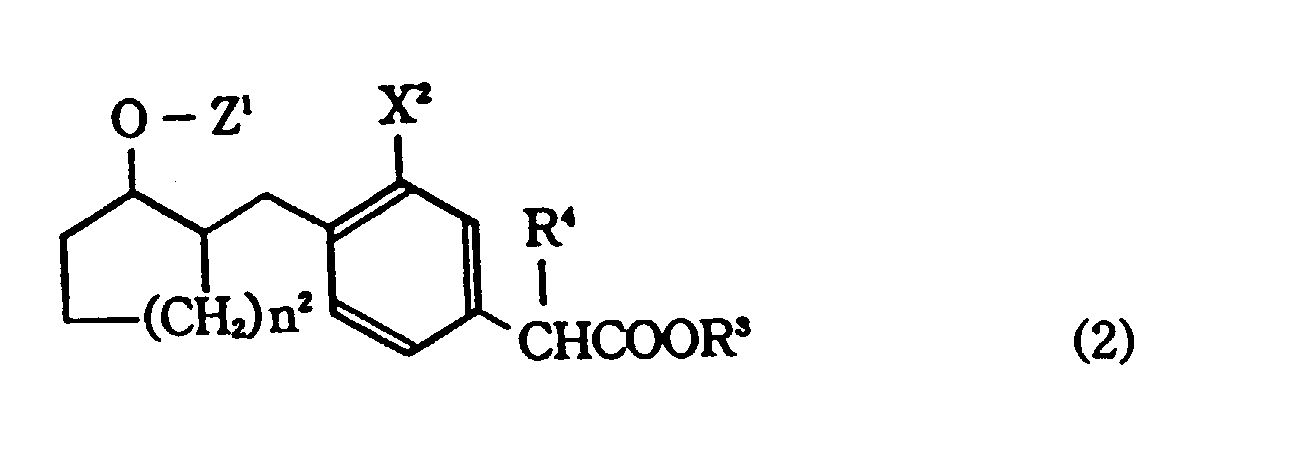 reacting together in an inert solvent two compounds represented respectively by the following formulae (12) and (13)
 treating the obtained reaction product with an acid and thenreducing the acid-treated reaction product in an inert solvent thereby to obtain the phenylalkanoic acid derivative.
 - A method according to claim 16, which further comprises hydrolyzing said acid-treated reaction product with an inorganic base or inorganic acid in water or a water-containing alcohol.
- A method according to claim 17, which further comprises acylating the compound obtained by said hydrolysis, in an inert solvent.
- A method for the separation of optical isomers of a phenylalkanoic acid derivative which comprises the steps ofreacting with an acylating agent in the presence of lipase which is an enzyme, a mixture of two trans-coordinated compounds represented respectively by the following formulae (2a) and (2b)

 separating the derivative of the formula (2c) from the derivative of the formula (2a).
 - An anti-inflammatory drug which contains a phenylalkanoic acid derivative as claimed in claim 13.
- An analgesic drug which contains a phenylalkanoic acid derivative as claimed in claim 13.
- A preparation for external use, which contains a phenylalkanoic acid derivative as claimed in claim 13.
- A preparation for external use according to claim 22, wherein said acid derivative-containing preparation is an eye drop, plaster, poultice, ointment, gel, cream, gel-like cream, liniment, suppository, nasal drop, aerosol, stomatic preparation, cataplasma or lotion.
Applications Claiming Priority (8)
| Application Number | Priority Date | Filing Date | Title |
|---|---|---|---|
| JP225000/91 | 1991-08-10 | ||
| JP22499991 | 1991-08-10 | ||
| JP224999/91 | 1991-08-10 | ||
| JP22500091 | 1991-08-10 | ||
| JP23114991 | 1991-08-20 | ||
| JP231149/91 | 1991-08-20 | ||
| PCT/JP1992/000995 WO1993002999A1 (en) | 1991-08-10 | 1992-08-04 | Phenylalkanoic acid derivative, production thereof, and separation of optical isomers thereof |
| US08/193,081 US5434292A (en) | 1991-08-10 | 1994-02-04 | Phenylalkanoic acid derivatives, process for producing the same and process for separating optical isomers thereof |
Publications (3)
| Publication Number | Publication Date |
|---|---|
| EP0641760A4 EP0641760A4 (en) | 1994-12-01 |
| EP0641760A1 EP0641760A1 (en) | 1995-03-08 |
| EP0641760B1 true EP0641760B1 (en) | 1996-11-06 |
Family
ID=27477153
Family Applications (1)
| Application Number | Title | Priority Date | Filing Date |
|---|---|---|---|
| EP92916116A Expired - Lifetime EP0641760B1 (en) | 1991-08-10 | 1992-08-04 | Phenylalkanoic acid derivative, production thereof, and separation of optical isomers thereof |
Country Status (10)
| Country | Link |
|---|---|
| US (1) | US5434292A (en) |
| EP (1) | EP0641760B1 (en) |
| JP (1) | JP2745436B2 (en) |
| KR (1) | KR0141507B1 (en) |
| CN (1) | CN1033086C (en) |
| AT (1) | ATE144976T1 (en) |
| AU (1) | AU656411B2 (en) |
| CA (1) | CA2115256A1 (en) |
| DE (1) | DE69215108T2 (en) |
| WO (1) | WO1993002999A1 (en) |
Families Citing this family (26)
| Publication number | Priority date | Publication date | Assignee | Title |
|---|---|---|---|---|
| US5962477A (en) * | 1994-04-12 | 1999-10-05 | Adolor Corporation | Screening methods for cytokine inhibitors |
| US6190691B1 (en) | 1994-04-12 | 2001-02-20 | Adolor Corporation | Methods for treating inflammatory conditions |
| US6573282B1 (en) | 1995-09-12 | 2003-06-03 | Adolor Corporation | Peripherally active anti-hyperalgesic opiates |
| US5849761A (en) | 1995-09-12 | 1998-12-15 | Regents Of The University Of California | Peripherally active anti-hyperalgesic opiates |
| JPH0990573A (en) * | 1995-09-28 | 1997-04-04 | Konica Corp | Solid developing replenisher for processing silver halide photographic sensitive material and developing method using the same |
| JP2010024239A (en) * | 1998-05-06 | 2010-02-04 | Kowa Co | Enterokinesis inhibitor |
| JP2000143540A (en) * | 1998-11-06 | 2000-05-23 | Bristol Myers Squibb Co | Topicals containing non-steroidal anti-inflammatory analgesics |
| US6635674B1 (en) | 1998-11-06 | 2003-10-21 | Bristol-Myers Squibb Co. | Pharmaceutical preparations for external use containing non-steroidal anti-inflammatory and analgesic agents |
| DE19935159A1 (en) * | 1999-07-27 | 2001-02-22 | Schuster Wolfgang | Muscle relaxant lotion containing natural active agents and penetration enhancing carrier |
| AU7998800A (en) * | 1999-10-04 | 2001-05-10 | R. Steven Marcus | Medical cutting tool lubricant composition |
| JP4195178B2 (en) * | 1999-11-10 | 2008-12-10 | 東興薬品工業株式会社 | Anti-inflammatory analgesic topical |
| US6497859B1 (en) * | 2000-11-17 | 2002-12-24 | Noville Inc. | Cooling agents, pharmaceutical compositions having cooling agents and processes for making and using same |
| US20030225031A1 (en) * | 2002-05-21 | 2003-12-04 | Quay Steven C. | Administration of acetylcholinesterase inhibitors to the cerebral spinal fluid |
| US6852713B2 (en) * | 2003-04-16 | 2005-02-08 | Adolor Corporation | Lactam derivatives and methods of their use |
| US7034051B2 (en) * | 2003-08-28 | 2006-04-25 | Adolor Corporation | Fused bicyclic carboxamide derivatives and methods of their use |
| US7160902B2 (en) * | 2003-11-14 | 2007-01-09 | Adolor Corporation | Amide derivatives and methods of their use |
| TW200827343A (en) * | 2006-09-11 | 2008-07-01 | Fuji Yakuhin Co Ltd | Novel phenylacetic acid derivative |
| JP5390883B2 (en) | 2009-02-26 | 2014-01-15 | 国立大学法人 熊本大学 | Loxoprofen derivative and pharmaceutical containing the same |
| JP5770621B2 (en) * | 2011-12-27 | 2015-08-26 | 株式会社Lttバイオファーマ | 2-Fluorophenylpropionic acid derivative |
| CN109134262A (en) * | 2017-06-15 | 2019-01-04 | 北京蓝丹医药科技有限公司 | A kind of loxoprofen derivative |
| CN109134261A (en) * | 2017-06-15 | 2019-01-04 | 北京蓝丹医药科技有限公司 | A kind of loxoprofen derivative |
| CN110041191A (en) * | 2019-04-30 | 2019-07-23 | 湖南九典宏阳制药有限公司 | A kind of purification process of pelubiprofen |
| WO2022052936A1 (en) * | 2020-09-09 | 2022-03-17 | 南京海融医药科技股份有限公司 | Aryl propionic acid derivative, pharmaceutical composition, and method for preparation thereof and application thereof |
| WO2023115511A1 (en) * | 2021-12-24 | 2023-06-29 | 南京海融医药科技股份有限公司 | Arylpropionic acid derivative and emulsion preparation thereof |
| WO2023202554A1 (en) * | 2022-04-19 | 2023-10-26 | 石家庄迪斯凯威医药科技有限公司 | Chiral aryl propionic acid derivative and pharmaceutical composition thereof, and use |
| CN115161847A (en) * | 2022-07-05 | 2022-10-11 | 晋江康邦拓新材料科技有限公司 | Antibacterial and deodorant shoe material lining cloth and processing method thereof |
Family Cites Families (4)
| Publication number | Priority date | Publication date | Assignee | Title |
|---|---|---|---|---|
| JPS584699B2 (en) * | 1977-04-05 | 1983-01-27 | 三共株式会社 | Substituted phenylacetic acid derivatives and their production method |
| DD141422A5 (en) * | 1978-01-27 | 1980-04-30 | Schering Ag | PROCESS FOR THE PREPARATION OF PHENYL ACID DERIVATIVES |
| JPS574919A (en) * | 1980-06-09 | 1982-01-11 | Sankyo Co Ltd | Anti-inflammatory for external use |
| JPS59196839A (en) * | 1983-04-21 | 1984-11-08 | Sankyo Co Ltd | Phenylacetic acid derivative |
-
1992
- 1992-08-04 EP EP92916116A patent/EP0641760B1/en not_active Expired - Lifetime
- 1992-08-04 CA CA002115256A patent/CA2115256A1/en not_active Abandoned
- 1992-08-04 JP JP5503475A patent/JP2745436B2/en not_active Expired - Lifetime
- 1992-08-04 AT AT92916116T patent/ATE144976T1/en active
- 1992-08-04 WO PCT/JP1992/000995 patent/WO1993002999A1/en not_active Ceased
- 1992-08-04 DE DE69215108T patent/DE69215108T2/en not_active Expired - Fee Related
- 1992-08-04 AU AU23909/92A patent/AU656411B2/en not_active Ceased
- 1992-08-10 CN CN92109051.XA patent/CN1033086C/en not_active Expired - Fee Related
-
1994
- 1994-02-04 US US08/193,081 patent/US5434292A/en not_active Expired - Fee Related
- 1994-02-07 KR KR1019940700344A patent/KR0141507B1/en not_active Expired - Fee Related
Also Published As
| Publication number | Publication date |
|---|---|
| WO1993002999A1 (en) | 1993-02-18 |
| CN1033086C (en) | 1996-10-23 |
| DE69215108D1 (en) | 1996-12-12 |
| CA2115256A1 (en) | 1993-02-18 |
| ATE144976T1 (en) | 1996-11-15 |
| EP0641760A4 (en) | 1994-12-01 |
| AU656411B2 (en) | 1995-02-02 |
| AU2390992A (en) | 1993-03-02 |
| CN1069484A (en) | 1993-03-03 |
| JP2745436B2 (en) | 1998-04-28 |
| EP0641760A1 (en) | 1995-03-08 |
| KR0141507B1 (en) | 1998-07-01 |
| DE69215108T2 (en) | 1997-03-20 |
| US5434292A (en) | 1995-07-18 |
Similar Documents
| Publication | Publication Date | Title |
|---|---|---|
| US5434292A (en) | Phenylalkanoic acid derivatives, process for producing the same and process for separating optical isomers thereof | |
| JPWO1993002999A1 (en) | Phenylalkanoic acid derivatives, their production method, and method for separating their optical isomers | |
| US5091422A (en) | Phenethanolamine derivatives | |
| US20100029704A1 (en) | Salt of nonsteroidal anti-inflammatory drug and organic amine compound and use thereof | |
| US5110814A (en) | Azelastine and its salts used to combat psoriasis | |
| WO1997044034A1 (en) | Remedy for rosacea | |
| JPS56145298A (en) | Aminophenyl derivative and physiologically active preparation containing the same | |
| WO1991006295A1 (en) | Analgesic composition containing optically pure s(+) flurbiprofen | |
| US4309407A (en) | Alkenyl-substituted thienylalkanecarboxylic acids and derivatives thereof | |
| JP2007534771A (en) | Phenoxyalkylcarboxylic acid derivatives in the treatment of inflammatory diseases | |
| JPS61251679A (en) | Antiinflammatory phenylalkyl-2,3-dihydrobenzofuran and analogue | |
| JP3112944B2 (en) | Pharmaceutical compositions useful as analgesics containing (R) -2- (3-benzoylphenyl) propionic acid | |
| JP2006509038A (en) | Dexanabinol with high enantiomeric purity for pharmaceutical compositions | |
| KR100240542B1 (en) | Novel retinoids | |
| US4619945A (en) | Polyene compounds useful in the treatment of allergic responses | |
| JPH0830027B2 (en) | 3-demethylmevalonic acid derivative | |
| EP0717027B1 (en) | Diarylheptanoide derivative and pharmaceutical composition comprising the same | |
| AU776153B2 (en) | Benzenoid derivatives of 15-hydroxyeicosatetraenoic acid and methods of their use in treating dry eye disorders | |
| JP2008506722A (en) | Cis-1,2-substituted stilbene derivatives and their use in the manufacture of a medicament for the treatment and / or prevention of diabetes | |
| WO1995032990A1 (en) | Cyclodepsipeptide | |
| DE3226687A1 (en) | POLYPRENYL COMPOUNDS, METHOD FOR PRODUCING THE SAME AND MEDICINAL PRODUCTS CONTAINING THEM | |
| JPWO1996006825A1 (en) | Guanidinomethylcyclohexanecarboxylic acid ester derivatives | |
| JP3586481B2 (en) | Arachidonic acid metabolism inhibitor | |
| JPH0567128B2 (en) | ||
| US4381304A (en) | 4,9-Dihydro-4,9-dioxo-1H-cyclohepta[b]pyridine derivatives |
Legal Events
| Date | Code | Title | Description |
|---|---|---|---|
| A4 | Supplementary search report drawn up and despatched | ||
| AK | Designated contracting states |
Kind code of ref document: A4 Designated state(s): AT BE CH DE ES FR GB GR IE IT LI LU NL SE |
|
| PUAI | Public reference made under article 153(3) epc to a published international application that has entered the european phase |
Free format text: ORIGINAL CODE: 0009012 |
|
| 17P | Request for examination filed |
Effective date: 19940308 |
|
| AK | Designated contracting states |
Kind code of ref document: A1 Designated state(s): AT BE CH DE ES FR GB GR IE IT LI LU NL SE |
|
| 17Q | First examination report despatched |
Effective date: 19950707 |
|
| GRAG | Despatch of communication of intention to grant |
Free format text: ORIGINAL CODE: EPIDOS AGRA |
|
| GRAH | Despatch of communication of intention to grant a patent |
Free format text: ORIGINAL CODE: EPIDOS IGRA |
|
| GRAH | Despatch of communication of intention to grant a patent |
Free format text: ORIGINAL CODE: EPIDOS IGRA |
|
| GRAA | (expected) grant |
Free format text: ORIGINAL CODE: 0009210 |
|
| AK | Designated contracting states |
Kind code of ref document: B1 Designated state(s): AT BE CH DE ES FR GB GR IE IT LI LU NL SE |
|
| PG25 | Lapsed in a contracting state [announced via postgrant information from national office to epo] |
Ref country code: NL Free format text: LAPSE BECAUSE OF FAILURE TO SUBMIT A TRANSLATION OF THE DESCRIPTION OR TO PAY THE FEE WITHIN THE PRESCRIBED TIME-LIMIT Effective date: 19961106 Ref country code: GR Free format text: LAPSE BECAUSE OF FAILURE TO SUBMIT A TRANSLATION OF THE DESCRIPTION OR TO PAY THE FEE WITHIN THE PRESCRIBED TIME-LIMIT Effective date: 19961106 Ref country code: ES Free format text: THE PATENT HAS BEEN ANNULLED BY A DECISION OF A NATIONAL AUTHORITY Effective date: 19961106 Ref country code: BE Effective date: 19961106 Ref country code: AT Effective date: 19961106 |
|
| REF | Corresponds to: |
Ref document number: 144976 Country of ref document: AT Date of ref document: 19961115 Kind code of ref document: T |
|
| ET | Fr: translation filed | ||
| REG | Reference to a national code |
Ref country code: IE Ref legal event code: FG4D Free format text: 70566 |
|
| REF | Corresponds to: |
Ref document number: 69215108 Country of ref document: DE Date of ref document: 19961212 |
|
| ITF | It: translation for a ep patent filed | ||
| PG25 | Lapsed in a contracting state [announced via postgrant information from national office to epo] |
Ref country code: SE Effective date: 19970206 |
|
| REG | Reference to a national code |
Ref country code: CH Ref legal event code: NV Representative=s name: R. A. EGLI & CO. PATENTANWAELTE |
|
| NLV1 | Nl: lapsed or annulled due to failure to fulfill the requirements of art. 29p and 29m of the patents act | ||
| PG25 | Lapsed in a contracting state [announced via postgrant information from national office to epo] |
Ref country code: IE Free format text: LAPSE BECAUSE OF NON-PAYMENT OF DUE FEES Effective date: 19970804 |
|
| PG25 | Lapsed in a contracting state [announced via postgrant information from national office to epo] |
Ref country code: LU Free format text: LAPSE BECAUSE OF NON-PAYMENT OF DUE FEES Effective date: 19970831 |
|
| PLBE | No opposition filed within time limit |
Free format text: ORIGINAL CODE: 0009261 |
|
| STAA | Information on the status of an ep patent application or granted ep patent |
Free format text: STATUS: NO OPPOSITION FILED WITHIN TIME LIMIT |
|
| 26N | No opposition filed | ||
| PGFP | Annual fee paid to national office [announced via postgrant information from national office to epo] |
Ref country code: GB Payment date: 19990702 Year of fee payment: 8 |
|
| PGFP | Annual fee paid to national office [announced via postgrant information from national office to epo] |
Ref country code: FR Payment date: 19990818 Year of fee payment: 8 Ref country code: CH Payment date: 19990818 Year of fee payment: 8 |
|
| PGFP | Annual fee paid to national office [announced via postgrant information from national office to epo] |
Ref country code: DE Payment date: 19990830 Year of fee payment: 8 |
|
| PG25 | Lapsed in a contracting state [announced via postgrant information from national office to epo] |
Ref country code: GB Free format text: LAPSE BECAUSE OF NON-PAYMENT OF DUE FEES Effective date: 20000804 |
|
| PG25 | Lapsed in a contracting state [announced via postgrant information from national office to epo] |
Ref country code: LI Free format text: LAPSE BECAUSE OF NON-PAYMENT OF DUE FEES Effective date: 20000831 Ref country code: CH Free format text: LAPSE BECAUSE OF NON-PAYMENT OF DUE FEES Effective date: 20000831 |
|
| GBPC | Gb: european patent ceased through non-payment of renewal fee |
Effective date: 20000804 |
|
| REG | Reference to a national code |
Ref country code: CH Ref legal event code: PL |
|
| PG25 | Lapsed in a contracting state [announced via postgrant information from national office to epo] |
Ref country code: FR Free format text: LAPSE BECAUSE OF NON-PAYMENT OF DUE FEES Effective date: 20010430 |
|
| PG25 | Lapsed in a contracting state [announced via postgrant information from national office to epo] |
Ref country code: DE Free format text: LAPSE BECAUSE OF NON-PAYMENT OF DUE FEES Effective date: 20010501 |
|
| REG | Reference to a national code |
Ref country code: FR Ref legal event code: ST |
|
| PG25 | Lapsed in a contracting state [announced via postgrant information from national office to epo] |
Ref country code: IT Free format text: LAPSE BECAUSE OF NON-PAYMENT OF DUE FEES;WARNING: LAPSES OF ITALIAN PATENTS WITH EFFECTIVE DATE BEFORE 2007 MAY HAVE OCCURRED AT ANY TIME BEFORE 2007. THE CORRECT EFFECTIVE DATE MAY BE DIFFERENT FROM THE ONE RECORDED. Effective date: 20050804 |