EP0641361B1 - Fusing member containing metal oxide free fluoroelastomer compositions - Google Patents
Fusing member containing metal oxide free fluoroelastomer compositions Download PDFInfo
- Publication number
- EP0641361B1 EP0641361B1 EP19930911384 EP93911384A EP0641361B1 EP 0641361 B1 EP0641361 B1 EP 0641361B1 EP 19930911384 EP19930911384 EP 19930911384 EP 93911384 A EP93911384 A EP 93911384A EP 0641361 B1 EP0641361 B1 EP 0641361B1
- Authority
- EP
- European Patent Office
- Prior art keywords
- fluoroelastomer
- fusing
- metal
- fuser roll
- fusing member
- Prior art date
- Legal status (The legal status is an assumption and is not a legal conclusion. Google has not performed a legal analysis and makes no representation as to the accuracy of the status listed.)
- Revoked
Links
Images
Classifications
-
- C—CHEMISTRY; METALLURGY
- C08—ORGANIC MACROMOLECULAR COMPOUNDS; THEIR PREPARATION OR CHEMICAL WORKING-UP; COMPOSITIONS BASED THEREON
- C08L—COMPOSITIONS OF MACROMOLECULAR COMPOUNDS
- C08L27/00—Compositions of homopolymers or copolymers of compounds having one or more unsaturated aliphatic radicals, each having only one carbon-to-carbon double bond, and at least one being terminated by a halogen; Compositions of derivatives of such polymers
- C08L27/02—Compositions of homopolymers or copolymers of compounds having one or more unsaturated aliphatic radicals, each having only one carbon-to-carbon double bond, and at least one being terminated by a halogen; Compositions of derivatives of such polymers not modified by chemical after-treatment
- C08L27/12—Compositions of homopolymers or copolymers of compounds having one or more unsaturated aliphatic radicals, each having only one carbon-to-carbon double bond, and at least one being terminated by a halogen; Compositions of derivatives of such polymers not modified by chemical after-treatment containing fluorine atoms
- C08L27/16—Homopolymers or copolymers or vinylidene fluoride
-
- C—CHEMISTRY; METALLURGY
- C08—ORGANIC MACROMOLECULAR COMPOUNDS; THEIR PREPARATION OR CHEMICAL WORKING-UP; COMPOSITIONS BASED THEREON
- C08F—MACROMOLECULAR COMPOUNDS OBTAINED BY REACTIONS ONLY INVOLVING CARBON-TO-CARBON UNSATURATED BONDS
- C08F259/00—Macromolecular compounds obtained by polymerising monomers on to polymers of halogen containing monomers as defined in group C08F14/00
- C08F259/08—Macromolecular compounds obtained by polymerising monomers on to polymers of halogen containing monomers as defined in group C08F14/00 on to polymers containing fluorine
-
- Y—GENERAL TAGGING OF NEW TECHNOLOGICAL DEVELOPMENTS; GENERAL TAGGING OF CROSS-SECTIONAL TECHNOLOGIES SPANNING OVER SEVERAL SECTIONS OF THE IPC; TECHNICAL SUBJECTS COVERED BY FORMER USPC CROSS-REFERENCE ART COLLECTIONS [XRACs] AND DIGESTS
- Y10—TECHNICAL SUBJECTS COVERED BY FORMER USPC
- Y10S—TECHNICAL SUBJECTS COVERED BY FORMER USPC CROSS-REFERENCE ART COLLECTIONS [XRACs] AND DIGESTS
- Y10S428/00—Stock material or miscellaneous articles
- Y10S428/906—Roll or coil
-
- Y—GENERAL TAGGING OF NEW TECHNOLOGICAL DEVELOPMENTS; GENERAL TAGGING OF CROSS-SECTIONAL TECHNOLOGIES SPANNING OVER SEVERAL SECTIONS OF THE IPC; TECHNICAL SUBJECTS COVERED BY FORMER USPC CROSS-REFERENCE ART COLLECTIONS [XRACs] AND DIGESTS
- Y10—TECHNICAL SUBJECTS COVERED BY FORMER USPC
- Y10T—TECHNICAL SUBJECTS COVERED BY FORMER US CLASSIFICATION
- Y10T428/00—Stock material or miscellaneous articles
- Y10T428/31504—Composite [nonstructural laminate]
- Y10T428/3154—Of fluorinated addition polymer from unsaturated monomers
-
- Y—GENERAL TAGGING OF NEW TECHNOLOGICAL DEVELOPMENTS; GENERAL TAGGING OF CROSS-SECTIONAL TECHNOLOGIES SPANNING OVER SEVERAL SECTIONS OF THE IPC; TECHNICAL SUBJECTS COVERED BY FORMER USPC CROSS-REFERENCE ART COLLECTIONS [XRACs] AND DIGESTS
- Y10—TECHNICAL SUBJECTS COVERED BY FORMER USPC
- Y10T—TECHNICAL SUBJECTS COVERED BY FORMER US CLASSIFICATION
- Y10T428/00—Stock material or miscellaneous articles
- Y10T428/31504—Composite [nonstructural laminate]
- Y10T428/31652—Of asbestos
- Y10T428/31663—As siloxane, silicone or silane
-
- Y—GENERAL TAGGING OF NEW TECHNOLOGICAL DEVELOPMENTS; GENERAL TAGGING OF CROSS-SECTIONAL TECHNOLOGIES SPANNING OVER SEVERAL SECTIONS OF THE IPC; TECHNICAL SUBJECTS COVERED BY FORMER USPC CROSS-REFERENCE ART COLLECTIONS [XRACs] AND DIGESTS
- Y10—TECHNICAL SUBJECTS COVERED BY FORMER USPC
- Y10T—TECHNICAL SUBJECTS COVERED BY FORMER US CLASSIFICATION
- Y10T428/00—Stock material or miscellaneous articles
- Y10T428/31504—Composite [nonstructural laminate]
- Y10T428/31678—Of metal
Definitions
- the invention relates generally to metal oxide free fluoroelastomer compositions and to a fusing member having an outer layer of the fluoroelastomer for applying heat and pressure to fix toner particles to recording paper.
- a fuser roll is a roller designed to apply direct heat and pressure to a toner image.
- the fluoroelastomer surface permits toner to be fixed to the recording paper without adhering to the roller surface and can withstand continuous exposure to high temperatures, silicone oils, toners, toner additives and paper product residue without unacceptable physical degradation.
- an image formed of a heat fusible toner powder is selectively disposed on a web-like surface of a recording medium, such as paper, by electrostatic forces.
- Toner powders are commonly formed of a mixture of thermoplastic and/or thermosetting resin carriers and additives such as amorphous carbon and magnetic particles. They are conventionally fixed to the recording paper by direct contact with a fuser roll which applies pressure and heat at temperatures between about 200 to 400°F.
- the fusing process is conventionally accomplished by feeding a recording medium having the toner image thereon between the nip where two mated rollers meet.
- One or both of the rollers are heated, typically by an internal heat source within the roller, so that the surface temperature of the roller will be above the softening point of the resinous carrier of the toner.
- the recording medium with the toner image thereon is fed between the two rollers which press towards each other to apply direct heat and pressure to the toner image.
- the amount of pressure and the length of time that the toner is heated determines the degree of fusing.
- the actual temperature range suitable for fixing toner images to recording paper is referred to as the "fusing window".
- Hot Offset temperature is the temperature at which the cohesive forces within the molten toner layer are less than the adhesive forces between the toner and roll surface so that toner adheres to the fuser roll.
- T MIN is the minimum temperature at which toner can be acceptably fixed to the recording paper. This temperature range is dependent on the raw materials, type of toner, release agents and the pressure applied by the roller. It is important that the toner is fixed without "offset" occurring, in order to produce copies of acceptable quality.
- a fusing window of at least 30°F is acceptable for some applications. However, it is preferable to have as large a fusing window as possible. Thus, a 60°F fusing window is desirable and a 100°F fusing window is particularly ideal.
- Softened toner generally has an affinity for the surface of the fuser roll it contacts. When toner adheres to the surface of a fuser roll, it can unintentionally be deposited on an unselected portion of the recording medium during the next rotation of the roll. This phenomenon is referred to as offset.
- a thin coating of a release agent such as polysiloxane fluid is commonly spread over the surface of the fuser roll which contacts the surface of the toner image.
- the polysiloxane fluid reduces the surface free energy of the roll surface and decreases the affinity of the toner for the roll.
- Surface tension values for several conventional fuser roll materials are set forth below in Table I.
- Surface Tension of Fuser Roll Materials Fuser Roll Surface Surface Tension nMn Polytetrafluoroethylene (PTFE) 18.0-18.5 Polyvinylidene fluoride (PVF 2 ) 21-22 Polysiloxane Compounds 28-29 Polyfluorocarbon Elastomers 35-37 Polysiloxane Release Agents 19-21
- metal oxides are typically included to act as an acid accepter, cure activator, reinforcing filler and/or as an additive to promote improved chemical resistance. It is believed that every commercially available fuser roll having a fluoroelastomer surface contains metal oxide particles in at least the fluoroelastomer surface layer.
- U.S. Patent Nos. 4,257,699, 4,264,181 and 4,272,179 describe fuser rolls in which additional metal oxide filler particles are added to the fluoroelastomer surface material to increase the metal oxide content of the surface of the fuser rolls beyond that needed to promote cure of the material. Fluoroelastomers described in U.S. Patent No. 5,035,950 contain only so much metal oxide as is necessary to effect cure of the high fluorine content material.
- fluoroelastomers have been suggested in the prior art.
- U.S. Patent No. 3,674,763 a process for curing fluoroelastomers in the presence of two diamines is disclosed.
- the elastomers are copolymers of polyvinylidene fluoride and a fluoro-olefin.
- the ratio of polyvinylidene fluoride and fluoro-olefin may be within the range of 10:90 to 95:5 by weight.
- a vinyl compound is included in the polymer.
- Japanese Application 73-38,467 purposes use of xylenediamine carbamates as crosslinking agents for hexafluoropropylenevinylidene fluoride copolymers which are useful as sealing agents.
- U.S. Patent 3,622,549 to Keller discloses a process for vulcanizing fluoroelastomers by heating the elastomer in the presence of a secondary monoamine and an aromatic polyamine or aromatic polyol.
- the fluoroelastomers include copolymers of vinylidene fluoride and at least one other ephenically unsaturated fluorinated monomer normally containing from 2 to 6 carbon atoms.
- the copolymers usually contain at least about 30 percent by weight vinylidine fluoride.
- Preferred copolymers are those derived from between 70 to 30% by weight vinylidene fluoride and between 30 to 70% by weight hexafluoropropene. While amines are present in curing systems, Keller teaches incorporation of conventional compounding agents, such as a metal oxide and a reinforcing fuller, such as carbon black into the elastomer.
- JP Application 74-42,756 teaches utilizing amine vulcanizing agents for hexafluoropropene-tetrafluoroethylene-vinylidene fluoride copolymers cured in the presence of carbon black.
- Japanese Application 74-34,545 utilizes 2-mercaptoim-idazoline and dithyocarbamate as an acid acceptor for curing hexafluoropropene-tetrafluoroethylene-vinylidene fluoride copolymers with carbon black, MgO and Na diethyldithiocarbamate. Additional elastomers including metal oxide are disclosed EP 1 960 762.
- European application 0 455 470 also discloses various poly (vinylidene- hexafluoropropylene-tetrafluoroethylene) elastomers, all including metal oxide. These elastomers are utilized in fusing members.
- European application 0 441 645 discloses elastomers of vinylidene fluoride and high hexafluoropropylene content which have been cured utilizing a metal containing acid acceptors.
- fluoroelastomer compositions free of metal or metal containing compounds, such as metals or metal oxides, which are particularly well suited for the topcoat of a fusing member for applying heat and pressure to fix toner to a recording medium are provided.
- the fluoroelastomer composition can be cured by electron beam treatment, fugitive base treatment or the use of blocked/hindered amines.
- a fusing member having metal free fluoroelastomer surfaces have advantages over conventional fusing members because they do not require the use of expensive mercapto functional active release agents to prevent offset.
- An object of the invention is to provide an improved fuser roll having a topcoat of fluoroelastomer free of metal containing material for fixing toner to a recording medium.
- a further object of the invention is to provide a fuser roll having a metal containing material free fluoroelastomer topcoat for fusing without the need to use mercapto functional release agents.
- a first aspect of the invention provides a fusing member for fixing toner particles to a recording medium, comprising a substrate and an outer layer of fluoroelastomer material on the substrate, the outer layer of fluoroelastomer material being free of metal containing material.
- a second aspect of the invention provides a fusing system for fusing toner to a recording medium, including a fuser roll having an outer surface formed of fluoroelastomer material, characterised in that:
- a fusing member constructed in accordance with an embodiment of the invention includes a fluoroelastomer topcoat surface that is free of metal containing material such as metal or metal oxide particles.
- the fusing member can be a belt, a flat surface or another substrate having suitable shape for fixing toner images to a recording medium, such as paper, at elevated temperatures under pressure.
- a preferred fusing member is a fuser roll having a metal core that can be hollow, covered with the fluoroelastomer material.
- a heating element can be included within the metal core to heat the fluoroelastomer surface.
- the fuser roll can be used to fix toner powder to a recording medium, such as paper, without offset and without relying on the interaction between metal oxides and mercapto functional release agent fluids.
- the outer layer of the fusing member is preferably of a fluoroelastomer composition having a greater molar content of hexafluoropropylene (HFP) than conventional fluoroelastomers.
- the fluoroelastomer compositions preferably include more than about 23.4 mole% HFP and more preferably more than about 30.0 mole% HFP.
- a preferred composition is a copolymer of vinylidene fluoride (VF 2 ) and hexafluoropropylene (HFP) that includes more than about 65% total fluorine by weight, preferably 69 to 71% fluorine by weight. It is preferable to include as much HFP as is practical.
- the molar ratio of VF 2 to HFP is preferably less than 2 and more preferably about 1.7 or less. An acceptable preferred range is between 1.25 and 1.75.
- the fluoroelastomer composition can also include cure additives, such as hexafluoropropylidine diphenol, triphenyl benzyl phosphonium chloride/bromide and acid acceptors (though not metal oxides).
- cure additives such as hexafluoropropylidine diphenol, triphenyl benzyl phosphonium chloride/bromide and acid acceptors (though not metal oxides).
- Fuser rolls having a fluoroelastomer surface substantially free of metal containing material such as metal oxides can be cured by several methods.
- Crosslinking can be induced by using diamines, a combination of diamines and bisphenol or by other organic base treatments such as ammonia vapor deposition.
- Another method involves the use of radiation curing such as electron beam treatment.
- Such techniques are known for the use of curing various polymer systems, but are uniformly not employed in the production of commercially available fuser rolls, where the mechanical properties of polymers having metal oxide particles therein has been the accepted material of choice.
- Base treatment includes the use of blocked/hindered amines, "fugitive" bases which will leave the polymer system after attack on the polymer material to yield unsaturation sites and electron beam treatment. The fugitive base treatment can be conducted in the vapor or liquid phases.
- Metal oxide free curing can be accomplished with treatment by blocked/hindered amines.
- blocked/hindered amines include DIAK 3 (N, N' - D - Cinnamylidene - 1, 6-hexanediamine and DIAK 1 (hexamethylene - diaminecarbamate) which are commercially available curing agents sold by DuPont of Wilmington, Delaware. This type of curing is described in Example 1.
- Electron beam processing and methods for estimating the required specifications of the electron accelerator are discussed in Becker, RC, "Accelerator Requirements For Electron Beam Processing", Radiat. Phys. Chem., Vol. 14, Pages 353-375 (1975), the contents of which are incorporated herein by reference.
- the fuser roll is conveyed into a chamber where it is bombarded by a highly energetic beam of electrons. Curing occurs during the brief interval during which the fuser roll is exposed to the electron beam, which is spread over the entire surface.
- Electron Beam (EB) radiation generates carbon-carbon bonds between molecules without using cure agents such as metal oxide powders. Compounding for the electron beam is similar to that for other curing processes. Commercial applications are well developed in the manufacture of wire and cable, rubber tires, heat shrink products and others. However, it is believed that this technique has never been applied to curing polymer materials for fuser rolls in the absence of conventional cure system including the use of metal oxides.
- Electron Beam (EB) dosages of 1-40 megarads are acceptable for many applications; 3-40 MRads is preferred and 5-20 MRads is more preferred. It is useful to include cross linking aids (co-agents) in the polymer composition at concentrations of about 1-10 parts by weight per 100 parts polymer.
- EB crosslinkable di or poly functional oligimers include: 1,6 - Hexanediol Diacrylate, Trimethylol Propane Triacrylate, Bisphenol A Expoxy Diacrylate (EBECRYL 3700), TAC (2,4,6 - Tris (Allyloxy) - S - Tri -azine and TAIC (Triallylisocyanurate).
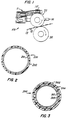
- a fuser roll test assembly 100 is shown generally in FIG. 1 and applies heat and pressure to fuse a quantity of toner particles 12 on a sheet of paper 13 between a fuser roll 20 and a pressure roll 30.
- Fuser roll test assembly 100 also includes a release agent application unit 11 including a wick 15 for applying release agent to the surface of fuser roll 20.
- a stripper finger 16 facilitates the separation of paper 13 from roll 20.
- FIG. 2 is a cross-sectional view of a fuser roll 200 constructed in accordance with an embodiment of the invention.
- Fuser roll 200 includes a hollow middle core 201 covered with a fluoroelastomer surface layer 202.
- a second fuser roll 300 is shown in cross-sectional view in FIG. 3.
- Fuser roll 300 includes an insert 302 covered with a base coat 303 having a tie coat 304 disposed thereon and a topcoat 302 disposed on tie coat 304.
- Base coat 303 is preferably 1.27 to 12.7 microns (0.5 to 5 mil) thick and the overall coating (either surface layer 202 or combined layers 303, 304, and 302) should be about 7.62 - 20.32 microns (3-8 mils) thick.
- compositions A through D contain metal oxide filler conventionally used to promote interaction with a mercapto functional release agent.
- Composition E contains no more than sufficient residual metal oxide to act as an activator and acid accepter for conventional cross-linking of the composition, but insufficient amount to react effectively with a mercapto functional release agent.
- compositions A through G were prepared by mixing the components with a two roll mixing mill.
- the polymer was loaded between the two mill rolls to obtain a "bank”.
- Cross-blending was obtained by cutting sheets off the mill roll until a uniform viscosity is achieved.
- the powdered ingredients were then added over the polymer bank and dispersed therein by cutting and cross-blending.
- the curatives are then added and the composition was cut and cross-blended to obtain thorough and uniform dispersion of all ingredients.
- the resulting material was cooled in the air, compound tested then used as the surface material for a fuser roll.
- the components can also be mixed with an internal mixer device known in the trade as a Banbury.
- the components can be effectively prepared by "in-situ" mixing techniques. In-situ mixing involves dissolving the polymer in a solvent, then adding the powdered ingredients including the activator and curatives. In compositions having a tendency to gel rapidly, it is preferable to employ a two or three component system to isolate the calcium hydroxide and/or the acceptor.
- metal oxides are conventionally added to act as an acid acceptor, cure activator, reinforcent filler and/or at times as an additive to promote improved chemical resistance.
- lead oxide for example, improves the steam and acid resistance of fluoroelastomer compounds and is well known in the art.
- Metal fillers are also added to provide actual release by interaction with mercapto functional compounds. However, it has been determined that metal and metal oxide free compositions provide advantages as a top coat surface in a fuser roll despite the diminished mechanical properties.
- Fuser roll samples were formed by covering a 3.81 cm (1.5 inch) standard aluminum insert with a 10.16 microns (4 mil) thick fluoroelastomer base coat covered with a 5.08 microns (2 mil) thick topcoat of the materials shown below in Table III.
- the sample fuser rolls were prepared by first mixing the base coat material and topcoat material in a two roll mixing mill.
- the base coat compound was formulated by combining 100 parts VITON E-60 (DuPont) fluoroelastomer, 30 parts thermal carbon black filler, 12 parts magnesium oxide (as an activator/acid accepter) and 5.5 parts blend CURATIVE 20 (DuPont) and CURATIVE 30 (DuPont).
- the mixed starting materials were dissolved in a 50:50 blend of methyl ethyl ketone (MEK) and methyl isobutyl ketone (MIBK) solvents to approximately a 15% solid concentration.
- MEK methyl ethyl ketone
- MIBK methyl isobutyl ketone
- the aluminum insert was precured with a primer layer of THIXON 300/301 adhesive and then sprayed with the base coat solution to a thickness of about 12.7 - 15.24 microns (5-6 mils).
- the coated sample was maintained at room temperature to permit residual solvent to evaporate and then cured in a circulating oven for up to 24 hours at a temperature of 65.6 to 232.2°C (150 to 450° F).
- the sample was then ground to a base coat thickness of 7.62 - 10.16 microns (3-4 mils).
- Fusing tests herein were carried out by passing an 21.59 x 29.21 cm (8.5 x 11.5 inch) 75g/m 2 sheet of paper having toner particles thereon between fuser roll 20 and pressure roll 30 to fuse toner 12 to paper 13.
- Fuser roll life is indicated by the number of sheets of paper that can be successfully fused before failure by either offset, mechanical failure or some other difficulty.
- Fuser rolls including metal free compositions F and G from Table II were found to be acceptable.
- Example 3 having 70% F shows a 75% increase in roll life compared to Example 2 and a 250% increase over Example 1 with 66% F.
- Example 3 and 5 The elimination of metal oxide within the fuser roll surface material led to a 450% increase in roll life of 94,000 copies. Accordingly, it is preferred to provide a fuser roll without any metal oxide in the material.
- metal oxides are used to generate unsaturation in the polymer material.
- the reaction is generally not easy to control and accordingly, it is has been common to employ excess metal oxides to achieve acceptable results. However, this typically generates excess unsaturation.
- the unsaturation in the cured polymer material increases the surface energy and may decrease fuser roll life before offset occurs.
- the metal particles at the roll surface also increase the surface energy.
- Metal free compositions in accordance with the invention include sufficient sites for cross-linking, but not excessive sites which would oxidize, thereby increasing surface energy and impede toner release. Furthermore, without residual metal oxide particles, the composition will inherently yield a polymer surface having lower surface energy particularly well suited for fusing applications.
- a fuser roll is prepared in accordance with Example 1, employing L-12176 as the surface material, which is sprayed onto a procured base layer having a 4 mil thickness.
- the surface material is air dried and then positioned in an electron beam apparatus curing device and exposed to an energy dose of 15 MRad.
- the resultant fuser roll will perform acceptably with polydimethylsiloxane release fluid having a viscosity of about 500 CSTKS and will exhibit excellent roll life and release properties, including adequate release at a temperature of about 185°C.
- a fuser roll is prepared as in Example 2, except that the top coat material is formed of 100 parts L-12176 together with five parts EBECRYL 3700.
- EBECRYL 3700 (available from RADCURE of Louisville Kentucky) is a conventional metal-oxide free cross-linking aid (co-agent) that has been found to improve the efficiency of electrons beam cures.
- the roll is cured with an electron beam dosage of about 5 MRad's and will perform similarly to the roll of Example 2.
- Curing without metal oxides can also be effected by treatment with a base in either the vapor or liquid phase.
- a base for example, ammonia, methylamine, ethylamine and dimethylamine gas can be passed over a fuser roll coated with metal oxide free fluoroelastomer material.
- the base will attack the polymer chain and create unsaturated sites for cross-linking. Subsequent heat treatment will cure the material and provide a fuser roll surface having exceptional release properties that does not require interaction with a mercapto functional release agent.
- Base treatment as described herein can also be accomplished in the liquid phase.
- the above-noted gaseous materials can be solved in a suitable solvent, such as ether or alcohols and the uncured fuser roll can be completely immersed therein.
- a suitable solvent such as ether or alcohols
- Propyl and butyl amines can also be employed, as well as combinations of the above bases.
- a fuser roll is prepared as in Example 1, except that the surface layer is formed of L-12176 which is sprayed onto the precured base layer.
- the surface material is air dried and placed in a cylindrical stainless steel chamber equipped with a gas inlet and exhaust apparatus.
- a gaseous mixture of 5% anhydrous ammonia and 95% N 2 (by volume) is allowed to flow over the roll surface until sufficient unsaturation is developed as can be evidenced by a change in surface color or through instrumental analysis.
- the roll is then removed and placed in a forced air oven at a temperature of about 200° C for about 24 hours. It will perform well with a polydimethylsiloxane release fluid having a viscosity of 500 CSTK at surface temperatures of about 185°C.
- a fuser roll is prepared as in Example 1, except that the surface layer is formed of Fluorel 2530 which is sprayed onto a precured base layer.
- the Fluorel layer is air dried and then placed in a cylindrical steel chamber equipped with gas inlets and outlets. A gaseous mixture of 5% anhydrous ammonia and 95% N 2 (by volume) is allowed to flow over the roll surface.
- the roll is then removed and placed in a forced air oven at 200° C for 24 hours.
- the roll will exhibit adequate release with a 500 CSTK linear reactive polydimethylsilicone fluid copolymer containing 0.1 wt% mercaptopropylmethylsiloxane modification at temperatures of about 185°C.
- a fuser roll is prepared as in Example 1, except that the surface layer is formed of L-12176.
- the material is cured by immersing the fuser roll in a l0wt% solution of butylamine in diethylether at 25° C until surface discoloration is apparent.
- the roll is then removed from the amine-ether solution and washed with ethyl alcohol and distilled water. It is then heat treated at 200° C for 24 hours.
- the roll will exhibit adequate release properties at temperatures of about 185°C with a 500 CSTK liner polysiloxane release fluid.
- ingredients or compounds recited in the singular are intended to include compatible mixtures of such ingredients wherever the sense permits.
Landscapes
- Chemical & Material Sciences (AREA)
- Chemical Kinetics & Catalysis (AREA)
- Medicinal Chemistry (AREA)
- Polymers & Plastics (AREA)
- Organic Chemistry (AREA)
- Health & Medical Sciences (AREA)
- Fixing For Electrophotography (AREA)
- Compositions Of Macromolecular Compounds (AREA)
- Rolls And Other Rotary Bodies (AREA)
- Treatments Of Macromolecular Shaped Articles (AREA)
- Addition Polymer Or Copolymer, Post-Treatments, Or Chemical Modifications (AREA)
- Adhesives Or Adhesive Processes (AREA)
- Laminated Bodies (AREA)
Abstract
Description
| Surface Tension of Fuser Roll Materials | |
| Fuser Roll Surface | Surface Tension nMn |
| Polytetrafluoroethylene (PTFE) | 18.0-18.5 |
| Polyvinylidene fluoride (PVF2) | 21-22 |
| Polysiloxane Compounds | 28-29 |
| Polyfluorocarbon Elastomers | 35-37 |
| Polysiloxane Release Agents | 19-21 |
| Fuser Roll Surface Material Compositions | |||||
| COMPARISON METAL OXIDE CONTAINING FLUOROELASTOMER COMPOSITION | |||||
| Composition | A | B | C | D | E |
| Fluorel 2530 (copolymer of VF2 and HFP, | X | X | X | X | 100 |
| L12176 (copolymer VF2 and HFP) | X | X | X | X | X |
| Terpolymer VF2 HFP & TPE | 100 | X | X | X | X |
| Copolymer VF2 & TPE | X | 100 | X | 100 | X |
| Terpolymer VF2 , HFP & TPE & Cure Site Monomer | X | X | 100 | X | X |
| Cupric Oxide | X | X | 15 | 15 | X |
| Lead Oxide | 15 | 15 | X | X | X |
| Magnesium Oxide | X | X | 2.0 | 3 | 3 |
| Calcium Hydroxide | X | X | 1.0 | 6 | 6 |
| Curative 20 | 2.5 | 1.4 | X | 1.4 | X |
| Curative 30 | 3.5 | 2.8 | X | 2.8 | X |
| Curative 50 | X | X | 5.0 | X | X |
| DIAK No. 3 | X | X | X | X | X |
| A | B | C | D | E | |
| Polymer Data | Terpolymer of VF2 HFP & TPE | Copolymer of VF2 & HFP | Tetrapolymer of VF2, HFP, TFE & cure site monomer | Copolymer of VF2 & HFP | Copolymer of VF2 & HFP |
| Total Fluorine (wt.%) | 68.5 | 66% | 69.0% | 66% | 69.6% |
| HFP Content (molar%) | 18 | 21 | 22 | 21 | 37 |
| VF2 Content (molar%) | 61 | 79 | 55 | 79 | 63 |
| TFE Content (molar%) | 21 | X | 23 | X | X |
| VF2/HFP Ratio (molar) | 3.39 | 3.76 | 2.5 | 3.76 | 1.70 |
| INGREDIENT DATA | ||
| CHEMICAL COMPOSITION | TRADE NAME | MANUFACTURER |
| Terpolymer of VF2, HFP & TPE with 68.5% fluorine | Viton B-50, Fluorel, FT 2430 | DuPont, 3M |
| Copolymer of VF2 and HFP with 65.9% fluorine | Viton E-45, Fluorel, FC 2145 | DuPont, 3M |
| Copolymer of VF2, HFP with 66% fluorine | Viton E-60, Fluorel, FC 2230 | DuPont, 3M |
| Tetrapolymer of FV2 and HFP TFE and cure site monomer with 69% fluorine | Viton GF, Fluorel, FLS 2690 | DuPont, 3M |
| Copolymer of VF2 and HFP containing phosphonium salt accelerator and bisphenol crosslinker with 69.6% fluorine | FC 2530 | 3M |
| 33% dispersion of organophosphonium salt in Viton E-45 | Curative 20 | DuPont |
| 50% dispersion of bisphenol (dihyroxy aromatic compound) in Viton E-45 | Curative 30 | DuPont |
| Proprietary accelerator and bisphenol curative system | Curative 50 | DuPont |
| Copolymer of VF2 and HFP containing phosphonium salt accelerator and bisphenol crosslinker with 70% fluorine | L-12176 | 3M |
| N, N' - Di-cinnamylidene- 1, 6, hexanediamine | DIAK No. 3 | DuPont |
| FORMULATION OF TOPCOAT COMPOSITION | |||||
| INGREDIENTS | RUN NUMBERS | ||||
| 1 | 2 | 3 | 4 | 5 | |
| FC 2145 (66% F) | 100 | X | X | 100 | X |
| L 12176 (70% F) | | 100 | 100 | X | 100 |
| MAGNESIUM OXIDE | 2 | 2 | 2 | X | X |
| CALCIUM HYDROXIDE | 4 | 4 | 4 | X | X |
| DIAK NO. 3 | X | X | X | 6 | 6 |
| CURATIVE 20 | 1.4 | X | X | X | X |
| CURATIVE 30 | 2.8 | X | X | X | X |
| FC 2145 - Copolymer of VF2 and HFP containing 66% total fluorine by weight and a VF2/HFP molar ratio of 3.76 | |||||
| FC 2530 - Copolymer of VF2 and HFP containing 69% total fluorine by weight and a VF2/HFP molar ratio of 1.70; contains phosphonium salt accelerator and bisphenol crosslinker. | |||||
| L12176 - Copolymer of VF2 and HFP containing 70% total fluorine by weight and a VF2/HFP molar ratio of 1,27; contains phosphonium salt accelerator and bisphenol crosslinker. | |||||
| DIAK NO. 3 - N, N1-Di-cinnamylidene - 1, 6 Hexanediamine | |||||
| CURATIVE 20 - 33% dispersion of organophophonium salt in Viton E45 | |||||
| CURATIVE 30 - 50% dispersion of bisphenol (dihydroxy aromatic compound) in Viton E45 |
| Material Description | Roll Life Type Release Agent |
| Run # | Non-Functional Polydimethysiloxane |
| 1 - 66% F with metal oxide | 6,000 |
| 2 - 69% F with metal oxide | 12,000 |
| 3 - 70% F with metal oxide | 21,000 |
| 5 - 70% F no metal oxide | 115,000 |
Claims (26)
- A fusing member for fixing toner particles to a recording medium, comprising a substrate and an outer layer of fluoroelastomer material on the substrate, the outer layer of fluoroelastomer material being free of metal containing material.
- The fusing member of claim 1, wherein the member is a fuser roll.
- The fusing member of claim 2, wherein the fluoroelestomer includes at least about 30 mole percent hexafluoropropylene.
- The fusing member of claim 2, wherein the fluoroelastomer includes hexafluoropropylene (HFP) and vinylidene fluoride (VF2).
- The fusing member of claim 4, wherein the molar ratio of VF2 to HFP is less than 2.
- The fusing member of claim 1, wherein the substrate is in the form of a metal core having a layer of silicone material including metal oxide material therein, disposed on the metal core.
- The fusing member of claim 6, including a tie coat of fluoroelastomer material between the surface layer and the silicone material.
- A fusing system for fusing toner to a recording medium, including a fuser roll having an outer surface formed of fluoroelastomer material, characterised in that:the fluoroelastomer material is free of metal containing material; anda release agent fluid disposed on the surface of the fuser roll, the release agent fluid is a polysiloxane free of mercapto functional compounds.
- The fusing member of claim 8, wherein the fluoroelastomer material includes a vinylidene fluoride and hexafluoropropylene with a fluorine content at least 65% by weight.
- The fusing system of claim 8, wherein the fluoroelastomer includes at least 23.4 mole percent hexafluoropropylene.
- The fusing system of claim 8, wherein the fluoroelastomer includes at least 70% by weight fluorine.
- A method of forming a fuser roll, comprising:providing a substrate;disposing uncured fluoroelastomer material on the substrate, the fluoroelastomer material being free of metal containing material; andcuring the fluoroelastomer material.
- The method of claim 12, wherein curing of the fluoroelastomer material includes exposure to electron beam radiation.
- The method of claim 13, wherein the dose of electron beam radiation is from about 3 to 40 MRads.
- The method of claim 13, wherein the dose of electron beam radiation is from about 5 to 20 MRads.
- The method of claim 13, wherein crosslinking aids are added to the fluoroelastomer material.
- The method of claim 16, wherein the crosslinking aids are selected from the group consisting of 1,6 Hexanediol Diacrylate, Trimethylol Propane, Triacrylate, Bisphenol A Expoxy Diacrylate, TAC (2, 4, 6 - Tris (Allyloxy) - S - Triazine, TAIC (Triallylisocyanurate).
- The method of claim 12, wherein curing of the fluoroelastomer material includes treatment with a base to provide unsaturated sites in the fluoroelastomer material.
- The method of claim 18, wherein the base treatment includes exposure to a base selected from the group consisting of methylamines, ethylamines, diethylamines, propylamines and butyl amines.
- The method of claim 18, wherein the base exposed to the fluoroelastomer is in the gaseous phase.
- The method of claim 18, wherein the base is ammonia.
- The method of claim 18, wherein the base treatment of the fluoroelastomer is in the liquid phase, dissolved in a solvent.
- The method of claim 22, wherein the base is ammonia.
- The method of claim 18, wherein curing of the fluoroelastomer includes treatment with a blocked/hindered amine.
- The method of claim 24, wherein the amine is N, N1 - Di-cinnamylidene - 1,6 - Hexanediamine.
- The method of claim 24, wherein the amine is Hexamethylene-diaminecarbamate.
Applications Claiming Priority (3)
| Application Number | Priority Date | Filing Date | Title |
|---|---|---|---|
| US88745492A | 1992-05-22 | 1992-05-22 | |
| PCT/US1993/004864 WO1993024538A1 (en) | 1992-05-22 | 1993-05-24 | Metal oxide free fluoroelastomer compositions and fusing member containing same |
| US887454 | 2001-06-22 |
Publications (2)
| Publication Number | Publication Date |
|---|---|
| EP0641361A1 EP0641361A1 (en) | 1995-03-08 |
| EP0641361B1 true EP0641361B1 (en) | 1998-02-18 |
Family
ID=25391169
Family Applications (1)
| Application Number | Title | Priority Date | Filing Date |
|---|---|---|---|
| EP19930911384 Revoked EP0641361B1 (en) | 1992-05-22 | 1993-05-24 | Fusing member containing metal oxide free fluoroelastomer compositions |
Country Status (7)
| Country | Link |
|---|---|
| US (2) | US5474850A (en) |
| EP (1) | EP0641361B1 (en) |
| JP (1) | JPH08502081A (en) |
| AT (1) | ATE163295T1 (en) |
| CA (1) | CA2136315A1 (en) |
| DE (1) | DE69317048D1 (en) |
| WO (1) | WO1993024538A1 (en) |
Families Citing this family (6)
| Publication number | Priority date | Publication date | Assignee | Title |
|---|---|---|---|---|
| US5887517A (en) * | 1997-10-24 | 1999-03-30 | Beloit Technologies, Inc. | Multiple hardness roll cover |
| US5998034A (en) | 1998-01-23 | 1999-12-07 | Ames Rubber Corporation | Multilayer fuser rolls having fluoropolymer coating on a complaint baselayer |
| US6703461B1 (en) * | 1998-03-25 | 2004-03-09 | Daikin Industries, Ltd. | Method of reducing metal content in fluoroelastomer |
| CN1332988C (en) * | 2001-09-26 | 2007-08-22 | 霓佳斯株式会社 | Moldings of fluororubbers and process for their production |
| US8052590B2 (en) * | 2005-07-07 | 2011-11-08 | Xerox Corporation | Amorphous metal components for a reproduction machine |
| US8309641B2 (en) * | 2010-08-13 | 2012-11-13 | E I Du Pont De Nemours And Company | Curable fluoroelastomer compositions |
Family Cites Families (35)
| Publication number | Priority date | Publication date | Assignee | Title |
|---|---|---|---|---|
| NL88192C (en) * | 1953-08-03 | |||
| US2951832A (en) * | 1958-09-26 | 1960-09-06 | Du Pont | Fluoroelastomers |
| US3039992A (en) * | 1960-05-17 | 1962-06-19 | Du Pont | Alkaline earth sulfide in curing of fluorocarbon elastomer |
| NL285901A (en) * | 1961-11-30 | |||
| GB1161410A (en) * | 1965-11-26 | 1969-08-13 | Nat Res Dev | Curing System for Fluorocarbon Elastomers |
| SU240146A1 (en) * | 1967-08-17 | 1975-10-15 | Ф. А. Галил, Е. М. Нечу това, Н. Нудельман , Л. К. Шмырева | The method of producing sealant based on fluororubber |
| US3502628A (en) * | 1968-05-22 | 1970-03-24 | Du Pont | Vulcanization accelerators for fluorinated polymers and compositions thereof |
| GB1259616A (en) * | 1968-12-05 | 1972-01-05 | ||
| US3622549A (en) * | 1969-08-27 | 1971-11-23 | Du Pont | Vulcanization of fluoroelastomers |
| US3674763A (en) * | 1969-12-30 | 1972-07-04 | Daikin Ind Ltd | Process for curing fluoroelastomer |
| JPS5641649B2 (en) * | 1972-06-12 | 1981-09-29 | ||
| US4272179A (en) * | 1979-04-04 | 1981-06-09 | Xerox Corporation | Metal-filled elastomer fuser member |
| US4257699A (en) * | 1979-04-04 | 1981-03-24 | Xerox Corporation | Metal filled, multi-layered elastomer fuser member |
| US4264181A (en) * | 1979-04-04 | 1981-04-28 | Xerox Corporation | Metal-filled nucleophilic addition cured elastomer fuser member |
| EP0018140B1 (en) * | 1979-04-04 | 1984-08-01 | Xerox Corporation | A member for, a method of, and a system for fusing toner images to a substrate |
| US4372246A (en) * | 1981-05-04 | 1983-02-08 | Xerox Corporation | Externally heated fusing member for electrostatographic copiers |
| US4430406A (en) * | 1981-10-22 | 1984-02-07 | Eastman Kodak Company | Fuser member |
| US4501482A (en) * | 1982-07-09 | 1985-02-26 | Eastman Kodak Company | Member of compliant material |
| US4487878A (en) * | 1983-06-30 | 1984-12-11 | E. I. Du Pont De Nemours And Company | Coating composition of a solution fluorocarbon polymer, a dispersed fluorocarbon polymer and a polyamine curing agent |
| US4495248A (en) * | 1983-06-30 | 1985-01-22 | E. I. Dupont De Nemours And Company | Coating composition of a fluorocarbon polymer and a polyamine curing agent |
| US4490501A (en) * | 1983-06-30 | 1984-12-25 | E. I. Du Pont De Nemours And Company | Coating composition of a fluorocarbon polymer and a polyamine curing agent |
| JPS60199015A (en) * | 1984-03-22 | 1985-10-08 | Daikin Ind Ltd | Foam stabilizer |
| CA1244196A (en) * | 1984-12-26 | 1988-11-01 | Yoshinori Masuda | High molecular weight fluoroelastomer |
| EP0314786B1 (en) * | 1987-05-08 | 1993-03-31 | Asahi Kasei Kogyo Kabushiki Kaisha | Fluorine-containing elastomer and its moldings |
| US4763158A (en) * | 1987-09-11 | 1988-08-09 | Xerox Corporation | Boron nitride filled fuser rolls |
| JPH0776856B2 (en) * | 1988-03-10 | 1995-08-16 | ゼロツクス コーポレーシヨン | Fusing member |
| US4853737A (en) * | 1988-05-31 | 1989-08-01 | Eastman Kodak Company | Roll useful in electrostatography |
| US4985520A (en) * | 1988-07-29 | 1991-01-15 | Asahi Kasei Kogyo Kabushiki Kaisha | Fluoroelastomer having excellent processability |
| US4935785A (en) * | 1988-12-05 | 1990-06-19 | Xerox Corporation | Electrophotographic fuser roll and fusing process |
| US5219612A (en) * | 1989-12-15 | 1993-06-15 | Xerox Corporation | Silane adhesive system for fuser member |
| US5035950A (en) * | 1990-02-09 | 1991-07-30 | Ames Rubber Corporation | Fluoroelastomer coated fuser roll |
| US5061965A (en) * | 1990-04-30 | 1991-10-29 | Xerox Corporation | Fusing assembly with release agent donor member |
| US5587208A (en) * | 1993-11-22 | 1996-12-24 | Xerox Corporation | Radiation induced grafting of polyorganosiloxanes to fluoroelastomers |
| US5512409A (en) * | 1993-12-10 | 1996-04-30 | Xerox Corporation | Fusing method and system with hydrofluoroelastomers fuser member for use with amino functional silicone oils |
| US5501881A (en) * | 1994-12-01 | 1996-03-26 | Xerox Corporation | Coated fuser member processes |
-
1993
- 1993-05-24 EP EP19930911384 patent/EP0641361B1/en not_active Revoked
- 1993-05-24 DE DE69317048T patent/DE69317048D1/en not_active Expired - Lifetime
- 1993-05-24 JP JP50065994A patent/JPH08502081A/en active Pending
- 1993-05-24 AT AT93911384T patent/ATE163295T1/en active
- 1993-05-24 WO PCT/US1993/004864 patent/WO1993024538A1/en not_active Ceased
- 1993-05-24 CA CA 2136315 patent/CA2136315A1/en not_active Abandoned
-
1994
- 1994-06-30 US US08/269,353 patent/US5474850A/en not_active Expired - Lifetime
-
1995
- 1995-12-12 US US08/570,783 patent/US5922416A/en not_active Expired - Fee Related
Also Published As
| Publication number | Publication date |
|---|---|
| JPH08502081A (en) | 1996-03-05 |
| US5474850A (en) | 1995-12-12 |
| DE69317048D1 (en) | 1998-03-26 |
| ATE163295T1 (en) | 1998-03-15 |
| EP0641361A1 (en) | 1995-03-08 |
| WO1993024538A1 (en) | 1993-12-09 |
| US5922416A (en) | 1999-07-13 |
| CA2136315A1 (en) | 1993-12-09 |
Similar Documents
| Publication | Publication Date | Title |
|---|---|---|
| US5035950A (en) | Fluoroelastomer coated fuser roll | |
| US5017432A (en) | Fuser member | |
| US5534347A (en) | Fusing roll having a fluorocarbon-silicone barrier layer | |
| DE69519004T2 (en) | Fixing element covered with fluorocarbon elastomer containing tin oxide | |
| US5582917A (en) | Fluorocarbon-silicone coated articles useful as toner fusing members | |
| DE69417154T2 (en) | Low surface energy material | |
| US5370931A (en) | Fuser member overcoated with a fluoroelastomer, polyorganosiloxane and copper oxide composition | |
| DE69411881T2 (en) | Fusing system and liquid release agent | |
| DE69111133T2 (en) | Fuser unit with release agent. | |
| US5531813A (en) | Fusing system with monoamino functional silicone release agent | |
| JP3913829B2 (en) | Fuser system components | |
| US6225409B1 (en) | Fluorosilicone interpenetrating network and methods of preparing same | |
| JPH09278907A (en) | Sliding member | |
| US6372833B1 (en) | Fluorocarbon thermoplastic random copolymer composition curable at low temperatures | |
| US6146751A (en) | Fuser member with vinyl and hydride containing silane adhesive layer | |
| US5922416A (en) | Method for fabricating metal oxide free fluoroelastomer fusing member | |
| US5219612A (en) | Silane adhesive system for fuser member | |
| US6447918B1 (en) | Interpenetrating polymer network of polytetra fluoroethylene and silicone elastomer for use in electrophotographic fusing applications | |
| US5720703A (en) | Amorphous fluoropolymer coated fusing member | |
| DE60113220T2 (en) | Process for producing a multilayer elastomeric coating | |
| JPH07199707A (en) | Fuse member and fixing system | |
| EP0332438B1 (en) | Fuser member | |
| EP1158371B1 (en) | Fuser member overcoated with fluorocarbon-silicone random copolymer containing aluminium oxide | |
| US20030156867A1 (en) | Electrophotographic system with member formed from boron nitride filler coupled to a silane | |
| WO1996025461A1 (en) | Fluoroelastomer and silicone blend compositions and fuser member containing same |
Legal Events
| Date | Code | Title | Description |
|---|---|---|---|
| PUAI | Public reference made under article 153(3) epc to a published international application that has entered the european phase |
Free format text: ORIGINAL CODE: 0009012 |
|
| 17P | Request for examination filed |
Effective date: 19941128 |
|
| AK | Designated contracting states |
Kind code of ref document: A1 Designated state(s): AT BE CH DE DK ES FR GB GR IE IT LI LU MC NL PT SE |
|
| 17Q | First examination report despatched |
Effective date: 19950711 |
|
| GRAG | Despatch of communication of intention to grant |
Free format text: ORIGINAL CODE: EPIDOS AGRA |
|
| GRAG | Despatch of communication of intention to grant |
Free format text: ORIGINAL CODE: EPIDOS AGRA |
|
| GRAG | Despatch of communication of intention to grant |
Free format text: ORIGINAL CODE: EPIDOS AGRA |
|
| GRAH | Despatch of communication of intention to grant a patent |
Free format text: ORIGINAL CODE: EPIDOS IGRA |
|
| GRAH | Despatch of communication of intention to grant a patent |
Free format text: ORIGINAL CODE: EPIDOS IGRA |
|
| GRAA | (expected) grant |
Free format text: ORIGINAL CODE: 0009210 |
|
| AK | Designated contracting states |
Kind code of ref document: B1 Designated state(s): AT BE CH DE DK ES FR GB GR IE IT LI LU MC NL PT SE |
|
| PG25 | Lapsed in a contracting state [announced via postgrant information from national office to epo] |
Ref country code: NL Free format text: LAPSE BECAUSE OF FAILURE TO SUBMIT A TRANSLATION OF THE DESCRIPTION OR TO PAY THE FEE WITHIN THE PRESCRIBED TIME-LIMIT Effective date: 19980218 Ref country code: LI Free format text: LAPSE BECAUSE OF FAILURE TO SUBMIT A TRANSLATION OF THE DESCRIPTION OR TO PAY THE FEE WITHIN THE PRESCRIBED TIME-LIMIT Effective date: 19980218 Ref country code: IT Free format text: LAPSE BECAUSE OF FAILURE TO SUBMIT A TRANSLATION OF THE DESCRIPTION OR TO PAY THE FEE WITHIN THE PRE;WARNING: LAPSES OF ITALIAN PATENTS WITH EFFECTIVE DATE BEFORE 2007 MAY HAVE OCCURRED AT ANY TIME BEFORE 2007. THE CORRECT EFFECTIVE DATE MAY BE DIFFERENT FROM THE ONE RECORDED.SCRIBED TIME-LIMIT Effective date: 19980218 Ref country code: GR Free format text: LAPSE BECAUSE OF FAILURE TO SUBMIT A TRANSLATION OF THE DESCRIPTION OR TO PAY THE FEE WITHIN THE PRESCRIBED TIME-LIMIT Effective date: 19980218 Ref country code: FR Free format text: LAPSE BECAUSE OF FAILURE TO SUBMIT A TRANSLATION OF THE DESCRIPTION OR TO PAY THE FEE WITHIN THE PRESCRIBED TIME-LIMIT Effective date: 19980218 Ref country code: CH Free format text: LAPSE BECAUSE OF FAILURE TO SUBMIT A TRANSLATION OF THE DESCRIPTION OR TO PAY THE FEE WITHIN THE PRESCRIBED TIME-LIMIT Effective date: 19980218 Ref country code: BE Free format text: LAPSE BECAUSE OF FAILURE TO SUBMIT A TRANSLATION OF THE DESCRIPTION OR TO PAY THE FEE WITHIN THE PRESCRIBED TIME-LIMIT Effective date: 19980218 Ref country code: AT Free format text: LAPSE BECAUSE OF FAILURE TO SUBMIT A TRANSLATION OF THE DESCRIPTION OR TO PAY THE FEE WITHIN THE PRESCRIBED TIME-LIMIT Effective date: 19980218 |
|
| REF | Corresponds to: |
Ref document number: 163295 Country of ref document: AT Date of ref document: 19980315 Kind code of ref document: T |
|
| REG | Reference to a national code |
Ref country code: CH Ref legal event code: EP |
|
| REF | Corresponds to: |
Ref document number: 69317048 Country of ref document: DE Date of ref document: 19980326 |
|
| PG25 | Lapsed in a contracting state [announced via postgrant information from national office to epo] |
Ref country code: SE Free format text: LAPSE BECAUSE OF FAILURE TO SUBMIT A TRANSLATION OF THE DESCRIPTION OR TO PAY THE FEE WITHIN THE PRESCRIBED TIME-LIMIT Effective date: 19980518 Ref country code: PT Free format text: LAPSE BECAUSE OF FAILURE TO SUBMIT A TRANSLATION OF THE DESCRIPTION OR TO PAY THE FEE WITHIN THE PRESCRIBED TIME-LIMIT Effective date: 19980518 Ref country code: DK Free format text: LAPSE BECAUSE OF FAILURE TO SUBMIT A TRANSLATION OF THE DESCRIPTION OR TO PAY THE FEE WITHIN THE PRESCRIBED TIME-LIMIT Effective date: 19980518 |
|
| PG25 | Lapsed in a contracting state [announced via postgrant information from national office to epo] |
Ref country code: ES Free format text: LAPSE BECAUSE OF FAILURE TO SUBMIT A TRANSLATION OF THE DESCRIPTION OR TO PAY THE FEE WITHIN THE PRESCRIBED TIME-LIMIT Effective date: 19980519 Ref country code: DE Free format text: LAPSE BECAUSE OF FAILURE TO SUBMIT A TRANSLATION OF THE DESCRIPTION OR TO PAY THE FEE WITHIN THE PRESCRIBED TIME-LIMIT Effective date: 19980519 |
|
| PGFP | Annual fee paid to national office [announced via postgrant information from national office to epo] |
Ref country code: GB Payment date: 19980519 Year of fee payment: 6 |
|
| PG25 | Lapsed in a contracting state [announced via postgrant information from national office to epo] |
Ref country code: LU Free format text: LAPSE BECAUSE OF NON-PAYMENT OF DUE FEES Effective date: 19980524 Ref country code: IE Free format text: LAPSE BECAUSE OF NON-PAYMENT OF DUE FEES Effective date: 19980524 |
|
| REG | Reference to a national code |
Ref country code: IE Ref legal event code: FG4D Free format text: 78938 |
|
| EN | Fr: translation not filed | ||
| NLV1 | Nl: lapsed or annulled due to failure to fulfill the requirements of art. 29p and 29m of the patents act | ||
| REG | Reference to a national code |
Ref country code: CH Ref legal event code: PL |
|
| PLBQ | Unpublished change to opponent data |
Free format text: ORIGINAL CODE: EPIDOS OPPO |
|
| PLBI | Opposition filed |
Free format text: ORIGINAL CODE: 0009260 |
|
| PG25 | Lapsed in a contracting state [announced via postgrant information from national office to epo] |
Ref country code: MC Free format text: LAPSE BECAUSE OF NON-PAYMENT OF DUE FEES Effective date: 19981130 |
|
| PLBF | Reply of patent proprietor to notice(s) of opposition |
Free format text: ORIGINAL CODE: EPIDOS OBSO |
|
| 26 | Opposition filed |
Opponent name: OCE-TECHNOLOGIES B.V. Effective date: 19981118 |
|
| PLBF | Reply of patent proprietor to notice(s) of opposition |
Free format text: ORIGINAL CODE: EPIDOS OBSO |
|
| PG25 | Lapsed in a contracting state [announced via postgrant information from national office to epo] |
Ref country code: GB Free format text: LAPSE BECAUSE OF NON-PAYMENT OF DUE FEES Effective date: 19990524 |
|
| PLBF | Reply of patent proprietor to notice(s) of opposition |
Free format text: ORIGINAL CODE: EPIDOS OBSO |
|
| GBPC | Gb: european patent ceased through non-payment of renewal fee |
Effective date: 19990524 |
|
| RDAH | Patent revoked |
Free format text: ORIGINAL CODE: EPIDOS REVO |
|
| RDAG | Patent revoked |
Free format text: ORIGINAL CODE: 0009271 |
|
| STAA | Information on the status of an ep patent application or granted ep patent |
Free format text: STATUS: PATENT REVOKED |
|
| 27W | Patent revoked |
Effective date: 20000407 |