EP0639622B1 - Silicone rubber with self-adhesion to glass and metal - Google Patents
Silicone rubber with self-adhesion to glass and metal Download PDFInfo
- Publication number
- EP0639622B1 EP0639622B1 EP94305992A EP94305992A EP0639622B1 EP 0639622 B1 EP0639622 B1 EP 0639622B1 EP 94305992 A EP94305992 A EP 94305992A EP 94305992 A EP94305992 A EP 94305992A EP 0639622 B1 EP0639622 B1 EP 0639622B1
- Authority
- EP
- European Patent Office
- Prior art keywords
- parts
- polymer
- radical
- adhesion
- composition
- Prior art date
- Legal status (The legal status is an assumption and is not a legal conclusion. Google has not performed a legal analysis and makes no representation as to the accuracy of the status listed.)
- Expired - Lifetime
Links
- 239000011521 glass Substances 0.000 title claims description 47
- 229920002379 silicone rubber Polymers 0.000 title claims description 33
- 239000004945 silicone rubber Substances 0.000 title claims description 32
- 229910052751 metal Inorganic materials 0.000 title description 4
- 239000002184 metal Substances 0.000 title description 4
- 239000000203 mixture Substances 0.000 claims description 153
- BASFCYQUMIYNBI-UHFFFAOYSA-N platinum Chemical compound [Pt] BASFCYQUMIYNBI-UHFFFAOYSA-N 0.000 claims description 76
- 239000000758 substrate Substances 0.000 claims description 66
- 229920001296 polysiloxane Polymers 0.000 claims description 53
- 229910001220 stainless steel Inorganic materials 0.000 claims description 43
- 239000010935 stainless steel Substances 0.000 claims description 43
- 239000003054 catalyst Substances 0.000 claims description 38
- 229910052697 platinum Inorganic materials 0.000 claims description 38
- 239000004615 ingredient Substances 0.000 claims description 37
- 125000004432 carbon atom Chemical group C* 0.000 claims description 28
- XUIMIQQOPSSXEZ-UHFFFAOYSA-N Silicon Chemical group [Si] XUIMIQQOPSSXEZ-UHFFFAOYSA-N 0.000 claims description 22
- 150000001875 compounds Chemical class 0.000 claims description 22
- 229910052710 silicon Inorganic materials 0.000 claims description 20
- 239000004215 Carbon black (E152) Substances 0.000 claims description 17
- 229930195733 hydrocarbon Natural products 0.000 claims description 17
- 125000004435 hydrogen atom Chemical group [H]* 0.000 claims description 17
- 125000000962 organic group Chemical group 0.000 claims description 17
- 125000003342 alkenyl group Chemical group 0.000 claims description 16
- 229920001971 elastomer Polymers 0.000 claims description 15
- 150000003609 titanium compounds Chemical class 0.000 claims description 14
- 239000005060 rubber Substances 0.000 claims description 13
- 238000006459 hydrosilylation reaction Methods 0.000 claims description 9
- 238000000034 method Methods 0.000 claims description 9
- 125000002496 methyl group Chemical group [H]C([H])([H])* 0.000 claims description 9
- 229910052605 nesosilicate Inorganic materials 0.000 claims description 8
- 125000000217 alkyl group Chemical group 0.000 claims description 7
- 125000001495 ethyl group Chemical group [H]C([H])([H])C([H])([H])* 0.000 claims description 7
- 150000004762 orthosilicates Chemical class 0.000 claims description 6
- 125000003545 alkoxy group Chemical group 0.000 claims description 4
- 125000000484 butyl group Chemical group [H]C([*])([H])C([H])([H])C([H])([H])C([H])([H])[H] 0.000 claims description 4
- 125000001436 propyl group Chemical group [H]C([*])([H])C([H])([H])C([H])([H])[H] 0.000 claims description 4
- 125000004430 oxygen atom Chemical group O* 0.000 claims description 3
- 239000012815 thermoplastic material Substances 0.000 claims 2
- BDKDHWOPFRTWPP-UHFFFAOYSA-N 2,2-bis(prop-2-enoxymethyl)butan-1-ol Chemical compound C=CCOCC(CO)(CC)COCC=C BDKDHWOPFRTWPP-UHFFFAOYSA-N 0.000 claims 1
- 229920000642 polymer Polymers 0.000 description 127
- VYPSYNLAJGMNEJ-UHFFFAOYSA-N Silicium dioxide Chemical compound O=[Si]=O VYPSYNLAJGMNEJ-UHFFFAOYSA-N 0.000 description 112
- -1 alkenyl radicals Chemical class 0.000 description 78
- 239000000377 silicon dioxide Substances 0.000 description 54
- 239000000654 additive Substances 0.000 description 42
- VUFNLQXQSDUXKB-DOFZRALJSA-N 2-[4-[4-[bis(2-chloroethyl)amino]phenyl]butanoyloxy]ethyl (5z,8z,11z,14z)-icosa-5,8,11,14-tetraenoate Chemical compound CCCCC\C=C/C\C=C/C\C=C/C\C=C/CCCC(=O)OCCOC(=O)CCCC1=CC=C(N(CCCl)CCCl)C=C1 VUFNLQXQSDUXKB-DOFZRALJSA-N 0.000 description 33
- BPSIOYPQMFLKFR-UHFFFAOYSA-N trimethoxy-[3-(oxiran-2-ylmethoxy)propyl]silane Chemical compound CO[Si](OC)(OC)CCCOCC1CO1 BPSIOYPQMFLKFR-UHFFFAOYSA-N 0.000 description 30
- 230000000996 additive effect Effects 0.000 description 26
- ATVJXMYDOSMEPO-UHFFFAOYSA-N 3-prop-2-enoxyprop-1-ene Chemical compound C=CCOCC=C ATVJXMYDOSMEPO-UHFFFAOYSA-N 0.000 description 24
- 238000012360 testing method Methods 0.000 description 22
- YHWCPXVTRSHPNY-UHFFFAOYSA-N butan-1-olate;titanium(4+) Chemical compound [Ti+4].CCCC[O-].CCCC[O-].CCCC[O-].CCCC[O-] YHWCPXVTRSHPNY-UHFFFAOYSA-N 0.000 description 21
- RTZKZFJDLAIYFH-UHFFFAOYSA-N Diethyl ether Chemical compound CCOCC RTZKZFJDLAIYFH-UHFFFAOYSA-N 0.000 description 19
- 239000000945 filler Substances 0.000 description 19
- ZJCCRDAZUWHFQH-UHFFFAOYSA-N Trimethylolpropane Chemical compound CCC(CO)(CO)CO ZJCCRDAZUWHFQH-UHFFFAOYSA-N 0.000 description 18
- ZQZCOBSUOFHDEE-UHFFFAOYSA-N tetrapropyl silicate Chemical compound CCCO[Si](OCCC)(OCCC)OCCC ZQZCOBSUOFHDEE-UHFFFAOYSA-N 0.000 description 17
- XLYOFNOQVPJJNP-UHFFFAOYSA-N water Substances O XLYOFNOQVPJJNP-UHFFFAOYSA-N 0.000 description 16
- 150000003254 radicals Chemical class 0.000 description 15
- 230000000052 comparative effect Effects 0.000 description 14
- 239000010703 silicon Substances 0.000 description 14
- 125000000391 vinyl group Chemical group [H]C([*])=C([H])[H] 0.000 description 12
- 238000010438 heat treatment Methods 0.000 description 8
- 238000007654 immersion Methods 0.000 description 8
- 229920002554 vinyl polymer Polymers 0.000 description 8
- PEDCQBHIVMGVHV-UHFFFAOYSA-N Glycerine Chemical compound OCC(O)CO PEDCQBHIVMGVHV-UHFFFAOYSA-N 0.000 description 6
- BOTDANWDWHJENH-UHFFFAOYSA-N Tetraethyl orthosilicate Chemical compound CCO[Si](OCC)(OCC)OCC BOTDANWDWHJENH-UHFFFAOYSA-N 0.000 description 6
- 239000000853 adhesive Substances 0.000 description 6
- 230000001070 adhesive effect Effects 0.000 description 6
- 239000007788 liquid Substances 0.000 description 6
- 239000000047 product Substances 0.000 description 6
- XDLMVUHYZWKMMD-UHFFFAOYSA-N 3-trimethoxysilylpropyl 2-methylprop-2-enoate Chemical compound CO[Si](OC)(OC)CCCOC(=O)C(C)=C XDLMVUHYZWKMMD-UHFFFAOYSA-N 0.000 description 5
- 229910004674 SiO0.5 Inorganic materials 0.000 description 5
- 230000005587 bubbling Effects 0.000 description 5
- 238000006243 chemical reaction Methods 0.000 description 5
- 239000003795 chemical substances by application Substances 0.000 description 5
- KPUWHANPEXNPJT-UHFFFAOYSA-N disiloxane Chemical class [SiH3]O[SiH3] KPUWHANPEXNPJT-UHFFFAOYSA-N 0.000 description 5
- 150000002170 ethers Chemical class 0.000 description 5
- 239000003112 inhibitor Substances 0.000 description 5
- 229920002367 Polyisobutene Polymers 0.000 description 4
- 238000013459 approach Methods 0.000 description 4
- 239000011324 bead Substances 0.000 description 4
- 230000000694 effects Effects 0.000 description 4
- FFUAGWLWBBFQJT-UHFFFAOYSA-N hexamethyldisilazane Chemical compound C[Si](C)(C)N[Si](C)(C)C FFUAGWLWBBFQJT-UHFFFAOYSA-N 0.000 description 4
- 125000006038 hexenyl group Chemical group 0.000 description 4
- 239000012763 reinforcing filler Substances 0.000 description 4
- 239000011347 resin Substances 0.000 description 4
- 229920005989 resin Polymers 0.000 description 4
- VXUYXOFXAQZZMF-UHFFFAOYSA-N titanium(IV) isopropoxide Chemical compound CC(C)O[Ti](OC(C)C)(OC(C)C)OC(C)C VXUYXOFXAQZZMF-UHFFFAOYSA-N 0.000 description 4
- DQZNLOXENNXVAD-UHFFFAOYSA-N trimethoxy-[2-(7-oxabicyclo[4.1.0]heptan-4-yl)ethyl]silane Chemical compound C1C(CC[Si](OC)(OC)OC)CCC2OC21 DQZNLOXENNXVAD-UHFFFAOYSA-N 0.000 description 4
- LYCAIKOWRPUZTN-UHFFFAOYSA-N Ethylene glycol Chemical compound OCCO LYCAIKOWRPUZTN-UHFFFAOYSA-N 0.000 description 3
- 229910020485 SiO4/2 Inorganic materials 0.000 description 3
- YXFVVABEGXRONW-UHFFFAOYSA-N Toluene Chemical compound CC1=CC=CC=C1 YXFVVABEGXRONW-UHFFFAOYSA-N 0.000 description 3
- 239000002318 adhesion promoter Substances 0.000 description 3
- WXZMFSXDPGVJKK-UHFFFAOYSA-N pentaerythritol Chemical compound OCC(CO)(CO)CO WXZMFSXDPGVJKK-UHFFFAOYSA-N 0.000 description 3
- 125000001997 phenyl group Chemical group [H]C1=C([H])C([H])=C(*)C([H])=C1[H] 0.000 description 3
- 125000006850 spacer group Chemical group 0.000 description 3
- 238000003860 storage Methods 0.000 description 3
- XBIUWALDKXACEA-UHFFFAOYSA-N 3-[bis(2,4-dioxopentan-3-yl)alumanyl]pentane-2,4-dione Chemical compound CC(=O)C(C(C)=O)[Al](C(C(C)=O)C(C)=O)C(C(C)=O)C(C)=O XBIUWALDKXACEA-UHFFFAOYSA-N 0.000 description 2
- 125000004975 3-butenyl group Chemical group C(CC=C)* 0.000 description 2
- 125000006043 5-hexenyl group Chemical group 0.000 description 2
- QGZKDVFQNNGYKY-UHFFFAOYSA-N Ammonia Chemical compound N QGZKDVFQNNGYKY-UHFFFAOYSA-N 0.000 description 2
- VTYYLEPIZMXCLO-UHFFFAOYSA-L Calcium carbonate Chemical compound [Ca+2].[O-]C([O-])=O VTYYLEPIZMXCLO-UHFFFAOYSA-L 0.000 description 2
- 239000002253 acid Substances 0.000 description 2
- 229910052782 aluminium Inorganic materials 0.000 description 2
- 125000003118 aryl group Chemical group 0.000 description 2
- 125000004106 butoxy group Chemical group [*]OC([H])([H])C([H])([H])C(C([H])([H])[H])([H])[H] 0.000 description 2
- 239000003431 cross linking reagent Substances 0.000 description 2
- 238000011161 development Methods 0.000 description 2
- GPLRAVKSCUXZTP-UHFFFAOYSA-N diglycerol Chemical compound OCC(O)COCC(O)CO GPLRAVKSCUXZTP-UHFFFAOYSA-N 0.000 description 2
- 239000004205 dimethyl polysiloxane Substances 0.000 description 2
- 239000000806 elastomer Substances 0.000 description 2
- 125000003700 epoxy group Chemical group 0.000 description 2
- 229910021485 fumed silica Inorganic materials 0.000 description 2
- 125000002887 hydroxy group Chemical group [H]O* 0.000 description 2
- 125000005375 organosiloxane group Chemical group 0.000 description 2
- 238000004806 packaging method and process Methods 0.000 description 2
- 230000000704 physical effect Effects 0.000 description 2
- 229920000435 poly(dimethylsiloxane) Polymers 0.000 description 2
- 238000012545 processing Methods 0.000 description 2
- 229910000077 silane Inorganic materials 0.000 description 2
- 125000001424 substituent group Chemical group 0.000 description 2
- KWEKXPWNFQBJAY-UHFFFAOYSA-N (dimethyl-$l^{3}-silanyl)oxy-dimethylsilicon Chemical compound C[Si](C)O[Si](C)C KWEKXPWNFQBJAY-UHFFFAOYSA-N 0.000 description 1
- QYLFHLNFIHBCPR-UHFFFAOYSA-N 1-ethynylcyclohexan-1-ol Chemical compound C#CC1(O)CCCCC1 QYLFHLNFIHBCPR-UHFFFAOYSA-N 0.000 description 1
- UJMZZAZBRIPOHZ-UHFFFAOYSA-N 2-ethylhexan-1-ol;titanium Chemical compound [Ti].CCCCC(CC)CO UJMZZAZBRIPOHZ-UHFFFAOYSA-N 0.000 description 1
- CEBKHWWANWSNTI-UHFFFAOYSA-N 2-methylbut-3-yn-2-ol Chemical compound CC(C)(O)C#C CEBKHWWANWSNTI-UHFFFAOYSA-N 0.000 description 1
- 125000003903 2-propenyl group Chemical group [H]C([*])([H])C([H])=C([H])[H] 0.000 description 1
- OYPRJOBELJOOCE-UHFFFAOYSA-N Calcium Chemical compound [Ca] OYPRJOBELJOOCE-UHFFFAOYSA-N 0.000 description 1
- 239000005046 Chlorosilane Substances 0.000 description 1
- 239000004593 Epoxy Substances 0.000 description 1
- 229910004723 HSiO1.5 Inorganic materials 0.000 description 1
- UFHFLCQGNIYNRP-UHFFFAOYSA-N Hydrogen Chemical compound [H][H] UFHFLCQGNIYNRP-UHFFFAOYSA-N 0.000 description 1
- FYYHWMGAXLPEAU-UHFFFAOYSA-N Magnesium Chemical compound [Mg] FYYHWMGAXLPEAU-UHFFFAOYSA-N 0.000 description 1
- 229910020381 SiO1.5 Inorganic materials 0.000 description 1
- BLRPTPMANUNPDV-UHFFFAOYSA-N Silane Chemical compound [SiH4] BLRPTPMANUNPDV-UHFFFAOYSA-N 0.000 description 1
- HCHKCACWOHOZIP-UHFFFAOYSA-N Zinc Chemical compound [Zn] HCHKCACWOHOZIP-UHFFFAOYSA-N 0.000 description 1
- 238000007259 addition reaction Methods 0.000 description 1
- 230000002411 adverse Effects 0.000 description 1
- 150000001298 alcohols Chemical class 0.000 description 1
- XAGFODPZIPBFFR-UHFFFAOYSA-N aluminium Chemical compound [Al] XAGFODPZIPBFFR-UHFFFAOYSA-N 0.000 description 1
- 229920013822 aminosilicone Polymers 0.000 description 1
- 229910021529 ammonia Inorganic materials 0.000 description 1
- 229940045985 antineoplastic platinum compound Drugs 0.000 description 1
- 229910052788 barium Inorganic materials 0.000 description 1
- DSAJWYNOEDNPEQ-UHFFFAOYSA-N barium atom Chemical compound [Ba] DSAJWYNOEDNPEQ-UHFFFAOYSA-N 0.000 description 1
- 229910052791 calcium Inorganic materials 0.000 description 1
- 239000011575 calcium Substances 0.000 description 1
- 229910000019 calcium carbonate Inorganic materials 0.000 description 1
- 150000004649 carbonic acid derivatives Chemical class 0.000 description 1
- 239000007795 chemical reaction product Substances 0.000 description 1
- KOPOQZFJUQMUML-UHFFFAOYSA-N chlorosilane Chemical compound Cl[SiH3] KOPOQZFJUQMUML-UHFFFAOYSA-N 0.000 description 1
- 238000010276 construction Methods 0.000 description 1
- 238000004132 cross linking Methods 0.000 description 1
- 150000001923 cyclic compounds Chemical class 0.000 description 1
- 125000000753 cycloalkyl group Chemical group 0.000 description 1
- 125000000113 cyclohexyl group Chemical group [H]C1([H])C([H])([H])C([H])([H])C([H])(*)C([H])([H])C1([H])[H] 0.000 description 1
- 230000006866 deterioration Effects 0.000 description 1
- 230000001627 detrimental effect Effects 0.000 description 1
- 239000000975 dye Substances 0.000 description 1
- 238000011156 evaluation Methods 0.000 description 1
- 239000003517 fume Substances 0.000 description 1
- 125000004051 hexyl group Chemical group [H]C([H])([H])C([H])([H])C([H])([H])C([H])([H])C([H])([H])C([H])([H])* 0.000 description 1
- 150000002430 hydrocarbons Chemical class 0.000 description 1
- 239000001257 hydrogen Substances 0.000 description 1
- 229910052739 hydrogen Inorganic materials 0.000 description 1
- 150000004679 hydroxides Chemical class 0.000 description 1
- 238000011065 in-situ storage Methods 0.000 description 1
- 238000011835 investigation Methods 0.000 description 1
- 239000004611 light stabiliser Substances 0.000 description 1
- 229920005684 linear copolymer Polymers 0.000 description 1
- 229910052749 magnesium Inorganic materials 0.000 description 1
- 239000011777 magnesium Substances 0.000 description 1
- WCYWZMWISLQXQU-UHFFFAOYSA-N methyl Chemical compound [CH3] WCYWZMWISLQXQU-UHFFFAOYSA-N 0.000 description 1
- KSCKTBJJRVPGKM-UHFFFAOYSA-N octan-1-olate;titanium(4+) Chemical compound [Ti+4].CCCCCCCC[O-].CCCCCCCC[O-].CCCCCCCC[O-].CCCCCCCC[O-] KSCKTBJJRVPGKM-UHFFFAOYSA-N 0.000 description 1
- 150000003961 organosilicon compounds Chemical class 0.000 description 1
- 239000002245 particle Substances 0.000 description 1
- 239000000049 pigment Substances 0.000 description 1
- 150000003058 platinum compounds Chemical class 0.000 description 1
- 229920002959 polymer blend Polymers 0.000 description 1
- 229920001843 polymethylhydrosiloxane Polymers 0.000 description 1
- 238000001556 precipitation Methods 0.000 description 1
- 125000002924 primary amino group Chemical group [H]N([H])* 0.000 description 1
- 239000013615 primer Substances 0.000 description 1
- 239000002987 primer (paints) Substances 0.000 description 1
- 239000010453 quartz Substances 0.000 description 1
- 239000000376 reactant Substances 0.000 description 1
- 230000003014 reinforcing effect Effects 0.000 description 1
- 239000000565 sealant Substances 0.000 description 1
- 238000004904 shortening Methods 0.000 description 1
- 150000004756 silanes Chemical class 0.000 description 1
- 229910052814 silicon oxide Inorganic materials 0.000 description 1
- 238000007655 standard test method Methods 0.000 description 1
- 239000007858 starting material Substances 0.000 description 1
- 239000000126 substance Substances 0.000 description 1
- 238000009864 tensile test Methods 0.000 description 1
- 238000010998 test method Methods 0.000 description 1
- UQMOLLPKNHFRAC-UHFFFAOYSA-N tetrabutyl silicate Chemical compound CCCCO[Si](OCCCC)(OCCCC)OCCCC UQMOLLPKNHFRAC-UHFFFAOYSA-N 0.000 description 1
- LFQCEHFDDXELDD-UHFFFAOYSA-N tetramethyl orthosilicate Chemical compound CO[Si](OC)(OC)OC LFQCEHFDDXELDD-UHFFFAOYSA-N 0.000 description 1
- LFRDHGNFBLIJIY-UHFFFAOYSA-N trimethoxy(prop-2-enyl)silane Chemical compound CO[Si](OC)(OC)CC=C LFRDHGNFBLIJIY-UHFFFAOYSA-N 0.000 description 1
- 229930195735 unsaturated hydrocarbon Natural products 0.000 description 1
- 229910052725 zinc Inorganic materials 0.000 description 1
- 239000011701 zinc Substances 0.000 description 1
Images

Classifications
-
- C—CHEMISTRY; METALLURGY
- C08—ORGANIC MACROMOLECULAR COMPOUNDS; THEIR PREPARATION OR CHEMICAL WORKING-UP; COMPOSITIONS BASED THEREON
- C08L—COMPOSITIONS OF MACROMOLECULAR COMPOUNDS
- C08L83/00—Compositions of macromolecular compounds obtained by reactions forming in the main chain of the macromolecule a linkage containing silicon with or without sulfur, nitrogen, oxygen or carbon only; Compositions of derivatives of such polymers
- C08L83/04—Polysiloxanes
-
- C—CHEMISTRY; METALLURGY
- C08—ORGANIC MACROMOLECULAR COMPOUNDS; THEIR PREPARATION OR CHEMICAL WORKING-UP; COMPOSITIONS BASED THEREON
- C08L—COMPOSITIONS OF MACROMOLECULAR COMPOUNDS
- C08L83/00—Compositions of macromolecular compounds obtained by reactions forming in the main chain of the macromolecule a linkage containing silicon with or without sulfur, nitrogen, oxygen or carbon only; Compositions of derivatives of such polymers
-
- C—CHEMISTRY; METALLURGY
- C09—DYES; PAINTS; POLISHES; NATURAL RESINS; ADHESIVES; COMPOSITIONS NOT OTHERWISE PROVIDED FOR; APPLICATIONS OF MATERIALS NOT OTHERWISE PROVIDED FOR
- C09J—ADHESIVES; NON-MECHANICAL ASPECTS OF ADHESIVE PROCESSES IN GENERAL; ADHESIVE PROCESSES NOT PROVIDED FOR ELSEWHERE; USE OF MATERIALS AS ADHESIVES
- C09J183/00—Adhesives based on macromolecular compounds obtained by reactions forming in the main chain of the macromolecule a linkage containing silicon, with or without sulfur, nitrogen, oxygen, or carbon only; Adhesives based on derivatives of such polymers
- C09J183/04—Polysiloxanes
-
- C—CHEMISTRY; METALLURGY
- C08—ORGANIC MACROMOLECULAR COMPOUNDS; THEIR PREPARATION OR CHEMICAL WORKING-UP; COMPOSITIONS BASED THEREON
- C08G—MACROMOLECULAR COMPOUNDS OBTAINED OTHERWISE THAN BY REACTIONS ONLY INVOLVING UNSATURATED CARBON-TO-CARBON BONDS
- C08G77/00—Macromolecular compounds obtained by reactions forming a linkage containing silicon with or without sulfur, nitrogen, oxygen or carbon in the main chain of the macromolecule
- C08G77/02—Polysilicates
-
- C—CHEMISTRY; METALLURGY
- C08—ORGANIC MACROMOLECULAR COMPOUNDS; THEIR PREPARATION OR CHEMICAL WORKING-UP; COMPOSITIONS BASED THEREON
- C08G—MACROMOLECULAR COMPOUNDS OBTAINED OTHERWISE THAN BY REACTIONS ONLY INVOLVING UNSATURATED CARBON-TO-CARBON BONDS
- C08G77/00—Macromolecular compounds obtained by reactions forming a linkage containing silicon with or without sulfur, nitrogen, oxygen or carbon in the main chain of the macromolecule
- C08G77/04—Polysiloxanes
- C08G77/20—Polysiloxanes containing silicon bound to unsaturated aliphatic groups
-
- C—CHEMISTRY; METALLURGY
- C08—ORGANIC MACROMOLECULAR COMPOUNDS; THEIR PREPARATION OR CHEMICAL WORKING-UP; COMPOSITIONS BASED THEREON
- C08G—MACROMOLECULAR COMPOUNDS OBTAINED OTHERWISE THAN BY REACTIONS ONLY INVOLVING UNSATURATED CARBON-TO-CARBON BONDS
- C08G77/00—Macromolecular compounds obtained by reactions forming a linkage containing silicon with or without sulfur, nitrogen, oxygen or carbon in the main chain of the macromolecule
- C08G77/04—Polysiloxanes
- C08G77/22—Polysiloxanes containing silicon bound to organic groups containing atoms other than carbon, hydrogen and oxygen
- C08G77/24—Polysiloxanes containing silicon bound to organic groups containing atoms other than carbon, hydrogen and oxygen halogen-containing groups
-
- C—CHEMISTRY; METALLURGY
- C08—ORGANIC MACROMOLECULAR COMPOUNDS; THEIR PREPARATION OR CHEMICAL WORKING-UP; COMPOSITIONS BASED THEREON
- C08L—COMPOSITIONS OF MACROMOLECULAR COMPOUNDS
- C08L2666/00—Composition of polymers characterized by a further compound in the blend, being organic macromolecular compounds, natural resins, waxes or and bituminous materials, non-macromolecular organic substances, inorganic substances or characterized by their function in the composition
- C08L2666/28—Non-macromolecular organic substances
Definitions
- This invention relates to liquid silicone compositions curable to rubber.
- the cured rubber has a unique combination of properties including unprimed adhesion to a variety of substrates, such as glass and stainless steel.
- Liquid silicone compositions curable to rubber based upon vinyl-containing polydiorganosiloxane polymer, organohydrogensiloxanes having silicon-bonded hydrogen atoms and platinum catalyst are well known in the art of silicone elastomer compositions. Such compositions are also well known for their reluctance to adhere to substrates on which the composition is cured. Many additives have been developed to improve adhesion of such compositions to a variety of substrates. However, the additives are, for the most part, selective to compositions and substrates in which they are effective. Many approaches are found in the prior art to solve the problem of adhering such addition-curable silicone compositions to substrates. Some solutions use the primer approach and others use the adhesion promoter approach. While each of these approaches have merit, their solutions do not provide the rapid cure needed at low temperatures, good adhesion to both glass and stainless steel substrates and bond durability under adverse conditions.
- This invention provides a silicone composition curable to a rubber comprising
- Another embodiment of this invention is a method of adhering a glass substrate to a stainless steel substrate comprising
- Our invention broadly relates to a silicone composition curable to rubber comprising an alkenyl-containing polydiorganosiloxane having an average of at least two silicon-bonded alkenyl groups per molecule, an organohydrogensiloxane having an average of at least 3 silicon-bonded hydrogen atoms per molecule, a hydrosilation catalyst containing platinum and additives which promote the adhesion to substrates against which it is cured, especially glass and stainless steel. It is our selection of additives which provide the adhesion characteristics and the bond durability over extended periods of time. Moreover, our additives do not deteriorate other cure properties, nor mechanical and chemical properties, such as fast curing at low temperatures and heat accelerated curing. Thus, our claimed compositions are curable in less than 5 minutes at 80°C. or in one to two hours at room temperature.
- silicone compositions are dispensed onto substrates while uncured and are then cured in place. They are required to adhere to substrates which may be metal or glass.
- substrates which may be metal or glass.
- certain combinations of additives in specific amounts can be added to silicone compositions to produce adhesion to substrates upon which they are cured.
- silicone compositions curable by hydrosilation reactions the ratio of hydrogen on silicon to alkenyl on silicon is controlled within certain limits to accommodate the adhesion additives and to produce a unique combination of adhesion and cure properties.
- the silicone composition of this invention comprises a titanium compound, an alkoxy silicon compound, an (epoxy-functional organo)trialkoxysilane and, optionally, unsaturated silanes such as gamma-methacryloxypropyltrialkoxysilane and/or unsaturated non-silicon containing ethers such as diallyl ether of trimethylolpropane.
- unsaturated silanes such as gamma-methacryloxypropyltrialkoxysilane and/or unsaturated non-silicon containing ethers such as diallyl ether of trimethylolpropane.
- the combination of these components in controlled amounts is found important in providing sufficient initial adhesion to substrates such as glass and stainless steel and in providing rapid cure between ambient temperatures and 100°C. This combination also provides wet adhesion that is significantly improved over various prior art adhesion additives. Compositions containing these components is found particularly useful for use with glass and metal substrates, such as stainless steel.
- Ingredient (A) of the silicone composition of our invention is primarily a linear polymer of one or more alkenyl-containing polydiorganosiloxanes containing at least two alkenyl groups having from 2 to 10 carbon atoms such as vinyl, allyl, 3-butenyl, 4-pentenyl, 5-hexenyl, 7-octenyl and/or 9-decenyl groups.
- alkenyl groups having from 2 to 10 carbon atoms
- the polydiorganosiloxane is diorganoalkenylsiloxy terminated with an alkenyl group such as a vinyl group.
- the alkylene radical can be linear or branched.
- the preferred alkenyl groups are vinyl and hexenyl.
- Polydiorganosiloxanes which have a combination of vinyl and hexenyl are preferred because the ratio of the hexenyl to vinyl can be used to regulate the rate of cure. For example, an increase in the amount of hexenyl containing polydiorganosiloxane in ingredient (A) will accelerate the rate of cure.
- the organo groups of the polydiorganosiloxane are individually monovalent hydrocarbon radicals or fluorinated monovalent hydrocarbon radicals containing from 1 to 6 carbon atoms.
- the organo radicals can be identical or different, such as methyl or ethyl, fluorinated alkyl such as 3,3,3-trifluoropropyl, cycloalkyl such as cyclohexyl or aryl such as phenyl.
- a preferred radical is the methyl radical.
- the siloxane is polymerized to achieve a viscosity of from 2 to 100 Pa ⁇ s at 25°C., preferably from 2 to 50 Pa ⁇ s. It is also possible to use either higher or lower viscosity polymers.
- Ingredient (A) can be a mixture of polydiorganosiloxanes which includes as a second polymer a liquid diorganoalkenylsiloxy-terminated polydiorganosiloxane that is represented by the average general formula R 3 R 4 2 SiO(R 4 2 SiO) y (R 3 R 4 SiO) z SiR 4 2 R 3 wherein R 3 represents a terminally unsaturated alkenyl radical containing at least four, preferably at least six, carbon atoms and R 4 is selected from the same group of monovalent hydrocarbon radicals and fluorinated monovalent hydrocarbon radicals as the polydiorganosiloxane above.
- R 3 The preference for six carbon atoms for R 3 is based on the availability of the starting material, typically the corresponding chlorosilane, for preparing polydiorganosiloxanes containing this radical bonded to a portion of the silicon atoms.
- the radical represented by R'' can be linear or branched. Examples of R 3 include 3-butenyl, 4-pentenyl, 5-hexenyl, 7-octenyl, 9-decenyl and 9-decenyl.
- the physical properties of the cured rubber are affected by the polymer size, viscosity and the amount of crosslinking.
- polymer mixtures having one polymer with only terminal vinyl groups and another polymer with both terminal and pendant vinyl groups is taught in US-A 4,753,978.
- alkenyl radical having at least 4 carbon atoms is taught in US-A(s) 4,946,878 and 5,110,845. These patents show polydiorganosiloxanes and their mixtures which can be used in this invention.
- an alkenyl-containing siloxane resin can be present in the composition.
- siloxane resins can be used to increase the tensile strength and the tear strength of our silicone compositions.
- examples of these siloxane resins are made up of the following siloxane units, ViMe 2 SiO 0.5 , Me 3 SiO 0.5 and SiO 4/2 where the ratio of ViMe 2 SiO 0.5 and Me 3 SiO 0.5 units to SiO 4/2 units is from 0.4:1 to 1.2:1 and the amount of vinyl group is from 1.5 to 3.5 weight percent, based on the weight of siloxane resin. Amounts can be widely varied, but are usually less than 50 weight percent of the weight of the curable silicone composition.
- the crosslinking agent, (B) is an organohydrogensiloxane containing an average of at least three silicon-bonded hydrogen atoms per molecule.
- the organohydrogensiloxane contains from as few as four silicon atoms per molecule up to an average of 100 or more and can have a viscosity of 10 Pa ⁇ s or higher at 25°C.
- the repeating units of this ingredient include HSiO 1.5 , R 1 HSiO and/or R 1 2 HSiO 0.5 in addition to one or more of R 1 SiO 1.5 , R 1 2 SiO, R 1 3 SiO 0.5 and SiO 4/2 units.
- R 1 represents a monovalent hydrocarbon or fluorinated radical as defined above for R 4 of the polydiorganosiloxane.
- the organohydrogensiloxane can be linear copolymer of diorganosiloxane units and organohydrogensiloxane units end-blocked with triorganosiloxy units or monohydrogendiorganosiloxy units, a cyclic compound containing both diorganosiloxane and organohydrogensiloxane units or a compound of the formula Si(OSiR 4 2 H) 4 .
- polydiorganosiloxane (A), organohydrogensiloxane (B) and hydrosilation catalyst (C) be miscible with one another.
- a majority of the silicon-bonded hydrocarbon radicals present in the polydiorganosiloxane and the organohydrogensiloxane be selected from the same class, e.g. alkyl radical.
- these hydrocarbon radicals are methyl or combinations of methyl with either 3,3,3-trifluoropropyl or phenyl.
- the molar ratio of silicon-bonded hydrogen atoms to alkenyl radical (vinyl or other ethylenically unsaturated hydrocarbon radicals) in compositions curable by hydrosilation reaction is important to the properties of the cured elastomer.
- the optimum ratio for our compositions is determined at least in part by the molecular weight of the polydiorganosiloxane and the type of curing agent.
- An effective molar ratio of silicon-bonded hydrogen atoms to silicon-bonded alkenyl radicals is in the range of 1.2 to 2 with a preferred range of 1.6 to 2.
- Hydrosilation reactions are typically conducted in the presence of a catalyst containing platinum.
- Platinum compounds such as hexachloroplatinic acid, and particularly complexes of these compounds with relatively low molecular weight vinyl-containing organosiloxane compounds, are preferred catalysts because of their high activity and compatibility with the organosiloxane reactants. These complexes are more fully described in US-A 3,419,593.
- the platinum-containing catalyst can be present in an amount equivalent to as little as one part by weight of platinum per one million parts by weight of curable composition. Catalyst concentrations equivalent to from 5 to 100 parts of platinum per million of curable composition are preferred to achieve a practical curing rate. Higher concentrations of platinum provide only marginal improvement in curing rate and are therefore economically unattractive.
- a first container comprises the alkenyl-containing polydiorganosiloxane and platinum catalyst and a second container comprises the polyorganohydrogensiloxane.
- a rapid cure rate is desired for the present invention, in certain situations one may wish to slow the curing reaction down to room temperature. If this is desired, the addition reaction catalyzed by the platinum catalyst can be slowed by adding an inhibitor such as those which are known to inhibit the hydrosilation reaction at room temperatures.
- inhibitors include the acetylenic compounds disclosed in US-A 3,445,420.
- Acetylenic alcohols such as 2-methyl-3-butyn-2-ol and ethynyl cyclohexanol constitute a preferred class of inhibitors that will suppress the activity of a platinum-containing catalyst at 25°C., but will also cure rapidly at temperatures of 70°C. or higher.
- silicone compositions comprising polydiorganosiloxane can also contain a particulate filler.
- Silicone compositions are commonly reinforced with one or more fillers such as fumed silica. Any finely divided form of silica can be used herein as a reinforcing filler.
- Colloidal silicas are preferred because of their relatively high surface area, which is typically at least 50 square meters per gram. Fillers having surface areas of at least 250 square meters per gram are preferred for use in the present method.
- Colloidal silicas can be prepared by precipitation or a fume process. Both of these types of silica are commercially available.
- Liquid or pumpable silicone compositions typically contain from 10 to 60 percent by weight of silica, based on the weight of polydiorganosiloxane.
- silica treating agents can be liquid hydroxyl terminated polydiorganosiloxanes containing an average of from 2 to 20 repeating units and can contain an alkenyl radical.
- Treating agents can also be organosilicon compounds such as hexaorganodisiloxanes and hexaorganodisilazanes such as hexamethyldisilazane. They can also hydrolyze under the conditions used to treat the silica to form compounds with silicon-bonded hydroxyl groups. Small amounts of water are often added to the composition during the filler treatment step to facilitate the process.
- the filler can also be a non-reinforcing or extending filler of finely ground particles of oxides or hydroxides or carbonates of such as silicon, calcium, magnesium, barium or zinc, with silicon oxide (quartz) and calcium carbonate as preferred non-reinforcing fillers.
- Suitable fillers for silicone elastomeric compositions are well known in the art.
- the (epoxy-functional organo)trialkoxysilane ingredient (D) is a trialkoxysilane functionalized with an organic substituent containing an epoxy group.
- the alkoxy radicals of the (epoxy-functional organo) trialkoxysilane may be the same or different and are usually selected from alkoxy radicals having 1 to 4 carbon atoms such that the alkoxy radicals are readily hydrolyzable upon contact with water.
- the alkoxy radicals may include methoxy, ethoxy, propoxy and butoxy.
- the structure of the organic substituent bearing the epoxy group may vary.
- the amount of ingredient (D) used is typically 0.1 to 1 part by weight per 100 parts by weight of polydiorganosiloxane in the composition. Both dry and wet adhesion of the cured silicone rubber to substrates increases with increased amounts of ingredient (D). Amounts of ingredient (D) exceeding one part by weight per 100 parts by weight of ingredient (A) may be detrimental to the adhesion properties of the cured silicone rubber to glass and metal substrates.
- Preferred silicone compositions of this invention contain 0.2 to 0.5 part by weight of ingredient (D) per 100 parts by weight of ingredient (A).
- the alkoxysilicon compound, ingredient (E) can be an alkyl orthosilicate or a partially hydrolyzed alkyl ortho- silicate where the alkyl groups have up to 4 carbon atoms.
- the alkyl groups may be the same or different.
- Alkyl orthosilicates include ethyl orthosilicate, methyl orthosilicate, n-propyl orthosilicate and butyl orthosilicate.
- the partial hydrolyzed alkyl orthosilicates are also known as alkylpolysilicates which include ethylpolysilicate, n-propylpolysilicate and butylpolysilicate.
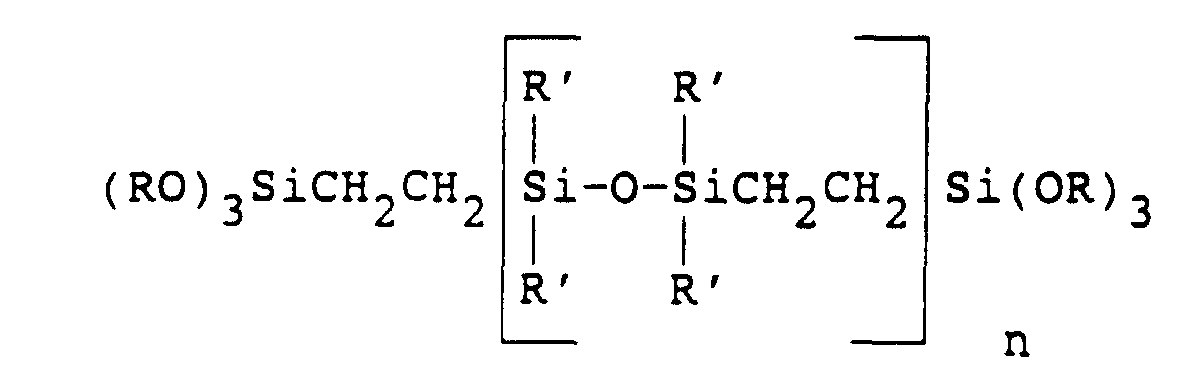
- Alkoxysilicon compound (E) can also be a compound of the general formula wherein n is 0 or 1, R is an alkyl radical of 1 to 4 inclusive carbon atoms, such as methyl, ethyl, propyl and butyl and R' is a monovalent hydrocarbon radical selected from alkyl, such as methyl, ethyl and hexyl and aryl such as phenyl.
- both R and R' are methyl.
- the alkoxysilicon compound is present in an amount of 0.25 to 5 parts by weight per 100 parts by weight of ingredient (A). It is preferred for improved adhesion to use from 0.4 to 3 parts of ethylpolysilicate or n-propyl orthosilicate.
- the combined amount of (epoxy-functional organo)trialkoxysilane and alkoxysilicon compound should be at least 0.5 part by weight per 100 parts by weight of ingredient (A), preferably from 0.5 to 6 parts by weight. It is also necessary to have the molar amount of alkoxysilicon compound (E) exceed the molar amount of (epoxy-functional organo)trialkoxysilane to provide satisfactory adhesion. If both the (epoxy functional organo)trialkoxysilane and the alkoxysilicon compound are at their lower limits, poor adhesion is obtained.
- the silicone compositions of this invention further include a titanium compound having Ti-O-CH bonds, (F).
- titanium compounds aid in the shortening of time for development of adhesion between the cured silicone rubber and the substrates.
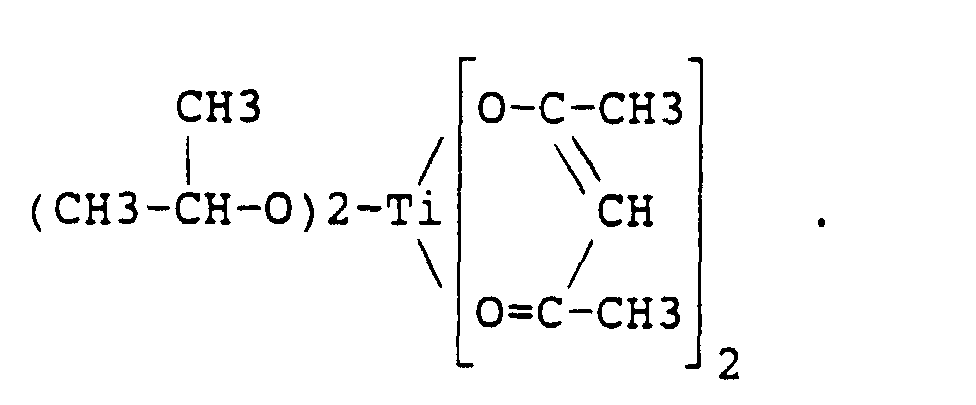
- titanium compounds include tetra-alkyltitanates such as tetraisopropyltitanate, tetrabutyltitanate and tetraoctyltitanate, tetraisopropyltitanate and tetra-2-ethylhexyl titanate; chelated titanates such as and other titanium compounds such as (CH 2 CH 2 CH 2 O) 3 TiOTi(OCH 2 CH 2 CH 3 ) 3 .
- the amounts of titanium compound (F) can be from 0.01 to 0.5 part by weight per 100 parts by weight of ingredient (A), preferably from 0.05 to 0.3 part by weight.
- the silicone compositions of this invention can optionally contain an olefinically unsaturated alkoxy silane, (G).
- alkoxysilanes are illustrated by gamma-methacryloxypropyltrialkoxysilane, vinyltrialkoxysilane and hexenyltrialkoxysilane, in which the alkoxy groups preferably contain from 1 to 4 carbon atoms per alkoxy group, such as methoxy, ethoxy, propoxy and butoxy.
- These olefinically unsaturated alkoxy silanes are present in amounts up to 1 weight percent based on the weight of the silicone composition, preferably from 0.1 to 1 weight percent.
- the silicone compositions of this invention can also optionally contain an unsaturated non-silicon-containing ether, (H).
- an unsaturated non-silicon-containing ether examples are diallyl ether of trimethylolpropane, monoallyl ethyl of trimethylolpropane, monoallyl ether of glycerol, diallyl ether of glycerol, monoallyl ether of ethylene glycol, monoallyl ether of diglycerol, diallyl ether of diglycerol, monoallyl ether of pentaerythritol, diallyl ether of pentaerythritol and triallyl ether of pentaerythritol.
- an unsaturated non-silicon-containing ether is used, it is preferably diallyl ether of trimethylolpropane.
- the amount of unsaturated non-silicon-containing ether used can effect the length of cure at lower temperatures. For this reason, small amounts of this ether is preferably used when it is desired to have it present. Such amounts are up to 1.5 weight percent based on the weight of the silicone composition and preferred amounts are from 0.1 to 1.2 weight percent.
- These unsaturated non-silicon-containing ethers also provide silicone compositions with increased adhesive tensile strengths for the cured product. Therefore, one balances the value of curing time of the silicone composition versus the enhanced adhesive tensile strength for the cured product for their particular application.
- the unsaturated non-silicon-containing ether may be left out of the silicone composition. If the adhesive tensile strength of the cured product is more important to the particular application, then the unsaturated non-silicon-containing ether may be used despite the slow cure rate. Of course, if smaller amounts of the unsaturated non-silicon-containing ether are used, one may improve the adhesive tensile strength of the cured product and also maintain a reasonable curing time for the silicone composition at lower temperatures.
- the most preferred silicone compositions are those which are packaged in at least two containers. These preferred silicone compositions are stored by packaging in a first container which comprises ingredients (F) and (C) and in a second container which comprises ingredient (B). Convenient packaging for the silicone compositions of this invention are a first container in which ingredients (A), (C), (F) and a particulate filler, if used, are present; and a second container in which ingredients (B), (D) and (E) are present. It is also possible to divide ingredient (A) and particulate filler and to place portions of both in the first and second containers.
- ethers When unsaturated non-silicon-containing ethers are used, it is preferred to include such ethers in a first container with ingredients (F) and (C) for maximum storage stability. This will achieve the best results during curing and the best results for the properties of the cured products.
- our silicone composition may include conventional additives which impart or enhance certain properties of the cured elastomer or facilitate processing of the curable composition.
- Typical additives include pigments, dyes and heat and/or ultraviolet light stabilizers. The effect of any such additives should be evaluated as to their result and impact on other desirable properties of the composition.
- compositions of this invention can be prepared by a simple mixing of the ingredients.
- the fillers are often treated in situ by first combining the polydiorganosiloxane, filler, filler treating agent and enough water to facilitate the filler treating process and then heating the mixture. Heating for 1 to 4 hours at 170°C. has been found to provide good filler treatment. The heating may also be conducted at reduced pressure to assist in removing any excess water and the ammonia formed in the process. After filler treatment is completed the remaining components are simply mixed into the composition. The equipment needed for the mixing depends upon the viscosity of the polydiorganosiloxane used and the amount of filler.
- the composition When all of the ingredients are mixed together, the composition will begin to cure unless a cure inhibitor is present. If the composition is not to be used immediately after mixing, it should be prepared in at least two parts. If the organohydrogensiloxane, (B), is placed in one part and the platinum catalyst, (C), and the titanium compound, (F), is placed in another part, the individual parts will be shelf stable. The amounts of polydiorganosiloxane and filler that are placed in each part can be varied to obtain the desired result. A convenient system distributes the ingredients into two parts so that the polydiorganosiloxane and filler are divided equally between the two parts. The organohydrogensiloxane is added to one part and the platinum catalyst plus the titanium compound are added to the other part.
- the contents of the two packages of the silicone composition are mixed together and are extruded into place on at least one substrate to be adhered as a bead.
- the bead is formed on the substrate or substrates to be adhered, it is allowed to cure at ambient temperatures or it can be heated to accelerate the cure.
- the bead adheres to the substrate upon curing.
- the silicone compositions of this invention adhere very well to stainless steel and glass substrates when the silicone composition is cured in contact with such substrates. Adhesion of the silicone composition to other substrates against which it is cured are also acceptable.
- the silicone compositions of this invention develop adhesion without the use of primers when the composition is cured against a substrate.
- These silicone compositions can be cured rapidly at low temperatures, such as from room temperature to 80°C. At room temperature, the silicone compositions can be cured in one or two hours, but at 80°C., it can be cured in less than five minutes.
- the rubber obtained by curing the composition exhibits both dry and wet adhesion to the substrates. Dry adhesion is determined by measuring the adhesion of a substrate-rubber test piece over a defined period of time at a defined temperature. Wet adhesion is determined by measuring the adhesion of a substrate-rubber test piece which has been immersed in water for a defined period of time at a defined temperature.
- the silicone compositions can cure against substrates and develop sufficient initial adhesion to allow handling of articles which are bonded together using the silicone composition to bond substrates, such as glass and stainless steel.
- the cured silicone rubber also has sufficient tensile strength so that together with the initial adhesion between the silicone rubber and the substrates, an article can be handled without concern of deforming the article. This tensile strength-initial adhesion characteristic is termed "green strength" or initial tensile-adhesion.
- the cured silicone rubber should also maintain the tensile strengths throughout the useful lifetime of the adhesive-substrate bond.
- the silicone rubber obtained by curing the composition of this invention also exhibits low thermal conductivity.
- a bubbling phenomenon at some substrate-rubber interfaces was observed with certain types of adhesion additives and when the titanium compound (F) and unsaturated non-silicon-containing ether (H) were stored in a package with the organohydrogensiloxane (B).
- One substrate against which the silicone composition was cured which was susceptible to such a bubbling phenomenon was polyisobutylene. Bubbling at a rubber-substrate interface means weak spots and reduced effectiveness of the seals which are intended by the use of the silicone composition with unprimed adhesion to substrates.
- Two-package compositions were prepared for use in evaluating various adhesion additives.
- the contents of each package was prepared as defined below.
- Adhesion Additive Composition No. 1 Adhesion Additive Composition No. 1 (AAC No. 1)
- Package A was prepared by mixing 92.8 parts of dimethylvinylsiloxy endblocked polydimethylsiloxane having a viscosity of 55 Pa ⁇ s at 25°C. as measured by a rotational viscometer with a spindle number 5 at 4 rpm (Polymer A), 7.2 parts of a dimethylhexenylsiloxy endblocked poly(dimethylsiloxanehexenylmethylsilxoane) having 2 mole percent hexenylmethylsiloxane units and a viscosity at 25°C.
- Package B was prepared by mixing 92.8 parts of Polymer A, 7.2 parts of Polymer B, 20.5 parts of Silica, 9.5 parts of trimethylsiloxy endblocked poly(dimethylsiloxanemethylhydrogensiloxane) having an average of 3 dimethylsiloxane units and 5 methylhydrogensiloxane units per molecule (SiH Polymer), 4.2 parts of ethylpolysilicate, 0.7 part of gamma-glycidoxy-propyltrimethoxysilane and 2.4 parts of diallyl ether of trimethylolpropane.
- Package A was prepared by mixing 92.8 parts of Polymer A, 7.2 parts of Polymer B, 20.5 parts of Silica, 0.5 part of Platinum Catalyst, 0.3 part of TBT.
- Package B was prepared by mixing 92.8 parts of Polymer A, 7.2 parts of Polymer B, 20.5 parts of Silica, 9.4 parts of SiH Polymer, 4.8 parts of an alkoxysilicon compound of the formula and 2.4 parts of diallyl ether of trimethylolpropane.
- Package A was prepared by mixing 92.8 parts of Polymer A, 7.2 parts of Polymer B, 20.5 parts of Silica, 0.5 part of Platinum Catalyst, 2.4 parts of gamma-glycicoxypropyltrimethoxysilane and 1.2 parts of gamma-methacryloxypropyltrimethoxysilane.
- Package B was prepared by mixing 92.8 parts of Polymer A, 7.2 parts of Polymer B, 20.5 parts of Silica, 4.6 parts of SiH Polymer and 0.4 part of aluminum acetylacetonate added as a 5 percent by weight solution of aluminum acetylacetonate in toluene.
- Package A was prepared by mixing 92.8 parts of Polymer A, 7.2 parts of Polymer B, 20.5 parts of Silica, 0.5 part of Platinum Catalyst, 0.7 part of allyltrimethoxysilane and 0.3 part of TBT.
- Package B was prepared by mixing 92.8 parts of Polymer A, 7.2 parts of Polymer B, 20.5 parts of silica and 4.5 parts of SiH polymer.
- Package A was prepared by mixing 92.8 parts of Polymer A, 7.2 parts of Polymer B, 20.5 parts of Silica, 0.5 part of Platinum Catalyst and 0.3 part of TBT.
- Package B was prepared by mixing 92.8 parts of Polymer A, 7.2 parts of Polymer B, 20.5 parts of Silica, 5.1 parts of SiH Polymer, 2.4 parts of gamma-methacryloxypropyltrimethoxysilane and 0.7 part of diallyl ether of trimethylolpropane.
- Package A was prepared by mixing 92.8 parts of Polymer A, 7.2 parts of Polymer B, 20.5 parts of silica and 0.5 part of Platinum Catalyst.
- Package B was prepared by mixing 92.8 parts of Polymer A, 7.2 parts of Polymer B, 20.5 parts of silica and 3.3 parts of SiH Polymer.
- each of the above compositions were evaluated by mixing 50 weight parts of the contents of Package A with 50 weight parts of the contents of Package B and then curing on stainless steel and glass substrates for one hour at 80°C.
- the adhesion for the stainless steel substrates was determined by using a lap shear test with the results being reported in kilopascals (kPa).
- the lap shear test evaluated the adhesion of the silicone rubber to the stainless steel substrates by making test laminates by placing a bead of silicone composition between two panels of stainless steel, such that the panels with silicone composition laminated between them overlapped by 6.4 square centimeters.
- the silicone composition was cured for one hour at 80°C. and then after a defined period of time as shown in Table 1, the panels were pulled in opposite directions.
- the force at which the silicone rubber-stainless steel laminate broke was recorded in kPa and reported in Table 1.
- the adhesion for the glass substrate was determined by Tensile-Adhesion joint construction as specified in ASTM Test Method C 1135-90, "Standard Test Method for Tensile Adhesion Properties of Structural Sealants.”
- the Tensile-Adhesion results were obtained on laminates in which the silicone rubber composition was 1.27 cm by 1.27 cm by 5.08 cm.
- the pull rate was 1.27 cm per minute and the results are reported in Table 1 in kPa. Each silicone rubber composition was tested three times and the average of these tests was used for each value reported.
- CAAC No. 1 exhibited very good adhesion to both glass and stainless steel but was slow to develop adhesive strength.
- CAAC No. 2 showed very good 24 hour adhesion to stainless steel and only fair adhesion to glass. The adhesion to both the stainless steel and the glass showed deterioration after hot water immersion.
- CAAC No. 3 showed only minimal improvement in adhesion to both glass and stainless steel compared to CAAC No. 5 which contained no adhesion additive.
- CAAC No. 4 exhibited very poor adhesion to glass and good adhesion to stainless steel.
- CAAC No. 5 was a control which contained no adhesion additives.
- Two-package compositions were prepared for use in evaluating various adhesion additives in an assembly having glass and stainless steel substrates.
- the contents of each package was prepared with the ingredients as defined below.
- Adhesion Additive Composition No. 2 Adhesion Additive Composition No. 2 (AAC No. 2)
- Package A was prepared by mixing 94.7 parts of Polymer A, 5.3 parts of Polymer B, 17.9 parts of Silica, 0.36 part of platinum catalyst, 0.24 part of TBT and 1.2 part of diallyl ether of trimethylolpropane.
- Package B was prepared by mixing 94.7 parts of Polymer A, 5.3 parts of Polymer B, 17.9 parts of Silica, 5.2 parts of SiH Polymer, 2.4 parts of ethylpolysilicate and 0.6 part of gamma-glycidoxypropyltrimethoxysilane.
- Adhesion Additive Composition No. 3 (AAC No. 3)
- Package A was prepared as described for Package A of AAC No. 2.
- Package B was prepared by mixing 94.7 parts of Polymer A, 5.3 parts of Polymer B, 17.9 parts of Silica, 5.2 parts of SiH Polymer, 2.1 parts of ethyl orthosilicate and 0.6 part of gamma-glycidoxypropyltrimethoxysilane.
- Adhesion Additive Composition No. 4 (AAC No. 4)
- Package A was prepared as described for Package A of AAC No. 2.
- Package B was prepared by mixing 94.7 parts of Polymer A, 5.3 parts of Polymer B, 17.9 parts of Silica, 5.2 parts of SiH polymer, 2.7 parts of n-propyl orthosilicate and 0.6 part of gamma-glycidoxypropyltrimethoxysilane.
- Adhesion Additive Composition No. 5 (AAC No. 5)
- Package A was prepared as described for Package A of AAC No. 2.
- Package B was prepared by mixing 94.7 parts of Polymer A, 5.3 parts of Polymer B, 17.9 parts of silica, 5.2 parts of SiH polymer, 2.4 parts of ethylpolysilicate and 0.6 part of beta(3,4-epoxy-cyclohexyl)ethyltrimethoxysilane.
- Adhesion Additive Composition No. 6 (AAC No. 6)
- Package A was prepared by mixing 94.7 parts of Polymer A, 5.3 parts of Polymer B, 17.9 parts of silica, 0.36 part of platinum catalyst, 1.2 part of diallyl ether of trimethylolpropane and 0.3 part of a Ti-O-CH compound of the formula
- Package B was prepared as described for Package B of AAC No. 2.
- Adhesion Additive Composition No. 7 (AAC No. 7)
- Package A was prepared as described for Package A of AAC No. 2.
- Package B was prepared by mixing 94.7 parts of Polymer A, 5.3 parts of Polymer B, 17.9 parts of silica, 5.2 parts of a trimethylsiloxy endblocked polymethylhydrogensiloxane having an average of about 35 siloxane units per molecule, 2.4 parts of n-propyl orthosilicate and 0.6 part of gamma-glycidoxypropyltrimethoxysilane.
- Adhesion Additive Composition No. 8 (AAC No. 8)
- Package A was prepared by mixing 94.7 parts of Polymer A, 5.3 parts of a dimethylvinylsiloxy endblocked poly(dimethylsiloxanemethylvinylsiloxane) having a viscosity of 0.3 Pa ⁇ s and a vinyl content of 1.15 weight percent (Polymer C), 17.9 parts of silica, 0.36 part of platinum catalyst, 0.24 part of TBT and 1.2 part of diallyl ether of trimethylolpropane.
- Package B was prepared by mixing 94.7 parts of Polymer A, 5.3 parts of Polymer C, 17.9 parts of silica, 5.2 parts of SiH polymer, 2.4 parts of ethylpolysilicate and 0.6 part of gamma-glycidoxypropyltrimethoxysilane.
- Adhesion Additive Composition No. 9 (AAC No. 9)
- Package A was prepared by mixing 94.7 parts of Polymer A, 5.3 parts of Polymer B, 17.9 parts of silica, 0.36 part of platinum catalyst and 0.24 part of TBT.
- Package B was prepared by mixing 94.7 parts of Polymer A, 5.3 parts of Polymer B, 17.9 parts of Silica, 2.8 parts of SiH Polymer, 2.6 parts of n-propyl orthosilicate, 0.6 part of gamma-glycidoxypropyltrimethoxysilane and 0.35 part of gamma-methacryloxypropyltrimethoxysilane.
- Package A was prepared by mixing 94.7 parts of Polymer A, 5.3 parts of Polymer B, 17.9 parts of silica, 0.36 part of platinum catalyst and 1.2 part of diallyl ether of trimethylolpropane.
- Package B was prepared by mixing 94.7 parts of Polymer A, 5.3 parts of Polymer B, 17.9 parts of silica, 5.2 parts of SiH polymer, 2.4 parts of ethylpolysilicate and 0.6 part of gamma-glycidoxypropyltrimethoxysilane.
- Package A was prepared by mixing 94.7 parts of Polymer A, 5.3 parts of Polymer B, 17.9 parts of silica and 0.36 part of platinum catalyst.
- Package B was prepared by mixing 94.7 parts of Polymer A, 5.3 parts of Polymer B, 17.9 parts of silica, 2.5 parts of SiH polymer and 0.6 part of gamma-glycidoxypropyltrimethoxysilane.
- Package A was prepared by mixing 94.7 parts of Polymer A, 5.3 parts of Polymer B, 17.9 parts of silica, 0.36 part of platinum catalyst and 0.24 part of TBT.
- Package B was prepared by mixing 94.7 parts of Polymer A, 5.3 parts of Polymer B, 17.9 parts of silica, 2.5 parts of SiH polymer and 0.6 part of gamma-glycidoxypropyltrimethoxysilane.
- Figure 1 is an end view of an H-test piece.
- Figure 2 is a side view of an H-test piece.
- the following reference numberals are used in the description below:
- the curing characteristics of the silicone rubber compositions were observed by using a commercially available oscillating rheometer. The results were obtained for cure at room temperature and at 80°C., for each silicone rubber composition after it was prepared (initial) and for each silicone rubber composition stored two weeks at 50°C. before mixing the contents of Package A and Package B (aged). The elapsed times in minutes were observed for each composition to exhibit 50 percent (T 50 ) and 90 percent (T 90 ) of the maximum torque value (F, reported in newton-meters, N-m) which was exhibited by the cured silicone rubber and are reported in Table 3.
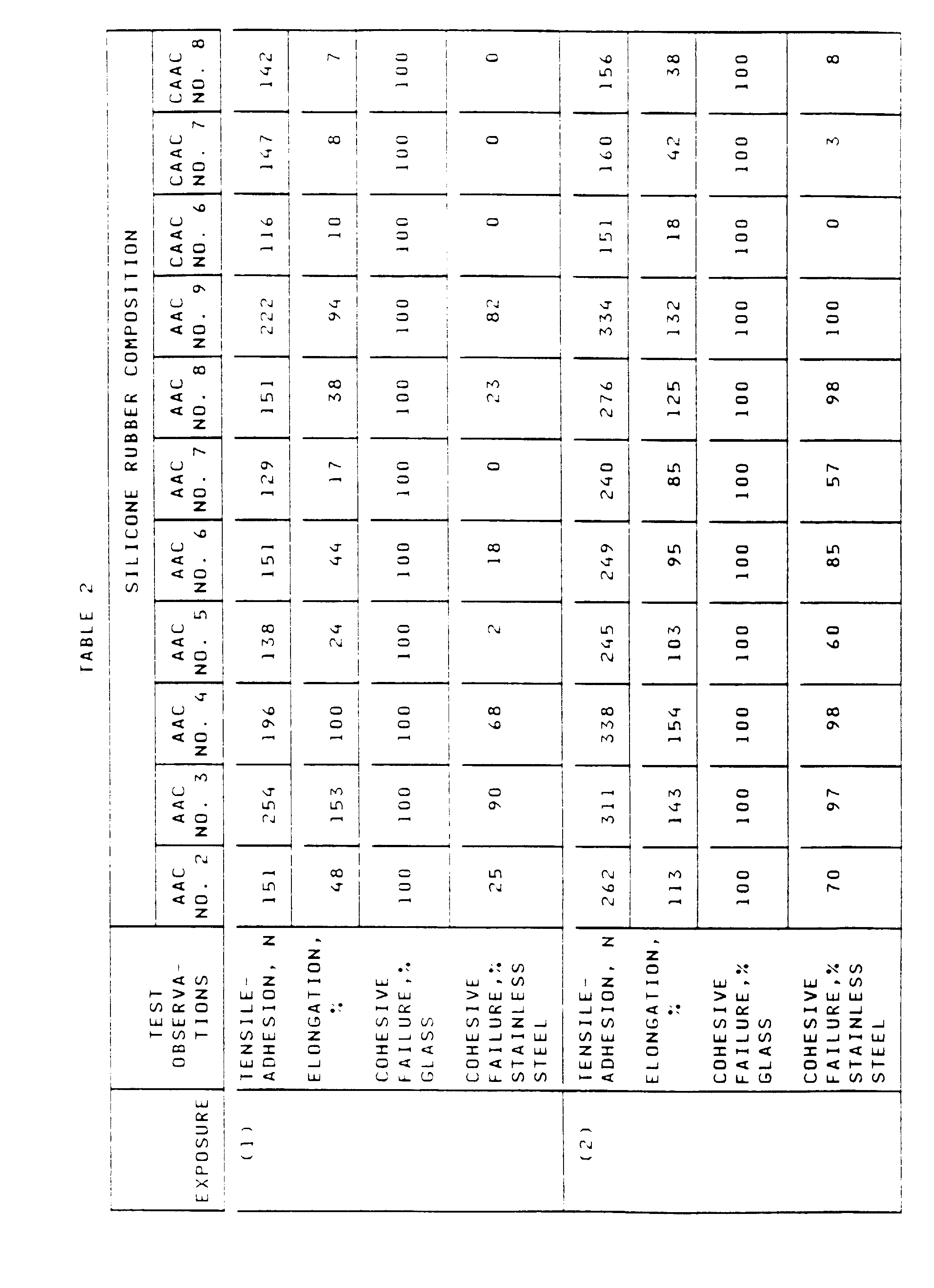
- CAAC No. 6 showed that without the presence of the tetrabutyl titanate and comparing it to AAC No. 2, the adhesion to stainless steel at room temperature was very slow to develop and essentially showed no cohesive failure after 14 days at room temperature.
- CAAC No. 7 and CAAC No. 8 showed that an (epoxy-functional organo)silane with or without tetrabutyl titanate did not provide adhesion to stainless steel at room temperature after 14 days and failed adhesively after hot water immersion either to the glass substrate or to the stainless steel substrate.
- AAC No. 5 showed that beta(3,4-epoxy cyclohexyl)ethyltrimethoxysilane developed adhesion to both stainless steel and glass between one day and 14 days at room temperature.
- Adhesion Additive Composition No. 10 Adhesion Additive Composition No. 10 (AAC No. 10)
- Package A was prepared by mixing 92.6 parts of Polymer A, 7.4 parts of Polymer B, 18.5 parts of Silica, 0.5 part of platinum catalyst and 0.3 part of TBT.
- Package B was prepared by mixing 92.6 parts of Polymer A, 7.4 parts of Polymer B, 18.5 parts of silica, 4.2 parts of ethylpolysilicate, 0.5 part of gamma-glycidoxypropyltrimethoxy silane, 8.6 parts of SiH polymer and 2.4 parts of diallyl ether of trimethylolpropane.
- a composition was prepared by mixing 50 weight parts of the contents of Package A with 50 weight parts of the contents of Package B.
- the resulting composition was used to make several H-test pieces as described in Example 2, except that in place of the stainless steel spacer, an aluminum spacer was used and one glass substrate was clear glass and the other glass substrate was a coated glass which had been abraded.
- the silicone compositions of the H-test pieces was cured by heating to 80°C. for 15 minutes. Test pieces were evaluated after 7 days at room temperature (RT), 14 days at room temperature and after immersion in water at 60°C. for 7 days, 14 days, 28 days, 42 days, 56 days and 70 days. In each situation, the bond failure was 100 % cohesive to the aluminum substrate, the glass substrate and the coated abraded glass substrate.
- Adhesion Additive Composition No. 11 Adhesion Additive Composition No. 11 (AAC No. 11)
- Package A was prepared by mixing 94.7 parts of Polymer A, 5.3 parts of Polymer B, 17.9 parts of silica, 0.36 part of platinum catalyst, 0.24 part of TBT and 0.6 part of diallyl ether of trimethylolpropane.
- Package B was prepared by mixing 94.7 parts of Polymer A, 5.3 parts of Polymer B, 17.9 parts of Silica, 3.9 parts of SiH Polymer, 2.6 parts of n-propyl orthosilicate and 0.59 part of gamma-glycidoxypropyltrimethoxysilane.
- the molar ratio of n-propyl orthosilicate to gamma-glycidoxy-propyltrimethoxysilane was 3.93:1.
- Package A was prepared by mixing 94.7 parts of Polymer A, 5.3 parts of Polymer B, 17.9 parts of Silica, 0.35 part of platinum catalyst and 4.0 parts of a pre-reacted mixture (1).
- the pre-reacted mixture (1) was prepared by mixing 0.19 part of TBT, 0.48 part of gamma-glycidoxypropyltrimethoxysilane, 2.12 parts of n-propyl orthosilicate and 0.48 part of diallyl ether of trimethylolpropane, heating the resulting mixture to 90°C. for one hour and then stripping at 90°C. and 12 kPa for 30 minutes.
- the molar ratio of n-propyl orthosilicate to gamma-glycidoxypropyltrimethoxysilane was 3.93:1.
- Package B was prepared by mixing 94.7 parts of Polymer A, 5.3 parts of Polymer B, 17.9 parts of silica and 3.8 parts of SiH polymer.
- Adhesion Additive Composition No. 12 Adhesion Additive Composition No. 12 (AAC No. 12)
- Package A was prepared by mixing 94.7 parts of Polymer A, 5.3 parts of Polymer B, 17.9 parts of silica, 0.36 part of platinum catalyst and 0.24 part of TBT.
- Package B was prepared by mixing 94.7 parts of Polymer A, 5.3 parts of Polymer B, 17.9 parts of silica, 2.8 parts of SiH polymer, 2.6 parts of n-propyl orthosilicate, 0.35 part of gamma-methacryloxypropyltrimethoxysilane and 0.58 part of gamma-glycidoxypropyltrimethoxysilane.
- the molar ratio of n-propyl orthosilicate to gamma-glycidoxy-propyltrimethoxysilane was 3.93:1.
- Package A was prepared by mixing 94.7 parts of Polymer A, 5.3 parts of Polymer B, 17.9 parts of silica and 3.77 parts of pre-reacted mixture (2).
- the pre-reacted mixture (2) was prepared by mixing 0.23 part of TBT, 2.6 parts of n-propyl orthosilicate, 0.35 part of gamma-methacryloxypropyltrimethoxysilane and 0.59 part of gamma-glycidoxypropyltrimethoxysilane, heating the resulting mixture to 90°C. for one hour and stripping at 90°C. and 12 kPa for 30 minutes.
- the molar ratio of n-propyl ortho silicate to gamma-glycidoxypropyltrimethoxysilane was 3.93:1.
- Package B was prepared by mixing 94.7 parts of Polymer A, 5.3 parts of Polymer B, 17.9 parts of silica and 2.8 parts of SiH polymer.
- Package A was prepared by mixing 94.7 parts of Polymer A, 5.3 parts of Polymer B, 17.9 parts of Silica, 0.36 part of Platinum Catalyst, 0.1 part of TBT and 0.7 part of diallyl ether of trimethylolpropane.
- Package B was prepared by mixing 94.7 parts of Polymer A, 5.3 parts of Polymer B, 17.9 parts of Silica, 4.1 parts of SiH Polymer, 1.7 parts of tetraethyl orthosilicate and 2.4 parts of gamma-glycidoxypropyltrimethoxysilane.
- the molar ratio of tetraethyl orthosilicate to gamma-glycidoxypropyltrimethoxysilane was 0.82:1.
- Package A was prepared by mixing 94.7 parts of Polymer A, 5.3 parts of Polymer B, 17.9 parts of Silica, 0.36 part of platinum catalyst and 4.9 parts of pre-reacted mixture (3).
- the pre-reacted mixture (3) was prepared by mixing 0.1 part of TBT, 1.7 parts of tetraethyl orthosilicate, 2.4 parts of gamma-glycidoxypropyltrimethoxysilane, 0.7 part of diallyl ether of trimethylolpropane, heating the resulting mixture to 90°C. for one hour and stripping at 90°C. and 12 kPa for 30 minutes.
- the molar ratio of tetraethyl orthosilicate to gamma-glycidoxypropyltrimethoxysilane was 0.82:1.
- Package B was prepared by mixing 94.7 parts of Polymer A, 5.3 parts of Polymer B, 17.9 parts of silica and 4.1 parts of SiH polymer.
- Package A was prepared by mixing 94.7 parts of Polymer A, 5.3 parts of Polymer B, 17.9 parts of silica, 0.36 part of platinum catalyst, 0.08 part of TBT and 0.7 part of diallyl ether of trimethylolpropane.
- Package B was prepared by mixing 94.7 parts of Polymer A, 5.3 parts of Polymer B, 17.9 parts of Silica, 4.0 parts of SiH Polymer, 1.9 parts of n-propyl orthosilicate and 2.2 parts of gamma-glycidoxypropyltrimethoxysilane.
- the molar ratio of n-propyl orthosilicate to gamma-glycidoxypropyltrimethoxysilane was 0.8:1.
- Package A was prepared by mixing 94.7 parts of Polymer A, 5.3 parts of Polymer B, 17.9 parts of silica and 4.9 parts of pre-reacted mixture (4).
- the pre-reacted mixture was prepared by mixing 0.08 part of TBT, 2.2 parts of gamma-glycidoxypropyltrimethoxysilane, 1.9 parts of n-propyl orthosilicate and 0.7 part of diallyl ether of trimethylolpropane, heating the resulting mixture to 90°C. for one hour, stripping at 90°C. and 12 kPa for 30 minutes.
- the molar ratio of n-propyl orthosilicate to gamma-glycidoxypropyltrimethoxysilane was 0.8:1.
- Package B was prepared by mixing 94.7 parts of Polymer A, 5.3 parts of Polymer B, 17.9 parts of silica and 4.0 parts of SiH polymer.
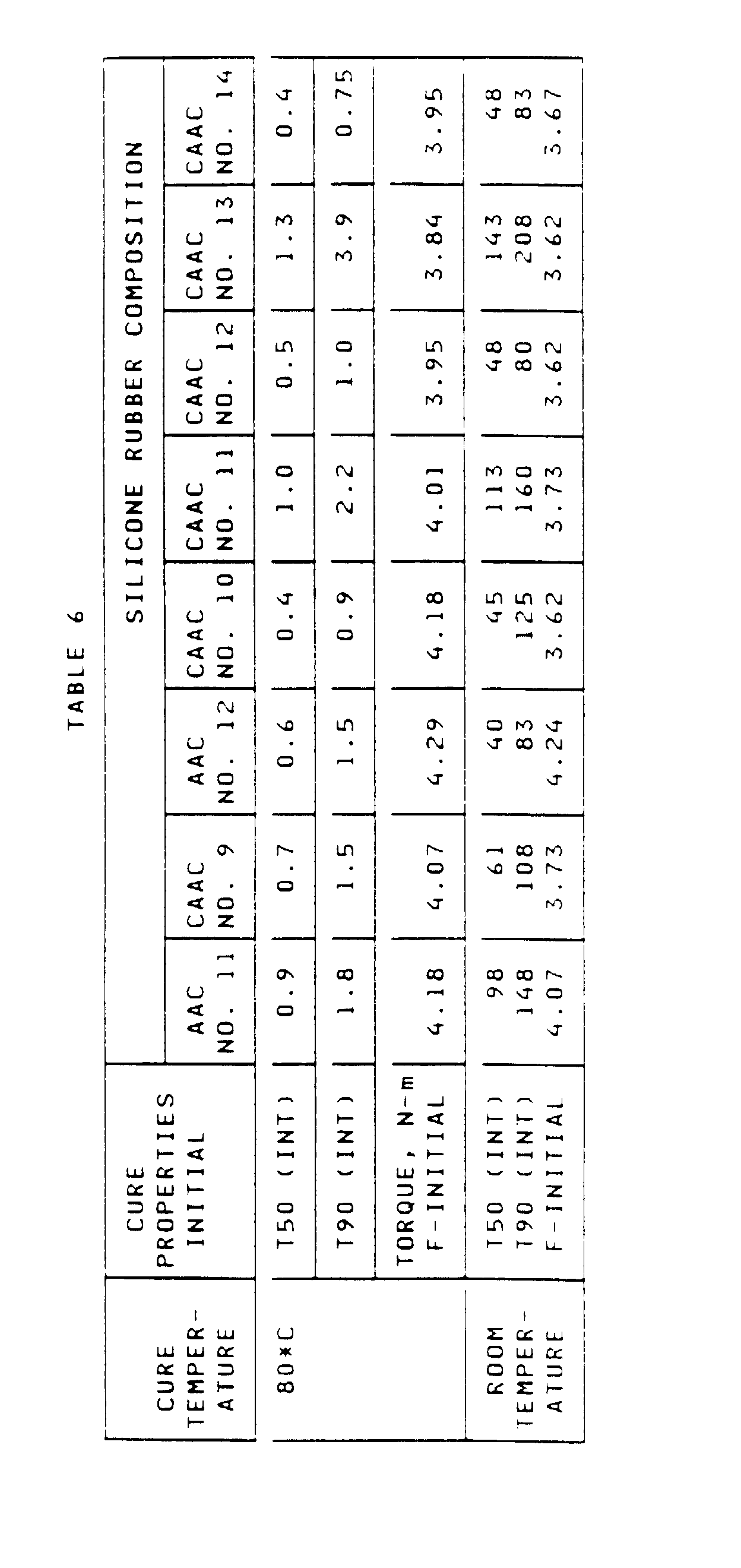
- Example 2 Each of the above compositions were evaluated by preparing H-test pieces as described in Example 2 and by observing the adhesion properties as described in Example 2 where test pieces were evaluated after (1) one day at room temperature, (2) 14 days at room temperature, (3) 7 days at room temperature and 14 days immersion in water at 80°C. and (4) 7 days at room temperature and 28 days immersion in water at 80°C.
- the curing characteristics of each composition was evaluated as described in Example 2. The results of the evaluations are shown in Tables 5 and 6.
Landscapes
- Chemical & Material Sciences (AREA)
- Chemical Kinetics & Catalysis (AREA)
- Organic Chemistry (AREA)
- Health & Medical Sciences (AREA)
- Medicinal Chemistry (AREA)
- Polymers & Plastics (AREA)
- Compositions Of Macromolecular Compounds (AREA)
- Adhesives Or Adhesive Processes (AREA)
- Application Of Or Painting With Fluid Materials (AREA)
- Paints Or Removers (AREA)
- Laminated Bodies (AREA)
Description

where the total amount of ingredient (D) and ingredient (E) is from 0.5 to 6 parts by weight and the molar amount of (E) exceeds the molar amount of (D), to make a curable silicone rubber composition,


| ADHESIVE STRENGTHS in kilopascals | ||||
| COMPOSITION | SUBSTRATE | AFTER 24 HRS | AFTER 2 WKS WATER IMMERSION | AFTER 4 WKS WATER IMMERSION |
| AAC No.1 | GLASS | 1103 | 1103 | 931 |
| STAINLESS | ||||
| STEEL | 1379 | 1482 | 1641 | |
| GLASS | 419 | 1379 | 1379 | |
| CAAC No.1 | STAINLESS | |||
| STEEL | 803 | 1379 | 1379 | |
| GLASS | 517 | 793 | 276 | |
| CAAC No.2 | STAINLESS | |||
| STEEL | 2413 | 793 | 1276 | |
| GLASS | 552 | 517 | 310 | |
| CAAC No.3 | STAINLESS | |||
| STEEL | 419 | 434 | 386 | |
| GLASS | 241 | 310 | 276 | |
| CAAC No.4 | STAINLESS | |||
| STEEL | 1172 | 965 | 965 | |
| GLASS | 193 | 214 | 138 | |
| CAAC No.5 | STAINLESS | |||
| STEEL | 103 | 228 | 103 |
The following reference numberals are used in the description below:
- 10
- Glass pane
- 20
- Glass pane
- 30
- Stainless steel spacer
- 40
- Polyisobutylene primary seal
- 50
- Polyisobutylene primary seal
- 60
- Silicone rubber secondary seal
- 70
- Silicone rubber secondary seal
- 80
- First direction force is applied during adhesion test
- 90
- Second direction force is applied during adhesion test
- L
- Length of primary seal and secondary seal
- HP
- Height of primary seal
- HS
- Height of secondary silicone rubber seal
- W
- Width of secondary silicone rubber seal


| H-TEST PIECE EXPOSURE | TENSILE ADHESION, newtons |
| 7 days RT | 464 |
| 14 days RT | 538 |
| IMMERSION | |
| 7 days | 468 |
| 14 days | 463 |
| 28 days | 513 |
| 42 days | 494 |
| 56 days | 371 |
| 70 days | 454 |


Claims (5)
- A silicone composition curable to a rubber comprisingwhere the total amount of ingredient (D) and ingredient (E) is from 0.5 to 6 parts by weight and the molar amount of (E) exceeds the molar amount of (D).(A) 100 parts by weight of an alkenyl-containing polydiorganosiloxane having an average of at least two silicon-bonded alkenyl radicals per molecule where the alkenyl radical has from 2 to 10 carbon atoms per radical, each organo radical of the polydiorganosiloxane being a monovalent radical selected from hydrocarbon radicals and fluorinated alkyl radicals both having less than 7 carbon atoms per radical, the polydiorganosiloxane having triorganosiloxy endgroups,(B) an organohydrogensiloxane having an average of at least three silicon-bonded hydrogen atoms per molecule and valences of any silicon atom in the organohydrogensiloxane not satisfied by a hydrogen atom is satisfied by a divalent oxygen atom or an organo radical, wherein each organo radical is a monovalent radical selected from hydrocarbon radicals and fluorinated alkyl radicals both having less than 7 carbon atoms per radical, the organohydrogensiloxane having no more than one silicon-bonded hydrogen atom on any one silicon atom, the amount of organohydrogensiloxane providing a ratio of silicon-bonded hydrogen atoms to alkenyl groups from the polydiorganosiloxane of 1.2 to 2,(C) a hydrosilation catalyst containing platinum,(D) 0.1 to 1 part by weight of an (epoxy-functional organo)trialkoxysilane where the alkoxy radicals of the (epoxy-functional organo)trialkoxysilane have 1 to 4 inclusive carbon atoms,(E) 0.25 to 5 parts by weight of an alkoxysilicon compound selected from tetraalkyl orthosilicates, alkylpolysilicates and alkoxysilicon compounds of the general formulawherein n is 0 or 1, R is an alkyl radical of 1 to 4 inclusive carbon atoms and R' is a monovalent hydrocarbon radical, where the alkyl groups of the tetraalkyl orthosilicates and the alkylpolysilicates are methyl, ethyl, propyl or butyl, and
 (F) 0.01 to 0.5 part by weight of a titanium compound having Ti-O-CH bonds,
 - The silicone composition according to claim 1 further comprising (G) at least 0.1 part by weight of a gamma-methacryloxypropyltrialkoxysilane in which the alkoxy has from 1 to 4 inclusive carbon atoms per alkoxy group.
- The silicone composition according to claim 1 further comprising diallyltrimethylol propane ether.
- A method of adhering a glass substrate to a stainless steel substrate comprising(1) preparing the silicone composition of claim 1,(2) applying said composition to a glass substrate and a stainless steel substrate such that the glass and stainless steel substrates are connected by said composition to form an assembly, and thereafter(3) maintaining the assembly in position until the silicone rubber composition has cured, thereby bonding the glass substrate to the stainless steel substrate through cured silicone rubber.
- The method according to claim 4 further comprising a thermoplastic material in combination with the glass substrate, stainless steel substrate and curable silicone rubber composition such that the curable silicone rubber composition contacts the thermoplastic material, the glass substrate and the stainless steel substrate during step (3) and the assembly is heated to accelerate curing.
Applications Claiming Priority (2)
| Application Number | Priority Date | Filing Date | Title |
|---|---|---|---|
| US08/107,494 US5364921A (en) | 1993-08-17 | 1993-08-17 | Silicone rubber with self-adhesion to glass and metal |
| US107494 | 1993-08-17 |
Publications (3)
| Publication Number | Publication Date |
|---|---|
| EP0639622A2 EP0639622A2 (en) | 1995-02-22 |
| EP0639622A3 EP0639622A3 (en) | 1996-01-17 |
| EP0639622B1 true EP0639622B1 (en) | 1999-10-06 |
Family
ID=22316914
Family Applications (1)
| Application Number | Title | Priority Date | Filing Date |
|---|---|---|---|
| EP94305992A Expired - Lifetime EP0639622B1 (en) | 1993-08-17 | 1994-08-12 | Silicone rubber with self-adhesion to glass and metal |
Country Status (7)
| Country | Link |
|---|---|
| US (1) | US5364921A (en) |
| EP (1) | EP0639622B1 (en) |
| JP (1) | JPH07166068A (en) |
| KR (1) | KR100304994B1 (en) |
| AU (1) | AU676580B2 (en) |
| CA (1) | CA2130135A1 (en) |
| DE (1) | DE69421022T2 (en) |
Cited By (12)
| Publication number | Priority date | Publication date | Assignee | Title |
|---|---|---|---|---|
| US7572842B2 (en) | 2003-08-01 | 2009-08-11 | 3M Espe Ag | Automixable putty impression material |
| WO2013130574A1 (en) | 2012-02-29 | 2013-09-06 | Dow Corning Corporation | Compositions of resin-linear organosiloxane block copolymers |
| WO2013134018A1 (en) | 2012-03-09 | 2013-09-12 | Dow Corning Corporation | Compositions of resin-linear organosiloxane block copolymers |
| WO2013138089A1 (en) | 2012-03-12 | 2013-09-19 | Dow Corning Corporation | Compositions of resin-linear organosiloxane block copolymers |
| WO2013142140A1 (en) | 2012-03-21 | 2013-09-26 | Dow Corning Corporation | Process for preparing resin- linear organosiloxane block copolymers |
| WO2013142252A1 (en) | 2012-03-21 | 2013-09-26 | Dow Corning Corporation | Compositions of resin-linear organosiloxane block copolymers |
| WO2013154718A1 (en) | 2012-03-21 | 2013-10-17 | Dow Corning Corporation | Compositions comprising resin- linear organosiloxane block copolymers and organopolysiloxanes |
| WO2014152522A1 (en) | 2013-03-15 | 2014-09-25 | Dow Corning Corporation | Compositions of resin-linear organosiloxane block copolymers |
| WO2014197617A1 (en) | 2013-06-05 | 2014-12-11 | Dow Corning Corporation | Compositions of resin-linear organosiloxane block copolymers |
| WO2016196048A1 (en) | 2015-05-29 | 2016-12-08 | 3M Innovative Properties Company | Kit of parts for conducting a dental impression and retraction process |
| WO2018136351A1 (en) | 2017-01-18 | 2018-07-26 | 3M Innovative Properties Company | Curable composition for dental retraction |
| WO2019218336A1 (en) | 2018-05-18 | 2019-11-21 | Rohm And Haas Electronic Materials Llc | Method for producing led by one step film lamination |
Families Citing this family (70)
| Publication number | Priority date | Publication date | Assignee | Title |
|---|---|---|---|---|
| US5445891A (en) * | 1993-11-17 | 1995-08-29 | Dow Corning Toray Siliconco., Ltd. | Curable organopolysiloxane composition containing novel adhesion promoter |
| JP3846640B2 (en) * | 1994-01-20 | 2006-11-15 | 東レ・ダウコーニング株式会社 | Curable organopolysiloxane composition |
| FR2719598B1 (en) * | 1994-05-03 | 1996-07-26 | Rhone Poulenc Chimie | Silicone elastomer composition and its applications, in particular for the coating of an airbag, intended for the protection of a vehicle occupant. |
| US5516823A (en) * | 1994-05-10 | 1996-05-14 | Dow Corning Corporation | Adhesion promoting compositions and curable organosiloxane compositions containing same |
| US5399651A (en) * | 1994-05-10 | 1995-03-21 | Dow Corning Corporation | Adhesion promoting additives and low temperature curing organosiloxane compositions containing same |
| EP0694576A1 (en) * | 1994-07-28 | 1996-01-31 | General Electric Company | Treating process for precipitated silica fillers |
| EP0699717A3 (en) * | 1994-08-30 | 1997-01-02 | Dow Corning | Organosiloxane compositions yielding cured products exhibiting adhesion and reduced flammability |
| GB9426082D0 (en) * | 1994-12-23 | 1995-02-22 | Dow Corning Gmbh | Silicon elastomer-forming composition |
| JP3950490B2 (en) * | 1995-08-04 | 2007-08-01 | 東レ・ダウコーニング株式会社 | Conductive silicone rubber composition and semiconductor device |
| JP3115808B2 (en) * | 1995-09-21 | 2000-12-11 | 東レ・ダウコーニング・シリコーン株式会社 | Liquid silicone rubber coating composition |
| EP0767040A1 (en) * | 1995-10-02 | 1997-04-09 | Dow Corning Corporation | Substrates containing a molded adhesive layer and method for preparing same |
| US5595826A (en) * | 1995-10-11 | 1997-01-21 | Dow Corning Corporation | Curable organopolysiloxane compositions with improved adhesion |
| FR2740479B1 (en) | 1995-10-31 | 1998-01-09 | Rhone Poulenc Chimie | USE OF AN ORGANOPOLYSILOXANIC COMPOSITION FOR COATING A CONVEYOR BELT AND CONVEYOR BELT THUS OBTAINED |
| US5973067A (en) * | 1995-11-28 | 1999-10-26 | Dow Corning Toray Silicone Co., Ltd. | Primer composition and adhesion method |
| US5672660A (en) * | 1995-12-01 | 1997-09-30 | Advanced Elastomer Systems, L.P. | Hydrosilylation crosslinking |
| US5696209A (en) * | 1996-10-09 | 1997-12-09 | Dow Corning Corporation | Dual-cure flowable adhesive |
| MXPA99005203A (en) | 1996-12-05 | 2006-07-18 | Sashlite Llc | Integrated multipane window unit and sash. |
| US6286288B1 (en) | 1996-12-05 | 2001-09-11 | Vertical Ventures V-5, Llc | Integrated multipane window unit and sash assembly and method for manufacturing the same |
| BR9713876C1 (en) * | 1996-12-05 | 2004-12-21 | John S France | Multi-pane window unit integrated into one frame |
| KR19980086123A (en) * | 1997-05-31 | 1998-12-05 | 엄길용 | Foshan Wastewater Treatment Method |
| FR2775481B1 (en) * | 1998-02-27 | 2003-10-24 | Rhodia Chimie Sa | CROSS-LINKABLE ADHESIVE SILICONE COMPOSITION AND USE THEREOF FOR BONDING VARIOUS SUBSTRATES |
| FR2787803B1 (en) * | 1998-12-23 | 2001-03-16 | Rhodia Chimie Sa | SILICONE COMPOSITION FOR COATING TEXTILE SUBSTRATES |
| US6271299B1 (en) | 1999-02-02 | 2001-08-07 | Dow Corning Corporation | Fire resistant sealant composition |
| JP2001035258A (en) * | 1999-07-26 | 2001-02-09 | Dow Corning Toray Silicone Co Ltd | Glass fiber braided wire treatment agent composition |
| DE19957276A1 (en) | 1999-11-29 | 2001-10-11 | Abb Research Ltd | Addition-curing silicone rubber compounds |
| DE19959412A1 (en) * | 1999-12-09 | 2001-06-21 | Wacker Chemie Gmbh | Self-adhesive addition-crosslinking silicone elastomer compositions |
| US6613185B1 (en) * | 2000-07-24 | 2003-09-02 | Specialty Silicone Products, Inc. | Curable silicone elastomer and process of production thereof and method of bonding therewith |
| DE10103446C5 (en) * | 2001-01-25 | 2007-06-28 | Kettenbach Gmbh & Co. Kg | Two-stage hardenable mixable materials |
| US6482888B1 (en) * | 2001-06-06 | 2002-11-19 | Dow Corning Corporation | Silicone composition and cured silicone product |
| US6512037B1 (en) * | 2001-06-06 | 2003-01-28 | Dow Corning Corporation | Silicone composition and cured silicone product |
| US6662523B2 (en) * | 2001-06-15 | 2003-12-16 | Sashlite, Llc | Insulating glass sash assemblies with adhesive mounting and spacing structures |
| JP2005517102A (en) * | 2001-06-15 | 2005-06-09 | サッシライト・リミテッド・ライアビリティ・カンパニー | Window sash integrated with multiple glazings and method for manufacturing a window sash integrated with multiple glazings |
| US20030084622A1 (en) * | 2001-11-05 | 2003-05-08 | Sashlite, Llc | Components for multipane window unit sash assemblies |
| US6679013B2 (en) | 2001-11-15 | 2004-01-20 | Sashlite, Llc | Window assembly with hinged components |
| DE10204893A1 (en) * | 2002-02-06 | 2003-08-14 | Ge Bayer Silicones Gmbh & Co | Self-adhesive addition-crosslinking silicone rubber mixtures, a process for their production, process for the production of composite molded parts and their use |
| WO2003099909A1 (en) * | 2002-05-23 | 2003-12-04 | Rhodia Chimie | Silicone composition which can be crosslinked into an elastomer by hydrosilylation in the presence of carbene-based metal catalysts, and catalysts of this type |
| JP4430470B2 (en) * | 2004-07-09 | 2010-03-10 | 信越化学工業株式会社 | Addition reaction curable silicone rubber composition |
| USD524603S1 (en) | 2005-01-26 | 2006-07-11 | Wki Holding Company, Inc. | Preparation bowl |
| US7575127B2 (en) * | 2005-02-03 | 2009-08-18 | Wki Holding Company, Inc. | Glassware with silicone gripping surfaces |
| US7784638B2 (en) * | 2005-02-03 | 2010-08-31 | Wki Holding Company, Inc. | Glassware with silicone support |
| US7588967B2 (en) * | 2005-05-27 | 2009-09-15 | Shin-Etsu Chemical Co., Ltd. | Curable silicone rubber composition and semiconductor device |
| JP4586981B2 (en) * | 2005-06-23 | 2010-11-24 | 信越化学工業株式会社 | Self-adhesive organopolysiloxane composition |
| CN101213258B (en) * | 2005-07-28 | 2012-10-03 | 荒川化学工业株式会社 | Curable resin composition, the cured product, and various articles derived therefrom |
| US7531242B2 (en) * | 2005-09-30 | 2009-05-12 | Industrial Control Development, Inc. | Silicone-coated architectural glass |
| US7838116B2 (en) * | 2005-09-30 | 2010-11-23 | Industrial Control Development, Inc. | Silicone-coated architectural and decorative glass |
| US7309734B2 (en) * | 2005-09-30 | 2007-12-18 | Industrial Control Development, Inc. | Silicone-coated architectural glass |
| DE102007011159A1 (en) * | 2007-03-07 | 2008-09-11 | Wacker Chemie Ag | Self-adhesive silicone compositions for pressureless vulcanization |
| CN102066488A (en) * | 2008-04-21 | 2011-05-18 | 霍尼韦尔国际公司 | Thermal interconnect and interface materials, methods of production and uses thereof |
| USD620817S1 (en) | 2009-03-21 | 2010-08-03 | Wki Holding Company, Inc. | Measuring container |
| MX2009003573A (en) * | 2009-04-02 | 2010-03-22 | Mabe Sa De Cv | Application of an organic and/or inorganic coating onto the inner surface of an outer glass of an oven door. |
| JP5594991B2 (en) * | 2009-07-29 | 2014-09-24 | 旭化成ワッカーシリコーン株式会社 | Adhesive silicone rubber composition |
| US9593209B2 (en) | 2009-10-22 | 2017-03-14 | Dow Corning Corporation | Process for preparing clustered functional polyorganosiloxanes, and methods for their use |
| ES2619847T5 (en) | 2010-03-05 | 2024-06-24 | Momentive Performance Mat Gmbh | Use of a curable polyorganosiloxane composition as an encapsulant for a solar cell module |
| WO2012133639A1 (en) * | 2011-03-31 | 2012-10-04 | 住友ベークライト株式会社 | Silicone rubber curable composition, method for producing silicone rubber, silicone rubber, molded article, and tube for medical use |
| DE202012101023U1 (en) | 2012-03-01 | 2013-06-04 | Solarworld Innovations Gmbh | solar module |
| DE102012101710A1 (en) | 2012-03-01 | 2013-09-05 | Solarworld Innovations Gmbh | Process for encapsulating a solar cell in a polymer matrix |
| WO2014124388A1 (en) | 2013-02-11 | 2014-08-14 | Dow Corning Corporation | Alkoxy-functional organopolysiloxane resin and polymer and related methods for forming same |
| CN105189685B (en) | 2013-02-11 | 2017-08-08 | 道康宁公司 | Method for forming thermally conductive thermal free radical curable silicone composition |
| US9670392B2 (en) | 2013-02-11 | 2017-06-06 | Dow Corning Corporation | Stable thermal radical curable silicone adhesive compositions |
| ES2895424T3 (en) | 2013-02-11 | 2022-02-21 | Dow Silicones Corp | Moisture curable hot melt silicone adhesive compositions including a reactive siloxane resin with alkoxy functional groups |
| US9718925B2 (en) | 2013-02-11 | 2017-08-01 | Dow Corning Corporation | Curable silicone compositions comprising clustered functional polyorganosiloxanes and silicone reactive diluents |
| EP2954022B1 (en) | 2013-02-11 | 2019-05-01 | Dow Silicones Corporation | Clustered functional polyorganosiloxanes, processes for forming same and methods for their use |
| US9528027B2 (en) * | 2013-03-11 | 2016-12-27 | Panasonic Intellectual Property Management Co., Ltd. | Coating for preventing scattering of fragments |
| EP3292168B1 (en) * | 2015-06-18 | 2024-10-09 | Nusil Technology LLC | High strength silicone elastomers and compositions therefor |
| EP3196229B1 (en) | 2015-11-05 | 2018-09-26 | Dow Silicones Corporation | Branched polyorganosiloxanes and related curable compositions, methods, uses and devices |
| ES2925226T3 (en) * | 2017-03-29 | 2022-10-14 | Elkem Silicones France Sas | Polyaddition crosslinking silicone composition useful for overmolding parts |
| US10883028B2 (en) | 2017-12-26 | 2021-01-05 | Nano And Advanced Materials Institute Limited | Room temperature curable polyoranopolysloxane silicone sealant composition, the silicone sealant and method for preparing thereof |
| WO2020198905A1 (en) * | 2019-03-29 | 2020-10-08 | Dow Silicones Corporation | Silicone elastomer compositions and elastomeric materials |
| US20240279468A1 (en) * | 2021-06-11 | 2024-08-22 | Dow Silicones Corporation | Curable silicone rubber compositions |
| US20240270464A1 (en) * | 2023-02-09 | 2024-08-15 | Stolle Machinery Company, Llc | Metal container, friction coating therefor, and associated methods |
Family Cites Families (13)
| Publication number | Priority date | Publication date | Assignee | Title |
|---|---|---|---|---|
| JPS56103264A (en) * | 1980-01-21 | 1981-08-18 | Toray Silicone Co Ltd | Silicone compositin for adhesive |
| US4659851A (en) * | 1986-03-26 | 1987-04-21 | Dow Corning Corporation | Novel organosilicon compounds |
| US4719262A (en) * | 1986-03-26 | 1988-01-12 | Dow Corning Corporation | Organosilicon primer compositions |
| US4737562A (en) * | 1986-10-15 | 1988-04-12 | Dow Corning Corporation | Self-adhering polyorganosiloxane elastomer compositions and method for preparing same |
| US4754013A (en) * | 1986-12-29 | 1988-06-28 | Dow Corning Corporation | Self-adhering polyorganosiloxane compositions |
| JP2543721B2 (en) * | 1987-09-25 | 1996-10-16 | 東レ・ダウコーニング・シリコーン株式会社 | Adhesion promoter |
| JP2614472B2 (en) * | 1987-12-29 | 1997-05-28 | 東レ・ダウコーニング・シリコーン株式会社 | Curable organopolysiloxane composition |
| JPH01313565A (en) * | 1988-06-10 | 1989-12-19 | Toray Dow Corning Silicone Co Ltd | Curable organopolysiloxane composition |
| JP2651840B2 (en) * | 1988-07-15 | 1997-09-10 | 東レ・ダウコーニング・シリコーン株式会社 | Silicone rubber adhesive |
| JP3268801B2 (en) * | 1991-11-22 | 2002-03-25 | ジーイー東芝シリコーン株式会社 | Silicone rubber composition and processed silicone rubber cloth |
| US5248715A (en) * | 1992-07-30 | 1993-09-28 | Dow Corning Corporation | Self-adhering silicone rubber with low compression set |
| JPH06145525A (en) * | 1992-11-05 | 1994-05-24 | Toray Dow Corning Silicone Co Ltd | Curable organopolysiloxane composition |
| GB9300611D0 (en) * | 1993-01-14 | 1993-03-03 | Dow Corning Gmbh | Elastomer-forming composition |
-
1993
- 1993-08-17 US US08/107,494 patent/US5364921A/en not_active Expired - Fee Related
-
1994
- 1994-08-12 EP EP94305992A patent/EP0639622B1/en not_active Expired - Lifetime
- 1994-08-12 DE DE69421022T patent/DE69421022T2/en not_active Expired - Fee Related
- 1994-08-15 CA CA002130135A patent/CA2130135A1/en not_active Abandoned
- 1994-08-15 AU AU70264/94A patent/AU676580B2/en not_active Ceased
- 1994-08-16 KR KR1019940020075A patent/KR100304994B1/en not_active Expired - Fee Related
- 1994-08-16 JP JP6192443A patent/JPH07166068A/en active Pending
Cited By (13)
| Publication number | Priority date | Publication date | Assignee | Title |
|---|---|---|---|---|
| US7572842B2 (en) | 2003-08-01 | 2009-08-11 | 3M Espe Ag | Automixable putty impression material |
| US7732508B2 (en) | 2003-08-01 | 2010-06-08 | 3M Espe Ag | Automixable putty impression material |
| WO2013130574A1 (en) | 2012-02-29 | 2013-09-06 | Dow Corning Corporation | Compositions of resin-linear organosiloxane block copolymers |
| WO2013134018A1 (en) | 2012-03-09 | 2013-09-12 | Dow Corning Corporation | Compositions of resin-linear organosiloxane block copolymers |
| WO2013138089A1 (en) | 2012-03-12 | 2013-09-19 | Dow Corning Corporation | Compositions of resin-linear organosiloxane block copolymers |
| WO2013142140A1 (en) | 2012-03-21 | 2013-09-26 | Dow Corning Corporation | Process for preparing resin- linear organosiloxane block copolymers |
| WO2013142252A1 (en) | 2012-03-21 | 2013-09-26 | Dow Corning Corporation | Compositions of resin-linear organosiloxane block copolymers |
| WO2013154718A1 (en) | 2012-03-21 | 2013-10-17 | Dow Corning Corporation | Compositions comprising resin- linear organosiloxane block copolymers and organopolysiloxanes |
| WO2014152522A1 (en) | 2013-03-15 | 2014-09-25 | Dow Corning Corporation | Compositions of resin-linear organosiloxane block copolymers |
| WO2014197617A1 (en) | 2013-06-05 | 2014-12-11 | Dow Corning Corporation | Compositions of resin-linear organosiloxane block copolymers |
| WO2016196048A1 (en) | 2015-05-29 | 2016-12-08 | 3M Innovative Properties Company | Kit of parts for conducting a dental impression and retraction process |
| WO2018136351A1 (en) | 2017-01-18 | 2018-07-26 | 3M Innovative Properties Company | Curable composition for dental retraction |
| WO2019218336A1 (en) | 2018-05-18 | 2019-11-21 | Rohm And Haas Electronic Materials Llc | Method for producing led by one step film lamination |
Also Published As
| Publication number | Publication date |
|---|---|
| DE69421022D1 (en) | 1999-11-11 |
| KR100304994B1 (en) | 2002-03-21 |
| DE69421022T2 (en) | 2000-06-29 |
| CA2130135A1 (en) | 1995-02-18 |
| EP0639622A2 (en) | 1995-02-22 |
| AU676580B2 (en) | 1997-03-13 |
| AU7026494A (en) | 1995-03-02 |
| JPH07166068A (en) | 1995-06-27 |
| EP0639622A3 (en) | 1996-01-17 |
| KR950005911A (en) | 1995-03-20 |
| US5364921A (en) | 1994-11-15 |
Similar Documents
| Publication | Publication Date | Title |
|---|---|---|
| AU676580B2 (en) | Silicone rubber with self-adhesion to glass and metal | |
| JP5647201B2 (en) | Compounds having a guanidine structure and their use as organopolysiloxane polycondensation catalysts | |
| CA1311329C (en) | Room temperature-curable organopolysiloxane composition | |
| JP5587902B2 (en) | Compounds having a guanidine structure and their use as organopolysiloxane polycondensation catalysts | |
| US5248715A (en) | Self-adhering silicone rubber with low compression set | |
| EP0178751B1 (en) | Silicone elastomers with good adhesion | |
| EP0625548B1 (en) | Room-temperature-curable organopolysiloxane composition and method for its preparation | |
| EP0714936B1 (en) | Organosilicon compounds and low temperature curing organosiloxane compositions containing same | |
| WO2015119904A1 (en) | Moisture curable silicone composition | |
| KR20150131109A (en) | Moisture curable organopolysiloxane compositions | |
| US5283307A (en) | Organosiloxane compositions exhibiting improved bonding to substrates during curing | |
| KR20200037266A (en) | Moisture curable composition | |
| CA3091354A1 (en) | Moisture curable silicone polymer and uses thereof | |
| US5416144A (en) | Addition-curable silicone adhesive compositions and bis (trialkoxysilyalkylene) urea adhesion promoters | |
| KR20160008584A (en) | Non-metal catalyzed room temperature moisture curable organopolysiloxane compositions | |
| EP0639605B1 (en) | Adhesion promoting additives and low temperature curig organosiloxane compositions containing same | |
| JP2023552956A (en) | Two-part condensation curable silicone composition and its uses | |
| JP3846571B2 (en) | Organopolysiloxane composition | |
| GB2316946A (en) | Bis[(trialkoxy)silylalkylene]ureas as adhesion promoters |
Legal Events
| Date | Code | Title | Description |
|---|---|---|---|
| PUAI | Public reference made under article 153(3) epc to a published international application that has entered the european phase |
Free format text: ORIGINAL CODE: 0009012 |
|
| AK | Designated contracting states |
Kind code of ref document: A2 Designated state(s): DE FR GB IT |
|
| RIN1 | Information on inventor provided before grant (corrected) |
Inventor name: PALMER, RICHARD ALAN Inventor name: KUNSELMAN, MICHAEL E., LUCKY-DC SILICONE CO., LTD Inventor name: GRAY, THOMAS EDWARD |
|
| PUAL | Search report despatched |
Free format text: ORIGINAL CODE: 0009013 |
|
| AK | Designated contracting states |
Kind code of ref document: A3 Designated state(s): DE FR GB IT |
|
| 17P | Request for examination filed |
Effective date: 19960307 |
|
| GRAG | Despatch of communication of intention to grant |
Free format text: ORIGINAL CODE: EPIDOS AGRA |
|
| 17Q | First examination report despatched |
Effective date: 19990113 |
|
| GRAG | Despatch of communication of intention to grant |
Free format text: ORIGINAL CODE: EPIDOS AGRA |
|
| GRAH | Despatch of communication of intention to grant a patent |
Free format text: ORIGINAL CODE: EPIDOS IGRA |
|
| GRAH | Despatch of communication of intention to grant a patent |
Free format text: ORIGINAL CODE: EPIDOS IGRA |
|
| GRAA | (expected) grant |
Free format text: ORIGINAL CODE: 0009210 |
|
| AK | Designated contracting states |
Kind code of ref document: B1 Designated state(s): DE FR GB IT |
|
| ITF | It: translation for a ep patent filed | ||
| REF | Corresponds to: |
Ref document number: 69421022 Country of ref document: DE Date of ref document: 19991111 |
|
| ET | Fr: translation filed | ||
| PGFP | Annual fee paid to national office [announced via postgrant information from national office to epo] |
Ref country code: FR Payment date: 20000710 Year of fee payment: 7 Ref country code: DE Payment date: 20000710 Year of fee payment: 7 |
|
| PGFP | Annual fee paid to national office [announced via postgrant information from national office to epo] |
Ref country code: GB Payment date: 20000713 Year of fee payment: 7 |
|
| PLBE | No opposition filed within time limit |
Free format text: ORIGINAL CODE: 0009261 |
|
| STAA | Information on the status of an ep patent application or granted ep patent |
Free format text: STATUS: NO OPPOSITION FILED WITHIN TIME LIMIT |
|
| 26N | No opposition filed | ||
| PG25 | Lapsed in a contracting state [announced via postgrant information from national office to epo] |
Ref country code: GB Free format text: LAPSE BECAUSE OF NON-PAYMENT OF DUE FEES Effective date: 20010812 |
|
| GBPC | Gb: european patent ceased through non-payment of renewal fee |
Effective date: 20010812 |
|
| PG25 | Lapsed in a contracting state [announced via postgrant information from national office to epo] |
Ref country code: FR Free format text: LAPSE BECAUSE OF NON-PAYMENT OF DUE FEES Effective date: 20020430 |
|
| PG25 | Lapsed in a contracting state [announced via postgrant information from national office to epo] |
Ref country code: DE Free format text: LAPSE BECAUSE OF NON-PAYMENT OF DUE FEES Effective date: 20020501 |
|
| REG | Reference to a national code |
Ref country code: FR Ref legal event code: ST |
|
| PG25 | Lapsed in a contracting state [announced via postgrant information from national office to epo] |
Ref country code: IT Free format text: LAPSE BECAUSE OF NON-PAYMENT OF DUE FEES Effective date: 20050812 |