EP0639211B1 - Levelling material - Google Patents
Levelling material Download PDFInfo
- Publication number
- EP0639211B1 EP0639211B1 EP93910510A EP93910510A EP0639211B1 EP 0639211 B1 EP0639211 B1 EP 0639211B1 EP 93910510 A EP93910510 A EP 93910510A EP 93910510 A EP93910510 A EP 93910510A EP 0639211 B1 EP0639211 B1 EP 0639211B1
- Authority
- EP
- European Patent Office
- Prior art keywords
- levelling
- layer
- coarse
- loading
- compound
- Prior art date
- Legal status (The legal status is an assumption and is not a legal conclusion. Google has not performed a legal analysis and makes no representation as to the accuracy of the status listed.)
- Expired - Lifetime
Links
Images
Classifications
-
- C—CHEMISTRY; METALLURGY
- C09—DYES; PAINTS; POLISHES; NATURAL RESINS; ADHESIVES; COMPOSITIONS NOT OTHERWISE PROVIDED FOR; APPLICATIONS OF MATERIALS NOT OTHERWISE PROVIDED FOR
- C09D—COATING COMPOSITIONS, e.g. PAINTS, VARNISHES OR LACQUERS; FILLING PASTES; CHEMICAL PAINT OR INK REMOVERS; INKS; CORRECTING FLUIDS; WOODSTAINS; PASTES OR SOLIDS FOR COLOURING OR PRINTING; USE OF MATERIALS THEREFOR
- C09D5/00—Coating compositions, e.g. paints, varnishes or lacquers, characterised by their physical nature or the effects produced; Filling pastes
- C09D5/34—Filling pastes
-
- E—FIXED CONSTRUCTIONS
- E04—BUILDING
- E04F—FINISHING WORK ON BUILDINGS, e.g. STAIRS, FLOORS
- E04F15/00—Flooring
- E04F15/12—Flooring or floor layers made of masses in situ, e.g. seamless magnesite floors, terrazzo gypsum floors
Definitions
- the present invention deals with a screed material or levelling compound of the kind that is described in the preamble of the claim and that is to be used in the production of so called levelling layers, which are intended to level uneven substrates, e.g. concrete constructions, with the purpose of achieving a surface which is smooth and even enough to serve as a floor surface.
- levelling of uneven substrates preferably is done by using pumpable levelling compounds.
- the demand of levelling is great because the unevenness exceeds 10-20 mm, which often is the case for prefabricated concrete elements, the high consumption of material leads to too high costs when you want to meet the requirements for loading capacity which normally are asked for.
- the loading capacity of a product is determined by the content of polymer and the content of binder. These two ingredients constitute the major part of the production cost.
- the present invention has the aim to achieve a new levelling material of the decribed kind and with considerably lower costs than with traditional techniques for the production of levelling layers on uneven substrates, where the unevenness is great, e.g. exceeds 10-20 mm. This is of utmost importance, since the development trend goes towards thicker levelling layers because of increased requirements on sound insulation and also because of demands for placing installations in the floor screed.
- a floor can be produced, which in the long run fulfills the demand for loading capacity for flooings of at least 0.5 MPa, measured according to the above mentioned standard and which can be produced with a coarse levelling layer with relatively low production costs, in spite of the fact that the loading capacity of the coarse levelling layer itself is at least 20% lower than the finished floor which is produced thereof.
- a loading layer any material which is suited for the purpose can used such as wood, steel, metal, plastic, ceramic, fine levelling compounds of known kind etc.
- a levelling can be applied in two layers.
- the first layer is made of the pumpable coarse levelling compound which is applied at a thickness of at least 10 mm.
- a wearing or loading layer is applied consisting of a fine levelling compound with 2-15 mm thickness, preferably 5-10 mm.
- the coarse levelling compound shall not constitute the finished surface, it can, as mentioned before, be made considerably weaker than usual and thereby can the costs for binder and polymer be kept low.
- the binder content is 4-14 %, preferably 5-10 % of the dry weight of the levelling compound.
- the binder in the coarse levelling compound which preferably is hydraulic, can e.g. be high aluminous cement, different kinds of gypsum, portland cement, natural cement or combinations thereof.
- the water content is e.g. 15-20 % of the dry weight of the levelling compound, which means that the water-binder ratio, i.e. the water content divided by the binder content, is 1-5, preferably 1.5-4.
- the coarse levelling compound contains 85-95 % by weight of sand and filler, preferably 89-94 % by weight.
- the filler can e.g. be ground dolomite, ground lime stone, pulverized fuel ash from coal fired power stations, ground granulated blast furnace slag or combinations thereof.
- the coarse levelling matierial contains additives which are conventionally used in levelling compounds, viz plasticizer, polymer, cellulose, salts and antifoaming agents, altogether not more than 1 % by weight.
- the content of polymer is considerably lower than in conventional levelling compounds.
- the coarse levelling layer decribed above has a compressive strength of 2-17 MPa, preferably 3-8 MPa, while its resistance against, wheel loading according to the Swedish Standard SS 92 35 07 is less or equal to 0.4 MPa.
- a conventional levelling compound is applied at 2-15 mm thickness, preferably 5-10 mm, which in the following is called fine levelling layer.
- This compound is pumped and is preferably self smoothing.
- the requirements on this material is on one hand that the shrinkage should be at the most 0.15 %, preferably at the most 0.10 %, when measured at drying in 50 % RH and on the other hand that it shall have a resistance against rolling wheel loading measured according the Swedish Standard SS 92 35 07 which is at least 0.5 MPa.
- the requirements regarding maximum shrinkage is caused by the risk that the fine levelling layer otherwise can disrupt the relatively weak coarse levelling layer. The same is the case for the requirement for a maximum layer thickness of 15 mm. Of course, this risk does not exist with loading layers made of wood or other floor coverings where there is no more shrinkage after the application of the floor covering.
- the requirement regarding resistance to loading is caused by the fact that the combined layer shall be able to withstand rolling wheel loading. The same goes for the requirement of a minimum thickness of 2 mm for such a fine levelling layer.
- Coarse levelling compounds were made with binder contents, water-binder ratios and filler and sand contents according to Table 1.
- Table 1 Compositions of coarse levelling layers. Sample no Binder content % by weight Water-binder ratio Filler + sand % by weight 1 2 8.8 97 2 4 4.4 95 3 6 2.9 93 4 8 2.2 91 5 10 1.8 89 6 12 1.5 87 7 14 1.2 85
- the binder consisted of 2/3 high aluminious cement and 1/3 anhydrate gypsum.
- the filler consisted of ground dolomite.
- the other additives amounting to 1 % of the dry weight were of conventional kinds, viz plasticizers, polymer, cellulose, unorganic salts and defoamers. However, the content of polymer was considerably lower than normally.
- This fine levelling layer had the following composition: Binder 23 % Water-binder ratio 1 Filler + sand 74 % Polymer 2 % Other additives 1 %
- the ingredients in the conventional fine levelling layer were the same as in the coarse levelling layer, only the proportions were very different.
- the shrinkage of the fine levelling compound was tested after drying in 50 % RH and was found to be 0.07 %.
- the coarse levelling compound was produced as a dry mortar on a factory and 17.5 % and 18 % water resp. was added at the building site in a continous mixerpump. It was pumped out on the substrate, which consisted of prestressed concrete elements, to a thickness of 40-60 mm. After a few hours, the surface could be walked upon, and then a 5-10 mm thick layer of a conventional fine levelling compound - with the product name Universal from Sträbruken AB - was pumped out.
- the new levelling material and the described technique with a relatively weak coarse levelling layer with low binder content and high water-binder ratio however has been shown to have further advantages.
- the drying time can be shortened towards half the time that is needed for conventional levelling compounds.
- the coarse levelling material furthermore can be used alone, without fine levelling layer in such cases when the described loading requirement is not applicable, e.g. where there is little loading or where the flooring can take the loading which otherwise the fine levelling layer should take. Examples of the latter is wooden floors and ceramic tiles.
Landscapes
- Engineering & Computer Science (AREA)
- Architecture (AREA)
- Chemical & Material Sciences (AREA)
- Civil Engineering (AREA)
- Structural Engineering (AREA)
- Life Sciences & Earth Sciences (AREA)
- Materials Engineering (AREA)
- Wood Science & Technology (AREA)
- Organic Chemistry (AREA)
- Curing Cements, Concrete, And Artificial Stone (AREA)
- Laminated Bodies (AREA)
- Paper (AREA)
Abstract
Description
- The present invention deals with a screed material or levelling compound of the kind that is described in the preamble of the claim and that is to be used in the production of so called levelling layers, which are intended to level uneven substrates, e.g. concrete constructions, with the purpose of achieving a surface which is smooth and even enough to serve as a floor surface.
- Since a long time levelling of e.g. concrete constructions have been done by casting onto the load bearing concrete structure a relatively thick layer of a cement mortar. This early solution of the problem however has considerable disadvantages, among which it can be mentioned that the method is very time consuming and labour intensive.
- Another technique that has been used to make the concrete substrate smooth and even enough to fulfill the requirements of the later floor coverings, has been that one has tried to make the concrete itself even enough, e.g. by vibration casting, power floating etc, but this technique has not functioned well in practice, because it is costly and time consuming.
- Today, levelling of uneven substrates preferably is done by using pumpable levelling compounds. However, when the demand of levelling is great because the unevenness exceeds 10-20 mm, which often is the case for prefabricated concrete elements, the high consumption of material leads to too high costs when you want to meet the requirements for loading capacity which normally are asked for.
- A common requirement in local codes of practice, e.g. the Swedish Hus AMA 83, is that the levelling compound shall have an adhesion of at least 0.5 MPa measured after loading with a rolling office chair castor according to the Swedish Standard SS 92 35 07. The loading capacity of a product is determined by the content of polymer and the content of binder. These two ingredients constitute the major part of the production cost.
- The present invention has the aim to achieve a new levelling material of the decribed kind and with considerably lower costs than with traditional techniques for the production of levelling layers on uneven substrates, where the unevenness is great, e.g. exceeds 10-20 mm. This is of utmost importance, since the development trend goes towards thicker levelling layers because of increased requirements on sound insulation and also because of demands for placing installations in the floor screed.
- This aim is achieved by the invention with a levelling material of the described kind and which is characterized by the means in the characterizing part of claim 1.
- It has been found that with this levelling material, a floor can be produced, which in the long run fulfills the demand for loading capacity for flooings of at least 0.5 MPa, measured according to the above mentioned standard and which can be produced with a coarse levelling layer with relatively low production costs, in spite of the fact that the loading capacity of the coarse levelling layer itself is at least 20% lower than the finished floor which is produced thereof. As a loading layer, any material which is suited for the purpose can used such as wood, steel, metal, plastic, ceramic, fine levelling compounds of known kind etc.
- As example of production of a finished, levelled floor with the use of the levelling material according to the invention, a levelling can be applied in two layers. The first layer is made of the pumpable coarse levelling compound which is applied at a thickness of at least 10 mm. On this coarse levelling compound then a wearing or loading layer is applied consisting of a fine levelling compound with 2-15 mm thickness, preferably 5-10 mm.
- Since the coarse levelling compound shall not constitute the finished surface, it can, as mentioned before, be made considerably weaker than usual and thereby can the costs for binder and polymer be kept low. The binder content is 4-14 %, preferably 5-10 % of the dry weight of the levelling compound.
- The binder in the coarse levelling compound, which preferably is hydraulic, can e.g. be high aluminous cement, different kinds of gypsum, portland cement, natural cement or combinations thereof.
- The water content is e.g. 15-20 % of the dry weight of the levelling compound, which means that the water-binder ratio, i.e. the water content divided by the binder content, is 1-5, preferably 1.5-4.
- The coarse levelling compound contains 85-95 % by weight of sand and filler, preferably 89-94 % by weight. The filler can e.g. be ground dolomite, ground lime stone, pulverized fuel ash from coal fired power stations, ground granulated blast furnace slag or combinations thereof.
- Except for binder, sand and filler, the coarse levelling matierial contains additives which are conventionally used in levelling compounds, viz plasticizer, polymer, cellulose, salts and antifoaming agents, altogether not more than 1 % by weight. The content of polymer is considerably lower than in conventional levelling compounds.
- The coarse levelling layer decribed above has a compressive strength of 2-17 MPa, preferably 3-8 MPa, while its resistance against, wheel loading according to the Swedish Standard SS 92 35 07 is less or equal to 0.4 MPa.
- On top of the described coarse levelling layer e.g. a conventional levelling compound is applied at 2-15 mm thickness, preferably 5-10 mm, which in the following is called fine levelling layer. This compound is pumped and is preferably self smoothing. The requirements on this material is on one hand that the shrinkage should be at the most 0.15 %, preferably at the most 0.10 %, when measured at drying in 50 % RH and on the other hand that it shall have a resistance against rolling wheel loading measured according the Swedish Standard SS 92 35 07 which is at least 0.5 MPa. The requirements regarding maximum shrinkage is caused by the risk that the fine levelling layer otherwise can disrupt the relatively weak coarse levelling layer. The same is the case for the requirement for a maximum layer thickness of 15 mm. Of course, this risk does not exist with loading layers made of wood or other floor coverings where there is no more shrinkage after the application of the floor covering.
- The requirement regarding resistance to loading is caused by the fact that the combined layer shall be able to withstand rolling wheel loading. The same goes for the requirement of a minimum thickness of 2 mm for such a fine levelling layer.
- Examples of commersial products which can serve as fine levelling layers are as follows:
- Universal and Grov from Strabruken AB
- 147 Pronto and 311 Grosso from Allmän Byggnadsservice AB
- Vetonit levelling compound from Partek Vetonit AB
- K15 from Ardex Chemie GmbH
- The invention will in the following be described by non-restricting examples. In the examples, the percentages given are by weight of the total dry weight unless otherwise stated.
- Coarse levelling compounds were made with binder contents, water-binder ratios and filler and sand contents according to Table 1.
Table 1 Compositions of coarse levelling layers. Sample no Binder content % by weight Water-binder ratio Filler + sand % by weight 1 2 8.8 97 2 4 4.4 95 3 6 2.9 93 4 8 2.2 91 5 10 1.8 89 6 12 1.5 87 7 14 1.2 85 - The binder consisted of 2/3 high aluminious cement and 1/3 anhydrate gypsum. The filler consisted of ground dolomite. The other additives amounting to 1 % of the dry weight were of conventional kinds, viz plasticizers, polymer, cellulose, unorganic salts and defoamers. However, the content of polymer was considerably lower than normally.
- On these coarse levelling layers, except for sample number 7, a fine levelling layer was applied at 5 mm thickness. This fine levelling layer had the following composition:
Binder 23 % Water-binder ratio 1 Filler + sand 74 % Polymer 2 % Other additives 1 % - The ingredients in the conventional fine levelling layer were the same as in the coarse levelling layer, only the proportions were very different. The shrinkage of the fine levelling compound was tested after drying in 50 % RH and was found to be 0.07 %.
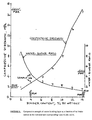
- The compressive strength of the seven coarse levelling materials was tested on cast test specimens after 28 days. The specimens were 40 x 40 x 160 mm and were stored in 50 % RH. The testing was done in a manner normally used for cement mortar and the test results are given in Table 2 and figure 1.
Table 2 Compressive strength of coarse levelling compound and the resistance against wheel loading of the combined layer. Sample no Compressive strength of coarse levelling compound, MPa Resistance to wheel loading of combined layer, MPa Note 1 1.5 - Rupture in coarse levelling layer at wheel loading 2 2.8 0.6 3 4.0 0.6 4 5.6 0.6 5 8.1 0.6 6 13.5 0.6 7 17.0 0.2 *) *) No fine levelling layer in this sample. - Further, the resistance to wheel loading was tested according to the Swedish Standard SS 92 35 07. The results from this testing are also shown in Table 2, where samples 1-6 consist of a combined layer of coarse and fine levelling layers, while sample 7 consists solely of a coarse levelling layer.
- From tables 1 and 2, it can be seen that the coarse levelling compound alone cannot withstand the wheel loading requirement of 0.5 MPa even at a binder content of 14 %. However, when there is a fine levelling layer on top, the combined layer can fulfill the loading requirement, provided that the binder content is at least 4 %.
- The new levelling material and the described technique was tested in full scale in a building project. Two different formulations of coarse levelling compound were used as follows:
Binder Water-binder ratio Filler + sand Formulation 1 7 % 2.5 92 % Formulation 210 % 1.8 89 % - The coarse levelling compound was produced as a dry mortar on a factory and 17.5 % and 18 % water resp. was added at the building site in a continous mixerpump. It was pumped out on the substrate, which consisted of prestressed concrete elements, to a thickness of 40-60 mm. After a few hours, the surface could be walked upon, and then a 5-10 mm thick layer of a conventional fine levelling compound - with the product name Universal from Sträbruken AB - was pumped out.
- The floor surfaces were inspected after eight weeks and no skrinkage cracks could be observed, neither when formulation 1 nor
formulation 2 had been used. - The new levelling material and the described technique with a relatively weak coarse levelling layer with low binder content and high water-binder ratio however has been shown to have further advantages. The drying time can be shortened towards half the time that is needed for conventional levelling compounds. Further, it has been possible to use screws when applying bases for partition walls, which is considerably quicker and less complicated than using traditional fastening with a bolting gun.
- The coarse levelling material furthermore can be used alone, without fine levelling layer in such cases when the described loading requirement is not applicable, e.g. where there is little loading or where the flooring can take the loading which otherwise the fine levelling layer should take. Examples of the latter is wooden floors and ceramic tiles.
Claims (3)
- Levelling material for levelling uneven substrates, which material is applied on the substrate in at least two layers, one coarse levelling layer of at least 10 mm thickness made of a pumpable coarse levelling compound and on this a loading layer characterized in that the coarse levelling layer consists of a pumpable coarse levelling compound having a binder content of 4-14 %, preferably 5-10 % of the dry weight of the compound, a water-binder ratio of 1-5, preferably 1.5-4, and a content of sand and filler of 85-95 %, preferably 89-94 % by weight, that the coarse levelling layer of said composition is adjusted to have a compressive strength after 28 days hardening of 2-17 MPa, preferably 3-8 MPa and a resistance against wheel loading which is at the most 0.4 MPa when measured according to the Swedish Standard SS 923507 or similar local standard while the loading layer is of such a type that it rests with all of its bottom surface evenly distributed over the top surface of the coarse levelling layer and has an even thickness.
- Levelling material according to claim 1, characterized in that the loading layer consists of a fine levelling layer with a thickness of 2-15 mm, preferably 5-10 mm, a shrinkage after drying in 50 % RH of at the most 0.15 %, preferably at the most 0.1 %, and a resistance against wheel loading of at least 0.5 MPa when measured according to the Swedish Standard SS923507 or similar local standard.
- Levelling material according to claim 1 or 2, characterized in that the loading layer is made of a pumpable, preferably self smoothing, fine levelling compound with a shrinkage after drying in 50 % RH of at the most 0.15 %, preferably at the most 0.1 %.
Applications Claiming Priority (3)
| Application Number | Priority Date | Filing Date | Title |
|---|---|---|---|
| SE9201459A SE500220C2 (en) | 1992-05-08 | 1992-05-08 | Avjämningsmaterial |
| SE9201459 | 1992-05-08 | ||
| PCT/SE1993/000402 WO1993023484A1 (en) | 1992-05-08 | 1993-05-07 | Levelling material |
Publications (2)
| Publication Number | Publication Date |
|---|---|
| EP0639211A1 EP0639211A1 (en) | 1995-02-22 |
| EP0639211B1 true EP0639211B1 (en) | 1996-11-27 |
Family
ID=20386190
Family Applications (1)
| Application Number | Title | Priority Date | Filing Date |
|---|---|---|---|
| EP93910510A Expired - Lifetime EP0639211B1 (en) | 1992-05-08 | 1993-05-07 | Levelling material |
Country Status (7)
| Country | Link |
|---|---|
| EP (1) | EP0639211B1 (en) |
| DE (1) | DE69306248D1 (en) |
| DK (1) | DK0639211T3 (en) |
| FI (1) | FI945051A7 (en) |
| NO (1) | NO943922L (en) |
| SE (1) | SE500220C2 (en) |
| WO (1) | WO1993023484A1 (en) |
Family Cites Families (1)
| Publication number | Priority date | Publication date | Assignee | Title |
|---|---|---|---|---|
| SE435049B (en) * | 1983-02-08 | 1984-09-03 | Allmaen Byggnadsservice Ab | putty |
-
1992
- 1992-05-08 SE SE9201459A patent/SE500220C2/en unknown
-
1993
- 1993-05-07 FI FI945051A patent/FI945051A7/en unknown
- 1993-05-07 WO PCT/SE1993/000402 patent/WO1993023484A1/en not_active Ceased
- 1993-05-07 EP EP93910510A patent/EP0639211B1/en not_active Expired - Lifetime
- 1993-05-07 DE DE69306248T patent/DE69306248D1/en not_active Expired - Lifetime
- 1993-05-07 DK DK93910510.2T patent/DK0639211T3/en active
-
1994
- 1994-10-17 NO NO943922A patent/NO943922L/en not_active Application Discontinuation
Also Published As
| Publication number | Publication date |
|---|---|
| NO943922D0 (en) | 1994-10-17 |
| DK0639211T3 (en) | 1997-06-02 |
| SE9201459D0 (en) | 1992-05-08 |
| SE500220C2 (en) | 1994-05-09 |
| SE9201459L (en) | 1993-11-09 |
| WO1993023484A1 (en) | 1993-11-25 |
| NO943922L (en) | 1994-12-01 |
| FI945051A0 (en) | 1994-10-27 |
| DE69306248D1 (en) | 1997-01-09 |
| FI945051L (en) | 1994-11-08 |
| FI945051A7 (en) | 1994-11-08 |
| EP0639211A1 (en) | 1995-02-22 |
Similar Documents
| Publication | Publication Date | Title |
|---|---|---|
| EP2493834B1 (en) | Composite concrete for floor slabs and rafts | |
| EP1903014B1 (en) | Concrete composition with reduced shrinkage | |
| KR101720504B1 (en) | A high early strength cement concrete composition having the improved durability for road pavement and a repairing method of road pavement using the same | |
| US4661159A (en) | Cementitious floor underlayment | |
| RU2277071C2 (en) | Method of production of concrete or mortar with vegetable filler | |
| KR101370694B1 (en) | Methods for applying polymer-modified wet concrete mixtures | |
| US20080057206A1 (en) | Hydraulic cement compositions and method of forming floor underlayment | |
| CN101337798A (en) | Polymers anti-cracking mortar | |
| CN101648798A (en) | Cement-based floor self-leveling mortar and preparation method thereof | |
| US20200062647A1 (en) | Concrete, a Dry Mixture for the Preparation of this Concrete, and a Method for the Preparation of this Concrete | |
| CN111779228A (en) | Waterborne epoxy composite cement self-leveling floor material, floor system and preparation method thereof | |
| US20190039953A1 (en) | Polyurethane hybrid system combining high compressive strength and early water resistance | |
| US5362320A (en) | Sandable low shrinkage mortar patching/coating compound | |
| KR100215140B1 (en) | Thin-film Cement-based Self-Planning Mortar Composition | |
| EP0379477B1 (en) | A self-leveling slurry screed, and a dry product for use in preparing it | |
| KR19980026538A (en) | Mortar composition with crack resistance and / or auto leveling | |
| WO1993023484A1 (en) | Levelling material | |
| EP0493858B1 (en) | Sand-cement mixture suitable for mortar | |
| KR102251955B1 (en) | Mortar composition using cement mixture and constructing method using it | |
| KR101806388B1 (en) | Composition of mortar powder with organic acid and natural fiber | |
| RU96123330A (en) | METHOD FOR PREPARING COMPOSITIONS FROM CONCRETE CONTAINING MIXES OF CEMENT, WATER AND FILLERS, WAY TO FORM AND CURE | |
| KR100502633B1 (en) | Water soluble color asphalt mortar construction method | |
| EP1627864B1 (en) | Composition particularly for preparing cement mortars | |
| KR20230049789A (en) | Mortar composition of floor structure reducing inter-floor noise | |
| KR102924356B1 (en) | Self-leveling mortar composition for construction |
Legal Events
| Date | Code | Title | Description |
|---|---|---|---|
| PUAI | Public reference made under article 153(3) epc to a published international application that has entered the european phase |
Free format text: ORIGINAL CODE: 0009012 |
|
| 17P | Request for examination filed |
Effective date: 19941119 |
|
| AK | Designated contracting states |
Kind code of ref document: A1 Designated state(s): BE CH DE DK FR GB LI NL |
|
| GRAG | Despatch of communication of intention to grant |
Free format text: ORIGINAL CODE: EPIDOS AGRA |
|
| 17Q | First examination report despatched |
Effective date: 19960201 |
|
| GRAH | Despatch of communication of intention to grant a patent |
Free format text: ORIGINAL CODE: EPIDOS IGRA |
|
| GRAH | Despatch of communication of intention to grant a patent |
Free format text: ORIGINAL CODE: EPIDOS IGRA |
|
| GRAA | (expected) grant |
Free format text: ORIGINAL CODE: 0009210 |
|
| AK | Designated contracting states |
Kind code of ref document: B1 Designated state(s): BE CH DE DK FR GB LI NL |
|
| PG25 | Lapsed in a contracting state [announced via postgrant information from national office to epo] |
Ref country code: NL Free format text: LAPSE BECAUSE OF FAILURE TO SUBMIT A TRANSLATION OF THE DESCRIPTION OR TO PAY THE FEE WITHIN THE PRESCRIBED TIME-LIMIT Effective date: 19961127 Ref country code: LI Effective date: 19961127 Ref country code: FR Effective date: 19961127 Ref country code: CH Effective date: 19961127 Ref country code: BE Effective date: 19961127 |
|
| REF | Corresponds to: |
Ref document number: 69306248 Country of ref document: DE Date of ref document: 19970109 |
|
| PG25 | Lapsed in a contracting state [announced via postgrant information from national office to epo] |
Ref country code: DE Effective date: 19970228 |
|
| EN | Fr: translation not filed | ||
| NLV1 | Nl: lapsed or annulled due to failure to fulfill the requirements of art. 29p and 29m of the patents act | ||
| REG | Reference to a national code |
Ref country code: CH Ref legal event code: PL |
|
| REG | Reference to a national code |
Ref country code: DK Ref legal event code: T3 |
|
| PLBE | No opposition filed within time limit |
Free format text: ORIGINAL CODE: 0009261 |
|
| STAA | Information on the status of an ep patent application or granted ep patent |
Free format text: STATUS: NO OPPOSITION FILED WITHIN TIME LIMIT |
|
| 26N | No opposition filed | ||
| PGFP | Annual fee paid to national office [announced via postgrant information from national office to epo] |
Ref country code: DK Payment date: 19990528 Year of fee payment: 7 |
|
| PGFP | Annual fee paid to national office [announced via postgrant information from national office to epo] |
Ref country code: GB Payment date: 19990607 Year of fee payment: 7 |
|
| PG25 | Lapsed in a contracting state [announced via postgrant information from national office to epo] |
Ref country code: GB Free format text: LAPSE BECAUSE OF NON-PAYMENT OF DUE FEES Effective date: 20000507 Ref country code: DK Free format text: LAPSE BECAUSE OF NON-PAYMENT OF DUE FEES Effective date: 20000507 |
|
| GBPC | Gb: european patent ceased through non-payment of renewal fee |
Effective date: 20000507 |
|
| REG | Reference to a national code |
Ref country code: DK Ref legal event code: EBP |