EP0637616B1 - Low structure pyrogenic hydrophilic & hydrophobic metallic oxides, production and use - Google Patents
Low structure pyrogenic hydrophilic & hydrophobic metallic oxides, production and use Download PDFInfo
- Publication number
- EP0637616B1 EP0637616B1 EP94111862A EP94111862A EP0637616B1 EP 0637616 B1 EP0637616 B1 EP 0637616B1 EP 94111862 A EP94111862 A EP 94111862A EP 94111862 A EP94111862 A EP 94111862A EP 0637616 B1 EP0637616 B1 EP 0637616B1
- Authority
- EP
- European Patent Office
- Prior art keywords
- din
- oxide
- pyrogenic
- filler
- loss
- Prior art date
- Legal status (The legal status is an assumption and is not a legal conclusion. Google has not performed a legal analysis and makes no representation as to the accuracy of the status listed.)
- Expired - Lifetime
Links
Images
Classifications
-
- C—CHEMISTRY; METALLURGY
- C09—DYES; PAINTS; POLISHES; NATURAL RESINS; ADHESIVES; COMPOSITIONS NOT OTHERWISE PROVIDED FOR; APPLICATIONS OF MATERIALS NOT OTHERWISE PROVIDED FOR
- C09C—TREATMENT OF INORGANIC MATERIALS, OTHER THAN FIBROUS FILLERS, TO ENHANCE THEIR PIGMENTING OR FILLING PROPERTIES ; PREPARATION OF CARBON BLACK ; PREPARATION OF INORGANIC MATERIALS WHICH ARE NO SINGLE CHEMICAL COMPOUNDS AND WHICH ARE MAINLY USED AS PIGMENTS OR FILLERS
- C09C1/00—Treatment of specific inorganic materials other than fibrous fillers; Preparation of carbon black
- C09C1/28—Compounds of silicon
- C09C1/30—Silicic acid
- C09C1/3009—Physical treatment, e.g. grinding; treatment with ultrasonic vibrations
- C09C1/3018—Grinding
-
- B—PERFORMING OPERATIONS; TRANSPORTING
- B82—NANOTECHNOLOGY
- B82Y—SPECIFIC USES OR APPLICATIONS OF NANOSTRUCTURES; MEASUREMENT OR ANALYSIS OF NANOSTRUCTURES; MANUFACTURE OR TREATMENT OF NANOSTRUCTURES
- B82Y30/00—Nanotechnology for materials or surface science, e.g. nanocomposites
-
- C—CHEMISTRY; METALLURGY
- C09—DYES; PAINTS; POLISHES; NATURAL RESINS; ADHESIVES; COMPOSITIONS NOT OTHERWISE PROVIDED FOR; APPLICATIONS OF MATERIALS NOT OTHERWISE PROVIDED FOR
- C09C—TREATMENT OF INORGANIC MATERIALS, OTHER THAN FIBROUS FILLERS, TO ENHANCE THEIR PIGMENTING OR FILLING PROPERTIES ; PREPARATION OF CARBON BLACK ; PREPARATION OF INORGANIC MATERIALS WHICH ARE NO SINGLE CHEMICAL COMPOUNDS AND WHICH ARE MAINLY USED AS PIGMENTS OR FILLERS
- C09C1/00—Treatment of specific inorganic materials other than fibrous fillers; Preparation of carbon black
- C09C1/36—Compounds of titanium
- C09C1/3607—Titanium dioxide
- C09C1/3615—Physical treatment, e.g. grinding, treatment with ultrasonic vibrations
- C09C1/3623—Grinding
-
- C—CHEMISTRY; METALLURGY
- C09—DYES; PAINTS; POLISHES; NATURAL RESINS; ADHESIVES; COMPOSITIONS NOT OTHERWISE PROVIDED FOR; APPLICATIONS OF MATERIALS NOT OTHERWISE PROVIDED FOR
- C09C—TREATMENT OF INORGANIC MATERIALS, OTHER THAN FIBROUS FILLERS, TO ENHANCE THEIR PIGMENTING OR FILLING PROPERTIES ; PREPARATION OF CARBON BLACK ; PREPARATION OF INORGANIC MATERIALS WHICH ARE NO SINGLE CHEMICAL COMPOUNDS AND WHICH ARE MAINLY USED AS PIGMENTS OR FILLERS
- C09C1/00—Treatment of specific inorganic materials other than fibrous fillers; Preparation of carbon black
- C09C1/40—Compounds of aluminium
- C09C1/407—Aluminium oxides or hydroxides
-
- C—CHEMISTRY; METALLURGY
- C09—DYES; PAINTS; POLISHES; NATURAL RESINS; ADHESIVES; COMPOSITIONS NOT OTHERWISE PROVIDED FOR; APPLICATIONS OF MATERIALS NOT OTHERWISE PROVIDED FOR
- C09C—TREATMENT OF INORGANIC MATERIALS, OTHER THAN FIBROUS FILLERS, TO ENHANCE THEIR PIGMENTING OR FILLING PROPERTIES ; PREPARATION OF CARBON BLACK ; PREPARATION OF INORGANIC MATERIALS WHICH ARE NO SINGLE CHEMICAL COMPOUNDS AND WHICH ARE MAINLY USED AS PIGMENTS OR FILLERS
- C09C3/00—Treatment in general of inorganic materials, other than fibrous fillers, to enhance their pigmenting or filling properties
- C09C3/04—Physical treatment, e.g. grinding or treatment with ultrasonic vibrations
- C09C3/041—Grinding
-
- C—CHEMISTRY; METALLURGY
- C01—INORGANIC CHEMISTRY
- C01P—INDEXING SCHEME RELATING TO STRUCTURAL AND PHYSICAL ASPECTS OF SOLID INORGANIC COMPOUNDS
- C01P2004/00—Particle morphology
- C01P2004/50—Agglomerated particles
-
- C—CHEMISTRY; METALLURGY
- C01—INORGANIC CHEMISTRY
- C01P—INDEXING SCHEME RELATING TO STRUCTURAL AND PHYSICAL ASPECTS OF SOLID INORGANIC COMPOUNDS
- C01P2004/00—Particle morphology
- C01P2004/60—Particles characterised by their size
- C01P2004/61—Micrometer sized, i.e. from 1-100 micrometer
-
- C—CHEMISTRY; METALLURGY
- C01—INORGANIC CHEMISTRY
- C01P—INDEXING SCHEME RELATING TO STRUCTURAL AND PHYSICAL ASPECTS OF SOLID INORGANIC COMPOUNDS
- C01P2004/00—Particle morphology
- C01P2004/60—Particles characterised by their size
- C01P2004/64—Nanometer sized, i.e. from 1-100 nanometer
-
- C—CHEMISTRY; METALLURGY
- C01—INORGANIC CHEMISTRY
- C01P—INDEXING SCHEME RELATING TO STRUCTURAL AND PHYSICAL ASPECTS OF SOLID INORGANIC COMPOUNDS
- C01P2006/00—Physical properties of inorganic compounds
- C01P2006/10—Solid density
-
- C—CHEMISTRY; METALLURGY
- C01—INORGANIC CHEMISTRY
- C01P—INDEXING SCHEME RELATING TO STRUCTURAL AND PHYSICAL ASPECTS OF SOLID INORGANIC COMPOUNDS
- C01P2006/00—Physical properties of inorganic compounds
- C01P2006/12—Surface area
-
- C—CHEMISTRY; METALLURGY
- C01—INORGANIC CHEMISTRY
- C01P—INDEXING SCHEME RELATING TO STRUCTURAL AND PHYSICAL ASPECTS OF SOLID INORGANIC COMPOUNDS
- C01P2006/00—Physical properties of inorganic compounds
- C01P2006/19—Oil-absorption capacity, e.g. DBP values
-
- C—CHEMISTRY; METALLURGY
- C01—INORGANIC CHEMISTRY
- C01P—INDEXING SCHEME RELATING TO STRUCTURAL AND PHYSICAL ASPECTS OF SOLID INORGANIC COMPOUNDS
- C01P2006/00—Physical properties of inorganic compounds
- C01P2006/22—Rheological behaviour as dispersion, e.g. viscosity, sedimentation stability
-
- C—CHEMISTRY; METALLURGY
- C01—INORGANIC CHEMISTRY
- C01P—INDEXING SCHEME RELATING TO STRUCTURAL AND PHYSICAL ASPECTS OF SOLID INORGANIC COMPOUNDS
- C01P2006/00—Physical properties of inorganic compounds
- C01P2006/80—Compositional purity
-
- C—CHEMISTRY; METALLURGY
- C01—INORGANIC CHEMISTRY
- C01P—INDEXING SCHEME RELATING TO STRUCTURAL AND PHYSICAL ASPECTS OF SOLID INORGANIC COMPOUNDS
- C01P2006/00—Physical properties of inorganic compounds
- C01P2006/90—Other properties not specified above
Definitions
- the present invention relates to low structure pyrogenic metal oxide fillers and to a method of producing such low structure pyrogenic metal oxide fillers.
- the present invention also relates to products made from and containing the novel low structure pyrogenic metal oxide fillers.
- Hydrophilic/hydrophobic pyrogenically produced metallic oxides based on silicon, aluminum, zirconium and titanium are well known in the art. They are produced by various methods known in the art such as described in U.S. Patent 3,954,945, U.S. Patent 4,067,954, and U.S. Patent 4,276,274. Also known from the prior art is the fact that such oxides are used as reinforcing fillers in many silicone RTV/HTV/LTV and nonsilicone based polymeric formulations such as rubbery polymers, sealants, caulks and adhesives. A full description of silicone rubber chemistry is found in U.S. Patent No. 4,307,023 (which is incorporated by reference in its entirety, especially column 1, lines 5-30).
- An object of the present invention is to provide low structure or destructured pyrogenic hydrophilic and hydrophobic metallic oxides which allow for higher loadings in formulations whereby excessive viscosity build-up is drastically reduced, extrusion rates are significantly increased, and mechanical properties are improved.
- Such low structure or destructured pyrogenic hydrophilic and hydrophobic metallic oxides can also be utilized as fillers and carriers for non-polymer applications such as catalysts, refractories, ceramics, and others. Mechanical destructuring is a irreversible process.
- a method of producing a low structure pyrogenic metal oxide filler comprising subjecting pyrogenically produced metal oxide agglomerates and aggregates such as silicon oxide, aluminum oxide, zirconium oxide or titanium oxide to a dry milling process whereby the pyrogenically produced metal oxide is contacted in an agitating zone with an energy specific force created by certain reaction conditions: agitating media bed consisting of a member selected from the group consisting of stainless steel, chrome steel, carbon steel, ceramic, aluminum oxide, tungsten carbide, zirconium carbide, zirconium oxide, and zirconium silicate whereby the metallic oxide agglomerates and aggregates are free to move, collide and impinge on each other, wherein the media is kept in constant agitation by a rotating shaft with protruding extensions of a length or by a rolling drum, the media diameter being 0,10
- dry as used herein means an extremely low moisture content. This is a condition known in the art as a “non-fluid medium” or a “non-fluid mill base”. Since the pyrogenic methods of preparation of these metallic oxides do not involve an aqueous system, the products obtained are dry, and any moisture picked up would be adsorbed from the environment.
- dry means silicon dioxide having less than 2,5% moisture; aluminum oxide having less than 3% moisture; zirconium oxide having less than 1% moisture; and titanium oxide having less than 2% moisture.
- the dry grinding process of the present invention is an intensive milling process which goes beyond standard particle size reduction to achieve destructuring of pyrogenic metallic oxides.
- Agitating media bed used according to the invention are selected from stainless steel, chrome steel, carbon steel, ceramic, aluminum oxide, tungsten carbide, zirconium carbide, zirconium oxide, or zirconium silicate whereby the metallic oxide agglomerates and aggregates are free to move, collide and impinge between the colliding media.
- the media is kept in constant agitation by a rotating shaft with protruding extensions of a desired length or by a rolling drum.
- the media diameter is generally 0,635 to 2.54 cm (one quarter inch to one inch) in diameter and being of circular, spherical or cylindrical shape (or equivalents thereof).
- the shaft speed is between 100 and 1500 rpm or the roller drum speed is between 30 to 120 rpm.
- the media fills the volume of the agitating zone to the extent of 1/4 to 3/4 of the total volume and wherein the dwell time in the zone is controlled by the amount of time the metallic oxide remains in the media bed or by the number of passes through the media bed.
- the product stream is evaluated to ascertain the structure of the resulting product until a steady state condition is reached.
- the lowering of the structure of the pyrogenic metallic oxide is a function of the time of compression, the amount of compressive force exerted on the aggregate/agglomerate particles and the conditions of compression.
- the metallic oxide can be pyrogenic silicon dioxide having the following characteristics: BET -Surface Area m 2 /g 50 - 400 Average Particle Size nm 7 - 40 Bulk Density g/l (DIN 53194) 20 - 120 Loss of Drying % (DIN 55921) 0.5 - 2 Loss of Ignition % (DIN 55921) 1 - 10 pH (DIN 53200) 3 - 9 DBP Absorption g/100g (DIN 53601) 150 - 450 Carbon Content % 0 - 5
- the metallic oxide can be pyrogenic aluminum oxide having the following characteristics: BET -Surface Area m 2 /g 80 - 120 Average Particle Size nm 10 - 15 Bulk Density g/l (DIN 53194) 40 - 120 Loss of Drying % (DIN 55921) 1 - 5 Loss of Ignition % (DIN 55921) 1 - 3 pH (DIN 53200) 4.5 - 5.5 DBP Absorption g/100g (DIN 53601) 150 - 200
- the metallic oxide can be a pyrogenic cofumed mixed metallic oxide of silicon dioxide and aluminum oxide in a ratio of 1 - 5% Al 2 O 3 :SiO 2 .
- the metallic oxide can be a physical blend of pyrogenic metallic oxides of silicon dioxide and aluminum oxide in a ratio up to 20% Al 2 O 3 :SiO 2 .
- the metallic oxide can be pyrogenic titanium oxide having the following characteristics: BET -Surface Area m 2 /g 30 - 100 Average Particle Size nm 15 - 30 Bulk Density g/l (DIN 53194) 40 - 120 Loss of Drying % (DIN 55921) 1 - 2 Loss of Ignition % (DIN 55921) 1 - 2 pH (DIN 53200) 3.0 - 4.0 DBP Absorption g/100g (DIN 53601) 90 - 130
- the metallic oxide can be pyrogenic zirconium oxide having the following characteristics: BET -Surface Area m 2 /g 30 - 50 Average Particle Size nm 20 - 40 Bulk Density g/l (DIN 53194) 80 - 250 Loss of Drying % (DIN 55921) .1 - 1 Loss of Ignition % (DIN 55921) .1 - 1 pH (DIN 53200) 5.5 - 6.5 DBP Absorption g/100g (DIN 53601) 120 - 150
- reduced particle/aggregate size, extremely reduced bulk density and destructured products are manufactured by taking hydrophilic/hydrophobic pyrogenic metallic oxides and passing them through a dry milling process whereby the products come into contact with a energy specific force created by the following conditions:
- the stationary rotating shaft refers to a shaft whose only motion is its rotation along its axis.
- the protruding extensions of the stationary shaft are of varying lengths which achieve fluidization of the media.
- the dwell time where the pyrogenic metallic oxide is in contact with the agitating media is controlled by either:
- Examples of these mills include ball mills, attrition mills, and others known in the art. Destructuring is also accomplished by intense compression through a roller mechanism, whereby, for example, the silica is compressed upon itself, between roller devices or between roller devices and a stationary vessel wall.
- a roller mill i.e., 2-roll mill or 3-roll mill
- a correctly operating mill such as a ball mill is characterized by a typical movement traveled by a typical ball in a partially filled ball mill chamber.
- Low velocity of the ball mill causes the typical ball inside the mill to be gradually lifted up on one side of the mill to a higher and higher level. At that point the ball cascades, falling and tumbling down along the sloping surface to the low side of the mill.
- Three types of movements are recognized in connection with operating ball mills; namely, centrifuging, cataracting and cascading. These-characteristic actions in a ball mill are known and recognized in the art.
- the desirable movement is cascading and persons skilled in the art recognize what is meant by this term.
- Cascading is a highly efficient process for producing a finely divided material and is the goal of the successful operation of the invention.
- Charging the ball mill or attrition mill to a partial capacity, such as halfway, provides the most efficient loading arrangement.
- Optimum loading complies with theoretical considerations and cascading freely occurs throughout the mill.
- Ceramic ball media such as flint pebbles and porcelain balls, were historically supplied in a range of sizes as indicated above. Steel balls and other newer technology types as known in the art are commonly supplied in ball diameters which also can vary, but in accordance with the present invention it has been found that dimensions of 0,1016 to 2,54 cm (0.04 inch to 1 inch) diameter are preferable.
- Ball mills are normally equipped with a manhole for loading the charge from the top which can be facilitated by a slope shoot that reaches from the storage area to the surface of the ball mill charge inside the mill, an air relief valve and a venting port for discharge. Venting should be carried out after starting a new batch and periodically as necessary as it contributes to grinding efficiency. Since the flowing material or moving machinery generates static electricity, it is desirable to have grounding at all points.
- Metallic media are generally of a higher density than porcelain balls and therefor provide faster grinding at smaller ball diameters than their ceramic counterparts. This usually necessitates sturdier mill construction and higher power requirements.
- High carbon, high manganese steel balls having a Rockwell C hardness of 60 to 70 are commonly used for ball mill operations.
- the smallest size should be selected which provides the proper cascading action inside the mill. It has been determined that once the ball size has been established for providing the best grinding action, it does not vary appreciably for different size mills. Thus, the ball size that proves successful on a small ball mill usually is also suitable to a scaled up production system. In general, balls of a minimum diameter and a maximum density are necessary to achieve the proper cascading action should be selected because per revolution of the mill they provide the maximum number of impact, colliding, or sheering contacts and for a given volume of space offer the maximum area for compressive action. Also, the smaller void spaces between the balls of lesser diameter effectively limits the size of the mill base agglomerates that can exist in the interstitial space.
- the metallic oxide proceeds to fill into the voids between the balls.
- the difference between a ball mill vibrating in a horizontal mode and an attrition mill is well known.
- conventional ball milling is based on the cascading of the ball media in a horizontally mounted rotating drum
- the attrition mills generally are upright, stationary, cylindrical grinding tanks fitted with a centralized vertical rotating shaft to which is attached at right angles a distribution of agitation members or metallic fingers. These extensions protrude into the ball media mill base mixture which partially fills the attritor tank during the milling operation. The rotation of these fingers which sweep through the tank contents vigorously agitates the ball charge which in turn provides the necessary shear and impact forces to grind the metallic oxide.
- the attritor mills can be designed for either batch or continuous operation.
- the attritor mill When properly functioning, the attritor mill also keeps all of the ball media in constant motion due to the rotation of the agitator fingers on the central shaft. Thus, in actual rotation the grinding media fluidizes and occupies a far greater percentage of the volume of the agitator than when the rotating blade is at rest. It is therefore essential that in a ball mill cascading action is obtained whereas in the attritor mill fluidization of the balls and agitating medium is necessary.
- Destructuring takes place when these three facets of compression have been optimized.
- the destructuring process can be either continuous or batch. In all cases, destructuring is irreversible.
- Destructuring according to the present invention is achieved in a dry grinding process. As opposed to a wet grinding process, dry grinding is a more intense milling process which goes beyond standard particle size reduction to achieve destructuring of pyrogenic metallic oxides. Prior to the present invention, destructuring of pyrogenic metallic oxides has not been documented. In wet grinding, particles are surrounded by liquid (e.g., water or resin). Particle size is reduced with the milling energy generated by wet grinding; however, structure is much less influenced since the liquid acts like a cushion, thus metallic oxides can not be destructured effectively by wet grinding.
- liquid e.g., water or resin
- the destructuring process of the present invention reduces agglomerate size measured by differential number % by Coulter® Laser Particle Size Analysis using optical model of Fraunhofer and bulk density measured in g/l.
- destructuring according to the present invention achieves a 40% to 90% lowering of structure.
- the present invention pertains to destructuring of all pyrogenic hydrophilic/hydrophobic metallic oxides with the following physical-chemical properties: 1. Pyrogenic Silicon Dioxide (hydrophilie & hydrophobic) : BET -Surface Area m 2 /g (Micromeritics® 2300) 50 - 400 Average Particle Size nm 7 - 40 Bulk Density g/l (DIN 53194) 20 - 120 Loss of Drying % (DIN 55921) 0.5 - 2 Loss of Ignition % (DIN 55921) 1 - 10 pH (DIN 53200) 3 - 9 DBP Absorption g/100g (DIN 53601) 150 - 450 Carbon Content % 0 - 5 Hydrophobizing agents for pyrogenic silicon dioxide include silane/organosilicon compounds (e.g., silicone oil, dimethyldichloro silane, hexamethyldisilizane, and others known to those skilled in the art) which consist of linear or
- the free valences of silicon not bonded to oxygen can be taken up by organic groups or hydrogen.
- hydrophobizing agents refer to U.S. Patent No. 4,307,023 (especially column 2, lines 5-30). Further details of the hydrophobizing process can be found in U.S. Patent Nos. 3,924,029 and 4,503,092 (which are incorporated by reference in their entirety). U.S. Patent 4,326,852 is also incorporated by reference in its entirety.
- the referenced patents illustrate hydrophobizing agents and methods for treating silica to render it hydrophobic. 2.
- Pyrogenic Aluminum Oxide BET -Surface Area m 2 /g (Micromeritics® 2300) 80 - 120 Average Particle Size nm 10 - 15 Bulk Density g/l (DIN 53194) 40 - 120 Loss of Drying % (DIN 55921) 1 - 5 Loss of Ignition % (DIN 55921) 1 - 3 pH (DIN 53200) 4.5 - 5.5 DBP Absorption g/100g (DIN 53601) 150 - 200 3. Pyrogenic cofumed mixed metallic oxides of above silicon dioxide products and aluminum oxide in ratios of 1 - 5% Al 2 O 3 :SiO 2 . 4.
- Pyrogenic Titanium dioxide BET -Surface Area m 2 /g (Micromeritics® 2300) 30 - 100 Average Particle Size nm 15 - 30 Bulk Density g/l (DIN 53194) 40 - 120 Loss of Drying % (DIN 55921) 1 - 2 Loss of Ignition % (DIN 55921) 1 - 2 pH (DIN 53200) 3.0 - 4.0 DBP Absorption g/100g (DIN 53601) 90 - 130 6.
- Pyrogenic Zirconium Oxide BET -Surface Area m 2 /g (Micromeritics® 2300) 30 - 50 Average Particle Size nm 20 - 40 Bulk Density g/l (DIN 53194) 80 - 250 Loss of Drying % (DIN 55921) .1 - 1 Loss of Ignition % (DIN 55921) .1 - 1 pH (DIN 53200) 5.5 - 6.5 DBP Absorption g/100g (DIN 53601) 120 - 150
- a further subject of the invention is a method of using the low structure pyrogenic metallic oxide according to the invention comprising incorporating a sufficient amount of said metallic oxide to function as a reinforcing filler in a silicon or non-silicon based rubber, sealant, caulk or adhesive composition.
- a further subject of the invention is a low structure pyrogenic metal oxide filler or carrier produced by the method according to the invention.
- a further subject of the invention is a polymeric composition
- a polymeric composition comprising a silicone or non-silicone based polymeric containing as a reinforcing filler a sufficient amount of the filler produced according to the method of the invention, whereby the polymeric composition can be a rubber, sealant, caulk or adhesive composition.
- the rubber composition can be a silicone or non-silicone based rubber containing as a reinforcing filler a sufficient amount of the filler produced according to the method of the invention.
- the sealant composition can be a silicone or non-silicone based sealant containing as a reinforcing filler a sufficient amount of the filler produced according to the method of the invention.
- the caulk composition can be a silicone or non-silicone based caulk containing as a reinforcing filler a sufficient amount of the filler produced according to the method of the invention.
- the adhesive composition can be a silicone or non-silicone based adhesive containing as a reinforcing filler a sufficient amount of the filler produced according to the method of the invention.
- the physical-chemical characteristics are as follows: DBP Absorption (g/100g) Agglomerate Size ( ⁇ ) Bulk Density (g/l) Aerosil® 300 Before destructuring 348 12.0 25 After destructuring 118 2.0 308 Aerosil® R972 Before destructuring 269 9.0 30 After destructuring 70 5.0 308 Aerosil® R810S Before destructuring 190 13.0 30 After destructuring 83 4.0 270 Al 2 O 3 C Before destructuring 184 2.7 45 After destructuring 62 0.3 614 TiO 2 P-25 Before destructuring 97 0.6 117 After destructuring 57 0.2 525
- Destructuring is time/force related. Optimized conditions were defined as volume of ball mill-one gallon, charge of Aerosil 200VS-250 grams, charge of ceramic media (0,635 cm (1/4 inch) spherical, density 2.8 g/cm 3 )-5000 grams, rpm of ball mill-90 rpm; samples were taken over several periods of time and the following destructuring under optimized conditions are achieved: Table 1 Aerosil 200 VS DBP absorption g/100g no milling 290 1 hour 213 2 hours 174 3 hours 149 4 hours 136
- Non-optimized ball milling conditions which do not significantly influence structure, are defined as volume of ball mill-one gallon, charge of Aerosil® 200-150 grams, charge of ceramic media (0,635 cm)(1/4 inch) spherical, density 2.8 g/cm 3 )-varied as indicated below, rpm of ball mill-90 rpm, time-varied as indicated below:
- Treatment DBP g/100 g no treatment (as is) 321 250 g of media, milled 5 minutes 324 350 g of media, milled 15 minutes 310 650 g of media, milled 15 minutes 307 1000 g of media, milled 15 minutes 296
- Step 2 Use of destructured products to improve extrusion rate (ASTM C603)
- Extrusion rates of structured and destructured materials are as follows: Extrusion Rate (g/min.) Aerosil® 300 Before destructuring 306 After destructuring 578 Aerosil® R972 Before destructuring 490 After destructuring 888 Aerosil® R810S Before destructuring 526 After destructuring 834
- Low structure is important to be able to load the polymer with larger amounts of filler. It enhances reinforcement and good flow properties of the polymer.
- Step 4. Hydrophobizing in-situ or as an after-treatment.
- hydrophobized surfaces open up, exposing untreated internal surfaces. To fully hydrophobize these surfaces it is necessary to rehydrophobize during the destructuring process or an aftertreatment once destructuring is completed. Any silane/siloxane treatments cited above for hydrophobizing of pyrogenic silicon dioxide can be utilized here.
Landscapes
- Chemical & Material Sciences (AREA)
- Organic Chemistry (AREA)
- Engineering & Computer Science (AREA)
- Nanotechnology (AREA)
- Composite Materials (AREA)
- Condensed Matter Physics & Semiconductors (AREA)
- General Physics & Mathematics (AREA)
- Materials Engineering (AREA)
- Crystallography & Structural Chemistry (AREA)
- Physics & Mathematics (AREA)
- Compositions Of Macromolecular Compounds (AREA)
- Adhesives Or Adhesive Processes (AREA)
- Silicon Compounds (AREA)
Description
- The present invention relates to low structure pyrogenic metal oxide fillers and to a method of producing such low structure pyrogenic metal oxide fillers. In a further aspect, the present invention also relates to products made from and containing the novel low structure pyrogenic metal oxide fillers.
- Hydrophilic/hydrophobic pyrogenically produced metallic oxides based on silicon, aluminum, zirconium and titanium are well known in the art. They are produced by various methods known in the art such as described in U.S. Patent 3,954,945, U.S. Patent 4,067,954, and U.S. Patent 4,276,274. Also known from the prior art is the fact that such oxides are used as reinforcing fillers in many silicone RTV/HTV/LTV and nonsilicone based polymeric formulations such as rubbery polymers, sealants, caulks and adhesives. A full description of silicone rubber chemistry is found in U.S. Patent No. 4,307,023 (which is incorporated by reference in its entirety, especially column 1, lines 5-30). The highest loadings possible are desired to obtain maximum reinforcement and improved physical properties including improved tensile strength, higher modulus, improved Shore A hardness and higher extrusion rates. Methods of producing hydrophobic pyrogenically obtained metallic oxide particulates are also well known in the art, as shown in U.S. Patent 4,068,024 and U.S. Patent 3,948,676 both assigned to the assignee herein.
- The current problem when using pyrogenic metallic oxides is their high structure, measured by DBP Absorption, which prevents high filler loadings and causes excessive viscosity build-up and low extrusion rates which makes formulations difficult to handle and process. "Structure" as it relates to fillers is a well recognized and understood term, see Kirk Othmer Encyclopedia of Chemical Technology, volume 4, page 638.
- Well known processes have been established to reduce particle/aggregate size and to decrease bulk density. However, simultaneously reducing particle size/aggregate size, decreasing bulk density and destructuring of pyrogenically produced metallic oxides is, prior to the present invention, an unknown process.
- An object of the present invention is to provide low structure or destructured pyrogenic hydrophilic and hydrophobic metallic oxides which allow for higher loadings in formulations whereby excessive viscosity build-up is drastically reduced, extrusion rates are significantly increased, and mechanical properties are improved. Such low structure or destructured pyrogenic hydrophilic and hydrophobic metallic oxides can also be utilized as fillers and carriers for non-polymer applications such as catalysts, refractories, ceramics, and others. Mechanical destructuring is a irreversible process.
- Disclosed is a method of producing a low structure pyrogenic metal oxide filler; i.e., a pyrogenic metal oxide filler of reduced structure compared with the filler prior to being subjected to the method of the invention, comprising subjecting pyrogenically produced metal oxide agglomerates and aggregates such as silicon oxide, aluminum oxide, zirconium oxide or titanium oxide to a dry milling process whereby the pyrogenically produced metal oxide is contacted in an agitating zone with an energy specific force created by certain reaction conditions:
agitating media bed consisting of a member selected from the group consisting of stainless steel, chrome steel, carbon steel, ceramic, aluminum oxide, tungsten carbide, zirconium carbide, zirconium oxide, and zirconium silicate whereby the metallic oxide agglomerates and aggregates are free to move, collide and impinge on each other, wherein the media is kept in constant agitation by a rotating shaft with protruding extensions of a length or by a rolling drum, the media diameter being 0,1016 to 2.54 cm (0.04 to one inch) in diameter and being of circular, spherical or cylindrical shape, the shaft speed being between 100 and 1500 rpm or the roller drum speed being between 30 to 120 rpm, wherein the media fills the volume of the agitating zone to the extent of 1/4 to 3/4 of its total volume and wherein the dwell time in the zone is controlled by the amount of time the metallic oxide remains in the media bed or by the number of passes through the media bed, evaluating the resulting product until a steady state condition is reached and wherein the lowering of the structure of the pyrogenic metallic oxide is a function of the time of compression, the amount of compressive force exerted on the aggregate/agglomerate particles and the conditions of compression. - The term "dry" as used herein means an extremely low moisture content. This is a condition known in the art as a "non-fluid medium" or a "non-fluid mill base". Since the pyrogenic methods of preparation of these metallic oxides do not involve an aqueous system, the products obtained are dry, and any moisture picked up would be adsorbed from the environment. In general, as used herein, the term "dry" means silicon dioxide having less than 2,5% moisture; aluminum oxide having less than 3% moisture; zirconium oxide having less than 1% moisture; and titanium oxide having less than 2% moisture.
- The dry grinding process of the present invention is an intensive milling process which goes beyond standard particle size reduction to achieve destructuring of pyrogenic metallic oxides.
- Agitating media bed used according to the invention are selected from stainless steel, chrome steel, carbon steel, ceramic, aluminum oxide, tungsten carbide, zirconium carbide, zirconium oxide, or zirconium silicate whereby the metallic oxide agglomerates and aggregates are free to move, collide and impinge between the colliding media. The media is kept in constant agitation by a rotating shaft with protruding extensions of a desired length or by a rolling drum. The media diameter is generally 0,635 to 2.54 cm (one quarter inch to one inch) in diameter and being of circular, spherical or cylindrical shape (or equivalents thereof). The shaft speed is between 100 and 1500 rpm or the roller drum speed is between 30 to 120 rpm. It is a feature of the invention that the media fills the volume of the agitating zone to the extent of 1/4 to 3/4 of the total volume and wherein the dwell time in the zone is controlled by the amount of time the metallic oxide remains in the media bed or by the number of passes through the media bed. The product stream is evaluated to ascertain the structure of the resulting product until a steady state condition is reached. The lowering of the structure of the pyrogenic metallic oxide is a function of the time of compression, the amount of compressive force exerted on the aggregate/agglomerate particles and the conditions of compression.
- According to the invention the metallic oxide can be pyrogenic silicon dioxide having the following characteristics:
BET -Surface Area m2/g 50 - 400 Average Particle Size nm 7 - 40 Bulk Density g/l (DIN 53194) 20 - 120 Loss of Drying % (DIN 55921) 0.5 - 2 Loss of Ignition % (DIN 55921) 1 - 10 pH (DIN 53200) 3 - 9 DBP Absorption g/100g (DIN 53601) 150 - 450 Carbon Content % 0 - 5 - According to the invention the metallic oxide can be pyrogenic aluminum oxide having the following characteristics:
BET -Surface Area m2/g 80 - 120 Average Particle Size nm 10 - 15 Bulk Density g/l (DIN 53194) 40 - 120 Loss of Drying % (DIN 55921) 1 - 5 Loss of Ignition % (DIN 55921) 1 - 3 pH (DIN 53200) 4.5 - 5.5 DBP Absorption g/100g (DIN 53601) 150 - 200 - According to the invention the metallic oxide can be a pyrogenic cofumed mixed metallic oxide of silicon dioxide and aluminum oxide in a ratio of 1 - 5% Al2O3:SiO2.
- According to the invention the metallic oxide can be a physical blend of pyrogenic metallic oxides of silicon dioxide and aluminum oxide in a ratio up to 20% Al2O3:SiO2.
- According to the invention the metallic oxide can be pyrogenic titanium oxide having the following characteristics:
BET -Surface Area m2/g 30 - 100 Average Particle Size nm 15 - 30 Bulk Density g/l (DIN 53194) 40 - 120 Loss of Drying % (DIN 55921) 1 - 2 Loss of Ignition % (DIN 55921) 1 - 2 pH (DIN 53200) 3.0 - 4.0 DBP Absorption g/100g (DIN 53601) 90 - 130 - According to the invention the metallic oxide can be pyrogenic zirconium oxide having the following characteristics:
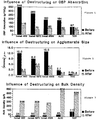
BET -Surface Area m2/g 30 - 50 Average Particle Size nm 20 - 40 Bulk Density g/l (DIN 53194) 80 - 250 Loss of Drying % (DIN 55921) .1 - 1 Loss of Ignition % (DIN 55921) .1 - 1 pH (DIN 53200) 5.5 - 6.5 DBP Absorption g/100g (DIN 53601) 120 - 150 - The invention will be further understood with reference to the drawings, wherein:
- Figure 1 is a bar chart showing the influence of destructuring on DBP absorption;
- Figure 2 is a bar chart showing the influence of destructuring on agglomerate size; and
- Figure 3 is a bar chart showing the influence of destructuring on bulk density.
- According to the present invention, reduced particle/aggregate size, extremely reduced bulk density and destructured products are manufactured by taking hydrophilic/hydrophobic pyrogenic metallic oxides and passing them through a dry milling process whereby the products come into contact with a energy specific force created by the following conditions:
- Agitating media (specific density 2 3-8 g/cm3, examples include stainless or chrome or carbon steel, ceramic, tungsten or zirconium carbide, zirconium oxide or zirconium silicate) so that the metallic oxide agglomerates/aggregates are free to move, collide and impinge upon each other.
- Media is kept in constant agitation by a stationary shaft (vertical or horizontal) with protruding extensions of a length determined by the size of the vessel or by a rolling drum.
- The media diameter is 0,1016 to 2,54 cm (0.04 - 1 inch) in diameter.
- The media can be either spherical, cylindrical or other shapes used in the art.
- The shaft speed must be between 100-1500 rpm or the rpm of the rolling drum must be between 30-120 rpm.
- At rest, the media used must fill 1/4 - 3/4 of the volume of the chamber or vessel used for destructuring.
- The stationary rotating shaft refers to a shaft whose only motion is its rotation along its axis. The protruding extensions of the stationary shaft are of varying lengths which achieve fluidization of the media.
- Time is very important in the process of the present invention because destructuring takes place after a critical reduced particle/aggregate size and bulk density have been achieved. The dwell time where the pyrogenic metallic oxide is in contact with the agitating media is controlled by either:
- 1. the amount of time the metallic oxide remains in the media bed or
- 2. by the number of passes through the media bed.
- Examples of these mills include ball mills, attrition mills, and others known in the art. Destructuring is also accomplished by intense compression through a roller mechanism, whereby, for example, the silica is compressed upon itself, between roller devices or between roller devices and a stationary vessel wall. An example of these types is a roller mill (i.e., 2-roll mill or 3-roll mill) and others known in the art.
- A correctly operating mill such as a ball mill is characterized by a typical movement traveled by a typical ball in a partially filled ball mill chamber. Low velocity of the ball mill causes the typical ball inside the mill to be gradually lifted up on one side of the mill to a higher and higher level. At that point the ball cascades, falling and tumbling down along the sloping surface to the low side of the mill. Three types of movements are recognized in connection with operating ball mills; namely, centrifuging, cataracting and cascading. These-characteristic actions in a ball mill are known and recognized in the art. The desirable movement is cascading and persons skilled in the art recognize what is meant by this term. Cascading is a highly efficient process for producing a finely divided material and is the goal of the successful operation of the invention.
- Charging the ball mill or attrition mill to a partial capacity, such as halfway, provides the most efficient loading arrangement. Optimum loading complies with theoretical considerations and cascading freely occurs throughout the mill.
- Ceramic ball media, such as flint pebbles and porcelain balls, were historically supplied in a range of sizes as indicated above. Steel balls and other newer technology types as known in the art are commonly supplied in ball diameters which also can vary, but in accordance with the present invention it has been found that dimensions of 0,1016 to 2,54 cm (0.04 inch to 1 inch) diameter are preferable. The approximate number of balls, n, per pound can be calculated from the expression n = 53/pd2, wherein p is the ball density given in grams per cubic centimeter and d is the ball diameter in inches. Thus, the number of porcelain balls of a certain size and density can be calculated per pound.
- Ball mills are normally equipped with a manhole for loading the charge from the top which can be facilitated by a slope shoot that reaches from the storage area to the surface of the ball mill charge inside the mill, an air relief valve and a venting port for discharge. Venting should be carried out after starting a new batch and periodically as necessary as it contributes to grinding efficiency. Since the flowing material or moving machinery generates static electricity, it is desirable to have grounding at all points.
- Although naturally occurring ceramic media such as flint pebbles (low density) are the oldest grinding material that is known, it is preferable to use the newer high density porcelain balls which have a high dinsity. These are well known materials which are harder and more abrasion resistant than more conventional older porcelains and hence the wear on the ball is correspondingly less.
- Metallic media are generally of a higher density than porcelain balls and therefor provide faster grinding at smaller ball diameters than their ceramic counterparts. This usually necessitates sturdier mill construction and higher power requirements. High carbon, high manganese steel balls having a Rockwell C hardness of 60 to 70 are commonly used for ball mill operations.
- In selecting ball size, the smallest size should be selected which provides the proper cascading action inside the mill. It has been determined that once the ball size has been established for providing the best grinding action, it does not vary appreciably for different size mills. Thus, the ball size that proves successful on a small ball mill usually is also suitable to a scaled up production system. In general, balls of a minimum diameter and a maximum density are necessary to achieve the proper cascading action should be selected because per revolution of the mill they provide the maximum number of impact, colliding, or sheering contacts and for a given volume of space offer the maximum area for compressive action. Also, the smaller void spaces between the balls of lesser diameter effectively limits the size of the mill base agglomerates that can exist in the interstitial space.
- It will be seen that depending upon the ball diameter and density, the most favorable conditions for grinding in a ball mill are tied in closely with the density and velocity of the mill base. In the difference between the ball and the mill base density, Δp determines the actual force acting on the balls that causes them to cascade. The buoyant effect exerted by the mill base acting upwardly is proportional to the mill base density. The gravitational pull or weight of the ball charge acts downwardly and is proportional to the ball density. Hence it has been said that the overall or net force acting downward is proportional to the difference in the two densities and is given in the following equation: Δp= p(ball) - p(mill base)
- While it has been suggested by some to use a mixture of small and large ball sizes in a ball mill operation, it has been found herein that it is desirable if the balls are of similar size.
- When the charge is added to the ball mill ready for grinding, the metallic oxide proceeds to fill into the voids between the balls.
- Taking into consideration that depending upon the ball shape and size, there can be a relatively tight packing of the balls or a relatively loose packing of the grinding medium. On an average, for a ideal situation assuming ideal charging conditions, the empty space in the ball mill should be about 50%, the ball volume occupying 30% of the remainder and the metallic oxides the remaining 20%. These are approximate and are not narrowly critical. It was established in general that by charging the ball mill to the halfway mark with balls, maximum grinding efficiency is obtained although that can vary as explained above.
- If an amount of the metallic oxide is used that is greater than necessary to cover the balls in the ball mills (overpacking the chamber), the excess remains undisbursed with respect to the balls until such time as it has the opportunity to defuse into and displace some of the metallic base that is in the active ball region. This means that the operation is not being carried out under optimum conditions.
- The difference between a ball mill vibrating in a horizontal mode and an attrition mill is well known. Whereas conventional ball milling is based on the cascading of the ball media in a horizontally mounted rotating drum, the attrition mills generally are upright, stationary, cylindrical grinding tanks fitted with a centralized vertical rotating shaft to which is attached at right angles a distribution of agitation members or metallic fingers. These extensions protrude into the ball media mill base mixture which partially fills the attritor tank during the milling operation. The rotation of these fingers which sweep through the tank contents vigorously agitates the ball charge which in turn provides the necessary shear and impact forces to grind the metallic oxide. The attritor mills can be designed for either batch or continuous operation. When properly functioning, the attritor mill also keeps all of the ball media in constant motion due to the rotation of the agitator fingers on the central shaft. Thus, in actual rotation the grinding media fluidizes and occupies a far greater percentage of the volume of the agitator than when the rotating blade is at rest. It is therefore essential that in a ball mill cascading action is obtained whereas in the attritor mill fluidization of the balls and agitating medium is necessary.
- It is possible to use milling procedures which compact the metallic oxide which decrease the bulk density without destructuring (see Tables 1 and 2).
- In all cases, lowering the structure of pyrogenic metallic oxides is a function of:
- 1. the time of compression
- 2. the amount of compressive force exerted on the aggregates/agglomerate particles
- 3. the conditions of compression.
- Destructuring takes place when these three facets of compression have been optimized. The destructuring process can be either continuous or batch. In all cases, destructuring is irreversible. Destructuring according to the present invention is achieved in a dry grinding process. As opposed to a wet grinding process, dry grinding is a more intense milling process which goes beyond standard particle size reduction to achieve destructuring of pyrogenic metallic oxides. Prior to the present invention, destructuring of pyrogenic metallic oxides has not been documented. In wet grinding, particles are surrounded by liquid (e.g., water or resin). Particle size is reduced with the milling energy generated by wet grinding; however, structure is much less influenced since the liquid acts like a cushion, thus metallic oxides can not be destructured effectively by wet grinding.
- In addition to reducing the DBP absorption, the destructuring process of the present invention reduces agglomerate size measured by differential number % by Coulter® Laser Particle Size Analysis using optical model of Fraunhofer and bulk density measured in g/l. In general, destructuring according to the present invention achieves a 40% to 90% lowering of structure.
- The present invention pertains to destructuring of all pyrogenic hydrophilic/hydrophobic metallic oxides with the following physical-chemical properties:
1. Pyrogenic Silicon Dioxide (hydrophilie & hydrophobic) :BET -Surface Area m2/g (Micromeritics® 2300) 50 - 400 Average Particle Size nm 7 - 40 Bulk Density g/l (DIN 53194) 20 - 120 Loss of Drying % (DIN 55921) 0.5 - 2 Loss of Ignition % (DIN 55921) 1 - 10 pH (DIN 53200) 3 - 9 DBP Absorption g/100g (DIN 53601) 150 - 450 Carbon Content % 0 - 5
Hydrophobizing agents for pyrogenic silicon dioxide include silane/organosilicon compounds (e.g., silicone oil, dimethyldichloro silane, hexamethyldisilizane, and others known to those skilled in the art) which consist of linear or cyclic organopolysiloxanes. The free valences of silicon not bonded to oxygen can be taken up by organic groups or hydrogen. For details of the hydrophobizing agents refer to U.S. Patent No. 4,307,023 (especially column 2, lines 5-30). Further details of the hydrophobizing process can be found in U.S. Patent Nos. 3,924,029 and 4,503,092 (which are incorporated by reference in their entirety). U.S. Patent 4,326,852 is also incorporated by reference in its entirety. The referenced patents illustrate hydrophobizing agents and methods for treating silica to render it hydrophobic.
2. Pyrogenic Aluminum Oxide:BET -Surface Area m2/g (Micromeritics® 2300) 80 - 120 Average Particle Size nm 10 - 15 Bulk Density g/l (DIN 53194) 40 - 120 Loss of Drying % (DIN 55921) 1 - 5 Loss of Ignition % (DIN 55921) 1 - 3 pH (DIN 53200) 4.5 - 5.5 DBP Absorption g/100g (DIN 53601) 150 - 200
3. Pyrogenic cofumed mixed metallic oxides of above silicon dioxide products and aluminum oxide in ratios of 1 - 5% Al2O3:SiO2.
4. Physical blends of pyrogenic metallic oxides of the above silicon dioxide products and aluminum oxide in ratios up to 20% Al2O3:SiO2.
5. Pyrogenic Titanium dioxide:BET -Surface Area m2/g (Micromeritics® 2300) 30 - 100 Average Particle Size nm 15 - 30 Bulk Density g/l (DIN 53194) 40 - 120 Loss of Drying % (DIN 55921) 1 - 2 Loss of Ignition % (DIN 55921) 1 - 2 pH (DIN 53200) 3.0 - 4.0 DBP Absorption g/100g (DIN 53601) 90 - 130
6. Pyrogenic Zirconium Oxide:BET -Surface Area m2/g (Micromeritics® 2300) 30 - 50 Average Particle Size nm 20 - 40 Bulk Density g/l (DIN 53194) 80 - 250 Loss of Drying % (DIN 55921) .1 - 1 Loss of Ignition % (DIN 55921) .1 - 1 pH (DIN 53200) 5.5 - 6.5 DBP Absorption g/100g (DIN 53601) 120 - 150 - A further subject of the invention is a method of using the low structure pyrogenic metallic oxide according to the invention comprising incorporating a sufficient amount of said metallic oxide to function as a reinforcing filler in a silicon or non-silicon based rubber, sealant, caulk or adhesive composition.
- A further subject of the invention is a low structure pyrogenic metal oxide filler or carrier produced by the method according to the invention.
- A further subject of the invention is a polymeric composition comprising a silicone or non-silicone based polymeric containing as a reinforcing filler a sufficient amount of the filler produced according to the method of the invention, whereby the polymeric composition can be a rubber, sealant, caulk or adhesive composition.
- The rubber composition can be a silicone or non-silicone based rubber containing as a reinforcing filler a sufficient amount of the filler produced according to the method of the invention.
- The sealant composition can be a silicone or non-silicone based sealant containing as a reinforcing filler a sufficient amount of the filler produced according to the method of the invention.
- The caulk composition can be a silicone or non-silicone based caulk containing as a reinforcing filler a sufficient amount of the filler produced according to the method of the invention.
- The adhesive composition can be a silicone or non-silicone based adhesive containing as a reinforcing filler a sufficient amount of the filler produced according to the method of the invention.
- Trials were conducted with one pyrogenic hydrophilic silicon dioxide (Aerosil® 300), two hydrophobic pyrogenic silicon dioxide products (Aerosil® R972 & R810S), one pyrogenic aluminum oxide (Aluminum Oxide C), and one pyrogenic titanium dioxide (Titanium dioxide P-25). Aerosil® is a trademark of Degussa AG for its brand of pyrogenic silica. These are commercially available products with well documented properties and characteristics. 1000 grams of pyrogenic metallic oxide were charged (via a continuous gravity feed or one single charge) into an agitating media bed with a retention time of 15 seconds to 10 minutes for attrition process and 1-4 hours for batch roller mill process. After the destructuring procedure, the physical-chemical characteristics are as follows:
DBP Absorption (g/100g) Agglomerate Size (µ) Bulk Density (g/l) Aerosil® 300Before destructuring 348 12.0 25 After destructuring 118 2.0 308 Aerosil® R972 Before destructuring 269 9.0 30 After destructuring 70 5.0 308 Aerosil® R810S Before destructuring 190 13.0 30 After destructuring 83 4.0 270 Al2O3C Before destructuring 184 2.7 45 After destructuring 62 0.3 614 TiO2P-25 Before destructuring 97 0.6 117 After destructuring 57 0.2 525 - The above data shows that the destructuring obtained was approximately 40% to 90%.
- Destructuring is time/force related. Optimized conditions were defined as volume of ball mill-one gallon, charge of Aerosil 200VS-250 grams, charge of ceramic media (0,635 cm (1/4 inch) spherical, density 2.8 g/cm3)-5000 grams, rpm of ball mill-90 rpm; samples were taken over several periods of time and the following destructuring under optimized conditions are achieved:
Table 1 Aerosil 200 VSDBP absorption g/100g no milling 290 1 hour 213 2 hours 174 3 hours 149 4 hours 136 - Examples where mechanical compaction does not destructure but where bulk density is reduced are evident by comparing standard undensified grades of silica produced by Degussa AG,
Aerosil® 200, 200m2/g andAerosil® 300, 300m2/g to their densified counter parts:Table 2 Bulk Density g/l DBP g/ 100g Aerosil® 200 20 309 200VS 85 290 Aerosil® 300 25 360 300VS 90 350 - Non-optimized ball milling conditions, which do not significantly influence structure, are defined as volume of ball mill-one gallon, charge of Aerosil® 200-150 grams, charge of ceramic media (0,635 cm)(1/4 inch) spherical, density 2.8 g/cm3)-varied as indicated below, rpm of ball mill-90 rpm, time-varied as indicated below:
Treatment DBP g/100 g no treatment (as is) 321 250 g of media, milled 5 minutes 324 350 g of media, milled 15 minutes 310 650 g of media, milled 15 minutes 307 1000 g of media, milled 15 minutes 296 - Preblend 36 g of crosslinker {vinyl-tris-(methylethyl-ketoxime) silane} with 300 g of polydimethylsiloxane - silanol terminated resin (2·10-2

- Mix part A 20 minutes using high speed dispersion. While mixing part A, preblend dibutyl-tin dilaurate based catalyst with (1·10-3

Extrusion Rate (g/min.) Aerosil® 300Before destructuring 306 After destructuring 578 Aerosil® R972 Before destructuring 490 After destructuring 888 Aerosil® R810S Before destructuring 526 After destructuring 834 - Low structure is important to be able to load the polymer with larger amounts of filler. It enhances reinforcement and good flow properties of the polymer.
- Blend 10 parts pyrogenic metallic oxide (e.g., silica) with 100 parts (8·10-3

Viscosity (cps) 
Aerosil® 300Before destructuring 10,000,000 1.000.000 After destructuring 17,500 1.750 Aerosil® R972 Before destructuring 60,000 6.000 After destructuring 25,000 2.500 Aerosil® R810S Before destructuring 30,000 3.000 After destructuring 26,000 2.600 - During the destructuring process hydrophobized surfaces open up, exposing untreated internal surfaces. To fully hydrophobize these surfaces it is necessary to rehydrophobize during the destructuring process or an aftertreatment once destructuring is completed. Any silane/siloxane treatments cited above for hydrophobizing of pyrogenic silicon dioxide can be utilized here.
- Further variations and modifications of the foregoing will be apparent to those skilled in the art and such variations and modifications are attended to be encompassed by the claims that are appended hereto.
Claims (15)
- A method of producing a low structure pyrogenic metal oxide filler comprising, subjecting pyrogenically produced metal oxide agglomerates and aggregates selected from the group consisting of silicon dioxide, zirconium oxide aluminum oxide, and titanium oxide to a dry milling process whereby the pyrogenically produced metal oxide is contacted in a agitating zone with an energy specific force created by the following conditions:
agitating media bed consisting of a member selected from the group consisting of stainless steel, chrome steel, carbon steel, ceramic, aluminum oxide, tungsten carbide, zirconium carbide, zirconium oxide, and zirconium silicate whereby the metallic oxide agglomerates and aggregates are free to move, collide and impinge on each other, wherein the media is kept in constant agitation by a rotating shaft with protruding extensions of a length or by a rolling drum, the media diameter being 0,1016 to 2,54 cm (0.04 to one inch) in diameter and being of circular, spherical or cylindrical shape, the shaft speed being between 100 and 1500 rpm or the roller drum speed being between 30 to 120 rpm, wherein the media fills the volume of the agitating zone to the extent of 1/4 to 3/4 of its total volume and wherein the dwell time in the zone is controlled by the amount of time the metallic oxide remains in the media bed or by the number of passes through the media bed, evaluating the resulting product until a steady state condition is reached and wherein the lowering of the structure of the pyrogenic metallic oxide is a function of the time of compression, the amount of compressive force exerted on the aggregate/agglomerate particles and the conditions of compression. - The method according to claim 1 wherein the metallic oxide is pyrogenic silicon dioxide having the following characteristics:
BET -Surface Area m2/g 50 - 400 Average Particle Size nm 7 - 40 Bulk Density g/l (DIN 53194) 20 - 120 Loss of Drying % (DIN 55921) 0.5 - 2 Loss of Ignition % (DIN 55921) 1 - 10 pH (DIN 53200) 3 - 9 DBP Absorption g/100g (DIN 53601) 150 - 450 Carbon Content % 0 - 5 - The method according to claim 1 wherein the metallic oxide is pyrogenic aluminum oxide having the following characteristics:
BET -Surface Area m2/g 80 - 120 Average Particle Size nm 10 - 15 Bulk Density g/l (DIN 53194) 40 - 120 Loss of Drying % (DIN 55921) 1 - 5 Loss of Ignition % (DIN 55921) 1 - 3 pH (DIN 53200) 4.5 - 5.5 DBP Absorption g/100g (DIN 53601) 150 - 200 - The method according to claim 1 wherein the metallic oxide is a pyrogenic cofumed mixed metallic oxide of silicon dioxide and aluminum oxide in a ratio of 1 - 5% Al2O3:SiO2.
- The method according to claim 1 wherein the metallic oxide is a physical blend of pyrogenic metallic oxides of silicon dioxide and aluminum oxide in a ratio up to 20% Al2O3:SiO2.
- The method according to claim 1 wherein the metallic oxide is pyrogenic titanium oxide having the following characteristics:
BET -Surface Area m2/g 30 - 100 Average Particle Size nm 15 - 30 Bulk Density g/l (DIN 53194) 40 - 120 Loss of Drying % (DIN 55921) 1 - 2 Loss of Ignition % (DIN 55921) 1 - 2 pH (DIN 53200) 3.0 - 4.0 DBP Absorption g/100g (DIN 53601) 90 - 130 - The method according to claim 1 wherein the metallic oxide is pyrogenic zirconium oxide having the following characteristics:
BET -Surface Area m2/g 30 - 50 Average Particle Size nm 20 - 40 Bulk Density g/l (DIN 53194) 80 - 250 Loss of Drying % (DIN 55921) .1 - 1 Loss of Ignition % (DIN 55921) .1 - 1 pH (DIN 53200) 5.5 - 6.5 DBP Absorption g/100g (DIN 53601) 120 - 150 - A method of using the low structure pyrogenic metallic oxide according to claim 1 comprising incorporating a sufficient amount of said metallic oxide to function as a reinforcing filler in a silicon or non-silicon based rubber, sealant, caulk or adhesive composition.
- A low structure pyrogenic metal oxide filler or carrier produced by the method according to claim 1.
- A polymeric composition comprising a silicone or non-silicone based polymeric containing as a reinforcing filler a sufficient amount of the filler produced according to the method of claim 1.
- The polymeric composition according to claim 10 which is a rubber, sealant, caulk or adhesive composition.
- A rubber composition according claim 11 comprising a silicone or non-silicone based rubber containing as a reinforcing filler a sufficient amount of the filler produced according to the method of claim 1.
- A sealant composition according to claim 11 comprising a silicone or non-silicone based sealant containing as a reinforcing filler a sufficient amount of the filler produced according to the method of claim 1.
- A caulk composition according to claim 11 comprising a silicone or non-silicone based caulk containing as a reinforcing filler a sufficient amount of the filler produced according to the method of claim 1.
- An adhesive composition according to claim 11 comprising a silicone or non-silicone based adhesive containing as a reinforcing filler a sufficient amount of the filler produced according to the method of claim 1.
Applications Claiming Priority (4)
| Application Number | Priority Date | Filing Date | Title |
|---|---|---|---|
| US10036793A | 1993-08-02 | 1993-08-02 | |
| US100367 | 1993-08-02 | ||
| US235699 | 1994-04-29 | ||
| US08/235,699 US6193795B1 (en) | 1993-08-02 | 1994-04-29 | Low structure pyrogenic hydrophilic and hydrophobic metallic oxides, production and use |
Publications (2)
| Publication Number | Publication Date |
|---|---|
| EP0637616A1 EP0637616A1 (en) | 1995-02-08 |
| EP0637616B1 true EP0637616B1 (en) | 1997-09-03 |
Family
ID=26797080
Family Applications (1)
| Application Number | Title | Priority Date | Filing Date |
|---|---|---|---|
| EP94111862A Expired - Lifetime EP0637616B1 (en) | 1993-08-02 | 1994-07-29 | Low structure pyrogenic hydrophilic & hydrophobic metallic oxides, production and use |
Country Status (4)
| Country | Link |
|---|---|
| US (1) | US6193795B1 (en) |
| EP (1) | EP0637616B1 (en) |
| JP (1) | JP3020082B2 (en) |
| DE (1) | DE69405337T2 (en) |
Cited By (1)
| Publication number | Priority date | Publication date | Assignee | Title |
|---|---|---|---|---|
| US6863933B2 (en) | 2001-01-30 | 2005-03-08 | The Procter And Gamble Company | Method of hydrophilizing materials |
Families Citing this family (61)
| Publication number | Priority date | Publication date | Assignee | Title |
|---|---|---|---|---|
| US5827363A (en) * | 1995-12-19 | 1998-10-27 | Degussa Corporation | Structure precipitated silicates and silicas, production and use in ink jet printing |
| DE19811790A1 (en) * | 1998-03-18 | 1999-09-23 | Bayer Ag | Transparent paint binders containing nanoparticles with improved scratch resistance, a process for their preparation and their use |
| US6350397B1 (en) | 1999-03-10 | 2002-02-26 | Aspen Research Corporation | Optical member with layer having a coating geometry and composition that enhance cleaning properties |
| AU3629499A (en) * | 1999-05-10 | 2000-11-21 | Shunichi Haruyama | Coating and adhesive |
| US6413490B1 (en) * | 1999-06-24 | 2002-07-02 | Degussa-Huls Ag | Granules based on pyrogenic titanium dioxide and a process for preparing the granules |
| US6887559B1 (en) * | 1999-10-01 | 2005-05-03 | Cabot Corporation | Recording medium |
| JP4528392B2 (en) * | 1999-11-11 | 2010-08-18 | 東レ・ダウコーニング株式会社 | Silicone rubber composition and method for producing the same |
| GB2357497A (en) * | 1999-12-22 | 2001-06-27 | Degussa | Hydrophobic silica |
| US6679945B2 (en) * | 2000-08-21 | 2004-01-20 | Degussa Ag | Pyrogenically prepared silicon dioxide |
| EP1199336B1 (en) * | 2000-10-21 | 2014-01-15 | Evonik Degussa GmbH | Functionalized, structure modified silicic acids |
| JP3650963B2 (en) * | 2000-10-26 | 2005-05-25 | フジビーシー技研株式会社 | Cutting oil application device |
| ATE280203T1 (en) * | 2001-08-08 | 2004-11-15 | Degussa | METAL OXIDE PARTICLES COVERED WITH SILICON DIOXIDE |
| JP3891265B2 (en) * | 2001-11-30 | 2007-03-14 | 信越化学工業株式会社 | Hydrophobic silica fine powder and method for producing the same |
| JP3965497B2 (en) * | 2001-12-28 | 2007-08-29 | 日本アエロジル株式会社 | Low viscosity fumed silica and slurry thereof |
| DE10239425A1 (en) * | 2002-08-28 | 2004-03-11 | Degussa Ag | coating formulations |
| DE10239423A1 (en) * | 2002-08-28 | 2004-03-11 | Degussa Ag | Silica |
| DE10239424A1 (en) * | 2002-08-28 | 2004-03-11 | Degussa Ag | silicas |
| DE10241273A1 (en) * | 2002-09-06 | 2004-03-18 | Degussa Ag | Efficient matting agents based on precipitated silicas |
| DE10250328A1 (en) * | 2002-10-29 | 2004-05-13 | Creavis Gesellschaft Für Technologie Und Innovation Mbh | Production of suspensions of hydrophobic oxide particles |
| DE10250711A1 (en) * | 2002-10-31 | 2004-05-19 | Degussa Ag | Pharmaceutical and cosmetic preparations |
| DE10250712A1 (en) * | 2002-10-31 | 2004-05-19 | Degussa Ag | Powdery substances |
| DE10258858A1 (en) * | 2002-12-17 | 2004-08-05 | Degussa Ag | Fumed silica |
| DE10304849A1 (en) * | 2003-02-06 | 2004-08-19 | Institut für Neue Materialien gemeinnützige Gesellschaft mit beschränkter Haftung | Chemomechanical production of functional colloids |
| DE10312970A1 (en) * | 2003-03-24 | 2004-10-14 | Degussa Ag | Fumed silica powder and dispersion thereof |
| DE10327365B4 (en) * | 2003-06-16 | 2007-04-12 | AHC-Oberflächentechnik GmbH & Co. OHG | An article with a corrosion protection layer and its use |
| DE10356042A1 (en) * | 2003-12-01 | 2005-07-07 | Degussa Ag | Adhesive and sealant systems |
| US20050129634A1 (en) * | 2003-12-16 | 2005-06-16 | Frerichs Scott R. | Passivated nano-titanium dioxide particles and methods of making the same |
| DE10360087A1 (en) * | 2003-12-20 | 2005-07-21 | Degussa Ag | Flame hydrolysis produced, hochoberflächiges alumina powder |
| DE102004005222A1 (en) * | 2004-02-03 | 2005-08-18 | Degussa Ag | Silicone rubber for use e.g. in sealing or coating applications, contains silanised, structurally-modified pyrogenic silica with groups such as dimethylsilyl attached to the surface |
| DE102004010756A1 (en) * | 2004-03-05 | 2005-09-22 | Degussa Ag | Silanized silicas |
| DE102004010755A1 (en) * | 2004-03-05 | 2005-09-22 | Degussa Ag | silicone rubber |
| US20080216710A1 (en) * | 2004-09-27 | 2008-09-11 | Kentucky-Tennessee Clay Co. | Method of Processing Mica |
| EP1674427A1 (en) * | 2004-12-23 | 2006-06-28 | Degussa AG | Structure modified titanium dioxides |
| EP1700825A1 (en) * | 2004-12-23 | 2006-09-13 | Degussa AG | Surface and structure modified titanium dioxide |
| US7276231B2 (en) * | 2005-05-23 | 2007-10-02 | E I Du Pont De Nemours And Company | Lower-energy process for preparing passivated inorganic nanoparticles |
| EP1801073B1 (en) | 2005-12-20 | 2011-05-18 | Evonik Degussa GmbH | Pyrogenically produced silicon dioxide |
| US7137970B1 (en) | 2006-01-23 | 2006-11-21 | The Procter & Gamble Company | Test method for assessing irritation of skin |
| DE102006033236A1 (en) * | 2006-07-18 | 2008-01-24 | Wacker Chemie Ag | Composition based on organosilicon compounds |
| US20080070146A1 (en) * | 2006-09-15 | 2008-03-20 | Cabot Corporation | Hydrophobic-treated metal oxide |
| US8455165B2 (en) * | 2006-09-15 | 2013-06-04 | Cabot Corporation | Cyclic-treated metal oxide |
| US8202502B2 (en) * | 2006-09-15 | 2012-06-19 | Cabot Corporation | Method of preparing hydrophobic silica |
| US8435474B2 (en) * | 2006-09-15 | 2013-05-07 | Cabot Corporation | Surface-treated metal oxide particles |
| DE102007024094A1 (en) * | 2007-05-22 | 2008-11-27 | Evonik Degussa Gmbh | Hydrophobic fumed silica and silicone rubber compositions containing the fumed silica |
| DE102007024099A1 (en) * | 2007-05-22 | 2008-11-27 | Evonik Degussa Gmbh | adhesives |
| DE102007024097A1 (en) * | 2007-05-22 | 2008-11-27 | Evonik Degussa Gmbh | silicas |
| DE102007024095A1 (en) * | 2007-05-22 | 2008-11-27 | Evonik Degussa Gmbh | Hydrophobic fumed silica and silicone rubber compositions containing the fumed silica |
| DE102007024096A1 (en) * | 2007-05-22 | 2008-11-27 | Evonik Degussa Gmbh | adhesives |
| DE102007025435A1 (en) * | 2007-05-31 | 2008-12-04 | Evonik Degussa Gmbh | Adhesive and sealant systems |
| DE102007025685A1 (en) | 2007-06-01 | 2008-12-04 | Evonik Degussa Gmbh | RTV two-component silicone rubber |
| DE102007049743A1 (en) * | 2007-10-16 | 2009-04-23 | Evonik Degussa Gmbh | Silicon-titanium mixed oxide powder, dispersion thereof and titanium-containing zeolite produced therefrom |
| EP2067826B1 (en) * | 2007-12-05 | 2014-02-12 | Evonik Degussa GmbH | Procédé pour la modification structurale de silices |
| EP2231758A1 (en) * | 2007-12-21 | 2010-09-29 | Cabot Corporation | Filler system including densed fumed metal oxide |
| ES2364790T3 (en) * | 2008-05-15 | 2011-09-14 | Evonik Degussa Gmbh | ELECTRONIC WRAPPING |
| EP2123706A1 (en) * | 2008-05-19 | 2009-11-25 | Evonik Degussa GmbH | Thermoplastic elastomers |
| US9821105B2 (en) | 2008-07-01 | 2017-11-21 | Baxter International Inc. | Nanoclay sorbents for dialysis |
| US20100004373A1 (en) * | 2008-07-02 | 2010-01-07 | Jingxu Zhu | Compositions and processes for producing durable hydrophobic and/or olephobic surfaces |
| DE102008041657A1 (en) * | 2008-08-28 | 2010-03-04 | Robert Bosch Gmbh | Method for bonding components to form a temperature-resistant adhesive layer |
| JP2016523989A (en) | 2013-04-18 | 2016-08-12 | スリーエム イノベイティブ プロパティズ カンパニー | Nanosilica / clay composition and coated article and method for producing the same |
| WO2014172139A2 (en) | 2013-04-18 | 2014-10-23 | 3M Innovative Properties Company | Buried clay/nanosilica static dissipative coatings |
| JP6927857B2 (en) * | 2017-11-13 | 2021-09-01 | 日本アエロジル株式会社 | Method for producing silicate phosphor |
| JP7845640B2 (en) * | 2021-01-14 | 2026-04-14 | 日本アエロジル株式会社 | Vapor-phase alumina fine particles, resin composition containing vapor-phase alumina fine particles, and method for producing vapor-phase alumina fine particles |
Family Cites Families (33)
| Publication number | Priority date | Publication date | Assignee | Title |
|---|---|---|---|---|
| US3126293A (en) * | 1964-03-24 | Milling process | ||
| US3317145A (en) | 1964-01-02 | 1967-05-02 | Fluid Energy Proc & Equipment | Method and means for pulverizing and drying solids |
| US3622084A (en) * | 1969-09-10 | 1971-11-23 | Ppg Industries Inc | Fluid energy steam mill collection system |
| US3948676A (en) | 1970-11-24 | 1976-04-06 | Deutsche Gold- Und Silber-Scheideanstalt Vormals Roessler | Process for preparing hydrophobic particles |
| US4068024A (en) | 1970-11-24 | 1978-01-10 | Deutsche Gold- Und Silber-Scheideanstalt Vormals Roessler | Process for preparing finely divided hydrophobic oxide particles |
| US4067954A (en) | 1971-05-11 | 1978-01-10 | Deutsche Gold- Und Silber-Scheideanstalt Vormals Roessler | Process for the production of finely divided silicon dioxide having a large specific surface |
| BE790704A (en) | 1971-10-28 | 1973-02-15 | Degussa | PROCESS FOR THE MANUFACTURE OF OXIDES FINE |
| DE2505191B2 (en) | 1975-02-07 | 1977-08-18 | Deutsche Gold- Und Silber-Scheideanstalt Vormals Roessler, 6000 Frankfurt | PROCESS FOR THE PRODUCTION OF FINE PARTICLE SILICONE ACID BY SPRAY DRYING |
| DE2533925C3 (en) | 1975-07-30 | 1980-12-11 | Degussa Ag, 6000 Frankfurt | Process for the production of finely divided oxides of metals and / or silicon |
| DE2609487C2 (en) | 1976-03-08 | 1983-09-15 | Wacker-Chemie GmbH, 8000 München | Process for the production of highly dispersed silicon dioxide with an enhanced thickening effect |
| DE2609831B2 (en) | 1976-03-10 | 1979-05-23 | Deutsche Gold- Und Silber-Scheideanstalt Vormals Roessler, 6000 Frankfurt | Process for processing waste dust containing silicon dioxide into precipitated silicas and silicates |
| DE2628975A1 (en) | 1976-06-28 | 1977-12-29 | Degussa | FELLING SILICIC ACID |
| US4308074A (en) | 1976-06-28 | 1981-12-29 | Deutsche Gold- Und Silber-Scheideanstalt Vormals Roessler | Precipitated silicic acid, method and compositions containing same |
| DE2721294A1 (en) * | 1976-07-12 | 1978-01-19 | Nat Semiconductor Corp | Hydrophobic filler prepd. from fused silica - treated with silane, partic. silazane, for use in moulded thermosetting electrical components |
| AT355149B (en) * | 1978-01-24 | 1980-02-11 | Basf Farben & Fasern | METHOD FOR PRODUCING GLOSSY OR CAPACITY IMPROVED PIGMENT COMPOSITIONS |
| US4208316A (en) | 1978-06-29 | 1980-06-17 | Deutsche Gold- Und Silber-Scheideanstalt Vormals Roessler | Hydrophobic precipitated silicic acid and compositions containing same |
| GB2035978B (en) * | 1978-11-09 | 1982-10-20 | Tioxide Group Ltd | Process for the treatment of halide titanium dioxide pigments to improve durability |
| US4233199A (en) * | 1979-07-03 | 1980-11-11 | Visvaldis Abolins | Flame resistant thermoplastic compositions with well balanced physical properties |
| DE2929587C2 (en) | 1979-07-21 | 1981-08-27 | Degussa Ag, 6000 Frankfurt | Hydrophobic filler mixture, process for its production and its use |
| DE3005137A1 (en) | 1980-02-12 | 1981-08-20 | Degussa Ag, 6000 Frankfurt | CONTAINING PELLETIC SILICONE, METHOD FOR THE PRODUCTION THEREOF, AND ELASTOMERIC LIQUID MEASURES CONTAINING THE CONTAINING PELLETIC SILICONE |
| JPS5713578A (en) * | 1980-06-27 | 1982-01-23 | Toshiba Corp | Optical character reader |
| US4427450A (en) * | 1980-08-04 | 1984-01-24 | Engelhard Corporation | Chalking-resistant, calcined kaolin clay pigment and method of making |
| DE3114493A1 (en) | 1981-04-10 | 1982-10-28 | Degussa Ag, 6000 Frankfurt | "FELLING SILICONES AND METHOD FOR THE PRODUCTION THEREOF" |
| DE3144299A1 (en) | 1981-11-07 | 1983-05-19 | Degussa Ag, 6000 Frankfurt | PELLETIC SILES WITH A HIGH STRUCTURE AND METHOD FOR THE PRODUCTION THEREOF |
| US4693427A (en) * | 1982-06-22 | 1987-09-15 | E.C.C. America Inc. | Method for improving handleability of calcined kaolin clay products |
| JPS60210643A (en) | 1983-11-30 | 1985-10-23 | Denki Kagaku Kogyo Kk | Filler and its composition |
| DE3400415A1 (en) | 1984-01-07 | 1985-07-18 | Degussa Ag, 6000 Frankfurt | METHOD FOR COMPRESSING AND / OR FILLING POWDERED SUBSTANCES |
| US4722952A (en) * | 1986-05-09 | 1988-02-02 | Elkem A/S | Resin compositions |
| DE3741846A1 (en) | 1987-02-26 | 1989-01-26 | Degussa | METHOD FOR COMPRESSING PYROGEN PRODUCED SILICA |
| JPH03135453A (en) * | 1989-10-20 | 1991-06-10 | Nippon Oil & Fats Co Ltd | Manufacture of inorganic powder |
| US5261956A (en) | 1990-07-03 | 1993-11-16 | Ecc International Inc. | Method for improving the rheology of calcined kaolin clay products |
| DE4024044C2 (en) * | 1990-07-28 | 1998-09-10 | Nabaltec Gmbh | Process for the production of a filler, use of the filler for flame fixing and flame-retardant plastic |
| DE4041137A1 (en) * | 1990-12-21 | 1992-06-25 | Bayer Ag | METHOD FOR GRINDING PIGMENTS |
-
1994
- 1994-04-29 US US08/235,699 patent/US6193795B1/en not_active Expired - Lifetime
- 1994-07-29 EP EP94111862A patent/EP0637616B1/en not_active Expired - Lifetime
- 1994-07-29 DE DE69405337T patent/DE69405337T2/en not_active Expired - Lifetime
- 1994-08-02 JP JP6181614A patent/JP3020082B2/en not_active Expired - Lifetime
Cited By (2)
| Publication number | Priority date | Publication date | Assignee | Title |
|---|---|---|---|---|
| US6863933B2 (en) | 2001-01-30 | 2005-03-08 | The Procter And Gamble Company | Method of hydrophilizing materials |
| US6872444B2 (en) | 2001-01-30 | 2005-03-29 | The Procter & Gamble Company | Enhancement of color on surfaces |
Also Published As
| Publication number | Publication date |
|---|---|
| JP3020082B2 (en) | 2000-03-15 |
| DE69405337T2 (en) | 1998-01-29 |
| JPH07165980A (en) | 1995-06-27 |
| DE69405337D1 (en) | 1997-10-09 |
| EP0637616A1 (en) | 1995-02-08 |
| US6193795B1 (en) | 2001-02-27 |
Similar Documents
| Publication | Publication Date | Title |
|---|---|---|
| US6193795B1 (en) | Low structure pyrogenic hydrophilic and hydrophobic metallic oxides, production and use | |
| AU743439B2 (en) | Precipitated silica used as reinforcing filler for elastomers | |
| KR100954969B1 (en) | Room temperature crosslinkable one-component silicone rubber composition containing hydrophobic silica | |
| US8552107B2 (en) | Fumed silanized silica | |
| EP1316589B1 (en) | Hydrophobic silica fine powder and its manufacture | |
| JP3411819B2 (en) | Novel method of preparing precipitated silica, novel precipitated silica and its use in reinforcing elastomers | |
| US8545618B2 (en) | Stable aqueous silica dispersions | |
| RU2092435C1 (en) | Precipitated silicon dioxide and method of preparation thereof | |
| US6830811B2 (en) | Method of preparing hydrophobic partially aggregated colloidal silica | |
| TW391978B (en) | New process for the preparation of precipitated silica, new precipitated silicas containing zinc and their use for the reinforcement of elastomers | |
| KR100901045B1 (en) | Hydrophobic fumed silica | |
| US7524478B2 (en) | Low water uptake silicas | |
| WO2004054929A1 (en) | Pyrogenic silicon dioxide and a dispersion thereof | |
| CN101918313A (en) | Precipitated silica for storage-stable RTV-1 silicone rubber formulations without stabilizers | |
| JP2003192331A (en) | Hydrophilic silica fine powder and method for producing the same | |
| JP2003171117A (en) | Hydrophobic silica fine powder and method for producing the same | |
| KR100449357B1 (en) | Process for photocatalytic removal of organic substances from waste water | |
| US4780108A (en) | Method for increasing bulk density of fillers | |
| CA2292819A1 (en) | Process for the production of a precipitated silica slurry with a controlled aggregate particle size distribution | |
| JP4166181B2 (en) | Silicon nitride powder, method for producing the same, toner external additive | |
| EP4691973A1 (en) | Hexagonal boron nitride powder and production method therefor | |
| JP4176706B2 (en) | Silicon nitride powder, method for producing the same, and toner external additive | |
| NL8403049A (en) | METHOD FOR PREPARING POLYMER COMPENSATED FILLERS AND FILLERS OBTAINED BY SUCH A METHOD | |
| TH12611A (en) | A novel method for preparing silica from precipitation; novel precipitated silica and its application in strengthening rubber elastomers. | |
| TH10804B (en) | A novel method for preparing silica from precipitation; novel precipitated silica and its application in strengthening rubber elastomers. |
Legal Events
| Date | Code | Title | Description |
|---|---|---|---|
| PUAI | Public reference made under article 153(3) epc to a published international application that has entered the european phase |
Free format text: ORIGINAL CODE: 0009012 |
|
| 17P | Request for examination filed |
Effective date: 19940729 |
|
| AK | Designated contracting states |
Kind code of ref document: A1 Designated state(s): BE DE FR GB |
|
| 17Q | First examination report despatched |
Effective date: 19960412 |
|
| GRAG | Despatch of communication of intention to grant |
Free format text: ORIGINAL CODE: EPIDOS AGRA |
|
| GRAH | Despatch of communication of intention to grant a patent |
Free format text: ORIGINAL CODE: EPIDOS IGRA |
|
| GRAH | Despatch of communication of intention to grant a patent |
Free format text: ORIGINAL CODE: EPIDOS IGRA |
|
| GRAA | (expected) grant |
Free format text: ORIGINAL CODE: 0009210 |
|
| AK | Designated contracting states |
Kind code of ref document: B1 Designated state(s): BE DE FR GB |
|
| REF | Corresponds to: |
Ref document number: 69405337 Country of ref document: DE Date of ref document: 19971009 |
|
| ET | Fr: translation filed | ||
| PLBE | No opposition filed within time limit |
Free format text: ORIGINAL CODE: 0009261 |
|
| STAA | Information on the status of an ep patent application or granted ep patent |
Free format text: STATUS: NO OPPOSITION FILED WITHIN TIME LIMIT |
|
| 26N | No opposition filed | ||
| REG | Reference to a national code |
Ref country code: GB Ref legal event code: 732E |
|
| REG | Reference to a national code |
Ref country code: GB Ref legal event code: IF02 |
|
| REG | Reference to a national code |
Ref country code: GB Ref legal event code: 732E |
|
| BECA | Be: change of holder's address |
Owner name: DEGUSSA A.G.BENNIGSENPLATZ 1, D-40474 DUESSELDORF Effective date: 20030407 |
|
| BECH | Be: change of holder |
Owner name: *DEGUSSA A.G. Effective date: 20030407 |
|
| REG | Reference to a national code |
Ref country code: FR Ref legal event code: TP |
|
| PGFP | Annual fee paid to national office [announced via postgrant information from national office to epo] |
Ref country code: FR Payment date: 20040708 Year of fee payment: 11 |
|
| PGFP | Annual fee paid to national office [announced via postgrant information from national office to epo] |
Ref country code: BE Payment date: 20040804 Year of fee payment: 11 |
|
| PG25 | Lapsed in a contracting state [announced via postgrant information from national office to epo] |
Ref country code: BE Free format text: LAPSE BECAUSE OF NON-PAYMENT OF DUE FEES Effective date: 20050731 |
|
| PG25 | Lapsed in a contracting state [announced via postgrant information from national office to epo] |
Ref country code: FR Free format text: LAPSE BECAUSE OF NON-PAYMENT OF DUE FEES Effective date: 20060331 |
|
| REG | Reference to a national code |
Ref country code: FR Ref legal event code: ST Effective date: 20060331 |
|
| BERE | Be: lapsed |
Owner name: *DEGUSSA A.G. Effective date: 20050731 |
|
| PGFP | Annual fee paid to national office [announced via postgrant information from national office to epo] |
Ref country code: DE Payment date: 20130722 Year of fee payment: 20 |
|
| PGFP | Annual fee paid to national office [announced via postgrant information from national office to epo] |
Ref country code: GB Payment date: 20130719 Year of fee payment: 20 |
|
| REG | Reference to a national code |
Ref country code: DE Ref legal event code: R071 Ref document number: 69405337 Country of ref document: DE |
|
| REG | Reference to a national code |
Ref country code: GB Ref legal event code: PE20 Expiry date: 20140728 |
|
| PG25 | Lapsed in a contracting state [announced via postgrant information from national office to epo] |
Ref country code: DE Free format text: LAPSE BECAUSE OF EXPIRATION OF PROTECTION Effective date: 20140730 |
|
| PG25 | Lapsed in a contracting state [announced via postgrant information from national office to epo] |
Ref country code: GB Free format text: LAPSE BECAUSE OF EXPIRATION OF PROTECTION Effective date: 20140728 |