EP0636368B1 - The use of 2- phenylmethylene -1- 3'-(amino)-2'-(hydroxy)--propoxy-imino -cyclohexane derivatives - Google Patents
The use of 2- phenylmethylene -1- 3'-(amino)-2'-(hydroxy)--propoxy-imino -cyclohexane derivatives Download PDFInfo
- Publication number
- EP0636368B1 EP0636368B1 EP94111107A EP94111107A EP0636368B1 EP 0636368 B1 EP0636368 B1 EP 0636368B1 EP 94111107 A EP94111107 A EP 94111107A EP 94111107 A EP94111107 A EP 94111107A EP 0636368 B1 EP0636368 B1 EP 0636368B1
- Authority
- EP
- European Patent Office
- Prior art keywords
- hydroxy
- phenylmethylene
- cyclohexane
- imino
- propoxy
- Prior art date
- Legal status (The legal status is an assumption and is not a legal conclusion. Google has not performed a legal analysis and makes no representation as to the accuracy of the status listed.)
- Expired - Lifetime
Links
- 230000000694 effects Effects 0.000 claims abstract description 29
- UDIWCXFCQWWTTN-UHFFFAOYSA-N 1-amino-3-[(2-benzylidenecyclohexylidene)amino]oxypropan-2-ol Chemical compound NCC(O)CON=C1CCCCC1=CC1=CC=CC=C1 UDIWCXFCQWWTTN-UHFFFAOYSA-N 0.000 claims abstract description 18
- 230000002178 gastroprotective effect Effects 0.000 claims abstract description 17
- 239000003814 drug Substances 0.000 claims abstract description 16
- 239000000203 mixture Substances 0.000 claims abstract description 16
- 239000002253 acid Substances 0.000 claims abstract description 15
- 150000003839 salts Chemical class 0.000 claims abstract description 14
- 125000004209 (C1-C8) alkyl group Chemical group 0.000 claims abstract description 10
- 230000000845 anti-microbial effect Effects 0.000 claims abstract description 10
- 125000004435 hydrogen atom Chemical group [H]* 0.000 claims abstract description 10
- 229910052739 hydrogen Inorganic materials 0.000 claims abstract description 9
- 239000001257 hydrogen Substances 0.000 claims abstract description 9
- 125000006272 (C3-C7) cycloalkyl group Chemical group 0.000 claims abstract description 8
- 125000005843 halogen group Chemical group 0.000 claims abstract description 8
- 239000008194 pharmaceutical composition Substances 0.000 claims abstract description 8
- UFHFLCQGNIYNRP-UHFFFAOYSA-N Hydrogen Chemical compound [H][H] UFHFLCQGNIYNRP-UHFFFAOYSA-N 0.000 claims abstract description 7
- 230000003287 optical effect Effects 0.000 claims abstract description 7
- 125000001453 quaternary ammonium group Chemical group 0.000 claims abstract description 7
- 230000000767 anti-ulcer Effects 0.000 claims abstract description 6
- 125000001639 phenylmethylene group Chemical group [H]C(=*)C1=C([H])C([H])=C([H])C([H])=C1[H] 0.000 claims description 8
- 230000002496 gastric effect Effects 0.000 claims description 7
- 125000004432 carbon atom Chemical group C* 0.000 claims description 5
- 125000001309 chloro group Chemical group Cl* 0.000 claims description 5
- 208000000718 duodenal ulcer Diseases 0.000 claims description 4
- 208000007107 Stomach Ulcer Diseases 0.000 claims description 3
- 239000000460 chlorine Substances 0.000 claims description 2
- 229910052801 chlorine Inorganic materials 0.000 claims description 2
- 201000005917 gastric ulcer Diseases 0.000 claims description 2
- 125000001997 phenyl group Chemical group [H]C1=C([H])C([H])=C(*)C([H])=C1[H] 0.000 abstract description 13
- 229910052757 nitrogen Inorganic materials 0.000 abstract description 6
- 125000004433 nitrogen atom Chemical group N* 0.000 abstract description 6
- 125000000229 (C1-C4)alkoxy group Chemical group 0.000 abstract 2
- 125000004070 6 membered heterocyclic group Chemical group 0.000 abstract 1
- 125000000882 C2-C6 alkenyl group Chemical group 0.000 abstract 1
- 125000002147 dimethylamino group Chemical group [H]C([H])([H])N(*)C([H])([H])[H] 0.000 abstract 1
- 150000001875 compounds Chemical class 0.000 description 37
- LFQSCWFLJHTTHZ-UHFFFAOYSA-N Ethanol Chemical compound CCO LFQSCWFLJHTTHZ-UHFFFAOYSA-N 0.000 description 19
- FHRSHSOEWXUORL-HDJSIYSDSA-N cetraxate Chemical compound C1C[C@@H](C[NH3+])CC[C@@H]1C(=O)OC1=CC=C(CCC([O-])=O)C=C1 FHRSHSOEWXUORL-HDJSIYSDSA-N 0.000 description 17
- 230000005764 inhibitory process Effects 0.000 description 17
- 125000002496 methyl group Chemical group [H]C([H])([H])* 0.000 description 15
- 241000590002 Helicobacter pylori Species 0.000 description 14
- 238000012360 testing method Methods 0.000 description 14
- VEXZGXHMUGYJMC-UHFFFAOYSA-N Hydrochloric acid Chemical compound Cl VEXZGXHMUGYJMC-UHFFFAOYSA-N 0.000 description 13
- 230000002401 inhibitory effect Effects 0.000 description 13
- 230000003628 erosive effect Effects 0.000 description 12
- 239000000126 substance Substances 0.000 description 12
- 239000004480 active ingredient Substances 0.000 description 10
- 229940037467 helicobacter pylori Drugs 0.000 description 10
- 238000000034 method Methods 0.000 description 10
- SUBDBMMJDZJVOS-UHFFFAOYSA-N 5-methoxy-2-{[(4-methoxy-3,5-dimethylpyridin-2-yl)methyl]sulfinyl}-1H-benzimidazole Chemical compound N=1C2=CC(OC)=CC=C2NC=1S(=O)CC1=NC=C(C)C(OC)=C1C SUBDBMMJDZJVOS-UHFFFAOYSA-N 0.000 description 9
- 208000025865 Ulcer Diseases 0.000 description 9
- 229950009533 cetraxate Drugs 0.000 description 9
- 230000001120 cytoprotective effect Effects 0.000 description 8
- HQKMJHAJHXVSDF-UHFFFAOYSA-L magnesium stearate Chemical compound [Mg+2].CCCCCCCCCCCCCCCCCC([O-])=O.CCCCCCCCCCCCCCCCCC([O-])=O HQKMJHAJHXVSDF-UHFFFAOYSA-L 0.000 description 8
- 239000003826 tablet Substances 0.000 description 8
- 231100000397 ulcer Toxicity 0.000 description 8
- VGGSQFUCUMXWEO-UHFFFAOYSA-N Ethene Chemical compound C=C VGGSQFUCUMXWEO-UHFFFAOYSA-N 0.000 description 7
- 239000005977 Ethylene Substances 0.000 description 7
- 241001465754 Metazoa Species 0.000 description 7
- 230000027119 gastric acid secretion Effects 0.000 description 7
- 125000001449 isopropyl group Chemical group [H]C([H])([H])C([H])(*)C([H])([H])[H] 0.000 description 7
- 208000037265 diseases, disorders, signs and symptoms Diseases 0.000 description 6
- 229960000381 omeprazole Drugs 0.000 description 6
- 239000002775 capsule Substances 0.000 description 5
- 201000010099 disease Diseases 0.000 description 5
- 210000004211 gastric acid Anatomy 0.000 description 5
- 210000001156 gastric mucosa Anatomy 0.000 description 5
- 238000002360 preparation method Methods 0.000 description 5
- 210000002784 stomach Anatomy 0.000 description 5
- 238000005303 weighing Methods 0.000 description 5
- 229920002261 Corn starch Polymers 0.000 description 4
- RTZKZFJDLAIYFH-UHFFFAOYSA-N Diethyl ether Chemical compound CCOCC RTZKZFJDLAIYFH-UHFFFAOYSA-N 0.000 description 4
- 239000008120 corn starch Substances 0.000 description 4
- 125000004093 cyano group Chemical group *C#N 0.000 description 4
- 239000008187 granular material Substances 0.000 description 4
- 235000019359 magnesium stearate Nutrition 0.000 description 4
- VAOCPAMSLUNLGC-UHFFFAOYSA-N metronidazole Chemical compound CC1=NC=C([N+]([O-])=O)N1CCO VAOCPAMSLUNLGC-UHFFFAOYSA-N 0.000 description 4
- 239000013558 reference substance Substances 0.000 description 4
- 125000003258 trimethylene group Chemical group [H]C([H])([*:2])C([H])([H])C([H])([H])[*:1] 0.000 description 4
- 239000001828 Gelatine Substances 0.000 description 3
- PEDCQBHIVMGVHV-UHFFFAOYSA-N Glycerine Chemical compound OCC(O)CO PEDCQBHIVMGVHV-UHFFFAOYSA-N 0.000 description 3
- GUBGYTABKSRVRQ-QKKXKWKRSA-N Lactose Natural products OC[C@H]1O[C@@H](O[C@H]2[C@H](O)[C@@H](O)C(O)O[C@@H]2CO)[C@H](O)[C@@H](O)[C@H]1O GUBGYTABKSRVRQ-QKKXKWKRSA-N 0.000 description 3
- DNIAPMSPPWPWGF-UHFFFAOYSA-N Propylene glycol Chemical compound CC(O)CO DNIAPMSPPWPWGF-UHFFFAOYSA-N 0.000 description 3
- VYPSYNLAJGMNEJ-UHFFFAOYSA-N Silicium dioxide Chemical compound O=[Si]=O VYPSYNLAJGMNEJ-UHFFFAOYSA-N 0.000 description 3
- CZMRCDWAGMRECN-UGDNZRGBSA-N Sucrose Chemical compound O[C@H]1[C@H](O)[C@@H](CO)O[C@@]1(CO)O[C@@H]1[C@H](O)[C@@H](O)[C@H](O)[C@@H](CO)O1 CZMRCDWAGMRECN-UGDNZRGBSA-N 0.000 description 3
- AZDRQVAHHNSJOQ-UHFFFAOYSA-N alumane Chemical class [AlH3] AZDRQVAHHNSJOQ-UHFFFAOYSA-N 0.000 description 3
- 230000003257 anti-anginal effect Effects 0.000 description 3
- ZQUAVILLCXTKTF-UHFFFAOYSA-H bismuth;tripotassium;2-hydroxypropane-1,2,3-tricarboxylate Chemical compound [K+].[K+].[K+].[Bi+3].[O-]C(=O)CC(O)(CC([O-])=O)C([O-])=O.[O-]C(=O)CC(O)(CC([O-])=O)C([O-])=O ZQUAVILLCXTKTF-UHFFFAOYSA-H 0.000 description 3
- 229960001380 cimetidine Drugs 0.000 description 3
- CCGSUNCLSOWKJO-UHFFFAOYSA-N cimetidine Chemical compound N#CNC(=N/C)\NCCSCC1=NC=N[C]1C CCGSUNCLSOWKJO-UHFFFAOYSA-N 0.000 description 3
- 239000012895 dilution Substances 0.000 description 3
- 238000010790 dilution Methods 0.000 description 3
- 239000008298 dragée Substances 0.000 description 3
- 238000002474 experimental method Methods 0.000 description 3
- 229920000159 gelatin Polymers 0.000 description 3
- 235000019322 gelatine Nutrition 0.000 description 3
- QAOWNCQODCNURD-UHFFFAOYSA-M hydrogensulfate Chemical compound OS([O-])(=O)=O QAOWNCQODCNURD-UHFFFAOYSA-M 0.000 description 3
- 125000002887 hydroxy group Chemical group [H]O* 0.000 description 3
- 230000002147 killing effect Effects 0.000 description 3
- 239000008101 lactose Substances 0.000 description 3
- 230000003902 lesion Effects 0.000 description 3
- 125000000956 methoxy group Chemical group [H]C([H])([H])O* 0.000 description 3
- 229940021182 non-steroidal anti-inflammatory drug Drugs 0.000 description 3
- 229910052760 oxygen Inorganic materials 0.000 description 3
- 239000001301 oxygen Substances 0.000 description 3
- 230000028327 secretion Effects 0.000 description 3
- 239000000243 solution Substances 0.000 description 3
- 239000000725 suspension Substances 0.000 description 3
- 230000001225 therapeutic effect Effects 0.000 description 3
- 125000004169 (C1-C6) alkyl group Chemical group 0.000 description 2
- QTBSBXVTEAMEQO-UHFFFAOYSA-N Acetic acid Chemical compound CC(O)=O QTBSBXVTEAMEQO-UHFFFAOYSA-N 0.000 description 2
- CURLTUGMZLYLDI-UHFFFAOYSA-N Carbon dioxide Chemical compound O=C=O CURLTUGMZLYLDI-UHFFFAOYSA-N 0.000 description 2
- FBPFZTCFMRRESA-FSIIMWSLSA-N D-Glucitol Natural products OC[C@H](O)[C@H](O)[C@@H](O)[C@H](O)CO FBPFZTCFMRRESA-FSIIMWSLSA-N 0.000 description 2
- 239000004593 Epoxy Substances 0.000 description 2
- 206010017865 Gastritis erosive Diseases 0.000 description 2
- CPELXLSAUQHCOX-UHFFFAOYSA-N Hydrogen bromide Chemical compound Br CPELXLSAUQHCOX-UHFFFAOYSA-N 0.000 description 2
- 206010030216 Oesophagitis Diseases 0.000 description 2
- NBIIXXVUZAFLBC-UHFFFAOYSA-N Phosphoric acid Chemical compound OP(O)(O)=O NBIIXXVUZAFLBC-UHFFFAOYSA-N 0.000 description 2
- 102100021904 Potassium-transporting ATPase alpha chain 1 Human genes 0.000 description 2
- XBDQKXXYIPTUBI-UHFFFAOYSA-N Propionic acid Substances CCC(O)=O XBDQKXXYIPTUBI-UHFFFAOYSA-N 0.000 description 2
- 108010083204 Proton Pumps Proteins 0.000 description 2
- 241000700159 Rattus Species 0.000 description 2
- 229930006000 Sucrose Natural products 0.000 description 2
- QAOWNCQODCNURD-UHFFFAOYSA-N Sulfuric acid Chemical compound OS(O)(=O)=O QAOWNCQODCNURD-UHFFFAOYSA-N 0.000 description 2
- FEWJPZIEWOKRBE-UHFFFAOYSA-N Tartaric acid Natural products [H+].[H+].[O-]C(=O)C(O)C(O)C([O-])=O FEWJPZIEWOKRBE-UHFFFAOYSA-N 0.000 description 2
- 241000534944 Thia Species 0.000 description 2
- 230000007059 acute toxicity Effects 0.000 description 2
- 231100000403 acute toxicity Toxicity 0.000 description 2
- LSQZJLSUYDQPKJ-NJBDSQKTSA-N amoxicillin Chemical compound C1([C@@H](N)C(=O)N[C@H]2[C@H]3SC([C@@H](N3C2=O)C(O)=O)(C)C)=CC=C(O)C=C1 LSQZJLSUYDQPKJ-NJBDSQKTSA-N 0.000 description 2
- 229960003022 amoxicillin Drugs 0.000 description 2
- 239000005557 antagonist Substances 0.000 description 2
- 230000000844 anti-bacterial effect Effects 0.000 description 2
- 239000004599 antimicrobial Substances 0.000 description 2
- 239000003699 antiulcer agent Substances 0.000 description 2
- QVGXLLKOCUKJST-UHFFFAOYSA-N atomic oxygen Chemical compound [O] QVGXLLKOCUKJST-UHFFFAOYSA-N 0.000 description 2
- 125000001797 benzyl group Chemical group [H]C1=C([H])C([H])=C(C([H])=C1[H])C([H])([H])* 0.000 description 2
- 239000003153 chemical reaction reagent Substances 0.000 description 2
- KRKNYBCHXYNGOX-UHFFFAOYSA-N citric acid Natural products OC(=O)CC(O)(C(O)=O)CC(O)=O KRKNYBCHXYNGOX-UHFFFAOYSA-N 0.000 description 2
- 125000000113 cyclohexyl group Chemical group [H]C1([H])C([H])([H])C([H])([H])C([H])(*)C([H])([H])C1([H])[H] 0.000 description 2
- 239000004914 cyclooctane Substances 0.000 description 2
- 235000013681 dietary sucrose Nutrition 0.000 description 2
- 210000005095 gastrointestinal system Anatomy 0.000 description 2
- 239000003112 inhibitor Substances 0.000 description 2
- JVTAAEKCZFNVCJ-UHFFFAOYSA-N lactic acid Chemical compound CC(O)C(O)=O JVTAAEKCZFNVCJ-UHFFFAOYSA-N 0.000 description 2
- 230000007246 mechanism Effects 0.000 description 2
- 229960000282 metronidazole Drugs 0.000 description 2
- LSQZJLSUYDQPKJ-UHFFFAOYSA-N p-Hydroxyampicillin Natural products O=C1N2C(C(O)=O)C(C)(C)SC2C1NC(=O)C(N)C1=CC=C(O)C=C1 LSQZJLSUYDQPKJ-UHFFFAOYSA-N 0.000 description 2
- 125000003854 p-chlorophenyl group Chemical group [H]C1=C([H])C(*)=C([H])C([H])=C1Cl 0.000 description 2
- 229940049954 penicillin Drugs 0.000 description 2
- 239000000843 powder Substances 0.000 description 2
- 230000002265 prevention Effects 0.000 description 2
- 230000008569 process Effects 0.000 description 2
- 238000010992 reflux Methods 0.000 description 2
- 239000000600 sorbitol Substances 0.000 description 2
- 229960004291 sucralfate Drugs 0.000 description 2
- MNQYNQBOVCBZIQ-JQOFMKNESA-A sucralfate Chemical compound O[Al](O)OS(=O)(=O)O[C@@H]1[C@@H](OS(=O)(=O)O[Al](O)O)[C@H](OS(=O)(=O)O[Al](O)O)[C@@H](COS(=O)(=O)O[Al](O)O)O[C@H]1O[C@@]1(COS(=O)(=O)O[Al](O)O)[C@@H](OS(=O)(=O)O[Al](O)O)[C@H](OS(=O)(=O)O[Al](O)O)[C@@H](OS(=O)(=O)O[Al](O)O)O1 MNQYNQBOVCBZIQ-JQOFMKNESA-A 0.000 description 2
- 229960004793 sucrose Drugs 0.000 description 2
- 235000000346 sugar Nutrition 0.000 description 2
- 239000000454 talc Substances 0.000 description 2
- 229910052623 talc Inorganic materials 0.000 description 2
- 238000002560 therapeutic procedure Methods 0.000 description 2
- JOXIMZWYDAKGHI-UHFFFAOYSA-N toluene-4-sulfonic acid Chemical compound CC1=CC=C(S(O)(=O)=O)C=C1 JOXIMZWYDAKGHI-UHFFFAOYSA-N 0.000 description 2
- VZCYOOQTPOCHFL-UHFFFAOYSA-N trans-butenedioic acid Natural products OC(=O)C=CC(O)=O VZCYOOQTPOCHFL-UHFFFAOYSA-N 0.000 description 2
- HFVMEOPYDLEHBR-UHFFFAOYSA-N (2-fluorophenyl)-phenylmethanol Chemical compound C=1C=CC=C(F)C=1C(O)C1=CC=CC=C1 HFVMEOPYDLEHBR-UHFFFAOYSA-N 0.000 description 1
- 125000004400 (C1-C12) alkyl group Chemical group 0.000 description 1
- 125000006273 (C1-C3) alkyl group Chemical group 0.000 description 1
- BJEPYKJPYRNKOW-REOHCLBHSA-N (S)-malic acid Chemical compound OC(=O)[C@@H](O)CC(O)=O BJEPYKJPYRNKOW-REOHCLBHSA-N 0.000 description 1
- ZYZSRNQCFQCJDZ-UHFFFAOYSA-N 1-amino-3-(hydroxyamino)propan-2-ol Chemical class NCC(O)CNO ZYZSRNQCFQCJDZ-UHFFFAOYSA-N 0.000 description 1
- VCDPHYIZVFJQCD-UHFFFAOYSA-N 2-benzylidenecyclohexan-1-one Chemical class O=C1CCCCC1=CC1=CC=CC=C1 VCDPHYIZVFJQCD-UHFFFAOYSA-N 0.000 description 1
- QISOBCMNUJQOJU-UHFFFAOYSA-N 4-bromo-1h-pyrazole-5-carboxylic acid Chemical compound OC(=O)C=1NN=CC=1Br QISOBCMNUJQOJU-UHFFFAOYSA-N 0.000 description 1
- PXRKCOCTEMYUEG-UHFFFAOYSA-N 5-aminoisoindole-1,3-dione Chemical compound NC1=CC=C2C(=O)NC(=O)C2=C1 PXRKCOCTEMYUEG-UHFFFAOYSA-N 0.000 description 1
- 125000003341 7 membered heterocyclic group Chemical group 0.000 description 1
- GUBGYTABKSRVRQ-XLOQQCSPSA-N Alpha-Lactose Chemical compound O[C@@H]1[C@@H](O)[C@@H](O)[C@@H](CO)O[C@H]1O[C@@H]1[C@@H](CO)O[C@H](O)[C@H](O)[C@H]1O GUBGYTABKSRVRQ-XLOQQCSPSA-N 0.000 description 1
- APKFDSVGJQXUKY-KKGHZKTASA-N Amphotericin-B Natural products O[C@H]1[C@@H](N)[C@H](O)[C@@H](C)O[C@H]1O[C@H]1C=CC=CC=CC=CC=CC=CC=C[C@H](C)[C@@H](O)[C@@H](C)[C@H](C)OC(=O)C[C@H](O)C[C@H](O)CC[C@@H](O)[C@H](O)C[C@H](O)C[C@](O)(C[C@H](O)[C@H]2C(O)=O)O[C@H]2C1 APKFDSVGJQXUKY-KKGHZKTASA-N 0.000 description 1
- 241000894006 Bacteria Species 0.000 description 1
- 208000035143 Bacterial infection Diseases 0.000 description 1
- WKBOTKDWSSQWDR-UHFFFAOYSA-N Bromine atom Chemical group [Br] WKBOTKDWSSQWDR-UHFFFAOYSA-N 0.000 description 1
- 238000009631 Broth culture Methods 0.000 description 1
- COVZYZSDYWQREU-UHFFFAOYSA-N Busulfan Chemical compound CS(=O)(=O)OCCCCOS(C)(=O)=O COVZYZSDYWQREU-UHFFFAOYSA-N 0.000 description 1
- OYPRJOBELJOOCE-UHFFFAOYSA-N Calcium Chemical compound [Ca] OYPRJOBELJOOCE-UHFFFAOYSA-N 0.000 description 1
- 229940127291 Calcium channel antagonist Drugs 0.000 description 1
- 229920002134 Carboxymethyl cellulose Polymers 0.000 description 1
- MYMOFIZGZYHOMD-UHFFFAOYSA-N Dioxygen Chemical compound O=O MYMOFIZGZYHOMD-UHFFFAOYSA-N 0.000 description 1
- 208000015877 Duodenal disease Diseases 0.000 description 1
- 239000004129 EU approved improving agent Substances 0.000 description 1
- 102000004190 Enzymes Human genes 0.000 description 1
- 108090000790 Enzymes Proteins 0.000 description 1
- VZCYOOQTPOCHFL-OWOJBTEDSA-N Fumaric acid Natural products OC(=O)\C=C\C(O)=O VZCYOOQTPOCHFL-OWOJBTEDSA-N 0.000 description 1
- 208000018522 Gastrointestinal disease Diseases 0.000 description 1
- WQZGKKKJIJFFOK-GASJEMHNSA-N Glucose Natural products OC[C@H]1OC(O)[C@H](O)[C@@H](O)[C@@H]1O WQZGKKKJIJFFOK-GASJEMHNSA-N 0.000 description 1
- 206010019375 Helicobacter infections Diseases 0.000 description 1
- 241000699670 Mus sp. Species 0.000 description 1
- VMXUWOKSQNHOCA-UHFFFAOYSA-N N1'-[2-[[5-[(dimethylamino)methyl]-2-furanyl]methylthio]ethyl]-N1-methyl-2-nitroethene-1,1-diamine Chemical compound [O-][N+](=O)C=C(NC)NCCSCC1=CC=C(CN(C)C)O1 VMXUWOKSQNHOCA-UHFFFAOYSA-N 0.000 description 1
- 208000008469 Peptic Ulcer Diseases 0.000 description 1
- OFOBLEOULBTSOW-UHFFFAOYSA-N Propanedioic acid Natural products OC(=O)CC(O)=O OFOBLEOULBTSOW-UHFFFAOYSA-N 0.000 description 1
- 241000700157 Rattus norvegicus Species 0.000 description 1
- CZMRCDWAGMRECN-UHFFFAOYSA-N Rohrzucker Natural products OCC1OC(CO)(OC2OC(CO)C(O)C(O)C2O)C(O)C1O CZMRCDWAGMRECN-UHFFFAOYSA-N 0.000 description 1
- 229920002472 Starch Polymers 0.000 description 1
- KDYFGRWQOYBRFD-UHFFFAOYSA-N Succinic acid Natural products OC(=O)CCC(O)=O KDYFGRWQOYBRFD-UHFFFAOYSA-N 0.000 description 1
- NINIDFKCEFEMDL-UHFFFAOYSA-N Sulfur Chemical compound [S] NINIDFKCEFEMDL-UHFFFAOYSA-N 0.000 description 1
- 108010059993 Vancomycin Proteins 0.000 description 1
- 230000009858 acid secretion Effects 0.000 description 1
- 150000007513 acids Chemical class 0.000 description 1
- 230000009471 action Effects 0.000 description 1
- 239000013543 active substance Substances 0.000 description 1
- 239000000654 additive Substances 0.000 description 1
- 125000003545 alkoxy group Chemical group 0.000 description 1
- BJEPYKJPYRNKOW-UHFFFAOYSA-N alpha-hydroxysuccinic acid Natural products OC(=O)C(O)CC(O)=O BJEPYKJPYRNKOW-UHFFFAOYSA-N 0.000 description 1
- 230000004075 alteration Effects 0.000 description 1
- 229910000147 aluminium phosphate Inorganic materials 0.000 description 1
- APKFDSVGJQXUKY-INPOYWNPSA-N amphotericin B Chemical compound O[C@H]1[C@@H](N)[C@H](O)[C@@H](C)O[C@H]1O[C@H]1/C=C/C=C/C=C/C=C/C=C/C=C/C=C/[C@H](C)[C@@H](O)[C@@H](C)[C@H](C)OC(=O)C[C@H](O)C[C@H](O)CC[C@@H](O)[C@H](O)C[C@H](O)C[C@](O)(C[C@H](O)[C@H]2C(O)=O)O[C@H]2C1 APKFDSVGJQXUKY-INPOYWNPSA-N 0.000 description 1
- 229960003942 amphotericin b Drugs 0.000 description 1
- 230000003444 anaesthetic effect Effects 0.000 description 1
- 230000000202 analgesic effect Effects 0.000 description 1
- 230000003288 anthiarrhythmic effect Effects 0.000 description 1
- 239000003242 anti bacterial agent Substances 0.000 description 1
- 230000003110 anti-inflammatory effect Effects 0.000 description 1
- 239000003416 antiarrhythmic agent Substances 0.000 description 1
- 229940088710 antibiotic agent Drugs 0.000 description 1
- 239000002249 anxiolytic agent Substances 0.000 description 1
- 239000007900 aqueous suspension Substances 0.000 description 1
- 239000012298 atmosphere Substances 0.000 description 1
- 208000022362 bacterial infectious disease Diseases 0.000 description 1
- 244000052616 bacterial pathogen Species 0.000 description 1
- 235000013871 bee wax Nutrition 0.000 description 1
- 125000003236 benzoyl group Chemical group [H]C1=C([H])C([H])=C(C([H])=C1[H])C(*)=O 0.000 description 1
- WQZGKKKJIJFFOK-VFUOTHLCSA-N beta-D-glucose Chemical compound OC[C@H]1O[C@@H](O)[C@H](O)[C@@H](O)[C@@H]1O WQZGKKKJIJFFOK-VFUOTHLCSA-N 0.000 description 1
- 239000011230 binding agent Substances 0.000 description 1
- 230000015572 biosynthetic process Effects 0.000 description 1
- 229910052797 bismuth Inorganic materials 0.000 description 1
- JCXGWMGPZLAOME-UHFFFAOYSA-N bismuth atom Chemical compound [Bi] JCXGWMGPZLAOME-UHFFFAOYSA-N 0.000 description 1
- 229960004645 bismuth subcitrate Drugs 0.000 description 1
- 239000006161 blood agar Substances 0.000 description 1
- GDTBXPJZTBHREO-UHFFFAOYSA-N bromine Chemical group BrBr GDTBXPJZTBHREO-UHFFFAOYSA-N 0.000 description 1
- 229910052794 bromium Chemical group 0.000 description 1
- 125000001246 bromo group Chemical group Br* 0.000 description 1
- 239000011575 calcium Substances 0.000 description 1
- 229910052791 calcium Inorganic materials 0.000 description 1
- 239000000480 calcium channel blocker Substances 0.000 description 1
- 125000003917 carbamoyl group Chemical group [H]N([H])C(*)=O 0.000 description 1
- 239000001569 carbon dioxide Substances 0.000 description 1
- 229910002092 carbon dioxide Inorganic materials 0.000 description 1
- 239000001768 carboxy methyl cellulose Substances 0.000 description 1
- 235000010948 carboxy methyl cellulose Nutrition 0.000 description 1
- 239000008112 carboxymethyl-cellulose Substances 0.000 description 1
- 239000003795 chemical substances by application Substances 0.000 description 1
- 208000015864 chronic erosive gastritis Diseases 0.000 description 1
- 239000008119 colloidal silica Substances 0.000 description 1
- 125000001995 cyclobutyl group Chemical group [H]C1([H])C([H])([H])C([H])(*)C1([H])[H] 0.000 description 1
- 125000000582 cycloheptyl group Chemical group [H]C1([H])C([H])([H])C([H])([H])C([H])([H])C([H])(*)C([H])([H])C1([H])[H] 0.000 description 1
- 125000001511 cyclopentyl group Chemical group [H]C1([H])C([H])([H])C([H])([H])C([H])(*)C1([H])[H] 0.000 description 1
- 125000001559 cyclopropyl group Chemical group [H]C1([H])C([H])([H])C1([H])* 0.000 description 1
- 230000002542 deteriorative effect Effects 0.000 description 1
- 125000004985 dialkyl amino alkyl group Chemical group 0.000 description 1
- 210000002249 digestive system Anatomy 0.000 description 1
- 239000003085 diluting agent Substances 0.000 description 1
- 125000005805 dimethoxy phenyl group Chemical group 0.000 description 1
- 230000003292 diminished effect Effects 0.000 description 1
- 229940079593 drug Drugs 0.000 description 1
- 239000003937 drug carrier Substances 0.000 description 1
- 239000000975 dye Substances 0.000 description 1
- 125000001495 ethyl group Chemical group [H]C([H])([H])C([H])([H])* 0.000 description 1
- 230000002349 favourable effect Effects 0.000 description 1
- 239000000945 filler Substances 0.000 description 1
- 125000001153 fluoro group Chemical group F* 0.000 description 1
- 239000000989 food dye Substances 0.000 description 1
- 238000004108 freeze drying Methods 0.000 description 1
- 238000007710 freezing Methods 0.000 description 1
- 239000001530 fumaric acid Substances 0.000 description 1
- ZZUFCTLCJUWOSV-UHFFFAOYSA-N furosemide Chemical compound C1=C(Cl)C(S(=O)(=O)N)=CC(C(O)=O)=C1NCC1=CC=CO1 ZZUFCTLCJUWOSV-UHFFFAOYSA-N 0.000 description 1
- 210000004051 gastric juice Anatomy 0.000 description 1
- 210000003736 gastrointestinal content Anatomy 0.000 description 1
- 230000014509 gene expression Effects 0.000 description 1
- 239000008103 glucose Substances 0.000 description 1
- 238000005469 granulation Methods 0.000 description 1
- 230000003179 granulation Effects 0.000 description 1
- 239000001963 growth medium Substances 0.000 description 1
- 229910052736 halogen Inorganic materials 0.000 description 1
- 150000002367 halogens Chemical class 0.000 description 1
- 230000035876 healing Effects 0.000 description 1
- 125000003187 heptyl group Chemical group [H]C([*])([H])C([H])([H])C([H])([H])C([H])([H])C([H])([H])C([H])([H])C([H])([H])[H] 0.000 description 1
- 125000004051 hexyl group Chemical group [H]C([H])([H])C([H])([H])C([H])([H])C([H])([H])C([H])([H])C([H])([H])* 0.000 description 1
- 239000003485 histamine H2 receptor antagonist Substances 0.000 description 1
- 229910000042 hydrogen bromide Inorganic materials 0.000 description 1
- IXCSERBJSXMMFS-UHFFFAOYSA-N hydrogen chloride Substances Cl.Cl IXCSERBJSXMMFS-UHFFFAOYSA-N 0.000 description 1
- 229910000041 hydrogen chloride Inorganic materials 0.000 description 1
- 238000000338 in vitro Methods 0.000 description 1
- 239000004615 ingredient Substances 0.000 description 1
- 229960000367 inositol Drugs 0.000 description 1
- 125000002346 iodo group Chemical group I* 0.000 description 1
- 150000002576 ketones Chemical class 0.000 description 1
- 239000004310 lactic acid Substances 0.000 description 1
- 235000014655 lactic acid Nutrition 0.000 description 1
- 239000007788 liquid Substances 0.000 description 1
- 230000005923 long-lasting effect Effects 0.000 description 1
- VZCYOOQTPOCHFL-UPHRSURJSA-N maleic acid Chemical compound OC(=O)\C=C/C(O)=O VZCYOOQTPOCHFL-UPHRSURJSA-N 0.000 description 1
- 239000011976 maleic acid Substances 0.000 description 1
- 239000001630 malic acid Substances 0.000 description 1
- 235000011090 malic acid Nutrition 0.000 description 1
- 238000004519 manufacturing process Methods 0.000 description 1
- 230000010534 mechanism of action Effects 0.000 description 1
- 239000002609 medium Substances 0.000 description 1
- AFVFQIVMOAPDHO-UHFFFAOYSA-N methanesulfonic acid Substances CS(O)(=O)=O AFVFQIVMOAPDHO-UHFFFAOYSA-N 0.000 description 1
- RUZLIIJDZBWWSA-INIZCTEOSA-N methyl 2-[[(1s)-1-(7-methyl-2-morpholin-4-yl-4-oxopyrido[1,2-a]pyrimidin-9-yl)ethyl]amino]benzoate Chemical compound COC(=O)C1=CC=CC=C1N[C@@H](C)C1=CC(C)=CN2C(=O)C=C(N3CCOCC3)N=C12 RUZLIIJDZBWWSA-INIZCTEOSA-N 0.000 description 1
- 239000004292 methyl p-hydroxybenzoate Substances 0.000 description 1
- 235000010270 methyl p-hydroxybenzoate Nutrition 0.000 description 1
- -1 methylenedioxy group Chemical group 0.000 description 1
- LXCFILQKKLGQFO-UHFFFAOYSA-N methylparaben Chemical compound COC(=O)C1=CC=C(O)C=C1 LXCFILQKKLGQFO-UHFFFAOYSA-N 0.000 description 1
- 150000007522 mineralic acids Chemical class 0.000 description 1
- 210000004877 mucosa Anatomy 0.000 description 1
- 125000004108 n-butyl group Chemical group [H]C([H])([H])C([H])([H])C([H])([H])C([H])([H])* 0.000 description 1
- 125000004123 n-propyl group Chemical group [H]C([H])([H])C([H])([H])C([H])([H])* 0.000 description 1
- 231100000252 nontoxic Toxicity 0.000 description 1
- 230000003000 nontoxic effect Effects 0.000 description 1
- 238000013421 nuclear magnetic resonance imaging Methods 0.000 description 1
- 125000002347 octyl group Chemical group [H]C([*])([H])C([H])([H])C([H])([H])C([H])([H])C([H])([H])C([H])([H])C([H])([H])C([H])([H])[H] 0.000 description 1
- 210000000056 organ Anatomy 0.000 description 1
- 150000007524 organic acids Chemical class 0.000 description 1
- 235000005985 organic acids Nutrition 0.000 description 1
- 150000007530 organic bases Chemical class 0.000 description 1
- 238000007911 parenteral administration Methods 0.000 description 1
- 230000001717 pathogenic effect Effects 0.000 description 1
- 125000001147 pentyl group Chemical group C(CCCC)* 0.000 description 1
- 208000011906 peptic ulcer disease Diseases 0.000 description 1
- 125000003386 piperidinyl group Chemical group 0.000 description 1
- 229960004633 pirenzepine Drugs 0.000 description 1
- RMHMFHUVIITRHF-UHFFFAOYSA-N pirenzepine Chemical compound C1CN(C)CCN1CC(=O)N1C2=NC=CC=C2NC(=O)C2=CC=CC=C21 RMHMFHUVIITRHF-UHFFFAOYSA-N 0.000 description 1
- 239000004033 plastic Substances 0.000 description 1
- 229920001223 polyethylene glycol Polymers 0.000 description 1
- 239000003755 preservative agent Substances 0.000 description 1
- 230000000069 prophylactic effect Effects 0.000 description 1
- 230000001681 protective effect Effects 0.000 description 1
- 210000001187 pylorus Anatomy 0.000 description 1
- IUVKMZGDUIUOCP-BTNSXGMBSA-N quinbolone Chemical compound O([C@H]1CC[C@H]2[C@H]3[C@@H]([C@]4(C=CC(=O)C=C4CC3)C)CC[C@@]21C)C1=CCCC1 IUVKMZGDUIUOCP-BTNSXGMBSA-N 0.000 description 1
- VMXUWOKSQNHOCA-LCYFTJDESA-N ranitidine Chemical compound [O-][N+](=O)/C=C(/NC)NCCSCC1=CC=C(CN(C)C)O1 VMXUWOKSQNHOCA-LCYFTJDESA-N 0.000 description 1
- 229960000620 ranitidine Drugs 0.000 description 1
- 229920006395 saturated elastomer Polymers 0.000 description 1
- 239000000377 silicon dioxide Substances 0.000 description 1
- 239000007787 solid Substances 0.000 description 1
- 239000002904 solvent Substances 0.000 description 1
- 238000003892 spreading Methods 0.000 description 1
- 230000007480 spreading Effects 0.000 description 1
- 239000008107 starch Substances 0.000 description 1
- 235000019698 starch Nutrition 0.000 description 1
- 239000008174 sterile solution Substances 0.000 description 1
- 125000001424 substituent group Chemical group 0.000 description 1
- 239000001384 succinic acid Substances 0.000 description 1
- 229910052717 sulfur Inorganic materials 0.000 description 1
- 239000011593 sulfur Substances 0.000 description 1
- 239000000375 suspending agent Substances 0.000 description 1
- 230000009885 systemic effect Effects 0.000 description 1
- 239000011975 tartaric acid Substances 0.000 description 1
- 238000004448 titration Methods 0.000 description 1
- 125000002023 trifluoromethyl group Chemical group FC(F)(F)* 0.000 description 1
- 229960003165 vancomycin Drugs 0.000 description 1
- MYPYJXKWCTUITO-UHFFFAOYSA-N vancomycin Natural products O1C(C(=C2)Cl)=CC=C2C(O)C(C(NC(C2=CC(O)=CC(O)=C2C=2C(O)=CC=C3C=2)C(O)=O)=O)NC(=O)C3NC(=O)C2NC(=O)C(CC(N)=O)NC(=O)C(NC(=O)C(CC(C)C)NC)C(O)C(C=C3Cl)=CC=C3OC3=CC2=CC1=C3OC1OC(CO)C(O)C(O)C1OC1CC(C)(N)C(O)C(C)O1 MYPYJXKWCTUITO-UHFFFAOYSA-N 0.000 description 1
- MYPYJXKWCTUITO-LYRMYLQWSA-O vancomycin(1+) Chemical compound O([C@@H]1[C@@H](O)[C@H](O)[C@@H](CO)O[C@H]1OC1=C2C=C3C=C1OC1=CC=C(C=C1Cl)[C@@H](O)[C@H](C(N[C@@H](CC(N)=O)C(=O)N[C@H]3C(=O)N[C@H]1C(=O)N[C@H](C(N[C@@H](C3=CC(O)=CC(O)=C3C=3C(O)=CC=C1C=3)C([O-])=O)=O)[C@H](O)C1=CC=C(C(=C1)Cl)O2)=O)NC(=O)[C@@H](CC(C)C)[NH2+]C)[C@H]1C[C@](C)([NH3+])[C@H](O)[C@H](C)O1 MYPYJXKWCTUITO-LYRMYLQWSA-O 0.000 description 1
- 239000003981 vehicle Substances 0.000 description 1
- XLYOFNOQVPJJNP-UHFFFAOYSA-N water Substances O XLYOFNOQVPJJNP-UHFFFAOYSA-N 0.000 description 1
- 230000003313 weakening effect Effects 0.000 description 1
Classifications
-
- A—HUMAN NECESSITIES
- A61—MEDICAL OR VETERINARY SCIENCE; HYGIENE
- A61K—PREPARATIONS FOR MEDICAL, DENTAL OR TOILETRY PURPOSES
- A61K31/00—Medicinal preparations containing organic active ingredients
- A61K31/13—Amines
- A61K31/15—Oximes (>C=N—O—); Hydrazines (>N—N<); Hydrazones (>N—N=) ; Imines (C—N=C)
-
- A—HUMAN NECESSITIES
- A61—MEDICAL OR VETERINARY SCIENCE; HYGIENE
- A61K—PREPARATIONS FOR MEDICAL, DENTAL OR TOILETRY PURPOSES
- A61K31/00—Medicinal preparations containing organic active ingredients
- A61K31/33—Heterocyclic compounds
- A61K31/395—Heterocyclic compounds having nitrogen as a ring hetero atom, e.g. guanethidine or rifamycins
- A61K31/495—Heterocyclic compounds having nitrogen as a ring hetero atom, e.g. guanethidine or rifamycins having six-membered rings with two or more nitrogen atoms as the only ring heteroatoms, e.g. piperazine or tetrazines
-
- A—HUMAN NECESSITIES
- A61—MEDICAL OR VETERINARY SCIENCE; HYGIENE
- A61P—SPECIFIC THERAPEUTIC ACTIVITY OF CHEMICAL COMPOUNDS OR MEDICINAL PREPARATIONS
- A61P1/00—Drugs for disorders of the alimentary tract or the digestive system
-
- A—HUMAN NECESSITIES
- A61—MEDICAL OR VETERINARY SCIENCE; HYGIENE
- A61P—SPECIFIC THERAPEUTIC ACTIVITY OF CHEMICAL COMPOUNDS OR MEDICINAL PREPARATIONS
- A61P1/00—Drugs for disorders of the alimentary tract or the digestive system
- A61P1/04—Drugs for disorders of the alimentary tract or the digestive system for ulcers, gastritis or reflux esophagitis, e.g. antacids, inhibitors of acid secretion, mucosal protectants
Definitions
- the invention is concerned with a new use of 2-[phenylmethylene]-1-[3'-(amino)-2'-(hydroxy)-propoxy-imino]-cyclohexane derivatives.
- gastric and duodenal ulcers are among the most widespread diseases that are accompanied by a continuously increasing number of oesophagitis reflux cases. It is more and more believed by clinical practitioners that the most adequate method for the treatment of peptic ulcer consists in killing the Helicobacter pylori bacteria being present in the organism of the patient.
- H + /K + -ATP-ase Compounds inhibiting the proton pump i.e. being inhibitors of H + /K + -ATP-ase are not only preferred and more rapidly acting compounds than the H 2 antagonists, but, in comparison to H 2 antagonists, they are effective also in the treatment of oesophagitis reflux, which is becoming more and more widespread.
- a common drawback of the antiulcer drugs possessing various mechanisms is that they do not respresent an effective therapeutical method against Helicobacter pylori bacteria.
- 5-[methoxy]-2-[ ⁇ 4-(methoxy)-3,5-di-(methyl)-2-pyridyl ⁇ -methylsulfinyl]-benzimidazole [omeprazole] plays some role in the prevention of ulcer development caused by non-steroidal antiinflammatory drugs.
- the problem underlying to the invention is to create the use of compounds having the above effects for preparing medicaments having gastroprotective and antimicrobial including antiulcer activity.
- the subject-matter of the invention is the use of 2-[phenylmethylene]-1-[3'-(amino)-2'-(hydroxy)-propoxy-imino]-cyclohexane derivatives of formula wherein
- the compound of formula I comprise chiral carbon atoms as well as double bonds, thus stereoismers and optimal isomers may exist.
- the use according to the invention comprises that of such stereoisomers or optical isomers or mixtures thereof.
- cytoprotection is defined as the ability of certain compounds to protect the organs of the digestive system against deteriorative effects. In case of the gastrointestinal system, “cytoprotection” is also called “gastroprotection”. Therefore, in the present text the expressions “cytoprotection”, “cytoprotective” and “gastroprotection” and “gastroprotective”, respectively, are used as synonyms.
- the use according to the invention fundamentally differs from that according to published GB Patent application 2,235,198 in that the range of compounds above defined is suitable for preparing medicaments having antimicrobial activity, particularly against Helicobacter pylori, whereas in the said publication for no compound such an activity has been indicated.
- the use for preparing medicaments having gastroprotective activity the present invention differs from published GB Patent application 2,235,198 in that as far as compounds within the above definition used according to the invention described in published GB Patent application 2,235,198 or most of them not even a gastric secretion inhibiting activity has been indicated in which regard it is to be noted that anyhow the gastroprotective activity of the compounds used according to the invention is surprisingly independent of the inhibition of the gastric acid secretion.
- halogen means fluoro, chloro, bromo or iodo.
- a straight chain C 1-8 alkyl group is, for example, a methyl, ethyl, n-propyl, isopropyl, n-butyl, pentyl, hexyl, heptyl or octyl group.
- a C 3-7 cycloalkyl group is a cyclopropyl, cyclobutyl, cyclopentyl, cyclohexyl or cycloheptyl group.
- halogen atom which may be represented by R is chlorine or bromine, particularly the former one.
- C 1-8 alkyl group(s) which may be represented by R 2 and/or R 3 is/are such having from 1 to 6, particularly 3 to 6, carbon atoms.
- C 3-7 cycloalkyl group which may be represented by R 3 is such having from 5 to 7, particularly 5 or 6, most particularly 6, carbon atoms.
- 2-[phenylmethylene]-1-[3'-(amino)-2'-(hydroxy)-propoxy-imino]-cyclohexane derivatives are such ones in which
- the invention is for preparing medicaments for the treatment of gastric and/or duodenal ulcer(s).
- the salts of the compounds of formula I with pharmaceutically acceptable acids may be salts with inorganic acids, such as sulfuric acid, hydrogen chloride, hydrogen bromide or phosphoric acid, or salts with organic acids, such as acetic, propionic, methanesulfonic, p-toluenesulfonic, tartaric, succinic, maleic, fumaric, citric, malic or lactic acid, commonly used in the pharmaceutical technique.
- inorganic acids such as sulfuric acid, hydrogen chloride, hydrogen bromide or phosphoric acid
- organic acids such as acetic, propionic, methanesulfonic, p-toluenesulfonic, tartaric, succinic, maleic, fumaric, citric, malic or lactic acid, commonly used in the pharmaceutical technique.
- the 2-[phenylmethylenel]-1-[3'-(amino)-2'-(hydroxy)-propoxy-imino]-cyclohexane derivatives of formula I can be prepared by using the process described in GB patent 2,235,198. Essentially, the known process comprises
- the acute toxicity was determined on NMRI strain mice of both sexes weighing 20 to 25 g each by using 6 animals for each dose.
- the compounds to be tested were administered perorally in a volume of 20 ml/kg, the highest dose applied was 1 000 mg/kg. After the administration the animals were kept under usual laboratory conditions for 7 days.
- the LD 50 values were calculated according to the method of Litchfield and Wilcoxon (J. Pharmacol. Exp. Ther., 96 [1949], 99). The results obtained are shown in Table I.
- Table I Compound tested LD 50 p.o.
- the lesions of gastric mucosa were induced by the oral administration of absolute ethanol in a dose of 1 ml/animal.
- the animals were killed by an overdose of ether, the stomach was excised and the alterations of gastric mucosa were examined.
- the lengths of the erosions were measured and summarized (expressed in mm) for each stomach to obtain the erosion index by calculating the average value of the group.
- the inhibition was calculated in percentage by comparing the value of the group treated with ethanol to that of the control group treated only with the vehicle.
- the principle of the method consists in that, simultaneously with the administration of absolute ethanol, hydrochloric acid is introduced to the stomach.
- hydrochloric acid is introduced to the stomach.
- the reagent used in this test was a mixture of concentrated aqueous hydrochloric acid and absolute ethanol in a weight ratio of 1 to 50 in accordance with the dilution ratio used by Yamazaki et al. (Japan J. Pharmacol., 55 [1991], 415 to 424).
- the experiment was performed as described under test 2.1., however, in addition to the erosion index calculated from the lenghts of the erosions in mm, the ratio of occurence of animals showing at least one gastric erosion within a test group, i.e. the erosion frequency, was also evaluated. The results obtained are shown in Table III.
- this test demonstrates the superiority of the compounds used according to the invention as compared to 3-[4- ⁇ trans-4-(aminomethyl)-cyclohexylcarbonyloxy ⁇ -phenyl]-propionic acid [cetraxate] as regards the cytoprotective activity.
- Helicobacter pylori strains used in these experiments were obtained from the biopsial samples of the stomachs of patients suffering from ulcerative diseases of the gastrointestinal system. From the pure culture of isolates a thick suspension was prepared with cysteine-inositol solution suitable for lyophilisation, and the suspension obtained was maintained in cold-resistant plastic ampoules in a deep-freezing chamber at a temperature of about -196°C.
- the plates containing the strains were cultivated at 37°C for 72 hours under a gaseous atmosphere containing 10% of carbon dioxide and 5% of oxygen (D. M. Jones et al., J. Clin. Pathol., 37 [1984], 1 002).
- the culture media were inoculated with a dilution of the broth culture of the strains grown overnight or with a suspension prepared from a culture obtained on a solid medium. About 10 5 of germs were applied to the surface of each plate.
- Table IV a Helicobacter pylori strains MIC value in microgram/ml of (R,S)-2-(E)-[4'-(chloro)-phenylmethylene]-1-(E)-[3''-(hexylamino)-2''-(hydroxy)-propoxy-imino]-cyclohexane Bismuth subcitrate [reference compound] 867/90 1.9 1596 0.9 3842 1.9 31.2 to 62.5 x 6656 1.9 6709 1.9 x Results relating to a Helicobacter pylori strain isolated from 7 biopsial samples.
- the 2-[phenylmethylene]-1-[3'-(amino)-2'-(hydroxy)-propoxy-imino]-cyclohexane derivatives used according to the invention possess excellent cytoprotective and antimicrobial effects. Consequently, they can be advantageously used for the treatment of gastrointestianl diseases, where the gastrointestinal mucosa is injured or the weakening of the protective factors plays a pathogenic role, e.g.:
- the known weak gastric acid secretion inhibiting activity of the 2-[phenylmethylene]-1-[3'-(amino)-2'-(hydroxy)-propoxy-imino]-cyclohexane derivatives used according to the invention does not play any essential role in their valuable novel gastroprotective effect.
- the medicaments for the preparation of which the 2-[phenylmethylene]-1-[3'-(amino)-2'-(hydroxy)-propoxy-imino]-cyclohexane derivatives of formula I and their stereoisomers and optical isomers and mixtures thereof as well as pharmaceutically acceptable acid addition salts and quaternary ammonium derivatives thereof are used can be pharmaceutical compositions. They can be prepared by admixing the active ingredient(s) to 1 or more pharmaceutically acceptable carrier(s), and converting the mixture obtained to a pharmaceutical composition by known methods of the drug manufacture. As to the additives and methods see e.g. Remington's pharmaceutical Sciences, 18th Edition, Mack Publishing Company, Easton, USA.
- the use according to the invention may be such for preparing medicaments for oral, rectal, parenteral or local administration.
- powders, tablets, coated tablets, dragées and capsules may be prepared. These dosage units contain, in general, 10 to 100 mg of active ingredient in addition to 1 or more carrier(s) which may be e.g. binding agents, such as gelatine, sorbitol and/or poly-(vinylpyrrolidone), filling agents, such as lactose, glucose, starch and/or calcium phospate, and/or auxiliary substances for tabletting, such as magnesium stearate, talc, poly-(ethylene glycol) and/or silica.
- carrier(s) may be e.g. binding agents, such as gelatine, sorbitol and/or poly-(vinylpyrrolidone), filling agents, such as lactose, glucose, starch and/or calcium phospate, and/or auxiliary substances for tabletting, such as magnesium stearate, talc, poly-(ethylene glycol) and/or silica.
- the preparation can be carried out by using solvents or diluents, such as water, ethanol, propylene glycol and/or glycerol, suspending agents, such as gelatine and/or carboxymethylcellulose, taste improving agents, such as sorbitol and/or sugar solution, preservatives, such as methyl p-hydroxybenzoate, and/or dyes.
- solvents or diluents such as water, ethanol, propylene glycol and/or glycerol
- suspending agents such as gelatine and/or carboxymethylcellulose
- taste improving agents such as sorbitol and/or sugar solution
- preservatives such as methyl p-hydroxybenzoate, and/or dyes.
- compositions suitable for parenteral administration sterile solutions of the active ingredient(s) may be prepared.
- compositions prepared by the use according to the invention contain, in general, 0.1 to 95.0 per cent of the active substance(s).
- the medicaments prepared by the use according to the invention can be administered in an effective non-toxic dose of [a] 2-[phenylmethylene]-1-[3'-(amino)-2'-(hydroxy)-propoxy-imino]-cyclohexane derivative(s) used according to the invention to patients suffering from gastrointestinal disorders.
- a typical dose for adult patients amounts to 0.25 to 40 mg/kg, preferably 1 to 20 mg/kg, of the 2-[phenylmethylene]-1-[3'-(amino)-2'-(hydroxy)-propoxy-imino]-cyclohexane derivative(s) used according to the invention, in a single daily dose or in 2 to 3 subdoses.
- the dose to be administered depends on the activity of the active ingredient(s) used, route of administration, condition of the patient to be treated and other factors.
- the active ingredient(s) and corn starch are wetted with a 15% by weight aqueous poly-(vinylpyrrolidone) solution, then granulated, and the wet granules are dried at 40 to 45°C.
- the dried granules are thoroughly mixed with magnesium stearate, and the mixture is compressed to obtain tablets weighing 300.0 mg each.
- Granules are prepared as described in Example 1, however, the granulation is carried out with a mixture of the active ingredient(s) and lactose (instead of corn starch), then the granules are compressed to obtain tablets weighing 150 mg each.
- the tablets obtained are used as dragée-cores which are coated with a layer consisting of talc and sugar in a manner known per se.
- the coated tablets are coloured with a food dye and polished with bee-wax.
- the ingredients listed are homogenized and the mixture obtained is filled into hard gelatine capsules. Each capsule contains 150 mg of the powder mixture.
Landscapes
- Health & Medical Sciences (AREA)
- Veterinary Medicine (AREA)
- Chemical & Material Sciences (AREA)
- Medicinal Chemistry (AREA)
- Pharmacology & Pharmacy (AREA)
- Life Sciences & Earth Sciences (AREA)
- Animal Behavior & Ethology (AREA)
- General Health & Medical Sciences (AREA)
- Public Health (AREA)
- Engineering & Computer Science (AREA)
- Epidemiology (AREA)
- Bioinformatics & Cheminformatics (AREA)
- Chemical Kinetics & Catalysis (AREA)
- General Chemical & Material Sciences (AREA)
- Nuclear Medicine, Radiotherapy & Molecular Imaging (AREA)
- Organic Chemistry (AREA)
- Acyclic And Carbocyclic Compounds In Medicinal Compositions (AREA)
- Pharmaceuticals Containing Other Organic And Inorganic Compounds (AREA)
- Medicines That Contain Protein Lipid Enzymes And Other Medicines (AREA)
- Organic Low-Molecular-Weight Compounds And Preparation Thereof (AREA)
- Medicinal Preparation (AREA)
- Reinforced Plastic Materials (AREA)
- Medicines Containing Material From Animals Or Micro-Organisms (AREA)
Abstract
Description
- The invention is concerned with a new use of 2-[phenylmethylene]-1-[3'-(amino)-2'-(hydroxy)-propoxy-imino]-cyclohexane derivatives.
- It is known that ketone derivatives of the formula

- R9 and R10
- independently stand for hydrogen atom(s), halogen atom(s), lower alkoxy group(s) or
- R9 and R10
- together form a methylenedioxy group,
- R7 and R8
- both represent hydrogen or
- R7 and R8
- together form a chemical bond,
- R4 and R5
- independently from each other mean hydrogen atom(s), straight or branched chain saturated or unsaturated C1-12 alkyl group(a), optionally substituted by a dialkylaminoalkyl, dimethoxyphenyl or phenyl group, or C3-7 cycloalkyl group(s) or
- R4 and R5
- together with the nitrogen atom to which they are attached form a 4 to 7 membered heterocyclic group comprising optionally an additional oxygen, sulfur or nitrogen atom and the additional nitrogen atom optionally may bear a phenyl, benzyl or C1-3 alkyl group, and optionally the latter substituents may be substituted by a hydroxyl group or 1 or 2 methoxy group(s), halogen atom(s) or trifluoromethyl group(s) or
- R4 and R5
- together with the nitrogen atom to which they are attached form a piperidine ring optionally containing a double bond and optionally substituted by a phenyl or benzyl group,
- R6
- stands for a hydrogen atom or a benzoyl group and
- n
- is 3, 4, 5 or 6,
- From published European Patent application 168 245 compounds of general formula

if n = 4, then - A1)
- R3 end R4 together form a chemical bond,
- R is phenyl,
- A means trimethylene,
- R1 and R2 represent a methyl group each and
- the molecule has an (E,Z) configuration; or
- A2)
- R3 and R4 together form a chemical bond,
- R means 4-chlorophenyl,
- A is ethylene,
- R1 is isopropyl,
- R2 is hydrogen and
- the molecule has an (E,E) configuration; or
- A3)
- R3 and R4 together form a chemical bond,
- R is 4-chlorophenyl,
- A is trimethylene,
- R1 and R2 represent an isopropyl group each and
- the molecule has an (E,E) configuration; or
- A4)
- R3 and R4 together form a chemical bond,
- R means phenyl,
- A is trimethylene,
- R1 and R2 represent an isopropyl group each and
- the molecule has an (E,E) configuration; or
- A5)
- R3 and R4 together form a chemical bond,
- R is phenyl,
- A means ethylene,
- R1 stands for isopropyl,
- R2 is hydrogen and
- the molecule has an (E,E) configuration; or
- A6)
- R3 and R4 together form a chemical bond,
- R means phenyl,
- A is ethylene,
- R1 and R2 stand for an isopropyl group each and
- the molecule has an (E,z) configuration; or
- B1)
- R3 and R4 together form a chemical bond,
- R is phenyl,
- A is ethylene,
- R1 and R2 represent a methyl group each and
- the molecule has a (Z,E) configuration; or
- B2)
- R3 and R4 stand for hydrogen each,
- R means phenyl,
- A is ethylene,
- R1 and R2 stand for a methyl group each and
- the molecule has an (E,E) configuration; or
- B3)
- R3 and R4 together form a chemical bond,
- R is phenyl,
- A stands for ethylene,
- R1 and R2 represent a methyl group each and
- the molecule has an (E,E) configuration; or
- B4)
- R3 and R4 together form a chemical bond,
- R means phenyl,
- A is ethylene,
- R1 and R2 represent an isopropyl group each
- and the molecule has a (Z,E) configuration;
- C)
- R3 and R4 together form a chemical bond,
- R is phenyl,
- A stands for trimethylene,
- R1 and R2 represent a methyl group each and
- the molecule has an (E,E) configuration,
- Recently, gastric and duodenal ulcers are among the most widespread diseases that are accompanied by a continuously increasing number of oesophagitis reflux cases. It is more and more believed by clinical practitioners that the most adequate method for the treatment of peptic ulcer consists in killing the Helicobacter pylori bacteria being present in the organism of the patient. The antiulcer use of N-[2-{5-(dimethylaminomethyl)-furfurylthio}-ethyl]-N'-[methyl]-2-[nitro]-1,1-ethendiamine 〈8-{5-(dimethylaminomethyl)-2-furyl}-3-{nitromethylene}-7-{thia}-2,4-di-{aza}-octane〉 [ranitidine] and 1-[cyano]-2-[methyl]-3-[2-{(5-〈methyl〉-4-imidazoyl)-methylthio}-ethyl]-guanidine [cimetidine] having an otherwise favourable histamine H2 receptor antagonist effect was highly diminished by the discovery that the killing of Helicobacter pylori prevents the relapse of ulcer. As a consequence, the use of 5-[methoxy]-2-[{4-[methoxy)-3,5-di-(methyl)-2-pyridyl}-methyl sulfinyl]-benzimidazole [omeprazole] inhibiting the H+/K+-ATP-ase enzyme becomes more and more widespread (this mechanism of action is quite novel compared to those known in the art). Its spreading is significantly promoted by the safety of its therapeutical use and the low number of side effects.
- Compounds inhibiting the proton pump i.e. being inhibitors of H+/K+-ATP-ase are not only preferred and more rapidly acting compounds than the H2 antagonists, but, in comparison to H2 antagonists, they are effective also in the treatment of oesophagitis reflux, which is becoming more and more widespread. A common drawback of the antiulcer drugs possessing various mechanisms is that they do not respresent an effective therapeutical method against Helicobacter pylori bacteria. Thus, at present, 5-[methoxy]-2-[{4-(methoxy)-3,5-di-(methyl)-2-pyridyl}-methylsulfinyl]-benzimidazole [omeprazole] is combined with α-amino-4-hydroxybenzyl-penicillin 〈(2S,5R,6R)-6-[(R)-(-)-2-(amino)-2-(p-hydroxyphenyl)-acetamido]-3,3-di-{methyl}-7-{oxo}-4-{thia}-1-{aza}-bicyclo[3.2.0]-heptane-2-carboxylic acid〉 [amoxycillin] having high antibacterial activity to obtain better therapeutical result. Previously, the combination of colloidal bismuth and 1-[2-(hydroxy)-ethyl]-2-[methyl]-5-[nitro]-imidazole 〈2-(methyl)-5-(nitro)-imidazole-1-ethanol〉 [metronidazole] with α-amino-4-hydroxybenzyl-penicillin [amoxycillin] had been used, but 1-[2-(hydroxy)-ethyl]-2-[methyl]-5-[nitro]-imidazole [metronidazole] caused a great problem since, in addition to its rather unfavourable side effects, bacteria became increasingly resistant to it.
- As an inhibitor of the proton pump, 5-[methoxy]-2-[{4-(methoxy)-3,5-di-(methyl)-2-pyridyl}-methylsulfinyl]-benzimidazole [omeprazole] plays some role in the prevention of ulcer development caused by non-steroidal antiinflammatory drugs. At present, 3-[4-{trans-4-(aminomethyl)-cyclohexylcarbonyloxy}-phenyl]-propionic acid [cetraxate] and the basic aluminum salt of saccharose hydrogen sulfate 〈the basic aluminum salt of β-D-fructofuranosyl α-D-glucopyranoside hydrogen sulfate〉 [sucralfate] are the most frequently used ulcer preventing and cytoprotective agents.
- Thus, there is a demand on the use of active principles simultaneously exerting:
- a) a rapid ulcer healing effect,
- b) a prophylactic effect against ulcer formation induced by non-steroidal antiinflammatory drugs and
- c) an effect of completely killing the Helicobacter pylori bacteria without the risk of intolerable side effects.
- Hence the problem underlying to the invention is to create the use of compounds having the above effects for preparing medicaments having gastroprotective and antimicrobial including antiulcer activity.
- This surprisingly has been attained by the present invention.
- It was found that the compounds as defined in the following falling within the scope of formula VI possess valuable gastroprotective and antimicrobial activity, said gastroprotective activity being independent of the inhibition of the gastric acid secretion.
- Consequently, the above defined 2-[phenylmethylene]-1-[3'-(amino)-2'-(hydroxy)-propoxy-imino]-cyclohexane derivatives can be utilized as active principles for preparing medicaments useful for the prevention and/or treatment of gastroic diseases including ulcer.
- Hence the subject-matter of the invention is the use of 2-[phenylmethylene]-1-[3'-(amino)-2'-(hydroxy)-propoxy-imino]-cyclohexane derivatives of formula

- R
- means a hydrogen or halogen atom,
- R2
- represents a straight chain C1-8 alkyl group and
- R3
- means a hydrogen atom, a straight chain C1-8 alkyl group or a C3-7 cycloalkyl group,
- The compound of formula I comprise chiral carbon atoms as well as double bonds, thus stereoismers and optimal isomers may exist. The use according to the invention comprises that of such stereoisomers or optical isomers or mixtures thereof.
- In the present text "cytoprotection" is defined as the ability of certain compounds to protect the organs of the digestive system against deteriorative effects. In case of the gastrointestinal system, "cytoprotection" is also called "gastroprotection". Therefore, in the present text the expressions "cytoprotection", "cytoprotective" and "gastroprotection" and "gastroprotective", respectively, are used as synonyms.
- The use according to the invention fundamentally differs from that according to published GB Patent application 2,235,198 in that the range of compounds above defined is suitable for preparing medicaments having antimicrobial activity, particularly against Helicobacter pylori, whereas in the said publication for no compound such an activity has been indicated. As regards the use for preparing medicaments having gastroprotective activity the present invention differs from published GB Patent application 2,235,198 in that as far as compounds within the above definition used according to the invention described in published GB Patent application 2,235,198 or most of them not even a gastric secretion inhibiting activity has been indicated in which regard it is to be noted that anyhow the gastroprotective activity of the compounds used according to the invention is surprisingly independent of the inhibition of the gastric acid secretion.
- The use according to the invention is fundamentally different from that according to published European Patent application 168,245 in that it is for preparing medicaments having gastroprotective and antimicrobial activity as proposed to the indication only of an antianginal activity in the latter publication moreover the structure of the compounds also being different.
- In formula I, halogen means fluoro, chloro, bromo or iodo.
- A straight chain C1-8 alkyl group is, for example, a methyl, ethyl, n-propyl, isopropyl, n-butyl, pentyl, hexyl, heptyl or octyl group.
- A C3-7 cycloalkyl group is a cyclopropyl, cyclobutyl, cyclopentyl, cyclohexyl or cycloheptyl group.
- Preferably the halogen atom which may be represented by R is chlorine or bromine, particularly the former one.
- Furthermore it is preferred that the C1-8 alkyl group(s) which may be represented by R2 and/or R3 is/are such having from 1 to 6, particularly 3 to 6, carbon atoms.
- It is also preferred that the C3-7 cycloalkyl group which may be represented by R3 is such having from 5 to 7, particularly 5 or 6, most particularly 6, carbon atoms.
- Particularly the 2-[phenylmethylene]-1-[3'-(amino)-2'-(hydroxy)-propoxy-imino]-cyclohexane derivatives are such ones
in which - R
- is as above defined,
- R2
- represents a straight chain C1-6 alkyl group and
- R3
- means a hydrogen atom, a straight chain C1-6 alkyl group or a cyclohexyl group.
- Compounds most particularly preferably used according to the invention are (R,S)-2-(E)-[phenylmethylene]-1-(E)-[3'-(hexylamino)-2'-(hydroxy)-propoxy-imino]-cyclohexane, (R,S)-2-(E)-[4'-(chloro)-phenylmethylene]-1-(E)-[3''-{N-methyl)-N-(cyclohexyl)-amino}-2''-(hydroxy)-propoxy-imino]-cyclohexane, (R,S)-2-(E)-[4'-(chloro)-phenylmethylene]-1-(E)-[3''-(cyclohexylamino)-2''-(hydroxy)-propoxy-imino]-cyclohexane, (R,S)-2-(E)-[4'-(chloro)-phenylmethylene]-1-(E)-[3''-(hexylamino)-2''-(hydroxy)-propoxy-imino]-cyclohexane, (R,S)-2-(E)-[4'-(chloro)-phenylmethylene]-1-(E)-[3''-(dimethylamino)-2''-(hydroxy)-propoxy-imino]-cyclohexane, (R,S)-2-(E)-[4'-(bromo)-phenylmethylene]-1-(E)-[3''-(diisopropylamino)-2''-(hydroxy)-propoxy-imino]-cyclohexane and (R,S)-2-(E)-[4'-(chloro)-phenylmethylene]-1-(E)-[(3''-(butylamino)-2''-(hydroxy)-propoxy-imino]-cyclohexane
and their stereoisomers and optical isomers and mixtures thereof as well as pharmaceutically acceptable acid addition salts and quaternary ammonium derivatives thereof. - According to a special preferred embodiment of the invention it is for preparing medicaments for the treatment of gastric and/or duodenal ulcer(s).
- The salts of the compounds of formula I with pharmaceutically acceptable acids may be salts with inorganic acids, such as sulfuric acid, hydrogen chloride, hydrogen bromide or phosphoric acid, or salts with organic acids, such as acetic, propionic, methanesulfonic, p-toluenesulfonic, tartaric, succinic, maleic, fumaric, citric, malic or lactic acid, commonly used in the pharmaceutical technique.
- The 2-[phenylmethylenel]-1-[3'-(amino)-2'-(hydroxy)-propoxy-imino]-cyclohexane derivatives of formula I can be prepared by using the process described in GB patent 2,235,198. Essentially, the known process comprises
- a) reacting 2-[phenylmethylene]-cyclohexane-1-ones of formula


- R2
- represents a straight chain C1-8 alkyl group and
- R3
- means a hydrogen atom, a straight chain C1-8 alkyl group or a C3-7 cycloalkyl group,
- b) reacting 2-[phenylmethylene]-cyclohexane-1-oximes of formula II, wherein W stands for a group of the formula =N-OH and R is as defined under a), with 1-(halo)-2,3-(epoxy)-propanes and then aminating the thus-obtained 2-[phenylmethylene]-1-[2',3'-(epoxy)-propoxy-imino]-cyclohexane derivatives of formula


- The activity of the above compounds to be used according to the invention as active ingredients for preparing medicaments having gastroprotective and antimicrobial including antiulcer activity was proved by the following tests.
- The acute toxicity was determined on NMRI strain mice of both sexes weighing 20 to 25 g each by using 6 animals for each dose. The compounds to be tested were administered perorally in a volume of 20 ml/kg, the highest dose applied was 1 000 mg/kg. After the administration the animals were kept under usual laboratory conditions for 7 days. The LD50 values were calculated according to the method of Litchfield and Wilcoxon (J. Pharmacol. Exp. Ther., 96 [1949], 99). The results obtained are shown in Table I.
Table I Compound tested LD50 p.o. in mg/kg (R,S)-2-(E)-[Phenylmethylene]-1-(E)-[3'-(hexylamino)-2'-(hydroxy)-propoxy-imino]-cyclohexane higher than 1 000 (R,S)-2-(E)-[4'-(Chloro)-phenylmethylene]-1-(E)-[3''-{N-(methyl)-N-(cyclohexyl)-amino}-2''-(hydroxy)-propoxy-imino]-cyclohexane higher than 1 000 (R,S)-2-(E)-[4'-(Chloro)-phenylmethylene]-1-(E)-[3''-(cyclohexylamino)-2''-(hydroxy)-propoxy-imino]-cyclohexane higher than 1 000 (R,S)-2-(E)-[4'-(Chloro)-phenylmethylene]-1-(E)-[3''-(hexylamino)-2''-(hydroxy)-propoxy-imino]-cyclohexane higher than 1 000 (R,S)-2-(E)-[4'-(Chloro)-phenylmethylene]-1-(E)-[3''-(dimethylamino)-2''-(hydroxy)-propoxy-imino]-cyclohexane higher than 1 000 (R,S)-2-(E)-[4'-(Bromo)-phenylmethylene]-1-(E)-[3''-(diisopropylamino)-2''-(hydroxy)-propoxy-imino]-cyclohexane 1 000 (R,S)-2-(E)-[4'(Chloro)-phenylmethylene]-1-(E)-[3''-(butylamino)-2''-(hydroxy)-propoxy-imino]-cyclohexane 1 300 5-[Methoxy]-2-[{4-(methoxy)-3,5-di-(methyl)-2-pyridyl}-methyl sulfinyl]-benzimidazole [omeprazole] {reference substance} higher than 4 000 1-[Cyano]-2-[methyl]-3-[2-{(5-〈methyl〉-4-imidazolyl)-methylthio}-ethyl]-guanidine[cimetidine] {reference substance} 2 600 3-[4-{Trans-4-(aminomethyl)-cyclohexylcarbonyloxy}-phenyl]-propionic acid [cetraxate]{reference substance} higher than 1 000 - Rats of both sexes weighing 200 to 250 g, each previously starved for 24 hours, were used in this experiment. The lesions of gastric mucosa were induced by the oral administration of absolute ethanol in a dose of 1 ml/animal. After one hour following the administration, the animals were killed by an overdose of ether, the stomach was excised and the alterations of gastric mucosa were examined. The lengths of the erosions were measured and summarized (expressed in mm) for each stomach to obtain the erosion index by calculating the average value of the group. The inhibition was calculated in percentage by comparing the value of the group treated with ethanol to that of the control group treated only with the vehicle. Various doses of the compounds to be tested were administered, perorally, in a volume of 5 ml/kg using a pretreatment time of 60 minutes. Eight rats were used for each dose. (A. Robert, Gastroenterology 77 [1979], 761 to 767).
- The influence of the compounds on the gastric acid secretion was examined on starved Wistar rats of both sexes weighing 180 to 240 g each by using Shay's method (H. Shay et al., Gastroenterology, 5 [1945], 45). The compounds to be tested were given, perorally, 3 hours before the ligation of the pylorus. Four hours after the operation, the animals were killed by an overdose of ether, the stomach was excised, the stomach content was centrifuged and the free hydrochloric acid content of the gastric juice was determined by titration in the presence of Töpfer's reagent. The percentage of inhibition and then the ED50 values were determined by calculating average values for the groups and comparing those to the average values for the control group. The data obtained are summarized in Table II.


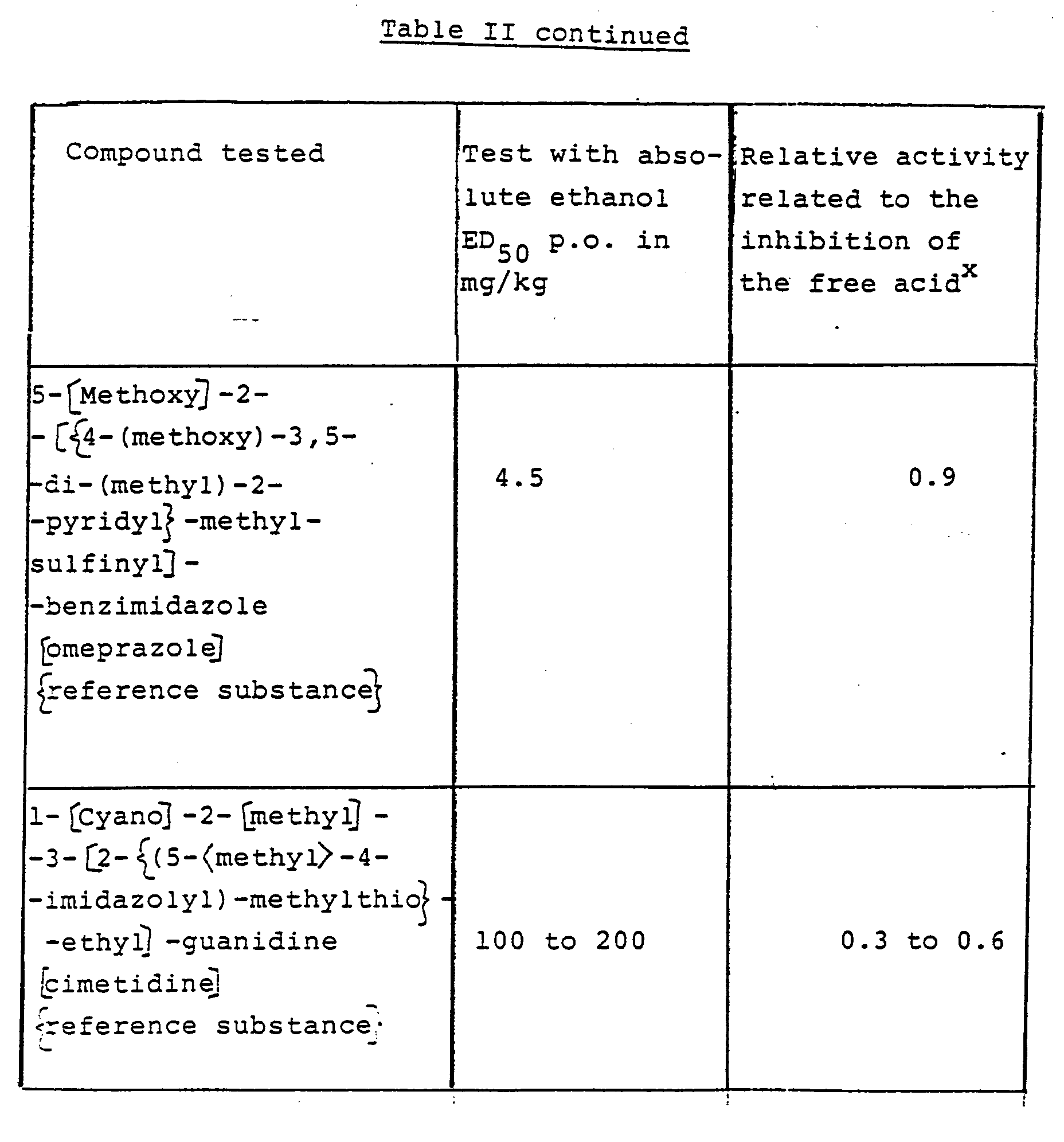


- In the test with absolute ethanol which is useful for showing the gastroprotective activity, as to the effective dose range, a sharp difference can be made between the cytoprotective effect and the gastric acid inhibition, the latter resulting in the inhibition of the gastric erosion.
- From Table II it can be seen that the 3 reference compounds used in the therapy of ulcer and having a mechanism of free acid inhibition, i.e. 5-[methoxy]-2-[{4-(methoxy)-3,5-di-(methyl)-2-pyridyl}-methylsulfinyl]-benzimidazole[omeprazole], 1-[cyano]-2-[methyl]-3-benzimidazole[omeprazole], 1-[cyano]-2-[methyl]-3-[2-{(5-〈methyl〉-4-imidazolyl)-methyithio}-ethyl]-guanidine[cimetidine]and 5,11-di-[hydro]-11-[〈4-(methyl)-1-piperazinyl〉-acetyl]-6H-pyrido[2,3-b][1,4]benzodiazepin-6-one[pirenzepine], exert a relatively low gastroprotective action as compared to the gastric acid inhibiting activity their relative activity amounting to only 0.3 to 0.9. This fact indicates that the above free acid inhibiting reference compounds protect the gastric mucosa against absolute ethanol as a consequence of their gastric acid inhibiting action.
- As to the 2-[phenylmethylene]-1-[3'-(amino)-2'-(hydroxy)-propoxy-imino]-cyclohexane derivates used according to the invention tested, their relative activity is very high compared to that of the reference compounds, a fact proving that the cytoprotective effect of the 2-[phenylmethylene]-1-[3'-(amino)-2'-(hydroxy)-propoxy-imino]-cyclohexane derivates used according to the invention which appears in the protection of the gastric mucosa, is independent of the acid inhibition activity.
- Both reference compounds having gastroprotective effect, i.e. the basic aluminum salt of saccharose hydrogen sulfate [sucralfate] and 3-[4-{trans-4-(aminomethyl)-cyclohexylcarbonyloxy}-phenyl]-propionic acid [cetraxate], exert nearly identical low activity in the test with absolute ethanol, whereas the 2-[phenylmethylene]-1-[3'-(amino)-2'-(hydroxy)-propoxy-imino]-cyclohexane derivates used according to the invention are effective in doses lower by 1 or 2 order(s).
- The principle of the method consists in that, simultaneously with the administration of absolute ethanol, hydrochloric acid is introduced to the stomach. Thus, the influence on systemic gastric acid inhibition action can be eliminated by the presence of the exogenous acid.
- The reagent used in this test was a mixture of concentrated aqueous hydrochloric acid and absolute ethanol in a weight ratio of 1 to 50 in accordance with the dilution ratio used by Yamazaki et al. (Japan J. Pharmacol., 55 [1991], 415 to 424). In other respects, the experiment was performed as described under test 2.1., however, in addition to the erosion index calculated from the lenghts of the erosions in mm, the ratio of occurence of animals showing at least one gastric erosion within a test group, i.e. the erosion frequency, was also evaluated. The results obtained are shown in Table III.
- In Table III, in case of the inhibition of the erosion frequency, the activity of the compounds tested were related to that of 3-[4-{trans-4-(aminomethyl)-cyclohexylcarbonyloxy}-phenyl]-propionic acid [cetraxate] to obtain the relative activity.
- In case of the inhibition of the erosion frequency and of the erosion index, the respective ED50 value of 3-[4-{trans-4-(aminomethyl)-cyclohexylcarbonyloxy}-phenyl]-propionic acid [cetraxate] was divided by the ED50 value of the compound tested each to obtain the respective relative activity.
Table III Compound tested Inhibition of the erosion frequency Inhibition of the erosion index ED50 p.o. in mg/kg Relative activity ED50 p.o. in mg/kg Relative activity (R,S)-2-(E)-[Phenylmethylene]-1-(E)-[3'-(hexylamino)-2'-(hydroxy)-propoxy-imino]-cyclohexane 25.7 7.4 11.5 1.9 (R,S)-2-(E)-[4'-(Chloro)-phenylmethylene]-1-(E)-[3''-(cyclohexylamino)-2''-(hydroxy)-propoxy-imino]-cyclohexane 30 to 60 3.2 to 6.3 10.3 2.1 (R,S)-2-(E)-[4'-(Chloro)-phenylmethylene]-1-(E)-[3''-hexylamino)-2''-(hydroxy)-propoxy-imino]-cyclohexane 25.2 7.5 7.2 3.1 (R,S)-2-(E)-[4'-(Chloro)-phenylmethylene]-1-(E)-[3''-(dimethylamino)-2''-(hydroxy)-propoxy-imino]-cyclohexane 30 to 60 3.2 to 6.3 15.8 1.4 (R,S)-2-(E)-[4'-(Bromo)-phenylmethylene]-1-(E)-[3''-(diisopropylamino)-2''-(hydroxy)-propoxy-imino]-cyclohexane 19.1 9.9 5.9 3.7 3-[4-{Trans-4-(aminomethyl)-cyclohexylcarbonyloxy}-phenyl]-propionic acid[cetraxate] {reference substance} 189.0 1.0 22.0 1.0 - From Table III it is to be taken that the direct cytoprotective activity (considering both the inhibition of the erosion frequency and the inhibition of the erosion index) of the compounds used according to the invention is substantially higher than that of the 3-[4-{trans-4-(aminomethyl)-cyclohexylcarbonyloxy}-phenyl]-propionic acid [cetraxate] used as reference compound, although the number of lesions in the gastric mucosa was increased and the lesions became more severe due to the presence of hydrochloric acid in the ethanol.
- In the test according to Shay (section 2.2.), only a moderate gastric acid secretion inhibition was shown by the-compounds according to the invention as well as by 3-[4-{trans-4-(aminomethyl)-cyclohexylcarbonyloxy}-phenyl]-propionic acid [cetraxate] having cytoprotective activity. In the above test (section 2.3.), the high activity of the compounds used according to the invention in the presence of exogenous hydrochloric acid precludes the possibility that the acid inhibition effect would be predominant in the gastroprotective activity of the compounds. Simultaneously this test demonstrates the superiority of the compounds used according to the invention as compared to 3-[4-{trans-4-(aminomethyl)-cyclohexylcarbonyloxy}-phenyl]-propionic acid [cetraxate] as regards the cytoprotective activity.
- Helicobacter pylori strains used in these experiments were obtained from the biopsial samples of the stomachs of patients suffering from ulcerative diseases of the gastrointestinal system. From the pure culture of isolates a thick suspension was prepared with cysteine-inositol solution suitable for lyophilisation, and the suspension obtained was maintained in cold-resistant plastic ampoules in a deep-freezing chamber at a temperature of about -196°C. For the determination of the inhibitory effect of the compounds tested on Helicobacter pylori, blood agar containing 10 mg/litre of a stereoisomer of 23-[aminocarbonyl]-12-[{2-0-(3-amino-2,3,6-trideoxy-3-C-methyl-α-L-lyxo-hexopyranosyl)-β-D-glucopyranosyl}-oxy]-8,16-di-[chloro]-2,3,4,5,19,20,21,22,23,24,25,26,27,28,29,30-hexa-[decahydro]-5,19,34,36,38-penta-[hydroxy]-28-[{4-(methyl)-2-(methylamino)-1-(oxo)-pentyl}-amino]-3,21,25,28,41-penta-[oxo]-1H-6,9:15,18-[dietheno]-4,30-[iminomethano]-31,35-[metheno]-11,27,13-[[1]-propene[1,2]diyl[3]ylidene]-13H-10,14,2,22,26,29-benzodioxatetraazacycloheptatriacontine-1-carboxylic acid 〈vancomycin〉 and 25 mg/litre of [1R-(1Rx,3Sx,5Rx,6Rx,9Rx,11Rx,15Sx,16Rx,17Rx,18Sx,19E,21E,23E,25E,27E,29E,31E,33Rx,35Sx,36Rx,37Sx)]-33-[{3-(amino)-3,6-di-(deoxy)-β-D-mannopyranosyl}-oxy]-1,3,5,6,9,11,17,37-octa-[hydroxy]-15,16,18-tri-[methyl]-13-[oxo]-14,39-di-[oxa]-bicyclo-[33.3.1]-nonatriaconta-19,21,23,25,27,29,31-heptaene-36-carboxylic acid 〈amphotericin B〉 was used (C. A. M. McNulty and I. C. Dent: Susceptibility of clinical isolates of Campylobacter pylori to twenty one antimicrobial agents. Book of Abstracts, 4th European Congress of Clinical Microbiology, Nice [1989]).
- The plates containing the strains were cultivated at 37°C for 72 hours under a gaseous atmosphere containing 10% of carbon dioxide and 5% of oxygen (D. M. Jones et al., J. Clin. Pathol., 37 [1984], 1 002).
- The culture media were inoculated with a dilution of the broth culture of the strains grown overnight or with a suspension prepared from a culture obtained on a solid medium. About 105 of germs were applied to the surface of each plate.
- A series of dilution were prepared from the compound to be tested. The MIC (minimal inhibiting concentration) value of the compounds tested was considered to be the lowest concentration inhibiting the growth of the test organism completely. The results obtained for (R,S)-2-(E)-[4'-(chloro)-phenylmethylene]-1-(E)-[3''-(hexylamino)-2''-(hydroxy)-propoxy-imino]-cyclohexane and colloidal bismuth subcitrate used as reference are given in Table IVa.
Table IVa Helicobacter pylori strains MIC value in microgram/ml of (R,S)-2-(E)-[4'-(chloro)-phenylmethylene]-1-(E)-[3''-(hexylamino)-2''-(hydroxy)-propoxy-imino]-cyclohexane Bismuth subcitrate [reference compound] 867/90 1.9 1596 0.9 3842 1.9 31.2 to 62.5x 6656 1.9 6709 1.9 xResults relating to a Helicobacter pylori strain isolated from 7 biopsial samples. - From Table IVa it can be seen that (R,S)-2-(E)-[4'-(chloro)-phenylmethylene]-1-(E)-[3''-(hexylamino)-2''-(hydroxy)-propoxy-imino]-cyclohexane was substantially more effective in the test than the colloidal bismuth subcitrate widely used in the therapy of Helicobacter pylori infections. The activity of (R,S)-2-(E)-[4'-(chloro)-phenylmethylene]-1-(E)-[3''-(hexylamino)-2''-(hydroxy)-propoxy-imino]-cyclohexane stands near to that of antibiotics (Y. Glupczynski: In vitro susceptibility testing of Helicobacter pylori and pharmacology of antimicrobial agents. Abstract book, Workshop Helicobacter pylori and the new concepts in gastro-duodenal diseases, Prague [1992]).
- Thus the 2-[phenylmethylene]-1-[3'-(amino)-2'-(hydroxy)-propoxy-imino]-cyclohexane derivatives used according to the invention possess excellent cytoprotective and antimicrobial effects. Consequently, they can be advantageously used for the treatment of gastrointestianl diseases, where the gastrointestinal mucosa is injured or the weakening of the protective factors plays a pathogenic role, e.g.:
- long-lasting treatment of rheumatoid diseases with non-steroidal antiinflammatory drugs,
- ulcers, especially duodenal ulcers, which cannot be treated with antiulcer drugs which inhibit gastric acid,
- chronic erosive gastritis (wherein the acid secretion is within the normal limits) and
- bacterial infections caused, in the first place, by Helicobacter pylori playing a significant role in the relapse of gastroduodenal diseases.
- The known weak gastric acid secretion inhibiting activity of the 2-[phenylmethylene]-1-[3'-(amino)-2'-(hydroxy)-propoxy-imino]-cyclohexane derivatives used according to the invention does not play any essential role in their valuable novel gastroprotective effect.
- The medicaments for the preparation of which the 2-[phenylmethylene]-1-[3'-(amino)-2'-(hydroxy)-propoxy-imino]-cyclohexane derivatives of formula I and their stereoisomers and optical isomers and mixtures thereof as well as pharmaceutically acceptable acid addition salts and quaternary ammonium derivatives thereof are used can be pharmaceutical compositions. They can be prepared by admixing the active ingredient(s) to 1 or more pharmaceutically acceptable carrier(s), and converting the mixture obtained to a pharmaceutical composition by known methods of the drug manufacture. As to the additives and methods see e.g. Remington's pharmaceutical Sciences, 18th Edition, Mack Publishing Company, Easton, USA.
- The use according to the invention may be such for preparing medicaments for oral, rectal, parenteral or local administration.
- For oral administration, for example, powders, tablets, coated tablets, dragées and capsules may be prepared. These dosage units contain, in general, 10 to 100 mg of active ingredient in addition to 1 or more carrier(s) which may be e.g. binding agents, such as gelatine, sorbitol and/or poly-(vinylpyrrolidone), filling agents, such as lactose, glucose, starch and/or calcium phospate, and/or auxiliary substances for tabletting, such as magnesium stearate, talc, poly-(ethylene glycol) and/or silica. By the use according to the invention as liquid pharmaceutical compositions for oral administration preferably aqueous suspensions and/or elixirs are prepared. The preparation can be carried out by using solvents or diluents, such as water, ethanol, propylene glycol and/or glycerol, suspending agents, such as gelatine and/or carboxymethylcellulose, taste improving agents, such as sorbitol and/or sugar solution, preservatives, such as methyl p-hydroxybenzoate, and/or dyes.
- By the use according to the invention as pharmaceutical compositions suitable for parenteral administration sterile solutions of the active ingredient(s) may be prepared.
- The pharmaceutical compositions prepared by the use according to the invention contain, in general, 0.1 to 95.0 per cent of the active substance(s). The medicaments prepared by the use according to the invention can be administered in an effective non-toxic dose of [a] 2-[phenylmethylene]-1-[3'-(amino)-2'-(hydroxy)-propoxy-imino]-cyclohexane derivative(s) used according to the invention to patients suffering from gastrointestinal disorders.
A typical dose for adult patients amounts to 0.25 to 40 mg/kg, preferably 1 to 20 mg/kg, of the 2-[phenylmethylene]-1-[3'-(amino)-2'-(hydroxy)-propoxy-imino]-cyclohexane derivative(s) used according to the invention, in a single daily dose or in 2 to 3 subdoses. In each case, the dose to be administered depends on the activity of the active ingredient(s) used, route of administration, condition of the patient to be treated and other factors. - The invention is illustrated in detail by the following Examples.
-
Preparation of tablets Composition Amount in mg/tablet Active ingredient(s) 2-[phenylmethylene]-1-[3'-(amino)-2'-(hydroxy)-propoxy-imino]-cyclohexane derivative(s)(used according to the invention) 25.0 Corn starch 97.0 Poly-(vinylpyrrolidone) 175.0 Magnesium stearate 3.0 
- The active ingredient(s) and corn starch are wetted with a 15% by weight aqueous poly-(vinylpyrrolidone) solution, then granulated, and the wet granules are dried at 40 to 45°C. The dried granules are thoroughly mixed with magnesium stearate, and the mixture is compressed to obtain tablets weighing 300.0 mg each.
-
Preparation of dragées Composition Amount in mg/dragée Active ingredient(s) 2-[phenylmethylene]-1-[3'-(amino)-2'-(hydroxy)k-propoxy-imino]-cyclohexane derivative(s) (used according to the invention) 50.0 Lactose 94.0 Magnesium stearate 2.0 Poly-(vinylpyrrolidone) 4.0 
- Granules are prepared as described in Example 1, however, the granulation is carried out with a mixture of the active ingredient(s) and lactose (instead of corn starch), then the granules are compressed to obtain tablets weighing 150 mg each. The tablets obtained are used as dragée-cores which are coated with a layer consisting of talc and sugar in a manner known per se. The coated tablets are coloured with a food dye and polished with bee-wax.
-
Preparation of capsules Composition Amount in mg/capsule Active ingredient(s) 2-[phenylmethylene]-1-[3'-(amino)-2'-(hydroxy)k-propoxy-imino]-cyclohexane derivative(s) (used according to the invention) 25.0 Corn starch 122.0 Colloidal silica 3.0 
- The ingredients listed are homogenized and the mixture obtained is filled into hard gelatine capsules. Each capsule contains 150 mg of the powder mixture.
Claims (7)
- The use of 2-[phenylmethylene]-1-[3'-(amino)-2'-(hydroxy)-propoxy-imino]-cyclohexane derivatives of formula
 R means a hydrogen or halogen atom,R2 represents a straight chain C1-8 alkyl group andR3 means a hydrogen atom, a straight chain C1-8 alkyl group or a C3-7 cycloalkyl group,and their stereoisomers and optical isomers and mixtures thereof as well as pharmaceutically acceptable acid addition salts and quaternary ammonium derivatives thereof, optionally in admixture with 1 or more carrier(s) commonly used in pharmaceutical compositions, for preparing medicaments having combined gastroprotective and antimicrobial including antiulcer activity.
 - The use according to claim 1, characterized in that the halogen atom which may be represented by R is chlorine.
- The use according to claim 1 or 2, characterized in that the C1-8 alkyl group(s) which may be represented by R2 and/or R3 is/are such having from 1 to 6, particularly 3 to 6, carbon atoms.
- The use according to claims 1 to 3, characterized in that the C3-7 cycloalkyl group which may be represented by R3 is such having from 5 to 7, particularly 5 or 6, carbon atoms.
- The use according to claims 1 to 4, characterized in that the 2-[phenylmethylene]-1-[3'-(amino)-2'-(hydroxy)-propoxy-imino]-cyclohexane derivatives are
(R,S)-2-(E)-[phenylmethylene]-1-(E)-[3'-(hexylamino)-2'-(hydroxy)-propoxy-imino]-cyclohexane, (R,S)-2-(E)-[4'-(chloro)-phenylmethylene]-1-(E)-[3''-{N-(methyl)-N-(cyclohexyl)-amino}-2''-(hydroxy)-propoxy-imino]-cyclohexane, (R,S)-2-(E)-[4'-(chloro)-phenylmethylene]-1-(E)-[3''-(cyclohexylamino)-2''-(hydroxy)-propoxy-imino]-cyclohexane, (R,S)-2-(E)-[4'-(chloro)-phenylmethylene]-1-(E)-[3''-(hexylamino)-2''-(hydroxy)-propoxy-imino]-cyclohexane, (R,S)-2-(E)-[4'-(chloro)-phenylmethylene]-1-(E)-[3''-(dimethylamino)-2''-(hydroxy)-propoxy-imino]-cyclohexane, (R,S)-2-(E)-[4'-(bromo)-phenylmethylene]-1-(E)-[3''-(diisopropylamino)-2''-(hydroxy)-propoxy-imino]-cyclohexane and (R,S)-2-(E)-[4'-(chloro)-phenylmethylene]-1-(E)-[3''-(butylamino)-2''-(hydroxy)-propoxy-imino]-cyclohexane
and their stereoisomers and optical isomers and mixtures thereof as well as pharmaceutically acceptable acid addition salts and quaternary ammonium derivatives thereof. - The use according to claims 1 to 5, characterized in that it is for preparing medicaments for oral, rectal, parenteral or local administration.
- The use according to claims 1 to 6,characterized in that it is for preparing medicaments for the treatment of gastric and/or duodenal ulcer(s).
Applications Claiming Priority (3)
| Application Number | Priority Date | Filing Date | Title |
|---|---|---|---|
| HU2008193 | 1993-07-20 | ||
| HU9302081A HU213472B (en) | 1993-07-20 | 1993-07-20 | Process to preparare pharmaceutical compns. with gastroprotective and anti helicobacter pylori activity |
| HU9302081 | 1993-07-20 |
Publications (2)
| Publication Number | Publication Date |
|---|---|
| EP0636368A1 EP0636368A1 (en) | 1995-02-01 |
| EP0636368B1 true EP0636368B1 (en) | 1997-12-10 |
Family
ID=10983801
Family Applications (1)
| Application Number | Title | Priority Date | Filing Date |
|---|---|---|---|
| EP94111107A Expired - Lifetime EP0636368B1 (en) | 1993-07-20 | 1994-07-18 | The use of 2- phenylmethylene -1- 3'-(amino)-2'-(hydroxy)--propoxy-imino -cyclohexane derivatives |
Country Status (14)
| Country | Link |
|---|---|
| EP (1) | EP0636368B1 (en) |
| JP (1) | JPH0769875A (en) |
| AT (1) | ATE160937T1 (en) |
| CA (1) | CA2128354A1 (en) |
| CZ (1) | CZ167494A3 (en) |
| DE (1) | DE69407227D1 (en) |
| HR (1) | HRP940361A2 (en) |
| HU (1) | HU213472B (en) |
| IL (1) | IL110369A0 (en) |
| IT (1) | IT1274040B (en) |
| PL (1) | PL304334A1 (en) |
| RU (1) | RU94026275A (en) |
| SK (1) | SK82094A3 (en) |
| YU (1) | YU45994A (en) |
Family Cites Families (2)
| Publication number | Priority date | Publication date | Assignee | Title |
|---|---|---|---|---|
| HU197205B (en) * | 1984-07-10 | 1989-03-28 | Egyt Gyogyszervegyeszeti Gyar | Process for production of medical compositions against angine |
| HU212415B (en) * | 1989-08-25 | 1996-06-28 | Egyt Gyogyszervegyeszeti Gyar | Process for producing new cyclic oxym derivatives and pharmaceutical compositions containing them as active components |
-
1993
- 1993-07-20 HU HU9302081A patent/HU213472B/en not_active IP Right Cessation
-
1994
- 1994-06-21 HR HRP9302081A patent/HRP940361A2/en not_active Application Discontinuation
- 1994-07-08 SK SK820-94A patent/SK82094A3/en unknown
- 1994-07-12 CZ CZ941674A patent/CZ167494A3/en unknown
- 1994-07-18 AT AT94111107T patent/ATE160937T1/en not_active IP Right Cessation
- 1994-07-18 DE DE69407227T patent/DE69407227D1/en not_active Expired - Lifetime
- 1994-07-18 EP EP94111107A patent/EP0636368B1/en not_active Expired - Lifetime
- 1994-07-18 PL PL94304334A patent/PL304334A1/en unknown
- 1994-07-19 YU YU45994A patent/YU45994A/en unknown
- 1994-07-19 CA CA002128354A patent/CA2128354A1/en not_active Abandoned
- 1994-07-19 IL IL11036994A patent/IL110369A0/en unknown
- 1994-07-20 IT ITMI941518A patent/IT1274040B/en active IP Right Grant
- 1994-07-20 RU RU94026275/14A patent/RU94026275A/en unknown
- 1994-07-20 JP JP6168018A patent/JPH0769875A/en active Pending
Also Published As
| Publication number | Publication date |
|---|---|
| HUT69166A (en) | 1995-08-28 |
| JPH0769875A (en) | 1995-03-14 |
| HU213472B (en) | 1997-06-30 |
| PL304334A1 (en) | 1995-01-23 |
| ATE160937T1 (en) | 1997-12-15 |
| RU94026275A (en) | 1996-09-10 |
| YU45994A (en) | 1997-12-05 |
| ITMI941518A0 (en) | 1994-07-20 |
| CA2128354A1 (en) | 1995-01-21 |
| IL110369A0 (en) | 1994-10-21 |
| EP0636368A1 (en) | 1995-02-01 |
| SK82094A3 (en) | 1995-07-11 |
| HRP940361A2 (en) | 1997-02-28 |
| ITMI941518A1 (en) | 1996-01-20 |
| IT1274040B (en) | 1997-07-14 |
| HU9302081D0 (en) | 1993-10-28 |
| DE69407227D1 (en) | 1998-01-22 |
| CZ167494A3 (en) | 1995-03-15 |
Similar Documents
| Publication | Publication Date | Title |
|---|---|---|
| DE69801680T2 (en) | COMPOSITIONS WHICH ALDOSE REDUCTASE INHIBITORS AND GLYCOGEN PHOSPHORYLASE INHIBITORS CONTAIN | |
| US20220096450A1 (en) | Compounds and Methods for Treating or Preventing Heart Failure | |
| JP4854960B2 (en) | 2,4,5-trisubstituted imidazole and its use as an antibacterial agent | |
| US4616025A (en) | Thiazolidine derivatives, process for the preparation and pharmaceutical compositions thereof | |
| JPS5839622A (en) | Gastric acid secretion inhibitor | |
| EA019741B1 (en) | Pyrrole compounds | |
| JPH09512831A (en) | Dibenzimidazole derivative | |
| RU2212404C2 (en) | Derivatives of indole and pharmaceutical composition comprising thereof | |
| CN102652135A (en) | Azocyclic inhibitors of fatty acid amide hydrolase | |
| US4868193A (en) | Styryl tetrazoles and anti-allergic use thereof | |
| JP4608093B2 (en) | Endothelin antagonists and beta-receptor blockers as combined preparations | |
| US4539318A (en) | Tertiary aminohydroxypropoxy substituted thiadiazoles, pharmaceutical compositions and use | |
| US3991210A (en) | Acetamidine urinary antiseptics | |
| US5597822A (en) | Pharmaceutical compositions for the prevention and/or treatment a gastrointestinal diseases | |
| AU757611B2 (en) | Optically active pyrrolopyridazine compounds | |
| US5244895A (en) | Anti-ulcer agent | |
| SK73594A3 (en) | Substituted benzimidazoles, process for their production as well as their use | |
| KR100404714B1 (en) | Guanidinomethyl cyclohexane carboxylic ester derivative | |
| EP0636368A1 (en) | The use of 2- phenylmethylene -1- 3'-(amino)-2'-(hydroxy)--propoxy-imino -cyclohexane derivatives | |
| JPWO1996006825A1 (en) | Guanidinomethylcyclohexanecarboxylic acid ester derivatives | |
| JPH04283517A (en) | Use of 2, 3-disubstituted 1-azolyl-propane as growth inhibitor against dimorphic yeast cell in pathogenic period | |
| EP1451177B1 (en) | Substituted 2-pyrrolidine-2-yl-1h-indole derivatives for the treatment of migraine | |
| WO2022115615A1 (en) | Cyclic peptides with antimicrobial properties | |
| JP2023548809A (en) | Pentamidine analogs and methods for treating infections | |
| DE60111768T2 (en) | N-FORMYL HYDROXYLAMINE DERIVATIVES AS INHIBITORS OF THE BACTERIAL POLYPEPTIDE DEFORMYLASE FOR THE TREATMENT OF MICROBIAL INFECTIONS |
Legal Events
| Date | Code | Title | Description |
|---|---|---|---|
| PUAI | Public reference made under article 153(3) epc to a published international application that has entered the european phase |
Free format text: ORIGINAL CODE: 0009012 |
|
| AK | Designated contracting states |
Kind code of ref document: A1 Designated state(s): AT BE CH DE DK FR GB GR LI NL PT SE |
|
| RAX | Requested extension states of the european patent have changed |
Free format text: SI PAYMENT 940718 |
|
| 17P | Request for examination filed |
Effective date: 19950728 |
|
| 17Q | First examination report despatched |
Effective date: 19960103 |
|
| GRAG | Despatch of communication of intention to grant |
Free format text: ORIGINAL CODE: EPIDOS AGRA |
|
| GRAH | Despatch of communication of intention to grant a patent |
Free format text: ORIGINAL CODE: EPIDOS IGRA |
|
| GRAH | Despatch of communication of intention to grant a patent |
Free format text: ORIGINAL CODE: EPIDOS IGRA |
|
| GRAA | (expected) grant |
Free format text: ORIGINAL CODE: 0009210 |
|
| AK | Designated contracting states |
Kind code of ref document: B1 Designated state(s): AT BE CH DE DK FR GB GR LI NL PT SE |
|
| AX | Request for extension of the european patent |
Free format text: SI PAYMENT 940718 |
|
| PG25 | Lapsed in a contracting state [announced via postgrant information from national office to epo] |
Ref country code: GR Free format text: LAPSE BECAUSE OF FAILURE TO SUBMIT A TRANSLATION OF THE DESCRIPTION OR TO PAY THE FEE WITHIN THE PRESCRIBED TIME-LIMIT Effective date: 19971210 Ref country code: FR Free format text: LAPSE BECAUSE OF FAILURE TO SUBMIT A TRANSLATION OF THE DESCRIPTION OR TO PAY THE FEE WITHIN THE PRESCRIBED TIME-LIMIT Effective date: 19971210 Ref country code: DK Free format text: LAPSE BECAUSE OF NON-PAYMENT OF DUE FEES Effective date: 19971210 Ref country code: BE Free format text: LAPSE BECAUSE OF FAILURE TO SUBMIT A TRANSLATION OF THE DESCRIPTION OR TO PAY THE FEE WITHIN THE PRESCRIBED TIME-LIMIT Effective date: 19971210 |
|
| REF | Corresponds to: |
Ref document number: 160937 Country of ref document: AT Date of ref document: 19971215 Kind code of ref document: T |
|
| REG | Reference to a national code |
Ref country code: CH Ref legal event code: NV Representative=s name: R. A. EGLI & CO. PATENTANWAELTE Ref country code: CH Ref legal event code: EP |
|
| PG25 | Lapsed in a contracting state [announced via postgrant information from national office to epo] |
Ref country code: DE Free format text: LAPSE BECAUSE OF THE APPLICANT RENOUNCES Effective date: 19980120 |
|
| REF | Corresponds to: |
Ref document number: 69407227 Country of ref document: DE Date of ref document: 19980122 |
|
| PG25 | Lapsed in a contracting state [announced via postgrant information from national office to epo] |
Ref country code: SE Free format text: LAPSE BECAUSE OF FAILURE TO SUBMIT A TRANSLATION OF THE DESCRIPTION OR TO PAY THE FEE WITHIN THE PRESCRIBED TIME-LIMIT Effective date: 19980310 Ref country code: PT Free format text: LAPSE BECAUSE OF FAILURE TO SUBMIT A TRANSLATION OF THE DESCRIPTION OR TO PAY THE FEE WITHIN THE PRESCRIBED TIME-LIMIT Effective date: 19980310 |
|
| EN | Fr: translation not filed | ||
| PG25 | Lapsed in a contracting state [announced via postgrant information from national office to epo] |
Ref country code: GB Free format text: LAPSE BECAUSE OF NON-PAYMENT OF DUE FEES Effective date: 19980718 Ref country code: AT Free format text: LAPSE BECAUSE OF NON-PAYMENT OF DUE FEES Effective date: 19980718 |
|
| PG25 | Lapsed in a contracting state [announced via postgrant information from national office to epo] |
Ref country code: LI Free format text: LAPSE BECAUSE OF NON-PAYMENT OF DUE FEES Effective date: 19980731 Ref country code: CH Free format text: LAPSE BECAUSE OF NON-PAYMENT OF DUE FEES Effective date: 19980731 |
|
| PLBE | No opposition filed within time limit |
Free format text: ORIGINAL CODE: 0009261 |
|
| STAA | Information on the status of an ep patent application or granted ep patent |
Free format text: STATUS: NO OPPOSITION FILED WITHIN TIME LIMIT |
|
| 26N | No opposition filed | ||
| PG25 | Lapsed in a contracting state [announced via postgrant information from national office to epo] |
Ref country code: NL Free format text: LAPSE BECAUSE OF NON-PAYMENT OF DUE FEES Effective date: 19990201 |
|
| GBPC | Gb: european patent ceased through non-payment of renewal fee |
Effective date: 19980718 |
|
| REG | Reference to a national code |
Ref country code: CH Ref legal event code: PL |
|
| NLV4 | Nl: lapsed or anulled due to non-payment of the annual fee |
Effective date: 19990201 |