EP0634445B1 - Light diffuser composition - Google Patents
Light diffuser composition Download PDFInfo
- Publication number
- EP0634445B1 EP0634445B1 EP94305105A EP94305105A EP0634445B1 EP 0634445 B1 EP0634445 B1 EP 0634445B1 EP 94305105 A EP94305105 A EP 94305105A EP 94305105 A EP94305105 A EP 94305105A EP 0634445 B1 EP0634445 B1 EP 0634445B1
- Authority
- EP
- European Patent Office
- Prior art keywords
- polymer
- particles
- composition
- weight
- light diffuser
- Prior art date
- Legal status (The legal status is an assumption and is not a legal conclusion. Google has not performed a legal analysis and makes no representation as to the accuracy of the status listed.)
- Expired - Lifetime
Links
- 239000000203 mixture Substances 0.000 title claims description 80
- 239000002245 particle Substances 0.000 claims description 92
- 229920000642 polymer Polymers 0.000 claims description 74
- GWEVSGVZZGPLCZ-UHFFFAOYSA-N Titan oxide Chemical compound O=[Ti]=O GWEVSGVZZGPLCZ-UHFFFAOYSA-N 0.000 claims description 54
- -1 alkyl methacrylate Chemical compound 0.000 claims description 46
- 239000004417 polycarbonate Substances 0.000 claims description 45
- 229920000515 polycarbonate Polymers 0.000 claims description 45
- 229920001169 thermoplastic Polymers 0.000 claims description 41
- 239000010954 inorganic particle Substances 0.000 claims description 31
- 229920002554 vinyl polymer Polymers 0.000 claims description 26
- 239000004408 titanium dioxide Substances 0.000 claims description 25
- 239000000178 monomer Substances 0.000 claims description 23
- 125000000217 alkyl group Chemical group 0.000 claims description 19
- 125000005250 alkyl acrylate group Chemical group 0.000 claims description 18
- 238000000034 method Methods 0.000 claims description 16
- 239000008188 pellet Substances 0.000 claims description 14
- KAKZBPTYRLMSJV-UHFFFAOYSA-N butadiene group Chemical class C=CC=C KAKZBPTYRLMSJV-UHFFFAOYSA-N 0.000 claims description 12
- 125000004432 carbon atom Chemical group C* 0.000 claims description 11
- 239000008187 granular material Substances 0.000 claims description 10
- 238000002156 mixing Methods 0.000 claims description 9
- NIXOWILDQLNWCW-UHFFFAOYSA-N Acrylic acid Chemical compound OC(=O)C=C NIXOWILDQLNWCW-UHFFFAOYSA-N 0.000 claims description 8
- XLOMVQKBTHCTTD-UHFFFAOYSA-N Zinc monoxide Chemical compound [Zn]=O XLOMVQKBTHCTTD-UHFFFAOYSA-N 0.000 claims description 8
- NIXOWILDQLNWCW-UHFFFAOYSA-M Acrylate Chemical compound [O-]C(=O)C=C NIXOWILDQLNWCW-UHFFFAOYSA-M 0.000 claims description 7
- CERQOIWHTDAKMF-UHFFFAOYSA-M Methacrylate Chemical compound CC(=C)C([O-])=O CERQOIWHTDAKMF-UHFFFAOYSA-M 0.000 claims description 7
- 125000000391 vinyl group Chemical group [H]C([*])=C([H])[H] 0.000 claims description 7
- 239000005083 Zinc sulfide Substances 0.000 claims description 5
- 150000004945 aromatic hydrocarbons Chemical class 0.000 claims description 5
- 229910052984 zinc sulfide Inorganic materials 0.000 claims description 5
- DRDVZXDWVBGGMH-UHFFFAOYSA-N zinc;sulfide Chemical compound [S-2].[Zn+2] DRDVZXDWVBGGMH-UHFFFAOYSA-N 0.000 claims description 5
- SMZOUWXMTYCWNB-UHFFFAOYSA-N 2-(2-methoxy-5-methylphenyl)ethanamine Chemical compound COC1=CC=C(C)C=C1CCN SMZOUWXMTYCWNB-UHFFFAOYSA-N 0.000 claims description 4
- 239000004971 Cross linker Substances 0.000 claims description 4
- CERQOIWHTDAKMF-UHFFFAOYSA-N Methacrylic acid Chemical compound CC(=C)C(O)=O CERQOIWHTDAKMF-UHFFFAOYSA-N 0.000 claims description 4
- 229920000058 polyacrylate Polymers 0.000 claims description 4
- 239000011787 zinc oxide Substances 0.000 claims description 4
- 238000013329 compounding Methods 0.000 claims description 3
- 229910017676 MgTiO3 Inorganic materials 0.000 claims description 2
- VYPSYNLAJGMNEJ-UHFFFAOYSA-N Silicium dioxide Chemical compound O=[Si]=O VYPSYNLAJGMNEJ-UHFFFAOYSA-N 0.000 claims description 2
- 239000000741 silica gel Substances 0.000 claims description 2
- 229910002027 silica gel Inorganic materials 0.000 claims description 2
- 230000000052 comparative effect Effects 0.000 description 29
- PPBRXRYQALVLMV-UHFFFAOYSA-N Styrene Chemical compound C=CC1=CC=CC=C1 PPBRXRYQALVLMV-UHFFFAOYSA-N 0.000 description 17
- 239000000654 additive Substances 0.000 description 14
- 229920001577 copolymer Polymers 0.000 description 13
- 238000002834 transmittance Methods 0.000 description 12
- 125000003118 aryl group Chemical group 0.000 description 11
- 238000001125 extrusion Methods 0.000 description 11
- 125000002496 methyl group Chemical group [H]C([H])([H])* 0.000 description 11
- TZCXTZWJZNENPQ-UHFFFAOYSA-L barium sulfate Chemical compound [Ba+2].[O-]S([O-])(=O)=O TZCXTZWJZNENPQ-UHFFFAOYSA-L 0.000 description 10
- 239000000049 pigment Substances 0.000 description 10
- 150000001252 acrylic acid derivatives Chemical class 0.000 description 9
- 238000009792 diffusion process Methods 0.000 description 9
- 125000001495 ethyl group Chemical group [H]C([H])([H])C([H])([H])* 0.000 description 9
- IISBACLAFKSPIT-UHFFFAOYSA-N bisphenol A Chemical compound C=1C=C(O)C=CC=1C(C)(C)C1=CC=C(O)C=C1 IISBACLAFKSPIT-UHFFFAOYSA-N 0.000 description 8
- 125000000484 butyl group Chemical group [H]C([*])([H])C([H])([H])C([H])([H])C([H])([H])[H] 0.000 description 8
- 150000002989 phenols Chemical class 0.000 description 8
- 230000032683 aging Effects 0.000 description 6
- 229910052736 halogen Inorganic materials 0.000 description 6
- 150000002367 halogens Chemical class 0.000 description 6
- 125000004051 hexyl group Chemical group [H]C([H])([H])C([H])([H])C([H])([H])C([H])([H])C([H])([H])C([H])([H])* 0.000 description 6
- 125000004108 n-butyl group Chemical group [H]C([H])([H])C([H])([H])C([H])([H])C([H])([H])* 0.000 description 6
- 125000004123 n-propyl group Chemical group [H]C([H])([H])C([H])([H])C([H])([H])* 0.000 description 6
- 125000004169 (C1-C6) alkyl group Chemical group 0.000 description 5
- 239000003963 antioxidant agent Substances 0.000 description 5
- 235000006708 antioxidants Nutrition 0.000 description 5
- 150000001875 compounds Chemical class 0.000 description 5
- 125000000959 isobutyl group Chemical group [H]C([H])([H])C([H])(C([H])([H])[H])C([H])([H])* 0.000 description 5
- 125000001449 isopropyl group Chemical group [H]C([H])([H])C([H])(*)C([H])([H])[H] 0.000 description 5
- 150000002734 metacrylic acid derivatives Chemical class 0.000 description 5
- MYRTYDVEIRVNKP-UHFFFAOYSA-N 1,2-Divinylbenzene Chemical compound C=CC1=CC=CC=C1C=C MYRTYDVEIRVNKP-UHFFFAOYSA-N 0.000 description 4
- NLHHRLWOUZZQLW-UHFFFAOYSA-N Acrylonitrile Chemical compound C=CC#N NLHHRLWOUZZQLW-UHFFFAOYSA-N 0.000 description 4
- 241001120493 Arene Species 0.000 description 4
- ISWSIDIOOBJBQZ-UHFFFAOYSA-N Phenol Chemical compound OC1=CC=CC=C1 ISWSIDIOOBJBQZ-UHFFFAOYSA-N 0.000 description 4
- YGYAWVDWMABLBF-UHFFFAOYSA-N Phosgene Chemical compound ClC(Cl)=O YGYAWVDWMABLBF-UHFFFAOYSA-N 0.000 description 4
- 125000003545 alkoxy group Chemical group 0.000 description 4
- 239000003086 colorant Substances 0.000 description 4
- 238000004132 cross linking Methods 0.000 description 4
- 150000002148 esters Chemical class 0.000 description 4
- 238000004519 manufacturing process Methods 0.000 description 4
- 230000003287 optical effect Effects 0.000 description 4
- 125000001147 pentyl group Chemical group C(CCCC)* 0.000 description 4
- 239000003381 stabilizer Substances 0.000 description 4
- 125000000999 tert-butyl group Chemical group [H]C([H])([H])C(*)(C([H])([H])[H])C([H])([H])[H] 0.000 description 4
- 238000003878 thermal aging Methods 0.000 description 4
- 239000004908 Emulsion polymer Substances 0.000 description 3
- JIGUQPWFLRLWPJ-UHFFFAOYSA-N Ethyl acrylate Chemical compound CCOC(=O)C=C JIGUQPWFLRLWPJ-UHFFFAOYSA-N 0.000 description 3
- VVQNEPGJFQJSBK-UHFFFAOYSA-N Methyl methacrylate Chemical compound COC(=O)C(C)=C VVQNEPGJFQJSBK-UHFFFAOYSA-N 0.000 description 3
- GYCMBHHDWRMZGG-UHFFFAOYSA-N Methylacrylonitrile Chemical compound CC(=C)C#N GYCMBHHDWRMZGG-UHFFFAOYSA-N 0.000 description 3
- XYLMUPLGERFSHI-UHFFFAOYSA-N alpha-Methylstyrene Chemical compound CC(=C)C1=CC=CC=C1 XYLMUPLGERFSHI-UHFFFAOYSA-N 0.000 description 3
- 125000003710 aryl alkyl group Chemical group 0.000 description 3
- 230000005540 biological transmission Effects 0.000 description 3
- 239000006085 branching agent Substances 0.000 description 3
- CQEYYJKEWSMYFG-UHFFFAOYSA-N butyl acrylate Chemical compound CCCCOC(=O)C=C CQEYYJKEWSMYFG-UHFFFAOYSA-N 0.000 description 3
- 230000007423 decrease Effects 0.000 description 3
- 125000002887 hydroxy group Chemical group [H]O* 0.000 description 3
- 238000001746 injection moulding Methods 0.000 description 3
- 239000000155 melt Substances 0.000 description 3
- SSDSCDGVMJFTEQ-UHFFFAOYSA-N octadecyl 3-(3,5-ditert-butyl-4-hydroxyphenyl)propanoate Chemical compound CCCCCCCCCCCCCCCCCCOC(=O)CCC1=CC(C(C)(C)C)=C(O)C(C(C)(C)C)=C1 SSDSCDGVMJFTEQ-UHFFFAOYSA-N 0.000 description 3
- 125000002347 octyl group Chemical group [H]C([*])([H])C([H])([H])C([H])([H])C([H])([H])C([H])([H])C([H])([H])C([H])([H])C([H])([H])[H] 0.000 description 3
- PNJWIWWMYCMZRO-UHFFFAOYSA-N pent‐4‐en‐2‐one Natural products CC(=O)CC=C PNJWIWWMYCMZRO-UHFFFAOYSA-N 0.000 description 3
- 125000001997 phenyl group Chemical group [H]C1=C([H])C([H])=C(*)C([H])=C1[H] 0.000 description 3
- XRBCRPZXSCBRTK-UHFFFAOYSA-N phosphonous acid Chemical compound OPO XRBCRPZXSCBRTK-UHFFFAOYSA-N 0.000 description 3
- 229920003023 plastic Polymers 0.000 description 3
- 239000004033 plastic Substances 0.000 description 3
- 229920003229 poly(methyl methacrylate) Polymers 0.000 description 3
- 239000004926 polymethyl methacrylate Substances 0.000 description 3
- 238000012545 processing Methods 0.000 description 3
- 150000003568 thioethers Chemical class 0.000 description 3
- 125000006274 (C1-C3)alkoxy group Chemical group 0.000 description 2
- SDJHPPZKZZWAKF-UHFFFAOYSA-N 2,3-dimethylbuta-1,3-diene Chemical compound CC(=C)C(C)=C SDJHPPZKZZWAKF-UHFFFAOYSA-N 0.000 description 2
- HIXDQWDOVZUNNA-UHFFFAOYSA-N 2-(3,4-dimethoxyphenyl)-5-hydroxy-7-methoxychromen-4-one Chemical compound C=1C(OC)=CC(O)=C(C(C=2)=O)C=1OC=2C1=CC=C(OC)C(OC)=C1 HIXDQWDOVZUNNA-UHFFFAOYSA-N 0.000 description 2
- SBYMUDUGTIKLCR-UHFFFAOYSA-N 2-chloroethenylbenzene Chemical compound ClC=CC1=CC=CC=C1 SBYMUDUGTIKLCR-UHFFFAOYSA-N 0.000 description 2
- GAODDBNJCKQQDY-UHFFFAOYSA-N 2-methyl-4,6-bis(octylsulfanylmethyl)phenol Chemical compound CCCCCCCCSCC1=CC(C)=C(O)C(CSCCCCCCCC)=C1 GAODDBNJCKQQDY-UHFFFAOYSA-N 0.000 description 2
- KUDUQBURMYMBIJ-UHFFFAOYSA-N 2-prop-2-enoyloxyethyl prop-2-enoate Chemical compound C=CC(=O)OCCOC(=O)C=C KUDUQBURMYMBIJ-UHFFFAOYSA-N 0.000 description 2
- HCILJBJJZALOAL-UHFFFAOYSA-N 3-(3,5-ditert-butyl-4-hydroxyphenyl)-n'-[3-(3,5-ditert-butyl-4-hydroxyphenyl)propanoyl]propanehydrazide Chemical compound CC(C)(C)C1=C(O)C(C(C)(C)C)=CC(CCC(=O)NNC(=O)CCC=2C=C(C(O)=C(C=2)C(C)(C)C)C(C)(C)C)=C1 HCILJBJJZALOAL-UHFFFAOYSA-N 0.000 description 2
- WPMYUUITDBHVQZ-UHFFFAOYSA-N 3-(3,5-ditert-butyl-4-hydroxyphenyl)propanoic acid Chemical compound CC(C)(C)C1=CC(CCC(O)=O)=CC(C(C)(C)C)=C1O WPMYUUITDBHVQZ-UHFFFAOYSA-N 0.000 description 2
- UJTRCPVECIHPBG-UHFFFAOYSA-N 3-cyclohexylpyrrole-2,5-dione Chemical compound O=C1NC(=O)C(C2CCCCC2)=C1 UJTRCPVECIHPBG-UHFFFAOYSA-N 0.000 description 2
- BRPSWMCDEYMRPE-UHFFFAOYSA-N 4-[1,1-bis(4-hydroxyphenyl)ethyl]phenol Chemical group C=1C=C(O)C=CC=1C(C=1C=CC(O)=CC=1)(C)C1=CC=C(O)C=C1 BRPSWMCDEYMRPE-UHFFFAOYSA-N 0.000 description 2
- GAWIXWVDTYZWAW-UHFFFAOYSA-N C[CH]O Chemical group C[CH]O GAWIXWVDTYZWAW-UHFFFAOYSA-N 0.000 description 2
- OKTJSMMVPCPJKN-UHFFFAOYSA-N Carbon Chemical compound [C] OKTJSMMVPCPJKN-UHFFFAOYSA-N 0.000 description 2
- LYCAIKOWRPUZTN-UHFFFAOYSA-N Ethylene glycol Chemical compound OCCO LYCAIKOWRPUZTN-UHFFFAOYSA-N 0.000 description 2
- 239000004609 Impact Modifier Substances 0.000 description 2
- 238000012696 Interfacial polycondensation Methods 0.000 description 2
- RRHGJUQNOFWUDK-UHFFFAOYSA-N Isoprene Chemical compound CC(=C)C=C RRHGJUQNOFWUDK-UHFFFAOYSA-N 0.000 description 2
- PEEHTFAAVSWFBL-UHFFFAOYSA-N Maleimide Chemical compound O=C1NC(=O)C=C1 PEEHTFAAVSWFBL-UHFFFAOYSA-N 0.000 description 2
- BAPJBEWLBFYGME-UHFFFAOYSA-N Methyl acrylate Chemical compound COC(=O)C=C BAPJBEWLBFYGME-UHFFFAOYSA-N 0.000 description 2
- PXHVJJICTQNCMI-UHFFFAOYSA-N Nickel Chemical compound [Ni] PXHVJJICTQNCMI-UHFFFAOYSA-N 0.000 description 2
- JKIJEFPNVSHHEI-UHFFFAOYSA-N Phenol, 2,4-bis(1,1-dimethylethyl)-, phosphite (3:1) Chemical compound CC(C)(C)C1=CC(C(C)(C)C)=CC=C1OP(OC=1C(=CC(=CC=1)C(C)(C)C)C(C)(C)C)OC1=CC=C(C(C)(C)C)C=C1C(C)(C)C JKIJEFPNVSHHEI-UHFFFAOYSA-N 0.000 description 2
- XYFCBTPGUUZFHI-UHFFFAOYSA-N Phosphine Chemical compound P XYFCBTPGUUZFHI-UHFFFAOYSA-N 0.000 description 2
- ABLZXFCXXLZCGV-UHFFFAOYSA-N Phosphorous acid Chemical compound OP(O)=O ABLZXFCXXLZCGV-UHFFFAOYSA-N 0.000 description 2
- XTXRWKRVRITETP-UHFFFAOYSA-N Vinyl acetate Chemical compound CC(=O)OC=C XTXRWKRVRITETP-UHFFFAOYSA-N 0.000 description 2
- FVUAWPYXXUUWMC-UHFFFAOYSA-N [1-bis(2,4-ditert-butylphenoxy)phosphanylbiphenylen-2-yl]-bis(2,4-ditert-butylphenoxy)phosphane Chemical compound CC(C)(C)C1=CC(C(C)(C)C)=CC=C1OP(C=1C(=C2C3=CC=CC=C3C2=CC=1)P(OC=1C(=CC(=CC=1)C(C)(C)C)C(C)(C)C)OC=1C(=CC(=CC=1)C(C)(C)C)C(C)(C)C)OC1=CC=C(C(C)(C)C)C=C1C(C)(C)C FVUAWPYXXUUWMC-UHFFFAOYSA-N 0.000 description 2
- BGYHLZZASRKEJE-UHFFFAOYSA-N [3-[3-(3,5-ditert-butyl-4-hydroxyphenyl)propanoyloxy]-2,2-bis[3-(3,5-ditert-butyl-4-hydroxyphenyl)propanoyloxymethyl]propyl] 3-(3,5-ditert-butyl-4-hydroxyphenyl)propanoate Chemical compound CC(C)(C)C1=C(O)C(C(C)(C)C)=CC(CCC(=O)OCC(COC(=O)CCC=2C=C(C(O)=C(C=2)C(C)(C)C)C(C)(C)C)(COC(=O)CCC=2C=C(C(O)=C(C=2)C(C)(C)C)C(C)(C)C)COC(=O)CCC=2C=C(C(O)=C(C=2)C(C)(C)C)C(C)(C)C)=C1 BGYHLZZASRKEJE-UHFFFAOYSA-N 0.000 description 2
- 150000001408 amides Chemical class 0.000 description 2
- 150000001412 amines Chemical class 0.000 description 2
- 230000003078 antioxidant effect Effects 0.000 description 2
- 238000000149 argon plasma sintering Methods 0.000 description 2
- 125000000753 cycloalkyl group Chemical group 0.000 description 2
- 230000003247 decreasing effect Effects 0.000 description 2
- 239000003085 diluting agent Substances 0.000 description 2
- 239000000975 dye Substances 0.000 description 2
- 239000000839 emulsion Substances 0.000 description 2
- 238000007720 emulsion polymerization reaction Methods 0.000 description 2
- 125000003700 epoxy group Chemical group 0.000 description 2
- RTZKZFJDLAIYFH-UHFFFAOYSA-N ether Substances CCOCC RTZKZFJDLAIYFH-UHFFFAOYSA-N 0.000 description 2
- 239000000945 filler Substances 0.000 description 2
- VOZRXNHHFUQHIL-UHFFFAOYSA-N glycidyl methacrylate Chemical compound CC(=C)C(=O)OCC1CO1 VOZRXNHHFUQHIL-UHFFFAOYSA-N 0.000 description 2
- 125000003187 heptyl group Chemical group [H]C([*])([H])C([H])([H])C([H])([H])C([H])([H])C([H])([H])C([H])([H])C([H])([H])[H] 0.000 description 2
- 125000004029 hydroxymethyl group Chemical group [H]OC([H])([H])* 0.000 description 2
- 238000010348 incorporation Methods 0.000 description 2
- 238000002347 injection Methods 0.000 description 2
- 239000007924 injection Substances 0.000 description 2
- 239000001023 inorganic pigment Substances 0.000 description 2
- 239000000463 material Substances 0.000 description 2
- 239000011159 matrix material Substances 0.000 description 2
- 239000006082 mold release agent Substances 0.000 description 2
- 229920000620 organic polymer Polymers 0.000 description 2
- 229910052760 oxygen Inorganic materials 0.000 description 2
- UEZVMMHDMIWARA-UHFFFAOYSA-M phosphonate Chemical compound [O-]P(=O)=O UEZVMMHDMIWARA-UHFFFAOYSA-M 0.000 description 2
- 229920001485 poly(butyl acrylate) polymer Polymers 0.000 description 2
- 238000006116 polymerization reaction Methods 0.000 description 2
- FBCQUCJYYPMKRO-UHFFFAOYSA-N prop-2-enyl 2-methylprop-2-enoate Chemical compound CC(=C)C(=O)OCC=C FBCQUCJYYPMKRO-UHFFFAOYSA-N 0.000 description 2
- 230000009257 reactivity Effects 0.000 description 2
- 239000012798 spherical particle Substances 0.000 description 2
- 230000006641 stabilisation Effects 0.000 description 2
- 238000011105 stabilization Methods 0.000 description 2
- 125000001424 substituent group Chemical group 0.000 description 2
- 150000007970 thio esters Chemical class 0.000 description 2
- RIOQSEWOXXDEQQ-UHFFFAOYSA-N triphenylphosphine Chemical compound C1=CC=CC=C1P(C=1C=CC=CC=1)C1=CC=CC=C1 RIOQSEWOXXDEQQ-UHFFFAOYSA-N 0.000 description 2
- 229920006163 vinyl copolymer Polymers 0.000 description 2
- PSGCQDPCAWOCSH-UHFFFAOYSA-N (4,7,7-trimethyl-3-bicyclo[2.2.1]heptanyl) prop-2-enoate Chemical compound C1CC2(C)C(OC(=O)C=C)CC1C2(C)C PSGCQDPCAWOCSH-UHFFFAOYSA-N 0.000 description 1
- CLECMSNCZUMKLM-UHFFFAOYSA-N (4-ethenylphenyl)methanol Chemical compound OCC1=CC=C(C=C)C=C1 CLECMSNCZUMKLM-UHFFFAOYSA-N 0.000 description 1
- 125000004209 (C1-C8) alkyl group Chemical group 0.000 description 1
- WVAFEFUPWRPQSY-UHFFFAOYSA-N 1,2,3-tris(ethenyl)benzene Chemical compound C=CC1=CC=CC(C=C)=C1C=C WVAFEFUPWRPQSY-UHFFFAOYSA-N 0.000 description 1
- RMSGQZDGSZOJMU-UHFFFAOYSA-N 1-butyl-2-phenylbenzene Chemical group CCCCC1=CC=CC=C1C1=CC=CC=C1 RMSGQZDGSZOJMU-UHFFFAOYSA-N 0.000 description 1
- JRBVOJLBGNYDSQ-UHFFFAOYSA-N 1-phenyl-9h-fluorene-2,3-diol Chemical compound OC=1C(O)=CC=2C3=CC=CC=C3CC=2C=1C1=CC=CC=C1 JRBVOJLBGNYDSQ-UHFFFAOYSA-N 0.000 description 1
- IGGDKDTUCAWDAN-UHFFFAOYSA-N 1-vinylnaphthalene Chemical compound C1=CC=C2C(C=C)=CC=CC2=C1 IGGDKDTUCAWDAN-UHFFFAOYSA-N 0.000 description 1
- HNURKXXMYARGAY-UHFFFAOYSA-N 2,6-Di-tert-butyl-4-hydroxymethylphenol Chemical compound CC(C)(C)C1=CC(CO)=CC(C(C)(C)C)=C1O HNURKXXMYARGAY-UHFFFAOYSA-N 0.000 description 1
- SLUKQUGVTITNSY-UHFFFAOYSA-N 2,6-di-tert-butyl-4-methoxyphenol Chemical compound COC1=CC(C(C)(C)C)=C(O)C(C(C)(C)C)=C1 SLUKQUGVTITNSY-UHFFFAOYSA-N 0.000 description 1
- GJDRKHHGPHLVNI-UHFFFAOYSA-N 2,6-ditert-butyl-4-(diethoxyphosphorylmethyl)phenol Chemical compound CCOP(=O)(OCC)CC1=CC(C(C)(C)C)=C(O)C(C(C)(C)C)=C1 GJDRKHHGPHLVNI-UHFFFAOYSA-N 0.000 description 1
- VMZVBRIIHDRYGK-UHFFFAOYSA-N 2,6-ditert-butyl-4-[(dimethylamino)methyl]phenol Chemical compound CN(C)CC1=CC(C(C)(C)C)=C(O)C(C(C)(C)C)=C1 VMZVBRIIHDRYGK-UHFFFAOYSA-N 0.000 description 1
- JJBFVQSGPLGDNX-UHFFFAOYSA-N 2-(2-methylprop-2-enoyloxy)propyl 2-methylprop-2-enoate Chemical compound CC(=C)C(=O)OC(C)COC(=O)C(C)=C JJBFVQSGPLGDNX-UHFFFAOYSA-N 0.000 description 1
- XKZQKPRCPNGNFR-UHFFFAOYSA-N 2-(3-hydroxyphenyl)phenol Chemical compound OC1=CC=CC(C=2C(=CC=CC=2)O)=C1 XKZQKPRCPNGNFR-UHFFFAOYSA-N 0.000 description 1
- BEWCNXNIQCLWHP-UHFFFAOYSA-N 2-(tert-butylamino)ethyl 2-methylprop-2-enoate Chemical compound CC(=C)C(=O)OCCNC(C)(C)C BEWCNXNIQCLWHP-UHFFFAOYSA-N 0.000 description 1
- GOXQRTZXKQZDDN-UHFFFAOYSA-N 2-Ethylhexyl acrylate Chemical compound CCCCC(CC)COC(=O)C=C GOXQRTZXKQZDDN-UHFFFAOYSA-N 0.000 description 1
- ROHFBIREHKPELA-UHFFFAOYSA-N 2-[(3,5-ditert-butyl-4-hydroxyphenyl)methyl]prop-2-enoic acid;methane Chemical compound C.CC(C)(C)C1=CC(CC(=C)C(O)=O)=CC(C(C)(C)C)=C1O.CC(C)(C)C1=CC(CC(=C)C(O)=O)=CC(C(C)(C)C)=C1O.CC(C)(C)C1=CC(CC(=C)C(O)=O)=CC(C(C)(C)C)=C1O.CC(C)(C)C1=CC(CC(=C)C(O)=O)=CC(C(C)(C)C)=C1O ROHFBIREHKPELA-UHFFFAOYSA-N 0.000 description 1
- QSRJVOOOWGXUDY-UHFFFAOYSA-N 2-[2-[2-[3-(3-tert-butyl-4-hydroxy-5-methylphenyl)propanoyloxy]ethoxy]ethoxy]ethyl 3-(3-tert-butyl-4-hydroxy-5-methylphenyl)propanoate Chemical compound CC(C)(C)C1=C(O)C(C)=CC(CCC(=O)OCCOCCOCCOC(=O)CCC=2C=C(C(O)=C(C)C=2)C(C)(C)C)=C1 QSRJVOOOWGXUDY-UHFFFAOYSA-N 0.000 description 1
- FWWXYLGCHHIKNY-UHFFFAOYSA-N 2-ethoxyethyl prop-2-enoate Chemical compound CCOCCOC(=O)C=C FWWXYLGCHHIKNY-UHFFFAOYSA-N 0.000 description 1
- OMIGHNLMNHATMP-UHFFFAOYSA-N 2-hydroxyethyl prop-2-enoate Chemical compound OCCOC(=O)C=C OMIGHNLMNHATMP-UHFFFAOYSA-N 0.000 description 1
- HFCUBKYHMMPGBY-UHFFFAOYSA-N 2-methoxyethyl prop-2-enoate Chemical compound COCCOC(=O)C=C HFCUBKYHMMPGBY-UHFFFAOYSA-N 0.000 description 1
- CFVWNXQPGQOHRJ-UHFFFAOYSA-N 2-methylpropyl prop-2-enoate Chemical compound CC(C)COC(=O)C=C CFVWNXQPGQOHRJ-UHFFFAOYSA-N 0.000 description 1
- RZVINYQDSSQUKO-UHFFFAOYSA-N 2-phenoxyethyl prop-2-enoate Chemical compound C=CC(=O)OCCOC1=CC=CC=C1 RZVINYQDSSQUKO-UHFFFAOYSA-N 0.000 description 1
- VFZKVQVQOMDJEG-UHFFFAOYSA-N 2-prop-2-enoyloxypropyl prop-2-enoate Chemical compound C=CC(=O)OC(C)COC(=O)C=C VFZKVQVQOMDJEG-UHFFFAOYSA-N 0.000 description 1
- 125000003903 2-propenyl group Chemical group [H]C([*])([H])C([H])=C([H])[H] 0.000 description 1
- HGBBKKWVSQBIMM-UHFFFAOYSA-N 2-pyrrolidin-1-yl-5-(4,4,5,5-tetramethyl-1,3,2-dioxaborolan-2-yl)pyridine Chemical compound O1C(C)(C)C(C)(C)OB1C1=CC=C(N2CCCC2)N=C1 HGBBKKWVSQBIMM-UHFFFAOYSA-N 0.000 description 1
- KGIGUEBEKRSTEW-UHFFFAOYSA-N 2-vinylpyridine Chemical compound C=CC1=CC=CC=N1 KGIGUEBEKRSTEW-UHFFFAOYSA-N 0.000 description 1
- GNSFRPWPOGYVLO-UHFFFAOYSA-N 3-hydroxypropyl 2-methylprop-2-enoate Chemical compound CC(=C)C(=O)OCCCO GNSFRPWPOGYVLO-UHFFFAOYSA-N 0.000 description 1
- QMYGFTJCQFEDST-UHFFFAOYSA-N 3-methoxybutyl acetate Chemical group COC(C)CCOC(C)=O QMYGFTJCQFEDST-UHFFFAOYSA-N 0.000 description 1
- ZXVONLUNISGICL-UHFFFAOYSA-N 4,6-dinitro-o-cresol Chemical compound CC1=CC([N+]([O-])=O)=CC([N+]([O-])=O)=C1O ZXVONLUNISGICL-UHFFFAOYSA-N 0.000 description 1
- XOJWAAUYNWGQAU-UHFFFAOYSA-N 4-(2-methylprop-2-enoyloxy)butyl 2-methylprop-2-enoate Chemical compound CC(=C)C(=O)OCCCCOC(=O)C(C)=C XOJWAAUYNWGQAU-UHFFFAOYSA-N 0.000 description 1
- JLBJTVDPSNHSKJ-UHFFFAOYSA-N 4-Methylstyrene Chemical compound CC1=CC=C(C=C)C=C1 JLBJTVDPSNHSKJ-UHFFFAOYSA-N 0.000 description 1
- DBCAQXHNJOFNGC-UHFFFAOYSA-N 4-bromo-1,1,1-trifluorobutane Chemical compound FC(F)(F)CCCBr DBCAQXHNJOFNGC-UHFFFAOYSA-N 0.000 description 1
- BFZOTKYPSZSDEV-UHFFFAOYSA-N 4-butan-2-yl-2,6-ditert-butylphenol Chemical compound CCC(C)C1=CC(C(C)(C)C)=C(O)C(C(C)(C)C)=C1 BFZOTKYPSZSDEV-UHFFFAOYSA-N 0.000 description 1
- JHWGFJBTMHEZME-UHFFFAOYSA-N 4-prop-2-enoyloxybutyl prop-2-enoate Chemical compound C=CC(=O)OCCCCOC(=O)C=C JHWGFJBTMHEZME-UHFFFAOYSA-N 0.000 description 1
- ZVVFVKJZNVSANF-UHFFFAOYSA-N 6-[3-(3,5-ditert-butyl-4-hydroxyphenyl)propanoyloxy]hexyl 3-(3,5-ditert-butyl-4-hydroxyphenyl)propanoate Chemical compound CC(C)(C)C1=C(O)C(C(C)(C)C)=CC(CCC(=O)OCCCCCCOC(=O)CCC=2C=C(C(O)=C(C=2)C(C)(C)C)C(C)(C)C)=C1 ZVVFVKJZNVSANF-UHFFFAOYSA-N 0.000 description 1
- FIHBHSQYSYVZQE-UHFFFAOYSA-N 6-prop-2-enoyloxyhexyl prop-2-enoate Chemical compound C=CC(=O)OCCCCCCOC(=O)C=C FIHBHSQYSYVZQE-UHFFFAOYSA-N 0.000 description 1
- HRPVXLWXLXDGHG-UHFFFAOYSA-N Acrylamide Chemical compound NC(=O)C=C HRPVXLWXLXDGHG-UHFFFAOYSA-N 0.000 description 1
- CPELXLSAUQHCOX-UHFFFAOYSA-M Bromide Chemical compound [Br-] CPELXLSAUQHCOX-UHFFFAOYSA-M 0.000 description 1
- NLZUEZXRPGMBCV-UHFFFAOYSA-N Butylhydroxytoluene Chemical compound CC1=CC(C(C)(C)C)=C(O)C(C(C)(C)C)=C1 NLZUEZXRPGMBCV-UHFFFAOYSA-N 0.000 description 1
- YCHFWFZZABULNX-UHFFFAOYSA-N C(C)OC1=C(C=C(COP(OCC2=CC(=C(C(=C2)C(C)(C)C)OCC)C(C)(C)C)=O)C=C1C(C)(C)C)C(C)(C)C.[Ca] Chemical compound C(C)OC1=C(C=C(COP(OCC2=CC(=C(C(=C2)C(C)(C)C)OCC)C(C)(C)C)=O)C=C1C(C)(C)C)C(C)(C)C.[Ca] YCHFWFZZABULNX-UHFFFAOYSA-N 0.000 description 1
- BVKZGUZCCUSVTD-UHFFFAOYSA-L Carbonate Chemical compound [O-]C([O-])=O BVKZGUZCCUSVTD-UHFFFAOYSA-L 0.000 description 1
- VEXZGXHMUGYJMC-UHFFFAOYSA-M Chloride anion Chemical compound [Cl-] VEXZGXHMUGYJMC-UHFFFAOYSA-M 0.000 description 1
- 241000084490 Esenbeckia delta Species 0.000 description 1
- KRHYYFGTRYWZRS-UHFFFAOYSA-M Fluoride anion Chemical compound [F-] KRHYYFGTRYWZRS-UHFFFAOYSA-M 0.000 description 1
- OKOBUGCCXMIKDM-UHFFFAOYSA-N Irganox 1098 Chemical compound CC(C)(C)C1=C(O)C(C(C)(C)C)=CC(CCC(=O)NCCCCCCNC(=O)CCC=2C=C(C(O)=C(C=2)C(C)(C)C)C(C)(C)C)=C1 OKOBUGCCXMIKDM-UHFFFAOYSA-N 0.000 description 1
- 239000004420 Iupilon Substances 0.000 description 1
- FYYHWMGAXLPEAU-UHFFFAOYSA-N Magnesium Chemical compound [Mg] FYYHWMGAXLPEAU-UHFFFAOYSA-N 0.000 description 1
- WHNWPMSKXPGLAX-UHFFFAOYSA-N N-Vinyl-2-pyrrolidone Chemical compound C=CN1CCCC1=O WHNWPMSKXPGLAX-UHFFFAOYSA-N 0.000 description 1
- XBDQKXXYIPTUBI-UHFFFAOYSA-M Propionate Chemical compound CCC([O-])=O XBDQKXXYIPTUBI-UHFFFAOYSA-M 0.000 description 1
- NINIDFKCEFEMDL-UHFFFAOYSA-N Sulfur Chemical compound [S] NINIDFKCEFEMDL-UHFFFAOYSA-N 0.000 description 1
- RTAQQCXQSZGOHL-UHFFFAOYSA-N Titanium Chemical compound [Ti] RTAQQCXQSZGOHL-UHFFFAOYSA-N 0.000 description 1
- 239000012963 UV stabilizer Substances 0.000 description 1
- BZHJMEDXRYGGRV-UHFFFAOYSA-N Vinyl chloride Chemical compound ClC=C BZHJMEDXRYGGRV-UHFFFAOYSA-N 0.000 description 1
- 238000012644 addition polymerization Methods 0.000 description 1
- 150000001336 alkenes Chemical class 0.000 description 1
- 125000004414 alkyl thio group Chemical group 0.000 description 1
- 239000012736 aqueous medium Substances 0.000 description 1
- 150000005840 aryl radicals Chemical class 0.000 description 1
- QVGXLLKOCUKJST-UHFFFAOYSA-N atomic oxygen Chemical compound [O] QVGXLLKOCUKJST-UHFFFAOYSA-N 0.000 description 1
- AOJOEFVRHOZDFN-UHFFFAOYSA-N benzyl 2-methylprop-2-enoate Chemical compound CC(=C)C(=O)OCC1=CC=CC=C1 AOJOEFVRHOZDFN-UHFFFAOYSA-N 0.000 description 1
- 125000001797 benzyl group Chemical group [H]C1=C([H])C([H])=C(C([H])=C1[H])C([H])([H])* 0.000 description 1
- ZPOLOEWJWXZUSP-WAYWQWQTSA-N bis(prop-2-enyl) (z)-but-2-enedioate Chemical compound C=CCOC(=O)\C=C/C(=O)OCC=C ZPOLOEWJWXZUSP-WAYWQWQTSA-N 0.000 description 1
- MPMBRWOOISTHJV-UHFFFAOYSA-N but-1-enylbenzene Chemical compound CCC=CC1=CC=CC=C1 MPMBRWOOISTHJV-UHFFFAOYSA-N 0.000 description 1
- 235000010354 butylated hydroxytoluene Nutrition 0.000 description 1
- AOWKSNWVBZGMTJ-UHFFFAOYSA-N calcium titanate Chemical compound [Ca+2].[O-][Ti]([O-])=O AOWKSNWVBZGMTJ-UHFFFAOYSA-N 0.000 description 1
- OOCILPYOPQKPJY-UHFFFAOYSA-N calcium;(3,5-ditert-butyl-4-hydroxyphenyl)methyl-ethoxyphosphinic acid Chemical compound [Ca].CCOP(O)(=O)CC1=CC(C(C)(C)C)=C(O)C(C(C)(C)C)=C1 OOCILPYOPQKPJY-UHFFFAOYSA-N 0.000 description 1
- BVKZGUZCCUSVTD-UHFFFAOYSA-N carbonic acid Chemical compound OC(O)=O BVKZGUZCCUSVTD-UHFFFAOYSA-N 0.000 description 1
- 150000001735 carboxylic acids Chemical class 0.000 description 1
- 230000015556 catabolic process Effects 0.000 description 1
- 235000017168 chlorine Nutrition 0.000 description 1
- 125000001309 chloro group Chemical class Cl* 0.000 description 1
- YACLQRRMGMJLJV-UHFFFAOYSA-N chloroprene Chemical compound ClC(=C)C=C YACLQRRMGMJLJV-UHFFFAOYSA-N 0.000 description 1
- 239000002131 composite material Substances 0.000 description 1
- 239000000470 constituent Substances 0.000 description 1
- 238000007334 copolymerization reaction Methods 0.000 description 1
- 239000011258 core-shell material Substances 0.000 description 1
- 239000003431 cross linking reagent Substances 0.000 description 1
- 125000004966 cyanoalkyl group Chemical group 0.000 description 1
- 125000000113 cyclohexyl group Chemical group [H]C1([H])C([H])([H])C([H])([H])C([H])(*)C([H])([H])C1([H])[H] 0.000 description 1
- 125000001511 cyclopentyl group Chemical group [H]C1([H])C([H])([H])C([H])([H])C([H])(*)C1([H])[H] 0.000 description 1
- 125000002704 decyl group Chemical group [H]C([H])([H])C([H])([H])C([H])([H])C([H])([H])C([H])([H])C([H])([H])C([H])([H])C([H])([H])C([H])([H])C([H])([H])* 0.000 description 1
- 238000006731 degradation reaction Methods 0.000 description 1
- 150000001991 dicarboxylic acids Chemical class 0.000 description 1
- 150000005690 diesters Chemical class 0.000 description 1
- 235000014113 dietary fatty acids Nutrition 0.000 description 1
- IEJIGPNLZYLLBP-UHFFFAOYSA-N dimethyl carbonate Chemical compound COC(=O)OC IEJIGPNLZYLLBP-UHFFFAOYSA-N 0.000 description 1
- LDCRTTXIJACKKU-ONEGZZNKSA-N dimethyl fumarate Chemical compound COC(=O)\C=C\C(=O)OC LDCRTTXIJACKKU-ONEGZZNKSA-N 0.000 description 1
- 229960004419 dimethyl fumarate Drugs 0.000 description 1
- LDCRTTXIJACKKU-ARJAWSKDSA-N dimethyl maleate Chemical compound COC(=O)\C=C/C(=O)OC LDCRTTXIJACKKU-ARJAWSKDSA-N 0.000 description 1
- ROORDVPLFPIABK-UHFFFAOYSA-N diphenyl carbonate Chemical compound C=1C=CC=CC=1OC(=O)OC1=CC=CC=C1 ROORDVPLFPIABK-UHFFFAOYSA-N 0.000 description 1
- KPUWHANPEXNPJT-UHFFFAOYSA-N disiloxane Chemical class [SiH3]O[SiH3] KPUWHANPEXNPJT-UHFFFAOYSA-N 0.000 description 1
- 239000006185 dispersion Substances 0.000 description 1
- 238000009826 distribution Methods 0.000 description 1
- 230000000694 effects Effects 0.000 description 1
- 229920001971 elastomer Polymers 0.000 description 1
- JOXWSDNHLSQKCC-UHFFFAOYSA-N ethenesulfonamide Chemical compound NS(=O)(=O)C=C JOXWSDNHLSQKCC-UHFFFAOYSA-N 0.000 description 1
- LPUZTLKYAOOFDX-QXMHVHEDSA-N ethenyl (z)-octadec-9-enoate Chemical compound CCCCCCCC\C=C/CCCCCCCC(=O)OC=C LPUZTLKYAOOFDX-QXMHVHEDSA-N 0.000 description 1
- LZWYWAIOTBEZFN-UHFFFAOYSA-N ethenyl hexanoate Chemical compound CCCCCC(=O)OC=C LZWYWAIOTBEZFN-UHFFFAOYSA-N 0.000 description 1
- UIWXSTHGICQLQT-UHFFFAOYSA-N ethenyl propanoate Chemical compound CCC(=O)OC=C UIWXSTHGICQLQT-UHFFFAOYSA-N 0.000 description 1
- STVZJERGLQHEKB-UHFFFAOYSA-N ethylene glycol dimethacrylate Substances CC(=C)C(=O)OCCOC(=O)C(C)=C STVZJERGLQHEKB-UHFFFAOYSA-N 0.000 description 1
- 239000000194 fatty acid Substances 0.000 description 1
- 229930195729 fatty acid Natural products 0.000 description 1
- 150000004665 fatty acids Chemical class 0.000 description 1
- 239000003365 glass fiber Substances 0.000 description 1
- 125000005843 halogen group Chemical group 0.000 description 1
- 229920001519 homopolymer Polymers 0.000 description 1
- AVVSGTOJTRSKRL-UHFFFAOYSA-L hydrogen phosphate;lead(2+) Chemical compound [Pb+2].OP([O-])([O-])=O AVVSGTOJTRSKRL-UHFFFAOYSA-L 0.000 description 1
- 125000004356 hydroxy functional group Chemical group O* 0.000 description 1
- WGCNASOHLSPBMP-UHFFFAOYSA-N hydroxyacetaldehyde Natural products OCC=O WGCNASOHLSPBMP-UHFFFAOYSA-N 0.000 description 1
- GWWYBYNZFWRRSG-UHFFFAOYSA-N hydroxyphosphanyloxyphosphinous acid;1,2,3,4-tetrakis(2,4-ditert-butylphenyl)biphenylene Chemical compound OPOPO.CC(C)(C)C1=CC(C(C)(C)C)=CC=C1C(C(=C1C=2C(=CC(=CC=2)C(C)(C)C)C(C)(C)C)C=2C(=CC(=CC=2)C(C)(C)C)C(C)(C)C)=C(C=2C3=CC=CC=2)C3=C1C1=CC=C(C(C)(C)C)C=C1C(C)(C)C GWWYBYNZFWRRSG-UHFFFAOYSA-N 0.000 description 1
- 238000010102 injection blow moulding Methods 0.000 description 1
- 229910052809 inorganic oxide Inorganic materials 0.000 description 1
- 229910052749 magnesium Inorganic materials 0.000 description 1
- 239000011777 magnesium Substances 0.000 description 1
- FPYJFEHAWHCUMM-UHFFFAOYSA-N maleic anhydride Chemical compound O=C1OC(=O)C=C1 FPYJFEHAWHCUMM-UHFFFAOYSA-N 0.000 description 1
- 239000006224 matting agent Substances 0.000 description 1
- 125000005394 methallyl group Chemical group 0.000 description 1
- YDKNBNOOCSNPNS-UHFFFAOYSA-N methyl 1,3-benzoxazole-2-carboxylate Chemical compound C1=CC=C2OC(C(=O)OC)=NC2=C1 YDKNBNOOCSNPNS-UHFFFAOYSA-N 0.000 description 1
- OIGSXRLVIQGTAV-UHFFFAOYSA-N methyl ethenesulfonate Chemical compound COS(=O)(=O)C=C OIGSXRLVIQGTAV-UHFFFAOYSA-N 0.000 description 1
- 238000012986 modification Methods 0.000 description 1
- 230000004048 modification Effects 0.000 description 1
- 238000000465 moulding Methods 0.000 description 1
- WFKDPJRCBCBQNT-UHFFFAOYSA-N n,2-dimethylprop-2-enamide Chemical compound CNC(=O)C(C)=C WFKDPJRCBCBQNT-UHFFFAOYSA-N 0.000 description 1
- OMNKZBIFPJNNIO-UHFFFAOYSA-N n-(2-methyl-4-oxopentan-2-yl)prop-2-enamide Chemical compound CC(=O)CC(C)(C)NC(=O)C=C OMNKZBIFPJNNIO-UHFFFAOYSA-N 0.000 description 1
- KCTMTGOHHMRJHZ-UHFFFAOYSA-N n-(2-methylpropoxymethyl)prop-2-enamide Chemical compound CC(C)COCNC(=O)C=C KCTMTGOHHMRJHZ-UHFFFAOYSA-N 0.000 description 1
- 125000001624 naphthyl group Chemical group 0.000 description 1
- 229910052759 nickel Inorganic materials 0.000 description 1
- 229910052757 nitrogen Inorganic materials 0.000 description 1
- 125000001400 nonyl group Chemical group [H]C([*])([H])C([H])([H])C([H])([H])C([H])([H])C([H])([H])C([H])([H])C([H])([H])C([H])([H])C([H])([H])[H] 0.000 description 1
- BARWIPMJPCRCTP-CLFAGFIQSA-N oleyl oleate Chemical compound CCCCCCCC\C=C/CCCCCCCCOC(=O)CCCCCCC\C=C/CCCCCCCC BARWIPMJPCRCTP-CLFAGFIQSA-N 0.000 description 1
- RPQRDASANLAFCM-UHFFFAOYSA-N oxiran-2-ylmethyl prop-2-enoate Chemical compound C=CC(=O)OCC1CO1 RPQRDASANLAFCM-UHFFFAOYSA-N 0.000 description 1
- 239000001301 oxygen Substances 0.000 description 1
- ACVYVLVWPXVTIT-UHFFFAOYSA-M phosphinate Chemical compound [O-][PH2]=O ACVYVLVWPXVTIT-UHFFFAOYSA-M 0.000 description 1
- 150000008301 phosphite esters Chemical class 0.000 description 1
- 229910000073 phosphorus hydride Inorganic materials 0.000 description 1
- 238000012667 polymer degradation Methods 0.000 description 1
- 230000000379 polymerizing effect Effects 0.000 description 1
- 229920000098 polyolefin Polymers 0.000 description 1
- 239000000843 powder Substances 0.000 description 1
- 238000002360 preparation method Methods 0.000 description 1
- 125000002924 primary amino group Chemical group [H]N([H])* 0.000 description 1
- 238000003672 processing method Methods 0.000 description 1
- QTECDUFMBMSHKR-UHFFFAOYSA-N prop-2-enyl prop-2-enoate Chemical compound C=CCOC(=O)C=C QTECDUFMBMSHKR-UHFFFAOYSA-N 0.000 description 1
- QLNJFJADRCOGBJ-UHFFFAOYSA-N propionamide Chemical compound CCC(N)=O QLNJFJADRCOGBJ-UHFFFAOYSA-N 0.000 description 1
- 229940080818 propionamide Drugs 0.000 description 1
- 150000003254 radicals Chemical class 0.000 description 1
- 239000011347 resin Substances 0.000 description 1
- 229920005989 resin Polymers 0.000 description 1
- 238000001175 rotational moulding Methods 0.000 description 1
- 239000005060 rubber Substances 0.000 description 1
- 150000003839 salts Chemical class 0.000 description 1
- 238000004088 simulation Methods 0.000 description 1
- 239000000243 solution Substances 0.000 description 1
- 230000000087 stabilizing effect Effects 0.000 description 1
- 239000007858 starting material Substances 0.000 description 1
- 125000004079 stearyl group Chemical group [H]C([*])([H])C([H])([H])C([H])([H])C([H])([H])C([H])([H])C([H])([H])C([H])([H])C([H])([H])C([H])([H])C([H])([H])C([H])([H])C([H])([H])C([H])([H])C([H])([H])C([H])([H])C([H])([H])C([H])([H])C([H])([H])[H] 0.000 description 1
- 229910052717 sulfur Inorganic materials 0.000 description 1
- 239000011593 sulfur Substances 0.000 description 1
- 230000008961 swelling Effects 0.000 description 1
- 238000012360 testing method Methods 0.000 description 1
- 239000004416 thermosoftening plastic Substances 0.000 description 1
- JUWGUJSXVOBPHP-UHFFFAOYSA-B titanium(4+);tetraphosphate Chemical compound [Ti+4].[Ti+4].[Ti+4].[O-]P([O-])([O-])=O.[O-]P([O-])([O-])=O.[O-]P([O-])([O-])=O.[O-]P([O-])([O-])=O JUWGUJSXVOBPHP-UHFFFAOYSA-B 0.000 description 1
- 125000003944 tolyl group Chemical group 0.000 description 1
- 238000005809 transesterification reaction Methods 0.000 description 1
- ZIBGPFATKBEMQZ-UHFFFAOYSA-N triethylene glycol Chemical compound OCCOCCOCCO ZIBGPFATKBEMQZ-UHFFFAOYSA-N 0.000 description 1
- KOZCZZVUFDCZGG-UHFFFAOYSA-N vinyl benzoate Chemical compound C=COC(=O)C1=CC=CC=C1 KOZCZZVUFDCZGG-UHFFFAOYSA-N 0.000 description 1
- NLVXSWCKKBEXTG-UHFFFAOYSA-N vinylsulfonic acid Chemical compound OS(=O)(=O)C=C NLVXSWCKKBEXTG-UHFFFAOYSA-N 0.000 description 1
- 238000011179 visual inspection Methods 0.000 description 1
- 239000012463 white pigment Substances 0.000 description 1
- 238000004383 yellowing Methods 0.000 description 1
- 239000002478 γ-tocopherol Substances 0.000 description 1
Classifications
-
- G—PHYSICS
- G02—OPTICS
- G02B—OPTICAL ELEMENTS, SYSTEMS OR APPARATUS
- G02B5/00—Optical elements other than lenses
- G02B5/02—Diffusing elements; Afocal elements
- G02B5/0205—Diffusing elements; Afocal elements characterised by the diffusing properties
- G02B5/0236—Diffusing elements; Afocal elements characterised by the diffusing properties the diffusion taking place within the volume of the element
- G02B5/0242—Diffusing elements; Afocal elements characterised by the diffusing properties the diffusion taking place within the volume of the element by means of dispersed particles
-
- C—CHEMISTRY; METALLURGY
- C08—ORGANIC MACROMOLECULAR COMPOUNDS; THEIR PREPARATION OR CHEMICAL WORKING-UP; COMPOSITIONS BASED THEREON
- C08L—COMPOSITIONS OF MACROMOLECULAR COMPOUNDS
- C08L101/00—Compositions of unspecified macromolecular compounds
-
- C—CHEMISTRY; METALLURGY
- C08—ORGANIC MACROMOLECULAR COMPOUNDS; THEIR PREPARATION OR CHEMICAL WORKING-UP; COMPOSITIONS BASED THEREON
- C08K—Use of inorganic or non-macromolecular organic substances as compounding ingredients
- C08K3/00—Use of inorganic substances as compounding ingredients
- C08K3/01—Use of inorganic substances as compounding ingredients characterized by their specific function
- C08K3/013—Fillers, pigments or reinforcing additives
-
- C—CHEMISTRY; METALLURGY
- C08—ORGANIC MACROMOLECULAR COMPOUNDS; THEIR PREPARATION OR CHEMICAL WORKING-UP; COMPOSITIONS BASED THEREON
- C08K—Use of inorganic or non-macromolecular organic substances as compounding ingredients
- C08K3/00—Use of inorganic substances as compounding ingredients
- C08K3/18—Oxygen-containing compounds, e.g. metal carbonyls
- C08K3/20—Oxides; Hydroxides
- C08K3/22—Oxides; Hydroxides of metals
-
- C—CHEMISTRY; METALLURGY
- C08—ORGANIC MACROMOLECULAR COMPOUNDS; THEIR PREPARATION OR CHEMICAL WORKING-UP; COMPOSITIONS BASED THEREON
- C08L—COMPOSITIONS OF MACROMOLECULAR COMPOUNDS
- C08L33/00—Compositions of homopolymers or copolymers of compounds having one or more unsaturated aliphatic radicals, each having only one carbon-to-carbon double bond, and only one being terminated by only one carboxyl radical, or of salts, anhydrides, esters, amides, imides or nitriles thereof; Compositions of derivatives of such polymers
- C08L33/04—Homopolymers or copolymers of esters
- C08L33/06—Homopolymers or copolymers of esters of esters containing only carbon, hydrogen and oxygen, which oxygen atoms are present only as part of the carboxyl radical
- C08L33/10—Homopolymers or copolymers of methacrylic acid esters
-
- C—CHEMISTRY; METALLURGY
- C08—ORGANIC MACROMOLECULAR COMPOUNDS; THEIR PREPARATION OR CHEMICAL WORKING-UP; COMPOSITIONS BASED THEREON
- C08L—COMPOSITIONS OF MACROMOLECULAR COMPOUNDS
- C08L51/00—Compositions of graft polymers in which the grafted component is obtained by reactions only involving carbon-to-carbon unsaturated bonds; Compositions of derivatives of such polymers
- C08L51/003—Compositions of graft polymers in which the grafted component is obtained by reactions only involving carbon-to-carbon unsaturated bonds; Compositions of derivatives of such polymers grafted on to macromolecular compounds obtained by reactions only involving unsaturated carbon-to-carbon bonds
-
- C—CHEMISTRY; METALLURGY
- C08—ORGANIC MACROMOLECULAR COMPOUNDS; THEIR PREPARATION OR CHEMICAL WORKING-UP; COMPOSITIONS BASED THEREON
- C08L—COMPOSITIONS OF MACROMOLECULAR COMPOUNDS
- C08L57/00—Compositions of unspecified polymers obtained by reactions only involving carbon-to-carbon unsaturated bonds
-
- C—CHEMISTRY; METALLURGY
- C08—ORGANIC MACROMOLECULAR COMPOUNDS; THEIR PREPARATION OR CHEMICAL WORKING-UP; COMPOSITIONS BASED THEREON
- C08L—COMPOSITIONS OF MACROMOLECULAR COMPOUNDS
- C08L69/00—Compositions of polycarbonates; Compositions of derivatives of polycarbonates
-
- G—PHYSICS
- G02—OPTICS
- G02B—OPTICAL ELEMENTS, SYSTEMS OR APPARATUS
- G02B5/00—Optical elements other than lenses
- G02B5/02—Diffusing elements; Afocal elements
- G02B5/0268—Diffusing elements; Afocal elements characterized by the fabrication or manufacturing method
-
- G—PHYSICS
- G02—OPTICS
- G02B—OPTICAL ELEMENTS, SYSTEMS OR APPARATUS
- G02B5/00—Optical elements other than lenses
- G02B5/02—Diffusing elements; Afocal elements
- G02B5/0273—Diffusing elements; Afocal elements characterized by the use
- G02B5/0278—Diffusing elements; Afocal elements characterized by the use used in transmission
Definitions
- the present invention relates to a light diffuser composition and its use for imparting light diffusing properties to a thermoplastic polymer.
- the present invention further relates to a polymer composition containing the novel light diffuser composition and to a compounded composition or molded article produced therefrom.
- light diffusers are generally white.
- the polymer composition and articles produced therefrom have light diffusing properties.
- the resulting colors of these composites are called opalescent colors. They are semi-transparent or translucent to visible light, that is, they scatter transmitted light so that the light source is not visible.
- Light diffusing polymer compositions may be formed into sheets or films of various thicknesses, or into more complex shapes, such as lamp covers like globes etc. Light diffusing polymer compositions are widely used by the lighting industry for producing luminaires, like fixed luminaires, road and street lighting, emergency lighting, etc. Accordingly, one important property of light diffusing polymer compositions and articles produced therefrom is a high resistance to thermal aging, particularly a high color stability when exposed to elevated temperatures over an extended time period.
- British patent specification 1,595,426 disclose plastics containing a translucent organic polymer and a white pigment which appear white in reflected and transmitted light.
- the refractive index n o of the polymer is in the range of from 1.4 to 1.65 and the refractive index n of the pigment is in the range of from 1.7 to 2.9.
- Exemplary of white pigments are for example titanium phosphate, lead hydrogen phosphate, zinc oxide, zinc sulfide, magnesium titanate, calcium titanate, titanium dioxide, etc.
- German patent 22 51 708 teaches it to be known that white pigments, such as titanium dioxide, zinc sulfide or zinc oxide provide articles produced from organic polymers with an milky white color.
- white pigments such as titanium dioxide, zinc sulfide or zinc oxide provide articles produced from organic polymers with an milky white color.
- the German patent teaches that such pigmented articles have such a low light transmittance that they are not useful as lamp covers. If only a small amount of such pigments is used, they do not scatter the light.
- German patent 2 251 708 teaches that barium sulfate which has isometrical particles of an average size of 2 to 12 micrometer, preferably of 4 to 9 micrometer, imparts good light-diffusing properties to thermoplastic polymer compositions.
- thermoplastic polymer compositions Unfortunately, the incorporation of inorganic additives of such a large particle size into thermoplastic polymer compositions has the effect that molded articles produced from such compositions have an uneven surface. Pits and holes can be observed in the surface of the molded articles which are caused by the large particle size of barium sulfate. Furthermore, it is difficult to disperse these inorganic additives evenly in the thermoplastic polymer.
- German Offenlegungsschrift DE-A-2,019,325 discloses that the addition of pigments, for example inorganic oxides, such as titanium dioxide, sulfides, such as zinc sulfide, or salts, such as barium sulfate, cause a certain degradation of polycarbonate in the presence of humidity.
- German Offenlegungsschrift DE-A-2,019,325 suggests stabilization of pigmented polycarbonates by incorporating epoxy groups containing vinyl copolymers into the polycarbonates.
- a preferred vinyl copolymer is a copolymer of glycidyl methacrylate, methyl methacrylate and styrene.
- German Offenlegungsschrift DE-A-2,105,487 suggests stabilization of pigmented polycarbonates by incorporating vinyl polymers free of epoxy groups into the polycarbonates.
- Preferred vinyl polymers are homo- or copolymers of acrylonitrile or methacrylonitrile, derivatives of acrylic or methacrylic acid, such as the methyl, ethyl or butyl esters of acrylic acid, or polymers of alkenyl aromatic compounds, such as styrene or alpha-methyl styrene.
- the stabilized pigmented polycarbonates disclosed in DE-A-2,019,325 and DE-A-2,105,487 contain from 0.5 to 1.5% of the pigment, such as titanium dioxide, by the weight of the polycarbonate and 5-100%, preferably 10-30%, of the stabilizing vinyl polymer, by the weight of the pigment content.
- the use of titanium dioxide at such high levels may promote polymer degradation.
- the published European patent application 0,269,324 discloses an organic light diffuser which is suitable for incorporation into a thermoplastic polymer matrix to form a light-diffusing polymer composition.
- This light diffuser comprises particles of core/shell morphology which have an average diameter of from 2 to 15 micrometer.
- the particles have a core of a rubbery alkyl acrylate polymer.
- the particles have one or more polymer shells, the outer most of which is compatible with the matrix polymer.
- the shells comprise from 5 to 40% of the weight of the particles.
- the light diffuser is utilized in amounts of from 2 to 10%, based on the total weight of the polymer composition.
- polymer compositions containing such a high percentage of a light diffuser do not have a very high color stability when exposed to elevated temperatures over an extended period of time. Therefore, their utility for lighting applications, such as lamp covers, is limited.
- One object of the present invention is to provide light diffusers of improved color stability when exposed to elevated temperatures over an extended time period.
- One aspect of the present invention is a light diffuser composition
- a light diffuser composition comprising
- average particle diameter refers to number average particle diameter.
- Another aspect of the present invention is the use of the above-mentioned light diffuser composition for imparting light diffusing properties to a thermoplastic polymer.
- Yet another aspect of the present invention is a polymer composition
- a polymer composition comprising a thermoplastic polymer and
- an article produced from a polymer composition comprising a combination of the inorganic particles a) and the polymeric particles b) in the indicated amounts is more resistant to thermal aging than an article produced from a comparable polymer composition containing the polymeric particles b) alone.
- “comparable” is meant that the two polymer compositions or articles produced therefrom have similar optical properties, particularly similar total light transmittance and light diffusion.
- the improved resistance to thermal aging is visualized as improved color stability, i.e. decreased tendency to yellowing when exposed to elevated temperatures over an extended period of time. It has even been found that at a given concentration of polymeric particles b) the color stability increases with increasing concentrations of the inorganic particles a) within the claimed range.
- the polymer composition In the practice of producing opalescent polymer compositions it is often desirable that their total light transmittance is in the range from 25 to 50%.
- the polymer composition When using the above-described polymeric particles b) alone as a light diffuser, the polymer composition generally contains from 4 to 10% of polymeric particles b), based on the weight of the thermoplastic polymer, in order to achieve such a low light transmittance.
- Such high amounts of polymeric particles b) decrease the color stability of the polymer composition when it is exposed to elevated temperatures over an extended period of time.
- the viscosity of the polymer composition increases when the concentration of polymeric particles b) in the polymer composition increases.
- Yet another aspect of the present invention is a process for producing a polymer composition which comprises mixing with a thermoplastic polymer
- the light diffuser composition of the present invention contains
- the weight ratio between the inorganic particles a) and the polymeric particles b) preferably is from 0.5 : 1 to 100 : 1, more preferably >1 : 1 to 50 : 1, most preferably 2 : 1 to 25 : 1.
- the inorganic particles a) have an average particle diameter of from 0.1 to 1 micrometer, preferably from 0.2 to 0.8 micrometer, most preferably from 0.2 to 0.4 micrometer. Such inorganic particles and methods of producing them are well known in the art. By the term “average particle diameter” the number average is meant.
- the inorganic particles have a refractive index of from 1.9 to 3.2, preferably from 2.0 to 2.9, most preferably from 2.0 to 2.7.
- Preferred inorganic particles a) are titanium dioxide, silica gel, zinc sulfide, zinc oxide or MgTiO 3 particles, provided that their particle size distribution is within the indicated range. The most preferred inorganic particles are titanium dioxide particles.
- the inorganic particles can be used in the various modifications, for example the anatase, brookite or rutile configuration of titanium dioxide is useful. Titanium dioxide may be coated with a layer of siloxane. Coated titanium dioxide and a method of preparing it is known.
- the polymeric particles b) have a core of a rubbery vinyl polymer.
- the rubbery vinyl polymer can be a homo- or copolymer of any of the monomers having at least one ethylenically unsaturated group which are well known to those skilled in the art to undergo addition polymerization under the conditions of emulsion polymerization in aqueous medium. Such monomers are listed in U.S. patent No. 4,226,752, column 3, lines 40-62, the teaching of which is included herein by reference.
- the rubbery vinyl polymer preferably contains at least 15%, more preferably at least 25%, most preferably at least 40% of a polymerized acrylate, methacrylate, monovinyl arene or optionally substituted butadiene and from 0 to 85%, more preferably from 0 to 75%, most preferably from 0 to 60% of one or more copolymerized vinyl monomers, based on the total weight of the rubbery vinyl polymer.
- Preferred acrylates and methyacrylates are alkyl acrylates or alkyl methacrylates which preferably contain 1 to 18, more preferably 1 to 8, most preferably 2 to 8, carbon atoms in the alkyl group, such as methyl, ethyl, n-propyl, isopropyl, n-butyl, sec. butyl or tert. butyl or the hexyl, heptyl or octyl groups.
- the alkyl group may be branched or linear.
- the preferred alkyl acrylates are ethyl acrylate, n-butyl acrylate, isobutyl acrylate or 2-ethylhexyl acrylate.
- the most preferred alkyl acrylate is butyl acrylate.
- acrylates are for example 1,6-hexanediol diacrylate, ethylthioethyl methacrylate, isobornyl acrylate, 2-hydroxyethyl acrylate, 2-phenoxyethyl acrylate, glycidyl acrylate, neopentyl glycol diacrylate, 2-ethoxyethyl acrylate t-butylaminoethyl methacrylate, 2-methoxyethyl acrylate, glycidyl methacrylate or benzyl methacrylate.
- Preferred monovinyl arenes are styrene or alpha-methyl styrene, optionally substituted at the aromatic ring with an alkyl group, such as methyl, ethyl or tertiary butyl or with a halogen, such as chlorostyrene.
- the butadiene preferably is substituted with one or more alkyl groups containing 1 to 6 carbon atoms or with one or more halogens, most preferably with one or more methyl groups and/or one or more chlorines.
- Preferred butadienes are 1,3-butadiene, isoprene, chlorobutadiene, or 2,3-dimethyl-1,3-butadiene.
- the rubbery vinyl polymer may contain one or more (co)polymerized acrylates, methacrylates, monovinyl arenes and/or optionally substituted butadienes. These monomers may be copolymerized with one or more other copolymerizable vinyl polymers, such as diacetone acrylamide, vinylnaphthalene, 4-vinyl benzyl alcohol, vinyl benzoate, vinyl propionate, vinyl caproate, vinyl chloride, vinyl oleate, dimethyl maleate, maleic anhydride, dimethyl fumarate, vinyl sulfonic acid, vinyl sulfonamide, methyl vinyl sulfonate, N-vinyl pyrrolidone, vinyl pyridine, divinyl benzene, vinyl acetate, vinyl versatate, acrylic acid, methacrylic acid, N-methyl methacrylamide, acrylonitrile, methacrylonitrile, acrylamide or N-(isobutoxymethyl)acrylamide.
- vinyl polymers such as diace
- One or more of the above-mentioned monomers are optionally reacted with 0-10%, preferably with 0-5%, of a copolymerizable polyfunctional cross-linker and/or with 0-10%, preferably with 0-5%, of a copolymerizable polyfunctional graftlinker, based on the total weight of the core.
- a cross-linking monomer is employed, it is preferably used at a level of from 0.05 to 5%, more preferably from 0.1 to 1%, based on the total weight of the core monomers.
- Crosslinking monomers are well known in the art and generally have a polyethylenic unsaturation in which the ethylenically unsaturated groups have approximately equal reactivity, such as divinylbenzene, trivinylbenzene, 1,3- or 1,4-triol acrylates or methacrylates, glycol di- or trimethacrylates or -acrylates, such as ethylene glycol dimethacrylate or diacrylate, propylene glycol dimethacrylate or diacrylate, 1,3- or 1,4-butylene glycol dimethacrylate or, most preferably, 1,3- or 1,4-butylene glycol diacrylate.
- a graftlinking monomer is employed, it is preferably used at a level of from 0.1 to 5%, more preferably from 0.5 to 2.5%, based on the total weight of the core monomers.
- Graftlinking monomers are well known in the art and generally are polyethylenically unsaturated monomers having sufficiently low reactivity of the unsaturated groups to allow significant residual unsaturation to remain in the core subsequent to its polymerization.
- Preferred graftlinkers are copolymerizable allyl, methallyl or crotyl esters of alpha,beta-ethylenically unsaturated carboxylic acids or dicarboxylic acids, such as allyl methacrylate, allyl acrylate, diallyl maleate, and allyl acryloxypropionate, most preferably allyl methacrylate.
- the polymeric particles b) contain a core of a rubbery alkyl acrylate polymer, the alkyl group having from 2 to 8 carbon atoms, optionally copolymerized with from 0 to 5% cross-linker and from 0 to 5% graftlinker, based on the total weight of the core.
- the rubbery alkyl acrylate is preferably copolymerized with up to 50% of one or more copolymerizable vinyl monomers, for example those mentioned above.
- Suitable cross-linking and graft-linking monomers are well known to those skilled in the art and are preferably those disclosed in published European patent application 0 269 324.
- the core of the polymeric particles b) may contain residual oligomeric material used in the polymerization process to swell the polymer particles, but such oligomeric material has a high enough molecular weight to prevent its diffusion or being extracted during processing or use.
- the polymeric particles b) contain one or more shells.
- Said one or more shells are preferably made of a vinyl homo- or copolymer. Suitable monomers for producing the shell(s) are listed in U.S. patent No. 4,226,752, column 4, lines 20-46, the teaching of wnich is included herein by reference.
- One or more shells are preferably a polymer of a methacrylate, acrylate, vinyl arene, vinyl carboxylate, acrylic acid and/or methacrylic acid.
- Preferred acrylates and methyacrylates are alkyl acrylates or alkyl methacrylates which preferably contain 1 to 18, more preferably 1 to 8, most preferably 2 to 8, carbon atoms in the alkyl group, such as methyl, ethyl, n-propyl, sopropyl, n-butyl, isobutyl or tert. butyl, 2-ethylhexyl or the hexyl, heptyl or octyl groups.
- the alkyl group may be branched or linear.
- the preferred alkyl acrylate is ethyl acrylate.
- Other useful acrylates and methacrylates are those listed above for the core, preferably the 3-hydroxypropyl methacrylate.
- the most preferred alkyl methacrylate is methyl methacrylate.
- Preferred vinyl arenes are styrene or alphamethyl styrene, optionally substituted at the aromatic ring with an alkyl group, such as methyl, ethyl or tertiary butyl or with a halogen, such as chlorostyrene.
- a preferred vinyl carboxylate is vinyl acetate.
- the shell(s) preferably contain(s) at least 15%, more preferably at least 25%, most preferably at least 40% of a polymerized methacrylate, acrylate or monovinyl arene and 0 to 85%, more preferably 0 to 75%, most preferably 0 to 60% of one or more vinyl comonomers, such as other alkyl methacrylates, aryl methacrylates, alkyl acrylates, aryl acrylates, alkyl and aryl acryl amides, acrylonitrile, methacrylonitrile, maleimide and/or alkyl and aryl acrylates and methacrylates being substituted with one or more substituents, such as halogen, alkoxy, alkylthio, cyanoalkyl or amino. Examples of suitable vinyl comonomers are listed above. Two or more monomers can be copolymerized.
- the shell polymer may contain a cross-linker and/or a graft-linker af the type indicated above with respect to the core polymer.
- the shell polymers preferably comprise from 5 to 40%, more preferably from 15 to 35%, of the total particle weight.
- the polymeric particles b) contain at least 15%, preferably from 20 to 80%, more preferably from 25 to 60%, most preferably from 30 to 50%, of a polymerized alkyl acrylate or methacrylate, based on the total weight of the polymer.
- a polymerized alkyl acrylate or methacrylate based on the total weight of the polymer.
- Preferred alkyl acrylates and methacrylates are listed above.
- the alkyl acrylate or alkyl methacrylate constituent can be comprised in the core and/or in the shell(s) of the polymeric particles b).
- an alkyl (meth)acrylate is preferably copolymerized with one or more other types of alkyl (meth)acrylates and/or one or more other vinyl polymers, preferably those listed above.
- the polymeric particles b) contain a core of a poly(butyl acrylate) and one or more shells of poly(methyl methacrylate).
- the polymeric particles b) are useful for imparting light diffusing properties to thermoplastic polymers.
- the refractive index n of core and of the shell(s) of the polymeric particles b) preferably is within +/-0.25 units of, more preferably within +/-0.18 units of, most preferably within +/-0.12 units of the refractive index of the thermoplastic polymer.
- the refractive index n of the core and of the shell(s) preferably is not closer than +/-0.003 units to, more preferably not closer than +/-0.01 units to, most preferably not closer than +/-0.05 units to the refractive index of the thermoplastic polymer.
- the refractive index is measured according to ASTM D 542-50 and/or DIN 53400.
- the polymeric particles b) generally have an average particle diameter of at least 0.5 micrometer, preferably of at least 2 micrometer, more preferably from 2 to 50 micrometer, most preferably from 2 to 15 micrometer.
- average particle diameter the number average is meant.
- at least 90%, most preferably at least 95%, of the polymeric particles b) have a diameter of more than 2 micrometer.
- the polymeric particles b) are preferably a free-flowing powder.
- the polymer particles b) can be produced in a known manner. Generally, at least one monomer component of the core polymer is subjected to emulsion polymerization to form emulsion polymer particles. The emulsion polymer particles are swollen with the same or one or more other monomer components of the core polymer and the monomer(s) are polymerized within the emulsion polymer particles. The swelling and polymerizing steps may be repeated until the particles have grown to the desired core size. The core polymer particles are suspended in a second aqueous monomer emulsion and a polymer shell is polymerized from the monomer(s) onto the polymer particles in the second emulsion. One or more shells can be polymerized on the core polymer. The preparation of core/shell polymer particles is disclosed in published European patent application 0,269,324 and in U.S. patent Nos. 3,793,402 and 3,808,180.
- the light diffuser composition of the present invention can be prepared by blending the inorganic particles a) and the polymeric particles b) in the above-indicated weight ratios.
- the blending can be conducted in an organic diluent.
- the dry components a) and b) are blended.
- the inorganic particles a) can be added prior to or during the production of the polymeric particles b).
- the blending temperature is not critical. Room temperature is the most convenient one, however, decreased or elevated temperatures are also useful.
- the light diffuser composition of the present invention may contain other inorganic pigments, such as barium sulfate, however, the inclusion of such other inorganic pigments is less preferred.
- the light diffuser composition of the present invention may contain other organic light diffusers, such as crosslinked poly(methyl methacrylates), polyolefins, MBS-rubbers or another light diffuser described further below.
- the light diffuser composition of the present invention is also very useful in the absence of any significant amounts of other pigments or light diffusers.
- the light diffuser composition of the present invention is very useful for imparting light diffusing properties to a thermoplastic polymer .
- another aspect of the present invention is a polymer composition containing a thermoplastic polymer and
- the thermoplastic polymer generally is transparent. It may be clear or colored. Preferably, it is a polyacrylate, a transparent styrene/acrylonitrile copolymer, a polycarbonate or a blend of such a polymers.
- the light diffuser composition of the present invention is particularly useful for polycarbonates.
- polymer compositions which contain a polycarbonate as a thermoplastic polymer, although the present invention is not limited thereto.
- a polycarbonate generally is a polycondensate which is obtainable by reacting a diphenol, such as Bisphenol A and/or bishydroxyphenylfluorene, with phosgene or a diester of a carbonic acid, a dihydroxydiarylalkane, the aryl radicals of which carry one or more methyl groups or halogen atoms in the o- and/or m-position relative to the hydroxyl groups also being suitable, in addition to a unsubstituted dihydroxydiarylalkane.
- a diphenol such as Bisphenol A and/or bishydroxyphenylfluorene
- Suitable diphenols which are useful as starting materials for a polycarbonate are listed in U.S. patent No. 4,627,949, column 2, line 68 - column 3, lines 1-22.
- the polycarbonate is prepared from Bisphenol A and phosgene.
- polycarbonates and methods of producing them are well known in the art.
- the polycarbonate can be prepared by a known interfacial two phase process, a homogeneous organic solution process and/or a melt process.
- U.S. patent No. 4,092,288 discloses aromatic polycarbonates and methods of preparing them in column 4, lines 4-68 and in Example 1.
- polycarbonates can be prepared from diphenylcarbonate or dimethyl carbonate by transesterification.
- Branched polycarbonates are also suitable. If the polycarbonate is branched, it preferably contains from 0.01 to 3 mole %, more preferably from 0.05 to 2 mole % of a branching agent, by the weight of the polycarbonate. Branched polycarbonates, methods of preparing them and suitable branching agents are for example described in U.S. patent No. 3,544,514, the published European patent application EP-A-0,411,433 and in the references cited in EP-A-0,411,433. A preferred branching agent is 1,1,1-tris(4-hydroxyphenyl)ethane.
- the polycarbonates preferably have a number average molecular weight of from 10,000 to 200,000, more preferably from 15,000 to 100,000 and most preferably from 17,000 to 45,000.
- the end groups of the polycarbonate may be the same or different.
- the most preferred end groups are p-tert-butyl phenyl, p-octyl phenyl, or phenyl.
- End groups which can lead to a crosslinking of polycarbonate such as arylcyclobutene terminated carbonate polymers are particularly useful. The invention is not restricted to these examples.
- the polymer composition of the present invention optionally contains an organic light diffuser in addition to the light-scattering polymeric particles b).
- the amount of an additional organic light diffuser preferably is from 0.01 to 10%, more preferably from 0.02 to 5%, most preferably from 0.5 to 3%, by the weight of the thermoplastic polymer.
- Exemplary of useful known light diffusers are spherical cross-linked copolymers of 1-90 wt.-% of cyclohexylmaleimide and 99-10 wt.-% of styrene having an average diameter of 4-100 micrometer.
- Another useful known light diffuser is a poly(methyl methacrylate) resin having an average diameter of 0.5-100 micrometer, preferably 1-20 micrometer.
- the most preferred additional light diffusers are cross-linked homo- or copolymers which contain at least 15 wt.-%, preferably from 20 to 80 wt.-%, more preferably from 25 to 60 wt.-% of a polymerized, optionally alkylated acrylate. If the optionally alkylated acrylate is copolymerized, one or more of the following monomers are preferred for copolymerization: vinyl arenes, such as styrene or an alkyl styrene like methylstyrene or ethyl styrene; olefins, such as butadiene; acrylonitrile or maleimide.
- vinyl arenes such as styrene or an alkyl styrene like methylstyrene or ethyl styrene
- olefins such as butadiene
- acrylonitrile or maleimide acrylonitrile or maleimi
- Two or more optionally alkylated acrylates can be copolymerized. If alkylated, the acrylate preferably contains a C 1-8 alkyl group, more preferably a C 2-8 -alkyl group.
- the preferred alkyl acrylates are methyl acrylate, ethyl acrylate and butyl acrylate.
- These optional organic light diffusers do not have a core-shell morphology. Such organic light diffusers and methods of preparing them are generally known.
- the polymer composition of the present invention may contain optional additives, such as an optical brightener or fluorescenting dyestuff, a pigment or colorant, tackifier, mold release agent, impact modifier, filler, etc., provided that these optional additives do not have a negative influence on the optical properties of the polymer composition.
- optional additives are generally known in the art.
- the polymer composition contains an optical brightener, a fluorescenting dye and/or an impact modifier preferably in an amount of from 0.01 to 3 wt.-%.
- the amount of a pigment or colorant preferably is from 0.0001 to 5 wt.-%, if present at all.
- Preferred mold release agents are known esters of long fatty acids; their preferred amount is from 0.01 to 2 wt.-%.
- a preferred filler are glass fibers, their preferred amount is from 1 to 20 wt.-%. All percentages are based on the weight of the thermoplastic polymer.
- the polymer composition of the present invention may also contain a stabilizer, such as an anti-oxidant and/or a UV stabilizer, such as a sulfur containing molecule, a phosphite, hindered phenol, hypophosphite, phosphonite and/or diphosphonite, such as tetrakis-(2,4-di-tert butylphenyl) biphenylene diphosphonite, etc., which may have been added during the production of the polycarbonate and/or during the production of the polymeric particles b).
- a stabilizer such as an anti-oxidant and/or a UV stabilizer, such as a sulfur containing molecule, a phosphite, hindered phenol, hypophosphite, phosphonite and/or diphosphonite, such as tetrakis-(2,4-di-tert butylphenyl) biphenylene diphosphonite, etc.
- a stabilizer such as an anti-oxidant and/or a
- a preferred stabilizer is for example an organo-phosphite, preferably a phosphite of formula (II) wherein R 4 and R 5 each independently are a C 1-6 -alkyl group, a C 1-3 -hydroxyalkyl group or a C 1-3 -alkoxy group such as methyl, ethyl, n-propyl, i-propyl, n-butyl, i-butyl, tert-butyl, a pentyl or a hexyl group, a hydroxymethyl, hydroxyethyl or hydroxypropyl group or a methoxy, ethoxy or propoxyl group.
- Preferred thereof is tri(2,4-di-tert-butylphenyl)phosphite (IRGAPHOS 168, trademark).
- Another preferred stabilizer is a hindered phenol.
- Hindered phenols and their use as antioxidants are described in Ullmann's Encyclopedia of Industrial Chemistry, Volume 3, "Antioxidants”, pages 95-98, 5th ed., 1985, VCH Verlagsgesellschaft mbH and in Encyclopedia of Polymer Science and Engineering, Volume 2, “Antioxidants”, pages 75-91, 1985 by John Wiley & Sons, Inc. Methods of preparing the hindered phenols are also well known in the art.
- Preferred hindered phenols are those of formula III wherein R 4 , R 5 and R 6 each independently are a C 1-6 -alkyl group, a C 1-3 -hydroxyalkyl group, or a C 1-3 -alkoxy group such as methyl, ethyl, n-propyl, i-propyl, n-butyl, i-butyl, tert-butyl, a pentyl or a hexyl group, a hydroxymethyl, hydroxyethyl or hydroxypropyl group or a methoxy, ethoxy or propoxyl group.
- At least one, preferably at least two groups should provide steric hindrance to the molecule of formula III.
- at least one, more preferably at least two of the groups R 4 , R 5 and R 6 are i-butyl or tert-butyl.
- Preferred examples of hindered phenols of formula III are 2,6-di-tert-butyl-4-methylphenol, 2,6-di-tert-butyl-4-sec-butylphenol, 4-(hydroxymethyl)-2,6-di-tert-butylphenol or 2,6-di-tert-butyl-4-methoxy-phenol.
- R 7 , R 8 and R 9 are arranged in the ortho and para positions to the hydroxyl group, R 7 is a C 1-6 -alkyl group, R 8 is a C 1-6 -alkyl group or a group containing one or more ester, ether, amide, amine, phosphonite, phosphonate, thioester and/or thioether functionalities and containing up to 24, preferably up to 12 carbon atoms, such as the -CH 2 -CH 2 -C(O)-O-C 18 H 37 group or the -CH 2 -S-C 8 H 17 group and R 9 is a group containing one or more ester, ether, amide, amine, phosphonite, phosphonate, thioester and/or thioether functionalities and containing up to 24, preferably up to 12 carbon atoms, such as the -CH 2 -CH 2 -C(O)-O-C 18 H
- R 7 or R 8 or both are a C 1-6 -alkyl group, they preferably are methyl, ethyl, n-propyl, i-propyl, n-butyl, i-butyl, tert-butyl, a pentyl or a hexyl group.
- Preferred examples of hindered phenols of formula IV are octadecyl 3,5-di-tert-butyl-4-hydroxyhydrocinnamate, commercially available as IRGANOX 1076 (trademark), 2-methyl-4,6-bis((octylthio)-methyl)-phenol, commercially available as IRGANOX 1520 (trademark), 2,6-di-tert-butyl-4-(dimethylaminomethyl)phenol or 3,5-di-tert-butyl-4-hydroxybenzyl di-O-ethyl phosphonate, commercially available as IRGANOX 1222.
- phenolic groups for example N,N'-1,6- hexamethylene-bis-3-(3,5-di-tert-butyl-4- hydroxyphenyl)propionamide, commercially available as IRGANOX 1098 (trademark), 1,6-hexamethylene bis(3,5-di-tert-butyl-4-hydroxyhydrocinnamate, commercially available as IRGANOX 259 (trademark), triethylene glycol bis[3-(3-tert-butyl-4-hydroxy-5-methylphenyl)] propionate, commercially available as IRGANOX 245 (trademark), N,N'-bis(3,5-di-tert-butyl-4-hydroxyhydrocinnamoyl)hydrazine, commercially available as IRGANOX MD 1024 and nickel or calcium bis[O-ethyl(3,5-di-tert-butyl-4-hydroxybenzyl)]phosphonate, the latter being
- the most preferred hindered phenols are tetrakis[methylene(3,5-di-tert-butyl-4-hydroxyhydrocinnamate)] methane, commercially available as IRGANOX 1010, 3,5-di-tert-butyl-4-hydroxyhydrocinnamate, commercially available as IRGANOX 1076 (trademark) or a 1:1 blend of IRGANOX 1010 and tri(2,4-di-tert-butyl-phenyl)phosphite (IRGAPHOS 168, trademark), which blend is commercially available as IRGANOX B 225.
- the hindered phenol is advantageously utilized in combination with a phosphine of the general formula PR 1 R 2 R 3 (I), wherein R 1 , R 2 and R 3 independently from each other represent an alkyl, cycloalkyl, aryl or aryl-alkyl group or an aryl group which is substituted at the aromatic ring with one or more halogens and/or one or more alkyl, hydroxy or alkoxy groups.
- the radicals R 1 , R 2 and R 3 can be identical or different.
- the alkyl groups those are preferred that have 1 to 18, preferably 1 to 12 carbon atoms, such as methyl, ethyl, n-propyl, i-propyl, n-butyl, sec. butyl or tert. butyl or the pentyl, hexyl, octyl, nonyl, decyl or octadecyl groups.
- the alkyl groups can be straight- chain or branched.
- the cycloalkyl groups those having 5 or 6 carbon atoms, such as cyclopentyl or cyclohexyl are preferred.
- aryl groups those having from 6 to 14 carbon atoms, such as phenyl or naphthyl, are preferred.
- the aryl groups may be substituted with one or more of the above-mentioned alkyl groups and/or with one or more halogens, such as fluoride, chloride or bromide, and/or one or more hydroxy groups and/or one or more alkoxy groups.
- Alkoxy groups if present, preferably contain 1 to 6 carbon atoms, such as the methoxy, ethoxy, n-propoxyl, i-propoxyl, n-butoxyl, sec. butoxyl or tert. butoxyl groups.
- the aryl groups preferably are substituted with 1, 2 or 3 substituent groups.
- the above-mentioned alkyl groups are preferred and the aryl group preferably is phenyl.
- Preferred aryl-alkyl groups are benzyl, butyl phenyl or tolyl.
- Triphenyl phosphine is the most preferred compound of formula (I).
- thermoplastic polymer For preparing the polymer composition of the present invention 0.001 to 0.3 wt.-% of the above-described inorganic particles a), 0.01 to 1.5 wt.-% of the above-described pciymeric particles b) and, if desired, one or more of the above-mentioned optional additives are mixed with the thermoplastic polymer. These compounds may be premixed before blending the mixture with the thermoplastic polymer. Alternatively, these compounds may be mixed separately with the thermoplastic polymer.
- the inorganic particles a), the polymeric particles b) and the optional additives may be added simultaneously or in sequence to the thermoplastic polymer. The sequence of addition and the temperature during the addition are not critical.
- the compounds may be mixed in their undiluted form or one or more of the compounds may be diluted with an aqueous or organic diluent.
- master batches can be prepared containing higher concentrations of the inorganic particles a) and polymeric particles b).
- the master-batches can be blended later with a thermoplastic polymer to prepare polymer compositions containing the claimed concentration of the particles a) and b). It is advisable to mix the inorganic particles a), the polymeric particles b) and the optional additives with the thermoplastic polymer, which may contain optional additives, before the thermoplastic polymer is compounded to granules or pellets.
- thermoplastic polymer(s) The manner of dispersing or mixing the inorganic particles a), the polymeric particles b) and any optional additives with the thermoplastic polymer(s) is not critical. However, the process chosen should be one which results in a great degree of dispersion of all the additives throughout the thermoplastic polymer.
- Preferred mixing equipment are mixing rolls, ribbon blenders, dough mixers, Banbury mixers, etc.
- the polymer composition can be compounded to granules or pellets by known extrusion techniques. If the polymer composition contains polycarbonate, the extrusion is preferably conducted at a temperature of from 200 to 390°C, more preferably from 250 to 390°C, most preferably from 260 to 380°C.
- the mixture may be fed into an extruder and extruded to strands which is then comminuted into pellets or granules.
- Useful extruders are generally known in the art.
- the extruders generally have a single screw or a double screw. When using a double screw, the screw speed preferably is from 50 to 100 rpm, more preferably from 100 to 350 rpm.
- one screw speed preferably is from from 5 to 250 rpm, more preferably from 10 to 150 rpm.
- a preferred compounding method is a devolatilizing extrusion process as generally described in U.S. patent No. 4,627,949 with or without applying a vacuum.
- the extrusion is generally conducted at a pressure of 0.1 to 100 bar, more preferably at 5 to 60 bar at the extrusion die.
- the pellets or granules may be formed into molded articles in a generally known manner, for example by injection-molding, injection blow molding, roll mill processing, rotational molding etc.
- a preferred processing method is a devolatilizing injection-molding as generally described in U.S. patent No. 4,627,949. If the polymer composition contains polycarbonate, the molding is preferably conducted at a temperature of from 200 to 380°C, more preferably from 250 to 380°C, most preferably from 260 to 380°C.
- Examples of molded articles are sheets, films, lamp covers, luminaires, lamps, etc.
- the molded articles have an excellent surface appearance.
- the surface is generally very smooth.
- Polycarbonate In all examples and comparative examples polycarbonate pellets prepared by interfacial polycondensation of bisphenol A and phosgene are used. The polycarbonate has a melt flow rate of 3.3. The polycarbonate pellets are shaken with 1000 ppm of Cetiol 620 S (trademark of Henkel, Germany) as a tackifier and 1000 ppm of tetrakis-(2,4-di-tert-butylphenyl) biphenylene-diphosphonite, commercially available as Irgaphos-PEPQ (trademark) as an antioxidant. All amounts of the additives are based on the weight of the polycarbonate.
- Light diffuser I a polymer having a core of poly(butyl acrylate) and a shell of poly(methyl methacrylate).
- the polymer having core/shell morphology is commercially available from Rohm and Haas under the trademark Paraloid EXL 5137.
- the particle size of the powdered polymer is 2-15 micrometer, the average particle size is 8 micrometer.
- Light diffuser II (comparison): a cross-linked copolymer of 58% methyl methacrylate, 39% styrene and 3% cross-linking agent.
- the polymer is commercially available from Sekisui Plastic under the trademark MSH-8.
- the polymer has an average particle size of 8 micrometer.
- Light diffuser III (comparison): a non-cross-linked acrylate-styrene copolymer.
- the copolymer is generally used as a matting agent and is commercially available from Degussa under the trademark Degussa OP 278.
- Titanium dioxide (TiO 2 ): having a number average particle size of 0.2 to 0.3 micrometer.
- the polycarbonate (containing the above-indicated additives), the light diffuser and, in some examples, titanium dioxide are mixed and then extruded to strands using a Werner and Pfleiderer ZSK 25 mm co-rotating twin screw extruder.
- the extrusion is carried out under vented conditions at 300 rpm and 60-70 % torque.
- the amounts of the light diffuser and of titanium dioxide listed in Table 1 below are based on the weight of the polycarbonate.
- the extrusion temperature is listed in Table 1 below.
- Strands are pelletized using a Scherr and Cie 50-E pelletizer.
- the pellets are injection molded at 300°C into plaques of 3.2 mm thickness.
- An Arburg Allrounder CMD 370 equipped with a non-vented injection barrel and 35 mm screw is utilized.
- the total light transmittance and light diffusion of the plaques are measured according to ASTM D-1003.
- the test specimens are measured using a Hunterlab Colorquest in transmission mode, utilizing a light source C (daylight simulation), an observer angle of 2° and wave lengths of 400-700 nm.
- the color of the produced plaques is measured according to a system defined by the Commission Internationale d'Eclairage (CIE-system) in reflectance (black) according to ASTM E 308.
- CIE-system Commission Internationale d'Eclairage
- the +L* -axis indicates the brightness, -L* the darkness of the color, +a* the red color component, -a* the green color component, +b* the yellow color component and -b* the blue color component.
- the components L*, a* and b* are measured prior to and after subjecting the plaques to oven aging at 140°C during 500 hours. The difference between the values b* after and prior to oven aging is calculated and listed in the Table below as delta b.
- Example 2 (0.5% light diffuser I and 0.02% titanium dioxide) and comparative Example C (2% light diffuser I) illustrates that the plaque of Example 2 has essentially the same total light transmittance and light diffusion as the plaque of comparative Example C but a better color stability (smaller delta b).
- Example 5 1% light diffuser I and 0.02% titanium dioxide
- comparative Example D 3% light diffuser I illustrates that the plaque of Example 5 has essentially the same total light transmittance and light diffusion as the plaque of comparative Example D, but a better color stability.
- Visual inspection of the plaques after oven aging shows that the plaque of Example 2 is whiter than the plaque of comparative Example C and the plaque of Example 5 is whiter than the plaque of comparative Example D.
- the light diffuser compositions of Examples 2 and 5 respectively are cheaper than the light diffuser in comparative Examples C and D respectively.
- the same results are achieved when one extrusion of the polymer compositions is conducted at 365°C instead of at 315°C (compare Example 8 with comparative Example F and Example 9 with comparative Example G).
- Examples 2-4 and 5-7 illustrates that at a given concentration of light diffuser I (0.5 or 1%) the color stability of the plaques during oven aging increases with increasing concentrations of titanium dioxide. This finding is surprising and contrary to the results of comparative Examples H/I and J/K. Although the concentration of the light diffuser II in comparative Example I is smaller than in comparative Example H and although only a small amount of titanium dioxide is incorporated into the plaque of comparative Example I, delta b of comparative Example I is substantially higher than delta b of comparative Example H. The same results are observed for comparative Examples J and K.
- Polycarbonate pellets prepared by interfacial polycondensation of bisphenol A and phosgene and branched with 0.5% of 1,1,1-tris(4-hydroxyphenyl)ethane are used in these Examples and Comparative Examples.
- the polycarbonate has a melt flow rate of 3.0.
- the polycarbonate is heat-stabilized with 1000 ppm of tetrakis-(2,4-di-tert-butylphenyl) biphenylene-diphosphonite, commercially available as Irgaphos-PEPQ (trademark), based on the weight of the polycarbonate.
- the extrusion and injection molding are conducted in the same manner as described above for Examples 1-9 except that the extrusion temperature is 298°C.
- the total light transmittance, light diffusion and color stability of the produced plaques are measured in the same manner as described above referring to Examples 1-9.
- Example 10 (0.5% light diffuser I and 0.05% titanium dioxide) and comparative Example N (4.5% light diffuser I) illustrate that the plaque of Example 10 has essentially the same total light transmittance and light diffusion as the plaque of comparative Example N but a substantially better color stability (smaller delta b).
- Example 10 and Comparative Example L illustrate that even if the concentration of the light diffuser I is kept constant, the addition of titanium dioxide generally decreases delta b, i.e., increases the color stability of the claimed polymer composition.
Landscapes
- Chemical & Material Sciences (AREA)
- Chemical Kinetics & Catalysis (AREA)
- Medicinal Chemistry (AREA)
- Polymers & Plastics (AREA)
- Organic Chemistry (AREA)
- Health & Medical Sciences (AREA)
- Physics & Mathematics (AREA)
- General Physics & Mathematics (AREA)
- Optics & Photonics (AREA)
- Manufacturing & Machinery (AREA)
- Engineering & Computer Science (AREA)
- Dispersion Chemistry (AREA)
- Compositions Of Macromolecular Compounds (AREA)
- Optical Elements Other Than Lenses (AREA)
Description
- The present invention relates to a light diffuser composition and its use for imparting light diffusing properties to a thermoplastic polymer. The present invention further relates to a polymer composition containing the novel light diffuser composition and to a compounded composition or molded article produced therefrom.
- It is well known to incorporate light diffusers into thermoplastic, transparent polymers. The light diffusers are generally white. When light diffusers are incorporated into a thermoplastic polymer, the polymer composition and articles produced therefrom have light diffusing properties. Usually the resulting colors of these composites are called opalescent colors. They are semi-transparent or translucent to visible light, that is, they scatter transmitted light so that the light source is not visible. Light diffusing polymer compositions may be formed into sheets or films of various thicknesses, or into more complex shapes, such as lamp covers like globes etc. Light diffusing polymer compositions are widely used by the lighting industry for producing luminaires, like fixed luminaires, road and street lighting, emergency lighting, etc.
Accordingly, one important property of light diffusing polymer compositions and articles produced therefrom is a high resistance to thermal aging, particularly a high color stability when exposed to elevated temperatures over an extended time period. - It is known to incorporate certain inorganic additives into polymer compositions in order to impart to the compositions light-diffusing properties.
- British patent specification 1,595,426 disclose plastics containing a translucent organic polymer and a white pigment which appear white in reflected and transmitted light. The refractive index no of the polymer is in the range of from 1.4 to 1.65 and the refractive index n of the pigment is in the range of from 1.7 to 2.9. Exemplary of white pigments are for example titanium phosphate, lead hydrogen phosphate, zinc oxide, zinc sulfide, magnesium titanate, calcium titanate, titanium dioxide, etc.
- German patent 22 51 708 teaches it to be known that white pigments, such as titanium dioxide, zinc sulfide or zinc oxide provide articles produced from organic polymers with an milky white color. The German patent teaches that such pigmented articles have such a low light transmittance that they are not useful as lamp covers. If only a small amount of such pigments is used, they do not scatter the light. German patent 2 251 708 teaches that barium sulfate which has isometrical particles of an average size of 2 to 12 micrometer, preferably of 4 to 9 micrometer, imparts good light-diffusing properties to thermoplastic polymer compositions. Unfortunately, the incorporation of inorganic additives of such a large particle size into thermoplastic polymer compositions has the effect that molded articles produced from such compositions have an uneven surface. Pits and holes can be observed in the surface of the molded articles which are caused by the large particle size of barium sulfate. Furthermore, it is difficult to disperse these inorganic additives evenly in the thermoplastic polymer.
- German Offenlegungsschrift DE-A-2,019,325 discloses that the addition of pigments, for example inorganic oxides, such as titanium dioxide, sulfides, such as zinc sulfide, or salts, such as barium sulfate, cause a certain degradation of polycarbonate in the presence of humidity. German Offenlegungsschrift DE-A-2,019,325 suggests stabilization of pigmented polycarbonates by incorporating epoxy groups containing vinyl copolymers into the polycarbonates. A preferred vinyl copolymer is a copolymer of glycidyl methacrylate, methyl methacrylate and styrene. Alternatively, German Offenlegungsschrift DE-A-2,105,487 suggests stabilization of pigmented polycarbonates by incorporating vinyl polymers free of epoxy groups into the polycarbonates. Preferred vinyl polymers are homo- or copolymers of acrylonitrile or methacrylonitrile, derivatives of acrylic or methacrylic acid, such as the methyl, ethyl or butyl esters of acrylic acid, or polymers of alkenyl aromatic compounds, such as styrene or alpha-methyl styrene. The stabilized pigmented polycarbonates disclosed in DE-A-2,019,325 and DE-A-2,105,487 contain from 0.5 to 1.5% of the pigment, such as titanium dioxide, by the weight of the polycarbonate and 5-100%, preferably 10-30%, of the stabilizing vinyl polymer, by the weight of the pigment content. Unfortunately, the use of titanium dioxide at such high levels may promote polymer degradation.
- Unfortunately, various common inorganic light diffusers are known to be sensitive to heat and oxygen (for example barium sulfate) or to UV light. Therefore, various light-diffusing polymer particles have been suggested to impart light-scattering properties to polycarbonates or other thermoplastic polymers.
- From CA Selects: Plastics Manufacture & Processing, Issue 23, 1992, page 16, Abstract 117:193113e, abstracting JP 04,161,448, light-diffusing polycarbonate compositions are known which comprise 90-99.95% of aromatic polycarbonates and 0.1-10% of spherical particles with an average diameter of 5 to 100 micrometers consisting of powdered titanium dioxide coated with cross-linked cyclohexylmaleimide-styrene copolymers I) containing 10-90% cyclohexylmaleimide. A blend of a 99.9% of Iupilon S 3000 (trademark) and 0.1% Techpolymer MR 636 (powdered titanium dioxide coated with copolymer I) is injection-molded at 280°C to give a specimen with light transmission of 70% and diffused light transmission of 40%. Unfortunately, spherical particles of cross-linked cyclohexylmaleimide-styrene copolymers are quite expensive.
- The published European patent application 0,269,324 discloses an organic light diffuser which is suitable for incorporation into a thermoplastic polymer matrix to form a light-diffusing polymer composition. This light diffuser comprises particles of core/shell morphology which have an average diameter of from 2 to 15 micrometer. The particles have a core of a rubbery alkyl acrylate polymer. The particles have one or more polymer shells, the outer most of which is compatible with the matrix polymer. The shells comprise from 5 to 40% of the weight of the particles. According to the Examples of the European patent application the light diffuser is utilized in amounts of from 2 to 10%, based on the total weight of the polymer composition. Unfortunately, polymer compositions containing such a high percentage of a light diffuser do not have a very high color stability when exposed to elevated temperatures over an extended period of time. Therefore, their utility for lighting applications, such as lamp covers, is limited.
- One object of the present invention is to provide light diffusers of improved color stability when exposed to elevated temperatures over an extended time period.
- One aspect of the present invention is a light diffuser composition comprising
- a) from 0.1 to 30 weight parts of inorganic particles having an average particle diameter of from 0.1 to 1 micrometer and a refractive index of from 1.9 to 3.2 and
- b) from 1 to 150 weight parts of polymeric particles having a core/shell morphology with a core of a rubbery vinyl polymer and one or more shells, which particles contain at least 15% of a polymerized alkyl acrylate or alkyl methacrylate, based on the total weight of the particles.
-
- The term "average particle diameter" as used herein refers to number average particle diameter.
- Another aspect of the present invention is the use of the above-mentioned light diffuser composition for imparting light diffusing properties to a thermoplastic polymer.
- Yet another aspect of the present invention is a polymer composition comprising a thermoplastic polymer and
- a) from 0.001 to 0.3% of the above-mentioned inorganic particles a) and
- b) from 0.01 to 1.5% of the above-mentioned polymeric particles b), based on the weight of the thermoplastic polymer. The polymer composition of the present invention can be in various shapes, for example in the form of a simple mixture of a thermoplastic polymer, the inorganic particles a) and the polymeric particles b) or in the form of pellets or granules or molded articles.
-
- Surprisingly, it has been found that an article produced from a polymer composition comprising a combination of the inorganic particles a) and the polymeric particles b) in the indicated amounts is more resistant to thermal aging than an article produced from a comparable polymer composition containing the polymeric particles b) alone. By "comparable" is meant that the two polymer compositions or articles produced therefrom have similar optical properties, particularly similar total light transmittance and light diffusion. The improved resistance to thermal aging is visualized as improved color stability, i.e. decreased tendency to yellowing when exposed to elevated temperatures over an extended period of time. It has even been found that at a given concentration of polymeric particles b) the color stability increases with increasing concentrations of the inorganic particles a) within the claimed range. This finding is contrary to the experience made with other polymeric light-diffusing particles which do not have core/shell morphology. Polymer compositions containing a combination of inorganic particles a) and said other polymeric light-diffusing particles have found to be less resistant to thermal aging than a polymer composition containing said other polymeric light-diffusing particles alone.
- In the practice of producing opalescent polymer compositions it is often desirable that their total light transmittance is in the range from 25 to 50%. When using the above-described polymeric particles b) alone as a light diffuser, the polymer composition generally contains from 4 to 10% of polymeric particles b), based on the weight of the thermoplastic polymer, in order to achieve such a low light transmittance. Such high amounts of polymeric particles b) decrease the color stability of the polymer composition when it is exposed to elevated temperatures over an extended period of time. Furthermore, the viscosity of the polymer composition increases when the concentration of polymeric particles b) in the polymer composition increases. Both problems can be solved by using the inorganic particles a) in combination with the polymeric particles b) and by reducing the concentration of the polymeric particles b) in the opalescent polymer composition. Surprisingly, the improved color stability of the polymer composition of the present invention is not only due to the reduced concentration of the polymeric particles b). Even if the concentration of the polymeric particles b) is kept constant, e.g. at 1 weight-percent, the addition of the inorganic particles a) in an amount within the claimed weight range generally increases the color stability of the polymer composition.
- Yet another aspect of the present invention is a process for producing a polymer composition which comprises mixing with a thermoplastic polymer
- a) from 0.001 to 0.3% of the above-mentioned inorganic particles a) and
- b) from 0.01 to 1.5% of the above-mentioned polymeric particles b), based on the weight of the thermoplastic polymer,
-
- The light diffuser composition of the present invention contains
- a) from 0.1 to 30, preferably from 1 to 25, more preferably from 2 to 20 weight parts of inorganic particles having an average particle diameter of from 0.1 to 1 micrometer and a refractive index of from 1.9 to 3.2. and
- b) from 1 to 150, preferably from 10 to 120, more preferably from 20 to 100 weight parts of polymeric particles having a core/shell morphology with a core of a rubbery vinyl polymer and one or more shells, wnich particles contain at least 15% of a polymerized alkyl acrylate or alkyl methacrylate, based on the total weight of the particles.
-
- The weight ratio between the inorganic particles a) and the polymeric particles b) preferably is from 0.5 : 1 to 100 : 1, more preferably >1 : 1 to 50 : 1, most preferably 2 : 1 to 25 : 1.
- The inorganic particles a) have an average particle diameter of from 0.1 to 1 micrometer, preferably from 0.2 to 0.8 micrometer, most preferably from 0.2 to 0.4 micrometer. Such inorganic particles and methods of producing them are well known in the art. By the term "average particle diameter" the number average is meant. The inorganic particles have a refractive index of from 1.9 to 3.2, preferably from 2.0 to 2.9, most preferably from 2.0 to 2.7. Preferred inorganic particles a) are titanium dioxide, silica gel, zinc sulfide, zinc oxide or MgTiO3 particles, provided that their particle size distribution is within the indicated range. The most preferred inorganic particles are titanium dioxide particles. The inorganic particles can be used in the various modifications, for example the anatase, brookite or rutile configuration of titanium dioxide is useful. Titanium dioxide may be coated with a layer of siloxane. Coated titanium dioxide and a method of preparing it is known.
- The polymeric particles b) have a core of a rubbery vinyl polymer. The rubbery vinyl polymer can be a homo- or copolymer of any of the monomers having at least one ethylenically unsaturated group which are well known to those skilled in the art to undergo addition polymerization under the conditions of emulsion polymerization in aqueous medium. Such monomers are listed in U.S. patent No. 4,226,752, column 3, lines 40-62, the teaching of which is included herein by reference. The rubbery vinyl polymer preferably contains at least 15%, more preferably at least 25%, most preferably at least 40% of a polymerized acrylate, methacrylate, monovinyl arene or optionally substituted butadiene and from 0 to 85%, more preferably from 0 to 75%, most preferably from 0 to 60% of one or more copolymerized vinyl monomers, based on the total weight of the rubbery vinyl polymer.
- Preferred acrylates and methyacrylates are alkyl acrylates or alkyl methacrylates which preferably contain 1 to 18, more preferably 1 to 8, most preferably 2 to 8, carbon atoms in the alkyl group, such as methyl, ethyl, n-propyl, isopropyl, n-butyl, sec. butyl or tert. butyl or the hexyl, heptyl or octyl groups. The alkyl group may be branched or linear. The preferred alkyl acrylates are ethyl acrylate, n-butyl acrylate, isobutyl acrylate or 2-ethylhexyl acrylate. The most preferred alkyl acrylate is butyl acrylate.
- Other useful acrylates are for example 1,6-hexanediol diacrylate, ethylthioethyl methacrylate, isobornyl acrylate, 2-hydroxyethyl acrylate, 2-phenoxyethyl acrylate, glycidyl acrylate, neopentyl glycol diacrylate, 2-ethoxyethyl acrylate t-butylaminoethyl methacrylate, 2-methoxyethyl acrylate, glycidyl methacrylate or benzyl methacrylate.
- Preferred monovinyl arenes are styrene or alpha-methyl styrene, optionally substituted at the aromatic ring with an alkyl group, such as methyl, ethyl or tertiary butyl or with a halogen, such as chlorostyrene.
- If substituted, the butadiene preferably is substituted with one or more alkyl groups containing 1 to 6 carbon atoms or with one or more halogens, most preferably with one or more methyl groups and/or one or more chlorines. Preferred butadienes are 1,3-butadiene, isoprene, chlorobutadiene, or 2,3-dimethyl-1,3-butadiene.
- The rubbery vinyl polymer may contain one or more (co)polymerized acrylates, methacrylates, monovinyl arenes and/or optionally substituted butadienes. These monomers may be copolymerized with one or more other copolymerizable vinyl polymers, such as diacetone acrylamide, vinylnaphthalene, 4-vinyl benzyl alcohol, vinyl benzoate, vinyl propionate, vinyl caproate, vinyl chloride, vinyl oleate, dimethyl maleate, maleic anhydride, dimethyl fumarate, vinyl sulfonic acid, vinyl sulfonamide, methyl vinyl sulfonate, N-vinyl pyrrolidone, vinyl pyridine, divinyl benzene, vinyl acetate, vinyl versatate, acrylic acid, methacrylic acid, N-methyl methacrylamide, acrylonitrile, methacrylonitrile, acrylamide or N-(isobutoxymethyl)acrylamide.
- One or more of the above-mentioned monomers are optionally reacted with 0-10%, preferably with 0-5%, of a copolymerizable polyfunctional cross-linker and/or with 0-10%, preferably with 0-5%, of a copolymerizable polyfunctional graftlinker, based on the total weight of the core. If a cross-linking monomer is employed, it is preferably used at a level of from 0.05 to 5%, more preferably from 0.1 to 1%, based on the total weight of the core monomers. Crosslinking monomers are well known in the art and generally have a polyethylenic unsaturation in which the ethylenically unsaturated groups have approximately equal reactivity, such as divinylbenzene, trivinylbenzene, 1,3- or 1,4-triol acrylates or methacrylates, glycol di- or trimethacrylates or -acrylates, such as ethylene glycol dimethacrylate or diacrylate, propylene glycol dimethacrylate or diacrylate, 1,3- or 1,4-butylene glycol dimethacrylate or, most preferably, 1,3- or 1,4-butylene glycol diacrylate. If a graftlinking monomer is employed, it is preferably used at a level of from 0.1 to 5%, more preferably from 0.5 to 2.5%, based on the total weight of the core monomers. Graftlinking monomers are well known in the art and generally are polyethylenically unsaturated monomers having sufficiently low reactivity of the unsaturated groups to allow significant residual unsaturation to remain in the core subsequent to its polymerization. Preferred graftlinkers are copolymerizable allyl, methallyl or crotyl esters of alpha,beta-ethylenically unsaturated carboxylic acids or dicarboxylic acids, such as allyl methacrylate, allyl acrylate, diallyl maleate, and allyl acryloxypropionate, most preferably allyl methacrylate.
- Most preferably, the polymeric particles b) contain a core of a rubbery alkyl acrylate polymer, the alkyl group having from 2 to 8 carbon atoms, optionally copolymerized with from 0 to 5% cross-linker and from 0 to 5% graftlinker, based on the total weight of the core. The rubbery alkyl acrylate is preferably copolymerized with up to 50% of one or more copolymerizable vinyl monomers, for example those mentioned above. Suitable cross-linking and graft-linking monomers are well known to those skilled in the art and are preferably those disclosed in published European patent application 0 269 324.
- The core of the polymeric particles b) may contain residual oligomeric material used in the polymerization process to swell the polymer particles, but such oligomeric material has a high enough molecular weight to prevent its diffusion or being extracted during processing or use.
- The polymeric particles b) contain one or more shells. Said one or more shells are preferably made of a vinyl homo- or copolymer. Suitable monomers for producing the shell(s) are listed in U.S. patent No. 4,226,752, column 4, lines 20-46, the teaching of wnich is included herein by reference. One or more shells are preferably a polymer of a methacrylate, acrylate, vinyl arene, vinyl carboxylate, acrylic acid and/or methacrylic acid.
- Preferred acrylates and methyacrylates are alkyl acrylates or alkyl methacrylates which preferably contain 1 to 18, more preferably 1 to 8, most preferably 2 to 8, carbon atoms in the alkyl group, such as methyl, ethyl, n-propyl, sopropyl, n-butyl, isobutyl or tert. butyl, 2-ethylhexyl or the hexyl, heptyl or octyl groups. The alkyl group may be branched or linear. The preferred alkyl acrylate is ethyl acrylate. Other useful acrylates and methacrylates are those listed above for the core, preferably the 3-hydroxypropyl methacrylate. The most preferred alkyl methacrylate is methyl methacrylate.
- Preferred vinyl arenes are styrene or alphamethyl styrene, optionally substituted at the aromatic ring with an alkyl group, such as methyl, ethyl or tertiary butyl or with a halogen, such as chlorostyrene.
- A preferred vinyl carboxylate is vinyl acetate.
- The shell(s) preferably contain(s) at least 15%, more preferably at least 25%, most preferably at least 40% of a polymerized methacrylate, acrylate or monovinyl arene and 0 to 85%, more preferably 0 to 75%, most preferably 0 to 60% of one or more vinyl comonomers, such as other alkyl methacrylates, aryl methacrylates, alkyl acrylates, aryl acrylates, alkyl and aryl acryl amides, acrylonitrile, methacrylonitrile, maleimide and/or alkyl and aryl acrylates and methacrylates being substituted with one or more substituents, such as halogen, alkoxy, alkylthio, cyanoalkyl or amino. Examples of suitable vinyl comonomers are listed above. Two or more monomers can be copolymerized.
- The shell polymer may contain a cross-linker and/or a graft-linker af the type indicated above with respect to the core polymer.
- The shell polymers preferably comprise from 5 to 40%, more preferably from 15 to 35%, of the total particle weight.
- The polymeric particles b) contain at least 15%, preferably from 20 to 80%, more preferably from 25 to 60%, most preferably from 30 to 50%, of a polymerized alkyl acrylate or methacrylate, based on the total weight of the polymer. Preferred alkyl acrylates and methacrylates are listed above. The alkyl acrylate or alkyl methacrylate constituent can be comprised in the core and/or in the shell(s) of the polymeric particles b). Homopolymers of an alkyl acrylate or methacrylate in the core and/or the shell(s) are useful, however, an alkyl (meth)acrylate is preferably copolymerized with one or more other types of alkyl (meth)acrylates and/or one or more other vinyl polymers, preferably those listed above. Most preferably, the polymeric particles b) contain a core of a poly(butyl acrylate) and one or more shells of poly(methyl methacrylate).
- The polymeric particles b) are useful for imparting light diffusing properties to thermoplastic polymers. The refractive index n of core and of the shell(s) of the polymeric particles b) preferably is within +/-0.25 units of, more preferably within +/-0.18 units of, most preferably within +/-0.12 units of the refractive index of the thermoplastic polymer. The refractive index n of the core and of the shell(s) preferably is not closer than +/-0.003 units to, more preferably not closer than +/-0.01 units to, most preferably not closer than +/-0.05 units to the refractive index of the thermoplastic polymer. The refractive index is measured according to ASTM D 542-50 and/or DIN 53400.
- The polymeric particles b) generally have an average particle diameter of at least 0.5 micrometer, preferably of at least 2 micrometer, more preferably from 2 to 50 micrometer, most preferably from 2 to 15 micrometer. By "average particle diameter" the number average is meant. Preferably, at least 90%, most preferably at least 95%, of the polymeric particles b) have a diameter of more than 2 micrometer. The polymeric particles b) are preferably a free-flowing powder.
- The polymer particles b) can be produced in a known manner. Generally, at least one monomer component of the core polymer is subjected to emulsion polymerization to form emulsion polymer particles. The emulsion polymer particles are swollen with the same or one or more other monomer components of the core polymer and the monomer(s) are polymerized within the emulsion polymer particles. The swelling and polymerizing steps may be repeated until the particles have grown to the desired core size. The core polymer particles are suspended in a second aqueous monomer emulsion and a polymer shell is polymerized from the monomer(s) onto the polymer particles in the second emulsion. One or more shells can be polymerized on the core polymer. The preparation of core/shell polymer particles is disclosed in published European patent application 0,269,324 and in U.S. patent Nos. 3,793,402 and 3,808,180.
- The light diffuser composition of the present invention can be prepared by blending the inorganic particles a) and the polymeric particles b) in the above-indicated weight ratios. The blending can be conducted in an organic diluent. Preferably the dry components a) and b) are blended. Alternatively, the inorganic particles a) can be added prior to or during the production of the polymeric particles b).
- The blending temperature is not critical. Room temperature is the most convenient one, however, decreased or elevated temperatures are also useful.
- The light diffuser composition of the present invention may contain other inorganic pigments, such as barium sulfate, however, the inclusion of such other inorganic pigments is less preferred. The light diffuser composition of the present invention may contain other organic light diffusers, such as crosslinked poly(methyl methacrylates), polyolefins, MBS-rubbers or another light diffuser described further below. However, the light diffuser composition of the present invention is also very useful in the absence of any significant amounts of other pigments or light diffusers.
- The light diffuser composition of the present invention is very useful for imparting light diffusing properties to a thermoplastic polymer .
- Accordingly, another aspect of the present invention is a polymer composition containing a thermoplastic polymer and
- a) from 0.001 to 0.3%, preferably from 0.01 to 0.25%, most preferably from 0.02 to 0.2% of the above-mentioned inorganic particles a) and
- b) from 0.01 to 1.5%, preferably from 0.1 to 1.2%, most preferably from 0.2 to 1.0% of the above-mentioned polymeric particles b), by the weight of the thermoplastic polymer.
-
- The thermoplastic polymer generally is transparent. It may be clear or colored. Preferably, it is a polyacrylate, a transparent styrene/acrylonitrile copolymer, a polycarbonate or a blend of such a polymers. The light diffuser composition of the present invention is particularly useful for polycarbonates.
- In the following paragraphs mainly polymer compositions are described which contain a polycarbonate as a thermoplastic polymer, although the present invention is not limited thereto.
- Suitable polycarbonates are described in U.S. patent 4,722,955, column 2, lines 6-42 and the references cited therein. A polycarbonate generally is a polycondensate which is obtainable by reacting a diphenol, such as Bisphenol A and/or bishydroxyphenylfluorene, with phosgene or a diester of a carbonic acid, a dihydroxydiarylalkane, the aryl radicals of which carry one or more methyl groups or halogen atoms in the o- and/or m-position relative to the hydroxyl groups also being suitable, in addition to a unsubstituted dihydroxydiarylalkane. Examples of suitable diphenols which are useful as starting materials for a polycarbonate are listed in U.S. patent No. 4,627,949, column 2, line 68 - column 3, lines 1-22. Most preferably, the polycarbonate is prepared from Bisphenol A and phosgene.
- Polycarbonates and methods of producing them are well known in the art. For example the polycarbonate can be prepared by a known interfacial two phase process, a homogeneous organic solution process and/or a melt process. U.S. patent No. 4,092,288 discloses aromatic polycarbonates and methods of preparing them in column 4, lines 4-68 and in Example 1. Alternatively, polycarbonates can be prepared from diphenylcarbonate or dimethyl carbonate by transesterification.
- Branched polycarbonates are also suitable. If the polycarbonate is branched, it preferably contains from 0.01 to 3 mole %, more preferably from 0.05 to 2 mole % of a branching agent, by the weight of the polycarbonate. Branched polycarbonates, methods of preparing them and suitable branching agents are for example described in U.S. patent No. 3,544,514, the published European patent application EP-A-0,411,433 and in the references cited in EP-A-0,411,433. A preferred branching agent is 1,1,1-tris(4-hydroxyphenyl)ethane.
- The polycarbonates preferably have a number average molecular weight of from 10,000 to 200,000, more preferably from 15,000 to 100,000 and most preferably from 17,000 to 45,000.
- The end groups of the polycarbonate may be the same or different. The most preferred end groups are p-tert-butyl phenyl, p-octyl phenyl, or phenyl. End groups which can lead to a crosslinking of polycarbonate such as arylcyclobutene terminated carbonate polymers are particularly useful. The invention is not restricted to these examples.
- The polymer composition of the present invention optionally contains an organic light diffuser in addition to the light-scattering polymeric particles b). If present, the amount of an additional organic light diffuser preferably is from 0.01 to 10%, more preferably from 0.02 to 5%, most preferably from 0.5 to 3%, by the weight of the thermoplastic polymer. Exemplary of useful known light diffusers are spherical cross-linked copolymers of 1-90 wt.-% of cyclohexylmaleimide and 99-10 wt.-% of styrene having an average diameter of 4-100 micrometer. Another useful known light diffuser is a poly(methyl methacrylate) resin having an average diameter of 0.5-100 micrometer, preferably 1-20 micrometer. The most preferred additional light diffusers are cross-linked homo- or copolymers which contain at least 15 wt.-%, preferably from 20 to 80 wt.-%, more preferably from 25 to 60 wt.-% of a polymerized, optionally alkylated acrylate. If the optionally alkylated acrylate is copolymerized, one or more of the following monomers are preferred for copolymerization: vinyl arenes, such as styrene or an alkyl styrene like methylstyrene or ethyl styrene; olefins, such as butadiene; acrylonitrile or maleimide. Two or more optionally alkylated acrylates can be copolymerized. If alkylated, the acrylate preferably contains a C1-8 alkyl group, more preferably a C2-8-alkyl group. The preferred alkyl acrylates are methyl acrylate, ethyl acrylate and butyl acrylate. These optional organic light diffusers do not have a core-shell morphology. Such organic light diffusers and methods of preparing them are generally known.
- The polymer composition of the present invention may contain optional additives, such as an optical brightener or fluorescenting dyestuff, a pigment or colorant, tackifier, mold release agent, impact modifier, filler, etc., provided that these optional additives do not have a negative influence on the optical properties of the polymer composition. Such optional additives are generally known in the art. If present, the polymer composition contains an optical brightener, a fluorescenting dye and/or an impact modifier preferably in an amount of from 0.01 to 3 wt.-%. The amount of a pigment or colorant preferably is from 0.0001 to 5 wt.-%, if present at all. Preferred mold release agents are known esters of long fatty acids; their preferred amount is from 0.01 to 2 wt.-%. A preferred filler are glass fibers, their preferred amount is from 1 to 20 wt.-%. All percentages are based on the weight of the thermoplastic polymer.
- The polymer composition of the present invention may also contain a stabilizer, such as an anti-oxidant and/or a UV stabilizer, such as a sulfur containing molecule, a phosphite, hindered phenol, hypophosphite, phosphonite and/or diphosphonite, such as tetrakis-(2,4-di-tert butylphenyl) biphenylene diphosphonite, etc., which may have been added during the production of the polycarbonate and/or during the production of the polymeric particles b). One or more stabilizers are preferably comprised in the polycarbonate composition in an amount of from 0.01 to 5%, preferably from 0.05 to 2%, by the weight of the polycarbonate.
- A preferred stabilizer is for example an organo-phosphite, preferably a phosphite of formula (II)wherein R4 and R5 each independently are a C1-6-alkyl group, a C1-3-hydroxyalkyl group or a C1-3-alkoxy group such as methyl, ethyl, n-propyl, i-propyl, n-butyl, i-butyl, tert-butyl, a pentyl or a hexyl group, a hydroxymethyl, hydroxyethyl or hydroxypropyl group or a methoxy, ethoxy or propoxyl group. Preferred thereof is tri(2,4-di-tert-butylphenyl)phosphite (IRGAPHOS 168, trademark).
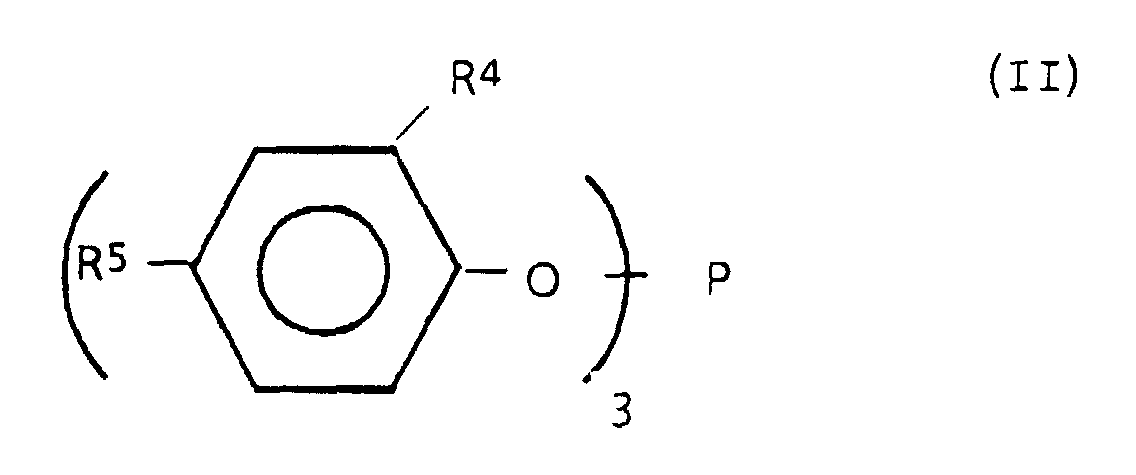
- Another preferred stabilizer is a hindered phenol. Hindered phenols and their use as antioxidants are described in Ullmann's Encyclopedia of Industrial Chemistry, Volume 3, "Antioxidants", pages 95-98, 5th ed., 1985, VCH Verlagsgesellschaft mbH and in Encyclopedia of Polymer Science and Engineering, Volume 2, "Antioxidants", pages 75-91, 1985 by John Wiley & Sons, Inc. Methods of preparing the hindered phenols are also well known in the art.
- Preferred hindered phenols are those of formula IIIwherein R4, R5 and R6 each independently are a C1-6-alkyl group, a C1-3-hydroxyalkyl group, or a C1-3-alkoxy group such as methyl, ethyl, n-propyl, i-propyl, n-butyl, i-butyl, tert-butyl, a pentyl or a hexyl group, a hydroxymethyl, hydroxyethyl or hydroxypropyl group or a methoxy, ethoxy or propoxyl group.
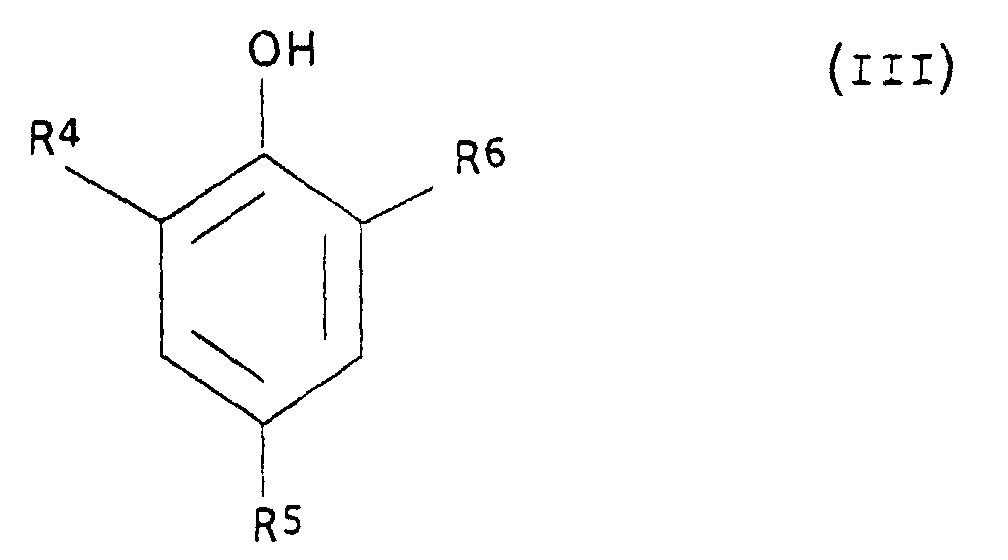
- Generally at least one, preferably at least two groups should provide steric hindrance to the molecule of formula III. Preferably at least one, more preferably at least two of the groups R4, R5 and R6 are i-butyl or tert-butyl. Preferred examples of hindered phenols of formula III are 2,6-di-tert-butyl-4-methylphenol, 2,6-di-tert-butyl-4-sec-butylphenol, 4-(hydroxymethyl)-2,6-di-tert-butylphenol or 2,6-di-tert-butyl-4-methoxy-phenol.
- Other preferred hindered phenols are those of formula IVwherein R7, R8 and R9 are arranged in the ortho and para positions to the hydroxyl group, R7 is a C1-6-alkyl group, R8 is a C1-6-alkyl group or a group containing one or more ester, ether, amide, amine, phosphonite, phosphonate, thioester and/or thioether functionalities and containing up to 24, preferably up to 12 carbon atoms, such as the -CH2-CH2-C(O)-O-C18H37 group or the -CH2-S-C8H17 group and R9 is a group containing one or more ester, ether, amide, amine, phosphonite, phosphonate, thioester and/or thioether functionalities and containing up to 24, preferably up to 12 carbon atoms, such as the -CH2-CH2-C(O)-O-C18H37 group or the -CH2-S-C8H17 group. When R7 or R8 or both are a C1-6-alkyl group, they preferably are methyl, ethyl, n-propyl, i-propyl, n-butyl, i-butyl, tert-butyl, a pentyl or a hexyl group.

- Preferred examples of hindered phenols of formula IV are octadecyl 3,5-di-tert-butyl-4-hydroxyhydrocinnamate, commercially available as IRGANOX 1076 (trademark), 2-methyl-4,6-bis((octylthio)-methyl)-phenol, commercially available as IRGANOX 1520 (trademark), 2,6-di-tert-butyl-4-(dimethylaminomethyl)phenol or 3,5-di-tert-butyl-4-hydroxybenzyl di-O-ethyl phosphonate, commercially available as IRGANOX 1222.
- Other preferred hindered phenols contain 2 phenolic groups, for example N,N'-1,6- hexamethylene-bis-3-(3,5-di-tert-butyl-4- hydroxyphenyl)propionamide, commercially available as IRGANOX 1098 (trademark), 1,6-hexamethylene bis(3,5-di-tert-butyl-4-hydroxyhydrocinnamate, commercially available as IRGANOX 259 (trademark), triethylene glycol bis[3-(3-tert-butyl-4-hydroxy-5-methylphenyl)] propionate, commercially available as IRGANOX 245 (trademark), N,N'-bis(3,5-di-tert-butyl-4-hydroxyhydrocinnamoyl)hydrazine, commercially available as IRGANOX MD 1024 and nickel or calcium bis[O-ethyl(3,5-di-tert-butyl-4-hydroxybenzyl)]phosphonate, the latter being commercially available as IRGANOX 1425.
- The most preferred hindered phenols are tetrakis[methylene(3,5-di-tert-butyl-4-hydroxyhydrocinnamate)] methane, commercially available as IRGANOX 1010, 3,5-di-tert-butyl-4-hydroxyhydrocinnamate, commercially available as IRGANOX 1076 (trademark) or a 1:1 blend of IRGANOX 1010 and tri(2,4-di-tert-butyl-phenyl)phosphite (IRGAPHOS 168, trademark), which blend is commercially available as IRGANOX B 225.
- The hindered phenol is advantageously utilized in combination with a phosphine of the general formula PR1R2R3 (I), wherein R1, R2 and R3 independently from each other represent an alkyl, cycloalkyl, aryl or aryl-alkyl group or an aryl group which is substituted at the aromatic ring with one or more halogens and/or one or more alkyl, hydroxy or alkoxy groups.
- The radicals R1, R2 and R3 can be identical or different. Of the alkyl groups those are preferred that have 1 to 18, preferably 1 to 12 carbon atoms, such as methyl, ethyl, n-propyl, i-propyl, n-butyl, sec. butyl or tert. butyl or the pentyl, hexyl, octyl, nonyl, decyl or octadecyl groups. The alkyl groups can be straight- chain or branched. Of the cycloalkyl groups those having 5 or 6 carbon atoms, such as cyclopentyl or cyclohexyl are preferred. Of the aryl groups those having from 6 to 14 carbon atoms, such as phenyl or naphthyl, are preferred. The aryl groups may be substituted with one or more of the above-mentioned alkyl groups and/or with one or more halogens, such as fluoride, chloride or bromide, and/or one or more hydroxy groups and/or one or more alkoxy groups. Alkoxy groups, if present, preferably contain 1 to 6 carbon atoms, such as the methoxy, ethoxy, n-propoxyl, i-propoxyl, n-butoxyl, sec. butoxyl or tert. butoxyl groups. If substituted, the aryl groups preferably are substituted with 1, 2 or 3 substituent groups. In the aryl-alkyl groups the above-mentioned alkyl groups are preferred and the aryl group preferably is phenyl. Preferred aryl-alkyl groups are benzyl, butyl phenyl or tolyl. Triphenyl phosphine is the most preferred compound of formula (I).
- For preparing the polymer composition of the present invention 0.001 to 0.3 wt.-% of the above-described inorganic particles a), 0.01 to 1.5 wt.-% of the above-described pciymeric particles b) and, if desired, one or more of the above-mentioned optional additives are mixed with the thermoplastic polymer. These compounds may be premixed before blending the mixture with the thermoplastic polymer. Alternatively, these compounds may be mixed separately with the thermoplastic polymer. The inorganic particles a), the polymeric particles b) and the optional additives may be added simultaneously or in sequence to the thermoplastic polymer. The sequence of addition and the temperature during the addition are not critical. The compounds may be mixed in their undiluted form or one or more of the compounds may be diluted with an aqueous or organic diluent. instead of preparing a polymer composition containing the above-mentioned concentration of the particles a) and b), master batches can be prepared containing higher concentrations of the inorganic particles a) and polymeric particles b). The master-batches can be blended later with a thermoplastic polymer to prepare polymer compositions containing the claimed concentration of the particles a) and b). It is advisable to mix the inorganic particles a), the polymeric particles b) and the optional additives with the thermoplastic polymer, which may contain optional additives, before the thermoplastic polymer is compounded to granules or pellets. The manner of dispersing or mixing the inorganic particles a), the polymeric particles b) and any optional additives with the thermoplastic polymer(s) is not critical. However, the process chosen should be one which results in a great degree of dispersion of all the additives throughout the thermoplastic polymer. Preferred mixing equipment are mixing rolls, ribbon blenders, dough mixers, Banbury mixers, etc.
- The polymer composition can be compounded to granules or pellets by known extrusion techniques. If the polymer composition contains polycarbonate, the extrusion is preferably conducted at a temperature of from 200 to 390°C, more preferably from 250 to 390°C, most preferably from 260 to 380°C. The mixture may be fed into an extruder and extruded to strands which is then comminuted into pellets or granules. Useful extruders are generally known in the art. The extruders generally have a single screw or a double screw. When using a double screw, the screw speed preferably is from 50 to 100 rpm, more preferably from 100 to 350 rpm. When using a single screw, one screw speed preferably is from from 5 to 250 rpm, more preferably from 10 to 150 rpm. A preferred compounding method is a devolatilizing extrusion process as generally described in U.S. patent No. 4,627,949 with or without applying a vacuum. The extrusion is generally conducted at a pressure of 0.1 to 100 bar, more preferably at 5 to 60 bar at the extrusion die.
- The pellets or granules may be formed into molded articles in a generally known manner, for example by injection-molding, injection blow molding, roll mill processing, rotational molding etc. A preferred processing method is a devolatilizing injection-molding as generally described in U.S. patent No. 4,627,949. If the polymer composition contains polycarbonate, the molding is preferably conducted at a temperature of from 200 to 380°C, more preferably from 250 to 380°C, most preferably from 260 to 380°C.
- Examples of molded articles are sheets, films, lamp covers, luminaires, lamps, etc. The molded articles have an excellent surface appearance. The surface is generally very smooth.
- The invention is further illustrated by the following examples. Unless otherwise mentioned all parts and percentages are weight parts and weight percentages.
- The following components are used for producing the plaques of these examples:
- Polycarbonate: In all examples and comparative examples polycarbonate pellets prepared by interfacial polycondensation of bisphenol A and phosgene are used. The polycarbonate has a melt flow rate of 3.3. The polycarbonate pellets are shaken with 1000 ppm of Cetiol 620 S (trademark of Henkel, Germany) as a tackifier and 1000 ppm of tetrakis-(2,4-di-tert-butylphenyl) biphenylene-diphosphonite, commercially available as Irgaphos-PEPQ (trademark) as an antioxidant. All amounts of the additives are based on the weight of the polycarbonate.
- Light diffuser I: a polymer having a core of poly(butyl acrylate) and a shell of poly(methyl methacrylate). The polymer having core/shell morphology is commercially available from Rohm and Haas under the trademark Paraloid EXL 5137. The particle size of the powdered polymer is 2-15 micrometer, the average particle size is 8 micrometer.
- Light diffuser II (comparison): a cross-linked copolymer of 58% methyl methacrylate, 39% styrene and 3% cross-linking agent. The polymer is commercially available from Sekisui Plastic under the trademark MSH-8. The polymer has an average particle size of 8 micrometer.
- Light diffuser III (comparison): a non-cross-linked acrylate-styrene copolymer. The copolymer is generally used as a matting agent and is commercially available from Degussa under the trademark Degussa OP 278.
- Titanium dioxide (TiO2): having a number average particle size of 0.2 to 0.3 micrometer.
- The polycarbonate (containing the above-indicated additives), the light diffuser and, in some examples, titanium dioxide are mixed and then extruded to strands using a Werner and Pfleiderer ZSK 25 mm co-rotating twin screw extruder. The extrusion is carried out under vented conditions at 300 rpm and 60-70 % torque. The amounts of the light diffuser and of titanium dioxide listed in Table 1 below are based on the weight of the polycarbonate. The extrusion temperature is listed in Table 1 below.
- Strands are pelletized using a Scherr and Cie 50-E pelletizer. The pellets are injection molded at 300°C into plaques of 3.2 mm thickness. An Arburg Allrounder CMD 370 equipped with a non-vented injection barrel and 35 mm screw is utilized.
- The total light transmittance and light diffusion of the plaques are measured according to ASTM D-1003. The test specimens are measured using a Hunterlab Colorquest in transmission mode, utilizing a light source C (daylight simulation), an observer angle of 2° and wave lengths of 400-700 nm.
- The color of the produced plaques is measured according to a system defined by the Commission Internationale d'Eclairage (CIE-system) in reflectance (black) according to ASTM E 308. In this system the +L* -axis indicates the brightness, -L* the darkness of the color, +a* the red color component, -a* the green color component, +b* the yellow color component and -b* the blue color component. The components L*, a* and b* are measured prior to and after subjecting the plaques to oven aging at 140°C during 500 hours. The difference between the values b* after and prior to oven aging is calculated and listed in the Table below as delta b. The higher delta b is, the higher is the yellowness of the plaque due to oven aging and the lower is the thermal resistance of the plaque over an extended period of time.
(Comp.) Example Light diffuser (type/%) TiO2 (%) Total Light Transmittance (%) Light diffusion Delta b Extrusion temp. (°C) A I / 0.5 - 69.6 58.1 2.2 315 B I / 1 - 62.3 52.2 5.3 315 C I / 2 - 57.5 48.1 5.4 315 D I / 3 - 55.5 46.3 5.7 315 E I / 5 - 50.0 41.6 5.7 315 1 I / 0.07 43.7 36.2 3.3 315 2 I / 0.5 0.02 57.7 48.2 4.3 315 3 I / 0.5 0.07 43.9 36.4 3.9 315 4 I / 0.5 0.2 24.6 20.2 3.4 315 5 I / 1 0.02 55.1 46.0 4.6 315 6 I / 1 0.1 37.1 30.7 4.0 315 7 I / 1 0.2 24.4 20.0 3.6 315 F I / 2 - 58.6 49.1 6.0 365 G I / 3 - 56.2 47.0 6.3 365 8 I / 0.5 0.02 57.8 48.3 5.2 365 9 I / 1 0.02 57.2 47.8 5.4 365 H II / 1.5 - 92 79 3.9 365 I II / 1 0.015 63 52 8.1 365 J III / 1.5 - 89 51 2.1 365 K III / 1 0.015 62 46 4.9 365 - The comparison between Example 2 (0.5% light diffuser I and 0.02% titanium dioxide) and comparative Example C (2% light diffuser I) illustrates that the plaque of Example 2 has essentially the same total light transmittance and light diffusion as the plaque of comparative Example C but a better color stability (smaller delta b). The comparison between Example 5 (1% light diffuser I and 0.02% titanium dioxide) and comparative Example D (3% light diffuser I) illustrates that the plaque of Example 5 has essentially the same total light transmittance and light diffusion as the plaque of comparative Example D, but a better color stability. Visual inspection of the plaques after oven aging shows that the plaque of Example 2 is whiter than the plaque of comparative Example C and the plaque of Example 5 is whiter than the plaque of comparative Example D. Further, the light diffuser compositions of Examples 2 and 5 respectively are cheaper than the light diffuser in comparative Examples C and D respectively. The same results are achieved when one extrusion of the polymer compositions is conducted at 365°C instead of at 315°C (compare Example 8 with comparative Example F and Example 9 with comparative Example G).
- The comparison between comparative Examples A-E illustrates that the color stability during oven aging decreases, i.e. delta b increases when the concentration of the light diffuser I in the plaque increases.
- The comparison between Examples 2-4 and 5-7 illustrates that at a given concentration of light diffuser I (0.5 or 1%) the color stability of the plaques during oven aging increases with increasing concentrations of titanium dioxide. This finding is surprising and contrary to the results of comparative Examples H/I and J/K. Although the concentration of the light diffuser II in comparative Example I is smaller than in comparative Example H and although only a small amount of titanium dioxide is incorporated into the plaque of comparative Example I, delta b of comparative Example I is substantially higher than delta b of comparative Example H. The same results are observed for comparative Examples J and K.
- Polycarbonate pellets prepared by interfacial polycondensation of bisphenol A and phosgene and branched with 0.5% of 1,1,1-tris(4-hydroxyphenyl)ethane are used in these Examples and Comparative Examples. The polycarbonate has a melt flow rate of 3.0. The polycarbonate is heat-stabilized with 1000 ppm of tetrakis-(2,4-di-tert-butylphenyl) biphenylene-diphosphonite, commercially available as Irgaphos-PEPQ (trademark), based on the weight of the polycarbonate.
- The same light diffusers I and III and titanium dioxide are used as described above referring to Examples 1-9. The amounts of the light diffuser and titanium dioxide are listed in Table 2 below.
- The extrusion and injection molding are conducted in the same manner as described above for Examples 1-9 except that the extrusion temperature is 298°C. The total light transmittance, light diffusion and color stability of the produced plaques are measured in the same manner as described above referring to Examples 1-9.
(Comp.) Example Light diffuser (type/%) TiO2 (%) Total Light Transmittance (%) Light diffusion Delta b L I / 0.5 - 70.8 59.6 3.8 M I / 1 - 60.4 51.1 4.75 N I / 4.5 - 46.9 39.6 5.6 10 I / 0.5 0.05 45.1 38.0 3.5 11 I / 1 0.05 43.5 37.1 4.4 O III / 1 - 86.9 47.5 1.6 P III / 1 0.05 46.4 39.0 4.6 - The comparison between Example 10 (0.5% light diffuser I and 0.05% titanium dioxide) and comparative Example N (4.5% light diffuser I) illustrate that the plaque of Example 10 has essentially the same total light transmittance and light diffusion as the plaque of comparative Example N but a substantially better color stability (smaller delta b).
- The comparisons between Example 10 and Comparative Example L and between Example 11 and Comparative Example M illustrate that even if the concentration of the light diffuser I is kept constant, the addition of titanium dioxide generally decreases delta b, i.e., increases the color stability of the claimed polymer composition.
- This finding is surprising and contrary to the results of comparative Examples O and P. Delta b of comparative Example P is substantially higher than delta b of comparative Example O. The plaque of comparative Example O has a good color stability, but a total light transmittance which is too high for many lighting applications.
optionally compounding the mixture to granules or pellets and
optionally producing a molded article from the granules or pellets.
Claims (11)
- A light diffuser composition comprisinga) from 0.1 to 30 weight parts of inorganic particles having an average particle diameter of from 0.1 to 1 micrometer and a refractive index of from 1.9 to 3.2 andb) from 1 to 150 weight parts of polymeric particles having a core/shell morphology with a core of a rubbery vinyl polymer and one or more shells, which particles contain at least 15% of a polymerized alkyl acrylate or alkyl methacrylate, based on the total weight of the polymeric particles.
- The light diffuser composition of claim 1 wherein the rubbery vinyl polymer of the core of the polymeric particles b) contains at least 15% of a polymerized acrylate, methacrylate, monovinyl arene or optionally substituted butadiene and from 0 to 85% of one or more copolymerized vinyl monomers, based on the total weight of the rubbery vinyl polymer.
- The light diffuser composition of claim 1 wherein the polymeric particles b) contain a core of a rubbery alkyl acrylate polymer, the alkyl group having from 2 to 8 carbon atoms, optionally copolymerized with from 0 to 5% cross-linker and from 0 to 5% graftlinker, based on the weight of the core, and one or more shells containing a polymer of a methacrylate, acrylate, vinyl arene, vinyl carboxylate, acrylic acid and/or methacrylic acid, the shells comprising from 5 to 40% of the weight of the particles.
- The light diffuser composition of any one of claims 1 to 3 wherein the weight ratio of the polymeric particles b) to the inorganic particles a) is from 0.5 : 1 to 100 : 1.
- The light diffuser composition of any one of claims 1 to 4 wherein the inorganic particles a) are titanium dioxide, silica gel, zinc sulfide, zinc oxide or MgTiO3.
- Use of the light diffuser composition of any one of claims 1 to 5 for imparting light diffusing properties to a thermoplastic polymer.
- A polymer composition comprising a thermoplastic polymer anda) from 0.001 to 0.3% of the inorganic particles a) as defined in claim 1 or claim 5 andb) from 0.01 to 1.5% of the polymeric particles b) as defined in any one of claims 1 to 3, based on the weight of the thermoplastic polymer.
- The polymer composition of claim 7 comprisinga) from 0.01 to 0.25% of the inorganic particles a) andb) from 0.1 to 1.2% of the polymeric particles b), based on the weight of the thermoplastic polymer.
- The polymer composition of claim 7 or claim 8 wherein the thermoplastic polymer is a polycarbonate.
- The polymer composition of any one of claims 7 to 9 in the shape of granules, pellets or a molded article.
- A process for producing the polymer composition of any one of claims 7 to 10 which comprises mixing with a thermoplastic polymera) from 0.001 to 0.3% of the inorganic particles a) as defined in claim 1 or claim 5 andb) from 0.01 to 1.5% of the polymeric particles b) as defined in any one of claims 1 to 3, based on the weight of the thermoplastic polymer, optionally compounding the mixture to granules or pellets and optionally producing a molded article from the granules or pellets.
Applications Claiming Priority (2)
| Application Number | Priority Date | Filing Date | Title |
|---|---|---|---|
| GB9314604 | 1993-07-14 | ||
| GB939314604A GB9314604D0 (en) | 1993-07-14 | 1993-07-14 | Light diffuser composition |
Publications (2)
| Publication Number | Publication Date |
|---|---|
| EP0634445A1 EP0634445A1 (en) | 1995-01-18 |
| EP0634445B1 true EP0634445B1 (en) | 1999-08-11 |
Family
ID=10738837
Family Applications (1)
| Application Number | Title | Priority Date | Filing Date |
|---|---|---|---|
| EP94305105A Expired - Lifetime EP0634445B1 (en) | 1993-07-14 | 1994-07-13 | Light diffuser composition |
Country Status (9)
| Country | Link |
|---|---|
| EP (1) | EP0634445B1 (en) |
| JP (1) | JP3450902B2 (en) |
| KR (1) | KR100338904B1 (en) |
| BR (1) | BR9402276A (en) |
| CA (1) | CA2127894A1 (en) |
| DE (1) | DE69419986T2 (en) |
| ES (1) | ES2134322T3 (en) |
| GB (1) | GB9314604D0 (en) |
| TW (1) | TW275079B (en) |
Cited By (9)
| Publication number | Priority date | Publication date | Assignee | Title |
|---|---|---|---|---|
| US7662471B2 (en) | 2005-10-19 | 2010-02-16 | Bayer Materialscience Ag | Light-scattering films and the use thereof in flat screens |
| US7790287B2 (en) | 2005-08-24 | 2010-09-07 | Bayer Materialscience Ag | Light-scattering sheet having high light transmission and improved antistatic properties |
| US7863403B2 (en) | 2008-02-13 | 2011-01-04 | Bayer Materialscience Ag | Process for the preparation of polycarbonates and diaryl carbonate |
| WO2011054866A1 (en) | 2009-11-05 | 2011-05-12 | Bayer Materialscience Ag | Polycarbonate composition having improved flame resistance for extrusion applications |
| WO2011054865A2 (en) | 2009-11-05 | 2011-05-12 | Bayer Materialscience Ag | More flame-retardant polycarbonate composition for use in extruded products |
| CN101278008B (en) * | 2005-10-05 | 2013-04-03 | 拜尔材料科学股份公司 | Light-scattering plastic composition with high brightness |
| WO2013045549A1 (en) | 2011-09-28 | 2013-04-04 | Bayer Materialscience Gmbh | Use of a light-diffusing polycarbonate sheet as a light cover |
| WO2019020478A1 (en) | 2017-07-24 | 2019-01-31 | Covestro Deutschland Ag | LED LIGHTING ELEMENTS WITH SHAPED PARTS OF TRANSLUCENT POLYCARBONATE COMPOSITIONS WITH DEEP GLOSS EFFECT |
| WO2021063719A1 (en) | 2019-09-30 | 2021-04-08 | Covestro Intellectual Property Gmbh & Co. Kg | Led lighting element on the basis of multi-layer bodies having solid stone appearance |
Families Citing this family (69)
| Publication number | Priority date | Publication date | Assignee | Title |
|---|---|---|---|---|
| DE19824333A1 (en) | 1998-06-02 | 1999-12-09 | Bayer Ag | Elastane threads and process for their manufacture |
| DE19851676A1 (en) * | 1998-11-10 | 2000-05-11 | Bayer Ag | Thermoplastic molding compounds with improved mechanical properties |
| SG93245A1 (en) * | 1999-07-13 | 2002-12-17 | Johnson & Johnson Vision Care | Reflectors for uv radiation source |
| KR101050982B1 (en) | 2003-06-17 | 2011-07-21 | 테이진 카세이 가부시키가이샤 | Direct Backlit Liquid Crystal Display and Light Diffusion Plate |
| KR100574092B1 (en) * | 2003-08-27 | 2006-04-27 | 제일모직주식회사 | Thermoplastic resin composition having light diffusivity |
| JP2005338439A (en) * | 2004-05-27 | 2005-12-08 | Toppan Printing Co Ltd | Light diffusing sheet, lens array sheet having the light diffusing sheet, and transmissive screen |
| DE102004036249A1 (en) * | 2004-07-26 | 2006-02-16 | Bayer Materialscience Ag | Shaped body with high light scattering and high light transmission |
| DE102005009653A1 (en) * | 2005-03-03 | 2006-09-07 | Bayer Materialscience Ag | Light-diffusing moldings with high light transmission and their use in flat screens |
| US7297381B2 (en) * | 2005-05-20 | 2007-11-20 | General Electric Company | Light diffusing films, methods of making the same, and articles using the same |
| US7297380B2 (en) | 2005-05-20 | 2007-11-20 | General Electric Company | Light-diffusing films, backlight display devices comprising the light-diffusing films, and methods of making the same |
| DE102005039413A1 (en) * | 2005-08-20 | 2007-02-22 | Bayer Materialscience Ag | Diffuser sheets made of CD material |
| DE102005040315A1 (en) * | 2005-08-24 | 2007-03-01 | Bayer Materialscience Ag | High brightness light scattering antistatic plastic composition and its use in flat panel displays |
| DE102005041402A1 (en) * | 2005-09-01 | 2007-03-08 | Röhm Gmbh | Shaped body with light scattering properties |
| KR101121892B1 (en) * | 2005-09-09 | 2012-03-19 | 니폰 덴키 가라스 가부시키가이샤 | Light diffusing composition |
| DE102005047615A1 (en) * | 2005-10-05 | 2007-04-12 | Bayer Materialscience Ag | Light-scattering plastic composition with high brightness and its use in flat screens |
| JP2007204695A (en) * | 2006-02-06 | 2007-08-16 | Gantsu Kasei Kk | Light diffusing agent and light diffusing resin composition using the same |
| DE102006014118A1 (en) * | 2006-03-24 | 2007-09-27 | Bayer Materialscience Ag | Shaped body with high light scattering and high light transmission for use as a diffuser sheet in flat screens |
| WO2008045181A1 (en) * | 2006-10-05 | 2008-04-17 | Dow Global Technologies Inc. | Bulk light diffuser composition |
| TWI369379B (en) * | 2007-01-26 | 2012-08-01 | Rohm & Haas | Light-scattering compositions |
| KR100823830B1 (en) | 2007-03-08 | 2008-04-21 | 경희대학교 산학협력단 | Light Diffusion Plate for LCD Backlight |
| DE102007015948A1 (en) | 2007-04-03 | 2008-10-09 | Bayer Materialscience Ag | Modified polycarbonates, polyester carbonates and polyesters with improved extensibility and flame retardancy |
| JP4910940B2 (en) * | 2007-04-25 | 2012-04-04 | 住友化学株式会社 | Light diffusion plate |
| KR101132143B1 (en) | 2007-06-20 | 2012-04-03 | 주식회사 엘지화학 | Light-diffusing resin composition having imporved physical properties and corrosion resistance |
| DE102007033300A1 (en) | 2007-07-18 | 2009-01-29 | Bayer Materialscience Ag | Light-guiding surface structure |
| DE102008008841A1 (en) | 2008-02-13 | 2009-08-20 | Bayer Materialscience Ag | Preparing (co)polycarbonate or diaryl carbonate, useful in e.g. sunglasses, comprises converting di-, mono-phenol and phosgene to chloroformic acid aryl ester, oligo- or diaryl-carbonate, and reacting the product under alkaline solution |
| DE102008011903A1 (en) | 2008-02-29 | 2009-09-03 | Bayer Materialscience Ag | Polycarbonates with cyclic oligomers and improved flow behavior |
| DE102008012613A1 (en) | 2008-03-05 | 2009-09-10 | Bayer Materialscience Ag | Process for the preparation of polycarbonate by the interfacial process |
| DE102008019503A1 (en) | 2008-04-18 | 2009-10-22 | Bayer Materialscience Ag | Polycarbonates with rearrangement structures, cyclic and linear oligomers and improved flow behavior |
| ITMI20081135A1 (en) | 2008-06-24 | 2009-12-25 | Trapani Paolo Di | LIGHTING DEVICE |
| DE102008036406A1 (en) | 2008-08-05 | 2010-02-11 | Bayer Materialscience Ag | Modified polycarbonates with improved surface properties |
| DE102008059658A1 (en) | 2008-11-28 | 2010-06-02 | Bayer Materialscience Ag | Copolycarbonates with improved surface hardness |
| DE102009013643A1 (en) | 2009-03-18 | 2010-09-30 | Bayer Materialscience Ag | Copolycarbonates with improved properties |
| DE102009025123A1 (en) | 2009-06-16 | 2010-12-23 | Osram Opto Semiconductors Gmbh | Radiation-emitting device |
| EP2309316A1 (en) | 2009-10-09 | 2011-04-13 | Bayer MaterialScience AG | LED illumination unit with structured dispersion film |
| EP2336245A1 (en) | 2009-12-12 | 2011-06-22 | Bayer MaterialScience AG | Polycarbonate compounds with improved surface hardness |
| DE102009058099A1 (en) | 2009-12-12 | 2011-06-16 | Bayer Materialscience Ag | Polycarbonate blends with high heat resistance and improved surface properties |
| DE102009058462A1 (en) | 2009-12-16 | 2011-06-22 | Bayer MaterialScience AG, 51373 | Producing polycarbonate injection molded body comprises introducing injection molded bodies containing polycarbonate in reactor, inerting atmosphere of reactor, introducing fluorine-inert gas mixture and evacuating and flushing the reactor |
| TW201139532A (en) | 2010-04-30 | 2011-11-16 | Styron Europe Gmbh | Improved light diffusing composition |
| CN102093689A (en) * | 2010-12-27 | 2011-06-15 | 金发科技股份有限公司 | Master batch with light scattering function, and preparation method and application thereof |
| DE202012102847U1 (en) | 2012-07-28 | 2012-11-22 | Yih Cheng Factory Co., Ltd. | toolbox |
| JP6188337B2 (en) * | 2012-08-31 | 2017-08-30 | 積水化成品工業株式会社 | Light diffuser and manufacturing method thereof |
| EP2752612A1 (en) | 2013-01-08 | 2014-07-09 | Bayer MaterialScience AG | LED light tube and method for manufacturing the LED light tube |
| CN103226213B (en) * | 2013-05-02 | 2015-06-10 | 江苏裕兴薄膜科技股份有限公司 | Polyester reflective film containing polymer microsphere, and preparation method of polyester reflective film |
| EP3097135B1 (en) | 2014-01-24 | 2021-08-18 | Covestro Intellectual Property GmbH & Co. KG | Method of manufacturing polycarbonate using the phase boundary method |
| JP6209463B2 (en) * | 2014-02-25 | 2017-10-04 | 積水化成品工業株式会社 | Light diffuser and manufacturing method thereof |
| US20160178814A1 (en) * | 2014-12-18 | 2016-06-23 | Eastman Chemical Company | Light diffusion composition and articles made therefrom |
| WO2016096848A1 (en) | 2014-12-19 | 2016-06-23 | Ineos Styrolution Group Gmbh | Light diffusing styrene copolymer compositions |
| US11719411B2 (en) | 2015-02-24 | 2023-08-08 | Trinseo Europe Gmbh | High efficiency diffusion lighting coverings |
| EP3262461A4 (en) * | 2015-02-24 | 2018-10-03 | Arkema France | High efficiency diffusion lighting coverings |
| JP2019526664A (en) | 2016-08-19 | 2019-09-19 | コベストロ、ドイチュラント、アクチエンゲゼルシャフトCovestro Deutschland Ag | Synthesis method of polyoxazolidinone compounds |
| EP3357949A1 (en) | 2017-02-02 | 2018-08-08 | Covestro Deutschland AG | Method for the production of polyoxazolidinone polymer compounds |
| JP7203830B2 (en) | 2017-08-24 | 2023-01-13 | ビーエーエスエフ ソシエタス・ヨーロピア | Transmitters and data transmission systems for transmitting data and for emitting electromagnetic radiation within the visible spectrum |
| TWI774920B (en) * | 2018-02-05 | 2022-08-21 | 德商羅姆有限公司 | Light scattering polymeric composition with improved scattering efficiency and improved mechanical properties |
| US11898075B2 (en) | 2018-03-20 | 2024-02-13 | Basf Se | Yellow light emitting device |
| JP7212442B2 (en) | 2018-06-11 | 2023-01-25 | ベーアーエスエフ・エスエー | Optical data communication systems containing paraphenylene vinylene and certain paraphenylene vinylenes |
| WO2019243288A1 (en) | 2018-06-22 | 2019-12-26 | Basf Se | Extruded pet films with photostable dyes for color conversion |
| KR102840276B1 (en) | 2018-06-22 | 2025-07-30 | 바스프 에스이 | Photostable cyano-substituted boron-dipyrromethene dyes as green emitters for display and lighting applications |
| WO2020053124A1 (en) | 2018-09-11 | 2020-03-19 | Basf Se | Receiver comprising a luminescent collector for optical data communication |
| FR3086293B1 (en) * | 2018-09-26 | 2021-07-16 | Arkema France | COMPOSITION INCLUDING DIFFUSING PARTICLES |
| KR102957439B1 (en) | 2019-03-22 | 2026-04-27 | 바스프 에스이 | Plant cultivation methods |
| EP3771929B1 (en) | 2019-07-29 | 2026-04-29 | Viavi Solutions Inc. | Encapsulated diffuser |
| EP3858946A1 (en) | 2020-01-29 | 2021-08-04 | Basf Se | New rylene dicarboximides |
| EP3985047A1 (en) | 2020-10-13 | 2022-04-20 | Covestro Deutschland AG | Method for the preparation of a polycarbonate based on the interfacial process with solvent exchange |
| WO2023025694A1 (en) | 2021-08-24 | 2023-03-02 | Basf Se | Novel perylene-based nir emitters |
| EP4444700A1 (en) | 2021-12-09 | 2024-10-16 | Basf Se | Terrylene diimide and quaterrylene diimide colorants |
| WO2023139596A1 (en) * | 2022-01-24 | 2023-07-27 | Havells India Limited | Polyolefin based diffuser for lighting fixtures |
| EP4638605A1 (en) | 2022-12-21 | 2025-10-29 | Basf Se | Xanthene compounds having a wavelength in the range from 650 to 1200 nm |
| EP4638606A1 (en) | 2022-12-22 | 2025-10-29 | Basf Se | Fluorescent phenyl xanthene dyes |
| CN118240447B (en) * | 2022-12-23 | 2026-04-14 | 财团法人工业技术研究院 | Paint, coating and light-emitting device |
Family Cites Families (5)
| Publication number | Priority date | Publication date | Assignee | Title |
|---|---|---|---|---|
| CA1337104C (en) * | 1986-11-18 | 1995-09-26 | William James Work | Light-scattering thermoplastic polymers |
| JP2844886B2 (en) * | 1989-09-05 | 1999-01-13 | 東亞合成株式会社 | Polymer powder |
| CA2050450A1 (en) * | 1990-09-04 | 1992-03-05 | Yasumasa Asanaka | Reactive particulate resin, method for producing the same, and resin composition for thermoforming |
| JPH04256345A (en) * | 1991-02-07 | 1992-09-11 | Toagosei Chem Ind Co Ltd | Semiconductor device |
| JP2906728B2 (en) * | 1991-04-04 | 1999-06-21 | 東亞合成株式会社 | Method for producing polymer powder |
-
1993
- 1993-07-14 GB GB939314604A patent/GB9314604D0/en active Pending
-
1994
- 1994-07-13 TW TW083106346A patent/TW275079B/zh not_active IP Right Cessation
- 1994-07-13 KR KR1019940016824A patent/KR100338904B1/en not_active Expired - Fee Related
- 1994-07-13 EP EP94305105A patent/EP0634445B1/en not_active Expired - Lifetime
- 1994-07-13 CA CA002127894A patent/CA2127894A1/en not_active Abandoned
- 1994-07-13 ES ES94305105T patent/ES2134322T3/en not_active Expired - Lifetime
- 1994-07-13 DE DE69419986T patent/DE69419986T2/en not_active Expired - Lifetime
- 1994-07-14 JP JP16213894A patent/JP3450902B2/en not_active Expired - Fee Related
- 1994-07-14 BR BR9402276A patent/BR9402276A/en not_active Application Discontinuation
Cited By (11)
| Publication number | Priority date | Publication date | Assignee | Title |
|---|---|---|---|---|
| US7790287B2 (en) | 2005-08-24 | 2010-09-07 | Bayer Materialscience Ag | Light-scattering sheet having high light transmission and improved antistatic properties |
| CN101278008B (en) * | 2005-10-05 | 2013-04-03 | 拜尔材料科学股份公司 | Light-scattering plastic composition with high brightness |
| US7662471B2 (en) | 2005-10-19 | 2010-02-16 | Bayer Materialscience Ag | Light-scattering films and the use thereof in flat screens |
| EP2757132A1 (en) | 2005-10-19 | 2014-07-23 | Bayer Intellectual Property GmbH | Light-diffusing films and their use in flat screens |
| US7863403B2 (en) | 2008-02-13 | 2011-01-04 | Bayer Materialscience Ag | Process for the preparation of polycarbonates and diaryl carbonate |
| WO2011054866A1 (en) | 2009-11-05 | 2011-05-12 | Bayer Materialscience Ag | Polycarbonate composition having improved flame resistance for extrusion applications |
| WO2011054865A2 (en) | 2009-11-05 | 2011-05-12 | Bayer Materialscience Ag | More flame-retardant polycarbonate composition for use in extruded products |
| DE102009052042A1 (en) | 2009-11-05 | 2011-05-12 | Bayer Materialscience Ag | Polycarbonate composition with improved flame retardancy for extrusion applications |
| WO2013045549A1 (en) | 2011-09-28 | 2013-04-04 | Bayer Materialscience Gmbh | Use of a light-diffusing polycarbonate sheet as a light cover |
| WO2019020478A1 (en) | 2017-07-24 | 2019-01-31 | Covestro Deutschland Ag | LED LIGHTING ELEMENTS WITH SHAPED PARTS OF TRANSLUCENT POLYCARBONATE COMPOSITIONS WITH DEEP GLOSS EFFECT |
| WO2021063719A1 (en) | 2019-09-30 | 2021-04-08 | Covestro Intellectual Property Gmbh & Co. Kg | Led lighting element on the basis of multi-layer bodies having solid stone appearance |
Also Published As
| Publication number | Publication date |
|---|---|
| JP3450902B2 (en) | 2003-09-29 |
| DE69419986T2 (en) | 1999-12-23 |
| JPH07149995A (en) | 1995-06-13 |
| BR9402276A (en) | 1995-03-14 |
| CA2127894A1 (en) | 1995-01-15 |
| KR100338904B1 (en) | 2002-11-01 |
| ES2134322T3 (en) | 1999-10-01 |
| EP0634445A1 (en) | 1995-01-18 |
| KR960014264A (en) | 1996-05-22 |
| TW275079B (en) | 1996-05-01 |
| DE69419986D1 (en) | 1999-09-16 |
| GB9314604D0 (en) | 1993-08-25 |
Similar Documents
| Publication | Publication Date | Title |
|---|---|---|
| KR100338904B1 (en) | Light Diffusion Composition | |
| EP0342283B1 (en) | Thermoplastic and thermoset polymer compositions | |
| US5346954A (en) | Thermoplastic and thermoset polymer compositions | |
| TWI386448B (en) | Light-scattering compositions | |
| KR100511423B1 (en) | Transparent Polymethylemethacrylate/Polycarbonate Resin Composition | |
| CN113286850B (en) | Polymer composition comprising particles and a colorant, method for preparing the same and use thereof | |
| JP3313887B2 (en) | Polycarbonate composition | |
| JP6215327B2 (en) | Light diffusing polymer composition, method for producing the same, and article made therefrom | |
| JP2006131833A (en) | Light diffusing polycarbonate resin composition and molded article | |
| KR100836572B1 (en) | Light-diffusion resin composition excellent in mechanical properties | |
| JPH0790167A (en) | Light diffusing resin composition | |
| US11319433B2 (en) | Light scattering polymeric composition with improved scattering efficiency and improved mechanical properties | |
| JP3447848B2 (en) | Molded product for light diffusion transmission | |
| KR20220001987A (en) | Thermoplastic resin composition and molded product using the same | |
| KR100524319B1 (en) | High reflectance and impact modified thermoplastic resin composition | |
| KR100510735B1 (en) | Polycarbonate Resin Composition Having Excellent Light Reflectance | |
| JP4837981B2 (en) | Thermoplastic resin composition having excellent light diffusibility and light diffusing plate comprising the same | |
| KR101378187B1 (en) | Light diffusion resin composition with improved weatherability and surface contamination | |
| KR102382266B1 (en) | Thermoplastic resin composition and light diffusion sheet produced therefrom | |
| JPH04318060A (en) | Light scattering polycarbonate-based resin composition, molded article of light scattering polycarbonate-based resin composition and production thereof | |
| KR960007768B1 (en) | Thermoplastic or Thermoset Polymer Compositions | |
| JP2006131834A (en) | Light diffusing polycarbonate resin composition and light diffusion molded article | |
| CN119331276A (en) | Polymer composition suitable for injection molding comprising particles and a colorant, method for its preparation and use thereof | |
| KR20250074448A (en) | Thermoplastic resin composition and molded article manufactured by the same |
Legal Events
| Date | Code | Title | Description |
|---|---|---|---|
| PUAI | Public reference made under article 153(3) epc to a published international application that has entered the european phase |
Free format text: ORIGINAL CODE: 0009012 |
|
| AK | Designated contracting states |
Kind code of ref document: A1 Designated state(s): BE DE ES FR GB IT NL |
|
| 17P | Request for examination filed |
Effective date: 19950708 |
|
| RAP3 | Party data changed (applicant data changed or rights of an application transferred) |
Owner name: THE DOW CHEMICAL COMPANY |
|
| GRAG | Despatch of communication of intention to grant |
Free format text: ORIGINAL CODE: EPIDOS AGRA |
|
| 17Q | First examination report despatched |
Effective date: 19980818 |
|
| GRAG | Despatch of communication of intention to grant |
Free format text: ORIGINAL CODE: EPIDOS AGRA |
|
| GRAH | Despatch of communication of intention to grant a patent |
Free format text: ORIGINAL CODE: EPIDOS IGRA |
|
| GRAH | Despatch of communication of intention to grant a patent |
Free format text: ORIGINAL CODE: EPIDOS IGRA |
|
| GRAA | (expected) grant |
Free format text: ORIGINAL CODE: 0009210 |
|
| AK | Designated contracting states |
Kind code of ref document: B1 Designated state(s): BE DE ES FR GB IT NL |
|
| ITF | It: translation for a ep patent filed | ||
| REF | Corresponds to: |
Ref document number: 69419986 Country of ref document: DE Date of ref document: 19990916 |
|
| REG | Reference to a national code |
Ref country code: ES Ref legal event code: FG2A Ref document number: 2134322 Country of ref document: ES Kind code of ref document: T3 |
|
| ET | Fr: translation filed | ||
| PLBE | No opposition filed within time limit |
Free format text: ORIGINAL CODE: 0009261 |
|
| STAA | Information on the status of an ep patent application or granted ep patent |
Free format text: STATUS: NO OPPOSITION FILED WITHIN TIME LIMIT |
|
| 26N | No opposition filed | ||
| REG | Reference to a national code |
Ref country code: GB Ref legal event code: IF02 |
|
| PGFP | Annual fee paid to national office [announced via postgrant information from national office to epo] |
Ref country code: FR Payment date: 20020506 Year of fee payment: 9 |
|
| PGFP | Annual fee paid to national office [announced via postgrant information from national office to epo] |
Ref country code: GB Payment date: 20020626 Year of fee payment: 9 |
|
| PGFP | Annual fee paid to national office [announced via postgrant information from national office to epo] |
Ref country code: BE Payment date: 20020703 Year of fee payment: 9 |
|
| PGFP | Annual fee paid to national office [announced via postgrant information from national office to epo] |
Ref country code: ES Payment date: 20020715 Year of fee payment: 9 |
|
| PG25 | Lapsed in a contracting state [announced via postgrant information from national office to epo] |
Ref country code: GB Free format text: LAPSE BECAUSE OF NON-PAYMENT OF DUE FEES Effective date: 20030713 |
|
| PG25 | Lapsed in a contracting state [announced via postgrant information from national office to epo] |
Ref country code: ES Free format text: LAPSE BECAUSE OF NON-PAYMENT OF DUE FEES Effective date: 20030714 |
|
| PG25 | Lapsed in a contracting state [announced via postgrant information from national office to epo] |
Ref country code: BE Free format text: LAPSE BECAUSE OF NON-PAYMENT OF DUE FEES Effective date: 20030731 |
|
| BERE | Be: lapsed |
Owner name: THE *DOW CHEMICAL CY Effective date: 20030731 |
|
| GBPC | Gb: european patent ceased through non-payment of renewal fee |
Effective date: 20030713 |
|
| PG25 | Lapsed in a contracting state [announced via postgrant information from national office to epo] |
Ref country code: FR Free format text: LAPSE BECAUSE OF NON-PAYMENT OF DUE FEES Effective date: 20040331 |
|
| REG | Reference to a national code |
Ref country code: FR Ref legal event code: ST |
|
| REG | Reference to a national code |
Ref country code: ES Ref legal event code: FD2A Effective date: 20030714 |
|
| REG | Reference to a national code |
Ref country code: NL Ref legal event code: SD Effective date: 20110720 |
|
| PGFP | Annual fee paid to national office [announced via postgrant information from national office to epo] |
Ref country code: DE Payment date: 20120727 Year of fee payment: 19 Ref country code: IT Payment date: 20120724 Year of fee payment: 19 |
|
| PGFP | Annual fee paid to national office [announced via postgrant information from national office to epo] |
Ref country code: NL Payment date: 20120724 Year of fee payment: 19 |
|
| REG | Reference to a national code |
Ref country code: NL Ref legal event code: V1 Effective date: 20140201 |
|
| PG25 | Lapsed in a contracting state [announced via postgrant information from national office to epo] |
Ref country code: NL Free format text: LAPSE BECAUSE OF NON-PAYMENT OF DUE FEES Effective date: 20140201 Ref country code: DE Free format text: LAPSE BECAUSE OF NON-PAYMENT OF DUE FEES Effective date: 20140201 |
|
| REG | Reference to a national code |
Ref country code: DE Ref legal event code: R119 Ref document number: 69419986 Country of ref document: DE Effective date: 20140201 |
|
| PG25 | Lapsed in a contracting state [announced via postgrant information from national office to epo] |
Ref country code: IT Free format text: LAPSE BECAUSE OF NON-PAYMENT OF DUE FEES Effective date: 20130713 |