EP0634413A1 - Herbicides - Google Patents
Herbicides Download PDFInfo
- Publication number
- EP0634413A1 EP0634413A1 EP94110578A EP94110578A EP0634413A1 EP 0634413 A1 EP0634413 A1 EP 0634413A1 EP 94110578 A EP94110578 A EP 94110578A EP 94110578 A EP94110578 A EP 94110578A EP 0634413 A1 EP0634413 A1 EP 0634413A1
- Authority
- EP
- European Patent Office
- Prior art keywords
- optionally substituted
- formula
- pyridazin
- pyrido
- compound
- Prior art date
- Legal status (The legal status is an assumption and is not a legal conclusion. Google has not performed a legal analysis and makes no representation as to the accuracy of the status listed.)
- Withdrawn
Links
- 239000004009 herbicide Substances 0.000 title abstract description 6
- 150000001875 compounds Chemical class 0.000 claims abstract description 138
- 125000000217 alkyl group Chemical group 0.000 claims abstract description 32
- QVGXLLKOCUKJST-UHFFFAOYSA-N atomic oxygen Chemical group [O] QVGXLLKOCUKJST-UHFFFAOYSA-N 0.000 claims abstract description 24
- 239000001301 oxygen Substances 0.000 claims abstract description 24
- 229910052760 oxygen Inorganic materials 0.000 claims abstract description 24
- 150000003839 salts Chemical class 0.000 claims abstract description 22
- 125000001997 phenyl group Chemical group [H]C1=C([H])C([H])=C(*)C([H])=C1[H] 0.000 claims abstract description 18
- 125000004093 cyano group Chemical group *C#N 0.000 claims abstract description 13
- 229910052736 halogen Inorganic materials 0.000 claims abstract description 13
- 150000002367 halogens Chemical group 0.000 claims abstract description 12
- NINIDFKCEFEMDL-UHFFFAOYSA-N Sulfur Chemical group [S] NINIDFKCEFEMDL-UHFFFAOYSA-N 0.000 claims abstract description 11
- 125000000304 alkynyl group Chemical group 0.000 claims abstract description 11
- 239000001257 hydrogen Substances 0.000 claims abstract description 11
- 229910052739 hydrogen Inorganic materials 0.000 claims abstract description 11
- 239000005864 Sulphur Chemical group 0.000 claims abstract description 10
- 125000003342 alkenyl group Chemical group 0.000 claims abstract description 10
- 125000000449 nitro group Chemical group [O-][N+](*)=O 0.000 claims abstract description 9
- 101100134927 Gallus gallus COR8 gene Proteins 0.000 claims abstract description 3
- 125000000623 heterocyclic group Chemical group 0.000 claims abstract description 3
- 239000000203 mixture Substances 0.000 claims description 84
- 241000196324 Embryophyta Species 0.000 claims description 55
- 125000005843 halogen group Chemical group 0.000 claims description 43
- XLYOFNOQVPJJNP-UHFFFAOYSA-N water Substances O XLYOFNOQVPJJNP-UHFFFAOYSA-N 0.000 claims description 40
- 125000004432 carbon atom Chemical group C* 0.000 claims description 37
- 230000002363 herbicidal effect Effects 0.000 claims description 32
- -1 3,4-methylenedioxyphenyl Chemical group 0.000 claims description 25
- 239000003085 diluting agent Substances 0.000 claims description 21
- 238000000034 method Methods 0.000 claims description 18
- 239000004094 surface-active agent Substances 0.000 claims description 16
- 239000007788 liquid Substances 0.000 claims description 13
- DHLCTHXZKHGREA-UHFFFAOYSA-N 6h-pyrido[2,3-d]pyridazin-5-one Chemical compound C1=CC=C2C(=O)NN=CC2=N1 DHLCTHXZKHGREA-UHFFFAOYSA-N 0.000 claims description 12
- 125000003118 aryl group Chemical group 0.000 claims description 12
- 239000000969 carrier Substances 0.000 claims description 11
- 125000004435 hydrogen atom Chemical group [H]* 0.000 claims description 11
- IJGRMHOSHXDMSA-UHFFFAOYSA-N Atomic nitrogen Chemical compound N#N IJGRMHOSHXDMSA-UHFFFAOYSA-N 0.000 claims description 10
- 125000002723 alicyclic group Chemical group 0.000 claims description 10
- 125000003545 alkoxy group Chemical group 0.000 claims description 10
- 239000008187 granular material Substances 0.000 claims description 10
- 239000000843 powder Substances 0.000 claims description 9
- 125000004076 pyridyl group Chemical group 0.000 claims description 9
- 239000004480 active ingredient Substances 0.000 claims description 8
- 239000012141 concentrate Substances 0.000 claims description 8
- 125000005842 heteroatom Chemical group 0.000 claims description 8
- 125000001424 substituent group Chemical group 0.000 claims description 7
- OAKJQQAXSVQMHS-UHFFFAOYSA-N Hydrazine Chemical compound NN OAKJQQAXSVQMHS-UHFFFAOYSA-N 0.000 claims description 6
- 125000001570 methylene group Chemical group [H]C([H])([*:1])[*:2] 0.000 claims description 6
- 229910052757 nitrogen Inorganic materials 0.000 claims description 6
- 238000002360 preparation method Methods 0.000 claims description 6
- 125000004429 atom Chemical group 0.000 claims description 5
- 239000003153 chemical reaction reagent Substances 0.000 claims description 5
- 239000004546 suspension concentrate Substances 0.000 claims description 5
- 125000001153 fluoro group Chemical group F* 0.000 claims description 4
- 230000008569 process Effects 0.000 claims description 4
- LMBFAGIMSUYTBN-MPZNNTNKSA-N teixobactin Chemical compound C([C@H](C(=O)N[C@@H]([C@@H](C)CC)C(=O)N[C@@H](CO)C(=O)N[C@H](CCC(N)=O)C(=O)N[C@H]([C@@H](C)CC)C(=O)N[C@@H]([C@@H](C)CC)C(=O)N[C@@H](CO)C(=O)N[C@H]1C(N[C@@H](C)C(=O)N[C@@H](C[C@@H]2NC(=N)NC2)C(=O)N[C@H](C(=O)O[C@H]1C)[C@@H](C)CC)=O)NC)C1=CC=CC=C1 LMBFAGIMSUYTBN-MPZNNTNKSA-N 0.000 claims description 4
- FSWMEFOBYUBEFR-UHFFFAOYSA-N 3-chloro-8-(6,7-difluoro-1,3-benzodioxol-5-yl)-6-(4-fluorophenyl)pyrido[2,3-d]pyridazin-5-one Chemical compound C1=CC(F)=CC=C1N1C(=O)C2=CC(Cl)=CN=C2C(C=2C(=C(F)C=3OCOC=3C=2)F)=N1 FSWMEFOBYUBEFR-UHFFFAOYSA-N 0.000 claims description 3
- POODXIOAXCFNLZ-UHFFFAOYSA-N 3-chloro-8-(6,7-difluoro-1,3-benzodioxol-5-yl)-6-[4-(trifluoromethyl)phenyl]pyrido[2,3-d]pyridazin-5-one Chemical compound FC=1C(F)=C2OCOC2=CC=1C(C1=NC=C(Cl)C=C1C1=O)=NN1C1=CC=C(C(F)(F)F)C=C1 POODXIOAXCFNLZ-UHFFFAOYSA-N 0.000 claims description 3
- QYPSGQMLSYHTEU-UHFFFAOYSA-N 4-[8-(6,7-difluoro-1,3-benzodioxol-5-yl)-5-oxopyrido[2,3-d]pyridazin-6-yl]benzonitrile Chemical compound FC=1C(F)=C2OCOC2=CC=1C(C1=NC=CC=C1C1=O)=NN1C1=CC=C(C#N)C=C1 QYPSGQMLSYHTEU-UHFFFAOYSA-N 0.000 claims description 3
- KKJLLMTZIUOIRC-UHFFFAOYSA-N 5-[8-(6,7-difluoro-1,3-benzodioxol-5-yl)-5-oxopyrido[2,3-d]pyridazin-6-yl]-2-fluorobenzonitrile Chemical compound C1=C(C#N)C(F)=CC=C1N1C(=O)C2=CC=CN=C2C(C=2C(=C(F)C=3OCOC=3C=2)F)=N1 KKJLLMTZIUOIRC-UHFFFAOYSA-N 0.000 claims description 3
- ARFXROZBUSLFIJ-UHFFFAOYSA-N 6-(4-chlorophenyl)-8-(6,7-difluoro-1,3-benzodioxol-5-yl)pyrido[2,3-d]pyridazin-5-one Chemical compound FC=1C(F)=C2OCOC2=CC=1C(C1=NC=CC=C1C1=O)=NN1C1=CC=C(Cl)C=C1 ARFXROZBUSLFIJ-UHFFFAOYSA-N 0.000 claims description 3
- SAXGJJRTLYVSJQ-UHFFFAOYSA-N 8-(1,3-benzodioxol-4-yl)-6-(4-fluorophenyl)pyrido[2,3-d]pyridazin-5-one Chemical compound C1=CC(F)=CC=C1N1C(=O)C2=CC=CN=C2C(C=2C=3OCOC=3C=CC=2)=N1 SAXGJJRTLYVSJQ-UHFFFAOYSA-N 0.000 claims description 3
- YHYGBZGVPSKMDZ-UHFFFAOYSA-N 8-(6,7-difluoro-1,3-benzodioxol-5-yl)-3-fluoro-6-[4-(trifluoromethyl)phenyl]pyrido[2,3-d]pyridazin-5-one Chemical compound O=C1C2=CC(F)=CN=C2C(C=2C(=C(F)C=3OCOC=3C=2)F)=NN1C1=CC=C(C(F)(F)F)C=C1 YHYGBZGVPSKMDZ-UHFFFAOYSA-N 0.000 claims description 3
- XLOGKWIRNSNQBB-UHFFFAOYSA-N 8-(6,7-difluoro-1,3-benzodioxol-5-yl)-6-(3,4-difluorophenyl)pyrido[2,3-d]pyridazin-5-one Chemical compound C1=C(F)C(F)=CC=C1N1C(=O)C2=CC=CN=C2C(C=2C(=C(F)C=3OCOC=3C=2)F)=N1 XLOGKWIRNSNQBB-UHFFFAOYSA-N 0.000 claims description 3
- UNLNEQKXSCCFSV-UHFFFAOYSA-N 8-(6,7-difluoro-1,3-benzodioxol-5-yl)-6-(4-fluorophenyl)pyrido[2,3-d]pyridazin-5-one Chemical compound C1=CC(F)=CC=C1N1C(=O)C2=CC=CN=C2C(C=2C(=C(F)C=3OCOC=3C=2)F)=N1 UNLNEQKXSCCFSV-UHFFFAOYSA-N 0.000 claims description 3
- KJDFDAABAZSROQ-UHFFFAOYSA-N 8-(6,7-difluoro-1,3-benzodioxol-5-yl)-6-[4-(trifluoromethyl)phenyl]pyrido[2,3-d]pyridazin-5-one Chemical compound FC=1C(F)=C2OCOC2=CC=1C(C1=NC=CC=C1C1=O)=NN1C1=CC=C(C(F)(F)F)C=C1 KJDFDAABAZSROQ-UHFFFAOYSA-N 0.000 claims description 3
- WANSNUSAKIMJQK-UHFFFAOYSA-N 8-(6,7-difluoro-1,3-benzodioxol-5-yl)-6-[4-fluoro-3-(trifluoromethyl)phenyl]pyrido[2,3-d]pyridazin-5-one Chemical compound C1=C(C(F)(F)F)C(F)=CC=C1N1C(=O)C2=CC=CN=C2C(C=2C(=C(F)C=3OCOC=3C=2)F)=N1 WANSNUSAKIMJQK-UHFFFAOYSA-N 0.000 claims description 3
- RQZIMAHWLTUBJB-UHFFFAOYSA-N 8-(6,7-difluoro-2,4-dioxabicyclo[3.2.2]nona-1(7),5,8-trien-9-yl)-6-(4-fluorophenyl)pyrido[2,3-d]pyridazin-5-one Chemical compound C1=CC(F)=CC=C1N1C(=O)C2=CC=CN=C2C(C=2C=3OCOC(=C(C=3F)F)C=2)=N1 RQZIMAHWLTUBJB-UHFFFAOYSA-N 0.000 claims description 3
- 239000007900 aqueous suspension Substances 0.000 claims description 3
- 125000002915 carbonyl group Chemical group [*:2]C([*:1])=O 0.000 claims description 3
- 235000013339 cereals Nutrition 0.000 claims description 3
- 239000004550 soluble concentrate Substances 0.000 claims description 3
- 238000007280 thionation reaction Methods 0.000 claims description 3
- 125000002023 trifluoromethyl group Chemical group FC(F)(F)* 0.000 claims description 3
- JMMUCCRQQQYVEV-UHFFFAOYSA-N 6-(6,7-difluoro-2,4-dioxabicyclo[3.2.2]nona-1(7),5,8-trien-9-yl)-8-[3-(trifluoromethyl)phenyl]pyrido[2,3-d]pyridazin-5-one Chemical compound FC1=C(F)C=2OCOC1=CC=2N(C(C1=CC=CN=C11)=O)N=C1C1=CC=CC(C(F)(F)F)=C1 JMMUCCRQQQYVEV-UHFFFAOYSA-N 0.000 claims description 2
- OXFOGWJSSJPJKJ-UHFFFAOYSA-N 8-(6,7-difluoro-1,3-benzodioxol-5-yl)-3-fluoro-6-(4-fluorophenyl)pyrido[2,3-d]pyridazin-5-one Chemical compound C1=CC(F)=CC=C1N1C(=O)C2=CC(F)=CN=C2C(C=2C(=C(F)C=3OCOC=3C=2)F)=N1 OXFOGWJSSJPJKJ-UHFFFAOYSA-N 0.000 claims description 2
- UFHFLCQGNIYNRP-UHFFFAOYSA-N Hydrogen Chemical compound [H][H] UFHFLCQGNIYNRP-UHFFFAOYSA-N 0.000 claims description 2
- DGYIJVNZSDYBOE-UHFFFAOYSA-N [CH2]C1=CC=NC=C1 Chemical group [CH2]C1=CC=NC=C1 DGYIJVNZSDYBOE-UHFFFAOYSA-N 0.000 claims description 2
- 125000001797 benzyl group Chemical group [H]C1=C([H])C([H])=C(C([H])=C1[H])C([H])([H])* 0.000 claims description 2
- 239000004495 emulsifiable concentrate Substances 0.000 claims description 2
- 125000001495 ethyl group Chemical group [H]C([H])([H])C([H])([H])* 0.000 claims description 2
- 125000002813 thiocarbonyl group Chemical group *C(*)=S 0.000 claims description 2
- 239000004563 wettable powder Substances 0.000 claims description 2
- 125000001188 haloalkyl group Chemical group 0.000 abstract 4
- 150000002431 hydrogen Chemical class 0.000 abstract 4
- 125000005741 alkyl alkenyl group Chemical group 0.000 abstract 1
- RTZKZFJDLAIYFH-UHFFFAOYSA-N Diethyl ether Chemical compound CCOCC RTZKZFJDLAIYFH-UHFFFAOYSA-N 0.000 description 53
- 238000006243 chemical reaction Methods 0.000 description 45
- 239000002904 solvent Substances 0.000 description 40
- LFQSCWFLJHTTHZ-UHFFFAOYSA-N Ethanol Chemical compound CCO LFQSCWFLJHTTHZ-UHFFFAOYSA-N 0.000 description 31
- YXFVVABEGXRONW-UHFFFAOYSA-N Toluene Chemical compound CC1=CC=CC=C1 YXFVVABEGXRONW-UHFFFAOYSA-N 0.000 description 30
- VEXZGXHMUGYJMC-UHFFFAOYSA-N Hydrochloric acid Chemical compound Cl VEXZGXHMUGYJMC-UHFFFAOYSA-N 0.000 description 29
- HEDRZPFGACZZDS-MICDWDOJSA-N Trichloro(2H)methane Chemical compound [2H]C(Cl)(Cl)Cl HEDRZPFGACZZDS-MICDWDOJSA-N 0.000 description 24
- 239000007787 solid Substances 0.000 description 23
- 239000000243 solution Substances 0.000 description 23
- 238000010992 reflux Methods 0.000 description 22
- OKKJLVBELUTLKV-UHFFFAOYSA-N Methanol Chemical compound OC OKKJLVBELUTLKV-UHFFFAOYSA-N 0.000 description 18
- VLKZOEOYAKHREP-UHFFFAOYSA-N n-Hexane Chemical compound CCCCCC VLKZOEOYAKHREP-UHFFFAOYSA-N 0.000 description 17
- WYURNTSHIVDZCO-UHFFFAOYSA-N Tetrahydrofuran Chemical compound C1CCOC1 WYURNTSHIVDZCO-UHFFFAOYSA-N 0.000 description 16
- XEKOWRVHYACXOJ-UHFFFAOYSA-N Ethyl acetate Chemical compound CCOC(C)=O XEKOWRVHYACXOJ-UHFFFAOYSA-N 0.000 description 15
- HEMHJVSKTPXQMS-UHFFFAOYSA-M Sodium hydroxide Chemical compound [OH-].[Na+] HEMHJVSKTPXQMS-UHFFFAOYSA-M 0.000 description 15
- ZMXDDKWLCZADIW-UHFFFAOYSA-N N,N-Dimethylformamide Chemical compound CN(C)C=O ZMXDDKWLCZADIW-UHFFFAOYSA-N 0.000 description 12
- ZMANZCXQSJIPKH-UHFFFAOYSA-N Triethylamine Chemical compound CCN(CC)CC ZMANZCXQSJIPKH-UHFFFAOYSA-N 0.000 description 12
- CSCPPACGZOOCGX-UHFFFAOYSA-N Acetone Chemical compound CC(C)=O CSCPPACGZOOCGX-UHFFFAOYSA-N 0.000 description 9
- 239000002253 acid Substances 0.000 description 9
- 229940125904 compound 1 Drugs 0.000 description 9
- 239000011541 reaction mixture Substances 0.000 description 9
- 239000002689 soil Substances 0.000 description 9
- CURLTUGMZLYLDI-UHFFFAOYSA-N Carbon dioxide Chemical compound O=C=O CURLTUGMZLYLDI-UHFFFAOYSA-N 0.000 description 8
- 239000003921 oil Substances 0.000 description 8
- 235000019198 oils Nutrition 0.000 description 8
- 238000005507 spraying Methods 0.000 description 8
- YLQBMQCUIZJEEH-UHFFFAOYSA-N tetrahydrofuran Natural products C=1C=COC=1 YLQBMQCUIZJEEH-UHFFFAOYSA-N 0.000 description 8
- VYPSYNLAJGMNEJ-UHFFFAOYSA-N Silicium dioxide Chemical compound O=[Si]=O VYPSYNLAJGMNEJ-UHFFFAOYSA-N 0.000 description 7
- 239000002585 base Substances 0.000 description 7
- 235000008504 concentrate Nutrition 0.000 description 7
- 230000009467 reduction Effects 0.000 description 7
- RFFLAFLAYFXFSW-UHFFFAOYSA-N 1,2-dichlorobenzene Chemical compound ClC1=CC=CC=C1Cl RFFLAFLAYFXFSW-UHFFFAOYSA-N 0.000 description 6
- WEVYAHXRMPXWCK-UHFFFAOYSA-N Acetonitrile Chemical compound CC#N WEVYAHXRMPXWCK-UHFFFAOYSA-N 0.000 description 6
- YMWUJEATGCHHMB-UHFFFAOYSA-N Dichloromethane Chemical compound ClCCl YMWUJEATGCHHMB-UHFFFAOYSA-N 0.000 description 6
- CSNNHWWHGAXBCP-UHFFFAOYSA-L Magnesium sulfate Chemical compound [Mg+2].[O-][S+2]([O-])([O-])[O-] CSNNHWWHGAXBCP-UHFFFAOYSA-L 0.000 description 6
- 239000011149 active material Substances 0.000 description 6
- 239000000460 chlorine Substances 0.000 description 6
- BWHMMNNQKKPAPP-UHFFFAOYSA-L potassium carbonate Chemical compound [K+].[K+].[O-]C([O-])=O BWHMMNNQKKPAPP-UHFFFAOYSA-L 0.000 description 6
- LPXPTNMVRIOKMN-UHFFFAOYSA-M sodium nitrite Chemical compound [Na+].[O-]N=O LPXPTNMVRIOKMN-UHFFFAOYSA-M 0.000 description 6
- RYHBNJHYFVUHQT-UHFFFAOYSA-N 1,4-Dioxane Chemical compound C1COCCO1 RYHBNJHYFVUHQT-UHFFFAOYSA-N 0.000 description 5
- UIIMBOGNXHQVGW-UHFFFAOYSA-M Sodium bicarbonate Chemical compound [Na+].OC([O-])=O UIIMBOGNXHQVGW-UHFFFAOYSA-M 0.000 description 5
- QAOWNCQODCNURD-UHFFFAOYSA-N Sulfuric acid Chemical class OS(O)(=O)=O QAOWNCQODCNURD-UHFFFAOYSA-N 0.000 description 5
- 229910052784 alkaline earth metal Inorganic materials 0.000 description 5
- 239000012267 brine Substances 0.000 description 5
- 229910052801 chlorine Inorganic materials 0.000 description 5
- 239000000284 extract Substances 0.000 description 5
- 239000011734 sodium Substances 0.000 description 5
- 229910052708 sodium Inorganic materials 0.000 description 5
- HPALAKNZSZLMCH-UHFFFAOYSA-M sodium;chloride;hydrate Chemical compound O.[Na+].[Cl-] HPALAKNZSZLMCH-UHFFFAOYSA-M 0.000 description 5
- 235000011149 sulphuric acid Nutrition 0.000 description 5
- JCVHMHTULFSRSX-UHFFFAOYSA-N 6h-pyrido[2,3-d]pyridazine-5-thione Chemical class C1=CC=C2C(=S)NN=CC2=N1 JCVHMHTULFSRSX-UHFFFAOYSA-N 0.000 description 4
- ZAMOUSCENKQFHK-UHFFFAOYSA-N Chlorine atom Chemical compound [Cl] ZAMOUSCENKQFHK-UHFFFAOYSA-N 0.000 description 4
- IAZDPXIOMUYVGZ-WFGJKAKNSA-N Dimethyl sulfoxide Chemical compound [2H]C([2H])([2H])S(=O)C([2H])([2H])[2H] IAZDPXIOMUYVGZ-WFGJKAKNSA-N 0.000 description 4
- DGAQECJNVWCQMB-PUAWFVPOSA-M Ilexoside XXIX Chemical compound C[C@@H]1CC[C@@]2(CC[C@@]3(C(=CC[C@H]4[C@]3(CC[C@@H]5[C@@]4(CC[C@@H](C5(C)C)OS(=O)(=O)[O-])C)C)[C@@H]2[C@]1(C)O)C)C(=O)O[C@H]6[C@@H]([C@H]([C@@H]([C@H](O6)CO)O)O)O.[Na+] DGAQECJNVWCQMB-PUAWFVPOSA-M 0.000 description 4
- LRHPLDYGYMQRHN-UHFFFAOYSA-N N-Butanol Chemical compound CCCCO LRHPLDYGYMQRHN-UHFFFAOYSA-N 0.000 description 4
- MZRVEZGGRBJDDB-UHFFFAOYSA-N N-Butyllithium Chemical compound [Li]CCCC MZRVEZGGRBJDDB-UHFFFAOYSA-N 0.000 description 4
- 239000001569 carbon dioxide Substances 0.000 description 4
- 229910002092 carbon dioxide Inorganic materials 0.000 description 4
- 239000003795 chemical substances by application Substances 0.000 description 4
- MZZBPDKVEFVLFF-UHFFFAOYSA-N cyanazine Chemical compound CCNC1=NC(Cl)=NC(NC(C)(C)C#N)=N1 MZZBPDKVEFVLFF-UHFFFAOYSA-N 0.000 description 4
- 238000001704 evaporation Methods 0.000 description 4
- 238000000227 grinding Methods 0.000 description 4
- 239000012280 lithium aluminium hydride Substances 0.000 description 4
- ZCSHNCUQKCANBX-UHFFFAOYSA-N lithium diisopropylamide Chemical compound [Li+].CC(C)[N-]C(C)C ZCSHNCUQKCANBX-UHFFFAOYSA-N 0.000 description 4
- 238000002156 mixing Methods 0.000 description 4
- 239000004033 plastic Substances 0.000 description 4
- 229920003023 plastic Polymers 0.000 description 4
- 239000000047 product Substances 0.000 description 4
- 239000000725 suspension Substances 0.000 description 4
- VZGDMQKNWNREIO-UHFFFAOYSA-N tetrachloromethane Chemical compound ClC(Cl)(Cl)Cl VZGDMQKNWNREIO-UHFFFAOYSA-N 0.000 description 4
- FWPIDFUJEMBDLS-UHFFFAOYSA-L tin(II) chloride dihydrate Chemical compound O.O.Cl[Sn]Cl FWPIDFUJEMBDLS-UHFFFAOYSA-L 0.000 description 4
- XGLVDUUYFKXKPL-UHFFFAOYSA-N 2-(2-methoxyethoxy)-n,n-bis[2-(2-methoxyethoxy)ethyl]ethanamine Chemical compound COCCOCCN(CCOCCOC)CCOCCOC XGLVDUUYFKXKPL-UHFFFAOYSA-N 0.000 description 3
- ZZGSTTFOHYZCSM-UHFFFAOYSA-N 2-(6,7-difluoro-1,3-benzodioxole-5-carbonyl)pyridine-3-carboxylic acid Chemical compound OC(=O)C1=CC=CN=C1C(=O)C(C(=C1F)F)=CC2=C1OCO2 ZZGSTTFOHYZCSM-UHFFFAOYSA-N 0.000 description 3
- 240000006995 Abutilon theophrasti Species 0.000 description 3
- QTBSBXVTEAMEQO-UHFFFAOYSA-N Acetic acid Chemical compound CC(O)=O QTBSBXVTEAMEQO-UHFFFAOYSA-N 0.000 description 3
- 241001621841 Alopecurus myosuroides Species 0.000 description 3
- 235000013479 Amaranthus retroflexus Nutrition 0.000 description 3
- 244000237956 Amaranthus retroflexus Species 0.000 description 3
- 241000209764 Avena fatua Species 0.000 description 3
- 235000007320 Avena fatua Nutrition 0.000 description 3
- 235000008427 Brassica arvensis Nutrition 0.000 description 3
- 244000024671 Brassica kaber Species 0.000 description 3
- 235000004977 Brassica sinapistrum Nutrition 0.000 description 3
- WKBOTKDWSSQWDR-UHFFFAOYSA-N Bromine atom Chemical compound [Br] WKBOTKDWSSQWDR-UHFFFAOYSA-N 0.000 description 3
- 241000722731 Carex Species 0.000 description 3
- 229920000742 Cotton Polymers 0.000 description 3
- XDTMQSROBMDMFD-UHFFFAOYSA-N Cyclohexane Chemical compound C1CCCCC1 XDTMQSROBMDMFD-UHFFFAOYSA-N 0.000 description 3
- 244000285774 Cyperus esculentus Species 0.000 description 3
- 235000005853 Cyperus esculentus Nutrition 0.000 description 3
- 244000058871 Echinochloa crus-galli Species 0.000 description 3
- PXGOKWXKJXAPGV-UHFFFAOYSA-N Fluorine Chemical compound FF PXGOKWXKJXAPGV-UHFFFAOYSA-N 0.000 description 3
- 235000014820 Galium aparine Nutrition 0.000 description 3
- 240000005702 Galium aparine Species 0.000 description 3
- 235000010469 Glycine max Nutrition 0.000 description 3
- 244000068988 Glycine max Species 0.000 description 3
- SIKJAQJRHWYJAI-UHFFFAOYSA-N Indole Chemical compound C1=CC=C2NC=CC2=C1 SIKJAQJRHWYJAI-UHFFFAOYSA-N 0.000 description 3
- 241000207890 Ipomoea purpurea Species 0.000 description 3
- 240000007594 Oryza sativa Species 0.000 description 3
- 235000007164 Oryza sativa Nutrition 0.000 description 3
- 235000011999 Panicum crusgalli Nutrition 0.000 description 3
- DNIAPMSPPWPWGF-UHFFFAOYSA-N Propylene glycol Chemical compound CC(O)CO DNIAPMSPPWPWGF-UHFFFAOYSA-N 0.000 description 3
- 240000003461 Setaria viridis Species 0.000 description 3
- 235000002248 Setaria viridis Nutrition 0.000 description 3
- KEAYESYHFKHZAL-UHFFFAOYSA-N Sodium Chemical compound [Na] KEAYESYHFKHZAL-UHFFFAOYSA-N 0.000 description 3
- 229910021626 Tin(II) chloride Inorganic materials 0.000 description 3
- 244000067505 Xanthium strumarium Species 0.000 description 3
- 240000008042 Zea mays Species 0.000 description 3
- 235000016383 Zea mays subsp huehuetenangensis Nutrition 0.000 description 3
- 235000002017 Zea mays subsp mays Nutrition 0.000 description 3
- 241001148683 Zostera marina Species 0.000 description 3
- 239000002671 adjuvant Substances 0.000 description 3
- 229910052783 alkali metal Inorganic materials 0.000 description 3
- 239000012298 atmosphere Substances 0.000 description 3
- GDTBXPJZTBHREO-UHFFFAOYSA-N bromine Substances BrBr GDTBXPJZTBHREO-UHFFFAOYSA-N 0.000 description 3
- 229910052794 bromium Inorganic materials 0.000 description 3
- 238000009833 condensation Methods 0.000 description 3
- 230000005494 condensation Effects 0.000 description 3
- LYCAIKOWRPUZTN-UHFFFAOYSA-N ethylene glycol Natural products OCCO LYCAIKOWRPUZTN-UHFFFAOYSA-N 0.000 description 3
- 238000001914 filtration Methods 0.000 description 3
- 239000011737 fluorine Substances 0.000 description 3
- 229910052731 fluorine Inorganic materials 0.000 description 3
- 239000011521 glass Substances 0.000 description 3
- 125000002887 hydroxy group Chemical group [H]O* 0.000 description 3
- 239000004615 ingredient Substances 0.000 description 3
- 229910052943 magnesium sulfate Inorganic materials 0.000 description 3
- 235000019341 magnesium sulphate Nutrition 0.000 description 3
- 235000009973 maize Nutrition 0.000 description 3
- 239000000463 material Substances 0.000 description 3
- 239000002480 mineral oil Substances 0.000 description 3
- 239000012074 organic phase Substances 0.000 description 3
- 239000003960 organic solvent Substances 0.000 description 3
- 229910000027 potassium carbonate Inorganic materials 0.000 description 3
- 239000002244 precipitate Substances 0.000 description 3
- 235000009566 rice Nutrition 0.000 description 3
- 239000000377 silicon dioxide Substances 0.000 description 3
- 239000012312 sodium hydride Substances 0.000 description 3
- 229910000104 sodium hydride Inorganic materials 0.000 description 3
- 235000010288 sodium nitrite Nutrition 0.000 description 3
- 235000011150 stannous chloride Nutrition 0.000 description 3
- 239000001117 sulphuric acid Substances 0.000 description 3
- 239000002562 thickening agent Substances 0.000 description 3
- 235000015112 vegetable and seed oil Nutrition 0.000 description 3
- 239000008158 vegetable oil Substances 0.000 description 3
- 239000004562 water dispersible granule Substances 0.000 description 3
- FEKUXLUOKFSMRO-UHFFFAOYSA-N (4-fluorophenyl)hydrazine;hydron;chloride Chemical compound Cl.NNC1=CC=C(F)C=C1 FEKUXLUOKFSMRO-UHFFFAOYSA-N 0.000 description 2
- FTNJQNQLEGKTGD-UHFFFAOYSA-N 1,3-benzodioxole Chemical class C1=CC=C2OCOC2=C1 FTNJQNQLEGKTGD-UHFFFAOYSA-N 0.000 description 2
- CVYQRDKVWVBOFP-UHFFFAOYSA-N 2,2-difluoro-1,3-benzodioxol-5-amine Chemical compound NC1=CC=C2OC(F)(F)OC2=C1 CVYQRDKVWVBOFP-UHFFFAOYSA-N 0.000 description 2
- GJZSGFPLQGYPEB-UHFFFAOYSA-N 2-bromo-7,8-difluoro-3,5-dioxabicyclo[4.2.2]deca-1(8),6,9-triene Chemical compound C1=C(OCOC2Br)C(F)=C(F)C2=C1 GJZSGFPLQGYPEB-UHFFFAOYSA-N 0.000 description 2
- WOFZRBCITDVRON-UHFFFAOYSA-N 2-chloro-5-nitronicotinic acid Chemical compound OC(=O)C1=CC([N+]([O-])=O)=CN=C1Cl WOFZRBCITDVRON-UHFFFAOYSA-N 0.000 description 2
- JVLVOEQOJYFQKR-UHFFFAOYSA-N 2-hydroxy-5-nitronicotinic acid Chemical compound OC(=O)C1=CC([N+]([O-])=O)=CNC1=O JVLVOEQOJYFQKR-UHFFFAOYSA-N 0.000 description 2
- UPMXNNIRAGDFEH-UHFFFAOYSA-N 3,5-dibromo-4-hydroxybenzonitrile Chemical compound OC1=C(Br)C=C(C#N)C=C1Br UPMXNNIRAGDFEH-UHFFFAOYSA-N 0.000 description 2
- CSDOYPSLPZBHOP-UHFFFAOYSA-N 4h-pyridazine-5-thione Chemical class S=C1CC=NN=C1 CSDOYPSLPZBHOP-UHFFFAOYSA-N 0.000 description 2
- GEFTWQVOBXTGAB-UHFFFAOYSA-N 5-amino-2-chloropyridine-3-carboxylic acid;hydrochloride Chemical compound Cl.NC1=CN=C(Cl)C(C(O)=O)=C1 GEFTWQVOBXTGAB-UHFFFAOYSA-N 0.000 description 2
- WCTPJOUXZLVWCN-UHFFFAOYSA-N 5-chloro-2-(6,7-difluoro-1,3-benzodioxole-5-carbonyl)pyridine-3-carboxylic acid Chemical compound OC(=O)C1=CC(Cl)=CN=C1C(=O)C(C(=C1F)F)=CC2=C1OCO2 WCTPJOUXZLVWCN-UHFFFAOYSA-N 0.000 description 2
- KWOLFJPFCHCOCG-UHFFFAOYSA-N Acetophenone Chemical compound CC(=O)C1=CC=CC=C1 KWOLFJPFCHCOCG-UHFFFAOYSA-N 0.000 description 2
- 239000005995 Aluminium silicate Substances 0.000 description 2
- 0 CC*C(C1C(C*CC*C)CCC*(*)CC(C)(C)CC1)[C@]1(C)CC=CCC1 Chemical compound CC*C(C1C(C*CC*C)CCC*(*)CC(C)(C)CC1)[C@]1(C)CC=CCC1 0.000 description 2
- 244000025254 Cannabis sativa Species 0.000 description 2
- HEDRZPFGACZZDS-UHFFFAOYSA-N Chloroform Chemical compound ClC(Cl)Cl HEDRZPFGACZZDS-UHFFFAOYSA-N 0.000 description 2
- ZAFNJMIOTHYJRJ-UHFFFAOYSA-N Diisopropyl ether Chemical compound CC(C)OC(C)C ZAFNJMIOTHYJRJ-UHFFFAOYSA-N 0.000 description 2
- IAYPIBMASNFSPL-UHFFFAOYSA-N Ethylene oxide Chemical compound C1CO1 IAYPIBMASNFSPL-UHFFFAOYSA-N 0.000 description 2
- 240000005979 Hordeum vulgare Species 0.000 description 2
- 235000007340 Hordeum vulgare Nutrition 0.000 description 2
- 206010061217 Infestation Diseases 0.000 description 2
- 240000004658 Medicago sativa Species 0.000 description 2
- PHSPJQZRQAJPPF-UHFFFAOYSA-N N-alpha-Methylhistamine Chemical compound CNCCC1=CN=CN1 PHSPJQZRQAJPPF-UHFFFAOYSA-N 0.000 description 2
- PCLIMKBDDGJMGD-UHFFFAOYSA-N N-bromosuccinimide Chemical compound BrN1C(=O)CCC1=O PCLIMKBDDGJMGD-UHFFFAOYSA-N 0.000 description 2
- JRNVZBWKYDBUCA-UHFFFAOYSA-N N-chlorosuccinimide Chemical group ClN1C(=O)CCC1=O JRNVZBWKYDBUCA-UHFFFAOYSA-N 0.000 description 2
- 229930040373 Paraformaldehyde Natural products 0.000 description 2
- JUJWROOIHBZHMG-UHFFFAOYSA-N Pyridine Chemical group C1=CC=NC=C1 JUJWROOIHBZHMG-UHFFFAOYSA-N 0.000 description 2
- 239000004113 Sepiolite Substances 0.000 description 2
- CDBYLPFSWZWCQE-UHFFFAOYSA-L Sodium Carbonate Chemical compound [Na+].[Na+].[O-]C([O-])=O CDBYLPFSWZWCQE-UHFFFAOYSA-L 0.000 description 2
- PXIPVTKHYLBLMZ-UHFFFAOYSA-N Sodium azide Chemical compound [Na+].[N-]=[N+]=[N-] PXIPVTKHYLBLMZ-UHFFFAOYSA-N 0.000 description 2
- 229920000142 Sodium polycarboxylate Polymers 0.000 description 2
- DKGAVHZHDRPRBM-UHFFFAOYSA-N Tert-Butanol Chemical compound CC(C)(C)O DKGAVHZHDRPRBM-UHFFFAOYSA-N 0.000 description 2
- GSEJCLTVZPLZKY-UHFFFAOYSA-N Triethanolamine Chemical compound OCCN(CCO)CCO GSEJCLTVZPLZKY-UHFFFAOYSA-N 0.000 description 2
- 241000209140 Triticum Species 0.000 description 2
- 235000021307 Triticum Nutrition 0.000 description 2
- 240000000359 Triticum dicoccon Species 0.000 description 2
- 235000011054 acetic acid Nutrition 0.000 description 2
- 150000007513 acids Chemical class 0.000 description 2
- 239000013543 active substance Substances 0.000 description 2
- 230000006978 adaptation Effects 0.000 description 2
- 239000003513 alkali Substances 0.000 description 2
- 150000001340 alkali metals Chemical class 0.000 description 2
- 235000012211 aluminium silicate Nutrition 0.000 description 2
- 239000007864 aqueous solution Substances 0.000 description 2
- MXWJVTOOROXGIU-UHFFFAOYSA-N atrazine Chemical compound CCNC1=NC(Cl)=NC(NC(C)C)=N1 MXWJVTOOROXGIU-UHFFFAOYSA-N 0.000 description 2
- 238000010533 azeotropic distillation Methods 0.000 description 2
- IOJUPLGTWVMSFF-UHFFFAOYSA-N benzothiazole Chemical compound C1=CC=C2SC=NC2=C1 IOJUPLGTWVMSFF-UHFFFAOYSA-N 0.000 description 2
- 239000011575 calcium Substances 0.000 description 2
- 229910052791 calcium Inorganic materials 0.000 description 2
- 229910052799 carbon Inorganic materials 0.000 description 2
- 239000003638 chemical reducing agent Substances 0.000 description 2
- JXCGFZXSOMJFOA-UHFFFAOYSA-N chlorotoluron Chemical compound CN(C)C(=O)NC1=CC=C(C)C(Cl)=C1 JXCGFZXSOMJFOA-UHFFFAOYSA-N 0.000 description 2
- 239000004927 clay Substances 0.000 description 2
- 239000012043 crude product Substances 0.000 description 2
- JHIVVAPYMSGYDF-UHFFFAOYSA-N cyclohexanone Chemical compound O=C1CCCCC1 JHIVVAPYMSGYDF-UHFFFAOYSA-N 0.000 description 2
- 239000012954 diazonium Substances 0.000 description 2
- IWEDIXLBFLAXBO-UHFFFAOYSA-N dicamba Chemical compound COC1=C(Cl)C=CC(Cl)=C1C(O)=O IWEDIXLBFLAXBO-UHFFFAOYSA-N 0.000 description 2
- 238000010790 dilution Methods 0.000 description 2
- 239000012895 dilution Substances 0.000 description 2
- XBDQKXXYIPTUBI-UHFFFAOYSA-N dimethylselenoniopropionate Natural products CCC(O)=O XBDQKXXYIPTUBI-UHFFFAOYSA-N 0.000 description 2
- 235000005489 dwarf bean Nutrition 0.000 description 2
- 230000000694 effects Effects 0.000 description 2
- 239000003995 emulsifying agent Substances 0.000 description 2
- 239000000839 emulsion Substances 0.000 description 2
- 239000012259 ether extract Substances 0.000 description 2
- 239000012530 fluid Substances 0.000 description 2
- 230000026030 halogenation Effects 0.000 description 2
- 238000005658 halogenation reaction Methods 0.000 description 2
- WGCNASOHLSPBMP-UHFFFAOYSA-N hydroxyacetaldehyde Natural products OCC=O WGCNASOHLSPBMP-UHFFFAOYSA-N 0.000 description 2
- 229910052500 inorganic mineral Inorganic materials 0.000 description 2
- 239000000543 intermediate Substances 0.000 description 2
- 238000003973 irrigation Methods 0.000 description 2
- HJOVHMDZYOCNQW-UHFFFAOYSA-N isophorone Chemical compound CC1=CC(=O)CC(C)(C)C1 HJOVHMDZYOCNQW-UHFFFAOYSA-N 0.000 description 2
- PUIYMUZLKQOUOZ-UHFFFAOYSA-N isoproturon Chemical compound CC(C)C1=CC=C(NC(=O)N(C)C)C=C1 PUIYMUZLKQOUOZ-UHFFFAOYSA-N 0.000 description 2
- NLYAJNPCOHFWQQ-UHFFFAOYSA-N kaolin Chemical compound O.O.O=[Al]O[Si](=O)O[Si](=O)O[Al]=O NLYAJNPCOHFWQQ-UHFFFAOYSA-N 0.000 description 2
- 239000010410 layer Substances 0.000 description 2
- 235000014666 liquid concentrate Nutrition 0.000 description 2
- 229910052751 metal Inorganic materials 0.000 description 2
- 239000002184 metal Substances 0.000 description 2
- 125000002496 methyl group Chemical group [H]C([H])([H])* 0.000 description 2
- 235000010755 mineral Nutrition 0.000 description 2
- 230000007935 neutral effect Effects 0.000 description 2
- 239000007800 oxidant agent Substances 0.000 description 2
- 230000001590 oxidative effect Effects 0.000 description 2
- 229920002866 paraformaldehyde Polymers 0.000 description 2
- 239000003208 petroleum Substances 0.000 description 2
- XHXFXVLFKHQFAL-UHFFFAOYSA-N phosphoryl trichloride Chemical compound ClP(Cl)(Cl)=O XHXFXVLFKHQFAL-UHFFFAOYSA-N 0.000 description 2
- NNFCIKHAZHQZJG-UHFFFAOYSA-N potassium cyanide Chemical compound [K+].N#[C-] NNFCIKHAZHQZJG-UHFFFAOYSA-N 0.000 description 2
- KIDHWZJUCRJVML-UHFFFAOYSA-N putrescine Chemical compound NCCCCN KIDHWZJUCRJVML-UHFFFAOYSA-N 0.000 description 2
- 235000019355 sepiolite Nutrition 0.000 description 2
- 229910052624 sepiolite Inorganic materials 0.000 description 2
- 235000012239 silicon dioxide Nutrition 0.000 description 2
- 239000002002 slurry Substances 0.000 description 2
- 239000012279 sodium borohydride Substances 0.000 description 2
- 229910000033 sodium borohydride Inorganic materials 0.000 description 2
- 229920005552 sodium lignosulfonate Polymers 0.000 description 2
- 239000007921 spray Substances 0.000 description 2
- 239000012258 stirred mixture Substances 0.000 description 2
- 239000000126 substance Substances 0.000 description 2
- FYSNRJHAOHDILO-UHFFFAOYSA-N thionyl chloride Chemical compound ClS(Cl)=O FYSNRJHAOHDILO-UHFFFAOYSA-N 0.000 description 2
- AXZWODMDQAVCJE-UHFFFAOYSA-L tin(II) chloride (anhydrous) Chemical compound [Cl-].[Cl-].[Sn+2] AXZWODMDQAVCJE-UHFFFAOYSA-L 0.000 description 2
- CSRZQMIRAZTJOY-UHFFFAOYSA-N trimethylsilyl iodide Chemical compound C[Si](C)(C)I CSRZQMIRAZTJOY-UHFFFAOYSA-N 0.000 description 2
- 230000000007 visual effect Effects 0.000 description 2
- 238000009736 wetting Methods 0.000 description 2
- TXUICONDJPYNPY-UHFFFAOYSA-N (1,10,13-trimethyl-3-oxo-4,5,6,7,8,9,11,12,14,15,16,17-dodecahydrocyclopenta[a]phenanthren-17-yl) heptanoate Chemical compound C1CC2CC(=O)C=C(C)C2(C)C2C1C1CCC(OC(=O)CCCCCC)C1(C)CC2 TXUICONDJPYNPY-UHFFFAOYSA-N 0.000 description 1
- SZUVGFMDDVSKSI-WIFOCOSTSA-N (1s,2s,3s,5r)-1-(carboxymethyl)-3,5-bis[(4-phenoxyphenyl)methyl-propylcarbamoyl]cyclopentane-1,2-dicarboxylic acid Chemical compound O=C([C@@H]1[C@@H]([C@](CC(O)=O)([C@H](C(=O)N(CCC)CC=2C=CC(OC=3C=CC=CC=3)=CC=2)C1)C(O)=O)C(O)=O)N(CCC)CC(C=C1)=CC=C1OC1=CC=CC=C1 SZUVGFMDDVSKSI-WIFOCOSTSA-N 0.000 description 1
- GHYOCDFICYLMRF-UTIIJYGPSA-N (2S,3R)-N-[(2S)-3-(cyclopenten-1-yl)-1-[(2R)-2-methyloxiran-2-yl]-1-oxopropan-2-yl]-3-hydroxy-3-(4-methoxyphenyl)-2-[[(2S)-2-[(2-morpholin-4-ylacetyl)amino]propanoyl]amino]propanamide Chemical compound C1(=CCCC1)C[C@@H](C(=O)[C@@]1(OC1)C)NC([C@H]([C@@H](C1=CC=C(C=C1)OC)O)NC([C@H](C)NC(CN1CCOCC1)=O)=O)=O GHYOCDFICYLMRF-UTIIJYGPSA-N 0.000 description 1
- NWZSZGALRFJKBT-KNIFDHDWSA-N (2s)-2,6-diaminohexanoic acid;(2s)-2-hydroxybutanedioic acid Chemical compound OC(=O)[C@@H](O)CC(O)=O.NCCCC[C@H](N)C(O)=O NWZSZGALRFJKBT-KNIFDHDWSA-N 0.000 description 1
- KBSCNXDDCDSLLP-UHFFFAOYSA-N (3,4-difluorophenyl)hydrazine Chemical compound NNC1=CC=C(F)C(F)=C1 KBSCNXDDCDSLLP-UHFFFAOYSA-N 0.000 description 1
- QFLWZFQWSBQYPS-AWRAUJHKSA-N (3S)-3-[[(2S)-2-[[(2S)-2-[5-[(3aS,6aR)-2-oxo-1,3,3a,4,6,6a-hexahydrothieno[3,4-d]imidazol-4-yl]pentanoylamino]-3-methylbutanoyl]amino]-3-(4-hydroxyphenyl)propanoyl]amino]-4-[1-bis(4-chlorophenoxy)phosphorylbutylamino]-4-oxobutanoic acid Chemical compound CCCC(NC(=O)[C@H](CC(O)=O)NC(=O)[C@H](Cc1ccc(O)cc1)NC(=O)[C@@H](NC(=O)CCCCC1SC[C@@H]2NC(=O)N[C@H]12)C(C)C)P(=O)(Oc1ccc(Cl)cc1)Oc1ccc(Cl)cc1 QFLWZFQWSBQYPS-AWRAUJHKSA-N 0.000 description 1
- MTQKMPGBALVEDL-ZPCKWCKBSA-N (z,12r)-12-hydroxy-2-sulfooctadec-9-enoic acid Chemical class CCCCCC[C@@H](O)C\C=C/CCCCCCC(C(O)=O)S(O)(=O)=O MTQKMPGBALVEDL-ZPCKWCKBSA-N 0.000 description 1
- BCMCBBGGLRIHSE-UHFFFAOYSA-N 1,3-benzoxazole Chemical compound C1=CC=C2OC=NC2=C1 BCMCBBGGLRIHSE-UHFFFAOYSA-N 0.000 description 1
- SILNNFMWIMZVEQ-UHFFFAOYSA-N 1,3-dihydrobenzimidazol-2-one Chemical class C1=CC=C2NC(O)=NC2=C1 SILNNFMWIMZVEQ-UHFFFAOYSA-N 0.000 description 1
- YHMYGUUIMTVXNW-UHFFFAOYSA-N 1,3-dihydrobenzimidazole-2-thione Chemical class C1=CC=C2NC(S)=NC2=C1 YHMYGUUIMTVXNW-UHFFFAOYSA-N 0.000 description 1
- WURBVZBTWMNKQT-UHFFFAOYSA-N 1-(4-chlorophenoxy)-3,3-dimethyl-1-(1,2,4-triazol-1-yl)butan-2-one Chemical compound C1=NC=NN1C(C(=O)C(C)(C)C)OC1=CC=C(Cl)C=C1 WURBVZBTWMNKQT-UHFFFAOYSA-N 0.000 description 1
- UNILWMWFPHPYOR-KXEYIPSPSA-M 1-[6-[2-[3-[3-[3-[2-[2-[3-[[2-[2-[[(2r)-1-[[2-[[(2r)-1-[3-[2-[2-[3-[[2-(2-amino-2-oxoethoxy)acetyl]amino]propoxy]ethoxy]ethoxy]propylamino]-3-hydroxy-1-oxopropan-2-yl]amino]-2-oxoethyl]amino]-3-[(2r)-2,3-di(hexadecanoyloxy)propyl]sulfanyl-1-oxopropan-2-yl Chemical compound O=C1C(SCCC(=O)NCCCOCCOCCOCCCNC(=O)COCC(=O)N[C@@H](CSC[C@@H](COC(=O)CCCCCCCCCCCCCCC)OC(=O)CCCCCCCCCCCCCCC)C(=O)NCC(=O)N[C@H](CO)C(=O)NCCCOCCOCCOCCCNC(=O)COCC(N)=O)CC(=O)N1CCNC(=O)CCCCCN\1C2=CC=C(S([O-])(=O)=O)C=C2CC/1=C/C=C/C=C/C1=[N+](CC)C2=CC=C(S([O-])(=O)=O)C=C2C1 UNILWMWFPHPYOR-KXEYIPSPSA-M 0.000 description 1
- HYZJCKYKOHLVJF-UHFFFAOYSA-N 1H-benzimidazole Chemical compound C1=CC=C2NC=NC2=C1 HYZJCKYKOHLVJF-UHFFFAOYSA-N 0.000 description 1
- BAXOFTOLAUCFNW-UHFFFAOYSA-N 1H-indazole Chemical compound C1=CC=C2C=NNC2=C1 BAXOFTOLAUCFNW-UHFFFAOYSA-N 0.000 description 1
- YCLXTFDBDIYVPZ-UHFFFAOYSA-N 2,2-difluoro-5-nitro-1,3-benzodioxole Chemical compound [O-][N+](=O)C1=CC=C2OC(F)(F)OC2=C1 YCLXTFDBDIYVPZ-UHFFFAOYSA-N 0.000 description 1
- TVFWYUWNQVRQRG-UHFFFAOYSA-N 2,3,4-tris(2-phenylethenyl)phenol Chemical compound C=1C=CC=CC=1C=CC1=C(C=CC=2C=CC=CC=2)C(O)=CC=C1C=CC1=CC=CC=C1 TVFWYUWNQVRQRG-UHFFFAOYSA-N 0.000 description 1
- GVYVHZKTSVDMNT-UHFFFAOYSA-N 2,3-dihydro-1,2-benzothiazole 1,1-dioxide Chemical compound C1=CC=C2S(=O)(=O)NCC2=C1 GVYVHZKTSVDMNT-UHFFFAOYSA-N 0.000 description 1
- YJUFGFXVASPYFQ-UHFFFAOYSA-N 2,3-dihydro-1-benzothiophene Chemical compound C1=CC=C2SCCC2=C1 YJUFGFXVASPYFQ-UHFFFAOYSA-N 0.000 description 1
- OVSKIKFHRZPJSS-UHFFFAOYSA-N 2,4-D Chemical compound OC(=O)COC1=CC=C(Cl)C=C1Cl OVSKIKFHRZPJSS-UHFFFAOYSA-N 0.000 description 1
- SXQSMLIMBNMUNB-UHFFFAOYSA-N 2,5-dichloropyridine-3-carboxylic acid Chemical compound OC(=O)C1=CC(Cl)=CN=C1Cl SXQSMLIMBNMUNB-UHFFFAOYSA-N 0.000 description 1
- RHDZEZZQGNVCJS-UHFFFAOYSA-N 2-(1,3-benzodioxol-4-yl)acetonitrile Chemical compound N#CCC1=CC=CC2=C1OCO2 RHDZEZZQGNVCJS-UHFFFAOYSA-N 0.000 description 1
- JQSQZFXFHCBQJB-UHFFFAOYSA-N 2-(1,3-benzodioxole-4-carbonyl)pyridine-3-carboxylic acid Chemical compound OC(=O)C1=CC=CN=C1C(=O)C1=CC=CC2=C1OCO2 JQSQZFXFHCBQJB-UHFFFAOYSA-N 0.000 description 1
- DLWJKXMWEDGPGN-UHFFFAOYSA-N 2-(6,7-difluoro-1,3-benzodioxole-5-carbonyl)-5-fluoropyridine-3-carboxylic acid Chemical compound OC(=O)C1=CC(F)=CN=C1C(=O)C(C(=C1F)F)=CC2=C1OCO2 DLWJKXMWEDGPGN-UHFFFAOYSA-N 0.000 description 1
- NKSOLOKWIIPRKD-UHFFFAOYSA-N 2-(cyanomethyl)pyridine-3-carboxylic acid Chemical class OC(=O)C1=CC=CN=C1CC#N NKSOLOKWIIPRKD-UHFFFAOYSA-N 0.000 description 1
- UEYQJQVBUVAELZ-UHFFFAOYSA-N 2-Hydroxynicotinic acid Chemical compound OC(=O)C1=CC=CN=C1O UEYQJQVBUVAELZ-UHFFFAOYSA-N 0.000 description 1
- NGNBDVOYPDDBFK-UHFFFAOYSA-N 2-[2,4-di(pentan-2-yl)phenoxy]acetyl chloride Chemical compound CCCC(C)C1=CC=C(OCC(Cl)=O)C(C(C)CCC)=C1 NGNBDVOYPDDBFK-UHFFFAOYSA-N 0.000 description 1
- WMADTZFXZAITIR-UHFFFAOYSA-N 2-chloro-5-fluoropyridine-3-carboxylic acid Chemical compound OC(=O)C1=CC(F)=CN=C1Cl WMADTZFXZAITIR-UHFFFAOYSA-N 0.000 description 1
- IBRSSZOHCGUTHI-UHFFFAOYSA-N 2-chloropyridine-3-carboxylic acid Chemical compound OC(=O)C1=CC=CN=C1Cl IBRSSZOHCGUTHI-UHFFFAOYSA-N 0.000 description 1
- ZNQVEEAIQZEUHB-UHFFFAOYSA-N 2-ethoxyethanol Chemical compound CCOCCO ZNQVEEAIQZEUHB-UHFFFAOYSA-N 0.000 description 1
- DUIOKRXOKLLURE-UHFFFAOYSA-N 2-octylphenol Chemical class CCCCCCCCC1=CC=CC=C1O DUIOKRXOKLLURE-UHFFFAOYSA-N 0.000 description 1
- KMUUDIJYIRNGRO-UHFFFAOYSA-N 2h-pyrido[3,2-c]pyridazin-3-one Chemical class N1=CC=CC2=NNC(=O)C=C21 KMUUDIJYIRNGRO-UHFFFAOYSA-N 0.000 description 1
- CDBHWRZEXFQNBI-UHFFFAOYSA-N 3-bromo-2,5-dichloropyridine Chemical compound ClC1=CN=C(Cl)C(Br)=C1 CDBHWRZEXFQNBI-UHFFFAOYSA-N 0.000 description 1
- OKEAMBAZBICIFP-UHFFFAOYSA-N 3-oxido-2,1,3-benzoxadiazol-3-ium Chemical compound C1=CC=CC2=[N+]([O-])ON=C21 OKEAMBAZBICIFP-UHFFFAOYSA-N 0.000 description 1
- NXSORIZRMNGQNL-UHFFFAOYSA-N 4-(bromomethyl)-1,3-benzodioxole Chemical compound BrCC1=CC=CC2=C1OCO2 NXSORIZRMNGQNL-UHFFFAOYSA-N 0.000 description 1
- DZUUSHCOMPROCJ-UHFFFAOYSA-N 4-hydrazinylbenzonitrile Chemical compound NNC1=CC=C(C#N)C=C1 DZUUSHCOMPROCJ-UHFFFAOYSA-N 0.000 description 1
- HHTRAISBAAXRKZ-UHFFFAOYSA-N 5-amino-2-fluorobenzonitrile Chemical compound NC1=CC=C(F)C(C#N)=C1 HHTRAISBAAXRKZ-UHFFFAOYSA-N 0.000 description 1
- YSYGSSTYGPPIAU-UHFFFAOYSA-N 6,7-difluoro-1,3-benzodioxole-5-carbaldehyde Chemical compound O=CC1=C(F)C(F)=C2OCOC2=C1 YSYGSSTYGPPIAU-UHFFFAOYSA-N 0.000 description 1
- SRXHUZDZXCRVNV-UHFFFAOYSA-N 6,7-difluoro-1,3-benzodioxole-5-carbonyl cyanide Chemical compound N#CC(=O)C1=C(F)C(F)=C2OCOC2=C1 SRXHUZDZXCRVNV-UHFFFAOYSA-N 0.000 description 1
- HIDXYGCZRVHETJ-UHFFFAOYSA-N 7,8-difluoro-3,5-dioxabicyclo[4.2.2]deca-1(8),6,9-triene-2-carbonitrile Chemical compound C1=C(OCOC2C#N)C(F)=C(F)C2=C1 HIDXYGCZRVHETJ-UHFFFAOYSA-N 0.000 description 1
- OSJPEVVRXNVUKG-UHFFFAOYSA-N 7,8-difluoro-4h-1,3-benzodioxine-4-carbonitrile Chemical compound N#CC1OCOC2=C(F)C(F)=CC=C21 OSJPEVVRXNVUKG-UHFFFAOYSA-N 0.000 description 1
- DFZNCWUUTHHJQG-UHFFFAOYSA-N 8-(1,3-benzodioxol-5-yl)-6h-pyrido[2,3-d]pyridazin-5-one Chemical class C12=NC=CC=C2C(=O)NN=C1C1=CC=C(OCO2)C2=C1 DFZNCWUUTHHJQG-UHFFFAOYSA-N 0.000 description 1
- 244000291564 Allium cepa Species 0.000 description 1
- 235000002732 Allium cepa var. cepa Nutrition 0.000 description 1
- 241000219318 Amaranthus Species 0.000 description 1
- QGZKDVFQNNGYKY-UHFFFAOYSA-O Ammonium Chemical compound [NH4+] QGZKDVFQNNGYKY-UHFFFAOYSA-O 0.000 description 1
- VHUUQVKOLVNVRT-UHFFFAOYSA-N Ammonium hydroxide Chemical compound [NH4+].[OH-] VHUUQVKOLVNVRT-UHFFFAOYSA-N 0.000 description 1
- 244000144730 Amygdalus persica Species 0.000 description 1
- 244000105624 Arachis hypogaea Species 0.000 description 1
- 241000209761 Avena Species 0.000 description 1
- 235000007319 Avena orientalis Nutrition 0.000 description 1
- 239000004342 Benzoyl peroxide Substances 0.000 description 1
- OMPJBNCRMGITSC-UHFFFAOYSA-N Benzoylperoxide Chemical compound C=1C=CC=CC=1C(=O)OOC(=O)C1=CC=CC=C1 OMPJBNCRMGITSC-UHFFFAOYSA-N 0.000 description 1
- 241000219310 Beta vulgaris subsp. vulgaris Species 0.000 description 1
- 235000010662 Bidens pilosa Nutrition 0.000 description 1
- 244000104272 Bidens pilosa Species 0.000 description 1
- 240000002791 Brassica napus Species 0.000 description 1
- 235000006008 Brassica napus var napus Nutrition 0.000 description 1
- 240000007124 Brassica oleracea Species 0.000 description 1
- 235000003899 Brassica oleracea var acephala Nutrition 0.000 description 1
- 235000011301 Brassica oleracea var capitata Nutrition 0.000 description 1
- 235000001169 Brassica oleracea var oleracea Nutrition 0.000 description 1
- 239000005489 Bromoxynil Substances 0.000 description 1
- 101100298222 Caenorhabditis elegans pot-1 gene Proteins 0.000 description 1
- OYPRJOBELJOOCE-UHFFFAOYSA-N Calcium Chemical compound [Ca] OYPRJOBELJOOCE-UHFFFAOYSA-N 0.000 description 1
- OKTJSMMVPCPJKN-UHFFFAOYSA-N Carbon Chemical compound [C] OKTJSMMVPCPJKN-UHFFFAOYSA-N 0.000 description 1
- 240000006122 Chenopodium album Species 0.000 description 1
- 235000009344 Chenopodium album Nutrition 0.000 description 1
- XFXPMWWXUTWYJX-UHFFFAOYSA-N Cyanide Chemical compound N#[C-] XFXPMWWXUTWYJX-UHFFFAOYSA-N 0.000 description 1
- 239000005946 Cypermethrin Substances 0.000 description 1
- 235000002767 Daucus carota Nutrition 0.000 description 1
- 244000000626 Daucus carota Species 0.000 description 1
- 239000005504 Dicamba Substances 0.000 description 1
- LBGPXIPGGRQBJW-UHFFFAOYSA-N Difenzoquat Chemical compound C[N+]=1N(C)C(C=2C=CC=CC=2)=CC=1C1=CC=CC=C1 LBGPXIPGGRQBJW-UHFFFAOYSA-N 0.000 description 1
- 244000152970 Digitaria sanguinalis Species 0.000 description 1
- 235000010823 Digitaria sanguinalis Nutrition 0.000 description 1
- IAZDPXIOMUYVGZ-UHFFFAOYSA-N Dimethylsulphoxide Chemical compound CS(C)=O IAZDPXIOMUYVGZ-UHFFFAOYSA-N 0.000 description 1
- 239000001692 EU approved anti-caking agent Substances 0.000 description 1
- 239000004150 EU approved colour Substances 0.000 description 1
- 235000001950 Elaeis guineensis Nutrition 0.000 description 1
- 244000127993 Elaeis melanococca Species 0.000 description 1
- 235000014716 Eleusine indica Nutrition 0.000 description 1
- 244000025670 Eleusine indica Species 0.000 description 1
- 239000005533 Fluometuron Substances 0.000 description 1
- 241000219146 Gossypium Species 0.000 description 1
- 244000020551 Helianthus annuus Species 0.000 description 1
- 235000003222 Helianthus annuus Nutrition 0.000 description 1
- 235000021506 Ipomoea Nutrition 0.000 description 1
- 241000207783 Ipomoea Species 0.000 description 1
- XEEYBQQBJWHFJM-UHFFFAOYSA-N Iron Chemical compound [Fe] XEEYBQQBJWHFJM-UHFFFAOYSA-N 0.000 description 1
- 238000005677 Lawesson carbonylation reaction Methods 0.000 description 1
- 239000002841 Lewis acid Substances 0.000 description 1
- 235000004431 Linum usitatissimum Nutrition 0.000 description 1
- 240000006240 Linum usitatissimum Species 0.000 description 1
- WHXSMMKQMYFTQS-UHFFFAOYSA-N Lithium Chemical compound [Li] WHXSMMKQMYFTQS-UHFFFAOYSA-N 0.000 description 1
- CPLXHLVBOLITMK-UHFFFAOYSA-N Magnesium oxide Chemical compound [Mg]=O CPLXHLVBOLITMK-UHFFFAOYSA-N 0.000 description 1
- 235000010624 Medicago sativa Nutrition 0.000 description 1
- 241001465754 Metazoa Species 0.000 description 1
- PVNIIMVLHYAWGP-UHFFFAOYSA-N Niacin Chemical class OC(=O)C1=CC=CN=C1 PVNIIMVLHYAWGP-UHFFFAOYSA-N 0.000 description 1
- GRYLNZFGIOXLOG-UHFFFAOYSA-N Nitric acid Chemical compound O[N+]([O-])=O GRYLNZFGIOXLOG-UHFFFAOYSA-N 0.000 description 1
- IGFHQQFPSIBGKE-UHFFFAOYSA-N Nonylphenol Natural products CCCCCCCCCC1=CC=C(O)C=C1 IGFHQQFPSIBGKE-UHFFFAOYSA-N 0.000 description 1
- CTQNGGLPUBDAKN-UHFFFAOYSA-N O-Xylene Chemical compound CC1=CC=CC=C1C CTQNGGLPUBDAKN-UHFFFAOYSA-N 0.000 description 1
- 229910019142 PO4 Inorganic materials 0.000 description 1
- 244000046052 Phaseolus vulgaris Species 0.000 description 1
- 235000010582 Pisum sativum Nutrition 0.000 description 1
- 240000004713 Pisum sativum Species 0.000 description 1
- 235000006040 Prunus persica var persica Nutrition 0.000 description 1
- 240000000111 Saccharum officinarum Species 0.000 description 1
- 235000007201 Saccharum officinarum Nutrition 0.000 description 1
- 241000533293 Sesbania emerus Species 0.000 description 1
- 235000005775 Setaria Nutrition 0.000 description 1
- 241000232088 Setaria <nematode> Species 0.000 description 1
- 241001355178 Setaria faberi Species 0.000 description 1
- VMHLLURERBWHNL-UHFFFAOYSA-M Sodium acetate Chemical compound [Na+].CC([O-])=O VMHLLURERBWHNL-UHFFFAOYSA-M 0.000 description 1
- 239000005708 Sodium hypochlorite Substances 0.000 description 1
- 235000002594 Solanum nigrum Nutrition 0.000 description 1
- 244000061457 Solanum nigrum Species 0.000 description 1
- 235000021536 Sugar beet Nutrition 0.000 description 1
- 235000002096 Vicia faba var. equina Nutrition 0.000 description 1
- 239000001089 [(2R)-oxolan-2-yl]methanol Substances 0.000 description 1
- QFRHXIIPONWQRR-UHFFFAOYSA-N [1,2]thiazolo[4,5-c]pyridine 1,1-dioxide Chemical compound N1=CC=C2S(=O)(=O)N=CC2=C1 QFRHXIIPONWQRR-UHFFFAOYSA-N 0.000 description 1
- DBNLGTYGKCMLLR-UHFFFAOYSA-N [4-(trifluoromethyl)phenyl]hydrazine Chemical compound NNC1=CC=C(C(F)(F)F)C=C1 DBNLGTYGKCMLLR-UHFFFAOYSA-N 0.000 description 1
- MZVWTLIAAUXYAQ-UHFFFAOYSA-N [4-fluoro-3-(trifluoromethyl)phenyl]hydrazine Chemical compound NNC1=CC=C(F)C(C(F)(F)F)=C1 MZVWTLIAAUXYAQ-UHFFFAOYSA-N 0.000 description 1
- YKTSYUJCYHOUJP-UHFFFAOYSA-N [O--].[Al+3].[Al+3].[O-][Si]([O-])([O-])[O-] Chemical compound [O--].[Al+3].[Al+3].[O-][Si]([O-])([O-])[O-] YKTSYUJCYHOUJP-UHFFFAOYSA-N 0.000 description 1
- 150000001243 acetic acids Chemical class 0.000 description 1
- 230000002378 acidificating effect Effects 0.000 description 1
- 239000000853 adhesive Substances 0.000 description 1
- 230000001070 adhesive effect Effects 0.000 description 1
- 239000003463 adsorbent Substances 0.000 description 1
- XCSGPAVHZFQHGE-UHFFFAOYSA-N alachlor Chemical compound CCC1=CC=CC(CC)=C1N(COC)C(=O)CCl XCSGPAVHZFQHGE-UHFFFAOYSA-N 0.000 description 1
- 230000001476 alcoholic effect Effects 0.000 description 1
- 150000001342 alkaline earth metals Chemical class 0.000 description 1
- 229910000323 aluminium silicate Inorganic materials 0.000 description 1
- 150000001408 amides Chemical class 0.000 description 1
- 125000003277 amino group Chemical group 0.000 description 1
- QGZKDVFQNNGYKY-UHFFFAOYSA-N ammonia Natural products N QGZKDVFQNNGYKY-UHFFFAOYSA-N 0.000 description 1
- 229940040526 anhydrous sodium acetate Drugs 0.000 description 1
- 239000010775 animal oil Substances 0.000 description 1
- 150000001450 anions Chemical class 0.000 description 1
- 239000002518 antifoaming agent Substances 0.000 description 1
- 239000002152 aqueous-organic solution Substances 0.000 description 1
- JXLHNMVSKXFWAO-UHFFFAOYSA-N azane;7-fluoro-2,1,3-benzoxadiazole-4-sulfonic acid Chemical compound N.OS(=O)(=O)C1=CC=C(F)C2=NON=C12 JXLHNMVSKXFWAO-UHFFFAOYSA-N 0.000 description 1
- 150000001540 azides Chemical class 0.000 description 1
- 239000011324 bead Substances 0.000 description 1
- 239000000440 bentonite Substances 0.000 description 1
- 229910000278 bentonite Inorganic materials 0.000 description 1
- SVPXDRXYRYOSEX-UHFFFAOYSA-N bentoquatam Chemical compound O.O=[Si]=O.O=[Al]O[Al]=O SVPXDRXYRYOSEX-UHFFFAOYSA-N 0.000 description 1
- DMSMPAJRVJJAGA-UHFFFAOYSA-N benzo[d]isothiazol-3-one Chemical compound C1=CC=C2C(=O)NSC2=C1 DMSMPAJRVJJAGA-UHFFFAOYSA-N 0.000 description 1
- 235000019400 benzoyl peroxide Nutrition 0.000 description 1
- HTZCNXWZYVXIMZ-UHFFFAOYSA-M benzyl(triethyl)azanium;chloride Chemical compound [Cl-].CC[N+](CC)(CC)CC1=CC=CC=C1 HTZCNXWZYVXIMZ-UHFFFAOYSA-M 0.000 description 1
- VEMKTZHHVJILDY-UXHICEINSA-N bioresmethrin Chemical compound CC1(C)[C@H](C=C(C)C)[C@H]1C(=O)OCC1=COC(CC=2C=CC=CC=2)=C1 VEMKTZHHVJILDY-UXHICEINSA-N 0.000 description 1
- 230000015572 biosynthetic process Effects 0.000 description 1
- 230000031709 bromination Effects 0.000 description 1
- 238000005893 bromination reaction Methods 0.000 description 1
- 244000309464 bull Species 0.000 description 1
- 229920005551 calcium lignosulfonate Polymers 0.000 description 1
- 239000001506 calcium phosphate Substances 0.000 description 1
- 150000004657 carbamic acid derivatives Chemical class 0.000 description 1
- 150000001721 carbon Chemical group 0.000 description 1
- 239000006229 carbon black Substances 0.000 description 1
- 125000003178 carboxy group Chemical group [H]OC(*)=O 0.000 description 1
- 150000001732 carboxylic acid derivatives Chemical class 0.000 description 1
- 150000001733 carboxylic acid esters Chemical class 0.000 description 1
- 239000003054 catalyst Substances 0.000 description 1
- 150000001768 cations Chemical class 0.000 description 1
- KXZJHVJKXJLBKO-UHFFFAOYSA-N chembl1408157 Chemical compound N=1C2=CC=CC=C2C(C(=O)O)=CC=1C1=CC=C(O)C=C1 KXZJHVJKXJLBKO-UHFFFAOYSA-N 0.000 description 1
- 239000012320 chlorinating reagent Substances 0.000 description 1
- 150000001805 chlorine compounds Chemical class 0.000 description 1
- 125000001309 chloro group Chemical group Cl* 0.000 description 1
- 238000003776 cleavage reaction Methods 0.000 description 1
- 239000000084 colloidal system Substances 0.000 description 1
- 238000004440 column chromatography Methods 0.000 description 1
- 239000002361 compost Substances 0.000 description 1
- 229940125773 compound 10 Drugs 0.000 description 1
- 229940125797 compound 12 Drugs 0.000 description 1
- 229940126543 compound 14 Drugs 0.000 description 1
- 229940125782 compound 2 Drugs 0.000 description 1
- 229940126214 compound 3 Drugs 0.000 description 1
- 229940125898 compound 5 Drugs 0.000 description 1
- 238000007796 conventional method Methods 0.000 description 1
- 238000001816 cooling Methods 0.000 description 1
- 239000007799 cork Substances 0.000 description 1
- 230000007797 corrosion Effects 0.000 description 1
- 238000005260 corrosion Methods 0.000 description 1
- 239000006071 cream Substances 0.000 description 1
- 238000007333 cyanation reaction Methods 0.000 description 1
- KAATUXNTWXVJKI-UHFFFAOYSA-N cypermethrin Chemical compound CC1(C)C(C=C(Cl)Cl)C1C(=O)OC(C#N)C1=CC=CC(OC=2C=CC=CC=2)=C1 KAATUXNTWXVJKI-UHFFFAOYSA-N 0.000 description 1
- 229960005424 cypermethrin Drugs 0.000 description 1
- ZBCBWPMODOFKDW-UHFFFAOYSA-N diethanolamine Chemical compound OCCNCCO ZBCBWPMODOFKDW-UHFFFAOYSA-N 0.000 description 1
- SIPUZPBQZHNSDW-UHFFFAOYSA-N diisobutylaluminium hydride Substances CC(C)C[Al]CC(C)C SIPUZPBQZHNSDW-UHFFFAOYSA-N 0.000 description 1
- 229960001760 dimethyl sulfoxide Drugs 0.000 description 1
- LAWOZCWGWDVVSG-UHFFFAOYSA-N dioctylamine Chemical compound CCCCCCCCNCCCCCCCC LAWOZCWGWDVVSG-UHFFFAOYSA-N 0.000 description 1
- MKRTXPORKIRPDG-UHFFFAOYSA-N diphenylphosphoryl azide Chemical compound C=1C=CC=CC=1P(=O)(N=[N+]=[N-])C1=CC=CC=C1 MKRTXPORKIRPDG-UHFFFAOYSA-N 0.000 description 1
- 239000002270 dispersing agent Substances 0.000 description 1
- 238000001035 drying Methods 0.000 description 1
- 244000013123 dwarf bean Species 0.000 description 1
- 229920001971 elastomer Polymers 0.000 description 1
- 125000006575 electron-withdrawing group Chemical group 0.000 description 1
- 239000003480 eluent Substances 0.000 description 1
- 230000001804 emulsifying effect Effects 0.000 description 1
- 150000002148 esters Chemical class 0.000 description 1
- 238000006266 etherification reaction Methods 0.000 description 1
- 125000001301 ethoxy group Chemical group [H]C([H])([H])C([H])([H])O* 0.000 description 1
- TYQKHCZKVCIXAJ-UHFFFAOYSA-N ethyl 1,3-benzodioxole-4-carboxylate Chemical compound CCOC(=O)C1=CC=CC2=C1OCO2 TYQKHCZKVCIXAJ-UHFFFAOYSA-N 0.000 description 1
- 230000008020 evaporation Effects 0.000 description 1
- RZILCCPWPBTYDO-UHFFFAOYSA-N fluometuron Chemical compound CN(C)C(=O)NC1=CC=CC(C(F)(F)F)=C1 RZILCCPWPBTYDO-UHFFFAOYSA-N 0.000 description 1
- 238000009472 formulation Methods 0.000 description 1
- 239000000417 fungicide Substances 0.000 description 1
- 238000007429 general method Methods 0.000 description 1
- 150000004676 glycans Chemical class 0.000 description 1
- 150000002334 glycols Chemical class 0.000 description 1
- 238000010438 heat treatment Methods 0.000 description 1
- IKDUDTNKRLTJSI-UHFFFAOYSA-N hydrazine monohydrate Substances O.NN IKDUDTNKRLTJSI-UHFFFAOYSA-N 0.000 description 1
- 235000011167 hydrochloric acid Nutrition 0.000 description 1
- 150000003840 hydrochlorides Chemical class 0.000 description 1
- 238000010348 incorporation Methods 0.000 description 1
- PZOUSPYUWWUPPK-UHFFFAOYSA-N indole Natural products CC1=CC=CC2=C1C=CN2 PZOUSPYUWWUPPK-UHFFFAOYSA-N 0.000 description 1
- RKJUIXBNRJVNHR-UHFFFAOYSA-N indolenine Natural products C1=CC=C2CC=NC2=C1 RKJUIXBNRJVNHR-UHFFFAOYSA-N 0.000 description 1
- 239000003112 inhibitor Substances 0.000 description 1
- 239000003999 initiator Substances 0.000 description 1
- 239000002917 insecticide Substances 0.000 description 1
- 230000002262 irrigation Effects 0.000 description 1
- ZLVXBBHTMQJRSX-VMGNSXQWSA-N jdtic Chemical compound C1([C@]2(C)CCN(C[C@@H]2C)C[C@H](C(C)C)NC(=O)[C@@H]2NCC3=CC(O)=CC=C3C2)=CC=CC(O)=C1 ZLVXBBHTMQJRSX-VMGNSXQWSA-N 0.000 description 1
- CFHGBZLNZZVTAY-UHFFFAOYSA-N lawesson's reagent Chemical compound C1=CC(OC)=CC=C1P1(=S)SP(=S)(C=2C=CC(OC)=CC=2)S1 CFHGBZLNZZVTAY-UHFFFAOYSA-N 0.000 description 1
- 150000007517 lewis acids Chemical class 0.000 description 1
- 238000006138 lithiation reaction Methods 0.000 description 1
- 229910052744 lithium Inorganic materials 0.000 description 1
- 150000002680 magnesium Chemical class 0.000 description 1
- 238000004519 manufacturing process Methods 0.000 description 1
- 238000002844 melting Methods 0.000 description 1
- 230000008018 melting Effects 0.000 description 1
- RBNIGDFIUWJJEV-UHFFFAOYSA-N methyl 2-(n-benzoyl-3-chloro-4-fluoroanilino)propanoate Chemical group C=1C=C(F)C(Cl)=CC=1N(C(C)C(=O)OC)C(=O)C1=CC=CC=C1 RBNIGDFIUWJJEV-UHFFFAOYSA-N 0.000 description 1
- BAZZERBWEWNHPP-UHFFFAOYSA-N methyl n-(1-butyl-4-carbamoylbenzimidazol-2-yl)carbamate Chemical compound C1=CC=C2N(CCCC)C(NC(=O)OC)=NC2=C1C(N)=O BAZZERBWEWNHPP-UHFFFAOYSA-N 0.000 description 1
- 238000003801 milling Methods 0.000 description 1
- 235000010446 mineral oil Nutrition 0.000 description 1
- 150000007522 mineralic acids Chemical class 0.000 description 1
- 230000004048 modification Effects 0.000 description 1
- 238000012986 modification Methods 0.000 description 1
- 150000002780 morpholines Chemical class 0.000 description 1
- 150000002823 nitrates Chemical class 0.000 description 1
- 238000006396 nitration reaction Methods 0.000 description 1
- 150000002825 nitriles Chemical class 0.000 description 1
- 125000004433 nitrogen atom Chemical group N* 0.000 description 1
- SNQQPOLDUKLAAF-UHFFFAOYSA-N nonylphenol Chemical compound CCCCCCCCCC1=CC=CC=C1O SNQQPOLDUKLAAF-UHFFFAOYSA-N 0.000 description 1
- IOQPZZOEVPZRBK-UHFFFAOYSA-N octan-1-amine Chemical compound CCCCCCCCN IOQPZZOEVPZRBK-UHFFFAOYSA-N 0.000 description 1
- 239000012053 oil suspension Substances 0.000 description 1
- 229940006093 opthalmologic coloring agent diagnostic Drugs 0.000 description 1
- 230000003287 optical effect Effects 0.000 description 1
- 239000002420 orchard Substances 0.000 description 1
- 150000007524 organic acids Chemical class 0.000 description 1
- 235000005985 organic acids Nutrition 0.000 description 1
- 239000012044 organic layer Substances 0.000 description 1
- 230000003647 oxidation Effects 0.000 description 1
- 238000007254 oxidation reaction Methods 0.000 description 1
- 235000020232 peanut Nutrition 0.000 description 1
- 230000000149 penetrating effect Effects 0.000 description 1
- RLLPVAHGXHCWKJ-UHFFFAOYSA-N permethrin Chemical compound CC1(C)C(C=C(Cl)Cl)C1C(=O)OCC1=CC=CC(OC=2C=CC=CC=2)=C1 RLLPVAHGXHCWKJ-UHFFFAOYSA-N 0.000 description 1
- 229960000490 permethrin Drugs 0.000 description 1
- 230000000361 pesticidal effect Effects 0.000 description 1
- 239000012071 phase Substances 0.000 description 1
- 239000003444 phase transfer catalyst Substances 0.000 description 1
- 150000002989 phenols Chemical class 0.000 description 1
- 229940067157 phenylhydrazine Drugs 0.000 description 1
- 235000021317 phosphate Nutrition 0.000 description 1
- 150000003013 phosphoric acid derivatives Chemical class 0.000 description 1
- 229920001282 polysaccharide Polymers 0.000 description 1
- 239000005017 polysaccharide Substances 0.000 description 1
- 229920001296 polysiloxane Polymers 0.000 description 1
- 150000003109 potassium Chemical class 0.000 description 1
- 238000004382 potting Methods 0.000 description 1
- 230000002035 prolonged effect Effects 0.000 description 1
- 235000019260 propionic acid Nutrition 0.000 description 1
- 125000006239 protecting group Chemical group 0.000 description 1
- 230000001681 protective effect Effects 0.000 description 1
- 125000003226 pyrazolyl group Chemical group 0.000 description 1
- UMJSCPRVCHMLSP-UHFFFAOYSA-N pyridine Natural products COC1=CC=CN=C1 UMJSCPRVCHMLSP-UHFFFAOYSA-N 0.000 description 1
- 125000000714 pyrimidinyl group Chemical group 0.000 description 1
- 125000001453 quaternary ammonium group Chemical group 0.000 description 1
- 150000003242 quaternary ammonium salts Chemical class 0.000 description 1
- IUVKMZGDUIUOCP-BTNSXGMBSA-N quinbolone Chemical compound O([C@H]1CC[C@H]2[C@H]3[C@@H]([C@]4(C=CC(=O)C=C4CC3)C)CC[C@@]21C)C1=CCCC1 IUVKMZGDUIUOCP-BTNSXGMBSA-N 0.000 description 1
- GJAWHXHKYYXBSV-UHFFFAOYSA-L quinolinate(2-) Chemical compound [O-]C(=O)C1=CC=CN=C1C([O-])=O GJAWHXHKYYXBSV-UHFFFAOYSA-L 0.000 description 1
- 150000003254 radicals Chemical class 0.000 description 1
- 230000008707 rearrangement Effects 0.000 description 1
- 230000007017 scission Effects 0.000 description 1
- 239000003352 sequestering agent Substances 0.000 description 1
- ODZPKZBBUMBTMG-UHFFFAOYSA-N sodium amide Chemical compound [NH2-].[Na+] ODZPKZBBUMBTMG-UHFFFAOYSA-N 0.000 description 1
- 229910000030 sodium bicarbonate Inorganic materials 0.000 description 1
- 235000017557 sodium bicarbonate Nutrition 0.000 description 1
- 229910000029 sodium carbonate Inorganic materials 0.000 description 1
- SUKJFIGYRHOWBL-UHFFFAOYSA-N sodium hypochlorite Chemical compound [Na+].Cl[O-] SUKJFIGYRHOWBL-UHFFFAOYSA-N 0.000 description 1
- AUPJTDWZPFFCCP-GMFCBQQYSA-M sodium;2-[methyl-[(z)-octadec-9-enyl]amino]ethanesulfonate Chemical compound [Na+].CCCCCCCC\C=C/CCCCCCCCN(C)CCS([O-])(=O)=O AUPJTDWZPFFCCP-GMFCBQQYSA-M 0.000 description 1
- HFQQZARZPUDIFP-UHFFFAOYSA-M sodium;2-dodecylbenzenesulfonate Chemical compound [Na+].CCCCCCCCCCCCC1=CC=CC=C1S([O-])(=O)=O HFQQZARZPUDIFP-UHFFFAOYSA-M 0.000 description 1
- 239000008247 solid mixture Substances 0.000 description 1
- 239000011877 solvent mixture Substances 0.000 description 1
- 238000009331 sowing Methods 0.000 description 1
- 241000894007 species Species 0.000 description 1
- 238000001228 spectrum Methods 0.000 description 1
- 238000003892 spreading Methods 0.000 description 1
- 230000007480 spreading Effects 0.000 description 1
- 239000003381 stabilizer Substances 0.000 description 1
- 239000001119 stannous chloride Substances 0.000 description 1
- 238000003860 storage Methods 0.000 description 1
- BDHFUVZGWQCTTF-UHFFFAOYSA-N sulfonic acid Chemical class OS(=O)=O BDHFUVZGWQCTTF-UHFFFAOYSA-N 0.000 description 1
- 150000003467 sulfuric acid derivatives Chemical class 0.000 description 1
- 239000000454 talc Substances 0.000 description 1
- 229910052623 talc Inorganic materials 0.000 description 1
- 125000000999 tert-butyl group Chemical group [H]C([H])([H])C(*)(C([H])([H])[H])C([H])([H])[H] 0.000 description 1
- 238000012360 testing method Methods 0.000 description 1
- BSYVTEYKTMYBMK-UHFFFAOYSA-N tetrahydrofurfuryl alcohol Chemical compound OCC1CCCO1 BSYVTEYKTMYBMK-UHFFFAOYSA-N 0.000 description 1
- 125000001544 thienyl group Chemical group 0.000 description 1
- XJDNKRIXUMDJCW-UHFFFAOYSA-J titanium tetrachloride Chemical compound Cl[Ti](Cl)(Cl)Cl XJDNKRIXUMDJCW-UHFFFAOYSA-J 0.000 description 1
- JOXIMZWYDAKGHI-UHFFFAOYSA-N toluene-4-sulfonic acid Chemical compound CC1=CC=C(S(O)(=O)=O)C=C1 JOXIMZWYDAKGHI-UHFFFAOYSA-N 0.000 description 1
- 125000002088 tosyl group Chemical group [H]C1=C([H])C(=C([H])C([H])=C1C([H])([H])[H])S(*)(=O)=O 0.000 description 1
- 150000003852 triazoles Chemical class 0.000 description 1
- QORWJWZARLRLPR-UHFFFAOYSA-H tricalcium bis(phosphate) Chemical compound [Ca+2].[Ca+2].[Ca+2].[O-]P([O-])([O-])=O.[O-]P([O-])([O-])=O QORWJWZARLRLPR-UHFFFAOYSA-H 0.000 description 1
- 229940078499 tricalcium phosphate Drugs 0.000 description 1
- 229910000391 tricalcium phosphate Inorganic materials 0.000 description 1
- 235000019731 tricalcium phosphate Nutrition 0.000 description 1
- ZIBGPFATKBEMQZ-UHFFFAOYSA-N triethylene glycol Chemical compound OCCOCCOCCO ZIBGPFATKBEMQZ-UHFFFAOYSA-N 0.000 description 1
- 238000001665 trituration Methods 0.000 description 1
- 239000000080 wetting agent Substances 0.000 description 1
- 239000008096 xylene Substances 0.000 description 1
Classifications
-
- C—CHEMISTRY; METALLURGY
- C07—ORGANIC CHEMISTRY
- C07D—HETEROCYCLIC COMPOUNDS
- C07D471/00—Heterocyclic compounds containing nitrogen atoms as the only ring hetero atoms in the condensed system, at least one ring being a six-membered ring with one nitrogen atom, not provided for by groups C07D451/00 - C07D463/00
- C07D471/02—Heterocyclic compounds containing nitrogen atoms as the only ring hetero atoms in the condensed system, at least one ring being a six-membered ring with one nitrogen atom, not provided for by groups C07D451/00 - C07D463/00 in which the condensed system contains two hetero rings
- C07D471/04—Ortho-condensed systems
-
- A—HUMAN NECESSITIES
- A01—AGRICULTURE; FORESTRY; ANIMAL HUSBANDRY; HUNTING; TRAPPING; FISHING
- A01N—PRESERVATION OF BODIES OF HUMANS OR ANIMALS OR PLANTS OR PARTS THEREOF; BIOCIDES, e.g. AS DISINFECTANTS, AS PESTICIDES OR AS HERBICIDES; PEST REPELLANTS OR ATTRACTANTS; PLANT GROWTH REGULATORS
- A01N43/00—Biocides, pest repellants or attractants, or plant growth regulators containing heterocyclic compounds
- A01N43/90—Biocides, pest repellants or attractants, or plant growth regulators containing heterocyclic compounds having two or more relevant hetero rings, condensed among themselves or with a common carbocyclic ring system
-
- C—CHEMISTRY; METALLURGY
- C07—ORGANIC CHEMISTRY
- C07D—HETEROCYCLIC COMPOUNDS
- C07D405/00—Heterocyclic compounds containing both one or more hetero rings having oxygen atoms as the only ring hetero atoms, and one or more rings having nitrogen as the only ring hetero atom
- C07D405/02—Heterocyclic compounds containing both one or more hetero rings having oxygen atoms as the only ring hetero atoms, and one or more rings having nitrogen as the only ring hetero atom containing two hetero rings
- C07D405/06—Heterocyclic compounds containing both one or more hetero rings having oxygen atoms as the only ring hetero atoms, and one or more rings having nitrogen as the only ring hetero atom containing two hetero rings linked by a carbon chain containing only aliphatic carbon atoms
Definitions
- This invention relates to novel pyrido[2,3-d]pyridazin-5-one and pyrido[2,3-d]pyridazin-5-thione derivatives, processes for their preparation, compositions containing them and their use as herbicides.
- WO-A-93/07146 discloses certain pyridopyridazinones having pharmacetical activity and in particular names certain 8-(3,4-methylenedioxyphenyl)pyrido[2,3-d]pyridazin-5-ones. No suggestion that these compounds possess pesticidal activity is found in this document.
- the present invention provides pyrido[2,3-d]pyridazin-5-one and pyrido[2,3-d]pyridazin-5-thione derivatives of formula (I): wherein:- R and R1, which may be the same or different, each represents:- the hydrogen atom, a straight- or branched chain alkyl, alkenyl or alkynyl group containing up to six carbon atoms optionally substituted by one or more halogen atoms; a group -(-CR3R4) n -(phenyl)-(R5) q ; a group -(-CR3R4) n Het; a group -(CR3R4) n -Ar, wherein Ar represents phenyl or pyridyl optionally substituted by one or more groups R5 and wherein two substituents on adjacent positions of the ring, together with the two atoms to which they are attached, form a 5- to 7-membered alicyclic
- R5 which may be the same or different
- R6 represents the hydrogen atom or a straight- or branched-chain alkyl group containing up to six carbon atoms optionally substituted by one or more halogen atoms
- p represents zero, one or two
- r represents one or two; where r is two the groups -(-CR61R62)- may be the same or different
- R7 represents phenyl optionally substituted by from one to five groups which may be the same or different selected from halogen, nitro, cyano, R6 and -OR6
- R8 represents a straight- or branched-chain alkyl group containing up to six carbon atoms optionally substituted by one or more halogen atoms
- R61 and R62 which may be the same or different, each represents a hydrogen or halogen atom or a straight- or branched-chain alky
- Suitable salts formed by compounds of formula I which are acidic, e.g. compounds containing a carboxy group, with bases include alkali metal (e.g. sodium and potassium) salts, alkaline earth metal (e.g. calcium and magnesium) salts and ammonium (e.g. diethanolamine, triethanolamine, octylamine, dioctylamine and morpholine) salts.
- alkali metal e.g. sodium and potassium
- alkaline earth metal e.g. calcium and magnesium
- ammonium e.g. diethanolamine, triethanolamine, octylamine, dioctylamine and morpholine
- Suitable acid addition salts include salts with inorganic acids, for example hydrochlorides, sulphates, phosphates and nitrates and salts with organic acids, for example acetic acid.
- group Ar represents optionally substituted phenyl or pyridyl with two substituents on adjacent positions of the ring forming a 5- to 7- membered alicyclic ring (which is optionally unsaturated) or an aromatic ring, which contains one or more heteroatoms in the ring, generally there will be from one to three heteroatoms.
- Examples of the group Ar include optionally substituted methylenedioxybenzene, 2-mercaptobenzimidazole, 2-hydroxybenzimidazole, 2,3-dihydroberzofuran, 1,3-benzoxathiazole, 1,2-benzoxathiazole, (3H)-1,2-benzisothiazole-1,1-dioxide, 1,2,5-benzothiadiazole- 1,1-dioxide, indoline, benzofuroxan and 2,3-dihydrobenzo[b]thiophene.
- Ar represents pyridyl optionally substituted by one or two groups R5
- the two substituents on adjacent atoms of the pyridyl ring which form a 5- to 7- membered alicyclic or aromatic ring may be attached to two carbon atoms or to a carbon and nitrogen atom of the pyridyl ring.
- a preferred class of compounds of formula (I) because of their herbicidal properties are those wherein:- R represents a group -(-CR3R4) n -Ar, wherein Ar represents phenyl optionally substituted by from one to three groups R5 and wherein two substituents in the 2,3- or 3,4- positions of the ring, together with the two atoms to which they are attached, form a 5- or 6- membered alicyclic ring (which is optionally unsaturated) or an aromatic ring, containing one or two heteroatoms selected from oxygen, sulphur and nitrogen (e.g.
- R51 represents phenyl optionally substituted by from one to five groups R5 which may be the same or different
- R2 represents:- a halogen atom; a straight- or branched- chain alkyl, alkenyl or alkynyl group containing up to six carbon atoms optionally substituted by one or more halogen atoms; or a group selected from cyano, nitro, -CO2R6, -S(O) p R6, -NR3R4, -COR6 and -OR6; n represents zero; R51 represents:- a halogen atom; a straight- or branched- chain alkyl group containing up to six carbon atoms optionally substituted by one or more hal
- R2 occupies the 3-position of the pyridyl ring.
- a particularly preferred class of compounds of formula (I) because of their herbicidal properties are those wherein:- R is 2,3-methylenedioxyphenyl, wherein the methylene group is optionally substituted by one or two (preferably two) groups R51 which may be the same or different (preferably the same); R1 represents phenyl optionally substituted in the 3- and/or 4-position by R5; R2 represents:- a halogen atom; a straight- or branched chain alkyl group containing up to four carbon atoms optionally substituted by one or more halogen atoms (e.g.
- R51 represents:- a halogen atom (preferably fluorine); or a straight- or branched chain alkyl group containing up to four carbon atoms optionally substituted by one or more halogen atoms
- R5 represents:- a halogen atom (preferably fluorine or chlorine); or a straight- or branched chain alkyl group containing up to four carbon atoms optionally substituted by one or more halogen atoms; or a cyano group
- m is zero, one or two
- X represents oxygen.
- a further particularly preferred class of compounds of formula (I) because of their herbicidal properties are those wherein:- R and R1, which may be the same or different, each represents:- phenyl substituted in the 3- and/or 4- position by R5; 2,3- or 3,4-methylenedioxyphenyl, wherein the methylene group is optionally substituted by two fluorine atoms; provided that at least one of the groups R and R1 is 2,3- or 3,4-methylenedioxyphenyl, wherein the methylene group is optionally substituted by two fluorine atoms; R2 represents a halogen atom; R5 represents a halogen atom, trifluoromethyl or cyano; m represents zero or one; and X represents oxygen.
- Particularly important compounds of formula (I) include the following:
- compounds of formula I wherein X represents oxygen may be prepared by the reaction of a compound of formula II: wherein R, R2 and m are as hereinbefore defined and L is a leaving group, with a hydrazine of formula III or a salt thereof: R1-NHNH2 (III) wherein R1 is as hereinbefore defined.
- L is -OH, straight- or branched- chain alkoxy containing up to 4 carbon atoms (e.g. ethoxy), or halogen, for example chlorine.
- the reaction is generally carried out in a solvent such as toluene or ethanol.
- the reaction is generally performed in the presence of a base or acid acceptor such as triethylamine or potassium carbonate.
- a base or acid acceptor such as triethylamine or potassium carbonate.
- the reaction is generally performed from room temperature to the reflux temperature of the mixture and preferably with azeotropic removal of water from the mixture.
- a number of the compounds of formula II are novel and as such constitute a further feature of the present invention.
- compounds of formula I in which X represents oxygen may be prepared by the cyclisation of a compound of formula IIa: wherein R, R1, R2, m and L are as hereinbefore defined.
- the reaction is generally carried out in a alcoholic solvent such as methanol or ethanol in the presence of a base or acid acceptor such as triethylamine or potassium carbonate optionally in the presence of a catalyst, for example para-toluenesulphonic acid.
- the reaction is generally performed at a temperature from room temperature to the reflux temperature of the mixture and preferably with azeotropic removal of water from the mixture.
- compounds of formula I wherein X represents sulphur may be prepared from corresponding compounds of formula I in which X represents oxygen by reaction with a thionation reagent to convert the carbonyl group to a thiocarbonyl group.
- Suitable thionation reagents include Lawessons' Reagent, i.e. [2,4-bis(4-methoxyphenyl)-1,3-dithia-2,4-diphosphetane-2,4-disulphide], and phosphotus pentasulphide.
- the reaction is generally carried out in a suitable solvent, for example toluene, at a temperature from 50 o C to the reflux temperature of the mixture.
- Compounds of formula II wherein L is OH or straight- or branched- chain alkoxy containing up to 4 carbon atoms may be prepared by the oxidation of a compound of formula IV: wherein R, R2 and m are as hereinbefore defined, to convert the cyano-methylene group to a carbonyl group.
- the reaction is carried out in the presence of a base, for example lithium diisopropylamide, potassium carbonate or sodium hydride, in an anhydrous solvent, for example dimethyl sulphoxide, tetrahydrofuran (THF), 1,4-dioxane or acetonitrile, at temperatures from -72 o C to the reflux temperature of the mixture.
- a base for example lithium diisopropylamide, potassium carbonate or sodium hydride
- an anhydrous solvent for example dimethyl sulphoxide, tetrahydrofuran (THF), 1,4-dioxane or acetonitrile, at temperatures from
- the reaction may be carried out in a two-phase system comprising an organic solvent such as toluene or dichloromethane and an aqueous solution of a base, for example sodium hydroxide, in the presence of a quaternary ammonium salt, for example triethyl benzylammonium chloride.
- a base for example sodium hydroxide
- a quaternary ammonium salt for example triethyl benzylammonium chloride.
- the oxidant used is air or oxygen.
- the reaction is generally performed at a temperature from room temperature to the reflux temperature of the mixture.
- Compounds of formula IIa in which L is hydroxy may be prepared by the reaction of a compound of formula II wherein R, R2 and m are as hereinbefore defined with a compound of formula III wherein R1 is as hereinbefore defined.
- the reaction is generally performed in a solvent such as ethanol or methanol.
- the reaction is generally carried out at a temperature from ambient to the reflux temperature of the solvent.
- Certain compounds of formula III may be prepared by diazotisation and reduction of a compound of formula R1NH2.
- Diazotisation is typically carried out using sodium nitrite and hydrochloric acid or sulphuric and acetic acids.
- the temperature of the reaction is generally between 0 o and 80 o C.
- the reducing agent is, for example tin (II) chloride and the solvent is hydrochloric acid.
- Compounds of formula III may also be prepared by reacting hydrazine hydrate with a suitable compound of formula R1-Y4, wherein Y4 is chlorine or fluorine, for example where R1 represents pyridine or an aromatic ring activated by an electron withdrawing group, for example trifluoromethyl.
- Y4 is chlorine or fluorine, for example where R1 represents pyridine or an aromatic ring activated by an electron withdrawing group, for example trifluoromethyl.
- the reaction is performed in a solvent, for example ethoxyethanol at a temperature from 60 o C to reflux temperature of the solvents.
- R is a straight- or branched-chain alkyl, alkenyl or alkynyl group containing up to six carbon atoms optionally substituted by one or more halogen atoms
- Z is not attached to an unsaturated carbon atom.
- the reaction is performed in the presence of a base and is widely described in the chemical literature (for example, as described by Masuyama et al., Chem. Lett., 1977,1439).
- Compounds of formula VI may be prepared by cyanation of a compound of formula IX: RCH2Y1 (IX) wherein R is as hereinbefore defined and Y1 is a leaving group, for example chlorine or bromine.
- R is as hereinbefore defined and Y1 is a leaving group, for example chlorine or bromine.
- Y1 is a leaving group, for example chlorine or bromine.
- sodium cyanide is the cyanide source and the reaction is generally performed in the presence of a solvent, for example aqueous ethanol. The reaction temperature is between room temperature and the reflux temperature of the solvent mixture.
- Compounds of formula (IX) in which Y1 is halogen may be prepared by halogenation of a compound of formula RCH2OH.
- the halogen source is, for example phosphorus tribromide.
- the reaction is conducted in a solvent, for example diethyl ether, at a temperature between 0 o C and the reflux temperature of the solvent.
- Compounds of the formula (IX) wherein Y1 is chlorine or bromine may also be prepared by halogenation of compounds of the formula RCH3 by known methods, for example in the presence of a suitable halogen source, for example N-chloro or N-bromosuccinimide in a solvent, e.g. carbon tetrachloride or chloroform, at a temperature between room temperature and the reflux temperature of the solvent.
- a suitable halogen source for example N-chloro or N-bromosuccinimide
- a solvent e.g. carbon tetrachloride or chloroform
- the reaction is preferably conducted in the presence of a radical initiator, for example benzoyl peroxide.
- Compounds of formula RCH2OH may be prepared by reduction of a compound of formula RC(O)Y2, wherein Y2 is hydrogen, OH or alkoxy.
- Suitable reducing agents include for example sodium borohydride, lithium aluminium hydride and diisobutyl aluminium hydride and the solvent is, for example ethanol, diethyl ether or tetrahydrofuran.
- the reaction temperature is generally between 0 o and the reflux temperature of the solvent.
- Compounds of formulae RCH2OH and RC(O)Y2 may be prepared by the lithiation of suitable compounds of formula RH followed by condensation with paraformaldehyde, dimethylformamide or carbon dioxide.
- the reaction is carried out in a solvent, for example diethyl ether or THF and the lithiating agent is, for example lithium diisopropylamide in the presence of tetramethylenediamine.
- a solvent for example diethyl ether or THF
- the lithiating agent is, for example lithium diisopropylamide in the presence of tetramethylenediamine.
- Compounds of formulae RCH2OH and RC(O)Y2 may also be prepared by a lithium-halogen exchange reaction on a compound of formula RBr, followed by condensation with paraformaldehyde, dimethylformamide or carbon dioxide.
- the reaction is carried out using, for example a lithium reagent such as n-butyl lithium, and a solvent such as diethyl ether or THF.
- the reaction is generally performed between -80 o and 0 o C.
- Compounds of formula RBr may be prepared by bromination of suitable compounds of formula RH using for example bromine and iron powder in a suitable solvent, for example carbon tetrachloride at a temperature between 0 o C and the reflux temperature of the solvent.
- a suitable solvent for example carbon tetrachloride at a temperature between 0 o C and the reflux temperature of the solvent.
- Compounds of the formula R1NH2 may be prepared by reduction of a compound of formula R1NO2, for example using tin (II) chloride in hydrochloric acid at a temperature from 0 o to 60 o C.
- Compounds of formula R1NO2 may be prepared by the nitration of suitable compounds of the formula R1H, for example using a mixture of nitric and sulphuric acids at a temperature between ambient and 100 o C. This reaction is described in the literature, e.g. European Patent No. 537519.
- Compounds of formula R1NH2 may also be prepared by the cleavage of a compound of the formula R1NHC(O)Y3, wherein Y3 is alkyl (preferably t-butyl), for example using iodotrimethylsilane in a solvent, for example acetonitrile at ambient temperature:
- Compounds of the formula R1NHC(O)Y3 may be prepared by rearrangement of an azide of formula R1C(O)N3. This is typically achieved by refluxing in a solvent such as toluene, followed by addition of an alcohol (preferably t-butanol) and heating at reflux.
- a solvent such as toluene
- an alcohol preferably t-butanol
- Compounds of formula R1C(O)N3 may be prepared by the reaction of an acid of the formula R1CO2H with diphenylphosphoryl azide in dimethylformamide and triethylamine at a temperature between 0 o and 50 o C.
- Compounds of formula R1NH2 may also be prepared by treating an amide of formula R1C(O)NH2 with aqueous sodium hypochlorite and sodium hydroxide. The reaction is generally performed at a temperature from 0 o to 80 o C.
- Compounds of formula R1C(O)NH2 and R1C(O)N3 may be prepared by the reaction of an acid chloride of the formula R1COCl with aqueous ammonia or sodium azide respectively.
- Acid chlorides of formula R1C(O)Cl may be prepared by reacting an acid of formula R1CO2H with a chlorinating reagent, e.g. thionyl chloride at reflux.
- a chlorinating reagent e.g. thionyl chloride at reflux.
- Triethylamine (1.81g) was added to 4-fluorophenylhydrazine hydrochloride (2.91g) in toluene.
- 2-(2,3-Difluoromethylenedioxybenzoyl)nicotinic acid (4.6g) was added and the mixture stirred at reflux for 4 hours. Water was removed azeotropically from the mixture using a Dean-Stark apparatus. The reaction mixture was then washed with 2N hydrochloric acid and brine. The organic phase was dried then evaporated.
- 2-(2,3-Difluoromethylenedioxybenzoyl)nicotinic acid (6.14g) was added to a solution of 4-trifluoromethylphenylhydrazine (3.52g) in toluene and the mixture was stirred at reflux temperature for 4 hours. Water was removed azeotropically using a Dean-Stark apparatus. The reaction mixture was washed successively with 2N hydrochloric acid, saturated sodium hydrogen carbonate and brine. The organic phase was dried and the solvent evaporated.
- 2,3-Difluoromethylenedioxybenzyl bromide (40.4g) was dissolved in ethanol and potassium cyanide (11.3g) was added. The mixture was stirred at 70 o C for 5 hours. Water and a further portion of potassium cyanide (2g) were added and the mixture was stirred at 70 o C for a further 3 hours. Most of the solvent was removed in vacuo and water was added to the residue, which was extracted with diethyl ether, washed with water, dried and concentrated to yield 2,3-difluoromethylenedioxybenzyl cyanide as a yellow oil, (30.2g), NMR (CDCl3): 3.80(s,2H), 7.10(m,3H).
- Phosphorus tribromide 47g was added to a solution of 2,3-difluoromethylenedioxybenzyl alcohol (32g) in diethyl ether at 0 o C. After 0.5 hours the reaction mixture was allowed to warm to ambient temperature and was stirred at ambient temperature for 3 hours. The reaction mixture was then cooled to 0 o C, methanol was added followed by water, the mixture was extracted with diethyl ether, separated and the organic layer washed with saturated sodium bicarbonate (until neutral), dried and the solvent removed to yield 2,3-difluoromethylenedioxybenzyl bromide as a pale yellow oil, (40.4g), NMR (CDCl3): 4.50(s,2H), 7.10(m,3H).
- 5-Amino-2-chloronicotinic acid hydrochloride (3.8g) was dissolved in 50% tetrafluoroboric acid. Tetrahydrofuran was added and the resulting slurry was cooled to 0 o C. An aqueous solution of sodium nitrite (1.6g) was added and the reaction mixture was then maintained at 0-10 o C for a further 2 hours. The precipitate was collected by filtration, washed with cold (0-5 o C) ethanol then dried to yield 2-chloro-5-diazonium tetrafluoroborate nicotinic acid as a white solid (4.3g), m.p. 143-4 o C.
- 1,2-Dichlorobenzene was heated to 155 o C.
- the diazonium tetrafluoroborate salt (5g) prepared as described above was added portionwise as a slurry in 1,2-dichlorobenzene so that the reaction temperature was maintained at 150-155 o C.
- the mixture was stirred at 150 o C for 15 minutes then allowed to cool to room temperature.
- the mixture was extracted with saturated sodium bicarbonate solution then water.
- the extracts were washed with diethyl ether and then acidified to pH 1 with concentrated hydrochloric acid.
- the mixture was extracted with ethyl acetate.
- compositions suitable for herbicidal use comprising one or more of the pyrido[2,3-d]pyridazin-5-one and -5-thione derivatives of formula I or an agriculturally acceptable salt thereof, in association with, and preferably homogeneously dispersed in, one or more compatible agriculturally- acceptable diluents or carriers and/or surface active agents [i.e. diluents or carriers and/or surface active agents of the type generally accepted in the art as being suitable for use in herbicidal compositions and which are compatible with compounds of formula I].
- the term "homogeneously dispersed” is used to include compositions in which the compounds of formula I are dissolved in other components.
- compositions are used in a broad sense to include not only compositions which are ready for use as herbicides but also concentrates which must be diluted before use.
- the compositions contain from 0.05 to 90% by weight of one or more compounds of formula I.
- the herbicidal compositions may contain both a diluent or carrier and surface-active (e.g. wetting, dispersing, or emulsifying) agent.
- Surface-active agents which may be present in herbicidal compositions of the present invention may be of the ionic or non-ionic types, e.g. sulphoricinoleates, quaternary ammonium derivatives, products based on condensates of ethylene oxide with alkyl and polyaryl phenols, e.g.
- nonyl- or octyl-phenols or carboxylic acid esters of anhydrosorbitols which have been rendered soluble by etherification of the free hydroxy groups by condensation with ethylene oxide, alkali and alkaline earth metal salts of sulphuric acid esters and sulphonic acids such as dinonyl- and dioctyl-sodium sulphonosuccinates and alkali and alkaline earth metal salts of high molecular weight sulphonic acid derivatives e.g. sodium and calcium lignosulphonates and sodium and calcium alkylbenzene sulphonates.
- sulphuric acid esters and sulphonic acids such as dinonyl- and dioctyl-sodium sulphonosuccinates and alkali and alkaline earth metal salts of high molecular weight sulphonic acid derivatives e.g. sodium and calcium lignosulphonates and sodium and calcium alkylbenzene
- the herbicidal compositions according to the present invention may comprise up to 10% by weight, e.g. from 0.05% to 10% by weight, of surface-active agent but, if desired, herbicidal compositions according to the present invention may comprise higher proportions of surface-active agent, for example up to 15% by weight in liquid emulsifiable suspension concentrates and up to 25% by weight in liquid water soluble concentrates.
- suitable solid diluents or carriers are aluminium silicate, microfine silicon dioxide, talc, chalk, calcined magnesia, kieselguhr, tricalcium phosphate, powdered cork, adsorbent carbon black and clays such as kaolin and bentonite.
- the solid compositions (which may take the form of dusts, granules or wettable powders) are preferably prepared by grinding the compounds of formula I with solid diluents or by impregnating the solid diluents or carriers with solutions of the compounds of formula I in volatile solvents, evaporating the solvents and, if necessary, grinding the products so as to obtain powders.
- Granular formulations may be prepared by absorbing the compounds of formula I (dissolved in suitable solvents, which may, if desired, be volatile) onto the solid diluents or carriers in granular form and, if desired, evaporating the solvents, or by granulating compositions in powder form obtained as described above.
- Solid herbicidal compositions, particularly wettable powders and granules may contain wetting or dispersing agents (for example of the types described above), which may also, when solid, serve as diluents or carriers.
- Liquid compositions according to the invention may take the form of aqueous, organic or aqueous-organic solutions, suspensions and emulsions which may incorporate a surface-active agent.
- Suitable liquid diluents for incorporation in the liquid compositions include water, glycols, glycol ethers, tetrahydrofurfuryl alcohol, acetophenone, cyclohexanone, isophorone, N-alkyl pyrrolidones, toluene, xylene, mineral, animal and vegetable oils, esterified vegetable oils and light aromatic and naphthenic fractions of petroleum (and mixtures of these diluents).
- Surface-active agents, which may be present in the liquid compositions may be ionic or non-ionic (for example of the types described above) and may, when liquid, also serve as diluents or carriers.
- Powders, dispersible granules and liquid compositions in the form of concentrates may be diluted with water or other suitable diluents, for example mineral or vegetable oils, particularly in the case of liquid concentrates in which the diluent or carrier is an oil, to give compositions ready for use.
- suitable diluents for example mineral or vegetable oils, particularly in the case of liquid concentrates in which the diluent or carrier is an oil, to give compositions ready for use.
- liquid compositions of the compound of formula I may be used in the form of self-emulsifying concentrates containing the active substances dissolved in the emulsifying agents or in solvents containing emulsifying agents compatible with the active substances, the simple addition of such concentrates to water producing compositions ready for use.
- Liquid concentrates in which the diluent or carrier is an oil may be used without further dilution using the electrostatic spray technique.
- Herbicidal compositions according to the present invention may also contain, if desired, conventional adjuvants such as adhesives, protective colloids, thickeners, penetrating agents, spreading agents, stabilisers, sequestering agents, anti-caking agents, colouring agents and corrosion inhibitors. These adjuvants may also serve as carriers or diluents.
- Preferred herbicidal compositions according to the present invention are: aqueous suspension concentrates which comprise from 10 to 70% of one or more compounds of formula I, from 2 to 10% of surface-active agent, from 0.1 to 5% of thickener and from 15 to 87.9% of water; wettable powders which comprise from 10 to 90% of one or more compounds of formula I, from 2 to 10% of surface-active agent and from 8 to 88% of solid diluent or carrier; water soluble or water dispersible powders which comprise from 10 to 90% of one or more compounds of formula I, from 2 to 40% of sodium carbonate and from 0 to 88% of solid diluent; liquid water soluble concentrates which comprise from 5 to 50%, e.g.
- liquid emulsifiable suspension concentrates which comprise from 10 to 70% of one or more compounds of formula I, from 5 to 15% of surface-active agent, from 0.1 to 5% of thickener and from 10 to 84.9% of organic solvent, e.g. mineral oil; water dispersible granules which comprise from 1 to 90%, e.g. 25 to 75% of one or more compounds of formula I, from 1 to 15%, e.g.
- surface-active agent 2 to 10%, of surface-active agent and from 5 to 95%, e.g. 20 to 60%, of solid diluent, e.g. clay, granulated with the addition of water to form a paste and then dried and emulsifiable concentrates which comprise 0.05 to 90%, and preferably from 1 to 60% of one or more compounds of formula I, from 0.01 to 10%, and preferably from 1 to 10%, of surface-active agent and from 9.99 to 99.94%, and preferably from 39 to 98.99%, of organic solvent.
- solid diluent e.g. clay
- Herbicidal compositions according to the present invention may also comprise the compounds of formula I in association with, and preferably homogeneously dispersed in, one or more other pesticidally active compounds and, if desired, one or more compatible pesticidally acceptable diluents or carriers, surface-active agents and conventional adjuvants as hereinbefore described.
- synthetic pyrethroids e.g. permethrin and cypermethrin
- fungicides e.g. carbamates, e.g. methyl N-(1-butyl-carbamoyl- benzimidazol-2-yl)carbamate
- triazoles e.g. 1-(4-chloro-phenoxy)-3,3- dimethyl-1-(1,2,4-triazol-1-yl)-butan-2-one.
- Pesticidally active compounds and other biologically active materials which may be included in, or used in conjunction with, the herbicidal compositions of the present invention, for example those hereinbefore mentioned, and which are acids, may, if desired, be utilized in the form of conventional derivatives, for example alkali metal and amine salts and esters.
- an article of manufacture comprising at least one of the pyrido[2,3-d]pyridazin-5-one and pyrido[2,3-d]pyridazin 5-thione derivatives of formula I or, as is preferred, a herbicidal composition as hereinbefore described, and preferably a herbicidal concentrate which must be diluted before use, comprising at least one of the pyrido[2,3-d]pyridazin-5-one and pyrido[2,3-d]pyridazin 5-thione derivativesof formula I within a container for the aforesaid derivative or derivatives of formula I, or a said herbicidal composition, and instructions physically associated with the aforesaid container setting out the manner in which the aforesaid derivative or derivatives of formula I or herbicidal composition contained therein is to be used to control the growth of weeds.
- the containers will normally be of the types conventionally used for the storage of chemical substances which are solid at normal ambient temperatures and herbicidal compositions particularly in the form of concentrates, for example cans and drums of metal, which may be internally lacquered, and plastics materials, bottles or glass and plastics materials and, when the contents of the container is a solid, for example granular, herbicidal compositions, boxes, for example of cardboard, plastics materials and metal, or sacks.
- the containers will normally be of sufficient capacity to contain amounts of the N-substituted pyrazole derivative or herbicidal compositions sufficient to treat at least one acre of ground to control the growth of weeds therein but will not exceed a size which is convenient for conventional methods of handling.
- the instructions will be physically associated with the container, for example by being printed directly thereon or on a label or tag affixed thereto.
- the directions will normally indicate that the contents of the container, after dilution if necessary, are to be applied to control the growth of weeds at rates of application between 0.01kg and 20kg of active material per hectare in the manner and for the purposes hereinbefore described.
- a wettable powder is formed from : Active ingredient (compound 1) 80% w/w Sodium dodecylbenzene sulphonate 3% w/w Sodium N-methyl-N-oleyl taurate 2% w/w Sodium polycarboxylate 1% w/w Microfine silicon dioxide 2% w/w China clay 12% w/w by blending the above ingredients and grinding the mixture in an air jet mill.
- Similar wettable powders may be prepared as described above by replacing the pyrido[2,3-d]pyridazin-5-one derivative (compound 1) with other compounds of formula I.
- a suspension concentrate is formed from: Active ingredient (compound 1) 60% w/v Nonyl phenol 9 mole polyethoxylate 0.5% w/v Triethanolamine salt of phosphated tristyryl phenol 16 mole polyethoxylate 1.5% w/v Sodium polycarboxylate 0.4% w/v polysaccharide gum 0.1% w/v propylene glycol 5% w/v silicone antifoam emulsion 0.01% w/v 1,2-benzisothiazolin-3-one solution in diipropylene glycol 0.01% w/v water to 100 volumes by mixing using a high shear mixer all ingredients into 90% volume of water, then making up to volume with water, then milling the mixture by passing through a horizontal bead mill.
- a granule is formed from Active ingredient (compound 1) 5% w/w Sepiolite granules 30/60 mesh 95% w/w by dissolving the active ingredient in n-butanol, then spraying this solution onto sepiolite granules whilst mixing the granules in a tumbler-mixer then evaporating off the n-butanol to leave a granule containing 5% w/w active ingredient.
- Active ingredient compound 1
- a water dispersible granule is formed from Active ingredient (compound 1) 75% w/w Sodium lignosulphonate 10% w/w Sodium dialkylnaphthalene sulphonate 3% w/w Clay 12% w/w by blending the above ingredients, then grinding the mixture in an air-jet mill, then adding water to form a kneadable paste, then extruding this paste to form fine filaments approximately 1mm in diameter, chopping the extrudate into lengths of approximately 4mm then drying these in a fluid bed drier.
- Active ingredient compound 15% w/w Sodium lignosulphonate 10% w/w Sodium dialkylnaphthalene sulphonate 3% w/w Clay 12% w/w by blending the above ingredients, then grinding the mixture in an air-jet mill, then adding water to form a kneadable paste, then extruding this paste to form fine filaments approximately 1mm in diameter, chopping the extrudate
- Similar water dispersible granules may be prepared as described above by replacing the pyrido[2,3-d]pyridazin-5-one derivative (compound 1) with other compounds of formula I.
- a method for controlling the growth of weeds i.e. undesired vegetation
- a method for controlling the growth of weeds which comprises applying to the locus a herbicidally effective amount of at least one pyrido[2,3-d]pyridazin-5-one or pyridazin-5-thione derivative of formula (I) or an agriculturally acceptable salt thereof.
- the pyrido[2,3-d]pyridazin-5-one or pyridazin-5-thione derivatives are normally used in the form of herbicidal compositions (i.e. in association with compatible diluents or carriers and/or surface active agents suitable for use in herbicidal compositions), for example as hereinafter described.
- the compounds of formula (I) show herbicidal activity against dicotyledonous (i.e. broad-leafed) and monocotyledonous (e.g. grass) weeds by pre- and/or post-emergence application.
- pre-emergence application application to the soil in which the weed seeds or seedlings are present before emergence of the weeds above the surface of the soil.
- post-emergence application application to the aerial or exposed portions of the weeds which have emerged above the surface of the soil.
- the compounds of formula (I) may be used to control the growth of: broad-leafed weeds, for example, Abutilon theophrasti, Amaranthus retroflexus, Bidens pilosa, Chenopodium album, Galium aparine, Ipomoea spp. e.g.
- Ipomoea purpurea Sesbania exaltata, Sinapis arvensis, Solanum nigrum and Xanthium strumarium, and grass weeds, for example Alopecurus myosuroides, Avena fatua, Digitaria sanguinalis, Echinochloa crus-galli, Eleusine indica and Setaria spp, e.g. Setaria faberii or Setaria viridis, and sedges, for example, Cyperus esculentus.
- the amounts of compounds of formula (I) applied vary with the nature of the weeds, the compositions used, the time of application, the climatic and edaphic conditions and (when used to control the growth of weeds in crop-growing areas) the nature of the crops.
- the rate of application should be sufficient to control the growth of weeds without causing substantial permanent damage to the crop.
- application rates between 0.01kg and 5kg of active material per hectare give good results. However, it is to be understood that higher or lower application rates may be used, depending upon the particular problem of weed control encountered.
- the compounds of formula (I) may be used to control selectively the growth of weeds, for example to control the growth of those species hereinbefore mentioned, by pre- or post-emergence application in a directional or non-directional fashion, e.g. by directional or non-directional spraying, to a locus of weed infestation which is an area used, or to be used, for growing crops, for example cereals, e.g. wheat, barley, oats, maize and rice, soya beans, field and dwarf beans, peas, lucerne, cotton, peanuts, flax, onions, carrots, cabbage, oilseed rape, sunflower, sugar beet, and permanent or sown grassland before or after sowing of the crop or before or after emergence of the crop.
- cereals e.g. wheat, barley, oats, maize and rice, soya beans, field and dwarf beans, peas, lucerne, cotton, peanuts, flax, onions, carrots, cabbage, oilseed rape,
- the compounds of formula (I) may also be used to control the growth of weeds, especially those indicated above, by pre- or post-emergence application in established orchards and other tree-growing areas, for example forests, woods and parks, and plantations, e.g. sugar cane, oil palm and rubber plantations.
- plantations e.g. sugar cane, oil palm and rubber plantations.
- they may be applied in a directional or non- directional fashion (e.g. by directional or non-directional spraying) to the weeds or to the soil in which they are expected to appear, before or after planting of the trees or plantations at application rates between 0.25kg and 5.0kg, and preferably between 0.5kg and 4.0kg of active material per hectare.
- the compounds of formula (I) may also be used to control the growth of weeds, especially those indicated above, at loci which are not crop-growing areas but in which the control of weeds is nevertheless desirable.
- non-crop-growing areas include airfields, industrial sites, railways, roadside verges, the verges of rivers, irrigation and other waterways, scrublands and fallow or uncultivated land, in particular where it is desired to control the growth of weeds in order to reduce fire risks.
- the active compounds When used for such purposes in which a total herbicidal effect is frequently desired, the active compounds are normally applied at dosage rates higher than those used in crop-growing areas as hereinbefore described. The precise dosage will depend upon the nature of the vegetation treated and the effect sought.
- the compounds of formula (I) When used to control the growth of weeds by pre-emergence application, the compounds of formula (I) may be incorporated into the soil in which the weeds are expected to emerge. It will be appreciated that when the compounds of formula (I) are used to control the growth of weeds by post-emergence application, i.e. by application to the aerial or exposed portions of emerged weeds, the compounds of formula (I) will also normally come into contact with the soil and may also then exercise a pre-emergence control on later-germinating weeds in the soil.
- the seeds were sown in 70 mm square, 75 mm deep plastic pots in non-sterile soil.
- the quantities of seed per pot were as follows:- Weed species Approx number of seeds/pot 1) Broad-leafed weeds Abutilon theophrasti 10 Amaranthus retroflexus 20 Galium aparine 10 Ipomoea purpurea 10 Sinapis arvensis 15 Xanthium strumarium 2. 2) Grass weeds Alopecurus myosuroides 15 Avena fatua 10 Echinochloa crus-galli 15 Setaria viridis 20. 3) Sedges Cyperus esculentus 3. Crop 1) Broad-leafed Cotton 3 Soya 3. 2) Grass Maize 2 Rice 6 Wheat 6.
- the compounds of the invention were applied to the soil surface, containing the seeds, as described in (a). A single pot of each crop and each weed was allocated to each treatment, with unsprayed controls and controls sprayed with acetone alone.
- the weeds and crops were sown directly into John Innes potting compost in 75 mm deep, 70 mm square pots except for Amaranthus which was pricked out at the seedling stage and transferred to the pots one week before spraying. The plants were then grown in the greenhouse until ready for spraying with the compounds used to treat the plants.
- the number of plants per pot were as follows :- 1) Broad leafed weeds Weed species Number of plants per pot Growth stage Abutilon theophrasti 3 1-2 leaves Amaranthus retroflexus 4 1-2 leaves Galium aparine 3 1 st whorl Ipomoea purpurea 3 1-2 leaves Sinapis arvensis 4 2 leaves Xanthium strumarium 1 2-3 leaves.
- the compounds used to treat the plants were applied to the plants as described in (a). A single pot of each crop and weed species was allocated to each treatment, with unsprayed controls and controls sprayed with acetone alone.
Landscapes
- Organic Chemistry (AREA)
- Chemical & Material Sciences (AREA)
- Life Sciences & Earth Sciences (AREA)
- Health & Medical Sciences (AREA)
- Plant Pathology (AREA)
- Engineering & Computer Science (AREA)
- Dentistry (AREA)
- General Health & Medical Sciences (AREA)
- Wood Science & Technology (AREA)
- Zoology (AREA)
- Environmental Sciences (AREA)
- Pest Control & Pesticides (AREA)
- Agronomy & Crop Science (AREA)
- Nitrogen Condensed Heterocyclic Rings (AREA)
- Agricultural Chemicals And Associated Chemicals (AREA)
- Plural Heterocyclic Compounds (AREA)
Abstract
The invention provides compounds of formula:

wherein R and R¹ independently represent hydrogen, optionally halogenated alkyl alkenyl or alkynyl;
-(-CR³R⁴)n-(optionally subtituted phenyl); -(-CR³R⁴)nHet; or
-(-CR³R⁴)n-Ar, wherein Ar is an optionally substituted bicycle;
wherein at least one of the groups R and R¹ represents -(-CR³R⁴)n-Ar;
R² represents R⁵ or optionally substituted phenyl;
X is oxygen or sulphur; m is 0, 1, 2 or 3;
R³ and R⁴, independently represent hydrogen, alkyl or haloalkyl;
R⁵ is halogen, optionally halogenated alkyl, alkenyl or alkynyl;
or a group selected from cyano, nitro, -CO₂R⁶, -S(O)pR⁶, -NR³R⁴, -COR⁶, -S(O)pR⁷, -CO₂R⁷, -OR⁷, -CONR³R⁴, -OSO₂R⁷, -OSO₂R⁸, -OCH₂R⁷, -N(R³)COR⁸, -N(R³)SO₂R⁸, -N(R³)SO₂R⁷, -SO₂NR³R⁴, -Si(R⁸)₃ and -OR⁶;
n is zero, 1 or 2; q is zero or an integer from 1 to 5;
Het represents an optionally substituted heterocycle;
R⁶ represents hydrogen, alkyl or haloalkyl;
p is zero, one or two; r is one or two;
R⁷ represents optionally substituted phenyl;
R⁸ represents alkyl or haloalkyl;
R⁶¹ and R⁶² independently represent hydrogen, halogen, alkyl or haloalkyl;
and agriculturally acceptable salts thereof;
which possess utility as herbicides.
wherein R and R¹ independently represent hydrogen, optionally halogenated alkyl alkenyl or alkynyl;
-(-CR³R⁴)n-(optionally subtituted phenyl); -(-CR³R⁴)nHet; or
-(-CR³R⁴)n-Ar, wherein Ar is an optionally substituted bicycle;
wherein at least one of the groups R and R¹ represents -(-CR³R⁴)n-Ar;
R² represents R⁵ or optionally substituted phenyl;
X is oxygen or sulphur; m is 0, 1, 2 or 3;
R³ and R⁴, independently represent hydrogen, alkyl or haloalkyl;
R⁵ is halogen, optionally halogenated alkyl, alkenyl or alkynyl;
or a group selected from cyano, nitro, -CO₂R⁶, -S(O)pR⁶, -NR³R⁴, -COR⁶, -S(O)pR⁷, -CO₂R⁷, -OR⁷, -CONR³R⁴, -OSO₂R⁷, -OSO₂R⁸, -OCH₂R⁷, -N(R³)COR⁸, -N(R³)SO₂R⁸, -N(R³)SO₂R⁷, -SO₂NR³R⁴, -Si(R⁸)₃ and -OR⁶;
n is zero, 1 or 2; q is zero or an integer from 1 to 5;
Het represents an optionally substituted heterocycle;
R⁶ represents hydrogen, alkyl or haloalkyl;
p is zero, one or two; r is one or two;
R⁷ represents optionally substituted phenyl;
R⁸ represents alkyl or haloalkyl;
R⁶¹ and R⁶² independently represent hydrogen, halogen, alkyl or haloalkyl;
and agriculturally acceptable salts thereof;
which possess utility as herbicides.
Description
- This invention relates to novel pyrido[2,3-d]pyridazin-5-one and pyrido[2,3-d]pyridazin-5-thione derivatives, processes for their preparation, compositions containing them and their use as herbicides.
- WO-A-93/07146 discloses certain pyridopyridazinones having pharmacetical activity and in particular names certain 8-(3,4-methylenedioxyphenyl)pyrido[2,3-d]pyridazin-5-ones. No suggestion that these compounds possess pesticidal activity is found in this document.
- The present invention provides pyrido[2,3-d]pyridazin-5-one and pyrido[2,3-d]pyridazin-5-thione derivatives of formula (I):

wherein:-
R and R¹, which may be the same or different, each represents:-
the hydrogen atom,
a straight- or branched chain alkyl, alkenyl or alkynyl group containing up to six carbon atoms optionally substituted by one or more halogen atoms;
a group -(-CR³R⁴)n-(phenyl)-(R⁵)q;
a group -(-CR³R⁴)nHet;
a group -(CR³R⁴)n-Ar, wherein Ar represents phenyl or pyridyl optionally substituted by one or more groups R⁵ and wherein two substituents on adjacent positions of the ring, together with the two atoms to which they are attached, form a 5- to 7-membered alicyclic ring (which is optionally unsaturated) or an aromatic ring, optionally containing one or more heteroatoms (preferably selected from oxygen, sulphur and nitrogen, it being understood that a sulphur atom, where present, may be in the form of a group -SO- or -SO₂-), wherein the alicyclic or aromatic ring is optionally substituted by one or more groups R⁵¹ which may be the same or different;
provided that at least one of the groups R and R¹ represents -(-CR³R⁴)n-Ar;
R² represents:-
a group R⁵;
or phenyl optionally substituted by from one to five groups R⁵ which may be the same or different;
X represents oxygen or sulphur;
m represents zero or an integer from one to three;
where m is greater than one the groups R² may be the same or different;
R³ and R⁴, which may be the same or different, each represents the hydrogen atom or a straight- or branched- chain alkyl group containing up to four carbon atoms optionally substituted by one or more halogen atoms;
R⁵ represents:-
a halogen atom;
a straight- or branched- chain alkyl, alkenyl or alkynyl group containing up to six carbon atoms optionally substituted by one or more halogen atoms; or
a group selected from cyano, nitro, -CO₂R⁶, -S(O)pR⁶, -NR³R⁴, -COR⁶, -S(O)pR⁷, -CO₂R⁷, -OR⁷, -CONR³R⁴, -OSO₂R⁷, -OSO₂R⁸, -OCH₂R⁷, -N(R³)COR⁸, -N(R³)SO₂R⁸, -N(R³)SO₂R⁷, -SO₂NR³R⁴, -Si(R⁸)₃ and -OR⁶;
n represents zero, one or two; where n is two the groups -(-CR³R⁴)- may be the same or different;
q represents zero or an integer from one to five; where q is greater than one the groups R⁵ may be the same or different;
R⁵¹ is as hereinbefore defined for R⁵ or represents =O, = S or a group -O(-CR⁶¹R⁶²-)r-O-;
Het represents a 5- or 6- membered heterocycle containing from 3 to 5 carbon atoms in the ring and from 1 to 3 heteroatoms in the ring selected from nitrogen, sulphur and oxygen (e.g. pyridyl, pyrimidyl, thienyl or pyrazolyl) optionally substituted by one or more groups R⁵ which may be the same or different;
R⁶ represents the hydrogen atom or a straight- or branched-chain alkyl group containing up to six carbon atoms optionally substituted by one or more halogen atoms;
p represents zero, one or two; r represents one or two; where r is two the groups -(-CR⁶¹R⁶²)- may be the same or different;
R⁷ represents phenyl optionally substituted by from one to five groups which may be the same or different selected from halogen, nitro, cyano, R⁶ and -OR⁶;
R⁸ represents a straight- or branched-chain alkyl group containing up to six carbon atoms optionally substituted by one or more halogen atoms;
R⁶¹ and R⁶², which may be the same or different, each represents a hydrogen or halogen atom or a straight- or branched-chain alkyl group containing up to four carbon atoms optionally substituted by one or more halogen atoms;
and agriculturally acceptable salts thereof. - Compounds in which X represents oxygen and R¹ represents hydrogen may exist in enolic tautomeric forms. Furthermore, in certain cases, the substituents R, R¹, R², R³, R⁴, R⁵, R⁵¹, R⁶, R⁶¹, R⁶² and R⁸ contribute to optical and/or stereoisomerism. All such forms are embraced by the present invention.
- By the term "agriculturally acceptable salts" is meant salts the cations or anions of which are known and accepted in the art for the formation of salts for agricultural or horticultural use. Preferably the salts are water soluble. Suitable salts formed by compounds of formula I which are acidic, e.g. compounds containing a carboxy group, with bases include alkali metal (e.g. sodium and potassium) salts, alkaline earth metal (e.g. calcium and magnesium) salts and ammonium (e.g. diethanolamine, triethanolamine, octylamine, dioctylamine and morpholine) salts.
- Suitable acid addition salts, e.g. formed by compounds of formula I containing an amino group, include salts with inorganic acids, for example hydrochlorides, sulphates, phosphates and nitrates and salts with organic acids, for example acetic acid.
- It is to be understood that where reference is made in the specification to the compounds of formula I, such reference is intended to include salts where the context so permits.
- Where the group Ar represents optionally substituted phenyl or pyridyl with two substituents on adjacent positions of the ring forming a 5- to 7- membered alicyclic ring (which is optionally unsaturated) or an aromatic ring, which contains one or more heteroatoms in the ring, generally there will be from one to three heteroatoms. Examples of the group Ar include optionally substituted methylenedioxybenzene, 2-mercaptobenzimidazole, 2-hydroxybenzimidazole, 2,3-dihydroberzofuran, 1,3-benzoxathiazole, 1,2-benzoxathiazole, (3H)-1,2-benzisothiazole-1,1-dioxide, 1,2,5-benzothiadiazole- 1,1-dioxide, indoline, benzofuroxan and 2,3-dihydrobenzo[b]thiophene.
- Furthermore, where Ar represents pyridyl optionally substituted by one or two groups R⁵, the two substituents on adjacent atoms of the pyridyl ring which form a 5- to 7- membered alicyclic or aromatic ring may be attached to two carbon atoms or to a carbon and nitrogen atom of the pyridyl ring.
- A number of these compounds are novel and the invention accordingly provides compounds of formula (I) as hereinbefore defined with the proviso that when X is oxygen, m is zero and R represents 3,4-methylenedioxyphenyl, R¹ is not selected from the group consisting of hydrogen, phenyl, benzyl, ethyl and 4-pyridylmethyl.
- A preferred class of compounds of formula (I) because of their herbicidal properties are those wherein:-
R represents a group -(-CR³R⁴)n-Ar, wherein Ar represents phenyl optionally substituted by from one to three groups R⁵ and wherein two substituents in the 2,3- or 3,4- positions of the ring, together with the two atoms to which they are attached, form a 5- or 6- membered alicyclic ring (which is optionally unsaturated) or an aromatic ring, containing one or two heteroatoms selected from oxygen, sulphur and nitrogen (e.g. benzothiazole, benzoxazole, methylenedioxybenzene, benzimidazole, indole or indazole), wherein the alicyclic or aromatic ring is optionally substituted by one or more groups R⁵¹ which may be the same or different;
R¹ represents phenyl optionally substituted by from one to five groups R⁵ which may be the same or different;
R² represents:-
a halogen atom;
a straight- or branched- chain alkyl, alkenyl or alkynyl group containing up to six carbon atoms optionally substituted by one or more halogen atoms; or
a group selected from cyano, nitro, -CO₂R⁶, -S(O)pR⁶, -NR³R⁴, -COR⁶ and -OR⁶;
n represents zero;
R⁵¹ represents:-
a halogen atom;
a straight- or branched- chain alkyl group containing up to six carbon atoms optionally substituted by one or more halogen atoms;
a group selected from cyano, nitro, -CO₂R⁶, -S(O)pR⁶, -NR³R⁴, -COR⁶, -S(O)pR⁷, -CO₂R⁷, -OR⁷, -CONR³R⁴, -OSO₂R⁷ and -OR⁶; and
X represents oxygen. - Where m is one preferably R² occupies the 3-position of the pyridyl ring.
- A particularly preferred class of compounds of formula (I) because of their herbicidal properties are those wherein:-
R is 2,3-methylenedioxyphenyl, wherein the methylene group is optionally substituted by one or two (preferably two) groups R⁵¹ which may be the same or different (preferably the same);
R¹ represents phenyl optionally substituted in the 3- and/or 4-position by R⁵;
R² represents:-
a halogen atom;
a straight- or branched chain alkyl group containing up to four carbon atoms optionally substituted by one or more halogen atoms (e.g. methyl);
or a group selected from -S(O)pR⁶, -NR³R⁴ and -OR⁶;
R⁵¹ represents:-
a halogen atom (preferably fluorine); or
a straight- or branched chain alkyl group containing up to four carbon atoms optionally substituted by one or more halogen atoms;
R⁵ represents:-
a halogen atom (preferably fluorine or chlorine); or
a straight- or branched chain alkyl group containing up to four carbon atoms optionally substituted by one or more halogen atoms;
or a cyano group;
m is zero, one or two; and X represents oxygen. - A further particularly preferred class of compounds of formula (I) because of their herbicidal properties are those wherein:-
R and R¹, which may be the same or different, each represents:-
phenyl substituted in the 3- and/or 4- position by R⁵;
2,3- or 3,4-methylenedioxyphenyl, wherein the methylene group is optionally substituted by two fluorine atoms;
provided that at least one of the groups R and R¹ is 2,3- or 3,4-methylenedioxyphenyl, wherein the methylene group is optionally substituted by two fluorine atoms;
R² represents a halogen atom;
R⁵ represents a halogen atom, trifluoromethyl or cyano;
m represents zero or one; and
X represents oxygen. - Particularly important compounds of formula (I) include the following:
- 1. 8-(2,3-difluoromethylenedioxyphenyl)-6-(4-fluorophenyl)pyrido[2,3-d]pyridazin-5-one;
- 2. 6-(4-chlorophenyl)-8-(2,3-difluoromethylenedioxyphenyl)pyrido[2,3-d]pyridazin-5-one;
- 3. 8-(2,3-difluoromethylenedioxyphenyl)-6-(4-trifluoromethylphenyl)pyrido[2,3-d]pyridazin-5-one;
- 4. 8-(3,4-difluoromethylenedioxyphenyl)-6-(4-fluorophenyl)pyrido[2,3-d]pyridazin-5-one;
- 5. 6-(4-fluorophenyl)-8-(2,3-methylenedioxyphenyl)pyrido[2,3-d]pyridazin-5-one;
- 6. 6-(3,4-difluoromethylenedioxyphenyl)-8-(3-trifluoromethylphenyl)pyrido[2,3-d]pyridazin-5-one;
- 7. 3-chloro-8-(2,3-difluoromethylenedioxyphenyl)-6-(4-fluorophenyl)pyrido[2,3-d]pyridazin-5-one;
- 8. 3-chloro-8-(2,3-difluoromethylenedioxyphenyl)-6-(4-trifluoromethylphenyl)pyrido[2,3-d]pyridazin-5-one;
- 9. 6-(3-cyano-4-fluorophenyl)-8-(2,3-difluoromethylenedioxyphenyl)pyrido[2,3-d]pyridazin-5-one;
- 10. 8-(2,3-difluoromethylenedioxyphenyl)-6-(4-fluoro-3-trifluoromethylphenyl)pyrido[2,3-d]pyridazin-5-one;
- 11. 6-(4-cyanophenyl)-8-(2,3-difluoromethylenedioxyphenyl)pyrido[2,3-d]pyridazin-5-one;
- 12. 8-(2,3-difluoromethylenedioxyphenyl)-6-(3,4-difluorophenyl)pyrido[2,3-d]pyridazin-5-one;
- 13. 8-(2,3-difluoromethylenedioxyphenyl)-3-fluoro-6-(4-fluorophenyl)pyrido[2,3-d]pyridazin-5-one; and
- 14. 8-(2,3-difluoromethylenedioxyphenyl)-3-fluoro-6-(4-trifluoromethylphenyl)pyrido[2,3-d]pyridazin-5-one.
- The numbers 1 to 14 are assigned to these compounds for reference and identification hereinafter.
- Compounds of formula I may be prepared by the application or adaptation of known methods (i.e. methods heretofore used or described in the literature), for example as hereinafter described.
- In the following description, where symbols appearing in formulae are not specifically defined, it is to be understood that they are "as hereinbefore defined" in accordance with the first definition of each symbol in the specification.
- It is to be understood that in the description of the following processes the sequences may be performed in different orders, and that suitable protecting groups may be required to achieve the compounds sought.
- According to a feature of the present invention compounds of formula I wherein X represents oxygen may be prepared by the reaction of a compound of formula II:
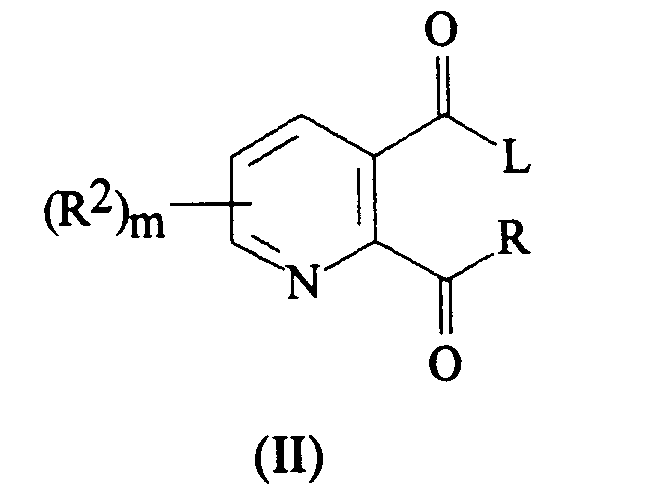
wherein R, R² and m are as hereinbefore defined and L is a leaving group, with a hydrazine of formula III or a salt thereof:
R¹-NHNH₂ (III)
wherein R¹ is as hereinbefore defined. Generally L is -OH, straight- or branched- chain alkoxy containing up to 4 carbon atoms (e.g. ethoxy), or halogen, for example chlorine. The reaction is generally carried out in a solvent such as toluene or ethanol. Where the hydrazine of formula III is used in the form of a salt (such as the hydrochloride) the reaction is generally performed in the presence of a base or acid acceptor such as triethylamine or potassium carbonate. The reaction is generally performed from room temperature to the reflux temperature of the mixture and preferably with azeotropic removal of water from the mixture. A number of the compounds of formula II are novel and as such constitute a further feature of the present invention. - According to a further feature of the present invention compounds of formula I in which X represents oxygen may be prepared by the cyclisation of a compound of formula IIa:

wherein R, R¹, R², m and L are as hereinbefore defined. The reaction is generally carried out in a alcoholic solvent such as methanol or ethanol in the presence of a base or acid acceptor such as triethylamine or potassium carbonate optionally in the presence of a catalyst, for example para-toluenesulphonic acid. The reaction is generally performed at a temperature from room temperature to the reflux temperature of the mixture and preferably with azeotropic removal of water from the mixture. - A number of the compounds of formula IIa are novel and as such constitute a further feature of the present invention.
- According to a further feature of the present invention compounds of formula I wherein X represents sulphur may be prepared from corresponding compounds of formula I in which X represents oxygen by reaction with a thionation reagent to convert the carbonyl group to a thiocarbonyl group. Suitable thionation reagents include Lawessons' Reagent, i.e. [2,4-bis(4-methoxyphenyl)-1,3-dithia-2,4-diphosphetane-2,4-disulphide], and phosphotus pentasulphide. The reaction is generally carried out in a suitable solvent, for example toluene, at a temperature from 50oC to the reflux temperature of the mixture.
- Intermediates in the preparation of compounds of formula I may be prepared by the application or adaptation of known methods.
- Compounds of formula II wherein L is OH or straight- or branched- chain alkoxy containing up to 4 carbon atoms may be prepared by the oxidation of a compound of formula IV:

wherein R, R² and m are as hereinbefore defined, to convert the cyano-methylene group to a carbonyl group. The reaction is carried out in the presence of a base, for example lithium diisopropylamide, potassium carbonate or sodium hydride, in an anhydrous solvent, for example dimethyl sulphoxide, tetrahydrofuran (THF), 1,4-dioxane or acetonitrile, at temperatures from -72oC to the reflux temperature of the mixture. Generally the oxidant used is air or oxygen. - Alternatively, the reaction may be carried out in a two-phase system comprising an organic solvent such as toluene or dichloromethane and an aqueous solution of a base, for example sodium hydroxide, in the presence of a quaternary ammonium salt, for example triethyl benzylammonium chloride. Generally the oxidant used is air or oxygen. The reaction is generally performed at a temperature from room temperature to the reflux temperature of the mixture.
- Compounds of formula II wherein L is straight- or branched-chain alkoxy containing up to 4 carbon atoms and R is hydrogen may also be prepared by the reduction of the corresponding pyridine dicarboxylate of formula II in which R is replaced by OH, for example as described by Queguiner et al., Bull. Soc. Chim. Fr., 1969, 3678.
- Compounds of formula II in which L is straight- or branched-chain alkoxy containing up to 4 carbon atoms or halogen may be prepared from the corresponding carboxylic acid of formula II in which L represents -OH by the application or modification of known methods.
- Compounds of formula IIa in which L is hydroxy may be prepared by the reaction of a compound of formula II wherein R, R² and m are as hereinbefore defined with a compound of formula III wherein R¹ is as hereinbefore defined. The reaction is generally performed in a solvent such as ethanol or methanol. The reaction is generally carried out at a temperature from ambient to the reflux temperature of the solvent.
- Compounds of formula IIa in which L is not hydroxy may be prepared by the reaction of a compound of formula II wherein R, R² and m are as hereinbefore defined with a compound of formula III wherein R¹ is as hereinbefore defined, in the presence of a Lewis acid (preferably titanium tetrachloride). The reaction is generally performed in a solvent such as hexane or toluene and at a temperature from -20oC to the reflux temperature of the mixture. This reaction is particularly useful for preparing compounds of formula IIa where L is straight- or branched- chain alkoxy having up to 4 carbon atoms, and the general method is described in the literature (e.g. J. Organic Chem. 1967, Volume 32, p3246).
- Certain compounds of formula III may be prepared by diazotisation and reduction of a compound of formula R¹NH₂. Diazotisation is typically carried out using sodium nitrite and hydrochloric acid or sulphuric and acetic acids. The temperature of the reaction is generally between 0o and 80oC. The reducing agent is, for example tin (II) chloride and the solvent is hydrochloric acid.
- Compounds of formula III may also be prepared by reacting hydrazine hydrate with a suitable compound of formula R¹-Y⁴, wherein Y⁴ is chlorine or fluorine, for example where R¹ represents pyridine or an aromatic ring activated by an electron withdrawing group, for example trifluoromethyl. The reaction is performed in a solvent, for example ethoxyethanol at a temperature from 60oC to reflux temperature of the solvents.
- Compounds of formula IV in which L is straight- or branched-chain alkoxy containing up to 4 carbon atoms, or preferably -OH, may be prepared by the reaction between a nicotinic acid derivative of formula V:

wherein R² and m are as hereinbefore defined and Y is a leaving group, for example halogen, and a nitrile of formula VI:
RCH₂CN (VI)
wherein R is as hereinbefore defined. The reaction is performed in the presence of a base, for example sodium hydride, sodium amide or an alkali metal alkoxide in a solvent, for example toluene, 1,4-dioxane or THF, at temperatures between 0oC and the reflux temperature of the solvent. The reaction may be optionally performed in the presence of a phase transfer catalyst, for example tris[2-(2-methoxyethoxy)ethyl]amine (commonly known as TDA-1). - Compounds of formula IV in which L is -OH or straight- or branched- chain alkoxy containing up to 4 carbon atoms and R represents a straight- or branched- chain alkyl, alkenyl or alkynyl group containing up to six carbon atoms optionally substituted by one or more halogen atoms, or a group selected from -[CR³R⁴]n-(phenyl)-(R⁵)q, -[CR³R⁴]n-Ar and -[CR³R⁴]n-Het, wherein n is one or two, may be prepared by the reaction of a 2-cyanomethylnicotinic acid derivative of formula VII:
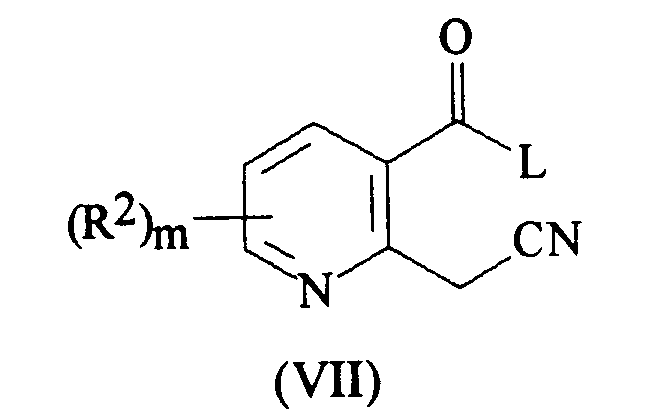
wherein R² and m are as hereinbefore defined and L is -OH or straight- or branched- chain alkoxy containing up to 4 carbon atoms, with a compound of formula VIII:
R-Z (VIII)
wherein R represents a straight- or branched- chain alkyl, alkenyl or alkynyl group containing up to six carbon atoms optionally substituted by one or more halogen atoms, or a group selected from -[CR³R⁴]n-(phenyl)-(R⁵)q, -[CR³R⁴]n-Ar and -[CR³R⁴]n-Het, wherein n is one or two, and Z is a leaving group, for example halogen or tosyl. Where R is a straight- or branched-chain alkyl, alkenyl or alkynyl group containing up to six carbon atoms optionally substituted by one or more halogen atoms, Z is not attached to an unsaturated carbon atom. The reaction is performed in the presence of a base and is widely described in the chemical literature (for example, as described by Masuyama et al., Chem. Lett., 1977,1439). - Compounds of formula VI may be prepared by cyanation of a compound of formula IX:
RCH₂Y¹ (IX)
wherein R is as hereinbefore defined and Y¹ is a leaving group, for example chlorine or bromine. Preferably sodium cyanide is the cyanide source and the reaction is generally performed in the presence of a solvent, for example aqueous ethanol. The reaction temperature is between room temperature and the reflux temperature of the solvent mixture. - Compounds of formula (IX) in which Y¹ is halogen may be prepared by halogenation of a compound of formula RCH₂OH. The halogen source is, for example phosphorus tribromide. The reaction is conducted in a solvent, for example diethyl ether, at a temperature between 0oC and the reflux temperature of the solvent.
- Compounds of the formula (IX) wherein Y¹ is chlorine or bromine may also be prepared by halogenation of compounds of the formula RCH₃ by known methods, for example in the presence of a suitable halogen source, for example N-chloro or N-bromosuccinimide in a solvent, e.g. carbon tetrachloride or chloroform, at a temperature between room temperature and the reflux temperature of the solvent. The reaction is preferably conducted in the presence of a radical initiator, for example benzoyl peroxide.
- Compounds of formula RCH₂OH may be prepared by reduction of a compound of formula RC(O)Y², wherein Y² is hydrogen, OH or alkoxy. Suitable reducing agents include for example sodium borohydride, lithium aluminium hydride and diisobutyl aluminium hydride and the solvent is, for example ethanol, diethyl ether or tetrahydrofuran. The reaction temperature is generally between 0o and the reflux temperature of the solvent.
- Compounds of formulae RCH₂OH and RC(O)Y² may be prepared by the lithiation of suitable compounds of formula RH followed by condensation with paraformaldehyde, dimethylformamide or carbon dioxide. The reaction is carried out in a solvent, for example diethyl ether or THF and the lithiating agent is, for example lithium diisopropylamide in the presence of tetramethylenediamine. This reaction is described in the literature, for example in European Patent No. 333658 or by G Jones et al, J.Chem.Soc.Perkin 1,1982, 967.
- Compounds of formulae RCH₂OH and RC(O)Y² may also be prepared by a lithium-halogen exchange reaction on a compound of formula RBr, followed by condensation with paraformaldehyde, dimethylformamide or carbon dioxide. The reaction is carried out using, for example a lithium reagent such as n-butyl lithium, and a solvent such as diethyl ether or THF. The reaction is generally performed between -80o and 0oC.
- Compounds of formula RBr may be prepared by bromination of suitable compounds of formula RH using for example bromine and iron powder in a suitable solvent, for example carbon tetrachloride at a temperature between 0oC and the reflux temperature of the solvent.
- Compounds of the formula R¹NH₂ may be prepared by reduction of a compound of formula R¹NO₂, for example using tin (II) chloride in hydrochloric acid at a temperature from 0o to 60oC.
- Compounds of formula R¹NO₂ may be prepared by the nitration of suitable compounds of the formula R¹H, for example using a mixture of nitric and sulphuric acids at a temperature between ambient and 100oC. This reaction is described in the literature, e.g. European Patent No. 537519.
- Compounds of formula R¹NH₂ may also be prepared by the cleavage of a compound of the formula R¹NHC(O)Y³, wherein Y³ is alkyl (preferably t-butyl), for example using iodotrimethylsilane in a solvent, for example acetonitrile at ambient temperature:
- Compounds of the formula R¹NHC(O)Y³ may be prepared by rearrangement of an azide of formula R¹C(O)N₃. This is typically achieved by refluxing in a solvent such as toluene, followed by addition of an alcohol (preferably t-butanol) and heating at reflux.
- Compounds of formula R¹C(O)N₃ may be prepared by the reaction of an acid of the formula R¹CO₂H with diphenylphosphoryl azide in dimethylformamide and triethylamine at a temperature between 0o and 50oC.
- Compounds of formula R¹NH₂ may also be prepared by treating an amide of formula R¹C(O)NH₂ with aqueous sodium hypochlorite and sodium hydroxide. The reaction is generally performed at a temperature from 0o to 80oC.
- Compounds of formula R¹C(O)NH₂ and R¹C(O)N₃ may be prepared by the reaction of an acid chloride of the formula R¹COCl with aqueous ammonia or sodium azide respectively.
- Acid chlorides of formula R¹C(O)Cl may be prepared by reacting an acid of formula R¹CO₂H with a chlorinating reagent, e.g. thionyl chloride at reflux.
- Compounds of formulae V, VII and VIII are known or may be prepared by the application of known methods. Agriculturally acceptable salts of compounds of formula (I) may be prepared by known methods.
- The following Examples illustrate the preparation of compounds of formula I and the Reference Examples illustrate the preparation of intermediates. In the present specification m.p. means melting point. Where the letters NMR appear the characteristics of a nuclear magnetic spectra follow. Unless otherwise stated percentages are by weight.
- Triethylamine (1.81g) was added to 4-fluorophenylhydrazine hydrochloride (2.91g) in toluene. 2-(2,3-Difluoromethylenedioxybenzoyl)nicotinic acid (4.6g) was added and the mixture stirred at reflux for 4 hours. Water was removed azeotropically from the mixture using a Dean-Stark apparatus. The reaction mixture was then washed with 2N hydrochloric acid and brine. The organic phase was dried then evaporated. The crude product was triturated with diethyl ether/hexane to yield 8-(2,3-difluoromethylenedioxyphenyl)-6-(4-fluorophenyl)pyrido[2,3-d]-pyridazin-5-one (compound 1, 3.43g) as a beige solid, m.p. 173-174oC.
- By proceeding similarly the following compounds of formula (I) were prepared:
6-(4-chlorophenyl)-8-(2,3-difluoromethylenedioxyphenyl)pyrido[2,3-d]pyridazin-5-one (compound 2), m.p. 160-161.4oC;
8-(3,4-difluoromethylenedioxyphenyl)-6-(4-fluorophenyl)pyrido[2,3-d]pyridazin-5-one (compound 4), m.p. 176-177.4oC;
6-(4-fluorophenyl)-8-(2,3-methylenedioxyphenyl)pyrido[2,3-d]pyridazin-5-one (compound 5), m.p. 165.4-167.4oC. - 5-Chloro-2-(2,3-difluoromethylenedioxybenzoyl)nicotinic acid (2.5g) was added to a stirred suspension of 4-fluorophenylhydrazine hydrochloride (1.54g) in ethanol. Anhydrous sodium acetate (0.78g) was added and the resulting mixture was stirred at reflux for 6 hours then allowed to stand at room temperature over the weekend. The solvent was evaporated. The residue was suspended in 2M hydrochloric acid and extracted with ethyl acetate. The organic extract was washed with aqueous sodium bicarbonate then water then dried and evaporated. The resulting red solid was triturated with ether/cyclohexane then further purified by column chromatography (dichloromethane eluent). Further trituration of the resulting product with cyclohexane yielded 3-chloro-8-(2,3-difluoromethylenedioxyphenyl)-6-(4-fluorophenyl)pyrido[2,3-d]pyridazin-5-one (compound 7, 1.29g) as a peach solid, m.p. 164-165oC.
- By proceeding in a similar manner the following compound was prepared:-
8-(2,3-difluoromethylenedioxyphenyl-3-fluoro-6-(4-fluorophenyl)pyrido[2,3-d]pyridazin-5-one (compound 13), m.p. 159-161oC. - 2-(2,3-Difluoromethylenedioxybenzoyl)nicotinic acid (6.14g) was added to a solution of 4-trifluoromethylphenylhydrazine (3.52g) in toluene and the mixture was stirred at reflux temperature for 4 hours. Water was removed azeotropically using a Dean-Stark apparatus. The reaction mixture was washed successively with 2N hydrochloric acid, saturated sodium hydrogen carbonate and brine. The organic phase was dried and the solvent evaporated. The crude product was triturated with ether/hexane to yield 8-(2,3-difluoromethylenedioxyphenyl)-6-(4-trifluoromethylphenyl)pyrido[2,3-d]pyridazin-5-one (compound 3) as an orange solid (6.18g), m.p. 181.6-182oC.
- By proceeding in a similar manner (but replacing toluene with ethanol as solvent), the following compounds of formula I were prepared:-
6-(3,4-difluoromethylenedioxyphenyl)-8-(3-trifluoromethylphenyl)pyrido[2,3-d]pyridazin-5-one (compound 6), m.p. 102.5-106oC;
3-chloro-8-(2,3-difluoromethylenedioxyphenyl)-6-(4-trifluoromethylphenyl)pyrido[2,3-d]pyridazin-5-one (compound 8), m.p. 186-187oC;
6-(3-cyano-4-fluorophenyl)-8-(2,3-difluoromethylenedioxyphenyl)pyrido[2,3-d]pyridazin-5-one (compound 9), m.p. 209 -210.2oC;
8-(2,3-difluoromethylenedioxyphenyl)-6-(4-fluoro-3-trifluoromethylphenyl)pyrido[2,3-d]pyridazin-5-one (compound 10), m.p. 177.6-178.6oC;
6-(4-cyanophenyl)-8-(2,3-difluoromethylenedioxyphenyl)pyrido[2,3-d]pyridazin-5-one (compound 11), m.p. 213.4-214oC;
8-(2,3-difluoromethylenedioxyphenyl)-6-(3,4-difluorophenyl)pyrido[2,3-d]pyridazin-5-one (compound 12), m.p. 158.5-159oC;
8-(2,3-difluoromethylenedioxyphenyl)-3-fluoro-6-(4-trifluoromethylphenyl)pyrido[2,3-d]pyridazin-5-one (compound 14), m.p. 188-189oC. - A solution of 2,3-difluoromethylenedioxybenzoyl cyanide (30.2g) in dry 1,4-dioxane was added to a stirred suspension of sodium hydride (60% as an oil suspension, 18.24g) in dry 1,4-dioxane and stirred for 30 minutes. TDA-1 (0.44ml) was added and the reactions stirred for a further 5 minutes. A solution of 2-chloronicotinic acid (23.9g) in 1,4-dioxane was added. The reaction mixture was stirred at reflux temperature for 3 hours. The reaction mixture was allowed to cool to 70oC and air was then passed through the stirred mixture for 3.5 hours, then left overnight at room temperature. Water was cautiously added and the reaction mixture was poured into water, washed with cyclohexane and filtered through "HiFlo" silica. The resulting solution was acidified to pH 2 with concentrated hydrochloric acid and extracted with ethyl acetate, washed with brine and water, dried and evaporated to yield 2-(2,3-difluoromethylenedioxybenzoyl)nicotinic acid (39.1g), m.p. 120-140oC.
- By proceeding in a similar manner the following compounds were prepared:-
2-(3,4-difluoromethylenedioxybenzoyl)nicotinic acid, NMR(CDCl₃): 7.07(d,1H), 7.38-7.6(m,3H), 8.35(dd,1H), 8.73(dd,1H);
2-(2,3-methylenedioxybenzoyl)nicotinic acid, m.p. 160-165oC;
5-chloro-2-(2,3-difluoromethylenedioxybenzoyl)nicotinic acid, m.p. 115-120oC;
2-(2,3-difluoromethylenedioxybenzoyl)-5-fluoronicotinic acid. - 2,3-Difluoromethylenedioxybenzyl bromide (40.4g) was dissolved in ethanol and potassium cyanide (11.3g) was added. The mixture was stirred at 70oC for 5 hours. Water and a further portion of potassium cyanide (2g) were added and the mixture was stirred at 70oC for a further 3 hours. Most of the solvent was removed in vacuo and water was added to the residue, which was extracted with diethyl ether, washed with water, dried and concentrated to yield 2,3-difluoromethylenedioxybenzyl cyanide as a yellow oil, (30.2g), NMR (CDCl₃): 3.80(s,2H), 7.10(m,3H).
- By proceeding in a similar manner the following compounds were prepared;
3,4-difluoromethylenedioxybenzyl cyanide, NMR (CDCl₃): 3.63(s,2H), 7.0(s,3H);
2,3-methylenedioxybenzyl cyanide, m.p. 65.8-68.2oC. - Phosphorus tribromide (47g) was added to a solution of 2,3-difluoromethylenedioxybenzyl alcohol (32g) in diethyl ether at 0oC. After 0.5 hours the reaction mixture was allowed to warm to ambient temperature and was stirred at ambient temperature for 3 hours. The reaction mixture was then cooled to 0oC, methanol was added followed by water, the mixture was extracted with diethyl ether, separated and the organic layer washed with saturated sodium bicarbonate (until neutral), dried and the solvent removed to yield 2,3-difluoromethylenedioxybenzyl bromide as a pale yellow oil, (40.4g), NMR (CDCl₃): 4.50(s,2H), 7.10(m,3H).
- By proceeding in a similar manner, the following compounds were prepared:-
3,4-difluoromethylenedioxybenzyl bromide, NMR (CDCl₃); 4.48(s,2H), 6.98-7.18(d of d/s,3H);
2,3-methylenedioxybenzyl bromide. - A solution of sodium borohydride (5g) in methanol was added to a solution of 2,3-difluoromethylenedioxybenzaldehyde (36g) in methanol with cooling so that the temperature did not exceed 10oC. The reaction mixture was then allowed to warm to ambient temperature and stirred for 1 hour. Most of the methanol was evaporated and the residue was poured into cold 20% sodium hydroxide solution, extracted with ether, separated and washed with brine (until neutral), dried and the solvent removed to yield 2,3-difluoromethylenedioxybenzyl alcohol as a colourless oil (33.7g), NMR (CDCl₃): 2.10(br,1H), 4.80(d,2H), 7.00(m,1H), 7.10(m,2H).
- By proceeding in a similar manner, the following compound was prepared:-
3,4-difluoromethylenedioxybenzyl alcohol, NMR (CDCl₃): 2.15(br.s,1H), 4.66(s,2H), 6.95-7.16(m,3H). - A solution of ethyl 2,3-methylenedioxybenzoate (5g) in diethyl ether was added to a suspension of lithium aluminium hydride (0.97g) in diethyl ether under an inert atmosphere. The resulting mixture was refluxed for 2 hours. A further quantity of lithium aluminium hydride (0.25g) was added and the mixture was refluxed for a further 1 hour. The mixture was cooled and the excess lithium aluminium hydride was decomposed by addition of ethyl acetate then 1M hydrochloric acid. The mixture was then separated, the organic phase was washed with 1 M hydrochloric acid then water, dried and the solvent evaporated to yield 2,3-methylenedioxybenzyl alcohol as a pale yellow oil (3.41g). NMR (CDCl₃) 4,7(s,2H), 5.95(s,2H), 6.76-6.87(m,3H).
- A solution of sodium nitrite (3g) in concentrated sulphuric acid (25ml) was added dropwise to a cooled (0oC) solution of 3,4-(difluoromethylenedioxy)aniline (6.92g) in propionic acid (50ml) and concentrated sulphuric acid (5ml) such that the reaction temperature did not exceed 5oC. The resulting mixture was stirred at 0-5oC for a further 1 hour and then allowed to reach room temperature over a period of 1 hour. The mixture was recooled to 0oC. A solution of stannous chloride dihydrate (28.8g) in concentrated hydrochloric acid (21ml) was then added to the stirred mixture so that the reaction temperature did not exceed 5oC. The resulting mixture was stirred at room temperature for one hour and then diluted with 50% sodium hydroxide to pH 14. The mixture was extracted with diethyl ether. The organic extracts were washed with water, dried and evaporated to yield 3,4-(difluoromethylenedioxy)phenyl hydrazine as a dark oil (6.15g), NMR (CDCl₃) 3.6 (br.s,2H), 5.2(br.s,1H), 6.47(dd,1H), 6.65(d,1H), 6.88(d,1H).
- By proceeding in a similar manner the following compounds were prepared:-
3-cyano-4-fluorophenylhydrazine, NMR (DMSO-d₆) 4.1 (br.s,2H), 7.0-7.38(m,4H);
4-fluoro-3-trifluoromethylphenylhydrazine, NMR (CDCl₃) 3.65(br.s,2H), 5.27(br.s,1H), 6.9-7.17(m,3H);
4-cyanophenylhydrazine, m.p. 67-76oC;
3,4-difluorophenylhydrazine, NMR (CDCl₃) 3.57(br.s,2H), 5.15(br.s,1H), 6.5(m,1H), 6.7(m,1H), 7.0(m,1H). - Stannous chloride dihydrate (39.5g) was added to a cooled mixture of 3,4-(difluoromethylenedioxy)nitrobenzene (11g), concentrated hydrochloric acid (66ml), water and tetrahydrofuran. The reaction temperature was not allowed to exceed 40oC. The mixture was stirred at room temperature, under an inert atmosphere for 3 days. The mixture was diluted with water, basified with 50% sodium hydroxide and extracted with diethyl ether. The ether extracts were washed with brine, dried and evaporated to yield 3,4-(difluoromethylenedioxy)aniline as a dark oil (2.2g). NMR (CDCl₃) 3.65 (brs,2H), 6.3(dd,1H), 6.4(d,1H), 6.82(d,1H).
- By proceeding in a similar manner, the following compound was prepared;
3-cyano-4-fluoroaniline, m.p. 99-100oC. - 2-Chloro-5-nitronicotinic acid (3.3g) was added portionwise to a solution of stannous chloride (12.6g) in concentrated hydrochloric acid so that the reaction temperature did not exceed 40oC. The mixture was then heated to 90oC and maintained at that temperature for 1 hour. The mixture was allowed to cool to room temperature and water was added. The mixture was placed in a fridge overnight. The crystalline product was collected by filtration, washed with water then dried to yield 5-amino-2-chloronicotinic acid hydrochloride as a colourless solid (1.1g), NMR(DMSO-d₆) 7.0(br.s,2H), 7.6(s,1H), 7.95(s,1H).
- A solution of 3-bromo-2,5-dichloropyridine (10g) in diisopropyl ether was added dropwise to a stirred solution of n-butyllithium (2.5 M in hexanes, 17.7ml) in diisopropyl ether at -70oC under an inert atmosphere so that the reaction temperature did not exceed -68oC. An excess of solid carbon dioxide was then added to the suspension and the mixture was stirred for 2 hours (excess carbon dioxide evaporates, temperature reaches 10oC.).
- Ice/water was added, the mixture was stirred. The layers were separated. The aqueous layer was acidified to pH 2 with concentrated hydrochloric acid. The resulting precipitate was extracted into diethyl ether. The ether extracts were washed with water, dried (magnesium sulphate) and evaporated to yield a solid which was triturated in light petroleum to yield 2,5-dichloronicotinic acid as a cream solid (7.04g), m.p. 160-162oC.
- 5-Amino-2-chloronicotinic acid hydrochloride (3.8g) was dissolved in 50% tetrafluoroboric acid. Tetrahydrofuran was added and the resulting slurry was cooled to 0oC. An aqueous solution of sodium nitrite (1.6g) was added and the reaction mixture was then maintained at 0-10oC for a further 2 hours. The precipitate was collected by filtration, washed with cold (0-5oC) ethanol then dried to yield 2-chloro-5-diazonium tetrafluoroborate nicotinic acid as a white solid (4.3g), m.p. 143-4oC.
- 1,2-Dichlorobenzene was heated to 155oC. The diazonium tetrafluoroborate salt (5g) prepared as described above was added portionwise as a slurry in 1,2-dichlorobenzene so that the reaction temperature was maintained at 150-155oC. On completion of addition, the mixture was stirred at 150oC for 15 minutes then allowed to cool to room temperature. The mixture was extracted with saturated sodium bicarbonate solution then water. The extracts were washed with diethyl ether and then acidified to pH 1 with concentrated hydrochloric acid. The mixture was extracted with ethyl acetate. The organic extracts were dried (magnesium sulphate) and evaporated to yield an orange gum which was triturated with hexane/diethyl ether to yield 2-chloro-5-fluoronicotinic acid as a yellow solid (1.4g), m.p. 123-8oC.
- Dimethylformamide (4 drops) was added to a solution of 2-hydroxy-5-nitronicotinic acid (5g) in phosphorus oxychloride (10ml). The mixture was stirred at the reflux temperature for 3 hours. Excess solvent was removed by evaporation and the residue was then poured carefully into water, keeping the temperature of the resulting mixture at below 40oC. The mixture was stirred at room temperature for a further 30 minutes then extracted with ethyl acetate. The extracts were washed with water, dried (magnesium sulphate) and evaporated. The resulting residue was triturated with ether/hexane to yield 2-chloro-5-nitronicotinic acid as a pale yellow solid (3.6g), m.p. 123-7oC.
- Fuming nitric acid (26ml) was added to a stirred solution of 2-hydroxynicotinic acid (34.8g) in concentrated sulphuric acid (100ml) at 35-40oC. The resulting mixture was then stirred at 50oC for 4 hours. The mixture was cooled to room temperature and then poured onto ice. The resulting precipitate was collected by filtration, air-dried on the filter then recrystallised from ethanol to yield 2-hydroxy-5-nitronicotinic acid as a pale yellow solid (39.6g), m.p. 210-22oC.
- According to a further feature of the present invention, there are provided compositions suitable for herbicidal use comprising one or more of the pyrido[2,3-d]pyridazin-5-one and -5-thione derivatives of formula I or an agriculturally acceptable salt thereof, in association with, and preferably homogeneously dispersed in, one or more compatible agriculturally- acceptable diluents or carriers and/or surface active agents [i.e. diluents or carriers and/or surface active agents of the type generally accepted in the art as being suitable for use in herbicidal compositions and which are compatible with compounds of formula I]. The term "homogeneously dispersed" is used to include compositions in which the compounds of formula I are dissolved in other components. The term "herbicidal compositions" is used in a broad sense to include not only compositions which are ready for use as herbicides but also concentrates which must be diluted before use. Preferably, the compositions contain from 0.05 to 90% by weight of one or more compounds of formula I.
- The herbicidal compositions may contain both a diluent or carrier and surface-active (e.g. wetting, dispersing, or emulsifying) agent. Surface-active agents which may be present in herbicidal compositions of the present invention may be of the ionic or non-ionic types, e.g. sulphoricinoleates, quaternary ammonium derivatives, products based on condensates of ethylene oxide with alkyl and polyaryl phenols, e.g. nonyl- or octyl-phenols, or carboxylic acid esters of anhydrosorbitols which have been rendered soluble by etherification of the free hydroxy groups by condensation with ethylene oxide, alkali and alkaline earth metal salts of sulphuric acid esters and sulphonic acids such as dinonyl- and dioctyl-sodium sulphonosuccinates and alkali and alkaline earth metal salts of high molecular weight sulphonic acid derivatives e.g. sodium and calcium lignosulphonates and sodium and calcium alkylbenzene sulphonates.
- Suitably, the herbicidal compositions according to the present invention may comprise up to 10% by weight, e.g. from 0.05% to 10% by weight, of surface-active agent but, if desired, herbicidal compositions according to the present invention may comprise higher proportions of surface-active agent, for example up to 15% by weight in liquid emulsifiable suspension concentrates and up to 25% by weight in liquid water soluble concentrates.
- Examples of suitable solid diluents or carriers are aluminium silicate, microfine silicon dioxide, talc, chalk, calcined magnesia, kieselguhr, tricalcium phosphate, powdered cork, adsorbent carbon black and clays such as kaolin and bentonite. The solid compositions (which may take the form of dusts, granules or wettable powders) are preferably prepared by grinding the compounds of formula I with solid diluents or by impregnating the solid diluents or carriers with solutions of the compounds of formula I in volatile solvents, evaporating the solvents and, if necessary, grinding the products so as to obtain powders. Granular formulations may be prepared by absorbing the compounds of formula I (dissolved in suitable solvents, which may, if desired, be volatile) onto the solid diluents or carriers in granular form and, if desired, evaporating the solvents, or by granulating compositions in powder form obtained as described above. Solid herbicidal compositions, particularly wettable powders and granules, may contain wetting or dispersing agents (for example of the types described above), which may also, when solid, serve as diluents or carriers.
- Liquid compositions according to the invention may take the form of aqueous, organic or aqueous-organic solutions, suspensions and emulsions which may incorporate a surface-active agent. Suitable liquid diluents for incorporation in the liquid compositions include water, glycols, glycol ethers, tetrahydrofurfuryl alcohol, acetophenone, cyclohexanone, isophorone, N-alkyl pyrrolidones, toluene, xylene, mineral, animal and vegetable oils, esterified vegetable oils and light aromatic and naphthenic fractions of petroleum (and mixtures of these diluents). Surface-active agents, which may be present in the liquid compositions, may be ionic or non-ionic (for example of the types described above) and may, when liquid, also serve as diluents or carriers.
- Powders, dispersible granules and liquid compositions in the form of concentrates may be diluted with water or other suitable diluents, for example mineral or vegetable oils, particularly in the case of liquid concentrates in which the diluent or carrier is an oil, to give compositions ready for use.
- When desired, liquid compositions of the compound of formula I may be used in the form of self-emulsifying concentrates containing the active substances dissolved in the emulsifying agents or in solvents containing emulsifying agents compatible with the active substances, the simple addition of such concentrates to water producing compositions ready for use.
- Liquid concentrates in which the diluent or carrier is an oil may be used without further dilution using the electrostatic spray technique.
- Herbicidal compositions according to the present invention may also contain, if desired, conventional adjuvants such as adhesives, protective colloids, thickeners, penetrating agents, spreading agents, stabilisers, sequestering agents, anti-caking agents, colouring agents and corrosion inhibitors. These adjuvants may also serve as carriers or diluents.
- Unless otherwise specified, the following percentages are by weight. Preferred herbicidal compositions according to the present invention are:
aqueous suspension concentrates which comprise from 10 to 70% of one or more compounds of formula I, from 2 to 10% of surface-active agent, from 0.1 to 5% of thickener and from 15 to 87.9% of water;
wettable powders which comprise from 10 to 90% of one or more compounds of formula I, from 2 to 10% of surface-active agent and from 8 to 88% of solid diluent or carrier;
water soluble or water dispersible powders which comprise from 10 to 90% of one or more compounds of formula I, from 2 to 40% of sodium carbonate and from 0 to 88% of solid diluent;
liquid water soluble concentrates which comprise from 5 to 50%, e.g. 10 to 30%, of one or more compounds of formula I, from 0 to 25% of surface-active agent and from 10 to 90%, e.g. 45 to 85%, of water miscible solvent, e.g. triethylene glycol, or a mixture of water-miscible solvent and water;
liquid emulsifiable suspension concentrates which comprise from 10 to 70% of one or more compounds of formula I, from 5 to 15% of surface-active agent, from 0.1 to 5% of thickener and from 10 to 84.9% of organic solvent, e.g. mineral oil;
water dispersible granules which comprise from 1 to 90%, e.g. 25 to 75% of one or more compounds of formula I, from 1 to 15%, e.g. 2 to 10%, of surface-active agent and from 5 to 95%, e.g. 20 to 60%, of solid diluent, e.g. clay, granulated with the addition of water to form a paste and then dried and
emulsifiable concentrates which comprise 0.05 to 90%, and preferably from 1 to 60% of one or more compounds of formula I, from 0.01 to 10%, and preferably from 1 to 10%, of surface-active agent and from 9.99 to 99.94%, and preferably from 39 to 98.99%, of organic solvent. - Herbicidal compositions according to the present invention may also comprise the compounds of formula I in association with, and preferably homogeneously dispersed in, one or more other pesticidally active compounds and, if desired, one or more compatible pesticidally acceptable diluents or carriers, surface-active agents and conventional adjuvants as hereinbefore described.
- Examples of other pesticidally active compounds which may be included in, or used in conjunction with, the herbicidal compositions of the present invention include herbicides, for example to increase the range of weed species controlled for example alachlor [2-chloro-2,6'-diethyl-N-(methoxy-methyl)-acetanilide], atrazine [2-chloro-4-ethylamino-6-isopropylamino-1,3,5-triazine], bromoxynil [3,5-dibromo-4-hydroxybenzonitrile], chlortoluron [N'-(3-chloro-4-methylphenyl)-N,N-dimethylurea], cyanazine [2-chloro-4-(1-cyano-1- methylethylamino)-6-ethylamino-1,3,5-triazine], 2,4-D [2,4-dichlorophenoxy-acetic acid], dicamba [3,6-dichloro-2-methoxybenzoic acid], difenzoquat [1,2- dimethyl-3,5-diphenylpyrazolium salts], flampropmethyl [methyl N-2-(N- benzoyl-3-chloro-4-fluoroanilino)-propionate], fluometuron [N'-(3-trifluoromethylphenyl)-N,N-dimethylurea], isoproturon [N'-(4-isopropylphenyl)-N,N-dimethylurea], insecticides, e.g. synthetic pyrethroids, e.g. permethrin and cypermethrin, and fungicides, e.g. carbamates, e.g. methyl N-(1-butyl-carbamoyl- benzimidazol-2-yl)carbamate, and triazoles e.g. 1-(4-chloro-phenoxy)-3,3- dimethyl-1-(1,2,4-triazol-1-yl)-butan-2-one.
- Pesticidally active compounds and other biologically active materials which may be included in, or used in conjunction with, the herbicidal compositions of the present invention, for example those hereinbefore mentioned, and which are acids, may, if desired, be utilized in the form of conventional derivatives, for example alkali metal and amine salts and esters.
- According to a further feature of the present invention there is provided an article of manufacture comprising at least one of the pyrido[2,3-d]pyridazin-5-one and pyrido[2,3-d]pyridazin 5-thione derivatives of formula I or, as is preferred, a herbicidal composition as hereinbefore described, and preferably a herbicidal concentrate which must be diluted before use, comprising at least one of the pyrido[2,3-d]pyridazin-5-one and pyrido[2,3-d]pyridazin 5-thione derivativesof formula I within a container for the aforesaid derivative or derivatives of formula I, or a said herbicidal composition, and instructions physically associated with the aforesaid container setting out the manner in which the aforesaid derivative or derivatives of formula I or herbicidal composition contained therein is to be used to control the growth of weeds. The containers will normally be of the types conventionally used for the storage of chemical substances which are solid at normal ambient temperatures and herbicidal compositions particularly in the form of concentrates, for example cans and drums of metal, which may be internally lacquered, and plastics materials, bottles or glass and plastics materials and, when the contents of the container is a solid, for example granular, herbicidal compositions, boxes, for example of cardboard, plastics materials and metal, or sacks. The containers will normally be of sufficient capacity to contain amounts of the N-substituted pyrazole derivative or herbicidal compositions sufficient to treat at least one acre of ground to control the growth of weeds therein but will not exceed a size which is convenient for conventional methods of handling. The instructions will be physically associated with the container, for example by being printed directly thereon or on a label or tag affixed thereto. The directions will normally indicate that the contents of the container, after dilution if necessary, are to be applied to control the growth of weeds at rates of application between 0.01kg and 20kg of active material per hectare in the manner and for the purposes hereinbefore described.
- The following Examples illustrate herbicidal compositions according to the present invention:
- A wettable powder is formed from :
Active ingredient (compound 1) 80% w/w Sodium dodecylbenzene sulphonate 3% w/w Sodium N-methyl-N-oleyl taurate 2% w/w Sodium polycarboxylate 1% w/w Microfine silicon dioxide 2% w/w China clay 12% w/w
by blending the above ingredients and grinding the mixture in an air jet mill. - Similar wettable powders may be prepared as described above by replacing the pyrido[2,3-d]pyridazin-5-one derivative (compound 1) with other compounds of formula I.
- A suspension concentrate is formed from:
Active ingredient (compound 1) 60% w/v Nonyl phenol 9 mole polyethoxylate 0.5% w/v Triethanolamine salt of phosphated tristyryl phenol 16 mole polyethoxylate 1.5% w/v Sodium polycarboxylate 0.4% w/v polysaccharide gum 0.1% w/v propylene glycol 5% w/v silicone antifoam emulsion 0.01% w/v 1,2-benzisothiazolin-3-one solution in diipropylene glycol 0.01% w/v water to 100 volumes
by mixing using a high shear mixer all ingredients into 90% volume of water, then making up to volume with water, then milling the mixture by passing through a horizontal bead mill. - Similar suspension concentrates may be prepared as described above by replacing the pyrido[2,3-d]pyridazin-5-one derivative (compound 1) with other compounds of formula I.
- A granule is formed from
Active ingredient (compound 1) 5% w/w Sepiolite granules 30/60 mesh 95% w/w
by dissolving the active ingredient in n-butanol, then spraying this solution onto sepiolite granules whilst mixing the granules in a tumbler-mixer then evaporating off the n-butanol to leave a granule containing 5% w/w active ingredient. - Similar granules may be prepared as described above by replacing the pyrido[2,3-d]pyridazin-5-one derivative (compound 1) with other compounds of formula I.
- A water dispersible granule is formed from
Active ingredient (compound 1) 75% w/w Sodium lignosulphonate 10% w/w Sodium dialkylnaphthalene sulphonate 3% w/w Clay 12% w/w
by blending the above ingredients, then grinding the mixture in an air-jet mill, then adding water to form a kneadable paste, then extruding this paste to form fine filaments approximately 1mm in diameter, chopping the extrudate into lengths of approximately 4mm then drying these in a fluid bed drier. - Similar water dispersible granules may be prepared as described above by replacing the pyrido[2,3-d]pyridazin-5-one derivative (compound 1) with other compounds of formula I.
- According to a feature of the present invention, there is provided a method for controlling the growth of weeds (i.e. undesired vegetation) at a locus which comprises applying to the locus a herbicidally effective amount of at least one pyrido[2,3-d]pyridazin-5-one or pyridazin-5-thione derivative of formula (I) or an agriculturally acceptable salt thereof. For this purpose, the pyrido[2,3-d]pyridazin-5-one or pyridazin-5-thione derivatives are normally used in the form of herbicidal compositions (i.e. in association with compatible diluents or carriers and/or surface active agents suitable for use in herbicidal compositions), for example as hereinafter described.
- The compounds of formula (I) show herbicidal activity against dicotyledonous (i.e. broad-leafed) and monocotyledonous (e.g. grass) weeds by pre- and/or post-emergence application.
- By the term "pre-emergence application" is meant application to the soil in which the weed seeds or seedlings are present before emergence of the weeds above the surface of the soil. By the term "post-emergence application" is meant application to the aerial or exposed portions of the weeds which have emerged above the surface of the soil. For example, the compounds of formula (I) may be used to control the growth of:
broad-leafed weeds, for example, Abutilon theophrasti, Amaranthus retroflexus, Bidens pilosa, Chenopodium album, Galium aparine, Ipomoea spp. e.g. Ipomoea purpurea, Sesbania exaltata, Sinapis arvensis, Solanum nigrum and Xanthium strumarium, and
grass weeds, for example Alopecurus myosuroides, Avena fatua, Digitaria sanguinalis, Echinochloa crus-galli, Eleusine indica and Setaria spp, e.g. Setaria faberii or Setaria viridis, and
sedges, for example, Cyperus esculentus. - The amounts of compounds of formula (I) applied vary with the nature of the weeds, the compositions used, the time of application, the climatic and edaphic conditions and (when used to control the growth of weeds in crop-growing areas) the nature of the crops. When applied to a crop-growing area, the rate of application should be sufficient to control the growth of weeds without causing substantial permanent damage to the crop. In general, taking these factors into account, application rates between 0.01kg and 5kg of active material per hectare give good results. However, it is to be understood that higher or lower application rates may be used, depending upon the particular problem of weed control encountered.
- The compounds of formula (I) may be used to control selectively the growth of weeds, for example to control the growth of those species hereinbefore mentioned, by pre- or post-emergence application in a directional or non-directional fashion, e.g. by directional or non-directional spraying, to a locus of weed infestation which is an area used, or to be used, for growing crops, for example cereals, e.g. wheat, barley, oats, maize and rice, soya beans, field and dwarf beans, peas, lucerne, cotton, peanuts, flax, onions, carrots, cabbage, oilseed rape, sunflower, sugar beet, and permanent or sown grassland before or after sowing of the crop or before or after emergence of the crop. For the selective control of weeds at a locus of weed infestation which is an area used, or to be used, for growing of crops, e.g. the crops hereinbefore mentioned, application rates between 0.01kg and 4.0kg, and preferably between 0.01kg and 2.0kg, of active material per hectare are particularly suitable. The use of the compounds for controlling weeds in cereal crops (e.g. wheat and barley) is particularly preferred.
- The compounds of formula (I) may also be used to control the growth of weeds, especially those indicated above, by pre- or post-emergence application in established orchards and other tree-growing areas, for example forests, woods and parks, and plantations, e.g. sugar cane, oil palm and rubber plantations. For this purpose they may be applied in a directional or non- directional fashion (e.g. by directional or non-directional spraying) to the weeds or to the soil in which they are expected to appear, before or after planting of the trees or plantations at application rates between 0.25kg and 5.0kg, and preferably between 0.5kg and 4.0kg of active material per hectare.
- The compounds of formula (I) may also be used to control the growth of weeds, especially those indicated above, at loci which are not crop-growing areas but in which the control of weeds is nevertheless desirable.
- Examples of such non-crop-growing areas include airfields, industrial sites, railways, roadside verges, the verges of rivers, irrigation and other waterways, scrublands and fallow or uncultivated land, in particular where it is desired to control the growth of weeds in order to reduce fire risks. When used for such purposes in which a total herbicidal effect is frequently desired, the active compounds are normally applied at dosage rates higher than those used in crop-growing areas as hereinbefore described. The precise dosage will depend upon the nature of the vegetation treated and the effect sought.
- Pre- or post-emergence application, and preferably pre-emergence application, in a directional or non-directional fashion (e.g. by directional or non-directional spraying) at application rates between 1.0kg and 20.0kg, and preferably between 5.0 and 10.0kg, of active material per hectare are particularly suitable for this purpose.
- When used to control the growth of weeds by pre-emergence application, the compounds of formula (I) may be incorporated into the soil in which the weeds are expected to emerge. It will be appreciated that when the compounds of formula (I) are used to control the growth of weeds by post-emergence application, i.e. by application to the aerial or exposed portions of emerged weeds, the compounds of formula (I) will also normally come into contact with the soil and may also then exercise a pre-emergence control on later-germinating weeds in the soil.
- Where especially prolonged weed control is required, the application of the compounds of formula (I) may be repeated if required.
- Representative compounds of formula (I) have been used in herbicidal applications according to the following procedures.
- Appropriate quantities of the compounds used to treat the plants were dissolved in acetone to give solutions equivalent to application rates of up to 4000g test compound per hectare (g/ha). These solutions were applied from a standard laboratory herbicide sprayer delivering the equivalent of 290 litres of spray fluid per hectare.
- The seeds were sown in 70 mm square, 75 mm deep plastic pots in non-sterile soil. The quantities of seed per pot were as follows:-
Weed species Approx number of seeds/pot 1) Broad-leafed weeds Abutilon theophrasti 10 Amaranthus retroflexus 20 Galium aparine 10 Ipomoea purpurea 10 Sinapis arvensis 15 Xanthium strumarium 2. 2) Grass weeds Alopecurus myosuroides 15 Avena fatua 10 Echinochloa crus-galli 15 Setaria viridis 20. 3) Sedges Cyperus esculentus 3. Crop 1) Broad-leafed Cotton 3 Soya 3. 2) Grass Maize 2 Rice 6 Wheat 6. - The compounds of the invention were applied to the soil surface, containing the seeds, as described in (a). A single pot of each crop and each weed was allocated to each treatment, with unsprayed controls and controls sprayed with acetone alone.
- After treatment the pots were placed on capillary matting kept in a glass house, and watered overhead. Visual assessment of crop damage was made 20-24 days after spraying. The results were expressed as the percentage reduction in growth or damage to the crop or weeds, in comparison with the plants in the control pots.
- The weeds and crops were sown directly into John Innes potting compost in 75 mm deep, 70 mm square pots except for Amaranthus which was pricked out at the seedling stage and transferred to the pots one week before spraying. The plants were then grown in the greenhouse until ready for spraying with the compounds used to treat the plants. The number of plants per pot were as follows :-
1) Broad leafed weeds Weed species Number of plants per pot Growth stage Abutilon theophrasti 3 1-2 leaves Amaranthus retroflexus 4 1-2 leaves Galium aparine 3 1st whorl Ipomoea purpurea 3 1-2 leaves Sinapis arvensis 4 2 leaves Xanthium strumarium 1 2-3 leaves. 2) Grass weeds Weed species Number of plants per pot Growth stage Alopecurus myosuroides 8-12 1-2 leaves Avena fatua 12-18 1-2 leaves Echinochloa crus-galli 4 2-3 leaves Setaria viridis 15-25 1-2 leaves. 3) Sedges Weed species Number of plants per pot Growth stage Cyperus esculentus 3 3 leaves. 1) Broad leafed Crops Number of plants per pot Growth stage Cotton 2 1 leaf Soya 2 2 leaves. 2) Grass Crops Number of plants per pot Growth stage Maize 2 2-3 leaves Rice 4 2-3 leaves Wheat 5 2-3 leaves. - The compounds used to treat the plants were applied to the plants as described in (a). A single pot of each crop and weed species was allocated to each treatment, with unsprayed controls and controls sprayed with acetone alone.
- After treatment the pots were placed on capillary matting in a glass house, and watered overhead once after 24 hours and then by controlled sub-irrigation. Visual assessment of crop damage and weed control was made 20-24 days after spraying. The results were expressed as the percentage reduction in growth or damage to the crop or weeds, in comparison with the plants in the control pots.
- When applied at 1000g/hectare pre- or post-emergence, compounds 1 to 14 gave at least 90% reduction in growth of one or more weed species.
Claims (14)
- A method of controlling the growth of weeds at a locus which comprises applying to the locus a herbicidally effective amount of a pyrido[2,3-d]pyridazin-5-one or -5-thione derivative of formula (I):

R and R¹, which may be the same or different, each represents:-
the hydrogen atom,
a straight- or branched chain alkyl, alkenyl or alkynyl group containing up to six carbon atoms optionally substituted by one or more halogen atoms;
a group -(-CR³R⁴)n-(phenyl)-(R⁵)q;
a group -(-CR³R⁴)nHet;
a group -(-CR³R⁴)n-Ar, wherein Ar represents phenyl or pyridyl optionally substituted by one or more groups R⁵ and wherein two substituents on adjacent positions of the ring, together with the two atoms to which they are attached, form a 5- to 7-membered alicyclic ring (which is optionally unsaturated) or an aromatic ring, optionally containing one or more heteroatoms, wherein the alicyclic or aromatic ring is optionally substituted by one or more groups R⁵¹ which may be the same or different;
provided that at least one of the groups R and R¹ represents -(-CR³R⁴)n-Ar;
R² represents:-
a group R⁵;
or phenyl optionally substituted by from one to five groups R⁵ which may be the same or different;
X represents oxygen or sulphur;
m represents zero or an integer from one to three;
where m is greater than one the groups R² may be the same or different;
R³ and R⁴, which may be the same or different, each represents the hydrogen atom or a straight- or branched- chain alkyl group containing up to four carbon atoms optionally substituted by one or more halogen atoms;
R⁵ represents:-
a halogen atom;
a straight- or branched- chain alkyl, alkenyl or alkynyl group containing up to six carbon atoms optionally substituted by one or more halogen atoms; or
a group selected from cyano, nitro, -CO₂R⁶, -S(O)pR⁶, -NR³R⁴, -COR⁶, -S(O)pR⁷, -CO₂R⁷, -OR⁷, -CONR³R⁴, -OSO₂R⁷, -OSO₂R⁸, -OCH₂R⁷, -N(R³)COR⁸, -N(R³)SO₂R⁸, -N(R³)SO₂R⁷, -SO₂NR³R⁴, -Si(R⁸)₃ and -OR⁶;
n represents zero, one or two; where n is two the groups -(-CR³R⁴)- may be the same or different;
q represents zero or an integer from one to five; where q is greater than one the groups R⁵ may be the same or different;
R⁵¹ is as defined above for R⁵ or represents =O, =S or a group -O(-CR⁶¹R⁶²-)r-O-;
Het represents a 5- or 6- membered heterocycle containing from 3 to 5 carbon atoms in the ring and from 1 to 3 heteroatoms in the ring selected from nitrogen, sulphur and oxygen, optionally substituted by one or more groups R⁵ which may be the same or different;
R⁶ represents the hydrogen atom or a straight- or branched-chain alkyl group containing up to six carbon atoms optionally substituted by one or more halogen atoms;
p represents zero, one or two;
r represents one or two; where r is two the groups -(-CR⁶¹R⁶²)- may be the same or different;
R⁷ represents phenyl optionally substituted by from one to five groups which may be the same or different selected from halogen, nitro, cyano, R⁶ and -OR⁶;
R⁸ represents a straight- or branched- chain alkyl group containing up to six carbon atoms optionally substituted by one or more halogen atoms;
R⁶¹ and R⁶², which may be the same or different, each represents a hydrogen or halogen atom or a straight- or branched-chain alkyl group containing up to four carbon atoms optionally substituted by one or more halogen atoms;
or an agriculturally acceptable salt thereof. - A method according to claim 1 in which the locus is an area used, or to be used, for growing of crops and the compound is applied at an application rate from 0.01 kg to 4.0 kg per hectare.
- A method according to claim 1 or 2 in which the locus is an area used for the growth of cereal crops.
- A compound of formula (I) as defined in claim 1 or an agriculturally acceptable salt thereof, with the proviso that when X is oxygen, m is zero and R represents 3,4-methylenedioxyphenyl, R¹ is not selected from the group consisting of hydrogen, phenyl, benzyl, ethyl and 4-pyridylmethyl.
- A compound according to claim 4 wherein:-
R represents a group -(-CR³R⁴)n-Ar, wherein Ar represents phenyl optionally substituted by from one to three groups R⁵ and wherein two substituents in the 2,3- or 3,4- positions of the ring, together with the two atoms to which they are attached, form a 5- or 6- membered alicyclic ring (which is optionally unsaturated) or an aromatic ring, containing one or two heteroatoms selected from oxygen, sulphur and nitrogen, wherein the alicyclic or aromatic ring is optionally substituted by one or more groups R⁵¹ which may be the same or different;
R¹ represents phenyl optionally substituted by from one to five groups R⁵ which may be the same or different;
R² represents:-
a halogen atom;
a straight- or branched- chain alkyl, alkenyl or alkynyl group containing up to six carbon atoms optionally substituted by one or more halogen atoms; or
a group selected from cyano, nitro, -CO₂R⁶, -S(O)pR⁶, -NR³R⁴, -COR⁶ and -OR⁶;
n represents zero;
R⁵¹ represents:-
a halogen atom;
a straight- or branched- chain alkyl group containing up to six carbon atoms optionally substituted by one or more halogen atoms;
a group selected from cyano, nitro, -CO₂R⁶, S(O)pR⁶, -NR³R⁴, -COR⁶, -S(O)pR⁷, -CO₂R⁷, -OR⁷, -CONR³R⁴, -OSO₂R⁷ and -OR⁶; and
X represents oxygen. - A compound according to claim 4 or 5 wherein m is one and R² occupies the 3-position of the pyridyl ring.
- A compound according to claim 4, 5 or 6 wherein
R represents 2,3-methylenedioxyphenyl, wherein the methylene group is optionally substituted by one or two groups R⁵¹ which may be the same or different;
R¹ represents phenyl optionally substituted in the 3- and/or 4-position by R⁵;
R² represents:-
a halogen atom;
a straight- or branched chain alkyl group containing up to four carbon atoms optionally substituted by one or more halogen atoms;
or a group selected from -S(O)pR⁶, -NR³R⁴ and -OR⁶;
R⁵¹ represents:-
a halogen atom; or
a straight- or branched chain alkyl group containing up to four carbon atoms optionally substituted by one or more halogen atoms;
R⁵ represents:-
a halogen atom; a cyano group; or
a straight- or branched chain alkyl group containing up to four carbon atoms optionally substituted by one or more halogen atoms;
m represents zero, one or two; and
X represents oxygen. - A compound according to claim 4 wherein:
R and R¹, which may be the same or different, each represents:-
phenyl substituted in the 3- and/or 4- position by R⁵;
2,3- or 3,4-methylenedioxyphenyl, wherein the methylene group is optionally substituted by two fluorine atoms;
provided that at least one of the groups R and R¹ is 2,3- or 3,4-methylenedioxyphenyl, wherein the methylene group is optionally substituted by two fluorine atoms;
R² represents a halogen atom;
R⁵ represents a halogen atom, trifluoromethyl or cyano;
m represents zero or one; and
X represents oxygen. - A compound according to claim 4 which is:
8-(2,3-difluoromethylenedioxyphenyl)-6-(4-fluorophenyl)pyrido[2,3-d]pyridazin-5-one;
6-(4-chlorophenyl)-8-(2,3-difluoromethylenedioxyphenyl)pyrido[2,3-d]pyridazin-5-one;
8-(2,3-difluoromethylenedioxyphenyl)-6-(4-trifluoromethylphenyl)pyrido[2,3-d]pyridazin-5-one;
8-(3,4-difluoromethylenedioxyphenyl)-6-(4-fluorophenyl)pyrido[2,3-d]pyridazin-5-one;
6-(4-fluorophenyl)-8-(2,3-methylenedioxyphenyl)pyrido[2,3-d]pyridazin-5-one;
6-(3,4-difluoromethylenedioxyphenyl)-8-(3-trifluoromethylphenyl)pyrido[2,3-d]pyridazin-5-one;
3-chloro-8-(2,3-difluoromethylenedioxyphenyl)-6-(4-fluorophenyl)pyrido[2,3-d]pyridazin-5-one;
3-chloro-8-(2,3-difluoromethylenedioxyphenyl)-6-(4-trifluoromethylphenyl)pyrido[2,3-d]pyridazin-5-one;
6-(3-cyano-4-fluorophenyl)-8-(2,3-difluoromethylenedioxyphenyl)pyrido[2,3-d]pyridazin-5-one;
8-(2,3-difluoromethylenedioxyphenyl)-6-(4-fluoro-3-trifluoromethylphenyl)pyrido[2,3-d]pyridazin-5-one;
6-(4-cyanophenyl)-8-(2,3-difluoromethylenedioxyphenyl)pyrido[2,3-d]pyridazin-5-one;
8-(2,3-difluoromethylenedioxyphenyl)-6-(3,4-difluorophenyl)pyrido[2,3-d]pyridazin-5-one;
8-(2,3-difluoromethylenedioxyphenyl)-3-fluoro-6-(4-fluorophenyl)pyrido[2,3-d]pyridazin-5-one; or
8-(2,3-difluoromethylenedioxyphenyl)-3-fluoro-6-(4-trifluoromethylphenyl)pyrido[2,3-d]pyridazin-5-one;
or an agriculturally acceptable salt thereof. - A composition suitable for herbicidal use comprising as active ingredient a herbicidally effective amount of a compound of formula (I) as defined in any one of claims 4 to 9 or an agriculturally acceptable salt thereof, in association with one or more compatible agriculturally- acceptable diluents or carriers.
- A composition according to claim 10 comprising from about 0.05% to about 95% by weight of active ingredient and from about 0.05 to about 25% by weight of surface active agent.
- A composition according to claim 10 or 11 which is in the form of an aqueous suspension concentrate, a wettable powder, a soluble powder, a liquid water soluble concentrate, a liquid emulsifiable suspension concentrate, a granule or an emulsifiable concentrate.
- A process for the preparation of a compound of formula I as defined in claim 1, said process comprising:(a) reacting a compound of formula II:

R¹-NHNH₂ (III)
wherein R¹ is as defined in claim 1;(b) where X represents oxygen, cyclising a compound of formula (IIa): (c) where X is sulphur, treating the corresponding compound of formula I in which X represents oxygen with a thionation reagent to convert the carbonyl group to a thiocarbonyl group;optionally followed by converting the compound of formula I thus obtained into an agriculturally acceptable salt thereof.
 - A compound useful as an intermediate in the preparation of a compound of fomula I as defined in claim 1, wherein said compound is of formula (II):
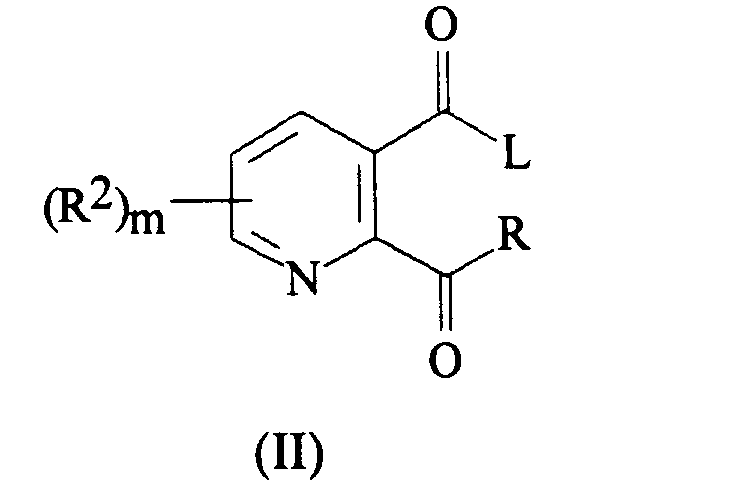

Applications Claiming Priority (3)
| Application Number | Priority Date | Filing Date | Title |
|---|---|---|---|
| GB939314412A GB9314412D0 (en) | 1993-07-13 | 1993-07-13 | New compositions of matter |
| GB9314412 | 1993-07-13 | ||
| CN94108590.2A CN1100262A (en) | 1993-07-13 | 1994-07-17 | new herbicide |
Publications (1)
| Publication Number | Publication Date |
|---|---|
| EP0634413A1 true EP0634413A1 (en) | 1995-01-18 |
Family
ID=36869987
Family Applications (1)
| Application Number | Title | Priority Date | Filing Date |
|---|---|---|---|
| EP94110578A Withdrawn EP0634413A1 (en) | 1993-07-13 | 1994-07-07 | Herbicides |
Country Status (16)
| Country | Link |
|---|---|
| EP (1) | EP0634413A1 (en) |
| JP (1) | JPH0789815A (en) |
| CN (1) | CN1100262A (en) |
| AU (1) | AU6735294A (en) |
| BG (1) | BG98898A (en) |
| BR (1) | BR9402265A (en) |
| CA (1) | CA2127624A1 (en) |
| CZ (1) | CZ167894A3 (en) |
| FI (1) | FI943318A7 (en) |
| GB (1) | GB9314412D0 (en) |
| HU (1) | HUT67620A (en) |
| IL (1) | IL110286A0 (en) |
| MA (1) | MA23264A1 (en) |
| MX (1) | MX9405286A (en) |
| PL (1) | PL304273A1 (en) |
| SK (1) | SK82794A3 (en) |
Cited By (33)
| Publication number | Priority date | Publication date | Assignee | Title |
|---|---|---|---|---|
| US5739326A (en) * | 1995-12-13 | 1998-04-14 | E. I. Du Pont De Nemours And Company | Heterobicyclic herbicides |
| WO2004099149A1 (en) * | 2003-05-09 | 2004-11-18 | Asahi Glass Company, Limited | Processes for producing 3-substituted 2-chloro-5fluoropyridine or salt thereof |
| WO2011147809A1 (en) | 2010-05-26 | 2011-12-01 | Bayer Pharma Aktiengesellschaft | Substituted 5-fluoro-1h-pyrazolopyridines and use thereof |
| WO2012004259A1 (en) | 2010-07-09 | 2012-01-12 | Bayer Pharma Aktiengesellschaft | Ring-fused 4 -aminopyrimidines and use thereof as stimulators of soluable guanylate cyclases |
| DE102010031149A1 (en) | 2010-07-09 | 2012-01-12 | Bayer Schering Pharma Aktiengesellschaft | New 1H-pyrazolo(3,4-b)pyridine compounds are guanylate cyclase stimulators useful to treat and/or prevent heart failure, angina pectoris, hypertonia, pulmonary hypertonia, ischemia, and vascular disease |
| DE102010031148A1 (en) | 2010-07-09 | 2012-01-12 | Bayer Schering Pharma Ag | New 1-(2-fluoro-benzyl)-1H-pyrazolo(3,4-b)pyridine compounds are guanylate cyclase stimulators useful to treat and/or prevent heart failure, angina pectoris, hypertonia, pulmonary hypertonia, ischemia, and vascular disease |
| WO2012004258A1 (en) | 2010-07-09 | 2012-01-12 | Bayer Pharma Aktiengesellschaft | Ring-fused pyrimidines and triazines and use thereof for the treatment and/or prophylaxis of cardiovascular diseases |
| DE102010031667A1 (en) | 2010-07-22 | 2012-01-26 | Bayer Schering Pharma Aktiengesellschaft | Substituted methyl pyrimidin-5-ylcarbamates and their use |
| DE102010031665A1 (en) | 2010-07-22 | 2012-01-26 | Bayer Schering Pharma Aktiengesellschaft | Substituted oxazolidinones and oxazinones and their use |
| WO2012010576A1 (en) | 2010-07-22 | 2012-01-26 | Bayer Pharma Aktiengesellschaft | Carbamate-substituted diaminopyrimidines and use thereof |
| DE102011003315A1 (en) | 2011-01-28 | 2012-08-02 | Bayer Schering Pharma Aktiengesellschaft | New 1H-pyrazolo(3,4-b)pyridine compounds are guanylate cyclase stimulators useful for treating and/or preventing e.g. heart failure, angina pectoris, hypertonia, pulmonary hypertonia, ischemia, vascular disease, and fibrotic disorder |
| DE102011007890A1 (en) | 2011-04-21 | 2012-10-25 | Bayer Pharma Aktiengesellschaft | New fluoroalkyl-substituted pyrazolopyridine compounds are soluble guanylate cyclase stimulators, useful to treat e.g. heart disease, angina pectoris, hypertension, pulmonary hypertension, ischemia, vascular disease or renal insufficiency |
| DE102011007891A1 (en) | 2011-04-21 | 2012-10-25 | Bayer Pharma Aktiengesellschaft | New ring-fused 4-aminopyrimidine compounds are guanylate cyclase stimulators useful to treat and/or prevent e.g. heart failure, angina pectoris, hypertonia, pulmonary hypertonia, ischemia, vascular disease and renal insufficiency |
| WO2012143510A1 (en) | 2011-04-21 | 2012-10-26 | Bayer Intellectual Property Gmbh | Fluoroalkyl-substituted pyrazolopyridines and use thereof |
| DE102011078715A1 (en) | 2011-07-06 | 2013-01-10 | Bayer Pharma AG | New substituted pyrazolo-pyridine derivatives useful for treating and/or prophylaxis of e.g. congestive heart failure, angina pectoris, hypertension, pulmonary hypertension, ischemia, vascular diseases, renal failure, and fibrotic diseases |
| WO2013004785A1 (en) | 2011-07-06 | 2013-01-10 | Bayer Intellectual Property Gmbh | Heteroaryl-substituted pyrazolopyridines and use thereof as soluble guanylate cyclase stimulators |
| WO2013030288A1 (en) | 2011-09-02 | 2013-03-07 | Bayer Intellectual Property Gmbh | Substituted annellated pyrimidine and the use thereof |
| DE102011082041A1 (en) | 2011-09-02 | 2013-03-07 | Bayer Pharma AG | New substituted fused pyrimidine compounds are guanylate cyclase stimulators useful to treat and/or prevent e.g. heart failure, hypertension, ischemia, vascular disease, renal failure, thromboembolic disorders and fibrotic diseases |
| DE102012200351A1 (en) | 2012-01-11 | 2013-07-11 | Bayer Pharma Aktiengesellschaft | New substituted annellated pyrimidine compounds are guanylate cyclase stimulators useful to treat and/or prevent heart failure, hypertension, ischemia, vascular disease, renal failure, thromboembolic disorders and fibrotic diseases |
| DE102012200357A1 (en) | 2012-01-11 | 2013-07-11 | Bayer Intellectual Property Gmbh | New fluoroalkyl-substituted pyrazolopyridine compounds are soluble guanylate cyclase stimulators, useful to treat e.g. heart disease, angina pectoris, hypertension, pulmonary hypertension, ischemia, vascular disease or renal insufficiency |
| DE102012200354A1 (en) | 2012-01-11 | 2013-07-11 | Bayer Intellectual Property Gmbh | New heteroaryl-substituted pyrazolopyridine compounds are soluble guanylate cyclase stimulators, useful to treat e.g. heart disease, angina pectoris, hypertension, pulmonary hypertension, ischemia, vascular disease or renal insufficiency |
| US8937178B2 (en) | 2013-03-13 | 2015-01-20 | Flatley Discovery Lab | Phthalazinone compounds and methods for the treatment of cystic fibrosis |
| US9023849B2 (en) | 2012-01-11 | 2015-05-05 | Bayer Intellectual Property Gmbh | Substituted fused imidazoles and pyrazoles and use thereof |
| US9096592B2 (en) | 2010-09-03 | 2015-08-04 | Bayer Intellectual Property Gmbh | Bicyclic aza heterocycles, and use thereof |
| US9133191B2 (en) | 2012-01-11 | 2015-09-15 | Bayer Intellectual Property Gmbh | Substituted triazine derivatives and use thereof as stimulators of soluble guanylate cyclase |
| US9266871B2 (en) | 2013-03-01 | 2016-02-23 | Bayer Pharma Aktiengesellschaft | Trifluoromethyl-substituted fused pyrimidines and their use |
| US9296741B2 (en) | 2011-12-30 | 2016-03-29 | Abbvie Inc. | Bromodomain inhibitors |
| US9498480B2 (en) | 2012-03-06 | 2016-11-22 | Bayer Intellectual Property Gmbh | Substituted azabicycles and use thereof |
| US9505786B2 (en) | 2012-01-11 | 2016-11-29 | Bayer Pharma Aktiengesellschaft | Substituted annulated triazines and use thereof |
| US9605008B2 (en) | 2013-07-10 | 2017-03-28 | Bayer Pharma Aktiengesellschaft | Benzyl-1H-pyrazolo[3,4-b]pyridines and use thereof |
| WO2017121700A1 (en) | 2016-01-15 | 2017-07-20 | Bayer Pharma Aktiengesellschaft | 1,3-disubstituted 1h-pyrazolo[3,4-b]pyridine derivatives and use thereof as stimulators of soluble guanylate cyclase |
| US10087183B2 (en) | 2013-02-21 | 2018-10-02 | Adverio Pharma Gmbh | Forms of methyl {4,6-diamino-2-[1 (2-fluorobenzyl)-1h-pyrazolo[3-4-b]pyridino-3-yl]pyrimidino-5-yl}methyl carbamate |
| US10633379B2 (en) | 2016-04-15 | 2020-04-28 | Abbvie Inc. | Bromodomain inhibitors |
Families Citing this family (2)
| Publication number | Priority date | Publication date | Assignee | Title |
|---|---|---|---|---|
| CN100355732C (en) * | 2003-11-03 | 2007-12-19 | 上海药明康德新药开发有限公司 | Preparation of 2-Cl-5-F-nicotinate and nicotonic acid |
| CN100355733C (en) * | 2003-12-09 | 2007-12-19 | 无锡药明康德新药开发有限公司 | Industrialized method for preparing 2-chlorine-5-fluorin-nicotinic aicd |
Citations (6)
| Publication number | Priority date | Publication date | Assignee | Title |
|---|---|---|---|---|
| DE2708187A1 (en) * | 1977-02-25 | 1978-08-31 | Thomae Gmbh Dr K | Piperazinyl-(hydroxy)propyl derivs. of pyrido-pyridazine cpds. - with hypotensive activity and effects on heart rate and cardiac contraction |
| EP0401981A1 (en) * | 1989-05-11 | 1990-12-12 | Pfizer Inc. | Pyridazinone deriratives |
| US5110347A (en) * | 1990-11-26 | 1992-05-05 | E. I Du Pont De Nemours And Company | Substituted fused heterocyclic herbicides |
| WO1993007146A1 (en) * | 1991-10-09 | 1993-04-15 | Syntex (U.S.A.) Inc. | Benzo and pyrido pyridazinone and pyridazinthione compounds with pde iv inhibiting activity |
| EP0555957A1 (en) * | 1992-01-14 | 1993-08-18 | Rhone-Poulenc Agriculture Ltd. | Pyrido 2,3-d pyridazine derivatives as herbicides |
| EP0584611A1 (en) * | 1992-08-21 | 1994-03-02 | BASF Aktiengesellschaft | Heteroaromatically condensed hydroxypyridone carboxamides, their preparation and use |
-
1993
- 1993-07-13 GB GB939314412A patent/GB9314412D0/en active Pending
-
1994
- 1994-07-07 EP EP94110578A patent/EP0634413A1/en not_active Withdrawn
- 1994-07-08 AU AU67352/94A patent/AU6735294A/en not_active Abandoned
- 1994-07-08 BG BG98898A patent/BG98898A/en unknown
- 1994-07-08 CA CA002127624A patent/CA2127624A1/en not_active Abandoned
- 1994-07-11 IL IL11028694A patent/IL110286A0/en unknown
- 1994-07-11 SK SK827-94A patent/SK82794A3/en unknown
- 1994-07-12 CZ CZ941678A patent/CZ167894A3/en unknown
- 1994-07-12 FI FI943318A patent/FI943318A7/en not_active Application Discontinuation
- 1994-07-12 MA MA23575A patent/MA23264A1/en unknown
- 1994-07-12 MX MX9405286A patent/MX9405286A/en unknown
- 1994-07-12 BR BR9402265A patent/BR9402265A/en not_active Application Discontinuation
- 1994-07-12 HU HU9402076A patent/HUT67620A/en unknown
- 1994-07-13 JP JP6161306A patent/JPH0789815A/en active Pending
- 1994-07-13 PL PL94304273A patent/PL304273A1/en unknown
- 1994-07-17 CN CN94108590.2A patent/CN1100262A/en active Pending
Patent Citations (6)
| Publication number | Priority date | Publication date | Assignee | Title |
|---|---|---|---|---|
| DE2708187A1 (en) * | 1977-02-25 | 1978-08-31 | Thomae Gmbh Dr K | Piperazinyl-(hydroxy)propyl derivs. of pyrido-pyridazine cpds. - with hypotensive activity and effects on heart rate and cardiac contraction |
| EP0401981A1 (en) * | 1989-05-11 | 1990-12-12 | Pfizer Inc. | Pyridazinone deriratives |
| US5110347A (en) * | 1990-11-26 | 1992-05-05 | E. I Du Pont De Nemours And Company | Substituted fused heterocyclic herbicides |
| WO1993007146A1 (en) * | 1991-10-09 | 1993-04-15 | Syntex (U.S.A.) Inc. | Benzo and pyrido pyridazinone and pyridazinthione compounds with pde iv inhibiting activity |
| EP0555957A1 (en) * | 1992-01-14 | 1993-08-18 | Rhone-Poulenc Agriculture Ltd. | Pyrido 2,3-d pyridazine derivatives as herbicides |
| EP0584611A1 (en) * | 1992-08-21 | 1994-03-02 | BASF Aktiengesellschaft | Heteroaromatically condensed hydroxypyridone carboxamides, their preparation and use |
Cited By (56)
| Publication number | Priority date | Publication date | Assignee | Title |
|---|---|---|---|---|
| US5739326A (en) * | 1995-12-13 | 1998-04-14 | E. I. Du Pont De Nemours And Company | Heterobicyclic herbicides |
| WO2004099149A1 (en) * | 2003-05-09 | 2004-11-18 | Asahi Glass Company, Limited | Processes for producing 3-substituted 2-chloro-5fluoropyridine or salt thereof |
| US7414136B2 (en) | 2003-05-09 | 2008-08-19 | Asahi Glass Company, Limited | Method for producing 3-substituted 2-chloro-5-fluoro-pyridine or its salt |
| AU2004236085B2 (en) * | 2003-05-09 | 2010-03-25 | Asahi Glass Company, Limited | Processes for producing 3-substituted 2-chloro-5-fluoropyridine or salt thereof |
| US12064429B2 (en) | 2010-05-26 | 2024-08-20 | Adverio Pharma Gmbh | Substituted 5-fluoro-1H-pyrazolopyridines and their use |
| WO2011147809A1 (en) | 2010-05-26 | 2011-12-01 | Bayer Pharma Aktiengesellschaft | Substituted 5-fluoro-1h-pyrazolopyridines and use thereof |
| US8921377B2 (en) | 2010-05-26 | 2014-12-30 | Bayer Intellectual Property Gmbh | Substituted 5-fluoro-1H-pyrazolopyridines and their use |
| US9266885B2 (en) | 2010-05-26 | 2016-02-23 | Adverio Pharma Gmbh | Substituted 5-fluoro-1H-pyrazolopyridines and their use |
| DE102010021637A1 (en) | 2010-05-26 | 2011-12-01 | Bayer Schering Pharma Aktiengesellschaft | Substituted 5-fluoro-1H-pyrazolopyridines and their use |
| US9993476B2 (en) | 2010-05-26 | 2018-06-12 | Adverio Pharma Gmbh | Substituted 5-flouro-1H-pyrazolopyridines and their use |
| US10736896B2 (en) | 2010-05-26 | 2020-08-11 | Adverio Pharma Gmbh | Substituted 5-fluoro-1H-pyrazolopyridines and their use |
| US11439642B2 (en) | 2010-05-26 | 2022-09-13 | Adverio Pharma Gmbh | Substituted 5-fluoro-1H-pyrazolopyridines and their use |
| EP2682394A1 (en) | 2010-07-09 | 2014-01-08 | Bayer Intellectual Property GmbH | 1H-pyrazolo[3,4-b]pyridin-triazine derivatives and their use for the treatment or the prevention of cardiovascular diseases |
| WO2012004258A1 (en) | 2010-07-09 | 2012-01-12 | Bayer Pharma Aktiengesellschaft | Ring-fused pyrimidines and triazines and use thereof for the treatment and/or prophylaxis of cardiovascular diseases |
| DE102010031148A1 (en) | 2010-07-09 | 2012-01-12 | Bayer Schering Pharma Ag | New 1-(2-fluoro-benzyl)-1H-pyrazolo(3,4-b)pyridine compounds are guanylate cyclase stimulators useful to treat and/or prevent heart failure, angina pectoris, hypertonia, pulmonary hypertonia, ischemia, and vascular disease |
| DE102010031149A1 (en) | 2010-07-09 | 2012-01-12 | Bayer Schering Pharma Aktiengesellschaft | New 1H-pyrazolo(3,4-b)pyridine compounds are guanylate cyclase stimulators useful to treat and/or prevent heart failure, angina pectoris, hypertonia, pulmonary hypertonia, ischemia, and vascular disease |
| US9216978B2 (en) | 2010-07-09 | 2015-12-22 | Bayer Intellectual Property Gmbh | Ring-fused pyrimidines and triazines and use thereof for the treatment and/or prophylaxis of cardiovascular diseases |
| WO2012004259A1 (en) | 2010-07-09 | 2012-01-12 | Bayer Pharma Aktiengesellschaft | Ring-fused 4 -aminopyrimidines and use thereof as stimulators of soluable guanylate cyclases |
| US8765769B2 (en) | 2010-07-09 | 2014-07-01 | Bayer Intellectual Property Gmbh | Ring-fused 4-aminopyrimidines and use thereof as stimulators of soluable guanylate cyclases |
| EP2708539A1 (en) | 2010-07-09 | 2014-03-19 | Bayer Intellectual Property GmbH | Annulated pyrimidines and triazines and their use |
| WO2012010578A1 (en) | 2010-07-22 | 2012-01-26 | Bayer Pharma Aktiengesellschaft | Substituted methyl-pyrimidin-5-yl carbamates and use thereof |
| DE102010031667A1 (en) | 2010-07-22 | 2012-01-26 | Bayer Schering Pharma Aktiengesellschaft | Substituted methyl pyrimidin-5-ylcarbamates and their use |
| DE102010031665A1 (en) | 2010-07-22 | 2012-01-26 | Bayer Schering Pharma Aktiengesellschaft | Substituted oxazolidinones and oxazinones and their use |
| WO2012010576A1 (en) | 2010-07-22 | 2012-01-26 | Bayer Pharma Aktiengesellschaft | Carbamate-substituted diaminopyrimidines and use thereof |
| DE102010031666A1 (en) | 2010-07-22 | 2012-01-26 | Bayer Schering Pharma Aktiengesellschaft | Carbamate-substituted diaminopyrimidines and their use |
| WO2012010577A1 (en) | 2010-07-22 | 2012-01-26 | Bayer Pharma Aktiengesellschaft | Substituted oxazolidinones and oxazinanones and use thereof |
| US9096592B2 (en) | 2010-09-03 | 2015-08-04 | Bayer Intellectual Property Gmbh | Bicyclic aza heterocycles, and use thereof |
| DE102011003315A1 (en) | 2011-01-28 | 2012-08-02 | Bayer Schering Pharma Aktiengesellschaft | New 1H-pyrazolo(3,4-b)pyridine compounds are guanylate cyclase stimulators useful for treating and/or preventing e.g. heart failure, angina pectoris, hypertonia, pulmonary hypertonia, ischemia, vascular disease, and fibrotic disorder |
| DE102011007891A1 (en) | 2011-04-21 | 2012-10-25 | Bayer Pharma Aktiengesellschaft | New ring-fused 4-aminopyrimidine compounds are guanylate cyclase stimulators useful to treat and/or prevent e.g. heart failure, angina pectoris, hypertonia, pulmonary hypertonia, ischemia, vascular disease and renal insufficiency |
| DE102011007890A1 (en) | 2011-04-21 | 2012-10-25 | Bayer Pharma Aktiengesellschaft | New fluoroalkyl-substituted pyrazolopyridine compounds are soluble guanylate cyclase stimulators, useful to treat e.g. heart disease, angina pectoris, hypertension, pulmonary hypertension, ischemia, vascular disease or renal insufficiency |
| US9090610B2 (en) | 2011-04-21 | 2015-07-28 | Bayer Intellectual Property Gmbh | Fluoroalkyl-substituted pyrazolopyridines and use thereof |
| WO2012143510A1 (en) | 2011-04-21 | 2012-10-26 | Bayer Intellectual Property Gmbh | Fluoroalkyl-substituted pyrazolopyridines and use thereof |
| WO2013004785A1 (en) | 2011-07-06 | 2013-01-10 | Bayer Intellectual Property Gmbh | Heteroaryl-substituted pyrazolopyridines and use thereof as soluble guanylate cyclase stimulators |
| DE102011078715A1 (en) | 2011-07-06 | 2013-01-10 | Bayer Pharma AG | New substituted pyrazolo-pyridine derivatives useful for treating and/or prophylaxis of e.g. congestive heart failure, angina pectoris, hypertension, pulmonary hypertension, ischemia, vascular diseases, renal failure, and fibrotic diseases |
| US8859569B2 (en) | 2011-09-02 | 2014-10-14 | Bayer Pharma Aktiengesellschaft | Substituted annellated pyrimidines and use thereof |
| WO2013030288A1 (en) | 2011-09-02 | 2013-03-07 | Bayer Intellectual Property Gmbh | Substituted annellated pyrimidine and the use thereof |
| DE102011082041A1 (en) | 2011-09-02 | 2013-03-07 | Bayer Pharma AG | New substituted fused pyrimidine compounds are guanylate cyclase stimulators useful to treat and/or prevent e.g. heart failure, hypertension, ischemia, vascular disease, renal failure, thromboembolic disorders and fibrotic diseases |
| US9296741B2 (en) | 2011-12-30 | 2016-03-29 | Abbvie Inc. | Bromodomain inhibitors |
| DE102012200357A1 (en) | 2012-01-11 | 2013-07-11 | Bayer Intellectual Property Gmbh | New fluoroalkyl-substituted pyrazolopyridine compounds are soluble guanylate cyclase stimulators, useful to treat e.g. heart disease, angina pectoris, hypertension, pulmonary hypertension, ischemia, vascular disease or renal insufficiency |
| DE102012200351A1 (en) | 2012-01-11 | 2013-07-11 | Bayer Pharma Aktiengesellschaft | New substituted annellated pyrimidine compounds are guanylate cyclase stimulators useful to treat and/or prevent heart failure, hypertension, ischemia, vascular disease, renal failure, thromboembolic disorders and fibrotic diseases |
| US9023849B2 (en) | 2012-01-11 | 2015-05-05 | Bayer Intellectual Property Gmbh | Substituted fused imidazoles and pyrazoles and use thereof |
| DE102012200354A1 (en) | 2012-01-11 | 2013-07-11 | Bayer Intellectual Property Gmbh | New heteroaryl-substituted pyrazolopyridine compounds are soluble guanylate cyclase stimulators, useful to treat e.g. heart disease, angina pectoris, hypertension, pulmonary hypertension, ischemia, vascular disease or renal insufficiency |
| US9505786B2 (en) | 2012-01-11 | 2016-11-29 | Bayer Pharma Aktiengesellschaft | Substituted annulated triazines and use thereof |
| US9133191B2 (en) | 2012-01-11 | 2015-09-15 | Bayer Intellectual Property Gmbh | Substituted triazine derivatives and use thereof as stimulators of soluble guanylate cyclase |
| US9498480B2 (en) | 2012-03-06 | 2016-11-22 | Bayer Intellectual Property Gmbh | Substituted azabicycles and use thereof |
| US10087183B2 (en) | 2013-02-21 | 2018-10-02 | Adverio Pharma Gmbh | Forms of methyl {4,6-diamino-2-[1 (2-fluorobenzyl)-1h-pyrazolo[3-4-b]pyridino-3-yl]pyrimidino-5-yl}methyl carbamate |
| US10662188B2 (en) | 2013-02-21 | 2020-05-26 | Adverio Pharma Gmbh | Forms of methyl {4,6-diamino-2-[1 (2-fluorobenzyl)-1H-pyrazolo[3-4-b]pyridino-3-yl]pyrimidino-5-yl} methyl carbamate |
| US11203593B2 (en) | 2013-02-21 | 2021-12-21 | Adverio Pharma Gmbh | Forms of methyl {4,6-diamino-2-[1(2-fluorobenzyl)-1H-pyrazolo[3-4-b]pyridino-3-yl]pyrimidino-5-yl}methyl carbamate |
| US12503469B2 (en) | 2013-02-21 | 2025-12-23 | Adverio Pharma Gmbh | Forms of methyl {4,6-diamino-2-[1-(2-fluorobenzyl)-1H-pyrazolo[3-4-b]pyridino-3-yl]pyrimidino-5-yl} methyl carbamate |
| US9266871B2 (en) | 2013-03-01 | 2016-02-23 | Bayer Pharma Aktiengesellschaft | Trifluoromethyl-substituted fused pyrimidines and their use |
| US9783529B2 (en) | 2013-03-13 | 2017-10-10 | Flatley Discovery Lab, Llc | Pyridazinone compounds and methods for the treatment of cystic fibrosis |
| US9790215B2 (en) | 2013-03-13 | 2017-10-17 | Flatley Discovery Lab, Llc | Pyridazinone compounds and methods for the treatment of cystic fibrosis |
| US8937178B2 (en) | 2013-03-13 | 2015-01-20 | Flatley Discovery Lab | Phthalazinone compounds and methods for the treatment of cystic fibrosis |
| US9605008B2 (en) | 2013-07-10 | 2017-03-28 | Bayer Pharma Aktiengesellschaft | Benzyl-1H-pyrazolo[3,4-b]pyridines and use thereof |
| WO2017121700A1 (en) | 2016-01-15 | 2017-07-20 | Bayer Pharma Aktiengesellschaft | 1,3-disubstituted 1h-pyrazolo[3,4-b]pyridine derivatives and use thereof as stimulators of soluble guanylate cyclase |
| US10633379B2 (en) | 2016-04-15 | 2020-04-28 | Abbvie Inc. | Bromodomain inhibitors |
Also Published As
| Publication number | Publication date |
|---|---|
| HU9402076D0 (en) | 1994-09-28 |
| PL304273A1 (en) | 1995-01-23 |
| FI943318A0 (en) | 1994-07-12 |
| FI943318A7 (en) | 1995-01-14 |
| MA23264A1 (en) | 1995-04-01 |
| CN1100262A (en) | 1995-03-22 |
| JPH0789815A (en) | 1995-04-04 |
| CA2127624A1 (en) | 1995-01-14 |
| SK82794A3 (en) | 1995-02-08 |
| BR9402265A (en) | 1995-03-14 |
| IL110286A0 (en) | 1994-10-21 |
| BG98898A (en) | 1995-06-30 |
| HUT67620A (en) | 1995-04-28 |
| CZ167894A3 (en) | 1995-01-18 |
| MX9405286A (en) | 1995-01-31 |
| GB9314412D0 (en) | 1993-08-25 |
| AU6735294A (en) | 1995-01-27 |
Similar Documents
| Publication | Publication Date | Title |
|---|---|---|
| EP0527036B1 (en) | 4-Benzoylisoxazole derivatives and their use as herbicides | |
| EP0560482B1 (en) | 4-Benzoyl isoxazole derivatives and their use as herbicides | |
| EP0470856B1 (en) | Isoxazole derivatives, process for their preparation and their herbicidal applications | |
| EP1160244B1 (en) | Isoxazole derivatives and their use as herbicides | |
| CA2127624A1 (en) | Herbicides | |
| EP0609798A1 (en) | 4-Benzoyl isoxazoles and their use as herbicides | |
| CA2075347A1 (en) | Herbicides | |
| EP1156048B1 (en) | Heteroaroyl-isoxazoles and their use as herbicides | |
| US6013805A (en) | Pentafluorothio-substituted isoxazoles | |
| EP0508800A1 (en) | New Herbicides | |
| EP0609797A1 (en) | 4-Benzoyl isoxazoles and their use as herbicides | |
| EP0509717A2 (en) | New herbicidal compositions | |
| US6323155B1 (en) | 4-benzoyl isoxazoles derivatives and their use as herbicides | |
| WO1999003856A1 (en) | 4-benzoyl-isoxazole- and -pyrazole derivatives and 2-cyano 1,3-dione derivatives as herbicides | |
| US5405826A (en) | Herbicidal pyridopyridazinones and pyridopyridazinethiones | |
| US6028032A (en) | 1,3-oxazin-4-one derivatives as herbicides | |
| EP0918056A1 (en) | Herbicides | |
| US5393730A (en) | Nicotinic acid hydrazone compounds which have useful herbicidal compositions | |
| HK1003790B (en) | 4-benzoylisoxazole derivatives and their use as herbicides |
Legal Events
| Date | Code | Title | Description |
|---|---|---|---|
| PUAI | Public reference made under article 153(3) epc to a published international application that has entered the european phase |
Free format text: ORIGINAL CODE: 0009012 |
|
| 17P | Request for examination filed |
Effective date: 19940707 |
|
| AK | Designated contracting states |
Kind code of ref document: A1 Designated state(s): AT BE CH DE DK ES FR GB GR IE IT LI LU NL PT SE |
|
| STAA | Information on the status of an ep patent application or granted ep patent |
Free format text: STATUS: THE APPLICATION IS DEEMED TO BE WITHDRAWN |
|
| 18D | Application deemed to be withdrawn |
Effective date: 19950719 |