EP0633949B1 - Method of treating nonferrous metal surfaces by means of an acid activating agent and an organophosphate or organophosphonate and substrates treated by such method - Google Patents
Method of treating nonferrous metal surfaces by means of an acid activating agent and an organophosphate or organophosphonate and substrates treated by such method Download PDFInfo
- Publication number
- EP0633949B1 EP0633949B1 EP93907494A EP93907494A EP0633949B1 EP 0633949 B1 EP0633949 B1 EP 0633949B1 EP 93907494 A EP93907494 A EP 93907494A EP 93907494 A EP93907494 A EP 93907494A EP 0633949 B1 EP0633949 B1 EP 0633949B1
- Authority
- EP
- European Patent Office
- Prior art keywords
- solution
- activating agent
- organophosphonate
- percent
- metallic substrate
- Prior art date
- Legal status (The legal status is an assumption and is not a legal conclusion. Google has not performed a legal analysis and makes no representation as to the accuracy of the status listed.)
- Expired - Lifetime
Links
- 239000002253 acid Substances 0.000 title claims abstract description 34
- 238000000034 method Methods 0.000 title claims abstract description 31
- 239000000758 substrate Substances 0.000 title claims abstract description 26
- 230000003213 activating effect Effects 0.000 title claims abstract description 19
- 239000003795 chemical substances by application Substances 0.000 title claims abstract description 19
- 229910052751 metal Inorganic materials 0.000 title abstract description 13
- 239000002184 metal Substances 0.000 title abstract description 13
- 229910052782 aluminium Inorganic materials 0.000 claims abstract description 9
- XAGFODPZIPBFFR-UHFFFAOYSA-N aluminium Chemical compound [Al] XAGFODPZIPBFFR-UHFFFAOYSA-N 0.000 claims abstract description 9
- 239000000243 solution Substances 0.000 claims description 50
- XLYOFNOQVPJJNP-UHFFFAOYSA-N water Substances O XLYOFNOQVPJJNP-UHFFFAOYSA-N 0.000 claims description 36
- 150000001875 compounds Chemical class 0.000 claims description 23
- 239000007864 aqueous solution Substances 0.000 claims description 13
- 239000004593 Epoxy Substances 0.000 claims description 12
- 150000002148 esters Chemical class 0.000 claims description 9
- KRHYYFGTRYWZRS-UHFFFAOYSA-M Fluoride anion Chemical compound [F-] KRHYYFGTRYWZRS-UHFFFAOYSA-M 0.000 claims description 7
- HCHKCACWOHOZIP-UHFFFAOYSA-N Zinc Chemical compound [Zn] HCHKCACWOHOZIP-UHFFFAOYSA-N 0.000 claims description 6
- 239000011701 zinc Substances 0.000 claims description 6
- 229910052725 zinc Inorganic materials 0.000 claims description 6
- 150000003014 phosphoric acid esters Chemical class 0.000 claims description 5
- 229910001297 Zn alloy Inorganic materials 0.000 claims description 4
- FJMNNXLGOUYVHO-UHFFFAOYSA-N aluminum zinc Chemical compound [Al].[Zn] FJMNNXLGOUYVHO-UHFFFAOYSA-N 0.000 claims description 4
- 150000003008 phosphonic acid esters Chemical class 0.000 claims description 4
- 229910044991 metal oxide Inorganic materials 0.000 claims description 2
- 150000004706 metal oxides Chemical class 0.000 claims description 2
- 238000000576 coating method Methods 0.000 abstract description 16
- 238000011282 treatment Methods 0.000 abstract description 10
- 230000007797 corrosion Effects 0.000 abstract description 5
- 238000005260 corrosion Methods 0.000 abstract description 5
- 150000003839 salts Chemical class 0.000 abstract description 4
- 239000007921 spray Substances 0.000 abstract description 4
- 239000003599 detergent Substances 0.000 abstract description 3
- ARXJGSRGQADJSQ-UHFFFAOYSA-N 1-methoxypropan-2-ol Chemical compound COCC(C)O ARXJGSRGQADJSQ-UHFFFAOYSA-N 0.000 description 16
- ZMXDDKWLCZADIW-UHFFFAOYSA-N N,N-Dimethylformamide Chemical compound CN(C)C=O ZMXDDKWLCZADIW-UHFFFAOYSA-N 0.000 description 15
- 239000008367 deionised water Substances 0.000 description 13
- 229910021641 deionized water Inorganic materials 0.000 description 13
- LCFVJGUPQDGYKZ-UHFFFAOYSA-N Bisphenol A diglycidyl ether Chemical compound C=1C=C(OCC2OC2)C=CC=1C(C)(C)C(C=C1)=CC=C1OCC1CO1 LCFVJGUPQDGYKZ-UHFFFAOYSA-N 0.000 description 12
- WSFSSNUMVMOOMR-UHFFFAOYSA-N Formaldehyde Chemical compound O=C WSFSSNUMVMOOMR-UHFFFAOYSA-N 0.000 description 12
- 239000011248 coating agent Substances 0.000 description 12
- 239000000203 mixture Substances 0.000 description 11
- 239000011541 reaction mixture Substances 0.000 description 10
- 238000012360 testing method Methods 0.000 description 9
- 238000007654 immersion Methods 0.000 description 8
- NLBSQHGCGGFVJW-UHFFFAOYSA-N 2-carboxyethylphosphonic acid Chemical compound OC(=O)CCP(O)(O)=O NLBSQHGCGGFVJW-UHFFFAOYSA-N 0.000 description 7
- 238000003756 stirring Methods 0.000 description 7
- IJGRMHOSHXDMSA-UHFFFAOYSA-N Atomic nitrogen Chemical compound N#N IJGRMHOSHXDMSA-UHFFFAOYSA-N 0.000 description 6
- XEEYBQQBJWHFJM-UHFFFAOYSA-N Iron Chemical compound [Fe] XEEYBQQBJWHFJM-UHFFFAOYSA-N 0.000 description 6
- HEMHJVSKTPXQMS-UHFFFAOYSA-M Sodium hydroxide Chemical compound [OH-].[Na+] HEMHJVSKTPXQMS-UHFFFAOYSA-M 0.000 description 6
- IISBACLAFKSPIT-UHFFFAOYSA-N bisphenol A Chemical compound C=1C=C(O)C=CC=1C(C)(C)C1=CC=C(O)C=C1 IISBACLAFKSPIT-UHFFFAOYSA-N 0.000 description 6
- 239000007795 chemical reaction product Substances 0.000 description 6
- 239000003973 paint Substances 0.000 description 6
- YSUQLAYJZDEMOT-UHFFFAOYSA-N 2-(butoxymethyl)oxirane Chemical compound CCCCOCC1CO1 YSUQLAYJZDEMOT-UHFFFAOYSA-N 0.000 description 5
- 238000010438 heat treatment Methods 0.000 description 5
- KUBDPQJOLOUJRM-UHFFFAOYSA-N 2-(chloromethyl)oxirane;4-[2-(4-hydroxyphenyl)propan-2-yl]phenol Chemical compound ClCC1CO1.C=1C=C(O)C=CC=1C(C)(C)C1=CC=C(O)C=C1 KUBDPQJOLOUJRM-UHFFFAOYSA-N 0.000 description 4
- UEEJHVSXFDXPFK-UHFFFAOYSA-N N-dimethylaminoethanol Chemical class CN(C)CCO UEEJHVSXFDXPFK-UHFFFAOYSA-N 0.000 description 4
- FQYUMYWMJTYZTK-UHFFFAOYSA-N Phenyl glycidyl ether Chemical compound C1OC1COC1=CC=CC=C1 FQYUMYWMJTYZTK-UHFFFAOYSA-N 0.000 description 4
- 238000010521 absorption reaction Methods 0.000 description 4
- 150000001845 chromium compounds Chemical class 0.000 description 4
- LVTYICIALWPMFW-UHFFFAOYSA-N diisopropanolamine Chemical compound CC(O)CNCC(C)O LVTYICIALWPMFW-UHFFFAOYSA-N 0.000 description 4
- -1 fluoride compound Chemical class 0.000 description 4
- 239000000047 product Substances 0.000 description 4
- 238000010992 reflux Methods 0.000 description 4
- PUZPDOWCWNUUKD-UHFFFAOYSA-M sodium fluoride Chemical compound [F-].[Na+] PUZPDOWCWNUUKD-UHFFFAOYSA-M 0.000 description 4
- 230000002378 acidificating effect Effects 0.000 description 3
- 230000004913 activation Effects 0.000 description 3
- 239000012736 aqueous medium Substances 0.000 description 3
- 239000002585 base Substances 0.000 description 3
- 238000004140 cleaning Methods 0.000 description 3
- 238000005336 cracking Methods 0.000 description 3
- 229940043276 diisopropanolamine Drugs 0.000 description 3
- 229910052742 iron Inorganic materials 0.000 description 3
- 229910052757 nitrogen Inorganic materials 0.000 description 3
- 150000003009 phosphonic acids Chemical class 0.000 description 3
- 238000011084 recovery Methods 0.000 description 3
- 239000007787 solid Substances 0.000 description 3
- 238000005507 spraying Methods 0.000 description 3
- 239000000126 substance Substances 0.000 description 3
- RTZKZFJDLAIYFH-UHFFFAOYSA-N Diethyl ether Chemical compound CCOCC RTZKZFJDLAIYFH-UHFFFAOYSA-N 0.000 description 2
- LYCAIKOWRPUZTN-UHFFFAOYSA-N Ethylene glycol Chemical compound OCCO LYCAIKOWRPUZTN-UHFFFAOYSA-N 0.000 description 2
- KRHYYFGTRYWZRS-UHFFFAOYSA-N Fluorane Chemical compound F KRHYYFGTRYWZRS-UHFFFAOYSA-N 0.000 description 2
- NBIIXXVUZAFLBC-UHFFFAOYSA-N Phosphoric acid Chemical compound OP(O)(O)=O NBIIXXVUZAFLBC-UHFFFAOYSA-N 0.000 description 2
- RTAQQCXQSZGOHL-UHFFFAOYSA-N Titanium Chemical compound [Ti] RTAQQCXQSZGOHL-UHFFFAOYSA-N 0.000 description 2
- NIXOWILDQLNWCW-UHFFFAOYSA-N acrylic acid group Chemical group C(C=C)(=O)O NIXOWILDQLNWCW-UHFFFAOYSA-N 0.000 description 2
- 229910045601 alloy Inorganic materials 0.000 description 2
- 239000000956 alloy Substances 0.000 description 2
- 150000001412 amines Chemical class 0.000 description 2
- WGQKYBSKWIADBV-UHFFFAOYSA-N benzylamine Chemical compound NCC1=CC=CC=C1 WGQKYBSKWIADBV-UHFFFAOYSA-N 0.000 description 2
- 238000006243 chemical reaction Methods 0.000 description 2
- 239000008199 coating composition Substances 0.000 description 2
- 238000001816 cooling Methods 0.000 description 2
- GYZLOYUZLJXAJU-UHFFFAOYSA-N diglycidyl ether Chemical compound C1OC1COCC1CO1 GYZLOYUZLJXAJU-UHFFFAOYSA-N 0.000 description 2
- 125000003700 epoxy group Chemical group 0.000 description 2
- GBHRVZIGDIUCJB-UHFFFAOYSA-N hydrogenphosphite Chemical class OP([O-])[O-] GBHRVZIGDIUCJB-UHFFFAOYSA-N 0.000 description 2
- 239000004816 latex Substances 0.000 description 2
- 229920000126 latex Polymers 0.000 description 2
- 239000007788 liquid Substances 0.000 description 2
- 150000002739 metals Chemical class 0.000 description 2
- 239000012299 nitrogen atmosphere Substances 0.000 description 2
- 230000035939 shock Effects 0.000 description 2
- 239000011775 sodium fluoride Substances 0.000 description 2
- 235000013024 sodium fluoride Nutrition 0.000 description 2
- ISIJQEHRDSCQIU-UHFFFAOYSA-N tert-butyl 2,7-diazaspiro[4.5]decane-7-carboxylate Chemical compound C1N(C(=O)OC(C)(C)C)CCCC11CNCC1 ISIJQEHRDSCQIU-UHFFFAOYSA-N 0.000 description 2
- 239000010936 titanium Substances 0.000 description 2
- 229910052719 titanium Inorganic materials 0.000 description 2
- ASZZHBXPMOVHCU-UHFFFAOYSA-N 3,9-diazaspiro[5.5]undecane-2,4-dione Chemical compound C1C(=O)NC(=O)CC11CCNCC1 ASZZHBXPMOVHCU-UHFFFAOYSA-N 0.000 description 1
- ZGZVGZCIFZBNCN-UHFFFAOYSA-N 4,4'-(2-Methylpropylidene)bisphenol Chemical compound C=1C=C(O)C=CC=1C(C(C)C)C1=CC=C(O)C=C1 ZGZVGZCIFZBNCN-UHFFFAOYSA-N 0.000 description 1
- VVXLFFIFNVKFBD-UHFFFAOYSA-N 4,4,4-trifluoro-1-phenylbutane-1,3-dione Chemical compound FC(F)(F)C(=O)CC(=O)C1=CC=CC=C1 VVXLFFIFNVKFBD-UHFFFAOYSA-N 0.000 description 1
- 229910000838 Al alloy Inorganic materials 0.000 description 1
- VYZAMTAEIAYCRO-UHFFFAOYSA-N Chromium Chemical compound [Cr] VYZAMTAEIAYCRO-UHFFFAOYSA-N 0.000 description 1
- LFQSCWFLJHTTHZ-UHFFFAOYSA-N Ethanol Chemical compound CCO LFQSCWFLJHTTHZ-UHFFFAOYSA-N 0.000 description 1
- SQUHHTBVTRBESD-UHFFFAOYSA-N Hexa-Ac-myo-Inositol Natural products CC(=O)OC1C(OC(C)=O)C(OC(C)=O)C(OC(C)=O)C(OC(C)=O)C1OC(C)=O SQUHHTBVTRBESD-UHFFFAOYSA-N 0.000 description 1
- DGAQECJNVWCQMB-PUAWFVPOSA-M Ilexoside XXIX Chemical compound C[C@@H]1CC[C@@]2(CC[C@@]3(C(=CC[C@H]4[C@]3(CC[C@@H]5[C@@]4(CC[C@@H](C5(C)C)OS(=O)(=O)[O-])C)C)[C@@H]2[C@]1(C)O)C)C(=O)O[C@H]6[C@@H]([C@H]([C@@H]([C@H](O6)CO)O)O)O.[Na+] DGAQECJNVWCQMB-PUAWFVPOSA-M 0.000 description 1
- 229920002732 Polyanhydride Polymers 0.000 description 1
- QCWXUUIWCKQGHC-UHFFFAOYSA-N Zirconium Chemical compound [Zr] QCWXUUIWCKQGHC-UHFFFAOYSA-N 0.000 description 1
- 239000000853 adhesive Substances 0.000 description 1
- 230000001070 adhesive effect Effects 0.000 description 1
- 239000002390 adhesive tape Substances 0.000 description 1
- 239000003513 alkali Substances 0.000 description 1
- 150000005215 alkyl ethers Chemical class 0.000 description 1
- 229910000147 aluminium phosphate Inorganic materials 0.000 description 1
- 229920003180 amino resin Polymers 0.000 description 1
- 230000004888 barrier function Effects 0.000 description 1
- 238000005452 bending Methods 0.000 description 1
- ZCDOYSPFYFSLEW-UHFFFAOYSA-N chromate(2-) Chemical compound [O-][Cr]([O-])(=O)=O ZCDOYSPFYFSLEW-UHFFFAOYSA-N 0.000 description 1
- KRVSOGSZCMJSLX-UHFFFAOYSA-L chromic acid Substances O[Cr](O)(=O)=O KRVSOGSZCMJSLX-UHFFFAOYSA-L 0.000 description 1
- 229910052804 chromium Inorganic materials 0.000 description 1
- 239000011651 chromium Substances 0.000 description 1
- 239000006184 cosolvent Substances 0.000 description 1
- MIHINWMALJZIBX-UHFFFAOYSA-N cyclohexa-2,4-dien-1-ol Chemical compound OC1CC=CC=C1 MIHINWMALJZIBX-UHFFFAOYSA-N 0.000 description 1
- UAOMVDZJSHZZME-UHFFFAOYSA-N diisopropylamine Chemical class CC(C)NC(C)C UAOMVDZJSHZZME-UHFFFAOYSA-N 0.000 description 1
- RXCBCUJUGULOGC-UHFFFAOYSA-H dipotassium;tetrafluorotitanium;difluoride Chemical compound [F-].[F-].[F-].[F-].[F-].[F-].[K+].[K+].[Ti+4] RXCBCUJUGULOGC-UHFFFAOYSA-H 0.000 description 1
- 229910001651 emery Inorganic materials 0.000 description 1
- 239000003822 epoxy resin Substances 0.000 description 1
- 150000002170 ethers Chemical class 0.000 description 1
- XXUJMEYKYHETBZ-UHFFFAOYSA-N ethyl 4-nitrophenyl ethylphosphonate Chemical compound CCOP(=O)(CC)OC1=CC=C([N+]([O-])=O)C=C1 XXUJMEYKYHETBZ-UHFFFAOYSA-N 0.000 description 1
- 239000004744 fabric Substances 0.000 description 1
- 239000012467 final product Substances 0.000 description 1
- 150000002222 fluorine compounds Chemical class 0.000 description 1
- 229940104869 fluorosilicate Drugs 0.000 description 1
- AWJWCTOOIBYHON-UHFFFAOYSA-N furo[3,4-b]pyrazine-5,7-dione Chemical compound C1=CN=C2C(=O)OC(=O)C2=N1 AWJWCTOOIBYHON-UHFFFAOYSA-N 0.000 description 1
- 239000003178 glass ionomer cement Substances 0.000 description 1
- 125000002887 hydroxy group Chemical group [H]O* 0.000 description 1
- WGCNASOHLSPBMP-UHFFFAOYSA-N hydroxyacetaldehyde Natural products OCC=O WGCNASOHLSPBMP-UHFFFAOYSA-N 0.000 description 1
- CDAISMWEOUEBRE-GPIVLXJGSA-N inositol Chemical compound O[C@H]1[C@H](O)[C@@H](O)[C@H](O)[C@H](O)[C@@H]1O CDAISMWEOUEBRE-GPIVLXJGSA-N 0.000 description 1
- 229960000367 inositol Drugs 0.000 description 1
- 230000003993 interaction Effects 0.000 description 1
- 238000002156 mixing Methods 0.000 description 1
- 238000006386 neutralization reaction Methods 0.000 description 1
- 125000001181 organosilyl group Chemical group [SiH3]* 0.000 description 1
- 150000002989 phenols Chemical class 0.000 description 1
- 229920000647 polyepoxide Polymers 0.000 description 1
- 229920000728 polyester Polymers 0.000 description 1
- 239000000843 powder Substances 0.000 description 1
- 238000002203 pretreatment Methods 0.000 description 1
- 229920005989 resin Polymers 0.000 description 1
- 239000011347 resin Substances 0.000 description 1
- CDAISMWEOUEBRE-UHFFFAOYSA-N scyllo-inosotol Natural products OC1C(O)C(O)C(O)C(O)C1O CDAISMWEOUEBRE-UHFFFAOYSA-N 0.000 description 1
- 229910052708 sodium Inorganic materials 0.000 description 1
- 239000011734 sodium Substances 0.000 description 1
- BFXAWOHHDUIALU-UHFFFAOYSA-M sodium;hydron;difluoride Chemical compound F.[F-].[Na+] BFXAWOHHDUIALU-UHFFFAOYSA-M 0.000 description 1
- 239000002904 solvent Substances 0.000 description 1
- 239000010935 stainless steel Substances 0.000 description 1
- 229910001220 stainless steel Inorganic materials 0.000 description 1
- XROWMBWRMNHXMF-UHFFFAOYSA-J titanium tetrafluoride Chemical compound [F-].[F-].[F-].[F-].[Ti+4] XROWMBWRMNHXMF-UHFFFAOYSA-J 0.000 description 1
- 230000001988 toxicity Effects 0.000 description 1
- 231100000419 toxicity Toxicity 0.000 description 1
- 229910052726 zirconium Inorganic materials 0.000 description 1
Classifications
-
- C—CHEMISTRY; METALLURGY
- C23—COATING METALLIC MATERIAL; COATING MATERIAL WITH METALLIC MATERIAL; CHEMICAL SURFACE TREATMENT; DIFFUSION TREATMENT OF METALLIC MATERIAL; COATING BY VACUUM EVAPORATION, BY SPUTTERING, BY ION IMPLANTATION OR BY CHEMICAL VAPOUR DEPOSITION, IN GENERAL; INHIBITING CORROSION OF METALLIC MATERIAL OR INCRUSTATION IN GENERAL
- C23C—COATING METALLIC MATERIAL; COATING MATERIAL WITH METALLIC MATERIAL; SURFACE TREATMENT OF METALLIC MATERIAL BY DIFFUSION INTO THE SURFACE, BY CHEMICAL CONVERSION OR SUBSTITUTION; COATING BY VACUUM EVAPORATION, BY SPUTTERING, BY ION IMPLANTATION OR BY CHEMICAL VAPOUR DEPOSITION, IN GENERAL
- C23C22/00—Chemical surface treatment of metallic material by reaction of the surface with a reactive liquid, leaving reaction products of surface material in the coating, e.g. conversion coatings, passivation of metals
- C23C22/05—Chemical surface treatment of metallic material by reaction of the surface with a reactive liquid, leaving reaction products of surface material in the coating, e.g. conversion coatings, passivation of metals using aqueous solutions
- C23C22/06—Chemical surface treatment of metallic material by reaction of the surface with a reactive liquid, leaving reaction products of surface material in the coating, e.g. conversion coatings, passivation of metals using aqueous solutions using aqueous acidic solutions with pH less than 6
- C23C22/07—Chemical surface treatment of metallic material by reaction of the surface with a reactive liquid, leaving reaction products of surface material in the coating, e.g. conversion coatings, passivation of metals using aqueous solutions using aqueous acidic solutions with pH less than 6 containing phosphates
-
- C—CHEMISTRY; METALLURGY
- C23—COATING METALLIC MATERIAL; COATING MATERIAL WITH METALLIC MATERIAL; CHEMICAL SURFACE TREATMENT; DIFFUSION TREATMENT OF METALLIC MATERIAL; COATING BY VACUUM EVAPORATION, BY SPUTTERING, BY ION IMPLANTATION OR BY CHEMICAL VAPOUR DEPOSITION, IN GENERAL; INHIBITING CORROSION OF METALLIC MATERIAL OR INCRUSTATION IN GENERAL
- C23C—COATING METALLIC MATERIAL; COATING MATERIAL WITH METALLIC MATERIAL; SURFACE TREATMENT OF METALLIC MATERIAL BY DIFFUSION INTO THE SURFACE, BY CHEMICAL CONVERSION OR SUBSTITUTION; COATING BY VACUUM EVAPORATION, BY SPUTTERING, BY ION IMPLANTATION OR BY CHEMICAL VAPOUR DEPOSITION, IN GENERAL
- C23C22/00—Chemical surface treatment of metallic material by reaction of the surface with a reactive liquid, leaving reaction products of surface material in the coating, e.g. conversion coatings, passivation of metals
- C23C22/82—After-treatment
- C23C22/83—Chemical after-treatment
-
- C—CHEMISTRY; METALLURGY
- C23—COATING METALLIC MATERIAL; COATING MATERIAL WITH METALLIC MATERIAL; CHEMICAL SURFACE TREATMENT; DIFFUSION TREATMENT OF METALLIC MATERIAL; COATING BY VACUUM EVAPORATION, BY SPUTTERING, BY ION IMPLANTATION OR BY CHEMICAL VAPOUR DEPOSITION, IN GENERAL; INHIBITING CORROSION OF METALLIC MATERIAL OR INCRUSTATION IN GENERAL
- C23C—COATING METALLIC MATERIAL; COATING MATERIAL WITH METALLIC MATERIAL; SURFACE TREATMENT OF METALLIC MATERIAL BY DIFFUSION INTO THE SURFACE, BY CHEMICAL CONVERSION OR SUBSTITUTION; COATING BY VACUUM EVAPORATION, BY SPUTTERING, BY ION IMPLANTATION OR BY CHEMICAL VAPOUR DEPOSITION, IN GENERAL
- C23C22/00—Chemical surface treatment of metallic material by reaction of the surface with a reactive liquid, leaving reaction products of surface material in the coating, e.g. conversion coatings, passivation of metals
- C23C22/05—Chemical surface treatment of metallic material by reaction of the surface with a reactive liquid, leaving reaction products of surface material in the coating, e.g. conversion coatings, passivation of metals using aqueous solutions
- C23C22/06—Chemical surface treatment of metallic material by reaction of the surface with a reactive liquid, leaving reaction products of surface material in the coating, e.g. conversion coatings, passivation of metals using aqueous solutions using aqueous acidic solutions with pH less than 6
- C23C22/34—Chemical surface treatment of metallic material by reaction of the surface with a reactive liquid, leaving reaction products of surface material in the coating, e.g. conversion coatings, passivation of metals using aqueous solutions using aqueous acidic solutions with pH less than 6 containing fluorides or complex fluorides
Definitions
- the present invention relates to metal pretreatment methods which do not involve the use of chromium compounds and, in particular, such methods which are useful in treating nonferrous metal surfaces and particularly aluminum, zinc and aluminum-zinc alloy surfaces.
- the present invention provides a treatment method which does not involve the use of chromium compounds.
- FR-A-2443514 discloses a surface treating solution for aluminum or aluminum alloys comprising aqueous solutions of inositol dihexaphosphates and water-soluble salts thereof in a mixture with titanium fluoride.
- the invention encompasses a method of treating a nonferrous metal substrate comprising contacting the substrate with an acid activating agent, and then contacting the substrate with a solution of a phosphoric acid ester of an epoxy compound or a phosphonic acid ester of an epoxy compound.
- the invention also encompasses a nonferrous metallic substrate treated by such method.
- nonferrous is meant to include metals other than iron, such as aluminum and zinc and alloys of aluminum and zinc, as well as alloys containing minor portions of up to 15 percent by weight iron.
- the nonferrous metallic substrate contains no iron.
- the acid activating agent is necessary to prepare the substrate for the subsequent treatment with the organophosphonate or organophosphate. It is believed that the acid activating step dissolves metal oxide films which may form on the nonferrous metal surface making the surface more receptive to the subsequently applied organophosphonate or organophosphate.
- the acid activating agent is desirably applied by contacting the metallic substrate such as by immersion or spraying at a temperature of from 50°F. (10°C.) to 180°F. (82°C.), preferably 50°F. (10°C.) to 150°F. (66°C.), more preferably 65°F. (18°C.) to 80°F. (27°C.). Usually it will have a pH of from 2.4 to 4.0 and preferably from 3.0 to 3.7.
- the activating agent is preferably an aqueous solution of an acidic fluoride compound.
- acidic fluoride compounds are hydrofluoric acid, fluorosilicic acid, sodium hydrogen fluoride and potassium hydrogen fluoride.
- the acid activating agent can be a mixture of a fluorosilicate such as fluorosilicic acid and an alkali fluoride such as sodium fluoride.
- the pH can be adjusted by the addition of base such as sodium hydroxide.
- the acidic fluoride compound is preferably used in amounts to provide a concentration of from 100 to 5200 ppm fluoride and more preferably a concentration of from 600 to 2600 ppm fluoride.
- the substrate may optionally be contacted with an aqueous solution of complex fluorotitanium or fluorozirconium compound.
- complex compounds are fluorotitanic acid, fluorozirconic acid, sodium hexafluorotitanate, potassium hexafluorotitanate and potassium hexafluorozirconate.
- complex compounds are preferably used in amounts to provide a concentration of from 100 to 800 ppm titanium and/or zirconium.
- the useful organophosphate or organophosphonate is compatible with an aqueous medium, i.e., soluble or dispersible to the extent of at least .05 gram per 100 grams of water at 25°C.
- the aqueous solution can be prepared by mixing the organophosphate or organophosphonate compound with an aqueous medium, preferably at a temperature of about 50°F. (10°C.) to 150°F. (66°C.) and more preferably at about 60°F. (16°C.) to 80°F. (27°C.).
- an aqueous medium water or water in combination with cosolvent such as an alkyl ether of a glycol, such as 1-methoxy-2-propanol, dimethylformamide or a base such as an amine that can partially neutralize the organophosphate or organophosphonate to enhance the solubility of the organophosphate or organophosphonate compound.
- cosolvent such as an alkyl ether of a glycol, such as 1-methoxy-2-propanol, dimethylformamide or a base such as an amine that can partially neutralize the organophosphate or organophosphonate to enhance the solubility of the organophosphate or organophosphonate compound.
- the organophosphate or organophosphonate compound is a phosphoric acid ester or a phosphonic acid ester of an epoxy compound.
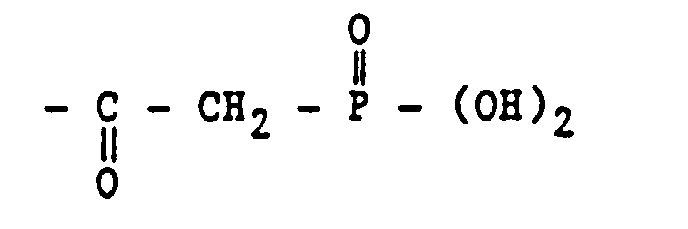
- suitable phosphonic acids are methylene phosphonic acids, particularly alpha-aminomethylene phosphonic acids containing at least one group of the structure: and alpha-carboxymethylene phosphonic acids having a group of the structure:
- specific phosphonic acids include benzylaminobis(methylenephosphonic) acid, cocoaminobis(methylenephosphonic) acid, triethylsilylpropylaminobis(methylenephosphonic) acid and carboxyethyl phosphonic acid.
- epoxy compounds are 1,2-epoxy compounds and include polyglycidyl ethers of polyhydric phenols such as the polyglycidyl ether of 2,2-bis(4-hydroxyphenyl)propane, i.e., bisphenol A, and 1,1-bis(4-hydroxyphenyl)isobutane.
- the epoxy compound may be a monoglycidyl ether of a monohydric phenol or alcohol such as phenyl glycidyl ether and butyl glycidyl ether.
- mixtures of epoxy compounds may be used.
- suitable organophosphates and organophosphonates include phosphoric acid ester of bisphenol A diglycidyl ether; benzylaminobis(methylenephosphonic) acid ester of bisphenol A diglycidyl ether; carboxyethyl phosphonic acid ester of bisphenol A diglycidyl ether and of phenylglycidyl ether and of butyl glycidyl ether; carboxyethyl phosphonic acid mixed ester of bisphenol A diglycidyl ether and butylglycidyl ether; triethoxyl silyl propylaminobis(methylenephosphonic) acid ester of bisphenol A diglycidyl ether and cocoaminobis(methylenephosphonic) acid ester of bisphenol A diglycidyl ether.
- the organophosphate or organophosphonate is applied to the metallic substrate under conditions that produce a corrosion-resistant barrier which is receptive to a subsequent coating process such as a spray, dip or roll coating.
- the organophosphate or organophosphonate is applied to the metal surface by contacting the metal surface with the solution by spraying or immersion techniques.
- the temperature of the solution is typically from about 50°F. (10°C.) to 150°F. (66°C.) and preferably about 60°F. (16°C.) to 80°F. (27°C.).
- the pH of the preferred treating composition during application is typically about 3.5 to 7.0 and preferably about 4.0 to 6.5.
- the organophosphate or organophosphonate is typically present in the solution in amounts of about 0.05 to 7.0 percent and preferably about 0.65 to 0.80 percent; the percentage being by weight based on weight of solution.
- the metal is usually rinsed with deionized water, dried with heat to preferably 60°C. to 130°C. and more preferably from 60°C. to 115°C. and then coated with a surface coating.
- the nonferrous metal substrate is first cleaned by a physical or chemical means and rinsed with water followed by contacting the metallic substrate with the acid activating agent and optionally the complex fluorotitanium or fluorozirconium compound as described above.
- the metallic substrate is then rinsed with water and then contacted with the organophosphate or organophosphonate as described above.
- the metallic substrate can then be given a final deionized water rinse and the substrate dried by heating followed by the application of a coating composition by conventional means such as spraying or roll coating.
- the pretreatment process of the invention results in improved adhesion and flexibility and resistance to humidity, salt spray corrosion and detergents of subsequently applied coatings.
- a solution of an acid activating agent was made by adding 1.06 grams (g) of sodium fluoride in one liter of deionized water followed by the addition of 2.19 g of 40% by weight aqueous sodium hydroxide solution and 11.75 g of 23% by weight aqueous fluorosilicic acid solution.
- the solution had a pH of 3.0 and a fluoride concentration of 2600 ppm.
- a complex fluorotitanium compound solution was made by adding 1.94 g of 53% by weight aqueous fluorotitanic acid to one liter of deionized water.
- the solution had a pH of 2.1 and a titanium concentration of 300 ppm.
- the N,N-dimethylethanolamine salt of benzylaminobis(methylenephosphonic) acid ester of bisphenol A diglycidyl ether was made by first heating a solution containing 779.1 g of phosphorous acid (9.5 mole) and 592.2 g of 1-methoxy-2-propanol to 85°C. under a nitrogen atmosphere. Next, 567.1 g of benzylamine (5.3 mole) and 779.1 g of a 37 percent by weight solution of formaldehyde in water (9.6 mole formaldehyde) were added simultaneously as separate feeds over 3.3 hours to this solution. The resulting reaction mixture was held for 4 hours at 95°C.
- Carboxyethyl phosphonic acid mixed ester of bisphenol A diglycidyl ether and phenylglycidyl ether was made by charging to a 1 liter, 4 neck, round bottom flask fitted with a Friedrich condenser, thermometer, nitrogen inlet and heating mantle, 180 g carboxyethyl phosphonic acid and 116 g dimethylformamide (DMF) solvent.
- DMF dimethylformamide
- the diisopropylamine salt of the phosphoric acid ester of bisphenol A diglycidyl ether was made by first charging 67.6 g 85 percent phosphoric acid into a 2-liter flask under a nitrogen blanket which was maintained throughout the reaction. 1-Methoxy-2-propanol (67.6 g) was then added. The mixture was heated to 120°C. followed by the addition of 332.4 g EPON 828 premixed with the 1-methoxy-2-propanol (85 to 15 weight ratio) over 30 minutes. The temperature of the reaction mixture was maintained at 120°C. When the addition was complete, the temperature was held at 120°C. for another 30 minutes followed by the addition of 63.4 g deionized water over a 5-minute period.
- the diisopropanolamine salt of carboxyethyl phosphonic acid mixed ester of bisphenol A diglycidyl ether and butylglycidyl ether was made by first charging the following to a 3 liter, 4 neck, round bottom flask fitted with a thermometer, stainless steel stirrer, nitrogen inlet, heating mantle and reflux condenser: Carboxyethyl phosphonic acid 145 g Dimethylformamide 145 g When a clear solution was obtained at 50°C., a mixture of 190 g of the diglycidyl ether of bisphenol A and 130 g of butylglycidyl ether was added over 11 ⁇ 2 hours while controlling the reaction exotherm to 55-60°C.
- N,N-dimethylethanolamine salt of cocoaminobis(methylenephosphonic) acid ester of bisphenol A diglycidyl ether was prepared as follows:
- the resulting reaction mixture was held for 4 hours at reflux temperature (98-100°C.), whereupon a mixture containing 116.2 g of EPON 828 (0.30 mole) and 30.0 g of 1-methoxy-2-propanol was added over 1 hour, after which the reaction mixture was held at reflux for 1.5 hours.
- the resulting product was cooled to 60°C. and then neutralized by the addition of 55.0 g of N,N-dimethylethanolamine (0.62 mole) over 15 minutes after which the resulting product was allowed to cool to room temperature.
- the resulting reaction product had a Gardner-Holdt bubble tube viscosity of X, a total solids content of 67 percent by weight, and a pH of 5.35.
- An aqueous solution of the organophosphonate of Example C was prepared by adding with stirring 12.04 g of the reaction product of Example C to one (1) liter of deionized water. The concentration of the solution was 0.8 percent by weight of organophosphonate based on weight of solution.
- An aqueous solution of the organophosphonate of Example D was prepared by adding with stirring sufficient reaction product of Example D to one (1) liter of deionized water to form a solution containing 0.1 percent by weight of the organophosphonate based on weight of solution.
- An aqueous solution of the organophosphate of Example E was prepared by adding with stirring sufficient reaction product of Example E to one (1) liter of deionized water to form a solution containing 5 percent by weight of the organophosphate based on weight of solution.
- An aqueous solution of the organophosphonate of Example F was prepared by adding with stirring sufficient reaction product of Example F to one (1) liter of deionized water to form a solution containing 0.1 percent by weight of the organophosphonate based on weight of solution.
- An aqueous solution of the organophosphonate of Example G was prepared by adding with stirring sufficient reaction product of Example G to one (1) liter of deionized water to form a solution containing 0.1 percent by weight of the organophosphonate based on weight of solution.
- Aluminum panels were subjected to an alkaline cleaning procedure by immersion in a 1.5 percent by weight bath of CHEMKLEEN 49D which is available from Chemfil Corp. at a temperature of 140°F. (60°C.) for 60 seconds.
- the panels were removed from the alkaline cleaning bath, rinsed with water, followed by immersion in a bath of the acid activating agent of Example A for 60 seconds at 140°F. (60°C.).
- the panels were then removed, rinsed with water and immersed in the fluorotitanium compound solution (140°F. [60°C.]) of Example B for 60 seconds.
- the panels were removed from this solution, rinsed with water and then immersed in the aqueous solution of an organophosphonate of Example H for 60 seconds at 70°F.
- the panels were removed from the aqueous solution, rinsed with water and dried with warm air at 104°F. (40°C.) for 3 minutes and then oven baked for 1 minute at 115°C.
- the panels were then topcoated with the clear powder coating composition based on an epoxy resin and a polyanhydride curing agent available from PPG Industries, Inc. as PCC 10103.
- the clear coated panels which had a coating thickness of 2 to 4 mils were subjected to General Motors Corp. thermal shock test (GM9525P) for paint adhesion.
- the thermal shock test was conducted by immersing the coated panels in a 38°C. water bath for 3 hours followed immediately by placement into freezer at -29°C. for a minimum of 3 hours.
- Example 1 was repeated except that the fluorotitanium treatment was omitted and times and temperatures of the other treatments were modified as follows.
- the alkaline cleaning was conducted by immersion for 10 seconds at 140°F. (60°C.).
- the acid activation step was conducted on two different panels by immersion for 10 and 30 seconds, respectively, at 140°F. (60°C.).
- the organophosphonate application was conducted by immersion for 10 and 30 seconds, respectively, at 70°F. (21°C.).
- the panels were topcoated with a coil primer and topcoat available from PPG Industries, Inc. as 4PLY41250 and 1LW4842, respectively.
- the primer was based on chromate containing acrylic latex and had a film thickness of 0.2 mils.
- the topcoat was based on an acrylic latex available from PPG Industries, Inc. under the trademark ENVIRON and had a thickness of 0.8 mils.
- coated panels were tested for flexibility via a T-bend test, for pencil hardness, for water soak recovery time and for percent water absorption.
- the T-bend test was conducted by cutting a 2-inch strip from a coated panel and bending it back upon itself.
- a 3T bend means the diameter of the bend is three (3) times the thickness of the panel.
- a 2T bend means the diameter of the bend is two (2) times the thickness of the panel.
- a OT bend means that the panel is bent back over itself 180 degrees and compressed flat.
- the coating was observed visually for cracking and for removal of film after a piece of adhesive tape was pressed down onto the coating and then rapidly pulled off the panel at right angles to the plane of the surface being tested. Each bend is then examined and rated both for paint "pickoff" and paint cracking. Ratings were given at the bend at which no pickoff (NP) is seen and at the bend at which no cracking (NC) is seen.
- the pencil hardness test was conducted by abrading a pencil of a given hardness (2H>H>F>HB>B>2B) with emery cloth to form a sharp edge. Holding a pencil at a 45° angle to the coating surface, the pencil was pushed through the coating. This was repeated with progressively softer pencils until a given pencil does not cut through the coating. Hardness was denoted by the hardest pencil that does not cut through the coating.
- the water soak test was conducted by immersing panels for 24 hours at 100°F. (38°C.) in a deionized water bath.
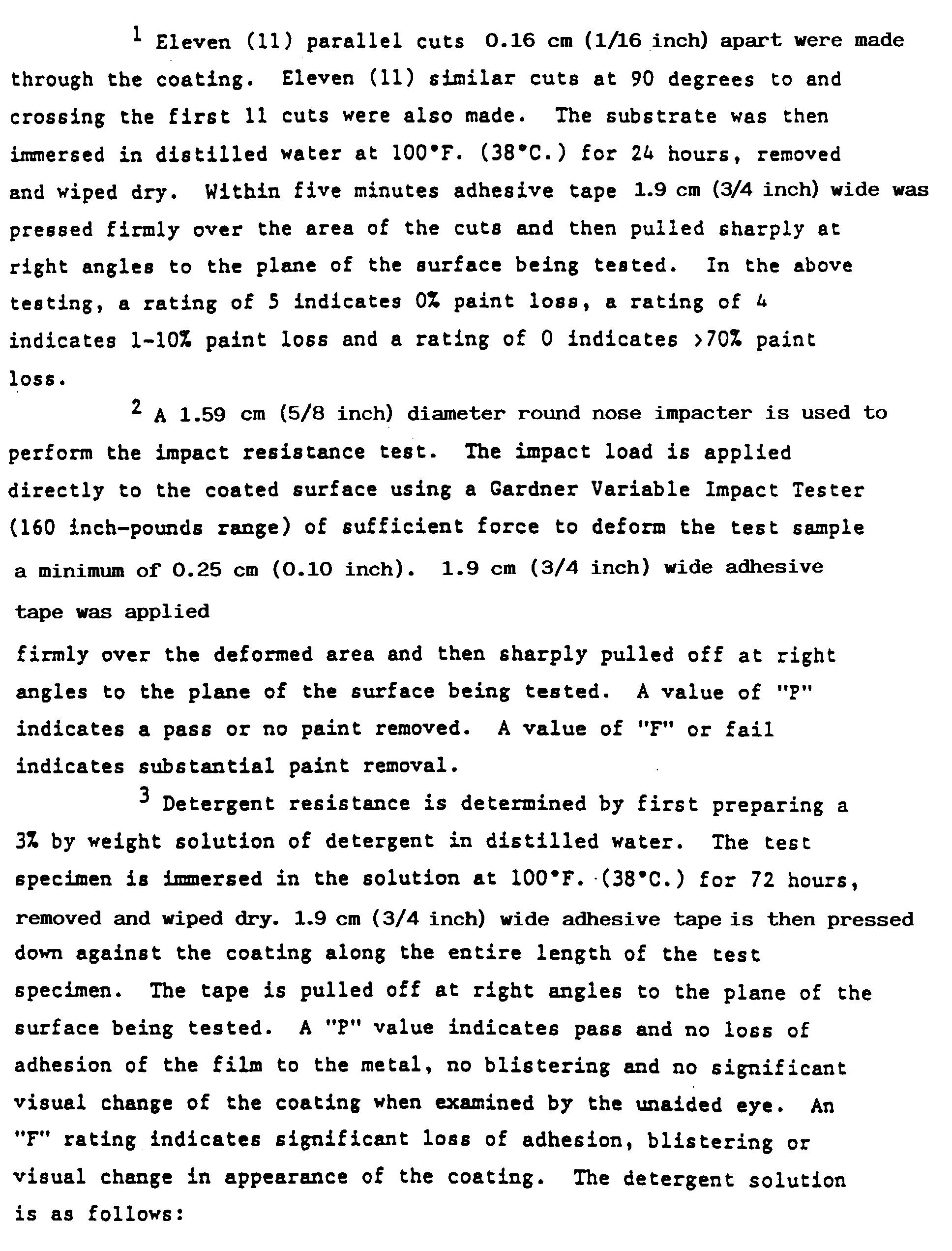
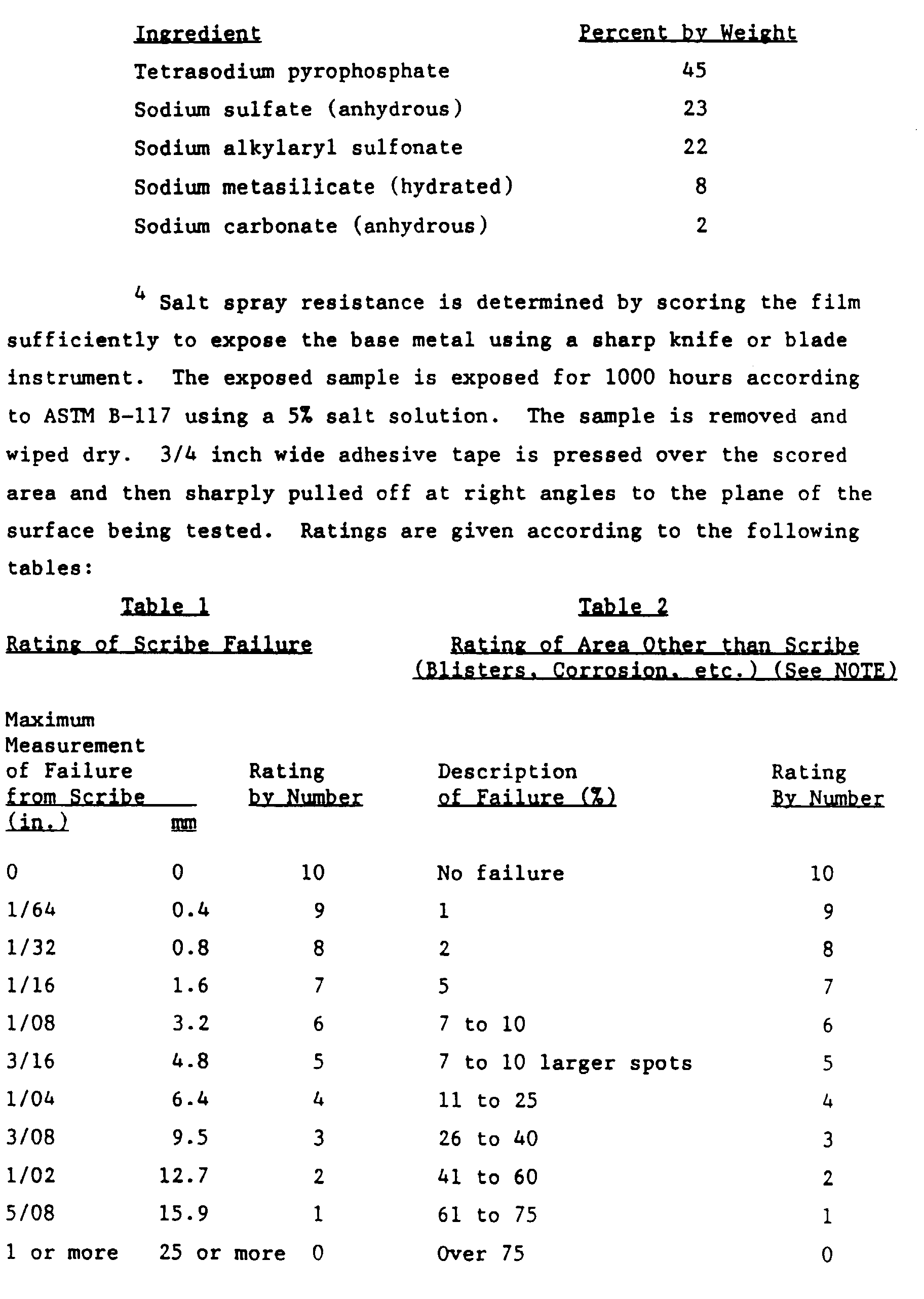
- Example 1 was repeated except that the fluorotitanium treatment was omitted and the acid activation was conducted via immersion for 60 seconds at 120°F. (49°C.). Also, the panels were topcoated with an aminoplast cured polyester topcoat available from PPG as POLYCRON III. The topcoat had a thickness of 1.0 mils. The panels were tested for film adhesion, impact resistance, detergent resistance and corrosion (salt spray and humidity) resistance as specified by the AAMA 603.8-85 publication. The results of the tests as well as those for an untreated control are shown in Table II below.
- Example 3 was repeated except that the organophosphonate treatment was conducted with the organophosphonates and organophosphate solutions of Examples I, J, K and L. The results of the testing is shown in Table II below.
Landscapes
- Chemical & Material Sciences (AREA)
- General Chemical & Material Sciences (AREA)
- Chemical Kinetics & Catalysis (AREA)
- Engineering & Computer Science (AREA)
- Materials Engineering (AREA)
- Mechanical Engineering (AREA)
- Metallurgy (AREA)
- Organic Chemistry (AREA)
- Chemical Treatment Of Metals (AREA)
- Application Of Or Painting With Fluid Materials (AREA)
- Chemically Coating (AREA)
- Paints Or Removers (AREA)
Abstract
Description
- The present invention relates to metal pretreatment methods which do not involve the use of chromium compounds and, in particular, such methods which are useful in treating nonferrous metal surfaces and particularly aluminum, zinc and aluminum-zinc alloy surfaces.
- It is known to treat nonferrous metals and particularly aluminum, zinc and aluminum-zinc alloys with chromium compounds such as chromic acid to inhibit corrosion and promote adhesion with coatings. While effective, the chromium compounds, nonetheless, are undesirable because of their toxicity and the attendant problems of disposal.
- Hence, considerable work has been done in finding a replacement for the chromium in metal pretreatment. The present invention provides a treatment method which does not involve the use of chromium compounds.
- Also of interest as background to the present invention is FR-A-2443514 which discloses a surface treating solution for aluminum or aluminum alloys comprising aqueous solutions of inositol dihexaphosphates and water-soluble salts thereof in a mixture with titanium fluoride.
- The invention encompasses a method of treating a nonferrous metal substrate comprising contacting the substrate with an acid activating agent, and then contacting the substrate with a solution of a phosphoric acid ester of an epoxy compound or a phosphonic acid ester of an epoxy compound. The invention also encompasses a nonferrous metallic substrate treated by such method. The term "nonferrous" is meant to include metals other than iron, such as aluminum and zinc and alloys of aluminum and zinc, as well as alloys containing minor portions of up to 15 percent by weight iron. Preferably, the nonferrous metallic substrate contains no iron.
- The acid activating agent is necessary to prepare the substrate for the subsequent treatment with the organophosphonate or organophosphate. It is believed that the acid activating step dissolves metal oxide films which may form on the nonferrous metal surface making the surface more receptive to the subsequently applied organophosphonate or organophosphate.
- The acid activating agent is desirably applied by contacting the metallic substrate such as by immersion or spraying at a temperature of from 50°F. (10°C.) to 180°F. (82°C.), preferably 50°F. (10°C.) to 150°F. (66°C.), more preferably 65°F. (18°C.) to 80°F. (27°C.). Usually it will have a pH of from 2.4 to 4.0 and preferably from 3.0 to 3.7. The activating agent is preferably an aqueous solution of an acidic fluoride compound. Examples of acidic fluoride compounds are hydrofluoric acid, fluorosilicic acid, sodium hydrogen fluoride and potassium hydrogen fluoride. The acid activating agent can be a mixture of a fluorosilicate such as fluorosilicic acid and an alkali fluoride such as sodium fluoride. The pH can be adjusted by the addition of base such as sodium hydroxide. The acidic fluoride compound is preferably used in amounts to provide a concentration of from 100 to 5200 ppm fluoride and more preferably a concentration of from 600 to 2600 ppm fluoride.
- After contacting the nonferrous metallic surface or substrate with the acid activating agent and before contacting with the organophosphate or organophosphonate, the substrate may optionally be contacted with an aqueous solution of complex fluorotitanium or fluorozirconium compound. Examples of such complex compounds are fluorotitanic acid, fluorozirconic acid, sodium hexafluorotitanate, potassium hexafluorotitanate and potassium hexafluorozirconate. Such complex compounds are preferably used in amounts to provide a concentration of from 100 to 800 ppm titanium and/or zirconium.
- The useful organophosphate or organophosphonate is compatible with an aqueous medium, i.e., soluble or dispersible to the extent of at least .05 gram per 100 grams of water at 25°C. The aqueous solution can be prepared by mixing the organophosphate or organophosphonate compound with an aqueous medium, preferably at a temperature of about 50°F. (10°C.) to 150°F. (66°C.) and more preferably at about 60°F. (16°C.) to 80°F. (27°C.). By an aqueous medium is meant water or water in combination with cosolvent such as an alkyl ether of a glycol, such as 1-methoxy-2-propanol, dimethylformamide or a base such as an amine that can partially neutralize the organophosphate or organophosphonate to enhance the solubility of the organophosphate or organophosphonate compound.
- The organophosphate or organophosphonate compound is a phosphoric acid ester or a phosphonic acid ester of an epoxy compound. Examples of suitable phosphonic acids are methylene phosphonic acids, particularly alpha-aminomethylene phosphonic acids containing at least one group of the structure:

- Examples of epoxy compounds are 1,2-epoxy compounds and include polyglycidyl ethers of polyhydric phenols such as the polyglycidyl ether of 2,2-bis(4-hydroxyphenyl)propane, i.e., bisphenol A, and 1,1-bis(4-hydroxyphenyl)isobutane. Also, the epoxy compound may be a monoglycidyl ether of a monohydric phenol or alcohol such as phenyl glycidyl ether and butyl glycidyl ether. Also, mixtures of epoxy compounds may be used.
- Examples of suitable organophosphates and organophosphonates include phosphoric acid ester of bisphenol A diglycidyl ether; benzylaminobis(methylenephosphonic) acid ester of bisphenol A diglycidyl ether; carboxyethyl phosphonic acid ester of bisphenol A diglycidyl ether and of phenylglycidyl ether and of butyl glycidyl ether; carboxyethyl phosphonic acid mixed ester of bisphenol A diglycidyl ether and butylglycidyl ether; triethoxyl silyl propylaminobis(methylenephosphonic) acid ester of bisphenol A diglycidyl ether and cocoaminobis(methylenephosphonic) acid ester of bisphenol A diglycidyl ether.
- The organophosphate or organophosphonate is applied to the metallic substrate under conditions that produce a corrosion-resistant barrier which is receptive to a subsequent coating process such as a spray, dip or roll coating. The organophosphate or organophosphonate is applied to the metal surface by contacting the metal surface with the solution by spraying or immersion techniques. The temperature of the solution is typically from about 50°F. (10°C.) to 150°F. (66°C.) and preferably about 60°F. (16°C.) to 80°F. (27°C.). The pH of the preferred treating composition during application is typically about 3.5 to 7.0 and preferably about 4.0 to 6.5. The organophosphate or organophosphonate is typically present in the solution in amounts of about 0.05 to 7.0 percent and preferably about 0.65 to 0.80 percent; the percentage being by weight based on weight of solution. After the aqueous composition has been applied, the metal is usually rinsed with deionized water, dried with heat to preferably 60°C. to 130°C. and more preferably from 60°C. to 115°C. and then coated with a surface coating.
- In a typical treatment process, the nonferrous metal substrate is first cleaned by a physical or chemical means and rinsed with water followed by contacting the metallic substrate with the acid activating agent and optionally the complex fluorotitanium or fluorozirconium compound as described above. The metallic substrate is then rinsed with water and then contacted with the organophosphate or organophosphonate as described above. The metallic substrate can then be given a final deionized water rinse and the substrate dried by heating followed by the application of a coating composition by conventional means such as spraying or roll coating. The pretreatment process of the invention results in improved adhesion and flexibility and resistance to humidity, salt spray corrosion and detergents of subsequently applied coatings.
- The invention is further illustrated by the following non-limiting examples. All parts are by weight unless otherwise indicated.
- A solution of an acid activating agent was made by adding 1.06 grams (g) of sodium fluoride in one liter of deionized water followed by the addition of 2.19 g of 40% by weight aqueous sodium hydroxide solution and 11.75 g of 23% by weight aqueous fluorosilicic acid solution. The solution had a pH of 3.0 and a fluoride concentration of 2600 ppm.
- A complex fluorotitanium compound solution was made by adding 1.94 g of 53% by weight aqueous fluorotitanic acid to one liter of deionized water. The solution had a pH of 2.1 and a titanium concentration of 300 ppm.
- The N,N-dimethylethanolamine salt of benzylaminobis(methylenephosphonic) acid ester of bisphenol A diglycidyl ether was made by first heating a solution containing 779.1 g of phosphorous acid (9.5 mole) and 592.2 g of 1-methoxy-2-propanol to 85°C. under a nitrogen atmosphere. Next, 567.1 g of benzylamine (5.3 mole) and 779.1 g of a 37 percent by weight solution of formaldehyde in water (9.6 mole formaldehyde) were added simultaneously as separate feeds over 3.3 hours to this solution. The resulting reaction mixture was held for 4 hours at 95°C. A solution of 1345.6 g bisphenol A diglycidyl ether (3.6 mole) (EPON 828 from Shell Chemical Company) and 343.5 g 1-methoxy-2-propanol was added over 1 hour and the resulting reaction mixture was heated to 90°C. for 1.5 hours. The reaction mixture was then allowed to cool to 50°C. and 437.2 g of N,N-dimethylethanolamine (4.9 mole) was added. The resulting product was a homogeneous liquid with a total solids content of 66.4 percent by weight, 3.405 milliequivalents of acid and 1.448 milliequivalents of base per gram of liquid.
- Carboxyethyl phosphonic acid mixed ester of bisphenol A diglycidyl ether and phenylglycidyl ether was made by charging to a 1 liter, 4 neck, round bottom flask fitted with a Friedrich condenser, thermometer, nitrogen inlet and heating mantle, 180 g carboxyethyl phosphonic acid and 116 g dimethylformamide (DMF) solvent. When a clear solution was obtained by stirring at 50°C., 168 g of phenylglycidyl ether was added over 15 minutes while cooling with an ice bath to maintain a temperature of 50-57°C. After stirring for 2¾ hours at 50°C., all the epoxy groups had reacted. A solution of 95 g of EPON 828 in 95 g DMF was added over 30 minutes and the solution heated to 100°C. After 8½ hours at 100°C., the mixture was cooled at which point a potentiometrically determined acid value of 227 at 58.5 percent solids was measured. The product had a solution viscosity of W-X (Gardner-Holdt) and a hydroxyl value of 147. No unreacted epoxy groups could be detected.
- The diisopropylamine salt of the phosphoric acid ester of bisphenol A diglycidyl ether was made by first charging 67.6 g 85 percent phosphoric acid into a 2-liter flask under a nitrogen blanket which was maintained throughout the reaction. 1-Methoxy-2-propanol (67.6 g) was then added. The mixture was heated to 120°C. followed by the addition of 332.4 g EPON 828 premixed with the 1-methoxy-2-propanol (85 to 15 weight ratio) over 30 minutes. The temperature of the reaction mixture was maintained at 120°C. When the addition was complete, the temperature was held at 120°C. for another 30 minutes followed by the addition of 63.4 g deionized water over a 5-minute period. When the water addition was completed, the mixture was held for 2 hours at reflux (106°C.) followed by cooling to 70°C. Premelted diisopropanolamine (100.6 g) was then added to the reaction mixture at 70°C. and the reaction mixture stirred for 15 minutes. The pH of the reaction mixture was adjusted to 6.0 by adding the small amounts of additional diisopropanolamine. The reaction mixture was then further thinned with an additional 309.7 g of deionized water.
- The diisopropanolamine salt of carboxyethyl phosphonic acid mixed ester of bisphenol A diglycidyl ether and butylglycidyl ether was made by first charging the following to a 3 liter, 4 neck, round bottom flask fitted with a thermometer, stainless steel stirrer, nitrogen inlet, heating mantle and reflux condenser:
Carboxyethyl phosphonic acid 145 g Dimethylformamide 145 g - The N,N-dimethylethanolamine salt of cocoaminobis(methylenephosphonic) acid ester of bisphenol A diglycidyl ether was prepared as follows:
- A solution containing 98.0 g of phosphorous acid (1.19 mole) and 75.0 g of 1-methoxy-2-propanol was heated to 85°C. under a nitrogen atmosphere. Next, 130.0 g of cocoamine (ARMEEN CD from Armak Chemicals, a division of AKZO Chemie America) (0.66 mole, having an amine equivalent weight of 196) and 98.0 g of a 37 percent by weight solution of formaldehyde in water (1.20 mole formaldehyde) were added simultaneously as separate feeds over 1.5 hours to this solution. The resulting reaction mixture was held for 4 hours at reflux temperature (98-100°C.), whereupon a mixture containing 116.2 g of EPON 828 (0.30 mole) and 30.0 g of 1-methoxy-2-propanol was added over 1 hour, after which the reaction mixture was held at reflux for 1.5 hours. The resulting product was cooled to 60°C. and then neutralized by the addition of 55.0 g of N,N-dimethylethanolamine (0.62 mole) over 15 minutes after which the resulting product was allowed to cool to room temperature. The resulting reaction product had a Gardner-Holdt bubble tube viscosity of X, a total solids content of 67 percent by weight, and a pH of 5.35.
- An aqueous solution of the organophosphonate of Example C was prepared by adding with stirring 12.04 g of the reaction product of Example C to one (1) liter of deionized water. The concentration of the solution was 0.8 percent by weight of organophosphonate based on weight of solution.
- An aqueous solution of the organophosphonate of Example D was prepared by adding with stirring sufficient reaction product of Example D to one (1) liter of deionized water to form a solution containing 0.1 percent by weight of the organophosphonate based on weight of solution.
- An aqueous solution of the organophosphate of Example E was prepared by adding with stirring sufficient reaction product of Example E to one (1) liter of deionized water to form a solution containing 5 percent by weight of the organophosphate based on weight of solution.
- An aqueous solution of the organophosphonate of Example F was prepared by adding with stirring sufficient reaction product of Example F to one (1) liter of deionized water to form a solution containing 0.1 percent by weight of the organophosphonate based on weight of solution.
- An aqueous solution of the organophosphonate of Example G was prepared by adding with stirring sufficient reaction product of Example G to one (1) liter of deionized water to form a solution containing 0.1 percent by weight of the organophosphonate based on weight of solution.
- Aluminum panels were subjected to an alkaline cleaning procedure by immersion in a 1.5 percent by weight bath of CHEMKLEEN 49D which is available from Chemfil Corp. at a temperature of 140°F. (60°C.) for 60 seconds. The panels were removed from the alkaline cleaning bath, rinsed with water, followed by immersion in a bath of the acid activating agent of Example A for 60 seconds at 140°F. (60°C.). The panels were then removed, rinsed with water and immersed in the fluorotitanium compound solution (140°F. [60°C.]) of Example B for 60 seconds. The panels were removed from this solution, rinsed with water and then immersed in the aqueous solution of an organophosphonate of Example H for 60 seconds at 70°F. (21°C.). The panels were removed from the aqueous solution, rinsed with water and dried with warm air at 104°F. (40°C.) for 3 minutes and then oven baked for 1 minute at 115°C. The panels were then topcoated with the clear powder coating composition based on an epoxy resin and a polyanhydride curing agent available from PPG Industries, Inc. as PCC 10103. The clear coated panels which had a coating thickness of 2 to 4 mils were subjected to General Motors Corp. thermal shock test (GM9525P) for paint adhesion. The thermal shock test was conducted by immersing the coated panels in a 38°C. water bath for 3 hours followed immediately by placement into freezer at -29°C. for a minimum of 3 hours. Within 60 seconds of removal from freezer, the panels were scribed with an "X" across the entire panel and blasted with high pressure (37.9 kPa) steam at a 45° angle and 50 mm distance with respect to the scribe lines. Performance was measured with respect to paint loss from scribe line(s). Little or no paint loss (0 to 1 mm) was evidenced. Untreated control panels resulted in a 100 percent paint loss when tested in this manner.
- Example 1 was repeated except that the fluorotitanium treatment was omitted and times and temperatures of the other treatments were modified as follows. The alkaline cleaning was conducted by immersion for 10 seconds at 140°F. (60°C.). The acid activation step was conducted on two different panels by immersion for 10 and 30 seconds, respectively, at 140°F. (60°C.). The organophosphonate application was conducted by immersion for 10 and 30 seconds, respectively, at 70°F. (21°C.). Also, the panels were topcoated with a coil primer and topcoat available from PPG Industries, Inc. as 4PLY41250 and 1LW4842, respectively. The primer was based on chromate containing acrylic latex and had a film thickness of 0.2 mils. The topcoat was based on an acrylic latex available from PPG Industries, Inc. under the trademark ENVIRON and had a thickness of 0.8 mils.
- The coated panels were tested for flexibility via a T-bend test, for pencil hardness, for water soak recovery time and for percent water absorption.
- The T-bend test was conducted by cutting a 2-inch strip from a coated panel and bending it back upon itself. A 3T bend means the diameter of the bend is three (3) times the thickness of the panel. A 2T bend means the diameter of the bend is two (2) times the thickness of the panel. A OT bend means that the panel is bent back over itself 180 degrees and compressed flat. The coating was observed visually for cracking and for removal of film after a piece of adhesive tape was pressed down onto the coating and then rapidly pulled off the panel at right angles to the plane of the surface being tested. Each bend is then examined and rated both for paint "pickoff" and paint cracking. Ratings were given at the bend at which no pickoff (NP) is seen and at the bend at which no cracking (NC) is seen. Lower values correspond to the most severe/stressful bends and are therefore indicative of the greater flexibility imparted by the coating pretreatment system. The pencil hardness test was conducted by abrading a pencil of a given hardness (2H>H>F>HB>B>2B) with emery cloth to form a sharp edge. Holding a pencil at a 45° angle to the coating surface, the pencil was pushed through the coating. This was repeated with progressively softer pencils until a given pencil does not cut through the coating. Hardness was denoted by the hardest pencil that does not cut through the coating. The water soak test was conducted by immersing panels for 24 hours at 100°F. (38°C.) in a deionized water bath. Upon removal from the bath, panels were immediately tested for pencil hardness as described above and every two minutes thereafter until the film fully recovers (to initial hardness). The amount of water absorbed (percent water absorption) by the panels was determined gravimetrically. Fast recovery times and low percent absorption were indicative of strong adhesive interactions at the pretreatment-coating interface. The results of tests at 10 and 30 second treatments are shown in Table I.
Acid Activation Treatment (time) Pretreatment (time) T-Bend NP/NC Pencil Initial Water Soak Recovery Time % Water Absorption 10 seconds 10 seconds 2T/3T B 0 minutes 2.3 30 seconds 30 seconds 0T/2T B 0 minutes 2.8 - Example 1 was repeated except that the fluorotitanium treatment was omitted and the acid activation was conducted via immersion for 60 seconds at 120°F. (49°C.). Also, the panels were topcoated with an aminoplast cured polyester topcoat available from PPG as POLYCRON III. The topcoat had a thickness of 1.0 mils. The panels were tested for film adhesion, impact resistance, detergent resistance and corrosion (salt spray and humidity) resistance as specified by the AAMA 603.8-85 publication. The results of the tests as well as those for an untreated control are shown in Table II below.
- Example 3 was repeated except that the organophosphonate treatment was conducted with the organophosphonates and organophosphate solutions of Examples I, J, K and L. The results of the testing is shown in Table II below.


Claims (21)
- A method of treating a nonferrous metallic substrate comprising the steps of:(a) contacting the metallic substrate with a solution of an acid activating agent so as to dissolve metal oxide film which may form on the nonferrous metallic substrate; followed by(b) contacting the metallic substrate with a solution of a compound selected from a group comprising phosphoric acid esters of epoxy compounds and phosphonic acid esters of epoxy compounds.
- The method of claim 1 wherein in step (a) the activating agent has a temperature of from about 50°F. (10°C.) to about 180°F. (82°C.).
- The method of claim 1 wherein in step (a) the activating agent has a pH of from about 2.4 to about 4.0.
- The method of claim 3 wherein in step (a) the activating agent has a pH of from about 3.0 to about 3.7.
- The method of claim 1 wherein in step (a) the activating agent is an acid fluoride.
- The method of claim 5 wherein the activating agent is present in the solution in a concentration of from about 100 to about 5200 ppm fluoride.
- The method of claim 6 wherein the activating agent is present in a concentration of from about 600 to 2600 ppm fluoride.
- The method of claim 1 wherein between step (a) and step (b) there is an additional step in which the metallic substrate is contacted with a solution of fluorotitanic or fluorozirconic compound.
- The method of claim 1 wherein the nonferrous metallic substrate is selected from a group comprising aluminum, zinc and aluminum-zinc alloys.
- The method of claim 1 wherein in step (b) the solution is at a temperature of from about 50°F. (10°C.) to about 150°F. (66°C.).
- The method of claim 10 wherein in step (b) the solution is at a temperature of from about 60°F. (16°C.) to about 80°F. (27°C.).
- The method of claim 1 wherein in step (b) the solution has a pH of from about 3.5 to about 7.0.
- The method of claim 12 wherein in step (b) the solution has a pH of from about 4.0 to about 6.5.
- The method of claim 1 wherein in step (b) the compound is present in a concentration of from about 0.05 percent to 7.0 percent by weight based on weight of solution.
- The method of claim 14 wherein in step (b) the compound is present in a concentration of about 0.65 percent to about 0.8 percent by weight based on weight of solution.
- The method of claim 16 wherein the phosphonic acid ester is an aminobis(methylenephosphonic) acid ester of an epoxy compound.
- The method of claim 1 wherein after step (b) the substrate is rinsed with water.
- A nonferrous metallic substrate treated by the method of claim 1.
- The nonferrous metallic substrate of claim 18 which is selected from a group comprising aluminum, zinc and aluminum-zinc alloys.
- The method of claim 1 wherein the solution in step (a) is an aqueous solution.
- The method of claim 2 wherein the solution in step (b) is an aqueous solution.
Applications Claiming Priority (3)
| Application Number | Priority Date | Filing Date | Title |
|---|---|---|---|
| US862143 | 1992-04-02 | ||
| US07/862,143 US5306526A (en) | 1992-04-02 | 1992-04-02 | Method of treating nonferrous metal surfaces by means of an acid activating agent and an organophosphate or organophosphonate and substrates treated by such method |
| PCT/US1993/002326 WO1993020258A1 (en) | 1992-04-02 | 1993-03-12 | Method of treating nonferrous metal surfaces by means of an acid activating agent and an organophosphate or organophosphonate and substrates treated by such method |
Publications (2)
| Publication Number | Publication Date |
|---|---|
| EP0633949A1 EP0633949A1 (en) | 1995-01-18 |
| EP0633949B1 true EP0633949B1 (en) | 1996-09-18 |
Family
ID=25337783
Family Applications (1)
| Application Number | Title | Priority Date | Filing Date |
|---|---|---|---|
| EP93907494A Expired - Lifetime EP0633949B1 (en) | 1992-04-02 | 1993-03-12 | Method of treating nonferrous metal surfaces by means of an acid activating agent and an organophosphate or organophosphonate and substrates treated by such method |
Country Status (13)
| Country | Link |
|---|---|
| US (1) | US5306526A (en) |
| EP (1) | EP0633949B1 (en) |
| JP (1) | JP2843439B2 (en) |
| KR (1) | KR0160819B1 (en) |
| AT (1) | ATE143063T1 (en) |
| AU (1) | AU670076B2 (en) |
| BR (1) | BR9306246A (en) |
| CA (1) | CA2130114C (en) |
| DE (1) | DE69304902T2 (en) |
| DK (1) | DK0633949T3 (en) |
| ES (1) | ES2094533T3 (en) |
| MX (1) | MX9301812A (en) |
| WO (1) | WO1993020258A1 (en) |
Families Citing this family (52)
| Publication number | Priority date | Publication date | Assignee | Title |
|---|---|---|---|---|
| US5294265A (en) * | 1992-04-02 | 1994-03-15 | Ppg Industries, Inc. | Non-chrome passivation for metal substrates |
| DE19654642C2 (en) * | 1996-12-28 | 2003-01-16 | Chemetall Gmbh | Process for treating metallic surfaces with an aqueous solution |
| US6096813A (en) * | 1997-09-24 | 2000-08-01 | Ppg Industries Ohio, Inc. | N-acyl amino acid compositions and their use as adhesion promoters |
| US5858282A (en) * | 1997-11-21 | 1999-01-12 | Ppg Industries, Inc. | Aqueous amine fluoride neutralizing composition for metal pretreatments containing organic resin and method |
| GB9821984D0 (en) * | 1998-10-08 | 1998-12-02 | Thorstone Business Man Ltd | Adhesive promotion |
| US6440580B1 (en) | 1998-12-01 | 2002-08-27 | Ppg Industries Ohio, Inc. | Weldable, coated metal substrates and methods for preparing and inhibiting corrosion of the same |
| US6312812B1 (en) | 1998-12-01 | 2001-11-06 | Ppg Industries Ohio, Inc. | Coated metal substrates and methods for preparing and inhibiting corrosion of the same |
| US6410926B1 (en) | 1999-10-01 | 2002-06-25 | Ppg Industries Ohio, Inc. | Coating with optical taggent |
| US6488990B1 (en) * | 2000-10-06 | 2002-12-03 | Chemetall Gmbh | Process for providing coatings on a metallic surface |
| US6689831B1 (en) | 2000-11-01 | 2004-02-10 | Mcmillen Mark | Chromium-free, curable coating compositions for metal substrates |
| US6863738B2 (en) * | 2001-01-29 | 2005-03-08 | General Electric Company | Method for removing oxides and coatings from a substrate |
| US6750274B2 (en) * | 2001-02-08 | 2004-06-15 | Ppg Industries Ohio. Inc. | Weldable coating of phosphated epoxy polymer, curing agent and electroconductive pigment |
| DE10114980A1 (en) * | 2001-03-27 | 2002-10-17 | Henkel Kgaa | Adhesion promoter for paints and adhesives on metals |
| US6774168B2 (en) * | 2001-11-21 | 2004-08-10 | Ppg Industries Ohio, Inc. | Adhesion promoting surface treatment or surface cleaner for metal substrates |
| US6841251B2 (en) * | 2002-02-19 | 2005-01-11 | Ppg Industries Ohio, Inc. | Composition having sealing and sound dampening properties and methods related thereto |
| US6749939B2 (en) | 2002-02-19 | 2004-06-15 | Ppg Industries, Ohio, Inc. | Composition having sealing and sound dampening properties and methods related thereto |
| US7345101B2 (en) * | 2002-11-06 | 2008-03-18 | Ppg Industries Ohio, Inc. | Aqueous composition of reaction product of epoxy and phosphorus materials with curing agent |
| US7147897B2 (en) * | 2002-11-06 | 2006-12-12 | Ppg Industries Ohio, Inc. | Weldable compositions comprising a conductive pigment and silicon and methods for using the same |
| US20040086718A1 (en) * | 2002-11-06 | 2004-05-06 | Pawlik Michael J | Corrosion and alkali-resistant compositions and methods for using the same |
| US20050043207A1 (en) * | 2003-06-30 | 2005-02-24 | Eric Aubay | Cleaning composition and method for removal of polysilicate residue |
| US7745010B2 (en) | 2005-08-26 | 2010-06-29 | Prc Desoto International, Inc. | Coating compositions exhibiting corrosion resistance properties, related coated substrates, and methods |
| BRPI0810553A8 (en) * | 2007-04-27 | 2018-10-30 | Valspar Sourcing Inc | coated substrate, method for producing a coated coil, and coil coating system |
| CA3225412A1 (en) | 2007-10-11 | 2019-12-26 | Implantica Patent Ltd. | Implantable device for external urinary control |
| US8173221B2 (en) * | 2008-03-18 | 2012-05-08 | MCT Research & Development | Protective coatings for metals |
| US20120024703A1 (en) | 2010-07-28 | 2012-02-02 | Ppg Industries Ohio, Inc. | Compositions useful for electrocoating metal substrates and electrodeposition processes using the coatings |
| US8574396B2 (en) | 2010-08-30 | 2013-11-05 | United Technologies Corporation | Hydration inhibitor coating for adhesive bonds |
| US9080004B2 (en) | 2010-10-07 | 2015-07-14 | Prc-Desoto International, Inc. | Diethylene glycol monomethyl ether resistant coating |
| US20130146460A1 (en) | 2011-12-13 | 2013-06-13 | Ppg Industries Ohio, Inc. | Resin based post rinse for improved throwpower of electrodepositable coating compositions on pretreated metal substrates |
| CA2877087C (en) | 2012-06-18 | 2016-08-16 | Ppg Industries Ohio, Inc. | Dual-cure compositions useful for coating metal substrates and processes using the compositions |
| US20140255608A1 (en) | 2013-03-11 | 2014-09-11 | Ppg Industries Ohio, Inc. | Coatings that exhibit a tri-coat appearance, related coating methods and substrates |
| US20150072161A1 (en) | 2013-09-11 | 2015-03-12 | Prc-Desoto International, Inc. | Compositions comprising magnesium oxide and amino acid |
| KR102349071B1 (en) | 2014-09-08 | 2022-01-10 | 엠씨티 홀딩스 엘티디. | Silicate coatings |
| CA2984597C (en) | 2015-05-01 | 2020-06-16 | Novelis Inc. | Continuous coil pretreatment process |
| EP3546530B1 (en) | 2015-05-29 | 2023-07-05 | PRC-Desoto International, Inc. | Curable film-forming compositions containing lithium silicates as corrosion inhibitors and multilayer coated metal substrates |
| US11554385B2 (en) | 2015-11-17 | 2023-01-17 | Ppg Industries Ohio, Inc. | Coated substrates prepared with waterborne sealer and primer compositions |
| KR20190039998A (en) * | 2016-08-12 | 2019-04-16 | 피피지 인더스트리즈 오하이오 인코포레이티드 | Pretreatment composition |
| US10767073B2 (en) | 2016-10-18 | 2020-09-08 | Ppg Industries Ohio, Inc. | Curable film-forming compositions containing hydroxyl functional, branched acrylic polymers and multilayer composite coatings |
| US10370555B2 (en) | 2017-05-16 | 2019-08-06 | Ppg Industries Ohio, Inc. | Curable film-forming compositions containing hydroxyl functional acrylic polymers and bisurea compounds and multilayer composite coatings |
| CN110959029A (en) | 2017-07-14 | 2020-04-03 | Ppg工业俄亥俄公司 | Curable film-forming composition comprising reactive functional polymer and polysiloxane resin, multilayer composite coating and method of using same |
| US10773243B2 (en) | 2017-09-07 | 2020-09-15 | Ppg Industries Ohio, Inc. | Thermolatent catalyst and its use in curable compositions |
| EP3480261A1 (en) | 2017-11-03 | 2019-05-08 | PPG Industries Ohio, Inc. | Aqueous coating compositions and processes of forming multi-component composite coatings on substrates |
| RU2770730C2 (en) | 2017-12-22 | 2022-04-21 | Ппг Индастриз Огайо, Инк. | Thermally cured film-forming compositions providing advantages in the appearance and effectiveness in runoff control |
| HUE073177T2 (en) * | 2019-03-01 | 2026-01-28 | Howmet Aerospace Inc | Metallic substrate treatment methods providing a phosphonate functionalized layer |
| US20200325289A1 (en) | 2019-04-15 | 2020-10-15 | Ppg Industries Ohio, Inc. | Curable film-forming compositions containing rheology modifiers comprising non-aqueous dispersions |
| US20240150587A1 (en) | 2021-03-02 | 2024-05-09 | Prc-Desoto International, Inc. | Corrosion inhibiting coatings comprising aluminum particles, magnesium oxide and an aluminum and/or iron compound |
| WO2022187823A1 (en) | 2021-03-02 | 2022-09-09 | Prc-Desoto International, Inc. | Corrosion inhibiting coatings comprising magnesium oxide and an aluminum or iron compound |
| US20240174865A1 (en) | 2021-03-05 | 2024-05-30 | Prc-Desoto International, Inc. | Coating compositions comprising a polysulfide corrosion inhibitor |
| CA3209325A1 (en) | 2021-03-05 | 2022-09-09 | Megan Elizabeth FERLIC | Corrosion inhibiting coating compositions |
| AU2022282534B9 (en) | 2021-05-25 | 2025-09-25 | Prc-Desoto International, Inc. | Composite structures comprising metal substrates |
| EP4359478B1 (en) | 2021-06-24 | 2025-08-06 | PRC-Desoto International, Inc. | Systems and methods for coating multi-layered coated metal substrates |
| WO2024173767A1 (en) | 2023-02-16 | 2024-08-22 | Prc-Desoto International, Inc. | Compositions comprising magnesium oxide and rare earth metal oxide |
| IT202300019572A1 (en) | 2023-09-22 | 2025-03-22 | Ppg Ind Ohio Inc | AQUEOUS DISPERSIONS OF PARTICLES, FILM-FORMING COMPOSITIONS AND MULTILAYER COATED SUBSTRATES PREPARED THEREOF, AND METHODS FOR IMPROVING ADHESION/COHESION OF COATING LAYERS IN MULTILAYER COATED SUBSTRATES |
Family Cites Families (34)
| Publication number | Priority date | Publication date | Assignee | Title |
|---|---|---|---|---|
| US630246A (en) * | 1898-09-03 | 1899-08-01 | Frank S Loeb | Preparation of aluminium for electroplating. |
| BE602685A (en) * | 1960-04-16 | 1900-01-01 | ||
| CA775575A (en) * | 1961-11-13 | 1968-01-09 | R. Irani Riyad | Organic phosphorus compounds |
| US3482951A (en) * | 1967-07-19 | 1969-12-09 | Robertson Co H H | Porcelain enameled aluminum articles |
| BE755746A (en) * | 1969-09-05 | 1971-03-04 | Monsanto Co | IMPROVED PROCESSES FOR THE PREPARATION OF ORGANO-PHOSPHONIC ACIDS AND PRODUCTS THUS OBTAINED |
| US4051110A (en) * | 1971-07-06 | 1977-09-27 | Petrolite Corporation | Methylene phosphonates of polymerized polyalkylenepolyamines |
| GB1441588A (en) * | 1972-10-04 | 1976-07-07 | Unilever Ltd | Rinse composition |
| US4111722A (en) * | 1976-02-09 | 1978-09-05 | Oxy Metal Industries Corporation | Tannin treatment of aluminum with a fluoride cleaner |
| US4122215A (en) * | 1976-12-27 | 1978-10-24 | Bell Telephone Laboratories, Incorporated | Electroless deposition of nickel on a masked aluminum surface |
| US4180603A (en) * | 1977-01-31 | 1979-12-25 | Oxy Metal Industries Corporation | Coating bath composition and method |
| LU77873A1 (en) * | 1977-07-29 | 1979-03-26 | Centre Rech Metallurgique | METHOD FOR PREPARING THE SURFACE OF GALVANIZED STEEL PRODUCTS |
| GB2032963B (en) * | 1978-10-30 | 1982-09-29 | Dart Ind Inc | Non-chromate conversion coating solutions |
| US4187127A (en) * | 1978-12-07 | 1980-02-05 | Nihon Parkerizing Co., Ltd. | Surface processing solution and surface treatment of aluminum or aluminum alloy substrate |
| US4312922A (en) * | 1980-01-11 | 1982-01-26 | Olin Corporation | Lubricated cupreous sheet comprising an organophosphonate layer and process therefor |
| CA1162504A (en) * | 1980-11-25 | 1984-02-21 | Mobuyuki Oda | Treating tin plated steel sheet with composition containing titanium or zirconium compounds |
| US4391652A (en) * | 1982-01-29 | 1983-07-05 | Chemical Systems, Inc. | Surface treatment for aluminum and aluminum alloys |
| GB8308003D0 (en) * | 1983-03-23 | 1983-04-27 | Albright & Wilson | Phosphonates |
| PL143722B1 (en) * | 1984-01-17 | 1988-03-31 | Ici Plc | Milk weighing balance |
| US4786336A (en) * | 1985-03-08 | 1988-11-22 | Amchem Products, Inc. | Low temperature seal for anodized aluminum surfaces |
| JPH0627358B2 (en) * | 1985-03-11 | 1994-04-13 | 株式会社日立製作所 | Coated steel and its manufacturing method |
| GB8507048D0 (en) * | 1985-03-19 | 1985-04-24 | Int Paint Plc | Paint |
| AT386000B (en) * | 1985-06-20 | 1988-06-10 | Vianova Kunstharz Ag | METHOD FOR STABILIZING ALUMINUM PIGMENTS |
| US4735649A (en) * | 1985-09-25 | 1988-04-05 | Monsanto Company | Gametocides |
| US4705703A (en) * | 1986-06-30 | 1987-11-10 | Nalco Chemical Company | Method of preventing corrosion of uncoated aluminum sheet or beverage cans in a brewery pasteurizer water system |
| JPS63109175A (en) * | 1986-10-27 | 1988-05-13 | Kawasaki Steel Corp | Phosphating method giving superior adhesion to paint |
| JPS63219587A (en) * | 1987-03-10 | 1988-09-13 | Kawasaki Steel Corp | Manufacture of galvanized steel sheet excellent in adhesive strength of paint |
| US4781984A (en) * | 1987-04-28 | 1988-11-01 | The Dow Chemical Company | Aromatic polyether resins having improved adhesion |
| US4777091A (en) * | 1987-04-28 | 1988-10-11 | The Dow Chemical Company | Metal substrates treated with aminophosphonic acid compounds and products resulting from coating such substrates |
| US4902535A (en) * | 1987-12-31 | 1990-02-20 | Air Products And Chemicals, Inc. | Method for depositing hard coatings on titanium or titanium alloys |
| DE3820650A1 (en) * | 1988-06-18 | 1989-12-21 | Henkel Kgaa | METHOD FOR COMPRESSING ANODIZED OXIDE LAYERS ON ALUMINUM AND ALUMINUM ALLOYS |
| US5034556A (en) * | 1989-04-03 | 1991-07-23 | Ppg Industries, Inc. | Reaction products of alpha-aminomethylene phosphonic acids and epoxy compounds and their use in coating compositions |
| US4992116A (en) * | 1989-04-21 | 1991-02-12 | Henkel Corporation | Method and composition for coating aluminum |
| US4988396A (en) * | 1989-04-26 | 1991-01-29 | Sanchem, Inc. | Corrosion resistant aluminum coating composition |
| JP3139795B2 (en) * | 1991-10-29 | 2001-03-05 | 日本パーカライジング株式会社 | Metal surface treatment agent for composite film formation |
-
1992
- 1992-04-02 US US07/862,143 patent/US5306526A/en not_active Expired - Lifetime
-
1993
- 1993-03-12 CA CA002130114A patent/CA2130114C/en not_active Expired - Lifetime
- 1993-03-12 ES ES93907494T patent/ES2094533T3/en not_active Expired - Lifetime
- 1993-03-12 JP JP5517468A patent/JP2843439B2/en not_active Expired - Fee Related
- 1993-03-12 EP EP93907494A patent/EP0633949B1/en not_active Expired - Lifetime
- 1993-03-12 DE DE69304902T patent/DE69304902T2/en not_active Expired - Lifetime
- 1993-03-12 BR BR9306246A patent/BR9306246A/en not_active IP Right Cessation
- 1993-03-12 AT AT93907494T patent/ATE143063T1/en not_active IP Right Cessation
- 1993-03-12 DK DK93907494.4T patent/DK0633949T3/da active
- 1993-03-12 AU AU38080/93A patent/AU670076B2/en not_active Ceased
- 1993-03-12 WO PCT/US1993/002326 patent/WO1993020258A1/en not_active Ceased
- 1993-03-12 KR KR1019940703455A patent/KR0160819B1/en not_active Expired - Fee Related
- 1993-03-30 MX MX9301812A patent/MX9301812A/en unknown
Also Published As
| Publication number | Publication date |
|---|---|
| JPH07501585A (en) | 1995-02-16 |
| ATE143063T1 (en) | 1996-10-15 |
| DE69304902D1 (en) | 1996-10-24 |
| MX9301812A (en) | 1993-10-01 |
| WO1993020258A1 (en) | 1993-10-14 |
| ES2094533T3 (en) | 1997-01-16 |
| KR0160819B1 (en) | 1999-01-15 |
| KR950701011A (en) | 1995-02-20 |
| BR9306246A (en) | 1998-06-30 |
| EP0633949A1 (en) | 1995-01-18 |
| CA2130114A1 (en) | 1993-10-14 |
| AU670076B2 (en) | 1996-07-04 |
| AU3808093A (en) | 1993-11-08 |
| US5306526A (en) | 1994-04-26 |
| DK0633949T3 (en) | 1997-03-17 |
| DE69304902T2 (en) | 1997-04-03 |
| JP2843439B2 (en) | 1999-01-06 |
| CA2130114C (en) | 1999-12-21 |
Similar Documents
| Publication | Publication Date | Title |
|---|---|---|
| US5306526A (en) | Method of treating nonferrous metal surfaces by means of an acid activating agent and an organophosphate or organophosphonate and substrates treated by such method | |
| JP3375611B2 (en) | Weldable coated metal substrate and method of making and preventing corrosion | |
| JP2768556B2 (en) | Non-chromic passivation of metal substrates | |
| EP0008942B1 (en) | Compositions and processes for coating aluminium | |
| US3189488A (en) | Solutions and method for coating metal surfaces | |
| US3895970A (en) | Sealing rinse for phosphate coatings of metal | |
| EP0846192B1 (en) | Composition and process for treating the surface of aluminiferous metals | |
| US4422886A (en) | Surface treatment for aluminum and aluminum alloys | |
| EP1230422A1 (en) | Process and composition for treating metals | |
| EP1570099B1 (en) | High performance non-chrome pretreatment for can-end stock aluminum | |
| JPH0331790B2 (en) | ||
| US4391652A (en) | Surface treatment for aluminum and aluminum alloys | |
| EP0533823B1 (en) | Liquid composition and process for treating aluminium or tin cans to impart corrosion resistance and reduced friction coefficient | |
| US6200693B1 (en) | Water-based liquid treatment for aluminum and its alloys | |
| US6607610B1 (en) | Polyphenolamine composition and method of use | |
| CA1047898A (en) | Metal surface treatment | |
| EP1036216B1 (en) | An aqueous amine fluoride neutralizing composition for metal pretreatments containing organic resin and method for metal pretreatment | |
| US3615889A (en) | Chemical treatment of metal | |
| US7175882B2 (en) | Process for coating metal surfaces | |
| US3622401A (en) | Chemical treatment of metal | |
| MXPA98003016A (en) | Post-rinsing composition without chrome for metallic substrates fosfata | |
| MXPA01005450A (en) | Weldable, coated metal substrates and methods for preparing and inhibiting corrosion of the same | |
| MXPA97006007A (en) | Reducing or avoiding superficial irregularities in the electroforetic painting of metal fosfat surfaces |
Legal Events
| Date | Code | Title | Description |
|---|---|---|---|
| PUAI | Public reference made under article 153(3) epc to a published international application that has entered the european phase |
Free format text: ORIGINAL CODE: 0009012 |
|
| 17P | Request for examination filed |
Effective date: 19940930 |
|
| AK | Designated contracting states |
Kind code of ref document: A1 Designated state(s): AT BE DE DK ES FR GB IE IT NL SE |
|
| 17Q | First examination report despatched |
Effective date: 19950505 |
|
| GRAH | Despatch of communication of intention to grant a patent |
Free format text: ORIGINAL CODE: EPIDOS IGRA |
|
| GRAH | Despatch of communication of intention to grant a patent |
Free format text: ORIGINAL CODE: EPIDOS IGRA |
|
| GRAA | (expected) grant |
Free format text: ORIGINAL CODE: 0009210 |
|
| AK | Designated contracting states |
Kind code of ref document: B1 Designated state(s): AT BE DE DK ES FR GB IE IT NL SE |
|
| REF | Corresponds to: |
Ref document number: 143063 Country of ref document: AT Date of ref document: 19961015 Kind code of ref document: T |
|
| REF | Corresponds to: |
Ref document number: 69304902 Country of ref document: DE Date of ref document: 19961024 |
|
| REG | Reference to a national code |
Ref country code: IE Ref legal event code: FG4D Free format text: 69934 |
|
| ITF | It: translation for a ep patent filed | ||
| ET | Fr: translation filed | ||
| REG | Reference to a national code |
Ref country code: ES Ref legal event code: FG2A Ref document number: 2094533 Country of ref document: ES Kind code of ref document: T3 |
|
| REG | Reference to a national code |
Ref country code: DK Ref legal event code: T3 |
|
| PLBE | No opposition filed within time limit |
Free format text: ORIGINAL CODE: 0009261 |
|
| STAA | Information on the status of an ep patent application or granted ep patent |
Free format text: STATUS: NO OPPOSITION FILED WITHIN TIME LIMIT |
|
| 26N | No opposition filed | ||
| REG | Reference to a national code |
Ref country code: FR Ref legal event code: TP |
|
| NLS | Nl: assignments of ep-patents |
Owner name: PPG INDUSTRIES OHIO, INC. |
|
| REG | Reference to a national code |
Ref country code: GB Ref legal event code: 732E |
|
| REG | Reference to a national code |
Ref country code: GB Ref legal event code: IF02 |
|
| PGFP | Annual fee paid to national office [announced via postgrant information from national office to epo] |
Ref country code: AT Payment date: 20050222 Year of fee payment: 13 |
|
| PG25 | Lapsed in a contracting state [announced via postgrant information from national office to epo] |
Ref country code: AT Free format text: LAPSE BECAUSE OF NON-PAYMENT OF DUE FEES Effective date: 20060312 |
|
| PGFP | Annual fee paid to national office [announced via postgrant information from national office to epo] |
Ref country code: IE Payment date: 20090325 Year of fee payment: 17 Ref country code: DK Payment date: 20090325 Year of fee payment: 17 |
|
| PGFP | Annual fee paid to national office [announced via postgrant information from national office to epo] |
Ref country code: NL Payment date: 20090324 Year of fee payment: 17 |
|
| PGFP | Annual fee paid to national office [announced via postgrant information from national office to epo] |
Ref country code: BE Payment date: 20090430 Year of fee payment: 17 |
|
| BERE | Be: lapsed |
Owner name: *PPG INDUSTRIES OHIO INC. UNE SOCIETE DE L'ETAT DE Effective date: 20100331 |
|
| REG | Reference to a national code |
Ref country code: NL Ref legal event code: V1 Effective date: 20101001 |
|
| REG | Reference to a national code |
Ref country code: DK Ref legal event code: EBP |
|
| REG | Reference to a national code |
Ref country code: IE Ref legal event code: MM4A |
|
| PG25 | Lapsed in a contracting state [announced via postgrant information from national office to epo] |
Ref country code: NL Free format text: LAPSE BECAUSE OF NON-PAYMENT OF DUE FEES Effective date: 20101001 Ref country code: IE Free format text: LAPSE BECAUSE OF NON-PAYMENT OF DUE FEES Effective date: 20100312 |
|
| PG25 | Lapsed in a contracting state [announced via postgrant information from national office to epo] |
Ref country code: BE Free format text: LAPSE BECAUSE OF NON-PAYMENT OF DUE FEES Effective date: 20100331 |
|
| PG25 | Lapsed in a contracting state [announced via postgrant information from national office to epo] |
Ref country code: DK Free format text: LAPSE BECAUSE OF NON-PAYMENT OF DUE FEES Effective date: 20100331 |
|
| PGFP | Annual fee paid to national office [announced via postgrant information from national office to epo] |
Ref country code: FR Payment date: 20110331 Year of fee payment: 19 Ref country code: SE Payment date: 20110329 Year of fee payment: 19 |
|
| PGFP | Annual fee paid to national office [announced via postgrant information from national office to epo] |
Ref country code: DE Payment date: 20110329 Year of fee payment: 19 Ref country code: GB Payment date: 20110325 Year of fee payment: 19 Ref country code: ES Payment date: 20110328 Year of fee payment: 19 |
|
| PGFP | Annual fee paid to national office [announced via postgrant information from national office to epo] |
Ref country code: IT Payment date: 20120327 Year of fee payment: 20 |
|
| REG | Reference to a national code |
Ref country code: SE Ref legal event code: EUG |
|
| PG25 | Lapsed in a contracting state [announced via postgrant information from national office to epo] |
Ref country code: SE Free format text: LAPSE BECAUSE OF NON-PAYMENT OF DUE FEES Effective date: 20120313 |
|
| GBPC | Gb: european patent ceased through non-payment of renewal fee |
Effective date: 20120312 |
|
| REG | Reference to a national code |
Ref country code: FR Ref legal event code: ST Effective date: 20121130 |
|
| REG | Reference to a national code |
Ref country code: DE Ref legal event code: R119 Ref document number: 69304902 Country of ref document: DE Effective date: 20121002 |
|
| PG25 | Lapsed in a contracting state [announced via postgrant information from national office to epo] |
Ref country code: FR Free format text: LAPSE BECAUSE OF NON-PAYMENT OF DUE FEES Effective date: 20120402 Ref country code: GB Free format text: LAPSE BECAUSE OF NON-PAYMENT OF DUE FEES Effective date: 20120312 |
|
| REG | Reference to a national code |
Ref country code: ES Ref legal event code: FD2A Effective date: 20130710 |
|
| PG25 | Lapsed in a contracting state [announced via postgrant information from national office to epo] |
Ref country code: ES Free format text: LAPSE BECAUSE OF NON-PAYMENT OF DUE FEES Effective date: 20120313 |
|
| PG25 | Lapsed in a contracting state [announced via postgrant information from national office to epo] |
Ref country code: DE Free format text: LAPSE BECAUSE OF NON-PAYMENT OF DUE FEES Effective date: 20121002 |