EP0633920B1 - Multi-functional gasoline detergent compositions - Google Patents
Multi-functional gasoline detergent compositions Download PDFInfo
- Publication number
- EP0633920B1 EP0633920B1 EP93907983A EP93907983A EP0633920B1 EP 0633920 B1 EP0633920 B1 EP 0633920B1 EP 93907983 A EP93907983 A EP 93907983A EP 93907983 A EP93907983 A EP 93907983A EP 0633920 B1 EP0633920 B1 EP 0633920B1
- Authority
- EP
- European Patent Office
- Prior art keywords
- detergent
- detergent composition
- composition according
- gasoline
- range
- Prior art date
- Legal status (The legal status is an assumption and is not a legal conclusion. Google has not performed a legal analysis and makes no representation as to the accuracy of the status listed.)
- Expired - Lifetime
Links
Classifications
-
- C—CHEMISTRY; METALLURGY
- C10—PETROLEUM, GAS OR COKE INDUSTRIES; TECHNICAL GASES CONTAINING CARBON MONOXIDE; FUELS; LUBRICANTS; PEAT
- C10L—FUELS NOT OTHERWISE PROVIDED FOR; NATURAL GAS; SYNTHETIC NATURAL GAS OBTAINED BY PROCESSES NOT COVERED BY SUBCLASSES C10G OR C10K; LIQUIFIED PETROLEUM GAS; USE OF ADDITIVES TO FUELS OR FIRES; FIRE-LIGHTERS
- C10L1/00—Liquid carbonaceous fuels
- C10L1/10—Liquid carbonaceous fuels containing additives
- C10L1/14—Organic compounds
- C10L1/143—Organic compounds mixtures of organic macromolecular compounds with organic non-macromolecular compounds
-
- C—CHEMISTRY; METALLURGY
- C10—PETROLEUM, GAS OR COKE INDUSTRIES; TECHNICAL GASES CONTAINING CARBON MONOXIDE; FUELS; LUBRICANTS; PEAT
- C10L—FUELS NOT OTHERWISE PROVIDED FOR; NATURAL GAS; SYNTHETIC NATURAL GAS OBTAINED BY PROCESSES NOT COVERED BY SUBCLASSES C10G OR C10K; LIQUIFIED PETROLEUM GAS; USE OF ADDITIVES TO FUELS OR FIRES; FIRE-LIGHTERS
- C10L10/00—Use of additives to fuels or fires for particular purposes
- C10L10/04—Use of additives to fuels or fires for particular purposes for minimising corrosion or incrustation
-
- C—CHEMISTRY; METALLURGY
- C10—PETROLEUM, GAS OR COKE INDUSTRIES; TECHNICAL GASES CONTAINING CARBON MONOXIDE; FUELS; LUBRICANTS; PEAT
- C10L—FUELS NOT OTHERWISE PROVIDED FOR; NATURAL GAS; SYNTHETIC NATURAL GAS OBTAINED BY PROCESSES NOT COVERED BY SUBCLASSES C10G OR C10K; LIQUIFIED PETROLEUM GAS; USE OF ADDITIVES TO FUELS OR FIRES; FIRE-LIGHTERS
- C10L1/00—Liquid carbonaceous fuels
- C10L1/10—Liquid carbonaceous fuels containing additives
- C10L1/14—Organic compounds
- C10L1/16—Hydrocarbons
- C10L1/1608—Well defined compounds, e.g. hexane, benzene
-
- C—CHEMISTRY; METALLURGY
- C10—PETROLEUM, GAS OR COKE INDUSTRIES; TECHNICAL GASES CONTAINING CARBON MONOXIDE; FUELS; LUBRICANTS; PEAT
- C10L—FUELS NOT OTHERWISE PROVIDED FOR; NATURAL GAS; SYNTHETIC NATURAL GAS OBTAINED BY PROCESSES NOT COVERED BY SUBCLASSES C10G OR C10K; LIQUIFIED PETROLEUM GAS; USE OF ADDITIVES TO FUELS OR FIRES; FIRE-LIGHTERS
- C10L1/00—Liquid carbonaceous fuels
- C10L1/10—Liquid carbonaceous fuels containing additives
- C10L1/14—Organic compounds
- C10L1/16—Hydrocarbons
- C10L1/1616—Hydrocarbons fractions, e.g. lubricants, solvents, naphta, bitumen, tars, terpentine
-
- C—CHEMISTRY; METALLURGY
- C10—PETROLEUM, GAS OR COKE INDUSTRIES; TECHNICAL GASES CONTAINING CARBON MONOXIDE; FUELS; LUBRICANTS; PEAT
- C10L—FUELS NOT OTHERWISE PROVIDED FOR; NATURAL GAS; SYNTHETIC NATURAL GAS OBTAINED BY PROCESSES NOT COVERED BY SUBCLASSES C10G OR C10K; LIQUIFIED PETROLEUM GAS; USE OF ADDITIVES TO FUELS OR FIRES; FIRE-LIGHTERS
- C10L1/00—Liquid carbonaceous fuels
- C10L1/10—Liquid carbonaceous fuels containing additives
- C10L1/14—Organic compounds
- C10L1/18—Organic compounds containing oxygen
- C10L1/188—Carboxylic acids; metal salts thereof
- C10L1/1881—Carboxylic acids; metal salts thereof carboxylic group attached to an aliphatic carbon atom
-
- C—CHEMISTRY; METALLURGY
- C10—PETROLEUM, GAS OR COKE INDUSTRIES; TECHNICAL GASES CONTAINING CARBON MONOXIDE; FUELS; LUBRICANTS; PEAT
- C10L—FUELS NOT OTHERWISE PROVIDED FOR; NATURAL GAS; SYNTHETIC NATURAL GAS OBTAINED BY PROCESSES NOT COVERED BY SUBCLASSES C10G OR C10K; LIQUIFIED PETROLEUM GAS; USE OF ADDITIVES TO FUELS OR FIRES; FIRE-LIGHTERS
- C10L1/00—Liquid carbonaceous fuels
- C10L1/10—Liquid carbonaceous fuels containing additives
- C10L1/14—Organic compounds
- C10L1/18—Organic compounds containing oxygen
- C10L1/192—Macromolecular compounds
- C10L1/198—Macromolecular compounds obtained otherwise than by reactions involving only carbon-to-carbon unsaturated bonds homo- or copolymers of compounds having one or more unsaturated aliphatic radicals, each having only one carbon to carbon double bond, and at least one being terminated by an acyloxy radical of a saturated carboxylic acid, of carbonic acid
- C10L1/1981—Condensation polymers of aldehydes or ketones
-
- C—CHEMISTRY; METALLURGY
- C10—PETROLEUM, GAS OR COKE INDUSTRIES; TECHNICAL GASES CONTAINING CARBON MONOXIDE; FUELS; LUBRICANTS; PEAT
- C10L—FUELS NOT OTHERWISE PROVIDED FOR; NATURAL GAS; SYNTHETIC NATURAL GAS OBTAINED BY PROCESSES NOT COVERED BY SUBCLASSES C10G OR C10K; LIQUIFIED PETROLEUM GAS; USE OF ADDITIVES TO FUELS OR FIRES; FIRE-LIGHTERS
- C10L1/00—Liquid carbonaceous fuels
- C10L1/10—Liquid carbonaceous fuels containing additives
- C10L1/14—Organic compounds
- C10L1/18—Organic compounds containing oxygen
- C10L1/192—Macromolecular compounds
- C10L1/198—Macromolecular compounds obtained otherwise than by reactions involving only carbon-to-carbon unsaturated bonds homo- or copolymers of compounds having one or more unsaturated aliphatic radicals, each having only one carbon to carbon double bond, and at least one being terminated by an acyloxy radical of a saturated carboxylic acid, of carbonic acid
- C10L1/1985—Macromolecular compounds obtained otherwise than by reactions involving only carbon-to-carbon unsaturated bonds homo- or copolymers of compounds having one or more unsaturated aliphatic radicals, each having only one carbon to carbon double bond, and at least one being terminated by an acyloxy radical of a saturated carboxylic acid, of carbonic acid polyethers, e.g. di- polygylcols and derivatives; ethers - esters
-
- C—CHEMISTRY; METALLURGY
- C10—PETROLEUM, GAS OR COKE INDUSTRIES; TECHNICAL GASES CONTAINING CARBON MONOXIDE; FUELS; LUBRICANTS; PEAT
- C10L—FUELS NOT OTHERWISE PROVIDED FOR; NATURAL GAS; SYNTHETIC NATURAL GAS OBTAINED BY PROCESSES NOT COVERED BY SUBCLASSES C10G OR C10K; LIQUIFIED PETROLEUM GAS; USE OF ADDITIVES TO FUELS OR FIRES; FIRE-LIGHTERS
- C10L1/00—Liquid carbonaceous fuels
- C10L1/10—Liquid carbonaceous fuels containing additives
- C10L1/14—Organic compounds
- C10L1/22—Organic compounds containing nitrogen
- C10L1/222—Organic compounds containing nitrogen containing at least one carbon-to-nitrogen single bond
-
- C—CHEMISTRY; METALLURGY
- C10—PETROLEUM, GAS OR COKE INDUSTRIES; TECHNICAL GASES CONTAINING CARBON MONOXIDE; FUELS; LUBRICANTS; PEAT
- C10L—FUELS NOT OTHERWISE PROVIDED FOR; NATURAL GAS; SYNTHETIC NATURAL GAS OBTAINED BY PROCESSES NOT COVERED BY SUBCLASSES C10G OR C10K; LIQUIFIED PETROLEUM GAS; USE OF ADDITIVES TO FUELS OR FIRES; FIRE-LIGHTERS
- C10L1/00—Liquid carbonaceous fuels
- C10L1/10—Liquid carbonaceous fuels containing additives
- C10L1/14—Organic compounds
- C10L1/22—Organic compounds containing nitrogen
- C10L1/234—Macromolecular compounds
- C10L1/238—Macromolecular compounds obtained otherwise than by reactions involving only carbon-to-carbon unsaturated bonds
-
- C—CHEMISTRY; METALLURGY
- C10—PETROLEUM, GAS OR COKE INDUSTRIES; TECHNICAL GASES CONTAINING CARBON MONOXIDE; FUELS; LUBRICANTS; PEAT
- C10L—FUELS NOT OTHERWISE PROVIDED FOR; NATURAL GAS; SYNTHETIC NATURAL GAS OBTAINED BY PROCESSES NOT COVERED BY SUBCLASSES C10G OR C10K; LIQUIFIED PETROLEUM GAS; USE OF ADDITIVES TO FUELS OR FIRES; FIRE-LIGHTERS
- C10L1/00—Liquid carbonaceous fuels
- C10L1/10—Liquid carbonaceous fuels containing additives
- C10L1/14—Organic compounds
- C10L1/22—Organic compounds containing nitrogen
- C10L1/234—Macromolecular compounds
- C10L1/238—Macromolecular compounds obtained otherwise than by reactions involving only carbon-to-carbon unsaturated bonds
- C10L1/2383—Polyamines or polyimines, or derivatives thereof (poly)amines and imines; derivatives thereof (substituted by a macromolecular group containing 30C)
-
- C—CHEMISTRY; METALLURGY
- C10—PETROLEUM, GAS OR COKE INDUSTRIES; TECHNICAL GASES CONTAINING CARBON MONOXIDE; FUELS; LUBRICANTS; PEAT
- C10L—FUELS NOT OTHERWISE PROVIDED FOR; NATURAL GAS; SYNTHETIC NATURAL GAS OBTAINED BY PROCESSES NOT COVERED BY SUBCLASSES C10G OR C10K; LIQUIFIED PETROLEUM GAS; USE OF ADDITIVES TO FUELS OR FIRES; FIRE-LIGHTERS
- C10L1/00—Liquid carbonaceous fuels
- C10L1/10—Liquid carbonaceous fuels containing additives
- C10L1/14—Organic compounds
- C10L1/22—Organic compounds containing nitrogen
- C10L1/234—Macromolecular compounds
- C10L1/238—Macromolecular compounds obtained otherwise than by reactions involving only carbon-to-carbon unsaturated bonds
- C10L1/2383—Polyamines or polyimines, or derivatives thereof (poly)amines and imines; derivatives thereof (substituted by a macromolecular group containing 30C)
- C10L1/2387—Polyoxyalkyleneamines (poly)oxyalkylene amines and derivatives thereof (substituted by a macromolecular group containing 30C)
-
- F—MECHANICAL ENGINEERING; LIGHTING; HEATING; WEAPONS; BLASTING
- F02—COMBUSTION ENGINES; HOT-GAS OR COMBUSTION-PRODUCT ENGINE PLANTS
- F02B—INTERNAL-COMBUSTION PISTON ENGINES; COMBUSTION ENGINES IN GENERAL
- F02B1/00—Engines characterised by fuel-air mixture compression
- F02B1/02—Engines characterised by fuel-air mixture compression with positive ignition
- F02B1/04—Engines characterised by fuel-air mixture compression with positive ignition with fuel-air mixture admission into cylinder
Definitions
- This invention relates to multi-functional detergent-containing additive compositions for hydrocarbon fuels, more especially gasoline. More especially, the invention relates to alkenylsuccinimide-based detergent compositions for hydrocarbon fuels and especially gasoline.
- Multi-functional detergent-containing additive compositions for gasoline have to satisfy a large number of criteria, amongst the most important of which are:
- alkyl or alkenyl substituted succinimides of the formula I: where R 1 is an alkyl or alkenyl group, especially a long chain polyalkenyl group, e.g. polyisobutenyl, and D is the residue of a polyalkylenepolyamine, and an immense amount of prior art is available describing the manufacture and use of these compounds as detergents for fuels and lubricating oils.
- R 1 is an alkyl or alkenyl group, especially a long chain polyalkenyl group, e.g. polyisobutenyl
- D is the residue of a polyalkylenepolyamine
- the products produced in each step will usually be a mixture of compounds, and will usually be used as such, either in the subsequent reaction with the polyamine or as the product detergent, i.e. without any form of purification.
- alkyl and alkenyl-substituted succinimides as gasoline detergents, reference is made to the following:
- UK Patent 1,269,774 (1972) which discloses an additive combination that improves the water-tolerance of gasoline and other distillate fuels, that combination comprising 1) an oil-soluble ashless detergent, inter alia an alkyl or alkenyl-substituted succinimide, 2) an oil-soluble amine or ammonium salt of a sulphonic acid, and 3) an oil-soluble polyether, preferably a polyoxyalkylene polyol.
- Esters obtainable by the reaction of a polyoxyalkylene polyol with an acid may be used but appear to be a less preferred alternative.
- the patent is primarily concerned with improving the water-tolerance of gasoline, rather than reducing deposits in and around the fuel inlet ports of internal combustion engines.
- UK Patent 1,287,443 (1972) which discloses anti-icing additives for gasolines, and which comprise the combination of (A) a polycarboxylic acid or anhydride or a derivative thereof, and including inter alia imide derivatives, such as, an alkyl or alkenyl-substituted succinimide and (B) a non-aromatic alcohol, glycol or polyol, and preferably a polyethyleneglycol or polypropyleneglycol, that combination again allegedly providing a synergistic anti-icing effect in gasolines, a problem quite remote from the elimination of deposits in and around the inlet valves and injectors of internal combustion engines without giving rise to valve stick or increased ORI.
- imide derivatives such as, an alkyl or alkenyl-substituted succinimide
- B a non-aromatic alcohol, glycol or polyol, and preferably a polyethyleneglycol or polypropyleneglycol
- UK Patent 1,486,144 (1977) which discloses the use of an alkenyl succinimide, a polymeric compound which is a polymer of a C 2 -C 6 unsaturated hydrocarbon and a paraffinic or naphthenic oil having a viscosity SUS at 100°F of from 350 to 3000.
- EP-A-0374461 (1990), which discloses the use of known detergents containing amino or amido groups to maintain cleanliness of the intake system and, as a carrier oil, a mixture of
- EP-A-0349369 (1990) which discloses gasoline detergent compositions comprising as the detergent the condensation product of an alkenylsuccinic acid or anhydride with (1) a 1-(2-hydroxyethyl)-imidazoline further substituted in the 2- position by an alkyl or alkenyl group of 1 to 25 carbon atoms, and (2) a polyamine, which may either be a polyalkylenepolyamine or a polyalkyleneoxypolyamine.
- the gasoline additive compositions contain, as a carrier oil, a polyalkyleneglycol having a molecular weight in the range 480 to 2100, that carrier oil preferably being polypropylene glycol.
- those compositions may also contain the usual minor components, e.g. antioxidants, corrosion inhibitors, etc., and the usual aromatic hydrocarbon solvent, e.g. xylene.
- EP-A-0353116 (1990), which discloses similar gasoline detergent compositions to those described in EP-A-0349369. Essentially these are (excluding the solvent and the minor, conventional, constituents, i.e. antioxidants, corrosion inhibitors, etc.) three component mixes containing:
- Component A is a polyisobutenylsuccinimide obtained by reacting polyisobutenylsuccinic acid anhydride (PIBSA) with tetraethylenepentamine.
- PIBSA polyisobutenylsuccinic acid anhydride
- that polyisobutenylsuccinimide is combined with a corresponding condensate of PIBSA with a substituted imidazoline and a polyglycol, preferably polypropyleneglycol, to form an essentially (solvent and minor ingredients not counting) three-component, multi-functional detergent composition for gasoline and other fuels.
- EP-A-0376578 (1990) which discloses three-component deposit control additives for gasolines and which comprise a mixture of a polyalkylenesuccinimide, a low molecular weight liquid polyalkylene which is preferably either a polyethylene, polypropylene or polyisobutylene of up to 500 carbon atoms, and a mineral oil having a viscosity of from 100 to 800 SUS at 100°F and a minimum viscosity index of 91.
- EP-A-0 460957 discloses a gasoline additive composition
- a gasoline additive composition comprising an ester, and at least one dispersant component selected from a monosuccinimide, a bissuccinimide, an alkylamine of average molecular weight 500 - 5000 having a polyolefine polymer as an alkyl group, and a benzylamine derivative of average molecular weight 500 - 5000.
- the composition may further comprise a polyoxyalkylene glycol or derivative thereof, and/or a lubricant oil fraction of viscosity in the range 3 - 35 mm 2 /s (100°C).
- the composition has utility in preventing or reducing undesired deposits on the surfaces of intake valves of an automobile engine.
- WO 91/13949 discloses a multi-component fuel additive composition specifically designed to overcome the problem of engine octane requirement increase (ORI) which is associated with many prior art gasoline detergent compositions.
- ORI engine octane requirement increase
- the ORI problem is tackled using an additive formulation which contains, in addition to the detergent, a fuel conditioner component comprising both a polar oxygenated hydrocarbon and an oxygenated compatibilizing agent, preferably an aliphatic alcohol of 6 to 14 carbon atoms.
- Optional components of the conditioner include a hydrophillic separant, a carrier oil, and an aromatic solvent component.
- solutions such as those proposed in US 4,968,321, EP-A-0349369, EP-A-0353116 and EP-A-0376578 involve additional components (i.e. in addition to the dispersant, the carrier oil or the solvent) leading to possible extra expense.
- additional components i.e. in addition to the dispersant, the carrier oil or the solvent
- three component compositions i.e. detergent/carrier oil/solvent
- sludge dispersant compositions which as already indicated, is a rather different problem to that now faced by modern internal combustion engine technology.
- the present invention is based on the discovery that inexpensive yet effective multi-functional detergent compositions can be obtained from the combination of a polyisobutenyl succinimide as the detergent, a mono-end capped polypropyleneglycol, preferably a polypropyleneglycol monoether, or an ester of such an end-capped polypropylene glycol, as the carrier oil, and a hydrocarbon solvent, e.g. xylene.
- a hydrocarbon solvent e.g. xylene
- the present invention provides a multi-functional detergent composition for gasoline, consisting of
- gasoline compositions containing a multi-functional detergent composition as described above are also included within the scope of this invention.
- gasoline refers to motor fuels meeting ASTM Standard D-439, and includes blends of distillate hydrocarbon fuels with oxygenated fuels, such as ethanol, as well as the distillate fuels themselves.
- the fuels may be leaded or unleaded, and may contain, in addition to the additive compositions of this invention, any of the other additives conventionally added to gasolines as, for example, scavengers, anti-icing additives, octane requirement improvers, etc.
- the principal constituents of the multi-functional gasoline additive compositions of this invention are the succinimide detergent, the carrier oil, i.e. the polypropylene glycol having a single hydrocarbyl end capping group or ester thereof and the hydrocarbon solvent.
- the detergent component in the compositions of this invention is a polyisobutenyl succinimide obtained by reacting polyisobutenyl substituted succinic acid or anhydride with a polyalkylenepolyamine.
- the polyisobutenyl substituent of the succinimide will generally have a number average molecular weight within the range 500 to 5000, preferably 800 to 1300, as determined by vapour phase osmometry or by gel permeation chromatography, on the originating polymer.
- polyisobutenyl substituted succinic anhydrides are well documented in the art. Suitable processes include thermally reacting a polyisobutenes with maleic anhydride (see for example US Patents 3,361,673 and US Patent 3,018,250), and reacting a halogenated, in particular a chlorinated, polyisobutene with maleic anhydride (see for example US Patent 3,172,892).
- the polyisobutenyl succinic anhydride can be prepared by mixing the polyolefin with maleic anhydride and passing chlorine through the mixture (see for example GB Patent 949,981).
- reaction product of these processes will be a complex mixture of unreacted polymer as well as the product polyisobutenyl succinic acid anhydride, the polyisobutenyl substituent being connected to either one or both of the alpha carbon atoms of the succinic acid group.
- polyisobutenyl substituted succinic acid or anhydride is then reacted with a polyalkylenepolyamine of the formula: H 2 N - (RNH) n - R - NH 2 where R is an alkylene radical from 1 to 5 carbon atoms; n is an integer whose values or average value is 1 to 10, preferably 1 to 6.
- the preferred polyalkylenepolyamines are polyethylenepolyamines of the formula: H 2 N(CH 2 CH 2 NH) x H where x is 1 to 6, e.g. ethylenediamine, diethylenetriamine, triethylenetetramine, tetraethylenepentamine and pentaethylenehexamine, most preferably tetraethylenepentamine.
- the commercially available materials will comprise a complex mixture of the polyalkylenepolyamine with minor amounts of cyclic products such as piperazines.
- the detergent component of the present invention will usually be a crude reaction product consisting primarily of the polyisobutenyl substituted succinimide, but possibly and probably also containing unreacted polyolefin, reaction solvent and minor amounts of other reaction byproducts, all such mixtures as is usual in the art falling within the term "alkenyl succinimide detergent".
- the polyisobutenyl substituted succinic acid or anhydride will be reacted with the polyalkylenepolyamine in a molar ratio from 0.2:1 to 5:1, preferably 0.2:1 to 2.5:1 and most preferably from 1:1 to 2:1.
- the reaction will usually be carried out at a temperature of at least 80°C, and preferably at a temperature in the range 125 to 250°C.
- the detergent component will be added to the additive compositions of this invention in admixture with an aromatic solvent and containing from 20 to 70%, by weight, or more of the active detergent.
- the carrier oil component of the compositions of this invention is a polypropylene glycol having a single hydrocarbyl end capping group having a molecular weight in the range 500 to 5000 or an ester thereof.
- the end cap comprises a hydrocarbyl group of 1 to 30 carbon atoms, preferably an alkyl group of 4 to 20 carbon atoms, more especially 12 to 18, and most preferably a straight chain group.
- Alternative hydrocarbyl end capping groups are alkyl-substituted phenyl, especially where the alkyl substituent(s) is or are alkyl groups of 4 to 20 carbon atoms preferably 8 to 12, preferably straight chain.
- Such hydrocarbyl end capping groups may be attached to the polyoxyalkylene chain via an ether oxygen atom (-O-) or via a carbonyl group attached to said oxygen atom.
- carrier oils are polypropylene glycol monoethers represented by the formula: where R' is hydrocarbyl of up to 30 carbon atoms, preferably straight chain C 1 -C 30 alkyl, more preferably straight chain C 4 -C 20 alkyl and most preferably C 12 -C 18 alkyl, and n is an integer whose value or average value is in the range 10 to 50, preferably 12 to 20.
- R' is hydrocarbyl of up to 30 carbon atoms, preferably straight chain C 1 -C 30 alkyl, more preferably straight chain C 4 -C 20 alkyl and most preferably C 12 -C 18 alkyl
- n is an integer whose value or average value is in the range 10 to 50, preferably 12 to 20.
- alkyl polypropyleneglycol monoethers are obtainable by the polymerisation of propylene oxide using an aliphatic alcohol, preferably a straight chain primary alcohol of 4 to 20 carbon atoms, as an initiator.
- the initiator may be a phenol or alkyl phenol of the formula R'OH, a hydrocarbyl amine or amide of the formula R'NH 2 or R'CONH, respectively, where R' is C 1 -C 30 hydrocarbyl group, preferably a saturated aliphatic or aromatic hydrocarbyl group such as alkyl, phenyl or phenalkyl etc.
- Preferred initiators are, of course, the long chain alkanols giving rise to the long chain polypropyleneglycol monoalkyl ethers already identified as the preferred carrier oils.
- the end cap to the polypropyleneglycol may be an ester (R'COO) group where R' is defined above, i.e. the carrier oil may be a polypropyleneglycol monoester of the formula where R' and n are as defined above.
- the carrier oil component used in the compositions of the invention may be an ester of the mono-end capped polypropylene glycols described above with a C 1 -C 30 monocarboxylic acid, preferably an aliphatic monocarboxylic acid, and preferably containing 2 to 10 carbon atoms, e.g. acetic, propionic, butyric, 2-ethylhexanoic acid etc.
- the carrier oil will be a polypropyleneglycol diester, the two ester groups not necessarily being the same.
- esters of polypropyleneglycol monoethers that is to say carrier oils of the formula where R' and n are as defined above; and R" is a C 1 -C 30 hydrocarbyl group, preferably an aliphatic hydrocarbyl group, and more preferably C 1 -C 10 alkyl.
- the third principal component of the multi-functional gasoline detergent compositions of this invention is the diluent or solvent added primarily to reduce the viscosity of the mix, thereby to improve its handling properties and to facilitate the blending of the additive with the gasoline.
- the solvent will be an aromatic hydrocarbon having a boiling point in the range 66 to 270°C, e.g. toluene or xylene or more especially the aromatic solvent mixtures sold under the trade marks Shellsol AB, Shellsol R and Solvesso 150, and boiling in the range 180 to 270°C.
- the amount of solvent to be incorporated will depend upon the desired final viscosity, but will usually be from 20 to 70% of the final composition on a weight basis.
- compositions of the present invention will usually contain a number of minor ingredients, often added to meet specific customer requirements. Included amongst these are dehazers, usually an alkoxylated phenol formaldehyde resin, added to minimise water adsorption and to prevent a hazy or cloudy appearance, and a corrosion inhibitor, usually of the type comprising a blend of one or more fatty acids and amines. Either or both will usually be present in the compositions of the present invention in amounts ranging from 1 to 5%, usually 1 to 3% each, based on the total weight of the composition.
- dehazers usually an alkoxylated phenol formaldehyde resin, added to minimise water adsorption and to prevent a hazy or cloudy appearance
- a corrosion inhibitor usually of the type comprising a blend of one or more fatty acids and amines. Either or both will usually be present in the compositions of the present invention in amounts ranging from 1 to 5%, usually 1 to 3% each, based on the total weight of the composition.
- anti-oxidants include anti-oxidants, anti-icing agents, anti-foam agents, metal deactivators, dyes and the like. These all may be added in amounts ranging from a few parts per million, up to 2 or 3% by weight, according to conventional practice.
- the total amount of such minor functional ingredients in the composition will not exceed 10% by weight, more usually not exceeding 5% by weight.
- the additive compositions of this invention will usually contain, on a weight basis:
- the weight ratio of active detergent to carrier oil in the additive composition will be in the range 0.2:1 to 5:1, usually about 1:1.
- the multi-functional gasoline detergent compositions of this invention are blended into gasoline in amounts sufficient to provide from 10 to 2000 ppm (weight basis) of active detergent in the gasoline. Preferred amounts range from 30 to 800 ppm, most usually and preferably from 50 to 500 ppm.
- the quantity of carrier oil incorporated in the gasoline will usually be in the range 10 to 1500 ppm (weight basis), preferably 10 to 1000 ppm, most usually and preferably 30 to 500 ppm.
- compositions of the invention are excellent multi-functional gasoline detergents. Use in the manner described provides excellent detergent performance through the engine system, and especially where most needed in the carburettor, and especially in and around injector nozzles and in and around the fuel inlet ports and inlet valves. They lead moreover to the elimination of valve stick and do not adversely affect the octane requirements of the engine. They have good "cleanup" properties, as well as “keep-clean” properties.
- Typical multi-functional gasoline detergent compositions according to the invention are illustrated in the following Examples, along with an evaluation of their performance as gasoline detergents.
- a multi-functional gasoline detergent composition is made up as follows, percentages by weight:
- test compositions were formulated as set out in Table 1.
- the detergent/carrier oil were present in the test composition at a concentration of about 36% by wt.
- the intake valve detergency properties exhibited by the detergent/carrier oil combinations listed in Table 1 were measured using a particularly severe CEC-F-05-T91 test procedure on a bench engine.
- the test engine was a Mercedes-Benz M 102.982 four cylinder, four stroke 2.3 litre gasoline-injection engine with a standard KE-Jetronic injection system.
- the test carried out involved a cyclic procedure, each cycle including the following four operating states: Stage Time (min) Speed (min-1) Torques (Nm) Power (kW) 1 0.5 800 0 0 2 1.0 1,300 28.4 4 3 2.0 1,850 32.5 6.3 4 1.0 3,000 35.0 11.0
- each test was approximately 60h. At the beginning of each test the engine was fitted with new inlet valves which were weighed before fitting. At the end of each test, and before the visual assessment and before weighing the used inlet valves, residues were cleaned carefully from the valve surface facing the combustion space. The valves were then immersed in n-heptane for 10 seconds and swung dry. After drying for 10 minutes, the valves were weighed and the increase in valve weight caused by deposits was measured in mg.
- the fuel employed in the test procedure was a CEC legislative reference premium unleaded gasoline, coded RF-08-A-85.
- test compositions were added to the fuel so as to obtain a concentration of active substance (detergent and carrier oil) in the fuel in the amounts indicated.
- Table 2 Run Number Test Composition Concentration ppm Average of the deposits (mg) Visual Rating Appearance of the deposits 1 0 274 7.8 non sticky 2 A 500 167 9.09 non sticky 3 B 500 0 10 non sticky 4 C 275 17 9.5 non sticky 5 D 275 45 9.2 sticky 6 E 250 25 9.5 non sticky 7 F 375 7 9.9 sticky 8 G 250 153 8.9 non sticky 9 H 250 52 9.2 non sticky 10 I 325 45 9.3 non sticky 11 K 500 10 9.7 sticky 12 M 372 30 9.6 sticky 13 B 250 5 9.8 non sticky 14 P 250 188 8.29 non sticky 15 Q 250 21 9.39 non sticky 16 R 250 190 8.3 non sticky 17 S 250 13.1 9.72 non sticky 18 W 250 59.7 9.36 non sticky * Total treat rate of detergent and/or carrier oil.
- Table 2 shows that when using pure detergent (Run 5, Composition D), dosages of at least 250 ppm are necessary in order to reduce the deposits to below 50 mg per valve, but that the deposit obtained is of a sticky nature.
- compositions according to the present invention (Compositions B, C, E, Q and S; Runs 3, 4, 6, 13, 15 and 17) comprising the constituents of the combination of the succinimide detergent and a polypropyleneglycol monoether or ester thereof (Q) as the carrier oil, make it possible to reduce the amount of deposits formed on the intake valves, and not only that, but also that the deposits which are formed are of a non-sticky nature, rather than sticky, thus reducing or eliminating the risk of valve stick.
- Compositions D, F, K and M for example, Runs 5, 7, 11 and 12, provide acceptably low deposits, those deposits are sticky and are thus likely to contribute to valve stick.
- Test running was carried out on a single roll distance accumulation dynamometer manufactured by Labeco.
- the test engine is a regular Volkswagen Transporter 1.9-litre, 44kW watercooled-boxer Otto engine type 2 series with hydraulic valve filter. It is a flat four cylinder engine mounted at the rear, with a three-speed automatic transmission.
- the cylinder heads are dismantled after each test (one test - 3 runs on the same fuel) and are cleaned with a suitable cleansing agent until metallically clean.
- the valve guides and valve stems are measured before each test.
- the fuel used in these tests is a CEC legislative reference premium unleaded gasoline, coded RF-08-A-85.
- DKA Procedure OCTEL Procedure Drive 130 km at level road load as follows: -5 km at 50 km/h -5 km at 50 km/h -5 km at 60 km/h -5 km at 60 km/h -Stop engine -Stop engine pause 10 minutes pause 10 minutes Carry out a total of 13 times to occupy 4 hours 33 minutes. Switch off engine and soak to required temperature for 15h. Carry out a total of 13 times to occupy 4 hours 33 minutes. Switch off engine and soak to required temperature for 11h 27 minutes. Carry out three cycles with a soak temperature of +5°C. Carry out four cycles with a soak temperature of +15°C and a final fifth cycle at -20°C.
- an engine compression test is carried out to highlight any valve which is not functioning correctly. Thus, if the compression at one or more cylinders is zero or very low the inlet valve is sticking. A failure condition is and appears still to be only when three consecutive low compressions are recorded.
- test compositions are added to the fuel so as to obtain a concentration of active substance in the fuel containing additives which is specified for each example in Table 3 below, which gives the results obtained.
- Table 3 shows the results of the Volkswagen valve sticking test described above. Table 3 Serial No. Procedure Additive Quantity mg/L Valve Stem Rating Nature of Deposits Comments Cycle No. Valve Stick Test Temp. 13 OCTEL no additive 7.80 non sticky PASS -20°C 14 DKA no additive 8.50 non sticky PASS +5°C 15 OCTEL D 125 5.25 sticky FAIL 5 -20°C 16 OCTEL D 250 4.53 sticky FAIL 1 -20°C 17 OCTEL E 250 7.53 non sticky PASS -20°C 18 OCTEL F 250 7.75 non sticky PASS -20°C 19 OCTEL N 275 7.55 non sticky PASS -20°C 20 OCTEL B 250 7.54 non sticky PASS -20°C 21 OCTEL B 500 7.25 non sticky PASS -20°C 22 OCTEL L 250 7.88 non sticky PASS -20°C 23 DKA F 375 7.33 sticky PASS +5°C 24 OCTEL F 375 6.13 sticky FAIL 5 -20°C 25 OCTEL O 275 7.73 sticky PASS
- valve stem ratings according to the Octel test and included in Table 3 are indicative of the percentage of surface covered by deposits on the valve stem areas as well as their appearance, i.e. density.
- compositions of the present invention comprising of the combination of a polyisobutenylsuccinimide and end capped polypropyleneglycol make it possible to eliminate the valve stick problem occurring even under the most severe conditions (-20°C), with the best results being obtained where the carrier oil is a mono-end capped polypropyleneglycol monoether.
- a Renault F2N engine was run on a deposit accumulation cycle adopted by the British Technical Council of the Motor and Petroleum Industries (BTC). This cycle is designed to simulate typical European driving conditions during which the engine is periodically rated with the use of reference fuels and by measuring Knock Limited Spark Advance to assess the level of ORI.
- BTC British Technical Council of the Motor and Petroleum Industries
- the duration of the cycle is three hours actual running time with additional 30-minute fan cooling at two intermediate stages.
- Octane ratings were carried out before the start of deposit accumulation and the end of the accumulation. The equivalent distance was 20,000 km. Tests were carried out at regular intervals under constant speed conditions, between 1500-4500 rpm in 500 rpm increments. Two sets were used to monitor the engine's octane requirement:
- the overall octane requirement being the maximum value attained throughout the speed range.
- the fuels were rated in accordance with the Co-operative Octane Requirement Committee (CORC) procedures.
- CORC Co-operative Octane Requirement Committee
- the trace knock condition provides the octane requirement for the engine, at a given speed and throttle position and completes a single rating.
- Table 5 presents the results of the F2N engine ORI test described above.
- Table 5 Fuel Composition Octane Requirement Increase ⁇ KLSA PRF ULG 95 10 5 ULG 95 + F @ 375 ppm (w/v) 7 3 ULG 95 + B @ 250 ppm (w/v) 6 5
Landscapes
- Chemical & Material Sciences (AREA)
- Oil, Petroleum & Natural Gas (AREA)
- Engineering & Computer Science (AREA)
- Organic Chemistry (AREA)
- Chemical Kinetics & Catalysis (AREA)
- General Chemical & Material Sciences (AREA)
- Combustion & Propulsion (AREA)
- Detergent Compositions (AREA)
- Lubricants (AREA)
- Liquid Carbonaceous Fuels (AREA)
- Cosmetics (AREA)
- Solid Fuels And Fuel-Associated Substances (AREA)
Abstract
Description
- This invention relates to multi-functional detergent-containing additive compositions for hydrocarbon fuels, more especially gasoline. More especially, the invention relates to alkenylsuccinimide-based detergent compositions for hydrocarbon fuels and especially gasoline.
- Multi-functional detergent-containing additive compositions for gasoline have to satisfy a large number of criteria, amongst the most important of which are:
- i) elimination of carburettor and injector fouling;
- ii) good detergency in the intake port and intake valve regions of the engine;
- iii) elimination of valve stick, a problem often associated with the use of high molecular weight detergents;
- iv) corrosion protection;
- v) good demulsifying characteristics; and
- vi) little or no effect on the Octane Requirement Increase (ORI) of modern engines.
- Amongst the most effective ashless detergents for lubricating oils and fuel compositions for internal combustion engines, both spark ignition and compression ignition, are alkyl or alkenyl substituted succinimides of the formula I:

- First of all, brief reference is made to the following patent specifications, which illustrate various routes available for the preparation of the alkenyl substituted succinimides used in the present invention, and which serve to illustrate various principles involved and which need to be taken into account when considering what is meant by an "alkyl or alkenyl-substituted succinimide detergent". The first and foremost of these is that by the very nature of the methods used in the preparation of these compounds, i.e. the initial alkylation step involving (in most cases, but not all) the reaction of a polyolefin with maleic anhydride, or the subsequent condensation reaction between the resulting alkyl or alkenyl substituted succinic anhydride and a polyamine to produce the succinimide, the products produced in each step will usually be a mixture of compounds, and will usually be used as such, either in the subsequent reaction with the polyamine or as the product detergent, i.e. without any form of purification. In other words, where, as above, reference is made to an alkyl or alkenyl-substituted succinimide detergent of formula I, that detergent will usually (unless specific steps have been taken to produce a pure compound) be a complex mixture of compounds approximating to that formula and including in particular some bis-condensates of the formula II:

- That having been said, there are two main routes for the preparation of alkyl or alkenyl-substituted succinimide gasoline detergents: the thermal route and the chlorination route. These are described inter alia in US Patents 3,018,250 and 3,361,673, UK Patent 949,981 and EP-A-0355895. An alternative route using a chlorinated polyolefin reactant is disclosed in US Patent 3,172,892.
- Turning now to the use of alkyl and alkenyl-substituted succinimides as gasoline detergents, reference is made to the following:
- US Patent 3,658,494 (1972), which discloses gasoline and other fuel compositions containing the combination of a dispersant and an oxy compound, that oxy compound being a monoetherglycol or a monoetherpolyglycol, i.e. a glycol or polyglycol end capped at one end by an ether group. The range of dispersants covered by and disclosed in the patent is enormous and is generally stated to be an ester, amide, imidine, amidine or amine salt of a carboxylic acid containing at least 30 carbon atoms, but within that broad range alkenyl succinimides is a preferred sub-group. Likewise a broad range of monoether glycols and polyglycols are disclosed as the carrier oil, including polypropylene glycol monoethers, although without any particular reference to those as a preferred group; indeed the Examples in the patent are based on either ethyleneglycol mono-n-butylether or triethyleneglycol monoethylether as the carrier oil, that is to say, at least as far as the detergent additive combinations for gasoline are concerned. Primarily that patent is concerned with sludge dispersion, evidence being provided that the combination of the dispersant and the oxy compound results in a synergistic effect leading to increased sludge reduction, i.e. decreased sludge formation in the gasoline. Whilst sludge reduction in gasoline will in itself be beneficial in reducing deposits in the fuel supply system of an internal combustion engine and to some extent will help to eliminate deposits in and around the inlet valves and injector systems of the modern internal combustion engine, those deposits are essentially high temperature deposits of a very different character to sludge deposits in the fuel tank itself, and which may get transported through the fuel supply system and give rise to blocked injectors etc., the elimination or reduction of sludge is by no means the whole answer to the problem of eliminating high temperature deposits from in and around the fuel intake systems of the modern engine, and which are of a very different character and origin.
- UK Patent 1,269,774 (1972), which discloses an additive combination that improves the water-tolerance of gasoline and other distillate fuels, that combination comprising 1) an oil-soluble ashless detergent, inter alia an alkyl or alkenyl-substituted succinimide, 2) an oil-soluble amine or ammonium salt of a sulphonic acid, and 3) an oil-soluble polyether, preferably a polyoxyalkylene polyol. Esters obtainable by the reaction of a polyoxyalkylene polyol with an acid may be used but appear to be a less preferred alternative. As indicated, the patent is primarily concerned with improving the water-tolerance of gasoline, rather than reducing deposits in and around the fuel inlet ports of internal combustion engines.
- UK Patent 1,287,443 (1972), which discloses anti-icing additives for gasolines, and which comprise the combination of (A) a polycarboxylic acid or anhydride or a derivative thereof, and including inter alia imide derivatives, such as, an alkyl or alkenyl-substituted succinimide and (B) a non-aromatic alcohol, glycol or polyol, and preferably a polyethyleneglycol or polypropyleneglycol, that combination again allegedly providing a synergistic anti-icing effect in gasolines, a problem quite remote from the elimination of deposits in and around the inlet valves and injectors of internal combustion engines without giving rise to valve stick or increased ORI.
- UK Patent 1,310,847 (1973), which, like the '494 patent referred to above, is concerned with sludge reduction in gasoline, and to that end provides an additive combination comprising (1) at least one oxy compound selected from polyglycols and esters of glycols, polyglycols, monoetherglycols and monoetherpolyglycols with mono-carboxylic acids containing up to 20 carbon atoms, and (2) a fuel-soluble dispersant selected from esters, amides, imides, amidines and amine salts of saturated carboxylic acids containing up to 30 aliphatic carbon atoms, i.e. essentially the same range of dispersants as disclosed in the '494 patent referred to above. Indeed, the whole disclosure is similar, save that the range of carrier oils is slightly different, i.e. glycols and glycol esters, rather than monoether glycols and polyglycols.
- US Patent 3,676,089 (1972), which describes a motor fuel composition containing an alkenyl succinimide in combination with a polymer or co-polymer of a C2-C6 unsaturated hydrocarbon. The patent claims that the succinimide by itself has no effect on the prevention of intake valve and port deposits.
- UK Patent 1,439,567 (1976), which discloses the use of polyalkylene succinimides in which 1-olefins are polymerised to form the hydrocarbon group of the detergent. The patent claims that these polyalkenyl succinimides are superior detergents to those of the prior art, and unlike the prior art, do not leave viscous sticky deposits over the intake manifold and intake valves.
- UK Patent 1,486,144 (1977), which discloses the use of an alkenyl succinimide, a polymeric compound which is a polymer of a C2-C6 unsaturated hydrocarbon and a paraffinic or naphthenic oil having a viscosity SUS at 100°F of from 350 to 3000.
- US Patent 4,240,803 (1980), which discloses the use of an alkenyl succinimide in which the alkenyl group is derived from a mixture of C16-C28 olefins for use in gasoline to reduce engine deposits.
- US Patent 4,968,321 (1989), which discloses a motor fuel composition which inhibits ORI and intake valve deposit formation and sticking which comprises (1) the reaction product of a hydrocarbyl succinic anhydride and a polyoxyalkylene diamine; (2) a polymeric component which is a polyolefin polymer; (3) a polyalkylene glycol having a molecular weight in the range 500-2000 and (4) a lubricating oil.
- EP-A-0374461 (1990), which discloses the use of known detergents containing amino or amido groups to maintain cleanliness of the intake system and, as a carrier oil, a mixture of
- A. polyethers based on propylene oxide and/or butylene oxide with a molar mass of at least 500; and
- B. esters of monocarboxylic acids or polycarboxylic acids and alkanols or polyols, whereby these esters have a minimum viscosity of 2mm2/s at 100°C.
- EP-A-0349369 (1990), which discloses gasoline detergent compositions comprising as the detergent the condensation product of an alkenylsuccinic acid or anhydride with (1) a 1-(2-hydroxyethyl)-imidazoline further substituted in the 2- position by an alkyl or alkenyl group of 1 to 25 carbon atoms, and (2) a polyamine, which may either be a polyalkylenepolyamine or a polyalkyleneoxypolyamine. In addition, the gasoline additive compositions contain, as a carrier oil, a polyalkyleneglycol having a molecular weight in the range 480 to 2100, that carrier oil preferably being polypropylene glycol. In addition those compositions may also contain the usual minor components, e.g. antioxidants, corrosion inhibitors, etc., and the usual aromatic hydrocarbon solvent, e.g. xylene.
- EP-A-0353116 (1990), which discloses similar gasoline detergent compositions to those described in EP-A-0349369. Essentially these are (excluding the solvent and the minor, conventional, constituents, i.e. antioxidants, corrosion inhibitors, etc.) three component mixes containing:
- A. an alkenyl (including polyalkenyl) succinimide of a polyalkylenepolyamine or polyalkyleneoxypolyamine;
- B. the reaction product of an alkenyl (including polyalkenyl) succinic acid or anhydride with a 1-(2-hydroxyethyl)-imidazoline further substituted in the 2-position by an alkyl or alkenyl substituent of 1 to 25 carbon atoms; and
- C, a polyalkyleneglycol (MW 480 to 2100) preferably polypropyleneglycol.
- A specific example of Component A is a polyisobutenylsuccinimide obtained by reacting polyisobutenylsuccinic acid anhydride (PIBSA) with tetraethylenepentamine. In accordance with the teachings of that disclosure, that polyisobutenylsuccinimide is combined with a corresponding condensate of PIBSA with a substituted imidazoline and a polyglycol, preferably polypropyleneglycol, to form an essentially (solvent and minor ingredients not counting) three-component, multi-functional detergent composition for gasoline and other fuels.
- EP-A-0376578 (1990), which discloses three-component deposit control additives for gasolines and which comprise a mixture of a polyalkylenesuccinimide, a low molecular weight liquid polyalkylene which is preferably either a polyethylene, polypropylene or polyisobutylene of up to 500 carbon atoms, and a mineral oil having a viscosity of from 100 to 800 SUS at 100°F and a minimum viscosity index of 91.
- EP-A-0 460957 discloses a gasoline additive composition comprising an ester, and at least one dispersant component selected from a monosuccinimide, a bissuccinimide, an alkylamine of average molecular weight 500 - 5000 having a polyolefine polymer as an alkyl group, and a benzylamine derivative of average molecular weight 500 - 5000. The composition may further comprise a polyoxyalkylene glycol or derivative thereof, and/or a lubricant oil fraction of viscosity in the range 3 - 35 mm2/s (100°C).
- The composition has utility in preventing or reducing undesired deposits on the surfaces of intake valves of an automobile engine.
- Finally WO 91/13949, which discloses a multi-component fuel additive composition specifically designed to overcome the problem of engine octane requirement increase (ORI) which is associated with many prior art gasoline detergent compositions. In accordance with WO 91/13949 the ORI problem is tackled using an additive formulation which contains, in addition to the detergent, a fuel conditioner component comprising both a polar oxygenated hydrocarbon and an oxygenated compatibilizing agent, preferably an aliphatic alcohol of 6 to 14 carbon atoms. Optional components of the conditioner include a hydrophillic separant, a carrier oil, and an aromatic solvent component.
- As will be apparent from the above, there is a substantial body of prior art relating to detergent compositions for gasolines and based on alkyl and alkenyl-substituted succinimides as the detergent component. Some of the later art discussed above seeks to deal with much the same problem as the present invention, namely the formulation of an effective multi-functional detergent composition for internal combustion engines, and especially one which eliminates high temperature deposits around the fuel intake valves and injectors, and elsewhere, without at the same time contributing to valve stick or increased ORI, but in the main seeks to deal with that problem in a different way. For example, solutions such as those proposed in US 4,968,321, EP-A-0349369, EP-A-0353116 and EP-A-0376578 involve additional components (i.e. in addition to the dispersant, the carrier oil or the solvent) leading to possible extra expense. Essentially three component compositions (i.e. detergent/carrier oil/solvent), are disclosed in the earlier items of prior art, especially those patents published in the period 1972-1973, but primarily as sludge dispersant compositions, which as already indicated, is a rather different problem to that now faced by modern internal combustion engine technology. Thus, whilst those patents, such as US 3,658,494 and UK 1,310,847, do disclose three component additive compositions very similar to those of the present invention, they do, in fact, have little to teach the person skilled in the art when it comes to elimination of high temperature deposits from the fuel intake and injection systems of internal combustion engines, without at the same time contributing to valve stick and increased ORI, as some of those combinations undoubtedly do. Nor does the person skilled in the art derive much help from patents, such as UK 1,269,744 or 1,287,443, which again relate to a different problem, in those'cases water tolerance and anti-icing, respectively.
- Thus, as already indicated, the problem facing the person skilled in the art is the formulation of an inexpensive yet effective multi-functional detergent composition for gasolines having the combination of desirable properties already indicated, namely
- i) elimination of carburettor and injector fouling;
- ii) good detergency in the intake port and intake valve regions of the engine;
- iii) elimination of valve stick, a problem often associated with the use of high molecular weight detergents;
- iv) corrosion protection;
- v) good demulsifying characteristics; and
- vi) little or no effect on the Octane Requirement Increase (ORI) of modern engines.
- The present invention is based on the discovery that inexpensive yet effective multi-functional detergent compositions can be obtained from the combination of a polyisobutenyl succinimide as the detergent, a mono-end capped polypropyleneglycol, preferably a polypropyleneglycol monoether, or an ester of such an end-capped polypropylene glycol, as the carrier oil, and a hydrocarbon solvent, e.g. xylene. Such a combination has been found to be surprisingly effective both in eliminating deposits in and around the fuel intake systems of internal combustion engines and eliminating problems of valve stick, even under the most severe test conditions, and with little or no increase in ORI.
- In a broad aspect, therefore, the present invention provides a multi-functional detergent composition for gasoline, consisting of
- i) from 10 to 30% by weight, based on the total composition, of a polyisobutenyl succinimide detergent wherein the polyisobutenyl substituent of the succinimide has a number average molecular weight (Mn) in the range 500 to 5000;
- ii) a carrier oil component providing from 10 to 30% by weight, based on the total composition, of a polypropylene glycol having a single hydrocarbyl end capping group attached to the polypropylene glycol chain via an ether oxygen atom or via a carbonyl group attached to said oxygen atom, and having a molecular weight in the range 500 to 5000, or an ester thereof;
- iii) from 20 to 80% (w/v) of a hydrocarbon solvent having a boiling point in the range 66 to 270°C; and
- iv) one or more minor functional components selected from: anti-oxidants, corrosion inhibitors, dehazers, anti-foam agents, metal deactivators, deicers or dyes, such minor functional components being present in a total amount not exceeding 10% by weight, based on the total weight of the composition.
- Also included within the scope of this invention are gasoline compositions containing a multi-functional detergent composition as described above.
- As used herein, "gasoline" refers to motor fuels meeting ASTM Standard D-439, and includes blends of distillate hydrocarbon fuels with oxygenated fuels, such as ethanol, as well as the distillate fuels themselves. The fuels may be leaded or unleaded, and may contain, in addition to the additive compositions of this invention, any of the other additives conventionally added to gasolines as, for example, scavengers, anti-icing additives, octane requirement improvers, etc.
- As indicated, the principal constituents of the multi-functional gasoline additive compositions of this invention are the succinimide detergent, the carrier oil, i.e. the polypropylene glycol having a single hydrocarbyl end capping group or ester thereof and the hydrocarbon solvent. Each is now described in more detail:
- As indicated, the detergent component in the compositions of this invention is a polyisobutenyl succinimide obtained by reacting polyisobutenyl substituted succinic acid or anhydride with a polyalkylenepolyamine.
- The polyisobutenyl substituent of the succinimide will generally have a number average molecular weight within the range 500 to 5000, preferably 800 to 1300, as determined by vapour phase osmometry or by gel permeation chromatography, on the originating polymer.
- The preparation of such polyisobutenyl substituted succinic anhydrides is well documented in the art. Suitable processes include thermally reacting a polyisobutenes with maleic anhydride (see for example US Patents 3,361,673 and US Patent 3,018,250), and reacting a halogenated, in particular a chlorinated, polyisobutene with maleic anhydride (see for example US Patent 3,172,892). Alternatively, the polyisobutenyl succinic anhydride can be prepared by mixing the polyolefin with maleic anhydride and passing chlorine through the mixture (see for example GB Patent 949,981).
- In all cases, the reaction product of these processes will be a complex mixture of unreacted polymer as well as the product polyisobutenyl succinic acid anhydride, the polyisobutenyl substituent being connected to either one or both of the alpha carbon atoms of the succinic acid group.
- In the second stage of the reaction the polyisobutenyl substituted succinic acid or anhydride, usually in the form of the crude reaction product, is then reacted with a polyalkylenepolyamine of the formula:
H2N - (RNH)n - R - NH2
where R is an alkylene radical from 1 to 5 carbon atoms;
n is an integer whose values or average value is 1 to 10, preferably 1 to 6. - The preferred polyalkylenepolyamines are polyethylenepolyamines of the formula:
H2N(CH2CH2NH)xH
where x is 1 to 6, e.g. ethylenediamine, diethylenetriamine, triethylenetetramine, tetraethylenepentamine and pentaethylenehexamine, most preferably tetraethylenepentamine. - Again it will be appreciated that the commercially available materials will comprise a complex mixture of the polyalkylenepolyamine with minor amounts of cyclic products such as piperazines. Hence the detergent component of the present invention will usually be a crude reaction product consisting primarily of the polyisobutenyl substituted succinimide, but possibly and probably also containing unreacted polyolefin, reaction solvent and minor amounts of other reaction byproducts, all such mixtures as is usual in the art falling within the term "alkenyl succinimide detergent". Usually the polyisobutenyl substituted succinic acid or anhydride will be reacted with the polyalkylenepolyamine in a molar ratio from 0.2:1 to 5:1, preferably 0.2:1 to 2.5:1 and most preferably from 1:1 to 2:1. The reaction will usually be carried out at a temperature of at least 80°C, and preferably at a temperature in the range 125 to 250°C.
- Usually the detergent component will be added to the additive compositions of this invention in admixture with an aromatic solvent and containing from 20 to 70%, by weight, or more of the active detergent.
- The carrier oil component of the compositions of this invention is a polypropylene glycol having a single hydrocarbyl end capping group having a molecular weight in the range 500 to 5000 or an ester thereof.
- Preferably the end cap comprises a hydrocarbyl group of 1 to 30 carbon atoms, preferably an alkyl group of 4 to 20 carbon atoms, more especially 12 to 18, and most preferably a straight chain group. Alternative hydrocarbyl end capping groups are alkyl-substituted phenyl, especially where the alkyl substituent(s) is or are alkyl groups of 4 to 20 carbon atoms preferably 8 to 12, preferably straight chain.
- Such hydrocarbyl end capping groups may be attached to the polyoxyalkylene chain via an ether oxygen atom (-O-) or via a carbonyl group

- More preferred of all the carrier oils are polypropylene glycol monoethers represented by the formula:
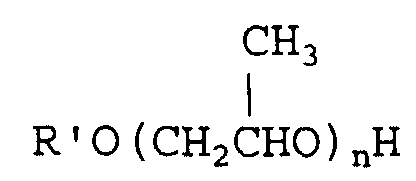
- In the alternative, the end cap to the polypropyleneglycol may be an ester (R'COO) group where R' is defined above, i.e. the carrier oil may be a polypropyleneglycol monoester of the formula

- In yet another alternative, the carrier oil component used in the compositions of the invention may be an ester of the mono-end capped polypropylene glycols described above with a C1-C30 monocarboxylic acid, preferably an aliphatic monocarboxylic acid, and preferably containing 2 to 10 carbon atoms, e.g. acetic, propionic, butyric, 2-ethylhexanoic acid etc. In the case where the end cap is itself an ester group, then, of course, the carrier oil will be a polypropyleneglycol diester, the two ester groups not necessarily being the same. But still preferred are the esters of polypropyleneglycol monoethers, that is to say carrier oils of the formula

R" is a C1-C30 hydrocarbyl group, preferably an aliphatic hydrocarbyl group, and more preferably C1-C10 alkyl. - The third principal component of the multi-functional gasoline detergent compositions of this invention is the diluent or solvent added primarily to reduce the viscosity of the mix, thereby to improve its handling properties and to facilitate the blending of the additive with the gasoline. Generally the solvent will be an aromatic hydrocarbon having a boiling point in the range 66 to 270°C, e.g. toluene or xylene or more especially the aromatic solvent mixtures sold under the trade marks Shellsol AB, Shellsol R and Solvesso 150, and boiling in the range 180 to 270°C. The amount of solvent to be incorporated will depend upon the desired final viscosity, but will usually be from 20 to 70% of the final composition on a weight basis.
- As indicated, the compositions of the present invention will usually contain a number of minor ingredients, often added to meet specific customer requirements. Included amongst these are dehazers, usually an alkoxylated phenol formaldehyde resin, added to minimise water adsorption and to prevent a hazy or cloudy appearance, and a corrosion inhibitor, usually of the type comprising a blend of one or more fatty acids and amines. Either or both will usually be present in the compositions of the present invention in amounts ranging from 1 to 5%, usually 1 to 3% each, based on the total weight of the composition.
- Other specific purpose minor ingredients which may be added include anti-oxidants, anti-icing agents, anti-foam agents, metal deactivators, dyes and the like. These all may be added in amounts ranging from a few parts per million, up to 2 or 3% by weight, according to conventional practice.
- In general terms the total amount of such minor functional ingredients in the composition will not exceed 10% by weight, more usually not exceeding 5% by weight.
- Such minor additives are conventional in the art. Overall, the additive compositions of this invention will usually contain, on a weight basis:
- 10-30%, preferably 15 to 20%, active detergent,
- 10-30%, preferably 15 to 20%, carrier oil,
- 20-80%, preferably 30-70% (w/v) solvent,
- 0-10% antioxidant, corrosion inhibitors, dehazers, etc.
- Preferably the weight ratio of active detergent to carrier oil in the additive composition will be in the range 0.2:1 to 5:1, usually about 1:1.
- The multi-functional gasoline detergent compositions of this invention are blended into gasoline in amounts sufficient to provide from 10 to 2000 ppm (weight basis) of active detergent in the gasoline. Preferred amounts range from 30 to 800 ppm, most usually and preferably from 50 to 500 ppm.
- The quantity of carrier oil incorporated in the gasoline will usually be in the range 10 to 1500 ppm (weight basis), preferably 10 to 1000 ppm, most usually and preferably 30 to 500 ppm.
- The compositions of the invention are excellent multi-functional gasoline detergents. Use in the manner described provides excellent detergent performance through the engine system, and especially where most needed in the carburettor, and especially in and around injector nozzles and in and around the fuel inlet ports and inlet valves. They lead moreover to the elimination of valve stick and do not adversely affect the octane requirements of the engine. They have good "cleanup" properties, as well as "keep-clean" properties.
- Typical multi-functional gasoline detergent compositions according to the invention are illustrated in the following Examples, along with an evaluation of their performance as gasoline detergents.
- A multi-functional gasoline detergent composition is made up as follows, percentages by weight:


-
% by wt. Polyisobutenyl (MW 1300) succinimide synthesized as in Example 1; PIBSA:TEPA mole ratio 1.4:1.0 26.05 Polypropyleneglycol mono straight chain C12-C18 alkyl ether (MW 700) 15.63 Polyoxyalkylated phenol formaldehyde dehazer (NALCO:7DO6) 0.53 Aromatic solvent (Shellsol AB) 55.00 Fatty acid/amine corrosion inhibitor 2.79 -
% by wt. Polyisobutenyl (780 MW) succinimide synthesized as in Example 1, except triethylenetetramine (TETA) is used in place of TEPA; PIBSA:TETA mole ratio 1.8:1.0 30.18 Polypropyleneglycol monoether (Same as Example 1) 18.00 Polyoxyalkylated phenol formaldehyde dehazer (Rechem:ER20) 1.00 Aromatic Solvent (Shellsol R) 48.20 Fatty acid/amine corrosion inhibitor (DuPont:DCI 11) 2.62 -
% by wt. Polyisobutenyl (MW 1000) succinimide synthesized as in Example 1 but using TETA instead of TEPA and at a PIBSA:TETA mole ratio of 1.8:1.0 26.05 Polypropyleneglycol (MW 1200) long chain (C15) alkyl monoether 31.26 Polyoxyalkylated phenol formaldehyde dehazer (NALCO:7D06) 0.52 Aromatic Solvent (Shellsol AB) 39.37 Fatty acid/amine corrosion inhibitor (DuPont:DCI 11) 2.80 -
% by wt. Polyisobutenyl (MW 1300) succinimide synthesized as in Example 1 but using TETA instead of TEPA at a PIBSA:TETA mole ratio of 1.4:1.0 30.18 Polypropyleneglycol monoether (same as Example 1) 32.50 Polyoxyalkylated phenol formaldehyde dehazer (Rechem:ER20) 1.00 Aromatic Solvent (Shellsol R) 33.52 Fatty acid/amine corrosion inhibitor (DuPont DC1 11) 2.80 -
% by wt. Polyisobutenyl (MW 1000) succinimide PIBSA:TEPA ratio 2.0:1.0 26.05 Acetate ester of polypropyleneglycol (MW 1200) long chain (C15) alkyl monoether 32.50 Solvent (Solvessso 150) 38.50 Dehazer, polyoxyalkylated phenol formaldehyde resin 0.52 Fatty acid corrosion inhibitor (DuPont DCI6a)) 2.43 - For the purpose of evaluating the performance of detergent compositions according to the invention, various test compositions were formulated as set out in Table 1. In each case the detergent/carrier oil were present in the test composition at a concentration of about 36% by wt.


- The intake valve detergency properties exhibited by the detergent/carrier oil combinations listed in Table 1 were measured using a particularly severe CEC-F-05-T91 test procedure on a bench engine. The test engine was a Mercedes-Benz M 102.982 four cylinder, four stroke 2.3 litre gasoline-injection engine with a standard KE-Jetronic injection system. The test carried out involved a cyclic procedure, each cycle including the following four operating states:
Stage Time (min) Speed (min-1) Torques (Nm) Power (kW) 1 0.5 800 0 0 2 1.0 1,300 28.4 4 3 2.0 1,850 32.5 6.3 4 1.0 3,000 35.0 11.0 - The duration of each test was approximately 60h. At the beginning of each test the engine was fitted with new inlet valves which were weighed before fitting. At the end of each test, and before the visual assessment and before weighing the used inlet valves, residues were cleaned carefully from the valve surface facing the combustion space. The valves were then immersed in n-heptane for 10 seconds and swung dry. After drying for 10 minutes, the valves were weighed and the increase in valve weight caused by deposits was measured in mg. Visual assessment of the inlet valves was then carried out according to the rating system described in the CEC F-05-T-91 method; the results are expressed below (Table 2) in the form of average per valve, a mark of 10 corresponding to a clean valve whilst a mark of 1 to a fouled valve. During the dismantling of the valves the sticky or non-sticky appearance of the deposits formed on the valve tulip and valve stem was also evaluated. The tendency to form deposits of sticky appearance could indicate, ultimately, a tendency to the appearance of the valve stick phenomenon which is desirable to avoid.
- The fuel employed in the test procedure was a CEC legislative reference premium unleaded gasoline, coded RF-08-A-85.
- The test compositions were added to the fuel so as to obtain a concentration of active substance (detergent and carrier oil) in the fuel in the amounts indicated.
Table 2 Run Number Test Composition Concentration ppm Average of the deposits (mg) Visual Rating Appearance of the deposits 1 0 274 7.8 non sticky 2 A 500 167 9.09 non sticky 3 B 500 0 10 non sticky 4 C 275 17 9.5 non sticky 5 D 275 45 9.2 sticky 6 E 250 25 9.5 non sticky 7 F 375 7 9.9 sticky 8 G 250 153 8.9 non sticky 9 H 250 52 9.2 non sticky 10 I 325 45 9.3 non sticky 11 K 500 10 9.7 sticky 12 M 372 30 9.6 sticky 13 B 250 5 9.8 non sticky 14 P 250 188 8.29 non sticky 15 Q 250 21 9.39 non sticky 16 R 250 190 8.3 non sticky 17 S 250 13.1 9.72 non sticky 18 W 250 59.7 9.36 non sticky - Table 2 shows that when using pure detergent (Run 5, Composition D), dosages of at least 250 ppm are necessary in order to reduce the deposits to below 50 mg per valve, but that the deposit obtained is of a sticky nature.
- When using carrier oils alone as the fuel additive in the absence of the detergent (Run 2, Composition A), high deposit levels (167 mg per valve in this example) are obtained even at dosage rates of 500 ppm.
- Analysis of the results obtained in the runs 2-16 show that the compositions according to the present invention (Compositions B, C, E, Q and S; Runs 3, 4, 6, 13, 15 and 17) comprising the constituents of the combination of the succinimide detergent and a polypropyleneglycol monoether or ester thereof (Q) as the carrier oil, make it possible to reduce the amount of deposits formed on the intake valves, and not only that, but also that the deposits which are formed are of a non-sticky nature, rather than sticky, thus reducing or eliminating the risk of valve stick. Thus, whilst Compositions D, F, K and M, for example, Runs 5, 7, 11 and 12, provide acceptably low deposits, those deposits are sticky and are thus likely to contribute to valve stick.
- From the above results, it appears that the chemistry of the carrier oil used in conjunction with polyalkenylsuccinimide detergent and the ratio of the two significantly affects both the appearance of the deposits, i.e. whether they are sticky or not, and the amount. Thus, when mineral oils (Composition M, Run 12), polyisobutenes (Composition K, Run 11), or polypropyleneglycols (Composition F, Run 7) are used as carrier oils the residual deposits are sticky. Against that, the use of the butylene oxide based products (Compositions G and H, Runs 8 and 9) results in deposits which are indeed non-sticky but an unacceptably high levels. Similarly with the ethyleneglycol based carrier oils (Compositions P and R, Runs 14 and 16).
- A series of tests was also carried out to evaluate the actual valve stick properties of various formulations. Test running was carried out on a single roll distance accumulation dynamometer manufactured by Labeco. The test engine is a regular Volkswagen Transporter 1.9-litre, 44kW watercooled-boxer Otto engine type 2 series with hydraulic valve filter. It is a flat four cylinder engine mounted at the rear, with a three-speed automatic transmission. The cylinder heads are dismantled after each test (one test - 3 runs on the same fuel) and are cleaned with a suitable cleansing agent until metallically clean. The valve guides and valve stems are measured before each test.
- The fuel used in these tests is a CEC legislative reference premium unleaded gasoline, coded RF-08-A-85.
- Two test procedures were employed, namely the procedure described by DKA (Deutscher Koordinierungs Ausschuess) and a very severe procedure developed by the Applicants, referred to herein as the Octel test, which involves final measurements taken at -20°C. Both are cyclic procedures, each cycle including the following operating states:
DKA Procedure OCTEL Procedure Drive 130 km at level road load as follows: -5 km at 50 km/h -5 km at 50 km/h -5 km at 60 km/h -5 km at 60 km/h -Stop engine -Stop engine pause 10 minutes pause 10 minutes Carry out a total of 13 times to occupy 4 hours 33 minutes. Switch off engine and soak to required temperature for 15h. Carry out a total of 13 times to occupy 4 hours 33 minutes. Switch off engine and soak to required temperature for 11h 27 minutes. Carry out three cycles with a soak temperature of +5°C. Carry out four cycles with a soak temperature of +15°C and a final fifth cycle at -20°C. - At the end of each engine soak phase, an engine compression test is carried out to highlight any valve which is not functioning correctly. Thus, if the compression at one or more cylinders is zero or very low the inlet valve is sticking. A failure condition is and appears still to be only when three consecutive low compressions are recorded.
- The test compositions are added to the fuel so as to obtain a concentration of active substance in the fuel containing additives which is specified for each example in Table 3 below, which gives the results obtained.
- Table 3 shows the results of the Volkswagen valve sticking test described above.
Table 3 Serial No. Procedure Additive Quantity mg/L Valve Stem Rating Nature of Deposits Comments Cycle No. Valve Stick Test Temp. 13 OCTEL no additive 7.80 non sticky PASS -20°C 14 DKA no additive 8.50 non sticky PASS +5°C 15 OCTEL D 125 5.25 sticky FAIL 5 -20°C 16 OCTEL D 250 4.53 sticky FAIL 1 -20°C 17 OCTEL E 250 7.53 non sticky PASS -20°C 18 OCTEL F 250 7.75 non sticky PASS -20°C 19 OCTEL N 275 7.55 non sticky PASS -20°C 20 OCTEL B 250 7.54 non sticky PASS -20°C 21 OCTEL B 500 7.25 non sticky PASS -20°C 22 OCTEL L 250 7.88 non sticky PASS -20°C 23 DKA F 375 7.33 sticky PASS +5°C 24 OCTEL F 375 6.13 sticky FAIL 5 -20°C 25 OCTEL O 275 7.73 sticky PASS -20°C 26 OCTEL O 825 5.20 sticky FAIL 1 -20°C 27 DKA M 372 6.98 sticky PASS +5°C 28 DKA K 500 7.00 sticky FAIL 1 +5°C - The valve stem ratings according to the Octel test and included in Table 3 are indicative of the percentage of surface covered by deposits on the valve stem areas as well as their appearance, i.e. density. The following conclusions can be drawn from the analysis of the results presented in Table 3:
- 1. The Octel cycle is more severe than the standard DKA cycle. This is shown in runs 13-14, and more clearly in runs 23-24 where Composition F passes the DKA cycle but fails the OCTEL cycle.
- 2. Runs 15 and 16 clearly illustrate the valve stem sticking tendency of polyisobutenylsuccinimides when they are used as pure detergents in the fuel.
- 3. The advantages when using polypropyleneglycol monoethers in conjunction with polyisobutenylsuccinimides according to the invention are obvious in runs 17-21.
- 4. Formulations of polyisobutenylsuccinimides and polyalkyleneglycols (Composition F) do reduce the valve sticking tendency of pure polyolefin-based succinimides (run 23), but under extremely severe conditions (test temperatures -20°C) the same formulations are likely to cause valve stick (run 24).
- 5. Valve stem sticking is likely to occur when using overdoses of detergents which tend to leave sticky deposits on the valve stem area (Runs 15-16 and 25-26).
- 6. When solvent neutral oils or polyisobutylenes are used in conjunction with olefin-based succinimides (Compositions M and K), they provide good valve detergency properties (see Table 2), but they leave sticky deposits (runs 27 and 28), which could cause valve stick problems, especially at high dose rates (run 28).
- Analysis of these results therefore clearly illustrates that the compositions of the present invention comprising of the combination of a polyisobutenylsuccinimide and end capped polypropyleneglycol make it possible to eliminate the valve stick problem occurring even under the most severe conditions (-20°C), with the best results being obtained where the carrier oil is a mono-end capped polypropyleneglycol monoether.
- A series of tests was also carried out to assess the effects of the multifunctional additive of this invention (based on polyalkenylsuccinimide detergents in combination with polypropylene glycol ethers) on octane requirement increase. For that purpose, a premium unleaded gasoline with the following specifications was used as base fuel:
Table 4 Properties of Unleaded Gasoline Density, kg/ℓ 0.7450 Distillation IBP @ °C 27 2% vol @ °C 32 5% vol @ °C 37 10% vol @ °C 43 20% vol @ °C 56 30% vol @ °C 70 40% vol @ °C 86 50% vol @ °C 99 60% vol @ °C 113 70% vol @ °C 126 80% vol @ °C 140 90% vol @ °C 166 95% vol @ °C - FBP @ °C 194 RON 96.9 MON 86.0 Sensitivity 10.9 % vol Recovery 94.2 % vol Residue 1.3 % vol Loss 4.5 % vol Saturates 49.4 % vol Aromatics 40.6 % vol Olefins 10.0 - A Renault F2N engine was run on a deposit accumulation cycle adopted by the British Technical Council of the Motor and Petroleum Industries (BTC). This cycle is designed to simulate typical European driving conditions during which the engine is periodically rated with the use of reference fuels and by measuring Knock Limited Spark Advance to assess the level of ORI.
- The cycle briefly comprises a simulation of the following fifth gear road load conditions:



- The duration of the cycle is three hours actual running time with additional 30-minute fan cooling at two intermediate stages.
- Octane ratings were carried out before the start of deposit accumulation and the end of the accumulation. The equivalent distance was 20,000 km. Tests were carried out at regular intervals under constant speed conditions, between 1500-4500 rpm in 500 rpm increments. Two sets were used to monitor the engine's octane requirement:
- i) Primary reference fuels ranging from 85-95 RON
- ii) Full boiling range unleaded fuels with low-, medium-, and high sensitivity.
- The overall octane requirement being the maximum value attained throughout the speed range.
- The fuels were rated in accordance with the Co-operative Octane Requirement Committee (CORC) procedures. Thus, the engine is run in turn on fuels of decreasing octane number and assessed audibly by an experienced technician for trace knock. The trace knock condition provides the octane requirement for the engine, at a given speed and throttle position and completes a single rating.
- Table 5 presents the results of the F2N engine ORI test described above.
Table 5 Fuel Composition Octane Requirement Increase δKLSA PRF ULG 95 10 5 ULG 95 + F @ 375 ppm (w/v) 7 3 ULG 95 + B @ 250 ppm (w/v) 6 5 - The results show that combinations of the polyalkenylsuccinimide detergent described above and end capped polypropyleneglycols do not contribute to ORI.
Claims (14)
- A multi-functional detergent composition for gasoline, consisting of:i) from 10 to 30% by weight, based on the total composition, of a polyisobutenyl succinimide detergent wherein the polyisobutenyl substituent of the succinimide has a number average molecular weight (Mn) in the range 500 to 5000;ii) a carrier oil component providing from 10 to 30% by weight, based on the total composition, of a polypropylene glycol having a single hydrocarbyl end capping group attached to the polypropylene glycol chain via an ether oxygen atom or via a carbonyl group attached to said oxygen atom, and having a molecular weight in the range 500 to 5000, or an ester thereof;iii) from 20 to 80% (w/v) of a hydrocarbon solvent having a boiling point in the range 66 to 270°C; andiv) one or more minor functional components selected from: anti-oxidants, corrosion inhibitors, dehazers, anti-foam agents, metal deactivators, deicers or dyes, such minor functional components being present in a total amount not exceeding 10% by weight, based on the total weight of the composition.
- A detergent composition according to claim 1, wherein the weight ratio of active detergent to carrier oil is in the range 0.2:1 to 5:1.
- A detergent composition according to claim 2, wherein the polyisobutenyl substituent of the succinimide is derived from polyisobutylene having a number average molecular weight (Mn) in the range 800 to 1300.
- A detergent composition according to any one of claims 1 to 3, wherein the succinimide detergent is derived from a polyalkylene polyamine of the formula:
H2N - (RNH)n - R - NH2
where R is C1-C5 alkylene;
n is an integer whose value or average value is from 1 to 10. - A detergent composition according to claim 4, wherein the said polyalkylene polyamine is a polyethylene polyamine of the formula:
H2N(CH2CH2N)xH
where x is 1 to 6. - A detergent composition according to claim 5, wherein the said polyethylene polyamine is tetraethylenepentamine.
- A detergent composition according to claim 4, 5 or 6, wherein the succinimide detergent is the reaction product obtained by reacting a polyisobutenylsuccinic acid or anhydride with the polyalkylene polyamine in a molar ratio of from 0.2:1 to 5:1.
- A detergent composition according to claim 7, wherein said ratio is from 0.5:1 to 2:1.
- A detergent composition according to any one of claims 1 to 8, wherein the carrier oil component is a polypropylene glycol comprising as the single end cap a hydrocarbyl group of up to 30 carbon atoms.
- A detergent composition according to claim 9, wherein the end cap is or comprises an alkyl group of 4 to 20 carbon atoms.
- A detergent composition according to claim 10, wherein the carrier oil component is a polypropyleneglycol monoether of the formula:

n is an integer whose value or average value is in the range 10 to 30. - A detergent composition according to any one of the preceding claims wherein the solvent is xylene, toluene or a mixture of aromatic solvents boiling in the range 180 to 270°C.
- A gasoline containing as a multi-functional detergent composition, a composition as claimed in any one of claims 1 to 12.
- A gasoline according to claim 13, wherein the detergent composition is added to the gasoline in an amount sufficient to provide, on a weight basis, from 50 to 500 ppm detergent and 30 to 500 ppm carrier oil.
Applications Claiming Priority (3)
| Application Number | Priority Date | Filing Date | Title |
|---|---|---|---|
| GB929207383A GB9207383D0 (en) | 1992-04-03 | 1992-04-03 | Multi-functional gasoline detergent compositions |
| GB9207383 | 1992-04-03 | ||
| PCT/GB1993/000698 WO1993020170A1 (en) | 1992-04-03 | 1993-04-02 | Multi-functional gasoline detergent compositions |
Publications (2)
| Publication Number | Publication Date |
|---|---|
| EP0633920A1 EP0633920A1 (en) | 1995-01-18 |
| EP0633920B1 true EP0633920B1 (en) | 1997-07-16 |
Family
ID=10713446
Family Applications (1)
| Application Number | Title | Priority Date | Filing Date |
|---|---|---|---|
| EP93907983A Expired - Lifetime EP0633920B1 (en) | 1992-04-03 | 1993-04-02 | Multi-functional gasoline detergent compositions |
Country Status (20)
| Country | Link |
|---|---|
| US (1) | US5518511A (en) |
| EP (1) | EP0633920B1 (en) |
| JP (1) | JPH07505185A (en) |
| CN (1) | CN1078743A (en) |
| AT (1) | ATE155520T1 (en) |
| AU (1) | AU669891B2 (en) |
| BR (1) | BR9306177A (en) |
| CA (1) | CA2132828A1 (en) |
| DE (1) | DE69312277T2 (en) |
| ES (1) | ES2104143T3 (en) |
| FI (1) | FI944607A0 (en) |
| GB (1) | GB9207383D0 (en) |
| MY (1) | MY109113A (en) |
| NO (1) | NO943662L (en) |
| NZ (1) | NZ251390A (en) |
| PL (1) | PL172553B1 (en) |
| TW (1) | TW221459B (en) |
| UY (1) | UY23565A1 (en) |
| WO (1) | WO1993020170A1 (en) |
| ZA (1) | ZA932258B (en) |
Cited By (1)
| Publication number | Priority date | Publication date | Assignee | Title |
|---|---|---|---|---|
| US9493720B2 (en) | 2010-05-10 | 2016-11-15 | Innospec Limited | Gasoline composition, method and use |
Families Citing this family (32)
| Publication number | Priority date | Publication date | Assignee | Title |
|---|---|---|---|---|
| DE4234032A1 (en) * | 1992-10-09 | 1994-04-14 | Rwe Dea Ag | Fuel additives for petrol engines and fuels containing them |
| US5962738A (en) * | 1994-12-15 | 1999-10-05 | Petrokleen, Ltd. | Polymeric-amine fuel and lubricant additive |
| GB9502041D0 (en) * | 1995-02-02 | 1995-03-22 | Exxon Chemical Patents Inc | Additives and fuel oil compositions |
| GB9610781D0 (en) * | 1996-05-23 | 1996-07-31 | Ass Octel | Gasoline detergent compositions |
| EP0829527A1 (en) * | 1996-09-12 | 1998-03-18 | Exxon Research And Engineering Company | Additive concentrate for fuel compositions |
| US5925151A (en) * | 1996-09-19 | 1999-07-20 | Texaco Inc | Detergent additive compositions for diesel fuels |
| DE19830818A1 (en) * | 1998-07-09 | 2000-01-13 | Basf Ag | Fuel compositions containing propoxylate |
| US6210452B1 (en) * | 2000-02-08 | 2001-04-03 | Hhntsman Petrochemical Corporation | Fuel additives |
| GB0022473D0 (en) * | 2000-09-13 | 2000-11-01 | Ass Octel | Composition |
| US6746495B2 (en) * | 2000-10-24 | 2004-06-08 | Exxonmobil Research And Engineering Company | Method for controlling deposit formation in gasoline direct injection engine by use of a fuel having particular compositional characteristics |
| DE10123553A1 (en) * | 2001-05-15 | 2002-11-21 | Basf Ag | Production of polyalkenyl succinimides useful as fuel and lubricant additives comprises using an alcohol or phenol to reduce foaming |
| DE10209830A1 (en) * | 2002-03-06 | 2003-09-18 | Basf Ag | Fuel additive mixtures for petrol with synergistic IVD performance |
| US20030177692A1 (en) | 2002-03-12 | 2003-09-25 | The Lubrizol Corporation | Method of operating a direct injection spark-ignited engine with a fuel composition |
| GB0301599D0 (en) * | 2003-01-23 | 2003-02-26 | Oxonica Ltd | Cerium oxide nanoparticles as fuel additives |
| CA2606747A1 (en) * | 2005-05-13 | 2006-11-23 | The Lubrizol Corporation | The use of fatty acid alkoxylates as a method to remedy engine intake valve sticking |
| MX2010006074A (en) * | 2010-06-03 | 2011-12-16 | Mexicano Inst Petrol | Amino and imino propionic acids, process of preparation and use. |
| US20120180382A1 (en) * | 2011-01-19 | 2012-07-19 | Afton Chemical Corporation | Fuel Additives and Gasoline Containing the Additives |
| CN102876402A (en) * | 2012-09-27 | 2013-01-16 | 上海群乐船舶附件启东有限公司 | Composite gasoline |
| CN103289762A (en) * | 2013-05-22 | 2013-09-11 | 吴江市德佐日用化学品有限公司 | Gasoline cleaning agent |
| EP3071677B1 (en) | 2013-11-18 | 2022-03-23 | Afton Chemical Corporation | Mixed detergent composition for intake valve deposit control |
| WO2017097685A1 (en) * | 2015-12-09 | 2017-06-15 | Basf Se | Novel alkoxylates and use thereof |
| US10273425B2 (en) | 2017-03-13 | 2019-04-30 | Afton Chemical Corporation | Polyol carrier fluids and fuel compositions including polyol carrier fluids |
| PL4179047T3 (en) * | 2020-07-07 | 2025-06-23 | Chevron Oronite Company Llc | Fuel additives for mitigating injector nozzle fouling and reducing particulate emissions |
| US12024686B2 (en) | 2022-09-30 | 2024-07-02 | Afton Chemical Corporation | Gasoline additive composition for improved engine performance |
| US12169192B2 (en) | 2020-11-02 | 2024-12-17 | Afton Chemical Corporation | Methods of identifying a hydrocarbon fuel |
| US11873461B1 (en) | 2022-09-22 | 2024-01-16 | Afton Chemical Corporation | Extreme pressure additives with improved copper corrosion |
| US12134742B2 (en) | 2022-09-30 | 2024-11-05 | Afton Chemical Corporation | Fuel composition |
| US12624303B2 (en) | 2023-07-28 | 2026-05-12 | Afton Chemical Corporation | Gasoline additive composition for improved engine performance |
| US11884890B1 (en) | 2023-02-07 | 2024-01-30 | Afton Chemical Corporation | Gasoline additive composition for improved engine performance |
| US11795412B1 (en) | 2023-03-03 | 2023-10-24 | Afton Chemical Corporation | Lubricating composition for industrial gear fluids |
| US12454653B2 (en) | 2023-12-11 | 2025-10-28 | Afton Chemical Corporation | Gasoline additive composition for improved engine performance |
| US12553003B1 (en) | 2025-02-03 | 2026-02-17 | Afton Chemical Corporation | Quaternary ammonium compounds |
Family Cites Families (7)
| Publication number | Priority date | Publication date | Assignee | Title |
|---|---|---|---|---|
| US3658494A (en) * | 1969-01-21 | 1972-04-25 | Lubrizol Corp | Fuel compositions comprising a combination of monoether and ashless dispersants |
| US3901665A (en) * | 1972-10-06 | 1975-08-26 | Du Pont | Multi-functional fuel additive compositions |
| US4968321A (en) * | 1989-02-06 | 1990-11-06 | Texaco Inc. | ORI-inhibited motor fuel composition |
| US5006130A (en) * | 1989-06-28 | 1991-04-09 | Shell Oil Company | Gasoline composition for reducing intake valve deposits in port fuel injected engines |
| BR9106137A (en) * | 1990-03-05 | 1993-03-02 | Polar Molecular Corp | ADDITIVE COMPOSITION OF ENGINE FUEL AND PROCESS FOR ITS PREPARATION |
| US5242469A (en) * | 1990-06-07 | 1993-09-07 | Tonen Corporation | Gasoline additive composition |
| US5089028A (en) * | 1990-08-09 | 1992-02-18 | Mobil Oil Corporation | Deposit control additives and fuel compositions containing the same |
-
1992
- 1992-04-03 GB GB929207383A patent/GB9207383D0/en active Pending
-
1993
- 1993-03-30 ZA ZA932258A patent/ZA932258B/en unknown
- 1993-04-02 FI FI944607A patent/FI944607A0/en unknown
- 1993-04-02 CA CA002132828A patent/CA2132828A1/en not_active Abandoned
- 1993-04-02 WO PCT/GB1993/000698 patent/WO1993020170A1/en not_active Ceased
- 1993-04-02 AT AT93907983T patent/ATE155520T1/en not_active IP Right Cessation
- 1993-04-02 US US08/313,241 patent/US5518511A/en not_active Expired - Fee Related
- 1993-04-02 MY MYPI93000584A patent/MY109113A/en unknown
- 1993-04-02 PL PL93305439A patent/PL172553B1/en unknown
- 1993-04-02 DE DE69312277T patent/DE69312277T2/en not_active Expired - Fee Related
- 1993-04-02 EP EP93907983A patent/EP0633920B1/en not_active Expired - Lifetime
- 1993-04-02 NZ NZ251390A patent/NZ251390A/en unknown
- 1993-04-02 ES ES93907983T patent/ES2104143T3/en not_active Expired - Lifetime
- 1993-04-02 BR BR9306177A patent/BR9306177A/en not_active IP Right Cessation
- 1993-04-02 JP JP5517259A patent/JPH07505185A/en active Pending
- 1993-04-02 AU AU38983/93A patent/AU669891B2/en not_active Ceased
- 1993-04-03 CN CN 93105220 patent/CN1078743A/en active Pending
- 1993-04-05 UY UY23565A patent/UY23565A1/en unknown
- 1993-04-08 TW TW082102605A patent/TW221459B/zh active
-
1994
- 1994-09-30 NO NO943662A patent/NO943662L/en unknown
Cited By (2)
| Publication number | Priority date | Publication date | Assignee | Title |
|---|---|---|---|---|
| US9493720B2 (en) | 2010-05-10 | 2016-11-15 | Innospec Limited | Gasoline composition, method and use |
| US9932536B2 (en) | 2010-05-10 | 2018-04-03 | Innospec Limited | Gasoline composition, method and use |
Also Published As
| Publication number | Publication date |
|---|---|
| JPH07505185A (en) | 1995-06-08 |
| FI944607A7 (en) | 1994-10-03 |
| GB9207383D0 (en) | 1992-05-13 |
| NO943662D0 (en) | 1994-09-30 |
| FI944607L (en) | 1994-10-03 |
| AU3898393A (en) | 1993-11-08 |
| MY109113A (en) | 1996-12-31 |
| EP0633920A1 (en) | 1995-01-18 |
| TW221459B (en) | 1994-03-01 |
| DE69312277T2 (en) | 1998-01-08 |
| ATE155520T1 (en) | 1997-08-15 |
| FI944607A0 (en) | 1994-10-03 |
| AU669891B2 (en) | 1996-06-27 |
| CA2132828A1 (en) | 1993-10-14 |
| PL172553B1 (en) | 1997-10-31 |
| UY23565A1 (en) | 1993-10-06 |
| DE69312277D1 (en) | 1997-08-21 |
| ES2104143T3 (en) | 1997-10-01 |
| US5518511A (en) | 1996-05-21 |
| BR9306177A (en) | 1998-06-23 |
| CN1078743A (en) | 1993-11-24 |
| WO1993020170A1 (en) | 1993-10-14 |
| ZA932258B (en) | 1993-10-14 |
| NO943662L (en) | 1994-09-30 |
| NZ251390A (en) | 1995-11-27 |
Similar Documents
| Publication | Publication Date | Title |
|---|---|---|
| US5518511A (en) | Multi-functional gasoline detergent compositions | |
| EP1481041B1 (en) | Gasoline additives | |
| KR100663774B1 (en) | Fuel composition | |
| US7704289B2 (en) | Method of operating a direct injection spark-ignited engine with a fuel composition | |
| US5814111A (en) | Gasoline compositions | |
| KR101320732B1 (en) | Fuel composition | |
| EP0526129B1 (en) | Compositions for control of octane requirement increase | |
| US5752990A (en) | Composition and method for reducing combustion chamber deposits, intake valve deposits or both in spark ignition internal combustion engines | |
| US6579329B1 (en) | Mixture suitable as a fuel additive and lubricant additive and comprising amines, hydrocarbon polymers and carrier oils | |
| US6361573B1 (en) | Fuel dispersants with enhanced lubricity | |
| US20050223630A1 (en) | Friction modifier for hydrocarbon fuels | |
| EP0518966B1 (en) | Motor fuel additive composition and method for preparation thereof | |
| EP0588429B1 (en) | Gasoline composition | |
| EP0380305B1 (en) | Ori-inhibited and deposit-resistant motor fuel composition | |
| US20040048765A1 (en) | Composition | |
| US4865621A (en) | Ori-inhibited and deposit-resistant motor fuel composition | |
| AU2003219078B2 (en) | Gasoline additives | |
| HK1006062B (en) | Gasoline composition |
Legal Events
| Date | Code | Title | Description |
|---|---|---|---|
| PUAI | Public reference made under article 153(3) epc to a published international application that has entered the european phase |
Free format text: ORIGINAL CODE: 0009012 |
|
| 17P | Request for examination filed |
Effective date: 19940924 |
|
| AK | Designated contracting states |
Kind code of ref document: A1 Designated state(s): AT BE CH DE DK ES FR GB GR IE IT LI LU MC NL PT SE |
|
| 17Q | First examination report despatched |
Effective date: 19950502 |
|
| GRAG | Despatch of communication of intention to grant |
Free format text: ORIGINAL CODE: EPIDOS AGRA |
|
| GRAH | Despatch of communication of intention to grant a patent |
Free format text: ORIGINAL CODE: EPIDOS IGRA |
|
| GRAH | Despatch of communication of intention to grant a patent |
Free format text: ORIGINAL CODE: EPIDOS IGRA |
|
| GRAA | (expected) grant |
Free format text: ORIGINAL CODE: 0009210 |
|
| AK | Designated contracting states |
Kind code of ref document: B1 Designated state(s): AT BE CH DE DK ES FR GB GR IE IT LI LU MC NL PT SE |
|
| PG25 | Lapsed in a contracting state [announced via postgrant information from national office to epo] |
Ref country code: LI Free format text: LAPSE BECAUSE OF FAILURE TO SUBMIT A TRANSLATION OF THE DESCRIPTION OR TO PAY THE FEE WITHIN THE PRESCRIBED TIME-LIMIT Effective date: 19970716 Ref country code: GR Free format text: LAPSE BECAUSE OF FAILURE TO SUBMIT A TRANSLATION OF THE DESCRIPTION OR TO PAY THE FEE WITHIN THE PRESCRIBED TIME-LIMIT Effective date: 19970716 Ref country code: DK Effective date: 19970716 Ref country code: CH Free format text: LAPSE BECAUSE OF FAILURE TO SUBMIT A TRANSLATION OF THE DESCRIPTION OR TO PAY THE FEE WITHIN THE PRESCRIBED TIME-LIMIT Effective date: 19970716 Ref country code: AT Effective date: 19970716 |
|
| REF | Corresponds to: |
Ref document number: 155520 Country of ref document: AT Date of ref document: 19970815 Kind code of ref document: T |
|
| REG | Reference to a national code |
Ref country code: CH Ref legal event code: EP |
|
| REF | Corresponds to: |
Ref document number: 69312277 Country of ref document: DE Date of ref document: 19970821 |
|
| REG | Reference to a national code |
Ref country code: ES Ref legal event code: FG2A Ref document number: 2104143 Country of ref document: ES Kind code of ref document: T3 |
|
| ITF | It: translation for a ep patent filed | ||
| PG25 | Lapsed in a contracting state [announced via postgrant information from national office to epo] |
Ref country code: SE Effective date: 19971016 |
|
| PG25 | Lapsed in a contracting state [announced via postgrant information from national office to epo] |
Ref country code: PT Effective date: 19971023 |
|
| ET | Fr: translation filed | ||
| REG | Reference to a national code |
Ref country code: CH Ref legal event code: PL |
|
| PG25 | Lapsed in a contracting state [announced via postgrant information from national office to epo] |
Ref country code: LU Free format text: LAPSE BECAUSE OF NON-PAYMENT OF DUE FEES Effective date: 19980402 Ref country code: IE Free format text: LAPSE BECAUSE OF NON-PAYMENT OF DUE FEES Effective date: 19980402 |
|
| PGFP | Annual fee paid to national office [announced via postgrant information from national office to epo] |
Ref country code: BE Payment date: 19980416 Year of fee payment: 6 |
|
| PGFP | Annual fee paid to national office [announced via postgrant information from national office to epo] |
Ref country code: NL Payment date: 19980427 Year of fee payment: 6 |
|
| PLBE | No opposition filed within time limit |
Free format text: ORIGINAL CODE: 0009261 |
|
| STAA | Information on the status of an ep patent application or granted ep patent |
Free format text: STATUS: NO OPPOSITION FILED WITHIN TIME LIMIT |
|
| 26N | No opposition filed | ||
| PG25 | Lapsed in a contracting state [announced via postgrant information from national office to epo] |
Ref country code: MC Free format text: LAPSE BECAUSE OF NON-PAYMENT OF DUE FEES Effective date: 19981031 |
|
| PG25 | Lapsed in a contracting state [announced via postgrant information from national office to epo] |
Ref country code: BE Free format text: LAPSE BECAUSE OF NON-PAYMENT OF DUE FEES Effective date: 19990430 |
|
| BERE | Be: lapsed |
Owner name: THE ASSOCIATED OCTEL CY LTD Effective date: 19990430 |
|
| PG25 | Lapsed in a contracting state [announced via postgrant information from national office to epo] |
Ref country code: NL Free format text: LAPSE BECAUSE OF NON-PAYMENT OF DUE FEES Effective date: 19991101 |
|
| NLV4 | Nl: lapsed or anulled due to non-payment of the annual fee |
Effective date: 19991101 |
|
| PGFP | Annual fee paid to national office [announced via postgrant information from national office to epo] |
Ref country code: GB Payment date: 20000323 Year of fee payment: 8 |
|
| PGFP | Annual fee paid to national office [announced via postgrant information from national office to epo] |
Ref country code: FR Payment date: 20000329 Year of fee payment: 8 |
|
| PGFP | Annual fee paid to national office [announced via postgrant information from national office to epo] |
Ref country code: ES Payment date: 20000418 Year of fee payment: 8 |
|
| PGFP | Annual fee paid to national office [announced via postgrant information from national office to epo] |
Ref country code: DE Payment date: 20000530 Year of fee payment: 8 |
|
| PG25 | Lapsed in a contracting state [announced via postgrant information from national office to epo] |
Ref country code: GB Free format text: LAPSE BECAUSE OF NON-PAYMENT OF DUE FEES Effective date: 20010402 |
|
| PG25 | Lapsed in a contracting state [announced via postgrant information from national office to epo] |
Ref country code: ES Free format text: LAPSE BECAUSE OF NON-PAYMENT OF DUE FEES Effective date: 20010403 |
|
| PG25 | Lapsed in a contracting state [announced via postgrant information from national office to epo] |
Ref country code: FR Free format text: THE PATENT HAS BEEN ANNULLED BY A DECISION OF A NATIONAL AUTHORITY Effective date: 20010430 |
|
| GBPC | Gb: european patent ceased through non-payment of renewal fee |
Effective date: 20010402 |
|
| PG25 | Lapsed in a contracting state [announced via postgrant information from national office to epo] |
Ref country code: DE Free format text: LAPSE BECAUSE OF NON-PAYMENT OF DUE FEES Effective date: 20020201 |
|
| REG | Reference to a national code |
Ref country code: FR Ref legal event code: ST |
|
| REG | Reference to a national code |
Ref country code: ES Ref legal event code: FD2A Effective date: 20030203 |
|
| PG25 | Lapsed in a contracting state [announced via postgrant information from national office to epo] |
Ref country code: IT Free format text: LAPSE BECAUSE OF NON-PAYMENT OF DUE FEES;WARNING: LAPSES OF ITALIAN PATENTS WITH EFFECTIVE DATE BEFORE 2007 MAY HAVE OCCURRED AT ANY TIME BEFORE 2007. THE CORRECT EFFECTIVE DATE MAY BE DIFFERENT FROM THE ONE RECORDED. Effective date: 20050402 |