EP0633226B1 - Calcium carbonate anti-precipitating agents - Google Patents
Calcium carbonate anti-precipitating agents Download PDFInfo
- Publication number
- EP0633226B1 EP0633226B1 EP93250267A EP93250267A EP0633226B1 EP 0633226 B1 EP0633226 B1 EP 0633226B1 EP 93250267 A EP93250267 A EP 93250267A EP 93250267 A EP93250267 A EP 93250267A EP 0633226 B1 EP0633226 B1 EP 0633226B1
- Authority
- EP
- European Patent Office
- Prior art keywords
- copolymer
- ppm
- calcium carbonate
- butyl acrylamide
- acrylic acid
- Prior art date
- Legal status (The legal status is an assumption and is not a legal conclusion. Google has not performed a legal analysis and makes no representation as to the accuracy of the status listed.)
- Expired - Lifetime
Links
Classifications
-
- C—CHEMISTRY; METALLURGY
- C02—TREATMENT OF WATER, WASTE WATER, SEWAGE, OR SLUDGE
- C02F—TREATMENT OF WATER, WASTE WATER, SEWAGE, OR SLUDGE
- C02F5/00—Softening water; Preventing scale; Adding scale preventatives or scale removers to water, e.g. adding sequestering agents
- C02F5/08—Treatment of water with complexing chemicals or other solubilising agents for softening, scale prevention or scale removal, e.g. adding sequestering agents
- C02F5/10—Treatment of water with complexing chemicals or other solubilising agents for softening, scale prevention or scale removal, e.g. adding sequestering agents using organic substances
- C02F5/12—Treatment of water with complexing chemicals or other solubilising agents for softening, scale prevention or scale removal, e.g. adding sequestering agents using organic substances containing nitrogen
Definitions
- This invention relates to a method for preventing or inhibiting the precipitation of calcium carbonate in aqueous systems and more particularly to a method for preventing the precipitation of calcium carbonate in aqueous systems which contain a relatively high concentration of magnesium ions.
- Calcium carbonate precipitation is a common problem in industrial aqueous systems due to the low solubility of calcium carbonate in water, particularly in water having an elevated pH.
- Polyphosphates and organophosphonates have been used for stabilizing calcium carbonate in aqueous systems.
- these compounds contain phosphorus which is environmentally unacceptable since sufficiently high levels of phosphorus in the effluent stream may serve as a nutrient to aquatic life.
- polyphosphates tend to hydrolyze to orthophosphate.
- the limited solubility of calcium orthophosphate which is likely to form, makes it difficult to maintain adequate concentrations of phosphates in many instances. This reversion process can also create sludge formation problems in the aqueous system. For these reasons, the use of the polyphosphates and organophosphonates heretofore for inhibiting the precipitation of calcium carbonate have not been completely satisfactory.
- a method for inhibiting or preventing the precipitation of calcium carbonate in aqueous systems which contain magnesium ions which comprises adding to the system, in an amount effective to inhibit or prevent the precipitation of calcium carbonate, a copolymer of (meth)acrylic acid and t-butyl acrylamide.
- the present invention is directed to a novel method of inhibiting or preventing the precipitation of calcium carbonate in aqueous systems which contain a relatively high concentration of magnesium ions.
- the terminology "relatively high concentration of magnesium ions” means a concentration greater than about 5 ppm.
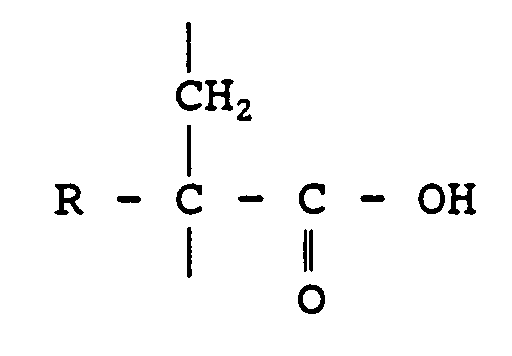
- the method involves adding to the system in an amount of 0.1 to 1000 ppm certain calcium insensitive water-soluble copolymers having a polymer chain structure which comprises monomeric units of t-butyl acrylamide and units having the following formula: wherein R is selected from the group consisting of H and CH 3 ; or water-soluble salts thereof, in an amount effective to inhibit or prevent the precipitation of the calcium carbonate.
- the copolymer can be a copolymer of t-butyl acrylamide and acrylic acid, methacrylic acid or the sodium salts thereof.
- Calcium sensitivity refers to the tendency of a compound to precipitate with calcium ions in solution. Calcium insensitivity is considered an important feature of this invention because it allows the agents of this invention to be used effectively in water of relatively high hardness.
- the test for calcium insensitivity of a compound as used in this application involves a cloud point test where the compound is added to a hard water containing 500 ppm calcium ion (as CaCO 3 ) which is buffered at pH 8.3 using 0.005 M borate buffer and has a temperature of 60°C. The amount of compound which can be added until the solution becomes turbid (the cloud point) is considered to be an indicator of calcium sensitivity. This cloud point test will be referred to herein as the "CA500 cloud point test.”
- the calcium insensitive compounds of this invention have cloud point of at least about 10 ppm as determined by the CA500 cloud point test.
- Preferred compounds have a cloud point of at least about 25 ppm; and the most preferred compounds have a cloud point of at least about 50 ppm as determined by the CA500 cloud point test because they are considered particularly volatile with regard to the water systems in which they can be effectively used.
- the exact dosage amount required withy respect to a particular system can vary widely depending on the nature of the system and the amount of calcium carbonate contained therein.
- the copolymers of this invention are added in very small amounts, typically in the range of from 0.1 ppm to 1000 ppm, preferably in the range 0.5 to 500 ppm and most preferably in the range of from 1 ppm to 10 ppm.
- Those of ordinary skill in the art can readily determine the appropriate dosage for a particular aqueous system in a conventional manner.
- copolymers of this invention are particularly suitable for use in aqueous systems having a high degree of hardness. As described more fully in the following examples, the copolymers of this invention effectively inhibited the precipitation of calcium carbonate in aqueous systems having a relatively high concentration of magnesium ions. This was surprising and unexpected, particularly in view of the ineffectiveness of several structurally similar copolymers.
- aqueous systems which may be advantageously treated in accordance with the polymers of this invention include, but are not limited to cooling water systems such as e.g. cooling towers, desalinization units, gas scrubbers, as well as to boiler systems and other recirculating water systems where scale deposits are known to form.
- cooling water systems such as e.g. cooling towers, desalinization units, gas scrubbers, as well as to boiler systems and other recirculating water systems where scale deposits are known to form.
- the polymers of this invention may be used in combination with other water treatment components customarily employed in the aqueous system including, but not limited to other scale inhibitors, corrosion inhibitors, biocides, dispersing agents, antifoaming agents, oxygen scavengers, sequestering agents, and the like and mixtures thereof.
- the polymeric scale inhibitors of this invention may be added to the system by any convenient mode, such as by first forming a concentrated aqueous solution of the copolymer of acrylic acid and t-butyl acrylamide or their water soluble salts, preferably containing between 1 and 50 total weight percent of the polymer, and then feeding the concentrated aqueous solution to the aqueous system at some convenient point.
- the scale inhibitors may be added to the make-up or feedwater lines through which water enters the system.
- an injector calibrated to deliver a predetermined amount periodically or continuously to the makeup water is employed.
- the critical pH for the test solution is shown in Table 1 below along with the total milliequivalents per liter of hydroxide (as NaOH) added to reach the critical pH.
- the usefulness of the copolymers of the invention to inhibit calcium carbonate precipitation was further measured using a magnesium-containing water at 54°C.
- the test water contains 283 ppm calcium, 184 ppm magnesium, and 423 ppm bicarbonate (all as CaCO 3 ).
- the treatments were dosed at 5 ppm. Table 2 summarizes the results.
- the effectiveness of the copolymers of this invention to control calcium carbonate precipitation was again evaluated using a magnesium-containing water at 54°C.
- the test water contains 283 ppm calcium, 184 ppm magnesium, and 423 ppm bicarbonate (all as CaCO 3 ).
- the additives were tested at 2.5 ppm. The results are tabulated in Table 3.
- the copolymer of acrylic acid and methylol acrylamide, the copolymer of acrylic acid and hydroxyethyl acrylamide, and the copolymer of acrylic acid and diacetone acrylamide were relatively ineffective in preventing the precipitation of calcium carbonate when the magnesium ion was present in the test water.
- the use for calcium insensitivity of a compound as used in this invention involves a cloud point test where the compound is added to a hard water containing 500 ppm calcium ion (as CaCO 3 ) which is buffered at pH 8.3 using 0.005 M borate buffer and has a temperature of 60°C. The amount of compound which can be added until the solution becomes turbid (the cloud point) is considered to be an indicator of calcium sensitivity.
- This cloud point test will be referenced to herein as the "CA500 cloud point test.”
- Suitable calcium insensitive compounds have cloud points of at least 10 ppm as determined by the CA500 cloud point test. The results are shown in Table 5 below. Run No.
- the critical pH for the test solution is shown in Table 2 below along with the total milliequivalents per liter of hydroxide (as NaOH) added to reach the critical pH.
- the copolymer of acrylic acid and t-butyl acrylamide (Run No. 22) was a superior treatment in inhibiting the precipitation of calcium carbonate in an aqueous system.
- the copolymer of acrylic acid and t-butyl acrylamide was vastly more effective than all other additives tested at low dosage levels.
- the polyacrylic acid, the sodium polymethacrylate, the copolymer of sodium acrylate and acrylamide, and the copolymer of potassium methacrylate and AMPS cited in the Khambatta et al patent were relatively ineffective in preventing the precipitation of calcium carbonate when the magnesium ion was present in the test water.
Landscapes
- Chemical & Material Sciences (AREA)
- Chemical Kinetics & Catalysis (AREA)
- General Chemical & Material Sciences (AREA)
- Life Sciences & Earth Sciences (AREA)
- Hydrology & Water Resources (AREA)
- Engineering & Computer Science (AREA)
- Environmental & Geological Engineering (AREA)
- Water Supply & Treatment (AREA)
- Organic Chemistry (AREA)
- Addition Polymer Or Copolymer, Post-Treatments, Or Chemical Modifications (AREA)
- Preventing Corrosion Or Incrustation Of Metals (AREA)
- Separation Of Suspended Particles By Flocculating Agents (AREA)
- Beans For Foods Or Fodder (AREA)
- Coloring Foods And Improving Nutritive Qualities (AREA)
- Compositions Of Macromolecular Compounds (AREA)
Abstract
Description
| Run | Additive | Critical pH | NaOH added to reach critical pH (meq/l) |
| 1 | Blank (without treatment) | 7.69 | 0.48 |
| 2 | Sodium tripolyphosphate | 8.48 | 1.61 |
| 3 | Sodium hexametaphosphate | 8.34 | 1.43 |
| 4 | Hydroxyethylidene diphosphonic acid | 8.54 | 1.63 |
| 5 | 2-Phosphonobutane-1,2,4-tricarboxylic acid | 8.74 | 1.96 |
| 6 | Copolymer of acrylic acid and t-butyl acrylamide (88:12) | 8.48 | 1.56 |
| 7 | Copolymer of acrylic acid and hydroxyethyl acrylamide (70:30) | 8.48 | 1.19 |
| 8 | Copolymer of acrylic acid and diacetone acrylamide (80:20) | 8.43 | 1.36 |
| Run | Additive | Critical pH | NaOH added to reach critical pH (meq/l) |
| 9 | Blank (without treatment) | 8.12 | 0.91 |
| 10 | Hydroxyethylidene diphosphonic acid | 9.52 | 4.10 |
| 11 | 2-Phosphonobutane-1,2,4-tricarboxylic acid | 9.55 | 4.19 |
| 12 | Copolymer of acrylic acid and t-butyl acrylamide (88:12) | 9.98 | 6.30 |
| 13 | Copolymer of acrylic acid and methylol acrylamide (68:32) | 9.08 | 2.38 |
| 14 | Copolymer of acrylic acid and hydroxyethyl acrylamide (70:30) | 9.18 | 2.07 |
| Run | Additive | Critical pH | NaOH added to reach critical pH (meq/l) |
| 15 | Blank (without treatment) | 8.12 | 0.91 |
| 16 | Hydroxyethylidene diphosphonic acid | 9.40 | 3.49 |
| 17 | 2-Phosphonobutane-1,2,4-tricarboxylic acid | 9.13 | 2.86 |
| 18 | Copolymer of acrylic acid and t-butyl acrylamide (88:12) | 9.97 | 6.16 |
| 19 | Copolymer of acrylic acid and methylol acrylamide (68:32) | 8.93 | 1.94 |
| 20 | Copolymer of acrylic acid and hydroxyethyl acrylamide (70:30) | 8.90 | 1.70 |
| 21 | Copolymer of acrylic acid and diacetone acrylamide (80:20) | 8.92 | 2.22 |
| Run No. | Additive | Cloud Point, ppm |
| 1 | Polyacrylic acid (PAA-45) | 4 |
| 2 | Sodium polymethacrylate (LPC-30) | 6 |
| 3 | Copolymer of acrylic acid and t-butyl acrylamide (97.5/2.5) | 4 |
| 4 | Copolymer of acrylic acid and t-butyl acrylamide (92/8) | <2 |
| 5 | Copolymer of acrylic acid and t-butyl acrylamide (90/10) | 7 |
| 6 | Copolymer of acrylic acid and t-butyl acrylamide (88/12) | 36 |
| 7 | Copolymer of acrylic acid and t-butyl acrylamide (85/15) | 39 |
| 8 | Copolymers of acrylic acid and t-butyl acrylamide (80/20) | >100 |
| 9 | Copolymer of acrylic acid and t-butyl acrylamide (75/25) | >100 |
| Run No. | Additive | Cloud Point, ppm |
| 1 | Polyacrylic acid (PAA-45) | 4 |
| 2 | Sodium polymethacrylate (LPC-30) | 6 |
| 3 | Copolymer of acrylic acid and t-butyl acrylamide (97.5/2.5) | 4 |
| 4 | Copolymer of acrylic acid and t-butyl acrylamide (92/8) | <2 |
| 5 | Copolymer of acrylic acid and t-butyl acrylamide (90/10) | 7 |
| 6 | Copolymer of acrylic acid and t-butyl acrylamide (88/12) | 36 |
| 7 | Copolymer of acrylic acid and t-butyl acrylamide (85/15) | 39 |
| 8 | Copolymer of acrylic acid and t-butyl acrylamide (80/20) | >100 |
| 9 | Copolymer of acrylic acid and t-butyl acrylamide (75/25) | >100 |
| Run | Additive | Critical pH | NaOH added to reach critical pH (meq/l) |
| 1 | Blank (without treatment) | 7.69 | 0.48 |
| 2 | Sodium tripolyphosphate | 8.48 | 1.61 |
| 3 | Sodium hexametaphosphate | 8.34 | 1.43 |
| 4 | Hydroxyethylidene diphosphonic acid | 8.54 | 1.63 |
| 5 | 2-Phosphonobutane-1,2,4-tricarboxylic acid | 8.74 | 1.96 |
| 6 | Copolymer of acrylic acid and t-butyl acrylamide (93:7 by mole), m.w. 5,700 | 8.48 | 1.56 |
| 7 | Polyacrylic acid, m.w. 2,400 | 8.54 | 1.33 |
| 8 | Sodium polymethacrylate, m.w. 4,500 | 8.30 | 0.98 |
| 9 | Copolymer of sodium acrylate and acrylamide (91:9 by mole), m.w. 2,000 | 8.51 | 1.37 |
| 10 | Copolymer of potassium methacrylate and AMPS (acrylamido methyl propane sulfonic acid) (67:33 by mole), m.w. 21,600 | 8.32 | 0.89 |
| Run | Additive | Critical pH | NaOH added to reach critical pH (meq/l) |
| 11 | Blank (without treatment) | 8.12 | 0.91 |
| 12 | Hydroxyethylidene diphosphonic acid | 9.52 | 4.10 |
| 13 | 2-Phosphonobutane-1,2,4-tricarboxylic acid | 9.55 | 4.19 |
| 14 | Copolymer of acrylic acid and t-butyl acrylamide (93:7 by mole), m.w. 5,700 | 9.98 | 6.30 |
| 15 | Polyacrylic acid, m.w. 2,400 | 9.33 | 3.62 |
| 16 | Sodium polymethacrylate, m.w. 4,500 | 8.93 | 1.78 |
| 17 | Copolymer of sodium acrylate and acrylamide (91:9 by mole), m.w. 2,000 | 9.07 | 2.51 |
| 18 | Copolymer of potassium methacrylate and AMPS (acrylamido methyl propane sulfonic acid) (67:33 by mole), m.w. 21,600 | 8.65 | 1.50 |
| Run | Additive | Critical pH | NaOH added to reach critical pH (meq/l) |
| 19 | Blank (without treatment) | 8.12 | 0.91 |
| 20 | Hydroxyethylidene diphosphonic acid | 9.40 | 3.49 |
| 21 | 2-Phosphonobutane-1,2,4-tricarboxylic acid | 9.13 | 2.86 |
| 22 | Copolymer of acrylic acid and t-butyl acrylamide (93:7 by mole), m.w. 5,700 | 9.97 | 6.16 |
| 23 | Polyacrylic acid, m.w. 2,400 | 9.18 | 2.75 |
| 24 | Sodium polymethacrylate, m.w. 4,500 | 8.72 | 1.60 |
| 25 | Copolymer of sodium acrylate and acrylamide (91:9 by mole), m.w. 2,000 | 8.91 | 2.04 |
| 26 | Copolymer of potassium methacrylate and AMPS (acrylamido methyl propane sulfonic acid) (67:33 by mole), m.w. 21,600 | 8.58 | 1.38 |
Claims (7)
- A method for inhibiting or preventing the precipitation of calcium carbonate in aqueous systems containing at least 5 ppm of magnesium ions comprising adding to the system, in an amount of 0.1 to 1000 ppm a water-soluble copolymer having a CA500 cloud point of greater than 10 ppm and a polymer chain structure which comprises monomeric units of t-butyl acrylamide and units having the following formula:wherein R is of the class consisting of H and CH3; or its water-soluble salts.

- A method according to Claim 1 wherein the copolymer is a copolymer of acrylic acid and t-butyl acrylamide.
- A method according to Claim 1 wherein the copolymer is a copolymer of sodium acrylate and t-butyl acrylamide.
- A method according to Claim 1 wherein the copolymer is a copolymer of methacrylic acid and t-butyl acrylamide.
- A method according to Claim 1 wherein the copolymer is a copolymer of sodium methacrylate and t-butyl acrylamide.
- A method according to claim 1 wherein the effective amount is in the range of from 0.5 to 500 ppm.
- A method according to claim 1 wherein the effective amount is in the range of from 1 to 10 ppm.
Applications Claiming Priority (2)
| Application Number | Priority Date | Filing Date | Title |
|---|---|---|---|
| US8871093A | 1993-07-08 | 1993-07-08 | |
| US88710 | 1993-07-08 |
Publications (2)
| Publication Number | Publication Date |
|---|---|
| EP0633226A1 EP0633226A1 (en) | 1995-01-11 |
| EP0633226B1 true EP0633226B1 (en) | 1998-04-22 |
Family
ID=22212979
Family Applications (1)
| Application Number | Title | Priority Date | Filing Date |
|---|---|---|---|
| EP93250267A Expired - Lifetime EP0633226B1 (en) | 1993-07-08 | 1993-09-29 | Calcium carbonate anti-precipitating agents |
Country Status (4)
| Country | Link |
|---|---|
| EP (1) | EP0633226B1 (en) |
| AT (1) | ATE165315T1 (en) |
| DE (1) | DE69318145T2 (en) |
| ES (1) | ES2115011T3 (en) |
Families Citing this family (2)
| Publication number | Priority date | Publication date | Assignee | Title |
|---|---|---|---|---|
| US8247363B2 (en) | 2007-05-04 | 2012-08-21 | Ecolab Usa Inc. | MG++ chemistry and method for fouling inhibition in heat processing of liquid foods and industrial processes |
| JP5592252B2 (en) | 2007-05-04 | 2014-09-17 | エコラボ インコーポレイティド | Compositions containing hard ions and gluconates and their use to reduce corrosion and etch |
Family Cites Families (5)
| Publication number | Priority date | Publication date | Assignee | Title |
|---|---|---|---|---|
| US4566973A (en) * | 1984-08-06 | 1986-01-28 | The B. F. Goodrich Company | Scale inhibition in water systems |
| US4904413A (en) * | 1986-03-26 | 1990-02-27 | Nalco Chemical Company | Cooling water corrosion control method and composition |
| CA1337323C (en) * | 1986-12-08 | 1995-10-17 | Zahid Amjad | Treatment of aqueous medium with copolymers containing acrylamidoalkane sulfonic acid |
| ZA905799B (en) * | 1989-12-15 | 1991-05-29 | Grace W R & Co | Control of scale in aqueous systems using certain phosphonomethyl amine oxides |
| US5171451A (en) * | 1991-05-28 | 1992-12-15 | Nalco Chemical Company | Simultaneous use of water soluble polymers with ozone in cooling water systems |
-
1993
- 1993-09-29 DE DE69318145T patent/DE69318145T2/en not_active Expired - Fee Related
- 1993-09-29 EP EP93250267A patent/EP0633226B1/en not_active Expired - Lifetime
- 1993-09-29 AT AT93250267T patent/ATE165315T1/en not_active IP Right Cessation
- 1993-09-29 ES ES93250267T patent/ES2115011T3/en not_active Expired - Lifetime
Also Published As
| Publication number | Publication date |
|---|---|
| ES2115011T3 (en) | 1998-06-16 |
| DE69318145T2 (en) | 1998-08-13 |
| DE69318145D1 (en) | 1998-05-28 |
| ATE165315T1 (en) | 1998-05-15 |
| EP0633226A1 (en) | 1995-01-11 |
Similar Documents
| Publication | Publication Date | Title |
|---|---|---|
| AU635102B2 (en) | Methods of controlling scale formation in aqueous systems | |
| US4933090A (en) | Method for controlling silica/silicate deposition in aqueous systems using phosphonates and carboxylic/sulfonic polymers | |
| US5342540A (en) | Compositions for controlling scale formation in aqueous system | |
| US5183590A (en) | Corrosion inhibitors | |
| US3766077A (en) | Compositions and method for inhibiting scaling in aqueous systems | |
| EP0122013B1 (en) | Polymeric additives for water | |
| ES2227632T3 (en) | STABILIZERS FOR ADDITIVES IN WATER SYSTEMS CONTAINING OZONE. | |
| JPH0215184A (en) | Corrosion suppressing method by molybdate composition | |
| JPH0258998B2 (en) | ||
| CA1176446A (en) | Method of inhibiting corrosion of iron base metals | |
| IE20000067A1 (en) | Scale and/or corrosion inhibiting composition | |
| SE453076B (en) | PROCEDURE AND COMPOSITION FOR REGULATING THE FLASH | |
| EP0388836A1 (en) | Composition for treating water or aqueous systems | |
| JPH0322240B2 (en) | ||
| JP4146230B2 (en) | Phosphate stabilizing composition | |
| KR100196966B1 (en) | Treatment of Recirculating Cooling Water | |
| US5527468A (en) | Nonionic polymers for the treatment of boiler water | |
| US4874527A (en) | Method for controlling silica/silicate deposition in aqueous systems using imines | |
| EP0538969B1 (en) | Composition and method for inhibiting scale and corrosion using naphthylamine polycarboxylic acids | |
| WO1983002607A1 (en) | Process for inhibiting scale | |
| US5326478A (en) | Methods for controlling scale formation in aqueous systems | |
| US5344590A (en) | Method for inhibiting corrosion of metals using polytartaric acids | |
| US5128045A (en) | Method for stabilizing metal ions in the presence of biofouling organisms | |
| CA2073660C (en) | Substituted carboxymethoxysuccinic acid corrosion inhibitors | |
| GB2118159A (en) | The treatment of aqueous systems |
Legal Events
| Date | Code | Title | Description |
|---|---|---|---|
| PUAI | Public reference made under article 153(3) epc to a published international application that has entered the european phase |
Free format text: ORIGINAL CODE: 0009012 |
|
| AK | Designated contracting states |
Kind code of ref document: A1 Designated state(s): AT BE CH DE DK ES FR GB GR IE IT LI LU MC NL PT SE |
|
| 17P | Request for examination filed |
Effective date: 19950413 |
|
| 17Q | First examination report despatched |
Effective date: 19950809 |
|
| RAP1 | Party data changed (applicant data changed or rights of an application transferred) |
Owner name: BETZDEARBORN, INC. |
|
| GRAG | Despatch of communication of intention to grant |
Free format text: ORIGINAL CODE: EPIDOS AGRA |
|
| GRAG | Despatch of communication of intention to grant |
Free format text: ORIGINAL CODE: EPIDOS AGRA |
|
| GRAH | Despatch of communication of intention to grant a patent |
Free format text: ORIGINAL CODE: EPIDOS IGRA |
|
| GRAH | Despatch of communication of intention to grant a patent |
Free format text: ORIGINAL CODE: EPIDOS IGRA |
|
| GRAA | (expected) grant |
Free format text: ORIGINAL CODE: 0009210 |
|
| ITF | It: translation for a ep patent filed | ||
| AK | Designated contracting states |
Kind code of ref document: B1 Designated state(s): AT BE CH DE DK ES FR GB GR IE IT LI LU MC NL PT SE |
|
| PG25 | Lapsed in a contracting state [announced via postgrant information from national office to epo] |
Ref country code: LI Free format text: LAPSE BECAUSE OF FAILURE TO SUBMIT A TRANSLATION OF THE DESCRIPTION OR TO PAY THE FEE WITHIN THE PRESCRIBED TIME-LIMIT Effective date: 19980422 Ref country code: GR Free format text: LAPSE BECAUSE OF FAILURE TO SUBMIT A TRANSLATION OF THE DESCRIPTION OR TO PAY THE FEE WITHIN THE PRESCRIBED TIME-LIMIT Effective date: 19980422 Ref country code: CH Free format text: LAPSE BECAUSE OF FAILURE TO SUBMIT A TRANSLATION OF THE DESCRIPTION OR TO PAY THE FEE WITHIN THE PRESCRIBED TIME-LIMIT Effective date: 19980422 Ref country code: AT Free format text: LAPSE BECAUSE OF FAILURE TO SUBMIT A TRANSLATION OF THE DESCRIPTION OR TO PAY THE FEE WITHIN THE PRESCRIBED TIME-LIMIT Effective date: 19980422 |
|
| REF | Corresponds to: |
Ref document number: 165315 Country of ref document: AT Date of ref document: 19980515 Kind code of ref document: T |
|
| REG | Reference to a national code |
Ref country code: CH Ref legal event code: EP |
|
| REF | Corresponds to: |
Ref document number: 69318145 Country of ref document: DE Date of ref document: 19980528 |
|
| REG | Reference to a national code |
Ref country code: ES Ref legal event code: FG2A Ref document number: 2115011 Country of ref document: ES Kind code of ref document: T3 |
|
| ET | Fr: translation filed | ||
| PG25 | Lapsed in a contracting state [announced via postgrant information from national office to epo] |
Ref country code: SE Free format text: LAPSE BECAUSE OF FAILURE TO SUBMIT A TRANSLATION OF THE DESCRIPTION OR TO PAY THE FEE WITHIN THE PRESCRIBED TIME-LIMIT Effective date: 19980722 Ref country code: PT Free format text: LAPSE BECAUSE OF FAILURE TO SUBMIT A TRANSLATION OF THE DESCRIPTION OR TO PAY THE FEE WITHIN THE PRESCRIBED TIME-LIMIT Effective date: 19980722 Ref country code: DK Free format text: LAPSE BECAUSE OF FAILURE TO SUBMIT A TRANSLATION OF THE DESCRIPTION OR TO PAY THE FEE WITHIN THE PRESCRIBED TIME-LIMIT Effective date: 19980722 |
|
| REG | Reference to a national code |
Ref country code: IE Ref legal event code: FG4D Free format text: 79930 |
|
| PGFP | Annual fee paid to national office [announced via postgrant information from national office to epo] |
Ref country code: FR Payment date: 19980909 Year of fee payment: 6 |
|
| PGFP | Annual fee paid to national office [announced via postgrant information from national office to epo] |
Ref country code: ES Payment date: 19980921 Year of fee payment: 6 |
|
| PG25 | Lapsed in a contracting state [announced via postgrant information from national office to epo] |
Ref country code: LU Free format text: LAPSE BECAUSE OF NON-PAYMENT OF DUE FEES Effective date: 19980929 Ref country code: IE Free format text: LAPSE BECAUSE OF NON-PAYMENT OF DUE FEES Effective date: 19980929 |
|
| PGFP | Annual fee paid to national office [announced via postgrant information from national office to epo] |
Ref country code: NL Payment date: 19980929 Year of fee payment: 6 |
|
| PGFP | Annual fee paid to national office [announced via postgrant information from national office to epo] |
Ref country code: GB Payment date: 19981001 Year of fee payment: 6 |
|
| PGFP | Annual fee paid to national office [announced via postgrant information from national office to epo] |
Ref country code: DE Payment date: 19981005 Year of fee payment: 6 |
|
| REG | Reference to a national code |
Ref country code: CH Ref legal event code: PL |
|
| PGFP | Annual fee paid to national office [announced via postgrant information from national office to epo] |
Ref country code: BE Payment date: 19981118 Year of fee payment: 6 |
|
| PLBE | No opposition filed within time limit |
Free format text: ORIGINAL CODE: 0009261 |
|
| PG25 | Lapsed in a contracting state [announced via postgrant information from national office to epo] |
Ref country code: MC Free format text: LAPSE BECAUSE OF NON-PAYMENT OF DUE FEES Effective date: 19990331 |
|
| 26N | No opposition filed | ||
| PG25 | Lapsed in a contracting state [announced via postgrant information from national office to epo] |
Ref country code: GB Free format text: LAPSE BECAUSE OF NON-PAYMENT OF DUE FEES Effective date: 19990929 |
|
| PG25 | Lapsed in a contracting state [announced via postgrant information from national office to epo] |
Ref country code: ES Free format text: LAPSE BECAUSE OF NON-PAYMENT OF DUE FEES Effective date: 19990930 Ref country code: BE Free format text: LAPSE BECAUSE OF NON-PAYMENT OF DUE FEES Effective date: 19990930 |
|
| BERE | Be: lapsed |
Owner name: BETZDEARBORN INC. Effective date: 19990930 |
|
| PG25 | Lapsed in a contracting state [announced via postgrant information from national office to epo] |
Ref country code: NL Free format text: LAPSE BECAUSE OF NON-PAYMENT OF DUE FEES Effective date: 20000401 |
|
| GBPC | Gb: european patent ceased through non-payment of renewal fee |
Effective date: 19990929 |
|
| PG25 | Lapsed in a contracting state [announced via postgrant information from national office to epo] |
Ref country code: FR Free format text: LAPSE BECAUSE OF NON-PAYMENT OF DUE FEES Effective date: 20000531 |
|
| NLV4 | Nl: lapsed or anulled due to non-payment of the annual fee |
Effective date: 20000401 |
|
| PG25 | Lapsed in a contracting state [announced via postgrant information from national office to epo] |
Ref country code: DE Free format text: LAPSE BECAUSE OF NON-PAYMENT OF DUE FEES Effective date: 20000701 |
|
| REG | Reference to a national code |
Ref country code: FR Ref legal event code: ST |
|
| REG | Reference to a national code |
Ref country code: ES Ref legal event code: FD2A Effective date: 20001013 |
|
| PG25 | Lapsed in a contracting state [announced via postgrant information from national office to epo] |
Ref country code: IT Free format text: LAPSE BECAUSE OF NON-PAYMENT OF DUE FEES Effective date: 20050929 |