EP0632267A1 - Method of measuring content of polycyclic aromatic compound in lanolin and removal thereof - Google Patents
Method of measuring content of polycyclic aromatic compound in lanolin and removal thereof Download PDFInfo
- Publication number
- EP0632267A1 EP0632267A1 EP94904003A EP94904003A EP0632267A1 EP 0632267 A1 EP0632267 A1 EP 0632267A1 EP 94904003 A EP94904003 A EP 94904003A EP 94904003 A EP94904003 A EP 94904003A EP 0632267 A1 EP0632267 A1 EP 0632267A1
- Authority
- EP
- European Patent Office
- Prior art keywords
- lanolin
- pah
- ppb
- activated carbon
- treatment
- Prior art date
- Legal status (The legal status is an assumption and is not a legal conclusion. Google has not performed a legal analysis and makes no representation as to the accuracy of the status listed.)
- Withdrawn
Links
- 235000019388 lanolin Nutrition 0.000 title claims abstract description 186
- 239000004166 Lanolin Substances 0.000 title claims abstract description 174
- 229940039717 lanolin Drugs 0.000 title claims abstract description 174
- 238000000034 method Methods 0.000 title claims abstract description 75
- -1 polycyclic aromatic compound Chemical class 0.000 title claims abstract description 23
- OKTJSMMVPCPJKN-UHFFFAOYSA-N Carbon Chemical compound [C] OKTJSMMVPCPJKN-UHFFFAOYSA-N 0.000 claims abstract description 179
- 238000001179 sorption measurement Methods 0.000 claims abstract description 38
- 238000005292 vacuum distillation Methods 0.000 claims abstract description 25
- 238000005227 gel permeation chromatography Methods 0.000 claims abstract description 13
- 229920001577 copolymer Polymers 0.000 claims abstract description 9
- 238000011282 treatment Methods 0.000 claims description 54
- LFQSCWFLJHTTHZ-UHFFFAOYSA-N Ethanol Chemical compound CCO LFQSCWFLJHTTHZ-UHFFFAOYSA-N 0.000 claims description 42
- 239000002904 solvent Substances 0.000 claims description 26
- VLKZOEOYAKHREP-UHFFFAOYSA-N n-Hexane Chemical compound CCCCCC VLKZOEOYAKHREP-UHFFFAOYSA-N 0.000 claims description 21
- 239000004327 boric acid Substances 0.000 claims description 20
- KGBXLFKZBHKPEV-UHFFFAOYSA-N boric acid Chemical compound OB(O)O KGBXLFKZBHKPEV-UHFFFAOYSA-N 0.000 claims description 19
- 239000007858 starting material Substances 0.000 claims description 18
- 238000000926 separation method Methods 0.000 claims description 3
- 239000003960 organic solvent Substances 0.000 claims 1
- 229910052799 carbon Inorganic materials 0.000 abstract description 39
- 230000000694 effects Effects 0.000 abstract description 38
- 238000004128 high performance liquid chromatography Methods 0.000 abstract description 6
- 238000002156 mixing Methods 0.000 abstract description 2
- BTBUEUYNUDRHOZ-UHFFFAOYSA-N Borate Chemical compound [O-]B([O-])[O-] BTBUEUYNUDRHOZ-UHFFFAOYSA-N 0.000 abstract 1
- 239000004519 grease Substances 0.000 abstract 1
- ZWEHNKRNPOVVGH-UHFFFAOYSA-N 2-Butanone Chemical compound CCC(C)=O ZWEHNKRNPOVVGH-UHFFFAOYSA-N 0.000 description 60
- KFZMGEQAYNKOFK-UHFFFAOYSA-N Isopropanol Chemical compound CC(C)O KFZMGEQAYNKOFK-UHFFFAOYSA-N 0.000 description 48
- 235000019441 ethanol Nutrition 0.000 description 42
- 239000000243 solution Substances 0.000 description 26
- 239000000203 mixture Substances 0.000 description 24
- 239000000194 fatty acid Substances 0.000 description 23
- YMWUJEATGCHHMB-UHFFFAOYSA-N Dichloromethane Chemical compound ClCCl YMWUJEATGCHHMB-UHFFFAOYSA-N 0.000 description 21
- 235000014113 dietary fatty acids Nutrition 0.000 description 21
- 229930195729 fatty acid Natural products 0.000 description 21
- IMNFDUFMRHMDMM-UHFFFAOYSA-N N-Heptane Chemical compound CCCCCCC IMNFDUFMRHMDMM-UHFFFAOYSA-N 0.000 description 18
- 241000894007 species Species 0.000 description 17
- 150000004665 fatty acids Chemical class 0.000 description 16
- HVYWMOMLDIMFJA-DPAQBDIFSA-N cholesterol Chemical compound C1C=C2C[C@@H](O)CC[C@]2(C)[C@@H]2[C@@H]1[C@@H]1CC[C@H]([C@H](C)CCCC(C)C)[C@@]1(C)CC2 HVYWMOMLDIMFJA-DPAQBDIFSA-N 0.000 description 15
- 238000004458 analytical method Methods 0.000 description 13
- 230000008569 process Effects 0.000 description 13
- UHOVQNZJYSORNB-UHFFFAOYSA-N Benzene Chemical compound C1=CC=CC=C1 UHOVQNZJYSORNB-UHFFFAOYSA-N 0.000 description 12
- 150000002148 esters Chemical class 0.000 description 12
- 238000005886 esterification reaction Methods 0.000 description 11
- 229940099367 lanolin alcohols Drugs 0.000 description 11
- 239000011148 porous material Substances 0.000 description 11
- 238000005516 engineering process Methods 0.000 description 10
- WEVYAHXRMPXWCK-UHFFFAOYSA-N Acetonitrile Chemical compound CC#N WEVYAHXRMPXWCK-UHFFFAOYSA-N 0.000 description 9
- FMMWHPNWAFZXNH-UHFFFAOYSA-N Benz[a]pyrene Chemical compound C1=C2C3=CC=CC=C3C=C(C=C3)C2=C2C3=CC=CC2=C1 FMMWHPNWAFZXNH-UHFFFAOYSA-N 0.000 description 9
- 239000000463 material Substances 0.000 description 9
- 238000000746 purification Methods 0.000 description 9
- 238000011084 recovery Methods 0.000 description 8
- 235000012000 cholesterol Nutrition 0.000 description 7
- 230000003247 decreasing effect Effects 0.000 description 7
- 230000032050 esterification Effects 0.000 description 7
- 239000000126 substance Substances 0.000 description 7
- IAZDPXIOMUYVGZ-UHFFFAOYSA-N Dimethylsulphoxide Chemical compound CS(C)=O IAZDPXIOMUYVGZ-UHFFFAOYSA-N 0.000 description 6
- YXFVVABEGXRONW-UHFFFAOYSA-N Toluene Chemical compound CC1=CC=CC=C1 YXFVVABEGXRONW-UHFFFAOYSA-N 0.000 description 6
- 238000005194 fractionation Methods 0.000 description 6
- 239000000047 product Substances 0.000 description 6
- XLYOFNOQVPJJNP-UHFFFAOYSA-N water Substances O XLYOFNOQVPJJNP-UHFFFAOYSA-N 0.000 description 6
- 229920003171 Poly (ethylene oxide) Polymers 0.000 description 5
- 239000003905 agrochemical Substances 0.000 description 5
- 150000001298 alcohols Chemical class 0.000 description 5
- 150000002632 lipids Chemical class 0.000 description 5
- 238000004519 manufacturing process Methods 0.000 description 5
- 238000007127 saponification reaction Methods 0.000 description 5
- 238000003756 stirring Methods 0.000 description 5
- RBTBFTRPCNLSDE-UHFFFAOYSA-N 3,7-bis(dimethylamino)phenothiazin-5-ium Chemical compound C1=CC(N(C)C)=CC2=[S+]C3=CC(N(C)C)=CC=C3N=C21 RBTBFTRPCNLSDE-UHFFFAOYSA-N 0.000 description 4
- VYPSYNLAJGMNEJ-UHFFFAOYSA-N Silicium dioxide Chemical compound O=[Si]=O VYPSYNLAJGMNEJ-UHFFFAOYSA-N 0.000 description 4
- 229930182558 Sterol Natural products 0.000 description 4
- 238000010306 acid treatment Methods 0.000 description 4
- 230000004913 activation Effects 0.000 description 4
- 238000010923 batch production Methods 0.000 description 4
- 238000004061 bleaching Methods 0.000 description 4
- 238000009835 boiling Methods 0.000 description 4
- 238000004042 decolorization Methods 0.000 description 4
- 238000000605 extraction Methods 0.000 description 4
- 239000000706 filtrate Substances 0.000 description 4
- 239000007789 gas Substances 0.000 description 4
- 125000002887 hydroxy group Chemical group [H]O* 0.000 description 4
- 239000007788 liquid Substances 0.000 description 4
- 238000000622 liquid--liquid extraction Methods 0.000 description 4
- 238000002844 melting Methods 0.000 description 4
- 229960000907 methylthioninium chloride Drugs 0.000 description 4
- 238000012856 packing Methods 0.000 description 4
- BDERNNFJNOPAEC-UHFFFAOYSA-N propan-1-ol Chemical compound CCCO BDERNNFJNOPAEC-UHFFFAOYSA-N 0.000 description 4
- 239000000741 silica gel Substances 0.000 description 4
- 229910002027 silica gel Inorganic materials 0.000 description 4
- 238000000638 solvent extraction Methods 0.000 description 4
- 150000003432 sterols Chemical class 0.000 description 4
- 235000003702 sterols Nutrition 0.000 description 4
- ZCYVEMRRCGMTRW-UHFFFAOYSA-N 7553-56-2 Chemical compound [I] ZCYVEMRRCGMTRW-UHFFFAOYSA-N 0.000 description 3
- OWTYWMJVQZQWFH-JQTKPCACSA-N CE(20:1(11Z)) Chemical compound C12CC[C@]3(C)C([C@H](C)CCCC(C)C)CCC3C2CC=C2[C@]1(C)CC[C@H](OC(=O)CCCCCCCCC\C=C/CCCCCCCC)C2 OWTYWMJVQZQWFH-JQTKPCACSA-N 0.000 description 3
- XEKOWRVHYACXOJ-UHFFFAOYSA-N Ethyl acetate Chemical compound CCOC(C)=O XEKOWRVHYACXOJ-UHFFFAOYSA-N 0.000 description 3
- OKKJLVBELUTLKV-UHFFFAOYSA-N Methanol Chemical compound OC OKKJLVBELUTLKV-UHFFFAOYSA-N 0.000 description 3
- 230000000274 adsorptive effect Effects 0.000 description 3
- 125000001931 aliphatic group Chemical group 0.000 description 3
- 238000003556 assay Methods 0.000 description 3
- 230000000711 cancerogenic effect Effects 0.000 description 3
- 231100000315 carcinogenic Toxicity 0.000 description 3
- 235000013339 cereals Nutrition 0.000 description 3
- 239000003245 coal Substances 0.000 description 3
- 239000002537 cosmetic Substances 0.000 description 3
- MTHSVFCYNBDYFN-UHFFFAOYSA-N diethylene glycol Chemical compound OCCOCCO MTHSVFCYNBDYFN-UHFFFAOYSA-N 0.000 description 3
- 238000004821 distillation Methods 0.000 description 3
- 230000008030 elimination Effects 0.000 description 3
- 238000003379 elimination reaction Methods 0.000 description 3
- 235000019387 fatty acid methyl ester Nutrition 0.000 description 3
- GVEPBJHOBDJJJI-UHFFFAOYSA-N fluoranthene Chemical compound C1=CC(C2=CC=CC=C22)=C3C2=CC=CC3=C1 GVEPBJHOBDJJJI-UHFFFAOYSA-N 0.000 description 3
- 239000011630 iodine Substances 0.000 description 3
- 229910052740 iodine Inorganic materials 0.000 description 3
- 230000008929 regeneration Effects 0.000 description 3
- 238000011069 regeneration method Methods 0.000 description 3
- 239000012086 standard solution Substances 0.000 description 3
- 239000002023 wood Substances 0.000 description 3
- IHCCLXNEEPMSIO-UHFFFAOYSA-N 2-[4-[2-(2,3-dihydro-1H-inden-2-ylamino)pyrimidin-5-yl]piperidin-1-yl]-1-(2,4,6,7-tetrahydrotriazolo[4,5-c]pyridin-5-yl)ethanone Chemical compound C1C(CC2=CC=CC=C12)NC1=NC=C(C=N1)C1CCN(CC1)CC(=O)N1CC2=C(CC1)NN=N2 IHCCLXNEEPMSIO-UHFFFAOYSA-N 0.000 description 2
- CSCPPACGZOOCGX-UHFFFAOYSA-N Acetone Chemical compound CC(C)=O CSCPPACGZOOCGX-UHFFFAOYSA-N 0.000 description 2
- IJGRMHOSHXDMSA-UHFFFAOYSA-N Atomic nitrogen Chemical compound N#N IJGRMHOSHXDMSA-UHFFFAOYSA-N 0.000 description 2
- GYFAGKUZYNFMBN-UHFFFAOYSA-N Benzo[ghi]perylene Chemical group C1=CC(C2=C34)=CC=C3C=CC=C4C3=CC=CC4=CC=C1C2=C43 GYFAGKUZYNFMBN-UHFFFAOYSA-N 0.000 description 2
- CURLTUGMZLYLDI-UHFFFAOYSA-N Carbon dioxide Chemical compound O=C=O CURLTUGMZLYLDI-UHFFFAOYSA-N 0.000 description 2
- HEDRZPFGACZZDS-UHFFFAOYSA-N Chloroform Chemical compound ClC(Cl)Cl HEDRZPFGACZZDS-UHFFFAOYSA-N 0.000 description 2
- 101100291369 Mus musculus Mip gene Proteins 0.000 description 2
- LRHPLDYGYMQRHN-UHFFFAOYSA-N N-Butanol Chemical compound CCCCO LRHPLDYGYMQRHN-UHFFFAOYSA-N 0.000 description 2
- CTQNGGLPUBDAKN-UHFFFAOYSA-N O-Xylene Chemical compound CC1=CC=CC=C1C CTQNGGLPUBDAKN-UHFFFAOYSA-N 0.000 description 2
- 101150116466 PALM gene Proteins 0.000 description 2
- OFBQJSOFQDEBGM-UHFFFAOYSA-N Pentane Chemical compound CCCCC OFBQJSOFQDEBGM-UHFFFAOYSA-N 0.000 description 2
- MWPLVEDNUUSJAV-UHFFFAOYSA-N anthracene Chemical compound C1=CC=CC2=CC3=CC=CC=C3C=C21 MWPLVEDNUUSJAV-UHFFFAOYSA-N 0.000 description 2
- 230000008859 change Effects 0.000 description 2
- WDECIBYCCFPHNR-UHFFFAOYSA-N chrysene Chemical compound C1=CC=CC2=CC=C3C4=CC=CC=C4C=CC3=C21 WDECIBYCCFPHNR-UHFFFAOYSA-N 0.000 description 2
- LHRCREOYAASXPZ-UHFFFAOYSA-N dibenz[a,h]anthracene Chemical compound C1=CC=C2C(C=C3C=CC=4C(C3=C3)=CC=CC=4)=C3C=CC2=C1 LHRCREOYAASXPZ-UHFFFAOYSA-N 0.000 description 2
- JKWMSGQKBLHBQQ-UHFFFAOYSA-N diboron trioxide Chemical compound O=BOB=O JKWMSGQKBLHBQQ-UHFFFAOYSA-N 0.000 description 2
- 238000009826 distribution Methods 0.000 description 2
- 238000010828 elution Methods 0.000 description 2
- 150000002170 ethers Chemical class 0.000 description 2
- 229930195733 hydrocarbon Natural products 0.000 description 2
- 150000002430 hydrocarbons Chemical class 0.000 description 2
- 229940058690 lanosterol Drugs 0.000 description 2
- 239000003077 lignite Substances 0.000 description 2
- 235000013372 meat Nutrition 0.000 description 2
- XELZGAJCZANUQH-UHFFFAOYSA-N methyl 1-acetylthieno[3,2-c]pyrazole-5-carboxylate Chemical compound CC(=O)N1N=CC2=C1C=C(C(=O)OC)S2 XELZGAJCZANUQH-UHFFFAOYSA-N 0.000 description 2
- TVMXDCGIABBOFY-UHFFFAOYSA-N octane Chemical compound CCCCCCCC TVMXDCGIABBOFY-UHFFFAOYSA-N 0.000 description 2
- FDPIMTJIUBPUKL-UHFFFAOYSA-N pentan-3-one Chemical compound CCC(=O)CC FDPIMTJIUBPUKL-UHFFFAOYSA-N 0.000 description 2
- 239000003209 petroleum derivative Substances 0.000 description 2
- YNPNZTXNASCQKK-UHFFFAOYSA-N phenanthrene Chemical compound C1=CC=C2C3=CC=CC=C3C=CC2=C1 YNPNZTXNASCQKK-UHFFFAOYSA-N 0.000 description 2
- BBEAQIROQSPTKN-UHFFFAOYSA-N pyrene Chemical compound C1=CC=C2C=CC3=CC=CC4=CC=C1C2=C43 BBEAQIROQSPTKN-UHFFFAOYSA-N 0.000 description 2
- 239000011347 resin Substances 0.000 description 2
- 229920005989 resin Polymers 0.000 description 2
- 238000004062 sedimentation Methods 0.000 description 2
- 230000035945 sensitivity Effects 0.000 description 2
- 239000011877 solvent mixture Substances 0.000 description 2
- HXJUTPCZVOIRIF-UHFFFAOYSA-N sulfolane Chemical compound O=S1(=O)CCCC1 HXJUTPCZVOIRIF-UHFFFAOYSA-N 0.000 description 2
- 239000006228 supernatant Substances 0.000 description 2
- 239000002699 waste material Substances 0.000 description 2
- 239000008096 xylene Substances 0.000 description 2
- JIAARYAFYJHUJI-UHFFFAOYSA-L zinc dichloride Chemical compound [Cl-].[Cl-].[Zn+2] JIAARYAFYJHUJI-UHFFFAOYSA-L 0.000 description 2
- BQPPJGMMIYJVBR-UHFFFAOYSA-N (10S)-3c-Acetoxy-4.4.10r.13c.14t-pentamethyl-17c-((R)-1.5-dimethyl-hexen-(4)-yl)-(5tH)-Delta8-tetradecahydro-1H-cyclopenta[a]phenanthren Natural products CC12CCC(OC(C)=O)C(C)(C)C1CCC1=C2CCC2(C)C(C(CCC=C(C)C)C)CCC21C BQPPJGMMIYJVBR-UHFFFAOYSA-N 0.000 description 1
- CHGIKSSZNBCNDW-UHFFFAOYSA-N (3beta,5alpha)-4,4-Dimethylcholesta-8,24-dien-3-ol Natural products CC12CCC(O)C(C)(C)C1CCC1=C2CCC2(C)C(C(CCC=C(C)C)C)CCC21 CHGIKSSZNBCNDW-UHFFFAOYSA-N 0.000 description 1
- QYIXCDOBOSTCEI-QCYZZNICSA-N (5alpha)-cholestan-3beta-ol Chemical compound C([C@@H]1CC2)[C@@H](O)CC[C@]1(C)[C@@H]1[C@@H]2[C@@H]2CC[C@H]([C@H](C)CCCC(C)C)[C@@]2(C)CC1 QYIXCDOBOSTCEI-QCYZZNICSA-N 0.000 description 1
- DXBHBZVCASKNBY-UHFFFAOYSA-N 1,2-Benz(a)anthracene Chemical compound C1=CC=C2C3=CC4=CC=CC=C4C=C3C=CC2=C1 DXBHBZVCASKNBY-UHFFFAOYSA-N 0.000 description 1
- OHVLMTFVQDZYHP-UHFFFAOYSA-N 1-(2,4,6,7-tetrahydrotriazolo[4,5-c]pyridin-5-yl)-2-[4-[2-[[3-(trifluoromethoxy)phenyl]methylamino]pyrimidin-5-yl]piperazin-1-yl]ethanone Chemical compound N1N=NC=2CN(CCC=21)C(CN1CCN(CC1)C=1C=NC(=NC=1)NCC1=CC(=CC=C1)OC(F)(F)F)=O OHVLMTFVQDZYHP-UHFFFAOYSA-N 0.000 description 1
- XYTLYKGXLMKYMV-UHFFFAOYSA-N 14alpha-methylzymosterol Natural products CC12CCC(O)CC1CCC1=C2CCC2(C)C(C(CCC=C(C)C)C)CCC21C XYTLYKGXLMKYMV-UHFFFAOYSA-N 0.000 description 1
- HIXDQWDOVZUNNA-UHFFFAOYSA-N 2-(3,4-dimethoxyphenyl)-5-hydroxy-7-methoxychromen-4-one Chemical compound C=1C(OC)=CC(O)=C(C(C=2)=O)C=1OC=2C1=CC=C(OC)C(OC)=C1 HIXDQWDOVZUNNA-UHFFFAOYSA-N 0.000 description 1
- WZFUQSJFWNHZHM-UHFFFAOYSA-N 2-[4-[2-(2,3-dihydro-1H-inden-2-ylamino)pyrimidin-5-yl]piperazin-1-yl]-1-(2,4,6,7-tetrahydrotriazolo[4,5-c]pyridin-5-yl)ethanone Chemical compound C1C(CC2=CC=CC=C12)NC1=NC=C(C=N1)N1CCN(CC1)CC(=O)N1CC2=C(CC1)NN=N2 WZFUQSJFWNHZHM-UHFFFAOYSA-N 0.000 description 1
- FPTJELQXIUUCEY-UHFFFAOYSA-N 3beta-Hydroxy-lanostan Natural products C1CC2C(C)(C)C(O)CCC2(C)C2C1C1(C)CCC(C(C)CCCC(C)C)C1(C)CC2 FPTJELQXIUUCEY-UHFFFAOYSA-N 0.000 description 1
- ARSRBNBHOADGJU-UHFFFAOYSA-N 7,12-dimethyltetraphene Chemical compound C1=CC2=CC=CC=C2C2=C1C(C)=C(C=CC=C1)C1=C2C ARSRBNBHOADGJU-UHFFFAOYSA-N 0.000 description 1
- QTBSBXVTEAMEQO-UHFFFAOYSA-M Acetate Chemical compound CC([O-])=O QTBSBXVTEAMEQO-UHFFFAOYSA-M 0.000 description 1
- KHNYNFUTFKJLDD-UHFFFAOYSA-N BCR-49 Natural products C1=CC(C=2C3=CC=CC=C3C=CC=22)=C3C2=CC=CC3=C1 KHNYNFUTFKJLDD-UHFFFAOYSA-N 0.000 description 1
- TXVHTIQJNYSSKO-UHFFFAOYSA-N BeP Natural products C1=CC=C2C3=CC=CC=C3C3=CC=CC4=CC=C1C2=C34 TXVHTIQJNYSSKO-UHFFFAOYSA-N 0.000 description 1
- HAXBIWFMXWRORI-UHFFFAOYSA-N Benzo[k]fluoranthene Chemical compound C1=CC(C2=CC3=CC=CC=C3C=C22)=C3C2=CC=CC3=C1 HAXBIWFMXWRORI-UHFFFAOYSA-N 0.000 description 1
- DKPFZGUDAPQIHT-UHFFFAOYSA-N Butyl acetate Natural products CCCCOC(C)=O DKPFZGUDAPQIHT-UHFFFAOYSA-N 0.000 description 1
- 206010007269 Carcinogenicity Diseases 0.000 description 1
- 235000013162 Cocos nucifera Nutrition 0.000 description 1
- 244000060011 Cocos nucifera Species 0.000 description 1
- XDTMQSROBMDMFD-UHFFFAOYSA-N Cyclohexane Chemical compound C1CCCCC1 XDTMQSROBMDMFD-UHFFFAOYSA-N 0.000 description 1
- 102100031480 Dual specificity mitogen-activated protein kinase kinase 1 Human genes 0.000 description 1
- 101710146526 Dual specificity mitogen-activated protein kinase kinase 1 Proteins 0.000 description 1
- 102100023275 Dual specificity mitogen-activated protein kinase kinase 3 Human genes 0.000 description 1
- 101710146519 Dual specificity mitogen-activated protein kinase kinase 3 Proteins 0.000 description 1
- 230000005526 G1 to G0 transition Effects 0.000 description 1
- BKLIAINBCQPSOV-UHFFFAOYSA-N Gluanol Natural products CC(C)CC=CC(C)C1CCC2(C)C3=C(CCC12C)C4(C)CCC(O)C(C)(C)C4CC3 BKLIAINBCQPSOV-UHFFFAOYSA-N 0.000 description 1
- UFHFLCQGNIYNRP-UHFFFAOYSA-N Hydrogen Chemical compound [H][H] UFHFLCQGNIYNRP-UHFFFAOYSA-N 0.000 description 1
- SXQBHARYMNFBPS-UHFFFAOYSA-N Indeno[1,2,3-cd]pyrene Chemical compound C=1C(C2=CC=CC=C22)=C3C2=CC=C(C=C2)C3=C3C2=CC=CC3=1 SXQBHARYMNFBPS-UHFFFAOYSA-N 0.000 description 1
- NHTMVDHEPJAVLT-UHFFFAOYSA-N Isooctane Chemical compound CC(C)CC(C)(C)C NHTMVDHEPJAVLT-UHFFFAOYSA-N 0.000 description 1
- LOPKHWOTGJIQLC-UHFFFAOYSA-N Lanosterol Natural products CC(CCC=C(C)C)C1CCC2(C)C3=C(CCC12C)C4(C)CCC(C)(O)C(C)(C)C4CC3 LOPKHWOTGJIQLC-UHFFFAOYSA-N 0.000 description 1
- 235000018330 Macadamia integrifolia Nutrition 0.000 description 1
- 240000000912 Macadamia tetraphylla Species 0.000 description 1
- 235000003800 Macadamia tetraphylla Nutrition 0.000 description 1
- NTIZESTWPVYFNL-UHFFFAOYSA-N Methyl isobutyl ketone Chemical compound CC(C)CC(C)=O NTIZESTWPVYFNL-UHFFFAOYSA-N 0.000 description 1
- UIHCLUNTQKBZGK-UHFFFAOYSA-N Methyl isobutyl ketone Natural products CCC(C)C(C)=O UIHCLUNTQKBZGK-UHFFFAOYSA-N 0.000 description 1
- SECXISVLQFMRJM-UHFFFAOYSA-N N-Methylpyrrolidone Chemical compound CN1CCCC1=O SECXISVLQFMRJM-UHFFFAOYSA-N 0.000 description 1
- CAHGCLMLTWQZNJ-UHFFFAOYSA-N Nerifoliol Natural products CC12CCC(O)C(C)(C)C1CCC1=C2CCC2(C)C(C(CCC=C(C)C)C)CCC21C CAHGCLMLTWQZNJ-UHFFFAOYSA-N 0.000 description 1
- 239000004264 Petrolatum Substances 0.000 description 1
- XBDQKXXYIPTUBI-UHFFFAOYSA-M Propionate Chemical compound CCC([O-])=O XBDQKXXYIPTUBI-UHFFFAOYSA-M 0.000 description 1
- SLGBZMMZGDRARJ-UHFFFAOYSA-N Triphenylene Natural products C1=CC=C2C3=CC=CC=C3C3=CC=CC=C3C2=C1 SLGBZMMZGDRARJ-UHFFFAOYSA-N 0.000 description 1
- KXKVLQRXCPHEJC-UHFFFAOYSA-N acetic acid trimethyl ester Natural products COC(C)=O KXKVLQRXCPHEJC-UHFFFAOYSA-N 0.000 description 1
- 238000007259 addition reaction Methods 0.000 description 1
- 239000003463 adsorbent Substances 0.000 description 1
- 230000002411 adverse Effects 0.000 description 1
- 238000013019 agitation Methods 0.000 description 1
- 239000003570 air Substances 0.000 description 1
- QYIXCDOBOSTCEI-UHFFFAOYSA-N alpha-cholestanol Natural products C1CC2CC(O)CCC2(C)C2C1C1CCC(C(C)CCCC(C)C)C1(C)CC2 QYIXCDOBOSTCEI-UHFFFAOYSA-N 0.000 description 1
- 238000010936 aqueous wash Methods 0.000 description 1
- 150000004945 aromatic hydrocarbons Chemical class 0.000 description 1
- FTOVXSOBNPWTSH-UHFFFAOYSA-N benzo[b]fluoranthene Chemical compound C12=CC=CC=C1C1=CC3=CC=CC=C3C3=C1C2=CC=C3 FTOVXSOBNPWTSH-UHFFFAOYSA-N 0.000 description 1
- 230000005587 bubbling Effects 0.000 description 1
- 229940043232 butyl acetate Drugs 0.000 description 1
- 239000001569 carbon dioxide Substances 0.000 description 1
- 229910002092 carbon dioxide Inorganic materials 0.000 description 1
- VZGDMQKNWNREIO-UHFFFAOYSA-N carbon tetrachloride Substances ClC(Cl)(Cl)Cl VZGDMQKNWNREIO-UHFFFAOYSA-N 0.000 description 1
- 231100000260 carcinogenicity Toxicity 0.000 description 1
- 230000007670 carcinogenicity Effects 0.000 description 1
- 239000001913 cellulose Substances 0.000 description 1
- 229920002678 cellulose Polymers 0.000 description 1
- 239000003610 charcoal Substances 0.000 description 1
- 239000003153 chemical reaction reagent Substances 0.000 description 1
- 239000004927 clay Substances 0.000 description 1
- 238000004440 column chromatography Methods 0.000 description 1
- 230000000052 comparative effect Effects 0.000 description 1
- 239000012141 concentrate Substances 0.000 description 1
- 239000000470 constituent Substances 0.000 description 1
- 238000001816 cooling Methods 0.000 description 1
- 230000001186 cumulative effect Effects 0.000 description 1
- 238000001212 derivatisation Methods 0.000 description 1
- 238000001514 detection method Methods 0.000 description 1
- QBSJHOGDIUQWTH-UHFFFAOYSA-N dihydrolanosterol Natural products CC(C)CCCC(C)C1CCC2(C)C3=C(CCC12C)C4(C)CCC(C)(O)C(C)(C)C4CC3 QBSJHOGDIUQWTH-UHFFFAOYSA-N 0.000 description 1
- 238000010790 dilution Methods 0.000 description 1
- 239000012895 dilution Substances 0.000 description 1
- JVSWJIKNEAIKJW-UHFFFAOYSA-N dimethyl-hexane Natural products CCCCCC(C)C JVSWJIKNEAIKJW-UHFFFAOYSA-N 0.000 description 1
- 239000008157 edible vegetable oil Substances 0.000 description 1
- 239000003759 ester based solvent Substances 0.000 description 1
- RTZKZFJDLAIYFH-UHFFFAOYSA-N ether Substances CCOCC RTZKZFJDLAIYFH-UHFFFAOYSA-N 0.000 description 1
- 229940093499 ethyl acetate Drugs 0.000 description 1
- 239000000835 fiber Substances 0.000 description 1
- 238000001914 filtration Methods 0.000 description 1
- 235000019688 fish Nutrition 0.000 description 1
- 235000013305 food Nutrition 0.000 description 1
- 235000021588 free fatty acids Nutrition 0.000 description 1
- 150000008282 halocarbons Chemical class 0.000 description 1
- 230000005802 health problem Effects 0.000 description 1
- FUZZWVXGSFPDMH-UHFFFAOYSA-N hexanoic acid Chemical compound CCCCCC(O)=O FUZZWVXGSFPDMH-UHFFFAOYSA-N 0.000 description 1
- 230000036571 hydration Effects 0.000 description 1
- 238000006703 hydration reaction Methods 0.000 description 1
- 239000001257 hydrogen Substances 0.000 description 1
- 229910052739 hydrogen Inorganic materials 0.000 description 1
- JMMWKPVZQRWMSS-UHFFFAOYSA-N isopropanol acetate Natural products CC(C)OC(C)=O JMMWKPVZQRWMSS-UHFFFAOYSA-N 0.000 description 1
- 229940011051 isopropyl acetate Drugs 0.000 description 1
- GWYFCOCPABKNJV-UHFFFAOYSA-N isovaleric acid Chemical compound CC(C)CC(O)=O GWYFCOCPABKNJV-UHFFFAOYSA-N 0.000 description 1
- 150000002576 ketones Chemical class 0.000 description 1
- CAHGCLMLTWQZNJ-RGEKOYMOSA-N lanosterol Chemical compound C([C@]12C)C[C@@H](O)C(C)(C)[C@H]1CCC1=C2CC[C@]2(C)[C@H]([C@H](CCC=C(C)C)C)CC[C@@]21C CAHGCLMLTWQZNJ-RGEKOYMOSA-N 0.000 description 1
- 230000014759 maintenance of location Effects 0.000 description 1
- 239000002480 mineral oil Substances 0.000 description 1
- YKYONYBAUNKHLG-UHFFFAOYSA-N n-Propyl acetate Natural products CCCOC(C)=O YKYONYBAUNKHLG-UHFFFAOYSA-N 0.000 description 1
- 229910052757 nitrogen Inorganic materials 0.000 description 1
- 235000014593 oils and fats Nutrition 0.000 description 1
- 239000003415 peat Substances 0.000 description 1
- 235000019271 petrolatum Nutrition 0.000 description 1
- 229940066842 petrolatum Drugs 0.000 description 1
- 239000003208 petroleum Substances 0.000 description 1
- 230000000704 physical effect Effects 0.000 description 1
- 235000002378 plant sterols Nutrition 0.000 description 1
- 229920001451 polypropylene glycol Polymers 0.000 description 1
- 229940090181 propyl acetate Drugs 0.000 description 1
- 238000012207 quantitative assay Methods 0.000 description 1
- 230000009467 reduction Effects 0.000 description 1
- 238000010898 silica gel chromatography Methods 0.000 description 1
- FKHIFSZMMVMEQY-UHFFFAOYSA-N talc Chemical compound [Mg+2].[O-][Si]([O-])=O FKHIFSZMMVMEQY-UHFFFAOYSA-N 0.000 description 1
- 238000010998 test method Methods 0.000 description 1
- 231100000419 toxicity Toxicity 0.000 description 1
- 230000001988 toxicity Effects 0.000 description 1
- 125000005580 triphenylene group Chemical group 0.000 description 1
- 238000011144 upstream manufacturing Methods 0.000 description 1
- NQPDZGIKBAWPEJ-UHFFFAOYSA-N valeric acid Chemical compound CCCCC(O)=O NQPDZGIKBAWPEJ-UHFFFAOYSA-N 0.000 description 1
- 235000015112 vegetable and seed oil Nutrition 0.000 description 1
- 239000008158 vegetable oil Substances 0.000 description 1
- 238000005406 washing Methods 0.000 description 1
- 239000011592 zinc chloride Substances 0.000 description 1
- 235000005074 zinc chloride Nutrition 0.000 description 1
Classifications
-
- C—CHEMISTRY; METALLURGY
- C11—ANIMAL OR VEGETABLE OILS, FATS, FATTY SUBSTANCES OR WAXES; FATTY ACIDS THEREFROM; DETERGENTS; CANDLES
- C11B—PRODUCING, e.g. BY PRESSING RAW MATERIALS OR BY EXTRACTION FROM WASTE MATERIALS, REFINING OR PRESERVING FATS, FATTY SUBSTANCES, e.g. LANOLIN, FATTY OILS OR WAXES; ESSENTIAL OILS; PERFUMES
- C11B11/00—Recovery or refining of other fatty substances, e.g. lanolin or waxes
- C11B11/005—Lanolin; Woolfat
-
- G—PHYSICS
- G01—MEASURING; TESTING
- G01N—INVESTIGATING OR ANALYSING MATERIALS BY DETERMINING THEIR CHEMICAL OR PHYSICAL PROPERTIES
- G01N30/00—Investigating or analysing materials by separation into components using adsorption, absorption or similar phenomena or using ion-exchange, e.g. chromatography or field flow fractionation
- G01N30/02—Column chromatography
- G01N2030/022—Column chromatography characterised by the kind of separation mechanism
- G01N2030/027—Liquid chromatography
-
- G—PHYSICS
- G01—MEASURING; TESTING
- G01N—INVESTIGATING OR ANALYSING MATERIALS BY DETERMINING THEIR CHEMICAL OR PHYSICAL PROPERTIES
- G01N30/00—Investigating or analysing materials by separation into components using adsorption, absorption or similar phenomena or using ion-exchange, e.g. chromatography or field flow fractionation
- G01N30/02—Column chromatography
-
- G—PHYSICS
- G01—MEASURING; TESTING
- G01N—INVESTIGATING OR ANALYSING MATERIALS BY DETERMINING THEIR CHEMICAL OR PHYSICAL PROPERTIES
- G01N30/00—Investigating or analysing materials by separation into components using adsorption, absorption or similar phenomena or using ion-exchange, e.g. chromatography or field flow fractionation
- G01N30/02—Column chromatography
- G01N30/26—Conditioning of the fluid carrier; Flow patterns
- G01N30/38—Flow patterns
- G01N30/46—Flow patterns using more than one column
- G01N30/461—Flow patterns using more than one column with serial coupling of separation columns
-
- G—PHYSICS
- G01—MEASURING; TESTING
- G01N—INVESTIGATING OR ANALYSING MATERIALS BY DETERMINING THEIR CHEMICAL OR PHYSICAL PROPERTIES
- G01N30/00—Investigating or analysing materials by separation into components using adsorption, absorption or similar phenomena or using ion-exchange, e.g. chromatography or field flow fractionation
- G01N30/02—Column chromatography
- G01N30/62—Detectors specially adapted therefor
- G01N30/74—Optical detectors
Definitions
- This invention relates to a method for quantitating polycyclic aromatic compounds (hereinafter referred to briefly as PAH) in lanolin and a method for eliminating PAH using activated carbon as an adsorbent.
- PAH polycyclic aromatic compounds
- Residues of PAH substances suspected to be carcinogenic, are a serious health problem not only in the field of food but also in the field of cosmetics.
- the proposed cleanup by gel permeation chromatography (GPC) using a Sephadex LH20 column involves a very complex 4-step procedure consisting of saponification, liquid-liquid extraction, purification by silica gel column chromatography, and final purification of the concentrate by column chromatography using 10 g of LH20 followed by elution with isopropyl alcohol for recovery of a 38-190 ml fraction.
- this procedure requires careful upstream and downstream parameter settings, for example varying the type and concentration of the solvent system for liquid-liquid extraction and conditions of aqueous wash according to each type of material, and/or using Florisil in lieu of silica gel for certain types of materials, and no expedient cleanup is possible by GPC alone.
- lanolin is a complex mixture of hydrocarbons, aliphatic higher alcohols, higher fatty acids, sterols, and esters thereof, which vary in molecular size from C12 for aliphatic alcohols and fatty acids to C64 for their esters. They vary in molecular configuration, too, from the straight-chain aliphatic series to the branched aliphatic, e.g. iso and ante-iso, series, not to speak of such other forms as cholesterol, trimethylsterol and their esters. Indeed, it is impossible to predict what kind of resin can be used for separating PAH from other components in such a complex mixture according to differences in molecular size.
- activated clay and activated carbon are sometimes employed for decolorization purposes but the use of activated carbon in such cases is never intended for elimination of PAH. If only in view of the state of the art that no one knows of the presence of PAH in lanolin or of any technology for quantitative determination thereof, adsorptive removal of PAH utilizing activated carbon is considered to be an art beyond the purview of the contemporary.
- the inventors of this invention succeeded in establishing a novel assay method for quantitating PAH in lanolin, which led to the discovery of the presence of PAH, which must be removed, in lanolin, and succeeded in developing a novel technology for eliminating PAH from lanolin.
- this invention provides a novel quantitation method for PAH in lanolin which comprises fractionating and concentrating PAH with respect to lanolin by styrene-divinylbenzene copolymer GPC, subjecting the lanolin thus cleaned up to high performance liquid chromatography (HPLC) employing an octadecylated silica gel as the stationary phase to fractionate the PAH into its constituents and assaying them using a fluorescence detector with high sensitivity.
- HPLC high performance liquid chromatography
- the resin which can be used for a cleanup of PAH in accordance with this invention is a styrene-divinylbenzene copolymer having a certain cutoff molecular weight, in benzene, which is preferably in the range of 1000 to 3000.
- the GPC in accordance with this invention can be carried out typically in the following manner.
- F fluoranthene
- BbF benzo(b)fluoranthene
- BkF benzo(k)fluoranthene
- BaP benzo(a)pyrene
- IcP indeno(1,2,3-c,d)pyrene
- BgP benzo(g,h,i)perylene
- Example 3 The results of analysis of 19 commercial brands of lanolin alcohol are shown in Example 1 (Table 3) which appears later. According to this analysis, the minimum value was 234 ppb, the maximum value was 6192 ppb, and the mean value was 1585 ppb. There was no brand that gave a value less than 200 ppb, 5 brands showed values in the range of 200-500 ppb, 6 brands showed values in the range of 500-1000 ppb, and 8 brands showed values not less than 1000 ppb. Thus, a large variation was found.
- Example 1 The results of analysis of 11 brands of distilled lanolin alcohol are shown in Example 1 (Table 4) which appears hereinafter. According to this analysis, the minimum value was 215 ppb, the maximum value was 425 ppb, and the mean value was 311 ppb. No brand of distilled alcohol gave a value less than 200 ppb, 6 showed values in the range of 200-300 ppb, 3 showed values in the range of 300-400 ppb, and 2 showed values not less than 400 ppb.
- the amount of PAH that will be adsorbed per gram carbon to give a total residual PAH concentration of 20 ppb is determined and this value is used as the PAH removing activity value of the particular activated carbon per 10 g of the load at the desired target post-adsorption PAH concentration of 20 ppb under the conditions used.
- the PAH removing activity can be determined from the above adsorption isotherm and the value be similarly substituted into Equation 1.
- PAH in a lanolin load can be selectively eliminated economically and easily without affecting the inherent properties of lanolin by using an activated carbon verified to be the most active of all in amount exceeding the required amount calculated from Equation 1 under optimum conditions of adsorption.
- the species of PAH which can be removed in accordance with this invention are mostly the above-mentioned 6 species which are highly suspected of carcinogenicity but the reduction of residues is achieved by this invention for PAH species other than these 6 species as well.
- additional species are the following 8 species.
- still other species of PAH are also removed by the method of this invention.
- the 8 species mentioned above are benz(a)anthracene, phenanthrene, anthracene, pyrene, triphenylene, chrysene, 7,12-dimethylbenz(a)anthracene, and dibenz(a,h)anthracene.
- the activated carbon treatment described above for removal of PAH can be carried out in a solution of the load in a solvent or in a solventless system.
- the solventless system is disadvantageous in that it takes a fairly long time for PAH to diffuse and become adsorbed on the pores of activated carbon as compared with the solvent system but if a sufficient duration of contact is provided, the same result as that of the solvent system can be obtained.
- the removing activity should be determined in a substantially steady state of adsorption but in this invention determinations are made even before an adsorption equilibrium has been established.
- the solvent that can be used for the above-mentioned solvent system is not particularly restricted for modified lanolins other than WG and lanolin, thus including, among others, various hydrocarbons such as pentane, hexane, cyclohexane (abbreviated as CH), heptane (HP), n-octane, isooctane, petroleum ether, etc., aromatic hydrocarbons such as benzene, toluene, xylene, etc., halogenated hydrocarbons such as methylene chloride, chloroform, trichloroethylene, tetrachloroethylene, carbon tetrachloride, etc., alcohols such as methanol, ethanol, n-propanol, isopropyl alcohol (IPA), butanol, etc., ketones such as acetone, methyl ethyl ketone (MEK), methyl isobutyl ketone, diethyl ketone,
- solvents can be used alone or in combination.
- any of the above-mentioned solvents excepting hexane can be employed.
- Selection of a solvent suitable for an actual operation can be easily accomplished by the above-described determination of PAH removing activity. It should be understood that the above solvents can be used in combination with water.
- such combinations as HP-IPA-water, MEK-water and HP-MT-water can be mentioned by way of example.
- the temperature of adsorption treatment also has important bearings on removing activity.
- the adsorption of PAH is feasible at or below ambient temperature.
- the temperature is preferably increased up to a critical level beyond which colorization takes place.
- adsorption treatment can be advantageously carried out under elevated pressure to reduce the required amount of activated carbon.
- adsorption treatment under elevated pressure has the disadvantage of high equipment cost. If it is the case, the treatment is preferably carried out at a temperature a few degrees below the boiling point of the system.
- the activated carbon decolorizing purification of technical lanolin was reportedly effective in achieving a decolorizing effect upon cooling of a hexane miscella down to 20-25°C and is therefore clearly different from the PAH removing method of this invention.
- Activated carbon is available in many kinds according to the starting material, method of activation, and morphology. As classified by starting material, coal-type activated carbons based on peat, lignite, brown coal, etc., and wood-type activated carbons based on sawdust, waste fiber, charcoal, wood, cellulose, pulp waste liquor, palm shells, coconut shells, etc. are available.
- the method of activation includes chemical activation using zinc chloride or the like and gas activation using steam, carbon dioxide gas, air or the like.
- powdered carbon for batch processes and granular carbon for fixed-bed or fluidized-bed operations can be mentioned. Regardless of the type of carbon, an economically advantageous grades of carbon and treating conditions can be selected by the determination of PAH removing activity according to this invention.
- the commercial technology for activated carbon treatment includes a batch process, a fluidized-bed process and a fixed-bed process and any of these processes can be employed without trouble in the practice of this invention.
- a predetermined proportion of activated carbon is added to the load and the mixture is agitated by stirring, bubbling of a gas or liquid circulation at a predetermined temperature so as to insure a sufficient contact between the carbon and the load and the carbon is then removed by filtration or the like.
- the necessary height of the fixed bed can be determined by analysis of the load. Generally speaking, to prevent the trouble of insufficient removal due to a short pass, the column length/column diameter ratio is preferably not less than 1.5.
- the linear velocity is preferably as low as possible and an empty column linear velocity (material feed rate/sectional area of fixed bed) within the range of about 0.5 cm/min. to about 20 cm/min. is generally recommended. If the space velocity is too low, the amount of treatment per unit time is decreased, while an excessively high space velocity leads to an increased pressure loss and a poor contact with the activated carbon so that the amount of treatment per unit amount of the carbon is decreased.
- the useful life of the carbon column is longer than the life calculated by means of Equation 1 because of the concentration gradient from the column inlet to the column outlet. This life-extending effect is closely related with the column length and tends to be greater as the column length is increased.
- the inventors of this invention further discovered, for the first time, that in the production of various lanolin derivatives from WG or lanolin, vacuum distillation of the starting material WG or lanolin under specified conditions removes PAH residues in the starting materials and provides the desired lanolin derivatives free of PAH.
- the desired PAH-free lanolin alcohols, and lanolin fatty acids as well can be produced by a process which comprises subjecting the starting material WG or lanolin to vacuum distillation according to this invention and, then, to saponification and extraction.
- this invention further provides a method of producing PAH-free lanolin derivatives from WG or lanolin characterized by subjecting the starting material to vacuum distillation at a temperature of 150-250°C and a degree of vacuum in the range of 0.1-0.001 Torr to thereby remove PAH residues beforehand.
- the above method is particularly advantageous when the desired lanolin derivative is a lanolin alcohol and, in this case, the WG or lanolin from which PAH has been removed by the above procedure is decomposed by saponification and extracted in the per se conventional manner, whereby the desired lanolin alcohol and, as concomitant products, lanolin fatty acids can be obtained.
- the above vacuum distillation method of this invention can be utilized not only for the production of lanolin alcohols but also for the production of various lanolin derivatives.
- lanolin derivatives liquid lanolin (low-melting lanolin; LL) and high-melting lanolin (hard lanolin; HL) which can be obtained by fractionation of WG or lanolin, lanolin esters such as lanolin acetate which can be obtained by esterifying WG or lanolin, and lanolin ethers such as adducts of polyoxyethylene, polyoxypropylene, etc. to lanolin, among others. From any of these lanolins, the desired PAH-free product can be obtained by application of the vacuum distillation method of this invention.
- the production of such varied lanolin derivatives can be performed in the conventional manner except that the vacuum distillation of this invention is interposed.
- the conditions of vacuum distillation for the starting material WG or lanolin can be judiciously selected within the above-mentioned ranges according to the type of starting material, particularly its PAH content and the degree of elimination of PAH desired in the product.
- the inventors of this invention further discovered that when WG or lanolin is previously treated with boric acid prior to said vacuum distillation, the free lanolin alcohol in the starting material is converted to a boric acid ester with the result that the loss due to vacuum distillation is minimized.
- this invention further provides a method of producing PAH-free WG or lanolin characterized by treating WG or lanolin with boric acid in the first place and, then, subjecting the so-treated WG or lanolin to vacuum distillation at a temperature of 150-250°C and a degree of vacuum in the range of 0.1-0.001 Torr to thereby remove the residual PAH.
- the above-mentioned boric acid treatment can be carried out using boric acid (H3BO3), boric anhydride (B2O3) or the like.
- the amount of such a reagent is about 0.5-5 molar equivalents, preferably about 1-3 molar equivalents, relative to the theoretical amount required to give the boric acid triester based on the hydroxyl value of the WG or lanolin.
- WG or lanolin contains esters having hydroxy groups derived from free lanolin alcohols and hydroxy-fatty acids and in the boric acid treatment mentioned above, the boric acid esterification of lanolin alcohols competes with the hydroxy-esterification of hydroxy-fatty acid esters.
- boric acid treatment can be carried out at a temperature of about 50-150°C, preferably about 100-120°C, for about 0.5-8 hours. While this esterification reaction can be carried out at whichever of atmospheric pressure and subatmospheric pressure, it is generally conducted under a reduced pressure of not higher than 100 Torr, preferably 30-1 Torr.
- the resulting esterified material is subjected to the vacuum distillation treatment of this invention, whereby the PAH present in the load can be selectively distilled off.
- the ester thus obtained as a distillation residue is saponified in the per se conventional manner and washed with water to remove boric acid, whereby the desired WG or lanolin with a reduced PAH content can be obtained.
- the free alcohol fraction is substantially not distilled during the vacuum distillation treatment. Therefore, the method is advantageous in that the alcohol yield is not adversely affected.
- the WG or lanolin obtained by the boric acid esterification and subsequent vacuum distillation according to this invention can be subjected to the above-mentioned fractionation, esterification, polyoxyethylene addition reaction, etc. to obtain various PAH-free lanolin derivatives.
- 'lanolin' as used in this specification means, in its broad sense, WG and various lanolin derivatives which are obtainable by purification/and derivatization procedures using WG as the main starting material.
- each of such lanolin species other than WG and lanolin, obtained from WG is sometimes referred to as a lanolin derivative.
- lanolin derivatives are low-melting liquid lanolin (LL) and high-melting hard lanolin (HL), both of which are obtainable by fractionation of lanolin, lanolin fatty acid fraction, soft and hard lanolin fatty acids obtainable by fractionation thereof, distillation products thereof (lanolin fatty acids), lanolin alcohol and its distillates, cholesterol, lanosterol, esters of lanolin fatty acids with alcohols or sterols, cholesterol fatty acid esters, ethers of lanolin, lanolin fatty acids, lanolin alcohols and sterols with polyoxyethylene or the like, fatty acid esters of lanolins or lanolin alcohols.
- fatty acid esters of sterols inclusive of plant sterols, and dihydrocholesterol, etc. are also included in the
- PAH occurring in lanolin at the ppb level can be assayed with accuracy, good reproducibility and great ease.
- the PAH removing activity of activated carbon can be determined and, therefore, an economical amount of carbon that is just necessary for removal of PAH and the corresponding optimal treating conditions can be easily selected.
- PAH residues can be further removed by vacuum distillation, with or without prior boric acid esterification treatment and the resulting PAH-free WG or lanolin is of great value as a starting material for various lanolin derivatives inclusive of lanolin alcohols.
- the low-PAH lanolin thus obtained has not been altered in fundamental properties from the lanolin prior to the activated carbon and other treatments and, therefore, can be used with greater safety in the pharmaceutical, cosmetic and other fields where lanolin has been traditionally used.
- the esters, lanolin fatty acids and lanolin alcohols emerge in the first 256 ml fraction and, immediately following this, PAH emerges in the subsequent 104 ml fraction (cumulative total:360 ml).
- the PAH-containing fraction is evaporated at 60°C and the residue is thoroughly washed with a total of 6 ml of acetonitrile and concentrated to dryness under reduced pressure or in a nitrogen stream (Sample A).
- Sample A is dissolved in 100 ⁇ l of acetonitrile and an appropriate amount, 10-50 ⁇ l, of the solution is injected into an HPLC equipped with a fluorescence detector. The quantitation is made by the absolute calibration method.
- CV % is the standard deviation/mean x 100. The smaller the value is, the smaller is the variation of measured values.
- a PAH recovery test for this quantitation method was carried out using standard solutions containing no lanolin alcohol (PAH concentrations 30-50 ppb) and a spike test was carried out by adding known amounts of PAH (10-12 ppb, respectively) to the lanolin alcohol.
- PAH concentrations 30-50 ppb PAH concentrations 30-50 ppb
- a spike test was carried out by adding known amounts of PAH (10-12 ppb, respectively) to the lanolin alcohol.
- Example 4-3 The adsorption treatment according to Example 4-3 was repeated except that in lieu of the reciprocating shaker, a 300 rpm stirrer equipped with an impeller measuring 5 cm long and 1 cm wide was employed (Example 4-4). The result was 2.2 ppb.
- the solvent was removed from the respective fractions to provide 464 g of treated lanolin alcohol (Treatment 1, about 0-4.3 times the amount of packing carbon) and 498 g (Treatment 2, about 4.3-9 times the amount of packing carbon).
- the changes from the pretreatment values of PAH are shown in Table 11. The data indicate that PAH can be efficiently removed even by fixed-bed adsorption.
- Example 10 The activated carbon used in Example 10 was regenerated by the bake regeneration (high-temperature regeneration) method to a regeneration rate of 88% and using this regenerated carbon, an adsorption treatment at a linear velocity of 4.6 cm/min. was carried out as in Example 10. The results are also shown in the table. These results are comparable with those obtained in Example 10.
- the activated carbon treatment was carried out using, as lanolins, (1) the low-boiling fraction liquid lanolin (LL) and (2) high-boiling lanolin fraction hard lanolin (HL), both of which are obtainable by fractionation of lanolin, (3) acetylated lanolin alcohol (AC100), which is an ester of lanolin alcohol, (4) lanolin alcohol-polyoxyethylene 30 mole adduct (L30), (5) lanolin-polyoxyethylene 20 mole adduct (A20), (6) macadamia nut fatty acid cholesteryl (MAC), which is an ester of cholesterol, (7) lanolin fatty acid cholesteryl (CL), (8) cholesterol (CHO), (9) isocholesterol (IC), which is a dihydrolanosterol-lanosterol mixture extracted from lanolin alcohol, (10) lanolin fatty acid methyl ester (FAM) and (11) lanolin fatty acid (LFA).
- LL low-boil
- MEK denotes a solution in aqueous methyl ethyl ketone
- This residue was saponified and extracted to give fatty acid and alcohol fractions.
- the yield of lanolin fatty acid was 64% and the total PAH residue in this fraction was 4 ppb.
- Example 17 To 500 g of the same lanolin (hydroxyl value 35) as used in Example 17 was added 10 g of boric acid and the esterification reaction was conducted at 120°C and 5 Torr for 5 hours.
- the resulting ester was subjected to vacuum distillation under the same conditions as in Example 17, followed by aqueous washing to remove the boric acid and provide a treated lanolin.
- the concentration of PAH in this treated lanolin was 10 ppb.
- This lanolin could then be fractionated into an alcohol fraction (yield 45%) and a fatty acid fraction by saponification and extraction.
- This invention provides a method of quantitating polycyclic aromatic compounds (PAH) in lanolin which comprises subjecting a lanolin containing PAH to styrene-divinylbenzene copolymer gel permeation chromatography for separation and concentration and assaying PAH using an HPLC equipped with a fluorescence detector and a method of removing PAH from lanolin which comprises selecting the optimum conditions, calculating the amount of an activated carbon required for minimizing PAH according to the PHA-removing activity of activated carbon as determined by the above quantitation method, and contacting the lanolin with said necessary amount of carbon for specific adsorption of the PAH on the carbon.
- the invention further provides a method of removing PAH from WG or lanolin which comprises subjecting the WG or lanolin to vacuum distillation with or without prior esterification with boric acid.
- a lanolin containing PAH in a total concentration of 1000 ppb, for instance can be purified to a PAH level of 2 ppb.
- the composition and physical properties of the lanolin are not affected by the procedure and the yield is also high.
- the lanolin from which PAH has been removed by this technology can be more safely used for pharmaceutical and cosmetic applications in which lanolin products have been conventionally used.
Landscapes
- Chemical & Material Sciences (AREA)
- Life Sciences & Earth Sciences (AREA)
- Engineering & Computer Science (AREA)
- Chemical Kinetics & Catalysis (AREA)
- Oil, Petroleum & Natural Gas (AREA)
- Wood Science & Technology (AREA)
- Organic Chemistry (AREA)
- Organic Low-Molecular-Weight Compounds And Preparation Thereof (AREA)
- Fats And Perfumes (AREA)
- Investigating Or Analyzing Non-Biological Materials By The Use Of Chemical Means (AREA)
- Treatment Of Liquids With Adsorbents In General (AREA)
- Cosmetics (AREA)
Abstract
Description
- This invention relates to a method for quantitating polycyclic aromatic compounds (hereinafter referred to briefly as PAH) in lanolin and a method for eliminating PAH using activated carbon as an adsorbent.
- Residues of PAH, substances suspected to be carcinogenic, are a serious health problem not only in the field of food but also in the field of cosmetics.
- Several methods have been proposed for the quantitative assay of PAH. Thus, reports are available on techniques for assaying PAH to the ppb order in aqueous systems, atmospheric air, petroleum products, edible oils, cereals, fishes and meats but none of these techniques are fully satisfactory in all the parameters of accuracy, expediency and reproducibility. For that matter, there is no report on the technology of assaying PAH in lanolin which is different from ordinary lipids in chemical structure and various properties.
- To achieve such a determination at the ppb level, it is essential to subject a starting material to some pretreatment or other and, so far, several methods of pretreatment such as liquid-liquid extraction, purification on a silica gel column, and purification procedures utilizing differences in molecular size, among others, have been reported (Int. J. Environ. Anal. Chem., vol. 24, No. 2, 113-131, 1986). However, these procedures are intended for application to meats, vegetable oils and mineral oils. Furthermore, the proposed cleanup by gel permeation chromatography (GPC) using a Sephadex LH20 column involves a very complex 4-step procedure consisting of saponification, liquid-liquid extraction, purification by silica gel column chromatography, and final purification of the concentrate by column chromatography using 10 g of LH20 followed by elution with isopropyl alcohol for recovery of a 38-190 ml fraction. Moreover, this procedure requires careful upstream and downstream parameter settings, for example varying the type and concentration of the solvent system for liquid-liquid extraction and conditions of aqueous wash according to each type of material, and/or using Florisil in lieu of silica gel for certain types of materials, and no expedient cleanup is possible by GPC alone. Moreover, the above GPC method using a Sephadex LH20 column accomplishes only separation of PAH and free fatty acids. Of course, a cleanup technology for the GPC determination of PAH using a styrene-divinylbenzene copolymer is not known.
- Meanwhile, lanolin is a complex mixture of hydrocarbons, aliphatic higher alcohols, higher fatty acids, sterols, and esters thereof, which vary in molecular size from C₁₂ for aliphatic alcohols and fatty acids to C₆₄ for their esters. They vary in molecular configuration, too, from the straight-chain aliphatic series to the branched aliphatic, e.g. iso and ante-iso, series, not to speak of such other forms as cholesterol, trimethylsterol and their esters. Indeed, it is impossible to predict what kind of resin can be used for separating PAH from other components in such a complex mixture according to differences in molecular size.
- The GPC process using a styrene-divinylbenzene copolymer is already known for the pretreatment of lanolin prior to the determination of residual agrochemicals. However, this process employs dichloromethane/hexane = 1/1 as the mobile phase and all the disclosure is the feasibility of separating such residual agrochemicals from lanolin. PAH is quite different from such residual agrochemicals in molecular configuration and size.
- Regarding the removal of PAH from petroleum products, Udex process employing diethylene glycol as the extractant, the sulfolane process employing sulfolane as the extractant, Arosolvan process employing N-methyl-pyrrolidone as the extractant, and the DMSO process employing dimethyl sulfoxide (DMSO) as the solvent, all according to the principle of liquid-liquid extraction, have been proposed for the production of benzene, toluene and xylene. However, these processes are unsatisfactory in regard to the toxicity and recovery of the extraction solvents used.
- For the removal of PAH contained in water, the use of a reversed phase system employing an octadecylated silica gel and the use of activated carbon are known. However, there is no reported case in which activated carbon was ever used for the removal of PAH from lipid materials, not to speak of a case in which such carbon has ever been applied to lanolin. Generally the adsorptive removal of any given fat-soluble component from among lipids in a non-hydrous system is achieved by utilizing the difference in affinity for activated carbon between the particular fat-soluble component and the other lipid components and, therefore, it is hardly conceivable to apply the aforementioned PAH-removing technology for a hydrous system to the removal of PAH contained in a lipid material.
- Furthermore, in the purification of oils and fats in general, activated clay and activated carbon, among others, are sometimes employed for decolorization purposes but the use of activated carbon in such cases is never intended for elimination of PAH. If only in view of the state of the art that no one knows of the presence of PAH in lanolin or of any technology for quantitative determination thereof, adsorptive removal of PAH utilizing activated carbon is considered to be an art beyond the purview of the contemporary.
- Regarding the decolorizing purification of lanolin, a brief report is available which, referring to technical lanolin, states that adsorption on a specific activated carbon was effective for decolorization. According to this report, when a hexane miscella was first neutralized, cooled to 20-25°C and subjected to adsorptive treatment, a decolorizing effect was obtained with two kinds of activated carbon from Soviet Russia but since no description is given about the degree of decolorization obtained, etc., details are not known. Of course, concerning lanolin materials other than genuine lanolin, the use of activated carbon for decolorization or, for that matter, any other purification purpose is certainly not known.
- It is an object of this invention to provide a novel technique for quantitating PAH in lanolin and a novel technology for removing PAH.
- It is a further object of this invention to provide a method for determining the PAH-removing activity of activated carbon for use in the above-mentioned technologies for the quantitation and removal of PAH and a computation method for calculating the amount of an activated carbon that is required for decreasing the concentration of PAH.
- The inventors of this invention succeeded in establishing a novel assay method for quantitating PAH in lanolin, which led to the discovery of the presence of PAH, which must be removed, in lanolin, and succeeded in developing a novel technology for eliminating PAH from lanolin.
- Thus, this invention provides a novel quantitation method for PAH in lanolin which comprises fractionating and concentrating PAH with respect to lanolin by styrene-divinylbenzene copolymer GPC, subjecting the lanolin thus cleaned up to high performance liquid chromatography (HPLC) employing an octadecylated silica gel as the stationary phase to fractionate the PAH into its constituents and assaying them using a fluorescence detector with high sensitivity.
- This quantitation method is now described in detail. The resin which can be used for a cleanup of PAH in accordance with this invention is a styrene-divinylbenzene copolymer having a certain cutoff molecular weight, in benzene, which is preferably in the range of 1000 to 3000. To be specific, BioBeads SX-2 (cutoff molecular weight = 2700), SX-3 (cutoff molecular weight = 2000), SX-4 (cutoff molecular weight = 1400) and SX-8 (cutoff molecular weight = 1000), all available from Bio-Rad Laboratories, Richmond, Calif., USA, can be mentioned by way of example.
- The GPC in accordance with this invention can be carried out typically in the following manner. Thus, when a solution of the sample in dichloromethane is filtered and applied to a chromatographic column packed with a styrene-divinylbenzene copolymer (200-300 mesh, cutoff molecular weight = 2000, in benzene) and elution is carried out with dichloromethane, an ester fraction, a lanolin fatty acid-organophosphorus agrochemical-lanolin alcohol fraction, and an organochlorine agrochemical-PAH fraction emerge from the column in that order according to molecular size. Therefore, the last PAH-containing fraction is collected. This last PAH-containing fraction contains organochlorine agrochemicals. However, when this fraction is concentrated and chromatographed using an HPLC equipped with a fluorescence detector, the organochlorine agrochemicals are not detected, thus producing no interference, so that PAH alone can be specifically quantitated. The use of dichloromethane as the mobile phase is preferred because the lanolin alcohol fraction and the PAH fraction can be sharply fractionated. This GPC cleanup procedure can also be followed with the aid of a different known type of detector (e.g. UV detector) or in combination with a different fractional assay system such as a gas chromatograph (GLC) equipped with a hydrogen flame-ionization detector (FID) or the like.
- Many different brands of lanolin were purchased from commercial sources and analyzed by the above quantitation method. As an example, the results of assay of PAH in wool grease (hereinafter referred to briefly as WG) are shown in Table 1.
- While PAH exists in many kinds, the following six species, all of which are highly suspected to be carcinogenic, were mainly assayed. These species are fluoranthene (abbreviated as F), benzo(b)fluoranthene (abbreviated as BbF), benzo(k)fluoranthene (abbreviated as BkF), benzo(a)pyrene (abbreviated as BaP), indeno(1,2,3-c,d)pyrene (abbreviated as IcP) and benzo(g,h,i)perylene (abbreviated as BgP).

- As shown in Table 1, analysis of 26 brands of WG revealed that the total concentration of 6 species of PAH was 129 ppb at the minimum and 1733 ppb at the maximum. The total mean value was 346 ppb. Seven brands showed values less than 200 ppb, 13 brands showed values in the range of 200-399 ppb, and 6 brands showed values not less than 400 ppb, thus suggesting a large variation.
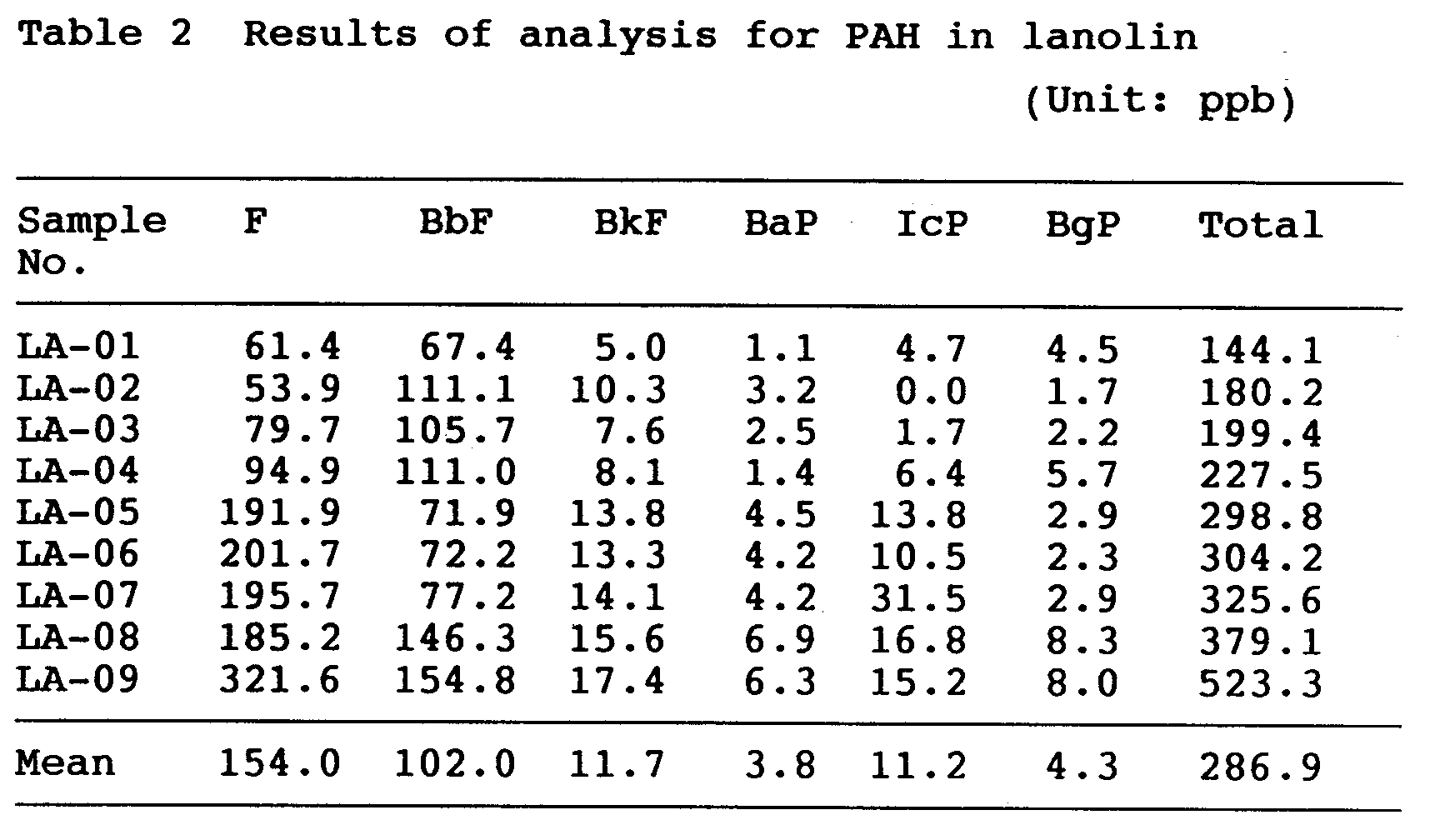
- The results of analysis of 9 commercial brands of lanolin are shown in Table 2. Thus, the minimum value was 144 ppb and the maximum value was 523 ppb. The mean value was 287 ppb. Three brands showed values less than 200 ppb, 2 brands showed values less than 300 ppb, and 4 brands showed values not less than 300 ppb.
- The results of analysis of 19 commercial brands of lanolin alcohol are shown in Example 1 (Table 3) which appears later. According to this analysis, the minimum value was 234 ppb, the maximum value was 6192 ppb, and the mean value was 1585 ppb. There was no brand that gave a value less than 200 ppb, 5 brands showed values in the range of 200-500 ppb, 6 brands showed values in the range of 500-1000 ppb, and 8 brands showed values not less than 1000 ppb. Thus, a large variation was found.
- The results of analysis of 11 brands of distilled lanolin alcohol are shown in Example 1 (Table 4) which appears hereinafter. According to this analysis, the minimum value was 215 ppb, the maximum value was 425 ppb, and the mean value was 311 ppb. No brand of distilled alcohol gave a value less than 200 ppb, 6 showed values in the range of 200-300 ppb, 3 showed values in the range of 300-400 ppb, and 2 showed values not less than 400 ppb.
- It is, therefore, clear that PAH in lanolin can be accurately estimated by the quantitation method of this invention.
- The method for determining the PAH removing activity of activated carbon is now described. To 10 g of a lanolin load is added 0.1 g-5 g of activated carbon and an adsorption process is allowed to proceed at a predetermined constant temperature for a predetermined time under stirring or shaking. The mixture is then allowed to stand for sedimentation and the supernatant is filtered to remove the carbon. The PAH remaining in the filtrate is assayed by the above quantitation method. On logarithmic paper, the amount of PAH adsorbed on each gram of activated carbon and the residual PAH concentration are plotted on the ordinate and abscissa, respectively, to construct an adsorption isotherm. From this adsorption isotherm, the amount of PAH that will be adsorbed per gram carbon to give a total residual PAH concentration of 20 ppb is determined and this value is used as the PAH removing activity value of the particular activated carbon per 10 g of the load at the desired target post-adsorption PAH concentration of 20 ppb under the conditions used.
- By substituting this activity value in the following equation 1, the amount of activated carbon required to attain the desired ultimate PAH concentration can be easily estimated.

where [z] ppb/g carbon means the PAH removing activity of the activated carbon; [a] ppb means the total amount of PAH in the load before treatment; [b] ppb means the desired concentration of residual PAH after treatment, and [c] g means the necessary amount of activated carbon. - To calculate the amount of activated carbon required in the event the target residual PAH concentration is altered, the PAH removing activity can be determined from the above adsorption isotherm and the value be similarly substituted into Equation 1.
- In accordance with the removing method of this invention, PAH in a lanolin load can be selectively eliminated economically and easily without affecting the inherent properties of lanolin by using an activated carbon verified to be the most active of all in amount exceeding the required amount calculated from Equation 1 under optimum conditions of adsorption.
- The species of PAH which can be removed in accordance with this invention are mostly the above-mentioned 6 species which are highly suspected of carcinogenicity but the reduction of residues is achieved by this invention for PAH species other than these 6 species as well. Among such additional species are the following 8 species. Of course, still other species of PAH are also removed by the method of this invention.
- The 8 species mentioned above are benz(a)anthracene, phenanthrene, anthracene, pyrene, triphenylene, chrysene, 7,12-dimethylbenz(a)anthracene, and dibenz(a,h)anthracene.
- The activated carbon treatment described above for removal of PAH can be carried out in a solution of the load in a solvent or in a solventless system. The solventless system is disadvantageous in that it takes a fairly long time for PAH to diffuse and become adsorbed on the pores of activated carbon as compared with the solvent system but if a sufficient duration of contact is provided, the same result as that of the solvent system can be obtained. Ideally the removing activity should be determined in a substantially steady state of adsorption but in this invention determinations are made even before an adsorption equilibrium has been established. Therefore, depending on the state of contact with activated carbon during treatment (shaking or stirring speed), different removing activity values are generated even if the amount of activated carbon, miscella concentration, temperature, time and other treating conditions are held constant. However, when the state of contact is constant, the removing activity has sufficient reproducibility and, therefore, the method can be effectively used for exploring the optimum treating conditions or for determining the amount of activated carbon required under uniform conditions of contact.
- The solvent that can be used for the above-mentioned solvent system is not particularly restricted for modified lanolins other than WG and lanolin, thus including, among others, various hydrocarbons such as pentane, hexane, cyclohexane (abbreviated as CH), heptane (HP), n-octane, isooctane, petroleum ether, etc., aromatic hydrocarbons such as benzene, toluene, xylene, etc., halogenated hydrocarbons such as methylene chloride, chloroform, trichloroethylene, tetrachloroethylene, carbon tetrachloride, etc., alcohols such as methanol, ethanol, n-propanol, isopropyl alcohol (IPA), butanol, etc., ketones such as acetone, methyl ethyl ketone (MEK), methyl isobutyl ketone, diethyl ketone, etc., ester solvents such as methyl acetate, ethyl acetate, propyl acetate, isopropyl acetate, butyl acetate, and so on. These solvents can be used alone or in combination. For WG and lanolin, any of the above-mentioned solvents excepting hexane can be employed. Selection of a solvent suitable for an actual operation can be easily accomplished by the above-described determination of PAH removing activity. It should be understood that the above solvents can be used in combination with water. Thus, such combinations as HP-IPA-water, MEK-water and HP-MT-water can be mentioned by way of example.
- The temperature of adsorption treatment also has important bearings on removing activity. The adsorption of PAH is feasible at or below ambient temperature. As the temperature is increased, the amount of PAH adsorbed per unit weight of activated carbon is also increased so that a higher removing activity value is obtained. Therefore, in the solventless system, the temperature is preferably increased up to a critical level beyond which colorization takes place. In the solvent system, even when the temperature is higher than the boiling point, adsorption treatment can be advantageously carried out under elevated pressure to reduce the required amount of activated carbon. However, adsorption treatment under elevated pressure has the disadvantage of high equipment cost. If it is the case, the treatment is preferably carried out at a temperature a few degrees below the boiling point of the system.
- The activated carbon decolorizing purification of technical lanolin was reportedly effective in achieving a decolorizing effect upon cooling of a hexane miscella down to 20-25°C and is therefore clearly different from the PAH removing method of this invention.
- Activated carbon is available in many kinds according to the starting material, method of activation, and morphology. As classified by starting material, coal-type activated carbons based on peat, lignite, brown coal, etc., and wood-type activated carbons based on sawdust, waste fiber, charcoal, wood, cellulose, pulp waste liquor, palm shells, coconut shells, etc. are available. The method of activation includes chemical activation using zinc chloride or the like and gas activation using steam, carbon dioxide gas, air or the like. As to the morphology of carbon, powdered carbon for batch processes and granular carbon for fixed-bed or fluidized-bed operations can be mentioned. Regardless of the type of carbon, an economically advantageous grades of carbon and treating conditions can be selected by the determination of PAH removing activity according to this invention.
- The commercial technology for activated carbon treatment includes a batch process, a fluidized-bed process and a fixed-bed process and any of these processes can be employed without trouble in the practice of this invention. In the case of a batch process, a predetermined proportion of activated carbon is added to the load and the mixture is agitated by stirring, bubbling of a gas or liquid circulation at a predetermined temperature so as to insure a sufficient contact between the carbon and the load and the carbon is then removed by filtration or the like.
- The necessary height of the fixed bed can be determined by analysis of the load. Generally speaking, to prevent the trouble of insufficient removal due to a short pass, the column length/column diameter ratio is preferably not less than 1.5. The linear velocity is preferably as low as possible and an empty column linear velocity (material feed rate/sectional area of fixed bed) within the range of about 0.5 cm/min. to about 20 cm/min. is generally recommended. If the space velocity is too low, the amount of treatment per unit time is decreased, while an excessively high space velocity leads to an increased pressure loss and a poor contact with the activated carbon so that the amount of treatment per unit amount of the carbon is decreased. Unlike the batch process, the useful life of the carbon column (adsorption breakthrough) is longer than the life calculated by means of Equation 1 because of the concentration gradient from the column inlet to the column outlet. This life-extending effect is closely related with the column length and tends to be greater as the column length is increased.
- The inventors of this invention further discovered, for the first time, that in the production of various lanolin derivatives from WG or lanolin, vacuum distillation of the starting material WG or lanolin under specified conditions removes PAH residues in the starting materials and provides the desired lanolin derivatives free of PAH.
- Nonetheless, since the conditions of the above vacuum distillation overlap the distillation range of lanolin alcohols in a large measure, the consideration of the elimination efficiency and product yield prevents direct application of this vacuum distillation process to lanolin alcohols. According to the above new finding by the inventors of this invention, the desired PAH-free lanolin alcohols, and lanolin fatty acids as well, can be produced by a process which comprises subjecting the starting material WG or lanolin to vacuum distillation according to this invention and, then, to saponification and extraction.
- Therefore, this invention further provides a method of producing PAH-free lanolin derivatives from WG or lanolin characterized by subjecting the starting material to vacuum distillation at a temperature of 150-250°C and a degree of vacuum in the range of 0.1-0.001 Torr to thereby remove PAH residues beforehand.
- The above method is particularly advantageous when the desired lanolin derivative is a lanolin alcohol and, in this case, the WG or lanolin from which PAH has been removed by the above procedure is decomposed by saponification and extracted in the per se conventional manner, whereby the desired lanolin alcohol and, as concomitant products, lanolin fatty acids can be obtained.
- The above vacuum distillation method of this invention can be utilized not only for the production of lanolin alcohols but also for the production of various lanolin derivatives. Among such derivatives are liquid lanolin (low-melting lanolin; LL) and high-melting lanolin (hard lanolin; HL) which can be obtained by fractionation of WG or lanolin, lanolin esters such as lanolin acetate which can be obtained by esterifying WG or lanolin, and lanolin ethers such as adducts of polyoxyethylene, polyoxypropylene, etc. to lanolin, among others. From any of these lanolins, the desired PAH-free product can be obtained by application of the vacuum distillation method of this invention. The production of such varied lanolin derivatives can be performed in the conventional manner except that the vacuum distillation of this invention is interposed. The conditions of vacuum distillation for the starting material WG or lanolin can be judiciously selected within the above-mentioned ranges according to the type of starting material, particularly its PAH content and the degree of elimination of PAH desired in the product.
- The inventors of this invention further discovered that when WG or lanolin is previously treated with boric acid prior to said vacuum distillation, the free lanolin alcohol in the starting material is converted to a boric acid ester with the result that the loss due to vacuum distillation is minimized.
- Therefore, this invention further provides a method of producing PAH-free WG or lanolin characterized by treating WG or lanolin with boric acid in the first place and, then, subjecting the so-treated WG or lanolin to vacuum distillation at a temperature of 150-250°C and a degree of vacuum in the range of 0.1-0.001 Torr to thereby remove the residual PAH.
- The above-mentioned boric acid treatment can be carried out using boric acid (H₃BO₃), boric anhydride (B₂O₃) or the like. The amount of such a reagent is about 0.5-5 molar equivalents, preferably about 1-3 molar equivalents, relative to the theoretical amount required to give the boric acid triester based on the hydroxyl value of the WG or lanolin. Thus, WG or lanolin contains esters having hydroxy groups derived from free lanolin alcohols and hydroxy-fatty acids and in the boric acid treatment mentioned above, the boric acid esterification of lanolin alcohols competes with the hydroxy-esterification of hydroxy-fatty acid esters. Therefore, this factor must be taken into account in calculating the required amount of boric acid based on the hydroxyl value. The above boric acid treatment (boric acid esterification) can be carried out at a temperature of about 50-150°C, preferably about 100-120°C, for about 0.5-8 hours. While this esterification reaction can be carried out at whichever of atmospheric pressure and subatmospheric pressure, it is generally conducted under a reduced pressure of not higher than 100 Torr, preferably 30-1 Torr.
- After the above boric acid esterification reaction, the resulting esterified material is subjected to the vacuum distillation treatment of this invention, whereby the PAH present in the load can be selectively distilled off. The ester thus obtained as a distillation residue is saponified in the per se conventional manner and washed with water to remove boric acid, whereby the desired WG or lanolin with a reduced PAH content can be obtained. Particularly in accordance with the method of this invention involving said boric acid treatment, the free alcohol fraction is substantially not distilled during the vacuum distillation treatment. Therefore, the method is advantageous in that the alcohol yield is not adversely affected.
- Of course, the WG or lanolin obtained by the boric acid esterification and subsequent vacuum distillation according to this invention can be subjected to the above-mentioned fractionation, esterification, polyoxyethylene addition reaction, etc. to obtain various PAH-free lanolin derivatives.
- The term 'lanolin' as used in this specification means, in its broad sense, WG and various lanolin derivatives which are obtainable by purification/and derivatization procedures using WG as the main starting material.
- It should also be understood that, in this specification, each of such lanolin species other than WG and lanolin, obtained from WG, is sometimes referred to as a lanolin derivative. Among such lanolin derivatives are low-melting liquid lanolin (LL) and high-melting hard lanolin (HL), both of which are obtainable by fractionation of lanolin, lanolin fatty acid fraction, soft and hard lanolin fatty acids obtainable by fractionation thereof, distillation products thereof (lanolin fatty acids), lanolin alcohol and its distillates, cholesterol, lanosterol, esters of lanolin fatty acids with alcohols or sterols, cholesterol fatty acid esters, ethers of lanolin, lanolin fatty acids, lanolin alcohols and sterols with polyoxyethylene or the like, fatty acid esters of lanolins or lanolin alcohols. In addition, fatty acid esters of sterols, inclusive of plant sterols, and dihydrocholesterol, etc. are also included in the concept of said lanolin derivative.
- According to the invention, PAH occurring in lanolin at the ppb level can be assayed with accuracy, good reproducibility and great ease. In addition, the PAH removing activity of activated carbon can be determined and, therefore, an economical amount of carbon that is just necessary for removal of PAH and the corresponding optimal treating conditions can be easily selected.
- Furthermore, by the method of the invention employing activated carbon for the adsorption treatment of lanolin, safe lanolin with a reduced PAH content can be obtained.
- Moreover, in accordance with this invention, PAH residues can be further removed by vacuum distillation, with or without prior boric acid esterification treatment and the resulting PAH-free WG or lanolin is of great value as a starting material for various lanolin derivatives inclusive of lanolin alcohols.
- The low-PAH lanolin thus obtained has not been altered in fundamental properties from the lanolin prior to the activated carbon and other treatments and, therefore, can be used with greater safety in the pharmaceutical, cosmetic and other fields where lanolin has been traditionally used.
- The following examples are intended to describe this invention in further detail.
- A column measuring 25 mm in inside dia. and 770 mm long is packed with 130 g of a styrene-divinylbenzene copolymer (200-300 mesh, Bio-Rad Laboratories; BioBeads SX-3, cutoff mol. wt. = 2000), while 1 g of the starting material is dissolved in 10 ml of dichloromethane and the resulting solution is filtered through a 0.2 µm filter. Five (5) ml of the sample filtrate is injected into the above column and elusion is carried out with 4 ml/min. of dichloromethane. As a result, the esters, lanolin fatty acids and lanolin alcohols emerge in the first 256 ml fraction and, immediately following this, PAH emerges in the subsequent 104 ml fraction (cumulative total:360 ml). The PAH-containing fraction is evaporated at 60°C and the residue is thoroughly washed with a total of 6 ml of acetonitrile and concentrated to dryness under reduced pressure or in a nitrogen stream (Sample A). Sample A is dissolved in 100 µl of acetonitrile and an appropriate amount, 10-50 µl, of the solution is injected into an HPLC equipped with a fluorescence detector. The quantitation is made by the absolute calibration method.
-
- Column:
- Novapak C18, 3.9-300 mm (30°C)
- Mobile phase:
- acetonitrile/water = 70/30
- Flow rate:
- 1.0 ml/min.
- Detection:
- The exciting and measuring wavelengths for each PAH are shown below. [Detector: Japanese Spectroscopic 820-FP fluorescence detector].
-
PAH Exciting wavelength (nm) Measuring wavelength (mm) Retention time (min.) Sensitivity Area/ng PAH F 284 470 11.3 574,627 BbF 300 411 23.1 640.829 BkF 300 411 24.3 7,696,765 BaP 300 411 26.5 4,454,364 IcP 300 500 38.0 180,361 BgP 300 411 38.4 1,785,894 - Commercial lanolin alcohols were analyzed under the above conditions. The results are set forth in Tables 3 and 4.


- To check the reproducibility of this quantitation method, Sample AD-11 in Table 4 was analyzed in 5 replicates. The results are shown in Table 5. It is clear from the data that the reproducibility of the method is high.

- In the table, CV % is the standard deviation/mean x 100. The smaller the value is, the smaller is the variation of measured values.
- A PAH recovery test for this quantitation method was carried out using standard solutions containing no lanolin alcohol (PAH concentrations 30-50 ppb) and a spike test was carried out by adding known amounts of PAH (10-12 ppb, respectively) to the lanolin alcohol. As a result, the rates of recovery from the standard solutions except F=71% were invariably not less than 90% (BbF=93%, BkF=90%, BaP=94%, BgP=103%, IcP=99%), thus being fully satisfactory.
- The results of the spike test were evaluated in terms of the recovery rate expressed by the following equation. In consideration of the fact that the level of addition was as low as 10 ppb, the recovery rates thus found were fully satisfactory as were the results of the above recovery test using standard solutions. (F=93%, BbF=98%, BkF=97%, BaP=91%, BgP=103%, IcP=110%).

- Ten (10) grams of lanolin alcohol (Sample AL-13 in Table 3) was dissolved in HP/IPA=90/10 (by weight) to prepare a 10% solution. On the other hand, crushed coal carbon Taiko GL-30 (Futamura Chemical Industries; specific surface area = 1060 m²/g, total pore volume = 0.56 ml/g, 0-10 Å=0.20 ml/g, 10-50 Å=0.32 ml/g, 50-100 Å=0.03 ml/g, 100 Å- =0.01 ml/g, methylene blue bleaching power=190 ml/g, iodine adsorption capacity=1000 mg/g) was pulverized and size-selected (325 mesh, 95% pass). This powdered carbon, 0.25-1 g, was added to portions of the above 10% solution and each mixture was gently shaken (amplitude = 2.5 cm, 130 reciprocations/min.) at 70°C for 1 hour for adsorption treatment. The mixture was then allowed to stand for sedimentation and the supernatant was filtered to remove the carbon. The solvent was removed from the filtrate and the residual PAH was determined by the quantitation method described hereinbefore. On logarithmic paper, the amount of PAH adsorbed per gram of carbon and the residual PAH concentration were plotted on the ordinate and abscissa, respectively, to construct an adsorption isotherm. From this adsorption isotherm, the amount of PAH adsorbed per gram of carbon that would give a residual PAH concentration of 20 ppb was determined. As a result, the PAH-removing activity of GL30 was 1900 ppb/g carbon.

- To 100 g of a 10% solution containing 10 g of lanolin alcohol AL-06 in a pretreatment concentration of 585 ppb was added 0.3 g of the same activated carbon as above for adsorption treatment. The total PAH content after this treatment was 10 ppb. The necessary amount of activated carbon calculated from the removing activity, as below, was close to 0.3 g. It is recognized that the two values well accords with each other.
(585-20)/1900=0.297 - Using the same lanolin alcohol and activated carbon as used in Example 2 but different solvents, the removing activity for a residual concentration of 20 ppb was calculated in each case. The results are shown in Table 7. It is clear from this example that the removing activity of carbon can be varied with the treating conditions and the optimum treating conditions can be established with comparative ease and accordingly calculating the removing activity values according to this invention.

- The removing activity of wood-based powdered carbon 'Taiko K' (Futamura Chemical Industries; specific surface area=1014 m²/g, total pore volume=0.51 ml/g, mean pore radius=10.1 Å, the pore radius representing the largest volume on the pore size distribution curve=5.5 Å; 0-10 Å=0.10 ml/g, 10-50 Å=0.28 ml/g, 50-100 Å=0.07 ml/g, 100 Å- =0.07 ml/g, methylene blue bleaching power=200 ml/g, pH=5.7) was similarly determined. Using lanolin alcohol Sample AL-06, a 10% solution was prepared using 88.7% MEK. To 100 g of this solution was added 0.2 g-2.0 g of the activated carbon and the mixture was gently shaken on a reciprocating shaker (130 reciprocations/min., amplitude=2.5 cm) at 70°C for 60 minutes. The results are shown in Table 8. The removing activity at a residual concentration of 20 ppb was 980 ppb/g carbon (Example 4-1).
- Similarly, using sample AL-13, a 10% solution was prepared using HP. To 100 g of this solution was added 0.5 g-2.0 g of activated carbon and the mixture was treated at 70°C for 60 minutes. The results are shown in Table 8. The removing activity at a residual concentration of 20 ppb was 820 ppb/g carbon (Example 4-2).
Table 8 Addition level of activated carbon (g) 88.7% MEK, total residual concentration (ppb) Addition level of activated carbon (g) HP, total residual concentration (ppb) 0.2 85.1 0.2 ---- 0.5 25.1 0.5 47.2 1.0 9.7 1.0 25.4 2.0 3.0 2.0 13.8 Removing activity 980 Removing activity 820 - Similarly a 10% solution of Sample AL-13 was prepared using 88.7% MEK. To 100 g of this solution was added 1.0 g of activated carbon and the mixture was treated at 70°C for 1 and 48 hours. As a result, the concentration was 21 ppb after 1 hour and 2.4 ppb after 48 hours (Example 4-3).
- The adsorption treatment according to Example 4-3 was repeated except that in lieu of the reciprocating shaker, a 300 rpm stirrer equipped with an impeller measuring 5 cm long and 1 cm wide was employed (Example 4-4). The result was 2.2 ppb.
- It is apparent from the above results that the time to equilibrium varies according to mixing conditions, with the consequent variation in removing activity.
- The removing activity of palm shell-based activated carbon 'Taiko CW130B' (Futamura Chemical Industries; specific surface area=1150 m²/g, total pore volume=0.50 ml/g; 0-10 Å=0.05 ml/g, 10-50 Å=0.60 ml/g, 50-100 Å=0.15 ml/g, 100 Å- =0.28 ml/g; methylene blue bleaching power=210 ml/g, iodine adsorption capacity=1110 mg/g, pH=9.8; grain size: 0.5-1.7 mm pass=98%) was determined under the conditions of a 10% solution in 88.7% MEK, 70°C and 5 hours. The removing activity found was 400 ppb/g carbon.
- The removing activity of a wood-based activated carbon 'Taiko SG' (Futamura Chemical Industries; specific surface area=1050 m²/g, total pore volume=0.84 ml/g, mean pore radius=13.7 Å, the pore radius representing the largest volume on the pore size distribution curve=11.3 Å; 0-10 Å=0.05 ml/g, 10-50 Å=0.57 ml/g, 50-100 Å=0.14 ml/g, 100 Å- =0.05 ml/g; methylene blue bleaching power=210 ml/g, iodine adsorption capacity=1110 mg/kg, pH=9.8, grain size: 0.5-1.7 mm pass=98%) was similarly determined under the conditions of a 10% solution in 88.7% MEK, 70°C and 2 hours. The activity found was 390 ppb/g carbon.
- To 10 g of Sample AL-13 was added 1 g of 'Taiko K', a powdered activated carbon, and the mixture was stirred at 70°C for 1 or 6 hours. The activated carbon was then filtered off and the PAH contained in the filtrate was assayed. Similar procedures were carried out using a treating temperature of 100°C and an agitation time of 1 hour. Furthermore, 1 g of the same activated carbon as above was added to 100 g of a 10% solution in 88.7% MEK and the mixture was treated at 70°C or 40°C for 1 hour. The respective results are shown in Table 9.
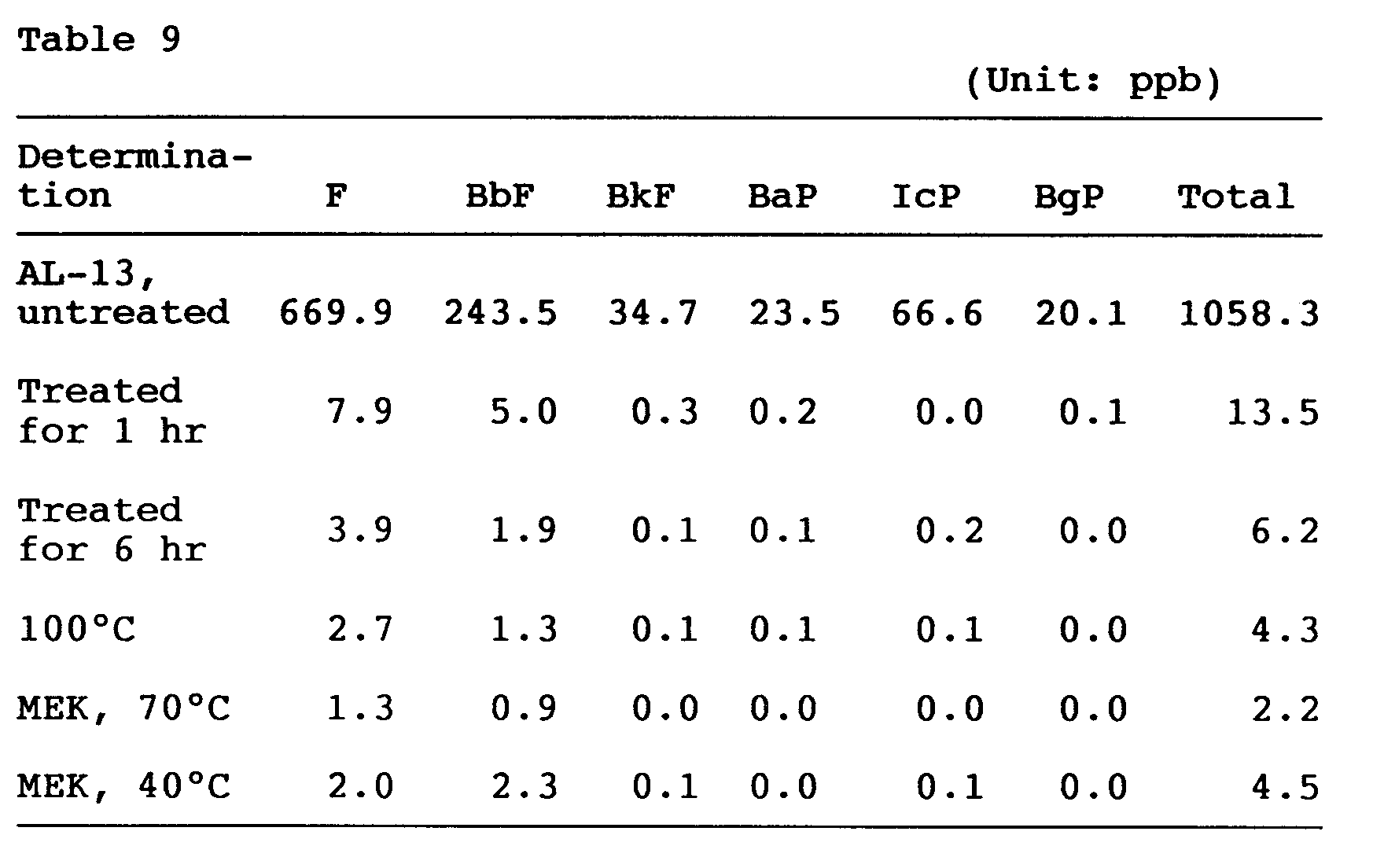
- Even when the sample was not diluted with a solvent, the total concentration fell to 13.5 ppb after 1 hour of treatment and to 6.2 ppb after 6 hours. It is apparent from the results that although it takes a long time for an adsorption equilibrium to be established, PAH can be sufficiently removed by activated carbon adsorption treatment. Moreover, the result of 1-hour treatment at 70°C in the absence of a solvent (13.5 ppb), the result of 1-hour treatment at 100°C (4.3 ppb), and the results of treatment after MEK dilution at 70°C (2.2 ppb) and 40°C (4.5 ppb) indicate that the adsorption performance of activated carbon can be better exploited at higher temperatures.
- Using the same activated carbon and lanolin alcohol as in Example 7, and, as the solvent system, 88.7% MEK and IPA, solutions of 10-50% concentrations were prepared and the adsorption treatment was carried out at 70°C under stirring (300 rpm/min., stirrer impeller=5 cm x 1 cm) for 1 hour. The results are shown in Table 10. As a result, the removing effect was invariably high, although a comparatively higher removing effect was obtained with IPA than with MEK. It is also apparent that within the range of no remarkable gain in viscosity, namely about 10-50% concentrations, there is substantially no concentration dependency in removing effect.

- A column measuring 5 cm in inside diameter and equipped with a jacket was packed with 107 g of 'Taiko GL30', a coal-based granular carbon (2.36-0.50 mm pass=96%, packing density=0.48 g/ml) (packing height=ca. 12.5 cm). A 10% solution of lanolin alcohol Sample AL-06 in a solvent system of HP/IPA/H₂O=92.5/7.0/0.5 was passed through the carbon-packed column at a linear velocity of 2 cm/min. and a treating temperature of 70°C and the effluent was collected in 2 fractions according to the amount of passage. The solvent was removed from the respective fractions to provide 464 g of treated lanolin alcohol (Treatment 1, about 0-4.3 times the amount of packing carbon) and 498 g (Treatment 2, about 4.3-9 times the amount of packing carbon). The changes from the pretreatment values of PAH are shown in Table 11. The data indicate that PAH can be efficiently removed even by fixed-bed adsorption.

- A column measuring 1.9 cm in inside diameter and equipped with a jacket was packed with 30 g of 'Taiko GL30', a coal-based crushed carbon, and a 15% solution of Sample AL-06 in 88.7% MEK was passed at a varying linear velocity of 2.1 cm/min., 4.1 cm/min., 11.2 cm/min. or 19.5 cm/min. Each effluent was collected in fractions according to the amount of treatment per activated carbon (0-1 time, 0-5 times and 0-10 times) and the amounts of PAH were determined. The results are shown in Table 12. It is apparent that as the linear velocity is decreased, the amount of treatment per unit amount of activated carbon is increased and the residual PAH concentration is decreased.

- The activated carbon used in Example 10 was regenerated by the bake regeneration (high-temperature regeneration) method to a regeneration rate of 88% and using this regenerated carbon, an adsorption treatment at a linear velocity of 4.6 cm/min. was carried out as in Example 10. The results are also shown in the table. These results are comparable with those obtained in Example 10.

- In 88.7% MEK was dissolved 150 g of lanolin alcohol AL-06 at a final concentration of 15%. To this solution was added 15.0 g of powdered activated carbon K and the mixture was stirred at 70°C for 1 hour. The mixture was then filtered to remove the carbon and the solvent was further removed to provide a lanolin alcohol. The results of analysis for PAH before and after the treatment are shown in Table 14 and the general analyses in Tables 15 and 16. The above adsorption treatment with activated carbon caused no remarkable change in the composition and analytical values of the lanolin alcohol.

Table 15 General analysis Sample GH AV SV OHV mp (°C) POV W/U % Before treatment 11 1.4 5.3 168 58.8 17.8 >200 After treatment 11 1.5 4.6 167 57.8 15.3 >200 W/U represents the hydration capacity of a petrolatum/lanolin alcohol (=9.4/0.6) mixture. 
- In 90 g of each solvent was dissolved 10 g of lanolin alcohol Sample AL-13. To the resulting solution was added 1.0 g of activated carbon K and the mixture was stirred at 70°C for 1 hour. This mixture was then filtered to remove the carbon and the solvent was further removed to provide a lanolin alcohol. The data after treatment are given in Table 17. The removal rate was as high as 98% or more, indicating that the level of PAH residues can be decreased by activated carbon treatment.

- Ten (10) grams of lanolin Sample LA-09 was dissolved in hexane to prepare a 10% solution. To this solution was added 0.5 g of powdered activated carbon K and the mixture was stirred at 30°C for 1 hour. After this adsorption treatment, PAH was assayed. The color of the sample was GH=8.5 both before and after treatment and the total PAH was reduced from 523 ppb before treatment to 6.6 ppb after treatment (Example 14-1). The above test procedure was repeated except that WG was used as the starting material. The color was GH=18 both before and after treatment, while PAH decreased from 487 ppb to 3.5 ppb (Example 14-2). The analytical data are presented in Table 18.

- Using HP/IPA=9/1 or IPA, a 10% solution of lanolin Sample LA-09 was prepared. To this solution was added 0.5 g of powdered activated carbon K and the mixture was stirred at 70°C for 1 hour. After this adsorption treatment, the PAH was assayed. The results were 4.3 ppb and 4.5 ppb, respectively.
- Using a solvent mixture of HP/IPA=90/10, 450 g of distilled lanolin alcohol Sample AD-01 was worked into a 10% miscella. A column measuring 19 mm in inside diameter and equipped with a jacket was packed with 30 g of granular activated carbon GL30 and the above material miscella was passed at a rate of 15 ml/min. (linear velocity=5.3 cm/min.). The PAH content, general analysis and composition after the above treatment are shown in Tables 19-1, 19-2, 20 and 21. It is apparent that the concentrations of PAH species other than the six species were also lowered and that there was no change in color, general analysis or composition.

Table 20 General analysis Sample GH AV SV OHV mp (°C) POV W/U % Before treatment 6 0.9 2.2 155 70.7 9.5 >300 After treatment 6 0.7 1.7 156 70.5 9.0 >300 W/U: as defined under Table 15. 
- The activated carbon treatment was carried out using, as lanolins, (1) the low-boiling fraction liquid lanolin (LL) and (2) high-boiling lanolin fraction hard lanolin (HL), both of which are obtainable by fractionation of lanolin, (3) acetylated lanolin alcohol (AC100), which is an ester of lanolin alcohol, (4) lanolin alcohol-polyoxyethylene 30 mole adduct (L30), (5) lanolin-polyoxyethylene 20 mole adduct (A20), (6) macadamia nut fatty acid cholesteryl (MAC), which is an ester of cholesterol, (7) lanolin fatty acid cholesteryl (CL), (8) cholesterol (CHO), (9) isocholesterol (IC), which is a dihydrolanosterol-lanosterol mixture extracted from lanolin alcohol, (10) lanolin fatty acid methyl ester (FAM) and (11) lanolin fatty acid (LFA). Thus, 10% of powdered activated carbon (Taiko K) was added to each of these starting materials and the mixture was treated in the solvent shown in Table 22 under stirring at 70°C for 1 hour. The PAH values before and after the treatment are shown in units of ppb in Table 22.
- It is apparent from the table that from any of these types of lanolin, PAH can be efficiently removed by the activated carbon treatment according to the invention
Table 22 Sample code Before or after treatment Solvent system F ppb BbF ppb BKF ppb BaP ppb IcP ppb BgP ppb Total ppb LL Before 122 119 12 4 11 6 273 After MEK 3 2 0 0 0 1 6 HL Before 29 37 3 1 4 2 76 After MEK 1 2 0 0 0 1 4 AC100 Before 128 111 11 8 12 7 277 After IPA 0 0 0 0 0 0 0 L30 Before 42 49 3 1 0 19 114 After IPA 1 1 0 0 0 0 2 A20 Before 39 41 3 2 2 2 89 After IPA 1 1 0 0 0 0 2 MAC Before 4 2 0 1 1 1 9 After H/IPA 1 0 0 0 0 0 1 CL Before 5 2 1 0 0 0 8 After MEK 0 0 0 0 0 0 0 CHO Before 2 1 0 0 0 0 3 After MEK 0 0 0 0 0 0 0 IC Before 4 1 0 0 0 0 5 After MEK 0 0 0 0 0 0 0 FAM Before 6 3 1 0 0 0 10 After MEK 0 0 0 0 0 0 0 LFA Before 7 3 1 0 0 0 11 After MEK 0 0 0 0 0 0 0 - In the above table, MEK denotes a solution in aqueous methyl ethyl ketone and H/IPA denotes a solvent mixture of heptane and IPA (=90/10, v/v).
- A lanolin with a PAH concentration of 90 ppb for said 6 species combined (F=46 ppb, BbF=30 ppb, BkF=5 ppb, BaP=3 ppb, BgP=2 ppb, IcP=4 ppb) was subjected to vacuum distillation at 230°C and 0.005 Torr to provide 9% of distillate and 91% of residue.
- The total PAH content of this residue was 10 ppb (F=3 ppb, BbF=4 ppb, BkF=0 ppb, BaP=0 ppb, BgP=1 ppb, IcP=2 ppb).
- This residue was saponified and extracted to give fatty acid and alcohol fractions. The yield of lanolin fatty acid was 64% and the total PAH residue in this fraction was 4 ppb. As to lanolin alcohol, its yield was 36% and the PAH residue in this alcohol was 20 ppb.
- As a control, the same starting material lanolin was saponified and extracted without prior vacuum distillation. As a result, the yields of fatty acid and alcohol were 55% and 45%, respectively. The respective PAH residues were 9 ppb and 178 ppb.
- The above results indicated that the vacuum distillation of lanolin under the specified conditions enables a fractionation thereof into a fatty acid fraction substantially free of PAH and a free alcohol fraction containing PAH and that PAH in this alcohol fraction can be eliminated by subsequent saponification and extraction.
- To 500 g of the same lanolin (hydroxyl value 35) as used in Example 17 was added 10 g of boric acid and the esterification reaction was conducted at 120°C and 5 Torr for 5 hours.
- The resulting ester was subjected to vacuum distillation under the same conditions as in Example 17, followed by aqueous washing to remove the boric acid and provide a treated lanolin.
- The concentration of PAH in this treated lanolin was 10 ppb. This lanolin could then be fractionated into an alcohol fraction (yield 45%) and a fatty acid fraction by saponification and extraction.
- It is, therefore, clear that by subjecting lanolin to esterification with boric acid and vacuum distillation in succession, PAH can be removed with high selectivity and in good yield.
- This invention provides a method of quantitating polycyclic aromatic compounds (PAH) in lanolin which comprises subjecting a lanolin containing PAH to styrene-divinylbenzene copolymer gel permeation chromatography for separation and concentration and assaying PAH using an HPLC equipped with a fluorescence detector and a method of removing PAH from lanolin which comprises selecting the optimum conditions, calculating the amount of an activated carbon required for minimizing PAH according to the PHA-removing activity of activated carbon as determined by the above quantitation method, and contacting the lanolin with said necessary amount of carbon for specific adsorption of the PAH on the carbon. The invention further provides a method of removing PAH from WG or lanolin which comprises subjecting the WG or lanolin to vacuum distillation with or without prior esterification with boric acid.
- By the PAH removing technology of this invention, six carcinogenic species and other species of PAH can be easily removed with accuracy and good reproducibility. Thus, by using 10% of activated carbon based on the weight of the material, a lanolin containing PAH in a total concentration of 1000 ppb, for instance, can be purified to a PAH level of 2 ppb. Moreover, the composition and physical properties of the lanolin are not affected by the procedure and the yield is also high. The lanolin from which PAH has been removed by this technology can be more safely used for pharmaceutical and cosmetic applications in which lanolin products have been conventionally used.
Claims (9)
- A method of quantitating polycyclic aromatic compounds in lanolin which comprises subjecting said lanolin to styrene-divinylbenzene copolymer gel permeation chromatography for separation and concentration.
- A method of removing polycyclic aromatic compounds in lanolin which comprises subjecting said lanolin to adsorption treatment with activated carbon.
- The method according to claim 2 wherein said lanolin is a lanolin derivative other than wool grease and lanolin.
- The method according to claim 2 wherein said lanolin derivative is lanolin alcohol.
- The method according to claim 2 wherein the lanolin is wool grease and lanolin and the adsorption treatment is carried out at a temperature not below 30°C.
- The method according to claim 2 wherein the lanolin is wool grease and lanolin and the adsorption treatment with activated carbon is carried out in the absence of a solvent or in an organic solvent other than hexane.
- A method of producing a lanolin derivative free of polycyclic aromatic compounds starting with wool grease or lanolin characterized in that the starting material is previously subjected to vacuum distillation at 150-250°C and 0.1-0.001 Torr to thereby remove residues of polycyclic aromatic compounds from the starting material.
- The method according to claim 7 wherein the lanolin derivative is lanolin alcohol.
- A method of removing polycyclic aromatic compounds from wool grease or lanolin characterized in that the wool grease or lanolin is treated with boric acid and then subjected to vacuum distillation at a temperature of 150-250°C and a vacuum degree of 0.1-0.001 Torr.
Applications Claiming Priority (3)
| Application Number | Priority Date | Filing Date | Title |
|---|---|---|---|
| JP3603393 | 1993-01-12 | ||
| JP36033/93 | 1993-01-12 | ||
| PCT/JP1994/000010 WO1994016322A1 (en) | 1993-01-12 | 1994-01-07 | Method of measuring content of polycyclic aromatic compound in lanolin and removal thereof |
Publications (2)
| Publication Number | Publication Date |
|---|---|
| EP0632267A1 true EP0632267A1 (en) | 1995-01-04 |
| EP0632267A4 EP0632267A4 (en) | 1995-12-20 |
Family
ID=12458408
Family Applications (1)
| Application Number | Title | Priority Date | Filing Date |
|---|---|---|---|
| EP94904003A Withdrawn EP0632267A4 (en) | 1993-01-12 | 1994-01-07 | PROCESS FOR MEASURING AND SEPARATING POLYCYCLIC AROMATIC COMPOUNDS CONTAINED IN LANOLIN. |
Country Status (2)
| Country | Link |
|---|---|
| EP (1) | EP0632267A4 (en) |
| WO (1) | WO1994016322A1 (en) |
Cited By (11)
| Publication number | Priority date | Publication date | Assignee | Title |
|---|---|---|---|---|
| WO2003022391A1 (en) * | 2001-09-05 | 2003-03-20 | Showa Denko K.K. | Method and apparatus for analyzing endocrine-disrupting substances in vital sample |
| WO2004102181A3 (en) * | 2003-05-13 | 2005-11-24 | Cargill Inc | Determination of aromatic hydrocarbons in edible oil products |
| US7678930B2 (en) | 2002-07-11 | 2010-03-16 | Pronova Biopharma Norge As | Process for decreasing the amount of cholesterol in a marine oil using a volatile working fluid |
| EP2169038A1 (en) | 2002-07-11 | 2010-03-31 | Pronova BioPharma Norge AS | A process for decreasing environmental pollutants in an oil or a fat, and a fish feed product |
| DE102012220494A1 (en) * | 2012-11-09 | 2014-05-15 | Beiersdorf Ag | Use of lanolin comprising a proportion of cholesterol, steranes and/or wool wax acids increased in relation to natural proportion, for producing cosmetic and/or dermatological products |
| DE102012220487A1 (en) * | 2012-11-09 | 2014-05-15 | Beiersdorf Ag | Purifying lanolin or lanolin-products, comprises passing lanolin or lanolin-product to be purified through activated carbon fixed bed |
| CN106872608A (en) * | 2017-03-24 | 2017-06-20 | 海南出入境检验检疫局检验检疫技术中心 | Limited in a kind of cosmetics with the detection method of anaphylactogen perfume materials |
| CN107941979A (en) * | 2017-11-13 | 2018-04-20 | 舟山市食品药品检验检测研究院 | Cholesterol oxide detection method of content in a kind of fishery technology |
| CN109839495A (en) * | 2019-03-22 | 2019-06-04 | 杭州辛孚能源科技有限公司 | A method of light petroleum fraction boiling range is calculated according to molecular composition |
| WO2020086898A1 (en) * | 2018-10-25 | 2020-04-30 | Gjerde Douglas T | Columns and methods of use for analytical standards and compounds |
| US12269012B2 (en) | 2018-10-25 | 2025-04-08 | Thomas Jakschitz | Columns and methods of use for analytical standards and compounds |
Families Citing this family (1)
| Publication number | Priority date | Publication date | Assignee | Title |
|---|---|---|---|---|
| CN113663599B (en) * | 2021-08-19 | 2023-06-02 | 浙江花园营养科技有限公司 | Method for preparing particulate medical grade lanonol |
Family Cites Families (5)
| Publication number | Priority date | Publication date | Assignee | Title |
|---|---|---|---|---|
| US3853930A (en) * | 1972-02-04 | 1974-12-10 | T Richey | Process for treating lanolin and lanolin derivatives |
| DE2364333C3 (en) * | 1973-12-22 | 1979-10-11 | Deutsche Texaco Ag, 2000 Hamburg | Process for the separation of aromatic hydrocarbons from n-paraffin mixtures by treatment with an anhydrous macroporous cation exchange resin |
| JPS5247009A (en) * | 1975-10-09 | 1977-04-14 | Kao Corp | Non-allergenic lanolin and its derivatives, and process for preparing the same |
| DE3215912A1 (en) * | 1982-04-29 | 1983-11-03 | Henkel Kgaa | WOOL WAX REPLACEMENT PRODUCT |
| US5155245A (en) * | 1988-09-14 | 1992-10-13 | Yoshikawa Oil & Fat Co., Ltd. | Process for refining lanolins |
-
1994
- 1994-01-07 WO PCT/JP1994/000010 patent/WO1994016322A1/en not_active Ceased
- 1994-01-07 EP EP94904003A patent/EP0632267A4/en not_active Withdrawn
Cited By (18)
| Publication number | Priority date | Publication date | Assignee | Title |
|---|---|---|---|---|
| WO2003022391A1 (en) * | 2001-09-05 | 2003-03-20 | Showa Denko K.K. | Method and apparatus for analyzing endocrine-disrupting substances in vital sample |
| US7678930B2 (en) | 2002-07-11 | 2010-03-16 | Pronova Biopharma Norge As | Process for decreasing the amount of cholesterol in a marine oil using a volatile working fluid |
| EP2169038A1 (en) | 2002-07-11 | 2010-03-31 | Pronova BioPharma Norge AS | A process for decreasing environmental pollutants in an oil or a fat, and a fish feed product |
| US7718698B2 (en) | 2002-07-11 | 2010-05-18 | Pronova Biopharma Norge As | Process for decreasing environmental pollutants in an oil or a fat |
| US7732488B2 (en) | 2002-07-11 | 2010-06-08 | Pronova Biopharma Norge As | Pharmaceutical composition comprising low concentrations of environmental pollutants |
| EP2295529A2 (en) | 2002-07-11 | 2011-03-16 | Pronova BioPharma Norge AS | Use of a volatile environmental pollutants-decreasing working fluid for decreasing the amount of pollutants in a fat for alimentary or cosmetic use |
| WO2004102181A3 (en) * | 2003-05-13 | 2005-11-24 | Cargill Inc | Determination of aromatic hydrocarbons in edible oil products |
| DE102012220487A1 (en) * | 2012-11-09 | 2014-05-15 | Beiersdorf Ag | Purifying lanolin or lanolin-products, comprises passing lanolin or lanolin-product to be purified through activated carbon fixed bed |
| DE102012220494A1 (en) * | 2012-11-09 | 2014-05-15 | Beiersdorf Ag | Use of lanolin comprising a proportion of cholesterol, steranes and/or wool wax acids increased in relation to natural proportion, for producing cosmetic and/or dermatological products |
| CN106872608A (en) * | 2017-03-24 | 2017-06-20 | 海南出入境检验检疫局检验检疫技术中心 | Limited in a kind of cosmetics with the detection method of anaphylactogen perfume materials |
| CN107941979A (en) * | 2017-11-13 | 2018-04-20 | 舟山市食品药品检验检测研究院 | Cholesterol oxide detection method of content in a kind of fishery technology |
| WO2020086898A1 (en) * | 2018-10-25 | 2020-04-30 | Gjerde Douglas T | Columns and methods of use for analytical standards and compounds |
| US20210072201A1 (en) * | 2018-10-25 | 2021-03-11 | Thomas Jakschitz | Columns and Methods of Use for Analytical Standards and Compounds |
| US11656209B2 (en) * | 2018-10-25 | 2023-05-23 | Thomas Jakschitz | Columns and methods of use for analytical standards and compounds |
| US11998893B2 (en) | 2018-10-25 | 2024-06-04 | Thomas Jakschitz | Columns and methods of use for analytical standards and compounds |
| US12269012B2 (en) | 2018-10-25 | 2025-04-08 | Thomas Jakschitz | Columns and methods of use for analytical standards and compounds |
| CN109839495A (en) * | 2019-03-22 | 2019-06-04 | 杭州辛孚能源科技有限公司 | A method of light petroleum fraction boiling range is calculated according to molecular composition |
| CN109839495B (en) * | 2019-03-22 | 2021-07-23 | 广东辛孚科技有限公司 | A method for calculating the distillation range of light petroleum distillates according to molecular composition |
Also Published As
| Publication number | Publication date |
|---|---|
| EP0632267A4 (en) | 1995-12-20 |
| WO1994016322A1 (en) | 1994-07-21 |
Similar Documents
| Publication | Publication Date | Title |
|---|---|---|
| JPWO1994016322A1 (en) | Measurement and removal method of polycyclic aromatic compounds in lanolin | |
| EP0632267A1 (en) | Method of measuring content of polycyclic aromatic compound in lanolin and removal thereof | |
| US5225580A (en) | Process for separating fatty acids and triglycerides | |
| US5179219A (en) | Process for separating fatty acids and triglycerides | |
| CA2131255A1 (en) | Tocopherols | |
| CN105585552A (en) | Decoloration and purification method for vitamin E | |
| JP3052172B2 (en) | Method for producing tea catechins | |
| US4122094A (en) | Separation of the isomers of tocopherol by liquid/solid chromatography | |
| Suzuki et al. | Behavior of chlorophyll derivatives in canola oil processing | |
| Singer et al. | Chirality evaluation of 2-methyl-4-propyl-1, 3-oxathiane from the yellow passion fruit | |
| Chapman et al. | Separation and characterization of pigments from bleached and deodorized canola oil | |
| Kemmo et al. | Formation and decomposition of stigmasterol hydroperoxides and secondary oxidation products during thermo‐oxidation | |
| US5155245A (en) | Process for refining lanolins | |
| US5102582A (en) | Process for separating fatty acids and triglycerides | |
| Kopycki et al. | HPLC determination of taxol and related compounds in Taxus plant extracts | |
| Regis‐Rolle et al. | High‐performance liquid chromatographic method for the determination of carbendazim residues in crops, grains, and wines with fluorescent detection | |
| CN113533608B (en) | Method suitable for rapidly detecting aflatoxin in large-batch edible oil samples | |
| Tautorus et al. | Chemical aspects of chlorophyll breakdown products and their relevance to canola oil stability | |
| Sinclair et al. | Rapid method for the determination of benzo [a] pyrene in the particulate phase of cigarette smoke by high-performance liquid chromatography with fluorimetric detection | |
| Moh et al. | Simultaneous determination of free fatty acids, partial acylglycerols and tocols in palm oil products using high‐performance liquid chromatography | |
| CN114577951A (en) | Method for determining residual quantity of cumyl ether and fluorofen-ethyl in plant-derived product by gas chromatography-triple quadrupole mass spectrometry | |
| US4195101A (en) | 2',6'-Dihydroxy-9-(2,5-dihydroxyphenyl)octylphenone and its use as an anti-oxidant | |
| Klobes et al. | Enantioseparation of the compounds of technical toxaphene (CTTs) on 35% heptakis (6-O-tert-butyldimethylsilyl-2, 3-di-O-Methyl)-β-cyclodextrin in OV1701 | |
| Valterová et al. | Enantiomeric composition of monoterpene hydrocarbons from the liverwort Conocephalum conicum | |
| Tafuri et al. | Determination of residues of Vitavax and Plantvax in grains |
Legal Events
| Date | Code | Title | Description |
|---|---|---|---|
| PUAI | Public reference made under article 153(3) epc to a published international application that has entered the european phase |
Free format text: ORIGINAL CODE: 0009012 |
|
| 17P | Request for examination filed |
Effective date: 19940908 |
|
| AK | Designated contracting states |
Kind code of ref document: A1 Designated state(s): BE DE FR GB IT NL |
|
| A4 | Supplementary search report drawn up and despatched |
Effective date: 19951103 |
|
| AK | Designated contracting states |
Kind code of ref document: A4 Designated state(s): BE DE FR GB IT NL |
|
| RAP1 | Party data changed (applicant data changed or rights of an application transferred) |
Owner name: NIPPON FINE CHEMICAL CO., LTD. |
|
| 17Q | First examination report despatched |
Effective date: 19990205 |
|
| STAA | Information on the status of an ep patent application or granted ep patent |
Free format text: STATUS: THE APPLICATION IS DEEMED TO BE WITHDRAWN |
|
| 18D | Application deemed to be withdrawn |
Effective date: 19990616 |