EP0631626B1 - Plasmide thermosensible - Google Patents
Plasmide thermosensible Download PDFInfo
- Publication number
- EP0631626B1 EP0631626B1 EP93918753A EP93918753A EP0631626B1 EP 0631626 B1 EP0631626 B1 EP 0631626B1 EP 93918753 A EP93918753 A EP 93918753A EP 93918753 A EP93918753 A EP 93918753A EP 0631626 B1 EP0631626 B1 EP 0631626B1
- Authority
- EP
- European Patent Office
- Prior art keywords
- plasmid
- temperature
- plasmid according
- replication
- bacterium
- Prior art date
- Legal status (The legal status is an assumption and is not a legal conclusion. Google has not performed a legal analysis and makes no representation as to the accuracy of the status listed.)
- Expired - Lifetime
Links
- 239000013612 plasmid Substances 0.000 title claims abstract description 208
- 241000894006 Bacteria Species 0.000 claims abstract description 71
- 108090000623 proteins and genes Proteins 0.000 claims abstract description 71
- 230000010076 replication Effects 0.000 claims abstract description 58
- 210000000349 chromosome Anatomy 0.000 claims abstract description 44
- 239000013598 vector Substances 0.000 claims abstract description 38
- 230000005764 inhibitory process Effects 0.000 claims abstract description 31
- 238000000034 method Methods 0.000 claims abstract description 28
- 239000003550 marker Substances 0.000 claims abstract description 19
- 230000001580 bacterial effect Effects 0.000 claims abstract description 12
- 241000192125 Firmicutes Species 0.000 claims abstract description 7
- 230000035899 viability Effects 0.000 claims abstract description 5
- 239000012634 fragment Substances 0.000 claims description 58
- 241000588724 Escherichia coli Species 0.000 claims description 21
- 230000006798 recombination Effects 0.000 claims description 21
- 238000005215 recombination Methods 0.000 claims description 21
- 230000035772 mutation Effects 0.000 claims description 18
- 239000006152 selective media Substances 0.000 claims description 17
- 230000009466 transformation Effects 0.000 claims description 14
- 102000004169 proteins and genes Human genes 0.000 claims description 13
- 230000003362 replicative effect Effects 0.000 claims description 12
- 230000021615 conjugation Effects 0.000 claims description 9
- 239000013611 chromosomal DNA Substances 0.000 claims description 6
- 241000186660 Lactobacillus Species 0.000 claims description 5
- 241000194036 Lactococcus Species 0.000 claims description 5
- 241000194017 Streptococcus Species 0.000 claims description 5
- 230000002779 inactivation Effects 0.000 claims description 5
- 241000193830 Bacillus <bacterium> Species 0.000 claims description 4
- 108091081062 Repeated sequence (DNA) Proteins 0.000 claims description 4
- 241001112696 Clostridia Species 0.000 claims description 3
- 241000186781 Listeria Species 0.000 claims description 3
- 108091028043 Nucleic acid sequence Proteins 0.000 claims description 3
- 241000191940 Staphylococcus Species 0.000 claims description 3
- 229940039696 lactobacillus Drugs 0.000 claims description 3
- 101100328086 Caenorhabditis elegans cla-1 gene Proteins 0.000 claims description 2
- 241000192132 Leuconostoc Species 0.000 claims description 2
- 241000192001 Pediococcus Species 0.000 claims description 2
- 238000005096 rolling process Methods 0.000 claims description 2
- 150000001875 compounds Chemical class 0.000 claims 1
- 230000008569 process Effects 0.000 abstract description 8
- 230000000415 inactivating effect Effects 0.000 abstract description 4
- 108020005091 Replication Origin Proteins 0.000 abstract 1
- 230000010354 integration Effects 0.000 description 45
- 108020004414 DNA Proteins 0.000 description 27
- ULGZDMOVFRHVEP-RWJQBGPGSA-N Erythromycin Chemical compound O([C@@H]1[C@@H](C)C(=O)O[C@@H]([C@@]([C@H](O)[C@@H](C)C(=O)[C@H](C)C[C@@](C)(O)[C@H](O[C@H]2[C@@H]([C@H](C[C@@H](C)O2)N(C)C)O)[C@H]1C)(C)O)CC)[C@H]1C[C@@](C)(OC)[C@@H](O)[C@H](C)O1 ULGZDMOVFRHVEP-RWJQBGPGSA-N 0.000 description 22
- 241000194035 Lactococcus lactis Species 0.000 description 21
- 230000002759 chromosomal effect Effects 0.000 description 21
- 210000004027 cell Anatomy 0.000 description 18
- 101150118377 tet gene Proteins 0.000 description 18
- JVTAAEKCZFNVCJ-UHFFFAOYSA-N lactic acid Chemical compound CC(O)C(O)=O JVTAAEKCZFNVCJ-UHFFFAOYSA-N 0.000 description 16
- 238000012217 deletion Methods 0.000 description 15
- 230000037430 deletion Effects 0.000 description 15
- 238000003780 insertion Methods 0.000 description 12
- 230000037431 insertion Effects 0.000 description 12
- 229960003276 erythromycin Drugs 0.000 description 10
- 239000002609 medium Substances 0.000 description 10
- 230000017105 transposition Effects 0.000 description 10
- 235000014469 Bacillus subtilis Nutrition 0.000 description 9
- 238000004458 analytical method Methods 0.000 description 9
- 238000010367 cloning Methods 0.000 description 9
- 238000010276 construction Methods 0.000 description 8
- 235000014655 lactic acid Nutrition 0.000 description 8
- 239000004310 lactic acid Substances 0.000 description 8
- 210000003578 bacterial chromosome Anatomy 0.000 description 7
- 230000003115 biocidal effect Effects 0.000 description 7
- 238000002474 experimental method Methods 0.000 description 7
- 230000004048 modification Effects 0.000 description 7
- 238000012986 modification Methods 0.000 description 7
- 238000002703 mutagenesis Methods 0.000 description 7
- 231100000350 mutagenesis Toxicity 0.000 description 7
- 239000003242 anti bacterial agent Substances 0.000 description 6
- 230000002068 genetic effect Effects 0.000 description 6
- 229960005091 chloramphenicol Drugs 0.000 description 5
- WIIZWVCIJKGZOK-RKDXNWHRSA-N chloramphenicol Chemical compound ClC(Cl)C(=O)N[C@H](CO)[C@H](O)C1=CC=C([N+]([O-])=O)C=C1 WIIZWVCIJKGZOK-RKDXNWHRSA-N 0.000 description 5
- 230000006801 homologous recombination Effects 0.000 description 5
- 238000002744 homologous recombination Methods 0.000 description 5
- 239000002773 nucleotide Substances 0.000 description 5
- 125000003729 nucleotide group Chemical group 0.000 description 5
- 239000000523 sample Substances 0.000 description 5
- 101000653281 Enterobacteria phage T4 Uncharacterized 11.1 kDa protein in Gp30-rIII intergenic region Proteins 0.000 description 4
- AVXURJPOCDRRFD-UHFFFAOYSA-N Hydroxylamine Chemical compound ON AVXURJPOCDRRFD-UHFFFAOYSA-N 0.000 description 4
- 101001083288 Methanococcus vannielii 50S ribosomal protein L32e Proteins 0.000 description 4
- 238000002105 Southern blotting Methods 0.000 description 4
- 229940088710 antibiotic agent Drugs 0.000 description 4
- 230000029087 digestion Effects 0.000 description 4
- 238000012239 gene modification Methods 0.000 description 4
- 230000005017 genetic modification Effects 0.000 description 4
- 235000013617 genetically modified food Nutrition 0.000 description 4
- 238000012163 sequencing technique Methods 0.000 description 4
- 241000894007 species Species 0.000 description 4
- 238000001228 spectrum Methods 0.000 description 4
- 101000645498 Alkalihalobacillus pseudofirmus (strain ATCC BAA-2126 / JCM 17055 / OF4) Uncharacterized protein BpOF4_10220 Proteins 0.000 description 3
- 101001132313 Clostridium pasteurianum 34.2 kDa protein in rubredoxin operon Proteins 0.000 description 3
- 238000001712 DNA sequencing Methods 0.000 description 3
- 101000618325 Enterobacteria phage T4 Uncharacterized 12.4 kDa protein in mobB-Gp55 intergenic region Proteins 0.000 description 3
- 101000653284 Enterobacteria phage T4 Uncharacterized 9.4 kDa protein in Gp31-cd intergenic region Proteins 0.000 description 3
- 241000194041 Lactococcus lactis subsp. lactis Species 0.000 description 3
- 108700026244 Open Reading Frames Proteins 0.000 description 3
- 101000758676 Pyrococcus woesei Uncharacterized 24.7 kDa protein in gap 5'region Proteins 0.000 description 3
- 238000012512 characterization method Methods 0.000 description 3
- 235000013365 dairy product Nutrition 0.000 description 3
- 238000010586 diagram Methods 0.000 description 3
- 238000004520 electroporation Methods 0.000 description 3
- 235000013305 food Nutrition 0.000 description 3
- 238000004519 manufacturing process Methods 0.000 description 3
- 101000758020 Alkalihalobacillus pseudofirmus (strain ATCC BAA-2126 / JCM 17055 / OF4) Uncharacterized aminotransferase BpOF4_10225 Proteins 0.000 description 2
- 101000584877 Clostridium pasteurianum Putative peroxiredoxin in rubredoxin operon Proteins 0.000 description 2
- 101000744710 Clostridium pasteurianum Uncharacterized glutaredoxin-like 8.6 kDa protein in rubredoxin operon Proteins 0.000 description 2
- 102000053602 DNA Human genes 0.000 description 2
- 101000653283 Enterobacteria phage T4 Uncharacterized 11.5 kDa protein in Gp31-cd intergenic region Proteins 0.000 description 2
- 101000618323 Enterobacteria phage T4 Uncharacterized 7.3 kDa protein in mobB-Gp55 intergenic region Proteins 0.000 description 2
- 101000618324 Enterobacteria phage T4 Uncharacterized 7.9 kDa protein in mobB-Gp55 intergenic region Proteins 0.000 description 2
- 108090000790 Enzymes Proteins 0.000 description 2
- 102000004190 Enzymes Human genes 0.000 description 2
- WQZGKKKJIJFFOK-GASJEMHNSA-N Glucose Natural products OC[C@H]1OC(O)[C@H](O)[C@@H](O)[C@@H]1O WQZGKKKJIJFFOK-GASJEMHNSA-N 0.000 description 2
- KFZMGEQAYNKOFK-UHFFFAOYSA-N Isopropanol Chemical compound CC(C)O KFZMGEQAYNKOFK-UHFFFAOYSA-N 0.000 description 2
- 244000199885 Lactobacillus bulgaricus Species 0.000 description 2
- 241000194034 Lactococcus lactis subsp. cremoris Species 0.000 description 2
- 241000432051 Lactococcus lactis subsp. lactis Il1403 Species 0.000 description 2
- 101000961876 Pyrococcus woesei Uncharacterized protein in gap 3'region Proteins 0.000 description 2
- 101001056912 Saccharopolyspora erythraea 6-deoxyerythronolide-B synthase EryA1, modules 1 and 2 Proteins 0.000 description 2
- 101001056915 Saccharopolyspora erythraea 6-deoxyerythronolide-B synthase EryA2, modules 3 and 4 Proteins 0.000 description 2
- 101001056914 Saccharopolyspora erythraea 6-deoxyerythronolide-B synthase EryA3, modules 5 and 6 Proteins 0.000 description 2
- 101000819251 Staphylococcus aureus Uncharacterized protein in ileS 3'region Proteins 0.000 description 2
- 101000819248 Staphylococcus aureus Uncharacterized protein in ileS 5'region Proteins 0.000 description 2
- 239000004098 Tetracycline Substances 0.000 description 2
- 239000002253 acid Substances 0.000 description 2
- 238000000246 agarose gel electrophoresis Methods 0.000 description 2
- 230000004075 alteration Effects 0.000 description 2
- 150000001413 amino acids Chemical class 0.000 description 2
- AVKUERGKIZMTKX-NJBDSQKTSA-N ampicillin Chemical compound C1([C@@H](N)C(=O)N[C@H]2[C@H]3SC([C@@H](N3C2=O)C(O)=O)(C)C)=CC=CC=C1 AVKUERGKIZMTKX-NJBDSQKTSA-N 0.000 description 2
- 230000008859 change Effects 0.000 description 2
- 230000007812 deficiency Effects 0.000 description 2
- 238000000855 fermentation Methods 0.000 description 2
- 230000004151 fermentation Effects 0.000 description 2
- 230000006870 function Effects 0.000 description 2
- 239000008103 glucose Substances 0.000 description 2
- 238000009396 hybridization Methods 0.000 description 2
- 230000002401 inhibitory effect Effects 0.000 description 2
- 244000005700 microbiome Species 0.000 description 2
- 230000003505 mutagenic effect Effects 0.000 description 2
- 238000002360 preparation method Methods 0.000 description 2
- 230000000644 propagated effect Effects 0.000 description 2
- 108091008146 restriction endonucleases Proteins 0.000 description 2
- 229960002180 tetracycline Drugs 0.000 description 2
- 229930101283 tetracycline Natural products 0.000 description 2
- 235000019364 tetracycline Nutrition 0.000 description 2
- 150000003522 tetracyclines Chemical class 0.000 description 2
- HRKNNHYKWGYTEN-HOQMJRDDSA-N (2r,3s,4r,5r,8r,10r,11r,12s,13s,14r)-11-[(2s,3r,4s,6r)-4-(dimethylamino)-3-hydroxy-6-methyloxan-2-yl]oxy-2-ethyl-3,4,10-trihydroxy-13-[(2r,4r,5s,6s)-5-hydroxy-4-methoxy-4,6-dimethyloxan-2-yl]oxy-3,5,8,10,12,14-hexamethyl-1-oxa-6-azacyclopentadecan-15-one Chemical compound O([C@@H]1[C@@H](C)C(=O)O[C@@H]([C@@]([C@H](O)[C@@H](C)NC[C@H](C)C[C@@](C)(O)[C@H](O[C@H]2[C@@H]([C@H](C[C@@H](C)O2)N(C)C)O)[C@H]1C)(C)O)CC)[C@H]1C[C@@](C)(OC)[C@@H](O)[C@H](C)O1 HRKNNHYKWGYTEN-HOQMJRDDSA-N 0.000 description 1
- 244000063299 Bacillus subtilis Species 0.000 description 1
- 108020000946 Bacterial DNA Proteins 0.000 description 1
- 101000583086 Bunodosoma granuliferum Delta-actitoxin-Bgr2b Proteins 0.000 description 1
- XXTATXIBQYEQLE-UHFFFAOYSA-N CC(C)C(CC1)C(C)C1C(C)=C Chemical compound CC(C)C(CC1)C(C)C1C(C)=C XXTATXIBQYEQLE-UHFFFAOYSA-N 0.000 description 1
- 108010035563 Chloramphenicol O-acetyltransferase Proteins 0.000 description 1
- 238000007400 DNA extraction Methods 0.000 description 1
- 239000003298 DNA probe Substances 0.000 description 1
- 241000194033 Enterococcus Species 0.000 description 1
- 241000495778 Escherichia faecalis Species 0.000 description 1
- 235000013960 Lactobacillus bulgaricus Nutrition 0.000 description 1
- 241000186840 Lactobacillus fermentum Species 0.000 description 1
- 240000002605 Lactobacillus helveticus Species 0.000 description 1
- GUBGYTABKSRVRQ-QKKXKWKRSA-N Lactose Natural products OC[C@H]1O[C@@H](O[C@H]2[C@H](O)[C@@H](O)C(O)O[C@@H]2CO)[C@H](O)[C@@H](O)[C@H]1O GUBGYTABKSRVRQ-QKKXKWKRSA-N 0.000 description 1
- 241000186779 Listeria monocytogenes Species 0.000 description 1
- 239000006137 Luria-Bertani broth Substances 0.000 description 1
- 108010086093 Mung Bean Nuclease Proteins 0.000 description 1
- 206010028400 Mutagenic effect Diseases 0.000 description 1
- 108091034117 Oligonucleotide Proteins 0.000 description 1
- 235000014962 Streptococcus cremoris Nutrition 0.000 description 1
- 235000014897 Streptococcus lactis Nutrition 0.000 description 1
- 241000193996 Streptococcus pyogenes Species 0.000 description 1
- 241000194023 Streptococcus sanguinis Species 0.000 description 1
- 241000194020 Streptococcus thermophilus Species 0.000 description 1
- JLCPHMBAVCMARE-UHFFFAOYSA-N [3-[[3-[[3-[[3-[[3-[[3-[[3-[[3-[[3-[[3-[[3-[[5-(2-amino-6-oxo-1H-purin-9-yl)-3-[[3-[[3-[[3-[[3-[[3-[[5-(2-amino-6-oxo-1H-purin-9-yl)-3-[[5-(2-amino-6-oxo-1H-purin-9-yl)-3-hydroxyoxolan-2-yl]methoxy-hydroxyphosphoryl]oxyoxolan-2-yl]methoxy-hydroxyphosphoryl]oxy-5-(5-methyl-2,4-dioxopyrimidin-1-yl)oxolan-2-yl]methoxy-hydroxyphosphoryl]oxy-5-(6-aminopurin-9-yl)oxolan-2-yl]methoxy-hydroxyphosphoryl]oxy-5-(6-aminopurin-9-yl)oxolan-2-yl]methoxy-hydroxyphosphoryl]oxy-5-(6-aminopurin-9-yl)oxolan-2-yl]methoxy-hydroxyphosphoryl]oxy-5-(6-aminopurin-9-yl)oxolan-2-yl]methoxy-hydroxyphosphoryl]oxyoxolan-2-yl]methoxy-hydroxyphosphoryl]oxy-5-(5-methyl-2,4-dioxopyrimidin-1-yl)oxolan-2-yl]methoxy-hydroxyphosphoryl]oxy-5-(4-amino-2-oxopyrimidin-1-yl)oxolan-2-yl]methoxy-hydroxyphosphoryl]oxy-5-(5-methyl-2,4-dioxopyrimidin-1-yl)oxolan-2-yl]methoxy-hydroxyphosphoryl]oxy-5-(5-methyl-2,4-dioxopyrimidin-1-yl)oxolan-2-yl]methoxy-hydroxyphosphoryl]oxy-5-(6-aminopurin-9-yl)oxolan-2-yl]methoxy-hydroxyphosphoryl]oxy-5-(6-aminopurin-9-yl)oxolan-2-yl]methoxy-hydroxyphosphoryl]oxy-5-(4-amino-2-oxopyrimidin-1-yl)oxolan-2-yl]methoxy-hydroxyphosphoryl]oxy-5-(4-amino-2-oxopyrimidin-1-yl)oxolan-2-yl]methoxy-hydroxyphosphoryl]oxy-5-(4-amino-2-oxopyrimidin-1-yl)oxolan-2-yl]methoxy-hydroxyphosphoryl]oxy-5-(6-aminopurin-9-yl)oxolan-2-yl]methoxy-hydroxyphosphoryl]oxy-5-(4-amino-2-oxopyrimidin-1-yl)oxolan-2-yl]methyl [5-(6-aminopurin-9-yl)-2-(hydroxymethyl)oxolan-3-yl] hydrogen phosphate Polymers Cc1cn(C2CC(OP(O)(=O)OCC3OC(CC3OP(O)(=O)OCC3OC(CC3O)n3cnc4c3nc(N)[nH]c4=O)n3cnc4c3nc(N)[nH]c4=O)C(COP(O)(=O)OC3CC(OC3COP(O)(=O)OC3CC(OC3COP(O)(=O)OC3CC(OC3COP(O)(=O)OC3CC(OC3COP(O)(=O)OC3CC(OC3COP(O)(=O)OC3CC(OC3COP(O)(=O)OC3CC(OC3COP(O)(=O)OC3CC(OC3COP(O)(=O)OC3CC(OC3COP(O)(=O)OC3CC(OC3COP(O)(=O)OC3CC(OC3COP(O)(=O)OC3CC(OC3COP(O)(=O)OC3CC(OC3COP(O)(=O)OC3CC(OC3COP(O)(=O)OC3CC(OC3COP(O)(=O)OC3CC(OC3COP(O)(=O)OC3CC(OC3CO)n3cnc4c(N)ncnc34)n3ccc(N)nc3=O)n3cnc4c(N)ncnc34)n3ccc(N)nc3=O)n3ccc(N)nc3=O)n3ccc(N)nc3=O)n3cnc4c(N)ncnc34)n3cnc4c(N)ncnc34)n3cc(C)c(=O)[nH]c3=O)n3cc(C)c(=O)[nH]c3=O)n3ccc(N)nc3=O)n3cc(C)c(=O)[nH]c3=O)n3cnc4c3nc(N)[nH]c4=O)n3cnc4c(N)ncnc34)n3cnc4c(N)ncnc34)n3cnc4c(N)ncnc34)n3cnc4c(N)ncnc34)O2)c(=O)[nH]c1=O JLCPHMBAVCMARE-UHFFFAOYSA-N 0.000 description 1
- 150000007513 acids Chemical class 0.000 description 1
- 239000011543 agarose gel Substances 0.000 description 1
- 229960000723 ampicillin Drugs 0.000 description 1
- 238000013459 approach Methods 0.000 description 1
- 241000921967 bacterium AT28 Species 0.000 description 1
- 230000032823 cell division Effects 0.000 description 1
- 235000013351 cheese Nutrition 0.000 description 1
- 238000006243 chemical reaction Methods 0.000 description 1
- 235000019987 cider Nutrition 0.000 description 1
- 238000005520 cutting process Methods 0.000 description 1
- 230000003247 decreasing effect Effects 0.000 description 1
- 230000001419 dependent effect Effects 0.000 description 1
- 238000001514 detection method Methods 0.000 description 1
- 238000011161 development Methods 0.000 description 1
- 230000000694 effects Effects 0.000 description 1
- 230000008030 elimination Effects 0.000 description 1
- 238000003379 elimination reaction Methods 0.000 description 1
- 230000002255 enzymatic effect Effects 0.000 description 1
- 108010052305 exodeoxyribonuclease III Proteins 0.000 description 1
- 238000000605 extraction Methods 0.000 description 1
- 239000000499 gel Substances 0.000 description 1
- 238000000338 in vitro Methods 0.000 description 1
- 238000011534 incubation Methods 0.000 description 1
- 230000006698 induction Effects 0.000 description 1
- 230000001939 inductive effect Effects 0.000 description 1
- 238000002955 isolation Methods 0.000 description 1
- 101150109249 lacI gene Proteins 0.000 description 1
- 229940004208 lactobacillus bulgaricus Drugs 0.000 description 1
- 239000008101 lactose Substances 0.000 description 1
- 230000000670 limiting effect Effects 0.000 description 1
- 230000004807 localization Effects 0.000 description 1
- 239000006166 lysate Substances 0.000 description 1
- 238000012423 maintenance Methods 0.000 description 1
- 230000014759 maintenance of location Effects 0.000 description 1
- 238000013507 mapping Methods 0.000 description 1
- 239000000463 material Substances 0.000 description 1
- 238000005259 measurement Methods 0.000 description 1
- 235000013372 meat Nutrition 0.000 description 1
- 230000007246 mechanism Effects 0.000 description 1
- 230000000813 microbial effect Effects 0.000 description 1
- 239000008267 milk Substances 0.000 description 1
- 235000013336 milk Nutrition 0.000 description 1
- 210000004080 milk Anatomy 0.000 description 1
- 238000010369 molecular cloning Methods 0.000 description 1
- 239000003471 mutagenic agent Substances 0.000 description 1
- 231100000707 mutagenic chemical Toxicity 0.000 description 1
- 231100000243 mutagenic effect Toxicity 0.000 description 1
- 230000036961 partial effect Effects 0.000 description 1
- 244000052769 pathogen Species 0.000 description 1
- 230000001717 pathogenic effect Effects 0.000 description 1
- 238000001556 precipitation Methods 0.000 description 1
- 238000001853 pulsed-field electrophoresis Methods 0.000 description 1
- 230000002441 reversible effect Effects 0.000 description 1
- 238000012216 screening Methods 0.000 description 1
- 230000035939 shock Effects 0.000 description 1
- 239000004460 silage Substances 0.000 description 1
- 230000007480 spreading Effects 0.000 description 1
- 238000003892 spreading Methods 0.000 description 1
- 238000010561 standard procedure Methods 0.000 description 1
- 230000004936 stimulating effect Effects 0.000 description 1
- 238000006467 substitution reaction Methods 0.000 description 1
- 238000012360 testing method Methods 0.000 description 1
- 238000012546 transfer Methods 0.000 description 1
- 230000001131 transforming effect Effects 0.000 description 1
- 230000007704 transition Effects 0.000 description 1
- 238000011144 upstream manufacturing Methods 0.000 description 1
Images


Classifications
-
- C—CHEMISTRY; METALLURGY
- C12—BIOCHEMISTRY; BEER; SPIRITS; WINE; VINEGAR; MICROBIOLOGY; ENZYMOLOGY; MUTATION OR GENETIC ENGINEERING
- C12N—MICROORGANISMS OR ENZYMES; COMPOSITIONS THEREOF; PROPAGATING, PRESERVING, OR MAINTAINING MICROORGANISMS; MUTATION OR GENETIC ENGINEERING; CULTURE MEDIA
- C12N15/00—Mutation or genetic engineering; DNA or RNA concerning genetic engineering, vectors, e.g. plasmids, or their isolation, preparation or purification; Use of hosts therefor
- C12N15/09—Recombinant DNA-technology
- C12N15/63—Introduction of foreign genetic material using vectors; Vectors; Use of hosts therefor; Regulation of expression
- C12N15/74—Vectors or expression systems specially adapted for prokaryotic hosts other than E. coli, e.g. Lactobacillus, Micromonospora
- C12N15/746—Vectors or expression systems specially adapted for prokaryotic hosts other than E. coli, e.g. Lactobacillus, Micromonospora for lactic acid bacteria (Streptococcus; Lactococcus; Lactobacillus; Pediococcus; Enterococcus; Leuconostoc; Propionibacterium; Bifidobacterium; Sporolactobacillus)
-
- C—CHEMISTRY; METALLURGY
- C12—BIOCHEMISTRY; BEER; SPIRITS; WINE; VINEGAR; MICROBIOLOGY; ENZYMOLOGY; MUTATION OR GENETIC ENGINEERING
- C12N—MICROORGANISMS OR ENZYMES; COMPOSITIONS THEREOF; PROPAGATING, PRESERVING, OR MAINTAINING MICROORGANISMS; MUTATION OR GENETIC ENGINEERING; CULTURE MEDIA
- C12N15/00—Mutation or genetic engineering; DNA or RNA concerning genetic engineering, vectors, e.g. plasmids, or their isolation, preparation or purification; Use of hosts therefor
- C12N15/09—Recombinant DNA-technology
- C12N15/87—Introduction of foreign genetic material using processes not otherwise provided for, e.g. co-transformation
- C12N15/90—Stable introduction of foreign DNA into chromosome
- C12N15/902—Stable introduction of foreign DNA into chromosome using homologous recombination
Definitions
- the present invention relates to a plasmid which can be used for the genetic modification of gram-positive bacteria, particularly lactic acid bacteria of industrial interest or medical.
- gram-positive gram bacteria are subjects of study as a biological model (for example bacteria from genus Bacillus), as a fermentation strain of industrial interest (lactic acid bacteria) or as a pathogen (e.g. Clostridia. Listeria, Staphylococcus, Streptococcus). Many of these strains are characterized from a physiological point of view but few have been studied or genetically modified. The study or modification of strains can be facilitated by the use of vectors allowing directed insertions or non-specific in the bacterial chromosome. Issuing systems which are based on non-replicating vectors are limited to bacteria which can be transformed with high frequency and those using replicons active only under certain conditions are often limited to their host spectrum. Also the construction of recombinant strains requires significant effort and cannot be applied with efficacy only to certain specific microorganisms.
- Addition, loss or modification of genes can transform the role of an organism in an industrial process such as the fermentation.
- Biotechnology seeks to facilitate the industrial use of microorganisms.
- lactic acid bacteria are used in food, mainly for the manufacture of dairy products fermented. but also outside the milk supply for the production of wine, cider, cold meats and silage.
- chromosome modification in lactic acid bacteria is carried out through a system by transformation of a non-replicating plasmid.
- the probability getting these two events in one step is the product of everyone's probabilities; so a very low chance of getting the modification.
- Plasmid pWV01 is an initially cryptic plasmid isolated from Lactococcus lactis subsp. cremoris; it is a plasmid with broad host specificity, replicative both in gram positive bacteria and gram negative, notably in E. coli, Bacillus subtilis, Lactococcus lactis, Streptococcus and Lactobacillus. It has been characterized and its sequence nucleotide was published by Leenhouts et al (1991).
- Non-replicating plasmids used so far allow to overcome this problem, but this system requires high transformation to allow detection of low events frequency such as transposition or recombination in the chromosome ; however most lactic acid bacteria are poorly transformable.
- thermosensitive replicon usable as a vector for delivery in bacteria, lactic or other.
- Plasmids pE194 and PSH71 have been described as naturally thermosensitive, above a temperature of 51 ° C (J. Bacteriol., 1990, 172, 4543-4548)
- the plasmid according to the invention is non-replicative to 37 ° C makes it particularly suitable in the case where bacteria have a relatively low growth temperature, or when a shock significant thermal is not desirable.
- the plasmid according to the invention is usable alone, it does not have to be associated with another plasmid. Inhibition of replication at temperatures above about 37 ° C is not dependent strain. It has a broad host spectrum and can establish itself in particular in conventional strains belonging to the group comprising: Bacillus, Enterococcus, Lactobacillus, Lactococcus, Streptococcus, Listeria, Pediococcus, Staphylococcus, Clostridia, Leuconostoc, E. coli.
- B. subtilis B. subtilis, E. faecalis, L. fermentum, L. helveticus, L. bulgaricus, L. lactis.
- S. pyogenes S. thermophilus
- S. sanguis L. monocytogenes.
- the plasmid according to the invention carries at least one gene coding for a selection marker, as well as the elements necessary for its expression such as promoter, ribosome binding site, terminator, etc.
- Selection genes are for example genes for resistance to antibiotics (Erythromycin, chloramphenicol), or allowing growth on an environment devoid of certain elements, etc.
- the marker gene is integrated into the chromosome in the event of recombination.
- replication system is meant a system comprising an origin of replication as well as the protein inducing its functioning ; said protein is inactivated above an inhibiting temperature the replication system.
- Such a plasmid replicates normally at 28 ° C, in a large number of bacteria. At a temperature above about 35 ° C, replication of this plasmid is inhibited; this temperature inhibiting replication of the plasmid is relatively low and allows multiplication and normal growth of most bacteria, especially lactic acid bacteria. Recommended temperature for inactivation effective of this plasmid is 37 ° C.
- the subject of the present invention is a vector plasmid, characterized in that it contains the largest fragment Cla 1 of plasmid pWV01, having at least one mutation in the region Thal-Rsa.
- a replicating vector plasmid thermosensitive has at least one mutation in the region corresponding to RepA of the plasmid pWV01.
- the RepA protein is coded by one of the 4 open reading frames (ORF) identified on pWV01, ORF A, and is required for replication.
- Preferred mutations of this plasmid are found in positions 972, 977, 980 and 987 of the nucleotide sequence of pWV01.
- Such a plasmid constitutes a broad suicide vector host specificity, of a unique type until today in the field of lactic acid bacteria.
- the integration in the chromosome allows to dissociate in two stages, the integration in the chromosome.
- the plasmid is established in the cell.
- the integration event in the chromosome is selected by raising the temperature.
- plasmids according to the invention include one of the sequences shown in one of FIGS. 9, 10 or 11, or a sequence representing at least 80% homology with these sequences.
- the genetic tools thus developed make it possible to introduce and stabilize genes in the bacterial chromosome.
- thermosensitive replicon which further comprises at least one homologous DNA fragment to the chromosomal DNA of the bacteria you want to modify.
- Step d) makes it possible to select the bacteria carrying the plasmid marker.
- the chromosomal fragment cloned into the plasmid can correspond to a specific gene, which is specifically inactivated by integration of the plasmid at the level of the chromosomal copy of the gene. In the bacterial population, only this integration site will be found.
- the bacterial DNA present in the plasmid may be chosen from a bank of fragments chromosomes for cloning, and there will be random integration; the site of integration of the plasmid is different from one bacterium to another and one thus performs mutagenesis.
- the method can also be applied to a replicon thermosensitive carrying a transposon. We have different transposons to mutagenize the chromosome.
- the plasmid Ts is used as a carrier for one of these possibly transposed to be active in L. lactis.
- Each transposon carries a marker gene (ex: resistance gene).
- a to c cells having integrated the transposon into their chromosomes. We select these cells using the transposon marker.
- the plasmid is not integrated into the chromosome.
- the vector plasmid according to the invention comprises also a mobilization locus allowing conjugation.
- this mobilization locus is the ori T locus, extracted from a gram-positive bacteria plasmid, preferably which can be extract of a Streptococcus plasmid.
- the vector plasmid carrying this locus can be mobilized and transferred by conjugation in species non-transformable bacteria.
- the bacteria obtained at the end of step d) underwent a recombination or transposition event and carry the marker for transposon or plasmid.
- the vector plasmid according to the invention comprises also an active replicon in E. coli.
- the vector plasmid carrying this locus, and these derivatives, can be propagated in E. Coli.
- the constructions prepared and propagated in E. coli at 37 ° C can then be transferred to lactic acid bacteria in which only the Ts replicon will be active.
- the plasmid is allowed to settle in the bacterial population, by replication, at 28-30 ° C.
- the selection character is expressed in all of the bacteria.
- the plasmid in free form becomes unable to replicate and is therefore lost during cell divisions.
- Only bacteria for which this plasmid has integrated recombinantly into the chromosome or for which the transposon has integrated into the chromosome conserve and transmit the genetic information carried by the plasmid or the transposon and allowing them to grow on selective medium.
- the plasmid When the plasmid is integrated into the chromosome, it has excellent stability, which can be around 99% after 75 generations at 37.5 ° C.
- the L. lactis VE 6002 strain containing the plasmid pVE6002 according to the invention, was deposited in the national collection of the Institut Pasteur, 25-28 rue du Dondel Roux, Paris, under the number 1-1179.
- Step d) makes it possible to select the bacteria carrying the plasmid or transposon marker.
- the invention also relates to bacteria containing a plasmid according to the invention, in free form or integrated into the chromosome.
- Such bacteria will find applications in particular in the field of the food industry, in particular dairy, or cheese.
- the homologous recombination process allows two stages: the first consists in selecting the integration event of the plasmid, the second step - which is optional - consists in excising the chromosome replicon and markers that do not meet food standards.
- Replicon excision integration by recombination homologous creates duplicates on each side of the Ts plasmid (Fig. 7a). he has been shown that a rolling-circle plasmid, a replicative integrated into the chromosome strongly stimulates homologous recombination between neighboring sequences. When the chromosomal fragment carried by the plasmid Ts contains a marker, the duplications created by integration allow the replicon to be excised, leaving a chromosomal gene inactive (Fig. 7a). Experimentally, it involves growing the strain at 28 ° C containing the integrated plasmid (previously selected at 37 ° C). AT permissive temperature, replication resumes and stimulates recombination between the repeated sequences leading to the deletion of the replicon (Fig. 7a).
- the present invention also relates to a plasmid heat-sensitive replication vector having one or more of characteristics already exposed, and in which an internal region is duplicated. The two identical sequences are placed so that oversee the region that we want to eliminate. Such a plasmid is then used in a method of inactivating a gene or introducing a gene heterologous by recombination in the bacterial chromosome, such as described above.
- the surviving bacteria are again cultured at a temperature below the inhibition temperature, for example at 28-30 ° C, on non-selective medium.
- a plasmid replicative strongly stimulates homologous recombination between neighboring sequences.
- the strain containing the previously integrated plasmid selected at 35-37 ° C is grown at permissive temperature: the plasmid replication resumes, stimulating recombination between repeated sequences.
- the replicon and the markers incompatible with, for example, an agrifood use of this system are excised, with possible retention of the modified gene. Selection of bacteria having excised the undesirable markers is done after spreading at temperature non-permissive. This mechanism is illustrated in Figure 7b.
- Bacterial strains Bacterial strains, plasmids and culture conditions.
- pVE6004 (or pG + host4) is constructed by insertion of a DNA fragment PvuII of 445 bp into the fragment ClaI-HpaII of 3340 bp with blunt end of l original Ts isolate lacking the Cm resistance gene.
- the 445 bp PvuII fragment contains a multicloning site, the T7 and T3 promoters, and the sites for M13-20, T7, T3 and reverse primers which allow direct sequencing from the vector.
- This plasmid is thermosensitive in all the hosts tested, including in E. coli and must be maintained at 28 ° C.
- E. coli and Bacillus subtrlis were grown in LB medium.
- L. lactis subsp. lactis (L. lactis) is grown on M17 medium, in which replaced lactose with glucose.
- the Cm, azaerythromycin and erythromycin were used in concentrations 15 ⁇ g / ml, 100 ⁇ g / ml and 150 ⁇ g / ml respective endpoints for E. coli.
- Molecular cloning, competence and transformation procedure (Cm) at 5 ⁇ g / ml)
- Em erythromycin
- Mutagenesis by hydroxylamine was carried out on DNA of the plasmid pGK12 under the conditions described by Thomas, 1987. After 110 and 120 minutes of treatment at 70 ° C., the hydroxylamine is eliminated by precipitation of DNA with isopropanol.
- the ThaI fragment was cloned (756pb) -Rsal (1620 bp) of pVE6002, in the plasmid pBluescript.
- the ThaI fragment (756pb) -Ndel (1140pb) of the preparation of the plasmid pGK12 used for the mutagenesis is also sequenced by the same procedure.
- DNA sequencing is carried out by the method of termination of dideoxy chains on double stranded DNA with the Kit Taq Dye Primer Cycle (Applied Biosystem) sequencing using a Perkin Elmer PCR instrument. Sequencing reactions are initiated with fluorescent oligonucleotides (Applied Biosystem) and are analyzed on an automatic sequencer (370 A DNA sequencer, Applied Biosystem). The sequences obtained were determined on the two strands.
- the plasmid used in these experiments is a derivative of pWV01 containing two antibiotic resistance markers (KoK et al, 1984). 10 ⁇ g of plasmid DNA are mutagenized in vitro by hydroxylamine and introduced by electroporation into the strain of lactococcus IL1403, after elimination of the mutagen. The effectiveness of mutagenesis is assessed by the decrease in viability of the plasmid and by the appearance of mutants sensitive to erythromycin or chloramphenicol. After 110 to 120 minutes of treatment, the viability of the plasmid drops to less than 0.1% and about 10% of transformants contain plasmids sensitive to one of the antibiotics.
- mutagenesis conditions are chosen to search for heat-sensitive plasmids, identified by replica of the transformants obtained at 28 ° C on a medium containing erythromycin incubated at 37.5 ° C.
- Two heat-sensitive candidates, called pVE6001 and pVE6002 are obtained by screening approximately 5000 clones. Their plasmid copy numbers are compared, and the loss at 37.5 ° C is determined.
- the plasmid pVE6001 is more unstable than pGK 12 at 28 ° C, and this deficiency becomes more pronounced at 37.5 ° C. However, 7% of bacteria still contain the plasmid after 8 hours of non-growth selective at 37.5 ° C, which suggests that replication takes place in restrictive conditions ( Figure 1A, left).
- Plasmid stability measurements during growth without antibiotics reveal that pVE6002 is as stable as pGK 12 at 28 ° C, but is drastically lost at 37.5 ° C (Figure 1B).
- the rapid loss of pVE6002 at 37.5 ° C suggests that replication is blocked immediately after the temperature change. After 8 hours of growth. he ... not only about 0.1% of cells are resistant to erythromycin.
- the copy numbers of pGK12 and pVE6002 are similar at 28 ° C, with and without selection; however, after 5 hours at 37.5 ° C, pVE6002 is undetectable when the number of copies of pGK12 is roughly the same ( Figure 1B).
- the minimum temperature allowing loss of pVE6002 has been determined.
- the IL1403 strain containing pVE6002 was tested for plasmid loss during 8 hours of non-selective growth at 28 ° C, 30 ° C. 33 ° C, 35 ° C and 37.5 ° C (Table 2). Percentage of Em r cells in the population Time (Hours) Growth temperature 28 ° C 30 ° C 33 ° C 35 ° C 37.5 ° C 0 100 100 100 100 100 100 100 2 100 100 99 97 98 4 100 100 100 48 47 38 6 100 100 9 3 4 8 100 99 5 1 1
- An overnight culture in M17 with Em, of IL1403 carrying pVE6002 is diluted in new selective medium and pushed for 3 hours at 28 ° C.
- the culture is then diluted 10,000 times in a non-selective medium and incubated at different temperatures.
- samples are taken and placed on M17 at 28 ° C.
- the loss of the plasmid is evaluated by subculturing a hundred colonies on dishes of selective medium (Em) at 28 ° C.
- Plasmid loss has been found to be equivalent to 37.5 ° C and 35 ° C. A partial loss of the plasmid is already observed at 33 ° C., then that the plasmid was stable at 28 ° C and 30 ° C. Thus, the cells containing pVE6002 can lose this plasmid by raising the temperature to 35 ° C or more.
- pVE6002 was introduced into another strain of Lactococcus, MG 1363 (Gasson, 1983), which is distinct from IL1403 by comparison of pulsed field electrophoresis profiles. Analysis of sequences indicate that MG1363 is probably a L. lactis subsp. cremoris (Godon et al, 1992). pVE6002 shows the same thermosensitivity in this environment, demonstrating that the mutant phenotype plasmid is not related to the strain.
- thermosensitive behavior of pVE6002 has was examined in B. subtilis and E. coli. These strains were chosen as representative of the broad host spectrum of the original replicon pWV01.
- the DNA plasmid was introduced into both species by transformation and selection at 28 ° C. Since B. subtilis and E. coli have maximum growth temperatures higher than those of L. lactis subsp., replication of pVE6002 was tested at 28 ° C, 37 ° C and 42 ° C. results show that pVE6002 is heat sensitive in both hosts. he pVE6002 is likely to retain its heat-sensitive properties in the broad host spectrum in which it can be established.
- the DNA sequence of pWV01 shows the presence of a origin-plus and four ORFs. Leenhouts deduces from its similarity to Plasmid DNA better characterized than ORF A codes for the protein of replication (RepA) responsible for cutting a DNA strand at the origin-plus. Additional homologies suggest that ORF C could regulate the expression of RepA. Functions have not yet been clearly attributed to ORF B and ORF D, although it is known that this the latter is not required for replication.
- pVE6043 is made up a fragment of pGK12 containing the origin-plus, ORF B and ORF C, and a fragment pVE6002 (Ts) containing the ORF A (RepA) devoid of its promoter, ORF D and resistance markers to Em and Cm (we use the Sacl and Thal restriction sites, FIG. 2).
- This hybrid is lost at 37.5 ° C, at the same rate as pVE6002, while the reciprocal hybrid (pVE6044) is maintained with the same stability as pGK12 ( Figure 2).
- thermosensitive function is the RepA protein.
- Reciprocal double exchange events could be obtained from a plasmid derived from pVE6002 carrying a region of homology with the bacterial chromosome interrupted by an antibiotic resistance gene (Ab r ) as illustrated in FIG. 7a.
- a first step consists in selecting the integrants in the chromosome by culture at 37 ° C on medium containing the antibiotic. The region of homology is duplicated following integration ( Figure 7a).
- replicon excision is obtained by incubation at 28 ° C to allow plasmid replication to resume and stimulate a second recombination event.
- the excision events are selected by culture at 37 ° C; the chromosomal gene is inactivated by the Ab r gene.
- thermosensitive plasmid into the chromosome of L. lactis
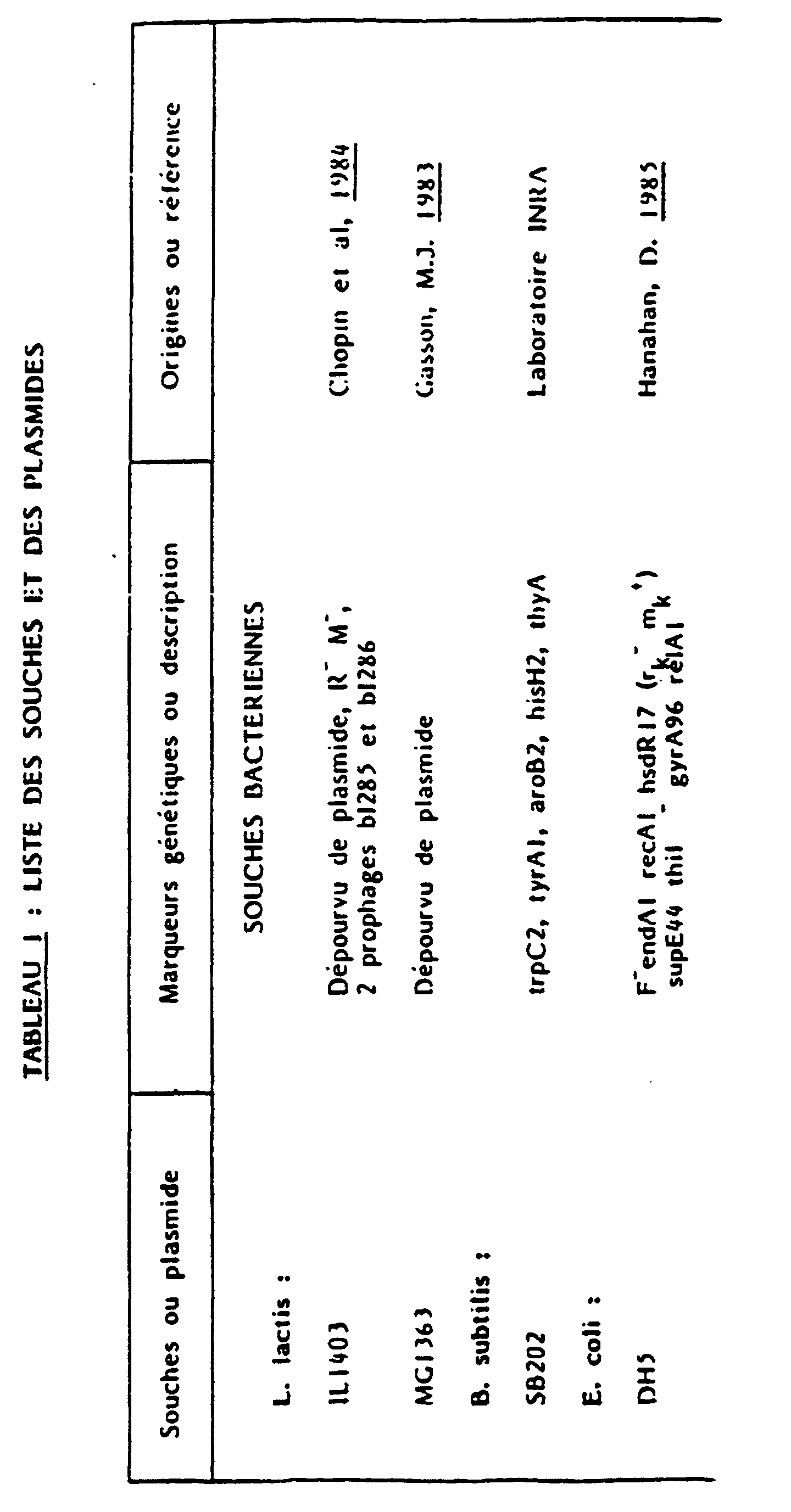
- the bacterial strains and the plasmids used in this study are presented in Table 3.
- the Escherichia coli strains are cultured in LB broth.
- L. lactis is cultivated and spread on an M17 + glucose broth or on a minimum medium when it is tested for the ilv phenotype.
- Erythromycin (Em) is added at a concentration of 5 micrograms / ml for L. lactis subsp. lactis and 150 micrograms / ml for E. coli, tetracycline is used at a concentration of 12.5 micrograms / ml for L. lactis.
- the electroporation of L. lactis subsp. lactis Appl. Env. Microbiol.
- ilv of 3362 bp pVE7014 StyI-EcoRV deletion of pVE7009R leaving a frag. 2904 bp ilv pVE7010 Clal deletion of pVE7009R leaving a frag.
- the plasmid pG + host4 (or pVE6004) is a Ts derivative of pWVO1 prepared according to example 1.
- the plasmid pG + host5 is constructed by inserting the Ava 1 - Alw N 1 fragment of pBR 322 (which contains the origin of replication of pBR 322) in the linearized pG + host4 cut byNsi 1. Its structure is shown in FIG. 8
- the plasmid obtained, called pG + host5 (Appligène, Illkirch, France) is used for all cloning.
- the activity of the origin of pBR322 allows its maintenance at 37 ° C in E. coli and the origin Ts maintains pG + host5 at 28 ° C in gram positive bacteria.
- the chromosomal DNA of the IL1403 strain is digested with EcoRV and HindIII. Chromosomal fragments of a size between 0.9 Kb and 1.4 Kb are purified from agarose gels and linked with pG + host5 treated with SmaI-HindIII. The recombinant plasmids are established in E. coli and then made to penetrate by electroporation into L. lactis. The latter is used to verify the structures of the plasmids and the sizes of the inserts. The results are presented in Table 4 below. The restriction enzymes Hpal (unique site in the vector part) and HindIII (unique site between the insert and the vector) are used to analyze the integrants.
- Lactococcus strains containing the tested plasmids are grown overnight at 28 ° C in the presence of erythromycin, then diluted 100 times in the same medium and cultured at 28 ° C for 2 hours to 2 hours and a half (exponential phase). Cultures are placed at 37.5 ° C for 3 hours to decrease the number of copies of plasmids per cell. The samples are then diluted and spread at 37 ° C on M17 Em medium to detect integration events, and at 28 ° C on non-selective medium to determine the number of viable cells.
- the integration frequency per cell (ipc) is estimated as being the ratio of Em r cells at 37 ° C to the number of viable cells at 28 ° C.
- the integrants isolated at 37 ° C are maintained in an M17 medium containing Em, at 37.5 ° C for later use.
- the plasmids pIL1263 and pIL1202 are composed of the vector Ts (pG + host4, Em r ) and respectively the chromosomal regions of 2.3 Kb or 3.6 Kb, interrupted by the Tet gene of Tn1545 (Nucl. Acids Res., 14 7047-7058, 1986).
- a strain carrying pIL1202 or pIL1263 is grown overnight at 37.5 ° C in M17 with Tet or Em to obtain a population of integrants. The culture is then diluted 1/10 5 in M17 medium without antibiotic and brought to 28 ° C to stimulate recombination by plasmid replication. A culture of 12 hours or more at 28 ° C gives maximum frequencies of gene replacement.
- Purified DNA is treated with restriction enzymes, separated by agarose gel electrophoresis and analyzed by Southern hybridization with DNA probes to detect homologous recombinations (Sambrook et al, 1989).
- Cloning the chromosomal fragments of L. lactis into pG + host5 in E. coli makes it possible to isolate 14 different plasmids, each containing a distinct chromosomal insertion, from 0.9 Kb to 1.4 Kb. These plasmids, established in IL1403 at 28 ° C., are used to measure the frequencies of integration into the chromosome of L. lactis.
- the integration frequency per cell is between 10 -2 and 10 -7 .
- the ipc of a vector pG + host5 without chromosomal insert is between 10 -6 and 10 -7 .
- the plasmids carrying the chromosomal inserts can be classified into two groups according to their frequency of integration.
- the ipc varies between 3.10 -2 and 4.10 -4 . These variations should be due to the location or nature of the insert rather than its size.
- the plasmid ipc is between 10 -5 and 3.10 -7 . This is probably due to the interruption of an essential chromosomal gene, which allows us to observe only non-homologous integrations. Only two of these plasmids (pVE7028 and pVE7034) produce high molecular weight molecules (HMW).
- the four group II plasmids appear to be randomly integrated, as HindIII digestion does not not release a monomeric plasmid band, and Hpal digestion of three integrants of the same plasmid do not give the same profile on the gel.
- the restriction map of the chromosome of L. lactis developed for Smal and Apal makes it possible to locate the plasmid integration sites by simple crossing-over on the chromosome map. Each member is present on a different segment. All of these results indicate that the insertions chromosomes are randomly positioned on the chromosome, thus excluding any bias in the procedure.
- the integration frequency depends on the length of homology.
- a 3.9 Kb segment of the ilv operon of sequenced IL1493 is cloned into pG + host5, and a set of deletions of the fragment is generated on the same vector. While plasmids carrying the total insert of 3.9 Kb in one of the two orientations (pVE7009 and pVE7009R) show a certain structural instability in L. lactis, the eight derivatives by deletion of pVE7009R are stable. These clones are used to study the relationship between the length of the homology and the frequency of integration. There is a logarithmic relationship between the integration frequency and the homology length for lengths between 0.35 and 2.5 Kb.
- the integrated plasmid is flanked by repeated sequences. Also, when the integrating strains, generated at 37 ° C, are placed at 28 ° C, replication of the plasmid strongly stimulates a second recombination event. This event results in a high frequency of excision of the replicon, leading either to the parental structure or to the chromosomal structure dco (double crossing-over).
- Two derivatives of pG + host4 which carry a chromosomal segment either contiguous or noncontiguous are used.
- pIL1263 contains a 2.3 Kb chromosomal fragment, upstream of the ilv operon, interrupted by a 4 Kb DNA segment containing a tetracycline resistance marker (Tet r ). The substitution of the gene must lead to the insertion of the marker Tet r in the chromosome and leave the operon ilv + intact.
- the plasmid pIL1202 contains non-contiguous segments of 1.1 Kb and 2.5 Kb, corresponding to the ends of a region of 18.5 Kb, including the operon ilv, linked by the marker Tet r of 4 Kb.
- the replacement of the gene must lead to a deletion of the chromosome of 14.9 Kb including the operon ilv and giving an phenotype ilv - .
- Selection of the replacement gene a strain containing either pIL1202 or pIL1263 is cultured under the conditions indicated above, using Tet as a selection marker.
- Tet r Em s For pIL1202 (deletion of the chromosome) 1% to 7% of the colonies are Tet r Em s , which indicates a replacement of the gene; among the four Tet r Em s colonies tested, all are ilv - . Analysis of the chromosomal structure of the four integrants by dco of each type confirms that the replacement occurs without selection of a new inserted fragment. These results demonstrate the feasibility of gene replacement without leaving an antibiotic marker in the chromosome. This protocol is therefore suitable for chromosomal modification without the use of selection markers.
- the efficiency of intermolecular recombination in twelve different locations of the B. subtilis chromosome was determined by transforming competent cells with a non-replicating plasmid (J. Bacteriol. 174, 5593-5587, 1992). In these experiments, the homologous segment is invariant (insertion of a fragment of pBR322). The efficiencies vary by about three times depending on the position of the integration. Using the pG + host sco system rather than the non-replicating vector, identical recombination experiments can be carried out on the two strains of B. subtilis with differences of an order of three in the integration frequencies. pG + host5 carrying the 1.4 Kb fragment of pBR322 is introduced into the B. subtilis strains of interest.
- the integration frequency varies between 1.8 ⁇ 0.6.10 -3 and 6.1 ⁇ 0.9.10 -4 .
- the same variations of three times are observed between the two different locations as those obtained with the non-replicative system. This result demonstrates the effectiveness of the system.
- oriT This oriT fragment was cloned into the plasmid Ts (plasmid Ts: oriT); its ability to be mobilized in the presence of a "helper" plasmid (derived from pIP501) which provides trans transfer proteins has been tested.
- plasmid Ts oriT
- helper plasmid derived from pIP501
- Several intra- or interspecies crosses have been made with success (Table 5); with exconjugants which contain only the plasmid Ts: oriT, the coming process of integration by recombination is applicable.
- the purpose of the integration process by recombination is the modification of the genetic characteristics of bacterial strains. This supposes that the properties to be modified are characterized at the molecular level.
- the development of a functional transposition system (combination of the Ts plasmid of a transposon) would constitute an appreciable contribution as a genetic tool for the analysis of L. lactis.
- a Tn10 transposition cassette cloned into a derivative of pVE6004 is used for a transposition test. About 1% of the cells are Em r at 37 ° C, which indicates that the transposon or the plasmid is integrated into the chromosome. Non-specific integration of the plasmid without the transposition cassette occurs at frequencies below 10 -7 .
- the transposition is estimated by analysis of the DNA digested with HindIII from eight colonies. HindIII has two restriction sites in the plasmid, but none in the transposable unit.
- Chromosomal DNA is extracted from eight Em r heat-resistant clones and digested with HindIII; the treated DNA is then separated by agarose gel electrophoresis and hybridized with a DNA fragment containing the Em r transposon as probe. Under these conditions, the integration of the whole vector (that is to say without transposition) would lead to a hybridization band of 1.3 Kb, which is not observed here.
- Each chromosomal sample gives a unique profile when the DNA fragment containing the transposon is used as a probe. None of the hybridized bands has a size of 1.3 Kb, which would be expected if the entire plasmid were integrated into a site of the vector.
- thermosensitive plasmid can therefore be used as a delivery vector.
- FIGURE 4
- FIGURE 6
- FIGURE 7A
- FIGURE 7B
Landscapes
- Genetics & Genomics (AREA)
- Health & Medical Sciences (AREA)
- Life Sciences & Earth Sciences (AREA)
- Engineering & Computer Science (AREA)
- Bioinformatics & Cheminformatics (AREA)
- Wood Science & Technology (AREA)
- Organic Chemistry (AREA)
- Biomedical Technology (AREA)
- Chemical & Material Sciences (AREA)
- Biotechnology (AREA)
- General Engineering & Computer Science (AREA)
- Zoology (AREA)
- Molecular Biology (AREA)
- Microbiology (AREA)
- Physics & Mathematics (AREA)
- Plant Pathology (AREA)
- Biophysics (AREA)
- Biochemistry (AREA)
- General Health & Medical Sciences (AREA)
- Mycology (AREA)
- Micro-Organisms Or Cultivation Processes Thereof (AREA)
- Saccharide Compounds (AREA)
- Preparation Of Compounds By Using Micro-Organisms (AREA)
- Medicines Containing Material From Animals Or Micro-Organisms (AREA)
Description
- un gène marqueur qui s'exprime dans une souche hôte bactérienne,
- un système de réplication efficace qui est thermosensible (Ts) à partir d'une température compatible avec la viabilité de la souche hôte,
- Ser par Asn,
- Asp par Asn,
- Val par Ile,
- Arg par Gln.
- FIGURE 1 :
- cinétique de perte et analyse du nombre de copies de pVE6002 selon l'invention et de pVE6001 non Ts. L. lactis subsp. lactis IL 1403 portant le plasmide pGK12, pVE6001 ou pVE6002 sont cultivés à 28° C ou 37,5° C. Après différents temps de culture, des échantillons sont prélevés pour être cultivés à 28° C sur des milieux sélectifs et non-sélectifs. 100 colonies sont repiquées à partir du milieu non-sélectif sur le milieu sélectif (Em 5 µg/ml) pour évaluer la proportion de cellules contenant un plasmide dans la population. Les extractions d'ADN total sont faites sur les cultures à 28° C ou 37,5° C, sans sélection, pendant 5h 30.
- FIGURE 2 :
- Plasmide hybride de pGK12 et pVE6002. pVE6043 est constitué du fragment Sacl-Thal, de 994 pb, de pGK12, lié au fragment Thal-Sacl de 3384 pb de pVE6002. pVE6044 contient la paire réciproque, le fragment Sacl-Thal de 994 pb de pVE6002, lié au fragment Thal-Sacl de 3384 pb de pGK12. Les traits fins correspondent à l'ADN de pGK12 ; les traits épais pointillés, à l'ADN de pVE6002.
- FIGURE 3 :
- Localisation de la mutation Ts dans le gène RepA de pVE6002. Le fragment Thal-Rsal de pVE6002, contenant le gène RepA a été séquencé sur les deux brins. La séquence montre quatre mutations aux positions 972, 977, 980, 987 alors que le reste de la séquence ne diffère pas de la séquence publiée pour le réplicon parental pWV01.
- FIGURE 4 :
- Description des dérivés thermosensibles. pVE6006 est construit par insertion du fragment PvuII de 445 pb de pBluescript SK+ dans le site ClaI de pVE6002. pVE6007 provient d'une délétion Sacl de pVE6006, conduisant à la perte du gène de résistance à l'érythromycine. pVE6004 est construit par insertion du fragment PvuII de 445 pb de pBluescript SK+ dans le fragment ClaI-HpaII de pVE6002 dépourvu de gène de résistance au chloramphénicol.
- FIGURE 5 :
- Comparaison des protéines analogues à Rep de PE.194.
- FIGURE 6 :
- Schéma du procédé d'inactivation d'un gène.
- FIGURE 7a :
- Schéma d'un exemple d'excision du réplicon Ts en deux étapes.
- 7b :
- Schéma de l'excision du réplicon au moyen de duplications plasmidiques.
- FIGURE 8 :
- Construction des plasmides pG+host5 et pG+host6 à partir du
plasmide pG+host4 (ou pVE6004) : le plasmide pG+host5 est
construit par insertion du fragment Ava I - Alw N 1 de pBR
322 (qui contient l'origine de réplication de pBR 322) dans le
pG+host4 linéarisé par Nsi 1.
pG+host6 est construit par insertion du fragment Ava 1 - Eco R 1 de pBR 322 (qui contient l'origine de réplication de pBR 322 et le gène de résistance à l'ampicilline) dans le pG+host4 linéarisé par Nsi I. - FIGURE 9 :
- Séquence nucléotidique de pG+host4.
- FIGURE 10 :
- Séquence nucléotidique de pG+host5.
- FIGURE 11 :
- Séquence nucléotidique de pG+host6.

| Pourcentage de cellules Emr dans la population | |||||
| Temps (Heures) | Température de croissance | ||||
| 28° C | 30° C | 33° C | 35° C | 37,5° C | |
| 0 | 100 | 100 | 100 | 100 | 100 |
| 2 | 100 | 100 | 99 | 97 | 98 |
| 4 | 100 | 100 | 48 | 47 | 38 |
| 6 | 100 | 100 | 9 | 3 | 4 |
| 8 | 100 | 99 | 5 | 1 | 1 |
| SOUCHE | MARQUEURS GÉNÉTIQUES OU DESCRIPTION | SOURCE |
| L lactis : NCD02118 | isolat naturel | |
| E. coli : TG1 | supE hsdΔ5 thi Δ(lac-proAB) F [traD36proAB+ lacIq lacZΔM15] | Sambrook et al |
| PLASMIDES | ||
| pG+host4 ou pV6004 | dérivé thermosensible de pGK12, Emr | |
| pG+host5 | frag. Nsil de pG+host4 lié au fragment 1,46 Kb AvaI-AlwNI de pBR322 Emr | |
| pVE7021 à pVE7034 | produit de restriction SmaI-HindIII de pG+host5 lié à un fragment EcoRV-HindIII aléatoire du chromosome de IL1403 | |
| pIL515 | frag. EcoRI, ilv de 3,9 Kbde IL1403 dans pBluescript, Ampr | |
| pVE7009 | frag. EcoRI de de 3,9 Kb de pII515 lié à pG+host5 coupé par EcoRI | |
| pVE7009R | même construction que pVE7009, inséré dans l'orientation opposée | |
| pVE7015 | délétion SphI-EcoRV de pVE7009R laissant un frag. ilv de 3362 pb | |
| pVE7014 | délétion StyI-EcoRV de pVE7009R laissant un frag. ilv de 2904 pb | |
| pVE7010 | délétion Clal de pVE7009R laissant un frag. ilv de 2552 bp | |
| pVE7016 | délétion XcmI-EcoRV de pVE7009R laissant un frag. ilv de 1912 bp | |
| pVE7013 | délétion AatII-EcoRV de pVE7009R laissant un frag. ilv de 1206 bp | |
| pVE7011 | délétion HindIII de pVE7009R laissant un frag. ilv de 497 bp | |
| pVE7012 | délétion PstI de pVE7009R laissant un frag. ilv de 356 bp | |
| pVE7017 | délétion PflMI-EcoRV de pVE7009R laissant un frag. ilv de 330 bp | |
| pIL500 | frag. 18,5 Kb Xbal ilv de NDC02118 chromosome dans pIL253 | Godon et al |
| pIL1202 | frag. XbaI de pG+host4 contenant les extrémités XbaI-BgIII de 1,1 Kb et EcoRI-XbaI de 2,5 Kb du frag. de 18,5 Kb de pIL500 lié au frag. BamHI de 4 Kb du gène Tet M | |
| pIL1261 | frag. 2,3 Kb XbaI-EcoRI de pIL500 interrompu par un gène Tet M, BamHI de 4 Kb inséré au site BgIII et lié à XbaI-EcoRI pBluescript | |
| pIL1263 | XbaI-EcoRI pG+host4 lié au frag. XbaI-EcoRI de pIL1261 de 6,3 Kb |
| Ipc à différentes localisations sur le chromosome de L. lactis | ||
| Taille de l'insert plasmidique (Kb) | IPC moyenne ± SD | |
| Groupe I : | ||
| pVE7025 | 1,29 | 3,0 ± 0,3 x 10⁻² |
| pVE7034 | 1,05 | 3,8 ± 0,5 x 10⁻³ |
| pVE7021 | 1,29 | 3,4 ± 2,6 x 10⁻³ |
| pVE7024 | 0,96 | 2,5 ± 1,3 x 10⁻³ |
| pVE7030 | 1,42 | 2,3 ± 0,8 x 10⁻³ |
| pVE7028 | 1,46 | 7,2 ± 0,7 x 10⁻⁴ |
| pVE7023 | 1,29 | 6,6 ± 3,9 x 10⁻⁴ |
| pVE7022 | 1,08 | 5,7 ± 0,3 x 10⁻⁴ |
| pVE7027 | 1,05 | 5,2 ± 1,3 x 10⁻⁴ |
| pVE7026 | 0,96 | 4,0 ± 0,5 x 10⁻⁴ |
| Groupe II : | ||
| pVE7029 | 1,02 | 1,1 ± 0,4 x 10⁻⁵ |
| pVE7031 | 0,96 | 9,9 ± 3,9 x 10⁻⁶ |
| pVE7032 | 1,37 | 8,6 ± 5,0 x 10⁻⁷ |
| PVE7033 | 1,25 | 3,9 ± 0,9 x 10⁻⁷ |
| ipc : fréquence d'intégrations par cellule |
Pas de sélection : un protocole identique a été utilisé sans sélection par Tet, afin de se placer dans le cas où le fragment chromosomique porté par le plasmide n'a pas de marqueur de sélection. Dans trois expériences utilisant pIL1263 (insertion de gène), 10% à 40% des colonies obtenues à 37° C sans sélection sont Tetr Ems, ce qui indique qu'un évènement de remplacement du gène a eu lieu. Pour pIL1202 (délétion du chromosome) 1% à 7% des colonies sont Tetr Ems, ce qut indique un remplacement du gène ; parmi les quatre colonies Tetr Ems testées, toutes sont ilv-. L'analyse de la structure chromosomique des quatre intégrants par dco de chaque type confirme que le remplacement se produit sans sélection d'un nouveau fragment inséré. Ces résultats démontrent la faisabilité du remplacement de gène sans laisser un marqueur antibiotique dans le chromosome. Ce protocole est donc adapté pour la modification chromosomique sans utilisation de marqueurs de sélection.


Claims (22)
- Plasmide vecteur bactérien ayant une origine de réplication efficace dans E.coli et dans les bactéries gram positives choisies dans le groupe comprenant: Bacillus, Enteroccocus, Lactobacillus, Lactococcus, Streptococcus, Listeria, Pediococcus, Staphylococcus, Clostridia, Leuconostoc,
comportant au moins:dont la température d'inhibition de réplication est inférieure ou égale à environ 37°C, et dont le système de réplication cercle roulant est celui porté par le plus grand fragment Cla1 du plasmide pWVO1, présentant au moins une mutation dans la région Tha1-Rsa1.un gène marqueur qui s'exprime dans une souche hôte bactérienne,un système de réplication efficace qui est thermosensible à partir d'une température compatible avec la viabilité de la souche hôte, - Plasmide vecteur selon la revendication 1, caractérisé en ce qu'il comporte en outre au moins une séquence d'ADN homologue avec une séquence d'ADN chromosomique, afin de permettre une recombinaison.
- Plasmide vecteur selon la revendication 2, caractérisé en ce que le gène marqueur est situé de façon à être intégré dans le chromosome en cas de recombinaison.
- Plasmide vecteur selon l'une des revendications 1 à 3, caractérisé en ce que le gène marqueur assure une résistance à un composé chimique ou est un gène permettant la complémentation d'une auxotrophie.
- Plasmide vecteur selon l'une des revendications 1 à 4, caractérisé en ce que le système de réplication thermosensible est inhibé au-dessus de 35°C.
- Plasmide vecteur selon l'une des revendications 1 à 5, caractérisé en ce que le plasmide comporte un locus de mobilisation permettant la conjugaison.
- Plasmide vecteur selon l'une des revendications 1 à 6, caractérisé en ce qu'il comporte deux séquences identiques répétées, encadrant une séquence du plasmide.
- Plasmide selon l'une des revendications 1 à 7, caractérisé en ce qu'il présente au moins une mutation dans la région correspondant à Rep A du plasmide pWVO1.
- Plasmide selon la revendication 8, caractérisé en ce que, par rapport à la séquence de pWVO1, il présente au moins une mutation dans l'une des positions suivantes : 972, 977, 980, 987.
- Plasmide selon l'une des revendications 8 et 9, caractérisé en ce que le fragment correspondant au système de réplication code pour une protéine présentant les mutations représentées sur la figure 3.
- Plasmide selon l'une des revendications 1 à 10, caractérisé en ce qu'il comporte une des séquences représentées sur la figure 9, 10 ou 11, ou une séquence présentant au moins 80 % d'homologie avec ces séquences.
- Plasmide selon l'une des revendications 8 à 11, caractérisé en ce qu'il est réplicatif à 28°C, et non-réplicatif à une température supérieure à environ 35°C.
- Plasmide selon l'une des revendications 6 à 12, caractérisé en ce que le locus de mobilisation est le locus ori T, extrait d'un plasmide de bactérie à gram positif.
- Plasmide selon l'une des revendications 6 à 13, caractérisé en ce qu'il comporte en outre un réplicon actif chez E. coli, qui en fait un plasmide navette gram-négatif, gram-positif.
- Plasmide selon l'une des revendications 1 à 14, caractérisé en ce qu'il porte un transposon.
- Plasmide selon l'une des revendications 1 à 15, caractérisé en ce qu'il comporte en outre un gène codant pour une protéine d'intérêt, sous le contrôle des éléments nécessaires à son expression.
- Bactérie caractérisée en ce qu'elle contient un plasmide selon l'une des revendications 1 à 16, sous forme libre ou intégré dans son chromosome.
- Procédé d'inactivation d'un gène présent dans le chromosome d'une bactérie, caractérisé en ce que :a) on introduit dans la bactérie, par transformation, le plasmide selon l'une des revendications 1 à 5, 7 à 12, 14, 15 ou 16.b) on cultive la bactérie sur milieu sélectif à une température inférieure à la température d'inhibition de l'origine de réplication,c) on élève la température de culture à une température supérieure à ladite température d'inhibition,d) on récupère les bactéries survivantes après plusieurs cycles de multiplication.
- Procédé d'inactivation d'un gène dans une bactérie, caractérisé en ce que :a) on introduit dans la bactérie, par conjugaison, un plasmide selon l'une des revendications 6 à 16,b) on cultive la bactérie sur milieu sélectif à une température inférieure à la température d'inhibition de l'origine de réplication,c) on élève la température de culture à une température supérieure à ladite température d'inhibition,d) on récupère les bactéries survivantes après plusieurs cycles de multiplication.
- Procédé d'introduction d'un gène hétérologue dans une bactérie, caractérisé en ce que :a) on introduit dans la bactérie par transformation ou conjugaison un plasmide selon la revendication 16,b) on cultive la bactérie sur milieu sélectif à une température inférieure à la température d'inhibition de l'origine de réplication,c) on élève la température de culture à une température supérieure à ladite température d'inhibition,d) on récupère les bactéries survivantes après plusieurs cycles de multiplication.
- Procédé selon l'une des revendications 18 à 20, caractérisé en ce que les bactéries survivantes obtenues à l'issue de l'étape d), sont à nouveau mises en culture à une température inférieure à la température d'inhibition de l'origine de réplication, sur milieu non sélectif.
- Procédé selon l'une des revendications 18 à 21, caractérisé en ce que l'étape b) est réalisée à une température d'environ 28°C.
Applications Claiming Priority (3)
| Application Number | Priority Date | Filing Date | Title |
|---|---|---|---|
| FR9203034A FR2688515B1 (fr) | 1992-03-13 | 1992-03-13 | Plasmide thermosensible. |
| FR9203034 | 1992-03-13 | ||
| PCT/FR1993/000248 WO1993018164A1 (fr) | 1992-03-13 | 1993-03-12 | Plasmide thermosensible |
Publications (2)
| Publication Number | Publication Date |
|---|---|
| EP0631626A1 EP0631626A1 (fr) | 1995-01-04 |
| EP0631626B1 true EP0631626B1 (fr) | 2004-05-26 |
Family
ID=9427665
Family Applications (1)
| Application Number | Title | Priority Date | Filing Date |
|---|---|---|---|
| EP93918753A Expired - Lifetime EP0631626B1 (fr) | 1992-03-13 | 1993-03-12 | Plasmide thermosensible |
Country Status (12)
| Country | Link |
|---|---|
| US (2) | US6025190A (fr) |
| EP (1) | EP0631626B1 (fr) |
| JP (2) | JP3573347B2 (fr) |
| AT (1) | ATE267869T1 (fr) |
| AU (1) | AU3756493A (fr) |
| CA (1) | CA2131984C (fr) |
| DE (1) | DE69333534T2 (fr) |
| DK (1) | DK0631626T3 (fr) |
| ES (1) | ES2220907T3 (fr) |
| FR (1) | FR2688515B1 (fr) |
| PT (1) | PT631626E (fr) |
| WO (1) | WO1993018164A1 (fr) |
Families Citing this family (13)
| Publication number | Priority date | Publication date | Assignee | Title |
|---|---|---|---|---|
| CA2341268C (fr) | 1998-07-22 | 2010-10-12 | Id-Lelystad, Instituut Voor Dierhouderij En Diergezondheid B.V. | Vaccins contre le streptococcus suis et tests diagnostiques |
| WO2000009738A1 (fr) * | 1998-08-17 | 2000-02-24 | Packard Bioscience Company | Analyse par cercles roulants d'une sequence polynucleotidique |
| EP1212437A2 (fr) * | 1999-09-17 | 2002-06-12 | Institut National De La Recherche Agronomique (Inra) | Procede de modification genetique de lactobacillus delbrueckii |
| FR2798669B1 (fr) * | 1999-09-17 | 2004-02-20 | Agronomique Inst Nat Rech | Souche de lactobacillus delbrueckii et son utilisation pour le criblage de plasmides |
| EP1288300A4 (fr) * | 2000-04-06 | 2004-07-14 | Kyowa Hakko Kogyo Kk | Plasmide utilisable pour la recombinaison de chromosomes d'escherichia coli |
| CA2436530C (fr) | 2001-02-02 | 2013-10-01 | Id-Lelystad, Instituut Voor Dierhouderij En Diergezondheid B.V. | Genes de streptococcus suis environnementalement regules |
| WO2003008631A2 (fr) * | 2001-07-20 | 2003-01-30 | Health Protection Agency | Marquage de micro-organismes |
| US8497128B2 (en) * | 2006-01-24 | 2013-07-30 | Purac Biochem B.V. | Genetic modification of homolactic thermophilic bacilli |
| DE102012024435A1 (de) | 2012-12-14 | 2014-07-10 | Forschungszentrum Jülich GmbH | Verfahren zur Identifizierung einer Zelle mit gegenüber ihrem Wildtyp erhöhten intrazellulären Konzentration eines bestimmten Metaboliten, wobei die Veränderung der Zelle durch Rekombi-neering erreicht wird, sowie ein Verfahren zur Herstellung einer gegenüber ihrem Wildtyp genetisch veränderten Produktionszelle mit optimierter Produktion eines bestimmten Metaboliten, ein Verfahren zur Herstellung dieses Metaboliten, sowie dafür geeignete Nukleinsäuren |
| CN107142269B (zh) * | 2017-06-07 | 2020-09-22 | 南京金斯瑞生物科技有限公司 | 一种改造的质粒复制子及其应用 |
| EP4168557A1 (fr) | 2020-06-17 | 2023-04-26 | Basf Se | Régulation et intégration de nombre de copies de plasmide |
| CN118652918A (zh) * | 2024-07-15 | 2024-09-17 | 南京鼓楼医院 | 一种对细菌外膜囊泡进行荧光标记的质粒及其制备方法 |
| CN119639821A (zh) * | 2024-12-04 | 2025-03-18 | 中国科学院深圳先进技术研究院 | Bac-to-Bac杆状病毒表达系统、重组杆粒、重组杆状病毒及其应用 |
Family Cites Families (5)
| Publication number | Priority date | Publication date | Assignee | Title |
|---|---|---|---|---|
| US4711845A (en) * | 1984-08-31 | 1987-12-08 | Cetus Corporation | Portable temperature-sensitive control cassette |
| GB2166743B (en) * | 1984-11-13 | 1989-01-05 | Solvay | Process for a thermo-inducible gene expression in gram positive bacteria and bacillus subtilis strains containing plasmids which induce such an expression |
| DE3614310A1 (de) * | 1986-04-28 | 1987-10-29 | Hoechst Ag | Verfahren zur isolierung mutierter gene sowie der entsprechenden wildtyp-gene |
| DE3809692A1 (de) * | 1988-03-23 | 1989-10-12 | Hoechst Ag | Verwendung von psg5 als temperatursensitives plasmid |
| DE4006637A1 (de) * | 1990-03-03 | 1991-09-05 | Degussa | Transposon, dieses transposon enthaltende testvektoren und verfahren zur mutagenese |
-
1992
- 1992-03-13 FR FR9203034A patent/FR2688515B1/fr not_active Expired - Lifetime
-
1993
- 1993-03-12 CA CA002131984A patent/CA2131984C/fr not_active Expired - Lifetime
- 1993-03-12 DE DE69333534T patent/DE69333534T2/de not_active Expired - Lifetime
- 1993-03-12 JP JP51541293A patent/JP3573347B2/ja not_active Expired - Lifetime
- 1993-03-12 ES ES93918753T patent/ES2220907T3/es not_active Expired - Lifetime
- 1993-03-12 AT AT93918753T patent/ATE267869T1/de active
- 1993-03-12 US US08/302,752 patent/US6025190A/en not_active Expired - Lifetime
- 1993-03-12 EP EP93918753A patent/EP0631626B1/fr not_active Expired - Lifetime
- 1993-03-12 WO PCT/FR1993/000248 patent/WO1993018164A1/fr not_active Ceased
- 1993-03-12 PT PT93918753T patent/PT631626E/pt unknown
- 1993-03-12 AU AU37564/93A patent/AU3756493A/en not_active Abandoned
- 1993-03-12 DK DK93918753T patent/DK0631626T3/da active
-
1997
- 1997-12-17 US US08/992,334 patent/US5919678A/en not_active Expired - Lifetime
-
2004
- 2004-02-16 JP JP2004038967A patent/JP2004166712A/ja active Pending
Also Published As
| Publication number | Publication date |
|---|---|
| ES2220907T3 (es) | 2004-12-16 |
| PT631626E (pt) | 2004-10-29 |
| CA2131984C (fr) | 2005-01-11 |
| WO1993018164A1 (fr) | 1993-09-16 |
| FR2688515A1 (fr) | 1993-09-17 |
| AU3756493A (en) | 1993-10-05 |
| JPH07504567A (ja) | 1995-05-25 |
| DE69333534D1 (en) | 2004-07-01 |
| JP3573347B2 (ja) | 2004-10-06 |
| ATE267869T1 (de) | 2004-06-15 |
| CA2131984A1 (fr) | 1993-09-16 |
| FR2688515B1 (fr) | 1995-03-31 |
| JP2004166712A (ja) | 2004-06-17 |
| EP0631626A1 (fr) | 1995-01-04 |
| DE69333534T2 (de) | 2005-06-02 |
| DK0631626T3 (da) | 2004-10-04 |
| US5919678A (en) | 1999-07-06 |
| US6025190A (en) | 2000-02-15 |
Similar Documents
| Publication | Publication Date | Title |
|---|---|---|
| EP2942391B1 (fr) | Procédés de production de vaccins non antibiorésistants | |
| Gutierrez et al. | Insertional mutagenesis and recovery of interrupted genes of Streptococcus mutans by using transposon Tn917: preliminary characterization of mutants displaying acid sensitivity and nutritional requirements | |
| Flannagan et al. | Conjugative transfer of Tn916 in Enterococcus faecalis: trans activation of homologous transposons | |
| CA2131984C (fr) | Plasmide thermosensible | |
| US20030100100A1 (en) | Insertional mutations in mycobacteria | |
| Rossi et al. | Improved cloning vectors for Bifidobacterium spp. | |
| EP1194526B1 (fr) | Echange allelique en phase unique dans des mycobacteries au moyen d'un phage de transduction conditionnel | |
| US6423545B1 (en) | Unmarked deletion mutants of mycobacteria and methods of using same | |
| EP0258118B1 (fr) | Procédé de stabilisation d'un plasmide contenu dans une souche bactérienne et souche obtenue | |
| Smith et al. | Gene expression in Deinococcus radiodurans | |
| WO1998020898A1 (fr) | Mycobacteries de recombinaison auxotrophes a l'egard du diaminopimelate | |
| JPH0630781A (ja) | Lactobacillus delbrueckii 種染色体への遺伝子組込み方法及び遺伝子組込み体 | |
| EP2057266B2 (fr) | Remodelage génétique chez bifidobacterium | |
| CA2266190A1 (fr) | Bacteries multiresistantes, procedes d'obtention et utilisation | |
| EP0760859A1 (fr) | Vecteurs navettes pour l'introduction d'adn dans des mycobacteries et utilisation de ces bacteries comme vaccins | |
| EP1029063B1 (fr) | Plasmide de leuconostoc non rcr apte a etre transfere dans des bacteries lactiques; utilisation comme outil de clonage et d'expression | |
| JP6757008B2 (ja) | ビフィドバクテリウム属細菌の形質転換方法 | |
| EP0528925A1 (fr) | Nouveaux vecteurs de clonage et/ou d'expression, procede de preparation et leur utilisation. | |
| Han et al. | Molecular cloning of the leuB genes from Mycobacterium bovis BCG and Mycobacterium tuberculosis | |
| JP3677125B2 (ja) | 染色体への外来遺伝子の導入方法 | |
| Vijaya | The genetics of Mycobacterium tuberculosis | |
| EP1214419A2 (fr) | Bacteries lactiques transformees pour leur conferer un metabolisme respiratoire | |
| Benachour | A new theta-type thermosensitive replicon from Lactoccocus lactis as an integration vector for Enterococcus faecalis | |
| BOVIS | Vol. 41, No, 4, April 1997 BIOCHEMISTRY and MOLECULAR BIOLOGY INTERNATIONAL Poges 657-663 | |
| WO2001021819A2 (fr) | Procede de modification genetique de lactobacillus delbrueckii |
Legal Events
| Date | Code | Title | Description |
|---|---|---|---|
| PUAI | Public reference made under article 153(3) epc to a published international application that has entered the european phase |
Free format text: ORIGINAL CODE: 0009012 |
|
| 17P | Request for examination filed |
Effective date: 19941004 |
|
| AK | Designated contracting states |
Kind code of ref document: A1 Designated state(s): AT BE CH DE DK ES FR GB GR IE IT LI LU MC NL PT SE |
|
| 17Q | First examination report despatched |
Effective date: 19990527 |
|
| GRAP | Despatch of communication of intention to grant a patent |
Free format text: ORIGINAL CODE: EPIDOSNIGR1 |
|
| GRAS | Grant fee paid |
Free format text: ORIGINAL CODE: EPIDOSNIGR3 |
|
| GRAA | (expected) grant |
Free format text: ORIGINAL CODE: 0009210 |
|
| AK | Designated contracting states |
Kind code of ref document: B1 Designated state(s): AT BE CH DE DK ES FR GB GR IE IT LI LU MC NL PT SE |
|
| REG | Reference to a national code |
Ref country code: GB Ref legal event code: FG4D Free format text: NOT ENGLISH |
|
| REG | Reference to a national code |
Ref country code: CH Ref legal event code: EP |
|
| REG | Reference to a national code |
Ref country code: IE Ref legal event code: FG4D Free format text: FRENCH |
|
| REF | Corresponds to: |
Ref document number: 69333534 Country of ref document: DE Date of ref document: 20040701 Kind code of ref document: P |
|
| REG | Reference to a national code |
Ref country code: CH Ref legal event code: NV Representative=s name: MICHELI & CIE INGENIEURS-CONSEILS |
|
| REG | Reference to a national code |
Ref country code: SE Ref legal event code: TRGR |
|
| GBT | Gb: translation of ep patent filed (gb section 77(6)(a)/1977) |
Effective date: 20040809 |
|
| REG | Reference to a national code |
Ref country code: DK Ref legal event code: T3 |
|
| REG | Reference to a national code |
Ref country code: GR Ref legal event code: EP Ref document number: 20040402789 Country of ref document: GR |
|
| REG | Reference to a national code |
Ref country code: PT Ref legal event code: SC4A Free format text: AVAILABILITY OF NATIONAL TRANSLATION Effective date: 20040825 |
|
| REG | Reference to a national code |
Ref country code: ES Ref legal event code: FG2A Ref document number: 2220907 Country of ref document: ES Kind code of ref document: T3 |
|
| PLBE | No opposition filed within time limit |
Free format text: ORIGINAL CODE: 0009261 |
|
| STAA | Information on the status of an ep patent application or granted ep patent |
Free format text: STATUS: NO OPPOSITION FILED WITHIN TIME LIMIT |
|
| 26N | No opposition filed |
Effective date: 20050301 |
|
| PGFP | Annual fee paid to national office [announced via postgrant information from national office to epo] |
Ref country code: LU Payment date: 20120220 Year of fee payment: 20 |
|
| PGFP | Annual fee paid to national office [announced via postgrant information from national office to epo] |
Ref country code: IE Payment date: 20120224 Year of fee payment: 20 Ref country code: MC Payment date: 20120220 Year of fee payment: 20 Ref country code: CH Payment date: 20120322 Year of fee payment: 20 Ref country code: FR Payment date: 20120327 Year of fee payment: 20 |
|
| PGFP | Annual fee paid to national office [announced via postgrant information from national office to epo] |
Ref country code: DE Payment date: 20120315 Year of fee payment: 20 Ref country code: PT Payment date: 20120220 Year of fee payment: 20 |
|
| PGFP | Annual fee paid to national office [announced via postgrant information from national office to epo] |
Ref country code: DK Payment date: 20120227 Year of fee payment: 20 Ref country code: IT Payment date: 20120326 Year of fee payment: 20 Ref country code: GB Payment date: 20120320 Year of fee payment: 20 Ref country code: BE Payment date: 20120329 Year of fee payment: 20 Ref country code: SE Payment date: 20120327 Year of fee payment: 20 Ref country code: GR Payment date: 20120222 Year of fee payment: 20 |
|
| PGFP | Annual fee paid to national office [announced via postgrant information from national office to epo] |
Ref country code: NL Payment date: 20120228 Year of fee payment: 20 |
|
| REG | Reference to a national code |
Ref country code: DE Ref legal event code: R071 Ref document number: 69333534 Country of ref document: DE |
|
| REG | Reference to a national code |
Ref country code: DE Ref legal event code: R071 Ref document number: 69333534 Country of ref document: DE |
|
| REG | Reference to a national code |
Ref country code: DK Ref legal event code: EUP |
|
| REG | Reference to a national code |
Ref country code: NL Ref legal event code: V4 Effective date: 20130312 Ref country code: PT Ref legal event code: MM4A Free format text: MAXIMUM VALIDITY LIMIT REACHED Effective date: 20130312 |
|
| REG | Reference to a national code |
Ref country code: CH Ref legal event code: PL |
|
| PGFP | Annual fee paid to national office [announced via postgrant information from national office to epo] |
Ref country code: AT Payment date: 20120223 Year of fee payment: 20 |
|
| BE20 | Be: patent expired |
Owner name: INSTITUT NATIONAL DE LA RECHERCHE *AGRONOMIQUE Effective date: 20130312 |
|
| REG | Reference to a national code |
Ref country code: GB Ref legal event code: PE20 Expiry date: 20130311 |
|
| PG25 | Lapsed in a contracting state [announced via postgrant information from national office to epo] |
Ref country code: DE Free format text: LAPSE BECAUSE OF EXPIRATION OF PROTECTION Effective date: 20130313 Ref country code: GB Free format text: LAPSE BECAUSE OF EXPIRATION OF PROTECTION Effective date: 20130311 |
|
| REG | Reference to a national code |
Ref country code: SE Ref legal event code: EUG |
|
| REG | Reference to a national code |
Ref country code: AT Ref legal event code: MK07 Ref document number: 267869 Country of ref document: AT Kind code of ref document: T Effective date: 20130312 |
|
| REG | Reference to a national code |
Ref country code: GR Ref legal event code: MA Ref document number: 20040402789 Country of ref document: GR Effective date: 20130313 |
|
| PG25 | Lapsed in a contracting state [announced via postgrant information from national office to epo] |
Ref country code: PT Free format text: LAPSE BECAUSE OF EXPIRATION OF PROTECTION Effective date: 20130320 |
|
| PGFP | Annual fee paid to national office [announced via postgrant information from national office to epo] |
Ref country code: ES Payment date: 20120323 Year of fee payment: 20 |
|
| REG | Reference to a national code |
Ref country code: ES Ref legal event code: FD2A Effective date: 20130722 |
|
| REG | Reference to a national code |
Ref country code: IE Ref legal event code: MK9A |
|
| PG25 | Lapsed in a contracting state [announced via postgrant information from national office to epo] |
Ref country code: IE Free format text: LAPSE BECAUSE OF EXPIRATION OF PROTECTION Effective date: 20130312 |