EP0630882A1 - Hydrogenation of aromatic amines to produce their ring hydrogenated counterparts - Google Patents
Hydrogenation of aromatic amines to produce their ring hydrogenated counterparts Download PDFInfo
- Publication number
- EP0630882A1 EP0630882A1 EP94109812A EP94109812A EP0630882A1 EP 0630882 A1 EP0630882 A1 EP 0630882A1 EP 94109812 A EP94109812 A EP 94109812A EP 94109812 A EP94109812 A EP 94109812A EP 0630882 A1 EP0630882 A1 EP 0630882A1
- Authority
- EP
- European Patent Office
- Prior art keywords
- catalyst
- rhodium
- alumina
- hydrogenation
- weight
- Prior art date
- Legal status (The legal status is an assumption and is not a legal conclusion. Google has not performed a legal analysis and makes no representation as to the accuracy of the status listed.)
- Granted
Links
- 238000005984 hydrogenation reaction Methods 0.000 title claims abstract description 36
- 150000004982 aromatic amines Chemical class 0.000 title claims abstract description 34
- 239000003054 catalyst Substances 0.000 claims abstract description 128
- 239000010948 rhodium Substances 0.000 claims abstract description 93
- 229910052703 rhodium Inorganic materials 0.000 claims abstract description 81
- PNEYBMLMFCGWSK-UHFFFAOYSA-N Alumina Chemical compound [O-2].[O-2].[O-2].[Al+3].[Al+3] PNEYBMLMFCGWSK-UHFFFAOYSA-N 0.000 claims abstract description 74
- MHOVAHRLVXNVSD-UHFFFAOYSA-N rhodium atom Chemical compound [Rh] MHOVAHRLVXNVSD-UHFFFAOYSA-N 0.000 claims abstract description 51
- 229910052739 hydrogen Inorganic materials 0.000 claims abstract description 23
- 239000001257 hydrogen Substances 0.000 claims abstract description 22
- UFHFLCQGNIYNRP-UHFFFAOYSA-N Hydrogen Chemical compound [H][H] UFHFLCQGNIYNRP-UHFFFAOYSA-N 0.000 claims abstract description 17
- 125000001931 aliphatic group Chemical group 0.000 claims abstract description 10
- 230000006872 improvement Effects 0.000 claims abstract description 5
- 125000004435 hydrogen atom Chemical group [H]* 0.000 claims abstract description 3
- 238000000034 method Methods 0.000 claims description 38
- 230000008569 process Effects 0.000 claims description 33
- KJTLSVCANCCWHF-UHFFFAOYSA-N Ruthenium Chemical compound [Ru] KJTLSVCANCCWHF-UHFFFAOYSA-N 0.000 claims description 18
- 229910052707 ruthenium Inorganic materials 0.000 claims description 16
- YBRVSVVVWCFQMG-UHFFFAOYSA-N 4,4'-diaminodiphenylmethane Chemical compound C1=CC(N)=CC=C1CC1=CC=C(N)C=C1 YBRVSVVVWCFQMG-UHFFFAOYSA-N 0.000 claims description 11
- 229910052751 metal Inorganic materials 0.000 claims description 7
- 239000002184 metal Substances 0.000 claims description 7
- DZIHTWJGPDVSGE-UHFFFAOYSA-N 4-[(4-aminocyclohexyl)methyl]cyclohexan-1-amine Chemical compound C1CC(N)CCC1CC1CCC(N)CC1 DZIHTWJGPDVSGE-UHFFFAOYSA-N 0.000 claims description 5
- 238000009903 catalytic hydrogenation reaction Methods 0.000 claims description 4
- WZCQRUWWHSTZEM-UHFFFAOYSA-N 1,3-phenylenediamine Chemical compound NC1=CC=CC(N)=C1 WZCQRUWWHSTZEM-UHFFFAOYSA-N 0.000 claims description 2
- 125000002496 methyl group Chemical group [H]C([H])([H])* 0.000 claims 2
- 125000001495 ethyl group Chemical group [H]C([H])([H])C([H])([H])* 0.000 claims 1
- 125000000999 tert-butyl group Chemical group [H]C([H])([H])C(*)(C([H])([H])[H])C([H])([H])[H] 0.000 claims 1
- 230000000694 effects Effects 0.000 description 21
- 238000006243 chemical reaction Methods 0.000 description 18
- 229910052593 corundum Inorganic materials 0.000 description 14
- 229910001845 yogo sapphire Inorganic materials 0.000 description 14
- 239000000203 mixture Substances 0.000 description 11
- 229910003158 γ-Al2O3 Inorganic materials 0.000 description 11
- IJGRMHOSHXDMSA-UHFFFAOYSA-N Atomic nitrogen Chemical compound N#N IJGRMHOSHXDMSA-UHFFFAOYSA-N 0.000 description 10
- -1 PACM Chemical class 0.000 description 10
- 229910052757 nitrogen Inorganic materials 0.000 description 9
- WMFOQBRAJBCJND-UHFFFAOYSA-M Lithium hydroxide Chemical compound [Li+].[OH-] WMFOQBRAJBCJND-UHFFFAOYSA-M 0.000 description 8
- 238000002360 preparation method Methods 0.000 description 8
- XLYOFNOQVPJJNP-UHFFFAOYSA-N water Substances O XLYOFNOQVPJJNP-UHFFFAOYSA-N 0.000 description 8
- 239000000047 product Substances 0.000 description 7
- 239000002904 solvent Substances 0.000 description 7
- VHUUQVKOLVNVRT-UHFFFAOYSA-N Ammonium hydroxide Chemical compound [NH4+].[OH-] VHUUQVKOLVNVRT-UHFFFAOYSA-N 0.000 description 6
- PAYRUJLWNCNPSJ-UHFFFAOYSA-N Aniline Chemical compound NC1=CC=CC=C1 PAYRUJLWNCNPSJ-UHFFFAOYSA-N 0.000 description 6
- WYURNTSHIVDZCO-UHFFFAOYSA-N Tetrahydrofuran Chemical compound C1CCOC1 WYURNTSHIVDZCO-UHFFFAOYSA-N 0.000 description 6
- 235000011114 ammonium hydroxide Nutrition 0.000 description 6
- DYLIWHYUXAJDOJ-OWOJBTEDSA-N (e)-4-(6-aminopurin-9-yl)but-2-en-1-ol Chemical compound NC1=NC=NC2=C1N=CN2C\C=C\CO DYLIWHYUXAJDOJ-OWOJBTEDSA-N 0.000 description 5
- 239000012071 phase Substances 0.000 description 5
- 239000000706 filtrate Substances 0.000 description 4
- 150000003335 secondary amines Chemical class 0.000 description 4
- 239000007787 solid Substances 0.000 description 4
- LFQSCWFLJHTTHZ-UHFFFAOYSA-N Ethanol Chemical compound CCO LFQSCWFLJHTTHZ-UHFFFAOYSA-N 0.000 description 3
- OKKJLVBELUTLKV-UHFFFAOYSA-N Methanol Chemical compound OC OKKJLVBELUTLKV-UHFFFAOYSA-N 0.000 description 3
- 238000002441 X-ray diffraction Methods 0.000 description 3
- 230000008901 benefit Effects 0.000 description 3
- 230000003197 catalytic effect Effects 0.000 description 3
- 239000007791 liquid phase Substances 0.000 description 3
- VLKZOEOYAKHREP-UHFFFAOYSA-N n-Hexane Chemical compound CCCCCC VLKZOEOYAKHREP-UHFFFAOYSA-N 0.000 description 3
- 150000003512 tertiary amines Chemical group 0.000 description 3
- RLYCRLGLCUXUPO-UHFFFAOYSA-N 2,6-diaminotoluene Chemical compound CC1=C(N)C=CC=C1N RLYCRLGLCUXUPO-UHFFFAOYSA-N 0.000 description 2
- FZZMTSNZRBFGGU-UHFFFAOYSA-N 2-chloro-7-fluoroquinazolin-4-amine Chemical compound FC1=CC=C2C(N)=NC(Cl)=NC2=C1 FZZMTSNZRBFGGU-UHFFFAOYSA-N 0.000 description 2
- KFZMGEQAYNKOFK-UHFFFAOYSA-N Isopropanol Chemical compound CC(C)O KFZMGEQAYNKOFK-UHFFFAOYSA-N 0.000 description 2
- GWEVSGVZZGPLCZ-UHFFFAOYSA-N Titan oxide Chemical compound O=[Ti]=O GWEVSGVZZGPLCZ-UHFFFAOYSA-N 0.000 description 2
- 150000001298 alcohols Chemical class 0.000 description 2
- 239000003513 alkali Substances 0.000 description 2
- 230000008859 change Effects 0.000 description 2
- 239000007795 chemical reaction product Substances 0.000 description 2
- 230000009615 deamination Effects 0.000 description 2
- 238000006481 deamination reaction Methods 0.000 description 2
- 230000007423 decrease Effects 0.000 description 2
- 229930195733 hydrocarbon Natural products 0.000 description 2
- 150000002431 hydrogen Chemical class 0.000 description 2
- 239000012535 impurity Substances 0.000 description 2
- 238000006317 isomerization reaction Methods 0.000 description 2
- JCCNYMKQOSZNPW-UHFFFAOYSA-N loratadine Chemical compound C1CN(C(=O)OCC)CCC1=C1C2=NC=CC=C2CCC2=CC(Cl)=CC=C21 JCCNYMKQOSZNPW-UHFFFAOYSA-N 0.000 description 2
- 239000011541 reaction mixture Substances 0.000 description 2
- 230000035484 reaction time Effects 0.000 description 2
- WOCIAKWEIIZHES-UHFFFAOYSA-N ruthenium(iv) oxide Chemical compound O=[Ru]=O WOCIAKWEIIZHES-UHFFFAOYSA-N 0.000 description 2
- 229910052594 sapphire Inorganic materials 0.000 description 2
- 238000012360 testing method Methods 0.000 description 2
- YLQBMQCUIZJEEH-UHFFFAOYSA-N tetrahydrofuran Natural products C=1C=COC=1 YLQBMQCUIZJEEH-UHFFFAOYSA-N 0.000 description 2
- XBTRYWRVOBZSGM-UHFFFAOYSA-N (4-methylphenyl)methanediamine Chemical class CC1=CC=C(C(N)N)C=C1 XBTRYWRVOBZSGM-UHFFFAOYSA-N 0.000 description 1
- 125000004178 (C1-C4) alkyl group Chemical group 0.000 description 1
- GEYOCULIXLDCMW-UHFFFAOYSA-N 1,2-phenylenediamine Chemical compound NC1=CC=CC=C1N GEYOCULIXLDCMW-UHFFFAOYSA-N 0.000 description 1
- RYHBNJHYFVUHQT-UHFFFAOYSA-N 1,4-Dioxane Chemical compound C1COCCO1 RYHBNJHYFVUHQT-UHFFFAOYSA-N 0.000 description 1
- DURPTKYDGMDSBL-UHFFFAOYSA-N 1-butoxybutane Chemical compound CCCCOCCCC DURPTKYDGMDSBL-UHFFFAOYSA-N 0.000 description 1
- AOPDRZXCEAKHHW-UHFFFAOYSA-N 1-pentoxypentane Chemical compound CCCCCOCCCCC AOPDRZXCEAKHHW-UHFFFAOYSA-N 0.000 description 1
- PISLZQACAJMAIO-UHFFFAOYSA-N 2,4-diethyl-6-methylbenzene-1,3-diamine Chemical compound CCC1=CC(C)=C(N)C(CC)=C1N PISLZQACAJMAIO-UHFFFAOYSA-N 0.000 description 1
- JBRSBAHFUXFHHZ-UHFFFAOYSA-N 2-methyl-1-(2-propan-2-ylphenyl)propane-1,1-diamine Chemical compound CC(C)C1=CC=CC=C1C(N)(N)C(C)C JBRSBAHFUXFHHZ-UHFFFAOYSA-N 0.000 description 1
- RZRNDKGBXXLHRZ-UHFFFAOYSA-N 2-methyl-1-phenylpropane-1,1-diamine Chemical compound CC(C)C(N)(N)C1=CC=CC=C1 RZRNDKGBXXLHRZ-UHFFFAOYSA-N 0.000 description 1
- YOOULUIIURNDPC-UHFFFAOYSA-N 3-[(2,3-diaminophenyl)methyl]benzene-1,2-diamine Chemical compound NC1=CC=CC(CC=2C(=C(N)C=CC=2)N)=C1N YOOULUIIURNDPC-UHFFFAOYSA-N 0.000 description 1
- ZYVPVTYKOVEWJW-UHFFFAOYSA-N 3-[2-(2,3-diaminophenyl)propan-2-yl]benzene-1,2-diamine Chemical compound C=1C=CC(N)=C(N)C=1C(C)(C)C1=CC=CC(N)=C1N ZYVPVTYKOVEWJW-UHFFFAOYSA-N 0.000 description 1
- YFKPQCYLWJULME-UHFFFAOYSA-N 4-[(4-amino-2-methylphenyl)methyl]-3-methylaniline Chemical compound CC1=CC(N)=CC=C1CC1=CC=C(N)C=C1C YFKPQCYLWJULME-UHFFFAOYSA-N 0.000 description 1
- CNPURSDMOWDNOQ-UHFFFAOYSA-N 4-methoxy-7h-pyrrolo[2,3-d]pyrimidin-2-amine Chemical compound COC1=NC(N)=NC2=C1C=CN2 CNPURSDMOWDNOQ-UHFFFAOYSA-N 0.000 description 1
- 239000004215 Carbon black (E152) Substances 0.000 description 1
- XDTMQSROBMDMFD-UHFFFAOYSA-N Cyclohexane Chemical compound C1CCCCC1 XDTMQSROBMDMFD-UHFFFAOYSA-N 0.000 description 1
- ZAFNJMIOTHYJRJ-UHFFFAOYSA-N Diisopropyl ether Chemical compound CC(C)OC(C)C ZAFNJMIOTHYJRJ-UHFFFAOYSA-N 0.000 description 1
- ROZSPJBPUVWBHW-UHFFFAOYSA-N [Ru]=O Chemical class [Ru]=O ROZSPJBPUVWBHW-UHFFFAOYSA-N 0.000 description 1
- 238000013019 agitation Methods 0.000 description 1
- 150000008044 alkali metal hydroxides Chemical class 0.000 description 1
- 150000004703 alkoxides Chemical class 0.000 description 1
- 125000000217 alkyl group Chemical group 0.000 description 1
- QQQCWVDPMPFUGF-ZDUSSCGKSA-N alpinetin Chemical compound C1([C@H]2OC=3C=C(O)C=C(C=3C(=O)C2)OC)=CC=CC=C1 QQQCWVDPMPFUGF-ZDUSSCGKSA-N 0.000 description 1
- 150000001412 amines Chemical class 0.000 description 1
- 125000003277 amino group Chemical group 0.000 description 1
- 238000013459 approach Methods 0.000 description 1
- 150000004984 aromatic diamines Chemical class 0.000 description 1
- 125000003118 aryl group Chemical group 0.000 description 1
- 239000002585 base Substances 0.000 description 1
- 238000010923 batch production Methods 0.000 description 1
- 229910001680 bayerite Inorganic materials 0.000 description 1
- DMVOXQPQNTYEKQ-UHFFFAOYSA-N biphenyl-4-amine Chemical compound C1=CC(N)=CC=C1C1=CC=CC=C1 DMVOXQPQNTYEKQ-UHFFFAOYSA-N 0.000 description 1
- 239000006227 byproduct Substances 0.000 description 1
- 125000004432 carbon atom Chemical group C* 0.000 description 1
- 239000007859 condensation product Substances 0.000 description 1
- 239000006184 cosolvent Substances 0.000 description 1
- OCDXZFSOHJRGIL-UHFFFAOYSA-N cyclohexyloxycyclohexane Chemical compound C1CCCCC1OC1CCCCC1 OCDXZFSOHJRGIL-UHFFFAOYSA-N 0.000 description 1
- WJTCGQSWYFHTAC-UHFFFAOYSA-N cyclooctane Chemical compound C1CCCCCCC1 WJTCGQSWYFHTAC-UHFFFAOYSA-N 0.000 description 1
- 239000004914 cyclooctane Substances 0.000 description 1
- 230000009849 deactivation Effects 0.000 description 1
- 238000011161 development Methods 0.000 description 1
- 230000018109 developmental process Effects 0.000 description 1
- 238000001914 filtration Methods 0.000 description 1
- 239000000499 gel Substances 0.000 description 1
- 229910001679 gibbsite Inorganic materials 0.000 description 1
- 238000003837 high-temperature calcination Methods 0.000 description 1
- 238000011065 in-situ storage Methods 0.000 description 1
- 239000012263 liquid product Substances 0.000 description 1
- 238000011068 loading method Methods 0.000 description 1
- 238000012423 maintenance Methods 0.000 description 1
- 238000004519 manufacturing process Methods 0.000 description 1
- AUHZEENZYGFFBQ-UHFFFAOYSA-N mesitylene Substances CC1=CC(C)=CC(C)=C1 AUHZEENZYGFFBQ-UHFFFAOYSA-N 0.000 description 1
- OHQOKJPHNPUMLN-UHFFFAOYSA-N n,n'-diphenylmethanediamine Chemical class C=1C=CC=CC=1NCNC1=CC=CC=C1 OHQOKJPHNPUMLN-UHFFFAOYSA-N 0.000 description 1
- 239000012299 nitrogen atmosphere Substances 0.000 description 1
- RNVCVTLRINQCPJ-UHFFFAOYSA-N o-toluidine Chemical class CC1=CC=CC=C1N RNVCVTLRINQCPJ-UHFFFAOYSA-N 0.000 description 1
- 239000003960 organic solvent Substances 0.000 description 1
- 150000004986 phenylenediamines Chemical class 0.000 description 1
- 239000006069 physical mixture Substances 0.000 description 1
- 238000012545 processing Methods 0.000 description 1
- 238000011084 recovery Methods 0.000 description 1
- 230000008929 regeneration Effects 0.000 description 1
- 238000011069 regeneration method Methods 0.000 description 1
- BALRIWPTGHDDFF-UHFFFAOYSA-N rhodium Chemical compound [Rh].[Rh] BALRIWPTGHDDFF-UHFFFAOYSA-N 0.000 description 1
- 150000003303 ruthenium Chemical class 0.000 description 1
- 229910001925 ruthenium oxide Inorganic materials 0.000 description 1
- 239000007858 starting material Substances 0.000 description 1
- 238000003756 stirring Methods 0.000 description 1
- 238000003860 storage Methods 0.000 description 1
- 239000000126 substance Substances 0.000 description 1
- 125000001424 substituent group Chemical group 0.000 description 1
- 150000004998 toluenediamines Chemical class 0.000 description 1
- 238000012546 transfer Methods 0.000 description 1
- 229910006415 θ-Al2O3 Inorganic materials 0.000 description 1
Images

Classifications
-
- C—CHEMISTRY; METALLURGY
- C07—ORGANIC CHEMISTRY
- C07C—ACYCLIC OR CARBOCYCLIC COMPOUNDS
- C07C209/00—Preparation of compounds containing amino groups bound to a carbon skeleton
- C07C209/68—Preparation of compounds containing amino groups bound to a carbon skeleton from amines, by reactions not involving amino groups, e.g. reduction of unsaturated amines, aromatisation, or substitution of the carbon skeleton
- C07C209/70—Preparation of compounds containing amino groups bound to a carbon skeleton from amines, by reactions not involving amino groups, e.g. reduction of unsaturated amines, aromatisation, or substitution of the carbon skeleton by reduction of unsaturated amines
- C07C209/72—Preparation of compounds containing amino groups bound to a carbon skeleton from amines, by reactions not involving amino groups, e.g. reduction of unsaturated amines, aromatisation, or substitution of the carbon skeleton by reduction of unsaturated amines by reduction of six-membered aromatic rings
-
- B—PERFORMING OPERATIONS; TRANSPORTING
- B01—PHYSICAL OR CHEMICAL PROCESSES OR APPARATUS IN GENERAL
- B01J—CHEMICAL OR PHYSICAL PROCESSES, e.g. CATALYSIS OR COLLOID CHEMISTRY; THEIR RELEVANT APPARATUS
- B01J23/00—Catalysts comprising metals or metal oxides or hydroxides, not provided for in group B01J21/00
- B01J23/38—Catalysts comprising metals or metal oxides or hydroxides, not provided for in group B01J21/00 of noble metals
- B01J23/40—Catalysts comprising metals or metal oxides or hydroxides, not provided for in group B01J21/00 of noble metals of the platinum group metals
- B01J23/46—Ruthenium, rhodium, osmium or iridium
- B01J23/464—Rhodium
-
- C—CHEMISTRY; METALLURGY
- C07—ORGANIC CHEMISTRY
- C07C—ACYCLIC OR CARBOCYCLIC COMPOUNDS
- C07C2601/00—Systems containing only non-condensed rings
- C07C2601/12—Systems containing only non-condensed rings with a six-membered ring
- C07C2601/14—The ring being saturated
Definitions
- This invention pertains to a process for hydrogenating aromatic amines to produce their ring hydrogenated counterparts.
- ruthenium catalysts utilized for the hydrogenation process include ruthenium oxides such as ruthenium sesquioxide and ruthenium dioxide; and ruthenium salts.
- U.S. Patents 3,347,917; 3,711,550; 3,679,746; 3,155,724; 3,766,272 and British Patent 1,122,609 disclose various isomerization processes and hydrogenation processes to produce PACM containing high trans,transisomer content; i.e. an isomer content near equilibrium typically 50% trans,trans-, 43% cis,trans- and 7% cis,cis-.
- ruthenium catalysts usually were used to effect isomerization. High temperatures and longer reaction times were required to produce the high trans,trans- product and, in addition, considerable deamination of product took place.
- U.S. 3,591,635 discloses the use of rhodium on alumina as a catalyst for the hydrogenation of methylenedianiline.
- U.S. 4,946,998 discloses processes for the hydrogenation of methylenedianiline contaminated with impurities utilizing a mixture of rhodium and ruthenium on alumina as the catalyst.
- a hydrogenated methylenedianiline product having a trans,trans- isomer content of from about 14 to 28% is prepared using the mixed metal catalyst system, although higher trans,trans- isomer content can be achieved through high temperature, long reaction times, and high ruthenium concentration.
- the presence of rhodium permits lower operating temperatures and reduces the percent trans,trans- isomer.
- US 4,960,941 similar to US 4,946,998 and disclose the hydrogenation of crude methylenedianiline containing up to about 15% oligomers using a mixed metal catalyst system.
- the catalyst comprises rhodium and ruthenium, the '941 patent showing a preference for the rhodium being carried on a titania support.
- the drawing is a plot of the phases of alumina as a function of temperature.
- This invention relates to an improved process for producing aromatic amines such as 4,4'-methylenedi(cyclohexylamine) (PACM) by the catalytic hydrogenation of such aromatic amines to produce their hydrogenated counterparts.
- the improvement in the hydrogenation process comprises using a catalytic system comprising rhodium carried on an alumina support, said alumina being selected from the group consisting of kappa, theta, and delta.
- the weight ratio of rhodium to select alumina support, calculated on metal content generally is from 1 to 25 weight parts rhodium per 100 weight parts alumina.
- This invention relates to an improvement in the conventional ring hydrogenation of aromatic amines and these amines are represented by the formulas: wherein R is hydrogen or C1 ⁇ 6 aliphatic, R1 and R2 are hydrogen, or C1 ⁇ 6 aliphatic, A is C1 ⁇ 4 alkyl, or NH, n is 0 or 1, x is 1-3 and y is 1-2 except the sum of the y groups in Formula I may be 1.
- R is hydrogen or C1 ⁇ 6 aliphatic
- R1 and R2 are hydrogen, or C1 ⁇ 6 aliphatic
- A is C1 ⁇ 4 alkyl, or NH
- n is 0 or 1
- x 1-3
- y 1-2 except the sum of the y groups in Formula I may be 1.
- the aromatic amines useful in the practice of the process are bridged polynuclear aromatic amines or mononuclear aromatic amines. These can be substituted with various substituents such as aliphatic groups containing from 1-6 carbon atoms. Further, the amine group can be substituted with aliphatic groups such as alkyl or alkanol groups resulting in secondary and tertiary amine substituents.
- bridged aromatic amines include methylene dianilines such as bis( para -aminophenyl)methane (MDA) including up to about 15% aniline oligomers by weight; bis(diaminophenyl)methane; bis( para -amino-2-methylphenyl)methane; bis(diaminophenyl)propane; biphenylamine; tolidine; N-C1 ⁇ 4-aliphatic derivatives and N,N'C1 ⁇ 4 aliphatic secondary and tertiary amine derivatives of the above bridged aromatic amines.
- MDA bis( para -aminophenyl)methane
- mononuclear aromatic amines examples include 2,4-and 2,6-toluenediamine, alkylated derivatives of toluenediamine, such as, 1-methyl-3,5-diethyl-2,4 or 2,6-diaminobenzene, commonly known as diethyltoluenediamine; diisopropyltoluenediamine, mono-isopropyl toluenediamine, tert -butyl-2,4-and 2,6-toluenediamine, cyclopent-toluenediamine; phenylenediamine, aniline, and alkylated derivatives of phenylenediamine and aniline, e.g., ortho -toluidine, ethyl toluidine, xylenediamine, mesitylene diamine, and the N and N,N'C1 ⁇ 4 aliphatic secondary and tertiary amine derivatives of the mononuclear aromatic monoamines and monon
- the hydrogenation process is carried out under liquid phase conditions, such liquid phase conditions being maintained typically by carrying out the hydrogenation in the presence of a solvent.
- liquid phase conditions being maintained typically by carrying out the hydrogenation in the presence of a solvent.
- Representative solvents suited for practicing the invention include saturated aliphatic and alicyclic hydrocarbons such as cyclohexane, hexane, and cyclooctane; low molecular weight alcohols, such as methanol, ethanol, isopropanol; and aliphatic and alicyclic hydrocarbon ethers, such as n-propyl ether, isopropyl ether, n-butyl ether, amyl ether, tetrahydrofuran, dioxane, and dicyclohexylether. Tetrahydrofuran is preferred.
- water can be used as a cosolvent, it is preferred that the system be maintained in an anhydrous state or at least maintained such that the water concentration is less than 0.5% by weight. Water, when present in the system, tends to increase the amount of by-product alcohols and heavy condensation products and it tends to deactivate the catalyst system.
- concentrations as low as 50% by weight based upon the aromatic amine introduced into the reaction zone are common and typically the solvent is used at levels from about 75 to about 500% by weight of the starting compound. High solvent use has associated recovery burdens.
- the hydrogenation is carried out principally in a batch process although it is possible to operate the plant continuously. Temperatures usually used for the hydrogenation process range from about 130 to 220°C with preferred temperatures of from about 170 to 195°C. Pressures as low as from about 200 to 1500 psig, even with systems containing impurities such as oligomers of MDA can be used thus providing for lower equipment costs and operating costs. When the pressure is raised toward the upper end of the operating range, higher reaction rates may be achieved.
- the rhodium metal as is the ruthenium metal when used, is carried on a select alumina support generally in a ratio of about 0.5 to 25 weight parts rhodium per 100 weight parts of support, preferably 1 to 12 weight parts metal per 100 weight parts support.
- a catalyst level from 0.1 to 10% by weight of the aromatic amine is utilized with preferred levels being from 0.5 to 5% by weight.
- the reaction rate may decrease.
- concentration of catalyst vis-a-vis the aromatic amine increases the reaction rate will increase up to a point and then level off to a constant rate.
- a preferred catalyst system comprises rhodium and another hydrogenation catalyst, typically ruthenium.
- ruthenium In a rhodium/ruthenium catalyst system the ratio of rhodium to ruthenium is from about 1 to 12, preferably 3 to 8 weight parts rhodium per weight part alumina. Generally each metal is carried on a separate support. This catalyst system permits kinetic control of the reaction at low pressures, with the advantage that there is excellent selectivity with an excellent reaction rate.
- the support is key to the catalyst system in that at least the rhodium component is carried on a support selected from kappa, delta, and theta alumina.
- Kappa-alumina is the preferred alumina. These aluminas are obtained by a high temperature calcination of alumina oxides or their gels from 700°C to 1000°C. The drawing correlates temperature with the phases of alumina and can be used as a reference. Other aluminas, such as gamma-alumina which have been used in the past, do not afford the high activity and long life.
- the progress of a hydrogenation reaction can readily be followed by observing the amount of hydrogen taken up by the reaction mixture and the reaction is terminated when the amount of hydrogen consumed is equal or nearly equal to that amount necessary to effect complete hydrogenation to product.
- the hydrogenation time for aromatic amines will range from about 100 to 500 minutes, at modest catalyst levels, e.g., 0.5-5% broadly 0.1-10% by weight of the aromatic amine at 180°C and 850 psi pressure, and generally will not exceed 500 minutes.
- the unexpected activity and life of the catalyst system is due to the enhanced surface area of the rhodium when dispersed on the support.
- Rh(NO3)3 10 weight % Rh
- DI deionized water
- This solution had a pH of 2.1.
- the pH of this solution was increased to between 3.8-4.2 by adding NH4OH dropwise.
- To that solution was added 10g of kappa-alumina (identified by x-ray diffraction), and the mixture stirred for 5 min.
- the pH of this solution was than increased to 8.5 by adding NH4OH in a dropwise manner. Once the pH reached 8.5, the mixture was stirred for an additional 15 min and the mixture was filtered through Watman filter paper.
- the filtrate was yellow orange in color indicating that all the rhodium was not deposited.
- the filtered solid was dried in a hood overnight and was calcined at 400°C for 3 hrs in air to obtain the final catalyst. When analyzed for rhodium content this catalyst had 2.8% Rh.
- Rh(NO3)3 (10 weight % Rh) solution was added to 300cc of deionized (DI) water. This solution had a pH of 2.1. The pH of this solution was increased to between 3.8-4.2 by adding NH4OH dropwise. To that solution was added 10g of kappa-alumina (identified by x-ray diffraction), and the mixture stirred for 5 min. The pH of this solution was then increased to 8.5 by adding NH4OH in a dropwise manner. Once the pH reached 8.5, the mixture was stirred for an additional 15 min and the mixture was filtered through Watman filter paper. The filtrate was yellow orange in color indicating that all the rhodium was not deposited. The filtered solid was dried in a hood overnight and was calcined at 400°C for 3 hrs in air to obtain the final catalyst. When analyzed for rhodium content this catalyst had 2.2% Rh.
- Rh(NO3)3 10 weight % Rh
- DI water 3 gms
- Rh(NO3)3 10 weight % Rh
- the catalyst was dried overnight and calcined at 400°C for 3hrs in air to obtain the final catalyst.
- this catalyst When analyzed for rhodium this catalyst had 1% Rh.
- the method of preparation was the same as (a) with the exception of using 10 grams of alpha-alumina catalyst. This catalyst had 2% Rh.
- Rh(NO3)3 10 weight% Rh
- DI deionized water
- This solution had a pH of 2.1.
- the pH of this solution was increased to between 3.8-4.2 by adding NH4OH dropwise.
- 10g of alumina type of alumina is given below
- the pH of this solution was then increased to 8.5 by adding NH4OH in a dropwise manner. Once the pH reached 8.5, the mixture was stirred for an additional 15 min and the mixture was filtered through Watman filter paper. The filtrate was colorless indicating all rhodium was deposited.
- the filtered solid was dried in a hood overnight and was calcined at 400°C for 3 hrs in air to obtain the final catalyst.
- the rhodium content of these catalysts are given below.
- the catalyst Prior to catalyst use, the catalyst was prereduced before use as outlined below to reduce the impact of catalyst preparation and storage history.
- the catalyst was charged to an empty, clean 300cc or 1 liter autoclave reactor and THF was added to the reactor. The autoclave was then sealed, leak tested and purged three times with nitrogen (pressurize to >200 psig, agitated, then vented to atmospheric pressure with the agitator off). The reactor was then purged three times with hydrogen (as with nitrogen but pressurized to 850 psig) and then pressurized to 650 psig. The reactor was then heated to 192°C and once at temperature, the reactor pressure was adjusted to 850 psig. The system was held at temperature for two hours, cooled, vented and purged three times with nitrogen. The catalyst was recovered by filtering the mixture under nitrogen atmosphere.
- a 300cc autoclave reactor or a 1-liter reactor was used during this work. All hydrogenations were carried out at 1500 rpm stirring rates to minimize hydrogen mass transfer as a limitation to reaction rates.
- the desired pre-reduced catalyst charge from Example 1 was weighed and added to the pressure vessel. The feed was then added to the reactor. Any desired base (eg. LiOH) was added as a 10% water solution to the reactor. The reactor was closed, leak tested and purged three times with nitrogen and then purged three times with hydrogen. The reactor was pressurized with hydrogen to 650 psig and heated to desired reaction temperature with agitation. When reaction temperature was reached, the reactor pressure was adjusted to 850 psig. The reactor was connected through a pressure controller to a ballast tank filled with hydrogen.
- Any desired base eg. LiOH
- the volume and hydrogen pressure of the ballast tank was chosen to be sufficient to provide all the hydrogen necessary for the reaction without dropping below 1000 psi. The volume was also small enough so that the ballast pressure drop during the reaction gave an accurate measure of the hydrogen consumed.
- the ballast pressure was followed versus time as a measure of the hydrogenation taking place. By calculating, the ballast pressure change (known volume), the molar hydrogen consumption was determined.
- the ballast line was closed, the reactor was cooled and the reactor was purged with nitrogen. The reaction mixture was then removed through the charge line/filter. Life studies in Examples to follow were done by adding the feed through the charge line/filter and repeating the procedure. Table 1 notes catalyst type, reaction conditions and yield. Table 2 provides results for the catalytic hydrogenation of MDA-100 referring to 100% MDA.
- Table 1 shows the activity of Rh/Al2O3 catalyst as a function of the phase of alumina. Although the same technique was used to prepare all these catalysts the level of rhodium for theta, kappa, delta, gamma, and alpha alumina catalysts were different. Therefore, the amount of catalyst was adjusted based on MDA so that the activities can be compared on an equal rhodium basis.
- the catalysts based on chi and eta alumina had very low activity while the catalysts based on delta, theta and kappa was more active than a commercial gamma-alumina type catalyst.
- the rhodium on kappa-alumina catalyst had the highest activity.
- Rh/kappa-Al2O3 catalyst was about twice as active as the commercial 4% Rh/Al2O3 gamma supported catalyst. As shown in Table 1 the catalyst activity decreases in the order.
- Rh/kappa-alumina catalyst was twice as active as the gamma-alumina supported catalyst.
- the rhodium/kappa-alumina catalyst had 2.8% rhodium compared to 4% Rh with the gamma-alumina supported catalyst.
- Rh/kappa-alumina catalyst A 1% and a 2.2% Rh/kappa-alumina catalyst were prepared and tested for MDA hydrogenation, and these catalysts had high activity.
- the 1% Rh/kappa-alumina catalyst was only about 45% less active than the commercial 4% Rh/gamma-Al2O3 catalyst.
- the 2.2% Rh/kappa-alumina catalyst had similar activity to the commercial 4% Rh/gamma-Al2O3 catalyst.
- Table 2 also has results for the hydrogenation of MDA with 2.5% Rh/gamma-Al2O3 catalyst.
- the 2.5% Rh/gamma-Al2O3 catalyst has similar actiity to the 1% Rh/kappa-alumina catalyst.
- Catalyst life studies were carried out for a series of catalysts.
- the catalyst was a physical mixture of Rh/Al2O3 (2.8g) and Ru/Al2O3 (0.3g).
- LiOH LiOH in three stages. It was added as 1% LiOH (as a percent of catalyst weight) in the second use, 2% in the third use and 1% in the fourth use.
- Other conditions and results are set forth in Table 3.
- time at temp refers to the time taken for a given conversion and T95 is the time taken for 95% conversion.
- T95 was calculated from a combination of GC data and ballast pressure drop.
- the average T95 is 147 min (8 uses)
- the 4% Rh/gamma-Al2O3 catalyst the average T95 is 155 min (7 uses).
- the advantage of the kappa-alumina catalyst is the lower rhodium usage.
- the 2.8% Rh/kappa-alumina catalyst which has 30% lower rhodium has an activity and selectivity to PACM similar to the gamma-alumina catalyst.
- the second important feature of the catalyst is its stable activity during 8 uses.
- Table 3 shows the level of secondary amines dropped to about 1% by the fifth use and did not change thereafter.
- Table 3 also gives the variation of the t/t isomer with re-use of the catalyst. With the kappa alumina catalyst, the t/t isomer content averaged 21% (8 uses) compared to 18.4% average (7 uses) with gamma-alumina catalyst. The level of deaminated PACM is low and falls within the accepted range.
Landscapes
- Chemical & Material Sciences (AREA)
- Organic Chemistry (AREA)
- Chemical Kinetics & Catalysis (AREA)
- Engineering & Computer Science (AREA)
- Materials Engineering (AREA)
- Organic Low-Molecular-Weight Compounds And Preparation Thereof (AREA)
- Catalysts (AREA)
- Low-Molecular Organic Synthesis Reactions Using Catalysts (AREA)
Abstract

wherein R is hydrogen or C₁₋₆ aliphatic, R1 and R2 are hydrogen or C₁₋₆ aliphatic, A is C₁₋₄ or NH; n is 0-2, x is 1-3 and y is 1 to 2 except the sum of the y groups in Formula I may be 1. The improvement resides in the utilization of a catalyst comprising rhodium carried on a support of kappa, theta or delta alumina.
Description
- This invention pertains to a process for hydrogenating aromatic amines to produce their ring hydrogenated counterparts.
- There is substantial literature in the art with respect to the hydrogenation of aromatic amines, including bridged aromatic amines, e.g., methylenedianiline to produce 4,4'-methylenedi(cyclohexylamine), also called bis(para-aminocyclohexyl)methane, bis(4-aminocyclohexyl)methane and PACM.
- Some of the early hydrogenation work to produce aromatic amines, such as, PACM, was done by Whitman and Barkdoll, et al. and their work is set forth in a series of U.S. Patents, e.g., 2,511,028; 2,606,924; 2,606,925; and 2,606,928. Basically the processes described in these patents involve the hydrogenation of methylenedianiline at pressures in excess of 200 psig, preferably in excess of 1,000 psig, at temperatures within a range of 80 to 275°C utilizing a ruthenium catalyst. The hydrogenation is carried out under liquid phase conditions and an inert organic solvent is used in the hydrogenation process. Typically, a liquid product having a trans,trans- isomer content of 15-23% is obtained. Examples of ruthenium catalysts utilized for the hydrogenation process include ruthenium oxides such as ruthenium sesquioxide and ruthenium dioxide; and ruthenium salts.
- Brake, et al. in US 3,696,108 and 3,644,522 continued in the development of processes for manufacturing PACM by hydrogenating methylenedianiline. They found that if the ruthenium was carried upon a support and the support was alkali-moderated, the catalyst was much more active and catalytically effective in producing the desired hydrogenated PACM product. Alkali moderation was effected by contacting the catalyst and support with alkali metal hydroxide or an alkoxide; also, such alkali moderation of the catalyst could be effected prior to hydrogenation or in situ during the hydrogenation.
- U.S. Patents 3,347,917; 3,711,550; 3,679,746; 3,155,724; 3,766,272 and British Patent 1,122,609 disclose various isomerization processes and hydrogenation processes to produce PACM containing high trans,transisomer content; i.e. an isomer content near equilibrium typically 50% trans,trans-, 43% cis,trans- and 7% cis,cis-. As in the early work ruthenium catalysts usually were used to effect isomerization. High temperatures and longer reaction times were required to produce the high trans,trans- product and, in addition, considerable deamination of product took place.
- A wide variety of catalytic systems have been developed for the hydrogenation of aromatic amines, and typical catalytic systems are represented in the following patents:
- U.S. 3,591,635 discloses the use of rhodium on alumina as a catalyst for the hydrogenation of methylenedianiline.
- U.S. 4,946,998 discloses processes for the hydrogenation of methylenedianiline contaminated with impurities utilizing a mixture of rhodium and ruthenium on alumina as the catalyst. A hydrogenated methylenedianiline product having a trans,trans- isomer content of from about 14 to 28% is prepared using the mixed metal catalyst system, although higher trans,trans- isomer content can be achieved through high temperature, long reaction times, and high ruthenium concentration. The presence of rhodium permits lower operating temperatures and reduces the percent trans,trans- isomer.
- US 4,960,941, similar to US 4,946,998 and disclose the hydrogenation of crude methylenedianiline containing up to about 15% oligomers using a mixed metal catalyst system. The catalyst comprises rhodium and ruthenium, the '941 patent showing a preference for the rhodium being carried on a titania support.
- The drawing is a plot of the phases of alumina as a function of temperature.
- This invention relates to an improved process for producing aromatic amines such as 4,4'-methylenedi(cyclohexylamine) (PACM) by the catalytic hydrogenation of such aromatic amines to produce their hydrogenated counterparts. The improvement in the hydrogenation process comprises using a catalytic system comprising rhodium carried on an alumina support, said alumina being selected from the group consisting of kappa, theta, and delta. As a catalyst the weight ratio of rhodium to select alumina support, calculated on metal content, generally is from 1 to 25 weight parts rhodium per 100 weight parts alumina.
- There are several advantages associated with this process. These include:
an ability to produce a ring hydrogenated counterpart to the aromatic amine in high selectivity;
an ability to effect hydrogenation of aromatic amines at relatively low pressures, e.g., 1500 psig and lower via a highly active catalyst at excellent reaction rates;
an ability to hydrogenate bridged aromatic amines without effecting significant deamination of the feed or product; and,
an ability to use the catalyst for continued periods of time with only modest maintenance or regeneration techniques. - This invention relates to an improvement in the conventional ring hydrogenation of aromatic amines and these amines are represented by the formulas:
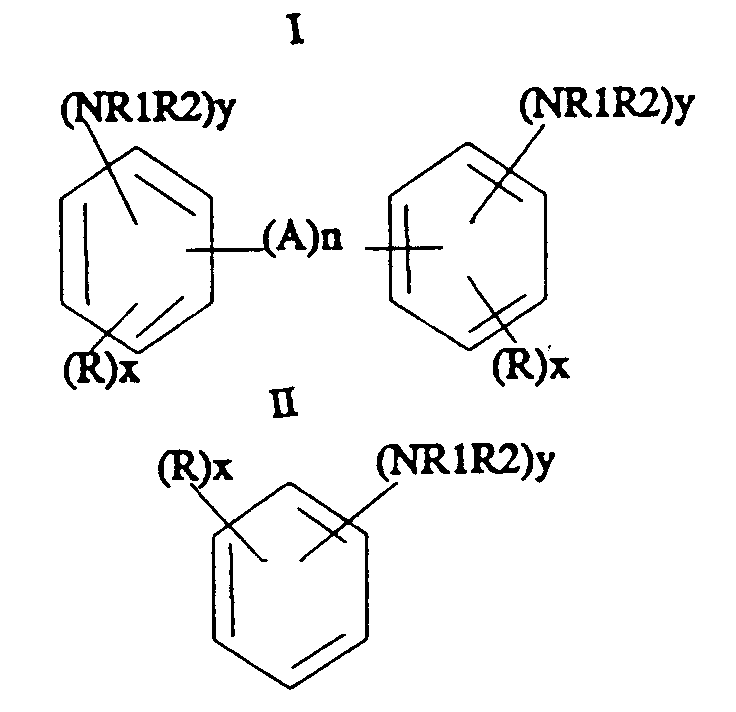
wherein R is hydrogen or C₁₋₆ aliphatic, R1 and R2 are hydrogen, or C₁₋₆ aliphatic, A is C₁₋₄ alkyl, or NH, n is 0 or 1, x is 1-3 and y is 1-2 except the sum of the y groups in Formula I may be 1. By the practice of this invention, one is able to selectively produce a ring hydrogenated reaction product in high selectivity with excellent reaction rates. - The aromatic amines useful in the practice of the process are bridged polynuclear aromatic amines or mononuclear aromatic amines. These can be substituted with various substituents such as aliphatic groups containing from 1-6 carbon atoms. Further, the amine group can be substituted with aliphatic groups such as alkyl or alkanol groups resulting in secondary and tertiary amine substituents. Examples of bridged aromatic amines include methylene dianilines such as bis(para-aminophenyl)methane (MDA) including up to about 15% aniline oligomers by weight; bis(diaminophenyl)methane; bis(para-amino-2-methylphenyl)methane; bis(diaminophenyl)propane; biphenylamine; tolidine; N-C₁₋₄-aliphatic derivatives and N,N'C₁₋₄ aliphatic secondary and tertiary amine derivatives of the above bridged aromatic amines. Examples of mononuclear aromatic amines include 2,4-and 2,6-toluenediamine, alkylated derivatives of toluenediamine, such as, 1-methyl-3,5-diethyl-2,4 or 2,6-diaminobenzene, commonly known as diethyltoluenediamine; diisopropyltoluenediamine, mono-isopropyl toluenediamine, tert-butyl-2,4-and 2,6-toluenediamine, cyclopent-toluenediamine; phenylenediamine, aniline, and alkylated derivatives of phenylenediamine and aniline, e.g., ortho-toluidine, ethyl toluidine, xylenediamine, mesitylene diamine, and the N and N,N'C₁₋₄ aliphatic secondary and tertiary amine derivatives of the mononuclear aromatic monoamines and mononuclear aromatic diamines.
- The hydrogenation process is carried out under liquid phase conditions, such liquid phase conditions being maintained typically by carrying out the hydrogenation in the presence of a solvent. Although as reported in the art, it is possible to produce the reaction product in the absence of a solvent, the processing usually is much simpler when a solvent is employed. Representative solvents suited for practicing the invention include saturated aliphatic and alicyclic hydrocarbons such as cyclohexane, hexane, and cyclooctane; low molecular weight alcohols, such as methanol, ethanol, isopropanol; and aliphatic and alicyclic hydrocarbon ethers, such as n-propyl ether, isopropyl ether, n-butyl ether, amyl ether, tetrahydrofuran, dioxane, and dicyclohexylether. Tetrahydrofuran is preferred. Although in some processes water can be used as a cosolvent, it is preferred that the system be maintained in an anhydrous state or at least maintained such that the water concentration is less than 0.5% by weight. Water, when present in the system, tends to increase the amount of by-product alcohols and heavy condensation products and it tends to deactivate the catalyst system.
- When a solvent is used, concentrations as low as 50% by weight based upon the aromatic amine introduced into the reaction zone are common and typically the solvent is used at levels from about 75 to about 500% by weight of the starting compound. High solvent use has associated recovery burdens.
- The hydrogenation is carried out principally in a batch process although it is possible to operate the plant continuously. Temperatures usually used for the hydrogenation process range from about 130 to 220°C with preferred temperatures of from about 170 to 195°C. Pressures as low as from about 200 to 1500 psig, even with systems containing impurities such as oligomers of MDA can be used thus providing for lower equipment costs and operating costs. When the pressure is raised toward the upper end of the operating range, higher reaction rates may be achieved.
- The rhodium metal, as is the ruthenium metal when used, is carried on a select alumina support generally in a ratio of about 0.5 to 25 weight parts rhodium per 100 weight parts of support, preferably 1 to 12 weight parts metal per 100 weight parts support. At these levels a catalyst level from 0.1 to 10% by weight of the aromatic amine is utilized with preferred levels being from 0.5 to 5% by weight. When the amount of catalyst approaches the lower limit of the range, the reaction rate may decrease. However, as the concentration of catalyst vis-a-vis the aromatic amine increases the reaction rate will increase up to a point and then level off to a constant rate.
- A preferred catalyst system comprises rhodium and another hydrogenation catalyst, typically ruthenium. In a rhodium/ruthenium catalyst system the ratio of rhodium to ruthenium is from about 1 to 12, preferably 3 to 8 weight parts rhodium per weight part alumina. Generally each metal is carried on a separate support. This catalyst system permits kinetic control of the reaction at low pressures, with the advantage that there is excellent selectivity with an excellent reaction rate.
- The support is key to the catalyst system in that at least the rhodium component is carried on a support selected from kappa, delta, and theta alumina. Kappa-alumina is the preferred alumina. These aluminas are obtained by a high temperature calcination of alumina oxides or their gels from 700°C to 1000°C. The drawing correlates temperature with the phases of alumina and can be used as a reference. Other aluminas, such as gamma-alumina which have been used in the past, do not afford the high activity and long life.
- The progress of a hydrogenation reaction can readily be followed by observing the amount of hydrogen taken up by the reaction mixture and the reaction is terminated when the amount of hydrogen consumed is equal or nearly equal to that amount necessary to effect complete hydrogenation to product. In general, the hydrogenation time for aromatic amines will range from about 100 to 500 minutes, at modest catalyst levels, e.g., 0.5-5% broadly 0.1-10% by weight of the aromatic amine at 180°C and 850 psi pressure, and generally will not exceed 500 minutes.
- Although not intending to be bound by theory, it is believed the unexpected activity and life of the catalyst system is due to the enhanced surface area of the rhodium when dispersed on the support.
- The following examples are intended to illustrate various embodiments of the invention and all parts and percentages given are weight parts or weight percents unless otherwise specified.
- Four grams of Rh(NO₃)₃ (10 weight % Rh) solution was added to 300cc of deionized (DI) water. This solution had a pH of 2.1. The pH of this solution was increased to between 3.8-4.2 by adding NH₄OH dropwise. To that solution was added 10g of kappa-alumina (identified by x-ray diffraction), and the mixture stirred for 5 min. The pH of this solution was than increased to 8.5 by adding NH₄OH in a dropwise manner. Once the pH reached 8.5, the mixture was stirred for an additional 15 min and the mixture was filtered through Watman filter paper. The filtrate was yellow orange in color indicating that all the rhodium was not deposited. The filtered solid was dried in a hood overnight and was calcined at 400°C for 3 hrs in air to obtain the final catalyst. When analyzed for rhodium content this catalyst had 2.8% Rh.
- Three grams of Rh(NO₃)₃ (10 weight % Rh) solution was added to 300cc of deionized (DI) water. This solution had a pH of 2.1. The pH of this solution was increased to between 3.8-4.2 by adding NH₄OH dropwise. To that solution was added 10g of kappa-alumina (identified by x-ray diffraction), and the mixture stirred for 5 min. The pH of this solution was then increased to 8.5 by adding NH₄OH in a dropwise manner. Once the pH reached 8.5, the mixture was stirred for an additional 15 min and the mixture was filtered through Watman filter paper. The filtrate was yellow orange in color indicating that all the rhodium was not deposited. The filtered solid was dried in a hood overnight and was calcined at 400°C for 3 hrs in air to obtain the final catalyst. When analyzed for rhodium content this catalyst had 2.2% Rh.
- One gram of Rh(NO₃)₃ (10 weight % Rh) solution was added to 3 gms of DI water. To this solution was added 10 grams of kappa-alumina (identified by x-ray diffraction), and the solid mixed well with the solution. The catalyst was dried overnight and calcined at 400°C for 3hrs in air to obtain the final catalyst. When analyzed for rhodium this catalyst had 1% Rh.
- The method of preparation was the same as (a) with the exception of using 10 grams of alpha-alumina catalyst. This catalyst had 2% Rh.
-
- Four grams of Rh(NO₃)₃ (10 weight% Rh) solution was added to 300cc of deionized (DI) water. This solution had a pH of 2.1. The pH of this solution was increased to between 3.8-4.2 by adding NH₄OH dropwise. To that solution was added 10g of alumina (type of alumina is given below) and the mixture stirred for 5 min. The pH of this solution was then increased to 8.5 by adding NH₄OH in a dropwise manner. Once the pH reached 8.5, the mixture was stirred for an additional 15 min and the mixture was filtered through Watman filter paper. The filtrate was colorless indicating all rhodium was deposited. The filtered solid was dried in a hood overnight and was calcined at 400°C for 3 hrs in air to obtain the final catalyst. The rhodium content of these catalysts are given below.
Supplier of Support Phase of Alumina % Rh Versal GH from LaRoche Chemicals Inc. gamma 3.6 Heat treated Versal GH delta 3.7 Theta-100 from Alcoa Corporation theta 2.8a Heat treated gibbsite chi 3.8 Heat treated Bayerite eta 4.1 (a) filtrate was orange in color indicating that all the rhodium did not deposit on Al₂O₃ - Prior to catalyst use, the catalyst was prereduced before use as outlined below to reduce the impact of catalyst preparation and storage history. The catalyst was charged to an empty, clean 300cc or 1 liter autoclave reactor and THF was added to the reactor. The autoclave was then sealed, leak tested and purged three times with nitrogen (pressurize to >200 psig, agitated, then vented to atmospheric pressure with the agitator off). The reactor was then purged three times with hydrogen (as with nitrogen but pressurized to 850 psig) and then pressurized to 650 psig. The reactor was then heated to 192°C and once at temperature, the reactor pressure was adjusted to 850 psig. The system was held at temperature for two hours, cooled, vented and purged three times with nitrogen. The catalyst was recovered by filtering the mixture under nitrogen atmosphere.
- A 300cc autoclave reactor or a 1-liter reactor was used during this work. All hydrogenations were carried out at 1500 rpm stirring rates to minimize hydrogen mass transfer as a limitation to reaction rates. The desired pre-reduced catalyst charge from Example 1 was weighed and added to the pressure vessel. The feed was then added to the reactor. Any desired base (eg. LiOH) was added as a 10% water solution to the reactor. The reactor was closed, leak tested and purged three times with nitrogen and then purged three times with hydrogen. The reactor was pressurized with hydrogen to 650 psig and heated to desired reaction temperature with agitation. When reaction temperature was reached, the reactor pressure was adjusted to 850 psig. The reactor was connected through a pressure controller to a ballast tank filled with hydrogen. The volume and hydrogen pressure of the ballast tank was chosen to be sufficient to provide all the hydrogen necessary for the reaction without dropping below 1000 psi. The volume was also small enough so that the ballast pressure drop during the reaction gave an accurate measure of the hydrogen consumed. The ballast pressure was followed versus time as a measure of the hydrogenation taking place. By calculating, the ballast pressure change (known volume), the molar hydrogen consumption was determined. When the reaction test was completed, the ballast line was closed, the reactor was cooled and the reactor was purged with nitrogen. The reaction mixture was then removed through the charge line/filter. Life studies in Examples to follow were done by adding the feed through the charge line/filter and repeating the procedure. Table 1 notes catalyst type, reaction conditions and yield. Table 2 provides results for the catalytic hydrogenation of MDA-100 referring to 100% MDA.

- Table 1 shows the activity of Rh/Al₂O₃ catalyst as a function of the phase of alumina. Although the same technique was used to prepare all these catalysts the level of rhodium for theta, kappa, delta, gamma, and alpha alumina catalysts were different. Therefore, the amount of catalyst was adjusted based on MDA so that the activities can be compared on an equal rhodium basis.
- The catalysts based on chi and eta alumina (Runs 1 & 2) had very low activity while the catalysts based on delta, theta and kappa was more active than a commercial gamma-alumina type catalyst. The rhodium on kappa-alumina catalyst had the highest activity. On an equivalent rhodium basis 2.8% Rh/kappa-Al₂O₃ catalyst was about twice as active as the commercial 4% Rh/Al₂O₃ gamma supported catalyst. As shown in Table 1 the catalyst activity decreases in the order.
Rh/kappa - Al₂O₃ > Rh/delta-Al₂O₃ / Rh/theta-Al₂O₃ > commercial gamma-alumina type catalyst / Rh/gamma-Al₂O₃ /Rh/alpha-Al₂O₃ > Rh/chi-Al₂O₃ > Rh/eta - Al₂O₃.

- Previously, the activity of different phases of alumina was compared and it was concluded that the Rh/kappa-alumina catalyst was twice as active as the gamma-alumina supported catalyst. The rhodium/kappa-alumina catalyst had 2.8% rhodium compared to 4% Rh with the gamma-alumina supported catalyst. These catalyst tests were tested by increasing the catalyst weight of 2.8% Rh/kappa-Al₂O₃ catalyst such that both catalysts were tested on an equal rhodium basis.
- To compare the catalysts on an equal weight basis, the catalysts were tested at 1.5% of MDA. Table 2 compares the activity of a 2.8% Rh/kappa-Al₂O₃ catalyst to two commercial 4% Rh/gamma-Al₂O₃ catalysts. Clearly, the 2.8% Rh/kappa-Al₂O₃ catalyst with 30% lower rhodium is much more active than the commercial 4% Rh/gamma-Al₂O₃ catalyst. The gamma-alumina catalyst increases activity from first to second use and, therefore, comparison of these catalysts should be done on the basis of the second use. Comparison of rows 2 and 9 of Table 2 clearly show that the kappa-alumina supported catalyst with 30% lower rhodium is about 20% more active than the gamma-alumina catalyst.
- A 1% and a 2.2% Rh/kappa-alumina catalyst were prepared and tested for MDA hydrogenation, and these catalysts had high activity. The 1% Rh/kappa-alumina catalyst was only about 45% less active than the commercial 4% Rh/gamma-Al₂O₃ catalyst. The 2.2% Rh/kappa-alumina catalyst had similar activity to the commercial 4% Rh/gamma-Al₂O₃ catalyst. Table 2 also has results for the hydrogenation of MDA with 2.5% Rh/gamma-Al₂O₃ catalyst. The 2.5% Rh/gamma-Al₂O₃ catalyst has similar actiity to the 1% Rh/kappa-alumina catalyst. In the second use, the 2.5% Rh/gamma-Al₂O₃ catalyst undergoes severe deactivation. These results also show that the activity of the 4% Rh/gamma-Al₂O₃ catalyst can be matched by the kappa-alumina supports having rhodium loading between 2.2% and 2.7%.
- Catalyst life studies were carried out for a series of catalysts. The catalyst was a physical mixture of Rh/Al₂O₃ (2.8g) and Ru/Al₂O₃ (0.3g). However, to each of these catalysts was added LiOH in three stages. It was added as 1% LiOH (as a percent of catalyst weight) in the second use, 2% in the third use and 1% in the fourth use. Other conditions and results are set forth in Table 3.


- Life studies were conducted to compare the activity of the 2.8% Rh/kappa-alumina catalyst to one of the best 4% Rh/gamma-Al₂O₃ commercial catalyst. During these life studies, the catalyst weight, temperature and pressure were kept constant. The salient features of this life study are listed below.
- · Kappa-alumina catalyst, with 30% lower rhodium, has an activity similar to the gamma-alumina catalyst.
- · Kappa-alumina catalyst had an excellent, stable activity through eight uses.
- · The level of secondary amines were dropped below 1% by adding aqueous LiOH to the feed. The drop in secondary amines was not accompanied by a drop in the rate.
- · Deaminated product and the t/t isomer content was similar in both catalysts.
- The term "time at temp" in Table 3 refers to the time taken for a given conversion and T₉₅ is the time taken for 95% conversion. T₉₅ was calculated from a combination of GC data and ballast pressure drop. With a 2.8% Rh/kappa-Al₂O₃ catalyst, the average T₉₅ is 147 min (8 uses), and the 4% Rh/gamma-Al₂O₃ catalyst, the average T₉₅ is 155 min (7 uses). Clearly, the advantage of the kappa-alumina catalyst is the lower rhodium usage. The 2.8% Rh/kappa-alumina catalyst which has 30% lower rhodium has an activity and selectivity to PACM similar to the gamma-alumina catalyst. The second important feature of the catalyst is its stable activity during 8 uses.
- Also shown in Table 3, the level of secondary amines dropped to about 1% by the fifth use and did not change thereafter. Table 3 also gives the variation of the t/t isomer with re-use of the catalyst. With the kappa alumina catalyst, the t/t isomer content averaged 21% (8 uses) compared to 18.4% average (7 uses) with gamma-alumina catalyst. The level of deaminated PACM is low and falls within the accepted range.
Claims (24)
- In a process for the catalytic hydrogenation of aromatic amines to their ring hydrogenated counterparts, by contacting the aromatic amine with hydrogen in the presence of a catalyst, the improvement which comprises effecting said hydrogenation in the presence of a catalyst comprising rhodium carried on an alumina support, said alumina support being selected from the group consisting of kappa, theta and delta.
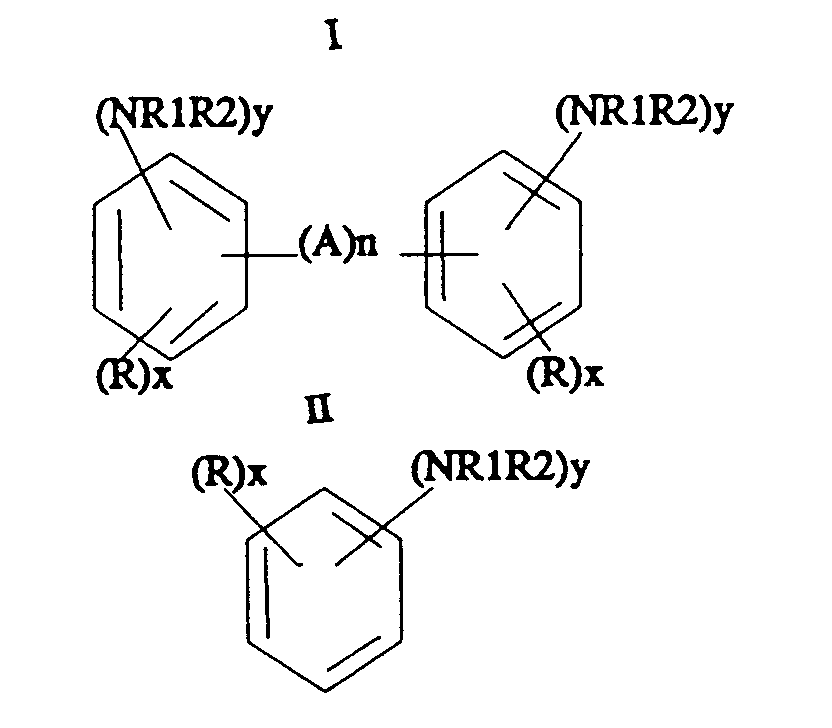
- The process of Claim 1 wherein the aromatic amine is represented by the formulas:
- The process of Claim 2 wherein said aromatic amine is represented by formula I.
- The process of Claim 3 wherein the catalyst is present in an amount from about 0.1 to 10% by weight of the aromatic amine and the rhodium is present in an amount from 1 to 12 weight parts per 100 weight parts alumina.
- The process of Claim 4 wherein the alumina support is kappa-alumina.
- The process of Claim 5 wherein R1 and R2 are hydrogen.
- The process of Claim 6 wherein R is H or methyl.
- The process of Claim 7 wherein n is 0.
- The process of Claim 7 wherein A is -CH₂-, R is H, and n is 1.
- The process of Claim 9 wherein each y is 1.
- The process of Claim 10 wherein hydrogenation is conducted at a hydrogen pressure from about 200 to 1500 psig.
- The process of Claim 11 wherein the catalyst system comprises rhodium and ruthenium and the weight ratio of rhodium to ruthenium, as metal, is from about 1 to 12.
- In a process for the catalytic hydrogenation of crude methylenedianiline containing up to about 15 % of oligomer by weight to bis (4-aminocyclohexyl)methane, which comprises hydrogenating the methylenedianiline in the presence of a catalyst system, the improvement which comprises effecting said hydrogenation in the presence of a catalyst comprising rhodium and ruthenium, said catalyst present as a physical admixture, with at least the rhodium component of the catalyst system being carried on a support of kappa-alumina.
- The process of Claim 13 wherein the catalyst system comprising rhodium and ruthenium is present in an amount of from 1 to 12 weight parts rhodium/weight part ruthenium, and the amount of catalyst based on methylenedianiline is from 0.5 to 5% by weight.
- The process of Claim 1 wherein said aromatic amine is represented by formula II.
- The process of Claim 15 wherein the catalyst system comprises rhodium in an amount from 1 to 12 weight parts per 100 weight parts alumina.
- The process of Claim 16 wherein hydrogenation is conducted at a hydrogen pressure from about 200 to 1500 psig.
- The process of Claim 17 wherein the catalyst is present in an amount from about 0.1 to 10% by weight of the aromatic amine.
- The process of Claim 18 wherein R1 and R2 are hydrogen.
- The process of Claim 18 wherein R is methyl, ethyl, or tert-butyl.
- The process of Claim 20 wherein and y is 2.
- The process of Claim 21 wherein in the pressure is from about 200 to 1500 psig.
- The process of Claim 22 wherein said aromatic amine is 2,4- or 2,6- tert-butyl-toluenediamine.
- The process of Claim 22 wherein said aromatic amine is 1-methyl-diethyl 2,4- or 2,6-diaminobenzene.
Applications Claiming Priority (2)
| Application Number | Priority Date | Filing Date | Title |
|---|---|---|---|
| US83843 | 1987-08-07 | ||
| US08/083,843 US5360934A (en) | 1993-06-25 | 1993-06-25 | Hydrogenation of aromatic amines to produce their ring hydrogenated counterparts |
Publications (2)
| Publication Number | Publication Date |
|---|---|
| EP0630882A1 true EP0630882A1 (en) | 1994-12-28 |
| EP0630882B1 EP0630882B1 (en) | 1997-11-05 |
Family
ID=22181053
Family Applications (1)
| Application Number | Title | Priority Date | Filing Date |
|---|---|---|---|
| EP94109812A Expired - Lifetime EP0630882B1 (en) | 1993-06-25 | 1994-06-24 | Hydrogenation of aromatic amines to produce their ring hydrogenated counterparts |
Country Status (6)
| Country | Link |
|---|---|
| US (1) | US5360934A (en) |
| EP (1) | EP0630882B1 (en) |
| KR (1) | KR950000647A (en) |
| BR (1) | BR9402488A (en) |
| DE (1) | DE69406594T2 (en) |
| TW (1) | TW250475B (en) |
Cited By (7)
| Publication number | Priority date | Publication date | Assignee | Title |
|---|---|---|---|---|
| EP0639403A3 (en) * | 1993-08-20 | 1995-05-17 | Huels Chemische Werke Ag | Catalyst for the prodcution of bis-para-aminocyclohexylmethane with few trans-trans-isomers by hydrogenation of methylenedianiline. |
| EP1329446A3 (en) * | 2002-01-17 | 2003-11-12 | Air Products And Chemicals, Inc. | Hydrogenation of single ring aromatic diamines |
| DE102008002002A1 (en) | 2008-05-27 | 2009-12-03 | Evonik Degussa Gmbh | Low chlorine multi-step process for the preparation of cycloaliphatic diisocyanates |
| EP2905272A1 (en) | 2014-02-05 | 2015-08-12 | Bayer MaterialScience AG | Process for hydrogenating aromatic di- and polyamines to cycloaliphatic di- and polyamines |
| EP2905273A1 (en) | 2014-02-05 | 2015-08-12 | Bayer MaterialScience AG | Process for hydrogenating aromatic di- and polyamines |
| EP4685129A1 (en) | 2024-07-26 | 2026-01-28 | Evonik Operations GmbH | Process for the hydrogenation of mda |
| EP4685130A1 (en) | 2024-07-26 | 2026-01-28 | Evonik Operations GmbH | Process for the preparation of methylenebis(cyclohexylamine) |
Families Citing this family (16)
| Publication number | Priority date | Publication date | Assignee | Title |
|---|---|---|---|---|
| DE19533718A1 (en) * | 1995-09-12 | 1997-03-13 | Basf Ag | Process for the hydrogenation of aromatic compounds in which at least one amino group is bonded to an aromatic nucleus |
| DE19641688A1 (en) * | 1996-10-10 | 1998-04-16 | Bayer Ag | Catalysts and processes for the preparation of cycloaliphatic amines |
| DE19824906A1 (en) * | 1998-06-04 | 1999-12-09 | Bayer Ag | Conversion of aromatic amines to mono- and dicycloaliphatic amines |
| DE19827282A1 (en) * | 1998-06-19 | 1999-12-23 | Bayer Ag | Process for the preparation of cycloaliphatic amines |
| DE19845641A1 (en) * | 1998-10-05 | 2000-04-06 | Bayer Ag | Process for the preparation of dicycloaliphatic amines |
| US6184416B1 (en) * | 2000-04-28 | 2001-02-06 | Air Products And Chemicals, Inc. | Lithium aluminate as a catalyst support for hydrogenation of aromatic amines |
| KR100418023B1 (en) * | 2001-03-07 | 2004-02-14 | 에스케이 주식회사 | Method for Preparing Cycloaliphatic amines by the Hydrogenation of Aromatic Amines |
| ATE422962T1 (en) | 2002-05-31 | 2009-03-15 | Evonik Degussa Gmbh | SUPPORTED RUTHENIUM CATALYST AND METHOD FOR HYDROGENING AN AROMATIC AMINE IN THE PRESENCE OF THIS CATALYST |
| DE10231119A1 (en) * | 2002-07-10 | 2004-02-05 | Degussa Ag | Process for increasing the selectivity of the hydrogenation of 4,4'-diaminodiphenylmethane to 4,4'-diaminodicyclohexylmethane in the presence of an N-alkyl-4,4'-diaminodiphenylmethane |
| US7038088B2 (en) * | 2004-05-19 | 2006-05-02 | Air Products And Chemicals, Inc. | Hydrogenation of highly contaminated methylenedianiline |
| CN102216255A (en) * | 2008-11-18 | 2011-10-12 | 因温斯特技术公司 | 1,2-Diaminocyclohexane and chemical methods |
| CN102688757A (en) * | 2011-03-22 | 2012-09-26 | 中国科学院大连化学物理研究所 | Catalyst for preparing cyclohexanediamine by phenylenediamine hydrogenation under ammonia reaction conditions |
| TWI534131B (en) | 2014-11-27 | 2016-05-21 | 財團法人工業技術研究院 | Catalyst and method for hydrogenation of 4,4'-methylenedianiline |
| JP2019531873A (en) | 2016-08-18 | 2019-11-07 | ザ ユニバーシティ オブ シカゴThe University Of Chicago | Earth-rich metal catalysts supported on metal oxides for highly efficient organic conversion |
| CN112898184A (en) * | 2021-01-25 | 2021-06-04 | 河北工业大学 | Method for continuously synthesizing alicyclic carbamate |
| US20240317674A1 (en) * | 2021-07-02 | 2024-09-26 | Evonik Operations Gmbh | Hydrogenation of aromatic amines from pu decomposition processes |
Citations (4)
| Publication number | Priority date | Publication date | Assignee | Title |
|---|---|---|---|---|
| DD69585A (en) * | ||||
| DE1948566A1 (en) * | 1968-09-25 | 1970-04-02 | Upjohn Co | Process for the catalytic hydrogenation of di (4-aminophenyl) methane to di (4-aminocyclohexyl) methane |
| EP0231788A1 (en) * | 1986-01-23 | 1987-08-12 | Air Products And Chemicals, Inc. | Hydrogenation of methylenedianiline to produce bis(para-amino-cyclohexyl) methane |
| EP0335272A2 (en) * | 1988-03-30 | 1989-10-04 | Air Products And Chemicals, Inc. | Hydrogenation of aromatic amines to produce their ring hydrogenated counterparts |
Family Cites Families (15)
| Publication number | Priority date | Publication date | Assignee | Title |
|---|---|---|---|---|
| US2606928A (en) * | 1947-11-18 | 1952-08-12 | Du Pont | Preparation of amino alicyclic compounds |
| US2511028A (en) * | 1947-12-04 | 1950-06-13 | Du Pont | 4-[(para-aminophenyl) alkyl] cyclo-hexylamine |
| US2606924A (en) * | 1949-06-09 | 1952-08-12 | Du Pont | Bis (4-aminocyclohexyl)-methane |
| US2606925A (en) * | 1949-12-15 | 1952-08-12 | Du Pont | Ruthenium catalyzed hydrogenation process for obtaining aminocyclohexyl compounds |
| US3347917A (en) * | 1961-12-29 | 1967-10-17 | Du Pont | Process for the preparation of di (paraaminocyclohexyl) methane |
| US3155724A (en) * | 1961-12-29 | 1964-11-03 | Du Pont | Process for bringing stereoisomeric mixture of bis-(4-aminocyclohexane) methane close to the equilibrium concentration |
| CH515882A (en) * | 1965-12-23 | 1971-11-30 | Du Pont | 4,4'-Methylene di-(cyclohexylamine) prepn - with control of stereoisomer concn |
| US3644522A (en) * | 1969-04-04 | 1972-02-22 | Du Pont | Catalytic hydrogenation of nitrogen containing compounds over supported ruthenium catalysts |
| US3679746A (en) * | 1969-10-27 | 1972-07-25 | Du Pont | Isomer enrichment of bicyclohexyl-4,4{40 -diamine |
| JPS4830603B1 (en) * | 1969-12-24 | 1973-09-21 | ||
| US3711550A (en) * | 1970-02-16 | 1973-01-16 | Du Pont | Isomerization of 4,4'-methylenedi (cyclohexylamine) over moderated ruthenium catalyst |
| US3766272A (en) * | 1972-08-25 | 1973-10-16 | Du Pont | 4,4'-methylenedi(cyclohexylamine)isomerization over a supported catalyst |
| US4034061A (en) * | 1972-11-16 | 1977-07-05 | Union Oil Company Of California | Aluminum borate catalyst compositions and use thereof in chemical conversions |
| US4220559A (en) * | 1978-02-14 | 1980-09-02 | Engelhard Minerals & Chemicals Corporation | High temperature-stable catalyst composition |
| US5116879A (en) * | 1988-12-28 | 1992-05-26 | Den Norske Stats Oljeselskap A.S. | Process using a supported catalyst for hydrocarbon synthesis |
-
1993
- 1993-06-25 US US08/083,843 patent/US5360934A/en not_active Expired - Lifetime
-
1994
- 1994-06-06 TW TW083105122A patent/TW250475B/zh active
- 1994-06-21 BR BR9402488A patent/BR9402488A/en not_active Application Discontinuation
- 1994-06-24 DE DE69406594T patent/DE69406594T2/en not_active Expired - Lifetime
- 1994-06-24 EP EP94109812A patent/EP0630882B1/en not_active Expired - Lifetime
- 1994-06-25 KR KR1019940014720A patent/KR950000647A/en not_active Ceased
Patent Citations (7)
| Publication number | Priority date | Publication date | Assignee | Title |
|---|---|---|---|---|
| DD69585A (en) * | ||||
| DE1948566A1 (en) * | 1968-09-25 | 1970-04-02 | Upjohn Co | Process for the catalytic hydrogenation of di (4-aminophenyl) methane to di (4-aminocyclohexyl) methane |
| US3591635A (en) * | 1968-09-25 | 1971-07-06 | Upjohn Co | Catalytic hydrogenation process for preparing di(4 - aminocyclohexyl) methane |
| EP0231788A1 (en) * | 1986-01-23 | 1987-08-12 | Air Products And Chemicals, Inc. | Hydrogenation of methylenedianiline to produce bis(para-amino-cyclohexyl) methane |
| US4946998A (en) * | 1986-01-23 | 1990-08-07 | Air Products And Chemicals, Inc. | Hydrogenation of methylenedianiline to produce bis(para-aminocyclohexyl)methane |
| EP0335272A2 (en) * | 1988-03-30 | 1989-10-04 | Air Products And Chemicals, Inc. | Hydrogenation of aromatic amines to produce their ring hydrogenated counterparts |
| US4960941A (en) * | 1988-03-30 | 1990-10-02 | Air Products And Chemicals, Inc. | Hydrogenation of aromatic amines to produce their ring hydrogenated counterparts |
Cited By (10)
| Publication number | Priority date | Publication date | Assignee | Title |
|---|---|---|---|---|
| EP0639403A3 (en) * | 1993-08-20 | 1995-05-17 | Huels Chemische Werke Ag | Catalyst for the prodcution of bis-para-aminocyclohexylmethane with few trans-trans-isomers by hydrogenation of methylenedianiline. |
| US5578546A (en) * | 1993-08-20 | 1996-11-26 | Huels Aktiengesellschaft | Catalyst for preparing bis-para-aminocyclohexylmethane containing a low proportion of trans/trans isomer by hydrogenation of methylenedianiline |
| EP1329446A3 (en) * | 2002-01-17 | 2003-11-12 | Air Products And Chemicals, Inc. | Hydrogenation of single ring aromatic diamines |
| DE102008002002A1 (en) | 2008-05-27 | 2009-12-03 | Evonik Degussa Gmbh | Low chlorine multi-step process for the preparation of cycloaliphatic diisocyanates |
| EP2905272A1 (en) | 2014-02-05 | 2015-08-12 | Bayer MaterialScience AG | Process for hydrogenating aromatic di- and polyamines to cycloaliphatic di- and polyamines |
| EP2905273A1 (en) | 2014-02-05 | 2015-08-12 | Bayer MaterialScience AG | Process for hydrogenating aromatic di- and polyamines |
| US9278906B2 (en) | 2014-02-05 | 2016-03-08 | Bayer Materialscience Ag | Process for hydrogenating aromatic di- and polyamines to cycloaliphatic di- and polyamines |
| US9403754B2 (en) | 2014-02-05 | 2016-08-02 | Bayer Materialscience Ag | Process for hydrogenating aromatic di- and polyamines |
| EP4685129A1 (en) | 2024-07-26 | 2026-01-28 | Evonik Operations GmbH | Process for the hydrogenation of mda |
| EP4685130A1 (en) | 2024-07-26 | 2026-01-28 | Evonik Operations GmbH | Process for the preparation of methylenebis(cyclohexylamine) |
Also Published As
| Publication number | Publication date |
|---|---|
| DE69406594D1 (en) | 1997-12-11 |
| KR950000647A (en) | 1995-01-03 |
| EP0630882B1 (en) | 1997-11-05 |
| US5360934A (en) | 1994-11-01 |
| TW250475B (en) | 1995-07-01 |
| BR9402488A (en) | 1995-03-14 |
| DE69406594T2 (en) | 1998-03-05 |
Similar Documents
| Publication | Publication Date | Title |
|---|---|---|
| EP0630882B1 (en) | Hydrogenation of aromatic amines to produce their ring hydrogenated counterparts | |
| US6184416B1 (en) | Lithium aluminate as a catalyst support for hydrogenation of aromatic amines | |
| EP0335272B1 (en) | Hydrogenation of aromatic amines to produce their ring hydrogenated counterparts | |
| KR100474024B1 (en) | Method of hydrogenating aromatic compounds in which at least one amino group is bonded to an aromatic nucleus | |
| JP5731603B2 (en) | Hydrogenation method of highly contaminated methylenedianiline | |
| US10329237B2 (en) | Method for hydrogenating aromatic compounds | |
| US9403754B2 (en) | Process for hydrogenating aromatic di- and polyamines | |
| EP0394967A1 (en) | Reductive amination of carbonylnitriles and similar compounds | |
| US9278906B2 (en) | Process for hydrogenating aromatic di- and polyamines to cycloaliphatic di- and polyamines | |
| EP0618188B1 (en) | Process for the preparation of cyclohexylamines by catalytic hydrogenation of anilines | |
| US5545756A (en) | Hydrogenation of aromatic amines using mixed metal oxide support | |
| EP1767520B1 (en) | Hydrogenation of aromatic amines to alicyclic amines using a ruthenium catalyst supported on lithium aluminate | |
| US5981801A (en) | Hydrogenation of aromatic diamines | |
| US6140540A (en) | Hydrogenation of aromatic amines to produce their ring hydrogenated counterparts | |
| EP0781267B1 (en) | Method of increasing hydrogenation rate of aromatic amines | |
| US6121493A (en) | Isomerization of cyclohexylamines to produce their thermodynamic isomeric form | |
| US5973207A (en) | Hydrogenation of meta-toluenediamine | |
| JPH0665165A (en) | Method of hydrogenating amine |
Legal Events
| Date | Code | Title | Description |
|---|---|---|---|
| PUAI | Public reference made under article 153(3) epc to a published international application that has entered the european phase |
Free format text: ORIGINAL CODE: 0009012 |
|
| AK | Designated contracting states |
Kind code of ref document: A1 Designated state(s): DE FR IT NL PT |
|
| 17P | Request for examination filed |
Effective date: 19950111 |
|
| 17Q | First examination report despatched |
Effective date: 19960404 |
|
| GRAG | Despatch of communication of intention to grant |
Free format text: ORIGINAL CODE: EPIDOS AGRA |
|
| GRAH | Despatch of communication of intention to grant a patent |
Free format text: ORIGINAL CODE: EPIDOS IGRA |
|
| GRAH | Despatch of communication of intention to grant a patent |
Free format text: ORIGINAL CODE: EPIDOS IGRA |
|
| GRAA | (expected) grant |
Free format text: ORIGINAL CODE: 0009210 |
|
| AK | Designated contracting states |
Kind code of ref document: B1 Designated state(s): DE FR IT NL PT |
|
| PG25 | Lapsed in a contracting state [announced via postgrant information from national office to epo] |
Ref country code: NL Free format text: LAPSE BECAUSE OF FAILURE TO SUBMIT A TRANSLATION OF THE DESCRIPTION OR TO PAY THE FEE WITHIN THE PRESCRIBED TIME-LIMIT Effective date: 19971105 Ref country code: IT Free format text: LAPSE BECAUSE OF FAILURE TO SUBMIT A TRANSLATION OF THE DESCRIPTION OR TO PAY THE FEE WITHIN THE PRE;WARNING: LAPSES OF ITALIAN PATENTS WITH EFFECTIVE DATE BEFORE 2007 MAY HAVE OCCURRED AT ANY TIME BEFORE 2007. THE CORRECT EFFECTIVE DATE MAY BE DIFFERENT FROM THE ONE RECORDED.SCRIBED TIME-LIMIT Effective date: 19971105 Ref country code: FR Free format text: LAPSE BECAUSE OF FAILURE TO SUBMIT A TRANSLATION OF THE DESCRIPTION OR TO PAY THE FEE WITHIN THE PRESCRIBED TIME-LIMIT Effective date: 19971105 |
|
| REF | Corresponds to: |
Ref document number: 69406594 Country of ref document: DE Date of ref document: 19971211 |
|
| PG25 | Lapsed in a contracting state [announced via postgrant information from national office to epo] |
Ref country code: PT Free format text: LAPSE BECAUSE OF FAILURE TO SUBMIT A TRANSLATION OF THE DESCRIPTION OR TO PAY THE FEE WITHIN THE PRESCRIBED TIME-LIMIT Effective date: 19980205 |
|
| NLV1 | Nl: lapsed or annulled due to failure to fulfill the requirements of art. 29p and 29m of the patents act | ||
| EN | Fr: translation not filed | ||
| PLBE | No opposition filed within time limit |
Free format text: ORIGINAL CODE: 0009261 |
|
| STAA | Information on the status of an ep patent application or granted ep patent |
Free format text: STATUS: NO OPPOSITION FILED WITHIN TIME LIMIT |
|
| 26N | No opposition filed | ||
| PGFP | Annual fee paid to national office [announced via postgrant information from national office to epo] |
Ref country code: DE Payment date: 20130628 Year of fee payment: 20 |
|
| REG | Reference to a national code |
Ref country code: DE Ref legal event code: R071 Ref document number: 69406594 Country of ref document: DE |
|
| PG25 | Lapsed in a contracting state [announced via postgrant information from national office to epo] |
Ref country code: DE Free format text: LAPSE BECAUSE OF EXPIRATION OF PROTECTION Effective date: 20140625 |