EP0630570A2 - Fungizide Wirkstoffkombinationen - Google Patents
Fungizide Wirkstoffkombinationen Download PDFInfo
- Publication number
- EP0630570A2 EP0630570A2 EP94109021A EP94109021A EP0630570A2 EP 0630570 A2 EP0630570 A2 EP 0630570A2 EP 94109021 A EP94109021 A EP 94109021A EP 94109021 A EP94109021 A EP 94109021A EP 0630570 A2 EP0630570 A2 EP 0630570A2
- Authority
- EP
- European Patent Office
- Prior art keywords
- formula
- weight
- active ingredient
- parts
- compound
- Prior art date
- Legal status (The legal status is an assumption and is not a legal conclusion. Google has not performed a legal analysis and makes no representation as to the accuracy of the status listed.)
- Withdrawn
Links
- 230000000855 fungicidal effect Effects 0.000 title claims abstract description 17
- 239000013543 active substance Substances 0.000 title claims description 11
- 239000004480 active ingredient Substances 0.000 claims abstract description 49
- 150000001875 compounds Chemical class 0.000 claims description 68
- 239000000203 mixture Substances 0.000 claims description 12
- 150000007980 azole derivatives Chemical class 0.000 claims description 9
- 241000233866 Fungi Species 0.000 claims description 5
- 238000002360 preparation method Methods 0.000 claims description 5
- 239000004606 Fillers/Extenders Substances 0.000 claims description 4
- 239000000417 fungicide Substances 0.000 claims description 4
- 125000006519 CCH3 Chemical group 0.000 claims description 3
- 239000005805 Mepanipyrim Substances 0.000 claims description 3
- 239000005828 Pyrimethanil Substances 0.000 claims description 3
- 239000003795 chemical substances by application Substances 0.000 claims description 3
- CIFWZNRJIBNXRE-UHFFFAOYSA-N mepanipyrim Chemical compound CC#CC1=CC(C)=NC(NC=2C=CC=CC=2)=N1 CIFWZNRJIBNXRE-UHFFFAOYSA-N 0.000 claims description 3
- 238000000034 method Methods 0.000 claims description 3
- ZLIBICFPKPWGIZ-UHFFFAOYSA-N pyrimethanil Chemical compound CC1=CC(C)=NC(NC=2C=CC=CC=2)=N1 ZLIBICFPKPWGIZ-UHFFFAOYSA-N 0.000 claims description 3
- 230000002195 synergetic effect Effects 0.000 abstract description 7
- VEKMJKMSTPFHQD-UHFFFAOYSA-N 1h-benzimidazole-2-carbonitrile Chemical class C1=CC=C2NC(C#N)=NC2=C1 VEKMJKMSTPFHQD-UHFFFAOYSA-N 0.000 abstract description 6
- 241000196324 Embryophyta Species 0.000 description 12
- 238000009472 formulation Methods 0.000 description 9
- -1 butanol or glycol Chemical class 0.000 description 6
- 230000000694 effects Effects 0.000 description 6
- 239000008187 granular material Substances 0.000 description 5
- 239000000843 powder Substances 0.000 description 5
- 238000005554 pickling Methods 0.000 description 4
- 230000001681 protective effect Effects 0.000 description 4
- VYPSYNLAJGMNEJ-UHFFFAOYSA-N silicon dioxide Inorganic materials O=[Si]=O VYPSYNLAJGMNEJ-UHFFFAOYSA-N 0.000 description 4
- 238000005507 spraying Methods 0.000 description 4
- XLYOFNOQVPJJNP-UHFFFAOYSA-N water Substances O XLYOFNOQVPJJNP-UHFFFAOYSA-N 0.000 description 4
- ZWEHNKRNPOVVGH-UHFFFAOYSA-N 2-Butanone Chemical compound CCC(C)=O ZWEHNKRNPOVVGH-UHFFFAOYSA-N 0.000 description 3
- CSCPPACGZOOCGX-UHFFFAOYSA-N Acetone Chemical compound CC(C)=O CSCPPACGZOOCGX-UHFFFAOYSA-N 0.000 description 3
- YMWUJEATGCHHMB-UHFFFAOYSA-N Dichloromethane Chemical compound ClCCl YMWUJEATGCHHMB-UHFFFAOYSA-N 0.000 description 3
- ZMXDDKWLCZADIW-UHFFFAOYSA-N N,N-Dimethylformamide Chemical compound CN(C)C=O ZMXDDKWLCZADIW-UHFFFAOYSA-N 0.000 description 3
- YXFVVABEGXRONW-UHFFFAOYSA-N Toluene Chemical compound CC1=CC=CC=C1 YXFVVABEGXRONW-UHFFFAOYSA-N 0.000 description 3
- 239000000969 carrier Substances 0.000 description 3
- 239000003995 emulsifying agent Substances 0.000 description 3
- 150000002170 ethers Chemical class 0.000 description 3
- 239000007788 liquid Substances 0.000 description 3
- 239000011435 rock Substances 0.000 description 3
- 239000007787 solid Substances 0.000 description 3
- 239000002904 solvent Substances 0.000 description 3
- 239000000725 suspension Substances 0.000 description 3
- 241001465180 Botrytis Species 0.000 description 2
- 0 COC=C(*)c(cccc1)c1Oc1cc(Oc(cccc2)c2C#N)ncn1 Chemical compound COC=C(*)c(cccc1)c1Oc1cc(Oc(cccc2)c2C#N)ncn1 0.000 description 2
- CURLTUGMZLYLDI-UHFFFAOYSA-N Carbon dioxide Chemical compound O=C=O CURLTUGMZLYLDI-UHFFFAOYSA-N 0.000 description 2
- IAZDPXIOMUYVGZ-UHFFFAOYSA-N Dimethylsulphoxide Chemical compound CS(C)=O IAZDPXIOMUYVGZ-UHFFFAOYSA-N 0.000 description 2
- LYCAIKOWRPUZTN-UHFFFAOYSA-N Ethylene glycol Chemical compound OCCO LYCAIKOWRPUZTN-UHFFFAOYSA-N 0.000 description 2
- XEEYBQQBJWHFJM-UHFFFAOYSA-N Iron Chemical class [Fe] XEEYBQQBJWHFJM-UHFFFAOYSA-N 0.000 description 2
- UQSXHKLRYXJYBZ-UHFFFAOYSA-N Iron oxide Chemical compound [Fe]=O UQSXHKLRYXJYBZ-UHFFFAOYSA-N 0.000 description 2
- 235000007688 Lycopersicon esculentum Nutrition 0.000 description 2
- LRHPLDYGYMQRHN-UHFFFAOYSA-N N-Butanol Chemical compound CCCCO LRHPLDYGYMQRHN-UHFFFAOYSA-N 0.000 description 2
- 244000046052 Phaseolus vulgaris Species 0.000 description 2
- 235000010627 Phaseolus vulgaris Nutrition 0.000 description 2
- 241000233614 Phytophthora Species 0.000 description 2
- 229920003171 Poly (ethylene oxide) Polymers 0.000 description 2
- ATUOYWHBWRKTHZ-UHFFFAOYSA-N Propane Chemical compound CCC ATUOYWHBWRKTHZ-UHFFFAOYSA-N 0.000 description 2
- 240000003768 Solanum lycopersicum Species 0.000 description 2
- 241000607479 Yersinia pestis Species 0.000 description 2
- 150000001338 aliphatic hydrocarbons Chemical class 0.000 description 2
- JHIVVAPYMSGYDF-UHFFFAOYSA-N cyclohexanone Chemical compound O=C1CCCCC1 JHIVVAPYMSGYDF-UHFFFAOYSA-N 0.000 description 2
- 201000010099 disease Diseases 0.000 description 2
- 208000037265 diseases, disorders, signs and symptoms Diseases 0.000 description 2
- 239000002270 dispersing agent Substances 0.000 description 2
- 239000000975 dye Substances 0.000 description 2
- 239000000839 emulsion Substances 0.000 description 2
- 239000004009 herbicide Substances 0.000 description 2
- 238000011081 inoculation Methods 0.000 description 2
- 239000002689 soil Substances 0.000 description 2
- 239000000243 solution Substances 0.000 description 2
- 239000000126 substance Substances 0.000 description 2
- 244000215068 Acacia senegal Species 0.000 description 1
- 229920001817 Agar Polymers 0.000 description 1
- 235000001674 Agaricus brunnescens Nutrition 0.000 description 1
- RGCKGOZRHPZPFP-UHFFFAOYSA-N Alizarin Natural products C1=CC=C2C(=O)C3=C(O)C(O)=CC=C3C(=O)C2=C1 RGCKGOZRHPZPFP-UHFFFAOYSA-N 0.000 description 1
- 241000235349 Ascomycota Species 0.000 description 1
- IJGRMHOSHXDMSA-UHFFFAOYSA-N Atomic nitrogen Chemical compound N#N IJGRMHOSHXDMSA-UHFFFAOYSA-N 0.000 description 1
- 241000221198 Basidiomycota Species 0.000 description 1
- ZOXJGFHDIHLPTG-UHFFFAOYSA-N Boron Chemical compound [B] ZOXJGFHDIHLPTG-UHFFFAOYSA-N 0.000 description 1
- 241000123650 Botrytis cinerea Species 0.000 description 1
- 229910021532 Calcite Inorganic materials 0.000 description 1
- 229920002134 Carboxymethyl cellulose Polymers 0.000 description 1
- 241000760356 Chytridiomycetes Species 0.000 description 1
- 241000228437 Cochliobolus Species 0.000 description 1
- 244000060011 Cocos nucifera Species 0.000 description 1
- 235000013162 Cocos nucifera Nutrition 0.000 description 1
- RYGMFSIKBFXOCR-UHFFFAOYSA-N Copper Chemical compound [Cu] RYGMFSIKBFXOCR-UHFFFAOYSA-N 0.000 description 1
- XDTMQSROBMDMFD-UHFFFAOYSA-N Cyclohexane Chemical compound C1CCCCC1 XDTMQSROBMDMFD-UHFFFAOYSA-N 0.000 description 1
- 240000003517 Elaeocarpus dentatus Species 0.000 description 1
- 241000221787 Erysiphe Species 0.000 description 1
- 229920000084 Gum arabic Polymers 0.000 description 1
- 239000005909 Kieselgur Substances 0.000 description 1
- 241000228456 Leptosphaeria Species 0.000 description 1
- 244000141359 Malus pumila Species 0.000 description 1
- NTIZESTWPVYFNL-UHFFFAOYSA-N Methyl isobutyl ketone Chemical compound CC(C)CC(C)=O NTIZESTWPVYFNL-UHFFFAOYSA-N 0.000 description 1
- UIHCLUNTQKBZGK-UHFFFAOYSA-N Methyl isobutyl ketone Natural products CCC(C)C(C)=O UIHCLUNTQKBZGK-UHFFFAOYSA-N 0.000 description 1
- ZOKXTWBITQBERF-UHFFFAOYSA-N Molybdenum Chemical compound [Mo] ZOKXTWBITQBERF-UHFFFAOYSA-N 0.000 description 1
- 244000061176 Nicotiana tabacum Species 0.000 description 1
- 235000002637 Nicotiana tabacum Nutrition 0.000 description 1
- CTQNGGLPUBDAKN-UHFFFAOYSA-N O-Xylene Chemical compound CC1=CC=CC=C1C CTQNGGLPUBDAKN-UHFFFAOYSA-N 0.000 description 1
- 241000233654 Oomycetes Species 0.000 description 1
- 241000233622 Phytophthora infestans Species 0.000 description 1
- 241001503460 Plasmodiophorida Species 0.000 description 1
- 241000896242 Podosphaera Species 0.000 description 1
- 239000004372 Polyvinyl alcohol Substances 0.000 description 1
- 241000228453 Pyrenophora Species 0.000 description 1
- 239000004113 Sepiolite Substances 0.000 description 1
- LSNNMFCWUKXFEE-UHFFFAOYSA-N Sulfurous acid Chemical compound OS(O)=O LSNNMFCWUKXFEE-UHFFFAOYSA-N 0.000 description 1
- GWEVSGVZZGPLCZ-UHFFFAOYSA-N Titan oxide Chemical compound O=[Ti]=O GWEVSGVZZGPLCZ-UHFFFAOYSA-N 0.000 description 1
- 241000317942 Venturia <ichneumonid wasp> Species 0.000 description 1
- BZHJMEDXRYGGRV-UHFFFAOYSA-N Vinyl chloride Chemical class ClC=C BZHJMEDXRYGGRV-UHFFFAOYSA-N 0.000 description 1
- 240000008042 Zea mays Species 0.000 description 1
- 235000005824 Zea mays ssp. parviglumis Nutrition 0.000 description 1
- 235000002017 Zea mays subsp mays Nutrition 0.000 description 1
- HCHKCACWOHOZIP-UHFFFAOYSA-N Zinc Chemical compound [Zn] HCHKCACWOHOZIP-UHFFFAOYSA-N 0.000 description 1
- 239000000205 acacia gum Substances 0.000 description 1
- 235000010489 acacia gum Nutrition 0.000 description 1
- 230000000895 acaricidal effect Effects 0.000 description 1
- 239000000642 acaricide Substances 0.000 description 1
- 239000000654 additive Substances 0.000 description 1
- 239000000853 adhesive Substances 0.000 description 1
- 230000001070 adhesive effect Effects 0.000 description 1
- 239000000443 aerosol Substances 0.000 description 1
- 239000008272 agar Substances 0.000 description 1
- 150000001298 alcohols Chemical class 0.000 description 1
- HFVAFDPGUJEFBQ-UHFFFAOYSA-M alizarin red S Chemical compound [Na+].O=C1C2=CC=CC=C2C(=O)C2=C1C=C(S([O-])(=O)=O)C(O)=C2O HFVAFDPGUJEFBQ-UHFFFAOYSA-M 0.000 description 1
- 125000002877 alkyl aryl group Chemical group 0.000 description 1
- 150000008055 alkyl aryl sulfonates Chemical class 0.000 description 1
- 150000008051 alkyl sulfates Chemical class 0.000 description 1
- 229940045714 alkyl sulfonate alkylating agent Drugs 0.000 description 1
- 150000008052 alkyl sulfonates Chemical class 0.000 description 1
- 235000012211 aluminium silicate Nutrition 0.000 description 1
- 125000000129 anionic group Chemical group 0.000 description 1
- 230000003042 antagnostic effect Effects 0.000 description 1
- 235000021016 apples Nutrition 0.000 description 1
- 229960000892 attapulgite Drugs 0.000 description 1
- 229940054066 benzamide antipsychotics Drugs 0.000 description 1
- 150000003936 benzamides Chemical class 0.000 description 1
- 229910052796 boron Inorganic materials 0.000 description 1
- 239000001273 butane Substances 0.000 description 1
- 239000001569 carbon dioxide Substances 0.000 description 1
- 229910002092 carbon dioxide Inorganic materials 0.000 description 1
- 239000001768 carboxy methyl cellulose Substances 0.000 description 1
- 235000010948 carboxy methyl cellulose Nutrition 0.000 description 1
- 239000008112 carboxymethyl-cellulose Substances 0.000 description 1
- 239000012876 carrier material Substances 0.000 description 1
- 235000013339 cereals Nutrition 0.000 description 1
- 150000008422 chlorobenzenes Chemical class 0.000 description 1
- 239000008199 coating composition Substances 0.000 description 1
- 239000010941 cobalt Substances 0.000 description 1
- 229910017052 cobalt Inorganic materials 0.000 description 1
- GUTLYIVDDKVIGB-UHFFFAOYSA-N cobalt atom Chemical compound [Co] GUTLYIVDDKVIGB-UHFFFAOYSA-N 0.000 description 1
- 229910052802 copper Inorganic materials 0.000 description 1
- 239000010949 copper Substances 0.000 description 1
- 235000005822 corn Nutrition 0.000 description 1
- GUJOJGAPFQRJSV-UHFFFAOYSA-N dialuminum;dioxosilane;oxygen(2-);hydrate Chemical compound O.[O-2].[O-2].[O-2].[Al+3].[Al+3].O=[Si]=O.O=[Si]=O.O=[Si]=O.O=[Si]=O GUJOJGAPFQRJSV-UHFFFAOYSA-N 0.000 description 1
- 235000014113 dietary fatty acids Nutrition 0.000 description 1
- 239000010459 dolomite Substances 0.000 description 1
- 229910000514 dolomite Inorganic materials 0.000 description 1
- 235000013399 edible fruits Nutrition 0.000 description 1
- 239000004495 emulsifiable concentrate Substances 0.000 description 1
- 238000005538 encapsulation Methods 0.000 description 1
- 150000002148 esters Chemical class 0.000 description 1
- 238000011156 evaluation Methods 0.000 description 1
- 230000003631 expected effect Effects 0.000 description 1
- 238000002474 experimental method Methods 0.000 description 1
- 239000000194 fatty acid Substances 0.000 description 1
- 229930195729 fatty acid Natural products 0.000 description 1
- 239000003337 fertilizer Substances 0.000 description 1
- 235000013312 flour Nutrition 0.000 description 1
- 239000006260 foam Substances 0.000 description 1
- 230000002538 fungal effect Effects 0.000 description 1
- 239000007789 gas Substances 0.000 description 1
- 150000008282 halocarbons Chemical class 0.000 description 1
- 230000002363 herbicidal effect Effects 0.000 description 1
- 125000000623 heterocyclic group Chemical group 0.000 description 1
- WGCNASOHLSPBMP-UHFFFAOYSA-N hydroxyacetaldehyde Natural products OCC=O WGCNASOHLSPBMP-UHFFFAOYSA-N 0.000 description 1
- 238000011534 incubation Methods 0.000 description 1
- 208000015181 infectious disease Diseases 0.000 description 1
- 229910052500 inorganic mineral Inorganic materials 0.000 description 1
- 239000001023 inorganic pigment Substances 0.000 description 1
- 239000002917 insecticide Substances 0.000 description 1
- 229910052742 iron Inorganic materials 0.000 description 1
- 150000002576 ketones Chemical class 0.000 description 1
- 239000000787 lecithin Substances 0.000 description 1
- 235000010445 lecithin Nutrition 0.000 description 1
- 229920005610 lignin Polymers 0.000 description 1
- WPBNNNQJVZRUHP-UHFFFAOYSA-L manganese(2+);methyl n-[[2-(methoxycarbonylcarbamothioylamino)phenyl]carbamothioyl]carbamate;n-[2-(sulfidocarbothioylamino)ethyl]carbamodithioate Chemical class [Mn+2].[S-]C(=S)NCCNC([S-])=S.COC(=O)NC(=S)NC1=CC=CC=C1NC(=S)NC(=O)OC WPBNNNQJVZRUHP-UHFFFAOYSA-L 0.000 description 1
- 239000004579 marble Substances 0.000 description 1
- 229910052751 metal Inorganic materials 0.000 description 1
- 239000002184 metal Substances 0.000 description 1
- 229920000609 methyl cellulose Polymers 0.000 description 1
- 239000001923 methylcellulose Substances 0.000 description 1
- 235000010981 methylcellulose Nutrition 0.000 description 1
- 239000002480 mineral oil Substances 0.000 description 1
- 238000002156 mixing Methods 0.000 description 1
- 229910052750 molybdenum Inorganic materials 0.000 description 1
- 239000011733 molybdenum Substances 0.000 description 1
- 229910052901 montmorillonite Inorganic materials 0.000 description 1
- 150000002780 morpholines Chemical class 0.000 description 1
- IJDNQMDRQITEOD-UHFFFAOYSA-N n-butane Chemical compound CCCC IJDNQMDRQITEOD-UHFFFAOYSA-N 0.000 description 1
- OFBQJSOFQDEBGM-UHFFFAOYSA-N n-pentane Natural products CCCCC OFBQJSOFQDEBGM-UHFFFAOYSA-N 0.000 description 1
- 229940042880 natural phospholipid Drugs 0.000 description 1
- JCXJVPUVTGWSNB-UHFFFAOYSA-N nitrogen dioxide Inorganic materials O=[N]=O JCXJVPUVTGWSNB-UHFFFAOYSA-N 0.000 description 1
- 235000015097 nutrients Nutrition 0.000 description 1
- 239000011368 organic material Substances 0.000 description 1
- 239000003960 organic solvent Substances 0.000 description 1
- TWNQGVIAIRXVLR-UHFFFAOYSA-N oxo(oxoalumanyloxy)alumane Chemical compound O=[Al]O[Al]=O TWNQGVIAIRXVLR-UHFFFAOYSA-N 0.000 description 1
- 229910052625 palygorskite Inorganic materials 0.000 description 1
- 239000006072 paste Substances 0.000 description 1
- 239000003208 petroleum Substances 0.000 description 1
- 150000003904 phospholipids Chemical class 0.000 description 1
- 239000001007 phthalocyanine dye Substances 0.000 description 1
- 230000003032 phytopathogenic effect Effects 0.000 description 1
- 239000005648 plant growth regulator Substances 0.000 description 1
- 239000002798 polar solvent Substances 0.000 description 1
- 229920000151 polyglycol Polymers 0.000 description 1
- 239000010695 polyglycol Substances 0.000 description 1
- 229920000642 polymer Polymers 0.000 description 1
- 239000011118 polyvinyl acetate Substances 0.000 description 1
- 229920002689 polyvinyl acetate Polymers 0.000 description 1
- 229920002451 polyvinyl alcohol Polymers 0.000 description 1
- 239000001294 propane Substances 0.000 description 1
- 239000003380 propellant Substances 0.000 description 1
- 239000003531 protein hydrolysate Substances 0.000 description 1
- 239000008262 pumice Substances 0.000 description 1
- 239000010453 quartz Substances 0.000 description 1
- 150000003839 salts Chemical class 0.000 description 1
- 229910052624 sepiolite Inorganic materials 0.000 description 1
- 235000019355 sepiolite Nutrition 0.000 description 1
- 150000004760 silicates Chemical class 0.000 description 1
- 239000000377 silicon dioxide Substances 0.000 description 1
- 239000002002 slurry Substances 0.000 description 1
- 239000004094 surface-active agent Substances 0.000 description 1
- 239000000454 talc Substances 0.000 description 1
- 229910052623 talc Inorganic materials 0.000 description 1
- OGIDPMRJRNCKJF-UHFFFAOYSA-N titanium oxide Inorganic materials [Ti]=O OGIDPMRJRNCKJF-UHFFFAOYSA-N 0.000 description 1
- 235000015112 vegetable and seed oil Nutrition 0.000 description 1
- 239000008158 vegetable oil Substances 0.000 description 1
- 235000013311 vegetables Nutrition 0.000 description 1
- 235000014101 wine Nutrition 0.000 description 1
- 239000008096 xylene Substances 0.000 description 1
- 239000011701 zinc Substances 0.000 description 1
- 229910052725 zinc Inorganic materials 0.000 description 1
Classifications
-
- A—HUMAN NECESSITIES
- A01—AGRICULTURE; FORESTRY; ANIMAL HUSBANDRY; HUNTING; TRAPPING; FISHING
- A01N—PRESERVATION OF BODIES OF HUMANS OR ANIMALS OR PLANTS OR PARTS THEREOF; BIOCIDES, e.g. AS DISINFECTANTS, AS PESTICIDES OR AS HERBICIDES; PEST REPELLANTS OR ATTRACTANTS; PLANT GROWTH REGULATORS
- A01N47/00—Biocides, pest repellants or attractants, or plant growth regulators containing organic compounds containing a carbon atom not being member of a ring and having no bond to a carbon or hydrogen atom, e.g. derivatives of carbonic acid
- A01N47/08—Biocides, pest repellants or attractants, or plant growth regulators containing organic compounds containing a carbon atom not being member of a ring and having no bond to a carbon or hydrogen atom, e.g. derivatives of carbonic acid the carbon atom having one or more single bonds to nitrogen atoms
- A01N47/28—Ureas or thioureas containing the groups >N—CO—N< or >N—CS—N<
- A01N47/38—Ureas or thioureas containing the groups >N—CO—N< or >N—CS—N< containing the group >N—CO—N< where at least one nitrogen atom is part of a heterocyclic ring; Thio analogues thereof
-
- A—HUMAN NECESSITIES
- A01—AGRICULTURE; FORESTRY; ANIMAL HUSBANDRY; HUNTING; TRAPPING; FISHING
- A01N—PRESERVATION OF BODIES OF HUMANS OR ANIMALS OR PLANTS OR PARTS THEREOF; BIOCIDES, e.g. AS DISINFECTANTS, AS PESTICIDES OR AS HERBICIDES; PEST REPELLANTS OR ATTRACTANTS; PLANT GROWTH REGULATORS
- A01N43/00—Biocides, pest repellants or attractants, or plant growth regulators containing heterocyclic compounds
- A01N43/90—Biocides, pest repellants or attractants, or plant growth regulators containing heterocyclic compounds having two or more relevant hetero rings, condensed among themselves or with a common carbocyclic ring system
Definitions
- fungicidal active substance combinations of the 2-cyanobenzimidazoles of the formula (I) and other known fungicidal active substances cf. EP-OS 0 517 476.
- the fungicidal activity of the active compound combinations according to the invention is considerably higher than the sum of the effects of the individual active compounds and also significantly higher than the effects of the known active compound combinations. So there is an unforeseeable synergistic effect and not just an addition.
- the weight ratios of the active ingredients in the active ingredient combinations can be varied within a relatively wide range.
- 1 part by weight of active compound of the formula (I) 0.1 to 50 parts by weight, preferably 1 to 20 parts by weight of active ingredient from group (A), 0.1 to 50 parts by weight, preferably 1 to 20 parts by weight of active ingredient from group (B), 0.1 to 50 parts by weight, preferably 1 to 20 parts by weight of active ingredient from group (C), 0.1 to 50 parts by weight, preferably 1 to 20 parts by weight of active ingredient from group (D), 1 to 200 parts by weight, preferably 1 to 50 parts by weight of active ingredient from group (E), 0.1 to 50 parts by weight, preferably 1 to 20 parts by weight of active ingredient from group (F), 1 to 200 parts by weight, preferably 1 to 50 parts by weight of active ingredient from group (G), 0.1 to 50 parts by weight, preferably 1 to 20 parts by weight of
- the active compound combinations according to the invention have very good fungicidal properties. They can be used primarily to combat phytopathogenic
- Use mushrooms such as Plasmodiophoromycetes, Oomycetes, Chytridiomycetes, Zygomycetes, Ascomycetes, Basidiomycetes, Deuteromycetes etc.
- the active compound combinations according to the invention are particularly suitable for combating cereal diseases, such as Erysiphe, Cochliobolus, Pyrenophora and Leptosphaeria, and against fungal attack on vegetables, wine and fruit, for example against Venturia or Podosphaera on apples, Botrytis on beans and Phytophthora on tomatoes.
- cereal diseases such as Erysiphe, Cochliobolus, Pyrenophora and Leptosphaeria
- fungal attack on vegetables, wine and fruit for example against Venturia or Podosphaera on apples, Botrytis on beans and Phytophthora on tomatoes.
- the active compound combinations according to the invention can be converted into the customary formulations, such as solutions, emulsions, suspensions, powders, foams, pastes, granules, aerosols, very fine encapsulations in polymeric substances and in coating compositions for seeds, and ULV formulations.
- customary formulations such as solutions, emulsions, suspensions, powders, foams, pastes, granules, aerosols, very fine encapsulations in polymeric substances and in coating compositions for seeds, and ULV formulations.
- formulations are prepared in a known manner, for example by mixing the active ingredients with extenders, that is to say liquid solvents, pressurized liquefied gases and / or solid carriers, optionally using surface-active agents, that is to say emulsifiers and / or dispersants and / or foam-generating agents. If water is used as an extender, organic solvents can, for example, also be used as auxiliary solvents.
- extenders that is to say liquid solvents, pressurized liquefied gases and / or solid carriers, optionally using surface-active agents, that is to say emulsifiers and / or dispersants and / or foam-generating agents.
- surface-active agents that is to say emulsifiers and / or dispersants and / or foam-generating agents.
- organic solvents can, for example, also be used as auxiliary solvents.
- aromatics such as xylene, toluene or alkylnaphthalenes
- chlorinated aromatics or chlorinated aliphatic hydrocarbons such as chlorobenzenes, chlorethylenes or methylene chloride
- aliphatic hydrocarbons such as cyclohexane or paraffins, for example petroleum fractions
- alcohols such as butanol or glycol, and the like their ethers and esters
- ketones such as acetone, methyl ethyl ketone, methyl isobutyl ketone or cyclohexanone
- strongly polar solvents such as dimethylformamide and dimethyl sulfoxide, and water.
- Liquefied gaseous extenders or carriers mean liquids which are gaseous at normal temperature and under normal pressure, for example Aerosol propellants, such as halogenated hydrocarbons, as well as butane, propane, nitrogen and carbon dioxide.
- Solid carrier materials are suitable: for example natural rock powders such as kaolins, clays, talc, chalk, quartz, attapulgite, montmorillonite or diatomaceous earth and synthetic rock powders such as highly disperse silica, aluminum oxide and silicates. Possible solid carriers for granules are: e.g.
- emulsifiers and / or foam-generating agents are: for example nonionic and anionic emulsifiers, such as polyoxyethylene fatty acid esters, polyoxyethylene fatty alcohol ethers, for example alkylaryl polyglycol ethers, alkyl sulfonates, alkyl sulfates, aryl sulfonates and protein hydrolyzates.
- Possible dispersants are, for example, lignin sulfite liquor and methyl cellulose.
- Adhesives such as carboxymethyl cellulose, natural and synthetic powdery, granular or latex-shaped polymers, such as gum arabic, polyvinyl alcohol, polyvinyl acetate, and also natural phospholipids, such as cephalins and lecithins, and synthetic phospholipids can be used in the formulations.
- Other additives can be mineral and vegetable oils.
- Dyes such as inorganic pigments, e.g. Iron oxide, titanium oxide, ferrocyan blue and organic dyes such as alizarin, azo and metal phthalocyanine dyes and trace nutrients such as salts of iron, manganese, boron, copper, cobalt, molybdenum and zinc can be used.
- the formulations generally contain between 0.1 and 95 percent by weight of active compound, preferably between 0.5 and 90%.
- the active compound combinations according to the invention can be present in the formulations in a mixture with other known active compounds, such as fungicides, insecticides, acaricides and herbicides, and in mixtures with fertilizers or plant growth regulators.
- the active compound combinations can be used as such, in the form of their formulations or the use forms prepared therefrom, such as ready-to-use solutions, emulsifiable concentrates, emulsions, suspensions, wettable powders, soluble powders and granules.
- the active compound concentrations in the use forms can be varied within a substantial range. They are generally between 1 and 0.0001% by weight, preferably between 0.5 and 0.001%.
- amounts of active ingredient of 0.001 to 50 g per kilogram of seed, preferably 0.01 to 10 g, are generally required.
- active ingredient concentrations of 0.00001 to 0.1% by weight, preferably 0.0001 to 0.02% by weight, are required at the site of action.
- the good fungicidal activity of the active compound combinations according to the invention can be seen from the examples below. While the individual active ingredients or the known active ingredient combinations have weaknesses in their fungicidal activity, the tables in the following examples clearly show that the activity found of the active ingredient combinations according to the invention is greater than the sum of the effects of the individual active ingredients (synergism) and also greater than the effects the known combinations of active ingredients.
- Fungicides always have a synergistic effect if the fungicidal activity of the active compound combinations is greater than the sum of the effects of the individual active compounds applied.
- active compound formulations (individual active compounds or combinations of active compounds) are diluted with water to the desired concentration.
- the plants are placed in an incubation cabin with 100% relative humidity and approx. 20 ° C.
- Evaluation is carried out 3 days after the inoculation.
- Botrytis test (bean) / protective
- active compound formulations (individual active compounds or combinations of active compounds) are diluted with water to the desired concentration.
Landscapes
- Life Sciences & Earth Sciences (AREA)
- Agronomy & Crop Science (AREA)
- Pest Control & Pesticides (AREA)
- Plant Pathology (AREA)
- Health & Medical Sciences (AREA)
- Engineering & Computer Science (AREA)
- Dentistry (AREA)
- General Health & Medical Sciences (AREA)
- Wood Science & Technology (AREA)
- Zoology (AREA)
- Environmental Sciences (AREA)
- Agricultural Chemicals And Associated Chemicals (AREA)
- Nitrogen Condensed Heterocyclic Rings (AREA)
Abstract
in welcher A die in der Beschreibung angegebenen Bedeutungen hat einerseits und bekannten fungiziden Wirkstoffen andererseits.
Description
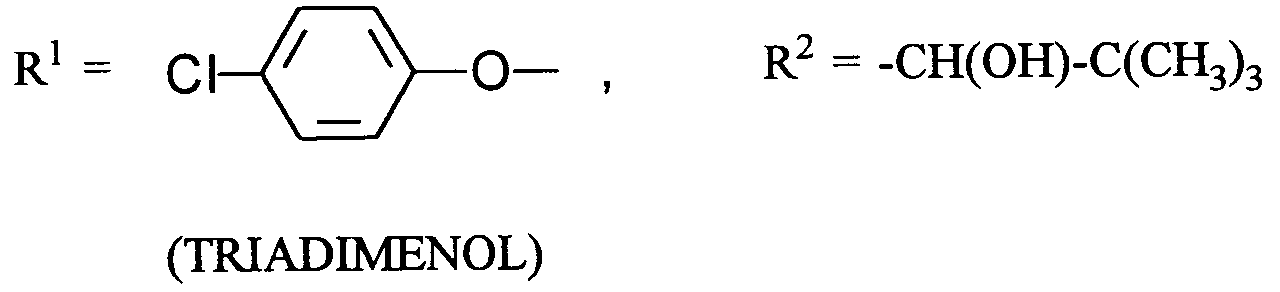
- Die vorliegende Erfindung betrifft neue Wirkstoffkombinationen, die aus den bekannten 2-Cyanobenzimidazolen der Formel
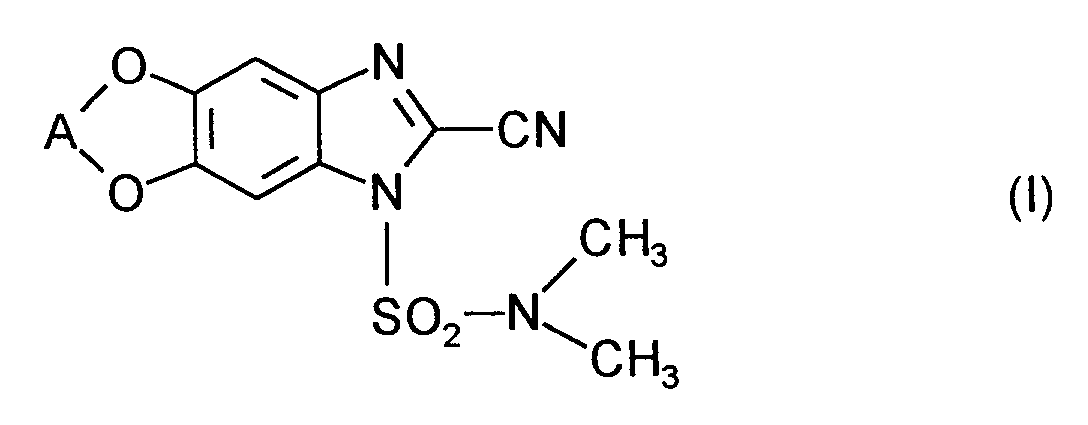
- (I-1) A = -CF₂-
- (I-2) A = -CF₂-CF₂-
- Es ist bereits bekannt, daß die 2-Cyanobenzimidazole der Formel (I) fungizide Eigenschaften besitzen (vgl. EP-OS 0 517 476). Die Wirksamkeit dieser Stoffe ist gut; sie läßt jedoch bei niedrigen Aufwandmengen in manchen Fällen zu wünschen übrig.
- Ferner ist schon bekannt, daß zahlreiche Azol-Derivate, Arylbenzylether, Benzamide, Morpholin-Verbindungen und andere Heterocyclen zur Bekämpfung von Pilzen eingesetzt werden können (vgl. K.H. Büchel "Pflanzenschutz und Schädlingsbekämpfung", Seiten 140 bis 153, Georg Thieme Verlag, Stuttgart 1977, EP-OS 0 040 345, DE-OS 2 324 010, DE-OS 2 201 063, EP-OS 0 112 284, EP-OS 0 304 758 und DD-PS 140 412).
- Ferner sind bekannt fungizide Wirkstoffkombinationen aus den 2-Cyanobenzimidazolen der Formel (I) und anderen bekannten fungiziden Wirkstoffen (vgl. EP-OS 0 517 476).
- Die Wirksamkeit der bekannten fungiziden Wirkstoffe als Einzelverbindungen, ebenso wie die der bekannten synergistischen Wirkstoffkombinationen ist jedoch, insbesondere bei niedrigen Aufwandmengen, nicht immer in allen Anwendungsbereichen völlig zufriedenstellend.
- Es wurde nun gefunden, daß die neuen Wirkstoffkombinationen aus den 2-Cyanobenzimidazolen der Formel
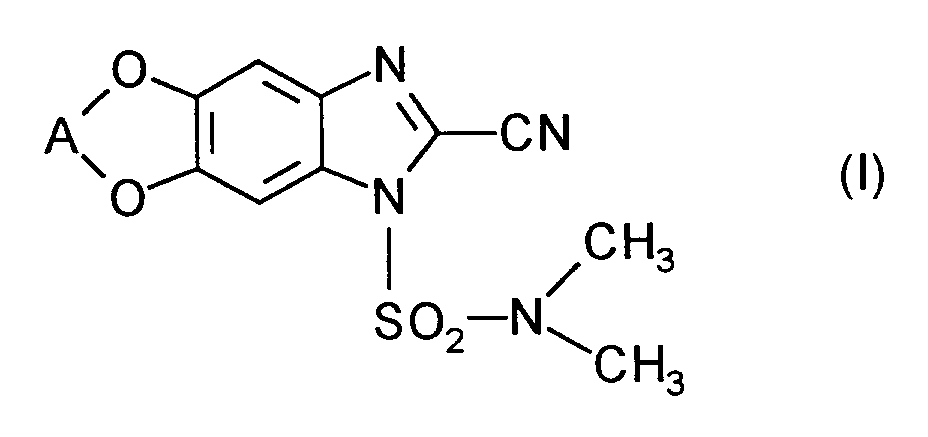
- (I-1) A = -CF₂-
- (I-2) A = -CF₂-CF₂-
- (A) einem Azol-Derivat der Formel

- (II-1)

- (II-2)

- (II-3)

- (II-1)
- (B) einem Azol-Derivat der Formel

- (III-1)


- (III-3)
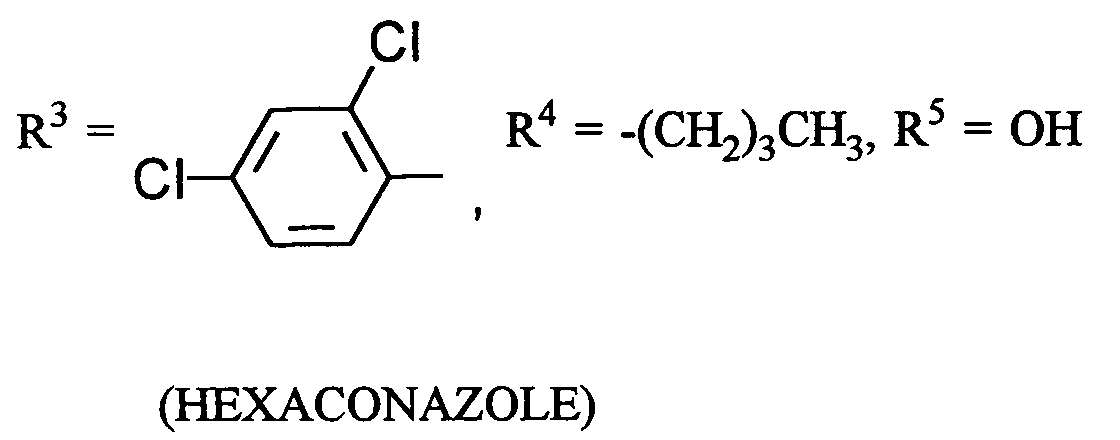
- (III-4)
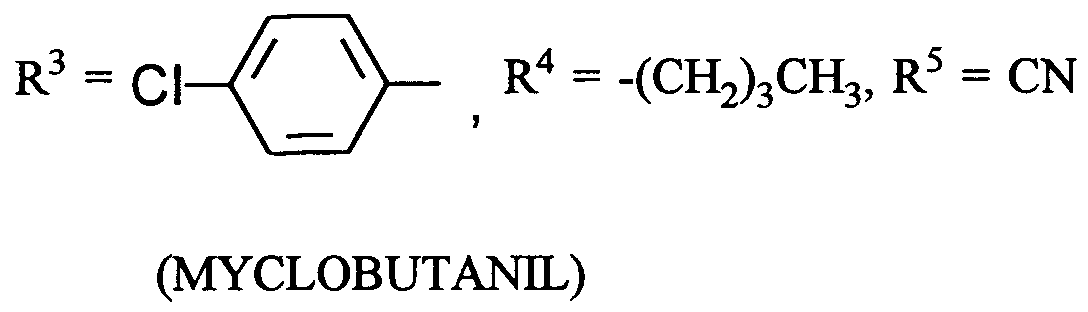
- (III-5)

- (III-1)
- (C) dem Azol-Derivat der Formel

- (D) dem Azol-Derivat der Formel

- (E) der Verbindung der Formel

- (F) einer Verbindung der Formel

- (VII-1)

- (VII-2)

- (VII-3)

- (VII-1)
- (G) der Verbindung der Formel

- (H) der Verbindung der Formel

- (I) der Verbindung der Formel

- (K) einer Verbindung der Formel

- (XI-1) R⁶ = -C≡ C-CH₃
(MEPANIPYRIM) - (XI-2) R⁶ = CH₃
(PYRIMETHANIL) - (XI-3)
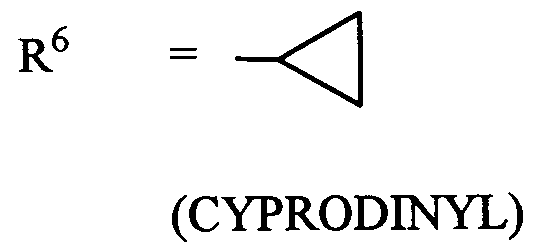
- (XI-1) R⁶ = -C≡ C-CH₃
- (L) der Verbindung der Formel

- (M) der Verbindung der Formel

- (N) der Verbindung der Formel

- Überraschenderweise ist die fungizide Wirkung der erfindungsgemäßen Wirkstoffkombinationen wesentlich höher als die Summe der Wirkungen der einzelnen Wirkstoffe und auch wesentlich höher als die Wirkungen der bekannten Wirkstoffkombinationen. Es liegt also ein nicht vorhersehbarer synergistischer Effekt vor und nicht nur eine Wirkungsergänzung.
- Die 2-Cyanobenzimidazole der Formel (I) und deren Einsatz als Fungizide sind bekannt (vgl. EP-OS 0 517 476).
- Die in den erfindungsgemäßen Wirkstoffkombinationen außerdem vorhandenen fungiziden Komponenten sind ebenfalls bekannt. Im einzelnen werden die Wirkstoffe in folgenden Publikationen beschrieben:
- (A) Verbindungen der Formel (II)
DE-OS 2 201 063
DE-OS 2 324 010
DE-OS 2 737 489 - (B) Verbindungen der Formel (III)
DE-OS 3 018 866
DE-OS 2 551 560
EP 47 594
DE 2 735 872 - (C) Verbindung der Formel (IV)
EP 68 813
US 4 496 551 - (D) Verbindung der Formel (V)
DE-OS 2 429 523
DE-OS 2 856 974
US 4 108 411 - (E), (G) Verbindung der Formel (VI) bzw. (VIII)
K.H. Büchel "Pflanzenschutz und Schädlingsbekämpfung
Georg Thieme Verlag, Stuttgart 1977 - (F) Verbindungen der Formel (VII)
DE 2 207 576
US 3 903 090
US 3 755 350
US 3 823 240 - (H) Verbindung der Formel (IX)
EP 219 756 - (I) Verbindung der Formel (X)
EP 206 999 - (K) Verbindungen der Formel (XI)
EP 270 111
EP 310 550 - (L) Verbindung der Formel (XII)
EP 382 375 - (M) Verbindung der Formel (XIII)
EP 515 901 - (N) Verbindung der Formel (XIV)
EP 472 996 - Wenn die Wirkstoffe in den erfindungsgemäßen Wirkstoffkombinationen in bestimmten Gewichtsverhältnissen vorhanden sind, zeigt sich der synergistische Effekt besonders deutlich. Jedoch können die Gewichtsverhältnisse der Wirkstoffe in den Wirkstoffkombinationen in einem relativ großen Bereich variiert werden. Im allgemeinen entfallen auf 1 Gewichtsteil an Wirkstoff der Formel (I)
0,1 bis 50 Gewichtsteile, vorzugsweise
1 bis 20 Gewichtsteile an Wirkstoff aus der Gruppe (A),
0,1 bis 50 Gewichtsteile, vorzugsweise
1 bis 20 Gewichtsteile an Wirkstoff aus der Gruppe (B),
0,1 bis 50 Gewichtsteile, vorzugsweise
1 bis 20 Gewichtsteile an Wirkstoff aus der Gruppe (C),
0,1 bis 50 Gewichtsteile, vorzugsweise
1 bis 20 Gewichtsteile an Wirkstoff aus der Gruppe (D),
1 bis 200 Gewichtsteile, vorzugsweise
1 bis 50 Gewichtsteile an Wirkstoff aus der Gruppe (E),
0,1 bis 50 Gewichtsteile, vorzugsweise
1 bis 20 Gewichtsteile an Wirkstoff aus der Gruppe (F),
1 bis 200 Gewichtsteile, vorzugsweise
1 bis 50 Gewichtsteile an Wirkstoff aus der Gruppe (G),
0,1 bis 50 Gewichtsteile, vorzugsweise
1 bis 20 Gewichtsteile an Wirkstoff aus der Gruppe (H),
0,1 bis 50 Gewichtsteile, vorzugsweise
1 bis 20 Gewichtsteile an Wirkstoff aus der Gruppe (I),
0,1 bis 50 Gewichtsteile, vorzugsweise
1 bis 20 Gewichtsteile an Wirkstoff aus der Gruppe (K),
0,1 bis 50 Gewichtsteile, vorzugsweise
1 bis 20 Gewichtsteile an Wirkstoff aus der Gruppe (L),
0,1 bis 50 Gewichtsteile, vorzugsweise
1 bis 20 Gewichtsteile an Wirkstoff aus der Gruppe (M).
0,1 bis 50 Gewichtsteile, vorzugsweise
1 bis 20 Gewichtsteile an Wirkstoff der Gruppe (N). - Die erfindungsgemäßen Wirkstoffkombinationen besitzen sehr gute fungizide Eigenschaften. Sie lassen sich vor allem zur Bekämpfung von phytopathogenen
- Pilzen, wie Plasmodiophoromycetes, Oomycetes, Chytridiomycetes, Zygomycetes, Ascomycetes, Basidiomycetes, Deuteromycetes usw. einsetzen.
- Die erfindungsgemäßen Wirkstoffkombinationen eignen sich besonders gut zur Bekämpfung von Getreidekrankheiten, wie Erysiphe, Cochliobolus, Pyrenophora und Leptosphaeria, und gegen Pilzbefall an Gemüse, Wein und Obst, beispielsweise gegen Venturia oder Podosphaera an Äpfeln, Botrytis an Bohnen und Phytophthora an Tomaten.
- Die gute Pflanzenverträglichkeit der Wirkstoffkombinationen in den zur Bekämpfung von Pflanzenkrankheiten notwendigen Konzentrationen erlaubt eine Behandlung von oberirdischen Pflanzenteilen, von Pflanz- und Saatgut, und des Bodens.
- Die erfindungsgemäßen Wirkstoffkombinationen können in die üblichen Formulierungen übergeführt werden, wie Lösungen, Emulsionen, Suspensionen, Pulver, Schäume, Pasten, Granulate, Aerosole, Feinstverkapselungen in polymeren Stoffen und in Hüllmassen für Saatgut, sowie ULV-Formulierungen.
- Diese Formulierungen werden in bekannter Weise hergestellt, z.B. durch Vermischen der Wirkstoffe mit Streckmitteln, also flüssigen Lösungsmitteln, unter Druck stehenden verflüssigten Gasen und/oder festen Trägerstoffen, gegebenenfalls unter Verwendung von oberflächenaktiven Mitteln, also Emulgiermitteln und/oder Dispergiermitteln und/oder schaumerzeugenden Mitteln. Im Falle der Benutzung von Wasser als Streckmittel können z.B. auch organische Lösungsmittel als Hilfslösungsmittel verwendet werden. Als flüssige Lösungsmittel kommen im wesentlichen in Frage: Aromaten, wie Xylol, Toluol oder Alkylnaphthaline, chlorierte Aromaten oder chlorierte aliphatische Kohlenwasserstoffe, wie Chlorbenzole, Chlorethylene oder Methylenchlorid, aliphatische Kohlenwasserstoffe, wie Cyclohexan oder Paraffine, z.B. Erdölfraktionen, Alkohole, wie Butanol oder Glycol sowie deren Ether und Ester, Ketone, wie Aceton, Methylethylketon, Methylisobutylketon oder Cyclohexanon, stark polare Lösungsmittel, wie Dimethylformamid und Dimethylsulfoxid, sowie Wasser. Mit verflüssigten gasförmigen Streckmitteln oder Trägerstoffen sind solche Flüssigkeiten gemeint, welche bei normaler Temperatur und unter Normaldruck gasförmig sind, z.B. Aerosol-Treibgase, wie Halogenkohlenwasserstoffe, sowie Butan, Propan, Stickstoff und Kohlendioxid. Als feste Trägerstoffe kommen in Frage: z.B. natürliche Gesteinsmehle, wie Kaoline, Tonerden, Talkum, Kreide, Quarz, Attapulgit, Montmorillonit oder Diatomeenerde und synthetische Gesteinsmehle, wie hochdisperse Kieselsäure, Aluminiumoxid und Silikate. Als feste Trägerstoffe für Granulate kommen in Frage: z.B. gebrochene und fraktionierte natürliche Gesteine wie Calcit, Marmor, Bims, Sepiolith, Dolomit sowie synthetische Granulate aus anorganischen und organischen Mehlen sowie Granulate aus organischem Material wie Sägemehl, Kokosnußschalen, Maiskolben und Tabakstengel. Als Emulgier- und/oder schaumerzeugende Mittel kommen in Frage: z.B. nichtionogene und anionische Emulgatoren, wie Polyoxyethylen-Fettsäureester, Polyoxyethylen-Fettalkoholether, z.B. Alkylarylpolyglycol-ether, Alkylsulfonate, Alkylsulfate, Arylsulfonate sowie Eiweißhydrolysate. Als Dispergiermittel kommen in Frage: z.B. Lignin-Sulfitablaugen und Methylcellulose.
- Es können in den Formulierungen Haftmittel wie Carboxymethylcellulose, natürliche und synthetische pulverige, körnige oder latexförmige Polymere verwendet werden, wie Gummiarabicum, Polyvinylalkohol, Polyvinylacetat, sowie natürliche Phospholipide, wie Kephaline und Lecithine, und synthetische Phospholipide. Weitere Additive können mineralische und vegetabile Öle sein.
- Es können Farbstoffe wie anorganische Pigmente, z.B. Eisenoxid, Titanoxid, Ferrocyanblau und organische Farbstoffe, wie Alizarin-, Azo- und Metallphthalocyaninfarbstoffe und Spurennährstoffe, wie Salze von Eisen, Mangan, Bor, Kupfer, Kobalt, Molybdän und Zink verwendet werden.
- Die Formulierungen enthalten im allgemeinen zwischen 0,1 und 95 Gewichtsprozent Wirkstoff, vorzugsweise zwischen 0,5 und 90 %.
- Die erfindungsgemäßen Wirkstoffkombinationen können in den Formulierungen in Mischung mit anderen bekannten Wirkstoffen vorliegen, wie Fungizide, Insektizide, Akarizide und Herbizide, sowie in Mischungen mit Düngemitteln oder Pflanzenwachstumsregulatoren.
- Die Wirkstoffkombinationen können als solche, in Form ihrer Formulierungen oder den daraus bereiteten Anwendungsformen, wie gebrauchsfertige Lösungen, emulgierbare Konzentrate, Emulsionen, Suspensionen, Spritzpulver, lösliche Pulver und Granulate, angewendet werden.
- Die Anwendung geschieht in üblicher Weise, z.B. durch Gießen, Verspritzen, Versprühen, Verstreuen, Verstreichen, Trockenbeizen, Feuchtbeizen, Naßbeizen, Schlämmbeizen oder Inkrustieren.
- Bei der Behandlung von Pflanzenteilen können die Wirkstoffkonzentrationen in den Anwendungsformen in einem größeren Bereich variiert werden. Sie liegen im allgemeinen zwischen 1 und 0,0001 Gew.-%, vorzugsweise zwischen 0,5 und 0,001 %.
- Bei der Saatgutbehandlung werden im allgemeinen Wirkstoffmengen von 0,001 bis 50 g je Kilogramm Saatgut, vorzugsweise 0,01 bis 10 g benötigt.
- Bei Behandlung des Bodens sind Wirkstoffkonzentrationen von 0,00001 bis 0,1 Gew.-%, vorzugsweise von 0,0001 bis 0,02 Gew.-%, am Wirkungsort erforderlich.
- Die gute fungizide Wirkung der erfindungsgemäßen Wirkstoffkombinationen geht aus den nachfolgenden Beispielen hervor. Während die einzelnen Wirkstoffe oder die bekannten Wirkstoffkombinationen in der fungiziden Wirkung Schwächen aufweisen, geht aus den Tabellen der folgenden Beispiele eindeutig hervor, daß die gefundene Wirkung der erfindungsgemäßen Wirkstoffkombinationen größer ist als Summe der Wirkungen der einzelnen Wirkstoffe (Synergismus) und auch größer als die Wirkungen der bekannten Wirkstoffkombinationen.
- Ein synergistischer Effekt liegt bei Fungiziden immer dann vor, wenn die fungizide Wirkung der Wirkstoffkombinationen größer ist als die Summe der Wirkungen der einzelnen applizierten Wirkstoffe.
- Die zu erwartende Wirkung für eine gegebene Kombination zweier Wirkstoffe kann (vgl. Colby, S.R., "Calculating Synergistic and Antagonistic Responses of Herbicide Combinations", Weeds 15, Seiten 20-22. 1967) wie folgt berechnet werden:
Wenn - X
- den Wirkungsgrad, ausgedrückt in % der unbehandelten Kontrolle, beim Einsatz des Wirkstoffes A in einer Konzentration von m ppm,
- Y
- den Wirkungsgrad, ausgedrückt in % der unbehandelten Kontrolle, beim Einsatz des Wirkstoffes B in einer Konzentration von n ppm,
- E
- den Wirkungsgrad, ausgedrückt in % der unbehandelten Kontrolle, beim Einsatz der Wirkstoffe A und B in Konzentrationen von m und n ppm bedeutet,
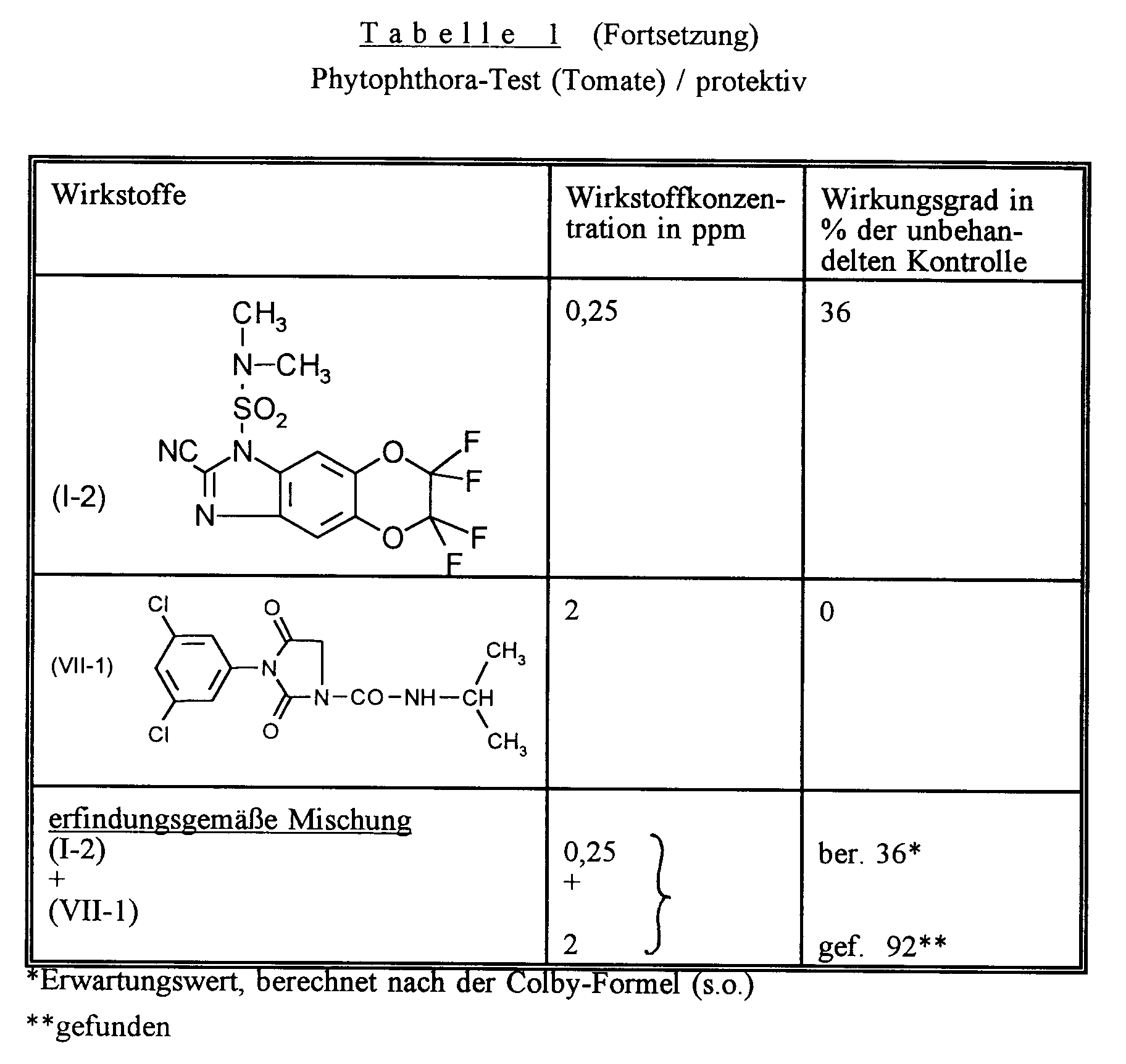
- Zur Herstellung einer zweckmäßigen Wirkstoffzubereitung werden handelsübliche Wirkstoff-Formulierungen (einzelne Wirkstoffe oder Wirkstoffkombinationen) mit Wasser auf die jeweils gewünschte Konzentration verdünnt.
- Zur Prüfung auf protektive Wirksamkeit bespritzt man junge Pflanzen mit der Wirkstoffzubereitung bis zur Tropfnässe. Nach Antrocknen des Spritzbelages werden die Pflanzen mit einer wäßrigen Sporensuspension von Phytophthora infestans inokuliert.
- Die Pflanzen werden in einer Inkubationskabine mit 100 % relativer Luftfeuchtigkeit und ca. 20°C aufgestellt.
- 3 Tage nach der Inokulation erfolgt die Auswertung.
- Wirkstoffe, Wirkstoffkonzentrationen und Versuchsergebnisse gehen aus der folgenden Tabelle hervor.



- Zur Herstellung einer zweckmäßigen Wirkstoffzubereitung werden handelsübliche Wirkstoff-Formulierungen (einzelne Wirkstoffe oder Wirkstoffkombinationen) mit Wasser auf die jeweils gewünschte Konzentration verdünnt.
- Zur Prüfung auf protektive Wirksamkeit bespritzt man junge Pflanzen mit der Wirkstoffzubereitung bis zur Tropfnässe. Nach Antrocknen des Spritzbelages werden auf jedes Blatt 2 Kleine mit Botrytis cinerea bewachsene Agarstückchen aufgelegt. Die inokulierten Pflanzen werden in einer abgedunkelten, feuchten Kammer bei 20°C aufgestellt.
- 3 Tage nach der Inokulation wird die Größe der Befallsflecken auf den Blättern ausgewertet.
- Um Synergismus zwischen den in diesem Versuch verwendeten Wirkstoffen aufzuzeigen, wurden die Resultate nach der von Colby beschriebenen Methode (s.o.) ausgewertet.
- Wirkstoffe, Wirkstoffkonzentrationen und Versuchsergebnisse gehen aus der folgenden Tabelle hervor.


Ist die tatsächliche fungizide Wirkung größer als berechnet, so ist die Kombination in ihrer Wirkung überadditiv, d.h. es liegt ein synergistischer Effekt vor. In diesem Fall muß der tatsächlich beobachtete Wirkungsgrad größer sein als der aus der oben angeführten Formel errechnete Wert für den erwarteten Wirkungsgrad (E).
Claims (5)
- Fungizide Mittel, gekennzeichnet durch einen Gehalt an einer Wirkstoffkombination bestehend aus einer Verbindung der Formel
 (I-1) A = -CF₂-(I-2) A = -CF₂CF₂-und mindestens(A) einem Azol-Derivat der Formel
 (II-1)
 (II-2)
 (II-3)und/oder
 (B) einem Azol-Derivat der Formel
 (III-1)
 (III-2)
 (III-3)
 (III-4)
 (III-5)
 (C) dem Azol-Derivat der Formel
 (D) dem Azol-Derivat der Formel
 (E) der Verbindung der Formel
 (F) einer Verbindung der Formel
 (VII-1)
 (VII-2)
 (VII-3)und/oder
 (G) der Verbindung der Formel
 (H) der Verbindung der Formel
 (I) der Verbindung der Formel
 (K) einer Verbindung der Formel
 (XI-1) R⁶ = -C≡ C-CH₃
(MEPANIPYRIM)(XI-2) R⁶ = CH₃
(PYRIMETHANIL)(XI-3)und/oder (L) der Verbindung der Formel
 (M) der Verbindung der Formel
 (N) der Verbindung der Formel
- Mittel gemäß Anspruch 1, dadurch gekennzeichnet, daß in den Wirkstoffkombinationen auf 1 Gewichtsteil an Wirkstoff der Formel (I)
0,1 bis 50 Gewichtsteile an Wirkstoff aus der Gruppe (A) entfallen,
0,1 bis 50 Gewichtsteile an Wirkstoff aus der Gruppe (B) entfallen,
0,1 bis 50 Gewichtsteile an Wirkstoff aus der Gruppe (C) entfallen,
0,1 bis 50 Gewichtsteile an Wirkstoff aus der Gruppe (D) entfallen,
1 bis 200 Gewichtsteile an Wirkstoff aus der Gruppe (E) entfallen,
0,1 bis 50 Gewichtsteile an Wirkstoff aus der Gruppe (F) entfallen,
1 bis 200 Gewichtsteile an Wirkstoff aus der Gruppe (G) entfallen,
0,1 bis 50 Gewichtsteile an Wirkstoff aus der Gruppe (H) entfallen,
0,1 bis 50 Gewichtsteile an Wirkstoff aus der Gruppe (I) entfallen,
0,1 bis 50 Gewichtsteile an Wirkstoff aus der Gruppe (K) entfallen,
0,1 bis 50 Gewichtsteile an Wirkstoff aus der Gruppe (L) entfallen,
0,1 bis 50 Gewichtsteile an Wirkstoff aus der Gruppe (M) entfallen und
0,1 bis 50 Gewichtsteile an Wirkstoff aus der Gruppe (N) entfallen. - Verfahren zur Bekämpfung von Pilzen, dadurch gekennzeichnet, daß man Wirkstoffkombinationen gemaß Anspruch 1 auf die Pilze und/oder deren Lebensraum einwirken läßt.
- Verwendung von Wirkstoffkombinationen gemäß Anspruch 1 zur Bekämpfung von Pilzen.
- Verfahren zur Herstellung von fungiziden Mitteln, dadurch gekennzeichnet, daß man Wirkstoffkombinationen gemäß Anspruch 1 mit Streckmitteln und/oder oberflächenaktiven Stoffen vermischt.
Applications Claiming Priority (2)
| Application Number | Priority Date | Filing Date | Title |
|---|---|---|---|
| DE4321206 | 1993-06-25 | ||
| DE4321206A DE4321206A1 (de) | 1993-06-25 | 1993-06-25 | Fungizide Wirkstoffkombinationen |
Publications (2)
| Publication Number | Publication Date |
|---|---|
| EP0630570A2 true EP0630570A2 (de) | 1994-12-28 |
| EP0630570A3 EP0630570A3 (de) | 1995-04-05 |
Family
ID=6491253
Family Applications (1)
| Application Number | Title | Priority Date | Filing Date |
|---|---|---|---|
| EP94109021A Withdrawn EP0630570A3 (de) | 1993-06-25 | 1994-06-13 | Fungizide Wirkstoffkombinationen. |
Country Status (9)
| Country | Link |
|---|---|
| US (4) | US5420148A (de) |
| EP (1) | EP0630570A3 (de) |
| JP (1) | JPH07101813A (de) |
| KR (1) | KR100334348B1 (de) |
| CN (2) | CN1074251C (de) |
| BR (1) | BR9402538A (de) |
| DE (1) | DE4321206A1 (de) |
| TW (1) | TW272113B (de) |
| ZA (1) | ZA944543B (de) |
Cited By (6)
| Publication number | Priority date | Publication date | Assignee | Title |
|---|---|---|---|---|
| WO1995029918A1 (de) * | 1994-05-03 | 1995-11-09 | Bayer Aktiengesellschaft | Substituierte (1,4)dioxino(2,3-f)benzimidazolderivate und ihre verwendung zur bekämpfung von schädlingen |
| WO1996032015A1 (de) * | 1995-04-08 | 1996-10-17 | Basf Aktiengesellschaft | Synergistische fungizide zusammensetzungen aus chinolinderivaten und cytochrom b/c-inhibitors |
| EP0741970A4 (de) * | 1993-12-02 | 1998-09-02 | Sumitomo Chemical Co | Bakterizide zusammensetzung |
| WO2002056690A1 (de) * | 2001-01-22 | 2002-07-25 | Basf Aktiengesellschaft | Fungizide mischungen |
| WO2004006676A1 (de) * | 2002-07-17 | 2004-01-22 | Basf Aktiengesellschaft | Fungizide mischungen auf basis von dithianon |
| US9867373B2 (en) | 2013-05-07 | 2018-01-16 | Jiangsu Huifeng Agrochemical Co., Ltd. | Fungicidal composition having synergistic effect |
Families Citing this family (8)
| Publication number | Priority date | Publication date | Assignee | Title |
|---|---|---|---|---|
| FR2715029B1 (fr) * | 1994-01-14 | 1996-03-15 | Rhone Poulenc Agrochimie | Association fongicide à effet synergique à base d'iprodione et d'un composé triazole. |
| CA2193714A1 (en) * | 1995-12-21 | 1997-06-22 | Wilhelm Rademacher | Encapsulated plant growth regulator formulations and applications |
| US5837653A (en) * | 1995-12-21 | 1998-11-17 | Basf Corporation | Encapsulated plant growth regulator formulations |
| JP2000510438A (ja) * | 1995-12-21 | 2000-08-15 | ビー・エイ・エス・エフ、コーポレーション | 塩化メピクァートと組み合わせたアミノエトキシビニルグリシン |
| AU1373797A (en) * | 1995-12-21 | 1997-07-17 | Basf Corporation | Low rate application of inhibitors of ethylene biosynthesis or action |
| ID19230A (id) | 1996-12-20 | 1998-06-28 | Basf Corp | Pengatur pertumbuhan tanaman dalam zat pelarut pirrolidon |
| EP1527683A1 (de) * | 2003-10-31 | 2005-05-04 | Bayer CropScience S.A. | Ein Pyridylmethylbenzamidderivat und ein Sulfamidderivat enthaltende fungizide Zusammensetzung |
| US7586476B2 (en) * | 2005-06-15 | 2009-09-08 | Lg. Display Co., Ltd. | Apparatus and method for driving liquid crystal display device |
Family Cites Families (3)
| Publication number | Priority date | Publication date | Assignee | Title |
|---|---|---|---|---|
| NZ242756A (en) * | 1991-06-03 | 1994-07-26 | Sumitomo Chemical Co | Benzimidazole derivatives having a fused ring which contains 1 or 2 o atoms and at least 1 -cf2- unit; use as fungicides; and precursors |
| DE4130298A1 (de) * | 1991-09-12 | 1993-03-18 | Basf Ag | Fungizide mischungen |
| DE4139950A1 (de) * | 1991-12-04 | 1993-06-09 | Bayer Ag, 5090 Leverkusen, De | 2-cyanobenzimidazole, ein verfahren zu ihrer herstellung und ihre verwendung und neue vorprodukte |
-
1993
- 1993-06-25 DE DE4321206A patent/DE4321206A1/de not_active Withdrawn
-
1994
- 1994-06-03 TW TW083105058A patent/TW272113B/zh active
- 1994-06-13 EP EP94109021A patent/EP0630570A3/de not_active Withdrawn
- 1994-06-20 JP JP6159647A patent/JPH07101813A/ja active Pending
- 1994-06-21 US US08/263,297 patent/US5420148A/en not_active Expired - Fee Related
- 1994-06-22 KR KR1019940014346A patent/KR100334348B1/ko not_active Expired - Fee Related
- 1994-06-24 BR BR9402538A patent/BR9402538A/pt not_active Application Discontinuation
- 1994-06-24 CN CN94107233A patent/CN1074251C/zh not_active Expired - Fee Related
- 1994-06-24 ZA ZA944543A patent/ZA944543B/xx unknown
-
1995
- 1995-03-01 US US08/397,502 patent/US5504100A/en not_active Expired - Fee Related
- 1995-11-02 US US08/552,332 patent/US5585393A/en not_active Expired - Fee Related
-
1996
- 1996-09-03 US US08/711,726 patent/US5668163A/en not_active Expired - Fee Related
-
2001
- 2001-02-28 CN CN01110873A patent/CN1335062A/zh active Pending
Cited By (13)
| Publication number | Priority date | Publication date | Assignee | Title |
|---|---|---|---|---|
| EP0741970A4 (de) * | 1993-12-02 | 1998-09-02 | Sumitomo Chemical Co | Bakterizide zusammensetzung |
| US6838482B2 (en) | 1993-12-02 | 2005-01-04 | Sumitomo Chemical Company, Limited | Fungicidal composition |
| US5792873A (en) * | 1994-05-03 | 1998-08-11 | Bayer Aktiengesellschaft | Substituted (1,4) dioxino (2,3-F) benzoimidazole derivatives and their use in pest control |
| WO1995029918A1 (de) * | 1994-05-03 | 1995-11-09 | Bayer Aktiengesellschaft | Substituierte (1,4)dioxino(2,3-f)benzimidazolderivate und ihre verwendung zur bekämpfung von schädlingen |
| US5648316A (en) * | 1994-05-03 | 1997-07-15 | Bayer Aktiengesellschaft | Substituted (1,4) Dioxino (2,3-F) Benzoimidazole derivative and their use in pest control |
| US5990316A (en) * | 1994-05-03 | 1999-11-23 | Bayer Aktiengesellschaft | Substituted (1,4)dioxino(2,3-F) 6,7-Dichloro-6,7-difluoro-2-trichloromethyl-[1,4]-dioxino-[2,3-f]-benzim idazole and their use in pest control |
| US6090954A (en) * | 1994-05-03 | 2000-07-18 | Bayer Aktiengesellschaft | Benzimidazole derivatives |
| WO1996032015A1 (de) * | 1995-04-08 | 1996-10-17 | Basf Aktiengesellschaft | Synergistische fungizide zusammensetzungen aus chinolinderivaten und cytochrom b/c-inhibitors |
| WO2002056690A1 (de) * | 2001-01-22 | 2002-07-25 | Basf Aktiengesellschaft | Fungizide mischungen |
| US7449195B2 (en) | 2001-01-22 | 2008-11-11 | Basf Aktiengesellschaft | Fungicide mixtures |
| WO2004006676A1 (de) * | 2002-07-17 | 2004-01-22 | Basf Aktiengesellschaft | Fungizide mischungen auf basis von dithianon |
| AU2003249899B2 (en) * | 2002-07-17 | 2008-08-21 | Basf Aktiengesellschaft | Fungicidal mixtures based on dithianon |
| US9867373B2 (en) | 2013-05-07 | 2018-01-16 | Jiangsu Huifeng Agrochemical Co., Ltd. | Fungicidal composition having synergistic effect |
Also Published As
| Publication number | Publication date |
|---|---|
| BR9402538A (pt) | 1995-03-14 |
| TW272113B (de) | 1996-03-11 |
| KR950000026A (ko) | 1995-01-03 |
| US5504100A (en) | 1996-04-02 |
| DE4321206A1 (de) | 1995-01-05 |
| US5420148A (en) | 1995-05-30 |
| CN1335062A (zh) | 2002-02-13 |
| EP0630570A3 (de) | 1995-04-05 |
| US5668163A (en) | 1997-09-16 |
| KR100334348B1 (ko) | 2004-12-17 |
| JPH07101813A (ja) | 1995-04-18 |
| ZA944543B (en) | 1995-02-17 |
| US5585393A (en) | 1996-12-17 |
| CN1099221A (zh) | 1995-03-01 |
| CN1074251C (zh) | 2001-11-07 |
Similar Documents
| Publication | Publication Date | Title |
|---|---|---|
| EP0626135B1 (de) | Fungizide Wirkstoffkombinationen | |
| EP0627163B1 (de) | Fungizide Wirkstoffkombinationen | |
| EP0944318B1 (de) | Fungizide wirkstoffkombinationen | |
| EP1517609B1 (de) | Fungizide wirkstoffkombinationen | |
| EP0707792B1 (de) | Fungizide Wirkstoffkombinationen | |
| DE10228102A1 (de) | Fungizide Wirkstoffkombinationen | |
| EP0316970A2 (de) | Fungizide Mittel | |
| DE4304172A1 (de) | Fungizide Wirkstoffkombinationen | |
| DE10333373A1 (de) | Fungizide Wirkstoffkombinationen | |
| EP0135855B1 (de) | Fungizide Mittel | |
| DE4321206A1 (de) | Fungizide Wirkstoffkombinationen | |
| EP1677600B1 (de) | Fungizide wirkstoffkombinationen enthaltend spiroxamine, prothioconazole und tebuconazole | |
| DE3736651C2 (de) | Fungizide Wirkstoffkombinationen | |
| EP0423566B1 (de) | Fungizide Wirkstoffkombinationen | |
| EP0275013B1 (de) | Fungizide Wirkstoffkombinationen | |
| EP0276666A2 (de) | Fungizide Wirkstoffkombinationen | |
| EP0588165A1 (de) | Fungizide Wirkstoffkombinationen | |
| EP0275012B1 (de) | Fungizide Wirkstoffkombinationen | |
| DE3700924C2 (de) | Verwendung von Wirkstoffkombinationen zur Bekämpfung von Botrytis- Monilia- und Sclerotinia-Arten | |
| EP1247452A2 (de) | Fungizide Wirkstoffkombinationen | |
| EP0316024B1 (de) | Fungizide Mittel | |
| DE3715705A1 (de) | Fungizide wirkstoffkombinationen | |
| DE10352264A1 (de) | Fungizide Wirkstoffkombination | |
| DE3700921A1 (de) | Verwendung von wirkstoffkombinationen zur bekaempfung von phytopathogenen pilzen |
Legal Events
| Date | Code | Title | Description |
|---|---|---|---|
| PUAI | Public reference made under article 153(3) epc to a published international application that has entered the european phase |
Free format text: ORIGINAL CODE: 0009012 |
|
| AK | Designated contracting states |
Kind code of ref document: A2 Designated state(s): BE CH DE ES FR GB GR IE IT LI NL PT |
|
| PUAL | Search report despatched |
Free format text: ORIGINAL CODE: 0009013 |
|
| AK | Designated contracting states |
Kind code of ref document: A3 Designated state(s): BE CH DE ES FR GB GR IE IT LI NL PT |
|
| 17P | Request for examination filed |
Effective date: 19950829 |
|
| 17Q | First examination report despatched |
Effective date: 19951107 |
|
| STAA | Information on the status of an ep patent application or granted ep patent |
Free format text: STATUS: THE APPLICATION IS DEEMED TO BE WITHDRAWN |
|
| 18D | Application deemed to be withdrawn |
Effective date: 19971021 |