EP0629437B1 - Organic amine impregnated activated carbon - Google Patents
Organic amine impregnated activated carbon Download PDFInfo
- Publication number
- EP0629437B1 EP0629437B1 EP94108843A EP94108843A EP0629437B1 EP 0629437 B1 EP0629437 B1 EP 0629437B1 EP 94108843 A EP94108843 A EP 94108843A EP 94108843 A EP94108843 A EP 94108843A EP 0629437 B1 EP0629437 B1 EP 0629437B1
- Authority
- EP
- European Patent Office
- Prior art keywords
- carbon
- amine
- weight
- activated carbon
- group
- Prior art date
- Legal status (The legal status is an assumption and is not a legal conclusion. Google has not performed a legal analysis and makes no representation as to the accuracy of the status listed.)
- Expired - Lifetime
Links
Images


Classifications
-
- B—PERFORMING OPERATIONS; TRANSPORTING
- B01—PHYSICAL OR CHEMICAL PROCESSES OR APPARATUS IN GENERAL
- B01J—CHEMICAL OR PHYSICAL PROCESSES, e.g. CATALYSIS OR COLLOID CHEMISTRY; THEIR RELEVANT APPARATUS
- B01J20/00—Solid sorbent compositions or filter aid compositions; Sorbents for chromatography; Processes for preparing, regenerating or reactivating thereof
- B01J20/02—Solid sorbent compositions or filter aid compositions; Sorbents for chromatography; Processes for preparing, regenerating or reactivating thereof comprising inorganic material
- B01J20/20—Solid sorbent compositions or filter aid compositions; Sorbents for chromatography; Processes for preparing, regenerating or reactivating thereof comprising inorganic material comprising free carbon; comprising carbon obtained by carbonising processes
-
- B—PERFORMING OPERATIONS; TRANSPORTING
- B01—PHYSICAL OR CHEMICAL PROCESSES OR APPARATUS IN GENERAL
- B01D—SEPARATION
- B01D53/00—Separation of gases or vapours; Recovering vapours of volatile solvents from gases; Chemical or biological purification of waste gases, e.g. engine exhaust gases, smoke, fumes, flue gases, aerosols
- B01D53/02—Separation of gases or vapours; Recovering vapours of volatile solvents from gases; Chemical or biological purification of waste gases, e.g. engine exhaust gases, smoke, fumes, flue gases, aerosols by adsorption, e.g. preparative gas chromatography
-
- B—PERFORMING OPERATIONS; TRANSPORTING
- B01—PHYSICAL OR CHEMICAL PROCESSES OR APPARATUS IN GENERAL
- B01D—SEPARATION
- B01D53/00—Separation of gases or vapours; Recovering vapours of volatile solvents from gases; Chemical or biological purification of waste gases, e.g. engine exhaust gases, smoke, fumes, flue gases, aerosols
- B01D53/34—Chemical or biological purification of waste gases
- B01D53/46—Removing components of defined structure
- B01D53/68—Halogens or halogen compounds
-
- B—PERFORMING OPERATIONS; TRANSPORTING
- B01—PHYSICAL OR CHEMICAL PROCESSES OR APPARATUS IN GENERAL
- B01D—SEPARATION
- B01D2253/00—Adsorbents used in seperation treatment of gases and vapours
- B01D2253/10—Inorganic adsorbents
- B01D2253/102—Carbon
-
- B—PERFORMING OPERATIONS; TRANSPORTING
- B01—PHYSICAL OR CHEMICAL PROCESSES OR APPARATUS IN GENERAL
- B01D—SEPARATION
- B01D2253/00—Adsorbents used in seperation treatment of gases and vapours
- B01D2253/25—Coated, impregnated or composite adsorbents
-
- B—PERFORMING OPERATIONS; TRANSPORTING
- B01—PHYSICAL OR CHEMICAL PROCESSES OR APPARATUS IN GENERAL
- B01D—SEPARATION
- B01D2257/00—Components to be removed
- B01D2257/20—Halogens or halogen compounds
- B01D2257/206—Organic halogen compounds
- B01D2257/2066—Fluorine
-
- B—PERFORMING OPERATIONS; TRANSPORTING
- B01—PHYSICAL OR CHEMICAL PROCESSES OR APPARATUS IN GENERAL
- B01D—SEPARATION
- B01D2259/00—Type of treatment
- B01D2259/45—Gas separation or purification devices adapted for specific applications
- B01D2259/4541—Gas separation or purification devices adapted for specific applications for portable use, e.g. gas masks
-
- Y—GENERAL TAGGING OF NEW TECHNOLOGICAL DEVELOPMENTS; GENERAL TAGGING OF CROSS-SECTIONAL TECHNOLOGIES SPANNING OVER SEVERAL SECTIONS OF THE IPC; TECHNICAL SUBJECTS COVERED BY FORMER USPC CROSS-REFERENCE ART COLLECTIONS [XRACs] AND DIGESTS
- Y02—TECHNOLOGIES OR APPLICATIONS FOR MITIGATION OR ADAPTATION AGAINST CLIMATE CHANGE
- Y02C—CAPTURE, STORAGE, SEQUESTRATION OR DISPOSAL OF GREENHOUSE GASES [GHG]
- Y02C20/00—Capture or disposal of greenhouse gases
- Y02C20/30—Capture or disposal of greenhouse gases of perfluorocarbons [PFC], hydrofluorocarbons [HFC] or sulfur hexafluoride [SF6]
Definitions
- This invention relates to a breathing gas filter composition
- a breathing gas filter composition comprising activated carbon impregnated with an organic amine compound to improve the performance of the activated carbon against toxic perfluorocarbons, particularly trifluoronitrosomethane (TFNM), and to processes for impregnating activated carbon with organic amine compounds.
- TFNM trifluoronitrosomethane
- Activated carbon has been used in breathing gas filter canisters of gas masks for the removal of toxic gases both commercially and in military applications.
- activated carbons which typically contain certain metals (copper, chromium, and silver) usually in the form of an oxide crystallite.
- these adsorbents are known in the trade as ASC Whetlerite carbon or ASC/TEDA if the carbon also contains triethylenediamine, TEDA.
- the function of these metals or metal compounds is primarily to break down HCN or CNCl by chemical reaction(s) into innocuous gaseous products and/or products which are readily physisorbed or chemisorbed onto the activated carbon.
- Trifluoronitrosomethane is a perfluorocarbon which is blue in colour and has a boiling point of -84°C. Under sunlight (UV irradiation), this gas dimerizes, and loses its intense blue hue to become faintly yellow.
- TFNM is sufficiently toxic to be a high hazard, even to subjects protected by standard carbon adsorbent filters.
- the amine-impregnated activated carbon described herein was found to be particularly effective in chemisorption of this type of compound.
- the invention resides in a breathing gas filter composition providing protection against toxic perfluorocarbons, comprising substantially dry activated carbon and an organic amine impregnant in an amount of 1.5 to 18% by weight, based on the weight of the carbon, characterised in that the composition additionally comprises 0.1 to 10% by weight, based on the weight of the carbon, of an alkaline hydroxide.
- the invention resides in a process for impregnating activated carbon by placing a low vapour pressure organic amine in contact with substantially dry activated carbon, characterised by the steps of subjecting the carbon and amine to positive pressure of 1-5 Pa in an oxygen-free inert gas atmosphere and then heating the carbon and amine for an extended period while maintaining the positive pressure of 1-5 Pa in an oxyen-free inert gas atmosphere, and pre-treating the activated carbon with a compound selected from the group consisting of an alkaline hydroxide in an amount of 0.1 to 10% by weight, based on the weight of the carbon, a suitable halogen and a suitable halide salt.
- the aforesaid heating step may typically be effected at 40° to 60°C, for a period of 1 to 72 hours, depending on the amine impregnant, and the oxygen-free inert gas may be nitrogen, helium, argon etc.
- the invention resides in a process for impregnating activated carbon with a solid amine compound, comprising dissolving the amine in a solvent selected from water and organic solvents and adding the amine solution to the activated carbon characterised by the step of pre-treating the activated carbon with a compound selected from the group consisting of an alkaline hydroxide in an amount of 0.1 to 10% by weight, based on the weight of carbon, a suitable halogen and a suitable halide salt.
- the amines have a tendency to break down (dissociate) due to the presence of acidic surface sites.
- the activated carbon is pretreated to prevent the degradation of the amine compounds on the carbon surface.
- the pre-treatment procedure can include neutralization to a substantially neutral pH (by an alkaline solution such as KOH or NaOH), or alkalinization to a basic pH in the same manner, or reaction of the acid sites (typically these are oxygen-containing moities) by halogenation (such as by Cl 2 and Br 2 ).
- the use of the process according to the second aspect of the invention facilitates the vaporization of the amine, the penetration of the amine molecules into the micropores on the activated carbon surface, and subsequently the adsorption of the amine molecules onto the activated carbon surface.
- the inert environment will impede the oxidation of the amine impregnants on the carbon surface as discussed by Hershman et al, in the US patent No. 4,264,776 issued on April 28, 1981.
- the lengthy heating step preferably conducted with continuous mixing in a closed container, allows a "surface distillation" of the amine (by adsorption-desorption processes), thus promoting an even distribution of amine molecules on the activated carbon surface.
- substantially dry activated carbon was deemed necessary after testing the impregnation method using two types of activated carbon.
- the first type was freshly prepared impregnated ASC Whetherlite activated carbon. Since ASC activated carbon must be dried after whetlerization, the drying procedure can be incorporated into the impregnation procedure.
- the other type of activated carbon was aged activated carbon at various levels of moisture content. For impregnation of amine in the presence of moisture/humid air, the amine molecules have to displace adsorbed water from the activated carbon in order to penetrate into the large surface area available in the meso and micropores.
- the adsorbtion of amine will be limited by how quickly adsorbed water can be displaced which is a kinetic problem. It is also possible that reactions may occur with some of the amines disclosed, if water is present. Therefore, the activated carbon should be dried before the introduction of the amine.
- the impregnation step involves the following series of processes:
- an equilibration period is provided to allow the amine adsorbtion process to reach equilibrium. Performing the process at a slightly elevated temperatures of 40°C to 60°C permits repeated desorption and redeposition of the amine to occur. Thus, a more uniform distribution of amine molecules on the activated carbon surface is achieved.
- the competition for adsorption sites on the carbon surface between the amine and inert gas will be minimal, because inert gas does not adsorb on carbon surface to any appreciable extent. This environment will also enhance the adsorption of amine molecules onto the carbon surface. Furthermore, avoidance of an oxidizing environment inhibits reactions such as the decomposition of tertiary amines in the presence of oxygen and carbon.
- ASC whetlerites i.e. carbons previously impregnated with copper, chromium and silver
- ASC/T ASC Whetlerite, including 2% triethylenediamine
- BPL base carbon with no chemical impregnants
- This reaction can be carried out in either gaseous or aqueous phase.
- carbon is stirred in an aqueous Br 2 or Cl 2 solution for several hours (typically 4 to 16 hours). The solution is then removed by suction filtration and the carbon washed with copious amounts of water. The carbon is then dried at 105 to 150°C at reduced pressure (typically ⁇ 100Pa). Subsequent to this step, the carbon can be further activated at between 200 to 400°C for up to 4 hours under reduced pressure (typically ⁇ 100 Pa).
- a solution containing activated carbon is neutralized to an alkaline pH with an alkaline solution containing an alkaline hydroxide, such as NaOH or KOH.
- the carbon including 0.1 to 10% w/w of the alkaline hydroxide, is then washed until a substantially neutral pH is obtained, dried and activated as in the halogenation procedure.
- the first method utilizes the inherent (although quite low) vapour pressure of the amines (solid or liquid) to drive the adsorption process. This method works extremely well with all liquid amines and some solid amines e.g. triethylenediamine and hexamethylene-tetramine.
- a second method was designed for solid amides such as ortho- and para-toluenesulfonamide which do not have sufficient vapour pressure for the first method to work.
- a 250 mL solution containing the desired loading levels (usually 1.5 to 18% by weight) of amide dissolved in 95% ethanol is first obtained.
- the solution is then added to 250 g ASC charcoal.
- the ethanol is removed under reduced pressure from the "wet" carbon. This typically lasts 1/2 to 3/4 hour.
- the carbon is sufficiently dry and quite free-flowing.
- the carbon is then spread out uniformly (ca. 0.5 cm high) on two watch glasses and placed inside a vacuum oven. The carbon is dried at less than 100 Pa, 50-60°C for up to 16 hours. Mass balance calculations show that essentially all the ethanol is removed following this treatment, and that all the amide impregnants remain behind, inside the pore structure of the carbon.
- a third method utilizes the solubility in water of the desired impregnants such as urea.
- the preparation of the solution is very similar to that proposed by Joshua C. Whetzell and E.W. Fuller, who gave rise to the term 'Whetlerite'.
- An ammoniacal solution containing about 7% copper, 2% chromium and the desired amide impregnant is prepared.
- BPL carbon is typically used as a base material in the preparation of these amide-impregnated carbons.
- the first step of a preparation consists of making an ammonia solution by adding 250 mL of NH 4 OH to 400 mL of deionized distilled water.
- the resulting impregnated carbon typically will have the following composition (w/w): 3% Cr, 10% Cu, 3% urea, and certain amounts of CO 2 and NH 3 .
- This impregnating procedure was an attempt to make the process more cost effective since all the impregnants can be added onto the carbon in one step.
- one drawback of this process is that the drying step in the impregnation has to be carried out at lower temperatures (about 120-150°C) to avoid self-ignition of the carbon. This may result in carbon which has moisture content higher than 2%.
- the amine-impregnated carbons prepared above were evaluated on its protection against toxic perfluoro-carbons, such as trifluoronitrosomethane.
- the impregnated carbons were loaded inside a container with an inside diameter of 10.5 cm, and to a bed height of 1.25 or 2 cm.
- a continuous flow of the test perfluorocarbon gas at 1000 mg/m 3 diluted inside an air stream at a flow rate of 30 L/min, 30°C and 80% RH was introduced into the carbon bed, and the effluent from the carbon bed was monitored for this perfluorocarbon gas, by a calibrated gas chromatography instrument.
- the breakthrough time is set at the time when the effluent perfluorocarbon gas concentration reaches 100 mg/m 3 , 1/10 of the original influent concentration.
- Some selected amine-impregnated carbons were also tested and proven effective against other perfluoro-carbons such as perfluoroisobutene and hexafluoro-cyclobutene.
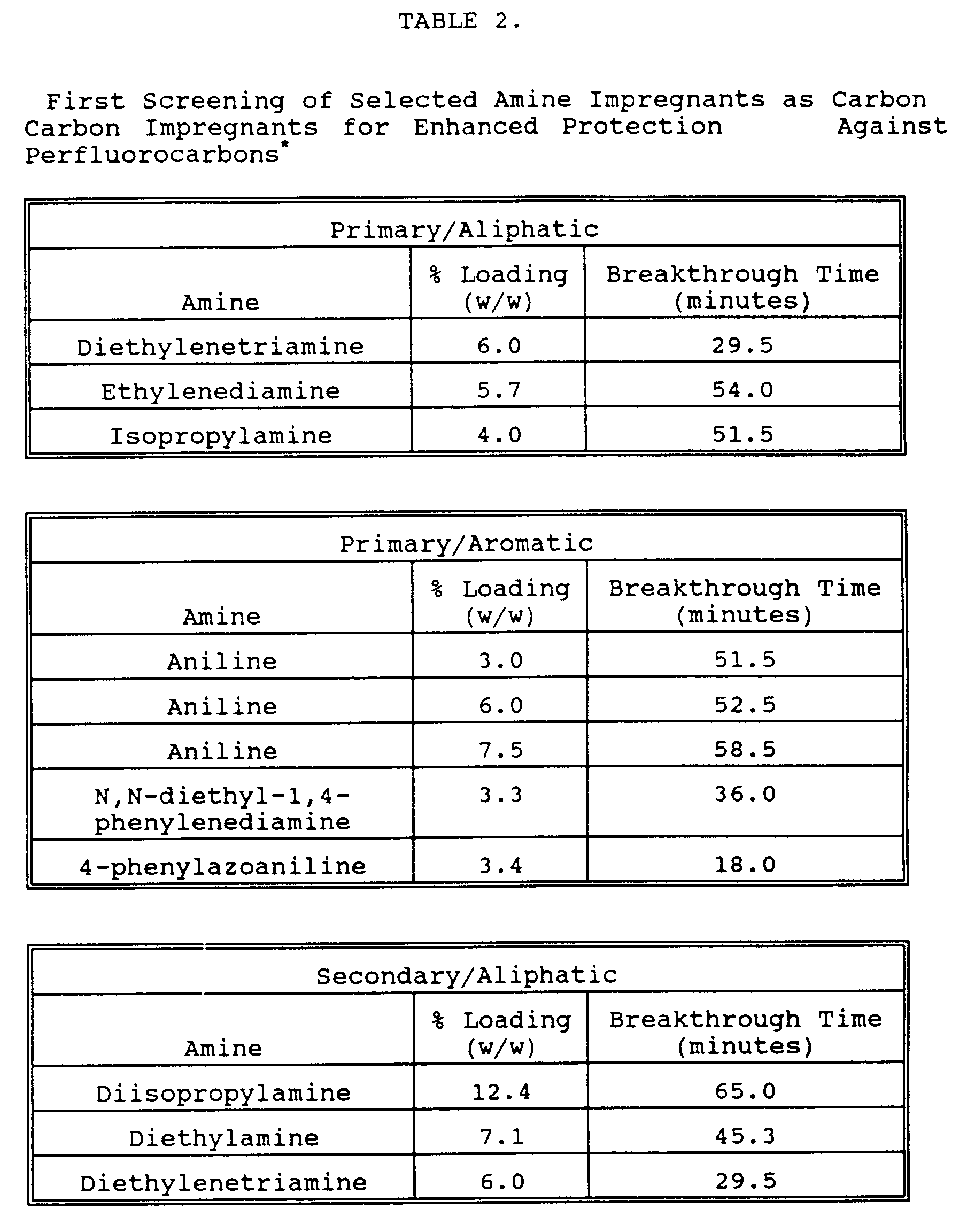
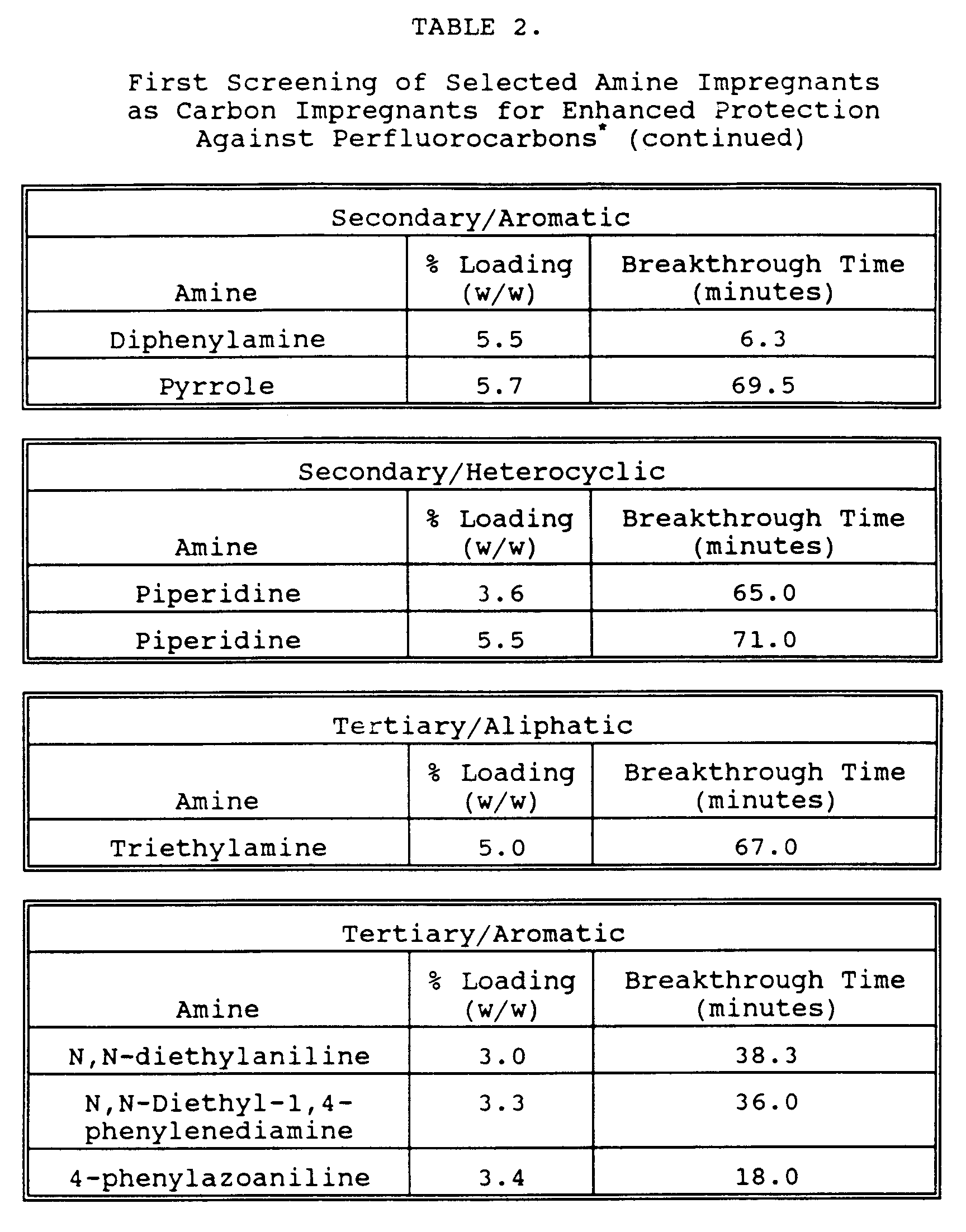
- the amine impregnated carbons were evaluated as follows: beds of 125 or 170 mL impregnated carbon were loaded into a 10.5 cm diameter container, and tested against trifluoronitrosomethane at 1000 mg/m 3 at an airflow of 30 L/min at 25°C and 80% RH. The breakthrough time results are collected in Table 2 below. The effluent from the canister was monitored for TFNM until a concentration of 100 mg/m 3 was reached, and the time to reach this concentration from time zero was arbirtrarily designated as the 'breakthrough time'. A typical challenge profile of TFNM through several of these amine-impregnated carbons is shown in Figure 1.
- TFNM at 1000 mg/m 3 on an activated carbon (125 mL, 10.5 cm diameter bed) impregnated with 7% (by weight) of triethylamine, that had been preconditioned at 80% RH until constant weight was achieved.
- Second Screening Protection Afforded by Selected Amine-Impregnated Dry Carbons against TFNM Amine % Loading Density (g/mL) Breakthrough Time (minutes) Dipropylamine 4.0 0.62 71.5 5.5 0.63 75.0 7.2 0.65 85.0 7.3 0.66 87.0 12.0 0.68 83.0 Diisopropylamine 3.2 0.61 75.3 5.1 0.62 79.1 7.0 0.64 81.0 9.9 0.67 78.4 Pyrrole 5.2 0.63 69.4 6.8 0.64 74.0 Piperidine 3.3 0.61 65.0 5.0 0.62 69.0 6.9 0.64 72.0 9.7 0.66 76.0 Triethylamine 3.5 0.61 39.7 5.0 0.62 71.0 6.8 0.63 75.0 7.1 0.63 78.2 8.1 0.64 81.5 9.1 0.64 89.0 15.0 0.70 87.2 Triisobutylamine 7.1 0.66 68.5 Trioctylamine 4.9 0.63 51.5 7.2 0.65
Landscapes
- Chemical & Material Sciences (AREA)
- Engineering & Computer Science (AREA)
- Chemical Kinetics & Catalysis (AREA)
- Analytical Chemistry (AREA)
- General Chemical & Material Sciences (AREA)
- Oil, Petroleum & Natural Gas (AREA)
- Environmental & Geological Engineering (AREA)
- Health & Medical Sciences (AREA)
- Biomedical Technology (AREA)
- Inorganic Chemistry (AREA)
- Organic Chemistry (AREA)
- Solid-Sorbent Or Filter-Aiding Compositions (AREA)
- Carbon And Carbon Compounds (AREA)
- Separation Of Gases By Adsorption (AREA)
- Treating Waste Gases (AREA)
Description
- This invention relates to a breathing gas filter composition comprising activated carbon impregnated with an organic amine compound to improve the performance of the activated carbon against toxic perfluorocarbons, particularly trifluoronitrosomethane (TFNM), and to processes for impregnating activated carbon with organic amine compounds.
- Activated carbon has been used in breathing gas filter canisters of gas masks for the removal of toxic gases both commercially and in military applications. For the removal of specific poisonous gases such as hydrogen cyanide (HCN) and cyanogen chloride (CNCl), activated carbons are used which typically contain certain metals (copper, chromium, and silver) usually in the form of an oxide crystallite. Typically, these adsorbents are known in the trade as ASC Whetlerite carbon or ASC/TEDA if the carbon also contains triethylenediamine, TEDA. The function of these metals or metal compounds is primarily to break down HCN or CNCl by chemical reaction(s) into innocuous gaseous products and/or products which are readily physisorbed or chemisorbed onto the activated carbon.
- Trifluoronitrosomethane (TFNM), is a perfluorocarbon which is blue in colour and has a boiling point of -84°C. Under sunlight (UV irradiation), this gas dimerizes, and loses its intense blue hue to become faintly yellow. TFNM is sufficiently toxic to be a high hazard, even to subjects protected by standard carbon adsorbent filters. The amine-impregnated activated carbon described herein was found to be particularly effective in chemisorption of this type of compound.
- From a methodology viewpoint, there are several ways to apply an organic amine to the surface of activated carbon. One proposal for applying TEDA to the surface of activated carbon is found in US patent No. 4,531,953, which was issued to J.E. Groose et al on July 30, 1985. The Groose patent proposes the direct sublimation of TEDA onto the activated carbon surface at atmospheric pressure. Such a process eliminates the subsequent drying procedure because no solvent is involved. Another method for applying TEDA onto the surface of activated carbon under reduced pressure has been detailed in US patent No. 5,145,820, which was issued to S.H. Liang et al on September 8, 1992.
- It is an aim of the invention to provide an organic amine impregnated activated carbon, by which toxic perfluorocarbons, particularly TFNM, can be effectively removed from the breathing air stream, and having an enhanced shelf and service life.
- In one aspect the invention resides in a breathing gas filter composition providing protection against toxic perfluorocarbons, comprising substantially dry activated carbon and an organic amine impregnant in an amount of 1.5 to 18% by weight, based on the weight of the carbon, characterised in that the composition additionally comprises 0.1 to 10% by weight, based on the weight of the carbon, of an alkaline hydroxide.
- In a second aspect the invention resides in a process for impregnating activated carbon by placing a low vapour pressure organic amine in contact with substantially dry activated carbon, characterised by the steps of subjecting the carbon and amine to positive pressure of 1-5 Pa in an oxygen-free inert gas atmosphere and then heating the carbon and amine for an extended period while maintaining the positive pressure of 1-5 Pa in an oxyen-free inert gas atmosphere, and pre-treating the activated carbon with a compound selected from the group consisting of an alkaline hydroxide in an amount of 0.1 to 10% by weight, based on the weight of the carbon, a suitable halogen and a suitable halide salt. The aforesaid heating step may typically be effected at 40° to 60°C, for a period of 1 to 72 hours, depending on the amine impregnant, and the oxygen-free inert gas may be nitrogen, helium, argon etc.
- In a further aspect the invention resides in a process for impregnating activated carbon with a solid amine compound, comprising dissolving the amine in a solvent selected from water and organic solvents and adding the amine solution to the activated carbon characterised by the step of pre-treating the activated carbon with a compound selected from the group consisting of an alkaline hydroxide in an amount of 0.1 to 10% by weight, based on the weight of carbon, a suitable halogen and a suitable halide salt.
- In some known amine impregnated activated carbons, the amines have a tendency to break down (dissociate) due to the presence of acidic surface sites. In the present invention the activated carbon is pretreated to prevent the degradation of the amine compounds on the carbon surface. The pre-treatment procedure can include neutralization to a substantially neutral pH (by an alkaline solution such as KOH or NaOH), or alkalinization to a basic pH in the same manner, or reaction of the acid sites (typically these are oxygen-containing moities) by halogenation (such as by Cl2 and Br2). These treatments effectively de-activate the surface acidic groups on the carbon, thus enhancing the stability of the adsorbed amines on the carbon surface. A US patent No. 4,072,479 issued to Sinha et al on February 7, 1978 has detailed the use of NaOH in the treatment of activated carbon for the removal of malodorous compounds, particularly sulfur-containing compounds from air stream. However, in the present invention the treatment with NaOH is not paramount nor necessary in the protection against perfluorocarbons. Our pretreatment of carbon with NaOH or KOH is used solely to enhance the shelf and service life of the amine-impregnated carbon, particularly in the presence of humid air.
- The use of the process according to the second aspect of the invention facilitates the vaporization of the amine, the penetration of the amine molecules into the micropores on the activated carbon surface, and subsequently the adsorption of the amine molecules onto the activated carbon surface. Furthermore, the inert environment will impede the oxidation of the amine impregnants on the carbon surface as discussed by Hershman et al, in the US patent No. 4,264,776 issued on April 28, 1981. The lengthy heating step, preferably conducted with continuous mixing in a closed container, allows a "surface distillation" of the amine (by adsorption-desorption processes), thus promoting an even distribution of amine molecules on the activated carbon surface.
- The use of substantially dry activated carbon was deemed necessary after testing the impregnation method using two types of activated carbon. The first type was freshly prepared impregnated ASC Whetherlite activated carbon. Since ASC activated carbon must be dried after whetlerization, the drying procedure can be incorporated into the impregnation procedure. The other type of activated carbon was aged activated carbon at various levels of moisture content. For impregnation of amine in the presence of moisture/humid air, the amine molecules have to displace adsorbed water from the activated carbon in order to penetrate into the large surface area available in the meso and micropores. If the micropores on the activated carbon surface are completely or partially filled with water, the adsorbtion of amine will be limited by how quickly adsorbed water can be displaced which is a kinetic problem. It is also possible that reactions may occur with some of the amines disclosed, if water is present. Therefore, the activated carbon should be dried before the introduction of the amine.
- The impregnation step involves the following series of processes:
- (i) sublimation or vaporization of amine;
- (ii) external diffusion of amine molecules to the activated carbon surface;
- (iii) internal diffusion of amine molecules inside the activated carbon pores; and
- (iv) adsorption of amine molecules.
-
- After impregnating the activated carbon with amine, an equilibration period is provided to allow the amine adsorbtion process to reach equilibrium. Performing the process at a slightly elevated temperatures of 40°C to 60°C permits repeated desorption and redeposition of the amine to occur. Thus, a more uniform distribution of amine molecules on the activated carbon surface is achieved. In an oxygen-free inert gas environment, the competition for adsorption sites on the carbon surface between the amine and inert gas will be minimal, because inert gas does not adsorb on carbon surface to any appreciable extent. This environment will also enhance the adsorption of amine molecules onto the carbon surface. Furthermore, avoidance of an oxidizing environment inhibits reactions such as the decomposition of tertiary amines in the presence of oxygen and carbon.
-
- Figure 1 is a graph of the breakthrough profile of TFNM on several fresh (i.e. dry) amine-impregnated activated carbons.
- Figure 2 is a graph of the breakthrough profile of perfluoroisobutene at 1000 mg/m3 on an activated carbon impregnated with triethylamine.
- Figure 3 is a graph of the breakthrough profile of hexafluorocyclobutene at 1000 mg/m3 on an activated carbon impregnated with triethylamine.
-
- All amines were purchased from commercial sources and were used without further purification. A wide range of activated carbons have been shown to be suitable for impregnation. Examples given here are ASC whetlerites (i.e. carbons previously impregnated with copper, chromium and silver), ASC/T (ASC Whetlerite, including 2% triethylenediamine), or a BPL (base carbon with no chemical impregnants).
- This reaction can be carried out in either gaseous or aqueous phase. Typically, carbon is stirred in an aqueous Br2 or Cl2 solution for several hours (typically 4 to 16 hours). The solution is then removed by suction filtration and the carbon washed with copious amounts of water. The carbon is then dried at 105 to 150°C at reduced pressure (typically < 100Pa). Subsequent to this step, the carbon can be further activated at between 200 to 400°C for up to 4 hours under reduced pressure (typically < 100 Pa).
- A solution containing activated carbon is neutralized to an alkaline pH with an alkaline solution containing an alkaline hydroxide, such as NaOH or KOH. The carbon, including 0.1 to 10% w/w of the alkaline hydroxide, is then washed until a substantially neutral pH is obtained, dried and activated as in the halogenation procedure.
- Sufficient solution containing 0.1 to 12% (w/w) of the alkaline hydroxide (NaOH or KOH) is added to the activated carbon so that it is visibly saturated. The slurry is then stirred for a minimum of 30 minutes. Heat can be applied to accelerate the process. The solution is then removed by suction filtration, and the carbon dried at 105 to 150°C under reduced pressure (typically <100Pa). Further activation at 200 to 400°C for up to 4 hours may be beneficial for some carbons.
- Three methods were employed in the impregnation of amine compounds on ASC carbons. The first method (described above) utilizes the inherent (although quite low) vapour pressure of the amines (solid or liquid) to drive the adsorption process. This method works extremely well with all liquid amines and some solid amines e.g. triethylenediamine and hexamethylene-tetramine.
- A second method was designed for solid amides such as ortho- and para-toluenesulfonamide which do not have sufficient vapour pressure for the first method to work. A 250 mL solution containing the desired loading levels (usually 1.5 to 18% by weight) of amide dissolved in 95% ethanol is first obtained. The solution is then added to 250 g ASC charcoal. When the addition of the impregnating solution is completed, the ethanol is removed under reduced pressure from the "wet" carbon. This typically lasts 1/2 to 3/4 hour. By then, the carbon is sufficiently dry and quite free-flowing. The carbon is then spread out uniformly (ca. 0.5 cm high) on two watch glasses and placed inside a vacuum oven. The carbon is dried at less than 100 Pa, 50-60°C for up to 16 hours. Mass balance calculations show that essentially all the ethanol is removed following this treatment, and that all the amide impregnants remain behind, inside the pore structure of the carbon.
- A third method utilizes the solubility in water of the desired impregnants such as urea. The preparation of the solution is very similar to that proposed by Joshua C. Whetzell and E.W. Fuller, who gave rise to the term 'Whetlerite'. An ammoniacal solution containing about 7% copper, 2% chromium and the desired amide impregnant is prepared. BPL carbon is typically used as a base material in the preparation of these amide-impregnated carbons. The first step of a preparation consists of making an ammonia solution by adding 250 mL of NH4OH to 400 mL of deionized distilled water. Then 37 grams of CrO3, followed by 164 grams of ammonium carbonate, 31 grams of urea and 117 grams of CuCO3.Cu(OH)2 is added (in the above order) and dissolved in the solution. This solution is then added onto 440 grams of carbon dropwise until a liquid excess is plainly visible. The ratio of impregnating solution to carbon is approximately 1.4 mL/g. The "wet" impregnated carbon is then removed, drained with occasional shaking for 30 to 40 minutes. The carbon is then spread to an even thickness on a flat container and dried in a forced-draft oven gradually over a period of 220 minutes as follows: 80°C (40 minutes) 100°C (30 minutes), and finally at 120°C (150 minutes). The resulting impregnated carbon typically will have the following composition (w/w): 3% Cr, 10% Cu, 3% urea, and certain amounts of CO2 and NH3. The development of this impregnating procedure was an attempt to make the process more cost effective since all the impregnants can be added onto the carbon in one step. However, one drawback of this process is that the drying step in the impregnation has to be carried out at lower temperatures (about 120-150°C) to avoid self-ignition of the carbon. This may result in carbon which has moisture content higher than 2%.
- The amine-impregnated carbons prepared above were evaluated on its protection against toxic perfluoro-carbons, such as trifluoronitrosomethane. The impregnated carbons were loaded inside a container with an inside diameter of 10.5 cm, and to a bed height of 1.25 or 2 cm. A continuous flow of the test perfluorocarbon gas at 1000 mg/m3 diluted inside an air stream at a flow rate of 30 L/min, 30°C and 80% RH was introduced into the carbon bed, and the effluent from the carbon bed was monitored for this perfluorocarbon gas, by a calibrated gas chromatography instrument. The breakthrough time is set at the time when the effluent perfluorocarbon gas concentration reaches 100 mg/m3, 1/10 of the original influent concentration.
- Some selected amine-impregnated carbons were also tested and proven effective against other perfluoro-carbons such as perfluoroisobutene and hexafluoro-cyclobutene.
- In order to evaluate all candidate amine impregnants systematically, the amine compounds used in this work were categorized into three major groups: aliphatic, aromatic and heterocyclic, which were then further divided into 3 classes: primary, secondary and tertiary, as shown in Table 1 below. In addition, an extra group under "Functional Substituents" was added to indicate amine compounds which contain additional substituents, such as a nitro group (as in 4-(4-nitrobenzyl)pyridine). Thus a simple 3x4 experiment matrix was set up so that any trend or anomaly could be correlated between the activity (protection against trifluoronitrosomethane) and the position in the matrix.
- The amine impregnated carbons were evaluated as follows: beds of 125 or 170 mL impregnated carbon were loaded into a 10.5 cm diameter container, and tested against trifluoronitrosomethane at 1000 mg/m3 at an airflow of 30 L/min at 25°C and 80% RH. The breakthrough time results are collected in Table 2 below. The effluent from the canister was monitored for TFNM until a concentration of 100 mg/m3 was reached, and the time to reach this concentration from time zero was arbirtrarily designated as the 'breakthrough time'. A typical challenge profile of TFNM through several of these amine-impregnated carbons is shown in Figure 1. Specifically, TFNM at 1000 mg/m3 on an activated carbon (125 mL, 10.5 cm diameter bed) impregnated with 7% (by weight) of triethylamine, that had been preconditioned at 80% RH until constant weight was achieved.

- It is noted that in Table 2 below, some secondary amines, such as diisopropylamine, pyrrole, and piperidine, and some tertiary amines such as triethylamine seemed to provide the best protection against TFNM. Impregnated carbons from these amines all produced longer breakthrough times than other amine impregnated carbons. Furthermore, it has been found from stoichiometry that 2 moles of TFNM were consumed per mole of secondary and tertiary amines. Thus it is expected that aliphatic secondary and tertiary amines to perform better against trifluoronitrosomethane than the rest of the candidate amines. Diamines did not appear to offer better protection against TFNM than other amines.

- In this section, the "better amine impregnants" were loaded onto the carbon at different loading levels and tested against trifluoronitrosomethane as shown in Table 3 below. The purpose is to identify the optimum loading level of the amines on the carbon.
- In general, it appeared the higher the loading level of amines, the better the protection against TFNM. All the candidate amines shown in Table 3 showed very good performance. Furthermore, it seemed that dipropylamine, piperidine and triethylamine yielded the longest breakthrough times against TFNM at a loading level of 7% and pyrrole was even better at a loading level of 5%. Diisopropylamine seemed to be the best candidate amine because there was no penetration of TFNM at all loading levels. In all cases, the level of protection against TFNM improves, as the percentage loading level of amine increases.
Second Screening: Protection Afforded by Selected Amine-Impregnated Dry Carbons Against TFNM Amine % Loading Density (g/mL) Breakthrough Time (minutes) Dipropylamine 4.0 0.62 71.5 5.5 0.63 75.0 7.2 0.65 85.0 7.3 0.66 87.0 12.0 0.68 83.0 Diisopropylamine 3.2 0.61 75.3 5.1 0.62 79.1 7.0 0.64 81.0 9.9 0.67 78.4 Pyrrole 5.2 0.63 69.4 6.8 0.64 74.0 Piperidine 3.3 0.61 65.0 5.0 0.62 69.0 6.9 0.64 72.0 9.7 0.66 76.0 Triethylamine 3.5 0.61 39.7 5.0 0.62 71.0 6.8 0.63 75.0 7.1 0.63 78.2 8.1 0.64 81.5 9.1 0.64 89.0 15.0 0.70 87.2 Triisobutylamine 7.1 0.66 68.5 Trioctylamine 4.9 0.63 51.5 7.2 0.65 47.7 Note: See footnote for Table 2 for test conditions. - Further testings were performed on other toxic perfluorocarbons such as perfluoroisobutene (PFIB) and hexafluorocyclobutene (HFCB) using triethylamine-impregnated carbon at 7% (w/w) loading level.
- As seen in figures 2 and 3, the results were extremely promising. At a continuous challenge of 1000 mg/m3 of PFIB, the breakthrough time is 155 minutes (i.e. it takes 155 minutes for the PFIB effluent from the canister to reach 100 mg/m3). The breakthrough time for tris(trifluoromethyl)methane (TRIS), a non-toxic breakdown product from the reaction between the activated carbon and PFIB is 163.2 minutes. For HFCB, the breakthrough time is 28.8 minutes under similar conditions. More specifically, in both figures 2 and 3, an activated carbon (125 mL, 10.5 cm diameter bed) impregnated with 7% (by weight) of triethylamine, that had been preconditioned at 80% RH until constant weight was achieved, is involved; (note that in figure 2, perfluoroisobutene (labelled PFIB) converts to form tris(trifluoromethyl)methane (labelled TRIS).
- To investigate the universality of this amine impregnation process, other activated carbons, namely the BPL (carbon with no previous impregnation history) and ASC/TEDA carbon were studied. The acceptance of amine impregnants on these carbons, and the protection against trifluoronitrosomethane and other perfluorocarbons were evaluated. The methods for loading the amine impregnants on these carbons are similar to those described above for the ASC whetlerite. The results are summarized in Table 4. As shown, the choice of base carbons make very little effect on the performance of the impregnated carbon against TFNM.
Protection Against Trifluoronitrosomethane by Using Different Base Carbons Base Carbon Impregnants Breakthrough Time (minutes) BPL Dipropylamine 72.8 Triethylamine 73.0 Piperidine 72.0 ASC/T Dipropylamine 79.0 Triethylamine 82.0 Piperidine 72.8 Notes:
(1) All amine impregnants were loaded at 5% by weight.
(2) All challenge tests were conducted using the same conditions as in Table 2. - Similar experiments using ASC/TEDA carbons (i.e. without the amine impregnants mentioned in this disclosure) result in breakthrough times much lower than those shown in figures 1 to 3, depending on the perfluorocarbon.
Claims (14)
- A breathing gas filter composition providing protection against toxic perfluorocarbons, comprising substantially dry activated carbon and an organic amine impregnant in an amount of 1.5 to 18% by weight, based on the weight of the carbon, characterised in that the composition additionally comprises 0.1 to 10% by weight, based on the weight of the carbon, of an alkaline hydroxide.
- A composition according to claim 1, wherein the organic amine is included in an amount of 4 to 7% by weight, based on the weight of the carbon.
- A composition according to claim 1 or claim 2, wherein the organic amine is selected from the group consisting of substituted amines, amides and sulfonamides.
- A composition according to claim 1 or claim 2, wherein the organic amine is selected from the group consisting of aliphatic secondary and tertiary amines.
- A composition according to claim 1 or claim 2 wherein the organic amine is selected from the group consisting of ethylenediamine, dipropylamine, isopropylamine, aniline, N,N-diethyl-1,4-phenylenediamine, 4-phenylazoaniline, diisopropylamine, diethylamine, diethylenetriamine, diphenylamine, pyrrole, piperidine, triethylamine, triisobutylamine, trioctylamine, N,N-diethylaniline, 4-(4-nitrobenzyl)-pyridine, hexamethyleneamine, monoethanolamine, urea, N,N-dimethylformamide, o-toluenesulfonamide and p-toluenesulfonamide.
- A process for impregnating activated carbon by placing a low vapour pressure organic amine in contact with substantially dry activated carbon, characterised by the steps of subjecting the carbon and amine to positive pressure of 1-5 Pa in an oxygen-free inert gas atmosphere and then heating the carbon and amine for an extended period while maintaining the positive pressure of 1-5 Pa in an oxygen-free inert gas atmosphere, and pre-treating the activated carbon with a compound selected from the group consisting of an alkaline hydroxide in an amount of 0.1 to 10% by weight, based on the weight of the carbon, a suitable halogen and a suitable halide salt.
- A process according to claim 6, including the additional step of storing the amine-impregnated carbon in an oxidizer-free enclosure.
- A process according to claim 6 or claim 7, wherein the heating step is effected at 40° to 60° C. for 1 to 72 hours.
- A process according to any one of claims 6 to 8, wherein the oxygen-free inert gas is selected from the group consisting of nitrogen, argon and helium.
- A process according to any one of claims 6 to 9, wherein the amine is selected from the group consisting of aliphatic secondary and tertiary amines.
- A process according to any one of claims 6 to 11, wherein the amine is included in an amount of 4 to 7% by weight, based on the weight of the carbon.
- A process according to any one of claims 6 to 11 wherein the activated carbon is selected from the group consisting of carbon impregnated with copper, silver and chromium, unimpregnated base carbon, and carbon impregnated with copper, silver, chromium and triethylenediamine.
- A process according to any one of claims 6 to 12, wherein the amine is selected from dipropylamine and triethylamine.
- A process for impregnating activated carbon with a solid amine compound, comprising dissolving the amine in a solvent selected from water and organic solvents and adding the amine solution to the activated carbon characterised by the step of pre-treating the activated carbon with a compound selected from the group consisting of an alkaline hydroxide in an amount of 0.1 to 10% by weight, based on the weight of carbon, a suitable halogen and a suitable halide salt.
Applications Claiming Priority (3)
| Application Number | Priority Date | Filing Date | Title |
|---|---|---|---|
| CA2098513 | 1993-06-16 | ||
| CA002098513A CA2098513C (en) | 1993-06-16 | 1993-06-16 | Organic amine impregnated activated carbon |
| US08/077,110 US5462908A (en) | 1993-06-16 | 1993-06-16 | Organic amine impregnated activated carbon |
Publications (2)
| Publication Number | Publication Date |
|---|---|
| EP0629437A1 EP0629437A1 (en) | 1994-12-21 |
| EP0629437B1 true EP0629437B1 (en) | 1999-08-18 |
Family
ID=25676286
Family Applications (1)
| Application Number | Title | Priority Date | Filing Date |
|---|---|---|---|
| EP94108843A Expired - Lifetime EP0629437B1 (en) | 1993-06-16 | 1994-06-09 | Organic amine impregnated activated carbon |
Country Status (4)
| Country | Link |
|---|---|
| US (1) | US5462908A (en) |
| EP (1) | EP0629437B1 (en) |
| CA (1) | CA2098513C (en) |
| FI (1) | FI942788A7 (en) |
Cited By (1)
| Publication number | Priority date | Publication date | Assignee | Title |
|---|---|---|---|---|
| US6767860B2 (en) | 2001-05-10 | 2004-07-27 | 3M Innovative Properties Company | Sublimation of solid organic compounds onto substrate surfaces in the presence of a fluid impregnant |
Families Citing this family (72)
| Publication number | Priority date | Publication date | Assignee | Title |
|---|---|---|---|---|
| KR0155342B1 (en) * | 1995-06-02 | 1998-11-16 | 신재인 | Process and apparatus for preparing teda impregnated active carbon in fluidized absorption tower |
| ATE439185T1 (en) | 1995-10-02 | 2009-08-15 | Osaka Gas Co Ltd | METHOD FOR DENOTITRIUSIZATION OF EXHAUST GASES USING HEAT-TREATED ACTIVE CARBON |
| IT1284131B1 (en) * | 1996-09-04 | 1998-05-08 | Ausimont Spa | DIELECTRIC FLUIDS |
| NL1004343C2 (en) * | 1996-10-23 | 1998-04-24 | Tno | Device for removing from one gas or vapor mixture one or more substances or dangerous substances undesirable for humans, and a gas mask comprising such a device. |
| WO1998031460A1 (en) * | 1997-01-22 | 1998-07-23 | Minnesota Mining And Manufacturing Company | Multi-gas impregnated sorbent |
| US5952092A (en) * | 1997-01-30 | 1999-09-14 | Aqf Technologies Llc | Fibrous structures with labile active substance |
| US6514907B2 (en) * | 1997-07-25 | 2003-02-04 | Takeda Chemical Industries, Ltd. | Bromine-impregnated activated carbon and process for preparing the same |
| IT1296887B1 (en) * | 1997-12-18 | 1999-08-02 | Sace Spa | ELECTRICAL DEVICE WITH ACTIVE FILTER FOR THE CHEMICAL NEUTRALIZATION OF REACTIVE PRODUCTS |
| US6147268A (en) | 1998-09-16 | 2000-11-14 | 3M Innovative Properties Company | Fluoroalkene-nucleophile adducts for analysis and removal of fluoroalkenes |
| US6344071B1 (en) | 2000-05-22 | 2002-02-05 | 3M Innovative Properties Company | Broad spectrum filter system for filtering contaminants from air or other gases |
| US6852903B1 (en) * | 2000-05-31 | 2005-02-08 | The United States Of America As Represented By The Secretary Of The Army | Decontamination of chemical warfare agents using a reactive sorbent |
| US6755892B2 (en) * | 2000-08-17 | 2004-06-29 | Hamilton Sundstrand | Carbon dioxide scrubber for fuel and gas emissions |
| US6547854B1 (en) * | 2001-09-25 | 2003-04-15 | The United States Of America As Represented By The United States Department Of Energy | Amine enriched solid sorbents for carbon dioxide capture |
| US6774270B1 (en) | 2003-04-01 | 2004-08-10 | 3M Innovative Properties Company | Method of removing hexafluoropropylene dimers |
| US10828596B2 (en) | 2003-04-23 | 2020-11-10 | Midwest Energy Emissions Corp. | Promoted ammonium salt-protected activated carbon sorbent particles for removal of mercury from gas streams |
| US11179673B2 (en) | 2003-04-23 | 2021-11-23 | Midwwest Energy Emission Corp. | Sorbents for the oxidation and removal of mercury |
| US7435286B2 (en) * | 2004-08-30 | 2008-10-14 | Energy & Environmental Research Center Foundation | Sorbents for the oxidation and removal of mercury |
| GB0408876D0 (en) * | 2004-04-21 | 2004-05-26 | Level 5 Networks Ltd | User-level stack |
| US10343114B2 (en) | 2004-08-30 | 2019-07-09 | Midwest Energy Emissions Corp | Sorbents for the oxidation and removal of mercury |
| US7832412B2 (en) * | 2004-10-25 | 2010-11-16 | Phillip Morris Usa Inc. | Surface modified adsorbents and use thereof |
| AU2007313786B2 (en) * | 2006-10-30 | 2010-08-19 | 3M Innovative Properties Company | Filter media including filtering agent effective for removal of cyano-containing contaminants having improved compatibility with amine sensitive impregnants and amine sensitive substrates |
| EP2257358B1 (en) * | 2008-02-21 | 2018-08-15 | 3M Innovative Properties Company | Adducts of amines and polycarboxylic acids, and filter media comprising such adducts |
| GB0918069D0 (en) | 2009-10-15 | 2009-12-02 | Ineos Fluor Holdings Ltd | Process |
| US8496894B2 (en) | 2010-02-04 | 2013-07-30 | ADA-ES, Inc. | Method and system for controlling mercury emissions from coal-fired thermal processes |
| US8951487B2 (en) | 2010-10-25 | 2015-02-10 | ADA-ES, Inc. | Hot-side method and system |
| RU2431523C1 (en) * | 2010-04-13 | 2011-10-20 | Открытое акционерное общество "Электростальское научно-производственное объединение "Неорганика" (ОАО "ЭНПО "Неорганика") | Method of chemisorbent for cleaning air from vapors of harmful substances |
| US8367881B2 (en) | 2011-05-09 | 2013-02-05 | Cool Planet Biofuels, Inc. | Method for biomass fractioning by enhancing biomass thermal conductivity |
| US8845986B2 (en) | 2011-05-13 | 2014-09-30 | ADA-ES, Inc. | Process to reduce emissions of nitrogen oxides and mercury from coal-fired boilers |
| US10059634B2 (en) | 2011-06-06 | 2018-08-28 | Cool Planet Energy Systems, Inc. | Biochar suspended solution |
| US10252951B2 (en) | 2011-06-06 | 2019-04-09 | Cool Planet Energy Systems, Inc. | Biochars and biochar treatment processes |
| US10118870B2 (en) | 2011-06-06 | 2018-11-06 | Cool Planet Energy Systems, Inc. | Additive infused biochar |
| US10233129B2 (en) | 2011-06-06 | 2019-03-19 | Cool Planet Energy Systems, Inc. | Methods for application of biochar |
| US11279662B2 (en) | 2011-06-06 | 2022-03-22 | Carbon Technology Holdings, LLC | Method for application of biochar in turf grass and landscaping environments |
| US9216916B2 (en) | 2013-10-25 | 2015-12-22 | Cool Planet Energy Systems, Inc. | System and method for purifying process water produced from biomass conversion to fuels |
| US11214528B2 (en) | 2011-06-06 | 2022-01-04 | Carbon Technology Holdings, LLC | Treated biochar for use in water treatment systems |
| US8568493B2 (en) | 2011-07-25 | 2013-10-29 | Cool Planet Energy Systems, Inc. | Method for producing negative carbon fuel |
| US12084392B2 (en) | 2011-06-06 | 2024-09-10 | Carbon Technology Holdings, LLC | Treated biochar for use in water treatment systems |
| US9493379B2 (en) | 2011-07-25 | 2016-11-15 | Cool Planet Energy Systems, Inc. | Method for the bioactivation of biochar for use as a soil amendment |
| US10322389B2 (en) | 2014-10-01 | 2019-06-18 | Cool Planet Energy Systems, Inc. | Biochar aggregate particles |
| US9980912B2 (en) | 2014-10-01 | 2018-05-29 | Cool Planet Energy Systems, Inc. | Biochars for use with animals |
| US10173937B2 (en) | 2011-06-06 | 2019-01-08 | Cool Planet Energy Systems, Inc. | Biochar as a microbial carrier |
| US12054440B2 (en) | 2011-06-06 | 2024-08-06 | Carbon Technology Holdings, LLC | Method for application of biochar in turf grass and landscaping environments |
| US9809502B2 (en) | 2011-06-06 | 2017-11-07 | Cool Planet Energy Systems, Inc. | Enhanced Biochar |
| US10696603B2 (en) | 2011-06-06 | 2020-06-30 | Carbon Technology Holdings, LLC | Mineral solubilizing microorganism infused biochars |
| US12421176B2 (en) | 2011-06-06 | 2025-09-23 | Carbon Technology Holdings, LLC | Biochar as a microbial carrier |
| US10550044B2 (en) | 2011-06-06 | 2020-02-04 | Cool Planet Energy Systems, Inc. | Biochar coated seeds |
| US10640429B2 (en) | 2011-06-06 | 2020-05-05 | Cool Planet Energy System, Inc. | Methods for application of biochar |
| US10392313B2 (en) | 2011-06-06 | 2019-08-27 | Cool Planet Energy Systems, Inc. | Method for application of biochar in turf grass and landscaping environments |
| US8317891B1 (en) | 2011-06-06 | 2012-11-27 | Cool Planet Biofuels, Inc. | Method for enhancing soil growth using bio-char |
| US8883099B2 (en) | 2012-04-11 | 2014-11-11 | ADA-ES, Inc. | Control of wet scrubber oxidation inhibitor and byproduct recovery |
| US9011805B2 (en) | 2012-04-23 | 2015-04-21 | Energy & Environmental Research Center Foundation | Carbon nanocomposite sorbent and methods of using the same for separation of one or more materials from a gas stream |
| US9302247B2 (en) | 2012-04-28 | 2016-04-05 | Aspen Aerogels, Inc. | Aerogel sorbents |
| US9957454B2 (en) | 2012-08-10 | 2018-05-01 | ADA-ES, Inc. | Method and additive for controlling nitrogen oxide emissions |
| KR101405481B1 (en) | 2012-10-09 | 2014-07-01 | 재단법인 포항산업과학연구원 | Method for manufacturing activated carbon fiber and activated carbon fiber manufactured by the same |
| US10130930B2 (en) | 2013-03-06 | 2018-11-20 | Midwest Energy Emissions Corp | Sorbent comprising carbon and nitrogen and methods of using the same |
| CN105188910B (en) | 2013-03-06 | 2018-10-19 | 能源及环境研究中心基金会 | Nitrogen-containing activated carbon adsorbent and method of using same |
| CN103721366A (en) * | 2013-11-25 | 2014-04-16 | 山西新华化工有限责任公司 | Preparation method of composite type protective material for comprehensive toxicant prevention |
| CN103721367A (en) * | 2013-11-25 | 2014-04-16 | 山西新华化工有限责任公司 | Composite type protective material for comprehensive toxicant prevention |
| CN103721681B (en) * | 2013-11-25 | 2016-08-17 | 山西新华化工有限责任公司 | The preparation method of protective material for perfluoroisobutyleneand |
| US11053171B2 (en) | 2014-10-01 | 2021-07-06 | Carbon Technology Holdings, LLC | Biochars for use with animals |
| US12599151B2 (en) | 2014-10-01 | 2026-04-14 | Talipot Cool Extract (Ip), Llc | Biochars, biochar extracts and biochar extracts having soluble signaling compounds and method for capturing material extracted from biochar |
| US10870608B1 (en) | 2014-10-01 | 2020-12-22 | Carbon Technology Holdings, LLC | Biochar encased in a biodegradable material |
| US11426350B1 (en) | 2014-10-01 | 2022-08-30 | Carbon Technology Holdings, LLC | Reducing the environmental impact of farming using biochar |
| EP3200915A4 (en) | 2014-10-01 | 2018-06-20 | Cool Planet Energy Systems, Inc. | Biochars and biochar treatment processes |
| US10472297B2 (en) | 2014-10-01 | 2019-11-12 | Cool Planet Energy System, Inc. | Biochars for use in composting |
| US11097241B2 (en) | 2014-10-01 | 2021-08-24 | Talipot Cool Extract (Ip), Llc | Biochars, biochar extracts and biochar extracts having soluble signaling compounds and method for capturing material extracted from biochar |
| CN114073935B (en) * | 2015-10-22 | 2024-11-12 | 格瑞福技术有限公司 | Treated activated carbon for the removal of organic and inorganic pollutants from air |
| KR102142929B1 (en) * | 2015-10-22 | 2020-08-10 | 그레이버 테크놀로지스 엘엘씨 | Activated carbon treated to remove airborne organic and inorganic pollutants |
| US10295515B2 (en) * | 2016-06-16 | 2019-05-21 | Honeywell International Inc. | System and method for calibration of volatile organic compound detecting instruments |
| MX2020006266A (en) | 2017-12-15 | 2021-01-20 | Talipot Cool Extract Ip Llc | Biochars and biochar extracts having soluble signaling compounds and method for capturing material extracted from biochar. |
| CN110813384A (en) * | 2019-10-15 | 2020-02-21 | 西安凯立新材料股份有限公司 | Method for treating catalyst carrier for meropenem synthesis and preparation method of catalyst |
| CN117504824B (en) * | 2024-01-08 | 2024-04-30 | 成都达奇科技股份有限公司 | Preparation method of activated carbon for methane adsorption and methane purification method |
Family Cites Families (9)
| Publication number | Priority date | Publication date | Assignee | Title |
|---|---|---|---|---|
| US2513508A (en) * | 1942-05-01 | 1950-07-04 | Us Sec War | Carbon impregnated with sodium cyanate and copper oxide |
| US4443354A (en) * | 1982-03-26 | 1984-04-17 | Minnesota Minning And Manufacturing Company | Sorbent material for reducing formaldehyde emission |
| US4531953A (en) * | 1983-06-21 | 1985-07-30 | Calgon Corporation | Sublimation of amine compounds on activated carbon pore surfaces |
| FR2553676B1 (en) * | 1983-10-25 | 1986-02-07 | France Etat Armement | ACTIVE CARBON IMPREGNATED FOR THE FILTRATION OF CYANOGENIC HALIDES AND METHODS OF PREPARATION |
| US4802898A (en) * | 1985-06-17 | 1989-02-07 | Westvaco Corporation | Method and apparatus for removing cyanogen chloride from air |
| US4737173A (en) * | 1986-07-03 | 1988-04-12 | Amway Corporation | Room air treatment system |
| KR0148793B1 (en) * | 1989-06-23 | 1998-10-15 | 죠셉 에이. 피세테 | Chromium free impregnated activated carbon for absorption of toxic gases and or vapors |
| US5063196A (en) * | 1989-06-23 | 1991-11-05 | Calgon Carbon Corporation | Chromium-free impregnated activated carbon for adsorption of toxic gases and/or vapors |
| CA2015810A1 (en) * | 1990-05-01 | 1991-11-01 | Septimus H. Liang | Reduced pressure sublimation of amine compounds on activated carbons |
-
1993
- 1993-06-16 US US08/077,110 patent/US5462908A/en not_active Expired - Lifetime
- 1993-06-16 CA CA002098513A patent/CA2098513C/en not_active Expired - Lifetime
-
1994
- 1994-06-09 EP EP94108843A patent/EP0629437B1/en not_active Expired - Lifetime
- 1994-06-13 FI FI942788A patent/FI942788A7/en not_active Application Discontinuation
Cited By (1)
| Publication number | Priority date | Publication date | Assignee | Title |
|---|---|---|---|---|
| US6767860B2 (en) | 2001-05-10 | 2004-07-27 | 3M Innovative Properties Company | Sublimation of solid organic compounds onto substrate surfaces in the presence of a fluid impregnant |
Also Published As
| Publication number | Publication date |
|---|---|
| US5462908A (en) | 1995-10-31 |
| CA2098513A1 (en) | 1994-12-17 |
| CA2098513C (en) | 2000-10-24 |
| FI942788L (en) | 1994-12-17 |
| FI942788A0 (en) | 1994-06-13 |
| EP0629437A1 (en) | 1994-12-21 |
| FI942788A7 (en) | 1994-12-17 |
Similar Documents
| Publication | Publication Date | Title |
|---|---|---|
| US5462908A (en) | Organic amine impregnated activated carbon | |
| US4802898A (en) | Method and apparatus for removing cyanogen chloride from air | |
| EP0370140B1 (en) | Method and apparatus for removing hydrogen cyanide, cyanogen and cyanogen chloride from air | |
| US4531953A (en) | Sublimation of amine compounds on activated carbon pore surfaces | |
| EP0090563B1 (en) | Sorbent material | |
| Ferro-Garcia et al. | Regeneration of activated carbons exhausted with chlorophenols | |
| EP0614400B1 (en) | Chromium-free impregnated activated universal respirator carbon for adsorption of toxic gases and/or vapors | |
| AU642653B2 (en) | Chromium-free impregnated activated carbon for adsorption of toxic gases and/or vapors | |
| CA1104995A (en) | Adsorbent for ethylene and process for preparation thereof | |
| US2963441A (en) | Sorbents and process for their preparation | |
| EP0501364B1 (en) | Low chromium active charcoal | |
| GB2187725A (en) | Impregnated activated carbon | |
| US6638489B2 (en) | Cleaning process and cleaning agent for harmful gas | |
| EP0455173A1 (en) | Reduced pressure sublimation of amine compounds on activated carbons | |
| CN108607499A (en) | One kind can ozone reproducing adsorbent preparation method | |
| CN116020409B (en) | High-dispersion CO adsorbent, preparation method thereof and CO adsorption method | |
| US3985689A (en) | Sorbent foam material | |
| GB2327048A (en) | Adsorbent zeolite composition | |
| DE69420079T2 (en) | Activated carbon impregnated with organic amines | |
| JP2721509B2 (en) | Adsorbent for aldehydes | |
| KR20200073837A (en) | Impregnated Activated Carbon for Nitric Oxide Reduction and its manufacturing method | |
| KR20200016565A (en) | Amine adsorbent for co2 capture process | |
| CN1724114A (en) | A kind of double function deoxidizer and its production method | |
| CN109107527B (en) | A kind of safe efficient type organic waste-gas adsorbant containing ketone | |
| Toshima et al. | The removal of nitrogen monoxide by the dry iron (II) complex immobilized on chelate resin. The preparation and characterization of the complex |
Legal Events
| Date | Code | Title | Description |
|---|---|---|---|
| PUAI | Public reference made under article 153(3) epc to a published international application that has entered the european phase |
Free format text: ORIGINAL CODE: 0009012 |
|
| AK | Designated contracting states |
Kind code of ref document: A1 Designated state(s): AT BE CH DE ES FR GB GR IT LI NL PT |
|
| 17P | Request for examination filed |
Effective date: 19950608 |
|
| 17Q | First examination report despatched |
Effective date: 19961227 |
|
| GRAG | Despatch of communication of intention to grant |
Free format text: ORIGINAL CODE: EPIDOS AGRA |
|
| GRAG | Despatch of communication of intention to grant |
Free format text: ORIGINAL CODE: EPIDOS AGRA |
|
| GRAG | Despatch of communication of intention to grant |
Free format text: ORIGINAL CODE: EPIDOS AGRA |
|
| GRAH | Despatch of communication of intention to grant a patent |
Free format text: ORIGINAL CODE: EPIDOS IGRA |
|
| GRAH | Despatch of communication of intention to grant a patent |
Free format text: ORIGINAL CODE: EPIDOS IGRA |
|
| GRAA | (expected) grant |
Free format text: ORIGINAL CODE: 0009210 |
|
| AK | Designated contracting states |
Kind code of ref document: B1 Designated state(s): AT BE CH DE ES FR GB GR IT LI NL PT |
|
| PG25 | Lapsed in a contracting state [announced via postgrant information from national office to epo] |
Ref country code: GR Free format text: LAPSE BECAUSE OF NON-PAYMENT OF DUE FEES Effective date: 19990818 Ref country code: ES Free format text: THE PATENT HAS BEEN ANNULLED BY A DECISION OF A NATIONAL AUTHORITY Effective date: 19990818 Ref country code: AT Free format text: LAPSE BECAUSE OF FAILURE TO SUBMIT A TRANSLATION OF THE DESCRIPTION OR TO PAY THE FEE WITHIN THE PRESCRIBED TIME-LIMIT Effective date: 19990818 |
|
| REF | Corresponds to: |
Ref document number: 183407 Country of ref document: AT Date of ref document: 19990915 Kind code of ref document: T |
|
| REG | Reference to a national code |
Ref country code: CH Ref legal event code: EP |
|
| REF | Corresponds to: |
Ref document number: 69420079 Country of ref document: DE Date of ref document: 19990923 |
|
| ITF | It: translation for a ep patent filed | ||
| PG25 | Lapsed in a contracting state [announced via postgrant information from national office to epo] |
Ref country code: PT Free format text: LAPSE BECAUSE OF FAILURE TO SUBMIT A TRANSLATION OF THE DESCRIPTION OR TO PAY THE FEE WITHIN THE PRESCRIBED TIME-LIMIT Effective date: 19991118 |
|
| ET | Fr: translation filed | ||
| REG | Reference to a national code |
Ref country code: CH Ref legal event code: NV Representative=s name: E. BLUM & CO. PATENTANWAELTE |
|
| PLBE | No opposition filed within time limit |
Free format text: ORIGINAL CODE: 0009261 |
|
| STAA | Information on the status of an ep patent application or granted ep patent |
Free format text: STATUS: NO OPPOSITION FILED WITHIN TIME LIMIT |
|
| 26N | No opposition filed | ||
| REG | Reference to a national code |
Ref country code: GB Ref legal event code: IF02 |
|
| REG | Reference to a national code |
Ref country code: CH Ref legal event code: PFA Owner name: THE MINISTER OF NATIONAL DEFENCE OF HER MAJESTY'S Free format text: THE MINISTER OF NATIONAL DEFENCE OF HER MAJESTY'S CANADIAN GOVERNMENT#NATIONAL DEFENCE HEADQUARTERS 101 COLONEL BY DRIVE#OTTAWA ONTARIO, K1A 0K2 (CA) -TRANSFER TO- THE MINISTER OF NATIONAL DEFENCE OF HER MAJESTY'S CANADIAN GOVERNMENT#NATIONAL DEFENCE HEADQUARTERS 101 COLONEL BY DRIVE#OTTAWA ONTARIO, K1A 0K2 (CA) |
|
| PGFP | Annual fee paid to national office [announced via postgrant information from national office to epo] |
Ref country code: BE Payment date: 20080730 Year of fee payment: 15 |
|
| BERE | Be: lapsed |
Owner name: THE *MINISTER OF NATIONAL DEFENCE OF HER MAJESTY'S Effective date: 20090630 |
|
| PG25 | Lapsed in a contracting state [announced via postgrant information from national office to epo] |
Ref country code: BE Free format text: LAPSE BECAUSE OF NON-PAYMENT OF DUE FEES Effective date: 20090630 |
|
| PGFP | Annual fee paid to national office [announced via postgrant information from national office to epo] |
Ref country code: CH Payment date: 20130612 Year of fee payment: 20 Ref country code: DE Payment date: 20130605 Year of fee payment: 20 Ref country code: GB Payment date: 20130605 Year of fee payment: 20 |
|
| PGFP | Annual fee paid to national office [announced via postgrant information from national office to epo] |
Ref country code: IT Payment date: 20130619 Year of fee payment: 20 Ref country code: NL Payment date: 20130608 Year of fee payment: 20 Ref country code: FR Payment date: 20130624 Year of fee payment: 20 |
|
| REG | Reference to a national code |
Ref country code: DE Ref legal event code: R071 Ref document number: 69420079 Country of ref document: DE |
|
| REG | Reference to a national code |
Ref country code: NL Ref legal event code: V4 Effective date: 20140609 |
|
| REG | Reference to a national code |
Ref country code: CH Ref legal event code: PL |
|
| REG | Reference to a national code |
Ref country code: GB Ref legal event code: PE20 Expiry date: 20140608 |
|
| PG25 | Lapsed in a contracting state [announced via postgrant information from national office to epo] |
Ref country code: GB Free format text: LAPSE BECAUSE OF EXPIRATION OF PROTECTION Effective date: 20140608 |
|
| PG25 | Lapsed in a contracting state [announced via postgrant information from national office to epo] |
Ref country code: DE Free format text: LAPSE BECAUSE OF EXPIRATION OF PROTECTION Effective date: 20140611 |