EP0628811A2 - Method for determining bulk modul using resonant ultrasound spectroscopy - Google Patents
Method for determining bulk modul using resonant ultrasound spectroscopy Download PDFInfo
- Publication number
- EP0628811A2 EP0628811A2 EP94108962A EP94108962A EP0628811A2 EP 0628811 A2 EP0628811 A2 EP 0628811A2 EP 94108962 A EP94108962 A EP 94108962A EP 94108962 A EP94108962 A EP 94108962A EP 0628811 A2 EP0628811 A2 EP 0628811A2
- Authority
- EP
- European Patent Office
- Prior art keywords
- modes
- frequency
- resonant
- poisson
- shear modulus
- Prior art date
- Legal status (The legal status is an assumption and is not a legal conclusion. Google has not performed a legal analysis and makes no representation as to the accuracy of the status listed.)
- Withdrawn
Links
- 238000000034 method Methods 0.000 title claims abstract description 28
- 238000002604 ultrasonography Methods 0.000 title abstract description 8
- 238000004611 spectroscopical analysis Methods 0.000 title abstract description 5
- 230000001419 dependent effect Effects 0.000 claims abstract description 11
- 238000005259 measurement Methods 0.000 claims description 9
- 238000004458 analytical method Methods 0.000 abstract description 5
- 230000004044 response Effects 0.000 abstract description 4
- 238000004519 manufacturing process Methods 0.000 description 8
- 239000000463 material Substances 0.000 description 8
- 238000001228 spectrum Methods 0.000 description 7
- 238000001514 detection method Methods 0.000 description 5
- 238000007689 inspection Methods 0.000 description 5
- 238000012360 testing method Methods 0.000 description 5
- 230000002950 deficient Effects 0.000 description 4
- 239000000919 ceramic Substances 0.000 description 2
- 238000012986 modification Methods 0.000 description 2
- 230000004048 modification Effects 0.000 description 2
- 238000009659 non-destructive testing Methods 0.000 description 2
- 230000008569 process Effects 0.000 description 2
- 238000004364 calculation method Methods 0.000 description 1
- 230000008859 change Effects 0.000 description 1
- 230000007547 defect Effects 0.000 description 1
- 238000010586 diagram Methods 0.000 description 1
- 230000005284 excitation Effects 0.000 description 1
- 230000001747 exhibiting effect Effects 0.000 description 1
- 239000011521 glass Substances 0.000 description 1
- 238000013178 mathematical model Methods 0.000 description 1
- 239000002184 metal Substances 0.000 description 1
- 229910052751 metal Inorganic materials 0.000 description 1
- 150000002739 metals Chemical class 0.000 description 1
- 230000035945 sensitivity Effects 0.000 description 1
- 239000011800 void material Substances 0.000 description 1
Images
Classifications
-
- G—PHYSICS
- G01—MEASURING; TESTING
- G01N—INVESTIGATING OR ANALYSING MATERIALS BY DETERMINING THEIR CHEMICAL OR PHYSICAL PROPERTIES
- G01N29/00—Investigating or analysing materials by the use of ultrasonic, sonic or infrasonic waves; Visualisation of the interior of objects by transmitting ultrasonic or sonic waves through the object
- G01N29/04—Analysing solids
- G01N29/12—Analysing solids by measuring frequency or resonance of acoustic waves
-
- G—PHYSICS
- G01—MEASURING; TESTING
- G01N—INVESTIGATING OR ANALYSING MATERIALS BY DETERMINING THEIR CHEMICAL OR PHYSICAL PROPERTIES
- G01N2291/00—Indexing codes associated with group G01N29/00
- G01N2291/02—Indexing codes associated with the analysed material
- G01N2291/028—Material parameters
- G01N2291/02827—Elastic parameters, strength or force
Definitions
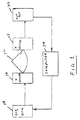
- Figure 1 shows a block diagram of a testing apparatus in accordance of this invention.
Landscapes
- Physics & Mathematics (AREA)
- Acoustics & Sound (AREA)
- Health & Medical Sciences (AREA)
- Life Sciences & Earth Sciences (AREA)
- Chemical & Material Sciences (AREA)
- Analytical Chemistry (AREA)
- Biochemistry (AREA)
- General Health & Medical Sciences (AREA)
- General Physics & Mathematics (AREA)
- Immunology (AREA)
- Pathology (AREA)
- Investigating Or Analyzing Materials By The Use Of Ultrasonic Waves (AREA)
Abstract
Description
- This invention was made with government support under Contract No. W-7405-ENG-36 awarded by the U.S. Department of Energy. The government has certain rights in the invention.
- This invention relates to nondestructive testing and, more particularly, to nondestructive detection of flaws in objects. A flaw may be a crack in an object, a void in an object, and/or a deviation from dimensional specifications of the object, and any other parameter that causes a change in mechanical resonance.
- Computational procedures have been developed to find the mechanical resonances of objects other than a sphere but which also have some symmetries. This work is described in "On the modes of free vibrations on inhomogeneous and anisotropic elastic objects" by Visscher et al., J. Acoust Soc. Am., 90 (4) p. 2154, 1991. Examples are, objects, such as a cylinder, rectangular parallel piped, cone, ellipsoid, or pyramids with regular polygon bases.
- This invention relates to a method of determination of flaws in an object. The flaws may be in the form of surface or subsurface cracks, tolerance errors, voids inside of the object or any other physical characteristics which would separate otherwise degenerate resonant frequencies. In the method of this invention, the existence and frequencies of degenerate resonant vibrational modes are first calculated or predicted by means of a mathematical analysis of the object to be tested. The object is then examined by exciting it with a mechanical transducer such that the excitation frequency is slowly varied from one predetermined frequency to another. From the prediction, modes are identified that should be degenerate (i.e. several modes will vibrate at precisely the same frequency) in an unflawed object. If flaws exist, the degenerate modes are resolved (or split) into two or more closely spaced resonances. Objects exhibiting resolved or split modes are identified as flawed or defective.
- In this invention, applicant also provides for measurement of the shear modulus (µ) and Poisson's ratio (σ), both of which are dependant upon frequencies.
- Testing of objects by use of sound (including ultrasound) and vibrations is well known. The prior art is extensive and encompasses many types of non-destructive testing. Resonant sound and ultrasound has also been used for testing purposes as described in U.S. Patents 5,062,296 and 4,976,148.
- To achieve the foregoing and other objects, and in accordance with the purposes of the present invention, as embodied and broadly described herein, the process of this invention is a method for testing objects based on their vibrational response. To achieve this, a vibrational (sound) spectrum is mathematically generated for an object, and in also measured. Comparison of the two enables detection of defective objects.
- The detection of the flaws described above is addressed by the present invention and a resonant ultrasound spectroscopy (RUS) technique is presented for examining all of the objects made in a production run. It is therefore an object of the present invention to provide for inspecting objects at rates consistent with a manufacturing process.
- A further object of the present invention is to provide an object inspection process that characterizes the entire body regardless of orientation in an inspection device.
- It is another object of the present invention to provide an inspection technique that provides high sensitivity to certain flaws.
- Additional objects, advantages and novel features of the invention will be set forth in part in the description which follows, and in part will become apparent to those skilled in the art upon examination of the following or may be learned by practice of the invention. The objects and advantages of the invention may be realized and attained by means of the instrumentalities and combinations particularly pointed out in the appended claims.
- The accompanying drawings, which are incorporated in and form a part of the specification, illustrate an embodiment of the present invention and, together with the description, serve to explain the principles of the invention.
- Figure 1 shows a block diagram of a testing apparatus in accordance of this invention.
- In accordance with the present invention resonant ultrasound spectroscopy (RUS) provides a rapid and accurate method for determining object deviations from specifications. A new technique for using RUS is provided. Quick inspection of objects determines their acceptability from a quality acceptance standpoint. Inspection is possible for certain objects too difficult to inspect by any other means at rates consistent with operation or a typical production line. Thus, product quality in assured, not estimated, and production manufacturing trends can be identified and corrected before quantities of defective products are manufactured.
- In copending application serial number 880,393, filed 5/8/92 entitled, "Sphericity Determination Using Resonant Ultrasound Spectroscopy" (incorporated herein by reference.), there is described a method of analysis which is specific to sphericity determination. One mode of employment of RUS relates the resonant ultrasound spectrum of a component to the dimensions and material properties of the components. As used herein, RUS can be used for determining some dimensions of certain symmetric objects.
- Figure 1 depicts a simplified schematic of a system 10 for generating and analyzing the RUS spectrum of a conical object 12. The object geometry may be any one which can be mathematically described.
Signal generator 14 excites transducer 16 for vibrating cone 12 over a predetermined frequency range, e.g., between 4 and 4000 kHz. The response of cone 12 is detected by transducer 18 and supplied to an output amplifier 22. A suitable RUS system 10 is described in U.S. patent 4,976,148, issued December 11, 1990, to Migliori, et al. (incorporated here in by reference). The outputs from amplifier 22 are input tocomputer 24 for analysis and computation of the difference between the cone 12 resonant vibrational modes and those of a perfect cone. - In an overview of the present method, RUS spectra for the vibrational modes of a perfect object are computed as a function of shear modulus and Poisson's ratio. A RUS spectrum is obtained from a production object and components of the spectrum, i.e., the degenerate resonant modes, are identified from the perfect object calculations. The shear modulus and Poisson's ratio for the production object can then be determined by comparing the identified and calculated degenerate resonances of a homogeneous isotropic elastic object.
- When an object deviates from perfect, at least some of the degenerate resonant frequencies become split, i.e., the resonant frequencies split into multiple resonant frequencies. The resonance deviations arising from splitting in the resonant frequencies is generally linear near the degenerate resonant frequencies as a function of the distortion.
- Other nonuniformities in the manufactured object such as cracks or internal voids will also affect the RUS spectrum such that a defective object can be detected. Further, drifts in manufacturing parameters can be detected and corrected before large lots of deviant material are produced.
- In a patent application Serial Number 880,393 (Filed May 8, 1992), it was demonstrated that spherical objects exhibit degenerate resonant modes. If the spherical symmetry is broken by a flaw, crack, or subsurface defect, the degeneracy is such that what appeared to be a single resonance becomes split into several distinct resonances. This splitting is used quantitatively to determine errors in sphericity, while the resonances themselves are used to determine density, diameter or elastic moduli depending on which two of these three quantities are known.
- By examining resonances in regions predicted to exhibit degeneracies, splittings into two or more peaks are observed when a flaw is introduced. In addition, computational procedures, such as finite-element analysis can be applied to objects that are not simple geometric shapes but which still have cylindrical, conical, or other symmetries. These objects exhibit only a few degeneracies but they are adequate to find flaws. Accidental degeneracies in objects have also been observed in objects that are not in general expected to have any degeneracies but which exhibit them only because certain small changes in dimensions can bring otherwise disparate resonances into conjunction. Thus the current method can also be applied to many objects that are not expected to have degenerate modes, but nonetheless exhibit one ore more degenerate resonances. The mode density (number of resonances per unit frequency interval) is, for any object, approximately proportional to the cube of the frequency. Thus as resonance measurements are mode at higher and higher frequencies, the density of resonances rapidly increases. Eventually, the width of each individual resonance is greater than the spacing between resonances so that they run together. This is called the reverberation limit. Below this limit, but well above the frequency of the first resonance lies a region where there are many well separated resonances. If the ultrasonic attenuation of the material is low, as it is in most metals, ceramics, glasses and other materials, then the intermediate region will consist of hundreds of well-separated resonances. It is usually the case that some of these hundreds of resonances are separated by 0.1% or less in frequency. By judicious changes in the dimension or shape of the object some of the closely spaced modes can be made to coincide. Because only very small changes are required, almost any manufactured object can be forced to have accidental degeneracies that do not affect the function of the object. Any object that exhibits degeneracies can be tested using resonances.
- Finite-element mathematical models that are readily available for complex, asymmetric objects can, under many circumstances, predict the mode type of the degenerate mode and predict its shift with internal or surface flaws, moduli or density (and thus temperature as well) to obtain quantitative information about the flaw size or tolerance error.
- In addition to the detection of flaws, we can use a surprising and heretofore unknown property of mechanical resonances to determine the elastic moduli of the material used in the object. This property is that all elastically isotropic objects exhibit many resonances that depend only on the shear modulus. Thus, if the shear modulus (µ) and Poisson's ratio (σ) are desired for an elastically isotropic object for which measurements and computations have been made, a very simple procedure can be used to find both µ and σ. This is of value because often the material properties are important for the correct functioning of the object under test. Below the region where there are hundreds of resonances, there exists a region just above the first resonance where only a few well-separated modes are present. Using any of the above mentioned computations, we can determine which of these modes depend: only on µ. For any mode it frequency fm that is dependent only on µ we scale the shear modulus as follows:

where (µ') is the actual (new) shear modulus, µ is the one used in the computation, fm is the measured frequency, fc is the computed frequency. Next, the resonances using the new value for µ' can be computed. At this point the shear modulus is determined, and all the modes dependent only on µ' will agree with the measurement, to an accuracy approximately equal to dimensional tolerances of the object. The modes that do not agree are the modes that depend on both shear modulus (µ) and Poisson's ratio (σ). We now use the new µ' to compute dfc/dσ using any of a number of the usual numerical procedures to compute derivatives for another mode at frequency fml that is not in agreement with the measurement. We can now determine (σ'), the actual (new) Poisson's ratio as follows:

where fcl is the computed mode that corresponds to fml the measured mode dependent on calculated Poisson's ratio (σ). - Because for any resonance at frequency f for an elastically isotropic object,

where ρ is the density, di are all the dimensions necessary to describe the object and the implied summation over repeated indices convention is used. It is clear that one cannot determine density (ρ) and shear modulus (µ) independently because f depends in exactly opposite ways on these quantities. - However, if a particular material such as a ceramic has a reasonably well known relationship between shear modulus (µ) and density (ρ), then one can combine the terms in equation (2) that contain µ and ρ. A measurement of at least as many resonances as there are unknowns in equation (2) will yield the dimensional, density and modulus errors without the need for any other independent measurements of any one of these quantities. If only one dimension is needed to describe the object (such as the edge of a cube, or the diameter of a sphere), or if a tolerance error is present that has exactly the some percentage error for all the dimensions of the object is present, than an additional measurement must be used. Thus, a set of resonances can be used to provide tolerance errors, flaw detection and material properties simultaneously in many elastically isotropic objects.
- The foregoing description of the preferred embodiments of the invention have been presented for purposes of illustration and description. It is not intended to be exhaustive or to limit the invention to the precise form disclosed, and obviously many modifications and variations are possible in light of the above teaching. The embodiments were chosen and described in order to best explain the principles of the invention and its practical application to thereby enable others skilled in the art to best utilize the invention in various embodiments and with various modifications as are suited to the particular use contemplated. It is intended that the scope of the invention be defined by the claims appended hereto.
Claims (10)
- A method for determination of flaws in an object comprising the stops of:a. mathematically determining degenerate modes having degenerate resonant frequencies of said object;b. examining resonances in at least one region predicted to exhibit degeneracy;c. observing a splitting of degenerate modes into two or more peaks; andd. identifying objects which exhibit splitting into two or more peaks as flawed.
- The method in accordance with Claim 1, wherein said regions are higher in frequency than a first resonant frequency of said object.
- The method in accordance with claim 1 further comprising computing and measuring modes which are dependent only on the shear modulus.
- The method in accordance with claim 1 further comprising computing and measuring modes which are dependent on both the shear modulus and Poisson's ratio.
- The method in accordance with Claim 1, further comparing the step of determining the actual shear modulus (µ') by the following relationship:

- The method in accordance with Claim 5, further comprising the step of computing the actual (new) Poisson's ratio (σ') in accordance with the following formula:

- A method for determining the existence of flaws in objects comprising the steps of:
calculating at least one frequency region at which there is a degenerate resonant mode frequency of said object;
applying vibrations to said object at frequencies within said at least one frequency region; and
identifying the presence of splitting of a degenerate resonant mode frequency into at least two degenerate resonant modes. - A method in accordance with Claim 7, further comprising the step of examining a plurality of degenerate resonant modes in a plurality of frequency regions and observing splittings of degenerate resonant mode frequencies when a flaw exists.
- A method for measuring the shear modulus (µ') of an elastically isotropic object of which both the computed and measured resonant modes have been obtained, comprising the steps of:
determining which resonant modes are dependent only upon (µ') and density (ρ), calculating a new shear modulus (µ') from the following relationship:
- A method for measuring Poisson's ratio (σ) of an elastically isotropic object for which both computed and measurement resonant modes have been obtained, comprising the steps of:
determining which resonant modes are dependent only upon Poisson's ratio;
calculating Poisson's ratio (σ) from the following relationship:
Applications Claiming Priority (2)
| Application Number | Priority Date | Filing Date | Title |
|---|---|---|---|
| US75159 | 1993-06-10 | ||
| US08/075,159 US5495763A (en) | 1993-06-10 | 1993-06-10 | Method for resonant measurement |
Publications (2)
| Publication Number | Publication Date |
|---|---|
| EP0628811A2 true EP0628811A2 (en) | 1994-12-14 |
| EP0628811A3 EP0628811A3 (en) | 1996-10-02 |
Family
ID=22123951
Family Applications (1)
| Application Number | Title | Priority Date | Filing Date |
|---|---|---|---|
| EP94108962A Withdrawn EP0628811A3 (en) | 1993-06-10 | 1994-06-10 | Method for determining bulk modul using resonant ultrasound spectroscopy. |
Country Status (2)
| Country | Link |
|---|---|
| US (1) | US5495763A (en) |
| EP (1) | EP0628811A3 (en) |
Families Citing this family (22)
| Publication number | Priority date | Publication date | Assignee | Title |
|---|---|---|---|---|
| JPH07294327A (en) * | 1994-04-27 | 1995-11-10 | Sankyo Seiki Mfg Co Ltd | Measuring method of natural frequency of electric motor |
| US6199431B1 (en) | 1997-03-27 | 2001-03-13 | Quasar International, Inc. | Method of resonant life cycle comparison inspection by serial number |
| US5952576A (en) * | 1997-03-27 | 1999-09-14 | Quasar International | Concurrent RUS measurements using multiple frequencies |
| US5965817A (en) * | 1998-07-28 | 1999-10-12 | Quasar International, Inc. | Temperature compensation of resonant frequency measurements for the effects of temperature variations |
| DE60016939T2 (en) | 1999-09-16 | 2005-12-15 | Wayne State University, Detroit | MINIATURIZED TOUCH-FREE SOUND / INFRARED DEVICE FOR DESTRUCTIVE TESTING |
| US6236049B1 (en) | 1999-09-16 | 2001-05-22 | Wayne State University | Infrared imaging of ultrasonically excited subsurface defects in materials |
| US6593574B2 (en) * | 1999-09-16 | 2003-07-15 | Wayne State University | Hand-held sound source gun for infrared imaging of sub-surface defects in materials |
| US6437334B1 (en) | 1999-09-16 | 2002-08-20 | Wayne State University | System and method for detecting cracks in a tooth by ultrasonically exciting and thermally imaging the tooth |
| US6606909B2 (en) | 2001-08-16 | 2003-08-19 | Lockheed Martin Corporation | Method and apparatus to conduct ultrasonic flaw detection for multi-layered structure |
| US7062386B1 (en) | 2003-12-04 | 2006-06-13 | The United States Of America As Represented By The Secretary Of The Navy | Method to estimate the mechanical properties of a solid material subjected to isonification |
| WO2005098731A2 (en) * | 2004-03-29 | 2005-10-20 | German Peter T | Systems and methods to determine elastic properties of materials |
| US7010981B1 (en) | 2004-08-06 | 2006-03-14 | The United States Of America As Represented By The Secretary Of The Navy | Inverse method for estimating the wave propagation parameters of two dissimilar wave types |
| US8043217B1 (en) * | 2007-07-10 | 2011-10-25 | Bioquantetics, Inc. | Method and apparatus to quantify specific material properties of objects using real-time ultrasound burst spectrography technique |
| US20100319454A1 (en) * | 2009-06-19 | 2010-12-23 | Her Majesty The Queen In Right Of Canada As Represented By The Minister Of Natural Resources | Method and system for determining young's modulus and poisson's ratio for a crystalline material |
| WO2012054867A1 (en) * | 2010-10-21 | 2012-04-26 | Vibrant Corporation | Utilizing resonance inspection of in-service parts |
| US9784625B2 (en) | 2010-11-30 | 2017-10-10 | Bloom Energy Corporation | Flaw detection method and apparatus for fuel cell components |
| WO2012177659A2 (en) | 2011-06-20 | 2012-12-27 | Vibrant Corporation | Part evaluation system/method using both resonance and surface vibration data |
| WO2013074881A1 (en) | 2011-11-17 | 2013-05-23 | Vibrant Corporation | Resonant ultrasound spectrocopy using surface acoustic wave analysis |
| WO2013155135A1 (en) * | 2012-04-13 | 2013-10-17 | Bloom Energy Corporation | Flaw detection method and apparatus for fuel cell components |
| US9927403B1 (en) | 2014-04-28 | 2018-03-27 | Vibrant Corporation | Resonance inspection sorting module array |
| US10386337B2 (en) * | 2017-02-28 | 2019-08-20 | Gemological Institute Of America, Inc. (Gia) | Method for fingerprinting and sorting diamonds |
| US11143630B2 (en) | 2018-05-08 | 2021-10-12 | Vibrant Corporation | Resonance inspection of manufactured parts with witness coupon testing |
Family Cites Families (3)
| Publication number | Priority date | Publication date | Assignee | Title |
|---|---|---|---|---|
| US4976148A (en) * | 1989-09-12 | 1990-12-11 | The United Stated Of America As Represented By The Department Of Energy | Resonant ultrasound spectrometer |
| US5144838A (en) * | 1989-10-04 | 1992-09-08 | Iwatsu Electric Co., Ltd. | Defect detecting method and apparatus |
| US5355731A (en) * | 1992-05-08 | 1994-10-18 | The Regents Of The University Of California, Office Of Technology Transfer | Sphericity determination using resonant ultrasound spectroscopy |
-
1993
- 1993-06-10 US US08/075,159 patent/US5495763A/en not_active Expired - Lifetime
-
1994
- 1994-06-10 EP EP94108962A patent/EP0628811A3/en not_active Withdrawn
Also Published As
| Publication number | Publication date |
|---|---|
| EP0628811A3 (en) | 1996-10-02 |
| US5495763A (en) | 1996-03-05 |
Similar Documents
| Publication | Publication Date | Title |
|---|---|---|
| US5495763A (en) | Method for resonant measurement | |
| US5631423A (en) | Method for resonant measurement | |
| Song et al. | Nondestructive testing and characterization of residual stress field using an ultrasonic method | |
| US5351543A (en) | Crack detection using resonant ultrasound spectroscopy | |
| Courtney et al. | Factors affecting the ultrasonic intermodulation crack detection technique using bispectral analysis | |
| JPH04505368A (en) | How to measure particle size distribution and concentration in suspensions using ultrasound | |
| Zima et al. | Corrosion degradation monitoring of ship stiffened plates using guided wave phase velocity and constrained convex optimization method | |
| Yan et al. | Cumulative fatigue damage in thin aluminum films evaluated non-destructively with lasers via zero-group-velocity Lamb modes | |
| EP0057521B1 (en) | Determination of plastic anisotropy in sheet material | |
| Liu et al. | Multimode photoacoustic characterization of subsurface damage in ground thin wafers | |
| US5886263A (en) | Method of resonant life cycle comparison inspection and testing | |
| Campeiro et al. | Lamb wave inspection using piezoelectric diaphragms: An initial feasibility study | |
| CN109946385A (en) | Ultrasonic method for evaluating early mechanical damage of material | |
| US6199431B1 (en) | Method of resonant life cycle comparison inspection by serial number | |
| US7231304B2 (en) | Interference pattern testing of materials | |
| Scalerandi et al. | Discrimination between cracks and recrystallization in steel using nonlinear techniques | |
| Reese et al. | On the establishment of a method for characterization of material microstructure through laser-based resonant ultrasound spectroscopy | |
| Barth et al. | Experimental determination of Lamb wave dispersion diagrams using 2d Fourier transform and laser vibrometry | |
| EP4006517A1 (en) | Method for detecting and locating cracks in a physical structure by means of an electro-mechanical impedance technique | |
| Adebisi et al. | Development of a LASER-based resonant ultrasound spectroscopy and a framework for error propagation in the estimated elastic moduli | |
| RU2245543C2 (en) | Product flow control method | |
| Zhu et al. | The potential of ultrasonic non-destructive measurement of residual stresses by modal frequency spacing using leaky lamb waves | |
| RU2308028C2 (en) | Method of detecting object defects | |
| Selvam et al. | Investigation of Capacitive Micromachined Ultrasound Transducer for NDT and material inspection in metals and alloys | |
| NL2035219B1 (en) | Apparatus, system and methods for high-frequency extensional rheology |
Legal Events
| Date | Code | Title | Description |
|---|---|---|---|
| PUAI | Public reference made under article 153(3) epc to a published international application that has entered the european phase |
Free format text: ORIGINAL CODE: 0009012 |
|
| AK | Designated contracting states |
Kind code of ref document: A2 Designated state(s): AT BE CH DE DK ES FR GB GR IE IT LI LU MC NL PT SE |
|
| PUAL | Search report despatched |
Free format text: ORIGINAL CODE: 0009013 |
|
| AK | Designated contracting states |
Kind code of ref document: A3 Designated state(s): AT BE CH DE DK ES FR GB GR IE IT LI LU MC NL PT SE |
|
| 17P | Request for examination filed |
Effective date: 19961211 |
|
| STAA | Information on the status of an ep patent application or granted ep patent |
Free format text: STATUS: THE APPLICATION HAS BEEN WITHDRAWN |
|
| 18W | Application withdrawn |
Withdrawal date: 19980415 |