EP0626413A2 - Method for the preparation of diorganopolysiloxanes - Google Patents
Method for the preparation of diorganopolysiloxanes Download PDFInfo
- Publication number
- EP0626413A2 EP0626413A2 EP94108226A EP94108226A EP0626413A2 EP 0626413 A2 EP0626413 A2 EP 0626413A2 EP 94108226 A EP94108226 A EP 94108226A EP 94108226 A EP94108226 A EP 94108226A EP 0626413 A2 EP0626413 A2 EP 0626413A2
- Authority
- EP
- European Patent Office
- Prior art keywords
- group
- component
- monovalent hydrocarbon
- formula
- hydrocarbon group
- Prior art date
- Legal status (The legal status is an assumption and is not a legal conclusion. Google has not performed a legal analysis and makes no representation as to the accuracy of the status listed.)
- Granted
Links
- 229920005645 diorganopolysiloxane polymer Polymers 0.000 title claims abstract description 55
- 238000000034 method Methods 0.000 title claims abstract description 22
- 238000002360 preparation method Methods 0.000 title claims description 21
- 239000012535 impurity Substances 0.000 claims abstract description 28
- 125000004122 cyclic group Chemical group 0.000 claims abstract description 23
- ZQTYRTSKQFQYPQ-UHFFFAOYSA-N trisiloxane Chemical compound [SiH3]O[SiH2]O[SiH3] ZQTYRTSKQFQYPQ-UHFFFAOYSA-N 0.000 claims abstract description 22
- 239000000463 material Substances 0.000 claims abstract description 13
- 150000002900 organolithium compounds Chemical class 0.000 claims abstract description 12
- 229910052736 halogen Inorganic materials 0.000 claims abstract description 10
- 150000002367 halogens Chemical class 0.000 claims abstract description 10
- 238000006138 lithiation reaction Methods 0.000 claims abstract description 6
- 238000006116 polymerization reaction Methods 0.000 claims description 46
- 239000003795 chemical substances by application Substances 0.000 claims description 39
- SCPYDCQAZCOKTP-UHFFFAOYSA-N silanol Chemical compound [SiH3]O SCPYDCQAZCOKTP-UHFFFAOYSA-N 0.000 claims description 31
- 125000004435 hydrogen atom Chemical group [H]* 0.000 claims description 14
- WHXSMMKQMYFTQS-UHFFFAOYSA-N Lithium Chemical compound [Li] WHXSMMKQMYFTQS-UHFFFAOYSA-N 0.000 claims description 13
- 239000002253 acid Substances 0.000 claims description 13
- 229910052744 lithium Inorganic materials 0.000 claims description 13
- 239000002685 polymerization catalyst Substances 0.000 claims description 11
- BLRPTPMANUNPDV-UHFFFAOYSA-N Silane Chemical compound [SiH4] BLRPTPMANUNPDV-UHFFFAOYSA-N 0.000 claims description 10
- KPUWHANPEXNPJT-UHFFFAOYSA-N disiloxane Chemical class [SiH3]O[SiH3] KPUWHANPEXNPJT-UHFFFAOYSA-N 0.000 claims description 10
- 229910000077 silane Inorganic materials 0.000 claims description 10
- 230000000694 effects Effects 0.000 claims description 7
- IJGRMHOSHXDMSA-UHFFFAOYSA-N Atomic nitrogen Chemical compound N#N IJGRMHOSHXDMSA-UHFFFAOYSA-N 0.000 claims description 6
- 125000005843 halogen group Chemical group 0.000 claims description 4
- 229910052757 nitrogen Inorganic materials 0.000 claims description 3
- 125000001183 hydrocarbyl group Chemical group 0.000 claims 12
- 150000001875 compounds Chemical class 0.000 claims 4
- 125000005372 silanol group Chemical group 0.000 abstract description 25
- 125000000524 functional group Chemical group 0.000 abstract description 12
- 238000006884 silylation reaction Methods 0.000 abstract description 12
- 230000015572 biosynthetic process Effects 0.000 abstract description 6
- 238000003786 synthesis reaction Methods 0.000 abstract description 6
- 239000004205 dimethyl polysiloxane Substances 0.000 description 43
- 235000013870 dimethyl polysiloxane Nutrition 0.000 description 43
- 229920000435 poly(dimethylsiloxane) Polymers 0.000 description 43
- -1 heptenyl Chemical group 0.000 description 39
- ZMXDDKWLCZADIW-UHFFFAOYSA-N N,N-Dimethylformamide Chemical compound CN(C)C=O ZMXDDKWLCZADIW-UHFFFAOYSA-N 0.000 description 33
- YXFVVABEGXRONW-UHFFFAOYSA-N Toluene Chemical compound CC1=CC=CC=C1 YXFVVABEGXRONW-UHFFFAOYSA-N 0.000 description 30
- 238000006243 chemical reaction Methods 0.000 description 30
- MZRVEZGGRBJDDB-UHFFFAOYSA-N N-Butyllithium Chemical compound [Li]CCCC MZRVEZGGRBJDDB-UHFFFAOYSA-N 0.000 description 24
- VLKZOEOYAKHREP-UHFFFAOYSA-N n-Hexane Chemical compound CCCCCC VLKZOEOYAKHREP-UHFFFAOYSA-N 0.000 description 24
- IJOOHPMOJXWVHK-UHFFFAOYSA-N chlorotrimethylsilane Chemical compound C[Si](C)(C)Cl IJOOHPMOJXWVHK-UHFFFAOYSA-N 0.000 description 22
- QTBSBXVTEAMEQO-UHFFFAOYSA-N Acetic acid Chemical compound CC(O)=O QTBSBXVTEAMEQO-UHFFFAOYSA-N 0.000 description 18
- 150000002430 hydrocarbons Chemical group 0.000 description 17
- 239000000047 product Substances 0.000 description 16
- 238000005033 Fourier transform infrared spectroscopy Methods 0.000 description 15
- 239000000010 aprotic solvent Substances 0.000 description 14
- 238000004458 analytical method Methods 0.000 description 13
- 238000005227 gel permeation chromatography Methods 0.000 description 13
- 238000003756 stirring Methods 0.000 description 13
- 150000003839 salts Chemical class 0.000 description 11
- 239000005051 trimethylchlorosilane Substances 0.000 description 11
- AAPLIUHOKVUFCC-UHFFFAOYSA-N trimethylsilanol Chemical compound C[Si](C)(C)O AAPLIUHOKVUFCC-UHFFFAOYSA-N 0.000 description 11
- 239000000499 gel Substances 0.000 description 10
- 239000002904 solvent Substances 0.000 description 10
- ZMANZCXQSJIPKH-UHFFFAOYSA-N Triethylamine Chemical compound CCN(CC)CC ZMANZCXQSJIPKH-UHFFFAOYSA-N 0.000 description 9
- 239000006227 byproduct Substances 0.000 description 9
- 239000012433 hydrogen halide Substances 0.000 description 9
- 229910000039 hydrogen halide Inorganic materials 0.000 description 9
- QGZKDVFQNNGYKY-UHFFFAOYSA-N Ammonia Chemical compound N QGZKDVFQNNGYKY-UHFFFAOYSA-N 0.000 description 8
- 239000000706 filtrate Substances 0.000 description 8
- 125000000391 vinyl group Chemical group [H]C([*])=C([H])[H] 0.000 description 8
- 229920002554 vinyl polymer Polymers 0.000 description 8
- 229910020175 SiOH Inorganic materials 0.000 description 7
- 125000002496 methyl group Chemical group [H]C([H])([H])* 0.000 description 7
- 229920000620 organic polymer Polymers 0.000 description 7
- 125000001997 phenyl group Chemical group [H]C1=C([H])C([H])=C(*)C([H])=C1[H] 0.000 description 7
- RTZKZFJDLAIYFH-UHFFFAOYSA-N Diethyl ether Chemical compound CCOCC RTZKZFJDLAIYFH-UHFFFAOYSA-N 0.000 description 6
- FFUAGWLWBBFQJT-UHFFFAOYSA-N hexamethyldisilazane Chemical compound C[Si](C)(C)N[Si](C)(C)C FFUAGWLWBBFQJT-UHFFFAOYSA-N 0.000 description 6
- 239000000203 mixture Substances 0.000 description 6
- 230000009257 reactivity Effects 0.000 description 6
- 239000007858 starting material Substances 0.000 description 6
- 125000003903 2-propenyl group Chemical group [H]C([*])([H])C([H])=C([H])[H] 0.000 description 5
- 125000003342 alkenyl group Chemical group 0.000 description 5
- 125000000217 alkyl group Chemical group 0.000 description 5
- 125000003118 aryl group Chemical group 0.000 description 5
- 125000004369 butenyl group Chemical group C(=CCC)* 0.000 description 5
- 125000006038 hexenyl group Chemical group 0.000 description 5
- 229910003002 lithium salt Inorganic materials 0.000 description 5
- 159000000002 lithium salts Chemical class 0.000 description 5
- 125000002255 pentenyl group Chemical group C(=CCCC)* 0.000 description 5
- 125000000094 2-phenylethyl group Chemical group [H]C1=C([H])C([H])=C(C([H])=C1[H])C([H])([H])C([H])([H])* 0.000 description 4
- IAZDPXIOMUYVGZ-UHFFFAOYSA-N Dimethylsulphoxide Chemical compound CS(C)=O IAZDPXIOMUYVGZ-UHFFFAOYSA-N 0.000 description 4
- 229910021529 ammonia Inorganic materials 0.000 description 4
- 125000003710 aryl alkyl group Chemical group 0.000 description 4
- 125000001797 benzyl group Chemical group [H]C1=C([H])C([H])=C(C([H])=C1[H])C([H])([H])* 0.000 description 4
- 125000000484 butyl group Chemical group [H]C([*])([H])C([H])([H])C([H])([H])C([H])([H])[H] 0.000 description 4
- 125000001495 ethyl group Chemical group [H]C([H])([H])C([H])([H])* 0.000 description 4
- 125000003187 heptyl group Chemical group [H]C([*])([H])C([H])([H])C([H])([H])C([H])([H])C([H])([H])C([H])([H])C([H])([H])[H] 0.000 description 4
- 125000004051 hexyl group Chemical group [H]C([H])([H])C([H])([H])C([H])([H])C([H])([H])C([H])([H])C([H])([H])* 0.000 description 4
- 238000004519 manufacturing process Methods 0.000 description 4
- 125000001624 naphthyl group Chemical group 0.000 description 4
- 125000002347 octyl group Chemical group [H]C([*])([H])C([H])([H])C([H])([H])C([H])([H])C([H])([H])C([H])([H])C([H])([H])C([H])([H])[H] 0.000 description 4
- 125000001147 pentyl group Chemical group C(CCCC)* 0.000 description 4
- 125000001436 propyl group Chemical group [H]C([*])([H])C([H])([H])C([H])([H])[H] 0.000 description 4
- 125000003944 tolyl group Chemical group 0.000 description 4
- 125000005023 xylyl group Chemical group 0.000 description 4
- ZWEHNKRNPOVVGH-UHFFFAOYSA-N 2-Butanone Chemical compound CCC(C)=O ZWEHNKRNPOVVGH-UHFFFAOYSA-N 0.000 description 3
- OKQXCDUCLYWRHA-UHFFFAOYSA-N 3-[chloro(dimethyl)silyl]propyl 2-methylprop-2-enoate Chemical compound CC(=C)C(=O)OCCC[Si](C)(C)Cl OKQXCDUCLYWRHA-UHFFFAOYSA-N 0.000 description 3
- CSCPPACGZOOCGX-UHFFFAOYSA-N Acetone Chemical compound CC(C)=O CSCPPACGZOOCGX-UHFFFAOYSA-N 0.000 description 3
- WEVYAHXRMPXWCK-UHFFFAOYSA-N Acetonitrile Chemical compound CC#N WEVYAHXRMPXWCK-UHFFFAOYSA-N 0.000 description 3
- UHOVQNZJYSORNB-UHFFFAOYSA-N Benzene Chemical compound C1=CC=CC=C1 UHOVQNZJYSORNB-UHFFFAOYSA-N 0.000 description 3
- XEKOWRVHYACXOJ-UHFFFAOYSA-N Ethyl acetate Chemical compound CCOC(C)=O XEKOWRVHYACXOJ-UHFFFAOYSA-N 0.000 description 3
- UFHFLCQGNIYNRP-UHFFFAOYSA-N Hydrogen Chemical compound [H][H] UFHFLCQGNIYNRP-UHFFFAOYSA-N 0.000 description 3
- 238000010521 absorption reaction Methods 0.000 description 3
- 239000011230 binding agent Substances 0.000 description 3
- QABCGOSYZHCPGN-UHFFFAOYSA-N chloro(dimethyl)silicon Chemical compound C[Si](C)Cl QABCGOSYZHCPGN-UHFFFAOYSA-N 0.000 description 3
- 238000010438 heat treatment Methods 0.000 description 3
- 239000001257 hydrogen Substances 0.000 description 3
- 229910052739 hydrogen Inorganic materials 0.000 description 3
- 150000001282 organosilanes Chemical class 0.000 description 3
- 238000000926 separation method Methods 0.000 description 3
- FZHAPNGMFPVSLP-UHFFFAOYSA-N silanamine Chemical class [SiH3]N FZHAPNGMFPVSLP-UHFFFAOYSA-N 0.000 description 3
- 238000010626 work up procedure Methods 0.000 description 3
- VVJKKWFAADXIJK-UHFFFAOYSA-N Allylamine Chemical compound NCC=C VVJKKWFAADXIJK-UHFFFAOYSA-N 0.000 description 2
- NLXLAEXVIDQMFP-UHFFFAOYSA-N Ammonia chloride Chemical compound [NH4+].[Cl-] NLXLAEXVIDQMFP-UHFFFAOYSA-N 0.000 description 2
- 239000005046 Chlorosilane Substances 0.000 description 2
- VEXZGXHMUGYJMC-UHFFFAOYSA-N Hydrochloric acid Chemical compound Cl VEXZGXHMUGYJMC-UHFFFAOYSA-N 0.000 description 2
- IMNFDUFMRHMDMM-UHFFFAOYSA-N N-Heptane Chemical compound CCCCCCC IMNFDUFMRHMDMM-UHFFFAOYSA-N 0.000 description 2
- JUJWROOIHBZHMG-UHFFFAOYSA-N Pyridine Chemical compound C1=CC=NC=C1 JUJWROOIHBZHMG-UHFFFAOYSA-N 0.000 description 2
- VYPSYNLAJGMNEJ-UHFFFAOYSA-N Silicium dioxide Chemical compound O=[Si]=O VYPSYNLAJGMNEJ-UHFFFAOYSA-N 0.000 description 2
- QAOWNCQODCNURD-UHFFFAOYSA-N Sulfuric acid Chemical compound OS(O)(=O)=O QAOWNCQODCNURD-UHFFFAOYSA-N 0.000 description 2
- WYURNTSHIVDZCO-UHFFFAOYSA-N Tetrahydrofuran Chemical compound C1CCOC1 WYURNTSHIVDZCO-UHFFFAOYSA-N 0.000 description 2
- DTQVDTLACAAQTR-UHFFFAOYSA-N Trifluoroacetic acid Chemical compound OC(=O)C(F)(F)F DTQVDTLACAAQTR-UHFFFAOYSA-N 0.000 description 2
- 150000007513 acids Chemical class 0.000 description 2
- 238000007259 addition reaction Methods 0.000 description 2
- XXROGKLTLUQVRX-UHFFFAOYSA-N allyl alcohol Chemical compound OCC=C XXROGKLTLUQVRX-UHFFFAOYSA-N 0.000 description 2
- 150000001408 amides Chemical class 0.000 description 2
- 150000001412 amines Chemical class 0.000 description 2
- 230000002902 bimodal effect Effects 0.000 description 2
- 238000009835 boiling Methods 0.000 description 2
- UCKORWKZRPKRQE-UHFFFAOYSA-N bromo(triethyl)silane Chemical compound CC[Si](Br)(CC)CC UCKORWKZRPKRQE-UHFFFAOYSA-N 0.000 description 2
- IYYIVELXUANFED-UHFFFAOYSA-N bromo(trimethyl)silane Chemical compound C[Si](C)(C)Br IYYIVELXUANFED-UHFFFAOYSA-N 0.000 description 2
- VQPFDLRNOCQMSN-UHFFFAOYSA-N bromosilane Chemical class Br[SiH3] VQPFDLRNOCQMSN-UHFFFAOYSA-N 0.000 description 2
- BVKZGUZCCUSVTD-UHFFFAOYSA-N carbonic acid Chemical class OC(O)=O BVKZGUZCCUSVTD-UHFFFAOYSA-N 0.000 description 2
- 239000003054 catalyst Substances 0.000 description 2
- KWYZNESIGBQHJK-UHFFFAOYSA-N chloro-dimethyl-phenylsilane Chemical compound C[Si](C)(Cl)C1=CC=CC=C1 KWYZNESIGBQHJK-UHFFFAOYSA-N 0.000 description 2
- KOPOQZFJUQMUML-UHFFFAOYSA-N chlorosilane Chemical class Cl[SiH3] KOPOQZFJUQMUML-UHFFFAOYSA-N 0.000 description 2
- 229920001577 copolymer Polymers 0.000 description 2
- HPNMFZURTQLUMO-UHFFFAOYSA-N diethylamine Chemical compound CCNCC HPNMFZURTQLUMO-UHFFFAOYSA-N 0.000 description 2
- LIKFHECYJZWXFJ-UHFFFAOYSA-N dimethyldichlorosilane Chemical compound C[Si](C)(Cl)Cl LIKFHECYJZWXFJ-UHFFFAOYSA-N 0.000 description 2
- XBDQKXXYIPTUBI-UHFFFAOYSA-N dimethylselenoniopropionate Natural products CCC(O)=O XBDQKXXYIPTUBI-UHFFFAOYSA-N 0.000 description 2
- 238000009826 distribution Methods 0.000 description 2
- 238000011067 equilibration Methods 0.000 description 2
- 238000004817 gas chromatography Methods 0.000 description 2
- 229910052500 inorganic mineral Inorganic materials 0.000 description 2
- AFRJJFRNGGLMDW-UHFFFAOYSA-N lithium amide Chemical class [Li+].[NH2-] AFRJJFRNGGLMDW-UHFFFAOYSA-N 0.000 description 2
- 150000002642 lithium compounds Chemical class 0.000 description 2
- UBJFKNSINUCEAL-UHFFFAOYSA-N lithium;2-methylpropane Chemical compound [Li+].C[C-](C)C UBJFKNSINUCEAL-UHFFFAOYSA-N 0.000 description 2
- WGOPGODQLGJZGL-UHFFFAOYSA-N lithium;butane Chemical compound [Li+].CC[CH-]C WGOPGODQLGJZGL-UHFFFAOYSA-N 0.000 description 2
- KBJKWYZQIJZAOZ-UHFFFAOYSA-N lithium;oxidosilane Chemical compound [Li+].[SiH3][O-] KBJKWYZQIJZAOZ-UHFFFAOYSA-N 0.000 description 2
- VCPPTNDHEILJHD-UHFFFAOYSA-N lithium;prop-1-ene Chemical compound [Li+].[CH2-]C=C VCPPTNDHEILJHD-UHFFFAOYSA-N 0.000 description 2
- DVSDBMFJEQPWNO-UHFFFAOYSA-N methyllithium Chemical compound C[Li] DVSDBMFJEQPWNO-UHFFFAOYSA-N 0.000 description 2
- 239000011707 mineral Chemical class 0.000 description 2
- 238000006386 neutralization reaction Methods 0.000 description 2
- NHKJPPKXDNZFBJ-UHFFFAOYSA-N phenyllithium Chemical compound [Li]C1=CC=CC=C1 NHKJPPKXDNZFBJ-UHFFFAOYSA-N 0.000 description 2
- 150000004756 silanes Chemical class 0.000 description 2
- 238000010561 standard procedure Methods 0.000 description 2
- BCNZYOJHNLTNEZ-UHFFFAOYSA-N tert-butyldimethylsilyl chloride Chemical compound CC(C)(C)[Si](C)(C)Cl BCNZYOJHNLTNEZ-UHFFFAOYSA-N 0.000 description 2
- GETQZCLCWQTVFV-UHFFFAOYSA-N trimethylamine Chemical compound CN(C)C GETQZCLCWQTVFV-UHFFFAOYSA-N 0.000 description 2
- PGOLTJPQCISRTO-UHFFFAOYSA-N vinyllithium Chemical compound [Li]C=C PGOLTJPQCISRTO-UHFFFAOYSA-N 0.000 description 2
- MASDFXZJIDNRTR-UHFFFAOYSA-N 1,3-bis(trimethylsilyl)urea Chemical compound C[Si](C)(C)NC(=O)N[Si](C)(C)C MASDFXZJIDNRTR-UHFFFAOYSA-N 0.000 description 1
- OUYBHCPCSNUQHE-UHFFFAOYSA-N 1,3-diphenyl-1-trimethylsilylurea Chemical compound C=1C=CC=CC=1N([Si](C)(C)C)C(=O)NC1=CC=CC=C1 OUYBHCPCSNUQHE-UHFFFAOYSA-N 0.000 description 1
- DGLJYEKNUTVPAE-UHFFFAOYSA-N 2,4,6-triethyl-2,4,6-trimethyl-1,3,5,2,4,6-trioxatrisilinane Chemical compound CC[Si]1(C)O[Si](C)(CC)O[Si](C)(CC)O1 DGLJYEKNUTVPAE-UHFFFAOYSA-N 0.000 description 1
- QRHXSUHCDGHLPU-UHFFFAOYSA-N 2,4,6-trimethyl-2,4,6-tripropyl-1,3,5,2,4,6-trioxatrisilinane Chemical compound CCC[Si]1(C)O[Si](C)(CCC)O[Si](C)(CCC)O1 QRHXSUHCDGHLPU-UHFFFAOYSA-N 0.000 description 1
- BVTLTBONLZSBJC-UHFFFAOYSA-N 2,4,6-tris(ethenyl)-2,4,6-trimethyl-1,3,5,2,4,6-trioxatrisilinane Chemical compound C=C[Si]1(C)O[Si](C)(C=C)O[Si](C)(C=C)O1 BVTLTBONLZSBJC-UHFFFAOYSA-N 0.000 description 1
- STMDPCBYJCIZOD-UHFFFAOYSA-N 2-(2,4-dinitroanilino)-4-methylpentanoic acid Chemical compound CC(C)CC(C(O)=O)NC1=CC=C([N+]([O-])=O)C=C1[N+]([O-])=O STMDPCBYJCIZOD-UHFFFAOYSA-N 0.000 description 1
- SMZOUWXMTYCWNB-UHFFFAOYSA-N 2-(2-methoxy-5-methylphenyl)ethanamine Chemical compound COC1=CC=C(C)C=C1CCN SMZOUWXMTYCWNB-UHFFFAOYSA-N 0.000 description 1
- NIXOWILDQLNWCW-UHFFFAOYSA-N 2-Propenoic acid Natural products OC(=O)C=C NIXOWILDQLNWCW-UHFFFAOYSA-N 0.000 description 1
- LZDXRPVSAKWYDH-UHFFFAOYSA-N 2-ethyl-2-(prop-2-enoxymethyl)propane-1,3-diol Chemical compound CCC(CO)(CO)COCC=C LZDXRPVSAKWYDH-UHFFFAOYSA-N 0.000 description 1
- IGDCJKDZZUALAO-UHFFFAOYSA-N 2-prop-2-enoxypropane-1,3-diol Chemical compound OCC(CO)OCC=C IGDCJKDZZUALAO-UHFFFAOYSA-N 0.000 description 1
- QOXOZONBQWIKDA-UHFFFAOYSA-N 3-hydroxypropyl Chemical group [CH2]CCO QOXOZONBQWIKDA-UHFFFAOYSA-N 0.000 description 1
- DKPFZGUDAPQIHT-UHFFFAOYSA-N Butyl acetate Natural products CCCCOC(C)=O DKPFZGUDAPQIHT-UHFFFAOYSA-N 0.000 description 1
- FNVYAUSFNSYOLC-UHFFFAOYSA-N CC(=C[SiH2][O-])C.[Li+] Chemical compound CC(=C[SiH2][O-])C.[Li+] FNVYAUSFNSYOLC-UHFFFAOYSA-N 0.000 description 1
- 0 CC*1CCCCC1 Chemical compound CC*1CCCCC1 0.000 description 1
- LLDVSYZNVMYOPY-UHFFFAOYSA-N CCC1C(C)C(CC2)C2C1C Chemical compound CCC1C(C)C(CC2)C2C1C LLDVSYZNVMYOPY-UHFFFAOYSA-N 0.000 description 1
- XDTMQSROBMDMFD-UHFFFAOYSA-N Cyclohexane Chemical compound C1CCCCC1 XDTMQSROBMDMFD-UHFFFAOYSA-N 0.000 description 1
- JOOMLFKONHCLCJ-UHFFFAOYSA-N N-(trimethylsilyl)diethylamine Chemical compound CCN(CC)[Si](C)(C)C JOOMLFKONHCLCJ-UHFFFAOYSA-N 0.000 description 1
- YKFRUJSEPGHZFJ-UHFFFAOYSA-N N-trimethylsilylimidazole Chemical compound C[Si](C)(C)N1C=CN=C1 YKFRUJSEPGHZFJ-UHFFFAOYSA-N 0.000 description 1
- 238000005481 NMR spectroscopy Methods 0.000 description 1
- CTQNGGLPUBDAKN-UHFFFAOYSA-N O-Xylene Chemical compound CC1=CC=CC=C1C CTQNGGLPUBDAKN-UHFFFAOYSA-N 0.000 description 1
- GJWAPAVRQYYSTK-UHFFFAOYSA-N [(dimethyl-$l^{3}-silanyl)amino]-dimethylsilicon Chemical compound C[Si](C)N[Si](C)C GJWAPAVRQYYSTK-UHFFFAOYSA-N 0.000 description 1
- 239000003463 adsorbent Substances 0.000 description 1
- 125000001931 aliphatic group Chemical group 0.000 description 1
- PNEYBMLMFCGWSK-UHFFFAOYSA-N aluminium oxide Inorganic materials [O-2].[O-2].[O-2].[Al+3].[Al+3] PNEYBMLMFCGWSK-UHFFFAOYSA-N 0.000 description 1
- 235000019270 ammonium chloride Nutrition 0.000 description 1
- BFNBIHQBYMNNAN-UHFFFAOYSA-N ammonium sulfate Chemical compound N.N.OS(O)(=O)=O BFNBIHQBYMNNAN-UHFFFAOYSA-N 0.000 description 1
- 229910052921 ammonium sulfate Inorganic materials 0.000 description 1
- 235000011130 ammonium sulphate Nutrition 0.000 description 1
- SIOVKLKJSOKLIF-UHFFFAOYSA-N bis(trimethylsilyl)acetamide Chemical compound C[Si](C)(C)OC(C)=N[Si](C)(C)C SIOVKLKJSOKLIF-UHFFFAOYSA-N 0.000 description 1
- 150000001732 carboxylic acid derivatives Chemical class 0.000 description 1
- 150000001735 carboxylic acids Chemical class 0.000 description 1
- 239000007809 chemical reaction catalyst Substances 0.000 description 1
- BJLJNLUARMMMLW-UHFFFAOYSA-N chloro-(3-chloropropyl)-dimethylsilane Chemical compound C[Si](C)(Cl)CCCCl BJLJNLUARMMMLW-UHFFFAOYSA-N 0.000 description 1
- XSDCTSITJJJDPY-UHFFFAOYSA-N chloro-ethenyl-dimethylsilane Chemical compound C[Si](C)(Cl)C=C XSDCTSITJJJDPY-UHFFFAOYSA-N 0.000 description 1
- 238000004587 chromatography analysis Methods 0.000 description 1
- HAURRGANAANPSQ-UHFFFAOYSA-N cis-2,4,6-Trimethyl-2,4,6-triphenylcyclotrisiloxane Chemical compound O1[Si](C)(C=2C=CC=CC=2)O[Si](C)(C=2C=CC=CC=2)O[Si]1(C)C1=CC=CC=C1 HAURRGANAANPSQ-UHFFFAOYSA-N 0.000 description 1
- 239000004927 clay Substances 0.000 description 1
- 230000007423 decrease Effects 0.000 description 1
- 238000004821 distillation Methods 0.000 description 1
- 238000001035 drying Methods 0.000 description 1
- 230000008030 elimination Effects 0.000 description 1
- 238000003379 elimination reaction Methods 0.000 description 1
- 239000003759 ester based solvent Substances 0.000 description 1
- VEJBQZZDVYDUHU-UHFFFAOYSA-N ethenyl-hydroxy-dimethylsilane Chemical compound C[Si](C)(O)C=C VEJBQZZDVYDUHU-UHFFFAOYSA-N 0.000 description 1
- 239000004210 ether based solvent Substances 0.000 description 1
- 238000001914 filtration Methods 0.000 description 1
- 239000007789 gas Substances 0.000 description 1
- FUZZWVXGSFPDMH-UHFFFAOYSA-N hexanoic acid Chemical compound CCCCCC(O)=O FUZZWVXGSFPDMH-UHFFFAOYSA-N 0.000 description 1
- 230000007062 hydrolysis Effects 0.000 description 1
- 238000006460 hydrolysis reaction Methods 0.000 description 1
- 238000006459 hydrosilylation reaction Methods 0.000 description 1
- FDTBETCIPGWBHK-UHFFFAOYSA-N hydroxy-dimethyl-phenylsilane Chemical compound C[Si](C)(O)C1=CC=CC=C1 FDTBETCIPGWBHK-UHFFFAOYSA-N 0.000 description 1
- 238000011835 investigation Methods 0.000 description 1
- 239000005453 ketone based solvent Substances 0.000 description 1
- YSVGZOLHIDFBPD-UHFFFAOYSA-N lithium;oxido(triphenyl)silane Chemical compound [Li+].C=1C=CC=CC=1[Si](C=1C=CC=CC=1)([O-])C1=CC=CC=C1 YSVGZOLHIDFBPD-UHFFFAOYSA-N 0.000 description 1
- OXOZHAWWRPCVGL-UHFFFAOYSA-N lithium;trimethyl(oxido)silane Chemical compound [Li+].C[Si](C)(C)[O-] OXOZHAWWRPCVGL-UHFFFAOYSA-N 0.000 description 1
- 229910052751 metal Inorganic materials 0.000 description 1
- 239000002184 metal Substances 0.000 description 1
- 239000002808 molecular sieve Substances 0.000 description 1
- KAHVZNKZQFSBFW-UHFFFAOYSA-N n-methyl-n-trimethylsilylmethanamine Chemical compound CN(C)[Si](C)(C)C KAHVZNKZQFSBFW-UHFFFAOYSA-N 0.000 description 1
- 125000005375 organosiloxane group Chemical class 0.000 description 1
- 125000001181 organosilyl group Chemical group [SiH3]* 0.000 description 1
- 230000035699 permeability Effects 0.000 description 1
- BASFCYQUMIYNBI-UHFFFAOYSA-N platinum Chemical group [Pt] BASFCYQUMIYNBI-UHFFFAOYSA-N 0.000 description 1
- 229920001296 polysiloxane Chemical class 0.000 description 1
- 239000002243 precursor Substances 0.000 description 1
- FBCQUCJYYPMKRO-UHFFFAOYSA-N prop-2-enyl 2-methylprop-2-enoate Chemical compound CC(=C)C(=O)OCC=C FBCQUCJYYPMKRO-UHFFFAOYSA-N 0.000 description 1
- 235000019260 propionic acid Nutrition 0.000 description 1
- WGYKZJWCGVVSQN-UHFFFAOYSA-N propylamine Chemical group CCCN WGYKZJWCGVVSQN-UHFFFAOYSA-N 0.000 description 1
- 125000006239 protecting group Chemical group 0.000 description 1
- UMJSCPRVCHMLSP-UHFFFAOYSA-N pyridine Natural products COC1=CC=CN=C1 UMJSCPRVCHMLSP-UHFFFAOYSA-N 0.000 description 1
- IUVKMZGDUIUOCP-BTNSXGMBSA-N quinbolone Chemical compound O([C@H]1CC[C@H]2[C@H]3[C@@H]([C@]4(C=CC(=O)C=C4CC3)C)CC[C@@]21C)C1=CCCC1 IUVKMZGDUIUOCP-BTNSXGMBSA-N 0.000 description 1
- 230000035484 reaction time Effects 0.000 description 1
- 238000010992 reflux Methods 0.000 description 1
- 150000004819 silanols Chemical class 0.000 description 1
- 239000000377 silicon dioxide Substances 0.000 description 1
- URGAHOPLAPQHLN-UHFFFAOYSA-N sodium aluminosilicate Chemical compound [Na+].[Al+3].[O-][Si]([O-])=O.[O-][Si]([O-])=O URGAHOPLAPQHLN-UHFFFAOYSA-N 0.000 description 1
- 238000004611 spectroscopical analysis Methods 0.000 description 1
- YLQBMQCUIZJEEH-UHFFFAOYSA-N tetrahydrofuran Natural products C=1C=COC=1 YLQBMQCUIZJEEH-UHFFFAOYSA-N 0.000 description 1
- IMFACGCPASFAPR-UHFFFAOYSA-N tributylamine Chemical compound CCCCN(CCCC)CCCC IMFACGCPASFAPR-UHFFFAOYSA-N 0.000 description 1
- 125000000026 trimethylsilyl group Chemical group [H]C([H])([H])[Si]([*])(C([H])([H])[H])C([H])([H])[H] 0.000 description 1
- NLSXASIDNWDYMI-UHFFFAOYSA-N triphenylsilanol Chemical compound C=1C=CC=CC=1[Si](C=1C=CC=CC=1)(O)C1=CC=CC=C1 NLSXASIDNWDYMI-UHFFFAOYSA-N 0.000 description 1
- 239000008096 xylene Substances 0.000 description 1
Images

Classifications
-
- C—CHEMISTRY; METALLURGY
- C08—ORGANIC MACROMOLECULAR COMPOUNDS; THEIR PREPARATION OR CHEMICAL WORKING-UP; COMPOSITIONS BASED THEREON
- C08G—MACROMOLECULAR COMPOUNDS OBTAINED OTHERWISE THAN BY REACTIONS ONLY INVOLVING UNSATURATED CARBON-TO-CARBON BONDS
- C08G77/00—Macromolecular compounds obtained by reactions forming a linkage containing silicon with or without sulfur, nitrogen, oxygen or carbon in the main chain of the macromolecule
- C08G77/04—Polysiloxanes
- C08G77/06—Preparatory processes
-
- C—CHEMISTRY; METALLURGY
- C08—ORGANIC MACROMOLECULAR COMPOUNDS; THEIR PREPARATION OR CHEMICAL WORKING-UP; COMPOSITIONS BASED THEREON
- C08G—MACROMOLECULAR COMPOUNDS OBTAINED OTHERWISE THAN BY REACTIONS ONLY INVOLVING UNSATURATED CARBON-TO-CARBON BONDS
- C08G77/00—Macromolecular compounds obtained by reactions forming a linkage containing silicon with or without sulfur, nitrogen, oxygen or carbon in the main chain of the macromolecule
- C08G77/04—Polysiloxanes
- C08G77/06—Preparatory processes
- C08G77/08—Preparatory processes characterised by the catalysts used
-
- C—CHEMISTRY; METALLURGY
- C08—ORGANIC MACROMOLECULAR COMPOUNDS; THEIR PREPARATION OR CHEMICAL WORKING-UP; COMPOSITIONS BASED THEREON
- C08G—MACROMOLECULAR COMPOUNDS OBTAINED OTHERWISE THAN BY REACTIONS ONLY INVOLVING UNSATURATED CARBON-TO-CARBON BONDS
- C08G77/00—Macromolecular compounds obtained by reactions forming a linkage containing silicon with or without sulfur, nitrogen, oxygen or carbon in the main chain of the macromolecule
- C08G77/04—Polysiloxanes
- C08G77/14—Polysiloxanes containing silicon bound to oxygen-containing groups
- C08G77/16—Polysiloxanes containing silicon bound to oxygen-containing groups to hydroxyl groups
Definitions
- the present invention relates to a method for the preparation of diorganopolysiloxane that yields a very pure diorganopolysiloxane which bears a functional group at only one end of the molecular chain.
- this diorganopolysiloxane is identified as monoterminal-functional diorganopolysiloxane.
- Diorganopolysiloxane of this type has the general formula R(R2SiO) p B in which R is a monovalent hydrocarbon group, p is an integer with a value of at least 1, and B is hydrogen atom or a group with the general formula -SiR2R1 in which R is a monovalent hydrocarbon group and R1 is the hydrogen atom or an organofunctional group.
- JP-A 59-78236 [78,236/1984], 1-131247 [131,247/1989], and 2-92933 [92,933/1990] teach the preparation of this type of diorganopolysiloxane by first subjecting cyclic trisiloxane with the general formula (R2SiO)3 in which R is a monovalent hydrocarbon group to nonequilibration polymerization, optionally in the presence of silane or siloxane with the general formula R(R2SiO) m H in which R is a monovalent hydrocarbon group and m is an integer with a value of at least 1, under the effect of a lithium polymerization catalyst with the general formula R(R2SiO) n Li in which R is a monovalent hydrocarbon group and n is an integer with a value of at least zero, and by subsequently terminating this nonequilibration polymerization with acid or halosilane with the general formula R1R2SiX in which R is a monovalent hydrocarbon group, R
- the present inventor undertook various analyses of monoterminal-functional diorganopolysiloxane and its cyclic trisiloxane precursor. Using a Fourier-transform infrared spectrophotometer, the inventor confirmed that a silanol-containing impurity was present in the starting cyclic trisiloxane. Gel permeation chromatographic analysis also demonstrated a secondary peak on the high molecular weight side of the main peak due to the diorganopolysiloxane. It was also found that the ratio of this secondary peak increased with increasing number-average molecular weight for the diorganopolysiloxane.
- diterminal-functional diorganopolysiloxane having functional groups at both molecular chain terminals, hereinafter referred to as diterminal-functional diorganopolysiloxane, is produced as a by-product during the synthesis of monoterminal-functional diorganopolysiloxane by the above preparative method.
- This diterminal-functional diorganopolysiloxane by-product is extremely difficult to separate by standard methods from the monoterminal-functional diorganopolysiloxane. This separation becomes even more difficult at higher number-average molecular weights for the diorganopolysiloxane.
- silanol-containing impurity such as a silane or siloxane that contains at least 2 silanol groups
- the silanol-containing impurity such as a silane or siloxane that contains at least 2 silanol groups
- silanol-containing impurity is also very difficult to separate from the cyclic trisiloxane by standard methods, such as distillation, column separation using an adsorbent such as silica, alumina, and activated clay, or a molecular sieve.
- the content of silanol-containing impurity in the cyclic trisiloxane is in fact increased in the particular case of column separation because the cyclic trisiloxane ring is easily opened by acid.
- the inventor carried out extensive investigations in order to solve the problems described above and as a result discovered that a very pure monoterminal-functional diorganopolysiloxane can be produced by the nonequilibration polymerization of cyclic trisiloxane in the presence of a lithium compound. This procedure prevents the silanol-containing impurity in the cyclic trisiloxane from participating in the nonequilibration polymerization by preliminarily silylating impurity with silylating agent.
- the present invention was achieved based on this discovery.
- the present invention introduced a method for the preparation of diorganopolysiloxane that is capable of yielding a very pure monoterminal-functional diorganopolysiloxane.
- This invention provides a method for the preparation of diorganopolysiloxane with the general formula R(R2SiO) p B in which R is a monovalent hydrocarbon group, p is an integer with a value of at least 1, and B is hydrogen atom or a group with the general formula -SiR2R1 in which R is a monovalent hydrocarbon group and R1 is hydrogen atom or an organofunctional group, by first subjecting
- Component (A) is the principal starting material in the preparative method of this invention, and it consists of cyclic trisiloxane with the following general formula (R2SiO)3 .
- the group R in this general formula represents monovalent hydrocarbon groups, and are exemplified by alkyl groups such as methyl, ethyl, propyl, butyl, pentyl, hexyl, heptyl, and octyl; alkenyl groups such as vinyl, allyl, butenyl, pentenyl, hexenyl, and heptenyl; aryl groups such as phenyl, tolyl, xylyl, and naphthyl; and aralkyl groups such as benzyl, and phenethyl.
- R is preferably methyl, phenyl, or vinyl because this affords ease of handling.
- the cyclic trisiloxanes comprising component (A) are selected from 1,1,3,3,5,5-hexamethylcyclotrisiloxane, 1,1,3,3,5,5-hexaphenylcyclotrisiloxane, 1,3,5-trimethyl-1,3,5-triphenylcyclotrisiloxane, 1,3,5-trimethyl-1,3,5-trivinylcyclotrisiloxane, 1,3,5-triethyl-1,3,5-trimethylcyclotrisiloxane, 1,1,3,3,5,5-hexavinylcyclotrisiloxane, 1,3,5-trimethyl-1,3,5-tripropylcyclotrisiloxane, and 1,3,5-trimethyl-1,3,5-triphenethylcyclotrisiloxane.
- the characteristic feature of the preparative method of this invention consists of the preliminary silylation of the silanol-containing impurity, such as a silane or a siloxane that contains at least 2 silanol groups, in the aforesaid component (A) with silylating agent (E) to thereby prevent the silanol-containing impurity from participating in the subsequent nonequilibration polymerization of component (A), optionally in the presence of silane or siloxane (B), under the effect of lithium polymerization catalyst (C).
- the silanol-containing impurity such as a silane or a siloxane that contains at least 2 silanol groups
- silylating agent, component (E), in the preparative method of the invention silylates the silanol-containing impurity present in component (A), and the nature of component (E) is not specifically restricted.
- Component (E) is exemplified by silylating agents that contain silicon-bonded halogen (SiX-containing silylating agents) and silylating agents that contain silicon-bonded nitrogen (SiN-containing silylating agents).
- the SiX-containing silylating agents are exemplified by chlorosilanes such as trimethylchlorosilane, dimethyldichlorosilane, phenyldimethylchlorosilane, and tert-butyldimethylchlorosilane, and by bromosilanes such as trimethylbromosilane, and triethylbromosilane.
- chlorosilanes such as trimethylchlorosilane, dimethyldichlorosilane, phenyldimethylchlorosilane, and tert-butyldimethylchlorosilane
- bromosilanes such as trimethylbromosilane, and triethylbromosilane.
- Trimethylchlorosilane is preferred for its ease of acquisition and excellent reactivity.
- the SiN-containing silylating agents are exemplified by silazanes such as hexamethyldisilazane; silylamines such as dimethylaminotrimethylsilane, diethylaminotrimethylsilane, and trimethylsilylimidazole and silylamides such as bis(trimethylsilyl)acetamide; trimethylsilyldiphenylurea; and bis(trimethylsilyl)urea.
- silazanes such as hexamethyldisilazane
- silylamines such as dimethylaminotrimethylsilane, diethylaminotrimethylsilane, and trimethylsilylimidazole
- silylamides such as bis(trimethylsilyl)acetamide
- trimethylsilyldiphenylurea trimethylsilylurea
- bis(trimethylsilyl)urea bis(trimethylsilyl)urea.
- the silylation reaction produces hydrogen halide as by-product when SiX-containing silylating agent is used as component (E). Because this hydrogen halide can open the ring in component (A) to introduce silanol-containing impurity, the hydrogen halide produced as by-product in the subject silylation reaction is preferably removed from the system.
- a hydrogen halide binding agent such as an organic amine compound or ammonia, is preferably added to this silylation reaction in order to remove the hydrogen halide from the system.
- the operable organic amine compounds which are tertiary organic amine compounds such as trimethylamine, triethylamine, tributylamine, and pyridine.
- SiN-containing silylating agent When SiN-containing silylating agent is used as component (E), ammonium chloride, ammonium sulfate, or SiX-containing silylating agent can be simultaneously added to increase the reactivity of the silylating agent.
- the co-use of SiX-containing silylating agent and SiN-containing silylating agent as component (E) is particularly preferred because this serves to remove the hydrogen halide by-product of the silylation reaction from the system and to also improve the reactivity of the SiN-containing silylating agent.
- Component (E) is preferably added in the method of this invention in a quantity that provides at least the stoichiometric quantity of silicon-bonded halogen and/or silicon-bonded nitrogen in component (E) with reference to the silanol group in the silanol-containing impurity in component (A).
- SiX-containing silylating agents can participate in a neutralization reaction with the subsequently added component (C) and can thereby inactivate component (C).
- a very active silylating agent such as a silylamide, can also silylate the silanol group in the subsequently added component (B), which then leads to an increase in the molecular weight of the final diorganopolysiloxane product.
- silylating agents are preferably added in equivalent quantities.
- the silanol group content due to the silanol-containing impurity in component (A) can be determined in advance using analytical instruments such as a Fourier-transform infrared spectrophotometer.
- the hydrogen halide binding agent such as an organic amine compound or ammonia, is preferably added in a quantity at least equivalent to that of said silylating agent.
- the reaction temperature can range from room temperature to the boiling point of the solvent used.
- this reaction is preferably run in aprotic solvent such as benzene, toluene, and xylene; aliphatic solvents such as hexane, heptane, and cyclohexane; ether solvents such as tetrahydrofuran, and diethyl ether; ketone solvents such as acetone, and methyl ethyl ketone; ester solvents such as ethyl acetate, and butyl acetate; dimethylformamide; acetonitrile; and dimethyl sulfoxide.
- aprotic solvents are preferably thoroughly dried prior to use.
- Component (B) is an optional starting material in the method of this invention of the instant. Its function is to regulate or adjust the molecular weight of the diorganopolysiloxane product.
- Component (B) is silane or siloxane with the following general formula R(R2SiO) m H .
- the group R in the preceding formula represents monovalent hydrocarbon groups, encompassed by alkyl groups such as methyl, ethyl, propyl, butyl, pentyl, hexyl, heptyl, and octyl; alkenyl groups such as vinyl, allyl, butenyl, pentenyl, hexenyl, and heptenyl; aryl groups such as phenyl, tolyl, xylyl, and naphthyl; and aralkyl groups such as benzyl, and phenethyl.
- R is preferably methyl, phenyl, or vinyl because this affords ease of handling.
- the subscript m in the preceding formula is an integer with a value of at least 1 and preferably is an integer with a value of 1 to 20.
- silanes and siloxanes comprising component (B) are exemplified by silanes such as trimethylsilanol, dimethylvinylsilanol, dimethylphenylsilanol, and triphenylsilanol; and by siloxanes such as dimethylpolysiloxane endblocked at one molecular chain terminal by the hydroxydimethylsiloxy group and endblocked at the other molecular chain terminal by the trimethylsiloxy group, dimethylsiloxane oligomer endblocked at one molecular chain terminal by the hydroxydimethylsiloxy group and endblocked at the other molecular chain terminal by the trimethylsiloxy group, methylphenylpolysiloxane endblocked at one molecular chain terminal by the hydroxydimethylsiloxy group and endblocked at the other molecular chain terminal by the trimethylsiloxy group, methylphenylpolysiloxane endblocked at one molecular chain
- component (B) Methods for the synthesis of component (B) are known.
- a specific example consists of the careful hydrolysis in dilute aqueous base solution of organomonochlorosilane or diorganopolysiloxane having Si-bonded halogen at only one molecular chain terminal.
- the lithium polymerization catalyst comprising component (C) is a catalyst for the nonequilibration polymerization of component (A), or component (A) plus component (B).
- the lithium polymerization catalyst comprising component (C) has the following general formula R(R2SiO) n Li .
- the group R in the preceding formula represents monovalent hydrocarbon groups, and are alkyl groups such as methyl, ethyl, propyl, butyl, pentyl, hexyl, heptyl, and octyl; alkenyl groups such as vinyl, allyl, butenyl, pentenyl, hexenyl, and heptenyl; aryl groups such as phenyl, tolyl, xylyl, and naphthyl; and aralkyl groups such as benzyl, and phenethyl.
- R is preferably methyl, phenyl, or vinyl because this affords ease of handling.
- component (C) consists of organolithium compounds that are available on a commercial basis.
- component (C) is the lithium salt of organosilane or diorganopolysiloxane when n is an integer with a value of at least 1, and in this case it can be prepared by the addition of a commercially available organolithium compound to hydroxydiorganosilane, or diorganopolysiloxane endblocked by the hydroxydiorganosiloxy group at only the one molecular chain terminal (as described above for component (B).
- the lithium polymerization catalyst comprising component (C) is exemplified by alkyllithiums such as n-butyllithium, sec-butyllithium, tert-butyllithium, and methyllithium; aryllithiums such as phenyllithium, and xylyllithium; alkenyllithiums such as vinyllithium, and allyllithium; the lithium salts of organosilane such as lithium trimethylsilanolate, lithium dimethylvinylsilanolate, and lithium triphenylsilanolate; and the lithium salts of organosiloxanes.
- alkyllithiums such as n-butyllithium, sec-butyllithium, tert-butyllithium, and methyllithium
- aryllithiums such as phenyllithium, and xylyllithium
- alkenyllithiums such as vinyllithium, and allyllithium
- alkyl-, aryl-, and alkenyllithiums and also lithium amides such as lithium bis(diisopropyl)amide are examples of commercially available organolithium compounds usable for the synthesis of the lithium salts of organosilane and organopolysiloxane used in this invention.
- component (C) No specific restrictions apply to the quantity of addition of component (C), and this component may simply be added in a quantity sufficient to run the nonequilibration polymerization.
- SiX-containing silylating agent has been used as the component (E) for silylation of the silanol-containing impurity in component (A)
- both the unreacted silylating agent and the salt from the hydrogen halide by-product and organic amine or ammonia will participate in a neutralization reaction with component (C) and thereby inactivate component (C).
- One of the following is preferably carried out in order to respond to this: (i) addition of component (C) in excess of the quantity equivalent to the preceding, (ii) filtration of the salt by-product and then addition of component (C) in excess of the quantity equivalent to the aforesaid silylating agent remaining in the system, or (iii) preliminary elimination of both from the system.
- quantities are preferred that yield values of 100 : 0 to 0.01 : 100 for the ratio between the number of moles of lithium polymerization catalyst in component (C) that effectively acts in the nonequilibration polymerization and the number of moles of component (B) or silane or siloxane having silanol at only one molecular chain terminal that is produced as the nonequilibration polymerization develops.
- Quantities that yield values of 0.5 : 99.5 to 50 : 50 are particularly preferred because they provide excellent nonequilibration polymerization reaction rates, excellent production efficiencies, and efficient utilization of the expensive lithium polymerization catalyst.
- reaction temperature and reaction time for the nonequilibration polymerization of component (A) and optionally component (B) under the effect of component (C) are not specifically restricted. However, very careful control must be exercised in order to avoid causing equilibration polymerization reactions (redistribution reactions). The occurrence of equilibration polymerization reactions leads to the secondary production of large amounts of diterminal-functional diorganopolysiloxane.
- the nonequilibration polymerization reaction conditions preferably consist of reaction for 1 to 50 hours at temperatures of 0°C to 30°C.
- While the subject nonequilibration polymerization can be run in the absence of solvent, it is preferably run in aprotic solvent.
- Aprotic solvents usable in this reaction are exemplified by the same solvents as above, and the aprotic solvent used in the silylation reaction is preferably used in the nonequilibration polymerization as long as no specific problems occur.
- the use of combinations of two or more aprotic solvents often yields good results.
- a low-polarity aprotic solvent such as toluene
- it is preferably combined with a high-polarity aprotic solvent, such as dimethylformamide or dimethyl sulfoxide, in order to accelerate the nonequilibration polymerization.
- the development of the nonequilibration polymerization reaction can generally be monitored by determining the decline in the quantity of component (A) by an analytical technique such as gas chromatography.
- the nonequilibration polymerization is preferably terminated by the addition of component (D). While it will be necessary to control the component (A) conversion in accordance with the type of component (A) and type of diorganopolysiloxane product, the component conversion is generally 70% to 100%, and preferably is 80% to 95%.
- Moisture present in the starting material and aprotic solvent must be removed to the maximum extent possible in the execution of the subject nonequilibration polymerization reaction.
- the presence of moisture in the starting material or aprotic solvent results in a pronounced tendency for diterminal-functional diorganopolysiloxane to be produced as a by-product.
- the number-average molecular weight of the diorganopolysiloxane product is determined by the ratio between the components (B) and (C) present in the system at the time of polymerization and the component (A) consumption.
- Component (D) terminates the nonequilibration polymerization, and it consists of acid or halosilane with the following general formula R1R2SiX .
- Component (D) encompasses any acid that reacts with the produced lithium silanolate to yield a stable lithium salt. Such acids include carbonic acid; mineral acids such as hydrochloric acid, and sulfuric acid and carboxylic acids such as acetic acid, propionic acid, and acrylic acid.
- the halosilanes encompassed by component (D) are dimethylchlorosilane, dimethylvinylchlorosilane, methacryloxypropyldimethylchlorosilane, and chloropropyldimethylchlorosilane.
- Termination of the nonequilibration polymerization in the invention is achieved by using an acid such as carbonic acid, mineral acid, or carboxylic acid, as component (D) places the silanol group at one terminal of the molecular chain of the diorganopolysiloxane product.
- an acid such as carbonic acid, mineral acid, or carboxylic acid
- component (D) places the silanol group at one terminal of the molecular chain of the diorganopolysiloxane product.
- halosilane as component (D)
- the endblocking group then consists of the silyl residue yielded by removal of the halogen.
- acid should be employed as component (D) when the synthesis is desired of diorganopolysiloxane having the silanol group at only one molecular chain terminal (silanol-monoterminated).
- Functional group-containing halosilane should be used when the synthesis is desired of diorganopolysiloxane having said functional group at only one molecular chain terminal.
- diorganopolysiloxane having a functional group at only one molecular chain terminal can be synthesized by reacting a component (D) functional group-containing halosilane or a functional group-containing silazane with the silanolmonoterminated diorganopolysiloxane afforded by the use of acid as component (D).
- a hydrogen halide binding agent such as organic amine or ammonia, is preferably added when halosilane is used as component (D) or when the silanol-monoterminated diorganopolysiloxane is reacted with halosilane.
- diorganopolysiloxane having SiH at only one molecular chain terminal can be prepared through the use of SiH-containing halosilane as component (D), for example dimethylchlorosilane.
- This SiH-monoterminated diorganopolysiloxane can then be addition reacted with a functional group-containing alkenyl compound, such as allyl glycidyl ether, allylamine, allyl alcohol, trimethylolpropane monoallyl ether, glycerol monoallyl ether, and allyl methacrylate, in the presence of a hydrosilylation-reaction catalyst, such as a platinum group metal catalyst, to provide a diorganopolysiloxane having a functional group at only one molecular chain terminal.
- a hydrosilylation-reaction catalyst such as a platinum group metal catalyst
- the diorganopolysiloxane prepared as described above has the following general formula R(R2SiO) p B .
- the group R in this general formula represents monovalent hydrocarbon groups, and are exemplified by alkyl groups such as methyl, ethyl, propyl, butyl, pentyl, hexyl, heptyl, and octyl; alkenyl groups such as vinyl, allyl, butenyl, pentenyl, hexenyl, and heptenyl; aryl groups such as phenyl, tolyl, xylyl, and naphthyl; and aralkyl groups such as benzyl and phenethyl.
- the group B in the preceding formula is hydrogen atom or a group with the following general formula -SiR2R1 .
- the group R in the preceding formula is a monovalent hydrocarbon group exemplified by the same groups as above.
- R1 is the hydrogen atom or an organofunctional group.
- the organofunctional groups encompassed by R1 are alkenyl groups such as vinyl, allyl, butenyl, pentenyl, hexenyl, and heptenyl; and by 3-methacryloxypropyl, 3-acryloxypropyl, 3-chloropropyl, 3-glycidoxypropyl, 3-aminopropyl, and 3-hydroxypropyl.
- the subscript p in the preceding formula is an integer with a value of at least 1, preferably at least 3, and more preferably at least 10.
- the preparative method of the second aspect of the present invention will now be considered in detail wherein the components (A) - (D) are the same as described above.
- the characteristic feature of the preparative method of this aspect of the invention consists of the preliminary lithiation of the silanol-containing impurity in the aforesaid component (A) with an organolithium compound (F) to form lithiated material and the subsequent silylation of this lithiated material with silylating agent that contains silicon-bonded halogen component (G), to thereby prevent this silanol-containing impurity from participating in the nonequilibration polymerization of component (A), optionally in the presence of silane or siloxane (B), under the effect of lithium polymerization catalyst (C).
- This preparative method prevents participation by the silanol-containing impurity in the nonequilibration polymerization more effectively than does the preparative method previously described above for reacting components (A) - (E).
- the organolithium compound comprising component (F) in this aspect of the claimed invention is an organolithium compound that lithiates the silanol-containing impurity present in component (A).
- the organolithium compound comprising component (F) is not specifically restricted, and commercially available organolithium compounds can be employed.
- the lithium compounds encompassed by component (F) are alkyllithiums such as n-butyllithium, sec-butyllithium, tert-butyllithium, and methyllithium; aryllithiums such as phenyllithium, and xylyllithium; alkenyllithiums such as vinyllithium, and allyllithium; and lithium amides such as lithium bis(diisopropyl)amide.
- Lithiation of the silanol-containing impurity in component (A) by component (F) proceeds readily at room temperature or below.
- Component (F) is preferably added in at least a stoichiometric quantity with reference to the silanol group in component (A).
- This lithiation reaction can be run in the absence of solvent, but is preferably run in aprotic solvent.
- Aprotic solvents usable in this case are exemplified by the same solvents as above.
- the aforesaid lithiated material is subsequently silylated with silylating agent that contains silicon-bonded halogen, component (G) (SiX-containing silylating agent).
- the SiX-containing silylating agents encompassed by component (G) are chlorosilanes such as trimethylchlorosilane, dimethyldichlorosilane, phenyldimethylchlorosilane, and tertbutyldimethylchlorosilane; and by bromosilanes such as trimethylbromosilane, and triethylbromosilane. Trimethylchlorosilane is preferred for its ease of acquisition and excellent reactivity.
- Component (G) is preferably added in at least a stoichiometric quantity with reference to the silanol group in component (A).
- An advantage to this preparative method is that the use of component (G), at less than equivalency relative to the previously added component (F), makes it unnecessary for the ensuing nonequilibration polymerization to also add excess component (C).
- This silylating reaction can be run in the absence of solvent, but is preferably run in aprotic solvent. Aprotic solvents usable in this case are exemplified by the same solvents as above.
- the conditions for this silylating reaction cannot be spoken of in unconditional terms because these conditions vary as a function of the reactivity of the silylating agent used. However, the reaction is ordinarily run at a temperature between room temperature and the boiling point of the solvent.
- the quantity of silanol group impurity in the cyclic trisiloxane is preferably measured beforehand by a technique such as Fourier-transform infrared spectrochemical analysis (FTIR) in order to determine the amount of silylating agent to be used.
- FTIR Fourier-transform infrared spectrochemical analysis
- the monoterminal-functional diorganopolysiloxane afforded by the preparative method of the present invention contains little diterminal-functional diorganopolysiloxane by-product.
- it when it is used as starting material for graft organic polymers, it can donate to the graft organic polymer the lubricity, weather resistance, moisture resistance, and gas permeability, that are characteristic of diorganopolysiloxanes without a substantial increase in the viscosity of the graft organic polymer.
- the method of the present invention for the preparation of diorganopolysiloxane is explained in greater detail through working examples.
- the number-average molecular weight and the dispersity reported in the examples for the diorganopolysiloxane were measured by gel permeation chromatography calibrated with dimethylpolysiloxane standard.
- the trimethylsilanol and dimethylformamide used in the examples were dried before use.
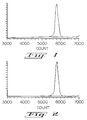
- Figure 1 is a gel permeation chromatogram of the dimethylpolysiloxane synthesized in Example 1.
- Figure 2 is a gel permeation chromatogram of the dimethylpolysiloxane synthesized in Example 2.
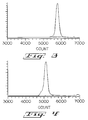
- Figure 3 is a gel permeation chromatogram of the dimethylpolysiloxane synthesized in Example 3.
- Figure 4 is a gel permeation chromatogram of the dimethylpolysiloxane synthesized in Example 4.
- Figure 5 is a gel permeation chromatogram of the dimethylpolysiloxane synthesized in Example 5.
- Figure 6 is a gel permeation chromatogram of the dimethylpolysiloxane synthesized in Example 6.
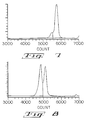
- Figure 7 is a gel permeation chromatogram of the dimethylpolysiloxane synthesized in Comparison Example 1.
- Figure 8 is a gel permeation chromatogram of the dimethylpolysiloxane synthesized in Comparison Example 2.
- the system was then azeotropically dried for 1 hour. After the system had been cooled to room temperature, 40.0 mL of a 1.63 N hexane solution of n-butyllithium (65.2 mmol) was added, and the system was stirred for 15 minutes at room temperature. 6.67 g (61.4 mmol) trimethylchlorosilane was subsequently added to the system with stirring for 10 minutes at room temperature.
- the SiH content of this dimethylpolysiloxane as determined by iodometry was 0.0106 weight%, which was in good agreement with the value of 0.0103 weight% calculated from the material charged. This value gave a value of 0.180 weight% for the silanol group content in the silanol-monoterminated dimethylpolysiloxane prior to the endblocking reaction, which again was in good agreement with the value of 0.176 weight% calculated from the material charged.
- the salt product was subsequently filtered off, azeotropic drying was carried out for 30 minutes, and the system was again cooled to room temperature. This was followed by the introduction of 0.1 mL of a 1.62 N hexane solution of n-butyllithium (0.162 mmol) and stirring for 10 minutes at room temperature. 4.4 g dimethylformamide was then added to the system, and stirring was carried out for 7.5 hours at 30°C. When the 1,1,3,3,5,5-hexamethylcyclotrisiloxane conversion according to GLC had reached 79.3%, 0.06 g acetic acid was added to the system in order to terminate the nonequilibration polymerization reaction.
- the number-average molecular weight was 95,712 and the dispersity was 1.05.
- the number-average molecular weight was 50,143 and the dispersity was 1.04.
- the peak area ratio (former : latter) was 57 : 43.
- the system was then azeotropically dried for 1 hour. After the system had been cooled to room temperature, 40.0 mL of a 1.63 N hexane solution of n-butyllithium (65.2 mmol) was added, and the system was stirred for 15 minutes at room temperature. 6.67 g (61.4 mmol) trimethylchlorosilane was subsequently added to the system with stirring for 10 minutes at room temperature.
- the system was then azeotropically dried for 1 hour. After the system had been cooled to room temperature, 40.0 mL of a 1.63 N hexane solution of n-butyllithium (65.2 mmol) was added and the system was stirred for 15 minutes at room temperature. 6.67 g (61.4 mmol) trimethylchlorosilane was subsequently added to the system with stirring for 10 minutes at room temperature.
Landscapes
- Chemical & Material Sciences (AREA)
- Health & Medical Sciences (AREA)
- Chemical Kinetics & Catalysis (AREA)
- Medicinal Chemistry (AREA)
- Polymers & Plastics (AREA)
- Organic Chemistry (AREA)
- Silicon Polymers (AREA)
Abstract
Description
- The present invention relates to a method for the preparation of diorganopolysiloxane that yields a very pure diorganopolysiloxane which bears a functional group at only one end of the molecular chain. Hereinafter this diorganopolysiloxane is identified as monoterminal-functional diorganopolysiloxane.
- The functional group reactivity of monoterminal-functional diorganopolysiloxane can be used as a starting material for graft organic polymers having diorganopolysiloxane chain branches. Diorganopolysiloxane of this type has the general formula
R(R₂SiO)pB
in which R is a monovalent hydrocarbon group, p is an integer with a value of at least 1, and B is hydrogen atom or a group with the general formula
-SiR₂R¹
in which R is a monovalent hydrocarbon group and R¹ is the hydrogen atom or an organofunctional group. JP-A 59-78236 [78,236/1984], 1-131247 [131,247/1989], and 2-92933 [92,933/1990] teach the preparation of this type of diorganopolysiloxane by first subjecting cyclic trisiloxane with the general formula
(R₂SiO)₃
in which R is a monovalent hydrocarbon group to nonequilibration polymerization, optionally in the presence of silane or siloxane with the general formula
R(R₂SiO)mH
in which R is a monovalent hydrocarbon group and m is an integer with a value of at least 1, under the effect of a lithium polymerization catalyst with the general formula
R(R₂SiO)nLi
in which R is a monovalent hydrocarbon group and n is an integer with a value of at least zero, and by subsequently terminating this nonequilibration polymerization with acid or halosilane with the general formula
R¹R₂SiX
in which R is a monovalent hydrocarbon group, R¹ is hydrogen atom or an organofunctional group, and X is a halogen atom. - However, several drawbacks are associated with the preparation of graft organic polymer using diorganopolysiloxane synthesized by the method described above. Thus, the viscosity of the graft organic polymer product undergoes a sharp increase as the molecular weight of the diorganopolysiloxane increases. Moreover, the graft organic polymer product gels when diorganopolysiloxane is used that has a number-average molecular weight above 10,000.
- The present inventor undertook various analyses of monoterminal-functional diorganopolysiloxane and its cyclic trisiloxane precursor. Using a Fourier-transform infrared spectrophotometer, the inventor confirmed that a silanol-containing impurity was present in the starting cyclic trisiloxane. Gel permeation chromatographic analysis also demonstrated a secondary peak on the high molecular weight side of the main peak due to the diorganopolysiloxane. It was also found that the ratio of this secondary peak increased with increasing number-average molecular weight for the diorganopolysiloxane.
- These results suggested that diorganopolysiloxane having functional groups at both molecular chain terminals, hereinafter referred to as diterminal-functional diorganopolysiloxane, is produced as a by-product during the synthesis of monoterminal-functional diorganopolysiloxane by the above preparative method.
- This diterminal-functional diorganopolysiloxane by-product is extremely difficult to separate by standard methods from the monoterminal-functional diorganopolysiloxane. This separation becomes even more difficult at higher number-average molecular weights for the diorganopolysiloxane.
- Also out analyses suggested that the presence of the silanol-containing impurity, such as a silane or siloxane that contains at least 2 silanol groups, in the starting cyclic trisiloxane is the primary cause of the secondary production of the diterminal-functional diorganopolysiloxane.
- However, silanol-containing impurity is also very difficult to separate from the cyclic trisiloxane by standard methods, such as distillation, column separation using an adsorbent such as silica, alumina, and activated clay, or a molecular sieve. The content of silanol-containing impurity in the cyclic trisiloxane is in fact increased in the particular case of column separation because the cyclic trisiloxane ring is easily opened by acid.
- The inventor carried out extensive investigations in order to solve the problems described above and as a result discovered that a very pure monoterminal-functional diorganopolysiloxane can be produced by the nonequilibration polymerization of cyclic trisiloxane in the presence of a lithium compound. This procedure prevents the silanol-containing impurity in the cyclic trisiloxane from participating in the nonequilibration polymerization by preliminarily silylating impurity with silylating agent. The present invention was achieved based on this discovery.
- Specifically, the present invention introduced a method for the preparation of diorganopolysiloxane that is capable of yielding a very pure monoterminal-functional diorganopolysiloxane.
- This invention provides a method for the preparation of diorganopolysiloxane with the general formula
R(R₂SiO)pB
in which R is a monovalent hydrocarbon group, p is an integer with a value of at least 1, and B is hydrogen atom or a group with the general formula
-SiR₂R¹
in which R is a monovalent hydrocarbon group and R¹ is hydrogen atom or an organofunctional group, by first subjecting - (A) a cyclic trisiloxane with the general formula
(R₂SiO)₃
in which R is a monovalent hydrocarbon group to nonequilibration polymerization, optionally in the presence of - (B) silane or siloxane with the general formula
R(R₂SiO)mH
in which R is a monovalent hydrocarbon group and m is an integer with a value of at least 1, under the effect of - (C) a lithium polymerization catalyst with the general formula
R(R₂SiO)nLi
in which R is a monovalent hydrocarbon group and n is an integer with a value of at least zero, and subsequently terminating said nonequilibration polymerization with - (D) an acid or halosilane with the general formula
R¹R₂SiX
in which R is a monovalent hydrocarbon group, R¹ is the hydrogen atom or an organofunctional group, and X is a halogen atom. In another aspect, the present invention relates to a method for the preparation of diorganopolysiloxane that is characterized in that the silanol-containing impurity present in the aforesaid cyclic trisiloxane (A) is preliminarily silylated with (E) a silylating agent.
Yet, another aspect of this invention is a method for the preparation of diorganopolysiloxane that is characterized in that the silanol-containing impurity present in the aforesaid cyclic trisiloxane (A) is preliminarily converted into lithiated material by lithiation with - (F) an organolithium compound and said lithiated material is then silylated with
- (G) a silylating agent that contains silicon-bonded halogen.
- Component (A) is the principal starting material in the preparative method of this invention, and it consists of cyclic trisiloxane with the following general formula
(R₂SiO)₃ .
The group R in this general formula represents monovalent hydrocarbon groups, and are exemplified by alkyl groups such as methyl, ethyl, propyl, butyl, pentyl, hexyl, heptyl, and octyl; alkenyl groups such as vinyl, allyl, butenyl, pentenyl, hexenyl, and heptenyl; aryl groups such as phenyl, tolyl, xylyl, and naphthyl; and aralkyl groups such as benzyl, and phenethyl. R is preferably methyl, phenyl, or vinyl because this affords ease of handling. - The cyclic trisiloxanes comprising component (A) are selected from
1,1,3,3,5,5-hexamethylcyclotrisiloxane,
1,1,3,3,5,5-hexaphenylcyclotrisiloxane,
1,3,5-trimethyl-1,3,5-triphenylcyclotrisiloxane,
1,3,5-trimethyl-1,3,5-trivinylcyclotrisiloxane,
1,3,5-triethyl-1,3,5-trimethylcyclotrisiloxane,
1,1,3,3,5,5-hexavinylcyclotrisiloxane,
1,3,5-trimethyl-1,3,5-tripropylcyclotrisiloxane, and
1,3,5-trimethyl-1,3,5-triphenethylcyclotrisiloxane. - The characteristic feature of the preparative method of this invention consists of the preliminary silylation of the silanol-containing impurity, such as a silane or a siloxane that contains at least 2 silanol groups, in the aforesaid component (A) with silylating agent (E) to thereby prevent the silanol-containing impurity from participating in the subsequent nonequilibration polymerization of component (A), optionally in the presence of silane or siloxane (B), under the effect of lithium polymerization catalyst (C).
- The silylating agent, component (E), in the preparative method of the invention silylates the silanol-containing impurity present in component (A), and the nature of component (E) is not specifically restricted. Component (E) is exemplified by silylating agents that contain silicon-bonded halogen (SiX-containing silylating agents) and silylating agents that contain silicon-bonded nitrogen (SiN-containing silylating agents). The SiX-containing silylating agents are exemplified by chlorosilanes such as trimethylchlorosilane, dimethyldichlorosilane, phenyldimethylchlorosilane, and tert-butyldimethylchlorosilane, and by bromosilanes such as trimethylbromosilane, and triethylbromosilane. Trimethylchlorosilane is preferred for its ease of acquisition and excellent reactivity. The SiN-containing silylating agents are exemplified by silazanes such as hexamethyldisilazane; silylamines such as dimethylaminotrimethylsilane, diethylaminotrimethylsilane, and trimethylsilylimidazole and silylamides such as bis(trimethylsilyl)acetamide; trimethylsilyldiphenylurea; and bis(trimethylsilyl)urea. Hexamethyldisilazane is preferred for its ease of acquisition and economics.
- The silylation reaction produces hydrogen halide as by-product when SiX-containing silylating agent is used as component (E). Because this hydrogen halide can open the ring in component (A) to introduce silanol-containing impurity, the hydrogen halide produced as by-product in the subject silylation reaction is preferably removed from the system. A hydrogen halide binding agent, such as an organic amine compound or ammonia, is preferably added to this silylation reaction in order to remove the hydrogen halide from the system. No particular restrictions apply to the operable organic amine compounds, which are tertiary organic amine compounds such as trimethylamine, triethylamine, tributylamine, and pyridine. When SiN-containing silylating agent is used as component (E), ammonium chloride, ammonium sulfate, or SiX-containing silylating agent can be simultaneously added to increase the reactivity of the silylating agent. The co-use of SiX-containing silylating agent and SiN-containing silylating agent as component (E) is particularly preferred because this serves to remove the hydrogen halide by-product of the silylation reaction from the system and to also improve the reactivity of the SiN-containing silylating agent.
- Component (E) is preferably added in the method of this invention in a quantity that provides at least the stoichiometric quantity of silicon-bonded halogen and/or silicon-bonded nitrogen in component (E) with reference to the silanol group in the silanol-containing impurity in component (A). However, SiX-containing silylating agents can participate in a neutralization reaction with the subsequently added component (C) and can thereby inactivate component (C). In addition, when added in excess, a very active silylating agent such as a silylamide, can also silylate the silanol group in the subsequently added component (B), which then leads to an increase in the molecular weight of the final diorganopolysiloxane product. For these reasons, these silylating agents are preferably added in equivalent quantities. The silanol group content due to the silanol-containing impurity in component (A) can be determined in advance using analytical instruments such as a Fourier-transform infrared spectrophotometer. When SiX-containing silylating agent is used as component (E), the hydrogen halide binding agent, such as an organic amine compound or ammonia, is preferably added in a quantity at least equivalent to that of said silylating agent.
- No particular restrictions obtain on the conditions for running the silylation reaction in the method of this invention. For example, the reaction temperature can range from room temperature to the boiling point of the solvent used. While the subject silylation reaction can be run in the absence of solvent, this reaction is preferably run in aprotic solvent such as benzene, toluene, and xylene; aliphatic solvents such as hexane, heptane, and cyclohexane; ether solvents such as tetrahydrofuran, and diethyl ether; ketone solvents such as acetone, and methyl ethyl ketone; ester solvents such as ethyl acetate, and butyl acetate; dimethylformamide; acetonitrile; and dimethyl sulfoxide. These aprotic solvents are preferably thoroughly dried prior to use.
- Component (B) is an optional starting material in the method of this invention of the instant. Its function is to regulate or adjust the molecular weight of the diorganopolysiloxane product. Component (B) is silane or siloxane with the following general formula
R(R₂SiO)mH .
The group R in the preceding formula represents monovalent hydrocarbon groups, encompassed by alkyl groups such as methyl, ethyl, propyl, butyl, pentyl, hexyl, heptyl, and octyl; alkenyl groups such as vinyl, allyl, butenyl, pentenyl, hexenyl, and heptenyl; aryl groups such as phenyl, tolyl, xylyl, and naphthyl; and aralkyl groups such as benzyl, and phenethyl. R is preferably methyl, phenyl, or vinyl because this affords ease of handling. The subscript m in the preceding formula is an integer with a value of at least 1 and preferably is an integer with a value of 1 to 20. - The silanes and siloxanes comprising component (B) are exemplified by silanes such as trimethylsilanol, dimethylvinylsilanol, dimethylphenylsilanol, and triphenylsilanol; and by siloxanes such as
dimethylpolysiloxane endblocked at one molecular chain terminal by the hydroxydimethylsiloxy group and endblocked at the other molecular chain terminal by the trimethylsiloxy group,
dimethylsiloxane oligomer endblocked at one molecular chain terminal by the hydroxydimethylsiloxy group and endblocked at the other molecular chain terminal by the trimethylsiloxy group,
methylphenylpolysiloxane endblocked at one molecular chain terminal by the hydroxydimethylsiloxy group and endblocked at the other molecular chain terminal by the trimethylsiloxy group,
methylphenylsiloxane oligomer endblocked at one molecular chain terminal by the hydroxydimethylsiloxy group and endblocked at the other molecular chain terminal by the trimethylsiloxy group,
methylphenylpolysiloxane endblocked at one molecular chain terminal by the hydroxydiphenylsiloxy group and endblocked at the other molecular chain terminal by the trimethylsiloxy group,
methylphenylpolysiloxane endblocked at one molecular chain terminal by the hydroxydimethylsiloxy group and endblocked at the other molecular chain terminal by the dimethylvinylsiloxy group,
methylphenylsiloxane-methylvinylsiloxane copolymer endblocked at one molecular chain terminal by the hydroxydimethylsiloxy group and endblocked at the other molecular chain terminal by the trimethylsiloxy group, and
methylphenylsiloxane-diphenylsiloxane copolymer endblocked at one molecular chain terminal by the hydroxydimethylsiloxy group and endblocked at the other molecular chain terminal by the trimethylsiloxy group. - Methods for the synthesis of component (B) are known. A specific example consists of the careful hydrolysis in dilute aqueous base solution of organomonochlorosilane or diorganopolysiloxane having Si-bonded halogen at only one molecular chain terminal.
- The lithium polymerization catalyst comprising component (C) is a catalyst for the nonequilibration polymerization of component (A), or component (A) plus component (B). The lithium polymerization catalyst comprising component (C) has the following general formula
R(R₂SiO)nLi .
The group R in the preceding formula represents monovalent hydrocarbon groups, and are alkyl groups such as methyl, ethyl, propyl, butyl, pentyl, hexyl, heptyl, and octyl; alkenyl groups such as vinyl, allyl, butenyl, pentenyl, hexenyl, and heptenyl; aryl groups such as phenyl, tolyl, xylyl, and naphthyl; and aralkyl groups such as benzyl, and phenethyl. R is preferably methyl, phenyl, or vinyl because this affords ease of handling. The subscript n in the preceding formula is an integer with a value of at least zero and preferably is an integer with a value of zero to 20. When n = zero, component (C) consists of organolithium compounds that are available on a commercial basis. On the other hand, component (C) is the lithium salt of organosilane or diorganopolysiloxane when n is an integer with a value of at least 1, and in this case it can be prepared by the addition of a commercially available organolithium compound to hydroxydiorganosilane, or diorganopolysiloxane endblocked by the hydroxydiorganosiloxy group at only the one molecular chain terminal (as described above for component (B). - The lithium polymerization catalyst comprising component (C) is exemplified by alkyllithiums such as n-butyllithium, sec-butyllithium, tert-butyllithium, and methyllithium; aryllithiums such as phenyllithium, and xylyllithium; alkenyllithiums such as vinyllithium, and allyllithium; the lithium salts of organosilane such as lithium trimethylsilanolate, lithium dimethylvinylsilanolate, and lithium triphenylsilanolate; and the lithium salts of organosiloxanes. The preceding alkyl-, aryl-, and alkenyllithiums and also lithium amides such as lithium bis(diisopropyl)amide are examples of commercially available organolithium compounds usable for the synthesis of the lithium salts of organosilane and organopolysiloxane used in this invention.
- No specific restrictions apply to the quantity of addition of component (C), and this component may simply be added in a quantity sufficient to run the nonequilibration polymerization. When SiX-containing silylating agent has been used as the component (E) for silylation of the silanol-containing impurity in component (A), both the unreacted silylating agent and the salt from the hydrogen halide by-product and organic amine or ammonia will participate in a neutralization reaction with component (C) and thereby inactivate component (C). One of the following is preferably carried out in order to respond to this: (i) addition of component (C) in excess of the quantity equivalent to the preceding, (ii) filtration of the salt by-product and then addition of component (C) in excess of the quantity equivalent to the aforesaid silylating agent remaining in the system, or (iii) preliminary elimination of both from the system. As a result, quantities are preferred that yield values of 100 : 0 to 0.01 : 100 for the ratio between the number of moles of lithium polymerization catalyst in component (C) that effectively acts in the nonequilibration polymerization and the number of moles of component (B) or silane or siloxane having silanol at only one molecular chain terminal that is produced as the nonequilibration polymerization develops. Quantities that yield values of 0.5 : 99.5 to 50 : 50 are particularly preferred because they provide excellent nonequilibration polymerization reaction rates, excellent production efficiencies, and efficient utilization of the expensive lithium polymerization catalyst.
- The reaction temperature and reaction time for the nonequilibration polymerization of component (A) and optionally component (B) under the effect of component (C) are not specifically restricted. However, very careful control must be exercised in order to avoid causing equilibration polymerization reactions (redistribution reactions). The occurrence of equilibration polymerization reactions leads to the secondary production of large amounts of diterminal-functional diorganopolysiloxane. In specific terms, when 1,1,3,3,5,5-hexamethylcyclotrisiloxane is used as component (A), the nonequilibration polymerization reaction conditions preferably consist of reaction for 1 to 50 hours at temperatures of 0°C to 30°C.
- While the subject nonequilibration polymerization can be run in the absence of solvent, it is preferably run in aprotic solvent. Aprotic solvents usable in this reaction are exemplified by the same solvents as above, and the aprotic solvent used in the silylation reaction is preferably used in the nonequilibration polymerization as long as no specific problems occur. The use of combinations of two or more aprotic solvents often yields good results. For example, when a low-polarity aprotic solvent such as toluene is used, it is preferably combined with a high-polarity aprotic solvent, such as dimethylformamide or dimethyl sulfoxide, in order to accelerate the nonequilibration polymerization.
- The development of the nonequilibration polymerization reaction can generally be monitored by determining the decline in the quantity of component (A) by an analytical technique such as gas chromatography. When the component (A) conversion has reached a prescribed value, the nonequilibration polymerization is preferably terminated by the addition of component (D). While it will be necessary to control the component (A) conversion in accordance with the type of component (A) and type of diorganopolysiloxane product, the component conversion is generally 70% to 100%, and preferably is 80% to 95%.
- Moisture present in the starting material and aprotic solvent must be removed to the maximum extent possible in the execution of the subject nonequilibration polymerization reaction. The presence of moisture in the starting material or aprotic solvent results in a pronounced tendency for diterminal-functional diorganopolysiloxane to be produced as a by-product.
- The number-average molecular weight of the diorganopolysiloxane product is determined by the ratio between the components (B) and (C) present in the system at the time of polymerization and the component (A) consumption.
- Component (D) terminates the nonequilibration polymerization, and it consists of acid or halosilane with the following general formula
R¹R₂SiX .
Component (D) encompasses any acid that reacts with the produced lithium silanolate to yield a stable lithium salt. Such acids include carbonic acid; mineral acids such as hydrochloric acid, and sulfuric acid and carboxylic acids such as acetic acid, propionic acid, and acrylic acid. The halosilanes encompassed by component (D) are dimethylchlorosilane, dimethylvinylchlorosilane, methacryloxypropyldimethylchlorosilane, and chloropropyldimethylchlorosilane. - Termination of the nonequilibration polymerization in the invention is achieved by using an acid such as carbonic acid, mineral acid, or carboxylic acid, as component (D) places the silanol group at one terminal of the molecular chain of the diorganopolysiloxane product. When this nonequilibration polymerization is terminated using halosilane as component (D), the endblocking group then consists of the silyl residue yielded by removal of the halogen. As a result, acid should be employed as component (D) when the synthesis is desired of diorganopolysiloxane having the silanol group at only one molecular chain terminal (silanol-monoterminated). Functional group-containing halosilane should be used when the synthesis is desired of diorganopolysiloxane having said functional group at only one molecular chain terminal. In addition, diorganopolysiloxane having a functional group at only one molecular chain terminal can be synthesized by reacting a component (D) functional group-containing halosilane or a functional group-containing silazane with the silanolmonoterminated diorganopolysiloxane afforded by the use of acid as component (D). A hydrogen halide binding agent, such as organic amine or ammonia, is preferably added when halosilane is used as component (D) or when the silanol-monoterminated diorganopolysiloxane is reacted with halosilane. Moreover, diorganopolysiloxane having SiH at only one molecular chain terminal can be prepared through the use of SiH-containing halosilane as component (D), for example dimethylchlorosilane. This SiH-monoterminated diorganopolysiloxane can then be addition reacted with a functional group-containing alkenyl compound, such as allyl glycidyl ether, allylamine, allyl alcohol, trimethylolpropane monoallyl ether, glycerol monoallyl ether, and allyl methacrylate, in the presence of a hydrosilylation-reaction catalyst, such as a platinum group metal catalyst, to provide a diorganopolysiloxane having a functional group at only one molecular chain terminal. If necessary, the functional group can be protected in this addition reaction through the use of a protective group such as the trimethylsilyl group, which may then be removed after the addition reaction.
- The diorganopolysiloxane prepared as described above has the following general formula
R(R₂SiO)pB .
The group R in this general formula represents monovalent hydrocarbon groups, and are exemplified by alkyl groups such as methyl, ethyl, propyl, butyl, pentyl, hexyl, heptyl, and octyl; alkenyl groups such as vinyl, allyl, butenyl, pentenyl, hexenyl, and heptenyl; aryl groups such as phenyl, tolyl, xylyl, and naphthyl; and aralkyl groups such as benzyl and phenethyl. The group B in the preceding formula is hydrogen atom or a group with the following general formula
-SiR₂R¹ .
The group R in the preceding formula is a monovalent hydrocarbon group exemplified by the same groups as above. R¹ is the hydrogen atom or an organofunctional group. The organofunctional groups encompassed by R¹ are alkenyl groups such as vinyl, allyl, butenyl, pentenyl, hexenyl, and heptenyl; and by 3-methacryloxypropyl, 3-acryloxypropyl, 3-chloropropyl, 3-glycidoxypropyl, 3-aminopropyl, and 3-hydroxypropyl. The subscript p in the preceding formula is an integer with a value of at least 1, preferably at least 3, and more preferably at least 10. - The preparative method of the second aspect of the present invention will now be considered in detail wherein the components (A) - (D) are the same as described above. The characteristic feature of the preparative method of this aspect of the invention consists of the preliminary lithiation of the silanol-containing impurity in the aforesaid component (A) with an organolithium compound (F) to form lithiated material and the subsequent silylation of this lithiated material with silylating agent that contains silicon-bonded halogen component (G), to thereby prevent this silanol-containing impurity from participating in the nonequilibration polymerization of component (A), optionally in the presence of silane or siloxane (B), under the effect of lithium polymerization catalyst (C). This preparative method prevents participation by the silanol-containing impurity in the nonequilibration polymerization more effectively than does the preparative method previously described above for reacting components (A) - (E).
- The organolithium compound comprising component (F) in this aspect of the claimed invention is an organolithium compound that lithiates the silanol-containing impurity present in component (A). The organolithium compound comprising component (F) is not specifically restricted, and commercially available organolithium compounds can be employed.
- The lithium compounds encompassed by component (F) are alkyllithiums such as n-butyllithium, sec-butyllithium, tert-butyllithium, and methyllithium; aryllithiums such as phenyllithium, and xylyllithium; alkenyllithiums such as vinyllithium, and allyllithium; and lithium amides such as lithium bis(diisopropyl)amide.
- Lithiation of the silanol-containing impurity in component (A) by component (F) proceeds readily at room temperature or below. Component (F) is preferably added in at least a stoichiometric quantity with reference to the silanol group in component (A). This lithiation reaction can be run in the absence of solvent, but is preferably run in aprotic solvent. Aprotic solvents usable in this case are exemplified by the same solvents as above.
- The aforesaid lithiated material is subsequently silylated with silylating agent that contains silicon-bonded halogen, component (G) (SiX-containing silylating agent). The SiX-containing silylating agents encompassed by component (G) are chlorosilanes such as trimethylchlorosilane, dimethyldichlorosilane, phenyldimethylchlorosilane, and tertbutyldimethylchlorosilane; and by bromosilanes such as trimethylbromosilane, and triethylbromosilane. Trimethylchlorosilane is preferred for its ease of acquisition and excellent reactivity.
- Component (G) is preferably added in at least a stoichiometric quantity with reference to the silanol group in component (A). An advantage to this preparative method is that the use of component (G), at less than equivalency relative to the previously added component (F), makes it unnecessary for the ensuing nonequilibration polymerization to also add excess component (C). This silylating reaction can be run in the absence of solvent, but is preferably run in aprotic solvent. Aprotic solvents usable in this case are exemplified by the same solvents as above.
- The conditions for this silylating reaction cannot be spoken of in unconditional terms because these conditions vary as a function of the reactivity of the silylating agent used. However, the reaction is ordinarily run at a temperature between room temperature and the boiling point of the solvent. The quantity of silanol group impurity in the cyclic trisiloxane is preferably measured beforehand by a technique such as Fourier-transform infrared spectrochemical analysis (FTIR) in order to determine the amount of silylating agent to be used.
- It has been reported in the Journal of Organic Chemistry, Volume 35, 1309 (1970) that the cyclic trisiloxane ring is readily opened at room temperature with the production of lithium silanolate when an organolithium compound is added to cyclic trisiloxane. However, in the case of the second aspect of this invention, it has been confirmed that the addition of component (F) preferentially converts the silanol-containing impurity in component (A) to lithiated material, and that this lithiated material is selectively silylated by the subsequent addition of component (G). It has also been confirmed that this method unexpectedly yields a more complete silylation of the silanol-containing impurity than the direct reaction of silylating agent with the silanol-containing impurity in component (A).
- As discussed hereinbefore, the monoterminal-functional diorganopolysiloxane afforded by the preparative method of the present invention contains little diterminal-functional diorganopolysiloxane by-product. As a result, when it is used as starting material for graft organic polymers, it can donate to the graft organic polymer the lubricity, weather resistance, moisture resistance, and gas permeability, that are characteristic of diorganopolysiloxanes without a substantial increase in the viscosity of the graft organic polymer.
- The method of the present invention for the preparation of diorganopolysiloxane is explained in greater detail through working examples. The number-average molecular weight and the dispersity reported in the examples for the diorganopolysiloxane were measured by gel permeation chromatography calibrated with dimethylpolysiloxane standard. The trimethylsilanol and dimethylformamide used in the examples were dried before use.
- Figure 1 is a gel permeation chromatogram of the dimethylpolysiloxane synthesized in Example 1.
- Figure 2 is a gel permeation chromatogram of the dimethylpolysiloxane synthesized in Example 2.
- Figure 3 is a gel permeation chromatogram of the dimethylpolysiloxane synthesized in Example 3.
- Figure 4 is a gel permeation chromatogram of the dimethylpolysiloxane synthesized in Example 4.
- Figure 5 is a gel permeation chromatogram of the dimethylpolysiloxane synthesized in Example 5.
- Figure 6 is a gel permeation chromatogram of the dimethylpolysiloxane synthesized in Example 6.
- Figure 7 is a gel permeation chromatogram of the dimethylpolysiloxane synthesized in Comparison Example 1.
- Figure 8 is a gel permeation chromatogram of the dimethylpolysiloxane synthesized in Comparison Example 2.
- 90 g toluene was mixed with 110 g (494.5 mmol) 1,1,3,3,5,5-hexamethylcyclotrisiloxane that contained 170 ppm silanol group (SiOH group = 1.1 mmol) as determined using a Fourier-transform infrared spectrophotometer (FTIR). The system was then azeotropically dried for 1 hour. After the system had been cooled to room temperature, 0.8 mL of a 1.62 N hexane solution of n-butyllithium (1.29 mmol n-butyllithium) was added, and the system was stirred for 10 minutes at room temperature. 0.120 g (1.1 mmol) trimethylchlorosilane was subsequently added to the system with stirring for 30 minutes at room temperature. This was followed by the addition of a mixture of 0.816 g (9.05 mmol) trimethylsilanol and 4.4 g dimethylformamide. The 1,1,3,3,5,5-hexamethylcyclotrisiloxane conversion was monitored by gas chromatography (GLC). After 7 hours, this conversion had reached 78.9%, and 0.06 g acetic acid was added to the system at this point to terminate the nonequilibration polymerization reaction. The salt product was filtered off, and the filtrate was distilled in a vacuum to afford dimethylpolysiloxane having silanol at only one molecular chain terminal. Analysis of this dimethylpolysiloxane by gel permeation chromatography (GPC) yielded the following results: number-average molecular weight = 11,685, dispersity = 1.07. No peaks were observed other than the main peak.
- A nonequilibration polymerization reaction was run as in Example 1, but in this case using 3.24 mmol n-butyllithium and 3.05 mmol trimethylchlorosilane. After 5.5 hours, the 1,1,3,3,5,5-hexamethylcyclotrisiloxane conversion had reached 77.7%, and the nonequilibration polymerization reaction was terminated at this point by the procedure in Example 1. The same workup as before afforded dimethylpolysiloxane having silanol at only one molecular chain terminal. Analysis of this dimethylpolysiloxane by GPC yielded the following results: number-average molecular weight = 10,544, dispersity = 1.07. No peaks were observed other than the main peak.
- A nonequilibration polymerization reaction was run as in Example 1, but in this case using 0.062 g (0.69 mmol) trimethylsilanol. After 5.5 hours, the 1,1,3,3,5,5-hexamethylcyclotrisiloxane conversion had reached 79.4%, and the nonequilibration polymerization reaction was terminated at this point by the procedure in Example 1. The same workup as before afforded dimethylpolysiloxane having silanol at only one molecular chain terminal. Analysis of this dimethylpolysiloxane by GPC yielded the following results: number-average molecular weight = 51,954, dispersity = 1.07. No peaks were observed other than the main peak.
- 1,800 g toluene was mixed with 2,200 g (9,889.2 mmol) 1,1,3,3,5,5-hexamethylcyclotrisiloxane that contained 170 ppm silanol group (SiOH group = 22.0 mmol) as determined by FTIR. The system was then azeotropically dried for 1 hour. After the system had been cooled to room temperature, 40.0 mL of a 1.63 N hexane solution of n-butyllithium (65.2 mmol) was added, and the system was stirred for 15 minutes at room temperature. 6.67 g (61.4 mmol) trimethylchlorosilane was subsequently added to the system with stirring for 10 minutes at room temperature. This was followed by the addition of a mixture of 16.33 g (181.0 mmol) trimethylsilanol and 88 g dimethylformamide. The 1,1,3,3,5,5-hexamethylcyclotrisiloxane conversion was monitored by GLC. After 5.5 hours, this conversion had reached 80.2%, and 1.2 g acetic acid was added to the system at this point in order to terminate the nonequilibration polymerization reaction. The salt product was filtered off, and the filtrate was distilled in a vacuum to afford dimethylpolysiloxane having silanol at only one molecular chain terminal (silanol-monoterminated dimethylpolysiloxane). Analysis of this dimethylpolysiloxane by GPC yielded the following results: number-average molecular weight = 10,707, dispersity = 1.08. Peaking other than the main peak was almost absent.
- 12 g of the silanol-monoterminated dimethylpolysiloxane synthesized in Example 4, 7.2 g tetramethyldisilazane, 30 g diethyl ether, and 0.1 g trifluoroacetic acid were mixed, and the mixture was held for 4 hours at room temperature. The system was then heated under reduced pressure to yield dimethylpolysiloxane having silicon-bonded hydrogen at only the one molecular chain terminal. Absorption due to the silanol group was not observed when this dimethylpolysiloxane was analyzed by FTIR, which confirmed completion of the endblocking reaction. The SiH content of this dimethylpolysiloxane as determined by iodometry was 0.0106 weight%, which was in good agreement with the value of 0.0103 weight% calculated from the material charged. This value gave a value of 0.180 weight% for the silanol group content in the silanol-monoterminated dimethylpolysiloxane prior to the endblocking reaction, which again was in good agreement with the value of 0.176 weight% calculated from the material charged.
- 50 g (5.29 mmol) of the silanol-monoterminated dimethylpolysiloxane synthesized in Example 4, 50 mL toluene, and 0.70 g (9.53 mmol) diethylamine were mixed, and 1.216 g (5.51 mmol) methacryloxypropyldimethylchlorosilane was then dripped into this mixture at room temperature. After the completion of addition, the system was stirred while heating at 60°C for 7.5 hours. The system was subsequently cooled to room temperature, the salt product was filtered off, and the filtrate was distilled under reduced pressure to yield dimethylpolysiloxane having the 3-methacryloxypropyl group at only one molecular chain terminal. Analysis of this dimethylpolysiloxane by GPC gave the following results: number-average molecular weight = 11,544, dispersity = 1.07. No peaks other than the main peak were observed. This dimethylpolysiloxane did not produce silanol group signals when analyzed by ²⁹Si nuclear magnetic resonance spectroscopic analysis, which confirmed completion of the endblocking reaction.
- 90 g toluene was mixed with 110 g (494.5 mmol) 1,1,3,3,5,5-hexamethylcyclotrisiloxane that contained 170 ppm silanol group (SiOH group = 1.1 mmol) as determined by FTIR. The system was then azeotropically dried for 1 hour. After the system had been cooled to room temperature, 0.22 g (2.2 mmol) triethylamine and then 0.141 g (1.3 mmol) trimethylchlorosilane were added and stirring was carried out for 1 hour at room temperature. This was followed by the addition of 0.816 g (9.05 mmol) trimethylsilanol to the system, and stirring for 1 hour at room temperature. The salt product was subsequently filtered off, azeotropic drying was carried out for 30 minutes, and the system was again cooled to room temperature. This was followed by the introduction of 0.1 mL of a 1.62 N hexane solution of n-butyllithium (0.162 mmol) and stirring for 10 minutes at room temperature. 4.4 g dimethylformamide was then added to the system, and stirring was carried out for 7.5 hours at 30°C. When the 1,1,3,3,5,5-hexamethylcyclotrisiloxane conversion according to GLC had reached 79.3%, 0.06 g acetic acid was added to the system in order to terminate the nonequilibration polymerization reaction. The salt product was filtered off, and the filtrate was distilled in a vacuum to afford dimethylpolysiloxane having silanol at only one molecular chain terminal. Analysis of this dimethylpolysiloxane by GPC yielded the following results: number-average molecular weight = 11,210, dispersity = 1.10. Peaking other than the main peak was almost absent.
- 90 g toluene was mixed with 110 g (494.5 mmol) 1,1,3,3,5,5-hexamethylcyclotrisiloxane that contained 170 ppm silanol group (SiOH group = 1.1 mmol) as determined by FTIR. The system was then azeotropically dried for 1 hour. After the system had been cooled to room temperature, 0.235 g (1.46 mmol) hexamethyldisilazane and then 0.0351 g (0.32 mmol) trimethylchlorosilane were added, and heating under reflux was carried out for 8 hours. After the system had again been cooled to room temperature, 0.816 g (9.05 mmol) trimethylsilanol and then 0.3 mL of a 1.62 N hexane solution of n-butyllithium (0.49 mmol) were added, and the system was stirred for 10 minutes at room temperature. 4.4 g dimethylformamide was then added to the system, and stirring was carried out for 5.5 hours at room temperature. When the 1,1,3,3,5,5-hexamethylcyclotrisiloxane conversion according to GLC had reached 79.5%, 0.06 g acetic acid was added to the system in order to terminate the nonequilibration polymerization reaction. The salt product was filtered off, and the filtrate was distilled in a vacuum to afford dimethylpolysiloxane having silanol at only one molecular chain terminal. Analysis of this dimethylpolysiloxane by GPC yielded the following results: number-average molecular weight = 11,304, dispersity = 1.09. Peaking other than the main peak was almost absent.
- 90 g toluene and 0.816 g (9.05 mmol) trimethylsilanol were mixed with 110 g (494.5 mmol) 1,1,3,3,5,5-hexamethylcyclotrisiloxane that contained 170 ppm silanol group (SiOH group = 1.1 mmol) as determined by FTIR. This system was azeotropically dried for 1 hour. After the system had been cooled to room temperature, 0.05 mL of a 1.62 N hexane solution of n-butyllithium (0.08 mmol) was added, and stirring was carried out for 10 minutes at room temperature. 3.3 g dimethylformamide was added to the system, which was then stirred for 7.5 hours at room temperature. When the 1,1,3,3,5,5-hexamethylcyclotrisiloxane conversion according to GLC had reached 79.6%, 0.06 g acetic acid was added to the system in order to terminate the nonequilibration polymerization reaction. The salt product was filtered off, and the filtrate was distilled in a vacuum to afford dimethylpolysiloxane having silanol at only one molecular chain terminal. A bimodal molecular weight distribution was found when this dimethylpolysiloxane was analyzed by GPC. For the peak on the higher molecular weight side the number-average molecular weight was 25,995 and the dispersity was 1.03. For the peak on the lower molecular weight side the number-average molecular weight was 11,958 and the dispersity was 1.06. The peak area ratio (former : latter) was 11 : 89.
- A nonequilibration polymerization reaction was run as in Comparison Example 1, but in this case using 0.16 mmol n-butyllithium, 0.062 g (0.69 mmol) trimethylsilanol, and 4.4 g dimethylformamide. When the 1,1,3,3,5,5-hexamethylcyclotrisiloxane conversion had reached 80.1% after stirring at room temperature for 4.5 hours, the nonequilibration polymerization reaction was terminated as in Comparison Example 1. Workup as in Comparison Example 1 afforded dimethylpolysiloxane having the silanol group at only one molecular chain terminal. A bimodal molecular weight distribution was found when this dimethylpolysiloxane was analyzed by GPC. For the peak on the higher molecular weight side the number-average molecular weight was 95,712 and the dispersity was 1.05. For the peak on the lower molecular weight side the number-average molecular weight was 50,143 and the dispersity was 1.04. The peak area ratio (former : latter) was 57 : 43.
- 1,800 g toluene was mixed with 2,200 g (9,889.2 mmol) 1,1,3,3,5,5-hexamethylcyclotrisiloxane that contained 170 ppm silanol group (SiOH group = 22.0 mmol) as determined by FTIR. The system was then azeotropically dried for 1 hour. After the system had been cooled to room temperature, 40.0 mL of a 1.63 N hexane solution of n-butyllithium (65.2 mmol) was added, and the system was stirred for 15 minutes at room temperature. 6.67 g (61.4 mmol) trimethylchlorosilane was subsequently added to the system with stirring for 10 minutes at room temperature. This was followed by the addition of a mixture of 16.33 g (181.0 mmol) trimethylsilanol and 88 g dimethylformamide. The 1,1,3,3,5,5-hexamethylcyclotrisiloxane conversion was monitored by GLC. After 5.5 hours, this conversion had reached 80.2%, and 21.0 g (221.8 mmol) dimethylchlorosilane and 33.7 g (332.7 mmol) triethylamine were added to the system at this point. The nonequilibration polymerization was terminated by stirring at room temperature overnight. The salt product was filtered off, and the filtrate was distilled in a vacuum to afford dimethylpolysiloxane having silicon-bonded hydrogen at only one molecular chain terminal. Analysis of this dimethylpolysiloxane by GPC yielded the following results: number-average molecular weight = 10,770, dispersity = 1.08. No peaks were observed other than the main peak. No silanol group absorption was observed when this dimethylpolysiloxane was analyzed by FTIR. The silicon-bonded hydrogen content of this dimethylpolysiloxane was 0.0105 weight% as determined by iodometry.
- 1,800 g toluene was mixed with 2,200 g (9,889.2 mmol) 1,1,3,3,5,5-hexamethylcyclotrisiloxane that contained 170 ppm silanol group (SiOH group = 22.0 mmol) as determined by FTIR. The system was then azeotropically dried for 1 hour. After the system had been cooled to room temperature, 40.0 mL of a 1.63 N hexane solution of n-butyllithium (65.2 mmol) was added and the system was stirred for 15 minutes at room temperature. 6.67 g (61.4 mmol) trimethylchlorosilane was subsequently added to the system with stirring for 10 minutes at room temperature. This was followed by the addition of a mixture of 16.33 g (181.0 mmol) trimethylsilanol and 88 g dimethylformamide. The 1,1,3,3,5,5-hexamethylcyclotrisiloxane conversion was monitored by GLC. After 5.5 hours, this conversion had reached 80.2%, and 49.0 g (221.8 mmol) 3-methacryloxypropyldimethylchlorosilane and 24.3 g (332.7 mmol) diethylamine were added to the system at this point. The nonequilibration polymerization was terminated by stirring for 7.5 hours while heating at 60°C. The salt product was filtered off, and the filtrate was distilled in a vacuum to afford dimethylpolysiloxane having the 3-methacryloxypropyl group at only one molecular chain terminal. Analysis of this dimethylpolysiloxane by GPC yielded the following results: number-average molecular weight = 11,550, dispersity = 1.08. No peaks were observed other than the main peak. No silanol group absorption was observed when this dimethylpolysiloxane was analyzed by FTIR.
Claims (4)
- A method for the preparation of a diorganopolysiloxane with the formula
R(R₂SiO)pB
in which R is a monovalent hydrocarbon group, p is an integer with a value of at least 1, and B is hydrogen atom or a group with the formula
-SiR₂R¹
in which R is a monovalent hydrocarbon group and R¹ is hydrogen atom or an organofunctional group, by first subjecting(A) a cyclic trisiloxane with the formula
(R₂SiO)₃
in which R is a monovalent hydrocarbon group to nonequilibration polymerization, optionally in the presence of(B) a compound selected from a silane and a siloxane with the formula
R(R₂SiO)mH
in which R is a monovalent hydrocarbon group and m is an integer with a value of at least 1, under the effect of a(C) a lithium polymerization catalyst with the formula
R(R₂SiO)nLi
in which R is a monovalent hydrocarbon group and n is an integer with a value of at least zero to twenty, and subsequently terminating said nonequilibration polymerization with(D) a compound selected from an acid and a halosilane with the formula
R¹R₂SiX
in which R is a monovalent hydrocarbon group, R¹ is hydrogen atom or an organofunctional group, and X is a halogen atom, characterized in that the silanol-containing impurity present in the cyclic trisiloxane (A) is preliminarily silylated with(E) a silylating agent. - A method according to Claim 1 in which the silylating agent (E) is a silylating agent containing silicon-bonded halogen.
- A method according to Claim 1 in which the silylating agent (E) is a silylating agent containing silicon-bonded nitrogen.
- A method for the preparation of a diorganopolysiloxane with the formula
R(R₂SiO)pB
in which R is a monovalent hydrocarbon group, p is an integer with a value of at least 1, and B is hydrogen atom or a group with the formula
-SiR₂R¹
in which R is a monovalent hydrocarbon group and R¹ is hydrogen atom or an organofunctional group, by first subjecting(A) a cyclic trisiloxane with the formula
(R₂SiO)₃
in which R is a monovalent hydrocarbon group, to nonequilibration polymerization, in the presence of(B) a compound selected from a silane and a siloxane with the formula
R(R₂SiO)mH
in which R is a monovalent hydrocarbon group and m is an integer with a value of at least 1, under the effect of(C) a lithium polymerization catalyst with the formula
R(R₂SiO)nLi
in which R is a monovalent hydrocarbon group and n is an integer with a value of at least zero to twenty, and subsequently terminating said nonequilibration polymerization with(D) a compound selected from an acid and a halosilane with the formula
R¹R₂SiX
in which R is a monovalent hydrocarbon group, R¹ is hydrogen atom or an organofunctional group, and X is a halogen atom, characterized in that the silanol-containing impurity present in the cyclic trisiloxane (A) is preliminarily converted into a lithiated material by lithiation with(F) an organolithium compound and said lithiated material is then silylated with(G) a silylating agent that contains silicon-bonded halogen.
Applications Claiming Priority (2)
| Application Number | Priority Date | Filing Date | Title |
|---|---|---|---|
| JP151052/93 | 1993-05-28 | ||
| JP5151052A JP2826939B2 (en) | 1993-05-28 | 1993-05-28 | Method for producing diorganopolysiloxane |
Publications (3)
| Publication Number | Publication Date |
|---|---|
| EP0626413A2 true EP0626413A2 (en) | 1994-11-30 |
| EP0626413A3 EP0626413A3 (en) | 1995-05-24 |
| EP0626413B1 EP0626413B1 (en) | 1997-10-22 |
Family
ID=15510252
Family Applications (1)
| Application Number | Title | Priority Date | Filing Date |
|---|---|---|---|
| EP94108226A Expired - Lifetime EP0626413B1 (en) | 1993-05-28 | 1994-05-27 | Method for the preparation of diorganopolysiloxanes |
Country Status (4)
| Country | Link |
|---|---|
| US (1) | US5399649A (en) |
| EP (1) | EP0626413B1 (en) |
| JP (1) | JP2826939B2 (en) |
| DE (1) | DE69406356T2 (en) |
Cited By (4)
| Publication number | Priority date | Publication date | Assignee | Title |
|---|---|---|---|---|
| EP0679674A3 (en) * | 1994-04-28 | 1996-09-04 | Dow Corning Toray Silicone | Method for preparing diorganopolysiloxane having a functional group at only one end of the molecular chain. |
| EP0814111A1 (en) * | 1996-06-21 | 1997-12-29 | Chisso Corporation | Process for producing diorganopolysiloxane |
| EP0855418A3 (en) * | 1997-01-28 | 1998-12-02 | PCR, Inc. | High purity branched phenylsiloxane fluids |
| CN1067399C (en) * | 1996-01-30 | 2001-06-20 | 拜尔公司 | Multifunctional cyclic organic siloxane, preparation method and usage thereof |
Families Citing this family (13)
| Publication number | Priority date | Publication date | Assignee | Title |
|---|---|---|---|---|
| JP3447104B2 (en) * | 1994-03-23 | 2003-09-16 | ダウ コーニング アジア株式会社 | Bi-functional diphenylsiloxane oligomer |
| US5660690A (en) * | 1996-06-03 | 1997-08-26 | Dow Corning Corporation | Method for distilling hexamethylcyclotrisiloxane |
| JP3687762B2 (en) * | 1996-06-21 | 2005-08-24 | チッソ株式会社 | Method for producing diorganopolysiloxane |
| US6090902A (en) * | 1998-12-21 | 2000-07-18 | Dow Corning Corporation | Organopolysiloxane-modified graft copolymers |
| US20060229423A1 (en) * | 2005-03-17 | 2006-10-12 | Parakka James P | Process for the production of monodisperse and narrow disperse monofunctional silicones |
| DE102011119341A1 (en) | 2011-11-25 | 2013-05-29 | Heraeus Quarzglas Gmbh & Co. Kg | Process for the production of synthetic quartz glass using the soot method |
| DE102011119339A1 (en) | 2011-11-25 | 2013-05-29 | Heraeus Quarzglas Gmbh & Co. Kg | Sputtering process for the production of synthetic quartz glass |
| DE102011119373A1 (en) | 2011-11-25 | 2013-05-29 | Heraeus Quarzglas Gmbh & Co. Kg | Process for the production of synthetic quartz glass |
| DE102011119374A1 (en) | 2011-11-25 | 2013-05-29 | Heraeus Quarzglas Gmbh & Co. Kg | Process for the production of synthetic quartz glass |
| CN113024809B (en) * | 2020-11-12 | 2022-07-29 | 杭州师范大学 | Preparation method of polysiloxane fluid with single-end trialkoxysiloxane blocking |
| CN114044905B (en) * | 2021-10-06 | 2023-01-06 | 复旦大学 | A kind of preparation method of end group functionalized polydimethylsiloxane |
| JP7113994B1 (en) * | 2022-04-05 | 2022-08-05 | 信越化学工業株式会社 | Method for producing single-end functional organopolysiloxane and single-end functional organopolysiloxane composition |
| JP2025537976A (en) * | 2022-12-02 | 2025-11-20 | ジェレスト, インコーポレイテッド | Soft skin adhesive composition |
Family Cites Families (4)
| Publication number | Priority date | Publication date | Assignee | Title |
|---|---|---|---|---|
| JPS5978236A (en) * | 1982-10-28 | 1984-05-07 | Toagosei Chem Ind Co Ltd | Production of vinyl-polymerizable high-molecular straight-chain silicone monomer |
| JP2678371B2 (en) * | 1987-08-31 | 1997-11-17 | 東レ・ダウコーニング・シリコーン株式会社 | Method for producing organopolysiloxane having alkenyl group at terminal |
| JP2842443B2 (en) * | 1988-09-30 | 1999-01-06 | 東レ・ダウコーニング・シリコーン株式会社 | Method for producing organopolysiloxane having a polymerizable functional group at one end |
| JP2978206B2 (en) * | 1990-04-28 | 1999-11-15 | 東レ・ダウコーニング・シリコーン株式会社 | Method for producing diphenylsiloxane / dimethylsiloxane copolymer |
-
1993
- 1993-05-28 JP JP5151052A patent/JP2826939B2/en not_active Expired - Lifetime
-
1994
- 1994-04-25 US US08/232,938 patent/US5399649A/en not_active Expired - Fee Related
- 1994-05-27 DE DE69406356T patent/DE69406356T2/en not_active Expired - Fee Related
- 1994-05-27 EP EP94108226A patent/EP0626413B1/en not_active Expired - Lifetime
Cited By (4)
| Publication number | Priority date | Publication date | Assignee | Title |
|---|---|---|---|---|
| EP0679674A3 (en) * | 1994-04-28 | 1996-09-04 | Dow Corning Toray Silicone | Method for preparing diorganopolysiloxane having a functional group at only one end of the molecular chain. |
| CN1067399C (en) * | 1996-01-30 | 2001-06-20 | 拜尔公司 | Multifunctional cyclic organic siloxane, preparation method and usage thereof |
| EP0814111A1 (en) * | 1996-06-21 | 1997-12-29 | Chisso Corporation | Process for producing diorganopolysiloxane |
| EP0855418A3 (en) * | 1997-01-28 | 1998-12-02 | PCR, Inc. | High purity branched phenylsiloxane fluids |
Also Published As
| Publication number | Publication date |
|---|---|
| JPH06340743A (en) | 1994-12-13 |
| DE69406356D1 (en) | 1997-11-27 |
| US5399649A (en) | 1995-03-21 |
| EP0626413B1 (en) | 1997-10-22 |
| JP2826939B2 (en) | 1998-11-18 |
| DE69406356T2 (en) | 1998-03-19 |
| EP0626413A3 (en) | 1995-05-24 |
Similar Documents
| Publication | Publication Date | Title |
|---|---|---|
| EP0626413B1 (en) | Method for the preparation of diorganopolysiloxanes | |
| EP0195936B1 (en) | Method for producing organosilicon polymers and the polymers prepared thereby | |
| KR0129763B1 (en) | Process for preparing organopolysiloxane in which a polymeric functional group is present at one end | |
| US5254645A (en) | Cluster azasilacycloalkyl functional polysiloxanes | |
| CN108137812B (en) | Production method of hydrosilyl group-containing silicone resin | |
| EP0679674B1 (en) | Method for preparing diorganopolysiloxane having a functional group at only one end of the molecular chain | |
| EP0499407B1 (en) | Crosslinkers and chain extenders for room temperature vulcanization or crosslinking of polymers | |
| JPS6320856B2 (en) | ||
| EP0331753B1 (en) | Process for producing organopolysiloxanes having alkenyl group at its end | |
| US5510430A (en) | Method of functionalizing organosiloxane condensation products | |
| EP0431409A2 (en) | A nonaqueous method for making silicone polymers | |
| US4578494A (en) | Preparation of polysiloxanes from halosilanes | |
| CN116745374B (en) | Siloxane functionalized silica | |
| JPH07247294A (en) | Method for producing organosilicon compound containing ketimine structure | |
| US5693735A (en) | Trimethylsiloxy group-containing polysiloxane and a process for producing the same | |
| CN109843982B (en) | Reactive siloxanes and process for their preparation | |
| CA1122996A (en) | Short chain linear amidosiloxanes | |
| JPH0826151B2 (en) | Method for producing polysiloxane | |
| JPS6220194B2 (en) | ||
| JP4603635B2 (en) | Process for producing organosiloxane from dihalosilane | |
| EP0693520B1 (en) | Method for the preparation of organopolysiloxanes | |
| JP2769840B2 (en) | Siloxane compounds having hydroxyl-containing substituents | |
| JP3131216B2 (en) | Organopolysiloxane and method for producing the same | |
| KR950015136B1 (en) | Silicon resin and process for producing thereof | |
| JP3155547B2 (en) | Diphenylsiloxane / dimethylsiloxane copolymer and method for producing the same |
Legal Events
| Date | Code | Title | Description |
|---|---|---|---|
| PUAI | Public reference made under article 153(3) epc to a published international application that has entered the european phase |
Free format text: ORIGINAL CODE: 0009012 |
|
| AK | Designated contracting states |
Kind code of ref document: A2 Designated state(s): DE FR GB |
|
| PUAL | Search report despatched |
Free format text: ORIGINAL CODE: 0009013 |
|
| AK | Designated contracting states |
Kind code of ref document: A3 Designated state(s): DE FR GB |
|
| 17P | Request for examination filed |
Effective date: 19950726 |
|
| GRAG | Despatch of communication of intention to grant |
Free format text: ORIGINAL CODE: EPIDOS AGRA |
|
| GRAG | Despatch of communication of intention to grant |
Free format text: ORIGINAL CODE: EPIDOS AGRA |
|
| 17Q | First examination report despatched |
Effective date: 19970204 |
|
| GRAH | Despatch of communication of intention to grant a patent |
Free format text: ORIGINAL CODE: EPIDOS IGRA |
|
| GRAH | Despatch of communication of intention to grant a patent |
Free format text: ORIGINAL CODE: EPIDOS IGRA |
|
| GRAA | (expected) grant |
Free format text: ORIGINAL CODE: 0009210 |
|
| AK | Designated contracting states |
Kind code of ref document: B1 Designated state(s): DE FR GB |
|
| REF | Corresponds to: |
Ref document number: 69406356 Country of ref document: DE Date of ref document: 19971127 |
|
| ET | Fr: translation filed | ||
| PLBE | No opposition filed within time limit |
Free format text: ORIGINAL CODE: 0009261 |
|
| STAA | Information on the status of an ep patent application or granted ep patent |
Free format text: STATUS: NO OPPOSITION FILED WITHIN TIME LIMIT |
|
| 26N | No opposition filed | ||
| REG | Reference to a national code |
Ref country code: GB Ref legal event code: IF02 |
|
| PGFP | Annual fee paid to national office [announced via postgrant information from national office to epo] |
Ref country code: DE Payment date: 20020408 Year of fee payment: 9 |
|
| PGFP | Annual fee paid to national office [announced via postgrant information from national office to epo] |
Ref country code: FR Payment date: 20020409 Year of fee payment: 9 |
|
| PGFP | Annual fee paid to national office [announced via postgrant information from national office to epo] |
Ref country code: GB Payment date: 20020410 Year of fee payment: 9 |
|
| PG25 | Lapsed in a contracting state [announced via postgrant information from national office to epo] |
Ref country code: GB Free format text: LAPSE BECAUSE OF NON-PAYMENT OF DUE FEES Effective date: 20030527 |
|
| PG25 | Lapsed in a contracting state [announced via postgrant information from national office to epo] |
Ref country code: DE Free format text: LAPSE BECAUSE OF NON-PAYMENT OF DUE FEES Effective date: 20031202 |
|
| GBPC | Gb: european patent ceased through non-payment of renewal fee |
Effective date: 20030527 |
|
| PG25 | Lapsed in a contracting state [announced via postgrant information from national office to epo] |
Ref country code: FR Free format text: LAPSE BECAUSE OF NON-PAYMENT OF DUE FEES Effective date: 20040130 |
|
| REG | Reference to a national code |
Ref country code: FR Ref legal event code: ST |