EP0625158B1 - Therapeutic nucleosides of the 2',3'-dideoxy-3'-fluoro-purine series - Google Patents
Therapeutic nucleosides of the 2',3'-dideoxy-3'-fluoro-purine series Download PDFInfo
- Publication number
- EP0625158B1 EP0625158B1 EP93900334A EP93900334A EP0625158B1 EP 0625158 B1 EP0625158 B1 EP 0625158B1 EP 93900334 A EP93900334 A EP 93900334A EP 93900334 A EP93900334 A EP 93900334A EP 0625158 B1 EP0625158 B1 EP 0625158B1
- Authority
- EP
- European Patent Office
- Prior art keywords
- compound
- formula
- purine
- amino
- fluoro
- Prior art date
- Legal status (The legal status is an assumption and is not a legal conclusion. Google has not performed a legal analysis and makes no representation as to the accuracy of the status listed.)
- Expired - Lifetime
Links
- 239000002777 nucleoside Substances 0.000 title description 5
- 230000001225 therapeutic effect Effects 0.000 title description 3
- 125000003835 nucleoside group Chemical group 0.000 title 1
- 230000009385 viral infection Effects 0.000 claims abstract description 12
- 150000001875 compounds Chemical class 0.000 claims description 97
- 239000000203 mixture Substances 0.000 claims description 71
- 238000009472 formulation Methods 0.000 claims description 54
- 238000000034 method Methods 0.000 claims description 35
- 150000003839 salts Chemical class 0.000 claims description 29
- 238000011282 treatment Methods 0.000 claims description 23
- 150000002148 esters Chemical class 0.000 claims description 20
- KDCGOANMDULRCW-UHFFFAOYSA-N 7H-purine Chemical group N1=CNC2=NC=NC2=C1 KDCGOANMDULRCW-UHFFFAOYSA-N 0.000 claims description 19
- 241000700721 Hepatitis B virus Species 0.000 claims description 16
- 238000006243 chemical reaction Methods 0.000 claims description 13
- 241000725303 Human immunodeficiency virus Species 0.000 claims description 12
- 239000003814 drug Substances 0.000 claims description 12
- 229910052739 hydrogen Inorganic materials 0.000 claims description 12
- 239000003795 chemical substances by application Substances 0.000 claims description 11
- 239000001257 hydrogen Substances 0.000 claims description 11
- 125000004435 hydrogen atom Chemical group [H]* 0.000 claims description 11
- 230000008569 process Effects 0.000 claims description 11
- 125000006239 protecting group Chemical group 0.000 claims description 9
- 125000002887 hydroxy group Chemical group [H]O* 0.000 claims description 8
- 238000002360 preparation method Methods 0.000 claims description 7
- 241000700605 Viruses Species 0.000 claims description 6
- 229910052757 nitrogen Inorganic materials 0.000 claims description 6
- 125000004433 nitrogen atom Chemical group N* 0.000 claims description 6
- 125000002467 phosphate group Chemical group [H]OP(=O)(O[H])O[*] 0.000 claims description 6
- 125000002924 primary amino group Chemical group [H]N([H])* 0.000 claims description 6
- SVLJJCFAOVASKJ-YNEHKIRRSA-N [(2r,3s,5r)-5-(2-amino-6-phenylmethoxypurin-9-yl)-3-fluorooxolan-2-yl]methanol Chemical compound C=12N=CN([C@@H]3O[C@H](CO)[C@@H](F)C3)C2=NC(N)=NC=1OCC1=CC=CC=C1 SVLJJCFAOVASKJ-YNEHKIRRSA-N 0.000 claims description 5
- NWBYZKRWDJCGTJ-DJLDLDEBSA-N [(2r,3s,5r)-5-[2-amino-6-(azetidin-1-yl)purin-9-yl]-3-fluorooxolan-2-yl]methanol Chemical compound C=12N=CN([C@@H]3O[C@H](CO)[C@@H](F)C3)C2=NC(N)=NC=1N1CCC1 NWBYZKRWDJCGTJ-DJLDLDEBSA-N 0.000 claims description 5
- 231100000283 hepatitis Toxicity 0.000 claims description 5
- 239000008194 pharmaceutical composition Substances 0.000 claims description 5
- 239000012453 solvate Substances 0.000 claims description 5
- 239000003443 antiviral agent Substances 0.000 claims description 4
- 125000001153 fluoro group Chemical group F* 0.000 claims description 4
- 238000004519 manufacturing process Methods 0.000 claims description 4
- 239000002243 precursor Substances 0.000 claims description 4
- 125000000714 pyrimidinyl group Chemical group 0.000 claims description 4
- 238000002560 therapeutic procedure Methods 0.000 claims description 4
- 125000001963 4 membered heterocyclic group Chemical group 0.000 claims description 3
- 208000006454 hepatitis Diseases 0.000 claims description 3
- 238000011321 prophylaxis Methods 0.000 claims description 3
- ULGZDMOVFRHVEP-RWJQBGPGSA-N Erythromycin Chemical compound O([C@@H]1[C@@H](C)C(=O)O[C@@H]([C@@]([C@H](O)[C@@H](C)C(=O)[C@H](C)C[C@@](C)(O)[C@H](O[C@H]2[C@@H]([C@H](C[C@@H](C)O2)N(C)C)O)[C@H]1C)(C)O)CC)[C@H]1C[C@@](C)(OC)[C@@H](O)[C@H](C)O1 ULGZDMOVFRHVEP-RWJQBGPGSA-N 0.000 claims description 2
- 208000005074 Retroviridae Infections Diseases 0.000 claims description 2
- 239000003937 drug carrier Substances 0.000 claims 1
- 208000036142 Viral infection Diseases 0.000 abstract description 8
- 239000002212 purine nucleoside Substances 0.000 abstract description 3
- 208000002672 hepatitis B Diseases 0.000 abstract description 2
- 239000004480 active ingredient Substances 0.000 description 57
- OKKJLVBELUTLKV-UHFFFAOYSA-N Methanol Chemical compound OC OKKJLVBELUTLKV-UHFFFAOYSA-N 0.000 description 24
- 210000004027 cell Anatomy 0.000 description 22
- -1 methanesulphonyl Chemical group 0.000 description 20
- HQKMJHAJHXVSDF-UHFFFAOYSA-L magnesium stearate Chemical compound [Mg+2].CCCCCCCCCCCCCCCCCC([O-])=O.CCCCCCCCCCCCCCCCCC([O-])=O HQKMJHAJHXVSDF-UHFFFAOYSA-L 0.000 description 16
- XLYOFNOQVPJJNP-UHFFFAOYSA-N water Substances O XLYOFNOQVPJJNP-UHFFFAOYSA-N 0.000 description 16
- 239000002585 base Substances 0.000 description 15
- 108020004414 DNA Proteins 0.000 description 14
- 239000002775 capsule Substances 0.000 description 14
- 239000003826 tablet Substances 0.000 description 14
- 239000004615 ingredient Substances 0.000 description 13
- 239000000243 solution Substances 0.000 description 13
- WVDDGKGOMKODPV-UHFFFAOYSA-N Benzyl alcohol Chemical compound OCC1=CC=CC=C1 WVDDGKGOMKODPV-UHFFFAOYSA-N 0.000 description 12
- 208000015181 infectious disease Diseases 0.000 description 12
- 208000030507 AIDS Diseases 0.000 description 11
- PEDCQBHIVMGVHV-UHFFFAOYSA-N Glycerine Chemical compound OCC(O)CO PEDCQBHIVMGVHV-UHFFFAOYSA-N 0.000 description 11
- 239000003921 oil Substances 0.000 description 11
- WEVYAHXRMPXWCK-UHFFFAOYSA-N Acetonitrile Chemical compound CC#N WEVYAHXRMPXWCK-UHFFFAOYSA-N 0.000 description 10
- 239000000126 substance Substances 0.000 description 10
- YMWUJEATGCHHMB-UHFFFAOYSA-N Dichloromethane Chemical compound ClCCl YMWUJEATGCHHMB-UHFFFAOYSA-N 0.000 description 9
- 208000031886 HIV Infections Diseases 0.000 description 9
- WHNWPMSKXPGLAX-UHFFFAOYSA-N N-Vinyl-2-pyrrolidone Chemical compound C=CN1CCCC1=O WHNWPMSKXPGLAX-UHFFFAOYSA-N 0.000 description 9
- 230000000694 effects Effects 0.000 description 9
- 239000007788 liquid Substances 0.000 description 9
- 235000019198 oils Nutrition 0.000 description 9
- 229920000036 polyvinylpyrrolidone Polymers 0.000 description 9
- 235000013855 polyvinylpyrrolidone Nutrition 0.000 description 9
- 229940069328 povidone Drugs 0.000 description 9
- 239000000725 suspension Substances 0.000 description 9
- GUBGYTABKSRVRQ-QKKXKWKRSA-N Lactose Natural products OC[C@H]1O[C@@H](O[C@H]2[C@H](O)[C@@H](O)C(O)O[C@@H]2CO)[C@H](O)[C@@H](O)[C@H]1O GUBGYTABKSRVRQ-QKKXKWKRSA-N 0.000 description 8
- 239000008101 lactose Substances 0.000 description 8
- 235000019359 magnesium stearate Nutrition 0.000 description 8
- 241000282414 Homo sapiens Species 0.000 description 7
- 239000006071 cream Substances 0.000 description 7
- 239000000843 powder Substances 0.000 description 7
- RYYIULNRIVUMTQ-UHFFFAOYSA-N 6-chloroguanine Chemical compound NC1=NC(Cl)=C2N=CNC2=N1 RYYIULNRIVUMTQ-UHFFFAOYSA-N 0.000 description 6
- 108020004207 Nucleoside deoxyribosyltransferase Proteins 0.000 description 6
- 101710132082 Pyrimidine/purine nucleoside phosphorylase Proteins 0.000 description 6
- HEMHJVSKTPXQMS-UHFFFAOYSA-M Sodium hydroxide Chemical compound [OH-].[Na+] HEMHJVSKTPXQMS-UHFFFAOYSA-M 0.000 description 6
- 102000013537 Thymidine Phosphorylase Human genes 0.000 description 6
- 239000002253 acid Substances 0.000 description 6
- 125000000217 alkyl group Chemical group 0.000 description 6
- 230000000840 anti-viral effect Effects 0.000 description 6
- 239000000969 carrier Substances 0.000 description 6
- 238000011049 filling Methods 0.000 description 6
- 239000002244 precipitate Substances 0.000 description 6
- 239000000047 product Substances 0.000 description 6
- 239000006228 supernatant Substances 0.000 description 6
- 241000588724 Escherichia coli Species 0.000 description 5
- 101710101148 Probable 6-oxopurine nucleoside phosphorylase Proteins 0.000 description 5
- DNIAPMSPPWPWGF-UHFFFAOYSA-N Propylene glycol Chemical group CC(O)CO DNIAPMSPPWPWGF-UHFFFAOYSA-N 0.000 description 5
- 102000030764 Purine-nucleoside phosphorylase Human genes 0.000 description 5
- VYPSYNLAJGMNEJ-UHFFFAOYSA-N Silicium dioxide Chemical compound O=[Si]=O VYPSYNLAJGMNEJ-UHFFFAOYSA-N 0.000 description 5
- 230000036436 anti-hiv Effects 0.000 description 5
- 125000004432 carbon atom Chemical group C* 0.000 description 5
- 238000005119 centrifugation Methods 0.000 description 5
- 238000013270 controlled release Methods 0.000 description 5
- 239000003925 fat Substances 0.000 description 5
- 235000019197 fats Nutrition 0.000 description 5
- 239000008188 pellet Substances 0.000 description 5
- IJGRMHOSHXDMSA-UHFFFAOYSA-N Atomic nitrogen Chemical compound N#N IJGRMHOSHXDMSA-UHFFFAOYSA-N 0.000 description 4
- 102000004190 Enzymes Human genes 0.000 description 4
- 108090000790 Enzymes Proteins 0.000 description 4
- 208000037357 HIV infectious disease Diseases 0.000 description 4
- VEXZGXHMUGYJMC-UHFFFAOYSA-N Hydrochloric acid Chemical compound Cl VEXZGXHMUGYJMC-UHFFFAOYSA-N 0.000 description 4
- 241001465754 Metazoa Species 0.000 description 4
- 206010038997 Retroviral infections Diseases 0.000 description 4
- 235000019445 benzyl alcohol Nutrition 0.000 description 4
- 230000037396 body weight Effects 0.000 description 4
- 230000010261 cell growth Effects 0.000 description 4
- 235000014113 dietary fatty acids Nutrition 0.000 description 4
- 229940079593 drug Drugs 0.000 description 4
- 239000003995 emulsifying agent Substances 0.000 description 4
- 239000000839 emulsion Substances 0.000 description 4
- 239000000194 fatty acid Substances 0.000 description 4
- 229930195729 fatty acid Natural products 0.000 description 4
- 239000000796 flavoring agent Substances 0.000 description 4
- 239000007903 gelatin capsule Substances 0.000 description 4
- 235000011187 glycerol Nutrition 0.000 description 4
- 208000033519 human immunodeficiency virus infectious disease Diseases 0.000 description 4
- 230000003834 intracellular effect Effects 0.000 description 4
- 150000003833 nucleoside derivatives Chemical class 0.000 description 4
- 239000002245 particle Substances 0.000 description 4
- 239000000741 silica gel Substances 0.000 description 4
- 229910002027 silica gel Inorganic materials 0.000 description 4
- 239000012064 sodium phosphate buffer Substances 0.000 description 4
- 229940080313 sodium starch Drugs 0.000 description 4
- 239000000829 suppository Substances 0.000 description 4
- 229940124597 therapeutic agent Drugs 0.000 description 4
- HBOMLICNUCNMMY-XLPZGREQSA-N zidovudine Chemical compound O=C1NC(=O)C(C)=CN1[C@@H]1O[C@H](CO)[C@@H](N=[N+]=[N-])C1 HBOMLICNUCNMMY-XLPZGREQSA-N 0.000 description 4
- 125000004178 (C1-C4) alkyl group Chemical group 0.000 description 3
- BKIUEHLYJFLWPK-SHYZEUOFSA-N 1-[(2r,4s,5r)-4-fluoro-5-(hydroxymethyl)oxolan-2-yl]pyrimidine-2,4-dione Chemical compound C1[C@H](F)[C@@H](CO)O[C@H]1N1C(=O)NC(=O)C=C1 BKIUEHLYJFLWPK-SHYZEUOFSA-N 0.000 description 3
- IIZPXYDJLKNOIY-JXPKJXOSSA-N 1-palmitoyl-2-arachidonoyl-sn-glycero-3-phosphocholine Chemical compound CCCCCCCCCCCCCCCC(=O)OC[C@H](COP([O-])(=O)OCC[N+](C)(C)C)OC(=O)CCC\C=C/C\C=C/C\C=C/C\C=C/CCCCC IIZPXYDJLKNOIY-JXPKJXOSSA-N 0.000 description 3
- FBPFZTCFMRRESA-FSIIMWSLSA-N D-Glucitol Natural products OC[C@H](O)[C@H](O)[C@@H](O)[C@H](O)CO FBPFZTCFMRRESA-FSIIMWSLSA-N 0.000 description 3
- FBPFZTCFMRRESA-JGWLITMVSA-N D-glucitol Chemical compound OC[C@H](O)[C@@H](O)[C@H](O)[C@H](O)CO FBPFZTCFMRRESA-JGWLITMVSA-N 0.000 description 3
- LFQSCWFLJHTTHZ-UHFFFAOYSA-N Ethanol Chemical compound CCO LFQSCWFLJHTTHZ-UHFFFAOYSA-N 0.000 description 3
- 108010010803 Gelatin Proteins 0.000 description 3
- 241000282412 Homo Species 0.000 description 3
- 241000124008 Mammalia Species 0.000 description 3
- KRWMERLEINMZFT-UHFFFAOYSA-N O6-benzylguanine Chemical compound C=12NC=NC2=NC(N)=NC=1OCC1=CC=CC=C1 KRWMERLEINMZFT-UHFFFAOYSA-N 0.000 description 3
- 102000009097 Phosphorylases Human genes 0.000 description 3
- 108010073135 Phosphorylases Proteins 0.000 description 3
- 229920002873 Polyethylenimine Polymers 0.000 description 3
- ZMANZCXQSJIPKH-UHFFFAOYSA-N Triethylamine Chemical compound CCN(CC)CC ZMANZCXQSJIPKH-UHFFFAOYSA-N 0.000 description 3
- 125000002252 acyl group Chemical group 0.000 description 3
- 150000001450 anions Chemical class 0.000 description 3
- 125000003710 aryl alkyl group Chemical group 0.000 description 3
- 238000003556 assay Methods 0.000 description 3
- 125000001797 benzyl group Chemical group [H]C1=C([H])C([H])=C(C([H])=C1[H])C([H])([H])* 0.000 description 3
- 239000000872 buffer Substances 0.000 description 3
- 239000007963 capsule composition Substances 0.000 description 3
- 238000002648 combination therapy Methods 0.000 description 3
- 238000007906 compression Methods 0.000 description 3
- 230000006835 compression Effects 0.000 description 3
- 230000000120 cytopathologic effect Effects 0.000 description 3
- 229940104302 cytosine Drugs 0.000 description 3
- 239000003085 diluting agent Substances 0.000 description 3
- 201000010099 disease Diseases 0.000 description 3
- 208000037265 diseases, disorders, signs and symptoms Diseases 0.000 description 3
- 239000006185 dispersion Substances 0.000 description 3
- 239000002552 dosage form Substances 0.000 description 3
- 239000006260 foam Substances 0.000 description 3
- 239000008273 gelatin Substances 0.000 description 3
- 229920000159 gelatin Polymers 0.000 description 3
- 235000019322 gelatine Nutrition 0.000 description 3
- 235000011852 gelatine desserts Nutrition 0.000 description 3
- 239000008187 granular material Substances 0.000 description 3
- 239000001963 growth medium Substances 0.000 description 3
- 230000007062 hydrolysis Effects 0.000 description 3
- 238000006460 hydrolysis reaction Methods 0.000 description 3
- 229920003088 hydroxypropyl methyl cellulose Polymers 0.000 description 3
- 238000001802 infusion Methods 0.000 description 3
- 239000003112 inhibitor Substances 0.000 description 3
- 239000000787 lecithin Substances 0.000 description 3
- 235000010445 lecithin Nutrition 0.000 description 3
- 229940067606 lecithin Drugs 0.000 description 3
- 125000002496 methyl group Chemical group [H]C([H])([H])* 0.000 description 3
- 229940127073 nucleoside analogue Drugs 0.000 description 3
- 239000006072 paste Substances 0.000 description 3
- 125000001997 phenyl group Chemical group [H]C1=C([H])C([H])=C(*)C([H])=C1[H] 0.000 description 3
- TZLVRPLSVNESQC-UHFFFAOYSA-N potassium azide Chemical compound [K+].[N-]=[N+]=[N-] TZLVRPLSVNESQC-UHFFFAOYSA-N 0.000 description 3
- 239000008057 potassium phosphate buffer Substances 0.000 description 3
- 239000003380 propellant Substances 0.000 description 3
- 102000004169 proteins and genes Human genes 0.000 description 3
- 108090000623 proteins and genes Proteins 0.000 description 3
- 239000008213 purified water Substances 0.000 description 3
- 150000003212 purines Chemical class 0.000 description 3
- 239000002904 solvent Substances 0.000 description 3
- 239000000600 sorbitol Substances 0.000 description 3
- 235000010356 sorbitol Nutrition 0.000 description 3
- 239000004094 surface-active agent Substances 0.000 description 3
- WYWHKKSPHMUBEB-UHFFFAOYSA-N tioguanine Chemical compound N1C(N)=NC(=S)C2=C1N=CN2 WYWHKKSPHMUBEB-UHFFFAOYSA-N 0.000 description 3
- 238000011200 topical administration Methods 0.000 description 3
- 241001430294 unidentified retrovirus Species 0.000 description 3
- PUPZLCDOIYMWBV-UHFFFAOYSA-N (+/-)-1,3-Butanediol Chemical compound CC(O)CCO PUPZLCDOIYMWBV-UHFFFAOYSA-N 0.000 description 2
- XSSYCIGJYCVRRK-RQJHMYQMSA-N (-)-carbovir Chemical compound C1=NC=2C(=O)NC(N)=NC=2N1[C@@H]1C[C@H](CO)C=C1 XSSYCIGJYCVRRK-RQJHMYQMSA-N 0.000 description 2
- 0 *c1nc2c(*)nc(*)nc2[n]1 Chemical compound *c1nc2c(*)nc(*)nc2[n]1 0.000 description 2
- VBICKXHEKHSIBG-UHFFFAOYSA-N 1-monostearoylglycerol Chemical compound CCCCCCCCCCCCCCCCCC(=O)OCC(O)CO VBICKXHEKHSIBG-UHFFFAOYSA-N 0.000 description 2
- 238000005160 1H NMR spectroscopy Methods 0.000 description 2
- CTPDSKVQLSDPLC-UHFFFAOYSA-N 2-(oxolan-2-ylmethoxy)ethanol Chemical compound OCCOCC1CCCO1 CTPDSKVQLSDPLC-UHFFFAOYSA-N 0.000 description 2
- XQSPYNMVSIKCOC-RITPCOANSA-N 4-amino-5-fluoro-1-[(2s,5r)-2-(hydroxymethyl)-1,3-oxathiolan-5-yl]pyrimidin-2-one Chemical compound C1=C(F)C(N)=NC(=O)N1[C@@H]1O[C@H](CO)SC1 XQSPYNMVSIKCOC-RITPCOANSA-N 0.000 description 2
- POYNHVFBISCPAG-DJLDLDEBSA-N 5-ethynyl-1-[(2r,4s,5r)-4-fluoro-5-(hydroxymethyl)oxolan-2-yl]pyrimidine-2,4-dione Chemical compound C1[C@H](F)[C@@H](CO)O[C@H]1N1C(=O)NC(=O)C(C#C)=C1 POYNHVFBISCPAG-DJLDLDEBSA-N 0.000 description 2
- VIHOKLDQONOBGG-UHFFFAOYSA-N 6-(azetidin-1-yl)-7h-purin-2-amine Chemical compound C=12N=CNC2=NC(N)=NC=1N1CCC1 VIHOKLDQONOBGG-UHFFFAOYSA-N 0.000 description 2
- 206010001513 AIDS related complex Diseases 0.000 description 2
- CSCPPACGZOOCGX-UHFFFAOYSA-N Acetone Natural products CC(C)=O CSCPPACGZOOCGX-UHFFFAOYSA-N 0.000 description 2
- UXCAQJAQSWSNPQ-XLPZGREQSA-N Alovudine Chemical compound O=C1NC(=O)C(C)=CN1[C@@H]1O[C@H](CO)[C@@H](F)C1 UXCAQJAQSWSNPQ-XLPZGREQSA-N 0.000 description 2
- USFZMSVCRYTOJT-UHFFFAOYSA-N Ammonium acetate Chemical compound N.CC(O)=O USFZMSVCRYTOJT-UHFFFAOYSA-N 0.000 description 2
- 239000005695 Ammonium acetate Substances 0.000 description 2
- 235000003911 Arachis Nutrition 0.000 description 2
- 244000105624 Arachis hypogaea Species 0.000 description 2
- CURLTUGMZLYLDI-UHFFFAOYSA-N Carbon dioxide Chemical compound O=C=O CURLTUGMZLYLDI-UHFFFAOYSA-N 0.000 description 2
- HEDRZPFGACZZDS-UHFFFAOYSA-N Chloroform Chemical compound ClC(Cl)Cl HEDRZPFGACZZDS-UHFFFAOYSA-N 0.000 description 2
- RTZKZFJDLAIYFH-UHFFFAOYSA-N Diethyl ether Chemical compound CCOCC RTZKZFJDLAIYFH-UHFFFAOYSA-N 0.000 description 2
- IAZDPXIOMUYVGZ-WFGJKAKNSA-N Dimethyl sulfoxide Chemical compound [2H]C([2H])([2H])S(=O)C([2H])([2H])[2H] IAZDPXIOMUYVGZ-WFGJKAKNSA-N 0.000 description 2
- 239000001856 Ethyl cellulose Substances 0.000 description 2
- ZZSNKZQZMQGXPY-UHFFFAOYSA-N Ethyl cellulose Chemical compound CCOCC1OC(OC)C(OCC)C(OCC)C1OC1C(O)C(O)C(OC)C(CO)O1 ZZSNKZQZMQGXPY-UHFFFAOYSA-N 0.000 description 2
- 206010016654 Fibrosis Diseases 0.000 description 2
- 206010057212 Hepatitis viral infections Diseases 0.000 description 2
- 241000598436 Human T-cell lymphotropic virus Species 0.000 description 2
- 241000713772 Human immunodeficiency virus 1 Species 0.000 description 2
- 241000713340 Human immunodeficiency virus 2 Species 0.000 description 2
- DGAQECJNVWCQMB-PUAWFVPOSA-M Ilexoside XXIX Chemical compound C[C@@H]1CC[C@@]2(CC[C@@]3(C(=CC[C@H]4[C@]3(CC[C@@H]5[C@@]4(CC[C@@H](C5(C)C)OS(=O)(=O)[O-])C)C)[C@@H]2[C@]1(C)O)C)C(=O)O[C@H]6[C@@H]([C@H]([C@@H]([C@H](O6)CO)O)O)O.[Na+] DGAQECJNVWCQMB-PUAWFVPOSA-M 0.000 description 2
- 102000006992 Interferon-alpha Human genes 0.000 description 2
- 108010047761 Interferon-alpha Proteins 0.000 description 2
- 102000014150 Interferons Human genes 0.000 description 2
- 108010050904 Interferons Proteins 0.000 description 2
- 241000186660 Lactobacillus Species 0.000 description 2
- 235000010643 Leucaena leucocephala Nutrition 0.000 description 2
- 240000007472 Leucaena leucocephala Species 0.000 description 2
- 229920000168 Microcrystalline cellulose Polymers 0.000 description 2
- GQPLMRYTRLFLPF-UHFFFAOYSA-N Nitrous Oxide Chemical compound [O-][N+]#N GQPLMRYTRLFLPF-UHFFFAOYSA-N 0.000 description 2
- ISWSIDIOOBJBQZ-UHFFFAOYSA-N Phenol Chemical compound OC1=CC=CC=C1 ISWSIDIOOBJBQZ-UHFFFAOYSA-N 0.000 description 2
- ATUOYWHBWRKTHZ-UHFFFAOYSA-N Propane Chemical compound CCC ATUOYWHBWRKTHZ-UHFFFAOYSA-N 0.000 description 2
- CZPWVGJYEJSRLH-UHFFFAOYSA-N Pyrimidine Chemical compound C1=CN=CN=C1 CZPWVGJYEJSRLH-UHFFFAOYSA-N 0.000 description 2
- XWNMORIHKRROGW-UHFFFAOYSA-N Ro 5-3335 Chemical compound C12=CC(Cl)=CC=C2NC(=O)CN=C1C1=CC=CN1 XWNMORIHKRROGW-UHFFFAOYSA-N 0.000 description 2
- DBMJMQXJHONAFJ-UHFFFAOYSA-M Sodium laurylsulphate Chemical compound [Na+].CCCCCCCCCCCCOS([O-])(=O)=O DBMJMQXJHONAFJ-UHFFFAOYSA-M 0.000 description 2
- CZMRCDWAGMRECN-UGDNZRGBSA-N Sucrose Chemical compound O[C@H]1[C@H](O)[C@@H](CO)O[C@@]1(CO)O[C@@H]1[C@H](O)[C@@H](O)[C@H](O)[C@@H](CO)O1 CZMRCDWAGMRECN-UGDNZRGBSA-N 0.000 description 2
- 229930006000 Sucrose Natural products 0.000 description 2
- 210000001744 T-lymphocyte Anatomy 0.000 description 2
- WYURNTSHIVDZCO-UHFFFAOYSA-N Tetrahydrofuran Chemical compound C1CCOC1 WYURNTSHIVDZCO-UHFFFAOYSA-N 0.000 description 2
- MKUXAQIIEYXACX-UHFFFAOYSA-N aciclovir Chemical compound N1C(N)=NC(=O)C2=C1N(COCCO)C=N2 MKUXAQIIEYXACX-UHFFFAOYSA-N 0.000 description 2
- 229960004150 aciclovir Drugs 0.000 description 2
- 150000007513 acids Chemical class 0.000 description 2
- 239000013543 active substance Substances 0.000 description 2
- 239000000654 additive Substances 0.000 description 2
- 239000000853 adhesive Substances 0.000 description 2
- 230000001070 adhesive effect Effects 0.000 description 2
- 235000019257 ammonium acetate Nutrition 0.000 description 2
- 229940043376 ammonium acetate Drugs 0.000 description 2
- BFNBIHQBYMNNAN-UHFFFAOYSA-N ammonium sulfate Chemical compound N.N.OS(O)(=O)=O BFNBIHQBYMNNAN-UHFFFAOYSA-N 0.000 description 2
- 229910052921 ammonium sulfate Inorganic materials 0.000 description 2
- 239000007864 aqueous solution Substances 0.000 description 2
- 125000003118 aryl group Chemical group 0.000 description 2
- 125000002393 azetidinyl group Chemical group 0.000 description 2
- 239000011230 binding agent Substances 0.000 description 2
- 230000015572 biosynthetic process Effects 0.000 description 2
- 125000001589 carboacyl group Chemical group 0.000 description 2
- 125000001309 chloro group Chemical group Cl* 0.000 description 2
- 230000007882 cirrhosis Effects 0.000 description 2
- 208000019425 cirrhosis of liver Diseases 0.000 description 2
- 125000000753 cycloalkyl group Chemical group 0.000 description 2
- OPTASPLRGRRNAP-UHFFFAOYSA-N cytosine Chemical compound NC=1C=CNC(=O)N=1 OPTASPLRGRRNAP-UHFFFAOYSA-N 0.000 description 2
- 238000007907 direct compression Methods 0.000 description 2
- 239000007884 disintegrant Substances 0.000 description 2
- 238000006073 displacement reaction Methods 0.000 description 2
- 239000008157 edible vegetable oil Substances 0.000 description 2
- 230000002255 enzymatic effect Effects 0.000 description 2
- 235000019325 ethyl cellulose Nutrition 0.000 description 2
- 229920001249 ethyl cellulose Polymers 0.000 description 2
- 235000019634 flavors Nutrition 0.000 description 2
- 238000004108 freeze drying Methods 0.000 description 2
- 239000000499 gel Substances 0.000 description 2
- 239000011521 glass Substances 0.000 description 2
- 206010073071 hepatocellular carcinoma Diseases 0.000 description 2
- 231100000844 hepatocellular carcinoma Toxicity 0.000 description 2
- 238000007327 hydrogenolysis reaction Methods 0.000 description 2
- 239000001866 hydroxypropyl methyl cellulose Substances 0.000 description 2
- 235000010979 hydroxypropyl methyl cellulose Nutrition 0.000 description 2
- UFVKGYZPFZQRLF-UHFFFAOYSA-N hydroxypropyl methyl cellulose Chemical compound OC1C(O)C(OC)OC(CO)C1OC1C(O)C(O)C(OC2C(C(O)C(OC3C(C(O)C(O)C(CO)O3)O)C(CO)O2)O)C(CO)O1 UFVKGYZPFZQRLF-UHFFFAOYSA-N 0.000 description 2
- 239000003701 inert diluent Substances 0.000 description 2
- 230000002458 infectious effect Effects 0.000 description 2
- 238000002347 injection Methods 0.000 description 2
- 239000007924 injection Substances 0.000 description 2
- 229940047124 interferons Drugs 0.000 description 2
- 239000000543 intermediate Substances 0.000 description 2
- NNPPMTNAJDCUHE-UHFFFAOYSA-N isobutane Chemical compound CC(C)C NNPPMTNAJDCUHE-UHFFFAOYSA-N 0.000 description 2
- 229940039696 lactobacillus Drugs 0.000 description 2
- 201000007270 liver cancer Diseases 0.000 description 2
- 208000014018 liver neoplasm Diseases 0.000 description 2
- 239000000314 lubricant Substances 0.000 description 2
- 239000003550 marker Substances 0.000 description 2
- 239000000463 material Substances 0.000 description 2
- 239000000155 melt Substances 0.000 description 2
- 238000002844 melting Methods 0.000 description 2
- 230000008018 melting Effects 0.000 description 2
- 239000012528 membrane Substances 0.000 description 2
- 125000000956 methoxy group Chemical group [H]C([H])([H])O* 0.000 description 2
- 229940016286 microcrystalline cellulose Drugs 0.000 description 2
- 235000019813 microcrystalline cellulose Nutrition 0.000 description 2
- 239000008108 microcrystalline cellulose Substances 0.000 description 2
- 238000002156 mixing Methods 0.000 description 2
- 238000000465 moulding Methods 0.000 description 2
- TZBAVQKIEKDGFH-UHFFFAOYSA-N n-[2-(diethylamino)ethyl]-1-benzothiophene-2-carboxamide;hydrochloride Chemical compound [Cl-].C1=CC=C2SC(C(=O)NCC[NH+](CC)CC)=CC2=C1 TZBAVQKIEKDGFH-UHFFFAOYSA-N 0.000 description 2
- 125000004108 n-butyl group Chemical group [H]C([H])([H])C([H])([H])C([H])([H])C([H])([H])* 0.000 description 2
- 239000002674 ointment Substances 0.000 description 2
- 239000003883 ointment base Substances 0.000 description 2
- 239000003960 organic solvent Substances 0.000 description 2
- 239000012071 phase Substances 0.000 description 2
- ZJAOAACCNHFJAH-UHFFFAOYSA-N phosphonoformic acid Chemical compound OC(=O)P(O)(O)=O ZJAOAACCNHFJAH-UHFFFAOYSA-N 0.000 description 2
- 229920005862 polyol Polymers 0.000 description 2
- 150000003077 polyols Chemical class 0.000 description 2
- NROKBHXJSPEDAR-UHFFFAOYSA-M potassium fluoride Chemical compound [F-].[K+] NROKBHXJSPEDAR-UHFFFAOYSA-M 0.000 description 2
- 238000001556 precipitation Methods 0.000 description 2
- 230000000750 progressive effect Effects 0.000 description 2
- BDERNNFJNOPAEC-UHFFFAOYSA-N propan-1-ol Chemical compound CCCO BDERNNFJNOPAEC-UHFFFAOYSA-N 0.000 description 2
- XJMOSONTPMZWPB-UHFFFAOYSA-M propidium iodide Chemical compound [I-].[I-].C12=CC(N)=CC=C2C2=CC=C(N)C=C2[N+](CCC[N+](C)(CC)CC)=C1C1=CC=CC=C1 XJMOSONTPMZWPB-UHFFFAOYSA-M 0.000 description 2
- 125000000561 purinyl group Chemical group N1=C(N=C2N=CNC2=C1)* 0.000 description 2
- 230000010076 replication Effects 0.000 description 2
- 230000003362 replicative effect Effects 0.000 description 2
- 238000011160 research Methods 0.000 description 2
- 230000002441 reversible effect Effects 0.000 description 2
- 210000003491 skin Anatomy 0.000 description 2
- 239000011734 sodium Substances 0.000 description 2
- 229910052708 sodium Inorganic materials 0.000 description 2
- WXMKPNITSTVMEF-UHFFFAOYSA-M sodium benzoate Chemical compound [Na+].[O-]C(=O)C1=CC=CC=C1 WXMKPNITSTVMEF-UHFFFAOYSA-M 0.000 description 2
- 239000004299 sodium benzoate Substances 0.000 description 2
- 235000010234 sodium benzoate Nutrition 0.000 description 2
- 235000019333 sodium laurylsulphate Nutrition 0.000 description 2
- 239000007787 solid Substances 0.000 description 2
- 239000007921 spray Substances 0.000 description 2
- 239000003381 stabilizer Substances 0.000 description 2
- 210000002784 stomach Anatomy 0.000 description 2
- 239000005720 sucrose Substances 0.000 description 2
- 208000024891 symptom Diseases 0.000 description 2
- 238000003786 synthesis reaction Methods 0.000 description 2
- 239000006188 syrup Substances 0.000 description 2
- 235000020357 syrup Nutrition 0.000 description 2
- 238000012360 testing method Methods 0.000 description 2
- FPGGTKZVZWFYPV-UHFFFAOYSA-M tetrabutylammonium fluoride Chemical compound [F-].CCCC[N+](CCCC)(CCCC)CCCC FPGGTKZVZWFYPV-UHFFFAOYSA-M 0.000 description 2
- HLZKNKRTKFSKGZ-UHFFFAOYSA-N tetradecan-1-ol Chemical compound CCCCCCCCCCCCCCO HLZKNKRTKFSKGZ-UHFFFAOYSA-N 0.000 description 2
- 238000013518 transcription Methods 0.000 description 2
- 230000035897 transcription Effects 0.000 description 2
- 239000004034 viscosity adjusting agent Substances 0.000 description 2
- 239000008215 water for injection Substances 0.000 description 2
- 239000001993 wax Substances 0.000 description 2
- 238000005550 wet granulation Methods 0.000 description 2
- 229960002555 zidovudine Drugs 0.000 description 2
- BMLMGCPTLHPWPY-REOHCLBHSA-N (4R)-2-oxo-4-thiazolidinecarboxylic acid Chemical compound OC(=O)[C@@H]1CSC(=O)N1 BMLMGCPTLHPWPY-REOHCLBHSA-N 0.000 description 1
- 125000006273 (C1-C3) alkyl group Chemical group 0.000 description 1
- 125000000229 (C1-C4)alkoxy group Chemical group 0.000 description 1
- QMMJWQMCMRUYTG-UHFFFAOYSA-N 1,2,4,5-tetrachloro-3-(trifluoromethyl)benzene Chemical compound FC(F)(F)C1=C(Cl)C(Cl)=CC(Cl)=C1Cl QMMJWQMCMRUYTG-UHFFFAOYSA-N 0.000 description 1
- QLOCVMVCRJOTTM-SDNRWEOFSA-N 1-[(2r,3s,4s,5r)-3,4-dihydroxy-5-(hydroxymethyl)oxolan-2-yl]-5-prop-1-ynylpyrimidine-2,4-dione Chemical compound O=C1NC(=O)C(C#CC)=CN1[C@H]1[C@@H](O)[C@H](O)[C@@H](CO)O1 QLOCVMVCRJOTTM-SDNRWEOFSA-N 0.000 description 1
- RBEXWVGCIBHYAD-HTQZYQBOSA-N 1-[(2r,5r)-4-hydroxy-5-(hydroxymethyl)-2,5-dihydrofuran-2-yl]-5-methylpyrimidine-2,4-dione Chemical compound O=C1NC(=O)C(C)=CN1[C@H]1C=C(O)[C@@H](CO)O1 RBEXWVGCIBHYAD-HTQZYQBOSA-N 0.000 description 1
- LGEZTMRIZWCDLW-UHFFFAOYSA-N 14-methylpentadecyl octadecanoate Chemical compound CCCCCCCCCCCCCCCCCC(=O)OCCCCCCCCCCCCCC(C)C LGEZTMRIZWCDLW-UHFFFAOYSA-N 0.000 description 1
- WVXRAFOPTSTNLL-NKWVEPMBSA-N 2',3'-dideoxyadenosine Chemical compound C1=NC=2C(N)=NC=NC=2N1[C@H]1CC[C@@H](CO)O1 WVXRAFOPTSTNLL-NKWVEPMBSA-N 0.000 description 1
- VGONTNSXDCQUGY-RRKCRQDMSA-N 2'-deoxyinosine Chemical compound C1[C@H](O)[C@@H](CO)O[C@H]1N1C(N=CNC2=O)=C2N=C1 VGONTNSXDCQUGY-RRKCRQDMSA-N 0.000 description 1
- RTJUXLYUUDBAJN-KVQBGUIXSA-N 2-amino-9-[(2r,4s,5r)-4-fluoro-5-(hydroxymethyl)oxolan-2-yl]-3h-purin-6-one Chemical compound C1=2NC(N)=NC(=O)C=2N=CN1[C@H]1C[C@H](F)[C@@H](CO)O1 RTJUXLYUUDBAJN-KVQBGUIXSA-N 0.000 description 1
- SFAAOBGYWOUHLU-UHFFFAOYSA-N 2-ethylhexyl hexadecanoate Chemical compound CCCCCCCCCCCCCCCC(=O)OCC(CC)CCCC SFAAOBGYWOUHLU-UHFFFAOYSA-N 0.000 description 1
- ASZZHBXPMOVHCU-UHFFFAOYSA-N 3,9-diazaspiro[5.5]undecane-2,4-dione Chemical compound C1C(=O)NC(=O)CC11CCNCC1 ASZZHBXPMOVHCU-UHFFFAOYSA-N 0.000 description 1
- HIQIXEFWDLTDED-UHFFFAOYSA-N 4-hydroxy-1-piperidin-4-ylpyrrolidin-2-one Chemical compound O=C1CC(O)CN1C1CCNCC1 HIQIXEFWDLTDED-UHFFFAOYSA-N 0.000 description 1
- WKVDSZYIGHLONN-RRKCRQDMSA-N 5-chloro-1-[(2r,4s,5r)-4-fluoro-5-(hydroxymethyl)oxolan-2-yl]pyrimidine-2,4-dione Chemical compound C1[C@H](F)[C@@H](CO)O[C@H]1N1C(=O)NC(=O)C(Cl)=C1 WKVDSZYIGHLONN-RRKCRQDMSA-N 0.000 description 1
- ZKBQDFAWXLTYKS-UHFFFAOYSA-N 6-Chloro-1H-purine Chemical compound ClC1=NC=NC2=C1NC=N2 ZKBQDFAWXLTYKS-UHFFFAOYSA-N 0.000 description 1
- 208000004998 Abdominal Pain Diseases 0.000 description 1
- QGZKDVFQNNGYKY-UHFFFAOYSA-N Ammonia Chemical compound N QGZKDVFQNNGYKY-UHFFFAOYSA-N 0.000 description 1
- QGZKDVFQNNGYKY-UHFFFAOYSA-O Ammonium Chemical compound [NH4+] QGZKDVFQNNGYKY-UHFFFAOYSA-O 0.000 description 1
- VHUUQVKOLVNVRT-UHFFFAOYSA-N Ammonium hydroxide Chemical compound [NH4+].[OH-] VHUUQVKOLVNVRT-UHFFFAOYSA-N 0.000 description 1
- 244000144730 Amygdalus persica Species 0.000 description 1
- 241000272517 Anseriformes Species 0.000 description 1
- 241000416162 Astragalus gummifer Species 0.000 description 1
- 241000894006 Bacteria Species 0.000 description 1
- 239000004358 Butane-1, 3-diol Substances 0.000 description 1
- 125000000041 C6-C10 aryl group Chemical group 0.000 description 1
- 239000004215 Carbon black (E152) Substances 0.000 description 1
- VEXZGXHMUGYJMC-UHFFFAOYSA-M Chloride anion Chemical compound [Cl-] VEXZGXHMUGYJMC-UHFFFAOYSA-M 0.000 description 1
- ZAMOUSCENKQFHK-UHFFFAOYSA-N Chlorine atom Chemical compound [Cl] ZAMOUSCENKQFHK-UHFFFAOYSA-N 0.000 description 1
- 206010008909 Chronic Hepatitis Diseases 0.000 description 1
- 244000060011 Cocos nucifera Species 0.000 description 1
- 235000013162 Cocos nucifera Nutrition 0.000 description 1
- 102000007644 Colony-Stimulating Factors Human genes 0.000 description 1
- 108010071942 Colony-Stimulating Factors Proteins 0.000 description 1
- 241000557626 Corvus corax Species 0.000 description 1
- FBPFZTCFMRRESA-KVTDHHQDSA-N D-Mannitol Chemical compound OC[C@@H](O)[C@@H](O)[C@H](O)[C@H](O)CO FBPFZTCFMRRESA-KVTDHHQDSA-N 0.000 description 1
- GUBGYTABKSRVRQ-WFVLMXAXSA-N DEAE-cellulose Chemical compound OC1C(O)C(O)C(CO)O[C@H]1O[C@@H]1C(CO)OC(O)C(O)C1O GUBGYTABKSRVRQ-WFVLMXAXSA-N 0.000 description 1
- BXZVVICBKDXVGW-NKWVEPMBSA-N Didanosine Chemical compound O1[C@H](CO)CC[C@@H]1N1C(NC=NC2=O)=C2N=C1 BXZVVICBKDXVGW-NKWVEPMBSA-N 0.000 description 1
- IAZDPXIOMUYVGZ-UHFFFAOYSA-N Dimethylsulphoxide Chemical compound CS(C)=O IAZDPXIOMUYVGZ-UHFFFAOYSA-N 0.000 description 1
- 108010067770 Endopeptidase K Proteins 0.000 description 1
- 229920003134 Eudragit® polymer Polymers 0.000 description 1
- KRHYYFGTRYWZRS-UHFFFAOYSA-M Fluoride anion Chemical compound [F-] KRHYYFGTRYWZRS-UHFFFAOYSA-M 0.000 description 1
- WQZGKKKJIJFFOK-GASJEMHNSA-N Glucose Natural products OC[C@H]1OC(O)[C@H](O)[C@@H](O)[C@@H]1O WQZGKKKJIJFFOK-GASJEMHNSA-N 0.000 description 1
- UYTPUPDQBNUYGX-UHFFFAOYSA-N Guanine Natural products O=C1NC(N)=NC2=C1N=CN2 UYTPUPDQBNUYGX-UHFFFAOYSA-N 0.000 description 1
- 206010019233 Headaches Diseases 0.000 description 1
- 206010019755 Hepatitis chronic active Diseases 0.000 description 1
- 206010019799 Hepatitis viral Diseases 0.000 description 1
- 206010020460 Human T-cell lymphotropic virus type I infection Diseases 0.000 description 1
- 241000714260 Human T-lymphotropic virus 1 Species 0.000 description 1
- 241000714259 Human T-lymphotropic virus 2 Species 0.000 description 1
- UFHFLCQGNIYNRP-UHFFFAOYSA-N Hydrogen Chemical group [H][H] UFHFLCQGNIYNRP-UHFFFAOYSA-N 0.000 description 1
- 102000000588 Interleukin-2 Human genes 0.000 description 1
- 108010002350 Interleukin-2 Proteins 0.000 description 1
- 208000007766 Kaposi sarcoma Diseases 0.000 description 1
- 125000002061 L-isoleucyl group Chemical group [H]N([H])[C@]([H])(C(=O)[*])[C@](C([H])([H])[H])([H])C(C([H])([H])[H])([H])[H] 0.000 description 1
- 125000003580 L-valyl group Chemical group [H]N([H])[C@]([H])(C(=O)[*])C(C([H])([H])[H])(C([H])([H])[H])[H] 0.000 description 1
- 240000002605 Lactobacillus helveticus Species 0.000 description 1
- 235000013967 Lactobacillus helveticus Nutrition 0.000 description 1
- 239000006137 Luria-Bertani broth Substances 0.000 description 1
- 208000008771 Lymphadenopathy Diseases 0.000 description 1
- FYYHWMGAXLPEAU-UHFFFAOYSA-N Magnesium Chemical compound [Mg] FYYHWMGAXLPEAU-UHFFFAOYSA-N 0.000 description 1
- 229930195725 Mannitol Natural products 0.000 description 1
- 241000283923 Marmota monax Species 0.000 description 1
- 229920003094 Methocel™ K4M Polymers 0.000 description 1
- VVQNEPGJFQJSBK-UHFFFAOYSA-N Methyl methacrylate Chemical compound COC(=O)C(C)=C VVQNEPGJFQJSBK-UHFFFAOYSA-N 0.000 description 1
- 229920000881 Modified starch Polymers 0.000 description 1
- 206010028813 Nausea Diseases 0.000 description 1
- 239000000020 Nitrocellulose Substances 0.000 description 1
- 208000001388 Opportunistic Infections Diseases 0.000 description 1
- 229910019142 PO4 Inorganic materials 0.000 description 1
- 241000282579 Pan Species 0.000 description 1
- 235000019483 Peanut oil Nutrition 0.000 description 1
- BYPFEZZEUUWMEJ-UHFFFAOYSA-N Pentoxifylline Chemical compound O=C1N(CCCCC(=O)C)C(=O)N(C)C2=C1N(C)C=N2 BYPFEZZEUUWMEJ-UHFFFAOYSA-N 0.000 description 1
- 208000037581 Persistent Infection Diseases 0.000 description 1
- 239000002202 Polyethylene glycol Substances 0.000 description 1
- 229920001214 Polysorbate 60 Polymers 0.000 description 1
- 235000006040 Prunus persica var persica Nutrition 0.000 description 1
- 201000004681 Psoriasis Diseases 0.000 description 1
- 206010037660 Pyrexia Diseases 0.000 description 1
- IWUCXVSUMQZMFG-AFCXAGJDSA-N Ribavirin Chemical compound N1=C(C(=O)N)N=CN1[C@H]1[C@H](O)[C@H](O)[C@@H](CO)O1 IWUCXVSUMQZMFG-AFCXAGJDSA-N 0.000 description 1
- FAPWRFPIFSIZLT-UHFFFAOYSA-M Sodium chloride Chemical compound [Na+].[Cl-] FAPWRFPIFSIZLT-UHFFFAOYSA-M 0.000 description 1
- 239000004141 Sodium laurylsulphate Substances 0.000 description 1
- NWGKJDSIEKMTRX-AAZCQSIUSA-N Sorbitan monooleate Chemical compound CCCCCCCC\C=C/CCCCCCCC(=O)OC[C@@H](O)[C@H]1OC[C@H](O)[C@H]1O NWGKJDSIEKMTRX-AAZCQSIUSA-N 0.000 description 1
- HVUMOYIDDBPOLL-XWVZOOPGSA-N Sorbitan monostearate Chemical compound CCCCCCCCCCCCCCCCCC(=O)OC[C@@H](O)[C@H]1OC[C@H](O)[C@H]1O HVUMOYIDDBPOLL-XWVZOOPGSA-N 0.000 description 1
- 229920002472 Starch Polymers 0.000 description 1
- 235000019486 Sunflower oil Nutrition 0.000 description 1
- 206010043561 Thrombocytopenic purpura Diseases 0.000 description 1
- 229910021627 Tin(IV) chloride Inorganic materials 0.000 description 1
- 229920001615 Tragacanth Polymers 0.000 description 1
- 102000004357 Transferases Human genes 0.000 description 1
- 108090000992 Transferases Proteins 0.000 description 1
- 108010021119 Trichosanthin Proteins 0.000 description 1
- 108020005202 Viral DNA Proteins 0.000 description 1
- 206010047700 Vomiting Diseases 0.000 description 1
- 108010093894 Xanthine oxidase Proteins 0.000 description 1
- 102100033220 Xanthine oxidase Human genes 0.000 description 1
- WREGKURFCTUGRC-POYBYMJQSA-N Zalcitabine Chemical compound O=C1N=C(N)C=CN1[C@@H]1O[C@H](CO)CC1 WREGKURFCTUGRC-POYBYMJQSA-N 0.000 description 1
- NGHUOSKIZOQGBY-PMDAXIHYSA-N [3-[3-[3-[3-[3-[3-[3-[3-[3-[2,3-bis[[(Z)-octadec-9-enoyl]oxy]propoxy]-2-hydroxypropoxy]-2-hydroxypropoxy]-2-hydroxypropoxy]-2-hydroxypropoxy]-2-hydroxypropoxy]-2-hydroxypropoxy]-2-hydroxypropoxy]-2-hydroxypropoxy]-2-[(Z)-octadec-9-enoyl]oxypropyl] (Z)-octadec-9-enoate Chemical compound CCCCCCCC\C=C/CCCCCCCC(=O)OCC(COCC(O)COCC(O)COCC(O)COCC(O)COCC(O)COCC(O)COCC(O)COCC(O)COCC(COC(=O)CCCCCCC\C=C/CCCCCCCC)OC(=O)CCCCCCC\C=C/CCCCCCCC)OC(=O)CCCCCCC\C=C/CCCCCCCC NGHUOSKIZOQGBY-PMDAXIHYSA-N 0.000 description 1
- 239000011358 absorbing material Substances 0.000 description 1
- 238000010521 absorption reaction Methods 0.000 description 1
- DPXJVFZANSGRMM-UHFFFAOYSA-N acetic acid;2,3,4,5,6-pentahydroxyhexanal;sodium Chemical compound [Na].CC(O)=O.OCC(O)C(O)C(O)C(O)C=O DPXJVFZANSGRMM-UHFFFAOYSA-N 0.000 description 1
- 125000002777 acetyl group Chemical group [H]C([H])([H])C(*)=O 0.000 description 1
- 125000003668 acetyloxy group Chemical group [H]C([H])([H])C(=O)O[*] 0.000 description 1
- 238000005903 acid hydrolysis reaction Methods 0.000 description 1
- 125000004423 acyloxy group Chemical group 0.000 description 1
- 239000000443 aerosol Substances 0.000 description 1
- 239000011543 agarose gel Substances 0.000 description 1
- 229910052783 alkali metal Inorganic materials 0.000 description 1
- 150000001340 alkali metals Chemical class 0.000 description 1
- 125000004183 alkoxy alkyl group Chemical group 0.000 description 1
- 125000003545 alkoxy group Chemical group 0.000 description 1
- 125000005907 alkyl ester group Chemical group 0.000 description 1
- 239000002168 alkylating agent Substances 0.000 description 1
- 229940100198 alkylating agent Drugs 0.000 description 1
- 150000001412 amines Chemical class 0.000 description 1
- 125000003277 amino group Chemical group 0.000 description 1
- AVKUERGKIZMTKX-NJBDSQKTSA-N ampicillin Chemical compound C1([C@@H](N)C(=O)N[C@H]2[C@H]3SC([C@@H](N3C2=O)C(O)=O)(C)C)=CC=CC=C1 AVKUERGKIZMTKX-NJBDSQKTSA-N 0.000 description 1
- 229960000723 ampicillin Drugs 0.000 description 1
- 238000004458 analytical method Methods 0.000 description 1
- 150000008064 anhydrides Chemical class 0.000 description 1
- 208000022531 anorexia Diseases 0.000 description 1
- 238000002832 anti-viral assay Methods 0.000 description 1
- 239000002246 antineoplastic agent Substances 0.000 description 1
- 239000003963 antioxidant agent Substances 0.000 description 1
- 235000006708 antioxidants Nutrition 0.000 description 1
- 239000008346 aqueous phase Substances 0.000 description 1
- 239000003125 aqueous solvent Substances 0.000 description 1
- 125000003435 aroyl group Chemical group 0.000 description 1
- 125000005160 aryl oxy alkyl group Chemical group 0.000 description 1
- JXLHNMVSKXFWAO-UHFFFAOYSA-N azane;7-fluoro-2,1,3-benzoxadiazole-4-sulfonic acid Chemical class N.OS(=O)(=O)C1=CC=C(F)C2=NON=C12 JXLHNMVSKXFWAO-UHFFFAOYSA-N 0.000 description 1
- HONIICLYMWZJFZ-UHFFFAOYSA-N azetidine Chemical compound C1CNC1 HONIICLYMWZJFZ-UHFFFAOYSA-N 0.000 description 1
- 230000008901 benefit Effects 0.000 description 1
- 125000003236 benzoyl group Chemical group [H]C1=C([H])C([H])=C(C([H])=C1[H])C(*)=O 0.000 description 1
- 125000000440 benzylamino group Chemical group [H]N(*)C([H])([H])C1=C([H])C([H])=C([H])C([H])=C1[H] 0.000 description 1
- 238000002306 biochemical method Methods 0.000 description 1
- 210000004369 blood Anatomy 0.000 description 1
- 239000008280 blood Substances 0.000 description 1
- 230000036765 blood level Effects 0.000 description 1
- 239000006172 buffering agent Substances 0.000 description 1
- 239000001273 butane Substances 0.000 description 1
- 235000019437 butane-1,3-diol Nutrition 0.000 description 1
- 125000000484 butyl group Chemical group [H]C([*])([H])C([H])([H])C([H])([H])C([H])([H])[H] 0.000 description 1
- 229910052799 carbon Inorganic materials 0.000 description 1
- 239000001569 carbon dioxide Substances 0.000 description 1
- 229910002092 carbon dioxide Inorganic materials 0.000 description 1
- 125000002915 carbonyl group Chemical group [*:2]C([*:1])=O 0.000 description 1
- 150000001732 carboxylic acid derivatives Chemical class 0.000 description 1
- 150000001733 carboxylic acid esters Chemical class 0.000 description 1
- 150000001735 carboxylic acids Chemical class 0.000 description 1
- 239000003054 catalyst Substances 0.000 description 1
- 230000003197 catalytic effect Effects 0.000 description 1
- 150000001768 cations Chemical class 0.000 description 1
- 230000022534 cell killing Effects 0.000 description 1
- 230000006037 cell lysis Effects 0.000 description 1
- 239000006285 cell suspension Substances 0.000 description 1
- 229940082500 cetostearyl alcohol Drugs 0.000 description 1
- 238000001311 chemical methods and process Methods 0.000 description 1
- 239000000460 chlorine Substances 0.000 description 1
- 229910052801 chlorine Inorganic materials 0.000 description 1
- 125000000068 chlorophenyl group Chemical group 0.000 description 1
- 230000007012 clinical effect Effects 0.000 description 1
- 229940110456 cocoa butter Drugs 0.000 description 1
- 235000019868 cocoa butter Nutrition 0.000 description 1
- 229940075614 colloidal silicon dioxide Drugs 0.000 description 1
- 229940047120 colony stimulating factors Drugs 0.000 description 1
- 238000004040 coloring Methods 0.000 description 1
- 229940125904 compound 1 Drugs 0.000 description 1
- 229940125782 compound 2 Drugs 0.000 description 1
- 238000003271 compound fluorescence assay Methods 0.000 description 1
- 239000007891 compressed tablet Substances 0.000 description 1
- 238000007796 conventional method Methods 0.000 description 1
- 239000002285 corn oil Substances 0.000 description 1
- 235000005687 corn oil Nutrition 0.000 description 1
- 239000002537 cosmetic Substances 0.000 description 1
- 238000005520 cutting process Methods 0.000 description 1
- 229940127089 cytotoxic agent Drugs 0.000 description 1
- 206010061428 decreased appetite Diseases 0.000 description 1
- SASYSVUEVMOWPL-NXVVXOECSA-N decyl oleate Chemical compound CCCCCCCCCCOC(=O)CCCCCCC\C=C/CCCCCCCC SASYSVUEVMOWPL-NXVVXOECSA-N 0.000 description 1
- 231100000223 dermal penetration Toxicity 0.000 description 1
- VGONTNSXDCQUGY-UHFFFAOYSA-N desoxyinosine Natural products C1C(O)C(CO)OC1N1C(NC=NC2=O)=C2N=C1 VGONTNSXDCQUGY-UHFFFAOYSA-N 0.000 description 1
- 239000003599 detergent Substances 0.000 description 1
- 239000008121 dextrose Substances 0.000 description 1
- 238000000502 dialysis Methods 0.000 description 1
- CSJLBAMHHLJAAS-UHFFFAOYSA-N diethylaminosulfur trifluoride Chemical compound CCN(CC)S(F)(F)F CSJLBAMHHLJAAS-UHFFFAOYSA-N 0.000 description 1
- 239000012470 diluted sample Substances 0.000 description 1
- 229960001760 dimethyl sulfoxide Drugs 0.000 description 1
- IZEKFCXSFNUWAM-UHFFFAOYSA-N dipyridamole Chemical compound C=12N=C(N(CCO)CCO)N=C(N3CCCCC3)C2=NC(N(CCO)CCO)=NC=1N1CCCCC1 IZEKFCXSFNUWAM-UHFFFAOYSA-N 0.000 description 1
- 229960002768 dipyridamole Drugs 0.000 description 1
- 229940042399 direct acting antivirals protease inhibitors Drugs 0.000 description 1
- 239000002270 dispersing agent Substances 0.000 description 1
- 238000001035 drying Methods 0.000 description 1
- 241001493065 dsRNA viruses Species 0.000 description 1
- 239000007904 elastic gelatin capsule Substances 0.000 description 1
- 238000000921 elemental analysis Methods 0.000 description 1
- 230000001804 emulsifying effect Effects 0.000 description 1
- 239000008387 emulsifying waxe Substances 0.000 description 1
- 239000003623 enhancer Substances 0.000 description 1
- 239000002702 enteric coating Substances 0.000 description 1
- 238000009505 enteric coating Methods 0.000 description 1
- 238000006911 enzymatic reaction Methods 0.000 description 1
- 210000002615 epidermis Anatomy 0.000 description 1
- 125000001033 ether group Chemical group 0.000 description 1
- 125000001495 ethyl group Chemical group [H]C([H])([H])C([H])([H])* 0.000 description 1
- 230000029142 excretion Effects 0.000 description 1
- 238000001125 extrusion Methods 0.000 description 1
- 239000003889 eye drop Substances 0.000 description 1
- 229940012356 eye drops Drugs 0.000 description 1
- 150000004665 fatty acids Chemical class 0.000 description 1
- 150000002191 fatty alcohols Chemical class 0.000 description 1
- 239000000706 filtrate Substances 0.000 description 1
- 238000001914 filtration Methods 0.000 description 1
- 229960004413 flucytosine Drugs 0.000 description 1
- 239000012025 fluorinating agent Substances 0.000 description 1
- 229910052731 fluorine Inorganic materials 0.000 description 1
- 235000013355 food flavoring agent Nutrition 0.000 description 1
- 230000037406 food intake Effects 0.000 description 1
- 229960005102 foscarnet Drugs 0.000 description 1
- 239000007789 gas Substances 0.000 description 1
- 210000001035 gastrointestinal tract Anatomy 0.000 description 1
- 229940075507 glyceryl monostearate Drugs 0.000 description 1
- 210000003714 granulocyte Anatomy 0.000 description 1
- YQOKLYTXVFAUCW-UHFFFAOYSA-N guanidine;isothiocyanic acid Chemical compound N=C=S.NC(N)=N YQOKLYTXVFAUCW-UHFFFAOYSA-N 0.000 description 1
- IVSXFFJGASXYCL-UHFFFAOYSA-N guanine Chemical compound O=C1NC(N)=NC2=NC=N[C]21 IVSXFFJGASXYCL-UHFFFAOYSA-N 0.000 description 1
- 150000004820 halides Chemical class 0.000 description 1
- 229910052736 halogen Inorganic materials 0.000 description 1
- 125000005843 halogen group Chemical group 0.000 description 1
- 150000002367 halogens Chemical class 0.000 description 1
- 229940116364 hard fat Drugs 0.000 description 1
- 231100000869 headache Toxicity 0.000 description 1
- 238000010438 heat treatment Methods 0.000 description 1
- 210000003494 hepatocyte Anatomy 0.000 description 1
- 238000004128 high performance liquid chromatography Methods 0.000 description 1
- 229930195733 hydrocarbon Natural products 0.000 description 1
- 150000002430 hydrocarbons Chemical class 0.000 description 1
- 239000008309 hydrophilic cream Substances 0.000 description 1
- 230000028993 immune response Effects 0.000 description 1
- 230000001506 immunosuppresive effect Effects 0.000 description 1
- 238000000338 in vitro Methods 0.000 description 1
- 238000011534 incubation Methods 0.000 description 1
- 239000000411 inducer Substances 0.000 description 1
- 230000002401 inhibitory effect Effects 0.000 description 1
- 239000007972 injectable composition Substances 0.000 description 1
- 230000000266 injurious effect Effects 0.000 description 1
- 238000007918 intramuscular administration Methods 0.000 description 1
- 238000010255 intramuscular injection Methods 0.000 description 1
- 239000007927 intramuscular injection Substances 0.000 description 1
- 238000001990 intravenous administration Methods 0.000 description 1
- 238000010253 intravenous injection Methods 0.000 description 1
- 239000001282 iso-butane Substances 0.000 description 1
- 229940078545 isocetyl stearate Drugs 0.000 description 1
- XUGNVMKQXJXZCD-UHFFFAOYSA-N isopropyl palmitate Chemical compound CCCCCCCCCCCCCCCC(=O)OC(C)C XUGNVMKQXJXZCD-UHFFFAOYSA-N 0.000 description 1
- 229940054346 lactobacillus helveticus Drugs 0.000 description 1
- 230000002045 lasting effect Effects 0.000 description 1
- 150000002632 lipids Chemical class 0.000 description 1
- 239000002502 liposome Substances 0.000 description 1
- 229940057995 liquid paraffin Drugs 0.000 description 1
- 208000019423 liver disease Diseases 0.000 description 1
- 239000006210 lotion Substances 0.000 description 1
- 239000007937 lozenge Substances 0.000 description 1
- 210000002540 macrophage Anatomy 0.000 description 1
- 239000011777 magnesium Substances 0.000 description 1
- 229910052749 magnesium Inorganic materials 0.000 description 1
- 206010025482 malaise Diseases 0.000 description 1
- 235000010355 mannitol Nutrition 0.000 description 1
- 239000000594 mannitol Substances 0.000 description 1
- 239000002207 metabolite Substances 0.000 description 1
- HRDXJKGNWSUIBT-UHFFFAOYSA-N methoxybenzene Chemical group [CH2]OC1=CC=CC=C1 HRDXJKGNWSUIBT-UHFFFAOYSA-N 0.000 description 1
- 125000004184 methoxymethyl group Chemical group [H]C([H])([H])OC([H])([H])* 0.000 description 1
- 238000003801 milling Methods 0.000 description 1
- 239000002480 mineral oil Substances 0.000 description 1
- 150000007522 mineralic acids Chemical class 0.000 description 1
- 239000001788 mono and diglycerides of fatty acids Substances 0.000 description 1
- 238000004264 monolayer culture Methods 0.000 description 1
- 239000002324 mouth wash Substances 0.000 description 1
- 201000006417 multiple sclerosis Diseases 0.000 description 1
- 229940043348 myristyl alcohol Drugs 0.000 description 1
- IJDNQMDRQITEOD-UHFFFAOYSA-N n-butane Chemical compound CCCC IJDNQMDRQITEOD-UHFFFAOYSA-N 0.000 description 1
- OFBQJSOFQDEBGM-UHFFFAOYSA-N n-pentane Natural products CCCCC OFBQJSOFQDEBGM-UHFFFAOYSA-N 0.000 description 1
- 125000004123 n-propyl group Chemical group [H]C([H])([H])C([H])([H])C([H])([H])* 0.000 description 1
- 239000007923 nasal drop Substances 0.000 description 1
- 229940100662 nasal drops Drugs 0.000 description 1
- 229940097496 nasal spray Drugs 0.000 description 1
- 239000007922 nasal spray Substances 0.000 description 1
- 230000008693 nausea Effects 0.000 description 1
- 230000000926 neurological effect Effects 0.000 description 1
- 229920001220 nitrocellulos Polymers 0.000 description 1
- 239000001272 nitrous oxide Substances 0.000 description 1
- 231100000252 nontoxic Toxicity 0.000 description 1
- 230000003000 nontoxic effect Effects 0.000 description 1
- 230000000269 nucleophilic effect Effects 0.000 description 1
- GLDOVTGHNKAZLK-UHFFFAOYSA-N octadecan-1-ol Chemical compound CCCCCCCCCCCCCCCCCCO GLDOVTGHNKAZLK-UHFFFAOYSA-N 0.000 description 1
- 239000004006 olive oil Substances 0.000 description 1
- 235000008390 olive oil Nutrition 0.000 description 1
- 230000003287 optical effect Effects 0.000 description 1
- 150000007530 organic bases Chemical class 0.000 description 1
- 239000012188 paraffin wax Substances 0.000 description 1
- 238000007911 parenteral administration Methods 0.000 description 1
- 235000010603 pastilles Nutrition 0.000 description 1
- 239000000312 peanut oil Substances 0.000 description 1
- 230000035515 penetration Effects 0.000 description 1
- 229960001476 pentoxifylline Drugs 0.000 description 1
- 239000000137 peptide hydrolase inhibitor Substances 0.000 description 1
- 230000002085 persistent effect Effects 0.000 description 1
- 239000008251 pharmaceutical emulsion Substances 0.000 description 1
- 239000000546 pharmaceutical excipient Substances 0.000 description 1
- NBIIXXVUZAFLBC-UHFFFAOYSA-K phosphate Chemical compound [O-]P([O-])([O-])=O NBIIXXVUZAFLBC-UHFFFAOYSA-K 0.000 description 1
- 239000010452 phosphate Substances 0.000 description 1
- 239000008363 phosphate buffer Substances 0.000 description 1
- 230000036470 plasma concentration Effects 0.000 description 1
- 239000011505 plaster Substances 0.000 description 1
- 229920003023 plastic Polymers 0.000 description 1
- 239000004033 plastic Substances 0.000 description 1
- 229920001223 polyethylene glycol Polymers 0.000 description 1
- 229920000642 polymer Polymers 0.000 description 1
- 239000005076 polymer ester Substances 0.000 description 1
- 239000011698 potassium fluoride Substances 0.000 description 1
- 235000003270 potassium fluoride Nutrition 0.000 description 1
- 229920001592 potato starch Polymers 0.000 description 1
- 239000003755 preservative agent Substances 0.000 description 1
- 230000002335 preservative effect Effects 0.000 description 1
- 230000002265 prevention Effects 0.000 description 1
- DBABZHXKTCFAPX-UHFFFAOYSA-N probenecid Chemical compound CCCN(CCC)S(=O)(=O)C1=CC=C(C(O)=O)C=C1 DBABZHXKTCFAPX-UHFFFAOYSA-N 0.000 description 1
- 229960003081 probenecid Drugs 0.000 description 1
- 230000002035 prolonged effect Effects 0.000 description 1
- 239000001294 propane Substances 0.000 description 1
- 235000013772 propylene glycol Nutrition 0.000 description 1
- 238000000746 purification Methods 0.000 description 1
- 239000002718 pyrimidine nucleoside Substances 0.000 description 1
- 239000011541 reaction mixture Substances 0.000 description 1
- 230000035484 reaction time Effects 0.000 description 1
- 238000011084 recovery Methods 0.000 description 1
- 230000009467 reduction Effects 0.000 description 1
- 108091008146 restriction endonucleases Proteins 0.000 description 1
- 229960000329 ribavirin Drugs 0.000 description 1
- HZCAHMRRMINHDJ-DBRKOABJSA-N ribavirin Natural products O[C@@H]1[C@H](O)[C@@H](CO)O[C@H]1N1N=CN=C1 HZCAHMRRMINHDJ-DBRKOABJSA-N 0.000 description 1
- 239000007320 rich medium Substances 0.000 description 1
- 239000000523 sample Substances 0.000 description 1
- QWAXKHKRTORLEM-UGJKXSETSA-N saquinavir Chemical compound C([C@@H]([C@H](O)CN1C[C@H]2CCCC[C@H]2C[C@H]1C(=O)NC(C)(C)C)NC(=O)[C@H](CC(N)=O)NC(=O)C=1N=C2C=CC=CC2=CC=1)C1=CC=CC=C1 QWAXKHKRTORLEM-UGJKXSETSA-N 0.000 description 1
- 150000004671 saturated fatty acids Chemical class 0.000 description 1
- 235000003441 saturated fatty acids Nutrition 0.000 description 1
- 238000000926 separation method Methods 0.000 description 1
- 238000007493 shaping process Methods 0.000 description 1
- 238000010898 silica gel chromatography Methods 0.000 description 1
- 125000003808 silyl group Chemical group [H][Si]([H])([H])[*] 0.000 description 1
- 239000002002 slurry Substances 0.000 description 1
- 239000011780 sodium chloride Substances 0.000 description 1
- 239000001587 sorbitan monostearate Substances 0.000 description 1
- 235000011076 sorbitan monostearate Nutrition 0.000 description 1
- 229940035048 sorbitan monostearate Drugs 0.000 description 1
- 239000003549 soybean oil Substances 0.000 description 1
- 235000012424 soybean oil Nutrition 0.000 description 1
- 241000894007 species Species 0.000 description 1
- 230000003595 spectral effect Effects 0.000 description 1
- 238000010186 staining Methods 0.000 description 1
- 229910001220 stainless steel Inorganic materials 0.000 description 1
- 239000010935 stainless steel Substances 0.000 description 1
- 229940032147 starch Drugs 0.000 description 1
- 239000008107 starch Substances 0.000 description 1
- 235000019698 starch Nutrition 0.000 description 1
- 239000007858 starting material Substances 0.000 description 1
- 239000008223 sterile water Substances 0.000 description 1
- 238000003756 stirring Methods 0.000 description 1
- 238000007920 subcutaneous administration Methods 0.000 description 1
- 239000000758 substrate Substances 0.000 description 1
- 235000011044 succinic acid Nutrition 0.000 description 1
- 150000003444 succinic acids Chemical class 0.000 description 1
- 235000000346 sugar Nutrition 0.000 description 1
- 150000005846 sugar alcohols Polymers 0.000 description 1
- 150000008163 sugars Chemical class 0.000 description 1
- IIACRCGMVDHOTQ-UHFFFAOYSA-N sulfamic acid Chemical class NS(O)(=O)=O IIACRCGMVDHOTQ-UHFFFAOYSA-N 0.000 description 1
- 150000003460 sulfonic acids Chemical class 0.000 description 1
- 239000002600 sunflower oil Substances 0.000 description 1
- 239000000375 suspending agent Substances 0.000 description 1
- 238000013268 sustained release Methods 0.000 description 1
- 239000012730 sustained-release form Substances 0.000 description 1
- 208000011580 syndromic disease Diseases 0.000 description 1
- 239000007916 tablet composition Substances 0.000 description 1
- 125000000999 tert-butyl group Chemical group [H]C([H])([H])C(*)(C([H])([H])[H])C([H])([H])[H] 0.000 description 1
- ILMRJRBKQSSXGY-UHFFFAOYSA-N tert-butyl(dimethyl)silicon Chemical group C[Si](C)C(C)(C)C ILMRJRBKQSSXGY-UHFFFAOYSA-N 0.000 description 1
- YLQBMQCUIZJEEH-UHFFFAOYSA-N tetrahydrofuran Natural products C=1C=COC=1 YLQBMQCUIZJEEH-UHFFFAOYSA-N 0.000 description 1
- OULAJFUGPPVRBK-UHFFFAOYSA-N tetratriacontyl alcohol Natural products CCCCCCCCCCCCCCCCCCCCCCCCCCCCCCCCCCO OULAJFUGPPVRBK-UHFFFAOYSA-N 0.000 description 1
- 239000002562 thickening agent Substances 0.000 description 1
- HPGGPRDJHPYFRM-UHFFFAOYSA-J tin(iv) chloride Chemical compound Cl[Sn](Cl)(Cl)Cl HPGGPRDJHPYFRM-UHFFFAOYSA-J 0.000 description 1
- 210000001519 tissue Anatomy 0.000 description 1
- JOXIMZWYDAKGHI-UHFFFAOYSA-N toluene-4-sulfonic acid Chemical class CC1=CC=C(S(O)(=O)=O)C=C1 JOXIMZWYDAKGHI-UHFFFAOYSA-N 0.000 description 1
- 230000000699 topical effect Effects 0.000 description 1
- 229940100615 topical ointment Drugs 0.000 description 1
- 239000012049 topical pharmaceutical composition Substances 0.000 description 1
- 235000010487 tragacanth Nutrition 0.000 description 1
- 239000000196 tragacanth Substances 0.000 description 1
- 229940116362 tragacanth Drugs 0.000 description 1
- 238000013519 translation Methods 0.000 description 1
- 150000003626 triacylglycerols Chemical class 0.000 description 1
- 125000004665 trialkylsilyl group Chemical group 0.000 description 1
- FTVLMFQEYACZNP-UHFFFAOYSA-N trimethylsilyl trifluoromethanesulfonate Chemical compound C[Si](C)(C)OS(=O)(=O)C(F)(F)F FTVLMFQEYACZNP-UHFFFAOYSA-N 0.000 description 1
- UNXRWKVEANCORM-UHFFFAOYSA-I triphosphate(5-) Chemical class [O-]P([O-])(=O)OP([O-])(=O)OP([O-])([O-])=O UNXRWKVEANCORM-UHFFFAOYSA-I 0.000 description 1
- 235000015112 vegetable and seed oil Nutrition 0.000 description 1
- 239000008158 vegetable oil Substances 0.000 description 1
- 201000001862 viral hepatitis Diseases 0.000 description 1
- 244000052613 viral pathogen Species 0.000 description 1
- 210000002845 virion Anatomy 0.000 description 1
- 230000003612 virological effect Effects 0.000 description 1
- 230000008673 vomiting Effects 0.000 description 1
Classifications
-
- C—CHEMISTRY; METALLURGY
- C07—ORGANIC CHEMISTRY
- C07H—SUGARS; DERIVATIVES THEREOF; NUCLEOSIDES; NUCLEOTIDES; NUCLEIC ACIDS
- C07H19/00—Compounds containing a hetero ring sharing one ring hetero atom with a saccharide radical; Nucleosides; Mononucleotides; Anhydro-derivatives thereof
- C07H19/02—Compounds containing a hetero ring sharing one ring hetero atom with a saccharide radical; Nucleosides; Mononucleotides; Anhydro-derivatives thereof sharing nitrogen
- C07H19/04—Heterocyclic radicals containing only nitrogen atoms as ring hetero atom
- C07H19/16—Purine radicals
-
- A—HUMAN NECESSITIES
- A61—MEDICAL OR VETERINARY SCIENCE; HYGIENE
- A61P—SPECIFIC THERAPEUTIC ACTIVITY OF CHEMICAL COMPOUNDS OR MEDICINAL PREPARATIONS
- A61P31/00—Antiinfectives, i.e. antibiotics, antiseptics, chemotherapeutics
- A61P31/12—Antivirals
Definitions
- the present invention relates to novel 2',3'-dideoxy-3'-fluoro-purine nucleoside compounds, physiologically functional derivatives thereof, processes for their preparation, pharmaceutical formulations containing them and the use of such analogues and derivative compounds in therapy, particularly the treatment or prophylaxis of viral infections.
- Retroviruses form a sub-group of RNA viruses which, in order to replicate, must first 'reverse transcribe' the RNA of their genome into DNA ('transcription' conventionally describes the synthesis of RNA from DNA). Once in the form of DNA, the viral genome may be incorporated into the host cell genome, allowing it to take advantage of the host cell's transcription/translation machinery for the purposes of replication. Once incorporated, the viral DNA is virtually indistinguishable from the host's DNA and, in this state, the virus may persist for the life of the cell.
- HIV Human Immunodeficiency Virus
- AIDS Acquired Immune Deficiency Syndrome
- AIDS is an immunosuppressive or immunodestructive disease that predisposes subjects to fatal opportunistic infections.
- Characteristically, AIDS is associated with a progressive depletion of T-cells, especially the helper-inducer subset bearing the OKT 4 surface marker. HIV is cytopathic and appears to preferentially infect and destroy T-cells bearing the OKT 4 marker and it is now generally recognised that HIV is the etiological agent of AIDS.
- HIV Since the discovery that HIV is the etiological agent of AIDS, numerous proposals have been made for anti-HIV chemotherapeutic agents that may be effective in treating AIDS.
- European Patent Specification No. 196185 describes 3'-azido-3'-deoxythymidine (which has the approved name zidovudine), its pharmaceutically acceptable derivatives and their use in the treatment of human retrovirus infections including AIDS and associated clinical conditions.
- Other nucleoside derivatives which have been suggested for the treatment of HIV infections include the 3'-fluoronucleosides described in European Patent No. 0 254 268.
- European Patent Specification No. 0 317 128 discloses certain 3'-fluoro-purine and pyrimidine nucleoside analogues having anti-HIV activity.
- HBV hepatitis B virus
- HBV hepatitis B virus
- the virus is etiologically associated with primary hepatocellular carcinoma and is thought to cause 80% of the world's liver cancer.
- HBV-related illness In the United States more than ten thousand people are hospitalised for HBV-related illness each year and an average of 250 die with fulminant disease.
- the United States currently contains an estimated pool of 500,000-1 million infectious carriers. Chronic active hepatitis will develop in over 25% of carriers and often progresses to cirrhosis.
- EP 0 317 128 and EP 0 409 227 disclose certain 2',3'-dideoxy-3'-fluoro-purine-nucleosides. However, there is no disclosure of the compounds of formula (I) infra .
- the present invention provides a compound of formula (I) wherein:
- alkyl as a group or part of a group means a straight or branched chain alkyl group. Such alkyl preferably have 1 to 3 carbon atoms and more preferably are methyl or ethyl, most preferably methyl.
- Representative compounds of the invention include:
- the compounds according to the invention for use in therapy more particularly for use as an antiviral agent, especially for the treatment of hepatitis or retroviral infections of animals, which term is intended to include humans, woodchucks and ducks.
- HIV Human Immunodeficiency Virus
- HLTV Human T-cell Lymphotropic Virus
- the compounds according to the invention are especially useful for the treatment of AIDS and related clinical conditions such as AIDS-related complex (ARC), progressive generalized lymphadenopathy (PGL), Kaposi's sarcoma, thrombocytopenic purpura, AIDS-related neurological conditions, such as multiple sclerosis or tropical paraperesis, and also anti-HIV antibody-positive and HIV-positive conditions, including such conditions in asymptomatic patients.
- ARC AIDS-related complex
- PDL progressive generalized lymphadenopathy
- Kaposi's sarcoma Kaposi's sarcom
- the compounds according to the invention may also be used in the treatment of psoriasis.
- hepatitis infection which may be treated or prevented in accordance with the invention is an hepatitis B virus infection.
- physiologically functional derivative means any physiologically acceptable salt, ester, or salt of such ester, of a compound of formula (I) or a compound which upon administration to the recipient, is capable of providing (directly or indirectly) such a compound or an antivirally active metabolite or residue thereof.
- a potentially hydrolysable group such as acyl or alkyl.
- esters of the compounds of formula (I) included within the scope of the invention as physiologically functional derivatives include carboxylic acid esters in which the non-carbonyl moiety of the carboxylic acid portion of the ester grouping is selected from straight or branched chain alkyl (for example, methyl, n -propyl, t -butyl, or n -butyl), cycloalkyl, alkoxyalkyl (for example, methoxymethyl), aralkyl (for example, benzyl), aryloxyalkyl (for example, phenoxymethyl), aryl (for example, phenyl optionally substituted by, for example, halogen, C 1-4 alkyl, or C 1-4 alkoxy), or amino; sulphonate esters, such as alkyl- or aralkylsulphonyl (for example, methanesulphonyl); amino acid esters (for example, L-valyl or L-isoleucyl); and
- any alkyl moiety present advantageously contains from 1 to 18 carbon atoms, particularly from 1 to 6 carbon atoms, more particularly from 1 to 4 carbon atoms.
- Any cycloalkyl moiety present in such esters advantageously contains from 3 to 6 carbon atoms.
- Any aryl moiety present in such esters advantageously comprises a phenyl group. Any reference to any of the above compounds also includes a reference to a physiologically acceptable salt thereof.
- physiologically acceptable salts of the compounds of formula (I) and physiologically acceptable derivatives thereof include salts derived from an appropriate base, such as an alkali metal (for example, sodium), an alkaline earth (for example, magnesium), ammonium and NX 4 + (wherein X is C 1-4 alkyl).
- an appropriate base such as an alkali metal (for example, sodium), an alkaline earth (for example, magnesium), ammonium and NX 4 + (wherein X is C 1-4 alkyl).
- Physiologically acceptable salts of an hydrogen atom or an amino group include salts of organic carboxylic acids such as acetic, lactic, tartaric, malic, isethionic, lactobionic and succinic acids; organic sulfonic acids, such as methanesulphonic, ethanesulphonic, benzenesulphonic and p-toluenesulphonic acids, and inorganic acids, such as hydrochloric, sulphuric, phosphoric and sulphamic acids.
- Physiologically acceptable salts of a compound of an hydroxy group include the anion of said compound in combination with a suitable cation such as Na + , NH 4 + and NX 4 + (wherein X is a C 1-4 alkyl group).
- salts of compounds of formula (I) will be physiologically acceptable, i.e. they will be salts derived from a physiologically acceptable acid or base.
- salts of acids or bases which are not physiologically acceptable may also find use, for example, in the preparation or purification of a physiologically acceptable compound. All salts, whether or not derived from a physiologically acceptable acid or base, are within the scope of the present invention.
- Combination therapies according to the present invention comprise the administration of at least one compound of the formula (I) or a physiologically functional derivative thereof and at least one other pharmaceutically active ingredient.
- the active ingredient(s) and pharmacologically active agents may be administered together or separately and, when administered separately this may occur simultaneously or sequentially in any order.
- the amounts of the active ingredient(s) and pharmacologically active agent(s) and the relative timings of administration will be selected in order to achieve the desired combined therapeutic effect.
- the combination therapy involves the administration of one compound of the formula (I), or a physiologically functional derivative thereof and one of the agents mentioned herein below.
- agents that are effective for the treatment of HIV infections or associated conditions such as 3'-azido-3'-deoxythymidine (zidovudine), other 2',3'-dideoxynucleosides such as 2',3'-dideoxycytidine, 2',3'-dideoxyadenosine and 2',3'-dideoxyinosine, carbovir, acyclic nucleosides (for example, acyclovir), 2',3'-didehydrothymidine, protease inhibitors such as N-tert-butyl-dechydro-2-[-2(R)-hydroxy-4-phenyl-3(S)-[[N-(2-quinolylcarbonyl)-L-asparginyl]butyl]-(4aS,8aS)-isoquinoline-3(S)-carboxamide (Ro 31-8959), oxathiolan nucleoside anazidovudine,
- Such further therapeutic agents which are effective for the treatment of HBV infections include carbovir, oxathiolan nucleoside analogues such as cis -1-(2-hydroxymethyl)-1,3-oxathiolan-5-yl)-cytosine or cis -1-(2-(hydroxymethyl)-1,3-oxathiolan-5-yl-5-fluoro-cytosine, 2',3'-dideoxy-5-ethynyl-3'-fluorouridine, 5-chloro-2',3'-dideoxy-3'-fluorouridine, 1-( ⁇ -D-arabinofuranosyl)-5-propynyluracil, acyclovir and interferons, such as ⁇ interferon.
- carbovir oxathiolan nucleoside analogues such as cis -1-(2-hydroxymethyl)-1,3-oxathiolan-5-yl)-cytosine or cis -1-(2-
- combination therapy involves the administration of one of the above-mentioned agents together with one of the compounds of formula (I) specifically named herein.
- the present invention further provides pharmaceutical formulations of the compounds according to the invention, also referred to herein as active ingredients, which may be administered for therapy to a mammal including a human ("the recipient") by any suitable route appropriate to the clinical condition to be treated; suitable routes include oral, rectal, nasal, topical (including buccal, sublingual and transdermal), vaginal and parenteral (including subcutaneous, intramuscular, intravenous and intradermal). It will be appreciated that the preferred route will vary with the condition, weight, age and sex of the recipient, the nature of the infection and the chosen active ingredient.
- the amount of a compound of the invention required for the treatment of the above named viral infections, including HBV and HIV infections will depend on a number of factors including the severity of the condition to be treated and the identity of the recipient and will ultimately be at the discretion of the attendant physician.
- a suitable dose for the treatment of a viral infection is in the range 0.5 to 120 mg per kilogram body weight of the recipient per day, preferably in the range 1 to 90 mg per kilogram body weight per day and most preferably in the range 2 to 60 mg per kilogram body weight per day.
- An optimum dose is about 10 mg per kilogram body weight per day.
- all weights of active ingredients are calculated as the parent compounds of formula (I). In the case of a physiologically acceptable salt, ester or other physiologically functional derivative of a compound of formula (I) or a solvate of any thereof the figures would be increased proportionately.
- the desired dose is preferably presented as two, three, four, five, six, or more sub-doses administered at appropriate intervals throughout the day.
- sub-doses may be administered in unit dosage forms, for example, containing from 1 to 1500 mg, preferably from 5 to 1000 mg, most preferably from 10 to 700 mg of active ingredient per unit dosage form.
- the dose may be administered as a continuous infusion.
- the active ingredient should be administered to achieve peak plasma concentrations of the active compound of from about 0.25 to about 100 ⁇ M, preferably from about 0.5 to 70 ⁇ M, most preferably from about 1 to about 50 ⁇ M. This may be achieved. for example, by the intravenous injection of a 0.1 to 5% w/v solution of the active ingredient, optionally in saline, or orally administered, for example, as a tablet, capsule, or syrup containing from about 0.5 to about 100 mg/kg of the active ingredient. Desirable blood levels may be maintained by a continuous infusion to provide from about 0.01 to about 5.0 mg/kg/hour or by intermittent infusions containing from about 0.4 to about 15 mg/kg of the active ingredient.
- the formulations of the present invention comprise at least one active ingredient, as defined above, together with one or more acceptable carriers thereof and, optionally, one or more other therapeutic agents.
- Each carrier must be "acceptable” in the sense of being compatible with the other ingredients of the formulation and not injurious to the patient.
- Formulations of the invention include those suitable for administration by any of the aforementioned routes which may conveniently be presented in unit dosage form and may be prepared by any method well know in the art of pharmacy. Such methods include the step of bringing into association the active ingredient with the carrier which constitutes one or more accessory ingredients. In general, the formulations are prepared by uniformly and intimately bringing into association the active ingredient with liquid carriers or finely divided solid carriers, or both, and then, if necessary, shaping the product.
- Formulations of the present invention suitable for oral administration may be presented as discrete units such as capsules, cachets or tablets each containing a predetermined amount of the active ingredient; as a powder or granules; as a solution or suspension in an aqueous or non-aqueous liquid; or as an oil-in-water liquid emulsion or a water-in-oil liquid emulsion.
- the active ingredient may also be presented as a bolus, electuary, or paste or may be contained within liposomes.
- a tablet may be made by compression or moulding, optionally with one or more accessory ingredients.
- Compressed tablets may be prepared by compressing in a suitable machine the active ingredient in a free-flowing form such as a powder or granules, optionally mixed with a binder (for example, povidone, gelatin, hydroxypropylmethyl cellulose), lubricant, inert diluent, preservative, disintegrant (for example, sodium starch glycollate, cross-linked povidone, crossed-linked sodium carboxmethyl cellulose), or a surface-active or dispersing agent.
- Moulded tablets may be made by moulding in a suitable machine a mixture of the powdered compound moistened with an inert liquid diluent.
- the tablets may optionally be coated or scored and may be formulated so as to provide slow or controlled release of the active ingredient therein using, for example, hydroxypropylmethyl cellulose in varying proportions to provide the desired release profile or to be soluble or effervescent when added to liquid. Tablets may optionally be provided with an enteric coating, to provide release in parts of the gut other than the stomach.
- Formulations suitable for oral use may also include buffering agents designed to neutralise stomach acidity.
- buffers may be chosen from a variety of organic or inorganic agents such as weak acids or bases admixed with their conjugated salts.
- a capsule may be made by filling a loose or compressed powder on an appropriate filling machine, optionally with one or more additives.
- suitable additives include binders such as povidone; gelatin, lubricants, inert diluents and disintegrants as for tablets.
- Capsules may also be formulated to contain pellets or discrete sub-units to provide slow or controlled release of the active ingredient. This can be achieved by extruding and spheronising a wet mixture of the drug plus an extrusion aid (for example microcrystalline cellulose) plus a diluent such as lactose.
- the spheroids thus produced can be coated with a semi-permeable membrane (for example ethyl cellulose, Eudragit WE30D) to produce sustained release properties.
- An edible foam or whip formulation ideally comprises; 50-70% of an edible oil, particularly a vegetable oil, including corn oil, peanut oil, sunflower oil, olive oil and soybean oil; 2-10% of one or more surfactants particularly lecithin, polyols, polyol polymer esters including glyceryl fatty acid esters, polyglyceryl fatty acid esters (e.g. decaglycerol tetraoleate), or sorbitan fatty acid esters (e.g.
- sorbitan monostearate 1-4% of a propellant which is suitable for ingestion, notably a compressed gas propellant especially nitrogen, nitrous oxide or carbon dioxide, or a gaseous hydrocarbon especially propane, butane or isobutane; 0.5-30% of one or more viscosity modifiers of particle size in the range 10-50 microns in diameter, particularly powdered sugars or colloidal silicon dioxide; and optionally 0.5-1% of one or more suitable, non-toxic colourings, flavourings or sweetners.
- the active ingredient is preferably present in such formulations in a concentration of 10-46%, advantageously 30%.
- An edible foam or whip formulation as described above may be prepared in a conventional manner, for example by mixing the edible oil, surfactant(s) and any other soluble ingredients, adding the viscosity modifier(s) and milling the mixture to form a uniform dispersion and suspension. The active ingredient is blended into the milled mixture until evenly dispersed. Finally, a metered quantity of propellant is incorporated to the mixture after said mixture has been measured into a suitable dispensing container.
- compositions suitable for transdermal administration may be presented as discrete patches adapted to remain in intimate contact with the epidermis of the recipient for a prolonged period of time.
- patches suitably contain the active compound 1) in an optionally buffered, aqueous solution or 2) dissolved in an adhesive or 3) dispersed in a polymer.
- a suitable concentration of the active compound is about 1% to 35%, preferably about 3% to 15%.
- the active compound may be delivered from the patch by iontophoresis as generally described in Pharmaceutical Research, 3(6), 318 (1986).
- compositions for topical administration may be formulated as an ointment, cream, suspension, lotion, powder, solution, paste, gel, spray, aerosol or oil.
- a formulation may comprise a dressing such as a bandage or adhesive plaster impregnated with active ingredients and optionally one or more excipients or diluents.
- the formulations are preferably applied as a topical ointment cream containing the active ingredient in an amount of, for example, 0.075 to 20% w/w, preferably 0.2 to 15% w/w and most preferably 0.5 to 10% w/w.
- the active ingredients may be employed with either a paraffinic or a water-miscible ointment base.
- the active ingredients may be formulated in a cream with an oil-in-water cream base or as a water-in-oil base.
- the aqueous phase of the cream base may include, for example, at least 40-45% w/w of a polyhydric alcohol, i.e. an alcohol having two or more hydroxyl groups such as propylene glycol, butane-1,3-diol, mannitol, sorbitol, glycerol and polyethylene glycol and mixtures thereof.
- the topical formulations may include a compound which enhances absorption or penetration of the active ingredient through the skin or other affected areas. Examples of such dermal penetration enhancers include dimethylsulphoxide and related analogues.
- the oily phase of an emulsion formulation according to the invention may comprise merely an emulsifier (otherwise known as an emulgent), but desirably comprises a mixture of at least one emulsifier with a fat or an oil or with both a fat and an oil.
- a hydrophilic emulsifier is included together with a lipophilic emulsifier which acts as a stablilizer. It is also preferred to include both an oil and a fat.
- the emulsifer(s) with or without stabilizer(s) make up the so-called emulsifying wax
- the wax together with the oil and/or fat make up the so-called emulsifying ointment base which forms the oily phase of the cream formulations.
- Emulgents and emulsion stabilizers suitable for use in the formulation of the present invention include Tween 60, Span 80, cetostearyl alcohol, myristyl alcohol, glyceryl mono-stearate and sodium lauryl sulphate.
- the choice of suitable oils or fats for the formulation is based on achieving the desired cosmetic properties, since the solubility of the active compound in most oils likely to be used in pharmaceutical emulsion formulations is very low.
- the cream should preferably be a non-greasy, non-staining and washable product with suitable consistency to avoid leakage from tubes or other containers.
- Straight or branched chain, mono- or dibasic alkyl esters such as di-isoadipate, isocetyl stearate, propylene glycol diester of coconut fatty acids, isopropyl myristate, decyl oleate, isopropyl palmitate, butyl stearate, 2-ethylhexyl palmitate or a blend of branched chain esters known as Crodamol CAP may be used, the last three being preferred esters. These may be used alone or in combination depending on the properties required. Alternatively, high melting point lipids such as white soft paraffin and/or liquid paraffin or other mineral oils can be used.
- Formulations suitable for topical administration to the eye also include eye drops wherein the active ingredient is dissolved or suspended in a suitable carrier, especially an aqueous solvent.
- a suitable carrier especially an aqueous solvent.
- the ingredient is preferably present in such formulations in a concentration of 0.5 to 20%, advantageously 0.5 to 10%, particularly about 1.5% w/w.
- Formulations suitable for topical administration in the mouth include lozenges comprising the active ingredient in a flavoured material, usually sucrose and acacia or tragacanth; pastilles comprising the active ingredient in an inert material such as gelatin and glycerin, or sucrose and acacia; and mouth-washes comprising the active ingredient in a suitable liquid carrier.
- Formulations for rectal administration may be presented as a suppository with a suitable base comprising for example cocoa butter or higher fatty alcohol (e.g. hard wax, European Pharmacopoeia) or triglycerides and saturated fatty acids (e.g. Witepsol).
- a suitable base comprising for example cocoa butter or higher fatty alcohol (e.g. hard wax, European Pharmacopoeia) or triglycerides and saturated fatty acids (e.g. Witepsol).
- Formulations suitable for nasal administration wherein the carrier is a solid include a coarse powder having a particle size for example in the range 20 to 500 microns which is administered in the manner in which snuff is taken, i.e. by rapid inhalation through the nasal passage from a container of the powder held close up to the nose.
- Suitable formulations wherein the carrier is a liquid, for administration as a nasal spray or as nasal drops, include aqueous or oily solutions of the active ingredient.
- Formulations suitable for vaginal administration may be presented as pessaries, tampons, creams, gels, pastes, foams or spray formulations containing in addition to the active ingredient such carriers as are known in the art to be appropriate.
- Formulations suitable for parenteral administration include aqueous and non- aqueous sterile injection solutions which may contain anti-oxidants, buffers, bacteriostats and solutes which render the formulation isotonic with the blood of the intended recipient; and aqueous and non-aqueous sterile suspensions which may include suspending agents and thickening agents.
- the formulations may be presented in unit-dose or multi-dose containers, for example sealed ampoules and vials, and may be stored in a freeze-dried (lyophilized) condition requiring only the addition of the sterile liquid carrier, for example water for injections, immediately prior to use.
- Extemporaneous injection solutions and suspensions may be prepared from sterile powders, granules and tablets of the kind previously described.
- Preferred unit dosage formulations are those containing a daily dose or sub-dose, as herein above recited, or an appropriate fraction thereof, of an active ingredient.
- formulations of this invention may include other agents conventional in the art having regard to the type of formulation in question, for example those suitable for oral administration may include flavouring agents.
- the compounds according to the invention may also be presented for the use in the form of veterinary formulations, which may be prepared, for example, by methods which are conventional in the art.
- the present invention further includes a process for the preparation of a compound of formula (I) and salts, esters or physiologically functional derivatives thereof or a solvate of any of the foregoing, which comprises either:-
- the starting compounds of formulae (II), (III) and (IV), as well as the above-mentioned agents and conditions may be selected from those which are known in the art of nucleoside synthetic chemistry. Examples of such conversion procedures are described hereinafter for guidance and it will be understood that they may be modified in conventional manner depending on the desired compound of formula (I). In particular, where a conversion is described which would otherwise result in the undesired reaction of labile groups, then such groups may be protected in conventional manner with subsequent removal of the protecting group(s) after completion of the conversion.
- the purine base of formula (II) and the compound of formula (III) may or may not be protected using conventional protecting groups, such as acyl groups, for example, alkanoyl (for example, acetyl), substituted alkanoyl, such as alkoxyalkanoyl, aroyl (for example, benzoyl), ether groups, for example, trialkylsilyl groups, such as t-butyldimethylsilyl or other groups, such as aralkyl (for example, benzyl) or a phosphate group.
- protecting groups such as acyl groups, for example, alkanoyl (for example, acetyl), substituted alkanoyl, such as alkoxyalkanoyl, aroyl (for example, benzoyl), ether groups, for example, trialkylsilyl groups, such as t-butyldimethylsilyl or other groups, such as aralkyl (for example, benzyl) or
- Such groups may be removed by acid or base hydrolysis, hydrogenolysis, or enzymatically, Acyl groups are typically removed by base hydrolysis and silyl groups by acid hydrolysis or fluoride ion.
- Aralkyl groups such as benzyl are advantageously removed by catalytic hydrogenolysis.
- Process (A) may be effected enzymatically by, for example, reacting an appropriate purine base of formula (II), wherein R 1 , R 2 and R 3 are as hereinbefore defined or a functional equivalent of any thereof, for example, a salt or protected derivative thereof (see above); with a compound of formula (III) wherein R 9 is hydrogen or a hydroxy protecting group (see above) and A is a purine or pyrimidine moiety (other than (II)), a phosphate group or a salt thereof.
- an appropriate purine base of formula (II) wherein R 1 , R 2 and R 3 are as hereinbefore defined or a functional equivalent of any thereof, for example, a salt or protected derivative thereof (see above); with a compound of formula (III) wherein R 9 is hydrogen or a hydroxy protecting group (see above) and A is a purine or pyrimidine moiety (other than (II)), a phosphate group or a salt thereof.
- reaction may be carried out in the presence of (i) phosphorylase enzymes, such as purine nucleoside phosphorylase and thymidine phosphorylase and an in organic phosphate or salt thereof; or (ii) a transferase enzyme, for example, N-deoxyribosyl transferase.
- phosphorylase enzymes such as purine nucleoside phosphorylase and thymidine phosphorylase and an in organic phosphate or salt thereof
- transferase enzyme for example, N-deoxyribosyl transferase.
- N-deoxyribosyl transferase may be isolated by standard biochemical techniques from:-
- reaction may be carried out in the presence of a single phosphorylase enzyme, such as purine nucleoside phosphorylase.
- a single phosphorylase enzyme such as purine nucleoside phosphorylase.
- Protecting groups may be used in the enzymatic process but in practice have been found to be unnecessary and in some cases to be actually disadvantageous in terms of overall yield.
- Process (A) may be effected chemically by, for example, reacting a compound of formula (II) as hereinbefore defined with a compound of formula (III) wherein R 9 is hydrogen or a hydroxy protecting group and A represents a suitable leaving group, such as a halogen atom, for example, chlorine, an acyloxy group, such as acetoxy or an alkoxy group, for example, methoxy, in the presence of a catalyst, such as tin (IV) chloride or trimethylsilyltriflate, in a suitable solvent, such as acetonitrile.
- a suitable leaving group such as a halogen atom, for example, chlorine, an acyloxy group, such as acetoxy or an alkoxy group, for example, methoxy
- a catalyst such as tin (IV) chloride or trimethylsilyltriflate
- the compounds of formula (II) and (III) may advantageously be protected ( vide supra ) and (b) the compound of formula (I) so formed is a mixture of ⁇ -and ⁇ -anomers.
- the ⁇ -anomers of the present invention may be obtained by anomeric separation by methods well known to a skilled person or readily available in the chemical literature, for example, by silica gel column chromatography or HPLC.
- purine bases wherein R 1 is amino or hydrogen R 3 is hydrogen and R 2 is, for example, methylmercapto or benzylamino may be obtained commercially from the Aldrich Chemical Co.
- Purine bases of formula (II) wherein R 1 is amino or hydrogen, R 2 is as hereinbefore defined and R 3 is hydrogen may be conveniently prepared from commercially available 2-amino-6-chloropurine or 6-chloropurine (Sigma Chemical Co.).
- 2-Amino-6-0-substituted purines may be prepared from 2-amino-6-chloropurine by treatment with sodium and the appropriate alcohol.
- 2-amino-6-benzyloxy-purine may be prepared by the reaction of 2-amino-6-chloro purine with benzyl alcohol.
- 2-Amino-6-N-substituted purines may be prepared by treatment of 2-amino-6-chloro-purine with the appropriate amine or a compound of formula (VI): (wherein n is an integer of from 3 to 6) in the presence of an organic solvent, such as acetonitrile, or an alcohol, such as methanol.
- an organic solvent such as acetonitrile, or an alcohol, such as methanol.
- 2-Amino-6-S-substituted purines may conveniently be prepared by treatment of 2-amino-6-mercapto purine with the appropriate moiety having a suitable leaving group.
- compounds of formula (II) wherein R 1 represents -S(O) n R 6 wherein R 6 is C 6-10 aryl, such as phenyl may advantageously be prepared by treatment of the 2-amino-6-mercapto-purine with chlorophenyl in an organic solvent, such as acetonitrile, in the presence of an organic base such as triethylamine, under nitrogen.
- 2-Amino-6-mercapto purine may be obtained commercially from the Aldrich Chemical Co.
- Kowollick et al ., J.Prakt.Chem., 1973, 315(5), 895, 3'-deoxy-3'-fluorothymidine may be prepared by the method described by Etzold et al ., Tetrahedron, 1971, 27, 2463-2472 and 2',3'-dideoxy-3'-fluoroguanine may be prepared by the method of Herdewijn et al ., J.Med.Chem., 1988, 31, 2040-2048.
- Compounds of formula (III) wherein A represents a phosphate group may be prepared chemically by methods analogous to those available in the chemical literature or from compounds of formula (III) wherein A is a pyrimidine or purine moiety by treatment with a phosphorylase enzyme, such as thymidine phosphorylase.
- a phosphorylase enzyme such as thymidine phosphorylase.
- this may be effected, for example, by treatment of a compound of formula (IV) in which Z represents a leaving group, for example, hydroxy or an organosulphonyloxy, such as methanesulphonyloxy or trifluoromethanesulphonyloxy, with an appropriate fluorinating agent, such as diethylaminosulphurtrifluoride, potassium fluoride, potassium hydrogen fluoride, or tetra-butylammonium fluoride.
- Z represents a leaving group, for example, hydroxy or an organosulphonyloxy, such as methanesulphonyloxy or trifluoromethanesulphonyloxy
- an appropriate fluorinating agent such as diethylaminosulphurtrifluoride, potassium fluoride, potassium hydrogen fluoride, or tetra-butylammonium fluoride.
- Esters according to the invention may be prepared by methods known in the art. For example, by treatment of the parent compound of formula (I) with an appropriate esterifying agent, for example, by treatment with an appropriate acid halide, for example, chloride or anhydride.
- an appropriate esterifying agent for example, by treatment with an appropriate acid halide, for example, chloride or anhydride.
- a compound of formula (I) may be converted into a corresponding physiologically acceptable ether of formula (I), by reaction with an appropriate alkylating agent in a conventional manner.
- the compounds of formula (I) including esters thereof may be converted into physiologically acceptable salts in a conventional manner, for example, by treatment with an appropriate base.
- An ester or salt of a compound of formula (I) may be converted into the parent compound by, for example, hydrolysis.
- active ingredient means a compound of formula (I), or a salt, ester or physiologically functional derivative thereof or a solvate of any thereof.
- 2-Amino-6-benzyloxy-9 H -purine was prepared by nucleophilic displacement of the chlorine group on 2-amino-6-chloropurine by the anion of benzyl alcohol (Aldrich Chemical Company). The anion was generated with NaH in tetrahydrofuran.
- 2-Amino-6-benzyloxy-9 H -purine (0.60g 2.5 mmoles) and 2',3'-dideoxy-3'-fluorouridine (0.5g 2.2 mmoles) were suspended in potassium phosphate buffer (10 mM) 50 ml, pH 6.8, containing 0.04% potassium azide.
- Purified purine nucleoside phosphorylase (1070) I.U.) and thymidine phosphorylase (400 I.U.) (Krenitsky et al , Biochemistry , 20 , 3615 (1981) and US Patent 4,381,344) were added to the reaction mixture and the suspension stirred at 37°C.
- thymidine phosphorylase 2000 I.U.
- additional thymidine phosphorylase 2000 I.U.
- 10 mM potassium phosphate buffer 25 ml, pH 6.8, containing 0.04% potassium azide was added.
- Additional purine nucleoside phosphorylase (5400 I.U.) and thymidine phosphorylase (2000 I.U.) were added after 17 days.
- denatured protein was removed by filtration.
- the precipitate was washed with methanol until all the UV absorbing material was eluted from the precipitate.
- the filtrate was diluted with water until the methanol content was ⁇ 10% and this diluted sample was applied to a series of coupled columns.
- the initial column contained AG1-X2 (2.5 x 10 cm, OH form) while the second column contained XAD-2 (2.5 x 20 cm).
- the columns were washed with water 800 ml and the product eluted with methanol.
- Product-containing fractions were flash chromatographed on silica gel (2.5 x 20 cm) using dichloromethane:methanol (9:1). Solvent was removed and lyophilization yielded 2-amino-6-benzyloxy-9-(2,3-dideoxy-3-fluoro- ⁇ -D-erythro-pentofuranosyl)-9 H -purine (0.49 g).
- 2-Amino-6-azetidinyl-9 H -purine was prepared by displacement of the chlorine group on 2-amino-6-chloropurine (Aldrich Chemical Company) by azetidine (Aldrich Chemical Company).
- 2-Amino-6-azetidinyl-9 H -purine (0.50g, 2.6 mmoles) and 2',3'-dideoxy-3'-fluorouridine (0.71g, 3.1 mmoles) were suspended in 50 ml, 10 mM potassium phosphate buffer, pH 7.0, containing 0.04% potassium azide.
- formulations A, B and C are prepared by wet granulation of the ingredients with a solution of povidone, followed by addition of the magnesium stearate and compression.
- Formulation A mg/tablet mg/tablet (a) Active ingredient 250 250 (b) Lactose B.P. 210 26 (c) Povidone B.P. 15 9 (d) Sodium Starch Glycollate 20 12 (e) Magnesium Stearate 5 3 500 300
- Formulation B mg/tablet mg/tablet (a) Active ingredient 250 250 (b) Lactose 150 - (c) Avicel PH 101 60 26 (d) Povidone B.P. 15 9 (e) Sodium Starch Glycollate 20 12 (f) Magnesium Stearate 5 3 500 300 Formulation C mg/tablet Active ingredient 100 Lactose 200 Starch 50 Povidone 5 Magnesium stearate 4 359
- formulations, D and E are prepared by direct compression of the admixed ingredients.
- the formulation is prepared by wet granulation of the following ingredients with a solution of povidone followed by addition of the magnesium stearate and compression.
- mg/tablet (a) Active Ingredient 500 (b) Hydroxypropylmethylcellulose (Methocel K4M Premium) 112 (c) Lactose B.P. 53 (d) Povidone B.P.C. 28 (e) Magnesium Stearate 7 700
- Drug release takes place over a period of about 6-8 hours and is complete after 12 hours.
- a capsule formulation is prepared by admixing the ingredients of Formulation D in Example 3 above and filling into two-part hard gelatin capsule.
- Formulation B mg/capsule (a) Active ingredient 250 (b) Lactose B.P. 143 (c) Sodium Starch Glycollate 25 (d) Magnesium Stearate 2 420
- Capsules are prepared by admixing the above ingredients and filling into two-part hard gelatin capsules.
- Formulation C mg/capsule (a) Active ingredient 250 (b) Macrogol 4000 BP 350 600
- Capsules are prepared by melting the Macrogol 4000 BP, dispersing the active ingredient in the melt and filling the melt into two-part hard gelatin capsules.
- Formulation D mg/capsule Active ingredient 250 Lecithin 100 Arachis Oil 100 450
- Capsules are prepared by dispersing the active ingredient in the lecithin and arachis oil and filling the dispersion into soft, elastic gelatin capsules.
- the following controlled release capsule formulation is prepared by extruding ingredients (a), (b) and (c) using an extruder, followed by spheronisation of the extrudate and drying. The dried pellets are then coated with the release-controlling membrane (d) and filled into two-piece, hard gelatin capsules.
- mg/capsule (a) Active Ingredient 250 (b) Microcrystalline Cellulose 125 (c) Lactose BP 125 (d) Ethyl Cellulose 13 513
- Formulation A Active ingredient 0.200g Hydrochloric acid solution, 0.1M q.s. to pH 4.0 to 7.0 Sodium hydroxide solution, 0.1M q.s. to pH 4.0 to 7.0 Sterile water q.s. to 10ml
- the active ingredient is dissolved in most of the water (35°-40°C) and the pH adjusted to between 4.0 and 7.0 using the hydrochloric acid or the sodium hydroxide as appropriate.
- the batch is then made up to volume with the water and filtered through a sterile micropore filter into a sterile amber glass vial 10ml and sealed with sterile closures and overseals.
- Formulation B Active ingredient 0.125 g Sterile, pyrogen-free, pH 7 phosphate buffer, q.s. to 25 ml
- Intramuscular injection Active Ingredient 0.20 g Benzyl Alcohol 0.10 g Glycofurol 75 1.45 g Water for Injection q.s. to 3.00 ml
- the active ingredient is dissolved in the glycofurol.
- the benzyl alcohol is then added and dissolved, and water added to 3 ml.
- the mixture is then filtered through a sterile micropore filter and sealed in sterile amber glass vials 3 ml.
- the active ingredient is dissolved in a mixture of the glycerol and most of the purified water.
- An aqueous solution of the sodium benzoate is then added to the solution, followed by addition of the sorbitol solution and finally the flavour.
- the volume is made up with purified water and mixed well.
- Witepsol H15 is melted in a steam-jacketed pan at 45°C maximum.
- the active ingredient is sifted through a 200 ⁇ m sieve and added to the molten base with mixing, using a Silverson fitted with a cutting head, until a smooth dispersion is achieved. Maintaining the mixture at 45°C, the remaining Witepsol H15 is added to the suspension and stirred to ensure a homogenous mix.
- the entire suspension is passed through a 250 ⁇ m stainless steel screen and, with continuous stirring, is allowed to cool to 40°C. At a temperature of 38°C to 40°C, 2.0g of the mixture is filled into suitable, 2 ml plastic moulds. The suppositories are allowed to cool to room temperature.
- Pessaries mg/pessary Active ingredient 250 Anhydrate Dextrose 380 Potato Starch 363 Magnesium Stearate 7 1000
Landscapes
- Chemical & Material Sciences (AREA)
- Organic Chemistry (AREA)
- Health & Medical Sciences (AREA)
- Life Sciences & Earth Sciences (AREA)
- General Health & Medical Sciences (AREA)
- Molecular Biology (AREA)
- Genetics & Genomics (AREA)
- Biotechnology (AREA)
- Biochemistry (AREA)
- Engineering & Computer Science (AREA)
- General Chemical & Material Sciences (AREA)
- Nuclear Medicine, Radiotherapy & Molecular Imaging (AREA)
- Animal Behavior & Ethology (AREA)
- Medicinal Chemistry (AREA)
- Public Health (AREA)
- Veterinary Medicine (AREA)
- Pharmacology & Pharmacy (AREA)
- Chemical Kinetics & Catalysis (AREA)
- Virology (AREA)
- Oncology (AREA)
- Communicable Diseases (AREA)
- Pharmaceuticals Containing Other Organic And Inorganic Compounds (AREA)
- Saccharide Compounds (AREA)
Abstract
Description
- The present invention relates to novel 2',3'-dideoxy-3'-fluoro-purine nucleoside compounds, physiologically functional derivatives thereof, processes for their preparation, pharmaceutical formulations containing them and the use of such analogues and derivative compounds in therapy, particularly the treatment or prophylaxis of viral infections.
- One group of viruses which has assumed a particular importance is the retroviruses. Retroviruses form a sub-group of RNA viruses which, in order to replicate, must first 'reverse transcribe' the RNA of their genome into DNA ('transcription' conventionally describes the synthesis of RNA from DNA). Once in the form of DNA, the viral genome may be incorporated into the host cell genome, allowing it to take advantage of the host cell's transcription/translation machinery for the purposes of replication. Once incorporated, the viral DNA is virtually indistinguishable from the host's DNA and, in this state, the virus may persist for the life of the cell.
- A species of retrovirus, Human Immunodeficiency Virus (HIV), has been reproducibly isolated from humans with Acquired Immune Deficiency Syndrome (AIDS) or with the symptoms that frequently precede AIDS. AIDS is an immunosuppressive or immunodestructive disease that predisposes subjects to fatal opportunistic infections. Characteristically, AIDS is associated with a progressive depletion of T-cells, especially the helper-inducer subset bearing the OKT4 surface marker. HIV is cytopathic and appears to preferentially infect and destroy T-cells bearing the OKT4 marker and it is now generally recognised that HIV is the etiological agent of AIDS.
- Since the discovery that HIV is the etiological agent of AIDS, numerous proposals have been made for anti-HIV chemotherapeutic agents that may be effective in treating AIDS. Thus, for example, European Patent Specification No. 196185 describes 3'-azido-3'-deoxythymidine (which has the approved name zidovudine), its pharmaceutically acceptable derivatives and their use in the treatment of human retrovirus infections including AIDS and associated clinical conditions. Other nucleoside derivatives which have been suggested for the treatment of HIV infections include the 3'-fluoronucleosides described in European Patent No. 0 254 268. European Patent Specification No. 0 317 128 discloses certain 3'-fluoro-purine and pyrimidine nucleoside analogues having anti-HIV activity.
- Another group of viral pathogens of major consequence worldwide are the hepatitis viruses, in particular hepatitis B virus (HBV). HBV is most common in Asian countries and prevalent in sub-Saharan Africa. The virus is etiologically associated with primary hepatocellular carcinoma and is thought to cause 80% of the world's liver cancer. In the United States more than ten thousand people are hospitalised for HBV-related illness each year and an average of 250 die with fulminant disease. The United States currently contains an estimated pool of 500,000-1 million infectious carriers. Chronic active hepatitis will develop in over 25% of carriers and often progresses to cirrhosis. It is estimated that 5000 people die from HBV related cirrhosis each year in the USA and that perhaps 1000 die from HBV-related liver cancer. Thus, there is a great need for effective antiviral agents, both to control the chronic infection and to reduce progression to hepatocellular carcinoma.
- Clinical effects of infection with HBV range from headache to fever, malaise, nausea, vomiting, anorexia and abdominal pains. Replication of the virus is usually controlled by the immune response, with a course of recovery lasting weeks or months in humans, but infection may be more severe leading to persistent chronic liver disease as outlined above. In "Fields Virology" (Volume 2 Ed., Fields et al (1990) Raven, New York), Chapters 76 and 77 describe the etiology of viral hepatitis infections.
- The anti-HIV and -HBV activity of the compound 2',3'-dideoxy-3'-fluoroadenine and 2',3'-dideoxy-3'-fluoroguanosine is described in International Patent Specification No. WO 88/00050.
- We have now identified certain 2',3'-dideoxy-3'-fluoro-purine nucleoside analogues and salts, esters or physiologically functional derivatives thereof, which have unexpectedly been found suitable for use as antiviral agents.
- European Patent Specifications No. EP 0 317 128 and EP 0 409 227 disclose certain 2',3'-dideoxy-3'-fluoro-purine-nucleosides. However, there is no disclosure of the compounds of formula (I) infra.
- According to one aspect, the present invention provides a compound of formula (I)wherein:

- R1 is amino;
- R2 represents -NR4R5 wherein R4 and R5 together with the N atom to which they are attached form a 4-membered heterocyclic ring, which ring is bonded to the purine base via the nitrogen atom or OR8 where R8 represents C3-6cycloalkyl-C1-3 alkyl or C6-10 aryl C1-3 alkyl;
- and R3 is hydrogen
- or a physiologically functional derivative thereof.
-
- As used herein, the term alkyl as a group or part of a group means a straight or branched chain alkyl group. Such alkyl preferably have 1 to 3 carbon atoms and more preferably are methyl or ethyl, most preferably methyl.
- Representative compounds of the invention include:
- 2-amino-6-benzyloxy-9-(2,3-dideoxy-3-fluoro-β-D-erythro-pento-furanosyl)-9H-purine;
- 2-amino-6-azetidinyl-9-(2,3-dideoxy-3-fluoro-β-D-erythro-pento-furanosyl)-9H-purine; and their physiologically functional derivaitves thereof.
-
- The compounds of formula (I) and their physiologically functional derivatives are hereinafter referred to as compounds according to the invention.
- In another aspect of the present invention there are provided the compounds according to the invention for use in therapy more particularly for use as an antiviral agent, especially for the treatment of hepatitis or retroviral infections of animals, which term is intended to include humans, woodchucks and ducks.
- Examples of retroviral infections which may be treated or prevented in accordance with the invention include human retroviral infections such as Human Immunodeficiency Virus (HIV), for example, HIV-1 or HIV-2, and Human T-cell Lymphotropic Virus (HLTV), for example, HTLV-I or HTLV-II, infections. The compounds according to the invention are especially useful for the treatment of AIDS and related clinical conditions such as AIDS-related complex (ARC), progressive generalized lymphadenopathy (PGL), Kaposi's sarcoma, thrombocytopenic purpura, AIDS-related neurological conditions, such as multiple sclerosis or tropical paraperesis, and also anti-HIV antibody-positive and HIV-positive conditions, including such conditions in asymptomatic patients.
- The compounds according to the invention may also be used in the treatment of psoriasis.
- An example of a hepatitis infection which may be treated or prevented in accordance with the invention is an hepatitis B virus infection.
- In a further aspect of the present invention there is included:
- a) the use of a compound according to the invention for the manufacture of a medicament for the treatment or prevention of the symptoms or effects of a viral infection, particularly a hepatitis or retroviral infection in an infected animal, for example, a mammal, such as a human. According to a particular embodiment of this aspect of the invention, the viral infection is an HBV or HIV infection.
- b) the use of a compound according to the invention for the manufacture of a medicament for the prophylaxis of a viral infection, particularly an HBV or HIV infection in an animal, for example, a mammal including a human.
- c) the use of a compound according to the invention for the manufacture of a medicament for the treatment of an animal subject suffering from or liable to suffer from a viral infection.
-
- As used herein, the term "physiologically functional derivative" means any physiologically acceptable salt, ester, or salt of such ester, of a compound of formula (I) or a compound which upon administration to the recipient, is capable of providing (directly or indirectly) such a compound or an antivirally active metabolite or residue thereof. For example, it is within the scope of the invention to replace the H of the OH group at the 5'- position is replaceable by a potentially hydrolysable group such as acyl or alkyl.
- Preferred esters of the compounds of formula (I) included within the scope of the invention as physiologically functional derivatives include carboxylic acid esters in which the non-carbonyl moiety of the carboxylic acid portion of the ester grouping is selected from straight or branched chain alkyl (for example, methyl, n-propyl, t-butyl, or n-butyl), cycloalkyl, alkoxyalkyl (for example, methoxymethyl), aralkyl (for example, benzyl), aryloxyalkyl (for example, phenoxymethyl), aryl (for example, phenyl optionally substituted by, for example, halogen, C1-4 alkyl, or C1-4 alkoxy), or amino; sulphonate esters, such as alkyl- or aralkylsulphonyl (for example, methanesulphonyl); amino acid esters (for example, L-valyl or L-isoleucyl); and mono-, di-, or tri-phosphate esters. In such esters, unless otherwise specified, any alkyl moiety present advantageously contains from 1 to 18 carbon atoms, particularly from 1 to 6 carbon atoms, more particularly from 1 to 4 carbon atoms. Any cycloalkyl moiety present in such esters advantageously contains from 3 to 6 carbon atoms. Any aryl moiety present in such esters advantageously comprises a phenyl group. Any reference to any of the above compounds also includes a reference to a physiologically acceptable salt thereof.
- Examples of physiologically acceptable salts of the compounds of formula (I) and physiologically acceptable derivatives thereof include salts derived from an appropriate base, such as an alkali metal (for example, sodium), an alkaline earth (for example, magnesium), ammonium and NX4 + (wherein X is C1-4alkyl). Physiologically acceptable salts of an hydrogen atom or an amino group include salts of organic carboxylic acids such as acetic, lactic, tartaric, malic, isethionic, lactobionic and succinic acids; organic sulfonic acids, such as methanesulphonic, ethanesulphonic, benzenesulphonic and p-toluenesulphonic acids, and inorganic acids, such as hydrochloric, sulphuric, phosphoric and sulphamic acids. Physiologically acceptable salts of a compound of an hydroxy group include the anion of said compound in combination with a suitable cation such as Na+, NH4 + and NX4 + (wherein X is a C1-4 alkyl group).
- For therapeutic use, salts of compounds of formula (I) will be physiologically acceptable, i.e. they will be salts derived from a physiologically acceptable acid or base. However, salts of acids or bases which are not physiologically acceptable may also find use, for example, in the preparation or purification of a physiologically acceptable compound. All salts, whether or not derived from a physiologically acceptable acid or base, are within the scope of the present invention.
- The compounds according to the invention may be employed alone or in combination with other therapeutic agents for the treatment of the above infections or conditions. Combination therapies according to the present invention comprise the administration of at least one compound of the formula (I) or a physiologically functional derivative thereof and at least one other pharmaceutically active ingredient. The active ingredient(s) and pharmacologically active agents may be administered together or separately and, when administered separately this may occur simultaneously or sequentially in any order. The amounts of the active ingredient(s) and pharmacologically active agent(s) and the relative timings of administration will be selected in order to achieve the desired combined therapeutic effect. Preferably the combination therapy involves the administration of one compound of the formula (I), or a physiologically functional derivative thereof and one of the agents mentioned herein below.
- Examples of such further therapeutic agents include agents that are effective for the treatment of HIV infections or associated conditions such as 3'-azido-3'-deoxythymidine (zidovudine), other 2',3'-dideoxynucleosides such as 2',3'-dideoxycytidine, 2',3'-dideoxyadenosine and 2',3'-dideoxyinosine, carbovir, acyclic nucleosides (for example, acyclovir), 2',3'-didehydrothymidine, protease inhibitors such as N-tert-butyl-dechydro-2-[-2(R)-hydroxy-4-phenyl-3(S)-[[N-(2-quinolylcarbonyl)-L-asparginyl]butyl]-(4aS,8aS)-isoquinoline-3(S)-carboxamide (Ro 31-8959), oxathiolan nucleoside analogues such as cis-1-(2-hydroxymethyl)-1,3-oxathiolan-5-yl)-cytosine or cis-1-(2-(hydroxymethyl)-1,3-oxathiolan-5-yl)-5-fluoro-cytosine, 3'-deoxy-3'-fluoro- thymidine, 2',3'-dideoxy-5-ethynyl-3'-fluorouridine, 5-chloro-2'3'-dideoxy-3' fluorouridine, Ribavirin, 9-[4-hydroxy-2-(hydroxymethyl)but-1-yl]guanine(H2G), TAT inhibitors such as 7-chloro-5-(2-pyrryl)-3H-1,4-benzodiazepin-2(H)-one (Ro5-3335), or 7-chloro-1,3-dihydro-5-(1H-pyrrol-2-yl)-3H-1,4-benzodiazepin-2-amine (Ro24-7429) interferons such as α-interferon, renal excretion inhibitors such as probenecid, nucleoside transport inhibitors such as dipyridamole; pentoxifylline, NAcetylCysteine, Procysteine, α-trichosanthin, phosphonoformic acid, as well as immunodulators such as interleukin II, granulocyte macrophage colony stimulating factors, erythropoetin, soluble CD4 and genetically engineered derivatives thereof. Examples of such further therapeutic agents which are effective for the treatment of HBV infections include carbovir, oxathiolan nucleoside analogues such as cis-1-(2-hydroxymethyl)-1,3-oxathiolan-5-yl)-cytosine or cis-1-(2-(hydroxymethyl)-1,3-oxathiolan-5-yl-5-fluoro-cytosine, 2',3'-dideoxy-5-ethynyl-3'-fluorouridine, 5-chloro-2',3'-dideoxy-3'-fluorouridine, 1-(β-D-arabinofuranosyl)-5-propynyluracil, acyclovir and interferons, such as α interferon.
- More preferably the combination therapy involves the administration of one of the above-mentioned agents together with one of the compounds of formula (I) specifically named herein.
- The present invention further provides pharmaceutical formulations of the compounds according to the invention, also referred to herein as active ingredients, which may be administered for therapy to a mammal including a human ("the recipient") by any suitable route appropriate to the clinical condition to be treated; suitable routes include oral, rectal, nasal, topical (including buccal, sublingual and transdermal), vaginal and parenteral (including subcutaneous, intramuscular, intravenous and intradermal). It will be appreciated that the preferred route will vary with the condition, weight, age and sex of the recipient, the nature of the infection and the chosen active ingredient.
- The amount of a compound of the invention required for the treatment of the above named viral infections, including HBV and HIV infections will depend on a number of factors including the severity of the condition to be treated and the identity of the recipient and will ultimately be at the discretion of the attendant physician.
- In general, a suitable dose for the treatment of a viral infection. such as in HBV or HIV infection, is in the range 0.5 to 120 mg per kilogram body weight of the recipient per day, preferably in the range 1 to 90 mg per kilogram body weight per day and most preferably in the range 2 to 60 mg per kilogram body weight per day. An optimum dose is about 10 mg per kilogram body weight per day. Unless otherwise indicated all weights of active ingredients are calculated as the parent compounds of formula (I). In the case of a physiologically acceptable salt, ester or other physiologically functional derivative of a compound of formula (I) or a solvate of any thereof the figures would be increased proportionately. The desired dose is preferably presented as two, three, four, five, six, or more sub-doses administered at appropriate intervals throughout the day. These sub-doses may be administered in unit dosage forms, for example, containing from 1 to 1500 mg, preferably from 5 to 1000 mg, most preferably from 10 to 700 mg of active ingredient per unit dosage form. Alternatively, if the condition of the recipient so requires the dose may be administered as a continuous infusion.
- Ideally, the active ingredient should be administered to achieve peak plasma concentrations of the active compound of from about 0.25 to about 100 µM, preferably from about 0.5 to 70 µM, most preferably from about 1 to about 50 µM. This may be achieved. for example, by the intravenous injection of a 0.1 to 5% w/v solution of the active ingredient, optionally in saline, or orally administered, for example, as a tablet, capsule, or syrup containing from about 0.5 to about 100 mg/kg of the active ingredient. Desirable blood levels may be maintained by a continuous infusion to provide from about 0.01 to about 5.0 mg/kg/hour or by intermittent infusions containing from about 0.4 to about 15 mg/kg of the active ingredient.
- While it is possible for the active ingredient to be administered alone, it is preferable to present it as a pharmaceutical formulation. The formulations of the present invention comprise at least one active ingredient, as defined above, together with one or more acceptable carriers thereof and, optionally, one or more other therapeutic agents. Each carrier must be "acceptable" in the sense of being compatible with the other ingredients of the formulation and not injurious to the patient.
- Formulations of the invention include those suitable for administration by any of the aforementioned routes which may conveniently be presented in unit dosage form and may be prepared by any method well know in the art of pharmacy. Such methods include the step of bringing into association the active ingredient with the carrier which constitutes one or more accessory ingredients. In general, the formulations are prepared by uniformly and intimately bringing into association the active ingredient with liquid carriers or finely divided solid carriers, or both, and then, if necessary, shaping the product.
- Formulations of the present invention suitable for oral administration may be presented as discrete units such as capsules, cachets or tablets each containing a predetermined amount of the active ingredient; as a powder or granules; as a solution or suspension in an aqueous or non-aqueous liquid; or as an oil-in-water liquid emulsion or a water-in-oil liquid emulsion. The active ingredient may also be presented as a bolus, electuary, or paste or may be contained within liposomes.
- A tablet may be made by compression or moulding, optionally with one or more accessory ingredients. Compressed tablets may be prepared by compressing in a suitable machine the active ingredient in a free-flowing form such as a powder or granules, optionally mixed with a binder (for example, povidone, gelatin, hydroxypropylmethyl cellulose), lubricant, inert diluent, preservative, disintegrant (for example, sodium starch glycollate, cross-linked povidone, crossed-linked sodium carboxmethyl cellulose), or a surface-active or dispersing agent. Moulded tablets may be made by moulding in a suitable machine a mixture of the powdered compound moistened with an inert liquid diluent. The tablets may optionally be coated or scored and may be formulated so as to provide slow or controlled release of the active ingredient therein using, for example, hydroxypropylmethyl cellulose in varying proportions to provide the desired release profile or to be soluble or effervescent when added to liquid. Tablets may optionally be provided with an enteric coating, to provide release in parts of the gut other than the stomach.
- Formulations suitable for oral use may also include buffering agents designed to neutralise stomach acidity. Such buffers may be chosen from a variety of organic or inorganic agents such as weak acids or bases admixed with their conjugated salts.
- A capsule may be made by filling a loose or compressed powder on an appropriate filling machine, optionally with one or more additives. Examples of suitable additives include binders such as povidone; gelatin, lubricants, inert diluents and disintegrants as for tablets. Capsules may also be formulated to contain pellets or discrete sub-units to provide slow or controlled release of the active ingredient. This can be achieved by extruding and spheronising a wet mixture of the drug plus an extrusion aid (for example microcrystalline cellulose) plus a diluent such as lactose. The spheroids thus produced can be coated with a semi-permeable membrane (for example ethyl cellulose, Eudragit WE30D) to produce sustained release properties.
- An edible foam or whip formulation ideally comprises; 50-70% of an edible oil, particularly a vegetable oil, including corn oil, peanut oil, sunflower oil, olive oil and soybean oil; 2-10% of one or more surfactants particularly lecithin, polyols, polyol polymer esters including glyceryl fatty acid esters, polyglyceryl fatty acid esters (e.g. decaglycerol tetraoleate), or sorbitan fatty acid esters (e.g. sorbitan monostearate); 1-4% of a propellant which is suitable for ingestion, notably a compressed gas propellant especially nitrogen, nitrous oxide or carbon dioxide, or a gaseous hydrocarbon especially propane, butane or isobutane; 0.5-30% of one or more viscosity modifiers of particle size in the range 10-50 microns in diameter, particularly powdered sugars or colloidal silicon dioxide; and optionally 0.5-1% of one or more suitable, non-toxic colourings, flavourings or sweetners. The active ingredient is preferably present in such formulations in a concentration of 10-46%, advantageously 30%. An edible foam or whip formulation as described above may be prepared in a conventional manner, for example by mixing the edible oil, surfactant(s) and any other soluble ingredients, adding the viscosity modifier(s) and milling the mixture to form a uniform dispersion and suspension. The active ingredient is blended into the milled mixture until evenly dispersed. Finally, a metered quantity of propellant is incorporated to the mixture after said mixture has been measured into a suitable dispensing container.
- Compositions suitable for transdermal administration may be presented as discrete patches adapted to remain in intimate contact with the epidermis of the recipient for a prolonged period of time. Such patches suitably contain the active compound 1) in an optionally buffered, aqueous solution or 2) dissolved in an adhesive or 3) dispersed in a polymer. A suitable concentration of the active compound is about 1% to 35%, preferably about 3% to 15%. As one particular possibility, the active compound may be delivered from the patch by iontophoresis as generally described in Pharmaceutical Research, 3(6), 318 (1986).
- Pharmaceutical formulations for topical administration according to the present invention may be formulated as an ointment, cream, suspension, lotion, powder, solution, paste, gel, spray, aerosol or oil. Alternatively, a formulation may comprise a dressing such as a bandage or adhesive plaster impregnated with active ingredients and optionally one or more excipients or diluents.
- For infections of the eye or other external tissues, for example mouth and skin, the formulations are preferably applied as a topical ointment cream containing the active ingredient in an amount of, for example, 0.075 to 20% w/w, preferably 0.2 to 15% w/w and most preferably 0.5 to 10% w/w. When formulated in an ointment, the active ingredients may be employed with either a paraffinic or a water-miscible ointment base. Alternatively, the active ingredients may be formulated in a cream with an oil-in-water cream base or as a water-in-oil base.
- If desired, the aqueous phase of the cream base may include, for example, at least 40-45% w/w of a polyhydric alcohol, i.e. an alcohol having two or more hydroxyl groups such as propylene glycol, butane-1,3-diol, mannitol, sorbitol, glycerol and polyethylene glycol and mixtures thereof. The topical formulations may include a compound which enhances absorption or penetration of the active ingredient through the skin or other affected areas. Examples of such dermal penetration enhancers include dimethylsulphoxide and related analogues.
- The oily phase of an emulsion formulation according to the invention may comprise merely an emulsifier (otherwise known as an emulgent), but desirably comprises a mixture of at least one emulsifier with a fat or an oil or with both a fat and an oil. Preferably, a hydrophilic emulsifier is included together with a lipophilic emulsifier which acts as a stablilizer. It is also preferred to include both an oil and a fat. Together, the emulsifer(s) with or without stabilizer(s) make up the so-called emulsifying wax, and the wax together with the oil and/or fat make up the so-called emulsifying ointment base which forms the oily phase of the cream formulations.
- Emulgents and emulsion stabilizers suitable for use in the formulation of the present invention include Tween 60, Span 80, cetostearyl alcohol, myristyl alcohol, glyceryl mono-stearate and sodium lauryl sulphate.
- The choice of suitable oils or fats for the formulation is based on achieving the desired cosmetic properties, since the solubility of the active compound in most oils likely to be used in pharmaceutical emulsion formulations is very low. The cream should preferably be a non-greasy, non-staining and washable product with suitable consistency to avoid leakage from tubes or other containers. Straight or branched chain, mono- or dibasic alkyl esters such as di-isoadipate, isocetyl stearate, propylene glycol diester of coconut fatty acids, isopropyl myristate, decyl oleate, isopropyl palmitate, butyl stearate, 2-ethylhexyl palmitate or a blend of branched chain esters known as Crodamol CAP may be used, the last three being preferred esters. These may be used alone or in combination depending on the properties required. Alternatively, high melting point lipids such as white soft paraffin and/or liquid paraffin or other mineral oils can be used.
- Formulations suitable for topical administration to the eye also include eye drops wherein the active ingredient is dissolved or suspended in a suitable carrier, especially an aqueous solvent. The ingredient is preferably present in such formulations in a concentration of 0.5 to 20%, advantageously 0.5 to 10%, particularly about 1.5% w/w.
- Formulations suitable for topical administration in the mouth include lozenges comprising the active ingredient in a flavoured material, usually sucrose and acacia or tragacanth; pastilles comprising the active ingredient in an inert material such as gelatin and glycerin, or sucrose and acacia; and mouth-washes comprising the active ingredient in a suitable liquid carrier.
- Formulations for rectal administration may be presented as a suppository with a suitable base comprising for example cocoa butter or higher fatty alcohol (e.g. hard wax, European Pharmacopoeia) or triglycerides and saturated fatty acids (e.g. Witepsol).
- Formulations suitable for nasal administration wherein the carrier is a solid include a coarse powder having a particle size for example in the range 20 to 500 microns which is administered in the manner in which snuff is taken, i.e. by rapid inhalation through the nasal passage from a container of the powder held close up to the nose. Suitable formulations wherein the carrier is a liquid, for administration as a nasal spray or as nasal drops, include aqueous or oily solutions of the active ingredient.
- Formulations suitable for vaginal administration may be presented as pessaries, tampons, creams, gels, pastes, foams or spray formulations containing in addition to the active ingredient such carriers as are known in the art to be appropriate.
- Formulations suitable for parenteral administration include aqueous and non- aqueous sterile injection solutions which may contain anti-oxidants, buffers, bacteriostats and solutes which render the formulation isotonic with the blood of the intended recipient; and aqueous and non-aqueous sterile suspensions which may include suspending agents and thickening agents. The formulations may be presented in unit-dose or multi-dose containers, for example sealed ampoules and vials, and may be stored in a freeze-dried (lyophilized) condition requiring only the addition of the sterile liquid carrier, for example water for injections, immediately prior to use. Extemporaneous injection solutions and suspensions may be prepared from sterile powders, granules and tablets of the kind previously described.
- Preferred unit dosage formulations are those containing a daily dose or sub-dose, as herein above recited, or an appropriate fraction thereof, of an active ingredient.
- It should be understood that in addition to the ingredients particularly mentioned above, the formulations of this invention may include other agents conventional in the art having regard to the type of formulation in question, for example those suitable for oral administration may include flavouring agents.
- The compounds according to the invention may also be presented for the use in the form of veterinary formulations, which may be prepared, for example, by methods which are conventional in the art.
- The present invention further includes a process for the preparation of a compound of formula (I) and salts, esters or physiologically functional derivatives thereof or a solvate of any of the foregoing, which comprises either:-
- (A) reacting a purine base of formula (II)
wherein R1, R2 and R3 are as hereinbefore defined, or a functionally equivalent thereof with a compound of formula (III)
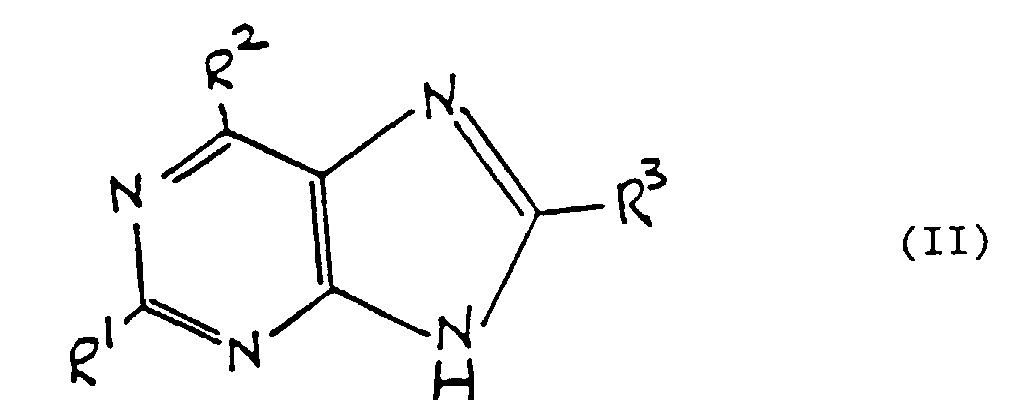 wherein R9 represents hydrogen or a hydroxy protecting group and A is a phosphate group or salt thereof or a purine or pyrimidine moiety other than (II) or a leaving group, to form a compound of formula (I); or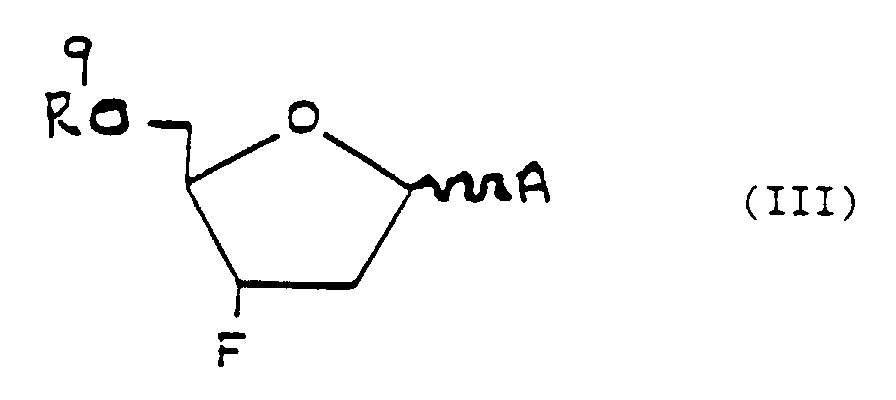
- (B) reacting a compound of formula (IV)
wherein R1, R2 and R3 are as hereinbefore defined and Z represents a precursor group for the fluoro atom, with agent(s) and/or under conditions serving to convert the precursor group Z to a fluoro atom in the erythro configuration;

and thereafter, or simultaneously therewith, effecting one or more of the following optional conversions:- - (i) removing any remaining protecting group(s);
- (ii) when a compound of formula (I) is formed, converting it into a salt, ester or physiologically functional derivative thereof; or
- (iii)when a salt, ester or physiologically functional derivative of a compound of formula (I) is formed or a solvate of any thereof, converting the derivative into a compound of formula (I) or into a different derivative of the compound of formula (I).
-
- In the above-described process according to the invention the starting compounds of formulae (II), (III) and (IV), as well as the above-mentioned agents and conditions, may be selected from those which are known in the art of nucleoside synthetic chemistry. Examples of such conversion procedures are described hereinafter for guidance and it will be understood that they may be modified in conventional manner depending on the desired compound of formula (I). In particular, where a conversion is described which would otherwise result in the undesired reaction of labile groups, then such groups may be protected in conventional manner with subsequent removal of the protecting group(s) after completion of the conversion.
- According to the conditions employed to effect process A, the purine base of formula (II) and the compound of formula (III) may or may not be protected using conventional protecting groups, such as acyl groups, for example, alkanoyl (for example, acetyl), substituted alkanoyl, such as alkoxyalkanoyl, aroyl (for example, benzoyl), ether groups, for example, trialkylsilyl groups, such as t-butyldimethylsilyl or other groups, such as aralkyl (for example, benzyl) or a phosphate group.
- Such groups may be removed by acid or base hydrolysis, hydrogenolysis, or enzymatically, Acyl groups are typically removed by base hydrolysis and silyl groups by acid hydrolysis or fluoride ion.
- Aralkyl groups such as benzyl are advantageously removed by catalytic hydrogenolysis.
- Two methods are commonly employed to effect process A, viz enzymatic and chemical.
- Process (A) may be effected enzymatically by, for example, reacting an appropriate purine base of formula (II), wherein R1, R2 and R3 are as hereinbefore defined or a functional equivalent of any thereof, for example, a salt or protected derivative thereof (see above); with a compound of formula (III) wherein R9 is hydrogen or a hydroxy protecting group (see above) and A is a purine or pyrimidine moiety (other than (II)), a phosphate group or a salt thereof.
- In the case where A is a purine or pyrimidine moiety (other than (II)), the reaction may be carried out in the presence of (i) phosphorylase enzymes, such as purine nucleoside phosphorylase and thymidine phosphorylase and an in organic phosphate or salt thereof; or (ii) a transferase enzyme, for example, N-deoxyribosyl transferase.
- In order to obtain the compounds of the invention it is necessary when employing this method that the compound of formula (III) should be in its β-form.
- The N-deoxyribosyl transferase may be isolated by standard biochemical techniques from:-
- (i) E.coli strain SS6030/14, which expresses lactobacillus enzyme, available from the American Type Culture Collection (ATCC) Rockville, MD, from 18th July, 1990 under Accession No. ATCC 68367, or
- (ii) E.coli strain SS70-8/15 which expresses lactobacillus enzyme, available from the ATCC from 17th June, 1992 under Accession No. ATCC 69016.
-
- In the case where A represents a phosphate group or a salt thereof, the reaction may be carried out in the presence of a single phosphorylase enzyme, such as purine nucleoside phosphorylase. In order to obtain the compounds of the invention it is necessary when employing this method that the compound of formula (III) should be in its α-form.
- Protecting groups may be used in the enzymatic process but in practice have been found to be unnecessary and in some cases to be actually disadvantageous in terms of overall yield.
- Process (A) may be effected chemically by, for example, reacting a compound of formula (II) as hereinbefore defined with a compound of formula (III) wherein R9 is hydrogen or a hydroxy protecting group and A represents a suitable leaving group, such as a halogen atom, for example, chlorine, an acyloxy group, such as acetoxy or an alkoxy group, for example, methoxy, in the presence of a catalyst, such as tin (IV) chloride or trimethylsilyltriflate, in a suitable solvent, such as acetonitrile.
- In contrast to the enzymatic method it has been found that in the chemical process (a) the compounds of formula (II) and (III) may advantageously be protected (vide supra) and (b) the compound of formula (I) so formed is a mixture of α-and β-anomers. The β-anomers of the present invention may be obtained by anomeric separation by methods well known to a skilled person or readily available in the chemical literature, for example, by silica gel column chromatography or HPLC.
- Compounds of formula (II) wherein R1, R2 and R3 are as hereinbefore defined or a functional equivalent of any thereof may be obtained commercially, for example, from the Aldrich Chemical Company or prepared by conventional methods well known to a skilled person or readily available from the chemical literature, for example, by methods the same as or analogous to those described in Robins et al., J.Amer.Chem.Soc., 1957, 79, 490-494 and Montgomery and Temple, J.Amer.Chem.Soc., 1961, 83, 630-635.
- For example, purine bases wherein R1 is amino or hydrogen R3 is hydrogen and R2 is, for example, methylmercapto or benzylamino may be obtained commercially from the Aldrich Chemical Co.
- Purine bases of formula (II) wherein R1 is amino or hydrogen, R2 is as hereinbefore defined and R3 is hydrogen may be conveniently prepared from commercially available 2-amino-6-chloropurine or 6-chloropurine (Sigma Chemical Co.). 2-Amino-6-0-substituted purines may be prepared from 2-amino-6-chloropurine by treatment with sodium and the appropriate alcohol. For example, 2-amino-6-benzyloxy-purine may be prepared by the reaction of 2-amino-6-chloro purine with benzyl alcohol. 2-Amino-6-N-substituted purines may be prepared by treatment of 2-amino-6-chloro-purine with the appropriate amine or a compound of formula (VI):(wherein n is an integer of from 3 to 6) in the presence of an organic solvent, such as acetonitrile, or an alcohol, such as methanol.
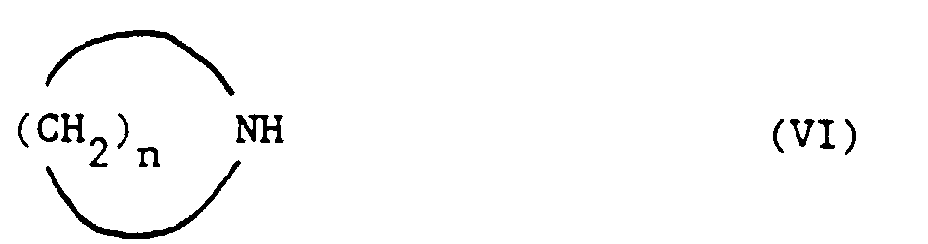
- 2-Amino-6-S-substituted purines may conveniently be prepared by treatment of 2-amino-6-mercapto purine with the appropriate moiety having a suitable leaving group. For example, compounds of formula (II) wherein R1 represents -S(O)nR6 wherein R6 is C6-10 aryl, such as phenyl, may advantageously be prepared by treatment of the 2-amino-6-mercapto-purine with chlorophenyl in an organic solvent, such as acetonitrile, in the presence of an organic base such as triethylamine, under nitrogen. 2-Amino-6-mercapto purine may be obtained commercially from the Aldrich Chemical Co.
- Compounds of formula (III) wherein A is a pyrimidine or purine moiety may conveniently be prepared by methods well known to a skilled person or readily available from the chemical literature. For example, 2',3'-dideoxy-3'-fluorouridine may be obtained commercially or prepared by the method described by G. Kowollick et al., J.Prakt.Chem., 1973, 315(5), 895, 3'-deoxy-3'-fluorothymidine may be prepared by the method described by Etzold et al., Tetrahedron, 1971, 27, 2463-2472 and 2',3'-dideoxy-3'-fluoroguanine may be prepared by the method of Herdewijn et al., J.Med.Chem., 1988, 31, 2040-2048.
- Compounds of formula (III) wherein A represents a phosphate group may be prepared chemically by methods analogous to those available in the chemical literature or from compounds of formula (III) wherein A is a pyrimidine or purine moiety by treatment with a phosphorylase enzyme, such as thymidine phosphorylase.
- Compounds of formula (III) wherein R9 is as hereinbefore defined and A represents a leaving group, such as methoxy, may be obtained commercially or may be prepared according to the method of Asahi Glass as described in Japanese Patent Application No. JP0129390.
- With regard to process (B), this may be effected, for example, by treatment of a compound of formula (IV) in which Z represents a leaving group, for example, hydroxy or an organosulphonyloxy, such as methanesulphonyloxy or trifluoromethanesulphonyloxy, with an appropriate fluorinating agent, such as diethylaminosulphurtrifluoride, potassium fluoride, potassium hydrogen fluoride, or tetra-butylammonium fluoride.
- Compounds of formula (IV) may be prepared by methods well known to a skilled man or readily available from the chemical literature, for example, by the method of Herdewijn et al., J.Med-Chem., 1988, 31, 2040-2048.
- Esters according to the invention may be prepared by methods known in the art. For example, by treatment of the parent compound of formula (I) with an appropriate esterifying agent, for example, by treatment with an appropriate acid halide, for example, chloride or anhydride.
- A compound of formula (I) may be converted into a corresponding physiologically acceptable ether of formula (I), by reaction with an appropriate alkylating agent in a conventional manner.
- The compounds of formula (I) including esters thereof, may be converted into physiologically acceptable salts in a conventional manner, for example, by treatment with an appropriate base. An ester or salt of a compound of formula (I) may be converted into the parent compound by, for example, hydrolysis.
- The following Examples are intended for illustration only and are not intended to limit the scope of the invention in any way. The term "active ingredient" as used in the Examples means a compound of formula (I), or a salt, ester or physiologically functional derivative thereof or a solvate of any thereof.
-
- A. Preparation of trans-N-deoxyribosylase (E.C, 2.4.2.6) from Esherichia coli E.coli strain SS6030/14 or SS70-8/15 was grown overnight (15-20 hr) in a rich medium, such as Luria broth, containing 150 g/mL ampicillin. The bacteria were collected from the growth medium by centrifugation at 4°C and the cell pellet washed with cold, 100 mM sodium phosphate buffer, pH 6.0. A cell extract was prepared by resuspending the washed cell pellet with 0.6-0.8 volumes of cold, 100 mM sodium phosphate buffer followed by passage of the cell suspension through a French press at 12-14 Kpsi. Whole cells and cell debris were removed by centrifugation in a 70Ti rotor and 50 Krpm for 90 min. The supernatant obtained following centrifugation was the high speed supernatant (HSS). The A260 for the HSS was adjusted to equal 180 by addition of cold, 100 mM sodium phosphate buffer. The diluted HSS was adjusted to 0.2% PEI (polyethyleneimine), incubated at 4°C for 15-30 min and then centrifuged. The supernatant obtained following the PEI precipitation was adjusted to 30% saturation with respect to (NH4)2SO4, incubated at 4°C for 60-90 min and then centrifuged to pellet the protein. The protein precipitated with 30% (NH4)2SO4 was slowly dissolved in 100 mM sodium phosphate buffer (pH 6.0) and then dialyzed against 2 to 6 liters of the same buffer.After dialysis, the precipitate that formed was removed by centrifugation. The supernatant containing enzyme was heated 5-10 min in a 60°C water bath followed by a 20 min incubation in a ice/water slurry. The precipitate that formed during the heat treatment step was removed by centrifugation. The supernatant contained trans-N-deoxyribosylase which was used for nucleoside synthesis.The trans-N-deoxyribosylase activity of each enzyme preparation was quantitated using deoxyinosine and cytosine as substrates in the xanthine oxidase coupled assay system described by Cardinaud, R. 1978. Nucleoside Deoxyribosyltransferase from Lactobacillus helveticus. Methods Enzymol. 51:446-455.E.coli strain SS6030/14 was deposited at the American Type Culture Collection (ATCC) Rockville, MD 20852-1776 on 18th July, 1990 under Accession No. ATCC 68367 and E.coli strain SS70-8/15 was deposited at the ATCC Rockville, MD 20852-1776 on 17th June, 1992, under Accession No. ATCC 69016.
-
- 2-Amino-6-benzyloxy-9H-purine was prepared by nucleophilic displacement of the chlorine group on 2-amino-6-chloropurine by the anion of benzyl alcohol (Aldrich Chemical Company). The anion was generated with NaH in tetrahydrofuran.
- 2-Amino-6-benzyloxy-9H-purine (0.60g 2.5 mmoles) and 2',3'-dideoxy-3'-fluorouridine (0.5g 2.2 mmoles) were suspended in potassium phosphate buffer (10 mM) 50 ml, pH 6.8, containing 0.04% potassium azide. Purified purine nucleoside phosphorylase (1070) I.U.) and thymidine phosphorylase (400 I.U.) (Krenitsky et al, Biochemistry, 20, 3615 (1981) and US Patent 4,381,344) were added to the reaction mixture and the suspension stirred at 37°C. After 24 hours, additional thymidine phosphorylase (2000 I.U.) was added and, after 14 days, an additional 10 mM potassium phosphate buffer 25 ml, pH 6.8, containing 0.04% potassium azide was added. Additional purine nucleoside phosphorylase (5400 I.U.) and thymidine phosphorylase (2000 I.U.) were added after 17 days. After a total reaction time of 33 days, denatured protein was removed by filtration. The precipitate was washed with methanol until all the UV absorbing material was eluted from the precipitate. The filtrate was diluted with water until the methanol content was <10% and this diluted sample was applied to a series of coupled columns. The initial column contained AG1-X2 (2.5 x 10 cm, OH form) while the second column contained XAD-2 (2.5 x 20 cm). After sample application, the columns were washed with water 800 ml and the product eluted with methanol. Product-containing fractions were flash chromatographed on silica gel (2.5 x 20 cm) using dichloromethane:methanol (9:1). Solvent was removed and lyophilization yielded 2-amino-6-benzyloxy-9-(2,3-dideoxy-3-fluoro-β-D-erythro-pentofuranosyl)-9H-purine (0.49 g).
Elemental analysis for C17H18FN5O3.0.05H2O Calculated C,56.68; H,5.06; F,5.27; N,19.44 Found C,56.71; H,5.14; F,5.11; N,19.28 - 1H NMR and mass spectral data were consistent with the structure.
- 2-Amino-6-azetidinyl-9H-purine was prepared by displacement of the chlorine group on 2-amino-6-chloropurine (Aldrich Chemical Company) by azetidine (Aldrich Chemical Company).
2-Amino-6-azetidinyl-9H-purine (0.50g, 2.6 mmoles) and 2',3'-dideoxy-3'-fluorouridine (0.71g, 3.1 mmoles) were suspended in 50 ml, 10 mM potassium phosphate buffer, pH 7.0, containing 0.04% potassium azide. Purine nucleoside phosphorylase (1120 I.U.) and thymidine phosphorylase (10,000 I.U.) (Krenitsky et al., Biochemistry, 20, 3615 (1981) and US Patent 4,381,344) immobilized on DEAE cellulose was added to the reaction and the suspension was stirred at 45°C. After 7 days, 170ml MeOH was added to the reaction. The reaction was applied to a column containing AG1-X2 (OH- form, 2.5 x 10 cm) and eluted with MeOH. Fractions containing product were pooled, concentrated, and flash chromatographed on silica gel (2.5 x 20 cm) with dichloromethane:- acetone (7:3). Fractions containing product were pooled, concentrated, and flash chromatographed a second time on silica gel (2.5 x 20 cm) with dichloromethane:methanol (96:4). Solvent was removed and lyophilization yielded 0.566g of 2-amino-6-azetidinyl-9-(2,3-dideoxy-3-fluoro-β-D-erythro-pentofuranosyl)-9H-purine (68%): mp 127-129°C; TLC Rf 0.70 (silica gel, MeCN:15N NH4OH:H2O/85:5:10); [α]D 20-15.9 (c=0.51, DMF);UV λmax (ε x 10-3) at pH 7, 285 (17.2); at pH 13, 285 (16.5);1H NMR (300 MHz, DMSO-d6) δ 7.91 (s, 1H, H8), 6.20 (dd, 1H, H1,, J=9.4 Hz, J=5.6 Hz), 5.91 (b, 2H, NH2), 5.46-5.49 (m, 1H, OH5,), 5.38 (dd, 1H, H3,, J=53.8 Hz, J=4.3 Hz), 4.12-4.35 (b, 5H, H4, and azetidinyl group), 3.5 (t, 2H, H5, and H5", J-4.9 Hz),2.80-2.95 and 2.53-2.62 (m, 2H, H2, and H2"), and 2.33-2.43 (m, 2H, azetidinyl group);
MS (ci) 309 (M+1), 289 (M-F), 191 (MH2-C5H8FO2). Anal.
(C13H17FN6O2·0.65H2O) C, H, F, N. Calculated (Found):
C, 48.79 (48.87); H, 5.76 (5.37); F, 5.94 (6.26); N, 26.26 (25.89) - The following formulations A, B and C are prepared by wet granulation of the ingredients with a solution of povidone, followed by addition of the magnesium stearate and compression.
Formulation A mg/tablet mg/tablet (a) Active ingredient 250 250 (b) Lactose B.P. 210 26 (c) Povidone B.P. 15 9 (d) Sodium Starch Glycollate 20 12 (e) Magnesium Stearate 5 3 500 300 Formulation B mg/tablet mg/tablet (a) Active ingredient 250 250 (b) Lactose 150 - (c) Avicel PH 101 60 26 (d) Povidone B.P. 15 9 (e) Sodium Starch Glycollate 20 12 (f) Magnesium Stearate 5 3 500 300 Formulation C mg/tablet Active ingredient 100 Lactose 200 Starch 50 Povidone 5 Magnesium stearate 4 359 - The following formulations, D and E, are prepared by direct compression of the admixed ingredients.
Formulation D mg/capsule Active Ingredient 250 Pregelatinised Starch NF15 150 400 Formulation E mg/capsule Active Ingredient 250 Lactose 150 Avicel 100 500 - The formulation is prepared by wet granulation of the following ingredients with a solution of povidone followed by addition of the magnesium stearate and compression.
mg/tablet (a) Active Ingredient 500 (b) Hydroxypropylmethylcellulose (Methocel K4M Premium) 112 (c) Lactose B.P. 53 (d) Povidone B.P.C. 28 (e) Magnesium Stearate 7 700 - Drug release takes place over a period of about 6-8 hours and is complete after 12 hours.
- A capsule formulation is prepared by admixing the ingredients of Formulation D in Example 3 above and filling into two-part hard gelatin capsule.
Formulation B mg/capsule (a) Active ingredient 250 (b) Lactose B.P. 143 (c) Sodium Starch Glycollate 25 (d) Magnesium Stearate 2 420 - Capsules are prepared by admixing the above ingredients and filling into two-part hard gelatin capsules.
Formulation C mg/capsule (a) Active ingredient 250 (b) Macrogol 4000 BP 350 600 - Capsules are prepared by melting the Macrogol 4000 BP, dispersing the active ingredient in the melt and filling the melt into two-part hard gelatin capsules.
Formulation D mg/capsule Active ingredient 250 Lecithin 100 Arachis Oil 100 450 - Capsules are prepared by dispersing the active ingredient in the lecithin and arachis oil and filling the dispersion into soft, elastic gelatin capsules.
- The following controlled release capsule formulation is prepared by extruding ingredients (a), (b) and (c) using an extruder, followed by spheronisation of the extrudate and drying. The dried pellets are then coated with the release-controlling membrane (d) and filled into two-piece, hard gelatin capsules.
mg/capsule (a) Active Ingredient 250 (b) Microcrystalline Cellulose 125 (c) Lactose BP 125 (d) Ethyl Cellulose 13 513 -
Formulation A Active ingredient 0.200g Hydrochloric acid solution, 0.1M q.s. to pH 4.0 to 7.0 Sodium hydroxide solution, 0.1M q.s. to pH 4.0 to 7.0 Sterile water q.s. to 10ml - The active ingredient is dissolved in most of the water (35°-40°C) and the pH adjusted to between 4.0 and 7.0 using the hydrochloric acid or the sodium hydroxide as appropriate. The batch is then made up to volume with the water and filtered through a sterile micropore filter into a sterile amber glass vial 10ml and sealed with sterile closures and overseals.
Formulation B Active ingredient 0.125 g Sterile, pyrogen-free, pH 7 phosphate buffer, q.s. to 25 ml -
Intramuscular injection Active Ingredient 0.20 g Benzyl Alcohol 0.10 g Glycofurol 75 1.45 g Water for Injection q.s. to 3.00 ml - The active ingredient is dissolved in the glycofurol. The benzyl alcohol is then added and dissolved, and water added to 3 ml. The mixture is then filtered through a sterile micropore filter and sealed in sterile amber glass vials 3 ml.
-
Syrup Active ingredient 0.25 g Sorbitol Solution 0.10 g Glycerol 2.00 g Sodium Benzoate 0.005 g Flavour, Peach 17.42.3169 0.0125 ml Purified Water q.s. to 5.00 ml - The active ingredient is dissolved in a mixture of the glycerol and most of the purified water. An aqueous solution of the sodium benzoate is then added to the solution, followed by addition of the sorbitol solution and finally the flavour. The volume is made up with purified water and mixed well.
-
Suppository mg/suppository Active Ingredient 250 Hard Fat, BP (Witepsol H15 - Dynamit Nobel) 1770 2020 - One-fifth of the Witepsol H15 is melted in a steam-jacketed pan at 45°C maximum. The active ingredient is sifted through a 200 µm sieve and added to the molten base with mixing, using a Silverson fitted with a cutting head, until a smooth dispersion is achieved. Maintaining the mixture at 45°C, the remaining Witepsol H15 is added to the suspension and stirred to ensure a homogenous mix. The entire suspension is passed through a 250 µm stainless steel screen and, with continuous stirring, is allowed to cool to 40°C. At a temperature of 38°C to 40°C, 2.0g of the mixture is filled into suitable, 2 ml plastic moulds. The suppositories are allowed to cool to room temperature.
-
Pessaries mg/pessary Active ingredient 250 Anhydrate Dextrose 380 Potato Starch 363 Magnesium Stearate 7 1000 - The above ingredients are mixed directly and pessaries prepared by direct compression of the resulting mixture.
-
- a) Antiviral Activity Against Human Immunodeficiency Virus (HIV). Anti-HIV activity of compounds of formula (I) was determined using the method of Averett D.R., 1989, J.Virol. Methods, 23, pp263-276, by measuring the ability of the compound to reverse the cytopathic effect of HIV infection. This was determined by a quantitative assessment of cell growth monitored at the fifth day post infection by a propidium iodide dye uptake test. MT4 cells were incubated with 100XTCID50 of HIV-1 (strain 3B) or HIV-2 (Zagury strain) for one hour prior to addition of the compound in six different concentrations varying from 2 to 200 µM. The cells were allowed to incubate for five days at 37°C. On day 5, NP-40, a detergent, was added to a final concentration of 0.5% immediately prior to analysis. Cell number was determined using a method which measures the fluorescence of a dye (propidium iodide) which binds to DNA. Since the amount of DNA is directly proportional to cell number, this fluorescence assay is an indication of cell growth. While uninfected cells double in cell number several times during the five days duration of the assay, HIV-infected cells grow very little, if at all. A compound which reverses the cytopathic effect of HIV would allow for rapid cell growth, approaching that of the mock-infected cells.The antiviral effect of a drug is reported as an IC50, i.e. as the inhibitory concentration that would protect 50% of the cells from cell killing, measured as 50% of that cell growth determined for uninfected MT4 cell controls.
- b) Antiviral Activity Against Hepatitis B Virus (HBV)
Anti-HBV activity of compounds of formula (I) was determined using
a method described by Korba B.E. and Milman G., Antiviral Research,
1991, Vol.15, pp217-228.The assay utilises the human HBV producer cell line of HepG2,
2.2.15, described and characterized by Sells et al., PNAS 84, 1005
(1987) and J. Virol. 62, 2836 (1988), has been shown to share many
characteristics of the HBV chronically infected hepatocyte. It is
infectious as demonstrated by the ability to cause disease in
chimpanzees. This cell line was utilized in vitro to identify
compounds with anti-HBV activity.To test compounds for antiviral activity, monolayer cultures were
treated with the compound (50-200 µM), for 9 days. Supernatant
media containing extracellular virion DNA (Dane particles) were
harvested on days 0, 4 and 9, treated with proteinase K (1 mg/mL)
and sodium dodecyl sulfate (1%), and incubated at 50°C for one
hour. DNA was extracted with equal volumes of phenol followed by
chloroform and then precipitated using ammonium acetate and
propanol. The DNA precipitate was dissolved and collected on
nitrocellulose using the procedure of Schleicher and Schuell (S &
S, 10 Optical Ave., Keene, NH 03431, Publication 700, 1987), and
treated as described by Southern in J. Mol. Biol. 98, 503 (1975).
Cells were harvested and the intracellular DNA obtained after cell
lysis with guanidine isothiocyanate. The intracellular DNA was
handled in the same manner as the extracellular DNA. After
precipitation by ammonium acetate and propanol, the intracellular
DNA precipitate was dissolved, cut by restriction endonuclease,
Hind III, applied to agarose gel and then treated as described by
Southern to determine the quantity of replicative intermediate
forms. The antiviral effect of the drug was determined by
measuring at least a 100-fold reduction in the amount of Dane
particles extruded into the culture medium and a similar decrease
in the intracellular replicative intermediates.
Extracellular HBV DNA (pg/ml, Culture Medium) Day 0 Day 4 Day 9 Untreated Cells 59 75 94 47 64 88 65 100 71 Treated 77 65 110 -
Claims (11)
- A compound of formula (I):wherein R1 is amino; R2 represents -NR4R5 wherein R4 and R5 together with the N atom to which they are attached form a 4-membered heterocyclic ring, which ring is bonded to the purine base via the nitrogen atom or -OR8 where R8 represents C3-6 cycloalkyl C1-3 alkyl or C6-10 aryl C1-3 alkyl and R3 is hydrogen;

or a physiologically functional derivative thereof. - A compound according to claim 1 selected from:and physiologically functional derivatives thereof.2-amino-6-benzyloxy-9-(2,3-dideoxy-3-fluoro-β-D-erythro-pento-furanosyl)-9H-purine;2-amino-6-azetidinyl-9-(2,3-dideoxy-3-fluoro-β-D-erythro-pento-furanosyl)-9H-purine;
- A physiologically functional derivative of a compound of formula (I) according to any one of claims 1 or 2.
- A pharmaceutical formulation comprising a compound according to any one of Claims 1 to 3 together with a pharmaceutically acceptable carrier therefore.
- A compound according to any one of Claims 1 to 3 or a formulation according to Claim 4 for use in therapy.
- A compound according to any one of Claims 1 to 3 or a formulation according to Claim 4 for use as an antiviral agent.
- Use of a compound according to any one of Claims 1 to 3 or a formulation according to Claim 4 for the manufacture of a medicament for the treatment or prophylaxis of a virus infection.
- Use of a compound or formulation as claimed in Claim 7 wherein the virus infection is a hepatitis virus or retrovirus infection.
- Use of a compound or formulation as claimed in Claim 7 wherein the virus infection is a hepatitis B virus or a human immunodeficiency virus infection.
- A process for the preparation of a compound of formula (I)wherein R1 is amino; R2 represents -NR4R5 wherein R4 and R5 together with the N atom to which they are attached form a 4-membered heterocyclic ring, which ring is bonded to the purine base via the nitrogen atom or -OR8 where R8 represents C3-6 cycloalkyl C1-3 alkyl or C6-10 aryl C1-3 alkyl and R3 is hydrogen;

or a physiologically functional derivative thereof
which comprises:(A) reacting a purine base of formula (II):wherein R1, R2 and R3 are as defined in Claim 1, or a functional equivalent thereof, with a compound of formula (III):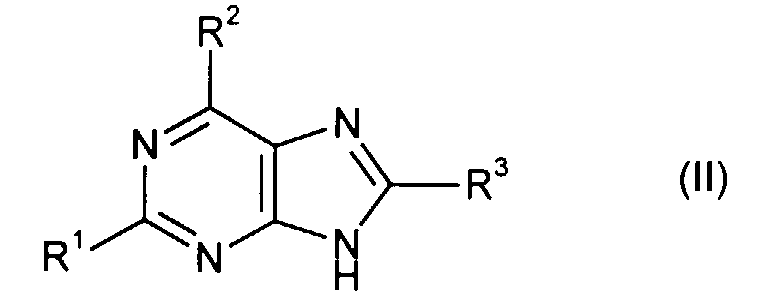 wherein R9 represents hydrogen or a hydroxy protecting group and A is a phosphate group or salt thereof or a purine or pyrimidine moiety other than (II) or a leaving group, to form a compound of formula (I); or
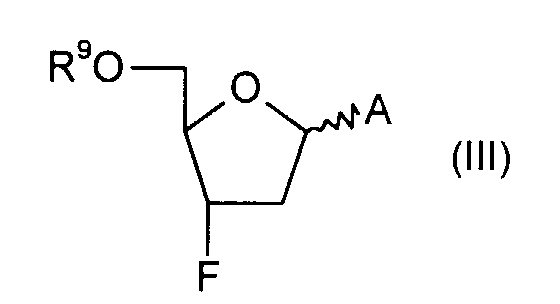 (B) reacting a compound of formula (IV):wherein R1, R2 and R3 are as defined in Claim 1 and Z represents a precursor group for the fluoro atom with agent(s) and/or under conditions serving to convert the precursor group Z to a fluoro atom in the erythro configuration; and thereafter, or simultaneously therewith, effecting one or more of the following optional conversions:-
 (i) removing any remaining protecting group(s);(ii) when a compound of formula (I) is formed, converting it into a salt, ester or physiologically functional derivative of a compound of formula (I); or(iii) when a salt, ester or physiologically functional derivative of a compound of formula (I) or a solvate of any thereof is formed, converting the derivative into a compound of formula (I) or into a different derivative of the compound of formula (I).
 - A process as claimed in claim 10 for the preparation ofand physiologically functional derivatives thereof.2-amino-6-benzyloxy-9-(2,3-dideoxy-3-fluoro-β-D-erythro-pento-furanosyl)-9H-purine;2-amino-6-azetidinyl-9-(2,3-dideoxy-3-fluoro-β-D-erythro-pento-furanosyl)-9H-purine;
Applications Claiming Priority (5)
| Application Number | Priority Date | Filing Date | Title |
|---|---|---|---|
| GB929200149A GB9200149D0 (en) | 1992-01-06 | 1992-01-06 | Therapeutic nucleosides |
| GB9200149 | 1992-01-06 | ||
| GB9220317 | 1992-09-25 | ||
| GB929220317A GB9220317D0 (en) | 1992-09-25 | 1992-09-25 | Therapeutic nucleosides |
| PCT/GB1993/000004 WO1993014103A1 (en) | 1992-01-06 | 1993-01-05 | Therapeutic nucleosides |
Publications (2)
| Publication Number | Publication Date |
|---|---|
| EP0625158A1 EP0625158A1 (en) | 1994-11-23 |
| EP0625158B1 true EP0625158B1 (en) | 1999-03-31 |
Family
ID=26300111
Family Applications (1)
| Application Number | Title | Priority Date | Filing Date |
|---|---|---|---|
| EP93900334A Expired - Lifetime EP0625158B1 (en) | 1992-01-06 | 1993-01-05 | Therapeutic nucleosides of the 2',3'-dideoxy-3'-fluoro-purine series |
Country Status (9)
| Country | Link |
|---|---|
| US (1) | US5663154A (en) |
| EP (1) | EP0625158B1 (en) |
| JP (1) | JPH07502740A (en) |
| AT (1) | ATE178335T1 (en) |
| AU (1) | AU3170193A (en) |
| DE (1) | DE69324244T2 (en) |
| DK (1) | DK0625158T3 (en) |
| ES (1) | ES2130246T3 (en) |
| WO (1) | WO1993014103A1 (en) |
Families Citing this family (11)
| Publication number | Priority date | Publication date | Assignee | Title |
|---|---|---|---|---|
| US5654286A (en) * | 1993-05-12 | 1997-08-05 | Hostetler; Karl Y. | Nucleotides for topical treatment of psoriasis, and methods for using same |
| PT874846E (en) * | 1995-11-01 | 2003-08-29 | Novartis Ag | PURINA DERIVATIVES AND PROCESSES FOR THEIR PREPARATION |
| US6107300A (en) * | 1996-03-27 | 2000-08-22 | Dupont Pharmaceuticals | Arylamino fused pyrimidines |
| HUP0100433A3 (en) * | 1997-12-22 | 2003-01-28 | Schering Corp | Orally administrable solid ribavirin dosage forms and process for producing them |
| US6949522B2 (en) * | 2001-06-22 | 2005-09-27 | Pharmasset, Inc. | β-2′- or 3′-halonucleosides |
| EP1352910A1 (en) | 2002-04-10 | 2003-10-15 | Grünenthal GmbH | New analogs of nitrobenzylthioinosine |
| CZ302225B6 (en) * | 2007-07-04 | 2010-12-29 | Univerzita Palackého v Olomouci | Substituted 6-anilinopurine derivatives functioning as cytokine oxidase inhibitors and formulations containing such compounds |
| US9289445B2 (en) | 2011-01-20 | 2016-03-22 | University Of Rochester | Compositions and methods for treating or preventing a retrovirus infection |
| EP3233860B1 (en) * | 2014-12-15 | 2020-01-29 | Univerzita Palackého V Olomouci | Substituted 6-anilino-9-heterocyclylpurine derivatives for inhibition of plant stress |
| US10413488B2 (en) * | 2015-12-02 | 2019-09-17 | L'oreal | Aerosol oil foam compositions comprising a triglyceride-based oil and surfactant |
| US11452714B2 (en) | 2017-05-23 | 2022-09-27 | Regents Of The University Of Minnesota | Antibacterial agents including histidine kinase inhibitors |
Family Cites Families (7)
| Publication number | Priority date | Publication date | Assignee | Title |
|---|---|---|---|---|
| US4381344A (en) * | 1980-04-25 | 1983-04-26 | Burroughs Wellcome Co. | Process for producing deoxyribosides using bacterial phosphorylase |
| SE8602981D0 (en) * | 1986-07-04 | 1986-07-04 | Astra Laekemedel Ab | NOVEL MEDICINAL USE |
| DD279407A1 (en) * | 1986-07-24 | 1990-06-06 | Akad Wissenschaften Ddr | METHOD FOR PRODUCING AN AGENT AGAINST AIDS |
| JPS6429390A (en) * | 1987-07-24 | 1989-01-31 | Asahi Glass Co Ltd | Production of pentofuranoside derivative |
| EP0311107A3 (en) * | 1987-10-08 | 1990-04-18 | Stichting REGA V.Z.W. | Anti-hiv active 3'-fluoro-purine-2',3'-dideoxyribosides |
| GB8726136D0 (en) * | 1987-11-07 | 1987-12-09 | Wellcome Found | Therapeutic nucleosides |
| DD293498A5 (en) * | 1989-07-20 | 1991-09-05 | Zi Fuer Molekularbiologie Der Adw,De | METHOD FOR PRODUCING A MEDIUM FOR THE TREATMENT OR PROPHYLAXIS OF HEPATITE INFECTIONS IN HUMANS AND ANIMALS |
-
1993
- 1993-01-05 AT AT93900334T patent/ATE178335T1/en not_active IP Right Cessation
- 1993-01-05 JP JP5512223A patent/JPH07502740A/en active Pending
- 1993-01-05 US US08/256,310 patent/US5663154A/en not_active Expired - Fee Related
- 1993-01-05 ES ES93900334T patent/ES2130246T3/en not_active Expired - Lifetime
- 1993-01-05 AU AU31701/93A patent/AU3170193A/en not_active Abandoned
- 1993-01-05 EP EP93900334A patent/EP0625158B1/en not_active Expired - Lifetime
- 1993-01-05 WO PCT/GB1993/000004 patent/WO1993014103A1/en not_active Ceased
- 1993-01-05 DK DK93900334T patent/DK0625158T3/en active
- 1993-01-05 DE DE69324244T patent/DE69324244T2/en not_active Expired - Fee Related
Also Published As
| Publication number | Publication date |
|---|---|
| WO1993014103A1 (en) | 1993-07-22 |
| ATE178335T1 (en) | 1999-04-15 |
| JPH07502740A (en) | 1995-03-23 |
| DE69324244T2 (en) | 1999-09-30 |
| ES2130246T3 (en) | 1999-07-01 |
| DK0625158T3 (en) | 1999-10-11 |
| DE69324244D1 (en) | 1999-05-06 |
| US5663154A (en) | 1997-09-02 |
| AU3170193A (en) | 1993-08-03 |
| EP0625158A1 (en) | 1994-11-23 |
Similar Documents
| Publication | Publication Date | Title |
|---|---|---|
| EP0574457B1 (en) | Antiviral nucleoside combination | |
| CA1330990C (en) | Antiviral compounds | |
| JP2003516413A (en) | N6 heterocyclic heterocyclic 8-modified adenosine derivatives | |
| US5071983A (en) | Therapeutic nucleosides | |
| US5153318A (en) | 3'-azido nucleoside compound | |
| US5663154A (en) | 2',3'-dideoxy-3'-fluoro-purine ribonucleosides | |
| EP0317128B1 (en) | Anti-HIV Pyrimidine Nucleosides | |
| CA1331138C (en) | Use of reverse transcriptase inhibitor for treatment of human breast carcinoma | |
| EP0285432A2 (en) | Therapeutic nucleosides | |
| US5157114A (en) | 2',3'-dideoxy-3'-fluoro-5-ethyngluridine | |
| US4920210A (en) | 2,6-diaminopurine-9-β-D-2',3'-dideoxyribofuranoside | |
| EP0639971B1 (en) | Therapeutic combinations | |
| US5637574A (en) | Therapeutic nucleosides | |
| WO1994001117A1 (en) | Therapeutic nucleosides | |
| US5198539A (en) | 5'-esters of 2',3'-dideoxy-3'-fluoro-5-ethynyluridine | |
| AU4508593A (en) | Therapeutic nucleosides | |
| EP0366287A1 (en) | Therapeutic nucleosides | |
| WO1988009332A1 (en) | Therapeutic nucleosides | |
| US5175274A (en) | Therapeutic nucleosides | |
| HK1004189B (en) | Antiviral nucleoside combination |
Legal Events
| Date | Code | Title | Description |
|---|---|---|---|
| PUAI | Public reference made under article 153(3) epc to a published international application that has entered the european phase |
Free format text: ORIGINAL CODE: 0009012 |
|
| 17P | Request for examination filed |
Effective date: 19940526 |
|
| AK | Designated contracting states |
Kind code of ref document: A1 Designated state(s): AT BE CH DE DK ES FR GB GR IE IT LI LU MC NL PT SE |
|
| 17Q | First examination report despatched |
Effective date: 19951204 |
|
| RAP1 | Party data changed (applicant data changed or rights of an application transferred) |
Owner name: THE WELLCOME FOUNDATION LIMITED |
|
| GRAG | Despatch of communication of intention to grant |
Free format text: ORIGINAL CODE: EPIDOS AGRA |
|
| GRAG | Despatch of communication of intention to grant |
Free format text: ORIGINAL CODE: EPIDOS AGRA |
|
| GRAH | Despatch of communication of intention to grant a patent |
Free format text: ORIGINAL CODE: EPIDOS IGRA |
|
| GRAH | Despatch of communication of intention to grant a patent |
Free format text: ORIGINAL CODE: EPIDOS IGRA |
|
| GRAA | (expected) grant |
Free format text: ORIGINAL CODE: 0009210 |
|
| AK | Designated contracting states |
Kind code of ref document: B1 Designated state(s): AT BE CH DE DK ES FR GB GR IE IT LI LU MC NL PT SE |
|
| PG25 | Lapsed in a contracting state [announced via postgrant information from national office to epo] |
Ref country code: GR Free format text: LAPSE BECAUSE OF NON-PAYMENT OF DUE FEES Effective date: 19990331 |
|
| REF | Corresponds to: |
Ref document number: 178335 Country of ref document: AT Date of ref document: 19990415 Kind code of ref document: T |
|
| REG | Reference to a national code |
Ref country code: CH Ref legal event code: EP |
|
| REG | Reference to a national code |
Ref country code: CH Ref legal event code: NV Representative=s name: BRAUN & PARTNER PATENT-, MARKEN-, RECHTSANWAELTE |
|
| REG | Reference to a national code |
Ref country code: IE Ref legal event code: FG4D |
|
| REF | Corresponds to: |
Ref document number: 69324244 Country of ref document: DE Date of ref document: 19990506 |
|
| ET | Fr: translation filed | ||
| REG | Reference to a national code |
Ref country code: ES Ref legal event code: FG2A Ref document number: 2130246 Country of ref document: ES Kind code of ref document: T3 |
|
| REG | Reference to a national code |
Ref country code: PT Ref legal event code: SC4A Free format text: AVAILABILITY OF NATIONAL TRANSLATION Effective date: 19990616 |
|
| REG | Reference to a national code |
Ref country code: DK Ref legal event code: T3 |
|
| PG25 | Lapsed in a contracting state [announced via postgrant information from national office to epo] |
Ref country code: MC Free format text: THE PATENT HAS BEEN ANNULLED BY A DECISION OF A NATIONAL AUTHORITY Effective date: 20000131 |
|
| PLBE | No opposition filed within time limit |
Free format text: ORIGINAL CODE: 0009261 |
|
| STAA | Information on the status of an ep patent application or granted ep patent |
Free format text: STATUS: NO OPPOSITION FILED WITHIN TIME LIMIT |
|
| 26N | No opposition filed | ||
| PGFP | Annual fee paid to national office [announced via postgrant information from national office to epo] |
Ref country code: PT Payment date: 20001219 Year of fee payment: 9 |
|
| PGFP | Annual fee paid to national office [announced via postgrant information from national office to epo] |
Ref country code: DE Payment date: 20010102 Year of fee payment: 9 |
|
| PGFP | Annual fee paid to national office [announced via postgrant information from national office to epo] |
Ref country code: GB Payment date: 20010103 Year of fee payment: 9 |
|
| PGFP | Annual fee paid to national office [announced via postgrant information from national office to epo] |
Ref country code: SE Payment date: 20010105 Year of fee payment: 9 |
|
| PGFP | Annual fee paid to national office [announced via postgrant information from national office to epo] |
Ref country code: LU Payment date: 20010109 Year of fee payment: 9 |
|
| PGFP | Annual fee paid to national office [announced via postgrant information from national office to epo] |
Ref country code: CH Payment date: 20010112 Year of fee payment: 9 |
|
| PGFP | Annual fee paid to national office [announced via postgrant information from national office to epo] |
Ref country code: DK Payment date: 20010116 Year of fee payment: 9 Ref country code: AT Payment date: 20010116 Year of fee payment: 9 |
|
| PGFP | Annual fee paid to national office [announced via postgrant information from national office to epo] |
Ref country code: ES Payment date: 20010122 Year of fee payment: 9 |
|
| PGFP | Annual fee paid to national office [announced via postgrant information from national office to epo] |
Ref country code: FR Payment date: 20010125 Year of fee payment: 9 |
|
| PGFP | Annual fee paid to national office [announced via postgrant information from national office to epo] |
Ref country code: IE Payment date: 20010126 Year of fee payment: 9 |
|
| PGFP | Annual fee paid to national office [announced via postgrant information from national office to epo] |
Ref country code: NL Payment date: 20010131 Year of fee payment: 9 |
|
| PGFP | Annual fee paid to national office [announced via postgrant information from national office to epo] |
Ref country code: BE Payment date: 20010314 Year of fee payment: 9 |
|
| REG | Reference to a national code |
Ref country code: GB Ref legal event code: IF02 |
|
| PG25 | Lapsed in a contracting state [announced via postgrant information from national office to epo] |
Ref country code: LU Free format text: LAPSE BECAUSE OF NON-PAYMENT OF DUE FEES Effective date: 20020105 Ref country code: GB Free format text: LAPSE BECAUSE OF NON-PAYMENT OF DUE FEES Effective date: 20020105 Ref country code: DK Free format text: LAPSE BECAUSE OF NON-PAYMENT OF DUE FEES Effective date: 20020105 Ref country code: AT Free format text: LAPSE BECAUSE OF NON-PAYMENT OF DUE FEES Effective date: 20020105 |
|
| PG25 | Lapsed in a contracting state [announced via postgrant information from national office to epo] |
Ref country code: SE Free format text: LAPSE BECAUSE OF NON-PAYMENT OF DUE FEES Effective date: 20020106 |
|
| PG25 | Lapsed in a contracting state [announced via postgrant information from national office to epo] |
Ref country code: IE Free format text: LAPSE BECAUSE OF NON-PAYMENT OF DUE FEES Effective date: 20020107 |
|
| PG25 | Lapsed in a contracting state [announced via postgrant information from national office to epo] |
Ref country code: ES Free format text: LAPSE BECAUSE OF NON-PAYMENT OF DUE FEES Effective date: 20020108 |
|
| PG25 | Lapsed in a contracting state [announced via postgrant information from national office to epo] |
Ref country code: LI Free format text: LAPSE BECAUSE OF NON-PAYMENT OF DUE FEES Effective date: 20020131 Ref country code: CH Free format text: LAPSE BECAUSE OF NON-PAYMENT OF DUE FEES Effective date: 20020131 Ref country code: BE Free format text: LAPSE BECAUSE OF NON-PAYMENT OF DUE FEES Effective date: 20020131 |
|
| BERE | Be: lapsed |
Owner name: THE WELLCOME FOUNDATION LTD Effective date: 20020131 |
|
| PG25 | Lapsed in a contracting state [announced via postgrant information from national office to epo] |
Ref country code: PT Free format text: LAPSE BECAUSE OF NON-PAYMENT OF DUE FEES Effective date: 20020731 |
|
| PG25 | Lapsed in a contracting state [announced via postgrant information from national office to epo] |
Ref country code: NL Free format text: LAPSE BECAUSE OF NON-PAYMENT OF DUE FEES Effective date: 20020801 Ref country code: DE Free format text: LAPSE BECAUSE OF NON-PAYMENT OF DUE FEES Effective date: 20020801 |
|
| EUG | Se: european patent has lapsed |
Ref document number: 93900334.9 |
|
| GBPC | Gb: european patent ceased through non-payment of renewal fee |
Effective date: 20020105 |
|
| REG | Reference to a national code |
Ref country code: CH Ref legal event code: PL |
|
| PG25 | Lapsed in a contracting state [announced via postgrant information from national office to epo] |
Ref country code: FR Free format text: LAPSE BECAUSE OF NON-PAYMENT OF DUE FEES Effective date: 20020930 |
|
| NLV4 | Nl: lapsed or anulled due to non-payment of the annual fee |
Effective date: 20020801 |
|
| REG | Reference to a national code |
Ref country code: FR Ref legal event code: ST Ref country code: PT Ref legal event code: MM4A Free format text: LAPSE DUE TO NON-PAYMENT OF FEES Effective date: 20020731 |
|
| REG | Reference to a national code |
Ref country code: IE Ref legal event code: MM4A |
|
| REG | Reference to a national code |
Ref country code: DK Ref legal event code: EBP |
|
| REG | Reference to a national code |
Ref country code: ES Ref legal event code: FD2A Effective date: 20031022 |
|
| PG25 | Lapsed in a contracting state [announced via postgrant information from national office to epo] |
Ref country code: IT Free format text: LAPSE BECAUSE OF NON-PAYMENT OF DUE FEES;WARNING: LAPSES OF ITALIAN PATENTS WITH EFFECTIVE DATE BEFORE 2007 MAY HAVE OCCURRED AT ANY TIME BEFORE 2007. THE CORRECT EFFECTIVE DATE MAY BE DIFFERENT FROM THE ONE RECORDED. Effective date: 20050105 |