EP0623941B1 - Polymer electrets with improved charge stability - Google Patents
Polymer electrets with improved charge stability Download PDFInfo
- Publication number
- EP0623941B1 EP0623941B1 EP94103367A EP94103367A EP0623941B1 EP 0623941 B1 EP0623941 B1 EP 0623941B1 EP 94103367 A EP94103367 A EP 94103367A EP 94103367 A EP94103367 A EP 94103367A EP 0623941 B1 EP0623941 B1 EP 0623941B1
- Authority
- EP
- European Patent Office
- Prior art keywords
- compounds
- charge control
- polymer
- control agent
- mixture
- Prior art date
- Legal status (The legal status is an assumption and is not a legal conclusion. Google has not performed a legal analysis and makes no representation as to the accuracy of the status listed.)
- Expired - Lifetime
Links
- 229920000642 polymer Polymers 0.000 title claims description 38
- -1 fluorine-substituted phosphonium compounds Chemical class 0.000 claims description 38
- 239000003795 chemical substances by application Substances 0.000 claims description 35
- 150000001875 compounds Chemical class 0.000 claims description 32
- 238000000034 method Methods 0.000 claims description 24
- 239000000203 mixture Substances 0.000 claims description 17
- 239000004743 Polypropylene Substances 0.000 claims description 15
- 229920001155 polypropylene Polymers 0.000 claims description 15
- 150000003868 ammonium compounds Chemical class 0.000 claims description 14
- 239000000835 fiber Substances 0.000 claims description 13
- 239000000463 material Substances 0.000 claims description 10
- 229920000098 polyolefin Polymers 0.000 claims description 7
- 150000001408 amides Chemical class 0.000 claims description 5
- MYONAGGJKCJOBT-UHFFFAOYSA-N benzimidazol-2-one Chemical class C1=CC=CC2=NC(=O)N=C21 MYONAGGJKCJOBT-UHFFFAOYSA-N 0.000 claims description 5
- 150000002989 phenols Chemical class 0.000 claims description 5
- 150000004714 phosphonium salts Chemical class 0.000 claims description 5
- 239000000049 pigment Substances 0.000 claims description 5
- 230000010287 polarization Effects 0.000 claims description 5
- 229920001230 polyarylate Polymers 0.000 claims description 5
- 239000002861 polymer material Substances 0.000 claims description 5
- OARRHUQTFTUEOS-UHFFFAOYSA-N safranin Chemical compound [Cl-].C=12C=C(N)C(C)=CC2=NC2=CC(C)=C(N)C=C2[N+]=1C1=CC=CC=C1 OARRHUQTFTUEOS-UHFFFAOYSA-N 0.000 claims description 5
- 239000002904 solvent Substances 0.000 claims description 5
- 150000004961 triphenylmethanes Chemical class 0.000 claims description 5
- 239000004952 Polyamide Substances 0.000 claims description 4
- 239000004698 Polyethylene Substances 0.000 claims description 4
- 229920001577 copolymer Polymers 0.000 claims description 4
- 229920002313 fluoropolymer Polymers 0.000 claims description 4
- 239000004811 fluoropolymer Substances 0.000 claims description 4
- 229920002647 polyamide Polymers 0.000 claims description 4
- 239000004417 polycarbonate Substances 0.000 claims description 4
- 229920000515 polycarbonate Polymers 0.000 claims description 4
- 229920000728 polyester Polymers 0.000 claims description 4
- 229920000573 polyethylene Polymers 0.000 claims description 4
- 239000004642 Polyimide Substances 0.000 claims description 3
- 239000004793 Polystyrene Substances 0.000 claims description 3
- 229920002678 cellulose Polymers 0.000 claims description 3
- 229920000058 polyacrylate Polymers 0.000 claims description 3
- 229920001721 polyimide Polymers 0.000 claims description 3
- 229920002959 polymer blend Polymers 0.000 claims description 3
- 229920006324 polyoxymethylene Polymers 0.000 claims description 3
- 229920002223 polystyrene Polymers 0.000 claims description 3
- 238000002360 preparation method Methods 0.000 claims description 3
- VYZAMTAEIAYCRO-UHFFFAOYSA-N Chromium Chemical group [Cr] VYZAMTAEIAYCRO-UHFFFAOYSA-N 0.000 claims description 2
- 239000004734 Polyphenylene sulfide Substances 0.000 claims description 2
- 238000001035 drying Methods 0.000 claims description 2
- 239000000178 monomer Substances 0.000 claims description 2
- 229920000069 polyphenylene sulfide Polymers 0.000 claims description 2
- 229910052804 chromium Inorganic materials 0.000 claims 1
- 239000011651 chromium Substances 0.000 claims 1
- 239000000539 dimer Substances 0.000 claims 1
- 230000004913 activation Effects 0.000 description 7
- 239000000654 additive Substances 0.000 description 7
- 229910052782 aluminium Inorganic materials 0.000 description 5
- 230000015572 biosynthetic process Effects 0.000 description 5
- 238000001228 spectrum Methods 0.000 description 5
- 230000000996 additive effect Effects 0.000 description 4
- XAGFODPZIPBFFR-UHFFFAOYSA-N aluminium Chemical compound [Al] XAGFODPZIPBFFR-UHFFFAOYSA-N 0.000 description 4
- 239000004744 fabric Substances 0.000 description 4
- 238000003786 synthesis reaction Methods 0.000 description 4
- 230000000694 effects Effects 0.000 description 3
- 230000005684 electric field Effects 0.000 description 3
- 238000010438 heat treatment Methods 0.000 description 3
- 239000000126 substance Substances 0.000 description 3
- YPFNIPKMNMDDDB-UHFFFAOYSA-K 2-[2-[bis(carboxylatomethyl)amino]ethyl-(2-hydroxyethyl)amino]acetate;iron(3+) Chemical compound [Fe+3].OCCN(CC([O-])=O)CCN(CC([O-])=O)CC([O-])=O YPFNIPKMNMDDDB-UHFFFAOYSA-K 0.000 description 2
- GWEVSGVZZGPLCZ-UHFFFAOYSA-N Titan oxide Chemical compound O=[Ti]=O GWEVSGVZZGPLCZ-UHFFFAOYSA-N 0.000 description 2
- 230000015556 catabolic process Effects 0.000 description 2
- GUTLYIVDDKVIGB-UHFFFAOYSA-N cobalt atom Chemical compound [Co] GUTLYIVDDKVIGB-UHFFFAOYSA-N 0.000 description 2
- 238000006731 degradation reaction Methods 0.000 description 2
- 239000003989 dielectric material Substances 0.000 description 2
- 235000014113 dietary fatty acids Nutrition 0.000 description 2
- 238000009826 distribution Methods 0.000 description 2
- 238000005516 engineering process Methods 0.000 description 2
- 239000000194 fatty acid Substances 0.000 description 2
- 229930195729 fatty acid Natural products 0.000 description 2
- 150000004665 fatty acids Chemical class 0.000 description 2
- 238000001914 filtration Methods 0.000 description 2
- HQKMJHAJHXVSDF-UHFFFAOYSA-L magnesium stearate Chemical compound [Mg+2].CCCCCCCCCCCCCCCCCC([O-])=O.CCCCCCCCCCCCCCCCCC([O-])=O HQKMJHAJHXVSDF-UHFFFAOYSA-L 0.000 description 2
- 238000004519 manufacturing process Methods 0.000 description 2
- 229910052751 metal Inorganic materials 0.000 description 2
- 239000002184 metal Substances 0.000 description 2
- 239000002245 particle Substances 0.000 description 2
- 229920006254 polymer film Polymers 0.000 description 2
- 229920001343 polytetrafluoroethylene Polymers 0.000 description 2
- 239000004810 polytetrafluoroethylene Substances 0.000 description 2
- 239000000843 powder Substances 0.000 description 2
- 239000007787 solid Substances 0.000 description 2
- 238000004804 winding Methods 0.000 description 2
- GBPWTMZRCAESKB-UHFFFAOYSA-N 2-amino-n,n-dipropylacetamide;hydrochloride Chemical compound Cl.CCCN(CCC)C(=O)CN GBPWTMZRCAESKB-UHFFFAOYSA-N 0.000 description 1
- QGZKDVFQNNGYKY-UHFFFAOYSA-O Ammonium Chemical compound [NH4+] QGZKDVFQNNGYKY-UHFFFAOYSA-O 0.000 description 1
- 230000005653 Brownian motion process Effects 0.000 description 1
- BVKZGUZCCUSVTD-UHFFFAOYSA-L Carbonate Chemical compound [O-]C([O-])=O BVKZGUZCCUSVTD-UHFFFAOYSA-L 0.000 description 1
- 239000004594 Masterbatch (MB) Substances 0.000 description 1
- 239000002253 acid Substances 0.000 description 1
- 239000000443 aerosol Substances 0.000 description 1
- JJCSYJVFIRBCRI-UHFFFAOYSA-K aluminum;hexadecanoate Chemical compound [Al].CCCCCCCCCCCCCCCC([O-])=O.CCCCCCCCCCCCCCCC([O-])=O.CCCCCCCCCCCCCCCC([O-])=O JJCSYJVFIRBCRI-UHFFFAOYSA-K 0.000 description 1
- 150000003863 ammonium salts Chemical class 0.000 description 1
- 239000008280 blood Substances 0.000 description 1
- 210000004369 blood Anatomy 0.000 description 1
- 238000005537 brownian motion Methods 0.000 description 1
- 239000000969 carrier Substances 0.000 description 1
- 238000010276 construction Methods 0.000 description 1
- 238000001816 cooling Methods 0.000 description 1
- 230000001627 detrimental effect Effects 0.000 description 1
- 239000006185 dispersion Substances 0.000 description 1
- 238000004980 dosimetry Methods 0.000 description 1
- 239000000428 dust Substances 0.000 description 1
- 230000005686 electrostatic field Effects 0.000 description 1
- 238000005421 electrostatic potential Methods 0.000 description 1
- 238000011156 evaluation Methods 0.000 description 1
- 238000001125 extrusion Methods 0.000 description 1
- 239000011888 foil Substances 0.000 description 1
- 239000008187 granular material Substances 0.000 description 1
- 150000003949 imides Chemical class 0.000 description 1
- 238000004898 kneading Methods 0.000 description 1
- 239000007788 liquid Substances 0.000 description 1
- 230000007774 longterm Effects 0.000 description 1
- 235000019359 magnesium stearate Nutrition 0.000 description 1
- 239000011159 matrix material Substances 0.000 description 1
- 239000000155 melt Substances 0.000 description 1
- 238000006068 polycondensation reaction Methods 0.000 description 1
- 238000006116 polymerization reaction Methods 0.000 description 1
- 230000002285 radioactive effect Effects 0.000 description 1
- 150000003839 salts Chemical class 0.000 description 1
- 230000035945 sensitivity Effects 0.000 description 1
- HLWRUJAIJJEZDL-UHFFFAOYSA-M sodium;2-[2-[bis(carboxymethyl)amino]ethyl-(carboxymethyl)amino]acetate Chemical compound [Na+].OC(=O)CN(CC(O)=O)CCN(CC(O)=O)CC([O-])=O HLWRUJAIJJEZDL-UHFFFAOYSA-M 0.000 description 1
- 239000000243 solution Substances 0.000 description 1
- 238000009987 spinning Methods 0.000 description 1
- 229920001169 thermoplastic Polymers 0.000 description 1
- 239000004416 thermosoftening plastic Substances 0.000 description 1
- 239000004408 titanium dioxide Substances 0.000 description 1
- AAAQKTZKLRYKHR-UHFFFAOYSA-N triphenylmethane Chemical compound C1=CC=CC=C1C(C=1C=CC=CC=1)C1=CC=CC=C1 AAAQKTZKLRYKHR-UHFFFAOYSA-N 0.000 description 1
- 230000029663 wound healing Effects 0.000 description 1
Images


Classifications
-
- D—TEXTILES; PAPER
- D01—NATURAL OR MAN-MADE THREADS OR FIBRES; SPINNING
- D01F—CHEMICAL FEATURES IN THE MANUFACTURE OF ARTIFICIAL FILAMENTS, THREADS, FIBRES, BRISTLES OR RIBBONS; APPARATUS SPECIALLY ADAPTED FOR THE MANUFACTURE OF CARBON FILAMENTS
- D01F1/00—General methods for the manufacture of artificial filaments or the like
- D01F1/02—Addition of substances to the spinning solution or to the melt
- D01F1/10—Other agents for modifying properties
-
- C—CHEMISTRY; METALLURGY
- C08—ORGANIC MACROMOLECULAR COMPOUNDS; THEIR PREPARATION OR CHEMICAL WORKING-UP; COMPOSITIONS BASED THEREON
- C08K—Use of inorganic or non-macromolecular organic substances as compounding ingredients
- C08K5/00—Use of organic ingredients
- C08K5/36—Sulfur-, selenium-, or tellurium-containing compounds
- C08K5/41—Compounds containing sulfur bound to oxygen
-
- B—PERFORMING OPERATIONS; TRANSPORTING
- B01—PHYSICAL OR CHEMICAL PROCESSES OR APPARATUS IN GENERAL
- B01D—SEPARATION
- B01D39/00—Filtering material for liquid or gaseous fluids
- B01D39/08—Filter cloth, i.e. woven, knitted or interlaced material
- B01D39/083—Filter cloth, i.e. woven, knitted or interlaced material of organic material
-
- B—PERFORMING OPERATIONS; TRANSPORTING
- B03—SEPARATION OF SOLID MATERIALS USING LIQUIDS OR USING PNEUMATIC TABLES OR JIGS; MAGNETIC OR ELECTROSTATIC SEPARATION OF SOLID MATERIALS FROM SOLID MATERIALS OR FLUIDS; SEPARATION BY HIGH-VOLTAGE ELECTRIC FIELDS
- B03C—MAGNETIC OR ELECTROSTATIC SEPARATION OF SOLID MATERIALS FROM SOLID MATERIALS OR FLUIDS; SEPARATION BY HIGH-VOLTAGE ELECTRIC FIELDS
- B03C3/00—Separating dispersed particles from gases or vapour, e.g. air, by electrostatic effect
- B03C3/28—Plant or installations without electricity supply, e.g. using electrets
-
- H—ELECTRICITY
- H01—ELECTRIC ELEMENTS
- H01G—CAPACITORS; CAPACITORS, RECTIFIERS, DETECTORS, SWITCHING DEVICES, LIGHT-SENSITIVE OR TEMPERATURE-SENSITIVE DEVICES OF THE ELECTROLYTIC TYPE
- H01G7/00—Capacitors in which the capacitance is varied by non-mechanical means; Processes of their manufacture
- H01G7/02—Electrets, i.e. having a permanently-polarised dielectric
- H01G7/021—Electrets, i.e. having a permanently-polarised dielectric having an organic dielectric
- H01G7/023—Electrets, i.e. having a permanently-polarised dielectric having an organic dielectric of macromolecular compounds
-
- B—PERFORMING OPERATIONS; TRANSPORTING
- B01—PHYSICAL OR CHEMICAL PROCESSES OR APPARATUS IN GENERAL
- B01D—SEPARATION
- B01D2239/00—Aspects relating to filtering material for liquid or gaseous fluids
- B01D2239/04—Additives and treatments of the filtering material
-
- B—PERFORMING OPERATIONS; TRANSPORTING
- B01—PHYSICAL OR CHEMICAL PROCESSES OR APPARATUS IN GENERAL
- B01D—SEPARATION
- B01D2239/00—Aspects relating to filtering material for liquid or gaseous fluids
- B01D2239/04—Additives and treatments of the filtering material
- B01D2239/0407—Additives and treatments of the filtering material comprising particulate additives, e.g. adsorbents
-
- B—PERFORMING OPERATIONS; TRANSPORTING
- B01—PHYSICAL OR CHEMICAL PROCESSES OR APPARATUS IN GENERAL
- B01D—SEPARATION
- B01D2239/00—Aspects relating to filtering material for liquid or gaseous fluids
- B01D2239/04—Additives and treatments of the filtering material
- B01D2239/0435—Electret
-
- B—PERFORMING OPERATIONS; TRANSPORTING
- B01—PHYSICAL OR CHEMICAL PROCESSES OR APPARATUS IN GENERAL
- B01D—SEPARATION
- B01D2239/00—Aspects relating to filtering material for liquid or gaseous fluids
- B01D2239/04—Additives and treatments of the filtering material
- B01D2239/0471—Surface coating material
-
- B—PERFORMING OPERATIONS; TRANSPORTING
- B01—PHYSICAL OR CHEMICAL PROCESSES OR APPARATUS IN GENERAL
- B01D—SEPARATION
- B01D2239/00—Aspects relating to filtering material for liquid or gaseous fluids
- B01D2239/06—Filter cloth, e.g. knitted, woven non-woven; self-supported material
- B01D2239/0604—Arrangement of the fibres in the filtering material
- B01D2239/0622—Melt-blown
-
- B—PERFORMING OPERATIONS; TRANSPORTING
- B01—PHYSICAL OR CHEMICAL PROCESSES OR APPARATUS IN GENERAL
- B01D—SEPARATION
- B01D2239/00—Aspects relating to filtering material for liquid or gaseous fluids
- B01D2239/06—Filter cloth, e.g. knitted, woven non-woven; self-supported material
- B01D2239/0604—Arrangement of the fibres in the filtering material
- B01D2239/064—The fibres being mixed
Definitions
- This invention relates to the use of additives to produce polymer electrets with improved charge stability. More particularly, this invention relates to the use of Charge Control Agents blended with polyolefins or other polymers at concentrations of 0.01-30% wt., preferably 0.1.3% wt., to significantly enhance the charge lifetime of said electrets.
- dielectric materials can be permanently electrostatically polarized. These materials are polarized by exciting the material by heating, applying a high-voltage electric field, and cooling the material while under the influence of the electric field. Upon the removal of the electric field, appropriate dielectric materials will be found to have become the electrical equivalent of a permanent magnet.
- a dielectric becomes an electret when the rate of decay of the field-induced polarization can be slowed down so much that a significant fraction of the polarization is preserved long after the polarizing field has been removed.
- electrets can be created by various methods, e.g. corona charging, triboelectric charging (friction), or any other charging technique (e.g. by liquid contact).
- a polymer film is initially passed across a corona discharge which impacts positive and negative charges on opposite sides of the film. The film is then mechanically split into small filaments which are subsequently formed into a filter mat.
- the electret material of US-A-4 308 223 is based on polypropylene felts having carbonate ions implanted therein which act as a charge control agent.
- a polymer melt is charged by applying a high voltage during the fiber spinning process.
- a third, more recent process is described by Felton et al. in U.S. Patent Nos.
- Suitable polymers for electrets are polyolefins, e.g. polypropylene or polyethylene, polycondensates, e.g. polyamides, polyesters, polycarbonates or polyarylates, polyacrylates, polyacetales, polyimides, celluloseesters, polystyrenes, fluoropolymers and polyphenylenesulfide. Also suitable are combinations of polymers, e.g. co-polymers and polymer blends. General material requirements and performance characteristics of suitable electret polymers are described, for example, in the book of G. Sessler: Topics in Applied Physics, Vol. 33: “Electrets", Springer Veriag, London, 1987.
- Suitable electret polymers include long-term charge stability as well as resistance to humidity and chemicals. It is known, for example, that certain kinds of fluoropolymers such as polytetrafluoroethylene (PTFE) or perfluorinated ethylene/propylene copolymer (PEEP) are excellent electrets with charge lifetimes in the range of several to tens of years. These polymers also have very good temperature stability and low moisture regain. However, these polymers are expensive, difficult to process and therefore not widely used in commercial filter fabrics.
- PTFE polytetrafluoroethylene
- PEEP perfluorinated ethylene/propylene copolymer
- polyolefins such as polypropylene or polyethylene and polycarbonates. These polymers provide good chemical and mechanical stability to the filter fabric. However, charge lifetimes on the order of only 1 year are provided with these fabrics which is not always sufficient for use as clean room filters or car interior filters. For an electret to maintain its high efficiency, its lifetime must be in excess of the actual use-time plus the typical shelf-time, that is, the time between production and use. It is therefore highly desirable to identify better performing and use stable, but nonetheless economical materials similar to the polyolefins.
- U.S. Patent No.4,789,504 to Ohmori et al. discloses an electretized material for a dust filter which is made of an insulating polymer material such as polypropylene together with a fatty acid metal salt in an amount not less than 100 ppm.
- the fatty acids exemplified are magnesium stearate and aluminum palmitate.
- Charge Control Agents such as those used in toners for electro-photographic processes are particularly suitable to improve the charge stability of polymer electrets. These agents blended with polyolefins or other polymers in concentrations of 0.01-30% wt. significantly enhance charge lifetime. Charge Control Agents have been selected to be used as additives because these agents gain a maximum charge in a triboelectric process. It was also found that Charge Control Agents disperse homogeneously in the polymer matrix and while acting as charge traps improve homogeneity of the charge distribution.
- the Charge Control Agents are from various chemical classes including
- the compounds used according to the invention are as a rule incorporated homogeneously into the particular polymer in a concentration of 0.01 to 30% wt., preferably 0.1 to 5.0% wt. in a known manner, for example by extrusion or kneading.
- the Charge Control Agents can be added to the polymer as dried and ground powders, dispersions or solutions, press-cakes or a masterbatch, and as compounds absorbed on suitable carriers.
- the compounds employed according to the invention can also be added directly during preparation of the particular polymers, that is to say in the course of their polymerization, polyaddition or polycondensation.
- Charge Control Agents can be used either as a single component, i.e. a specific chemical compound, or a mixture of two or more Charge Control Agents.
- the mixture was then homogenized for 2 hours in a tumble mixer and dried in an oven for 4 hours at 140°C.
- the blend was poured into a twin-screw melt extruder and extruded to a 10.2 cm (4 inch) wide, 0.25 mm (10 mil) thick film.
- the melt temperature was 260°C and the die temperature 280°C.
- the sample was inserted in the Thermally Stimulated Current (TSC)-unit and heated at a constant of 2°C/minute. During this heating procedure, the polarization current was recorded with an electrometer.
- TSC Thermally Stimulated Current
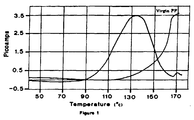
- Results are shown in Figure 1.
- the sample containing the additive shows a strong current peak centered at 136°C which does not occur with the virgin PP-sample.
- the steep rise in current at 150°C for the virgin sample is due to the beginning of film softening and degradation.
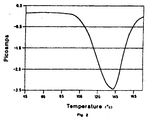
- Example 2 A sample was prepared and treated as described in Example 1 but positively charged in the corona discharge. The resulting TSC-spectrum is shown in Figure 2. A current peak was observed at 143°C, resulting in a calculated trap activation energy of 1.2 eV and an estimated room-temperature lifetime of > 6 years.
- FIG. 1 A film was processed and charged negatively as described in Example 1.
- Figure 3 shows the corresponding TSC-spectrum.
- a peak at 119°C was observed, corresponding to a calculated trap activation energy of 1.3 eV and a room-temperature lifetime > 1 year.
- Example 1 As described in Example 1, a film was prepared with 1% wt. of the triphenylmethane compound of the formula The synthesis of this compound (Solvent Blue 124, CI No. 42762) is described in German Patent 1, 919,724, respectively in U.S. Patent No. 5,061,585, example 1.
- the sample was negatively charged at 135°C.
- the resulting TSC-spectrum is shown in Figure 4.
- a peak centered at about 148°C was observed.
- Activation energy and room-temperature lifetime could not be determined, because the falling part of the peak overlapped with a signal caused by sample degradation. However, it can be estimated from the peak position that the trap activation energy is well above 1 eV and the room-temperature lifetime is in the range of several years.
- the corresponding TSC-spectrum given in Figure 5 revealed a peak at 156°C close to the polymer's failing temperature. Due to the overlap, activation energy and lifetime could not be evaluated, but the peak position is an indicator for a lifetime of at least several years.
- Example 2 As described in Example 1, a film was prepared with 1% wt. of the azochromium complex of the formula this compound has the CAS-Nr. 31714-55-3 and the synthesis is described in the literature.
- the sample was charged negatively at 135°C.
- the corresponding TSC-spectrum is depicted in Figure 6, showing a peak centered at 117°C.
- the calculated activation energy is 1.2 eV and the extrapolated room-temperature lifetime is 1 year.
- melt blown electret webs were made from polypropylene (PP) and PP + 5% of the triphenylmethane compound described in example 4. Fibers were corona charged as they exited the 6" die. Samples of these media were tested for filtration efficiency.
- Figure 7a represents the filtration efficiency of a virgin polypropylene electret web while figure 7b represents the efficiency of a web containing polypropylene with 5% of the triphenylmethane compound noted above.
- the efficiency of the triphenylmethane media was better than twice that of Virgin PP over the difficult to filter 0.1 to 0.4 ⁇ m range. Below 0.1 ⁇ m efficiencies of media are expected to be similar, due to the fact that these small particles are in large part captured by Brownian motion.
Landscapes
- Engineering & Computer Science (AREA)
- Chemical & Material Sciences (AREA)
- Chemical Kinetics & Catalysis (AREA)
- Power Engineering (AREA)
- Textile Engineering (AREA)
- General Chemical & Material Sciences (AREA)
- Manufacturing & Machinery (AREA)
- Physics & Mathematics (AREA)
- Spectroscopy & Molecular Physics (AREA)
- Microelectronics & Electronic Packaging (AREA)
- Organic Chemistry (AREA)
- Health & Medical Sciences (AREA)
- Polymers & Plastics (AREA)
- Medicinal Chemistry (AREA)
- Compositions Of Macromolecular Compounds (AREA)
- Filtering Materials (AREA)
- Manufacture Of Macromolecular Shaped Articles (AREA)
- Treatments Of Macromolecular Shaped Articles (AREA)
Description
- This invention relates to the use of additives to produce polymer electrets with improved charge stability. More particularly, this invention relates to the use of Charge Control Agents blended with polyolefins or other polymers at concentrations of 0.01-30% wt., preferably 0.1.3% wt., to significantly enhance the charge lifetime of said electrets.
- It is known that certain dielectric materials can be permanently electrostatically polarized. These materials are polarized by exciting the material by heating, applying a high-voltage electric field, and cooling the material while under the influence of the electric field. Upon the removal of the electric field, appropriate dielectric materials will be found to have become the electrical equivalent of a permanent magnet. A dielectric becomes an electret when the rate of decay of the field-induced polarization can be slowed down so much that a significant fraction of the polarization is preserved long after the polarizing field has been removed. Such electrets can be created by various methods, e.g. corona charging, triboelectric charging (friction), or any other charging technique (e.g. by liquid contact).
- It is known that air filters made of electret fibers are very effective in removing submicron aerosols. The electrostatic collection mechanism increases the efficiency of these electrostatically charged fibrous non-woven materials relative to conventional, uncharged fibers. The filters have increased ability for the mechanical capture of particles with no corresponding increase in pressure drop. The use of electets has also been investigated in the medical field, i.e., wound healing and blood compatibility, as well as in dosimetry, where charged polymer films are used to determine radioactive exposure.
- Early methods for the formation of fibrous electrets from thermoplastic films or filaments involved disposing the thread or filaments in an electrostatic field established between parallel closed spaced electrodes. (U.S. Patent No. 2,740,184.) Another method for forming electrets is disclosed in U.S. Patent No.3,571.679. This method involves a process for forming electrets by closely winding a monofilament fiber such as a polypropylene fiber on a hollow winding roller which has been previously surfaced with a polyamide faced aluminum foil. This process however is discontinuous and extremely slow in that charging times of three hours or so for the wrapped roll are required.
- Now electrets are commonly produced by a number of methods which differ in both the manufacturing/charging technology and polymer material used.
- In one method, as shown in U.S. Patent Nos. 4,308,223 and 4,375,718, a polymer film is initially passed across a corona discharge which impacts positive and negative charges on opposite sides of the film. The film is then mechanically split into small filaments which are subsequently formed into a filter mat. The electret material of US-A-4 308 223 is based on polypropylene felts having carbonate ions implanted therein which act as a charge control agent. In a second commonly used method, as disclosed in U.S. Patent No.4,215,682, a polymer melt is charged by applying a high voltage during the fiber spinning process. A third, more recent process is described by Felton et al. in U.S. Patent Nos. 4,623,438 and 4,944,834. In these patents, a charge is released between fine wires and a surface electrode. The wires are biased with an electrostatic potential of several kilovolts. The structure to be charged, be it fiber or fabric, is positioned between the electrodes. This is referred to as the "Corona" technique.
- Another method described in the literature (P.A. Smith, G.C. East; Journal of Electrostatics, 21 (1988) 81-88) is triboelectric charging. In this process, two or more polymers are brought in close contact and, due to their different dielectric properties, charge is transferred from one to the other. After taking both polymers apart they are left in a charged state. Triboelectric exchange of charge was shown to be useful as having a good effect in the construction of air filters.
- Many types of polymers have been investigated for use as air filters made of electret fibers. Suitable polymers for electrets are polyolefins, e.g. polypropylene or polyethylene, polycondensates, e.g. polyamides, polyesters, polycarbonates or polyarylates, polyacrylates, polyacetales, polyimides, celluloseesters, polystyrenes, fluoropolymers and polyphenylenesulfide. Also suitable are combinations of polymers, e.g. co-polymers and polymer blends. General material requirements and performance characteristics of suitable electret polymers are described, for example, in the book of G. Sessler: Topics in Applied Physics, Vol. 33: "Electrets", Springer Veriag, London, 1987.
- Some of the characteristics of suitable electret polymers include long-term charge stability as well as resistance to humidity and chemicals. It is known, for example, that certain kinds of fluoropolymers such as polytetrafluoroethylene (PTFE) or perfluorinated ethylene/propylene copolymer (PEEP) are excellent electrets with charge lifetimes in the range of several to tens of years. These polymers also have very good temperature stability and low moisture regain. However, these polymers are expensive, difficult to process and therefore not widely used in commercial filter fabrics.
- More economically and possessing very good electret performance are polyolefins such as polypropylene or polyethylene and polycarbonates. These polymers provide good chemical and mechanical stability to the filter fabric. However, charge lifetimes on the order of only 1 year are provided with these fabrics which is not always sufficient for use as clean room filters or car interior filters. For an electret to maintain its high efficiency, its lifetime must be in excess of the actual use-time plus the typical shelf-time, that is, the time between production and use. It is therefore highly desirable to identify better performing and use stable, but nonetheless economical materials similar to the polyolefins.
- It is known to use certain additives to improve the efficiency of electret performance. Nath and Perlman, Journal of Electrostatics, 24 (1990), 283-293, disclose the use of 10% titanium dioxide as an additive to improve the half-life temperature in polyarylate from 126°C to 180°C. However, it was found that a significant effect could only be observed when using additive concentrations of 5% or larger which would be likely to deteriorate the polymer's mechanical properties. It was also found that the additive caused an increase in humidity sensitivity which would be detrimental for commercial applications such as air filters.
- U.S. Patent No.4,789,504 to Ohmori et al. discloses an electretized material for a dust filter which is made of an insulating polymer material such as polypropylene together with a fatty acid metal salt in an amount not less than 100 ppm. The fatty acids exemplified are magnesium stearate and aluminum palmitate.
- According to the present invention, it has been discovered that Charge Control Agents, such as those used in toners for electro-photographic processes are particularly suitable to improve the charge stability of polymer electrets. These agents blended with polyolefins or other polymers in concentrations of 0.01-30% wt. significantly enhance charge lifetime. Charge Control Agents have been selected to be used as additives because these agents gain a maximum charge in a triboelectric process. It was also found that Charge Control Agents disperse homogeneously in the polymer matrix and while acting as charge traps improve homogeneity of the charge distribution.
- The present invention provides a polymer electret with improved charge stability which comprises a mixture of a polymer and a suitable Charge Control Agent or a mixture of suitable Charge Control Agents characterized in that the Charge Control agent is selected from
- a) triphenylmethanes;
- b) ammonium compounds;
- c) immonium compounds;
- d) fluorinated ammonium compounds;
- e) fluorinated immonium compounds;
- f) biscationic acid amide derivatives;
- g) polymeric ammonium compounds;
- h) diallylammonium compounds;
- i) arylsulfide compounds;
- j) phenolic compounds;
- k) phosphonium compounds;
- l) fluorine-substituted phosphonium compounds;
- m) calix(n)arene compounds;
- n) metal complex compounds;
- o) benzimidazolon compounds; or
- p) azines of the following color index numbers, C.I.
Solvent Black 5,5:1, 5:2, 7, 31, 50; C.I.Pigment Black 1, C. I.Basic Red 2 and C.I.Basic Black - a) forming a mixture of a polymer material and suitable charge control agent;
- b) homogenizing and drying said mixture;
- c) forming said mixture into a film or fiber; and
- d) subjecting said film or fiber to a corona charging treatment thereby imparting a permanent dielectric polarization to the material,
- a) triphenylmethanes;
- b) ammonium compounds;
- c) immonium compounds;
- d) fluorinated ammonium compounds;
- e) fluorinated immonium compounds;
- f) biscationic acid amide derivatives;
- g) polymeric ammonium compounds;
- h) diallylammonium compounds;
- i) arylsulfide compounds;
- j) phenolic compounds;
- k) phosphonium compounds;
- l) fluorine-substituted phosphonium compounds;
- m) calix(n)arene compounds;
- n) metal complex compounds;
- o) benzimidazolon compounds; or
- p) azines of the following color index numbers, C.I.
Solvent Black 5,5:1, 5:2, 7, 31, 50; C.I.Pigment Black 1, C. I.Basic Red 2 and C.I.Basic Black - As known from the literature, charge distribution in films or fibers is usually very inhomogeneous and unpredictable.
- There is no general understanding as to how the Charge Control Agents work. In the electrophotographic process, they are used to give the needed chargeability to toner powders and are responsible both for the polarity and magnitude of the electrostatic charge.
- The Charge Control Agents are from various chemical classes including
- a) triphenylmethanes as described in U.S. Patent No. 5,061,585;
- b) ammonium and immonium compounds, as described in U.S. Patent No. 5,015,676;
- c) intensely fluorinated ammonium and immonium compounds as described in U.S. Patent No. 5,069,994;
- d) biscationic acid amide and acid imide derivatives as described in World Patent Application 91/10172;
- e) polymeric ammonium compounds as described in German Patent Application 4,029,653;
- f) diallylammonium compounds as described in U.S. Patent Application Serial No. 07/992,043;
- g) arylsulfide compounds as described in German Patent Application 4,031,705;
- h) phenolic compounds as described in European Patent Application 025 8651, respectively compounds of the CAS-No. 41481-66-7 and 13288-70-5;
- i) phosphonium compounds as described in U.S. Patent No. 5,021,473;
- j) highly fluorine-substituted phosphonium compounds as described in U.S. Patent No. 5,147,748;
- k) calix(n)arene compounds as described in European Patent Application 0385580 A1 and European Patent Application 0516434;
- l) metal complex compounds like chronium-, cobalt-, iron-, zinc- or aluminum azocomplexes or chromium-, cobalt-, iron-, zinc- or aluminum salicyclic acid complexes as described in European Patent Application 0 162632 A2, U.S. Patent No.4,908,225, EP 393479, EP 360617; EP 291930, EP 280272, EP 255925; EP 251326: EP 180655, EP 141377, U.S. 4,939,061, U.S. 4,623,606, U.S. 4,590,141 and/or described by CAS-Numbers 31714-55-3, 104813-18-1, 84179-68-8, 110941-75-8, 33517-36-5, 38833-00-00, 95692-86-7, 85414-43-3, 136709-14-3,135534-82.6,1334-81-5, 127800-82-2, 114803-10-0 and 114803-08-6.
- m) benzimidazolon compounds as described in European Patent Application 0 347 695 A2; or
- n) azines of the following Color Index numbers, C. I.
Solvent Black 5, 5:1, 5:2, 7, 31, 50; C.I.Pigment Black 1, C. I.Basic Red 2 and C. I.Basic Black - As shown in Examples 1-7, these Charge Control Agents significantly improve the charge stability of polypropylene electrets. A similar effect was found for other polymers like polyesters or polyarylates.
- The compounds used according to the invention are as a rule incorporated homogeneously into the particular polymer in a concentration of 0.01 to 30% wt., preferably 0.1 to 5.0% wt. in a known manner, for example by extrusion or kneading. The Charge Control Agents can be added to the polymer as dried and ground powders, dispersions or solutions, press-cakes or a masterbatch, and as compounds absorbed on suitable carriers. The compounds employed according to the invention can also be added directly during preparation of the particular polymers, that is to say in the course of their polymerization, polyaddition or polycondensation.
- For the purpose of this invention, Charge Control Agents can be used either as a single component, i.e. a specific chemical compound, or a mixture of two or more Charge Control Agents.
- The following examples are given for illustrative purposes.
- Experimental data are presented in Fig. 1 - Fig. 7b.
- All temperatures are in degrees Centigrade (°C) unless otherwise designated.
- Polypropylene granules (REXENE®) were ground and blended with 1% wt. of the arylsulfide compound of the formula

- The mixture was then homogenized for 2 hours in a tumble mixer and dried in an oven for 4 hours at 140°C. The blend was poured into a twin-screw melt extruder and extruded to a 10.2 cm (4 inch) wide, 0.25 mm (10 mil) thick film. The melt temperature was 260°C and the die temperature 280°C.
- Film samples of 5.1 cm (2 inches) in diameter were cut and clamped in a circular holder. An aluminum electrode of 3.8 cm (1.5 inches) diam. and 100 nanometer thickness was evaporated on one side of the film. The sample was placed on a metal plate, heated to 135°C and exposed to a corona discharge for 3 minutes, imparting a negative charge on the uncovered side of the sample. During the charging procedure, the aluminum coated surface was connected to ground potential. After charging was completed, the sample was taken from the heating plate and allowed to cool. The resultlng surface potential, measured with an electrostatic voltmeter, was -615 Volts.
- After being stored for 14 hours at ambient conditions, the sample was inserted in the Thermally Stimulated Current (TSC)-unit and heated at a constant of 2°C/minute. During this heating procedure, the polarization current was recorded with an electrometer.
- Results are shown in Figure 1. The sample containing the additive shows a strong current peak centered at 136°C which does not occur with the virgin PP-sample. The steep rise in current at 150°C for the virgin sample is due to the beginning of film softening and degradation.
- For further evaluation of the peak at 136°C, the method described by Sessler and West (J. Electrochem. Soc.: Solid State Science, Vol. 115(8), 1968, 836-841) and Perlman (J. Electrochem. Soc.: Solid State Science and Technology, Vol. 119(7), 1972, 892-898) was used. The so calculated trap activation energy was 1.1 eV and the extrapolated room-temperature lifetime > 2 years.
- A sample was prepared and treated as described in Example 1 but positively charged in the corona discharge. The resulting TSC-spectrum is shown in Figure 2. A current peak was observed at 143°C, resulting in a calculated trap activation energy of 1.2 eV and an estimated room-temperature lifetime of > 6 years.
- Ground polypropylene was blended with 1% wt. of the polymeric ammonium compound based on the monomer of the formula

Herstellungsbeispiel 2". - A film was processed and charged negatively as described in Example 1. Figure 3 shows the corresponding TSC-spectrum. A peak at 119°C was observed, corresponding to a calculated trap activation energy of 1.3 eV and a room-temperature lifetime > 1 year.
- As described in Example 1, a film was prepared with 1% wt. of the triphenylmethane compound of the formula

German Patent 1, 919,724, respectively in U.S. Patent No. 5,061,585, example 1. - The sample was negatively charged at 135°C. The resulting TSC-spectrum is shown in Figure 4. A peak centered at about 148°C was observed. Activation energy and room-temperature lifetime could not be determined, because the falling part of the peak overlapped with a signal caused by sample degradation. However, it can be estimated from the peak position that the trap activation energy is well above 1 eV and the room-temperature lifetime is in the range of several years.
- A film sample, as described in Example 4, was charged positively at 133°C. The corresponding TSC-spectrum given in Figure 5 revealed a peak at 156°C close to the polymer's failing temperature. Due to the overlap, activation energy and lifetime could not be evaluated, but the peak position is an indicator for a lifetime of at least several years.
- As described in Example 1, a film was prepared with 1% wt. of the azochromium complex of the formula

- The sample was charged negatively at 135°C. The corresponding TSC-spectrum is depicted in Figure 6, showing a peak centered at 117°C. The calculated activation energy is 1.2 eV and the extrapolated room-temperature lifetime is 1 year.
- 33.9 g/m2 (one ounce per square yard (1 osy)) melt blown electret webs were made from polypropylene (PP) and PP + 5% of the triphenylmethane compound described in example 4. Fibers were corona charged as they exited the 6" die. Samples of these media were tested for filtration efficiency.
- Figure 7a represents the filtration efficiency of a virgin polypropylene electret web while figure 7b represents the efficiency of a web containing polypropylene with 5% of the triphenylmethane compound noted above. The efficiency of the triphenylmethane media was better than twice that of Virgin PP over the difficult to filter 0.1 to 0.4 µm range. Below 0.1 µm efficiencies of media are expected to be similar, due to the fact that these small particles are in large part captured by Brownian motion.
Claims (8)
- A polymer electret with improved charge stability which comprises a mixture of a polymer and a suitable Charge Control Agent or a mixture of suitable Charge Control Agents characterized in that the Charge Control agent is selected froma) triphenylmethanes;b) ammonium compounds;c) immonium compounds;d) fluorinated ammonium compounds;e) fluorinated immonium compounds;f) biscationic acid amide derivatives;g) polymeric ammonium compounds;h) diallylammonium compounds;i) arylsulfide compounds;j) phenolic compounds;k) phosphonium compounds;l) fluorine-substituted phosphonium compounds;m) calix(n)arene compounds;n) metal complex compounds;o) benzimidazolon compounds; orp) azines of the following color index numbers, C.I. Solvent Black 5,5:1, 5:2, 7, 31, 50; C.I. Pigment Black 1, C. I. Basic Red 2 and C.I. Basic Black 1 and 2,and in that the Charge Control Agent or mixture of Charge Control Agents is present in a concentration of between 0.01-30 % wt.
- A polymer electret as defined in claim 1 wherein the polymer is selected from polyolefins, including polypropylene or polyethylene; polycondensates, including polyamides, polyesters, polycarbonates or polyarylates; polyacrylates, polyacetales, polyimides, celluloseesters, polystyrenes, fluoropolymers, and polyphenylenefulfide, or combinations of polymers including co-polymers and polymer blends.
- A polymer electret as defined in claim 1 wherein the Charge Control Agent is

- A polymer electret as defined in claim 1 wherein the Charge Control Agent is a compound of the formula

- A polymer electret as defined in claim 1 wherein the Charge Control Agent is a compound of the formula

- A polymer electret as defined in claim 1 wherein the charge Control Agent is a chromium azocomplex of the formula

- A process for the preparation of polymer electrets with improved charge stability which comprises the steps ofa) forming mixture of a polymer material and a suitable charge control agent;b) homogenizing and drying said mixture;c) forming said mixture into a film or fiber; andd) subjecting said film or fiber to a corona charging treatment thereby imparting a permanent dielectric polarization to the material,characterized in that the Charge Control Agent is selected froma) triphenylmethanes;b) ammonium compounds;c) immonium compounds;d) fluorinated ammonium compounds;e) fluorinated immonium compounds;f) biscationic acid amide derivatives;g) polymeric ammonium compounds;h) diallylammonium compounds;i) arylsulfide compounds;j) phenolic compounds;k) phosphonium compounds;l) fluorine-substituted phosphonium compounds;m) calix(n)arene compounds;n) metal complex compounds;o) benzimidazolon compounds; orp) azines of the following color index numbers, C.I. Solvent Black 5,5:1, 5:2, 7, 31, 50; C.I. Pigment Black 1, C. I. Basic Red 2 and C.I. Basic Black 1 and 2,and in that the Charge Control Agent or mixture of Charge Control Agents is present in a concentration of between 0.01-30 % wt.
- The process as defined in claim 7 wherein the polymer material is selected from polyolefins, including polypropylene or polyethylene; polycondensates, including polyamides, polyesters, polycarbonates or polyarylates; polyacrylates, polyacetales, polyimides, celluloseesters, polystyrenes, fluoropolymers, and polyphenylenesulfide, or combinations of polymers, including co-polymers and polymer blends.
Applications Claiming Priority (2)
| Application Number | Priority Date | Filing Date | Title |
|---|---|---|---|
| US2843993A | 1993-03-09 | 1993-03-09 | |
| US28439 | 1993-03-09 |
Publications (3)
| Publication Number | Publication Date |
|---|---|
| EP0623941A2 EP0623941A2 (en) | 1994-11-09 |
| EP0623941A3 EP0623941A3 (en) | 1994-12-07 |
| EP0623941B1 true EP0623941B1 (en) | 1997-08-06 |
Family
ID=21843456
Family Applications (1)
| Application Number | Title | Priority Date | Filing Date |
|---|---|---|---|
| EP94103367A Expired - Lifetime EP0623941B1 (en) | 1993-03-09 | 1994-03-05 | Polymer electrets with improved charge stability |
Country Status (6)
| Country | Link |
|---|---|
| US (1) | US5558809A (en) |
| EP (1) | EP0623941B1 (en) |
| JP (1) | JP3199947B2 (en) |
| KR (1) | KR940021640A (en) |
| CN (1) | CN1097774A (en) |
| DE (1) | DE69404736T2 (en) |
Cited By (6)
| Publication number | Priority date | Publication date | Assignee | Title |
|---|---|---|---|---|
| US6573205B1 (en) | 1999-01-30 | 2003-06-03 | Kimberly-Clark Worldwide, Inc. | Stable electret polymeric articles |
| US6759356B1 (en) | 1998-06-30 | 2004-07-06 | Kimberly-Clark Worldwide, Inc. | Fibrous electret polymeric articles |
| US6858551B1 (en) | 1996-05-24 | 2005-02-22 | Kimberly-Clark Worldwide, Inc. | Ferroelectric fibers and applications therefor |
| US11982031B2 (en) | 2020-01-27 | 2024-05-14 | 3M Innovative Properties Company | Substituted thiol melt additives |
| US12467174B2 (en) | 2019-10-16 | 2025-11-11 | 3M Innovative Properties Company | Substituted benzimidazole melt additives |
| US12552914B2 (en) | 2020-01-27 | 2026-02-17 | 3M Innovative Properties Company | Substituted thiolate salt melt additives |
Families Citing this family (57)
| Publication number | Priority date | Publication date | Assignee | Title |
|---|---|---|---|---|
| US5645627A (en) * | 1995-02-28 | 1997-07-08 | Hollingsworth & Vose Company | Charge stabilized electret filter media |
| US5800866A (en) * | 1996-12-06 | 1998-09-01 | Kimberly-Clark Worldwide, Inc. | Method of preparing small particle dispersions |
| IL119809A (en) * | 1996-12-11 | 2001-06-14 | Nicast Ltd | Device for manufacture of composite filtering material and method of its manufacture |
| DE19732995A1 (en) * | 1997-07-31 | 1999-02-04 | Clariant Gmbh | Use of inter-polyelectrolyte complexes as charge control agents |
| US6037168A (en) * | 1997-12-31 | 2000-03-14 | Cytonix Corporation | Microbiological assembly comprising resealable closure means |
| US6432175B1 (en) | 1998-07-02 | 2002-08-13 | 3M Innovative Properties Company | Fluorinated electret |
| DE19837522A1 (en) | 1998-08-19 | 2000-02-24 | Clariant Gmbh | Use of metal carboxylates and sulfonates as charge control agents |
| US6110588A (en) | 1999-02-05 | 2000-08-29 | 3M Innovative Properties Company | Microfibers and method of making |
| US6630231B2 (en) | 1999-02-05 | 2003-10-07 | 3M Innovative Properties Company | Composite articles reinforced with highly oriented microfibers |
| US6444312B1 (en) | 1999-12-08 | 2002-09-03 | Fiber Innovation Technology, Inc. | Splittable multicomponent fibers containing a polyacrylonitrile polymer component |
| WO2001060496A1 (en) | 2000-02-15 | 2001-08-23 | Hollingsworth & Vose Company | Melt blown composite hepa filter media and vacuum bag |
| US20020084178A1 (en) * | 2000-12-19 | 2002-07-04 | Nicast Corporation Ltd. | Method and apparatus for manufacturing polymer fiber shells via electrospinning |
| US20070031607A1 (en) * | 2000-12-19 | 2007-02-08 | Alexander Dubson | Method and apparatus for coating medical implants |
| US20040030377A1 (en) * | 2001-10-19 | 2004-02-12 | Alexander Dubson | Medicated polymer-coated stent assembly |
| US7244272B2 (en) | 2000-12-19 | 2007-07-17 | Nicast Ltd. | Vascular prosthesis and method for production thereof |
| US6420024B1 (en) * | 2000-12-21 | 2002-07-16 | 3M Innovative Properties Company | Charged microfibers, microfibrillated articles and use thereof |
| JP4659232B2 (en) * | 2001-02-23 | 2011-03-30 | 日本バイリーン株式会社 | Electrified non-woven fabric |
| EP1377420B1 (en) * | 2001-03-20 | 2010-07-07 | Nicast Ltd. | Portable electrospinning device |
| US6680114B2 (en) | 2001-05-15 | 2004-01-20 | 3M Innovative Properties Company | Fibrous films and articles from microlayer substrates |
| US6514324B1 (en) | 2001-08-10 | 2003-02-04 | Rick L. Chapman | High efficiency active electrostatic air filter and method of manufacture |
| US6926961B2 (en) * | 2001-08-15 | 2005-08-09 | Invista North America S.A.R.L. | Nonwoven blend with electret fiber |
| US6805048B2 (en) | 2002-08-30 | 2004-10-19 | 3M Innovative Properties Company | Method of marking a substrate using an electret stencil |
| WO2004021379A2 (en) | 2002-08-30 | 2004-03-11 | 3M Innovative Properties Company | Method of making writable erasable articles and articles therefrom |
| US20040043248A1 (en) * | 2002-08-30 | 2004-03-04 | 3M Innovative Properties Company | Phosphorescent elecret films and methods of making the same |
| DE10251394A1 (en) * | 2002-11-05 | 2004-05-13 | Clariant Gmbh | Triamino triphenylmethane compound with low primary aromatic amine content as determined by HPLC is useful as a wide application pigment and is obtained by Friedel-Crafts alkylation with steam distillation |
| US20050000642A1 (en) * | 2003-07-03 | 2005-01-06 | 3M Innovative Properties Company | Cling articles |
| US20080200975A1 (en) * | 2004-01-06 | 2008-08-21 | Nicast Ltd. | Vascular Prosthesis with Anastomotic Member |
| US7442481B2 (en) * | 2004-04-27 | 2008-10-28 | Xsys Print Solutions Us Llc | Charge control agent |
| JP2008535534A (en) * | 2005-02-17 | 2008-09-04 | ナイキャスト リミテッド | Inflatable medical device |
| WO2007021977A1 (en) * | 2005-08-11 | 2007-02-22 | Stromberg Allen And Company | Substrate having polarized adhesive |
| US7390351B2 (en) * | 2006-02-09 | 2008-06-24 | 3M Innovative Properties Company | Electrets and compounds useful in electrets |
| JP5050408B2 (en) * | 2006-05-19 | 2012-10-17 | 住友化学株式会社 | Resin modifier and thermoplastic resin mixture containing the same. |
| US8529671B2 (en) * | 2007-12-06 | 2013-09-10 | 3M Innovative Properties Comany | Electret webs with charge-enhancing additives |
| JP5446879B2 (en) * | 2008-02-22 | 2014-03-19 | 旭硝子株式会社 | Electret and electrostatic induction type conversion element |
| EP2266792B1 (en) * | 2008-03-27 | 2016-05-04 | Asahi Glass Company, Limited | Electret and electrostatic induction conversion device |
| WO2009123022A1 (en) * | 2008-03-31 | 2009-10-08 | 旭硝子株式会社 | Acceleration sensor device and sensor network system |
| KR20110008009A (en) * | 2008-04-17 | 2011-01-25 | 아사히 가라스 가부시키가이샤 | Electret and Electrostatic Induction Converters |
| CN102159649B (en) * | 2008-09-19 | 2014-04-16 | 旭硝子株式会社 | Electret and electrostatic induction conversion element |
| TWI629386B (en) | 2010-10-25 | 2018-07-11 | 里克L 查普曼 | Filtration materials using fiber blends that contain strategically shaped fibers and/or charge control agents |
| JP2014037451A (en) * | 2012-08-10 | 2014-02-27 | Sekisui Chem Co Ltd | Electret sheet |
| ES2669768T3 (en) | 2012-12-28 | 2018-05-29 | 3M Innovative Properties Company | Electret bands with load enhancing additives |
| EP2986354B1 (en) | 2013-04-19 | 2017-06-14 | 3M Innovative Properties Company | Electret webs with charge-enhancing additives |
| PL3157650T3 (en) | 2014-06-23 | 2018-08-31 | 3M Innovative Properties Co | Electret webs with charge-enhancing additives |
| JP6463624B2 (en) * | 2014-12-08 | 2019-02-06 | 東友ファインケム株式会社Dongwoo Fine−Chem Co., Ltd. | Compound |
| JP6987739B2 (en) | 2015-07-07 | 2022-01-05 | スリーエム イノベイティブ プロパティズ カンパニー | Polymer matrix with ionic additives |
| WO2017007672A1 (en) | 2015-07-07 | 2017-01-12 | 3M Innovative Properties Company | Substituted benzotriazole phenols |
| KR102627554B1 (en) | 2015-07-07 | 2024-01-22 | 쓰리엠 이노베이티브 프로퍼티즈 캄파니 | Substituted benzotriazole phenolate salts and antioxidant compositions formed therefrom |
| EP3565653B1 (en) | 2017-01-05 | 2020-10-28 | 3M Innovative Properties Company | Electret webs with charge-enhancing additives |
| WO2021074863A1 (en) | 2019-10-16 | 2021-04-22 | 3M Innovative Properties Company | Dual-function melt additives |
| CN115038829B (en) | 2019-12-03 | 2023-07-28 | 3M创新有限公司 | Aromatic heterocyclic melt additives |
| WO2021111246A1 (en) | 2019-12-03 | 2021-06-10 | 3M Innovative Properties Company | Thiolate salt melt additives |
| CN111019233A (en) * | 2019-12-16 | 2020-04-17 | 浙江金海环境技术股份有限公司 | Electret film, preparation method, application and air purification device |
| FR3106938B1 (en) * | 2020-01-31 | 2022-08-05 | Central Res Inst Electric Power Ind | IONIC ELEMENT, METHOD OF MANUFACTURING IT, FUNCTIONAL DEVICE AND ELECTRONIC APPARATUS EACH HAVING THE IONIC ELEMENT |
| US20220170201A1 (en) | 2020-12-02 | 2022-06-02 | Fiber Innovation Technology, Inc. | Splittable chargeable fiber, split multicomponent fiber, a split multicomponent fiber with a durable charge, nonwoven fabric, filter, and yarn containing, and manufacturing processes therefor |
| CN113851329B (en) * | 2021-09-24 | 2023-06-16 | 重庆大学 | Method for improving surface charge storage stability of polyolefin film |
| CN113787797B (en) * | 2021-09-26 | 2022-04-26 | 河南大学 | Fatty acid/SEBS stretchable composite membrane with enhanced triboelectric output, and preparation method and application thereof |
| CN118450930A (en) | 2021-11-26 | 2024-08-06 | 东洋纺艾睦希株式会社 | Electret and electret filter |
Citations (4)
| Publication number | Priority date | Publication date | Assignee | Title |
|---|---|---|---|---|
| DE116835C (en) * | ||||
| DE113231C (en) * | ||||
| DE10813C (en) * | H. E. PARSON und P. GÖPEL in New-York | Apparatus for cleaning boiler tubes using steam | ||
| DE845956C (en) * | 1944-07-31 | 1952-08-07 | Hussmann Refrigerator Co | Automatic temperature control for open showcases with cooling system |
Family Cites Families (17)
| Publication number | Priority date | Publication date | Assignee | Title |
|---|---|---|---|---|
| US2740184A (en) * | 1951-03-01 | 1956-04-03 | Albert G Thomas | Electrically charged material |
| NL6814644A (en) * | 1968-10-14 | 1970-04-16 | ||
| US4215682A (en) * | 1978-02-06 | 1980-08-05 | Minnesota Mining And Manufacturing Company | Melt-blown fibrous electrets |
| US4308223A (en) * | 1980-03-24 | 1981-12-29 | Albany International Corp. | Method for producing electret fibers for enhancement of submicron aerosol filtration |
| JPS6034095B2 (en) * | 1980-03-31 | 1985-08-07 | シャープ株式会社 | liquid crystal display device |
| US4375718A (en) * | 1981-03-12 | 1983-03-08 | Surgikos, Inc. | Method of making fibrous electrets |
| JPS5978361A (en) * | 1982-10-28 | 1984-05-07 | Hodogaya Chem Co Ltd | Developing powder for electrophotography |
| US4944854A (en) * | 1983-11-08 | 1990-07-31 | Celanese Corporation | Electret process and products |
| US4623438A (en) * | 1983-11-08 | 1986-11-18 | Celanese Corporation | Electret making process using corona discharge |
| DE3509857C2 (en) * | 1984-03-19 | 1994-04-28 | Toyo Boseki | Electretized dust filter and its manufacture |
| JPS6242716A (en) * | 1985-08-14 | 1987-02-24 | Toyobo Co Ltd | Filter material for electret filter |
| DE3641525A1 (en) * | 1986-12-05 | 1988-06-16 | Hoechst Ag | BLUE COLOR FOR ELECTROPHOTOGRAPHIC RECORDING METHOD WITH POSITIVE CONTROL EFFECT |
| DE3737495A1 (en) * | 1987-11-05 | 1989-05-18 | Hoechst Ag | METHOD FOR INCREASING THE ELECTROSTATIC RECHARGEABILITY OF POWDER VARNISHES AND POWDERS AND THEIR USE FOR SURFACE COATING OF FIXED OBJECTS |
| JP2672329B2 (en) * | 1988-05-13 | 1997-11-05 | 東レ株式会社 | Electret material |
| US5187038A (en) * | 1990-09-19 | 1993-02-16 | Hoechst Aktiengesellschaft | Polymeric ammonium compounds as charge control agents |
| DE4031705A1 (en) * | 1990-10-06 | 1992-04-09 | Hoechst Ag | ARYL AND ARALKYL SULPHIDE, SULFOXIDE OR SULFON COMPOUNDS AS LOADING AGENT |
| DE4142541A1 (en) * | 1991-12-21 | 1993-06-24 | Hoechst Ag | DIALLYLAMMONIUM COMPOUNDS, METHOD FOR THE PRODUCTION THEREOF AND THEIR USE |
-
1994
- 1994-03-05 EP EP94103367A patent/EP0623941B1/en not_active Expired - Lifetime
- 1994-03-05 DE DE69404736T patent/DE69404736T2/en not_active Expired - Fee Related
- 1994-03-08 CN CN94102333A patent/CN1097774A/en active Pending
- 1994-03-09 KR KR1019940004585A patent/KR940021640A/en not_active Withdrawn
- 1994-03-09 JP JP03817394A patent/JP3199947B2/en not_active Expired - Fee Related
-
1995
- 1995-10-10 US US08/540,507 patent/US5558809A/en not_active Expired - Lifetime
Patent Citations (4)
| Publication number | Priority date | Publication date | Assignee | Title |
|---|---|---|---|---|
| DE116835C (en) * | ||||
| DE113231C (en) * | ||||
| DE10813C (en) * | H. E. PARSON und P. GÖPEL in New-York | Apparatus for cleaning boiler tubes using steam | ||
| DE845956C (en) * | 1944-07-31 | 1952-08-07 | Hussmann Refrigerator Co | Automatic temperature control for open showcases with cooling system |
Cited By (7)
| Publication number | Priority date | Publication date | Assignee | Title |
|---|---|---|---|---|
| US6858551B1 (en) | 1996-05-24 | 2005-02-22 | Kimberly-Clark Worldwide, Inc. | Ferroelectric fibers and applications therefor |
| US6759356B1 (en) | 1998-06-30 | 2004-07-06 | Kimberly-Clark Worldwide, Inc. | Fibrous electret polymeric articles |
| US6573205B1 (en) | 1999-01-30 | 2003-06-03 | Kimberly-Clark Worldwide, Inc. | Stable electret polymeric articles |
| US6893990B2 (en) | 1999-01-30 | 2005-05-17 | Kimberly Clark Worldwide, Inc. | Stable electret polymeric articles |
| US12467174B2 (en) | 2019-10-16 | 2025-11-11 | 3M Innovative Properties Company | Substituted benzimidazole melt additives |
| US11982031B2 (en) | 2020-01-27 | 2024-05-14 | 3M Innovative Properties Company | Substituted thiol melt additives |
| US12552914B2 (en) | 2020-01-27 | 2026-02-17 | 3M Innovative Properties Company | Substituted thiolate salt melt additives |
Also Published As
| Publication number | Publication date |
|---|---|
| EP0623941A3 (en) | 1994-12-07 |
| JP3199947B2 (en) | 2001-08-20 |
| DE69404736D1 (en) | 1997-09-11 |
| US5558809A (en) | 1996-09-24 |
| JPH06340769A (en) | 1994-12-13 |
| CN1097774A (en) | 1995-01-25 |
| KR940021640A (en) | 1994-10-19 |
| EP0623941A2 (en) | 1994-11-09 |
| DE69404736T2 (en) | 1998-01-08 |
Similar Documents
| Publication | Publication Date | Title |
|---|---|---|
| US5558809A (en) | Polymer electrets with improved charge stability | |
| US5401446A (en) | Method and apparatus for the electrostatic charging of a web or film | |
| US5057710A (en) | Electret materials and the method for preparing the electret materials | |
| EP0060687B1 (en) | Method of making fibrous electrets | |
| AU2013368596B2 (en) | Electret webs with charge-enhancing additives | |
| DE69119948T2 (en) | Process for producing an electret, a film electret and an electret filter | |
| AU2014254114B2 (en) | Electret webs with charge-enhancing additives | |
| AU738605B2 (en) | Electret fibers and filter webs having a low level of extractable hydrocarbons | |
| EP0902851A1 (en) | Ferroelectric fibers and applications therefor | |
| KR20170021853A (en) | Electret webs with charge-enhancing additives | |
| WO2018127831A1 (en) | Electret webs with charge-enhancing additives | |
| JPH06104952B2 (en) | Electret fiber and manufacturing method thereof | |
| KR19990068474A (en) | Electrostatic Air Filter and the Process for preparing the same | |
| DE3586482T2 (en) | ELECTRIC FIBER FILM AND METHOD FOR THE PRODUCTION THEREOF. | |
| JPH0561384B2 (en) | ||
| Huang | Characterization of factors that affect charge decay in fibrous electret | |
| WO2021111290A1 (en) | Aromatic-heterocyclic ring melt additives | |
| JPS63316421A (en) | Manufacture of electret |
Legal Events
| Date | Code | Title | Description |
|---|---|---|---|
| PUAI | Public reference made under article 153(3) epc to a published international application that has entered the european phase |
Free format text: ORIGINAL CODE: 0009012 |
|
| PUAL | Search report despatched |
Free format text: ORIGINAL CODE: 0009013 |
|
| AK | Designated contracting states |
Kind code of ref document: A2 Designated state(s): DE ES FR GB IE IT NL SE |
|
| AK | Designated contracting states |
Kind code of ref document: A3 Designated state(s): DE ES FR GB IE IT NL SE |
|
| 17P | Request for examination filed |
Effective date: 19950110 |
|
| 17Q | First examination report despatched |
Effective date: 19951103 |
|
| GRAG | Despatch of communication of intention to grant |
Free format text: ORIGINAL CODE: EPIDOS AGRA |
|
| GRAH | Despatch of communication of intention to grant a patent |
Free format text: ORIGINAL CODE: EPIDOS IGRA |
|
| GRAH | Despatch of communication of intention to grant a patent |
Free format text: ORIGINAL CODE: EPIDOS IGRA |
|
| GRAA | (expected) grant |
Free format text: ORIGINAL CODE: 0009210 |
|
| AK | Designated contracting states |
Kind code of ref document: B1 Designated state(s): DE ES FR GB IE IT NL SE |
|
| PG25 | Lapsed in a contracting state [announced via postgrant information from national office to epo] |
Ref country code: NL Free format text: LAPSE BECAUSE OF FAILURE TO SUBMIT A TRANSLATION OF THE DESCRIPTION OR TO PAY THE FEE WITHIN THE PRESCRIBED TIME-LIMIT Effective date: 19970806 Ref country code: IT Free format text: LAPSE BECAUSE OF FAILURE TO SUBMIT A TRANSLATION OF THE DESCRIPTION OR TO PAY THE FEE WITHIN THE PRESCRIBED TIME-LIMIT;WARNING: LAPSES OF ITALIAN PATENTS WITH EFFECTIVE DATE BEFORE 2007 MAY HAVE OCCURRED AT ANY TIME BEFORE 2007. THE CORRECT EFFECTIVE DATE MAY BE DIFFERENT FROM THE ONE RECORDED. Effective date: 19970806 Ref country code: FR Free format text: LAPSE BECAUSE OF FAILURE TO SUBMIT A TRANSLATION OF THE DESCRIPTION OR TO PAY THE FEE WITHIN THE PRESCRIBED TIME-LIMIT Effective date: 19970806 Ref country code: ES Free format text: THE PATENT HAS BEEN ANNULLED BY A DECISION OF A NATIONAL AUTHORITY Effective date: 19970806 |
|
| REF | Corresponds to: |
Ref document number: 69404736 Country of ref document: DE Date of ref document: 19970911 |
|
| PG25 | Lapsed in a contracting state [announced via postgrant information from national office to epo] |
Ref country code: SE Effective date: 19971106 |
|
| EN | Fr: translation not filed | ||
| NLV1 | Nl: lapsed or annulled due to failure to fulfill the requirements of art. 29p and 29m of the patents act | ||
| PG25 | Lapsed in a contracting state [announced via postgrant information from national office to epo] |
Ref country code: IE Free format text: LAPSE BECAUSE OF NON-PAYMENT OF DUE FEES Effective date: 19980305 Ref country code: GB Free format text: LAPSE BECAUSE OF NON-PAYMENT OF DUE FEES Effective date: 19980305 |
|
| PLBE | No opposition filed within time limit |
Free format text: ORIGINAL CODE: 0009261 |
|
| STAA | Information on the status of an ep patent application or granted ep patent |
Free format text: STATUS: NO OPPOSITION FILED WITHIN TIME LIMIT |
|
| 26N | No opposition filed | ||
| GBPC | Gb: european patent ceased through non-payment of renewal fee |
Effective date: 19980305 |
|
| PGFP | Annual fee paid to national office [announced via postgrant information from national office to epo] |
Ref country code: DE Payment date: 20080221 Year of fee payment: 15 |
|
| PG25 | Lapsed in a contracting state [announced via postgrant information from national office to epo] |
Ref country code: DE Free format text: LAPSE BECAUSE OF NON-PAYMENT OF DUE FEES Effective date: 20091001 |